𝐵 = 𝛼𝐴 + 𝜒𝐺
Two criterion emissions, G and A, measured as emission reductions.
Benefits, B, of emission reduction:
Emission controls, R and S, affect both:
𝐺 = 𝜋𝑆 + 𝜌𝑅, 𝜌 ≫ 𝜋
𝐴 = 𝜎𝑆 + 𝜏𝑅, 𝜎 ≫ 𝜏
Costs, C, of emission reduction:
𝐶 = 0.5𝜅𝑆2
+ 0.5𝜆𝑅2
Rework benefits:
𝐵 = 𝛼 𝜎𝑆 + 𝜏𝑅 + 𝜒 𝜋𝑆 + 𝜌𝑅 = 𝑆 𝛼𝜎 + 𝜒𝜋 + 𝑅 𝛼𝜏 + 𝜒𝜌
Benefits, B, of emission reduction:
Costs, C, of emission reduction:
𝐶 = 0.5𝜅𝑆2 + 0.5𝜆𝑅2
𝐵 = 𝛼 𝜎𝑆 + 𝜏𝑅 + 𝜒 𝜋𝑆 + 𝜌𝑅 = 𝑆 𝛼𝜎 + 𝜒𝜋 + 𝑅 𝛼𝜏 + 𝜒𝜌
Optimal control for R:
𝜕𝐵
𝜕𝑅
= 𝛼𝜏 + 𝜒𝜌 = 𝜆𝑅 =
𝜕𝐶
𝜕𝑅
⇒ 𝑅′ =
𝛼𝜏 + 𝜒𝜌
𝜆
The secondary benefit, 𝜏>0, increases the optimal rate of abatement.
𝜕𝐵
𝜕𝑆
= 𝛼𝜎 + 𝜒𝜋 = 𝜅𝑅 =
𝜕𝐶
𝜕𝑆
⇒ 𝑆′ =
𝛼𝜎 + 𝜒𝜋
𝜅
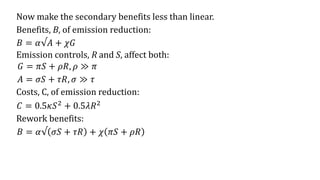
𝐵 = 𝛼√𝐴 + 𝜒𝐺
Now make the secondary benefits less than linear.
Benefits, B, of emission reduction:
Emission controls, R and S, affect both:
𝐺 = 𝜋𝑆 + 𝜌𝑅, 𝜌 ≫ 𝜋
𝐴 = 𝜎𝑆 + 𝜏𝑅, 𝜎 ≫ 𝜏
Costs, C, of emission reduction:
𝐶 = 0.5𝜅𝑆2
+ 0.5𝜆𝑅2
Rework benefits:
𝐵 = 𝛼√ 𝜎𝑆 + 𝜏𝑅 + 𝜒 𝜋𝑆 + 𝜌𝑅
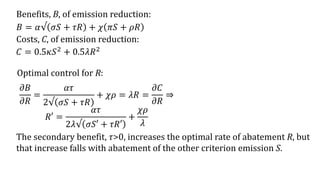
Benefits, B, of emission reduction:
Costs, C, of emission reduction:
𝐶 = 0.5𝜅𝑆2 + 0.5𝜆𝑅2
Optimal control for R:
𝜕𝐵
𝜕𝑅
=
𝛼𝜏
2√ 𝜎𝑆 + 𝜏𝑅
+ 𝜒𝜌 = 𝜆𝑅 =
𝜕𝐶
𝜕𝑅
⇒
𝑅′ =
𝛼𝜏
2𝜆√ 𝜎𝑆′ + 𝜏𝑅′
+
𝜒𝜌
𝜆
The secondary benefit, 𝜏>0, increases the optimal rate of abatement R, but
that increase falls with abatement of the other criterion emission S.
𝐵 = 𝛼√ 𝜎𝑆 + 𝜏𝑅 + 𝜒 𝜋𝑆 + 𝜌𝑅
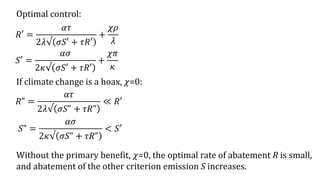
Optimal control:
𝑅′ =
𝛼𝜏
2𝜆√ 𝜎𝑆′ + 𝜏𝑅′
+
𝜒𝜌
𝜆
Without the primary benefit, 𝜒=0, the optimal rate of abatement R is small,
and abatement of the other criterion emission S increases.
𝑆′ =
𝛼𝜎
2𝜅√ 𝜎𝑆′ + 𝜏𝑅′
+
𝜒𝜋
𝜅
If climate change is a hoax, 𝜒=0:
𝑅" =
𝛼𝜏
2𝜆√ 𝜎𝑆" + 𝜏𝑅"
≪ 𝑅′
𝑆" =
𝛼𝜎
2𝜅√ 𝜎𝑆" + 𝜏𝑅"
< 𝑆′
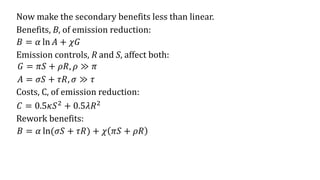
𝐵 = 𝛼 ln 𝐴 + 𝜒𝐺
Now make the secondary benefits less than linear.
Benefits, B, of emission reduction:
Emission controls, R and S, affect both:
𝐺 = 𝜋𝑆 + 𝜌𝑅, 𝜌 ≫ 𝜋
𝐴 = 𝜎𝑆 + 𝜏𝑅, 𝜎 ≫ 𝜏
Costs, C, of emission reduction:
𝐶 = 0.5𝜅𝑆2
+ 0.5𝜆𝑅2
Rework benefits:
𝐵 = 𝛼 ln(𝜎𝑆 + 𝜏𝑅) + 𝜒 𝜋𝑆 + 𝜌𝑅
Benefits, B, of emission reduction:
Costs, C, of emission reduction:
𝐶 = 0.5𝜅𝑆2 + 0.5𝜆𝑅2
Optimal control for R:
𝜕𝐵
𝜕𝑅
=
𝛼𝜏
𝜎𝑆 + 𝜏𝑅
+ 𝜒𝜌 = 𝜆𝑅 =
𝜕𝐶
𝜕𝑅
⇒ 𝛼𝜏 + 𝜎𝜒𝜌𝑆 = 𝜎𝑆𝜆 − 𝜏𝜒𝜌 𝑅 + 𝜏𝜆𝑅2
⇒ 𝑅′ =
𝜏𝜒𝜌 − 𝜎𝑆𝜆 ± (𝜎𝑆𝜆 − 𝜏𝜒𝜌)2+4𝜏𝜆(𝛼𝜏 + 𝜎𝜒𝜌𝑆)
−2(𝛼𝜏 + 𝜎𝜒𝜌𝑆)
𝐵 = 𝛼 ln 𝜎𝑆 + 𝜏𝑅 + 𝜒 𝜋𝑆 + 𝜌𝑅
Optimal control for R:
𝑅′ =
𝜏𝜒𝜌 − 𝜎𝑆𝜆 − (𝜎𝑆𝜆 − 𝜏𝜒𝜌)2+4𝜏𝜆(𝛼𝜏 + 𝜎𝜒𝜌𝑆)
−2(𝛼𝜏 + 𝜎𝜒𝜌𝑆)
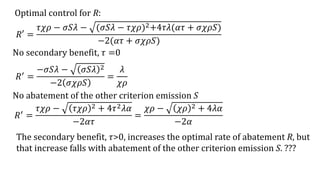
The secondary benefit, 𝜏>0, increases the optimal rate of abatement R, but
that increase falls with abatement of the other criterion emission S. ???
𝑅′ =
−𝜎𝑆𝜆 − 𝜎𝑆𝜆 2
−2 𝜎𝜒𝜌𝑆
=
𝜆
𝜒𝜌
No secondary benefit, 𝜏 =0
No abatement of the other criterion emission S
𝑅′
=
𝜏𝜒𝜌 − 𝜏𝜒𝜌 2 + 4𝜏2 𝜆𝛼
−2𝛼𝜏
=
𝜒𝜌 − 𝜒𝜌 2 + 4𝜆𝛼
−2𝛼
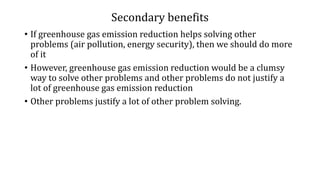
Secondary benefits
• If greenhouse gas emission reduction helps solving other
problems (air pollution, energy security), then we should do more
of it
• However, greenhouse gas emission reduction would be a clumsy
way to solve other problems and other problems do not justify a
lot of greenhouse gas emission reduction
• Other problems justify a lot of other problem solving.

Secondary benefits

  • 2.
    𝐵 = 𝛼𝐴+ 𝜒𝐺 Two criterion emissions, G and A, measured as emission reductions. Benefits, B, of emission reduction: Emission controls, R and S, affect both: 𝐺 = 𝜋𝑆 + 𝜌𝑅, 𝜌 ≫ 𝜋 𝐴 = 𝜎𝑆 + 𝜏𝑅, 𝜎 ≫ 𝜏 Costs, C, of emission reduction: 𝐶 = 0.5𝜅𝑆2 + 0.5𝜆𝑅2 Rework benefits: 𝐵 = 𝛼 𝜎𝑆 + 𝜏𝑅 + 𝜒 𝜋𝑆 + 𝜌𝑅 = 𝑆 𝛼𝜎 + 𝜒𝜋 + 𝑅 𝛼𝜏 + 𝜒𝜌
  • 3.
    Benefits, B, ofemission reduction: Costs, C, of emission reduction: 𝐶 = 0.5𝜅𝑆2 + 0.5𝜆𝑅2 𝐵 = 𝛼 𝜎𝑆 + 𝜏𝑅 + 𝜒 𝜋𝑆 + 𝜌𝑅 = 𝑆 𝛼𝜎 + 𝜒𝜋 + 𝑅 𝛼𝜏 + 𝜒𝜌 Optimal control for R: 𝜕𝐵 𝜕𝑅 = 𝛼𝜏 + 𝜒𝜌 = 𝜆𝑅 = 𝜕𝐶 𝜕𝑅 ⇒ 𝑅′ = 𝛼𝜏 + 𝜒𝜌 𝜆 The secondary benefit, 𝜏>0, increases the optimal rate of abatement. 𝜕𝐵 𝜕𝑆 = 𝛼𝜎 + 𝜒𝜋 = 𝜅𝑅 = 𝜕𝐶 𝜕𝑆 ⇒ 𝑆′ = 𝛼𝜎 + 𝜒𝜋 𝜅
  • 4.
    𝐵 = 𝛼√𝐴+ 𝜒𝐺 Now make the secondary benefits less than linear. Benefits, B, of emission reduction: Emission controls, R and S, affect both: 𝐺 = 𝜋𝑆 + 𝜌𝑅, 𝜌 ≫ 𝜋 𝐴 = 𝜎𝑆 + 𝜏𝑅, 𝜎 ≫ 𝜏 Costs, C, of emission reduction: 𝐶 = 0.5𝜅𝑆2 + 0.5𝜆𝑅2 Rework benefits: 𝐵 = 𝛼√ 𝜎𝑆 + 𝜏𝑅 + 𝜒 𝜋𝑆 + 𝜌𝑅
  • 5.
    Benefits, B, ofemission reduction: Costs, C, of emission reduction: 𝐶 = 0.5𝜅𝑆2 + 0.5𝜆𝑅2 Optimal control for R: 𝜕𝐵 𝜕𝑅 = 𝛼𝜏 2√ 𝜎𝑆 + 𝜏𝑅 + 𝜒𝜌 = 𝜆𝑅 = 𝜕𝐶 𝜕𝑅 ⇒ 𝑅′ = 𝛼𝜏 2𝜆√ 𝜎𝑆′ + 𝜏𝑅′ + 𝜒𝜌 𝜆 The secondary benefit, 𝜏>0, increases the optimal rate of abatement R, but that increase falls with abatement of the other criterion emission S. 𝐵 = 𝛼√ 𝜎𝑆 + 𝜏𝑅 + 𝜒 𝜋𝑆 + 𝜌𝑅
  • 6.
    Optimal control: 𝑅′ = 𝛼𝜏 2𝜆√𝜎𝑆′ + 𝜏𝑅′ + 𝜒𝜌 𝜆 Without the primary benefit, 𝜒=0, the optimal rate of abatement R is small, and abatement of the other criterion emission S increases. 𝑆′ = 𝛼𝜎 2𝜅√ 𝜎𝑆′ + 𝜏𝑅′ + 𝜒𝜋 𝜅 If climate change is a hoax, 𝜒=0: 𝑅" = 𝛼𝜏 2𝜆√ 𝜎𝑆" + 𝜏𝑅" ≪ 𝑅′ 𝑆" = 𝛼𝜎 2𝜅√ 𝜎𝑆" + 𝜏𝑅" < 𝑆′
  • 7.
    𝐵 = 𝛼ln 𝐴 + 𝜒𝐺 Now make the secondary benefits less than linear. Benefits, B, of emission reduction: Emission controls, R and S, affect both: 𝐺 = 𝜋𝑆 + 𝜌𝑅, 𝜌 ≫ 𝜋 𝐴 = 𝜎𝑆 + 𝜏𝑅, 𝜎 ≫ 𝜏 Costs, C, of emission reduction: 𝐶 = 0.5𝜅𝑆2 + 0.5𝜆𝑅2 Rework benefits: 𝐵 = 𝛼 ln(𝜎𝑆 + 𝜏𝑅) + 𝜒 𝜋𝑆 + 𝜌𝑅
  • 8.
    Benefits, B, ofemission reduction: Costs, C, of emission reduction: 𝐶 = 0.5𝜅𝑆2 + 0.5𝜆𝑅2 Optimal control for R: 𝜕𝐵 𝜕𝑅 = 𝛼𝜏 𝜎𝑆 + 𝜏𝑅 + 𝜒𝜌 = 𝜆𝑅 = 𝜕𝐶 𝜕𝑅 ⇒ 𝛼𝜏 + 𝜎𝜒𝜌𝑆 = 𝜎𝑆𝜆 − 𝜏𝜒𝜌 𝑅 + 𝜏𝜆𝑅2 ⇒ 𝑅′ = 𝜏𝜒𝜌 − 𝜎𝑆𝜆 ± (𝜎𝑆𝜆 − 𝜏𝜒𝜌)2+4𝜏𝜆(𝛼𝜏 + 𝜎𝜒𝜌𝑆) −2(𝛼𝜏 + 𝜎𝜒𝜌𝑆) 𝐵 = 𝛼 ln 𝜎𝑆 + 𝜏𝑅 + 𝜒 𝜋𝑆 + 𝜌𝑅
  • 9.
    Optimal control forR: 𝑅′ = 𝜏𝜒𝜌 − 𝜎𝑆𝜆 − (𝜎𝑆𝜆 − 𝜏𝜒𝜌)2+4𝜏𝜆(𝛼𝜏 + 𝜎𝜒𝜌𝑆) −2(𝛼𝜏 + 𝜎𝜒𝜌𝑆) The secondary benefit, 𝜏>0, increases the optimal rate of abatement R, but that increase falls with abatement of the other criterion emission S. ??? 𝑅′ = −𝜎𝑆𝜆 − 𝜎𝑆𝜆 2 −2 𝜎𝜒𝜌𝑆 = 𝜆 𝜒𝜌 No secondary benefit, 𝜏 =0 No abatement of the other criterion emission S 𝑅′ = 𝜏𝜒𝜌 − 𝜏𝜒𝜌 2 + 4𝜏2 𝜆𝛼 −2𝛼𝜏 = 𝜒𝜌 − 𝜒𝜌 2 + 4𝜆𝛼 −2𝛼
  • 10.
    Secondary benefits • Ifgreenhouse gas emission reduction helps solving other problems (air pollution, energy security), then we should do more of it • However, greenhouse gas emission reduction would be a clumsy way to solve other problems and other problems do not justify a lot of greenhouse gas emission reduction • Other problems justify a lot of other problem solving.