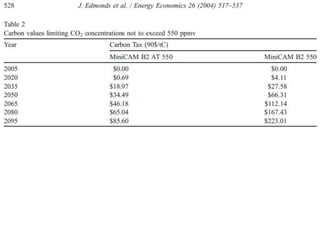
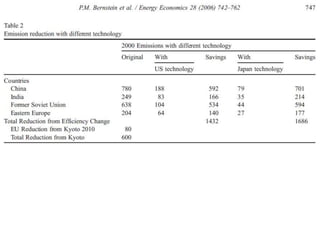
Climate change
Policy instruments
• The problem
• The solution
– What will it cost?
– How to achieve the goals?
Direct Regulation
• It is the most common form of
environmental regulation, and highly
successful in past management of point
sources of toxic materials
• Essentially, command and control
prescribes aspects of the production
process, be it inputs, production or outputs
• Requires substantial knowledge on the part
of the regulator
• Requires relatively homogenous producers
Types of Direct Regulation
• Inputs, e.g., fuel efficiency
• Technology, e.g., catalytic convertors
– Best practible means
– Best available technology (not exceeding
excessive costs)
• Outputs
– Products, e.g., carcinogenic toys
– Waste, e.g., sulphur emissions
• Timing, e.g., air traffic
• Location, e.g., nature reserves
• Prohibition, e.g., CFCs
Taxes and Subsidies
• Taxes: Pay a charge or levy or penalty for
every unit consumed, produced or emitted
• Subsidies: Receive a premium for every
unit not consumed, produced or emitted
• Uniform taxes and subsidies have a
uniform effect on marginal production
costs, thus ensuring efficiency
• Taxes and subsidies have an equivalent
effect on emissions in the short run, but
have different budgetary distributional,
and long-term effects: Taxes increases
costs, subsidies lower costs in polluting
sectors
Tradeable Permits
• The government set an overall target on
consumption, production or, most common,
emission
• Each producer obtains a certain amount of
emission permits, can sell these, or buy
more at the market place
• If the permit market is perfect, all
producers pay the same price, and marginal
costs of production increase uniformly
• Taxes and tradeable permits are equivalent
provided that the regulator knows all
marginal abatement costs
Permits: Initial Allocation
• Grandfathering
– Give permits to current polluters
– Politically easy, as confirms status quo
• Auctioning
– Sell permits to highest bidder
– Generates revenue, perhaps a lot
• To victim
– Perhaps fair, definitely complicated
– May generate large transfers
• Per capita
– Perhaps fair, relatively easy
– May generate large transfers
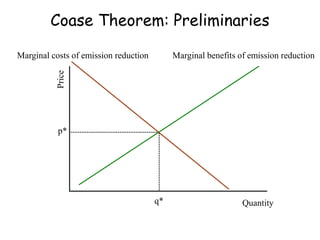
Coase Theorem: Preliminaries
Quantity
Price
p*
q*
Marginal benefits of emission reductionMarginal costs of emission reduction
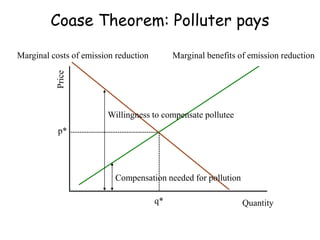
Coase Theorem: Polluter pays
Quantity
Price
p*
q*
Willingness to compensate pollutee
Compensation needed for pollution
Marginal costs of emission reduction Marginal benefits of emission reduction
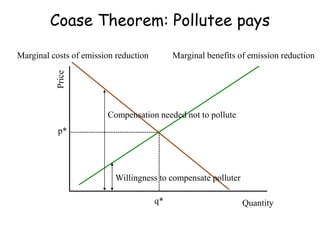
Coase Theorem: Pollutee pays
Quantity
Price
p*
q*
Compensation needed not to pollute
Willingness to compensate polluter
Marginal costs of emission reduction Marginal benefits of emission reduction
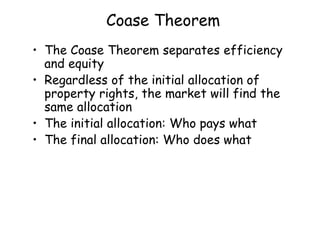
Coase Theorem
• The Coase Theorem separates efficiency
and equity
• Regardless of the initial allocation of
property rights, the market will find the
same allocation
• The initial allocation: Who pays what
• The final allocation: Who does what
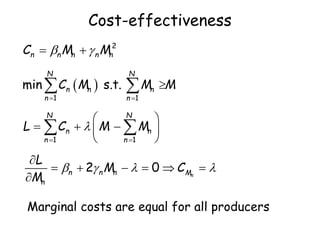
Cost-effectiveness
Marginal costs are equal for all producers
 
 
 1 1
min s.t.
N N
n n n
n n
C M M M
2
n n n n nC M M  

 
 
   
 
 1 1
N N
n n
n n
L C M M
   

     

2 0 nn n n M
n
L
M C
M
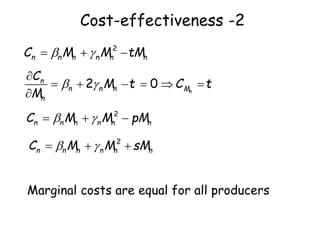
Cost-effectiveness -2
Marginal costs are equal for all producers
   2
n n n n n nC M M pM
   2
n n n n n nC M M tM
 

     

2 0 n
n
n n n M
n
C
M t C t
M
   2
n n n n n nC M M sM
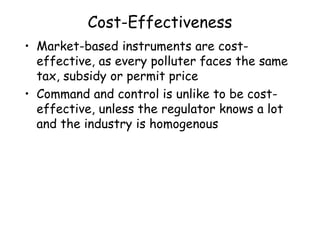
Cost-Effectiveness
• Market-based instruments are cost-
effective, as every polluter faces the same
tax, subsidy or permit price
• Command and control is unlike to be cost-
effective, unless the regulator knows a lot
and the industry is homogenous
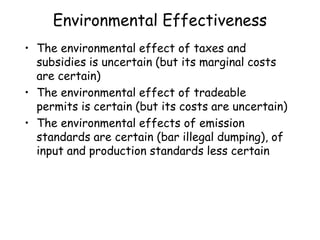
Environmental Effectiveness
• The environmental effect of taxes and
subsidies is uncertain (but its marginal costs
are certain)
• The environmental effect of tradeable
permits is certain (but its costs are uncertain)
• The environmental effects of emission
standards are certain (bar illegal dumping), of
input and production standards less certain
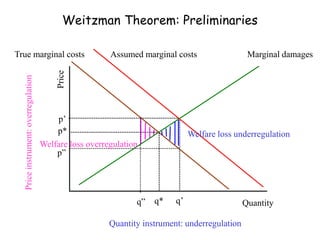
Weitzman Theorem: Preliminaries
Quantity
Price
p*
q’q*
p’
Marginal damagesAssumed marginal costsTrue marginal costs
Quantity instrument: underregulation
Priceinstrument:overregulation
Welfare loss underregulation
Welfare loss overregulation
q”
p”
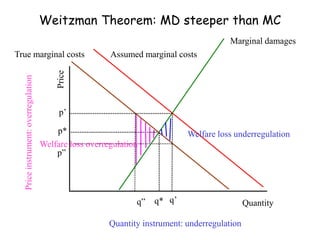
Weitzman Theorem: MD steeper than MC
Quantity
Price
p*
q’q*
p’
Marginal damages
Quantity instrument: underregulation
Priceinstrument:overregulation
Welfare loss underregulation
Welfare loss overregulation
p”
q”
True marginal costs Assumed marginal costs
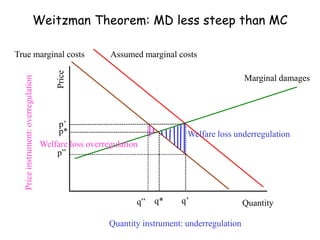
Weitzman Theorem: MD less steep than MC
Quantity
Price
p*
q’q*
p’
Marginal damages
Quantity instrument: underregulation
Priceinstrument:overregulation
Welfare loss underregulation
Welfare loss overregulation
p”
q”
True marginal costs Assumed marginal costs
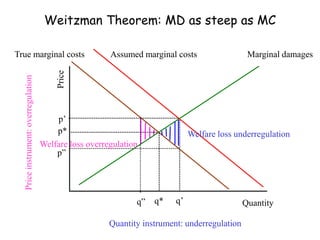
Weitzman Theorem: MD as steep as MC
Quantity
Price
p*
q’q*
p’
Quantity instrument: underregulation
Priceinstrument:overregulation
Welfare loss underregulation
Welfare loss overregulation
p”
q”
True marginal costs Assumed marginal costs Marginal damages
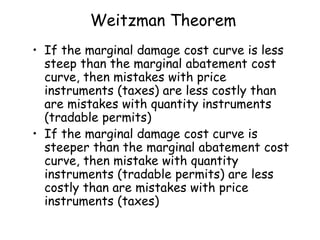
Weitzman Theorem
• If the marginal damage cost curve is less
steep than the marginal abatement cost
curve, then mistakes with price
instruments (taxes) are less costly than
are mistakes with quantity instruments
(tradable permits)
• If the marginal damage cost curve is
steeper than the marginal abatement cost
curve, then mistake with quantity
instruments (tradable permits) are less
costly than are mistakes with price
instruments (taxes)
Weitzman Theorem
• If environmental pollution is a stock
variable, pollution would not be very
sensitive to changes in emissions and the
marginal damage cost curve would be
relatively flat, that is, not vary much with
emissions
• In this case (e.g., climate change,
biodiversity loss), taxes are preferred
over tradable permits
International Emissions Trade
• Kyoto Protocol / Marrakech Accords
– Emissions trade in the OECD
– Joint Implementation (project based) between
OECD and Countries in Transition
– Clean Development Mechanism (project based)
between OECD and Less Developed Countries
• Within the EU, there is the Emissions
Trading Scheme/System, and the one for
aviation
• Two permit markets in the USA
• Australia and South Korea to follow soon
• Note that a single market creates a single
price – 9 markets means 9 prices
Can permit markets be coupled?
• Long distance trade is older than the
nation state
• Permits are not goods, however, but
government licenses
• International permit trade thus requires an
government act of mutual recognition
• Heterogeneity in permits (monitoring,
enforcement, definition) can be
accomodated, e.g., through a rating system
• Permit markets do not fall under WTO, so
trade can be regulated at will
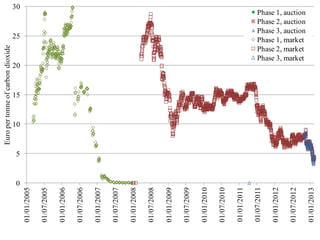
EU Emissions Trading Scheme
• Covers part of carbon dioxide
– Extension to aviation suspended
– Extension to Australia cancelled
• Mid-stream trade
• Grandparenting of permits – capital subsidy
of billions of euros
– Gradual transition to auctioning (40% in 2013),
to be completed by 2020
• Banking (after 2012) but not borrowing
• Full banking and borrowing 2008-12
• Fines for excess emissions
0
5
10
15
20
25
30
01/01/2005
01/07/2005
01/01/2006
01/07/2006
01/01/2007
01/07/2007
01/01/2008
01/07/2008
01/01/2009
01/07/2009
01/01/2010
01/07/2010
01/01/2011
01/07/2011
01/01/2012
01/07/2012
01/01/2013
Europertonneofcarbondioxide
Phase 1, auction
Phase 2, auction
Phase 3, auction
Phase 1, market
Phase 2, market
Phase 3, market
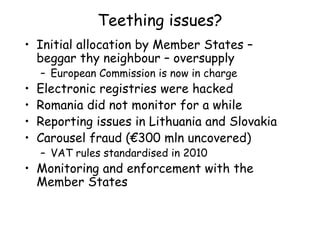
Teething issues?
• Initial allocation by Member States –
beggar thy neighbour – oversupply
– European Commission is now in charge
• Electronic registries were hacked
• Romania did not monitor for a while
• Reporting issues in Lithuania and Slovakia
• Carousel fraud (€300 mln uncovered)
– VAT rules standardised in 2010
• Monitoring and enforcement with the
Member States
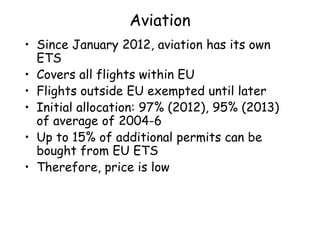
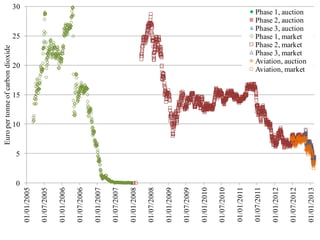
Aviation
• Since January 2012, aviation has its own
ETS
• Covers all flights within EU
• Flights outside EU exempted until later
• Initial allocation: 97% (2012), 95% (2013)
of average of 2004-6
• Up to 15% of additional permits can be
bought from EU ETS
• Therefore, price is low
0
5
10
15
20
25
30
01/01/2005
01/07/2005
01/01/2006
01/07/2006
01/01/2007
01/07/2007
01/01/2008
01/07/2008
01/01/2009
01/07/2009
01/01/2010
01/07/2010
01/01/2011
01/07/2011
01/01/2012
01/07/2012
01/01/2013
Europertonneofcarbondioxide
Phase 1, auction
Phase 2, auction
Phase 3, auction
Phase 1, market
Phase 2, market
Phase 3, market
Aviation, auction
Aviation, market
Aviation – design issues
• Extra-Union flights exempted because of
undue advantage to hubs on EU borders
• Principal-agent problems
– Flight routes
– Taxying, take-off, landing
• Grandparenting of emission permits means
an untoward advantage for incumbent
airlines
– Hub-and-spoke
– Airport congestion
– Age of aircraft
– Occupation of aircraft
Clean Development Mechanism
• CDM allows rich countries to invest in
emission reduction in poor countries
• Poor countries do not have emission
targets, so the trade is in Certified
Emission Reduction credits (CERs)
• CERs are project-based, difference
between emissions as they are and as they
would be without project
• There is therefore a hefty bureaucracy,
which excludes smaller projects and poorer
countries, and drives a price wedge
between ETS and CER
Clean Development Mechanism -2
• Projects can meet all criteria without
reducing emissions
• Closing a factory (without reducing overall
supply) would earn CERs
• The carbon value of HFC23 far exceeds its
market value. It is profitable to build an
HFC23 plant, plan to turn it on, sell the
carbon credits instead, break it down
again, and rebuild under a different name
in a different location
• Now forbidden
Technological progress
• If technological progress can be
accelerated and directed towards carbon-
neutral energy, costs of emission reduction
would fall substantially
Technological progress
• If technological progress can be
accelerated and directed towards carbon-
neutral energy, costs of emission reduction
would fall substantially
• Just redirecting technology may be very
expensive, as climate policy would come at
the expense of economic growth, medical
care and so on
• How can this be done?
Externalities and risks
• Knowledge can be copied – it spills between
companies and countries
• That implies that the innovator will not
reap the full benefits, which means that
there is underinvestment in research and
development
• R&D is a risky investment
– Knowledge production is uncertain
– Future market is uncertain
– More underinvestment
• Policies that accelerate R&D thus increase
welfare
Three types
• Invention
– Something new
• Innovation
– Bring the invention to the market
• Diffusion
– From niche application to mass market
• The climate problem can be solved by
innovation and diffusion, but invention
would help
Technology instruments
• Patents
– Temporary monopoly
• R&D subsidies
– Inputs not output
– Picking winners
• Government procurement
• Conditional procurement
– Guaranteed purchase
• Conditional monopoly
• Prize
• Predictable price signals
– Taxes better than tradable permits

Instruments for emission reduction

  • 1.
    Climate change Policy instruments •The problem • The solution – What will it cost? – How to achieve the goals?
  • 2.
    Direct Regulation • Itis the most common form of environmental regulation, and highly successful in past management of point sources of toxic materials • Essentially, command and control prescribes aspects of the production process, be it inputs, production or outputs • Requires substantial knowledge on the part of the regulator • Requires relatively homogenous producers
  • 3.
    Types of DirectRegulation • Inputs, e.g., fuel efficiency • Technology, e.g., catalytic convertors – Best practible means – Best available technology (not exceeding excessive costs) • Outputs – Products, e.g., carcinogenic toys – Waste, e.g., sulphur emissions • Timing, e.g., air traffic • Location, e.g., nature reserves • Prohibition, e.g., CFCs
  • 4.
    Taxes and Subsidies •Taxes: Pay a charge or levy or penalty for every unit consumed, produced or emitted • Subsidies: Receive a premium for every unit not consumed, produced or emitted • Uniform taxes and subsidies have a uniform effect on marginal production costs, thus ensuring efficiency • Taxes and subsidies have an equivalent effect on emissions in the short run, but have different budgetary distributional, and long-term effects: Taxes increases costs, subsidies lower costs in polluting sectors
  • 5.
    Tradeable Permits • Thegovernment set an overall target on consumption, production or, most common, emission • Each producer obtains a certain amount of emission permits, can sell these, or buy more at the market place • If the permit market is perfect, all producers pay the same price, and marginal costs of production increase uniformly • Taxes and tradeable permits are equivalent provided that the regulator knows all marginal abatement costs
  • 6.
    Permits: Initial Allocation •Grandfathering – Give permits to current polluters – Politically easy, as confirms status quo • Auctioning – Sell permits to highest bidder – Generates revenue, perhaps a lot • To victim – Perhaps fair, definitely complicated – May generate large transfers • Per capita – Perhaps fair, relatively easy – May generate large transfers
  • 7.
    Coase Theorem: Preliminaries Quantity Price p* q* Marginalbenefits of emission reductionMarginal costs of emission reduction
  • 8.
    Coase Theorem: Polluterpays Quantity Price p* q* Willingness to compensate pollutee Compensation needed for pollution Marginal costs of emission reduction Marginal benefits of emission reduction
  • 9.
    Coase Theorem: Polluteepays Quantity Price p* q* Compensation needed not to pollute Willingness to compensate polluter Marginal costs of emission reduction Marginal benefits of emission reduction
  • 10.
    Coase Theorem • TheCoase Theorem separates efficiency and equity • Regardless of the initial allocation of property rights, the market will find the same allocation • The initial allocation: Who pays what • The final allocation: Who does what
  • 11.
    Cost-effectiveness Marginal costs areequal for all producers      1 1 min s.t. N N n n n n n C M M M 2 n n n n nC M M               1 1 N N n n n n L C M M             2 0 nn n n M n L M C M
  • 12.
    Cost-effectiveness -2 Marginal costsare equal for all producers    2 n n n n n nC M M pM    2 n n n n n nC M M tM           2 0 n n n n n M n C M t C t M    2 n n n n n nC M M sM
  • 13.
    Cost-Effectiveness • Market-based instrumentsare cost- effective, as every polluter faces the same tax, subsidy or permit price • Command and control is unlike to be cost- effective, unless the regulator knows a lot and the industry is homogenous
  • 14.
    Environmental Effectiveness • Theenvironmental effect of taxes and subsidies is uncertain (but its marginal costs are certain) • The environmental effect of tradeable permits is certain (but its costs are uncertain) • The environmental effects of emission standards are certain (bar illegal dumping), of input and production standards less certain
  • 15.
    Weitzman Theorem: Preliminaries Quantity Price p* q’q* p’ MarginaldamagesAssumed marginal costsTrue marginal costs Quantity instrument: underregulation Priceinstrument:overregulation Welfare loss underregulation Welfare loss overregulation q” p”
  • 16.
    Weitzman Theorem: MDsteeper than MC Quantity Price p* q’q* p’ Marginal damages Quantity instrument: underregulation Priceinstrument:overregulation Welfare loss underregulation Welfare loss overregulation p” q” True marginal costs Assumed marginal costs
  • 17.
    Weitzman Theorem: MDless steep than MC Quantity Price p* q’q* p’ Marginal damages Quantity instrument: underregulation Priceinstrument:overregulation Welfare loss underregulation Welfare loss overregulation p” q” True marginal costs Assumed marginal costs
  • 18.
    Weitzman Theorem: MDas steep as MC Quantity Price p* q’q* p’ Quantity instrument: underregulation Priceinstrument:overregulation Welfare loss underregulation Welfare loss overregulation p” q” True marginal costs Assumed marginal costs Marginal damages
  • 19.
    Weitzman Theorem • Ifthe marginal damage cost curve is less steep than the marginal abatement cost curve, then mistakes with price instruments (taxes) are less costly than are mistakes with quantity instruments (tradable permits) • If the marginal damage cost curve is steeper than the marginal abatement cost curve, then mistake with quantity instruments (tradable permits) are less costly than are mistakes with price instruments (taxes)
  • 20.
    Weitzman Theorem • Ifenvironmental pollution is a stock variable, pollution would not be very sensitive to changes in emissions and the marginal damage cost curve would be relatively flat, that is, not vary much with emissions • In this case (e.g., climate change, biodiversity loss), taxes are preferred over tradable permits
  • 21.
    International Emissions Trade •Kyoto Protocol / Marrakech Accords – Emissions trade in the OECD – Joint Implementation (project based) between OECD and Countries in Transition – Clean Development Mechanism (project based) between OECD and Less Developed Countries • Within the EU, there is the Emissions Trading Scheme/System, and the one for aviation • Two permit markets in the USA • Australia and South Korea to follow soon • Note that a single market creates a single price – 9 markets means 9 prices
  • 22.
    Can permit marketsbe coupled? • Long distance trade is older than the nation state • Permits are not goods, however, but government licenses • International permit trade thus requires an government act of mutual recognition • Heterogeneity in permits (monitoring, enforcement, definition) can be accomodated, e.g., through a rating system • Permit markets do not fall under WTO, so trade can be regulated at will
  • 23.
    EU Emissions TradingScheme • Covers part of carbon dioxide – Extension to aviation suspended – Extension to Australia cancelled • Mid-stream trade • Grandparenting of permits – capital subsidy of billions of euros – Gradual transition to auctioning (40% in 2013), to be completed by 2020 • Banking (after 2012) but not borrowing • Full banking and borrowing 2008-12 • Fines for excess emissions
  • 24.
  • 25.
    Teething issues? • Initialallocation by Member States – beggar thy neighbour – oversupply – European Commission is now in charge • Electronic registries were hacked • Romania did not monitor for a while • Reporting issues in Lithuania and Slovakia • Carousel fraud (€300 mln uncovered) – VAT rules standardised in 2010 • Monitoring and enforcement with the Member States
  • 26.
    Aviation • Since January2012, aviation has its own ETS • Covers all flights within EU • Flights outside EU exempted until later • Initial allocation: 97% (2012), 95% (2013) of average of 2004-6 • Up to 15% of additional permits can be bought from EU ETS • Therefore, price is low
  • 27.
  • 28.
    Aviation – designissues • Extra-Union flights exempted because of undue advantage to hubs on EU borders • Principal-agent problems – Flight routes – Taxying, take-off, landing • Grandparenting of emission permits means an untoward advantage for incumbent airlines – Hub-and-spoke – Airport congestion – Age of aircraft – Occupation of aircraft
  • 29.
    Clean Development Mechanism •CDM allows rich countries to invest in emission reduction in poor countries • Poor countries do not have emission targets, so the trade is in Certified Emission Reduction credits (CERs) • CERs are project-based, difference between emissions as they are and as they would be without project • There is therefore a hefty bureaucracy, which excludes smaller projects and poorer countries, and drives a price wedge between ETS and CER
  • 30.
    Clean Development Mechanism-2 • Projects can meet all criteria without reducing emissions • Closing a factory (without reducing overall supply) would earn CERs • The carbon value of HFC23 far exceeds its market value. It is profitable to build an HFC23 plant, plan to turn it on, sell the carbon credits instead, break it down again, and rebuild under a different name in a different location • Now forbidden
  • 31.
    Technological progress • Iftechnological progress can be accelerated and directed towards carbon- neutral energy, costs of emission reduction would fall substantially
  • 34.
    Technological progress • Iftechnological progress can be accelerated and directed towards carbon- neutral energy, costs of emission reduction would fall substantially • Just redirecting technology may be very expensive, as climate policy would come at the expense of economic growth, medical care and so on • How can this be done?
  • 35.
    Externalities and risks •Knowledge can be copied – it spills between companies and countries • That implies that the innovator will not reap the full benefits, which means that there is underinvestment in research and development • R&D is a risky investment – Knowledge production is uncertain – Future market is uncertain – More underinvestment • Policies that accelerate R&D thus increase welfare
  • 36.
    Three types • Invention –Something new • Innovation – Bring the invention to the market • Diffusion – From niche application to mass market • The climate problem can be solved by innovation and diffusion, but invention would help
  • 37.
    Technology instruments • Patents –Temporary monopoly • R&D subsidies – Inputs not output – Picking winners • Government procurement • Conditional procurement – Guaranteed purchase • Conditional monopoly • Prize • Predictable price signals – Taxes better than tradable permits