HS 232
Lecture 722nd
January 2025
Climate mitigation as environmental externality
2.
Recap
• Marginal costand Revenue curve
• Positive and Negative externalities
• Shifts in MC and MR curves
• Market Failure
• Public good
3.
What is climatemitigation?
• Climate mitigation refers to actions aimed at reducing greenhouse gas
(GHG) emissions or enhancing carbon sinks to curb the impacts of
climate change.
• Examples include transitioning to renewable energy, adopting energy-
efficient technologies, afforestation, and promoting sustainable
agricultural practices.
• However climate mitigation is a public good and it also leads to market
failure due to externalities
4.
Characteristics of aPublic Good
• Non-excludability:
• Once mitigation actions (like reducing greenhouse gas emissions) are
implemented, no individual or country can be excluded from enjoying the
benefits. For instance, a reduction in global warming benefits everyone,
regardless of whether they contributed to the mitigation effort.
• Non-rivalry:
• One person's or country's enjoyment of the benefits of mitigation does not
diminish the benefits available to others. For example, a cooler and more
stable climate can be enjoyed by all simultaneously without depletion.
5.
Positive Externalities inClimate Mitigation
• Global Benefits of Emission Reductions:
• A country or organization that invests in reducing emissions benefits the entire world by slowing climate change.
However, these global benefits—such as reduced temperature increases, less extreme weather, and fewer
ecosystem disruptions—are not limited to the entity bearing the cost of mitigation.
• For instance, if India invests in solar energy, it reduces global GHG levels, benefiting not just its citizens but also
people in other countries.
• Health Benefits:
• Actions like reducing fossil fuel use lower air pollution, leading to fewer respiratory and cardiovascular diseases.
While the country implementing these measures enjoys these health benefits directly, neighboring regions might
also benefit from cleaner air without contributing to the costs.
• Economic Opportunities:
• Investments in clean energy and green technologies often lead to innovation, job creation, and lower energy costs
over time. These innovations may spill over to other regions or countries, boosting global progress without direct
compensation for the innovating entity.
• Preservation of Ecosystems:
• Mitigation efforts, such as protecting forests, contribute to biodiversity conservation. Healthy ecosystems provide
services like pollination, water purification, and climate regulation, benefiting communities globally
6.
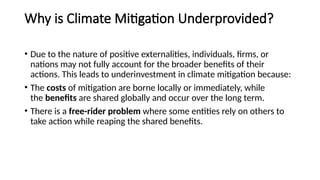
Why is ClimateMitigation Underprovided?
• Due to the nature of positive externalities, individuals, firms, or
nations may not fully account for the broader benefits of their
actions. This leads to underinvestment in climate mitigation because:
• The costs of mitigation are borne locally or immediately, while
the benefits are shared globally and occur over the long term.
• There is a free-rider problem where some entities rely on others to
take action while reaping the shared benefits.
7.
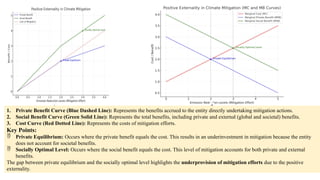
1. Private BenefitCurve (Blue Dashed Line): Represents the benefits accrued to the entity directly undertaking mitigation actions.
2. Social Benefit Curve (Green Solid Line): Represents the total benefits, including private and external (global and societal) benefits.
3. Cost Curve (Red Dotted Line): Represents the costs of mitigation efforts.
Key Points:
Private Equilibrium: Occurs where the private benefit equals the cost. This results in an underinvestment in mitigation because the entity
does not account for societal benefits.
Socially Optimal Level: Occurs where the social benefit equals the cost. This level of mitigation accounts for both private and external
benefits.
The gap between private equilibrium and the socially optimal level highlights the underprovision of mitigation efforts due to the positive
externality.
8.
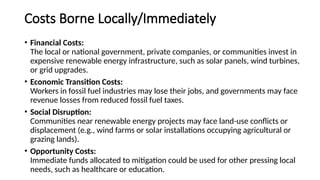
Costs Borne Locally/Immediately
•Financial Costs:
The local or national government, private companies, or communities invest in
expensive renewable energy infrastructure, such as solar panels, wind turbines,
or grid upgrades.
• Economic Transition Costs:
Workers in fossil fuel industries may lose their jobs, and governments may face
revenue losses from reduced fossil fuel taxes.
• Social Disruption:
Communities near renewable energy projects may face land-use conflicts or
displacement (e.g., wind farms or solar installations occupying agricultural or
grazing lands).
• Opportunity Costs:
Immediate funds allocated to mitigation could be used for other pressing local
needs, such as healthcare or education.
9.
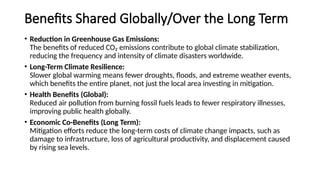
Benefits Shared Globally/Overthe Long Term
• Reduction in Greenhouse Gas Emissions:
The benefits of reduced CO₂ emissions contribute to global climate stabilization,
reducing the frequency and intensity of climate disasters worldwide.
• Long-Term Climate Resilience:
Slower global warming means fewer droughts, floods, and extreme weather events,
which benefits the entire planet, not just the local area investing in mitigation.
• Health Benefits (Global):
Reduced air pollution from burning fossil fuels leads to fewer respiratory illnesses,
improving public health globally.
• Economic Co-Benefits (Long Term):
Mitigation efforts reduce the long-term costs of climate change impacts, such as
damage to infrastructure, loss of agricultural productivity, and displacement caused
by rising sea levels.
10.
Example: India's SolarEnergy Initiative
• Costs: India has invested billions in solar parks under the National
Solar Mission, borne primarily by the government and local industries.
These costs include land acquisition, capital investment, and
retraining workers from fossil fuel sectors.
• Benefits: The reduction in global emissions benefits all nations by
slowing climate change. However, these benefits are global and long-
term, whereas India bears the immediate financial and social costs of
transitioning to renewable energy.
• This imbalance between local costs and global benefits makes
mitigation a classic example of a global public good and market failure
11.
Free-Rider Behavior:
• Somecountries, particularly smaller or less developed ones, might choose
not to invest in mitigation efforts. Instead, they rely on larger economies
(like the U.S., EU, or China) to reduce global emissions, assuming their
efforts will stabilize the climate for all.
• For example, if Country A invests heavily in renewable energy while Country
B does nothing, both countries benefit equally from reduced climate risks.
Outcome:
• The shared benefit of climate mitigation (a more stable global climate)
encourages some countries to "free-ride" on the efforts of others.
• If too many countries adopt this strategy, global emissions remain high, and
climate goals (like limiting global warming to 1.5°C) are not achieved.
12.
Implication : Marketfailure in case of Mitigation
• Market failure refers to a situation defined by an inefficient distribution of goods
and services in the free market.
• In the case of climate mitigation, market failure arises because the costs and
benefits of reducing greenhouse gas (GHG) emissions are not adequately
reflected in market transactions.
• Incomplete information leads to suboptimal decisions, such as continued reliance
on carbon-intensive activities instead of shifting to sustainable practices.
13.
Policy Interventions toCorrect Market Failure
Direct methods
• Subsidies for Clean Energy: Provide financial incentives for renewable
energy and energy efficiency projects to encourage mitigation
investments.
• International Agreements: Foster global cooperation through
agreements like the Paris Accord to ensure coordinated action
(climate finance).
• Public Awareness Campaigns: Educate people about climate change
and the importance of mitigation to increase demand for mitigation
Internalizing the externality refers to adjusting market mechanisms so that the social costs or benefits of an
economic activity are reflected in its price.
14.
Subsidy
• Subsidies aimto make clean energy more affordable, increase its
competitiveness compared to traditional energy sources like fossil fuels, and
promote the transition to a sustainable energy system.
Example :
• The Indian government offers various subsidies and incentives for solar energy,
such as capital subsidies for individuals or companies installing solar panels.
Under the National Solar Mission, the government provides subsidies that
reduce the upfront cost of purchasing and installing solar power systems,
making it more accessible for consumers, especially in rural areas.
• Increased Adoption: By reducing the cost of renewable energy technologies,
subsidies help more people and businesses transition to cleaner energy.
15.
Indirect methods
Carbon Tax
•A carbon tax directly imposes a fixed cost on every ton of CO₂ emitted.
• It raises the price of fossil fuels, making carbon-intensive activities more
expensive.
• How It Works:
• Firms and individuals are incentivized to reduce emissions by switching to cleaner
energy sources, improving energy efficiency, or adopting greener technologies.
• Example:
• Sweden’s Carbon Tax:
• Sweden implemented a carbon tax in 1991, starting at $23/ton CO₂ and now exceeding
$130/ton.
• The tax significantly reduced emissions while the economy grew, as businesses and
consumers shifted toward renewable energy and energy-efficient practices.
16.
Cap-and-Trade System
• Acap-and-trade system sets a limit (cap) on total emissions and allows firms to
trade emission permits in a market.
• Firms that reduce emissions below their cap can sell unused permits to others.
• How It Works:
• By creating a market price for carbon, firms are incentivized to cut emissions in cost-
effective ways.
• Example:
• European Union Emissions Trading System (EU ETS):
• The EU ETS caps emissions from power plants, industrial facilities, and airlines.
• Firms buy or sell allowances, encouraging innovation in clean technologies.
• The system has contributed to a steady decline in emissions across the EU.