


















































1
2
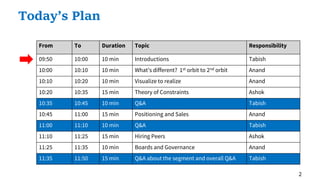
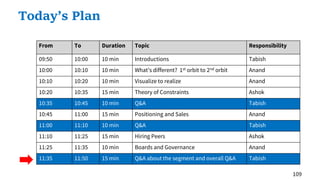
Today’s Plan
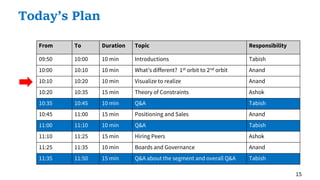
From To Duration Topic Responsibility
09:50 10:00 10 min Introductions Tabish
10:00 10:10 10 min What’s different? 1st orbit to 2nd orbit Anand
10:10 10:20 10 min Visualize to realize Anand
10:20 10:35 15 min Theory of Constraints Ashok
10:35 10:45 10 min Q&A Tabish
10:45 11:00 15 min Positioning and Sales Anand
11:00 11:10 10 min Q&A Tabish
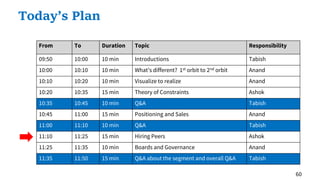
11:10 11:25 15 min Hiring Peers Ashok
11:25 11:35 10 min Boards and Governance Anand
11:35 11:50 15 min Q&A about the segment and overall Q&A Tabish
A Workshop for CEOs
to help them Launch their
Business to the Second Orbit
Anand Deshpande and Ashok Korwar
3
4
This workshop has
evolved since it was
first developed
in 2009 for the
NASSCOM EMERGE
Forum
5
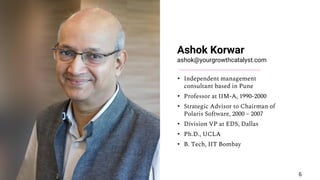
Ashok Korwar
ashok@yourgrowthcatalyst.com
• Independent management
consultant based in Pune
• Professor at IIM-A, 1990-2000
• Strategic Advisor to Chairman of
Polaris Software, 2000 – 2007
• Division VP at EDS, Dallas
• Ph.D., UCLA
• B. Tech, IIT Bombay
6
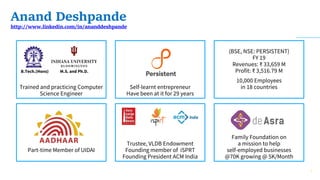
Anand Deshpande
http://www.linkedin.com/in/ananddeshpande
(BSE, NSE: PERSISTENT)
FY 19
Revenues: ₹ 33,659 M
Profit: ₹ 3,516.79 M
10,000 Employees
in 18 countries
Family Foundation on
a mission to help
self-employed businesses
@70K growing @ 5K/Month
Trained and practicing Computer
Science Engineer
B.Tech.(Hons) M.S. and Ph.D.
Part-time Member of UIDAI
Self-learnt entrepreneur
Have been at it for 29 years
Trustee, VLDB Endowment
Founding member of iSPRT
Founding President ACM India
7
Believe in nothing, no matter where you
read it, or who said it, no matter if
I said it, unless it agrees with your own
reason and your own common sense.
- Gautam Buddha
DISCLAIMER
8
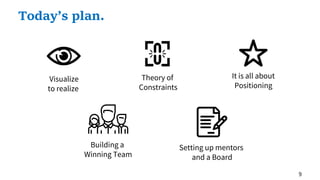
Theory of
Constraints
Visualize
to realize
It is all about
Positioning
Setting up mentors
and a Board
Building a
Winning Team
9
Today’s plan.
10
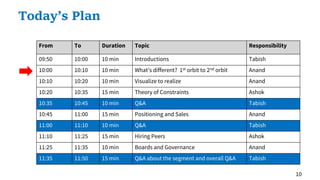
Today’s Plan
From To Duration Topic Responsibility
09:50 10:00 10 min Introductions Tabish
10:00 10:10 10 min What’s different? 1st orbit to 2nd orbit Anand
10:10 10:20 10 min Visualize to realize Anand
10:20 10:35 15 min Theory of Constraints Ashok
10:35 10:45 10 min Q&A Tabish
10:45 11:00 15 min Positioning and Sales Anand
11:00 11:10 10 min Q&A Tabish
11:10 11:25 15 min Hiring Peers Ashok
11:25 11:35 10 min Boards and Governance Anand
11:35 11:50 15 min Q&A about the segment and overall Q&A Tabish
₹
time
Growth in Companies is not Linear
11
₹
time
Growth in Companies is not Linear
What works in one
orbit does not work
in the next one!
12
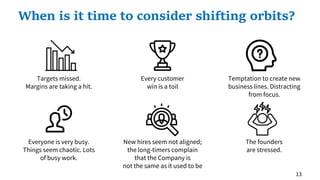
Targets missed.
Margins are taking a hit.
Every customer
win is a toil
Temptation to create new
business lines. Distracting
from focus.
Everyone is very busy.
Things seem chaotic. Lots
of busy work.
New hires seem not aligned;
the long-timers complain
that the Company is
not the same as it used to be
The founders
are stressed.
When is it time to consider shifting orbits?
13
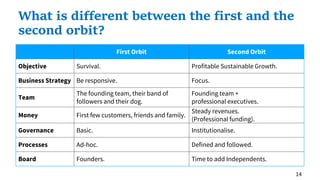
First Orbit Second Orbit
Objective Survival. Profitable Sustainable Growth.
Business Strategy Be responsive. Focus.
Team
The founding team, their band of
followers and their dog.
Founding team +
professional executives.
Money First few customers, friends and family.
Steady revenues.
(Professional funding).
Governance Basic. Institutionalise.
Processes Ad-hoc. Defined and followed.
Board Founders. Time to add Independents.
14
What is different between the first and the
second orbit?
15
Today’s Plan
From To Duration Topic Responsibility
09:50 10:00 10 min Introductions Tabish
10:00 10:10 10 min What’s different? 1st orbit to 2nd orbit Anand
10:10 10:20 10 min Visualize to realize Anand
10:20 10:35 15 min Theory of Constraints Ashok
10:35 10:45 10 min Q&A Tabish
10:45 11:00 15 min Positioning and Sales Anand
11:00 11:10 10 min Q&A Tabish
11:10 11:25 15 min Hiring Peers Ashok
11:25 11:35 10 min Boards and Governance Anand
11:35 11:50 15 min Q&A about the segment and overall Q&A Tabish
16
What do you want your
business to look like?
Visualize to realize
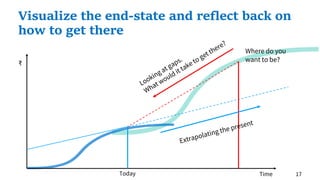
Visualize the end-state and reflect back on
how to get there
₹
TimeToday
Where do you
want to be?
17
18
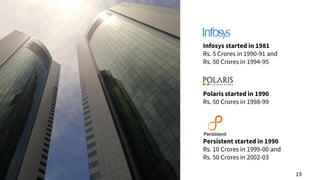
What will your business at
5X
your current size look like?
Infosys started in 1981
Rs. 5 Crores in 1990-91 and
Rs. 50 Crores in 1994-95
Polaris started in 1990
Rs. 50 Crores in 1998-99
Persistent started in 1990
Rs. 10 Crores in 1999-00 and
Rs. 50 Crores in 2002-03
19
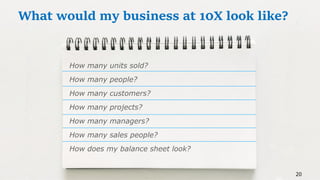
How many units sold?
How many people?
How many customers?
How many projects?
How many managers?
How many sales people?
How does my balance sheet look?
20
What would my business at 10X look like?
21
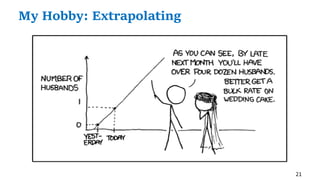
My Hobby: Extrapolating
22
Today’s Plan
From To Duration Topic Responsibility
09:50 10:00 10 min Introductions Tabish
10:00 10:10 10 min What’s different? 1st orbit to 2nd orbit Anand
10:10 10:20 10 min Visualize to realize Anand
10:20 10:35 15 min Theory of Constraints Ashok
10:35 10:45 10 min Q&A Tabish
10:45 11:00 15 min Positioning and Sales Anand
11:00 11:10 10 min Q&A Tabish
11:10 11:25 15 min Hiring Peers Ashok
11:25 11:35 10 min Boards and Governance Anand
11:35 11:50 15 min Q&A about the segment and overall Q&A Tabish
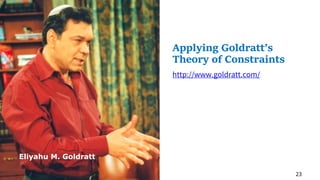
Eliyahu M. Goldratt
23
http://www.goldratt.com/
Applying Goldratt’s
Theory of Constraints
What determines your
speed on the road?
24
24
25
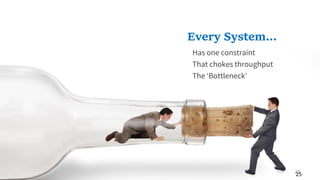
Has one constraint
That chokes throughput
The ‘Bottleneck’
Every System...
25
What determines the
strength of a chain?
26
26
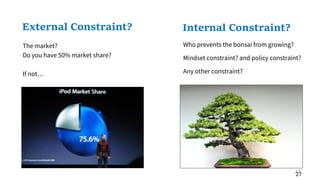
Who prevents the bonsai from growing?
Mindset constraint? and policy constraint?
Any other constraint?
Internal Constraint?
The market?
Do you have 50% market share?
If not…
External Constraint?
27
27
28
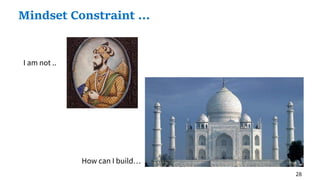
Mindset Constraint …
I am not ..
How can I build…
29
Mental blinders
we put on ourselves...
But also the most common
dominant constraint...
Policy Constraint ...
30
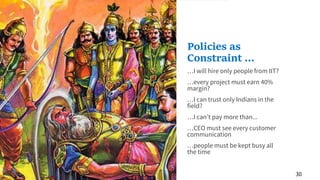
…I will hire only people from IIT?
…every project must earn 40%
margin?
…I can trust only Indians in the
field?
…I can’t pay more than...
…CEO must see every customer
communication
…people must be kept busy all
the time
Policies as
Constraint ...
31
31
Any other
constraints …
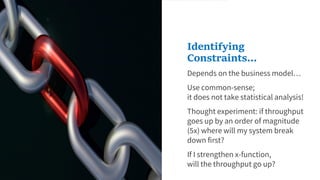
Depends on the business model…
Use common-sense;
it does not take statistical analysis!
Thought experiment: if throughput
goes up by an order of magnitude
(5x) where will my system break
down first?
If I strengthen x-function,
will the throughput go up?
Identifying
Constraints...
Ok, so I found the constraint...
How does it help…?
33
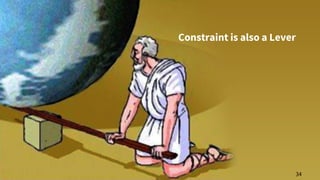
Constraint is also a Lever
34
Eliyahu M. Goldratt
35
1. Identify the constraint
2. Squeeze the most out of the
constraint
3. Subordinate everything else to
the constraint
4. Elevate the capability of the
constraint
5. Go back to step 1!!
Goldratt’s 5 step
process
36
What should the
CEO focus on?
Management
Bandwidth is
very often the
constraint.
37
38
The ONE constraint for my business is:
Q&A
39
40
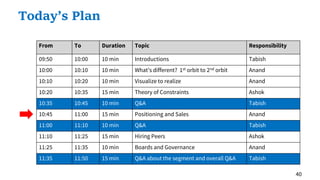
Today’s Plan
From To Duration Topic Responsibility
09:50 10:00 10 min Introductions Tabish
10:00 10:10 10 min What’s different? 1st orbit to 2nd orbit Anand
10:10 10:20 10 min Visualize to realize Anand
10:20 10:35 15 min Theory of Constraints Ashok
10:35 10:45 10 min Q&A Tabish
10:45 11:00 15 min Positioning and Sales Anand
11:00 11:10 10 min Q&A Tabish
11:10 11:25 15 min Hiring Peers Ashok
11:25 11:35 10 min Boards and Governance Anand
11:35 11:50 15 min Q&A about the segment and overall Q&A Tabish
41
How does
someone know
that you can meet
their needs?
What makes you
unique?
42
Positioning helps
establish trust.
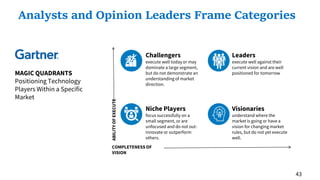
Niche Players
focus successfully on a
small segment, or are
unfocused and do not out-
innovate or outperform
others.
ABILITYOFEXECUTE
COMPLETENESS OF
VISION
Challengers
execute well today or may
dominate a large segment,
but do not demonstrate an
understanding of market
direction.
Visionaries
understand where the
market is going or have a
vision for changing market
rules, but do not yet execute
well.
Leaders
execute well against their
current vision and are well
positioned for tomorrowMAGIC QUADRANTS
Positioning Technology
Players Within a Specific
Market
43
Analysts and Opinion Leaders Frame Categories
44
• The top 3-4 leaders
dominate the market (> 20%
market share each)
• Leaders get an unfair
advantage.
• The rest get pushed on
margins.
Position to be a
leader
• Leadership is about defining the market where you can claim
leadership.
• You are a Rs. 10 Crore business … how do you define the
market where you can claim to be the leader?
45
What does leadership mean
when you run a small business?
Chattrapati Shivaji Maharaj
defined the Battlefield …to his advantage
46
47
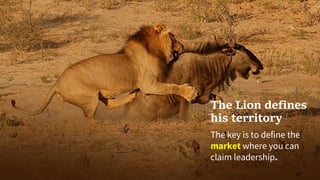
The key is to define the
market where you can
claim leadership.
The Lion defines
his territory
48
If you are building a Ten
Crore business, you must
define your Fifty Crore
market.
The Lion defines
his territory
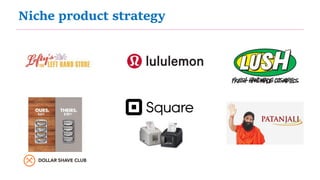
Competing in a market dominated by the big
boys
Niche product strategy
51
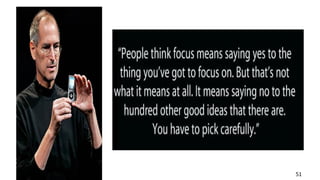
The one who chases two rabbits catches none!
52
• Consider customers for life…
• Subscription model
• Kanye West’s new album!
53
What is value? How does it evolve?
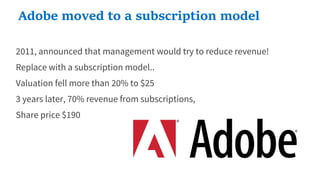
2011, announced that management would try to reduce revenue!
Replace with a subscription model..
Valuation fell more than 20% to $25
3 years later, 70% revenue from subscriptions,
Share price $190
Adobe moved to a subscription model
55
Can you disrupt by moving to a
subscription model..
Hyundai – Ioniq, for $275 a month..
Porsche, Cadillac, Volvo introducing
similar models – can swap vehicles
several times a year..
Need cars for only 2 months a year? Etc..
now 60% revenue is subscription
‘how much earth do you want moved’..
Drones do survey, hundreds of
simulations to create project plan for you
sensors to detect insects, spray
automatically ... handle surge
demand in restaurants..
56
It helps to
catch a wave…
57
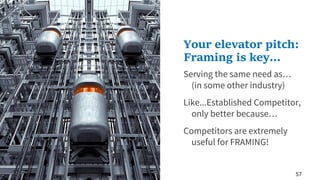
Serving the same need as…
(in some other industry)
Like...Established Competitor,
only better because…
Competitors are extremely
useful for FRAMING!
Your elevator pitch:
Framing is key...
58
58
What is your market?
What is your positioning in the market?
Q&A
59
60
Today’s Plan
From To Duration Topic Responsibility
09:50 10:00 10 min Introductions Tabish
10:00 10:10 10 min What’s different? 1st orbit to 2nd orbit Anand
10:10 10:20 10 min Visualize to realize Anand
10:20 10:35 15 min Theory of Constraints Ashok
10:35 10:45 10 min Q&A Tabish
10:45 11:00 15 min Positioning and Sales Anand
11:00 11:10 10 min Q&A Tabish
11:10 11:25 15 min Hiring Peers Ashok
11:25 11:35 10 min Boards and Governance Anand
11:35 11:50 15 min Q&A about the segment and overall Q&A Tabish
61
Building your team
62
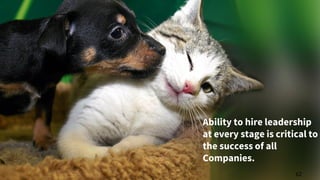
Ability to hire leadership
at every stage is critical to
the success of all
Companies.
63
Can you hire an equal,
not a subordinate?
64
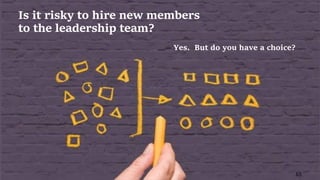
Is it risky to hire new members
to the leadership team?
65
Is it risky to hire new members
to the leadership team?
Yes. But do you have a choice?
66
Every orbit is different and needs
fresh
Mindset
Capabilities
Leadership team
67
The team decides
where to go!
Get the right
people in the
team.
68
My Company … or … Our Company
69
Why should someone
join you?
70
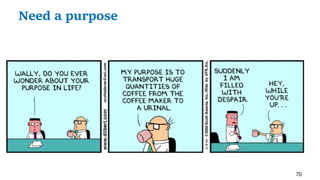
Need a purpose
People join a mission
71
72
You must use
your passion to
attract talent!
73
Growing a
business
can be thrilling!
74
Wealth in the
future
Avoid culture
clash when
you hire new
leaders
75
Don’t miss opportunities
to reinforce it.
Your Company’s
culture is the
most powerful
tool for finding
and keeping
great employees
What do you
really need?
You need a small and a
hungry team that wants to
go for it!
77
How you think is
more important
than what
you know.
Pick teammates
for what they
will do, not for
what they have
already done.
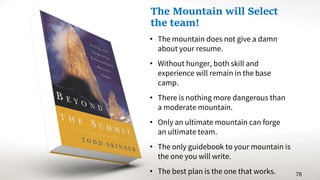
• The mountain does not give a damn
about your resume.
• Without hunger, both skill and
experience will remain in the base
camp.
• There is nothing more dangerous than
a moderate mountain.
• Only an ultimate mountain can forge
an ultimate team.
• The only guidebook to your mountain is
the one you will write.
• The best plan is the one that works. 78
The Mountain will Select
the team!
79
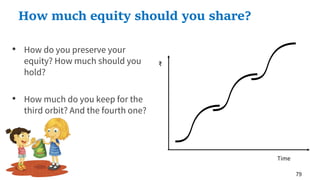
How much equity should you share?
• How do you preserve your
equity? How much should you
hold?
• How much do you keep for the
third orbit? And the fourth one?
₹
time
₹
Time
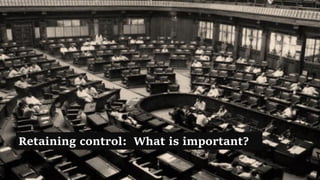
Retaining control: What is important?
80
81
Getting the
Organization
Structure right is
very important but
rather difficult.
What can you
do to ensure
that you can
scale?
83
Difficult Decision:
When is it a good
time to step down
as CEO?
Should you hire a
CEO?
84
• How do you know if it was
wrong?
• Are you acting too soon?
• Are you waiting too long?
What if the hiring
decision was wrong?
85
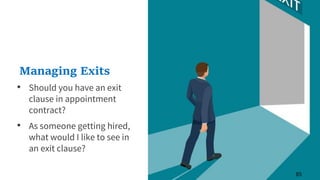
• Should you have an exit
clause in appointment
contract?
• As someone getting hired,
what would I like to see in
an exit clause?
Managing Exits
86
How do you deal with
someone who is loyal but is
not able to scale?
Unfortunately,
Engagement
Intensity varies and
may not sustain
across orbits
Board Members
and Mentors as
referees?
87
Hire two people
at the same
time?
What happens if they
fight with each other?
88
89
Why should someone join our team?
90
Why are they hesitating?
Q&A
91
92
Today’s Plan
From To Duration Topic Responsibility
09:50 10:00 10 min Introductions Tabish
10:00 10:10 10 min What’s different? 1st orbit to 2nd orbit Anand
10:10 10:20 10 min Visualize to realize Anand
10:20 10:35 15 min Theory of Constraints Ashok
10:35 10:45 10 min Q&A Tabish
10:45 11:00 15 min Positioning and Sales Anand
11:00 11:10 10 min Q&A Tabish
11:10 11:25 15 min Hiring Peers Ashok
11:25 11:35 10 min Boards and Governance Anand
11:35 11:50 15 min Q&A about the segment and overall Q&A Tabish
93
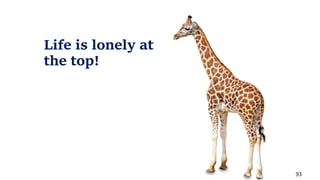
Life is lonely at
the top!
94
Establish a network of
mentors you trust.
Where are the mentors?
Showing 3,810,472 resultsmentor
startup mentor
Business coach
Showing 584,074 results
Showing 2,883,998 results
Showing 5,986,834 resultscoach
Numbers when searched on April 13, 2020
95
96
Mentors. How to manage them?
Eklavya - Dronacharya Regular Pooja
For Special Mission For the Dharmayuddha
Leverage Your
Board.
Independent Directors:
your mentors and critics! 97
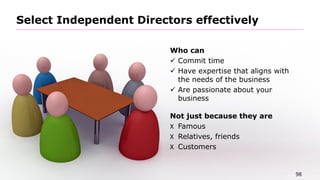
Select Independent Directors effectively
Who can
✓ Commit time
✓ Have expertise that aligns with
the needs of the business
✓ Are passionate about your
business
Not just because they are
X Famous
X Relatives, friends
X Customers
98
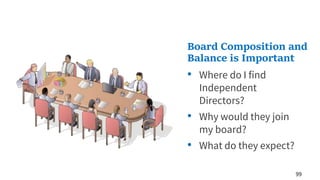
99
• Where do I find
Independent
Directors?
• Why would they join
my board?
• What do they expect?
Board Composition and
Balance is Important
• Meet. At least once a quarter.
• Plan. At least 2 quarters ahead.
Look at what was planned (at least
2 quarters ahead) and what was
achieved.
• Engage. Share your hardest
questions with the Board – they are
your sounding board.
• Data-Driven. Discuss data.
• Introductions. Get their help with
their network.
100
Your Board is your
sounding board
101
Publish quarterly
results within
four weeks every
quarter.
Share them with
the Board and
internally.
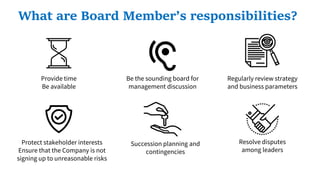
Provide time
Be available
Be the sounding board for
management discussion
Regularly review strategy
and business parameters
Protect stakeholder interests
Ensure that the Company is not
signing up to unreasonable risks
Succession planning and
contingencies
Resolve disputes
among leaders
What are Board Member’s responsibilities?
103
Board Members must
avoid the temptation
of running the
business.
That is the CEO’s job.
104
Ensure that you
have the right
Capital Structure
to scale.
105
Make your contribution to
society.
Commit to Corporate
Social Responsibility
106
Setting up my Board of Directors and my
Advisors
Failure defeats losers,
failure inspires winners.
- Robert T. Kiyosaki,
Author, entrepreneur, investor
107
Q&A
108
109
Today’s Plan
From To Duration Topic Responsibility
09:50 10:00 10 min Introductions Tabish
10:00 10:10 10 min What’s different? 1st orbit to 2nd orbit Anand
10:10 10:20 10 min Visualize to realize Anand
10:20 10:35 15 min Theory of Constraints Ashok
10:35 10:45 10 min Q&A Tabish
10:45 11:00 15 min Positioning and Sales Anand
11:00 11:10 10 min Q&A Tabish
11:10 11:25 15 min Hiring Peers Ashok
11:25 11:35 10 min Boards and Governance Anand
11:35 11:50 15 min Q&A about the segment and overall Q&A Tabish
Ashok Korwar
ashok@yourgrowthcatalyst.com
Anand Deshpande
anand@persistent.com
Visit our blog
https://wordpress.com/view/secondorbit
.blog
110
THE END
111
Recommended
Reading
112
115
119

Second Orbit - Action COACH Business Redefined Summit

  • 1.
  • 2.
    2 Today’s Plan From ToDuration Topic Responsibility 09:50 10:00 10 min Introductions Tabish 10:00 10:10 10 min What’s different? 1st orbit to 2nd orbit Anand 10:10 10:20 10 min Visualize to realize Anand 10:20 10:35 15 min Theory of Constraints Ashok 10:35 10:45 10 min Q&A Tabish 10:45 11:00 15 min Positioning and Sales Anand 11:00 11:10 10 min Q&A Tabish 11:10 11:25 15 min Hiring Peers Ashok 11:25 11:35 10 min Boards and Governance Anand 11:35 11:50 15 min Q&A about the segment and overall Q&A Tabish
  • 3.
    A Workshop forCEOs to help them Launch their Business to the Second Orbit Anand Deshpande and Ashok Korwar 3
  • 4.
  • 5.
    This workshop has evolvedsince it was first developed in 2009 for the NASSCOM EMERGE Forum 5
  • 6.
    Ashok Korwar ashok@yourgrowthcatalyst.com • Independentmanagement consultant based in Pune • Professor at IIM-A, 1990-2000 • Strategic Advisor to Chairman of Polaris Software, 2000 – 2007 • Division VP at EDS, Dallas • Ph.D., UCLA • B. Tech, IIT Bombay 6
  • 7.
    Anand Deshpande http://www.linkedin.com/in/ananddeshpande (BSE, NSE:PERSISTENT) FY 19 Revenues: ₹ 33,659 M Profit: ₹ 3,516.79 M 10,000 Employees in 18 countries Family Foundation on a mission to help self-employed businesses @70K growing @ 5K/Month Trained and practicing Computer Science Engineer B.Tech.(Hons) M.S. and Ph.D. Part-time Member of UIDAI Self-learnt entrepreneur Have been at it for 29 years Trustee, VLDB Endowment Founding member of iSPRT Founding President ACM India 7
  • 8.
    Believe in nothing,no matter where you read it, or who said it, no matter if I said it, unless it agrees with your own reason and your own common sense. - Gautam Buddha DISCLAIMER 8
  • 9.
    Theory of Constraints Visualize to realize Itis all about Positioning Setting up mentors and a Board Building a Winning Team 9 Today’s plan.
  • 10.
    10 Today’s Plan From ToDuration Topic Responsibility 09:50 10:00 10 min Introductions Tabish 10:00 10:10 10 min What’s different? 1st orbit to 2nd orbit Anand 10:10 10:20 10 min Visualize to realize Anand 10:20 10:35 15 min Theory of Constraints Ashok 10:35 10:45 10 min Q&A Tabish 10:45 11:00 15 min Positioning and Sales Anand 11:00 11:10 10 min Q&A Tabish 11:10 11:25 15 min Hiring Peers Ashok 11:25 11:35 10 min Boards and Governance Anand 11:35 11:50 15 min Q&A about the segment and overall Q&A Tabish
  • 11.
  • 12.
    ₹ time Growth in Companiesis not Linear What works in one orbit does not work in the next one! 12
  • 13.
    Targets missed. Margins aretaking a hit. Every customer win is a toil Temptation to create new business lines. Distracting from focus. Everyone is very busy. Things seem chaotic. Lots of busy work. New hires seem not aligned; the long-timers complain that the Company is not the same as it used to be The founders are stressed. When is it time to consider shifting orbits? 13
  • 14.
    First Orbit SecondOrbit Objective Survival. Profitable Sustainable Growth. Business Strategy Be responsive. Focus. Team The founding team, their band of followers and their dog. Founding team + professional executives. Money First few customers, friends and family. Steady revenues. (Professional funding). Governance Basic. Institutionalise. Processes Ad-hoc. Defined and followed. Board Founders. Time to add Independents. 14 What is different between the first and the second orbit?
  • 15.
    15 Today’s Plan From ToDuration Topic Responsibility 09:50 10:00 10 min Introductions Tabish 10:00 10:10 10 min What’s different? 1st orbit to 2nd orbit Anand 10:10 10:20 10 min Visualize to realize Anand 10:20 10:35 15 min Theory of Constraints Ashok 10:35 10:45 10 min Q&A Tabish 10:45 11:00 15 min Positioning and Sales Anand 11:00 11:10 10 min Q&A Tabish 11:10 11:25 15 min Hiring Peers Ashok 11:25 11:35 10 min Boards and Governance Anand 11:35 11:50 15 min Q&A about the segment and overall Q&A Tabish
  • 16.
    16 What do youwant your business to look like? Visualize to realize
  • 17.
    Visualize the end-stateand reflect back on how to get there ₹ TimeToday Where do you want to be? 17
  • 18.
    18 What will yourbusiness at 5X your current size look like?
  • 19.
    Infosys started in1981 Rs. 5 Crores in 1990-91 and Rs. 50 Crores in 1994-95 Polaris started in 1990 Rs. 50 Crores in 1998-99 Persistent started in 1990 Rs. 10 Crores in 1999-00 and Rs. 50 Crores in 2002-03 19
  • 20.
    How many unitssold? How many people? How many customers? How many projects? How many managers? How many sales people? How does my balance sheet look? 20 What would my business at 10X look like?
  • 21.
  • 22.
    22 Today’s Plan From ToDuration Topic Responsibility 09:50 10:00 10 min Introductions Tabish 10:00 10:10 10 min What’s different? 1st orbit to 2nd orbit Anand 10:10 10:20 10 min Visualize to realize Anand 10:20 10:35 15 min Theory of Constraints Ashok 10:35 10:45 10 min Q&A Tabish 10:45 11:00 15 min Positioning and Sales Anand 11:00 11:10 10 min Q&A Tabish 11:10 11:25 15 min Hiring Peers Ashok 11:25 11:35 10 min Boards and Governance Anand 11:35 11:50 15 min Q&A about the segment and overall Q&A Tabish
  • 23.
  • 24.
    What determines your speedon the road? 24 24
  • 25.
    25 Has one constraint Thatchokes throughput The ‘Bottleneck’ Every System... 25
  • 26.
  • 27.
    Who prevents thebonsai from growing? Mindset constraint? and policy constraint? Any other constraint? Internal Constraint? The market? Do you have 50% market share? If not… External Constraint? 27 27
  • 28.
    28 Mindset Constraint … Iam not .. How can I build…
  • 29.
    29 Mental blinders we puton ourselves... But also the most common dominant constraint... Policy Constraint ...
  • 30.
    30 …I will hireonly people from IIT? …every project must earn 40% margin? …I can trust only Indians in the field? …I can’t pay more than... …CEO must see every customer communication …people must be kept busy all the time Policies as Constraint ...
  • 31.
  • 32.
    Depends on thebusiness model… Use common-sense; it does not take statistical analysis! Thought experiment: if throughput goes up by an order of magnitude (5x) where will my system break down first? If I strengthen x-function, will the throughput go up? Identifying Constraints...
  • 33.
    Ok, so Ifound the constraint... How does it help…? 33
  • 34.
  • 35.
    Eliyahu M. Goldratt 35 1.Identify the constraint 2. Squeeze the most out of the constraint 3. Subordinate everything else to the constraint 4. Elevate the capability of the constraint 5. Go back to step 1!! Goldratt’s 5 step process
  • 36.
  • 37.
  • 38.
    38 The ONE constraintfor my business is:
  • 39.
  • 40.
    40 Today’s Plan From ToDuration Topic Responsibility 09:50 10:00 10 min Introductions Tabish 10:00 10:10 10 min What’s different? 1st orbit to 2nd orbit Anand 10:10 10:20 10 min Visualize to realize Anand 10:20 10:35 15 min Theory of Constraints Ashok 10:35 10:45 10 min Q&A Tabish 10:45 11:00 15 min Positioning and Sales Anand 11:00 11:10 10 min Q&A Tabish 11:10 11:25 15 min Hiring Peers Ashok 11:25 11:35 10 min Boards and Governance Anand 11:35 11:50 15 min Q&A about the segment and overall Q&A Tabish
  • 41.
    41 How does someone know thatyou can meet their needs? What makes you unique?
  • 42.
  • 43.
    Niche Players focus successfullyon a small segment, or are unfocused and do not out- innovate or outperform others. ABILITYOFEXECUTE COMPLETENESS OF VISION Challengers execute well today or may dominate a large segment, but do not demonstrate an understanding of market direction. Visionaries understand where the market is going or have a vision for changing market rules, but do not yet execute well. Leaders execute well against their current vision and are well positioned for tomorrowMAGIC QUADRANTS Positioning Technology Players Within a Specific Market 43 Analysts and Opinion Leaders Frame Categories
  • 44.
    44 • The top3-4 leaders dominate the market (> 20% market share each) • Leaders get an unfair advantage. • The rest get pushed on margins. Position to be a leader
  • 45.
    • Leadership isabout defining the market where you can claim leadership. • You are a Rs. 10 Crore business … how do you define the market where you can claim to be the leader? 45 What does leadership mean when you run a small business?
  • 46.
    Chattrapati Shivaji Maharaj definedthe Battlefield …to his advantage 46
  • 47.
    47 The key isto define the market where you can claim leadership. The Lion defines his territory
  • 48.
    48 If you arebuilding a Ten Crore business, you must define your Fifty Crore market. The Lion defines his territory
  • 49.
    Competing in amarket dominated by the big boys
  • 50.
  • 51.
  • 52.
    The one whochases two rabbits catches none! 52
  • 53.
    • Consider customersfor life… • Subscription model • Kanye West’s new album! 53 What is value? How does it evolve?
  • 54.
    2011, announced thatmanagement would try to reduce revenue! Replace with a subscription model.. Valuation fell more than 20% to $25 3 years later, 70% revenue from subscriptions, Share price $190 Adobe moved to a subscription model
  • 55.
    55 Can you disruptby moving to a subscription model.. Hyundai – Ioniq, for $275 a month.. Porsche, Cadillac, Volvo introducing similar models – can swap vehicles several times a year.. Need cars for only 2 months a year? Etc.. now 60% revenue is subscription ‘how much earth do you want moved’.. Drones do survey, hundreds of simulations to create project plan for you sensors to detect insects, spray automatically ... handle surge demand in restaurants..
  • 56.
  • 57.
    57 Serving the sameneed as… (in some other industry) Like...Established Competitor, only better because… Competitors are extremely useful for FRAMING! Your elevator pitch: Framing is key...
  • 58.
    58 58 What is yourmarket? What is your positioning in the market?
  • 59.
  • 60.
    60 Today’s Plan From ToDuration Topic Responsibility 09:50 10:00 10 min Introductions Tabish 10:00 10:10 10 min What’s different? 1st orbit to 2nd orbit Anand 10:10 10:20 10 min Visualize to realize Anand 10:20 10:35 15 min Theory of Constraints Ashok 10:35 10:45 10 min Q&A Tabish 10:45 11:00 15 min Positioning and Sales Anand 11:00 11:10 10 min Q&A Tabish 11:10 11:25 15 min Hiring Peers Ashok 11:25 11:35 10 min Boards and Governance Anand 11:35 11:50 15 min Q&A about the segment and overall Q&A Tabish
  • 61.
  • 62.
    62 Ability to hireleadership at every stage is critical to the success of all Companies.
  • 63.
    63 Can you hirean equal, not a subordinate?
  • 64.
    64 Is it riskyto hire new members to the leadership team?
  • 65.
    65 Is it riskyto hire new members to the leadership team? Yes. But do you have a choice?
  • 66.
    66 Every orbit isdifferent and needs fresh Mindset Capabilities Leadership team
  • 67.
    67 The team decides whereto go! Get the right people in the team.
  • 68.
    68 My Company …or … Our Company
  • 69.
  • 70.
  • 71.
    People join amission 71
  • 72.
    72 You must use yourpassion to attract talent!
  • 73.
  • 74.
  • 75.
    Avoid culture clash when youhire new leaders 75 Don’t miss opportunities to reinforce it. Your Company’s culture is the most powerful tool for finding and keeping great employees
  • 76.
    What do you reallyneed? You need a small and a hungry team that wants to go for it!
  • 77.
    77 How you thinkis more important than what you know. Pick teammates for what they will do, not for what they have already done.
  • 78.
    • The mountaindoes not give a damn about your resume. • Without hunger, both skill and experience will remain in the base camp. • There is nothing more dangerous than a moderate mountain. • Only an ultimate mountain can forge an ultimate team. • The only guidebook to your mountain is the one you will write. • The best plan is the one that works. 78 The Mountain will Select the team!
  • 79.
    79 How much equityshould you share? • How do you preserve your equity? How much should you hold? • How much do you keep for the third orbit? And the fourth one? ₹ time ₹ Time
  • 80.
    Retaining control: Whatis important? 80
  • 81.
    81 Getting the Organization Structure rightis very important but rather difficult.
  • 82.
    What can you doto ensure that you can scale?
  • 83.
    83 Difficult Decision: When isit a good time to step down as CEO? Should you hire a CEO?
  • 84.
    84 • How doyou know if it was wrong? • Are you acting too soon? • Are you waiting too long? What if the hiring decision was wrong?
  • 85.
    85 • Should youhave an exit clause in appointment contract? • As someone getting hired, what would I like to see in an exit clause? Managing Exits
  • 86.
    86 How do youdeal with someone who is loyal but is not able to scale? Unfortunately, Engagement Intensity varies and may not sustain across orbits
  • 87.
  • 88.
    Hire two people atthe same time? What happens if they fight with each other? 88
  • 89.
    89 Why should someonejoin our team?
  • 90.
    90 Why are theyhesitating?
  • 91.
  • 92.
    92 Today’s Plan From ToDuration Topic Responsibility 09:50 10:00 10 min Introductions Tabish 10:00 10:10 10 min What’s different? 1st orbit to 2nd orbit Anand 10:10 10:20 10 min Visualize to realize Anand 10:20 10:35 15 min Theory of Constraints Ashok 10:35 10:45 10 min Q&A Tabish 10:45 11:00 15 min Positioning and Sales Anand 11:00 11:10 10 min Q&A Tabish 11:10 11:25 15 min Hiring Peers Ashok 11:25 11:35 10 min Boards and Governance Anand 11:35 11:50 15 min Q&A about the segment and overall Q&A Tabish
  • 93.
    93 Life is lonelyat the top!
  • 94.
    94 Establish a networkof mentors you trust.
  • 95.
    Where are thementors? Showing 3,810,472 resultsmentor startup mentor Business coach Showing 584,074 results Showing 2,883,998 results Showing 5,986,834 resultscoach Numbers when searched on April 13, 2020 95
  • 96.
    96 Mentors. How tomanage them? Eklavya - Dronacharya Regular Pooja For Special Mission For the Dharmayuddha
  • 97.
  • 98.
    Select Independent Directorseffectively Who can ✓ Commit time ✓ Have expertise that aligns with the needs of the business ✓ Are passionate about your business Not just because they are X Famous X Relatives, friends X Customers 98
  • 99.
    99 • Where doI find Independent Directors? • Why would they join my board? • What do they expect? Board Composition and Balance is Important
  • 100.
    • Meet. Atleast once a quarter. • Plan. At least 2 quarters ahead. Look at what was planned (at least 2 quarters ahead) and what was achieved. • Engage. Share your hardest questions with the Board – they are your sounding board. • Data-Driven. Discuss data. • Introductions. Get their help with their network. 100 Your Board is your sounding board
  • 101.
    101 Publish quarterly results within fourweeks every quarter. Share them with the Board and internally.
  • 102.
    Provide time Be available Bethe sounding board for management discussion Regularly review strategy and business parameters Protect stakeholder interests Ensure that the Company is not signing up to unreasonable risks Succession planning and contingencies Resolve disputes among leaders What are Board Member’s responsibilities?
  • 103.
    103 Board Members must avoidthe temptation of running the business. That is the CEO’s job.
  • 104.
    104 Ensure that you havethe right Capital Structure to scale.
  • 105.
    105 Make your contributionto society. Commit to Corporate Social Responsibility
  • 106.
    106 Setting up myBoard of Directors and my Advisors
  • 107.
    Failure defeats losers, failureinspires winners. - Robert T. Kiyosaki, Author, entrepreneur, investor 107
  • 108.
  • 109.
    109 Today’s Plan From ToDuration Topic Responsibility 09:50 10:00 10 min Introductions Tabish 10:00 10:10 10 min What’s different? 1st orbit to 2nd orbit Anand 10:10 10:20 10 min Visualize to realize Anand 10:20 10:35 15 min Theory of Constraints Ashok 10:35 10:45 10 min Q&A Tabish 10:45 11:00 15 min Positioning and Sales Anand 11:00 11:10 10 min Q&A Tabish 11:10 11:25 15 min Hiring Peers Ashok 11:25 11:35 10 min Boards and Governance Anand 11:35 11:50 15 min Q&A about the segment and overall Q&A Tabish
  • 110.
    Ashok Korwar ashok@yourgrowthcatalyst.com Anand Deshpande anand@persistent.com Visitour blog https://wordpress.com/view/secondorbit .blog 110
  • 111.
  • 112.
  • 115.
  • 119.