Mobius: C# API for Spark
Seattle Spark Meetup – Feb 2016
Speakers:
Kaarthik Sivashanmugam, linkedin.com/in/kaarthik
Renyi Xiong, linkedin.com/in/renyi-xiong-95597628
Agenda
• Background
• Architecture
• Sample Code
• Demo (if time permits)
• Early lessons on Spark Streaming with Mobius
Joining the Community
• Consider joining the C# API dev community for Spark to
• Develop Spark applications in C# and provide feedback
• Contribute to the open source project @ github.com/Microsoft/Mobius
Target Scenario
• Near real time processing of Bing logs (aka “Fast SML”)
• Size of raw logs - hundreds of TB per hour
• Downstream scenarios
• NRT click signal & improved relevance on fresh results
• Operational Intelligence
• Bad flight detection
• …
Another team we partnered with had an interactive scenario need for querying Cosmos logs
Implementations of FastSML
1. Microsoft’s internal low-latency, transactional storage and
processing platform
2. Apache Storm (SCP.Net) + Kafka + Microsoft’s internal in-memory
streaming analytics engine
• Can Apache Spark help implement a better solution?
• How can we reuse existing investments in FastSML?
C# API - Motivations
• Enable organizations invested deeply in .NET to start building Spark
apps and not have to do development in Scala, Java, Python or R
• Enable reuse of existing .NET libraries in Spark applications
C# API - Goal
Make C# a first-class citizen for building Apache Spark apps for the
following job types
• Batch jobs (RDD API)
• Streaming jobs (Streaming API)
• Structured data processing or SQL jobs (DataFrame API)
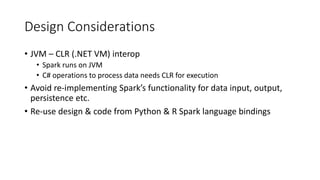
Design Considerations
• JVM – CLR (.NET VM) interop
• Spark runs on JVM
• C# operations to process data needs CLR for execution
• Avoid re-implementing Spark’s functionality for data input, output,
persistence etc.
• Re-use design & code from Python & R Spark language bindings
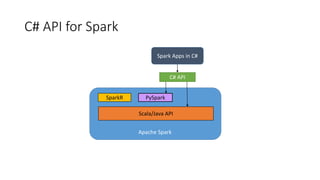
C# API for Spark
Scala/Java API
SparkR PySpark
C# API
Apache Spark
Spark Apps in C#
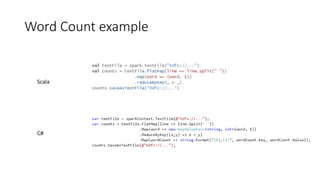
Word Count example
Scala
C#
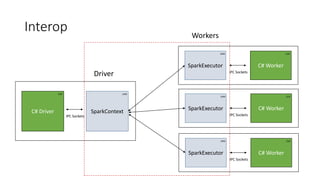
C# Worker
CLR
IPC Sockets
C# Worker
CLR
IPC Sockets
C# Worker
CLR
IPC Sockets
Interop
C# Driver
CLR
IPC Sockets
SparkExecutor
SparkExecutor
SparkExecutor
SparkContext
JVM
JVM
JVM
JVM
Workers
Driver
Reuse
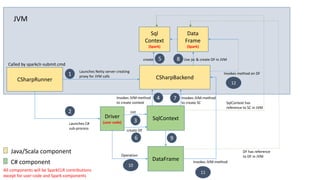
• Driver-side interop uses Netty server as a proxy to JVM – similar to
SparkR
• Worker-side interop reuses PySpark implementation
• CSharpRDD inherits from PythonRDD reusing the implementation to launch
external process, pipe in/out serialized data
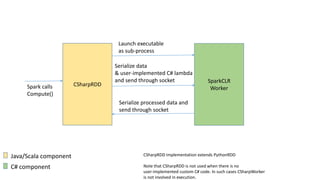
CSharpRDD
• C# operations use CSharpRDD which needs CLR to execute
• If no C# transformation or UDF is involved, CLR is not needed – execution is
purely JVM-based
• RDD<byte[]>
• Data is stored as serialized objects and sent to C# worker process
• Transformations are pipelined when possible
• Avoids unnecessary serialization & deserialization within a stage
Linux Support
• Mono (open source implementation of .NET framework) used for C#
with Spark in Linux
• GitHub project uses Travis for CI in Ubuntu 14.04.3 LTS
• Unit tests and samples (functional tests) are run
• More info @ linux-instructions.md
CSharpRunner
Called by sparkclr-submit.cmd
JVM
Java/Scala component
C# component
CSharpBackend
Launches Netty server creating
proxy for JVM calls1
Driver
(user code)Launches C#
sub-process
2
SqlContext
Init
3
Invokes JVM-method
to create context
4
Sql
Context
(Spark)
create 5
create DF
6
Invokes JVM-method
to create DF
7
Data
Frame
(Spark)
Use jsc & create DF in JVM8
10
Operation
DataFrame
9
C# DF has reference
to DF in JVM
11
Invokes JVM-method
SqlContext has
reference to SC in JVM
12
Invokes method on DF
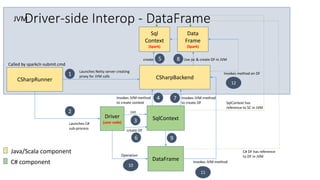
Driver-side Interop - DataFrame
C#
Worker
Launch executable
as sub-process
Serialize data
& user-implemented C# lambda
and send through socket
Serialize processed data and
send through socket
CSharpRDDSpark calls
Compute()
Scala component
C# component
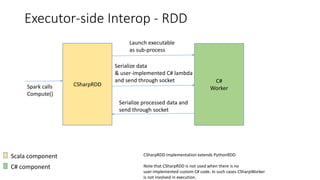
CSharpRDD implementation extends PythonRDD
Note that CSharpRDD is not used when there is no
user-implemented custom C# code. In such cases CSharpWorker
is not involved in execution.
Executor-side Interop - RDD
Performance Considerations
• Map & Filter RDD operations in C# require serialization & deserialization of data –
impacts performance
• C# operations are pipelined when possible - minimizes unnecessary Ser/De
• Persistence is handled by JVM - checkpoint/cache on a RDD impacts pipelining for CLR
operations
• DataFrame operations without C# UDFs do not require Ser/De
• Perf will be same as native Spark application
• Execution plan optimization & code generation perf improvements in Spark leveraged
Status
• Past Releases
• V1.5.200 (supports Spark 1.5.2)
• V.1.6.000-PREVIEW1 (supports Spark 1.6.0)
• Upcoming Release
• V1.6.100 (with support for Spark 1.6.1, in April’16)
• In the works
• Support for interactive scenarios (Zeppelin/Jupyter integration)
• MapWithState API for streaming
• Perf benchmarking
Project Info
• Repo - https://github.com/Microsoft/Mobius. Contributions welcome!
• Services integrated with the repo
• AppVeyor – Windows builds, unit and functional tests, NuGet & Maven deployment
• Travis CI – Linux builds, unit and functional tests
• CodeCov – unit test code coverage measurement & analysis
• License – code is released under MIT license
• Discussions
• StackOverflow – tag “SparkCLR”
• Gitter - https://gitter.im/Microsoft/Mobius
API Reference
Mobius API usage samples are available in the repo at:
• Samples - comprehensive set of C# APIs & functional tests
• Examples - standalone C# projects demonstrating C# API
• Pi
• EventHub
• SparkXml
• JdbcDataFrame
• … (could be your contribution!)
• Performance tests – side by side comparison of Scala & C# drivers
API documentation
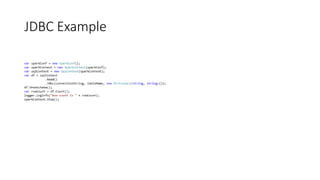
JDBC Example
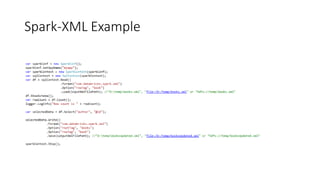
Spark-XML Example
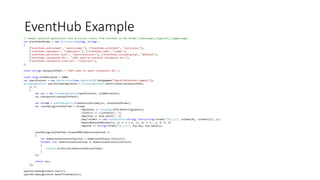
EventHub Example
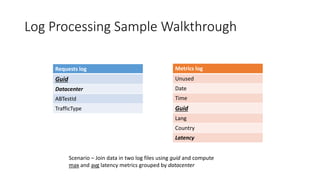
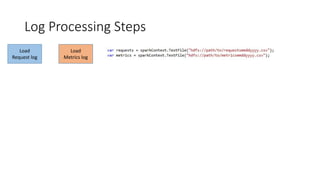
Log Processing Sample Walkthrough
Requests log
Guid
Datacenter
ABTestId
TrafficType
Metrics log
Unused
Date
Time
Guid
Lang
Country
Latency
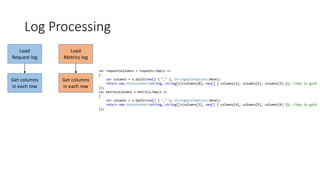
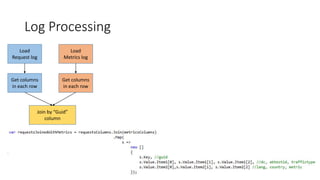
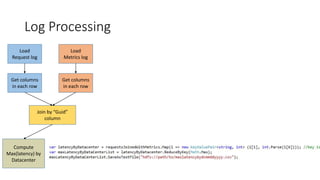
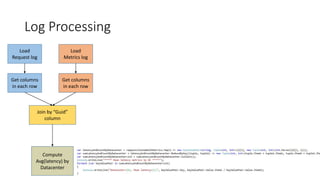
Scenario – Join data in two log files using guid and compute
max and avg latency metrics grouped by datacenter
Log Processing Steps
Load
Request log
Load
Metrics log
Log Processing
Load
Request log
Load
Metrics log
Get columns
in each row
Get columns
in each row
Log Processing
Load
Request log
Load
Metrics log
Get columns
in each row
Get columns
in each row
Join by “Guid”
column
Log Processing
Load
Request log
Load
Metrics log
Get columns
in each row
Get columns
in each row
Join by “Guid”
column
Compute
Max(latency) by
Datacenter
Log Processing
Load
Request log
Load
Metrics log
Get columns
in each row
Get columns
in each row
Join by “Guid”
column
Compute
Avg(latency) by
Datacenter
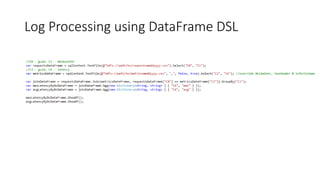
Log Processing using DataFrame DSL
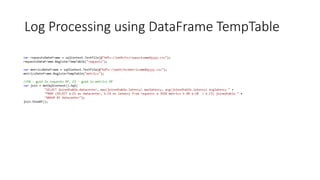
Log Processing using DataFrame TempTable
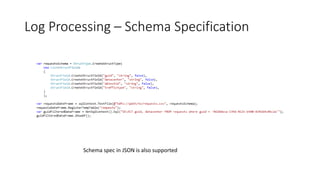
Log Processing – Schema Specification
Schema spec in JSON is also supported
Early Lessons on Spark Streaming with Mobius
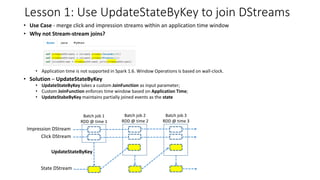
Lesson 1: Use UpdateStateByKey to join DStreams
• Use Case - merge click and impression streams within an application time window
• Why not Stream-stream joins?
• Application time is not supported in Spark 1.6. Window Operations is based on wall-clock.
• Solution – UpdateStateByKey
• UpdateStateByKey takes a custom JoinFunction as input parameter;
• Custom JoinFunction enforces time window based on Application Time;
• UpdateStabeByKey maintains partially joined events as the state
Impression DStream
Click DStream
Batch job 1
RDD @ time 1
Batch job 2
RDD @ time 2
State DStream
UpdateStateByKey
Batch job 3
RDD @ time 3
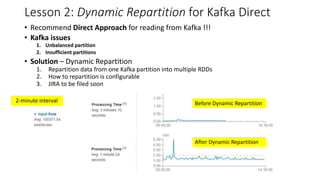
• Recommend Direct Approach for reading from Kafka !!!
• Kafka issues
1. Unbalanced partition
2. Insufficient partitions
• Solution – Dynamic Repartition
1. Repartition data from one Kafka partition into multiple RDDs
2. How to repartition is configurable
3. JIRA to be filed soon
Lesson 2: Dynamic Repartition for Kafka Direct
After Dynamic Repartition
Before Dynamic Repartition2-minute interval
How you can engage
• Develop Spark applications in C# and provide feedback
• Contributions are welcome to the open source project @
https://github.com/Microsoft/Mobius
Thanks to…
• Spark community – for building Spark 
• Mobius contributors – for their contributions
• SparkR and PySpark developers – Mobius reuses design and code
from these implementations
• Reynold Xin and Josh Rosen from Databricks for the review and
feedback on Mobius design doc
Back-up Slides
Driver-side IPC Interop
Using a Netty server as a proxy to JVM
Driver-side implementation in SparkCLR
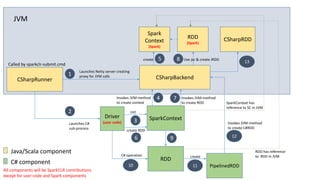
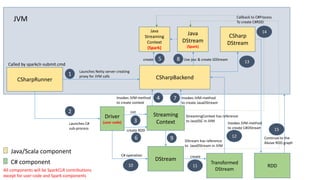
• Driver-side interaction between JVM & CLR is the same for RDD and
DataFrame APIs -- CLR executes calls on JVM.
• For streaming scenarios, CLR executes calls on JVM and JVM calls
back to CLR to create C# RDD
DataFrame
CSharpRunner
Called by sparkclr-submit.cmd
Driver
(user code)Launches C#
sub-process
SqlContext
Init
CSharpBackend
Launches Netty server creating
proxy for JVM calls
Sql
Context
(Spark)
JVM
Invokes JVM-method
to create context
create
DataFrame
create DF
1
2
3
4
5
6
Invokes JVM-method
to create SC
7
Data
Frame
(Spark)
Use jsc & create DF in JVM8
9
10
Operation
11
DF has reference
to DF in JVM
Java/Scala component
C# component Invokes JVM-method
SqlContext has
reference to SC in JVM
All components will be SparkCLR contributions
except for user code and Spark components
12
Invokes method on DF
RDD
CSharpRunner
Called by sparkclr-submit.cmd
Driver
(user code)Launches C#
sub-process
SparkContext
Init
CSharpBackend
Launches Netty server creating
proxy for JVM calls
Spark
Context
(Spark)
JVM
Invokes JVM-method
to create context
create
RDD
create RDD
CSharpRDD
Invokes JVM-method
to create RDD
RDD
(Spark)
Use jsc & create JRDD
1
2
3
4
5
6
7
8
9
create
10
C# operation
PipelinedRDD11
12
RDD has reference
to RDD in JVM
Java/Scala component
C# component
Invokes JVM-method
to create C#RDD
13
SparkContext has
reference to SC in JVM
All components will be SparkCLR contributions
except for user code and Spark components
DStream
CSharpRunner
Called by sparkclr-submit.cmd
Driver
(user code)Launches C#
sub-process
Streaming
Context
Init
CSharpBackend
Launches Netty server creating
proxy for JVM calls
Java
Streaming
Context
(Spark)
JVM
Invokes JVM-method
to create context
create
DStream
create RDD
CSharp
DStream
Invokes JVM-method
to create JavaDStream
Java
DStream
(Spark)
Use jssc & create JDStream
1
2
3
4
5
6
7
8
9
create
10
C# operation
Transformed
DStream
11
12
DStream has reference
to JavaDStream in JVM
Java/Scala component
C# component
Invokes JVM-method
to create C#DStream
13
StreamingContext has reference
to JavaSSC in JVM
All components will be SparkCLR contributions
except for user code and Spark components
RDD
14
Callback to C#Process
To create C#RDD
15
Continue to the
Above RDD graph
Executor-side IPC Interop
Using pipes to send data between JVM & CLR
C# Lambda in RDD
Similar to Python implementation
CSharpRDDSpark calls
Compute()
SparkCLR
Worker
Launch executable
as sub-process
Serialize data
& user-implemented C# lambda
and send through socket
Serialize processed data and
send through socket
Java/Scala component
C# component
CSharpRDD implementation extends PythonRDD
Note that CSharpRDD is not used when there is no
user-implemented custom C# code. In such cases CSharpWorker
is not involved in execution.
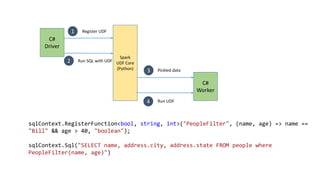
C# UDFs in DataFrame
Similar to Python implementation
Spark
UDF Core
(Python)
C#
Driver
1
2
3
4
C#
Worker
Register UDF
Run SQL with UDF
Run UDF
Pickled data
sqlContext.RegisterFunction<bool, string, int>("PeopleFilter", (name, age) => name ==
"Bill" && age > 40, "boolean");
sqlContext.Sql("SELECT name, address.city, address.state FROM people where
PeopleFilter(name, age)")
SparkCLR Streaming API
Similar to Python implementation
DStream sample
// write code here to drop text files under <directory>test
… … …
StreamingContext ssc = StreamingContext.GetOrCreate(checkpointPath,
() =>
{
SparkContext sc = SparkCLRSamples.SparkContext;
StreamingContext context = new StreamingContext(sc, 2000);
context.Checkpoint(checkpointPath);
var lines = context.TextFileStream(Path.Combine(directory, "test"));
var words = lines.FlatMap(l => l.Split(' '));
var pairs = words.Map(w => new KeyValuePair<string, int>(w, 1));
var wordCounts = pairs.ReduceByKey((x, y) => x + y);
var join = wordCounts.Join(wordCounts, 2);
var state = join.UpdateStateByKey<string, Tuple<int, int>, int>((vs, s) => vs.Sum(x => x.Item1 + x.Item2) + s);
state.ForeachRDD((time, rdd) =>
{
object[] taken = rdd.Take(10);
});
return context;
});
ssc.Start();
ssc.AwaitTermination();

Seattle Spark Meetup Mobius CSharp API

  • 1.
    Mobius: C# APIfor Spark Seattle Spark Meetup – Feb 2016 Speakers: Kaarthik Sivashanmugam, linkedin.com/in/kaarthik Renyi Xiong, linkedin.com/in/renyi-xiong-95597628
  • 2.
    Agenda • Background • Architecture •Sample Code • Demo (if time permits) • Early lessons on Spark Streaming with Mobius
  • 3.
    Joining the Community •Consider joining the C# API dev community for Spark to • Develop Spark applications in C# and provide feedback • Contribute to the open source project @ github.com/Microsoft/Mobius
  • 4.
    Target Scenario • Nearreal time processing of Bing logs (aka “Fast SML”) • Size of raw logs - hundreds of TB per hour • Downstream scenarios • NRT click signal & improved relevance on fresh results • Operational Intelligence • Bad flight detection • … Another team we partnered with had an interactive scenario need for querying Cosmos logs
  • 5.
    Implementations of FastSML 1.Microsoft’s internal low-latency, transactional storage and processing platform 2. Apache Storm (SCP.Net) + Kafka + Microsoft’s internal in-memory streaming analytics engine • Can Apache Spark help implement a better solution? • How can we reuse existing investments in FastSML?
  • 6.
    C# API -Motivations • Enable organizations invested deeply in .NET to start building Spark apps and not have to do development in Scala, Java, Python or R • Enable reuse of existing .NET libraries in Spark applications
  • 7.
    C# API -Goal Make C# a first-class citizen for building Apache Spark apps for the following job types • Batch jobs (RDD API) • Streaming jobs (Streaming API) • Structured data processing or SQL jobs (DataFrame API)
  • 8.
    Design Considerations • JVM– CLR (.NET VM) interop • Spark runs on JVM • C# operations to process data needs CLR for execution • Avoid re-implementing Spark’s functionality for data input, output, persistence etc. • Re-use design & code from Python & R Spark language bindings
  • 9.
    C# API forSpark Scala/Java API SparkR PySpark C# API Apache Spark Spark Apps in C#
  • 10.
  • 11.
    C# Worker CLR IPC Sockets C#Worker CLR IPC Sockets C# Worker CLR IPC Sockets Interop C# Driver CLR IPC Sockets SparkExecutor SparkExecutor SparkExecutor SparkContext JVM JVM JVM JVM Workers Driver
  • 12.
    Reuse • Driver-side interopuses Netty server as a proxy to JVM – similar to SparkR • Worker-side interop reuses PySpark implementation • CSharpRDD inherits from PythonRDD reusing the implementation to launch external process, pipe in/out serialized data
  • 13.
    CSharpRDD • C# operationsuse CSharpRDD which needs CLR to execute • If no C# transformation or UDF is involved, CLR is not needed – execution is purely JVM-based • RDD<byte[]> • Data is stored as serialized objects and sent to C# worker process • Transformations are pipelined when possible • Avoids unnecessary serialization & deserialization within a stage
  • 14.
    Linux Support • Mono(open source implementation of .NET framework) used for C# with Spark in Linux • GitHub project uses Travis for CI in Ubuntu 14.04.3 LTS • Unit tests and samples (functional tests) are run • More info @ linux-instructions.md
  • 15.
    CSharpRunner Called by sparkclr-submit.cmd JVM Java/Scalacomponent C# component CSharpBackend Launches Netty server creating proxy for JVM calls1 Driver (user code)Launches C# sub-process 2 SqlContext Init 3 Invokes JVM-method to create context 4 Sql Context (Spark) create 5 create DF 6 Invokes JVM-method to create DF 7 Data Frame (Spark) Use jsc & create DF in JVM8 10 Operation DataFrame 9 C# DF has reference to DF in JVM 11 Invokes JVM-method SqlContext has reference to SC in JVM 12 Invokes method on DF Driver-side Interop - DataFrame
  • 16.
    C# Worker Launch executable as sub-process Serializedata & user-implemented C# lambda and send through socket Serialize processed data and send through socket CSharpRDDSpark calls Compute() Scala component C# component CSharpRDD implementation extends PythonRDD Note that CSharpRDD is not used when there is no user-implemented custom C# code. In such cases CSharpWorker is not involved in execution. Executor-side Interop - RDD
  • 17.
    Performance Considerations • Map& Filter RDD operations in C# require serialization & deserialization of data – impacts performance • C# operations are pipelined when possible - minimizes unnecessary Ser/De • Persistence is handled by JVM - checkpoint/cache on a RDD impacts pipelining for CLR operations • DataFrame operations without C# UDFs do not require Ser/De • Perf will be same as native Spark application • Execution plan optimization & code generation perf improvements in Spark leveraged
  • 18.
    Status • Past Releases •V1.5.200 (supports Spark 1.5.2) • V.1.6.000-PREVIEW1 (supports Spark 1.6.0) • Upcoming Release • V1.6.100 (with support for Spark 1.6.1, in April’16) • In the works • Support for interactive scenarios (Zeppelin/Jupyter integration) • MapWithState API for streaming • Perf benchmarking
  • 19.
    Project Info • Repo- https://github.com/Microsoft/Mobius. Contributions welcome! • Services integrated with the repo • AppVeyor – Windows builds, unit and functional tests, NuGet & Maven deployment • Travis CI – Linux builds, unit and functional tests • CodeCov – unit test code coverage measurement & analysis • License – code is released under MIT license • Discussions • StackOverflow – tag “SparkCLR” • Gitter - https://gitter.im/Microsoft/Mobius
  • 20.
    API Reference Mobius APIusage samples are available in the repo at: • Samples - comprehensive set of C# APIs & functional tests • Examples - standalone C# projects demonstrating C# API • Pi • EventHub • SparkXml • JdbcDataFrame • … (could be your contribution!) • Performance tests – side by side comparison of Scala & C# drivers API documentation
  • 21.
  • 22.
  • 23.
  • 24.
    Log Processing SampleWalkthrough Requests log Guid Datacenter ABTestId TrafficType Metrics log Unused Date Time Guid Lang Country Latency Scenario – Join data in two log files using guid and compute max and avg latency metrics grouped by datacenter
  • 25.
  • 26.
    Log Processing Load Request log Load Metricslog Get columns in each row Get columns in each row
  • 27.
    Log Processing Load Request log Load Metricslog Get columns in each row Get columns in each row Join by “Guid” column
  • 28.
    Log Processing Load Request log Load Metricslog Get columns in each row Get columns in each row Join by “Guid” column Compute Max(latency) by Datacenter
  • 29.
    Log Processing Load Request log Load Metricslog Get columns in each row Get columns in each row Join by “Guid” column Compute Avg(latency) by Datacenter
  • 30.
    Log Processing usingDataFrame DSL
  • 31.
    Log Processing usingDataFrame TempTable
  • 32.
    Log Processing –Schema Specification Schema spec in JSON is also supported
  • 33.
    Early Lessons onSpark Streaming with Mobius
  • 34.
    Lesson 1: UseUpdateStateByKey to join DStreams • Use Case - merge click and impression streams within an application time window • Why not Stream-stream joins? • Application time is not supported in Spark 1.6. Window Operations is based on wall-clock. • Solution – UpdateStateByKey • UpdateStateByKey takes a custom JoinFunction as input parameter; • Custom JoinFunction enforces time window based on Application Time; • UpdateStabeByKey maintains partially joined events as the state Impression DStream Click DStream Batch job 1 RDD @ time 1 Batch job 2 RDD @ time 2 State DStream UpdateStateByKey Batch job 3 RDD @ time 3
  • 35.
    • Recommend DirectApproach for reading from Kafka !!! • Kafka issues 1. Unbalanced partition 2. Insufficient partitions • Solution – Dynamic Repartition 1. Repartition data from one Kafka partition into multiple RDDs 2. How to repartition is configurable 3. JIRA to be filed soon Lesson 2: Dynamic Repartition for Kafka Direct After Dynamic Repartition Before Dynamic Repartition2-minute interval
  • 36.
    How you canengage • Develop Spark applications in C# and provide feedback • Contributions are welcome to the open source project @ https://github.com/Microsoft/Mobius
  • 37.
    Thanks to… • Sparkcommunity – for building Spark  • Mobius contributors – for their contributions • SparkR and PySpark developers – Mobius reuses design and code from these implementations • Reynold Xin and Josh Rosen from Databricks for the review and feedback on Mobius design doc
  • 38.
  • 39.
    Driver-side IPC Interop Usinga Netty server as a proxy to JVM
  • 40.
    Driver-side implementation inSparkCLR • Driver-side interaction between JVM & CLR is the same for RDD and DataFrame APIs -- CLR executes calls on JVM. • For streaming scenarios, CLR executes calls on JVM and JVM calls back to CLR to create C# RDD
  • 41.
  • 42.
    CSharpRunner Called by sparkclr-submit.cmd Driver (usercode)Launches C# sub-process SqlContext Init CSharpBackend Launches Netty server creating proxy for JVM calls Sql Context (Spark) JVM Invokes JVM-method to create context create DataFrame create DF 1 2 3 4 5 6 Invokes JVM-method to create SC 7 Data Frame (Spark) Use jsc & create DF in JVM8 9 10 Operation 11 DF has reference to DF in JVM Java/Scala component C# component Invokes JVM-method SqlContext has reference to SC in JVM All components will be SparkCLR contributions except for user code and Spark components 12 Invokes method on DF
  • 43.
  • 44.
    CSharpRunner Called by sparkclr-submit.cmd Driver (usercode)Launches C# sub-process SparkContext Init CSharpBackend Launches Netty server creating proxy for JVM calls Spark Context (Spark) JVM Invokes JVM-method to create context create RDD create RDD CSharpRDD Invokes JVM-method to create RDD RDD (Spark) Use jsc & create JRDD 1 2 3 4 5 6 7 8 9 create 10 C# operation PipelinedRDD11 12 RDD has reference to RDD in JVM Java/Scala component C# component Invokes JVM-method to create C#RDD 13 SparkContext has reference to SC in JVM All components will be SparkCLR contributions except for user code and Spark components
  • 45.
  • 46.
    CSharpRunner Called by sparkclr-submit.cmd Driver (usercode)Launches C# sub-process Streaming Context Init CSharpBackend Launches Netty server creating proxy for JVM calls Java Streaming Context (Spark) JVM Invokes JVM-method to create context create DStream create RDD CSharp DStream Invokes JVM-method to create JavaDStream Java DStream (Spark) Use jssc & create JDStream 1 2 3 4 5 6 7 8 9 create 10 C# operation Transformed DStream 11 12 DStream has reference to JavaDStream in JVM Java/Scala component C# component Invokes JVM-method to create C#DStream 13 StreamingContext has reference to JavaSSC in JVM All components will be SparkCLR contributions except for user code and Spark components RDD 14 Callback to C#Process To create C#RDD 15 Continue to the Above RDD graph
  • 47.
    Executor-side IPC Interop Usingpipes to send data between JVM & CLR
  • 48.
    C# Lambda inRDD Similar to Python implementation
  • 49.
    CSharpRDDSpark calls Compute() SparkCLR Worker Launch executable assub-process Serialize data & user-implemented C# lambda and send through socket Serialize processed data and send through socket Java/Scala component C# component CSharpRDD implementation extends PythonRDD Note that CSharpRDD is not used when there is no user-implemented custom C# code. In such cases CSharpWorker is not involved in execution.
  • 50.
    C# UDFs inDataFrame Similar to Python implementation
  • 51.
    Spark UDF Core (Python) C# Driver 1 2 3 4 C# Worker Register UDF RunSQL with UDF Run UDF Pickled data sqlContext.RegisterFunction<bool, string, int>("PeopleFilter", (name, age) => name == "Bill" && age > 40, "boolean"); sqlContext.Sql("SELECT name, address.city, address.state FROM people where PeopleFilter(name, age)")
  • 52.
    SparkCLR Streaming API Similarto Python implementation
  • 53.
    DStream sample // writecode here to drop text files under <directory>test … … … StreamingContext ssc = StreamingContext.GetOrCreate(checkpointPath, () => { SparkContext sc = SparkCLRSamples.SparkContext; StreamingContext context = new StreamingContext(sc, 2000); context.Checkpoint(checkpointPath); var lines = context.TextFileStream(Path.Combine(directory, "test")); var words = lines.FlatMap(l => l.Split(' ')); var pairs = words.Map(w => new KeyValuePair<string, int>(w, 1)); var wordCounts = pairs.ReduceByKey((x, y) => x + y); var join = wordCounts.Join(wordCounts, 2); var state = join.UpdateStateByKey<string, Tuple<int, int>, int>((vs, s) => vs.Sum(x => x.Item1 + x.Item2) + s); state.ForeachRDD((time, rdd) => { object[] taken = rdd.Take(10); }); return context; }); ssc.Start(); ssc.AwaitTermination();

Editor's Notes

  • #12 Sockets provide point-to-point, two-way communication between two processes. Sockets are very versatile and are a basic component of interprocess and intersystem communication. A socket is an endpoint of communication to which a name can be bound. It has a type and one or more associated processes.