





Finding scholarly resources and
Referencing
BIO1000H
11 October 2017
Awot K. Gebregziabher
(awot.Gebregziabher@uct.ac.za)
Content
• Searching strategy (revision)
• Where to search
• Referencing: introduction
• Referencing Stages
• How to cite
• Reference list
Search Strategy
Search Strategy
Known item search
• Know title or author of a resource …
Example:
Author: Merle Sowman
Title: Subsistence and small-scale
fisheries in South Africa: a ten-year
review
Unknown item search
• Looking for resources in a topic
area
• Keyword/s search
Example: climate change
adaptation, biodiversity …
Searching for unknown items
Searching for items in a desired topic area
• Use keywords
• Search in databases / platforms and catalogues
Databases are searchable electronic resources
• They host journal articles, eBooks, e-news papers and other electronic
resources.
• Database Platforms enables searching across several databases at a
time.
Searching for unknown item
When searching in databases
• Using natural language is not efficient
• databases don’t understand it
• retrieved items might not have the most relevant ones.
• Using Boolean logic provide effective search
• Boolean operators: AND, OR, NOT
Searching for unknown item
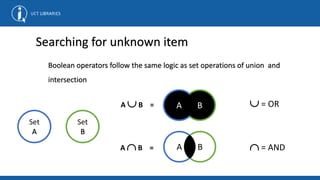
Boolean operators follow the same logic as set operations of union and
intersection
Set
A
Set
B
A B =
A B = BA
BA  = OR
 = AND
Smart Searching
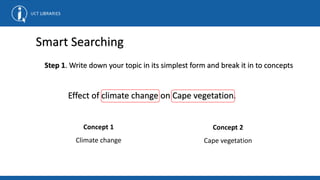
Step 1. Write down your topic in its simplest form and break it in to concepts
Effect of climate change on Cape vegetation.
Concept 1
Climate change
Concept 2
Cape vegetation
Smart Searching (cont. …)
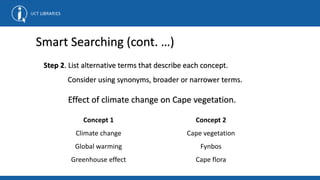
Step 2. List alternative terms that describe each concept.
Consider using synonyms, broader or narrower terms.
Effect of climate change on Cape vegetation.
Concept 1
Climate change
Global warming
Greenhouse effect
Concept 2
Cape vegetation
Fynbos
Cape flora
Smart Searching (cont. …)
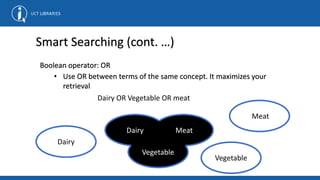
Boolean operator: OR
• Use OR between terms of the same concept. It maximizes your
retrieval
Dairy
Vegetable
Meat
Dairy OR Vegetable OR meat
Dairy
Vegetable
Meat
Smart Searching (cont. …)
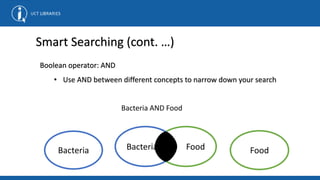
Boolean operator: AND
• Use AND between different concepts to narrow down your search
Bacteria FoodFoodBacteria
Bacteria AND Food
Smart Searching (cont. …)
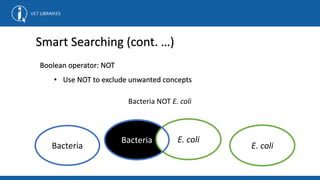
Boolean operator: NOT
• Use NOT to exclude unwanted concepts
Bacteria E. coli
Bacteria E. coli
Bacteria NOT E. coli
Smart Searching (cont. …)
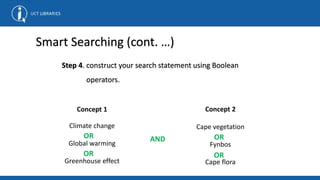
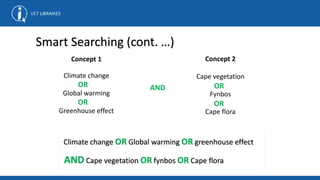
Step 4. construct your search statement using Boolean
operators.
Concept 1
Climate change
Global warming
Greenhouse effect
Concept 2
Cape vegetation
Fynbos
Cape flora
AND OR
OR
OR
OR
Smart Searching (cont. …)
Concept 1
Climate change
Global warming
Greenhouse effect
Concept 2
Cape vegetation
Fynbos
Cape flora
AND OR
OR
OR
OR
Climate change OR Global warming OR greenhouse effect
AND Cape vegetation OR fynbos OR Cape flora
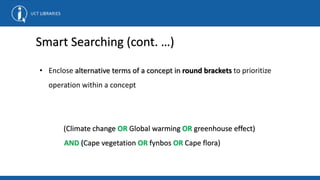
• Enclose alternative terms of a concept in round brackets to prioritize
operation within a concept
Smart Searching (cont. …)
(Climate change OR Global warming OR greenhouse effect)
AND (Cape vegetation OR fynbos OR Cape flora)
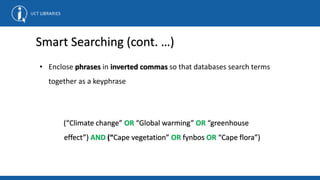
• Enclose phrases in inverted commas so that databases search terms
together as a keyphrase
Smart Searching (cont. …)
(“Climate change” OR “Global warming” OR “greenhouse
effect”) AND (“Cape vegetation” OR fynbos OR “Cape flora”)
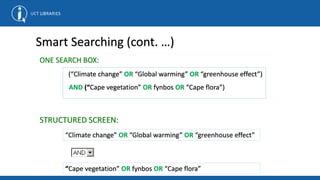
Smart Searching (cont. …)
“Climate change” OR “Global warming” OR “greenhouse effect”
“Cape vegetation” OR fynbos OR “Cape flora”
STRUCTURED SCREEN:
ONE SEARCH BOX:
(“Climate change” OR “Global warming” OR “greenhouse effect”)
AND (“Cape vegetation” OR fynbos OR “Cape flora”)
• each database have additional refining tools
• explained in help menu.
• check for Search tips, truncation, proximity search …
• If your search provids you with irrelevant items, consider using alternative terms
and broader or narrower terms.
• Start broad and refine your search
Additional Tips
Where to Search
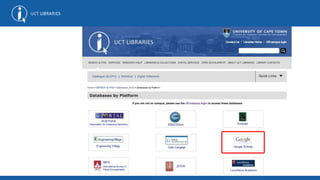
• Scholarly resources are indexed and discovered by library databases
• Academic One File
• Scopus
• ScienceDirect
• Web of Science
• Google Scholar
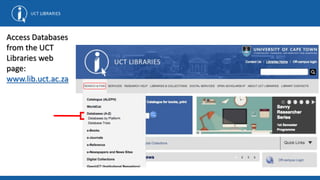
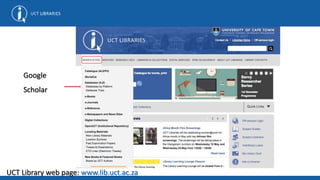
Access Databases
from the UCT
Libraries web
page:
www.lib.uct.ac.za
Searching for known item
Use
• e-Journal Portal
To browse UCT’s electronic journal collection
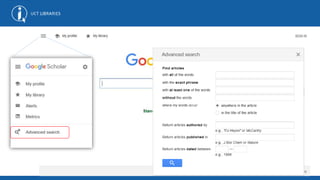
• Google Scholar Or Primo (Discovery tool coming soon 22 Nov. 2017)
To find articles, books and book chapters
• Catalogue (ALEPH until Nov. 2017) Or Primo
To search or browse books, journal titles, CDs … and to check
availability at UCT Libraries collection
e-Journal
Portal
Go to the UCT
Library web page:
www.lib.uct.ac.za
Type the
journal title
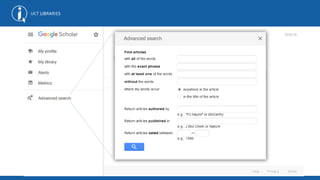
Google
Scholar
UCT Library web page: www.lib.uct.ac.za
Referencing
Introduction
• It is a standardized way of acknowledging sources of information and
ideas that you have used in your essay or assignment.
• Helps avoid plagiarism (stealing of other's ideas)
• Enables readers to follow-up and read more fully the cited author’s
arguments
• Shows you have done research
Introduction cont. …
Sources of information
• books, webpages, articles (newspaper, magazine or scholarly journal)
Each sources have common elements:
• Author/s, Title, Date of publication, …
• magazines and journals would have volumes, parts / issue / number
These elements are used to compile references
Introduction cont. …
Referencing Styles
• are conventions on how to properly acknowledge information source
• Each convention has its own style with detail instruction of
• sequences and format of referencing elements and
• what punctuations to use where
Example: UCT Author-Date Referencing Style
Introduction cont. …
UCT Author-Date Style
• based on Harvard Convention
• UCT Author-Date Reference Guide (2016) with example is available
from UCT Libraries webpage (www.lib.uct.ac.za Research Help
Referencing Help)
Two stages of referencing
In-Text Citation
• A brief details of a source after the ideas incorporated in your statements.
• Usually placed within brackets
Reference List
• A list of all cited references each with full detail referencing elements.
• Usually placed at the end of essay / document.
In-Text Citation
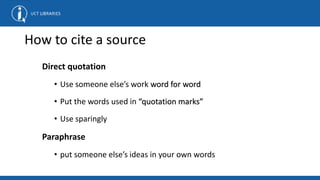
How to cite a source
Direct quotation
• Use someone else’s work word for word
• Put the words used in “quotation marks”
• Use sparingly
Paraphrase
• put someone else’s ideas in your own words
How to cite a source cont. …
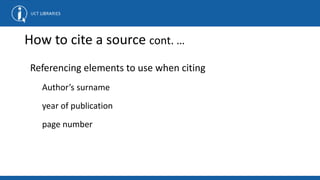
Referencing elements to use when citing
Author’s surname
year of publication
page number
How to cite a source cont. …
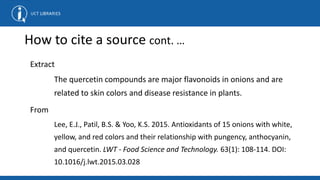
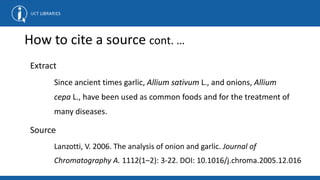
Extract
The quercetin compounds are major flavonoids in onions and are
related to skin colors and disease resistance in plants.
From
Lee, E.J., Patil, B.S. & Yoo, K.S. 2015. Antioxidants of 15 onions with white,
yellow, and red colors and their relationship with pungency, anthocyanin,
and quercetin. LWT - Food Science and Technology. 63(1): 108-114. DOI:
10.1016/j.lwt.2015.03.028
How to cite a source cont. …
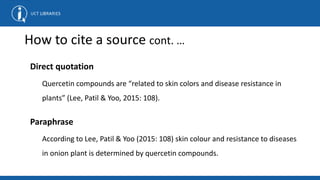
Direct quotation
Quercetin compounds are “related to skin colors and disease resistance in
plants” (Lee, Patil & Yoo, 2015: 108).
Paraphrase
According to Lee, Patil & Yoo (2015: 108) skin colour and resistance to diseases
in onion plant is determined by quercetin compounds.
How to cite a source cont. …
Extract
Since ancient times garlic, Allium sativum L., and onions, Allium
cepa L., have been used as common foods and for the treatment of
many diseases.
Source
Lanzotti, V. 2006. The analysis of onion and garlic. Journal of
Chromatography A. 1112(1–2): 3-22. DOI: 10.1016/j.chroma.2005.12.016
How to cite a source cont. …
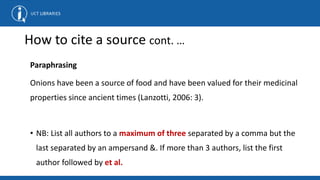
Paraphrasing
Onions have been a source of food and have been valued for their medicinal
properties since ancient times (Lanzotti, 2006: 3).
• NB: List all authors to a maximum of three separated by a comma but the
last separated by an ampersand &. If more than 3 authors, list the first
author followed by et al.
Compiling reference list
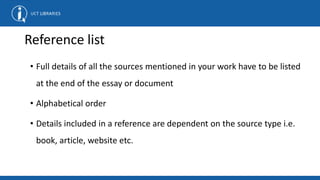
Reference list
• Full details of all the sources mentioned in your work have to be listed
at the end of the essay or document
• Alphabetical order
• Details included in a reference are dependent on the source type i.e.
book, article, website etc.
Reference list cont. …
Basic structure of UCT Author-date reference includes:
• Author(s) of resource – Surname & initials
• Date of publication – Year of publication
• Title of resource
• Publication details
• Book - Place and name of publisher
• Journal - Volume, issue, page numbers and DOI number
• Web resource – URL
N.B. Electronic resources usually have Digital Object Identifier (DOI) number
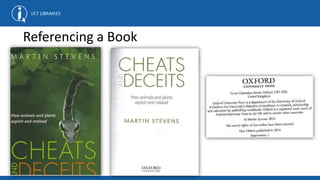
Referencing a Book
Referencing a Book
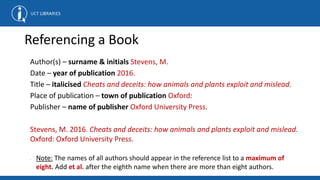
Author(s) – surname & initials Stevens, M.
Date – year of publication 2016.
Title – italicised Cheats and deceits: how animals and plants exploit and mislead.
Place of publication – town of publication Oxford:
Publisher – name of publisher Oxford University Press.
Stevens, M. 2016. Cheats and deceits: how animals and plants exploit and mislead.
Oxford: Oxford University Press.
• Note: The names of all authors should appear in the reference list to a maximum of
eight. Add et al. after the eighth name when there are more than eight authors.
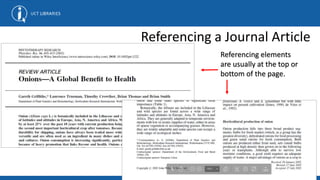
Referencing a Journal Article
Referencing elements
are usually at the top or
bottom of the page.
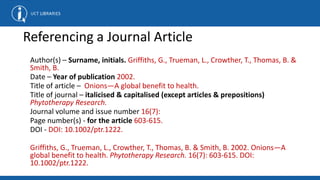
Author(s) – Surname, initials. Griffiths, G., Trueman, L., Crowther, T., Thomas, B. &
Smith, B.
Date – Year of publication 2002.
Title of article – Onions—A global benefit to health.
Title of journal – italicised & capitalised (except articles & prepositions)
Phytotherapy Research.
Journal volume and issue number 16(7):
Page number(s) - for the article 603-615.
DOI - DOI: 10.1002/ptr.1222.
Griffiths, G., Trueman, L., Crowther, T., Thomas, B. & Smith, B. 2002. Onions—A
global benefit to health. Phytotherapy Research. 16(7): 603-615. DOI:
10.1002/ptr.1222.
Referencing a Journal Article
Need more help?
Consult UCT Author-Date Reference Guide examples
Or
Contact me at awot.gebregziabher@uct.ac.za
• Announcements & relevant information
• Post queries
• View self help video clips at
Follow us on social media
@UCTLibrary UCT Libraries
UCTLibraries
Thank You

Searching & Referencing

  • 1.
    Finding scholarly resourcesand Referencing BIO1000H 11 October 2017 Awot K. Gebregziabher (awot.Gebregziabher@uct.ac.za)
  • 2.
    Content • Searching strategy(revision) • Where to search • Referencing: introduction • Referencing Stages • How to cite • Reference list
  • 3.
  • 4.
    Search Strategy Known itemsearch • Know title or author of a resource … Example: Author: Merle Sowman Title: Subsistence and small-scale fisheries in South Africa: a ten-year review Unknown item search • Looking for resources in a topic area • Keyword/s search Example: climate change adaptation, biodiversity …
  • 5.
  • 6.
    Searching for itemsin a desired topic area • Use keywords • Search in databases / platforms and catalogues Databases are searchable electronic resources • They host journal articles, eBooks, e-news papers and other electronic resources. • Database Platforms enables searching across several databases at a time. Searching for unknown item
  • 7.
    Searching for unknownitem When searching in databases • Using natural language is not efficient • databases don’t understand it • retrieved items might not have the most relevant ones. • Using Boolean logic provide effective search • Boolean operators: AND, OR, NOT
  • 8.
    Searching for unknownitem Boolean operators follow the same logic as set operations of union and intersection Set A Set B A B = A B = BA BA  = OR  = AND
  • 9.
    Smart Searching Step 1.Write down your topic in its simplest form and break it in to concepts Effect of climate change on Cape vegetation. Concept 1 Climate change Concept 2 Cape vegetation
  • 10.
    Smart Searching (cont.…) Step 2. List alternative terms that describe each concept. Consider using synonyms, broader or narrower terms. Effect of climate change on Cape vegetation. Concept 1 Climate change Global warming Greenhouse effect Concept 2 Cape vegetation Fynbos Cape flora
  • 11.
    Smart Searching (cont.…) Boolean operator: OR • Use OR between terms of the same concept. It maximizes your retrieval Dairy Vegetable Meat Dairy OR Vegetable OR meat Dairy Vegetable Meat
  • 12.
    Smart Searching (cont.…) Boolean operator: AND • Use AND between different concepts to narrow down your search Bacteria FoodFoodBacteria Bacteria AND Food
  • 13.
    Smart Searching (cont.…) Boolean operator: NOT • Use NOT to exclude unwanted concepts Bacteria E. coli Bacteria E. coli Bacteria NOT E. coli
  • 14.
    Smart Searching (cont.…) Step 4. construct your search statement using Boolean operators. Concept 1 Climate change Global warming Greenhouse effect Concept 2 Cape vegetation Fynbos Cape flora AND OR OR OR OR
  • 15.
    Smart Searching (cont.…) Concept 1 Climate change Global warming Greenhouse effect Concept 2 Cape vegetation Fynbos Cape flora AND OR OR OR OR Climate change OR Global warming OR greenhouse effect AND Cape vegetation OR fynbos OR Cape flora
  • 16.
    • Enclose alternativeterms of a concept in round brackets to prioritize operation within a concept Smart Searching (cont. …) (Climate change OR Global warming OR greenhouse effect) AND (Cape vegetation OR fynbos OR Cape flora)
  • 17.
    • Enclose phrasesin inverted commas so that databases search terms together as a keyphrase Smart Searching (cont. …) (“Climate change” OR “Global warming” OR “greenhouse effect”) AND (“Cape vegetation” OR fynbos OR “Cape flora”)
  • 18.
    Smart Searching (cont.…) “Climate change” OR “Global warming” OR “greenhouse effect” “Cape vegetation” OR fynbos OR “Cape flora” STRUCTURED SCREEN: ONE SEARCH BOX: (“Climate change” OR “Global warming” OR “greenhouse effect”) AND (“Cape vegetation” OR fynbos OR “Cape flora”)
  • 19.
    • each databasehave additional refining tools • explained in help menu. • check for Search tips, truncation, proximity search … • If your search provids you with irrelevant items, consider using alternative terms and broader or narrower terms. • Start broad and refine your search Additional Tips
  • 20.
    Where to Search •Scholarly resources are indexed and discovered by library databases • Academic One File • Scopus • ScienceDirect • Web of Science • Google Scholar
  • 21.
    Access Databases from theUCT Libraries web page: www.lib.uct.ac.za
  • 22.
  • 23.
    Searching for knownitem Use • e-Journal Portal To browse UCT’s electronic journal collection • Google Scholar Or Primo (Discovery tool coming soon 22 Nov. 2017) To find articles, books and book chapters • Catalogue (ALEPH until Nov. 2017) Or Primo To search or browse books, journal titles, CDs … and to check availability at UCT Libraries collection
  • 24.
    e-Journal Portal Go to theUCT Library web page: www.lib.uct.ac.za
  • 25.
  • 26.
    Google Scholar UCT Library webpage: www.lib.uct.ac.za
  • 30.
  • 31.
    Introduction • It isa standardized way of acknowledging sources of information and ideas that you have used in your essay or assignment. • Helps avoid plagiarism (stealing of other's ideas) • Enables readers to follow-up and read more fully the cited author’s arguments • Shows you have done research
  • 32.
    Introduction cont. … Sourcesof information • books, webpages, articles (newspaper, magazine or scholarly journal) Each sources have common elements: • Author/s, Title, Date of publication, … • magazines and journals would have volumes, parts / issue / number These elements are used to compile references
  • 33.
    Introduction cont. … ReferencingStyles • are conventions on how to properly acknowledge information source • Each convention has its own style with detail instruction of • sequences and format of referencing elements and • what punctuations to use where Example: UCT Author-Date Referencing Style
  • 34.
    Introduction cont. … UCTAuthor-Date Style • based on Harvard Convention • UCT Author-Date Reference Guide (2016) with example is available from UCT Libraries webpage (www.lib.uct.ac.za Research Help Referencing Help)
  • 35.
    Two stages ofreferencing In-Text Citation • A brief details of a source after the ideas incorporated in your statements. • Usually placed within brackets Reference List • A list of all cited references each with full detail referencing elements. • Usually placed at the end of essay / document.
  • 36.
  • 37.
    How to citea source Direct quotation • Use someone else’s work word for word • Put the words used in “quotation marks” • Use sparingly Paraphrase • put someone else’s ideas in your own words
  • 38.
    How to citea source cont. … Referencing elements to use when citing Author’s surname year of publication page number
  • 39.
    How to citea source cont. … Extract The quercetin compounds are major flavonoids in onions and are related to skin colors and disease resistance in plants. From Lee, E.J., Patil, B.S. & Yoo, K.S. 2015. Antioxidants of 15 onions with white, yellow, and red colors and their relationship with pungency, anthocyanin, and quercetin. LWT - Food Science and Technology. 63(1): 108-114. DOI: 10.1016/j.lwt.2015.03.028
  • 40.
    How to citea source cont. … Direct quotation Quercetin compounds are “related to skin colors and disease resistance in plants” (Lee, Patil & Yoo, 2015: 108). Paraphrase According to Lee, Patil & Yoo (2015: 108) skin colour and resistance to diseases in onion plant is determined by quercetin compounds.
  • 41.
    How to citea source cont. … Extract Since ancient times garlic, Allium sativum L., and onions, Allium cepa L., have been used as common foods and for the treatment of many diseases. Source Lanzotti, V. 2006. The analysis of onion and garlic. Journal of Chromatography A. 1112(1–2): 3-22. DOI: 10.1016/j.chroma.2005.12.016
  • 42.
    How to citea source cont. … Paraphrasing Onions have been a source of food and have been valued for their medicinal properties since ancient times (Lanzotti, 2006: 3). • NB: List all authors to a maximum of three separated by a comma but the last separated by an ampersand &. If more than 3 authors, list the first author followed by et al.
  • 43.
  • 44.
    Reference list • Fulldetails of all the sources mentioned in your work have to be listed at the end of the essay or document • Alphabetical order • Details included in a reference are dependent on the source type i.e. book, article, website etc.
  • 45.
    Reference list cont.… Basic structure of UCT Author-date reference includes: • Author(s) of resource – Surname & initials • Date of publication – Year of publication • Title of resource • Publication details • Book - Place and name of publisher • Journal - Volume, issue, page numbers and DOI number • Web resource – URL N.B. Electronic resources usually have Digital Object Identifier (DOI) number
  • 46.
  • 47.
    Referencing a Book Author(s)– surname & initials Stevens, M. Date – year of publication 2016. Title – italicised Cheats and deceits: how animals and plants exploit and mislead. Place of publication – town of publication Oxford: Publisher – name of publisher Oxford University Press. Stevens, M. 2016. Cheats and deceits: how animals and plants exploit and mislead. Oxford: Oxford University Press. • Note: The names of all authors should appear in the reference list to a maximum of eight. Add et al. after the eighth name when there are more than eight authors.
  • 48.
    Referencing a JournalArticle Referencing elements are usually at the top or bottom of the page.
  • 49.
    Author(s) – Surname,initials. Griffiths, G., Trueman, L., Crowther, T., Thomas, B. & Smith, B. Date – Year of publication 2002. Title of article – Onions—A global benefit to health. Title of journal – italicised & capitalised (except articles & prepositions) Phytotherapy Research. Journal volume and issue number 16(7): Page number(s) - for the article 603-615. DOI - DOI: 10.1002/ptr.1222. Griffiths, G., Trueman, L., Crowther, T., Thomas, B. & Smith, B. 2002. Onions—A global benefit to health. Phytotherapy Research. 16(7): 603-615. DOI: 10.1002/ptr.1222. Referencing a Journal Article
  • 50.
    Need more help? ConsultUCT Author-Date Reference Guide examples Or Contact me at awot.gebregziabher@uct.ac.za
  • 51.
    • Announcements &relevant information • Post queries • View self help video clips at Follow us on social media @UCTLibrary UCT Libraries UCTLibraries
  • 52.