Science
Research
Guide
Brisbane Grammar School Library
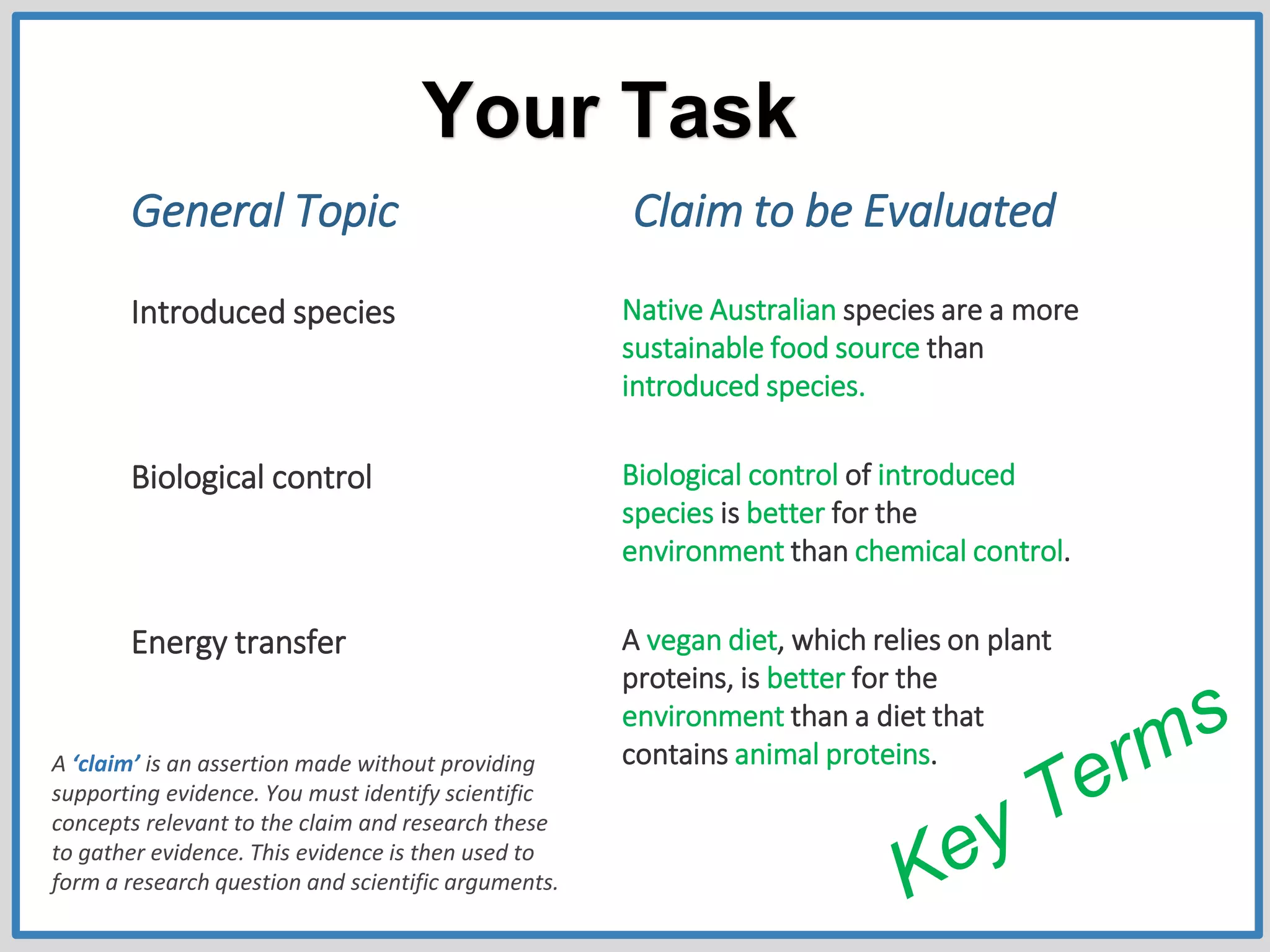
Your Task
General Topic Claim to be Evaluated
Introduced species Native Australian species are a more
sustainable food source than
introduced species.
Biological control Biological control of introduced
species is better for the
environment than chemical control.
Energy transfer A vegan diet, which relies on plant
proteins, is better for the
environment than a diet that
contains animal proteins.A ‘claim’ is an assertion made without providing
supporting evidence. You must identify scientific
concepts relevant to the claim and research these
to gather evidence. This evidence is then used to
form a research question and scientific arguments.
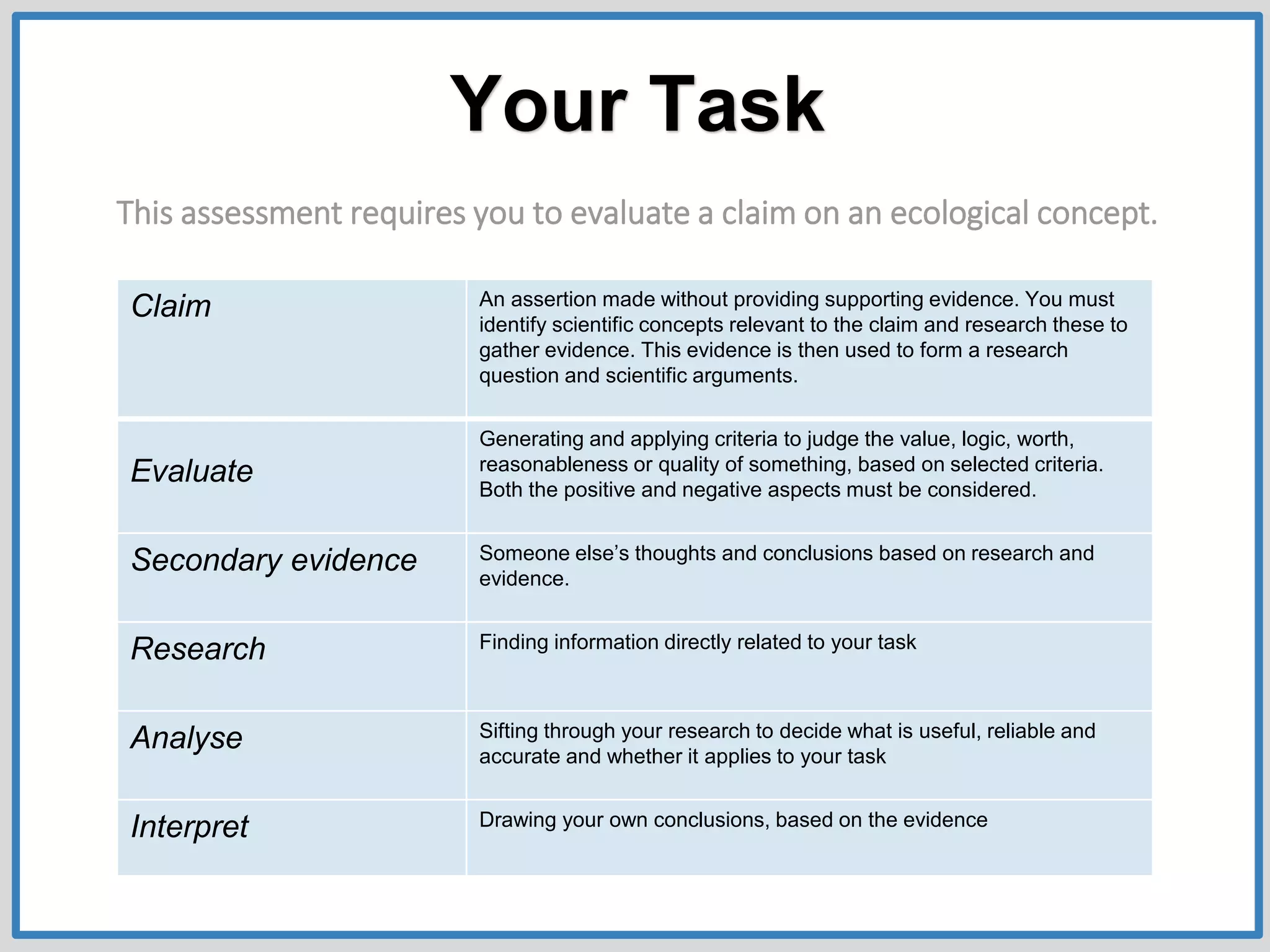
Your Task
This assessment requires you to evaluate a claim on an ecological concept.
Claim An assertion made without providing supporting evidence. You must
identify scientific concepts relevant to the claim and research these to
gather evidence. This evidence is then used to form a research
question and scientific arguments.
Evaluate
Generating and applying criteria to judge the value, logic, worth,
reasonableness or quality of something, based on selected criteria.
Both the positive and negative aspects must be considered.
Secondary evidence Someone else’s thoughts and conclusions based on research and
evidence.
Research Finding information directly related to your task
Analyse Sifting through your research to decide what is useful, reliable and
accurate and whether it applies to your task
Interpret Drawing your own conclusions, based on the evidence
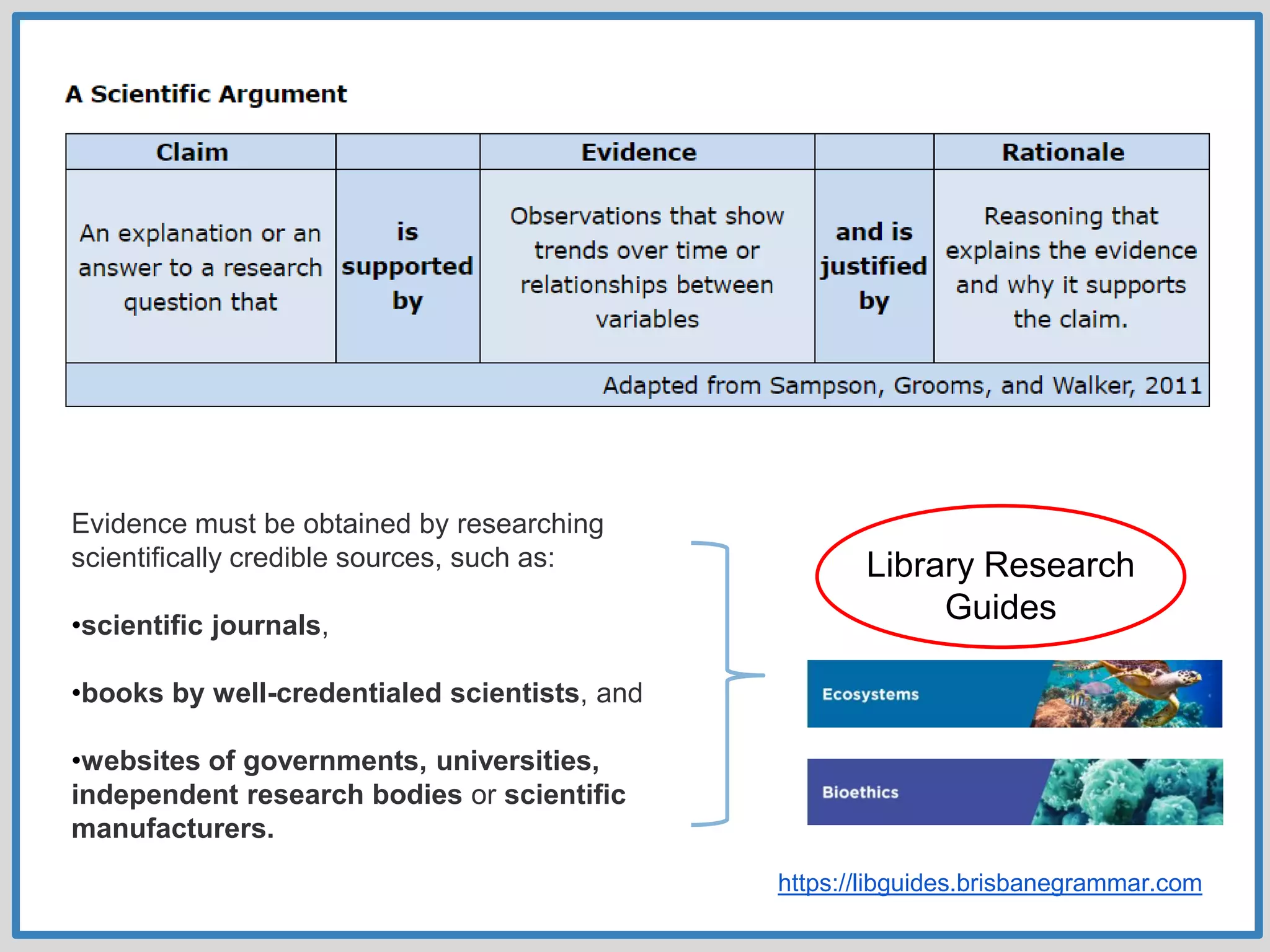
Evidence must be obtained by researching
scientifically credible sources, such as:
•scientific journals,
•books by well-credentialed scientists, and
•websites of governments, universities,
independent research bodies or scientific
manufacturers.
Library Research
Guides
https://libguides.brisbanegrammar.com
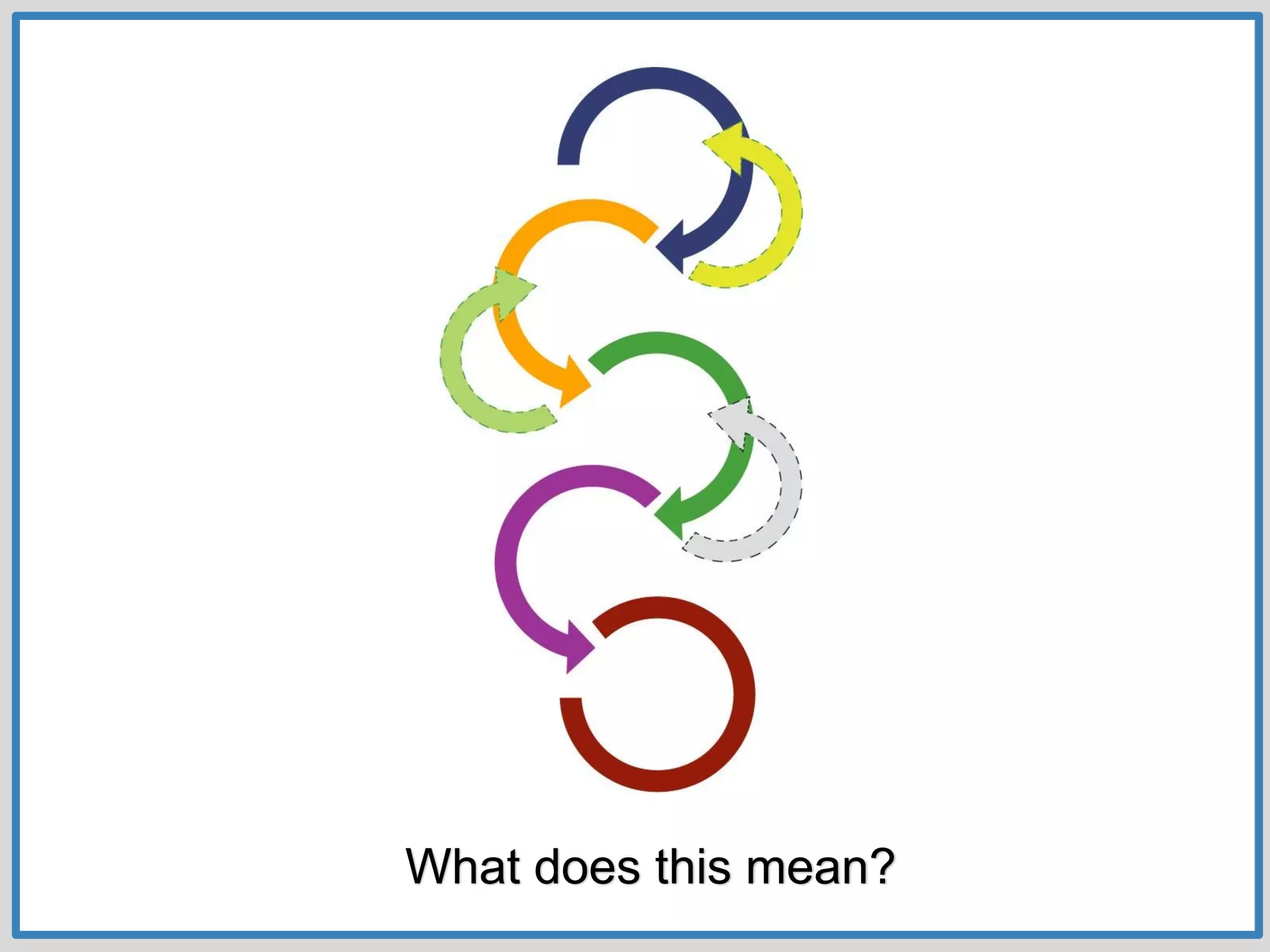
What does this mean?
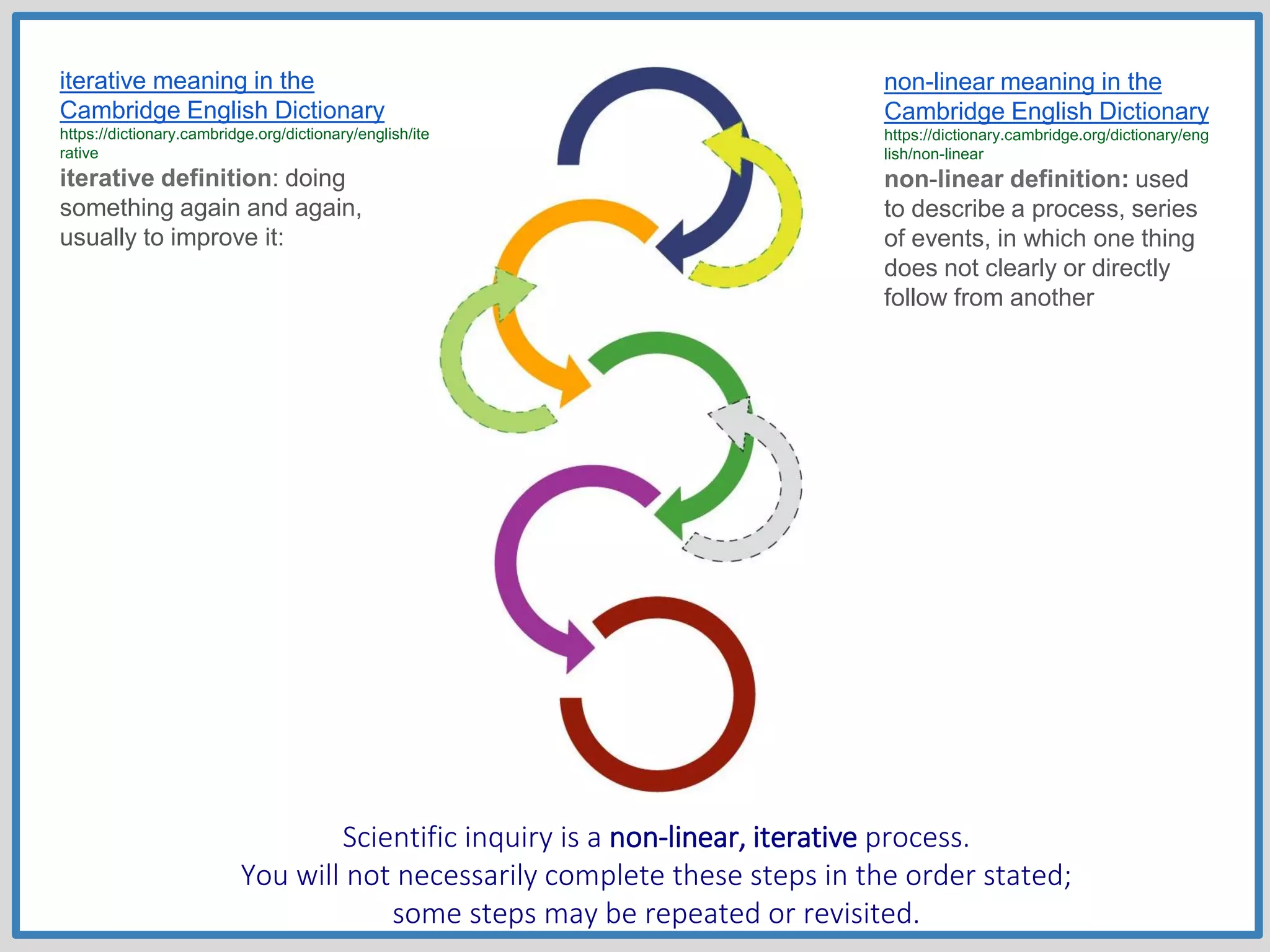
Scientific inquiry is a non-linear, iterative process.
You will not necessarily complete these steps in the order stated;
some steps may be repeated or revisited.
iterative meaning in the
Cambridge English Dictionary
https://dictionary.cambridge.org/dictionary/english/ite
rative
iterative definition: doing
something again and again,
usually to improve it:
non-linear meaning in the
Cambridge English Dictionary
https://dictionary.cambridge.org/dictionary/eng
lish/non-linear
non-linear definition: used
to describe a process, series
of events, in which one thing
does not clearly or directly
follow from another
https://youtu.be/hH9fCRgqNGo
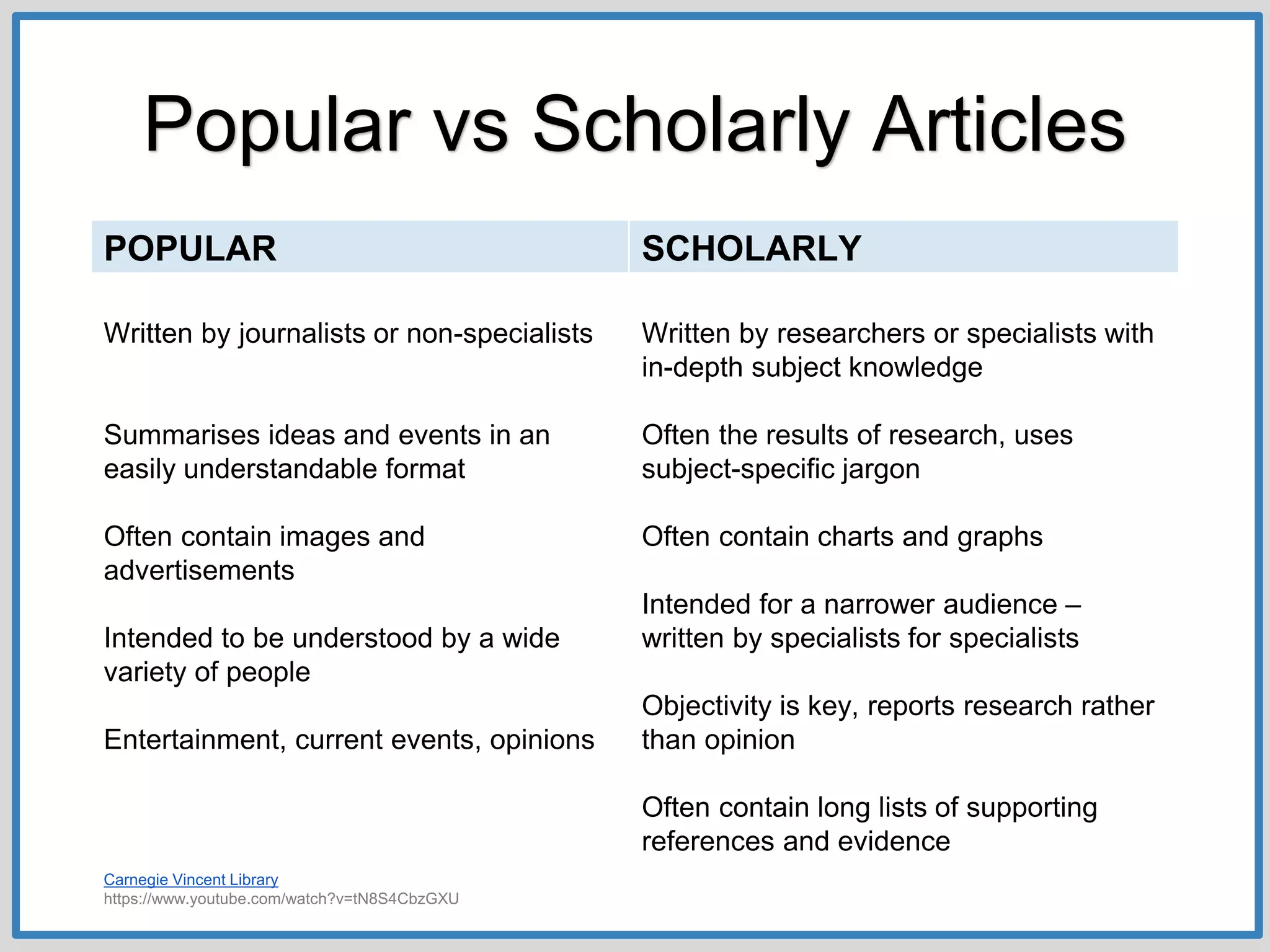
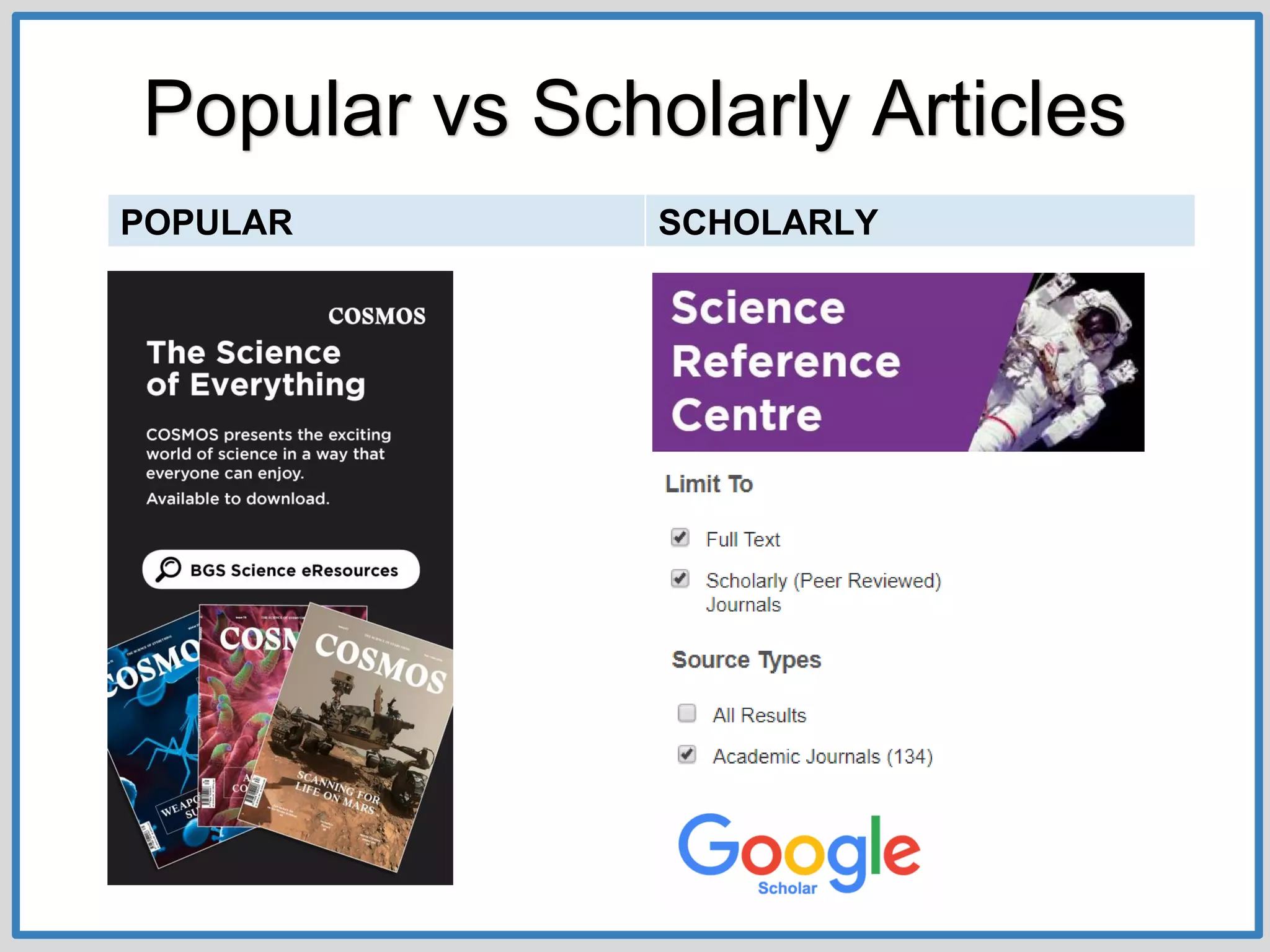
Popular vs Scholarly Articles
POPULAR SCHOLARLY
Written by journalists or non-specialists
Summarises ideas and events in an
easily understandable format
Often contain images and
advertisements
Intended to be understood by a wide
variety of people
Entertainment, current events, opinions
Written by researchers or specialists with
in-depth subject knowledge
Often the results of research, uses
subject-specific jargon
Often contain charts and graphs
Intended for a narrower audience –
written by specialists for specialists
Objectivity is key, reports research rather
than opinion
Often contain long lists of supporting
references and evidence
Carnegie Vincent Library
https://www.youtube.com/watch?v=tN8S4CbzGXU
Popular vs Scholarly Articles
POPULAR SCHOLARLY
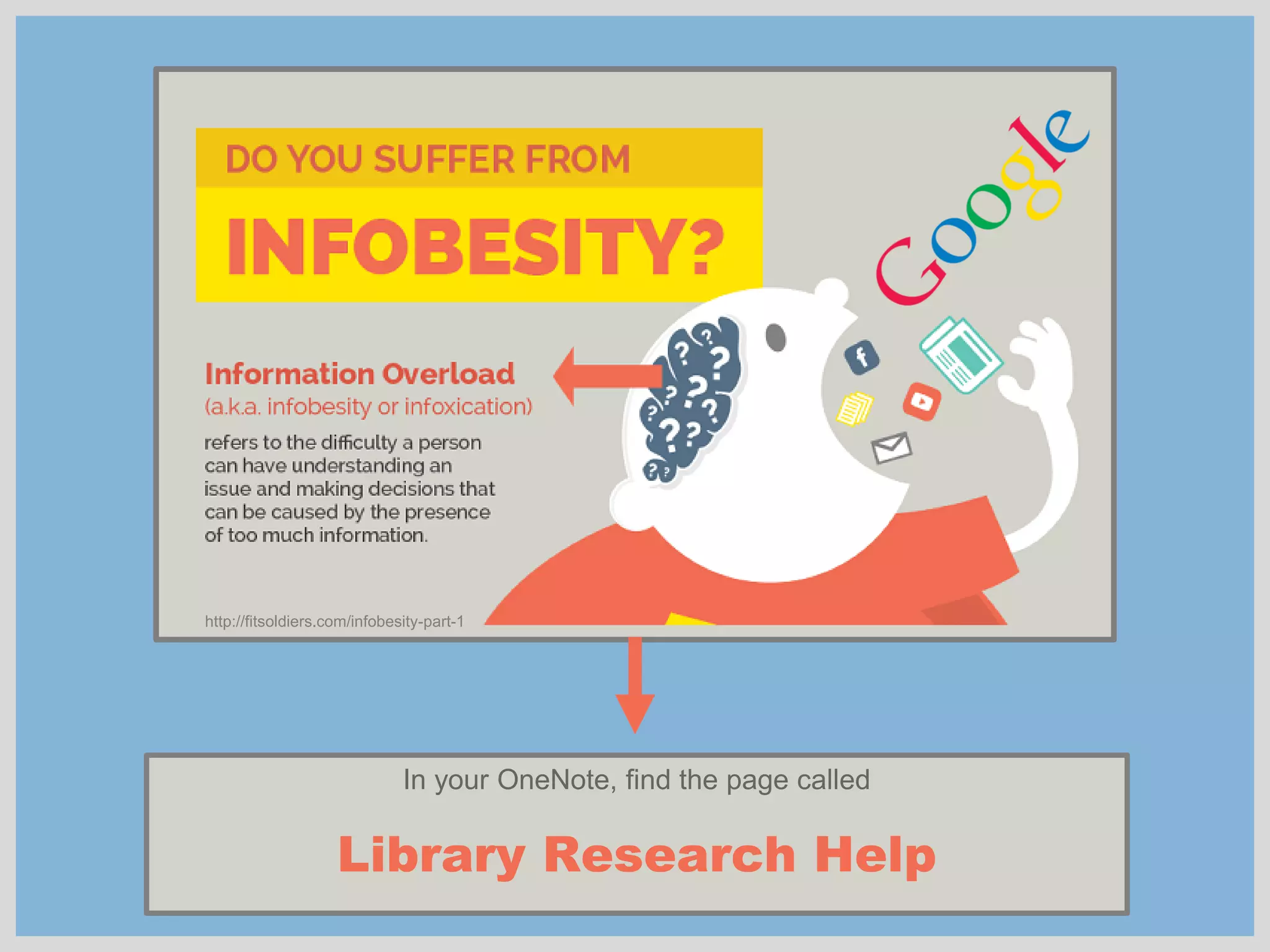
http://fitsoldiers.com/infobesity-part-1
In your OneNote, find the page called
Library Research Help
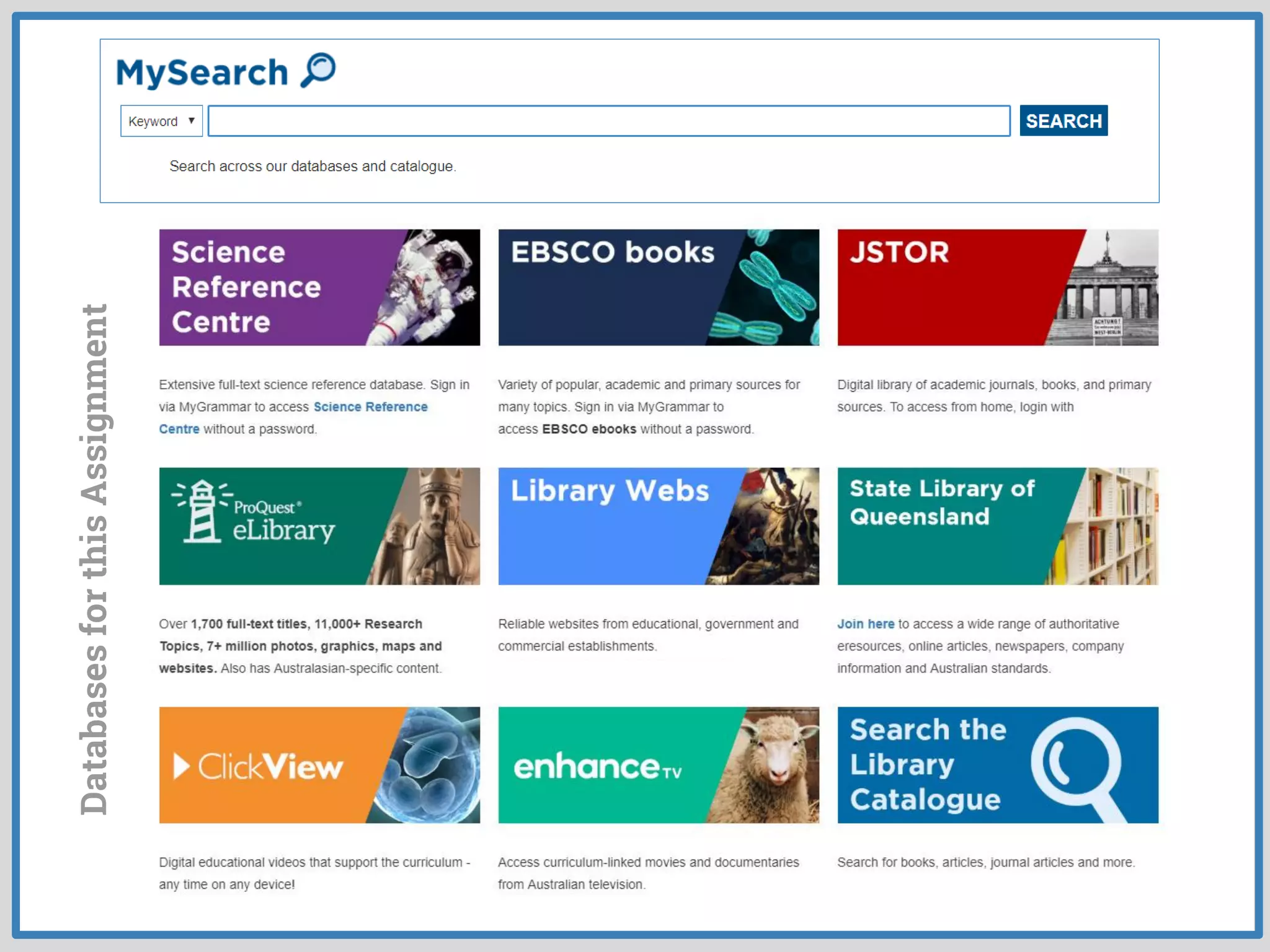
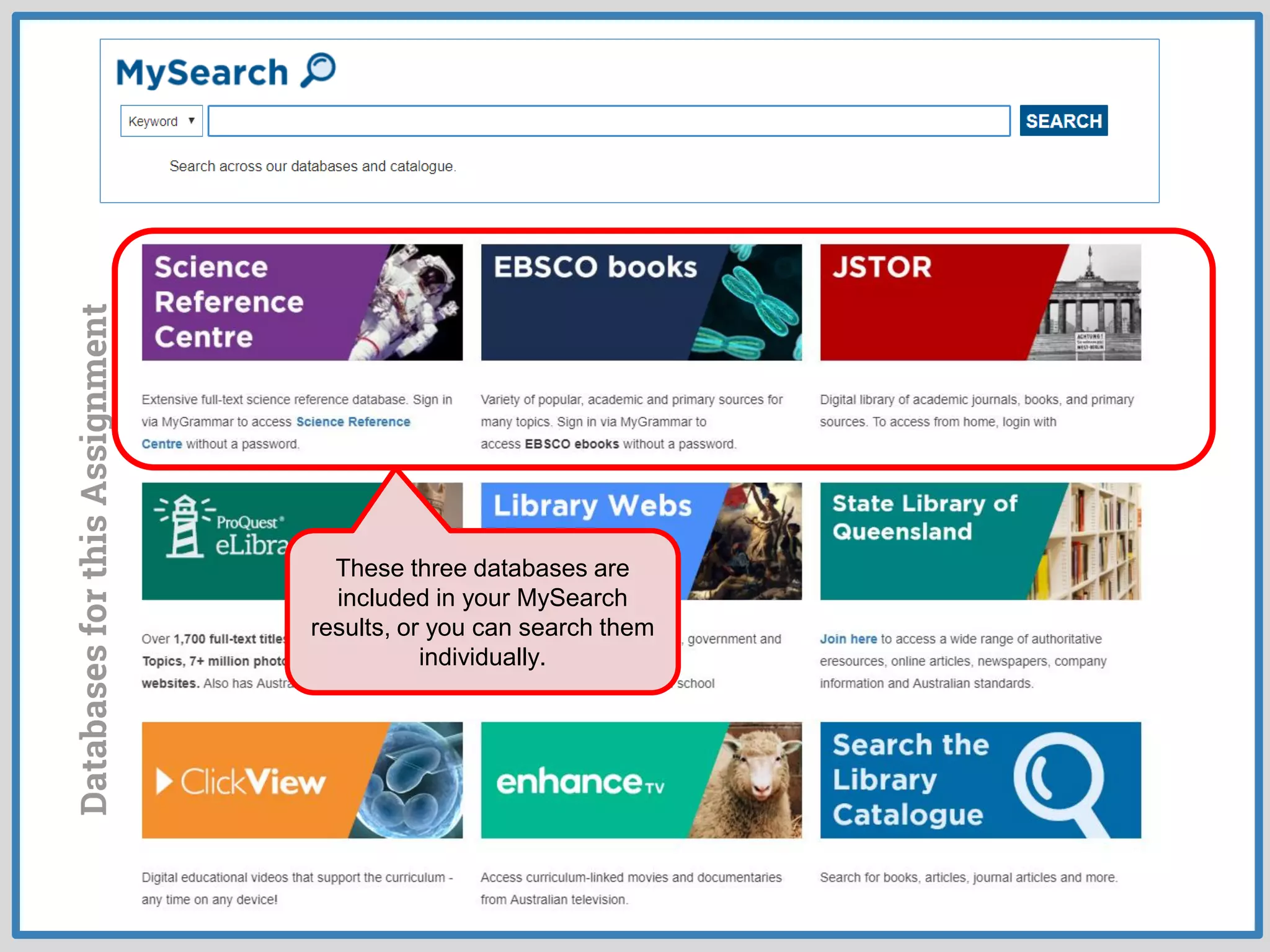
DatabasesforthisAssignment
These three databases are
included in your MySearch
results, or you can search them
individually.
DatabasesforthisAssignment
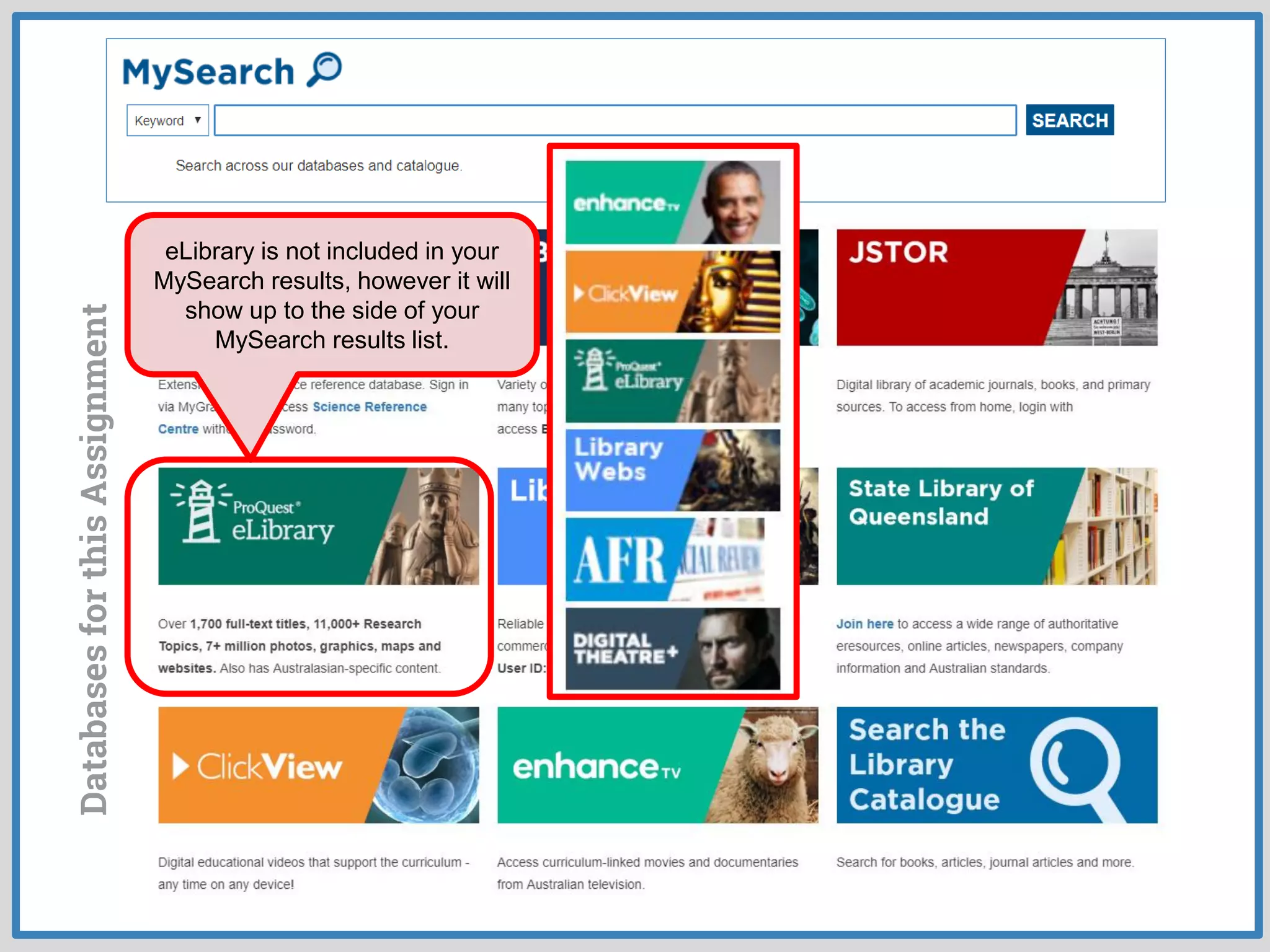
eLibrary is not included in your
MySearch results, however it will
show up to the side of your
MySearch results list.
DatabasesforthisAssignment
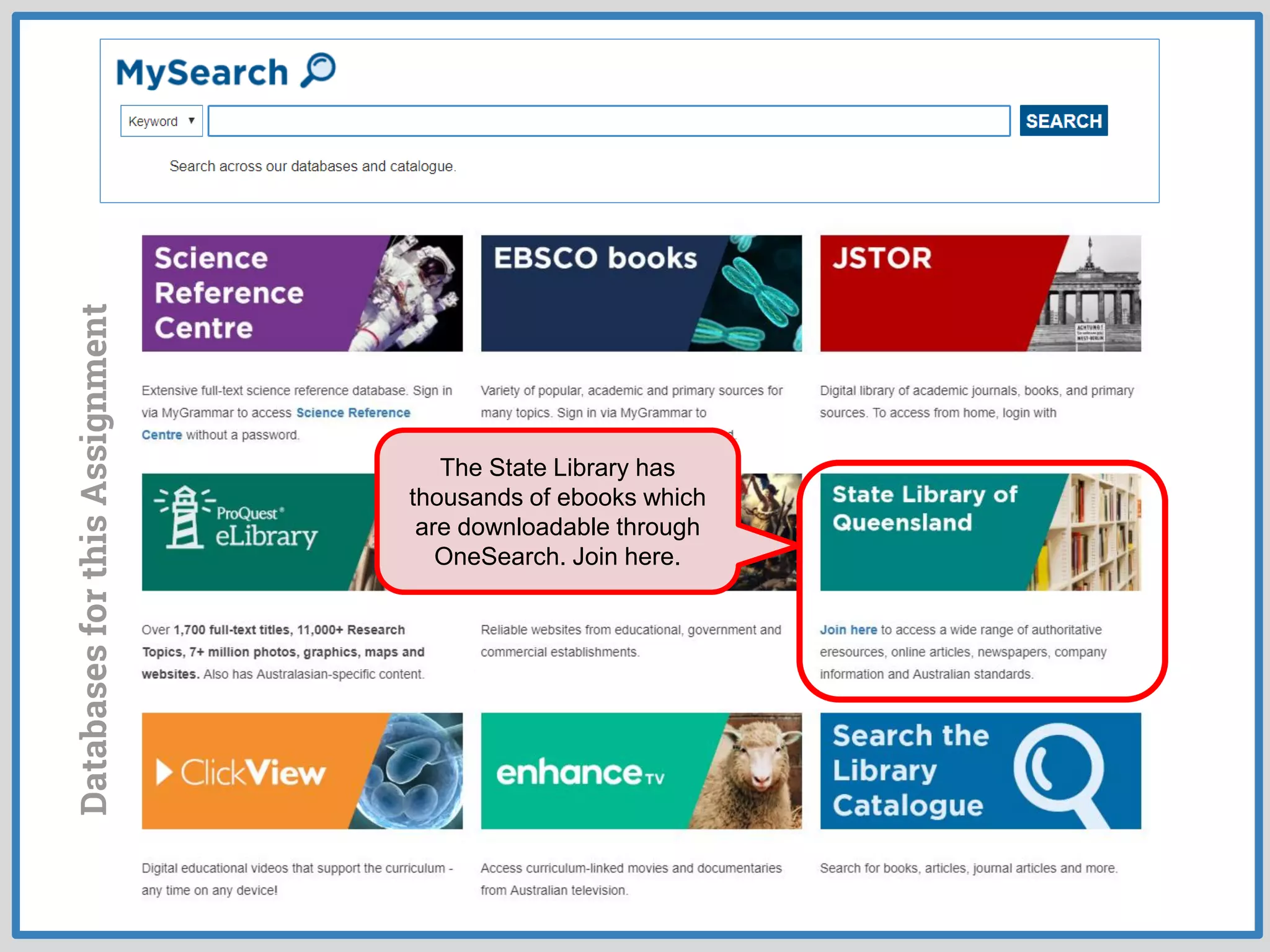
The State Library has
thousands of ebooks which
are downloadable through
OneSearch. Join here.
The State Library has
thousands of ebooks which
are downloadable through
OneSearch. Join here.
DatabasesforthisAssignment
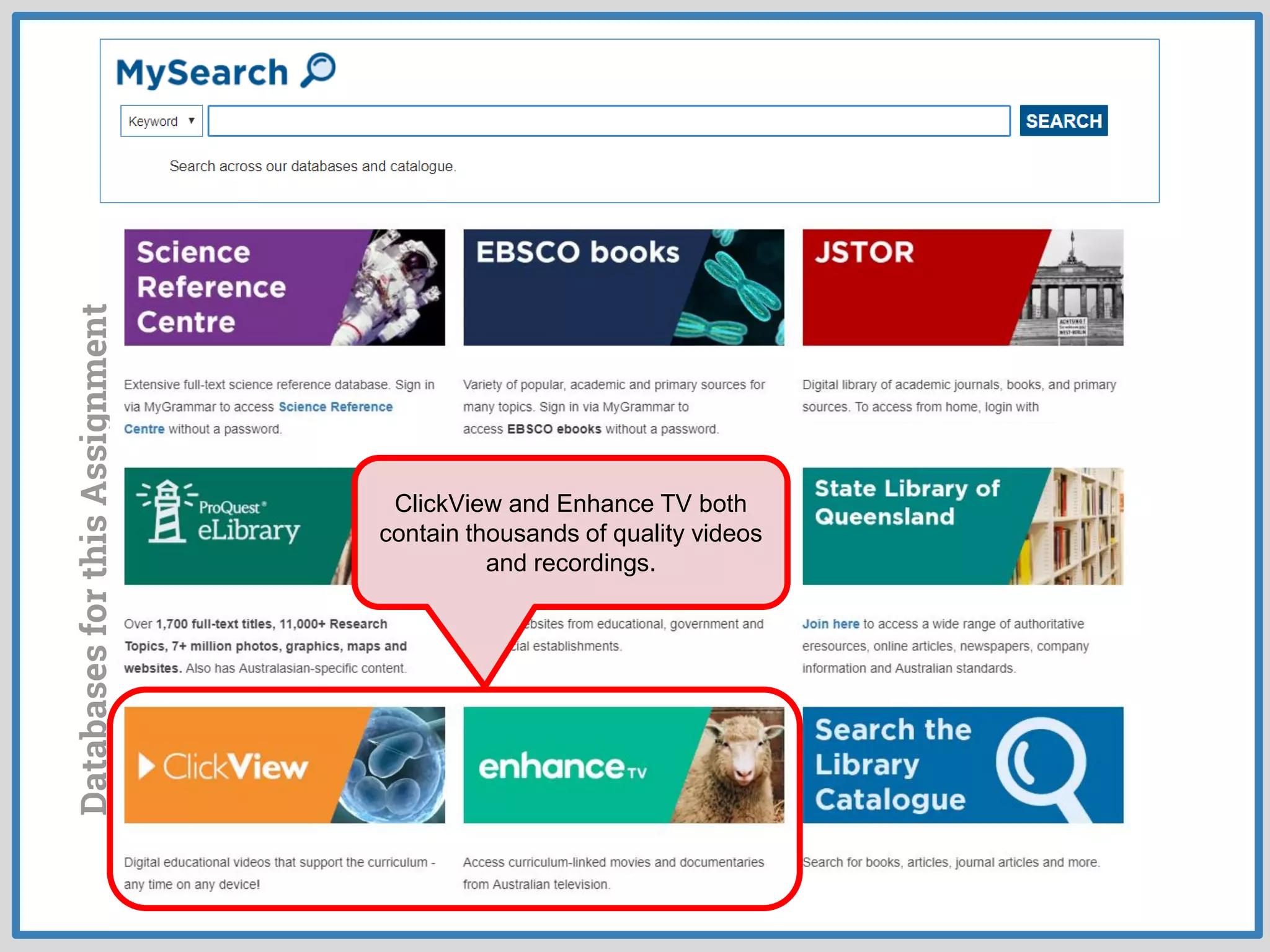
ClickView and Enhance TV both
contain thousands of quality videos
and recordings.
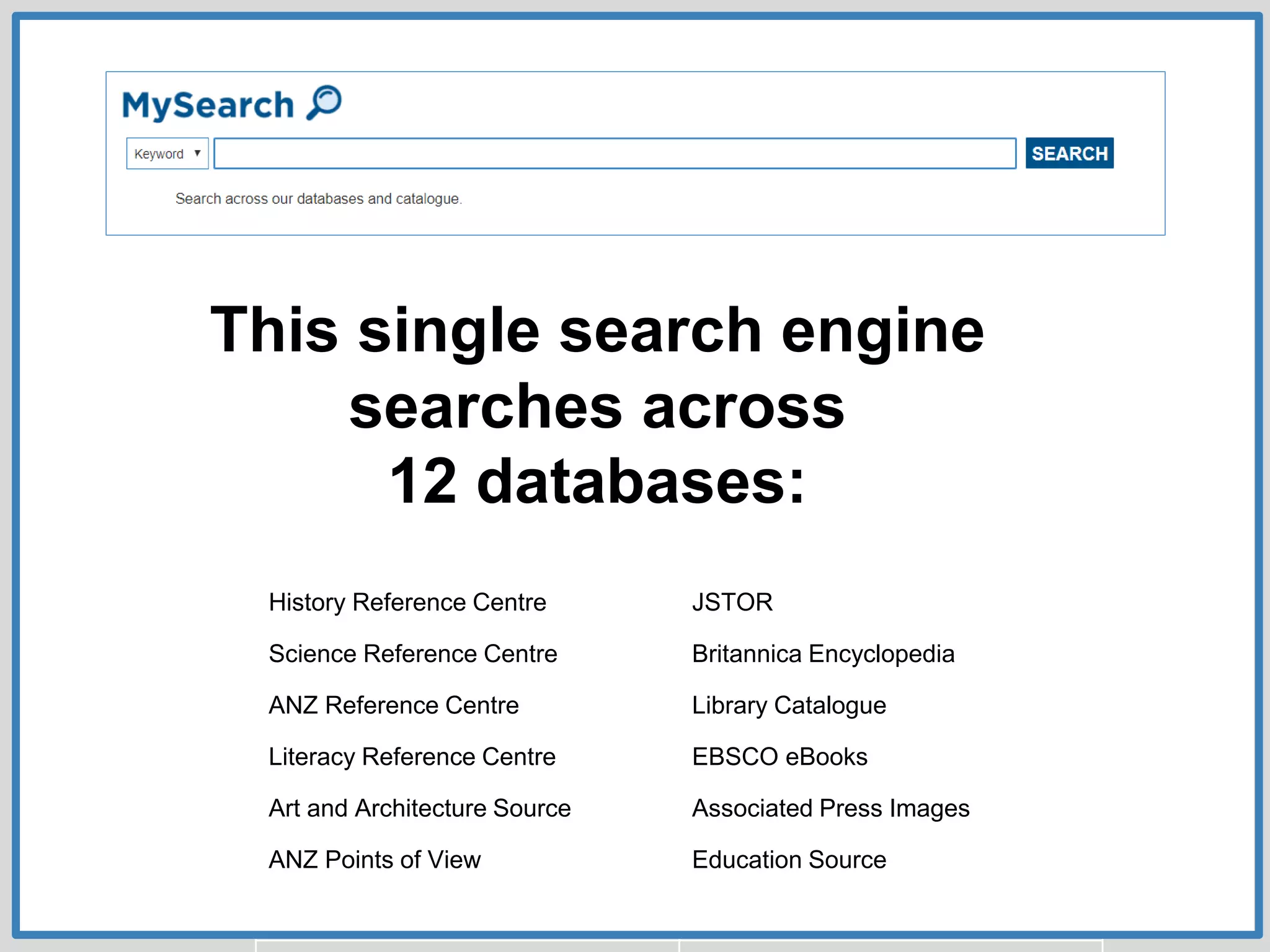
This single search engine
searches across
12 databases:
History Reference Centre JSTOR
Science Reference Centre Britannica Encyclopedia
ANZ Reference Centre Library Catalogue
Literacy Reference Centre EBSCO eBooks
Art and Architecture Source Associated Press Images
ANZ Points of View Education Source
So…..
Why
databases?
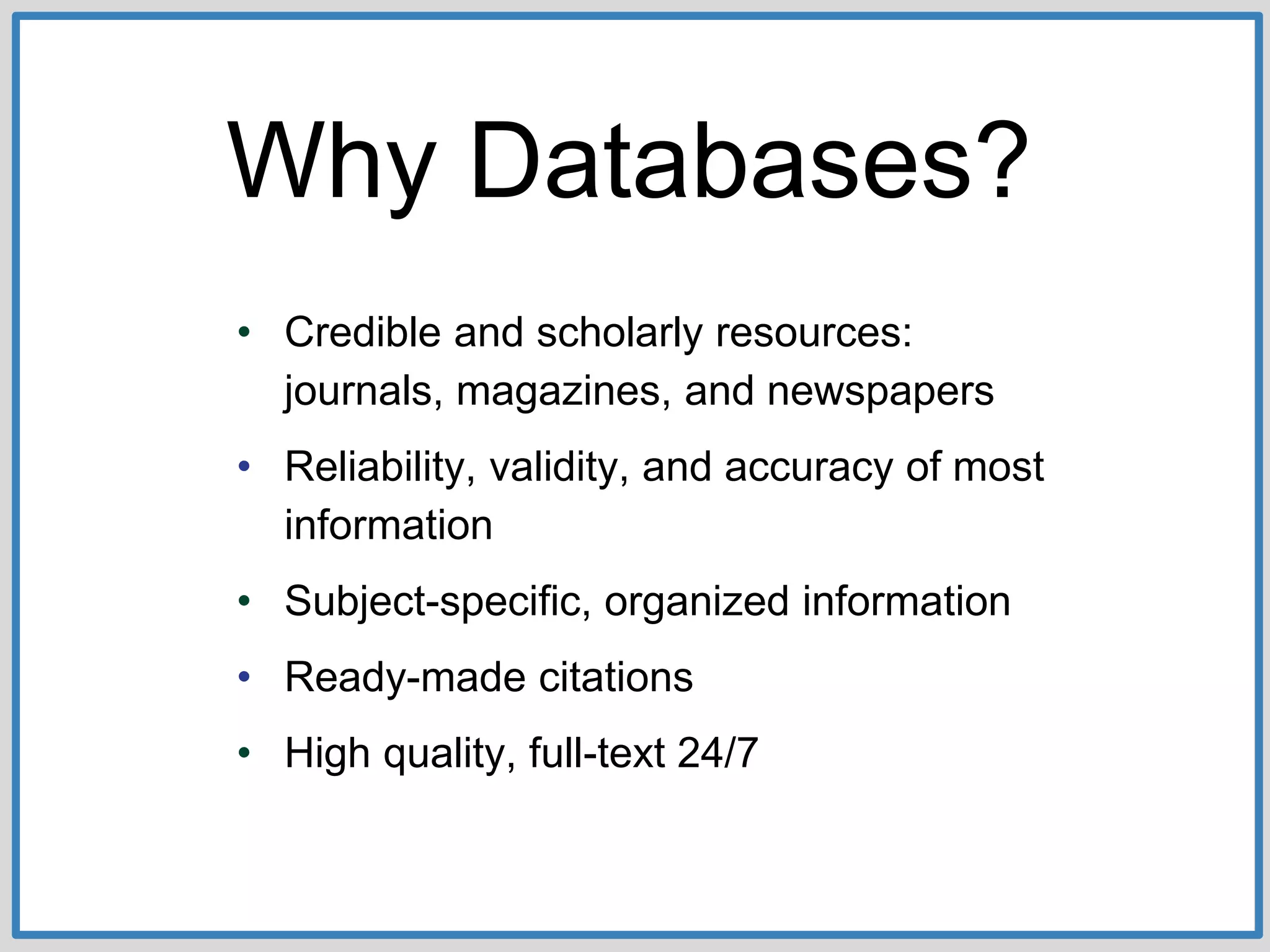
Why Databases?
• Credible and scholarly resources:
journals, magazines, and newspapers
• Reliability, validity, and accuracy of most
information
• Subject-specific, organized information
• Ready-made citations
• High quality, full-text 24/7
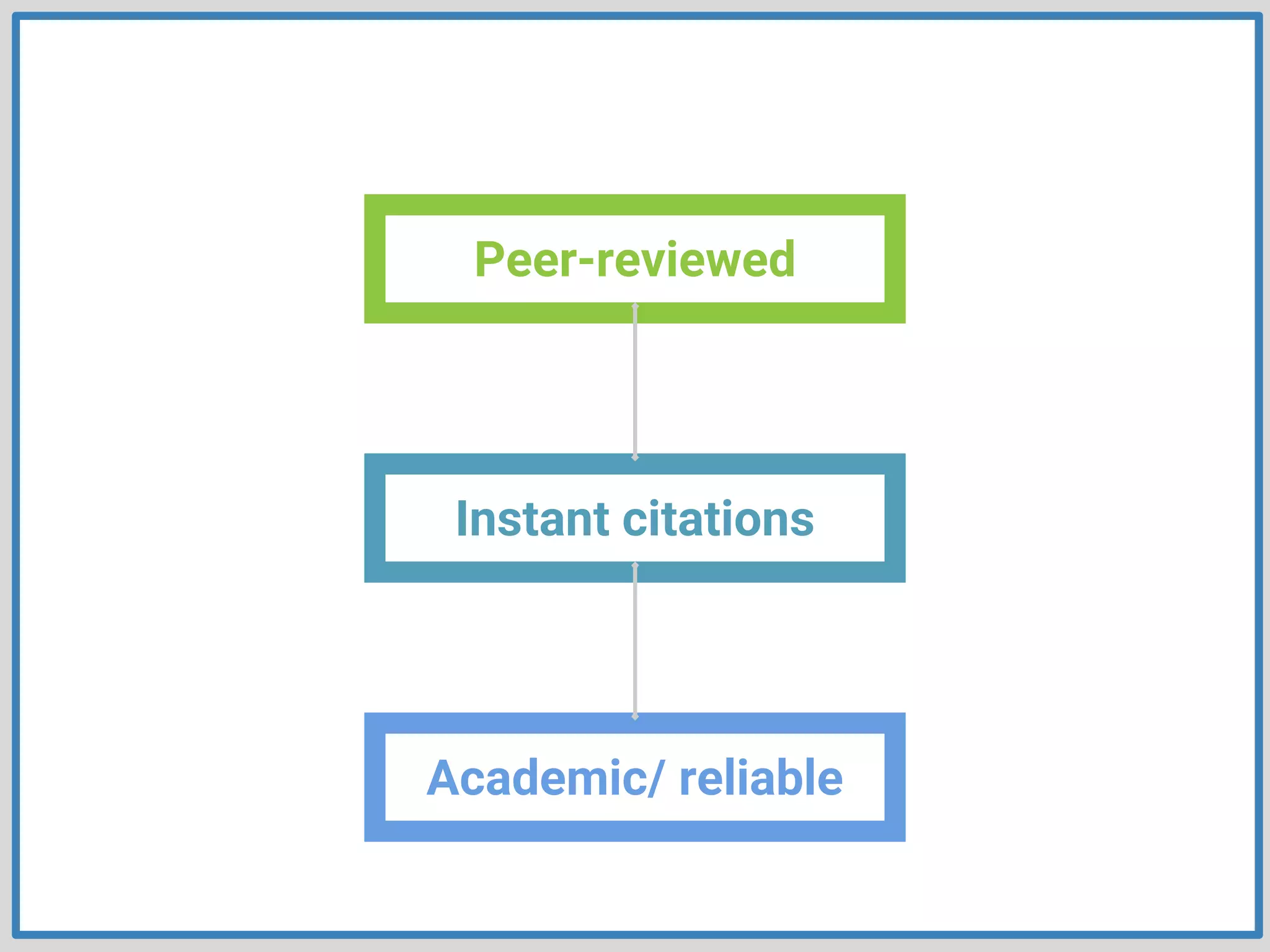
Peer-reviewed
Instant citations
Academic/ reliable
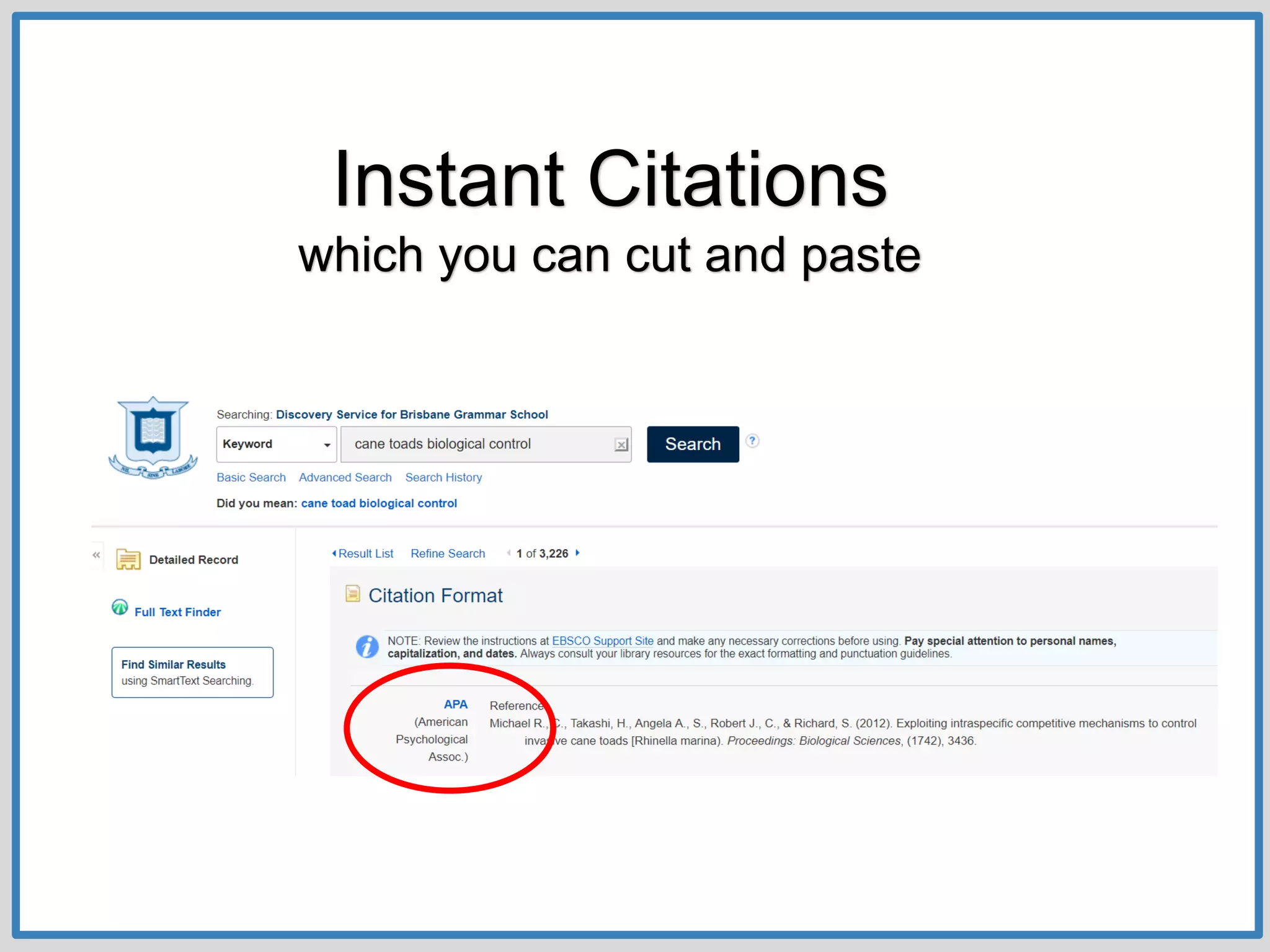
Instant Citations
which you can cut and paste
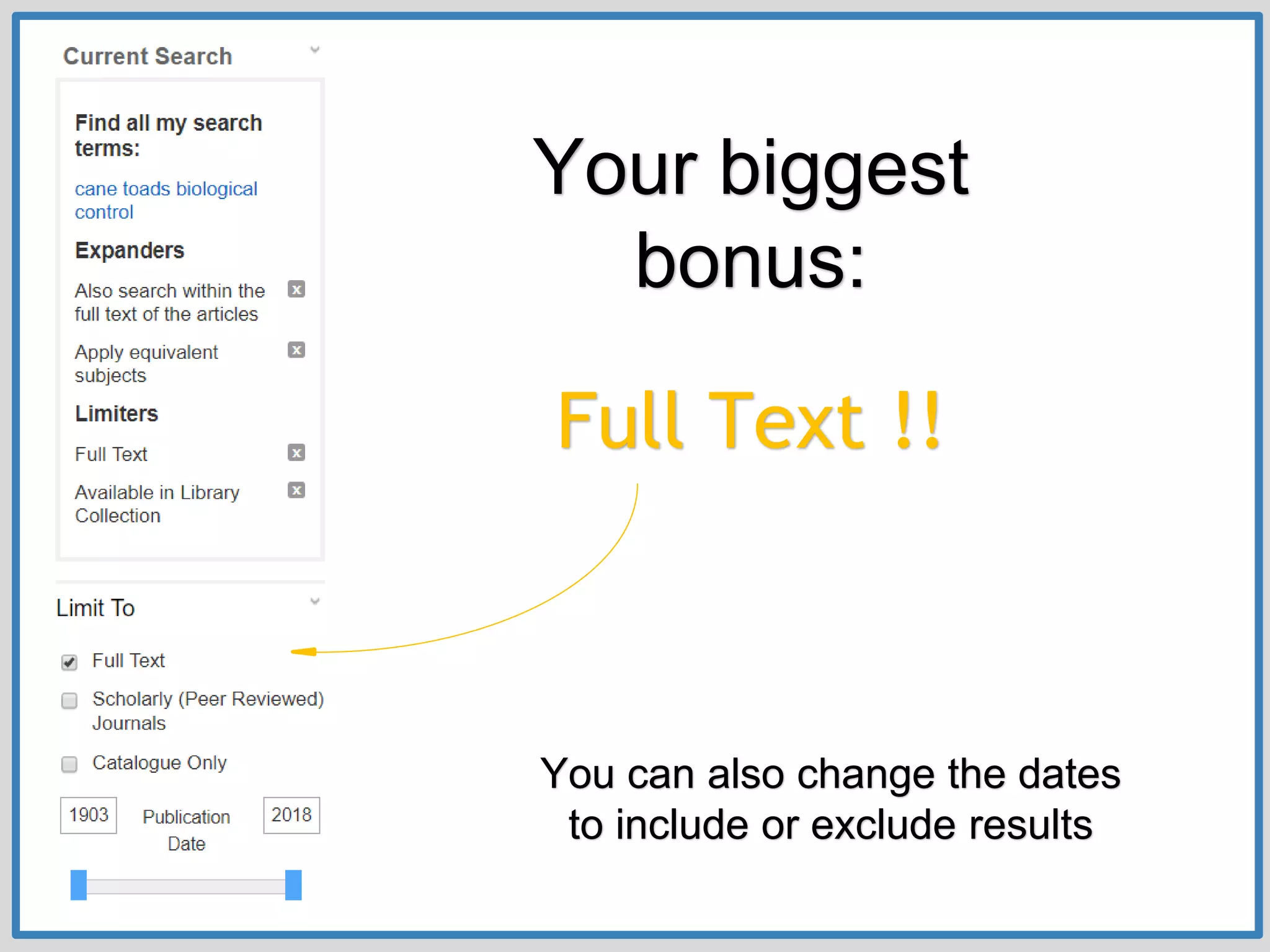
You can also change the dates
to include or exclude results
Your biggest
bonus:
Full Text !!
So…..
Why
Google?
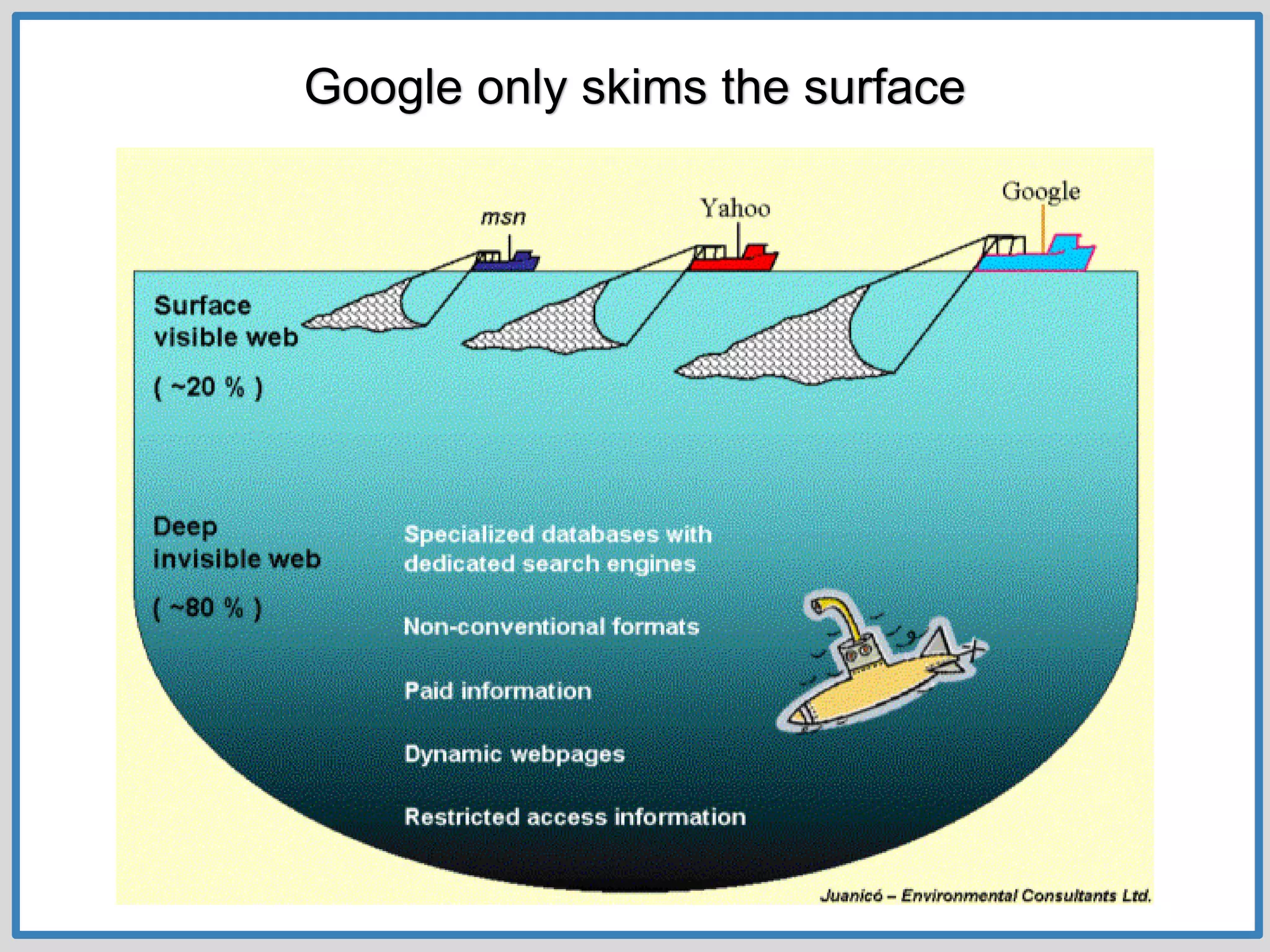
Google only skims the surface
The problem with Google
is that it does some things so well
it’s easy to see it as the primary tool of research.
The point of senior research is not in
getting an answer…
it's in getting the right answer!!
You need to learn how to learn –
how to access, analyse, and interpret the information you find –
and how to distinguish authoritative from non-authoritative sources.
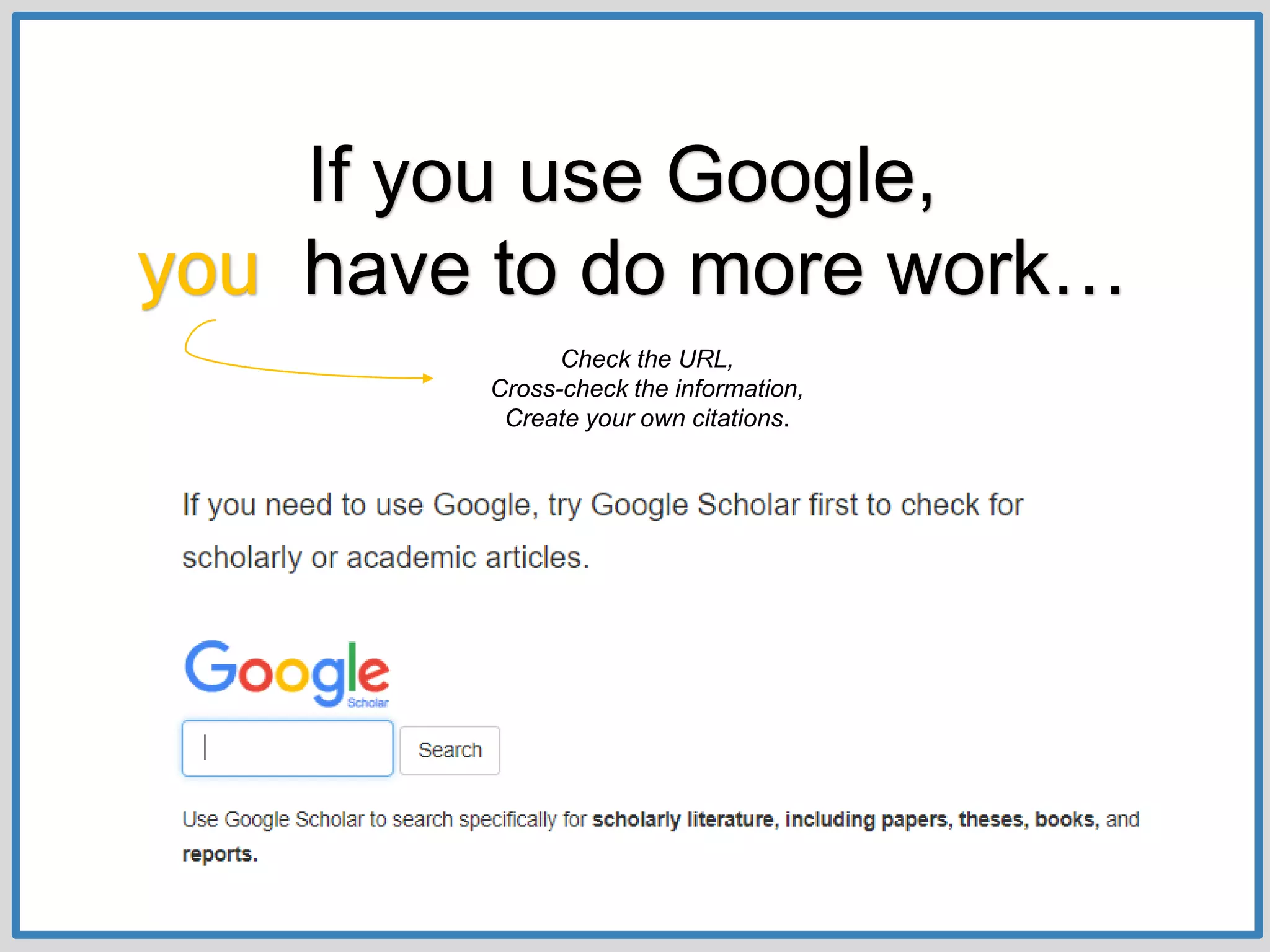
If you use Google,
you have to do more work…
Check the URL,
Cross-check the information,
Create your own citations.
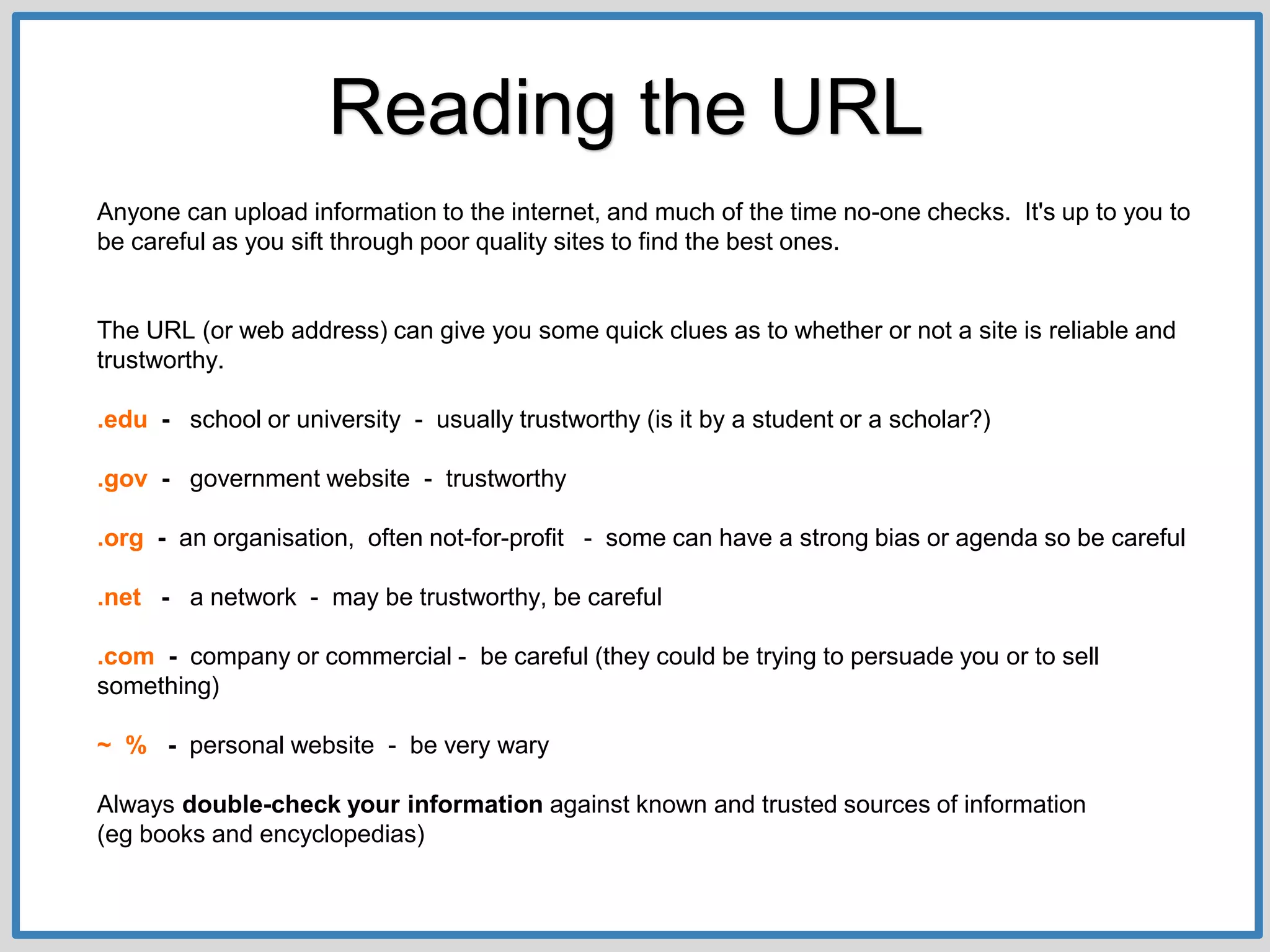
Anyone can upload information to the internet, and much of the time no-one checks. It's up to you to
be careful as you sift through poor quality sites to find the best ones.
The URL (or web address) can give you some quick clues as to whether or not a site is reliable and
trustworthy.
.edu - school or university - usually trustworthy (is it by a student or a scholar?)
.gov - government website - trustworthy
.org - an organisation, often not-for-profit - some can have a strong bias or agenda so be careful
.net - a network - may be trustworthy, be careful
.com - company or commercial - be careful (they could be trying to persuade you or to sell
something)
~ % - personal website - be very wary
Always double-check your information against known and trusted sources of information
(eg books and encyclopedias)
Reading the URL
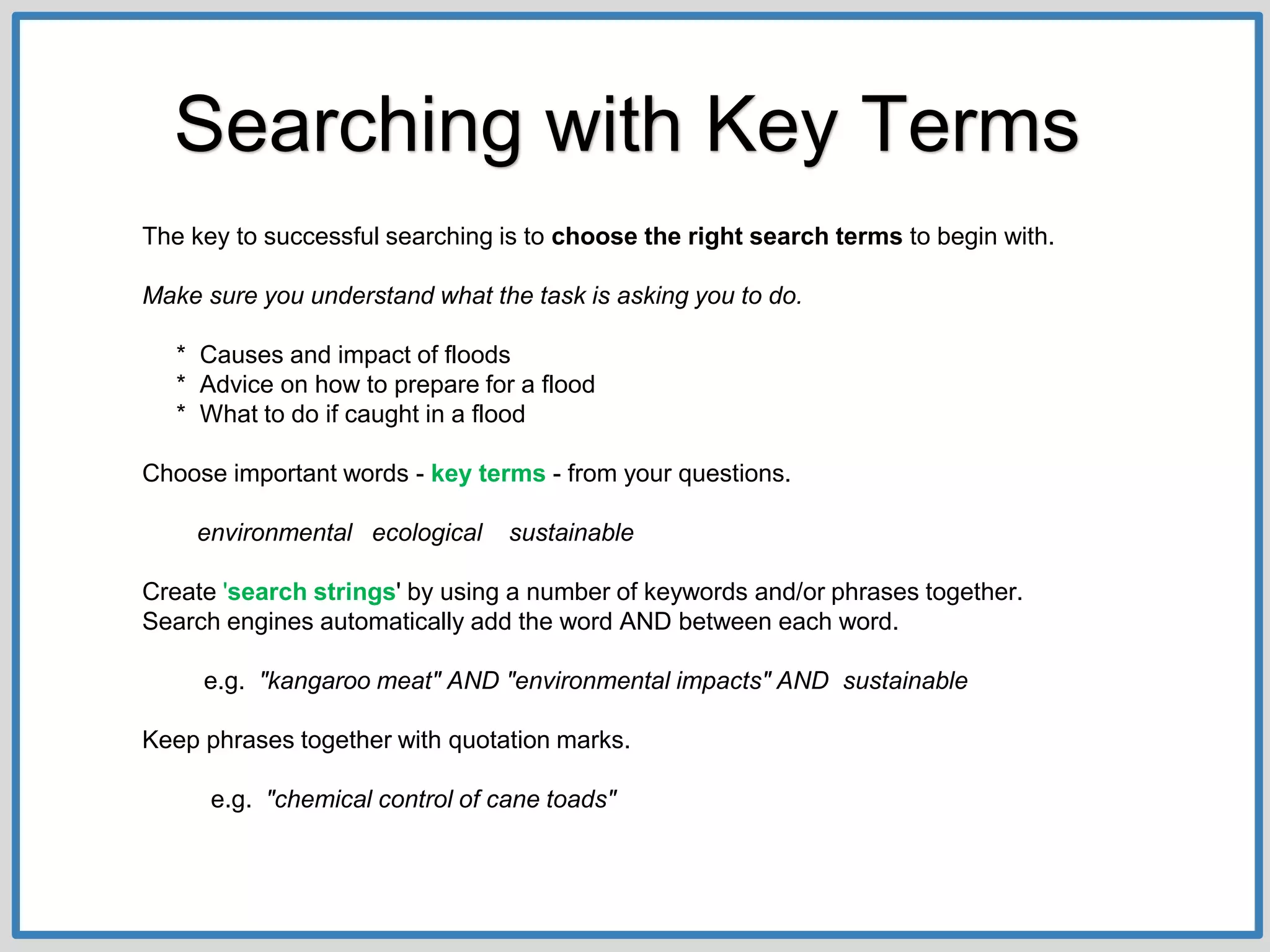
The key to successful searching is to choose the right search terms to begin with.
Make sure you understand what the task is asking you to do.
* Causes and impact of floods
* Advice on how to prepare for a flood
* What to do if caught in a flood
Choose important words - key terms - from your questions.
environmental ecological sustainable
Create 'search strings' by using a number of keywords and/or phrases together.
Search engines automatically add the word AND between each word.
e.g. "kangaroo meat" AND "environmental impacts" AND sustainable
Keep phrases together with quotation marks.
e.g. "chemical control of cane toads"
Searching with Key Terms
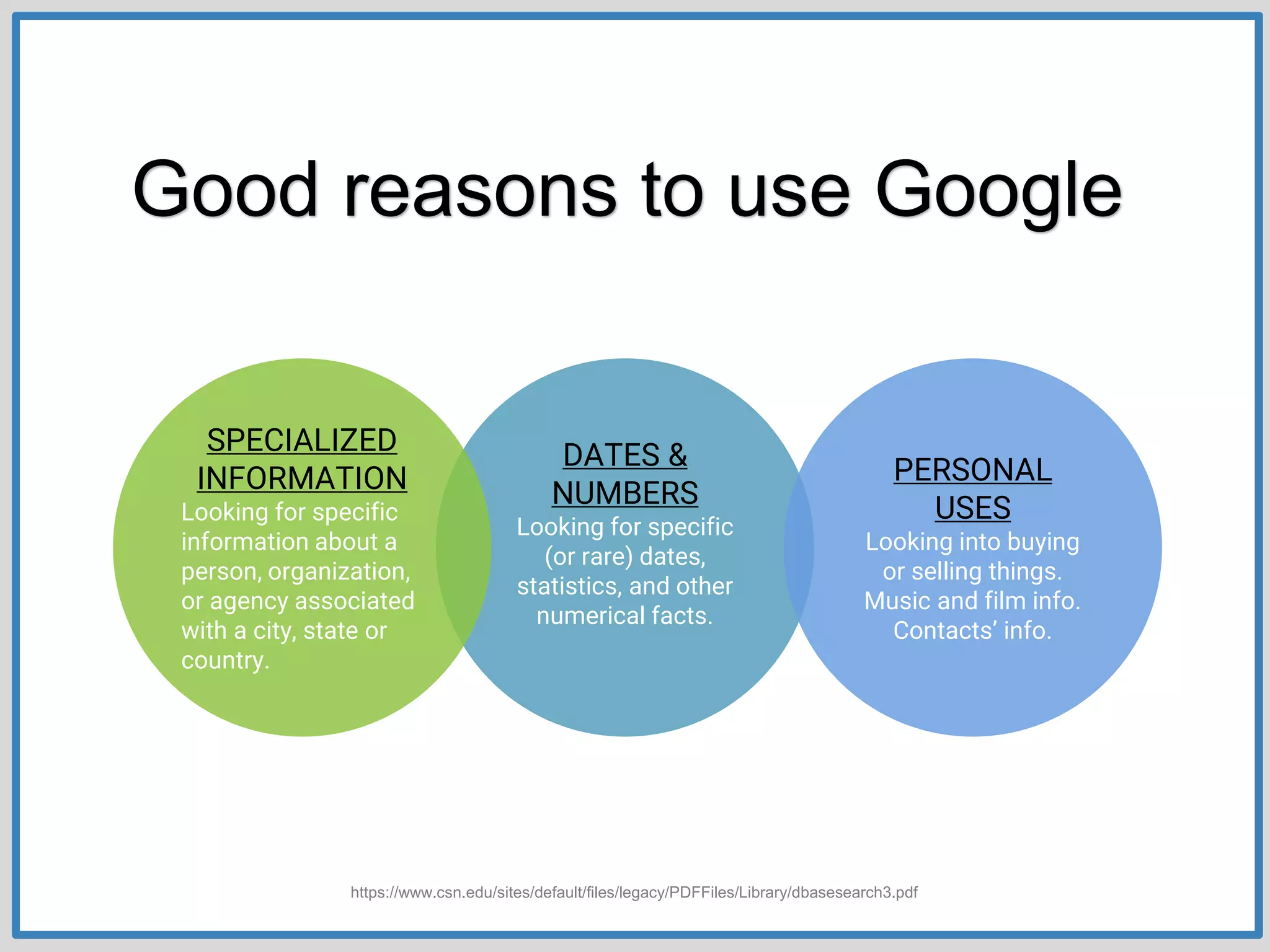
DATES &
NUMBERS
Looking for specific
(or rare) dates,
statistics, and other
numerical facts.
SPECIALIZED
INFORMATION
Looking for specific
information about a
person, organization,
or agency associated
with a city, state or
country.
PERSONAL
USES
Looking into buying
or selling things.
Music and film info.
Contacts’ info.
Good reasons to use Google
https://www.csn.edu/sites/default/files/legacy/PDFFiles/Library/dbasesearch3.pdf

Science Research Guide: MySearchDatabasesBioethicsEcosystems

  • 1.
  • 2.
    Your Task General TopicClaim to be Evaluated Introduced species Native Australian species are a more sustainable food source than introduced species. Biological control Biological control of introduced species is better for the environment than chemical control. Energy transfer A vegan diet, which relies on plant proteins, is better for the environment than a diet that contains animal proteins.A ‘claim’ is an assertion made without providing supporting evidence. You must identify scientific concepts relevant to the claim and research these to gather evidence. This evidence is then used to form a research question and scientific arguments.
  • 3.
    Your Task This assessmentrequires you to evaluate a claim on an ecological concept. Claim An assertion made without providing supporting evidence. You must identify scientific concepts relevant to the claim and research these to gather evidence. This evidence is then used to form a research question and scientific arguments. Evaluate Generating and applying criteria to judge the value, logic, worth, reasonableness or quality of something, based on selected criteria. Both the positive and negative aspects must be considered. Secondary evidence Someone else’s thoughts and conclusions based on research and evidence. Research Finding information directly related to your task Analyse Sifting through your research to decide what is useful, reliable and accurate and whether it applies to your task Interpret Drawing your own conclusions, based on the evidence
  • 4.
    Evidence must beobtained by researching scientifically credible sources, such as: •scientific journals, •books by well-credentialed scientists, and •websites of governments, universities, independent research bodies or scientific manufacturers. Library Research Guides https://libguides.brisbanegrammar.com
  • 5.
  • 6.
    Scientific inquiry isa non-linear, iterative process. You will not necessarily complete these steps in the order stated; some steps may be repeated or revisited. iterative meaning in the Cambridge English Dictionary https://dictionary.cambridge.org/dictionary/english/ite rative iterative definition: doing something again and again, usually to improve it: non-linear meaning in the Cambridge English Dictionary https://dictionary.cambridge.org/dictionary/eng lish/non-linear non-linear definition: used to describe a process, series of events, in which one thing does not clearly or directly follow from another
  • 8.
  • 9.
    Popular vs ScholarlyArticles POPULAR SCHOLARLY Written by journalists or non-specialists Summarises ideas and events in an easily understandable format Often contain images and advertisements Intended to be understood by a wide variety of people Entertainment, current events, opinions Written by researchers or specialists with in-depth subject knowledge Often the results of research, uses subject-specific jargon Often contain charts and graphs Intended for a narrower audience – written by specialists for specialists Objectivity is key, reports research rather than opinion Often contain long lists of supporting references and evidence Carnegie Vincent Library https://www.youtube.com/watch?v=tN8S4CbzGXU
  • 10.
    Popular vs ScholarlyArticles POPULAR SCHOLARLY
  • 11.
    http://fitsoldiers.com/infobesity-part-1 In your OneNote,find the page called Library Research Help
  • 12.
  • 13.
    DatabasesforthisAssignment These three databasesare included in your MySearch results, or you can search them individually.
  • 14.
    DatabasesforthisAssignment eLibrary is notincluded in your MySearch results, however it will show up to the side of your MySearch results list.
  • 15.
    DatabasesforthisAssignment The State Libraryhas thousands of ebooks which are downloadable through OneSearch. Join here. The State Library has thousands of ebooks which are downloadable through OneSearch. Join here.
  • 16.
    DatabasesforthisAssignment ClickView and EnhanceTV both contain thousands of quality videos and recordings.
  • 17.
    This single searchengine searches across 12 databases: History Reference Centre JSTOR Science Reference Centre Britannica Encyclopedia ANZ Reference Centre Library Catalogue Literacy Reference Centre EBSCO eBooks Art and Architecture Source Associated Press Images ANZ Points of View Education Source
  • 18.
  • 19.
    Why Databases? • Credibleand scholarly resources: journals, magazines, and newspapers • Reliability, validity, and accuracy of most information • Subject-specific, organized information • Ready-made citations • High quality, full-text 24/7
  • 20.
  • 21.
    Instant Citations which youcan cut and paste
  • 22.
    You can alsochange the dates to include or exclude results Your biggest bonus: Full Text !!
  • 23.
  • 24.
    Google only skimsthe surface
  • 25.
    The problem withGoogle is that it does some things so well it’s easy to see it as the primary tool of research. The point of senior research is not in getting an answer… it's in getting the right answer!! You need to learn how to learn – how to access, analyse, and interpret the information you find – and how to distinguish authoritative from non-authoritative sources.
  • 26.
    If you useGoogle, you have to do more work… Check the URL, Cross-check the information, Create your own citations.
  • 27.
    Anyone can uploadinformation to the internet, and much of the time no-one checks. It's up to you to be careful as you sift through poor quality sites to find the best ones. The URL (or web address) can give you some quick clues as to whether or not a site is reliable and trustworthy. .edu - school or university - usually trustworthy (is it by a student or a scholar?) .gov - government website - trustworthy .org - an organisation, often not-for-profit - some can have a strong bias or agenda so be careful .net - a network - may be trustworthy, be careful .com - company or commercial - be careful (they could be trying to persuade you or to sell something) ~ % - personal website - be very wary Always double-check your information against known and trusted sources of information (eg books and encyclopedias) Reading the URL
  • 28.
    The key tosuccessful searching is to choose the right search terms to begin with. Make sure you understand what the task is asking you to do. * Causes and impact of floods * Advice on how to prepare for a flood * What to do if caught in a flood Choose important words - key terms - from your questions. environmental ecological sustainable Create 'search strings' by using a number of keywords and/or phrases together. Search engines automatically add the word AND between each word. e.g. "kangaroo meat" AND "environmental impacts" AND sustainable Keep phrases together with quotation marks. e.g. "chemical control of cane toads" Searching with Key Terms
  • 29.
    DATES & NUMBERS Looking forspecific (or rare) dates, statistics, and other numerical facts. SPECIALIZED INFORMATION Looking for specific information about a person, organization, or agency associated with a city, state or country. PERSONAL USES Looking into buying or selling things. Music and film info. Contacts’ info. Good reasons to use Google https://www.csn.edu/sites/default/files/legacy/PDFFiles/Library/dbasesearch3.pdf