DESIGN AND ANALYSIS OF A
SEARCHABLE SYMMETRIC KEY
CIPHER SYSTEM


               By:
               Asanka Balasooriya
               Kelum Senanayake
SECURITY REQUIREMENTS
A cryptographic scheme which enables searching
on encrypted data without revealing to the server
should have following features.


 Untrusted server should not be able to learn
  anything about the plaintext given only the
  ciphertext
 Untrusted server should not be able to search for
  a word without authorization of the client
 The scheme should be efficient and practical
THE PROPOSED SCHEME

Let’s assume that Alice is the client who owns important data
and wants to store in Bob’s cloud storage which is untrusted.

The scheme is as follows;

   Alice builds an index with keywords that Alice may want to
    search for later for all data currently she owns.
   Then she encrypts all the plain data using a symmetric
    encryption key.
   All the keywords of the index are encrypted using the same
    key.
   Lists of positions of the index are left as plain data.
   Store the complete index and ciphertext of the plain data on
    Bob’s server.
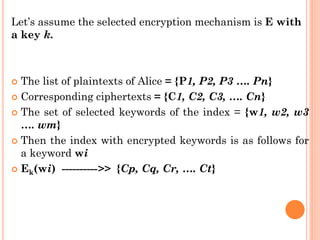
Let’s assume the selected encryption mechanism is E with
a key k.


 The list of plaintexts of Alice = {P1, P2, P3 …. Pn}
 Corresponding ciphertexts = {C1, C2, C3, …. Cn}

 The set of selected keywords of the index = {w1, w2, w3
  …. wm}
 Then the index with encrypted keywords is as follows for
  a keyword wi
 Ek(wi) ---------->> {Cp, Cq, Cr, …. Ct}
SEARCHING FOR A SPECIFIC KEYWORD
WJ IS AS FOLLOWS
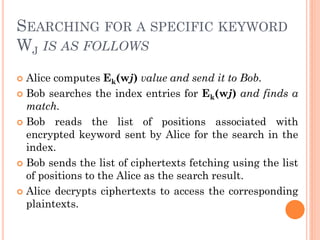
 Alice computes Ek(wj) value and send it to Bob.
 Bob searches the index entries for Ek(wj) and finds a
  match.
 Bob reads the list of positions associated with
  encrypted keyword sent by Alice for the search in the
  index.
 Bob sends the list of ciphertexts fetching using the list
  of positions to the Alice as the search result.
 Alice decrypts ciphertexts to access the corresponding
  plaintexts.
SECURITY STRENGTHS OF THE
SCHEME
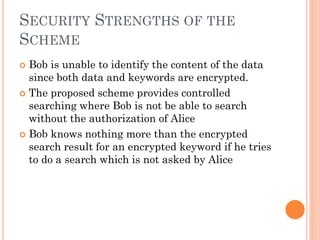
 Bob is unable to identify the content of the data
  since both data and keywords are encrypted.
 The proposed scheme provides controlled
  searching where Bob is not be able to search
  without the authorization of Alice
 Bob knows nothing more than the encrypted
  search result for an encrypted keyword if he tries
  to do a search which is not asked by Alice
SECURITY ATTACKS

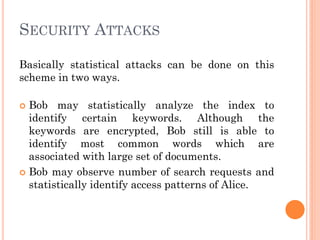
Basically statistical attacks can be done on this
scheme in two ways.

 Bob may statistically analyze the index to
  identify certain keywords. Although the
  keywords are encrypted, Bob still is able to
  identify most common words which are
  associated with large set of documents.
 Bob may observe number of search requests and
  statistically identify access patterns of Alice.
SOLUTIONS
   Statistical attacks on index can be prevented by
    maintaining lists of document positions for keywords
    in fixed size lists. For words that appear infrequently,
    Alice can pad the list to the fixed size. For more
    common words, Alice can split the long list into several
    lists with the fixed size. Then to search for such a
    word, Alice will need to ask Bob to perform and merge
    several search queries in parallel.
   The second kind of attacks is hard to avoid unless
    performing several unwanted searches together with
    regular searches. This way Bob can be misled to
    identify false access patterns.
WEAKNESSES OF THE SCHEME
 Alice must update the index whenever she
  changes her documents.
 Ideal for read only data storages.

 Bob might be able to learn through updating the
  index.
     If Alice does not change the index for a key word
      when she adds a new document to the server, then
      Bob is able to know that the keyword is not included
      in the newly created document.
     Alice must update substantial part of the index to
      hide real updates.
REFERENCES

[1] D. X. Song, D. Wagner, and A. Perrig.
Practical techniques for searches on encrypted
data. In IEEE Symposium onSecurity and
Privacy, 2000.


[2] Changyu Dong, Giovanni Russello and
Naranker Dulay. No Shared Keys: Multi-user
Searchable Data Encryption. Department of
Computing, Imperial College London.
THANK YOU

A Searchable Symmetric Key Cipher System

  • 1.
    DESIGN AND ANALYSISOF A SEARCHABLE SYMMETRIC KEY CIPHER SYSTEM By: Asanka Balasooriya Kelum Senanayake
  • 2.
    SECURITY REQUIREMENTS A cryptographicscheme which enables searching on encrypted data without revealing to the server should have following features.  Untrusted server should not be able to learn anything about the plaintext given only the ciphertext  Untrusted server should not be able to search for a word without authorization of the client  The scheme should be efficient and practical
  • 3.
    THE PROPOSED SCHEME Let’sassume that Alice is the client who owns important data and wants to store in Bob’s cloud storage which is untrusted. The scheme is as follows;  Alice builds an index with keywords that Alice may want to search for later for all data currently she owns.  Then she encrypts all the plain data using a symmetric encryption key.  All the keywords of the index are encrypted using the same key.  Lists of positions of the index are left as plain data.  Store the complete index and ciphertext of the plain data on Bob’s server.
  • 4.
    Let’s assume theselected encryption mechanism is E with a key k.  The list of plaintexts of Alice = {P1, P2, P3 …. Pn}  Corresponding ciphertexts = {C1, C2, C3, …. Cn}  The set of selected keywords of the index = {w1, w2, w3 …. wm}  Then the index with encrypted keywords is as follows for a keyword wi  Ek(wi) ---------->> {Cp, Cq, Cr, …. Ct}
  • 5.
    SEARCHING FOR ASPECIFIC KEYWORD WJ IS AS FOLLOWS  Alice computes Ek(wj) value and send it to Bob.  Bob searches the index entries for Ek(wj) and finds a match.  Bob reads the list of positions associated with encrypted keyword sent by Alice for the search in the index.  Bob sends the list of ciphertexts fetching using the list of positions to the Alice as the search result.  Alice decrypts ciphertexts to access the corresponding plaintexts.
  • 6.
    SECURITY STRENGTHS OFTHE SCHEME  Bob is unable to identify the content of the data since both data and keywords are encrypted.  The proposed scheme provides controlled searching where Bob is not be able to search without the authorization of Alice  Bob knows nothing more than the encrypted search result for an encrypted keyword if he tries to do a search which is not asked by Alice
  • 7.
    SECURITY ATTACKS Basically statisticalattacks can be done on this scheme in two ways.  Bob may statistically analyze the index to identify certain keywords. Although the keywords are encrypted, Bob still is able to identify most common words which are associated with large set of documents.  Bob may observe number of search requests and statistically identify access patterns of Alice.
  • 8.
    SOLUTIONS  Statistical attacks on index can be prevented by maintaining lists of document positions for keywords in fixed size lists. For words that appear infrequently, Alice can pad the list to the fixed size. For more common words, Alice can split the long list into several lists with the fixed size. Then to search for such a word, Alice will need to ask Bob to perform and merge several search queries in parallel.  The second kind of attacks is hard to avoid unless performing several unwanted searches together with regular searches. This way Bob can be misled to identify false access patterns.
  • 9.
    WEAKNESSES OF THESCHEME  Alice must update the index whenever she changes her documents.  Ideal for read only data storages.  Bob might be able to learn through updating the index.  If Alice does not change the index for a key word when she adds a new document to the server, then Bob is able to know that the keyword is not included in the newly created document.  Alice must update substantial part of the index to hide real updates.
  • 10.
    REFERENCES [1] D. X.Song, D. Wagner, and A. Perrig. Practical techniques for searches on encrypted data. In IEEE Symposium onSecurity and Privacy, 2000. [2] Changyu Dong, Giovanni Russello and Naranker Dulay. No Shared Keys: Multi-user Searchable Data Encryption. Department of Computing, Imperial College London.
  • 11.