SEARCH ENGINE
OPTIMIZATION
Optimize Organic Search
SEO is an acronym that stands for search engine
optimization, which is the process of optimizing your
website to get organic, or un-paid, traffic from the
search engine results page.
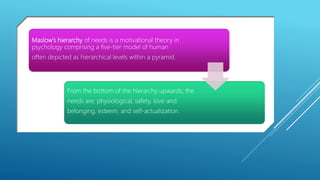
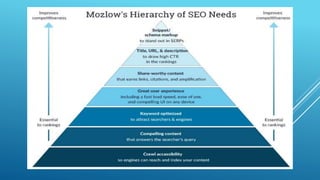
Maslow's hierarchy of needs is a motivational theory in
psychology comprising a five-tier model of human
often depicted as hierarchical levels within a pyramid.
From the bottom of the hierarchy upwards, the
needs are: physiological, safety, love and
belonging, esteem, and self-actualization.
Organic Results
Search engines do all of this by discovering and cataloguing
all available content on the Internet (web pages, PDFs,
images, videos, etc.) via a process known as “crawling and
indexing,” and then ordering it by how well it matches the
query in a process we refer to as “ranking.
Organic Results
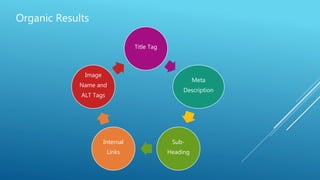
Title Tag
Meta
Description
Sub-
Heading
Internal
Links
Image
Name and
ALT Tags
White hat vs Black hat SEO
"White hat SEO" refers to SEO
techniques, best practices, and
strategies that abide by search
engine rule.
It’s primary focus to provide more
value to people.
"Black hat SEO" refers to
techniques and strategies that
attempt to spam/fool search
engines.
While black hat SEO can work, it
puts websites at tremendous risk
of being penalized and/or de-
indexed (removed from search
results) and has ethical
implications.
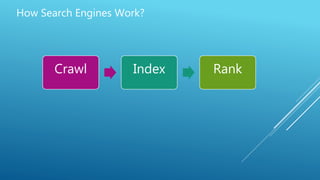
How Search Engines Work?
Crawl Index Rank
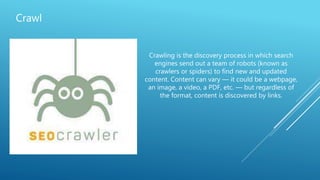
Crawl
Crawling is the discovery process in which search
engines send out a team of robots (known as
crawlers or spiders) to find new and updated
content. Content can vary — it could be a webpage,
an image, a video, a PDF, etc. — but regardless of
the format, content is discovered by links.
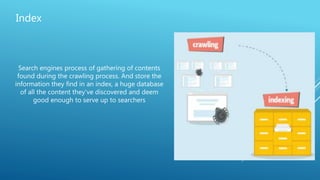
Index
Search engines process of gathering of contents
found during the crawling process. And store the
information they find in an index, a huge database
of all the content they’ve discovered and deem
good enough to serve up to searchers
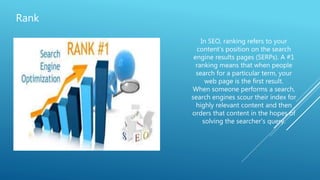
Rank
In SEO, ranking refers to your
content's position on the search
engine results pages (SERPs). A #1
ranking means that when people
search for a particular term, your
web page is the first result.
When someone performs a search,
search engines scour their index for
highly relevant content and then
orders that content in the hopes of
solving the searcher's query.
Crawling – Test Web Pages
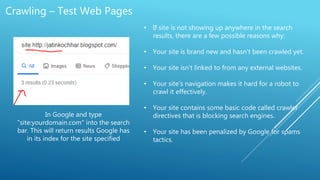
In Google and type
"site:yourdomain.com" into the search
bar. This will return results Google has
in its index for the site specified
• If site is not showing up anywhere in the search
results, there are a few possible reasons why:
• Your site is brand new and hasn't been crawled yet.
• Your site isn't linked to from any external websites.
• Your site's navigation makes it hard for a robot to
crawl it effectively.
• Your site contains some basic code called crawler
directives that is blocking search engines.
• Your site has been penalized by Google for spams
tactics.
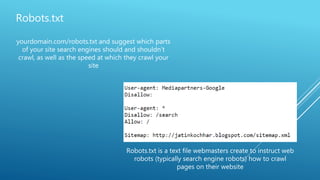
Robots.txt
yourdomain.com/robots.txt and suggest which parts
of your site search engines should and shouldn't
crawl, as well as the speed at which they crawl your
site
Robots.txt is a text file webmasters create to instruct web
robots (typically search engine robots) how to crawl
pages on their website
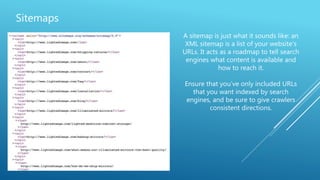
Sitemaps
A sitemap is just what it sounds like: an
XML sitemap is a list of your website's
URLs. It acts as a roadmap to tell search
engines what content is available and
how to reach it.
Ensure that you’ve only included URLs
that you want indexed by search
engines, and be sure to give crawlers
consistent directions.
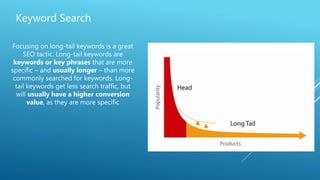
Keyword Search
Focusing on long-tail keywords is a great
SEO tactic. Long-tail keywords are
keywords or key phrases that are more
specific – and usually longer – than more
commonly searched for keywords. Long-
tail keywords get less search traffic, but
will usually have a higher conversion
value, as they are more specific
Keyword Format
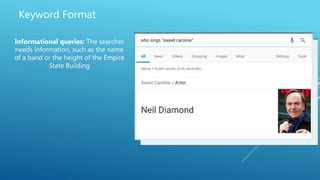
Informational queries: The searcher
needs information, such as the name
of a band or the height of the Empire
State Building
Keyword Format
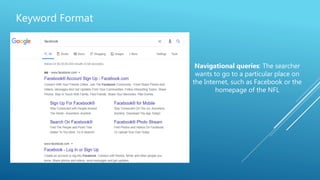
Navigational queries: The searcher
wants to go to a particular place on
the Internet, such as Facebook or the
homepage of the NFL
Keyword Format
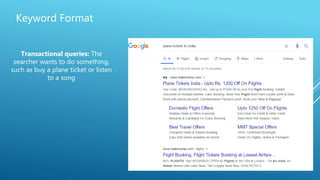
Transactional queries: The
searcher wants to do something,
such as buy a plane ticket or listen
to a song
Keyword Format
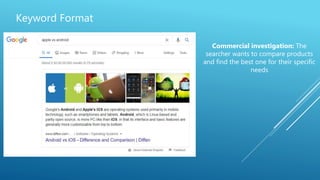
Commercial investigation: The
searcher wants to compare products
and find the best one for their specific
needs
Keyword Format
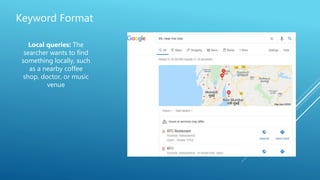
Local queries: The
searcher wants to find
something locally, such
as a nearby coffee
shop, doctor, or music
venue
Tracking SEO Performance
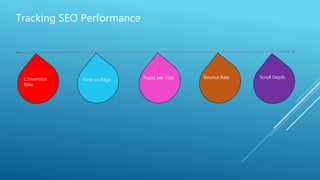
Conversion
Rate
Time on Page Pages per Visit Bounce Rate Scroll Depth
Tracking SEO Performance
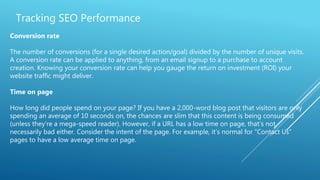
Conversion rate
The number of conversions (for a single desired action/goal) divided by the number of unique visits.
A conversion rate can be applied to anything, from an email signup to a purchase to account
creation. Knowing your conversion rate can help you gauge the return on investment (ROI) your
website traffic might deliver.
Time on page
How long did people spend on your page? If you have a 2,000-word blog post that visitors are only
spending an average of 10 seconds on, the chances are slim that this content is being consumed
(unless they’re a mega-speed reader). However, if a URL has a low time on page, that’s not
necessarily bad either. Consider the intent of the page. For example, it’s normal for “Contact Us”
pages to have a low average time on page.
Tracking SEO Performance
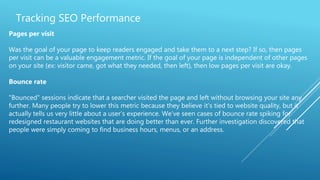
Pages per visit
Was the goal of your page to keep readers engaged and take them to a next step? If so, then pages
per visit can be a valuable engagement metric. If the goal of your page is independent of other pages
on your site (ex: visitor came, got what they needed, then left), then low pages per visit are okay.
Bounce rate
"Bounced" sessions indicate that a searcher visited the page and left without browsing your site any
further. Many people try to lower this metric because they believe it’s tied to website quality, but it
actually tells us very little about a user’s experience. We’ve seen cases of bounce rate spiking for
redesigned restaurant websites that are doing better than ever. Further investigation discovered that
people were simply coming to find business hours, menus, or an address.
Tracking SEO Performance
Scroll depth
This measures how far visitors scroll down individual webpages. Are visitors reaching your important
content? If not, test different ways of providing the most important content higher up on your page,
such as multimedia, contact forms, and so on. Also consider the quality of your content. Are you
omitting needless words? Is it enticing for the visitor to continue down the page? Scroll depth tracking
can be set up in your Google Analytics.
References
https://moz.com/beginners-guide-to-seo
https://www.lyfemarketing.com/blog/what-is-seo-and-how-it-works/
Thank You!
For any queries connect me at jatinkochhar@hotmail.com

Search Engine Optimization - Optimize Organic Search

  • 1.
  • 2.
    SEO is anacronym that stands for search engine optimization, which is the process of optimizing your website to get organic, or un-paid, traffic from the search engine results page.
  • 3.
    Maslow's hierarchy ofneeds is a motivational theory in psychology comprising a five-tier model of human often depicted as hierarchical levels within a pyramid. From the bottom of the hierarchy upwards, the needs are: physiological, safety, love and belonging, esteem, and self-actualization.
  • 5.
    Organic Results Search enginesdo all of this by discovering and cataloguing all available content on the Internet (web pages, PDFs, images, videos, etc.) via a process known as “crawling and indexing,” and then ordering it by how well it matches the query in a process we refer to as “ranking.
  • 6.
  • 7.
    White hat vsBlack hat SEO "White hat SEO" refers to SEO techniques, best practices, and strategies that abide by search engine rule. It’s primary focus to provide more value to people. "Black hat SEO" refers to techniques and strategies that attempt to spam/fool search engines. While black hat SEO can work, it puts websites at tremendous risk of being penalized and/or de- indexed (removed from search results) and has ethical implications.
  • 8.
    How Search EnginesWork? Crawl Index Rank
  • 9.
    Crawl Crawling is thediscovery process in which search engines send out a team of robots (known as crawlers or spiders) to find new and updated content. Content can vary — it could be a webpage, an image, a video, a PDF, etc. — but regardless of the format, content is discovered by links.
  • 10.
    Index Search engines processof gathering of contents found during the crawling process. And store the information they find in an index, a huge database of all the content they’ve discovered and deem good enough to serve up to searchers
  • 11.
    Rank In SEO, rankingrefers to your content's position on the search engine results pages (SERPs). A #1 ranking means that when people search for a particular term, your web page is the first result. When someone performs a search, search engines scour their index for highly relevant content and then orders that content in the hopes of solving the searcher's query.
  • 12.
    Crawling – TestWeb Pages In Google and type "site:yourdomain.com" into the search bar. This will return results Google has in its index for the site specified • If site is not showing up anywhere in the search results, there are a few possible reasons why: • Your site is brand new and hasn't been crawled yet. • Your site isn't linked to from any external websites. • Your site's navigation makes it hard for a robot to crawl it effectively. • Your site contains some basic code called crawler directives that is blocking search engines. • Your site has been penalized by Google for spams tactics.
  • 13.
    Robots.txt yourdomain.com/robots.txt and suggestwhich parts of your site search engines should and shouldn't crawl, as well as the speed at which they crawl your site Robots.txt is a text file webmasters create to instruct web robots (typically search engine robots) how to crawl pages on their website
  • 14.
    Sitemaps A sitemap isjust what it sounds like: an XML sitemap is a list of your website's URLs. It acts as a roadmap to tell search engines what content is available and how to reach it. Ensure that you’ve only included URLs that you want indexed by search engines, and be sure to give crawlers consistent directions.
  • 15.
    Keyword Search Focusing onlong-tail keywords is a great SEO tactic. Long-tail keywords are keywords or key phrases that are more specific – and usually longer – than more commonly searched for keywords. Long- tail keywords get less search traffic, but will usually have a higher conversion value, as they are more specific
  • 16.
    Keyword Format Informational queries:The searcher needs information, such as the name of a band or the height of the Empire State Building
  • 17.
    Keyword Format Navigational queries:The searcher wants to go to a particular place on the Internet, such as Facebook or the homepage of the NFL
  • 18.
    Keyword Format Transactional queries:The searcher wants to do something, such as buy a plane ticket or listen to a song
  • 19.
    Keyword Format Commercial investigation:The searcher wants to compare products and find the best one for their specific needs
  • 20.
    Keyword Format Local queries:The searcher wants to find something locally, such as a nearby coffee shop, doctor, or music venue
  • 21.
    Tracking SEO Performance Conversion Rate Timeon Page Pages per Visit Bounce Rate Scroll Depth
  • 22.
    Tracking SEO Performance Conversionrate The number of conversions (for a single desired action/goal) divided by the number of unique visits. A conversion rate can be applied to anything, from an email signup to a purchase to account creation. Knowing your conversion rate can help you gauge the return on investment (ROI) your website traffic might deliver. Time on page How long did people spend on your page? If you have a 2,000-word blog post that visitors are only spending an average of 10 seconds on, the chances are slim that this content is being consumed (unless they’re a mega-speed reader). However, if a URL has a low time on page, that’s not necessarily bad either. Consider the intent of the page. For example, it’s normal for “Contact Us” pages to have a low average time on page.
  • 23.
    Tracking SEO Performance Pagesper visit Was the goal of your page to keep readers engaged and take them to a next step? If so, then pages per visit can be a valuable engagement metric. If the goal of your page is independent of other pages on your site (ex: visitor came, got what they needed, then left), then low pages per visit are okay. Bounce rate "Bounced" sessions indicate that a searcher visited the page and left without browsing your site any further. Many people try to lower this metric because they believe it’s tied to website quality, but it actually tells us very little about a user’s experience. We’ve seen cases of bounce rate spiking for redesigned restaurant websites that are doing better than ever. Further investigation discovered that people were simply coming to find business hours, menus, or an address.
  • 24.
    Tracking SEO Performance Scrolldepth This measures how far visitors scroll down individual webpages. Are visitors reaching your important content? If not, test different ways of providing the most important content higher up on your page, such as multimedia, contact forms, and so on. Also consider the quality of your content. Are you omitting needless words? Is it enticing for the visitor to continue down the page? Scroll depth tracking can be set up in your Google Analytics.
  • 25.
  • 26.
    Thank You! For anyqueries connect me at jatinkochhar@hotmail.com

Editor's Notes

  • #7 Title Tag The title tag on each page tells the search engines what your page is about. This should be 70 characters or less, including both the keyword your content focuses on and your business name Meta Description The meta description on your website tells search engines a little bit more about what each page is about. This is also used by your human visitors to better understand what the page is about and if it’s relevant. This should include your keyword and also provide enough details to tell the reader what the content is about Sub-headings Not only do sub-headings make your content easier for visitors to read, but it can also help improve your SEO. You can use H1, H2, and H3 tags to help search engines better understand what your content is about Internal Links Building internal links, or hyperlinks to other content on your site, can help search engines learn more about your site. For example, if you are writing a post about the value of a specific product or service, you can link to the product or service page in your blog post Image Name and ALT Tags If you are using images on your website or within your blog content, you will also want to include your keyword or phrase in the image name and alt tag. By including this information, you also help give your SEO definition. This will help search engines better index your images, which may appear when users perform an image search for a certain keyword or phrase
  • #10 Image Source - https://www.google.com/imgres?imgurl=https%3A%2F%2Fseocrawler.io%2Fwp-content%2Fuploads%2F2017%2F06%2FSEO-TOOL.jpg&imgrefurl=https%3A%2F%2Fseocrawler.io%2F&tbnid=J65sKx9KKyl-5M&vet=12ahUKEwjIwbGcyqHrAhVUJbcAHRIuDWEQMygHegUIARDBAQ..i&docid=61mmEr3bbVyczM&w=236&h=214&q=seo%20crawl&ved=2ahUKEwjIwbGcyqHrAhVUJbcAHRIuDWEQMygHegUIARDBAQ
  • #11 Image Source - https://qph.fs.quoracdn.net/main-qimg-e36e9425cb7bc16ba7c615fbf20ef7f3
  • #12 Image Source - https://www.google.com/imgres?imgurl=http%3A%2F%2Fmannarshidigitalsolutions.com%2Fwp-content%2Fuploads%2F2018%2F12%2Fseo-rankings.jpg&imgrefurl=http%3A%2F%2Fmannarshidigitalsolutions.com%2F2018%2F12%2F18%2Fseo-ranking-factors-2019%2F&tbnid=kYKOBQ4-7jb-jM&vet=12ahUKEwie8cDwyaHrAhUTQ3wKHe65BekQMygIegUIARDPAQ..i&docid=0BrqEn7DbcgoAM&w=600&h=300&q=seo%20rank&ved=2ahUKEwie8cDwyaHrAhUTQ3wKHe65BekQMygIegUIARDPAQ
  • #14 How Googlebot treats robots.txt files If Googlebot can't find a robots.txt file for a site, it proceeds to crawl the site. If Googlebot finds a robots.txt file for a site, it will usually abide by the suggestions and proceed to crawl the site. If Googlebot encounters an error while trying to access a site’s robots.txt file and can't determine if one exists or not, it won't crawl the site.
  • #15 Image Source - https://statcounter.com/images/insights/seo/sitemap-example-xml.png
  • #16 Image Source - https://www.apptus.com/hubfs/Long%20Tail/Long%20Tail%20Apptus%20algorithm%20-%20lift.png
  • #17 Image Source - https://moz.com/beginners-guide-to-seo/keyword-research