Types of requirement

•   User requirements
•   System requirements
•   Domain requirements
•   Functional requirements
•   Non-functional requirements
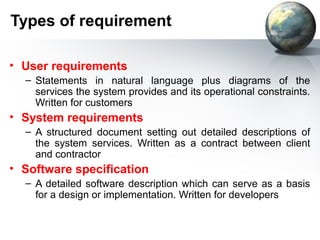
Types of requirement

• User requirements
  – Statements in natural language plus diagrams of the
    services the system provides and its operational constraints.
    Written for customers
• System requirements
  – A structured document setting out detailed descriptions of
    the system services. Written as a contract between client
    and contractor
• Software specification
  – A detailed software description which can serve as a basis
    for a design or implementation. Written for developers
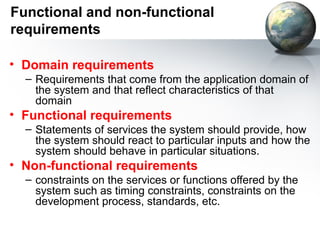
Functional and non-functional
requirements

• Domain requirements
  – Requirements that come from the application domain of
    the system and that reflect characteristics of that
    domain
• Functional requirements
  – Statements of services the system should provide, how
    the system should react to particular inputs and how the
    system should behave in particular situations.
• Non-functional requirements
  – constraints on the services or functions offered by the
    system such as timing constraints, constraints on the
    development process, standards, etc.
What are User requirements
User requirements


• Should describe functional and non-
  functional requirements so that they are
  understandable by system users who don’t
  have detailed technical knowledge

• User requirements are defined using natural
  language, tables and diagrams
What are System requirements
System requirements

– More detailed specifications of user requirements
• Serve as a basis for designing the system
• May be used as part of the system contract
• System requirements may be expressed using
  system models
What are Domain requirements
Domain requirements

• Derived from the application domain and
  describe system characteristics and features
  that reflect the domain

• May be new functional requirements, constraints
  on existing requirements or define specific
  computations
• If domain requirements are not satisfied, the
  system may be unworkable
What is Functional Requirement
Functional Requirements

  Describe functionality or system services
• Depend on the type of software, expected users
  and the type of system where the software is used
• Functional user requirements may be high-
  level statements of what the system should do
  BUT functional system requirements should
  describe the system services in detail
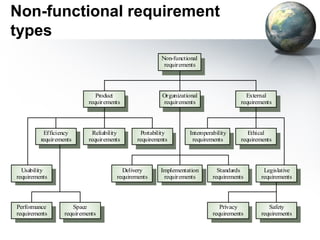
Types of Non-functional requirement
Non-functional requirement
types
                                                     Non-functional
                                                      requirements


                              Product                Organizational                    External
                           requirements               requirements                   requirements


          Efficiency        Reliability      Portability        Interoperability        Ethical
         requirements      requirements     requirements         requirements        requirements


  Usability                            Delivery      Implementation         Standards        Legislative
requirements                         requirements     requirements        requirements      requirements


Performance          Space                                                   Privacy           Safety
requirements      requirements                                            requirements      requirements
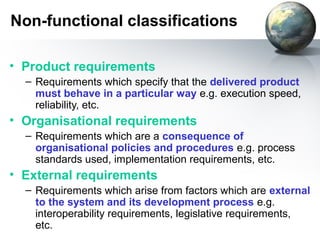
Non-functional classifications

• Product requirements
  – Requirements which specify that the delivered product
    must behave in a particular way e.g. execution speed,
    reliability, etc.
• Organisational requirements
  – Requirements which are a consequence of
    organisational policies and procedures e.g. process
    standards used, implementation requirements, etc.
• External requirements
  – Requirements which arise from factors which are external
    to the system and its development process e.g.
    interoperability requirements, legislative requirements,
    etc.
Features of Non-Functional
Requirements

1. Non-Functional requirements mostly define
   the overall attributes of the “resulting”
   system.
IEEE Standard 830 – 1993


•    List of 13 non-functional requirements:

    1.    Performance
    2.    Interface
                                              Examples?
    3.    Operational
    4.    Resource
    5.    Verification
    6.    Acceptance
    7.    Documentation
    8.    Security
    9.    Portability
    10.   Quality
    11.   Reliability
    12.   Maintainability
    13.   Safety
                            Some of these also overlap - - - - - -
IEEE Standard 830 – 1993


•    List of 13 non-functional requirements Examples:

    1.    Performance: 100 transactions per minute
    2.    Interface: capable of importing data with EDI format
    3.    Operational: must not require more than 1 megabyte of main memory
    4.    Resource: will use wireless encryption algorithm that is “better” than WEP
    5.    Verification: all data updates must be traceable
    6.    Acceptance: must pass a user defined system test bucket
    7.    Documentation: user manual is needed for novice users only
    8.    Security: user request to access any data must be authorized first
    9.    Portability: the system must operate with “any” relational db systems
    10.   Quality: the system must install with zero defect
    11.   Reliability: the system must be accessible 99.9 % of the time
    12.   Maintainability: the system must be modifiable (e.g. designed with exits)
    13.   Safety: the system must not perform “chemical material discard” functions
          without “explicit” user authorization.
     There may be others that are important such as meeting legal standards that
     Is not mentioned in this list
Difficulties in Specifying
Non-functional Requirements
Difficulties in Specifying
Non-functional Requirements


•   The difficulties in gathering Non-Functional Requirements may be
    attributed to many reasons - - - - - mostly because people tend to
    focus on the functions and services that they need:

    – Certain non-functional requirements are sometimes hard to quantify
      and therefore hard to express without some “trial and error
      prototyping”.
        • e.g. : usability
    – Certain non-functional requirements are hard to differentiate between
      functional and non-functional
        • e.g. security
    – Certain non-functional requirements are difficult to specify because
                                                                    similar
      they can not be well understood or validated until much later
        • e.g. reliability or quality
    – Certain non-functional requirements may be conflicting
        • e.g. performance .vs. security .vs. reliability
    – Certain non-functional requirements may be difficult to express and
      validate; may require more refinements.
What are“Critical” Systems
“Critical” Systems


• Critical systems are systems whose failure
  causes significant economic, human or
  organizational damage:

  – Business Critical System
     • e-commerce systems such as stock trading, reservations,
       etc.
  – Mission Critical System
     • Aircraft control, manufacturing process control, etc.
  – Safety (life) Critical system
     • Medical Device control, hazardous materials management,
       etc.
Requirements for System Criticality


• Most of the requirements for these “business,”
  “mission,” and “safety” criticality deals with non-
  functional requirements of the a) “complete” system, not
  just software and b) may be expressed in general ways
  that need to be decomposed further:

   –   Performance
   –   Reliability
   –   Security
   –   Usability
   –   Safety
        Again, these may be “conflicting” - - - - so what do you do?

        Must prioritize the requirements, especially when there are conflicts
Performance Related Requirements


• These requirements mostly addresses the
  constraints of speed and sometimes capacity:

  – System Response time to end-user such as 1 second
    response to user requests
  – System throughput such as # of transactions per
    minute (time interval)
  – System timing such as collection of data and
    responding to it within sub-second for real-time
    system.
  – System capacity such as number of simultaneous
    users that may access an application (instantaneous
    time)
         These should be specified quantitatively.
Reliability Related Requirements


• These requirements addresses constraints on
  run-time behavior of the system:
  – System Availability such as the system is up certain
    percentage of the time.
  – System Failure rate such as average mean time
    between system failures to deliver the user service.


         These should also be specified quantitatively.
Security Related Requirements


• These requirements addresses the issues
  related to unauthorized access: to the system, to
  specific function, to data:
  – System Access protection such as firewall
    requirement
  – Application Functional Access & Usage protection
    such as authorization and authentication requirement
  – Data Access and Usage protection such as
    authorization and encryption requirement


        Security is also an important factor for other requirement such
        as safety. A little hard to specify these quantitatively.
Usability Related Requirements


• These requirements addresses the user interface looks
  and user inter-actions with the system
   – Entry and beginners-level knowledge assumption to use the
     system
   – Learning time and experience needed such as hours or number
     of lessons to learn the system
   – Handling and usage such as time to complete certain tasks or
     number of errors made before completing certain tasks
   – Likeness and delight experienced from using the system such
     as availability of context sensitive help text or “re-do” capability


      Some of these requirements can be and should be specified
      Quantitatively; delight and likeness are a bit hard to define.
Safety Critical System Requirements


• These requirements addresses everything with
  the safety of the system and of the usage of the
  system.
• These requirements deal mostly with the “shall
  not” requirements such as:
  – The system shall not allow - - - -
  – The system will not operate without - - -
   Note that safety may be dependent on many of the other requirements:

    - insecure system may be open to malicious danger
    - unreliable system may fail unpredictably and hurt someone
    - non-responsive system may miss critical data and damage something
    - difficult to use system may create a critical human error
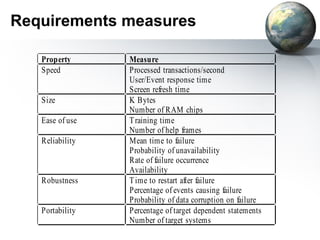
Requirements measures

   Property      Measure
   Speed         Processed transactions/second
                 User/Event response time
                 Screen refresh time
   Size          K Bytes
                 Number of RAM chips
   Ease of use   T raining time
                 Number of help frames
   Reliability   Mean time to failure
                 Probability of unavailability
                 Rate of failure occurrence
                 Availability
   Robustness    T ime to restart after failure
                 Percentage of events causing failure
                 Probability of data corruption on failure
   Portability   Percentage of target dependent statements
                 Number of target systems
Relationship Between Requirement
and Design
Requirements and design

• In principle, requirements should state what the
  system should do and the design should describe
  how it does this
• In practice, requirements and design are inseparable
  – A system architecture may be designed to structure the
    requirements
  – The system may inter-operate with other systems that
    generate design requirements
  – The use of a specific design may be a domain requirement
Relationships between user
needs, concerns and NFRs
Relationships between user
needs, concerns and NFRs

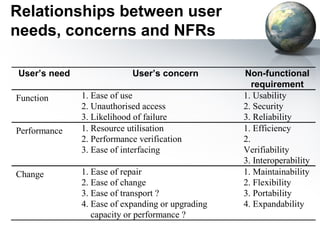
User’s need                User’s concern         Non-functional
                                                     requirement
Function      1. Ease of use                      1. Usability
              2. Unauthorised access              2. Security
              3. Likelihood of failure            3. Reliability
Performance   1. Resource utilisation             1. Efficiency
              2. Performance verification         2.
              3. Ease of interfacing              Verifiability
                                                  3. Interoperability
Change        1. Ease of repair                   1. Maintainability
              2. Ease of change                   2. Flexibility
              3. Ease of transport ?              3. Portability
              4. Ease of expanding or upgrading   4. Expandability
                 capacity or performance ?
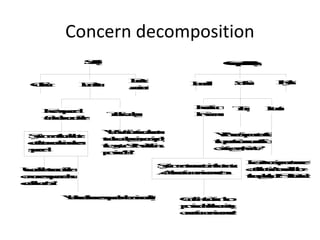
Concern decomposition
       S
       a
       f
       et
        y                Ci
                         ob
                         m
                         py
                          a
                          tt
                          il
                           i


             Pl
             e
             rs
              on
               a           Se
                           o
                           f
                           tw
                            a
                            r   P
                                h
                                y
                                si
                                 c
                                 al
 C
 o
 ln
 l
 i
 si
  o    Dt
       ee
       r n
       a
       il
        m             H
                      ae
                      rr
                      d
                      wa
             an
             ct
             ci
              d
              e


                      En T
                      x
                      e
                      cu
                       t
                       io i g If
                          m n
                           i
                           n  tc
                               e
                               r
                               ae
  Ee
  xp
   c e
   e d
   ss
    s
          Tm
          rd
          a a
          c g
           k e
           a          E e
                      n n
                      v t
                      im
                       r
                       o
                       n
  f ans
  o ci
  r kt
   t on
   r d
    c i
      o

          Wt a
           h ri b
           a mu
           to n
            i a o
            n ot
            f           Wm
                         i ri ee
                         l e nt
                         lq t c
                          ar a
                            u f
                             e f
Sme
y ub
s s l
 t
 e ta
 m bt
    eo
          tkgqb
          rd i uy
          am i
           c ar r
            a s e
              eed       t e af
                        ho ee
                        e r ch
                         p n
                          rfm ot
d n ds
e de
t aoe
 e ax
 c vc
 t  i s
          ts ? i i
          h mt
           e
           y Hs
            s o
            t
            e wsh       e ga
                        xs r
                         i o?
                         s fe
                         t t
                          i w
                          n
s
p
ee
 d
          pd
          re
           o
           v
           i?
           d
                           Du te
                           o qe d
                            e i n
                            s r n
                             a e e
                              r m
                              e
                 Smt tt e
                 y uc h d
                 s s ue
                 te t
                  m e r
                    e i
                     x nu
                     e  st
Ut d
n a is
d ci
 e on
 rwt
   h o
     n                     d t' v
                           a ia l
                            ta a
                            as i e
                             t nl
                             ht ab
                 At en
                 d u ve
                 a in n
                  e or t
                  xn m
                  ec  i
                      o
cc eu
ae es
ns d
 esc
 xp e
   s  a                    tu Ha
                           h t Sf
                           rh Tc
                            o e ir ?
                             gh nt e
                                 e
de
en
r t
a?
 i
 l
 m

    Wc ee r y
    hse eae
    a ' s d ia
    te s ' nl
    does m i
       xp   n?
             t       Cu b
                     a ft e
                     nn
                      t c
                      h i
                       i
                       s o
                         n
                     p den
                     r e ht
                     oo x
                      vn i
                      i
                      dt s
                         e g
                     eien
                     xno ?
                     e n e
                      c vn
                      u im
                      tor t
How to write requirements:
Guidelines for writing requirements
• Invent a standard format and use it for all
  requirements
• Use language in a consistent way. Use
  shall for mandatory requirements,
  should for desirable requirements
• Use text highlighting to identify key parts of the
  requirement

Avoid the use of computer jargon !!!
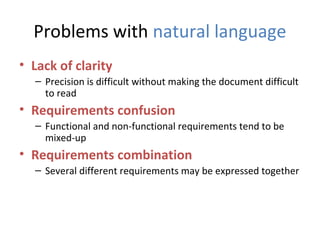
Problems with natural language
• Lack of clarity
  – Precision is difficult without making the document difficult
    to read
• Requirements confusion
  – Functional and non-functional requirements tend to be
    mixed-up
• Requirements combination
  – Several different requirements may be expressed together
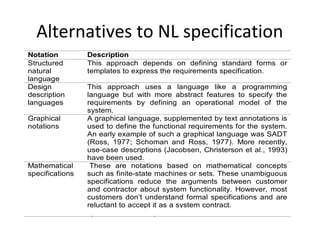
Alternatives to NL specification
Notation         Description
Structured       This approach depends on defining standard forms or
natural          templates to express the requirements specification.
language
Design           This approach uses a language like a programming
description      language but with more abstract features to specify the
languages        requirements by defining an operational model of the
                 system.
Graphical        A graphical language, supplemented by text annotations is
notations        used to define the functional requirements for the system.
                 An early example of such a graphical language was SADT
                 (Ross, 1977; Schoman and Ross, 1977). More recently,
                 use-case descriptions (Jacobsen, Christerson et al., 1993)
                 have been used. I discuss these in the following chapter.
Mathematical      These are notations based on mathematical concepts
specifications   such as finite-state machines or sets. These unambiguous
                 specifications reduce the arguments between customer
                 and contractor about system functionality. However, most
                 customers don’t understand formal specifications and are
                 reluctant to accept it as a system contract. I discuss formal
                 specification in Chapter 9.
What is Requirement Document
The requirements document
• The requirements document is the official
  statement of what is required of the system
  developers

• Should include both a definition and a
  specification of requirements

• It is NOT a design document. As far as
  possible, it should set of WHAT the system
  should do rather than HOW it should do it
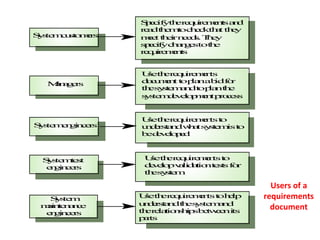
Users of a requirements document
S e if th r q i e e t a d
                  p c y e e u mns n
                               r
                 r a t e t c e k a th y
                  e d h mo h c th t e
S s m u t mr
 y te c so e s   me t ern e s T e
                   e t h i e d. h y
                 s e i yc a g stot e
                  p cf h n e      h
                 r q ie e t
                  e ur mns


                 Ueth r q ir mn
                  s   e e u e e ts
   Mn g r
    a a es       d c mn t p nab f r
                  o u e t o la    id o
                 th s se a dt p nt e
                   e y t m n o la h
                 s s m e eo mn p o e s
                  y te d v l p e t r c s


                 Ueth r q ir mn t
                  s    e e u e e ts o
Ss mni er
y te e gn e s    u d r t n wa s se ist
                  n e sa d h t y t m o
                 b dv l pd
                  e e eo e


  S s me t
   y te t s       Ueth r q ir mn t
                   s    e e u e e ts o
  e gn e s
   ni er          d v l pv li aio t ssf r
                   e eo a d t n e t o
                  th s se
                    e yt m

                                               Users of a
   Ss m
    y te         Ueth r q ir mn t h lp
                  s    e e u e e ts o e      requirements
 mi t n n e
  ane a c        u d r t n t es s m n
                  n esa d h y te a d
                 th r laio s i sb t e ni
                   e e t n hp ewe ts
                                               document
  e gn e s
   ni er
                 pr
                  ats
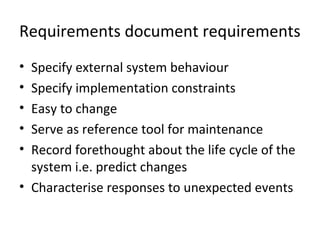
Requirements document requirements
• Specify external system behaviour
• Specify implementation constraints
• Easy to change
• Serve as reference tool for maintenance
• Record forethought about the life cycle of the
  system i.e. predict changes
• Characterise responses to unexpected events
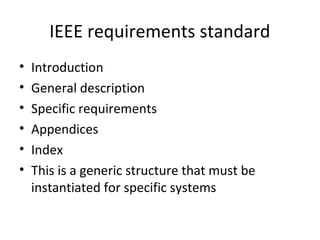
IEEE requirements standard
•   Introduction
•   General description
•   Specific requirements
•   Appendices
•   Index
•   This is a generic structure that must be
    instantiated for specific systems
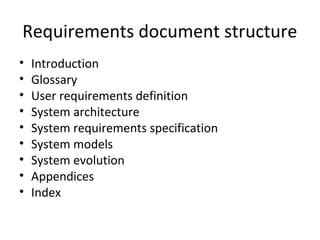
Requirements document structure
•   Introduction
•   Glossary
•   User requirements definition
•   System architecture
•   System requirements specification
•   System models
•   System evolution
•   Appendices
•   Index

Se lect9 btech

  • 1.
    Types of requirement • User requirements • System requirements • Domain requirements • Functional requirements • Non-functional requirements
  • 2.
    Types of requirement •User requirements – Statements in natural language plus diagrams of the services the system provides and its operational constraints. Written for customers • System requirements – A structured document setting out detailed descriptions of the system services. Written as a contract between client and contractor • Software specification – A detailed software description which can serve as a basis for a design or implementation. Written for developers
  • 3.
    Functional and non-functional requirements •Domain requirements – Requirements that come from the application domain of the system and that reflect characteristics of that domain • Functional requirements – Statements of services the system should provide, how the system should react to particular inputs and how the system should behave in particular situations. • Non-functional requirements – constraints on the services or functions offered by the system such as timing constraints, constraints on the development process, standards, etc.
  • 4.
    What are Userrequirements
  • 5.
    User requirements • Shoulddescribe functional and non- functional requirements so that they are understandable by system users who don’t have detailed technical knowledge • User requirements are defined using natural language, tables and diagrams
  • 6.
    What are Systemrequirements
  • 7.
    System requirements – Moredetailed specifications of user requirements • Serve as a basis for designing the system • May be used as part of the system contract • System requirements may be expressed using system models
  • 8.
    What are Domainrequirements
  • 9.
    Domain requirements • Derivedfrom the application domain and describe system characteristics and features that reflect the domain • May be new functional requirements, constraints on existing requirements or define specific computations • If domain requirements are not satisfied, the system may be unworkable
  • 10.
    What is FunctionalRequirement
  • 11.
    Functional Requirements Describe functionality or system services • Depend on the type of software, expected users and the type of system where the software is used • Functional user requirements may be high- level statements of what the system should do BUT functional system requirements should describe the system services in detail
  • 12.
  • 13.
    Non-functional requirement types Non-functional requirements Product Organizational External requirements requirements requirements Efficiency Reliability Portability Interoperability Ethical requirements requirements requirements requirements requirements Usability Delivery Implementation Standards Legislative requirements requirements requirements requirements requirements Performance Space Privacy Safety requirements requirements requirements requirements
  • 14.
    Non-functional classifications • Productrequirements – Requirements which specify that the delivered product must behave in a particular way e.g. execution speed, reliability, etc. • Organisational requirements – Requirements which are a consequence of organisational policies and procedures e.g. process standards used, implementation requirements, etc. • External requirements – Requirements which arise from factors which are external to the system and its development process e.g. interoperability requirements, legislative requirements, etc.
  • 15.
    Features of Non-Functional Requirements 1.Non-Functional requirements mostly define the overall attributes of the “resulting” system.
  • 16.
    IEEE Standard 830– 1993 • List of 13 non-functional requirements: 1. Performance 2. Interface Examples? 3. Operational 4. Resource 5. Verification 6. Acceptance 7. Documentation 8. Security 9. Portability 10. Quality 11. Reliability 12. Maintainability 13. Safety Some of these also overlap - - - - - -
  • 17.
    IEEE Standard 830– 1993 • List of 13 non-functional requirements Examples: 1. Performance: 100 transactions per minute 2. Interface: capable of importing data with EDI format 3. Operational: must not require more than 1 megabyte of main memory 4. Resource: will use wireless encryption algorithm that is “better” than WEP 5. Verification: all data updates must be traceable 6. Acceptance: must pass a user defined system test bucket 7. Documentation: user manual is needed for novice users only 8. Security: user request to access any data must be authorized first 9. Portability: the system must operate with “any” relational db systems 10. Quality: the system must install with zero defect 11. Reliability: the system must be accessible 99.9 % of the time 12. Maintainability: the system must be modifiable (e.g. designed with exits) 13. Safety: the system must not perform “chemical material discard” functions without “explicit” user authorization. There may be others that are important such as meeting legal standards that Is not mentioned in this list
  • 18.
  • 19.
    Difficulties in Specifying Non-functionalRequirements • The difficulties in gathering Non-Functional Requirements may be attributed to many reasons - - - - - mostly because people tend to focus on the functions and services that they need: – Certain non-functional requirements are sometimes hard to quantify and therefore hard to express without some “trial and error prototyping”. • e.g. : usability – Certain non-functional requirements are hard to differentiate between functional and non-functional • e.g. security – Certain non-functional requirements are difficult to specify because similar they can not be well understood or validated until much later • e.g. reliability or quality – Certain non-functional requirements may be conflicting • e.g. performance .vs. security .vs. reliability – Certain non-functional requirements may be difficult to express and validate; may require more refinements.
  • 20.
  • 21.
    “Critical” Systems • Criticalsystems are systems whose failure causes significant economic, human or organizational damage: – Business Critical System • e-commerce systems such as stock trading, reservations, etc. – Mission Critical System • Aircraft control, manufacturing process control, etc. – Safety (life) Critical system • Medical Device control, hazardous materials management, etc.
  • 22.
  • 23.
    Requirements for SystemCriticality • Most of the requirements for these “business,” “mission,” and “safety” criticality deals with non- functional requirements of the a) “complete” system, not just software and b) may be expressed in general ways that need to be decomposed further: – Performance – Reliability – Security – Usability – Safety Again, these may be “conflicting” - - - - so what do you do? Must prioritize the requirements, especially when there are conflicts
  • 24.
  • 25.
    Performance Related Requirements •These requirements mostly addresses the constraints of speed and sometimes capacity: – System Response time to end-user such as 1 second response to user requests – System throughput such as # of transactions per minute (time interval) – System timing such as collection of data and responding to it within sub-second for real-time system. – System capacity such as number of simultaneous users that may access an application (instantaneous time) These should be specified quantitatively.
  • 26.
  • 27.
    Reliability Related Requirements •These requirements addresses constraints on run-time behavior of the system: – System Availability such as the system is up certain percentage of the time. – System Failure rate such as average mean time between system failures to deliver the user service. These should also be specified quantitatively.
  • 28.
  • 29.
    Security Related Requirements •These requirements addresses the issues related to unauthorized access: to the system, to specific function, to data: – System Access protection such as firewall requirement – Application Functional Access & Usage protection such as authorization and authentication requirement – Data Access and Usage protection such as authorization and encryption requirement Security is also an important factor for other requirement such as safety. A little hard to specify these quantitatively.
  • 30.
  • 31.
    Usability Related Requirements •These requirements addresses the user interface looks and user inter-actions with the system – Entry and beginners-level knowledge assumption to use the system – Learning time and experience needed such as hours or number of lessons to learn the system – Handling and usage such as time to complete certain tasks or number of errors made before completing certain tasks – Likeness and delight experienced from using the system such as availability of context sensitive help text or “re-do” capability Some of these requirements can be and should be specified Quantitatively; delight and likeness are a bit hard to define.
  • 32.
  • 33.
    Safety Critical SystemRequirements • These requirements addresses everything with the safety of the system and of the usage of the system. • These requirements deal mostly with the “shall not” requirements such as: – The system shall not allow - - - - – The system will not operate without - - - Note that safety may be dependent on many of the other requirements: - insecure system may be open to malicious danger - unreliable system may fail unpredictably and hurt someone - non-responsive system may miss critical data and damage something - difficult to use system may create a critical human error
  • 34.
  • 35.
    Requirements measures Property Measure Speed Processed transactions/second User/Event response time Screen refresh time Size K Bytes Number of RAM chips Ease of use T raining time Number of help frames Reliability Mean time to failure Probability of unavailability Rate of failure occurrence Availability Robustness T ime to restart after failure Percentage of events causing failure Probability of data corruption on failure Portability Percentage of target dependent statements Number of target systems
  • 36.
  • 37.
    Requirements and design •In principle, requirements should state what the system should do and the design should describe how it does this • In practice, requirements and design are inseparable – A system architecture may be designed to structure the requirements – The system may inter-operate with other systems that generate design requirements – The use of a specific design may be a domain requirement
  • 38.
  • 39.
    Relationships between user needs,concerns and NFRs User’s need User’s concern Non-functional requirement Function 1. Ease of use 1. Usability 2. Unauthorised access 2. Security 3. Likelihood of failure 3. Reliability Performance 1. Resource utilisation 1. Efficiency 2. Performance verification 2. 3. Ease of interfacing Verifiability 3. Interoperability Change 1. Ease of repair 1. Maintainability 2. Ease of change 2. Flexibility 3. Ease of transport ? 3. Portability 4. Ease of expanding or upgrading 4. Expandability capacity or performance ?
  • 40.
    Concern decomposition S a f et y Ci ob m py a tt il i Pl e rs on a Se o f tw a r P h y si c al C o ln l i si o Dt ee r n a il m H ae rr d wa an ct ci d e En T x e cu t io i g If m n i n tc e r ae Ee xp c e e d ss s Tm rd a a c g k e a E e n n v t im r o n f ans o ci r kt t on r d c i o Wt a h ri b a mu to n i a o n ot f Wm i ri ee l e nt lq t c ar a u f e f Sme y ub s s l t e ta m bt eo tkgqb rd i uy am i c ar r a s e eed t e af ho ee e r ch p n rfm ot d n ds e de t aoe e ax c vc t i s ts ? i i h mt e y Hs s o t e wsh e ga xs r i o? s fe t t i w n s p ee d pd re o v i? d Du te o qe d e i n s r n a e e r m e Smt tt e y uc h d s s ue te t m e r e i x nu e st Ut d n a is d ci e on rwt h o n d t' v a ia l ta a as i e t nl ht ab At en d u ve a in n e or t xn m ec i o cc eu ae es ns d esc xp e s a tu Ha h t Sf rh Tc o e ir ? gh nt e e de en r t a? i l m Wc ee r y hse eae a ' s d ia te s ' nl does m i xp n? t Cu b a ft e nn t c h i i s o n p den r e ht oo x vn i i dt s e g eien xno ? e n e c vn u im tor t
  • 41.
    How to writerequirements:
  • 42.
    Guidelines for writingrequirements • Invent a standard format and use it for all requirements • Use language in a consistent way. Use shall for mandatory requirements, should for desirable requirements • Use text highlighting to identify key parts of the requirement Avoid the use of computer jargon !!!
  • 43.
  • 44.
    Problems with naturallanguage • Lack of clarity – Precision is difficult without making the document difficult to read • Requirements confusion – Functional and non-functional requirements tend to be mixed-up • Requirements combination – Several different requirements may be expressed together
  • 45.
    Alternatives to NLspecification
  • 46.
    Alternatives to NLspecification Notation Description Structured This approach depends on defining standard forms or natural templates to express the requirements specification. language Design This approach uses a language like a programming description language but with more abstract features to specify the languages requirements by defining an operational model of the system. Graphical A graphical language, supplemented by text annotations is notations used to define the functional requirements for the system. An early example of such a graphical language was SADT (Ross, 1977; Schoman and Ross, 1977). More recently, use-case descriptions (Jacobsen, Christerson et al., 1993) have been used. I discuss these in the following chapter. Mathematical These are notations based on mathematical concepts specifications such as finite-state machines or sets. These unambiguous specifications reduce the arguments between customer and contractor about system functionality. However, most customers don’t understand formal specifications and are reluctant to accept it as a system contract. I discuss formal specification in Chapter 9.
  • 47.
  • 48.
    The requirements document •The requirements document is the official statement of what is required of the system developers • Should include both a definition and a specification of requirements • It is NOT a design document. As far as possible, it should set of WHAT the system should do rather than HOW it should do it
  • 49.
    Users of arequirements document
  • 50.
    S e ifth r q i e e t a d p c y e e u mns n r r a t e t c e k a th y e d h mo h c th t e S s m u t mr y te c so e s me t ern e s T e e t h i e d. h y s e i yc a g stot e p cf h n e h r q ie e t e ur mns Ueth r q ir mn s e e u e e ts Mn g r a a es d c mn t p nab f r o u e t o la id o th s se a dt p nt e e y t m n o la h s s m e eo mn p o e s y te d v l p e t r c s Ueth r q ir mn t s e e u e e ts o Ss mni er y te e gn e s u d r t n wa s se ist n e sa d h t y t m o b dv l pd e e eo e S s me t y te t s Ueth r q ir mn t s e e u e e ts o e gn e s ni er d v l pv li aio t ssf r e eo a d t n e t o th s se e yt m Users of a Ss m y te Ueth r q ir mn t h lp s e e u e e ts o e requirements mi t n n e ane a c u d r t n t es s m n n esa d h y te a d th r laio s i sb t e ni e e t n hp ewe ts document e gn e s ni er pr ats
  • 51.
  • 52.
    Requirements document requirements •Specify external system behaviour • Specify implementation constraints • Easy to change • Serve as reference tool for maintenance • Record forethought about the life cycle of the system i.e. predict changes • Characterise responses to unexpected events
  • 53.
    IEEE requirements standard • Introduction • General description • Specific requirements • Appendices • Index • This is a generic structure that must be instantiated for specific systems
  • 54.
    Requirements document structure • Introduction • Glossary • User requirements definition • System architecture • System requirements specification • System models • System evolution • Appendices • Index