Software Architecture & Design


       Syed Salman Qadri
     Asisstant Professor (CS)
     The Islamia University of
           Bahawalpur
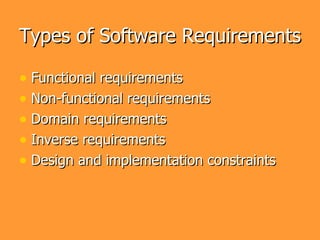
Types of Software Requirements

• Functional requirements
• Non-functional requirements
• Domain requirements
• Inverse requirements
• Design and implementation constraints
Non-Functional Requirements

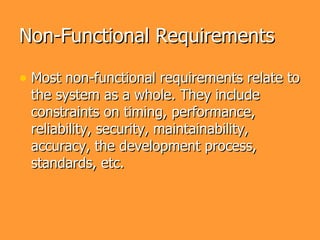
• Most non-functional requirements relate to
 the system as a whole. They include
 constraints on timing, performance,
 reliability, security, maintainability,
 accuracy, the development process,
 standards, etc.
Non-Functional Requirements

• They are often more critical than
  individual functional requirements
• Capture the emergent behavior of the
  system, that is they relate to system as a
  whole
Continued…

• Must be built into the framework of the
  software product
• Failure to meet a non-functional system
  requirement may make the whole system
  unusable
Example

• For example, if an aircraft system does not
  meet reliability requirements, it will not be
  certified as ‘safe’
• If a real-time control system fails to meet
  its performance requirements, the control
  functions will not operate correctly
Non-Functional Requirements

• Non-functional requirements arise through
 user needs, because of budget
 constraints, because of organizational
 policies, because of the need of
 interoperability with other software and
 hardware systems, or because of external
 factors such as safety regulations, privacy
 legislation, etc.
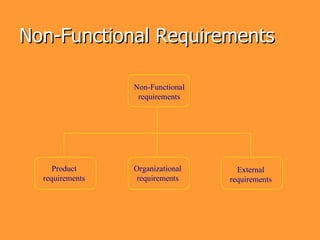
Non-Functional Requirements

                 Non-Functional
                  requirements


     Product     Organizational     External
  requirements    requirements    requirements
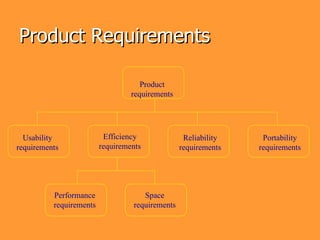
Product Requirements

                                     Product
                                  requirements


  Usability               Efficiency              Reliability    Portability
requirements             requirements            requirements   requirements


          Performance                Space
          requirements            requirements
Product Requirements Examples

• The system shall allow one hundred
  thousand hits per minute on the website
• The system shall not have down time of
  more than one second for continuous
  execution of one thousand hours
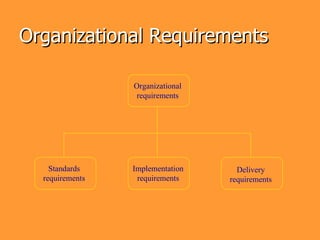
Organizational Requirements

                 Organizational
                  requirements


    Standards    Implementation     Delivery
  requirements    requirements    requirements
Organizational Requirements
Examples

• Any development work sub-contracted by
 the development organization shall be
 carried out in accordance with Capability
 Maturity Model
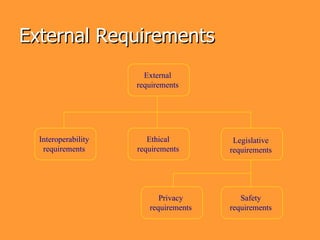
External Requirements
                       External
                     requirements


  Interoperability      Ethical         Legislative
   requirements      requirements      requirements


                           Privacy        Safety
                        requirements   requirements
Examples External
Requirements
• The system shall not disclose any personal
  information about members of the library
  system to other members except system
  administrators
• The system shall comply with the local
  and national laws regarding the use of
  software tools
Observations on Non-Functional
Requirements
• Non-functional requirements can be
 written to reflect general goals for the
 system. Examples include:
  – Ease of use
  – Recovery from failure
  – Rapid user response
Observations on Non-Functional
Requirements
• Goals can be useful to designers and
 developers, as they give clues to them
 about priorities of the customers
Observations on Non-Functional
Requirements
• Some negotiations must be done among
 different stakeholders, to achieve an
 agreement in these situations
Observations on Non-Functional
Requirements
• Non-functional requirements should be
 highlighted in the requirements document,
 so that they can be used to build the
 architecture of the software product
Summary

• Discussed different aspects of the non-functional
    requirements
•   Non-functional requirements capture very
    important emergent behavior of the automated
    system
•   Due importance, time, and resources should be
    given to non-functional requirements
References
• ‘Requirements Engineering: Processes and
    Techniques’ by G. Kotonya and I. Sommerville,
    John Wiley & Sons, 1998
•   Software Requirements: Objects, Functions, and
    States by A. Davis, PH, 1993
•   Software Engineering 6th Edition, by I.
    Sommerville, 2000
•   Software Engineering 5th Edition, by R. Pressman

Software architecture 2

  • 1.
    Software Architecture &Design Syed Salman Qadri Asisstant Professor (CS) The Islamia University of Bahawalpur
  • 2.
    Types of SoftwareRequirements • Functional requirements • Non-functional requirements • Domain requirements • Inverse requirements • Design and implementation constraints
  • 3.
  • 4.
    Non-Functional Requirements • Mostnon-functional requirements relate to the system as a whole. They include constraints on timing, performance, reliability, security, maintainability, accuracy, the development process, standards, etc.
  • 5.
    Non-Functional Requirements • Theyare often more critical than individual functional requirements • Capture the emergent behavior of the system, that is they relate to system as a whole
  • 6.
    Continued… • Must bebuilt into the framework of the software product • Failure to meet a non-functional system requirement may make the whole system unusable
  • 7.
    Example • For example,if an aircraft system does not meet reliability requirements, it will not be certified as ‘safe’ • If a real-time control system fails to meet its performance requirements, the control functions will not operate correctly
  • 8.
    Non-Functional Requirements • Non-functionalrequirements arise through user needs, because of budget constraints, because of organizational policies, because of the need of interoperability with other software and hardware systems, or because of external factors such as safety regulations, privacy legislation, etc.
  • 9.
    Non-Functional Requirements Non-Functional requirements Product Organizational External requirements requirements requirements
  • 10.
    Product Requirements Product requirements Usability Efficiency Reliability Portability requirements requirements requirements requirements Performance Space requirements requirements
  • 11.
    Product Requirements Examples •The system shall allow one hundred thousand hits per minute on the website • The system shall not have down time of more than one second for continuous execution of one thousand hours
  • 12.
    Organizational Requirements Organizational requirements Standards Implementation Delivery requirements requirements requirements
  • 13.
    Organizational Requirements Examples • Anydevelopment work sub-contracted by the development organization shall be carried out in accordance with Capability Maturity Model
  • 14.
    External Requirements External requirements Interoperability Ethical Legislative requirements requirements requirements Privacy Safety requirements requirements
  • 15.
    Examples External Requirements • Thesystem shall not disclose any personal information about members of the library system to other members except system administrators • The system shall comply with the local and national laws regarding the use of software tools
  • 16.
    Observations on Non-Functional Requirements •Non-functional requirements can be written to reflect general goals for the system. Examples include: – Ease of use – Recovery from failure – Rapid user response
  • 17.
    Observations on Non-Functional Requirements •Goals can be useful to designers and developers, as they give clues to them about priorities of the customers
  • 18.
    Observations on Non-Functional Requirements •Some negotiations must be done among different stakeholders, to achieve an agreement in these situations
  • 19.
    Observations on Non-Functional Requirements •Non-functional requirements should be highlighted in the requirements document, so that they can be used to build the architecture of the software product
  • 20.
    Summary • Discussed differentaspects of the non-functional requirements • Non-functional requirements capture very important emergent behavior of the automated system • Due importance, time, and resources should be given to non-functional requirements
  • 21.
    References • ‘Requirements Engineering:Processes and Techniques’ by G. Kotonya and I. Sommerville, John Wiley & Sons, 1998 • Software Requirements: Objects, Functions, and States by A. Davis, PH, 1993 • Software Engineering 6th Edition, by I. Sommerville, 2000 • Software Engineering 5th Edition, by R. Pressman