1
Software Requirements
Descriptions and specifications
of a system
What is a requirement?
• May range from
– a high-level abstract statement of a service
or
– a statement of a system constraint to a
detailed mathematical functional specification
• Requirements may be used for
– a bid for a contract
• must be open to interpretation
– the basis for the contract itself
• must be defined in detail
• Both the above statements may be called
requirements
Example Example
……
4.A.5 The database shall support the generation and control of
configuration objects; that is, objects which are themselves
groupings
of other objects in the database. The configuration control
facilities
shall allow access to the objects in a version group by the use of
an
incomplete name.
……
2
Types of requirements
• Written for customers
– User requirements
• Statements in natural language plus diagrams of the
services the system provides and its operational
constraints.
• Written as a contract between client and
contractor
– System requirements
• A structured document setting out detailed
descriptions of the system services.
• Written for developers
– Software specification
• A detailed software description which can serve as a
basis for a design or implementation.
User requirements readers
• Client managers
• System end-users
• Client engineers
• Contractor managers
• System architects
System requirements readers
• System end-users
• Client engineers
• System architects
• Software developers
Software specification readers
• Client engineers (maybe)
• System architects
• Software developers
3
We will come back to user
and system requirements
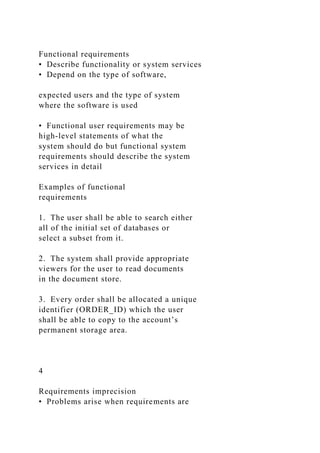
Functional requirements
• Statements of services the system
should provide, how the system
should react to particular inputs
and how the system should behave
in particular situations.
Functional requirements
• Describe functionality or system services
• Depend on the type of software,
expected users and the type of system
where the software is used
• Functional user requirements may be
high-level statements of what the
system should do but functional system
requirements should describe the system
services in detail
Examples of functional
requirements
1. The user shall be able to search either
all of the initial set of databases or
select a subset from it.
2. The system shall provide appropriate
viewers for the user to read documents
in the document store.
3. Every order shall be allocated a unique
identifier (ORDER_ID) which the user
shall be able to copy to the account’s
permanent storage area.
4
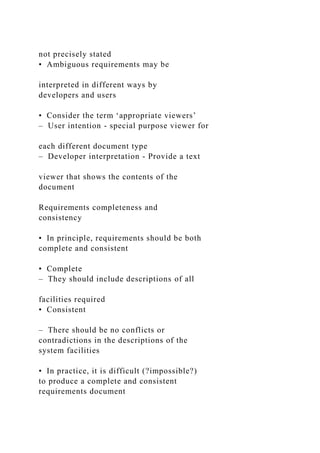
Requirements imprecision
• Problems arise when requirements are
not precisely stated
• Ambiguous requirements may be
interpreted in different ways by
developers and users
• Consider the term ‘appropriate viewers’
– User intention - special purpose viewer for
each different document type
– Developer interpretation - Provide a text
viewer that shows the contents of the
document
Requirements completeness and
consistency
• In principle, requirements should be both
complete and consistent
• Complete
– They should include descriptions of all
facilities required
• Consistent
– There should be no conflicts or
contradictions in the descriptions of the
system facilities
• In practice, it is difficult (?impossible?)
to produce a complete and consistent
requirements document
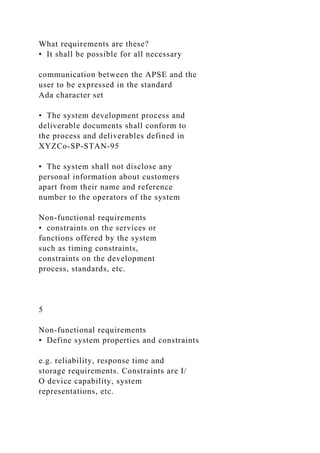
What requirements are these?
• It shall be possible for all necessary
communication between the APSE and the
user to be expressed in the standard
Ada character set
• The system development process and
deliverable documents shall conform to
the process and deliverables defined in
XYZCo-SP-STAN-95
• The system shall not disclose any
personal information about customers
apart from their name and reference
number to the operators of the system
Non-functional requirements
• constraints on the services or
functions offered by the system
such as timing constraints,
constraints on the development
process, standards, etc.
5
Non-functional requirements
• Define system properties and constraints
e.g. reliability, response time and
storage requirements. Constraints are I/
O device capability, system
representations, etc.
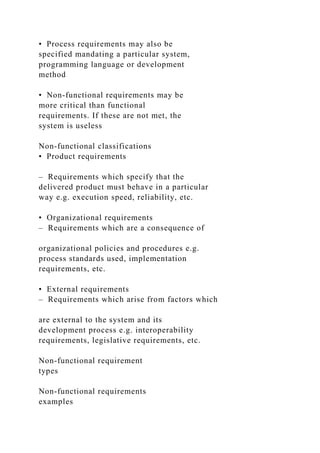
• Process requirements may also be
specified mandating a particular system,
programming language or development
method
• Non-functional requirements may be
more critical than functional
requirements. If these are not met, the
system is useless
Non-functional classifications
• Product requirements
– Requirements which specify that the
delivered product must behave in a particular
way e.g. execution speed, reliability, etc.
• Organizational requirements
– Requirements which are a consequence of
organizational policies and procedures e.g.
process standards used, implementation
requirements, etc.
• External requirements
– Requirements which arise from factors which
are external to the system and its
development process e.g. interoperability
requirements, legislative requirements, etc.
Non-functional requirement
types
Non-functional requirements
examples
• Product requirement
– 4.C.8 It shall be possible for all necessary
communication between the APSE and the user to
be expressed in the standard Ada character set
• Organizational requirement
– 9.3.2 The system development process and
deliverable documents shall conform to the
process and deliverables defined in XYZCo-SP-
STAN-95
• External requirement
– 7.6.5 The system shall not disclose any personal
information about customers apart from their
name and reference number to the operators of
the system
6
Goals and requirements
• Non-functional requirements may be very
difficult to state precisely and imprecise
requirements may be difficult to verify.
• Goal
– A general intention of the user such as ease
of use
• Verifiable non-functional requirement
– A statement using some measure that can be
objectively tested
• Goals are helpful to developers as they
convey the intentions of the system
users
Examples
• A system goal
– The system should be easy to use by
experienced controllers and should be
organized in such a way that user errors are
minimized.
• A verifiable non-functional requirement
– Experienced controllers shall be able to use
all the system functions after a total of two
hours training. After this training, the
average number of errors made by
experienced users shall not exceed two per
day.
Requirements measures
Property Measure
Speed • Processed transactions/second
• User/event response time
• Screen refresh time
Size • K Bytes
• Number of RAM chips
Ease of use • Training time
• Number of help frames
Reliability • Mean time to failure
• Probability of unavailability
• Rate of failure occurrence
• Availability
Robustness • Time to restart after failure
• Percentage of events causing failure
• Probability of data corruption on failure
Portability • Percentage of target dependent statements
• Number of target systems
Requirements interaction
• Conflicts between different non-
functional requirements are common in
complex systems
• Spacecraft system
– To minimize weight, the number of separate
chips in the system should be minimized
– To minimize power consumption, lower power
chips should be used
– However, using low power chips may mean
that more chips have to be used. Which is
the most critical requirement?
7
Domain requirements
• Requirements that come from the
application domain of the system
and that reflect characteristics of
that domain
Domain requirements
• Derived from the application domain and
describe system characteristics and
features that reflect the domain
• May be new functional requirements,
constraints on existing requirements or
define specific computations
• If domain requirements are not
satisfied, the system may be unworkable
Library system domain
requirements
• There shall be a standard user interface
to all databases which shall be based on
the Z39.50 standard.
• Because of copyright restrictions, some
documents must be deleted immediately
on arrival. Depending on the user’s
requirements, these documents will
either be printed locally on the system
server for manually forwarding to the
user or routed to a network printer.
Domain requirements problems
• Understandability
– Requirements are expressed in the
language of the application domain
– This is often not understood by
software engineers developing the
system
• Implicitness
– Domain specialists understand the area
so well that they do not think of
making the domain requirements
explicit
8
Back to user and system
requirements
User requirements
• Should describe functional and non-
functional requirements so that
they are understandable by system
users who don’t have detailed
technical knowledge
• User requirements are defined using
natural language, tables and
diagrams
Database requirement
……
4.A.5 The database shall support the generation and control of
configuration objects; that is, objects which are themselves
groupings
of other objects in the database. The configuration control
facilities
shall allow access to the objects in a version group by the use of
an
incomplete name.
……
Requirement problems
• Database requirements includes
both conceptual and detailed
information
– Describes the concept of configuration
control facilities
– Includes the detail that objects may
be accessed using an incomplete name
9
Editor grid requirement
……
2.6 Grid facilities To assist in the positioning of entities on a
diagram,
the user may turn on a grid in either centimetres or inches, via
an
option on the control panel. Initially, the grid is off. The grid
may be
turned on and off at any time during an editing session and can
be
toggled between inches and centimetres at any time. A grid
option
will be provided on the reduce-to-fit view but the number of
grid
lines shown will be reduced to avoid filling the smaller diagram
with grid lines.
……
Requirement problems
• Grid requirement mixes three
different kinds of requirement
– Conceptual functional requirement (the
need for a grid)
– Non-functional requirement (grid units)
– Non-functional UI requirement (grid
switching)
Why the problems?
Problems with natural language
• Lack of clarity
– Precision is difficult without making
the document difficult to read
• Requirements confusion
– Functional and non-functional
requirements tend to be mixed-up
• Requirements mix-up
– Several different requirements may
be expressed together
10
Structured presentation Detailed user requirement
Guidelines for writing
requirements
• Invent a standard format and use it
for all requirements
• Use language in a consistent way.
Use “shall” for mandatory
requirements, “should” for desirable
requirements
• Use text highlighting to identify
key parts of the requirement
• Avoid the use of computer jargon
System requirements
• More detailed specifications of user
requirements
• Serve as a basis for designing the
system
• May be used as part of the system
contract
11
Problems with NL specification
• Ambiguity
– The readers and writers of the requirement
must interpret the same words in the same
way. NL is naturally ambiguous so this is
very difficult
• Over-flexibility
– The same thing may be said in a number of
different ways in the specification
• Lack of modularisation
– NL structures are inadequate to structure
system requirements
Alternatives to NL specification
Structured language
specifications
• A limited form of natural language
may be used to express
requirements
• This removes some of the problems
resulting from ambiguity and
flexibility and imposes a degree of
uniformity on a specification
• Often best supported using a
forms-based approach
Form-based specifications
• Definition of the function or entity
• Description of inputs and where
they come from
• Description of outputs and where
they go to
• Indication of other entities required
• Pre and post conditions (if
appropriate)
• The side effects (if any)
12
Form-based node specification PDL-based requirements
definition
• Requirements may be defined using a
language like a programming language but
with more flexibility of expression
• Most appropriate in two situations
• Where an operation is specified as a sequence of
actions and the order is important
• When hardware and software interfaces have to be
specified
• Disadvantages are
– The program definition language (PDL) may
not be sufficiently expressive to define
domain concepts
– The specification will be taken as a design
rather than a specification
Part of an ATM specification PDL disadvantages
• PDL may not be sufficiently expressive
to express the system functionality in an
understandable way
• Notation is only understandable to people
with programming language knowledge
• The requirement may be taken as a
design specification rather than a model
to help understand the system
13
Interface specification
• Most systems must operate with other
systems and the operating interfaces
must be specified as part of the
requirements
• Three types of interface may have to be
defined
– Procedural interfaces
– Data structures that are exchanged
– Data representations
• Formal notations are an effective
technique for interface specification
PDL interface description
Viewpoint-oriented elicitation
• Stakeholders represent different
ways of looking at a problem or
problem viewpoints
• This multi-perspective analysis is
important as there is no single
correct way to analyze system
requirements
Banking ATM system
• The example used here is an auto-teller
system which provides some automated
banking services
• I use a very simplified system which
offers some services to customers of the
bank who own the system and a narrower
range of services to other customers
• Services include cash withdrawal,
message passing (send a message to
request a service), ordering a statement
and transferring funds
14
Autoteller viewpoints
• Bank customers
• Representatives of other banks
• Hardware and software maintenance
engineers
• Marketing department
• Bank managers and counter staff
• Database administrators and security
staff
• Communications engineers
• Personnel department
Types of viewpoints
– Data sources or sinks
• Viewpoints are responsible for producing or consuming
data.
• Analysis involves checking that data is produced and
consumed and that assumptions about the source and
sink of data are valid
– Representation frameworks
• Viewpoints represent particular types of system
model.
• These may be compared to discover requirements
that would be missed using a single representation.
Particularly suitable for real-time systems
– Receivers of services
• Viewpoints are external to the system and receive
services from it.
• Most suited to interactive systems
External viewpoints
• Natural to think of end-users as
receivers of system services
• Viewpoints are a natural way to
structure requirements elicitation
• It is relatively easy to decide if a
viewpoint is valid
• Viewpoints and services may be
used to structure non-functional
requirements
Method-based analysis
• Widely used approach to requirements
analysis. Depends on the application of a
structured method to understand the
system
• Methods have different emphases. Some
are designed for requirements elicitation,
others are close to design methods
• A viewpoint-oriented method (VORD) is
used as an example here. It also
illustrates the use of viewpoints
15
The VORD method
Viewpoint
Identification
Viewpoint
Structuring
Viewpoint
Documentation
Viewpoint
System
Mapping
VORD process model
• Viewpoint identification
– Discover viewpoints which receive system
services and identify the services provided to
each viewpoint
• Viewpoint structuring
– Group related viewpoints into a hierarchy.
Common services are provided at higher-
levels in the hierarchy
• Viewpoint documentation
– Refine the description of the identified
viewpoints and services
• Viewpoint-system mapping
– Transform the analysis to an object-oriented
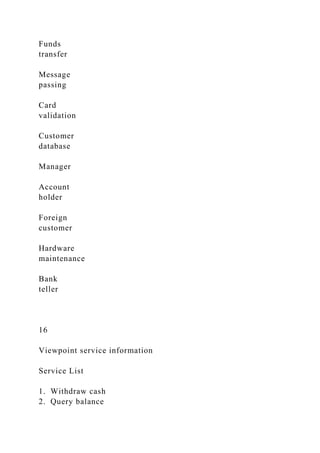
design
VORD standard forms Viewpoint identification
Query
balance
Get
transactions
Cash
withdrawal
Transaction
log
Machine
supplies
Card
returning
Remote
software
upgrade
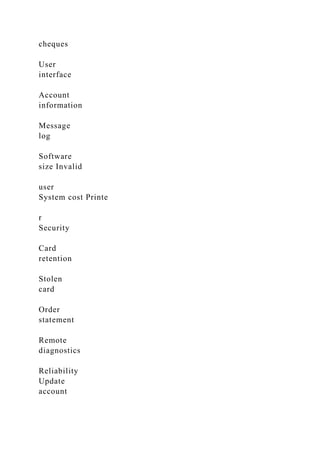
Order
cheques
User
interface
Account
information
Message
log
Software
size Invalid
user
System cost Printe
r
Security
Card
retention
Stolen
card
Order
statement
Remote
diagnostics
Reliability
Update
account
Funds
transfer
Message
passing
Card
validation
Customer
database
Manager
Account
holder
Foreign
customer
Hardware
maintenance
Bank
teller
16
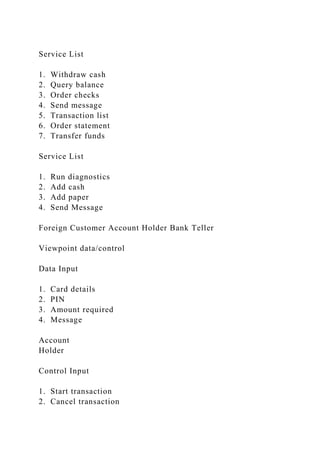
Viewpoint service information
Service List
1. Withdraw cash
2. Query balance
Service List
1. Withdraw cash
2. Query balance
3. Order checks
4. Send message
5. Transaction list
6. Order statement
7. Transfer funds
Service List
1. Run diagnostics
2. Add cash
3. Add paper
4. Send Message
Foreign Customer Account Holder Bank Teller
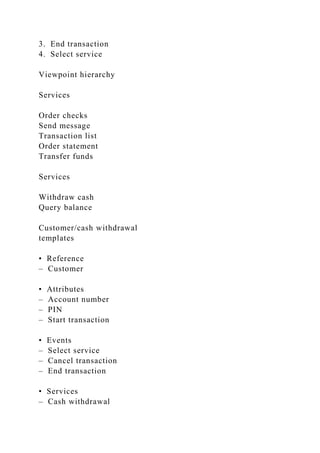
Viewpoint data/control
Data Input
1. Card details
2. PIN
3. Amount required
4. Message
Account
Holder
Control Input
1. Start transaction
2. Cancel transaction
3. End transaction
4. Select service
Viewpoint hierarchy
Services
Order checks
Send message
Transaction list
Order statement
Transfer funds
Services
Withdraw cash
Query balance
Customer/cash withdrawal
templates
• Reference
– Customer
• Attributes
– Account number
– PIN
– Start transaction
• Events
– Select service
– Cancel transaction
– End transaction
• Services
– Cash withdrawal
– Balance enquiry
• Sub-VPs
– Account holder
– Foreign customer
• Reference
– Cash withdrawal
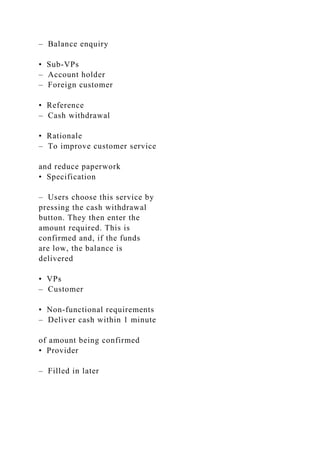
• Rationale
– To improve customer service
and reduce paperwork
• Specification
– Users choose this service by
pressing the cash withdrawal
button. They then enter the
amount required. This is
confirmed and, if the funds
are low, the balance is
delivered
• VPs
– Customer
• Non-functional requirements
– Deliver cash within 1 minute
of amount being confirmed
• Provider
– Filled in later
17
Scenarios
• Scenarios are descriptions of how a
system is used in practice
• They are helpful in requirements
elicitation as people can relate to
these more readily than abstract
statement of what they require
from a system
• Scenarios are particularly useful for
adding detail to an outline
requirements description
Scenario descriptions
• System state at the beginning of
the scenario
• Normal flow of events in the
scenario
• What can go wrong and how this is
handled
• Other concurrent activities
• System state on completion of the
scenario
Event scenarios
• Event scenarios may be used to
describe how a system responds to
the occurrence of some particular
event such as ‘start transaction’
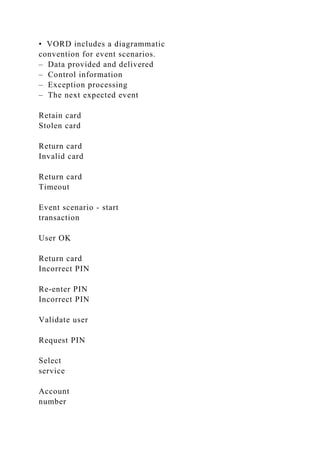
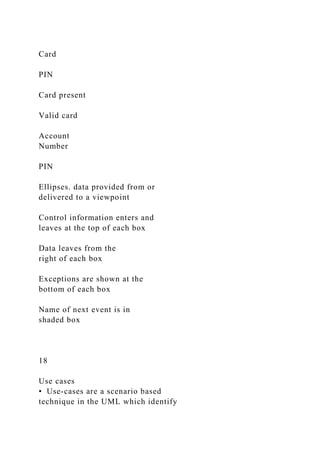
• VORD includes a diagrammatic
convention for event scenarios.
– Data provided and delivered
– Control information
– Exception processing
– The next expected event
Retain card
Stolen card
Return card
Invalid card
Return card
Timeout
Event scenario - start
transaction
User OK
Return card
Incorrect PIN
Re-enter PIN
Incorrect PIN
Validate user
Request PIN
Select
service
Account
number
Card
PIN
Card present
Valid card
Account
Number
PIN
Ellipses. data provided from or
delivered to a viewpoint
Control information enters and
leaves at the top of each box
Data leaves from the
right of each box
Exceptions are shown at the
bottom of each box
Name of next event is in
shaded box
18
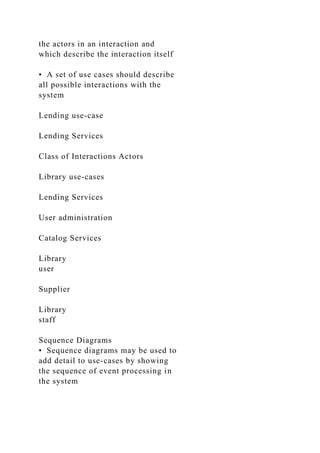
Use cases
• Use-cases are a scenario based
technique in the UML which identify
the actors in an interaction and
which describe the interaction itself
• A set of use cases should describe
all possible interactions with the
system
Lending use-case
Lending Services
Class of Interactions Actors
Library use-cases
Lending Services
User administration
Catalog Services
Library
user
Supplier
Library
staff
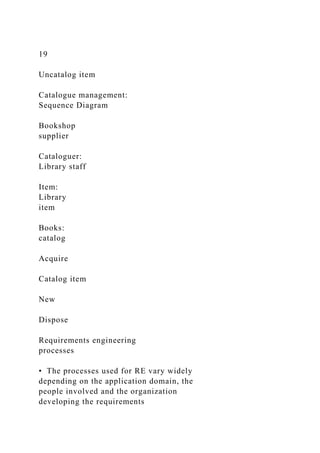
Sequence Diagrams
• Sequence diagrams may be used to
add detail to use-cases by showing
the sequence of event processing in
the system
19
Uncatalog item
Catalogue management:
Sequence Diagram
Bookshop
supplier
Cataloguer:
Library staff
Item:
Library
item
Books:
catalog
Acquire
Catalog item
New
Dispose
Requirements engineering
processes
• The processes used for RE vary widely
depending on the application domain, the
people involved and the organization
developing the requirements
• However, there are a number of generic
activities common to all processes
– Requirements elicitation
– Requirements analysis
– Requirements validation
– Requirements management
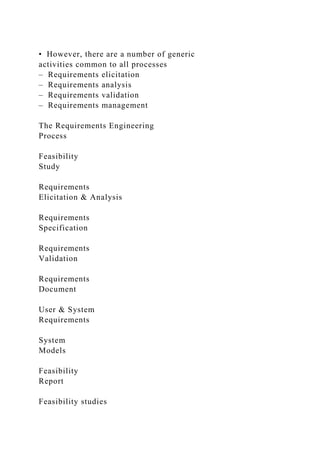
The Requirements Engineering
Process
Feasibility
Study
Requirements
Elicitation & Analysis
Requirements
Specification
Requirements
Validation
Requirements
Document
User & System
Requirements
System
Models
Feasibility
Report
Feasibility studies
• A feasibility study decides whether
or not the proposed system is
worthwhile
• A short focused study that checks
– If the system contributes to
organizational objectives
– If the system can be engineered using
current technology and within budget
– If the system can be integrated with
other systems that are used
20
Feasibility study implementation
• Based on information assessment (what is
required), information collection and
report writing
• Questions for people in the organization
– What if the system wasn’t implemented?
– What are current process problems?
– How will the proposed system help?
– What will be the integration problems?
– Is new technology needed? What skills?
– What facilities must be supported by the
proposed system?
Elicit: by Webster dictionary
Main Entry: elic·it
Pronunciation: i-'li-s&t
Function: transitive verb
Etymology: Latin elicitus, past participle of
elicere, from e- + lacere to allure
Date: 1605
1 : to draw forth or bring out (something
latent or potential) <hypnotism elicited his
hidden fears>
2 : to call forth or draw out (as
information or a response) <her remarks
elicited cheers>
Elicitation
• Sometimes called requirements elicitation
or requirements discovery
• Involves technical staff working with
customers to find out about the
application domain, the services that the
system should provide and the system’s
operational constraints
• May involve end-users, managers,
engineers involved in maintenance, domain
experts, trade unions, etc. These are
called stakeholders
Requirements Analysis
• Stakeholders don’t know what they really
want
• Stakeholders express requirements in
their own terms
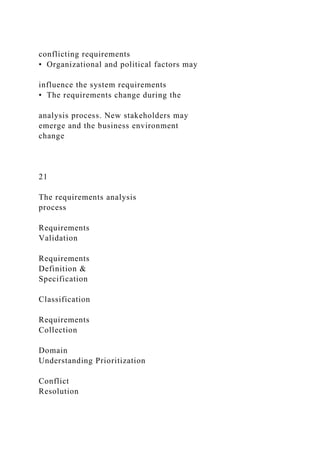
• Different stakeholders may have
conflicting requirements
• Organizational and political factors may
influence the system requirements
• The requirements change during the
analysis process. New stakeholders may
emerge and the business environment
change
21
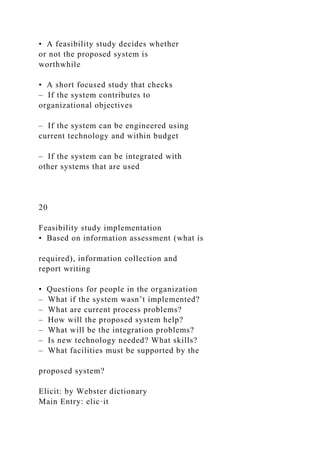
The requirements analysis
process
Requirements
Validation
Requirements
Definition &
Specification
Classification
Requirements
Collection
Domain
Understanding Prioritization
Conflict
Resolution
Process
Entry
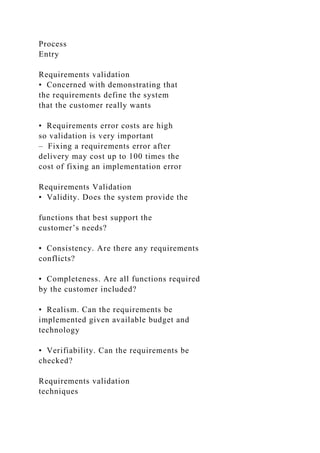
Requirements validation
• Concerned with demonstrating that
the requirements define the system
that the customer really wants
• Requirements error costs are high
so validation is very important
– Fixing a requirements error after
delivery may cost up to 100 times the
cost of fixing an implementation error
Requirements Validation
• Validity. Does the system provide the
functions that best support the
customer’s needs?
• Consistency. Are there any requirements
conflicts?
• Completeness. Are all functions required
by the customer included?
• Realism. Can the requirements be
implemented given available budget and
technology
• Verifiability. Can the requirements be
checked?
Requirements validation
techniques
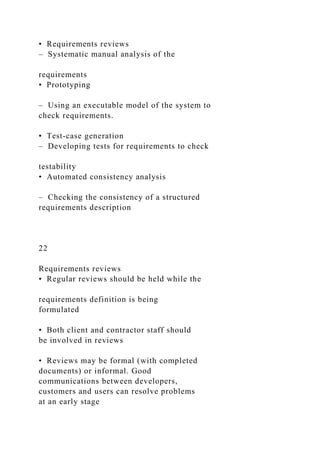
• Requirements reviews
– Systematic manual analysis of the
requirements
• Prototyping
– Using an executable model of the system to
check requirements.
• Test-case generation
– Developing tests for requirements to check
testability
• Automated consistency analysis
– Checking the consistency of a structured
requirements description
22
Requirements reviews
• Regular reviews should be held while the
requirements definition is being
formulated
• Both client and contractor staff should
be involved in reviews
• Reviews may be formal (with completed
documents) or informal. Good
communications between developers,
customers and users can resolve problems
at an early stage
Review checks
• Verifiability. Is the requirement
realistically testable?
• Comprehensibility. Is the
requirement properly understood?
• Traceability. Is the origin of the
requirement clearly stated?
• Adaptability. Can the requirement
be changed without a large impact
on other requirements?
Requirements management
• Requirements management is the process
of managing changing requirements during
the requirements engineering process and
system development
• Requirements are inevitably incomplete
and inconsistent
– New requirements emerge during the process
as business needs change and a better
understanding of the system is developed
– Different viewpoints have different
requirements and these are often
contradictory
Requirements management planning
• During the requirements engineering
process, you have to plan:
– Requirements identification
• How requirements are individually identified
– A change management process
• The process followed when analyzing a requirements
change
– Traceability policies
• The amount of information about requirements
relationships that is maintained
– CASE tool support
• The tool support required to help manage
requirements change
23
Traceability
• Traceability is concerned with the
relationships between requirements, their
sources and the system design
• Source traceability
– Links from requirements to stakeholders who
proposed these requirements
• Requirements traceability
– Links between dependent requirements
• Design traceability
– Links from the requirements to the design
A traceability matrix
U = “uses the requirement”, R = “Some other weaker
relationship”
CASE tool support
• Requirements storage
– Requirements should be managed in a secure,
managed data store
• Change management
– The process of change management is a
workflow process whose stages can be
defined and information flow between these
stages partially automated
• Traceability management
– Automated retrieval of the links between
requirements
24
Enduring and volatile
requirements
• Enduring requirements. Stable
requirements derived from the core
activity of the customer organisation.
E.g. a hospital will always have doctors,
nurses, etc. May be derived from domain
models
• Volatile requirements. Requirements
which change during development or when
the system is in use. In a hospital,
requirements derived from health-care
policy
Requirements change
• The priority of requirements from
different viewpoints changes during
the development process
• System customers may specify
requirements from a business
perspective that conflict with end-
user requirements
• The business and technical
environment of the system changes
during its development
25
Requirements evolution
Initial
understanding
of problem
Changed
understanding
of problem
Initial
requirements
Changed
requirements
Time
Requirements change management
• Should apply to all proposed changes to
the requirements
• Principal stages
– Problem analysis. Discuss requirements
problem and propose change
– Change analysis and costing. Assess effects
of change on other requirements
– Change implementation. Modify requirements
document and other documents to reflect
change
Requirements change management
Change analysis
and costing
Problem analysis
and change specification
Identified problem
Change implementation
Revised requirements
The requirements document
• The requirements document is the
official statement of what is
required of the system developers
• Should include both a definition and
a specification of requirements
• It is NOT a design document. As
far as possible, it should set of
WHAT the system should do rather
than HOW it should do it
26
Users of a requirements
document
– System customers
• Specify the requirements and read them to check
that they meet their needs
– Managers
• Use the requirements document to plan a bid for the
system and to plan the system
– System engineers
• Use the requirements to understand what system is
to be developed
– System test engineers
• Use the requirements to develop validation tests for
the system
– System maintenance engineers
• Use the requirements to help understand the system
and the relationship between its parts
Requirements document
requirements
• Specify external system behaviour
• Specify implementation constraints
• Easy to change
• Serve as reference tool for maintenance
• Record forethought about the life cycle
of the system i.e. predict changes
• Characterise responses to unexpected
events
IEEE requirements standard
• Introduction
• General description
• Specific requirements
• Appendices
• Index
• This is a generic structure that
must be instantiated for specific
systems
1 Software Requirements Descriptions and specification.docx

1 Software Requirements Descriptions and specification.docx

  • 1.
    1 Software Requirements Descriptions andspecifications of a system What is a requirement? • May range from – a high-level abstract statement of a service or – a statement of a system constraint to a detailed mathematical functional specification • Requirements may be used for – a bid for a contract • must be open to interpretation – the basis for the contract itself • must be defined in detail • Both the above statements may be called requirements Example Example …… 4.A.5 The database shall support the generation and control of
  • 2.
    configuration objects; thatis, objects which are themselves groupings of other objects in the database. The configuration control facilities shall allow access to the objects in a version group by the use of an incomplete name. …… 2 Types of requirements • Written for customers – User requirements • Statements in natural language plus diagrams of the services the system provides and its operational constraints. • Written as a contract between client and contractor – System requirements • A structured document setting out detailed descriptions of the system services. • Written for developers
  • 3.
    – Software specification •A detailed software description which can serve as a basis for a design or implementation. User requirements readers • Client managers • System end-users • Client engineers • Contractor managers • System architects System requirements readers • System end-users • Client engineers • System architects • Software developers Software specification readers • Client engineers (maybe) • System architects • Software developers 3 We will come back to user and system requirements Functional requirements • Statements of services the system should provide, how the system should react to particular inputs and how the system should behave in particular situations.
  • 4.
    Functional requirements • Describefunctionality or system services • Depend on the type of software, expected users and the type of system where the software is used • Functional user requirements may be high-level statements of what the system should do but functional system requirements should describe the system services in detail Examples of functional requirements 1. The user shall be able to search either all of the initial set of databases or select a subset from it. 2. The system shall provide appropriate viewers for the user to read documents in the document store. 3. Every order shall be allocated a unique identifier (ORDER_ID) which the user shall be able to copy to the account’s permanent storage area. 4 Requirements imprecision • Problems arise when requirements are
  • 5.
    not precisely stated •Ambiguous requirements may be interpreted in different ways by developers and users • Consider the term ‘appropriate viewers’ – User intention - special purpose viewer for each different document type – Developer interpretation - Provide a text viewer that shows the contents of the document Requirements completeness and consistency • In principle, requirements should be both complete and consistent • Complete – They should include descriptions of all facilities required • Consistent – There should be no conflicts or contradictions in the descriptions of the system facilities • In practice, it is difficult (?impossible?) to produce a complete and consistent requirements document
  • 6.
    What requirements arethese? • It shall be possible for all necessary communication between the APSE and the user to be expressed in the standard Ada character set • The system development process and deliverable documents shall conform to the process and deliverables defined in XYZCo-SP-STAN-95 • The system shall not disclose any personal information about customers apart from their name and reference number to the operators of the system Non-functional requirements • constraints on the services or functions offered by the system such as timing constraints, constraints on the development process, standards, etc. 5 Non-functional requirements • Define system properties and constraints e.g. reliability, response time and storage requirements. Constraints are I/ O device capability, system representations, etc.
  • 7.
    • Process requirementsmay also be specified mandating a particular system, programming language or development method • Non-functional requirements may be more critical than functional requirements. If these are not met, the system is useless Non-functional classifications • Product requirements – Requirements which specify that the delivered product must behave in a particular way e.g. execution speed, reliability, etc. • Organizational requirements – Requirements which are a consequence of organizational policies and procedures e.g. process standards used, implementation requirements, etc. • External requirements – Requirements which arise from factors which are external to the system and its development process e.g. interoperability requirements, legislative requirements, etc. Non-functional requirement types Non-functional requirements examples
  • 8.
    • Product requirement –4.C.8 It shall be possible for all necessary communication between the APSE and the user to be expressed in the standard Ada character set • Organizational requirement – 9.3.2 The system development process and deliverable documents shall conform to the process and deliverables defined in XYZCo-SP- STAN-95 • External requirement – 7.6.5 The system shall not disclose any personal information about customers apart from their name and reference number to the operators of the system 6 Goals and requirements • Non-functional requirements may be very difficult to state precisely and imprecise requirements may be difficult to verify. • Goal – A general intention of the user such as ease of use • Verifiable non-functional requirement
  • 9.
    – A statementusing some measure that can be objectively tested • Goals are helpful to developers as they convey the intentions of the system users Examples • A system goal – The system should be easy to use by experienced controllers and should be organized in such a way that user errors are minimized. • A verifiable non-functional requirement – Experienced controllers shall be able to use all the system functions after a total of two hours training. After this training, the average number of errors made by experienced users shall not exceed two per day. Requirements measures Property Measure Speed • Processed transactions/second • User/event response time • Screen refresh time Size • K Bytes • Number of RAM chips Ease of use • Training time
  • 10.
    • Number ofhelp frames Reliability • Mean time to failure • Probability of unavailability • Rate of failure occurrence • Availability Robustness • Time to restart after failure • Percentage of events causing failure • Probability of data corruption on failure Portability • Percentage of target dependent statements • Number of target systems Requirements interaction • Conflicts between different non- functional requirements are common in complex systems • Spacecraft system – To minimize weight, the number of separate chips in the system should be minimized – To minimize power consumption, lower power chips should be used – However, using low power chips may mean that more chips have to be used. Which is the most critical requirement? 7
  • 11.
    Domain requirements • Requirementsthat come from the application domain of the system and that reflect characteristics of that domain Domain requirements • Derived from the application domain and describe system characteristics and features that reflect the domain • May be new functional requirements, constraints on existing requirements or define specific computations • If domain requirements are not satisfied, the system may be unworkable Library system domain requirements • There shall be a standard user interface to all databases which shall be based on the Z39.50 standard. • Because of copyright restrictions, some documents must be deleted immediately on arrival. Depending on the user’s requirements, these documents will either be printed locally on the system server for manually forwarding to the user or routed to a network printer. Domain requirements problems • Understandability
  • 12.
    – Requirements areexpressed in the language of the application domain – This is often not understood by software engineers developing the system • Implicitness – Domain specialists understand the area so well that they do not think of making the domain requirements explicit 8 Back to user and system requirements User requirements • Should describe functional and non- functional requirements so that they are understandable by system users who don’t have detailed technical knowledge • User requirements are defined using natural language, tables and diagrams Database requirement ……
  • 13.
    4.A.5 The databaseshall support the generation and control of configuration objects; that is, objects which are themselves groupings of other objects in the database. The configuration control facilities shall allow access to the objects in a version group by the use of an incomplete name. …… Requirement problems • Database requirements includes both conceptual and detailed information – Describes the concept of configuration control facilities – Includes the detail that objects may be accessed using an incomplete name 9 Editor grid requirement …… 2.6 Grid facilities To assist in the positioning of entities on a diagram,
  • 14.
    the user mayturn on a grid in either centimetres or inches, via an option on the control panel. Initially, the grid is off. The grid may be turned on and off at any time during an editing session and can be toggled between inches and centimetres at any time. A grid option will be provided on the reduce-to-fit view but the number of grid lines shown will be reduced to avoid filling the smaller diagram with grid lines. …… Requirement problems • Grid requirement mixes three different kinds of requirement – Conceptual functional requirement (the need for a grid) – Non-functional requirement (grid units) – Non-functional UI requirement (grid switching) Why the problems? Problems with natural language
  • 15.
    • Lack ofclarity – Precision is difficult without making the document difficult to read • Requirements confusion – Functional and non-functional requirements tend to be mixed-up • Requirements mix-up – Several different requirements may be expressed together 10 Structured presentation Detailed user requirement Guidelines for writing requirements • Invent a standard format and use it for all requirements • Use language in a consistent way. Use “shall” for mandatory requirements, “should” for desirable requirements • Use text highlighting to identify key parts of the requirement • Avoid the use of computer jargon System requirements
  • 16.
    • More detailedspecifications of user requirements • Serve as a basis for designing the system • May be used as part of the system contract 11 Problems with NL specification • Ambiguity – The readers and writers of the requirement must interpret the same words in the same way. NL is naturally ambiguous so this is very difficult • Over-flexibility – The same thing may be said in a number of different ways in the specification • Lack of modularisation – NL structures are inadequate to structure system requirements Alternatives to NL specification Structured language specifications • A limited form of natural language
  • 17.
    may be usedto express requirements • This removes some of the problems resulting from ambiguity and flexibility and imposes a degree of uniformity on a specification • Often best supported using a forms-based approach Form-based specifications • Definition of the function or entity • Description of inputs and where they come from • Description of outputs and where they go to • Indication of other entities required • Pre and post conditions (if appropriate) • The side effects (if any) 12 Form-based node specification PDL-based requirements definition • Requirements may be defined using a language like a programming language but with more flexibility of expression
  • 18.
    • Most appropriatein two situations • Where an operation is specified as a sequence of actions and the order is important • When hardware and software interfaces have to be specified • Disadvantages are – The program definition language (PDL) may not be sufficiently expressive to define domain concepts – The specification will be taken as a design rather than a specification Part of an ATM specification PDL disadvantages • PDL may not be sufficiently expressive to express the system functionality in an understandable way • Notation is only understandable to people with programming language knowledge • The requirement may be taken as a design specification rather than a model to help understand the system 13 Interface specification • Most systems must operate with other
  • 19.
    systems and theoperating interfaces must be specified as part of the requirements • Three types of interface may have to be defined – Procedural interfaces – Data structures that are exchanged – Data representations • Formal notations are an effective technique for interface specification PDL interface description Viewpoint-oriented elicitation • Stakeholders represent different ways of looking at a problem or problem viewpoints • This multi-perspective analysis is important as there is no single correct way to analyze system requirements Banking ATM system • The example used here is an auto-teller system which provides some automated banking services • I use a very simplified system which offers some services to customers of the bank who own the system and a narrower range of services to other customers
  • 20.
    • Services includecash withdrawal, message passing (send a message to request a service), ordering a statement and transferring funds 14 Autoteller viewpoints • Bank customers • Representatives of other banks • Hardware and software maintenance engineers • Marketing department • Bank managers and counter staff • Database administrators and security staff • Communications engineers • Personnel department Types of viewpoints – Data sources or sinks • Viewpoints are responsible for producing or consuming data. • Analysis involves checking that data is produced and consumed and that assumptions about the source and sink of data are valid – Representation frameworks • Viewpoints represent particular types of system
  • 21.
    model. • These maybe compared to discover requirements that would be missed using a single representation. Particularly suitable for real-time systems – Receivers of services • Viewpoints are external to the system and receive services from it. • Most suited to interactive systems External viewpoints • Natural to think of end-users as receivers of system services • Viewpoints are a natural way to structure requirements elicitation • It is relatively easy to decide if a viewpoint is valid • Viewpoints and services may be used to structure non-functional requirements Method-based analysis • Widely used approach to requirements analysis. Depends on the application of a structured method to understand the system • Methods have different emphases. Some are designed for requirements elicitation,
  • 22.
    others are closeto design methods • A viewpoint-oriented method (VORD) is used as an example here. It also illustrates the use of viewpoints 15 The VORD method Viewpoint Identification Viewpoint Structuring Viewpoint Documentation Viewpoint System Mapping VORD process model • Viewpoint identification – Discover viewpoints which receive system services and identify the services provided to each viewpoint • Viewpoint structuring – Group related viewpoints into a hierarchy. Common services are provided at higher-
  • 23.
    levels in thehierarchy • Viewpoint documentation – Refine the description of the identified viewpoints and services • Viewpoint-system mapping – Transform the analysis to an object-oriented design VORD standard forms Viewpoint identification Query balance Get transactions Cash withdrawal Transaction log Machine supplies Card returning Remote software upgrade Order
  • 24.
    cheques User interface Account information Message log Software size Invalid user System costPrinte r Security Card retention Stolen card Order statement Remote diagnostics Reliability Update account
  • 25.
  • 26.
    Service List 1. Withdrawcash 2. Query balance 3. Order checks 4. Send message 5. Transaction list 6. Order statement 7. Transfer funds Service List 1. Run diagnostics 2. Add cash 3. Add paper 4. Send Message Foreign Customer Account Holder Bank Teller Viewpoint data/control Data Input 1. Card details 2. PIN 3. Amount required 4. Message Account Holder Control Input 1. Start transaction 2. Cancel transaction
  • 27.
    3. End transaction 4.Select service Viewpoint hierarchy Services Order checks Send message Transaction list Order statement Transfer funds Services Withdraw cash Query balance Customer/cash withdrawal templates • Reference – Customer • Attributes – Account number – PIN – Start transaction • Events – Select service – Cancel transaction – End transaction • Services – Cash withdrawal
  • 28.
    – Balance enquiry •Sub-VPs – Account holder – Foreign customer • Reference – Cash withdrawal • Rationale – To improve customer service and reduce paperwork • Specification – Users choose this service by pressing the cash withdrawal button. They then enter the amount required. This is confirmed and, if the funds are low, the balance is delivered • VPs – Customer • Non-functional requirements – Deliver cash within 1 minute of amount being confirmed • Provider – Filled in later
  • 29.
    17 Scenarios • Scenarios aredescriptions of how a system is used in practice • They are helpful in requirements elicitation as people can relate to these more readily than abstract statement of what they require from a system • Scenarios are particularly useful for adding detail to an outline requirements description Scenario descriptions • System state at the beginning of the scenario • Normal flow of events in the scenario • What can go wrong and how this is handled • Other concurrent activities • System state on completion of the scenario Event scenarios • Event scenarios may be used to describe how a system responds to the occurrence of some particular event such as ‘start transaction’
  • 30.
    • VORD includesa diagrammatic convention for event scenarios. – Data provided and delivered – Control information – Exception processing – The next expected event Retain card Stolen card Return card Invalid card Return card Timeout Event scenario - start transaction User OK Return card Incorrect PIN Re-enter PIN Incorrect PIN Validate user Request PIN Select service Account number
  • 31.
    Card PIN Card present Valid card Account Number PIN Ellipses.data provided from or delivered to a viewpoint Control information enters and leaves at the top of each box Data leaves from the right of each box Exceptions are shown at the bottom of each box Name of next event is in shaded box 18 Use cases • Use-cases are a scenario based technique in the UML which identify
  • 32.
    the actors inan interaction and which describe the interaction itself • A set of use cases should describe all possible interactions with the system Lending use-case Lending Services Class of Interactions Actors Library use-cases Lending Services User administration Catalog Services Library user Supplier Library staff Sequence Diagrams • Sequence diagrams may be used to add detail to use-cases by showing the sequence of event processing in the system
  • 33.
    19 Uncatalog item Catalogue management: SequenceDiagram Bookshop supplier Cataloguer: Library staff Item: Library item Books: catalog Acquire Catalog item New Dispose Requirements engineering processes • The processes used for RE vary widely depending on the application domain, the people involved and the organization developing the requirements
  • 34.
    • However, thereare a number of generic activities common to all processes – Requirements elicitation – Requirements analysis – Requirements validation – Requirements management The Requirements Engineering Process Feasibility Study Requirements Elicitation & Analysis Requirements Specification Requirements Validation Requirements Document User & System Requirements System Models Feasibility Report Feasibility studies
  • 35.
    • A feasibilitystudy decides whether or not the proposed system is worthwhile • A short focused study that checks – If the system contributes to organizational objectives – If the system can be engineered using current technology and within budget – If the system can be integrated with other systems that are used 20 Feasibility study implementation • Based on information assessment (what is required), information collection and report writing • Questions for people in the organization – What if the system wasn’t implemented? – What are current process problems? – How will the proposed system help? – What will be the integration problems? – Is new technology needed? What skills? – What facilities must be supported by the proposed system? Elicit: by Webster dictionary Main Entry: elic·it
  • 36.
    Pronunciation: i-'li-s&t Function: transitiveverb Etymology: Latin elicitus, past participle of elicere, from e- + lacere to allure Date: 1605 1 : to draw forth or bring out (something latent or potential) <hypnotism elicited his hidden fears> 2 : to call forth or draw out (as information or a response) <her remarks elicited cheers> Elicitation • Sometimes called requirements elicitation or requirements discovery • Involves technical staff working with customers to find out about the application domain, the services that the system should provide and the system’s operational constraints • May involve end-users, managers, engineers involved in maintenance, domain experts, trade unions, etc. These are called stakeholders Requirements Analysis • Stakeholders don’t know what they really want • Stakeholders express requirements in their own terms • Different stakeholders may have
  • 37.
    conflicting requirements • Organizationaland political factors may influence the system requirements • The requirements change during the analysis process. New stakeholders may emerge and the business environment change 21 The requirements analysis process Requirements Validation Requirements Definition & Specification Classification Requirements Collection Domain Understanding Prioritization Conflict Resolution
  • 38.
    Process Entry Requirements validation • Concernedwith demonstrating that the requirements define the system that the customer really wants • Requirements error costs are high so validation is very important – Fixing a requirements error after delivery may cost up to 100 times the cost of fixing an implementation error Requirements Validation • Validity. Does the system provide the functions that best support the customer’s needs? • Consistency. Are there any requirements conflicts? • Completeness. Are all functions required by the customer included? • Realism. Can the requirements be implemented given available budget and technology • Verifiability. Can the requirements be checked? Requirements validation techniques
  • 39.
    • Requirements reviews –Systematic manual analysis of the requirements • Prototyping – Using an executable model of the system to check requirements. • Test-case generation – Developing tests for requirements to check testability • Automated consistency analysis – Checking the consistency of a structured requirements description 22 Requirements reviews • Regular reviews should be held while the requirements definition is being formulated • Both client and contractor staff should be involved in reviews • Reviews may be formal (with completed documents) or informal. Good communications between developers, customers and users can resolve problems at an early stage
  • 40.
    Review checks • Verifiability.Is the requirement realistically testable? • Comprehensibility. Is the requirement properly understood? • Traceability. Is the origin of the requirement clearly stated? • Adaptability. Can the requirement be changed without a large impact on other requirements? Requirements management • Requirements management is the process of managing changing requirements during the requirements engineering process and system development • Requirements are inevitably incomplete and inconsistent – New requirements emerge during the process as business needs change and a better understanding of the system is developed – Different viewpoints have different requirements and these are often contradictory Requirements management planning • During the requirements engineering
  • 41.
    process, you haveto plan: – Requirements identification • How requirements are individually identified – A change management process • The process followed when analyzing a requirements change – Traceability policies • The amount of information about requirements relationships that is maintained – CASE tool support • The tool support required to help manage requirements change 23 Traceability • Traceability is concerned with the relationships between requirements, their sources and the system design • Source traceability – Links from requirements to stakeholders who proposed these requirements • Requirements traceability – Links between dependent requirements • Design traceability
  • 42.
    – Links fromthe requirements to the design A traceability matrix U = “uses the requirement”, R = “Some other weaker relationship” CASE tool support • Requirements storage – Requirements should be managed in a secure, managed data store • Change management – The process of change management is a workflow process whose stages can be defined and information flow between these stages partially automated • Traceability management – Automated retrieval of the links between requirements 24 Enduring and volatile requirements • Enduring requirements. Stable requirements derived from the core activity of the customer organisation.
  • 43.
    E.g. a hospitalwill always have doctors, nurses, etc. May be derived from domain models • Volatile requirements. Requirements which change during development or when the system is in use. In a hospital, requirements derived from health-care policy Requirements change • The priority of requirements from different viewpoints changes during the development process • System customers may specify requirements from a business perspective that conflict with end- user requirements • The business and technical environment of the system changes during its development 25 Requirements evolution Initial understanding of problem Changed understanding
  • 44.
    of problem Initial requirements Changed requirements Time Requirements changemanagement • Should apply to all proposed changes to the requirements • Principal stages – Problem analysis. Discuss requirements problem and propose change – Change analysis and costing. Assess effects of change on other requirements – Change implementation. Modify requirements document and other documents to reflect change Requirements change management Change analysis and costing Problem analysis and change specification Identified problem
  • 45.
    Change implementation Revised requirements Therequirements document • The requirements document is the official statement of what is required of the system developers • Should include both a definition and a specification of requirements • It is NOT a design document. As far as possible, it should set of WHAT the system should do rather than HOW it should do it 26 Users of a requirements document – System customers • Specify the requirements and read them to check that they meet their needs – Managers • Use the requirements document to plan a bid for the system and to plan the system – System engineers • Use the requirements to understand what system is
  • 46.
    to be developed –System test engineers • Use the requirements to develop validation tests for the system – System maintenance engineers • Use the requirements to help understand the system and the relationship between its parts Requirements document requirements • Specify external system behaviour • Specify implementation constraints • Easy to change • Serve as reference tool for maintenance • Record forethought about the life cycle of the system i.e. predict changes • Characterise responses to unexpected events IEEE requirements standard • Introduction • General description • Specific requirements • Appendices • Index • This is a generic structure that must be instantiated for specific systems