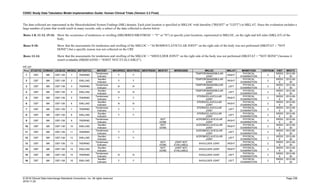
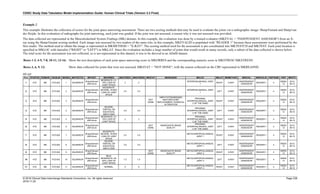
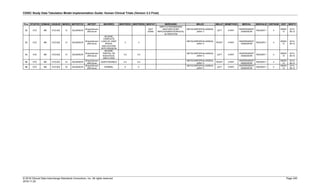
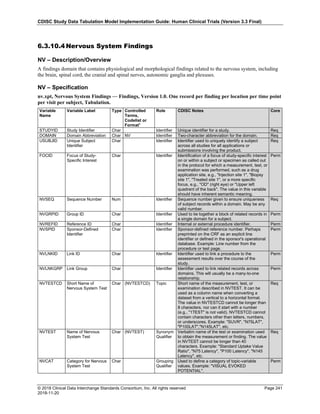
Study Data Tabulation Model Implementation
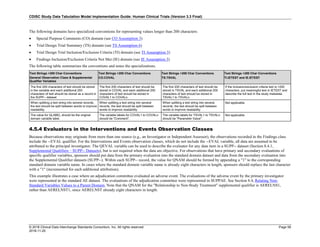
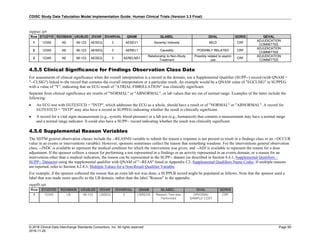
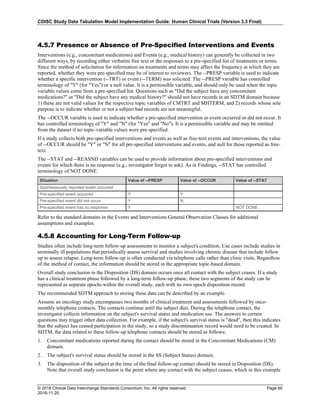
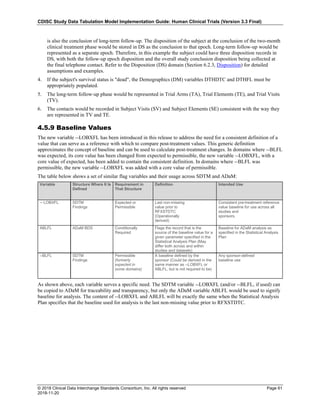
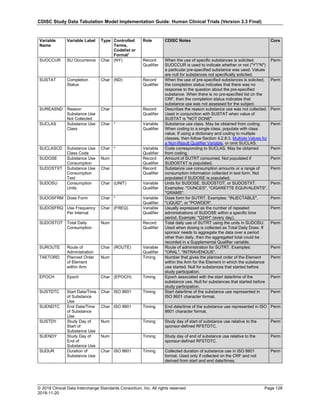
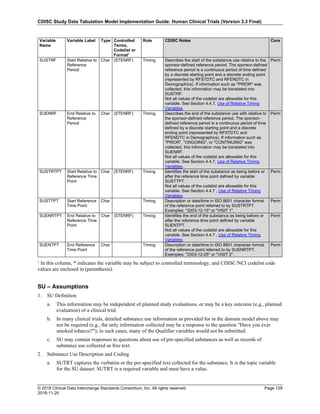
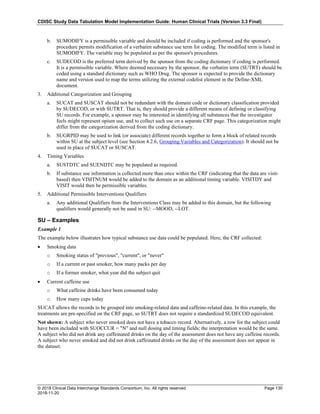
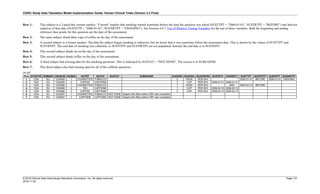
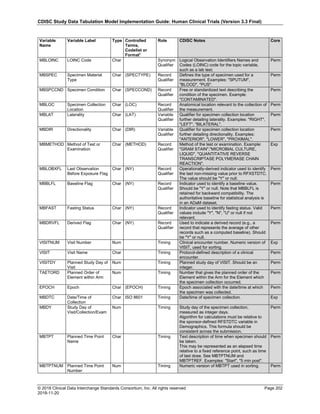
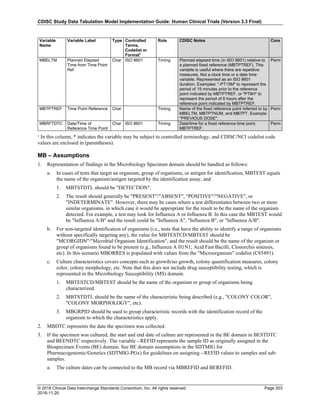
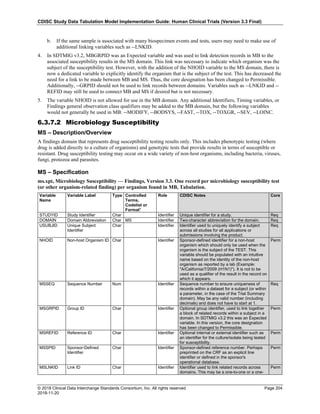
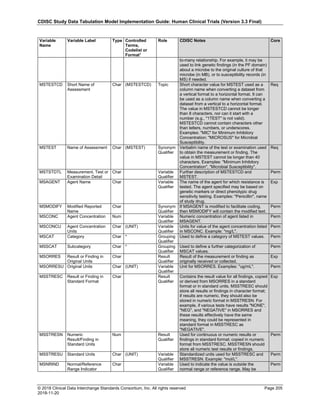
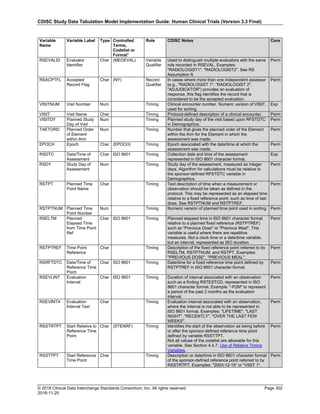
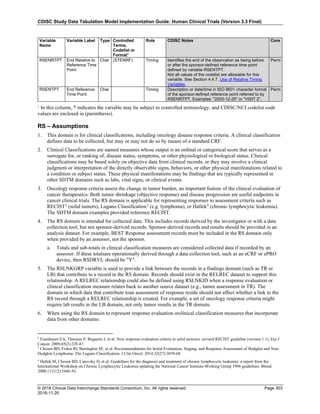
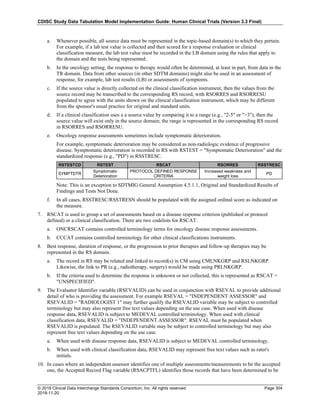
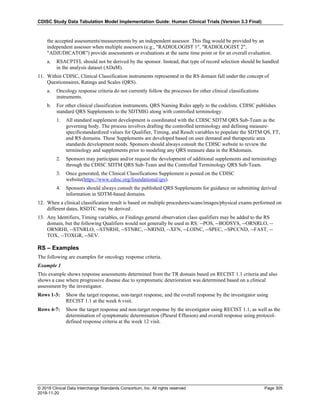
Guide: Human Clinical Trials
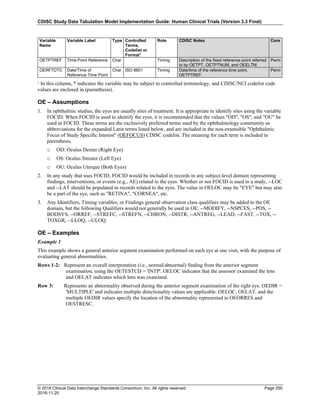
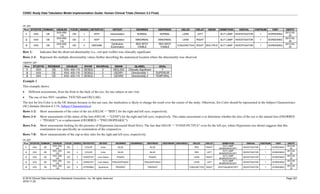
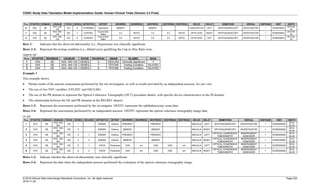
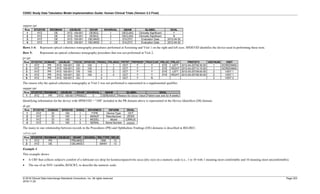
Version 3.3 (Final)
Prepared by the
CDISC Submission Data Standards Team
Revision History
Date Version
2018-11-20 3.3 Final
2013-11-26 3.2 Final
2012-07-16 3.1.3 Final
2008-11-12 3.1.2 Final
2005-08-26 3.1.1 Final
2004-07-14 3.1
See Appendix F for Representations and Warranties, Limitations of Liability, and Disclaimers.
Notes to Readers
This is the implementation guide for human clinical trials corresponding to Version 1.7 of the CDISC
Study Data Tabulation Model.
CDISC Study Data Tabulation Model Implementation Guide: Human Clinical Trials (Version 3.3 Final)
© 2018 Clinical Data Interchange Standards Consortium, Inc. All rights reserved Page 2
2018-11-20
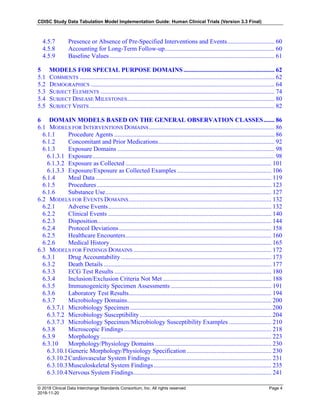
CONTENTS
1 INTRODUCTION ................................................................................................................. 7
1.1 PURPOSE................................................................................................................................... 7
1.2 ORGANIZATION OF THIS DOCUMENT ........................................................................................ 7
1.3 RELATIONSHIP TO PRIOR CDISC DOCUMENTS ........................................................................ 7
1.4 HOW TO READ THIS IMPLEMENTATION GUIDE ......................................................................... 8
1.4.1 How to Read a Domain Specification ......................................................................... 9
2 FUNDAMENTALS OF THE SDTM................................................................................. 11
2.1 OBSERVATIONS AND VARIABLES ........................................................................................... 11
2.2 DATASETS AND DOMAINS ...................................................................................................... 11
2.3 THE GENERAL OBSERVATION CLASS ..................................................................................... 12
2.4 DATASETS OTHER THAN GENERAL OBSERVATION ................................................................ 12
2.5 THE SDTM STANDARD DOMAIN MODELS ............................................................................. 13
2.6 CREATING A NEW DOMAIN .................................................................................................... 14
2.7 SDTM VARIABLES NOT ALLOWED IN SDTMIG.................................................................... 15
3 SUBMITTING DATA IN STANDARD FORMAT ......................................................... 17
3.1 STANDARD METADATA FOR DATASET CONTENTS AND ATTRIBUTES ..................................... 17
3.2 USING THE CDISC DOMAIN MODELS IN REGULATORY SUBMISSIONS — DATASET METADATA
17
3.2.1 Dataset-Level Metadata............................................................................................. 17
3.2.1.1 Primary Keys............................................................................................................. 21
3.2.1.2 CDISC Submission Value-Level Metadata............................................................... 21
3.2.2 Conformance ............................................................................................................. 21
4 ASSUMPTIONS FOR DOMAIN MODELS .................................................................... 23
4.1 GENERAL DOMAIN ASSUMPTIONS.......................................................................................... 23
4.1.1 Review Study Data Tabulation and Implementation Guide...................................... 23
4.1.2 Relationship to Analysis Datasets ............................................................................. 23
4.1.3 Additional Timing Variables..................................................................................... 23
4.1.3.1 EPOCH Variable Guidance....................................................................................... 23
4.1.4 Order of the Variables ............................................................................................... 23
4.1.5 SDTM Core Designations ......................................................................................... 23
4.1.6 Additional Guidance on Dataset Naming.................................................................. 24
4.1.7 Splitting Domains...................................................................................................... 24
4.1.7.1 Trial Inclusion/Exclusion Criteria............................................................................. 26
4.1.8 Origin Metadata......................................................................................................... 27
4.1.8.1 Origin Metadata for Variables................................................................................... 27
4.1.8.2 Origin Metadata for Records..................................................................................... 27
4.1.8.3 Assigning Natural Keys in the Metadata................................................................... 27
4.2 GENERAL VARIABLE ASSUMPTIONS....................................................................................... 29
4.2.1 Variable-Naming Conventions.................................................................................. 29
4.2.2 Two-Character Domain Identifier............................................................................. 29
4.2.3 Use of “Subject” and USUBJID................................................................................ 30
4.2.4 Text Case in Submitted Data..................................................................................... 30
CDISC Study Data Tabulation Model Implementation Guide: Human Clinical Trials (Version 3.3 Final)
© 2018 Clinical Data Interchange Standards Consortium, Inc. All rights reserved Page 3
2018-11-20
4.2.5 Convention for Missing Values................................................................................. 31
4.2.6 Grouping Variables and Categorization.................................................................... 31
4.2.7 Submitting Free Text from the CRF.......................................................................... 32
4.2.7.1 "Specify" Values for Non-Result Qualifier Variables............................................... 32
4.2.7.2 "Specify" Values for Result Qualifier Variables....................................................... 34
4.2.7.3 "Specify" Values for Topic Variables ....................................................................... 34
4.2.8 Multiple Values for a Variable.................................................................................. 35
4.2.8.1 Multiple Values for an Intervention or Event Topic Variable .................................. 35
4.2.8.2 Multiple Values for a Findings Result Variable........................................................ 35
4.2.8.3 Multiple Values for a Non-Result Qualifier Variable............................................... 36
4.2.9 Variable Lengths ....................................................................................................... 37
4.3 CODING AND CONTROLLED TERMINOLOGY ASSUMPTIONS .................................................... 37
4.3.1 Types of Controlled Terminology............................................................................. 37
4.3.2 Controlled Terminology Text Case........................................................................... 37
4.3.3 Controlled Terminology Values................................................................................ 37
4.3.4 Use of Controlled Terminology and Arbitrary Number Codes................................. 38
4.3.5 Storing Controlled Terminology for Synonym Qualifier Variables ......................... 38
4.3.6 Storing Topic Variables for General Domain Models .............................................. 38
4.3.7 Use of "Yes" and "No" Values.................................................................................. 38
4.4 ACTUAL AND RELATIVE TIME ASSUMPTIONS......................................................................... 39
4.4.1 Formats for Date/Time Variables.............................................................................. 39
4.4.2 Date/Time Precision.................................................................................................. 40
4.4.3 Intervals of Time and Use of Duration for --DUR Variables.................................... 41
4.4.3.1 Intervals of Time and Use of Duration...................................................................... 41
4.4.3.2 Interval with Uncertainty........................................................................................... 42
4.4.4 Use of the "Study Day" Variables............................................................................. 42
4.4.5 Clinical Encounters and Visits .................................................................................. 43
4.4.6 Representing Additional Study Days ........................................................................ 43
4.4.7 Use of Relative Timing Variables............................................................................. 44
4.4.8 Date and Time Reported in a Domain Based on Findings........................................ 46
4.4.9 Use of Dates as Result Variables .............................................................................. 47
4.4.10 Representing Time Points ......................................................................................... 47
4.4.11 Disease Milestones and Disease Milestone Timing Variables.................................. 50
4.5 OTHER ASSUMPTIONS ............................................................................................................ 52
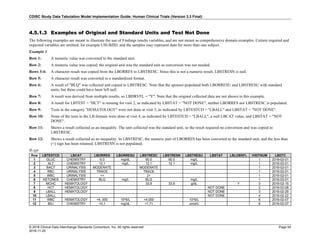
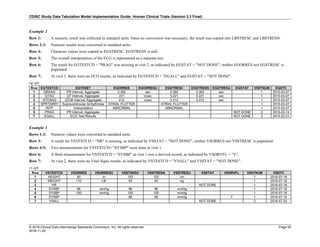
4.5.1 Original and Standardized Results of Findings and Tests Not Done........................ 52
4.5.1.1 Original and Standardized Results ............................................................................ 52
4.5.1.2 Tests Not Done.......................................................................................................... 53
4.5.1.3 Examples of Original and Standard Units and Test Not Done.................................. 54
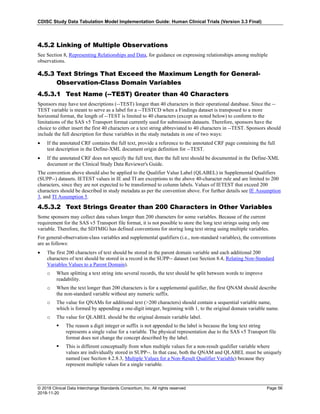
4.5.2 Linking of Multiple Observations ............................................................................. 56
4.5.3 Text Strings That Exceed the Maximum Length for General-Observation-Class
Domain Variables ...................................................................................................................... 56
4.5.3.1 Test Name (--TEST) Greater than 40 Characters...................................................... 56
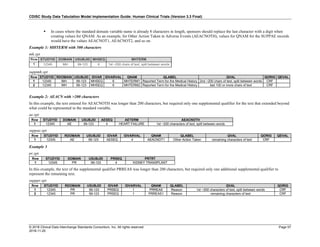
4.5.3.2 Text Strings Greater than 200 Characters in Other Variables................................... 56
4.5.4 Evaluators in the Interventions and Events Observation Classes.............................. 58
4.5.5 Clinical Significance for Findings Observation Class Data...................................... 59
4.5.6 Supplemental Reason Variables................................................................................ 59
CDISC Study Data Tabulation Model Implementation Guide: Human Clinical Trials (Version 3.3 Final)
© 2018 Clinical Data Interchange Standards Consortium, Inc. All rights reserved Page 4
2018-11-20
4.5.7 Presence or Absence of Pre-Specified Interventions and Events.............................. 60
4.5.8 Accounting for Long-Term Follow-up...................................................................... 60
4.5.9 Baseline Values ......................................................................................................... 61
5 MODELS FOR SPECIAL PURPOSE DOMAINS.......................................................... 62
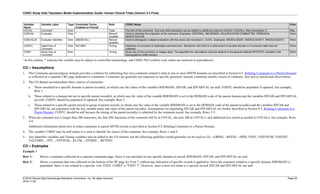
5.1 COMMENTS ............................................................................................................................ 62
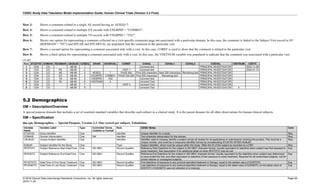
5.2 DEMOGRAPHICS ..................................................................................................................... 64
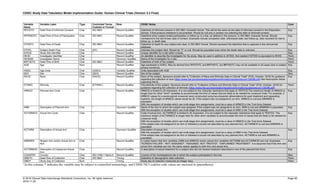
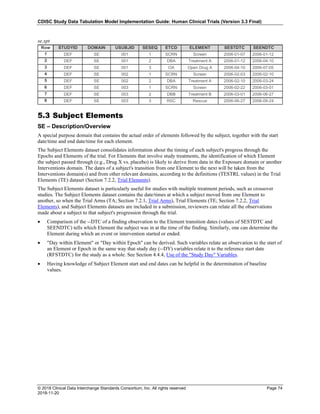
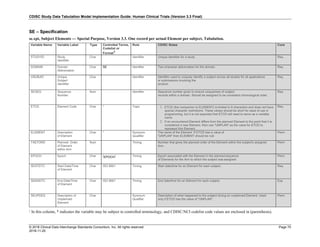
5.3 SUBJECT ELEMENTS ............................................................................................................... 74
5.4 SUBJECT DISEASE MILESTONES.............................................................................................. 80
5.5 SUBJECT VISITS...................................................................................................................... 82
6 DOMAIN MODELS BASED ON THE GENERAL OBSERVATION CLASSES....... 86
6.1 MODELS FOR INTERVENTIONS DOMAINS................................................................................ 86
6.1.1 Procedure Agents ...................................................................................................... 86
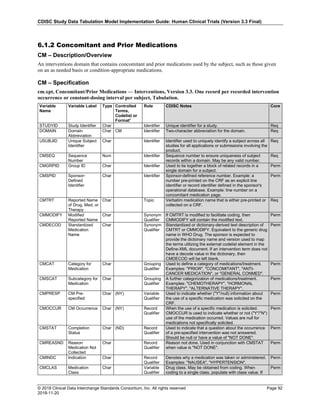
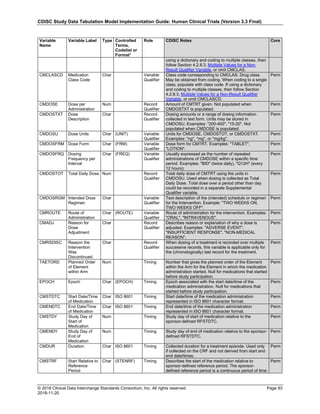
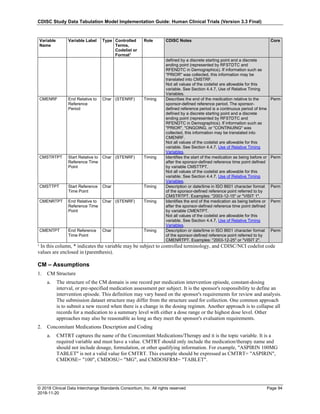
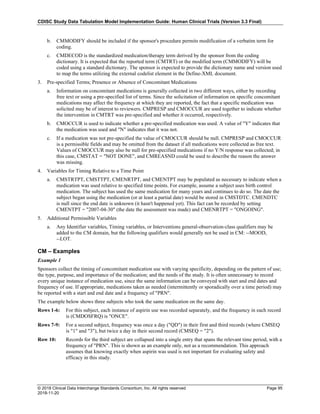
6.1.2 Concomitant and Prior Medications.......................................................................... 92
6.1.3 Exposure Domains .................................................................................................... 98
6.1.3.1 Exposure.................................................................................................................... 98
6.1.3.2 Exposure as Collected ............................................................................................. 101
6.1.3.3 Exposure/Exposure as Collected Examples ............................................................ 106
6.1.4 Meal Data ................................................................................................................ 119
6.1.5 Procedures ............................................................................................................... 123
6.1.6 Substance Use.......................................................................................................... 127
6.2 MODELS FOR EVENTS DOMAINS........................................................................................... 132
6.2.1 Adverse Events........................................................................................................ 132
6.2.2 Clinical Events ........................................................................................................ 140
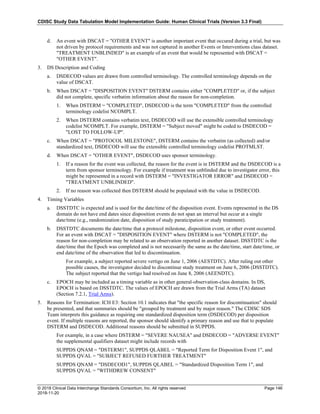
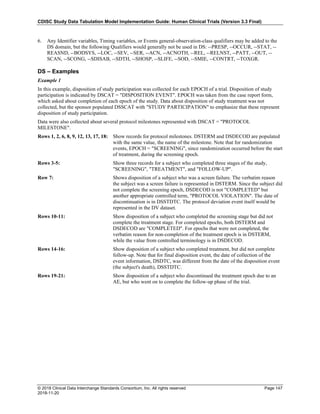
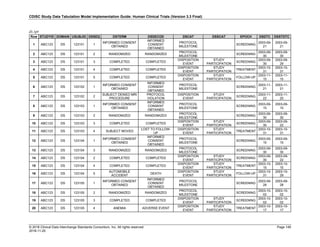
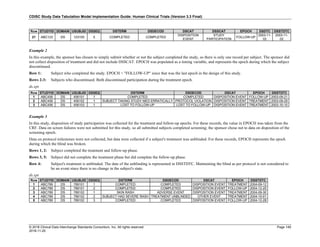
6.2.3 Disposition............................................................................................................... 144
6.2.4 Protocol Deviations ................................................................................................. 158
6.2.5 Healthcare Encounters............................................................................................. 160
6.2.6 Medical History....................................................................................................... 165
6.3 MODELS FOR FINDINGS DOMAINS ........................................................................................ 172
6.3.1 Drug Accountability................................................................................................ 173
6.3.2 Death Details ........................................................................................................... 177
6.3.3 ECG Test Results .................................................................................................... 180
6.3.4 Inclusion/Exclusion Criteria Not Met ..................................................................... 188
6.3.5 Immunogenicity Specimen Assessments ................................................................ 191
6.3.6 Laboratory Test Results........................................................................................... 194
6.3.7 Microbiology Domains............................................................................................ 200
6.3.7.1 Microbiology Specimen .......................................................................................... 200
6.3.7.2 Microbiology Susceptibility.................................................................................... 204
6.3.7.3 Microbiology Specimen/Microbiology Susceptibility Examples ........................... 210
6.3.8 Microscopic Findings.............................................................................................. 218
6.3.9 Morphology............................................................................................................. 223
6.3.10 Morphology/Physiology Domains .......................................................................... 230
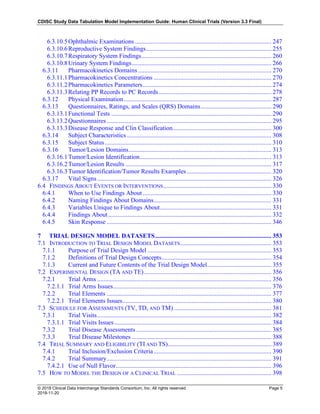
6.3.10.1Generic Morphology/Physiology Specification...................................................... 230
6.3.10.2Cardiovascular System Findings............................................................................. 231
6.3.10.3Musculoskeletal System Findings........................................................................... 235
6.3.10.4Nervous System Findings........................................................................................ 241
CDISC Study Data Tabulation Model Implementation Guide: Human Clinical Trials (Version 3.3 Final)
© 2018 Clinical Data Interchange Standards Consortium, Inc. All rights reserved Page 5
2018-11-20
6.3.10.5Ophthalmic Examinations ....................................................................................... 247
6.3.10.6Reproductive System Findings................................................................................ 255
6.3.10.7Respiratory System Findings................................................................................... 260
6.3.10.8Urinary System Findings......................................................................................... 266
6.3.11 Pharmacokinetics Domains ..................................................................................... 270
6.3.11.1Pharmacokinetics Concentrations ........................................................................... 270
6.3.11.2Pharmacokinetics Parameters.................................................................................. 274
6.3.11.3Relating PP Records to PC Records........................................................................ 278
6.3.12 Physical Examination.............................................................................................. 287
6.3.13 Questionnaires, Ratings, and Scales (QRS) Domains............................................. 290
6.3.13.1Functional Tests ...................................................................................................... 290
6.3.13.2Questionnaires......................................................................................................... 295
6.3.13.3Disease Response and Clin Classification............................................................... 300
6.3.14 Subject Characteristics ............................................................................................ 308
6.3.15 Subject Status .......................................................................................................... 310
6.3.16 Tumor/Lesion Domains........................................................................................... 313
6.3.16.1Tumor/Lesion Identification.................................................................................... 313
6.3.16.2Tumor/Lesion Results ............................................................................................. 317
6.3.16.3Tumor Identification/Tumor Results Examples...................................................... 320
6.3.17 Vital Signs............................................................................................................... 326
6.4 FINDINGS ABOUT EVENTS OR INTERVENTIONS..................................................................... 330
6.4.1 When to Use Findings About .................................................................................. 330
6.4.2 Naming Findings About Domains........................................................................... 331
6.4.3 Variables Unique to Findings About....................................................................... 331
6.4.4 Findings About........................................................................................................ 332
6.4.5 Skin Response ......................................................................................................... 346
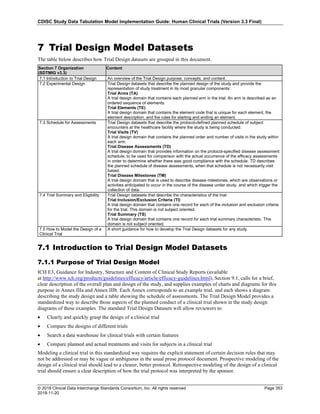
7 TRIAL DESIGN MODEL DATASETS.......................................................................... 353
7.1 INTRODUCTION TO TRIAL DESIGN MODEL DATASETS.......................................................... 353
7.1.1 Purpose of Trial Design Model ............................................................................... 353
7.1.2 Definitions of Trial Design Concepts...................................................................... 354
7.1.3 Current and Future Contents of the Trial Design Model......................................... 355
7.2 EXPERIMENTAL DESIGN (TA AND TE)................................................................................. 356
7.2.1 Trial Arms ............................................................................................................... 356
7.2.1.1 Trial Arms Issues..................................................................................................... 376
7.2.2 Trial Elements ......................................................................................................... 377
7.2.2.1 Trial Elements Issues............................................................................................... 380
7.3 SCHEDULE FOR ASSESSMENTS (TV, TD, AND TM) .............................................................. 381
7.3.1 Trial Visits............................................................................................................... 382
7.3.1.1 Trial Visits Issues .................................................................................................... 384
7.3.2 Trial Disease Assessments ...................................................................................... 385
7.3.3 Trial Disease Milestones ......................................................................................... 388
7.4 TRIAL SUMMARY AND ELIGIBILITY (TI AND TS).................................................................. 389
7.4.1 Trial Inclusion/Exclusion Criteria........................................................................... 390
7.4.2 Trial Summary......................................................................................................... 391
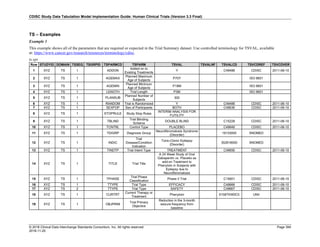
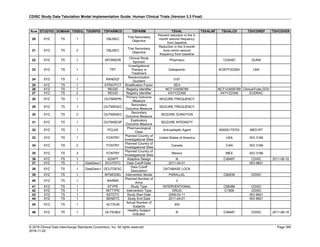
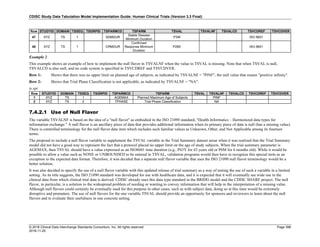
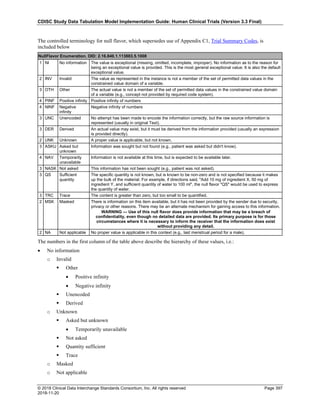
7.4.2.1 Use of Null Flavor................................................................................................... 396
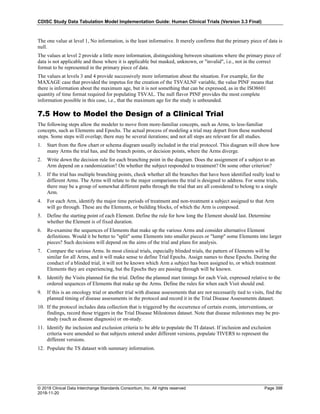
7.5 HOW TO MODEL THE DESIGN OF A CLINICAL TRIAL ............................................................ 398
CDISC Study Data Tabulation Model Implementation Guide: Human Clinical Trials (Version 3.3 Final)
© 2018 Clinical Data Interchange Standards Consortium, Inc. All rights reserved Page 6
2018-11-20
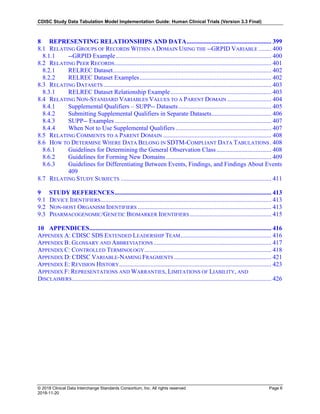
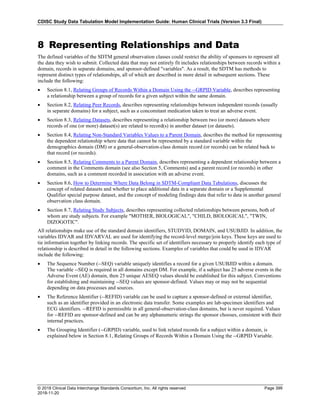
8 REPRESENTING RELATIONSHIPS AND DATA...................................................... 399
8.1 RELATING GROUPS OF RECORDS WITHIN A DOMAIN USING THE --GRPID VARIABLE ........ 400
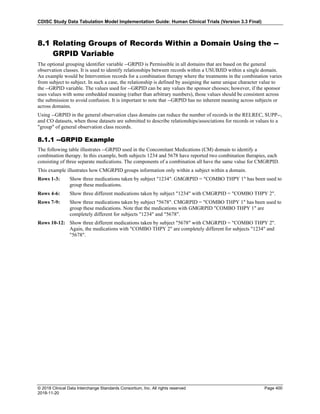
8.1.1 --GRPID Example ................................................................................................... 400
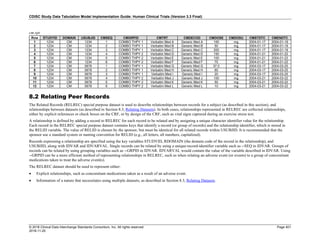
8.2 RELATING PEER RECORDS.................................................................................................... 401
8.2.1 RELREC Dataset..................................................................................................... 402
8.2.2 RELREC Dataset Examples.................................................................................... 402
8.3 RELATING DATASETS ........................................................................................................... 403
8.3.1 RELREC Dataset Relationship Example ................................................................ 403
8.4 RELATING NON-STANDARD VARIABLES VALUES TO A PARENT DOMAIN ............................ 404
8.4.1 Supplemental Qualifiers – SUPP-- Datasets ........................................................... 405
8.4.2 Submitting Supplemental Qualifiers in Separate Datasets...................................... 406
8.4.3 SUPP-- Examples.................................................................................................... 407
8.4.4 When Not to Use Supplemental Qualifiers ............................................................. 407
8.5 RELATING COMMENTS TO A PARENT DOMAIN ..................................................................... 408
8.6 HOW TO DETERMINE WHERE DATA BELONG IN SDTM-COMPLIANT DATA TABULATIONS. 408
8.6.1 Guidelines for Determining the General Observation Class................................... 408
8.6.2 Guidelines for Forming New Domains ................................................................... 409
8.6.3 Guidelines for Differentiating Between Events, Findings, and Findings About Events
409
8.7 RELATING STUDY SUBJECTS ................................................................................................ 411
9 STUDY REFERENCES.................................................................................................... 413
9.1 DEVICE IDENTIFIERS............................................................................................................. 413
9.2 NON-HOST ORGANISM IDENTIFIERS ..................................................................................... 413
9.3 PHARMACOGENOMIC/GENETIC BIOMARKER IDENTIFIERS .................................................... 415
10 APPENDICES.................................................................................................................... 416
APPENDIX A: CDISC SDS EXTENDED LEADERSHIP TEAM.......................................................... 416
APPENDIX B: GLOSSARY AND ABBREVIATIONS ........................................................................... 417
APPENDIX C: CONTROLLED TERMINOLOGY................................................................................. 418
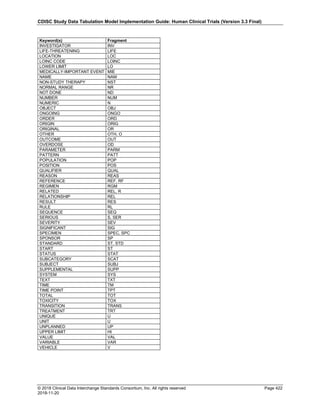
APPENDIX D: CDISC VARIABLE-NAMING FRAGMENTS .............................................................. 421
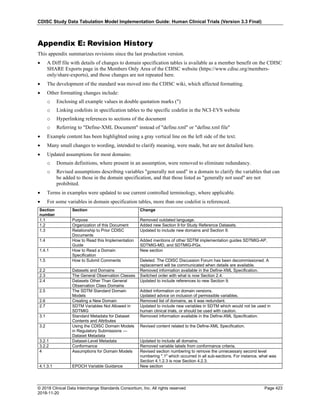
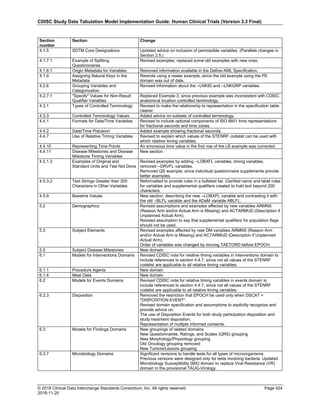
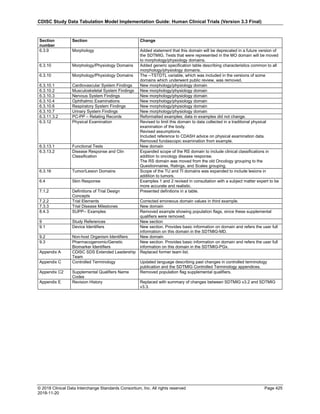
APPENDIX E: REVISION HISTORY................................................................................................. 423
APPENDIX F: REPRESENTATIONS AND WARRANTIES, LIMITATIONS OF LIABILITY, AND
DISCLAIMERS............................................................................................................................... 426
CDISC Study Data Tabulation Model Implementation Guide: Human Clinical Trials (Version 3.3 Final)
© 2018 Clinical Data Interchange Standards Consortium, Inc. All rights reserved Page 7
2018-11-20
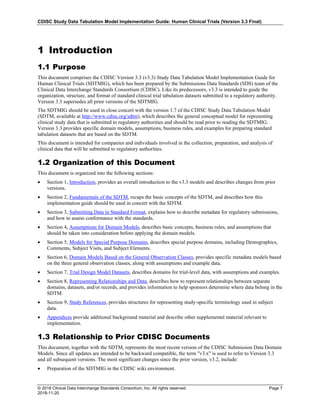
1 Introduction
1.1 Purpose
This document comprises the CDISC Version 3.3 (v3.3) Study Data Tabulation Model Implementation Guide for
Human Clinical Trials (SDTMIG), which has been prepared by the Submissions Data Standards (SDS) team of the
Clinical Data Interchange Standards Consortium (CDISC). Like its predecessors, v3.3 is intended to guide the
organization, structure, and format of standard clinical trial tabulation datasets submitted to a regulatory authority.
Version 3.3 supersedes all prior versions of the SDTMIG.
The SDTMIG should be used in close concert with the version 1.7 of the CDISC Study Data Tabulation Model
(SDTM, available at http://www.cdisc.org/sdtm), which describes the general conceptual model for representing
clinical study data that is submitted to regulatory authorities and should be read prior to reading the SDTMIG.
Version 3.3 provides specific domain models, assumptions, business rules, and examples for preparing standard
tabulation datasets that are based on the SDTM.
This document is intended for companies and individuals involved in the collection, preparation, and analysis of
clinical data that will be submitted to regulatory authorities.
1.2 Organization of this Document
This document is organized into the following sections:
• Section 1, Introduction, provides an overall introduction to the v3.3 models and describes changes from prior
versions.
• Section 2, Fundamentals of the SDTM, recaps the basic concepts of the SDTM, and describes how this
implementation guide should be used in concert with the SDTM.
• Section 3, Submitting Data in Standard Format, explains how to describe metadata for regulatory submissions,
and how to assess conformance with the standards.
• Section 4, Assumptions for Domain Models, describes basic concepts, business rules, and assumptions that
should be taken into consideration before applying the domain models.
• Section 5, Models for Special Purpose Domains, describes special purpose domains, including Demographics,
Comments, Subject Visits, and Subject Elements.
• Section 6, Domain Models Based on the General Observation Classes, provides specific metadata models based
on the three general observation classes, along with assumptions and example data.
• Section 7, Trial Design Model Datasets, describes domains for trial-level data, with assumptions and examples.
• Section 8, Representing Relationships and Data, describes how to represent relationships between separate
domains, datasets, and/or records, and provides information to help sponsors determine where data belong in the
SDTM.
• Section 9, Study References, provides structures for representing study-specific terminology used in subject
data.
• Appendices provide additional background material and describe other supplemental material relevant to
implementation.
1.3 Relationship to Prior CDISC Documents
This document, together with the SDTM, represents the most recent version of the CDISC Submission Data Domain
Models. Since all updates are intended to be backward compatible, the term "v3.x" is used to refer to Version 3.3
and all subsequent versions. The most significant changes since the prior version, v3.2, include:
• Preparation of the SDTMIG in the CDISC wiki environment.
CDISC Study Data Tabulation Model Implementation Guide: Human Clinical Trials (Version 3.3 Final)
© 2018 Clinical Data Interchange Standards Consortium, Inc. All rights reserved Page 8
2018-11-20
• Renumbering of sections in Section 4.3, Coding and Controlled Terminology Assumptions, to remove an
unnecessary layer.
• The following new domain in Section 5, Models for Special Purpose Domains:
o Subject Disease Milestones (SM)
• The following new domains in Section 6.1, Models for Interventions Domains:
o Meal Data (ML)
o Procedure Agents (AG)
• The following new domain in Section 6.3, Models for Findings Domains:
o Functional Tests (FT)
• The following body system-based domains in Section 6.3.10, Morphology/Physiology Domains:
o Cardiovascular System Findings (CV)
o Musculoskeletal System Findings (MK)
o Nervous System Findings (NV)
o Ophthalmic Examinations (OE)
o Respiratory System Findings (RE)
o Urinary System Findings (UI)
• The following new domain in Section 7, Trial Design Model Datasets:
o Trial Disease Milestones (TM)
• The new Section 9, Study References
• The following new domains in Section 9, Study References:
o Device Identifiers (DI)
o Non-host Organism Identifiers (OI)
o Pharmacogenomic/Genetic Biomarker Identifiers (PB)
• Updated Controlled Terminology for applicable variables across all domains, if available.
A detailed list of changes between versions is provided in Appendix E, Revision History.
Version 3.1 was the first fully implementation-ready version of the CDISC Submission Data Standards that was
directly referenced by the FDA for use in human clinical studies involving drug products. However, future
improvements and enhancements will continue to be made as sponsors gain more experience submitting data in this
format. Therefore, CDISC will be preparing regular updates to the implementation guide to provide corrections,
clarifications, additional domain models, examples, business rules, and conventions for using the standard domain
models. CDISC will produce further documentation for controlled terminology as separate publications, so sponsors
are encouraged to check the CDISC website (http://www.cdisc.org/terminology) frequently for additional
information. See Section 4.3, Coding and Controlled Terminology Assumptions, for the most up-to-date information
on applying Controlled Terminology.
1.4 How to Read this Implementation Guide
This SDTM Implementation Guide (SDTMIG) is best read online, so the reader can benefit from the many
hyperlinks included to both internal and external references. The following guidelines may be helpful in reading this
document:
1. First, read the SDTM to gain a general understanding of SDTM concepts.
2. Next, read Sections 1-3 of this document to review the key concepts for preparing domains and submitting data
to regulatory authorities. Refer to Appendix B, Glossary and Abbreviations, as necessary.
CDISC Study Data Tabulation Model Implementation Guide: Human Clinical Trials (Version 3.3 Final)
© 2018 Clinical Data Interchange Standards Consortium, Inc. All rights reserved Page 9
2018-11-20
3. Read Section 4, Assumptions for Domain Models.
4. Review Section 5, Models for Special Purpose Domains, and Section 6, Domain Models Based on the General
Observation Classes, in detail, referring back to Section 4, Assumptions for Domain Models, as directed. See
the implementation examples for each domain to gain an understanding of how to apply the domain models for
specific types of data.
5. Read Section 7, Trial Design Model Datasets, to understand the fundamentals of the Trial Design Model and
consider how to apply the concepts for typical protocols.
6. Review Section 8, Representing Relationships and Data, to learn advanced concepts of how to express
relationships between datasets, records, and additional variables not specifically defined in the models.
7. Review Section 9, Study References, to learn occasions when it is necessary to establish study-specific
references that will be used in accordance with subject data.
8. Finally, review the Appendices as appropriate. Appendix C, Controlled Terminology, in particular, describes
how CDISC Terminology is centrally managed by the CDISC Controlled Terminology Team. Efforts are made
at publication time to ensure all SDTMIG domain/dataset specification tables and/or examples reflect the latest
CDISC Terminology; users, however, should refer to
https://www.cancer.gov/research/resources/terminology/cdisc as the authoritative source of controlled
terminology, as CDISC controlled terminology is updated on a quarterly basis.
This implementation guide covers most data collected in human clinical trials, but separate implementation guides
provide information about certain data, and should be consulted when needed.
• The SDTM Implementation Guide for Associated Persons (SDTMIG-AP) provides structures for representing
data collected about persons who are not study subjects.
• The SDTM Implementation Guide for Medical Devices (SDTMIG-MD) provides structures for data about
devices.
• The SDTM Implementation Guide for Pharmacogenomics/Genetics (SDTMIG-PGx) provides structures for
pharmacogenetic/genomic data and for data about biospecimens.
1.4.1 How to Read a Domain Specification
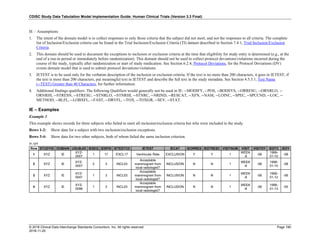
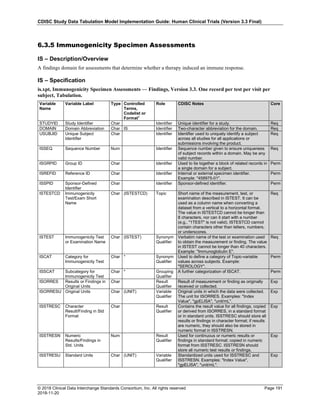
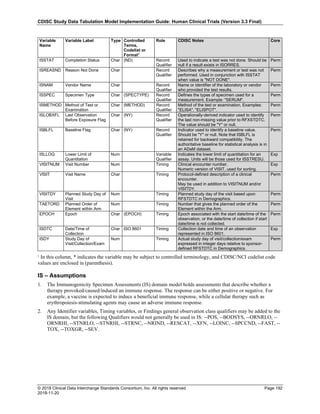
A domain specification table includes rows for all required and expected variables for a domain and for a set of
permissible variables. The permissible variables do not include all the variables that are allowed for the domain;
they are a set of variables that the SDS team considered likely to be included. The columns of the table:
• Variable Name
o For variables that do not include a domain prefix, this name is taken directly from the SDTM.
o For variables that do include the domain prefix, this name from the SDTM, but with "--" placeholder in the
SDTM variable name replaced by the domain prefix.
• Variable Label: A longer name for the variable.
o This may be the same as the label in the SDTM, or it may be customized for the domain.
o If a sponsor includes in a dataset an allowable variable not in the domain specification, they will create an
appropriate label.
• Type: One of the two SAS datatypes, "Num" or "Char". These values are taken directly from the SDTM.
• Controlled Terms, Codelist, or Format
o Controlled Terms are represented as hyperlinked text. The domain code in the row for the DOMAIN
variable is the most common kind of controlled term represented in domain specifications.
o Codelist
o An asterisk * indicates that the variable may be subject to controlled terminology.
 The controlled terminology might be of a type that would inherently be sponsor defined.
CDISC Study Data Tabulation Model Implementation Guide: Human Clinical Trials (Version 3.3 Final)
© 2018 Clinical Data Interchange Standards Consortium, Inc. All rights reserved Page 10
2018-11-20
 The controlled terminology might be of a type that could be standardized, but has not yet been
developed.
 The controlled terminology might be terminology that would be specified in value- level metadata.
o A hyperlinked codelist name in parentheses indicates that the variable is subject to the CDISC
controlled terminology in the named codelist.
o The name of an external code system (e.g., MedDRA, ISO 3166 Alpha-3) may be listed in plain text.
o Format: "ISO8601" in plain text indicates that the variable values should be formatted in conformance with
that standard.
• Role: This is taken directly from the SDTM. Note that if a variable is either a Variable Qualifier or a Synonym
Qualifier, the SDTM includes the qualified variable, but SDTMIG domain specifications do not.
• CDISC Notes: The notes may include any of the following:
o A description of what the variable means.
o Information about how this variable relates to another variable.
o Rules for when or how the variable should be populated, or how the contents should be formatted.
Examples of values that might appear in the variable. Such examples are only examples, and although they
may be CDISC controlled terminology values, their presence in a CDISC note should not be construed as
definitive. For authoritative information on CDISC controlled terminology, consult
https://www.cancer.gov/research/resources/terminology/cdisc.
• Core: Contains one of the three values "Req", "Exp", or "Perm", which are explained further in Section 4.1.5,
SDTM Core Designations.
CDISC Study Data Tabulation Model Implementation Guide: Human Clinical Trials (Version 3.3 Final)
© 2018 Clinical Data Interchange Standards Consortium, Inc. All rights reserved Page 11
2018-11-20
2 Fundamentals of the SDTM
2.1 Observations and Variables
The SDTMIG for Human Clinical Trials is based on the SDTM's general framework for organizing clinical trials
information that is to be submitted to regulatory authorities. The SDTM is built around the concept of observations
collected about subjects who participated in a clinical study. Each observation can be described by a series of
variables, corresponding to a row in a dataset. Each variable can be classified according to its Role. A Role
determines the type of information conveyed by the variable about each distinct observation and how it can be used.
Variables can be classified into five major roles:
• Identifier variables, such as those that identify the study, subject, domain, and sequence number of the record
• Topic variables, which specify the focus of the observation (such as the name of a lab test)
• Timing variables, which describe the timing of the observation (such as start date and end date)
• Qualifier variables, which include additional illustrative text or numeric values that describe the results or
additional traits of the observation (such as units or descriptive adjectives)
• Rule variables, which express an algorithm or executable method to define start, end, and branching or looping
conditions in the Trial Design model
The set of Qualifier variables can be further categorized into five sub-classes:
• Grouping Qualifiers are used to group together a collection of observations within the same domain. Examples
include --CAT and --SCAT.
• Result Qualifiers describe the specific results associated with the topic variable in a Findings dataset. They
answer the question raised by the topic variable. Result Qualifiers are --ORRES, --STRESC, and -- STRESN.
• Synonym Qualifiers specify an alternative name for a particular variable in an observation. Examples include --
MODIFY and --DECOD, which are equivalent terms for a --TRT or --TERM topic variable, and
• --TEST and --LOINC, which are equivalent terms for a --TESTCD.
• Record Qualifiers define additional attributes of the observation record as a whole (rather than describing a
particular variable within a record). Examples include --REASND, AESLIFE, and all other SAE flag variables
in the AE domain; AGE, SEX, and RACE in the DM domain; and --BLFL, --POS, --LOC, -- SPEC and --NAM
in a Findings domain
• Variable Qualifiers are used to further modify or describe a specific variable within an observation and are only
meaningful in the context of the variable they qualify. Examples include --ORRESU, --ORNRHI, and
--ORNRLO, all of which are Variable Qualifiers of --ORRES; and --DOSU, which is a Variable Qualifier of --
DOSE.
For example, in the observation, "Subject 101 had mild nausea starting on Study Day 6," the Topic variable value is
the term for the adverse event, "NAUSEA". The Identifier variable is the subject identifier, "101". The Timing
variable is the study day of the start of the event, which captures the information, "starting on Study Day 6", while
an example of a Record Qualifier is the severity, the value for which is "MILD". Additional Timing and Qualifier
variables could be included to provide the necessary detail to adequately describe an observation.
2.2 Datasets and Domains
Observations about study subjects are normally collected for all subjects in a series of domains. A domain is defined
as a collection of logically related observations with a common topic. The logic of the relationship may pertain to
the scientific subject matter of the data or to its role in the trial. Each domain is represented by a single dataset.
Each domain dataset is distinguished by a unique, two-character code that should be used consistently throughout
the submission. This code, which is stored in the SDTM variable named DOMAIN, is used in four ways: as the
dataset name, the value of the DOMAIN variable in that dataset; as a prefix for most variable names in that
CDISC Study Data Tabulation Model Implementation Guide: Human Clinical Trials (Version 3.3 Final)
© 2018 Clinical Data Interchange Standards Consortium, Inc. All rights reserved Page 12
2018-11-20
dataset; and as a value in the RDOMAIN variable in relationship tables Section 8, Representing Relationships and
Data.
All datasets are structured as flat files with rows representing observations and columns representing variables. Each
dataset is described by metadata definitions that provide information about the variables used in the dataset. The
metadata are described in a data definition document, a Define-XML document, that is submitted with the data to
regulatory authorities. The Define-XML standard, available at https://www.cdisc.org/standards/transport/define-xml,
specifies metadata attributes to describe SDTM data.
Data stored in SDTM datasets include both raw (as originally collected) and derived values (e.g., converted into
standard units, or computed on the basis of multiple values, such as an average). The SDTM lists only the name,
label, and type, with a set of brief CDISC guidelines that provide a general description for each variable.
The domain dataset models included in Section 5, Models for Special Purpose Domains and Section 6, Domain
Models Based on the General Observation Classes of this document provide additional information about Controlled
Terms or Format, notes on proper usage, and examples. See Section 1.4.1, How to Read a Domain Specification.
2.3 The General Observation Class
Most subject-level observations collected during the study should be represented according to one of the three
SDTM general observation classes: Interventions, Events, or Findings. The lists of variables allowed to be used in
each of these can be found in the SDTM.
• The Interventions class captures investigational, therapeutic, and other treatments that are administered to the
subject (with some actual or expected physiological effect) either as specified by the study protocol (e.g.,
exposure to study drug), coincident with the study assessment period (e.g., concomitant medications), or self-
administered by the subject (such as use of alcohol, tobacco, or caffeine).
• The Events class captures planned protocol milestones such as randomization and study completion, and
occurrences, conditions, or incidents independent of planned study evaluations occurring during the trial (e.g.,
adverse events) or prior to the trial (e.g., medical history).
• The Findings class captures the observations resulting from planned evaluations to address specific tests or
questions such as laboratory tests, ECG testing, and questions listed on questionnaires.
In most cases, the choice of observation class appropriate to a specific collection of data can be easily determined
according to the descriptions provided above. The majority of data, which typically consists of measurements or
responses to questions, usually at specific visits or time points, will fit the Findings general observation class.
Additional guidance on choosing the appropriate general observation class is provided in Section 8.6.1, Guidelines
for Determining the General Observation Class.
General assumptions for use with all domain models and custom domains based on the general observation classes
are described in Section 4, Assumptions for Domain Models; specific assumptions for individual domains are
included with the domain models.
2.4 Datasets Other Than General Observation
The SDTM includes four types of datasets other than those based on the general observation classes:
• Domain datasets, which include subject-level data that do not conform to one of the three general observation
classes. These include Demographics (DM), Comments (CO), Subject Elements (SE), and Subject Visits (SV),1
and are described in Section 5, Models for Special Purpose Domains.
• Trial Design Model (TDM) datasets, which represent information about the study design but do not contain
subject data. These include datasets such as Trial Arms (TA) and Trial Elements (TE) and are described in
Section 7, Trial Design Model Datasets.
1
SE and SV were included as part of the Trial Design Model in SDTMIG v3.1.1, but were moved in SDTMIG v3.1.2.
CDISC Study Data Tabulation Model Implementation Guide: Human Clinical Trials (Version 3.3 Final)
© 2018 Clinical Data Interchange Standards Consortium, Inc. All rights reserved Page 13
2018-11-20
• Relationship datasets, such as the RELREC and SUPP-- datasets. These are described in Section 8,
Representing Relationships and Data.
• Study Reference datasets, which include Device Identifiers (DI), Non-host Organism Identifiers (OI), and
Pharmacogenomic/Genetic Biomarker Identifiers (PB). These provide structures for representing study- specific
terminology used in subject data. These are described in Section 9, Study References.
2.5 The SDTM Standard Domain Models
A sponsor should only submit domain datasets that were actually collected (or directly derived from the collected
data) for a given study. Decisions on what data to collect should be based on the scientific objectives of the study,
rather than the SDTM. Note that any data collected that will be submitted in an analysis dataset must also appear in
a tabulation dataset.
The collected data for a given study may use standard domains from this and other SDTM Implementation Guides
as well as additional custom domains based on the three general observation classes. A list of standard domains is
provided in Section 3.2.1, Dataset-Level Metadata. Final domains will be published only in an SDTM
Implementation Guide (the SDTMIG for human clinical trials or another implementation guide, such as the
SDTMIG for Medical Devices). Therapeutic area standards projects and other projects may develop proposals for
additional domains. Draft versions of these domains may be made available in the CDISC wiki in the SDTM Draft
Domains (https://wiki.cdisc.org/x/s4Iv) area.
Starting with SDTMIG v3.3:
• A new domain has version 1.0.
• An existing version that has changed since the last published version of the SDTMIG is up-versioned.
• An existing version that has not changed since the last published version of the SDTMIG is not up- versioned.
What constitutes a change for the purposes of deciding a domain version will be developed further, but for SDTMIG
v3.3, a domain was assigned a version of v3.3 if there was a change to the specification and/or the assumptions from
the domain as it appeared in SDTMIG v3.2.
These general rules apply when determining which variables to include in a domain:
• The Identifier variables, STUDYID, USUBJID, DOMAIN, and --SEQ are required in all domains based on the
general observation classes. Other Identifiers may be added as needed.
• Any Timing variables are permissible for use in any submission dataset based on a general observation class
except where restricted by specific domain assumptions.
• Any additional Qualifier variables from the same general observation class may be added to a domain model
except where restricted by specific domain assumptions.
• Sponsors may not add any variables other than those described in the preceding three bullets. The addition of
non-standard variables will compromise the FDA's ability to populate the data repository and to use standard
tools. The SDTM allows for the inclusion of a sponsor's non-SDTM variables using the Supplemental
Qualifiers special purpose dataset structure, described in Section 8.4, Relating Non-Standard Variables Values
to a Parent Domain. As the SDTM continues to evolve over time, certain additional standard variables may be
added to the general observation classes.
• Standard variables must not be renamed or modified for novel usage. Their metadata should not be changed.
• A Permissible variable should be used in an SDTM dataset wherever appropriate.
o If a study includes a data item that would be represented in a Permissible variable, then that variable must
be included in the SDTM dataset, even if null. Indicate no data were available for that variable in the
Define-XML document.
o If a study did not include a data item that would be represented in a Permissible variable, then that variable
should not be included in the SDTM dataset and should not be declared in the Define- XML document.
CDISC Study Data Tabulation Model Implementation Guide: Human Clinical Trials (Version 3.3 Final)
© 2018 Clinical Data Interchange Standards Consortium, Inc. All rights reserved Page 14
2018-11-20
2.6 Creating a New Domain
This section describes the overall process for creating a custom domain, which must be based on one of the three
SDTM general observation classes. The number of domains submitted should be based on the specific requirements
of the study. Follow the process below to create a custom domain:
1. Confirm that none of the existing published domains will fit the need. A custom domain may only be created if
the data are different in nature and do not fit into an existing published domain.
• Establish a domain of a common topic (i.e., where the nature of the data is the same), rather than by a
specific method of collection (e.g., electrocardiogram, EG). Group and separate data within the domain
using --CAT, --SCAT, --METHOD, --SPEC, --LOC, etc. as appropriate. Examples of different topics are:
microbiology, tumor measurements, pathology/histology, vital signs, and physical exam results.
• Do not create separate domains based on time; rather, represent both prior and current observations in a
domain (e.g., CM for all non-study medications). Note that AE and MH are an exception to this best
practice because of regulatory reporting needs.
• How collected data are used (e.g., to support analyses and/or efficacy endpoints) must not result in the
creation of a custom domain. For example, if blood pressure measurements are endpoints in a hypertension
study, they must still be represented in the VS (Vital Signs) domain, as opposed to a custom "efficacy"
domain. Similarly, if liver function test results are of special interest, they must still be represented in the
LB (Laboratory Tests) domain.
• Data that were collected on separate CRF modules or pages may fit into an existing domain (such as
separate questionnaires into the QS domain, or prior and concomitant medications in the CM domain).
• If it is necessary to represent relationships between data that are hierarchical in nature (e.g., a parent record
must be observed before child records), then establish a domain pair (e.g., MB/MS, PC/PP). Note, domain
pairs have been modeled for microbiology data (MB/MS domains) and PK data (PC/PP domains) to enable
dataset-level relationships to be described using RELREC. The domain pair uses DOMAIN as an Identifier
to group parent records (e.g., MB) from child records (e.g., MS) and enables a dataset-level relationship to
be described in RELREC. Without using DOMAIN to facilitate description of the data relationships,
RELREC, as currently defined, could not be used without introducing a variable that would group data like
DOMAIN.
2. Check the SDTM Draft Domains area of CDISC wiki SDTM Draft Domains Home
(https://wiki.cdisc.org/x/s4Iv) for proposed domains developed since the last published version of the SDTMIG.
These proposed domains may be used as custom domains in a submission.
3. Look for an existing, relevant domain model to serve as a prototype. If no existing model seems appropriate,
choose the general observation class (Interventions, Events, or Findings) that best fits the data by considering
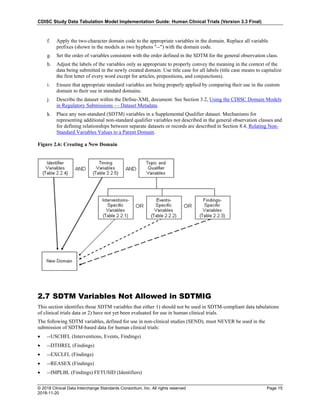
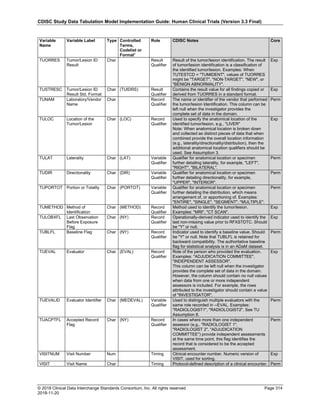
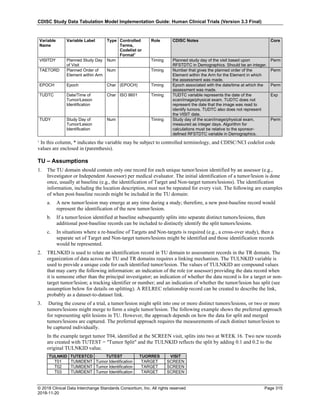
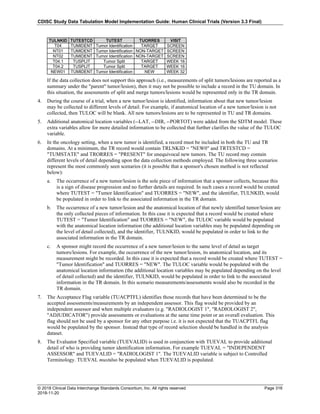
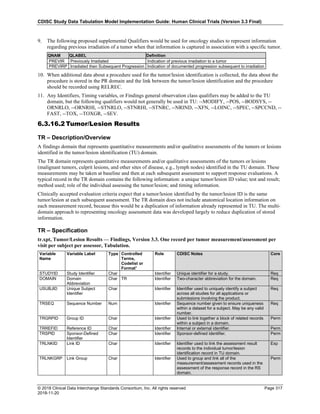
the topic of the observation The general approach for selecting variables for a custom domain is as follows (also
see Figure 2.6, Creating a New Domain, below).
a. Select and include the required identifier variables (e.g., STUDYID, DOMAIN, USUBJID, --SEQ) and any
permissible Identifier variables from the SDTM.
b. Include the topic variable from the identified general observation class (e.g., --TESTCD for Findings) in
the SDTM.
c. Select and include the relevant qualifier variables from the identified general observation class in the
SDTM. Variables belonging to other general observation classes must not be added.
d. Select and include the applicable timing variables in the SDTM.
e. Determine the domain code, one that is not a domain code in the CDISC Controlled Terminology codelist
"SDTM Domain Abbreviations" available at http://www.cancer.gov/research/resources/terminology/cdisc.
If it desired to have this domain code as part of CDISC controlled terminology, then submit a request to
https://ncitermform.nci.nih.gov/ncitermform/?version=cdisc. The sponsor-selected, two-character domain
code should be used consistently throughout the submission.
CDISC Study Data Tabulation Model Implementation Guide: Human Clinical Trials (Version 3.3 Final)
© 2018 Clinical Data Interchange Standards Consortium, Inc. All rights reserved Page 15
2018-11-20
f. Apply the two-character domain code to the appropriate variables in the domain. Replace all variable
prefixes (shown in the models as two hyphens "--") with the domain code.
g. Set the order of variables consistent with the order defined in the SDTM for the general observation class.
h. Adjust the labels of the variables only as appropriate to properly convey the meaning in the context of the
data being submitted in the newly created domain. Use title case for all labels (title case means to capitalize
the first letter of every word except for articles, prepositions, and conjunctions).
i. Ensure that appropriate standard variables are being properly applied by comparing their use in the custom
domain to their use in standard domains.
j. Describe the dataset within the Define-XML document. See Section 3.2, Using the CDISC Domain Models
in Regulatory Submissions — Dataset Metadata.
k. Place any non-standard (SDTM) variables in a Supplemental Qualifier dataset. Mechanisms for
representing additional non-standard qualifier variables not described in the general observation classes and
for defining relationships between separate datasets or records are described in Section 8.4, Relating Non-
Standard Variables Values to a Parent Domain.
Figure 2.6: Creating a New Domain
2.7 SDTM Variables Not Allowed in SDTMIG
This section identifies those SDTM variables that either 1) should not be used in SDTM-compliant data tabulations
of clinical trials data or 2) have not yet been evaluated for use in human clinical trials.
The following SDTM variables, defined for use in non-clinical studies (SEND), must NEVER be used in the
submission of SDTM-based data for human clinical trials:
• --USCHFL (Interventions, Events, Findings)
• --DTHREL (Findings)
• --EXCLFL (Findings)
• --REASEX (Findings)
• --IMPLBL (Findings) FETUSID (Identifiers)
CDISC Study Data Tabulation Model Implementation Guide: Human Clinical Trials (Version 3.3 Final)
© 2018 Clinical Data Interchange Standards Consortium, Inc. All rights reserved Page 16
2018-11-20
• --DETECT (Timing Variables)
• --NOMDY (Timing Variables)
• --NOMLBL (Timing Variables)
The following variables can be used for non-clinical studies (SEND) but must NEVER be used in the Demographics
domain for human clinical trials, where all subjects are human. See Section 9.2, Non-host Organism Identifiers (OI),
for information about representing taxonomic information for non-host organisms such as bacteria and viruses.
• SPECIES (Demographics)
• STRAIN (Demographics)
• SBSTRAIN (Demographics)
The following variables have not been evaluated for use in human clinical trials and must therefore be used with
extreme caution:
• --METHOD (Interventions)
• --ANTREG (Findings)
• --CHRON (Findings)
• --DISTR (Findings) SETCD (Demographics)
The following identifier variable can be used for non-clinical studies (SEND), and may be used in human clinical
trials when appropriate:
• POOLID
Other variables defined in the SDTM are allowed for use as defined in this SDTMIG except when explicitly stated.
Custom domains, created following the guidance in Section 2.6, Creating a New Domain, may utilize any
appropriate Qualifier variables from the selected general observation class.
The use of SETCD additionally requires the use of the Trials Sets domain.
The use of POOLID additionally requires the use of the Pool Definition dataset.
CDISC Study Data Tabulation Model Implementation Guide: Human Clinical Trials (Version 3.3 Final)
© 2018 Clinical Data Interchange Standards Consortium, Inc. All rights reserved Page 17
2018-11-20
3 Submitting Data in Standard Format
3.1 Standard Metadata for Dataset Contents and Attributes
The SDTMIG provides standard descriptions of some of the most commonly used data domains, with metadata
attributes. These include descriptive metadata attributes that should be included in a Define-XML document. In
addition, the CDISC domain models include two shaded columns that are not sent to the FDA. These columns assist
sponsors in preparing their datasets:
• "CDISC Notes" is for notes to the sponsor regarding the relevant use of each variable.
• "Core" indicates how a variable is classified (see Section 4.1.5, SDTM Core Designations).
The domain models in Section 6, Domain Models Based on the General Observation Classes illustrate how to apply
the SDTM when creating a specific domain dataset. In particular, these models illustrate the selection of a subset of
the variables offered in one of the general observation classes, along with applicable timing variables. The models
also show how a standard variable from a general observation class should be adjusted to meet the specific content
needs of a particular domain, including making the label more meaningful, specifying controlled terminology, and
creating domain-specific notes and examples. Thus the domain models not only demonstrate how to apply the model
for the most common domains, but also give insight on how to apply general model concepts to other domains not
yet defined by CDISC.
3.2 Using the CDISC Domain Models in Regulatory
Submissions — Dataset Metadata
The Define-XML document that accompanies a submission should also describe each dataset that is included in the
submission and describe the natural key structure of each dataset. While most studies will include DM and a set of
safety domains based on the three general observation classes (typically including EX, CM, AE, DS, MH, LB, and
VS), the actual choice of which data to submit will depend on the protocol and the needs of the regulatory reviewer.
Dataset definition metadata should include the dataset filenames, descriptions, locations, structures, class, purpose,
and keys, as shown in Section 3.2.1, Dataset-Level Metadata. In addition, comments can also be provided where
needed.
In the event that no records are present in a dataset (e.g., a small PK study where no subjects took concomitant
medications), the empty dataset should not be submitted and should not be described in the Define-XML document.
The annotated CRF will show the data that would have been submitted had data been received; it need not be re-
annotated to indicate that no records exist.
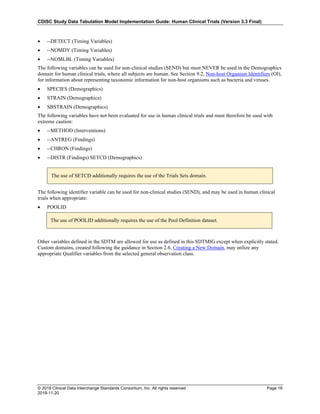
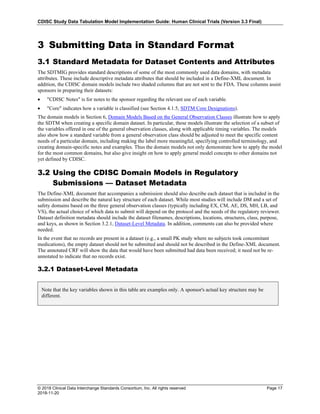
3.2.1 Dataset-Level Metadata
Note that the key variables shown in this table are examples only. A sponsor's actual key structure may be
different.
CDISC Study Data Tabulation Model Implementation Guide: Human Clinical Trials (Version 3.3 Final)
© 2018 Clinical Data Interchange Standards Consortium, Inc. All rights reserved Page 18
2018-11-20
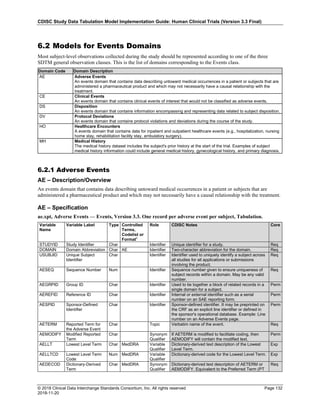
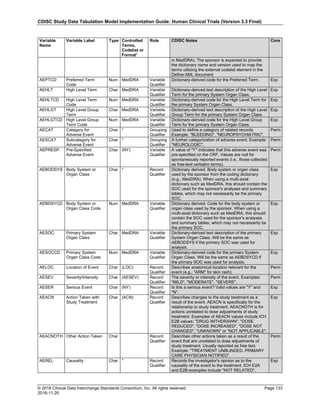
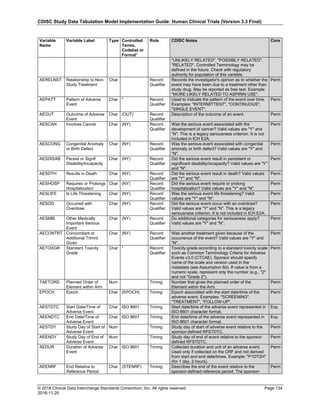
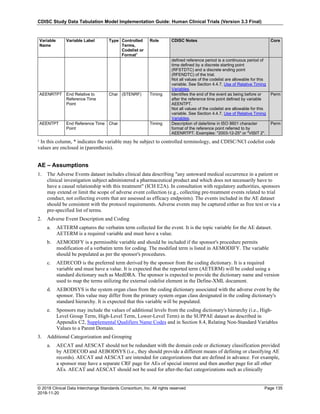
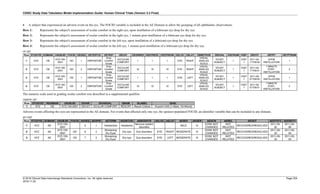
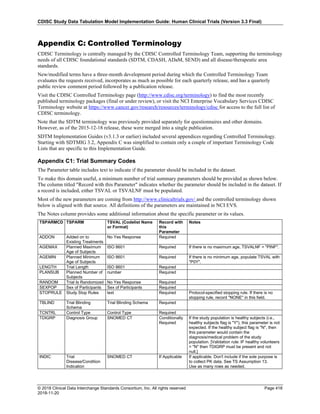
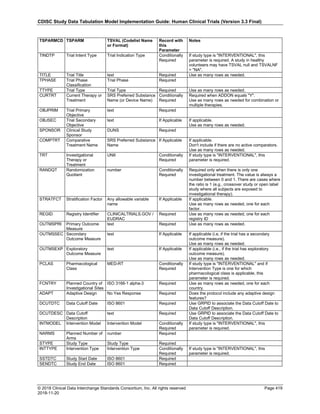
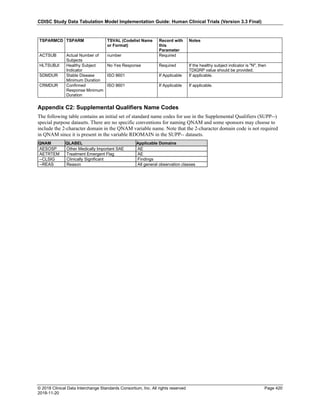
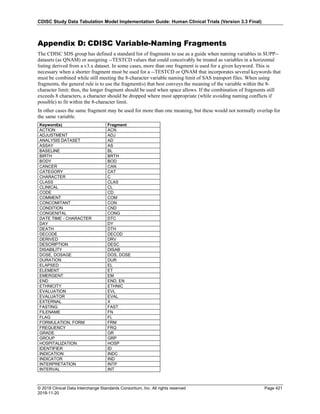
Dataset Description Class Structure Purpose Keys Location
CO Comments Special
Purpose
One record per comment per subject Tabulation STUDYID, USUBJID, IDVAR, COREF, CODTC co.xpt
DM Demographics Special
Purpose
One record per subject Tabulation STUDYID, USUBJID dm.xpt
SE Subject Elements Special
Purpose
One record per actual Element per subject Tabulation STUDYID, USUBJID, ETCD, SESTDTC se.xpt
SM Subject Disease
Milestones
Special
Purpose
One record per Disease Milestone per subject Tabulation STUDYID, USUBJID, MIDS sm.xpt
SV Subject Visits Special
Purpose
One record per subject per actual visit Tabulation STUDYID, USUBJID, VISITNUM sv.xpt
AG Procedure Agents Interventions One record per recorded intervention occurrence per
subject
Tabulation STUDYID, USUBJID, AGTRT, AGSTDTC ag.xpt
CM Concomitant/Prior
Medications
Interventions One record per recorded intervention occurrence or
constant-dosing interval per subject
Tabulation STUDYID, USUBJID, CMTRT, CMSTDTC cm.xpt
EC Exposure as Collected Interventions One record per protocol-specified study treatment,
collected-dosing interval, per subject, per mood
Tabulation STUDYID, USUBJID, ECTRT, ECSTDTC,
ECMOOD
ec.xpt
EX Exposure Interventions One record per protocol-specified study treatment,
constant-dosing interval, per subject
Tabulation STUDYID, USUBJID, EXTRT, EXSTDTC ex.xpt
ML Meal Data Interventions One record per food product occurrence or constant
intake interval per subject
Tabulation STUDYID, USUBJID, MLTRT, MLSTDTC ml.xpt
PR Procedures Interventions One record per recorded procedure per occurrence
per subject
Tabulation STUDYID, USUBJID, PRTRT, PRSTDTC pr.xpt
SU Substance Use Interventions One record per substance type per reported
occurrence per subject
Tabulation STUDYID, USUBJID, SUTRT, SUSTDTC su.xpt
AE Adverse Events Events One record per adverse event per subject Tabulation STUDYID, USUBJID, AEDECOD, AESTDTC ae.xpt
CE Clinical Events Events One record per event per subject Tabulation STUDYID, USUBJID, CETERM, CESTDTC ce.xpt
DS Disposition Events One record per disposition status or protocol
milestone per subject
Tabulation STUDYID, USUBJID, DSDECOD, DSSTDTC ds.xpt
DV Protocol Deviations Events One record per protocol deviation per subject Tabulation STUDYID, USUBJID, DVTERM, DVSTDTC dv.xpt
HO Healthcare Encounters Events One record per healthcare encounter per subject Tabulation STUDYID, USUBJID, HOTERM, HOSTDTC ho.xpt
MH Medical History Events One record per medical history event per subject Tabulation STUDYID, USUBJID, MHDECOD mh.xpt
CV Cardiovascular System
Findings
Findings One record per finding or result per time point per visit
per subject
Tabulation STUDYID, USUBJID, VISITNUM, CVTESTCD,
CVTPTREF, CVTPTNUM
cv.xpt
DA Drug Accountability Findings One record per drug accountability finding per subject Tabulation STUDYID, USUBJID, DATESTCD, DADTC da.xpt
DD Death Details Findings One record per finding per subject Tabulation STUDYID, USUBJID, DDTESTCD, DDDTC dd.xpt
EG ECG Test Results Findings One record per ECG observation per replicate per
time point or one record per ECG observation per
beat per visit per subject
Tabulation STUDYID, USUBJID, EGTESTCD, VISITNUM,
EGTPTREF, EGTPTNUM
eg.xpt
FA Findings About Events
or Interventions
Findings One record per finding, per object, per time point, per
visit per subject
Tabulation STUDYID, USUBJID, FATESTCD, FAOBJ,
VISITNUM, FATPTREF, FATPTNUM
fa.xpt
FT Functional Tests Findings One record per Functional Test finding per time point
per visit per subject
Tabulation STUDYID, USUBJID, TESTCD, VISITNUM,
FTTPTREF, FTTPTNUM
ft.xpt
IE Inclusion/Exclusion
Criteria Not Met
Findings One record per inclusion/exclusion criterion not met
per subject
Tabulation STUDYID, USUBJID, IETESTCD ie.xpt
IS Immunogenicity
Specimen Assessments
Findings One record per test per visit per subject Tabulation STUDYID, USUBJID, ISTESTCD, VISITNUM is.xpt
CDISC Study Data Tabulation Model Implementation Guide: Human Clinical Trials (Version 3.3 Final)
© 2018 Clinical Data Interchange Standards Consortium, Inc. All rights reserved Page 19
2018-11-20
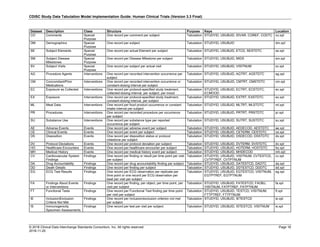
Dataset Description Class Structure Purpose Keys Location
LB Laboratory Test Results Findings One record per lab test per time point per visit per
subject
Tabulation STUDYID, USUBJID, LBTESTCD, LBSPEC,
VISITNUM, LBTPTREF, LBTPTNUM
lb.xpt
MB Microbiology Specimen Findings One record per microbiology specimen finding per
time point per visit per subject
Tabulation STUDYID, USUBJID, MBTESTCD, VISITNUM,
MBTPTREF, MBTPTNUM
mb.xpt
MI Microscopic Findings Findings One record per finding per specimen per subject Tabulation STUDYID, USUBJID, MISPEC, MITESTCD mi.xpt
MK Musculoskeletal System
Findings
Findings One record per assessment per visit per subject Tabulation STUDYID, USUBJID, VISITNUM, MKTESTCD,
MKLOC, MKLAT
mk.xpt
MO Morphology Findings One record per Morphology finding per location per
time point per visit per subject
Tabulation STUDYID, USUBJID, VISITNUM, MOTESTCD,
MOLOC, MOLAT
mo.xpt
MS Microbiology
Susceptibility
Findings One record per microbiology susceptibility test (or
other organism-related finding) per organism found in
MB
Tabulation STUDYID, USUBJID, MSTESTCD, VISITNUM,
MSTPTREF, MSTPTNUM
ms.xpt
NV Nervous System
Findings
Findings One record per finding per location per time point per
visit per subject
Tabulation STUDYID, USUBJID, VISITNUM, CVTPTNUM,
CVLOC, NVTESTCD
nv.xpt
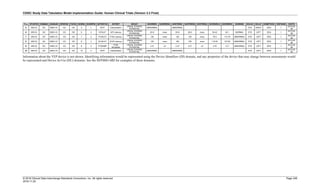
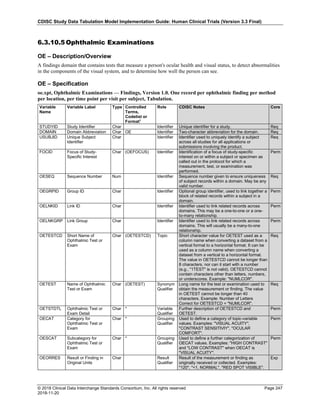
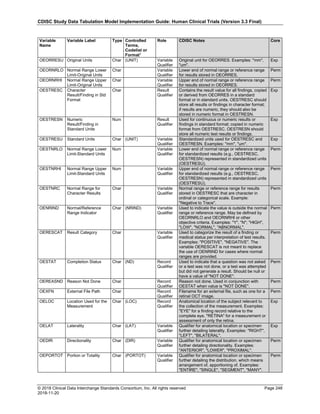
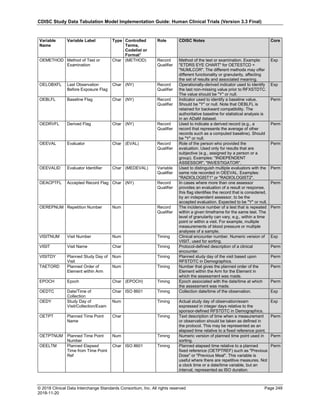
OE Ophthalmic
Examinations
Findings One record per ophthalmic finding per method per
location, per time point per visit per subject
Tabulation STUDYID, USUBJID, FOCID, OETESTCD,
OETSTDTL, OEMETHOD, OELOC, OELAT,
OEDIR, VISITNUM, OEDTC, OETPTREF,
OETPTNUM, OEREPNUM
oe.xpt
PC Pharmacokinetics
Concentrations
Findings One record per sample characteristic or time-point
concentration per reference time point or per analyte
per subject
Tabulation STUDYID, USUBJID, PCTESTCD, VISITNUM,
PCTPTREF, PCTPTNUM
pc.xpt
PE Physical Examination Findings One record per body system or abnormality per visit
per subject
Tabulation STUDYID, USUBJID, PETESTCD, VISITNUM pe.xpt
PP Pharmacokinetics
Parameters
Findings One record per PK parameter per time-concentration
profile per modeling method per subject
Tabulation STUDYID, USUBJID, PPTESTCD, PPCAT,
VISITNUM, PPTPTREF
pp.xpt
QS Questionnaires Findings One record per questionnaire per question per time
point per visit per subject
Tabulation STUDYID, USUBJID, QSCAT, QSSCAT,
VISITNUM, QSTESTCD
qs.xpt
RE Respiratory System
Findings
Findings One record per finding or result per time point per visit
per subject
Tabulation STUDYID, USUBJID, VISITNUM, RETESTCD,
RETPTNUM, REREPNUM
re.xpt
RP Reproductive System
Findings
Findings One record per finding or result per time point per visit
per subject
Tabulation STUDYID, DOMAIN, USUBJID, RPTESTCD,
VISITNUM
rp.xpt
RS Disease Response and
Clin Classification
Findings One record per response assessment or clinical
classification assessment per time point per visit per
subject per assessor per medical evaluator
Tabulation STUDYID, USUBJID, RSTESTCD, VISITNUM,
RSTPTREF, RSTPTNUM, RSEVAL,
RSEVALID
rs.xpt
SC Subject Characteristics Findings One record per characteristic per subject. Tabulation STUDYID, USUBJID, SCTESTCD sc.xpt
SR Skin Response Findings One record per finding, per object, per time point, per
visit per subject
Tabulation STUDYID, USUBJID, SRTESTCD, SROBJ,
VISITNUM, SRTPTREF, SRTPTNUM
sr.xpt
SS Subject Status Findings One record per finding per visit per subject Tabulation STUDYID, USUBJID, SSTESTCD, VISITNUM ss.xpt
TR Tumor/Lesion Results Findings One record per tumor measurement/assessment per
visit per subject per assessor
Tabulation STUDYID, USUBJID, TRTESTCD, EVALID,
VISITNUM
tr.xpt
TU Tumor/Lesion
Identification
Findings One record per identified tumor per subject per
assessor
Tabulation STUDYID, USUBJID, EVALID, LNKID tu.xpt
UR Urinary System Findings Findings One record per finding per location per per visit per
subject
Tabulation STUDYID, USUBJID, VISITNUM, URTESTCD,
URLOC, URLAT, URDIR
ur.xpt
VS Vital Signs Findings One record per vital sign measurement per time point
per visit per subject
Tabulation STUDYID, USUBJID, VSTESTCD, VISITNUM,
VSTPTREF, VSTPTNUM
vs.xpt
TA Trial Arms Trial Design One record per planned Element per Arm Tabulation STUDYID, ARMCD, TAETORD ta.xpt
CDISC Study Data Tabulation Model Implementation Guide: Human Clinical Trials (Version 3.3 Final)
© 2018 Clinical Data Interchange Standards Consortium, Inc. All rights reserved Page 20
2018-11-20
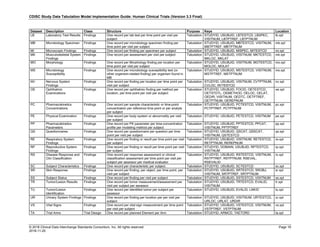
Dataset Description Class Structure Purpose Keys Location
TD Trial Disease
Assessments
Trial Design One record per planned constant assessment period Tabulation STUDYID, TDORDER td.xpt
TE Trial Elements Trial Design One record per planned Element Tabulation STUDYID, ETCD te.xpt
TI Trial Inclusion/Exclusion
Criteria
Trial Design One record per I/E crierion Tabulation STUDYID, IETESTCD ti.xpt
TM Trial Disease Milestones Trial Design One record per Disease Milestone type Tabulation STUDYID, MIDSTYPE tm.xpt
TS Trial Summary
Information
Trial Design One record per trial summary parameter value Tabulation STUDYID, TSPARMCD, TSSEQ ts.xpt
TV Trial Visits Trial Design One record per planned Visit per Arm Tabulation STUDYID, ARM, VISIT tv.xpt
RELREC Related Records Relationships One record per related record, group of records or
dataset
Tabulation STUDYID, RDOMAIN, USUBJID, IDVAR,
IDVARVAL, RELID
relrec.xpt
RELSUB Related Subjects Relationships One record per relationship per related subject per
subject
Tabulation STUDYID, USUBJID, RSUBJID, SREL relsub.xpt
SUPP-- Supplemental Qualifiers
for [domain name]
Relationships One record per IDVAR, IDVARVAL, and QNAM value
per subject
Tabulation STUDYID, RDOMAIN, USUBJID, IDVAR,
IDVARVAL, QNAM
supp--
.xpt
OI Non-host Organism
Identifiers
Study
Reference
One record per taxon per non-host organism Tabulation NHOID, OISEQ oi.xpt
Separate Supplemental Qualifier datasets of the form supp--.xpt are required. See Section 8.4, Relating Non- Standard Variables Values to a Parent Domain.
CDISC Study Data Tabulation Model Implementation Guide: Human Clinical Trials (Version 3.3 Final)
© 2018 Clinical Data Interchange Standards Consortium, Inc. All rights reserved Page 21
2018-11-20
3.2.1.1 Primary Keys
The table in Section 3.2.1, Dataset-Level Metadata shows examples of what a sponsor might submit as variables that
comprise the primary key for SDTM datasets. Since the purpose of this column is to aid reviewers in understanding
the structure of a dataset, sponsors should list all of the natural keys (see definition below) for the dataset. These
keys should define uniqueness for records within a dataset, and may define a record sort order. The identified keys
for each dataset should be consistent with the description of the dataset structure as described in the Define-XML
document. For all the general-observation-class domains (and for some special purpose domains), the --SEQ
variable was created so that a unique record could be identified consistently across all of these domains via its use,
along with STUDYID, USUBJID, DOMAIN. In most domains, --SEQ will be a surrogate key (see definition below)
for a set of variables that comprise the natural key. In certain instances, a Supplemental Qualifier (SUPP--) variable
might also contribute to the natural key of a record for a particular domain. See Section 4.1.8.3, Assigning Natural
Keys in the Metadata, for how this should be represented, and for additional information on keys.
A natural key is a set of data (one or more columns of an entity) that uniquely identifies that entity and distinguishes
it from any other row in the table. The advantage of natural keys is that they exist already; one does not need to
introduce a new, "unnatural" value to the data schema. One of the difficulties in choosing a natural key is that just
about any natural key one can think of has the potential to change. Because they have business meaning, natural
keys are effectively coupled to the business, and they may need to be reworked when business requirements change.
An example of such a change in clinical trials data would be the addition of a position or location that becomes a
key in a new study, but that wasn't collected in previous studies.
A surrogate key is a single-part, artificially established identifier for a record. Surrogate key assignment is a special
case of derived data, one where a portion of the primary key is derived. A surrogate key is immune to changes in
business needs. In addition, the key depends on only one field, so it's compact. A common way of deriving surrogate
key values is to assign integer values sequentially. The --SEQ variable in the SDTM datasets is an example of a
surrogate key for most datasets; in some instances, however, --SEQ might be a part of a natural key as a replacement
for what might have been a key (e.g., a repeat sequence number) in the sponsor's database.
3.2.1.2 CDISC Submission Value-Level Metadata
In general, the SDTMIG v3.x Findings data models are closely related to normalized, relational data models in a
vertical structure of one record per observation. Since the v3.x data structures are fixed, sometimes information that
might have appeared as columns in a more horizontal (denormalized) structure in presentations and reports will
instead be represented as rows in an SDTM Findings structure. Because many different types of observations are all
presented in the same structure, there is a need to provide additional metadata to describe the expected properties
that differentiate, for example, hematology lab results from serum chemistry lab results in terms of data type,
standard units, and other attributes.
For example, the Vital Signs data domain could contain subject records related to diastolic and systolic blood
pressure, height, weight, and body mass index (BMI). These data are all submitted in the normalized SDTM
Findings structure of one row per vital signs measurement. This means that there could be five records per subject
(one for each test or measurement) for a single visit or time point, with the parameter names stored in the Test
Code/Name variables, and the parameter values stored in result variables. Since the unique Test Code/Names could
have different attributes (i.e., different origins, roles, and definitions) there would be a need to provide value-level
metadata for this information.
The value-level metadata should be provided as a separate section of the Define-XML document. For details on the
CDISC Define-XML standard, see https://www.cdisc.org/standards/transport/define-xml.
3.2.2 Conformance
Conformance with the SDTMIG Domain Models is minimally indicated by:
• Following the complete metadata structure for data domains
• Following SDTMIG domain models wherever applicable
• Using SDTM-specified standard domain names and prefixes where applicable
• Using SDTM-specified standard variable names
CDISC Study Data Tabulation Model Implementation Guide: Human Clinical Trials (Version 3.3 Final)
© 2018 Clinical Data Interchange Standards Consortium, Inc. All rights reserved Page 22
2018-11-20
• Using SDTM-specified data types for all variables
• Following SDTM-specified controlled terminology and format guidelines for variables, when provided
• Including all collected and relevant derived data in one of the standard domains, special purpose datasets, or
general-observation-class structures
• Including all Required and Expected variables as columns in standard domains, and ensuring that all Required
variables are populated
• Ensuring that each record in a dataset includes the appropriate Identifier and Timing variables, as well as a
Topic variable
• Conforming to all business rules described in the CDISC Notes column and general and domain-specific
assumptions.
CDISC Study Data Tabulation Model Implementation Guide: Human Clinical Trials (Version 3.3 Final)
© 2018 Clinical Data Interchange Standards Consortium, Inc. All rights reserved Page 23
2018-11-20
4 Assumptions for Domain Models
4.1 General Domain Assumptions
4.1.1 Review Study Data Tabulation and Implementation Guide
Review the Study Data Tabulation Model as well as this complete Implementation Guide before attempting to use
any of the individual domain models.
4.1.2 Relationship to Analysis Datasets
Specific guidance on preparing analysis datasets can be found in the CDISC Analysis Data Model (ADaM)
Implementation Guide and other ADaM documents, available at http://www.cdisc.org/adam.
4.1.3 Additional Timing Variables
Additional Timing variables can be added as needed to a standard domain model based on the three general
observation classes, except for the cases specified in Assumption 4.4.8, Date and Time Reported in a Domain Based
on Findings. Timing variables can be added to special purpose domains only where specified in the SDTMIG
domain model assumptions. Timing variables cannot be added to SUPPQUAL datasets or to RELREC (described in
Section 8, Representing Relationships and Data).
4.1.3.1 EPOCH Variable Guidance
When EPOCH is included in a Findings class domain, it should be based on the --DTC variable, since this is the
date/time of the test or, for tests performed on specimens, the date/time of specimen collection. For observations in
Interventions or Events class domains, EPOCH should be based on the --STDTC variable, since this is the start of
the Intervention or Event. A possible, though unlikely, exception would be a finding based on an interval specimen
collection that started in one epoch but ended in another. --ENDTC might be a more appropriate basis for EPOCH in
such a case.
Sponsors should not impute EPOCH values, but should, where possible, assign EPOCH values on the basis of CRF
instructions and structure, even ifEPOCH was not directly collected and date/time data was not collected with
sufficient precision to permit assignment of an observation to an EPOCH on the basis of date/time data alone. If it is
not possible to determine theEPOCH of an observation, then EPOCH should be null. Methods for assigning EPOCH
values can be described in the Define-XML document.
Since EPOCH is a study-design construct, it is not applicable to Interventions or Events that started before the
subject's participation in the study, nor to Findings performed before their participation in the study. For such
records, EPOCH should be null. Note that a subject's participation in a study includes screening, which generally
occurs before the reference start date, RFSTDTC, in the DM domain.
4.1.4 Order of the Variables
The order of variables in the Define-XML document must reflect the order of variables in the dataset. The order of
variables in the CDISC domain models has been chosen to facilitate the review of the models and application of the
models. Variables for the three general observation classes must be ordered with Identifiers first, followed by the
Topic, Qualifier, and Timing variables. Within each role, variables must be ordered as shown in SDTM Tables
2.2.1, 2.2.2, 2.2.3, 2.2.3.1, 2.2.4, and 2.2.5.
4.1.5 SDTM Core Designations
Three categories are specified in the "Core" column in the domain models:
CDISC Study Data Tabulation Model Implementation Guide: Human Clinical Trials (Version 3.3 Final)
© 2018 Clinical Data Interchange Standards Consortium, Inc. All rights reserved Page 24
2018-11-20
• A Required variable is any variable that is basic to the identification of a data record (i.e., essential key
variables and a topic variable) or is necessary to make the record meaningful. Required variables must always
be included in the dataset and cannot be null for any record.
• An Expected variable is any variable necessary to make a record useful in the context of a specific domain.
Expected variables may contain some null values, but in most cases will not contain null values for every
record. When the study does not include the data item for an expected variable, however, a null column must
still be included in the dataset, and a comment must be included in the Define-XML document to state that the
study does not include the data item.
• A Permissible variable should be used in an SDTM dataset wherever appropriate. Although domain
specification tables list only some of the Identifier, Timing, and general observation class variables listed in the
SDTM, all are permissible unless specifically restricted in this implementation guide (see Section 2.7, SDTM
Variables Not Allowed in SDTMIG) or by specific domain assumptions.
o Domain assumptions that say a Permissible variable is "generally not used" do not prohibit use of the
variable.
o If a study includes a data item that would be represented in a Permissible variable, then that variable must
be included in the SDTM dataset, even if null. Indicate no data were available for that variable in the
Define-XML document.
o If a study did not include a data item that would be represented in a Permissible variable, then that variable
should not be included in the SDTM dataset and should not be declared in the Define- XML document.
4.1.6 Additional Guidance on Dataset Naming
SDTM datasets are normally named to be consistent with the domain code; for example, the Demographics dataset
(DM) is named dm.xpt. (See the SDTM Domain Abbreviation codelist, C66734, in CDISC Controlled Terminology
(https://www.cancer.gov/research/resources/terminology/cdisc) for standard domain codes).
Exceptions to this rule are described in Section 4.1.7, Splitting Domains, for general-observation-class datasets and
in Section 8, Representing Relationships and Data, for the RELREC and SUPP-- datasets.
In some cases, sponsors may need to define new custom domains and may be concerned that CDISC domain codes
defined in the future will conflict with those they choose to use. To eliminate any risk of a sponsor using a name that
CDISC later determines to have a different meaning, domain codes beginning with the letters X, Y, or Z have been
reserved for the creation of custom domains. Any letter or number may be used in the second position. Note the use
of codes beginning with X, Y, or Z is optional, and not required for custom domains.
4.1.7 Splitting Domains
Sponsors may choose to split a domain of topically related information into physically separate datasets.
• A domain based on a general observation class may be split according to values in --CAT. When a domain is
split on --CAT, --CAT must not be null.
• The Findings About (FA) domain (Section 6.4.4, Findings About) may alternatively be split based on the
domain of the value in --OBJ. For example, FACM would store Findings About CM records. See Section 6.4.2,
Naming Findings About Domains, for more details.
The following rules must be adhered to when splitting a domain into separate datasets to ensure they can be
appended back into one domain dataset:
1. The value of DOMAIN must be consistent across the separate datasets as it would have been if they had not
been split (e.g., QS, FA).
2. All variables that require a domain prefix (e.g., --TESTCD, --LOC) must use the value of DOMAIN as the
prefix value (e.g., QS, FA).
3. --SEQ must be unique within USUBJID for all records across all the split datasets. If there are 1000 records for
a USUBJID across the separate datasets, all 1000 records need unique values for --SEQ.
CDISC Study Data Tabulation Model Implementation Guide: Human Clinical Trials (Version 3.3 Final)
© 2018 Clinical Data Interchange Standards Consortium, Inc. All rights reserved Page 25
2018-11-20
4. When relationship datasets (e.g., SUPPxx, FAxx, CO, RELREC) relate back to split parent domains, IDVAR
would generally be --SEQ. When IDVAR is a value other than --SEQ (e.g., --GRPID, --REFID, -- SPID), care
should be used to ensure that the parent records across the split datasets have unique values for the variable
specified in IDVAR, so that related children records do not accidentally join back to incorrect parent records.
5. Permissible variables included in one split dataset need not be included in all split datasets.
6. For domains with two-letter domain codes (i.e., other than SUPP and RELREC), split dataset names can be up
to four characters in length. For example, if splitting by --CAT, then dataset names would be the domain name
plus up to two additional characters (e.g., QS36 for SF-36). If splitting Findings About by parent domain, then
the dataset name would be the domain code, "FA", plus the two-character domain code for parent domain code
(e.g., "FACM"). The four-character dataset-name limitation allows the use of a Supplemental Qualifier dataset
associated with the split dataset.
7. Supplemental Qualifier datasets for split domains would also be split. The nomenclature would include the
additional one-to-two characters used to identify the split dataset (e.g., SUPPQS36, SUPPFACM). The value of
RDOMAIN in the SUPP-- datasets would be the two-character domain code (e.g., QS, FA).
8. In RELREC, if a dataset-level relationship is defined for a split Findings About domain, then RDOMAIN may
contain the four-character dataset name, rather than the domain name "FA", as shown in the following example.
relrec.xpt
Row STUDYID RDOMAIN USUBJID IDVAR IDVARVAL RELTYPE RELID
1 ABC CM CMSPID ONE 1
2 ABC FACM FASPID MANY 1
9. See the SDTM Implementation Guide for Associated Persons for the naming of split associated persons
datasets.
10. See the SDTM Define-XML specification for details regarding metadata representation when a domain is split
into different datasets. Additional examples can be referenced in the Metadata Submission Guidelines (MSG)
for SDTMIG.
Note that submission of split SDTM domains may be subject to additional dataset splitting conventions as
defined by regulators via technical specifications and/or as negotiated with regulatory reviewers.
CDISC Study Data Tabulation Model Implementation Guide: Human Clinical Trials (Version 3.3 Final)
© 2018 Clinical Data Interchange Standards Consortium, Inc. All rights reserved Page 26
2018-11-20
4.1.7.1 Trial Inclusion/Exclusion Criteria
This example shows the QS domain data split into three datasets: Clinical Global Impression (QSCG), Cornell Scale for Depression in Dementia (QSCS) and Mini Mental State Examination (QSMM). Each dataset
represents a subset of the QS domain data and has only one value of QSCAT.
QS Domains
Dataset for Clinical Global Impressions
qscg.xpt
Row STUDYID DOMAIN USUBJID QSSEQ QSSPID QSTESTCD QSTEST QSCAT QSORRES QSSTRESC QSSTRESN QSBLFL VISITNUM VISIT VISITDY QSDTC QSDY
1 CDISC01 QS CDISC01.100008 1 CGI-CGI-I CGIGLOB Global Improvement Clinical Global Impressions No change 4 4 3 WEEK 2 15 2003-05-13 15
2 CDISC01 QS CDISC01.100008 2 CGI-CGI-I CGIGLOB Global Improvement Clinical Global Impressions Much Improved 2 2 10 WEEK 24 169 2003-10-13 168
3 CDISC01 QS CDISC01.100014 1 CGI-CGI-I CGIGLOB Global Improvement Clinical Global Impressions Minimally Improved 3 3 3 WEEK 2 15 2003-10-31 17
4 CDISC01 QS CDISC01.100014 2 CGI-CGI-I CGIGLOB Global Improvement Clinical Global Impressions Minimally Improved 3 3 10 WEEK 24 169 2004-03-30 168
Dataset for Cornell Scale for Depression in Dementia
qscs.xpt
Row STUDYID DOMAIN USUBJID QSSEQ QSSPID QSTESTCD QSTEST QSCAT QSORRES QSSTRESC QSSTRESN QSBLFL VISITNUM VISIT VISITDY QSDTC QSDY
1 CDISC01 QS CDISC01.100008 3 CSDD-01 CSDD01 Anxiety Cornell Scale for Depression in Dementia Severe 2 2 1 SCREEN -13 2003-04-15 -14
2 CDISC01 QS CDISC01.100008 23 CSDD-01 CSDD01 Anxiety Cornell Scale for Depression in Dementia Severe 2 2 Y 2 BASELINE 1 2003-04-29 1
3 CDISC01 QS CDISC01.100014 3 CSDD-01 CSDD01 Anxiety Cornell Scale for Depression in Dementia Severe 2 2 1 SCREEN -13 2003-10-06 -9
4 CDISC01 QS CDISC01.100014 28 CSDD-06 CSDD06 Retardation Cornell Scale for Depression in Dementia Mild 1 1 Y 2 BASELINE 1 2003-10-15 1
Dataset for Mini Mental State Examination
qsmm.xpt
Row STUDYID DOMAIN USUBJID QSSEQ QSSPID QSTESTCD QSTEST QSCAT QSORRES QSSTRESC QSSTRESN QSBLFL VISITNUM VISIT VISITDY QSDTC QSDY
1 CDISC01 QS CDISC01.100008 81 MMSE-A.1 MMSEA1 Orientation Time Score Mini Mental State Examination 4 4 4 1 SCREEN -13 2003-04-15 -14
2 CDISC01 QS CDISC01.100008 88 MMSE-A.1 MMSEA1 Orientation Time Score Mini Mental State Examination 3 3 3 Y 2 BASELINE 1 2003-04-29 1
3 CDISC01 QS CDISC01.100014 81 MMSE-A.1 MMSEA1 Orientation Time score Mini Mental State Examination 2 2 2 1 SCREEN -13 2003-10-06 -9
4 CDISC01 QS CDISC01.100014 88 MMSE-A.1 MMSEA1 Orientation Time score Mini Mental State Examination 2 2 2 Y 2 BASELINE 1 2003-10-15 1
SUPPQS Domains
Supplemental Qualifiers for QSCG
suppqscg.xpt
Row STUDYID RDOMAIN USUBJID IDVAR IDVARVAL QNAM QLABEL QVAL QORIG QEVAL
1 CDISC01 QS CDISC01.100008 QSCAT Clinical Global Impressions QSLANG Questionnaire Language GERMAN CRF
2 CDISC01 QS CDISC01.100014 QSCAT Clinical Global Impressions QSLANG Questionnaire Language FRENCH CRF
CDISC Study Data Tabulation Model Implementation Guide: Human Clinical Trials (Version 3.3 Final)
© 2018 Clinical Data Interchange Standards Consortium, Inc. All rights reserved Page 27
2018-11-20
Supplemental Qualifiers for QSCS
suppqscs.xpt
Row STUDYID RDOMAIN USUBJID IDVAR IDVARVAL QNAM QLABEL QVAL QORIG QEVAL
1 CDISC01 QS CDISC01.100008 QSCAT Cornell Scale for Depression in Dementia QSLANG Questionnaire Language GERMAN CRF
2 CDISC01 QS CDISC01.100014 QSCAT Cornell Scale for Depression in Dementia QSLANG Questionnaire Language FRENCH CRF
Supplemental Qualifiers for QSMM
suppqsmm.xpt
Row STUDYID RDOMAIN USUBJID IDVAR IDVARVAL QNAM QLABEL QVAL QORIG QEVAL
1 CDISC01 QS CDISC01.100008 QSCAT Mini Mental State Examination QSLANG Questionnaire Language GERMAN CRF
2 CDISC01 QS CDISC01.100014 QSCAT Mini Mental State Examination QSLANG Questionnaire Language FRENCH CRF
4.1.8 Origin Metadata
4.1.8.1 Origin Metadata for Variables
The origin element in the Define-XML document file is used to indicate where the data originated. Its purpose is to unambiguously communicate to the reviewer
the origin of the data source. For example, data could be on the CRF (and thus should be traceable to an annotated CRF), derived (and thus traceable to some
derivation algorithm), or assigned by some subjective process (and thus traceable to some external evaluator). The Define- XML specification is the definitive
source of allowable origin values. Additional guidance and supporting examples can be referenced using the Metadata Submission Guidelines (MSG) for
SDTMIG.
4.1.8.2 Origin Metadata for Records
Sponsors are cautioned to recognize that a derived origin means that all values for that variable were derived, and that collected on the CRF applies to all values
as well. In some cases, both collected and derived values may be reported in the same field. For example, some records in a Findings dataset such as QS contain
values collected from the CRF; other records may contain derived values, such as a total score. When both derived and collected values are reported in a variable,
the origin is to be described using value-level metadata.
4.1.8.3 Assigning Natural Keys in the Metadata
Section 3.2, Using the CDISC Domain Models in Regulatory Submissions — Dataset Metadata, indicates that a sponsor should include in the metadata the
variables that contribute to the natural key for a domain. In a case where a dataset includes a mix of records with different natural keys, the natural key that
provides the most granularity is the one that should be provided. The following examples are illustrations of how to do this, and include a case where a
Supplemental Qualifier variable is referenced because it forms part of the natural key.
CDISC Study Data Tabulation Model Implementation Guide: Human Clinical Trials (Version 3.3 Final)
© 2018 Clinical Data Interchange Standards Consortium, Inc. All rights reserved Page 28
2018-11-20
Musculoskeletal System Findings (MK) domain example:
Sponsor A chooses the following natural key for the MK domain:
STUDYID, USUBJID, VISTNUM, MKTESTCD
Sponsor B collects data in such a way that the location (MKLOC and MKLAT) and method (MKMETHOD)
variables need to be included in the natural key to identify a unique row. Sponsor B then defines the following
natural key for the MK domain.
STUDYID, USUBJID, VISITNUM, MKTESTCD, MKLOC, MKLAT, MKMETHOD
In certain instances a Supplemental Qualifier variable (i.e., a QNAM value, see Section 8.4, Relating Non- Standard
Variables Values to a Parent Domain) might also contribute to the natural key of a record, and therefore needs to be
referenced as part of the natural key for a domain. The important concept here is that a domain is not limited by
physical structure. A domain may be comprised of more than one physical dataset, for example the main domain
dataset and its associated Supplemental Qualifiers dataset. Supplemental Qualifiers variables should be referenced in
the natural key by using a two-part name. The word QNAM must be used as the first part of the name to indicate
that the contributing variable exists in a domain-specific SUPP-- and the second part is the value of QNAM that
ultimately becomes a column reference (e.g., QNAM.XVAR when the SUPP-- record has a QNAM of "XVAR")
when the SUPPQUAL records are joined on to the main domain dataset.
Continuing with the MK domain example above:
Sponsor B might have collected data that used different imaging methods, using imaging devices with different
makes and models, and using different hand positions. The sponsor considers the make and model information and
hand position to be essential data that contributes to the uniqueness of the test result, and so includes a device
identifier (SPDEVID) in the data and creates a Supplemental Qualifier variable for hand position (QNAM =
"MKHNDPOS"). The natural key is then defined as follows:
STUDYID, USUBJID, SPDEVID, VISITNUM, MKTESTCD, MKLOC, MKLAT, MKMETHOD,
QNAM.MKHNDPOS
Where the notation "QNAM.MKHNDPOS" means the Supplemental Qualifier whose QNAM is "MKHNDPOS".
This approach becomes very useful in a Findings domain when --TESTCD values are "generic" and rely on other
variables to completely describe the test. The use of generic test codes helps to create distinct lists of manageable
controlled terminology for --TESTCD. In studies where multiple repetitive tests or measurements are being made,
for example in a rheumatoid arthritis study where repetitive measurements of bone erosion in the hands and wrists
might be made using both X-ray and MRI equipment, the generic MKTEST "Sharp/Genant Bone Erosion Score"
would be used in combination with other variables to fully identify the result.
Taking just the phalanges, a sponsor might want to express the following in a test in order to make it unique:
• Left or Right hand
• Phalangeal joint position (which finger, which joint)
• Rotation of the hand
• Method of measurement (X-ray or MRI)
• Machine make and model
When CDISC controlled terminology for a test is not available, and a sponsor creates --TEST and --TESTCD
values, trying to encapsulate all information about a test within a unique value of a --TESTCD is not a
recommended approach for the following reasons:
• It results in the creation of a potentially large number of test codes.
• The eight-character values of --TESTCD become less intuitively meaningful.
• Multiple test codes are essentially representing the same test or measurement simply to accommodate attributes
of a test within the --TESTCD value itself (e.g., to represent a body location at which a measurement was
taken).
CDISC Study Data Tabulation Model Implementation Guide: Human Clinical Trials (Version 3.3 Final)
© 2018 Clinical Data Interchange Standards Consortium, Inc. All rights reserved Page 29
2018-11-20
As a result, the preferred approach would be to use a generic (or simple) test code that requires associated qualifier
variables to fully express the test detail. This approach was used in creating the CDISC controlled terminology that
would be used in the above example:
The MKTESTCD value "SGBESCR" is a "generic" test code, and additional information about the test is provided
by separate qualifier variables. The variables that completely specify a test may include domain variables and
supplemental qualifier variables. Expressing the natural key becomes very important in this situation in order to
communicate the variables that contribute to the uniqueness of a test.
The following variables would be used to fully describe the test. The natural key for this domain includes both
parent dataset variables and a supplemental qualifier variable that contribute to the natural key of each row and to
describe the uniqueness of the test.
SPDEVID MKTESTCD MKTEST MKLOC MKLAT MKMETHOD QNAM.MKHNDPOS
ACME3000 SGBESCR
Sharp/Genant Bone
Erosion Score
METACARPOPHALANGEAL
JOINT 1
LEFT X-RAY PALM UP
4.2 General Variable Assumptions
4.2.1 Variable-Naming Conventions
SDTM variables are named according to a set of conventions, using fragment names (listed in Appendix D, CDISC
Variable-Naming Fragments). Variables with names ending in "CD" are "short" versions of associated variables that
do not include the "CD" suffix (e.g., --TESTCD is the short version of --TEST).
Values of --TESTCD must be limited to eight characters and cannot start with a number, nor can they contain
characters other than letters, numbers, or underscores. This is to avoid possible incompatibility with SAS v5
Transport files. This limitation will be in effect until the use of other formats (such as Dataset-XML) becomes
acceptable to regulatory authorities.
QNAM serves the same purpose as --TESTCD within supplemental qualifier datasets, and so values of QNAM are
subject to the same restrictions as values of --TESTCD.
Values of other "CD" variables are not subject to the same restrictions as --TESTCD.
• ETCD (the companion to ELEMENT) and TSPARMCD (the companion to TSPARM) are limited to eight
characters and do not have the character restrictions that apply to --TESTCD. These values should be short for
ease of use in programming, but it is not expected that they will need to serve as variable names. ARMCD is
limited to 20 characters and does not have the character restrictions that apply to --TESTCD. The maximum
length of ARMCD is longer than for other "short" variables to accommodate the kind of values that are likely to
be needed for crossover trials. For example, if ARMCD values for a seven-period crossover were constructed
using two-character abbreviations for each treatment and separating hyphens, the length of ARMCD values
would be 20. This same rule applies to the ACTARMCD variable also.
• Variable descriptive names (labels), up to 40 characters, should be provided as data variable labels for all
variables, including Supplemental Qualifier variables.
• Use of variable names (other than domain prefixes), formats, decodes, terminology, and data types for the same
type of data (even for custom domains and Supplemental Qualifiers) should be consistent within and across
studies within a submission.
4.2.2 Two-Character Domain Identifier
In order to minimize the risk of difficulty when merging/joining domains for reporting purposes, the two- character
Domain Identifier is used as a prefix in most variable names.
Variables in domain specification tables (see Section 5, Models for Special Purpose Domains, Section 6, Domain
Models Based on the General Observation Classes, Section 7, Trial Design Model Datasets, Section 8, Representing
Relationships and Data, and Section 9, Study References) already specify the complete variable names. When
adding variables from the SDTM to standard domains or creating custom domains based on the General Observation
Classes, sponsors must replace the -- (two hyphens) prefix in the SDTM tables of General Observation Class,
CDISC Study Data Tabulation Model Implementation Guide: Human Clinical Trials (Version 3.3 Final)
© 2018 Clinical Data Interchange Standards Consortium, Inc. All rights reserved Page 30
2018-11-20
Timing, and Identifier variables with the two-character Domain Identifier (DOMAIN) value for that domain/dataset.
The two-character domain code is limited to A-Z for the first character, and A-Z, 0-9 for the second character. No
other characters are allowed. This is for compatibility with SAS version 5 Transport files and with file naming for
the Electronic Common Technical Document (eCTD).
The following variables are exceptions to the philosophy that all variable names are prefixed with the Domain
Identifier:
• Required Identifiers (STUDYID, DOMAIN, USUBJID)
• Commonly used grouping and merge Keys (e.g., VISIT, VISITNUM, VISITDY)
• All Demographics domain (DM) variables other than DMDTC and DMDY
• All variables in RELREC and SUPPQUAL, and some variables in Comments and Trial Design datasets.
Required Identifiers are not prefixed because they are usually used as keys when merging/joining observations. The
--SEQ and the optional Identifiers --GRPID and --REFID are prefixed because they may be used as keys when
relating observations across domains.
4.2.3 Use of “Subject” and USUBJID
"Subject" is used to generically refer to both "patients" and "healthy volunteers" in order to be consistent with the
recommendation in FDA guidance. The term "Subject" should be used consistently in all labels and Define-XML
document comments. To identify a subject uniquely across all studies for all applications or submissions involving
the product, a unique identifier (USUBJID) should be assigned and included in all datasets.
The unique subject identifier (USUBJID) is required in all datasets containing subject-level data. USUBJID values
must be unique for each trial participant (subject) across all trials in the submission. This means that no two (or
more) subjects, across all trials in the submission, may have the same USUBJID. Additionally, the same person who
participates in multiple clinical trials (when this is known) must be assigned the same USUBJID value in all trials.
The below dm.xpt sample rows illustrate a single subject who participates in two studies, first in ACME01 and later
in ACME14. Note that this is only one example of the possible values for USUBJID. CDISC does not recommend
any specific format for the values of USUBJID, only that the values need to be unique for all subjects in the
submission, and across multiple submissions for the same compound. Many sponsors concatenate values for the
Study, Site and Subject into USUBJID, but this is not a requirement. It is acceptable to use any format for
USUBJID, as long as the values are unique across all subjects per FDA guidance.
Study ACME01 dm.xpt
dm.xpt
Row STUDYID DOMAIN USUBJID SUBJID SITEID INVNAM
1 ACME01 DM ACME01-05-001 001 05 John Doe
Study ACME14 dm.xpt
dm.xpt
Row STUDYID DOMAIN USUBJID SUBJID SITEID INVNAM
1 ACME14 DM ACME01-05-001 017 14 Mary Smith
4.2.4 Text Case in Submitted Data
It is recommended that text data be submitted in upper case text. Exceptions may include long text data (such as
comment text) and values of --TEST in Findings datasets (which may be more readable in title case if used as labels
in transposed views). Values from CDISC controlled terminology or external code systems (e.g., MedDRA) or
response values for QRS instruments specified by the instrument documentation should be in the case specified by
those sources, which may be mixed case. The case used in the text data must match the case used in the Controlled
Terminology provided in the Define-XML document.
CDISC Study Data Tabulation Model Implementation Guide: Human Clinical Trials (Version 3.3 Final)
© 2018 Clinical Data Interchange Standards Consortium, Inc. All rights reserved Page 31
2018-11-20
4.2.5 Convention for Missing Values
Missing values for individual data items should be represented by nulls. Conventions for representing observations
not done, using the SDTM --STAT and --REASND variables, are addressed in Section 4.5.1.2, Tests Not Done and
the individual domain models.
4.2.6 Grouping Variables and Categorization
Grouping variables are Identifiers and Qualifiers variables, such as the --CAT (Category) and --SCAT
(Subcategory), that group records in the SDTM domains/datasets and can be assigned by sponsors to categorize
topic-variable values. For example, a lab record with LBTEST = "SODIUM" might have LBCAT = "CHEMISTRY"
and LBSCAT = "ELECTROLYTES". Values for --CAT and --SCAT should not be redundant with the domain
name or dictionary classification provided by --DECOD and --BODSYS.
1. Hierarchy of Grouping Variables
STUDYID
DOMAIN
--CAT
--SCAT
USUBJID
--GRPID
--LNKID
--LNKGRP
2. How Grouping Variables Group Data
A. For the subject
1. All records with the same USUBJID value are a group of records that describe that subject.
B. Across subjects (records with different USUBJID values)
1. All records with the same STUDYID value are a group of records that describe that study.
2. All records with the same DOMAIN value are a group of records that describe that domain.
3. --CAT (Category) and --SCAT (Sub-category) values further subset groups within the domain. Generally, -
-CAT/--SCAT values have meaning within a particular domain. However, it is possible to use the same
values for --CAT/--SCAT in related domains (e.g., MH and AE). When values are used across domains, the
meanings should be the same. Examples of where --CAT/--SCAT may have meaning across
domains/datasets:
a. Cases where different domains in the same general observation class contain similar conceptual
information. Adverse Events (AE), Medical History (MH), and Clinical Events (CE), for example, are
conceptually the same data, the only differences being when the event started relative to the study start
and whether the event is considered a regulatory reportable adverse event in the study. Neurotoxicities
collected in Oncology trials both as separate Medical History CRFs (MH domain) and Adverse Event
CRFs (AE domain) could both identify/collect "Paresthesia of the left Arm". In both domains, the --
CAT variable could have the value of NEUROTOXICITY.
b. Cases where multiple datasets are necessary to capture data about the same topic. As an example,
perhaps the existence and start and stop date of "Paresthesia of the left Arm" is reported as an Adverse
Event (AE domain), but the severity of the event is captured at multiple visits and recorded as Findings
About (FA dataset). In both cases the --CAT variable could have a value of NEUROTOXICITY.
c. Cases where multiple domains are necessary to capture data that was collected together and have an
implicit relationship, perhaps identified in the Related Records (RELREC) special purpose dataset.
Stress Test data collection, for example, may capture the following:
1. Information about the occurrence, start, stop, and duration of the test (in the PR domain)
2. Vital Signs recorded during the stress test (VS domain)
CDISC Study Data Tabulation Model Implementation Guide: Human Clinical Trials (Version 3.3 Final)
© 2018 Clinical Data Interchange Standards Consortium, Inc. All rights reserved Page 32
2018-11-20
3. Treatments (e.g., oxygen) administered during the stress test (in an Interventions domain)
In such cases, the data collected during the stress tests recorded in three separate domains may all have
--CAT/--SCAT values (STRESS TEST) that identify that this data was collected during the stress test.
C. Within subjects (records with the same USUBJID values)
1. --GRPID values further group (subset) records within USUBJID. All records in the same domain with the
same --GRPID value are a group of records within USUBJID. Unlike --CAT and --SCAT, --GRPID values
are not intended to have any meaning across subjects and are usually assigned during or after data
collection.
D. Although --SPID and --REFID are Identifier variables, they may sometimes be used as grouping variables and
may also have meaning across domains.
E. --LNKID and --LNKGRP express values that are used to link records in separate domains. As such, these
variables are often used in IDVAR in a RELREC relationship when there is a dataset-to-dataset relationship.
1. --LNKID is a grouping identifier used to identify a record in one domain that is related to records in
another domain, often forming a one-to-many relationship.
2. --LNKGRP is a grouping identifier used to identify a group of records in one domain that is related to a
record in another domain, often forming a many-to-one relationship.
3. Differences between Grouping Variables
The primary distinctions between --CAT/--SCAT and --GRPID are:
• --CAT/--SCAT are known (identified) about the data before it is collected.
• --CAT/--SCAT values group data across subjects.
• --CAT/--SCAT may have some controlled terminology.
• --GRPID is usually assigned during or after data collection at the discretion of the sponsor.
• --GRPID groups data only within a subject.
• --GRPID values are sponsor-defined, and will not be subject to controlled terminology.
Therefore, data that would be the same across subjects is usually more appropriate in --CAT/--SCAT, and data that
would vary across subjects is usually more appropriate in --GRPID. For example, a Concomitant Medication
administered as part of a known combination therapy for all subjects ("Mayo Clinic Regimen", for example) would
more appropriately use --CAT/--SCAT to identify the medication as part of that regimen. Groups of medications
recorded on an SAE form as treatments for the SAE would more appropriately use --GRPID because the groupings
are likely to differ across subjects.
In domains based on the Findings general observation class, the --RESCAT variable can be used to categorize
results after the fact. --CAT and --SCAT by contrast, are generally pre-defined by the sponsor or used by the
investigator at the point of collection, not after assessing the value of Findings results.
4.2.7 Submitting Free Text from the CRF
Sponsors often collect free text data on a CRF to supplement a standard field. This often occurs as part of a list of
choices accompanied by "Other, specify." The manner in which these data are submitted will vary based on their
role. The handling of verbatim text values for the ---OBJ variable is discussed in Section 6.4.3 Variables Unique to
Findings About.
4.2.7.1 "Specify" Values for Non-Result Qualifier Variables
When free-text information is collected to supplement a standard non-result Qualifier field, the free-text value
should be placed in the SUPP-- dataset described in Section 8.4, Relating Non-Standard Variables Values to a Parent
Domain. When applicable, controlled terminology should be used for SUPP-- field names (QNAM) and their
associated labels (QLABEL) (see Section 8.4, Relating Non-Standard Variables Values to a Parent Domain and
Appendix C2, Supplemental Qualifiers Name Codes).
CDISC Study Data Tabulation Model Implementation Guide: Human Clinical Trials (Version 3.3 Final)
© 2018 Clinical Data Interchange Standards Consortium, Inc. All rights reserved Page 33
2018-11-20
For example, when a description of "Other Medically Important Serious Adverse Event" category is collected on a
CRF, the free text description should be stored in the SUPPAE dataset.
• AESMIE = "Y"
• SUPPAE QNAM = "AESOSP", QLABEL = "Other Medically Important SAE", QVAL = "HIGH RISK FOR
ADDITIONAL THROMBOSIS"
Another example is a CRF that collects reason for dose adjustment with additional free-text description:
The free text description should be stored in the SUPPEX dataset.
• EXADJ = "NONMEDICAL REASON"
• SUPPEX QNAM = "EXADJDSC", QLABEL = "Reason For Dose Adjustment Description", QVAL =
"PATIENT MISUNDERSTOOD INSTRUCTIONS"
When the CRF includes a list of values for a qualifier field that includes "Other" and the "Other" is supplemented
with a "Specify" free text field, then the manner in which the free text "Specify" value is submitted will vary based
on the sponsor's coding practice and analysis requirements.
For example, consider a CRF that collects the indication for an analgesic concomitant medication (CMINDC) using
a list of pre-specified values and an "Other, specify" field:
An investigator has selected "OTHER" and specified "Broken arm". Several options are available for submission of
this data:
1) If the sponsor wishes to maintain controlled terminology for the CMINDC field and limit the terminology to the
five pre-specified choices, then the free text is placed in SUPPCM.
CMINDC
OTHER
QNAM QLABEL QVAL
CMINDOTH Other Indication BROKEN ARM
2) If the sponsor wishes to maintain controlled terminology for CMINDC but will expand the terminology based on
values seen in the specify field, then the value of CMINDC will reflect the sponsor's coding decision and SUPPCM
could be used to store the verbatim text.
Note that QNAM references the "parent" variable name with the addition of "DSC". Likewise, the label
is a modification of the parent variable label.
CDISC Study Data Tabulation Model Implementation Guide: Human Clinical Trials (Version 3.3 Final)
© 2018 Clinical Data Interchange Standards Consortium, Inc. All rights reserved Page 34
2018-11-20
CMINDC
FRACTURE
QNAM QLABEL QVAL
CMINDOTH Other Indication BROKEN ARM
Note that the sponsor might choose a different value for CMINDC (e.g., "BONE FRACTURE") depending on the
sponsor's coding practice and analysis requirements.
3) If the sponsor does not require that controlled terminology be maintained and wishes for all responses to be stored
in a single variable, then CMINDC will be used and SUPPCM is not required.
CMINDC
BROKEN ARM
4.2.7.2 "Specify" Values for Result Qualifier Variables
When the CRF includes a list of values for a result field that includes "Other" and the "Other" is supplemented with
a "Specify" free text field, then the manner in which the free text "Specify" value is submitted will vary based on the
sponsor's coding practice and analysis requirements.
For example, consider a CRF where the sponsor requests the subject's eye color:
An investigator has selected "OTHER" and specified "BLUEISH GRAY". As in the above discussion for non-result
Qualifier values, the sponsor has several options for submission:
1) If the sponsor wishes to maintain controlled terminology in the standard result field and limit the terminology to
the five pre-specified choices, then the free text is placed in --ORRES and the controlled terminology in --STRESC.
SCTEST SCORRES SCSTRESC
Eye Color BLUEISH GRAY OTHER
2) If the sponsor wishes to maintain controlled terminology in the standard result field, but will expand the
terminology based on values seen in the specify field, then the free text is placed in --ORRES and the value of
--STRESC will reflect the sponsor's coding decision.
SCTEST SCORRES SCSTRESC
Eye Color BLUEISH GRAY GRAY
3) If the sponsor does not require that controlled terminology be maintained, the verbatim value will be copied to
--STRESC.
SCTEST SCORRES SCSTRESC
Eye Color BLUEISH GRAY BLUEISH GRAY
4.2.7.3 "Specify" Values for Topic Variables
Interventions: If a list of specific treatments is provided along with "Other, Specify", --TRT should be populated
with the name of the treatment found in the specified text. If the sponsor wishes to distinguish between the pre-
specified list of treatments and those recorded under "Other, Specify," the --PRESP variable could be used. For
example:
CDISC Study Data Tabulation Model Implementation Guide: Human Clinical Trials (Version 3.3 Final)
© 2018 Clinical Data Interchange Standards Consortium, Inc. All rights reserved Page 35
2018-11-20
If ibuprofen and diclofenac were reported, the CM dataset would include the following:
CMTRT CMPRESP
IBUPROFEN Y
DICLOFENAC
Events: "Other, Specify" for Events may be handled similarly to Interventions. --TERM should be populated with
the description of the event found in the specified text and --PRESP could be used to distinguish between
prespecified and free text responses.
Findings: "Other, Specify" for tests may be handled similarly to Interventions. --TESTCD and --TEST should be
populated with the code and description of the test found in the specified text. If specific tests are not prespecified on
the CRF and the investigator has the option of writing in tests, then the name of the test would have to be coded to
ensure that all --TESTCD and --TEST values are consistent with the test controlled terminology.
For example, a lab CRF collected values for Hemoglobin, Hematocrit and "Other, specify". The value the
investigator wrote for "Other, specify" was "Prothrombin time" with an associated result and units. The sponsor
would submit the controlled terminology for this test, i.e., LBTESTCD would be "PT" and LBTEST would be
"Prothrombin Time", rather than the verbatim term, "Prothrombin time" supplied by the investigator.
4.2.8 Multiple Values for a Variable
4.2.8.1 Multiple Values for an Intervention or Event Topic Variable
If multiple values are reported for a topic variable (i.e., --TRT in an Interventions general-observation-class dataset
or --TERM in an Events general-observation-class dataset), it is expected that the sponsor will split the values into
multiple records or otherwise resolve the multiplicity per the sponsor's standard data management procedures. For
example, if an adverse event term of "Headache and Nausea" or a concomitant medication of "Tylenol and
Benadryl" is reported, sponsors will often split the original report into separate records and/or query the site for
clarification. By the time of submission, the datasets should be in conformance with the record structures described
in the SDTMIG. Note that the Disposition dataset (DS) is an exception to the general rule of splitting multiple topic
values into separate records. For DS, one record for each disposition or protocol milestone is permitted according to
the domain structure. For cases of multiple reasons for discontinuation see Section 6.2.3, Disposition, Assumption 5
for additional information.
4.2.8.2 Multiple Values for a Findings Result Variable
If multiple result values (--ORRES) are reported for a test in a Findings class dataset, multiple records should be
submitted for that --TESTCD.
For example,
• EGTESTCD = "SPRTARRY", EGTEST = "Supraventricular Tachyarrhythmias", EGORRES = "ATRIAL
FIBRILLATION"
• EGTESTCD = "SPRTARRY", EGTEST = "Supraventricular Tachyarrhythmias", EGORRES = "ATRIAL
FLUTTER"
When a finding can have multiple results, the key structure for the findings dataset must be adequate to distinguish
between the multiple results. See Section 4.1.8.3, Assigning Natural Keys in the Metadata.
CDISC Study Data Tabulation Model Implementation Guide: Human Clinical Trials (Version 3.3 Final)
© 2018 Clinical Data Interchange Standards Consortium, Inc. All rights reserved Page 36
2018-11-20
4.2.8.3 Multiple Values for a Non-Result Qualifier Variable
The SDTM permits one value for each Qualifier variable per record. If multiple values exist (e.g., due to a "Check
all that apply" instruction on a CRF), then the value for the Qualifier variable should be "MULTIPLE" and SUPP--
should be used to store the individual responses. It is recommended that the SUPP-- QNAM value reference the
corresponding standard domain variable with an appended number or letter. In some cases, the standard variable
name will be shortened to meet the 8-character variable name requirement, or it may be clearer to append a
meaningful character string as shown in the second AE example below, where the first three characters of the drug
name are appended. Likewise the QLABEL value should be similar to the standard label. The values stored in
QVAL should be consistent with the controlled terminology associated with the standard variable. See Section 8.4,
Relating Non-Standard Variables Values to a Parent Domain for additional guidance on maintaining appropriately
unique QNAM values.
The following example includes selected variables from the ae.xpt and suppae.xpt datasets for a rash whose
locations are the face, neck, and chest.
AE Dataset
AETERM AELOC
RASH MULTIPLE
SUPPAE Dataset
QNAM QLABEL QVAL
AELOC1 Location of the Reaction 1 FACE
AELOC2 Location of the Reaction 2 NECK
AELOC3 Location of the Reaction 3 CHEST
In some cases, values for QNAM and QLABEL more specific than those above may be needed.
For example, a sponsor might conduct a study with two study drugs (e.g., open-label study of Abcicin + Xyzamin),
and may require the investigator assess causality and describe action taken for each drug for the rash:
AE Dataset
AETERM AEREL AEACN
RASH MULTIPLE MULTIPLE
SUPPAE Dataset
QNAM QLABEL QVAL
AERELABC Causality of Abcicin POSSIBLY RELATED
AERELXYZ Causality of Xyzamin UNLIKELY RELATED
AEACNABC Action Taken with Abcicin DOSE REDUCED
AEACNXYZ Action Taken with Xyzamin DOSE NOT CHANGED
In each of the above examples, the use of SUPPAE should be documented in the Define-XML document and the
annotated CRF. The controlled terminology used should be documented as part of value-level metadata.
If the sponsor has clearly documented that one response is of primary interest (e.g., in the CRF, protocol, or analysis
plan), the standard domain variable may be populated with the primary response and SUPP-- may be used to store
the secondary response(s).
For example, if Abcicin is designated as the primary study drug in the example above:
AE Dataset
AETERM AEREL AEACN
RASH POSSIBLY RELATED DOSE REDUCED
SUPPAE Dataset
QNAM QLABEL QVAL
AERELX Causality of Xyzamin UNLIKELY RELATED
AEACNX Action Taken with Xyzamin DOSE NOT CHANGED
Note that in the latter case, the label for standard variables AEREL and AEACN will have no indication that they
pertain to Abcicin. This association must be clearly documented in the metadata and annotated CRF.
CDISC Study Data Tabulation Model Implementation Guide: Human Clinical Trials (Version 3.3 Final)
© 2018 Clinical Data Interchange Standards Consortium, Inc. All rights reserved Page 37
2018-11-20
4.2.9 Variable Lengths
Very large transport files have become an issue for FDA to process. One of the main contributors to the large file
sizes has been sponsors using the maximum length of 200 for character variables. To help rectify this situation:
• The maximum SAS Version 5 character variable length of 200 characters should not be used unless necessary.
• Sponsors should consider the nature of the data and apply reasonable, appropriate lengths to variables. For
example:
o The length of flags will always be 1.
o --TESTCD and IDVAR will never be more than 8, so the length can always be set to 8.
o The length for variables that use controlled terminology can be set to the length of the longest term.
4.3 Coding and Controlled Terminology Assumptions
4.3.1 Types of Controlled Terminology
As of SDTMIG v3.3, controlled terminology is represented one of the following ways:
• A single asterisk, "*", when CDISC controlled terminology is not available at the current time, but the SDS
Team expects that sponsors may have their own controlled terminology and/or the CDISC Controlled
Terminology Team may develop controlled terminology in the future.
• The single applicable value for the variable DOMAIN, e.g., "PR".
• The name of a CDISC codelist, represented as a hyperlink in parentheses, e.g., "(NY)".
• A short reference to an external terminology, such as "MedDRA" or "ISO 3166 Alpha-3".
In addition, the "Controlled Terms, Codelist or Format" column has been used to indicate variables that use an ISO
8601 format.
4.3.2 Controlled Terminology Text Case
Terms from controlled terminology should be in the case that appears the source codelist or code system (e.g.,
CDISC codelist or external code system such as MedDRA). See Section 4.2.4 Text Case in Submitted Data.
4.3.3 Controlled Terminology Values
The controlled terminology or a reference to the controlled terminology should be included in the Define-XML
document file wherever applicable. All values in the permissible value set for the study should be included, whether
they are represented in the submitted data or not. Note that a null value should not be included in the permissible
value set. A null value is implied for any list of controlled terms unless the variable is "Required" (see Section 4.1.5,
SDTM Core Designations).
When a domain or datasetspecification includes a codelist for a variable, not every value in that codelist may have
been part of planned data collection; only values that were part of planned data collection should be included in the
Define-XML document. For example, --PRESP variables are associated with the NY codelist, but only the value
"Y" is allowed in --PRESP variables. Future versions of the Define-XML Specification are expected to include
information on representing subsets of controlled terminology.
Examples provided in the column "CDISC Notes" are only examples and not intended to imply controlled
terminology. Check current controlled terminology at this link:
http://www.cancer.gov/cancertopics/cancerlibrary/terminologyresources/cdisc
CDISC Study Data Tabulation Model Implementation Guide: Human Clinical Trials (Version 3.3 Final)
© 2018 Clinical Data Interchange Standards Consortium, Inc. All rights reserved Page 38
2018-11-20
4.3.4 Use of Controlled Terminology and Arbitrary Number Codes
Controlled terminology or human-readable text should be used instead of arbitrary number codes in order to reduce
ambiguity for submission reviewers. For example, CMDECOD would contain human-readable dictionary text rather
than a numeric code. Numeric code values may be submitted as Supplemental Qualifiers if necessary.
4.3.5 Storing Controlled Terminology for Synonym Qualifier Variables
• For events such as AEs and Medical History, populate --DECOD with the dictionary's preferred term and
populate --BODSYS with the preferred body system name. If a dictionary is multi-axial, the value in --
BODSYS should represent the system organ class (SOC) used for the sponsor's analysis and summary tables,
which may not necessarily be the primary SOC. Populate --SOC with the dictionary-derived primary SOC. In
cases where the primary SOC was used for analysis, --BODSYS and --SOC are the same.
• If the MedDRA dictionary was used to code events, the intermediate levels in the MedDRA hierarchy should
also be represented in the dataset. A pair of variables has been defined for each of the levels of the hierarchy
other than SOC and PT: one to represent the text description and the other to represent the code value associated
with it. For example, --LLT should be used to represent the Lowest Level Term text description and --LLTCD
should be used to represent the Lowest Level Term code value.
• For concomitant medications, populate CMDECOD with the drug's generic name and populate CMCLAS with
the drug class used for the sponsor's analysis and summary tables. If coding to multiple classes, follow Section
4.2.8.1, Multiple Values for an Intervention or Event Topic Variable, or omit CMCLAS.
• For concomitant medications, supplemental qualifiers may be used to represent additional coding dictionary
information, e.g., a drug's ATC codes from the WHO Drug dictionary (see Section 8.4, Relating Non-Standard
Variables Values to a Parent Domain for more information).
4.3.6 Storing Topic Variables for General Domain Models
The topic variable for the Interventions and Events general-observation-class models is often stored as verbatim text.
For an Events domain, the topic variable is --TERM. For an Interventions domain, the topic variable is --TRT. For a
Findings domain, the topic variable, --TESTCD, should use Controlled Terminology (e.g., "SYSBP" for Systolic
Blood Pressure). If CDISC standard controlled terminology exists, it should be used; otherwise, sponsors should
define their own controlled list of terms. If the verbatim topic variable in an Interventions or Event domain is
modified to facilitate coding, the modified text is stored in --MODIFY. In most cases (other than PE), the dictionary-
coded text is derived into --DECOD. Since the PEORRES variable is modified instead of the topic variable for PE,
the dictionary-derived text would be placed in PESTRESC. The variables used in each of the defined domains are:
Domain Original Verbatim Modified Verbatim Standardized Value
AE AETERM AEMODIFY AEDECOD
DS DSTERM DSDECOD
CM CMTRT CMMODIFY CMDECOD
MH MHTERM MHMODIFY MHDECOD
PE PEORRES PEMODIFY PESTRESC
4.3.7 Use of "Yes" and "No" Values
Variables where the response is "Yes" or "No" ("Y" or "N") should normally be populated for both "Y" and "N"
responses. This eliminates confusion regarding whether a blank response indicates "N" or is a missing value.
However, some variables are collected or derived in a manner that allows only one response, such as when a single
check box indicates "Yes". In situations such as these, where it is unambiguous to populate only the response of
interest, it is permissible to populate only one value ("Y" or "N") and leave the alternate value blank. An example of
when it would be acceptable to use only a value of "Y" would be for Last Observation Before Exposure Flag
The sponsor is expected to provide the dictionary name and version used to map the terms by utilizing the
Define-XML external codelist attributes.
CDISC Study Data Tabulation Model Implementation Guide: Human Clinical Trials (Version 3.3 Final)
© 2018 Clinical Data Interchange Standards Consortium, Inc. All rights reserved Page 39
2018-11-20
(--LOBXFL) variables, where "N" is not necessary to indicate that a value is not the last observation before
exposure.
4.4 Actual and Relative Time Assumptions
Timing variables (SDTM Table 2.2.5) are an essential component of all SDTM subject-level domain datasets. In
general, all domains based on the three general observation classes should have at least one Timing variable. In the
Events or Interventions general observation class, this could be the start date of the event or intervention. In the
Findings observation class, where data are usually collected at multiple visits, at least one Timing variable must be
used.
The SDTMIG requires dates and times of day to be stored according to the international standard ISO 8601
(http://www.iso.org). ISO 8601 provides a text-based representation of dates and/or times, intervals of time, and
durations of time.
4.4.1 Formats for Date/Time Variables
An SDTM DTC variable may include data that is represented in ISO 8601 format as a complete date/time, a partial
date/time, or an incomplete date/time.
The SDTMIG template uses ISO 8601 for calendar dates and times of day, which are expressed as follows:
• YYYY-MM-DDThh:mm:ss(.n+)?(((+|-)hh:mm)|Z)?
where:
• [YYYY] = four-digit year
• [MM] = two-digit representation of the month (01-12, 01=January, etc.)
• [DD] = two-digit day of the month (01 through 31)
• [T] = (time designator) indicates time information follows
• [hh] = two digits of hour (00 through 23) (am/pm is NOT allowed)
• [mm] = two digits of minute (00 through 59)
• [ss] = two digits of second (00 through 59)
The last two components, indicated in the format pattern with a question mark, are optional:
• [(.n+)?] = optional fractions of seconds
• [(((+|-)hh:mm)|Z)?] = optional time zone
Other characters defined for use within the ISO 8601 standard are:
• [-] (hyphen): to separate the time Elements "year" from "month" and "month" from "day" and to represent
missing date components.
• [:] (colon): to separate the time Elements "hour" from "minute" and "minute" from "second"
• [/] (solidus): to separate components in the representation of date/time intervals
• [P] (duration designator): precedes the components that represent the duration
Note: Permissible values for variables with controlled terms of "Y" or "N" may be extended to include "U" or
"NA" if it is the sponsor's practice to explicitly collect or derive values indicating "Unknown" or "Not
Applicable" for that variable.
Spaces are not allowed in any ISO 8601 representations
CDISC Study Data Tabulation Model Implementation Guide: Human Clinical Trials (Version 3.3 Final)
© 2018 Clinical Data Interchange Standards Consortium, Inc. All rights reserved Page 40
2018-11-20
Key aspects of the ISO 8601 standard are as follows:
• ISO 8601 represents dates as a text string using the notation YYYY-MM-DD.
• ISO 8601 represents times as a text string using the notation hh:mm:ss(.n+)?(((+|-)hh:mm)|Z)?.
• The SDTM and SDTMIG require use of the ISO 8601 Extended format, which requires hyphen delimiters for
date components and colon delimiters for time components. The ISO 8601 basic format, which does not require
delimiters, should not be used in SDTM datasets.
• When a date is stored with a time in the same variable (as a date/time), the date is written in front of the time
and the time is preceded with "T" using the notation YYYY-MM-DDThh:mm:ss (e.g. 2001-12-26T00:00:01).
Implementation of the ISO 8601 standard means that date/time variables are character/text data types. The SDTM
fragment employed for date/time character variables is DTC.
4.4.2 Date/Time Precision
The concept of representing date/time precision is handled through use of the ISO 8601 standard. According to ISO
8601, precision (also referred to by ISO 8601 as "completeness" or "representations with reduced accuracy") can be
inferred from the presence or absence of components in the date and/or time values. Missing components are
represented by right truncation or a hyphen (for intermediate components that are missing). If the date and time
values are completely missing, the SDTM date field should be null. Every component except year is represented as
two digits. Years are represented as four digits; for all other components, one-digit numbers are always padded with
a leading zero.
The table below provides examples of ISO 8601 representations of complete and truncated date/time values using
ISO 8601 "appropriate right truncations" of incomplete date/time representations. Note that if no time component is
represented, the [T] time designator (in addition to the missing time) must be omitted in ISO 8601 representation.
Date and Time as Originally Recorded Precision ISO 8601 Date/Time
1 December 15, 2003 13:14:17.123 Date/time, including fractional seconds 2003-12-15T13:14:17.123
2 December 15, 2003 13:14:17 Date/time to the nearest second 2003-12-15T13:14:17
3 December 15, 2003 13:14 Unknown seconds 2003-12-15T13:14
4 December 15, 2003 13 Unknown minutes and seconds 2003-12-15T13
5 December 15, 2003 Unknown time 2003-12-15
6 December, 2003 Unknown day and time 2003-12
7 2003 Unknown month, day, and time 2003
This date and date/time model also provides for imprecise or estimated dates, such as those commonly seen in
Medical History. To represent these intervals while applying the ISO 8601 standard, it is recommended that the
sponsor concatenate the date/time values (using the most complete representation of the date/time known) that
describe the beginning and the end of the interval of uncertainty and separate them with a solidus as shown in the
table below:
Interval of Uncertainty ISO 8601 Date/Time
1 Between 10:00 and 10:30 on the morning of December 15, 2003 2003-12-15T10:00/2003-12-15T10:30
2 Between the first of this year (2003) until "now" (February 15, 2003) 2003-01-01/2003-02-15
3 Between the first and the tenth of December, 2003 2003-12-01/2003-12-10
4 Sometime in the first half of 2003 2003-01-01/2003-06-30
Other uncertainty intervals may be represented by the omission of components of the date when these components
are unknown or missing. As mentioned above, ISO 8601 represents missing intermediate components through the
use of a hyphen where the missing component would normally be represented. This may be used in addition to
"appropriate right truncations" for incomplete date/time representations. When components are omitted, the
expected delimiters must still be kept in place and only a single hyphen is to be used to indicate an omitted
component. Examples of this method of omitted component representation are shown in the table below:
CDISC Study Data Tabulation Model Implementation Guide: Human Clinical Trials (Version 3.3 Final)
© 2018 Clinical Data Interchange Standards Consortium, Inc. All rights reserved Page 41
2018-11-20
Date and Time as Originally Recorded Level of Uncertainty ISO 8601
Dat/Time
1 December 15, 2003 13:15:17 Date/time to the nearest second 2003-12-15T13:15:17
2 December 15, 2003 ??:15 Unknown hour with known minutes 2003-12-15T-:15
3 December 15, 2003 13:??:17 Unknown minutes with known date, hours, and
seconds
2003-12-15T13:-:17
4 The 15th of some month in 2003, time not collected Unknown month and time with known year and
day
2003---15
5 December 15, but can't remember the year, time not
collected
Unknown year with known month and day --12-15
6 7:15 of some unknown date Unknown date with known hour and minute -----T07:15
Note that Row 6 above, where a time is reported with no date information, represents a very unusual situation. Since
most data is collected as part of a visit, when only a time appears on a CRF, it is expected that the date of the visit
would usually be used as the date of collection.
Using a character-based data type to implement the ISO 8601 date/time standard will ensure that the date/time
information will be machine and human readable without the need for further manipulation, and will be platform
and software independent.
4.4.3 Intervals of Time and Use of Duration for --DUR Variables
4.4.3.1 Intervals of Time and Use of Duration
As defined by ISO 8601, an interval of time is the part of a time axis, limited by two time "instants" such as the
times represented in SDTM by the variables --STDTC and --ENDTC. These variables represent the two instants that
bound an interval of time, while the duration is the quantity of time that is equal to the difference between these time
points.
ISO 8601 allows an interval to be represented in multiple ways. One representation, shown below, uses two dates in
the format:
YYYY-MM-DDThh:mm:ss/YYYY-MM-DDThh:mm:ss
While the above would represent the interval (by providing the start date/time and end date/time to bound the
interval of time), it does not provide the value of the duration (the quantity of time).
Duration is frequently used during a review; however, the duration timing variable (--DUR) should generally be
used in a domain if it was collected in lieu of a start date/time (--STDTC) and end date/time (--ENDTC). If both --
STDTC and --ENDTC are collected, durations can be calculated by the difference in these two values, and need not
be in the submission dataset.
Both duration and duration units can be provided in the single --DUR variable, in accordance with the ISO 8601
standard. The values provided in --DUR should follow one of the following ISO 8601 duration formats:
PnYnMnDTnHnMnS
- or -
PnW
where:
• [P] (duration designator): precedes the alphanumeric text string that represents the duration. Note that the use of
the character P is based on the historical use of the term "period" for duration.
• [n] represents a positive number or zero
• [W] is used as week designator, preceding a data Element that represents the number of calendar weeks within
the calendar year (e.g., P6W represents 6 weeks of calendar time).
The letter "P" must precede other values in the ISO 8601 representation of duration. The "n" preceding each letter
represents the number of Years, Months, Days, Hours, Minutes, Seconds, or the number of Weeks. As with the
date/time format, "T" is used to separate the date components from time components.
CDISC Study Data Tabulation Model Implementation Guide: Human Clinical Trials (Version 3.3 Final)
© 2018 Clinical Data Interchange Standards Consortium, Inc. All rights reserved Page 42
2018-11-20
Note that weeks cannot be mixed with any other date/time components such as days or months in duration
expressions.
As is the case with the date/time representation in --DTC, --STDTC, or --ENDTC, only the components of duration
that are known or collected need to be represented. Also, as is the case with the date/time representation, if no time
component is represented, the [T] time designator (in addition to the missing time) must be omitted in ISO 8601
representation.
ISO 8601 also allows that the "lowest-order components" of duration being represented may be represented in
decimal format. This may be useful if data are collected in formats such as "one and one-half years", "two and one-
half weeks", "one-half a week" or "one quarter of an hour" and the sponsor wishes to represent this "precision" (or
lack of precision) in ISO 8601 representation. Remember that this is ONLY allowed in the lowest-order (right-most)
component in any duration representation.
The table below provides some examples of ISO-8601-compliant representations of durations:
Duration as originally recorded ISO 8601 Duration
2 Years P2Y
10 weeks P10W
3 Months 14 days P3M14D
3 Days P3D
6 Months 17 Days 3 Hours P6M17DT3H
14 Days 7 Hours 57 Minutes P14DT7H57M
42 Minutes 18 Seconds PT42M18S
One-half hour PT0.5H
5 Days 12¼ Hours P5DT12.25H
4 ½ Weeks P4.5W
Note that a leading zero is required with decimal values less than one.
4.4.3.2 Interval with Uncertainty
When an interval of time is an amount of time (duration) following an event whose start date/time is recorded (with
some level of precision, i.e. when one knows the start date/time and the duration following the start date/time), the
correct ISO 8601 usage to represent this interval is as follows:
YYYY-MM-DDThh:mm:ss/PnYnMnDTnHnMnS
where the start date/time is represented before the solidus [/], the "Pn…" following the solidus represents a
"duration", and the entire representation is known as an "interval". Note that this is the recommended representation
of elapsed time, given a start date/time and the duration elapsed.
When an interval of time is an amount of time (duration) measured prior to an event whose start date/time is
recorded (with some level of precision, i.e., where one knows the end date/time and the duration preceding that end
date/time), the syntax is:
PnYnMnDTnHnMnS/YYYY-MM-DDThh:mm:ss
where the duration, "Pn…", is represented before the solidus [/], the end date/time is represented following the
solidus, and the entire representation is known as an "interval".
4.4.4 Use of the "Study Day" Variables
The permissible Study Day variables (--DY, --STDY, and --ENDY) describe the relative day of the observation
starting with the reference date as Day 1. They are determined by comparing the date portion of the respective
date/time variables (--DTC, --STDTC, and --ENDTC) to the date portion of the Subject Reference Start Date
(RFSTDTC from the Demographics domain).
The Subject Reference Start Date (RFSTDTC) is designated as Study Day 1. The Study Day value is incremented by
1 for each date following RFSTDTC. Dates prior to RFSTDTC are decreased by 1, with the date preceding
RFSTDTC designated as Study Day -1 (there is no Study Day 0). This algorithm for determining Study Day is
CDISC Study Data Tabulation Model Implementation Guide: Human Clinical Trials (Version 3.3 Final)
© 2018 Clinical Data Interchange Standards Consortium, Inc. All rights reserved Page 43
2018-11-20
consistent with how people typically describe sequential days relative to a fixed reference point, but creates
problems if used for mathematical calculations because it does not allow for a Day 0. As such, Study Day is not
suited for use in subsequent numerical computations, such as calculating duration. The raw date values should be
used rather than Study Day in those calculations.
All Study Day values are integers. Thus, to calculate Study Day:
--DY = (date portion of --DTC) - (date portion of RFSTDTC) + 1 if --DTC is on or after RFSTDTC
--DY = (date portion of --DTC) - (date portion of RFSTDTC) if --DTC precedes RFSTDTC
This algorithm should be used across all domains.
4.4.5 Clinical Encounters and Visits
All domains based on the three general observation classes should have at least one timing variable. For domains in
the Events or Interventions observation classes, and for domains in the Findings observation class, for which data
are collected only once during the study, the most appropriate timing variable may be a date (e.g., --DTC, --STDTC)
or some other timing variable. For studies that are designed with a prospectively defined schedule of visit-based
activities, domains for data that are to be collected more than once per subject (e.g., Labs, ECG, Vital Signs) are
expected to include VISITNUM as a timing variable.
Clinical encounters are described by the CDISC Visit variables. For planned visits, values of VISIT, VISITNUM,
and VISITDY must be those defined in the Trial Visits (TV) dataset (Section 7.3.1, Trial Visits). For planned visits:
• Values of VISITNUM are used for sorting and should, wherever possible, match the planned chronological
order of visits. Occasionally, a protocol will define a planned visit whose timing is unpredictable (e.g., one
planned in response to an adverse event, a threshold test value, or a disease event), and completely
chronological values of VISITNUM may not be possible in such a case.
• There should be a one-to-one relationship between values of VISIT and VISITNUM.
• For visits that may last more than one calendar day, VISITDY should be the planned day of the start of the visit.
Sponsor practices for populating visit variables for unplanned visits may vary across sponsors.
• VISITNUM should generally be populated, even for unplanned visits, as it is expected in many Findings
domains, as described above. The easiest method of populating VISITNUM for unplanned visits is to assign the
same value (e.g., 99) to all unplanned visits, but this method provides no differentiation between the unplanned
visits and does not provide chronological sorting. Methods that provide a one-to-one relationship between visits
and values of VISITNUM, that are consistent across domains, and that assign VISITNUM values that sort
chronologically require more work and must be applied after all of a subject's unplanned visits are known.
• VISIT may be left null or may be populated with a generic value (e.g., "Unscheduled") for all unplanned visits,
or individual values may be assigned to different unplanned visits.
• VISITDY must not be populated for unplanned visits, since VISITDY is, by definition, the planned study day of
visit, and since the actual study day of an unplanned visit belongs in a --DY variable.
The following table shows an example of how the visit identifiers might be used for lab data:
USUBJID VISIT VISITNUM VISITDY LBDY
001 Week 1 2 7 7
001 Week 2 3 14 13
001 Week 2 Unscheduled 3.1 17
4.4.6 Representing Additional Study Days
The SDTM allows to represent study days relative to the RFSTDTC reference start date variable in the DM dataset,
using variables --DY, as described above in Section 4.4.4, Use of the "Study Day" Variables. The calculation of
additional study days within subdivisions of time in a clinical trial may be based on one or more sponsor-defined
reference dates not represented by RFSTDTC. In such cases, the sponsor may define Supplemental Qualifier
variables and the Define-XML document should reflect the reference dates used to calculate such study days. If the
CDISC Study Data Tabulation Model Implementation Guide: Human Clinical Trials (Version 3.3 Final)
© 2018 Clinical Data Interchange Standards Consortium, Inc. All rights reserved Page 44
2018-11-20
sponsor wishes to define "day within element" or "day within epoch", the reference date/time will be an element
start date/time in the Subject Elements (SE) dataset (Section 5.3, Subject Elements).
4.4.7 Use of Relative Timing Variables
--STRF and --ENRF
The variables --STRF and --ENRF represent the timing of an observation relative to the sponsor-defined Study
Reference Period, when information such as "BEFORE", "PRIOR", "ONGOING"', or "CONTINUING" is collected
in lieu of a date and this collected information is in relation to the sponsor-defined Study Reference Period. The
sponsor-defined Study Reference Period is the continuous period of time defined by the discrete starting point,
RFSTDTC, and the discrete ending point, RFENDTC, for each subject in the Demographics dataset.
--STRF is used to identify the start of an observation relative to the sponsor-defined Study Reference Period.
--ENRF is used to identify the end of an observation relative to the sponsor-defined Study Reference Period.
Allowable values for --STRF are "BEFORE", "DURING", "DURING/AFTER", "AFTER", and "U" (for unknown).
Although "COINCIDENT" and "ONGOING" are in the STENRF codelist, they describe timing relative to a point in
time rather than an interval of time, so are not appropriate for use with --STRF variables. It would be unusual for an
event or intervention to be recorded as starting "AFTER" the Study Reference Period, but could be possible,
depending on how the Study Reference Period is defined in a particular study.
Allowable values for --ENRF are "BEFORE", "DURING", "DURING/AFTER", "AFTER" and "U" (for unknown).
If --ENRF is used, then --ENRF = "AFTER" means that the event did not end before or during the Study Reference
Period. Although "COINCIDENT" and "ONGOING" are in the STENRF codelist, they describe timing relative to a
point in time rather than an interval of time, so are not appropriate for use with --ENRF variables.
As an example, a CRF checkbox that identifies concomitant medication use that began prior to the Study Reference
Period would translate into CMSTRF = "BEFORE", if selected. Note that in this example, the information collected
is with respect to the start of the concomitant medication use only, and therefore the collected data corresponds to
variable CMSTRF, not CMENRF. Note also that the information collected is relative to the Study Reference Period,
which meets the definition of CMSTRF.
Some sponsors may wish to derive --STRF and --ENRF for analysis or reporting purposes even when dates are
collected. Sponsors are cautioned that doing so in conjunction with directly collecting or mapping data such as
"BEFORE", "PRIOR", "ONGOING", etc., to --STRF and --ENRF will blur the distinction between collected and
derived values within the domain. Sponsors wishing to do such derivations are instead encouraged to use analysis
datasets for this derived data.
In general, sponsors are cautioned that representing information using variables --STRF and --ENRF may not be as
precise as other methods, particularly because information is often collected relative to a point in time or to a period
of time other than the one defined as the Study Reference Period. SDTMIG v3.1.2 attempted to address these
limitations by the addition of four new relative timing variables, which are described in the following paragraph.
Sponsors should use the set of variables that allows for accurate representation of the collected data. In many cases,
this will mean using these new relative timing variables in place of --STRF and --ENRF.
--STRTPT, --STTPT, --ENRTPT, and --ENTPT
While the variables --STRF and --ENRF are useful in the case when relative timing assessments are made coincident
with the start and end of the Study Reference Period, these may not be suitable for expressing relative timing
assessments such as "Prior" or "Ongoing" that are collected at other times of the study. As a result, four new timing
variables were added in v3.1.2 to express a similar concept at any point in time. The variables --STRTPT and --
ENRTPT contain values similar to --STRF and --ENRF, but may be anchored with any timing description or
date/time value expressed in the respective --STTPT and --ENTPT variables, and are not limited to the Study
Reference Period. Unlike the variables --STRF and --ENRF, which for all domains are defined relative to one Study
Reference Period, the timing variables --STRTPT, --STTPT, --ENRTPT, and --ENTPT are defined by each sponsor
for each study. Allowable values for --STRTPT and --ENRTPT are as follows:
If the reference time point corresponds to the date of collection or assessment:
• Start values: An observation can start BEFORE that time point, can start COINCIDENT with that time point, or
it is unknown (U) when it started.
CDISC Study Data Tabulation Model Implementation Guide: Human Clinical Trials (Version 3.3 Final)
© 2018 Clinical Data Interchange Standards Consortium, Inc. All rights reserved Page 45
2018-11-20
• End values: An observation can end BEFORE that time point, can end COINCIDENT with that time point, can
be known that it didn't end but was ONGOING, or it is unknown (U) when it ended or if it was ongoing.
• AFTER is not a valid value in this case because it would represent an event after the date of collection.
If the reference time point is prior to the date of collection or assessment:
• Start values: An observation can start BEFORE the reference point, can start COINCIDENT with the reference
point, can start AFTER the reference point, or it may not be known (U) when it started.
• End values: An observation can end BEFORE the reference point, can end COINCIDENT with the reference
point, can end AFTER the reference point, can be known that it didn't end but was ONGOING, or it is unknown
(U) when it ended or if it was ongoing.
Although "DURING" and "DURING/AFTER" are in the STENRF codelist, they describe timing relative to an
interval of time rather than a point in time, so are not allowable for use with --STRTPT and --ENRTPT variables.
Examples of --STRTPT, --STTPT, --ENRTPT, and --ENTPT
Example 1: Medical History
Assumptions:
• CRF contains "Year Started" and check box for "Active"
• "Date of Assessment" is collected
Example when "Active" is checked:
• MHDTC = date of assessment value, e.g., "2006-11-02"
• MHSTDTC = year of condition start, e.g., "2002"
• MHENRTPT = "ONGOING"
• MHENTPT = date of assessment value, e.g., "2006-11-02"
•
Figure 4.4.7: Example of --ENRTPT and --ENTPT for Medical History
CDISC Study Data Tabulation Model Implementation Guide: Human Clinical Trials (Version 3.3 Final)
© 2018 Clinical Data Interchange Standards Consortium, Inc. All rights reserved Page 46
2018-11-20
Example 2: Prior and Concomitant Medications
Assumptions:
• CRF includes collection of "Start Date" and "Stop Date", and check boxes for
o "Prior" if start date was before the screening visit and was unknown or uncollected
o "Continuing" if medication had not stopped as of the final study visit, so no end date was collected
Example when both "Prior" and "Continuing" are checked:
• CMSTDTC is null
• CMENDTC is null
• CMSTRTPT = "BEFORE"
• CMSTTPT is screening date, e.g., "2006-10-21"
• CMENRTPT = "ONGOING"
• CMENTPT is final study visit date, e.g., "2006-11-02"
Example 3: Adverse Events
Assumptions:
• CRF contains "Start Date", "Stop Date"
• Collection of "Outcome" includes check boxes for "Continuing" and "Unknown", to be used, if necessary, at the
end of the subject's participation in the trial
• No assessment date or visit information was collected
Example when "Unknown" is checked:
• AESTDTC is start date, e.g., "2006-10-01"
• AEENDTC is null
• AEENRTPT = "U"
• AEENTPT is final subject contact date, e.g., "2006-11-02"
4.4.8 Date and Time Reported in a Domain Based on Findings
When the date/time of collection is reported in any domain, the date/time should go into the --DTC field (e.g.,
EGDTC for Date/Time of ECG). For any domain based on the Findings general observation class, such as lab tests
which are based on a specimen, the collection date is likely to be tied to when the specimen or source of the finding
was captured, not necessarily when the data were recorded. In order to ensure that the critical timing information is
always represented in the same variable, the --DTC variable is used to represent the time of specimen collection. For
example, in the LB domain the LBDTC variable would be used for all single-point blood collections or spot urine
collections. For timed lab collections (e.g., 24-hour urine collections) the LBDTC variable would be used for the
start date/time of the collection and LBENDTC for the end date/time of the collection. This approach will allow the
single-point and interval collections to use the same date/time variables consistently across all datasets for the
Findings general observation class. The table below illustrates the proper use of these variables. Note that --STDTC
is not used for collection dates over an interval in the Findings general observation class and is therefore blank in the
following table.
Collection Type --DTC --STDTC --ENDTC
Single-Point Collection X
Interval Collection X X
CDISC Study Data Tabulation Model Implementation Guide: Human Clinical Trials (Version 3.3 Final)
© 2018 Clinical Data Interchange Standards Consortium, Inc. All rights reserved Page 47
2018-11-20
4.4.9 Use of Dates as Result Variables
Dates are generally used only as timing variables to describe the timing of an event, intervention, or collection
activity, but there may be occasions when it may be preferable to model a date as a result (--ORRES) in a Findings
dataset. Note that using a date as a result to a Findings question is unusual and atypical, and should be approached
with caution. This situation, however, may occasionally occur when a) a group of questions (each of which has a
date response) is asked and analyzed together; or b) the Event(s) and Intervention(s) in question are not medically
significant (often the case when included in questionnaires). Consider the following cases:
• Calculated due date
• Date of last day on the job
• Date of high school graduation
One approach to modeling these data would be to place the text of the question in --TEST and the response to the
question, a date represented in ISO 8601 format, in --ORRES and --STRESC, as long as these date results do not
contain the dates of medically significant events or interventions.
Again, use extreme caution when storing dates as the results of Findings. Remember, in most cases, these dates
should be timing variables associated with a record in an Intervention or Events dataset.
4.4.10 Representing Time Points
Time points can be represented using the time point variables, --TPT, --TPTNUM, --ELTM, and the time point
anchors, --TPTREF (text description) and --RFTDTC (the date/time). Note that time-point data will usually have an
associated --DTC value. The interrelationship of these variables is shown in Figure 4.4.10 below.
Figure 4.4.10: Relationships among Time Point Variables
Values for these variables for Vital Signs measurements taken at 30, 60, and 90 minutes after dosing would look like
the following.
VSTPTNUM VSTPT VSELTM VSTPTREF VSRFTDTC VSDTC
1 30 MIN PT30M DOSE ADMINISTRATION 2006-08-01T08:00 2006-08-01T08:30
2 60 MIN PT1H DOSE ADMINISTRATION 2006-08-01T08:00 2006-08-01T09:01
3 90 MIN PT1H30M DOSE ADMINISTRATION 2006-08-01T08:00 2006-08-01T09:32
Values for these variables for Urine Collections taken pre-dose, and from 0-12 hours and 12-24 hours after dosing
would look like the following.
LBTPTNUM LBTPT LBELTM LBTPTREF LBRFTDTC LBDTC
1 15 MIN PRE-DOSE -PT15M DOSE ADMINISTRATION 2006-08-01T08:00 2006-08-01T07:45
2 0-12 HOURS PT12H DOSE ADMINISTRATION 2006-08-01T08:00 2006-08-01T20:35
3 12-24 HOURS PT24H DOSE ADMINISTRATION 2006-08-01T08:00 2006-08-02T08:40
Note that VSELTM is the planned elapsed time, not the actual elapsed time. The actual elapsed time could be
derived in an analysis dataset, if desired, as VSDTC-VSRFTDTC.
CDISC Study Data Tabulation Model Implementation Guide: Human Clinical Trials (Version 3.3 Final)
© 2018 Clinical Data Interchange Standards Consortium, Inc. All rights reserved Page 48
2018-11-20
When time points are used, --TPTNUM is expected. Time points may or may not have an associated --TPTREF.
Sometimes, --TPTNUM may be used as a key for multiple values collected for the same test within a visit; as such,
there is no dependence upon an anchor such as --TPTREF, but there will be a dependency upon the VISITNUM. In
such cases, VISITNUM will be required to confer uniqueness to values of --TPTNUM.
If the protocol describes the scheduling of a dose using a reference intervention or assessment, then --TPTREF
should be populated, even if it does not contribute to uniqueness. The fact that time points are related to a reference
time point, and what that reference time point is, are important for interpreting the data collected at the time point.
Not all time points will require all three variables to provide uniqueness. In fact, in some cases a time point may be
uniquely identified without the use of VISIT, or without the use of --TPTREF, or, without the use of either one. For
instance:
• A trial might have time points only within one visit, so that the contribution of VISITNUM to uniqueness is
trivial. (VISITNUM would be populated, but would not contribute to uniqueness.)
• A trial might have time points that do not relate to any visit, such as time points relative to a dose of drug self-
administered by the subject at home. (Visit variables would not be included, but --TPTREF and other time point
variables would be populated.)
• A trial may have only one reference time point per visit, and all reference time points may be similar, so that
only one value of --TPTREF (e.g., "DOSE") is needed. (--TPTREF would be populated, but would not
contribute to uniqueness.)
• A trial may have time points not related to a reference time point. For instance, --TPTNUM values could be
used to distinguish first, second, and third repeats of a measurement scheduled without any relationship to
dosing. (--TPTREF and --ELTM would not be included.) In this case, where the protocol calls for repeated
measurements but does not specify timing of the measurements, the --REPNUM variable could be used instead
of time point variables.
For trials with many time points, the requirement to provide uniqueness using only VISITNUM, --TPTREF, and --
TPTNUM may lead to a scheme where multiple natural keys are combined into the values of one of these variables.
For instance, in a crossover trial with multiple doses on multiple days within each period, either of the following
options could be used. VISITNUM might be used to designate period, --TPTREF might be used to designate the day
and the dose, and --TPTNUM might be used to designate the timing relative to the reference time point.
Alternatively, VISITNUM might be used to designate period and day within period, --TPTREF might be used to
designate the dose within the day, and --TPTNUM might be used to designate the timing relative to the reference
time point.
Note that the value in LBELTM represents the end of the specimen collection interval.
CDISC Study Data Tabulation Model Implementation Guide: Human Clinical Trials (Version 3.3 Final)
© 2018 Clinical Data Interchange Standards Consortium, Inc. All rights reserved Page 49
2018-11-20
Option 1
VISIT VISITNUM --TPT --TPTNUM --TPTREF
PERIOD 1 3 PRE-DOSE 1 DAY 1, AM DOSE
1H 2
4H 3
PRE-DOSE 1 DAY 1, PM DOSE
1H 2
4H 3
PRE-DOSE 1 DAY 5, AM DOSE
1H 2
4H 3
PRE-DOSE 1 DAY 5, PM DOSE
1H 2
4H 3
PERIOD 2 4 PRE-DOSE 1 DAY 1, AM DOSE
1H 2
4H 3
PRE-DOSE 1 DAY 1, PM DOSE
1H 2
4H 3
Option 2
VISIT VISITNUM --TPT --TPTNUM --TPTREF
PERIOD 1, DAY 1 3 PRE-DOSE 1 AM DOSE
1H 2
4H 3
PRE-DOSE 1 PM DOSE
1H 2
4H 3
PERIOD 1, DAY 5 4 PRE-DOSE 1 AM DOSE
1H 2
4H 3
PRE-DOSE 1 PM DOSE
1H 2
4H 3
PERIOD 2, DAY 1 5 PRE-DOSE 1 AM DOSE
1H 2
4H 3
PRE-DOSE 1 PM DOSE
1H 2
4H 3
Within the context that defines uniqueness for a time point, which may include domain, visit, and reference time
point, there must be a one-to-relationship between values of --TPT and --TPTNUM. In other words, if domain, visit,
and reference time point uniquely identify subject data, then if two subjects have records with the same values of
DOMAIN, VISITNUM, --TPTREF, and --TPTNUM, then these records may not have different time point
descriptions in --TPT.
Within the context that defines uniqueness for a time point, there is likely to be a one-to-one relationship between
most values of --TPT and --ELTM. However, since --ELTM can only be populated with ISO 8601 periods of time
(as described in Section 4.4.3, Intervals of Time and Use of Duration for --DUR Variables), --ELTM may not be
populated for all time points. For example, --ELTM is likely to be null for time points described by text such as
"pre-dose" or "before breakfast". When --ELTM is populated, if two subjects have records with the same values of
DOMAIN, VISITNUM, --TPTREF, and --TPTNUM, then these records may not have different values in --ELTM.
When the protocol describes a time point with text such as "4-6 hours after dose" or "12 hours +/- 2 hours after
dose" the sponsor may choose whether and how to populate --ELTM. For example, a time point described as "4-6
hours after dose" might be associated with an --ELTM value of PT4H. A time point described as "12 hours +/- 2
CDISC Study Data Tabulation Model Implementation Guide: Human Clinical Trials (Version 3.3 Final)
© 2018 Clinical Data Interchange Standards Consortium, Inc. All rights reserved Page 50
2018-11-20
hours after dose" might be associated with an --ELTM value of PT12H. Conventions for populating --ELTM should
be consistent (the examples just given would probably not both be used in the same trial). It would be good practice
to indicate the range of intended timings by some convention in the values used to populate --TPT.
Sponsors may, of course, use more stringent requirements for populating --TPTNUM, --TPT, and --ELTM. For
instance, a sponsor could decide that all time points with a particular --ELTM value would have the same values of -
-TPTNUM, and --TPT, across all visits, reference time points, and domains.
4.4.11 Disease Milestones and Disease Milestone Timing Variables
A "disease milestone" is an event or activity that can be anticipated in the course of a disease, but whose timing is
not controlled by the study schedule. A disease milestone may be something that occurred pre-study, but which
represents a time at which data would have been collected, such as diagnosis of the disease under study. A disease
milestone may also be something which is anticipated to occur during a study and which, if it occurs, triggers the
collection of related data outside the regular schedule of visits, such as an adverse event of interest. The types of
Disease Milestones for a study are defined in the study-level Trial Disease Milestones (TM) dataset (Section 7.3.3,
Trial Disease Milestones). The times at which disease milestones occurred for a particular subject are summarized in
the special purpose Subject Disease Milestones (SM) domain (Section 5.4, Subject Disease Milestones), a domain
similar in structure to the Subject Visits (SV) and Subject Elements (SE) domains.
Not all studies will have disease milestones. If a study does not have disease milestones, the TM and SM domains
will not be present and the disease milestones timing variables may not be included in other domains.
Disease Milestone Naming
Instances of disease milestones are given names at a subject level. The name of a disease milestone is composed of a
character string that depends on the disease milestone type (MIDSTYPE in TM and SM) and, if the type of disease
milestone is one that may occur multiple times, a chronological sequence number for this disease milestone among
other instances of the same type for the subject. The character string used in the name of a disease milestone is
usually a short form of the disease milestone type. For example, if the type of disease milestone was "EPISODE OF
DISEASE UNDER STUDY", the values of MIDS for instances of this type of event could include "EPISODE1",
"EPISODE2", etc, or "EPISODE01", "EPISODE02", etc. The association between the longer text in MIDSTYPE
and the shorter text in MIDS can be seen in SM, which includes both variables.
Disease Milestones Name (MIDS)
If something that has been defined as a disease milestone for a particular study occurred for a particular subject, it is
represented as usual, in the appropriate findings, intervention, or events class record. In addition this record will
include the MIDS timing variable, populated with the name of the disease milestone. The timing of a disease
milestone is also represented in the special purpose SM domain.
The record that represents a disease milestone does not include values for the timing variables RELMIDS and
MIDSDTC, which are used to represent the timing of other observations relative to a disease milestone. The usual
timing variables in the record for a disease milestone (e.g., --DTC, --STDTC, --ENDTC) provide the needed timing
for this observation and for the timing information represented in the SM domain.
Timing Relative to a Disease Milestone (MIDS, RELMIDS, MIDSDTC)
For an observation triggered by the occurrence of a disease milestone, the relationship of the observation to the
disease milestone can be represented using the disease milestones timing variables MIDS, RELMIDS, and
MIDSDTC to describe the timing of the observation.
• MIDS is populated with the name of a disease milestone for this subject. MIDS is the "anchor" for describing
the timing of the observation relative to the disease milestone. In this sense, its function is similar to --TPTREF
for time points.
• RELMIDS is usually populated with a textual description of the temporal relationship between the observation
and the disease milestone named in MIDS. Controlled vocabulary has not yet been developed for RELMIDS,
but is likely to include terms such as "IMMEDIATELY BEFORE", "AT START OF", "DURING", "AT END
OF", and "SHORTLY AFTER". It is similar to --ELTM, except that --ELTM is represented ISO 8601 duration.
CDISC Study Data Tabulation Model Implementation Guide: Human Clinical Trials (Version 3.3 Final)
© 2018 Clinical Data Interchange Standards Consortium, Inc. All rights reserved Page 51
2018-11-20
• MIDSDTC is populated with the date/time of the disease milestone. This is the --DTC for a finding, or the --
STDTC for an event or intervention, and is the date recorded in SMSTDTC in the SM domain. Its function is
similar to --RFTDTC for time points.
In some cases, data collected in conjunction with a disease milestone does not include the collection of a separate
date for the related observation. This is particularly common for pre-study disease milestones, but may occur with
on-study disease milestones as well. In such cases, MIDSDTC provides a related date/time in records that would not
otherwise contain any date. In records that do contain date/time(s) of the observation, MIDSDTC allows easy
comparison of the date(s) of the observation to the (start) date of the disease milestone. In such cases, it functions
much like the reference time point date/time (--RFTDTC) in observations at time points.
When a disease milestone is an event or intervention, some data triggered by the disease milestone may be modeled
as Findings About the disease milestone (i.e., FAOBJ is the disease milestone). In such cases, RELMIDS should be
used to describe the temporal relationship between the Disease Milestone and the subject of the question being asked
in the finding, rather than as describing when the question was asked.
• When the subject of the question is the disease milestone itself, RELMIDS may be populated with a value such
as "ENTIRE EVENT" or "ENTIRE TREATMENT."
• When the subject of the question is a question about the occurrence of some activity or event related to the
disease milestone, RELMIDS acts like an evaluation interval, describing the period of time over which the
question is focused.
o For questions about a possible cause of an event or about the indication for a treatment, RELMIDS would
have a value such as "WEEK PRIOR" or "IMMEDIATELY BEFORE", or even just "BEFORE".
o RELMIDS would be "DURING" for questions about things that may have occurred while an event or
intervention disease milestone was in progress.
o For sequelae of a disease milestone, RELMIDS would have a value such as "AT DISCHARGE" or "WEEK
AFTER" or simply "AFTER".
Use of Disease Milestone Timing Variables with other Timing Variables
The disease milestone timing variables provide timing relative to an activity or event that has been identified, for the
particular study, as a disease milestone. Their use does not preclude the use of variables that collect actual date/times
or timing relative to the study schedule.
• The use of actual date/times is unaffected. The Disease Milestone Timing variables may provide timing
information in cases where actual date/times are unavailable, particularly for pre-study disease milestones.
When the question text for an observation references a disease milestone, but a separate date for the observation
is not collected, the disease milestone timing variables should be populated but the actual date/s should not be
imputed by populating them with the date of the disease milestone. Examples of such questions: Disease stage
at initial diagnosis of disease under study; Treatment for most recent disease episode.
• Study-day variables should be populated wherever complete actual date/times are populated. This includes
negative study days for pre-study observations.
• The timing variables EPOCH and TAETORD (Planned Order of Element within Arm) may be populated for
on-study observations associated with disease milestones. However, pre-study disease milestones, those which
occur before the start of study participation when informed consent is obtained, by definition, do not have an
associated EPOCH or TAETORD.
• Visit variables are expected in many findings domains, but findings triggered by the occurrence of a study
milestone may not occur at a scheduled visit.
o Findings associated with pre-study disease milestones are often collected at a screening visit, although the
test was not performed at that visit.
o For findings associated with on-study disease milestones but not conducted at a scheduled visit, practices
for populating VISITNUM as for an unscheduled visit should be followed.
• The use of time-point variables with disease milestone variables may occur in cases where a disease milestone
triggers treatment, and time points relative to treatment are part of the study schedule. For instance, a migraine
CDISC Study Data Tabulation Model Implementation Guide: Human Clinical Trials (Version 3.3 Final)
© 2018 Clinical Data Interchange Standards Consortium, Inc. All rights reserved Page 52
2018-11-20
trial may call for assessments of symptom severity at prescribed times after treatment of the migraine. If the
migraine episodes were treated as disease milestones, then the disease milestone timing variables might be
populated in the exposure and symptom-severity records. If the study planned to treat multiple migraine
episodes, the MIDS variable would provide a convenient way to determine the episode with which data were
associated.
• An evaluation interval variable (--EVLINT or --EVLTXT) could be used in conjunction with disease milestone
variables. For instance, patient-reported outcome instruments might be administered at the time of a disease
milestone, and the questions in the instrument might include an evaluation interval.
• The timing variables for start and end of an event or intervention relative to the study reference period (--STRF
and --ENRF) or relative to a reference time point (--STRTPT and --STTPT, --ENRTPT and --ENTPT) could be
used in conjunction with disease milestone variables. For example, a concomitant medication could be collected
in association with a disease milestone, so that the disease milestone timing variables were populated, but
relative timing variables could be used for the start or end of the concomitant medication.
• The timing variables for start and end of a planned assessment interval might be populated for an assessment
triggered by a disease milestone, if applicable. For example, the occurrence of a particular event might trigger
both a treatment and Holter monitoring for 24 hours after the treatment.
Linking and Disease Milestones
When disease milestones have been defined for a study, the MIDS variable serves to link observations associated
with a disease milestone in a way similar to the way that VISITNUM links observations collected at a visit. If
disease milestones were not defined for the study, it would be possible to link records associated with a disease
milestone using RELREC, but the use of disease milestones has certain advantages:
• RELREC indicates that there is a relationship between records or datasets, but not the nature of the relationship.
Records with the same MIDS value are related to the same disease milestone.
• When disease milestones are defined, it is not necessary to create RELREC records to establish relationships
between observations associated with a disease milestone.
4.5 Other Assumptions
4.5.1 Original and Standardized Results of Findings and Tests Not Done
4.5.1.1 Original and Standardized Results
The --ORRES variable contains the result of the measurement or finding as originally received or collected. --
ORRES is an expected variable and should always be populated, with two exceptions:
• When --STAT = "NOT DONE" since there is no result for such a record
• When --DRVFL = "Y" since the distinction between an original result and a standard result is not applicable for
records for which --DRVFL = "Y".
Note that records for which --DRVFL = "Y" may combine data collected at more than one visit. In such a case the
sponsor must define the value for VISITNUM, addressing the correct temporal sequence. If a new record is derived
for a dataset, and the source is not eDT, then that new record should be flagged as derived.
For example, in ECG data, if a corrected QT interval value derived in-house by the sponsor were represented in an
SDTM record, then EGDRVFL would be "Y". If a corrected QT interval value was received from a vendor or was
produced by the ECG machine, the derived flag would be null.
When --ORRES is populated, --STRESC must also be populated, regardless of whether the data values are character
or numeric. The variable, --STRESC, is populated either by the conversion of values in --ORRES to values with
standard units, or by the assignment of the value of --ORRES (as in the PE Domain, where --STRESC could contain
a dictionary-derived term). A further step is necessary when --STRESC contains numeric values. These are
converted to numeric type and written to --STRESN. Because --STRESC may contain a mixture of numeric and
character values, --STRESN may contain null values, as shown in the flowchart below.
CDISC Study Data Tabulation Model Implementation Guide: Human Clinical Trials (Version 3.3 Final)
© 2018 Clinical Data Interchange Standards Consortium, Inc. All rights reserved Page 53
2018-11-20
When the original measurement or finding is a selection from a defined codelist, in general, the --ORRES and --
STRESC variables contain results in decoded format, that is, the textual interpretation of whichever code was
selected from the codelist. In some cases where the code values in the codelist are statistically meaningful
standardized values or scores, which are defined by sponsors or by valid methodologies such as SF36
questionnaires, the --ORRES variables will contain the decoded format, whereas, the --STRESC variables as well as
the --STRESN variables will contain the standardized values or scores.
Occasionally data that are intended to be numeric are collected with characters attached that cause the character-to-
numeric conversion to fail. For example, numeric cell counts in the source data may be specified with a greater than
(>) or less than (<) sign attached (e.g. >10,000 or <1). In these cases, the value with the greater than (>) or less than
(<) sign attached should be moved to the --STRESC variable, and --STRESN should be null. The rules for
modifying the value for analysis purposes should be defined in the analysis plan and a numeric value should only be
imputed in the ADaM datasets. If the value in --STRESC has different units, the greater than (>) or less than (<) sign
should be maintained. An example is included in Section 4.5.1.3, Examples of Original and Standard Units and Test
Not Done, Example 1, Rows 11 and 12.
4.5.1.2 Tests Not Done
If the data on the CRF is missing and "Yes/No" or "Done/Not Done" was not explicitly captured, a record should not
be created to indicate that the data was not collected.
When an entire examination (laboratory draw, ECG, vital signs, or physical examination), or a group of tests
(hematology or urinalysis), or an individual test (glucose, PR interval, blood pressure, or hearing) is not done, and
this information is explicitly captured with a "Yes/No" or "Done/Not Done" question, this information should be
represented in the dataset. The reason for the missing information may or may not have been collected.
A sponsor has two options:
1. Submit individual records for each test not done.
2. Submit one record for a group of tests that were not done.
The example below illustrates the single-record approach for representing a group of tests not done. If a single
record is used to represent a group of tests were not done:
• --TESTCD should be --ALL
• --TEST should be <Domain description>
• --CAT should be <Name of group of tests>
• --ORRES should be null
• --STAT should be "NOT DONE"
• --REASND, if collected, might be "Specimen lost"
For example, if urinalysis tests were not done, then:
• LBTESTCD would be "LBALL".
• LBTEST would be "Laboratory Test Results".
• LBCAT would be "URINALYSIS".
• LBORRES would be null.
• LBSTAT would be "NOT DONE".
• LBREASND, if collected, might be "Subject could not void".
CDISC Study Data Tabulation Model Implementation Guide: Human Clinical Trials (Version 3.3 Final)
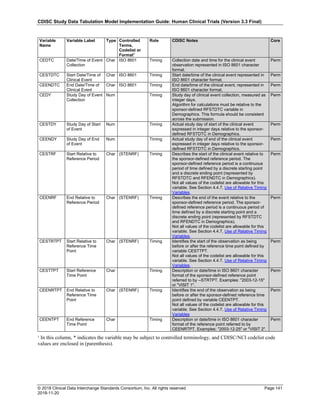
© 2018 Clinical Data Interchange Standards Consortium, Inc. All rights reserved Page 54
2018-11-20
4.5.1.3 Examples of Original and Standard Units and Test Not Done
The following examples are meant to illustrate the use of Findings results variables, and are not meant as comprehensive domain examples. Certain required and
expected variables are omitted, for example USUBJID, and the samples may represent data for more than one subject.
Example 1
Row 1: A numeric value was converted to the standard unit.
Row 2: A numeric value was copied; the original unit was the standard unit so conversion was not needed.
Rows 3-4: A character result was copied from the LBORRES to LBSTRESC. Since this is not a numeric result, LBSTRESN is null.
Row 5: A character result was converted to a standardized format.
Row 6: A result of "BLQ" was collected and copied to LBSTRESC. Note that the sponsor populated both LBORRESU and LBSTRESU with standard
units, but these could have been left null.
Row 7: A result was derived from multiple results, so LBDRVFL = "Y". Note that the original collected data are not shown in this example.
Row 8: A result for LBTEST = "HCT" is missing for visit 2, as indicated by LBSTAT = "NOT DONE"; neither LBORRES nor LBSTRESC is populated.
Row 9: Tests in the category "HEMATOLOGY" were not done at visit 3, as indicated by LBTESTCD = "LBALL" and LBSTAT = "NOT DONE".
Row 10: None of the tests in the LB domain were done at visit 4, as indicated by LBTESTCD = "LBALL", a null LBCAT value, and LBSTAT = "NOT
DONE".
Row 11: Shows a result collected as an inequality. The unit collected was the standard unit, so the result required no conversion and was copied to
LBSTRESC.
Row 12: Shows a result collected as an inequality. In LBSTRESC, the numeric part of LBORRES has been converted to the standard unit, and the less than
(<) sign has been retained. LBSTRESN is not populated.
lb.xpt
Row LBTESTCD LBCAT LBORRES LBORRESU LBSTRESC LBSTRESN LBSTRESU LBSTAT LBLOBXFL VISITNUM LBDTC
1 GLUC CHEMISTRY 6.0 mg/dL 60.0 60.0 mg/L 1 2016-02-01
2 ALT CHEMISTRY 12.1 mg/L 12.1 12.1 mg/L 1 2016-02-01
3 BACT URINALYSIS MODERATE MODERATE 1 2016-02-01
4 RBC URINALYSIS TRACE TRACE 1 2016-02-01
5 WBC URINALYSIS ++ 2+ 1 2016-02-01
6 KETONES CHEMISTRY BLQ mg/L BLQ mg/L 1 2016-02-01
7 MCHC HEMATOLOGY 33.8 33.8 g/dL Y 3 2016-02-15
8 HCT HEMATOLOGY NOT DONE 2 2016-02-08
9 LBALL HEMATOLOGY NOT DONE 3 2016-02-29
10 LBALL NOT DONE 4 2016-02-22
11 WBC HEMATOLOGY <4, 000 10^6/L <4,000 10^6/L 6 2016-02-07
12 BILI CHEMISTRY <0.1 mg/dL <1.71 umol/L 6 2016-02-07
CDISC Study Data Tabulation Model Implementation Guide: Human Clinical Trials (Version 3.3 Final)
© 2018 Clinical Data Interchange Standards Consortium, Inc. All rights reserved Page 55
2018-11-20
Example 2
Row 1: A numeric result was collected in standard units. Since no conversion was necessary, the result was copied into LBSTRESC and LBSTRESN.
Rows 2-3: Numeric results were converted to standard units.
Row 4: Character values were copied to EGSTRESC. EGSTRESN is null.
Row 5: The overall interpretation of the ECG is represented as a separate test.
Row 6: The result for EGTESTCD = "PRAG" was missing at visit 2, as indicated by EGSTAT = "NOT DONE"; neither EGORRES nor EGSTRESC is
populated.
Row 7: At visit 3, there were no ECG results, as indicated by EGTESTCD = "EGALL" and EGSTAT = "NOT DONE".
eg.xpt
Row EGTESTCD EGTESET EGORRES EGORRESU EGSTRESC EGSTRESN EGSTRESU EGSTAT VISITNUM EGDTC
1 QRSAG PR Interval, Aggregate 0.362 sec 0.362 0.362 sec 1 2015-03-07
2 QTAG QT Interval, Aggregate 221 msec 0.221 0.221 sec 1 2015-03-07
3 QTCBAG QTcB Interval, Aggregate 412 msec 0.412 0.412 sec 1 2015-03-07
4 SPRTARRY Supraventricular Arrhythmias ATRIAL FLUTTER ATRIAL FLUTTER 1 2015-03-07
6 INTP Interpretation ABNORMAL ABNORMAL 1 2015-03-07
5 PRAG PR Interval, Aggregate NOT DONE 2 2015-03-14
7 EGALL ECG Test Results NOT DONE 3 2015-03-21
Example 3
Rows 1-2: Numeric values were converted to standard units.
Row 3: A result for VSTESTCD = "HR" is missing, as indicated by VSSTAT = "NOT DONE"; neither VSORRES nor VSSTRESC is populated.
Rows 4-5: Two measurements for VSTESTCD= "SYSBP" were done at visit 1.
Row 6: A third measurement for VSTESTCD = "SYSBP" at visit 1 was a derived record, as indicated by VSDRVFL = "Y".
Row 7: At visit 2, there were no Vital Signs results, as indicated by VSTESTCD = "VSALL" and VSSTAT = "NOT DONE".
vs.xpt
Row VSTESTCD VSORRES VSORRESU VSSTRESC VSSTRESN VSSTRESU VSSTAT VSDRVFL VISITNUM VSDTC
1 HEIGHT 60 in 152 152 cm 1 2016-07-18
2 WEIGHT 110 LB 50 50 kg 1 2016-07-18
3 HR NOT DONE 1 2016-07-18
4 SYSBP 96 mmHg 96 96 mmHg 1 2016-07-18
5 SYSBP 100 mmHg 100 100 mmHg 1 2016-07-18
6 SYSBP 98 98 mmHg Y 1 2016-07-18
7 VSALL NOT DONE 2 2016-07-25
CDISC Study Data Tabulation Model Implementation Guide: Human Clinical Trials (Version 3.3 Final)
© 2018 Clinical Data Interchange Standards Consortium, Inc. All rights reserved Page 56
2018-11-20
4.5.2 Linking of Multiple Observations
See Section 8, Representing Relationships and Data, for guidance on expressing relationships among multiple
observations.
4.5.3 Text Strings That Exceed the Maximum Length for General-
Observation-Class Domain Variables
4.5.3.1 Test Name (--TEST) Greater than 40 Characters
Sponsors may have test descriptions (--TEST) longer than 40 characters in their operational database. Since the --
TEST variable is meant to serve as a label for a --TESTCD when a Findings dataset is transposed to a more
horizontal format, the length of --TEST is limited to 40 characters (except as noted below) to conform to the
limitations of the SAS v5 Transport format currently used for submission datasets. Therefore, sponsors have the
choice to either insert the first 40 characters or a text string abbreviated to 40 characters in --TEST. Sponsors should
include the full description for these variables in the study metadata in one of two ways:
• If the annotated CRF contains the full text, provide a reference to the annotated CRF page containing the full
test description in the Define-XML document origin definition for --TEST.
• If the annotated CRF does not specify the full text, then the full text should be documented in the Define-XML
document or the Clinical Study Data Reviewer's Guide.
The convention above should also be applied to the Qualifier Value Label (QLABEL) in Supplemental Qualifiers
(SUPP--) datasets. IETEST values in IE and TI are exceptions to the above 40-character rule and are limited to 200
characters, since they are not expected to be transformed to column labels. Values of IETEST that exceed 200
characters should be described in study metadata as per the convention above. For further details see IE Assumption
3, and TI Assumption 5.
4.5.3.2 Text Strings Greater than 200 Characters in Other Variables
Some sponsors may collect data values longer than 200 characters for some variables. Because of the current
requirement for the SAS v5 Transport file format, it is not possible to store the long text strings using only one
variable. Therefore, the SDTMIG has defined conventions for storing long text string using multiple variables.
For general-observation-class variables and supplemental qualifiers (i.e., non-standard variables), the conventions
are as follows:
• The first 200 characters of text should be stored in the parent domain variable and each additional 200
characters of text should be stored in a record in the SUPP-- dataset (see Section 8.4, Relating Non-Standard
Variables Values to a Parent Domain).
o When splitting a text string into several records, the text should be split between words to improve
readability.
o When the text longer than 200 characters is for a supplemental qualifier, the first QNAM should describe
the non-standard variable without any numeric suffix.
o The value for QNAMs for additional text (>200 characters) should contain a sequential variable name,
which is formed by appending a one-digit integer, beginning with 1, to the original domain variable name.
o The value for QLABEL should be the original domain variable label.
 The reason a digit integer or suffix is not appended to the label is because the long text string
represents a single value for a variable. The physical representation due to the SAS v5 Transport file
format does not change the concept described by the label.
 This is different conceptually from when multiple values for a non-result qualifier variable where
values are individually stored in SUPP--. In that case, both the QNAM and QLABEL must be uniquely
named (see Section 4.2.8.3, Multiple Values for a Non-Result Qualifier Variable) because they
represent multiple values for a single variable.
CDISC Study Data Tabulation Model Implementation Guide: Human Clinical Trials (Version 3.3 Final)
© 2018 Clinical Data Interchange Standards Consortium, Inc. All rights reserved Page 57
2018-11-20
 In cases where the standard domain variable name is already 8 characters in length, sponsors should replace the last character with a digit when
creating values for QNAM. As an example, for Other Action Taken in Adverse Events (AEACNOTH), values for QNAM for the SUPPAE records
would have the values AEACNOT1, AEACNOT2, and so on.
Example 1: MHTERM with 500 characters
mh.xpt
Row STUDYID DOMAIN USUBJID MHSEQ MHTERM
1 12345 MH 99-123 6 1st ~200 chars of text, split between words
suppmh.xpt
Row STUDYID RDOMAIN USUBJID IDVAR IDVARVAL QNAM QLABEL QVAL QORIG QEVAL
1 12345 MH 99-123 MHSEQ 6 MHTERM1 Reported Term for the Medical History 2nd ~200 chars of text, split between words CRF
2 12345 MH 99-123 MHSEQ 6 MHTERM2 Reported Term for the Medical History last 100 or more chars of text CRF
Example 2: AEACN with >200 characters
In this example, the text entered for AEACNOTH was longer than 200 characters, but required only one supplemental qualifier for the text that extended beyond
what could be represented in the standard variable.
ae.xpt
Row STUDYID DOMAIN USUBJID AESEQ AETERM AEACNOTH
1 12345 AE 99-123 4 HEART FAILURE 1st ~200 characters of text, split between words
suppae.xpt
Row STUDYID RDOMAIN USUBJID IDVAR IDVARVAL QNAM QLABEL QVAL QORIG QEVAL
1 12345 AE 99-123 AESEQ 4 AEACNOT1 Other Action Taken remaining characters of text CRF
Example 3
pr.xpt
Row STUDYID DOMAIN USUBJID PRSEQ PRTRT
1 12345 PR 99-123 4 KIDNEY TRANSPLANT
In this example, the text of the supplemental qualifier PRREAS was longer than 200 characters, but required only one additional supplemental qualifier to
represent the remaining text.
supppr.xpt
Row STUDYID RDOMAIN USUBJID IDVAR IDVARVAL QNAM QLABEL QVAL QORIG
1 12345 PR 99-123 PRSEQ 1 PRREAS Reason 1st ~200 characters of text, split between words CRF
2 12345 PR 99-123 PRSEQ 1 PRREAS1 Reason remaining characters of text CRF
CDISC Study Data Tabulation Model Implementation Guide: Human Clinical Trials (Version 3.3 Final)
© 2018 Clinical Data Interchange Standards Consortium, Inc. All rights reserved Page 58
2018-11-20
The following domains have specialized conventions for representing values longer than 200 characters:
• Special Purpose Comments (CO) domain (see CO Assumption 3)
• Trial Design Trial Summary (TS) domain (see TS Assumption 6)
• Trial Design Trial Inclusion/Exclusion Criteria (TI) domain (see TI Assumption 5)
• Findings Inclusion/Exclusion Criteria Not Met (IE) domain (see IE Assumption 3)
The following table summarizes the conventions and notes the specializations.
Text Strings >200 Char Conventions
General Observation Class & Supplemental
Qualifier Variables
Text Strings >200 Char Conventions
CO.COVAL
Text Strings >200 Char Conventions
TS.TSVAL
Text Strings >200 Char Conventions
TI.IETEST and IE.IETEST
The first 200 characters of text should be stored
in the variable and each additional 200
characters of text should be stored as a record in
the SUPP-- dataset
The first 200 characters of text should be
stored in COVAL and each additional 200
characters of text should be stored in
COVAL1 to COVALn.
The first 200 characters of text should be
stored in TSVAL and each additional 200
characters of text should be stored in
TSVAL1 to TSVALn.
If the inclusion/exclusion criteria text is >200
characters, put meaningful text in IETEST and
describe the full text in the study metadata.
When splitting a text string into several records,
the text should be split between words to improve
readability.
When splitting a text string into several
records, the text should be split between
words to improve readability.
When splitting a text string into several
records, the text should be split between
words to improve readability.
Not applicable.
The value for QLABEL should be the original
domain variable label.
The variable labels for COVAL1 to COVALn
should be "Comment".
The variable labels for TSVAL1 to TSVALn
should be "Parameter Value".
Not applicable.
4.5.4 Evaluators in the Interventions and Events Observation Classes
Because observations may originate from more than one source (e.g., an Investigator or Independent Assessor), the observations recorded in the Findings class
include the --EVAL qualifier. For the Interventions and Events observation classes, which do not include the --EVAL variable, all data are assumed to be
attributed to the principal investigator. The QEVAL variable can be used to describe the evaluator for any data item in a SUPP-- dataset (Section 8.4.1,
Supplemental Qualifiers – SUPP-- Datasets), but is not required when the data are objective. For observations that have primary and secondary evaluations of
specific qualifier variables, sponsors should put data from the primary evaluation into the standard domain dataset and data from the secondary evaluation into
the Supplemental Qualifier datasets (SUPP--). Within each SUPP-- record, the value for QNAM should be formed by appending a "1" to the corresponding
standard domain variable name. In cases where the standard domain variable name is already eight characters in length, sponsors should replace the last character
with a "1" (incremented for each additional attribution).
This example illustrates a case where an adjudication committee evaluated an adverse event. The evaluations of the adverse event by the primary investigator
were represented in the standard AE dataset. The evaluations of the adjudication committee were represented in SUPPAE. See Section 8.4, Relating Non-
Standard Variables Values to a Parent Domain. Note that the QNAM for the "Relationship to Non-Study Treatment" supplemental qualifier is AERELNS1,
rather than AERELNST1, since AERELNST already eight characters in length.
CDISC Study Data Tabulation Model Implementation Guide: Human Clinical Trials (Version 3.3 Final)
© 2018 Clinical Data Interchange Standards Consortium, Inc. All rights reserved Page 59
2018-11-20
suppae.xpt
Row STUDYID RDOMAIN USUBJID IDVAR IDVARVAL QNAM QLABEL QVAL QORIG QEVAL
1 12345 AE 99-123 AESEQ 3 AESEV1 Severity/ Intensity MILD CRF
ADJUDICATION
COMMITTEE
2 12345 AE 99-123 AESEQ 3 AEREL1 Causality POSSIBLY RELATED CRF
ADJUDICATION
COMMITTEE
3 12345 AE 99-123 AESEQ 3 AERELNS1
Relationship to Non-Study
Treatment
Possibly related to aspirin
use
CRF
ADJUDICATION
COMMITTEE
4.5.5 Clinical Significance for Findings Observation Class Data
For assessments of clinical significance when the overall interpretation is a record in the domain, use a Supplemental Qualifier (SUPP--) record (with QNAM =
"--CLSIG") linked to the record that contains the overall interpretation or a particular result. An example would be a QNAM value of "EGCLSIG" in SUPPEG
with a value of "Y", indicating that an ECG result of "ATRIAL FIBRILLATION" was clinically significant.
Separate from clinical significance are results of "NORMAL" or "ABNORMAL", or lab values that are out of normal range. Examples of the latter include the
following:
• An ECG test with EGTESTCD = "INTP", which addresses the ECG as a whole, should have a result or of "NORMAL" or "ABNORMAL". A record for
EGTESTCD = "INTP" may also have a record in SUPPEG indicating whether the result is clinically significant.
• A record for a vital signs measurement (e.g., systolic blood pressure) or a lab test (e.g., hematocrit) that contains a measurement may have a normal range
and a normal range indicator. It could also have a SUPP-- record indicating whether the result was clinically significant.
4.5.6 Supplemental Reason Variables
The SDTM general observation classes include the --REASND variable to submit the reason a response is not present (a result in a findings class or an --OCCUR
value in an events or interventions variable). However, sponsors sometimes collect the reason that something wasdone. For the interventions general observation
class, --INDC is available to represent the medical condition for which the intervention was given, and --ADJ is available to represent the reason for a dose
adjustment. If the sponsor collects a reason for performing a test represented in a findings or an activity represented in an events domain, or a reason for an
intervention other than a medical indication, the reason can be represented in the SUPP-- dataset (as described in Section 8.4.1, Supplemental Qualifiers –
SUPP-- Datasets) using the supplemental qualifier with QNAM of "--REAS" listed in Appendix C2, Supplemental Qualifiers Name Codes. If multiple reasons
are reported, refer to Section 4.2.8.3, Multiple Values for a Non-Result Qualifier Variable.
For example, if the sponsor collected the reason that an extra lab test was done, a SUPPLB record might be populated as follows. Note that the sponsor used a
label that was made more specific to the LB domain, rather than the label "Reason" in the appendix.
supplb.xpt
Row STUDYID RDOMAIN USUBJID IDVAR IDVARVAL QNAM QLABEL QVAL QORIG
1 12345 LB 99-123 LBSEQ 3 LBREAS Reason Test was
Performed
ORIGINAL
SAMPLE LOST
CRF
CDISC Study Data Tabulation Model Implementation Guide: Human Clinical Trials (Version 3.3 Final)
© 2018 Clinical Data Interchange Standards Consortium, Inc. All rights reserved Page 60
2018-11-20
4.5.7 Presence or Absence of Pre-Specified Interventions and Events
Interventions (e.g., concomitant medications) and Events (e.g., medical history) can generally be collected in two
different ways, by recording either verbatim free text or the responses to a pre-specified list of treatments or terms.
Since the method of solicitation for information on treatments and terms may affect the frequency at which they are
reported, whether they were pre-specified may be of interest to reviewers. The --PRESP variable is used to indicate
whether a specific intervention (--TRT) or event (--TERM) was solicited. The --PRESP variable has controlled
terminology of "Y" (for "Yes") or a null value. It is a permissible variable, and should only be used when the topic
variable values come from a pre-specified list. Questions such as "Did the subject have any concomitant
medications?" or "Did the subject have any medical history?" should not have records in an SDTM domain because
1) these are not valid values for the respective topic variables of CMTRT and MHTERM, and 2) records whose sole
purpose is to indicate whether or not a subject had records are not meaningful.
The --OCCUR variable is used to indicate whether a pre-specified intervention or event occurred or did not occur. It
has controlled terminology of "Y" and "N" (for "Yes" and "No"). It is a permissible variable and may be omitted
from the dataset if no topic-variable values were pre-specified.
If a study collects both pre-specified interventions and events as well as free-text events and interventions, the value
of --OCCUR should be "Y" or "N" for all pre-specified interventions and events, and null for those reported as free-
text.
The --STAT and --REASND variables can be used to provide information about pre-specified interventions and
events for which there is no response (e.g., investigator forgot to ask). As in Findings, --STAT has controlled
terminology of NOT DONE.
Situation Value of --PRESP Value of --OCCUR Value of --STAT
Spontaneously reported event occurred
Pre-specified event occurred Y Y
Pre-specified event did not occur Y N
Pre-specified event has no response Y NOT DONE
Refer to the standard domains in the Events and Interventions General Observation Classes for additional
assumptions and examples.
4.5.8 Accounting for Long-Term Follow-up
Studies often include long-term follow-up assessments to monitor a subject's condition. Use cases include studies in
terminally ill populations that periodically assess survival and studies involving chronic disease that include follow
up to assess relapse. Long-term follow-up is often conducted via telephone calls rather than clinic visits. Regardless
of the method of contact, the information should be stored in the appropriate topic-based domain.
Overall study conclusion in the Disposition (DS) domain occurs once all contact with the subject ceases. If a study
has a clinical treatment phase followed by a long-term follow-up phase, these two segments of the study can be
represented as separate epochs within the overall study, each with its own epoch disposition record.
The recommended SDTM approach to storing these data can be described by an example.
Assume an oncology study encompasses two months of clinical treatment and assessments followed by once-
monthly telephone contacts. The contacts continue until the subject dies. During the telephone contact, the
investigator collects information on the subject's survival status and medication use. The answers to certain
questions may trigger other data collection. For example, if the subject's survival status is "dead", then this indicates
that the subject has ceased participation in the study, so a study discontinuation record would need to be created. In
SDTM, the data related to these follow-up telephone contacts should be stored as follows:
1. Concomitant medications reported during the contact should be stored in the Concomitant Medications (CM)
domain.
2. The subject's survival status should be stored in the SS (Subject Status) domain.
3. The disposition of the subject at the time of the final follow-up contact should be stored in Disposition (DS).
Note that overall study conclusion is the point where any contact with the subject ceases, which in this example
CDISC Study Data Tabulation Model Implementation Guide: Human Clinical Trials (Version 3.3 Final)
© 2018 Clinical Data Interchange Standards Consortium, Inc. All rights reserved Page 61
2018-11-20
is also the conclusion of long-term follow-up. The disposition of the subject at the conclusion of the two-month
clinical treatment phase would be stored in DS as the conclusion to that epoch. Long-term follow-up would be
represented as a separate epoch. Therefore, in this example the subject could have three disposition records in
DS, with both the follow-up epoch disposition and the overall study conclusion disposition being collected at
the final telephone contact. Refer to the Disposition (DS) domain (Section 6.2.3, Disposition) for detailed
assumptions and examples.
4. If the subject's survival status is "dead", the Demographics (DM) variables DTHDTC and DTHFL must be
appropriately populated.
5. The long-term follow-up phase would be represented in Trial Arms (TA), Trial Elements (TE), and Trial Visits
(TV).
6. The contacts would be recorded in Subject Visits (SV) and Subject Elements (SE) consistent with the way they
are represented in TV and TE.
4.5.9 Baseline Values
The new variable --LOBXFL has been introduced in this release to address the need for a consistent definition of a
value that can serve as a reference with which to compare post-treatment values. This generic definition
approximates the concept of baseline and can be used to calculate post-treatment changes. In domains where --BLFL
was expected, its core value has been changed from expected to permissible, the new variable --LOBXFL, with a
core value of expected, has been added to contain the consistent definition. In domains where --BLFL was
permissible, the new variable --LOBXFL was added with a core value of permissible.
The table below shows a set of similar flag variables and their usage across SDTM and ADaM:
Variable Structure Where It Is
Defined
Requirement in
That Structure
Definition Intended Use
-- LOBXFL SDTM
Findings
Expected or
Permissible
Last non-missing
value prior to
RFXSTDTC
(Operationally
derived)
Consistent pre-treatment reference
value baseline for use across all
studies and
sponsors.
ABLFL ADaM BDS Conditionally
Required
Flags the record that is the
source of the baseline value for a
given parameter specified in the
Statistical Analysis Plan (May
differ both across and within
studies and datasets)
Baseline for ADaM analysis as
specified in the Statistical Analysis
Plan
--BLFL SDTM
Findings
Permissible
(formerly
expected in
some domains)
A baseline defined by the
sponsor (Could be derived in the
same manner as --LOBXFL or
ABLFL, but is not required to be)
Any sponsor-defined
baseline use
As shown above, each variable serves a specific need. The SDTM variable --LOBXFL (and/or --BLFL, if used) can
be copied to ADaM for traceability and transparency, but only the ADaM variable ABLFL would be used to signify
baseline for analysis. The content of --LOBXFL and ABLFL will be exactly the same when the Statistical Analysis
Plan specifies that the baseline used for analysis is the last non-missing value prior to RFXSTDTC.
CDISC Study Data Tabulation Model Implementation Guide: Human Clinical Trials (Version 3.3 Final)
© 2018 Clinical Data Interchange Standards Consortium, Inc. All rights reserved Page 62
2018-11-20
5 Models for Special Purpose Domains
Special Purpose Domains is an SDTM category in its own right. Special Purpose Domains provide specific, standardized structures to represent additional important information that does not fit any of the General
Observation Classes.
Domain Code Domain Description
CO Comments
A special purpose domain that contains comments that may be collected alongside other data.
DM Demographics
A special purpose domain that includes a set of essential standard variables that describe each subject in a
clinical study. It is the parent domain for all other observations for human clinical subjects.
SE Subject Elements
A special purpose domain that contains the actual order of elements followed by the subject, together with the
start date/time and end date/time for each element.
SM Subject Disease Milestones
A special purpose domain that is designed to record the timing, for each subject, of disease milestones that have
been defined in the Trial Disease Milestones (TM) domain.
SV Subject Visits
A special purpose domain that contains the actual start and end data/time for each visit of each individual
subject.
5.1 Comments
CO – Description/Overview
A special purpose domain that contains comments that may be collected alongside other data.
CO – Specification
co.xpt, Comments — Special Purpose, Version 3.3. One record per comment per subject, Tabulation.
Variable
Name
Variable Label Type Controlled Terms,
Codelist or Format1
Role CDISC Notes Core
STUDYID Study Identifier Char Identifier Unique identifier for a study. Req
DOMAIN Domain Abbreviation Char CO Identifier Two-character abbreviation for the domain. Req
RDOMAIN Related Domain
Abbreviation
Char * Record
Qualifier
Two-character abbreviation for the domain of the parent record(s). Null for comments collected on a general comments or additional information
CRF page.
Perm
USUBJID Unique Subject
Identifier
Char Identifier Identifier used to uniquely identify a subject across all studies for all applications or submissions involving the product. Req
COSEQ Sequence Number Num Identifier Sequence Number given to ensure uniqueness of subject records within a domain. May be any valid number. Req
IDVAR Identifying Variable Char * Record
Qualifier
Identifying variable in the parent dataset that identifies the record(s) to which the comment applies. Examples AESEQ or CMGRPID. Used only
when individual comments are related to domain records. Null for comments collected on separate CRFs.
Perm
IDVARVAL Identifying Variable
Value
Char Record
Qualifier
Value of identifying variable of the parent record(s). Used only when individual comments are related to domain records. Null for comments
collected on separate CRFs.
Perm
COREF Comment Reference Char Record
Qualifier
Sponsor-defined reference associated with the comment. May be the CRF page number (e.g., 650), or a module name (e.g., DEMOG), or a
combination of information that identifies the reference (e.g. 650-VITALS-VISIT 2).
Perm
CDISC Study Data Tabulation Model Implementation Guide: Human Clinical Trials (Version 3.3 Final)
© 2018 Clinical Data Interchange Standards Consortium, Inc. All rights reserved Page 63
2018-11-20
Variable
Name
Variable Label Type Controlled Terms,
Codelist or Format1
Role CDISC Notes Core
COVAL Comment Char Topic The text of the comment. Text over 200 characters can be added to additional columns COVAL1-COVALn. See Assumption 3. Req
COEVAL Evaluator Char * Record
Qualifier
Used to describe the originator of the comment. Examples: CENTRAL, REVIEWER, ADJUDICATION COMMITTEE, PRINCIPAL
INVESTIGATOR.
Perm
COEVALID Evaluator Identifier Char (MEDEVAL) Record
Qualifier
Used to distinguish multiple evaluators with the same role recorded in --EVAL. Examples: RADIOLOGIST, RADIOLOGIST1, RADIOLOGIST2. Perm
CODTC Date/Time of
Comment
Char ISO 8601 Timing Date/time of comment on dedicated comment form. Should be null if this is a child record of another domain or if comment date was not
collected.
Perm
CODY Study Day of
Comment
Num Timing Study day of the comment, in integer days. The algorithm for calculations must be relative to the sponsor-defined RFSTDTC variable in the
Demographics (DM) domain.
Perm
¹ In this column, * indicates the variable may be subject to controlled terminology, and CDISC/NCI codelist code values are enclosed in (parenthesis).
CO – Assumptions
1. The Comments special purpose domain provides a solution for submitting free-text comments related to data in one or more SDTM domains (as described in Section 8.5, Relating Comments to a Parent Domain)
or collected on a separate CRF page dedicated to comments. Comments are generally not responses to specific questions; instead, comments usually consist of voluntary, free-text or unsolicited observations.
2. The CO dataset accommodates three sources of comments:
a. Those unrelated to a specific domain or parent record(s), in which case the values of the variables RDOMAIN, IDVAR, and IDVARVAL are null. CODTC should be populated if captured. See example,
Row 1.
b. Those related to a domain but not to specific parent record(s), in which case the value of the variable RDOMAIN is set to the DOMAIN code of the parent domain and the variables IDVAR and IDVARVAL
are null. CODTC should be populated if captured. See example, Row 2.
c. Those related to a specific parent record or group of parent records, in which case the value of the variable RDOMAIN is set to the DOMAIN code of the parent record(s) and the variables IDVAR and
IDVARVAL are populated with the key variable name and value of the parent record(s). Assumptions for populating IDVAR and IDVARVAL are further described in Section 8.5, Relating Comments to a
Parent Domain. CODTC should be null because the timing of the parent record(s) is inherited by the comment record. See example, Rows 3-5.
3. When the comment text is longer than 200 characters, the first 200 characters of the comment will be in COVAL, the next 200 in COVAL1, and additional text stored as needed to COVALn. See example, Rows
3-4.
Additional information about how to relate comments to parent SDTM records is provided in Section 8.5, Relating Comments to a Parent Domain.
4. The variable COREF may be null unless it is used to identify the source of the comment. See example, Rows 1 and 5.
5. Any Identifier variables and Timing variables may be added to the CO domain, but the following qualifiers would generally not be used in CO: --GRPID, --REFID, --SPID, VISIT, VISITNUM, VISITDY,
TAETORD, --TPT, --TPTNUM, --ELTM, --TPTREF, --RFTDTC.
CO – Examples
Example 1
Row 1: Shows a comment collected on a separate comments page. Since it was unrelated to any specific domain or record, RDOMAIN, IDVAR, and IDVARVAL are null.
Row 2: Shows a comment that was collected on the bottom of the PE page for Visit 7, without any indication of specific records it applied to. Since the comment related to a specific domain, RDOMAIN is
populated. Since it was related to a specific visit, VISIT, COREF is "VISIT 7". However, since it does not relate to a specific record, IDVAR and IDVARVAL are null.
CDISC Study Data Tabulation Model Implementation Guide: Human Clinical Trials (Version 3.3 Final)
© 2018 Clinical Data Interchange Standards Consortium, Inc. All rights reserved Page 64
2018-11-20
Row 3: Shows a comment related to a single AE record having its AESEQ=7.
Row 4: Shows a comment related to multiple EX records with EXGRPID = "COMBO1".
Row 5: Shows a comment related to multiple VS records with VSGRPID = "VS2".
Row 6: Shows one option for representing a comment collected on a visit-specific comments page not associated with a particular domain. In this case, the comment is linked to the Subject Visit record in SV
(RDOMAIN = "SV") and IDVAR and IDVARVAL are populated link the comment to the particular visit.
Row 7: Shows a second option for representing a comment associated only with a visit. In this case, COREF is used to show that the comment is related to the particular visit.
Row 8: Shows a third option for representing a comment associated only with a visit. In this case, the VISITNUM variable was populated to indicate that the comment was associated with a particular visit.
co.xpt
Row STUDYID DOMAIN RDOMAIN USUBJID COSEQ IDVAR IDVARVAL COREF COVAL COVAL1 COVAL2 COEVAL VISITNUM CODTC
1 1234 CO AB-99 1 Comment text PRINCIPAL INVESTIGATOR 2003-11-08
2 1234 CO PE AB-99 2 VISIT 7 Comment text PRINCIPAL INVESTIGATOR 2004-01-14
3 1234 CO AE AB-99 3 AESEQ 7 PAGE 650 First 200 characters Next 200 characters Remaining text PRINCIPAL INVESTIGATOR
4 1234 CO EX AB-99 4 EXGRPID COMBO1 PAGE 320-355 First 200 characters Remaining text PRINCIPAL INVESTIGATOR
5 1234 CO VS AB-99 5 VSGRPID VS2 Comment text PRINCIPAL INVESTIGATOR
6 1234 CO SV AB-99 6 VISITNUM 4 Comment Text PRINCIPAL INVESTIGATOR
7 1234 CO AB-99 7 VISIT 4 Comment Text PRINCIPAL INVESTIGATOR
8 1234 CO AB-99 8 Comment Text PRINCIPAL INVESTIGATOR 4
5.2 Demographics
DM – Description/Overview
A special purpose domain that includes a set of essential standard variables that describe each subject in a clinical study. It is the parent domain for all other observations for human clinical subjects.
DM – Specification
dm.xpt, Demographics — Special Purpose, Version 3.3. One record per subject, Tabulation.
Variable
Name
Variable Label Type Controlled Terms,
Codelist or Format1
Role CDISC Notes Core
STUDYID Study Identifier Char Identifier Unique identifier for a study. Req
DOMAIN Domain Abbreviation Char DM Identifier Two-character abbreviation for the domain. Req
USUBJID Unique Subject Identifier Char Identifier Identifier used to uniquely identify a subject across all studies for all applications or submissions involving the product. This must be a
unique number, and could be a compound identifier formed by concatenating STUDYID-SITEID-SUBJID.
Req
SUBJID Subject Identifier for the Study Char Topic Subject identifier, which must be unique within the study. Often the ID of the subject as recorded on a CRF. Req
RFSTDTC Subject Reference Start Date/Time Char ISO 8601 Record Qualifier Reference Start Date/time for the subject in ISO 8601 character format. Usually equivalent to date/time when subject was first exposed to
study treatment. See Assumption 9 for additional detail on when RFSTDTC may be null.
Exp
RFENDTC Subject Reference End Date/Time Char ISO 8601 Record Qualifier Reference End Date/time for the subject in ISO 8601 character format. Usually equivalent to the date/time when subject was determined
to have ended the trial, and often equivalent to date/time of last exposure to study treatment. Required for all randomized subjects; null for
screen failures or unassigned subjects.
Exp
RFXSTDTC Date/Time of First Study Treatment Char ISO 8601 Record Qualifier First date/time of exposure to any protocol-specified treatment or therapy, equal to the earliest value of EXSTDTC. Exp
RFXENDTC Date/Time of Last Study Treatment Char ISO 8601 Record Qualifier Last date/time of exposure to any protocol-specified treatment or therapy, equal to the latest value of EXENDTC (or the latest value of
EXSTDTC if EXENDTC was not collected or is missing).
Exp
CDISC Study Data Tabulation Model Implementation Guide: Human Clinical Trials (Version 3.3 Final)
© 2018 Clinical Data Interchange Standards Consortium, Inc. All rights reserved Page 65
2018-11-20
Variable
Name
Variable Label Type Controlled Terms,
Codelist or Format1
Role CDISC Notes Core
RFICDTC Date/Time of Informed Consent Char ISO 8601 Record Qualifier Date/time of informed consent in ISO 8601 character format. This will be the same as the date of informed consent in the Disposition
domain, if that protocol milestone is documented. Would be null only in studies not collecting the date of informed consent.
Exp
RFPENDTC Date/Time of End of Participation Char ISO 8601 Record Qualifier Date/time when subject ended participation or follow-up in a trial, as defined in the protocol, in ISO 8601 character format. Should
correspond to the last known date of contact. Examples include completion date, withdrawal date, last follow-up, date recorded for lost to
follow up, or death date.
Exp
DTHDTC Date/Time of Death Char ISO 8601 Record Qualifier Date/time of death for any subject who died, in ISO 8601 format. Should represent the date/time that is captured in the clinical-trial
database.
Exp
DTHFL Subject Death Flag Char (NY) Record Qualifier Indicates the subject died. Should be "Y" or null. Should be populated even when the death date is unknown. Exp
SITEID Study Site Identifier Char * Record Qualifier Unique identifier for a site within a study. Req
INVID Investigator Identifier Char Record Qualifier An identifier to describe the Investigator for the study. May be used in addition to SITEID. Not needed if SITEID is equivalent to INVID. Perm
INVNAM Investigator Name Char Synonym Qualifier Name of the investigator for a site. Perm
BRTHDTC Date/Time of Birth Char ISO 8601 Record Qualifier Date/time of birth of the subject. Perm
AGE Age Num Record Qualifier Age expressed in AGEU. May be derived from RFSTDTC and BRTHDTC, but BRTHDTC may not be available in all cases (due to subject
privacy concerns).
Exp
AGEU Age Units Char (AGEU) Variable Qualifier Units associated with AGE. Exp
SEX Sex Char (SEX) Record Qualifier Sex of the subject. Req
RACE Race Char (RACE) Record Qualifier Race of the subject. Sponsors should refer to "Collection of Race and Ethnicity Data in Clinical Trials" (FDA, October, 2016) for guidance
regarding the collection of race (https://www.fda.gov/downloads/regulatoryinformation/guidances/ucm126396.pdf) See Assumption below
regarding RACE.
Exp
ETHNIC Ethnicity Char (ETHNIC) Record Qualifier The ethnicity of the subject. Sponsors should refer to "Collection of Race and Ethnicity Data in Clinical Trials" (FDA, October, 2016) for
guidance regarding the collection of ethnicity (https://www.fda.gov/downloads/regulatoryinformation/guidances/ucm126396.pdf).
Perm
ARMCD Planned Arm Code Char * Record Qualifier ARMCD is limited to 20 characters. It is not subject to the character restrictions that apply to TESTCD.The maximum length of ARMCD is
longer than for other "short" variables to accommodate the kind of values that are likely to be needed for crossover trials. For example, if
ARMCD values for a seven-period crossover were constructed using two-character abbreviations for each treatment and separating
hyphens, the length of ARMCD values would be 20. If the subject was not assigned to an Arm, ARMCD is null and ARMNRS is
populated.
With the exception of studies which use multi-stage Arm assignments, must be a value of ARMCD in the Trial Arms Dataset.
Exp
ARM Description of Planned Arm Char * Synonym Qualifier Name of the Arm to which the subject was assigned. If the subject was not assigned to an Arm, ARM is null and ARMNRS is populated.
With the exception of studies which use multi-stage Arm assignments, must be a value of ARM in the Trial Arms Dataset.
Exp
ACTARMCD Actual Arm Code Char * Record Qualifier Code of actual Arm. ACTARMCD is limited to 20 characters. It is not subject to the character restrictions that apply to TESTCD. The
maximum length of ACTARMCD is longer than for other short variables to accommodate the kind of values that are likely to be needed for
crossover trials.
With the exception of studies which use multi-stage Arm assignments, must be a value of ARMCD in the Trial Arms Dataset.
If the subject was not assigned to an Arm or followed a course not described by any planned Arm, ACTARMCD is null and ARMNRS is
populated.
Exp
ACTARM Description of Actual Arm Char * Synonym Qualifier Description of actual Arm.
With the exception of studies which use multi-stage Arm assignments, must be a value of ARM in the Trial Arms Dataset.
If the subject was not assigned to an Arm or followed a course not described by any planned Arm, ACTARM is null and ARMNRS is
populated.
Exp
ARMNRS Reason Arm and/or Actual Arm is
Null
Char * Record Qualifier A coded reason that Arm variables (ARM and ARMCD) and/or actual Arm variables (ACTARM and ACTARMCD) are null. Examples:
"SCREEN FAILURE", "NOT ASSIGNED", "ASSIGNED, NOT TREATED", "UNPLANNED TREATMENT". It is assumed that if the Arm and
actual Arm variables are null, the same reason applies to both Arm and actual Arm.
Exp
ACTARMUD Description of Unplanned Actual
Arm
Char Record Qualifier A description of actual treatment for a subject who did not receive treatment described in one of the planned trial Arms. Exp
COUNTRY Country Char ISO 3166-1 Alpha-3 Record Qualifier Country of the investigational site in which the subject participated in the trial. Req
DMDTC Date/Time of Collection Char ISO 8601 Timing Date/time of demographic data collection. Perm
DMDY Study Day of Collection Num Timing Study day of collection measured as integer days. Perm
¹ In this column, * indicates the variable may be subject to controlled terminology, and CDISC/NCI codelist code values are enclosed in (parenthesis).
CDISC Study Data Tabulation Model Implementation Guide: Human Clinical Trials (Version 3.3 Final)
© 2018 Clinical Data Interchange Standards Consortium, Inc. All rights reserved Page 66
2018-11-20
DM – Assumptions
1. Investigator and site identification: Companies use different methods to distinguish sites and investigators.
CDISC assumes that SITEID will always be present, with INVID and INVNAM used as necessary. This should
be done consistently and the meaning of the variable made clear in the Define-XML document.
2. Every subject in a study must have a subject identifier (SUBJID). In some cases a subject may participate in
more than one study. To identify a subject uniquely across all studies for all applications or submissions
involving the product, a unique identifier (USUBJID) must be included in all datasets. Subjects occasionally
change sites during the course of a clinical trial. The sponsor must decide how to populate variables such as
USUBJID, SUBJID and SITEID based on their operational and analysis needs, but only one DM record should
be submitted for the subject. The Supplemental Qualifiers dataset may be used if appropriate to provide
additional information.
3. Concerns for subject privacy suggest caution regarding the collection of variables like BRTHDTC. This
variable is included in the Demographics model in the event that a sponsor intends to submit it; however,
sponsors should follow regulatory guidelines and guidance as appropriate.
4. With the exception of trials that use multi-stage processes to assign subjects to Arms described below, ARM
and ACTARM must be populated with ARM values from the Trial Arms (TA) dataset and ARMCD and
ACTARMCD must be populated with ARMCD values from the TA dataset or be null. The ARM and ARMCD
values in the TA dataset have a one-to-one relationship, and that one-to-one relationship must be preserved in
the values used to populate ARM and ARMCD in DM, and to populate the values of ACTARM and
ACTARMCD in DM.
a. Rules for the Arm-Related Variables:
1. If ARMCD is null, then ARM must be null and ARMNRS must be populated with the reason ARMCD
is null.
2. If ACTARMCD is null, then ACTARM must be null and ARMNRS must be populated with the reason
ACTARMCD is null. Both ARMCD and ACTARMCD will be null for subjects who were not
assigned to treatment. The same reason will provide the reason that both are null.
3. ARMNRS may not be populated if both ARMCD and ACTARMCD are populated. ARMCD and
ACTARMCD will be populated if the subject was assigned to an arm and received treatment
consistent with one of the arms in the TA dataset. If ARMCD and ACTARMCD are not the same, that
is sufficient to explain the situation; ARMNRS should not be populated.
4. If ARMNRS is populated with "UNPLANNED TREATMENT", ACTARMUD should be populated
with a description of the unplanned treatment received.
b. Multi-stage Assignment to Treatment: Some trials use a multi-stage process for assigning a subject to an
Arm. Example Trial 3 in Section 7.2.1 Trial Arms, illustrates such a trial. In such a case, best practice is to
create ARMCD values which are composed of codes representing the results of the multiple stages of the
treatment assignment process. If a subject is partially assigned, then truncated codes representing the stages
completed can be used in ARMCD, and similar truncated codes can be used in ACTARMCD. The
descriptions used to populate ARM and ACTARM should be similarly truncated, and the one-to-
relationship between these truncated codes should be maintained for all affected subjects in the trial.
Example 7 in Section 5.2, Demographics, provides an example of this situation, and Example 2 in Section
5.3, Subject Elements, shows another example. Note that this use of values not in the TA dataset is
allowable only for trials with multi-stage assignment to Arms and to subjects in those trials who do not
complete all stages of the assignment.
c. Examples Illustrating the Arm-Related Variables
1. Example 1 in Section 5.2, Demographics, shows how a subject who was a screen failure and was never
treated would be handled.
2. The Subject Elements (SE) dataset records the series of elements a subject passed through in the course
of a trial, and these determine the value of ACTARMCD. The following examples include sample data
for both datasets to illustrate this relationship.
CDISC Study Data Tabulation Model Implementation Guide: Human Clinical Trials (Version 3.3 Final)
© 2018 Clinical Data Interchange Standards Consortium, Inc. All rights reserved Page 67
2018-11-20
1. Example 6 in Section 5.2, Demographics, shows how subjects who started the trial but were never
assigned to an Arm would be handled.
2. Example 1 in Section 5.3, Subject Elements, shows representation of a situation for a subject who
received a treatment that was not the one to which they were assigned.
3. Example 2 in Section 5.3, Subject Elements, shows representation of a situation in which a subject
received a set of treatments different from that for any of the planned Arms.
5. Study population flags should not be included in SDTM data. The standard Supplemental Qualifiers included in
previous versions of the SDTMIG (COMPLT, FULLSET, ITT, PPROT, and SAFETY) should not be used.
Note that the ADaM subject-level analysis dataset (ADSL) specifies standard variable names for the most
common populations and requires the inclusion of these flags when necessary for analysis; consult the ADaM
Implementation Guide for more information about these variables.
6. Submission of multiple race responses should be represented in the Demographics domain and Supplemental
Qualifiers (SUPPDM) dataset as described in Section 4.2.8.3, Multiple Values for a Non-Result Qualifier
Variable. If multiple races are collected, then the value of RACE should be "MULTIPLE" and the additional
information will be included in the Supplemental Qualifiers dataset. Controlled terminology for RACE should
be used in both DM and SUPPDM so that consistent values are available for summaries regardless of whether
the data are found in a column or row. If multiple races were collected and one was designated as primary,
RACE in DM should be the primary race and additional races should be reported in SUPPDM. When additional
free-text information is reported about subject's RACE using "Other, Specify", sponsors should refer to Section
4.2.7.1, "Specify" Values for Non-Result Qualifier Variables. If the race was collected via an "Other, Specify"
field and the sponsor chooses not to map the value as described in the current FDA guidance (see CDISC Notes
for RACE in the domain specification), then the value of RACE should be "OTHER". If a subject refuses to
provide race information, the value of RACE could be "UNKNOWN". See DM Example 3, DM Example 4,
and DM Example 5.
7. RFSTDTC, RFENDTC, RFXSTDTC, RFXENDTC, RFICDTC, RFPENDTC, and BRTHDTC represent
date/time values, but they are considered to have a Record Qualifier role in DM. They are not considered to be
Timing Variables because they are not intended for use in the general observation classes.
8. Additional Permissible Identifier, Qualifier, and Timing Variables:
a. Only the following Timing variables are permissible and may be added as appropriate: VISITNUM, VISIT,
VISITDY. The Record Qualifier DMXFN (External File Name) is the only additional qualifier variable that
may be added, which is adopted from the Findings general observation class, may also be used to refer to
an external file, such as a patient narrative.
b. The order of these additional variables within the domain should follow the rules as described in Section
4.1.4, Order of the Variables and the order described in Section 4.2, General Variable Assumptions.
9. As described in Section 4.1.4, Order of the Variables, RFSTDTC is used to calculate study day variables.
RFSTDTC is usually defined as the date/time when a subject was first exposed to study drug. This definition
applies for most interventional studies, when the start of treatment is the natural and preferred starting point for
study day variables and thus the logical value for RFSTDTC. In such studies, when data are submitted for
subjects who are ineligible for treatment (e.g., screen failures with ARMNRS = "SCREEN FAILURE"),
subjects who were enrolled but not assigned to an arm (e.g., ARMNRS = "NOT ASSIGNED"), or subjects who
were randomized but not treated (e.g., ARMNRS = "NOT TREATED"), RFSTDTC will be null. For studies
with designs that include a substantial portion of subjects who are not expected to be treated, a different
protocol milestone may be chosen as the starting point for study day variables. Some examples include non-
interventional or observational studies, studies with a no-treatment Arm, or studies where there is a delay
between randomization and treatment.
10. The DM domain contains several pairs of reference period variables: RFSTDTC and RFENDTC, RFXSTDTC
and RFXENDTC and, RFICDTC and RFPENDTC. There are three sets of reference variables to accommodate
distinct reference period definitions and there are instances when the values of the variables may be exactly the
same, particularly the first two pairs of variables in the preceding list.
a. RFSTDTC and RFENDTC: This pair of variables is sponsor defined, but usually represents the date/time
of first and last study exposure. However, there are certain study designs where the start of the reference
CDISC Study Data Tabulation Model Implementation Guide: Human Clinical Trials (Version 3.3 Final)
© 2018 Clinical Data Interchange Standards Consortium, Inc. All rights reserved Page 68
2018-11-20
period is defined differently, such as studies that have a washout period before randomization or have a
medical procedure, such as a biopsy, required during screening. In these cases, RFSTDTC may be the
enrollment date, which is prior to first dose. Since study day values are calculated using RFSTDTC, in this
case study days would not be based on the date of first dose.
b. RFXSTDTC and RFXENDTC: This pair of variables defines a consistent reference period for all
interventional studies and is not open to customization. RFXSTDTC and RFXENDTC always represent the
date/time of first and last study exposure. The study reference period often duplicates the reference period
defined in RFSTDTC and RFENDTC, but not always. Therefore, this pair of variables is important as they
guarantee that a reviewer will always be able to reference the first and last study exposure reference period.
RFXSTDTC should be the same as SESTDTC for the first treatment Element described in the SE dataset.
RFXENDTC may often be the same as the SEENDTC for the last treatment Element described in the SE
dataset.
c. RFICDTC and RFPENDTC: The definitions of this pair of variables are consistent in every study they're
used in. They represent the entire period of a subject's involvement in a study, from providing informed
consent through to the last participation event or activity. There may be times when this period coincides
with other reference periods but that's unusual. An example in which these period would coincide with the
study reference period, RFSTDTC to RFENDTC, might be an observational trial where no study
intervention is administered. RFICDTC should correspond to the date of the informed consent protocol
milestone in DS, if that protocol milestone is documented in DS. In the event that there are multiple
informed consents, this will be the date of the first one. RFPENDTC will be the last date of participation
for a subject for data included in a submission. This should be the last date of any record for the subject in
the database at the time it's locked for submission. As such, it may not be the last date of participation in the
study if the submission includes interim data.
CDISC Study Data Tabulation Model Implementation Guide: Human Clinical Trials (Version 3.3 Final)
© 2018 Clinical Data Interchange Standards Consortium, Inc. All rights reserved Page 69
2018-11-20
DM – Examples
Example 1
dm.xpt
Row STUDYID DOMAIN USUBJID SUBJID RFSTDTC RFENDTC RFXSTDTC RFXENDTC RFICDTC RFPENDTC SITEID INVNAM BRTHDTC AGE AGEU SEX RACE ETHNIC ARMCD ARM ACTARMCD ACTARM ARMNRS ACTARMUD COUNTRY
1 ABC123 DM ABC12301001 01001
2006-01-
12
2006-03-
10
2006-01-12 2006-03-10
2006-01-
03
2006-04-01 01
JOHNSON,
M
1948-12-
13
57 YEARS M WHITE
HISPANIC
OR
LATINO
A Drug A A Drug A USA
2 ABC123 DM ABC12301002 01002
2006-01-
15
2006-02-
28
2006-01-15 2006-02-28
2006-01-
04
2006-03-26 01
JOHNSON,
M
1955-03-
22
50 YEARS M WHITE
NOT
HISPANIC
OR
LATINO
P Placebo P Placebo USA
3 ABC123 DM ABC12301003 01003
2006-01-
16
2006-03-
19
2006-01-16 2006-03-19
2006-01-
02
2006-03-19 01
JOHNSON,
M
1938-01-
19
68 YEARS F
BLACK OR
AFRICAN
AMERICAN
NOT
HISPANIC
OR
LATINO
P Placebo P Placebo USA
4 ABC123 DM ABC12301004 01004
2006-01-
07
2006-01-08 01
JOHNSON,
M
1941-07-
02
M ASIAN
NOT
HISPANIC
OR
LATINO
SCREEN
FAILURE
USA
5 ABC123 DM ABC12302001 02001
2006-02-
02
2006-03-
31
2006-02-02 2006-03-31
2006-01-
15
2006-04-12 02
GONZALEZ,
E
1950-06-
23
55 YEARS F
AMERICAN
INDIAN OR
ALASKA
NATIVE
NOT
HISPANIC
OR
LATINO
P Placebo P Placebo USA
6 ABC123 DM ABC12302002 02002
2006-02-
03
2006-04-
05
2006-02-03 2006-04-05
2006-01-
10
2006-04-25 02
GONZALEZ,
E
1956-05-
05
49 YEARS F
NATIVE
HAWAIIAN OR
OTHER
PACIFIC
ISLANDERS
NOT
HISPANIC
OR
LATINO
A Drug A A Drug A USA
CDISC Study Data Tabulation Model Implementation Guide: Human Clinical Trials (Version 3.3 Final)
© 2018 Clinical Data Interchange Standards Consortium, Inc. All rights reserved Page 70
2018-11-20
Example 2
Sample CRF:
Ethnicity Check one
Hispanic or Latino
Not Hispanic or Latino
Race Check one
American Indian or Alaska Native
Asian
Black or African American
Native Hawaiian or Other Pacific Islander
White
Row 1: Shows data for a subject who was "NOT HISPANIC OR LATINO" and was "ASIAN".
Row 2: Shows data for a subject who was "HISPANIC OR LATINO" and "WHITE".
dm.xpt
Row STUDYID DOMAIN USUBJID RACE ETHNIC
1 ABC DM 001 ASIAN NOT HISPANIC OR LATINO
2 ABC DM 002 WHITE HISPANIC OR LATINO
Example 3
In this example, the subject is permitted to check all applicable races. Sample CRF:
Race Check all that apply
American Indian or Alaska Native
Asian
Black or African American
Native Hawaiian or Other Pacific Islander
White
Other, Specify:
Row 1: Subject "001" checked "Other, Specify" and entered a specify value of "Brazilian". "Brazilian" is
represented in a supplemental qualifier.
Row 2: Subject "002" checked three of the listed races and "Other, Specify." The RACE variable is populated
with "MULTIPLE" and the individual races are represented in supplemental qualifiers.
Row 3: Shows the record for a subject who refused to provide information about race.
Row 4: Shows the record for a subject who checked just one race, "ASIAN".
dm.xpt
Row STUDYID DOMAIN USUBJID RACE
1 ABC DM 001 OTHER
2 ABC DM 002 MULTIPLE
3 ABC DM 003
4 ABC DM 004 ASIAN
Row 1: The other race specified by subject "001" was represented using the supplemental qualifier
RACEOTH.
Rows 2-4: The three selections made by subject "002" were represented using supplemental qualifiers RACE1,
RACE2, and RACE 3. The third race checked was "Other, Specify", so the value of RACE3 is
"OTHER".
CDISC Study Data Tabulation Model Implementation Guide: Human Clinical Trials (Version 3.3 Final)
© 2018 Clinical Data Interchange Standards Consortium, Inc. All rights reserved Page 71
2018-11-20
Row 5: The other race specified by subject "002" was represented using the supplemental qualifier
RACEOTH, in the same manner as for subject "001".
suppdm.xpt
Row STUDYID RDOMAIN USUBJID IDVAR IDVARVAL QNAM QLABEL QVAL QORIG QEVAL
1 ABC DM 001 RACEOTH Race,
Other
BRAZILIAN CRF
2 ABC DM 002 RACE1 Race 1
BLACK OR
AFRICAN
AMERICAN
CRF
3 ABC DM 002 RACE2 Race 2
AMERICAN
INDIAN OR
ALASKA
NATIVE
CRF
4 ABC DM 002 RACE3 Race 3 OTHER CRF
5 ABC DM 002 RACEOTH Race,
Other
ABORIGINE CRF
Example 4
In this example, the sponsor has chosen to map some of the predefined races to other races, specifically Japanese
and Non-Japanese to Asian. Note: Sponsors may choose not to map race data, in which case the previous examples
should be followed.
Sample CRF:
Race Check One
American Indian or Alaska Native
Asian
Japanese
Non-Japanese
Black or African American
Native Hawaiian or Other Pacific Islander
White
Row 1: Shows the record for a subject who checked "Non-Japanese", which was mapped by the sponsor to the
RACE value "ASIAN".
Row 2: Shows the record for a subject who checked "Japanese", which was mapped by the sponsor to the
RACE value "ASIAN".
dm.xpt
Row STUDYID DOMAIN USUBJID RACE
1 ABC DM 001 ASIAN
2 ABC DM 002 ASIAN
The values captured on the CRF, "Non-Japanese" and "Japanese", were represented using the supplemental qualifier
"RACEOR".
suppdm.xpt
Row STUDYID RDOMAIN USUBJID IDVAR IDVARVAL QNAM QLABEL QVAL QORIG QEVAL
1 ABC DM 001 RACEOR Original Race NON-JAPANESE CRF
2 ABC DM 002 RACEOR Original Race JAPANESE CRF
Example 5
In this example, the sponsor has chosen to map the values entered into the "Other, Specify" field to one of the
preprinted races.
Note: Sponsors may choose not to map race data, in which case the first two examples should be followed.
CDISC Study Data Tabulation Model Implementation Guide: Human Clinical Trials (Version 3.3 Final)
© 2018 Clinical Data Interchange Standards Consortium, Inc. All rights reserved Page 72
2018-11-20
Sample CRF:
Race Check One
American Indian or Alaska Native
Asian
Black or African American
Native Hawaiian or Other Pacific Islander
White
Other, Specify: _____________________
Row 1: Shows the record for a subject who checked "Other, Specify" and entered "Japanese". Their race was
was mapped to "ASIAN" by the sponsor.
Row 2: Shows the record for a subject who checked "Other, Specify" and entered "Swedish". Their race was
mapped to "WHITE" by the sponsor.
dm.xpt
Row STUDYID DOMAIN USUBJID RACE
1 ABC DM 001 ASIAN
2 ABC DM 002 WHITE
The text entered in the "Other, Specify" line of the CRF was represented using the Supplemental qualifier
RACEOR.
suppdm.xpt
Row STUDYID RDOMAIN USUBJID IDVAR IDVARVAL QNAM QLABEL QVAL QORIG QEVAL
1 ABC DM 001 RACEOR Original Race JAPANESE CRF
2 ABC DM 002 RACEOR Original Race SWEDISH CRF
Example 6
The following example illustrates values of ARMCD for subjects in Example Trial 1, described in Section 7.2.1,
Trial Arms. This study included two elements, Screen and Run-In, before subjects were randomized to treatment.
For this study, the sponsor submitted data on all subjects, including screen-failure subjects.
This example Demography dataset does not include all the DM required and expected variables, only those that
illustrate the variables that represent arm information.
Row 1: Subject "001" was randomized to Arm "Drug A". As shown in the SE dataset, this subject completed
the "Drug A" element, so their actual arm was also "Drug A".
Row 2: Subject "002" was randomized to Arm "Drug B". As shown in the SE dataset, their actual arm was
consistent with their randomization.
Row 3: Subject "003" was a screen failure, so they were not assigned to an arm or treated. The arm actual arm
variables are null, and ARMNRS = "SCREEN FAILURE".
Row 4: Subject "004" withdrew during the Run-in Element. Like Subject "003", they were not assigned to an
arm or treated. However, they were not considered a screen failure, and ARMNRS = "NOT
ASSIGNED".
Row 5: Subject "005" was randomized but dropped out before being treated. Thus the actual arm variables are
not populated and ARMNRS = "ASSIGNED, NOT TREATED".
dm.xpt
Row STUDYID DOMAIN USUBJID ARMCD ARM ACTARMCD ACTARM ARMNRS ACTARMUD
1 ABC DM 001 A Drug A A Drug A
2 ABC DM 002 B Drug B B Drug B
3 ABC DM 003 SCREEN FAILURE
4 ABC DM 004 NOT ASSIGNED
CDISC Study Data Tabulation Model Implementation Guide: Human Clinical Trials (Version 3.3 Final)
© 2018 Clinical Data Interchange Standards Consortium, Inc. All rights reserved Page 73
2018-11-20
Row STUDYID DOMAIN USUBJID ARMCD ARM ACTARMCD ACTARM ARMNRS ACTARMUD
5 ABC DM 005 A Drug A ASSIGNED, NOT
TREATED
Rows 1-3: Subject "001" completed all the Elements for Arm A.
Rows 4-6: Subject "002" completed all the Elements for Arm B.
Row 7: Subject "003" was a screen failure, who participated only in the "Screen" element.
Rows 8-9: Subject "004" withdrew during the "Run-in" Element, before they could be randomized.
Rows 10-11:Subject "005" withdrew after they were randomized, but did not start treatment.
se.xpt
Row STUDYID DOMAIN USUBJID SESEQ ETCD ELEMENT SESTDTC SEENDTC
1 ABC SE 001 1 SCRN Screen 2006-06-01 2006-06-07
2 ABC SE 001 2 RI Run-In 2006-06-07 2006-06-21
3 ABC SE 001 3 A Drug A 2006-06-21 2006-07-05
4 ABC SE 002 1 SCRN Screen 2006-05-03 2006-05-10
5 ABC SE 002 2 RI Run-In 2006-05-10 2006-05-24
6 ABC SE 002 3 B Drug B 2006-05-24 2006-06-07
7 ABC SE 003 1 SCRN Screen 2006-06-27 2006-06-30
8 ABC SE 004 1 SCRN Screen 2006-05-14 2006-05-21
9 ABC SE 004 2 RI Run-In 2006-05-21 2006-05-26
10 ABC SE 005 1 SCRN Screen 2006-05-14 2006-05-21
11 ABC SE 005 2 RI Run-In 2006-05-21 2006-05-26
Example 7
The following example illustrates values of ARMCD for subjects in Example Trial 3, described in Section 7.2.1,
Trial Arms.
Row 1: Subject "001" was randomized to Drug A. At the end of the Double Blind Treatment Epoch, they were
assigned to Open Label A. Thus their ARMCD is "AA". They received the treatment to which they
were assigned, so ACTRMCD is also "AA".
Row 2: Subject "002" was randomized to Drug A. They were lost to follow-up during the Double Blind
Treatment Epoch, so never reached the Open Label Epoch, when they would have been assigned to
either the Open Drug A or the Rescue Element. Their ARMCD is "A". This case illustrates the
exception to the rule that ARMCD, ARM, ACTARMCD, and ACTARM must be populated with
values from the TA dataset.
Row 3: Subject "003" was randomized to Drug A, but Received Drug B. At the end of the Double Blind
Treatment Epoch, they were assigned to Rescue Treatment. ARMCD shows the result of their
assignments, "AR", while ACTARMCD shows their actual treatment, "BR".
dm.xpt
Row STUDYID DOMAIN USUBJID ARMCD ARM ACTARMCD ACTARM ARMNRS ACTARMUD
1 DEF DM 001 AA A-OPEN A AA A-OPEN A
2 DEF DM 002 A A A A
3 DEF DM 003 AR A-RESCUE BR B-RESCUE
Rows 1-3: Show that the subject passed through all three Elements for the AA Arm.
Rows 4-5: Show the two Elements ("Screen" and "Treatment A") the subject passed through.
Rows 6-8: Show that the subject passed through the three Elements associated with the "B-Rescue" Arm.
CDISC Study Data Tabulation Model Implementation Guide: Human Clinical Trials (Version 3.3 Final)
© 2018 Clinical Data Interchange Standards Consortium, Inc. All rights reserved Page 74
2018-11-20
se.xpt
Row STUDYID DOMAIN USUBJID SESEQ ETCD ELEMENT SESTDTC SEENDTC
1 DEF SE 001 1 SCRN Screen 2006-01-07 2006-01-12
2 DEF SE 001 2 DBA Treatment A 2006-01-12 2006-04-10
3 DEF SE 001 3 OA Open Drug A 2006-04-10 2006-07-05
4 DEF SE 002 1 SCRN Screen 2006-02-03 2006-02-10
5 DEF SE 002 2 DBA Treatment A 2006-02-10 2006-03-24
6 DEF SE 003 1 SCRN Screen 2006-02-22 2006-03-01
7 DEF SE 003 2 DBB Treatment B 2006-03-01 2006-06-27
8 DEF SE 003 3 RSC Rescue 2006-06-27 2006-09-24
5.3 Subject Elements
SE – Description/Overview
A special purpose domain that contains the actual order of elements followed by the subject, together with the start
date/time and end date/time for each element.
The Subject Elements dataset consolidates information about the timing of each subject's progress through the
Epochs and Elements of the trial. For Elements that involve study treatments, the identification of which Element
the subject passed through (e.g., Drug X vs. placebo) is likely to derive from data in the Exposure domain or another
Interventions domain. The dates of a subject's transition from one Element to the next will be taken from the
Interventions domain(s) and from other relevant domains, according to the definitions (TESTRL values) in the Trial
Elements (TE) dataset (Section 7.2.2, Trial Elements).
The Subject Elements dataset is particularly useful for studies with multiple treatment periods, such as crossover
studies. The Subject Elements dataset contains the date/times at which a subject moved from one Element to
another, so when the Trial Arms (TA; Section 7.2.1, Trial Arms), Trial Elements (TE; Section 7.2.2, Trial
Elements), and Subject Elements datasets are included in a submission, reviewers can relate all the observations
made about a subject to that subject's progression through the trial.
• Comparison of the --DTC of a finding observation to the Element transition dates (values of SESTDTC and
SEENDTC) tells which Element the subject was in at the time of the finding. Similarly, one can determine the
Element during which an event or intervention started or ended.
• "Day within Element" or "Day within Epoch" can be derived. Such variables relate an observation to the start of
an Element or Epoch in the same way that study day (--DY) variables relate it to the reference start date
(RFSTDTC) for the study as a whole. See Section 4.4.4, Use of the "Study Day" Variables.
• Having knowledge of Subject Element start and end dates can be helpful in the determination of baseline
values.
CDISC Study Data Tabulation Model Implementation Guide: Human Clinical Trials (Version 3.3 Final)
© 2018 Clinical Data Interchange Standards Consortium, Inc. All rights reserved Page 75
2018-11-20
SE – Specification
se.xpt, Subject Elements — Special Purpose, Version 3.3. One record per actual Element per subject, Tabulation.
Variable Name Variable Label Type Controlled Terms,
Codelist or
Format1
Role CDISC Notes Core
STUDYID Study
Identifier
Char Identifier Unique identifier for a study. Req
DOMAIN Domain
Abbreviation
Char SE Identifier Two-character abbreviation for the domain. Req
USUBJID Unique
Subject
Identifier
Char Identifier Identifier used to uniquely identify a subject across all studies for all applications
or submissions involving the
product.
Req
SESEQ Sequence
Number
Num Identifier Sequence number given to ensure uniqueness of subject
records within a domain. Should be assigned to be consistent chronological order.
Req
ETCD Element Code Char * Topic 1. ETCD (the companion to ELEMENT) is limited to 8 characters and does not have
special character restrictions. These values should be short for ease of use in
programming, but it is not expected that ETCD will need to serve as a variable
name.
2. If an encountered Element differs from the planned Element to the point that it is
considered a new Element, then use "UNPLAN" as the value for ETCD to
represent this Element.
Req
ELEMENT Description
of Element
Char * Synonym
Qualifier
The name of the Element. If ETCD has a value of
"UNPLAN" then ELEMENT should be null.
Perm
TAETORD Planned Order
of Element
within Arm
Num Timing Number that gives the planned order of the Element within the subject's assigned
Arm.
Perm
EPOCH Epoch Char (EPOCH) Timing Epoch associated with the Element in the planned sequence
of Elements for the Arm to which the subject was assigned.
Perm
SESTDTC Start Date/Time
of Element
Char ISO 8601 Timing Start date/time for an Element for each subject. Req
SEENDTC End Date/Time
of Element
Char ISO 8601 Timing End date/time for an Element for each subject. Exp
SEUPDES Description of
Unplanned
Element
Char Synonym
Qualifier
Description of what happened to the subject during an unplanned Element. Used
only if ETCD has the value of "UNPLAN".
Perm
¹ In this column, * indicates the variable may be subject to controlled terminology, and CDISC/NCI codelist code values are enclosed in (parenthesis).
CDISC Study Data Tabulation Model Implementation Guide: Human Clinical Trials (Version 3.3 Final)
© 2018 Clinical Data Interchange Standards Consortium, Inc. All rights reserved Page 76
2018-11-20
SE – Assumptions
Submission of the Subject Elements dataset is strongly recommended, as it provides information needed by
reviewers to place observations in context within the study. The Trial Elements and Trial Arms datasets should also
be submitted, as they define the design and the terms referenced by the Subject Elements dataset.
The Subject Elements domain allows the submission of data on the timing of the trial Elements a subject actually
passed through in their participation in the trial. Read Section 7.2.2, Trial Elements, on the Trial Elements (TE)
dataset and Section 7.2.1, Trial Arms, on the Trial Arms (TA) dataset, as these datasets define a trial's planned
Elements and describe the planned sequences of Elements for the Arms of the trial.
1. For any particular subject, the dates in the subject Elements table are the dates when the transition events
identified in the Trial Elements table occurred. Judgment may be needed to match actual events in a subject's
experience with the definitions of transition events (the events that mark the starts of new Elements) in the Trial
Elements table, since actual events may vary from the plan. For instance, in a single-dose PK study, the
transition events might correspond to study drug doses of 5 and 10 mg. If a subject actually received a dose of 7
mg when they were scheduled to receive 5 mg, a decision will have to be made on how to represent this in the
SE domain.
2. If the date/time of a transition Element was not collected directly, the method used to infer the Element start
date/time should be explained in the Comments column of the Define-XML document.
3. Judgment will also have to be used in deciding how to represent a subject's experience if an Element does not
proceed or end as planned. For instance, the plan might identify a trial Element that is to start with the first of a
series of 5 daily doses and end after 1 week, when the subject transitions to the next treatment Element. If the
subject actually started the next treatment Epoch (see Section 7.1, Introduction to Trial Design Model Datasets
and Section 7.1.2, Definitions of Trial Design Concepts) after 4 weeks, the sponsor would have to decide
whether to represent this as an abnormally long Element, or as a normal Element plus an unplanned non-
treatment Element.
4. If the sponsor decides that the subject's experience for a particular period of time cannot be represented with one
of the planned Elements, then that period of time should be represented as an unplanned Element. The value of
ETCD for an unplanned Element is "UNPLAN" and SEUPDES should be populated with a description of the
unplanned Element.
5. The values of SESTDTC provide the chronological order of the actual subject Elements. SESEQ should be
assigned to be consistent with the chronological order. Note that the requirement that SESEQ be consistent with
chronological order is more stringent than in most other domains, where --SEQ values need only be unique
within subject.
6. When TAETORD is included in the SE domain, it represents the planned order of an Element in an Arm. This
should not be confused with the actual order of the Elements, which will be represented by their chronological
order and SESEQ. TAETORD will not be populated for subject Elements that are not planned for the Arm to
which the subject was assigned. Thus, TAETORD will not be populated for any Element with an ETCD value
of "UNPLAN". TAETORD also will not be populated if a subject passed through an Element that, although
defined in the TE dataset, was out of place for the Arm to which the subject was assigned. For example, if a
subject in a parallel study of Drug A vs. Drug B was assigned to receive Drug A, but received Drug B instead,
then TAETORD would be left blank for the SE record for their Drug B Element. If a subject was assigned to
receive the sequence of Elements A, B, C, D, and instead received A, D, B, C, then the sponsor would have to
decide for which of these subject Element records TAETORD should be populated. The rationale for this
decision should be documented in the Comments column of the Define-XML document.
7. For subjects who follow the planned sequence of Elements for the Arm to which they were assigned, the values
of EPOCH in the SE domain will match those associated with the Elements for the subject's Arm in the Trial
Arms dataset. The sponsor will have to decide what value, if any, of EPOCH to assign SE records for unplanned
Elements and in other cases where the subject's actual Elements deviate from the plan. The sponsor's methods
for such decisions should be documented in the Define-XML document, in the row for EPOCH in the SE
dataset table.
8. Since there are, by definition, no gaps between Elements, the value of SEENDTC for one Element will always
be the same as the value of SESTDTC for the next Element.
CDISC Study Data Tabulation Model Implementation Guide: Human Clinical Trials (Version 3.3 Final)
© 2018 Clinical Data Interchange Standards Consortium, Inc. All rights reserved Page 77
2018-11-20
9. Note that SESTDTC is required, although --STDTC is not required in any other subject-level dataset. The
purpose of the dataset is to record the Elements a subject actually passed through. We assume that if it is known
that a subject passed through a particular Element, then there must be some information on when it started, even
if that information is imprecise. Thus, SESTDTC may not be null, although some records may not have all the
components (e.g., year, month, day, hour, minute) of the date/time value collected.
10. The following Identifier variables are permissible and may be added as appropriate: --GRPID, --REFID, --
SPID.
11. Care should be taken in adding additional Timing variables:
a. The purpose of --DTC and --DY in other domains with start and end dates (Event and Intervention
Domains) is to record the date and study day on which data was collected. The starts and ends of Elements
are generally "derived" in the sense that they are a secondary use of data collected elsewhere; it is not
generally useful to know when those date/times were recorded.
b. --DUR could be added only if the duration of an element was collected, not derived.
c. It would be inappropriate to add the variables that support time points (--TPT, --TPTNUM, --ELTM, --
TPTREF, and --RFTDTC), since the topic of this dataset is Elements.
SE – Examples
STUDYID and DOMAIN, which are required in the SE and DM domains, have not been included in the following
examples, to improve readability.
Example 1
This example shows data for two subjects for a crossover trial with four Epochs.
STUDYID and DOMAIN, which are required in the SE and DM domains, have not been included in the following
examples, to improve readability.
Row 1: The record for the SCREEN Element for subject "789". Note that only the date of the start of the
"SCREEN" Element was collected, while for the end of the Element, which corresponds to the start of
IV dosing, both date and time were collected.
Row 2: The record for the IV Element for subject "789". The IV Element started with the start of IV dosing
and ended with the start of oral dosing, and full date/times were collected for both.
Row 3: The record for the ORAL Element for subject "789". Only the date, and not the time, of the start of
follow-up was collected.
Row 4: The FOLLOWUP Element for subject "789" started and ended on the same day. Presumably, the
Element had a positive duration, but no times were collected.
Rows 5-8: Subject "790" was treated incorrectly, as shown by the fact that the values of SESEQ and TAETORD
do not match. This subject entered the "IV" Element before the "ORAL" Element, but the planned
order of Elements for this subject was "ORAL", then "IV". The sponsor has assigned EPOCH values
for this subject according to the actual order of Elements, rather than the planned order. The correct
order of Elements is the subject's ARMCD, shown in the DM dataset.
Rows 9-10: Subject "791" was screened, randomized to the IV-ORAL arm, and received the IV treatment, but did
not return to the unit for the treatment epoch or follow up.
CDISC Study Data Tabulation Model Implementation Guide: Human Clinical Trials (Version 3.3 Final)
© 2018 Clinical Data Interchange Standards Consortium, Inc. All rights reserved Page 78
2018-11-20
se.xpt
Row USUBJID SESEQ ETCD SESTDTC SEENDTC SEUPDES TAETORD EPOCH
1 789 1 SCREEN 2006-06-01 2006-06-03T10:32 1 SCREENING
2 789 2 IV 2006-06-03T10:32 2006-06-10T09:47 2 TREATMENT 1
3 789 3 ORAL 2006-06-10T09:47 2006-06-17 3 TREATMENT 2
4 789 4 FOLLOWUP 2006-06-17 2006-06-17 4 FOLLOW-UP
5 790 1 SCREEN 2006-06-01 2006-06-03T10:14 1 SCREENING
6 790 2 IV 2006-06-03T10:14 2006-06-10T10:32 3 TREATMENT 1
7 790 3 ORAL 2006-06-10T10:32 2006-06-17 2 TREATMENT 2
8 790 4 FOLLOWUP 2006-06-17 2006-06-17 4 FOLLOW-UP
9 791 1 SCREEN 2006-06-01 2006-06-03T10:17 1 SCREENING
10 791 2 IV 2006-06-03T10:17 2006-06-7 3 TREATMENT 1
Row 1: Subject "789" was assigned to the "IV-ORAL" arm and was treated accordingly.
Row 2: Subject "790" was assigned to the "ORAL-IV" arm, but their actual treatment was "IV" then "ORAL".
Row 3: Subject "791" was assigned to the "IV-ORAL" arm. Although they received only the first of the two planned treatment elements, they were following their assigned treatment when they withdrew early,
so the actual arm variables are populated with the values for the arm to which they were assigned.
dm.xpt
Row USUBJID SUBJID RFSTDTC RFENDTC SITEID INVNAM BIRTHDTC AGE AGEU SEX RACE ETHNIC ARMCD ARM ACTARMCD ACTARM ARMNRS ACTARMUD COUNTRY
1 789 001 2006-06-03 2006-06-17 01 SMITH, J 1948-12-13 57 YEARS M WHITE HISPANIC OR LATINO IO IV-ORAL IO IV-ORAL USA
2 790 002 2006-06-03 2006-06-17 01 SMITH, J 1955-03-22 51 YEARS M WHITE NOT HISPANIC OR LATINO OI ORAL-IV IO IV-ORAL USA
3 791 003 2006-06-03 2006-06-07 01 SMITH, J 1956-07-17 49 YEARS M WHITE NOT HISPANIC OR LATINO IO IV-ORAL IO IV-ORAL USA
Example 2
The data below represent two subjects enrolled in a trial in which assignment to an arm occurs in two stages.
See Example Trial 3 as described in Section 7.2.1, Trial Arms. In this trial, subjects were randomized at the beginning of the blinded treatment epoch, then assigned to treatment for the open treatment epoch
according to their response to treatment in the blinded treatment epoch. See Demographics domain DM Example 6 for other examples of ARM and ARMCD values for this trial.
In this trial, start of dosing was recorded as dates without times, so SESTDTC values include only dates. Epochs could not be assigned to observations that occurred on epoch transition dates on the basis of the SE
dataset alone, so the sponsors algorithms for dealing with this ambiguity were documented in the Define-XML document.
Rows 1-2: Show data for a subject who completed only two Elements of the trial.
Rows 3-6: Show data for a subject who completed the trial, but received the wrong drug for the last 2 weeks of the double-blind treatment period. This has been represented by treating the period when the subject
received the wrong drug as an unplanned Element. Note that TAETORD, which represents the planned order of Elements within an Arm, has not been populated for this unplanned Element. Even
though this Element was unplanned, the sponsor assigned a value of BLINDED TREATMENT to EPOCH.
CDISC Study Data Tabulation Model Implementation Guide: Human Clinical Trials (Version 3.3 Final)
© 2018 Clinical Data Interchange Standards Consortium, Inc. All rights reserved Page 79
2018-11-20
se.xpt
Row USUBJID SESEQ ETCD SESTDTC SEENDTC SEUPDES TAETORD EPOCH
1 123 1 SCRN 2006-06-01 2006-06-03 1 SCREENING
2 123 2 DBA 2006-06-03 2006-06-10 2 BLINDED TREATMENT
3 456 1 SCRN 2006-05-01 2006-05-03 1 SCREENING
4 456 2 DBA 2006-05-03 2006-05-31 2 BLINDED TREATMENT
5 456 3 UNPLAN 2006-05-31 2006-06-13 Drug B dispensed in error BLINDED TREATMENT
6 456 4 RSC 2006-06-13 2006-07-30 3 OPEN LABEL TREATMENT
Row 1: Shows the record for a subject who was randomized to blinded treatment A, but withdrew from the trial before the open treatment epoch and did not have a second treatment assignment. They were thus
incompletely assigned to an arm. The code used to represent this incomplete assignment, "A", is not in the Trial Arms table for this trial design, but is the first part of the codes for the two arms to which
they could have been assigned ("AR" or "AO").
Row 2: Shows the record for a subject who was randomized to blinded treatment A, but was erroneously treated with B for part of the blinded treatment epoch. ARM and ARMCD for this subject reflect their
planned treatment and are not affected by the fact that their treatment deviated from plan. Their assignment to Rescue treatment for the open treatment epoch proceeded as planned. The sponsor decided
that the subject's treatment, which consisted partly of Drug A and partly of Drug B, did not match any planned arm, so ACTARMCD and ACTARM were left null. ARMNRS was populated with
"UNPLANNED TREATMENT" and the way in which this treatment was unplanned was described in ACTARMUD.
dm.xpt
Row USUBJID SUBJID RFSTDTC RFENDTC SITEID INVNAM BIRTHDTC AGE AGEU SEX RACE ETHNIC ARMCD ARM ACTARMCD ACTARM ARMNRS ACTARMUD COUNTRY
1 123 012
2006-06-
03
2006-06-
10
01
JONES,
D
1943-12-
08
62 YEARS M ASIAN
HISPANIC OR
LATINO
A A A A USA
2 456 103
2006-05-
03
2006-07-
30
01
JONES,
D
1950-05-
15
55 YEARS F WHITE
NOT HISPANIC
OR LATINO
AR
A-
Rescue
UNPLANNED
TREATMENT
Drug B dispensed for
part of Drug A element
USA
CDISC Study Data Tabulation Model Implementation Guide: Human Clinical Trials (Version 3.3 Final)
© 2018 Clinical Data Interchange Standards Consortium, Inc. All rights reserved Page 80
2018-11-20
5.4 Subject Disease Milestones
SM – Description/Overview
A special purpose domain that is designed to record the timing, for each subject, of disease milestones that have
been defined in the Trial Disease Milestones (TM) domain.
SM – Specification
sm.xpt, Subject Disease Milestones — Special Purpose, Version 1.0. One record per Disease Milestone per
subject, Tabulation.
Variable
Name
Variable
Label
Type Controlled
Terms,
Codelist or
Format1
Role CDISC Notes Core
STUDYID Study
Identifier
Char Identifier Unique identifier for a study. Req
DOMAIN Domain Char SM Identifier Two-character abbreviation for the domain. Req
USUBJID Unique
Subject
Identifier
Char Identifier Identifier used to uniquely identify a subject across all
studies.
Req
SMSEQ Sequence
Number
Num Identifier Sequence number to ensure uniqueness of subject records.
Should be assigned to be consistent chronological order.
Req
MIDS Disease
Milestone
Instance
Name
Char * Topic Name of the specific Disease Milestone. For types of
Disease Milestone that can occur multiple times, the name
will end with a sequence number. Example: "HYPO1".
Req
MIDSTYPE Disease
Milestone
Type
Char * Record
Qualifier
The type of Disease Milestone. Example:
"HYPOGLYCEMIC EVENT".
Req
SMSTDTC Start
Date/Time
of
Milestone
Char ISO 8601 Timing State date/time of Milestone Instance, if Milestone is an
intervention or event, or date of Milestone if Milestone is a
finding.
Exp
SMENDTC End
Date/Time
of
Milestone
Char ISO 8601 Timing End date/time of Disease Milestone Instance. Exp
SMSTDY Study
Day of
Start of
Milestone
Num Timing Study day of start of Disease Milestone Instance, relative to
the sponsor-defined RFSTDTC.
Exp
SMENDY Study
Day of
End of
Milestone
Num Timing Study day of end of Disease Milestone Instance, relative to
the sponsor-defined RFSTDTC.
Exp
¹ In this column, * indicates the variable may be subject to controlled terminology, and CDISC/NCI codelist code
values are enclosed in (parenthesis).
SM – Assumptions
1. Disease Milestones are observations or activities whose timings are of interest in the study. The types of
Disease Milestones are defined at the study level in the Trial Disease Milestones (TM) dataset. The purpose of
the Subject Disease Milestones dataset is to provide a summary timeline of the milestones for a particular
subject.
2. The name of the Disease Milestone is recorded in MIDS.
a. For Disease Milestones that can occur only once (TMRPT = "N") the value of MIDS may be the value in
MIDSTYPE or may an abbreviated version.
b. For types of Disease Milestones that can occur multiple times, MIDS will usually be an abbreviated version
of MIDSTYPE and will always end with a sequence number. Sequence numbers should start with one and
indicate the chronological order of the instances of this type of Disease Milestone.
CDISC Study Data Tabulation Model Implementation Guide: Human Clinical Trials (Version 3.3 Final)
© 2018 Clinical Data Interchange Standards Consortium, Inc. All rights reserved Page 81
2018-11-20
3. The timing variables SMSTDTC and SMENDTC hold start and end date/times of data collected for the Disease
Milestone(s) for each subject. SMSTDY and SMENDY represent the corresponding Study Day variables.
a. The start date/time of the Disease Milestone is the critical date/time, and must be populated. If the Disease
Milestone is an event, then the meaning of "start date" for the event may need to be defined.
b. The start study day will not be populated if the start date/time includes only a year or only a year and
month.
c. The end date/time for the Disease Milestone is less important than the start date/time. It will not be
populated if the Disease Milestone is a finding without an end date/time or if it is an event or intervention
for which an end date/time has not yet occurred or was not collected.
d. The end study day will not be populated if the end date/time includes only a year or only a year and month.
SM – Examples
Example 1
In this study, the Disease Milestones of interest were initial diagnosis and hypoglycemic events, as shown in Section
7.3.3, Trial Disease Milestones, Example 1.
Row 1: Shows that this subject's initial diagnosis of diabetes occurred in October of 2005. Since this is a partial
date, SMDY is not populated. No end date/time was recorded for this Milestone.
Rows 2-3: Show that this subject had two hypoglycemic events. In this case, only start date/times have been
collected. Since these date/times include full dates, SMSTDY has been populated in each case.
Row 4: Shows that this subject's initial diagnosis of diabetes occurred on May 15, 2010. Since a full date was
collected, the study day of this Milestone was populated. Since diagnosis was pre-study, the study day
of the Disease Milestone is negative. No hypoglycemic events were recorded for this subject.
sm.xpt
Row STUDYID DOMAIN USUBJID SMSEQ MIDS MIDSTYPE SMSTDTC SMENDTC SMSTDY SMENDY
1 XYZ SM 001 1 DIAG DIAGNOSIS 2005-10
2 XYZ SM 001 2 HYPO1
HYPOGLYCEMIC
EVENT
2013-09-
01T11:00
25
3 XYZ SM 001 3 HYPO2
HYPOGLYCEMIC
EVENT
2013-09-
24T8:48
50
4 XYZ SM 002 1 DIAG DIAGNOSIS 2010-05-15 -1046
Information in SM is taken from records in other domains. In this study, diagnosis was represented in the MH
domain, and hyypoglycemic events were represented in the CE domain.
The MH records for diabetes with MHEVDTYP = "DIAGNOSIS" are the records which represent the disease
milestones for the defined MIDSTYPE of "DIAGNOSIS", so these records include the MIDS variable with the
value "DIAG". Since these are records for disease milestones, rather than associated records, the variables
RELMIDS and MIDSDTC are not needed.
CDISC Study Data Tabulation Model Implementation Guide: Human Clinical Trials (Version 3.3 Final)
© 2018 Clinical Data Interchange Standards Consortium, Inc. All rights reserved Page 82
2018-11-20
mh.xpt
Row STUDYID DOMAIN USUBJID MHSEQ MHTERM MHDECOD MHEVDTYP MHPRESP MHOCCUR MHDTC MHSTDTC MHENDTC MHDY MIDS
1 XYZ MH 001 1
TYPE 2
DIABETES
Type 2 diabetes
mellitus
DIAGNOSIS Y Y
2013-08-
06
2005-10 1 DIAG
2 XYZ MH 002 1
TYPE 2
DIABETES
Type 2 diabetes
mellitus
DIAGNOSIS Y Y
2013-08-
06
2010-05-
15
1 DIAG
In this study, information about hypoglycemic events was collected in a separate CRF module, and CE records recorded in this module were represented with
CECAT = "HYPOGLYCEMIC EVENT". Each CE record for a hypoglycemic event is a disease milestone, and records for a study have distinct values of MIDS.
ce.xpt
Row STUDYID DOMAIN USUBJID CESEQ CETERM CEDECOD CECAT CEPRESP CEOCCUR CESTDTC CEENDTC MIDS
1 XYZ CE 001 1
HYPOGLYCEMIC
EVENT
Hypoglycaemia
HYPOGLYCEMIC
EVENT
Y Y
2013-09-
01T11:00
2013-09-
01T2:30
HYPO1
2 XYZ CE 001 1
HYPOGLYCEMIC
EVENT
Hypoglycaemia
HYPOGLYCEMIC
EVENT
Y Y
2013-09-
24T8:48
2013-09-
24T10:00
HYPO2
5.5 Subject Visits
SV – Description/Overview
A special purpose domain that contains the actual start and end data/time for each visit of each individual subject.
The Subject Visits domain consolidates information about the timing of subject visits that is otherwise spread over domains that include the visit variables
(VISITNUM and possibly VISIT and/or VISITDY). Unless the beginning and end of each visit is collected, populating the Subject Visits dataset will involve
derivations. In a simple case, where, for each subject visit, exactly one date appears in every such domain, the Subject Visits dataset can be created easily by
populating both SVSTDTC and SVENDTC with the single date for a visit. When there are multiple dates and/or date/times for a visit for a particular subject, the
derivation of values for SVSTDTC and SVENDTC may be more complex. The method for deriving these values should be consistent with the visit definitions in
the Trial Visits (TV) dataset (Section 7.3.1, Trial Visits). For some studies, a visit may be defined to correspond with a clinic visit that occurs within one day,
while for other studies, a visit may reflect data collection over a multi-day period.
The Subject Visits dataset provides reviewers with a summary of a subject's visits. Comparison of an individual subject's SV dataset with the TV dataset, which
describes the planned visits for the trial, quickly identifies missed visits and "extra" visits. Comparison of the values of STVSDY and SVENDY to VISIT and/or
VISITDY can often highlight departures from the planned timing of visits.
CDISC Study Data Tabulation Model Implementation Guide: Human Clinical Trials (Version 3.3 Final)
© 2018 Clinical Data Interchange Standards Consortium, Inc. All rights reserved Page 83
2018-11-20
SV – Specification
sv.xpt, Subject Visits — Special Purpose, Version 3.2. One record per subject per actual visit, Tabulation.
Variable
Name
Variable Label Type Controlled
Terms,
Codelist or
Format1
Role CDISC Notes Core
STUDYID Study Identifier Char Identifier Unique identifier for a study. Req
DOMAIN Domain
Abbreviation
Char SV Identifier Two-character abbreviation for the domain. Req
USUBJID Unique Subject
Identifier
Char Identifier Identifier used to uniquely identify a subject
across all studies for all applications or
submissions involving the product.
Req
VISITNUM Visit Number Num Topic Clinical encounter number. (Decimal numbering
may be useful for inserting unplanned visits.)
Numeric version of VISIT, used for sorting.
Req
VISIT Visit Name Char Synonym
Qualifier
Protocol-defined description of clinical
encounter.
May be used in addition to VISITNUM and/or
VISITDY as a text description of the clinical
encounter.
Perm
VISITDY Planned Study
Day of Visit
Num Timing Planned study day of the start of the visit based
upon RFSTDTC in Demographics.
Perm
SVSTDTC Start Date/Time
of Visit
Char ISO 8601 Timing Start date/time for a Visit. Exp
SVENDTC End Date/Time of
Visit
Char ISO 8601 Timing End date/time of a Visit. Exp
SVSTDY Study Day of
Start of Visit
Num Timing Study day of start of visit relative to the
sponsor-defined RFSTDTC.
Perm
SVENDY Study Day of End
of Visit
Num Timing Study day of end of visit relative to the sponsor-
defined RFSTDTC.
Perm
SVUPDES Description of
Unplanned Visit
Char Synonym
Qualifier
Description of what happened to the subject
during an unplanned visit.
Perm
¹ In this column, * indicates the variable may be subject to controlled terminology, and CDISC/NCI codelist code
values are enclosed in (parenthesis).
SV – Assumptions
1. The Subject Visits domain allows the submission of data on the timing of the trial visits a subject actually
passed through in their participation in the trial. Read Section 7.3.1, Trial Arms, on the Trial Visits (TV)
dataset, as this dataset defines the planned visits for the trial.
2. The identification of an actual visit with a planned visit sometimes calls for judgment. In general, data
collection forms are prepared for particular visits, and the fact that data was collected on a form labeled with a
planned visit is sufficient to make the association. Occasionally, the association will not be so clear, and the
sponsor will need to make decisions about how to label actual visits. The sponsor's rules for making such
decisions should be documented in the Define-XML document.
3. Records for unplanned visits should be included in the SV dataset. For unplanned visits, SVUPDES should be
populated with a description of the reason for the unplanned visit. Some judgment may be required to determine
what constitutes an unplanned visit. When data are collected outside a planned visit, that act of collecting data
may or may not be described as a "visit." The encounter should generally be treated as a visit if data from the
encounter are included in any domain for which VISITNUM is included, since a record with a missing value for
VISITNUM is generally less useful than a record with VISITNUM populated. If the occasion is considered a
visit, its date/times must be included in the SV table and a value of VISITNUM must be assigned. See Section
4.4.5, Clinical Encounters and Visits for information on the population of visit variables for unplanned visits.
4. VISITDY is the Planned Study Day of a visit. It should not be populated for unplanned visits.
CDISC Study Data Tabulation Model Implementation Guide: Human Clinical Trials (Version 3.3 Final)
© 2018 Clinical Data Interchange Standards Consortium, Inc. All rights reserved Page 84
2018-11-20
5. If SVSTDY is included, it is the actual study day corresponding to SVSTDTC. In studies for which VISITDY
has been populated, it may be desirable to populate SVSTDY, as this will facilitate the comparison of planned
(VISITDY) and actual (SVSTDY) study days for the start of a visit.
6. If SVENDY is included, it is the actual day corresponding to SVENDTC.
7. For many studies, all visits are assumed to occur within one calendar day, and only one date is collected for the
Visit. In such a case, the values for SVENDTC duplicate values in SVSTDTC. However, if the data for a visit is
actually collected over several physical visits and/or over several days, then SVSTDTC and SVENDTC should
reflect this fact. Note that it is fairly common for screening data to be collected over several days, but for the
data to be treated as belonging to a single planned screening visit, even in studies for which all other visits are
single-day visits.
8. Differentiating between planned and unplanned visits may be challenging if unplanned assessments (e.g., repeat
labs) are performed during the time period of a planned visit.
9. Algorithms for populating SVSTDTC and SVENDTC from the dates of assessments performed at a visit may
be particularly challenging for screening visits since baseline values collected at a screening visit are sometimes
historical data from tests performed before the subject started screening for the trial.
10. The following Identifier variables are permissible and may be added as appropriate: --SEQ, --GRPID, --REFID,
and --SPID.
11. Care should be taken in adding additional Timing variables:
a. If TAETORD and/or EPOCH are added, then the values must be those at the start of the visit.
b. The purpose of --DTC and --DY in other domains with start and end dates (Event and Intervention
Domains) is to record the date on which data was collected. It seems unnecessary to record the date on
which the start and end of a visit were recorded.
c. --DUR could be added if the duration of a visit was collected.
d. It would be inappropriate to add the variables that support time points (--TPT, --TPTNUM, --ELTM, --
TPTREF, and --RFTDTC), since the topic of this dataset is visits.
e. --STRF and --ENRF could be used to say whether a visit started and ended before, during, or after the study
reference period, although this seems unnecessary.
f. --STRTPT, --STTPT, --ENRTPT, and --ENTPT could be used to say that a visit started or ended before or
after particular dates, although this seems unnecessary.
SV – Examples
Example 1
The data below represents the visits for a single subject.
Row 1: Data for the screening visit was gathered over the course of six days.
Row 2: The visit called "DAY 1" started and ended as planned, on Day 1.
Row 3: The visit scheduled for Day 8 occurred one day early, on Day 7.
Row 4: The visit called "WEEK 2" started and ended as planned, on Day 15.
Row 5: Shows an unscheduled visit. SVUPDES provides the information that this visit dealt with evaluation of
an adverse event. Since this visit was not planned, VISITDY was not populated. The sponsor chose not
to populate VISIT. VISITNUM was populated, probably because the data collected at this encounter is
in a Findings domain such as EG, LB, or VS, in which VISIT is treated as an important timing
variable.
Row 6: This subject had their last visit, a follow-up visit on study day 26, eight days after the unscheduled
visit, but well before the scheduled visit day of 71.
CDISC Study Data Tabulation Model Implementation Guide: Human Clinical Trials (Version 3.3 Final)
© 2018 Clinical Data Interchange Standards Consortium, Inc. All rights reserved Page 85
2018-11-20
sv.xpt
Row STUDYID DOMAIN USUBJID VISITNUM VISIT VISITDY SVSTDTC SVENDTC SVSTDY SVENDY SVUPDES
1 123456 SV 101 1 SCREEN -7
2006-01-
15
2006-01-
20
-6 -1
2 123456 SV 101 2 DAY 1 1
2006-01-
21
2006-01-
21
1 1
3 123456 SV 101 3 WEEK 1 8
2006-01-
27
2006-01-
27
7 7
4 123456 SV 101 4 WEEK 2 15
2006-02-
04
2006-02-
04
15 15
5 123456 SV 101 4.1
2006-02-
07
2006-02-
07
18 18
Evaluation of
AE
6 123456 SV 101 8
FOLLOW-
UP
71
2006-02-
15
2006-02-
15
26 26
CDISC Study Data Tabulation Model Implementation Guide: Human Clinical Trials (Version 3.3 Final)
© 2018 Clinical Data Interchange Standards Consortium, Inc. All rights reserved Page 86
2018-11-20
6 Domain Models Based on the General
Observation Classes
6.1 Models for Interventions Domains
Most subject-level observations collected during the study should be represented according to one of the three
SDTM general observation classes. This is the list of domains corresponding to the Interventions class.
Domain Code Domain Description
AG Procedure Agents
An interventions domain that contains the agents administered to the subject as part of a procedure or assessment,
as opposed to drugs, medications and therapies administered with therapeutic intent.
CM Concomitant and Prior Medications
An interventions domain that contains concomitant and prior medications used by the subject, such as those given
on an as needed basis or condition-appropriate medications.
EC and EX Exposure Domains
Exposure (EX)
An interventions domain that contains the details of a subject's exposure to protocol-specified study treatment.
Study treatment may be any intervention that is prospectively defined as a test material within a study, and is
typically but not always supplied to the subject.
Exposure as Collected (EC)
An interventions domain that contains information about protocol-specified study treatment administrations, as
collected.
ML Meal Data
Information regarding the subject's meal consumption, such as fluid intake, amounts, form (solid or liquid state),
frequency, etc., typically used for pharmacokinetic analysis.
PR Procedures
An interventions domain that contains interventional activity intended to have diagnostic, preventive, therapeutic, or
palliative effects.
SU Substance Use
An interventions domain that contains substance use information that may be used to assess the efficacy and/or
safety of therapies that look to mitigate the effects of chronic substance use.
6.1.1 Procedure Agents
AG – Description/Overview
An interventions domain that contains the agents administered to the subject as part of a procedure or assessment, as
opposed to drugs, medications and therapies administered with therapeutic intent.
AG – Specification
ag.xpt, Procedure Agents — Interventions, Version 1.0. One record per recorded intervention occurrence per
subject, Tabulation.
Variable
Name
Variable
Label
Type Controlled
Terms,
Codelist or
Format1
Role CDISC Notes Core
STUDYID Study
Identifier
Char Identifier Unique identifier for a study. Req
DOMAIN Domain
Abbreviation
Char AG Identifier Two-character abbreviation for the domain. Req
USUBJID Unique
Subject
Identifier
Char Identifier Identifier used to uniquely identify a subject across all
studies for all applications or submissions involving the
product.
Req
AGSEQ Sequence
Number
Num Identifier Sequence Number given to ensure uniqueness of subject
records within a domain. May be any valid number.
Req
AGGRPID Group ID Char Identifier Used to tie together a block of related records in a single
domain for a subject.
Perm
CDISC Study Data Tabulation Model Implementation Guide: Human Clinical Trials (Version 3.3 Final)
© 2018 Clinical Data Interchange Standards Consortium, Inc. All rights reserved Page 87
2018-11-20
Variable
Name
Variable
Label
Type Controlled
Terms,
Codelist or
Format1
Role CDISC Notes Core
AGSPID Sponsor-
Defined
Identifier
Char Identifier Sponsor-defined reference number. Perhaps pre-printed on
the CRF as an explicit line identifier or defined in the
sponsor's operational database. Example: Line number
from the procedure or test page.
Perm
AGLNKID Link ID Char Identifier Identifier used to link related records across domains.This
may be a one-to-one or a one-to-many relationship.
Perm
AGLNKGRP Link Group ID Char Identifier Identifier used to link related records across domains.This
will usually be a many-to-one relationship.
Perm
AGTRT Reported
Agent Name
Char Topic Verbatim medication name that is either pre-printed or
collected on a CRF.
Req
AGMODIFY Modified
Reported
Name
Char Synonym
Qualifier
If AGTRT is modified to facilitate coding, then AGMODIFY
will contain the modified text.
Perm
AGDECOD Standardized
Agent Name
Char * Synonym
Qualifier
Standardized or dictionary-derived text description of
AGTRT or AGMODIFY. Equivalent to the generic
medication name in WHO Drug. The sponsor is expected to
provide the dictionary name and version used to map the
terms utilizing the external codelist element in the Define-
XML document. If an intervention term does not have a
decode value in the dictionary, then AGDECOD will be left
blank.
Perm
AGCAT Category for
Agent
Char * Grouping
Qualifier
Used to define a category of agent. Examples:
"CHALLENGE AGENT", or "PET TRACER".
Perm
AGSCAT Subcategory
for Agent
Char * Grouping
Qualifier
Further categorization of agent. Perm
AGPRESP AG Pre-
Specified
Char (NY) Variable
Qualifier
Used to indicate whether ("Y"/null) information about the
use of a specific agent was solicited on the CRF.
Perm
AGOCCUR AG
Occurrence
Char (NY) Record
Qualifier
When the use of specific agent is solicited, AGOCCUR is
used to indicate whether or not ("Y"/"N") use of the agent
occurred. Values are null for agents not specifically
solicited.
Perm
AGSTAT Completion
Status
Char (ND) Record
Qualifier
Used to indicate that a question about a pre-specified agent
was not answered. Should be null or have a value of "NOT
DONE".
Perm
AGREASND Reason
Procedure
Agent Not
Collected
Char Record
Qualifier
Describes the reason a response to a question about the
occurrence of a procedure agent was not collected. Used in
conjunction with AGSTAT when value is "NOT DONE".
Perm
AGCLAS Agent Class Char * Variable
Qualifier
Drug class. May be obtained from coding. When coding to a
single class, populate with class value. If using a dictionary
and coding to multiple classes, then follow assumption
4.1.2.8.3 or omit AGCLAS.
Perm
AGCLASCD Agent Class
Code
Char * Variable
Qualifier
Class code corresponding to AGCLAS. Drug class. May be
obtained from coding. When coding to a single class,
populate with class code. If using a dictionary and coding to
multiple classes, then follow Assumption 4.1.2.8.3, Multiple
Values for a Non-Result Qualifier Variable, or omit
AGCLASCD.
Perm
AGDOSE Dose per
Administration
Num Record
Qualifier
Amount of AGTRT taken. Perm
AGDOSTXT Dose
Description
Char Record
Qualifier
Dosing amounts or a range of dosing information collected
in text form. Units may be stored in AGDOSU. Example:
"200-400", "15-20".
Perm
AGDOSU Dose Units Char (UNIT) Variable
Qualifier
Units for AGDOSE and AGDOSTXT. Examples: "ng", "mg",
or "mg/kg".
Perm
AGDOSFRM Dose Form Char (FRM) Variable
Qualifier
Dose form for AGTRT. Examples: "TABLET", "AEROSOL". Perm
AGDOSFRQ Dosing
Frequency
per Interval
Char (FREQ) Variable
Qualifier
Usually expressed as the number of repeated
administrations of AGDOSE within a specific time period.
Example: "ONCE".
Perm
AGROUTE Route of
Administration
Char (ROUTE) Variable
Qualifier
Route of administration for AGTRT. Examples: "ORAL". Perm
VISITNUM Visit Number Num Timing Clinical encounter number.
Numeric version of VISIT, used for sorting.
Exp
VISIT Visit Name Char Timing Protocol-defined description of clinical encounter. Perm
CDISC Study Data Tabulation Model Implementation Guide: Human Clinical Trials (Version 3.3 Final)
© 2018 Clinical Data Interchange Standards Consortium, Inc. All rights reserved Page 88
2018-11-20
Variable
Name
Variable
Label
Type Controlled
Terms,
Codelist or
Format1
Role CDISC Notes Core
May be used in addition to VISITNUM and/or VISITDY.
VISITDY Planned
Study Day of
Visit
Num Timing Planned study day of the visit based upon RFSTDTC in
Demographics.
Perm
TAETORD Planned
Order of
Element
within Arm
Num Timing Number that gives the planned order of the Element within
the Arm for the Element in which the agent administration
started.
Perm
EPOCH Epoch Char (EPOCH) Timing Epoch associated with the start date/time of the agent
administration started.
Perm
AGSTDTC Start
Date/Time of
Agent
Char ISO 8601 Timing The date/time when administration of the treatment
indicated by AGTRT and the dosing variables began.
Perm
AGENDTC End
Date/Time of
Agent
Char ISO 8601 Timing The date/time when administration of the treatment
indicated by AGTRT and the dosing variables ended.
Perm
AGSTDY Study Day of
Start of Agent
Num Timing Study day of start of agent relative to the sponsor-defined
RFSTDTC.
Perm
AGENDY Study Day of
End of Agent
Num Timing Study day of end of agent relative to the sponsor-defined
RFSTDTC.
Perm
AGDUR Duration of
Agent
Char ISO 8601 Timing Collected duration for an agent episode. Used only if
collected on the CRF and not derived from start and end
date/times.
Perm
AGSTRF Start Relative
to Reference
Period
Char (STENRF) Timing Describes the start of the agent relative to sponsor-defined
reference period. The sponsor-defined reference period is a
continuous period of time defined by a discrete starting
point and a discrete ending point (represented by
RFSTDTC and RFENDTC in Demographics). If information
such as "PRIOR", "ONGOING", or "CONTINUING" was
collected, this information may be translated into AGSTRF.
Perm
AGENRF End Relative
to Reference
Period
Char (STENRF) Timing Describes the end of the agent relative to the sponsor-
defined reference period. The sponsor-defined reference
period is a continuous period of time defined by a discrete
starting point and a discrete ending point (represented by
RFSTDTC and RFENDTC in Demographics). If information
such as "PRIOR", "ONGOING", or "CONTINUING" was
collected, this information may be translated into AGENRF.
Perm
AGSTRTPT Start Relative
to Reference
Time Point
Char (STENRF) Timing Identifies the start of the agent as being before or after the
sponsor-defined reference time point defined by variable
AGSTTPT.
Perm
AGSTTPT Start
Reference
Time Point
Char Timing Description or date/time in ISO 8601 character format of the
reference point referred to by AGSTRTPT. Examples:
"2003-12-15" or "VISIT 1".
Perm
AGENRTPT End Relative
to Reference
Time Point
Char (STENRF) Timing Identifies the end of the agent as being before or after the
reference time point defined by variable AGENTPT.
Identifies the end of the agent as being before or after the
sponsor-defined reference time point defined by variable
AGENTPT.
Perm
AGENTPT End
Reference
Time Point
Char Timing Description or date/time in ISO 8601 character format of the
reference point referred to by AGENRTPT. Examples:
"2003-12-25" or "VISIT 2".
Perm
¹ In this column, * indicates the variable may be subject to controlled terminology, and CDISC/NCI codelist code
values are enclosed in (parenthesis).
AG – Assumptions
1. AG Purpose: Some tests involve administration of substances, and it has been unclear what domain these should
be represented in.
a. The Concomitant Medications domain seemed particularly inappropriate when the substance was one that
would never be given as a medication. Even substances that are medications are not being used as such
when they are given as part of a testing procedure.
CDISC Study Data Tabulation Model Implementation Guide: Human Clinical Trials (Version 3.3 Final)
© 2018 Clinical Data Interchange Standards Consortium, Inc. All rights reserved Page 89
2018-11-20
b. The Exposure domain also seemed inappropriate, since although the testing procedure might be part of the
study plan, these data would not be used or analyzed in the same way as data about study treatments. The
Procedure Agents domain was created to fill this gap.
c. The Procedure Agents domain has advantages over the Procedures domain for this purpose. It allows
recording of multiple substance administrations for a single testing procedure. It also separates data about
substance administrations from data about procedures that do not involve substance administration.
d. Information about the conduct of the procedure with which the procedure agent administration was
associated, if collected, should be represented in the Procedures (PR) domain.
2. AG Examples and Structure
a. Examples of agents administered as part of a procedure include a short-acting bronchodilator administered
as part of a reversibility assessment and contrast agents or radio-labeled substances used in imaging studies.
b. The structure of the AG domain is one record per agent intervention episode, or pre-specified agent
assessment per subject. It is the sponsor's responsibility to define an intervention episode. This definition
may vary based on the sponsor's requirements for review and analysis.
3. Procedure Agent Description and Coding
a. AGTRT captures the name of the agent and it is the topic variable. It is a required variable and must have a
value. AGTRT should include only the agent name, and should not include dosage, formulation, or other
qualifying information. For example, "ALBUTEROL 2 PUFF" is not a valid value for AGTRT. This
example should be expressed as AGTRT = "ALBUTEROL", AGDOSE = "2", AGDOSU = "PUFF", and
AGDOSFRM = "AEROSOL".
b. AGMODIFY should be included if the sponsor's procedure permits modification of a verbatim term for
coding.
c. AGDECOD is the standardized agent term derived by the sponsor from the coding dictionary. It is possible
that the reported term (AGTRT) or the modified term (AGMODIFY) can be coded using a standard
dictionary. In this instance the sponsor is expected to provide the dictionary name and version used to map
the terms utilizing the external codelist element in the Define-XML document.
4. Pre-specified Terms; Presence or Absence of Procedure Agents
a. AGPRESP is used to indicate whether an agent was pre-specified.
b. AGOCCUR is used to indicate whether a pre-specified agent was used. A value of "Y" indicates that the
agent was used and "N" indicates that it was not.
c. If an agent was not pre-specified, the value of AGOCCUR should be null. AGPRESP and AGOCCUR are
permissible fields and may be omitted from the dataset if all agents were collected as free text. Values of
AGOCCUR may also be null for pre-specified agents if no Y/N response was collected; in this case,
AGSTAT = "NOT DONE", and AGREASND could be used to describe the reason the answer was
missing.
5. Any Identifier variables, Timing variables, or Interventions general-observation-class qualifiers may be added
to the AG domain.
a. However, --INDC, although allowed, would not generally be used since substance administrations
represented in AG are given as part of a testing procedure rather than with therapeutic intent.
b. The variables --DOSTOT and --DOSRGM, although allowed, would generally not be used since procedure
agents are likely to be recorded at the level of single administrations.
CDISC Study Data Tabulation Model Implementation Guide: Human Clinical Trials (Version 3.3 Final)
© 2018 Clinical Data Interchange Standards Consortium, Inc. All rights reserved Page 90
2018-11-20
AG – Examples
Example 1
This example captures data about the allergen administered to the subject as part of a bronchial allergen challenge (BAC) test.
Prior to the BAC, the subject had a skin-prick allergen test to help identify the allergen to be used for the BAC test. It identified grass as the allergen to be used in
the BAC test. Data from the allergen skin test are not shown, but the CRF for the BAC includes collection of the allergen chosen for use in the BAC. A
predetermined set of ascending doses of the chosen allergen was used in the screening BAC test. The results of the screening BAC are not shown, but would be
represented in the RE domain.
Row 1: The first dose given in the BAC was saline.
Rows 2-4: Three successively higher doses of grass allergen were given.
ag.xpt
Row STUDYID DOMAIN USUBJID AGSEQ AGTRT AGPRESP AGOCCUR AGDOSE AGDOSU AGROUTE VISIT AGENDTC
1 XYZ AG
XYZ-001-
001
1 SALINE Y Y 0 SQ-u/mL
RESPIRATORY
(INHALATION)
SCREENING
2010-11-
07T10:56:00
2 XYZ AG
XYZ-001-
001
2 GRASS Y Y 250 SQ-u/mL
RESPIRATORY
(INHALATION)
SCREENING
2010-11-
07T11:19:00
3 XYZ AG
XYZ-001-
001
3 GRASS Y Y 1000 SQ-u/mL
RESPIRATORY
(INHALATION)
SCREENING
2010-11-
07T11:43:00
4 XYZ AG
XYZ-001-
001
4 GRASS Y Y 2000 SQ-u/mL
RESPIRATORY
(INHALATION)
SCREENING
2010-11-
07T12:06:00
Example 2
In this example, first there was a check that the subject had not taken a short-acting bronchodilator in the previous 4 hours (CM domain). Then the procedure
agent (AG domain) was given as part of a reversibility assessment. Spirometry measurements (RE domain) were obtained before and after agent administration.
An identifier was assigned to the reversibility test and this identifier was used to be link data across the multiple SDTM domains in which the data are
represented.
The question as to whether a short-acting bronchodilator was administered in the 4 hours prior to the reversibility assessment is represented in the Concomitant
Medication (CM) domain, since this prior administration would have been for therapeutic effect, not as part of the procedure. The question asked was about the
administration of any short-acting bronchodilator, rather than a specific medication, so both CMTRT and CMCAT are populated with the "SHORT-ACTING
BRONCHODILATOR", which describes a group of medications. The CMSPID value RV1 was used to indicate that this question was associated with the
reversibility test.
cm.xpt
Row STUDYID DOMAIN USUBJID CMSEQ CMSPID CMTRT CMCAT CMPRESP CMOCCUR CMEVLINT
1 XYZ CM
XYZ-001-
001
1 RV1
SHORT-ACTING
BRONCHODILATOR
SHORT-ACTING
BRONCHODILATOR
Y N -PT4H
The administration of albuterol as part of the reversibility procedure is represented in the Procedure Agents (AG) domain. The AGSPID value RV1 was used to
indicate that this administration was associated with the reversibility test.
CDISC Study Data Tabulation Model Implementation Guide: Human Clinical Trials (Version 3.3 Final)
© 2018 Clinical Data Interchange Standards Consortium, Inc. All rights reserved Page 91
2018-11-20
ag.xpt
Row STUDYID DOMAIN USUBJID AGSEQ AGSPID AGTRT AGPRESP AGOCCUR AGDOSE AGDOSU AGDOSFRM AGDOSFRQ AGROUTE VISIT AGSTDTC
1 XYZ AG XYZ-001-001 1 RV1 ALBUTEROL Y Y 2 PUFF AEROSOL ONCE RESPIRATORY (INHALATION) VISIT 2 2013-06-18T10:05
The sponsor populated REGRPID with RV1 to indicate that these pulmonary function tests were associated with the reversibility test. The spirometer used in the testing is identified in SPDEVID. See the SDTM
Implementation Guide for Medical Devices (SDTMIG-MD) for information about representing device-related information.
Row 1: Shows the results for the pre-bronchodilator FEV1 test performed as part of a reversibility assessment. The timing reference variables RETPT, RETPTNUM, REELTM, RETPTREF, and RERFTDTC
show that this test was performed 5 minutes before the bronchodilator challenge.
Row 2: Shows the results for FEV1 test performed 20 minutes after the bronchodilator challenge.
Row 3: Since the percentage reversibility was collected on the CRF, it is included in the SDTM dataset.
re.xpt
Row STUDYID DOMAIN USUBJID SPDEVID RESEQ REGRPID RETESTCD RETEST REORRES REORRESU RESTRESC RESTRESN RESTRESU VISIT REDTC RETPT RETPTNUM REELTM RETPTREF RERFTDTC
1 XYZ RE
XYZ-001-
001
ABC001 1 RV1 FEV1
Forced
Expiratory
Volume in 1
Second
2.43 L 2.43 2.43 L
VISIT
2
2013-06-
18T10:00
PRE-
BRONCHODILATOR
ADMINISTRATION
1 -PT5M
BRONCHODILATOR
ADMINISTRATION
2013-06-
18T10:05
2 XYZ RE
XYZ-001-
001
ABC001 2 RV1 FEV1
Forced
Expiratory
Volume in 1
Second
2.77 L 2.77 2.77 L
VISIT
2
2013-06-
18T10:00
POST-
BRONCHODILATOR
ADMINISTRATION
2 PT20M
BRONCHODILATOR
ADMINISTRATION
2013-06-
18T10:05
3 XYZ RE
XYZ-001-
001
ABC001 3 RV1 PTCREV
Percentage
Reversibility
13.99 % 13.99 13.99 %
VISIT
2
2013-06-
18T10:00
BRONCHODILATOR
ADMINISTRATION
2013-06-
18T10:05
The identifier for the device used in the test was established in the Device Identifier (DI) domain.
di.xpt
Row STUDYID DOMAIN SPDEVID DISEQ DIPARMCD DIPARM DIVAL
1 XYZ DI ABC001 1 TYPE Device Type SPIROMETER
The relationship of the test agent to the spirometry measurements obtained before and after its administration and to the prior occurrence of short acting bronchodilator administration is recorded by means of a
relationship in RELREC.
relrec.xpt
Row STUDYID RDOMAIN USUBJID IDVAR IDVARVAL RELTYPE RELID
1 XYZ AG XYZ-001-001 AGSPID 1 1
2 XYZ RE XYZ-001-001 REGRPID 1 1
3 XYZ CM XYZ-001-001 CMSPID 1 1
CDISC Study Data Tabulation Model Implementation Guide: Human Clinical Trials (Version 3.3 Final)
© 2018 Clinical Data Interchange Standards Consortium, Inc. All rights reserved Page 92
2018-11-20
6.1.2 Concomitant and Prior Medications
CM – Description/Overview
An interventions domain that contains concomitant and prior medications used by the subject, such as those given
on an as needed basis or condition-appropriate medications.
CM – Specification
cm.xpt, Concomitant/Prior Medications — Interventions, Version 3.3. One record per recorded intervention
occurrence or constant-dosing interval per subject, Tabulation.
Variable
Name
Variable Label Type Controlled
Terms,
Codelist or
Format1
Role CDISC Notes Core
STUDYID Study Identifier Char Identifier Unique identifier for a study. Req
DOMAIN Domain
Abbreviation
Char CM Identifier Two-character abbreviation for the domain. Req
USUBJID Unique Subject
Identifier
Char Identifier Identifier used to uniquely identify a subject across all
studies for all applications or submissions involving the
product.
Req
CMSEQ Sequence
Number
Num Identifier Sequence number to ensure uniqueness of subject
records within a domain. May be any valid number.
Req
CMGRPID Group ID Char Identifier Used to tie together a block of related records in a
single domain for a subject.
Perm
CMSPID Sponsor-
Defined
Identifier
Char Identifier Sponsor-defined reference number. Example: a
number pre-printed on the CRF as an explicit line
identifier or record identifier defined in the sponsor's
operational database. Example: line number on a
concomitant medication page.
Perm
CMTRT Reported Name
of Drug, Med, or
Therapy
Char Topic Verbatim medication name that is either pre-printed or
collected on a CRF.
Req
CMMODIFY Modified
Reported Name
Char Synonym
Qualifier
If CMTRT is modified to facilitate coding, then
CMMODIFY will contain the modified text.
Perm
CMDECOD Standardized
Medication
Name
Char Synonym
Qualifier
Standardized or dictionary-derived text description of
CMTRT or CMMODIFY. Equivalent to the generic drug
name in WHO Drug. The sponsor is expected to
provide the dictionary name and version used to map
the terms utilizing the external codelist element in the
Define-XML document. If an intervention term does not
have a decode value in the dictionary, then
CMDECOD will be left blank.
Perm
CMCAT Category for
Medication
Char Grouping
Qualifier
Used to define a category of medications/treatment.
Examples: "PRIOR", "CONCOMITANT", "ANTI-
CANCER MEDICATION", or "GENERAL CONMED".
Perm
CMSCAT Subcategory for
Medication
Char Grouping
Qualifier
A further categorization of medications/treatment.
Examples: "CHEMOTHERAPY", "HORMONAL
THERAPY", "ALTERNATIVE THERAPY".
Perm
CMPRESP CM Pre-
specified
Char (NY) Variable
Qualifier
Used to indicate whether ("Y"/null) information about
the use of a specific medication was solicited on the
CRF.
Perm
CMOCCUR CM Occurrence Char (NY) Record
Qualifier
When the use of a specific medication is solicited.
CMOCCUR is used to indicate whether or not ("Y"/"N")
use of the medication occurred. Values are null for
medications not specifically solicited.
Perm
CMSTAT Completion
Status
Char (ND) Record
Qualifier
Used to indicate that a question about the occurrence
of a pre-specified intervention was not answered.
Should be null or have a value of "NOT DONE".
Perm
CMREASND Reason
Medication Not
Collected
Char Record
Qualifier
Reason not done. Used in conjunction with CMSTAT
when value is "NOT DONE".
Perm
CMINDC Indication Char Record
Qualifier
Denotes why a medication was taken or administered.
Examples: "NAUSEA", "HYPERTENSION".
Perm
CMCLAS Medication
Class
Char Variable
Qualifier
Drug class. May be obtained from coding. When
coding to a single class, populate with class value. If
Perm
CDISC Study Data Tabulation Model Implementation Guide: Human Clinical Trials (Version 3.3 Final)
© 2018 Clinical Data Interchange Standards Consortium, Inc. All rights reserved Page 93
2018-11-20
Variable
Name
Variable Label Type Controlled
Terms,
Codelist or
Format1
Role CDISC Notes Core
using a dictionary and coding to multiple classes, then
follow Section 4.2.8.3, Multiple Values for a Non-
Result Qualifier Variable, or omit CMCLAS.
CMCLASCD Medication
Class Code
Char Variable
Qualifier
Class code corresponding to CMCLAS. Drug class.
May be obtained from coding. When coding to a single
class, populate with class code. If using a dictionary
and coding to multiple classes, then follow Section
4.2.8.3, Multiple Values for a Non-Result Qualifier
Variable, or omit CMCLASCD.
Perm
CMDOSE Dose per
Administration
Num Record
Qualifier
Amount of CMTRT given. Not populated when
CMDOSTXT is populated.
Perm
CMDOSTXT Dose
Description
Char Record
Qualifier
Dosing amounts or a range of dosing information
collected in text form. Units may be stored in
CMDOSU. Examples: "200-400", "15-20". Not
populated when CMDOSE is populated.
Perm
CMDOSU Dose Units Char (UNIT) Variable
Qualifier
Units for CMDOSE, CMDOSTOT, or CMDOSTXT.
Examples: "ng", "mg", or "mg/kg".
Perm
CMDOSFRM Dose Form Char (FRM) Variable
Qualifier
Dose form for CMTRT. Examples: "TABLET",
"LOTION".
Perm
CMDOSFRQ Dosing
Frequency per
Interval
Char (FREQ) Variable
Qualifier
Usually expressed as the number of repeated
administrations of CMDOSE within a specific time
period. Examples: "BID" (twice daily), "Q12H" (every
12 hours).
Perm
CMDOSTOT Total Daily Dose Num Record
Qualifier
Total daily dose of CMTRT using the units in
CMDOSU. Used when dosing is collected as Total
Daily Dose. Total dose over a period other than day
could be recorded in a separate Supplemental
Qualifier variable.
Perm
CMDOSRGM Intended Dose
Regimen
Char Variable
Qualifier
Text description of the (intended) schedule or regimen
for the Intervention. Example: "TWO WEEKS ON,
TWO WEEKS OFF".
Perm
CMROUTE Route of
Administration
Char (ROUTE) Variable
Qualifier
Route of administration for the intervention. Examples:
"ORAL", "INTRAVENOUS".
Perm
CMADJ Reason for
Dose
Adjustment
Char Record
Qualifier
Describes reason or explanation of why a dose is
adjusted. Examples: "ADVERSE EVENT",
"INSUFFICIENT RESPONSE", "NON-MEDICAL
REASON".
Perm
CMRSDISC Reason the
Intervention
Was
Discontinued
Char Record
Qualifier
When dosing of a treatment is recorded over multiple
successive records, this variable is applicable only for
the (chronologically) last record for the treatment.
Perm
TAETORD Planned Order
of Element
within Arm
Num Timing Number that gives the planned order of the Element
within the Arm for the Element in which the medication
administration started. Null for medications that started
before study participation.
Perm
EPOCH Epoch Char (EPOCH) Timing Epoch associated with the start date/time of the
medication administration. Null for medications that
started before study participation.
Perm
CMSTDTC Start Date/Time
of Medication
Char ISO 8601 Timing Start date/time of the medication administration
represented in ISO 8601 character format.
Perm
CMENDTC End Date/Time
of Medication
Char ISO 8601 Timing End date/time of the medication administration
represented in ISO 8601 character format.
Perm
CMSTDY Study Day of
Start of
Medication
Num Timing Study day of start of medication relative to the
sponsor-defined RFSTDTC.
Perm
CMENDY Study Day of
End of
Medication
Num Timing Study day of end of medication relative to the sponsor-
defined RFSTDTC.
Perm
CMDUR Duration Char ISO 8601 Timing Collected duration for a treatment episode. Used only
if collected on the CRF and not derived from start and
end date/times.
Perm
CMSTRF Start Relative to
Reference
Period
Char (STENRF) Timing Describes the start of the medication relative to
sponsor-defined reference period. The sponsor-
defined reference period is a continuous period of time
Perm
CDISC Study Data Tabulation Model Implementation Guide: Human Clinical Trials (Version 3.3 Final)
© 2018 Clinical Data Interchange Standards Consortium, Inc. All rights reserved Page 94
2018-11-20
Variable
Name
Variable Label Type Controlled
Terms,
Codelist or
Format1
Role CDISC Notes Core
defined by a discrete starting point and a discrete
ending point (represented by RFSTDTC and
RFENDTC in Demographics). If information such as
"PRIOR" was collected, this information may be
translated into CMSTRF.
Not all values of the codelist are allowable for this
variable. See Section 4.4.7, Use of Relative Timing
Variables.
CMENRF End Relative to
Reference
Period
Char (STENRF) Timing Describes the end of the medication relative to the
sponsor-defined reference period. The sponsor-
defined reference period is a continuous period of time
defined by a discrete starting point and a discrete
ending point (represented by RFSTDTC and
RFENDTC in Demographics). If information such as
"PRIOR", "ONGOING, or "CONTINUING" was
collected, this information may be translated into
CMENRF.
Not all values of the codelist are allowable for this
variable. See Section 4.4.7, Use of Relative Timing
Variables.
Perm
CMSTRTPT Start Relative to
Reference Time
Point
Char (STENRF) Timing Identifies the start of the medication as being before or
after the sponsor-defined reference time point defined
by variable CMSTTPT.
Not all values of the codelist are allowable for this
variable. See Section 4.4.7, Use of Relative Timing
Variables.
Perm
CMSTTPT Start Reference
Time Point
Char Timing Description or date/time in ISO 8601 character format
of the sponsor-defined reference point referred to by
CMSTRTPT. Examples: "2003-12-15" or "VISIT 1".
Perm
CMENRTPT End Relative to
Reference Time
Point
Char (STENRF) Timing Identifies the end of the medication as being before or
after the sponsor-defined reference time point defined
by variable CMENTPT.
Not all values of the codelist are allowable for this
variable. See Section 4.4.7, Use of Relative Timing
Variables.
Perm
CMENTPT End Reference
Time Point
Char Timing Description or date/time in ISO 8601 character format
of the sponsor-defined reference point referred to by
CMENRTPT. Examples: "2003-12-25" or "VISIT 2".
Perm
¹ In this column, * indicates the variable may be subject to controlled terminology, and CDISC/NCI codelist code
values are enclosed in (parenthesis).
CM – Assumptions
1. CM Structure
a. The structure of the CM domain is one record per medication intervention episode, constant-dosing
interval, or pre-specified medication assessment per subject. It is the sponsor's responsibility to define an
intervention episode. This definition may vary based on the sponsor's requirements for review and analysis.
The submission dataset structure may differ from the structure used for collection. One common approach
is to submit a new record when there is a change in the dosing regimen. Another approach is to collapse all
records for a medication to a summary level with either a dose range or the highest dose level. Other
approaches may also be reasonable as long as they meet the sponsor's evaluation requirements.
2. Concomitant Medications Description and Coding
a. CMTRT captures the name of the Concomitant Medications/Therapy and it is the topic variable. It is a
required variable and must have a value. CMTRT should only include the medication/therapy name and
should not include dosage, formulation, or other qualifying information. For example, "ASPIRIN 100MG
TABLET" is not a valid value for CMTRT. This example should be expressed as CMTRT= "ASPIRIN",
CMDOSE= "100", CMDOSU= "MG", and CMDOSFRM= "TABLET".
CDISC Study Data Tabulation Model Implementation Guide: Human Clinical Trials (Version 3.3 Final)
© 2018 Clinical Data Interchange Standards Consortium, Inc. All rights reserved Page 95
2018-11-20
b. CMMODIFY should be included if the sponsor's procedure permits modification of a verbatim term for
coding.
c. CMDECOD is the standardized medication/therapy term derived by the sponsor from the coding
dictionary. It is expected that the reported term (CMTRT) or the modified term (CMMODIFY) will be
coded using a standard dictionary. The sponsor is expected to provide the dictionary name and version used
to map the terms utilizing the external codelist element in the Define-XML document.
3. Pre-specified Terms; Presence or Absence of Concomitant Medications
a. Information on concomitant medications is generally collected in two different ways, either by recording
free text or using a pre-specified list of terms. Since the solicitation of information on specific concomitant
medications may affect the frequency at which they are reported, the fact that a specific medication was
solicited may be of interest to reviewers. CMPRESP and CMOCCUR are used together to indicate whether
the intervention in CMTRT was pre-specified and whether it occurred, respectively.
b. CMOCCUR is used to indicate whether a pre-specified medication was used. A value of "Y" indicates that
the medication was used and "N" indicates that it was not.
c. If a medication was not pre-specified the value of CMOCCUR should be null. CMPRESP and CMOCCUR
is a permissible fields and may be omitted from the dataset if all medications were collected as free text.
Values of CMOCCUR may also be null for pre-specified medications if no Y/N response was collected; in
this case, CMSTAT = "NOT DONE", and CMREASND could be used to describe the reason the answer
was missing.
4. Variables for Timing Relative to a Time Point
a. CMSTRTPT, CMSTTPT, CMENRTPT, and CMENTPT may be populated as necessary to indicate when a
medication was used relative to specified time points. For example, assume a subject uses birth control
medication. The subject has used the same medication for many years and continues to do so. The date the
subject began using the medication (or at least a partial date) would be stored in CMSTDTC. CMENDTC
is null since the end date is unknown (it hasn't happened yet). This fact can be recorded by setting
CMENTPT = "2007-04-30" (the date the assessment was made) and CMENRTPT = "ONGOING".
5. Additional Permissible Variables
a. Any Identifier variables, Timing variables, or Interventions general-observation-class qualifiers may be
added to the CM domain, but the following qualifiers would generally not be used in CM: --MOOD,
--LOT.
CM – Examples
Example 1
Sponsors collect the timing of concomitant medication use with varying specificity, depending on the pattern of use;
the type, purpose, and importance of the medication; and the needs of the study. It is often unnecessary to record
every unique instance of medication use, since the same information can be conveyed with start and end dates and
frequency of use. If appropriate, medications taken as needed (intermittently or sporadically over a time period) may
be reported with a start and end date and a frequency of "PRN".
The example below shows three subjects who took the same medication on the same day.
Rows 1-6: For this subject, each instance of aspirin use was recorded separately, and the frequency in each record
is (CMDOSFRQ) is "ONCE".
Rows 7-9: For a second subject, frequency was once a day ("QD") in their first and third records (where CMSEQ
is "1" and "3"), but twice a day in their second record (CMSEQ = "2").
Row 10: Records for the third subject are collapsed into a single entry that spans the relevant time period, with a
frequency of "PRN". This is shown as an example only, not as a recommendation. This approach
assumes that knowing exactly when aspirin was used is not important for evaluating safety and
efficacy in this study.
CDISC Study Data Tabulation Model Implementation Guide: Human Clinical Trials (Version 3.3 Final)
© 2018 Clinical Data Interchange Standards Consortium, Inc. All rights reserved Page 96
2018-11-20
cm.xpt
Row STUDYID DOMAIN USUBJID CMSEQ CMTRT CMDOSE CMDOSU CMDOSFRQ CMSTDTC CMENDTC
1 ABC CM ABC-0001 1 ASPIRIN 100 mg ONCE 2004-01-01 2004-01-01
2 ABC CM ABC-0001 2 ASPIRIN 100 mg ONCE 2004-01-02 2004-01-02
3 ABC CM ABC-0001 3 ASPIRIN 100 mg ONCE 2004-01-03 2004-01-03
4 ABC CM ABC-0001 4 ASPIRIN 100 mg ONCE 2004-01-07 2004-01-07
5 ABC CM ABC-0001 5 ASPIRIN 100 mg ONCE 2004-01-07 2004-01-07
6 ABC CM ABC-0001 6 ASPIRIN 100 mg ONCE 2004-01-09 2004-01-09
7 ABC CM ABC-0002 1 ASPIRIN 100 mg QD 2004-01-01 2004-01-03
8 ABC CM ABC-0002 2 ASPIRIN 100 mg BID 2004-01-07 2004-01-07
9 ABC CM ABC-0002 3 ASPIRIN 100 mg QD 2004-01-09 2004-01-09
10 ABC CM ABC-0003 1 ASPIRIN 100 mg PRN 2004-01-01 2004-01-09
Example 2
The example below is for a study that had a particular interest in whether subjects use any anticonvulsant
medications. The medication history, dosing, etc., was not of interest; the study only asked for the anticonvulsants to
which subjects were exposed.
cm.xpt
Row STUDYID DOMAIN USUBJID CMSEQ CMTRT CMCAT
1 ABC123 CM 1 1 LITHIUM ANTI-CONVULSANT
2 ABC123 CM 2 1 VPA ANTI-CONVULSANT
Example 3
Sponsors often are interested in whether subjects are exposed to specific concomitant medications, and collect this
information using a checklist. This example is for a study that had a particular interest in the antidepressant
medications that subjects used. For the study's purposes, absence is just as important as presence of a medication.
This can be clearly shown using CMOCCUR.
In this example, CMPRESP shows that the subjects were specifically asked if they use any of three antidepressants
(Zoloft, Prozac, and Paxil). The value of CMOCCUR indicates the response to the pre-specified medication
question. CMSTAT indicates whether the response was missing for a pre-specified medication, and CMREASND
shows the reason for missing response. The medication details (e.g., dose, frequency) were not of interest in this
study.
Row 1: Medication use was solicited and the medication was taken.
Row 2: Medication use was solicited and the medication was not taken.
Row 3: Medication use was solicited, but data was not collected. The reason for the lack of a response was
collected and is represented in CMREASND.
cm.xpt
Row STUDYID DOMAIN USUBJID CMSEQ CMTRT CMPRESP CMOCCUR CMSTAT CMREASND
1 ABC123 CM 1 1 ZOLOFT Y Y
2 ABC123 CM 1 2 PROZAC Y N
3 ABC123 CM 1 3 PAXIL Y NOT
DONE
Didn't ask due to
interruption
CDISC Study Data Tabulation Model Implementation Guide: Human Clinical Trials (Version 3.3 Final)
© 2018 Clinical Data Interchange Standards Consortium, Inc. All rights reserved Page 97
2018-11-20
Example 4
In this hepatitis C study, collection of data on prior treatments included reason for discontinuation. Since hepatitis C is usually treated with a combinations of
medications, CMGRPID was used to group records into regimens.
Rows 1-3: This subject's treatment consisted of the three medications grouped by means of CMGRPID = "1". The subject completed the scheduled treatment.
Rows 4-6: Another subject received the same set of three medications. The medications for this subject are also grouped using CMGRPID = "1". Note,
however, that the fact that the same CMGRPID value has been used for the same set of medications for subjects "ABC123-765" and "ABC123-
899" is coincidence; CMGRPID groups records only within a subject. This subject stopped the regimen due to side effects.
cm.xpt
Row STUDYID DOMAIN USUBJID CMSEQ CMGRPID CMTRT CMCAT CMDOSFRM CMROUTE CMRSDISC
1 ABC123 CM
ABC123-
765
1 1 PEGINTRON
HCV
TREATMENT
INJECTION SUBCUTANEOUS
COMPLETED SCHEDULED
TREATMENT
2 ABC123 CM
ABC123-
765
2 1 RIBAVIRIN
HCV
TREATMENT
TABLET ORAL
COMPLETED SCHEDULED
TREATMENT
3 ABC123 CM
ABC123-
765
3 1 BOCEPREVIR
HCV
TREATMENT
TABLET ORAL
COMPLETED SCHEDULED
TREATMENT
4 ABC123 CM
ABC123-
899
1 1 PEGINTRON
HCV
TREATMENT
INJECTION SUBCUTANEOUS TOXICITY/INTOLERANCE
5 ABC123 CM
ABC123-
899
2 1 RIBAVIRIN
HCV
TREATMENT
TABLET ORAL TOXICITY/INTOLERANCE
6 ABC123 CM
ABC123-
899
3 1 BOCEPREVIR
HCV
TREATMENT
TABLET ORAL TOXICITY/INTOLERANCE
CDISC Study Data Tabulation Model Implementation Guide: Human Clinical Trials (Version 3.3 Final)
© 2018 Clinical Data Interchange Standards Consortium, Inc. All rights reserved Page 98
2018-11-20
6.1.3 Exposure Domains
Clinical trial study designs can range from open label (where subjects and investigators know which product each
subject is receiving) to blinded (where the subject, investigator, or anyone assessing the outcome is unaware of the
treatment assignment(s) to reduce potential for bias). To support standardization of various collection methods and
details, as well as process differences between open-label and blinded studies, two SDTM domains based on the
Interventions General Observation Class are available to represent details of subject exposure to protocol-specified
study treatment(s).
The two domains are introduced below.
6.1.3.1 Exposure
EX – Description/Overview
An interventions domain that contains the details of a subject's exposure to protocol-specified study treatment. Study
treatment may be any intervention that is prospectively defined as a test material within a study, and is typically but
not always supplied to the subject.
EX – Specification
ex.xpt, Exposure — Interventions, Version 3.3. One record per protocol-specified study treatment, constant-
dosing interval, per subject, Tabulation.
Variable
Name
Variable Label Type Controlled
Terms,
Codelist or
Format1
Role CDISC Notes Core
STUDYID Study Identifier Char Identifier Unique identifier for a study. Req
DOMAIN Domain
Abbreviation
Char EX Identifier Two-character abbreviation for the domain. Req
USUBJID Unique Subject
Identifier
Char Identifier Identifier used to uniquely identify a subject across
all studies for all applications or submissions
involving the product.
Req
EXSEQ Sequence
Number
Num Identifier Sequence Number given to ensure uniqueness of
subject records within a domain. May be any valid
number.
Req
EXGRPID Group ID Char Identifier Used to tie together a block of related records in a
single domain for a subject.
Perm
EXREFID Reference ID Char Identifier Internal or external identifier (e.g., kit number, bottle
label, vial identifier).
Perm
EXSPID Sponsor-Defined
Identifier
Char Identifier Sponsor-defined reference number. Perhaps pre-
printed on the CRF as an explicit line identifier or
defined in the sponsor's operational database.
Example: Line number on a CRF Page.
Perm
EXLNKID Link ID Char Identifier Identifier used to link related records across
domains.
Perm
EXLNKGRP Link Group ID Char Identifier Identifier used to link related, grouped records
across domains.
Perm
EXTRT Name of
Treatment
Char * Topic Name of the protocol-specified study treatment given
during the dosing period for the observation.
Req
EXCAT Category of
Treatment
Char * Grouping
Qualifier
Used to define a category of EXTRT values. Perm
EXSCAT Subcategory of
Treatment
Char * Grouping
Qualifier
A further categorization of EXCAT values. Perm
EXDOSE Dose Num Record
Qualifier
Amount of EXTRT when numeric. Not populated
when EXDOSTXT is populated.
Exp
EXDOSTXT Dose Description Char Record
Qualifier
Amount of EXTRT when non-numeric. Dosing
amounts or a range of dosing information collected in
text form. Example: 200-400. Not populated when
EXDOSE is populated.
Perm
EXDOSU Dose Units Char (UNIT) Variable
Qualifier
Units for EXDOSE, EXDOSTOT, or EXDOSTXT
representing protocol-specified values. Examples:
"ng", "mg", "mg/kg", "mg/m2".
Exp
CDISC Study Data Tabulation Model Implementation Guide: Human Clinical Trials (Version 3.3 Final)
© 2018 Clinical Data Interchange Standards Consortium, Inc. All rights reserved Page 99
2018-11-20
Variable
Name
Variable Label Type Controlled
Terms,
Codelist or
Format1
Role CDISC Notes Core
EXDOSFRM Dose Form Char (FRM) Variable
Qualifier
Dose form for EXTRT. Examples: "TABLET",
"LOTION".
Exp
EXDOSFRQ Dosing
Frequency per
Interval
Char (FREQ) Variable
Qualifier
Usually expressed as the number of repeated
administrations of EXDOSE within a specific time
period. Examples: "Q2H", "QD", "BID".
Perm
EXDOSRGM Intended Dose
Regimen
Char Variable
Qualifier
Text description of the intended schedule or regimen
for the Intervention. Example: "TWO WEEKS ON,
TWO WEEKS OFF".
Perm
EXROUTE Route of
Administration
Char (ROUTE) Variable
Qualifier
Route of administration for the intervention.
Examples: "ORAL", "INTRAVENOUS".
Perm
EXLOT Lot Number Char Record
Qualifier
Lot number of the intervention product. Perm
EXLOC Location of Dose
Administration
Char (LOC) Record
Qualifier
Specifies location of administration. Examples:
"ARM", "LIP".
Perm
EXLAT Laterality Char (LAT) Variable
Qualifier
Qualifier for anatomical location further detailing
laterality of the intervention administration.
Examples: "LEFT", "RIGHT".
Perm
EXDIR Directionality Char (DIR) Variable
Qualifier
Qualifier for anatomical location further detailing
directionality. Examples: "ANTERIOR", "LOWER",
"PROXIMAL", "UPPER".
Perm
EXFAST Fasting Status Char (NY) Record
Qualifier
Indicator used to identify fasting status. Examples:
"Y", "N".
Perm
EXADJ Reason for Dose
Adjustment
Char * Record
Qualifier
Describes reason or explanation of why a dose is
adjusted.
Perm
TAETORD Planned Order of
Element within
Arm
Num Timing Number that gives the planned order of the Element
within the Arm.
Perm
EPOCH Epoch Char (EPOCH) Timing Trial Epoch of the Exposure record. Examples:
"RUN-IN", "TREATMENT".
Perm
EXSTDTC Start Date/Time
of Treatment
Char ISO 8601 Timing The date/time when administration of the treatment
indicated by EXTRT and EXDOSE began.
Exp
EXENDTC End Date/Time of
Treatment
Char ISO 8601 Timing The date/time when administration of the treatment
indicated by EXTRT and EXDOSE ended. For
administrations considered given at a point in time
(e.g., oral tablet, pre-filled syringe injection), where
only an administration date/time is collected,
EXSTDTC should be copied to EXENDTC as the
standard representation.
Exp
EXSTDY Study Day of
Start of
Treatment
Num Timing Study day of EXSTDTC relative to DM.RFSTDTC. Perm
EXENDY Study Day of End
of Treatment
Num Timing Study day of EXENDTC relative to DM.RFSTDTC. Perm
EXDUR Duration of
Treatment
Char ISO 8601 Timing Collected duration of administration. Used only if
collected on the CRF and not derived from start and
end date/times.
Perm
EXTPT Planned Time
Point Name
Char Timing Text Description of time when administration should
occur.
This may be represented as an elapsed time relative
to a fixed reference point, such as time of last dose.
See EXTPTNUM and EXTPTREF.
Perm
EXTPTNUM Planned Time
Point Number
Num Timing Numerical version of EXTPT to aid in sorting. Perm
EXELTM Planned Elapsed
Time from Time
Point Ref
Char ISO 8601 Timing Planned elapsed time relative to the planned fixed
reference (EXTPTREF). This variable is useful
where there are repetitive measures. Not a clock
time.
Perm
EXTPTREF Time Point
Reference
Char Timing Name of the fixed reference point referred to by
EXELTM, EXTPTNUM, and EXTPT. Examples:
PREVIOUS DOSE, PREVIOUS MEAL.
Perm
EXRFTDTC Date/Time of
Reference Time
Point
Char ISO 8601 Timing Date/time for a fixed reference time point defined by
EXTPTREF.
Perm
CDISC Study Data Tabulation Model Implementation Guide: Human Clinical Trials (Version 3.3 Final)
© 2018 Clinical Data Interchange Standards Consortium, Inc. All rights reserved Page 100
2018-11-20
¹ In this column, * indicates the variable may be subject to controlled terminology, and CDISC/NCI codelist code
values are enclosed in (parenthesis).
EX – Assumptions
1. EX Structure and Usage
a. Examples of treatments represented in the EX domain include but are not limited to placebo, active
comparators, and investigational products. Treatments that are not protocol-specified should be represented
in the Concomitant Medication (CM) or another Interventions domain as appropriate.
b. The EX domain is recognized in most cases as a derived dataset where EXDOSU reflects the protocol-
specified unit per study treatment. Collected data points (e.g., number of tablets, total volume infused)
along with additional inputs (e.g., randomization file, concentration, dosage strength, drug accountability)
are used to derive records in the EX domain.
c. The EX domain is required for all studies that include protocol-specified study treatment. Exposure records
may be directly or indirectly determined; metadata should describe how the records were derived. Common
methods for determining exposure (from most direct to least direct) include the following:
1. Derived from actual observation of the administration of drug by the investigator
2. Derived from automated dispensing device that records administrations
3. Derived from subject recall
4. Derived from drug accountability data
5. Derived from the protocol
When a study is still masked and protocol-specified study treatment doses cannot yet be reflected in the
protocol-specified unit due to blinding requirements, then the EX domain is not expected to be populated.
d. The EX domain should contain one record per constant-dosing interval per subject. "Constant-dosing
interval" is sponsor defined, and may include any period of time that can be described in terms of a known
treatment given at a consistent dose, frequency, infusion rate, etc. For example, for a study with once-a-
week administration of a standard dose for 6 weeks, exposure may be represented as one of the following:
1. If information about each dose is not collected, there would be a single record per subject, spanning the
entire 6-week treatment phase.
2. If the sponsor monitors each treatment administration, there could be up to six records (one for each
weekly administration).
2. Exposure Treatment Description
a. EXTRT captures the name of the protocol-specified study treatment and is the topic variable. It is a
Required variable and must have a value. EXTRT must include only the treatment name and must not
include dosage, formulation, or other qualifying information. For example, "ASPIRIN 100MG TABLET"
is not a valid value for EXTRT. This example should be expressed as EXTRT = "ASPIRIN", EXDOSE =
"100", EXDOSU = "mg", and EXDOSFRM = "TABLET".
b. Doses of placebo should be represented by EXTRT = "PLACEBO" and EXDOSE = "0" (indicating 0 mg
of active ingredient was taken or administered).
3. Categorization and Grouping
a. EXCAT and EXSCAT may be used when appropriate to categorize treatments into categories and
subcategories. For example, if a study contains several active comparator medications, EXCAT may be set
to "ACTIVE COMPARATOR". Such categorization may not be useful in all studies, so these variables are
permissible.
4. Timing Variables
a. The timing of exposure to study treatment is captured by the start/end date and start/end time of each
constant-dosing interval. If the subject is only exposed to study medication within a clinical encounter (e.g.,
if an injection is administered at the clinic), VISITNUM may be added to the domain as an additional
CDISC Study Data Tabulation Model Implementation Guide: Human Clinical Trials (Version 3.3 Final)
© 2018 Clinical Data Interchange Standards Consortium, Inc. All rights reserved Page 101
2018-11-20
Timing variable. VISITDY and VISIT would then also be permissible Qualifiers. However, if the
beginning and end of a constant-dosing interval is not confined within the time limits of a clinical
encounter (e.g., if a subject takes pills at home), then it is not appropriate to include VISITNUM in the EX
domain. This is because EX is designed to capture the timing of exposure to treatment, not the timing of
dispensing treatment. Furthermore, VISITNUM should not be used to indicate that treatment began at a
particular visit and continued for a period of time. The SDTM does not have any provision for recording
"start visit" and "end visit" of exposure.
b. For administrations considered given at a point in time (e.g., oral tablet, pre-filled syringe injection), where
only an administration date/time is collected, EXSTDTC should be copied to EXENDTC as the standard
representation.
5. Collected exposure data points are to be represented in the EC domain. When the relationship between EC and
EX records can be described in RELREC, then it should be defined. EX derivations must be described in the
Define-XML document.
6. Additional Interventions Qualifiers
a. EX contains medications received; the inclusion of administrations not taken, not given or missed is under
evaluation.
b. --DOSTOT is under evaluation for potential deprecation and replacement with a mechanism to describe
total dose over any interval of time (e.g., day, week, month). Sponsors considering use of EXDOSTOT
may want to consider using other dose amount variables (EXDOSE or EXDOSTXT) in combination with
frequency (EXDOSFRQ) and timing variables to represent the data.
c. When the EC domain is implemented in conjunction with the EX domain, EXVAMT and EXVAMTU
should not be used in EX; collected values instead would be represented in ECDOSE and ECDOSU.
d. Any Identifier variables, Timing variables, or Findings general-observation-class qualifiers may be added
to the EX domain, but the following qualifiers would generally not be used in EX: --PRESP, --OCCUR, --
STAT, and --REASND.
6.1.3.2 Exposure as Collected
EC – Description/Overview
An interventions domain that contains information about protocol-specified study treatment administrations, as
collected.
EC – Specification
ec.xpt, Exposure as Collected — Interventions, Version 3.3. One record per protocol-specified study
treatment, constant-dosing interval, per subject, per mood, Tabulation.
Variable
Name
Variable Label Type Controlled
Terms,
Codelist or
Format1
Role CDISC Notes Core
STUDYID Study Identifier Char Identifier Unique identifier for a study. Req
DOMAIN Domain
Abbreviation
Char EC Identifier Two-character abbreviation for the domain. Req
USUBJID Unique Subject
Identifier
Char Identifier Identifier used to uniquely identify a subject across
all studies for all applications or submissions
involving the product.
Req
ECSEQ Sequence
Number
Num Identifier Sequence Number given to ensure uniqueness of
subject records within a domain. May be any valid
number.
Req
ECGRPID Group ID Char Identifier Used to tie together a block of related records in a
single domain for a subject.
Perm
ECREFID Reference ID Char Identifier Internal or external identifier (e.g., kit number,
bottle label, vial identifier).
Perm
ECSPID Sponsor-Defined
Identifier
Char Identifier Sponsor-defined reference number. Perhaps pre-
printed on the CRF as an explicit line identifier or
defined in the sponsor's operational database.
Example: Line number on a CRF Page.
Perm
CDISC Study Data Tabulation Model Implementation Guide: Human Clinical Trials (Version 3.3 Final)
© 2018 Clinical Data Interchange Standards Consortium, Inc. All rights reserved Page 102
2018-11-20
Variable
Name
Variable Label Type Controlled
Terms,
Codelist or
Format1
Role CDISC Notes Core
ECLNKID Link ID Char Identifier Identifier used to link related records across
domains.
Perm
ECLNKGRP Link Group ID Char Identifier Identifier used to link related, grouped records
across domains.
Perm
ECTRT Name of
Treatment
Char * Topic Name of the intervention treatment known to the
subject and/or administrator.
Req
ECMOOD Mood Char (BRDGMOOD) Record
Qualifier
Mode or condition of the record specifying whether
the intervention (activity) is intended to happen or
has happened. Values align with BRIDG pillars
(e.g., scheduled context, performed context) and
HL7 activity moods (e.g., intent, event). Examples:
"SCHEDULED", "PERFORMED".
Perm
ECCAT Category of
Treatment
Char * Grouping
Qualifier
Used to define a category of related ECTRT
values.
Perm
ECSCAT Subcategory of
Treatment
Char * Grouping
Qualifier
A further categorization of ECCAT values. Perm
ECPRESP Pre-Specified Char (NY) Variable
Qualifier
Used when a specific intervention is pre-specified.
Values should be "Y" or null.
Perm
ECOCCUR Occurrence Char (NY) Record
Qualifier
Used to indicate whether a treatment occurred
when information about the occurrence is solicited.
ECOCCUR = "N" when a treatment was not taken,
not given, or missed.
Perm
ECDOSE Dose Num Record
Qualifier
Amount of ECTRT when numeric. Not populated
when ECDOSTXT is populated.
Exp
ECDOSTXT Dose Description Char Record
Qualifier
Amount of ECTRT when non-numeric. Dosing
amounts or a range of dosing information collected
in text form. Example: "200-400". Not populated
when ECDOSE is populated.
Perm
ECDOSU Dose Units Char (UNIT) Variable
Qualifier
Units for ECDOSE, ECDOSTOT, or ECDOSTXT. Exp
ECDOSFRM Dose Form Char (FRM) Variable
Qualifier
Dose form for ECTRT. Examples: "TABLET",
"LOTION".
Exp
ECDOSFRQ Dosing Frequency
per Interval
Char (FREQ) Variable
Qualifier
Usually expressed as the number of repeated
administrations of ECDOSE within a specific time
period. Examples: "Q2H", "QD", "BID".
Perm
ECDOSTOT Total Daily Dose Num Record
Qualifier
Total daily dose of ECTRT using the units in
ECDOSU. Used when dosing is collected as Total
Daily Dose.
Perm
ECDOSRGM Intended Dose
Regimen
Char Variable
Qualifier
Text description of the intended schedule or
regimen for the Intervention. Example: "TWO
WEEKS ON", "TWO WEEKS OFF".
Perm
ECROUTE Route of
Administration
Char (ROUTE) Variable
Qualifier
Route of administration for the intervention.
Examples: "ORAL", "INTRAVENOUS".
Perm
ECLOT Lot Number Char Record
Qualifier
Lot Number of the ECTRT product. Perm
ECLOC Location of Dose
Administration
Char (LOC) Record
Qualifier
Specifies location of administration. Example:
"ARM", "LIP".
Perm
ECLAT Laterality Char (LAT) Variable
Qualifier
Qualifier for anatomical location further detailing
laterality of the intervention administration.
Examples: "LEFT", "RIGHT".
Perm
ECDIR Directionality Char (DIR) Variable
Qualifier
Qualifier for anatomical location further detailing
directionality. Examples: "ANTERIOR", "LOWER",
"PROXIMAL", "UPPER".
Perm
ECPORTOT Portion or Totality Char (PORTOT) Variable
Qualifier
Qualifier for anatomical location further detailing
distribution, which means arrangement of,
apportioning of. Examples: "ENTIRE", "SINGLE",
"SEGMENT".
Perm
ECFAST Fasting Status Char (NY) Record
Qualifier
Indicator used to identify fasting status. Examples:
"Y", "N".
Perm
ECPSTRG Pharmaceutical
Strength
Num Record
Qualifier
Amount of an active ingredient expressed
quantitatively per dosage unit, per unit of volume,
or per unit of weight, according to the
pharmaceutical dose form.
Perm
CDISC Study Data Tabulation Model Implementation Guide: Human Clinical Trials (Version 3.3 Final)
© 2018 Clinical Data Interchange Standards Consortium, Inc. All rights reserved Page 103
2018-11-20
Variable
Name
Variable Label Type Controlled
Terms,
Codelist or
Format1
Role CDISC Notes Core
ECPSTRGU Pharmaceutical
Strength Units
Char * Variable
Qualifier
Unit for ECPSTRG. Examples: "mg/TABLET",
"mg/mL".
Perm
ECADJ Reason for Dose
Adjustment
Char Record
Qualifier
Describes reason or explanation of why a dose is
adjusted.
Perm
TAETORD Planned Order of
Element within
Arm
Num Timing Number that gives the planned order of the
Element within the Arm.
Perm
EPOCH Epoch Char (EPOCH) Timing Trial Epoch of the exposure as collected record.
Examples: "RUN-IN", "TREATMENT".
Perm
ECSTDTC Start Date/Time of
Treatment
Char ISO 8601 Timing The date/time when administration of the
treatment indicated by ECTRT and ECDOSE
began.
Exp
ECENDTC End Date/Time of
Treatment
Char ISO 8601 Timing The date/time when administration of the
treatment indicated by ECTRT and ECDOSE
ended. For administrations considered given at a
point in time (e.g., oral tablet, pre-filled syringe
injection), where only an administration date/time
is collected, ECSTDTC should be copied to
ECENDTC as the standard representation.
Exp
ECSTDY Study Day of Start
of Treatment
Num Timing Study day of ECSTDTC relative to the sponsor-
defined DM.RFSTDTC.
Perm
ECENDY Study Day of End
of Treatment
Num Timing Study day of ECENDTC relative to the sponsor-
defined DM.RFSTDTC.
Perm
ECDUR Duration of
Treatment
Char ISO 8601 Timing Collected duration of administration. Used only if
collected on the CRF and not derived from start
and end date/times.
Perm
ECTPT Planned Time
Point Name
Char Timing Text Description of time when administration
should occur. This may be represented as an
elapsed time relative to a fixed reference point,
such as time of last dose. See ECTPTNUM and
ECTPTREF.
Perm
ECTPTNUM Planned Time
Point Number
Num Timing Numerical version of ECTPT to aid in sorting. Perm
ECELTM Planned Elapsed
Time from Time
Point Ref
Char ISO 8601 Timing Planned elapsed time relative to the planned fixed
reference (ECTPTREF). This variable is useful
where there are repetitive measures. Not a clock
time.
Perm
ECTPTREF Time Point
Reference
Char Timing Name of the fixed reference point referred to by
ECELTM, ECTPTNUM, and ECTPT. Examples:
PREVIOUS DOSE, PREVIOUS MEAL.
Perm
ECRFTDTC Date/Time of
Reference Time
Point
Char ISO 8601 Timing Date/time for a fixed reference time point defined
by ECTPTREF.
Perm
¹ In this column, * indicates the variable may be subject to controlled terminology, and CDISC/NCI codelist code
values are enclosed in (parenthesis).
EC – Assumptions
1. EC Definition
a. The Exposure as Collected domain model reflects protocol-specified study treatment administrations, as
collected.
1. EC should be used in all cases where collected exposure information cannot or should not be directly
represented in EX. For example, administrations collected in tablets but protocol-specified unit is mg,
or administrations collected in mL but protocol-specified unit is mg/kg. Drug accountability details
(e.g., amount dispensed, amount returned) are represented in DA and not in EC.
2. Collected exposure data are in most cases represented in a combination of one or more of EC, DA, or
FA domains. If the entire EC dataset is an exact duplicate of the entire EX dataset, then EC is optional
and at the sponsor's discretion.
CDISC Study Data Tabulation Model Implementation Guide: Human Clinical Trials (Version 3.3 Final)
© 2018 Clinical Data Interchange Standards Consortium, Inc. All rights reserved Page 104
2018-11-20
b. Collected exposure log data points descriptive of administrations typically reflect amounts at the product-
level (e.g., number of tablets, number of mL).
2. Treatment Description
a. ECTRT is sponsor defined and should reflect how the protocol-specified study treatment is known or
referred to in data collection. In an open-label study, ECTRT should store the treatment name. In a masked
study, if treatment is collected and known as Tablet A to the subject or administrator, then ECTRT =
"TABLET A". If in a masked study the treatment is not known by a synonym and the data are to be
exchanged between sponsors, partners and/or regulatory agency(s), then assign ECTRT the value of
"MASKED".
3. ECMOOD is permissible; when implemented, it must be populated for all records.
a. Values of ECMOOD, to date include:
1. "SCHEDULED" (for collected subject-level intended dose records)
2. "PERFORMED" (for collected subject-level actual dose records)
b. Qualifier variables should be populated with equal granularity across Scheduled and Performed records
when known. For example, if ECDOSU and ECDOSFRQ are known at scheduling and administration, then
the variables would be populated on both records. If ECLOC is determined at the time of administration,
then it would be populated on the performed record only.
c. Appropriate Timing variable(s) should be populated. Note: Details on Scheduled records may describe
timing at a higher level than Performed records.
d. ECOCCUR is generally not applicable for Scheduled records.
e. An activity may be rescheduled or modified multiple times before being performed. Representation of
Scheduled records is dependent on the collected, available data. If each rescheduled or modified activity is
collected, then multiple Scheduled records may be represented. If only the final Scheduled activity is
collected, then it would be the only scheduled record represented.
4. Doses Not Taken, Not Given, or Missed
a. The record qualifier --OCCUR, with value of "N", is available in domains based on the Interventions and
Events General Observation Classes as the standard way to represent whether an intervention or event did
not happen. In the EC domain, ECOCCUR value of "N" indicates a dose was not taken, not given, or
missed. For example, if 0 tablets are taken within a timeframe or 0 mL is infused at a visit, then ECOCCUR
= "N" is the standard representation of the collected doses not taken, not given, or missed. Dose amount
variables (e.g., ECDOSE, ECDOSTXT) must not be set to zero (0) as an alternative method for indicating
doses not taken, not given, or missed.
b. The population of Qualifier variables (e.g., Grouping, Record, Variable) and additional Timing variables
(e.g., date of collection, visit, time point) for records representing information collected about doses not
taken, not given, or missed should be populated with equal granularity as administered records, when
known and/or applicable. Qualifiers that indicate dose amount (e.g., ECDOSE, ECDOSTXT) may be
populated with positive (non-zero) values in cases where the sponsor feels it is necessary and/or appropriate
to represent specific dose amounts not taken, not given, or missed.
5. Timing Variables
a. Timing variables in the EC domain should reflect administrations by the intervals they were collected (e.g.,
constant-dosing intervals, visits, targeted dates like first dose, last dose).
b. For administrations considered given at a point in time (e.g., oral tablet, pre-filled syringe injection), where
only an administration date/time is collected, ECSTDTC should be copied to ECENDTC.
6. The degree of summarization of records from EC to EX is sponsor defined to support study purpose and
analysis. When the relationship between EC and EX records can be described in RELREC, then it should be
defined. EX derivations must be described in the Define-XML document.
7. Additional Interventions Qualifiers
CDISC Study Data Tabulation Model Implementation Guide: Human Clinical Trials (Version 3.3 Final)
© 2018 Clinical Data Interchange Standards Consortium, Inc. All rights reserved Page 105
2018-11-20
a. --DOSTOT is under evaluation for potential deprecation and replacement with a mechanism to describe
total dose over any interval of time (e.g., day, week, month). Sponsors considering ECDOSTOT may want
to consider using other dose amount variables (ECDOSE or ECDOSTXT) in combination with frequency
(ECDOSFRQ) and timing variables to represent the data.
b. Any Identifier variables, Timing variables, or Findings general-observation-class qualifiers may be added
to the EC domain, but the following qualifiers would generally not be used in EC: --STAT, --REASND, --
VAMT, and --VAMTU.
CDISC Study Data Tabulation Model Implementation Guide: Human Clinical Trials (Version 3.3 Final)
© 2018 Clinical Data Interchange Standards Consortium, Inc. All rights reserved Page 106
2018-11-20
6.1.3.3 Exposure/Exposure as Collected Examples
Example 1
This is an example of a double-blind study comparing Drug X extended release (ER) (two 500-mg tablets once daily) vs. Drug Z (two 250-mg tablets once
daily). Per example CRFs, Subject ABC1001 took 2 tablets from 2011-01-14 to 2011-01-28 and Subject ABC2001 took 2 tablets within the same timeframe but
missed dosing on 2011-01-24.
Exposure CRF:
Subject: ABC1001
Bottle Number of Tablets Taken Daily Reason for Variation Start Date End Date
A 2 2011-01-14 2011-01-28
Subject: ABC2001
Bottle Number of Tablets Taken Daily Reason for Variation Start Date End Datee
A 2 2011-01-14 2011-01-23
A 0 Patient mistake 2011-01-24 2011-01-24
A 2 2011-01-25 2011-01-28
Upon unmasking, it became known that Subject ABC1001 received Drug X and Subject ABC2001 received Drug Z. The EC dataset shows the administrations of
study treatment as collected.
Rows 1-2, 4: Show treatments administered.
Row 3: Shows that the zero for Number of Tablets Taken Daily on the CRF was represented as ECOCCUR = "N".
ec.xpt
Row STUDYID DOMAIN USUBJID ECSEQ ECLNKID ECTRT ECPRESP ECOCCUR ECDOSE ECDOSU ECDOSFRQ EPOCH ECSTDTC ECENDTC ECSTDY ECENDY
1 ABC EC ABC1001 1
A2-
20110114
BOTTLE
A
Y Y 2 TABLET QD TREATMENT 2011-01-14 2011-01-28 1 15
2 ABC EC ABC2001 1
A2-
20110114
BOTTLE
A
Y Y 2 TABLET QD TREATMENT 2011-01-14 2011-01-23 1 10
3 ABC EC ABC2001 2
A0-
20110124
BOTTLE
A
Y N TABLET QD TREATMENT 2011-01-24 2011-01-24 11 11
4 ABC EC ABC2001 3
A2-
20110125
BOTTLE
A
Y Y 2 TABLET QD TREATMENT 2011-01-25 2011-01-28 12 15
The reason for the ECOCCUR value of "N" was represented using a supplemental qualiifier.
suppec.xpt
Row STUDYID RDOMAIN USUBJID IDVAR IDVARVAL QNAM QLABEL QVAL QORIG QEVAL
1 ABC EC ABC2001 ECSEQ 2 ECREASOC Reason for Occur Value PATIENT MISTAKE CRF
CDISC Study Data Tabulation Model Implementation Guide: Human Clinical Trials (Version 3.3 Final)
© 2018 Clinical Data Interchange Standards Consortium, Inc. All rights reserved Page 107
2018-11-20
The EX dataset shows the unmasked administrations. Two tablets from Bottle A became 1000 mg of Drug X extended release for Subject ABC1001, but 500 mg
of Drug Z for Subject ABC2001. Note that there is no record in the EX dataset for non-occurrence of study treatment. The non-occurrence of study drug for
subject ABC2001 is reflected in the gap in time between the two EX records.
ex.xpt
Row STUDYID DOMAIN USUBJID EXSEQ EXLNKID EXTRT EXDOSE EXDOSU EXDOSFRM EXDOSFRQ EXROUTE EPOCH EXSTDTC EXENDTC EXSTDY EXENDY
1 ABC EX ABC1001 1
A2-
20110114
DRUG
X
1000 mg
TABLET,
EXTENDED
RELEASE
QD ORAL TREATMENT
2011-01-
14
2011-01-
28
1 15
2 ABC EX ABC2001 1
A2-
20110114
DRUG
Z
500 mg TABLET QD ORAL TREATMENT
2011-01-
14
2011-01-
23
1 10
3 ABC EX ABC2001 2
A2-
20110125
DRUG
Z
500 mg TABLET QD ORAL TREATMENT
2011-01-
25
2011-01-
28
12 15
The relrec.xpt example reflects a one-to-one dataset-level relationship between EC and EX using --LNKID.
relrec.xpt
Row STUDYID RDOMAIN USUBJID IDVAR IDVARVAL RELTYPE RELID
1 ABC EC ECLNKID ONE 1
2 ABC EX EXLNKID ONE 1
Example 2
This example shows data from an open-label study. A subject received Drug X as a 20 mg/mL solution administered across 3 injection sites to deliver a total
dose of 3 mg/kg. The subject's weight was 100 kg.
Exposure CRF
Visit 3
Date 2009-05-10
Injection 1
Volume Given (mL) 5
Location ABDOMEN
Side LEFT
Injection 2
Volume Given (mL) 5
Location ABDOMEN
Side CENTER
Injection 3
Volume Given (mL) 5
Location ABDOMEN
Side RIGHT
CDISC Study Data Tabulation Model Implementation Guide: Human Clinical Trials (Version 3.3 Final)
© 2018 Clinical Data Interchange Standards Consortium, Inc. All rights reserved Page 108
2018-11-20
The collected administration amounts, in mL, and their locations are represented in the EC dataset.
ec.xpt
Row STUDYID DOMAIN USUBJID ECSEQ ECSPID ECLNKID ECTRT ECPRESP ECOCCUR ECDOSE ECDOSU ECDOSFRM ECDOSFRQ ECROUTE ECLOC ECLAT VISITNUM VISIT EPOCH ECSTDTC ECENDTC ECSTDY ECENDY
1 ABC EC ABC3001 1 INJ1 V3 DRUG X Y Y 5 mL INJECTION ONCE SUBCUTANEOUS ABDOMEN LEFT 3 VISIT 3 TREATMENT 2009-05-10 2009-05-10 21 21
2 ABC EC ABC3001 2 INJ2 V3 DRUG X Y Y 5 mL INJECTION ONCE SUBCUTANEOUS ABDOMEN CENTER 3 VISIT 3 TREATMENT 2009-05-10 2009-05-10 21 21
3 ABC EC ABC3001 3 INJ3 V3 DRUG X Y Y 5 mL INJECTION ONCE SUBCUTANEOUS ABDOMEN RIGHT 3 VISIT 3 TREATMENT 2009-05-10 2009-05-10 21 21
The sponsor considered the 3 injections to constitute a single administration, so the EX dataset shows the total dose given in the protocol-specified unit, mg/kg. EXLOC = "ABDOMEN" is included since this location
was common to all injections, but EXLAT was not included. If the sponsor had chosen to represent laterality in the EX record, this would have been handled as described in Section 4.2.8.3, Multiple Values for a
Non-Result Qualifier Variable.
ex.xpt
Row STUDYID DOMAIN USUBJID EXSEQ EXSPID EXLNKID EXTRT EXDOSE EXDOSU EXDOSFRM EXDOSFRQ EXROUTE EXLOC VISITNUM VISIT EPOCH EXSTDTC EXENDTC EXSTDY EXENDY
1 ABC EX ABC3001 1 V3 DRUG X 3 mg/kg INJECTION ONCE SUBCUTANEOUS ABDOMEN 3 VISIT 3 TREATMENT 2009-05-10 2009-05-10 21 21
The relrec.xpt example reflects a many-to-one dataset-level relationship between EC and EX using --LNKID.
relrec.xpt
Row STUDYID RDOMAIN USUBJID IDVAR IDVARVAL RELTYPE RELID
1 ABC EC ECLNKID MANY 1
2 ABC EX EXLNKID ONE 1
Example 3
The study in this example was a double-blind study comparing 10, 20, and 30 mg of Drug X once daily vs Placebo. Study treatment was given as one tablet each from Bottles A, B, and C taken together once daily.
The subject in this example took:
• 1 tablet from Bottles A, B and C from 2011-01-14 to 2011-01-20
• 0 tablets from Bottle B on 2011-01-21, then 2 tablets on 2011-01-22
• 1 tablet from Bottles A and C on 2011-01-21 and 2011-01-22
• 1 tablet from Bottles A, B and C from 2011-01-23 to 2011-01-28
The EC dataset shows administrations as collected, in tablets.
ec.xpt
Row STUDYID DOMAIN USUBJID ECSEQ ECTRT ECPRESP ECOCCUR ECDOSE ECDOSU ECDOSFRQ EPOCH ECSTDTC ECENDTC ECSTDY ECENDY
1 ABC EC ABC4001 1 BOTTLE A Y Y 1 TABLET QD TREATMENT 2011-01-14 2011-01-28 1 15
2 ABC EC ABC4001 2 BOTTLE C Y Y 1 TABLET QD TREATMENT 2011-01-14 2011-01-28 1 15
3 ABC EC ABC4001 3 BOTTLE B Y Y 1 TABLET QD TREATMENT 2011-01-14 2011-01-20 1 7
4 ABC EC ABC4001 4 BOTTLE B Y N TABLET QD TREATMENT 2011-01-21 2011-01-21 8 8
5 ABC EC ABC4001 5 BOTTLE B Y Y 2 TABLET QD TREATMENT 2011-01-22 2011-01-22 9 9
6 ABC EC ABC4001 6 BOTTLE B Y Y 1 TABLET QD TREATMENT 2011-01-23 2011-01-28 10 15
CDISC Study Data Tabulation Model Implementation Guide: Human Clinical Trials (Version 3.3 Final)
© 2018 Clinical Data Interchange Standards Consortium, Inc. All rights reserved Page 109
2018-11-20
Upon unmasking, it became known that the subject was randomized to Drug X 20 mg and that:
• Bottle A contained 10 mg/tablet.
• Bottle B contained 10 mg/tablet.
• Bottle C contained Placebo (i.e., 0 mg of active ingredient/tablet).
The EX dataset shows the doses administered in the protocol-specified unit (mg). The sponsor considered an administration to consist of the total amount for Bottles A, B, and C. The derivation of EX records from
multiple EC records should be shown in the Define-XML document.
ex.xpt
Row STUDYID DOMAIN USUBJID EXSEQ EXTRT EXDOSE EXDOSU EXDOSFRM EXDOSFRQ EXROUTE EPOCH EXSTDTC EXENDTC EXSTDY EXENDY
1 ABC EX ABC4001 1 DRUG X 20 mg TABLET QD ORAL TREATMENT 2011-01-14 2011-01-20 1 7
2 ABC EX ABC4001 2 DRUG X 10 mg TABLET QD ORAL TREATMENT 2011-01-21 2011-01-21 8 8
3 ABC EX ABC4001 3 DRUG X 30 mg TABLET QD ORAL TREATMENT 2011-01-22 2011-01-22 9 9
4 ABC EX ABC4001 4 DRUG X 20 mg TABLET QD ORAL TREATMENT 2011-01-23 2011-01-28 10 15
Example 4
The study in this example was an open-label study examining the tolerability of different doses of Drug A. Study drug was taken orally, daily for three months. Dose adjustments were allowed as needed in response
to tolerability or efficacy issues.
The EX dataset shows administrations collected in the protocol-specified unit, mg. No EC dataset was needed since the open-label administrations were collected in the protocol-specified unit; EC would be an exact
duplicate of the entire EX domain.
ex.xpt
Row STUDYID DOMAIN USUBJID EXSEQ EXTRT EXDOSE EXDOSU EXDOSFRM EXDOSFRQ EXROUTE EXADJ EPOCH EXSTDTC EXENDTC
1 37841 EX 37841001 1 DRUG A 20 mg TABLET QD ORAL TREATMENT 2002-07-01 2002-10-01
2 37841 EX 37841002 1 DRUG A 20 mg TABLET QD ORAL TREATMENT 2002-04-02 2002-04-21
3 37841 EX 37841002 2 DRUG A 15 mg TABLET QD ORAL Reduced due to toxicity TREATMENT 2002-04-22 2002-07-01
4 37841 EX 37841003 1 DRUG A 20 mg TABLET QD ORAL TREATMENT 2002-05-09 2002-06-01
5 37841 EX 37841003 2 DRUG A 25 mg TABLET QD ORAL Increased due to suboptimal efficacy TREATMENT 2002-06-02 2002-07-01
6 37841 EX 37841003 3 DRUG A 30 mg TABLET QD ORAL Increased due to suboptimal efficacy TREATMENT 2002-07-02 2002-08-01
Example 5
This is an example of a double-blind study design comparing 10 and 20 mg of Drug X vs Placebo taken daily, morning and evening, for a week.
Subject ABC5001
Bottle Time Point Number of Tablets Taken Start Date End Date
A AM 1 2012-01-01 2012-01-08
B PM 1 2012-01-01 2012-01-08
CDISC Study Data Tabulation Model Implementation Guide: Human Clinical Trials (Version 3.3 Final)
© 2018 Clinical Data Interchange Standards Consortium, Inc. All rights reserved Page 110
2018-11-20
Subject ABC5002
Bottle Time Point Number of Tablets Taken Start Date End Date
A AM 1 2012-02-01 2012-02-08
B PM 1 2012-02-01 2012-02-08
Subject ABC5003
Bottle Time Point Number of Tablets Taken Start Date End Date
A AM 1 2012-03-01 2012-03-08
B PM 1 2012-03-01 2012-03-08
The EC dataset shows the administrations as collected. The time point variables ECTPT and ECTPTNUM were used to describe the time of day of administration. This use of time point variables is novel, since it
represents data about multiple time points, one on each day of administration, rather than data for a single time point.
ec.xpt
Row STUDYID DOMAIN USUBJID ECSEQ ECLNKID ECTRT ECPRESP ECOCCUR ECDOSE ECDOSU ECDOSFRQ EPOCH ECSTDTC ECENDTC ECSTDY ECENDY ECTPT ECTPTNUM
1 ABC EC ABC5001 1 20120101-20120108-AM BOTTLE A Y Y 1 TABLET QD TREATMENT 2012-01-01 2012-01-08 1 8 AM 1
2 ABC EC ABC5001 2 20120101-20120108-PM BOTTLE B Y Y 1 TABLET QD TREATMENT 2012-01-01 2012-01-08 1 8 PM 2
3 ABC EC ABC5002 1 20120201-20120208-AM BOTTLE A Y Y 1 TABLET QD TREATMENT 2012-02-01 2012-02-08 1 8 AM 1
4 ABC EC ABC5002 2 20120201-20120208-PM BOTTLE B Y Y 1 TABLET QD TREATMENT 2012-02-01 2012-02-08 1 8 PM 2
5 ABC EC ABC5003 1 20120301-20120308-AM BOTTLE A Y Y 1 TABLET QD TREATMENT 2012-03-01 2012-03-08 1 8 AM 1
6 ABC EC ABC5003 2 20120301-20120308-PM BOTTLE B Y Y 1 TABLET QD TREATMENT 2012-03-01 2012-03-08 1 8 PM 2
The EX dataset shows the unmasked administrations in the protocol specified unit, mg. Amounts of placebo was represented as 0 mg. The sponsor chose to represent the administrations at the time point level.
Rows 1-2: Show administrations for a subject who was randomized to the 20 mg Drug X arm.
Rows 3-4: Show administrations for a subject who was randomized to the 10 mg Drug X arm.
Rows 5-6: Show administrations for a subject who was randomized to the Placebo arm.
ex.xpt
Row STUDYID DOMAIN USUBJID EXSEQ EXLNKID EXTRT EXDOSE EXDOSU EXDOSFRM EXDOSFRQ EXROUTE EPOCH EXSTDTC EXENDTC EXSTDY EXENDY EXTPT EXTPTNUM
1 ABC EX ABC5001 1 20120101-20120108-AM DRUG X 10 mg TABLET QD ORAL TREATMENT 2012-01-01 2012-01-08 1 8 AM 1
2 ABC EX ABC5001 2 20120101-20120108-PM DRUG X 10 mg TABLET QD ORAL TREATMENT 2012-01-01 2012-01-08 1 8 PM 2
3 ABC EX ABC5002 1 20120201-20120208-AM DRUG X 10 mg TABLET QD ORAL TREATMENT 2012-02-01 2012-02-08 1 8 AM 1
4 ABC EX ABC5002 2 20120201-20120208-PM PLACEBO 0 mg TABLET QD ORAL TREATMENT 2012-02-01 2012-02-08 1 8 PM 2
5 ABC EX ABC5003 1 20120301-20120308-AM PLACEBO 0 mg TABLET QD ORAL TREATMENT 2012-03-01 2012-03-08 1 8 AM 1
6 ABC EX ABC5003 2 20120301-20120308-PM PLACEBO 0 mg TABLET QD ORAL TREATMENT 2012-03-01 2012-03-08 1 8 PM 2
CDISC Study Data Tabulation Model Implementation Guide: Human Clinical Trials (Version 3.3 Final)
© 2018 Clinical Data Interchange Standards Consortium, Inc. All rights reserved Page 111
2018-11-20
The relrec.xpt example reflects a one-to-one dataset-level relationship between EC and EX using --LNKID.
relrec.xpt
Row STUDYID RDOMAIN USUBJID IDVAR IDVARVAL RELTYPE RELID
1 ABC EC ECLNKID ONE 1
2 ABC EX EXLNKID ONE 1
Example 6
The study in this example was a single-crossover study comparing once daily oral administration of Drug A 20 mg capsules with Drug B 30 mg coated tablets. Study drug was taken for 3 consecutive mornings, 30
minutes prior to a standardized breakfast. There was a 6-day washout period between treatments.
The following CRFs show data for two subjects.
Subject 56789001
Period 1 Period 2
Day Bottle 1
# of capsules
Bottle 2
# of tablets
Start Date/Time End Date/Time Day Bottle 1
# of capsules
Bottle 2
# of tablets
Start Date/Time End Date/Time
1 1 1 2002-07-01T07:30 2002-07-01T07:30 1 1 1 2002-07-09T07:30 2002-07-09T07:30
2 1 1 2002-07-02T07:30 2002-07-02T07:30 2 1 1 2002-07-10T07:30 2002-07-10T07:30
3 1 1 2002-07-03T07:32 2002-07-03T07:32 3 1 1 2002-07-11T07:34 2002-07-11T07:34
Subject 56789003
Period 1 Period 2
Day Bottle 1
# of capsules
Bottle 2
# of tablets
Start Date/Time End Date/Time Day Bottle 1
# of capsules
Bottle 2
# of tablets
Start Date/Time End Date/Time
1 1 1 2002-07-03T07:30 2002-07-03T07:30 1 1 1 2002-07-11T07:30 2002-07-11T07:30
2 1 1 2002-07-04T07:24 2002-07-04T07:24 2 1 1 2002-07-12T07:43 2002-07-12T07:43
3 1 1 2002-07-05T07:24 2002-07-05T07:24 3 1 1 2002-07-13T07:38 2002-07-13T07:38
The EC dataset shows administrations as collected.
ec.xpt
Row STUDYID DOMAIN USUBJID ECSEQ ECTRT ECPRESP ECOCCUR ECDOSE ECDOSU ECDOSFRM ECDOSFRQ ECROUTE EPOCH ECSTDTC ECENDTC ECSTDY ECENDY ECTPT ECELTM ECTPTREF
1 56789 EC 56789001 1
BOTTLE
1
Y Y 1 CAPSULE CAPSULE QD ORAL
TREATMENT
1
2002-07-
01T07:30
2002-07-
01T07:30
1 1
30
MINUTES
PRIOR
-PT30M
STD
BREAKFAST
2 56789 EC 56789001 2
BOTTLE
2
Y Y 1
TABLET,
COATED
TABLET,
COATED
QD ORAL
TREATMENT
1
2002-07-
01T07:30
2002-07-
01T07:30
1 1
30
MINUTES
PRIOR
-PT30M
STD
BREAKFAST
3 56789 EC 56789001 3
BOTTLE
1
Y Y 1 CAPSULE CAPSULE QD ORAL
TREATMENT
1
2002-07-
02T07:30
2002-07-
02T07:30
2 2
30
MINUTES
PRIOR
-PT30M
STD
BREAKFAST
CDISC Study Data Tabulation Model Implementation Guide: Human Clinical Trials (Version 3.3 Final)
© 2018 Clinical Data Interchange Standards Consortium, Inc. All rights reserved Page 112
2018-11-20
Row STUDYID DOMAIN USUBJID ECSEQ ECTRT ECPRESP ECOCCUR ECDOSE ECDOSU ECDOSFRM ECDOSFRQ ECROUTE EPOCH ECSTDTC ECENDTC ECSTDY ECENDY ECTPT ECELTM ECTPTREF
4 56789 EC 56789001 4
BOTTLE
2
Y Y 1
TABLET,
COATED
TABLET,
COATED
QD ORAL
TREATMENT
1
2002-07-
02T07:30
2002-07-
02T07:30
2 2
30
MINUTES
PRIOR
-PT30M
STD
BREAKFAST
5 56789 EC 56789001 5
BOTTLE
1
Y Y 1 CAPSULE CAPSULE QD ORAL
TREATMENT
1
2002-07-
03T07:32
2002-07-
03T07:32
3 3
30
MINUTES
PRIOR
-PT30M
STD
BREAKFAST
6 56789 EC 56789001 6
BOTTLE
2
Y Y 1
TABLET,
COATED
TABLET,
COATED
QD ORAL
TREATMENT
1
2002-07-
03T07:32
2002-07-
03T07:32
3 3
30
MINUTES
PRIOR
-PT30M
STD
BREAKFAST
7 56789 EC 56789001 7
BOTTLE
1
Y Y 1 CAPSULE CAPSULE QD ORAL
TREATMENT
2
2002-07-
09T07:30
2002-07-
09T07:30
9 9
30
MINUTES
PRIOR
-PT30M
STD
BREAKFAST
8 56789 EC 56789001 8
BOTTLE
2
Y Y 1
TABLET,
COATED
TABLET,
COATED
QD ORAL
TREATMENT
2
2002-07-
09T07:30
2002-07-
09T07:30
9 9
30
MINUTES
PRIOR
-PT30M
STD
BREAKFAST
9 56789 EC 56789001 9
BOTTLE
1
Y Y 1 CAPSULE CAPSULE QD ORAL
TREATMENT
2
2002-07-
10T07:30
2002-07-
10T07:30
10 10
30
MINUTES
PRIOR
-PT30M
STD
BREAKFAST
10 56789 EC 56789001 10
BOTTLE
2
Y Y 1
TABLET,
COATED
TABLET,
COATED
QD ORAL
TREATMENT
2
2002-07-
10T07:30
2002-07-
10T07:30
10 10
30
MINUTES
PRIOR
-PT30M
STD
BREAKFAST
11 56789 EC 56789001 11
BOTTLE
1
Y Y 1 CAPSULE CAPSULE QD ORAL
TREATMENT
2
2002-07-
11T07:34
2002-07-
11T07:34
11 11
30
MINUTES
PRIOR
-PT30M
STD
BREAKFAST
12 56789 EC 56789001 12
BOTTLE
2
Y Y 1
TABLET,
COATED
TABLET,
COATED
QD ORAL
TREATMENT
2
2002-07-
11T07:34
2002-07-
11T07:34
11 11
30
MINUTES
PRIOR
-PT30M
STD
BREAKFAST
13 56789 EC 56789003 1
BOTTLE
1
Y Y 1 CAPSULE CAPSULE QD ORAL
TREATMENT
1
2002-07-
03T07:30
2002-07-
03T07:30
1 1
30
MINUTES
PRIOR
-PT30M
STD
BREAKFAST
14 56789 EC 56789003 2
BOTTLE
2
Y Y 1
TABLET,
COATED
TABLET,
COATED
QD ORAL
TREATMENT
1
2002-07-
03T07:30
2002-07-
03T07:30
1 1
30
MINUTES
PRIOR
-PT30M
STD
BREAKFAST
15 56789 EC 56789003 3
BOTTLE
1
Y Y 1 CAPSULE CAPSULE QD ORAL
TREATMENT
1
2002-07-
04T07:24
2002-07-
04T07:24
2 2
30
MINUTES
PRIOR
-PT30M
STD
BREAKFAST
16 56789 EC 56789003 4
BOTTLE
2
Y Y 1
TABLET,
COATED
TABLET,
COATED
QD ORAL
TREATMENT
1
2002-07-
04T07:24
2002-07-
04T07:24
2 2
30
MINUTES
PRIOR
-PT30M
STD
BREAKFAST
17 56789 EC 56789003 5
BOTTLE
1
Y Y 1 CAPSULE CAPSULE QD ORAL
TREATMENT
1
2002-07-
05T07:24
2002-07-
05T07:24
3 3
30
MINUTES
PRIOR
-PT30M
STD
BREAKFAST
18 56789 EC 56789003 6
BOTTLE
2
Y Y 1
TABLET,
COATED
TABLET,
COATED
QD ORAL
TREATMENT
1
2002-07-
05T07:24
2002-07-
05T07:24
3 3
30
MINUTES
PRIOR
-PT30M
STD
BREAKFAST
19 56789 EC 56789003 7
BOTTLE
1
Y Y 1 CAPSULE CAPSULE QD ORAL
TREATMENT
2
2002-07-
11T07:30
2002-07-
11T07:30
9 9
30
MINUTES
PRIOR
-PT30M
STD
BREAKFAST
20 56789 EC 56789003 8
BOTTLE
2
Y Y 1
TABLET,
COATED
TABLET,
COATED
QD ORAL
TREATMENT
2
2002-07-
11T07:30
2002-07-
11T07:30
9 9
30
MINUTES
PRIOR
-PT30M
STD
BREAKFAST
CDISC Study Data Tabulation Model Implementation Guide: Human Clinical Trials (Version 3.3 Final)
© 2018 Clinical Data Interchange Standards Consortium, Inc. All rights reserved Page 113
2018-11-20
Row STUDYID DOMAIN USUBJID ECSEQ ECTRT ECPRESP ECOCCUR ECDOSE ECDOSU ECDOSFRM ECDOSFRQ ECROUTE EPOCH ECSTDTC ECENDTC ECSTDY ECENDY ECTPT ECELTM ECTPTREF
21 56789 EC 56789003 9
BOTTLE
1
Y Y 1 CAPSULE CAPSULE QD ORAL
TREATMENT
2
2002-07-
12T07:43
2002-07-
12T07:43
10 10
30
MINUTES
PRIOR
-PT30M
STD
BREAKFAST
22 56789 EC 56789003 10
BOTTLE
2
Y Y 1
TABLET,
COATED
TABLET,
COATED
QD ORAL
TREATMENT
2
2002-07-
12T07:43
2002-07-
12T07:43
10 10
30
MINUTES
PRIOR
-PT30M
STD
BREAKFAST
23 56789 EC 56789003 11
BOTTLE
1
Y Y 1 CAPSULE CAPSULE QD ORAL
TREATMENT
2
2002-07-
13T07:38
2002-07-
13T07:38
11 11
30
MINUTES
PRIOR
-PT30M
STD
BREAKFAST
24 56789 EC 56789003 12
BOTTLE
2
Y Y 1
TABLET,
COATED
TABLET,
COATED
QD ORAL
TREATMENT
2
2002-07-
13T07:38
2002-07-
13T07:38
11 11
30
MINUTES
PRIOR
-PT30M
STD
BREAKFAST
The EX dataset shows the unblinded administrations.
Rows 1-12: Unblinding revealed that the first subject received placebo coated tablets during the first treatment epoch and placebo capsules during the second treatment epoch.
Rows 13-24: Unblinding revealed that the second subject received placebo capsules during the first treatment epoch and placebo coated tablets during the second treatment epoch.
ex.xpt
Row STUDYID DOMAIN USUBJID EXSEQ EXTRT EXDOSE EXDOSU EXDOSFRM EXDOSFRQ EXROUTE EPOCH EXSTDTC EXENDTC EXSTDY EXENDY EXTPT EXELTM EXTPTREF
1 56789 EX 56789001 1 DRUG A 20 mg CAPSULE QD ORAL
TREATMENT
1
2002-07-
01T07:30
1 1
30 MINUTES
PRIOR
-PT30M
STD
BREAKFAST
2 56789 EX 56789001 2 PLACEBO 0 mg
TABLET,
COATED
QD ORAL
TREATMENT
1
2002-07-
01T07:30
1 1
30 MINUTES
PRIOR
-PT30M
STD
BREAKFAST
3 56789 EX 56789001 3 DRUG A 20 mg CAPSULE QD ORAL
TREATMENT
1
2002-07-
02T07:30
2 2
30 MINUTES
PRIOR
-PT30M
STD
BREAKFAST
4 56789 EX 56789001 4 PLACEBO 0 mg
TABLET,
COATED
QD ORAL
TREATMENT
1
2002-07-
02T07:30
2 2
30 MINUTES
PRIOR
-PT30M
STD
BREAKFAST
5 56789 EX 56789001 5 DRUG A 20 mg CAPSULE QD ORAL
TREATMENT
1
2002-07-
03T07:32
3 3
30 MINUTES
PRIOR
-PT30M
STD
BREAKFAST
6 56789 EX 56789001 6 PLACEBO 0 mg
TABLET,
COATED
QD ORAL
TREATMENT
1
2002-07-
03T07:32
3 3
30 MINUTES
PRIOR
-PT30M
STD
BREAKFAST
7 56789 EX 56789001 7 PLACEBO 0 mg CAPSULE QD ORAL
TREATMENT
2
2002-07-
09T07:30
9 9
30 MINUTES
PRIOR
-PT30M
STD
BREAKFAST
8 56789 EX 56789001 8 DRUG B 30 mg
TABLET,
COATED
QD ORAL
TREATMENT
2
2002-07-
09T07:30
9 9
30 MINUTES
PRIOR
-PT30M
STD
BREAKFAST
9 56789 EX 56789001 9 PLACEBO 0 mg CAPSULE QD ORAL
TREATMENT
2
2002-07-
10T07:30
10 10
30 MINUTES
PRIOR
-PT30M
STD
BREAKFAST
10 56789 EX 56789001 10 DRUG B 30 mg
TABLET,
COATED
QD ORAL
TREATMENT
2
2002-07-
10T07:30
10 10
30 MINUTES
PRIOR
-PT30M
STD
BREAKFAST
11 56789 EX 56789001 11 PLACEBO 0 mg CAPSULE QD ORAL
TREATMENT
2
2002-07-
11T07:34
11 11
30 MINUTES
PRIOR
-PT30M
STD
BREAKFAST
12 56789 EX 56789001 12 DRUG B 30 mg
TABLET,
COATED
QD ORAL
TREATMENT
2
2002-07-
11T07:34
11 11
30 MINUTES
PRIOR
-PT30M
STD
BREAKFAST
13 56789 EX 56789003 1 PLACEBO 0 mg CAPSULE QD ORAL
TREATMENT
1
2002-07-
03T07:30
1 1
30 MINUTES
PRIOR
-PT30M
STD
BREAKFAST
14 56789 EX 56789003 2 DRUG B 30 mg
TABLET,
COATED
QD ORAL
TREATMENT
1
2002-07-
03T07:30
1 1
30 MINUTES
PRIOR
-PT30M
STD
BREAKFAST
CDISC Study Data Tabulation Model Implementation Guide: Human Clinical Trials (Version 3.3 Final)
© 2018 Clinical Data Interchange Standards Consortium, Inc. All rights reserved Page 114
2018-11-20
Row STUDYID DOMAIN USUBJID EXSEQ EXTRT EXDOSE EXDOSU EXDOSFRM EXDOSFRQ EXROUTE EPOCH EXSTDTC EXENDTC EXSTDY EXENDY EXTPT EXELTM EXTPTREF
15 56789 EX 56789003 3 PLACEBO 0 mg CAPSULE QD ORAL
TREATMENT
1
2002-07-
04T07:24
2 2
30 MINUTES
PRIOR
-PT30M
STD
BREAKFAST
16 56789 EX 56789003 4 DRUG B 30 mg
TABLET,
COATED
QD ORAL
TREATMENT
1
2002-07-
04T07:24
2 2
30 MINUTES
PRIOR
-PT30M
STD
BREAKFAST
17 56789 EX 56789003 5 PLACEBO 0 mg CAPSULE QD ORAL
TREATMENT
1
2002-07-
05T07:24
3 3
30 MINUTES
PRIOR
-PT30M
STD
BREAKFAST
18 56789 EX 56789003 6 DRUG B 30 mg
TABLET,
COATED
QD ORAL
TREATMENT
1
2002-07-
05T07:24
3 3
30 MINUTES
PRIOR
-PT30M
STD
BREAKFAST
19 56789 EX 56789003 7 DRUG A 20 mg CAPSULE QD ORAL
TREATMENT
2
2002-07-
11T07:30
9 9
30 MINUTES
PRIOR
-PT30M
STD
BREAKFAST
20 56789 EX 56789003 8 PLACEBO 0 mg
TABLET,
COATED
QD ORAL
TREATMENT
2
2002-07-
11T07:30
9 9
30 MINUTES
PRIOR
-PT30M
STD
BREAKFAST
21 56789 EX 56789003 9 DRUG A 20 mg CAPSULE QD ORAL
TREATMENT
2
2002-07-
12T07:43
10 10
30 MINUTES
PRIOR
-PT30M
STD
BREAKFAST
22 56789 EX 56789003 10 PLACEBO 0 mg
TABLET,
COATED
QD ORAL
TREATMENT
2
2002-07-
12T07:43
10 10
30 MINUTES
PRIOR
-PT30M
STD
BREAKFAST
23 56789 EX 56789003 11 DRUG A 20 mg CAPSULE QD ORAL
TREATMENT
2
2002-07-
13T07:38
11 11
30 MINUTES
PRIOR
-PT30M
STD
BREAKFAST
24 56789 EX 56789003 12 PLACEBO 0 mg
TABLET,
COATED
QD ORAL
TREATMENT
2
2002-07-
13T07:38
11 11
30 MINUTES
PRIOR
-PT30M
STD
BREAKFAST
CDISC Study Data Tabulation Model Implementation Guide: Human Clinical Trials (Version 3.3 Final)
© 2018 Clinical Data Interchange Standards Consortium, Inc. All rights reserved Page 115
2018-11-20
Example 7
The study in this example involved weekly infusions of Drug Z 10 mg/kg. If a subject experienced a dose-limiting toxicity (DLT), the intended dose could be reduced to 7.5 mg/kg.
The example CRF below was for Subject ABC123-0201, who weighed 55 kg. The CRF shows that:
• The subject's first administration of Drug Z was on 2009-02-13; the intended dose was 10 mg/kg, but the actual amount given was 99 mL at 5.5 mg/mL, so the actual dose was 9.9 mg/kg.
• The subject's second administration of Drug Z occurred on 2009-02-20; the intended dose was reduced to 7.5 mg/kg due to dose-limiting toxicity, and the infusion was stopped early due to an injection site
reaction. However, the actual amount given was 35 mL at a concentration of 4.12 mg/mL, so the calculated actual dose was 2.6 mg/kg.
• The subject's third administration was intended to occur on 2009-02-27; the intended dose was 7.5 mg/kg but due to a personal reason, the administration did not occur.
Visit 1 2 3
Intended Dose 10 mg/kg
7.5 mg/kg
10 mg/kg
7.5 mg/kg
10 mg/kg
7.5 mg/kg
Reason for Dose Adjustment Dose-limiting toxicity Dose-limiting toxicity Dose-limiting toxicity
Dose Administered Yes
No
If no, give reason:
Treatment discontinued due to disease progression
Other, specify: ________________________
Yes
No
If no, give reason:
Treatment discontinued due to disease progression
Other, specify: ________________________
Yes
No
If no, give reason:
Treatment discontinued due to disease progression
Other, specify: Personal reason
Date 13-FEB-2009 20-FEB-2009 27-FEB-2009
Start Time (24 hour clock) 10:00 11:00
End Time (24 hour clock) 10:45 11:20
Amount (mL) 99 mL 35 mL 0 mL
Concentration 5.5 mg/mL 4.12 mg/mL 4.12 mg/mL
If dose was adjusted, what was the reason: Injection site reaction
Adverse event
Other, specify: ______________________
Injection site reaction
Adverse event
Other, specify: ____________________
Injection site reaction
Adverse event
Other, specify: ______________________
The EC dataset shows both intended and actual doses of Drug Z, as collected.
Rows 1, 3, 5: Show the collected intended dose levels (mg/kg) and ECMOOD is "SCHEDULED". Scheduled dose is represented in mg/ML.
Rows 2, 4, 6: Show the collected actual administration amounts (mL) and ECMOOD is "PERFORMED". Actual doses are represented using dose in mL and concentration (pharmaceutical strength) in mg/mL.
ec.xpt
Row STUDYID DOMAIN USUBJID ECSEQ ECLNKID ECLNKGRP ECTRT ECMOOD ECPRESP ECOCCUR ECDOSE ECDOSU ECPSTRG ECPSTRGU ECADJ VISITNUM VISIT EPOCH ECSTDTC ECENDTC ECSTDY ECENDY
1 ABC123 EC
ABC123-
0201
1 V1
DRUG
Z
SCHEDULED 10 mg/kg 1
VISIT
1
TREATMENT
2009-02-
13
2009-02-13 1 1
2 ABC123 EC
ABC123-
0201
2
20090213
T1000
V1
DRUG
Z
PERFORMED Y Y 99 mL 5.5 mg/mL 1
VISIT
1
TREATMENT
2009-02-
13T10:00
2009-02-
13T10:45
1 1
3 ABC123 EC
ABC123-
0201
3 V2
DRUG
Z
SCHEDULED 7.5 mg/kg
Dose
limiting
toxicity
2
VISIT
2
TREATMENT
2009-02-
20
2009-02-20 8 8
4 ABC123 EC
ABC123-
0201
4
20090220
T1100
V2
DRUG
Z
PERFORMED Y Y 35 mL 4.12 mg/mL 2
VISIT
2
TREATMENT
2009-02-
20T11:00
2009-02-
20T11:20
8 8
CDISC Study Data Tabulation Model Implementation Guide: Human Clinical Trials (Version 3.3 Final)
© 2018 Clinical Data Interchange Standards Consortium, Inc. All rights reserved Page 116
2018-11-20
Row STUDYID DOMAIN USUBJID ECSEQ ECLNKID ECLNKGRP ECTRT ECMOOD ECPRESP ECOCCUR ECDOSE ECDOSU ECPSTRG ECPSTRGU ECADJ VISITNUM VISIT EPOCH ECSTDTC ECENDTC ECSTDY ECENDY
5 ABC123 EC
ABC123-
0201
5 V3
DRUG
Z
SCHEDULED 7.5 mg/kg 3
VISIT
3
TREATMENT
2009-02-
27
2009-02-27 15 15
6 ABC123 EC
ABC123-
0201
6 20090227 V3
DRUG
Z
PERFORMED Y N mL 4.12 mg/mL 3
VISIT
3
TREATMENT
2009-02-
27
2009-02-27 15 15
The reason that ECOCCUR was "N" was represented in a supplemental qualifier.
suppec.xpt
Row STUDYID RDOMAIN USUBJID IDVAR IDVARVAL QNAM QLABEL QVAL QORIG QEVAL
1 ABC EC ABC123-0201 ECSEQ 6 ECREASOC Reason for Occur Value PERSONAL REASON CRF
The EX dataset shows the administrations in protocol-specified unit (mg/kg). There is no record for the intended third dose that was not given. Intended doses in EC (records with EXMOOD = "SCHEDULED") can
be compared with actual doses in EX.
Row 1: Shows the subject's first dose.
Row 2: Shows the subject's second dose. The collected explanation for the adjusted dose amount administered at Visit 2 is in EXADJ.
ex.xpt
Row STUDYID DOMAIN USUBJID EXSEQ EXLNKID EXLNKGRP EXTRT EXDOSE EXDOSU EXDOSFRM EXDOSFRQ EXROUTE EXADJ VISITNUM VISIT EPOCH EXSTDTC EXENDTC EXSTDY EXENDY
1 ABC123 EX
ABC123-
0201
1 20090213T1000 V1
DRUG
Z
9.9 mg/kg SOLUTION CONTINUOUS INTRAVENOUS 1
VISIT
1
TREATMENT
2009-02-
13T10:00
2009-02-
13T10:00
1 1
2 ABC123 EX
ABC123-
0201
2 20090220T1100 V2
DRUG
Z
2.6 mg/kg SOLUTION CONTINUOUS INTRAVENOUS
Injection site
reaction
2
VISIT
2
TREATMENT
2009-02-
20T11:00
2009-02-
20T11:00
8 8
The sponsor wished to represent the doses in mg, as well as in mg/kg. Since a dose includes both a numeric value and a unit, the data could not be represented in a supplemental qualifier, so was represented in an FA
dataset. See Section 6.4.1, When to Use Findings About.
fa.xpt
Row STUDYID DOMAIN USUBJID FASEQ FALNKID FATESTCD FATEST FAOBJ FAORRES FAORRESU FASTRESC FASTRESN FASTRESU VISITNUM VISIT EPOCH
1 ABC123 FA ABC123-0201 1 20090213T1000 DOSEALT Dose in Alternative Unit DRUG Z 522.5 mg 522.5 522.5 mg 1 VISIT 1 TREATMENT
2 ABC123 FA ABC123-0201 2 20090220T1100 DOSEALT Dose in Alternative Unit DRUG Z 144.2 mg 144.2 144.2 mg 2 VISIT 2 TREATMENT
CDISC Study Data Tabulation Model Implementation Guide: Human Clinical Trials (Version 3.3 Final)
© 2018 Clinical Data Interchange Standards Consortium, Inc. All rights reserved Page 117
2018-11-20
The RELREC dataset represents relationships between EC, EX, and FA.
Rows 1-2: Represent the one-to-one relationship between "PERFORMED" records in EC and records in EX, using --LNKID.
Rows 3-4: Represent the many-to-one relationship between records (both "SCHEDULED" and "PERFORMED") in EC and records in EX, using --LNGRP.
Rows 5-6: Represent the one-to-one relationship between records in EX and records in FA, using LNKID.
relrec.xpt
Row STUDYID RDOMAIN USUBJID IDVAR IDVARVAL RELTYPE RELID
1 ABC123 EC ECLNKID ONE 1
2 ABC123 EX EXLNKID ONE 1
3 ABC123 EC ECLNKGRP MANY 2
4 ABC123 EX EXLNKGRP ONE 2
5 ABC123 EX EXLNKID ONE 3
6 ABC123 FA FALNKID ONE 3
Example 8
In this example, a 100 mg tablet is scheduled to be taken daily. Start and end of dosing were collected,along with deviations from the planned daily dosing. Note:
This method of data collection design is not consistent with current CDASH standards.
First Dose Date Last Dose Date
2012-01-13 2012-01-20
Date Number of Doses Daily
If/When Deviated from Plan
2012-01-15 0
2012-01-16 2
The EC dataset shows administrations as collected.
Row 1: Shows the overall dosing interval from first dose date to last dose date.
Row 2: Shows the missed dose on 2012-01-15, which falls within the overall dosing interval.
Row 3: Shows a doubled dose on 2012-01-16, which also falls within the overall dosing interval.
ec.xpt
Row STUDYID DOMAIN USUBJID ECSEQ ECTRT ECCAT ECPRESP ECOCCUR ECDOSE ECDOSU ECDOSFRQ EPOCH ECSTDTC ECENDTC ECSTDY ECENDY
1 ABC EC ABC7001 1
BOTTLE
A
FIRST TO LAST
DOSE
INTERVAL
Y Y 1 TABLET QD TREATMENT
2012-01-
13
2012-01-
20
1 8
2 ABC EC ABC7001 2
BOTTLE
A
EXCEPTION
DOSE
Y N TABLET QD TREATMENT
2012-01-
15
2012-01-
15
3 3
3 ABC EC ABC7001 3
BOTTLE
A
EXCEPTION
DOSE
Y Y 2 TABLET QD TREATMENT
2012-01-
16
2012-01-
16
4 4
CDISC Study Data Tabulation Model Implementation Guide: Human Clinical Trials (Version 3.3 Final)
© 2018 Clinical Data Interchange Standards Consortium, Inc. All rights reserved Page 118
2018-11-20
The EX dataset shows the unmasked treatment for this subject, "DRUG X", and represents dosing in non-overlapping intervals of time. There is no EX record for
the missed dose, but the missed dose is reflected in a gap between dates in the EX records.
Row 1: Shows the administration from first dose date to the day before the missed dose.
Row 2: Shows the doubled dose.
Row 3: Shows the remaining administrations to the last dose date.
ex.xpt
Row STUDYID DOMAIN USUBJID EXSEQ EXTRT EXDOSE EXDOSU EXDOSFRM EXDOSFRQ EXROUTE EPOCH EXSTDTC EXENDTC EXSTDY EXENDY
1 ABC EX ABC7001 1 DRUG X 100 mg TABLET QD ORAL TREATMENT 2012-01-13 2012-01-14 1 2
2 ABC EX ABC7001 2 DRUG X 200 mg TABLET QD ORAL TREATMENT 2012-01-16 2012-01-16 4 4
3 ABC EX ABC7001 3 DRUG X 100 mg TABLET QD ORAL TREATMENT 2012-01-17 2012-01-20 5 8
CDISC Study Data Tabulation Model Implementation Guide: Human Clinical Trials (Version 3.3 Final)
© 2018 Clinical Data Interchange Standards Consortium, Inc. All rights reserved Page 119
2018-11-20
6.1.4 Meal Data
ML – Description/Overview
Information regarding the subject's meal consumption, such as fluid intake, amounts, form (solid or liquid state),
frequency, etc., typically used for pharmacokinetic analysis.
ML – Specification
ml.xpt, Meal Data — Interventions, Version 1.0. One record per food product occurrence or constant intake
interval per subject, Tabulation.
Variable
Name
Variable Label Type Controlled
Terms,
Codelist or
Format1
Role CDISC Notes Core
STUDYID Study Identifier Char Identifier Unique identifier for a study. Req
DOMAIN Domain Abbreviation Char ML Identifier Two-character abbreviation for the domain. Req
USUBJID Unique Subject
Identifier
Char Identifier Identifier used to uniquely identify a subject
across all studies for all applications or
submissions involving the product.
Req
MLSEQ Sequence Number Num Identifier Sequence Number given to ensure
uniqueness of subject records within a
domain. May be any valid number.
Req
MLGRPID Group ID Char Identifier Used to tie together a block of related records
in a single domain for a subject.
Perm
MLSPID Sponsor-Defined
Identifier
Char Identifier Sponsor-defined reference number.
Examples: a number pre-printed on the CRF
as an explicit line identifier or record identifier
defined in the sponsor's operational
database.
Perm
MLTRT Name of Meal Char * Topic Verbatim food product name that is either
pre-printed or collected on a CRF.
Req
MLCAT Category for Meal Char * Grouping
Qualifier
Used to define a category of MLTRT values. Perm
MLSCAT Subcategory for Meal Char * Grouping
Qualifier
Used to define a further categorization of
MLCAT values.
Perm
MLPRESP ML Pre-specified Char (NY) Variable
Qualifier
Used when a specific meal is pre-specified
on a CRF. Values should be "Y" or null.
Perm
MLOCCUR ML Occurrence Char (NY) Record
Qualifier
Used to record whether a pre-specified meal
occurred when information about the
occurrence of a specific meal is solicited.
Perm
MLSTAT Completion Status Char (ND) Record
Qualifier
Used to indicate when a question about the
occurrence of a pre-specified meal was not
answered. Should be null or have a value of
"NOT DONE".
Perm
MLREASND Reason Meal Not
Collected
Char Record
Qualifier
Describes the reason a response to a
question about the occurrence of a meal was
not collected. Used in conjunction with
MLSTAT when value is "NOT DONE".
Perm
MLDOSE Dose Num Record
Qualifier
Amount of MLTRT consumed. Not populated
when MLDOSTXT is populated.
Perm
MLDOSTXT Dose Description Char Record
Qualifier
Amount description of MLTRT consumed,
collected in text form. Not populated when
MLDOSE is populated. Examples: "<1 per
day", "200-400".
Perm
MLDOSU Dose Units Char (UNIT) Variable
Qualifier
Units for MLDOSE, MLDOSTOT, or
MLDOSTXT.
Perm
MLDOSFRM Dose Form Char (FRM) Variable
Qualifier
Dosage form for MLTRT. Example: "BAR,
CHEWABLE".
Perm
VISITNUM Visit Number Num Timing Clinical encounter number. Numeric version
of VISIT, used for sorting.
Perm
VISIT Visit Name Char Timing Protocol-defined description of a clinical
encounter.
Perm
VISITDY Planned Study Day of
Visit
Num Timing Planned study day of VISIT. Should be an
integer.
Perm
CDISC Study Data Tabulation Model Implementation Guide: Human Clinical Trials (Version 3.3 Final)
© 2018 Clinical Data Interchange Standards Consortium, Inc. All rights reserved Page 120
2018-11-20
Variable
Name
Variable Label Type Controlled
Terms,
Codelist or
Format1
Role CDISC Notes Core
TAETORD Planned Order of
Element within Arm
Num Timing Number that gives the planned order of the
Element within the Arm for the Element in
which the meal started.
Perm
EPOCH Epoch Char (EPOCH) Timing Epoch associated with the start date/time of
the meal.
Perm
MLDTC Date/Time of Collection Char ISO 8601 Timing Collection date and time of the meal
represented in ISO 8601 character format.
Perm
MLSTDTC Start Date/Time of Meal Char ISO 8601 Timing Start date/time of the meal represented in
ISO 8601 character format.
Perm
MLENDTC End Date/Time of Meal Char ISO 8601 Timing End date/time of the meal represented in ISO
8601 character format.
Perm
MLDY Study Day of
Visit/Collection/Exam
Num Timing Actual study day of the visit/collection
expressed in integer days relative to the
sponsor-defined RFSTDTC in Demographics.
Perm
MLSTDY Study Day of Start of
Meal
Num Timing Actual study day of start of the meal
expressed in integer days relative to sponsor-
defined RFSTDTC in Demographics.
Perm
MLENDY Study Day of End of
Meal
Num Timing Actual study day of end of the meal
expressed in integer days relative to the
sponsor-defined RFSTDTC in Demographics.
Perm
MLDUR Duration of Meal Char ISO 8601 Timing Collected duration of the meal represented in
ISO 8601 character format. Used only if
collected on the CRF and not derived.
Perm
MLTPT Planned Time Point
Name
Char Timing Text description of time when a measurement
or observation should be taken as defined in
the protocol. This may be represented as an
elapsed time relative to a fixed reference
point. See MLTPTNUM and MLTPTREF.
Perm
MLTPTNUM Planned Time Point
Number
Num Timing Numeric version of planned time point used
in sorting.
Perm
MLELTM Planned Elapsed Time
from Time Point Ref
Char ISO 8601 Timing Planned Elapsed time (in ISO 8601) relative
to the planned fixed reference (MLTPTREF).
This variable is useful when there are
repetitive measures. Not a clock time or a
date/time variable. Represented as an ISO
8601 duration.
Perm
MLTPTREF Time Point Reference Char Timing Description of the fixed reference point
referred to by MLELTM, MLTPTNUM, and
MLTPT.
Perm
MLRFTDTC Date/Time of Reference
Time Point
Char ISO 8601 Timing Date/time for a fixed reference time point
defined by MLTPTREF in ISO 8601 character
format.
Perm
MIDS Disease Milestone
Instance Name
Char Timing The name of a specific instance of a Disease
Milestone Type (MIDSTYPE) described in the
Trial Disease Milestones dataset. This should
be unique within a subject. Used only in
conjunction with RELMIDS and MIDSDTC.
Perm
RELMIDS Temporal Relation to
Milestone Instance
Char Timing The temporal relationship of the observation
to the Disease Milestone Instance Name in
MIDS. Examples: "IMMEDIATELY BEFORE",
"AT TIME OF", "AFTER".
Perm
MIDSDTC Disease Milestone
Instance Date/Time
Char ISO 8601 Timing The start date/time of the Disease Milestone
Instance Name in MIDS, in ISO 8601 format.
Perm
¹ In this column, * indicates the variable may be subject to controlled terminology, and CDISC/NCI codelist code
values are enclosed in (parenthesis).
ML – Assumptions
1. The ML Domain is used to represent consumption of any food or nutritional item that would not be represented
in EC/EX, CM, AG, or SU. Examples of nutritional items that would be represented in other domains:
• Investigational nutritional products represented in EC/EX
CDISC Study Data Tabulation Model Implementation Guide: Human Clinical Trials (Version 3.3 Final)
© 2018 Clinical Data Interchange Standards Consortium, Inc. All rights reserved Page 121
2018-11-20
• Food or drink used to treat hypoglycemic events represented in CM
• Glucose given as part of a glucose tolerance test represented in AG
• Caffeinated drinks represented in SU
The nutritional items represented in ML may be prospectively defined within a protocol, collected
retrospectively as potential precipitants of clinical events, and/or to describe nutritional intake.
2. Additional Timing Variables
a. Any additional Timing variables may be added to this domain.
b. Consumption of a food product is considered to occur over an interval of time (as opposed to a point in
time). If start and end date/times are collected, they should be represented in MLSTDTC and MLENDTC,
respectively. If only a start date/time is collected, it should not be copied to MLENDTC.
3. Any Identifier variables, Timing variables, or Findings general-observation-class qualifiers may be added to the
ML domain, but the following qualifiers would generally not be used in ML: --MOOD, --LOT, --LOC, --LAT, -
-DIR, --PORTOT.
ML – Examples
Example 1
This example shows meal data collected in an effort to understand the causes of two different kinds of event.
• Data was collected about the last meal before each hypoglycemic event
• Data was collected about the occurrence of of pre-specified foods prior to a suspected event of drug-induced
liver injury (DILI).
Meal Log CRF
Type If Nutritional Drink, volume (ounces) Start Date Start Time Event ID
X Snack Nutritional drink Meal 2015 Jun 03 14:15 CE001
Snack X Nutritional drink Meal 8 oz 2015 Sep 03 8:30 CE002
Snack Nutritional drink X Meal 2015 Dec 31 19:00 CE003
Click here to add a row: Add Row
DILI Meal CRF
If suspected DILI, did you consume any of the following in the past week?
Type Occurrence If yes, Date
Wild mushrooms X Yes No 2015 DEC 24
Ackee fruit Yes X No
Cycad seeds Yes X No
Note that in this example MLENDTC is null. Since no end date was collected, the meal was represented as a point-
in-time event, as described in Assumption 2b.
CDISC Study Data Tabulation Model Implementation Guide: Human Clinical Trials (Version 3.3 Final)
© 2018 Clinical Data Interchange Standards Consortium, Inc. All rights reserved Page 122
2018-11-20
Rows 1-3: Show the last meal data for three hypoglycemic events.
Rows 4-6: Show the meal data collected relative to the suspected DILI.
ml.xpt
Row STUDYID DOMAIN USUBJID MLSEQ MLTRT MLCAT MLPRESP MLOCCUR MLDOSE MLDOSU MLDTC MLSTDTC MLENDTC MLEVLINT RELMIDS MIDS MIDSDTC
1 XYZ ML
XYZ-001-
001
1 SNACK
HYPOGLYCEMIA
EVALUATION
Y Y
2015-06-
03T14:15
LAST MEAL
PRIOR TO
HYPO1
2015-06-
03T19:20
2 XYZ ML
XYZ-001-
001
2
NUTRITIONAL
DRINK
HYPOGLYCEMIA
EVALUATION
Y Y 8 oz
2015-09-
03T08:30
LAST MEAL
PRIOR TO
HYPO2
2015-09-
03T17:00
3 XYZ ML
XYZ-001-
001
3 MEAL
HYPOGLYCEMIA
EVALUATION
Y Y
2015-12-
31T19:00
LAST MEAL
PRIOR TO
HYPO3
2016-01-
01T10:30
4 XYZ ML
XYZ-001-
001
4
WILD
MUSHROOMS
DILI EVALUATION Y Y
2015-12-
27
2015-12-24 -P1W
5 XYZ ML
XYZ-001-
001
5 ACKEE FRUIT DILI EVALUATION Y N
2015-12-
27
-P1W
6 XYZ ML
XYZ-001-
001
6 CYCAD SEEDS DILI EVALUATION Y N
2015-12-
27
-P1W
Example 2
This example describes a study that examines the impact of physical modifications in a cafeteria on selection/consumption among school students.
Group Arms Details
1 Control Students received standard meals in a standard cafeteria environment.
2 Experimental: choice
architecture
Students were exposed to modifications to the physical environment in the cafeteria to "nudge" students
towards healthier choices. Physical modifications included:
Placing vegetables at the beginning of the lunch line.
Placing fruits in attractive bowls, trays lined with appealing fabric, and fruit options next to cash registers.
Promote fruits and vegetables with prominently displayed signage and images.
Place white milk selection more predominantly that chocolate milk (e.g., display white milk in front of
chocolate milk).
Food-card data was collected over a 7-month period by students receiving a school meal one day week. Students who brought a lunch from home or those not eating lunch in the cafeteria on a study day were
excluded.
The dataset below shows the food-card data collected for the first 3 weeks for a subject.
ml.xpt
Row STUDYID DOMAIN USUBJID MLSEQ MLTRT VISITNUM VISIT MLSTDTC
1 ABC123 ML ABC123-001 1 FRUIT ROLLUP 1 WEEK 1 2015-09-09
2 ABC123 ML ABC123-001 2 WHTE MILK 1 WEEK 1 2015-09-09
3 ABC123 ML ABC123-001 3 PEANUT BUTTER SANDWICH 1 WEEK 1 2015-09-09
4 ABC123 ML ABC123-001 4 BANANA 2 WEEK 2 2015-09-17
5 ABC123 ML ABC123-001 5 CHOCOLATE MILK 2 WEEK 2 2015-09-17
6 ABC123 ML ABC123-001 6 PIZZA 2 WEEK 2 2015-09-17
7 ABC123 ML ABC123-001 7 APPLE 3 WEEK 3 2015-09-22
8 ABC123 ML ABC123-001 8 WHITE MILK 3 WEEK 3 2015-09-22
9 ABC123 ML ABC123-001 9 SALAD 3 WEEK 3 2015-09-22
CDISC Study Data Tabulation Model Implementation Guide: Human Clinical Trials (Version 3.3 Final)
© 2018 Clinical Data Interchange Standards Consortium, Inc. All rights reserved Page 123
2018-11-20
6.1.5 Procedures
PR – Description/Overview
An interventions domain that contains interventional activity intended to have diagnostic, preventive, therapeutic, or
palliative effects.
PR – Specification
pr.xpt, Procedures — Interventions, Version 3.3. One record per recorded procedure per occurrence per
subject, Tabulation.
Variable
Name
Variable Label Type Controlled
Terms,
Codelist or
Format1
Role CDISC Notes Core
STUDYID Study Identifier Char Identifier Unique identifier for a study. Req
DOMAIN Domain
Abbreviation
Char PR Identifier Two-character abbreviation for the domain. Req
USUBJID Unique Subject
Identifier
Char Identifier Identifier used to uniquely identify a subject across
all studies for all applications or submissions
involving the product.
Req
PRSEQ Sequence
Number
Num Identifier Sequence Number to ensure uniqueness of records
within a dataset for a subject. Should be assigned
to be in a consistent chronological order.
Req
PRGRPID Group ID Char Identifier Used to link together a block of related records
within a subject in a domain.
Perm
PRSPID Sponsor-Defined
Identifier
Char Identifier Sponsor-defined identifier. Example: pre-printed
line identifier on a CRF or record identifier defined
in the sponsor's operational database.
Perm
PRLNKID Link ID Char Identifier Used to facilitate identification of relationships
between records.
Perm
PRLNKGRP Link Group ID Char Identifier Used to facilitate identification of relationships
between records.
Perm
PRTRT Reported Name
of Procedure
Char Topic Name of procedure performed, either pre-printed or
collected on a CRF.
Req
PRDECOD Standardized
Procedure Name
Char * Synonym
Qualifier
Standardized or dictionary-derived name of PRTRT.
The sponsor is expected to provide the dictionary
name and version used to map the terms in the
external codelist element in the Define-XML
document. If an intervention term does not have a
decode value in the dictionary, then PRDECOD will
be null.
Perm
PRCAT Category Char * Grouping
Qualifier
Used to define a category of procedure values. Perm
PRSCAT Subcategory Char * Grouping
Qualifier
Used to define a further categorization of PRCAT
values.
Perm
PRPRESP Pre-specified Char (NY) Variable
Qualifier
Used when a specific procedure is pre-specified on
a CRF. Values should be "Y" or null.
Perm
PROCCUR Occurrence Char (NY) Record
Qualifier
Used to record whether a pre-specified procedure
occurred when information about the occurrence of
a specific procedure is solicited.
Perm
PRINDC Indication Char Record
Qualifier
Denotes the indication for the procedure (e.g., why
the procedure was performed).
Perm
PRDOSE Dose Num Record
Qualifier
Amount of PRTRT administered. Not populated
when PRDOSTXT is populated.
Perm
PRDOSTXT Dose Description Char Record
Qualifier
Dosing information collected in text form. Examples:
"<1", "200-400". Not populated when PRDOSE is
populated.
Perm
PRDOSU Dose Units Char (UNIT) Variable
Qualifier
Units for PRDOSE, PRDOSTOT, or PRDOSTXT. Perm
PRDOSFRM Dose Form Char (FRM) Variable
Qualifier
Dose form for PRTRT. Perm
PRDOSFRQ Dosing
Frequency per
Interval
Char (FREQ) Variable
Qualifier
Usually expressed as the number of doses given
per a specific interval.
Perm
CDISC Study Data Tabulation Model Implementation Guide: Human Clinical Trials (Version 3.3 Final)
© 2018 Clinical Data Interchange Standards Consortium, Inc. All rights reserved Page 124
2018-11-20
Variable
Name
Variable Label Type Controlled
Terms,
Codelist or
Format1
Role CDISC Notes Core
PRDOSRGM Intended Dose
Regimen
Char Variable
Qualifier
Text description of the intended schedule or
regimen for the procedure.
Perm
PRROUTE Route of
Administration
Char (ROUTE) Variable
Qualifier
Route of administration for PRTRT. Perm
PRLOC Location of
Procedure
Char (LOC) Record
Qualifier
Anatomical location of a procedure. Perm
PRLAT Laterality Char (LAT) Variable
Qualifier
Qualifier for anatomical location or specimen further
detailing laterality.
Perm
PRDIR Directionality Char (DIR) Variable
Qualifier
Qualifier for anatomical location or specimen further
detailing directionality.
Perm
PRPORTOT Portion or Totality Char (PORTOT) Variable
Qualifier
Qualifier for anatomical location or specimen further
detailing the distribution, which means arrangement
of, apportioning of.
Perm
VISITNUM Visit Number Num Timing Clinical encounter number. Numeric version of
VISIT, used for sorting.
Perm
VISIT Visit Name Char Timing Protocol-defined description of a clinical encounter. Perm
VISITDY Planned Study
Day of Visit
Num Timing Planned study day of VISIT. Should be an integer. Perm
TAETORD Planned Order of
Element within
Arm
Num Timing Number that gives the planned order of the Element
within the Arm.
Perm
EPOCH Epoch Char (EPOCH) Timing Epoch associated with the start date/time of the
procedure.
Perm
PRSTDTC Start Date/Time
of Procedure
Char ISO 8601 Timing Start date/time of the procedure represented in ISO
8601 character format.
Exp
PRENDTC End Date/Time of
Procedure
Char ISO 8601 Timing End date/time of the procedure represented in ISO
8601 character format.
Perm
PRSTDY Study Day of
Start of
Procedure
Num Timing Study day of start of procedure expressed in integer
days relative to the sponsor-defined RFSTDTC in
Demographics.
Perm
PRENDY Study Day of End
of Procedure
Num Timing Study day of end of procedure expressed in integer
days relative to the sponsor-defined RFSTDTC in
Demographics.
Perm
PRDUR Duration of
Procedure
Char ISO 8601 Timing Collected duration of a procedure represented in
ISO 8601 character format. Used only if collected
on the CRF and not derived from start and end
date/times.
Perm
PRTPT Planned Time
Point Name
Char Timing Text description of time when a procedure should
be performed. This may be represented as an
elapsed time relative to a fixed reference point,
such as time of last dose. See PRTPTNUM and
PRTPTREF.
Perm
PRTPTNUM Planned Time
Point Number
Num Timing Numerical version of planned time point used in
sorting.
Perm
PRELTM Planned Elapsed
Time from Time
Point Ref
Char ISO 8601 Timing Planned elapsed time in ISO 8601 format relative to
a planned fixed reference (PRTPTREF). This
variable is useful where there are repetitive
measures. Not a clock time or a date/time variable,
but an interval, represented as ISO duration.
Perm
PRTPTREF Time Point
Reference
Char Timing Description of the fixed reference point referred to
by PRELTM, PRTPTNUM, and PRTPT.
Perm
PRRFTDTC Date/Time of
Reference Time
Point
Char ISO 8601 Timing Date/time for a fixed reference time point defined by
PRTRTREF in ISO 8601 character format.
Perm
PRSTRTPT Start Relative to
Reference Time
Point
Char (STENRF) Timing Identifies the start of the observation as being
before or after the sponsor-defined reference time
point defined by variable PRSTTPT.
Not all values of the codelist are allowable for this
variable. See Section 4.4.7, Use of Relative Timing
Variables.
Perm
PRSTTPT Start Reference
Time Point
Char Timing Description or date/time in ISO 8601 character
format of the sponsor-defined reference point
referred to by PRSTRTPT. Examples: "2003-12-15"
or "VISIT 1".
Perm
CDISC Study Data Tabulation Model Implementation Guide: Human Clinical Trials (Version 3.3 Final)
© 2018 Clinical Data Interchange Standards Consortium, Inc. All rights reserved Page 125
2018-11-20
Variable
Name
Variable Label Type Controlled
Terms,
Codelist or
Format1
Role CDISC Notes Core
PRENRTPT End Relative to
Reference Time
Point
Char (STENRF) Timing Identifies the end of the observation as being before
or after the sponsor-defined reference time point
defined by variable PRENTPT.
Not all values of the codelist are allowable for this
variable. See Section 4.4.7, Use of Relative Timing
Variables.
Perm
PRENTPT End Reference
Time Point
Char Timing Description or date/time in ISO 8601 character
format of the sponsor-defined reference point
referred to by PRENRTPT. Examples: "2003-12-25"
or "VISIT 2".
Perm
¹ In this column, * indicates the variable may be subject to controlled terminology, and CDISC/NCI codelist code
values are enclosed in (parenthesis).
PR – Assumptions
1. Some example procedures by type include the following:
a. Disease screening (e.g., mammogram, pap smear)
b. Endoscopic examinations (e.g., arthroscopy, diagnostic colonoscopy, therapeutic colonoscopy, diagnostic
laparoscopy, therapeutic laparoscopy)
c. Diagnostic tests (e.g., amniocentesis, biopsy, catheterization, cutaneous oximetry, finger stick,
fluorophotometry, imaging techniques (e.g., DXA scan, CT scan, MRI), phlebotomy, pulmonary function
test, skin test, stress test, tympanometry)
d. Therapeutic procedures (e.g., ablation therapy, catheterization, cryotherapy, mechanical ventilation,
phototherapy, radiation therapy/radiotherapy, thermotherapy)
e. Surgical procedures (e.g., curative surgery, diagnostic surgery, palliative surgery, therapeutic surgery,
prophylactic surgery, resection, stenting, hysterectomy, tubal ligation, implantation)
The Procedures domain is based on the Interventions Observation Class. The extent of physiological effect may
range from observable to microscopic. Regardless of the extent of effect or whether it is collected in the study,
all collected procedures are represented in this domain. The protocol design should pre-specify whether
procedure information will be collected.
Measurements obtained from procedures are to be represented in their respective Findings domain(s). For
example, a biopsy may be performed to obtain a tissue sample that is then evaluated histopathologically. In this
case, details of the biopsy procedure can be represented in the PR domain and the histopathology findings in the
MI domain. Describing the relationship between PR and MI records (in RELREC) in this example is dependent
on whether the relationship is collected, either explicitly or implicitly.
2. In the Findings Observation Class, the test method is represented in the --METHOD variable (e.g.,
electrophoresis, gram stain, polymerase chain reaction). At times, the test method overlaps with
diagnostic/therapeutic procedures (e.g., ultrasound, MRI, X-ray) in-scope for the PR domain. The following is
recommended: If timing (start, end or duration) or an indicator populating PROCCUR, PRSTAT, or
PRREASND is collected, then a PR record should be created. If only the findings from a procedure are
collected, then --METHOD in the Findings domain(s) may be sufficient to reflect the procedure and a related
PR record is optional. It is at the sponsor's discretion whether to represent the procedure as both a test method (-
-METHOD) and related PR record.
3. PRINDC is used to represent a medical indication, a medical condition which makes a treatment advisable. The
reason for a procedure may be something other than a medical indication. For example, an X-ray might be taken
to determine whether a fracture was present. Reasons other than medical indications should be represented
using the supplemental qualifier PRREAS (see Appendix C2, Supplemental Qualifiers Name Codes).
4. Any Identifier variables, Timing variables, or Interventions general-observation-class qualifiers may be added
to the PR domain, but the following qualifiers would generally not be used in PR: --MOOD, --LOT.
CDISC Study Data Tabulation Model Implementation Guide: Human Clinical Trials (Version 3.3 Final)
© 2018 Clinical Data Interchange Standards Consortium, Inc. All rights reserved Page 126
2018-11-20
PR – Examples
Example 1
A procedures log CRF may collect verbatim values (procedure names) and dates performed. This example shows a subject who had five procedures collected and
represented in the PR domain.
pr.xpt
Row STUDYID DOMAIN USUBJID PRSEQ PRTRT PRSTDTC PRENDTC
1 XYZ PR XYZ789-002 1 Wisdom Teeth Extraction 2010-06-08 2010-06-08
2 XYZ PR XYZ789-002 2 Reset Broken Arm 2010-08-06 2010-08-06
3 XYZ PR XYZ789-002 3 Prostate Examination 2010-12-12 2010-12-12
4 XYZ PR XYZ789-002 4 Endoscopy 2010-12-12 2010-12-12
5 XYZ PR XYZ789-002 5 Heart Transplant 2011-08-29 2011-08-29
Example 2
This example shows data from a 24-hour Holter monitor, an ambulatory electrocardiography device that records a continuous electrocardiographic rhythm
pattern.
The start and end of the Holter monitoring procedure are represented in the PR domain.
pr.xpt
Row STUDYID DOMAIN USUBJID PRSEQ PRLNKID PRTRT PRPRESP PROCCUR PRSTDTC PRENDTC
1 ABC123 PR ABC123-001 1 20110101_20110102 24-HOUR HOLTER MONITOR Y Y 2011-01-01T08:00 2011-01-02T09:45
The heart rate findings from the procedure are represented in the EG domain.
eg.xpt
Row STUDYID DOMAIN USUBJID EGSEQ EGLNKID EGTESTCD EGTEST EGORRES EGORRESU EGMETHOD EGDTC EGENDTC
1 ABC123 EG
ABC123-
001
1 20110101_20110102 EGHRMIN
ECG
Minimum
Heart Rate
70 beats/min
HOLTER
CONTINUOUS ECG
RECORDING
2011-01-
01T08:00
2011-01-
02T09:45
2 ABC123 EG
ABC123-
001
2 20110101_20110102 EGHRMAX
ECG
Maximum
Heart Rate
100 beats/min
HOLTER
CONTINUOUS ECG
RECORDING
2011-01-
01T08:00
2011-01-
02T09:45
3 ABC123 EG
ABC123-
001
3 20110101_20110102 EGHRMEAN
ECG Mean
Heart Rate
75 beats/min
HOLTER
CONTINUOUS ECG
RECORDING
2011-01-
01T08:00
2011-01-
02T09:45
The relrec.xpt reflects a one-to-many dataset-level relationship between PR and EG using --LNKID.
relrec.xpt
Row STUDYID RDOMAIN USUBJID IDVAR IDVARVAL RELTYPE RELID
1 ABC123 PR PRLNKID ONE 1
2 ABC123 EG EGLNKID MANY 1
CDISC Study Data Tabulation Model Implementation Guide: Human Clinical Trials (Version 3.3 Final)
© 2018 Clinical Data Interchange Standards Consortium, Inc. All rights reserved Page 127
2018-11-20
Example 3
Data for three subjects who had on-study radiotherapy are below. Dose, dose unit, location, and timing are
represented.
pr.xpt
Row STUDYID DOMAIN USUBJID PRSEQ PRTRT PRDOSE PRDOSU PRLOC PRLAT PRSTDTC PRENDTC
1 ABC123 PR
ABC123-
1001
1
External beam
radiation
therapy
70 Gy BREAST RIGHT
2011-06-
01
2011-06-
25
2 ABC123 PR
ABC123-
2002
1 Brachytherapy 25 Gy PROSTATE
2011-07-
15
2011-07-
15
3 ABC123 PR
ABC123-
3003
1 Radiotherapy 300 cGy BONE
2011-08-
19
2011-08-
22
6.1.6 Substance Use
SU – Description/Overview
An interventions domain that contains substance use information that may be used to assess the efficacy and/or
safety of therapies that look to mitigate the effects of chronic substance use.
SU – Specification
su.xpt, Substance Use — Interventions, Version 3.3. One record per substance type per reported occurrence
per subject, Tabulation.
Variable
Name
Variable Label Type Controlled
Terms,
Codelist or
Format1
Role CDISC Notes Core
STUDYID Study Identifier Char Identifier Unique identifier for a study. Req
DOMAIN Domain
Abbreviation
Char SU Identifier Two-character abbreviation for the domain. Req
USUBJID Unique Subject
Identifier
Char Identifier Identifier used to uniquely identify a subject across all
studies for all applications or submissions involving the
product.
Req
SUSEQ Sequence
Number
Num Identifier Sequence Number given to ensure uniqueness of
subject records within a domain. May be any valid
number.
Req
SUGRPID Group ID Char Identifier Used to tie together a block of related records in a
single domain for a subject.
Perm
SUSPID Sponsor-
Defined
Identifier
Char Identifier Sponsor-defined reference number. Perhaps pre-
printed on the CRF as an explicit line identifier or
defined in the sponsor's operational database.
Example: Line number on a Tobacco & Alcohol use
CRF page.
Perm
SUTRT Reported Name
of Substance
Char Topic Substance name. Examples: "Cigarettes", "Coffee". Req
SUMODIFY Modified
Substance
Name
Char Synonym
Qualifier
If SUTRT is modified, then the modified text is placed
here.
Perm
SUDECOD Standardized
Substance
Name
Char * Synonym
Qualifier
Standardized or dictionary-derived text description of
SUTRT or SUMODIFY if the sponsor chooses to code
the substance use. The sponsor is expected to provide
the dictionary name and version used to map the terms
utilizing the external codelist element in the Define-
XML document.
Perm
SUCAT Category for
Substance Use
Char * Grouping
Qualifier
Used to define a category of related records.
Examples: "TOBACCO", "ALCOHOL", or "CAFFEINE".
Perm
SUSCAT Subcategory for
Substance Use
Char * Grouping
Qualifier
A further categorization of substance use. Examples:
"CIGARS", "CIGARETTES", "BEER", "WINE".
Perm
SUPRESP SU Pre-
Specified
Char (NY) Variable
Qualifier
Used to indicate whether ("Y"/null) information about
the use of a specific substance was solicited on the
CRF.
Perm
CDISC Study Data Tabulation Model Implementation Guide: Human Clinical Trials (Version 3.3 Final)
© 2018 Clinical Data Interchange Standards Consortium, Inc. All rights reserved Page 128
2018-11-20
Variable
Name
Variable Label Type Controlled
Terms,
Codelist or
Format1
Role CDISC Notes Core
SUOCCUR SU Occurrence Char (NY) Record
Qualifier
When the use of specific substances is solicited,
SUOCCUR is used to indicate whether or not ("Y"/"N")
a particular pre-specified substance was used. Values
are null for substances not specifically solicited.
Perm
SUSTAT Completion
Status
Char (ND) Record
Qualifier
When the use of pre-specified substances is solicited,
the completion status indicates that there was no
response to the question about the pre-specified
substance. When there is no pre-specified list on the
CRF, then the completion status indicates that
substance use was not assessed for the subject.
Perm
SUREASND Reason
Substance Use
Not Collected
Char Record
Qualifier
Describes the reason substance use was not collected.
Used in conjunction with SUSTAT when value of
SUSTAT is "NOT DONE".
Perm
SUCLAS Substance Use
Class
Char * Variable
Qualifier
Substance use class. May be obtained from coding.
When coding to a single class, populate with class
value. If using a dictionary and coding to multiple
classes, then follow Section 4.2.8.3, Multiple Values for
a Non-Result Qualifier Variable, or omit SUCLAS.
Perm
SUCLASCD Substance Use
Class Code
Char * Variable
Qualifier
Code corresponding to SUCLAS. May be obtained
from coding.
Perm
SUDOSE Substance Use
Consumption
Num Record
Qualifier
Amount of SUTRT consumed. Not populated if
SUDOSTXT is populated.
Perm
SUDOSTXT Substance Use
Consumption
Text
Char Record
Qualifier
Substance use consumption amounts or a range of
consumption information collected in text form. Not
populated if SUDOSE is populated.
Perm
SUDOSU Consumption
Units
Char (UNIT) Variable
Qualifier
Units for SUDOSE, SUDOSTOT, or SUDOSTXT.
Examples: "OUNCES", "CIGARETTE EQUIVALENTS",
"GRAMS".
Perm
SUDOSFRM Dose Form Char * Variable
Qualifier
Dose form for SUTRT. Examples: "INJECTABLE",
"LIQUID", or "POWDER".
Perm
SUDOSFRQ Use Frequency
Per Interval
Char (FREQ) Variable
Qualifier
Usually expressed as the number of repeated
administrations of SUDOSE within a specific time
period. Example: "Q24H" (every day).
Perm
SUDOSTOT Total Daily
Consumption
Num Record
Qualifier
Total daily use of SUTRT using the units in SUDOSU.
Used when dosing is collected as Total Daily Dose. If
sponsor needs to aggregate the data over a period
other than daily, then the aggregated total could be
recorded in a Supplemental Qualifier variable.
Perm
SUROUTE Route of
Administration
Char (ROUTE) Variable
Qualifier
Route of administration for SUTRT. Examples:
"ORAL", "INTRAVENOUS".
Perm
TAETORD Planned Order
of Element
within Arm
Num Timing Number that gives the planned order of the Element
within the Arm for the Element in which the substance
use started. Null for substances that started before
study participation.
Perm
EPOCH Epoch Char (EPOCH) Timing Epoch associated with the start date/time of the
substance use. Null for substances that started before
study participation.
Perm
SUSTDTC Start Date/Time
of Substance
Use
Char ISO 8601 Timing Start date/time of the substance use represented in
ISO 8601 character format.
Perm
SUENDTC End Date/Time
of Substance
Use
Char ISO 8601 Timing End date/time of the substance use represented in ISO
8601 character format.
Perm
SUSTDY Study Day of
Start of
Substance Use
Num Timing Study day of start of substance use relative to the
sponsor-defined RFSTDTC.
Perm
SUENDY Study Day of
End of
Substance Use
Num Timing Study day of end of substance use relative to the
sponsor-defined RFSTDTC.
Perm
SUDUR Duration of
Substance Use
Char ISO 8601 Timing Collected duration of substance use in ISO 8601
format. Used only if collected on the CRF and not
derived from start and end date/times.
Perm
CDISC Study Data Tabulation Model Implementation Guide: Human Clinical Trials (Version 3.3 Final)
© 2018 Clinical Data Interchange Standards Consortium, Inc. All rights reserved Page 129
2018-11-20
Variable
Name
Variable Label Type Controlled
Terms,
Codelist or
Format1
Role CDISC Notes Core
SUSTRF Start Relative to
Reference
Period
Char (STENRF) Timing Describes the start of the substance use relative to the
sponsor-defined reference period. The sponsor-defined
reference period is a continuous period of time defined
by a discrete starting point and a discrete ending point
(represented by RFSTDTC and RFENDTC in
Demographics). If information such as "PRIOR" was
collected, this information may be translated into
SUSTRF.
Not all values of the codelist are allowable for this
variable. See Section 4.4.7, Use of Relative Timing
Variables.
Perm
SUENRF End Relative to
Reference
Period
Char (STENRF) Timing Describes the end of the substance use with relative to
the sponsor-defined reference period. The sponsor-
defined reference period is a continuous period of time
defined by a discrete starting point and a discrete
ending point (represented by RFSTDTC and
RFENDTC in Demographics). If information such as
"PRIOR", "ONGOING", or "CONTINUING" was
collected, this information may be translated into
SUENRF.
Not all values of the codelist are allowable for this
variable. See Section 4.4.7, Use of Relative Timing
Variables.
Perm
SUSTRTPT Start Relative to
Reference Time
Point
Char (STENRF) Timing Identifies the start of the substance as being before or
after the reference time point defined by variable
SUSTTPT.
Not all values of the codelist are allowable for this
variable. See Section 4.4.7 , Use of Relative Timing
Variables.
Perm
SUSTTPT Start Reference
Time Point
Char Timing Description or date/time in ISO 8601 character format
of the reference point referred to by SUSTRTPT.
Examples: "2003-12-15" or "VISIT 1".
Perm
SUENRTPT End Relative to
Reference Time
Point
Char (STENRF) Timing Identifies the end of the substance as being before or
after the reference time point defined by variable
SUENTPT.
Not all values of the codelist are allowable for this
variable. See Section 4.4.7 , Use of Relative Timing
Variables.
Perm
SUENTPT End Reference
Time Point
Char Timing Description or date/time in ISO 8601 character format
of the reference point referred to by SUENRTPT.
Examples: "2003-12-25" or "VISIT 2".
Perm
¹ In this column, * indicates the variable may be subject to controlled terminology, and CDISC/NCI codelist code
values are enclosed in (parenthesis).
SU – Assumptions
1. SU Definition
a. This information may be independent of planned study evaluations, or may be a key outcome (e.g., planned
evaluation) of a clinical trial.
b. In many clinical trials, detailed substance use information as provided for in the domain model above may
not be required (e.g., the only information collected may be a response to the question "Have you ever
smoked tobacco?"); in such cases, many of the Qualifier variables would not be submitted.
c. SU may contain responses to questions about use of pre-specified substances as well as records of
substance use collected as free text.
2. Substance Use Description and Coding
a. SUTRT captures the verbatim or the pre-specified text collected for the substance. It is the topic variable
for the SU dataset. SUTRT is a required variable and must have a value.
CDISC Study Data Tabulation Model Implementation Guide: Human Clinical Trials (Version 3.3 Final)
© 2018 Clinical Data Interchange Standards Consortium, Inc. All rights reserved Page 130
2018-11-20
b. SUMODIFY is a permissible variable and should be included if coding is performed and the sponsor's
procedure permits modification of a verbatim substance use term for coding. The modified term is listed in
SUMODIFY. The variable may be populated as per the sponsor's procedures.
c. SUDECOD is the preferred term derived by the sponsor from the coding dictionary if coding is performed.
It is a permissible variable. Where deemed necessary by the sponsor, the verbatim term (SUTRT) should be
coded using a standard dictionary such as WHO Drug. The sponsor is expected to provide the dictionary
name and version used to map the terms utilizing the external codelist element in the Define-XML
document.
3. Additional Categorization and Grouping
a. SUCAT and SUSCAT should not be redundant with the domain code or dictionary classification provided
by SUDECOD, or with SUTRT. That is, they should provide a different means of defining or classifying
SU records. For example, a sponsor may be interested in identifying all substances that the investigator
feels might represent opium use, and to collect such use on a separate CRF page. This categorization might
differ from the categorization derived from the coding dictionary.
b. SUGRPID may be used to link (or associate) different records together to form a block of related records
within SU at the subject level (see Section 4.2.6, Grouping Variables and Categorization). It should not be
used in place of SUCAT or SUSCAT.
4. Timing Variables
a. SUSTDTC and SUENDTC may be populated as required.
b. If substance use information is collected more than once within the CRF (indicating that the data are visit-
based) then VISITNUM would be added to the domain as an additional timing variable. VISITDY and
VISIT would then be permissible variables.
5. Additional Permissible Interventions Qualifiers
a. Any additional Qualifiers from the Interventions Class may be added to this domain, but the following
qualifiers would generally not be used in SU: --MOOD, --LOT.
SU – Examples
Example 1
The example below illustrates how typical substance use data could be populated. Here, the CRF collected:
• Smoking data
o Smoking status of "previous", "current", or "never"
o If a current or past smoker, how many packs per day
o If a former smoker, what year did the subject quit
• Current caffeine use
o What caffeine drinks have been consumed today
o How many cups today
SUCAT allows the records to be grouped into smoking-related data and caffeine-related data. In this example, the
treatments are pre-specified on the CRF page, so SUTRT does not require a standardized SUDECOD equivalent.
Not shown: A subject who never smoked does not have a tobacco record. Alternatively, a row for the subject could
have been included with SUOCCUR = "N" and null dosing and timing fields; the interpretation would be the same.
A subject who did not drink any caffeinated drinks on the day of the assessment does not have any caffeine records.
A subject who never smoked and did not drink caffeinated drinks on the day of the assessment does not appear in
the dataset.
CDISC Study Data Tabulation Model Implementation Guide: Human Clinical Trials (Version 3.3 Final)
© 2018 Clinical Data Interchange Standards Consortium, Inc. All rights reserved Page 131
2018-11-20
Row 1: This subject is a 2-pack/day current smoker. "Current" implies that smoking started sometime before the time the question was asked (SUSTTPT = "2006-01-01", SUSTRTPT = "BEFORE") and had not
ended as of that date (SUENTTP = "2006-01-01", SUENRTPT = "ONGOING"). See Section 4.4.7, Use of Relative Timing Variables for the use of these variables. Both the beginning and ending
reference time points for this question are the date of the assessment
Row 2: The same subject drank three cups of coffee on the day of the assessment.
Row 3: A second subject is a former smoker. The date the subject began smoking is unknown, but we know that it was sometime before the assessment date. This is shown by the values of SUSTTPT and
SUSTRTPT. The end date of smoking was collected, so SUENTPT and SUENRTPT are not populated. Instead, the end date is in SUENDTC.
Row 4: This second subject drank tea on the day of the assessment.
Row 5: This second subject drank coffee on the day of the assessment.
Row 6: A third subject had missing data for the smoking questions. This is indicated by SUSTAT = "NOT DONE". The reason is in SUREASND.
Row 7: This third subject also had missing data for all of the caffeine questions.
su.xpt
Row STUDYID DOMAIN USUBJID SUSEQ SUTRT SUCAT SUSTAT SUREASND SUDOSE SUDOSU SUDOSFRQ SUSTDTC SUENDTC SUSTTPT SUSTRTPT SUENTPT SUENRTPT
1 1234 SU 1234005 1 CIGARETTES TOBACCO 2 PACK PER DAY 2006-01-01 BEFORE 2006-01-01 ONGOING
2 1234 SU 1234005 2 COFFEE CAFFEINE 3 CUP PER DAY 2006-01-01 2006-01-01
3 1234 SU 1234006 1 CIGARETTES TOBACCO 1 PACK PER DAY 2003 2006-03-15 BEFORE
4 1234 SU 1234006 2 TEA CAFFEINE 1 CUP PER DAY 2006-03-15 2006-03-15
5 1234 SU 1234006 3 COFFEE CAFFEINE 2 CUP PER DAY 2006-03-15 2006-03-15
6 1234 SU 1234007 1 CIGARETTES TOBACCO NOT DONE Subject left office before CRF was completed
7 1234 SU 1234007 2 CAFFEINE CAFFEINE NOT DONE Subject left office before CRF was completed
CDISC Study Data Tabulation Model Implementation Guide: Human Clinical Trials (Version 3.3 Final)
© 2018 Clinical Data Interchange Standards Consortium, Inc. All rights reserved Page 132
2018-11-20
6.2 Models for Events Domains
Most subject-level observations collected during the study should be represented according to one of the three
SDTM general observation classes. This is the list of domains corresponding to the Events class.
Domain Code Domain Description
AE Adverse Events
An events domain that contains data describing untoward medical occurrences in a patient or subjects that are
administered a pharmaceutical product and which may not necessarily have a causal relationship with the
treatment.
CE Clinical Events
An events domain that contains clinical events of interest that would not be classified as adverse events.
DS Disposition
An events domain that contains information encompassing and representing data related to subject disposition.
DV Protocol Deviations
An events domain that contains protocol violations and deviations during the course of the study.
HO Healthcare Encounters
A events domain that contains data for inpatient and outpatient healthcare events (e.g., hospitalization, nursing
home stay, rehabilitation facility stay, ambulatory surgery).
MH Medical History
The medical history dataset includes the subject's prior history at the start of the trial. Examples of subject
medical history information could include general medical history, gynecological history, and primary diagnosis.
6.2.1 Adverse Events
AE – Description/Overview
An events domain that contains data describing untoward medical occurrences in a patient or subjects that are
administered a pharmaceutical product and which may not necessarily have a causal relationship with the treatment.
AE – Specification
ae.xpt, Adverse Events — Events, Version 3.3. One record per adverse event per subject, Tabulation.
Variable
Name
Variable Label Type Controlled
Terms,
Codelist or
Format1
Role CDISC Notes Core
STUDYID Study Identifier Char Identifier Unique identifier for a study. Req
DOMAIN Domain Abbreviation Char AE Identifier Two-character abbreviation for the domain. Req
USUBJID Unique Subject
Identifier
Char Identifier Identifier used to uniquely identify a subject across
all studies for all applications or submissions
involving the product.
Req
AESEQ Sequence Number Num Identifier Sequence number given to ensure uniqueness of
subject records within a domain. May be any valid
number.
Req
AEGRPID Group ID Char Identifier Used to tie together a block of related records in a
single domain for a subject.
Perm
AEREFID Reference ID Char Identifier Internal or external identifier such as a serial
number on an SAE reporting form.
Perm
AESPID Sponsor-Defined
Identifier
Char Identifier Sponsor-defined identifier. It may be preprinted on
the CRF as an explicit line identifier or defined in
the sponsor's operational database. Example: Line
number on an Adverse Events page.
Perm
AETERM Reported Term for
the Adverse Event
Char Topic Verbatim name of the event. Req
AEMODIFY Modified Reported
Term
Char Synonym
Qualifier
If AETERM is modified to facilitate coding, then
AEMODIFY will contain the modified text.
Perm
AELLT Lowest Level Term Char MedDRA Variable
Qualifier
Dictionary-derived text description of the Lowest
Level Term.
Exp
AELLTCD Lowest Level Term
Code
Num MedDRA Variable
Qualifier
Dictionary-derived code for the Lowest Level Term. Exp
AEDECOD Dictionary-Derived
Term
Char MedDRA Synonym
Qualifier
Dictionary-derived text description of AETERM or
AEMODIFY. Equivalent to the Preferred Term (PT
Req
CDISC Study Data Tabulation Model Implementation Guide: Human Clinical Trials (Version 3.3 Final)
© 2018 Clinical Data Interchange Standards Consortium, Inc. All rights reserved Page 133
2018-11-20
Variable
Name
Variable Label Type Controlled
Terms,
Codelist or
Format1
Role CDISC Notes Core
in MedDRA). The sponsor is expected to provide
the dictionary name and version used to map the
terms utilizing the external codelist element in the
Define-XML document.
AEPTCD Preferred Term
Code
Num MedDRA Variable
Qualifier
Dictionary-derived code for the Preferred Term. Exp
AEHLT High Level Term Char MedDRA Variable
Qualifier
Dictionary-derived text description of the High Level
Term for the primary System Organ Class.
Exp
AEHLTCD High Level Term
Code
Num MedDRA Variable
Qualifier
Dictionary-derived code for the High Level Term for
the primary System Organ Class.
Exp
AEHLGT High Level Group
Term
Char MedDRA Variable
Qualifier
Dictionary-derived text description of the High Level
Group Term for the primary System Organ Class.
Exp
AEHLGTCD High Level Group
Term Code
Num MedDRA Variable
Qualifier
Dictionary-derived code for the High Level Group
Term for the primary System Organ Class.
Exp
AECAT Category for
Adverse Event
Char * Grouping
Qualifier
Used to define a category of related records.
Example: "BLEEDING", "NEUROPSYCHIATRIC".
Perm
AESCAT Subcategory for
Adverse Event
Char * Grouping
Qualifier
A further categorization of adverse event. Example:
"NEUROLOGIC".
Perm
AEPRESP Pre-Specified
Adverse Event
Char (NY) Variable
Qualifier
A value of "Y" indicates that this adverse event was
pre-specified on the CRF. Values are null for
spontaneously reported events (i.e., those collected
as free-text verbatim terms).
Perm
AEBODSYS Body System or
Organ Class
Char * Record
Qualifier
Dictionary derived. Body system or organ class
used by the sponsor from the coding dictionary
(e.g., MedDRA). When using a multi-axial
dictionary such as MedDRA, this should contain the
SOC used for the sponsor's analyses and summary
tables, which may not necessarily be the primary
SOC.
Exp
AEBDSYCD Body System or
Organ Class Code
Num MedDRA Variable
Qualifier
Dictionary derived. Code for the body system or
organ class used by the sponsor. When using a
multi-axial dictionary such as MedDRA, this should
contain the SOC used for the sponsor's analyses
and summary tables, which may not necessarily be
the primary SOC.
Exp
AESOC Primary System
Organ Class
Char MedDRA Variable
Qualifier
Dictionary-derived text description of the primary
System Organ Class. Will be the same as
AEBODSYS if the primary SOC was used for
analysis.
Exp
AESOCCD Primary System
Organ Class Code
Num MedDRA Variable
Qualifier
Dictionary-derived code for the primary System
Organ Class. Will be the same as AEBDSYCD if
the primary SOC was used for analysis.
Exp
AELOC Location of Event Char (LOC) Record
Qualifier
Describes anatomical location relevant for the
event (e.g., "ARM" for skin rash).
Perm
AESEV Severity/Intensity Char (AESEV) Record
Qualifier
The severity or intensity of the event. Examples:
"MILD", "MODERATE", "SEVERE".
Perm
AESER Serious Event Char (NY) Record
Qualifier
Is this a serious event? Valid values are "Y" and
"N".
Exp
AEACN Action Taken with
Study Treatment
Char (ACN) Record
Qualifier
Describes changes to the study treatment as a
result of the event. AEACN is specifically for the
relationship to study treatment. AEACNOTH is for
actions unrelated to dose adjustments of study
treatment. Examples of AEACN values include ICH
E2B values: "DRUG WITHDRAWN", "DOSE
REDUCED", "DOSE INCREASED", "DOSE NOT
CHANGED", "UNKNOWN" or "NOT APPLICABLE".
Exp
AEACNOTH Other Action Taken Char Record
Qualifier
Describes other actions taken as a result of the
event that are unrelated to dose adjustments of
study treatment. Usually reported as free text.
Example: "TREATMENT UNBLINDED. PRIMARY
CARE PHYSICIAN NOTIFIED".
Perm
AEREL Causality Char * Record
Qualifier
Records the investigator's opinion as to the
causality of the event to the treatment. ICH E2A
and E2B examples include "NOT RELATED",
Exp
CDISC Study Data Tabulation Model Implementation Guide: Human Clinical Trials (Version 3.3 Final)
© 2018 Clinical Data Interchange Standards Consortium, Inc. All rights reserved Page 134
2018-11-20
Variable
Name
Variable Label Type Controlled
Terms,
Codelist or
Format1
Role CDISC Notes Core
"UNLIKELY RELATED", "POSSIBLY RELATED",
"RELATED". Controlled Terminology may be
defined in the future. Check with regulatory
authority for population of this variable.
AERELNST Relationship to Non-
Study Treatment
Char Record
Qualifier
Records the investigator's opinion as to whether the
event may have been due to a treatment other than
study drug. May be reported as free text. Example:
"MORE LIKELY RELATED TO ASPIRIN USE".
Perm
AEPATT Pattern of Adverse
Event
Char * Record
Qualifier
Used to indicate the pattern of the event over time.
Examples: "INTERMITTENT", "CONTINUOUS",
"SINGLE EVENT".
Perm
AEOUT Outcome of Adverse
Event
Char (OUT) Record
Qualifier
Description of the outcome of an event. Perm
AESCAN Involves Cancer Char (NY) Record
Qualifier
Was the serious event associated with the
development of cancer? Valid values are "Y" and
"N". This is a legacy seriousness criterion. It is not
included in ICH E2A.
Perm
AESCONG Congenital Anomaly
or Birth Defect
Char (NY) Record
Qualifier
Was the serious event associated with congenital
anomaly or birth defect? Valid values are "Y" and
"N".
Perm
AESDISAB Persist or Signif
Disability/Incapacity
Char (NY) Record
Qualifier
Did the serious event result in persistent or
significant disability/incapacity? Valid values are "Y"
and "N".
Perm
AESDTH Results in Death Char (NY) Record
Qualifier
Did the serious event result in death? Valid values
are "Y" and "N".
Perm
AESHOSP Requires or Prolongs
Hospitalization
Char (NY) Record
Qualifier
Did the serious event require or prolong
hospitalization? Valid values are "Y" and "N".
Perm
AESLIFE Is Life Threatening Char (NY) Record
Qualifier
Was the serious event life threatening? Valid
values are "Y" and "N".
Perm
AESOD Occurred with
Overdose
Char (NY) Record
Qualifier
Did the serious event occur with an overdose?
Valid values are "Y" and "N". This is a legacy
seriousness criterion. It is not included in ICH E2A.
Perm
AESMIE Other Medically
Important Serious
Event
Char (NY) Record
Qualifier
Do additional categories for seriousness apply?
Valid values are "Y" and "N".
Perm
AECONTRT Concomitant or
Additional Trtmnt
Given
Char (NY) Record
Qualifier
Was another treatment given because of the
occurrence of the event? Valid values are "Y" and
"N".
Perm
AETOXGR Standard Toxicity
Grade
Char * Record
Qualifier
Toxicity grade according to a standard toxicity scale
such as Common Terminology Criteria for Adverse
Events v3.0 (CTCAE). Sponsor should specify
name of the scale and version used in the
metadata (see Assumption 6d). If value is from a
numeric scale, represent only the number (e.g., "2"
and not "Grade 2").
Perm
TAETORD Planned Order of
Element within Arm
Num Timing Number that gives the planned order of the
Element within the Arm.
Perm
EPOCH Epoch Char (EPOCH) Timing Epoch associated with the start date/time of the
adverse event. Examples: "SCREENING",
"TREATMENT", "FOLLOW-UP".
Perm
AESTDTC Start Date/Time of
Adverse Event
Char ISO 8601 Timing Start date/time of the adverse event represented in
ISO 8601 character format.
Exp
AEENDTC End Date/Time of
Adverse Event
Char ISO 8601 Timing End date/time of the adverse event represented in
ISO 8601 character format.
Exp
AESTDY Study Day of Start of
Adverse Event
Num Timing Study day of start of adverse event relative to the
sponsor-defined RFSTDTC.
Perm
AEENDY Study Day of End of
Adverse Event
Num Timing Study day of end of event relative to the sponsor-
defined RFSTDTC.
Perm
AEDUR Duration of Adverse
Event
Char ISO 8601 Timing Collected duration and unit of an adverse event.
Used only if collected on the CRF and not derived
from start and end date/times. Example: "P1DT2H"
(for 1 day, 2 hours).
Perm
AEENRF End Relative to
Reference Period
Char (STENRF) Timing Describes the end of the event relative to the
sponsor-defined reference period. The sponsor-
Perm
CDISC Study Data Tabulation Model Implementation Guide: Human Clinical Trials (Version 3.3 Final)
© 2018 Clinical Data Interchange Standards Consortium, Inc. All rights reserved Page 135
2018-11-20
Variable
Name
Variable Label Type Controlled
Terms,
Codelist or
Format1
Role CDISC Notes Core
defined reference period is a continuous period of
time defined by a discrete starting point
(RFSTDTC) and a discrete ending point
(RFENDTC) of the trial.
Not all values of the codelist are allowable for this
variable. See Section 4.4.7, Use of Relative Timing
Variables.
AEENRTPT End Relative to
Reference Time
Point
Char (STENRF) Timing Identifies the end of the event as being before or
after the reference time point defined by variable
AEENTPT.
Not all values of the codelist are allowable for this
variable. See Section 4.4.7, Use of Relative Timing
Variables.
Perm
AEENTPT End Reference Time
Point
Char Timing Description of date/time in ISO 8601 character
format of the reference point referred to by
AEENRTPT. Examples: "2003-12-25" or "VISIT 2".
Perm
¹ In this column, * indicates the variable may be subject to controlled terminology, and CDISC/NCI codelist code
values are enclosed in (parenthesis).
AE – Assumptions
1. The Adverse Events dataset includes clinical data describing "any untoward medical occurrence in a patient or
clinical investigation subject administered a pharmaceutical product and which does not necessarily have to
have a causal relationship with this treatment" (ICH E2A). In consultation with regulatory authorities, sponsors
may extend or limit the scope of adverse event collection (e.g., collecting pre-treatment events related to trial
conduct, not collecting events that are assessed as efficacy endpoints). The events included in the AE dataset
should be consistent with the protocol requirements. Adverse events may be captured either as free text or via a
pre-specified list of terms.
2. Adverse Event Description and Coding
a. AETERM captures the verbatim term collected for the event. It is the topic variable for the AE dataset.
AETERM is a required variable and must have a value.
b. AEMODIFY is a permissible variable and should be included if the sponsor's procedure permits
modification of a verbatim term for coding. The modified term is listed in AEMODIFY. The variable
should be populated as per the sponsor's procedures.
c. AEDECOD is the preferred term derived by the sponsor from the coding dictionary. It is a required
variable and must have a value. It is expected that the reported term (AETERM) will be coded using a
standard dictionary such as MedDRA. The sponsor is expected to provide the dictionary name and version
used to map the terms utilizing the external codelist element in the Define-XML document.
d. AEBODSYS is the system organ class from the coding dictionary associated with the adverse event by the
sponsor. This value may differ from the primary system organ class designated in the coding dictionary's
standard hierarchy. It is expected that this variable will be populated.
e. Sponsors may include the values of additional levels from the coding dictionary's hierarchy (i.e., High-
Level Group Term, High-Level Term, Lower-Level Term) in the SUPPAE dataset as described in
Appendix C2, Supplemental Qualifiers Name Codes and in Section 8.4, Relating Non-Standard Variables
Values to a Parent Domain.
3. Additional Categorization and Grouping
a. AECAT and AESCAT should not be redundant with the domain code or dictionary classification provided
by AEDECOD and AEBODSYS (i.e., they should provide a different means of defining or classifying AE
records). AECAT and AESCAT are intended for categorizations that are defined in advance. For example,
a sponsor may have a separate CRF page for AEs of special interest and then another page for all other
AEs. AECAT and AESCAT should not be used for after-the-fact categorizations such as clinically
CDISC Study Data Tabulation Model Implementation Guide: Human Clinical Trials (Version 3.3 Final)
© 2018 Clinical Data Interchange Standards Consortium, Inc. All rights reserved Page 136
2018-11-20
significant. In cases where a category of AEs of special interest resembles a part of the dictionary hierarchy
(e.g., "CARDIAC EVENTS"), the categorization represented by AECAT and AESCAT may differ from
the categorization derived from the coding dictionary.
b. AEGRPID may be used to link (or associate) different records together to form a block of related records at
the subject level within the AE domain. See Section 4.2.6, Grouping Variables and Categorization for
discussion of grouping variables.
4. Pre-Specified Terms; Presence or Absence of Events
a. Adverse events are generally collected in two different ways, either by recording free text or using a pre-
specified list of terms. In the latter case, the solicitation of information on specific adverse events may
affect the frequency at which they are reported; therefore, the fact that a specific adverse event was
solicited may be of interest to reviewers. An AEPRESP value of "Y" is used to indicate that the event in
AETERM was pre-specified on the CRF.
b. If it is important to know which adverse events from a pre-specified list were not reported as well as those
that did occur, these data should be submitted in a Findings class dataset such as Findings About Events
and Interventions (see Section 6.4, Findings About Events or Interventions). A record should be included in
that Findings dataset for each pre-specified adverse-event term. Records for adverse events that actually
occurred should also exist in the AE dataset with AEPRESP set to "Y."
c. If a study collects both pre-specified adverse events as well as free-text events, the value of AEPRESP
should be "Y" for all pre-specified events and null for events reported as free text. AEPRESP is a
permissible field and may be omitted from the dataset if all adverse events were collected as free text.
d. When adverse events are collected with the recording of free text, a record may be entered into the
sponsor's data management system to indicate "no adverse events" for a specific subject. For these subjects,
do not include a record in the AE submission dataset to indicate that there were no events. Records should
be included in the submission AE dataset only for adverse events that have actually occurred.
5. Timing Variables
a. Relative timing assessment "Ongoing" is common in the collection of Adverse Event information.
AEENRF may be used when this relative timing assessment is made coincident with the end of the study
reference period for the subject represented in the Demographics dataset (RFENDTC). AEENRTPT with
AEENTPT may be used when "Ongoing" is relative to another date, such as the final safety follow-up visit
date. See Section 4.4.7, Use of Relative Timing Variables.
b. Additional timing variables (such as AEDTC) may be used when appropriate.
6. Other Qualifier Variables
a. If categories of serious events are collected secondarily to a leading question, as in the example below, the
values of the variables that capture reasons an event is considered serious (i.e., AESCAN, AESCONG, etc.)
may be null.
For example, if Serious is answered "No", the values for these variables may be null. However, if Serious is
answered "Yes", at least one of them will have a "Y" response. Others may be "N" or null, according to the
sponsor's convention.
On the other hand, if the CRF is structured so that a response is collected for each seriousness category, all
category variables (e.g., AESDTH, AESHOSP) would be populated and AESER would be derived.
b. The serious categories "Involves cancer" (AESCAN) and "Occurred with overdose" (AESOD) are not part
of the ICH definition of a serious adverse event, but these categories are available for use in studies
conducted under guidelines that existed prior to the FDA's adoption of the ICH definition.
c. When a description of Other Medically Important Serious Adverse Events category is collected on a CRF,
sponsors should place the description in the SUPPAE dataset using the standard supplemental qualifier
CDISC Study Data Tabulation Model Implementation Guide: Human Clinical Trials (Version 3.3 Final)
© 2018 Clinical Data Interchange Standards Consortium, Inc. All rights reserved Page 137
2018-11-20
name code AESOSP as described in Section 8.4, Relating Non-Standard Variables Values to a Parent
Domain and in Appendix C2, Supplemental Qualifiers Name Codes.
d. In studies using toxicity grade according to a standard toxicity scale such as Common Terminology Criteria
for Adverse Events v3.0 (CTCAE), published by the NCI (National Cancer Institute) at
https://ctep.cancer.gov/protocoldevelopment/electronic_applications/docs/ctcaev3.pdf, AETOXGR should
be used instead of AESEV. In most cases, either AESEV or AETOXGR is populated but not both. There
may be cases when a sponsor may need to populate both variables. The sponsor is expected to provide the
dictionary name and version used to map the terms utilizing the external codelist element in the Define-
XML document.
e. AE Structure
The structure of the AE domain is one record per adverse event per subject. It is the sponsor's responsibility
to define an event. This definition may vary based on the sponsor's requirements for characterizing and
reporting product safety and is usually described in the protocol. For example, the sponsor may submit one
record that covers an adverse event from start to finish. Alternatively, if there is a need to evaluate AEs at a
more granular level, a sponsor may submit a new record when severity, causality, or seriousness changes or
worsens. By submitting these individual records, the sponsor indicates that each is considered to represent a
different event. The submission dataset structure may differ from the structure at the time of collection. For
example, a sponsor might collect data at each visit in order to meet operational needs, but submit records
that summarize the event and contain the highest level of severity, causality, seriousness, etc. Examples of
dataset structure:
1. One record per adverse event per subject for each unique event. Multiple adverse event records
reported by the investigator are submitted as summary records "collapsed" to the highest level of
severity, causality, seriousness, and the final outcome.
2. One record per adverse event per subject. Changes over time in severity, causality, or seriousness are
submitted as separate events. Alternatively, these changes may be submitted in a separate dataset based
on the Findings About Events and Interventions model (see Section 6.4, Findings About Events or
Interventions).
3. Other approaches may also be reasonable as long as they meet the sponsor's safety evaluation
requirements and each submitted record represents a unique event. The domain-level metadata (see
Section 3.2, Using the CDISC Domain Models in Regulatory Submissions — Dataset Metadata)
should clarify the structure of the dataset.
7. Use of EPOCH and TAETORD
When EPOCH is included in the Adverse Event domain, it should be the Epoch of the start of the adverse event.
In other words, it should be based on AESTDTC, rather than AEENDTC. The computational method for
EPOCH in the Define-XML document should describe any assumptions made to handle cases where an adverse
event starts on the same day that a subject starts an Epoch, if AESTDTC and SESTDTC are not captured with
enough precision to determine the epoch of the onset of the adverse event unambiguously. Similarly, if
TAETORD is included in the Adverse Events domain, it should be the value for the start of the adverse event,
and the computational method in the Define-XML document should describe any assumptions.
8. Any additional Identifier variables may be added to the AE domain.
9. Additional Events Qualifiers
The following Qualifiers would not be used in AE: --OCCUR, --STAT, and--REASND. They are the only
Qualifiers from the SDTM Events Class not in the AE domain. They are not permitted because the AE domain
contains only records for adverse events that actually occurred. See Assumption 4b above for information on
how to deal with negative responses or missing responses to probing questions for pre-specified adverse events.
10. Variable order in the domain should follow the rules as described in Section 4.1.4, Order of the Variables and
the order described in Section 1.1, Purpose.
11. The addition of AELLT, AELLTCD, AEPTCD, AEHLT, AEHLTCD, AEHLGT, AEHLGTCD, AEBDSYCD,
AESOC, and AESOCCD is applicable to submissions coded in MedDRA only. Data items are not expected for
non-MedDRA coding.
CDISC Study Data Tabulation Model Implementation Guide: Human Clinical Trials (Version 3.3 Final)
© 2018 Clinical Data Interchange Standards Consortium, Inc. All rights reserved Page 138
2018-11-20
AE – Examples
Example 1
This example illustrates data from an AE CRF that collected AE terms as free text. AEs were coded using MedDRA, and the sponsor's procedures include the possibility of modifying the reported term to aid in
coding. The CRF was structured so that seriousness category variables (e.g., AESDTH, AESHOSP) were checked only when AESER is answered "Y." In this study, the study reference period started at the start of
study treatment. Three AEs were reported for this subject.
Rows 1-2: Show examples of modifying the reported term for coding purposes, with the modified term in AEMODIFY. These adverse events were not serious, so the seriousness criteria variables are null. Note
that for the event in row 2, AESTDY = "1". Since Day 1 was the day treatment started, the AE start and end times, as well as dates, were collected to allow comparison of the AE timing to the start of
treatment.
Row 3: Shows an example of the overall seriousness question AESER answered with "Y" and the relevant corresponding seriousness category variables (AESHOSP and AESLIFE) answered "Y". The other
seriousness category variables are left blank. This row also shows AEENRF being populated because the AE was marked as "Continuing" as of the end of the study reference period for the subject (see
Section 4.4.7, Use of Relative Timing Variables).
ae.xpt
Row STUDYID DOMAIN USUBJID AESEQ AETERM AEMODIFY AEDECOD AEBODSYS AESEV AESER AEACN AEREL AEOUT AESCONG AESDISAB AESDTH AESHOSP AESLIFE AESMIE EPOCH AESTDTC AEENDTC AESTDY AEENDY AEENRF
1 ABC123 AE 123101 1
POUNDING
HEADACHE
HEADACHE Headache
Nervous system
disorders
SEVERE N
NOT
APPLICABLE
DEFINITELY
NOT
RELATED
RECOVERED/
RESOLVED
SCREENING
2005-10-
12
2005-10-
12
-1 -1
2 ABC123 AE 123101 2
BACK PAIN
FOR 6
HOURS
BACK PAIN Back pain
Musculoskeletal
and connective
tissue disorders
MODERATE N
DOSE
REDUCED
PROBABLY
RELATED
RECOVERED/
RESOLVED
TREATMENT
2005-10-
13T13:05
2005-10-
13T19:00
1 1
3 ABC123 AE 123101 3
PULMONARY
EMBOLISM
Pulmonary
embolism
Vascular
disorders
MODERATE Y
DOSE
REDUCED
PROBABLY
NOT
RELATED
RECOVERING/
RESOLVING
Y Y TREATMENT
2005-10-
21
9 AFTER
Example 2
In this example, a CRF module included at several visits asked whether nausea, vomiting, or diarrhea occurred. The responses to the probing questions ("Yes", "No", or "Not Done") were represented in the Findings
About (FA) domain (see Section 6.4, Findings About Events or Interventions). If "Yes", the investigator was instructed to complete the Adverse Event CRF. In the Adverse Events dataset, data on AEs solicited by
means of pre-specified on the CRF have an AEPRESP value of "Y". For AEs solicited by a general question, AEPRESP is null. RELREC may be used to relate AE records and FA records.
Rows 1-2: Show that nausea and vomiting were pre-specified on a CRF, as indicated by AEPRESP = "Y". The subject did not experience diarrhea, so no record for that term exists in the AE dataset.
Row 3: Shows an example of an AE (headache) that was not pre-specified on a CRF as indicated by a null value for AEPRESP.
ae.xpt
Row STUDYID DOMAIN USUBJID AESEQ AETERM AEDECOD AEPRESP AEBODSYS AESEV AESER AEACN AEREL AEOUT EPOCH AESTDTC AEENDTC AESTDY AEENDY
1 ABC123 AE 123101 1 NAUSEA Nausea Y
Gastrointestinal
disorders
SEVERE N
DOSE
REDUCED
RELATED RECOVERED/RESOLVED TREATMENT 2005-10-12 2005-10-13 2 3
2 ABC123 AE 123101 2 VOMITING Vomiting Y
Gastrointestinal
disorders
MODERATE N
DOSE
REDUCED
RELATED RECOVERED/RESOLVED TREATMENT
2005-10-
13T13:00
2005-10-
13T19:00
3 3
3 ABC123 AE 123101 3 HEADACHE Headache
Nervous system
disorders
MILD N
DOSE NOT
CHANGED
POSSIBLY
RELATED
RECOVERED/RESOLVED TREATMENT 2005-10-21 2005-10-21 11 11
CDISC Study Data Tabulation Model Implementation Guide: Human Clinical Trials (Version 3.3 Final)
© 2018 Clinical Data Interchange Standards Consortium, Inc. All rights reserved Page 139
2018-11-20
Example 3
In this example, a CRF module that asked whether or not nausea, vomiting, or diarrhea occurred was included in the study only once. In the context of this study, the conditions that occurred were reportable as
Adverse Events. No additional data about these events was collected. No other adverse event information was collected via general questions. The responses to the probing questions ("Yes", "No", or "Not Done")
were represented in the Findings About (FA) domain (see Section 6.4, Findings About Events or Interventions). This is an example of unusually sparse AE data collection; the AE dataset is populated with the term
and the flag indicating that it was pre-specified, but timing information is limited to the date of collection, and other expected qualifiers are not available. RELREC may be used to relate AE records and FA records.
The subject shown in this example experienced nausea and vomiting. The subject did not experience diarrhea, so no record for that term exists in the AE dataset.
ae.xpt
Row STUDYID DOMAIN USUBJID AESEQ AETERM AEDECOD AEPRESP AEBODSYS AESER AEACN AEREL AEDTC AESTDTC AEENDTC AEDY
1 ABC123 AE 123101 1 NAUSEA Nausea Y Gastrointestinal disorders 2005-10-29 19
2 ABC123 AE 123101 2 VOMITING Vomiting Y Gastrointestinal disorders 2005-10-29 19
Example 4
In this example, the investigator was instructed to create a new adverse-event record each time the severity of an adverse event changed. The sponsor used AEGRPID to identify the group of records related to a
single event for a subject.
Row 1: Shows an adverse event of nausea, whose severity was moderate.
Rows 2-4: Show AEGRPID used to group records related to a single event of "VOMITING".
Rows 5-6: Show AEGRPID used to group records related to a single event of "DIARRHEA".
ae.xpt
Row STUDYID DOMAIN USUBJID AESEQ AEGRPID AETERM AEBODSYS AESEV AESER AEACN AEREL AESTDTC AEENDTC
1 ABC123 AE 123101 1 NAUSEA Gastrointestinal disorders MODERATE N DOSE NOT CHANGED RELATED 2005-10-13 2005-10-14
2 ABC123 AE 123101 2 1 VOMITING Gastrointestinal disorders MILD N DOSE NOT CHANGED POSSIBLY RELATED 2005-10-14 2005-10-16
3 ABC123 AE 123101 3 1 VOMITING Gastrointestinal disorders SEVERE N DOSE NOT CHANGED POSSIBLY RELATED 2005-10-16 2005-10-17
4 ABC123 AE 123101 4 1 VOMITING Gastrointestinal disorders MILD N DOSE NOT CHANGED POSSIBLY RELATED 2005-10-17 2005-10-20
5 ABC123 AE 123101 5 2 DIARRHEA Gastrointestinal disorders SEVERE N DOSE NOT CHANGED POSSIBLY RELATED 2005-10-16 2005-10-17
6 ABC123 AE 123101 6 2 DIARRHEA Gastrointestinal disorders MODERATE N DOSE NOT CHANGED POSSIBLY RELATED 2005-10-17 2005-10-21
CDISC Study Data Tabulation Model Implementation Guide: Human Clinical Trials (Version 3.3 Final)
© 2018 Clinical Data Interchange Standards Consortium, Inc. All rights reserved Page 140
2018-11-20
6.2.2 Clinical Events
CE – Description/Overview
An events domain that contains clinical events of interest that would not be classified as adverse events.
CE – Specification
ce.xpt, Clinical Events — Events, Version 3.3. One record per event per subject, Tabulation.
Variable
Name
Variable Label Type Controlled
Terms,
Codelist or
Format1
Role CDISC Notes Core
STUDYID Study Identifier Char Identifier Unique identifier for a study. Req
DOMAIN Domain
Abbreviation
Char CE Identifier Two-character abbreviation for the domain. Req
USUBJID Unique Subject
Identifier
Char Identifier Identifier used to uniquely identify a subject across
all studies for all applications or submissions
involving the product.
Req
CESEQ Sequence Number Num Identifier Sequence Number given to ensure uniqueness of
subject records within adomain. May be any valid
number.
Req
CEGRPID Group ID Char Identifier Used to link together a block of related records for
a subject within a domain.
Perm
CEREFID Reference ID Char Identifier Internal or external identifier such as lab specimen
ID, or UUID for an ECG waveform or a medical
image.
Perm
CESPID Sponsor-Defined
Identifier
Char Identifier Sponsor-defined identifier. Perm
CETERM Reported Term for
the Clinical Event
Char Topic Term for the medical condition or event. Most likely
preprinted on CRF.
Req
CEDECOD Dictionary-Derived
Term
Char * Synonym
Qualifier
Controlled terminology for the name of the clinical
event. The sponsor is expected to provide the
dictionary name and version used to map the terms
utilizing the external codelist element in the Define-
XML document.
Perm
CECAT Category for the
Clinical Event
Char * Grouping
Qualifier
Used to define a category of related records. Perm
CESCAT Subcategory for the
Clinical Event
Char * Grouping
Qualifier
A further categorization of the condition or event. Perm
CEPRESP Clinical Event Pre-
specified
Char (NY) Variable
Qualifier
Used to indicate whether the Event in CETERM
was pre-specified. Value is "Y" for pre-specified
events and null for spontaneously reported events.
Perm
CEOCCUR Clinical Event
Occurrence
Char (NY) Record
Qualifier
Used when the occurrence of specific events is
solicited, to indicate whether or not a clinical event
occurred. Values are null for spontaneously
reported events.
Perm
CESTAT Completion Status Char (ND) Record
Qualifier
The status indicates that a question from a pre-
specified list was not answered.
Perm
CEREASND Reason Clinical
Event Not
Collected
Char Record
Qualifier
Describes the reason clinical event data was not
collected. Used in conjunction with CESTAT when
value is "NOT DONE".
Perm
CEBODSYS Body System or
Organ Class
Char * Record
Qualifier
Dictionary-derived. Body system or organ class
that is involved in an event or measurement from a
standard hierarchy (e.g., MedDRA). When using a
multiaxial dictionary such as MedDRA, this should
contain the SOC used for the sponsor's analyses
and summary tables which may not necessarily be
the primary SOC.
Perm
CESEV Severity/Intensity Char * Record
Qualifier
The severity or intensity of the event. Examples:
"MILD", "MODERATE", "SEVERE".
Perm
TAETORD Planned Order of
Element within Arm
Num Timing Number that gives the planned order of the
Element within the Arm for the Element in which
the clinical event started.
Perm
EPOCH Epoch Char (EPOCH) Timing Epoch associated with the start date/time of the
clinical event.
Perm
CDISC Study Data Tabulation Model Implementation Guide: Human Clinical Trials (Version 3.3 Final)
© 2018 Clinical Data Interchange Standards Consortium, Inc. All rights reserved Page 141
2018-11-20
Variable
Name
Variable Label Type Controlled
Terms,
Codelist or
Format1
Role CDISC Notes Core
CEDTC Date/Time of Event
Collection
Char ISO 8601 Timing Collection date and time for the clinical event
observation represented in ISO 8601 character
format.
Perm
CESTDTC Start Date/Time of
Clinical Event
Char ISO 8601 Timing Start date/time of the clinical event represented in
ISO 8601 character format.
Perm
CEENDTC End Date/Time of
Clinical Event
Char ISO 8601 Timing End date/time of the clinical event, represented in
ISO 8601 character format.
Perm
CEDY Study Day of Event
Collection
Num Timing Study day of clinical event collection, measured as
integer days.
Algorithm for calculations must be relative to the
sponsor-defined RFSTDTC variable in
Demographics. This formula should be consistent
across the submission.
Perm
CESTDY Study Day of Start
of Event
Num Timing Actual study day of start of the clinical event
expressed in integer days relative to the sponsor-
defined RFSTDTC in Demographics.
Perm
CEENDY Study Day of End
of Event
Num Timing Actual study day of end of the clinical event
expressed in integer days relative to the sponsor-
defined RFSTDTC in Demographics.
Perm
CESTRF Start Relative to
Reference Period
Char (STENRF) Timing Describes the start of the clinical event relative to
the sponsor-defined reference period. The
sponsor-defined reference period is a continuous
period of time defined by a discrete starting point
and a discrete ending point (represented by
RFSTDTC and RFENDTC in Demographics).
Not all values of the codelist are allowable for this
variable. See Section 4.4.7, Use of Relative Timing
Variables.
Perm
CEENRF End Relative to
Reference Period
Char (STENRF) Timing Describes the end of the event relative to the
sponsor-defined reference period. The sponsor-
defined reference period is a continuous period of
time defined by a discrete starting point and a
discrete ending point (represented by RFSTDTC
and RFENDTC in Demographics).
Not all values of the codelist are allowable for this
variable. See Section 4.4.7, Use of Relative Timing
Variables.
Perm
CESTRTPT Start Relative to
Reference Time
Point
Char (STENRF) Timing Identifies the start of the observation as being
before or after the reference time point defined by
variable CESTTPT.
Not all values of the codelist are allowable for this
variable. See Section 4.4.7, Use of Relative Timing
Variables.
Perm
CESTTPT Start Reference
Time Point
Char Timing Description or date/time in ISO 8601 character
format of the sponsor-defined reference point
referred to by --STRTPT. Examples: "2003-12-15"
or "VISIT 1".
Perm
CEENRTPT End Relative to
Reference Time
Point
Char (STENRF) Timing Identifies the end of the observation as being
before or after the sponsor-defined reference time
point defined by variable CEENTPT.
Not all values of the codelist are allowable for this
variable. See Section 4.4.7, Use of Relative Timing
Variables
Perm
CEENTPT End Reference
Time Point
Char Timing Description or date/time in ISO 8601 character
format of the reference point referred to by
CEENRTPT. Examples: "2003-12-25" or "VISIT 2".
Perm
¹ In this column, * indicates the variable may be subject to controlled terminology, and CDISC/NCI codelist code
values are enclosed in (parenthesis).
CDISC Study Data Tabulation Model Implementation Guide: Human Clinical Trials (Version 3.3 Final)
© 2018 Clinical Data Interchange Standards Consortium, Inc. All rights reserved Page 142
2018-11-20
CE – Assumptions
1. The determination of events to be considered clinical events versus adverse events should be done carefully and
with reference to regulatory guidelines or consultation with a regulatory review division. Note that all reportable
adverse events that would contribute to AE incidence tables in a clinical study report must be included in the
AE domain.
a. Events considered to be clinical events may include episodes of symptoms of the disease under study (often
known as signs and symptoms), or events that do not constitute adverse events in themselves, though they
might lead to the identification of an adverse event. For example, in a study of an investigational treatment
for migraine headaches, migraine headaches may not be considered to be adverse events per protocol. The
occurrence of migraines or associated signs and symptoms might be reported in CE.
b. In vaccine trials, certain serious adverse events may be considered to be signs or symptoms and accordingly
determined to be clinical events. In this case the serious variable (--SER) and the serious adverse event
flags (--SCAN, --SCONG, --SDTH, --SHOSP, --SDISAB, --SLIFE, --SOD, --SMIE) would be required in
the CE domain.
c. Other studies might track the occurrence of specific events as efficacy endpoints. For example, in a study of
an investigational treatment for prevention of ischemic stroke, all occurrences of TIA, stroke and death
might be captured as clinical events and assessed as to whether they meet endpoint criteria. Note that other
information about these events may be reported in other datasets. For example, the event leading to death
would be reported in AE; death would also be a reason for study discontinuation in DS.
2. CEOCCUR and CEPRESP are used together to indicate whether the event in CETERM was pre-specified and
whether it occurred. CEPRESP can be used to separate records that correspond to probing questions for pre-
specified events from those that represent spontaneously reported events, while CEOCCUR contains the
responses to such questions. The table below shows how these variables are populated in various situations.
Situation Value of
CEPRESP
Value of
CEOCCUR
Value of
CESTAT
Spontaneously reported event occurrence
Pre-specified event occurred Y Y
Pre-specified event did not occur Y N
Pre-specified event has not response Y NOT DONE
3. The collection of write-in events on a Clinical Events CRF should be considered with caution. Sponsors must
ensure that all adverse events are recorded in the AE domain.
4. Any identifier variable may be added to the CE domain.
5. Timing variables
a. Relative timing assessments "Prior" or "Ongoing" are common in the collection of Clinical Event
information. CESTRF or CEENRF may be used when this timing assessment is relative to the study
reference period for the subject represented in the Demographics dataset (RFENDTC). CESTRTPT with
CESTTPT, and/or CEENRTPT with CEENTPT may be used when "Prior" or "Ongoing" are relative to
specific dates other than the start and end of the study reference period. See Section 4.4.7, Use of Relative
Timing Variables.
b. Additional Timing variables may be used when appropriate.
6. The clinical events domain is based on the Events general observation class and thus can use any variables in
the Events class, including those found in the Adverse Events (AE) domain specification table.
CE – Examples
Example 1
In this example:
• Data were collected about pre-specified events that, in the context of this study, were not reportable as Adverse
Events.
CDISC Study Data Tabulation Model Implementation Guide: Human Clinical Trials (Version 3.3 Final)
© 2018 Clinical Data Interchange Standards Consortium, Inc. All rights reserved Page 143
2018-11-20
• The data collected included the "event-like" timing variable start date.
• Data about pre-specified clinical events were collected in a log independent of visits, rather than in visit-based
CRF modules.
• No "Yes/No" data on the occurrence of the event was collected.
CRF:
Record start dates of any of the following signs that occur.
Clinical Sign Start Date
Rash
Wheezing
Edema
Conjunctivitis
This example shows records for clinical events for which start dates were recorded. Since conjunctivitis was not
observed, no start date was recorded and there is no CE record.
ce.xpt
Row STUDYID DOMAIN USUBJID CESEQ CETERM CEPRESP CEOCCUR CESTDTC
1 ABC123 CE 123 1 Rash Y Y 2006-05-03
2 ABC123 CE 123 2 Wheezing Y Y 2006-05-03
3 ABC123 CE 123 3 Edema Y Y 2006-05-03
Example 2
In this example:
• The CRF included both questions about pre-specified clinical events (events not reportable as AEs in the
context of this study) and spaces for the investigator to write in additional clinical events.
• Data collected are start and end dates, which are "event-like," and severity, which is a Qualifier in the Events
general observation class.
CRF:
Event Date Started Date Ended Severity
Nausea Yes
No
_ _ / _ _ _ / _ _ _ _
(dd/mmm/yyyy)
_ _ / _ _ _ / _ _ _ _
(dd/mmm/yyyy)
Mild
Moderate
Severe
Vomit Yes
No
_ _ / _ _ _ / _ _ _ _
(dd/mmm/yyyy)
_ _ / _ _ _ / _ _ _ _
(dd/mmm/yyyy)
Mild
Moderate
Severe
Diarrhea Yes
No
_ _ / _ _ _ / _ _ _ _
(dd/mmm/yyyy)
_ _ / _ _ _ / _ _ _ _
(dd/mmm/yyyy)
Mild
Moderate
Severe
Other, Specify: _____________ _ _ / _ _ _ / _ _ _ _
(dd/mmm/yyyy)
_ _ / _ _ _ / _ _ _ _
(dd/mmm/yyyy)
Mild
Moderate
Severe
Row 1: Shows a record for the pre-specified clinical event "Nausea". The CEPRESP value of "Y" indicates
that there was a probing question; the response to the probe (CEOCCUR) was "Yes". The record
includes additional data about the event.
Row 2: Shows a record for the pre-specified clinical event "Vomit". The CEPRESP value of "Y" indicates that
there was a probing question; the response to the question (CEOCCUR) was "No".
CDISC Study Data Tabulation Model Implementation Guide: Human Clinical Trials (Version 3.3 Final)
© 2018 Clinical Data Interchange Standards Consortium, Inc. All rights reserved Page 144
2018-11-20
Row 3: Shows a record for the pre-specified clinical event "Diarrhea." The value "Y" for CEPRESP indicates
it was pre-specified. The CESTAT value of NOT DONE indicates that the probing question was not
asked or that there was no answer.
Row 4: Shows a record for a write-in Clinical Event recorded in the "Other, Specify" space. Because this event
was not pre-specified, CEPRESP and CEOCCUR are null. See Section 4.2.7, Submitting Free Text
from the CRF for further information on populating the Topic variable when "Other, Specify" is used
on the CRF).
ce.xpt
Row STUDYID DOMAIN USUBJID CESEQ CETERM CEPRESP CEOCCUR CESTAT CESEV CESTDTC CEENDTC
1 ABC123 CE 123 1 NAUSEA Y Y MODERATE
2005-10-
12
2005-10-
15
2 ABC123 CE 123 2 VOMIT Y N
3 ABC123 CE 123 3 DIARRHEA Y
NOT
DONE
4 ABC123 CE 123 4
SEVERE HEAD
PAIN
SEVERE
2005-10-
09
2005-10-
11
6.2.3 Disposition
DS – Description/Overview
An events domain that contains information encompassing and representing data related to subject disposition.
DS – Specification
ds.xpt, Disposition — Events, Version 3.3. One record per disposition status or protocol milestone per
subject, Tabulation.
Variable
Name
Variable
Label
Type Controlled Terms,
Codelist or Format1
Role CDISC Notes Core
STUDYID Study
Identifier
Char Identifier Unique identifier for a study. Req
DOMAIN Domain
Abbreviation
Char DS Identifier Two-character abbreviation for the domain. Req
USUBJID Unique
Subject
Identifier
Char Identifier Identifier used to uniquely identify a subject
across all studies for all applications or
submissions involving the product.
Req
DSSEQ Sequence
Number
Num Identifier Sequence Number given to ensure
uniqueness of subject records within a
domain. May be any valid number.
Req
DSGRPID Group ID Char Identifier Used to tie together a block of related
records in a single domain for a subject.
Perm
DSREFID Reference ID Char Identifier Internal or external identifier. Perm
DSSPID Sponsor-
Defined
Identifier
Char Identifier Sponsor-defined reference number. Perhaps
preprinted on the CRF as an explicit line
identifier or defined in the sponsor's
operational database. Example: Line number
on a Disposition page.
Perm
DSTERM Reported
Term for the
Disposition
Event
Char Topic Verbatim name of the event or protocol
milestone. Some terms in DSTERM will
match DSDECOD, but others, such as
"Subject moved" will map to controlled
terminology in DSDECOD, such as "LOST
TO FOLLOW-UP".
Req
DSDECOD Standardized
Disposition
Term
Char (NCOMPLT)(PROTMLST) Synonym
Qualifier
Controlled terminology for the name of
disposition event or protocol milestone.
Examples of protocol milestones:
"INFORMED CONSENT OBTAINED",
"RANDOMIZED". There are separate
codelists used for DSDECOD where the
choice depends on the value of DSCAT.
Codelist "NCOMPLT" is used for disposition
events and codelist "PROTMLST" is used for
protocol milestones. The variable may be
Req
CDISC Study Data Tabulation Model Implementation Guide: Human Clinical Trials (Version 3.3 Final)
© 2018 Clinical Data Interchange Standards Consortium, Inc. All rights reserved Page 145
2018-11-20
Variable
Name
Variable
Label
Type Controlled Terms,
Codelist or Format1
Role CDISC Notes Core
subject to controlled terminology for other
events.
DSCAT Category for
Disposition
Event
Char (DSCAT) Grouping
Qualifier
Used to define a category of related records. Exp
DSSCAT Subcategory
for Disposition
Event
Char * Grouping
Qualifier
A further categorization of DSCAT (e.g.,
"STUDY PARTICIPATION", "STUDY
TREATMENT" when DSCAT =
"DISPOSITION EVENT").
Perm
EPOCH Epoch Char (EPOCH) Timing Epoch associated with the start date/time of
the event.
Perm
DSDTC Date/Time of
Collection
Char ISO 8601 Timing Collection date and time of the disposition
observation represented in ISO 8601
character format.
Perm
DSSTDTC Start
Date/Time of
Disposition
Event
Char ISO 8601 Timing Start date/time of the disposition event in ISO
8601 character format.
Exp
DSDY Study Day of
Collection
Num Timing Start date/time of the disposition event in ISO
8601 character format.
Exp
DSSTDY Study Day of
Start of
Disposition
Event
Num Timing Study day of start of event relative to the
sponsor-defined RFSTDTC.
Perm
¹ In this column, * indicates the variable may be subject to controlled terminology, and CDISC/NCI codelist code
values are enclosed in (parenthesis).
DS – Assumptions
1. DS Definition
The Disposition dataset provides an accounting for all subjects who entered the study and may include protocol
milestones, such as randomization, as well as the subject's completion status or reason for discontinuation for
the entire study or each phase or segment of the study, including screening and post-treatment follow-up.
Sponsors may choose which disposition events and milestones to submit for a study. See ICH E3: Section 10.1
for information about disposition events.
2. Categorization
a. DSCAT is used to distinguish between disposition events, protocol milestones and other events. The
controlled terminology for DSCAT consists of "DISPOSITION EVENT", "PROTOCOL MILESTONE",
and "OTHER EVENT".
b. An event with DSCAT = "DISPOSITION EVENT" describes either disposition of study participation or of
a study treatment. It describes whether a subject completed study participation or a study treatment, and if
not, the reason they did not complete it. Dispositions may be described for each Epoch (e.g., screening,
initial treatment, washout, cross-over treatment, follow-up) or for the study as a whole. If disposition events
for both study participation and study treatment(s) are to be represented, then DSSCAT provides this
distinction. The value of DSSCAT is based on the sponsor's controlled terminology, however for records
with DSCAT = "DISPOSITION EVENT",
1. DSSCAT = "STUDY PARTICIPATION" is used to represent disposition of study participation.
2. DSSCAT = "STUDY TREATMENT" can be used as a generic identifier when a study has only a
single treatment.
3. If a study has multiple treatments, then DSSCAT should name the individual treatment.
c. An event with DSCAT = "PROTOCOL MILESTONE" is a protocol-specified, "point-in-time" event.
Common protocol milestones include "INFORMED CONSENT OBTAINED" and "RANDOMIZED."
DSSCAT may be used for subcategories of protocol milestones.
CDISC Study Data Tabulation Model Implementation Guide: Human Clinical Trials (Version 3.3 Final)
© 2018 Clinical Data Interchange Standards Consortium, Inc. All rights reserved Page 146
2018-11-20
d. An event with DSCAT = "OTHER EVENT" is another important event that occured during a trial, but was
not driven by protocol requirements and was not captured in another Events or Interventions class dataset.
"TREATMENT UNBLINDED" is an example of an event that would be represented with DSCAT =
"OTHER EVENT".
3. DS Description and Coding
a. DSDECOD values are drawn from controlled terminology. The controlled terminology depends on the
value of DSCAT.
b. When DSCAT = "DISPOSITION EVENT" DSTERM contains either "COMPLETED" or, if the subject
did not complete, specific verbatim information about the reason for non-completion.
1. When DSTERM = "COMPLETED", DSDECOD is the term "COMPLETED" from the controlled
terminology codelist NCOMPLT.
2. When DSTERM contains verbatim text, DSDECOD will use the extensible controlled terminology
codelist NCOMPLT. For example, DSTERM = "Subject moved" might be coded to DSDECOD =
"LOST TO FOLLOW-UP".
c. When DSCAT = "PROTOCOL MILESTONE", DSTERM contains the verbatim (as collected) and/or
standardized text, DSDECOD will use the extensible controlled terminology codelist PROTMLST.
d. When DSCAT = "OTHER EVENT", DSDECOD uses sponsor terminology.
1. If a reason for the event was collected, the reason for the event is in DSTERM and the DSDECOD is a
term from sponsor terminology. For example if treatment was unblinded due to investigator error, this
might be represented in a record with DSTERM = "INVESTIGATOR ERROR" and DSDECOD =
"TREATMENT UNBLINDED".
2. If no reason was collected then DSTERM should be populated with the value in DSDECOD.
4. Timing Variables
a. DSSTDTC is expected and is used for the date/time of the disposition event. Events represented in the DS
domain do not have end dates since disposition events do not span an interval but occur at a single
date/time (e.g., randomization date, disposition of study paraticipation or study treatment).
b. DSSTDTC documents the date/time that a protocol milestone, disposition event, or other event occurred.
For an event with DSCAT = "DISPOSITION EVENT" where DSTERM is not "COMPLETED", the
reason for non-completion may be related to an observation reported in another dataset. DSSTDTC is the
date/time that the Epoch was completed and is not necessarily the same as the date/time, start date/time, or
end date/time of the observation that led to discontinuation.
For example, a subject reported severe vertigo on June 1, 2006 (AESTDTC). After ruling out other
possible causes, the investigator decided to discontinue study treatment on June 6, 2006 (DSSTDTC).
The subject reported that the vertigo had resolved on June 8, 2006 (AEENDTC).
c. EPOCH may be included as a timing variable as in other general-observation-class domains. In DS,
EPOCH is based on DSSTDTC. The values of EPOCH are drawn from the Trial Arms (TA) dataset
(Section 7.2.1, Trial Arms).
5. Reasons for Termination: ICH E3: Section 10.1 indicates that "the specific reason for discontinuation" should
be presented, and that summaries should be "grouped by treatment and by major reason." The CDISC SDS
Team interprets this guidance as requiring one standardized disposition term (DSDECOD) per disposition
event. If multiple reasons are reported, the sponsor should identify a primary reason and use that to populate
DSTERM and DSDECOD. Additional reasons should be submitted in SUPPDS.
For example, in a case where DSTERM = "SEVERE NAUSEA" and DSDECOD = "ADVERSE EVENT"
the supplemental qualifiers dataset might include records with
SUPPDS QNAM = "DSTERM1", SUPPDS QLABEL = "Reported Term for Disposition Event 1", and
SUPPDS QVAL = "SUBJECT REFUSED FURTHER TREATMENT"
SUPPDS QNAM = "DSDECOD1", SUPPDS QLABEL = "Standardized Disposition Term 1", and
SUPPDS QVAL = "WITHDREW CONSENT"
CDISC Study Data Tabulation Model Implementation Guide: Human Clinical Trials (Version 3.3 Final)
© 2018 Clinical Data Interchange Standards Consortium, Inc. All rights reserved Page 147
2018-11-20
6. Any Identifier variables, Timing variables, or Events general-observation-class qualifiers may be added to the
DS domain, but the following Qualifiers would generally not be used in DS: --PRESP, --OCCUR, --STAT, --
REASND, --BODSYS, --LOC, --SEV, --SER, --ACN, --ACNOTH, --REL, --RELNST, --PATT, --OUT, --
SCAN, --SCONG, --SDISAB, --SDTH, --SHOSP, --SLIFE, --SOD, --SMIE, --CONTRT, --TOXGR.
DS – Examples
Example 1
In this example, disposition of study participation was collected for each EPOCH of a trial. Disposition of study
participation is indicated by DSCAT = "DISPOSITION EVENT". EPOCH was taken from the case report form,
which asked about completion of each epoch of the study. Data about disposition of study treatment was not
collected, but the sponsor populated DSSCAT with "STUDY PARTICIPATION" to emphasize that these represent
disposition of study participation.
Data were also collected about several protocol milestones represented with DSCAT = "PROTOCOL
MILESTONE".
Rows 1, 2, 6, 8, 9, 12, 13, 17, 18: Show records for protocol milestones. DSTERM and DSDECOD are populated
with the same value, the name of the milestone. Note that for randomization
events, EPOCH = "SCREENING", since randomization occurred before the start
of treatment, during the screening epoch.
Rows 3-5: Show three records for a subject who completed three stages of the study,
"SCREENING", "TREATMENT", and "FOLLOW-UP".
Row 7: Shows disposition of a subject who was a screen failure. The verbatim reason
the subject was a screen failure is represented in DSTERM. Since the subject did
not complete the screening epoch, DSDECOD is not "COMPLETED" but
another appropriate controlled term, "PROTOCOL VIOLATION". The date of
discontinuation is in DSSTDTC. The protocol deviation event itself would be
represented in the DV dataset.
Rows 10-11: Show disposition of a subject who completed the screening stage but did not
complete the treatment stage. For completed epochs, both DSTERM and
DSDECOD are "COMPLETED". For epochs that were not completed, the
verbatim reason for non-completion of the treatment epoch is in DSTERM,
while the value from controlled terminology is in DSDECOD.
Rows 14-16: Show disposition of a subject who completed treatment, but did not complete
follow-up. Note that for final disposition event, the date of collection of the
event information, DSDTC, was different from the date of the disposition event
(the subject's death), DSSTDTC.
Rows 19-21: Show disposition of a subject who discontinued the treatment epoch due to an
AE, but who went on to complete the follow-up phase of the trial.
CDISC Study Data Tabulation Model Implementation Guide: Human Clinical Trials (Version 3.3 Final)
© 2018 Clinical Data Interchange Standards Consortium, Inc. All rights reserved Page 148
2018-11-20
ds.xpt
Row STUDYID DOMAIN USUBJID DSSEQ DSTERM DSDECOD DSCAT DSSCAT EPOCH DSDTC DSSTDTC
1 ABC123 DS 123101 1
INFORMED CONSENT
OBTAINED
INFORMED
CONSENT
OBTAINED
PROTOCOL
MILESTONE
SCREENING
2003-09-
21
2003-09-
21
2 ABC123 DS 123101 2 RANDOMIZED RANDOMIZED
PROTOCOL
MILESTONE
SCREENING
2003-09-
30
2003-09-
30
3 ABC123 DS 123101 3 COMPLETED COMPLETED
DISPOSITION
EVENT
STUDY
PARTICIPATION
SCREENING
2003-09-
30
2003-09-
29
4 ABC123 DS 123101 4 COMPLETED COMPLETED
DISPOSITION
EVENT
STUDY
PARTICIPATION
TREATMENT
2003-10-
31
2003-10-
31
5 ABC123 DS 123101 5 COMPLETED COMPLETED
DISPOSITION
EVENT
STUDY
PARTICIPATION
FOLLOW-UP
2003-11-
15
2003-11-
15
6 ABC123 DS 123102 1
INFORMED CONSENT
OBTAINED
INFORMED
CONSENT
OBTAINED
PROTOCOL
MILESTONE
SCREENING
2003-11-
21
2003-11-
21
7 ABC123 DS 123102 2
SUBJECT DENIED MRI
PROCEDURE
PROTOCOL
VIOLATION
DISPOSITION
EVENT
STUDY
PARTICIPATION
SCREENING
2003-11-
22
2003-11-
20
8 ABC123 DS 123103 1
INFORMED CONSENT
OBTAINED
INFORMED
CONSENT
OBTAINED
PROTOCOL
MILESTONE
SCREENING
2003-09-
15
2003-09-
15
9 ABC123 DS 123103 2 RANDOMIZED RANDOMIZED
PROTOCOL
MILESTONE
SCREENING
2003-09-
30
2003-09-
30
10 ABC123 DS 123103 3 COMPLETED COMPLETED
DISPOSITION
EVENT
STUDY
PARTICIPATION
SCREENING
2003-09-
30
2003-09-
22
11 ABC123 DS 123103 4 SUBJECT MOVED
LOST TO FOLLOW-
UP
DISPOSITION
EVENT
STUDY
PARTICIPATION
TREATMENT
2003-10-
31
2003-10-
31
12 ABC123 DS 123104 1
INFORMED CONSENT
OBTAINED
INFORMED
CONSENT
OBTAINED
PROTOCOL
MILESTONE
SCREENING
2003-09-
15
2003-09-
15
13 ABC123 DS 123104 3 RANDOMIZED RANDOMIZED
PROTOCOL
MILESTONE
SCREENING
2003-09-
30
2003-09-
30
14 ABC123 DS 123104 2 COMPLETED COMPLETED
DISPOSITION
EVENT
STUDY
PARTICIPATION
SCREENING
2003-09-
30
2003-09-
22
15 ABC123 DS 123104 4 COMPLETED COMPLETED
DISPOSITION
EVENT
STUDY
PARTICIPATION
TREATMENT
2003-10-
15
2003-10-
15
16 ABC123 DS 123104 5
AUTOMOBILE
ACCIDENT
DEATH
DISPOSITION
EVENT
STUDY
PARTICIPATION
FOLLOW-UP
2003-10-
31
2003-10-
29
17 ABC123 DS 123105 1
INFORMED CONSENT
OBTAINED
INFORMED
CONSENT
OBTAINED
PROTOCOL
MILESTONE
SCREENING
2003-09-
28
2003-09-
28
18 ABC123 DS 123105 2 RANDOMIZED RANDOMIZED
PROTOCOL
MILESTONE
SCREENING
2003-10-
02
2003-10-
02
19 ABC123 DS 123105 3 COMPLETED COMPLETED
DISPOSITION
EVENT
STUDY
PARTICIPATION
SCREENING
2003-10-
02
2003-10-
02
20 ABC123 DS 123105 4 ANEMIA ADVERSE EVENT
DISPOSITION
EVENT
STUDY
PARTICIPATION
TREATMENT
2003-10-
17
2003-10-
17
CDISC Study Data Tabulation Model Implementation Guide: Human Clinical Trials (Version 3.3 Final)
© 2018 Clinical Data Interchange Standards Consortium, Inc. All rights reserved Page 149
2018-11-20
Row STUDYID DOMAIN USUBJID DSSEQ DSTERM DSDECOD DSCAT DSSCAT EPOCH DSDTC DSSTDTC
21 ABC123 DS 123105 5 COMPLETED COMPLETED
DISPOSITION
EVENT
STUDY
PARTICIPATION
FOLLOW-UP
2003-11-
02
2003-11-
02
Example 2
In this example, the sponsor has chosen to simply submit whether or not the subject completed the study, so there is only one record per subject. The sponsor did
not collect disposition of treatment and did not include DSSCAT. EPOCH was populated as a timing variable, and represents the epoch during which the subject
discontinued.
Row 1: Subject who completed the study. EPOCH = "FOLLOW-UP" since that was the last epoch in the design of this study.
Rows 2-3: Subjects who discontinued. Both discontinued participation during the treatment epoch.
ds.xpt
Row STUDYID DOMAIN USUBJID DSSEQ DSTERM DSDECOD DSCAT EPOCH DSSTDTC
1 ABC456 DS 456101 1 COMPLETED COMPLETED DISPOSITION EVENT FOLLOW-UP 2003-09-21
2 ABC456 DS 456102 1 SUBJECT TAKING STUDY MED ERRATICALLY PROTOCOL VIOLATION DISPOSITION EVENT TREATMENT 2003-09-29
3 ABC456 DS 456103 1 LOST TO FOLLOW-UP LOST TO FOLLOW-UP DISPOSITION EVENT TREATMENT 2003-10-15
Example 3
In this study, disposition of study participation was collected for the treatment and follow-up epochs. For these records, the value in EPOCH was taken from the
CRF. Data on screen failures were not submitted for this study, so all submitted subjects completed screening; the sponsor chose not to data on disposition of the
screening epoch.
Data on protocol milestones were not collected, but data were collected if a subject's treatment was unblinded. For these records, EPOCH represents the epoch
during which the blind was broken.
Rows 1, 2: Subject completed the treatment and follow-up phase.
Rows 3, 5: Subject did not complete the treatment phase but did complete the follow-up phase.
Row 4: Subject's treatment is unblinded. The date of the unblinding is represented in DSSTDTC. Maintaining the blind as per protocol is not considered to
be an event since there is no change in the subject's state.
ds.xpt
Row STUDYID DOMAIN USUBJID DSSEQ DSTERM DSDECOD DSCAT EPOCH DSSTDTC
1 ABC789 DS 789101 1 COMPLETED COMPLETED DISPOSITION EVENT TREATMENT 2004-09-12
2 ABC789 DS 789101 2 COMPLETED COMPLETED DISPOSITION EVENT FOLLOW-UP 2004-12-20
3 ABC789 DS 789102 1 SKIN RASH ADVERSE EVENT DISPOSITION EVENT TREATMENT 2004-09-30
4 ABC789 DS 789102 2 SUBJECT HAD SEVERE RASH TREATMENT UNBLINDED OTHER EVENT TREATMENT 2004-10-01
5 ABC789 DS 789102 3 COMPLETED COMPLETED DISPOSITION EVENT FOLLOW-UP 2004-12-28
CDISC Study Data Tabulation Model Implementation Guide: Human Clinical Trials (Version 3.3 Final)
© 2018 Clinical Data Interchange Standards Consortium, Inc. All rights reserved Page 150
2018-11-20
Example 4
In this example, the CRF included collection of an AE number when study participation was incomplete due to an adverse event. The relationship between the DS record and in the AE record was represented in a
RELREC dataset.
The DS domains represents the end of the subject's participation in the study, due to their death from heart failure. In this case, the disposition was collected (DSDTC) on the same day that death occurred and the
subject's study participation ended. (DSDTDTC).
ds.xpt
Row STUDYID DOMAIN USUBJID DSSEQ DSTERM DSDECOD DSCAT EPOCH DSDTC DSSTDTC
1 ABC123 DS 123102 1 Heart Failure DEATH DISPOSITION EVENT TREATMENT 2003-09-29 2003-09-29
The heart failure is represented as an adverse event. In order to save space, only two of the MedDRA coding variables for the adverse event have been included.
ae.xpt
Row STUDYID DOMAIN USUBJID AESEQ AETERM AESTDTC AEENDTC AEDECOD AESOC AESEV AESER AEACN AEREL AEOUT AESCAN AESCONG AESDISAB AESDTH AESHOSP AESLIFE AESOD AESMIE
1 ABC123 AE 123102 1
Heart
Failure
2003-09-
29
2003-09-
29
HEART
FAILURE
CARDIOVASCULAR
SYSTEM
SEVERE Y
NOT
APPLICABLE
DEFINITELY NOT
RELATED
FATAL N N N Y N N N N
The relationship between the DS and AE records is represented in RELREC.
relrec.xpt
Row STUDYID RDOMAIN USUBJID IDVAR IDVARVAL RELTYPE RELID
1 ABC123 DS 123102 DSSEQ 1 1
2 ABC123 AE 123102 AESEQ 1 1
The subject's DM record is not shown, but included DTHFL = "Y" and the date of death.
Example 5
The example below represents a multi-drug (isoniazid and levofloxacin) investigational treatment trial for multidrug-resistant tuberculosis (MDR-TB). The protocol allows for a subject to discontinue levofloxacin
and continue single treatment of isoniazid throughout the remainder of the study. Disposition of study participation and disposition of each drug was collected. Whether a record with DSCAT = "DISPOSITION
EVENT" represents disposition of the subject's participation in the study or disposition of a study treatment is represented in DSSCAT. In this example, disposition of the study and of each drug a subject received for
each of the study's two treatment epochs.
Row 1: Indicates that the physician, per protocol, removed levofloxacin treatment due to high-level positive cultures. This record represents the treatment discontinuation for levofloxacin, for the first treatment
epocch. Note that since this subject did not receive levofloxacin during the second treatment epoch, there is no record for DSSCAT = "LEVOFLOXACIN" with EPOCH = "TREATMENT 2".
Rows 2, 4: Represent the treatment continuation and completion for isoniazid each treatment epoch, as indicated by DSSCAT = "ISONIAZID".
Rows 3, 5: Represent the study disposition for each treatment epoch, as indicated by DSSCAT = "STUDY PARTICIPATION".
CDISC Study Data Tabulation Model Implementation Guide: Human Clinical Trials (Version 3.3 Final)
© 2018 Clinical Data Interchange Standards Consortium, Inc. All rights reserved Page 151
2018-11-20
ds.xpt
Row STUDYID DOMAIN USUBJID DSSEQ DSTERM DSDECOD DSCAT DSSCAT DSSTDTC EPOCH
1 XXX DS
XXX-767-
001
1
PERSISTENT HIGH-LEVEL POSITIVE CULTURES, PER PROTOCOL, LEVOFLOXACIN
REMOVAL RECOMMENDED
PHYSICIAN
DECISION
DISPOSITION
EVENT
LEVOFLOXACIN
2016-02-
15
TREATMENT
1
2 XXX DS
XXX-767-
001
2 COMPLETED COMPLETED
DISPOSITION
EVENT
ISONIAZID
2016-02-
15
TREATMENT
1
3 XXX DS
XXX-767-
001
3 COMPLETED COMPLETED
DISPOSITION
EVENT
STUDY
PARTICIPATION
2016-02-
25
TREATMENT
1
4 XXX DS
XXX-767-
001
4 COMPLETED COMPLETED
DISPOSITION
EVENT
ISONIAZID
2016-03-
14
TREATMENT
2
5 XXX DS
XXX-767-
001
5 COMPLETED COMPLETED
DISPOSITION
EVENT
STUDY
PARTICIPATION
2016-03-
24
TREATMENT
2
Example 6
This example is for a study of a multi-drug (isoniazid and levofloxacin) investigational treatment for multidrug-resistant tuberculosis (MDR-TB). The protocol allowed a subject to discontinue levofloxacin and
continue single treatment of isoniazid throughout the remainder of the study. Disposition of study participation and of each study treatment was collected. For records of disposition of the subject's participation in the
study DSSCAT = "STUDY PARTICIPATION", while for records of disposition of a study treatment DSSCAT is the name of the treatment.
Row 1: Represents the final treatment disposition for levofloxacin, as indicated by DSSCAT = "LEVOFLOXACIN". The physician removed levofloxacin treatment due to high-level positive cultures, as
allowed by the protocol.
Row 2: Represents the final treatment completion of isoniazid within the trial, which is indicated by DSSCAT = "ISONIAZID".
Row 3: Represents the final study completion within the trial, which is indicated by DSSCAT = "STUDY PARTICIPATION".
ds.xpt
Row STUDYID DOMAIN USUBJID DSSEQ DSTERM DSDECOD DSCAT DSSCAT DSSTDTC EPOCH
1 XXX DS
XXX-767-
001
1
PERSISTENT HIGH-LEVEL POSITIVE CULTURES, PER PROTOCOL, LEVOFLOXACIN
REMOVAL RECOMMENDED
PHYSICIAN
DECISION
DISPOSITION
EVENT
LEVOFLOXACIN
2016-02-
15
TREATMENT
1
2 XXX DS
XXX-767-
001
2 COMPLETED COMPLETED
DISPOSITION
EVENT
ISONIAZID
2016-03-
14
TREATMENT
2
3 XXX DS
XXX-767-
001
3 COMPLETED COMPLETED
DISPOSITION
EVENT
STUDY
PARTICIPATION
2016-03-
24
TREATMENT
2
Example 7
The example below is for a trial with a single investigative treatment. The sponsor used the generic DSSCAT value "STUDY TREATMENT" rather than the name of the treatment. This subject discontinued both
treatment and study participation due to an adverse event.
Rows 1, 3: Represent the disposition of treatment for each treatment epoch, as indicated by DSSCAT = "STUDY TREATMENT".
Rows 2, 4: Represent the disposition of study participation continuation for each treatment epoch, as indicated by DSSCAT = "STUDY PARTICIPATION".
CDISC Study Data Tabulation Model Implementation Guide: Human Clinical Trials (Version 3.3 Final)
© 2018 Clinical Data Interchange Standards Consortium, Inc. All rights reserved Page 152
2018-11-20
ds.xpt
Row STUDYID DOMAIN USUBJID DSSEQ DSTERM DSDECOD DSCAT DSSCAT DSSTDTC EPOCH
1 XXX DS XXX-767-001 1 COMPLETED COMPLETED DISPOSITION EVENT STUDY TREATMENT 2016-02-15 TREATMENT 1
2 XXX DS XXX-767-001 2 COMPLETED COMPLETED DISPOSITION EVENT STUDY PARTICIPATION 2016-02-15 TREATMENT 1
3 XXX DS XXX-767-001 3 SKIN RASH ADVERSE EVENT DISPOSITION EVENT STUDY TREATMENT 2016-03-14 TREATMENT 2
4 XXX DS XXX-767-001 4 SKIN RASH ADVERSE EVENT DISPOSITION EVENT STUDY PARTICIPATION 2016-03-14 TREATMENT 2
Example 8
The example below represents data for an ongoing blinded study in which each subject received two treatments, identified by the sponsor as "BLINDED DRUG
A" and "BLINDED DRUG B". Disposition of study participation and of each of the two blinded treatments was collected for each of the two treatment epochs in
the study. The subject in this example completed study participation and both treatments for both treatment epochs.
Rows 1, 2, 4, 5: Represent the disposition of the blinded treatments for each of the two treatment epochs for each of the two treatments, indicated by DSSCAT
= "BLINDED DRUG A" and DSSCAT = "BLINDED DRUG B".
Rows 3, 6: Represent the disposition of study participation for each of the two treatment epochs, as indicated by DSSCAT = "STUDY
PARTICIPATION".
ds.xpt
Row STUDYID DOMAIN USUBJID DSSEQ DSTERM DSDECOD DSCAT DSSCAT DSSTDTC EPOCH
1 XXX DS XXX-767-001 1 COMPLETED COMPLETED DISPOSITION EVENT BLINDED DRUG A 2016-02-15 TREATMENT 1
2 XXX DS XXX-767-001 2 COMPLETED COMPLETED DISPOSITION EVENT BLINDED DRUG B 2016-02-15 TREATMENT 1
3 XXX DS XXX-767-001 3 COMPLETED COMPLETED DISPOSITION EVENT STUDY PARTICIPATION 2016-02-25 TREATMENT 1
4 XXX DS XXX-767-001 4 COMPLETED COMPLETED DISPOSITION EVENT BLINDED DRUG A 2016-03-14 TREATMENT 2
5 XXX DS XXX-767-001 5 COMPLETED COMPLETED DISPOSITION EVENT BLINDED DRUG B 2016-03-14 TREATMENT 2
6 XXX DS XXX-767-001 6 COMPLETED COMPLETED DISPOSITION EVENT STUDY PARTICIPATION 2016-03-24 TREATMENT 2
Example 9
This example is for a study in which multiple informed consents were collected. DSTERM is populated with a full description of the informed consent;
DSDECOD is populated with the standardized value "INFORMED CONSENT OBTAINED" from the codelist "Completion/Reason for Non-Completion"
(NCOMPLT). For all informed consent records, DSCAT = "PROTOCOL MILESTONE". The sponsor chose to include the EPOCH timing variable, to indicate
the epoch during which each protocol milestone occurred.
Row 1: Shows the obtaining of the initial study informed consent.
Row 2: Shows randomization, another event with DSCAT = "PROTOCOL MILESTONE".
Rows 3-5: Show three additional informed consents obtained during the trial.
CDISC Study Data Tabulation Model Implementation Guide: Human Clinical Trials (Version 3.3 Final)
© 2018 Clinical Data Interchange Standards Consortium, Inc. All rights reserved Page 153
2018-11-20
ds.xpt
Row STUDYID DOMAIN USUBJID DSSEQ DSTERM DSDECOD DSCAT EPOCH DSSTDTC
1 XXX DS
XXX-767-
001
1
INFORMED CONSENT FOR STUDY
ENROLLMENT OBTAINED
INFORMED CONSENT
OBTAINED
PROTOCOL
MILESTONE
SCREENING
2016-02-
22
2 XXX DS
XXX-767-
001
2 RANDOMIZED RANDOMIZED
PROTOCOL
MILESTONE
SCREENING
2016-02-
26
3 XXX DS
XXX-767-
001
3
INFORMED CONSENT FOR AMENDMENT ONE
OBTAINED
INFORMED CONSENT
OBTAINED
PROTOCOL
MILESTONE
TREATMENT
1
2016-04-
12
4 XXX DS
XXX-767-
001
4
INFORMED CONSENT FOR
PHARMACOGENETIC RESEARCH OBTAINED
INFORMED CONSENT
OBTAINED
PROTOCOL
MILESTONE
TREATMENT
2
2016-06-
08
5 XXX DS
XXX-767-
001
5
INFORMED CONSENT FOR PK SUB-STUDY
OBTAINED
INFORMED CONSENT
OBTAINED
PROTOCOL
MILESTONE
TREATMENT
2
2016-06-
23
Example 10
The example represents data for two subjects who participated in a study with multiple treatment periods. During the first treatment period, subjects were
randomized to "DRUG1" or "DRUG2". The second treatment phase added the investigational drug to "DRUG1" and "DRUG2". Disposition of study drugs and
study participation was collected at the end of each epoch. DSSCAT was used to distinguish between disposition of study drugs vs. study participation. The
supporting Demographics (DM), Exposure (EX), Trial Elements (TE), Trial Arms (TA) and Subject Elements (SE) have been provided for additional context.
Not all records are shown in the supporting example datasets.
The elements used in the TA dataset are defined in the TE dataset.
Row 1: Shows the screening element.
Rows 2, 3: Show the elements for treatment with either "DRUG1" or "DRUG2". These appear in the first treatment epoch in the TA dataset.
Rows 4, 5: Show the elements for treatment with either "DG1INDG" or "DG2INDG". These appear in the second treatment epoch in the TA dataset.
Row 6: Shows the follow-up element.
te.xpt
Row STUDYID DOMAIN ETCD ELEMENT TESTRL TEENRL TEDUR
1 XYZ TE SCRN Screen Informed Consent
1 week after start of
Element
P7D
2 XYZ TE DRUG1 Drug 1 First dose of Drug 1
4 weeks after start of
Element
P28D
3 XYZ TE DRUG2 Drug 2 First dose of Drug 2
4 weeks after start of
Element
P28D
4 XYZ TE DG1INDG
Drug 1 + Investigation
Drug
First dose of Investigational Drug, where Investigational Drug is given with
Drug 1.
1 week after start of
Element
P7D
5 XYZ TE DG2INDG
Drug 2 + Investigation
Drug
First dose of Investigational Drug, where Investigational Drug is given with
Drug 2.
1 week after start of
Element
P7D
6 XYZ TE FU Follow-up One day after last administration of study drug.
CDISC Study Data Tabulation Model Implementation Guide: Human Clinical Trials (Version 3.3 Final)
© 2018 Clinical Data Interchange Standards Consortium, Inc. All rights reserved Page 154
2018-11-20
The TA dataset describes the design of the study.
Rows 1, 5: Screening portion of the trial arm.
Rows 2, 6: Represents the planned initial treatment arm of either "DRUG1" or "DRUG2".
Rows 3, 7: Represents the planned second treatment arm of either "DG1INDG" or " DG2INDG" .
Rows 4, 8: Follow-up portion of the trial arm.
ta.xpt
Row STUDYID DOMAIN ARMCD ARM TAETORD ETCD ELEMENT TABRANCH TATRANS EPOCH
1 XYZ TA DG1INDG Drug-1+Investigation-Drug 1 SCRN Screen Randomized to DG1INDG SCREENING
2 XYZ TA DG1INDG Drug-1+Investigation-Drug 2 DRUG1 Drug-1 TREATMENT 1
3 XYZ TA DG1INDG Drug-1+Investigation-Drug 3 DG1INDG Drug 1 + Investigation Drug TREATMENT 2
4 XYZ TA DG1INDG Drug-1+Investigation-Drug 4 FU Follow-up FOLLOW-UP
5 XYZ TA DG2INDG Drug-2+Investigation-Drug 1 SCRN Screen Randomized to DG2INDG SCREENING
6 XYZ TA DG2INDG Drug-2+Investigation-Drug 2 DRUG2 Drug-2 TREATMENT 1
7 XYZ TA DG2INDG Drug-2+Investigation-Drug 3 DG2INDG Drug 2 + Investigation Drug TREATMENT 2
8 XYZ TA DG2INDG Drug-2+Investigation-Drug 4 FU Follow-up FOLLOW-UP
The Demographics (DM) dataset includes the arm to which the subjects were randomized, and the dates of informed consent, start of study treatment, end of study treatment, and end of study participation.
dm.xpt
Row STUDYID DOMAIN USUBJID SUBJID RFXSTDTC RFXENDTC RFICDTC RFPENDTC SITEID INVNAM ARMCD ARM ACTARMCD ACTARM ARMNRS ACTARMUD
1 XYZ DM XYZ-767-001 001 2016-02-14 2016-04-19 2016-02-02 2016-04-24 01 ADAMS, M DG1INDG Drug-1+Investigation-Drug DG1INDG Drug-1+Investigation-Drug
3 XYZ DM XYZ-767-002 002 2016-02-21 2016-04-24 2016-02-04 2016-04-29 01 ADAMS, M DG2INDG Drug-2+Investigation-Drug DG2INDG Drug-2+Investigation-Drug
The Exposure (EX) dataset shows the administration of study treatments.
ex.xpt
Row STUDYID DOMAIN USUBJID EXSEQ EXTRT EXDOSE EXDOSU EPOCH EXSTDTC EXENDTC
1 XYZ EX XYZ-767-001 1 Drug 1 500 mg TREATMENT 1 2016-02-14 2016-03-13
2 XYZ EX XYZ-767-001 2 Drug 1 500 mg TREATMENT 2 2016-03-14 2016-04-19
3 XYZ EX XYZ-767-001 3 Investigational Drug 1000 mg TREATMENT 2 2016-03-14 2016-04-19
4 XYZ EX XYZ-767-002 1 Drug 2 500 mg TREATMENT 1 2016-02-21 2016-03-23
5 XYZ EX XYZ-767-002 2 Drug 2 500 mg TREATMENT 2 2016-03-24 2016-04-24
6 XYZ EX XYZ-767-002 3 Investigational Drug 1000 mg TREATMENT 2 2016-03-24 2016-04-24
CDISC Study Data Tabulation Model Implementation Guide: Human Clinical Trials (Version 3.3 Final)
© 2018 Clinical Data Interchange Standards Consortium, Inc. All rights reserved Page 155
2018-11-20
The Subject Elements (SE) dataset shows the dates for the elements for each subject.
Rows 1, 5: Represent the subjects' actual screening elements.
Rows 2, 6: Represent the subjects' actual first treatment epochs. The two subjects were in different elements in the first treatment epoch.
Rows 3, 7: Represent the subjects' actual second treatment epochs.
Rows 4, 8: Represent the subjects' actual follow-up elements.
se.xpt
Row STUDYID DOMAIN USUBJID SDSEQ ETCD ELEMENT SESTDTC SEENDTC TAETORD EPOCH
1 XYZ SE XYZ-767-001 1 SCREEN Screen 2016-02-02 2016-02-14 1 SCREENING
2 XYZ SE XYZ-767-001 2 DRUG1 Drug-1 2016-02-14 2016-03-14 2 TREATMENT 1
3 XYZ SE XYZ-767-001 3 DG1INDG Drug 1 + Investigational Drug 2016-03-14 2016-04-24 3 TREATMENT 2
4 XYZ SE XYZ-767-001 4 FU Follow-up 2016-04-24 2016-04-24 4 FOLLOW-UP
5 XYZ SE XYZ-767-002 1 SCREEN Screen 2016-02-04 2016-02-21 1 SCREENING
6 XYZ SE XYZ-767-002 2 DRUG2 Drug-2 2016-02-21 2016-03-24 2 TREATMENT 1
7 XYZ SE XYZ-767-002 3 DG2INDG Drug 2 + Investigational Drug 2016-03-24 2016-04-29 3 TREATMENT 2
8 XYZ SE XYZ-767-002 4 FU Follow-up 2016-04-29 2016-04-29 4 FOLLOW-UP
The Dispostion (DS) dataset shows the disposition events and protocol milestones for each subject.
Rows 1, 8: Show randomization to either "DRUG1" or "DRUG2" in the study.
Rows 2, 9: Represent the completion of the screening phase of the study. Note that although a form describing disposition of the screening epoch may
be filled out before treatment starts, the screening epoch does not end until treatment begins.
Rows 3, 5, 10, 12: Represent the completion of drug for each EPOCH, where DSSCAT has the name of the drug(s). The DSSTDTC is the end date of study
treatment for the EPOCH.
Rows 4, 6, 11, 13: Represent the completion of study participation for each EPOCH, where DSSCAT has the name of "STUDY PARTICIPATION". The
DSSTDTC is the end date of study particaption for the EPOCH. There's a one day evaluation post treatment.
Rows 7, 14: Represent the completion of study participation follow-up EPOCH, where DSSCAT has the name of "STUDY PARTICIPATION". The
DSSTDTC is the end date of study particaption for the EPOCH.
ds.xpt
Row STUDYID DOMAIN USUBJID DSSEQ DSTERM DSDECOD DSCAT DSSCAT DSSTDTC EPOCH
1 XYZ DS XYZ-767-001 1 RANDOMIZED RANDOMIZED PROTOCOL MILESTONE 2016-02-13 SCREENING
2 XYZ DS XYZ-767-001 2 COMPLETED COMPLETED DISPOSITION EVENT STUDY PARTICIPATION 2016-02-13 SCREENING
3 XYZ DS XYZ-767-001 3 COMPLETED COMPLETED DISPOSITION EVENT DRUG1 2016-03-13 TREATMENT 1
4 XYZ DS XYZ-767-001 4 COMPLETED COMPLETED DISPOSITION EVENT STUDY PARTICIPATION 2016-03-14 TREATMENT 1
5 XYZ DS XYZ-767-001 5 COMPLETED COMPLETED DISPOSITION EVENT DG1INDG 2016-04-19 TREATMENT 2
6 XYZ DS XYZ-767-001 6 COMPLETED COMPLETED DISPOSITION EVENT STUDY PARTICIPATION 2016-04-20 TREATMENT 2
7 XYZ DS XYZ-767-001 7 COMPLETED COMPLETED DISPOSITION EVENT STUDY PARTICIPATION 2016-04-24 FOLLOW-UP
8 XYZ DS XYZ-767-002 1 RANDOMIZED RANDOMIZED PROTOCOL MILESTONE 2016-02-20 SCREENING
9 XYZ DS XYZ-767-002 2 COMPLETED COMPLETED DISPOSITION EVENT STUDY PARTICIPATION 2016-02-20 SCREENING
CDISC Study Data Tabulation Model Implementation Guide: Human Clinical Trials (Version 3.3 Final)
© 2018 Clinical Data Interchange Standards Consortium, Inc. All rights reserved Page 156
2018-11-20
Row STUDYID DOMAIN USUBJID DSSEQ DSTERM DSDECOD DSCAT DSSCAT DSSTDTC EPOCH
10 XYZ DS XYZ-767-002 3 COMPLETED COMPLETED DISPOSITION EVENT DRUG2 2016-03-23 TREATMENT 1
11 XYZ DS XYZ-767-002 4 COMPLETED COMPLETED DISPOSITION EVENT STUDY PARTICIPATION 2016-03-24 TREATMENT 1
12 XYZ DS XYZ-767-002 5 COMPLETED COMPLETED DISPOSITION EVENT DG2INDG 2016-04-24 TREATMENT 2
13 XYZ DS XYZ-767-002 6 COMPLETED COMPLETED DISPOSITION EVENT STUDY PARTICIPATION 2016-04-25 TREATMENT 2
14 XYZ DS XYZ-767-002 7 COMPLETED COMPLETED DISPOSITION EVENT STUDY PARTICIPATION 2016-04-29 FOLLOW-UP
Example 11
The study in this example had four cycles of treatment within the treatment epoch, and each cycle was represented as an element. While not a general
requirement that each cycle is represented as a distinct element, doing so was important for this study. The study compared a current standard treatment with
Drugs A and B to treatment with Drugs A, B, and C. The protocol allowed for drug doses to be reduced under specified criteria. For Drug C, these dose
modifications could include dropping the drug. When Drug C is dropped, the subject may transition to treatment with Drugs A and B or to Follow-up.
The TE dataset shows the elements of the trial.
te.xpt
Row STUDYID DOMAIN ETCD ELEMENT TESTRL TEENRL TEDUR
1 DS10 TE SCRN Screen Informed Consent
Screening assessments are complete, up to 2 weeks after start of
Element
2 DS10 TE AB Trt AB
First dose of treatment Element, where treatment is
AB
4 weeks after start of Element P4W
3 DS10 TE ABC Trt ABC
First dose of treatment Element, where treatment
AB +C
4 weeks after start of Element P4W
4 DS10 TE FU Follow-up Four weeks after start of last treatment element Death, withdrawal of consent, or loss to follow-up.
The TA dataset shows the trial design. The sponsor has chosen to number elements starting with zero for the screening element. For the AB Arm, the TAETORD
values match the cycle numbers. For the ABC Arm, if Drug C is dropped, the subject may transition to an AB element or Follow-up. TAETORD values are not
chronological for this Arm such that elements with TAETORD values of "2" or "5" would be during "Cycle 2", elements with TAETORD values of "3" or "6"
would be during "Cycle 3", and elements with TAETORD values of "4" or "7" would be during "Cycle 4".
ta.xpt
Row STUDYID DOMAIN ARMCD ARM TAETORD ETCD ELEMENT TABRANCH TATRANS EPOCH
1 DS10 TA AB AB 0 SCRN Screen
Randomized to
AB
SCREENING
2 DS10 TA AB AB 1 AB Trt AB If disease progression, go to follow-up epoch. TREATMENT
3 DS10 TA AB AB 2 AB Trt AB If disease progression, go to follow-up epoch. TREATMENT
4 DS10 TA AB AB 3 AB Trt AB If disease progression, go to follow-up epoch. TREATMENT
5 DS10 TA AB AB 4 AB Trt AB TREATMENT
6 DS10 TA AB AB 5 FU Follow-up FOLLOW-UP
7 DS10 TA ABC ABC 0 SCRN Screen
Randomized to
ABC
SCREENING
8 DS10 TA ABC ABC 1 ABC Trt ABC
If disease progression, go to follow-up epoch. If drug C is dropped,
go to element with TAETORD = "5".
TREATMENT
CDISC Study Data Tabulation Model Implementation Guide: Human Clinical Trials (Version 3.3 Final)
© 2018 Clinical Data Interchange Standards Consortium, Inc. All rights reserved Page 157
2018-11-20
Row STUDYID DOMAIN ARMCD ARM TAETORD ETCD ELEMENT TABRANCH TATRANS EPOCH
9 DS10 TA ABC ABC 2 ABC Trt ABC
If disease progression, go to follow-up epoch. If drug C is dropped,
go to element with TAETORD = "6".
TREATMENT
10 DS10 TA ABC ABC 3 ABC Trt ABC
If disease progression, go to follow-up epoch. If drug C is dropped,
go to element with TAETORD = "7".
TREATMENT
11 DS10 TA ABC ABC 4 ABC Trt ABC Go to follow-up epoch. TREATMENT
12 DS10 TA ABC ABC 5 AB Trt AB TREATMENT
13 DS10 TA ABC ABC 6 AB Trt AB TREATMENT
14 DS10 TA ABC ABC 7 AB Trt AB TREATMENT
15 DS10 TA ABC ABC 8 FU Follow-up FOLLOW-UP
This example shows data for a subject who was randomized to Treatment ABC. Drug C was dropped after Cycle 2 due to toxicity associated with Drug C.
Treatment with Drugs A and B was stopped after Cycle 3 due to disease progression. The subject died during follow-up.
The SE dataset records the elements this subject experienced.
Rows 1-4: The subject participated in the screening epoch and three elements of the treatment epoch.
Row 5: The subject's fifth element was not "ABC" or "AB", as would have been expected if they recieved all four cycles of therapy, but "FU".
se.xpt
Row STUDYID DOMAIN USUBJID SESEQ ETCD SESTDTC SEENDTC SEUPDES TAETORD EPOCH
1 DS10 SE 101 1 SCRN 2015-01-21 2015-02-01 0 SCREENING
2 DS10 SE 101 2 ABC 2015-02-01 2015-03-01 1 TREATMENT
3 DS10 SE 101 3 ABC 2015-03-01 2015-03-29 2 TREATMENT
4 DS10 SE 101 4 AB 2015-03-29 2015-04-26 6 TREATMENT
5 DS10 SE 101 5 FU 2015-04-26 2015-09-19 8 FOLLOW-UP
In this study, disposition of each treatment was collected, and disposition of study participation was collected for each epoch of the trial. The date of disposition
for study treatment was defined as the date of the last dose of that treatment.
Rows 1-2: Show that informed consent was obtained and randomization occurred during the screening epoch.
Row 3: Shows disposition of study participation for the screening epoch. The subject completed this epoch.
Row 4: Shows that Drug C was ended during the second cycle (TAETORD = "2") of the treatment epoch.
Rows 5-6: Show that Drugs A and B were ended on the same day during the third cycle (TAETORD = "6") of the treatment epoch.
Row 7: Shows disposition of study participation in the treatment epoch. The subject did not complete treatment, due to disease progression. The date of
disposition of the treatment epoch, DSSTDTC, is the date the subject started the follow-up epoch. For this study, that was defined as four weeks
after the start of the last treatment element. This means that although the subject's last dose of treatment was "2015-04-14", the end of the treatment
period was later, on "2015-04-26", when the subject started the follow-up treatment.
Row 8: Shows disposition of study participation in the follow-up epoch. The subject died.
CDISC Study Data Tabulation Model Implementation Guide: Human Clinical Trials (Version 3.3 Final)
© 2018 Clinical Data Interchange Standards Consortium, Inc. All rights reserved Page 158
2018-11-20
ds.xpt
Row STUDYID DOMAIN USUBJID DSSEQ DSTERM DSDECOD DSCAT DSSCAT DSSTDTC TAETORD EPOCH
1 DS10 DS 101 1
INFORMED
CONSENT
OBTAINED
INFORMED
CONSENT OBTAINED
PROTOCOL
MILESTONE
2015-01-
21
1 SCREENING
2 DS10 DS 101 2 RANDOMIZED RANDOMIZED
PROTOCOL
MILESTONE
2015-02-
01
1 SCREENING
3 DS10 DS 101 3 COMPLETED COMPLETED
DISPOSITION
EVENT
STUDY
PARTICIPATION
2015-02-
01
1 SCREENING
4 DS10 DS 101 4 Toxicity ADVERSE EVENT
DISPOSITION
EVENT
DRUG C
2015-03-
06
2 TREATMENT
5 DS10 DS 101 5 Disease progression
PROGRESSIVE
DISEASE
DISPOSITION
EVENT
DRUGS A & B
2015-04-
14
6 TREATMENT
7 DS10 DS 101 6 Disease progression
PROGRESSIVE
DISEASE
DISPOSITION
EVENT
STUDY
PARTICIPATION
2015-04-
26
6 TREATMENT
8 DS10 DS 101 7 Death due to cancer DEATH
DISPOSITION
EVENT
STUDY
PARTICIPATION
2015-09-
19
8 FOLLOW-UP
6.2.4 Protocol Deviations
DV – Description/Overview
An events domain that contains protocol violations and deviations during the course of the study.
DV – Specification
dv.xpt, Protocol Deviations — Events, Version 3.3. One record per protocol deviation per subject, Tabulation.
Variable
Name
Variable Label Type Controlled Terms,
Codelist or Format1
Role CDISC Notes Core
STUDYID Study Identifier Char Identifier Unique identifier for a study. Req
DOMAIN Domain Abbreviation Char DV Identifier Two-character abbreviation for the domain. Req
USUBJID Unique Subject
Identifier
Char Identifier Identifier used to uniquely identify a subject across all studies for all applications or
submissions involving the product.
Req
DVSEQ Sequence Number Num Identifier Sequence Number given to ensure uniqueness of subject records within a domain. May be
any valid number.
Req
DVREFID Reference ID Char Identifier Internal or external identifier. Perm
DVSPID Sponsor-Defined
Identifier
Char Identifier Sponsor-defined reference number. Perhaps preprinted on the CRF as an explicit line
identifier or defined in the sponsor's operational database. Example: Line number on a CRF
page.
Perm
DVTERM Protocol Deviation
Term
Char Topic Verbatim name of the protocol deviation criterion. Example: "IVRS PROCESS DEVIATION -
NO DOSE CALL PERFORMED". The DVTERM values will map to the controlled
terminology in DVDECOD, such as "TREATMENT DEVIATION".
Req
DVDECOD Protocol Deviation
Coded Term
Char * Synonym
Qualifier
Controlled terminology for the name of the protocol deviation. Examples: "SUBJECT NOT
WITHDRAWN AS PER PROTOCOL", "SELECTION CRITERIA NOT MET", "EXCLUDED
CONCOMITANT MEDICATION", "TREATMENT DEVIATION".
Perm
CDISC Study Data Tabulation Model Implementation Guide: Human Clinical Trials (Version 3.3 Final)
© 2018 Clinical Data Interchange Standards Consortium, Inc. All rights reserved Page 159
2018-11-20
Variable
Name
Variable Label Type Controlled Terms,
Codelist or Format1
Role CDISC Notes Core
DVCAT Category for
Protocol Deviation
Char * Grouping
Qualifier
Category of the protocol deviation criterion. Perm
DVSCAT Subcategory for
Protocol Deviation
Char * Grouping
Qualifier
A further categorization of the protocol deviation. Perm
TAETORD Planned Order of
Element within Arm
Num Timing Number that gives the planned order of the Element within the Arm. Perm
EPOCH Epoch Char (EPOCH) Timing Epoch associated with the start date/time of the deviation. Examples: "TREATMENT",
"SCREENING", "FOLLOW-UP".
Perm
DVSTDTC Start Date/Time of
Deviation
Char ISO 8601 Timing Start date/time of deviation represented in ISO 8601 character format. Perm
DVENDTC End Date/Time of
Deviation
Char ISO 8601 Timing End date/time of deviation represented in ISO 8601 character format. Perm
DVSTDY Study Day of Start of
Deviation Event
Num Timing Study day of start of event relative to the sponsor-defined RFSTDTC. Perm
DVENDY Study Day of End of
Observation
Num Timing Study day of end of event relative to the sponsor-defined RFSTDTC. Perm
¹ In this column, * indicates the variable may be subject to controlled terminology, and CDISC/NCI codelist code values are enclosed in (parenthesis).
DV – Assumptions
1. The DV domain is an Events model for collected protocol deviations and not for derived protocol deviations that are more likely to be part of analysis.
Events typically include what the event was, captured in --TERM (the topic variable), and when it happened (captured in its start and/or end dates). The
intent of the domain model is to capture protocol deviations that occurred during the course of the study (see ICH E3: Section 10.2 at
http://www.ich.org/fileadmin/Public_Web_Site/ICH_Products/Guidelines/Efficacy/E3/E3_Guideline.pdf). Usually these are deviations that occur after the
subject has been randomized or received the first treatment.
2. This domain should not be used to collect entry criteria information. Violated inclusion/exclusion criteria are stored in IE. The Deviations domain is for
more general deviation data. A protocol may indicate that violating an inclusion/exclusion criterion during the course of the study (after first dose) is a
protocol violation. In this case, this information would go into DV.
3. Any Identifier variables, Timing variables, or Findings general-observation-class qualifiers may be added to the DV domain, but the following Qualifiers
would generally not be used in DV: --PRESP, --OCCUR, --STAT, --REASND, --BODSYS, --LOC, --SEV, --SER, --ACN, --ACNOTH, --REL, --RELNST,
--PATT, --OUT, --SCAN, --SCONG, --SDISAB, --SDTH, --SHOSP, --SLIFE, --SOD, --SMIE, --CONTRT, --TOXGR.
DV – Examples
Example 1
This is an example of data that was collected on a protocol-deviations CRF. The DVDECOD column is for controlled terminology, whereas the DVTERM is free
text.
Rows 1, 3: Show examples of a TREATMENT DEVIATION type of protocol deviation.
Row 2: Shows an example of a deviation due to the subject taking a prohibited concomitant medication.
CDISC Study Data Tabulation Model Implementation Guide: Human Clinical Trials (Version 3.3 Final)
© 2018 Clinical Data Interchange Standards Consortium, Inc. All rights reserved Page 160
2018-11-20
Row 4: Shows an example of a medication that should not be taken during the study.
dv.xpt
Row STUDYID DOMAIN USUBJID DVSEQ DVTERM DVDECOD EPOCH DVSTDTC
1 ABC123 DV 123101 1
IVRS PROCESS DEVIATION - NO DOSE CALL
PERFORMED.
TREATMENT DEVIATION TREATMENT
2003-09-
21
2 ABC123 DV 123103 1
DRUG XXX ADMINISTERED DURING STUDY
TREATMENT PERIOD
EXCLUDED CONCOMITANT
MEDICATION
TREATMENT
2003-10-
30
3 ABC123 DV 123103 2 VISIT 3 DOSE <15 MG TREATMENT DEVIATION TREATMENT
2003-10-
30
4 ABC123 DV 123104 1 TOOK ASPIRIN PROHIBITED MEDS TREATMENT
2003-11-
30
6.2.5 Healthcare Encounters
HO – Description/Overview
A events domain that contains data for inpatient and outpatient healthcare events (e.g., hospitalization, nursing home stay, rehabilitation facility stay, ambulatory
surgery).
HO – Specification
ho.xpt, Healthcare Encounters — Events, Version 3.3. One record per healthcare encounter per subject, Tabulation.
Variable
Name
Variable Label Type Controlled Terms,
Codelist or Format1
Role CDISC Notes Core
STUDYID Study Identifier Char Identifier Unique identifier for a study. Req
DOMAIN Domain Abbreviation Char HO Identifier Two-character abbreviation for the domain. Req
USUBJID Unique Subject
Identifier
Char Identifier Identifier used to uniquely identify a subject across all studies for all applications or
submissions involving the product.
Req
HOSEQ Sequence Number Num Identifier Sequence Number given to ensure uniqueness of subject records within a domain.
May be any valid number.
Req
HOGRPID Group ID Char Identifier Used to tie together a block of related records in a single domain for a subject. Perm
HOREFID Reference ID Char Identifier Internal or external healthcare encounter identifier. Perm
HOSPID Sponsor-Defined
Identifier
Char Identifier Sponsor-defined identifier. It may be preprinted on the CRF as an explicit line
identifier or defined in the sponsor's operational database. Example: Line number on
a Healthcare encounters page.
Perm
HOTERM Healthcare Encounter
Term
Char Topic Verbatim or preprinted CRF term for the healthcare encounter. Req
HODECOD Dictionary-Derived
Term
Char * Synonym
Qualifier
Dictionary or sponsor-defined derived text description of HOTERM or the modified
topic variable (HOMODIFY).
Perm
HOCAT Category for Healthcare
Encounter
Char * Grouping
Qualifier
Used to define a category of topic-related values. Perm
HOSCAT Subcategory for
Healthcare Encounter
Char * Grouping
Qualifier
A further categorization of HOCAT values. Perm
CDISC Study Data Tabulation Model Implementation Guide: Human Clinical Trials (Version 3.3 Final)
© 2018 Clinical Data Interchange Standards Consortium, Inc. All rights reserved Page 161
2018-11-20
Variable
Name
Variable Label Type Controlled Terms,
Codelist or Format1
Role CDISC Notes Core
HOPRESP Pre-Specified
Healthcare Encounter
Char (NY) Variable
Qualifier
A value of "Y" indicates that this healthcare encounter event was pre-specified on the
CRF. Values are null for spontaneously reported events (i.e., those collected as free-
text verbatim terms).
Perm
HOOCCUR Healthcare Encounter
Occurrence
Char (NY) Record
Qualifier
Used when the occurrence of specific healthcare encounters is solicited, to indicate
whether or not an encounter occurred. Values are null for spontaneously reported
events.
Perm
HOSTAT Completion Status Char (ND) Record
Qualifier
The status indicates that the pre-specified question was not answered. Perm
HOREASND Reason Healthcare
Encounter Not Done
Char Record
Qualifier
Describes the reason data for a pre-specified event was not collected. Used in
conjunction with HOSTAT when value is "NOT DONE".
Perm
TAETORD Planned Order of
Element within Arm
Num Timing Number that gives the planned order of the Element within the Arm. Perm
EPOCH Epoch Char (EPOCH) Timing Epoch associated with the start date/time of the healthcare encounter. Examples:
"SCREENING", "TREATMENT", "FOLLOW-UP".
Perm
HODTC Date/Time of Event
Collection
Char ISO 8601 Timing Collection date and time of the healthcare encounter. Perm
HOSTDTC Start Date/Time of
Healthcare Encounter
Char ISO 8601 Timing Start date/time of the healthcare encounter (e.g., date of admission). Exp
HOENDTC End Date/Time of
Healthcare Encounter
Char ISO 8601 Timing End date/time of the healthcare encounter (date of discharge). Perm
HODY Study Day of Event
Collection
Num Timing Study day of event collection relative to the sponsor-defined RFSTDTC. Perm
HOSTDY Study Day of Start of
Encounter
Num Timing Study day of the start of the healthcare encounter relative to the sponsor-defined
RFSTDTC.
Perm
HOENDY Study Day of End of
Healthcare Encounter
Num Timing Study day of the end of the healthcare encounter relative to the sponsor-defined
RFSTDTC.
Perm
HODUR Duration of Healthcare
Encounter
Char ISO 8601 Timing Collected duration of the healthcare encounter. Used only if collected on the CRF and
not derived from the start and end date/times. Example: P1DT2H (for 1 day, 2 hours).
Perm
HOSTRTPT Start Relative to
Reference Time Point
Char (STENRF) Timing Identifies the start of the observation as being before or after the sponsor-defined
reference time point defined by variable --STTPT.
Not all values of the codelist are allowable for this variable. See Section 4.4.7, Use of
Relative Timing Variables.
Perm
HOSTTPT Start Reference Time
Point
Char Timing Description or date/time in ISO 8601 character format of the sponsor-defined
reference point referred to by STRTPT. Examples: "2003-12-15" or "VISIT 1".
Perm
HOENRTPT End Relative to
Reference Time Point
Char (STENRF) Timing Identifies the end of the event as being before or after the reference time point
defined by variable HOENTPT.
Not all values of the codelist are allowable for this variable. See Section 4.4.7, Use of
Relative Timing Variables.
Perm
HOENTPT End Reference Time
Point
Char Timing Description or date/time in ISO 8601 character format of the reference point referred
to by HOENRTPT. Examples: "2003-12-25" or "VISIT 2".
Perm
¹ In this column, * indicates the variable may be subject to controlled terminology, and CDISC/NCI codelist code values are enclosed in (parenthesis).
CDISC Study Data Tabulation Model Implementation Guide: Human Clinical Trials (Version 3.3 Final)
© 2018 Clinical Data Interchange Standards Consortium, Inc. All rights reserved Page 162
2018-11-20
HO – Assumptions
1. HO Definition
The Healthcare Encounters dataset includes inpatient and outpatient healthcare events (e.g., hospitalizations,
nursing home stay, rehabilitation facility stays, ambulatory surgery).
2. Values of HOTERM typically describe the location or place of the healthcare encounter (e.g., HOSPITAL
instead of HOSPITALIZATION). HOSTDTC should represent the start or admission date and HOENDTC the
end or discharge date.
3. Data collected about healthcare encounters may include the reason for the encounter. The following
supplemental qualifiers may be appropriate for representing such data.
a. The supplemental qualifier with QNAM = "HOINDC", would be used to represent the indication/medical
condition for the encounter (e.g., stroke). Note that --INDC is an interventions class variable, so is not a
standard variable for HO, which is an events class domain.
b. The supplemental qualifier with QNAM = "HOREAS", would be used to represent a reason for the
encounter other than a medical condition (e.g., annual checkup). Note that --REAS is a non-standard
variable listed in Appendix C2, Supplemental Qualifiers Name Codes.
4. If collected data includes the name of the provider or the facility where the encounter took place, this may be
represented using the supplemental qualifier with QNAM = "HONAM". Note that --NAM is a findings class
variable, so is not a standard variable for HO, which is an events class domain.
5. Any Identifier variables, Timing variables, or Findings general-observation-class qualifiers may be added to the
HO domain, but the following Qualifiers would generally not be used in HO: --SER, --ACN, --ACNOTH, --
REL, --RELNST, --SCAN, --SCONG, --SDISAB, --SDTH, --SHOSP, --SLIFE, --SOD, --SMIE, --BODSYS, --
LOC, --SEV, --TOX, --TOXGR, --PATT, --CONTRT.
HO – Examples
Example 1
In this example, a healthcare encounter CRF collects verbatim descriptions of the encounter.
Rows 1-2: Subject ABC123101 was hospitalized and then moved to a nursing home.
Rows 3-5: Subject ABC123102 was in a hospital in the general ward and then in the intensive care unit. This
same subject was transferred to a rehabilitation facility.
Rows 6-7: Subject ABC123103 has two hospitalization records.
Row 8: Subject ABC123104 was seen in the cardiac catheterization laboratory.
Rows 9-12: Subject ABC123105 and subject ABC123106 were each seen in the cardiac catheterization laboratory
and then transferred to another hospital.
ho.xpt
Row STUDYID DOMAIN USUBJID HOSEQ HOTEM EPOCH HOSTDTC HOENDTC HODUR
1 ABC HO ABC123101 1 HOSPITAL TREATMENT
2011-06-
08
2011-06-
13
2 ABC HO ABC123101 2 NURSING HOME TREATMENT P6D
3 ABC HO ABC123102 1 GENERAL WARD TREATMENT
2011-08-
06
2011-08-
08
4 ABC HO ABC123102 2 INTENSIVE CARE TREATMENT
2011-08-
08
2011-08-
15
5 ABC HO ABC123102 3
REHABILIATION
FACILITY
TREATMENT
2011-08-
15
2011-08-
20
6 ABC HO ABC123103 1 HOSPITAL TREATMENT
2011-09-
09
2011-09-
11
7 ABC HO ABC123103 2 HOSPITAL TREATMENT
2011-09-
11
2011-09-
15
8 ABC HO ABC123104 1
CARDIAC
CATHETERIZATION
LABORATORY
TREATMENT
2011-10-
10
2011-10-
10
CDISC Study Data Tabulation Model Implementation Guide: Human Clinical Trials (Version 3.3 Final)
© 2018 Clinical Data Interchange Standards Consortium, Inc. All rights reserved Page 163
2018-11-20
Row STUDYID DOMAIN USUBJID HOSEQ HOTEM EPOCH HOSTDTC HOENDTC HODUR
9 ABC HO ABC123105 1
CARDIAC
CATHETERIZATION
LABORATORY
TREATMENT
2011-10-
11
2011-10-
11
10 ABC HO ABC123105 2 HOSPITAL TREATMENT
2011-10-
11
2011-10-
15
11 ABC HO ABC123106 1
CARDIAC
CATHETERIZATION
LABORATORY
FOLLOW-UP
2011-11-
07
2011-11-
07
12 ABC HO ABC123106 2 HOSPITAL FOLLOW-UP
2011-11-
07
2011-11-
09
Row 1: For the first encounter recorded for subject ABC123101, the indication/medical condition for
hospitalization was recorded.
Row 2: For the second encounter recorded for subject ABC123101, the reason for admission to a nursing home
was for rehabilitation.
Rows 3-4: For the two encounters recorded for subject ABC123103, the name of the facilities were recorded.
Row 5: For the first encounter for subject ABC123105, the indication/medical condition for the hospitalization
was recorded.
Row 6: For the second encounter for subject ABC123105, the name of the hospital was recorded.
suppho.xpt
Row STUDYID RDOMAIN USUBJID IDVAR IDVARVAL QNAM QLABEL QVAL QORIG QEVAL
1 ABC HO ABC123101 HOSEQ 1 HOINDC Indication
CONGESTIVE
HEART FAILURE
CRF
2 ABC HO ABC123101 HOSEQ 2 HOREAS Reason REHABILITATION CRF
3 ABC HO ABC123103 HOSEQ 1 HONAM
Provider
Name
GENERAL
HOSPITAL
CRF
4 ABC HO ABC123103 HOSEQ 2 HONAM
Provider
Name
EMERSON
HOSPITAL
CRF
5 ABC HO ABC123105 HOSEQ 1 HOINDC Indication
ATRIAL
FIBRILLATION
CRF
6 ABC HO ABC123105 HOSEQ 2 HONAM
Provider
Name
ROOSEVELT
HOSPITAL
CRF
CDISC Study Data Tabulation Model Implementation Guide: Human Clinical Trials (Version 3.3 Final)
© 2018 Clinical Data Interchange Standards Consortium, Inc. All rights reserved Page 164
2018-11-20
Example 2
In this example, the dates of an initial hospitalization are collected as well as the date/time of ICU stay. Subsequent to discharge from the initial hospitalization,
follow-up healthcare encounters, including admission to a rehabilitation facility, visits with healthcare providers, and home nursing visits were collected. Repeat
hospitalizations are categorized separately.
ho.xpt
Row STUDYID DOMAIN USUBJID HOSEQ HOTERM HOCAT HOSTDTC HOENDTC HOENRTPT HOENTPT
1 ABC HO ABC123101 1 HOSPITAL
INITIAL
HOSPITALIZATION
2011-06-08 2011-06-12
2 ABC HO ABC123101 2 ICU
INITIAL
HOSPITALIZATION
2011-06-
08T11:00
2011-06-
09T14:30
3 ABC HO ABC123101 3 REHABILITATION FACILITY FOLLOW-UP CARE 2011-06-12 2011-06-22
4 ABC HO ABC123101 4 CARDIOLOGY UNIT FOLLOW-UP CARE 2011-06-25 2011-06-25
5 ABC HO ABC123101 5
OUTPATIENT PHYSICAL
THERAPY
FOLLOW-UP CARE 2011-06-27 2011-06-27
6 ABC HO ABC123101 6
OUTPATIENT PHYSICAL
THERAPY
FOLLOW-UP CARE 2011-07-12 2011-07-12
7 ABC HO ABC123101 7 HOSPITAL
REPEAT
HOSPITALIZATION
2011-07-23 2011-07-24
8 ABC HO ABC123102 1 HOSPITAL
INITIAL
HOSPITALIZATION
2011-06-19 2011-07-02
9 ABC HO ABC123102 2 ICU
INITIAL
HOSPITALIZATION
2011-06-
19T22:00
2011-06-
23T09:30
10 ABC HO ABC123102 3 ICU
INITIAL
HOSPITALIZATION
2011-06-
25T10:00
2011-06-
29T19:30
11 ABC HO ABC123102 4 SKILLED NURSING FACILITY FOLLOW-UP CARE 2011-07-02 ONGOING
END OF
STUDY
The indication/medical condition for subject ABC123101's repeat hospitalization was represented as a supplemental qualifier.
suppho.xpt
Row STUDYID RDOMAIN USUBJID IDVAR IDVARVAL QNAM QLABEL QVAL QORIG QEVAL
1 ABC HO ABC123101 HOSEQ 7 HOINDC Indication STROKE CRF
CDISC Study Data Tabulation Model Implementation Guide: Human Clinical Trials (Version 3.3 Final)
© 2018 Clinical Data Interchange Standards Consortium, Inc. All rights reserved Page 165
2018-11-20
6.2.6 Medical History
MH – Description/Overview
The medical history dataset includes the subject's prior history at the start of the trial. Examples of subject medical
history information could include general medical history, gynecological history, and primary diagnosis.
MH – Specification
mh.xpt, Medical History — Events, Version 3.3. One record per medical history event per subject,
Tabulation.
Name Variable Label Type Controlled
Terms, Codelist
or Format1
Role CDISC Notes Core
STUDYID Study Identifier Char Identifier Unique identifier for a study. Req
DOMAIN Domain
Abbreviation
Char MH Identifier Two-character abbreviation for the domain. Req
USUBJID Unique Subject
Identifier
Char Identifier Identifier used to uniquely identify a subject across
all studies for all applications or submissions
involving the product.
Req
MHSEQ Sequence
Number
Num Identifier Sequence Number given to ensure uniqueness of
subject records within a domain. May be any valid
number.
Req
MHGRPID Group ID Char Identifier Used to tie together a block of related records in a
single domain for a subject.
Perm
MHREFID Reference ID Char Identifier Internal or external medical history identifier. Perm
MHSPID Sponsor-
Defined
Identifier
Char Identifier Sponsor-defined reference number. Perhaps
preprinted on the CRF as an explicit line identifier or
defined in the sponsor's operational database.
Example: Line number on a Medical History page.
Perm
MHTERM Reported Term
for the Medical
History
Char Topic Verbatim or preprinted CRF term for the medical
condition or event.
Req
MHMODIFY Modified
Reported Term
Char Synonym
Qualifier
If MHTERM is modified to facilitate coding, then
MHMODIFY will contain the modified text.
Perm
MHDECOD Dictionary-
Derived Term
Char * Synonym
Qualifier
Dictionary-derived text description of MHTERM or
MHMODIFY. Equivalent to the Preferred Term (PT
in MedDRA). The sponsor is expected to provide the
dictionary name and version used to map the terms
utilizing the external codelist element in the Define-
XML document.
Perm
MHEVDTYP Medical History
Event Date
Type
Char (MHEDTTYP) Variable
Qualifier
Specifies the aspect of the medical condition or
event by which MHSTDTC and/or the MHENDTC is
defined. Examples: "DIAGNOSIS", "SYMPTOMS",
"RELAPSE", "INFECTION".
Perm
MHCAT Category for
Medical History
Char * Grouping
Qualifier
Used to define a category of related records.
Examples: "CARDIAC" or "GENERAL".
Perm
MHSCAT Subcategory for
Medical History
Char * Grouping
Qualifier
A further categorization of the condition or event. Perm
MHPRESP Medical History
Event Pre-
Specified
Char (NY) Variable
Qualifier
A value of "Y" indicates that this medical history
event was pre-specified on the CRF. Values are null
for spontaneously reported events (i.e., those
collected as free-text verbatim terms).
Perm
MHOCCUR Medical History
Occurrence
Char (NY) Record
Qualifier
Used when the occurrence of specific medical
history conditions is solicited, to indicate whether or
not ("Y"/"N") a medical condition (MHTERM) had
ever occurred. Values are null for spontaneously
reported events.
Perm
MHSTAT Completion
Status
Char (ND) Record
Qualifier
The status indicates that the pre-specified question
was not asked/answered.
Perm
MHREASND Reason
Medical History
Not Collected
Char Record
Qualifier
Describes the reason why data for a pre-specified
condition was not collected. Used in conjunction with
MHSTAT when value is "NOT DONE".
Perm
MHBODSYS Body System or
Organ Class
Char * Record
Qualifier
Dictionary-derived. Body system or organ class that
is involved in an event or measurement from a
Perm
CDISC Study Data Tabulation Model Implementation Guide: Human Clinical Trials (Version 3.3 Final)
© 2018 Clinical Data Interchange Standards Consortium, Inc. All rights reserved Page 166
2018-11-20
Name Variable Label Type Controlled
Terms, Codelist
or Format1
Role CDISC Notes Core
standard hierarchy (e.g., MedDRA). When using a
multi-axial dictionary such as MedDRA, this should
contain the SOC used for the sponsor's analyses
and summary tables which may not necessarily be
the primary SOC.
TAETORD Planned Order
of Element
within Arm
Num Timing Number that gives the planned order of the Element
within the Arm for the Element in which the
assessment was made.
Perm
EPOCH Epoch Char (EPOCH) Timing Epoch associated with the start date/time of the
medical history event.
Perm
MHDTC Date/Time of
History
Collection
Char ISO 8601 Timing Collection date and time of the medical history
observation represented in ISO 8601 character
format.
Perm
MHSTDTC Start Date/Time
of Medical
History Event
Char ISO 8601 Timing Start date/time of the medical history event
represented in ISO 8601 character format.
Perm
MHENDTC End Date/Time
of Medical
History Event
Char ISO 8601 Timing End date/time of the medical history event. Perm
MHDY Study Day of
History
Collection
Num Timing Study day of medical history collection, measured as
integer days.
Algorithm for calculations must be relative to the
sponsor-defined RFSTDTC variable in
Demographics. This formula should be consistent
across the submission.
Perm
MHENRF End Relative to
Reference
Period
Char (STENRF) Timing Describes the end of the event relative to the
sponsor-defined reference period. The sponsor-
defined reference period is a continuous period of
time defined by a discrete starting point and a
discrete ending point (represented by RFSTDTC
and RFENDTC in Demographics).
Not all values of the codelist are allowable for this
variable. See Section 4.4.7, Use of Relative Timing
Variables.
Perm
MHENRTPT End Relative to
Reference
Time Point
Char (STENRF) Timing Identifies the end of the event as being before or
after the reference time point defined by variable
MHENTPT.
Not all values of the codelist are allowable for this
variable. See Section 4.4.7, Use of Relative Timing
Variables
Perm
MHENTPT End Reference
Time Point
Char Timing Description or date/time in ISO 8601 character
format of the reference point referred to by
MHENRTPT. Examples: "2003-12-25" or "VISIT 2".
Perm
¹ In this column, * indicates the variable may be subject to controlled terminology, and CDISC/NCI codelist code
values are enclosed in (parenthesis).
MH – Assumptions
1. Prior Treatments
a. Prior treatments, including prior medications and procedures should be submitted in an appropriate dataset
from the Interventions class (e.g., CM or PR).
2. Medical History Description and Coding
a. MHTERM captures the verbatim term collected for the condition or event. It is the topic variable for the
MH dataset. MHTERM is a required variable and must have a value.
b. MHMODIFY is a permissible variable and should be included if the sponsor's procedure permits
modification of a verbatim term for coding. The modified term is listed in MHMODIFY. The variable
should be populated as per the sponsor's procedures; null values are permitted.
c. If the sponsor codes the reported term (MHTERM) using a standard dictionary, then MHDECOD will be
populated with the preferred term derived from the dictionary. The sponsor is expected to provide the
CDISC Study Data Tabulation Model Implementation Guide: Human Clinical Trials (Version 3.3 Final)
© 2018 Clinical Data Interchange Standards Consortium, Inc. All rights reserved Page 167
2018-11-20
dictionary name and version used to map the terms utilizing the external codelist element in the Define-
XML document.
d. MHBODSYS is the system organ class from the coding dictionary associated with the adverse event by the
sponsor. This value may differ from the primary system organ class designated in the coding dictionary's
standard hierarchy.
e. If a CRF collects medical history by pre-specified body systems and the sponsor also codes reported terms
using a standard dictionary, then MHDECOD and MHBODSYS are populated using the standard
dictionary. MHCAT and MHSCAT should be used for the pre-specified body systems.
3. Additional Categorization and Grouping
a. MHCAT and MHSCAT may be populated with the sponsor's pre-defined categorization of medical history
events, which are often pre-specified on the CRF. Note that even if the sponsor uses the body system
terminology from the standard dictionary, MHBODSYS and MHCAT may differ, since MHBODSYS is
derived from the coding system, while MHCAT is effectively assigned when the investigator records a
condition under the pre-specified category.
1. This categorization should not group all records (within the MH Domain) into one generic group such
as "Medical History" or "General Medical History" because this is redundant information with the
domain code. If no smaller categorization can be applied, then it is not necessary to include or populate
this variable.
2. Examples of MHCAT could include "General Medical History" (see above assumption since if
"General Medical History" is an MHCAT value, then there should be other MHCAT values), "Allergy
Medical History, " and "Reproductive Medical History".
b. MHGRPID may be used to link (or associate) different records together to form a block of related records
at the subject level within the MH domain. It should not be used in place of MHCAT or MHSCAT, which
are used to group data across subjects. For example, if a group of syndromes reported for a subject were
related to a particular disease then the MHGRPID variable could be populated with the appropriate text.
4. Pre-Specified Terms; Presence or Absence of Events
a. Information on medical history is generally collected in two different ways, either by recording free text or
using a pre-specified list of terms. The solicitation of information on specific medical history events may
affect the frequency at which they are reported; therefore, the fact that a specific medical history event was
solicited may be of interest to reviewers. MHPRESP and MHOCCUR are used together to indicate whether
the condition in MHTERM was pre-specified and whether it occurred, respectively. A value of "Y" in
MHPRESP indicates that the term was pre-specified.
b. MHOCCUR is used to indicate whether a pre-specified medical condition occurred; a value of "Y"
indicates that the event occurred and "N" indicates that it did not.
c. If a medical history event was reported using free text, the values of MHPRESP and MHOCCUR should be
null. MHPRESP and MHOCCUR are permissible fields and may be omitted from the dataset if all medical
history events were collected as free text.
d. MHSTAT and MHREASND provide information about pre-specified medical history questions for which
no response was collected. MHSTAT and MHREASND are permissible fields and may be omitted from
the dataset if all medications were collected as free text or if all pre-specified conditions had responses in
MHOCCUR.
Situation Value of
MHPRESP
Value of
MHOCCUR
Value of
MHSTAT
Spontaneously reported event occurred
Pre-specified event occurred Y Y
Pre-specified event did not occur Y N
Pre-specified event has no response Y NOT DONE
CDISC Study Data Tabulation Model Implementation Guide: Human Clinical Trials (Version 3.3 Final)
© 2018 Clinical Data Interchange Standards Consortium, Inc. All rights reserved Page 168
2018-11-20
e. When medical history events are collected with the recording of free text, a record may be entered into the
data management system to indicate "no medical history" for a specific subject or pre-specified body
system category (e.g., Gastrointestinal). For these subjects or categories within subject, do not include a
record in the MH dataset to indicate that there were no events.
5. Timing Variables
a. Relative timing assessments such as "Ongoing" or "Active" are common in the collection of Medical
History information. MHENRF may be used when this relative timing assessment is coincident with the
start of the study reference period for the subject represented in the Demographics dataset (RFSTDTC).
MHENRTPT and MHENTPT may be used when "Ongoing" is relative to another date such as the
screening visit date. See examples below and Section 4.4.7, Use of Relative Timing Variables.
b. Additional timing variables (such as MHSTRF) may be used when appropriate.
6. Medical History Event Date Type
a. MHEVDTYP is a domain-specific variable that can be used to indicate the aspect of the event that is
represented in the event start and/or end date/times (MHSTDTC and/or MHENDTC). If a start date and/or
end dates is collected without further specification of what constitutes the start or end of the event, then
MHEVDTYP is not needed. However, when data collection specifies how the start or end date is to be
reported, MHEVDTYP can be used to provide this information. For example, the date of diagnosis may be
collected, in which case the date of diagnosis would be used to populate MHSTDTC and MHEVDTYP
would be populated with "DIAGNOSIS". If MHEVDTYP is not needed for any collected data, it need not
be included in the dataset. If MHEVDTYP is included in the dataset, it should be populated only when the
data collection specifies the aspect of the event that is to be used to populate the start and/or end date;
otherwise it should be null.
b. When data collected about an event includes two different dates that could be considered the start or end of
an event, then an MH record will be created for each. For example, if data collection included both a date
of onset of symptoms and a date of diagnosis, there would be two records for the event, one with
MHSTDTC the date of onset of symptoms and MHEVDTYP = "SYMPTOMS" and a second with
MHSTDTC the date of diagnosis and MHENDTYP = "DIAGNOSIS". In such a case, it is recommended
that the two records be linked by means such as a common value of MHSPID or MHGRPID.
7. Any identifiers, timing variables, or events general observation class qualifiers may be added to the MH
domain, but the following Qualifiers would generally not be used in MH: --SER, --ACN, --ACNOTH, --REL, --
RELNST, --OUT, --SCAN, --SCONG, --SDISAB, --SDTH, --SHOSP, --SLIFE, --SOD, --SMIE.
MH – Examples
Example 1
In this example, a General Medical History CRF collected verbatim descriptions of conditions and events by body
system (e.g., Endocrine, Metabolic), did not collect start date, but asked whether or not the condition was ongoing at
the time of the visit. Another CRF page was used for cardiac history events. This page asked for date of onset of
symptoms and date of diagnosis, but did not include the ongoing question.
Rows 1-3: MHCAT indicates that these data were collected on the General Medical History CRF, and MHSCAT
indicates the body system for which the event was collected. The reported events were coded using a
standard dictionary. MHDECOD and MHBODSYS display the preferred term and body system
assigned through the coding process. MHENRTPT was populated based on the response to the
"Ongoing" question on the General Medical History CRF. MHENTPT displays the reference date for
MHENRTPT, that is, the date the information was collected. If "Yes" was specified for Ongoing,
MHENRTPT = "ONGOING"; if "No" was checked, MHENRTPT = "BEFORE". See Section 4.4.7,
Use of Relative Timing Variables, for further guidance.
Rows 4-5: MHCAT indicates that these data were collected on the Cardiac Medical History CRF. Since two kinds
of start date were collected for congestive heart failure, there are two records for this event, one with
the start date for which MHEVDTYP = "SYMPTOM ONSET" and one with the start date for which
MHEVDTYP = "DIAGNOSIS". The sponsor grouped these two records using the MHGRPID value
"CHF".
CDISC Study Data Tabulation Model Implementation Guide: Human Clinical Trials (Version 3.3 Final)
© 2018 Clinical Data Interchange Standards Consortium, Inc. All rights reserved Page 169
2018-11-20
mh.xpt
Row STUDYID DOMAIN USUBJID MHSEQ MHGRPID MHTERM MHDECOD MHEVDTYP MHCAT MHSCAT MHBODSYS MHSTDTC MHENRTPT MHENTPT
1 ABC123 MH 123101 1 ASTHMA Asthma
GENERAL MEDICAL
HISTORY
RESPIRATORY Respiratory system disorders ONGOING
2004-09-
18
2 ABC123 MH 123101 2
FREQUENT
HEADACHES
Headache
GENERAL MEDICAL
HISTORY
CNS
Central and peripheral nervous
system disorders
ONGOING
2004-09-
18
3 ABC123 MH 123101 3 BROKEN LEG Bone fracture
GENERAL MEDICAL
HISTORY
OTHER
Musculoskeletal system
disorders
BEFORE
2004-09-
18
4 ABC123 MH 123101 4 CHF
CONGESTIVE HEART
FAILURE
Cardiac failure
congestive
SYMPTOM
ONSET
CARDIAC MEDICAL
HISTORY
Cardiac disorders
2004-09-
17
5 ABC123 MH 123101 5 CHF
CONGESTIVE HEART
FAILURE
Cardiac failure
congestive
DIAGNOSIS
CARDIAC MEDICAL
HISTORY
Cardiac disorders
2004-09-
19
Example 2
In this example, data from three CRF modules related to medical history were collected:
• A general medical history CRF collected descriptions of conditions and events by body system (e.g., Endocrine, Metabolic) and asked whether or not the conditions were ongoing at study start. The reported
events were coded using a standard dictionary.
• A second CRF collected stroke history. Terms were selected from a list of terms taken from the standard dictionary.
• A third CRF asked whether or not the subject had any of a list of four specific risk factors.
In all of the records shown below, MHCAT is populated with the CRF module (general medical history, stroke history, or risk factors) through which the data were collected. MHPRESP and MHOCCUR were
populated only when the term was pre-specified, in keeping with MH Assumption 4.
Rows 1-3: Show records from the general medical history CRF. MHSCAT displays the body systems specified on the CRF. The coded terms are represented in MHDECOD. MHENRF has been populated based
on the response to the "Ongoing at Study Start" question on the CRF. If "Yes" was specified, MHENRF = "DURING/AFTER"; if "No" was checked, MHENRF = "BEFORE". See Section 4.4.7, Use of
Relative Timing Variables, for further guidance on using --STRF and --ENRF.
Row 4: Shows the record from the stroke history CRF. MHSTDTC was populated with the date and time at which the event occurred.
Rows 5-8: Show records from the risk factors CRF. MHPRESP values of "Y" indicate that each risk factor was pre-specified on the CRF. MHOCCUR is populated with "Y" or "N", corresponding to the CRF
response to the questions for the four pre-specified risk factors. The terms used to describe these risk factors were chosen to have associated codes in the standard dictionary.
mh.xpt
Row STUDYID DOMAIN USUBJID MHSEQ MHTERM MHDECOD MHCAT MHSCAT MHPRESP MHOCCUR MHBODSYS MHSTDTC MHENRF
1 ABC123 MH 123101 1 ASTHMA Asthma
GENERAL
MEDICAL HISTORY
RESPIRATORY Respiratory system disorders DURING/AFTER
2 ABC123 MH 123101 2 FREQUENT HEADACHES Headache
GENERAL
MEDICAL HISTORY
CNS
Central and peripheral nervous
system disorders
DURING/AFTER
3 ABC123 MH 123101 3 BROKEN LEG Bone fracture
GENERAL
MEDICAL HISTORY
OTHER
Musculoskeletal system
disorders
BEFORE
4 ABC123 MH 123101 4 ISCHEMIC STROKE Ischaemic Stroke STROKE HISTORY
2004-09-
17T07:30
5 ABC123 MH 123101 5 DIABETES Diabetes mellitus RISK FACTORS Y Y
6 ABC123 MH 123101 6 HYPERCHOLESTEROLEMIA Hypercholesterolemia RISK FACTORS Y Y
CDISC Study Data Tabulation Model Implementation Guide: Human Clinical Trials (Version 3.3 Final)
© 2018 Clinical Data Interchange Standards Consortium, Inc. All rights reserved Page 170
2018-11-20
Row STUDYID DOMAIN USUBJID MHSEQ MHTERM MHDECOD MHCAT MHSCAT MHPRESP MHOCCUR MHBODSYS MHSTDTC MHENRF
7 ABC123 MH 123101 7 HYPERTENSION Hypertension RISK FACTORS Y Y
8 ABC123 MH 123101 8 TIA
Transient ischaemic
attack
RISK FACTORS Y N
Example 3
This is an example of a medical history CRF where the history of specific (pre-specified) conditions is solicited. The conditions were not coded using a standard dictionary. The data were collected as part of the
Screening visit.
Rows 1-9: MHPRESP = "Y" indicates that these conditions were specifically queried. Presence or absence of the condition is represented in MHOCCUR.
Row 10: There was also a specific question about ASTHMA, as indicated by MHPRESP = "Y", but this question was not asked. Since the question was not asked, MHOCCUR is null and MHSTAT = "NOT
DONE". In this case, a reason for the absence of a response was collected, and this is represented in MHREASND.
mh.xpt
Row STUDYID DOMAIN USUBJID MHSEQ MHTERM MHDECOD MHPRESP MHOCCUR MHSTAT MHREASND VISITNUM VISIT MHDTC MHDY
1 ABC123 MH 101002 1
HISTORY OF EARLY CORONARY ARTERY DISEASE (<55
YEARS OF AGE)
Coronary Artery
Disease
Y N 1 SCREEN
2006-04-
22
-5
2 ABC123 MH 101002 2 CONGESTIVE HEART FAILURE
Congestive Heart
Failure
Y N 1 SCREEN
2006-04-
22
-5
3 ABC123 MH 101002 3 PERIPHERAL VASCULAR DISEASE
Peripheral Vascular
Disease
Y N 1 SCREEN
2006-04-
22
-5
4 ABC123 MH 101002 4 TRANSIENT ISCHEMIC ATTACK
Transient Ischemic
Attack
Y Y 1 SCREEN
2006-04-
22
-5
5 ABC123 MH 101002 5 ASTHMA Asthma Y Y 1 SCREEN
2006-04-
22
-5
6 ABC123 MH 101003 1
HISTORY OF EARLY CORONARY ARTERY DISEASE (<55
YEARS OF AGE)
Coronary Artery
Disease
Y Y 1 SCREEN
2006-05-
03
-3
7 ABC123 MH 101003 2 CONGESTIVE HEART FAILURE
Congestive Heart
Failure
Y N 1 SCREEN
2006-05-
03
-3
8 ABC123 MH 101003 3 PERIPHERAL VASCULAR DISEASE
Peripheral Vascular
Disease
Y Y 1 SCREEN
2006-05-
03
-3
9 ABC123 MH 101003 4 TRANSIENT ISCHEMIC ATTACK
Transient Ischemic
Attack
Y N 1 SCREEN
2006-05-
03
-3
10 ABC123 MH 101003 5 ASTHMA Asthma Y
NOT
DONE
FORGOT TO
ASK
1 SCREEN
2006-05-
03
-3
CDISC Study Data Tabulation Model Implementation Guide: Human Clinical Trials (Version 3.3 Final)
© 2018 Clinical Data Interchange Standards Consortium, Inc. All rights reserved Page 171
2018-11-20
Example 4
This diabetes study included subjects with both Type 1 diabetes and Type 2 diabetes. Data collection included which kind of diabetes the subject had and the date of diagnosis of the condition.
Rows 1-2: Show that subject XYZ-001-001 had Type 1 diabetes, and did not have Type 2 diabetes. The fact that the start date in Row 1 is the date of diagnosis is indicated by MHEVDTYP = "DIAGNOSIS".
Since this subject did not have Type 2 diabetes, no start date for Type 2 diabetes was collected, so MHEVDTYP in Row 2 is blank.
Rows 3-4: Show that subject XYZ-001-002 had Type 2 diabetes, and did not have Type 1 diabetes. The fact that the start date in Row 4 is the date of diagnosis is indicated by MHEVDTYP = "DIAGNOSIS".
mh.xpt
Row STUDYID DOMAIN USUBJID MHSEQ MHTERM MHDECOD MHEVDTYP MHCAT MHPRESP MHOCCUR MHDTC MHSTDTC
1 XYZ MH XYZ-001-001 1 TYPE 1 DIABETES MELLITUS Type 1 diabetes mellitus DIAGNOSIS DIABETES Y Y 2010-09-26 2010-03-25
2 XYZ MH XYZ-001-001 2 TYPE 2 DIABETES MELLITUS Type 2 diabetes mellitus DIABETES Y N 2010-09-26
3 XYZ MH XYZ-001-002 1 TYPE 1 DIABETES MELLITUS Type 1 diabetes mellitus DIABETES Y N 2010-10-26
4 XYZ MH XYZ-001-002 2 TYPE 2 DIABETES MELLITUS Type 2 diabetes mellitus DIAGNOSIS DIABETES Y Y 2010-10-26 2010-04-25
CDISC Study Data Tabulation Model Implementation Guide: Human Clinical Trials (Version 3.3 Final)
© 2018 Clinical Data Interchange Standards Consortium, Inc. All rights reserved Page 172
2018-11-20
6.3 Models for Findings Domains
Most subject-level observations collected during the study should be represented according to one of the three
SDTM general observation classes. This is the list of domains corresponding to the Findings class.
Domain Code Domain Description
DA Drug Accountability
A findings domain that contains the accountability of study drug, such as information on the receipt, dispensing,
return, and packaging.
DD Death Details
A findings domain that contains the diagnosis of the cause of death for a subject.
EG ECG Test Results
A findings domain that contains ECG data, including position of the subject, method of evaluation, all cycle
measurements and all findings from the ECG including an overall interpretation if collected or derived.
IE Inclusion/Exclusion Criteria Not Met
A findings domain that contains those criteria that cause the subject to be in violation of the inclusion/exclusion
criteria.
IS Immunogenicity Specimen Assessments
A findings domain for assessments that determine whether a therapy induced an immune response.
LB Laboratory Test Results
A findings domain that contains laboratory test data such as hematology, clinical chemistry and urinalysis. This
domain does not include microbiology or pharmacokinetic data, which are stored in separate domains.
MB and MS Microbiology Domains
Microbiology Specimen (MB)
A findings domain that represents non-host organisms identified including bacteria, viruses, parasites, protozoa
and fungi.
Microbiology Susceptibility (MS)
A findings domain that represents drug susceptibility testing results only. This includes phenotypic testing (where
drug is added directly to a culture of organisms) and genotypic tests that provide results in terms of susceptible
or resistant. Drug susceptibility testing may occur on a wide variety of non-host organisms, including bacteria,
viruses, fungi, protozoa and parasites.
MI Microscopic Findings
A findings domain that contains histopathology findings and microscopic evaluations.
MO Morphology
A domain relevant to the science of the form and structure of an organism or of its parts.
The MO domain was originally created to hold all macroscopic results, but is expected to be deprecated in a
later version of the SDTMIG. Submissions using that later SDTMIG version would represent morphology results
in the appropriate body system-based physiology/morphology domain.
For data prepared using a version of the SDTMIG that includes both the MO domain and body system-based
physiology/morphology domains, morphology findings may be represented in either the MO domain or in a body-
system based physiology/morphology domain. Custom body system-based domains may be used if the
appropriate body system-based domain is not included in the SDTMIG version being used.
CV, MK, NV,
OE, RP, RE
and UR
Morphology/Physiology Domains
Cardiovascular System Findings (CV)
A findings domain that contains physiological and morphological findings related to the cardiovascular system,
including the heart, blood vessels and lymphatic vessels.
Musculoskeletal System Findings (MK)
A findings domain that contains physiological and morphological findings related to the system of muscles,
tendons, ligaments, bones, joints, and associated tissues.
Nervous System Findings (NV)
A findings domain that contains physiological and morphological findings related to the nervous system,
including the brain, spinal cord, the cranial and spinal nerves, autonomic ganglia and plexuses.
Ophthalmic Examinations (OE)
A findings domain that contains tests that measure a person's ocular health and visual status, to detect
abnormalities in the components of the visual system, and to determine how well the person can see.
Reproductive System Findings (RP)
A findings domain that contains physiological and morphological findings related to the male and female
reproductive systems.
Respiratory System Findings (RE)
A findings domain that contains physiological and morphological findings related to the respiratory system,
including the organs that are involved in breathing such as the nose, throat, larynx, trachea, bronchi and lungs.
Urinary System Findings (UR)
A findings domain that contains physiological and morphological findings related to the urinary tract, including
the organs involved in the creation and excretion of urine such as the kidneys, ureters, bladder and urethra.
PC and PP Pharmacokinetics
Pharmacokinetics Concentrations (PC)
A findings domain that contains concentrations of drugs or metabolites in fluids or tissues as a function of time.
CDISC Study Data Tabulation Model Implementation Guide: Human Clinical Trials (Version 3.3 Final)
© 2018 Clinical Data Interchange Standards Consortium, Inc. All rights reserved Page 173
2018-11-20
Domain Code Domain Description
Pharmacokinetics Parameters (PP)
A findings domain that contains pharmacokinetic parameters derived from pharmacokinetic concentration-time
(PC) data.
PE Physical Examination
A findings domain that contains findings observed during a physical examination where the body is evaluated by
inspection, palpation, percussion, and auscultation.
FT, QS, and
RS
Questionnaires, Ratings and Scales
Functional Tests (FT)
A findings domain that contains data for named, stand-alone, task-based evaluations designed to provide an
assessment of mobility, dexterity, or cognitive ability.
Questionnaires (QS)
A findings domain that contains data for named, stand-alone instruments designed to provide an assessment of
a concept. Questionnaires have a defined standard structure, format, and content; consist of conceptually
related items that are typically scored; and have documented methods for administration and analysis.
Disease Response and Clin Classification (RS)
A findings domain for the assessment of disease response to therapy, or clinical classification based on
published criteria.
SC Subject Characteristics
A findings domain that contains subject-related data not collected in other domains.
SS Subject Status
A findings domain that contains general subject characteristics that are evaluated periodically to determine if
they have changed.
TU and TR Tumor/Lesion Domains
Tumor/Lesion Identification (TU)
A findings domain that represents data that uniquely identifies tumors or lesions under study.
Tumor/Lesion Results (TR)
A findings domain that represents quantitative measurements and/or qualitative assessments of the tumors or
lesions identified in the tumor/lesion identification (TU) domain.
VS Vital Signs
A findings domain that contains measurements including but not limited to blood pressure, temperature,
respiration, body surface area, body mass index, height and weight.
6.3.1 Drug Accountability
DA – Description/Overview
A findings domain that contains the accountability of study drug, such as information on the receipt, dispensing,
return, and packaging.
DA – Specification
da.xpt, Drug Accountability — Findings, Version 3.3. One record per drug accountability finding per subject,
Tabulation.
Variable
Name
Variable Label Type Controlled
Terms,
Codelist or
Format1
Role CDISC Notes Core
STUDYID Study Identifier Char Identifier Unique identifier for a study within the
submission.
Req
DOMAIN Domain Abbreviation Char DA Identifier Two-character abbreviation for the domain. Req
USUBJID Unique Subject
Identifier
Char Identifier Unique subject identifier within the
submission.
Req
DASEQ Sequence Number Num Identifier Sequence number given to ensure
uniqueness of subject records within a
domain. May be any valid number.
Req
DAGRPID Group ID Char Identifier Used to tie together a block of related records
in a single domain for a subject.
Perm
DAREFID Reference ID Char Identifier Internal or external identifier such as label
number.
Perm
DASPID Sponsor-Defined
Identifier
Char Identifier Sponsor-defined reference number. Perhaps
preprinted on the CRF as an explicit line
identifier or defined in the sponsor's
operational database. Examples: Line
Perm
CDISC Study Data Tabulation Model Implementation Guide: Human Clinical Trials (Version 3.3 Final)
© 2018 Clinical Data Interchange Standards Consortium, Inc. All rights reserved Page 174
2018-11-20
Variable
Name
Variable Label Type Controlled
Terms,
Codelist or
Format1
Role CDISC Notes Core
number on the Drug Accountability page,
drug label code.
DATESTCD Short Name of
Accountability
Assessment
Char (DATESTCD) Topic Short character value for DATEST used as a
column name when converting a dataset from
a vertical format to a horizontal format. The
short value can be up to 8 characters and
cannot begin with a number or contain
characters other than letters, numbers, or
underscores. Example: "DISPAMT",
"RETAMT".
Req
DATEST Name of Accountability
Assessment
Char (DATEST) Synonym
Qualifier
Verbatim name, corresponding to the topic
variable, of the test or examination used to
obtain the drug accountability assessment.
The value in DATEST cannot be longer than
40 characters. Example: "Dispensed
Amount", "Returned Amount".
Req
DACAT Category Char * Grouping
Qualifier
Used to define a category of topic-variable
values. Examples: "STUDY MEDICATION",
"RESCUE MEDICATION".
Perm
DASCAT Subcategory Char * Grouping
Qualifier
Used to define a further categorization level
for a group of related records.
Perm
DAORRES Result or Finding in
Original Units
Char Result
Qualifier
Result of the Drug Accountability assessment
as originally received or collected.
Exp
DAORRESU Original Units Char (UNIT) Variable
Qualifier
Unit for DAORRES. Perm
DASTRESC Result or Finding in
Standard Format
Char Result
Qualifier
Contains the result value for all Drug
Accountability assessments, copied or
derived from DAORRES in a standard format
or in standard units. DASTRESC should store
all results or findings in character format; if
results are numeric, they should also be
stored in numeric format in DASTRESN.
Exp
DASTRESN Numeric
Result/Finding in
Standard Units
Num Result
Qualifier
Used for continuous or numeric results or
findings in standard format; copied in numeric
format from DASTRESC. DASTRESN should
store all numeric test results or findings.
Perm
DASTRESU Standard Units Char (UNIT) Variable
Qualifier
Standardized units used for DASTRESC and
DASTRESN.
Perm
DASTAT Completion Status Char (ND) Record
Qualifier
Used to indicate that a drug accountability
assessment was not done. Should be null or
have a value of "NOT DONE".
Perm
DAREASND Reason Not Done Char Record
Qualifier
Reason not done. Used in conjunction with
DASTAT when value is "NOT DONE".
Perm
VISITNUM Visit Number Num Timing Clinical encounter number.
Numeric version of VISIT, used for sorting.
Exp
VISIT Visit Name Char Timing Protocol-defined description of a clinical
encounter.
May be used in addition to VISITNUM and/or
VISITDY.
Perm
VISITDY Planned Study Day of
Visit
Num Timing Planned study day of the visit, based upon
RFSTDTC in Demographics.
Perm
TAETORD Planned Order of
Element within Arm
Num Timing Number that gives the planned order of the
Element within the Arm.
Perm
EPOCH Epoch Char (EPOCH) Timing Epoch associated with the start date/time of
the observation, or the date/time of collection
if start date/time is not collected.
Perm
DADTC Date/Time of
Collection
Char ISO 8601 Timing Date and time of the drug accountability
assessment represented in ISO 8601
character format.
Exp
DADY Study Day of
Visit/Collection/Exam
Num Timing Study day of drug accountability assessment,
measured in integer days.
Algorithm for calculations must be relative to
the sponsor-defined RFSTDTC in
Demographics.
Perm
CDISC Study Data Tabulation Model Implementation Guide: Human Clinical Trials (Version 3.3 Final)
© 2018 Clinical Data Interchange Standards Consortium, Inc. All rights reserved Page 175
2018-11-20
¹ In this column, * indicates the variable may be subject to controlled terminology, and CDISC/NCI codelist code
values are enclosed in (parenthesis).
DA – Assumptions
1. One way a sponsor may choose to differentiate different types of medications, (e.g., study medication, rescue
medication, run-in medication) is to use DACAT.
2. DAREFID and DASPID are both available for capturing label information.
3. Any Identifiers, Timing variables, or Findings general observation class qualifiers may be added to the DA
domain, but the following Qualifiers would not generally be used in DA: --MODIFY, --POS, --BODSYS, --
ORNRLO, --ORNRHI, --STNRLO, --STNRHI, --STNRC, --NRIND, --RESCAT, --XFN, --NAM, --LOINC, --
SPEC, --SPCCND, --METHOD, --BLFL, --FAST, --DRVFL, --TOX, --TOXGR, --SEV.
CDISC Study Data Tabulation Model Implementation Guide: Human Clinical Trials (Version 3.3 Final)
© 2018 Clinical Data Interchange Standards Consortium, Inc. All rights reserved Page 176
2018-11-20
DA – Examples
Example 1
This example shows drug accounting for a study with two study meds and one rescue med, all of which were measured in tablets. The sponsor chose to add EPOCH from the list of timing variables and to use
DASPID and DAREFID for code numbers that appeared on the label.
da.xpt
Row STUDYID DOMAIN USUBJID DASEQ DAREFID DASPID DATESTCD DATEST DACAT DASCAT DAORRES DAORRESU DASTRESC DASTRESN DASTRESU VISITNUM EPOCH DADTC
1 ABC DA
ABC-
01001
1
XBYCC-
E990A
A375827 DISAMT
Dispensed
Amount
Study
Medication
Bottle A 30 TABLET 30 30 TABLET 1
Study Med
Period 1
2004-06-
15
2 ABC DA
ABC-
01001
2
XBYCC-
E990A
A375827 RETAMT
Returned
Amount
Study
Medication
Bottle A 5 TABLET 5 5 TABLET 2
Study Med
Period 1
2004-07-
15
3 ABC DA
ABC-
01001
3
XBYCC-
E990B
A227588 DISAMT
Dispensed
Amount
Study
Medication
Bottle B 15 TABLET 15 15 TABLET 1
Study Med
Period 1
2004-06-
15
4 ABC DA
ABC-
01001
4
XBYCC-
E990B
A227588 RETAMT
Returned
Amount
Study
Medication
Bottle B 0 TABLET 0 0 TABLET 2
Study Med
Period 1
2004-07-
15
5 ABC DA
ABC-
01001
1 DISAMT
Dispensed
Amount
Rescue
Medication
10 TABLET 10 10 TABLET 1
Study Med
Period 1
2004-06-
15
6 ABC DA
ABC-
01001
1 DISAMT
Returned
Amount
Rescue
Medication
10 TABLET 10 10 TABLET 2
Study Med
Period 1
2004-07-
15
Example 2
In this study, drug containers, rather than their contents, were being accounted for and the sponsor did not track returns. In this case, the purpose of the accountability tracking is to verify that the containers dispensed
were consistent with the randomization. The sponsor chose to use DASPID to record the identifying number of the container dispensed.
da.xpt
Row STUDYID DOMAIN USUBJID DASEQ DASPID DATESTCD DATEST DACAT DASCAT DAORRES DAORRESU DASTRESC DASTRESN DASTRESU VISITNUM DADTC
1 ABC DA ABC/01001 1 AB001 DISPAMT Dispensed Amount Study Medication Drug A 1 CONTAINER 1 1 CONTAINER 1 2004-06-15
2 ABC DA ABC/01001 1 AB002 DISPAMT Dispensed Amount Study Medication Drug B 1 CONTAINER 1 1 CONTAINER 1 2004-06-15
CDISC Study Data Tabulation Model Implementation Guide: Human Clinical Trials (Version 3.3 Final)
© 2018 Clinical Data Interchange Standards Consortium, Inc. All rights reserved Page 177
2018-11-20
6.3.2 Death Details
DD – Description/Overview
A findings domain that contains the diagnosis of the cause of death for a subject.
The domain is designed to hold supplemental data that are typically collected when a death occurs, such as the
official cause of death. It does not replace existing data such as the SAE details in AE. Furthermore, it does not
introduce a new requirement to collect information that is not already indicated as Good Clinical Practice or defined
in regulatory guidelines. Instead, it provides a consistent place within SDTM to hold information that previously did
not have a clearly defined home.
DD – Specification
dd.xpt, Death Details — Findings, Version 3.3. One record per finding per subject, Tabulation.
Variable
Name
Variable Label Type Controlled
Terms,
Codelist or
Format1
Role CDISC Notes Core
STUDYID Study Identifier Char Identifier Unique identifier for a study. Req
DOMAIN Domain
Abbreviation
Char DD Identifier Two-character abbreviation for the domain. Req
USUBJID Unique Subject
Identifier
Char Identifier Identifier used to uniquely identify a subject across all
studies for all applications or submissions involving the
product.
Req
DDSEQ Sequence
Number
Num Identifier Sequence number given to ensure uniqueness of
subject records within a domain. May be any valid
number.
Req
DDTESTCD Death Detail
Assessment
Short Name
Char (DTHDXCD) Topic Short name of the measurement, test, or examination
described in DDTEST. It can be used as a column
name when converting a dataset from a vertical to a
horizontal format. The value in DDTESTCD cannot be
longer than 8 characters, nor can it start with a number
(e.g., "1TEST" is not valid). DDTESTCD cannot
contain characters other than letters, numbers, or
underscores. Examples: "PRCDTH", "SECDTH".
Req
DDTEST Death Detail
Assessment
Name
Char (DTHDX) Synonym
Qualifier
Long name for DDTESTCD. The value in DDTEST
cannot be longer than 40 characters. Examples:
"Primary Cause of Death", "Secondary Cause of
Death".
Req
DDORRES Result or
Finding as
Collected
Char Result
Qualifier
Result of the test defined in DDTEST, as originally
received or collected.
Exp
DDSTRESC Character
Result/Finding
in Std Format
Char Result
Qualifier
Contains the result or finding copied or derived from
DDORRES in a standard format.
Exp
DDRESCAT Result Category Char * Variable
Qualifier
Used to categorize the result of a finding. Examples:
"TREATMENT RELATED", "NONTREATMENT
RELATED", "UNDETERMINED", "ACCIDENTAL".
Perm
DDEVAL Evaluator Char (EVAL) Record
Qualifier
Role of the person who provided the evaluation. Perm
DDDTC Date/Time of
Collection
Char ISO 8601 Timing Date/time of collection of the diagnosis or other death
assessment data in ISO 8601 format. This is not
necessarily the date of death.
Exp
DDDY Study Day of
Collection
Num Timing Study day of the collection, in integer days. The
algorithm for calculations must be relative to the
sponsor-defined RFSTDTC variable in the
Demographics (DM) domain.
Perm
¹ In this column, * indicates the variable may be subject to controlled terminology, and CDISC/NCI codelist code
values are enclosed in (parenthesis).
CDISC Study Data Tabulation Model Implementation Guide: Human Clinical Trials (Version 3.3 Final)
© 2018 Clinical Data Interchange Standards Consortium, Inc. All rights reserved Page 178
2018-11-20
DD – Assumptions
1. There may be more than one cause of death. If so, these may be separated into primary and secondary causes
and/or other appropriate designations. DD may also include other details about the death, such as where the
death occurred and whether it was witnessed.
2. Death details are typically collected on designated CRF pages. The DD domain is not intended to collate data
that are collected in standard variables in other domains, such as AE.AEOUT (Outcome of Adverse Event),
AE.AESDTH (Results in Death) or DS.DSTERM (Reported Term for the Disposition Event). Data from other
domains that relates to the death can be linked to DD using RELREC.
3. This domain is not intended to include data obtained from autopsy. An autopsy is a procedure from which there
will usually be findings. Autopsy information should be handled as per recommendations in the Procedures
domain.
4. Any Identifiers, Timing variables, or Findings general observation class qualifiers may be added to the DD
domain, but the following qualifiers would not generally be used in DD: --MODIFY, --POS, --BODSYS, --
ORNRLO, --ORNRHI, --STNRLO, --STNRHI, --STNRC, --NRIND, --RESCAT, --NAM, --LOINC, --SPEC, -
-SPCCND, --LOBXFL, --BLFL, --FAST, --DRVFL, --TOX, --TOXGR, --SEV.
DD – Examples
Example 1
This example shows the primary cause of death for three subjects. The CRF also collected the location of the
subject's death and a secondary cause of death.
Rows 1-2: Show the primary cause of death and location of death for a subject. DDDTC is the date of assessment.
Rows 3-4: Show records for primary cause of death and location of death for another subject for whom the
information was not known.
Rows 4-6: Show primary and secondary cause of death and location of death for a third subject.
dd.xpt
Row STUDYID DOMAIN USUBJID DDSEQ DDTESTCD DDTEST DDORRES DDSTRESC DDDTC
1 ABC123 DD ABC12301001 1 PRCDTH
Primary
Cause of
Death
SUDDEN
CARDIAC
DEATH
SUDDEN
CARDIAC
DEATH
2011-
01-12
2 ABC123 DD ABC12301001 2 LOCDTH
Location of
Death
HOME HOME
2011-
01-12
3 ABC123 DD ABC12301002 1 PRCDTH
Primary
Cause of
Death
UNKNOWN UNKNOWN
2011-
03-15
4 ABC123 DD ABC12301002 2 LOCDTH
Location of
Death
UNKNOWN UNKNOWN
2011-
03-15
5 ABC123 DD ABC12301023 1 PRCDTH
Primary
Cause of
Death
CARDIAC
ARRHYTHMIA
CARDIAC
ARRHYTHMIA
2011-
09-09
6 ABC123 DD ABC12301023 2 SECDTH
Secondary
Cause of
Death
CHF
CONGESTIVE
HEART
FAILURE
2011-
09-09
7 ABC123 DD ABC12301023 3 LOCDTH
Location of
Death
MEMORIAL
HOSPITAL
HOSPITAL
2011-
09-09
CDISC Study Data Tabulation Model Implementation Guide: Human Clinical Trials (Version 3.3 Final)
© 2018 Clinical Data Interchange Standards Consortium, Inc. All rights reserved Page 179
2018-11-20
Example 2
This example illustrates how the DD, DS, and AE data for a subject are linked using RELREC. Note that each of these domains serves a different purpose, even
though the information is related. This subject had a fatal adverse event, represented in the AE domain.
ae.xpt
Row STUDYID DOMAIN USUBJID AESEQ AETERM AESTDTC AEENDTC AEDECOD AEBODSYS AEOUT AESER AESDTH
1 ABC123 AE ABC12301001 6
SUDDEN
CARDIAC DEATH
2011-01-
10
2011-01-
10
SUDDEN CARDIAC
DEATH
CARDIOVASCULAR
SYSTEM
FATAL Y Y
The primary cause of death was collected and is represented in DD. In this case, the result for primary cause of death is the same as the term in the AE record.
dd.xpt
Row STUDYID DOMAIN USUBJID DDSEQ DDTESTCD DDTEST DDORRES DDSTRESC DDDTC
1 ABC123 DD ABC12301001 1 PRCDTH Primary Cause of Death SUDDEN CARDIAC DEATH SUDDEN CARDIAC DEATH 2011-01-12
The subject's death was also represented in the DS domain as the reason for their withdrawal from the study.
Rows 1-3: Show typical protocol milestones and disposition events.
Row 4: Shows the date the death event occurred (DSSTDTC) and was recorded (DSDTC).
ds.xpt
Row STUDYID DOMAIN USUBJID DSSEQ DSTERM DSDECOD DSCAT DSDTC DSSTDTC
1 ABC123 DS ABC12301001 1
INFORMED CONSENT
OBTAINED
INFORMED CONSENT
OBTAINED
PROTOCOL
MILESTONE
2011-01-
02
2011-01-
02
2 ABC123 DS ABC12301001 2 COMPLETED COMPLETED DISPOSITION EVENT
2011-01-
03
2011-01-
03
3 ABC123 DS ABC12301001 3 RANDOMIZED RANDOMIZED
PROTOCOL
MILESTONE
2011-01-
03
2011-01-
03
4 ABC123 DS ABC12301001 4 SUDDEN CARDIAC DEATH DEATH DISPOSITION EVENT
2011-01-
10
2011-01-
10
The relationship between the DS, AE, and DD records that reflect the subject's death is represented in RELREC.
relrec.xpt
Row STUDYID RDOMAIN USUBJID IDVAR IDVARVAL RELTYPE RELID
1 ABC123 DS ABC12301001 DSSEQ 4 1
2 ABC123 AE ABC12301001 AESEQ 6 1
3 ABC123 DD ABC12301001 DDSEQ 1 1
CDISC Study Data Tabulation Model Implementation Guide: Human Clinical Trials (Version 3.3 Final)
© 2018 Clinical Data Interchange Standards Consortium, Inc. All rights reserved Page 180
2018-11-20
6.3.3 ECG Test Results
EG – Description/Overview
A findings domain that contains ECG data, including position of the subject, method of evaluation, all cycle
measurements and all findings from the ECG including an overall interpretation if collected or derived.
EG – Specification
eg.xpt, ECG Test Results — Findings, Version 3.3. One record per ECG observation per replicate per time
point or one record per ECG observation per beat per visit per subject, Tabulation.
Variable
Name
Variable Label Type Controlled Terms,
Codelist or Format1
Role CDISC Notes Core
STUDYID Study Identifier Char Identifier Unique identifier for a study. Req
DOMAIN Domain
Abbreviation
Char EG Identifier Two-character abbreviation for the
domain.
Req
USUBJID Unique Subject
Identifier
Char Identifier Identifier used to uniquely identify a
subject across all studies for all
applications or submissions involving the
product.
Req
SPDEVID Sponsor Device
Identifier
Char Identifier Sponsor-defined identifier for a device. Perm
EGSEQ Sequence
Number
Num Identifier Sequence number given to ensure
uniqueness of subject records within a
domain. May be any valid number.
Req
EGGRPID Group ID Char Identifier Used to tie together a block of related
records in a single domain for a subject.
Perm
EGREFID ECG Reference
ID
Char Identifier Internal or external ECG identifier.
Example: "UUID".
Perm
EGSPID Sponsor-
Defined
Identifier
Char Identifier Sponsor-defined reference number.
Perhaps preprinted on the CRF as an
explicit line identifier or defined in the
sponsor's operational database.
Example: Line number from the ECG
page.
Perm
EGTESTCD ECG Test or
Examination
Short Name
Char (EGTESTCD)(HETESTCD) Topic Short name of the measurement, test, or
examination described in EGTEST. It can
be used as a column name when
converting a dataset from a vertical to a
horizontal format. The value in
EGTESTCD cannot be longer than 8
characters, nor can it start with a number
(e.g., "1TEST" is not valid). EGTESTCD
cannot contain characters other than
letters, numbers, or underscores.
Examples : "PRAG", "QRSAG".
Test codes are in two separate codelists,
one for tests based on regular 10-second
ECGs (EGTESTCD) and one for tests
based on Holter monitoring
(HETESTCD).
Req
EGTEST ECG Test or
Examination
Name
Char (EGTEST)(HETEST) Synonym
Qualifier
Verbatim name of the test or examination
used to obtain the measurement or
finding. The value in EGTEST cannot be
longer than 40 characters. Examples:
"PR Interval, Aggregate", "QRS Duration,
Aggregate".
Test names are in two separate codelists,
one for tests based on regular 10-second
ECGs (EGTEST) and one for tests based
on Holter monitoring (HETEST).
Req
EGCAT Category for
ECG
Char * Grouping
Qualifier
Used to categorize ECG observations
across subjects. Examples:
"MEASUREMENT", "FINDING",
"INTERVAL".
Perm
CDISC Study Data Tabulation Model Implementation Guide: Human Clinical Trials (Version 3.3 Final)
© 2018 Clinical Data Interchange Standards Consortium, Inc. All rights reserved Page 181
2018-11-20
Variable
Name
Variable Label Type Controlled Terms,
Codelist or Format1
Role CDISC Notes Core
EGSCAT Subcategory for
ECG
Char * Grouping
Qualifier
A further categorization of the ECG. Perm
EGPOS ECG Position
of Subject
Char (POSITION) Record
Qualifier
Position of the subject during a
measurement or examination. Examples:
"SUPINE", "STANDING", "SITTING".
Perm
EGBEATNO ECG Beat
Number
Num Variable
Qualifier
A sequence number that identifies the
beat within an ECG.
Perm
EGORRES Result or
Finding in
Original Units
Char Result
Qualifier
Result of the ECG measurement or
finding as originally received or collected.
Examples of expected values are "62" or
"0.151" when the result is an interval or
measurement, or "ATRIAL
FIBRILLATION" or "QT
PROLONGATION" when the result is a
finding.
Exp
EGORRESU Original Units Char (UNIT) Variable
Qualifier
Original units in which the data were
collected. The unit for EGORRES.
Examples: "sec" or "msec".
Perm
EGSTRESC Character
Result/Finding
in Std Format
Char (EGSTRESC)(HESTRESC) Result
Qualifier
Contains the result value for all findings,
copied or derived from EGORRES in a
standard format or standard units.
EGSTRESC should store all results or
findings in character format; if results are
numeric, they should also be stored in
numeric format in EGSTRESN. For
example, if a test has results of "NONE",
"NEG", and "NEGATIVE" in EGORRES
and these results effectively have the
same meaning, they could be
represented in standard format in
EGSTRESC as "NEGATIVE". For other
examples, see general assumptions.
Additional examples of result data:
"SINUS BRADYCARDIA", "ATRIAL
FLUTTER", "ATRIAL FIBRILLATION".
Test results are in two separate codelists,
one for tests based on regular 10-second
ECGs (EGSTRESC) and one for tests
based on Holter monitoring
(HESTRESC).
Exp
EGSTRESN Numeric
Result/Finding
in Standard
Units
Num Result
Qualifier
Used for continuous or numeric results or
findings in standard format; copied in
numeric format from EGSTRESC.
EGSTRESN should store all numeric test
results or findings.
Perm
EGSTRESU Standard Units Char (UNIT) Variable
Qualifier
Standardized units used for EGSTRESC
and EGSTRESN.
Perm
EGSTAT Completion
Status
Char (ND) Record
Qualifier
Used to indicate an ECG was not done,
or an ECG measurement was not taken.
Should be null if a result exists in
EGORRES.
Perm
EGREASND Reason ECG
Not Done
Char Record
Qualifier
Describes why a measurement or test
was not performed. Examples: "BROKEN
EQUIPMENT" or "SUBJECT REFUSED".
Used in conjunction with EGSTAT when
value is "NOT DONE".
Perm
EGXFN ECG External
File Path
Char Record
Qualifier
File name and path for the external ECG
waveform file.
Perm
EGNAM Vendor Name Char Record
Qualifier
Name or identifier of the laboratory or
vendor who provided the test results.
Perm
EGMETHOD Method of Test
or Examination
Char (EGMETHOD) Record
Qualifier
Method of the ECG test. Example: "12
LEAD STANDARD".
Perm
EGLEAD Lead Location
Used for
Measurement
Char (EGLEAD) Record
Qualifier
The lead used for the measurement.
Examples: "LEAD 1", "LEAD 2", "LEAD
3", "LEAD rV2", "LEAD V1".
Perm
EGLOBXFL Last
Observation
Char (NY) Record
Qualifier
Operationally-derived indicator used to
identify the last non-missing value prior to
Exp
CDISC Study Data Tabulation Model Implementation Guide: Human Clinical Trials (Version 3.3 Final)
© 2018 Clinical Data Interchange Standards Consortium, Inc. All rights reserved Page 182
2018-11-20
Variable
Name
Variable Label Type Controlled Terms,
Codelist or Format1
Role CDISC Notes Core
Before
Exposure Flag
RFXSTDTC. The value should be "Y" or
null.
EGBLFL Baseline Flag Char (NY) Record
Qualifier
Indicator used to identify a baseline
value. Should be "Y" or null. Note that
EGBLFL is retained for backward
compatibility. The authoritative baseline
for statistical analysis is in an ADaM
dataset.
Perm
EGDRVFL Derived Flag Char (NY) Record
Qualifier
Used to indicate a derived record. The
value should be "Y" or null. Records that
represent the average of other records, or
that do not come from the CRF, or are
not as originally collected or received are
examples of records that would be
derived for the submission datasets. If
EGDRVFL = "Y", then EGORRES could
be null, with EGSTRESC and
EGSTRESN (if the result is numeric)
having the derived value.
Perm
EGEVAL Evaluator Char (EVAL) Record
Qualifier
Role of the person who provided the
evaluation. Used only for results that are
subjective (e.g., assigned by a person or
a group). Should be null for records that
contain collected or derived data.
Examples: "INVESTIGATOR",
"ADJUDICATION COMMITTEE",
"VENDOR".
Perm
EGEVALID Evaluator
Identifier
Char (MEDEVAL) Variable
Qualifier
Used to distinguish multiple evaluators
with the same role recorded in EGEVAL.
Examples: "RADIOLOGIST 1" or
"RADIOLOGIST 2".
Perm
EGREPNUM Repetition
Number
Num Record
Qualifier
The incidence number of a test that is
repeated within a given timeframe for the
same test. The level of granularity can
vary, e.g., within a time point or within a
visit. For example, multiple
measurements of blood pressure or
multiple analyses of a sample.
Perm
VISITNUM Visit Number Num Timing Clinical encounter number.
Numeric version of VISIT, used for
sorting.
Exp
VISIT Visit Name Char Timing Protocol-defined description of clinical
encounter.
May be used in addition to VISITNUM
and/or VISITDY.
Perm
VISITDY Planned Study
Day of Visit
Num Timing Planned study day of the visit based upon
RFSTDTC in Demographics.
Perm
TAETORD Planned Order
of Element
within Arm
Num Timing Number that gives the planned order of
the Element within the Arm for the
element in which the assessment was
made.
Perm
EPOCH Epoch Char (EPOCH) Timing Epoch associated with the date/time at
which the assessment was made.
Perm
EGDTC Date/Time of
ECG
Char ISO 8601 Timing Date/Time of ECG. Exp
EGDY Study Day of
ECG
Num Timing Study day of the ECG, measured as
integer days.
Algorithm for calculations must be relative
to the sponsor-defined RFSTDTC
variable in Demographics.
Perm
EGTPT Planned Time
Point Name
Char Timing Text description of time when
measurement should be taken.
This may be represented as an elapsed
time relative to a fixed reference point,
such as time of last dose. See
EGTPTNUM and EGTPTREF. Examples:
"Start", "5 min post".
Perm
CDISC Study Data Tabulation Model Implementation Guide: Human Clinical Trials (Version 3.3 Final)
© 2018 Clinical Data Interchange Standards Consortium, Inc. All rights reserved Page 183
2018-11-20
Variable
Name
Variable Label Type Controlled Terms,
Codelist or Format1
Role CDISC Notes Core
EGTPTNUM Planned Time
Point Number
Num Timing Numerical version of EGTPT to aid in
sorting.
Perm
EGELTM Planned
Elapsed Time
from Time Point
Ref
Char ISO 8601 Timing Planned elapsed time (in ISO 8601)
relative to a fixed time point reference
(EGTPTREF). Not a clock time or a date
time variable. Represented as an ISO
8601 duration. Examples: "-PT15M" to
represent the period of 15 minutes prior
to the reference point indicated by
EGTPTREF, or "PT8H" to represent the
period of 8 hours after the reference point
indicated by EGTPTREF.
Perm
EGTPTREF Time Point
Reference
Char Timing Name of the fixed reference point
referred to by EGELTM, EGTPTNUM,
and EGTPT. Examples: "PREVIOUS
DOSE", "PREVIOUS MEAL".
Perm
EGRFTDTC Date/Time of
Reference
Time Point
Char ISO 8601 Timing Date/time for a fixed reference time point
defined by EGTPTREF.
Perm
¹ In this column, * indicates the variable may be subject to controlled terminology, and CDISC/NCI codelist code
values are enclosed in (parenthesis).
EG – Assumptions
1. EGREFID is intended to store an identifier (e.g. UUID) for the associated ECG tracing. EGXFN is intended to
store the name of and path to the ECG waveform file when it is submitted.
2. There are separate codelists for tests and results based on regular 10-second ECGs and for tests and results
based on Holter monitoring.
3. For non-individual ECG beat data and for aggregate ECG parameter results (e.g., "QT interval", "RR", "PR",
"QRS"), EGREFID is populated for all unique ECGs, so that submitted SDTM data can be matched to the
actual ECGs stored in the ECG warehouse. Therefore, this variable is expected for these types of records.
4. For individual-beat parameter results, waveform data will not be stored in the warehouse, so there will be no
associated identifier for these beats.
5. The method for QT interval correction is specified in the test name by controlled terminology: EGTESTCD =
"QTCFAG" and EGTEST = "QTcF Interval, Aggregate" is used for Fridericia's formula; EGTESTCD =
"QTCBAG" and EGTEST = "QTcB Interval, Aggregate", is used for Bazett's formula.
6. EGBEATNO is used to differentiate between beats in beat-to-beat records.
7. EGREPNUM is used to differentiate between multiple repetitions of a test within a given time frame.
8. EGNRIND can be added to indicate where a result falls with respect to reference range defined by
EGORNRLO and EGORNRHI. Examples: "HIGH", "LOW". Clinical significance would be represented as
described in Section 4.5.5, Clinical Significance for Findings Observation Class Data as a record in SUPPEG
with a QNAM of EGCLSIG (see also EG Example 1).
9. When "QTcF Interval, Aggregate" or "QTcB Interval, Aggregate" is derived by the sponsor, the derived flag
(EGDRVFL) is set to "Y". However, when the "QTcF Interval, Aggregate" or "QTcB Interval, Aggregate" is
received from a central provider or vendor, the value would go into EGORRES and EGDRVFL would be null
(see Section 4.1.8.1, Origin Metadata for Variables).
10. If this domain is used in conjunction with the ECG QT Correction Model Data (QT) domain:
a. For each QT correction method used in the study, values of EGTESTCD and EGTEST are assigned at the
study level.
b. The sponsor should assign values for EGTESTCD/EGTEST appropriately with clear documentation on
what each test code represents. For example, if the protocol calls for computing the top two best fit models,
the sponsor could choose to name the top best fit model QTCIAG1 and the second best fit model
QTCIAG2, in rank order.
CDISC Study Data Tabulation Model Implementation Guide: Human Clinical Trials (Version 3.3 Final)
© 2018 Clinical Data Interchange Standards Consortium, Inc. All rights reserved Page 184
2018-11-20
11. Any Identifiers, Timing variables, or Findings general observation class qualifiers may be added to the EG
domain, but the following qualifiers would not generally be used in EG: --MODIFY, --BODSYS, --SPEC, --
SPCCND, --FAST, --SEV. It is recommended that --LOINC not be used.
CDISC Study Data Tabulation Model Implementation Guide: Human Clinical Trials (Version 3.3 Final)
© 2018 Clinical Data Interchange Standards Consortium, Inc. All rights reserved Page 185
2018-11-20
EG - Examples
Example 1
This example shows ECG measurements and other findings from one ECG for one subject. EGCAT has been used to group tests.
Row 1: Shows a measurement of ventricular rate.
Rows 2-4: These interval measurements were collected in seconds. However, in this submission, the standard unit for these tests was milliseconds, so the results have been converted in EGSTRESC and
EGSTRESN.
Rows 5-6: Show "QTcB Interval, Aggregate" and "QTcF Interval, Aggregate". These results were derived by the sponsor, as indicated by the "Y" in the EGDRVFL column. Note that EGORRES is null for these
derived records.
Rows 7-10: Show results from tests looking for certain kinds of abnormalities, which have been grouped using EGCAT = "FINDINGS".
Row 11: Shows a technical problem represented as the result of the test "Technical Quality". Results of this test can be important to the overall understanding of an ECG, but are not truly findings or
interpretations about the subject's heart function.
Row 12: Shows the result of the TEST "Interpretation" (i.e., the interpretation of the ECG strip as a whole), which for this ECG was "ABNORMAL".
eg.xpt
Row STUDYID DOMAIN USUBJID EGSEQ EGREFID EGTESTCD EGTEST EGCAT EGPOS EGORRES EGORRESU EGSTRESC EGSTRESN EGSTRESU EGXFN EGNAM EGDRVFL EGEVAL VISITNUM VISIT EGDTC EGDY
1 XYZ EG
XYZ-US-
701-002
1 334PT89 EGHRMN
ECG Mean Heart
Rate
MEASUREMENT SUPINE 62 beats/min 62 62 beats/min
PQW436789-
07.xml
Test
Lab
1
Screening
1
2003-04-
15T11:58
-36
2 XYZ EG
XYZ-US-
701-002
2 334PT89 PRAG
PR Interval,
Aggregate
INTERVAL SUPINE 0.15 sec 150 150 msec
PQW436789-
07.xml
Test
Lab
1
Screening
1
2003-04-
15T11:58
-36
3 XYZ EG
XYZ-US-
701-002
3 334PT89 QRSAG
QRS Duration,
Aggregate
INTERVAL SUPINE 0.103 sec 103 103 msec
PQW436789-
07.xml
Test
Lab
1
Screening
1
2003-04-
15T11:58
-36
4 XYZ EG
XYZ-US-
701-002
4 334PT89 QTAG
QT Interval,
Aggregate
INTERVAL SUPINE 0.406 sec 406 406 msec
PQW436789-
07.xml
Test
Lab
1
Screening
1
2003-04-
15T11:58
-36
5 XYZ EG
XYZ-US-
701-002
5 334PT89 QTCBAG
QTcB Interval,
Aggregate
INTERVAL SUPINE 469 469 msec
PQW436789-
07.xml
Test
Lab
Y 1
Screening
1
2003-04-
15T11:58
-36
6 XYZ EG
XYZ-US-
701-002
6 334PT89 QTCFAG
QTcF Interval,
Aggregate
INTERVAL SUPINE 446 446 msec
PQW436789-
07.xml
Test
Lab
Y 1
Screening
1
2003-04-
15T11:58
-36
7 XYZ EG
XYZ-US-
701-002
7 334PT89 SPRTARRY
Supraventricular
Tachyarrhythmias
FINDING SUPINE
ATRIAL
FIBRILLATION
ATRIAL
FIBRILLATION
PQW436789-
07.xml
Test
Lab
1
Screening
1
2003-04-
15T11:58
-36
8 XYZ EG
XYZ-US-
701-002
8 334PT89 SPRTARRY
Supraventricular
Tachyarrhythmias
FINDING SUPINE ATRIAL FLUTTER ATRIAL FLUTTER
PQW436789-
07.xml
Test
Lab
1
Screening
1
2003-04-
15T11:58
-36
9 XYZ EG
XYZ-US-
701-002
9 334PT89 STSTWUW
ST Segment, T
wave, and U wave
FINDING SUPINE PROLONGED QT PROLONGED QT
PQW436789-
07.xml
Test
Lab
1
Screening
1
2003-04-
15T11:58
-36
10 XYZ EG
XYZ-US-
701-002
10 334PT89 CHYPTENL
Chamber
Hypertrophy or
Enlargement
FINDING SUPINE
LEFT
VENTRICULAR
HYPERTROPHY
LEFT
VENTRICULAR
HYPERTROPHY
PQW436789-
07.xml
Test
Lab
1
Screening
1
2003-04-
15T11:58
-36
11 XYZ EG
XYZ-US-
701-002
11 334PT89 TECHQUAL Technical Quality SUPINE
OTHER
INCORRECT
ELECTRODE
PLACEMENT
OTHER
INCORRECT
ELECTRODE
PLACEMENT
PQW436789-
07.xml
Test
Lab
1
Screening
1
2003-04-
15T11:58
-36
12 XYZ EG
XYZ-US-
701-002
12 334PT89 INTP Interpretation SUPINE ABNORMAL ABNORMAL 1
Screening
1
2003-04-
15T11:58
-36
CDISC Study Data Tabulation Model Implementation Guide: Human Clinical Trials (Version 3.3 Final)
© 2018 Clinical Data Interchange Standards Consortium, Inc. All rights reserved Page 186
2018-11-20
For some tests, clinical significance was collected. These assessments of clinical significance were represented in supplemental qualifier records.
Row 1: Shows that the record in the EG dataset with EGSEQ = "1" (the record showing a ventricular rate of 62 bpm), was assessed as having a value of "N" for the variable EGCLSIG. In other words, the result
was not clinically significant.
Row 2: Shows that the record in the EG dataset with EGSEQ = "2" (the record showing a PR interval of 0.15 sec), was assessed as being clinically significant.
suppeg.xpt
Row STUDYID RDOMAIN USUBJID IDVAR IDVARVAL QNAM QLABEL QVAL QORIG QEVAL
1 XYZ EG XYZ-US-701-002 EGSEQ 1 EGCLSIG Clinically Significant N CRF
2 XYZ EG XYZ-US-701-002 EGSEQ 2 EGCLSIG Clinically Significant Y CRF
Example 2
This example shows ECG results where only the overall assessment was collected. Results are for one subject across multiple visits. In addition, the ECG interpretation was provided by the investigator and, when
necessary, by a cardiologist. EGGRPID is used to group the overall assessments collected on each ECG.
Rows 1-3: Show interpretations performed by the principal investigation on three different occasions. The ECG at Visit "SCREEN 2" has been flagged as the last observation before start of study treatment.
Rows 4-5: Show interpretations of the same ECG by both the investigator and a cardiologist. EGGRPID has been used to group these two records to emphasize their relationship.
eg.xpt
Row STUDYID DOMAIN USUBJID EGSEQ EGGRPID EGTESTCD EGTEST EGPOS EGORRES EGSTRESC EGSTRESN EGLOBXFL EGEVAL VISITNUM VISIT VISITDY EGDTC EGDY
1 ABC EG
ABC-99-CA-
456
1 INTP Interpretation SUPINE NORMAL NORMAL
PRINCIPAL
INVESTIGATOR
1
SCREEN
I
-2 2003-11-26 -2
2 ABC EG
ABC-99-CA-
456
2 INTP Interpretation SUPINE ABNORMAL ABNORMAL Y
PRINCIPAL
INVESTIGATOR
2
SCREEN
II
-1 2003-11-27 -1
3 ABC EG
ABC-99-CA-
456
3 INTP Interpretation SUPINE ABNORMAL ABNORMAL
PRINCIPAL
INVESTIGATOR
3 DAY 10 10
2003-12-
07T09:02
10
4 ABC EG
ABC-99-CA-
456
4 Comp 1 INTP Interpretation SUPINE ABNORMAL ABNORMAL
PRINCIPAL
INVESTIGATOR
4 DAY 15 15 2003-12-12 15
5 ABC EG
ABC-99-CA-
456
5 Comp 1 INTP Interpretation SUPINE ABNORMAL ABNORMAL CARDIOLOGIST 4 DAY 15 15 2003-12-12 15
Example 3
This example shows 10-second ECG replicates extracted from a continuous recording. The example shows one subject's (USUBJID = "2324-P0001") extracted 10-second ECG replicate results. Three replicates were
extracted for planned time points "1 HR" and "2 HR"; EGREPNUM is used to identify the replicates. Summary mean measurements are reported for the 10 seconds of extracted data for each replicate. EGDTC is the
date/time of the first individual beat in the extracted 10-second ECG. In order to save space, some permissible variables (EGREFID, VISITDY, EGTPTNUM, EGTPTREF, EGRFTDTC) have been omitted, as
marked by ellipses.
eg.xpt
Row STUDYID DOMAIN USUBJID EGSEQ … EGTESTCD EGTEST EGCAT EGPOS EGORRES EGORRESU EGSTRESC EGSTRESN EGSTRESU EGLEAD EGMETHOD VISITNUM VISIT EGDTC EGTPT … EGREPNUM
1 STUDY01 EG 2324-
P0001
1 … PRAG PR
Interval,
Aggregate
INTERVAL SUPINE 176 msec 176 176 msec LEAD II 12 LEAD
STANDARD
2 VISIT
2
2014-03-
22T10:00:21
1 HR … 1
CDISC Study Data Tabulation Model Implementation Guide: Human Clinical Trials (Version 3.3 Final)
© 2018 Clinical Data Interchange Standards Consortium, Inc. All rights reserved Page 187
2018-11-20
Row STUDYID DOMAIN USUBJID EGSEQ … EGTESTCD EGTEST EGCAT EGPOS EGORRES EGORRESU EGSTRESC EGSTRESN EGSTRESU EGLEAD EGMETHOD VISITNUM VISIT EGDTC EGTPT … EGREPNUM
2 STUDY01 EG 2324-
P0001
2 … RRAG RR
Interval,
Aggregate
INTERVAL SUPINE 658 msec 658 658 msec LEAD II 12 LEAD
STANDARD
2 VISIT
2
2014-03-
22T10:00:21
1 HR … 1
3 STUDY01 EG 2324-
P0001
3 … QRSAG QRS
Duration,
Aggregate
INTERVAL SUPINE 97 msec 97 97 msec LEAD II 12 LEAD
STANDARD
2 VISIT
2
2014-03-
22T10:00:21
1 HR … 1
4 STUDY01 EG 2324-
P0001
4 … QTAG QT
Interval,
Aggregate
INTERVAL SUPINE 440 msec 440 440 msec LEAD II 12 LEAD
STANDARD
2 VISIT
2
2014-03-
22T10:00:21
1 HR … 1
5 STUDY01 EG 2324-
P0001
5 … PRAG PR
Interval,
Aggregate
INTERVAL SUPINE 176 msec 176 176 msec LEAD II 12 LEAD
STANDARD
2 VISIT
2
2014-03-
22T10:01:35
1 HR … 2
6 STUDY01 EG 2324-
P0001
6 … RRAG RR
Interval,
Aggregate
INTERVAL SUPINE 679 msec 679 679 msec LEAD II 12 LEAD
STANDARD
2 VISIT
2
2014-03-
22T10:01:35
1 HR … 2
7 STUDY01 EG 2324-
P0001
7 … QRSAG QRS
Duration,
Aggregate
INTERVAL SUPINE 95 msec 95 95 msec LEAD II 12 LEAD
STANDARD
2 VISIT
2
2014-03-
22T10:01:35
1 HR … 2
8 STUDY01 EG 2324-
P0001
8 … QTAG QT
Interval,
Aggregate
INTERVAL SUPINE 389 msec 389 389 msec LEAD II 12 LEAD
STANDARD
2 VISIT
2
2014-03-
22T10:01:35
1 HR … 2
9 STUDY01 EG 2324-
P0001
9 … PRAG PR
Interval,
Aggregate
INTERVAL SUPINE 169 msec 169 169 msec LEAD II 12 LEAD
STANDARD
2 VISIT
2
2014-03-
22T10:02:14
1 HR … 3
10 STUDY01 EG 2324-
P0001
10 … RRAG RR
Interval,
Aggregate
INTERVAL SUPINE 661 msec 661 661 msec LEAD II 12 LEAD
STANDARD
2 VISIT
2
2014-03-
22T10:02:14
1 HR … 3
11 STUDY01 EG 2324-
P0001
11 … QRSAG QRS
Duration,
Aggregate
INTERVAL SUPINE 90 msec 90 90 msec LEAD II 12 LEAD
STANDARD
2 VISIT
2
2014-03-
22T10:02:14
1 HR … 3
12 STUDY01 EG 2324-
P0001
12 … QTAG QT
Interval,
Aggregate
INTERVAL SUPINE 377 msec 377 377 msec LEAD II 12 LEAD
STANDARD
2 VISIT
2
2014-03-
22T10:02:14
1 HR … 3
13 STUDY01 EG 2324-
P0001
13 … PRAG PR
Interval,
Aggregate
INTERVAL SUPINE 176 msec 176 176 msec LEAD II 12 LEAD
STANDARD
2 VISIT
2
2014-03-
22T11:00:21
2 HR … 1
14 STUDY01 EG 2324-
P0001
14 … RRAG RR
Interval,
Aggregate
INTERVAL SUPINE 771 msec 771 771 msec LEAD II 12 LEAD
STANDARD
2 VISIT
2
2014-03-
22T11:00:21
2 HR … 1
15 STUDY01 EG 2324-
P0001
15 … QRSAG QRS
Duration,
Aggregate
INTERVAL SUPINE 100 msec 100 100 msec LEAD II 12 LEAD
STANDARD
2 VISIT
2
2014-03-
22T11:00:21
2 HR … 1
16 STUDY01 EG 2324-
P0001
16 … QTAG QT
Interval,
Aggregate
INTERVAL SUPINE 379 msec 379 379 msec LEAD II 12 LEAD
STANDARD
2 VISIT
2
2014-03-
22T11:00:21
2 HR … 1
17 STUDY01 EG 2324-
P0001
17 … PRAG PR
Interval,
Aggregate
INTERVAL SUPINE 179 msec 179 179 msec LEAD II 12 LEAD
STANDARD
2 VISIT
2
2014-03-
22T11:01:31
2 HR … 2
18 STUDY01 EG 2324-
P0001
18 … RRAG RR
Interval,
Aggregate
INTERVAL SUPINE 749 msec 749 749 msec LEAD II 12 LEAD
STANDARD
2 VISIT
2
2014-03-
22T11:01:31
2 HR … 2
19 STUDY01 EG 2324-
P0001
19 … QRSAG QRS
Duration,
Aggregate
INTERVAL SUPINE 103 msec 103 103 msec LEAD II 12 LEAD
STANDARD
2 VISIT
2
2014-03-
22T11:01:31
2 HR … 2
20 STUDY01 EG 2324-
P0001
20 … QTAG QT
Interval,
Aggregate
INTERVAL SUPINE 402 msec 402 402 msec LEAD II 12 LEAD
STANDARD
2 VISIT
2
2014-03-
22T11:01:31
2 HR … 2
21 STUDY01 EG 2324-
P0001
21 … PRAG PR
Interval,
Aggregate
INTERVAL SUPINE 175 msec 175 175 msec LEAD II 12 LEAD
STANDARD
2 VISIT
2
2014-03-
22T11:02:40
2 HR … 3
22 STUDY01 EG 2324-
P0001
22 … RRAG RR
Interval,
Aggregate
INTERVAL SUPINE 771 msec 771 771 msec LEAD II 12 LEAD
STANDARD
2 VISIT
2
2014-03-
22T11:02:40
2 HR … 3
CDISC Study Data Tabulation Model Implementation Guide: Human Clinical Trials (Version 3.3 Final)
© 2018 Clinical Data Interchange Standards Consortium, Inc. All rights reserved Page 188
2018-11-20
Row STUDYID DOMAIN USUBJID EGSEQ … EGTESTCD EGTEST EGCAT EGPOS EGORRES EGORRESU EGSTRESC EGSTRESN EGSTRESU EGLEAD EGMETHOD VISITNUM VISIT EGDTC EGTPT … EGREPNUM
23 STUDY01 EG 2324-
P0001
23 … QRSAG QRS
Duration,
Aggregate
INTERVAL SUPINE 98 msec 98 98 msec LEAD II 12 LEAD
STANDARD
2 VISIT
2
2014-03-
22T11:02:40
2 HR … 3
24 STUDY01 EG 2324-
P0001
24 … QTAG QT
Interval,
Aggregate
INTERVAL SUPINE 356 msec 356 356 msec LEAD II 12 LEAD
STANDARD
2 VISIT
2
2014-03-
22T11:02:40
2 HR … 3
Example 4
The example shows one subject's continuous beat-to-beat EG results. Only 3 beats are shown, but there could be measurements for, as an example, 101,000 complexes in 24 hours. The actual number of complexes in
24 hours can be variable and depends on average heart rate. The results are mapped to the EG (ECG Test Results) domain using EGBEATNO. If there is no result to be reported, then the row would not be included.
Rows 1-2: Show the first beat recorded. The first beat was considered to be the beat for which the recording contained a complete P-wave. It was assigned EGBEATNO = "1". There is no RR measurement for this
beat because RR is measured as the duration (time) between the peak of the R-wave in the reported single beat and peak of the R-wave in the preceding single beat, and the partial recording that
preceded EGBEATNO = "1" did not contain an R-wave. EGDTC was the date/time of the individual beat.
Rows 3-5: EGBEATNO = "2" had an RR measurement, since the R-wave of the preceding beat (EGBEATNO = "1") was recorded.
Rows 6-8: There is a 1-hour gap between beats 2 and 3 due to electrical interference or other artifacts that prevented measurements from being recorded. Note that EGBEATNO = "3" does have an RR
measurement because the partial beat preceding EGBEATNO = "3" contained an R-wave.
eg.xpt
Row STUDYID DOMAIN USUBJID EGSEQ EGTESTCD EGTEST EGCAT EGPOS EGBEATNO EGORRES EGORRESU EGSTRESC EGSTRESN EGSTRESU EGLEAD EGMETHOD VISITNUM VISIT VISITDY EGDTC
1 STUDY01 EG 2324-
P0001
1 PRSB PR Interval,
Single Beat
INTERVAL SUPINE 1 176 msec 176 176 msec LEAD II 12 LEAD
STANDARD
1 SCREENING -7 2014-02-
11T14:32:12.3
2 STUDY01 EG 2324-
P0001
2 QRSSB QRS
Duration,
Single Beat
INTERVAL SUPINE 1 97 msec 97 97 msec LEAD II 12 LEAD
STANDARD
1 SCREENING -7 2014-02-
11T14:32:12.3
3 STUDY01 EG 2324-
P0001
3 PRSB PR Interval,
Single Beat
INTERVAL SUPINE 2 176 msec 176 176 msec LEAD II 12 LEAD
STANDARD
1 SCREENING -7 2014-02-
11T14:32:13.3
4 STUDY01 EG 2324-
P0001
4 RRSM RR Interval,
Single
Measurement
INTERVAL SUPINE 2 679 msec 679 679 msec LEAD II 12 LEAD
STANDARD
1 SCREENING -7 2014-02-
11T14:32:13.3
5 STUDY01 EG 2324-
P0001
5 QRSSB QRS
Duration,
Single Beat
INTERVAL SUPINE 2 95 msec 95 95 msec LEAD II 12 LEAD
STANDARD
1 SCREENING -7 2014-02-
11T14:32:13.3
6 STUDY01 EG 2324-
P0001
6 PRSB PR Interval,
Single Beat
INTERVAL SUPINE 3 169 msec 169 169 msec LEAD II 12 LEAD
STANDARD
1 SCREENING -7 2014-02-
11T15:32:14.2
7 STUDY01 EG 2324-
P0001
7 RRSM RR Interval,
Single
Measurement
INTERVAL SUPINE 3 661 msec 661 661 msec LEAD II 12 LEAD
STANDARD
1 SCREENING -7 2014-02-
11T15:32:14.2
8 STUDY01 EG 2324-
P0001
8 QRSSB QRS
Duration,
Single Beat
INTERVAL SUPINE 3 90 msec 90 90 msec LEAD II 12 LEAD
STANDARD
1 SCREENING -7 2014-02-
11T15:32:14.2
6.3.4 Inclusion/Exclusion Criteria Not Met
IE – Description/Overview
A findings domain that contains those criteria that cause the subject to be in violation of the inclusion/exclusion criteria.
IE – Specification
ie.xpt, Inclusion/Exclusion Criteria Not Met — Findings, Version 3.2. One record per inclusion/exclusion criterion not met per subject, Tabulation.
CDISC Study Data Tabulation Model Implementation Guide: Human Clinical Trials (Version 3.3 Final)
© 2018 Clinical Data Interchange Standards Consortium, Inc. All rights reserved Page 189
2018-11-20
Variable
Name
Variable Label Type Controlled Terms,
Codelist or Format1
Role CDISC Notes Core
STUDYID Study Identifier Char Identifier Unique identifier for a study. Req
DOMAIN Domain Abbreviation Char IE Identifier Two-character abbreviation for the domain. Req
USUBJID Unique Subject Identifier Char Identifier Identifier used to uniquely identify a subject across all studies for all applications or submissions involving the product. Req
IESEQ Sequence Number Num Identifier Sequence number given to ensure uniqueness of subject records within a domain. May be any valid number. Req
IESPID Sponsor-Defined Identifier Char Identifier Sponsor-defined reference number. Perhaps preprinted on the CRF as an explicit line identifier or defined in the sponsor's operational
database. Example: Inclusion or Exclusion criteria number from CRF.
Perm
IETESTCD Inclusion/Exclusion Criterion
Short Name
Char * Topic Short name of the criterion described in IETEST. The value in IETESTCD cannot be longer than 8 characters, nor can it start with a number
(e.g., "1TEST" is not valid). IETESTCD cannot contain characters other than letters, numbers, or underscores. Examples: "IN01", "EX01".
Req
IETEST Inclusion/Exclusion Criterion Char Synonym
Qualifier
Verbatim description of the inclusion or exclusion criterion that was the exception for the subject within the study. IETEST cannot be longer
than 200 characters.
Req
IECAT Inclusion/Exclusion Category Char (IECAT) Grouping
Qualifier
Used to define a category of related records across subjects. Req
IESCAT Inclusion/Exclusion
Subcategory
Char * Grouping
Qualifier
A further categorization of the exception criterion. Can be used to distinguish criteria for a sub-study or for to categorize as a major or minor
exceptions. Examples: "MAJOR", "MINOR".
Perm
IEORRES I/E Criterion Original Result Char (NY) Result
Qualifier
Original response to Inclusion/Exclusion Criterion question, i.e., whether the inclusion or exclusion criterion was met. Req
IESTRESC I/E Criterion Result in Std
Format
Char (NY) Result
Qualifier
Response to Inclusion/Exclusion criterion result in standard format. Req
VISITNUM Visit Number Num Timing Clinical encounter number.
Numeric version of VISIT, used for sorting.
Perm
VISIT Visit Name Char Timing Protocol-defined description of clinical encounter.
May be used in addition to VISITNUM and/or VISITDY.
Perm
VISITDY Planned Study Day of Visit Num Timing Planned study day of the visit based upon RFSTDTC in Demographics. Perm
TAETORD Planned Order of Element
within Arm
Num Timing Number that gives the planned order of the Element within the Arm for the Element in which the assessment was made. Perm
EPOCH Epoch Char (EPOCH) Timing Epoch associated with the observation date/time of the inclusion/exclusion finding. Perm
IEDTC Date/Time of Collection Char ISO 8601 Timing Collection date and time of the inclusion/exclusion criterion represented in ISO 8601 character format. Perm
IEDY Study Day of Collection Num Timing Study day of collection of the inclusion/exclusion exceptions, measured as integer days.
Algorithm for calculations must be relative to the sponsor-defined RFSTDTC variable in Demographics. This formula should be consistent
across the submission.
Perm
¹ In this column, * indicates the variable may be subject to controlled terminology, and CDISC/NCI codelist code values are enclosed in (parenthesis).
CDISC Study Data Tabulation Model Implementation Guide: Human Clinical Trials (Version 3.3 Final)
© 2018 Clinical Data Interchange Standards Consortium, Inc. All rights reserved Page 190
2018-11-20
IE – Assumptions
1. The intent of the domain model is to collect responses to only those criteria that the subject did not meet, and not the responses to all criteria. The complete
list of Inclusion/Exclusion criteria can be found in the Trial Inclusion/Exclusion Criteria (TI) dataset described in Section 7.4.1, Trial Inclusion/Exclusion
Criteria.
2. This domain should be used to document the exceptions to inclusion or exclusion criteria at the time that eligibility for study entry is determined (e.g., at the
end of a run-in period or immediately before randomization). This domain should not be used to collect protocol deviations/violations incurred during the
course of the study, typically after randomization or start of study medication. See Section 6.2.4, Protocol Deviations, for the Protocol Deviations (DV)
events domain model that is used to submit protocol deviations/violations.
3. IETEST is to be used only for the verbatim description of the inclusion or exclusion criteria. If the text is no more than 200 characters, it goes in IETEST; if
the text is more than 200 characters, put meaningful text in IETEST and describe the full text in the study metadata. See Section 4.5.3.1, Test Name
(--TEST) Greater than 40 Characters, for further information.
4. Additional findings qualifiers: The following Qualifiers would generally not be used in IE: --MODIFY, --POS, --BODSYS, --ORRESU, --ORNRLO, --
ORNRHI, --STRESN, --STRESU, --STNRLO, --STNRHI, --STNRC, --NRIND, --RESCAT, --XFN, --NAM, --LOINC, --SPEC, --SPCCND, --LOC, --
METHOD, --BLFL, --LOBXFL, --FAST, --DRVFL, --TOX, --TOXGR, --SEV, --STAT.
IE – Examples
Example 1
This example shows records for three subjects who failed to meet all inclusion/exclusion criteria but who were included in the study.
Rows 1-2: Show data for a subject with two inclusion/exclusion exceptions.
Rows 3-4: Show data for two other subjects, both of whom failed the same inclusion criterion.
ie.xpt
Row STUDYID DOMAIN USUBJID IESEQ IESPID IETESTCD IETEST IECAT IEORRES IESTRESC VISITNUM VISIT VISITDY IEDTC IEDY
1 XYZ IE
XYZ-
0007
1 17 EXCL17 Ventricular Rate EXCLUSION Y Y 1
WEEK
-8
-56
1999-
01-10
-58
2 XYZ IE
XYZ-
0007
2 3 INCL03
Acceptable
mammogram from
local radiologist?
INCLUSION N N 1
WEEK
-8
-56
1999-
01-10
-58
3 XYZ IE
XYZ-
0047
1 3 INCL03
Acceptable
mammogram from
local radiologist?
INCLUSION N N 1
WEEK
-8
-56
1999-
01-12
-56
4 XYZ IE
XYZ-
0096
1 3 INCL03
Acceptable
mammogram from
local radiologist?
INCLUSION N N 1
WEEK
-8
-56
1999-
01-13
-55
CDISC Study Data Tabulation Model Implementation Guide: Human Clinical Trials (Version 3.3 Final)
© 2018 Clinical Data Interchange Standards Consortium, Inc. All rights reserved Page 191
2018-11-20
6.3.5 Immunogenicity Specimen Assessments
IS – Description/Overview
A findings domain for assessments that determine whether a therapy induced an immune response.
IS – Specification
is.xpt, Immunogenicity Specimen Assessments — Findings, Version 3.3. One record per test per visit per
subject, Tabulation.
Variable
Name
Variable Label Type Controlled
Terms,
Codelist or
Format1
Role CDISC Notes Core
STUDYID Study Identifier Char Identifier Unique identifier for a study. Req
DOMAIN Domain Abbreviation Char IS Identifier Two-character abbreviation for the domain. Req
USUBJID Unique Subject
Identifier
Char Identifier Identifier used to uniquely identify a subject
across all studies for all applications or
submissions involving the product.
Req
ISSEQ Sequence Number Num Identifier Sequence number given to ensure uniqueness
of subject records within a domain. May be any
valid number.
Req
ISGRPID Group ID Char Identifier Used to tie together a block of related records in
a single domain for a subject.
Perm
ISREFID Reference ID Char Identifier Internal or external specimen identifier.
Example: "458975-01".
Perm
ISSPID Sponsor-Defined
Identifier
Char Identifier Sponsor-defined identifier. Perm
ISTESTCD Immunogenicity
Test/Exam Short
Name
Char (ISTESTCD) Topic Short name of the measurement, test, or
examination described in ISTEST. It can be
used as a column name when converting a
dataset from a vertical to a horizontal format.
The value in ISTESTCD cannot be longer than
8 characters, nor can it start with a number
(e.g., "1TEST" is not valid). ISTESTCD cannot
contain characters other than letters, numbers,
or underscores.
Req
ISTEST Immunogenicity Test
or Examination Name
Char (ISTEST) Synonym
Qualifier
Verbatim name of the test or examination used
to obtain the measurement or finding. The value
in ISTEST cannot be longer than 40 characters.
Example: "Immunoglobulin E".
Req
ISCAT Category for
Immunogenicity Test
Char * Synonym
Qualifier
Used to define a category of Topic-variable
values across subjects. Example:
"SEROLOGY".
Perm
ISSCAT Subcategory for
Immunogenicity Test
Char * Grouping
Qualifier
A further categorization of ISCAT. Perm
ISORRES Results or Findings in
Original Units
Char Result
Qualifier
Result of measurement or finding as originally
received or collected.
Exp
ISORRESU Original Units Char (UNIT) Variable
Qualifier
Original units in which the data were collected.
The unit for ISORRES. Examples: "Index
Value", "gpELISA", "unit/mL".
Exp
ISSTRESC Character
Result/Finding in Std
Format
Char Result
Qualifier
Contains the result value for all findings, copied
or derived from ISORRES, in a standard format
or in standard units. ISSTRESC should store all
results or findings in character format; if results
are numeric, they should also be stored in
numeric format in ISSTRESN.
Exp
ISSTRESN Numeric
Results/Findings in
Std. Units
Num Result
Qualifier
Used for continuous or numeric results or
findings in standard format; copied in numeric
format from ISSTRESC. ISSTRESN should
store all numeric test results or findings.
Exp
ISSTRESU Standard Units Char (UNIT) Variable
Qualifier
Standardized units used for ISSTRESC and
ISSTRESN. Examples: "Index Value",
"gpELISA", "unit/mL".
Exp
CDISC Study Data Tabulation Model Implementation Guide: Human Clinical Trials (Version 3.3 Final)
© 2018 Clinical Data Interchange Standards Consortium, Inc. All rights reserved Page 192
2018-11-20
Variable
Name
Variable Label Type Controlled
Terms,
Codelist or
Format1
Role CDISC Notes Core
ISSTAT Completion Status Char (ND) Record
Qualifier
Used to indicate a test was not done. Should be
null if a result exists in ISORRES.
Perm
ISREASND Reason Not Done Char Record
Qualifier
Describes why a measurement or test was not
performed. Used in conjunction with ISSTAT
when value is "NOT DONE".
Perm
ISNAM Vendor Name Char Record
Qualifier
Name or identifier of the laboratory or vendor
who provided the test results.
Perm
ISSPEC Specimen Type Char (SPECTYPE) Record
Qualifier
Defines the types of specimen used for a
measurement. Example: "SERUM".
Perm
ISMETHOD Method of Test or
Examination
Char (METHOD) Record
Qualifier
Method of the test or examination. Examples:
"ELISA", "ELISPOT".
Perm
ISLOBXFL Last Observation
Before Exposure Flag
Char (NY) Record
Qualifier
Operationally-derived indicator used to identify
the last non-missing value prior to RFXSTDTC.
The value should be "Y" or null.
Perm
ISBLFL Baseline Flag Char (NY) Record
Qualifier
Indicator used to identify a baseline value.
Should be "Y" or null. Note that ISBLFL is
retained for backward compatibility. The
authoritative baseline for statistical analysis is in
an ADaM dataset.
Perm
ISLLOQ Lower Limit of
Quantitation
Num Variable
Qualifier
Indicates the lower limit of quantitation for an
assay. Units will be those used for ISSTRESU.
Exp
VISITNUM Visit Number Num Timing Clinical encounter number.
Numeric version of VISIT, used for sorting.
Exp
VISIT Visit Name Char Timing Protocol-defined description of a clinical
encounter.
May be used in addition to VISITNUM and/or
VISITDY.
Perm
VISITDY Planned Study Day of
Visit
Num Timing Planned study day of the visit based upon
RFSTDTC in Demographics.
Perm
TAETORD Planned Order of
Element within Arm
Num Timing Number that gives the planned order of the
Element within the Arm.
Perm
EPOCH Epoch Char (EPOCH) Timing Epoch associated with the start date/time of the
observation, or the date/time of collection if start
date/time is not collected.
Perm
ISDTC Date/Time of
Collection
Char ISO 8601 Timing Collection date and time of an observation
represented in ISO 8601.
Exp
ISDY Study Day of
Visit/Collection/Exam
Num Timing Actual study day of visit/collection/exam
expressed in integer days relative to sponsor-
defined RFSTDTC in Demographics.
Perm
¹ In this column, * indicates the variable may be subject to controlled terminology, and CDISC/NCI codelist code
values are enclosed in (parenthesis).
IS – Assumptions
1. The Immunogenicity Specimen Assessments (IS) domain model holds assessments that describe whether a
therapy provoked/caused/induced an immune response. The response can be either positive or negative. For
example, a vaccine is expected to induce a beneficial immune response, while a cellular therapy such as
erythropoiesis-stimulating agents may cause an adverse immune response.
2. Any Identifier variables, Timing variables, or Findings general observation class qualifiers may be added to the
IS domain, but the following Qualifiers would not generally be used in IS: --POS, --BODSYS, --ORNRLO, --
ORNRHI, --STNRLO, --STNRHI, --STRNC, --NRIND, --RESCAT, --XFN, --LOINC, --SPCCND, --FAST, --
TOX, --TOXGR, --SEV.
CDISC Study Data Tabulation Model Implementation Guide: Human Clinical Trials (Version 3.3 Final)
© 2018 Clinical Data Interchange Standards Consortium, Inc. All rights reserved Page 193
2018-11-20
IS – Examples
Example 1
In this example, subjects were dosed with a Hepatitis C vaccine. Note that information about administration of the vaccine is found in the Exposure domain, not the Immunogenicity domain, so it is not included here.
is.xpt
Row STUDYID DOMAIN USUBJID ISSEQ ISTESTCD ISTEST ISCAT ISORRES ISORRESU ISSTRESC ISSTRESN ISSTRESU ISSPEC ISMETHOD ISLOBXFL ISLLOQ VISITNUM VISIT ISDTC ISDY
1 ABC-123 IS 123457 1 HCAB
Hepatitis
C Virus
Antibody
SEROLOGY 3115.016
gpELISA
unit/mL
3115.016 3115.016
gpELISA
unit/mL
SERUM
ENZYME
IMMUNOASSAY
Y 100 1
VISIT
1
2008-
10-10
1
2 ABC-123 IS 123457 2 HCAB
Hepatitis
C Virus
Antibody
SEROLOGY 1772.78
gpELISA
unit/mL
1772.78 1772.78
gpELISA
unit/mL
SERUM
ENZYME
IMMUNOASSAY
100 2
VISIT
2
2008-
11-21
43
3 ABC-123 IS 123460 1 HCAB
Hepatitis
C Virus
Antibody
SEROLOGY 217.218
gpELISA
unit/mL
217.218 217.218
gpELISA
unit/mL
SERUM
ENZYME
IMMUNOASSAY
Y 100 1
VISIT
1
2008-
09-01
1
4 ABC-123 IS 123460 2 HCAB
Hepatitis
C Virus
Antibody
SEROLOGY 203.88
gpELISA
unit/mL
203.88 203.88
gpELISA
unit/mL
SERUM
ENZYME
IMMUNOASSAY
100 2
VISIT
2
2008-
10-02
31
Example 2
In this example, subject was dosed with the study product consisting of 0.5 mL of varicella vaccine. The immunogenic response of the study product, as well as the pneumococcal vaccine that was given
concomitantly, was measured to ensure that immunogenicity of both vaccines was sufficient to provide protection. The measurements of antibody to the vaccines were represented in the IS domain.
is.xpt
Row STUDYID DOMAIN USUBJID ISSEQ ISTESTCD ISTEST ISCAT ISORRES ISORRESU ISSTRESC ISSTRESN ISSTRESU ISSPEC ISMETHOD ISLOBXFL ISLLOQ VISITNUM VISIT ISDY ISDTC
1 GHJ-456 IS 6017 1 PNPSAB14
Pneumococcal
Polysacch AB
Serotype 14
SEROLOGY 9.715 ug/mL 9.715 9.715 ug/mL SERUM
ENZYME
IMMUNOASSAY
Y 2.5 1
VISIT
1
1
2010-
02-06
2 GHJ-456 IS 6017 2 VZVAB
Varicella-Zoster
Virus Antibody
SEROLOGY 141.616
gpELISA
unit/mL
141.616 141.616
gpELISA
unit/mL
SERUM
ENZYME
IMMUNOASSAY
Y 2.5 1
VISIT
1
1
2010-
02-06
3 GHJ-456 IS 6017 3 PNPSAB14
Pneumococcal
Polysacch AB
Serotype 14
SEROLOGY 13.244 ug/mL 13.244 13.244 ug/mL SERUM
ENZYME
IMMUNOASSAY
2.5 2
VISIT
2
31
2010-
03-09
4 GHJ-456 IS 6017 4 VZVAB
Varicella-Zoster
Virus Antibody
SEROLOGY 870.871
gpELISA
unit/mL
870.871 870.871
gpELISA
unit/mL
SERUM
ENZYME
IMMUNOASSAY
2.5 2
VISIT
2
31
2010-
03-09
CDISC Study Data Tabulation Model Implementation Guide: Human Clinical Trials (Version 3.3 Final)
© 2018 Clinical Data Interchange Standards Consortium, Inc. All rights reserved Page 194
2018-11-20
6.3.6 Laboratory Test Results
LB – Description/Overview
A findings domain that contains laboratory test data such as hematology, clinical chemistry and urinalysis. This
domain does not include microbiology or pharmacokinetic data, which are stored in separate domains.
LB – Specification
lb.xpt, Laboratory Test Results — Findings, Version 3.3. One record per lab test per time point per visit per
subject, Tabulation.
Variable
Name
Variable Label Type Controlled
Terms,
Codelist or
Format1
Role CDISC Notes Core
STUDYID Study Identifier Char Identifier Unique identifier for a study. Req
DOMAIN Domain
Abbreviation
Char LB Identifier Two-character abbreviation for the domain. Req
USUBJID Unique Subject
Identifier
Char Identifier Identifier used to uniquely identify a subject across all
studies for all applications or submissions involving
the product.
Req
LBSEQ Sequence
Number
Num Identifier Sequence number given to ensure uniqueness of
subject records within a domain. May be any valid
number.
Req
LBGRPID Group ID Char Identifier Used to tie together a block of related records in a
single domain for a subject.
Perm
LBREFID Specimen ID Char Identifier Internal or external specimen identifier. Example:
Specimen ID.
Perm
LBSPID Sponsor-
Defined
Identifier
Char Identifier Sponsor-defined reference number. Perhaps
preprinted on the CRF as an explicit line identifier or
defined in the sponsor's operational database.
Example: Line number on the Lab page.
Perm
LBTESTCD Lab Test or
Examination
Short Name.
Char (LBTESTCD) Topic Short name of the measurement, test, or examination
described in LBTEST. It can be used as a column
name when converting a dataset from a vertical to a
horizontal format. The value in LBTESTCD cannot be
longer than 8 characters, nor can it start with a
number (e.g., "1TEST" is not valid). LBTESTCD
cannot contain characters other than letters,
numbers, or underscores. Examples: "ALT", "LDH".
Req
LBTEST Lab Test or
Examination
Name
Char (LBTEST) Synonym
Qualifier
Verbatim name of the test or examination used to
obtain the measurement or finding. Note any test
normally performed by a clinical laboratory is
considered a lab test. The value in LBTEST cannot
be longer than 40 characters. Examples: "Alanine
Aminotransferase", "Lactate Dehydrogenase".
Req
LBCAT Category for
Lab Test
Char * Grouping
Qualifier
Used to define a category of related records across
subjects. Examples: "HEMATOLOGY",
"URINALYSIS", "CHEMISTRY".
Exp
LBSCAT Subcategory for
Lab Test
Char * Grouping
Qualifier
A further categorization of a test category such as
"DIFFERENTIAL", "COAGULATION", "LIVER
FUNCTION", "ELECTROLYTES".
Perm
LBORRES Result or
Finding in
Original Units
Char Result
Qualifier
Result of the measurement or finding as originally
received or collected.
Exp
LBORRESU Original Units Char (UNIT) Variable
Qualifier
Original units in which the data were collected. The
unit for LBORRES. Example: "g/L".
Exp
LBORNRLO Reference
Range Lower
Limit in Orig
Unit
Char Variable
Qualifier
Lower end of reference range for continuous
measurement in original units. Should be populated
only for continuous results.
Exp
LBORNRHI Reference
Range Upper
Limit in Orig
Unit
Char Variable
Qualifier
Upper end of reference range for continuous
measurement in original units. Should be populated
only for continuous results.
Exp
CDISC Study Data Tabulation Model Implementation Guide: Human Clinical Trials (Version 3.3 Final)
© 2018 Clinical Data Interchange Standards Consortium, Inc. All rights reserved Page 195
2018-11-20
Variable
Name
Variable Label Type Controlled
Terms,
Codelist or
Format1
Role CDISC Notes Core
LBSTRESC Character
Result/Finding
in Std Format
Char (LBSTRESC) Result
Qualifier
Contains the result value for all findings, copied or
derived from LBORRES in a standard format or
standard units. LBSTRESC should store all results or
findings in character format; if results are numeric,
they should also be stored in numeric format in
LBSTRESN. For example, if a test has results
"NONE", "NEG", and "NEGATIVE" in LBORRES and
these results effectively have the same meaning, they
could be represented in standard format in
LBSTRESC as "NEGATIVE". For other examples,
see general assumptions.
Exp
LBSTRESN Numeric
Result/Finding
in Standard
Units
Num Result
Qualifier
Used for continuous or numeric results or findings in
standard format; copied in numeric format from
LBSTRESC. LBSTRESN should store all numeric test
results or findings.
Exp
LBSTRESU Standard Units Char (UNIT) Variable
Qualifier
Standardized unit used for LBSTRESC or
LBSTRESN.
Exp
LBSTNRLO Reference
Range Lower
Limit-Std Units
Num Variable
Qualifier
Lower end of reference range for continuous
measurements for LBSTRESC/LBSTRESN in
standardized units. Should be populated only for
continuous results.
Exp
LBSTNRHI Reference
Range Upper
Limit-Std Units
Num Variable
Qualifier
Upper end of reference range for continuous
measurements in standardized units. Should be
populated only for continuous results.
Exp
LBSTNRC Reference
Range for Char
Rslt-Std Units
Char Variable
Qualifier
For normal range values that are character in ordinal
scale or if categorical ranges were supplied (e.g., "-1
to +1", "NEGATIVE TO TRACE").
Perm
LBSTREFC Reference
Result in
Standard
Format
Char Variable
Qualifier
Reference value for the result or finding copied or
derived from LBORREF in a standard format.
Exp
LBNRIND Reference
Range Indicator
Char (NRIND) Variable
Qualifier
Indicates where the value falls with respect to
reference range defined by LBORNRLO and
LBORNRHI, LBSTNRLO and LBSTNRHI, or by
LBSTNRC. Examples: "NORMAL", "ABNORMAL",
"HIGH", "LOW".
Sponsors should specify in the study metadata
(Comments column in the Define-XML document)
whether LBNRIND refers to the original or standard
reference ranges and results.
Should not be used to indicate clinical significance.
Exp
LBSTAT Completion
Status
Char (ND) Record
Qualifier
Used to indicate exam not done. Should be null if a
result exists in LBORRES.
Perm
LBREASND Reason Test
Not Done
Char Record
Qualifier
Describes why a measurement or test was not
performed, e.g., "BROKEN EQUIPMENT",
"SUBJECT REFUSED", or "SPECIMEN LOST". Used
in conjunction with LBSTAT when value is "NOT
DONE".
Perm
LBNAM Vendor Name Char Record
Qualifier
The name or identifier of the laboratory that
performed the test.
Perm
LBLOINC LOINC Code Char * Synonym
Qualifier
Code for the lab test from the LOINC code system.
The sponsor is expected to provide the dictionary
name and version used to map the terms utilizing the
Define-XML external codelist attributes.
Perm
LBSPEC Specimen Type Char (SPECTYPE) Record
Qualifier
Defines the type of specimen used for a
measurement. Examples: "SERUM", "PLASMA",
"URINE", "DNA", "RNA".
Perm
LBSPCCND Specimen
Condition
Char (SPECCOND) Record
Qualifier
Free or standardized text describing the condition of
the specimen, e.g., "HEMOLYZED", "ICTERIC",
"LIPEMIC".
Perm
LBMETHOD Method of Test
or Examination
Char (METHOD) Record
Qualifier
Method of the test or examination. Examples: "EIA"
(Enzyme Immunoassay), "ELECTROPHORESIS",
"DIPSTICK".
Perm
CDISC Study Data Tabulation Model Implementation Guide: Human Clinical Trials (Version 3.3 Final)
© 2018 Clinical Data Interchange Standards Consortium, Inc. All rights reserved Page 196
2018-11-20
Variable
Name
Variable Label Type Controlled
Terms,
Codelist or
Format1
Role CDISC Notes Core
LBLOBXFL Last
Observation
Before
Exposure Flag
Char (NY) Record
Qualifier
Operationally-derived indicator used to identify the
last non-missing value prior to RFXSTDTC. The value
should be "Y" or null.
Exp
LBBLFL Baseline Flag Char (NY) Record
Qualifier
Indicator used to identify a baseline value. Should be
"Y" or null. Note that LBBLFL is retained for backward
compatibility. The authoritative baseline for statistical
analysis is in an ADaM dataset.
Perm
LBFAST Fasting Status Char (NY) Record
Qualifier
Indicator used to identify fasting status such as "Y",
"N", "U", or null if not relevant.
Perm
LBDRVFL Derived Flag Char (NY) Record
Qualifier
Used to indicate a derived record. The value should
be "Y" or null. Records that represent the average of
other records, or do not come from the CRF, or are
not as originally received or collected are examples of
records that might be derived for the submission
datasets. If LBDRVFL = "Y", then LBORRES may be
null, with LBSTRESC and (if numeric) LBSTRESN
having the derived value.
Perm
LBTOX Toxicity Char * Variable
Qualifier
Description of toxicity quantified by LBTOXGR. The
sponsor is expected to provide the name of the scale
and version used to map the terms, utilizing the
external codelist element in the Define-XML
document.
Perm
LBTOXGR Standard
Toxicity Grade
Char * Record
Qualifier
Records toxicity grade value using a standard toxicity
scale (such as the NCI CTCAE). If value is from a
numeric scale, represent only the number (e.g., "2"
and not "Grade 2"). The sponsor is expected to
provide the name of the scale and version used to
map the terms, utilizing the external codelist element
in the Define-XML document.
Perm
VISITNUM Visit Number Num Timing Clinical encounter number.
Numeric version of VISIT, used for sorting.
Exp
VISIT Visit Name Char Timing Protocol-defined description of clinical encounter.
May be used in addition to VISITNUM and/or
VISITDY.
Perm
VISITDY Planned Study
Day of Visit
Num Timing Planned study day of the visit based upon RFSTDTC
in Demographics.
Perm
TAETORD Planned Order
of Element
within Arm
Num Timing Number that gives the planned order of the Element
within the Arm.
Perm
EPOCH Epoch Char (EPOCH) Timing Epoch associated with the start date/time of the
observation, or the date/time of collection if start
date/time is not collected.
Perm
LBDTC Date/Time of
Specimen
Collection
Char ISO 8601 Timing Date/time of specimen collection represented in ISO
8601 character format.
Exp
LBENDTC End Date/Time
of Specimen
Collection
Char ISO 8601 Timing End date/time of specimen collection represented in
ISO 8601 character format.
Perm
LBDY Study Day of
Specimen
Collection
Num Timing Study day of specimen collection, measured as
integer days.
Algorithm for calculations must be relative to the
sponsor-defined RFSTDTC variable in
Demographics. This formula should be consistent
across the submission.
Perm
LBENDY Study Day of
End of
Observation
Num Timing Actual study day of end of observation expressed in
integer days relative to the sponsor-defined
RFSTDTC in Demographics.
Perm
LBTPT Planned Time
Point Name
Char Timing Text description of time when specimen should be
taken.
This may be represented as an elapsed time relative
to a fixed reference point, such as time of last dose.
See LBTPTNUM and LBTPTREF. Examples: "Start",
"5 min post".
Perm
CDISC Study Data Tabulation Model Implementation Guide: Human Clinical Trials (Version 3.3 Final)
© 2018 Clinical Data Interchange Standards Consortium, Inc. All rights reserved Page 197
2018-11-20
Variable
Name
Variable Label Type Controlled
Terms,
Codelist or
Format1
Role CDISC Notes Core
LBTPTNUM Planned Time
Point Number
Num Timing Numerical version of LBTPT to aid in sorting. Perm
LBELTM Planned
Elapsed Time
from Time Point
Ref
Char ISO 8601 Timing Planned elapsed time (in ISO 8601) relative to a
planned fixed reference (LBTPTREF). This variable is
useful where there are repetitive measures. Not a
clock time or a date/time variable. Represented as
ISO 8601 duration. Examples: "-PT15M" to represent
the period of 15 minutes prior to the reference point
indicated by LBTPTREF, or "PT8H" to represent the
period of 8 hours after the reference point indicated
by LBTPTREF.
Perm
LBTPTREF Time Point
Reference
Char Timing Name of the fixed reference point referred to by
LBELTM, LBTPTNUM, and LBTPT. Examples:
PREVIOUS DOSE, PREVIOUS MEAL.
Perm
LBRFTDTC Date/Time of
Reference Time
Point
Char ISO 8601 Timing Date/time of the reference time point, LBTPTREF. Perm
¹ In this column, * indicates the variable may be subject to controlled terminology, and CDISC/NCI codelist code
values are enclosed in (parenthesis).
LB – Assumptions
1. LB definition: This domain captures laboratory data collected on the CRF or received from a central provider or
vendor.
2. For lab tests that do not have continuous numeric results (e.g., urine protein as measured by dipstick, descriptive
tests such as urine color), LBSTNRC could be populated either with normal range values that are a range of
character values for an ordinal scale (e.g., "NEGATIVE to TRACE") or a delimited set of values that are
considered to be normal (e.g., "YELLOW", "AMBER"). LBORNRLO, LBORNRHI, LBSTNRLO, and
LBSTNRHI should be null for these types of tests.
3. LBNRIND can be added to indicate where a result falls with respect to reference range defined by LBORNRLO
and LBORNRHI. Examples: "HIGH", "LOW". Clinical significance would be represented as described in
Section 4.5.5, Clinical Significance for Findings Observation Class Data, as a record in SUPPLB with a QNAM
of LBCLSIG (see also LB Example 1 below).
4. For lab tests where the specimen is collected over time, e.g., a 24-hour urine collection, the start date/time of the
collection goes into LBDTC and the end date/time of collection goes into LBENDTC. See Section 4.4.8, Date
and Time Reported in a Domain Based on Findings.
5. Any Identifiers, Timing variables, or Findings general observation class qualifiers may be added to the LB
domain, but the following Qualifiers would not generally be used in LB: --BODSYS, --SEV.
6. A value derived by a central lab according to their procedures is considered collected rather than derived. See
Section 4.1.8.1, Origin Metadata for Variables.
7. The variable, LBORRESU uses the UNIT codelist. This means that sponsors should be submitting a term from
the column "CDISC Submission Value" in the published Controlled Terminology List that is maintained for
CDISC by NCI EVS. When sponsors have units that are not in this column, they should first check to see if
their unit is mathematically synonymous with an existing unit and submit their lab values using that unit.
(Example: "g/L" and "mg/mL" are mathematically synonymous, but only "g/L" is in the CDISC Unit codelist.)
If this is not the case, then a New-Term Request Form should be submitted.
CDISC Study Data Tabulation Model Implementation Guide: Human Clinical Trials (Version 3.3 Final)
© 2018 Clinical Data Interchange Standards Consortium, Inc. All rights reserved Page 198
2018-11-20
LB – Examples
Example 1
Row 1: Shows a value collected in one unit, but converted to selected standard unit. See Section 4.5.1, Original and Standardized Results of Findings and Tests Not Done for additional examples for the
population of Result Qualifiers.
Rows 1, 3, 5-8: LBLOBXFL = "Y" indicates that these were last observations before exposure to study treatment.
Rows 2-3: Show two records (Rows 2 and 3) for Alkaline Phosphatase done at the same visit, one day apart.
Row 4: Shows a derived record (average of the records 2 and 3) and flagged derived (LBDRVFL = "Y").
Rows 6-7: Show a suggested use of the LBSCAT variable. It could be used to further classify types of tests within a laboratory panel (i.e., "DIFFERENTIAL").
Row 9: Shows the proper use of the LBSTAT variable to indicate "NOT DONE", where a reason was collected when a test was not done.
Row 10: The subject had cholesterol measured. The normal range for this test is <200 mg/dL. Note that the sponsor has decided to make LBSTNRHI = "199", however another sponsor may have chosen a
different value.
Row 12: Shows use of LBSTNRC for Urine Protein that is not reported as a continuous numeric result.
lb.xpt
Row STUDYID DOMAIN USUBJID LBSEQ
LBTESTC
D
LBTEST LBCAT LBSCAT LBORRES
LBORRES
U
LBORNRL
O
LBORNRH
I
LBSTRESC
LBSTRES
N
LBSTRES
U
LBSTNRL
O
LBSTNRH
I
LBSTNRC LBNRIND
LBSTA
T
LBREASND
LBLOBXF
L
LBFAS
T
LBDRVF
L
VISITNU
M
VISIT LBDTC
1 ABC LB
ABC-
001-001
1 ALB Albumin CHEMISTRY 30 g/L 35 50 3.0 3.0 g/dL 3.5 5 LOW Y Y 1
Week
1
1999-
06-19
2 ABC LB
ABC-
001-001
2 ALP
Alkaline
Phosphatase
CHEMISTRY 398 IU/L 40 160 398 398 IU/L 40 160 Y 1
Week
1
1999-
06-19
3 ABC LB
ABC-
001-001
3 ALP
Alkaline
Phosphatase
CHEMISTRY 350 IU/L 40 160 350 350 IU/L 40 160 Y Y 1
Week
1
1999-
06-20
4 ABC LB
ABC-
001-001
4 ALP
Alkaline
Phosphatase
CHEMISTRY 374 374 IU/L 40 160 Y Y 1
Week
1
1999-
06-19
5 ABC LB
ABC-
001-001
5 WBC Leukocytes
HEMATOLOG
Y
5.9 10^9/L 4 11 5.9 5.9 10^9/L 4 11 Y Y 1
Week
1
1999-
06-19
6 ABC LB
ABC-
001-001
6 LYMLE
Lymphocyte
s
HEMATOLOG
Y
DIFFERENTIA
L
6.7 % 25 40 6.7 6.7 % 25 40 LOW Y Y 1
Week
1
1999-
06-19
7 ABC LB
ABC-
001-001
7 NEUT Neutrophils
HEMATOLOG
Y
DIFFERENTIA
L
5.1 10^9/L 2 8 5.1 5.1 10^9/L 2 8 Y Y 1
Week
1
1999-
06-19
8 ABC LB
ABC-
001-001
8 PH pH URINALYSIS 7.5 5.0 9.0 7.5 5.00 9.00 Y Y 1
Week
1
1999-
06-19
9 ABC LB
ABC-
001-001
9 ALB Albumin CHEMISTRY
NOT
DONE
INSUFFICIEN
T SAMPLE
2
Week
2
1999-
07-21
10 ABC LB
ABC-
001-001
10 CHOL Cholesterol CHEMISTRY 229 mg/dL 0 <200 229 229 mg/dL 0 199 2
Week
2
1999-
07-21
11 ABC LB
ABC-
001-001
11 WBC Leukocytes
HEMATOLOG
Y
5.9 10^9/L 4 11 5.9 5.9 10^9/L 4 11 Y 2
Week
2
1999-
07-21
12 ABC LB
ABC-
001-001
12 PROT Protein URINALYSIS
MODERAT
E
MODERAT
E
NEGATIV
E to
TRACE
ABNORMA
L
2
Week
2
1999-
07-21
The SUPPLB dataset example shows clinical significance assigned by the investigator for test results where LBNRIND (reference range indicator) is populated.
supplb.xpt
Row STUDYID RDOMAIN USUBJID IDVAR IDVARVAL QNAM QLABEL QVAL QORIG QEVAL
1 ABC LB ABC-001-
001
LBSEQ 1 LBCLSIG Clinical Significance N CRF INVESTIGATOR
CDISC Study Data Tabulation Model Implementation Guide: Human Clinical Trials (Version 3.3 Final)
© 2018 Clinical Data Interchange Standards Consortium, Inc. All rights reserved Page 199
2018-11-20
2 ABC LB ABC-001-
001
LBSEQ 6 LBCLSIG Clinical Significance N CRF INVESTIGATOR
Example 2
Row 1: Shows an example of a pre-dose urine collection interval (from 4 hours prior to dosing until 15 minutes prior to dosing) with a negative value for LBELTM that reflects the end of the interval in
reference to the fixed reference LBTPTREF, the date of which is recorded in LBRFTDTC.
Rows 2-3: Show an example of postdose urine collection intervals with values for LBELTM that reflect the end of the intervals in reference to the fixed reference LBTPTREF, the date of which is recorded in
LBRFTDTC.
lb.xpt
Row STUDYID DOMAIN USUBJID LBSEQ LBTESTCD LBTEST LBCAT LBORRES LBORRESU LBORNRLO LBORNRHI LBSTRESC LBSTRESN LBSTRESU LBSTNRLO LBSTNRHI LBNRIND VISITNUM VISIT LBDTC LBENDTC LBTPT LBTPTNUM LBELTM LBTPTREF LBRFTDTC
1 ABC LB
ABC-001-
001
1 GLUC Glucose URINALYSIS 7 mg/dL 1 15 0.39 0.39 mmol/L 0.1 0.8 NORMAL 2
INITIAL
DOSING
1999-06-
19T04:00
1999-06-
19T07:45
Pre-
dose
1 -PT15M Dosing
1999-06-
19T08:00
2 ABC LB
ABC-001-
001
2 GLUC Glucose URINALYSIS 11 mg/dL 1 15 0.61 0.61 mmol/L 0.1 0.8 NORMAL 2
INITIAL
DOSING
1999-06-
19T08:00
1999-06-
19T16:00
0-8
hours
after
dosing
2 PT8H Dosing
1999-06-
19T08:00
3 ABC LB
ABC-001-
001
3 GLUC Glucose URINALYSIS 9 mg/dL 1 15 0.5 0.5 mmol/L 0.1 0.8 NORMAL 2
INITIAL
DOSING
1999-06-
19T16:00
1999-06-
20T00:00
8-16
hours
after
dosing
3 PT16H Dosing
1999-06-
19T08:00
Example 3
This is an example of pregnancy test records, one with a result and one with no result because the test was not performed because the subject was male.
Row 1: Shows a pregnancy test with an original result of "-" (negative sign) standardized to the text value "NEGATIVE" in LBSTRESC.
Row 2: Shows a pregnancy test that was not performed because the subject was male. The sponsor felt it was necessary to include a record documenting the reason why the test was not performed, rather than
simply not including a record.
lb.xpt
Row STUDYID DOMAIN USUBJID LBSEQ LBTESTCD LBTEST LBCAT LBORRES LBORRESU LBORNRLO LBORNRHI LBSTRESC LBSTRESN LBSTRESU LBSTNRLO LBSTRNHI LBNRIND LBSTAT LBREASND VISITNUM VISIT LBDTC
1 ABC LB
ABC-001-
001
1 HCG
Choriogonadotropin
Beta
CHEMISTRY - NEGATIVE 1 BASELINE
1999-06-
19T04:00
2 ABC LB
ABC-001-
002
1 HCG
Choriogonadotropin
Beta
CHEMISTRY
NOT
DONE
NOT APPLICABLE (SUBJECT
MALE)
1 BASELINE
1999-06-
24T08:00
CDISC Study Data Tabulation Model Implementation Guide: Human Clinical Trials (Version 3.3 Final)
© 2018 Clinical Data Interchange Standards Consortium, Inc. All rights reserved Page 200
2018-11-20
6.3.7 Microbiology Domains
The microbiology domains consist of Microbiology Specimen (MB) and Microbiology Susceptibility (MS). The MB
domain is used for the detection, identification, quantification, and other characterizations of microorganisms in
subject samples, except for drug susceptibility testing. MS is used for representing data from drug susceptibility
testing on the organisms identified in MB. All non-host infectious organisms, including bacteria, viruses, fungi, and
parasites are appropriate for the microbiology domains.
6.3.7.1 Microbiology Specimen
MB – Description/Overview
A findings domain that represents non-host organisms identified including bacteria, viruses, parasites, protozoa and
fungi.
MB – Specification
mb.xpt, Microbiology Specimen — Findings, Version 3.3. One record per microbiology specimen finding per
time point per visit per subject, Tabulation.
Variable
Name
Variable Label Type Controlled
Terms,
Codelist or
Format1
Role CDISC Notes Core
STUDYID Study Identifier Char Identifier Unique identifier for a study. Req
DOMAIN Domain Abbreviation Char MB Identifier Two-character abbreviation for the domain. Req
USUBJID Unique Subject
Identifier
Char Identifier Identifier used to uniquely identify a subject
across all studies for all applications or
submissions involving the product.
Req
FOCID Focus of Study-
Specific Interest
Char Identifier Identification of a focus of study-specific
interest on or within a subject or specimen as
called out in the protocol for which a
measurement, test, or examination was
performed.The value in this variable should
have inherent semantic meaning.
Perm
MBSEQ Sequence Number Num Identifier Sequence number to ensure uniqueness of
records within a dataset for a subject. May be
any valid number.
Req
MBGRPID Group ID Char Identifier Optional group identifier, used to link together a
block of related records within a subject in a
domain. In SDTMIG v3.2, this was an Expected
variable. In this version, the core designation
has been changed to Permissible.
Perm
MBREFID Reference ID Char Identifier Internal or external specimen identifier such as
the sample ID for a subject sample from which
a microbial culture was generated.
Perm
MBSPID Sponsor-Defined
Identifier
Char Identifier Sponsor-defined reference number. Perhaps
preprinted on the CRF as an explicit line
identifier or defined in the sponsor's operational
database.
Perm
MBLNKID Link ID Char Identifier Identifier used to link related records across
domains. This may be a one-to-one or a one-
to-many relationship. For example, it may be
used to link genetic findings (in the PF domain)
about a microbe to the original culture of that
microbe (in MB), or to susceptibility records (in
MS) if needed.
Perm
MBLNKGRP Link Group ID Char Identifier Identifier used to link related records across
domains. This will usually be a many-to-one
relationship.
Perm
MBTESTCD Microbiology Test or
Finding Short Name
Char (MBTESTCD) Topic Short name of the measurement, test, or
finding described in MBTEST. It can be used
as a column name when converting a dataset
from a vertical to a horizontal format. The value
in MBTESTCD cannot be longer than 8
Req
CDISC Study Data Tabulation Model Implementation Guide: Human Clinical Trials (Version 3.3 Final)
© 2018 Clinical Data Interchange Standards Consortium, Inc. All rights reserved Page 201
2018-11-20
Variable
Name
Variable Label Type Controlled
Terms,
Codelist or
Format1
Role CDISC Notes Core
characters, nor can it start with a number (e.g.,
"1TEST" is not valid). MBTESTCD cannot
contain characters other than letters, numbers,
or underscores. Example: "MCORGIDN" for
Microbial Organism Identification; "GMNCOC"
for Gram Negative Cocci.
MBTEST Microbiology Test or
Finding Name
Char (MBTEST) Synonym
Qualifier
Verbatim name of the test or examination used
to obtain the measurement or finding. The
value in MBTEST cannot be longer than 40
characters. Examples:"Microbial Organism
Identification; "Gram Negative Cocci"; "HIV-1
RNA".
Req
MBTSTDTL Measurement, Test or
Examination Detail
Char * Variable
Qualifier
Further description of MBTESTCD and
MBTEST. Example: "VIRAL LOAD" (when
MBTESTCD represents viral genetic material,
such as "HCRNA"); "QUANTIFICATION" when
MBTESTCD represents any organism being
quantified.
Perm
MBCAT Category Char * Grouping
Qualifier
Used to define a category of related records. Perm
MBSCAT Subcategory Char * Grouping
Qualifier
Used to define a further categorization of
MBCAT values.
Perm
MBORRES Result or Finding in
Original Units
Char Result
Qualifier
Result of the Microbiology measurement or
finding as originally received or collected.
Examples for "GRAM STAIN" findings: "+3
MODERATE", "+2 FEW", "<10". Examples for
"CULTURE PLATE" findings: "KLEBSIELLA
PNEUMONIAE", "STREPTOCOCCUS
PNEUMONIAE".
Exp
MBORRESU Original Units Char (UNIT) Variable
Qualifier
Original unit for MBORRES. Example:
"mcg/mL".
Perm
MBSTRESC Result or Finding in
Standard Format
Char Result
Qualifier
Contains the result value for all findings, copied
or derived from MBORRES in a standard
format or standard units. MBSTRESC should
store all results or findings in character format;
if results are numeric, they should also be
stored in numeric format in MBSTRESN. For
example, if a test has results "+3 MODERATE",
"MOD", and "MODERATE" in MBORRES and
these results effectively have the same
meaning, they could be represented in
standard format in MBSTRESC as
"MODERATE".
Exp
MBSTRESN Numeric
Result/Finding in
Standard Units
Num Result
Qualifier
Used for continuous or numeric results or
findings in standard format; copied in numeric
format from MBSTRESC. MBSTRESN should
store all numeric test results or findings.
Perm
MBSTRESU Standard Units Char (UNIT) Variable
Qualifier
Standardized units used for MBSTRESC and
MBSTRESN.
Perm
MBRESCAT Result Category Char Variable
Qualifier
Used to categorize the result of a finding in a
standard format. In SDTMIG v3.2, this was an
Expected variable. In this version, the core
designation has been changed to Permissible.
Perm
MBSTAT Completion Status Char (ND) Record
Qualifier
Used to indicate that a question was not asked
or a test was not done, or that a test was
attempted but did not generate a result. Should
be null or have a value of "NOT DONE".
Perm
MBREASND Reason Not Done Char Record
Qualifier
Reason not done. Used in conjunction with
MBSTAT when value is NOT DONE.
Examples: "BROKEN EQUIPMENT" or
"SUBJECT REFUSED".
Perm
MBNAM Laboratory/Vendor
Name
Char Record
Qualifier
Name or identifier of the vendor (e.g.,
laboratory) that provided the test results.
Perm
CDISC Study Data Tabulation Model Implementation Guide: Human Clinical Trials (Version 3.3 Final)
© 2018 Clinical Data Interchange Standards Consortium, Inc. All rights reserved Page 202
2018-11-20
Variable
Name
Variable Label Type Controlled
Terms,
Codelist or
Format1
Role CDISC Notes Core
MBLOINC LOINC Code Char Synonym
Qualifier
Logical Observation Identifiers Names and
Codes (LOINC) code for the topic variable,
such as a lab test.
Perm
MBSPEC Specimen Material
Type
Char (SPECTYPE) Record
Qualifier
Defines the type of specimen used for a
measurement. Examples: "SPUTUM",
"BLOOD", "PUS".
Perm
MBSPCCND Specimen Condition Char (SPECCOND) Record
Qualifier
Free or standardized text describing the
condition of the specimen. Example:
"CONTAMINATED".
Perm
MBLOC Specimen Collection
Location
Char (LOC) Record
Qualifier
Anatomical location relevant to the collection of
the measurement.
Perm
MBLAT Laterality Char (LAT) Variable
Qualifier
Qualifier for specimen collection location
further detailing laterality. Examples: "RIGHT",
"LEFT", "BILATERAL".
Perm
MBDIR Directionality Char (DIR) Variable
Qualifier
Qualifier for specimen collection location
further detailing directionality. Examples:
"ANTERIOR", "LOWER", "PROXIMAL".
Perm
MBMETHOD Method of Test or
Examination
Char (METHOD) Record
Qualifier
Method of the test or examination. Example:
"GRAM STAIN","MICROBIAL CULTURE,
LIQUID", "QUANTITATIVE REVERSE
TRANSCRIPTASE POLYMERASE CHAIN
REACTION".
Exp
MBLOBXFL Last Observation
Before Exposure Flag
Char (NY) Record
Qualifier
Operationally-derived indicator used to identify
the last non-missing value prior to RFXSTDTC.
The value should be "Y" or null.
Perm
MBBLFL Baseline Flag Char (NY) Record
Qualifier
Indicator used to identify a baseline value.
Should be "Y" or null. Note that MBBLFL is
retained for backward compatibility. The
authoritative baseline for statistical analysis is
in an ADaM dataset.
Perm
MBFAST Fasting Status Char (NY) Record
Qualifier
Indicator used to identify fasting status. Valid
values include "Y", "N", "U" or null if not
relevant.
Perm
MBDRVFL Derived Flag Char (NY) Record
Qualifier
Used to indicate a derived record (e.g., a
record that represents the average of other
records such as a computed baseline). Should
be "Y" or null.
Perm
VISITNUM Visit Number Num Timing Clinical encounter number. Numeric version of
VISIT, used for sorting.
Exp
VISIT Visit Name Char Timing Protocol-defined description of a clinical
encounter.
Perm
VISITDY Planned Study Day of
Visit
Num Timing Planned study day of VISIT. Should be an
integer.
Perm
TAETORD Planned Order of
Element within Arm
Num Timing Number that gives the planned order of the
Element within the Arm for the Element which
the specimen collection occurred.
Perm
EPOCH Epoch Char (EPOCH) Timing Epoch associated with the date/time at which
the specimen was collected.
Perm
MBDTC Date/Time of
Collection
Char ISO 8601 Timing Date/time of specimen collection. Exp
MBDY Study Day of
Visit/Collection/Exam
Num Timing Study day of the specimen collection,
measured as integer days.
Algorithm for calculations must be relative to
the sponsor-defined RFSTDTC variable in
Demographics. This formula should be
consistent across the submission.
Perm
MBTPT Planned Time Point
Name
Char Timing Text description of time when specimen should
be taken.
This may be represented as an elapsed time
relative to a fixed reference point, such as time
of last dose. See MBTPTNUM and
MBTPTREF. Examples: "Start", "5 min post".
Perm
MBTPTNUM Planned Time Point
Number
Num Timing Numeric version of MBTPT used in sorting. Perm
CDISC Study Data Tabulation Model Implementation Guide: Human Clinical Trials (Version 3.3 Final)
© 2018 Clinical Data Interchange Standards Consortium, Inc. All rights reserved Page 203
2018-11-20
Variable
Name
Variable Label Type Controlled
Terms,
Codelist or
Format1
Role CDISC Notes Core
MBELTM Planned Elapsed
Time from Time Point
Ref
Char ISO 8601 Timing Planned elapsed time (in ISO 8601) relative to
a planned fixed reference (MBTPTREF). This
variable is useful where there are repetitive
measures. Not a clock time or a date time
variable. Represented as an ISO 8601
duration. Examples: "-PT15M" to represent the
period of 15 minutes prior to the reference
point indicated by MBTPTREF, or "PT8H" to
represent the period of 8 hours after the
reference point indicated by MBTPTREF.
Perm
MBTPTREF Time Point Reference Char Timing Name of the fixed reference point referred to by
MBELTM, MBTPTNUM, and MBTPT. Example:
"PREVIOUS DOSE".
Perm
MBRFTDTC Date/Time of
Reference Time Point
Char ISO 8601 Timing Date/time for a fixed reference time point,
MBTPTREF.
Perm
¹ In this column, * indicates the variable may be subject to controlled terminology, and CDISC/NCI codelist code
values are enclosed in (parentheses).
MB – Assumptions
1. Representation of findings in the Microbiology Specimen domain should be handled as follows:
a. In cases of tests that target an organism, group of organisms, or antigen for identification, MBTEST equals
the name of the organism/antigen targeted by the identification assay, and
1. MBTSTDTL should be "DETECTION".
2. The result should generally be "PRESENT"/"ABSENT", "POSITIVE"/"NEGATIVE", or
"INDETERMINATE". However, there may be cases where a test differentiates between two or more
similar organisms, in which case it would be appropriate for the result to be the name of the organism
detected. For example, a test may look for Influenza A or Influenza B. In this case the MBTEST would
be "Influenza A/B" and the result could be "Influenza A", "Influenza B", or "Influenza A/B".
b. For non-targeted identification of organisms (i.e., tests that have the ability to identify a range of organisms
without specifically targeting any), the value for MBTESTCD/MBTEST should be
"MCORGIDN"/"Microbial Organism Identification", and the result should be the name of the organism or
group of organisms found to be present (e.g., Influenza A H1N1; Acid Fast Bacilli, Clonorchis sinensis,
etc). In this scenario MBORRES is populated with values from the "Microorganism" codelist (C85491).
c. Culture characteristics covers concepts such as growth/no growth, colony quantification measures, colony
color, colony morphology, etc. Note that this does not include drug susceptibility testing, which is
represented in the Microbiology Susceptibility (MS) domain.
1. MBTESTCD/MBTEST should be the name of the organism or group of organisms being
characterized.
2. MBTSTDTL should be the name of the characteristic being described (e.g., "COLONY COLOR",
"COLONY MORPHOLOGY", etc).
3. MBGRPID should be used to group characteristic records with the identification record of the
organism to which the characteristics apply.
2. MBDTC represents the date the specimen was collected.
3. If the specimen was cultured, the start and end date of culture are represented in the BE domain in BESTDTC
and BEENDTC respectively. The variable --REFID represents the sample ID as originally assigned in the
Biospecimen Events (BE) domain. See BE domain assumptions in the SDTMIG for
Pharmacogenomic/Genetics (SDTMIG-PGx) for guidelines on assigning --REFID values to samples and sub-
samples.
a. The culture dates can be connected to the MB record via MBREFID and BEREFID.
CDISC Study Data Tabulation Model Implementation Guide: Human Clinical Trials (Version 3.3 Final)
© 2018 Clinical Data Interchange Standards Consortium, Inc. All rights reserved Page 204
2018-11-20
b. If the same sample is associated with many biospecimen events and tests, users may need to make use of
additional linking variables such as --LNKID.
4. In SDTMIG v3.2, MBGRPID was an Expected variable and was used to link detection records in MB to the
associated susceptibility results in the MS domain. This link was necessary to indicate which organism was the
subject of the susceptibility test. However, with the addition of the NHOID variable to the MS domain, there is
now a dedicated variable to explicitly identify the organism that is the subject of the test. This has decreased the
need for a link to be made between MB and MS. Thus, the core designation has been changed to Permissible.
Additionally, --GRPID should not be used to link records between domains. Variables such as --LNKID and --
REFID may still be used to connect MB and MS if desired but is not necessary.
5. The variable NHOID is not allowed for use in the MB domain. Any additional Identifiers, Timing variables, or
Findings general observation class qualifiers may be added to the MB domain, but the following variables
would not generally be used in MB: --MODIFY, --BODSYS, --FAST, --TOX, --TOXGR, --SEV, --LOINC.
6.3.7.2 Microbiology Susceptibility
MS – Description/Overview
A findings domain that represents drug susceptibility testing results only. This includes phenotypic testing (where
drug is added directly to a culture of organisms) and genotypic tests that provide results in terms of susceptible or
resistant. Drug susceptibility testing may occur on a wide variety of non-host organisms, including bacteria, viruses,
fungi, protozoa and parasites.
MS – Specification
ms.xpt, Microbiology Susceptibility — Findings, Version 3.3. One record per microbiology susceptibility test
(or other organism-related finding) per organism found in MB, Tabulation.
Variable
Name
Variable Label Type Controlled
Terms,
Codelist or
Format1
Role CDISC Notes Core
STUDYID Study Identifier Char Identifier Unique identifier for a study. Req
DOMAIN Domain Abbreviation Char MS Identifier Two-character abbreviation for the domain. Req
USUBJID Unique Subject
Identifier
Char Identifier Identifier used to uniquely identify a subject
across all studies for all applications or
submissions involving the product.
Req
NHOID Non-host Organism ID Char Identifier Sponsor-defined identifier for a non-host
organism which should only be used when the
organism is the subject of the TEST. This
variable should be populated with an intuitive
name based on the identity of the non-host
organism as reported by a lab (Example:
"A/California/7/2009 (H1N1)"). It is not to be
used as a qualifier of the result in the record on
which it appears.
Perm
MSSEQ Sequence Number Num Identifier Sequence number to ensure uniqueness of
records within a dataset for a subject (or within
a parameter, in the case of the Trial Summary
domain). May be any valid number (including
decimals) and does not have to start at 1.
Req
MSGRPID Group ID Char Identifier Optional group identifier, used to link together
a block of related records within a subject in a
domain. In SDTMIG v3.2 this was an Expected
variable. In this version, the core designation
has been changed to Permissible.
Perm
MSREFID Reference ID Char Identifier Optional internal or external identifier such as
an identifier for the culture/isolate being tested
for susceptibility.
Perm
MSSPID Sponsor-Defined
Identifier
Char Identifier Sponsor-defined reference number. Perhaps
preprinted on the CRF as an explicit line
identifier or defined in the sponsor's
operational database.
Perm
MSLNKID Link ID Char Identifier Identifier used to link related records across
domains. This may be a one-to-one or a one-
Perm
CDISC Study Data Tabulation Model Implementation Guide: Human Clinical Trials (Version 3.3 Final)
© 2018 Clinical Data Interchange Standards Consortium, Inc. All rights reserved Page 205
2018-11-20
Variable
Name
Variable Label Type Controlled
Terms,
Codelist or
Format1
Role CDISC Notes Core
to-many relationship. For example, it may be
used to link genetic findings (in the PF domain)
about a microbe to the original culture of that
microbe (in MB), or to susceptibility records (in
MS) if needed.
MSTESTCD Short Name of
Assessment
Char (MSTESTCD) Topic Short character value for MSTEST used as a
column name when converting a dataset from
a vertical format to a horizontal format. It can
be used as a column name when converting a
dataset from a vertical to a horizontal format.
The value in MSTESTCD cannot be longer
than 8 characters, nor can it start with a
number (e.g., "1TEST" is not valid).
MSTESTCD cannot contain characters other
than letters, numbers, or underscores.
Examples: "MIC" for Minimum Inhibitory
Concentration; "MICROSUS" for Microbial
Susceptibility.
Req
MSTEST Name of Assessment Char (MSTEST) Synonym
Qualifier
Verbatim name of the test or examination used
to obtain the measurement or finding. The
value in MSTEST cannot be longer than 40
characters. Examples: "Minimum Inhibitory
Concentration", "Microbial Susceptibility".
Req
MSTSTDTL Measurement, Test or
Examination Detail
Char Variable
Qualifier
Further description of MSTESTCD and
MSTEST.
Perm
MSAGENT Agent Name Char Variable
Qualifier
The name of the agent for which resistance is
tested. The agent specified may be based on
genetic markers or direct phenotypic drug
sensitivity testing. Examples: "Penicillin", name
of study drug.
Exp
MSMODIFY Modified Reported
Name
Char Synonym
Qualifier
If MSAGENT is modified to facilitate coding,
then MSMODIFY will contain the modified text.
Perm
MSCONC Agent Concentration Num Variable
Qualifier
Numeric concentration of agent listed in
MSAGENT.
Perm
MSCONCU Agent Concentration
Units
Char (UNIT) Variable
Qualifier
Units for value of the agent concentration listed
in MSCONC. Example: "mg/L".
Perm
MSCAT Category Char * Grouping
Qualifier
Used to define a category of MSTEST values. Perm
MSSCAT Subcategory Char * Grouping
Qualifier
Used to define a further categorization of
MSCAT values.
Perm
MSORRES Result or Finding in
Original Units
Char Result
Qualifier
Result of the measurement or finding as
originally received or collected.
Exp
MSORRESU Original Units Char (UNIT) Variable
Qualifier
Unit for MSORRES. Examples: "ug/mL". Perm
MSSTRESC Result or Finding in
Standard Format
Char Result
Qualifier
Contains the result value for all findings, copied
or derived from MSORRES in a standard
format or in standard units. MSSTRESC should
store all results or findings in character format;
if results are numeric, they should also be
stored in numeric format in MSSTRESN. For
example, if various tests have results "NONE",
"NEG", and "NEGATIVE" in MSORRES and
these results effectively have the same
meaning, they could be represented in
standard format in MSSTRESC as
"NEGATIVE".
Exp
MSSTRESN Numeric
Result/Finding in
Standard Units
Num Result
Qualifier
Used for continuous or numeric results or
findings in standard format; copied in numeric
format from MSSTRESC. MSSTRESN should
store all numeric test results or findings.
Perm
MSSTRESU Standard Units Char (UNIT) Variable
Qualifier
Standardized units used for MSSTRESC and
MSSTRESN. Example: "mol/L".
Perm
MSNRIND Normal/Reference
Range Indicator
Char Variable
Qualifier
Used to indicate the value is outside the
normal range or reference range. May be
Perm
CDISC Study Data Tabulation Model Implementation Guide: Human Clinical Trials (Version 3.3 Final)
© 2018 Clinical Data Interchange Standards Consortium, Inc. All rights reserved Page 206
2018-11-20
Variable
Name
Variable Label Type Controlled
Terms,
Codelist or
Format1
Role CDISC Notes Core
defined by MSORNRLO and MSORNRHI or
other objective criteria. Examples: "Y", "N",
"HIGH", "LOW", "NORMAL". "ABNORMAL".
MSRESCAT Result Category Char (MSRESCAT) Variable
Qualifier
Used to categorize the result of a finding. In
SDTMIG v3.2, MSRESCAT was used to
categorize a numeric susceptibility result
represented in MSORRES as either
"SUSCEPTIBLE", "INTERMEDIATE", or
"RESISTANT". However, results from some
susceptibility tests may report only a
categorical result and not a numeric result.
Thus, in order for susceptibility results to be
represented consistently, MSRESCAT should
no longer be used for this purpose. In this
version, the core designation has been
changed from Expected to Permissible.
Perm
MSSTAT Completion Status Char (ND) Record
Qualifier
Used to indicate that a question was not asked
or a test was not done, or a test was attempted
but did not generate a result. Should be null or
have a value of "NOT DONE".
Perm
MSREASND Reason Not Done Char Record
Qualifier
Reason not done. Used in conjunction with
MSSTAT when value is "NOT DONE".
Perm
MSXFN External File Path Char Record
Qualifier
Filename for an external file. Perm
MSNAM Laboratory/Vendor
Name
Char Record
Qualifier
Name or identifier of the vendor (e.g.,
laboratory) that provided the test results.
Perm
MSLOINC LOINC Code Char Synonym
Qualifier
Logical Observation Identifiers Names and
Codes (LOINC) code for the topic variable
such as a lab test.
Perm
MSSPEC Specimen Material
Type
Char (SPECTYPE) Record
Qualifier
Defines the type of specimen used for a
measurement. Examples: "SPUTUM".
Perm
MSSPCCND Specimen Condition Char (SPECCOND) Record
Qualifier
Defines the condition of the specimen.
Example: "CLOUDY".
Perm
MSSPCUFL Specimen Usability for
the Test
Char (NY) Record
Qualifier
Describes the usability of the specimen for the
test. The value will be "N" if the specimen is
not usable, and null if the specimen is usable.
Perm
MSLOC Location Used for the
Measurement
Char (LOC) Record
Qualifier
Anatomical location of the subject relevant to
the collection of the measurement.
Perm
MSLAT Laterality Char (LAT) Variable
Qualifier
Qualifier for anatomical location or specimen
further detailing laterality. Examples: "RIGHT",
"LEFT", "BILATERAL".
Perm
MSDIR Directionality Char (DIR) Variable
Qualifier
Qualifier for anatomical location or specimen
further detailing directionality. Examples:
"ANTERIOR", "LOWER", "PROXIMAL".
Perm
MSMETHOD Method of Test or
Examination
Char (METHOD) Record
Qualifier
Method of the test or examination. Examples:
"EPSILOMETER", "MACRO BROTH
DILUTION".
Perm
MSANMETH Analysis Method Char Record
Qualifier
Analysis method applied to obtain a
summarized result. Analysis method describes
the method of secondary processing applied to
a complex observation result (e.g. an image or
a genetic sequence).
Perm
MSLOBXFL Last Observation
Before Exposure Flag
Char (NY) Record
Qualifier
Operationally-derived indicator used to identify
the last non-missing value prior to RFXSTDTC.
The value should be "Y" or null.
Perm
MSBLFL Baseline Flag Char (NY) Record
Qualifier
Indicator used to identify a baseline value.
Should be "Y" or null. Note that MSBLFL is
retained for backward compatibility. The
authoritative baseline for statistical analysis is
in an ADaM dataset.
Perm
MSFAST Fasting Status Char (NY) Record
Qualifier
Indicator used to identify fasting status. Valid
values include "Y", "N", "U" or null if not
relevant.
Perm
CDISC Study Data Tabulation Model Implementation Guide: Human Clinical Trials (Version 3.3 Final)
© 2018 Clinical Data Interchange Standards Consortium, Inc. All rights reserved Page 207
2018-11-20
Variable
Name
Variable Label Type Controlled
Terms,
Codelist or
Format1
Role CDISC Notes Core
MSDRVFL Derived Flag Char (NY) Record
Qualifier
Used to indicate a derived record (e.g., a
record that represents the average of other
records such as a computed baseline). Should
be "Y" or null.
Perm
MSEVAL Evaluator Char (EVAL) Record
Qualifier
Role of the person who provided the
evaluation. Used only for results that are
subjective (e.g., assigned by a person or a
group). Examples: "ADJUDICATION
COMMITTEE", "INDEPENDENT ASSESSOR",
"MICROSCOPIST".
Perm
MSEVALID Evaluator Identifier Char (MEDEVAL) Variable
Qualifier
Used to distinguish multiple evaluators with the
same role recorded in MSEVAL. Examples:
"RADIOLOGIST1" or "RADIOLOGIST2".
Perm
MSACPTFL Accepted Record Flag Char (NY) Record
Qualifier
In cases where more than one assessor
provides an evaluation of a result or response,
this flag identifies the record that is considered,
by an independent assessor, to be the
accepted evaluation. Expected to be "Y" or
null.
Perm
MSLLOQ Lower Limit of
Quantitation
Num Variable
Qualifier
Indicates the lower limit of quantitation for an
assay. Units will be those used for
MSSTRESU.
Perm
MSULOQ Upper Limit of
Quantitation
Num Variable
Qualifier
Indicates the upper limit of quantitation for an
assay. Units will be those used for
MSSTRESU.
Perm
MSREPNUM Repetition Number Num Record
Qualifier
The incidence number of a test that is repeated
within a given timeframe for the same test. The
level of granularity can vary, e.g., within a time
point or within a visit. For example, multiple
measurements of blood pressure or multiple
analyses of a sample.
Perm
VISITNUM Visit Number Num Timing Clinical encounter number. Numeric version of
VISIT, used for sorting.
Exp
VISIT Visit Name Char Timing Protocol-defined description of a clinical
encounter.
Perm
VISITDY Planned Study Day of
Visit
Num Timing Planned study day of VISIT. Should be an
integer.
Perm
TAETORD Planned Order of
Element within Arm
Num Timing Number that gives the planned order of the
Element within the Arm for the element in
which the specimen was collected.
Perm
EPOCH Epoch Char (EPOCH) Timing Epoch associated with the date/time at which
the specimen was collected.
Perm
MSDTC Date/Time of
Collection
Char ISO 8601 Timing Collection date and time of an observation. Perm
MSENDTC End Date/Time of
Observation
Char ISO 8601 Timing End date/time of the observation. Perm
MSDY Study Day of
Visit/Collection/Exam
Num Timing Actual study day of visit/collection/exam
expressed in integer days relative to the
sponsor-defined RFSTDTC in Demographics.
Perm
MSENDY Study Day of End of
Observation
Num Timing Actual study day of end of observation
expressed in integer days relative to the
sponsor-defined RFSTDTC in Demographics.
Perm
MSDUR Duration Char ISO 8601 Timing Collected duration of an event, intervention, or
finding. Used only if collected on the CRF and
not derived.
Perm
MSTPT Planned Time Point
Name
Char Timing Text description of time when a measurement
or observation should be taken as defined in
the protocol. This may be represented as an
elapsed time relative to a fixed reference point,
such as time of last dose. See MSTPTNUM
and MSTPTREF.
Perm
MSTPTNUM Planned Time Point
Number
Num Timing Numeric version of planned time point used in
sorting.
Perm
CDISC Study Data Tabulation Model Implementation Guide: Human Clinical Trials (Version 3.3 Final)
© 2018 Clinical Data Interchange Standards Consortium, Inc. All rights reserved Page 208
2018-11-20
Variable
Name
Variable Label Type Controlled
Terms,
Codelist or
Format1
Role CDISC Notes Core
MSELTM Planned Elapsed
Time from Time Point
Ref
Char ISO 8601 Timing Planned Elapsed time relative to a planned
fixed reference (MSTPTREF) such as
"Previous Dose" or "Previous Meal". This
variable is useful where there are repetitive
measures. Not a clock time or a date/time
variable, but an interval, represented as ISO
duration.
Perm
MSTPTREF Time Point Reference Char Timing Description of the fixed reference point referred
to by MSELTM, MSTPTNUM, and MSTPT.
Example: "PREVIOUS DOSE".
Perm
MSRFTDTC Date/Time of
Reference Time Point
Char ISO 8601 Timing Date/time for a fixed reference time point
defined by MSTPTREF.
Perm
MSSTRF Start Relative to
Reference Period
Char (STENRF) Timing Identifies the start of the observation as being
before, during, or after the sponsor-defined
reference period. The sponsor-defined
reference period is a continuous period of time
defined by a discrete starting point and a
discrete ending point represented by
RFSTDTC and RFENDTC in Demographics.
Perm
MSENRF End Relative to
Reference Period
Char (STENRF) Timing Identifies the end of the observation as being
before, during or after the sponsor-defined
reference period. The sponsor-defined
reference period is a continuous period of time
defined by a discrete starting point and a
discrete ending point represented by
RFSTDTC and RFENDTC in Demographics.
Perm
MSEVLINT Evaluation Interval Char ISO 8601 Timing Duration of interval associated with an
observation such as a finding MSTESTCD.
Example: "-P2M" to represent a period of the
past 2 months before the assessment.
Perm
MSEVINTX Evaluation Interval
Text
Char Timing Evaluation interval associated with an
observation, where the interval is not able to be
represented in ISO 8601 format. Examples:
"LIFETIME", "LAST NIGHT", "RECENTLY",
"OVER THE LAST FEW WEEKS".
Perm
MSSTRTPT Start Relative to
Reference Time Point
Char (STENRF) Timing Identifies the start of the observation as being
before or after the sponsor-defined reference
time point defined by variable MSSTTPT.
Perm
MSSTTPT Start Reference Time
Point
Char Timing Description or date/time, in ISO 8601 or other
character format, of the sponsor-defined
reference point referred to by MSSTRTPT.
Examples: "2003-12-15" or "VISIT 1".
Perm
MSENRTPT End Relative to
Reference Time Point
Char (STENRF) Timing Identifies the end of the observation as being
before or after the sponsor-defined reference
time point defined by variable MSENTPT.
Perm
MSENTPT End Reference Time
Point
Char Timing Description or date/time in ISO 8601 or other
character format of the sponsor-defined
reference point referred to by MSENRTPT.
Examples: "2003-12-25" or "VISIT 2".
Perm
¹ In this column, * indicates the variable may be subject to controlled terminology, and CDISC/NCI codelist code
values are enclosed in (parentheses).
MS – Assumptions
1. Microbiology Susceptibility testing includes testing of the following types:
a. Phenotypic drug susceptibility testing may involve determining susceptibility/resistance (qualitative) at a
pre-defined concentration of drug, or may involve determining a specific dose (quantitative) at which a
drug inhibits organism growth or some other process associated with virulence. The MS domain is
appropriate for both of these types of drug susceptibility tests.
CDISC Study Data Tabulation Model Implementation Guide: Human Clinical Trials (Version 3.3 Final)
© 2018 Clinical Data Interchange Standards Consortium, Inc. All rights reserved Page 209
2018-11-20
1. In the qualitative methods described in (a), MSAGENT, MSCONC, and MSCONCU are used to
represent the pre-defined drug, concentration, and units, respectively. In these cases, the results are
represented with values such as "SUSCEPTIBLE" or "RESISTANT".
2. In the quantitative methods described in (a), MSAGENT is used to represent the drug being tested, but
MSCONC and MSCONCU are not used. The concentration at which growth is inhibited is the result in
these cases (MSORRES, MSSTRESC/MSSTRESN), with units being represented in
MSORRESU/MSSTRESU.
b. Genotypic tests that provide results in terms of specific changes to nucleotides, codons, or amino acids of
genes/gene products associated with resistance should be represented in the Pharmacogenomics/genetics
Findings (PF) domain, as that domain structure contains the variables necessary to accommodate data of
this type. Genetic tests that provide results in terms of susceptible/resistant only—such as nucleic acid
amplification tests (NAAT)—can be completely represented in MS without the need for any record(s) in
PF. If a test provides both mutation data and susceptibility data, the mutation results should be represented
in PF and the susceptibility information should be represented in MS. In these cases, the PF records should
be linked via RELREC to susceptibility records in MS.
1. As in (a) (ii), MSAGENT should be populated with the drug whose action would be affected by the
genetic marker being assessed via the genotypic test. MSCONC and MSCONCU are null in these
records.
2. MSDTC represents the date the specimen was collected.
3. If the specimen was cultured, the start and end date of culture are represented in the BE domain in BESTDTC
and BEENDTC, respectively. --REFID represents the sample ID as originally assigned in the Biospecimen
Events (BE) domain. See BE domain assumptions in the SDTMIG for Pharmacogenomic/Genetics (SDTMIG-
PGx) for guidelines on assigning --REFID values to samples and sub-samples.
a. The culture dates can be connected to the MS record via MSREFID and BEREFID.
b. If the same sample is associated with many biospecimen events and tests, users may need to make use of
additional linking variables such as --LNKID.
4. NHOID is a sponsor-defined, intuitive name of the non-host organism being tested. It should only populated
with values representing what is known about the identity of the organism before the results of the test are
determined. It should therefore never be used as a qualifier of result.
5. In SDTMIG v3.2, MSGRPID was an Expected variable and was used to link detection records in MB to the
associated susceptibility results in the MS domain. This link was necessary to indicate which organism was the
subject of the susceptibility test. However, with the addition of the NHOID variable to the MS domain, there is
now a dedicated variable to explicitly identify the organism that is the subject of the test. This has decreased the
need for a link to be made between MB and MS. Thus, the core designation has been changed to Permissible.
Additionally, --GRPID should not be used to link records between domains. Variables such as --LNKID and --
REFID may still be used to connect MB and MS if desired but is not necessary.
6. In SDTMIG v3.2, MSRESCAT was used to categorize a numeric susceptibility result represented in
MSORRES as either "SUSCEPTIBLE", "INTERMEDIATE", or "RESISTANT". However, results from some
susceptibility tests may report only a categorical result and not a numeric result. Thus, in order for susceptibility
results to be represented consistently, MSRESCAT should no longer be used for this purpose. In this version,
the core designation has been changed from Expected to Permissible.
7. Any Identifiers, Timing variables, or Findings general observation class qualifiers may be added to the MS
domain, but the following variables would not generally be used in MS: --MODIFY, --BODSYS, --TOX, --
TOXGR --SEV.
CDISC Study Data Tabulation Model Implementation Guide: Human Clinical Trials (Version 3.3 Final)
© 2018 Clinical Data Interchange Standards Consortium, Inc. All rights reserved Page 210
2018-11-20
6.3.7.3 Microbiology Specimen/Microbiology Susceptibility Examples
Example 1
The example below shows that a central and local lab (MBNAM) both independently identified "ENTEROCOCCUS FAECALIS " (MBORRES) in a fluid specimen (MBSPEC) taken from the skin (MBLOC) of one
subject at Visit 1. The method used by both labs was a solid microbial culture (MBMETHOD). The culture was not targeted to encourage the growth of a specific organism, thus the MBTESTCD/MBTEST is
"MCORGIDN"/"Microbial Organism Identification" and MBORRES represents the name of the organism identified.
mb.xpt
Row STUDYID DOMAIN USUBJID MBSEQ MBREFID MBLNKID MBTESTCD MBTEST MBORRES MBSTRESC MBNAM MBSPEC MBLOC MBMETHOD VISITNUM VISIT MBDTC
1 ABC MB
ABC-001-
002
1 SPEC01 1 MCORGIDN
Microbial
Organism
Identification
ENTEROCOCCUS
FAECALIS
ENTEROCOCCUS
FAECALIS
CENTRAL
LAB ABC
FLUID SKIN
MICROBIAL
CULTURE,
SOLID
1
VISIT
1
2005-07-
21T08:00
2 ABC MB
ABC-001-
002
2 SPEC01 2 MCORGIDN
Microbial
Organism
Identification
ENTEROCOCCUS
FAECALIS
ENTEROCOCCUS
FAECALIS
LOCAL LAB
XYZ
FLUID SKIN
MICROBIAL
CULTURE,
SOLID
1
VISIT
1
2005-07-
21T08:00
After Enterococcus faecalis was identified in the subject sample, drug susceptibility testing was performed at each of the labs using both the sponsor's investigational drug as well as amoxicillin. Since an identified
organism is the subject of the test, the NHOID variable is populated with "ENTEROCOCCUS FAECALIS". Between the two labs (MSNAM), a total of three susceptibility testing methods were used: epsilometer,
disk diffusion, and macro broth dilution (MSMETHOD). Both epsilometer and disk diffusion both use agar diffusion methods. In this type of testing, an agar plate is inoculated with the microorganism of interest and
either a strip (epsilometer) or discs (disk diffusion) containing various concentrations of the drug are placed onto the agar plate. The epsilometer test method provides both a minimum inhibitory concentration
(MSTESTCD="MIC"), the lowest concentration of a drug that inhibits the growth of a microorganism, and a qualitative interpretation (MSTESTCD="MICROSUS") such as susceptible, intermediate, or resistant.
The disk diffusion test method gives the diameter of the zone of inhibition (MSTESTCD="DIAZOINH") and a qualitative interpretation such as susceptible, intermediate, or resistant (MSTESTCD=" MICROSUS" ).
The quantitative and qualitative results are grouped together using MSGRPID.
The third method, macro broth dilution, was used to test the specimen at a pre-defined drug concentration of each of the drugs. When the drug and amount are a pre-defined part of the test, the variable MSAGENT is
populated with the name of the drug being used in the susceptibility test. The variables MSCONC and MSCONCU represent the concentration and units of the drug being used.
Rows 1-4: Show the minimum inhibitory concentration and the interpretation result reported from Central Lab ABC from a sample that was tested for susceptibility to the sponsor drug and amoxicillin using an
epsilometer test method.
Rows 5-6: Show that Local Lab XYZ found that the sample was susceptible to the sponsor drug at a concentration of 0.5 ug/dL and resistant to amoxicillin at a concentration of 0.5 ug/dL.
Rows 7-10: Show the diameter of the zone of inhibition and the interpretation result reported from Local Lab XYZ from a sample that was tested for susceptibility to the sponsor drug and amoxicillin using a disk
diffusion test method.
ms.xpt
Row STUDYID DOMAIN USUBJID NHOID MSGRPID MSSEQ MSREFID MSLNKID MSTESTCD MSTEST MSAGENT MSCONC MSCONCU MSORRES MSORRESU MSSTRESC MSTRESN MSSTRESU MSNAM MSMETHOD MSDTC
1 ABC MS
ABC-001-
002
ENTEROCOCCUS
FAECALIS
1 1 SPEC01 1 MIC
Minimum Inhibitory
Concentration
Sponsor
Drug
0.25 ug/dL 0.25 0.25 ug/dL
CENTRAL
LAB ABC
EPSILOMETER
2005-06-
19T08:00
2 ABC MS
ABC-001-
002
ENTEROCOCCUS
FAECALIS
1 2 SPEC01 1 MICROSUS
Microbial
Susceptibility
Sponsor
Drug
SUSCEPTIBLE SUSCEPTIBLE
CENTRAL
LAB ABC
EPSILOMETER
2005-06-
19T08:00
3 ABC MS
ABC-001-
002
ENTEROCOCCUS
FAECALIS
2 3 SPEC01 1 MIC
Minimum Inhibitory
Concentration
Amoxicillin 1 ug/dL 1 1 ug/dL
CENTRAL
LAB ABC
EPSILOMETER
2005-06-
19T08:00
4 ABC MS
ABC-001-
002
ENTEROCOCCUS
FAECALIS
2 4 SPEC01 1 MICROSUS
Microbial
Susceptibility
Amoxicillin RESISTANT RESISTANT
CENTRAL
LAB ABC
EPSILOMETER
2005-06-
19T08:00
5 ABC MS
ABC-001-
002
ENTEROCOCCUS
FAECALIS
5 SPEC01 2 MICROSUS
Microbial
Susceptibility
Sponsor
Drug
0.5 ug/dL SUSCEPTIBLE SUSCEPTIBLE
LOCAL LAB
XYZ
MACRO BROTH
DILUTION
2005-06-
19T08:00
CDISC Study Data Tabulation Model Implementation Guide: Human Clinical Trials (Version 3.3 Final)
© 2018 Clinical Data Interchange Standards Consortium, Inc. All rights reserved Page 211
2018-11-20
Row STUDYID DOMAIN USUBJID NHOID MSGRPID MSSEQ MSREFID MSLNKID MSTESTCD MSTEST MSAGENT MSCONC MSCONCU MSORRES MSORRESU MSSTRESC MSTRESN MSSTRESU MSNAM MSMETHOD MSDTC
6 ABC MS
ABC-001-
002
ENTEROCOCCUS
FAECALIS
6 SPEC01 2 MICROSUS
Microbial
Susceptibility
Amoxicillin 0.5 ug/dL RESISTANT RESISTANT
LOCAL LAB
XYZ
MACRO BROTH
DILUTION
2005-06-
19T08:00
7 ABC MS
ABC-001-
002
ENTEROCOCCUS
FAECALIS
3 7 SPEC01 2 DIAZOINH
Diameter of the
Zone of Inhibition
Sponsor
Drug
23 mm 23 23 mm
LOCAL LAB
XYZ
DISK DIFFUSION
2005-06-
26T08:00
8 ABC MS
ABC-001-
002
ENTEROCOCCUS
FAECALIS
3 8 SPEC01 2 MICROSUS
Microbial
Susceptibility
Sponsor
Drug
SUSCEPTIBLE SUSCEPTIBLE
LOCAL LAB
XYZ
DISK DIFFUSION
2005-06-
26T08:00
9 ABC MS
ABC-001-
002
ENTEROCOCCUS
FAECALIS
4 9 SPEC01 2 DIAZOINH
Diameter of the
Zone of Inhibition
Amoxicillin 25 mm 25 mm
LOCAL LAB
XYZ
DISK DIFFUSION
2005-06-
26T08:00
10 ABC MS
ABC-001-
002
ENTEROCOCCUS
FAECALIS
4 10 SPEC01 2 MICROSUS
Microbial
Susceptibility
Amoxicillin RESISTANT RESISTANT
LOCAL LAB
XYZ
DISK DIFFUSION
2005-06-
26T08:00
While not expected, the sponsor decided to connect the identification records in MB to the records in MS using the variables MBLNKID and MSLNKID.
relrec.xpt
Row STUDYID RDOMAIN USUBJID IDVAR IDVARVAL RELTYPE RELID
1 ABC MB MBLNKID ONE A
2 ABC MS MSLNKID MANY A
Example 2
The following example illustrates a scenario where a subject sputum sample was collected and tested for the presence of infectious organisms over the course of three visits. The two organisms identified were also
tested for susceptibility to both penicillin and a sponsor study drug (MSAGENT). The example shows that the two infecting organisms were cleared over the course of the three visits.
Specimen collection was represented in the Biospecimen Events (BE) domain. The example below shows that three samples were collected from the same subject over a period of 15 days. Information about the BE
domain including the specification table, assumptions, and examples can be found in the SDTMIG-PGx document.
be.xpt
Row STUDYID DOMAIN USUBJID BESEQ BEREFID BETERM BEDTC
1 ABC BE ABC-001-001 1 SP01 Collecting 2005-06-19T08:00
2 ABC BE ABC-001-001 2 SP02 Collecting 2005-06-26T08:00
3 ABC BE ABC-001-001 3 SP03 Collecting 2005-07-06T08:00
The SUPPBE dataset below is used to represent two non-standard variables of BE.
Rows 1-3: Show that all three samples (IDVARVAL where IDVAR="BEREFID") were sputum as indicated by QVAL where QNAM = "BESPEC" and QLABEL = "Specimen Type".
Rows 4-6: Show that all three sputum samples were collected via expectoration as indicated by QVAL where QNAM = "Specimen Collection Method". QVAL is populated using the CDISC controlled
terminology codelist, "Specimen Collection Method".
suppbe.xpt
Row STUDYID RDOMAIN USUBJID IDVAR IDVARVAL QNAM QLABEL QVAL QORIG
1 ABC BE ABC-01-101 BEREFID SP01 BESPEC Specimen Type SPUTUM CRF
2 ABC BE ABC-01-101 BEREFID SP02 BESPEC Specimen Type SPUTUM CRF
3 ABC BE ABC-01-101 BEREFID SP03 BESPEC Specimen Type SPUTUM CRF
4 ABC BE ABC-01-101 BEREFID SP01 BECLMETH Specimen Collection Method EXPECTORATION CRF
5 ABC BE ABC-01-101 BEREFID SP02 BECLMETH Specimen Collection Method EXPECTORATION CRF
6 ABC BE ABC-01-101 BEREFID SP03 BECLMETH Specimen Collection Method EXPECTORATION CRF
CDISC Study Data Tabulation Model Implementation Guide: Human Clinical Trials (Version 3.3 Final)
© 2018 Clinical Data Interchange Standards Consortium, Inc. All rights reserved Page 212
2018-11-20
Rows 1-2: Show that a gram stain was used on a subject sputum sample to identify the presence of gram negative cocci (row 1) and to quantify the bacteria (row 2). MBORRES in row 2 represents an ordinal
result, such as from a published quantification scale. This value decodes to "FEW" as shown in MBSTRESC. The quantification scale used and the result scale type are represented as Supplemental
Qualifiers of MB.
Rows 3-4: Show that the same gram-stained sample was used to identify and quantify the presence of gram negative rods.
Rows 5-6: Show that microbial culture of the same sample was used at the same visit to identify the presence of two organisms, "STREPTOCOCCUS PNEUMONIAE" and "KLEBSIELLA PNEUMONIAE"
(MBORRES).
Row 7: Shows that microbial culture of a subsequent sample at a later visit indicated only the presence of "KLEBSIELLA PNEUMONIAE" (MBORRES).
Row 8: Shows that microbial culture of a third subject sample at the third visit indicated "NO GROWTH" (MBORRES) of any organisms.
mb.xpt
Row STUDYID DOMAIN USUBJID MBSEQ MBREFID MBTESTCD MBTEST MBTSTDTL MBORRES MBSTRESC MBLOC MBMETHOD VISITNUM VISIT MBDTC
1 ABC MB
ABC-001-
001
1 SP01 GMNCOC
Gram Negative
Cocci
DETECTION PRESENT PRESENT LUNG GRAM STAIN 1
VISIT
1
2005-06-
19T08:00
2 ABC MB
ABC-001-
001
2 SP01 GMNCOC
Gram Negative
Cocci
CELL
COUNT
2+ FEW LUNG GRAM STAIN 1
VISIT
1
2005-06-
19T08:00
3 ABC MB
ABC-001-
001
3 SP01 GMNROD Gram Negative Rods DETECTION PRESENT PRESENT LUNG GRAM STAIN 1
VISIT
1
2005-06-
19T08:00
4 ABC MB
ABC-001-
001
4 SP01 GMNROD Gram Negative Rods
CELL
COUNT
2+ FEW LUNG GRAM STAIN 1
VISIT
1
2005-06-
19T08:00
5 ABC MB
ABC-001-
001
5 SP01 MCORGIDN
Microbial Organism
Identification
STREPTOCOCCUS
PNEUMONIAE
STREPTOCOCCUS
PNEUMONIAE
LUNG
MICROBIAL
CULTURE, SOLID
1
VISIT
1
2005-06-
19T08:00
6 ABC MB
ABC-001-
001
6 SP01 MCORGIDN
Microbial Organism
Identification
KLEBSIELLA
PNEUMONIAE
KLEBSIELLA
PNEUMONIAE
LUNG
MICROBIAL
CULTURE, SOLID
1
VISIT
1
2005-06-
19T08:00
7 ABC MB
ABC-001-
001
7 SP02 MCORGIDN
Microbial Organism
Identification
KLEBSIELLA
PNEUMONIAE
KLEBSIELLA
PNEUMONIAE
LUNG
MICROBIAL
CULTURE, SOLID
2
VISIT
2
2005-06-
26T08:00
8 ABC MB
ABC-001-
001
8 SP03 MCORGIDN
Microbial Organism
Identification
NO GROWTH NO GROWTH LUNG
MICROBIAL
CULTURE, SOLID
3
VISIT
3
2005-07-
06T08:00
suppmb.xpt
Row STUDYID RDOMAIN USUBJID IDVAR IDVARVAL QNAM QLABEL QVAL QORIG
1 ABC MB ABC-01-101 MBTSTDTL CELL COUNT MBQSCAL Quantification Scale CDC semi-quantitative score for gram staining CRF
2 ABC MB ABC-01-101 MBTSTDTL CELL COUNT MBRRSTYP Reported Result Scale Type ORDINAL CRF
Rows 1-2: Show that the sponsor drug (MSAGENT) was tested against "STREPTOCOCCUS PNEUMONIAE" (NHOID) from subject sample SP01 and that the drug has a minimum inhibitory concentration
(MSTESTCD/MSTEST) of 0.004 mg/L (row 1). This led to the conclusion that this organism is susceptible to that drug (row 2).
Rows 3-4: Show that penicillin was tested against the same organism from the same sample and was found to have a minimum inhibitory concentration of 0.023 mg/L (row 3). This led to the conclusion that
"STREPTOCOCCUS PNEUMONIAE" is resistant to penicillin (row 4).
Rows 5-8: Similar to rows 1-4, the sponsor drug (rows 5-6) and penicillin (rows 7-8) were tested against " KLEBSIELLA PNEUMONIAE" from an additional sample from the same subject at a later timepoint.
Results from these tests indicated that the organism was susceptible to sponsor drug, yet had intermediate resistance to penicillin.
Rows 9-10: A test against "KLEBSIELLA PNEUMONIAE" from an additional sample at a later timepoint showed little change in the minimum inhibitory concentration of penicillin, and that the organism was still
classified as having intermediate resistance to this drug.
CDISC Study Data Tabulation Model Implementation Guide: Human Clinical Trials (Version 3.3 Final)
© 2018 Clinical Data Interchange Standards Consortium, Inc. All rights reserved Page 213
2018-11-20
ms.xpt
Row STUDYID DOMAIN USUBJID NHOID MSSEQ MSREFID MSGRPID MSTESTCD MSTEST MSAGENT MSORRES MSORRESU MSSTRESC MSTRESN MSSTRESU MSMETHOD MSDTC
1 ABC MS
ABC-001-
001
STREPTOCOCCUS
PNEUMONIAE
1 SP01 1 MIC
Minimum Inhibitory
Concentration
Sponsor
Drug
0.004 mg/L 0.004 0.004 mg/L EPSILOMETER
2005-06-
19T08:00
2 ABC MS
ABC-001-
001
STREPTOCOCCUS
PNEUMONIAE
2 SP01 1 MICROSUS Microbial Susceptibility
Sponsor
Drug
SUSCEPTIBLE SUSCEPTIBLE SUSCEPTIBLE EPSILOMETER
2005-06-
19T08:00
3 ABC MS
ABC-001-
001
STREPTOCOCCUS
PNEUMONIAE
3 SP01 2 MIC
Minimum Inhibitory
Concentration
Penicillin 0.023 mg/L 0.023 0.023 mg/L EPSILOMETER
2005-06-
19T08:00
4 ABC MS
ABC-001-
001
STREPTOCOCCUS
PNEUMONIAE
4 SP01 2 MICROSUS Microbial Susceptibility Penicillin RESISTANT RESISTANT RESISTANT EPSILOMETER
2005-06-
19T08:00
5 ABC MS
ABC-001-
001
KLEBSIELLA PNEUMONIAE 5 SP02 3 MIC
Minimum Inhibitory
Concentration
Sponsor
Drug
0.125 mg/L 0.125 0.125 mg/L EPSILOMETER
2005-06-
26T08:00
6 ABC MS
ABC-001-
001
KLEBSIELLA PNEUMONIAE 6 SP02 3 MICROSUS Microbial Susceptibility
Sponsor
Drug
SUSCEPTIBLE SUSCEPTIBLE SUSCEPTIBLE EPSILOMETER
2005-06-
26T08:00
7 ABC MS
ABC-001-
001
KLEBSIELLA PNEUMONIAE 7 SP02 4 MIC
Minimum Inhibitory
Concentration
Penicillin 0.023 mg/L 0.023 0.023 mg/L EPSILOMETER
2005-06-
26T08:00
8 ABC MS
ABC-001-
001
KLEBSIELLA PNEUMONIAE 8 SP02 4 MICROSUS Microbial Susceptibility Penicillin INTERMEDIATE INTERMEDIATE INTERMEDIATE EPSILOMETER
2005-06-
26T08:00
9 ABC MS
ABC-001-
001
KLEBSIELLA PNEUMONIAE 9 SP03 5 MIC
Minimum Inhibitory
Concentration
Penicillin 0.026 mg/L 0.026 0.026 mg/L EPSILOMETER
2005-07-
06T08:00
10 ABC MS
ABC-001-
001
KLEBSIELLA PNEUMONIAE 10 SP03 5 MICROSUS Microbial Susceptibility Penicillin INTERMEDIATE INTERMEDIATE INTERMEDIATE EPSILOMETER
2005-07-
06T08:00
Example 3
This example shows the microorganisms detected from a gastric aspirate specimen from a child with suspected TB. In this example, gastric lavage is only performed once. Three records in the Microbiology
Specimen (MB) domain store detection records for two levels of detection: acid-fast bacilli, and Mycobacterium tuberculosis(Mtb). Characteristics from a culture on solid media that support the presumptive
detection of Mtb are also represented in MB. The susceptibility results from both the NAAT and the solid culture are represented in the Microbiology Susceptibility (MS) domain.
The example table below shows specimen processing events including sample collection, preparation and culturing events. Sample processing events are represented in the Biospecimen Events (BE) domain. For TB
studies, each sample needs a separate identifier to link it to further actions or characteristics of the sample. Therefore, each aliquot is assigned a unique BEREFID value that can be traced to the BEREFID value
assigned to the collected "parent" sample. BEREFID is also used to connect the BE and Biospecimen Findings (BS) domains (via BSREFID), as well as any results obtained from the sample that are in the MB or MS
domains (via MBREFID and MSREFID). If the same sample is used in many tests, the use of --REFID may result in a potentially undesirable MANY to MANY merge. Users may need to make use of additional
linking variables, such as --LNKID. Information about the BE and BS domains including the specification tables, assumptions, and examples can be found in the SDTMIG-PGx document.
In the BE, BS, MB, and MS domains, --DTC represents the date of sample collection. --LNKID is used to link culture start and stop dates (BE) with culture results (MB and MS).
Row 1: Shows the event of specimen collection. This is the genesis of the sample identified by BEREFID = "100", therefore BEDTC and BESTDTC are the same. The specimen collection setting, collection
method, and specimen type are represented using Supplemental Qualifiers. Even though the variable Specimen Type is available for use in Findings domains, it is not available for use in Events domains
and thus it is represented as Supplemental Qualifier.
Rows 2-6: Show that the sample was aliquoted (smaller subsamples were portioned out from the parent sample). Each separate aliquot is assigned a unique BEREFID. In these cases, BEREFID is an incremented
decimal value with the original sample's BEREFID (when BECAT = "COLLECTION") as the base number. This is not an explicit requirement, but makes tracking the samples easier. The definitive link
between parent-child samples is defined by the PARENT variable shown in the RELSPEC dataset below.
Rows 7-9: Show that three of the aliquots (100.3, 100.4, and 100.5) were cultured for detection (row 7) and drug susceptibility testing (rows 8 and 9). The inoculation and read dates of a culture should be
represented in BESTDTC and BEENDTC, respectively. These dates can be linked to the culture results in MB and MS using BELNKID, MBLNKID, and MSLNKID.
Row 10: Shows that sample 100.1 was concentrated.
CDISC Study Data Tabulation Model Implementation Guide: Human Clinical Trials (Version 3.3 Final)
© 2018 Clinical Data Interchange Standards Consortium, Inc. All rights reserved Page 214
2018-11-20
be.xpt
Row STUDYID DOMAIN USUBJID BESEQ BEREFID BELNKID BETERM BECAT BEDTC BESTDTC BEENDTC
1 ABC BE ABC-01-101 1 100 Collecting COLLECTION 2011-01-17T06:00 2011-01-17T06:00
2 ABC BE ABC-01-101 2 100.1 Aliquoting PREPARATION 2011-01-17T06:00 2011-01-17T09:00
3 ABC BE ABC-01-101 3 100.2 Aliquoting PREPARATION 2011-01-17T06:00 2011-01-17T09:00
4 ABC BE ABC-01-101 4 100.3 Aliquoting PREPARATION 2011-01-17T06:00 2011-01-17T09:00
5 ABC BE ABC-01-101 5 100.4 Aliquoting PREPARATION 2011-01-17T06:00 2011-01-17T09:00
6 ABC BE ABC-01-101 6 100.5 Aliquoting PREPARATION 2011-01-17T06:00 2011-01-17T09:00
7 ABC BE ABC-01-101 7 100.3 1 Culturing CULTURE 2011-01-17T06:00 2011-01-17T09:30 2011-02-02T09:00
8 ABC BE ABC-01-101 8 100.4 2 Culturing CULTURE 2011-01-17T06:00 2011-02-02T10:00 2011-02-21T09:00
9 ABC BE ABC-01-101 9 100.5 3 Culturing CULTURE 2011-01-17T06:00 2011-02-02T10:00 2011-02-22T09:00
10 ABC BE ABC-01-101 10 100.1 Concentrating PREPARATION 2011-01-17T06:00 2011-01-17T09:15
suppbe.xpt
Row STUDYID RDOMAIN USUBJID IDVAR IDVARVAL QNAM QLABEL QVAL QORIG
1 ABC BE ABC-01-101 BESEQ 1 BECLSET Specimen Collection Setting HOSPITAL CRF
2 ABC BE ABC-01-101 BESEQ 1 BECLMETH Specimen Collection Method GASTRIC LAVAGE CRF
3 ABC BE ABC-01-101 BESEQ 1 BESPEC Specimen Type LAVAGE FLUID CRF
4 ABC BE ABC-01-101 BESEQ 2 BESPEC Specimen Type LAVAGE FLUID CRF
5 ABC BE ABC-01-101 BESEQ 3 BESPEC Specimen Type LAVAGE FLUID CRF
6 ABC BE ABC-01-101 BESEQ 4 BESPEC Specimen Type LAVAGE FLUID CRF
7 ABC BE ABC-01-101 BESEQ 5 BESPEC Specimen Type LAVAGE FLUID CRF
8 ABC BE ABC-01-101 BESEQ 6 BESPEC Specimen Type LAVAGE FLUID CRF
9 ABC BE ABC-01-101 BESEQ 7 BESPEC Specimen Type LAVAGE FLUID CRF
10 ABC BE ABC-01-101 BESEQ 8 BESPEC Specimen Type LAVAGE FLUID CRF
11 ABC BE ABC-01-101 BESEQ 9 BESPEC Specimen Type LAVAGE FLUID CRF
12 ABC BE ABC-01-101 BESEQ 10 BESPEC Specimen Type LAVAGE FLUID CRF
Findings data captured about the specimen during collection, preparation, and handling are represented in the Biospecimen (BS) domain.
Row 1: Shows the total volume of lavage fluid collected during the gastric lavage by using the same values for BSREFID and BEREFID. This is the parent
(collected) sample from which further aliquots were generated.
Rows 2-6: Show the volume of each aliquot created.
bs.xpt
Row STUDYID DOMAIN USUBJID BSSEQ BSREFID BSTESTCD BSTEST BSORRES BSORRESU BSSTRESC BSSTRESN BSSTRESU BSSPEC BSLOC BSDTC
1 ABC BS
ABC-01-
101
1 100 VOLUME Volume 20 mL 20 20 mL
LAVAGE
FLUID
STOMACH
2011-01-
17T06:00
2 ABC BS
ABC-01-
101
2 100.1 VOLUME Volume 4 mL 4 4 mL
LAVAGE
FLUID
STOMACH
2011-01-
17T06:00
3 ABC BS
ABC-01-
101
3 100.2 VOLUME Volume 4 mL 4 4 mL
LAVAGE
FLUID
STOMACH
2011-01-
17T06:00
4 ABC BS
ABC-01-
101
4 100.3 VOLUME Volume 4 mL 4 4 mL
LAVAGE
FLUID
STOMACH
2011-01-
17T06:00
5 ABC BS
ABC-01-
101
5 100.4 VOLUME Volume 4 mL 4 4 mL
LAVAGE
FLUID
STOMACH
2011-01-
17T06:00
6 ABC BS
ABC-01-
101
6 100.5 VOLUME Volume 4 mL 4 4 mL
LAVAGE
FLUID
STOMACH
2011-01-
17T06:00
CDISC Study Data Tabulation Model Implementation Guide: Human Clinical Trials (Version 3.3 Final)
© 2018 Clinical Data Interchange Standards Consortium, Inc. All rights reserved Page 215
2018-11-20
The RELSPEC table shows the relationship of the "Parent" sample to its aliquots. The LEVEL variable indicates that the sample has been sub-sampled. The
original "Parent" sample is always LEVEL = "1". An aliquot of the sample would be LEVEL = "2". If the aliquot was further split, that sub-sample would be
LEVEL = "3".
Row 1: Shows the original collected (parent) sample. The PARENT variable is left blank to indicate this is the highest level sample.
Rows 2-6: Show the relationship of each aliquot in the BE domain to the parent sample. PARENT is populated with the REFID value of the parent sample,
indicating that the sample with REFID = "100" is the parent of these samples. LEVEL = "2" serves to indicate that these aliquots are sub-samples of
the original (LEVEL = "1") sample.
relspec.xpt
Row STUDYID USUBJID REFID SPEC PARENT LEVEL
1 ABC ABC-01-101 100 LAVAGE FLUID 1
2 ABC ABC-01-101 100.1 LAVAGE FLUID 100 2
3 ABC ABC-01-101 100.2 LAVAGE FLUID 100 2
4 ABC ABC-01-101 100.3 LAVAGE FLUID 100 2
5 ABC ABC-01-101 100.4 LAVAGE FLUID 100 2
6 ABC ABC-01-101 100.5 LAVAGE FLUID 100 2
Results from detection tests performed on samples are represented in the MB domain. The sputum sample was aliquoted five times. Three of these aliquots
underwent detection testing using three separate tests: one for AFB, one for M. tuberculosis complex, and one for M. tuberculosis. MBTESTCD/MBTEST
represents the organism being investigated. MBMETHOD represents the testing method. MBREFID represents which aliquot was tested. The variable
MBTSTDTL is used to represent further description of the test performed in producing the MB result. In addition to detection, MBTSTDTL can also be used to
represent specific attributes, such as quantifiable and semi-quantifiable results of the culture, as well as qualitative details about the culture such as colony color,
morphology, etc.
Row 1: Shows a test targeting the presence or absence of AFB using a stain. The MBSPCCND shows that the sample used in the test was concentrated.
MBGRPID can be used to connect the detection record with the corresponding AFB quantification results shown in row 2.
Row 2: Shows a categorical result for an AFB test using a stain. MBORRES contains a result based on a CDC AFB quantification scale. The name of the
scale used is represented as a Supplemental Qualifier. MBREFID indicates which aliquot the procedure was performed upon and MBGRPID is
used to connect the AFB quantification record to the detection record in row 1.
Row 3: Shows a test targeting the presence or absence of M. tuberculosis complex using a genotyping method. Details about the assay can be found in the
DI domain. The value in SPDEVID links the genotype result to the assay information in the DI domain. The microbial detection certainty is
represented as a Supplemental Qualifier. Because genotyping was used, the detection is considered to be definitive.
Row 4: Shows a test targeting the presence or absence of M. tuberculosis performed on a solid culture. The medium type and microbial detection certainty
are represented as Supplemental Qualifiers. Because genotyping was not used, the detection is considered to be presumptive. The culture start and
stop dates are represented in BE and are connected to the culture results via BELNKID and MBLNKID. MBGRPID is used to connect the detection
record in MB with the corresponding culture characteristics shown in rows 5-7.
Row 5: Shows a colony forming unit (CFU) count from a solid culture. The MBORRES value represents the actual colony count from this plate. However,
the sample that was spread on this plate represented a 100-fold dilution from the original subject sample. This information is represented in the
Supplemental Qualifier "DILUFACT" (Dilution Factor), whose value= 10^-2 (1/100th). In order to enable more straightforward pooling of CFU
CDISC Study Data Tabulation Model Implementation Guide: Human Clinical Trials (Version 3.3 Final)
© 2018 Clinical Data Interchange Standards Consortium, Inc. All rights reserved Page 216
2018-11-20
data, a simple integer result (14700) is used in MBSTRESC/N and MBSTRESU = "CFU/mL". The medium type for the solid culture is also represented as a Supplemental Qualifier.
Row 6: Shows the standardized colony count category based on a CDC M. tuberculosis colony quantification scale. The quantification scale used and the medium type for the solid culture are represented as
Supplemental Qualifiers.
mb.xpt
Row STUDYID DOMAIN USUBJID SPDEVID MBSEQ MBGRPID MBLNKID MBREFID MBTESTCD MBTEST MBTSTDTL MBORRES MBORRESU MBSTRESC MBSTRESN MBSTRESU MBLOC MBSPCCND MBMETHOD VISITNUM VISIT MBDTC
1 ABC MB
ABC-01-
101
1 1 100.1 AFB Acid-Fast Bacilli DETECTION PRESENT PRESENT STOMACH CONCENTRATED
ZIEHL NEELSEN
ACID FAST STAIN
1
WEEK
1
2011-01-
17T06:00
2 ABC MB
ABC-01-
101
2 1 100.1 AFB Acid-Fast Bacilli
CELL
COUNT
3+ 3+ STOMACH CONCENTRATED
ZIEHL NEELSEN
ACID FAST STAIN
1
WEEK
1
2011-01-
17T06:00
3 ABC MB
ABC-01-
101
ABC765 3 100.2 MTBCMPLX
Mycobacterium
Tuberculosis
Complex
DETECTION PRESENT PRESENT STOMACH
NUCLEIC ACID
AMPLIFICATION
TEST
1
WEEK
1
2011-01-
17T06:00
4 ABC MB
ABC-01-
101
4 2 1 100.3 MTB
Mycobacterium
tuberculosis
DETECTION PRESENT PRESENT STOMACH
MICROBIAL
CULTURE, SOLID
1
WEEK
1
2011-01-
17T06:00
5 ABC MB
ABC-01-
101
5 2 1 100.3 MTB
Mycobacterium
tuberculosis
COLONY
COUNT
147 CFU 14700 14700 CFU/mL STOMACH
MICROBIAL
CULTURE, SOLID
1
WEEK
1
2011-01-
17T06:00
6 ABC MB
ABC-01-
101
6 2 1 100.3 MTB
Mycobacterium
tuberculosis
COLONY
COUNT
2+ 2+ STOMACH
MICROBIAL
CULTURE, SOLID
1
WEEK
1
2011-01-
17T06:00
suppmb.xpt
Row STUDYID RDOMAIN USUBJID IDVAR IDVARVAL QNAM QLABEL QVAL QORIG
1 ABC MB ABC-01-101 MBSEQ 2 MBQSCAL Quantification Scale Smear Quantification: Centers for Disease Control Method for Carbol Fuchsin Staining (1000X) eDT
2 ABC MB ABC-01-101 MBSEQ 3 MBMICERT Microbial Identification Certainty DEFINITIVE eDT
3 ABC MB ABC-01-101 MBSEQ 4 MBMICERT Microbial Identification Certainty PRESUMPTIVE eDT
4 ABC MB ABC-01-101 MBREFID 100.3 MBMEDTYP Medium Type MIDDLEBROOK 7H10 AGAR eDT
7 ABC MB ABC-01-101 MBSEQ 6 MBQSCAL Quantification Scale Solid Media Result: Centers for Disease Control (CDC) Quantification Scale eDT
8 ABC MB ABC-01-101 MBSEQ 5 MBDILFCT Dilution Factor 10^-2 eDT
9 ABC MB ABC-01-101 MBSEQ 2 MBRRSTYP Reported Result Scale Type ORDINAL eDT
10 ABC MB ABC-01-101 MBSEQ 5 MBRRSTYP Reported Result Scale Type QUANTITATIVE eDT
11 ABC MB ABC-01-101 MBSEQ 6 MBRRSTYP Reported Result Scale Type ORDINAL eDT
Results from drug susceptibility tests performed on samples are represented in the MS domain. This includes all phenotypic tests (where drug is added directly to the culture medium) and genotypic tests when the
result is given as susceptible or resistant. Genotypic tests that give results of specific genetic polymorphisms should be represented in the Pharmacogenomics/Genetics Findings (PF) domain, even though such results
may be categorized as susceptible or resistant. In the example below, the variable NHOID (Non-Host Organism ID) is populated with the name of the organism that is the subject of the test.
Rows 1-2: Show phenotypic testing results on two separate culture plates: one with medium containing rifampicin (row 1) and one with medium containing isoniazid (row 2). MSAGENT is populated with the
name of the drug being used in the susceptibility test. The variables MSCONC and MSCONCU represent the concentration and units of the drug being used. The culture start and stop dates are
represented in BE and can be linked to MS by BELNKID and MSLNKID.
Rows 3-4: Show genotypic susceptibility testing results on the same aliquot from a nucleic acid amplification test (NAAT) that looks for mutations that confer resistance to two drugs. MSAGENT should be
populated with the name of the drug whose action is affected by the mutation being tested for. However, since the drug is not used in the test, MSCONC and MSCONU should be null. These results are
represented in MS because the only result given is in terms of resistant/susceptible; no genetic results are reported.
ms.xpt
Row STUDYID DOMAIN USUBJID SPDEVID NHOID MSSEQ MSREFID MSLNKID MSTESTCD MSTEST MSAGENT MSCONC MSCONCU MSORRES MSSTRESC MSSPEC MSLOC MSMETHOD MSDTC
1 ABC MS
ABC-01-
101
MYCOBACTERIUM
TUBERCULOSIS
1 100.4 2 MICROSUS
Microbial
Susceptibility
Rifampicin 1 ug/mL RESISTANT RESISTANT
LAVAGE
FLUID
STOMACH
ANTIBIOTIC AGAR
SCREEN
2011-01-
17T06:00
2 ABC MS
ABC-01-
101
MYCOBACTERIUM
TUBERCULOSIS
2 100.5 3 MICROSUS
Microbial
Susceptibility
Isoniazid 0.2 ug/mL SUSCEPTIBLE SUSCEPTIBLE
LAVAGE
FLUID
STOMACH
ANTIBIOTIC AGAR
SCREEN
2011-01-
17T06:00
CDISC Study Data Tabulation Model Implementation Guide: Human Clinical Trials (Version 3.3 Final)
© 2018 Clinical Data Interchange Standards Consortium, Inc. All rights reserved Page 217
2018-11-20
Row STUDYID DOMAIN USUBJID SPDEVID NHOID MSSEQ MSREFID MSLNKID MSTESTCD MSTEST MSAGENT MSCONC MSCONCU MSORRES MSSTRESC MSSPEC MSLOC MSMETHOD MSDTC
3 ABC MS
ABC-01-
101
ABC765
MYCOBACTERIUM
TUBERCULOSIS
3 100.2 MICROSUS
Microbial
Susceptibility
Rifampicin RESISTANT RESISTANT
LAVAGE
FLUID
STOMACH
NUCLEIC ACID
AMPLIFICATION TEST
2011-01-
17T06:00
4 ABC MS
ABC-01-
101
ABC765
MYCOBACTERIUM
TUBERCULOSIS
4 100.2 MICROSUS
Microbial
Susceptibility
Isoniazid SUSCEPTIBLE SUSCEPTIBLE
LAVAGE
FLUID
STOMACH
NUCLEIC ACID
AMPLIFICATION TEST
2011-01-
17T06:00
suppms.xpt
Row STUDYID RDOMAIN USUBJID IDVAR IDVARVAL QNAM QLABEL QVAL QORIG
1 ABC MB ABC-01-101 MBREFID 100.4 MEDTYPE Medium Type LOWENSTEIN-JENSEN eDT
2 ABC MB ABC-01-101 MBREFID 100.5 MEDTYPE Medium Type LOWENSTEIN-JENSE eDT
Data about the device used (row 3 of the MB dataset example and rows 3-4 of the MS dataset example above) can be represented in the Device Identifiers (DI) domain if needed.
di.xpt
Row STUDYID DOMAIN SPDEVID DISEQ DIPARMCD DIPARM DIVAL
1 ABC DI ABC765 1 DEVTYPE Device Type NUCLEIC ACID AMPLIFICATION TEST
2 ABC DI ABC765 2 TRADENAM Trade Name HAIN GENOTYPE MTBDRplus
The RELREC table below shows how to link culture start and end dates from BE to the culture results in MB and MS using --LNKID. It also shows how to link the detection record (MB) to the susceptibility results
(MS) from a NAAT using --REFID.
relrec.xpt
Row STUDYID RDOMAIN USUBJID IDVAR IDVARVAL RELTYPE RELID
1 ABC BE BELNKID ONE A
2 ABC MB MBLNKID MANY A
3 ABC BE BELNKID ONE B
4 ABC MS MSLNKID MANY B
5 ABC MB MBREFID ONE C
6 ABC MS MSREFID MANY C
Example 4
When a culture has become contaminated, the sponsor may choose to report results despite the contamination. The example below showshow to flag results using a supplemental qualifier to indicate that the results
are comingfrom a contaminated culture.This example also illustrates how to use Timing variables to represent an 8-hour pooled overnight sputum sample collection when the start and end times are
collected.MBDTC is used to represent the start date/time of the overnight sputum collection and MBENDTC is used to represent the end date/time.
Row 1: Shows a test targeting the presence or absence ofMycobacterium tuberculosisfrom a solid culture that has been contaminated (see SUPPMB).
Row 2: Shows the number of colony forming units from the solid culture that has been contaminated (see SUPPMB).
mb.xpt
Row STUDYID DOMAIN USUBJID MBSEQ MBREFID MBGPRID MBTESTCD MBTEST MBTSTDTL MBORRES MBORRESU MBSTRESC MBTRESN MBSTRESU MBSPEC MBLOC MBMETHOD VISITNUM VISIT MBDTC MBENDTC
1 ABC MB
ABC-01-
601
1 600 1 MTB
Mycobacterium
tuberculosis
DETECTION PRESENT PRESENT SPUTUM LUNG
MICROBIAL
CULTURE, SOLID
5
WEEK
5
2011-03-
01T22:00
2011-03-
02T06:00
2 ABC MB
ABC-01-
601
2 600 1 MTB
Mycobacterium
tuberculosis
COLONY
COUNT
87 CFU/mL 87 87 CFU/mL SPUTUM LUNG
MICROBIAL
CULTURE, SOLID
5
WEEK
5
2011-03-
01T22:00
2011-03-
02T06:00
CDISC Study Data Tabulation Model Implementation Guide: Human Clinical Trials (Version 3.3 Final)
© 2018 Clinical Data Interchange Standards Consortium, Inc. All rights reserved Page 218
2018-11-20
Below, a culture contamination indicator flag is shown in SUPPMB. An additional Supplemental Qualifier
indicating that the reported result scale type is "QUANTITATIVE" is also shown.
suppmb.xpt
Row STUDYID RDOMAIN USUBJID IDVAR IDVARVAL QNAM QLABEL QVAL QORIG
1 ABC MB
ABC-01-
601
MBSEQ 1 MBCNMIND
Culture
Contamination
Indicator
Y eDT
2 ABC MB
ABC-01-
601
MBSEQ 2 MBCNMIND
Culture
Contamination
Indicator
Y eDT
3 ABC MB
ABC-01-
601
MBSEQ 2 MBRRSTYP
Reported Result
Scale Type
QUANTITATIVE eDT
6.3.8 Microscopic Findings
MI – Description/Overview
A findings domain that contains histopathology findings and microscopic evaluations.
The histopathology findings and microscopic evaluations recorded. The Microscopic Findings dataset provides a
record for each microscopic finding observed. There may be multiple microscopic tests on a subject or specimen.
MI – Specification
mi.xpt, Microscopic Findings — Findings, Version 3.3. One record per finding per specimen per subject,
Tabulation.
Variable
Name
Variable Label Type Controlled
Terms,
Codelist or
Format1
Role CDISC Notes Core
STUDYID Study Identifier Char Identifier Unique identifier for a study. Req
DOMAIN Domain
Abbreviation
Char MI Identifier Two-character abbreviation for the domain. Req
USUBJID Unique Subject
Identifier
Char Identifier Identifier used to uniquely identify a subject
across all studies for all applications or
submissions involving the product.
Req
MISEQ Sequence Number Num Identifier Sequence number given to ensure uniqueness of
subject records within a domain. May be any
valid number.
Req
MIGRPID Group ID Char Identifier Used to tie together a block of related records in
a single domain for a subject. This is not the
treatment group number.
Perm
MIREFID Reference ID Char Identifier Internal or external specimen identifier. Example:
Specimen barcode number.
Perm
MISPID Sponsor-Defined
Identifier
Char Identifier Sponsor-defined reference number. Perhaps
preprinted on the CRF as an explicit line identifier
or defined in the sponsor's operational database.
Example: Line number from the MI Findings
page.
Perm
MITESTCD Microscopic
Examination Short
Name
Char (MITSCD) Topic Short name of the measurement, test, or
examination described in MITEST. It can be used
as a column name when converting a dataset
from a vertical to a horizontal format. The value in
MITESTCD cannot be longer than 8 characters,
nor can it start with a number (e.g., "1TEST" is
not valid). MITESTCD cannot contain characters
other than letters, numbers, or underscores.
Examples: "HER2", "BRCA1","TTF1".
Req
MITEST Microscopic
Examination Name
Char (MITS) Synonym
Qualifier
Verbatim name of the test or examination used to
obtain the measurement or finding. The value in
MITEST cannot be longer than 40 characters.
Examples: "Human Epidermal Growth Factor
Req
CDISC Study Data Tabulation Model Implementation Guide: Human Clinical Trials (Version 3.3 Final)
© 2018 Clinical Data Interchange Standards Consortium, Inc. All rights reserved Page 219
2018-11-20
Variable
Name
Variable Label Type Controlled
Terms,
Codelist or
Format1
Role CDISC Notes Core
Receptor 2", "Breast Cancer Susceptibility Gene
1", "Thyroid Transcription Factor 1".
MITSTDTL Microscopic
Examination Detail
Char (MIFTSDTL) Record
Qualifier
Further description of the test performed in
producing the MI result. This would be used to
represent specific attributes, such as intensity
score or percentage of cells displaying presence
of the biomarker or compound.
Perm
MICAT Category for
Microscopic Finding
Char * Grouping
Qualifier
Used to define a category of related records. Perm
MISCAT Subcategory for
Microscopic Finding
Char * Grouping
Qualifier
Used to define a further categorization of MICAT. Perm
MIORRES Result or Finding in
Original Units
Char Result
Qualifier
Result of the histopathology measurement or
finding as originally received or collected.
Exp
MIORRESU Original Units Char (UNIT) Variable
Qualifier
Original unit for MIORRES. Perm
MISTRESC Character
Result/Finding in
Std Format
Char Result
Qualifier
Contains the result value for all findings, copied
or derived from MIORRES in a standard format or
standard units. MISTRESC should store all
results or findings in character format; if results
are numeric, they should also be stored in
numeric format in MISTRESN.
Exp
MISTRESN Numeric
Result/Finding in
Standard Units
Num Result
Qualifier
Used for continuous or numeric results or findings
in standard format; copied in numeric format from
MISTRESC. MISTRESN should store all numeric
test results or findings.
Perm
MISTRESU Standard Units Char (UNIT) Variable
Qualifier
Standardized unit used for MISTRESC and
MISTRESN.
Perm
MIRESCAT Result Category Char * Variable
Qualifier
Used to categorize the result of a finding.
Examples: "MALIGNANT" or "BENIGN" for tumor
findings.
Perm
MISTAT Completion Status Char (ND) Record
Qualifier
Used to indicate examination not done or result is
missing. Should be null if a result exists in
MIORRES or have a value of "NOT DONE" when
MIORRES is null.
Perm
MIREASND Reason Not Done Char Record
Qualifier
Reason not done. Used in conjunction with
MISTAT when value is NOT DONE. Examples:
"SAMPLE AUTOLYZED", "SPECIMEN LOST".
Perm
MINAM Laboratory/Vendor
Name
Char Record
Qualifier
Name or identifier of the vendor (e.g., laboratory)
that provided the test results.
Perm
MISPEC Specimen Material
Type
Char (SPECTYPE) Record
Qualifier
Subject of the observation. Defines the type of
specimen used for a measurement. Examples:
"TISSUE", "BLOOD", "BONE MARROW".
Req
MISPCCND Specimen Condition Char (SPECCOND) Record
Qualifier
Free or standardized text describing the condition
of the specimen. Example: "AUTOLYZED".
Exp
MILOC Specimen
Collection Location
Char (LOC) Record
Qualifier
Location relevant to the collection of the
specimen. Examples: "LUNG", "KNEE JOINT",
"ARM", "THIGH".
Perm
MILAT Specimen Laterality
within Subject
Char (LAT) Variable
Qualifier
Qualifier for laterality of the location of the
specimen in MILOC. Examples: "LEFT",
"RIGHT", "BILATERAL".
Perm
MIDIR Specimen
Directionality within
Subject
Char (DIR) Variable
Qualifier
Qualifier for directionality of the location of the
specimen in MILOC. Examples: "DORSAL",
"PROXIMAL".
Perm
MIMETHOD Method of Test or
Examination
Char (METHOD) Record
Qualifier
Method of the test or examination. This could
include the technique or type of staining used for
the slides. Examples: "IHC", "Crystal Violet",
"Safranin", "Trypan Blue", or "Propidium Iodide".
Perm
MILOBXFL Last Observation
Before Exposure
Flag
Char (NY) Record
Qualifier
Operationally-derived indicator used to identify
the last non-missing value prior to RFXSTDTC.
The value should be "Y" or null.
Perm
MIBLFL Baseline Flag Char (NY) Record
Qualifier
Indicator used to identify a baseline value. The
value should be "Y" or null. Note that MIBLFL is
retained for backward compatibility. The
Exp
CDISC Study Data Tabulation Model Implementation Guide: Human Clinical Trials (Version 3.3 Final)
© 2018 Clinical Data Interchange Standards Consortium, Inc. All rights reserved Page 220
2018-11-20
Variable
Name
Variable Label Type Controlled
Terms,
Codelist or
Format1
Role CDISC Notes Core
authoritative baseline flag for statistical analysis
is in an ADaM dataset.
MIEVAL Evaluator Char (EVAL) Record
Qualifier
Role of the person who provided the evaluation.
Example: "PATHOLOGIST", "PEER REVIEW",
"SPONSOR PATHOLOGIST".
Perm
VISITNUM Visit Number Num Timing Clinical encounter number.
Numeric version of VISIT, used for sorting.
Exp
VISIT Visit Name Char Timing Protocol-defined description of clinical encounter.
2. May be used in addition to VISITNUM and/or
VISITDY.
Perm
VISITDY Planned Study Day
of Visit
Num Timing Planned study day of the visit based upon
RFSTDTC in Demographics.
Perm
TAETORD Planned Order of
Element within Arm
Num Timing Number that gives the planned order of the
Element within the Arm for the element in which
the assessment was made.
Perm
EPOCH Epoch Char (EPOCH) Timing Epoch associated with the date/time at which the
specimen was collected.
Perm
MIDTC Date/Time of
Specimen
Collection
Char ISO 8601 Timing Date/time of specimen collection, in ISO 8601
format.
Exp
MIDY Study Day of
Specimen
Collection
Num Timing Study day of specimen collection, in integer days.
The algorithm for calculations must be relative to
the sponsor-defined RFSTDTC variable in the
Demographics (DM) domain.
Perm
¹ In this column, * indicates the variable may be subject to controlled terminology, and CDISC/NCI codelist code
values are enclosed in (parenthesis).
MI – Assumptions
1. This domain holds findings resulting from the microscopic examination of tissue samples. These examinations
are performed on a specimen, usually one that has been prepared with some type of stain. Some examinations of
cells in fluid specimens such as blood or urine are classified as lab tests and should be stored in the LB domain.
Biomarkers assessed by histologic or histopathological examination (by employing cytochemical /
immunocytochemical stains) will be stored in the MI domain.
2. When biomarker results are represented in MI, MITESTCD reflects the biomarker of interest (e.g., "BRCA1",
"HER2", "TTF1"), and MITSTDTL further qualifies the record. MITSTDTL is used to represent details
descriptive of staining results (e.g., cells at 1+ intensity cytoplasm stain, H-Score, nuclear reaction score).
3. Any Identifiers, Timing variables, or Findings general observation class qualifiers may be added to the MI
domain, but the following qualifiers would generally not be used in MI: --POS, --MODIFY, --ORNRLO, --
ORNRHI, --STNRLO, --STNRHI, --STNRC, --NRIND, --LEAD, --CSTATE, --BLFL, --FAST, --DRVFL, --
LLOQ, --ULOQ.
MI – Examples
Example 1
Immunohistochemistry (IHC) is a method that involves treating tissue with a stain that adheres to very specific
substances. IHC is the method most commonly used to assess the amount of HER2 receptor protein on the surface of
the cancer cells. A cell with too many receptors receives too many growth signals. In this study, IHC assessment of
HER2 in samples of breast cancer tissue yielded reaction scores on a scale of "0" to "3+". Reaction scores of "0" to
"1+" were categorized as "NEGATIVE", while scores of "2+" and "3+" were categorized as "POSITIVE".
Row 1: Shows a subject with a receptor protein stain reaction score of "0", categorized in MIRESCAT as
"NEGATIVE".
Row 2: Shows a subject with a receptor protein stain reaction score of "2+", categorized in MIRESCAT as
"POSITIVE".
CDISC Study Data Tabulation Model Implementation Guide: Human Clinical Trials (Version 3.3 Final)
© 2018 Clinical Data Interchange Standards Consortium, Inc. All rights reserved Page 221
2018-11-20
mi.xpt
Row STUDYID DOMAIN USUBJID MISEQ MITESTCD MITEST MITSTDTL MIORRES MISTRESC MIRESCAT MISPEC MILOC MIMETHOD VISIT MIDTC
1 ABC MI
ABC-
1001
1 HER2
Human Epidermal Growth Factor
Receptor 2
Reaction
Score
0 0 NEGATIVE TISSUE BREAST IHC SCREENING
2001-06-
15
2 ABC MI
ABC-
2002
1 HER2
Human Epidermal Growth Factor
Receptor 2
Reaction
Score
2+ 2+ POSITIVE TISSUE BREAST IHC SCREENING
2001-06-
15
Example 2
In this study, immunohistochemistry (IHC) for BRCA1 protein expression in a tissue was reported using a reaction score, a stain intensity score, and a composite
score.
• The reaction score was assessed as the percentage of tumor cells that stained positive on a scale from 0 to 3.
• Stain intensity was assessed as "Absent", "Mild", "Moderate", or "Strong", and scored from 0 to 3 .
• The product of the two scores was the composite score.
Row 1: Shows the reaction score.
Row 2: Shows the stain intensity, which was assessed as "STRONG". The score associated with an intensity of "STRONG" is in MISTRESC and
MISTRESN.
Row 3: The composite score is a represented in a derived record, so MIORRES is null.
mi.xpt
Row STUDYID DOMAIN USUBJID MISEQ MIGRPID MITESTCD MITEST MITSTDTL MIORRES MISTRESC MISTRESN MISPEC MILOC MIMETHOD MIDRVFL VISIT MIDTC
1 ABC MI
ABC-
1001
1 1 BRCA1
Breast Cancer
Susceptibility
Gene 1
Reaction
Score
2 2 2 TISSUE BREAST IHC SCREENING
2001-
06-15
2 ABC MI
ABC-
1001
2 1 BRCA1
Breast Cancer
Susceptibility
Gene 1
Stain
Intensity
Score
STRONG 3 3 TISSUE BREAST IHC SCREENING
2001-
06-15
3 ABC MI
ABC-
1001
3 1 BRCA1
Breast Cancer
Susceptibility
Gene 1
Composite
Score
6 6 TISSUE BREAST IHC Y SCREENING
2001-
06-15
The IHC staining results above were all for the cell nucleus. This was represented using a supplemental qualifier for subcellular location.
suppmi.xpt
Row STUDYID RDOMAIN USUBJID IDVAR IDVARVAL QNAM QLABEL QVAL QORIG QEVAL
1 ABC MI ABC-1001 MIGRPID 1 MISCELOC Subcellular Location NUCLEUS CRF
Example 3
In this study, IHC staining for Thyroid Transcription Factor 1 was reported at a detailed level.
• Staining intensity of cytoplasm was assessed on a semi-quantitative scale ranging from 0 to 3+, and the percentage of tumor cells at each intensity level was
reported.
• These results were used to calculate the H-Score, which ranges from 0 to 300.
Rows 1-4: Show percentage of cells at each of the staining intensities.
CDISC Study Data Tabulation Model Implementation Guide: Human Clinical Trials (Version 3.3 Final)
© 2018 Clinical Data Interchange Standards Consortium, Inc. All rights reserved Page 222
2018-11-20
Row 5: Shows the H-Score derived from the percentages. This is a derived record, so MIORRES is blank.
mi.xpt
Row STUDYID DOMAIN USUBJID MISEQ MIGRPID MITESTCD MITEST MITSTDTL MIORRES MIORRESU MISTRESC MISTRESN MISTRESU MISPEC MILOC MIMETHOD MIDRVL VISIT MIDTC
1 ABC MI
ABC-
1001
1 1 TTF1
Thyroid
Transcription
Factor 1
The percentage
of cells with 0
intensity of
staining
25 % 25 25 % TISSUE LUNG IHC SCREENING
2001-
06-15
2 ABC MI
ABC-
1001
2 1 TTF1
Thyroid
Transcription
Factor 1
The percentage
of cells with 1+
intensity of
staining
40 % 40 40 % TISSUE LUNG IHC SCREENING
2001-
06-15
3 ABC MI
ABC-
1001
3 1 TTF1
Thyroid
Transcription
Factor 1
The percentage
of cells with 2+
intensity of
staining
35 % 35 35 % TISSUE LUNG IHC SCREENING
2001-
06-15
4 ABC MI
ABC-
1001
4 1 TTF1
Thyroid
Transcription
Factor 1
The percentage
of cells with 3+
intensity of
staining
0 % 0 0 % TISSUE LUNG IHC SCREENING
2001-
06-15
5 ABC MI
ABC-
1001
5 1 TTF1
Thyroid
Transcription
Factor 1
H-Score of
staining
110 110 TISSUE LUNG IHC Y SCREENING
2001-
06-15
The IHC staining results above were all for the cell cytoplasm. This was represented using a supplemental qualifier for subcellular location.
suppmi.xpt
Row STUDYID RDOMAIN USUBJID IDVAR IDVARVAL QNAM QLABEL QVAL QORIG QEVAL
1 ABC MI ABC-1001 MIGRPID 1 MISCELOC Subcellular Location CYTOPLASM CRF
CDISC Study Data Tabulation Model Implementation Guide: Human Clinical Trials (Version 3.3 Final)
© 2018 Clinical Data Interchange Standards Consortium, Inc. All rights reserved Page 223
2018-11-20
6.3.9 Morphology
MO – Decomissioning
When the Morphology domain was introduced in SDTMIG v3.2, the SDS team planned to represent morphology
and physiology findings in separate domains: morphology findings in the MO domain and physiology findings in
separate domains by body systems. Since then, the team found that separating morphology and physiology findings
was more difficult than anticipated and provided little added value. This led to the decision to expand the body
system-based domains to cover both morphology and physiology findings and to deprecate MO in a future version
of the SDTMIG. Submissions using that later SDTMIG version would represent morphology results in the
appropriate body system-based physiology/morphology domain.
For data prepared using a version of the SDTMIG that includes both the MO domain and body system-based
physiology/morphology domains, morphology findings may be represented in either the MO domain or in a body-
system based physiology/morphology domain. Custom body system-based domains may be used if the appropriate
body system-based domain is not included in the SDTMIG version being used.
MO – Description/Overview
A domain relevant to the science of the form and structure of an organism or of its parts.
Macroscopic results (e.g., size, shape, color, and abnormalities of body parts or specimens) that are seen by the
naked eye or observed via procedures such as imaging modalities, endoscopy, or other technologies. Many
morphology results are obtained from a procedure, although information about the procedure may or may not be
collected.
MO – Specification
mo.xpt, Morphology — Findings, Version 3.3. One record per Morphology finding per location per time
point per visit per subject, Tabulation.
Variable
Name
Variable Label Type Controlled
Terms,
Codelist or
Format1
Role CDISC Notes Core
STUDYID Study Identifier Char Identifier Unique identifier for a study. Req
DOMAIN Domain
Abbreviation
Char MO Identifier Two-character abbreviation for the domain. Req
USUBJID Unique Subject
Identifier
Char Identifier Identifier used to uniquely identify a subject across all
studies for all applications or submissions involving
the product.
Req
MOSEQ Sequence
Number
Num Identifier Sequence number given to ensure uniqueness of
subject records within a domain. May be any valid
number.
Req
MOGRPID Group ID Char Identifier Used to tie together a block of related records in a
single domain for a subject.
Perm
MOREFID Reference ID Char Identifier Internal or external procedure identifier. Perm
MOSPID Sponsor-Defined
Identifier
Char Identifier Sponsor-defined reference number. Perhaps
preprinted on the CRF as an explicit line identifier or
defined in the sponsor's operational database.
Example: Line number from the procedure or test
page.
Perm
MOLNKID Link ID Char Identifier Identifier used to link results of a procedure to the
procedure performed.
Perm
MOTESTCD Test or
Examination
Short Name
Char * Topic Short name of the measurement, test, or examination
described in MOTEST. It can be used as a column
name when converting a dataset from a vertical to a
horizontal format. The value in MOTESTCD cannot
be longer than 8 characters, nor can it start with a
number (e.g., "1TEST" is not valid). MOTESTCD
cannot contain characters other than letters,
numbers, or underscores. Examples: "VOLUME",
"INTP".
Req
CDISC Study Data Tabulation Model Implementation Guide: Human Clinical Trials (Version 3.3 Final)
© 2018 Clinical Data Interchange Standards Consortium, Inc. All rights reserved Page 224
2018-11-20
Variable
Name
Variable Label Type Controlled
Terms,
Codelist or
Format1
Role CDISC Notes Core
MOTEST Test or
Examination
Name
Char * Synonym
Qualifier
Verbatim name of the test or examination used to
obtain the measurement or finding. The value in
MOTEST cannot be longer than 40 characters.
Examples: "Volume", "Interpretation".
Req
MOCAT Category for
Test
Char * Grouping
Qualifier
Used to categorize observations across subjects. Perm
MOSCAT Subcategory for
Test
Char * Grouping
Qualifier
A further categorization. Perm
MOPOS Position of
Subject
Char (POSITION) Record
Qualifier
Position of the subject during a measurement or
examination. Examples: "SUPINE", "STANDING",
"SITTING".
Perm
MOORRES Result or
Finding in
Original Units
Char Result
Qualifier
Result of the procedure measurement or finding as
originally received or collected.
Exp
MOORRESU Original Units Char (UNIT) Variable
Qualifier
Original units in which the data were collected. The
unit for MOORRES.
Perm
MOSTRESC Character
Result/Finding in
Std Format
Char Result
Qualifier
Contains the result value for all findings, copied or
derived from MOORRES in a standard format or
standard units. MOSTRESC should store all results
or findings in character format; if results are numeric,
they should also be stored in numeric format in
MOSTRESN.
Exp
MOSTRESN Numeric
Result/Finding in
Standard Units
Num Result
Qualifier
Used for continuous or numeric results or findings in
standard format; copied in numeric format from
MOSTRESC. MOSTRESN should store all numeric
test results or findings.
Perm
MOSTRESU Standard Units Char (UNIT) Variable
Qualifier
Standardized unit used for MOSTRESC or
MOSTRESN.
Perm
MOSTAT Completion
Status
Char (ND) Record
Qualifier
Used to indicate a test was not done, or a
measurement was not taken. Should be null if a
result exists in MOORRES.
Perm
MOREASND Reason Test Not
Performed
Char Record
Qualifier
Describes why a measurement or test was not
performed. Examples: "BROKEN EQUIPMENT" or
"SUBJECT REFUSED". Used in conjunction with
MOSTAT when value is "NOT DONE".
Perm
MOXFN External File
Path
Char Record
Qualifier
File path to the external file. Perm
MONAM Vendor Name Char Record
Qualifier
Name or identifier of the laboratory or vendor who
provided the test results.
Perm
MOLOC Location Used
for
Measurement
Char (LOC) Record
Qualifier
Location relevant to the collection of the
measurement. Examples: "BRAIN", "KIDNEY",
"LIVER", etc.
Perm
MOLAT Specimen
Laterality within
Subject
Char (LAT) Variable
Qualifier
Qualifier for laterality of the specimen within the
subject for paired specimens. Examples: "LEFT",
"RIGHT", "BILATERAL".
Perm
MODIR Specimen
Directionality
within Subject
Char (DIR) Variable
Qualifier
Qualifier for directionality of the specimen within the
subject. Examples: "DORSAL", "PROXIMAL".
Perm
MOPORTOT Portion or
Totality
Char (PORTOT) Variable
Qualifier
Qualifier for anatomical location or specimen further
detailing the portion of totality which means
arrangement of, or apportioning of. Examples:
"ENTIRE", "PARTIAL".
Perm
MOMETHOD Method of
Procedure Test
Char (METHOD) Record
Qualifier
Method of the test or examination result. Perm
MOANMETH Analysis Method Char * Record
Qualifier
Analysis method applied to obtain a summarized
result. Example: "STEREOLOGY".
Perm
MOLOBXFL Last
Observation
Before Exposure
Flag
Char (NY) Record
Qualifier
Operationally-derived indicator used to identify the
last non-missing value prior to RFXSTDTC. The
value should be "Y" or null.
Perm
MOBLFL Baseline Flag Char (NY) Record
Qualifier
Indicator used to identify a baseline value. The value
should be "Y" or "null". Note that MOBLFL is retained
for backward compatibility. The authoritative baseline
flag for statistical analysis is in an ADaM dataset.
Exp
CDISC Study Data Tabulation Model Implementation Guide: Human Clinical Trials (Version 3.3 Final)
© 2018 Clinical Data Interchange Standards Consortium, Inc. All rights reserved Page 225
2018-11-20
Variable
Name
Variable Label Type Controlled
Terms,
Codelist or
Format1
Role CDISC Notes Core
MODRVFL Derived Flag Char (NY) Record
Qualifier
Used to indicate a derived record. The value should
be "Y" or null. Records that represent the average of
other records, or that do not come from the CRF, or
are not as originally collected or received are
examples of records that would be derived for the
submission datasets. If MODRVFL = "Y", then
MOORRES could be null, and (if numeric)
MOSTRESN have the derived value.
Perm
MOEVAL Evaluator Char (EVAL) Record
Qualifier
Role of the person who provided the evaluation.
Used only for results that are subjective (e.g.,
assigned by a person or a group). Should be null for
records that contain collected or derived data.
Examples: "INVESTIGATOR", "ADJUDICATION
COMMITTEE", "VENDOR".
Perm
VISITNUM Visit Number Num Timing Clinical encounter number.
Numeric version of VISIT, used for sorting.
Exp
VISIT Visit Name Char Timing Protocol-defined description of clinical encounter.
May be used in addition to VISITNUM and/or
VISITDY.
Perm
VISITDY Planned Study
Day of Visit
Num Timing Planned study day of the visit based upon RFSTDTC
in Demographics.
Perm
TAETORD Planned Order
of Element
within Arm
Num Timing Number that gives the planned order of the Element
within the Arm for the Element in which the
assessment was made.
Perm
EPOCH Epoch Char (EPOCH) Timing Epoch associated with the date/time at which the
observation was made.
Perm
MODTC Date/Time of
Test
Char ISO 8601 Timing Date of test. Exp
MODY Study Day of
Test
Num Timing Study day of the procedure or test, measured as
integer days.
Algorithm for calculations must be relative to the
sponsor-defined RFSTDTC variable in
Demographics.
Perm
MOTPT Planned Time
Point Name
Char Timing Text Description of time when measurement should
be taken.
This may be represented as an elapsed time relative
to a fixed reference point, such as time of last dose.
See MOTPTNUM and MOTPTREF. Examples:
"Start", "5 min post".
Perm
MOTPTNUM Planned Time
Point Number
Num Timing Numerical version of MOTPT to aid in sorting. Perm
MOELTM Planned
Elapsed Time
from Time Point
Ref
Char ISO 8601 Timing Planned elapsed time (in ISO 8601) relative to a fixed
time point reference (MOTPTREF). Not a clock time
or a date time variable. Represented as an ISO 8601
duration. Examples: "-PT15M" to represent the period
of 15 minutes prior to the reference point indicated by
MOTPTREF, or "PT8H" to represent the period of 8
hours after the reference point indicated by
MOTPTREF.
Perm
MOTPTREF Time Point
Reference
Char Timing Name of the fixed reference point referred to by
MOELTM, MOTPTNUM, and MOTPT. Examples:
"PREVIOUS DOSE", "PREVIOUS MEAL".
Perm
MORFTDTC Date/Time of
Reference Time
Point
Char ISO 8601 Timing Date/time of the reference time point, MOTPTREF. Perm
¹ In this column, * indicates the variable may be subject to controlled terminology, and CDISC/NCI codelist code
values are enclosed in (parenthesis).
MO – Assumptions
1. CRF or eDT Findings Data received as a result of tests or procedures.
CDISC Study Data Tabulation Model Implementation Guide: Human Clinical Trials (Version 3.3 Final)
© 2018 Clinical Data Interchange Standards Consortium, Inc. All rights reserved Page 226
2018-11-20
a. Macroscopic results that are seen by the naked eye or observed via procedures such as imaging modalities,
endoscopy, or other technologies. Many morphology results are obtained from a procedure, although
information about the procedure may or may not be collected. The protocol design and/or CRFs will
usually specify whether PR information would be collected. When additional data about a procedure that
produced morphology findings is collected, the data about the procedure is stored in the PR domain and the
link between the morphology findings and the procedure should be recording using RELREC. If only
morphology information was collected, without any procedure information, then a PR domain would not be
needed.
b. The MO domain is intended for use when morphological findings are noted in the course of a study such as
via a physical exam or imaging technology. It is not intended for use in studies in which lesions or tumors
are of primary interest and are identified and tracked throughout the study.
2. While the CDISC SEND Implementation Guide (SENDIG) has separate domains for Macroscopic Findings
(MA) and Organ Measurements (OM) for pre-clinical data, the MO domain for clinical studies is intended for
the representation of data on both of these topics.
3. In prior SDTMIG versions, morphology test examples, such as "Eye Color" were aligned to the Subject
Characteristics (SC) domain and should now be mapped as a Morphology test.
4. The MOTESTCD and MOTEST codelists were removed from CDISC controlled terminology based on the
decision to decommission the MO domain in the future.
5. Any Identifiers, Timing variables, or Findings general observation class qualifiers may be added to the MO
domain, but the following qualifiers would generally not be used in MO: --MODIFY, --BODSYS, --FAST, --
ORNRLO, --ORNRHI, --STNRLO, --STNRHI, and --LOINC.
CDISC Study Data Tabulation Model Implementation Guide: Human Clinical Trials (Version 3.3 Final)
© 2018 Clinical Data Interchange Standards Consortium, Inc. All rights reserved Page 227
2018-11-20
MO – Examples
Example 1
This example shows Morphology tests related to cardiovascular assessments for one subject. Other tests of cardiovascular function would be submitted in another appropriate and associated physiology domain.
mo.xpt
Row STUDYID DOMAIN USUBJID MOSEQ MOTESTCD MOTEST MOORRES MOORRESU MOSTRESC MOSTRESN MOSTRESU MOLOC MOLAT VISITNUM MODTC
1 XYZ MO XYZ-AB-333-009 1 AREA Area 20 cm2 20 20 cm2 HEART, ATRIUM LEFT 1 2015-06-15
2 XYZ MO XYZ-AB-333-009 2 VOLUME Volume 22 ml 22 22 ml HEART, ATRIUM LEFT 1 2015-06-15
3 XYZ MO XYZ-AB-333-009 3 NUMDVSL Number of Diseased Vessels 2 2 2 CORONARY ARTERY 1 2015-06-15
Example 2
This example shows imaging data results from an Alzheimer's disease study. It represents seven MRI imaging tests done on the brain at the "SCREENING" visit and at first treatment, "VISIT 1", for one subject. It
also shows the controlled terminology for MOTESTCD and MOTEST. MOREFID is used in RELREC to link the data with the MRI information reported in the Device-in-Use domain. MOREFID contains the
identifier of the image used to determine the MO results.
The Device Identifier and Device-in-Use domains are used in this example from the SDTM Implementation Guide for Medical Devices (SDTMIG-MD).
mo.xpt
Row STUDYID DOMAIN USUBJID SPDEVID MOSEQ MOREFID MOTESTCD MOTEST MOORRES MOORRESU MOSTRESC MOSTRESN MOSTRESU MOLOC MOLAT MOMETHOD MOEVAL VISITNUM VISIT VISITDY MODTC MODY
1 STUDYX MO P0001 ABC174 1 1234-5678 INTP Interpretation NORMAL NORMAL BRAIN MRI INVESTIGATOR 1 SCREENING -14 2011-03-20 -10
2 STUDYX MO P0001 ABC174 2 1234-5678 VOLUME Volume 1200 mL 1200 1200 mL BRAIN MRI 1 SCREENING -14 2011-03-20 -10
3 STUDYX MO P0001 ABC174 3 1234-5678 VOLUME Volume 2725 mL 2725 2725 mL HIPPOCAMPUS LEFT MRI 1 SCREENING -14 2011-03-20 -10
4 STUDYX MO P0001 ABC174 4 1234-5678 VOLUME Volume 2685 mL 2685 2685 mL HIPPOCAMPUS RIGHT MRI 1 SCREENING -14 2011-03-20 -10
5 STUDYX MO P0001 ABC174 5 1234-5678 VOLUME Volume 15635 mL 15635 15635 mL TEMPORAL LOBE LEFT MRI 1 SCREENING -14 2011-03-20 -10
6 STUDYX MO P0001 ABC174 6 1234-5678 VOLUME Volume 15650 mL 15650 15650 mL TEMPORAL LOBE RIGHT MRI 1 SCREENING -14 2011-03-20 -10
7 STUDYX MO P0001 ABC174 7 1234-5678 VOLUME Volume 7505 mL 7505 7505 mL BRAIN VENTRICLE MRI 1 SCREENING -14 2011-03-20 -10
8 STUDYX MO P0001 ABC174 8 1234-6666 INTP Interpretation NORMAL NORMAL BRAIN MRI INVESTIGATOR 2 VISIT 1 1 2011-04-03 1
9 STUDYX MO P0001 ABC174 9 1234-6666 VOLUME Volume 1200 mL 1200 1200 mL BRAIN MRI 2 VISIT 1 1 2011-04-03 1
10 STUDYX MO P0001 ABC174 10 1234-6666 VOLUME Volume 2725 mL 2725 2725 mL HIPPOCAMPUS LEFT MRI 2 VISIT 1 1 2011-04-03 1
11 STUDYX MO P0001 ABC174 11 1234-6666 VOLUME Volume 2685 mL 2685 2685 mL HIPPOCAMPUS RIGHT MRI 2 VISIT 1 1 2011-04-03 1
12 STUDYX MO P0001 ABC174 12 1234-6666 VOLUME Volume 15635 mL 15635 15635 mL TEMPORAL LOBE LEFT MRI 2 VISIT 1 1 2011-04-03 1
13 STUDYX MO P0001 ABC174 13 1234-6666 VOLUME Volume 15650 mL 15650 15650 mL TEMPORAL LOBE RIGHT MRI 2 VISIT 1 1 2011-04-03 1
14 STUDYX MO P0001 ABC174 14 1234-6666 VOLUME Volume 7505 mL 7505 7505 mL BRAIN VENTRICLE MRI 2 VISIT 1 1 2011-04-03 1
The example below shows a Device Identifiers (DI) domain record based on the MRI device used for the brain measurement. A prerequisite for any Device domain is that there will be at least one record in DI. The
standard controlled terminology for DIPARMCD, DIPARM, and DIVAL is represented in the table.
di.xpt
Row STUDYID DOMAIN SPDEVID DISEQ DIPARMCD DIPARM DIVAL
1 STUDYX DI ABC174 1 TYPE Device Type MRI
Device-in-Use (DU) data example related to MO results for the MRI device
This example represents data from one subject collected at two visits regarding parameters from an MRI imaging protocol. DUGRPID is used to facilitate the creation of a RELREC relationship to the morphological
result(s). (See table below.)
CDISC Study Data Tabulation Model Implementation Guide: Human Clinical Trials (Version 3.3 Final)
© 2018 Clinical Data Interchange Standards Consortium, Inc. All rights reserved Page 228
2018-11-20
du.xpt
Row STUDYID DOMAIN USUBJID SPDEVID DUSEQ DUGRPID DUREFID DUTESTCD DUTEST DUORRES DUORRESU DUSTRESC DUSTRESN DUSTRESU VISITNUM VISIT VISITDY DUDTC DUDY
1 STUDYX DU
2324-
P0001
ABC174 1 DUMO1
222333-
444555
COILSTR Coil Strength 1.5 Tesla 1.5 1.5 Tesla 1 SCREENING -7
2011-04-
19
-7
2 STUDYX DU
2324-
P0001
ABC174 2 DUMO1
222333-
444555
ANTPLANE Anatomical Plane CORONAL CORONAL 1 SCREENING -7
2011-04-
19
-7
3 STUDYX DU
2324-
P0001
ABC174 3 DUMO1
222333-
444555
STHICK Slice Thickness 1 mm 1 1 mm 1 SCREENING -7
2011-04-
19
-7
4 STUDYX DU
2324-
P0001
ABC174 4 DUMO1
222333-
444555
MATRIX Matrix 256X256 256X256 1 SCREENING -7
2011-04-
19
-7
5 STUDYX DU
2324-
P0001
ABC174 5 DUMO1
222333-
444555
FLDVIEW Field of View 24 cm 24 24 cm 1 SCREENING -7
2011-04-
19
-7
6 STUDYX DU
2324-
P0001
ABC174 6 DUMO1
222333-
444555
RCBDWTH
Receiver
Bandwidth
16 kHz 16 1 kHz 1 SCREENING -7
2011-04-
19
-7
7 STUDYX DU
2324-
P0001
ABC174 7 DUMO2
444555-
666777
COILSTR Coil Strength 1 Tesla 1 1 Tesla 2 VISIT 1 1
2011-04-
25
1
8 STUDYX DU
2324-
P0001
ABC174 8 DUMO2
444555-
666777
ANTPLANE Anatomical Plane CORONAL CORONAL 2 VISIT 1 1
2011-04-
25
1
9 STUDYX DU
2324-
P0001
ABC174 9 DUMO2
444555-
666777
STHICK Slice Thickness 2 mm 2 2 mm 2 VISIT 1 1
2011-04-
25
1
10 STUDYX DU
2324-
P0001
ABC174 10 DUMO2
444555-
666777
MATRIX Matrix 256X256 256X256 2 VISIT 1 1
2011-04-
25
1
11 STUDYX DU
2324-
P0001
ABC174 11 DUMO2
444555-
666777
FLDVIEW Field of View 25 cm 25 25 cm 2 VISIT 1 1
2011-04-
25
1
12 STUDYX DU
2324-
P0001
ABC174 12 DUMO2
444555-
666777
RCBDWTH
Receiver
Bandwidth
16 kHz 16 16 kHz 2 VISIT 1 1
2011-04-
25
1
Example on the use of RELREC to relate MO and DU
The example represents the relationship between the MO and DU records for the "SCREENING" and "VISIT 1" visits. MOREFID was used to link the records in DU by DUGRPID. DUGRPID was assigned to all of
the records for the visit for the device.
relrec.xpt
Row STUDYID USUBJID RDOMAIN IDVAR IDVARVAL RELTYPE RELID
1 STUDYX 2324-P0001 MO MOREFID 1234-5678 MODU1
2 STUDYX 2324-P0001 DU DUGRPID DUMO1 MODU1
3 STUDYX 2324-P0001 MO MOREFID 1234-6666 MODU2
4 STUDYX 2324-P0001 DU DUGRPID DUMO2 MODU2
Example 3
This example is from a Polycystic Kidney Disease study where kidney, liver, and heart (left ventricle) measurements were recorded. The example represents one subject who had MO results based on a CT-SCAN
image at the "BASELINE" visit.
mo.xpt
Row STUDYID DOMAIN USUBJID MOSEQ MOTESTCD MOTEST MOORRES MOORRESU MOSTRESC MOSTRESN MOSTRESU MOLOC MOLAT MOMETHOD MOANMETH VISITNUM VISIT MODTC
1 STUDY01 MO
2324-
P0001
1 WIDTH Width 5 mm 5 5 mm KIDNEY LEFT CT SCAN 1 BASELINE
2010-06-
19
2 STUDY01 MO
2324-
P0001
2 WIDTH Width 5 mm 5 5 mm KIDNEY RIGHT CT SCAN 1 BASELINE
2010-06-
19
CDISC Study Data Tabulation Model Implementation Guide: Human Clinical Trials (Version 3.3 Final)
© 2018 Clinical Data Interchange Standards Consortium, Inc. All rights reserved Page 229
2018-11-20
Row STUDYID DOMAIN USUBJID MOSEQ MOTESTCD MOTEST MOORRES MOORRESU MOSTRESC MOSTRESN MOSTRESU MOLOC MOLAT MOMETHOD MOANMETH VISITNUM VISIT MODTC
3 STUDY01 MO
2324-
P0001
3 LENGTH Length 11 mm 11 11 mm KIDNEY LEFT CT SCAN 1 BASELINE
2010-06-
19
4 STUDY01 MO
2324-
P0001
4 LENGTH Length 11 mm 11 11 mm KIDNEY RIGHT CT SCAN 1 BASELINE
2010-06-
19
5 STUDY01 MO
2324-
P0001
5 DEPTH Depth 2 mm 2 2 mm KIDNEY LEFT CT SCAN 1 BASELINE
2010-06-
19
6 STUDY01 MO
2324-
P0001
6 DEPTH Depth 2 mm 2 2 mm KIDNEY RIGHT CT SCAN 1 BASELINE
2010-06-
19
7 STUDY01 MO
2324-
P0001
7 VOLUME Volume 25 mL 25 25 mL LIVER CT SCAN STEREOLOGY 1 BASELINE
2010-06-
19
8 STUDY01 MO
2324-
P0001
8 VOLUME Volume 50 mL 50 50 mL KIDNEY LEFT CT SCAN STEREOLOGY 1 BASELINE
2010-06-
19
9 STUDY01 MO
2324-
P0001
9 VOLUME Volume 50 mL 50 50 mL KIDNEY RIGHT CT SCAN STEREOLOGY 1 BASELINE
2010-06-
19
10 STUDY01 MO
2324-
P0001
10 VOLUME Volume 100 mL 100 100 mL KIDNEY BILATERAL CT SCAN STEREOLOGY 1 BASELINE
2010-06-
19
11 STUDY01 MO
2324-
P0001
11 MASS Mass 225 g 225 225 g
HEART, LEFT
VENTRICLE
CT SCAN 1 BASELINE
2010-06-
19
CDISC Study Data Tabulation Model Implementation Guide: Human Clinical Trials (Version 3.3 Final)
© 2018 Clinical Data Interchange Standards Consortium, Inc. All rights reserved Page 230
2018-11-20
6.3.10 Morphology/Physiology Domains
Individual domains for morphology and physiology findings about specific body systems are grouped together in
this section. This grouping is not meant to imply that there is a single morphology/physiology domain. Additional
domains for other body systems are expected to be added in future versions. See Section 6.3.9, Morphology, for an
explanation of the relationship between the morphology/physiology domains and the Morphology domain.
6.3.10.1 Generic Morphology/Physiology Specification
This section describes properties common to all the body system-based morphology/physiology domains.
• The SDTMIG includes several domains for physiology and morphology findings for different body systems.
These differ only in body system, in domain code, and in informative content, such as examples.
• In the partial generic domain specification table below, "--" is used as a placeholder. In each individual body
system-based morphology/physiology domain specification, it is replaced by the appropriate domain code.
• The variables included in the generic morphology/physiology domain specification table below are those
required or expected in the individual body system-based morphology/physiology domains. Individual
morphology/physiology domains may included additional expected variables. All other variables allowed in
findings domains are allowed in the body system-based morphology/physiology domains
• All body system-based physiology/morphology domains share the same structure, given below. Although time
point is not in the structure, it can be included in the structure of a particular domain if time point variables were
included in the data represented.
• CDISC controlled terminology includes codelists for TEST and TESTCD values for each body-system based
domain.
--.xpt, Body System-Based Morphology/Physiology — Findings, Version 3.3. One record per finding per visit
per subject, Tabulation.
Variable
Name
Variable Label Type Controlled
Terms,
Codelist or
Format1
Role CDISC Notes Core
STUDYID Study Identifier Char Identifier Unique identifier for a study. Req
DOMAIN Domain
Abbreviation
Char -- Identifier Two-character abbreviation for the domain. Req
USUBJID Unique Subject
Identifier
Char Identifier Identifier used to uniquely identify a subject across all
studies for all applications or submissions involving the
product.
Req
--SEQ Sequence
Number
Num Identifier Sequence number to ensure uniqueness of records
within a dataset for a subject (or within a parameter, in
the case of the Trial Summary domain). May be any
valid number (including decimals) and does not have to
start at 1.
Req
--TESTCD Short Name of
Measurement,
Test or Exam
Char * Topic Short character value for --TEST used as a column
name when converting a dataset from a vertical format
to a horizontal format. The short value can be up to 8
characters.
Subject to Domain-specific test code controlled
terminology.
Req
--TEST Name of
Measurement,
Test or
Examination
Char * Synonym
Qualifier
Long name for --TESTCD.
Subject to Domain-specific test code controlled
terminology.
Req
--ORRES Result or Finding
in Original Units
Char Result
Qualifier
Result of the measurement or finding as originally
received or collected.
Exp
--STRESC Result or Finding
in Standard
Format
Char Result
Qualifier
Contains the result value for all findings, copied or
derived from --ORRES in a standard format or in
standard units. --STRESC should store all results or
findings in character format; if results are numeric, they
should also be stored in numeric format in --STRESN.
For example, if various tests have results "NONE",
"NEG", and "NEGATIVE" in --ORRES, and these results
Exp
CDISC Study Data Tabulation Model Implementation Guide: Human Clinical Trials (Version 3.3 Final)
© 2018 Clinical Data Interchange Standards Consortium, Inc. All rights reserved Page 231
2018-11-20
Variable
Name
Variable Label Type Controlled
Terms,
Codelist or
Format1
Role CDISC Notes Core
effectively have the same meaning, they could be
represented in standard format in --STRESC as
"NEGATIVE".
--LOBXFL Last Observation
Before Exposure
Flag
Char Record
Qualifier
Operationally-derived indicator used to identify the last
non-missing value prior to RFXSTDTC. The value
should be "Y" or null.
Exp
VISITNUM Visit Number Num Timing Clinical encounter number.
Numeric version of VISIT, used for sorting.
Exp
--DTC Date/Time of
Collection
Char ISO 8601 Timing Collection date and time of an observation. Exp
--DY Study Day of
Collection
Num Timing Study day of the collection, in integer days. The
algorithm for calculations must be relative to the
sponsor-defined RFSTDTC variable in the
Demographics (DM) domain.
Exp
¹ In this column, * indicates the variable may be subject to controlled terminology, and CDISC/NCI codelist code
values are enclosed in (parenthesis).
6.3.10.2 Cardiovascular System Findings
CV – Description/Overview
A findings domain that contains physiological and morphological findings related to the cardiovascular system,
including the heart, blood vessels and lymphatic vessels.
CV – Specification
cv.xpt, Cardiovascular System Findings — Findings, Version 1.0. One record per finding or result per time
point per visit per subject, Tabulation.
Variable
Name
Variable Label Type Controlled
Terms,
Codelist or
Format1
Role CDISC Notes Core
STUDYID Study Identifier Char Identifier Unique identifier for a study. Req
DOMAIN Domain Abbreviation Char CV Identifier Two-character abbreviation for the domain. Req
USUBJID Unique Subject
Identifier
Char Identifier Identifier used to uniquely identify a subject
across all studies for all applications or
submissions involving the product.
Req
CVSEQ Sequence Number Num Identifier Sequence number to ensure uniqueness of
records within a dataset for a subject. May be
any valid number (including decimals) and does
not have to start at 1.
Req
CVGRPID Group ID Char Identifier Optional group identifier, used to link together a
block of related records within a subject in a
domain.
Perm
CVREFID Reference ID Char Identifier Optional internal or external identifier. Perm
CVSPID Sponsor-Defined
Identifier
Char Identifier Sponsor-defined identifier. Example: "preprinted
line identifier on a Case Report Form".
Perm
CVLNKID Link ID Char Identifier Identifier used to link related records across
domains. This may be a one-to-one or a one-to-
many relationship.
Perm
CVLNKGRP Link Group Char Identifier Identifier used to link related records across
domains. This will usually be a many-to-one
relationship.
Perm
CVTESTCD Short Name of
Cardiovascular Test
Char (CVTESTCD) Topic Short name of the measurement, test, or
examination described in CVTEST. It can be
used as a column name when converting a
dataset from a vertical to a horizontal format.
The value in CVTESTCD cannot be longer than
8 characters, nor can it start with a number
(e.g., "1TEST"). CVTESTCD cannot contain
Req
CDISC Study Data Tabulation Model Implementation Guide: Human Clinical Trials (Version 3.3 Final)
© 2018 Clinical Data Interchange Standards Consortium, Inc. All rights reserved Page 232
2018-11-20
Variable
Name
Variable Label Type Controlled
Terms,
Codelist or
Format1
Role CDISC Notes Core
characters other than letters, numbers, or
underscores.
CVTEST Name of
Cardiovascular Test
Char (CVTEST) Synonym
Qualifier
Long name For CVTESTCD. The value in
CVTEST cannot be longer than 40 characters.
Req
CVCAT Category for
Cardiovascular Test
Char * Grouping
Qualifier
Used to define a category of topic-variable
values.
Perm
CVSCAT Subcategory for
Cardiovascular Test
Char * Grouping
Qualifier
Used to define a further categorization of
CVCAT values.
Perm
CVPOS Position of Subject
During Observation
Char (POSITION) Record
Qualifier
Position of the subject during a measurement or
examination. Examples: "SUPINE",
"STANDING", "SITTING".
Perm
CVORRES Result or Finding in
Original Units
Char Result
Qualifier
Result of the measurement or finding as
originally received or collected.
Exp
CVORRESU Original Units Char (UNIT) Variable
Qualifier
Original units in which the data were collected.
Unit for CVORRES.
Perm
CVSTRESC Character
Result/Finding in Std
Format
Char * Result
Qualifier
Contains the result value for all findings, copied
or derived from CVORRES in a standard format
or in standard units. CVSTRESC should store
all results or findings in character format; if
results are numeric, they should also be stored
in numeric format in CVSTRESN. For example,
if various tests have results "NONE", "NEG",
and "NEGATIVE" in CVORRES and these
results effectively have the same meaning, they
could be represented in standard format in
CVSTRESC as "NEGATIVE".
Exp
CVSTRESN Numeric
Result/Finding in
Standard Units
Num Result
Qualifier
Used for continuous or numeric results or
findings in standard format; copied in numeric
format from CVSTRESC. CVSTRESN should
store all numeric test results or findings.
Perm
CVSTRESU Standard Units Char (UNIT) Variable
Qualifier
Standardized units used for CVSTRESC and
CVSTRESN.
Perm
CVSTAT Completion Status Char (ND) Record
Qualifier
Used to indicate that a question was not asked
or a test was not done, or a test was attempted
but did not generate a result. Should be null or
have a value of "NOT DONE".
Perm
CVREASND Reason Not Done Char Record
Qualifier
Describes why a measurement or test was not
performed. Examples: "BROKEN EQUIPMENT"
or "SUBJECT REFUSED". Used in conjunction
with CVSTAT when value is "NOT DONE".
Perm
CVLOC Location Used for the
Measurement
Char (LOC) Record
Qualifier
Anatomical location of the subject relevant to
the collection of the measurement. Example:
"HEART", "LEFT VENTRICLE".
Perm
CVLAT Laterality Char (LAT) Variable
Qualifier
Qualifier for anatomical location or specimen
further detailing laterality. Examples: "RIGHT",
"LEFT", "BILATERAL", "UNILATERAL".
Perm
CVDIR Directionality Char (DIR) Variable
Qualifier
Qualifier for anatomical location or specimen
further detailing directionality. Examples:
"ANTERIOR", "LOWER", "PROXIMAL".
Perm
CVMETHOD Method of Test or
Examination
Char (METHOD) Record
Qualifier
Method used to create the result. Perm
CVLOBXFL Last Observation
Before Exposure Flag
Char (NY) Record
Qualifier
Operationally-derived indicator used to identify
the last non-missing value prior to RFXSTDTC.
The value should be "Y" or null.
Exp
CVBLFL Baseline Flag Char (NY) Record
Qualifier
Indicator used to identify a baseline value.
Should be "Y" or null. Note that CVBLFL is
retained for backward compatibility. The
authoritative baseline for statistical analysis is in
an ADaM dataset.
Perm
CVDRVFL Derived Flag Char (NY) Record
Qualifier
Used to indicate a derived record (e.g., a record
that represents the average of other records
such as a computed baseline). Should be "Y" or
null.
Perm
CDISC Study Data Tabulation Model Implementation Guide: Human Clinical Trials (Version 3.3 Final)
© 2018 Clinical Data Interchange Standards Consortium, Inc. All rights reserved Page 233
2018-11-20
Variable
Name
Variable Label Type Controlled
Terms,
Codelist or
Format1
Role CDISC Notes Core
CVEVAL Evaluator Char (EVAL) Record
Qualifier
Role of the person who provided the evaluation.
Used only for results that are subjective (e.g.,
assigned by a person or a group). Examples:
"ADJUDICATION COMMITTEE", "
INDEPENDENT ASSESSOR",
"RADIOLOGIST".
Perm
CVEVALID Evaluator Identifier Char (MEDEVAL) Variable
Qualifier
Used to distinguish multiple evaluators with the
same role recorded in CVEVAL. Examples:
"RADIOLOGIST1" or "RADIOLOGIST2".
Perm
VISITNUM Visit Number Num Timing Clinical encounter number.
Numeric version of VISIT, used for sorting.
Exp
VISIT Visit Name Char Timing Protocol-defined description of clinical
encounter. May be used in addition to
VISITNUM and/or VISITDY.
Perm
VISITDY Planned Study Day of
Visit
Num Timing Planned study day of VISIT. Should be an
integer.
Perm
TAETORD Planned Order of
Element within Arm
Num Timing Number that gives the planned order of the
Element within the Arm for the element in which
the assessment was made.
Perm
EPOCH Epoch Char (EPOCH) Timing Epoch associated with the date/time at which
the assessment was made.
Perm
CVDTC Date/Time of Test Char ISO 8601 Timing Collection date and time of an observation. Exp
CVDY Study Day of
Visit/Collection/Exam
Num Timing Actual study day of visit/collection/exam
expressed in integer days relative to the
sponsor-defined RFSTDTC in Demographics.
Perm
CVTPT Planned Time Point
Name
Char Timing Text description of time when a measurement
or observation should be taken, as defined in
the protocol. This may be represented as an
elapsed time relative to a fixed reference point,
such as time of last dose. See CVTPTNUM and
CVTPTREF.
Perm
CVTPTNUM Planned Time Point
Number
Num Timing Numeric version of planned time point used in
sorting.
Perm
CVELTM Planned Elapsed
Time from Time Point
Ref
Char ISO 8601 Timing Planned Elapsed time relative to a planned
fixed reference (CVTPTREF) such as
"PREVIOUS DOSE" or "PREVIOUS MEAL".
This variable is useful where there are repetitive
measures. Not a clock time or a date/time
variable, but an interval, represented as ISO
duration.
Perm
CVTPTREF Time Point Reference Char Timing Description of the fixed reference point referred
to by CVELTM, CVTPTNUM, and CVTPT.
Examples: "PREVIOUS DOSE", "PREVIOUS
MEAL".
Perm
CVRFTDTC Date/Time of
Reference Time Point
Char ISO 8601 Timing Date/time for a fixed reference time point
defined by CVTPTREF.
Perm
¹ In this column, * indicates the variable may be subject to controlled terminology, and CDISC/NCI codelist code
values are enclosed in (parenthesis).
CV – Assumptions
1. This domain is used to represent results and findings of cardiovascular diagnostic procedures. Information about
the conduct of the procedure(s), if collected, is submitted in the Procedure Domain (PR).
2. Any Identifiers, Timing variables, or Findings general observation class qualifiers may be added to the CV
domain, but the following Qualifiers would generally not be used in CV: --MODIFY, --BODSYS, --FAST, --
ORNRLO, --ORNRHI, --TNRLO, --STNRHI, and --LOINC.
CDISC Study Data Tabulation Model Implementation Guide: Human Clinical Trials (Version 3.3 Final)
© 2018 Clinical Data Interchange Standards Consortium, Inc. All rights reserved Page 234
2018-11-20
CV – Examples
Example 1
The example below shows various findings related to the aortic artery. This example also shows the evaluation for the presence or absence of abdominal aortic aneurysms. The suprarenal, infrarenal, and thoracic
sections of the aorta were examined for aneurysms. This level of anatomical location detail can be found in CVLOC. The records in Rows 1 to 3 are related assessments regarding an aneurysm in the thoracic aorta
and are grouped together using the CVGRPID variable.
cv.xpt
Row STUDYID DOMAIN USUBJID CVSEQ CVGRPID CVTESTCD CVTEST CVORRES CVSTRESC CVLOC CVMETHOD VISITNUM VISIT CVDTC
1 ABC123 CV 002-2004 1 2 ANEURIND Aneurysm Indicator Y Y THORACIC AORTA TRANSTHORACIC ECHOCARDIOGRAPHY 2 BASELINE 2015-06-09T14:20
2 ABC123 CV 002-2004 2 2 DISECIND Dissection Indicator Y Y THORACIC AORTA TRANSTHORACIC ECHOCARDIOGRAPHY 2 BASELINE 2015-06-09T14:20
3 ABC123 CV 002-2004 3 2 STANFADC Stanford AoD Classification CLASS A CLASS A THORACIC AORTA TRANSTHORACIC ECHOCARDIOGRAPHY 2 BASELINE 2015-06-09T14:20
4 ABC123 CV 002-2004 4 ANEURIND Aneurysm Indicator N N SUPRARENAL AORTA TRANSTHORACIC ECHOCARDIOGRAPHY 2 BASELINE 2015-06-09T14:20
5 ABC123 CV 002-2004 5 ANEURIND Aneurysm Indicator N N INFRARENAL AORTA TRANSTHORACIC ECHOCARDIOGRAPHY 2 BASELINE 2015-06-09T14:20
Example 2
In this example the CVTESTs represent the structure of the aortic valve evaluated during a transthoracic echocardiography procedure.
cv.xpt
Row STUDYID DOMAIN USUBJID CVSEQ CVTESTCD CVTEST CVCAT CVORRES CVORRESU CVSTRESC CVSTRESN CVSTRESU CVLOC CVMETHOD VISITNUM VISIT CVDTC
1 ABC123 CV 1001 1 NCVALTYP
Native Cardiac
Valve Intervention
Type
VALVULAR
STRUCTURE,
COMMON
NATIVE, WITHOUT
INTERVENTION
NATIVE, WITHOUT
INTERVENTION
AORTIC
VALVE
TRANSTHORACIC
ECHOCARDIOGRAPHY
5
MONTH
2
2015-08-
05T011:15
2 ABC123 CV 1001 2 SIZE Size
VALVULAR
STRUCTURE,
COMMON
REDUCED REDUCED
AORTIC
VALVE
ANNULUS
TRANSTHORACIC
ECHOCARDIOGRAPHY
5
MONTH
2
2015-08-
05T011:15
3 ABC123 CV 1001 3 MNDIAEVS
Minor Axis Cross-
sec Diameter, EVS
VALVULAR
STRUCTURE,
COMMON
2.18 cm 2.18 2.18 cm
AORTIC
VALVE
ANNULUS
TRANSTHORACIC
ECHOCARDIOGRAPHY
5
MONTH
2
2015-08-
05T011:15
4 ABC123 CV 1001 4 MJDIAEVS
Major Axis Cross-
sec Diameter, EVS
VALVULAR
STRUCTURE,
COMMON
2.48 cm 2.48 2.48 cm
AORTIC
VALVE
ANNULUS
TRANSTHORACIC
ECHOCARDIOGRAPHY
5
MONTH
2
2015-08-
05T011:15
5 ABC123 CV 1001 5 MNDIAEVD
Minor Axis Cross-
sec Diameter, EVD
VALVULAR
STRUCTURE,
COMMON
1.92 cm 1.92 1.92 cm
AORTIC
VALVE
ANNULUS
TRANSTHORACIC
ECHOCARDIOGRAPHY
5
MONTH
2
2015-08-
05T011:15
6 ABC123 CV 1001 6 MJDIAEVD
Major Axis Cross-
sec Diameter, EVD
VALVULAR
STRUCTURE,
COMMON
2.58 cm 2.58 2.58 cm
AORTIC
VALVE
ANNULUS
TRANSTHORACIC
ECHOCARDIOGRAPHY
5
MONTH
2
2015-08-
05T011:15
7 ABC123 CV 1001 7 MNDIAMVS
Minor Axis Cross-
sec. Diameter, MVS
VALVULAR
STRUCTURE,
COMMON
2.11 cm 2.11 2.11 cm
AORTIC
VALVE
ANNULUS
TRANSTHORACIC
ECHOCARDIOGRAPHY
5
MONTH
2
2015-08-
05T011:15
8 ABC123 CV 1001 8 MJDIAMVS
Major Axis Cross-
sec. Diameter, MVS
VALVULAR
STRUCTURE,
COMMON
2.39 cm 2.39 2.39 cm
AORTIC
VALVE
ANNULUS
TRANSTHORACIC
ECHOCARDIOGRAPHY
5
MONTH
2
2015-08-
05T011:15
CDISC Study Data Tabulation Model Implementation Guide: Human Clinical Trials (Version 3.3 Final)
© 2018 Clinical Data Interchange Standards Consortium, Inc. All rights reserved Page 235
2018-11-20
6.3.10.3 Musculoskeletal System Findings
MK – Description/Overview
A findings domain that contains physiological and morphological findings related to the system of muscles, tendons,
ligaments, bones, joints, and associated tissues.
MK – Specification
mk.xpt, Musculoskeletal System Findings — Findings, Version 1.0. One record per assessment per visit per
subject, Tabulation.
Variable
Name
Variable Label Type Controlled
Terms,
Codelist or
Format1
Role CDISC Notes Core
STUDYID Study Identifier Char Identifier Unique identifier for a study. Req
DOMAIN Domain Abbreviation Char MK Identifier Two-character abbreviation for the domain. Req
USUBJID Unique Subject
Identifier
Char Identifier Identifier used to uniquely identify a subject
across all studies for all applications or
submissions involving the product.
Req
MKSEQ Sequence Number Num Identifier Sequence number to ensure uniqueness of
records within a dataset for a subject (or within
a parameter, in the case of the Trial Summary
domain). May be any valid number (including
decimals) and does not have to start at 1.
Req
MKGRPID Group ID Char Identifier Used to link together a block of related records
within a subject in a domain.
Perm
MKREFID Reference ID Char Identifier Optional internal or external identifier such as
lab specimen ID or a medical image.
Perm
MKSPID Sponsor-Defined
Identifier
Char Identifier Sponsor-defined identifier. Example: Preprinted
line identifier on a Concomitant Medications
page.
Perm
MKLNKID Link ID Char Identifier Identifier used to link related records across
domains. This may be a one-to-one or a one-
to-many relationship.
Perm
MKLNKGRP Link Group ID Char Identifier Identifier used to link related records across
domains. This will usually be a many-to-one
relationship.
Perm
MKTESTCD Short Name of
Musculoskeletal Test
Char (MUSCTSCD) Topic Short character value for MKTEST used as a
column name when converting a dataset from a
vertical format to a horizontal format. It can be
used as a column name when converting a
dataset from a vertical to a horizontal format.
The value in MKTESTCD cannot be longer
than 8 characters, nor can it start with a
number (e.g., "1TEST" is not valid).
MKTESTCD cannot contain characters other
than letters, numbers, or underscores.
Examples: "TNDRIND", "SWLLIND",
"SGJSNSCR".
Req
MKTEST Name of
Musculoskeletal Test
Char (MUSCTS) Synonym
Qualifier
Long name For MKTESTCD. Examples:
"Tenderness Indicator", "Swollen Indicator",
"Sharp/Genant JSN Score".
Req
MKCAT Category for
Musculoskeletal Test
Char * Grouping
Qualifier
Used to define a category of topic-variable
values. Examples: "SWOLLEN/TENDER
JOINT ASSESSMENT".
Perm
MKSCAT Subcategory for
Musculoskeletal Test
Char * Grouping
Qualifier
Used to define a further categorization of
MKCAT values.
Perm
MKPOS Position of Subject Char (POSITION) Record
Qualifier
Position of the subject during a measurement
or examination. Examples: "SUPINE",
"STANDING", "SITTING".
Perm
MKORRES Result or Finding in
Original Units
Char Result
Qualifier
Result of the measurement or finding as
originally received or collected.
Exp
MKORRESU Original Units Char (UNIT) Variable
Qualifier
Unit for MKORRES. Perm
CDISC Study Data Tabulation Model Implementation Guide: Human Clinical Trials (Version 3.3 Final)
© 2018 Clinical Data Interchange Standards Consortium, Inc. All rights reserved Page 236
2018-11-20
Variable
Name
Variable Label Type Controlled
Terms,
Codelist or
Format1
Role CDISC Notes Core
MKSTRESC Character
Result/Finding in Std
Format
Char Result
Qualifier
Contains the result value for all findings, copied
or derived from MKORRES in a standard
format or in standard units. MKSTRESC should
store all results or findings in character format;
if results are numeric, they should also be
stored in numeric format in MKSTRESN. For
example, if various tests have results "NONE",
"NEG", and "NEGATIVE" in MKORRES and
these results effectively have the same
meaning, they could be represented in
standard format in MKSTRESC as
"NEGATIVE".
Exp
MKSTRESN Numeric
Result/Finding in
Standard Units
Num Result
Qualifier
Used for continuous or numeric results or
findings in standard format; copied in numeric
format from MKSTRESC. MKSTRESN should
store all numeric test results or findings.
Perm
MKSTRESU Standard Units Char (UNIT) Variable
Qualifier
Standardized units used for MKSTRESC and
MKSTRESN.
Perm
MKSTAT Completion Status Char (ND) Record
Qualifier
Used to indicate that a question was not asked
or a test was not done, or that a test was
attempted but did not generate a result. Should
be null if a result exists in MKORRES.
Perm
MKREASND Reason Not Done Char Record
Qualifier
Reason not done. Used in conjunction with
MKSTAT when value is "NOT DONE".
Perm
MKLOC Location Used for the
Measurement
Char (LOC) Record
Qualifier
Anatomical location of the subject relevant to
the collection of the measurement. Examples:
"INTERPHALANGEAL JOINT 1", "SHOULDER
JOINT".
Exp
MKLAT Laterality Char (LAT) Variable
Qualifier
Qualifier for anatomical location or specimen
further detailing laterality. Examples: "RIGHT",
"LEFT", "BILATERAL".
Perm
MKDIR Directionality Char (DIR) Variable
Qualifier
Qualifier for anatomical location further
detailing directionality. Examples:
"ANTERIOR", "LOWER", "PROXIMAL".
Perm
MKMETHOD Method of Test or
Examination
Char (METHOD) Record
Qualifier
Method of the test or examination. Examples:
"X-RAY", "MRI", "CT SCAN".
Perm
MKLOBXFL Last Observation
Before Exposure Flag
Char (NY) Record
Qualifier
Operationally-derived indicator used to identify
the last non-missing value prior to RFXSTDTC.
The value should be "Y" or null.
Exp
MKBLFL Baseline Flag Char (NY) Record
Qualifier
Indicator used to identify a baseline value.
Should be "Y" or null. Note that MKBLFL is
retained for backward compatibility. The
authoritative baseline for statistical analysis is
in an ADaM dataset.
Perm
MKDRVFL Derived Flag Char (NY) Record
Qualifier
Used to indicate a derived record (e.g., a
record that represents the average of other
records such as a computed baseline). Should
be "Y" or null.
Perm
MKEVAL Evaluator Char (EVAL) Record
Qualifier
Role of the person who provided the
evaluation. Used only for results that are
subjective (e.g., assigned by a person or a
group). Examples: "ADJUDICATION
COMMITTEE", "INDEPENDENT ASSESSOR",
"RADIOLOGIST".
Perm
MKEVALID Evaluator Identifier Char (MEDEVAL) Variable
Qualifier
Used to distinguish multiple evaluators with the
same role recorded in MKEVAL. Examples:
"RADIOLOGIST1" or "RADIOLOGIST2".
Perm
VISITNUM Visit Number Num Timing Clinical encounter number. Numeric version of
VISIT, used for sorting.
Exp
VISIT Visit Name Char Timing Protocol-defined description of a clinical
encounter.
Perm
VISITDY Planned Study Day of
Visit
Num Timing Planned study day of VISIT. Should be an
integer.
Perm
CDISC Study Data Tabulation Model Implementation Guide: Human Clinical Trials (Version 3.3 Final)
© 2018 Clinical Data Interchange Standards Consortium, Inc. All rights reserved Page 237
2018-11-20
Variable
Name
Variable Label Type Controlled
Terms,
Codelist or
Format1
Role CDISC Notes Core
TAETORD Planned Order of
Element within Arm
Num Timing Number that gives the planned order of the
Element within the Arm for the Element in
which the assessment was made.
Perm
EPOCH Epoch Char (EPOCH) Timing Epoch associated with the date/time at which
the assessment was made.
Perm
MKDTC Date/Time of
Collection
Char ISO 8601 Timing Collection date and time of an observation. Exp
MKDY Study Day of
Visit/Collection/Exam
Num Timing Actual study day of visit/collection/exam
expressed in integer days relative to the
sponsor-defined RFSTDTC in Demographics.
Perm
MKTPT Planned Time Point
Name
Char Timing Text description of time when a measurement
or observation should be taken as defined in
the protocol. This may be represented as an
elapsed time relative to a fixed reference point,
such as time of last dose. See MKTPTNUM
and MKTPTREF.
Perm
MKTPTNUM Planned Time Point
Number
Num Timing Numeric version of planned time point used in
sorting.
Perm
MKELTM Planned Elapsed
Time from Time Point
Ref
Char ISO 8601 Timing Planned Elapsed time relative to a planned
fixed reference (MKTPTREF) such as
"Previous Dose" or "Previous Meal". This
variable is useful where there are repetitive
measures. Not a clock time or a date/time
variable, but an interval, represented as ISO
duration.
Perm
MKTPTREF Time Point Reference Char Timing Description of the fixed reference point referred
to by MKELTM, MKTPTNUM, and MKTPT.
Examples: "PREVIOUS DOSE", "PREVIOUS
MEAL".
Perm
MKRFTDTC Date/Time of
Reference Time Point
Char ISO 8601 Timing Date/time for a fixed reference time point
defined by MKTPTREF.
Perm
¹ In this column, * indicates the variable may be subject to controlled terminology, and CDISC/NCI codelist code
values are enclosed in (parenthesis).
MK – Assumptions
1. This domain should not be used for oncology data related to the musculoskeletal system (e.g., bone lesions).
Such data should be placed in the appropriate oncology domains: TU, TR, and/or RS.
2. Musculoskeletal assessment examples that may have results represented in the MK domain include the
following: morphology/physiology observations such as swollen/tender joint count, limb movement, and
strength/grip measurements.
3. Any Identifiers, Timing variables, or Findings general observation class qualifiers may be added to the MK
domain, but the following qualifiers would generally not be used in MK: --MODIFY, --BODSYS, --LOINC, --
TOX, --TOXGR, --FAST, --ORNRLO, --ORNRHI, --STNRLO, --STNRHI, --ORREF, --STREFC, --STREFN.
MK – Examples
Example 1
This example illustrates the data collected for the Swollen/Tender Joint Count assessment, specifically the 68-joint
count. After determining whether each joint is swollen or tender, the assessment includes adding up the number of
"Yes" responses for swollen joints and tender joints to obtain a total counts for swollen joints and tender joints.
Total counts were not collected on the CRF since they were to be derived in ADaM datasets. Data collection
included a field for marking a joint "Not Evaluable" when that joint met a condition (e.g., infection of the overlying
tissue or skin, grossly edematous, fused) which precluded joint assessment. as specified by the protocol and the
protocol-related joint assessor training. A field for the reason that a joint was not evaluable was not needed. Note
that there was a field for marking a joint assessment as "Not Done"; this was to be used if the joint assessor
overlooked or missed that joint while performing the joint assessment.
CDISC Study Data Tabulation Model Implementation Guide: Human Clinical Trials (Version 3.3 Final)
© 2018 Clinical Data Interchange Standards Consortium, Inc. All rights reserved Page 238
2018-11-20
The data collected are represented in the Musculoskeletal System Findings (MK) domain. Each joint location is specified in MKLOC with laterality ("RIGHT" or "LEFT") in MKLAT. Since the evaluation includes a
large number of joints that would result in many records, only a subset of the data collected is shown below.
Rows 1-8, 11-12, 15-16: Show the occurrence of tenderness or swelling (MKORRES/MKSTRESC = "Y" or "N") at specific joint locations, represented in MKLOC, on the right and left sides (MKLAT) of the
body.
Rows 9-10: Show that the assessments for tenderness and swelling of the MKLOC = "ACROMIOCLAVICULAR JOINT" on the right side of the body was not performed (MKSTAT = "NOT
DONE") but a specific reason was not collected on the CRF.
Rows 13-14: Show that the assessments for tenderness and swelling of the MKLOC = "SHOULDER JOINT" on the right side of the body was not performed (MKSTAT = "NOT DONE") because it
wasn't evaluable (MKREASND = "JOINT NOT EVALUABLE").
mk.xpt
Row STUDYID DOMAIN USUBJID MKSEQ MKTESTCD MKTEST MKORRES MKSTRESC MKSTRESN MKSTAT MKREASND MKLOC MKLAT MKMETHOD VISITNUM VISIT MKDTC
1 DEF MK DEF-138 1 TNDRIND
Tenderness
Indicator
Y Y
TEMPOROMANDIBULAR
JOINT
RIGHT
PHYSICAL
EXAMINATION
2
WEEK
4
2012-09-
30
2 DEF MK DEF-138 2 SWLLIND
Swollen
Indicator
Y Y
TEMPOROMANDIBULAR
JOINT
RIGHT
PHYSICAL
EXAMINATION
2
WEEK
4
2012-09-
30
3 DEF MK DEF-138 3 TNDRIND
Tenderness
Indicator
N N
TEMPOROMANDIBULAR
JOINT
LEFT
PHYSICAL
EXAMINATION
2
WEEK
4
2012-09-
30
4 DEF MK DEF-138 4 SWLLIND
Swollen
Indicator
N N
TEMPOROMANDIBULAR
JOINT
LEFT
PHYSICAL
EXAMINATION
2
WEEK
4
2012-09-
30
5 DEF MK DEF-138 5 TNDRIND
Tenderness
Indicator
Y Y
STERNOCLAVICULAR
JOINT
RIGHT
PHYSICAL
EXAMINATION
2
WEEK
4
2012-09-
30
6 DEF MK DEF-138 6 SWLLIND
Swollen
Indicator
N N
STERNOCLAVICULAR
JOINT
RIGHT
PHYSICAL
EXAMINATION
2
WEEK
4
2012-09-
30
7 DEF MK DEF-138 7 TNDRIND
Tenderness
Indicator
Y Y
STERNOCLAVICULAR
JOINT
LEFT
PHYSICAL
EXAMINATION
2
WEEK
4
2012-09-
30
8 DEF MK DEF-138 8 SWLLIND
Swollen
Indicator
Y Y
STERNOCLAVICULAR
JOINT
LEFT
PHYSICAL
EXAMINATION
2
WEEK
4
2012-09-
30
9 DEF MK DEF-138 9 TNDRIND
Tenderness
Indicator
NOT
DONE
ACROMIOCLAVICULAR
JOINT
RIGHT
PHYSICAL
EXAMINATION
2
WEEK
4
2012-09-
30
10 DEF MK DEF-138 10 SWLLIND
Swollen
Indicator
NOT
DONE
ACROMIOCLAVICULAR
JOINT
RIGHT
PHYSICAL
EXAMINATION
2
WEEK
4
2012-09-
30
11 DEF MK DEF-138 11 TNDRIND
Tenderness
Indicator
Y Y
ACROMIOCLAVICULAR
JOINT
LEFT
PHYSICAL
EXAMINATION
2
WEEK
4
2012-09-
30
12 DEF MK DEF-138 12 SWLLIND
Swollen
Indicator
Y Y
ACROMIOCLAVICULAR
JOINT
LEFT
PHYSICAL
EXAMINATION
2
WEEK
4
2012-09-
30
13 DEF MK DEF-138 13 TNDRIND
Tenderness
Indicator
NOT
DONE
JOINT NOT
EVALUABLE
SHOULDER JOINT RIGHT
PHYSICAL
EXAMINATION
2
WEEK
4
2012-09-
30
14 DEF MK DEF-138 14 SWLLIND
Swollen
Indicator
NOT
DONE
JOINT NOT
EVALUABLE
SHOULDER JOINT RIGHT
PHYSICAL
EXAMINATION
2
WEEK
4
2012-09-
30
15 DEF MK DEF-138 15 TNDRIND
Tenderness
Indicator
N N SHOULDER JOINT LEFT
PHYSICAL
EXAMINATION
2
WEEK
4
2012-09-
30
16 DEF MK DEF-138 16 SWLLIND
Swollen
Indicator
Y Y SHOULDER JOINT LEFT
PHYSICAL
EXAMINATION
2
WEEK
4
2012-09-
30
CDISC Study Data Tabulation Model Implementation Guide: Human Clinical Trials (Version 3.3 Final)
© 2018 Clinical Data Interchange Standards Consortium, Inc. All rights reserved Page 239
2018-11-20
Example 2
This example illustrates the collection of scores for the joint space narrowing assessment. There are two scoring methods that may be used to evaluate the joints via a radiographic image: Sharp/Genant and Sharp/van
der Heijde. In this evaluation of radiographs for joint narrowing, each joint was graded. If the joint was not assessed, a reason why it was not assessed was provided.
The data collected are represented in the Musculoskeletal System Findings (MK) domain. In this example, the evaluation was done by a trained evaluator (MKEVAL = "INDEPENDENT ASSESSOR") from an X-
ray using the Sharp/Genant scoring method. Each image was assessed by two readers of the same role; in this example, MKEVALID is populated with "READER 1" because these assessments were performed by the
first reader. The method used to obtain the image is represented in MKMETHOD = "X-RAY". The scoring method used for the assessment is pre-coordinated into MKTESTCD and MKTEST. Each joint location is
specified in MKLOC with laterality ("RIGHT" or "LEFT") in MKLAT. Since the evaluation includes a large number of joints that would result in many records, only a subset of the data collected is shown below.
The total score for the assessment was not collected, so is not represented in this dataset; it was to be derived in an ADaM dataset.
Rows 1-2, 4-5, 7-8, 10-11, 13-16: Show the text description of each joint space narrowing score in MKORRES and the corresponding numeric score in MKSTRESC/MKSTRESN.
Rows 3, 6, 9, 12: Show data collected for joints that were not assessed, MKSTAT = "NOT DONE", with the reason collected on the CRF represented in MKREASND.
mk.xpt
Row STUDYID DOMAIN USUBJID MKSEQ MKTESTCD MKTEST MKORRES MKSTRESC MKSTRESN MKSTAT MKREASND MKLOC MKLAT MKMETHOD MKEVAL MKEVALID VISITNUM VISIT MKDTC
1 XYZ MK XYZ-002 1 SGJSNSCR
Sharp/Genant
JSN Score
MODERATE; 51-
75% LOSS OF
JOINT SPACE
2 2
INTERPHALANGEAL JOINT
1
RIGHT X-RAY
INDEPENDENT
ASSESSOR
READER 1 4
WEEK
12
2013-
08-12
2 XYZ MK XYZ-002 2 SGJSNSCR
Sharp/Genant
JSN Score
MODERATE-
SEVERE; 76-95%
LOSS OF JOINT
SPACE
2.5 2.5
INTERPHALANGEAL JOINT
1
LEFT X-RAY
INDEPENDENT
ASSESSOR
READER 1 4
WEEK
12
2013-
08-12
3 XYZ MK XYZ-002 3 SGJSNSCR
Sharp/Genant
JSN Score
NOT
DONE
AMPUTATION/MISSING
ANATOMY/JOINT
REPLACEMENT/ SURGICAL
ALTERATION
PROXIMAL
INTERPHALANGEAL JOINT
2 OF THE HAND
RIGHT X-RAY
INDEPENDENT
ASSESSOR
READER 1 4
WEEK
12
2013-
08-12
4 XYZ MK XYZ-002 4 SGJSNSCR
Sharp/Genant
JSN Score
SEVERE;
PARTIAL OR
EQUIVOCAL
ANKYLOSIS
3.5 3.5
PROXIMAL
INTERPHALANGEAL JOINT
2 OF THE HAND
LEFT X-RAY
INDEPENDENT
ASSESSOR
READER 1 4
WEEK
12
2013-
08-12
5 XYZ MK XYZ-002 5 SGJSNSCR
Sharp/Genant
JSN Score
MODERATE; 51-
75% LOSS OF
JOINT SPACE
2 2
PROXIMAL
INTERPHALANGEAL JOINT
3 OF THE HAND
RIGHT X-RAY
INDEPENDENT
ASSESSOR
READER 1 4
WEEK
12
2013-
08-12
6 XYZ MK XYZ-002 6 SGJSNSCR
Sharp/Genant
JSN Score
NOT
DONE
INADEQUATE IMAGE
QUALITY
PROXIMAL
INTERPHALANGEAL JOINT
3 OF THE HAND
LEFT X-RAY
INDEPENDENT
ASSESSOR
READER 1 4
WEEK
12
2013-
08-12
7 XYZ MK XYZ-002 7 SGJSNSCR
Sharp/Genant
JSN Score
MODERATE-
SEVERE; 76-95%
LOSS OF JOINT
SPACE
2.5 2.5
METACARPOPHALANGEAL
JOINT 1
RIGHT X-RAY
INDEPENDENT
ASSESSOR
READER 1 4
WEEK
12
2013-
08-12
8 XYZ MK XYZ-002 8 SGJSNSCR
Sharp/Genant
JSN Score
SEVERE;
PARTIAL OR
EQUIVOCAL
ANKYLOSIS
3.5 3.5
METACARPOPHALANGEAL
JOINT 1
LEFT X-RAY
INDEPENDENT
ASSESSOR
READER 1 4
WEEK
12
2013-
08-12
9 XYZ MK XYZ-002 9 SGJSNSCR
Sharp/Genant
JSN Score
NOT
DONE
INADEQUATE IMAGE
QUALITY
METACARPOPHALANGEAL
JOINT 2
RIGHT X-RAY
INDEPENDENT
ASSESSOR
READER 1 4
WEEK
12
2013-
08-12
10 XYZ MK XYZ-002 10 SGJSNSCR
Sharp/Genant
JSN Score
MILD-
MODERATE; 26-
50% LOSS OF
JOINT SPACE
1.5 1.5
METACARPOPHALANGEAL
JOINT 2
LEFT X-RAY
INDEPENDENT
ASSESSOR
READER 1 4
WEEK
12
2013-
08-12
11 XYZ MK XYZ-002 11 SGJSNSCR
Sharp/Genant
JSN Score
NORMAL 0 0
METACARPOPHALANGEAL
JOINT 3
RIGHT X-RAY
INDEPENDENT
ASSESSOR
READER 1 4
WEEK
12
2013-
08-12
CDISC Study Data Tabulation Model Implementation Guide: Human Clinical Trials (Version 3.3 Final)
© 2018 Clinical Data Interchange Standards Consortium, Inc. All rights reserved Page 240
2018-11-20
Row STUDYID DOMAIN USUBJID MKSEQ MKTESTCD MKTEST MKORRES MKSTRESC MKSTRESN MKSTAT MKREASND MKLOC MKLAT MKMETHOD MKEVAL MKEVALID VISITNUM VISIT MKDTC
12 XYZ MK XYZ-002 12 SGJSNSCR
Sharp/Genant
JSN Score
NOT
DONE
AMPUTATION/MISSING
ANATOMY/JOINT
REPLACEMENT/SURGICAL
ALTERATION
METACARPOPHALANGEAL
JOINT 3
LEFT X-RAY
INDEPENDENT
ASSESSOR
READER 1 4
WEEK
12
2013-
08-12
13 XYZ MK XYZ-002 13 SGJSNSCR
Sharp/Genant
JSN Score
SEVERE;
COMPLETE
LOSS OF JOINT
SPACE,
DISLOCATION
WITH EROSION
3 3
METACARPOPHALANGEAL
JOINT 4
RIGHT X-RAY
INDEPENDENT
ASSESSOR
READER 1 4
WEEK
12
2013-
08-12
14 XYZ MK XYZ-002 14 SGJSNSCR
Sharp/Genant
JSN Score
SEVERE;
PARTIAL OR
EQUIVOCAL
ANKYLOSIS
3.5 3.5
METACARPOPHALANGEAL
JOINT 4
LEFT X-RAY
INDEPENDENT
ASSESSOR
READER 1 4
WEEK
12
2013-
08-12
15 XYZ MK XYZ-002 15 SGJSNSCR
Sharp/Genant
JSN Score
QUESTIONABLE 0.5 0.5
METACARPOPHALANGEAL
JOINT 5
RIGHT X-RAY
INDEPENDENT
ASSESSOR
READER 1 4
WEEK
12
2013-
08-12
16 XYZ MK XYZ-002 16 SGJSNSCR
Sharp/Genant
JSN Score
NORMAL 0 0
METACARPOPHALANGEAL
JOINT 5
LEFT X-RAY
INDEPENDENT
ASSESSOR
READER 1 4
WEEK
12
2013-
08-12
CDISC Study Data Tabulation Model Implementation Guide: Human Clinical Trials (Version 3.3 Final)
© 2018 Clinical Data Interchange Standards Consortium, Inc. All rights reserved Page 241
2018-11-20
6.3.10.4 Nervous System Findings
NV – Description/Overview
A findings domain that contains physiological and morphological findings related to the nervous system, including
the brain, spinal cord, the cranial and spinal nerves, autonomic ganglia and plexuses.
NV – Specification
nv.xpt, Nervous System Findings — Findings, Version 1.0. One record per finding per location per time point
per visit per subject, Tabulation.
Variable
Name
Variable Label Type Controlled
Terms,
Codelist or
Format1
Role CDISC Notes Core
STUDYID Study Identifier Char Identifier Unique identifier for a study. Req
DOMAIN Domain Abbreviation Char NV Identifier Two-character abbreviation for the domain. Req
USUBJID Unique Subject
Identifier
Char Identifier Identifier used to uniquely identify a subject
across all studies for all applications or
submissions involving the product.
Req
FOCID Focus of Study-
Specific Interest
Char Identifier Identification of a focus of study-specific interest
on or within a subject or specimen as called out
in the protocol for which a measurement, test, or
examination was performed, such as a drug
application site, e.g., "Injection site 1", "Biopsy
site 1", "Treated site 1", or a more specific
focus, e.g., "OD" (right eye) or "Upper left
quadrant of the back". The value in this variable
should have inherent semantic meaning.
Perm
NVSEQ Sequence Number Num Identifier Sequence number given to ensure uniqueness
of subject records within a domain. May be any
valid number.
Req
NVGRPID Group ID Char Identifier Used to tie together a block of related records in
a single domain for a subject.
Perm
NVREFID Reference ID Char Identifier Internal or external procedure identifier. Perm
NVSPID Sponsor-Defined
Identifier
Char Identifier Sponsor-defined reference number. Perhaps
preprinted on the CRF as an explicit line
identifier or defined in the sponsor's operational
database. Example: Line number from the
procedure or test page.
Perm
NVLNKID Link ID Char Identifier Identifier used to link a procedure to the
assessment results over the course of the
study.
Perm
NVLNKGRP Link Group Char Identifier Identifier used to link related records across
domains. This will usually be a many-to-one
relationship.
Perm
NVTESTCD Short Name of
Nervous System Test
Char (NVTESTCD) Topic Short name of the measurement, test, or
examination described in NVTEST. It can be
used as a column name when converting a
dataset from a vertical to a horizontal format.
The value in NVTESTCD cannot be longer than
8 characters, nor can it start with a number
(e.g., "1TEST" is not valid). NVTESTCD cannot
contain characters other than letters, numbers,
or underscores. Example: "SUVR", "N75LAT",
"P100LAT","N145LAT", etc.
Req
NVTEST Name of Nervous
System Test
Char (NVTEST) Synonym
Qualifier
Verbatim name of the test or examination used
to obtain the measurement or finding. The value
in NVTEST cannot be longer than 40
characters. Example: "Standard Uptake Value
Ratio", "N75 Latency", "P100 Latency", "N145
Latency", etc.
Req
NVCAT Category for Nervous
System Test
Char Grouping
Qualifier
Used to define a category of topic-variable
values. Example: "VISUAL EVOKED
POTENTIAL".
Perm
CDISC Study Data Tabulation Model Implementation Guide: Human Clinical Trials (Version 3.3 Final)
© 2018 Clinical Data Interchange Standards Consortium, Inc. All rights reserved Page 242
2018-11-20
Variable
Name
Variable Label Type Controlled
Terms,
Codelist or
Format1
Role CDISC Notes Core
NVSCAT Subcategory for
Nervous System Test
Char Grouping
Qualifier
Used to define a further categorization of
NVCAT values.
Perm
NVORRES Result or Finding in
Original Units
Char Result
Qualifier
Result of the procedure measurement or finding
as originally received or collected.
Exp
NVORRESU Original Units Char (UNIT) Variable
Qualifier
Original units in which the data were collected.
The unit for NVORRES.
Perm
NVSTRESC Character
Result/Finding in Std
Format
Char Result
Qualifier
Contains the result value for all findings, copied
or derived from NVORRES in a standard format
or standard units. NVSTRESC should store all
results or findings in character format; if results
are numeric, they should also be stored in
numeric format in NVSTRESN.
Exp
NVSTRESN Numeric
Result/Finding in
Standard Units
Num Result
Qualifier
Used for continuous or numeric results or
findings in standard format; copied in numeric
format from NVSTRESC. NVSTRESN should
store all numeric test results or findings.
Perm
NVSTRESU Standard Units Char (UNIT) Variable
Qualifier
Standardized unit used for NVSTRESC or
NVSTRESN.
Perm
NVSTAT Completion Status Char (ND) Record
Qualifier
Used to indicate a test was not done, or a
measurement was not taken. Should be null if a
result exists in NVORRES.
Perm
NVREASND Reason Not Done Char Record
Qualifier
Describes why a measurement or test was not
performed. Examples: "BROKEN EQUIPMENT"
or "SUBJECT REFUSED". Used in conjunction
with NVSTAT when value is "NOT DONE".
Perm
NVLOC Location Used for the
Measurement
Char (LOC) Record
Qualifier
Anatomical location of the subject relevant to
the collection of the measurement. Examples:
"BRAIN", "EYE", "PRECUNEUS", "CINGULATE
CORTEX", etc.
Perm
NVLAT Laterality Char (LAT) Variable
Qualifier
Qualifier for anatomical location or specimen
further detailing laterality. Examples: "RIGHT",
"LEFT", "BILATERAL".
Perm
NVDIR Directionality Char (DIR) Variable
Qualifier
Qualifier for anatomical location or specimen
further detailing directionality. Examples:
"ANTERIOR", "LOWER", "PROXIMAL".
Perm
NVMETHOD Method of Test or
Examination
Char (METHOD) Record
Qualifier
Method of the test or examination. Examples:
"EEG", "PET/CT SCAN ", "FDGPET", etc.
Perm
NVLOBXFL Last Observation
Before Exposure Flag
Char (NY) Record
Qualifier
Operationally-derived indicator used to identify
the last non-missing value prior to RFXSTDTC.
The value should be "Y" or null.
Perm
NVBLFL Baseline Flag Char (NY) Record
Qualifier
Indicator used to identify a baseline value.
Should be "Y" or null. Note that NVBLFL is
retained for backward compatibility. The
authoritative baseline flag for statistical analysis
is in an ADaM dataset.
Perm
NVDRVFL Derived Flag Char (NY) Record
Qualifier
Used to indicate a derived record (e.g., a record
that represents the average of other records
such as a computed baseline). Should be "Y" or
null.
Perm
NVEVAL Evaluator Char (EVAL) Record
Qualifier
Role of the person who provided the evaluation.
Used only for results that are subjective (e.g.,
assigned by a person or a group). Examples:
"ADJUDICATION COMMITTEE",
"INDEPENDENT ASSESSOR",
"RADIOLOGIST".
Perm
NVEVALID Evaluator Identifier Char (MEDEVAL) Variable
Qualifier
Used to distinguish multiple evaluators with the
same role recorded in NVEVAL. Examples:
"RADIOLOGIST 1" or "RADIOLOGIST 2".
Perm
VISITNUM Visit Number Num Timing Clinical encounter number.
Numeric version of VISIT, used for sorting.
Exp
VISIT Visit Name Char Timing Protocol-defined description of clinical
encounter.
May be used in addition to VISITNUM and/or
VISITDY.
Perm
CDISC Study Data Tabulation Model Implementation Guide: Human Clinical Trials (Version 3.3 Final)
© 2018 Clinical Data Interchange Standards Consortium, Inc. All rights reserved Page 243
2018-11-20
Variable
Name
Variable Label Type Controlled
Terms,
Codelist or
Format1
Role CDISC Notes Core
VISITDY Planned Study Day of
Visit
Num Timing Planned study day of the visit based upon
RFSTDTC in Demographics.
Perm
TAETORD Planned Order of
Element within Arm
Num Timing Number that gives the planned order of the
Element within the Arm for the Element in which
the assessment was made.
Perm
EPOCH Epoch Char (EPOCH) Timing Epoch associated with the date/time at which
the assessment was made.
Perm
NVDTC Date/Time of
Collection
Char ISO 8601 Timing Date of procedure or test. Exp
NVDY Study Day of
Visit/Collection/Exam
Num Timing Study day of the procedure or test, measured as
integer days.
Algorithm for calculations must be relative to the
sponsor-defined RFSTDTC variable in
Demographics.
Perm
NVTPT Planned Time Point
Name
Char Timing Text description of time when measurement
should be taken.
This may be represented as an elapsed time
relative to a fixed reference point, such as time
of last dose. See NVTPTNUM and NVTPTREF.
Examples: "Start", "5 min post".
Perm
NVTPTNUM Planned Time Point
Number
Num Timing Numerical version of NVTPT to aid in sorting. Perm
NVELTM Planned Elapsed
Time from Time Point
Ref
Char ISO 8601 Timing Planned elapsed time (in ISO 8601) relative to a
fixed time point reference (NVTPTREF). Not a
clock time or a date time variable. Represented
as an ISO 8601 duration. Examples: "-PT15M"
to represent the period of 15 minutes prior to the
reference point indicated by NVTPTREF, or
"PT8H" to represent the period of 8 hours after
the reference point indicated by NVTPTREF.
Perm
NVTPTREF Time Point Reference Char Timing Name of the fixed reference point referred to by
NVELTM, NVTPTNUM, and NVTPT. Examples:
"PREVIOUS DOSE", "PREVIOUS MEAL".
Perm
NVRFTDTC Date/Time of
Reference Time Point
Char ISO 8601 Timing Date/time for a fixed reference time point
defined by --TPTREF in ISO 8601 character
format.
Perm
¹ In this column, * indicates the variable may be subject to controlled terminology, and CDISC/NCI codelist code
values are enclosed in (parenthesis).
NV – Assumptions
1. Methods of assessment for nervous system findings may include nerve conduction studies, EEG, EMG, and
imaging.
2. Additional Findings Qualifiers:
a. Any Identifiers, Timing variables, or Findings general observation class qualifiers may be added to the NV
domain, but the following Qualifiers would not generally be used in NV: --MODIFY, --BODSYS, --
LOINC, --TOX, --TOXGR.
NV – Examples
Example 1
The following example demonstrates the SDTM-based modeling of the nervous system information collected and
generated (as described above) from separate PET or PET/CT procedures.
This example shows measures for standard uptake value ratios taken from three PET scans. SPDEVID shows the
scanner used. NVLNKID can be used to link back to the imaging procedure record in the PR domain (PRLNKID),
as well as to the tracer administration record in the AG domain (AGLNKID). AGLNKID would be used to
determine which tracer uptake is being measured (SUVR), and therefore to which biomarker the findings pertain.
NVDTC corresponds to the date of the PET or PET/CT procedure from which these results were obtained.
CDISC Study Data Tabulation Model Implementation Guide: Human Clinical Trials (Version 3.3 Final)
© 2018 Clinical Data Interchange Standards Consortium, Inc. All rights reserved Page 244
2018-11-20
Rows 1-2: Show the Standard Uptake Value Ratio (SUVR) findings based on a PET/CT scan for a subject.
Rows 3-4: Show the SUVR findings based on a PET/CT scan for a subject.
Rows 5-6: Show the SUVR findings based on an FDG-PET scan for a subject.
nv.xpt
Row STUDYID DOMAIN USUBJID SPDEVID NVSEQ NVREFID NVLNKID NVTESTCD NVTEST NVORRES NVORRESU NVSTRESC NVSTRESN NVSTRESU NVLOC NVDIR NVMETHOD VISITNUM NVDTC
1 ABC123 NV
AD01-
101
22 1 1236 03 SUVR
Standard
Uptake Value
Ratio
.95 RATIO .95 .95 RATIO PRECUNEUS
PET/CT
SCAN
1
2012-
05-22
2 ABC123 NV
AD01-
101
22 2 1236 03 SUVR
Standard
Uptake Value
Ratio
1.17 RATIO 1.17 RATIO
CINGULATE
CORTEX
POSTERIOR
PET/CT
SCAN
1
2012-
05-22
3 ABC123 NV
AD01-
102
22 1 1237 04 SUVR
Standard
Uptake Value
Ratio
1.21 RATIO 1.21 1.21 RATIO PRECUNEUS
PET/CT
SCAN
1
2012-
05-22
4 ABC123 NV
AD01-
102
22 2 1237 04 SUVR
Standard
Uptake Value
Ratio
1.78 RATIO 1.78 1.78 RATIO
CINGULATE
CORTEX
POSTERIOR
PET/CT
SCAN
1
2012-
05-22
5 ABC123 NV
AD01-
103
44 1 1238 05 SUVR
Standard
Uptake Value
Ratio
1.52 RATIO 1.52 1.52 RATIO PRECUNEUS FDGPET 1
2012-
05-22
6 ABC123 NV
AD01-
103
44 2 1238 05 SUVR
Standard
Uptake Value
Ratio
1.63 RATIO 1.63 1.63 RATIO
CINGULATE
CORTEX
POSTERIOR FDGPET 1
2012-
05-22
The reference region used for the SUVR tests shown is represented in a Supplemental Qualifiers dataset.
suppnv.xpt
Row STUDYID RDOMAIN USUBJID IDVAR IDVARVAL QNAM QLABEL QVAL
1 ABC123 NV AD01-101 NVSEQ 1 REFREG Reference Region CEREBELLUM
2 ABC123 NV AD01-101 NVSEQ 2 REFREG Reference Region CEREBELLUM
3 ABC123 NV AD01-102 NVSEQ 1 REFREG Reference Region CEREBELLUM
4 ABC123 NV AD01-102 NVSEQ 2 REFREG Reference Region CEREBELLUM
5 ABC123 NV AD01-103 NVSEQ 1 REFREG Reference Region PONS
6 ABC123 NV AD01-103 NVSEQ 2 REFREG Reference Region PONS
The RELREC table below displays the dataset relationship on how a procedure is linked to multiple Nervous System (NV) domain records and how an individual Procedure Agents (AG) administration record related
to a scan is linked to multiple Nervous System (NV) domain records. The RELREC table below uses --LNKID to relate the PR and AG domains to each other and to NV, and --REFID to relate NV and DU.
In this example, the sponsor has maintained two sets of reference identifiers (REFID values) for the specific purpose of being able to relate records across multiple domains. Because the SDTMIG-MD advocates the
use of --REFID to link a group of settings to the results obtained from the reading or interpretation of the test (see SDTMIG-MD v1.0, Section 4.2.1, Assumption 8), --LNKID has been used to establish the
relationships between the procedure, the substance administered during the procedure, and the results obtained from the procedure. --LNKID is unique for each procedure for each subject, so datasets may be related
to each other as a whole.
Rows 1-2: Show the relationship between the scan, represented in PR, and the radiolabel tracer used, represented in AG. There is only one tracer administration for each scan, and only one scan for each tracer
administration, so the relationship is ONE to ONE.
Rows 3-4: Show the relationship between the scan, represented in PR, and the SUVR results obtained from the scan, represented in NV. Each scan yields two results, so the relationship is ONE to MANY.
CDISC Study Data Tabulation Model Implementation Guide: Human Clinical Trials (Version 3.3 Final)
© 2018 Clinical Data Interchange Standards Consortium, Inc. All rights reserved Page 245
2018-11-20
Rows 5-6: Show the relationship between the radiolabel tracer used and the SUVR results for each scan. This relationship may seem indirect, but it is not: The choice of radiolabel has the potential to affect the
results obtained. Because the relationship between PR and AG is ONE to ONE and the relationship between PR and NV is ONE to MANY, the relationship between AG and NV must be ONE to
MANY.
Rows 7-8: Show the relationship between the SUVR results and the specific settings for the device used for each scan. There is more than one result from each scan, and more than one setting for each scan, so the
relationship is MANY to MANY. This relationship is unusual and challenging to manage in a join/merge, and only represents the concept of this relationship.
relrec.xpt
Row STUDYID RDOMAIN USUBJID IDVAR IDVARVAL RELTYPE RELID
1 ABC123 PR PRLNKID ONE 6
2 ABC123 AG AGLNKID ONE 6
3 ABC123 PR PRLNKID ONE 7
4 ABC123 NV NVLNKID MANY 7
5 ABC123 AG AGLNKID ONE 8
6 ABC123 NV NVLNKID MANY 8
7 ABC123 NV NVLNKID MANY 9
8 ABC123 DU DULNKID MANY 9
Example 2
The following examples show how to represent components of a pattern-reversal visual evoked potential (VEP) test elicited by checkerboard stimuli for a subject with optic neuritis. VEPs are detected via an
electroencephalogram (EEG) using leads that are placed on the back of the subject's head. It is important to note that the nature of VEP testing is such that NVMETHOD should be equal to "EEG", and that NVCAT
should be equal to "VISUAL EVOKED POTENTIAL". Several latencies from each eye including N75, P100, and N145, as well as the P100 peak-to-peak amplitude (75-100), are collected and should be represented
in NVTESTCD/NVTEST. Details about the VEP equipment including the checkerboard size should be represented in the appropriate device domains. To interpret, each VEP component is compared against
normative values established by the laboratory using healthy controls. In this example, a VEP component is considered abnormal if it falls outside of three standard deviations from the normative lab mean. These low
and high values are stored in NVORNRLO and NVORNRHI respectively and the interpretation of each VEP component is represented in NVNRIND. In addition to interpreting each VEP component as normal or
abnormal, the overall test for each eye may have an interpretation. In this scenario, NVTESTCD/NVTEST should be equal to INTP/Interpretation and NVORRES should represent whether the overall test in each eye
is normal or abnormal. NVGRPID links the each VEP component to the overall interpretation.
The NV domain should be used to represent the VEP latencies, P100 peak-to-peak amplitude, and their interpretations. SPDEVID allows the results to be related to both the VEP testing device as well as the
checkerboard size.
Rows 1-4: Show the VEP measurements from the right eye.
Row 5: Shows that when all the components of right eye VEP are considered together (NVGRPID = 1), the overall test is interpreted as abnormal.
Rows 6-9: Show the VEP measurements from the left eye.
Row 10: Shows that when all the components of left eye VEP are considered together (NVGRPID = 2), the overall test is interpreted as abnormal.
nv.xpt
Row STUDYID DOMAIN USUBJID SPDEVID FOCID NVSEQ NVGRPID NVTESTCD NVTEST NVCAT NVORRES NVORRESU NVSTRESC NVSTRESN NVSTRESU NVORNRLO NVORNRHI NVNRIND NVLOC NVLAT NVMETHOD VISITNUM NVDTC
1 MS123 NV MS01-01 123 OD 1 1 N75LAT N75 Latency
VISUAL EVOKED
POTENTIAL
79.8 msec 79.8 79.8 msec 54.68 94 NORMAL EYE RIGHT EEG 1
2013-02-
08
2 MS123 NV MS01-01 123 OD 2 1 P100LAT P100 Latency
VISUAL EVOKED
POTENTIAL
129 msec 129 129 msec 76.75 113.71 ABNORMAL EYE RIGHT EEG 1
2013-02-
08
3 MS123 NV MS01-01 123 OD 3 1 N145LAT N145 Latency
VISUAL EVOKED
POTENTIAL
181 msec 181 181 msec 114.27 156.03 ABNORMAL EYE RIGHT EEG 1
2013-02-
08
4 MS123 NV MS01-01 123 OD 4 1 P100AMP
P100
Amplitude
VISUAL EVOKED
POTENTIAL
5.02 uV 5.02 5.02 uV 5.26 12.64 ABNORMAL EYE RIGHT EEG 1
2013-02-
08
CDISC Study Data Tabulation Model Implementation Guide: Human Clinical Trials (Version 3.3 Final)
© 2018 Clinical Data Interchange Standards Consortium, Inc. All rights reserved Page 246
2018-11-20
Row STUDYID DOMAIN USUBJID SPDEVID FOCID NVSEQ NVGRPID NVTESTCD NVTEST NVCAT NVORRES NVORRESU NVSTRESC NVSTRESN NVSTRESU NVORNRLO NVORNRHI NVNRIND NVLOC NVLAT NVMETHOD VISITNUM NVDTC
5 MS123 NV MS01-01 123 OD 5 1 INTP Interpretation
VISUAL EVOKED
POTENTIAL
ABNORMAL ABNORMAL EYE RIGHT EEG 1
2013-02-
08
6 MS123 NV MS01-01 123 OS 6 2 N75LAT N75 Latency
VISUAL EVOKED
POTENTIAL
83.8 msec 83.8 83.8 msec 54.42 95.1 NORMAL EYE LEFT EEG 1
2013-02-
08
7 MS123 NV MS01-01 123 OS 7 2 P100LAT P100 Latency
VISUAL EVOKED
POTENTIAL
126 msec 126 126 msec 76.9 115.78 ABNORMAL EYE LEFT EEG 1
2013-02-
08
8 MS123 NV MS01-01 123 OS 8 2 N145LAT N145 Latency
VISUAL EVOKED
POTENTIAL
160 msec 160 160 msec 115.65 157.65 ABNORMAL EYE LEFT EEG 1
2013-02-
08
9 MS123 NV MS01-01 123 OS 9 2 P100AMP
P100
Amplitude
VISUAL EVOKED
POTENTIAL
4.37 uV 4.37 4.37 uV 4.78 12.7 ABNORMAL EYE LEFT EEG 1
2013-02-
08
10 MS123 NV MS01-01 123 OS 10 2 INTP Interpretation
VISUAL EVOKED
POTENTIAL
ABNORMAL ABNORMAL EYE LEFT EEG 1
2013-02-
08
Information about the VEP device is not shown. Identifying information would be represented using the Device Identifiers (DI) domain, and any properties of the device that may change between assessments would
be represented and Device In-Use (DU) domains. See the SDTMIG-MD for examples of these domains.
CDISC Study Data Tabulation Model Implementation Guide: Human Clinical Trials (Version 3.3 Final)
© 2018 Clinical Data Interchange Standards Consortium, Inc. All rights reserved Page 247
2018-11-20
6.3.10.5 Ophthalmic Examinations
OE – Description/Overview
A findings domain that contains tests that measure a person's ocular health and visual status, to detect abnormalities
in the components of the visual system, and to determine how well the person can see.
OE – Specification
oe.xpt, Ophthalmic Examinations — Findings, Version 1.0. One record per ophthalmic finding per method
per location, per time point per visit per subject, Tabulation.
Variable
Name
Variable Label Type Controlled
Terms,
Codelist or
Format1
Role CDISC Notes Core
STUDYID Study Identifier Char Identifier Unique identifier for a study. Req
DOMAIN Domain Abbreviation Char OE Identifier Two-character abbreviation for the domain. Req
USUBJID Unique Subject
Identifier
Char Identifier Identifier used to uniquely identify a subject
across all studies for all applications or
submissions involving the product.
Req
FOCID Focus of Study-
Specific Interest
Char (OEFOCUS) Identifier Identification of a focus of study-specific
interest on or within a subject or specimen as
called out in the protocol for which a
measurement, test, or examination was
performed.
Perm
OESEQ Sequence Number Num Identifier Sequence number given to ensure uniqueness
of subject records within a domain. May be any
valid number.
Req
OEGRPID Group ID Char Identifier Optional group identifier, used to link together a
block of related records within a subject in a
domain.
Perm
OELNKID Link ID Char Identifier Identifier used to link related records across
domains. This may be a one-to-one or a one-
to-many relationship.
Perm
OELNKGRP Link Group Char Identifier Identifier used to link related records across
domains. This will usually be a many-to-one
relationship.
Perm
OETESTCD Short Name of
Ophthalmic Test or
Exam
Char (OETESTCD) Topic Short character value for OETEST used as a
column name when converting a dataset from a
vertical format to a horizontal format. It can be
used as a column name when converting a
dataset from a vertical to a horizontal format.
The value in OETESTCD cannot be longer than
8 characters, nor can it start with a number
(e.g., "1TEST" is not valid). OETESTCD cannot
contain characters other than letters, numbers,
or underscores. Example: "NUMLCOR".
Req
OETEST Name of Ophthalmic
Test or Exam
Char (OETEST) Synonym
Qualifier
Long name for the test or examination used to
obtain the measurement or finding. The value
in OETEST cannot be longer than 40
characters. Example: Number of Letters
Correct for OETESTCD = "NUMLCOR".
Req
OETSTDTL Ophthalmic Test or
Exam Detail
Char * Variable
Qualifier
Further description of OETESTCD and
OETEST.
Perm
OECAT Category for
Ophthalmic Test or
Exam
Char * Grouping
Qualifier
Used to define a category of topic-variable
values. Examples: "VISUAL ACUITY",
"CONTRAST SENSITIVIY", "OCULAR
COMFORT".
Perm
OESCAT Subcategory for
Ophthalmic Test or
Exam
Char * Grouping
Qualifier
Used to define a further categorization of
OECAT values. Examples: "HIGH CONTRAST"
and "LOW CONTRAST" when OECAT is
"VISUAL ACUITY".
Perm
OEORRES Result or Finding in
Original Units
Char Result
Qualifier
Result of the measurement or finding as
originally received or collected. Examples:
"120", "<1, NORMAL", "RED SPOT VISIBLE".
Exp
CDISC Study Data Tabulation Model Implementation Guide: Human Clinical Trials (Version 3.3 Final)
© 2018 Clinical Data Interchange Standards Consortium, Inc. All rights reserved Page 248
2018-11-20
Variable
Name
Variable Label Type Controlled
Terms,
Codelist or
Format1
Role CDISC Notes Core
OEORRESU Original Units Char (UNIT) Variable
Qualifier
Original unit for OEORRES. Examples: "mm",
"um".
Exp
OEORNRLO Normal Range Lower
Limit-Original Units
Char Variable
Qualifier
Lower end of normal range or reference range
for results stored in OEORRES.
Perm
OEORNRHI Normal Range Upper
Limit-Original Units
Char Variable
Qualifier
Upper end of normal range or reference range
for results stored in OEORRES.
Perm
OESTRESC Character
Result/Finding in Std
Format
Char Result
Qualifier
Contains the result value for all findings, copied
or derived from OEORRES in a standard
format or in standard units. OESTRESC should
store all results or findings in character format;
if results are numeric, they should also be
stored in numeric format in OESTRESN.
Exp
OESTRESN Numeric
Result/Finding in
Standard Units
Num Result
Qualifier
Used for continuous or numeric results or
findings in standard format; copied in numeric
format from OESTRESC. OESTRESN should
store all numeric test results or findings.
Exp
OESTRESU Standard Units Char (UNIT) Variable
Qualifier
Standardized units used for OESTRESC and
OESTRESN. Examples: "mm", "um".
Exp
OESTNRLO Normal Range Lower
Limit-Standard Units
Num Variable
Qualifier
Lower end of normal range or reference range
for standardized results (e.g., OESTRESC,
OESTRESN) represented in standardized units
(OESTRESU).
Perm
OESTNRHI Normal Range Upper
Limit-Standard Units
Num Variable
Qualifier
Upper end of normal range or reference range
for standardized results (e.g., OESTRESC,
OESTRESN) represented in standardized units
(OESTRESU).
Perm
OESTNRC Normal Range for
Character Results
Char Variable
Qualifier
Normal range or reference range for results
stored in OESTRESC that are character in
ordinal or categorical scale. Example:
"Negative to Trace".
Perm
OENRIND Normal/Reference
Range Indicator
Char (NRIND) Variable
Qualifier
Used to indicate the value is outside the normal
range or reference range. May be defined by
OEORNRLO and OEORNRHI or other
objective criteria. Examples: "Y", "N"; "HIGH",
"LOW", "NORMAL", "ABNORMAL".
Perm
OERESCAT Result Category Char Variable
Qualifier
Used to categorize the result of a finding or
medical status per interpretation of test results.
Examples: "POSITIVE", "NEGATIVE". The
variable OERESCAT is not meant to replace
the use of OENRIND for cases where normal
ranges are provided.
Perm
OESTAT Completion Status Char (ND) Record
Qualifier
Used to indicate that a question was not asked
or a test was not done, or a test was attempted
but did not generate a result. Should be null or
have a value of "NOT DONE".
Perm
OEREASND Reason Not Done Char Record
Qualifier
Reason not done. Used in conjunction with
OESTAT when value is "NOT DONE".
Perm
OEXFN External File Path Char Record
Qualifier
Filename for an external file, such as one for a
retinal OCT image.
Perm
OELOC Location Used for the
Measurement
Char (LOC) Record
Qualifier
Anatomical location of the subject relevant to
the collection of the measurement. Examples:
"EYE" for a finding record relative to the
complete eye, "RETINA" for a measurement or
assessment of only the retina.
Exp
OELAT Laterality Char (LAT) Variable
Qualifier
Qualifier for anatomical location or specimen
further detailing laterality. Examples: "RIGHT",
"LEFT", "BILATERAL".
Exp
OEDIR Directionality Char (DIR) Variable
Qualifier
Qualifier for anatomical location or specimen
further detailing directionality. Examples:
"ANTERIOR", "LOWER", "PROXIMAL".
Perm
OEPORTOT Portion or Totality Char (PORTOT) Variable
Qualifier
Qualifier for anatomical location or specimen
further detailing the distribution, which means
arrangement of, apportioning of. Examples:
"ENTIRE", "SINGLE", "SEGMENT", "MANY".
Perm
CDISC Study Data Tabulation Model Implementation Guide: Human Clinical Trials (Version 3.3 Final)
© 2018 Clinical Data Interchange Standards Consortium, Inc. All rights reserved Page 249
2018-11-20
Variable
Name
Variable Label Type Controlled
Terms,
Codelist or
Format1
Role CDISC Notes Core
OEMETHOD Method of Test or
Examination
Char (METHOD) Record
Qualifier
Method of the test or examination. Example:
"ETDRS EYE CHART" for OETESTCD =
"NUMLCOR". The different methods may offer
different functionality or granularity, affecting
the set of results and associated meaning.
Exp
OELOBXFL Last Observation
Before Exposure Flag
Char (NY) Record
Qualifier
Operationally-derived indicator used to identify
the last non-missing value prior to RFXSTDTC.
The value should be "Y" or null.
Exp
OEBLFL Baseline Flag Char (NY) Record
Qualifier
Indicator used to identify a baseline value.
Should be "Y" or null. Note that OEBLFL is
retained for backward compatibility. The
authoritative baseline for statistical analysis is
in an ADaM dataset.
Perm
OEDRVFL Derived Flag Char (NY) Record
Qualifier
Used to indicate a derived record (e.g., a
record that represents the average of other
records such as a computed baseline). Should
be "Y" or null.
Perm
OEEVAL Evaluator Char (EVAL) Record
Qualifier
Role of the person who provided the
evaluation. Used only for results that are
subjective (e.g., assigned by a person or a
group). Examples: "INDEPENDENT
ASSESSOR", "INVESTIGATOR".
Perm
OEEVALID Evaluator Identifier Char (MEDEVAL) Variable
Qualifier
Used to distinguish multiple evaluators with the
same role recorded in OEEVAL. Examples:
"RADIOLOGIST1" or "RADIOLOGIST2".
Perm
OEACPTFL Accepted Record Flag Char (NY) Record
Qualifier
In cases where more than one assessor
provides an evaluation of a result or response,
this flag identifies the record that is considered,
by an independent assessor, to be the
accepted evaluation. Expected to be "Y" or null.
Perm
OEREPNUM Repetition Number Num Record
Qualifier
The incidence number of a test that is repeated
within a given timeframe for the same test. The
level of granularity can vary, e.g., within a time
point or within a visit. For example, multiple
measurements of blood pressure or multiple
analyses of a sample.
Perm
VISITNUM Visit Number Num Timing Clinical encounter number. Numeric version of
VISIT, used for sorting.
Exp
VISIT Visit Name Char Timing Protocol-defined description of a clinical
encounter.
Perm
VISITDY Planned Study Day of
Visit
Num Timing Planned study day of the visit based upon
RFSTDTC in Demographics.
Perm
TAETORD Planned Order of
Element within Arm
Num Timing Number that gives the planned order of the
Element within the Arm for the Element in
which the assessment was made.
Perm
EPOCH Epoch Char (EPOCH) Timing Epoch associated with the date/time at which
the assessment was made.
Perm
OEDTC Date/Time of
Collection
Char ISO 8601 Timing Collection date/time of the observation. Exp
OEDY Study Day of
Visit/Collection/Exam
Num Timing Actual study day of observation/exam
expressed in integer days relative to the
sponsor-defined RFSTDTC in Demographics.
Exp
OETPT Planned Time Point
Name
Char Timing Text description of time when a measurement
or observation should be taken as defined in
the protocol. This may be represented as an
elapsed time relative to a fixed reference point.
Perm
OETPTNUM Planned Time Point
Number
Num Timing Numeric version of planned time point used in
sorting.
Perm
OEELTM Planned Elapsed
Time from Time Point
Ref
Char ISO 8601 Timing Planned elapsed time relative to a planned
fixed reference (OETPTREF) such as "Previous
Dose" or "Previous Meal". This variable is
useful where there are repetitive measures. Not
a clock time or a date/time variable, but an
interval, represented as ISO duration.
Perm
CDISC Study Data Tabulation Model Implementation Guide: Human Clinical Trials (Version 3.3 Final)
© 2018 Clinical Data Interchange Standards Consortium, Inc. All rights reserved Page 250
2018-11-20
Variable
Name
Variable Label Type Controlled
Terms,
Codelist or
Format1
Role CDISC Notes Core
OETPTREF Time Point Reference Char Timing Description of the fixed reference point referred
to by OETPT, OETPTNUM, and OEELTM.
Perm
OERFTDTC Date/Time of
Reference Time Point
Char ISO 8601 Timing Date/time of the reference time point,
OETPTREF.
Perm
¹ In this column, * indicates the variable may be subject to controlled terminology, and CDISC/NCI codelist code
values are enclosed in (parenthesis).
OE – Assumptions
1. In ophthalmic studies, the eyes are usually sites of treatment. It is appropriate to identify sites using the variable
FOCID. When FOCID is used to identify the eyes, it is recommended that the values "OD", "OS", and "OU" be
used in FOCID. These terms are the exclusively preferred terms used by the ophthalmology community as
abbreviations for the expanded Latin terms listed below, and are included in the non-extensible "Ophthalmic
Focus of Study Specific Interest" (OEFOCUS) CDISC codelist. The meaning for each term is included in
parenthesis.
o OD: Oculus Dexter (Right Eye)
o OS: Oculus Sinister (Left Eye)
o OU: Oculus Uterque (Both Eyes)
2. In any study that uses FOCID, FOCID would be included in records in any subject-level domain representing
findings, interventions, or events (e.g., AE) related to the eyes. Whether or not FOCID is used in a study, --LOC
and --LAT should be populated in records related to the eyes. The value in OELOC may be "EYE" but may also
be a part of the eye, such as "RETINA", "CORNEA", etc.
3. Any Identifiers, Timing variables, or Findings general observation class qualifiers may be added to the OE
domain, but the following Qualifiers would not generally be used in OE: --MODIFY, --NSPCES, --POS, --
BODSYS, --ORREF, --STREFC, --STREFN, --CHRON, --DISTR, --ANTREG, --LEAD, --FAST, --TOX, --
TOXGR, --LLOQ, --ULOQ.
OE – Examples
Example 1
This example shows a general anterior segment examination performed on each eye at one visit, with the purpose of
evaluating general abnormalities.
Rows 1-2: Represent an overall interpretation (i.e., normal/abnormal) finding from the anterior segment
examination, using the OETESTCD = 'INTP'. OELOC indicates that the assessor examined the lens
and OELAT indicates which lens was examined.
Row 3: Represents an abnormality observed during the anterior segment examination of the right eye. OEDIR =
'MULTIPLE' and indicates multiple directionality values are applicable. OELOC, OELAT, and the
multiple OEDIR values specify the location of the abnormality represented in OEORRES and
OESTRESC.
CDISC Study Data Tabulation Model Implementation Guide: Human Clinical Trials (Version 3.3 Final)
© 2018 Clinical Data Interchange Standards Consortium, Inc. All rights reserved Page 251
2018-11-20
oe.xpt
Row STUDYID DOMAIN USUBJID FOCID OESEQ OETESTCD OETEST OEORRES OESTRESC OELOC OELAT OEDIR OEMETHOD OEEVAL VISITNUM VISIT OEDTC
1 XXX OE
XXX-450-
110
OS 1 INTP Interpretation NORMAL NORMAL LENS LEFT SLIT LAMP INVESTIGATOR 1 SCREENING
2012-03-
20
2 XXX OE
XXX-450-
110
OD 2 INTP Interpretation ABNORMAL ABNORMAL LENS RIGHT SLIT LAMP INVESTIGATOR 1 SCREENING
2012-03-
20
3 XXX OE
XXX-450-
110
OD 3 OEEXAM
Ophthalmic
Examination
RED SPOT
VISIBLE
RED SPOT
VISIBLE
CONJUNCTIVA RIGHT MULTIPLE SLIT LAMP INVESTIGATOR 1 SCREENING
2012-03-
20
Row 1: Indicates that the observed abnormality (i.e., red spot visible) was clinically significant.
Rows 2-3: Represent the multiple directionality values further describing the anatomical location where the abnormality was observed.
suppoe.xpt
Row STUDYID RDOMAIN USUBJID IDVAR IDVARVAL QNAM QLABEL QVAL
1 XXX OE XXX- 450-110 OESEQ 3 OECLSIG Clinically Significant Y
2 XXX OE XXX- 450-110 OESEQ 3 OEDIR1 Directionality 1 SUPERIOR
3 XXX OE XXX- 450-110 OESEQ 3 OEDIR2 Directionality 2 TEMPORAL
Example 2
This example shows:
• Different assessments, from the front to the back of the eye, for one subject at one visit.
• The use of two NSV variables: TSTCND and OECLSIG.
The test for Iris Color is in the OE domain because in this use case, the medication is likely to change the result over the course of the study. Otherwise, Iris Color should be represented in the Subject Characteristics
(SC) domain (Section 6.3.14, Subject Characteristics).
Rows 1-2: Show assessments of the color of the iris (OELOC = "IRIS") for the right and left eyes, respectively.
Rows 3-4: Show assessments of the status of the lens (OELOC = "LENS") for the right and left eyes, respectively. This status assessment is to determine whether the lens of the eye is the natural lens (OEORRES
= "PHAKIC") or a replacement (OEORRES = "PSEUDOPHAKIC").
Rows 5-6: Show assessments looking for the presence of Hyperemia (increased blood flow). The fact that OELOC = "CONJUNCTIVA" even for the left eye, where Hyperemia was absent suggests that this
examination was specifically an examination of the conjunctiva.
Rows 7-8: Show measurements of the cup-to-disc ratio for the right and left eyes, respectively.
oe.xpt
Row STUDYID DOMAIN USUBJID FOCID OESEQ OETESTCD OETEST OEORRES OEORRESU OESTRESC OESTRESN OESTRESU OELOC OELAT OEMETHOD OEEVAL VISITNUM VISIT OEDTC
1 XXX OE
XXX- 450-
120
OD 1 COLOR Color BLUE BLUE IRIS RIGHT
SLIT LAMP
BIOMICROSCOPY
INVESTIGATOR 1 SCREENING
2012-04-
20
2 XXX OE
XXX- 450-
120
OS 2 COLOR Color BLUE BLUE IRIS LEFT
SLIT LAMP
BIOMICROSCOPY
INVESTIGATOR 1 SCREENING
2012-04-
20
3 XXX OE
XXX- 450-
120
OD 3 LENSSTAT Lens Status PHAKIC PHAKIC LENS RIGHT
SLIT LAMP
BIOMICROSCOPY
INVESTIGATOR 1 SCREENING
2012-04-
20
4 XXX OE
XXX- 450-
120
OS 4 LENSSTAT Lens Status PSEUDOPHAKIC PSEUDOPHAKIC LENS LEFT
SLIT LAMP
BIOMICROSCOPY
INVESTIGATOR 1 SCREENING
2012-04-
20
5 XXX OE
XXX- 450-
120
OD 5 HYPERMIA Hyperemia PRESENT PRESENT CONJUNCTIVA RIGHT OPHTHALMOSCOPY INVESTIGATOR 1 SCREENING
2012-04-
20
CDISC Study Data Tabulation Model Implementation Guide: Human Clinical Trials (Version 3.3 Final)
© 2018 Clinical Data Interchange Standards Consortium, Inc. All rights reserved Page 252
2018-11-20
Row STUDYID DOMAIN USUBJID FOCID OESEQ OETESTCD OETEST OEORRES OEORRESU OESTRESC OESTRESN OESTRESU OELOC OELAT OEMETHOD OEEVAL VISITNUM VISIT OEDTC
6 XXX OE
XXX- 450-
120
OS 6 HYPERMIA Hyperemia ABSENT ABSENT CONJUNCTIVA LEFT OPHTHALMOSCOPY INVESTIGATOR 1 SCREENING
2012-04-
20
7 XXX OE
XXX- 450-
120
OD 7 CUPDISC
Cup-to-Disc
Ratio
0.5 RATIO 0.5 0.5 RATIO OPTIC DISC RIGHT OPHTHALMOSCOPY INVESTIGATOR 1 SCREENING
2012-04-
20
8 XXX OE
XXX- 450-
120
OS 8 CUPDISC
Cup-to-Disc
Ratio
0.6 RATIO 0.6 0.6 RATIO OPTIC DISC LEFT OPHTHALMOSCOPY INVESTIGATOR 1 SCREENING
2012-04-
20
Row 1: Indicates that the observed abnormality (i.e., Hyperemia) was clinically significant.
Rows 2-3: Represent the testing condition (i.e., dilated eyes) qualifying the Cup-to-Disc Ratio tests.
suppoe.xpt
Row STUDYID RDOMAIN USUBJID IDVAR IDVARVAL QNAM QLABEL QVAL
1 XXX OE XXX- 450-120 OESEQ 5 OECLSIG Clinically Significant Y
2 XXX OE XXX- 450-120 OESEQ 7 TSTCND Testing Condition DILATED
3 XXX OE XXX- 450-120 OESEQ 8 TSTCND Testing Condition DILATED
Example 3
This example shows:
• Partial results of the macula examination performed by the site investigator, as well as results provided by an independent assessor, for one visit.
• The use of two NSV variables: EVLDTC and OECLSIG.
• The use of the PR domain to represent the Optical Coherence Tomography (OCT) procedure details, with specific device characteristics in the DI domain.
• The relationship between the OE and PR domains in the RELREC dataset.
Rows 1-2: Represent the assessments performed by the investigator. OEDTC represents the ophthalmoscopy exam date.
Rows 3-6: Represent the assessments performed by an independent assessor. OEDTC represents the optical coherence tomography image date.
oe.xpt
Row STUDYID DOMAIN USUBJID FOCID OESEQ OELNKID OETESTCD OETEST OEORRES OEORRESU OESTRESC OESTRESN OESTRESU OELOC OELAT OEMETHOD OEEVAL VISITNUM VISIT OEDTC
1 XYZ OE
XYZ-100-
001
OS 1 EDEMA Edema PRESENT PRESENT MACULA LEFT OPHTHALMOSCOPY INVESTIGATOR 1 SCREENING
2012-
04-25
2 XYZ OE
XYZ- 100-
001
OD 2 EDEMA Edema ABSENT ABSENT MACULA RIGHT OPHTHALMOSCOPY INVESTIGATOR 1 SCREENING
2012-
04-25
3 XYZ OE
XYZ- 100-
001
OS 3 1 EDEMA Edema PRESENT PRESENT MACULA LEFT
OPTICAL COHERENCE
TOMOGRAPHY
INDEPENDENT
ASSESSOR
1 SCREENING
2012-
04-25
4 XYZ OE
XYZ- 100-
001
OD 4 2 EDEMA Edema ABSENT ABSENT MACULA RIGHT
OPTICAL COHERENCE
TOMOGRAPHY
INDEPENDENT
ASSESSOR
1 SCREENING
2012-
04-25
5 XYZ OE
XYZ- 100-
001
OS 5 1 THICK Thickness 1030 um 1030 1030 um MACULA LEFT
OPTICAL COHERENCE
TOMOGRAPHY
INDEPENDENT
ASSESSOR
1 SCREENING
2012-
04-25
6 XYZ OE
XYZ- 100-
001
OD 6 2 THICK Thickness 1005 um 1005 1005 um MACULA RIGHT
OPTICAL COHERENCE
TOMOGRAPHY
INDEPENDENT
ASSESSOR
1 SCREENING
2012-
04-25
Rows 1-2: Indicate whether the observed abnormality was clinically significant.
Rows 3-4: Represent the date when the independent assessor performed the evaluation of the optical coherence tomography image.
CDISC Study Data Tabulation Model Implementation Guide: Human Clinical Trials (Version 3.3 Final)
© 2018 Clinical Data Interchange Standards Consortium, Inc. All rights reserved Page 253
2018-11-20
suppoe.xpt
Row STUDYID RDOMAIN USUBJID IDVAR IDVARVAL QNAM QLABEL QVAL
1 XYZ OE XYZ- 100-001 OESEQ 1 OECLSIG Clinically Significant Y
2 XYZ OE XYZ- 100-001 OESEQ 2 OECLSIG Clinically Significant N
3 XYZ OE XYZ- 100-001 OELNKID 1 EVLDTC Evaluation Date 2012-04-30
4 XYZ OE XYZ- 100-001 OELNKID 2 EVLDTC Evaluation Date 2012-04-30
Rows 1-4: Represent optical coherence tomography procedures performed at Screening and Visit 1 on the right and left eyes. SPDEVID identifies the device used in performing these tests.
Row 5: Represents an optical coherence tomography procedure that was not performed at Visit 2.
pr.xpt
Row STUDYID DOMAIN USUBJID FOCID SPDEVID PRSEQ PRLNKID PRTRT PRPRESP PROCCUR PRLOC PRLAT PRSTDTC VISITNUM VISIT
1 XYZ PR XYZ- 100-001 OS 100 1 1 OCT Y Y EYE LEFT 2012-04-25T09:30:00 1 SCREENING
2 XYZ PR XYZ- 100-001 OD 100 2 2 OCT Y Y EYE RIGHT 2012-04-25T10:10:00 1 SCREENING
3 XYZ PR XYZ- 100-001 OS 100 3 3 OCT Y Y EYE LEFT 2012-05-25T08:00:00 2 VISIT 1
4 XYZ PR XYZ- 100-001 OD 100 4 4 OCT Y Y EYE RIGHT 2012-05-25T08:30:00 2 VISIT 1
5 XYZ PR XYZ- 100-001 OU 5 OCT Y N 3 VISIT 2
The reason why the optical coherence tomography at Visit 2 was not performed is represented in a supplemental qualifier.
supppr.xpt
Row STUDYID RDOMAIN USUBJID IDVAR IDVARVAL QNAM QLABEL QVAL
1 XYZ PR XYZ- 100-001 PRSEQ 5 OEREASOC Reason for Occur Value Patient was sick for # weeks
Identifying information for the device with SPDEVID = "100" included in the PR domain above is represented in the Device Identifiers (DI) domain.
di.xpt
Row STUDYID DOMAIN SPDEVID DISEQ DIPARMCD DIPARM DIVAL
1 XYZ DI 100 1 TYPE Device Type OCT
2 XYZ DI 100 2 MANUF Manufacturer ZEISS
3 XYZ DI 100 3 MODEL Model CIRRUS
4 XYZ DI 100 4 SERIAL Serial Number yyyyyy
The many-to one relationship between records in the Procedures (PR) and Ophthalmic Findings (OE) domains is described in RELREC.
relrec.xpt
Row STUDYID RDOMAIN USUBJID IDVAR IDVARAL RELTYPE RELID
1 XYZ PR PRLNKID ONE 13
2 XYZ OE OELNKID MANY 13
Example 4
This example shows:
• A CRF that collects subject's comfort of a lubricant eye drop for keratoconjunctivitis sicca (dry eye) on a numeric scale (i.e., 1 to 10 with 1 meaning most comfortable and 10 meaning most uncomfortable).
• The use of an NSV variable, RESCRT, to describe the numeric scale.
CDISC Study Data Tabulation Model Implementation Guide: Human Clinical Trials (Version 3.3 Final)
© 2018 Clinical Data Interchange Standards Consortium, Inc. All rights reserved Page 254
2018-11-20
• A subject that experienced an adverse event on the eye. The FOCID variable is included in the AE Domain to allow the grouping of all ophthalmic observations.
Row 1: Represents the subject's assessment of ocular comfort in the right eye, upon instillation of a lubricant eye drop for dry eye.
Row 2: Represents the subject's assessment of ocular comfort in the right eye, 1 minute post-instillation of a lubricant eye drop for dry eye.
Row 3: Represents the subject's assessment of ocular comfort in the left eye, upon instillation of a lubricant eye drop for dry eye.
Row 4: Represents the subject's assessment of ocular comfort in the left eye, 1 minute post-instillation of a lubricant eye drop for dry eye.
oe.xpt
Row STUDYID DOMAIN USUBJID FOCID OESEQ OETESTCD OETEST OECAT OEORRES OESTRESC OESTRESN OELOC OELAT OEMETHOD OEEVAL VISITNUM VISIT OEDTC OETPT OETPTNUM
1 XYZ OE
XYZ-100-
0001
OD 1 DRPCMTGR
Drop
Comfort
Grade
OCCULAR
COMFORT
1 1 1 EYE RIGHT
VISUAL
ANALOG
SCALE
STUDY
SUBJECT
1
VISIT
1
2011-02-
11T09:00
UPON
INSTILLATION
1
2 XYZ OE
XYZ-100-
0001
OD 2 DRPCMTGR
Drop
Comfort
Grade
OCCULAR
COMFORT
10 10 10 EYE RIGHT
VISUAL
ANALOG
SCALE
STUDY
SUBJECT
1
VISIT
1
2011-02-
11T09:01
1 MINUTE
POST-
INSTILLATION
2
3 XYZ OE
XYZ-100-
0001
OS 1 DRPCMTGR
Drop
Comfort
Grade
OCCULAR
COMFORT
1 1 1 EYE LEFT
VISUAL
ANALOG
SCALE
STUDY
SUBJECT
1
VISIT
1
2011-05-
01T09:00
UPON
INSTILLATION
1
4 XYZ OE
XYZ-100-
0001
OS 2 DRPCMTGR
Drop
Comfort
Grade
OCCULAR
COMFORT
10 10 10 EYE LEFT
VISUAL
ANALOG
SCALE
STUDY
SUBJECT
1
VISIT
1
2011-05-
01T09:01
1 MINUTE
POST-
INSTILLATION
2
The numeric scale used in grading ocular comfort was described in a supplemental qualifier.
suppoe.xpt
Row STUDYID RDOMAIN USUBJID IDVAR IDVARVAL QNAM QLABEL QVAL
1 XYZ OE XYZ-100-0001 OECAT OCULAR COMFORT RESCRT Result Criteria 10-point VAS (1=Best, 10=Worst)
Adverse events affecting the eyes are represented in the AE domain. For events that affected only one eye, the sponsor populated FOCID, an identifier variable that can be included in any domain.
qe.expt
Row STUDYID DOMAIN USUBJID FOCID AESEQ AESPID AETERM AEDECOD AEBODSYS AELOC AELAT AESEV AESER AEACN AEREL AEOUT AESTDTC AEENDTC
1 XYZ AE
XYZ-100-
0001
5 1 Headaches Headache
Nervous system
disorders
MILD N
DOSE NOT
CHANGED
NOT
RELATED
RECOVERED/RESOLVED
2011-05-
02
2011-05-
06
2 XYZ AE
XYZ-100-
0001
OD 6 2
Worsening
Dry Eyes
Dry eye Eye disorders EYE RIGHT MODERATE N
DOSE NOT
CHANGED
NOT
RELATED
RECOVERED/RESOLVED
2011-05-
03
2011-05-
05
3 XYZ AE
XYZ-100-
0001
OS 7 2
Worsening
Dry Eyes
Dry eye Eye disorders EYE LEFT MODERATE N
DOSE NOT
CHANGED
NOT
RELATED
RECOVERED/RESOLVED
2011-05-
03
2011-05-
04
CDISC Study Data Tabulation Model Implementation Guide: Human Clinical Trials (Version 3.3 Final)
© 2018 Clinical Data Interchange Standards Consortium, Inc. All rights reserved Page 255
2018-11-20
6.3.10.6 Reproductive System Findings
RP – Description/Overview
A findings domain that contains physiological and morphological findings related to the male and female
reproductive systems.
RP – Specification
rp.xpt, Reproductive System Findings — Findings, Version 3.3. One record per finding or result per time
point per visit per subject, Tabulation.
Variable
Name
Variable Label Type Controlled
Terms,
Codelist or
Format1
Role CDISC Notes Core
STUDYID Study Identifier Char Identifier Unique identifier for a study. Req
DOMAIN Domain Abbreviation Char RP Identifier Two-character abbreviation for the domain. Req
USUBJID Unique Subject
Identifier
Char Identifier Identifier used to uniquely identify a subject
across all studies for all applications or
submissions involving the product.
Req
RPSEQ Sequence Number Num Identifier Sequence number to ensure uniqueness of
records within a dataset for a subject (or within
a parameter, in the case of the Trial Summary
domain). May be any valid number (including
decimals) and does not have to start at 1.
Req
RPGRPID Group ID Char Identifier Optional group identifier, used to link together a
block of related records within a subject in a
domain. Also used to link together a block of
related records in the Trial Summary dataset.
Perm
RPREFID Reference ID Char Identifier Optional internal or external identifier such as
lab specimen ID, or UUID for an ECG waveform
or a medical image.
Perm
RPSPID Sponsor-Defined
Identifier
Char Identifier Sponsor-defined identifier. Example: pre-printed
line identifier on a case report form.
Perm
RPLNKID Link ID Char Identifier Identifier used to link related records across
domains. This may be a one-to-one or a one-to-
many relationship.
Perm
RPLNKGRP Link Group ID Char Identifier Identifier used to link related records across
domains. This will usually be a many-to-one
relationship.
Perm
RPTESTCD Short Name of
Reproductive Test
Char (RPTESTCD) Topic Short character value for RPTEST used as a
column name when converting a dataset from a
vertical format to a horizontal format. The short
value can be up to 8 characters. Examples:
"CHILDPOT", "BCMETHOD", "MENARAGE".
Req
RPTEST Name of Reproductive
Test
Char (RPTEST) Synonym
Qualifier
Long name For RPTESTCD. Examples:
"Childbearing Potential", "Birth Control Method",
"Menarche Age".
Req
RPCAT Category for
Reproductive Test
Char Grouping
Qualifier
Used to define a category of topic-variable
values. Examples: "No use case to date, but
values would be relative to reproduction tests
grouping".
Perm
RPSCAT Subcategory for
Reproductive Test
Char Grouping
Qualifier
Used to define a further categorization of
RPCAT values. Example: "No use case to date,
but values would be relative to reproduction
tests grouping".
Perm
RPORRES Result or Finding in
Original Units
Char Result
Qualifier
Result of the measurement or finding as
originally received or collected. Examples:
"120", "<1", "POS".
Exp
RPORRESU Original Units Char (UNIT) Variable
Qualifier
Unit for RPORRES. Examples: "in", "LB",
"kg/L".
Perm
RPSTRESC Character
Result/Finding in Std
Format
Char Result
Qualifier
Contains the result value for all findings, copied
or derived from RPORRES in a standard format
or in standard units. RPSTRESC should store
all results or findings in character format; if
results are numeric, they should also be stored
Exp
CDISC Study Data Tabulation Model Implementation Guide: Human Clinical Trials (Version 3.3 Final)
© 2018 Clinical Data Interchange Standards Consortium, Inc. All rights reserved Page 256
2018-11-20
Variable
Name
Variable Label Type Controlled
Terms,
Codelist or
Format1
Role CDISC Notes Core
in numeric format in RPSTRESN. For example,
if various tests have results "NONE", "NEG",
and "NEGATIVE" in RPORRES, and these
results effectively have the same meaning, they
could be represented in standard format in
RPSTRESC as "NEGATIVE".
RPSTRESN Numeric
Result/Finding in
Standard Units
Num Result
Qualifier
Used for continuous or numeric results or
findings in standard format; copied in numeric
format from RPSTRESC. RPSTRESN should
store all numeric test results or findings.
Perm
RPSTRESU Standard Units Char (UNIT) Variable
Qualifier
Standardized units used for RPSTRESC and
RPSTRESN. Example: "mol/L".
Perm
RPSTAT Completion Status Char (ND) Record
Qualifier
Used to indicate that a question was not asked
or a test was not done, or a test was attempted
but did not generate a result. Should be null or
have a value of "NOT DONE".
Perm
RPREASND Reason Not Done Char Record
Qualifier
Reason not done. Used in conjunction with
RPSTAT when value is "NOT DONE".
Perm
RPLOBXFL Last Observation
Before Exposure Flag
Char (NY) Record
Qualifier
Operationally-derived indicator used to identify
the last non-missing value prior to RFXSTDTC.
The value should be "Y" or null.
Perm
RPBLFL Baseline Flag Char (NY) Record
Qualifier
Indicator used to identify a baseline value.
Should be "Y" or null. Note that RPBLFL is
retained for backward compatibility. The
authoritative baseline for statistical analysis is in
an ADaM dataset.
Perm
RPDRVFL Derived Flag Char (NY) Record
Qualifier
Used to indicate a derived record. The value
should be "Y" or null. Records which represent
the average of other records or which do not
come from the CRF are examples of records
that would be derived for the submission
datasets. If RPDRVFL = "Y", then RPORRES
may be null, with RPSTRESC and (if numeric)
RPSTRESN having the derived value.
Perm
VISITNUM Visit Number Num Timing Clinical encounter number. Numeric version of
VISIT, used for sorting.
Exp
VISIT Visit Name Char Timing Protocol-defined description of a clinical
encounter.
Perm
VISITDY Planned Study Day of
Visit
Num Timing Planned study day of VISIT. Should be an
integer.
Perm
TAETORD Planned Order of
Element within Arm
Num Timing Number that gives the planned order of the
Element within the Arm for the Element in which
the assessment was made.
Perm
EPOCH Epoch Char (EPOCH) Timing Epoch associated with the date/time at which
the assessment was made.
Perm
RPDTC Date/Time of
Collection
Char ISO 8601 Timing Collection date and time of an observation. Exp
RPDY Study Day of
Visit/Collection/Exam
Num Timing Actual study day of visit/collection/exam
expressed in integer days relative to the
sponsor-defined RFSTDTC in Demographics.
Perm
RPDUR Duration Char ISO 8601 Timing Collected duration of an event, intervention, or
finding represented in ISO 8601 character
format. Used only if collected on the CRF and
not derived.
Perm
RPTPT Planned Time Point
Name
Char Timing Text description of time when a measurement
or observation should be taken as defined in the
protocol. This may be represented as an
elapsed time relative to a fixed reference point,
such as time of last dose.
Perm
RPTPTNUM Planned Time Point
Number
Num Timing Numeric version of planned time point used in
sorting.
Perm
RPELTM Planned Elapsed
Time from Time Point
Ref
Char ISO 8601 Timing Planned elapsed time in ISO 8601 character
format relative to a planned fixed reference
(RPTPTREF) such as "Previous Dose" or
Perm
CDISC Study Data Tabulation Model Implementation Guide: Human Clinical Trials (Version 3.3 Final)
© 2018 Clinical Data Interchange Standards Consortium, Inc. All rights reserved Page 257
2018-11-20
Variable
Name
Variable Label Type Controlled
Terms,
Codelist or
Format1
Role CDISC Notes Core
"Previous Meal". This variable is useful where
there are repetitive measures. Not a clock time
or a date/time variable, but an interval,
represented as ISO duration.
RPTPTREF Time Point Reference Char Timing Description of the fixed reference point referred
to by RPELTM, RPTPTNUM, and RPTPT.
Examples: "PREVIOUS DOSE", "PREVIOUS
MEAL".
Perm
RPRFTDTC Date/Time of
Reference Time Point
Char ISO 8601 Timing Date/time for a fixed reference time point
defined by RPTPTREF in ISO 8601 character
format.
Perm
¹ In this column, * indicates the variable may be subject to controlled terminology, and CDISC/NCI codelist code
values are enclosed in (parenthesis).
RP – Assumptions
1. This domain will contain information regarding, for example, the subject's reproductive ability, and
reproductive history, such as number of previous pregnancies and number of births, pregnant during the study,
etc.
2. Information on medications related to reproduction, such as contraceptives or fertility treatments, need to be
included in the CM domain, not RP.
3. Any Identifiers, Timing variables, or Findings general observation class qualifiers may be added to the RP
domain, but the following qualifiers would not generally be used in RP: --MODIFY, --BODSYS, --LOINC, --
SPCCND, --FAST, --TOX, --TOXGR, --SEV.
CDISC Study Data Tabulation Model Implementation Guide: Human Clinical Trials (Version 3.3 Final)
© 2018 Clinical Data Interchange Standards Consortium, Inc. All rights reserved Page 258
2018-11-20
RP – Examples
Example 1
This example represents Reproductive System Findings at the Screening Visit, Visit 1 and Visit 2 for two subjects.
rp.xpt
Row STUDYID DOMAIN USUBJID RPSEQ RPTESTCD RPTEST RPORRES RPORRESU RPSTRESC RPSTRESN RPSTRESU RPDUR RPBLFL VISITNUM VISIT VISITDY RPDTC RPDY
1 STUDYX RP
2324-
P0001
1 SPABORTN
Number of
Spontaneous
Abortions
1 1 1 Y 1 SCREENING 1 3/9/2008 -10
2 STUDYX RP
2324-
P0001
2 BRTHLVN
Number of Live
Births
2 2 2 Y 1 SCREENING 1 3/9/2008 -10
3 STUDYX RP
2324-
P0001
3 PREGNN
Number of
Pregnancies
3 3 3 Y 1 SCREENING 1 3/9/2008 -10
4 STUDYX RP
2324-
P0001
4 MENOSTAT
Menopause
Status
Pre-Menopause Pre-Menopause Y 1 SCREENING 1 3/9/2008 -10
5 STUDYX RP
2324-
P0001
5 MENARAGE Menarche Age 10 YEARS 10 10 YEARS Y 1 SCREENING 1 3/9/2008 -10
6 STUDYX RP
2324-
P0001
6 BCMETHOD
Birth Control
Method
FOAM OR
OTHER
SPERMICIDES
FOAM OR
OTHER
SPERMICIDES
P3Y Y 1 SCREENING 1 3/9/2008 -10
7 STUDYX RP
2324-
P0001
7 CHILDPOT
Childbearing
Potential
Y Y Y 1 SCREENING 1 3/9/2008 -10
8 STUDYX RP
2324-
P0001
8 CHILDPOT
Childbearing
Potential
Y Y 2 Day 1 1 3/19/2008 1
9 STUDYX RP
2324-
P0001
9 PREGST
Pregnant
During the
Study
N N 2 Day 1 1 3/19/2008 1
10 STUDYX RP
2324-
P0001
10 CHILDPOT
Childbearing
Potential
Y Y 3 Day 29 29 4/16/2008 29
11 STUDYX RP
2324-
P0001
11 PREGST
Pregnant
During the
Study
N N 3 Day 29 29 4/16/2008 29
12 STUDYX RP
2324-
P0002
1 INABORTN
Number of
Induced
Abortions
0 0 0 Y 1 SCREENING 1 3/9/2009 -10
13 STUDYX RP
2324-
P0002
2 BRTHLVN
Number of Live
Births
1 1 1 Y 1 SCREENING 1 3/9/2009 -10
14 STUDYX RP
2324-
P0002
3 PREGNN
Number of
Pregnancies
1 1 1 Y 1 SCREENING 1 3/9/2009 -10
15 STUDYX RP
2324-
P0002
4 MENOSTAT
Menopause
Status
MENOPAUSE MENOPAUSE Y 1 SCREENING 1 3/9/2009 -10
16 STUDYX RP
2324-
P0002
5 MENOAGE
Menopause
Age
55 YEARS 55 55 YEARS Y 1 SCREENING 1 3/9/2009 -10
17 STUDYX RP
2324-
P0002
6 MENARAGE Menarche Age 11 YEARS 11 11 YEARS Y 1 SCREENING 1 3/9/2009 -10
CDISC Study Data Tabulation Model Implementation Guide: Human Clinical Trials (Version 3.3 Final)
© 2018 Clinical Data Interchange Standards Consortium, Inc. All rights reserved Page 259
2018-11-20
Row STUDYID DOMAIN USUBJID RPSEQ RPTESTCD RPTEST RPORRES RPORRESU RPSTRESC RPSTRESN RPSTRESU RPDUR RPBLFL VISITNUM VISIT VISITDY RPDTC RPDY
18 STUDYX RP
2324-
P0002
7 BCMETHOD
Birth Control
Method
DIAPHRAGM DIAPHRAGM P3Y Y 1 SCREENING 1 3/9/2009 -10
19 STUDYX RP
2324-
P0002
8 CHILDPOT
Childbearing
Potential
N N Y 1 SCREENING 1 3/9/2009 -10
20 STUDYX RP
2324-
P0002
9 CHILDPOT
Childbearing
Potential
N N 2 Day 1 1 3/19/2009 1
21 STUDYX RP
2324-
P0002
10 CHILDPOT
Childbearing
Potential
N N 3 Day 29 29 4/16/2009 29
CDISC Study Data Tabulation Model Implementation Guide: Human Clinical Trials (Version 3.3 Final)
© 2018 Clinical Data Interchange Standards Consortium, Inc. All rights reserved Page 260
2018-11-20
6.3.10.7 Respiratory System Findings
RE – Description/Overview
A findings domain that contains physiological and morphological findings related to the respiratory system,
including the organs that are involved in breathing such as the nose, throat, larynx, trachea, bronchi and lungs.
RE – Specification
re.xpt, Respiratory System Findings — Findings, Version 1.0. One record per finding or result per time point
per visit per subject, Tabulation.
Variable
Name
Variable Label Type Controlled
Terms,
Codelist or
Format1
Role CDISC Notes Core
STUDYID Study Identifier Char Identifier Unique identifier for a study. Req
DOMAIN Domain Abbreviation Char RE Identifier Two-character abbreviation for the domain. Req
USUBJID Unique Subject
Identifier
Char Identifier Identifier used to uniquely identify a subject
across all studies for all applications or
submissions involving the product.
Req
SPDEVID Sponsor Device
Identifier
Char Identifier Sponsor-defined identifier for a device. Perm
RESEQ Sequence Number Num Identifier Sequence number to ensure uniqueness of
records within a dataset for a subject. May be
any valid number (including decimals) and
does not have to start at 1.
Req
REGRPID Group ID Char Identifier Optional group identifier, used to link together a
block of related records within a subject in a
domain.
Perm
REREFID Reference ID Char Identifier Optional internal or external procedure
identifier.
Perm
RESPID Sponsor-Defined
Identifier
Char Identifier Sponsor-defined identifier. Perhaps preprinted
on the CRF as an explicit line identifier or
defined in the sponsor's operational database.
Perm
RELNKID Link ID Char Identifier Identifier used to link related records across
domains. This may be a one-to-one or a one-
to-many relationship.
Perm
RELNKGRP Link Group Char Identifier Identifier used to link related records across
domains. This will usually be a many-to-one
relationship.
Perm
RETESTCD Short Name of
Respiratory Test
Char (RETESTCD) Topic Short name of the measurement, test, or
examination. It can be used as a column name
when converting a dataset from a vertical
format to a horizontal format. The value in
RETESTCD cannot be longer than 8
characters, nor can it start with a number (e.g.,
"1TEST" is not valid). RETESTCD cannot
contain characters other than letters, numbers,
or underscores. Examples: "FEV1", "FVC".
Req
RETEST Name of Respiratory
Test
Char (RETEST) Synonym
Qualifier
Verbatim name of the test or examination used
to obtain the measurement or finding. The
value in RETEST cannot be longer than 40
characters. Examples: "Forced Expiratory
Volume in 1 Second", "Forced Vital Capacity".
Req
RECAT Category for
Respiratory Test
Char Grouping
Qualifier
Used to categorize observations across
subjects.
Perm
RESCAT Subcategory for
Respiratory Test
Char Grouping
Qualifier
A further categorization. Perm
REPOS Position of Subject
During Observation
Char (POSITION) Record
Qualifier
Position of the subject during a measurement
or examination. Examples: "SUPINE",
"STANDING", "SITTING".
Perm
REORRES Result or Finding in
Original Units
Char Result
Qualifier
Result of the procedure measurement or
finding as originally received or collected.
Exp
REORRESU Original Units Char (UNIT) Variable
Qualifier
Original units in which the data were collected.
The unit for REORRES and REORREF.
Perm
CDISC Study Data Tabulation Model Implementation Guide: Human Clinical Trials (Version 3.3 Final)
© 2018 Clinical Data Interchange Standards Consortium, Inc. All rights reserved Page 261
2018-11-20
Variable
Name
Variable Label Type Controlled
Terms,
Codelist or
Format1
Role CDISC Notes Core
REORREF Reference Result in
Original Units
Char Variable
Qualifier
Reference result for continuous measurements
in original units. Should be collected only for
continuous results.
Perm
RESTRESC Character
Result/Finding in Std
Format
Char Result
Qualifier
Contains the result value for all findings, copied
or derived from REORRES in a standard
format or in standard units. RESTRESC should
store all results or findings in character format;
if results are numeric, they should also be
stored in numeric format in RESTRESN.
Exp
RESTRESN Numeric
Result/Finding in
Standard Units
Num Result
Qualifier
Used for continuous or numeric results or
findings in standard format; copied in numeric
format from RESTRESC. RESTRESN should
store all numeric test results or findings.
Perm
RESTRESU Standard Units Char (UNIT) Variable
Qualifier
Standardized unit used for RESTRESC,
RESTRESN and RESTREFN.
Perm
RESTREFC Character Reference
Result
Char Variable
Qualifier
Reference value for the result or finding copied
or derived from --ORREF in a standard format.
Perm
RESTREFN Numeric Reference
Result in Std Units
Num Variable
Qualifier
Reference result for continuous measurements
in standard units. Should be populated only for
continuous results.
Perm
RESTAT Completion Status Char (ND) Record
Qualifier
Used to indicate that a test was not done or a
measurement was not taken. Should be null if
a result exists in REORRES.
Perm
REREASND Reason Not Done Char Record
Qualifier
Describes why a measurement or test was not
performed. Examples: "BROKEN
EQUIPMENT", "SUBJECT REFUSED". Used
in conjunction with RESTAT when value is
"NOT DONE".
Perm
RELOC Location Used for the
Measurement
Char (LOC) Record
Qualifier
Anatomical location of the subject relevant to
the collection of the measurement. Examples:
"LUNG", "BRONCHUS".
Perm
RELAT Laterality Char (LAT) Variable
Qualifier
Side of the body used to collect measurement.
Examples: "RIGHT", "LEFT".
Perm
REDIR Directionality Char (DIR) Variable
Qualifier
Qualifier for anatomical location or specimen
further detailing directionality. Examples:
"ANTERIOR", "LOWER", "PROXIMAL".
Perm
REMETHOD Method of Test or
Examination
Char (METHOD) Record
Qualifier
Method used to create the result. Perm
RELOBXFL Last Observation
Before Exposure Flag
Char (NY) Record
Qualifier
Operationally-derived indicator used to identify
the last non-missing value prior to RFXSTDTC.
The value should be "Y" or null.
Exp
REBLFL Baseline Flag Char (NY) Record
Qualifier
Indicator used to identify a baseline value.
Should be Y or null. Note that REBLFL is
retained for backward compatibility. The
authoritative baseline flag for statistical
analysis is in an ADaM dataset.
Perm
REDRVFL Derived Flag Char (NY) Record
Qualifier
Used to indicate a derived record. Should be
"Y" or null. Records that represent the average
of other records, or that do not come from the
CRF, or are not as originally collected or
received are examples of records that would be
derived for the submission datasets. If
REDRVFL = "Y", then REORRES could be
null, with RESTRESC and (if numeric)
RESTRESN having the derived value.
Perm
REEVAL Evaluator Char (EVAL) Record
Qualifier
Role of the person who provided the
evaluation. Used only for results that are
subjective (e.g., assigned by a person or a
group). Examples: "ADJUDICATION
COMMITTEE", "INDEPENDENT ASSESSOR",
"RADIOLOGIST".
Perm
REEVALID Evaluator Identifier Char (MEDEVAL) Variable
Qualifier
Used to distinguish multiple evaluators with the
same role recorded in REEVAL. Examples:
"RADIOLOGIST1" or "RADIOLOGIST2".
Perm
CDISC Study Data Tabulation Model Implementation Guide: Human Clinical Trials (Version 3.3 Final)
© 2018 Clinical Data Interchange Standards Consortium, Inc. All rights reserved Page 262
2018-11-20
Variable
Name
Variable Label Type Controlled
Terms,
Codelist or
Format1
Role CDISC Notes Core
REREPNUM Repetition Number Num Record
Qualifier
The instance number of a test that is repeated
within a given time frame for the same test.
The level of granularity can vary, e.g., within a
time point or within a visit. For example,
multiple measurements of pulmonary function.
Perm
VISITNUM Visit Number Num Timing Clinical encounter number. Numeric version of
VISIT, used for sorting.
Exp
VISIT Visit Name Char Timing Protocol-defined description of a clinical
encounter. May be used in addition to
VISITNUM and/or VISITDY.
Perm
VISITDY Planned Study Day of
Visit
Num Timing Planned study day of the visit based upon
RFSTDTC in Demographics.
Perm
TAETORD Planned Order of
Element within Arm
Num Timing Number that gives the planned order of the
Element within the Arm for the Element in
which the assessment was made.
Perm
EPOCH Epoch Char (EPOCH) Timing Epoch associated with the date/time at which
the assessment was made.
Perm
REDTC Date/Time of
Collection
Char ISO 8601 Timing Date/time of procedure or test. Exp
REDY Study Day of
Visit/Collection/Exam
Num Timing Actual study day of visit/collection/exam
expressed in integer days relative to the
sponsor-defined RFSTDTC in Demographics.
Perm
RETPT Planned Time Point
Name
Char Timing Text description of time when a measurement
or observation should be taken as defined in
the protocol. This may be represented as an
elapsed time relative to a fixed reference point,
such as time of last dose. See RETPTNUM
and RETPTREF. Examples: "Start", "5 minutes
post".
Perm
RETPTNUM Planned Time Point
Number
Num Timing Numeric version of RETPT to aid in sorting. Perm
REELTM Planned Elapsed Time
from Time Point Ref
Char ISO 8601 Timing Planned Elapsed time relative to a planned
fixed reference (RETPTREF). Not a clock time
or a date/time variable, but an interval,
represented as ISO duration. Examples: "-
PT15M" to represent 15 minutes prior to the
reference time point indicated by RETPTREF,
or "PT8H" to represent 8 hours after the
reference time point represented by
RETPTREF.
Perm
RETPTREF Time Point Reference Char Timing Description of the fixed reference point referred
to by REELTM, RETPTNUM, and RETPT.
Examples: "PREVIOUS DOSE", "PREVIOUS
MEAL".
Perm
RERFTDTC Date/Time of
Reference Time Point
Char ISO 8601 Timing Date/time for a fixed reference time point
defined by RETPTREF.
Perm
¹ In this column, * indicates the variable may be subject to controlled terminology, and CDISC/NCI codelist code
values are enclosed in (parenthesis).
RE – Assumptions
1. This domain is used to represent the results/findings of a respiratory diagnostic procedure, such as spirometry.
Information about the conduct of the procedure(s), if collected, should be submitted in the Procedures (PR)
domain.
2. Many respiratory assessments require the use of a device. When data about the device used for an assessment,
or additional information about its use in the assessment, are collected, SPDEVID should be included in the
record. See the SDTMIG for Medical Devices for further information about SPDEVID and the device domains.
3. Any Identifier variables, Timing variables, or Findings general observation class qualifiers may be added to the
RE domain, but the following qualifiers would generally not be used in the RE domain: --MODIFY, --
BODSYS, and --FAST.
CDISC Study Data Tabulation Model Implementation Guide: Human Clinical Trials (Version 3.3 Final)
© 2018 Clinical Data Interchange Standards Consortium, Inc. All rights reserved Page 263
2018-11-20
RE – Examples
Example 1
This example shows results from several spirometry tests using either a spirometer or a peak flow meter. When spirometry tests are performed, the subject
usually makes several efforts, each of which produces results, but only the best result for each test is used in analyses. In this study, the sponsor collected only the
best results. The Device Identifiers (DI) domain was submitted for device identification, and the Device In-Use (DU) domain was submitted to provide
information about the use of the device.
Because the original and standardized units of measure are identical in this example, RESTRESC, RESTRESN, RESTRESU, and RESTREFN are not shown.
Instead, an ellipsis marks their place in the dataset. Spirometry test values are compared to a predicted value, rather than a normal range. Predicted values are
represented in REORREF.
Rows 1-2: Show the results for the spirometry tests FEV1 and FVC, with the predicted values in REORREF. The spirometer used in the tests is identified by
the SPDEVID.
Rows 3-4: Show the results for FEV1 and FVC as percentages of the predicted values. This result is output by the spirometer device, not derived by the
sponsor. REORREF is null as there are no reference results for percent predicted tests.
Row 5: Shows the results of the PEF test with the predicted values in REORREF. These results were obtained with a different device, a peak flow meter,
identified by the SPDEVID.
re.xpt
Row STUDYID DOMAIN USUBJID SPDEVID RESEQ RETESTCD RETEST REORRES REORRESU REORREF ... VISITNUM VISIT REDTC
1 XYZ RE
XYZ-001-
001
ABC001 1 FEV1
Forced Expiratory Volume in 1
Second
2.73 L 3.37 2
VISIT
2
2013-06-
30
2 XYZ RE
XYZ-001-
001
ABC001 2 FVC Forced Vital Capacity 3.91 L 3.86 2
VISIT
2
2013-06-
30
3 XYZ RE
XYZ-001-
001
ABC001 3 FEV1PP Percent Predicted FEV1 81 % 2
VISIT
2
2013-06-
30
4 XYZ RE
XYZ-001-
001
ABC001 4 FVCPP
Percent Predicted Forced Vital
Capacity
101.3 % 2
VISIT
2
2013-06-
30
5 XYZ RE
XYZ-001-
001
DEF999 5 PEF Peak Expiratory Flow 6.11 L/s 7.33 4
VISIT
4
2013-07-
17
The DI domain provides the information needed to distinguish among devices used in the study. In this example, the only parameter needed to establish
identifiers was the device type.
di.xpt
Row STUDYID DOMAIN SPDEVID SPSEQ DIPARMCD DIPARM DIVAL
1 XYZ DI ABC001 1 DEVTYPE Device Type SPIROMETER
2 XYZ DI DEF999 1 DEVTYPE Device Type PEAK FLOW METER
The DU domain shows settings used on the devices with identifier "ABC001". The device was set to use the NHANES III reference equation. Since this setting
was the same for all uses of the device for all subjects, USUBJID is null.
CDISC Study Data Tabulation Model Implementation Guide: Human Clinical Trials (Version 3.3 Final)
© 2018 Clinical Data Interchange Standards Consortium, Inc. All rights reserved Page 264
2018-11-20
du.xpt
Row STUDYID DOMAIN USUBJID SPDEVID DUSEQ DUTESTCD DUTEST DUORRES
1 XYZ DU ABC001 1 SPIREFEQ
Spirometric Reference
Equation
NATIONAL HEALTH NUTRITION EXAMINATION SURVEY (NHANES)
III
Example 2
In this example, a subject made four attempts at the FEV1 pulmonary function test, and data about all attempts were collected. It is standard practice for multiple
attempts to be made, and for the best result to be used in analyses. In this example, the spirometry report included an indicator of which was the best result. The
spirometry report also included an indicator that one of the attempts was considered to have produced an inadequate result, with the reasons the result was
considered inadequate.
Rows 1-3: Show individual test results for FEV1 as measured by spirometry.
Row 4: Shows an individual test result for FEV1 as measured by spirometry. Note that this result is much less than the others.
re.xpt
Row STUDYID DOMAIN USUBJID SPDEVID RESEQ RETESTCD RETEST REORRES REORRESU RESTRESN RESTRESU REREPNUM VISITNUM VISIT REDTC
1 XYZ RE
XYZ-001-
001
ABC001 1 FEV1
Forced
Expiratory
Volume in 1
Second
1.94 L 1.94 L 1 2
VISIT
2
2013-
04-23
2 XYZ RE
XYZ-001-
001
ABC001 2 FEV1
Forced
Expiratory
Volume in 1
Second
1.88 L 1.88 L 2 2
VISIT
2
2013-
04-23
3 XYZ RE
XYZ-001-
001
ABC001 3 FEV1
Forced
Expiratory
Volume in 1
Second
1.88 L 1.88 L 3 2
VISIT
2
2013-
04-23
4 XYZ RE
XYZ-001-
001
ABC001 4 FEV1
Forced
Expiratory
Volume in 1
Second
1.57 L 1.57 L 4 2
VISIT
2
2013-
04-23
Supplemental qualifiers were used to indicate which was the best result and to provide information on the attempt that was considered to produce inadequate
results.
Row 1: Shows the record with RESEQ = "1" was the best test result, indicated by BRESFL = "Y".
Rows 2-4: The presence of a flag, IRESFL, indicates that the data were inadequate. The two reasons why this was the case are represented by QNAM =
"IRREA1" and "IREEA2".
suppre.xpt
Row STUDYID RDOMAIN USUBJID IDVAR IDVARVAL QNAM QLABEL QVAL QORIG QEVAL
1 XYZ RE
XYZ-001-
001
RESEQ 1 BRESFL Best Result Flag Y CRF
2 XYZ RE
XYZ-001-
001
RESEQ 4 IRESFL
Inadequate Results
Flag
Y CRF
CDISC Study Data Tabulation Model Implementation Guide: Human Clinical Trials (Version 3.3 Final)
© 2018 Clinical Data Interchange Standards Consortium, Inc. All rights reserved Page 265
2018-11-20
Row STUDYID RDOMAIN USUBJID IDVAR IDVARVAL QNAM QLABEL QVAL QORIG QEVAL
3 XYZ RE
XYZ-001-
001
RESEQ 4 IRREA1
Inadequate Result
Reason 1
COUGHING WAS DETECTED IN THE FIRST PART OF
THE EXPIRATION
CRF
4 XYZ RE
XYZ-001-
001
RESEQ 4 IRREA2
Inadequate Result
Reason 2
FEV1 REPEATABILITY IS UNACCEPTABLE CRF
DI was used to represent the device type that was used to perform for the pulmonary function tests.
di.xpt
Row STUDYID DOMAIN SPDEVID DISEQ DIPARMCD DIPARM DIVAL
1 XYZ DI ABC001 1 DEVTYPE Device Type SPIROMETER
CDISC Study Data Tabulation Model Implementation Guide: Human Clinical Trials (Version 3.3 Final)
© 2018 Clinical Data Interchange Standards Consortium, Inc. All rights reserved Page 266
2018-11-20
6.3.10.8 Urinary System Findings
UR – Description/Overview
A findings domain that contains physiological and morphological findings related to the urinary tract, including the
organs involved in the creation and excretion of urine such as the kidneys, ureters, bladder and urethra.
UR – Specification
ur.xpt, Urinary System Findings — Findings, Version 3.3. One record per finding per location per per visit
per subject, Tabulation.
Variable
Name
Variable Label Type Controlled
Terms,
Codelist or
Format1
Role CDISC Notes Core
STUDYID Study Identifier Char Identifier Unique identifier for a study. Req
DOMAIN Domain Abbreviation Char UR Identifier Two-character abbreviation for the domain. Req
USUBJID Unique Subject
Identifier
Char Identifier Identifier used to uniquely identify a subject
across all studies for all applications or
submissions involving the product.
Req
URSEQ Sequence Number Num Identifier Sequence number to ensure uniqueness of
records within a dataset for a subject. May be
any valid number (including decimals) and
does not have to start at 1.
Req
URGRPID Group ID Char Identifier Optional group identifier, used to link together a
block of related records within a subject in a
domain.
Perm
URREFID Reference ID Char Identifier Optional internal or external identifier such as
lab specimen ID, or Universally Unique
Identifier (UUID) for a medical image.
Perm
URSPID Sponsor-Defined
Identifier
Char Identifier Sponsor-defined identifier. Example: preprinted
line identifier.
Perm
URLNKID Link ID Char Identifier Identifier used to link related records across
domains. This may be a one-to-one or a one-
to-many relationship.
Perm
URLNKGRP Link Group ID Char Identifier Identifier used to link related records across
domains. This will usually be a many-to-one
relationship.
Perm
URTESTCD Short Name of Urinary
Test
Char (URNSTSCD) Topic Short character value for URTEST used as a
column name when converting a dataset from a
vertical format to a horizontal format. It can be
used as a column name when converting a
dataset from a vertical to a horizontal format.
The value in URTESTCD cannot be longer
than 8 characters, nor can it start with a
number (e.g., "1TEST" is not valid).
URTESTCD cannot contain characters other
than letters, numbers, or underscores.
Examples: "COUNT", "LENGTH", "RBLDFLW".
Req
URTEST Name of Urinary Test Char (URNSTS) Synonym
Qualifier
Long name For URTESTCD. Examples:
"Count", "Length", "Renal Blood Flow".
Req
URTSTDTL Urinary Test Detail Char * Variable
Qualifier
Further description of URTESTCD and
URTEST.
Perm
URCAT Category for Urinary
Test
Char * Grouping
Qualifier
Used to define a category of topic-variable
values.
Perm
URSCAT Subcategory for
Urinary Test
Char * Grouping
Qualifier
Used to define a further categorization of
URCAT values.
Perm
URORRES Result or Finding in
Original Units
Char Result
Qualifier
Result of the measurement or finding as
originally received or collected.
Exp
URORRESU Original Units Char (UNIT) Variable
Qualifier
Unit for URORRES. Perm
URSTRESC Character
Result/Finding in Std
Format
Char Result
Qualifier
Contains the result value for all findings, copied
or derived from URORRES in a standard
format or in standard units. URSTRESC should
store all results or findings in character format;
Exp
CDISC Study Data Tabulation Model Implementation Guide: Human Clinical Trials (Version 3.3 Final)
© 2018 Clinical Data Interchange Standards Consortium, Inc. All rights reserved Page 267
2018-11-20
Variable
Name
Variable Label Type Controlled
Terms,
Codelist or
Format1
Role CDISC Notes Core
if results are numeric, they should also be
stored in numeric format in URSTRESN.
URSTRESN Numeric
Result/Finding in
Standard Units
Num Result
Qualifier
Used for continuous or numeric results or
findings in standard format; copied in numeric
format from URSTRESC. URSTRESN should
store all numeric test results or findings.
Perm
URSTRESU Standard Units Char (UNIT) Variable
Qualifier
Standardized units used for URSTRESC and
URSTRESN.
Perm
URRESCAT Result Category Char Variable
Qualifier
Used to categorize the result of a finding. Perm
URSTAT Completion Status Char (ND) Record
Qualifier
Used to indicate that a question was not asked
or a test was not done, or a test was attempted
but did not generate a result. Should be null or
have a value of "NOT DONE".
Perm
URREASND Reason Not Done Char Record
Qualifier
Reason not done. Used in conjunction with
URSTAT when value is "NOT DONE".
Perm
URSPEC Specimen Material
Type
Char (SPECTYPE) Record
Qualifier
Defines the type of specimen used for a
measurement.
Perm
URSPCUFL Specimen Usability for
the Test
Char (NY) Record
Qualifier
Describes the usability of the specimen for the
test. The value will be "N" if the specimen is not
usable, and null if the specimen is usable.
Perm
URLOC Location Used for the
Measurement
Char (LOC) Record
Qualifier
Anatomical location of the subject relevant to
the collection of the measurement.
Perm
URLAT Laterality Char (LAT) Variable
Qualifier
Qualifier for anatomical location or specimen
further detailing laterality. Examples: "RIGHT",
"LEFT", "BILATERAL".
Perm
URDIR Directionality Char (DIR) Variable
Qualifier
Qualifier for anatomical location or specimen
further detailing directionality. Examples:
"ANTERIOR", "LOWER", "PROXIMAL".
Perm
URMETHOD Method of Test or
Examination
Char (METHOD) Record
Qualifier
Method of the test or examination. Perm
URLOBXFL Last Observation
Before Exposure Flag
Char (NY) Record
Qualifier
Operationally-derived indicator used to identify
the last non-missing value prior to RFXSTDTC.
The value should be "Y" or null.
Exp
URBLFL Baseline Flag Char (NY) Record
Qualifier
A baseline defined by the sponsor The value
should be "Y" or null. Note that URBLFL is
retained for backward compatibility. The
authoritative baseline flag for statistical analysis
is in an ADaM dataset.
Perm
URDRVFL Derived Flag Char (NY) Record
Qualifier
Used to indicate a derived record (e.g., a
record that represents the average of other
records such as a computed baseline). Should
be "Y" or null.
Perm
UREVAL Evaluator Char (EVAL) Record
Qualifier
Role of the person who provided the
evaluation. Used only for results that are
subjective (e.g., assigned by a person or a
group). Examples: "ADJUDICATION
COMMITTEE", "INDEPENDENT ASSESSOR",
"RADIOLOGIST".
Perm
UREVALID Evaluator Identifier Char (MEDEVAL) Variable
Qualifier
Used to distinguish multiple evaluators with the
same role recorded in UREVAL. Examples:
"RADIOLOGIST1" or "RADIOLOGIST2".
Perm
VISITNUM Visit Number Num Timing Clinical encounter number. Numeric version of
VISIT, used for sorting.
Exp
VISIT Visit Name Char Timing Protocol-defined description of a clinical
encounter.
Perm
VISITDY Planned Study Day of
Visit
Num Timing Planned study day of VISIT. Should be an
integer.
Perm
TAETORD Planned Order of
Element within Arm
Num Timing Number that gives the planned order of the
Element within the Arm for the Element in
which the observation was made.
Perm
EPOCH Epoch Char (EPOCH) Timing Epoch associated with the date/time at which
the observation was made.
Perm
CDISC Study Data Tabulation Model Implementation Guide: Human Clinical Trials (Version 3.3 Final)
© 2018 Clinical Data Interchange Standards Consortium, Inc. All rights reserved Page 268
2018-11-20
Variable
Name
Variable Label Type Controlled
Terms,
Codelist or
Format1
Role CDISC Notes Core
URDTC Date/Time of
Collection
Char ISO 8601 Timing Collection date and time of an observation. Exp
URDY Study Day of
Visit/Collection/Exam
Num Timing Actual study day of visit/collection/exam
expressed in integer days relative to the
sponsor-defined RFSTDTC in Demographics.
Perm
URTPT Planned Time Point
Name
Char Timing Text description of time when a measurement
or observation should be taken as defined in
the protocol. This may be represented as an
elapsed time relative to a fixed reference point,
such as time of last dose. See URTPTNUM
and URTPTREF.
Perm
URTPTNUM Planned Time Point
Number
Num Timing Numeric version of planned time point used in
sorting.
Perm
URELTM Planned Elapsed
Time from Time Point
Ref
Char ISO 8601 Timing Planned elapsed time relative to a planned
fixed reference (URTPTREF) such as
"Previous Dose" or "Previous Meal". This
variable is useful where there are repetitive
measures. Not a clock time or a date/time
variable, but an interval, represented as ISO
duration.
Perm
URTPTREF Time Point Reference Char Timing Description of the fixed reference point referred
to by URELTM, URTPTNUM, and URTPT.
Examples: "PREVIOUS DOSE", "PREVIOUS
MEAL".
Perm
URRFTDTC Date/Time of
Reference Time Point
Char ISO 8601 Timing Date/time for a fixed reference time point
defined by URTPTREF.
Perm
¹ In this column, * indicates the variable may be subject to controlled terminology, and CDISC/NCI codelist code
values are enclosed in (parenthesis).
UR – Assumptions
1. Any Identifiers, Timing variables, or Findings general observation class qualifiers may be added to the UR
domain, but the following qualifiers would not generally be used in UR: --MODIFY, --BODSYS, --ORNRLO, -
-ORNRHI, --STNRLO, --STNRHI, --NRIND, --LOINC, --SPCCND, --FAST, --TOX, --TOXGR, --SEV, --
LLOQ.
UR – Examples
Example 1
This example shows measurements of the kidney, number of renal arteries and veins, and presence/absence results
for pre-specified abnormalities of the kidneys. These findings were made using CT imaging.
Row 1: Shows that the subject's left kidney was measured to be 126 mm long.
Row 2: Shows that the subject's left kidney had 2 renal arteries.
Row 3: Shows that the subject's left kidney had 1 renal vein.
Row 4: Shows that no hematomas were found in the kidney. If a hematoma had been present, the variable
URLOC (with URDIR as necessary) would have specified where within the kidney.
Row 5: Shows that surgical damage was noted in the superior portion of the kidney cortex. Note that in
SDTM, there is no way to clearly distinguish between the use of --LOC as a qualifier of --TEST vs. as
a qualifier of results, as it is used here.
CDISC Study Data Tabulation Model Implementation Guide: Human Clinical Trials (Version 3.3 Final)
© 2018 Clinical Data Interchange Standards Consortium, Inc. All rights reserved Page 269
2018-11-20
ur.xpt
Row STUDYID DOMAIN USUBJID URSEQ URTESTCD URTEST URORRES URORRESU URSTRESC URSTRESN URSTRESU URLOC URLAT URDIR URMETHOD URDTC
1 ABC UR ABC-001-011 1 LENGTH Length 12.6 cm 126 126 mm KIDNEY LEFT CT SCAN 2016-03-30
2 ABC UR ABC-001-011 2 COUNT Count 2 2 2 RENAL ARTERY LEFT CT SCAN 2016-03-30
3 ABC UR ABC-001-011 3 COUNT Count 1 1 1 RENAL VEIN LEFT CT SCAN 2016-03-30
4 ABC UR ABC-001-011 4 HEMAIND Hematoma Indicator ABSENT ABSENT KIDNEY CT SCAN 2016-03-30
5 ABC UR ABC-001-011 5 SGDMGIND Surgical Damage Indicator PRESENT PRESENT KIDNEY, CORTEX LEFT SUPERIOR CT SCAN 2016-03-30
Example 2
This example shows a subject's renal blood flow measurement for each visit based on the subject's para-amino hippuric acid (PAH) clearance, indicated by URMETHOD = "PARA-AMINO HIPPURIC ACID
CLEARANCE".
ur.xpt
Row STUDYID DOMAIN USUBJID URSEQ URTESTCD URTEST URORRES URORRESU URSTRESC URSTRESN URSTRESU URLOC URLAT URMETHOD VISITNUM VISIT URDTC
1 DEF UR
DEF-
0123
1 RBLDFLW
Renal Blood
Flow
20 mL/min 20 20 mL/min KIDNEY BILATERAL
PARA-AMINO HIPPURIC ACID
CLEARANCE
1
VISIT
1
2016-03-
15
2 DEF UR
DEF-
0123
2 RBLDFLW
Renal Blood
Flow
10 mL/min 10 10 mL/min KIDNEY LEFT
PARA-AMINO HIPPURIC ACID
CLEARANCE
2
VISIT
2
2016-03-
20
3 DEF UR
DEF-
0123
3 RBLDFLW
Renal Blood
Flow
10 mL/min 10 10 mL/min KIDNEY RIGHT
PARA-AMINO HIPPURIC ACID
CLEARANCE
3
VISIT
3
2016-04-
07
CDISC Study Data Tabulation Model Implementation Guide: Human Clinical Trials (Version 3.3 Final)
© 2018 Clinical Data Interchange Standards Consortium, Inc. All rights reserved Page 270
2018-11-20
6.3.11 Pharmacokinetics Domains
6.3.11.1 Pharmacokinetics Concentrations
PC – Description/Overview
A findings domain that contains concentrations of drugs or metabolites in fluids or tissues as a function of time.
PC – Specification
pc.xpt, Pharmacokinetics Concentrations — Findings, Version 3.2. One record per sample characteristic or
time-point concentration per reference time point or per analyte per subject, Tabulation.
Variable
Name
Variable Label Type Controlled
Terms,
Codelist or
Format1
Role CDISC Notes Core
STUDYID Study Identifier Char Identifier Unique identifier for a study. Req
DOMAIN Domain
Abbreviation
Char PC Identifier Two-character abbreviation for the domain. Req
USUBJID Unique Subject
Identifier
Char Identifier Unique subject identifier within the submission. Req
PCSEQ Sequence Number Num Identifier Sequence number given to ensure uniqueness of
subject records within a domain. May be any valid
number.
Req
PCGRPID Group ID Char Identifier Used to tie together a block of related records in a
single domain to support relationships within the
domain and between domains.
Perm
PCREFID Reference ID Char Identifier Internal or external specimen identifier. Perm
PCSPID Sponsor-Defined
Identifier
Char Identifier Sponsor-defined reference number. Perm
PCTESTCD Pharmacokinetic
Test Short Name
Char Topic Short name of the analyte or specimen
characteristic. It can be used as a column name
when converting a dataset from a vertical to a
horizontal format. The value in PCTESTCD cannot
be longer than 8 characters, nor can it start with a
number (e.g., "1TEST" is not valid). PCTESTCD
cannot contain characters other than letters,
numbers, or underscores. Examples: "ASA",
"VOL", "SPG".
Req
PCTEST Pharmacokinetic
Test Name
Char Synonym
Qualifier
Name of the analyte or specimen characteristic.
Note any test normally performed by a clinical
laboratory is considered a lab test. The value in
PCTEST cannot be longer than 40 characters.
Examples: "Acetylsalicylic Acid", "Volume",
"Specific Gravity".
Req
PCCAT Test Category Char * Grouping
Qualifier
Used to define a category of related records.
Examples: "ANALYTE", "SPECIMEN
PROPERTY".
Perm
PCSCAT Test Subcategory Char * Grouping
Qualifier
A further categorization of a test category. Perm
PCORRES Result or Finding
in Original Units
Char Result
Qualifier
Result of the measurement or finding as originally
received or collected.
Exp
PCORRESU Original Units Char (PKUNIT) Variable
Qualifier
Original units in which the data were collected.
The unit for PCORRES. Example: "mg/L".
Exp
PCSTRESC Character
Result/Finding in
Std Format
Char Result
Qualifier
Contains the result value for all findings, copied or
derived from PCORRES in a standard format or
standard units. PCSTRESC should store all
results or findings in character format; if results are
numeric, they should also be stored in numeric
format in PCSTRESN. For example, if a test has
results "NONE", "NEG", and "NEGATIVE" in
PCORRES, and these results effectively have the
same meaning, they could be represented in
standard format in PCSTRESC as "NEGATIVE".
For other examples, see general assumptions.
Exp
CDISC Study Data Tabulation Model Implementation Guide: Human Clinical Trials (Version 3.3 Final)
© 2018 Clinical Data Interchange Standards Consortium, Inc. All rights reserved Page 271
2018-11-20
Variable
Name
Variable Label Type Controlled
Terms,
Codelist or
Format1
Role CDISC Notes Core
PCSTRESN Numeric
Result/Finding in
Standard Units
Num Result
Qualifier
Used for continuous or numeric results or findings
in standard format; copied in numeric format from
PCSTRESC. PCSTRESN should store all numeric
test results or findings.
Exp
PCSTRESU Standard Units Char (PKUNIT) Variable
Qualifier
Standardized unit used for PCSTRESC and
PCSTRESN.
Exp
PCSTAT Completion Status Char (ND) Record
Qualifier
Used to indicate a result was not obtained. Should
be null if a result exists in PCORRES.
Perm
PCREASND Reason Test Not
Done
Char Record
Qualifier
Describes why a result was not obtained, such as
"SPECIMEN LOST". Used in conjunction with
PCSTAT when value is "NOT DONE".
Perm
PCNAM Vendor Name Char Record
Qualifier
Name or identifier of the laboratory or vendor who
provides the test results.
Exp
PCSPEC Specimen Material
Type
Char (SPECTYPE) Record
Qualifier
Defines the type of specimen used for a
measurement. Examples: "SERUM", "PLASMA",
"URINE".
Exp
PCSPCCND Specimen
Condition
Char (SPECCOND) Record
Qualifier
Free or standardized text describing the condition
of the specimen, e.g., "HEMOLYZED", "ICTERIC",
"LIPEMIC".
Perm
PCMETHOD Method of Test or
Examination
Char (METHOD) Record
Qualifier
Method of the test or examination. Examples:
"HPLC/MS", "ELISA". This should contain
sufficient information and granularity to allow
differentiation of various methods that might have
been used within a study.
Perm
PCFAST Fasting Status Char (NY) Record
Qualifier
Indicator used to identify fasting status. Perm
PCDRVFL Derived Flag Char (NY) Record
Qualifier
Used to indicate a derived record. The value
should be "Y" or null. Records that represent the
average of other records, which do not come from
the CRF, are examples of records that would be
derived for the submission datasets. If PCDRVFL
= "Y", then PCORRES may be null with
PCSTRESC, and PCSTRESN (if the result is
numeric) having the derived value.
Perm
PCLLOQ Lower Limit of
Quantitation
Num Variable
Qualifier
Indicates the lower limit of quantitation for an
assay. Units should be those used in PCSTRESU.
Exp
PCULOQ Upper Limit of
Quantitation
Num Variable
Qualifier
Indicates the upper limit of quantitation for an
assay. Units should be those used in PCSTRESU.
Perm
VISITNUM Visit Number Num Timing Clinical encounter number.
Numeric version of VISIT, used for sorting.
Exp
VISIT Visit Name Char Timing Protocol-defined description of clinical encounter.
May be used in addition to VISITNUM and/or
VISITDY.
Perm
VISITDY Planned Study
Day of Visit
Num Timing Planned study day of the visit based upon
RFSTDTC in Demographics.
Perm
TAETORD Planned Order of
Element within
Arm
Num Timing Number that gives the planned order of the
Element within the Arm.
Perm
EPOCH Epoch Char (EPOCH) Timing Epoch associated with the start date/time of the
observation, or the date/time of collection if start
date/time is not collected.
Perm
PCDTC Date/Time of
Specimen
Collection
Char ISO 8601 Timing Date/time of specimen collection represented in
ISO 8601 character format. If there is no end time,
then this will be the collection time.
Exp
PCENDTC End Date/Time of
Specimen
Collection
Char ISO 8601 Timing End date/time of specimen collection represented
in ISO 8601 character format. If there is no end
time, the collection time should be stored in
PCDTC, and PCENDTC should be null.
Perm
PCDY Actual Study Day
of Specimen
Collection
Num Timing Study day of specimen collection, measured as
integer days.
Algorithm for calculations must be relative to the
sponsor-defined RFSTDTC variable in
Demographics.
Perm
CDISC Study Data Tabulation Model Implementation Guide: Human Clinical Trials (Version 3.3 Final)
© 2018 Clinical Data Interchange Standards Consortium, Inc. All rights reserved Page 272
2018-11-20
Variable
Name
Variable Label Type Controlled
Terms,
Codelist or
Format1
Role CDISC Notes Core
PCENDY Study Day of End
of Observation
Num Timing Actual study day of end of observation expressed
in integer days relative to the sponsor-defined
RFSTDTC in Demographics.
Perm
PCTPT Planned Time
Point Name
Char Timing Text description of time when specimen should be
taken.
This may be represented as an elapsed time
relative to a fixed reference point, such as time of
last dose. See PCTPTNUM and PCTPTREF.
Examples: "Start", "5 min post".
Perm
PCTPTNUM Planned Time
Point Number
Num Timing Numerical version of PCTPT to aid in sorting. Perm
PCELTM Planned Elapsed
Time from Time
Point Ref
Char ISO 8601 Timing Planned elapsed time (in ISO 8601) relative to a
planned fixed reference (PCTPTREF) such as
"PREVIOUS DOSE" or "PREVIOUS MEAL". This
variable is useful where there are repetitive
measures. Not a clock time or a date time
variable.
Perm
PCTPTREF Time Point
Reference
Char Timing Name of the fixed reference point used as a basis
for PCTPT, PCTPTNUM, and PCELTM. Example:
"Most Recent Dose".
Perm
PCRFTDTC Date/Time of
Reference Point
Char ISO 8601 Timing Date/time of the reference time point described by
PCTPTREF.
Perm
PCEVLINT Evaluation Interval Char ISO 8601 Timing Evaluation Interval associated with a PCTEST
record represented in ISO 8601 character format.
Example: "-PT2H" to represent an interval of 2
hours prior to a PCTPT.
Perm
¹ In this column, * indicates the variable may be subject to controlled terminology, and CDISC/NCI codelist code
values are enclosed in (parenthesis).
PC – Assumptions
1. This domain can be used to represent specimen properties (e.g., volume and pH) in addition to drug and
metabolite concentration measurements.
2. Any Identifiers, Timing variables, or Findings general observation class qualifiers may be added to the PC
domain, but the following Qualifiers would not generally be used in PC: --BODSYS, --SEV.
PC – Examples
Due to space limitations, not all expected or permissible findings variables are included in examples for this domain.
Example 1
This example shows concentration data for Drug A and a metabolite of Drug A from plasma and from urine samples
collected pre-dose and after dosing on two different study days, Days 1 and 11.
PCTPTREF is a text value of the description of a "zero" time (e.g., time of dosing). It should be meaningful. If there
are multiple PK profiles being generated, the zero time for each will be different (e.g., a different dose such as "first
dose", "second dose") and, as a result, values for PCTPTREF must be different. In this example such values for
PCTPTREF are required to make values of PCTPTNUM and PCTPT unique (see Section 4.4.10, Representing Time
Points).
Rows 1-2: Show Day 1 pre-dose drug and metabolite concentrations in plasma and urine.
Rows 3-4: Show Day 1 pre-dose drug and metabolite concentrations in urine. Since urine specimens are often
collected over an interval, both PCDTC and PCENDTC in have been populated with the same value
to show that the urine specimens were collected at a point in time, rather than over an interval.
Rows 5-6: Show specimen properties (VOLUME and PH) for the Day 1 pre-dose urine specimens. These have a
PCCAT value of "SPECIMEN PROPERTY".
Rows 7-12: Show Day 1 post-dose drug and metabolite concentrations in plasma.
CDISC Study Data Tabulation Model Implementation Guide: Human Clinical Trials (Version 3.3 Final)
© 2018 Clinical Data Interchange Standards Consortium, Inc. All rights reserved Page 273
2018-11-20
Rows 13-16: Show Day 11 drug and metabolite concentrations in plasma.
Rows 17-20: Show Day 11 drug and metabolite concentrations in urine specimens collected over an interval. The elapsed times for urine samples are based upon the elapsed time (from the reference time point,
PCTPTREF) for the end of the specimen collection period. Elapsed time values that are the same for urine and plasma samples have been assigned the same value for PCTPT. For the urine samples,
the value in PCEVLINT describes the planned evaluation (or collection) interval relative to the time point. The actual evaluation interval can be determined by subtracting PCDTC from PCENDTC.
Rows 21-30: Show additional drug and metabolite concentrations and specimen properties related to the Day 11 dose.
pc.xpt
Row STUDYID DOMAIN USUBJID PCSEQ PCGRPID PCREFID PCTESTCD PCTEST PCCAT PCSPEC PCORRES PCORRESU PCSTRESC PCSTRESN PCSTRESU PCSTAT PCLLOQ PCULOQ VISITNUM VISIT VISITDY PCDTC PCENDTC PCDY PCTPT PCTPTNUM PCTPTREF PCRFTDTC PCELTM PCEVLINT
1 ABC-123 PC 123-0001 1 Day 1
A554134-
10
DRGA_MET
Drug A
Metabolite
ANALYTE PLASMA <0.1 ng/mL <0.1 ng/mL 0.10 20 1 DAY 1 1
2001-02-
01T07:45
1 PREDOSE 0 Day 1 Dose
2001-02-
01T08:00
-PT15M
2 ABC-123 PC 123-0001 2 Day 1
A554134-
10
DRGA_PAR
Drug A
Parent
ANALYTE PLASMA <0.1 ng/mL <0.1 ng/mL 0.10 20 1 DAY 1 1
2001-02-
01T07:45
1 PREDOSE 0 Day 1 Dose
2001-02-
01T08:00
-PT15M
3 ABC-123 PC 123-0001 3 Day 1
A554134-
11
DRGA_MET
Drug A
Metabolite
ANALYTE URINE <2 ng/mL <2 ng/mL 2.00 500 1 DAY 1 1
2001-02-
01T07:45
2001-02-
01T07:45
1 PREDOSE 0 Day 1 Dose
2001-02-
01T08:00
-PT15M
4 ABC-123 PC 123-0001 4 Day 1
A554134-
11
DRGA_PAR
Drug A
Parent
ANALYTE URINE <2 ng/mL <2 ng/mL 2.00 500 1 DAY 1 1
2001-02-
01T07:45
2001-02-
01T07:45
1 PREDOSE 0 Day 1 Dose
2001-02-
01T08:00
-PT15M
5 ABC-123 PC 123-0001 5 Day 1
A554134-
11
VOLUME Volume
SPECIMEN
PROPERTY
URINE 3500 mL 100 100 mL 1 DAY 1 1
2001-02-
01T07:45
2001-02-
01T07:45
1 PREDOSE 0 Day 1 Dose
2001-02-
01T08:00
-PT15M
6 ABC-123 PC 123-0001 6 Day 1
A554134-
11
PH PH
SPECIMEN
PROPERTY
URINE 5.5 5.5 5.5 1 DAY 1 1
2001-02-
01T07:45
2001-02-
01T07:45
1 PREDOSE 0 Day 1 Dose
2001-02-
01T08:00
-PT15M
7 ABC-123 PC 123-0001 7 Day 1
A554134-
12
DRGA_MET
Drug A
Metabolite
ANALYTE PLASMA 5.4 ng/mL 5.4 5.4 ng/mL 0.10 20 1 DAY 1 1
2001-02-
01T09:30
1 1H30MIN 1.5 Day 1 Dose
2001-02-
01T08:00
PT1H30M
8 ABC-123 PC 123-0001 8 Day 1
A554134-
12
DRGA_PAR
Drug A
Parent
ANALYTE PLASMA 4.74 ng/mL 4.74 4.74 ng/mL 0.10 20 1 DAY 1 1
2001-02-
01T09:30
1 1H30MIN 1.5 Day 1 Dose
2001-02-
01T08:00
PT1H30M
9 ABC-123 PC 123-0001 9 Day 1
A554134-
13
DRGA_MET
Drug A
Metabolite
ANALYTE PLASMA 5.44 ng/mL 5.44 5.44 ng/mL 0.10 20 1 DAY 1 1
2001-02-
01T14:00
1 6H 6 Day 1 Dose
2001-02-
01T08:00
PT6H00M
10 ABC-123 PC 123-0001 10 Day 1
A554134-
13
DRGA_PAR
Drug A
Parent
ANALYTE PLASMA 1.09 ng/mL 1.09 1.09 ng/mL 0.10 20 1 DAY 1 1
2001-02-
01T14:00
1 6H 6 Day 1 Dose
2001-02-
01T08:00
PT6H
11 ABC-123 PC 123-0001 11 Day 1
A554134-
14
DRGA_MET
Drug A
Metabolite
ANALYTE PLASMA
NOT
DONE
20 2 DAY 2 2
2001-02-
02T08:00
2 24H 24 Day 1 Dose
2001-02-
01T08:00
PT24H
12 ABC-123 PC 123-0001 12 Day 1
A554134-
14
DRGA_PAR
Drug A
Parent
ANALYTE PLASMA <0.1 ng/mL <0.1 ng/mL 0.10 20 2 DAY 2 2
2001-02-
02T08:00
2 24H 24 Day 1 Dose
2001-02-
01T08:00
PT24H
13 ABC-123 PC 123-0001 13 Day 11
A554134-
15
DRGA_MET
Drug A
Metabolite
ANALYTE PLASMA 3.41 ng/mL 3.41 3.41 ng/mL 0.10 20 3
DAY
11
11
2001-02-
11T07:45
11 PREDOSE 0
Day 11
Dose
2001-02-
11T08:00
-PT15M
14 ABC-123 PC 123-0001 14 Day 11
A554134-
15
DRGA_PAR
Drug A
Parent
ANALYTE PLASMA <0.1 ng/mL <0.1 ng/mL 0.10 20 3
DAY
11
11
2001-02-
11T07:45
11 PREDOSE 0
Day 11
Dose
2001-02-
11T08:00
-PT15M
15 ABC-123 PC 123-0001 15 Day 11
A554134-
16
DRGA_MET
Drug A
Metabolite
ANALYTE PLASMA 8.74 ng/mL 8.74 8.74 ng/mL 0.10 20 3
DAY
11
11
2001-02-
11T09:30
11 1H30MIN 1.5
Day 11
Dose
2001-02-
11T08:00
PT1H30M
16 ABC-123 PC 123-0001 16 Day 11
A554134-
16
DRGA_PAR
Drug A
Parent
ANALYTE PLASMA 4.2 ng/mL 4.2 4.2 ng/mL 0.10 20 3
DAY
11
11
2001-02-
11T09:30
11 1H30MIN 1.5
Day 11
Dose
2001-02-
11T08:00
PT1H30M
17 ABC-123 PC 123-0001 17 Day 11
A554134-
17
DRGA_MET
Drug A
Metabolite
ANALYTE URINE 245 ng/mL 245 245 ng/mL 2.00 500 3
DAY
11
11
2001-02-
11T08:00
2001-02-
11T14:03
11 6H 6
Day 11
Dose
2001-02-
11T08:00
PT6H -PT6H
18 ABC-123 PC 123-0001 18 Day 11
A554134-
17
DRGA_PAR
Drug A
Parent
ANALYTE URINE 13.1 ng/mL 13.1 13.1 ng/mL 2.00 500 3
DAY
11
11
2001-02-
11T08:00
2001-02-
11T14:03
11 6H 6
Day 11
Dose
2001-02-
11T08:00
PT6H -PT6H
19 ABC-123 PC 123-0001 19 Day 11
A554134-
17
VOLUME Volume
SPECIMEN
PROPERTY
URINE 574 mL 574 574 mL 3
DAY
11
11
2001-02-
11T08:00
2001-02-
11T14:03
11 6H 6
Day 11
Dose
2001-02-
11T08:00
PT6H -PT6H
20 ABC-123 PC 123-0001 20 Day 11
A554134-
17
PH PH
SPECIMEN
PROPERTY
URINE 5.5 5.5 5.5 3
DAY
11
11
2001-02-
11T08:00
2001-02-
11T14:03
11 6H 6
Day 11
Dose
2001-02-
11T08:00
PT6H -PT6H
21 ABC-123 PC 123-0001 21 Day 11
A554134-
18
DRGA_MET
Drug A
Metabolite
ANALYTE PLASMA 9.02 ng/mL 9.02 9.02 ng/mL 0.10 20 3
DAY
11
11
2001-02-
11T14:00
11 6H 6
Day 11
Dose
2001-02-
11T08:00
PT6H
22 ABC-123 PC 123-0001 22 Day 11
A554134-
18
DRGA_PAR
Drug A
Parent
ANALYTE PLASMA 1.18 ng/mL 1.18 1.18 ng/mL 0.10 20 3
DAY
11
11
2001-02-
11T14:00
11 6H 6
Day 11
Dose
2001-02-
11T08:00
PT6H
23 ABC-123 PC 123-0001 23 Day 11
A554134-
19
DRGA_MET
Drug A
Metabolite
ANALYTE URINE 293 ng/mL 293 293 ng/mL 2.00 3
DAY
11
11
2001-02-
11T14:03
2001-02-
11T20:10
11 12H 12
Day 11
Dose
2001-02-
11T08:00
PT12H -PT6H
24 ABC-123 PC 123-0001 24 Day 11
A554134-
19
DRGA_PAR
Drug A
Parent
ANALYTE URINE 7.1 ng/mL 7.1 7.1 ng/mL 2.00 3
DAY
11
11
2001-02-
11T14:03
2001-02-
11T20:10
11 12H 12
Day 11
Dose
2001-02-
11T08:00
PT12H -PT6H
25 ABC-123 PC 123-0001 25 Day 11
A554134-
19
VOLUME Volume
SPECIMEN
PROPERTY
URINE 363 mL 363 363 mL 3
DAY
11
11
2001-02-
11T14:03
2001-02-
11T20:10
11 12H 12
Day 11
Dose
2001-02-
11T08:00
PT12H -PT6H
26 ABC-123 PC 123-0001 26 Day 11
A554134-
19
PH PH
SPECIMEN
PROPERTY
URINE 5.5 5.5 5.5 3
DAY
11
11
2001-02-
11T14:03
2001-02-
11T20:10
11 12H 12
Day 11
Dose
2001-02-
11T08:00
PT12H -PT6H
27 ABC-123 PC 123-0001 27 Day 11
A554134-
20
DRGA_MET
Drug A
Metabolite
ANALYTE URINE 280 ng/mL 280 280 ng/mL 2.00 4
DAY
12
12
2001-02-
11T20:03
2001-02-
12T08:10
12 24H 24
Day 11
Dose
2001-02-
11T08:00
PT24H -PT12H
28 ABC-123 PC 123-0001 28 Day 11
A554134-
20
DRGA_PAR
Drug A
Parent
ANALYTE URINE 2.4 ng/mL 2.4 2.4 ng/mL 2.00 4
DAY
12
12
2001-02-
11T20:03
2001-02-
12T08:10
12 24H 24
Day 11
Dose
2001-02-
11T08:00
PT24H -PT12H
29 ABC-123 PC 123-0001 29 Day 11
A554134-
20
VOLUME Volume
SPECIMEN
PROPERTY
URINE 606 mL 606 606 mL 4
DAY
12
12
2001-02-
11T20:03
2001-02-
12T08:10
12 24H 24
Day 11
Dose
2001-02-
11T08:00
PT24H -PT12H
30 ABC-123 PC 123-0001 30 Day 11
A554134-
20
PH PH
SPECIMEN
PROPERTY
URINE 5.5 5.5 5.5 4
DAY
12
12
2001-02-
11T20:03
2001-02-
12T08:10
12 24H 24
Day 11
Dose
2001-02-
11T08:00
PT24H -PT12H
31 ABC-123 PC 123-0001 31 Day 11
A554134-
21
DRGA_MET
Drug A
Metabolite
ANALYTE PLASMA 3.73 ng/mL 3.73 3.73 ng/mL 0.10 20 4
DAY
12
12
2001-02-
12T08:00
12 24H 24
Day 11
Dose
2001-02-
11T08:00
PT24H
32 ABC-123 PC 123-0001 32 Day 11
A554134-
21
DRGA_PAR
Drug A
Parent
ANALYTE PLASMA <0.1 ng/mL <0.1 ng/mL 0.10 20 4
DAY
12
12
2001-02-
12T08:00
12 24H 24
Day 11
Dose
2001-02-
11T08:00
PT24H
CDISC Study Data Tabulation Model Implementation Guide: Human Clinical Trials (Version 3.3 Final)
© 2018 Clinical Data Interchange Standards Consortium, Inc. All rights reserved Page 274
2018-11-20
6.3.11.2 Pharmacokinetics Parameters
PP – Description/Overview
A findings domain that contains pharmacokinetic parameters derived from pharmacokinetic concentration-time (PC)
data.
PP – Specification
pp.xpt, Pharmacokinetics Parameters — Findings, Version 3.2. One record per PK parameter per time-
concentration profile per modeling method per subject, Tabulation.
Variable
Name
Variable Label Type Controlled
Terms,
Codelist or
Format1
Role CDISC Notes Core
STUDYID Study Identifier Char Identifier Unique identifier for a study. Req
DOMAIN Domain
Abbreviation
Char PP Identifier Two-character abbreviation for the domain. Req
USUBJID Unique Subject
Identifier
Char Identifier Unique subject identifier within the submission. Req
PPSEQ Sequence
Number
Num Identifier Sequence number given to ensure uniqueness of
subject records within a domain. May be any valid
number.
Req
PPGRPID Group ID Char Identifier Used to tie together a block of related records in a
single domain to support relationships within the
domain and between domains.
Perm
PPTESTCD Parameter Short
Name
Char (PKPARMCD) Topic Short name of the pharmacokinetic parameter. It can
be used as a column name when converting a
dataset from a vertical to a horizontal format. The
value in PPTESTCD cannot be longer than 8
characters, nor can it start with a number (e.g.,
"1TEST" is not valid). PPTESTCD cannot contain
characters other than letters, numbers, or
underscores. Examples: "AUCALL", "TMAX",
"CMAX".
Req
PPTEST Parameter
Name
Char (PKPARM) Synonym
Qualifier
Name of the pharmacokinetic parameter. The value
in PPTEST cannot be longer than 40 characters.
Examples: "AUC All", "Time of CMAX", "Max Conc".
Req
PPCAT Parameter
Category
Char * Grouping
Qualifier
Used to define a category of related records. For PP,
this should be the name of the analyte in PCTEST
whose profile the parameter is associated with.
Exp
PPSCAT Parameter
Subcategory
Char * Grouping
Qualifier
Categorization of the model type used to calculate
the PK parameters. Examples:
"COMPARTMENTAL", "NON-COMPARTMENTAL".
Perm
PPORRES Result or
Finding in
Original Units
Char Result
Qualifier
Result of the measurement or finding as originally
received or collected.
Exp
PPORRESU Original Units Char (PKUNIT)
(PKUWG)
(PKUWKG)
(PKUDMG)
(PKUDUG)
Variable
Qualifier
Original units in which the data were collected. The
unit for PPORRES. Example: "ng/L". See PP
Assumption 3.
Exp
PPSTRESC Character
Result/Finding
in Std Format
Char Result
Qualifier
Contains the result value for all findings, copied or
derived from PPORRES in a standard format or
standard units. PPSTRESC should store all results
or findings in character format; if results are numeric,
they should also be stored in numeric format in
PPSTRESN.
Exp
PPSTRESN Numeric
Result/Finding
in Standard
Units
Num Result
Qualifier
Used for continuous or numeric results or findings in
standard format; copied in numeric format from
PPSTRESC. PPSTRESN should store all numeric
test results or findings.
Exp
PPSTRESU Standard Units Char (PKUNIT)
(PKUWG)
(PKUWKG)
Variable
Qualifier
Standardized unit used for PPSTRESC and
PPSTRESN. See PP Assumption 3 .
Exp
CDISC Study Data Tabulation Model Implementation Guide: Human Clinical Trials (Version 3.3 Final)
© 2018 Clinical Data Interchange Standards Consortium, Inc. All rights reserved Page 275
2018-11-20
Variable
Name
Variable Label Type Controlled
Terms,
Codelist or
Format1
Role CDISC Notes Core
(PKUDMG)
(PKUDUG)
PPSTAT Completion
Status
Char (ND) Record
Qualifier
Used to indicate that a parameter was not
calculated. Should be null if a result exists in
PPORRES.
Perm
PPREASND Reason
Parameter Not
Calculated
Char Record
Qualifier
Describes why a parameter was not calculated, such
as "INSUFFICIENT DATA". Used in conjunction with
PPSTAT when value is "NOT DONE".
Perm
PPSPEC Specimen
Material Type
Char (SPECTYPE) Record
Qualifier
Defines the type of specimen used for a
measurement. If multiple specimen types are used
for a calculation (e.g., serum and urine for renal
clearance), then this field should be left blank.
Examples: "SERUM", "PLASMA", "URINE".
Exp
TAETORD Planned Order
of Element
within Arm
Num Timing Number that gives the planned order of the Element
within the Arm.
Perm
EPOCH Epoch Char (EPOCH) Timing Epoch associated with the start date/time of the
observation, or the date/time of collection if start
date/time is not collected.
Perm
PPDTC Date/Time of
Parameter
Calculations
Char ISO 8601 Timing Nominal date/time of parameter calculations. Perm
PPDY Study Day of
Parameter
Calculations
Num Timing Study day of the collection, in integer days. The
algorithm for calculations must be relative to the
sponsor-defined RFSTDTC variable in the
Demographics (DM) domain.
Perm
PPRFTDTC Date/Time of
Reference Point
Char ISO 8601 Timing Date/time of the reference time point from the PC
records used to calculate a parameter record. The
values in PPRFTDTC should be the same as that in
PCRFTDTC for related records.
Exp
PPSTINT Planned Start of
Assessment
Interval
Char ISO 8601 Timing The start of a planned evaluation or assessment
interval relative to the Time Point Reference.
Perm
PPENINT Planned End of
Assessment
Interval
Char ISO 8601 Timing The end of a planned evaluation or assessment
interval relative to the Time Point Reference.
Perm
¹ In this column, * indicates the variable may be subject to controlled terminology, and CDISC/NCI codelist code
values are enclosed in (parenthesis).
PP – Assumptions
1. It is recognized that PP is a derived dataset, and may be produced from an analysis dataset with a different
structure. As a result, some sponsors may need to normalize their analysis dataset in order for it to fit into the
SDTM-based PP domain.
2. Information pertaining to all parameters (e.g., number of exponents, model weighting) should be submitted in
the SUPPPP dataset.
3. There are separate codelists used for PPORRESU/PPSTRESU where the choice depends on whether the value
of the pharmacokinetic parameter is normalized.
o Codelist "PKUNIT" is used for non-normalized parameters.
o Codelists "PKUDMG" and "PKUDUG" are used when parameters are normalized by dose amount in
milligrams or micrograms respectively.
o Codelists "PKUWG" and "PKUWKG" are used when parameters are normalized by weight in grams or
kilograms respectively.
Multiple subset codelists were created for the unique unit expressions of the same concept across codelists, this
approach allows study-context appropriate use of unit values for PK analysis subtypes.
CDISC Study Data Tabulation Model Implementation Guide: Human Clinical Trials (Version 3.3 Final)
© 2018 Clinical Data Interchange Standards Consortium, Inc. All rights reserved Page 276
2018-11-20
4. Any Identifiers, Timing variables, or Findings general observation class qualifiers may be added to the PP domain, but the following qualifiers would not generally be used in PP: --BODSYS, --SEV.
PP – Examples
Example 1
This example shows PK parameters calculated from time-concentration profiles for parent drug and one metabolite in plasma and urine for one subject. Note that PPRFTDTC is populated in order to link the PP
records to the respective PC records. Note that PPSPEC is null for Clearance (PPTESTCD = "CLO") records since it is calculated from multiple specimen sources (plasma and urine).
Rows 1-12: Show parameters for Day 1.
Rows 13-24: Show parameters for Day 8.
pp.xpt
Row STUDYID DOMAIN USUBJID PPSEQ PPGRPID PPTESTCD PPTEST PPCAT PPORRES PPORRESU PPSTRESC PPSTRESN PPSTRESU PPSPEC VISITNUM VISIT PPDTC PPRFTDTC
1 ABC-123 PP
ABC-123-
0001
1 DAY1_PAR TMAX Time of CMAX DRUG A PARENT 1.87 h 1.87 1.87 H PLASMA 1 DAY 1
2001-03-
01
2001-02-
01T08:00
2 ABC-123 PP
ABC-123-
0001
2 DAY1_PAR CMAX Max Conc DRUG A PARENT 44.5 ug/L 44.5 44.5 ug/L PLASMA 1 DAY 1
2001-03-
01
2001-02-
01T08:00
3 ABC-123 PP
ABC-123-
0001
3 DAY1_PAR AUCALL AUC All DRUG A PARENT 294.7 h*mg/L 294.7 294.7 h*mg/L PLASMA 1 DAY 1
2001-03-
01
2001-02-
01T08:00
4 ABC-123 PP
ABC-123-
0001
4 DAY1_PAR LAMZHL
Half-Life Lambda
z
DRUG A PARENT 0.75 h 0.75 0.75 H PLASMA 1 DAY 1
2001-03-
01
2001-02-
01T08:00
5 ABC-123 PP
ABC-123-
0001
5 DAY1_PAR VZO Vz Obs DRUG A PARENT 10.9 L 10.9 10.9 L PLASMA 1 DAY 1
2001-03-
01
2001-02-
01T08:00
6 ABC-123 PP
ABC-123-
0001
6 DAY1_PAR CLO Total CL Obs DRUG A PARENT 1.68 L/h 1.68 1.68 L/h 1 DAY 1
2001-03-
01
2001-02-
01T08:00
7 ABC-123 PP
ABC-123-
0001
7 DAY1_MET TMAX Time of CMAX
DRUG A
METABOLITE
0.94 h 0.94 0.94 h PLASMA 1 DAY 1
2001-03-
01
2001-02-
01T08:00
8 ABC-123 PP
ABC-123-
0001
8 DAY1_MET CMAX Max Conc
DRUG A
METABOLITE
22.27 ug/L 22.27 22.27 ug/L PLASMA 1 DAY 1
2001-03-
01
2001-02-
01T08:00
9 ABC-123 PP
ABC-123-
0001
9 DAY1_MET AUCALL AUC All
DRUG A
METABOLITE
147.35 h*mg/L 147.35 147.35 h*mg/L PLASMA 1 DAY 1
2001-03-
01
2001-02-
01T08:00
10 ABC-123 PP
ABC-123-
0001
10 DAY1_MET LAMZHL
Half-Life Lambda
z
DRUG A
METABOLITE
0.38 h 0.38 0.38 h PLASMA 1 DAY 1
2001-03-
01
2001-02-
01T08:00
11 ABC-123 PP
ABC-123-
0001
11 DAY1_MET VZO Vz Obs
DRUG A
METABOLITE
5.45 L 5.45 5.45 L PLASMA 1 DAY 1
2001-03-
01
2001-02-
01T08:00
12 ABC-123 PP
ABC-123-
0001
12 DAY1_MET CLO Total CL Obs
DRUG A
METABOLITE
0.84 L/h 0.84 0.84 L/h 1 DAY 1
2001-03-
01
2001-02-
01T08:00
13 ABC-123 PP
ABC-123-
0001
13 DAY11_PAR TMAX Time of CMAX DRUG A PARENT 1.91 h 1.91 1.91 h PLASMA 2
DAY
11
2001-03-
01
2001-02-
11T08:00
14 ABC-123 PP
ABC-123-
0001
14 DAY11_PAR CMAX Max Conc DRUG A PARENT 46.0 ug/L 46.0 46.0 ug/L PLASMA 2
DAY
11
2001-03-
01
2001-02-
11T08:00
15 ABC-123 PP
ABC-123-
0001
15 DAY11_PAR AUCALL AUC All DRUG A PARENT 289.0 h*mg/L 289.0 289.0 h*mg/L PLASMA 2
DAY
11
2001-03-
01
2001-02-
11T08:00
16 ABC-123 PP
ABC-123-
0001
16 DAY11_PAR LAMZHL
Half-Life Lambda
z
DRUG A PARENT 0.77 h 0.77 0.77 h PLASMA 2
DAY
11
2001-03-
01
2001-02-
11T08:00
17 ABC-123 PP
ABC-123-
0001
17 DAY11_PAR VZO Vz Obs DRUG A PARENT 10.7 L 10.7 10.7 L PLASMA 2
DAY
11
2001-03-
01
2001-02-
11T08:00
18 ABC-123 PP
ABC-123-
0001
18 DAY11_PAR CLO Total CL Obs DRUG A PARENT 1.75 L/h 1.75 1.75 L/h 2
DAY
11
2001-03-
01
2001-02-
11T08:00
CDISC Study Data Tabulation Model Implementation Guide: Human Clinical Trials (Version 3.3 Final)
© 2018 Clinical Data Interchange Standards Consortium, Inc. All rights reserved Page 277
2018-11-20
Row STUDYID DOMAIN USUBJID PPSEQ PPGRPID PPTESTCD PPTEST PPCAT PPORRES PPORRESU PPSTRESC PPSTRESN PPSTRESU PPSPEC VISITNUM VISIT PPDTC PPRFTDTC
19 ABC-123 PP
ABC-123-
0001
19 DAY11_MET TMAX Time of CMAX
DRUG A
METABOLITE
0.96 h 0.96 0.96 h PLASMA 2
DAY
11
2001-03-
01
2001-02-
11T08:00
20 ABC-123 PP
ABC-123-
0001
20 DAY11_MET CMAX Max Conc
DRUG A
METABOLITE
23.00 ug/L 23.00 23.00 ug/L PLASMA 2
DAY
11
2001-03-
01
2001-02-
11T08:00
21 ABC-123 PP
ABC-123-
0001
21 DAY11_MET AUCALL AUC All
DRUG A
METABOLITE
144.50 h*mg/L 144.50 144.50 h*mg/L PLASMA 2
DAY
11
2001-03-
01
2001-02-
11T08:00
22 ABC-123 PP
ABC-123-
0001
22 DAY11_MET LAMZHL
Half-Life Lambda
z
DRUG A
METABOLITE
0.39 h 0.39 0.39 h PLASMA 2
DAY
11
2001-03-
01
2001-02-
11T08:00
23 ABC-123 PP
ABC-123-
0001
23 DAY8_MET VD
Vol of
Distribution
DRUG A
METABOLITE
5.35 L 5.35 5.35 L PLASMA 2
DAY
11
2001-03-
01
2001-02-
11T08:00
24 ABC-123 PP
ABC-123-
0001
24 DAY8_MET CL Clearance
DRUG A
METABOLITE
0.88 L/h 0.88 0.88 L/h 2
DAY
11
2001-03-
01
2001-02-
11T08:00
Example 2
This example shows the use of PPSTINT and PPENINT to describe the AUC segments for the test code "AUCINT", the area under the curve from time T1 to time T2. Time T1 is represented in PPSTINT as the
elapsed time since PPRFTDTC and Time T2 is represented in PPENINT as the elapsed time since PPRFTDTC.
Rows 1-7: Show parameters for Day 1.
Rows 8-14: Show parameters for Day 14.
pp.xpt
Row STUDYID DOMAIN USUBJID PPSEQ PPGRPID PPTESTCD PPTEST PPCAT PPORRES PPORRESU PPSTRESC PPSTRESN PPSTRESU PPSPEC VISITNUM VISIT PPDTC PPRFTDTC PPSTINT PPENINT
1 ABC-123 PP
ABC-123-
001
1 DRUGA_DAY1 TMAX
Time of
CMAX
DRUG A
PARENT
0.65 h 0.65 0.65 h PLASMA 1
DAY
1
2001-
02-25
2001-02-
01T08:00
2 ABC-123 PP
ABC-123-
001
2 DRUGA_DAY1 CMAX Max Conc
DRUG A
PARENT
6.92 ng/mL 6.92 6.92 ng/mL PLASMA 1
DAY
1
2001-
02-25
2001-02-
01T08:00
3 ABC-123 PP
ABC-123-
001
3 DRUGA_DAY1 AUCALL AUC All
DRUG A
PARENT
45.5 h*ng/mL 45.5 45.5 h*ng/mL PLASMA 1
DAY
1
2001-
02-25
2001-02-
01T08:00
4 ABC-123 PP
ABC-123-
001
4 DRUGA_DAY1 AUCINT
AUC from
T1 to T2
DRUG A
PARENT
43.6 h*ng/mL 43.6 43.6 h*ng/mL PLASMA 1
DAY
1
2001-
02-25
2001-02-
01T08:00
PT0M PT24H
5 ABC-123 PP
ABC-123-
001
5 DRUGA_DAY1 LAMZHL
Half-Life
Lambda z
DRUG A
PARENT
7.74 h 7.74 7.74 h PLASMA 1
DAY
1
2001-
02-25
2001-02-
01T08:00
6 ABC-123 PP
ABC-123-
001
6 DRUGA_DAY1 VZFO
Vz Obs by
F
DRUG A
PARENT
256 L 256000 256 L PLASMA 1
DAY
1
2001-
02-25
2001-02-
01T08:00
7 ABC-123 PP
ABC-123-
001
7 DRUGA_DAY1 CLFO
Total CL
Obs by F
DRUG A
PARENT
20.2 L/hr 20200 20.2 L/h PLASMA 1
DAY
1
2001-
02-25
2001-02-
01T08:00
8 ABC-123 PP
ABC-123-
001
15 DRUGA_DAY14 TMAX
Time of
CMAX
DRUG A
PARENT
0.65 h 0.65 0.65 h PLASMA 2
DAY
14
2001-
02-25
2001-02-
15T08:00
9 ABC-123 PP
ABC-123-
001
16 DRUGA_DAY14 CMAX Max Conc
DRUG A
PARENT
6.51 ng/mL 6.51 6.51 ng/mL PLASMA 2
DAY
14
2001-
02-25
2001-02-
15T08:00
10 ABC-123 PP
ABC-123-
001
17 DRUGA_DAY14 AUCALL AUC All
DRUG A
PARENT
34.2 h*ng/mL 34.2 34.2 h*ng/mL PLASMA 2
DAY
14
2001-
02-25
2001-02-
15T08:00
11 ABC-123 PP
ABC-123-
001
18 DRUGA_DAY14 AUCINT
AUC from
T1 to T2
DRUG A
PARENT
35.6 h*ng/mL 35.6 35.6 h*ng/mL PLASMA 2
DAY
14
2001-
02-25
2001-02-
15T08:00
PT0M PT24H
12 ABC-123 PP
ABC-123-
001
19 DRUGA_DAY14 AUCINT
AUC from
T1 to T2
DRUG A
PARENT
38.4 h*ng/mL 38.4 38.4 h*ng/mL PLASMA 2
DAY
14
2001-
02-25
2001-02-
15T08:00
PT0M PT48H
13 ABC-123 PP
ABC-123-
001
20 DRUGA_DAY14 AUCINT
AUC from
T1 to T2
DRUG A
PARENT
2.78 h*ng/mL 2.78 2.78 h*ng/mL PLASMA 2
DAY
14
2001-
02-25
2001-02-
15T08:00
PT24H PT48H
CDISC Study Data Tabulation Model Implementation Guide: Human Clinical Trials (Version 3.3 Final)
© 2018 Clinical Data Interchange Standards Consortium, Inc. All rights reserved Page 278
2018-11-20
Row STUDYID DOMAIN USUBJID PPSEQ PPGRPID PPTESTCD PPTEST PPCAT PPORRES PPORRESU PPSTRESC PPSTRESN PPSTRESU PPSPEC VISITNUM VISIT PPDTC PPRFTDTC PPSTINT PPENINT
14 ABC-123 PP
ABC-123-
001
21 DRUGA_DAY14 LAMZHL
Half-Life
Lambda z
DRUG A
PARENT
7.6 h 7.6 7.6 h PLASMA 2
DAY
14
2001-
02-25
2001-02-
15T08:00
15 ABC-123 PP
ABC-123-
001
22 DRUGA_DAY14 VZFO
Vz Obs by
F
DRUG A
PARENT
283 L 283 283 L PLASMA 2
DAY
14
2001-
02-25
2001-02-
15T08:00
16 ABC-123 PP
ABC-123-
001
23 DRUGA_DAY14 CLFO
Total CL
Obs by F
DRUG A
PARENT
28.1 L/h 28.1 28.1 L/h PLASMA 2
DAY
14
2001-
02-25
2001-02-
15T08:00
6.3.11.3 Relating PP Records to PC Records
Sponsors must document the concentrations used to calculate each parameter. This may be done in analysis dataset metadata or by documenting relationships between records in the Pharmacokinetics Parameters (PP)
and Pharmacokinetics Concentrations (PC) datasets in a RELREC dataset (See Section 8.2, Relating Peer Records and Section 8.3, Relating Datasets).
PC-PP – Relating Datasets
If all time-point concentrations in PC are used to calculate all parameters for all subjects, then the relationship between the two datasets can be documented as shown in the table below.
relrec.xpt
Row STUDYID RDOMAIN USUBJID IDVAR IDVARVAL RELTYPE RELID
1 ABC-123 PC PCGRPID MANY A
2 ABC-123 PP PPGRPID MANY A
Note that the reference time point and the analyte are part of the natural key (see Section 3.2.1.1, Primary Keys) for both datasets. In the relationship shown above, --GRPID is a surrogate key, and must be populated
so that each combination of analyte and reference time point has a separate value of --GRPID.
PC-PP – Relating Records
This section illustrates four methods for representing relationships between PC and PP records under four different example circumstances. All these examples are based on the same PC and PP data for one drug,
"Drug X".
The different methods for representing relationships are based on which linking variables are used in RELREC.
• Method A (Many to many, using PCGRPID and PPGRPID)
• Method B (One to many, using PCSEQ and PPGRPID)
• Method C (Many to one, using PCGRPID and PPSEQ)
• Method D (One to one, using PCSEQ and PPSEQ)
The different examples illustrate situations in which different subsets of the pharmacokinetic concentration data were used in calculating the pharmacokinetic parameters. As in the example above, --GRPID values
must take into account all the combinations of analytes and reference time points, since both are part of the natural key for both datasets. For each example, PCGRPID and PPGRPID were used to group related
records within each respective dataset. The exclusion of some concentration values from the calculation of some parameters affects the values of PCGRPID and PPGRPID for the different situations. To conserve
space, the PC and PP domains appear only once, but with four --GRPID columns, one for each of the example situations. Note that a submission dataset would contain only one --GRPID column with a set of values
such as those shown in one of the four columns in the PC and PP datasets.
Since the relationship between PC records and PP records for Day 8 data does not change across the examples, it is shown only for Example 1, and not repeated.
CDISC Study Data Tabulation Model Implementation Guide: Human Clinical Trials (Version 3.3 Final)
© 2018 Clinical Data Interchange Standards Consortium, Inc. All rights reserved Page 279
2018-11-20
Pharmacokinetic Concentrations (PC) Dataset for All Examples
pc.xpt
Row STUDYID DOMAIN USUBJID PCSEQ PCGRPID1 PCGRPID2 PCGRPID3 PCGRPID4 PCREFID PCTESTCD PCTEST PCCAT PCORRES PCORRESU PCSTRESC PCSTRESN PCSTRESU PCSPEC PCBLFL PCLLOQ PCDTC PCDY PCNOMDY PCTPT PCTPTNUM PCELTM PCTPTREF PCRFTDTC
1 ABC-123 PC ABC-123-0001 1 DY1_DRGX DY1_DRGX DY1_DRGX_A DY1_DRGX_A 123-0001-01 DRUG X STUDYDRUG ANALYTE 9 ug/mL 9 9 ug/mL PLASMA 1.00 2001-02-01T08:35 1 1 5 min 1 PT5M Day 1 Dose 2001-02-01T08:30
2 ABC-123 PC ABC-123-0001 2 DY1_DRGX DY1_DRGX DY1_DRGX_A DY1_DRGX_A 123-0001-02 DRUG X STUDYDRUG ANALYTE 20 ug/mL 20 20 ug/mL PLASMA 1.00 2001-02-01T08:55 1 1 25 min 2 PT25M Day 1 Dose 2001-02-01T08:30
3 ABC-123 PC ABC-123-0001 3 DY1_DRGX DY1_DRGX DY1_DRGX_A DY1_DRGX_A 123-0001-03 DRUG X STUDYDRUG ANALYTE 31 ug/mL 31 31 ug/mL PLASMA 1.00 2001-02-01T09:20 1 1 50 min 3 PT50M Day 1 Dose 2001-02-01T08:30
4 ABC-123 PC ABC-123-0001 4 DY1_DRGX DY1_DRGX DY1_DRGX_A DY1_DRGX_A 123-0001-04 DRUG X STUDYDRUG ANALYTE 38 ug/mL 38 38 ug/mL PLASMA 1.00 2001-02-01T09:45 1 1 75 min 4 PT1H15M Day 1 Dose 2001-02-01T08:30
5 ABC-123 PC ABC-123-0001 5 DY1_DRGX DY1_DRGX DY1_DRGX_A DY1_DRGX_B 123-0001-05 DRUG X STUDYDRUG ANALYTE 45 ug/mL 45 45 ug/mL PLASMA 1.00 2001-02-01T10:10 1 1 100 min 5 PT1H40M Day 1 Dose 2001-02-01T08:30
6 ABC-123 PC ABC-123-0001 6 DY1_DRGX DY1_DRGX DY1_DRGX_A DY1_DRGX_C 123-0001-06 DRUG X STUDYDRUG ANALYTE 48 ug/mL 48 48 ug/mL PLASMA 1.00 2001-02-01T10:35 1 1 125 min 6 PT2H5M Day 1 Dose 2001-02-01T08:30
7 ABC-123 PC ABC-123-0001 7 DY1_DRGX DY1_DRGX DY1_DRGX_A DY1_DRGX_A 123-0001-07 DRUG X STUDYDRUG ANALYTE 41 ug/mL 41 41 ug/mL PLASMA 1.00 2001-02-01T11:00 1 1 150 min 7 PT2H30M Day 1 Dose 2001-02-01T08:30
8 ABC-123 PC ABC-123-0001 8 DY1_DRGX EXCLUDE DY1_DRGX_B DY1_DRGX_A 123-0001-08 DRUG X STUDYDRUG ANALYTE 35 ug/mL 35 35 ug/mL PLASMA 1.00 2001-02-01T11:50 1 1 200 min 8 PT3H20M Day 1 Dose 2001-02-01T08:30
9 ABC-123 PC ABC-123-0001 9 DY1_DRGX EXCLUDE DY1_DRGX_B DY1_DRGX_A 123-0001-09 DRUG X STUDYDRUG ANALYTE 31 ug/mL 31 31 ug/mL PLASMA 1.00 2001-02-01T12:40 1 1 250 min 9 PT4H10M Day 1 Dose 2001-02-01T08:30
10 ABC-123 PC ABC-123-0001 10 DY1_DRGX DY1_DRGX DY1_DRGX_A DY1_DRGX_A 123-0001-10 DRUG X STUDYDRUG ANALYTE 25 ug/mL 25 25 ug/mL PLASMA 1.00 2001-02-01T14:45 1 1 375 min 10 PT6H15M Day 1 Dose 2001-02-01T08:30
11 ABC-123 PC ABC-123-0001 11 DY1_DRGX DY1_DRGX DY1_DRGX_A DY1_DRGX_D 123-0001-11 DRUG X STUDYDRUG ANALYTE 18 ug/mL 18 18 ug/mL PLASMA 1.00 2001-02-01T16:50 1 1 500 min 11 PT8H20M Day 1 Dose 2001-02-01T08:30
12 ABC-123 PC ABC-123-0001 12 DY1_DRGX DY1_DRGX DY1_DRGX_A DY1_DRGX_D 123-0001-12 DRUG X STUDYDRUG ANALYTE 12 ug/mL 12 12 ug/mL PLASMA 1.00 2001-02-01T18:30 1 1 600 min 12 PT10H Day 1 Dose 2001-02-01T08:30
13 ABC-123 PC ABC-123-0001 13 DY8_DRGX DY8_DRGX DY8_DRGX DY8_DRGX 123-0002-13 DRUG X STUDYDRUG ANALYTE 10 ug/mL 10 10 ug/mL PLASMA 1.00 2001-02-08T08:35 8 8 5 min 1 PT5M Day 8 Dose 2001-02-08T08:30
14 ABC-123 PC ABC-123-0001 14 DY8_DRGX DY8_DRGX DY8_DRGX DY8_DRGX 123-0002-14 DRUG X STUDYDRUG ANALYTE 21 ug/mL 21 21 ug/mL PLASMA 1.00 2001-02-08T08:55 8 8 25 min 2 PT25M Day 8 Dose 2001-02-08T08:30
15 ABC-123 PC ABC-123-0001 15 DY8_DRGX DY8_DRGX DY8_DRGX DY8_DRGX 123-0002-15 DRUG X STUDYDRUG ANALYTE 32 ug/mL 32 32 ug/mL PLASMA 1.00 2001-02-08T09:20 8 8 50 min 3 PT50M Day 8 Dose 2001-02-08T08:30
16 ABC-123 PC ABC-123-0001 16 DY8_DRGX DY8_DRGX DY8_DRGX DY8_DRGX 123-0002-16 DRUG X STUDYDRUG ANALYTE 39 ug/mL 39 39 ug/mL PLASMA 1.00 2001-02-08T09:45 8 8 75 min 4 PT1H15M Day 8 Dose 2001-02-08T08:30
17 ABC-123 PC ABC-123-0001 17 DY8_DRGX DY8_DRGX DY8_DRGX DY8_DRGX 123-0002-17 DRUG X STUDYDRUG ANALYTE 46 ug/mL 46 46 ug/mL PLASMA 1.00 2001-02-08T10:10 8 8 100 min 5 PT1H40M Day 8 Dose 2001-02-08T08:30
18 ABC-123 PC ABC-123-0001 18 DY8_DRGX DY8_DRGX DY8_DRGX DY8_DRGX 123-0002-18 DRUG X STUDYDRUG ANALYTE 48 ug/mL 48 48 ug/mL PLASMA 1.00 2001-02-08T10:35 8 8 125 min 6 PT2H5M Day 8 Dose 2001-02-08T08:30
19 ABC-123 PC ABC-123-0001 19 DY8_DRGX DY8_DRGX DY8_DRGX DY8_DRGX 123-0002-19 DRUG X STUDYDRUG ANALYTE 40 ug/mL 40 40 ug/mL PLASMA 1.00 2001-02-08T11:00 8 8 150 min 7 PT2H30M Day 8 Dose 2001-02-08T08:30
20 ABC-123 PC ABC-123-0001 20 DY8_DRGX DY8_DRGX DY8_DRGX DY8_DRGX 123-0002-20 DRUG X STUDYDRUG ANALYTE 35 ug/mL 35 35 ug/mL PLASMA 1.00 2001-02-08T11:50 8 8 200 min 8 PT3H20M Day 8 Dose 2001-02-08T08:30
21 ABC-123 PC ABC-123-0001 21 DY8_DRGX DY8_DRGX DY8_DRGX DY8_DRGX 123-0002-21 DRUG X STUDYDRUG ANALYTE 30 ug/mL 30 30 ug/mL PLASMA 1.00 2001-02-08T12:40 8 8 250 min 9 PT4H10M Day 8 Dose 2001-02-08T08:30
22 ABC-123 PC ABC-123-0001 22 DY8_DRGX DY8_DRGX DY8_DRGX DY8_DRGX 123-0002-22 DRUG X STUDYDRUG ANALYTE 24 ug/mL 24 24 ug/mL PLASMA 1.00 2001-02-08T14:45 8 8 375 min 10 PT6H15M Day 8 Dose 2001-02-08T08:30
23 ABC-123 PC ABC-123-0001 23 DY8_DRGX DY8_DRGX DY8_DRGX DY8_DRGX 123-0002-23 DRUG X STUDYDRUG ANALYTE 17 ug/mL 17 17 ug/mL PLASMA 1.00 2001-02-08T16:50 8 8 500 min 11 PT8H20M Day 8 Dose 2001-02-08T08:30
24 ABC-123 PC ABC-123-0001 24 DY8_DRGX DY8_DRGX DY8_DRGX DY8_DRGX 123-0002-24 DRUG X STUDYDRUG ANALYTE 11 ug/mL 11 11 ug/mL PLASMA 1.00 2001-02-08T18:30 8 8 600 min 12 PT10H Day 8 Dose 2001-02-08T08:30
Pharmacokinetic Parameters (PP) Dataset for All Examples
pc.xpt
Row STUDYID DOMAIN USUBJID PPSEQ PPGRPID1 PPGRPID2 PPGRPID3 PPGRPID4 PPTESTCD PPTEST PPCAT PPORRES PPORRESU PPSTRESC PPSTRESN PPSTRESU PPSPEC PPNOMDY PPRFTDTC
1 ABC-123 PP
ABC-123-
0001
1 DY1DRGX DY1DRGX DY1DRGX_A TMAX TMAX
Time of
CMAX
DRUG
X
1.87 h 1.87 1.87 h PLASMA 1
2001-02-
01T08:35
2 ABC-123 PP
ABC-123-
0001
2 DY1DRGX DY1DRGX DY1DRGX_A CMAX CMAX Max Conc
DRUG
X
44.5 ng/mL 44.5 44.5 ng/mL PLASMA 1
2001-02-
01T08:35
3 ABC-123 PP
ABC-123-
0001
3 DY1DRGX DY1DRGX DY1DRGX_A AUC AUCALL AUC All
DRUG
X
294.7 h*ug/mL 294.7 294.7 h*ug/mL PLASMA 1
2001-02-
01T08:35
4 ABC-123 PP
ABC-123-
0001
5 DY1DRGX DY1DRGX DY1DRGX_HALF OTHER LAMZHL
Half-Life
Lambda z
DRUG
X
4.69 h 4.69 4.69 h PLASMA 1
2001-02-
01T08:35
5 ABC-123 PP
ABC-123-
0001
6 DY1DRGX DY1DRGX DY1DRGX_A OTHER VZO Vz Obs
DRUG
X
10.9 L 10.9 10.9 L PLASMA 1
2001-02-
01T08:35
6 ABC-123 PP
ABC-123-
0001
7 DY1DRGX DY1DRGX DY1DRGX_A OTHER CLO
Total CL
Obs
DRUG
X
1.68 L/h 1.68 1.68 L/h PLASMA 1
2001-02-
01T08:35
7 ABC-123 PP
ABC-123-
0001
8 DY8DRGX DY8DRGX DY8DRGX DY8DRGX TMAX
Time of
CMAX
DRUG
X
1.91 h 1.91 1.91 h PLASMA 8
2001-02-
08T08:35
8 ABC-123 PP
ABC-123-
0001
9 DY8DRGX DY8DRGX DY8DRGX DY8DRGX CMAX Max Conc
DRUG
X
46.0 ng/mL 46.0 46.0 ng/mL PLASMA 8
2001-02-
08T08:35
9 ABC-123 PP
ABC-123-
0001
10 DY8DRGX DY8DRGX DY8DRGX DY8DRGX AUCALL AUC All
DRUG
X
289.0 h*ug/mL 289.0 289.0 h*ug/mL PLASMA 8
2001-02-
08T08:35
10 ABC-123 PP
ABC-123-
0001
12 DY8DRGX DY8DRGX DY8DRGX DY8DRGX LAMZHL
Half-Life
Lambda z
DRUG
X
4.50 h 4.50 4.50 h PLASMA 8
2001-02-
08T08:35
11 ABC-123 PP
ABC-123-
0001
13 DY8DRGX DY8DRGX DY8DRGX DY8DRGX VZO Vz Obs
DRUG
X
10.7 L 10.7 10.7 L PLASMA 8
2001-02-
08T08:35
12 ABC-123 PP
ABC-123-
0001
14 DY8DRGX DY8DRGX DY8DRGX DY8DRGX CLO
Total CL
Obs
DRUG
X
1.75 L/h 1.75 1.75 L/h PLASMA 8
2001-02-
08T08:35
CDISC Study Data Tabulation Model Implementation Guide: Human Clinical Trials (Version 3.3 Final)
© 2018 Clinical Data Interchange Standards Consortium, Inc. All rights reserved Page 280
2018-11-20
Example 1
All PC records used to calculate all pharmacokinetic parameters.
This example uses --GRPID values in the columns labeled "PCGRPID1" and "PPGRPID1".
Method A (Many to many, using PCGRPID and PPGRPID)
Rows 1-2: The relationship with RELID "1" includes all PC records with PCGRPID = "DY1_DRGX" and all PP
records with PPGRPID = "DY1DRGX".
Rows 3-4: The relationship with RELID "2" includes all PC records with GRPID = "DY8_DRGX" and all PP
records with GRPID = "DY8DRGX".
relrec.xpt
Row STUDYID RDOMAIN USUBJID IDVAR IDVARVAL RELTYPE RELID
1 ABC-123 PC ABC-123-0001 PCGRPID DY1_DRGX 1
2 ABC-123 PP ABC-123-0001 PPGRPID DY1DRGX 1
2 ABC-123 PC ABC-123-0001 PPGRPID DY8_DRGX 2
2 ABC-123 PP ABC-123-0001 PPGRPID DY8DRGX 2
Method B (One to many, using PCSEQ and PPGRPID)
Rows 1-13: The relationship with RELID "1" includes the individual PC records with PCSEQ values "1" to "12"
and all PP records with PPGRPID = "DY1DRGX".
Rows 14-26: The relationship with RELID "2" includes the individual PC records with PCSEQ values "13" to
"24" and all PP records with PPGRPID = "DY8DRGX".
relrec.xpt
Row STUDYID RDOMAIN USUBJID IDVAR IDVARVAL RELTYPE RELID
1 ABC-123 PC ABC-123-0001 PCSEQ 1 1
2 ABC-123 PC ABC-123-0001 PCSEQ 2 1
3 ABC-123 PC ABC-123-0001 PCSEQ 3 1
4 ABC-123 PC ABC-123-0001 PCSEQ 4 1
5 ABC-123 PC ABC-123-0001 PCSEQ 5 1
6 ABC-123 PC ABC-123-0001 PCSEQ 6 1
7 ABC-123 PC ABC-123-0001 PCSEQ 7 1
8 ABC-123 PC ABC-123-0001 PCSEQ 8 1
9 ABC-123 PC ABC-123-0001 PCSEQ 9 1
10 ABC-123 PC ABC-123-0001 PCSEQ 10 1
11 ABC-123 PC ABC-123-0001 PCSEQ 11 1
12 ABC-123 PC ABC-123-0001 PCSEQ 12 1
13 ABC-123 PC ABC-123-0001 PPGRPID DY1DRGX 1
14 ABC-123 PC ABC-123-0001 PCSEQ 13 1
15 ABC-123 PC ABC-123-0001 PCSEQ 14 1
16 ABC-123 PC ABC-123-0001 PCSEQ 15 1
17 ABC-123 PC ABC-123-0001 PCSEQ 16 1
18 ABC-123 PC ABC-123-0001 PCSEQ 17 1
19 ABC-123 PC ABC-123-0001 PCSEQ 18 1
20 ABC-123 PC ABC-123-0001 PCSEQ 19 1
21 ABC-123 PC ABC-123-0001 PCSEQ 20 1
22 ABC-123 PC ABC-123-0001 PCSEQ 21 1
23 ABC-123 PC ABC-123-0001 PCSEQ 22 1
24 ABC-123 PC ABC-123-0001 PCSEQ 23 1
25 ABC-123 PC ABC-123-0001 PCSEQ 24 1
26 ABC-123 PC ABC-123-0001 PPGRPID DY1DRGX 1
Method C (Many to one, using PCGRPID and PPSEQ)
Rows 1-8: The relationship with RELID = "1" includes all PC records with a PCGRPID = "DY1_DRGX" and PP
records with PPSEQ values "1" through "7".
Rows 9-16: The relationship with RELID = "2" includes all PC records with a PCGRPID = "DY8_DRGX" and PP
records with PPSEQ values of "8" through "14".
CDISC Study Data Tabulation Model Implementation Guide: Human Clinical Trials (Version 3.3 Final)
© 2018 Clinical Data Interchange Standards Consortium, Inc. All rights reserved Page 281
2018-11-20
relrec.xpt
Row STUDYID RDOMAIN USUBJID IDVAR IDVARVAL RELTYPE RELID
1 ABC-123 PC ABC-123-0001 PCGRPID DY1_DRGX 1
2 ABC-123 PP ABC-123-0001 PPSEQ 1 1
3 ABC-123 PP ABC-123-0001 PPSEQ 2 1
4 ABC-123 PP ABC-123-0001 PPSEQ 3 1
5 ABC-123 PP ABC-123-0001 PPSEQ 4 1
6 ABC-123 PP ABC-123-0001 PPSEQ 5 1
7 ABC-123 PP ABC-123-0001 PPSEQ 6 1
8 ABC-123 PP ABC-123-0001 PPSEQ 7 1
9 ABC-123 PC ABC-123-0001 PCGRPID DY8_DRGX 2
10 ABC-123 PP ABC-123-0001 PPSEQ 8 2
11 ABC-123 PP ABC-123-0001 PPSEQ 9 2
12 ABC-123 PP ABC-123-0001 PPSEQ 10 2
13 ABC-123 PP ABC-123-0001 PPSEQ 11 2
14 ABC-123 PP ABC-123-0001 PPSEQ 12 2
15 ABC-123 PP ABC-123-0001 PPSEQ 13 2
16 ABC-123 PP ABC-123-0001 PPSEQ 14 2
Method D (One to one, using PCSEQ and PPSEQ)
Rows 1-19: The relationship with RELID "1" includes individual PC records with PCSEQ values "1" through
"12" and PP records with PPSEQ values "1" through "7".
Rows 20-38: The relationship with RELID "2" includes individual PC records with PCSEQ values "13" through
"24" and PP records with PPSEQ values "8" through "14".
relrec.xpt
Row STUDYID RDOMAIN USUBJID IDVAR IDVARVAL RELTYPE RELID
1 ABC-123 PC ABC-123-0001 PCSEQ 1 1
2 ABC-123 PC ABC-123-0001 PCSEQ 2 1
3 ABC-123 PC ABC-123-0001 PCSEQ 3 1
4 ABC-123 PC ABC-123-0001 PCSEQ 4 1
5 ABC-123 PC ABC-123-0001 PCSEQ 5 1
6 ABC-123 PC ABC-123-0001 PCSEQ 6 1
7 ABC-123 PC ABC-123-0001 PCSEQ 7 1
8 ABC-123 PC ABC-123-0001 PCSEQ 8 1
9 ABC-123 PC ABC-123-0001 PCSEQ 9 1
10 ABC-123 PC ABC-123-0001 PCSEQ 10 1
11 ABC-123 PC ABC-123-0001 PCSEQ 11 1
12 ABC-123 PC ABC-123-0001 PCSEQ 12 1
13 ABC-123 PP ABC-123-0001 PPSEQ 1 1
14 ABC-123 PP ABC-123-0001 PPSEQ 2 1
15 ABC-123 PP ABC-123-0001 PPSEQ 3 1
16 ABC-123 PP ABC-123-0001 PPSEQ 4 1
17 ABC-123 PP ABC-123-0001 PPSEQ 5 1
18 ABC-123 PP ABC-123-0001 PPSEQ 6 1
19 ABC-123 PP ABC-123-0001 PPSEQ 7 1
20 ABC-123 PC ABC-123-0001 PCSEQ 13 2
21 ABC-123 PC ABC-123-0001 PCSEQ 14 2
22 ABC-123 PC ABC-123-0001 PCSEQ 15 2
23 ABC-123 PC ABC-123-0001 PCSEQ 16 2
24 ABC-123 PC ABC-123-0001 PCSEQ 17 2
25 ABC-123 PC ABC-123-0001 PCSEQ 18 2
26 ABC-123 PC ABC-123-0001 PCSEQ 19 2
27 ABC-123 PC ABC-123-0001 PCSEQ 20 2
28 ABC-123 PC ABC-123-0001 PCSEQ 21 2
29 ABC-123 PC ABC-123-0001 PCSEQ 22 2
30 ABC-123 PC ABC-123-0001 PCSEQ 23 2
31 ABC-123 PC ABC-123-0001 PCSEQ 24 2
32 ABC-123 PP ABC-123-0001 PPSEQ 8 2
33 ABC-123 PP ABC-123-0001 PPSEQ 9 2
34 ABC-123 PP ABC-123-0001 PPSEQ 10 2
35 ABC-123 PP ABC-123-0001 PPSEQ 11 2
36 ABC-123 PP ABC-123-0001 PPSEQ 12 2
CDISC Study Data Tabulation Model Implementation Guide: Human Clinical Trials (Version 3.3 Final)
© 2018 Clinical Data Interchange Standards Consortium, Inc. All rights reserved Page 282
2018-11-20
Row STUDYID RDOMAIN USUBJID IDVAR IDVARVAL RELTYPE RELID
37 ABC-123 PP ABC-123-0001 PPSEQ 13 2
38 ABC-123 PP ABC-123-0001 PPSEQ 14 2
Example 2
Only some records in PC were used to calculate all pharmacokinetic parameters: Time Points 8 and 9 on Day 1 were
not used for any pharmacokinetic parameters.
This example uses --GRPID values in the columns labeled "PCGRPID2" and "PPGRPID2". Note that for the two
excluded PC records, PCGRPID = "EXCLUDE", while for other PC records, PCGRPID = "DY1_DRGX".
All pharmacokinetic concentrations for Day 8 were used to calculate all pharmacokinetic parameters. Since Day 8
relationships are the same as for Example 1, they are not included here.
Method A (Many to many, using PCGRPID and PPGRPID)
The relationship with RELID "1" includes PC records with PCGRPID = "DY1_DRGX" and all PP records with
PPGRPID = "DY1DRGX". PC records with PCGRPID = "EXCLUDE" are not included in this relationship.
relrec.xpt
Row STUDYID RDOMAIN USUBJID IDVAR IDVARVAL RELTYPE RELID
1 ABC-123 PC ABC-123-0001 PCGRPID DY1_DRGX 1
2 ABC-123 PP ABC-123-0001 PPGRPID DY1DRGX 1
Method B (One to many, using PCSEQ and PPGRPID)
The relationship with RELID "1" includes individual PC records with PCSEQ values "1" through "7" and "10"
through 11", and all the PP records with PPGRPID = "DY1DRGX".
relrec.xpt
Row STUDYID RDOMAIN USUBJID IDVAR IDVARVAL RELTYPE RELID
1 ABC-123 PC ABC-123-0001 PCSEQ 1 1
2 ABC-123 PC ABC-123-0001 PCSEQ 2 1
3 ABC-123 PC ABC-123-0001 PCSEQ 3 1
4 ABC-123 PC ABC-123-0001 PCSEQ 4 1
5 ABC-123 PC ABC-123-0001 PCSEQ 5 1
6 ABC-123 PC ABC-123-0001 PCSEQ 6 1
7 ABC-123 PC ABC-123-0001 PCSEQ 7 1
8 ABC-123 PC ABC-123-0001 PCSEQ 10 1
9 ABC-123 PC ABC-123-0001 PCSEQ 11 1
10 ABC-123 PC ABC-123-0001 PCSEQ 12 1
11 ABC-123 PP ABC-123-0001 PPGRPID DY1DRGX 1
Method C (Many to one, using PCGRPID and PPSEQ)
The relationship with RELID "1" includes all PC records with PCGRPID = "DY1_DRGX" and individual PP
records with PPSEQ values "1" through "7".
relrec.xpt
Row STUDYID RDOMAIN USUBJID IDVAR IDVARVAL RELTYPE RELID
1 ABC-123 PC ABC-123-0001 PCGRPID DY1_DRGX 1
2 ABC-123 PP ABC-123-0001 PPSEQ 1 1
3 ABC-123 PP ABC-123-0001 PPSEQ 2 1
4 ABC-123 PP ABC-123-0001 PPSEQ 3 1
5 ABC-123 PP ABC-123-0001 PPSEQ 4 1
6 ABC-123 PP ABC-123-0001 PPSEQ 5 1
7 ABC-123 PP ABC-123-0001 PPSEQ 6 1
8 ABC-123 PP ABC-123-0001 PPSEQ 7 1
Method D (One to one, using PCSEQ and PPSEQ)
The relationship with RELID "1" includes individual PC records with PCSEQ values "1" through "7" and "10"
through "12" and individual PP records with PPSEQ values "1 through "7".
CDISC Study Data Tabulation Model Implementation Guide: Human Clinical Trials (Version 3.3 Final)
© 2018 Clinical Data Interchange Standards Consortium, Inc. All rights reserved Page 283
2018-11-20
relrec.xpt
Row STUDYID RDOMAIN USUBJID IDVAR IDVARVAL RELTYPE RELID
1 ABC-123 PC ABC-123-0001 PCSEQ 1 1
2 ABC-123 PC ABC-123-0001 PCSEQ 2 1
3 ABC-123 PC ABC-123-0001 PCSEQ 3 1
4 ABC-123 PC ABC-123-0001 PCSEQ 4 1
5 ABC-123 PC ABC-123-0001 PCSEQ 5 1
6 ABC-123 PC ABC-123-0001 PCSEQ 6 1
7 ABC-123 PC ABC-123-0001 PCSEQ 7 1
8 ABC-123 PC ABC-123-0001 PCSEQ 10 1
9 ABC-123 PC ABC-123-0001 PCSEQ 11 1
10 ABC-123 PC ABC-123-0001 PCSEQ 12 1
11 ABC-123 PP ABC-123-0001 PPSEQ 1 1
12 ABC-123 PP ABC-123-0001 PPSEQ 2 1
13 ABC-123 PP ABC-123-0001 PPSEQ 3 1
14 ABC-123 PP ABC-123-0001 PPSEQ 4 1
15 ABC-123 PP ABC-123-0001 PPSEQ 5 1
16 ABC-123 PP ABC-123-0001 PPSEQ 6 1
17 ABC-123 PP ABC-123-0001 PPSEQ 7 1
Example 3
Only some records in PC were used to calculate some parameters: Time points 8 and 9 on Day 1 were not used for
half-life calculations, but were used for other parameters.
This example uses --GRPID values in the columns labeled "PCGRPID3" and "PPGRPID3". Note that the two
excluded PC records have PCGRPID = "DY1_DRGX_B", while the other PC records have PCGRPID =
"DY1_DRGX_A". Note also that the PP records for half-life calculations have PPGRPID = "DYDRGX_HALF",
while the other PP records have PPGRPID = "DY1DRGX_A".
All pharmacokinetic concentrations for Day 8 were used to calculate all pharmacokinetic parameters. Since Day 8
relationships are the same as for Example 1, they are not included here.
Method A (Many to many, using PCGRPID and PPGRPID)
Rows 1-3: The relationship with RELID "1" includes all PC records with PCGRPID = "DY1_DRGX_A", all PC
records with PCGRPID = "DY1_DRGX_B" (which in this case is all the PP records for Day 1) and all
PP records with PPGRPID = "DYIDRGX_A".
Rows 4-6: The relationship with RELID "2" includes only PC records with PCGRPID = "DY1_DRGX_A" and
all PP records with PPGRPID = "DYIDRGX_HALF".
relrec.xpt
Row STUDYID RDOMAIN USUBJID IDVAR IDVARVAL RELTYPE RELID
1 ABC-123 PC ABC-123-0001 PCGRPID DY1_DRGX_A 1
2 ABC-123 PC ABC-123-0001 PCGRPID DY1_DRGX_B 1
3 ABC-123 PP ABC-123-0001 PPGRPID DY1DRGX_A 1
4 ABC-123 PC ABC-123-0001 PCGRPID DY1_DRGX_A 2
5 ABC-123 PP ABC-123-0001 PPGRPID DY1DRGX_HALF 2
Method B (One to many, using PCSEQ and PPGRPID)
Rows 1-13: The relationship with RELID "1" includes PP records with PCSEQ values "1" through "12" and PP
records with PPGRPID = "DY1DRGX_A".
Rows 14-24: The relationship with RELID "2" includes PP records with PCSEQ values "1" through "7" and "10"
through "12" and PP records with PPGRPID = "DY1DRGX_HALF".
relrec.xpt
Row STUDYID RDOMAIN USUBJID IDVAR IDVARVAL RELTYPE RELID
1 ABC-123 PC ABC-123-0001 PCSEQ 1 1
2 ABC-123 PC ABC-123-0001 PCSEQ 2 1
3 ABC-123 PC ABC-123-0001 PCSEQ 3 1
4 ABC-123 PC ABC-123-0001 PCSEQ 4 1
5 ABC-123 PC ABC-123-0001 PCSEQ 5 1
6 ABC-123 PC ABC-123-0001 PCSEQ 6 1
CDISC Study Data Tabulation Model Implementation Guide: Human Clinical Trials (Version 3.3 Final)
© 2018 Clinical Data Interchange Standards Consortium, Inc. All rights reserved Page 284
2018-11-20
Row STUDYID RDOMAIN USUBJID IDVAR IDVARVAL RELTYPE RELID
7 ABC-123 PC ABC-123-0001 PCSEQ 7 1
8 ABC-123 PC ABC-123-0001 PCSEQ 8 1
9 ABC-123 PC ABC-123-0001 PCSEQ 9 1
10 ABC-123 PC ABC-123-0001 PCSEQ 10 1
11 ABC-123 PC ABC-123-0001 PCSEQ 11 1
12 ABC-123 PC ABC-123-0001 PCSEQ 12 1
13 ABC-123 PP ABC-123-0001 PPGRPID DY1DRGX_A 1
14 ABC-123 PC ABC-123-0001 PCSEQ 1 2
15 ABC-123 PC ABC-123-0001 PCSEQ 2 2
16 ABC-123 PC ABC-123-0001 PCSEQ 3 2
17 ABC-123 PC ABC-123-0001 PCSEQ 4 2
18 ABC-123 PC ABC-123-0001 PCSEQ 5 2
19 ABC-123 PC ABC-123-0001 PCSEQ 6 2
20 ABC-123 PC ABC-123-0001 PCSEQ 7 2
21 ABC-123 PC ABC-123-0001 PCSEQ 10 2
22 ABC-123 PC ABC-123-0001 PCSEQ 11 2
23 ABC-123 PC ABC-123-0001 PCSEQ 12 2
24 ABC-123 PP ABC-123-0001 PPGRPID DY1DRGX_HALF 2
Method C (Many to one, using PCGRPID and PPSEQ)
Rows 1-7: The relationship with RELID "1" includes all PP records with PGRPID values "DY1_DRGX_A" and
"DY1_DRGX_B" and PP records with PPSEQ values "1" through "3", "6", and "7".
Rows 8-10: The relationship with RELID "2" includes all PP records with PGRPID value "DY1_DRGX_A" and
PP records with PPSEQ values "4" and "5".
relrec.xpt
Row STUDYID RDOMAIN USUBJID IDVAR IDVARVAL RELTYPE RELID
1 ABC-123 PC ABC-123-0001 PCGRPID DY1_DRGX_A 1
2 ABC-123 PC ABC-123-0001 PCGRPID DY1_DRGX_B 1
3 ABC-123 PP ABC-123-0001 PPSEQ 1 1
4 ABC-123 PP ABC-123-0001 PPSEQ 2 1
5 ABC-123 PP ABC-123-0001 PPSEQ 3 1
6 ABC-123 PP ABC-123-0001 PPSEQ 6 1
7 ABC-123 PP ABC-123-0001 PPSEQ 7 1
8 ABC-123 PC ABC-123-0001 PCGRPID DY1_DRGX_A 2
9 ABC-123 PP ABC-123-0001 PPSEQ 4 2
10 ABC-123 PP ABC-123-0001 PPSEQ 5 2
Method D (One to one, using PCSEQ and PPSEQ)
Rows 1-17: The relationship with RELID "1" includes PC records with PCSEQ values of "1" through "12" and
PP records with PPSEQ values "1" through "3" and "6" and "7".
Rows 18-29: The relationship with RELID "2" includes PC records with PCSEQ values of "1" through "7" and
"10" through "12" and PP records with PPSEQ values "4" and "5".
relrec.xpt
Row STUDYID RDOMAIN USUBJID IDVAR IDVARVAL RELTYPE RELID
1 ABC-123 PC ABC-123-0001 PCSEQ 1 1
2 ABC-123 PC ABC-123-0001 PCSEQ 2 1
3 ABC-123 PC ABC-123-0001 PCSEQ 3 1
4 ABC-123 PC ABC-123-0001 PCSEQ 4 1
5 ABC-123 PC ABC-123-0001 PCSEQ 5 1
6 ABC-123 PC ABC-123-0001 PCSEQ 6 1
7 ABC-123 PC ABC-123-0001 PCSEQ 7 1
8 ABC-123 PC ABC-123-0001 PCSEQ 8 1
9 ABC-123 PC ABC-123-0001 PCSEQ 9 1
10 ABC-123 PC ABC-123-0001 PCSEQ 10 1
11 ABC-123 PC ABC-123-0001 PCSEQ 11 1
12 ABC-123 PC ABC-123-0001 PCSEQ 12 1
13 ABC-123 PP ABC-123-0001 PPSEQ 1 1
14 ABC-123 PP ABC-123-0001 PPSEQ 2 1
15 ABC-123 PP ABC-123-0001 PPSEQ 3 1
CDISC Study Data Tabulation Model Implementation Guide: Human Clinical Trials (Version 3.3 Final)
© 2018 Clinical Data Interchange Standards Consortium, Inc. All rights reserved Page 285
2018-11-20
Row STUDYID RDOMAIN USUBJID IDVAR IDVARVAL RELTYPE RELID
16 ABC-123 PP ABC-123-0001 PPSEQ 6 1
17 ABC-123 PP ABC-123-0001 PPSEQ 7 1
18 ABC-123 PC ABC-123-0001 PCSEQ 1 2
19 ABC-123 PC ABC-123-0001 PCSEQ 2 2
20 ABC-123 PC ABC-123-0001 PCSEQ 3 2
21 ABC-123 PC ABC-123-0001 PCSEQ 4 2
22 ABC-123 PC ABC-123-0001 PCSEQ 5 2
23 ABC-123 PC ABC-123-0001 PCSEQ 6 2
24 ABC-123 PC ABC-123-0001 PCSEQ 7 2
25 ABC-123 PC ABC-123-0001 PCSEQ 10 2
26 ABC-123 PC ABC-123-0001 PCSEQ 11 2
27 ABC-123 PC ABC-123-0001 PCSEQ 12 2
28 ABC-123 PP ABC-123-0001 PPSEQ 4 2
29 ABC-123 PP ABC-123-0001 PPSEQ 5 2
Example 4
Only some records in PC were used to calculate parameters: Time point 5 was excluded from Tmax, 6 from Cmax,
and 11 and 12 from AUC.
This example uses --GRPID values in the columns labeled "PCGRPID4" and "PPGRPID4". Note that four values of
PCGRPID and four values of PPGRPID were used.
Because of the complexity of this example, only methods A and D are illustrated.
Method A (Many to many, using PCGRPID and PPGRPID)
Rows 1-4: The relationship with RELID "1" includes PC records with PCGRPID values "DY1DRGX_A",
"DY1DRGX_C", and "DY1DRGX_D" and the one PP record with PPGRPID = "TMAX".
Rows 5-8: The relationship with RELID "2" includes PC records with PCGRPID values "DY1DRGX_A",
"DY1DRGX_B", and "DY1DRGX_D" and the one PP record with PPGRPID = "CMAX".
Rows 9-12: The relationship with RELID "1" includes PC records with PCGRPID values "DY1DRGX_A",
"DY1DRGX_B", and "DY1DRGX_C" and the one PP record with PPGRPID = "AUC".
Rows 13-17: The relationship with RELID "1" includes PC records with PCGRPID values "DY1DRGX_A",
"DY1DRGX_B", "DY1DRGX_C", and "DY1DRGX_D" (in this case, all PC records) and all PP
records with PPGRPID = "OTHER".
relrec.xpt
Row STUDYID RDOMAIN USUBJID IDVAR IDVARVAL RELTYPE RELID
1 ABC-123 PP ABC-123-0001 PPGRPID TMAX 1
2 ABC-123 PC ABC-123-0001 PCGRPID DY1DRGX_A 1
3 ABC-123 PC ABC-123-0001 PCGRPID DY1DRGX_C 1
4 ABC-123 PC ABC-123-0001 PCGRPID DY1DRGX_D 1
5 ABC-123 PP ABC-123-0001 PPGRPID CMAX 2
6 ABC-123 PC ABC-123-0001 PCGRPID DY1DRGX_A 2
7 ABC-123 PC ABC-123-0001 PCGRPID DY1DRGX_B 2
8 ABC-123 PC ABC-123-0001 PCGRPID DY1DRGX_D 2
9 ABC-123 PP ABC-123-0001 PPGRPID AUC 3
10 ABC-123 PC ABC-123-0001 PCGRPID DY1DRGX_A 3
11 ABC-123 PC ABC-123-0001 PCGRPID DY1DRGX_B 3
12 ABC-123 PC ABC-123-0001 PCGRPID DY1DRGX_C 3
13 ABC-123 PP ABC-123-0001 PPGRPID OTHER 4
14 ABC-123 PC ABC-123-0001 PCGRPID DY1DRGX_A 4
15 ABC-123 PC ABC-123-0001 PCGRPID DY1DRGX_B 4
16 ABC-123 PC ABC-123-0001 PCGRPID DY1DRGX_C 4
17 ABC-123 PC ABC-123-0001 PCGRPID DY1DRGX_D 4
Note that in RELREC table for Method A, the single records in Rows 1, 3, 5, 7, and 9, represented by their
PPGRPID values, could have been referenced by their PPSEQ values, since both identify the records sufficiently.
At least two other hybrid approaches would also be acceptable:
• Using PPSEQ values; use PCGRPID values wherever possible
CDISC Study Data Tabulation Model Implementation Guide: Human Clinical Trials (Version 3.3 Final)
© 2018 Clinical Data Interchange Standards Consortium, Inc. All rights reserved Page 286
2018-11-20
• Using PPGRPID values wherever possible; use PCSEQ values
Method D, shown below, uses only PCSEQ and PPSEQ values.
Method D (One to one, using PCSEQ and PPSEQ)
Rows 1-12: The relationship with RELID "1" includes PC records with PCSEQ values "1" through "4" and "6"
through "12" and PP records with PPSEQ = "1".
Rows 13-24: The relationship with RELID "2" includes PC records with PCSEQ values "1" through "5" and "7"
through "12" and PP records with PPSEQ = "2".
Rows 24-35: The relationship with RELID "3" includes PC records with PCSEQ values "1" through "10" and PP
records with PPSEQ = "3".
Rows 36-51: The relationship with RELID "4" includes PC records with PCSEQ values "1" through "12" and PP
records with PPSEQ values "4" through "7".
relrec.xpt
Row STUDYID RDOMAIN USUBJID IDVAR IDVARVAL RELTYPE RELID
1 ABC-123 PC ABC-123-0001 PCSEQ 1 1
2 ABC-123 PC ABC-123-0001 PCSEQ 2 1
3 ABC-123 PC ABC-123-0001 PCSEQ 3 1
4 ABC-123 PC ABC-123-0001 PCSEQ 4 1
5 ABC-123 PC ABC-123-0001 PCSEQ 6 1
6 ABC-123 PC ABC-123-0001 PCSEQ 7 1
7 ABC-123 PC ABC-123-0001 PCSEQ 8 1
8 ABC-123 PC ABC-123-0001 PCSEQ 9 1
9 ABC-123 PC ABC-123-0001 PCSEQ 10 1
10 ABC-123 PC ABC-123-0001 PCSEQ 11 1
11 ABC-123 PC ABC-123-0001 PCSEQ 12 1
12 ABC-123 PP ABC-123-0001 PPSEQ 1 1
13 ABC-123 PC ABC-123-0001 PCSEQ 1 2
14 ABC-123 PC ABC-123-0001 PCSEQ 2 2
15 ABC-123 PC ABC-123-0001 PCSEQ 3 2
16 ABC-123 PC ABC-123-0001 PCSEQ 4 2
17 ABC-123 PC ABC-123-0001 PCSEQ 5 2
18 ABC-123 PC ABC-123-0001 PCSEQ 7 2
19 ABC-123 PC ABC-123-0001 PCSEQ 8 2
20 ABC-123 PC ABC-123-0001 PCSEQ 9 2
21 ABC-123 PC ABC-123-0001 PCSEQ 10 2
22 ABC-123 PC ABC-123-0001 PCSEQ 11 2
23 ABC-123 PC ABC-123-0001 PCSEQ 12 2
24 ABC-123 PP ABC-123-0001 PPSEQ 2 2
25 ABC-123 PC ABC-123-0001 PCSEQ 1 3
26 ABC-123 PC ABC-123-0001 PCSEQ 2 3
27 ABC-123 PC ABC-123-0001 PCSEQ 3 3
28 ABC-123 PC ABC-123-0001 PCSEQ 4 3
29 ABC-123 PC ABC-123-0001 PCSEQ 5 3
30 ABC-123 PC ABC-123-0001 PCSEQ 6 3
31 ABC-123 PC ABC-123-0001 PCSEQ 7 3
32 ABC-123 PC ABC-123-0001 PCSEQ 8 3
33 ABC-123 PC ABC-123-0001 PCSEQ 9 3
34 ABC-123 PC ABC-123-0001 PCSEQ 10 3
35 ABC-123 PP ABC-123-0001 PPSEQ 3 3
36 ABC-123 PC ABC-123-0001 PCSEQ 1 4
37 ABC-123 PC ABC-123-0001 PCSEQ 2 4
38 ABC-123 PC ABC-123-0001 PCSEQ 3 4
39 ABC-123 PC ABC-123-0001 PCSEQ 4 4
40 ABC-123 PC ABC-123-0001 PCSEQ 5 4
41 ABC-123 PC ABC-123-0001 PCSEQ 6 4
42 ABC-123 PC ABC-123-0001 PCSEQ 7 4
43 ABC-123 PC ABC-123-0001 PCSEQ 8 4
44 ABC-123 PC ABC-123-0001 PCSEQ 9 4
45 ABC-123 PC ABC-123-0001 PCSEQ 10 4
46 ABC-123 PC ABC-123-0001 PCSEQ 11 4
CDISC Study Data Tabulation Model Implementation Guide: Human Clinical Trials (Version 3.3 Final)
© 2018 Clinical Data Interchange Standards Consortium, Inc. All rights reserved Page 287
2018-11-20
Row STUDYID RDOMAIN USUBJID IDVAR IDVARVAL RELTYPE RELID
47 ABC-123 PC ABC-123-0001 PCSEQ 12 4
48 ABC-123 PP ABC-123-0001 PPSEQ 4 4
49 ABC-123 PP ABC-123-0001 PPSEQ 5 4
50 ABC-123 PP ABC-123-0001 PPSEQ 6 4
51 ABC-123 PP ABC-123-0001 PPSEQ 7 4
PC-PP Conclusions
Relating the datasets (as described in Section 8, Representing Relationships and Data) is the simplest method;
however, all time-point concentrations in PC must be used to calculate all parameters for all subjects. If datasets
cannot be related, then individual subject records must be related. In either case, the values of PCGRPID and
PPGRPID must take into account multiple analytes and multiple reference time points, if they exist.
Method A is clearly the most efficient in terms of having the least number of RELREC records, but it does require
the assignment of --GRPID values (which are optional) in both the PC and PP datasets. Method D, in contrast, does
not require the assignment of --GRPID values, but relies instead on the required --SEQ values in both datasets to
relate the records. Although Method D results in the largest number of RELREC records compared to the other
methods, it may be the easiest to implement consistently across the range of complexities shown in the examples.
Two additional methods, Methods B and C, are also shown for Examples 1-3. They represent hybrid approaches,
using --GRPID values in only one dataset (PP and PC, respectively) and --SEQ values for the other. These methods
are best suited for sponsors who want to minimize the number of RELREC records while not having to assign --
GRPID values in both domains. Methods B and C would not be ideal, however, if one expected complex scenarios
as shown in Example 4.
Note that an attempt has been made to approximate real pharmacokinetic data; however, the example values are not
intended to reflect data used for actual analysis. When certain time-point concentrations have been omitted from PP
calculations in Examples 2-4, the actual parameter values in the PP dataset have not been recalculated from those in
Example 1 to reflect those omissions.
PC-PP – Suggestions for Implementing RELREC in the Submission of PK Data
Determine which of the scenarios best reflects how PP data are related to PC data. Questions that should be
considered:
1. Do all parameters for each PK profile use all concentrations for all subjects? If so, create a PPGRPID value for
all PP records and a PCGRPID value for all PC records for each profile for each subject, analyte, and reference
time point. Decide whether to relate datasets or records. If choosing the latter, create records in RELREC for
each PCGRPID value and each PPGRPID value (Method A). Use RELID to show which PCGRPID and
PPGRPID records are related. Consider RELREC Methods B, C, and D as applicable.
2. Do all parameters use the same concentrations, although maybe not all of them (Example 2)? If so, create a
single PPGRPID value for all PP records, and two PCGRPID values for the PC records: a PCGRPID value for
ones that were used and a PCGRPID value for those that were not used. Create records in RELREC for each
PCGRPID value and each PPGRPID value (Method A). Use RELID to show which PCGRPID and PPGRPID
records are related. Consider RELREC Methods B, C, and D as applicable.
3. Do any parameters use the same concentrations, but not as consistently as what is shown in Examples 1 and 2?
If so, refer to Example 3. Assign a GRPID value to the PP records that use the same concentrations. More than
one PPGRPID value may be necessary. Assign as many PCGRPID values in the PC domain as needed to group
these records. Create records in RELREC for each PCGRPID value and each PPGRPID value (Method A). Use
RELID to show which PCGRPID and PPGRPID records are related. Consider RELREC Methods B, C, and D
as applicable.
4. If none of the above applies, or the data become difficult to group, then start with Example 4, and decide which
RELREC method would be easiest to implement and represent.
6.3.12 Physical Examination
PE – Description/Overview
CDISC Study Data Tabulation Model Implementation Guide: Human Clinical Trials (Version 3.3 Final)
© 2018 Clinical Data Interchange Standards Consortium, Inc. All rights reserved Page 288
2018-11-20
A findings domain that contains findings observed during a physical examination where the body is evaluated by
inspection, palpation, percussion, and auscultation.
PE – Specification
pe.xpt, Physical Examination — Findings, Version 3.3. One record per body system or abnormality per visit
per subject, Tabulation.
Name Variable Label Type Controlled
Terms,
Codelist or
Format1
Role CDISC Notes Core
STUDYID Study Identifier Char Identifier Unique identifier for a study. Req
DOMAIN Domain
Abbreviation
Char PE Identifier Two-character abbreviation for the domain. Req
USUBJID Unique Subject
Identifier
Char Identifier Identifier used to uniquely identify a subject across all
studies for all applications or submissions involving the
product.
Req
PESEQ Sequence
Number
Num Identifier Sequence number to ensure uniqueness of records
within a dataset for a subject. May be any valid number.
Req
PEGRPID Group ID Char Identifier Used to link together a block of related records in a
single domain for a subject.
Perm
PESPID Sponsor-
Defined
Identifier
Char Identifier Sponsor-defined reference number. Perhaps preprinted
on the CRF as an explicit line identifier or defined in the
sponsor's operational database. Example: Line number
on a CRF.
Perm
PETESTCD Body System
Examined Short
Name
Char * Topic Short name of a part of the body examined in a physical
examination. It can be used as a column name when
converting a dataset from a vertical to a horizontal
format. The value in PETESTCD cannot be longer than
8 characters, nor can it start with a number (e.g.,
"1TEST" is not valid). PETESTCD cannot contain
characters other than letters, numbers, or underscores.
Examples: "HEAD", "ENT". If the results of the entire
physical examination are represented in one record,
value should be "PHYSEXAM".
Req
PETEST Body System
Examined
Char * Synonym
Qualifier
Long name of a part of the body examined in a physical
examination. The value in PETEST cannot be longer
than 40 characters. Examples: "Head",
"Ear/Nose/Throat". If the results of the entire physical
examination are represented in one record, value should
be "Physical Examination".
Req
PEMODIFY Modified
Reported Term
Char Synonym
Qualifier
If the value of PEORRES is modified for coding
purposes, then the modified text is placed here.
Perm
PECAT Category for
Examination
Char * Grouping
Qualifier
Used to define a category of topic-variable values.
Examples: "GENERAL".
Perm
PESCAT Subcategory for
Examination
Char * Grouping
Qualifier
Used to define a further categorization of --CAT values. Perm
PEBODSYS Body System or
Organ Class
Char Record
Qualifier
Body system or organ class (MedDRA SOC) that is
involved for a finding from the standard hierarchy for
dictionary-coded results (e.g., MedDRA).
Perm
PEORRES Verbatim
Examination
Finding
Char Result
Qualifier
Text description of any abnormal findings. If the
examination was completed and there were no
abnormal findings, the value should be "NORMAL". If
the examination was not performed on a particular body
system, or at the subject level, then the value should be
null, and "NOT DONE" should appear in PESTAT.
Exp
PEORRESU Original Units Char (UNIT) Variable
Qualifier
Original units in which the data were collected. The unit
for PEORRES.
Perm
PESTRESC Character
Result/Finding
in Std Format
Char Result
Qualifier
If there are findings for a body system, then either the
dictionary preferred term (if findings are coded using a
dictionary) or PEORRES (if findings are not encoded)
should appear here. If PEORRES is null, PESTRESC
must be null.
Exp
PESTAT Completion
Status
Char (ND) Record
Qualifier
Used to indicate exam not done. Must be null if a result
exists in PEORRES/PESTRESC.
Perm
PEREASND Reason Not
Examined
Char Record
Qualifier
Describes why an examination was not performed or
why a body system was not examined. Example:
Perm
CDISC Study Data Tabulation Model Implementation Guide: Human Clinical Trials (Version 3.3 Final)
© 2018 Clinical Data Interchange Standards Consortium, Inc. All rights reserved Page 289
2018-11-20
Name Variable Label Type Controlled
Terms,
Codelist or
Format1
Role CDISC Notes Core
"SUBJECT REFUSED". Used in conjunction with
PESTAT when value is "NOT DONE".
PELOC Location of
Physical Exam
Finding
Char (LOC) Record
Qualifier
Anatomical location of the subject relevant to the
collection of the measurement. Example: "ARM" for skin
rash.
Perm
PELAT Laterality Char (LAT) Variable
Qualifier
Qualifier for anatomical location or specimen further
detailing laterallity. Examples: "RIGHT", "LEFT",
"BILATERAL".
Perm
PEMETHOD Method of Test
or Examination
Char (METHOD) Record
Qualifier
Method of the test or examination. Examples:
"PALPATION", "PERCUSSION".
Perm
PELOBXFL Last
Observation
Before
Exposure Flag
Char (NY) Record
Qualifier
Operationally-derived indicator used to identify the last
non-missing value prior to RFXSTDTC. Should be "Y" or
null.
Perm
PEBLFL Baseline Flag Char (NY) Record
Qualifier
A baseline defined by the sponsor (could be derived in
the same manner as PELOBXFL or ABLFL, but is not
required to be). The value should be "Y" or null. Note
that PEBLFL is retained for backward compatibility. The
authoritative baseline flag for statistical analysis is in an
ADaM dataset.
Perm
PEEVAL Evaluator Char (EVAL) Record
Qualifier
Role of the person who provided the evaluation. Used
only for results that are subjective (e.g., assigned by a
person or a group). Example: "INVESTIGATOR".
Perm
VISITNUM Visit Number Num Timing Clinical encounter number.
Numeric version of VISIT, used for sorting.
Exp
VISIT Visit Name Char Timing Protocol-defined description of a clinical encounter.
May be used in addition to VISITNUM and/or VISITDY.
Perm
VISITDY Planned Study
Day of Visit
Num Timing Planned study day of VISIT. Should be an integer. Perm
TAETORD Planned Order
of Element
within Arm
Num Timing Number that gives the planned order of the Element
within the Arm for the Element in which the assessment
was made.
Perm
EPOCH Epoch Char (EPOCH) Timing Epoch associated with the observation date/time of the
physical exam finding.
Perm
PEDTC Date/Time of
Examination
Char ISO 8601 Timing Date and time of the physical examination represented
in ISO 8601 character format.
Exp
PEDY Study Day of
Examination
Num Timing Study day of physical exam, measured as integer days.
Algorithm for calculations must be relative to the
sponsor-defined RFSTDTC variable in Demographics.
Perm
¹ In this column, * indicates the variable may be subject to controlled terminology, and CDISC/NCI codelist code
values are enclosed in (parenthesis).
PE – Assumptions
1. PE findings reflect the presence or absence of physical signs of disease or abnormality observed during a
general physical examination. Multiple body systems are assessed during a physical examination, often starting
at the head and ending at the toes, where the body is evaluated by inspection, palpation (feeling with the hands),
percussion (tapping with fingers), and auscultation (listening). The examination often includes macro
assessments (eg, normal/abnormal) of appearance, general health, behavior, and body system review from head
to toe.
a. Evaluation of targeted body systems (e.g., cardiovascular, endocrine, ophthalmic, reproductive) as part of
therapeutic specific assessments should be represented in an appropriate body system domain (e.g., CV,
ED, OE, RP).
b. See CDASHIG Section PE - Physical Examination for additional collection guidance.
2. Abnormalities observed during a physical examination may be encoded. When collected/reported as a PE
finding, the verbatim value is represented in PEORRES and the encoded value in PESTRESC. When
collected/reported as a medical history or adverse event, the verbatim value is represented in MHTERM or
AETERM and the encoded value is represented in MHDECOD or AEDECOD, respectively.
CDISC Study Data Tabulation Model Implementation Guide: Human Clinical Trials (Version 3.3 Final)
© 2018 Clinical Data Interchange Standards Consortium, Inc. All rights reserved Page 290
2018-11-20
3. Any Identifiers, Timing variables, or Findings general observation class qualifiers may be added to the PE domain, but the following qualifiers would generally not be used in PE: --XFN, --NAM, --LOINC, --
FAST, --TOX, --TOXGR.
PE – Examples
Example 1
This example shows data for one subject collected at one visit. The data come from a general physical examination.
Rows 1-2, 6: Show how PESTRESC is populated if result is "NORMAL".
Rows 3-5: Show how PESPID is used to show the sponsor-defined identifier, which in this case is the CRF sequence number used for identifying abnormalities within a body system. Additionally, the
abnormalities were encoded and PESTRESC represents the MedDRA Preferred Term and PEBODSYS represents the MedDRA System Organ Class.
pe.xpt
Row STUDYID DOMAIN USUBJID PESEQ PESPID PETESTCD PETEST PELOC PELAT PEBODSYS PEORRES PESTRESC VISITNUM VISIT VISITDY PEDTC PEDY
1 ABC PE ABC-001-001 1 HEAD Head NORMAL NORMAL -1 BASELINE -1 1999-06-06 -3
2 ABC PE ABC-001-001 2 ENT Ear/Nose/Throat NORMAL NORMAL -1 BASELINE -1 1999-06-06 -3
3 ABC PE ABC-001-001 3 1 SKIN Skin FACE Skin and subcutaneous tissue disorder ACNE Acne -1 BASELINE -1 1999-06-06 -3
4 ABC PE ABC-001-001 4 2 SKIN Skin HANDS Skin and subcutaneous tissue disorder DERMATITIS Dermatitis -1 BASELINE -1 1999-06-06 -3
5 ABC PE ABC-001-001 5 3 SKIN Skin ARM LEFT Skin and subcutaneous tissue disorder SKIN RASH Rash -1 BASELINE -1 1999-06-06 -3
6 ABC PE ABC-001-001 6 HEART Heart NORMAL NORMAL -1 BASELINE -1 1999-06-06 -3
6.3.13 Questionnaires, Ratings, and Scales (QRS) Domains
This section includes three domains which are used to represent data from questionnaires, ratings, and scales.
• Functional Tests (FT)
• Questionnaires (QS)
• Disease Response and Clinical Classifications (RS)
CDISC develops controlled terminology and publishes supplements for individual questionnaires, ratings, and scales when the instrument is in the public domain or permission is granted by the copyright holder. The
CDISC website pages for controlled terminology (https://www.cdisc.org/standards/semantics/terminology) and questionnaires, ratings, and scales (QRS) (https://www.cdisc.org/foundational/qrs) provide downloads
as well as further information about the development processes. Each QRS supplement includes instrument-specific implementation assumptions, dataset example, SDTM mapping strategies, and a list of any
applicable supplemental qualifiers. SDTM-annotated CRFs are also provided where available.
6.3.13.1 Functional Tests
FT – Description/Overview
A findings domain that contains data for named, stand-alone, task-based evaluations designed to provide an assessment of mobility, dexterity, or cognitive ability.
CDISC Study Data Tabulation Model Implementation Guide: Human Clinical Trials (Version 3.3 Final)
© 2018 Clinical Data Interchange Standards Consortium, Inc. All rights reserved Page 291
2018-11-20
FT – Specification
ft.xpt, Functional Tests — Findings, Version 3.3. One record per Functional Test finding per time point per
visit per subject, Tabulation.
Variable
Name
Variable
Label
Type Controlled
Terms,
Codelist or
Format1
Role CDISC Notes Core
STUDYID Study
Identifier
Char Identifier Unique identifier for a study. Req
DOMAIN Domain
Abbreviatio
n
Char FT Identifier Two-character abbreviation for the domain. Req
USUBJID Unique
Subject
Identifier
Char Identifier Identifier used to uniquely identify a subject across all studies
for all applications or submissions involving the product.
Req
FTSEQ Sequence
Number
Num Identifier Sequence number to ensure uniqueness of records within a
dataset for a subject. May be any valid number.
Req
FTGRPID Group ID Char Identifier Optional group identifier, used to link together a block of
related records within a subject in a domain.
Per
m
FTREFID Reference
ID
Char Identifier Optional internal or external identifier.
Per
m
FTSPID Sponsor-
Defined
Identifier
Char Identifier Sponsor-defined identifier. Perhaps preprinted on the CRF as
an explicit line identifier or defined in the sponsor's
operational database. Example: Line number from the test
page.
Per
m
FTTESTCD Short Name
of Test
Char * Topic Short character value for FTTEST, which can be used as a
column name when converting a dataset from a vertical
format to a horizontal format. The value cannot be longer
than 8 characters, nor can it start with a number (e.g.,
"1TEST" is not valid). FTTESTCD cannot contain characters
other than letters, numbers, or underscores.
Controlled terminology for FTTESTCD is published in
separate codelists for each questionnaire.
See https://www.cdisc.org/standards/semantics/terminology f
or values for FTTESTCD. Examples: "W250101",
"W25F0102".
Req
FTTEST Name of
Test
Char * Synony
m
Qualifier
Verbatim name of the question used to obtain the finding.
The value in FTTEST cannot be longer than 40 characters.
Controlled terminology for FTTEST is published in separate
codelists for each questionnaire.
See https://www.cdisc.org/standards/semantics/terminology f
or values for FTTEST. Examples: "W2501-25 Foot Walk
Time", "W25F-More Than Two Attempts".
Req
FTCAT Category Char (FTCAT) Groupin
g
Qualifier
Used to specify the functional test in which the functional test
question identified by FTTEST and FTTESTCD was included.
Req
FTSCAT Subcategor
y
Char Groupin
g
Qualifier
Used to define a further categorization of FTCAT values. Per
m
FTPOS Position of
Subject
During
Observatio
n
Char (POSITION
)
Record
Qualifier
Position of the subject during the test. Examples: "SUPINE",
"STANDING", "SITTING".
Per
m
FTORRES Result or
Finding in
Original
Units
Char Result
Qualifier
Result of the measurement or finding as originally received or
collected.
Exp
FTORRES
U
Original
Units
Char (UNIT) Variable
Qualifier
Original units in which the data were collected. Unit for
FTORRES.
Per
m
FTSTRESC Result or
Finding in
Standard
Format
Char Result
Qualifier
Contains the result value for all findings, copied or derived
from FTORRES in a standard format or in standard units.
FTSTRESC should store all results or findings in character
format; if results are numeric, they should also be stored in
numeric format in FTSTRESN.
Exp
CDISC Study Data Tabulation Model Implementation Guide: Human Clinical Trials (Version 3.3 Final)
© 2018 Clinical Data Interchange Standards Consortium, Inc. All rights reserved Page 292
2018-11-20
Variable
Name
Variable
Label
Type Controlled
Terms,
Codelist or
Format1
Role CDISC Notes Core
FTSTRESN Numeric
Result/Findi
ng in
Standard
Units
Num Result
Qualifier
Used for continuous or numeric results or findings in standard
format; copied in numeric format from FTSTRESC.
FTSTRESN should store all numeric test results or findings.
Per
m
FTSTRESU Standard
Units
Char (UNIT) Variable
Qualifier
Standardized units used for FTSTRESC and FTSTRESN. Per
m
FTSTAT Completion
Status
Char (ND) Record
Qualifier
Used to indicate that a test was not done, or a test was
attempted but did not generate a result. Should be null or
have a value of "NOT DONE".
Per
m
FTREASND Reason Not
Done
Char Record
Qualifier
Describes why a test was not done, or a test was attempted
but did not generate a result. Used in conjunction with
FTSTAT when value is "NOT DONE".
Per
m
FTXFN External
File Path
Char Record
Qualifier
File path to an external file. Per
m
FTNAM Vendor
Name
Char Record
Qualifier
Name or identifier of the vendor or laboratory that provided
the test results.
Per
m
FTMETHO
D
Method of
Test
Char (METHOD) Record
Qualifier
Method of the test. Per
m
FTLOBXFL Last
Observatio
n Before
Exposure
Flag
Char (NY) Record
Qualifier
Operationally-derived indicator used to identify the last non-
missing value prior to RFXSTDTC. The value should be "Y"
or null.
Exp
FTBLFL Baseline
Flag
Char (NY) Record
Qualifier
A baseline defined by the sponsor (could be derived in the
same manner as FTLOBXFL or ABLFL, but is not required to
be). The value should be "Y" or null. Note that FTBLFL is
retained for backward compatibility. The authoritative
baseline flag for statistical analysis is in an ADaM dataset.
Per
m
FTDRVFL Derived
Flag
Char (NY) Record
Qualifier
Used to indicate a derived record (e.g., a record that
represents the average of other records such as a computed
baseline). Should be "Y" or null.
Per
m
FTEVAL Evaluator Char (EVAL) Record
Qualifier
Role of the person who provided the evaluation. Used only
for results that are subjective (e.g., assigned by a person or a
group). Examples: "ADJUDICATION COMMITTEE",
"INDEPENDENT ASSESSOR", "RADIOLOGIST".
Per
m
FTREPNU
M
Repetition
Number
Num Record
Qualifier
The incidence number of a test that is repeated within a given
timeframe for the same test. The level of granularity can vary,
e.g., within a time point or within a visit. For example, multiple
measurements of blood pressure or multiple analyses of a
sample.
Per
m
VISITNUM Visit
Number
Num Timing Clinical encounter number. Numeric version of VISIT, used
for sorting.
Exp
VISIT Visit Name Char Timing Protocol-defined description of a clinical encounter. Per
m
VISITDY Planned
Study Day
of Visit
Num Timing Planned study day of VISIT based upon RFSTDTC in
Demographics. Should be an integer.
Per
m
TAETORD Planned
Order of
Element
within Arm
Num Timing Number that gives the planned order of the Element within
the Arm for the element in which the assessment was made.
Per
m
EPOCH Epoch Char (EPOCH) Timing Epoch associated with the observation date/time of the
functional tests finding.
Per
m
FTDTC Date/Time
of Test
Char ISO 8601 Timing Collection date and time of functional test. Exp
FTDY Study Day
of Test
Num Timing Actual study day of test expressed in integer days relative to
the sponsor-defined RFSTDTC in Demographics.
Per
m
FTTPT Planned
Time Point
Name
Char Timing Text description of time when a measurement or observation
should be taken, as defined in the protocol. This may be
represented as an elapsed time relative to a fixed reference
point, such as time of last dose. See FTTPTNUM and
FTTPTREF.
Per
m
CDISC Study Data Tabulation Model Implementation Guide: Human Clinical Trials (Version 3.3 Final)
© 2018 Clinical Data Interchange Standards Consortium, Inc. All rights reserved Page 293
2018-11-20
Variable
Name
Variable
Label
Type Controlled
Terms,
Codelist or
Format1
Role CDISC Notes Core
FTTPTNUM Planned
Time Point
Number
Num Timing Numeric version of planned time point used in sorting. Per
m
FTELTM Planned
Elapsed
Time from
Time Point
Ref
Char ISO 8601 Timing Planned elapsed time relative to a planned fixed reference
(FTTPTREF). Not a clock time or a date/time variable, but an
interval, represented as ISO duration.
Per
m
FTTPTREF Time Point
Reference
Char Timing Description of the fixed reference point referred to by
FTELTM, FTTPTNUM, and FTTPT. Examples: "PREVIOUS
DOSE", "PREVIOUS MEAL".
Per
m
FTRFTDTC Date/Time
of
Reference
Time Point
Char ISO 8601 Timing Date/time for a fixed reference time point defined by
FTTPTREF.
Per
m
¹ In this column, * indicates the variable may be subject to controlled terminology, and CDISC/NCI codelist code
values are enclosed in (parenthesis).
FT – Assumptions
1. A functional test is not a subjective assessment of how the subject generally performs a task. Rather it is an
objective measurement of the performance of the task by the subject in a specific instance.
2. Functional tests have documented methods for administration and analysis and require a subject to perform
specific activities that are evaluated and recorded. Most often, functional tests are direct quantitative
measurements. Examples of functional tests include the "Timed 25-Foot Walk", "9-Hole Peg Test", and the
"Hauser Ambulation Index".
3. The variable FTREPNUM is populated when there are multiple trials or repeats of the same task. When records
are related to the first trial of the task, the variable FTREPNUM should be set to 1. When records are related to
the second trial of the task, FTREPNUM should be set to 2, and so forth.
4. Testing conditions (e.g., assistive devices used) and Circumstance Affected are recorded in SUPPFT to allow
the qualifiers to be related to the test results.
5. The names of the functional tests are described in the variable FTCAT and values of FTTESTCD/FTTEST are
unique within FTCAT. To view the Functional Tests Naming Rules for FTCAT, FTTEST, and FTTESTCD and
to view the list of functional tests that have controlled terminology defined,
access https://www.cdisc.org/standards/semantics/terminology.
6. A QRS Frequently Asked Questions file (QRS FAQs) exists on the QRS web page
(https://www.cdisc.org/foundational/qrs) under the QRS Implementation Files box that contains additional
information on FT supplements based on the evolution of QRS supplements.
7. Any Identifiers, Timing variables, or Findings general observation class qualifiers may be added to the FT
domain, but the following Qualifiers would generally not be used in FT: --BODSYS, --ORNRLO, --ORNRHI, -
-STNRLO, --STNRHI, --STRNC, --NRIND, --XFN, --LOINC, --SPEC, --SPCCND, --FAST, --TOX, --
TOXGR, --SEV.
CDISC Study Data Tabulation Model Implementation Guide: Human Clinical Trials (Version 3.3 Final)
© 2018 Clinical Data Interchange Standards Consortium, Inc. All rights reserved Page 294
2018-11-20
FT – Examples
CDISC publishes supplements for individual functional tests, available here: https://www.cdisc.org/foundational/qrs. Additional FT examples can be found in
supplements on this webpage.
Example 1
The generic example below represents how the FT domain is to be populated for a fictional 40 Yard Dash functional test at 3 different visits following the QRS
Naming Rules.
ft.xpt
Row STUDYID DOMAIN USUBJID FTSEQ FTTESTCD FTTEST FTCAT FTORRES FTORRESU FTSTRESC FTSTRESN FTSTRESU FTLOBXFL VISITNUM FTDTC
1 STUDYX FT P0001 1 FYD01001
FYD01-
Time
FORTY YARD
DASH
5.2 sec 5.2 5.2 sec Y 1
2012-11-
16
2 STUDYX FT P0001 2 FYD01001
FYD01-
Time
FORTY YARD
DASH
5 sec 5 5 sec 2
2012-11-
23
3 STUDYX FT P0001 3 FYD01001
FYD01-
Time
FORTY YARD
DASH
4.9 sec 4.9 4.9 sec 3
2012-11-
30
CDISC Study Data Tabulation Model Implementation Guide: Human Clinical Trials (Version 3.3 Final)
© 2018 Clinical Data Interchange Standards Consortium, Inc. All rights reserved Page 295
2018-11-20
6.3.13.2 Questionnaires
QS – Description/Overview
A findings domain that contains data for named, stand-alone instruments designed to provide an assessment of a
concept. Questionnaires have a defined standard structure, format, and content; consist of conceptually related items
that are typically scored; and have documented methods for administration and analysis.
QS – Specification
qs.xpt, Questionnaires — Findings, Version 3.3. One record per questionnaire per question per time point per
visit per subject, Tabulation.
Variable
Name
Variable
Label
Type Controlled
Terms,
Codelist
or
Format1
Role CDISC Notes Core
STUDYID Study
Identifier
Char Identifier Unique identifier for a study. Req
DOMAIN Domain
Abbreviation
Char QS Identifier Two-character abbreviation for the domain. Req
USUBJID Unique
Subject
Identifier
Char Identifier Identifier used to uniquely identify a subject across all
studies for all applications or submissions involving the
product.
Req
QSSEQ Sequence
Number
Num Identifier Sequence number given to ensure uniqueness of subject
records within a domain. May be any valid number.
Req
QSGRPID Group ID Char Identifier Used to tie together a block of related records in a single
domain for a subject.
Perm
QSSPID Sponsor-
Defined
Identifier
Char Identifier Sponsor-defined reference number. Perhaps preprinted on
the CRF as an explicit line identifier or defined in the
sponsor's operational database. Example: Question number
on a questionnaire.
Perm
QSTESTCD Question
Short Name
Char * Topic Topic variable for QS. Short name for the value in QSTEST,
which can be used as a column name when converting the
dataset from a vertical format to a horizontal format. The
value in QSTESTCD cannot be longer than 8 characters,
nor can it start with a number (e.g., "1TEST" is not valid).
QSTESTCD cannot contain characters other than letters,
numbers, or underscores.
Controlled terminology for QSTESTCD is published in
separate codelists for each questionnaire.
See https://www.cdisc.org/standards/semantics/terminology
for values for QSTESTCD. Examples: "ADCCMD01",
"BPR0103".
Req
QSTEST Question
Name
Char * Synonym
Qualifier
Verbatim name of the question or group of questions used
to obtain the measurement or finding. The value in QSTEST
cannot be longer than 40 characters.
Controlled terminology for QSTEST is published in separate
codelists for each questionnaire.
See https://www.cdisc.org/standards/semantics/terminology
for vaues for QSTEST. Example: "BPR01 - Emotional
Withdrawal".
Req
QSCAT Category of
Question
Char (QSCAT) Grouping
Qualifier
Used to specify the questionnaire in which the question
identified by QSTEST and QSTESTCD was included.
Examples: "ADAS-COG", "MDS-UPDRS".
Req
QSSCAT Subcategory
for Question
Char * Grouping
Qualifier
A further categorization of the questions within the category.
Examples: "MENTAL HEALTH" , "DEPRESSION", "WORD
RECALL".
Perm
QSORRES Finding in
Original Units
Char Result
Qualifier
Finding as originally received or collected (e.g., "RARELY",
"SOMETIMES"). When sponsors apply codelist to indicate
the code values are statistically meaningful standardized
scores, which are defined by sponsors or by valid
methodologies such as SF36 questionnaires, QSORRES
will contain the decode format, and QSSTRESC and
Exp
CDISC Study Data Tabulation Model Implementation Guide: Human Clinical Trials (Version 3.3 Final)
© 2018 Clinical Data Interchange Standards Consortium, Inc. All rights reserved Page 296
2018-11-20
Variable
Name
Variable
Label
Type Controlled
Terms,
Codelist
or
Format1
Role CDISC Notes Core
QSSTRESN may contain the standardized code values or
scores.
QSORRESU Original Units Char (UNIT) Variable
Qualifier
Original units in which the data were collected. The unit for
QSORRES, such as minutes or seconds or the units
associated with a visual analog scale.
Perm
QSSTRESC Character
Result/Finding
in Std Format
Char Result
Qualifier
Contains the finding for all questions or sub-scores, copied
or derived from QSORRES in a standard format or standard
units. QSSTRESC should store all findings in character
format; if findings are numeric, they should also be stored in
numeric format in QSSTRESN. If question scores are
derived from the original finding, then the standard format is
the score. Examples: "0", "1". When sponsors apply codelist
to indicate the code values are statistically meaningful
standardized scores, which are defined by sponsors or by
valid methodologies such as SF36 questionnaires,
QSORRES will contain the decode format, and QSSTRESC
and QSSTRESN may contain the standardized code values
or scores.
Exp
QSSTRESN Numeric
Finding in
Standard
Units
Num Result
Qualifier
Used for continuous or numeric findings in standard format;
copied in numeric format from QSSTRESC. QSSTRESN
should store all numeric results or findings.
Perm
QSSTRESU Standard
Units
Char (UNIT) Variable
Qualifier
Standardized unit used for QSSTRESC or QSSTRESN. Perm
QSSTAT Completion
Status
Char (ND) Record
Qualifier
Used to indicate that a question was not done or was not
answered. Should be null if a result exists in QSORRES.
Perm
QSREASND Reason Not
Performed
Char Record
Qualifier
Describes why a question was not answered. Used in
conjunction with QSSTAT when value is "NOT DONE".
Example: "SUBJECT REFUSED".
Perm
QSLOBXFL Last
Observation
Before
Exposure
Flag
Char (NY) Record
Qualifier
Operationally-derived indicator used to identify the last non-
missing value prior to RFXSTDTC. Should be "Y" or null.
Perm
QSBLFL Baseline Flag Char (NY) Record
Qualifier
Indicator used to identify a baseline value. Should be "Y" or
null. Note that QSBLFL is retained for backward
compatibility. The authoritative baseline for statistical
analysis is in an ADaM dataset.
Perm
QSDRVFL Derived Flag Char (NY) Record
Qualifier
Used to indicate a derived record. The value should be "Y"
or null. Records that represent the average of other records
or questionnaire sub-scores that do not come from the CRF
are examples of records that would be derived for the
submission datasets. If QSDRVFL = "Y", then QSORRES
may be null with QSSTRESC and (if numeric) QSSTRESN
having the derived value.
Perm
QSEVAL Evaluator Char (EVAL) Record
Qualifier
Role of the person who provided the evaluation. Examples:
"STUDY SUBJECT", "CAREGIVER", "INVESTIGATOR".
Perm
VISITNUM Visit Number Num Timing Clinical encounter number.
Numeric version of VISIT, used for sorting.
Exp
VISIT Visit Name Char Timing Protocol-defined description of clinical encounter.
May be used in addition to VISITNUM and/or VISITDY.
Perm
VISITDY Planned
Study Day of
Visit
Num Timing Planned study day of the visit based upon RFSTDTC in
Demographics.
Perm
TAETORD Planned
Order of
Element
within Arm
Num Timing Number that gives the planned order of the Element within
the Arm for the Element in which the assessment was
made.
Perm
EPOCH Epoch Char (EPOCH) Timing Epoch associated with the observation date/time of the
physical exam finding.
Perm
QSDTC Date/Time of
Finding
Char ISO 8601 Timing Date of questionnaire. Exp
CDISC Study Data Tabulation Model Implementation Guide: Human Clinical Trials (Version 3.3 Final)
© 2018 Clinical Data Interchange Standards Consortium, Inc. All rights reserved Page 297
2018-11-20
Variable
Name
Variable
Label
Type Controlled
Terms,
Codelist
or
Format1
Role CDISC Notes Core
QSDY Study Day of
Finding
Num Timing Study day of finding collection, measured as integer days.
Algorithm for calculations must be relative to the sponsor-
defined RFSTDTC variable in Demographics.
Perm
QSTPT Planned Time
Point Name
Char Timing Text description of time when questionnaire should be
administered.
This may be represented as an elapsed time relative to a
fixed reference point, such as time of last dose. See
QSTPTNUM and QSTPTREF.
Perm
QSTPTNUM Planned Time
Point Number
Num Timing Numerical version of QSTPT to aid in sorting. Perm
QSELTM Planned
Elapsed Time
from Time
Point Ref
Char ISO 8601 Timing Planned elapsed time (in ISO 8601) relative to a planned
fixed reference (QSTPTREF). This variable is useful where
there are repetitive measures. Not a clock time or a date
time variable. Represented as an ISO 8601 duration.
Examples: "-PT15M" to represent the period of 15 minutes
prior to the reference point indicated by QSTPTREF, or
"PT8H" to represent the period of 8 hours after the
reference point indicated by QSTPTREF.
Perm
QSTPTREF Time Point
Reference
Char Timing Name of the fixed reference point referred to by QSELTM,
QSTPTNUM, and QSTPT. Examples: "PREVIOUS DOSE",
"PREVIOUS MEAL".
Perm
QSRFTDTC Date/Time of
Reference
Time Point
Char ISO 8601 Timing Date/time of the reference time point, QSTPTREF. Perm
QSEVLINT Evaluation
Interval
Char ISO 8601 Timing Evaluation interval associated with a QSTEST question
represented in ISO 8601 character format. Example: "-P2Y"
to represent an interval of 2 years in the question "Have you
experienced any episodes in the past 2 years?".
Perm
¹ In this column, * indicates the variable may be subject to controlled terminology, and CDISC/NCI codelist code
values are enclosed in (parenthesis).
QS – Assumptions
1. The names of the questionnaires should be described under the variable QSCAT in the questionnaire domain.
These could be either abbreviations or longer names. For example, "ADAS-COG", "BPI SHORT FORM", "C-
SSRS BASELINE". Sponsors should always consult CDISC Controlled Terminology. Names of subcategories
for groups of items/questions could be described under QSSCAT. Refer to the QS Terminology Naming Rules
document within the QS Implementation Documents box of the CDISC QRS web page for the rules.
2. Sponsors should always consult the published Questionnaire Supplements for guidance on submitting derived
information in SDTM. Derived variables in questionnaires are normally considered captured data. If sponsors
operationally derive variable results, then the derived records that are submitted in the QS domain should be
flagged by QSDRVFL and identified with appropriate category/subcategory names (QSSCAT), item names
(QSTEST), and results (QSSTRESC, QSSTRESN).
3. The sponsor is expected to provide information about the version used for each validated questionnaire in the
metadata (using the Comments column in the Define-XML document). This could be provided as value-level
metadata for QSCAT. If more than one version of a questionnaire is used in a study, the version used for each
record should be specified in the Supplemental Qualifiers datasets, as described in Section 8.4, Relating Non-
Standard Variables Values to a Parent Domain. The sponsor is expected to provide information about the
scoring rules in the metadata.
4. If the verbatim question text is > 40 characters, put meaningful text in QSTEST and describe the full text in the
study metadata. See Section 4.5.3.1, Test Name (--TEST) Greater than 40 Characters for further information.
5. A QRS Frequently Asked Questions file (QRS FAQs) exists on the QRS web page
(https://www.cdisc.org/foundational/qrs) under the QRS Implementation Files box that contains additional
information on QS supplements based on the evolution of QRS supplements.
CDISC Study Data Tabulation Model Implementation Guide: Human Clinical Trials (Version 3.3 Final)
© 2018 Clinical Data Interchange Standards Consortium, Inc. All rights reserved Page 298
2018-11-20
6. Any Identifiers, Timing variables, or Findings general observation class qualifiers may be added to the QS
domain, but the following qualifiers would generally not be used in QS: --POS, --BODSYS, --ORNRLO,
-- ORNRHI, --STNRLO, --STNRHI, --STRNC, --NRIND, --XFN, --LOINC, --SPEC, --SPCCND, --LOC, --
FAST, --TOX, --TOXGR, --SE.
CDISC Study Data Tabulation Model Implementation Guide: Human Clinical Trials (Version 3.3 Final)
© 2018 Clinical Data Interchange Standards Consortium, Inc. All rights reserved Page 299
2018-11-20
QS – Examples
CDISC publishes supplements for individual questionnaires, available here: https://www.cdisc.org/foundational/qrs. Additional QS examples can be found in
supplements on this webpage.
Example 1
The generic example below represents how the QS domain is to be populated for a fictional Fruit Preference questionnaire following the QRS Naming Rules.
The questionnaire has responses from Strongly Disagree to Strongly Agree (0-4).
qs.xpt
Row STUDYID DOMAIN USUBJID QSSEQ QSTESTCD QSTEST QSCAT QSORRES QSSTRESC QSSTRESN QSLOBXFL VISITNUM QSDTC
1 STUDYX QS P0001 1 FPQ01001
FPQ01-I
Like Apples
FRUIT PREFERENCE
QUESTIONNAIRE
Strongly
Agree
4 4 Y 1
2012-
11-16
2 STUDYX QS P0001 2 FPQ01002
FPQ01-I
Like
Oranges
FRUIT PREFERENCE
QUESTIONNAIRE
Disagree 1 1 Y 1
2012-
11-16
3 STUDYX QS P0001 3 FPQ01003
FPQ01-I
Like
Bananas
FRUIT PREFERENCE
QUESTIONNAIRE
Agree 3 3 Y 1
2012-
11-16
CDISC Study Data Tabulation Model Implementation Guide: Human Clinical Trials (Version 3.3 Final)
© 2018 Clinical Data Interchange Standards Consortium, Inc. All rights reserved Page 300
2018-11-20
6.3.13.3 Disease Response and Clin Classification
RS – Description/Overview
A findings domain for the assessment of disease response to therapy, or clinical classification based on published
criteria.
RS – Specification
rs.xpt, Disease Response and Clin Classification — Findings, Version 3.3. One record per response
assessment or clinical classification assessment per time point per visit per subject per assessor per medical
evaluator, Tabulation.
Variable
Name
Variable Label Type Controlled
Terms,
Codelist or
Format1
Role CDISC Notes Core
STUDYID Study Identifier Char Identifier Unique identifier for a study. Req
DOMAIN Domain
Abbreviation
Char RS Identifier Two-character abbreviation for the domain. Req
USUBJID Unique Subject
Identifier
Char Identifier Identifier used to uniquely identify a subject across all
studies for all applications or submissions involving
the product.
Req
RSSEQ Sequence
Number
Num Identifier Sequence number given to ensure uniqueness within
a dataset for a subject. May be any valid number.
Req
RSGRPID Group ID Char Identifier Used to link together a block of related records within
a subject in a domain.
Perm
RSREFID Reference ID Char Identifier Internal or external identifier. Perm
RSSPID Sponsor-
Defined
Identifier
Char Identifier Sponsor-defined identifier. Perm
RSLNKID Link ID Char Identifier An identifier used to link the response assessment to
the related measurement record in another domain
which was used to determine the response result.
LNKID values group records within USUBJID.
Perm
RSLNKGRP Link Group ID Char Identifier A grouping identifier used to link the response
assessment to a group of measurement/assessment
records which were used in the assessment of the
response. LNKGRP values group records within
USUBJID.
Perm
RSTESTCD Assessment
Short Name
Char (ONCRTSCD) Topic Short name of the TEST in RSTEST. RSTESTCD
cannot contain characters other than letters,
numbers, or underscores. Examples: "TRGRESP",
"NTRGRESP", "OVRLRESP", "SYMPTDTR",
"CPS0102".
There are separate codelists used for RSTESTCD
where the choice depends on the value of RSCAT.
Codelist "ONCRTSCD" is used for oncology response
criteria (when RSCAT is a term in codelist
"ONCRSCAT"). Examples: TRGRESP, "NTRGRESP,
"OVRLRESSP". For Clinical Classifications (when
RSCAT is a term in codelist "CCCAT"), QRS Naming
Rules apply. These instruments have individual
dedicated terminology codelists.
Req
RSTEST Assessment
Name
Char (ONCRTS) Synonym
Qualifier
Verbatim name of the response assessment. The
value in RSTEST cannot be longer than 40
characters.
There are separate codelists used for RSTEST where
the choice depends on the value of RSCAT. Codelist
"ONCRTS" is used for oncology response criteria
(when RSCAT is a term in codelist "ONCRSCAT").
Examples: "Target Response", "Non-target
Response", "Overall Response", "Symptomatic
Deterioration", "CPS01-Ascites". For Clinical
Classifications, QRS Naming Rules apply. These
instruments have individual dedicated terminology
codelists.
Req
CDISC Study Data Tabulation Model Implementation Guide: Human Clinical Trials (Version 3.3 Final)
© 2018 Clinical Data Interchange Standards Consortium, Inc. All rights reserved Page 301
2018-11-20
Variable
Name
Variable Label Type Controlled
Terms,
Codelist or
Format1
Role CDISC Notes Core
RSCAT Category for
Assessment
Char (ONCRSCAT)
(CCCAT)
Grouping
Qualifier
Used to define a category of related records across
subjects. Examples: "RECIST 1.1", "CHILD-PUGH
CLASSIFICATION". There are separate codelists
used for RSCAT where the choice depends on
whether the related records are about an oncology
response criterion or another clinical classification.
RSCAT is required for clinical classifications other
than oncology response criteria.
Exp
RSSCAT Subcategory Char Grouping
Qualifier
Used to define a further categorization of RSCAT
values.
Perm
RSORRES Result or
Finding in
Original Units
Char Result
Qualifier
Result of the response assessment as originally
received, collected, or calculated.
Exp
RSORRESU Original Units Char (UNIT) Variable
Qualifier
Unit for RSORRES. Perm
RSSTRESC Character
Result/Finding
in Std Format
Char (ONCRSR) Result
Qualifier
Contains the result value for the response
assessment, copied, or derived from RSORRES in a
standard format or standard units. RSSTRESC
should store all results or findings in character format.
For Clinical Classifications, this may be a score.
Exp
RSSTRESN Numeric
Result/Finding
in Standard
Units
Num Result
Qualifier
Used for continuous or numeric results or findings in
standard format; copied in numeric format from --
STRESC. --STRESN should store all numeric test
results or findings. For Clinical Classifications, this
may be a score.
Perm
RSSTRESU Standard Units Char (UNIT) Variable
Qualifier
Standardized units used for RSSTRESC and
RSSTRESN.
Perm
RSSTAT Completion
Status
Char (ND) Record
Qualifier
Used to indicate the response assessment was not
performed. Should be null if a result exists in
RSORRES.
Perm
RSREASND Reason Not
Done
Char Record
Qualifier
Describes why a response assessment was not
performed. Examples: "All target tumors not
evaluated", "Subject does not have non-target
tumors". Used in conjunction with RSSTAT when
value is "NOT DONE".
Perm
RSNAM Vendor Name Char Record
Qualifier
The name or identifier of the vendor that performed
the response assessment. This column can be left
null when the investigator provides the complete set
of data in the domain.
Perm
RSLOBXFL Last
Observation
Before
Exposure Flag
Char (NY) Record
Qualifier
Operationally-derived indicator used to identify the
last non-missing value prior to RFXSTDTC. The value
should be "Y" or null.
When a clinical classification is assessed at multiple
times, including baseline, RSLOBXFL should be
included in the dataset.
Perm
RSBLFL Baseline Flag Char (NY) Record
Qualifier
Indicator used to identify a baseline value. Should be
"Y" or null. Note that --BLFL is retained for backward
compatibility. The authoritative baseline for statistical
analysis is in an ADaM dataset.
Perm
RSDRVFL Derived Flag Char (NY) Record
Qualifier
Used to indicate a derived record (e.g., a record that
represents the average of other records such as a
computed baseline). Should be "Y" or null.
Perm
RSEVAL Evaluator Char (EVAL) Record
Qualifier
Role of the person who provided the evaluation. Used
only for results that are subjective (e.g., assigned by
a person or a group). Examples: "ADJUDICATION
COMMITTEE", "INDEPENDENT ASSESSOR",
"RADIOLOGIST".
RSEVAL is expected for oncology response criteria. It
can be left null when the investigator provides the
complete set of data in the domain. However, the
column should contain no null values when data from
one or more independent assessors is included,
meaning that the rows attributed to the investigator
should contain a value of "INVESTIGATOR".
Perm
CDISC Study Data Tabulation Model Implementation Guide: Human Clinical Trials (Version 3.3 Final)
© 2018 Clinical Data Interchange Standards Consortium, Inc. All rights reserved Page 302
2018-11-20
Variable
Name
Variable Label Type Controlled
Terms,
Codelist or
Format1
Role CDISC Notes Core
RSEVALID Evaluator
Identifier
Char (MEDEVAL) Variable
Qualifier
Used to distinguish multiple evaluators with the same
role recorded in RSEVAL. Examples:
"RADIOLOGIST1", "RADIOLOGIST2". See RS
Assumption 9.
Perm
RSACPTFL Accepted
Record Flag
Char (NY) Record
Qualifier
In cases where more than one independent assessor
(e.g., "RADIOLOGIST 1", "RADIOLOGIST 2",
"ADJUDICATOR") provides an evaluation of
response, this flag identifies the record that is
considered to be the accepted evaluation.
Perm
VISITNUM Visit Number Num Timing Clinical encounter number. Numeric version of VISIT,
used for sorting.
Exp
VISIT Visit Name Char Timing Protocol-defined description of a clinical encounter. Perm
VISITDY Planned Study
Day of Visit
Num Timing Planned study day of the visit based upon RFSTDTC
in Demographics.
Perm
TAETORD Planned Order
of Element
within Arm
Num Timing Number that gives the planned order of the Element
within the Arm for the Element in which the
assessment was made.
Perm
EPOCH Epoch Char (EPOCH) Timing Epoch associated with the date/time at which the
assessment was made.
Perm
RSDTC Date/Time of
Assessment
Char ISO 8601 Timing Collection date and time of the assessment
represented in ISO 8601 character format.
Exp
RSDY Study Day of
Assessment
Num Timing Study day of the assessment, measured as integer
days. Algorithm for calculations must be relative to
the sponsor-defined RFSTDTC variable in
Demographics.
Perm
RSTPT Planned Time
Point Name
Char Timing Text description of time when a measurement or
observation should be taken as defined in the
protocol. This may be represented as an elapsed time
relative to a fixed reference point, such as time of last
dose. See RSTPTNUM and RSTPTREF.
Perm
RSTPTNUM Planned Time
Point Number
Num Timing Numeric version of planned time point used in sorting. Perm
RSELTM Planned
Elapsed Time
from Time Point
Ref
Char ISO 8601 Timing Planned elapsed time in ISO 8601 character format
relative to a planned fixed reference (RSTPTREF)
such as "Previous Dose" or "Previous Meal". This
variable is useful where there are repetitive
measures. Not a clock time or a date/time variable,
but an interval, represented as ISO duration.
Perm
RSTPTREF Time Point
Reference
Char Timing Description of the fixed reference point referred to by
RSELTM, RSTPTNUM, and RSTPT. Examples:
"PREVIOUS DOSE", "PREVIOUS MEAL".
Perm
RSRFTDTC Date/Time of
Reference Time
Point
Char ISO 8601 Timing Date/time for a fixed reference time point defined by
RSTPTREF in ISO 8601 character format.
Perm
RSEVLINT Evaluation
Interval
Char ISO 8601 Timing Duration of interval associated with an observation
such as a finding RSTESTCD, represented in ISO
8601 character format. Example: "-P2M" to represent
a period of the past 2 months as the evaluation
interval.
Perm
RSEVINTX Evaluation
Interval Text
Char Timing Evaluation interval associated with an observation,
where the interval is not able to be represented in
ISO 8601 format. Examples: "LIFETIME", "LAST
NIGHT", "RECENTLY", "OVER THE LAST FEW
WEEKS".
Perm
RSSTRTPT Start Relative to
Reference Time
Point
Char (STENRF) Timing Identifies the start of the observation as being before
or after the sponsor-defined reference time point
defined by variable RSSTTPT.
Not all values of the codelist are allowable for this
variable. See Section 4.4.7, Use of Relative Timing
Variables.
Perm
RSSTTPT Start Reference
Time Point
Char Timing Description or date/time in ISO 8601 character format
of the sponsor-defined reference point referred to by
RSSTRTPT. Examples: "2003-12-15" or "VISIT 1".
Perm
CDISC Study Data Tabulation Model Implementation Guide: Human Clinical Trials (Version 3.3 Final)
© 2018 Clinical Data Interchange Standards Consortium, Inc. All rights reserved Page 303
2018-11-20
Variable
Name
Variable Label Type Controlled
Terms,
Codelist or
Format1
Role CDISC Notes Core
RSENRTPT End Relative to
Reference Time
Point
Char (STENRF) Timing Identifies the end of the observation as being before
or after the sponsor-defined reference time point
defined by variable RSENTPT.
Not all values of the codelist are allowable for this
variable. See Section 4.4.7, Use of Relative Timing
Variables.
Perm
RSENTPT End Reference
Time Point
Char Timing Description or date/time in ISO 8601 character format
of the sponsor-defined reference point referred to by
RSENRTPT. Examples: "2003-12-25" or "VISIT 2".
Perm
¹ In this column, * indicates the variable may be subject to controlled terminology, and CDISC/NCI codelist code
values are enclosed in (parenthesis).
RS – Assumptions
1. This domain is for clinical classifications, including oncology disease response criteria. A clinical classification
defines data to be collected, but may or may not do so by means of a standard CRF.
2. Clinical Classifications are named measures whose output is an ordinal or categorical score that serves as a
surrogate for, or ranking of, disease status, symptoms, or other physiological or biological status. Clinical
classifications may be based solely on objective data from clinical records, or they may involve a clinical
judgment or interpretation of the directly observable signs, behaviors, or other physical manifestations related to
a condition or subject status. These physical manifestations may be findings that are typically represented in
other SDTM domains such as labs, vital signs, or clinical events.
3. Oncology response criteria assess the change in tumor burden, an important feature of the clinical evaluation of
cancer therapeutics: Both tumor shrinkage (objective response) and disease progression are useful endpoints in
cancer clinical trials. The RS domain is applicable for representing responses to assessment criteria such as
RECIST2
(solid tumors), Lugano Classification3
(e.g. lymphoma), or Hallek4
(chronic lymphocytic leukemia).
The SDTM domain examples provided reference RECIST.
4. The RS domain is intended for collected data. This includes records derived by the investigator or with a data
collection tool, but not sponsor-derived records. Sponsor-derived records and results should be provided in an
analysis dataset. For example, BEST Response assessment records must be included in the RS domain only
when provided by an assessor, not the sponsor.
a. Totals and sub-totals in clinical classification measures are considered collected data if recorded by an
assessor. If these totalsare operationally derived through a data collection tool, such as an eCRF or ePRO
device, then RSDRVL should be "Y".
5. The RSLNKGRP variable is used to provide a link between the records in a findings domain (such as TR or
LB) that contribute to a record in the RS domain. Records should exist in the RELREC dataset to support this
relationship. A RELREC relationship could also be defined using RSLNKID when a response evaluation or
clinical classification measure relates back to another source dataset (e.g., tumor assessment in TR). The
domain in which data that contribute toan assessment of response reside should not affect whether a link to the
RS record through a RELREC relationship is created. For example, a set of oncology response criteria might
require lab results in the LB domain, not only tumor results in the TR domain.
6. When using the RS domain to represent response evaluation orclinical classification measures that incorporate
data from other domains:
2
Eisenhauer EA, Therasse P, Bogaerts J, et al. New response evaluation criteria in solid tumours: revised RECIST guideline (version 1.1). Eur J
Cancer. 2009;45(2):228-47.
3
Cheson BD, Fisher RI, Barrington SF, et al. Recommendations for Initial Evaluation, Staging, and Response Assessment of Hodgkin and Non-
Hodgkin Lymphoma: The Lugano Classification. J Clin Oncol. 2014;32(27):3059-68.
4
Hallek M, Cheson BD, Catovsky D, et al. Guidelines for the diagnosis and treatment of chronic lymphocytic leukemia: a report from the
International Workshop on Chronic Lymphocytic Leukemia updating the National Cancer Institute-Working Group 1996 guidelines. Blood.
2008;111(12):5446-56.
CDISC Study Data Tabulation Model Implementation Guide: Human Clinical Trials (Version 3.3 Final)
© 2018 Clinical Data Interchange Standards Consortium, Inc. All rights reserved Page 304
2018-11-20
a. Whenever possible, all source data must be represented in the topic-based domain(s) to which they pertain.
For example, if a lab test value is collected and then scored for a response evaluation or clinical
classification measure, the lab test value must be recorded in the LB domain using the rules that apply to
the domain and the tests being represented.
b. In the oncology setting, the response to therapy would often be determined, at least in part, from data in the
TR domain. Data from other sources (in other SDTM domains) might also be used in an assessment of
response, for example, lab test results (LB) or assessments of symptoms.
c. If the source value is directly collected on the clinical classification instrument, then the values from the
source record may be transcribed to the corresponding RS record, with RSORRES and RSORRESU
populated to agree with the units shown on the clinical classification instrument, which may be different
from the sponsor's usual practice for original and standard units.
d. If a clinical classification uses a a source value by comparing it to a range (e.g., "2-5" or ">3"), then the
source value will exist only in the source domain; the range is represented in the corresponding RS record
in RSORRES and RSORRESU.
e. Oncology response assessments sometimes include symptomatic deterioration.
For example, symptomatic deterioration may be considered as non-radiologic evidence of progressive
disease. Symptomatic deterioration is recorded in RS with RSTEST = "Symptomatic Deterioration" and the
standardized response (e.g., "PD") in RSSTRESC.
RSTESTCD RSTEST RSCAT RSORRES RSSTRESC
SYMPTDTR
Symptomatic
Deterioration
PROTOCOL DEFINED RESPONSE
CRITERIA
Increased weakness and
weight loss
PD
Note: This is an exception to SDTMIG General Assumption 4.5.1.1, Original and Standardized Results of
Findings and Tests Not Done.
f. In all cases, RSSTRESC/RSSTRESN should be populated with the assigned ordinal score as indicated on
the measure.
7. RSCAT is used to group a set of assessments based on a disease response criterion (published or protocol
defined) or a clinical classification. There are two codelists for RSCAT.
a. ONCRSCAT contains controlled terminology terms for oncology disease response assessments.
b. CCCAT contains controlled terminology for other clinical classifications instruments.
8. Best response, duration of response, or the progression to prior therapies and follow-up therapies may be
represented in the RS domain.
a. The record in RS may be related and linked to record(s) in CM using CMLNKGRP and RSLNKGRP.
Likewise, the link to PR (e.g., radiotherapy, surgery) would be made using PRLNKGRP.
b. If the criteria used to determine the response is unknown or not collected, this is represented as RSCAT =
"UNSPECIFIED".
9. The Evaluator Identifier variable (RSEVALID) can be used in conjunction with RSEVAL to provide additional
detail of who is providing the assessment. For example RSEVAL = "INDEPENDENT ASSESSOR" and
RSEVALID = "RADIOLOGIST 1" may further qualify the RSEVALID variable may be subject to controlled
terminology but may also represent free text values depending on the use case. When used with disease
response data, RSEVALID is subject to MEDEVAL controlled terminology. When used with clinical
classification data, RSEVALID = "INDEPENDENT ASSESSOR". RSEVAL must be populated when
RSEVALID is populated. The RSEVALID variable may be subject to controlled terminology but may also
represent free text values depending on the use case.
a. When used with disease response data, RSEVALID is subject to MEDEVAL controlled terminology.
b. When used with clinical classification data, RSEVALID may represent free text values such as rater's
initials.
10. In cases where an independent assessor identifies one of multiple assessments/measurements to be the accepted
one, the Accepted Record Flag variable (RSACPTFL) identifies those records that have been determined to be
CDISC Study Data Tabulation Model Implementation Guide: Human Clinical Trials (Version 3.3 Final)
© 2018 Clinical Data Interchange Standards Consortium, Inc. All rights reserved Page 305
2018-11-20
the accepted assessments/measurements by an independent assessor. This flag would be provided by an
independent assessor when multiple assessors (e.g., "RADIOLOGIST 1", "RADIOLOGIST 2",
"ADJUDICATOR") provide assessments or evaluations at the same time point or for an overall evaluation.
a. RSACPTFL should not be derived by the sponsor. Instead, that type of record selection should be handled
in the analysis dataset (ADaM).
11. Within CDISC, Clinical Classification instruments represented in the RS domain fall under the concept of
Questionnaires, Ratings and Scales (QRS).
a. Oncology response criteria do not currently follow the processes for other clinical classifications
instruments.
b. For other clinical classification instruments, QRS Naming Rules apply to the codelists. CDISC publishes
standard QRS Supplements to the SDTMIG along with controlled terminology.
1. All standard supplement development is coordinated with the CDISC SDTM QRS Sub-Team as the
governing body. The process involves drafting the controlled terminology and defining measure-
specificstandardized values for Qualifier, Timing, and Result variables to populate the SDTM QS, FT,
and RS domains. These Supplements are developed based on user demand and therapeutic area
standards development needs. Sponsors should always consult the CDISC website to review the
terminology and supplements prior to modeling any QRS measure data in the RSdomain.
2. Sponsors may participate and/or request the development of additional supplements and terminology
through the CDISC SDTM QRS Sub-Team and the Controlled Terminology QRS Sub-Team.
3. Once generated, the Clinical Classifications Supplement is posted on the CDISC
website(https://www.cdisc.org/foundational/qrs).
4. Sponsors should always consult the published QRS Supplements for guidance on submitting derived
information in SDTM-based domains.
12. When a clinical classification result is based on multiple procedures/scans/images/physical exams performed on
different dates, RSDTC may be derived .
13. Any Identifiers, Timing variables, or Findings general observation class qualifiers may be added to the RS
domain, but the following Qualifiers would not generally be used in RS: --POS, --BODSYS, --ORNRLO, --
ORNRHI, --STNRLO, --STNRHI, --STNRC, --NRIND, --XFN, --LOINC, --SPEC, --SPCCND, --FAST, --
TOX, --TOXGR, --SEV.
RS – Examples
The following are examples for oncology response criteria.
Example 1
This example shows response assessments determined from the TR domain based on RECIST 1.1 criteria and also
shows a case where progressive disease due to symptomatic deterioration was determined based on a clinical
assessment by the investigator.
Rows 1-3: Show the target response, non-target response, and the overall response by the investigator using
RECIST 1.1 at the week 6 visit.
Rows 4-7: Show the target response and non-target response by the investigator using RECIST 1.1, as well as the
determination of symptomatic determination (Pleural Effusion) and overall response using protocol-
defined response criteria at the week 12 visit.
CDISC Study Data Tabulation Model Implementation Guide: Human Clinical Trials (Version 3.3 Final)
© 2018 Clinical Data Interchange Standards Consortium, Inc. All rights reserved Page 306
2018-11-20
rs.xpt
Row STUDYID DOMAIN USUBJID RSSEQ RSLNKGRP RSTESTCD RSTEST RSCAT RSORRES RSSTRESC RSEVAL VISITNUM VISIT RSDTC RSDY
1 ABC RS 44444 1 TRGRESP Target Response RECIST 1.1 PR PR INVESTIGATOR 40 WEEK 6 2010-02-18 46
2 ABC RS 44444 2 NTRGRESP Non-target Response RECIST 1.1 SD SD INVESTIGATOR 40 WEEK 6 2010-02-18 46
3 ABC RS 44444 3 A2 OVRLRESP Overall Response RECIST 1.1 PR PR INVESTIGATOR 40 WEEK 6 2010-02-18 46
4 ABC RS 44444 4 TRGRESP Target Response RECIST 1.1 NE NE INVESTIGATOR 60 WEEK 12 2010-04-02 88
5 ABC RS 44444 5 NTRGRESP Non-target Response RECIST 1.1 NE NE INVESTIGATOR 60 WEEK 12 2010-04-02 88
6 ABC RS 44444 6 SYMPTDTR Symptomatic Deterioration PROTOCOL DEFINED RESPONSE CRITERIA Pleural Effusion PD INVESTIGATOR 60 WEEK 12 2010-04-02 88
7 ABC RS 44444 7 A3 OVRLRESP Overall Response PROTOCOL DEFINED RESPONSE CRITERIA PD PD INVESTIGATOR 60 WEEK 12 2010-04-02 88
Example 2
This example shows response assessments determined from the TR domain based on RECIST 1.1 criteria and also shows a confirmation of an equivocal new lesion progression.
Rows 1-4: Show the target response, non-target response, and the overall response by the independent assessor Radiologist 1 using RECSIT 1.1 at the week 6 visit. At this week 6 visit, an equivocal new lesion was
identified.
Rows 5-8: Show the target response, non-target response, and the overall response by the independent assessor Radiologist 1 using RECSIT 1.1 at the week 12 visit. At this week 12 visit, the new lesion was
determined to be unequivocally a new lesion.
rs.xpt
Row STUDYID DOMAIN USUBJID RSSEQ RSLNKGRP RSTESTCD RSTEST RSCAT RSORRES RSSTRESC RSNAM RSEVAL RSEVALID RSACPTFL VISITNUM VISIT RSDTC RSDY
1 ABC RS 55555 1 TRGRESP
Target
Response
RECIST
1.1
PR PR
ACE
IMAGING
INDEPENDENT
ASSESSOR
RADIOLOGIST
1
Y 40
WEEK
6
2010-
02-18
46
2 ABC RS 55555 2 NTRGRESP
Non-target
Response
RECIST
1.1
CR CR
ACE
IMAGING
INDEPENDENT
ASSESSOR
RADIOLOGIST
1
Y 40
WEEK
6
2010-
02-18
46
3 ABC RS 55555 3 NEWLPROG
New Lesion
Progression
RECIST
1.1
EQUIVOCAL EQUIVOCAL
ACE
IMAGING
INDEPENDENT
ASSESSOR
RADIOLOGIST
1
Y 40
WEEK
6
2010-
02-18
46
4 ABC RS 55555 4 A2 OVRLRESP
Overall
Response
RECIST
1.1
PR PR
ACE
IMAGING
INDEPENDENT
ASSESSOR
RADIOLOGIST
1
Y 40
WEEK
6
2010-
02-18
46
5 ABC RS 55555 5 TRGRESP
Target
Response
RECIST
1.1
PD PD
ACE
IMAGING
INDEPENDENT
ASSESSOR
RADIOLOGIST
1
Y 60
WEEK
12
2010-
04-02
88
6 ABC RS 55555 6 NTRGRESP
Non-target
Response
RECIST
1.1
CR CR
ACE
IMAGING
INDEPENDENT
ASSESSOR
RADIOLOGIST
1
Y 60
WEEK
12
2010-
04-02
88
7 ABC RS 55555 7 NEWLPROG
New Lesion
Progression
RECIST
1.1
UNEQUIVOCAL UNEQUIVOCAL
ACE
IMAGING
INDEPENDENT
ASSESSOR
RADIOLOGIST
1
Y 60
WEEK
12
2010-
04-02
88
8 ABC RS 55555 8 A3 OVRLRESP
Overall
Response
RECIST
1.1
PD PD
ACE
IMAGING
INDEPENDENT
ASSESSOR
RADIOLOGIST
1
Y 60
WEEK
12
2010-
04-02
88
Example 3
This example shows best response and the overall response of progression to prior therapies and follow-up therapies.
Row 1: Shows disease progression on or after a prior chemotherapy regimen. The date of progression is represented in RSDTC. RSENTPT and RSENRTPT represent that the disease progression was prior to
screening. RSCAT = "UNSPECIFIED" indicates that the criteria used to determine the disease progression was unknown or not collected. RSPLNKGRP = "CM1" is used to link this record in RS to the
prior chemotherapy in CM where the CMLNKGRP = "CM1".
CDISC Study Data Tabulation Model Implementation Guide: Human Clinical Trials (Version 3.3 Final)
© 2018 Clinical Data Interchange Standards Consortium, Inc. All rights reserved Page 307
2018-11-20
Row 2: Shows best response to prior chemotherapy regimen. The date of best response is represented in RSDTC. RSENTPT and RSENRTPT represent that the best response was prior to screening. RSCAT =
"UNSPECIFIED" indicates that the criteria used to determine the best response was unknown or not collected. RSPLNKGRP = "CM2" is used to link this record in RS to the prior chemotherapy in CM
where the CMLNKGRP = "CM2".
Row 3: Shows best response to prior radiotherapy. The date of best response is represented in RSDTC. RSENTPT and RSENRTPT represent that the best response was prior to screening. RSCAT =
"UNSPECIFIED" indicates that the criteria used to determine the best response was unknown or not collected. RSPLNKGRP = "PR2" is used to link this record in RS to the prior radiotherapy in PR
where the PRLNKGRP = "PR2".
Rows 4-5: Show best response and progression to a follow-up anti-cancer therapy. The date of best response and date of progression are represented in RSDTC. RSSTTPT and RSSTRTPT represent that the best
response and progression were after study treatment discontinuation. RSCAT = "UNSPECIFIED" indicates that the criteria used to determine the best response and progression was unknown or not
collected. RSPLNKGRP = "CM3" is used to link this record in RS to the prior chemotherapy in CM where the CMLNKGRP = "CM3".
rs.xpt
Row STUDYID DOMAIN USUBJID RSSEQ RSLNKGRP RSTESTCD RSTEST RSCAT RSSTTPT RSSTRTPT RSENRTPT RSENTPT RSORRES RSORRESU RSSTRESC RSSTRESN RSSTRESU RSEVAL VISITNUM VISIT RSDTC RSDY
1 ABC RS 55555 1 CM1 OVRLRESP
Overall
Response
UNSPECIFIED BEFORE SCREEN PD PD INVESTIGATOR 10 SCREEN
2010-
02-18
-32
2 ABC RS 66666 2 CM2 BESTRESP
Best
Response
UNSPECIFIED BEFORE SCREEN SD SD INVESTIGATOR 10 SCREEN
2010-
02-18
-32
3 ABC RS 66666 3 PR2 BESTRESP
Best
Response
UNSPECIFIED BEFORE SCREEN
MINIMAL
RESPONSE
MINIMAL
REPSONSE
INVESTIGATOR 10 SCREEN
2010-
02-18
-32
4 ABC RS 77777 4 CM3 BESTRESP
Best
Response
UNSPECIFIED AFTER
STUDY TREATMENT
DISCONTINUATION
SD SD INVESTIGATOR 240
FOLLOW-
UP MONTH
4
2010-
04-02
520
5 ABC RS 77777 5 CM3 OVRLRESP
Overall
Response
UNSPECIFIED AFTER
STUDY TREATMENT
DISCONTINUATION
PD PD INVESTIGATOR 260
FOLLOW-
UP MONTH
6
2010-
04-02
581
CDISC publishes supplements for individual clinical classifications, available here: https://www.cdisc.org/foundational/qrs. Additional RS examples can be found in supplements on this webpage.
Example 4
The generic example below represents how the RS domain is to be populated for a fictional Smith Snoring Scale clinical classification at one visit. The clinical classification captures responses for snoring extent as
soft/moderate/loud, snoring extent as <25% of sleep time/25-50% of sleep time/>50% of sleep time and snoring pattern as very regular/somewhat irregular/very irregular with pauses and snorts. Each of the 3 tests are
scored from 1-3. A total score is represented as captured data. As with all QRS standards, the RSORRES text values match the case of the data capture media (.ex CRF, RDC screen, etc.).
rs.xpt
Row STUDYID DOMAIN USUBJID RSSEQ RSTESTCD RSTEST RSCAT RSORRES RSSTRESC RSSTRESN RSLOBXFL RSEVAL VISITNUM RSDTC
1 STUDYX RS P0001 1 SSS01001 SSS01-Snoring Volume SMITH SNORING SCALE loud 3 3 Y SPOUSE 1 2012-11-16
2 STUDYX RS P0001 2 SSS01002 SSS01-Snoring Extent SMITH SNORING SCALE 25-50% of sleep time 2 2 Y SPOUSE 1 2012-11-16
3 STUDYX RS P0001 3 SSS01003 SSS01-Snoring Pattern SMITH SNORING SCALE very regular 1 1 Y SPOUSE 1 2012-11-16
4 STUDYX RS P0001 4 SSS01004 SSS01-Total Score SMITH SNORING SCALE 6 6 6 Y SPOUSE 1 2012-11-16
CDISC Study Data Tabulation Model Implementation Guide: Human Clinical Trials (Version 3.3 Final)
© 2018 Clinical Data Interchange Standards Consortium, Inc. All rights reserved Page 308
2018-11-20
6.3.14 Subject Characteristics
SC – Description/Overview
A findings domain that contains subject-related data not collected in other domains.
SC – Specification
sc.xpt, Subject Characteristics — Findings, Version 3.3. One record per characteristic per subject.,
Tabulation.
Variable
Name
Variable Label Type Controlled
Terms,
Codelist or
Format1
Role CDISC Notes Core
STUDYID Study Identifier Char Identifier Unique identifier for a study. Req
DOMAIN Domain
Abbreviation
Char SC Identifier Two-character abbreviation for the domain. Req
USUBJID Unique Subject
Identifier
Char Identifier Identifier used to uniquely identify a subject across
all studies for all applications or submissions
involving the product.
Req
SCSEQ Sequence
Number
Num Identifier Sequence number given to ensure uniqueness of
subject records within a domain. May be any valid
number.
Req
SCGRPID Group ID Char Identifier Used to tie together a block of related records in a
single domain for a subject.
Perm
SCSPID Sponsor-
Defined
Identifier
Char Identifier Sponsor-defined reference number. Perhaps
preprinted on the CRF as an explicit line identifier or
defined in the sponsor's operational database.
Perm
SCTESTCD Subject
Characteristic
Short Name
Char (SCTESTCD) Topic Short name of the measurement, test, or
examination described in SCTEST. It can be used as
a column name when converting a dataset from a
vertical to a horizontal format. The value in
SCTESTCD cannot be longer than 8 characters, nor
can it start with a number (e.g., "1TEST" is not valid).
SCTESTCD cannot contain characters other than
letters, numbers, or underscores. Example:
"MARISTAT", "NATORIG".
Req
SCTEST Subject
Characteristic
Char (SCTEST) Synonym
Qualifier
Verbatim name of the test or examination used to
obtain the measurement or finding. The value in
SCTEST cannot be longer than 40 characters.
Examples: "Marital Status", "National Origin".
Req
SCCAT Category for
Subject
Characteristic
Char * Grouping
Qualifier
Used to define a category of related records. Perm
SCSCAT Subcategory for
Subject
Characteristic
Char * Grouping
Qualifier
A further categorization of the subject characteristic. Perm
SCORRES Result or
Finding in
Original Units
Char Result
Qualifier
Result of the subject characteristic as originally
received or collected.
Exp
SCORRESU Original Units Char (UNIT) Variable
Qualifier
Original unit in which the data were collected. The
unit for SCORRES.
Perm
SCSTRESC Character
Result/Finding in
Std Format
Char Result
Qualifier
Contains the result value for all findings, copied or
derived from SCORRES in a standard format or
standard units. SCSTRESC should store all results
or findings in character format; if results are numeric,
they should also be stored in numeric format in
SCSTRESN. For example, if a test has results
"NONE", "NEG", and "NEGATIVE" in SCORRES,
and these results effectively have the same
meaning, they could be represented in standard
format in SCSTRESC as "NEGATIVE".
Exp
SCSTRESN Numeric
Result/Finding in
Standard Units
Num Result
Qualifier
Used for continuous or numeric results or findings in
standard format; copied in numeric format from
SCSTRESC. SCSTRESN should store all numeric
test results or findings.
Perm
CDISC Study Data Tabulation Model Implementation Guide: Human Clinical Trials (Version 3.3 Final)
© 2018 Clinical Data Interchange Standards Consortium, Inc. All rights reserved Page 309
2018-11-20
Variable
Name
Variable Label Type Controlled
Terms,
Codelist or
Format1
Role CDISC Notes Core
SCSTRESU Standard Units Char (UNIT) Variable
Qualifier
Standardized unit used for SCSTRESC or
SCSTRESN.
Perm
SCSTAT Completion
Status
Char (ND) Record
Qualifier
Used to indicate that the measurement was not
done. Should be null if a result exists in SCORRES.
Perm
SCREASND Reason Not
Performed
Char Record
Qualifier
Describes why the observation has no result.
Example: "Subject refused". Used in conjunction with
SCSTAT when value is "NOT DONE".
Perm
TAETORD Planned Order
of Element
within Arm
Num Timing Number that gives the planned order of the Element
within the Arm.
Perm
EPOCH Epoch Char (EPOCH) Timing Epoch associated with the start date/time at which
the assessment was made.
Perm
SCDTC Date/Time of
Collection
Char ISO 8601 Timing Collection date and time of the subject characteristic
represented in ISO 8601 character format.
Perm
SCDY Study Day of
Examination
Num Timing Study day of collection, measured as integer days.
Algorithm for calculations must be relative to the
sponsor-defined RFSTDTC variable in
Demographics.
Perm
¹ In this column, * indicates the variable may be subject to controlled terminology, and CDISC/NCI codelist code
values are enclosed in (parenthesis).
SC – Assumptions
1. SC Definition: Subject Characteristics is for subject-related data that are not collected in other domains.
Examples: education level, marital status, national origin, etc.
2. The structure for demographic data is fixed and includes date of birth, age, sex, race, ethnicity, and country. The
structure of subject characteristics is based on the Findings general observation class and is an extension of the
demographics data. Subject Characteristics consists of data that is collected once per subject (per test). SC
contains data that is either not normally expected to change during the trial or whose change is not of interest
after the initial collection. Sponsor should ensure that data considered for submission in SC do not actually
belong in another domain.
3. Any Identifiers, Timing variables, or Findings general observation class qualifiers may be added to the SC
domain, but the following qualifiers would generally not be used in SC: --MODIFY, --POS, --BODSYS, --
ORNRLO, --ORNRHI, --STNRLO, --STNRHI, --STNRC, --NRIND, --RESCAT, --XFN, --NAM, --LOINC, --
SPEC, --SPCCND, --METHOD, --BLFL, --LOBXFL, --FAST, --DRVFL, --TOX, --TOXGR, --SEV.
SC – Examples
Example 1
The example below shows data collected once per subject that does not fit into the Demographics domain. For this
example, national origin and marital status were collected.
sc.xpt
Row STUDYID DOMAIN USUBJID SCSEQ SCTESTCD SCTEST SCORRES SCSTRESC SCDTC
1 ABC SC
ABC-001-
001
1 NATORIG
National
Origin
UNITED
STATES
USA
1999-06-
19
2 ABC SC
ABC-001-
001
2 MARISTAT
Marital
Status
DIVORCED DIVORCED
1999-06-
19
3 ABC SC
ABC-001-
002
1 NATORIG
National
Origin
CANADA CAN
1999-03-
19
4 ABC SC
ABC-001-
002
2 MARISTAT
Marital
Status
MARRIED MARRIED
1999-03-
19
5 ABC SC
ABC-001-
003
1 NATORIG
National
Origin
USA USA
1999-05-
03
6 ABC SC
ABC-001-
003
2 MARISTAT
Marital
Status
NEVER
MARRIED
NEVER
MARRIED
1999-05-
03
7 ABC SC
ABC-001-
201
1 NATORIG
National
Origin
JAPAN JPN
1999-06-
14
CDISC Study Data Tabulation Model Implementation Guide: Human Clinical Trials (Version 3.3 Final)
© 2018 Clinical Data Interchange Standards Consortium, Inc. All rights reserved Page 310
2018-11-20
Row STUDYID DOMAIN USUBJID SCSEQ SCTESTCD SCTEST SCORRES SCSTRESC SCDTC
8 ABC SC
ABC-002-
001
2 MARISTAT
Marital
Status
WIDOWED WIDOWED
1999-06-
14
6.3.15 Subject Status
SS – Description/Overview
A findings domain that contains general subject characteristics that are evaluated periodically to determine if they
have changed.
SS – Specification
ss.xpt, Subject Status — Findings, Version 3.3. One record per finding per visit per subject, Tabulation.
Variable
Name
Variable Label Type Controlled
Terms,
Codelist or
Format1
Role CDISC Notes Core
STUDYID Study Identifier Char Identifier Unique identifier for a study. Req
DOMAIN Domain
Abbreviation
Char SS Identifier Two-character abbreviation for the domain. Req
USUBJID Unique Subject
Identifier
Char Identifier Identifier used to uniquely identify a subject across
all studies for all applications or submissions
involving the product.
Req
SSSEQ Sequence
Number
Num Identifier Sequence number given to ensure uniqueness of
subject records within a domain. May be any valid
number.
Req
SSGRPID Group ID Char Identifier Used to tie together a block of related records in a
single domain for a subject.
Perm
SSSPID Sponsor-
Defined
Identifier
Char Identifier Sponsor-defined reference number. Perhaps
preprinted on the CRF as an explicit line identifier or
defined in the sponsor's operational database.
Example: Line number from the procedure or test
page.
Perm
SSTESTCD Status Short
Name
Char (SSTESTCD) Topic Short name of the status assessment described in
SSTEST. It can be used as a column name when
converting a dataset from a vertical to a horizontal
format. The value in SSTESTCD cannot be longer
than 8 characters, nor can it start with a number
(e.g., "1TEST" is not valid). SSTESTCD cannot
contain characters other than letters, numbers, or
underscores. Example: "SURVSTAT".
Req
SSTEST Status Name Char (SSTEST) Synonym
Qualifier
Verbatim name of the status assessment used to
obtain the finding. The value in SSTEST cannot be
longer than 40 characters. Example: "Survival
Status".
Req
SSCAT Category for
Assessment
Char * Grouping
Qualifier
Used to categorize observations across subjects. Perm
SSSCAT Subcategory for
Assessment
Char * Grouping
Qualifier
A further categorization. Perm
SSORRES Result or
Finding Original
Result
Char Result
Qualifier
Result of the status assessment finding as originally
received or collected.
Exp
SSSTRESC Character
Result/Finding in
Std Format
Char (SSTATRS) Result
Qualifier
Contains the result value for all findings, copied or
derived from SSORRES in a standard format.
Exp
SSSTAT Completion
Status
Char (ND) Record
Qualifier
Used to indicate a status assessment was not done.
Should be null if a result exists in SSORRES.
Perm
SSREASND Reason
Assessment Not
Performed
Char Record
Qualifier
Describes why an assessment was not performed.
Example: "Subject Refused". Used in conjunction
with SSSTAT when value is "NOT DONE".
Perm
SSEVAL Evaluator Char (EVAL) Record
Qualifier
Role of the person who provided the evaluation.
Used only for results that are subjective (e.g.,
assigned by a person or a group). Should be null for
records that contain collected or derived data.
Perm
CDISC Study Data Tabulation Model Implementation Guide: Human Clinical Trials (Version 3.3 Final)
© 2018 Clinical Data Interchange Standards Consortium, Inc. All rights reserved Page 311
2018-11-20
Variable
Name
Variable Label Type Controlled
Terms,
Codelist or
Format1
Role CDISC Notes Core
Examples: "CAREGIVER", "ADJUDICATION
COMMITTEE", "FRIEND".
VISITNUM Visit Number Num Timing Clinical encounter number.
Numeric version of VISIT, used for sorting.
Exp
VISIT Visit Name Char Timing Protocol-defined description of clinical encounter.
May be used in addition to VISITNUM and/or
VISITDY.
Perm
VISITDY Planned Study
Day of Visit
Num Timing Planned study day of the visit based upon RFSTDTC
in Demographics.
Perm
TAETORD Planned Order
of Element
within Arm
Num Timing Number that gives the planned order of the Element
within the Arm.
Perm
EPOCH Epoch Char (EPOCH) Timing Epoch associated with the start date/time of the
subject status assessment.
Perm
SSDTC Date/Time of
Assessment
Char ISO 8601 Timing Date and time of the subject status assessment
represented in ISO 8601 character format.
Exp
SSDY Study Day of
Assessment
Num Timing Study day of the test, measured as integer days.
Algorithm for calculations must be relative to the
sponsor-defined RFSTDTC variable in
Demographics.
Perm
¹ In this column, * indicates the variable may be subject to controlled terminology, and CDISC/NCI codelist
code values are enclosed in (parenthesis).
SS – Assumptions
1. Subject Status does not contain details about the circumstances of a subject's status. The response to the status
assessment may trigger collection of additional details, but those details are to be stored in appropriate separate
domains. For example, if a subject's survival status is "DEAD", the date of death must be stored in DM and
within a final disposition record in DS. Only the status collection date, the status question, and the status
response are stored in SS.
2. Subject Status must not contain data that belong in another domain. Periodic data collection is not the sole
criterion for storing data in SS. The criterion is whether the test reflects the subject's status at a point in time. It
is not for recording clinical test results, event terms, treatment names, or other data that belong elsewhere.
3. RELREC may be used to link assessments in SS with data in other domains that were collected as a result of the
subject status assessment.
4. Any Identifiers, Timing variables, or Findings general observation class qualifiers may be added to the SC
domain, but the following qualifiers would generally not be used in SS: --MODIFY, --POS, --BODSYS, --
ORRESU, --ORNRLO, --ORNRHI, --STRESN, --STRESU, --STNRLO, --STNRHI, --STNRC, --NRIND, --
RESCAT, --XFN, --NAM, --LOINC, --SPEC, --SPCCND, --LOC, --METHOD, --BLFL, --FAST, --DRVFL, --
TOX, --TOXGR, --SEV, --STAT.
CDISC Study Data Tabulation Model Implementation Guide: Human Clinical Trials (Version 3.3 Final)
© 2018 Clinical Data Interchange Standards Consortium, Inc. All rights reserved Page 312
2018-11-20
SS – Examples
Example 1
In this example, subjects complete a ten-week treatment regimen and are then contacted by phone every month for three months. The phone contact assesses the
subject's survival status. If the survival status is "DEAD", additional information is collected in order to complete the subject's final disposition record in DS and
to record the date of death in DM (DS and DM records are not shown here).
ss.xpt
Row STUDYID DOMAIN USUBJID SSSEQ SSTESTCD SSTEST SSORRES SSSTRESC VISITNUM VISIT SSDTC
1 XYZ SS XYZ-333-009 1 SURVSTAT Survival Status ALIVE ALIVE 10 MONTH 1 2010-04-15
2 XYZ SS XYZ-333-009 2 SURVSTAT Survival Status ALIVE ALIVE 20 MONTH 2 2010-05-12
3 XYZ SS XYZ-333-009 3 SURVSTAT Survival Status ALIVE ALIVE 30 MONTH 3 2010-06-15
4 XYZ SS XYZ-428-021 1 SURVSTAT Survival Status ALIVE ALIVE 10 MONTH 1 2010-08-03
5 XYZ SS XYZ-428-021 2 SURVSTAT Survival Status DEAD DEAD 20 MONTH 2 2010-09-06
CDISC Study Data Tabulation Model Implementation Guide: Human Clinical Trials (Version 3.3 Final)
© 2018 Clinical Data Interchange Standards Consortium, Inc. All rights reserved Page 313
2018-11-20
6.3.16 Tumor/Lesion Domains
The Tumor/Lesion domains (TU/TR) represent data collected in clinical trials where sites of disease (e.g.
tumors/lesions, lymph nodes, or organs of interest in the assessment of the disease) are identified and then
repeatedly measured/assessed at subsequent time points and often used in an evaluation of disease response(s). As
such these domains would be applicable for representing data to support disease response criteria. These two
domains each have a distinct purpose and are related to each other, and may also be related to assessments in the
Disease Response and Clin Classification (RS) domain.
6.3.16.1 Tumor/Lesion Identification
TU – Description/Overview
A findings domain that represents data that uniquely identifies tumors or lesions under study.
The TU domain represents data that uniquely identifies tumors/lesions (i.e., malignant tumors, culprit lesions, and
other sites of disease, e.g., lymph nodes). Commonly the tumors/lesions are identified by an investigator and/or
independent assessor and classified according to the disease assessment criteria. For example, for an oncology study
using RECIST evaluation criteria, this equates to the identification of Target, Non-Target, or New tumors. A record
in the TU domain contains the following information: a unique tumor ID value; anatomical location of the tumor;
method used to identify the tumor; role of the individual identifying the tumor; and timing information.
TU – Specification
tu.xpt, Tumor/Lesion Identification — Findings, Version 1.0. One record per identified tumor per subject per
assessor, Tabulation.
Variable
Name
Variable Label Type Controlled
Terms,
Codelist or
Format1
Role CDISC Notes Core
STUDYID Study Identifier Char Identifier Unique identifier for a study. Req
DOMAIN Domain
Abbreviation
Char TU Identifier Two-character abbreviation for the domain. Req
USUBJID Unique Subject
Identifier
Char Identifier Identifier used to uniquely identify a subject across
all studies for all applications or submissions
involving the product.
Req
TUSEQ Sequence Number Num Identifier Sequence number given to ensure uniqueness
within a dataset for a subject. May be any valid
number.
Req
TUGRPID Group ID Char Identifier Used to link together a block of related records
within a subject in a domain. Can be used to group
split or merged tumors/lesions which have been
identified.
Perm
TUREFID Reference ID Char Identifier Internal or external identifier, such as a medical
image ID number.
Perm
TUSPID Sponsor-Defined
Identifier
Char Identifier Sponsor-defined identifier. Perm
TULNKID Link ID Char Identifier Identifier used to link identified tumor/lesion to the
assessment results (in TR domain) over the course
of the study.
Exp
TULNKGRP Link Group ID Char Identifier Identifier used to link related records across
domains. This will usually be a many-to-one
relationship.
Perm
TUTESTCD Tumor/Lesion ID
Short Name
Char (TUTESTCD) Topic Short name of the TEST in TUTEST. TUTESTCD
cannot be longer than 8 characters nor can start
with a number. TUTESTCD cannot contain
characters other than letters, numbers, or
underscores. Example: "TUMIDENT". See TU
Assumption 3.
Req
TUTEST Tumor/Lesion ID
Test Name
Char (TUTEST) Synonym
Qualifier
Verbatim name of the test for the tumor/lesion
identification. The value in TUTEST cannot be
longer than 40 characters. Example: "Tumor
Identification". See TU Assumption 3.
Req
CDISC Study Data Tabulation Model Implementation Guide: Human Clinical Trials (Version 3.3 Final)
© 2018 Clinical Data Interchange Standards Consortium, Inc. All rights reserved Page 314
2018-11-20
Variable
Name
Variable Label Type Controlled
Terms,
Codelist or
Format1
Role CDISC Notes Core
TUORRES Tumor/Lesion ID
Result
Char Result
Qualifier
Result of the tumor/lesion identification. The result
of tumor/lesion identification is a classification of
the identified tumor/lesion. Examples: When
TUTESTCD = "TUMIDENT", values of TUORRES
might be "TARGET", "NON-TARGET", "NEW", or
"BENIGN ABNORMALITY".
Exp
TUSTRESC Tumor/Lesion ID
Result Std. Format
Char (TUIDRS) Result
Qualifier
Contains the result value for all findings copied or
derived from TUORRES in a standard format.
Exp
TUNAM Laboratory/Vendor
Name
Char Record
Qualifier
The name or identifier of the vendor that performed
the tumor/lesion Identification. This column can be
left null when the investigator provides the
complete set of data in the domain.
Perm
TULOC Location of the
Tumor/Lesion
Char (LOC) Record
Qualifier
Used to specify the anatomical location of the
identified tumor/lesion, e.g., "LIVER"
Note: When anatomical location is broken down
and collected as distinct pieces of data that when
combined provide the overall location information
(e.g., laterality/directionality/distribution), then the
additional anatomical location qualifiers should be
used. See Assumption 3.
Exp
TULAT Laterality Char (LAT) Variable
Qualifier
Qualifier for anatomical location or specimen
further detailing laterality, for example, "LEFT",
"RIGHT", "BILATERAL".
Perm
TUDIR Directionality Char (DIR) Variable
Qualifier
Qualifier for anatomical location or specimen
further detailing directionality, for example,
"UPPER", "INTERIOR".
Perm
TUPORTOT Portion or Totality Char (PORTOT) Variable
Qualifier
Qualifier for anatomical location or specimen
further detailing the distribution, which means
arrangement of, or apportioning of. Examples:
"ENTIRE", "SINGLE", "SEGMENT", "MULTIPLE".
Perm
TUMETHOD Method of
Identification
Char (METHOD) Record
Qualifier
Method used to identify the tumor/lesion.
Examples: "MRI", "CT SCAN".
Exp
TULOBXFL Last Observation
Before Exposure
Flag
Char (NY) Record
Qualifier
Operationally-derived indicator used to identify the
last non-missing value prior to RFXSTDTC. Should
be "Y" or null.
Exp
TUBLFL Baseline Flag Char (NY) Record
Qualifier
Indicator used to identify a baseline value. Should
be "Y" or null. Note that TUBLFL is retained for
backward compatibility. The authoritative baseline
flag for statistical analysis is in an ADaM dataset.
Perm
TUEVAL Evaluator Char (EVAL) Record
Qualifier
Role of the person who provided the evaluation.
Examples: "ADJUDICATION COMMITTEE",
"INDEPENDENT ASSESSOR".
This column can be left null when the investigator
provides the complete set of data in the domain.
However, the column should contain no null values
when data from one or more independent
assessors is included. For example, the rows
attributed to the investigator should contain a value
of "INVESTIGATOR".
Exp
TUEVALID Evaluator Identifier Char (MEDEVAL) Variable
Qualifier
Used to distinguish multiple evaluators with the
same role recorded in --EVAL. Examples:
"RADIOLOGIST1", "RADIOLOGIST2". See TU
Assumption 8.
Perm
TUACPTFL Accepted Record
Flag
Char (NY) Record
Qualifier
In cases where more than one independent
assessor (e.g., "RADIOLOGIST 1",
"RADIOLOGIST 2", "ADJUDICATION
COMMITTEE") provide independent assessments
at the same time point, this flag identifies the
record that is considered to be the accepted
assessment.
Perm
VISITNUM Visit Number Num Timing Clinical encounter number. Numeric version of
VISIT, used for sorting.
Exp
VISIT Visit Name Char Timing Protocol-defined description of a clinical encounter. Perm
CDISC Study Data Tabulation Model Implementation Guide: Human Clinical Trials (Version 3.3 Final)
© 2018 Clinical Data Interchange Standards Consortium, Inc. All rights reserved Page 315
2018-11-20
Variable
Name
Variable Label Type Controlled
Terms,
Codelist or
Format1
Role CDISC Notes Core
VISITDY Planned Study Day
of Visit
Num Timing Planned study day of the visit based upon
RFSTDTC in Demographics. Should be an integer.
Perm
TAETORD Planned Order of
Element within Arm
Num Timing Number that gives the planned order of the
Element within the Arm for the Element in which
the assessment was made.
Perm
EPOCH Epoch Char (EPOCH) Timing Epoch associated with the date/time at which the
assessment was made.
Perm
TUDTC Date/Time of
Tumor/Lesion
Identification
Char ISO 8601 Timing TUDTC variable represents the date of the
scan/image/physical exam. TUDTC does not
represent the date that the image was read to
identify tumors. TUDTC also does not represent
the VISIT date.
Exp
TUDY Study Day of
Tumor/Lesion
Identification
Num Timing Study day of the scan/image/physical exam,
measured as integer days. Algorithm for
calculations must be relative to the sponsor-
defined RFSTDTC variable in Demographics.
Perm
¹ In this column, * indicates the variable may be subject to controlled terminology, and CDISC/NCI codelist code
values are enclosed in (parenthesis).
TU – Assumptions
1. The TU domain should contain only one record for each unique tumor/lesion identified by an assessor (e.g.,
Investigator or Independent Assessor) per medical evaluator. The initial identification of a tumor/lesion is done
once, usually at baseline (e.g., the identification of Target and Non-target tumors/lesions). The identification
information, including the location description, must not be repeated for every visit. The following are examples
of when post-baseline records might be included in the TU domain:
a. A new tumor/lesion may emerge at any time during a study; therefore, a new post-baseline record would
represent the identification of the new tumor/lesion.
b. If a tumor/lesion identified at baseline subsequently splits into separate distinct tumors/lesions, then
additional post-baseline records can be included to distinctly identify the split tumors/lesions.
c. In situations where a re-baseline of Targets and Non-targets is required (e.g., a cross-over study), then a
separate set of Target and Non-target tumors/lesions might be identified and those identification records
would be represented.
2. TRLNKID is used to relate an identification record in TU domain to assessment records in the TR domain. The
organization of data across the TU and TR domains requires a linking mechanism. The TULNKID variable is
used to provide a unique code for each identified tumor/lesion. The values of TULNKID are compound values
that may carry the following information: an indication of the role (or assessor) providing the data record when
it is someone other than the principal investigator; an indication of whether the data record is for a target or non-
target tumor/lesion; a tracking identifier or number; and an indication of whether the tumor/lesion has split (see
assumption below for details on splitting). A RELREC relationship record can be created to describe the link,
probably as a dataset-to-dataset link.
3. During the course of a trial, a tumor/lesion might split into one or more distinct tumors/lesions, or two or more
tumors/lesions might merge to form a single tumor/lesion. The following example shows the preferred approach
for representing split lesions in TU. However, the approach depends on how the data for split and merged
tumors/lesions are captured. The preferred approach requires the measurements of each distinct tumor/lesion to
be captured individually.
In the example target tumor T04, identified at the SCREEN visit, splits into two at WEEK 16. Two new records
are created with TUTEST = "Tumor Split" and the TULNKID reflects the split by adding 0.1 and 0.2 to the
original TULNKID value.
TULNKID TUTESTCD TUTEST TUORRES VISIT
T01 TUMIDENT Tumor Identification TARGET SCREEN
T02 TUMIDENT Tumor Identification TARGET SCREEN
T03 TUMIDENT Tumor Identification TARGET SCREEN
CDISC Study Data Tabulation Model Implementation Guide: Human Clinical Trials (Version 3.3 Final)
© 2018 Clinical Data Interchange Standards Consortium, Inc. All rights reserved Page 316
2018-11-20
TULNKID TUTESTCD TUTEST TUORRES VISIT
T04 TUMIDENT Tumor Identification TARGET SCREEN
NT01 TUMIDENT Tumor Identification NON-TARGET SCREEN
NT02 TUMIDENT Tumor Identification NON-TARGET SCREEN
T04.1 TUSPLIT Tumor Split TARGET WEEK 16
T04.2 TUSPLIT Tumor Split TARGET WEEK 16
NEW01 TUMIDENT Tumor Identification NEW WEEK 32
If the data collection does not support this approach (i.e., measurements of split tumors/lesions are reported as a
summary under the "parent" tumor/lesion), then it may not be possible to include a record in the TU domain. In
this situation, the assessments of split and merge tumors/lesions would be represented only in the TR domain.
4. During the course of a trial, when a new tumor/lesion is identified, information about that new tumor/lesion
may be collected to different levels of detail. For example, if anatomical location of a new tumor/lesion is not
collected, then TULOC will be blank. All new tumors/lesions are to be represented in TU and TR domains.
5. Additional anatomical location variables (--LAT, --DIR, --PORTOT) were added from the SDTM model. These
extra variables allow for more detailed information to be collected that further clarifies the value of the TULOC
variable.
6. In the oncology setting, when a new tumor is identified, a record must be included in both the TU and TR
domains. At a minimum, the TR record would contain TRLNKID = "NEW0" and TRTESTCD =
"TUMSTATE" and TRORRES = "PRESENT" for unequivocal new tumors. The TU record may contain
different levels of detail depending upon the data collection methods employed. The following three scenarios
represent the most commonly seen scenarios (it is possible that a sponsor's chosen method is not reflected
below):
a. The occurrence of a new tumor/lesion is the sole piece of information that a sponsor collects, because this
is a sign of disease progression and no further details are required. In such cases a record would be created
where TUTEST = "Tumor Identification" and TUORRES = "NEW", and the identifier, TULNKID, would
be populated in order to link to the associated information in the TR domain.
b. The occurrence of a new tumor/lesion and the anatomical location of that newly identified tumor/lesion are
the only collected pieces of information. In this case it is expected that a record would be created where
TUTEST = "Tumor Identification" and TUORRES = "NEW", the TULOC variable would be populated
with the anatomical location information (the additional location variables may be populated depending on
the level of detail collected), and the identifier, TULNKID, would be populated in order to link to the
associated information in the TR domain.
c. A sponsor might record the occurrence of a new tumor/lesion to the same level of detail as target
tumors/lesions. For example, the occurrence of the new tumor/lesion, its anatomical location, and its
measurement might be recorded. In this case it is expected that a record would be created where TUTEST =
"Tumor Identification" and TUORRES = "NEW". The TULOC variable would be populated with the
anatomical location information (the additional location variables may be populated depending on the level
of detail collected) and the identifier, TULNKID, would be populated in order to link to the associated
information in the TR domain. In this scenario measurements/assessments would also be recorded in the
TR domain.
7. The Acceptance Flag variable (TUACPTFL) identifies those records that have been determined to be the
accepted assessments/measurements by an independent assessor. This flag would be provided by an
independent assessor and when multiple evaluators (e.g. "RADIOLOGIST 1", "RADIOLOGIST 2",
"ADJUDICATOR") provide assessments or evaluations at the same time point or an overall evaluation. This
flag should not be used by a sponsor for any other purpose i.e. it is not expected that the TUACPTFL flag
would be populated by the sponsor. Instead that type of record selection should be handled in the analysis
dataset.
8. The Evaluator Specified variable (TUEVALID) is used in conjunction with TUEVAL to provide additional
detail of who is providing tumor identification information. For example TUEVAL = "INDEPENDENT
ASSESSOR" and TUEVALID = "RADIOLOGIST 1". The TUEVALID variable is subject to Controlled
Terminology. TUEVAL mustalso be populated when TUEVALID is populated.
CDISC Study Data Tabulation Model Implementation Guide: Human Clinical Trials (Version 3.3 Final)
© 2018 Clinical Data Interchange Standards Consortium, Inc. All rights reserved Page 317
2018-11-20
9. The following proposed supplemental Qualifiers would be used for oncology studies to represent information
regarding previous irradiation of a tumor when that information is captured in association with a specific tumor.
QNAM QLABEL Definition
PREVIR Previously Irradiated Indication of previous irradiation to a tumor
PREVIRP Irradiated then Subsequent Progression Indication of documented progression subsequent to irradiation
10. When additional data about a procedure used for the tumor/lesion identification is collected, the data about the
procedure is stored in the PR domain and the link between the tumor/lesion identification and the procedure
should be recorded using RELREC.
11. Any Identifiers, Timing variables, or Findings general observation class qualifiers may be added to the TU
domain, but the following qualifiers would not generally be used in TU: --MODIFY, --POS, --BODSYS, --
ORNRLO, --ORNRHI, --STNRLO, --STNRHI, --STNRC, --NRIND, --XFN, --LOINC, --SPEC, --SPCCND, --
FAST, --TOX, --TOXGR, --SEV.
6.3.16.2 Tumor/Lesion Results
TR – Description/Overview
A findings domain that represents quantitative measurements and/or qualitative assessments of the tumors or lesions
identified in the tumor/lesion identification (TU) domain.
The TR domain represents quantitative measurements and/or qualitative assessments of the tumors or lesions
(malignant tumors, culprit lesions, and other sites of disease, e.g., lymph nodes) identified in the TU domain. These
measurements may be taken at baseline and then at each subsequent assessment to support response evaluations. A
typical record in the TR domain contains the following information: a unique tumor/lesion ID value; test and result;
method used; role of the individual assessing the tumor/lesion; and timing information.
Clinically accepted evaluation criteria expect that a tumor/lesion identified by the tumor/lesion ID is the same
tumor/lesion at each subsequent assessment. The TR domain does not include anatomical location information on
each measurement record, because this would be a duplication of information already represented in TU. The multi-
domain approach to representing oncology assessment data was developed largely to reduce duplication of stored
information.
TR – Specification
tr.xpt, Tumor/Lesion Results — Findings, Version 3.3. One record per tumor measurement/assessment per
visit per subject per assessor, Tabulation.
Variable
Name
Variable Label Type Controlled
Terms,
Codelist or
Format1
Role CDISC Notes Core
STUDYID Study Identifier Char Identifier Unique identifier for a study. Req
DOMAIN Domain
Abbreviation
Char TR Identifier Two-character abbreviation for the domain. Req
USUBJID Unique Subject
Identifier
Char Identifier Identifier used to uniquely identify a subject
across all studies for all applications or
submissions involving the product.
Req
TRSEQ Sequence Number Num Identifier Sequence number given to ensure uniqueness
within a dataset for a subject. May be any valid
number.
Req
TRGRPID Group ID Char Identifier Used to link together a block of related records
within a subject in a domain.
Perm
TRREFID Reference ID Char Identifier Internal or external identifier. Perm
TRSPID Sponsor-Defined
Identifier
Char Identifier Sponsor-defined identifier. Perm
TRLNKID Link ID Char Identifier Identifier used to link the assessment result
records to the individual tumor/lesion
identification record in TU domain.
Exp
TRLNKGRP Link Group Char Identifier Used to group and link all of the
measurement/assessment records used in the
assessment of the response record in the RS
domain.
Perm
CDISC Study Data Tabulation Model Implementation Guide: Human Clinical Trials (Version 3.3 Final)
© 2018 Clinical Data Interchange Standards Consortium, Inc. All rights reserved Page 318
2018-11-20
Variable
Name
Variable Label Type Controlled
Terms,
Codelist or
Format1
Role CDISC Notes Core
TRTESTCD Tumor/Lesion
Assessment Short
Name
Char (TRTESTCD) Topic Short name of the TEST in TRTEST.
TRTESTCD cannot contain characters other
than letters, numbers, or underscores.
Examples: "TUMSTATE", "DIAMETER",
"LESSCIND", "LESRVIND". See TR Assumption
3.
Req
TRTEST Tumor/Lesion
Assessment Test
Name
Char (TRTEST) Synonym
Qualifier
Verbatim name of the test or examination used
to obtain the measurement or finding. The value
in TRTEST cannot be longer than 40 characters.
Examples: "Tumor State", "Diameter", "Volume",
"Lesion Success Indicator", "Lesion
Revascularization Indicator". See TR
Assumption 3.
Req
TRORRES Result or Finding in
Original Units
Char Result
Qualifier
Result of the tumor/lesion
measurement/assessment as originally received
or collected.
Exp
TRORRESU Original Units Char (UNIT) Variable
Qualifier
Original units in which the data were collected.
The unit for TRORRES. Example: "mm".
Exp
TRSTRESC Character
Result/Finding in
Std Format
Char (TRPROPRS) Result
Qualifier
Contains the result value for all findings, copied
or derived from TRORRES in a standard format
or standard units. TRSTRESC should store all
results or findings in character format; if results
are numeric, they should also be stored in
numeric format in TRSTRESN.
Exp
TRSTRESN Numeric
Result/Finding in
Standard Units
Num Result
Qualifier
Used for continuous or numeric results or
findings in standard format; copied in numeric
format from TRSTRESC. TRSTRESN should
store all numeric test results or findings.
Exp
TRSTRESU Standard Units Char (UNIT) Variable
Qualifier
Standardized unit used for TRSTRESN. Exp
TRSTAT Completion Status Char (ND) Record
Qualifier
Used to indicate a scan/image/physical exam
was not performed or a tumor/lesion
measurement was not taken. Should be null if a
result exists in TRORRES.
Perm
TRREASND Reason Not Done Char Record
Qualifier
Describes why a scan/image/physical exam was
not performed or a tumor/lesion measurement
was not taken. Examples: "SCAN NOT
PERFORMED", "NOT ASSESSABLE: IMAGE
OBSCURED TUMOR". Used in conjunction with
TRSTAT when value is "NOT DONE".
Perm
TRNAM Laboratory/Vendor
Name
Char Record
Qualifier
The name or identifier of the vendor that
performed the tumor/lesion measurement or
assessment. This column can be left null when
the investigator provides the complete set of
data in the domain.
Perm
TRMETHOD Method Used to
Identify the
Tumor/Lesion
Char (METHOD) Record
Qualifier
Method used to measure the tumor/lesion.
Examples: "MRI", "CT SCAN", "Coronary
Angiography".
Exp
TRLOBXFL Last Observation
Before Exposure
Flag
Char (NY) Record
Qualifier
Operationally-derived indicator used to identify
the last non-missing value prior to RFXSTDTC.
Should be "Y" or null.
Exp
TRBLFL Baseline Flag Char (NY) Record
Qualifier
Indicator used to identify a baseline value.
Should be "Y" or null. Note that TRBLFL is
retained for backward compatibility. The
authoritative baseline flag for statistical analysis
is in an ADaM dataset.
Perm
TREVAL Evaluator Char (EVAL) Record
Qualifier
Role of the person who provided the evaluation.
Used only for results that are subjective (e.g.,
assigned by a person or a group). Examples:
"ADJUDICATION COMMITTEE",
"INDEPENDENT ASSESSOR".
Exp
TREVALID Evaluator Identifier Char (MEDEVAL) Variable
Qualifier
Used to distinguish multiple evaluators with the
same role recorded in TREVAL. Examples:"
RADIOLOGIST1", "RADIOLOGIST2". See TR
Assumption 6.
Perm
CDISC Study Data Tabulation Model Implementation Guide: Human Clinical Trials (Version 3.3 Final)
© 2018 Clinical Data Interchange Standards Consortium, Inc. All rights reserved Page 319
2018-11-20
Variable
Name
Variable Label Type Controlled
Terms,
Codelist or
Format1
Role CDISC Notes Core
TRACPTFL Accepted Record
Flag
Char (NY) Record
Qualifier
In cases where more than one independent
assessor (e.g., "RADIOLOGIST 1",
"RADIOLOGIST 2", "ADJUDICATION
COMMITTEE") provide independent
assessments at the same time point, this flag
identifies the record that is considered to be the
accepted assessment.
Perm
VISITNUM Visit Number Num Timing Clinical encounter number. Numeric version of
VISIT, used for sorting.
Exp
VISIT Visit Name Char Timing Protocol-defined description of a clinical
encounter.
Perm
VISITDY Planned Study Day
of Visit
Num Timing Planned study day of the visit based upon
RFSTDTC in Demographics.
Perm
TAETORD Planned Order of
Element within Arm
Num Timing Epoch associated with the date/time at which the
assessment was made.
Perm
EPOCH Epoch Char (EPOCH) Timing Epoch associated with the Element in the
planned sequence of Elements for the Arm to
which the subject was assigned.
Perm
TRDTC Date/Time of
Tumor/Lesion
Measurement
Char ISO 8601 Timing The date of the scan/image/physical exam.
TRDTC does not represent the date that the
image was read to identify tumors/lesions.
TRDTC also does not represent the VISIT date.
Exp
TRDY Study Day of
Tumor/Lesion
Measurement
Num Timing Study day of the scan/image/physical exam,
measured as integer days. Algorithm for
calculations must be relative to the sponsor-
defined RFSTDTC variable in Demographics.
Perm
¹ In this column, * indicates the variable may be subject to controlled terminology, and CDISC/NCI codelist code
values are enclosed in (parenthesis).
TR – Assumptions
1. TRLNKID is used to relate records in the TR domain to an identification record in TU domain. The
organization of data across the TU and TR domains requires a RELREC relationship to link the related data
rows. A dataset-to-dataset link would be the most appropriate linking mechanism. Utilizing one of the existing
ID variables is not possible, because all three (GRPID, REFID & SPID) may be used for other purposes per
SDTM. The --LNKID variable is used for values that support a RELREC dataset-to-dataset relationship and to
provide a unique code for each identified tumor/lesion.
2. TRLNKGRP is used to relate records in the TR domain to a response assessment record in RS domain. The
organization of data across the TR and RS domains requires a RELREC relationship to link the related data
rows. A dataset-to-dataset link would be the most appropriate linking mechanism. Utilizing one of the existing
ID variables is not possible because all three (GRPID, REFID & SPID) may be used for other purposes per
SDTM. The --LNKGRP variable is used for values that support a RELREC dataset-to-dataset relationship and
to provide a unique code for each response and associated tumor/lesion measurements/assessments.
3. TRTESTCD/TRTEST values for this domain are published as Controlled Terminology. The sponsor should not
derive results for any test (e.g., "Percent Change From Nadir in Sum of Diameter") if the result was not
collected. Tests would be included in the domain only if those data points have been collected on a CRF or have
been supplied by an external assessor as part of an electronic data transfer. It is not intended that the sponsor
would create derived records to supply those values in the TR domain. Derived records/results should be
provided in the analysis dataset. It is important to recognize that when the investigator makes a clinical decision
based on the data, either collected or presented via the data collection tool (i.e., derived in the EDC system), at a
visit, the SDTM data set must represent the data values used in the decision-making process. Those data values
should not be derived by the sponsor after the fact.
4. In order to support data value standardization it is sometimes appropriate to standardize an original result value
in TRORRES to a standardized result value in TRSTRESC and TRSTRESN. For example, in the published
RECIST criteria, a standardized value of 5 mm is used, in the calculation to determine response, when a tumor
in "too small to measure". The original or collected value "TOO SMALL TO MEASURE" should be
CDISC Study Data Tabulation Model Implementation Guide: Human Clinical Trials (Version 3.3 Final)
© 2018 Clinical Data Interchange Standards Consortium, Inc. All rights reserved Page 320
2018-11-20
represented in the TRORRES variable and the standardized value should be represented in the TRSTRESC and
TRSTRESN variables. The information should be represented on a single row of data showing the
standardization between the original result, TRORRES, and the standard results, TRSTRESC/TRSTRESN, as
follows:
TRLNKID TRTESTCD TRTEST TRORRES TRORRESU TRSTRESC TRSTRESN TRSTRESU
T01 DIAMETER Diameter TOO SMALL TO MEASURE mm 5 5 mm
5. The Acceptance Flag variable (TRACPTFL) identifies those records that have been determined to be the
accepted assessments/measurements by an independent assessor. This flag would be provided by an
independent assessor and when multiple assessors (e.g., "RADIOLOGIST 1", "RADIOLOGIST 2",
"ADJUDICATOR") provide assessments or evaluations at the same time point or an overall evaluation. This
flag should not be used by a sponsor for any other purpose, i.e., it is not expected that the TRACPTFL flag
would be populated by the sponsor. Instead, that type of record selection should be handled in the analysis
dataset.
6. The Evaluator Specified variable (TREVALID) is used in conjunction with TREVAL to provide additional
detail of who is providing measurements or assessments. For example TREVAL = "INDEPENDENT
ASSESSOR" and TREVALID = "RADIOLOGIST 1". The TREVALID variable is to Controlled Terminology.
TREVAL must also be populated when TREVALID is populated.
7. When additional data are collected about a procedure (e.g., imaging procedure) from which tumor/lesion results
are determined, the data about the procedure is stored in the PR domain and the link between the tumor/lesion
results and the procedure should be recorded using RELREC.
8. Any Identifiers, Timing variables, or Findings general observation class qualifiers may be added to the TR
domain, but the following Qualifiers would not generally be used in TR: --POS, --BODSYS, --ORNRLO, --
ORNRHI, --STNRLO, --STNRHI, --STNRC, --NRIND, --XFN, --LOINC, --SPEC, --SPCCND, --FAST, --
TOX, --TOXGR, --SEV.
6.3.16.3 Tumor Identification/Tumor Results Examples
Example 1
This is an example of using the TU domain to represent non-cancerous lesions identified in the heart.
Subject "40913" had a pulmonary vein isolation (PVI) procedure on February 1, 2007. A target lesion (L01) was
identified in the infrarenal aorta within the aorto-iliac vessel (L01-1). During the same PVI procedure, the subject
also had a target graft lesion (L01-G) identified in the left femoro-popliteal graft (L01-G1). The lesion location was
noted within the graft anastomosis proximal, the type was a synthetic graft composed of Gortex, and the anastomosis
was in the Left Popliteal Artery.
Rows 1-2: Show the target lesion located in the infrarenal aorta and within the aorta-iliac vessel.
Row 3: Shows the PVI target limb in which the graft lesion is located identified by the investigator.
Rows 4-5: Show the target graft lesion located in the left femoro-popliteal graft and within the femoro-popliteal
vessel.
Note: This is an exception to SDTM-IG general variable rule 4.5.1, Original and Standardized Results of
Findings and Tests Not Done.
CDISC Study Data Tabulation Model Implementation Guide: Human Clinical Trials (Version 3.3 Final)
© 2018 Clinical Data Interchange Standards Consortium, Inc. All rights reserved Page 321
2018-11-20
tu.xpt
Row STUDYID DOMAIN USUBJID TUSEQ TULNKID TUTESTCD TUTEST TUORRES TUSTRESC TULOC TULAT TUMETHOD TUEVAL VISITNUM VISIT TUDTC
1 STUDY01 TU 40913 1 L01 LESIONID Lesion Identification TARGET TARGET INFRARENAL AORTA LEFT
PERIPHERAL
ANGIOGRAPHY
INVESTIGATOR 1 SCREEN 2/1/2007
2 STUDY01 TU 40913 2 L01-1 VESSELID
SDTMIG_v3.3_FINAL.pdf

SDTMIG_v3.3_FINAL.pdf

  • 1.
    Study Data TabulationModel Implementation Guide: Human Clinical Trials Version 3.3 (Final) Prepared by the CDISC Submission Data Standards Team Revision History Date Version 2018-11-20 3.3 Final 2013-11-26 3.2 Final 2012-07-16 3.1.3 Final 2008-11-12 3.1.2 Final 2005-08-26 3.1.1 Final 2004-07-14 3.1 See Appendix F for Representations and Warranties, Limitations of Liability, and Disclaimers. Notes to Readers This is the implementation guide for human clinical trials corresponding to Version 1.7 of the CDISC Study Data Tabulation Model.
  • 2.
    CDISC Study DataTabulation Model Implementation Guide: Human Clinical Trials (Version 3.3 Final) © 2018 Clinical Data Interchange Standards Consortium, Inc. All rights reserved Page 2 2018-11-20 CONTENTS 1 INTRODUCTION ................................................................................................................. 7 1.1 PURPOSE................................................................................................................................... 7 1.2 ORGANIZATION OF THIS DOCUMENT ........................................................................................ 7 1.3 RELATIONSHIP TO PRIOR CDISC DOCUMENTS ........................................................................ 7 1.4 HOW TO READ THIS IMPLEMENTATION GUIDE ......................................................................... 8 1.4.1 How to Read a Domain Specification ......................................................................... 9 2 FUNDAMENTALS OF THE SDTM................................................................................. 11 2.1 OBSERVATIONS AND VARIABLES ........................................................................................... 11 2.2 DATASETS AND DOMAINS ...................................................................................................... 11 2.3 THE GENERAL OBSERVATION CLASS ..................................................................................... 12 2.4 DATASETS OTHER THAN GENERAL OBSERVATION ................................................................ 12 2.5 THE SDTM STANDARD DOMAIN MODELS ............................................................................. 13 2.6 CREATING A NEW DOMAIN .................................................................................................... 14 2.7 SDTM VARIABLES NOT ALLOWED IN SDTMIG.................................................................... 15 3 SUBMITTING DATA IN STANDARD FORMAT ......................................................... 17 3.1 STANDARD METADATA FOR DATASET CONTENTS AND ATTRIBUTES ..................................... 17 3.2 USING THE CDISC DOMAIN MODELS IN REGULATORY SUBMISSIONS — DATASET METADATA 17 3.2.1 Dataset-Level Metadata............................................................................................. 17 3.2.1.1 Primary Keys............................................................................................................. 21 3.2.1.2 CDISC Submission Value-Level Metadata............................................................... 21 3.2.2 Conformance ............................................................................................................. 21 4 ASSUMPTIONS FOR DOMAIN MODELS .................................................................... 23 4.1 GENERAL DOMAIN ASSUMPTIONS.......................................................................................... 23 4.1.1 Review Study Data Tabulation and Implementation Guide...................................... 23 4.1.2 Relationship to Analysis Datasets ............................................................................. 23 4.1.3 Additional Timing Variables..................................................................................... 23 4.1.3.1 EPOCH Variable Guidance....................................................................................... 23 4.1.4 Order of the Variables ............................................................................................... 23 4.1.5 SDTM Core Designations ......................................................................................... 23 4.1.6 Additional Guidance on Dataset Naming.................................................................. 24 4.1.7 Splitting Domains...................................................................................................... 24 4.1.7.1 Trial Inclusion/Exclusion Criteria............................................................................. 26 4.1.8 Origin Metadata......................................................................................................... 27 4.1.8.1 Origin Metadata for Variables................................................................................... 27 4.1.8.2 Origin Metadata for Records..................................................................................... 27 4.1.8.3 Assigning Natural Keys in the Metadata................................................................... 27 4.2 GENERAL VARIABLE ASSUMPTIONS....................................................................................... 29 4.2.1 Variable-Naming Conventions.................................................................................. 29 4.2.2 Two-Character Domain Identifier............................................................................. 29 4.2.3 Use of “Subject” and USUBJID................................................................................ 30 4.2.4 Text Case in Submitted Data..................................................................................... 30
  • 3.
    CDISC Study DataTabulation Model Implementation Guide: Human Clinical Trials (Version 3.3 Final) © 2018 Clinical Data Interchange Standards Consortium, Inc. All rights reserved Page 3 2018-11-20 4.2.5 Convention for Missing Values................................................................................. 31 4.2.6 Grouping Variables and Categorization.................................................................... 31 4.2.7 Submitting Free Text from the CRF.......................................................................... 32 4.2.7.1 "Specify" Values for Non-Result Qualifier Variables............................................... 32 4.2.7.2 "Specify" Values for Result Qualifier Variables....................................................... 34 4.2.7.3 "Specify" Values for Topic Variables ....................................................................... 34 4.2.8 Multiple Values for a Variable.................................................................................. 35 4.2.8.1 Multiple Values for an Intervention or Event Topic Variable .................................. 35 4.2.8.2 Multiple Values for a Findings Result Variable........................................................ 35 4.2.8.3 Multiple Values for a Non-Result Qualifier Variable............................................... 36 4.2.9 Variable Lengths ....................................................................................................... 37 4.3 CODING AND CONTROLLED TERMINOLOGY ASSUMPTIONS .................................................... 37 4.3.1 Types of Controlled Terminology............................................................................. 37 4.3.2 Controlled Terminology Text Case........................................................................... 37 4.3.3 Controlled Terminology Values................................................................................ 37 4.3.4 Use of Controlled Terminology and Arbitrary Number Codes................................. 38 4.3.5 Storing Controlled Terminology for Synonym Qualifier Variables ......................... 38 4.3.6 Storing Topic Variables for General Domain Models .............................................. 38 4.3.7 Use of "Yes" and "No" Values.................................................................................. 38 4.4 ACTUAL AND RELATIVE TIME ASSUMPTIONS......................................................................... 39 4.4.1 Formats for Date/Time Variables.............................................................................. 39 4.4.2 Date/Time Precision.................................................................................................. 40 4.4.3 Intervals of Time and Use of Duration for --DUR Variables.................................... 41 4.4.3.1 Intervals of Time and Use of Duration...................................................................... 41 4.4.3.2 Interval with Uncertainty........................................................................................... 42 4.4.4 Use of the "Study Day" Variables............................................................................. 42 4.4.5 Clinical Encounters and Visits .................................................................................. 43 4.4.6 Representing Additional Study Days ........................................................................ 43 4.4.7 Use of Relative Timing Variables............................................................................. 44 4.4.8 Date and Time Reported in a Domain Based on Findings........................................ 46 4.4.9 Use of Dates as Result Variables .............................................................................. 47 4.4.10 Representing Time Points ......................................................................................... 47 4.4.11 Disease Milestones and Disease Milestone Timing Variables.................................. 50 4.5 OTHER ASSUMPTIONS ............................................................................................................ 52 4.5.1 Original and Standardized Results of Findings and Tests Not Done........................ 52 4.5.1.1 Original and Standardized Results ............................................................................ 52 4.5.1.2 Tests Not Done.......................................................................................................... 53 4.5.1.3 Examples of Original and Standard Units and Test Not Done.................................. 54 4.5.2 Linking of Multiple Observations ............................................................................. 56 4.5.3 Text Strings That Exceed the Maximum Length for General-Observation-Class Domain Variables ...................................................................................................................... 56 4.5.3.1 Test Name (--TEST) Greater than 40 Characters...................................................... 56 4.5.3.2 Text Strings Greater than 200 Characters in Other Variables................................... 56 4.5.4 Evaluators in the Interventions and Events Observation Classes.............................. 58 4.5.5 Clinical Significance for Findings Observation Class Data...................................... 59 4.5.6 Supplemental Reason Variables................................................................................ 59
  • 4.
    CDISC Study DataTabulation Model Implementation Guide: Human Clinical Trials (Version 3.3 Final) © 2018 Clinical Data Interchange Standards Consortium, Inc. All rights reserved Page 4 2018-11-20 4.5.7 Presence or Absence of Pre-Specified Interventions and Events.............................. 60 4.5.8 Accounting for Long-Term Follow-up...................................................................... 60 4.5.9 Baseline Values ......................................................................................................... 61 5 MODELS FOR SPECIAL PURPOSE DOMAINS.......................................................... 62 5.1 COMMENTS ............................................................................................................................ 62 5.2 DEMOGRAPHICS ..................................................................................................................... 64 5.3 SUBJECT ELEMENTS ............................................................................................................... 74 5.4 SUBJECT DISEASE MILESTONES.............................................................................................. 80 5.5 SUBJECT VISITS...................................................................................................................... 82 6 DOMAIN MODELS BASED ON THE GENERAL OBSERVATION CLASSES....... 86 6.1 MODELS FOR INTERVENTIONS DOMAINS................................................................................ 86 6.1.1 Procedure Agents ...................................................................................................... 86 6.1.2 Concomitant and Prior Medications.......................................................................... 92 6.1.3 Exposure Domains .................................................................................................... 98 6.1.3.1 Exposure.................................................................................................................... 98 6.1.3.2 Exposure as Collected ............................................................................................. 101 6.1.3.3 Exposure/Exposure as Collected Examples ............................................................ 106 6.1.4 Meal Data ................................................................................................................ 119 6.1.5 Procedures ............................................................................................................... 123 6.1.6 Substance Use.......................................................................................................... 127 6.2 MODELS FOR EVENTS DOMAINS........................................................................................... 132 6.2.1 Adverse Events........................................................................................................ 132 6.2.2 Clinical Events ........................................................................................................ 140 6.2.3 Disposition............................................................................................................... 144 6.2.4 Protocol Deviations ................................................................................................. 158 6.2.5 Healthcare Encounters............................................................................................. 160 6.2.6 Medical History....................................................................................................... 165 6.3 MODELS FOR FINDINGS DOMAINS ........................................................................................ 172 6.3.1 Drug Accountability................................................................................................ 173 6.3.2 Death Details ........................................................................................................... 177 6.3.3 ECG Test Results .................................................................................................... 180 6.3.4 Inclusion/Exclusion Criteria Not Met ..................................................................... 188 6.3.5 Immunogenicity Specimen Assessments ................................................................ 191 6.3.6 Laboratory Test Results........................................................................................... 194 6.3.7 Microbiology Domains............................................................................................ 200 6.3.7.1 Microbiology Specimen .......................................................................................... 200 6.3.7.2 Microbiology Susceptibility.................................................................................... 204 6.3.7.3 Microbiology Specimen/Microbiology Susceptibility Examples ........................... 210 6.3.8 Microscopic Findings.............................................................................................. 218 6.3.9 Morphology............................................................................................................. 223 6.3.10 Morphology/Physiology Domains .......................................................................... 230 6.3.10.1Generic Morphology/Physiology Specification...................................................... 230 6.3.10.2Cardiovascular System Findings............................................................................. 231 6.3.10.3Musculoskeletal System Findings........................................................................... 235 6.3.10.4Nervous System Findings........................................................................................ 241
  • 5.
    CDISC Study DataTabulation Model Implementation Guide: Human Clinical Trials (Version 3.3 Final) © 2018 Clinical Data Interchange Standards Consortium, Inc. All rights reserved Page 5 2018-11-20 6.3.10.5Ophthalmic Examinations ....................................................................................... 247 6.3.10.6Reproductive System Findings................................................................................ 255 6.3.10.7Respiratory System Findings................................................................................... 260 6.3.10.8Urinary System Findings......................................................................................... 266 6.3.11 Pharmacokinetics Domains ..................................................................................... 270 6.3.11.1Pharmacokinetics Concentrations ........................................................................... 270 6.3.11.2Pharmacokinetics Parameters.................................................................................. 274 6.3.11.3Relating PP Records to PC Records........................................................................ 278 6.3.12 Physical Examination.............................................................................................. 287 6.3.13 Questionnaires, Ratings, and Scales (QRS) Domains............................................. 290 6.3.13.1Functional Tests ...................................................................................................... 290 6.3.13.2Questionnaires......................................................................................................... 295 6.3.13.3Disease Response and Clin Classification............................................................... 300 6.3.14 Subject Characteristics ............................................................................................ 308 6.3.15 Subject Status .......................................................................................................... 310 6.3.16 Tumor/Lesion Domains........................................................................................... 313 6.3.16.1Tumor/Lesion Identification.................................................................................... 313 6.3.16.2Tumor/Lesion Results ............................................................................................. 317 6.3.16.3Tumor Identification/Tumor Results Examples...................................................... 320 6.3.17 Vital Signs............................................................................................................... 326 6.4 FINDINGS ABOUT EVENTS OR INTERVENTIONS..................................................................... 330 6.4.1 When to Use Findings About .................................................................................. 330 6.4.2 Naming Findings About Domains........................................................................... 331 6.4.3 Variables Unique to Findings About....................................................................... 331 6.4.4 Findings About........................................................................................................ 332 6.4.5 Skin Response ......................................................................................................... 346 7 TRIAL DESIGN MODEL DATASETS.......................................................................... 353 7.1 INTRODUCTION TO TRIAL DESIGN MODEL DATASETS.......................................................... 353 7.1.1 Purpose of Trial Design Model ............................................................................... 353 7.1.2 Definitions of Trial Design Concepts...................................................................... 354 7.1.3 Current and Future Contents of the Trial Design Model......................................... 355 7.2 EXPERIMENTAL DESIGN (TA AND TE)................................................................................. 356 7.2.1 Trial Arms ............................................................................................................... 356 7.2.1.1 Trial Arms Issues..................................................................................................... 376 7.2.2 Trial Elements ......................................................................................................... 377 7.2.2.1 Trial Elements Issues............................................................................................... 380 7.3 SCHEDULE FOR ASSESSMENTS (TV, TD, AND TM) .............................................................. 381 7.3.1 Trial Visits............................................................................................................... 382 7.3.1.1 Trial Visits Issues .................................................................................................... 384 7.3.2 Trial Disease Assessments ...................................................................................... 385 7.3.3 Trial Disease Milestones ......................................................................................... 388 7.4 TRIAL SUMMARY AND ELIGIBILITY (TI AND TS).................................................................. 389 7.4.1 Trial Inclusion/Exclusion Criteria........................................................................... 390 7.4.2 Trial Summary......................................................................................................... 391 7.4.2.1 Use of Null Flavor................................................................................................... 396 7.5 HOW TO MODEL THE DESIGN OF A CLINICAL TRIAL ............................................................ 398
  • 6.
    CDISC Study DataTabulation Model Implementation Guide: Human Clinical Trials (Version 3.3 Final) © 2018 Clinical Data Interchange Standards Consortium, Inc. All rights reserved Page 6 2018-11-20 8 REPRESENTING RELATIONSHIPS AND DATA...................................................... 399 8.1 RELATING GROUPS OF RECORDS WITHIN A DOMAIN USING THE --GRPID VARIABLE ........ 400 8.1.1 --GRPID Example ................................................................................................... 400 8.2 RELATING PEER RECORDS.................................................................................................... 401 8.2.1 RELREC Dataset..................................................................................................... 402 8.2.2 RELREC Dataset Examples.................................................................................... 402 8.3 RELATING DATASETS ........................................................................................................... 403 8.3.1 RELREC Dataset Relationship Example ................................................................ 403 8.4 RELATING NON-STANDARD VARIABLES VALUES TO A PARENT DOMAIN ............................ 404 8.4.1 Supplemental Qualifiers – SUPP-- Datasets ........................................................... 405 8.4.2 Submitting Supplemental Qualifiers in Separate Datasets...................................... 406 8.4.3 SUPP-- Examples.................................................................................................... 407 8.4.4 When Not to Use Supplemental Qualifiers ............................................................. 407 8.5 RELATING COMMENTS TO A PARENT DOMAIN ..................................................................... 408 8.6 HOW TO DETERMINE WHERE DATA BELONG IN SDTM-COMPLIANT DATA TABULATIONS. 408 8.6.1 Guidelines for Determining the General Observation Class................................... 408 8.6.2 Guidelines for Forming New Domains ................................................................... 409 8.6.3 Guidelines for Differentiating Between Events, Findings, and Findings About Events 409 8.7 RELATING STUDY SUBJECTS ................................................................................................ 411 9 STUDY REFERENCES.................................................................................................... 413 9.1 DEVICE IDENTIFIERS............................................................................................................. 413 9.2 NON-HOST ORGANISM IDENTIFIERS ..................................................................................... 413 9.3 PHARMACOGENOMIC/GENETIC BIOMARKER IDENTIFIERS .................................................... 415 10 APPENDICES.................................................................................................................... 416 APPENDIX A: CDISC SDS EXTENDED LEADERSHIP TEAM.......................................................... 416 APPENDIX B: GLOSSARY AND ABBREVIATIONS ........................................................................... 417 APPENDIX C: CONTROLLED TERMINOLOGY................................................................................. 418 APPENDIX D: CDISC VARIABLE-NAMING FRAGMENTS .............................................................. 421 APPENDIX E: REVISION HISTORY................................................................................................. 423 APPENDIX F: REPRESENTATIONS AND WARRANTIES, LIMITATIONS OF LIABILITY, AND DISCLAIMERS............................................................................................................................... 426
  • 7.
    CDISC Study DataTabulation Model Implementation Guide: Human Clinical Trials (Version 3.3 Final) © 2018 Clinical Data Interchange Standards Consortium, Inc. All rights reserved Page 7 2018-11-20 1 Introduction 1.1 Purpose This document comprises the CDISC Version 3.3 (v3.3) Study Data Tabulation Model Implementation Guide for Human Clinical Trials (SDTMIG), which has been prepared by the Submissions Data Standards (SDS) team of the Clinical Data Interchange Standards Consortium (CDISC). Like its predecessors, v3.3 is intended to guide the organization, structure, and format of standard clinical trial tabulation datasets submitted to a regulatory authority. Version 3.3 supersedes all prior versions of the SDTMIG. The SDTMIG should be used in close concert with the version 1.7 of the CDISC Study Data Tabulation Model (SDTM, available at http://www.cdisc.org/sdtm), which describes the general conceptual model for representing clinical study data that is submitted to regulatory authorities and should be read prior to reading the SDTMIG. Version 3.3 provides specific domain models, assumptions, business rules, and examples for preparing standard tabulation datasets that are based on the SDTM. This document is intended for companies and individuals involved in the collection, preparation, and analysis of clinical data that will be submitted to regulatory authorities. 1.2 Organization of this Document This document is organized into the following sections: • Section 1, Introduction, provides an overall introduction to the v3.3 models and describes changes from prior versions. • Section 2, Fundamentals of the SDTM, recaps the basic concepts of the SDTM, and describes how this implementation guide should be used in concert with the SDTM. • Section 3, Submitting Data in Standard Format, explains how to describe metadata for regulatory submissions, and how to assess conformance with the standards. • Section 4, Assumptions for Domain Models, describes basic concepts, business rules, and assumptions that should be taken into consideration before applying the domain models. • Section 5, Models for Special Purpose Domains, describes special purpose domains, including Demographics, Comments, Subject Visits, and Subject Elements. • Section 6, Domain Models Based on the General Observation Classes, provides specific metadata models based on the three general observation classes, along with assumptions and example data. • Section 7, Trial Design Model Datasets, describes domains for trial-level data, with assumptions and examples. • Section 8, Representing Relationships and Data, describes how to represent relationships between separate domains, datasets, and/or records, and provides information to help sponsors determine where data belong in the SDTM. • Section 9, Study References, provides structures for representing study-specific terminology used in subject data. • Appendices provide additional background material and describe other supplemental material relevant to implementation. 1.3 Relationship to Prior CDISC Documents This document, together with the SDTM, represents the most recent version of the CDISC Submission Data Domain Models. Since all updates are intended to be backward compatible, the term "v3.x" is used to refer to Version 3.3 and all subsequent versions. The most significant changes since the prior version, v3.2, include: • Preparation of the SDTMIG in the CDISC wiki environment.
  • 8.
    CDISC Study DataTabulation Model Implementation Guide: Human Clinical Trials (Version 3.3 Final) © 2018 Clinical Data Interchange Standards Consortium, Inc. All rights reserved Page 8 2018-11-20 • Renumbering of sections in Section 4.3, Coding and Controlled Terminology Assumptions, to remove an unnecessary layer. • The following new domain in Section 5, Models for Special Purpose Domains: o Subject Disease Milestones (SM) • The following new domains in Section 6.1, Models for Interventions Domains: o Meal Data (ML) o Procedure Agents (AG) • The following new domain in Section 6.3, Models for Findings Domains: o Functional Tests (FT) • The following body system-based domains in Section 6.3.10, Morphology/Physiology Domains: o Cardiovascular System Findings (CV) o Musculoskeletal System Findings (MK) o Nervous System Findings (NV) o Ophthalmic Examinations (OE) o Respiratory System Findings (RE) o Urinary System Findings (UI) • The following new domain in Section 7, Trial Design Model Datasets: o Trial Disease Milestones (TM) • The new Section 9, Study References • The following new domains in Section 9, Study References: o Device Identifiers (DI) o Non-host Organism Identifiers (OI) o Pharmacogenomic/Genetic Biomarker Identifiers (PB) • Updated Controlled Terminology for applicable variables across all domains, if available. A detailed list of changes between versions is provided in Appendix E, Revision History. Version 3.1 was the first fully implementation-ready version of the CDISC Submission Data Standards that was directly referenced by the FDA for use in human clinical studies involving drug products. However, future improvements and enhancements will continue to be made as sponsors gain more experience submitting data in this format. Therefore, CDISC will be preparing regular updates to the implementation guide to provide corrections, clarifications, additional domain models, examples, business rules, and conventions for using the standard domain models. CDISC will produce further documentation for controlled terminology as separate publications, so sponsors are encouraged to check the CDISC website (http://www.cdisc.org/terminology) frequently for additional information. See Section 4.3, Coding and Controlled Terminology Assumptions, for the most up-to-date information on applying Controlled Terminology. 1.4 How to Read this Implementation Guide This SDTM Implementation Guide (SDTMIG) is best read online, so the reader can benefit from the many hyperlinks included to both internal and external references. The following guidelines may be helpful in reading this document: 1. First, read the SDTM to gain a general understanding of SDTM concepts. 2. Next, read Sections 1-3 of this document to review the key concepts for preparing domains and submitting data to regulatory authorities. Refer to Appendix B, Glossary and Abbreviations, as necessary.
  • 9.
    CDISC Study DataTabulation Model Implementation Guide: Human Clinical Trials (Version 3.3 Final) © 2018 Clinical Data Interchange Standards Consortium, Inc. All rights reserved Page 9 2018-11-20 3. Read Section 4, Assumptions for Domain Models. 4. Review Section 5, Models for Special Purpose Domains, and Section 6, Domain Models Based on the General Observation Classes, in detail, referring back to Section 4, Assumptions for Domain Models, as directed. See the implementation examples for each domain to gain an understanding of how to apply the domain models for specific types of data. 5. Read Section 7, Trial Design Model Datasets, to understand the fundamentals of the Trial Design Model and consider how to apply the concepts for typical protocols. 6. Review Section 8, Representing Relationships and Data, to learn advanced concepts of how to express relationships between datasets, records, and additional variables not specifically defined in the models. 7. Review Section 9, Study References, to learn occasions when it is necessary to establish study-specific references that will be used in accordance with subject data. 8. Finally, review the Appendices as appropriate. Appendix C, Controlled Terminology, in particular, describes how CDISC Terminology is centrally managed by the CDISC Controlled Terminology Team. Efforts are made at publication time to ensure all SDTMIG domain/dataset specification tables and/or examples reflect the latest CDISC Terminology; users, however, should refer to https://www.cancer.gov/research/resources/terminology/cdisc as the authoritative source of controlled terminology, as CDISC controlled terminology is updated on a quarterly basis. This implementation guide covers most data collected in human clinical trials, but separate implementation guides provide information about certain data, and should be consulted when needed. • The SDTM Implementation Guide for Associated Persons (SDTMIG-AP) provides structures for representing data collected about persons who are not study subjects. • The SDTM Implementation Guide for Medical Devices (SDTMIG-MD) provides structures for data about devices. • The SDTM Implementation Guide for Pharmacogenomics/Genetics (SDTMIG-PGx) provides structures for pharmacogenetic/genomic data and for data about biospecimens. 1.4.1 How to Read a Domain Specification A domain specification table includes rows for all required and expected variables for a domain and for a set of permissible variables. The permissible variables do not include all the variables that are allowed for the domain; they are a set of variables that the SDS team considered likely to be included. The columns of the table: • Variable Name o For variables that do not include a domain prefix, this name is taken directly from the SDTM. o For variables that do include the domain prefix, this name from the SDTM, but with "--" placeholder in the SDTM variable name replaced by the domain prefix. • Variable Label: A longer name for the variable. o This may be the same as the label in the SDTM, or it may be customized for the domain. o If a sponsor includes in a dataset an allowable variable not in the domain specification, they will create an appropriate label. • Type: One of the two SAS datatypes, "Num" or "Char". These values are taken directly from the SDTM. • Controlled Terms, Codelist, or Format o Controlled Terms are represented as hyperlinked text. The domain code in the row for the DOMAIN variable is the most common kind of controlled term represented in domain specifications. o Codelist o An asterisk * indicates that the variable may be subject to controlled terminology.  The controlled terminology might be of a type that would inherently be sponsor defined.
  • 10.
    CDISC Study DataTabulation Model Implementation Guide: Human Clinical Trials (Version 3.3 Final) © 2018 Clinical Data Interchange Standards Consortium, Inc. All rights reserved Page 10 2018-11-20  The controlled terminology might be of a type that could be standardized, but has not yet been developed.  The controlled terminology might be terminology that would be specified in value- level metadata. o A hyperlinked codelist name in parentheses indicates that the variable is subject to the CDISC controlled terminology in the named codelist. o The name of an external code system (e.g., MedDRA, ISO 3166 Alpha-3) may be listed in plain text. o Format: "ISO8601" in plain text indicates that the variable values should be formatted in conformance with that standard. • Role: This is taken directly from the SDTM. Note that if a variable is either a Variable Qualifier or a Synonym Qualifier, the SDTM includes the qualified variable, but SDTMIG domain specifications do not. • CDISC Notes: The notes may include any of the following: o A description of what the variable means. o Information about how this variable relates to another variable. o Rules for when or how the variable should be populated, or how the contents should be formatted. Examples of values that might appear in the variable. Such examples are only examples, and although they may be CDISC controlled terminology values, their presence in a CDISC note should not be construed as definitive. For authoritative information on CDISC controlled terminology, consult https://www.cancer.gov/research/resources/terminology/cdisc. • Core: Contains one of the three values "Req", "Exp", or "Perm", which are explained further in Section 4.1.5, SDTM Core Designations.
  • 11.
    CDISC Study DataTabulation Model Implementation Guide: Human Clinical Trials (Version 3.3 Final) © 2018 Clinical Data Interchange Standards Consortium, Inc. All rights reserved Page 11 2018-11-20 2 Fundamentals of the SDTM 2.1 Observations and Variables The SDTMIG for Human Clinical Trials is based on the SDTM's general framework for organizing clinical trials information that is to be submitted to regulatory authorities. The SDTM is built around the concept of observations collected about subjects who participated in a clinical study. Each observation can be described by a series of variables, corresponding to a row in a dataset. Each variable can be classified according to its Role. A Role determines the type of information conveyed by the variable about each distinct observation and how it can be used. Variables can be classified into five major roles: • Identifier variables, such as those that identify the study, subject, domain, and sequence number of the record • Topic variables, which specify the focus of the observation (such as the name of a lab test) • Timing variables, which describe the timing of the observation (such as start date and end date) • Qualifier variables, which include additional illustrative text or numeric values that describe the results or additional traits of the observation (such as units or descriptive adjectives) • Rule variables, which express an algorithm or executable method to define start, end, and branching or looping conditions in the Trial Design model The set of Qualifier variables can be further categorized into five sub-classes: • Grouping Qualifiers are used to group together a collection of observations within the same domain. Examples include --CAT and --SCAT. • Result Qualifiers describe the specific results associated with the topic variable in a Findings dataset. They answer the question raised by the topic variable. Result Qualifiers are --ORRES, --STRESC, and -- STRESN. • Synonym Qualifiers specify an alternative name for a particular variable in an observation. Examples include -- MODIFY and --DECOD, which are equivalent terms for a --TRT or --TERM topic variable, and • --TEST and --LOINC, which are equivalent terms for a --TESTCD. • Record Qualifiers define additional attributes of the observation record as a whole (rather than describing a particular variable within a record). Examples include --REASND, AESLIFE, and all other SAE flag variables in the AE domain; AGE, SEX, and RACE in the DM domain; and --BLFL, --POS, --LOC, -- SPEC and --NAM in a Findings domain • Variable Qualifiers are used to further modify or describe a specific variable within an observation and are only meaningful in the context of the variable they qualify. Examples include --ORRESU, --ORNRHI, and --ORNRLO, all of which are Variable Qualifiers of --ORRES; and --DOSU, which is a Variable Qualifier of -- DOSE. For example, in the observation, "Subject 101 had mild nausea starting on Study Day 6," the Topic variable value is the term for the adverse event, "NAUSEA". The Identifier variable is the subject identifier, "101". The Timing variable is the study day of the start of the event, which captures the information, "starting on Study Day 6", while an example of a Record Qualifier is the severity, the value for which is "MILD". Additional Timing and Qualifier variables could be included to provide the necessary detail to adequately describe an observation. 2.2 Datasets and Domains Observations about study subjects are normally collected for all subjects in a series of domains. A domain is defined as a collection of logically related observations with a common topic. The logic of the relationship may pertain to the scientific subject matter of the data or to its role in the trial. Each domain is represented by a single dataset. Each domain dataset is distinguished by a unique, two-character code that should be used consistently throughout the submission. This code, which is stored in the SDTM variable named DOMAIN, is used in four ways: as the dataset name, the value of the DOMAIN variable in that dataset; as a prefix for most variable names in that
  • 12.
    CDISC Study DataTabulation Model Implementation Guide: Human Clinical Trials (Version 3.3 Final) © 2018 Clinical Data Interchange Standards Consortium, Inc. All rights reserved Page 12 2018-11-20 dataset; and as a value in the RDOMAIN variable in relationship tables Section 8, Representing Relationships and Data. All datasets are structured as flat files with rows representing observations and columns representing variables. Each dataset is described by metadata definitions that provide information about the variables used in the dataset. The metadata are described in a data definition document, a Define-XML document, that is submitted with the data to regulatory authorities. The Define-XML standard, available at https://www.cdisc.org/standards/transport/define-xml, specifies metadata attributes to describe SDTM data. Data stored in SDTM datasets include both raw (as originally collected) and derived values (e.g., converted into standard units, or computed on the basis of multiple values, such as an average). The SDTM lists only the name, label, and type, with a set of brief CDISC guidelines that provide a general description for each variable. The domain dataset models included in Section 5, Models for Special Purpose Domains and Section 6, Domain Models Based on the General Observation Classes of this document provide additional information about Controlled Terms or Format, notes on proper usage, and examples. See Section 1.4.1, How to Read a Domain Specification. 2.3 The General Observation Class Most subject-level observations collected during the study should be represented according to one of the three SDTM general observation classes: Interventions, Events, or Findings. The lists of variables allowed to be used in each of these can be found in the SDTM. • The Interventions class captures investigational, therapeutic, and other treatments that are administered to the subject (with some actual or expected physiological effect) either as specified by the study protocol (e.g., exposure to study drug), coincident with the study assessment period (e.g., concomitant medications), or self- administered by the subject (such as use of alcohol, tobacco, or caffeine). • The Events class captures planned protocol milestones such as randomization and study completion, and occurrences, conditions, or incidents independent of planned study evaluations occurring during the trial (e.g., adverse events) or prior to the trial (e.g., medical history). • The Findings class captures the observations resulting from planned evaluations to address specific tests or questions such as laboratory tests, ECG testing, and questions listed on questionnaires. In most cases, the choice of observation class appropriate to a specific collection of data can be easily determined according to the descriptions provided above. The majority of data, which typically consists of measurements or responses to questions, usually at specific visits or time points, will fit the Findings general observation class. Additional guidance on choosing the appropriate general observation class is provided in Section 8.6.1, Guidelines for Determining the General Observation Class. General assumptions for use with all domain models and custom domains based on the general observation classes are described in Section 4, Assumptions for Domain Models; specific assumptions for individual domains are included with the domain models. 2.4 Datasets Other Than General Observation The SDTM includes four types of datasets other than those based on the general observation classes: • Domain datasets, which include subject-level data that do not conform to one of the three general observation classes. These include Demographics (DM), Comments (CO), Subject Elements (SE), and Subject Visits (SV),1 and are described in Section 5, Models for Special Purpose Domains. • Trial Design Model (TDM) datasets, which represent information about the study design but do not contain subject data. These include datasets such as Trial Arms (TA) and Trial Elements (TE) and are described in Section 7, Trial Design Model Datasets. 1 SE and SV were included as part of the Trial Design Model in SDTMIG v3.1.1, but were moved in SDTMIG v3.1.2.
  • 13.
    CDISC Study DataTabulation Model Implementation Guide: Human Clinical Trials (Version 3.3 Final) © 2018 Clinical Data Interchange Standards Consortium, Inc. All rights reserved Page 13 2018-11-20 • Relationship datasets, such as the RELREC and SUPP-- datasets. These are described in Section 8, Representing Relationships and Data. • Study Reference datasets, which include Device Identifiers (DI), Non-host Organism Identifiers (OI), and Pharmacogenomic/Genetic Biomarker Identifiers (PB). These provide structures for representing study- specific terminology used in subject data. These are described in Section 9, Study References. 2.5 The SDTM Standard Domain Models A sponsor should only submit domain datasets that were actually collected (or directly derived from the collected data) for a given study. Decisions on what data to collect should be based on the scientific objectives of the study, rather than the SDTM. Note that any data collected that will be submitted in an analysis dataset must also appear in a tabulation dataset. The collected data for a given study may use standard domains from this and other SDTM Implementation Guides as well as additional custom domains based on the three general observation classes. A list of standard domains is provided in Section 3.2.1, Dataset-Level Metadata. Final domains will be published only in an SDTM Implementation Guide (the SDTMIG for human clinical trials or another implementation guide, such as the SDTMIG for Medical Devices). Therapeutic area standards projects and other projects may develop proposals for additional domains. Draft versions of these domains may be made available in the CDISC wiki in the SDTM Draft Domains (https://wiki.cdisc.org/x/s4Iv) area. Starting with SDTMIG v3.3: • A new domain has version 1.0. • An existing version that has changed since the last published version of the SDTMIG is up-versioned. • An existing version that has not changed since the last published version of the SDTMIG is not up- versioned. What constitutes a change for the purposes of deciding a domain version will be developed further, but for SDTMIG v3.3, a domain was assigned a version of v3.3 if there was a change to the specification and/or the assumptions from the domain as it appeared in SDTMIG v3.2. These general rules apply when determining which variables to include in a domain: • The Identifier variables, STUDYID, USUBJID, DOMAIN, and --SEQ are required in all domains based on the general observation classes. Other Identifiers may be added as needed. • Any Timing variables are permissible for use in any submission dataset based on a general observation class except where restricted by specific domain assumptions. • Any additional Qualifier variables from the same general observation class may be added to a domain model except where restricted by specific domain assumptions. • Sponsors may not add any variables other than those described in the preceding three bullets. The addition of non-standard variables will compromise the FDA's ability to populate the data repository and to use standard tools. The SDTM allows for the inclusion of a sponsor's non-SDTM variables using the Supplemental Qualifiers special purpose dataset structure, described in Section 8.4, Relating Non-Standard Variables Values to a Parent Domain. As the SDTM continues to evolve over time, certain additional standard variables may be added to the general observation classes. • Standard variables must not be renamed or modified for novel usage. Their metadata should not be changed. • A Permissible variable should be used in an SDTM dataset wherever appropriate. o If a study includes a data item that would be represented in a Permissible variable, then that variable must be included in the SDTM dataset, even if null. Indicate no data were available for that variable in the Define-XML document. o If a study did not include a data item that would be represented in a Permissible variable, then that variable should not be included in the SDTM dataset and should not be declared in the Define- XML document.
  • 14.
    CDISC Study DataTabulation Model Implementation Guide: Human Clinical Trials (Version 3.3 Final) © 2018 Clinical Data Interchange Standards Consortium, Inc. All rights reserved Page 14 2018-11-20 2.6 Creating a New Domain This section describes the overall process for creating a custom domain, which must be based on one of the three SDTM general observation classes. The number of domains submitted should be based on the specific requirements of the study. Follow the process below to create a custom domain: 1. Confirm that none of the existing published domains will fit the need. A custom domain may only be created if the data are different in nature and do not fit into an existing published domain. • Establish a domain of a common topic (i.e., where the nature of the data is the same), rather than by a specific method of collection (e.g., electrocardiogram, EG). Group and separate data within the domain using --CAT, --SCAT, --METHOD, --SPEC, --LOC, etc. as appropriate. Examples of different topics are: microbiology, tumor measurements, pathology/histology, vital signs, and physical exam results. • Do not create separate domains based on time; rather, represent both prior and current observations in a domain (e.g., CM for all non-study medications). Note that AE and MH are an exception to this best practice because of regulatory reporting needs. • How collected data are used (e.g., to support analyses and/or efficacy endpoints) must not result in the creation of a custom domain. For example, if blood pressure measurements are endpoints in a hypertension study, they must still be represented in the VS (Vital Signs) domain, as opposed to a custom "efficacy" domain. Similarly, if liver function test results are of special interest, they must still be represented in the LB (Laboratory Tests) domain. • Data that were collected on separate CRF modules or pages may fit into an existing domain (such as separate questionnaires into the QS domain, or prior and concomitant medications in the CM domain). • If it is necessary to represent relationships between data that are hierarchical in nature (e.g., a parent record must be observed before child records), then establish a domain pair (e.g., MB/MS, PC/PP). Note, domain pairs have been modeled for microbiology data (MB/MS domains) and PK data (PC/PP domains) to enable dataset-level relationships to be described using RELREC. The domain pair uses DOMAIN as an Identifier to group parent records (e.g., MB) from child records (e.g., MS) and enables a dataset-level relationship to be described in RELREC. Without using DOMAIN to facilitate description of the data relationships, RELREC, as currently defined, could not be used without introducing a variable that would group data like DOMAIN. 2. Check the SDTM Draft Domains area of CDISC wiki SDTM Draft Domains Home (https://wiki.cdisc.org/x/s4Iv) for proposed domains developed since the last published version of the SDTMIG. These proposed domains may be used as custom domains in a submission. 3. Look for an existing, relevant domain model to serve as a prototype. If no existing model seems appropriate, choose the general observation class (Interventions, Events, or Findings) that best fits the data by considering the topic of the observation The general approach for selecting variables for a custom domain is as follows (also see Figure 2.6, Creating a New Domain, below). a. Select and include the required identifier variables (e.g., STUDYID, DOMAIN, USUBJID, --SEQ) and any permissible Identifier variables from the SDTM. b. Include the topic variable from the identified general observation class (e.g., --TESTCD for Findings) in the SDTM. c. Select and include the relevant qualifier variables from the identified general observation class in the SDTM. Variables belonging to other general observation classes must not be added. d. Select and include the applicable timing variables in the SDTM. e. Determine the domain code, one that is not a domain code in the CDISC Controlled Terminology codelist "SDTM Domain Abbreviations" available at http://www.cancer.gov/research/resources/terminology/cdisc. If it desired to have this domain code as part of CDISC controlled terminology, then submit a request to https://ncitermform.nci.nih.gov/ncitermform/?version=cdisc. The sponsor-selected, two-character domain code should be used consistently throughout the submission.
  • 15.
    CDISC Study DataTabulation Model Implementation Guide: Human Clinical Trials (Version 3.3 Final) © 2018 Clinical Data Interchange Standards Consortium, Inc. All rights reserved Page 15 2018-11-20 f. Apply the two-character domain code to the appropriate variables in the domain. Replace all variable prefixes (shown in the models as two hyphens "--") with the domain code. g. Set the order of variables consistent with the order defined in the SDTM for the general observation class. h. Adjust the labels of the variables only as appropriate to properly convey the meaning in the context of the data being submitted in the newly created domain. Use title case for all labels (title case means to capitalize the first letter of every word except for articles, prepositions, and conjunctions). i. Ensure that appropriate standard variables are being properly applied by comparing their use in the custom domain to their use in standard domains. j. Describe the dataset within the Define-XML document. See Section 3.2, Using the CDISC Domain Models in Regulatory Submissions — Dataset Metadata. k. Place any non-standard (SDTM) variables in a Supplemental Qualifier dataset. Mechanisms for representing additional non-standard qualifier variables not described in the general observation classes and for defining relationships between separate datasets or records are described in Section 8.4, Relating Non- Standard Variables Values to a Parent Domain. Figure 2.6: Creating a New Domain 2.7 SDTM Variables Not Allowed in SDTMIG This section identifies those SDTM variables that either 1) should not be used in SDTM-compliant data tabulations of clinical trials data or 2) have not yet been evaluated for use in human clinical trials. The following SDTM variables, defined for use in non-clinical studies (SEND), must NEVER be used in the submission of SDTM-based data for human clinical trials: • --USCHFL (Interventions, Events, Findings) • --DTHREL (Findings) • --EXCLFL (Findings) • --REASEX (Findings) • --IMPLBL (Findings) FETUSID (Identifiers)
  • 16.
    CDISC Study DataTabulation Model Implementation Guide: Human Clinical Trials (Version 3.3 Final) © 2018 Clinical Data Interchange Standards Consortium, Inc. All rights reserved Page 16 2018-11-20 • --DETECT (Timing Variables) • --NOMDY (Timing Variables) • --NOMLBL (Timing Variables) The following variables can be used for non-clinical studies (SEND) but must NEVER be used in the Demographics domain for human clinical trials, where all subjects are human. See Section 9.2, Non-host Organism Identifiers (OI), for information about representing taxonomic information for non-host organisms such as bacteria and viruses. • SPECIES (Demographics) • STRAIN (Demographics) • SBSTRAIN (Demographics) The following variables have not been evaluated for use in human clinical trials and must therefore be used with extreme caution: • --METHOD (Interventions) • --ANTREG (Findings) • --CHRON (Findings) • --DISTR (Findings) SETCD (Demographics) The following identifier variable can be used for non-clinical studies (SEND), and may be used in human clinical trials when appropriate: • POOLID Other variables defined in the SDTM are allowed for use as defined in this SDTMIG except when explicitly stated. Custom domains, created following the guidance in Section 2.6, Creating a New Domain, may utilize any appropriate Qualifier variables from the selected general observation class. The use of SETCD additionally requires the use of the Trials Sets domain. The use of POOLID additionally requires the use of the Pool Definition dataset.
  • 17.
    CDISC Study DataTabulation Model Implementation Guide: Human Clinical Trials (Version 3.3 Final) © 2018 Clinical Data Interchange Standards Consortium, Inc. All rights reserved Page 17 2018-11-20 3 Submitting Data in Standard Format 3.1 Standard Metadata for Dataset Contents and Attributes The SDTMIG provides standard descriptions of some of the most commonly used data domains, with metadata attributes. These include descriptive metadata attributes that should be included in a Define-XML document. In addition, the CDISC domain models include two shaded columns that are not sent to the FDA. These columns assist sponsors in preparing their datasets: • "CDISC Notes" is for notes to the sponsor regarding the relevant use of each variable. • "Core" indicates how a variable is classified (see Section 4.1.5, SDTM Core Designations). The domain models in Section 6, Domain Models Based on the General Observation Classes illustrate how to apply the SDTM when creating a specific domain dataset. In particular, these models illustrate the selection of a subset of the variables offered in one of the general observation classes, along with applicable timing variables. The models also show how a standard variable from a general observation class should be adjusted to meet the specific content needs of a particular domain, including making the label more meaningful, specifying controlled terminology, and creating domain-specific notes and examples. Thus the domain models not only demonstrate how to apply the model for the most common domains, but also give insight on how to apply general model concepts to other domains not yet defined by CDISC. 3.2 Using the CDISC Domain Models in Regulatory Submissions — Dataset Metadata The Define-XML document that accompanies a submission should also describe each dataset that is included in the submission and describe the natural key structure of each dataset. While most studies will include DM and a set of safety domains based on the three general observation classes (typically including EX, CM, AE, DS, MH, LB, and VS), the actual choice of which data to submit will depend on the protocol and the needs of the regulatory reviewer. Dataset definition metadata should include the dataset filenames, descriptions, locations, structures, class, purpose, and keys, as shown in Section 3.2.1, Dataset-Level Metadata. In addition, comments can also be provided where needed. In the event that no records are present in a dataset (e.g., a small PK study where no subjects took concomitant medications), the empty dataset should not be submitted and should not be described in the Define-XML document. The annotated CRF will show the data that would have been submitted had data been received; it need not be re- annotated to indicate that no records exist. 3.2.1 Dataset-Level Metadata Note that the key variables shown in this table are examples only. A sponsor's actual key structure may be different.
  • 18.
    CDISC Study DataTabulation Model Implementation Guide: Human Clinical Trials (Version 3.3 Final) © 2018 Clinical Data Interchange Standards Consortium, Inc. All rights reserved Page 18 2018-11-20 Dataset Description Class Structure Purpose Keys Location CO Comments Special Purpose One record per comment per subject Tabulation STUDYID, USUBJID, IDVAR, COREF, CODTC co.xpt DM Demographics Special Purpose One record per subject Tabulation STUDYID, USUBJID dm.xpt SE Subject Elements Special Purpose One record per actual Element per subject Tabulation STUDYID, USUBJID, ETCD, SESTDTC se.xpt SM Subject Disease Milestones Special Purpose One record per Disease Milestone per subject Tabulation STUDYID, USUBJID, MIDS sm.xpt SV Subject Visits Special Purpose One record per subject per actual visit Tabulation STUDYID, USUBJID, VISITNUM sv.xpt AG Procedure Agents Interventions One record per recorded intervention occurrence per subject Tabulation STUDYID, USUBJID, AGTRT, AGSTDTC ag.xpt CM Concomitant/Prior Medications Interventions One record per recorded intervention occurrence or constant-dosing interval per subject Tabulation STUDYID, USUBJID, CMTRT, CMSTDTC cm.xpt EC Exposure as Collected Interventions One record per protocol-specified study treatment, collected-dosing interval, per subject, per mood Tabulation STUDYID, USUBJID, ECTRT, ECSTDTC, ECMOOD ec.xpt EX Exposure Interventions One record per protocol-specified study treatment, constant-dosing interval, per subject Tabulation STUDYID, USUBJID, EXTRT, EXSTDTC ex.xpt ML Meal Data Interventions One record per food product occurrence or constant intake interval per subject Tabulation STUDYID, USUBJID, MLTRT, MLSTDTC ml.xpt PR Procedures Interventions One record per recorded procedure per occurrence per subject Tabulation STUDYID, USUBJID, PRTRT, PRSTDTC pr.xpt SU Substance Use Interventions One record per substance type per reported occurrence per subject Tabulation STUDYID, USUBJID, SUTRT, SUSTDTC su.xpt AE Adverse Events Events One record per adverse event per subject Tabulation STUDYID, USUBJID, AEDECOD, AESTDTC ae.xpt CE Clinical Events Events One record per event per subject Tabulation STUDYID, USUBJID, CETERM, CESTDTC ce.xpt DS Disposition Events One record per disposition status or protocol milestone per subject Tabulation STUDYID, USUBJID, DSDECOD, DSSTDTC ds.xpt DV Protocol Deviations Events One record per protocol deviation per subject Tabulation STUDYID, USUBJID, DVTERM, DVSTDTC dv.xpt HO Healthcare Encounters Events One record per healthcare encounter per subject Tabulation STUDYID, USUBJID, HOTERM, HOSTDTC ho.xpt MH Medical History Events One record per medical history event per subject Tabulation STUDYID, USUBJID, MHDECOD mh.xpt CV Cardiovascular System Findings Findings One record per finding or result per time point per visit per subject Tabulation STUDYID, USUBJID, VISITNUM, CVTESTCD, CVTPTREF, CVTPTNUM cv.xpt DA Drug Accountability Findings One record per drug accountability finding per subject Tabulation STUDYID, USUBJID, DATESTCD, DADTC da.xpt DD Death Details Findings One record per finding per subject Tabulation STUDYID, USUBJID, DDTESTCD, DDDTC dd.xpt EG ECG Test Results Findings One record per ECG observation per replicate per time point or one record per ECG observation per beat per visit per subject Tabulation STUDYID, USUBJID, EGTESTCD, VISITNUM, EGTPTREF, EGTPTNUM eg.xpt FA Findings About Events or Interventions Findings One record per finding, per object, per time point, per visit per subject Tabulation STUDYID, USUBJID, FATESTCD, FAOBJ, VISITNUM, FATPTREF, FATPTNUM fa.xpt FT Functional Tests Findings One record per Functional Test finding per time point per visit per subject Tabulation STUDYID, USUBJID, TESTCD, VISITNUM, FTTPTREF, FTTPTNUM ft.xpt IE Inclusion/Exclusion Criteria Not Met Findings One record per inclusion/exclusion criterion not met per subject Tabulation STUDYID, USUBJID, IETESTCD ie.xpt IS Immunogenicity Specimen Assessments Findings One record per test per visit per subject Tabulation STUDYID, USUBJID, ISTESTCD, VISITNUM is.xpt
  • 19.
    CDISC Study DataTabulation Model Implementation Guide: Human Clinical Trials (Version 3.3 Final) © 2018 Clinical Data Interchange Standards Consortium, Inc. All rights reserved Page 19 2018-11-20 Dataset Description Class Structure Purpose Keys Location LB Laboratory Test Results Findings One record per lab test per time point per visit per subject Tabulation STUDYID, USUBJID, LBTESTCD, LBSPEC, VISITNUM, LBTPTREF, LBTPTNUM lb.xpt MB Microbiology Specimen Findings One record per microbiology specimen finding per time point per visit per subject Tabulation STUDYID, USUBJID, MBTESTCD, VISITNUM, MBTPTREF, MBTPTNUM mb.xpt MI Microscopic Findings Findings One record per finding per specimen per subject Tabulation STUDYID, USUBJID, MISPEC, MITESTCD mi.xpt MK Musculoskeletal System Findings Findings One record per assessment per visit per subject Tabulation STUDYID, USUBJID, VISITNUM, MKTESTCD, MKLOC, MKLAT mk.xpt MO Morphology Findings One record per Morphology finding per location per time point per visit per subject Tabulation STUDYID, USUBJID, VISITNUM, MOTESTCD, MOLOC, MOLAT mo.xpt MS Microbiology Susceptibility Findings One record per microbiology susceptibility test (or other organism-related finding) per organism found in MB Tabulation STUDYID, USUBJID, MSTESTCD, VISITNUM, MSTPTREF, MSTPTNUM ms.xpt NV Nervous System Findings Findings One record per finding per location per time point per visit per subject Tabulation STUDYID, USUBJID, VISITNUM, CVTPTNUM, CVLOC, NVTESTCD nv.xpt OE Ophthalmic Examinations Findings One record per ophthalmic finding per method per location, per time point per visit per subject Tabulation STUDYID, USUBJID, FOCID, OETESTCD, OETSTDTL, OEMETHOD, OELOC, OELAT, OEDIR, VISITNUM, OEDTC, OETPTREF, OETPTNUM, OEREPNUM oe.xpt PC Pharmacokinetics Concentrations Findings One record per sample characteristic or time-point concentration per reference time point or per analyte per subject Tabulation STUDYID, USUBJID, PCTESTCD, VISITNUM, PCTPTREF, PCTPTNUM pc.xpt PE Physical Examination Findings One record per body system or abnormality per visit per subject Tabulation STUDYID, USUBJID, PETESTCD, VISITNUM pe.xpt PP Pharmacokinetics Parameters Findings One record per PK parameter per time-concentration profile per modeling method per subject Tabulation STUDYID, USUBJID, PPTESTCD, PPCAT, VISITNUM, PPTPTREF pp.xpt QS Questionnaires Findings One record per questionnaire per question per time point per visit per subject Tabulation STUDYID, USUBJID, QSCAT, QSSCAT, VISITNUM, QSTESTCD qs.xpt RE Respiratory System Findings Findings One record per finding or result per time point per visit per subject Tabulation STUDYID, USUBJID, VISITNUM, RETESTCD, RETPTNUM, REREPNUM re.xpt RP Reproductive System Findings Findings One record per finding or result per time point per visit per subject Tabulation STUDYID, DOMAIN, USUBJID, RPTESTCD, VISITNUM rp.xpt RS Disease Response and Clin Classification Findings One record per response assessment or clinical classification assessment per time point per visit per subject per assessor per medical evaluator Tabulation STUDYID, USUBJID, RSTESTCD, VISITNUM, RSTPTREF, RSTPTNUM, RSEVAL, RSEVALID rs.xpt SC Subject Characteristics Findings One record per characteristic per subject. Tabulation STUDYID, USUBJID, SCTESTCD sc.xpt SR Skin Response Findings One record per finding, per object, per time point, per visit per subject Tabulation STUDYID, USUBJID, SRTESTCD, SROBJ, VISITNUM, SRTPTREF, SRTPTNUM sr.xpt SS Subject Status Findings One record per finding per visit per subject Tabulation STUDYID, USUBJID, SSTESTCD, VISITNUM ss.xpt TR Tumor/Lesion Results Findings One record per tumor measurement/assessment per visit per subject per assessor Tabulation STUDYID, USUBJID, TRTESTCD, EVALID, VISITNUM tr.xpt TU Tumor/Lesion Identification Findings One record per identified tumor per subject per assessor Tabulation STUDYID, USUBJID, EVALID, LNKID tu.xpt UR Urinary System Findings Findings One record per finding per location per per visit per subject Tabulation STUDYID, USUBJID, VISITNUM, URTESTCD, URLOC, URLAT, URDIR ur.xpt VS Vital Signs Findings One record per vital sign measurement per time point per visit per subject Tabulation STUDYID, USUBJID, VSTESTCD, VISITNUM, VSTPTREF, VSTPTNUM vs.xpt TA Trial Arms Trial Design One record per planned Element per Arm Tabulation STUDYID, ARMCD, TAETORD ta.xpt
  • 20.
    CDISC Study DataTabulation Model Implementation Guide: Human Clinical Trials (Version 3.3 Final) © 2018 Clinical Data Interchange Standards Consortium, Inc. All rights reserved Page 20 2018-11-20 Dataset Description Class Structure Purpose Keys Location TD Trial Disease Assessments Trial Design One record per planned constant assessment period Tabulation STUDYID, TDORDER td.xpt TE Trial Elements Trial Design One record per planned Element Tabulation STUDYID, ETCD te.xpt TI Trial Inclusion/Exclusion Criteria Trial Design One record per I/E crierion Tabulation STUDYID, IETESTCD ti.xpt TM Trial Disease Milestones Trial Design One record per Disease Milestone type Tabulation STUDYID, MIDSTYPE tm.xpt TS Trial Summary Information Trial Design One record per trial summary parameter value Tabulation STUDYID, TSPARMCD, TSSEQ ts.xpt TV Trial Visits Trial Design One record per planned Visit per Arm Tabulation STUDYID, ARM, VISIT tv.xpt RELREC Related Records Relationships One record per related record, group of records or dataset Tabulation STUDYID, RDOMAIN, USUBJID, IDVAR, IDVARVAL, RELID relrec.xpt RELSUB Related Subjects Relationships One record per relationship per related subject per subject Tabulation STUDYID, USUBJID, RSUBJID, SREL relsub.xpt SUPP-- Supplemental Qualifiers for [domain name] Relationships One record per IDVAR, IDVARVAL, and QNAM value per subject Tabulation STUDYID, RDOMAIN, USUBJID, IDVAR, IDVARVAL, QNAM supp-- .xpt OI Non-host Organism Identifiers Study Reference One record per taxon per non-host organism Tabulation NHOID, OISEQ oi.xpt Separate Supplemental Qualifier datasets of the form supp--.xpt are required. See Section 8.4, Relating Non- Standard Variables Values to a Parent Domain.
  • 21.
    CDISC Study DataTabulation Model Implementation Guide: Human Clinical Trials (Version 3.3 Final) © 2018 Clinical Data Interchange Standards Consortium, Inc. All rights reserved Page 21 2018-11-20 3.2.1.1 Primary Keys The table in Section 3.2.1, Dataset-Level Metadata shows examples of what a sponsor might submit as variables that comprise the primary key for SDTM datasets. Since the purpose of this column is to aid reviewers in understanding the structure of a dataset, sponsors should list all of the natural keys (see definition below) for the dataset. These keys should define uniqueness for records within a dataset, and may define a record sort order. The identified keys for each dataset should be consistent with the description of the dataset structure as described in the Define-XML document. For all the general-observation-class domains (and for some special purpose domains), the --SEQ variable was created so that a unique record could be identified consistently across all of these domains via its use, along with STUDYID, USUBJID, DOMAIN. In most domains, --SEQ will be a surrogate key (see definition below) for a set of variables that comprise the natural key. In certain instances, a Supplemental Qualifier (SUPP--) variable might also contribute to the natural key of a record for a particular domain. See Section 4.1.8.3, Assigning Natural Keys in the Metadata, for how this should be represented, and for additional information on keys. A natural key is a set of data (one or more columns of an entity) that uniquely identifies that entity and distinguishes it from any other row in the table. The advantage of natural keys is that they exist already; one does not need to introduce a new, "unnatural" value to the data schema. One of the difficulties in choosing a natural key is that just about any natural key one can think of has the potential to change. Because they have business meaning, natural keys are effectively coupled to the business, and they may need to be reworked when business requirements change. An example of such a change in clinical trials data would be the addition of a position or location that becomes a key in a new study, but that wasn't collected in previous studies. A surrogate key is a single-part, artificially established identifier for a record. Surrogate key assignment is a special case of derived data, one where a portion of the primary key is derived. A surrogate key is immune to changes in business needs. In addition, the key depends on only one field, so it's compact. A common way of deriving surrogate key values is to assign integer values sequentially. The --SEQ variable in the SDTM datasets is an example of a surrogate key for most datasets; in some instances, however, --SEQ might be a part of a natural key as a replacement for what might have been a key (e.g., a repeat sequence number) in the sponsor's database. 3.2.1.2 CDISC Submission Value-Level Metadata In general, the SDTMIG v3.x Findings data models are closely related to normalized, relational data models in a vertical structure of one record per observation. Since the v3.x data structures are fixed, sometimes information that might have appeared as columns in a more horizontal (denormalized) structure in presentations and reports will instead be represented as rows in an SDTM Findings structure. Because many different types of observations are all presented in the same structure, there is a need to provide additional metadata to describe the expected properties that differentiate, for example, hematology lab results from serum chemistry lab results in terms of data type, standard units, and other attributes. For example, the Vital Signs data domain could contain subject records related to diastolic and systolic blood pressure, height, weight, and body mass index (BMI). These data are all submitted in the normalized SDTM Findings structure of one row per vital signs measurement. This means that there could be five records per subject (one for each test or measurement) for a single visit or time point, with the parameter names stored in the Test Code/Name variables, and the parameter values stored in result variables. Since the unique Test Code/Names could have different attributes (i.e., different origins, roles, and definitions) there would be a need to provide value-level metadata for this information. The value-level metadata should be provided as a separate section of the Define-XML document. For details on the CDISC Define-XML standard, see https://www.cdisc.org/standards/transport/define-xml. 3.2.2 Conformance Conformance with the SDTMIG Domain Models is minimally indicated by: • Following the complete metadata structure for data domains • Following SDTMIG domain models wherever applicable • Using SDTM-specified standard domain names and prefixes where applicable • Using SDTM-specified standard variable names
  • 22.
    CDISC Study DataTabulation Model Implementation Guide: Human Clinical Trials (Version 3.3 Final) © 2018 Clinical Data Interchange Standards Consortium, Inc. All rights reserved Page 22 2018-11-20 • Using SDTM-specified data types for all variables • Following SDTM-specified controlled terminology and format guidelines for variables, when provided • Including all collected and relevant derived data in one of the standard domains, special purpose datasets, or general-observation-class structures • Including all Required and Expected variables as columns in standard domains, and ensuring that all Required variables are populated • Ensuring that each record in a dataset includes the appropriate Identifier and Timing variables, as well as a Topic variable • Conforming to all business rules described in the CDISC Notes column and general and domain-specific assumptions.
  • 23.
    CDISC Study DataTabulation Model Implementation Guide: Human Clinical Trials (Version 3.3 Final) © 2018 Clinical Data Interchange Standards Consortium, Inc. All rights reserved Page 23 2018-11-20 4 Assumptions for Domain Models 4.1 General Domain Assumptions 4.1.1 Review Study Data Tabulation and Implementation Guide Review the Study Data Tabulation Model as well as this complete Implementation Guide before attempting to use any of the individual domain models. 4.1.2 Relationship to Analysis Datasets Specific guidance on preparing analysis datasets can be found in the CDISC Analysis Data Model (ADaM) Implementation Guide and other ADaM documents, available at http://www.cdisc.org/adam. 4.1.3 Additional Timing Variables Additional Timing variables can be added as needed to a standard domain model based on the three general observation classes, except for the cases specified in Assumption 4.4.8, Date and Time Reported in a Domain Based on Findings. Timing variables can be added to special purpose domains only where specified in the SDTMIG domain model assumptions. Timing variables cannot be added to SUPPQUAL datasets or to RELREC (described in Section 8, Representing Relationships and Data). 4.1.3.1 EPOCH Variable Guidance When EPOCH is included in a Findings class domain, it should be based on the --DTC variable, since this is the date/time of the test or, for tests performed on specimens, the date/time of specimen collection. For observations in Interventions or Events class domains, EPOCH should be based on the --STDTC variable, since this is the start of the Intervention or Event. A possible, though unlikely, exception would be a finding based on an interval specimen collection that started in one epoch but ended in another. --ENDTC might be a more appropriate basis for EPOCH in such a case. Sponsors should not impute EPOCH values, but should, where possible, assign EPOCH values on the basis of CRF instructions and structure, even ifEPOCH was not directly collected and date/time data was not collected with sufficient precision to permit assignment of an observation to an EPOCH on the basis of date/time data alone. If it is not possible to determine theEPOCH of an observation, then EPOCH should be null. Methods for assigning EPOCH values can be described in the Define-XML document. Since EPOCH is a study-design construct, it is not applicable to Interventions or Events that started before the subject's participation in the study, nor to Findings performed before their participation in the study. For such records, EPOCH should be null. Note that a subject's participation in a study includes screening, which generally occurs before the reference start date, RFSTDTC, in the DM domain. 4.1.4 Order of the Variables The order of variables in the Define-XML document must reflect the order of variables in the dataset. The order of variables in the CDISC domain models has been chosen to facilitate the review of the models and application of the models. Variables for the three general observation classes must be ordered with Identifiers first, followed by the Topic, Qualifier, and Timing variables. Within each role, variables must be ordered as shown in SDTM Tables 2.2.1, 2.2.2, 2.2.3, 2.2.3.1, 2.2.4, and 2.2.5. 4.1.5 SDTM Core Designations Three categories are specified in the "Core" column in the domain models:
  • 24.
    CDISC Study DataTabulation Model Implementation Guide: Human Clinical Trials (Version 3.3 Final) © 2018 Clinical Data Interchange Standards Consortium, Inc. All rights reserved Page 24 2018-11-20 • A Required variable is any variable that is basic to the identification of a data record (i.e., essential key variables and a topic variable) or is necessary to make the record meaningful. Required variables must always be included in the dataset and cannot be null for any record. • An Expected variable is any variable necessary to make a record useful in the context of a specific domain. Expected variables may contain some null values, but in most cases will not contain null values for every record. When the study does not include the data item for an expected variable, however, a null column must still be included in the dataset, and a comment must be included in the Define-XML document to state that the study does not include the data item. • A Permissible variable should be used in an SDTM dataset wherever appropriate. Although domain specification tables list only some of the Identifier, Timing, and general observation class variables listed in the SDTM, all are permissible unless specifically restricted in this implementation guide (see Section 2.7, SDTM Variables Not Allowed in SDTMIG) or by specific domain assumptions. o Domain assumptions that say a Permissible variable is "generally not used" do not prohibit use of the variable. o If a study includes a data item that would be represented in a Permissible variable, then that variable must be included in the SDTM dataset, even if null. Indicate no data were available for that variable in the Define-XML document. o If a study did not include a data item that would be represented in a Permissible variable, then that variable should not be included in the SDTM dataset and should not be declared in the Define- XML document. 4.1.6 Additional Guidance on Dataset Naming SDTM datasets are normally named to be consistent with the domain code; for example, the Demographics dataset (DM) is named dm.xpt. (See the SDTM Domain Abbreviation codelist, C66734, in CDISC Controlled Terminology (https://www.cancer.gov/research/resources/terminology/cdisc) for standard domain codes). Exceptions to this rule are described in Section 4.1.7, Splitting Domains, for general-observation-class datasets and in Section 8, Representing Relationships and Data, for the RELREC and SUPP-- datasets. In some cases, sponsors may need to define new custom domains and may be concerned that CDISC domain codes defined in the future will conflict with those they choose to use. To eliminate any risk of a sponsor using a name that CDISC later determines to have a different meaning, domain codes beginning with the letters X, Y, or Z have been reserved for the creation of custom domains. Any letter or number may be used in the second position. Note the use of codes beginning with X, Y, or Z is optional, and not required for custom domains. 4.1.7 Splitting Domains Sponsors may choose to split a domain of topically related information into physically separate datasets. • A domain based on a general observation class may be split according to values in --CAT. When a domain is split on --CAT, --CAT must not be null. • The Findings About (FA) domain (Section 6.4.4, Findings About) may alternatively be split based on the domain of the value in --OBJ. For example, FACM would store Findings About CM records. See Section 6.4.2, Naming Findings About Domains, for more details. The following rules must be adhered to when splitting a domain into separate datasets to ensure they can be appended back into one domain dataset: 1. The value of DOMAIN must be consistent across the separate datasets as it would have been if they had not been split (e.g., QS, FA). 2. All variables that require a domain prefix (e.g., --TESTCD, --LOC) must use the value of DOMAIN as the prefix value (e.g., QS, FA). 3. --SEQ must be unique within USUBJID for all records across all the split datasets. If there are 1000 records for a USUBJID across the separate datasets, all 1000 records need unique values for --SEQ.
  • 25.
    CDISC Study DataTabulation Model Implementation Guide: Human Clinical Trials (Version 3.3 Final) © 2018 Clinical Data Interchange Standards Consortium, Inc. All rights reserved Page 25 2018-11-20 4. When relationship datasets (e.g., SUPPxx, FAxx, CO, RELREC) relate back to split parent domains, IDVAR would generally be --SEQ. When IDVAR is a value other than --SEQ (e.g., --GRPID, --REFID, -- SPID), care should be used to ensure that the parent records across the split datasets have unique values for the variable specified in IDVAR, so that related children records do not accidentally join back to incorrect parent records. 5. Permissible variables included in one split dataset need not be included in all split datasets. 6. For domains with two-letter domain codes (i.e., other than SUPP and RELREC), split dataset names can be up to four characters in length. For example, if splitting by --CAT, then dataset names would be the domain name plus up to two additional characters (e.g., QS36 for SF-36). If splitting Findings About by parent domain, then the dataset name would be the domain code, "FA", plus the two-character domain code for parent domain code (e.g., "FACM"). The four-character dataset-name limitation allows the use of a Supplemental Qualifier dataset associated with the split dataset. 7. Supplemental Qualifier datasets for split domains would also be split. The nomenclature would include the additional one-to-two characters used to identify the split dataset (e.g., SUPPQS36, SUPPFACM). The value of RDOMAIN in the SUPP-- datasets would be the two-character domain code (e.g., QS, FA). 8. In RELREC, if a dataset-level relationship is defined for a split Findings About domain, then RDOMAIN may contain the four-character dataset name, rather than the domain name "FA", as shown in the following example. relrec.xpt Row STUDYID RDOMAIN USUBJID IDVAR IDVARVAL RELTYPE RELID 1 ABC CM CMSPID ONE 1 2 ABC FACM FASPID MANY 1 9. See the SDTM Implementation Guide for Associated Persons for the naming of split associated persons datasets. 10. See the SDTM Define-XML specification for details regarding metadata representation when a domain is split into different datasets. Additional examples can be referenced in the Metadata Submission Guidelines (MSG) for SDTMIG. Note that submission of split SDTM domains may be subject to additional dataset splitting conventions as defined by regulators via technical specifications and/or as negotiated with regulatory reviewers.
  • 26.
    CDISC Study DataTabulation Model Implementation Guide: Human Clinical Trials (Version 3.3 Final) © 2018 Clinical Data Interchange Standards Consortium, Inc. All rights reserved Page 26 2018-11-20 4.1.7.1 Trial Inclusion/Exclusion Criteria This example shows the QS domain data split into three datasets: Clinical Global Impression (QSCG), Cornell Scale for Depression in Dementia (QSCS) and Mini Mental State Examination (QSMM). Each dataset represents a subset of the QS domain data and has only one value of QSCAT. QS Domains Dataset for Clinical Global Impressions qscg.xpt Row STUDYID DOMAIN USUBJID QSSEQ QSSPID QSTESTCD QSTEST QSCAT QSORRES QSSTRESC QSSTRESN QSBLFL VISITNUM VISIT VISITDY QSDTC QSDY 1 CDISC01 QS CDISC01.100008 1 CGI-CGI-I CGIGLOB Global Improvement Clinical Global Impressions No change 4 4 3 WEEK 2 15 2003-05-13 15 2 CDISC01 QS CDISC01.100008 2 CGI-CGI-I CGIGLOB Global Improvement Clinical Global Impressions Much Improved 2 2 10 WEEK 24 169 2003-10-13 168 3 CDISC01 QS CDISC01.100014 1 CGI-CGI-I CGIGLOB Global Improvement Clinical Global Impressions Minimally Improved 3 3 3 WEEK 2 15 2003-10-31 17 4 CDISC01 QS CDISC01.100014 2 CGI-CGI-I CGIGLOB Global Improvement Clinical Global Impressions Minimally Improved 3 3 10 WEEK 24 169 2004-03-30 168 Dataset for Cornell Scale for Depression in Dementia qscs.xpt Row STUDYID DOMAIN USUBJID QSSEQ QSSPID QSTESTCD QSTEST QSCAT QSORRES QSSTRESC QSSTRESN QSBLFL VISITNUM VISIT VISITDY QSDTC QSDY 1 CDISC01 QS CDISC01.100008 3 CSDD-01 CSDD01 Anxiety Cornell Scale for Depression in Dementia Severe 2 2 1 SCREEN -13 2003-04-15 -14 2 CDISC01 QS CDISC01.100008 23 CSDD-01 CSDD01 Anxiety Cornell Scale for Depression in Dementia Severe 2 2 Y 2 BASELINE 1 2003-04-29 1 3 CDISC01 QS CDISC01.100014 3 CSDD-01 CSDD01 Anxiety Cornell Scale for Depression in Dementia Severe 2 2 1 SCREEN -13 2003-10-06 -9 4 CDISC01 QS CDISC01.100014 28 CSDD-06 CSDD06 Retardation Cornell Scale for Depression in Dementia Mild 1 1 Y 2 BASELINE 1 2003-10-15 1 Dataset for Mini Mental State Examination qsmm.xpt Row STUDYID DOMAIN USUBJID QSSEQ QSSPID QSTESTCD QSTEST QSCAT QSORRES QSSTRESC QSSTRESN QSBLFL VISITNUM VISIT VISITDY QSDTC QSDY 1 CDISC01 QS CDISC01.100008 81 MMSE-A.1 MMSEA1 Orientation Time Score Mini Mental State Examination 4 4 4 1 SCREEN -13 2003-04-15 -14 2 CDISC01 QS CDISC01.100008 88 MMSE-A.1 MMSEA1 Orientation Time Score Mini Mental State Examination 3 3 3 Y 2 BASELINE 1 2003-04-29 1 3 CDISC01 QS CDISC01.100014 81 MMSE-A.1 MMSEA1 Orientation Time score Mini Mental State Examination 2 2 2 1 SCREEN -13 2003-10-06 -9 4 CDISC01 QS CDISC01.100014 88 MMSE-A.1 MMSEA1 Orientation Time score Mini Mental State Examination 2 2 2 Y 2 BASELINE 1 2003-10-15 1 SUPPQS Domains Supplemental Qualifiers for QSCG suppqscg.xpt Row STUDYID RDOMAIN USUBJID IDVAR IDVARVAL QNAM QLABEL QVAL QORIG QEVAL 1 CDISC01 QS CDISC01.100008 QSCAT Clinical Global Impressions QSLANG Questionnaire Language GERMAN CRF 2 CDISC01 QS CDISC01.100014 QSCAT Clinical Global Impressions QSLANG Questionnaire Language FRENCH CRF
  • 27.
    CDISC Study DataTabulation Model Implementation Guide: Human Clinical Trials (Version 3.3 Final) © 2018 Clinical Data Interchange Standards Consortium, Inc. All rights reserved Page 27 2018-11-20 Supplemental Qualifiers for QSCS suppqscs.xpt Row STUDYID RDOMAIN USUBJID IDVAR IDVARVAL QNAM QLABEL QVAL QORIG QEVAL 1 CDISC01 QS CDISC01.100008 QSCAT Cornell Scale for Depression in Dementia QSLANG Questionnaire Language GERMAN CRF 2 CDISC01 QS CDISC01.100014 QSCAT Cornell Scale for Depression in Dementia QSLANG Questionnaire Language FRENCH CRF Supplemental Qualifiers for QSMM suppqsmm.xpt Row STUDYID RDOMAIN USUBJID IDVAR IDVARVAL QNAM QLABEL QVAL QORIG QEVAL 1 CDISC01 QS CDISC01.100008 QSCAT Mini Mental State Examination QSLANG Questionnaire Language GERMAN CRF 2 CDISC01 QS CDISC01.100014 QSCAT Mini Mental State Examination QSLANG Questionnaire Language FRENCH CRF 4.1.8 Origin Metadata 4.1.8.1 Origin Metadata for Variables The origin element in the Define-XML document file is used to indicate where the data originated. Its purpose is to unambiguously communicate to the reviewer the origin of the data source. For example, data could be on the CRF (and thus should be traceable to an annotated CRF), derived (and thus traceable to some derivation algorithm), or assigned by some subjective process (and thus traceable to some external evaluator). The Define- XML specification is the definitive source of allowable origin values. Additional guidance and supporting examples can be referenced using the Metadata Submission Guidelines (MSG) for SDTMIG. 4.1.8.2 Origin Metadata for Records Sponsors are cautioned to recognize that a derived origin means that all values for that variable were derived, and that collected on the CRF applies to all values as well. In some cases, both collected and derived values may be reported in the same field. For example, some records in a Findings dataset such as QS contain values collected from the CRF; other records may contain derived values, such as a total score. When both derived and collected values are reported in a variable, the origin is to be described using value-level metadata. 4.1.8.3 Assigning Natural Keys in the Metadata Section 3.2, Using the CDISC Domain Models in Regulatory Submissions — Dataset Metadata, indicates that a sponsor should include in the metadata the variables that contribute to the natural key for a domain. In a case where a dataset includes a mix of records with different natural keys, the natural key that provides the most granularity is the one that should be provided. The following examples are illustrations of how to do this, and include a case where a Supplemental Qualifier variable is referenced because it forms part of the natural key.
  • 28.
    CDISC Study DataTabulation Model Implementation Guide: Human Clinical Trials (Version 3.3 Final) © 2018 Clinical Data Interchange Standards Consortium, Inc. All rights reserved Page 28 2018-11-20 Musculoskeletal System Findings (MK) domain example: Sponsor A chooses the following natural key for the MK domain: STUDYID, USUBJID, VISTNUM, MKTESTCD Sponsor B collects data in such a way that the location (MKLOC and MKLAT) and method (MKMETHOD) variables need to be included in the natural key to identify a unique row. Sponsor B then defines the following natural key for the MK domain. STUDYID, USUBJID, VISITNUM, MKTESTCD, MKLOC, MKLAT, MKMETHOD In certain instances a Supplemental Qualifier variable (i.e., a QNAM value, see Section 8.4, Relating Non- Standard Variables Values to a Parent Domain) might also contribute to the natural key of a record, and therefore needs to be referenced as part of the natural key for a domain. The important concept here is that a domain is not limited by physical structure. A domain may be comprised of more than one physical dataset, for example the main domain dataset and its associated Supplemental Qualifiers dataset. Supplemental Qualifiers variables should be referenced in the natural key by using a two-part name. The word QNAM must be used as the first part of the name to indicate that the contributing variable exists in a domain-specific SUPP-- and the second part is the value of QNAM that ultimately becomes a column reference (e.g., QNAM.XVAR when the SUPP-- record has a QNAM of "XVAR") when the SUPPQUAL records are joined on to the main domain dataset. Continuing with the MK domain example above: Sponsor B might have collected data that used different imaging methods, using imaging devices with different makes and models, and using different hand positions. The sponsor considers the make and model information and hand position to be essential data that contributes to the uniqueness of the test result, and so includes a device identifier (SPDEVID) in the data and creates a Supplemental Qualifier variable for hand position (QNAM = "MKHNDPOS"). The natural key is then defined as follows: STUDYID, USUBJID, SPDEVID, VISITNUM, MKTESTCD, MKLOC, MKLAT, MKMETHOD, QNAM.MKHNDPOS Where the notation "QNAM.MKHNDPOS" means the Supplemental Qualifier whose QNAM is "MKHNDPOS". This approach becomes very useful in a Findings domain when --TESTCD values are "generic" and rely on other variables to completely describe the test. The use of generic test codes helps to create distinct lists of manageable controlled terminology for --TESTCD. In studies where multiple repetitive tests or measurements are being made, for example in a rheumatoid arthritis study where repetitive measurements of bone erosion in the hands and wrists might be made using both X-ray and MRI equipment, the generic MKTEST "Sharp/Genant Bone Erosion Score" would be used in combination with other variables to fully identify the result. Taking just the phalanges, a sponsor might want to express the following in a test in order to make it unique: • Left or Right hand • Phalangeal joint position (which finger, which joint) • Rotation of the hand • Method of measurement (X-ray or MRI) • Machine make and model When CDISC controlled terminology for a test is not available, and a sponsor creates --TEST and --TESTCD values, trying to encapsulate all information about a test within a unique value of a --TESTCD is not a recommended approach for the following reasons: • It results in the creation of a potentially large number of test codes. • The eight-character values of --TESTCD become less intuitively meaningful. • Multiple test codes are essentially representing the same test or measurement simply to accommodate attributes of a test within the --TESTCD value itself (e.g., to represent a body location at which a measurement was taken).
  • 29.
    CDISC Study DataTabulation Model Implementation Guide: Human Clinical Trials (Version 3.3 Final) © 2018 Clinical Data Interchange Standards Consortium, Inc. All rights reserved Page 29 2018-11-20 As a result, the preferred approach would be to use a generic (or simple) test code that requires associated qualifier variables to fully express the test detail. This approach was used in creating the CDISC controlled terminology that would be used in the above example: The MKTESTCD value "SGBESCR" is a "generic" test code, and additional information about the test is provided by separate qualifier variables. The variables that completely specify a test may include domain variables and supplemental qualifier variables. Expressing the natural key becomes very important in this situation in order to communicate the variables that contribute to the uniqueness of a test. The following variables would be used to fully describe the test. The natural key for this domain includes both parent dataset variables and a supplemental qualifier variable that contribute to the natural key of each row and to describe the uniqueness of the test. SPDEVID MKTESTCD MKTEST MKLOC MKLAT MKMETHOD QNAM.MKHNDPOS ACME3000 SGBESCR Sharp/Genant Bone Erosion Score METACARPOPHALANGEAL JOINT 1 LEFT X-RAY PALM UP 4.2 General Variable Assumptions 4.2.1 Variable-Naming Conventions SDTM variables are named according to a set of conventions, using fragment names (listed in Appendix D, CDISC Variable-Naming Fragments). Variables with names ending in "CD" are "short" versions of associated variables that do not include the "CD" suffix (e.g., --TESTCD is the short version of --TEST). Values of --TESTCD must be limited to eight characters and cannot start with a number, nor can they contain characters other than letters, numbers, or underscores. This is to avoid possible incompatibility with SAS v5 Transport files. This limitation will be in effect until the use of other formats (such as Dataset-XML) becomes acceptable to regulatory authorities. QNAM serves the same purpose as --TESTCD within supplemental qualifier datasets, and so values of QNAM are subject to the same restrictions as values of --TESTCD. Values of other "CD" variables are not subject to the same restrictions as --TESTCD. • ETCD (the companion to ELEMENT) and TSPARMCD (the companion to TSPARM) are limited to eight characters and do not have the character restrictions that apply to --TESTCD. These values should be short for ease of use in programming, but it is not expected that they will need to serve as variable names. ARMCD is limited to 20 characters and does not have the character restrictions that apply to --TESTCD. The maximum length of ARMCD is longer than for other "short" variables to accommodate the kind of values that are likely to be needed for crossover trials. For example, if ARMCD values for a seven-period crossover were constructed using two-character abbreviations for each treatment and separating hyphens, the length of ARMCD values would be 20. This same rule applies to the ACTARMCD variable also. • Variable descriptive names (labels), up to 40 characters, should be provided as data variable labels for all variables, including Supplemental Qualifier variables. • Use of variable names (other than domain prefixes), formats, decodes, terminology, and data types for the same type of data (even for custom domains and Supplemental Qualifiers) should be consistent within and across studies within a submission. 4.2.2 Two-Character Domain Identifier In order to minimize the risk of difficulty when merging/joining domains for reporting purposes, the two- character Domain Identifier is used as a prefix in most variable names. Variables in domain specification tables (see Section 5, Models for Special Purpose Domains, Section 6, Domain Models Based on the General Observation Classes, Section 7, Trial Design Model Datasets, Section 8, Representing Relationships and Data, and Section 9, Study References) already specify the complete variable names. When adding variables from the SDTM to standard domains or creating custom domains based on the General Observation Classes, sponsors must replace the -- (two hyphens) prefix in the SDTM tables of General Observation Class,
  • 30.
    CDISC Study DataTabulation Model Implementation Guide: Human Clinical Trials (Version 3.3 Final) © 2018 Clinical Data Interchange Standards Consortium, Inc. All rights reserved Page 30 2018-11-20 Timing, and Identifier variables with the two-character Domain Identifier (DOMAIN) value for that domain/dataset. The two-character domain code is limited to A-Z for the first character, and A-Z, 0-9 for the second character. No other characters are allowed. This is for compatibility with SAS version 5 Transport files and with file naming for the Electronic Common Technical Document (eCTD). The following variables are exceptions to the philosophy that all variable names are prefixed with the Domain Identifier: • Required Identifiers (STUDYID, DOMAIN, USUBJID) • Commonly used grouping and merge Keys (e.g., VISIT, VISITNUM, VISITDY) • All Demographics domain (DM) variables other than DMDTC and DMDY • All variables in RELREC and SUPPQUAL, and some variables in Comments and Trial Design datasets. Required Identifiers are not prefixed because they are usually used as keys when merging/joining observations. The --SEQ and the optional Identifiers --GRPID and --REFID are prefixed because they may be used as keys when relating observations across domains. 4.2.3 Use of “Subject” and USUBJID "Subject" is used to generically refer to both "patients" and "healthy volunteers" in order to be consistent with the recommendation in FDA guidance. The term "Subject" should be used consistently in all labels and Define-XML document comments. To identify a subject uniquely across all studies for all applications or submissions involving the product, a unique identifier (USUBJID) should be assigned and included in all datasets. The unique subject identifier (USUBJID) is required in all datasets containing subject-level data. USUBJID values must be unique for each trial participant (subject) across all trials in the submission. This means that no two (or more) subjects, across all trials in the submission, may have the same USUBJID. Additionally, the same person who participates in multiple clinical trials (when this is known) must be assigned the same USUBJID value in all trials. The below dm.xpt sample rows illustrate a single subject who participates in two studies, first in ACME01 and later in ACME14. Note that this is only one example of the possible values for USUBJID. CDISC does not recommend any specific format for the values of USUBJID, only that the values need to be unique for all subjects in the submission, and across multiple submissions for the same compound. Many sponsors concatenate values for the Study, Site and Subject into USUBJID, but this is not a requirement. It is acceptable to use any format for USUBJID, as long as the values are unique across all subjects per FDA guidance. Study ACME01 dm.xpt dm.xpt Row STUDYID DOMAIN USUBJID SUBJID SITEID INVNAM 1 ACME01 DM ACME01-05-001 001 05 John Doe Study ACME14 dm.xpt dm.xpt Row STUDYID DOMAIN USUBJID SUBJID SITEID INVNAM 1 ACME14 DM ACME01-05-001 017 14 Mary Smith 4.2.4 Text Case in Submitted Data It is recommended that text data be submitted in upper case text. Exceptions may include long text data (such as comment text) and values of --TEST in Findings datasets (which may be more readable in title case if used as labels in transposed views). Values from CDISC controlled terminology or external code systems (e.g., MedDRA) or response values for QRS instruments specified by the instrument documentation should be in the case specified by those sources, which may be mixed case. The case used in the text data must match the case used in the Controlled Terminology provided in the Define-XML document.
  • 31.
    CDISC Study DataTabulation Model Implementation Guide: Human Clinical Trials (Version 3.3 Final) © 2018 Clinical Data Interchange Standards Consortium, Inc. All rights reserved Page 31 2018-11-20 4.2.5 Convention for Missing Values Missing values for individual data items should be represented by nulls. Conventions for representing observations not done, using the SDTM --STAT and --REASND variables, are addressed in Section 4.5.1.2, Tests Not Done and the individual domain models. 4.2.6 Grouping Variables and Categorization Grouping variables are Identifiers and Qualifiers variables, such as the --CAT (Category) and --SCAT (Subcategory), that group records in the SDTM domains/datasets and can be assigned by sponsors to categorize topic-variable values. For example, a lab record with LBTEST = "SODIUM" might have LBCAT = "CHEMISTRY" and LBSCAT = "ELECTROLYTES". Values for --CAT and --SCAT should not be redundant with the domain name or dictionary classification provided by --DECOD and --BODSYS. 1. Hierarchy of Grouping Variables STUDYID DOMAIN --CAT --SCAT USUBJID --GRPID --LNKID --LNKGRP 2. How Grouping Variables Group Data A. For the subject 1. All records with the same USUBJID value are a group of records that describe that subject. B. Across subjects (records with different USUBJID values) 1. All records with the same STUDYID value are a group of records that describe that study. 2. All records with the same DOMAIN value are a group of records that describe that domain. 3. --CAT (Category) and --SCAT (Sub-category) values further subset groups within the domain. Generally, - -CAT/--SCAT values have meaning within a particular domain. However, it is possible to use the same values for --CAT/--SCAT in related domains (e.g., MH and AE). When values are used across domains, the meanings should be the same. Examples of where --CAT/--SCAT may have meaning across domains/datasets: a. Cases where different domains in the same general observation class contain similar conceptual information. Adverse Events (AE), Medical History (MH), and Clinical Events (CE), for example, are conceptually the same data, the only differences being when the event started relative to the study start and whether the event is considered a regulatory reportable adverse event in the study. Neurotoxicities collected in Oncology trials both as separate Medical History CRFs (MH domain) and Adverse Event CRFs (AE domain) could both identify/collect "Paresthesia of the left Arm". In both domains, the -- CAT variable could have the value of NEUROTOXICITY. b. Cases where multiple datasets are necessary to capture data about the same topic. As an example, perhaps the existence and start and stop date of "Paresthesia of the left Arm" is reported as an Adverse Event (AE domain), but the severity of the event is captured at multiple visits and recorded as Findings About (FA dataset). In both cases the --CAT variable could have a value of NEUROTOXICITY. c. Cases where multiple domains are necessary to capture data that was collected together and have an implicit relationship, perhaps identified in the Related Records (RELREC) special purpose dataset. Stress Test data collection, for example, may capture the following: 1. Information about the occurrence, start, stop, and duration of the test (in the PR domain) 2. Vital Signs recorded during the stress test (VS domain)
  • 32.
    CDISC Study DataTabulation Model Implementation Guide: Human Clinical Trials (Version 3.3 Final) © 2018 Clinical Data Interchange Standards Consortium, Inc. All rights reserved Page 32 2018-11-20 3. Treatments (e.g., oxygen) administered during the stress test (in an Interventions domain) In such cases, the data collected during the stress tests recorded in three separate domains may all have --CAT/--SCAT values (STRESS TEST) that identify that this data was collected during the stress test. C. Within subjects (records with the same USUBJID values) 1. --GRPID values further group (subset) records within USUBJID. All records in the same domain with the same --GRPID value are a group of records within USUBJID. Unlike --CAT and --SCAT, --GRPID values are not intended to have any meaning across subjects and are usually assigned during or after data collection. D. Although --SPID and --REFID are Identifier variables, they may sometimes be used as grouping variables and may also have meaning across domains. E. --LNKID and --LNKGRP express values that are used to link records in separate domains. As such, these variables are often used in IDVAR in a RELREC relationship when there is a dataset-to-dataset relationship. 1. --LNKID is a grouping identifier used to identify a record in one domain that is related to records in another domain, often forming a one-to-many relationship. 2. --LNKGRP is a grouping identifier used to identify a group of records in one domain that is related to a record in another domain, often forming a many-to-one relationship. 3. Differences between Grouping Variables The primary distinctions between --CAT/--SCAT and --GRPID are: • --CAT/--SCAT are known (identified) about the data before it is collected. • --CAT/--SCAT values group data across subjects. • --CAT/--SCAT may have some controlled terminology. • --GRPID is usually assigned during or after data collection at the discretion of the sponsor. • --GRPID groups data only within a subject. • --GRPID values are sponsor-defined, and will not be subject to controlled terminology. Therefore, data that would be the same across subjects is usually more appropriate in --CAT/--SCAT, and data that would vary across subjects is usually more appropriate in --GRPID. For example, a Concomitant Medication administered as part of a known combination therapy for all subjects ("Mayo Clinic Regimen", for example) would more appropriately use --CAT/--SCAT to identify the medication as part of that regimen. Groups of medications recorded on an SAE form as treatments for the SAE would more appropriately use --GRPID because the groupings are likely to differ across subjects. In domains based on the Findings general observation class, the --RESCAT variable can be used to categorize results after the fact. --CAT and --SCAT by contrast, are generally pre-defined by the sponsor or used by the investigator at the point of collection, not after assessing the value of Findings results. 4.2.7 Submitting Free Text from the CRF Sponsors often collect free text data on a CRF to supplement a standard field. This often occurs as part of a list of choices accompanied by "Other, specify." The manner in which these data are submitted will vary based on their role. The handling of verbatim text values for the ---OBJ variable is discussed in Section 6.4.3 Variables Unique to Findings About. 4.2.7.1 "Specify" Values for Non-Result Qualifier Variables When free-text information is collected to supplement a standard non-result Qualifier field, the free-text value should be placed in the SUPP-- dataset described in Section 8.4, Relating Non-Standard Variables Values to a Parent Domain. When applicable, controlled terminology should be used for SUPP-- field names (QNAM) and their associated labels (QLABEL) (see Section 8.4, Relating Non-Standard Variables Values to a Parent Domain and Appendix C2, Supplemental Qualifiers Name Codes).
  • 33.
    CDISC Study DataTabulation Model Implementation Guide: Human Clinical Trials (Version 3.3 Final) © 2018 Clinical Data Interchange Standards Consortium, Inc. All rights reserved Page 33 2018-11-20 For example, when a description of "Other Medically Important Serious Adverse Event" category is collected on a CRF, the free text description should be stored in the SUPPAE dataset. • AESMIE = "Y" • SUPPAE QNAM = "AESOSP", QLABEL = "Other Medically Important SAE", QVAL = "HIGH RISK FOR ADDITIONAL THROMBOSIS" Another example is a CRF that collects reason for dose adjustment with additional free-text description: The free text description should be stored in the SUPPEX dataset. • EXADJ = "NONMEDICAL REASON" • SUPPEX QNAM = "EXADJDSC", QLABEL = "Reason For Dose Adjustment Description", QVAL = "PATIENT MISUNDERSTOOD INSTRUCTIONS" When the CRF includes a list of values for a qualifier field that includes "Other" and the "Other" is supplemented with a "Specify" free text field, then the manner in which the free text "Specify" value is submitted will vary based on the sponsor's coding practice and analysis requirements. For example, consider a CRF that collects the indication for an analgesic concomitant medication (CMINDC) using a list of pre-specified values and an "Other, specify" field: An investigator has selected "OTHER" and specified "Broken arm". Several options are available for submission of this data: 1) If the sponsor wishes to maintain controlled terminology for the CMINDC field and limit the terminology to the five pre-specified choices, then the free text is placed in SUPPCM. CMINDC OTHER QNAM QLABEL QVAL CMINDOTH Other Indication BROKEN ARM 2) If the sponsor wishes to maintain controlled terminology for CMINDC but will expand the terminology based on values seen in the specify field, then the value of CMINDC will reflect the sponsor's coding decision and SUPPCM could be used to store the verbatim text. Note that QNAM references the "parent" variable name with the addition of "DSC". Likewise, the label is a modification of the parent variable label.
  • 34.
    CDISC Study DataTabulation Model Implementation Guide: Human Clinical Trials (Version 3.3 Final) © 2018 Clinical Data Interchange Standards Consortium, Inc. All rights reserved Page 34 2018-11-20 CMINDC FRACTURE QNAM QLABEL QVAL CMINDOTH Other Indication BROKEN ARM Note that the sponsor might choose a different value for CMINDC (e.g., "BONE FRACTURE") depending on the sponsor's coding practice and analysis requirements. 3) If the sponsor does not require that controlled terminology be maintained and wishes for all responses to be stored in a single variable, then CMINDC will be used and SUPPCM is not required. CMINDC BROKEN ARM 4.2.7.2 "Specify" Values for Result Qualifier Variables When the CRF includes a list of values for a result field that includes "Other" and the "Other" is supplemented with a "Specify" free text field, then the manner in which the free text "Specify" value is submitted will vary based on the sponsor's coding practice and analysis requirements. For example, consider a CRF where the sponsor requests the subject's eye color: An investigator has selected "OTHER" and specified "BLUEISH GRAY". As in the above discussion for non-result Qualifier values, the sponsor has several options for submission: 1) If the sponsor wishes to maintain controlled terminology in the standard result field and limit the terminology to the five pre-specified choices, then the free text is placed in --ORRES and the controlled terminology in --STRESC. SCTEST SCORRES SCSTRESC Eye Color BLUEISH GRAY OTHER 2) If the sponsor wishes to maintain controlled terminology in the standard result field, but will expand the terminology based on values seen in the specify field, then the free text is placed in --ORRES and the value of --STRESC will reflect the sponsor's coding decision. SCTEST SCORRES SCSTRESC Eye Color BLUEISH GRAY GRAY 3) If the sponsor does not require that controlled terminology be maintained, the verbatim value will be copied to --STRESC. SCTEST SCORRES SCSTRESC Eye Color BLUEISH GRAY BLUEISH GRAY 4.2.7.3 "Specify" Values for Topic Variables Interventions: If a list of specific treatments is provided along with "Other, Specify", --TRT should be populated with the name of the treatment found in the specified text. If the sponsor wishes to distinguish between the pre- specified list of treatments and those recorded under "Other, Specify," the --PRESP variable could be used. For example:
  • 35.
    CDISC Study DataTabulation Model Implementation Guide: Human Clinical Trials (Version 3.3 Final) © 2018 Clinical Data Interchange Standards Consortium, Inc. All rights reserved Page 35 2018-11-20 If ibuprofen and diclofenac were reported, the CM dataset would include the following: CMTRT CMPRESP IBUPROFEN Y DICLOFENAC Events: "Other, Specify" for Events may be handled similarly to Interventions. --TERM should be populated with the description of the event found in the specified text and --PRESP could be used to distinguish between prespecified and free text responses. Findings: "Other, Specify" for tests may be handled similarly to Interventions. --TESTCD and --TEST should be populated with the code and description of the test found in the specified text. If specific tests are not prespecified on the CRF and the investigator has the option of writing in tests, then the name of the test would have to be coded to ensure that all --TESTCD and --TEST values are consistent with the test controlled terminology. For example, a lab CRF collected values for Hemoglobin, Hematocrit and "Other, specify". The value the investigator wrote for "Other, specify" was "Prothrombin time" with an associated result and units. The sponsor would submit the controlled terminology for this test, i.e., LBTESTCD would be "PT" and LBTEST would be "Prothrombin Time", rather than the verbatim term, "Prothrombin time" supplied by the investigator. 4.2.8 Multiple Values for a Variable 4.2.8.1 Multiple Values for an Intervention or Event Topic Variable If multiple values are reported for a topic variable (i.e., --TRT in an Interventions general-observation-class dataset or --TERM in an Events general-observation-class dataset), it is expected that the sponsor will split the values into multiple records or otherwise resolve the multiplicity per the sponsor's standard data management procedures. For example, if an adverse event term of "Headache and Nausea" or a concomitant medication of "Tylenol and Benadryl" is reported, sponsors will often split the original report into separate records and/or query the site for clarification. By the time of submission, the datasets should be in conformance with the record structures described in the SDTMIG. Note that the Disposition dataset (DS) is an exception to the general rule of splitting multiple topic values into separate records. For DS, one record for each disposition or protocol milestone is permitted according to the domain structure. For cases of multiple reasons for discontinuation see Section 6.2.3, Disposition, Assumption 5 for additional information. 4.2.8.2 Multiple Values for a Findings Result Variable If multiple result values (--ORRES) are reported for a test in a Findings class dataset, multiple records should be submitted for that --TESTCD. For example, • EGTESTCD = "SPRTARRY", EGTEST = "Supraventricular Tachyarrhythmias", EGORRES = "ATRIAL FIBRILLATION" • EGTESTCD = "SPRTARRY", EGTEST = "Supraventricular Tachyarrhythmias", EGORRES = "ATRIAL FLUTTER" When a finding can have multiple results, the key structure for the findings dataset must be adequate to distinguish between the multiple results. See Section 4.1.8.3, Assigning Natural Keys in the Metadata.
  • 36.
    CDISC Study DataTabulation Model Implementation Guide: Human Clinical Trials (Version 3.3 Final) © 2018 Clinical Data Interchange Standards Consortium, Inc. All rights reserved Page 36 2018-11-20 4.2.8.3 Multiple Values for a Non-Result Qualifier Variable The SDTM permits one value for each Qualifier variable per record. If multiple values exist (e.g., due to a "Check all that apply" instruction on a CRF), then the value for the Qualifier variable should be "MULTIPLE" and SUPP-- should be used to store the individual responses. It is recommended that the SUPP-- QNAM value reference the corresponding standard domain variable with an appended number or letter. In some cases, the standard variable name will be shortened to meet the 8-character variable name requirement, or it may be clearer to append a meaningful character string as shown in the second AE example below, where the first three characters of the drug name are appended. Likewise the QLABEL value should be similar to the standard label. The values stored in QVAL should be consistent with the controlled terminology associated with the standard variable. See Section 8.4, Relating Non-Standard Variables Values to a Parent Domain for additional guidance on maintaining appropriately unique QNAM values. The following example includes selected variables from the ae.xpt and suppae.xpt datasets for a rash whose locations are the face, neck, and chest. AE Dataset AETERM AELOC RASH MULTIPLE SUPPAE Dataset QNAM QLABEL QVAL AELOC1 Location of the Reaction 1 FACE AELOC2 Location of the Reaction 2 NECK AELOC3 Location of the Reaction 3 CHEST In some cases, values for QNAM and QLABEL more specific than those above may be needed. For example, a sponsor might conduct a study with two study drugs (e.g., open-label study of Abcicin + Xyzamin), and may require the investigator assess causality and describe action taken for each drug for the rash: AE Dataset AETERM AEREL AEACN RASH MULTIPLE MULTIPLE SUPPAE Dataset QNAM QLABEL QVAL AERELABC Causality of Abcicin POSSIBLY RELATED AERELXYZ Causality of Xyzamin UNLIKELY RELATED AEACNABC Action Taken with Abcicin DOSE REDUCED AEACNXYZ Action Taken with Xyzamin DOSE NOT CHANGED In each of the above examples, the use of SUPPAE should be documented in the Define-XML document and the annotated CRF. The controlled terminology used should be documented as part of value-level metadata. If the sponsor has clearly documented that one response is of primary interest (e.g., in the CRF, protocol, or analysis plan), the standard domain variable may be populated with the primary response and SUPP-- may be used to store the secondary response(s). For example, if Abcicin is designated as the primary study drug in the example above: AE Dataset AETERM AEREL AEACN RASH POSSIBLY RELATED DOSE REDUCED SUPPAE Dataset QNAM QLABEL QVAL AERELX Causality of Xyzamin UNLIKELY RELATED AEACNX Action Taken with Xyzamin DOSE NOT CHANGED Note that in the latter case, the label for standard variables AEREL and AEACN will have no indication that they pertain to Abcicin. This association must be clearly documented in the metadata and annotated CRF.
  • 37.
    CDISC Study DataTabulation Model Implementation Guide: Human Clinical Trials (Version 3.3 Final) © 2018 Clinical Data Interchange Standards Consortium, Inc. All rights reserved Page 37 2018-11-20 4.2.9 Variable Lengths Very large transport files have become an issue for FDA to process. One of the main contributors to the large file sizes has been sponsors using the maximum length of 200 for character variables. To help rectify this situation: • The maximum SAS Version 5 character variable length of 200 characters should not be used unless necessary. • Sponsors should consider the nature of the data and apply reasonable, appropriate lengths to variables. For example: o The length of flags will always be 1. o --TESTCD and IDVAR will never be more than 8, so the length can always be set to 8. o The length for variables that use controlled terminology can be set to the length of the longest term. 4.3 Coding and Controlled Terminology Assumptions 4.3.1 Types of Controlled Terminology As of SDTMIG v3.3, controlled terminology is represented one of the following ways: • A single asterisk, "*", when CDISC controlled terminology is not available at the current time, but the SDS Team expects that sponsors may have their own controlled terminology and/or the CDISC Controlled Terminology Team may develop controlled terminology in the future. • The single applicable value for the variable DOMAIN, e.g., "PR". • The name of a CDISC codelist, represented as a hyperlink in parentheses, e.g., "(NY)". • A short reference to an external terminology, such as "MedDRA" or "ISO 3166 Alpha-3". In addition, the "Controlled Terms, Codelist or Format" column has been used to indicate variables that use an ISO 8601 format. 4.3.2 Controlled Terminology Text Case Terms from controlled terminology should be in the case that appears the source codelist or code system (e.g., CDISC codelist or external code system such as MedDRA). See Section 4.2.4 Text Case in Submitted Data. 4.3.3 Controlled Terminology Values The controlled terminology or a reference to the controlled terminology should be included in the Define-XML document file wherever applicable. All values in the permissible value set for the study should be included, whether they are represented in the submitted data or not. Note that a null value should not be included in the permissible value set. A null value is implied for any list of controlled terms unless the variable is "Required" (see Section 4.1.5, SDTM Core Designations). When a domain or datasetspecification includes a codelist for a variable, not every value in that codelist may have been part of planned data collection; only values that were part of planned data collection should be included in the Define-XML document. For example, --PRESP variables are associated with the NY codelist, but only the value "Y" is allowed in --PRESP variables. Future versions of the Define-XML Specification are expected to include information on representing subsets of controlled terminology. Examples provided in the column "CDISC Notes" are only examples and not intended to imply controlled terminology. Check current controlled terminology at this link: http://www.cancer.gov/cancertopics/cancerlibrary/terminologyresources/cdisc
  • 38.
    CDISC Study DataTabulation Model Implementation Guide: Human Clinical Trials (Version 3.3 Final) © 2018 Clinical Data Interchange Standards Consortium, Inc. All rights reserved Page 38 2018-11-20 4.3.4 Use of Controlled Terminology and Arbitrary Number Codes Controlled terminology or human-readable text should be used instead of arbitrary number codes in order to reduce ambiguity for submission reviewers. For example, CMDECOD would contain human-readable dictionary text rather than a numeric code. Numeric code values may be submitted as Supplemental Qualifiers if necessary. 4.3.5 Storing Controlled Terminology for Synonym Qualifier Variables • For events such as AEs and Medical History, populate --DECOD with the dictionary's preferred term and populate --BODSYS with the preferred body system name. If a dictionary is multi-axial, the value in -- BODSYS should represent the system organ class (SOC) used for the sponsor's analysis and summary tables, which may not necessarily be the primary SOC. Populate --SOC with the dictionary-derived primary SOC. In cases where the primary SOC was used for analysis, --BODSYS and --SOC are the same. • If the MedDRA dictionary was used to code events, the intermediate levels in the MedDRA hierarchy should also be represented in the dataset. A pair of variables has been defined for each of the levels of the hierarchy other than SOC and PT: one to represent the text description and the other to represent the code value associated with it. For example, --LLT should be used to represent the Lowest Level Term text description and --LLTCD should be used to represent the Lowest Level Term code value. • For concomitant medications, populate CMDECOD with the drug's generic name and populate CMCLAS with the drug class used for the sponsor's analysis and summary tables. If coding to multiple classes, follow Section 4.2.8.1, Multiple Values for an Intervention or Event Topic Variable, or omit CMCLAS. • For concomitant medications, supplemental qualifiers may be used to represent additional coding dictionary information, e.g., a drug's ATC codes from the WHO Drug dictionary (see Section 8.4, Relating Non-Standard Variables Values to a Parent Domain for more information). 4.3.6 Storing Topic Variables for General Domain Models The topic variable for the Interventions and Events general-observation-class models is often stored as verbatim text. For an Events domain, the topic variable is --TERM. For an Interventions domain, the topic variable is --TRT. For a Findings domain, the topic variable, --TESTCD, should use Controlled Terminology (e.g., "SYSBP" for Systolic Blood Pressure). If CDISC standard controlled terminology exists, it should be used; otherwise, sponsors should define their own controlled list of terms. If the verbatim topic variable in an Interventions or Event domain is modified to facilitate coding, the modified text is stored in --MODIFY. In most cases (other than PE), the dictionary- coded text is derived into --DECOD. Since the PEORRES variable is modified instead of the topic variable for PE, the dictionary-derived text would be placed in PESTRESC. The variables used in each of the defined domains are: Domain Original Verbatim Modified Verbatim Standardized Value AE AETERM AEMODIFY AEDECOD DS DSTERM DSDECOD CM CMTRT CMMODIFY CMDECOD MH MHTERM MHMODIFY MHDECOD PE PEORRES PEMODIFY PESTRESC 4.3.7 Use of "Yes" and "No" Values Variables where the response is "Yes" or "No" ("Y" or "N") should normally be populated for both "Y" and "N" responses. This eliminates confusion regarding whether a blank response indicates "N" or is a missing value. However, some variables are collected or derived in a manner that allows only one response, such as when a single check box indicates "Yes". In situations such as these, where it is unambiguous to populate only the response of interest, it is permissible to populate only one value ("Y" or "N") and leave the alternate value blank. An example of when it would be acceptable to use only a value of "Y" would be for Last Observation Before Exposure Flag The sponsor is expected to provide the dictionary name and version used to map the terms by utilizing the Define-XML external codelist attributes.
  • 39.
    CDISC Study DataTabulation Model Implementation Guide: Human Clinical Trials (Version 3.3 Final) © 2018 Clinical Data Interchange Standards Consortium, Inc. All rights reserved Page 39 2018-11-20 (--LOBXFL) variables, where "N" is not necessary to indicate that a value is not the last observation before exposure. 4.4 Actual and Relative Time Assumptions Timing variables (SDTM Table 2.2.5) are an essential component of all SDTM subject-level domain datasets. In general, all domains based on the three general observation classes should have at least one Timing variable. In the Events or Interventions general observation class, this could be the start date of the event or intervention. In the Findings observation class, where data are usually collected at multiple visits, at least one Timing variable must be used. The SDTMIG requires dates and times of day to be stored according to the international standard ISO 8601 (http://www.iso.org). ISO 8601 provides a text-based representation of dates and/or times, intervals of time, and durations of time. 4.4.1 Formats for Date/Time Variables An SDTM DTC variable may include data that is represented in ISO 8601 format as a complete date/time, a partial date/time, or an incomplete date/time. The SDTMIG template uses ISO 8601 for calendar dates and times of day, which are expressed as follows: • YYYY-MM-DDThh:mm:ss(.n+)?(((+|-)hh:mm)|Z)? where: • [YYYY] = four-digit year • [MM] = two-digit representation of the month (01-12, 01=January, etc.) • [DD] = two-digit day of the month (01 through 31) • [T] = (time designator) indicates time information follows • [hh] = two digits of hour (00 through 23) (am/pm is NOT allowed) • [mm] = two digits of minute (00 through 59) • [ss] = two digits of second (00 through 59) The last two components, indicated in the format pattern with a question mark, are optional: • [(.n+)?] = optional fractions of seconds • [(((+|-)hh:mm)|Z)?] = optional time zone Other characters defined for use within the ISO 8601 standard are: • [-] (hyphen): to separate the time Elements "year" from "month" and "month" from "day" and to represent missing date components. • [:] (colon): to separate the time Elements "hour" from "minute" and "minute" from "second" • [/] (solidus): to separate components in the representation of date/time intervals • [P] (duration designator): precedes the components that represent the duration Note: Permissible values for variables with controlled terms of "Y" or "N" may be extended to include "U" or "NA" if it is the sponsor's practice to explicitly collect or derive values indicating "Unknown" or "Not Applicable" for that variable. Spaces are not allowed in any ISO 8601 representations
  • 40.
    CDISC Study DataTabulation Model Implementation Guide: Human Clinical Trials (Version 3.3 Final) © 2018 Clinical Data Interchange Standards Consortium, Inc. All rights reserved Page 40 2018-11-20 Key aspects of the ISO 8601 standard are as follows: • ISO 8601 represents dates as a text string using the notation YYYY-MM-DD. • ISO 8601 represents times as a text string using the notation hh:mm:ss(.n+)?(((+|-)hh:mm)|Z)?. • The SDTM and SDTMIG require use of the ISO 8601 Extended format, which requires hyphen delimiters for date components and colon delimiters for time components. The ISO 8601 basic format, which does not require delimiters, should not be used in SDTM datasets. • When a date is stored with a time in the same variable (as a date/time), the date is written in front of the time and the time is preceded with "T" using the notation YYYY-MM-DDThh:mm:ss (e.g. 2001-12-26T00:00:01). Implementation of the ISO 8601 standard means that date/time variables are character/text data types. The SDTM fragment employed for date/time character variables is DTC. 4.4.2 Date/Time Precision The concept of representing date/time precision is handled through use of the ISO 8601 standard. According to ISO 8601, precision (also referred to by ISO 8601 as "completeness" or "representations with reduced accuracy") can be inferred from the presence or absence of components in the date and/or time values. Missing components are represented by right truncation or a hyphen (for intermediate components that are missing). If the date and time values are completely missing, the SDTM date field should be null. Every component except year is represented as two digits. Years are represented as four digits; for all other components, one-digit numbers are always padded with a leading zero. The table below provides examples of ISO 8601 representations of complete and truncated date/time values using ISO 8601 "appropriate right truncations" of incomplete date/time representations. Note that if no time component is represented, the [T] time designator (in addition to the missing time) must be omitted in ISO 8601 representation. Date and Time as Originally Recorded Precision ISO 8601 Date/Time 1 December 15, 2003 13:14:17.123 Date/time, including fractional seconds 2003-12-15T13:14:17.123 2 December 15, 2003 13:14:17 Date/time to the nearest second 2003-12-15T13:14:17 3 December 15, 2003 13:14 Unknown seconds 2003-12-15T13:14 4 December 15, 2003 13 Unknown minutes and seconds 2003-12-15T13 5 December 15, 2003 Unknown time 2003-12-15 6 December, 2003 Unknown day and time 2003-12 7 2003 Unknown month, day, and time 2003 This date and date/time model also provides for imprecise or estimated dates, such as those commonly seen in Medical History. To represent these intervals while applying the ISO 8601 standard, it is recommended that the sponsor concatenate the date/time values (using the most complete representation of the date/time known) that describe the beginning and the end of the interval of uncertainty and separate them with a solidus as shown in the table below: Interval of Uncertainty ISO 8601 Date/Time 1 Between 10:00 and 10:30 on the morning of December 15, 2003 2003-12-15T10:00/2003-12-15T10:30 2 Between the first of this year (2003) until "now" (February 15, 2003) 2003-01-01/2003-02-15 3 Between the first and the tenth of December, 2003 2003-12-01/2003-12-10 4 Sometime in the first half of 2003 2003-01-01/2003-06-30 Other uncertainty intervals may be represented by the omission of components of the date when these components are unknown or missing. As mentioned above, ISO 8601 represents missing intermediate components through the use of a hyphen where the missing component would normally be represented. This may be used in addition to "appropriate right truncations" for incomplete date/time representations. When components are omitted, the expected delimiters must still be kept in place and only a single hyphen is to be used to indicate an omitted component. Examples of this method of omitted component representation are shown in the table below:
  • 41.
    CDISC Study DataTabulation Model Implementation Guide: Human Clinical Trials (Version 3.3 Final) © 2018 Clinical Data Interchange Standards Consortium, Inc. All rights reserved Page 41 2018-11-20 Date and Time as Originally Recorded Level of Uncertainty ISO 8601 Dat/Time 1 December 15, 2003 13:15:17 Date/time to the nearest second 2003-12-15T13:15:17 2 December 15, 2003 ??:15 Unknown hour with known minutes 2003-12-15T-:15 3 December 15, 2003 13:??:17 Unknown minutes with known date, hours, and seconds 2003-12-15T13:-:17 4 The 15th of some month in 2003, time not collected Unknown month and time with known year and day 2003---15 5 December 15, but can't remember the year, time not collected Unknown year with known month and day --12-15 6 7:15 of some unknown date Unknown date with known hour and minute -----T07:15 Note that Row 6 above, where a time is reported with no date information, represents a very unusual situation. Since most data is collected as part of a visit, when only a time appears on a CRF, it is expected that the date of the visit would usually be used as the date of collection. Using a character-based data type to implement the ISO 8601 date/time standard will ensure that the date/time information will be machine and human readable without the need for further manipulation, and will be platform and software independent. 4.4.3 Intervals of Time and Use of Duration for --DUR Variables 4.4.3.1 Intervals of Time and Use of Duration As defined by ISO 8601, an interval of time is the part of a time axis, limited by two time "instants" such as the times represented in SDTM by the variables --STDTC and --ENDTC. These variables represent the two instants that bound an interval of time, while the duration is the quantity of time that is equal to the difference between these time points. ISO 8601 allows an interval to be represented in multiple ways. One representation, shown below, uses two dates in the format: YYYY-MM-DDThh:mm:ss/YYYY-MM-DDThh:mm:ss While the above would represent the interval (by providing the start date/time and end date/time to bound the interval of time), it does not provide the value of the duration (the quantity of time). Duration is frequently used during a review; however, the duration timing variable (--DUR) should generally be used in a domain if it was collected in lieu of a start date/time (--STDTC) and end date/time (--ENDTC). If both -- STDTC and --ENDTC are collected, durations can be calculated by the difference in these two values, and need not be in the submission dataset. Both duration and duration units can be provided in the single --DUR variable, in accordance with the ISO 8601 standard. The values provided in --DUR should follow one of the following ISO 8601 duration formats: PnYnMnDTnHnMnS - or - PnW where: • [P] (duration designator): precedes the alphanumeric text string that represents the duration. Note that the use of the character P is based on the historical use of the term "period" for duration. • [n] represents a positive number or zero • [W] is used as week designator, preceding a data Element that represents the number of calendar weeks within the calendar year (e.g., P6W represents 6 weeks of calendar time). The letter "P" must precede other values in the ISO 8601 representation of duration. The "n" preceding each letter represents the number of Years, Months, Days, Hours, Minutes, Seconds, or the number of Weeks. As with the date/time format, "T" is used to separate the date components from time components.
  • 42.
    CDISC Study DataTabulation Model Implementation Guide: Human Clinical Trials (Version 3.3 Final) © 2018 Clinical Data Interchange Standards Consortium, Inc. All rights reserved Page 42 2018-11-20 Note that weeks cannot be mixed with any other date/time components such as days or months in duration expressions. As is the case with the date/time representation in --DTC, --STDTC, or --ENDTC, only the components of duration that are known or collected need to be represented. Also, as is the case with the date/time representation, if no time component is represented, the [T] time designator (in addition to the missing time) must be omitted in ISO 8601 representation. ISO 8601 also allows that the "lowest-order components" of duration being represented may be represented in decimal format. This may be useful if data are collected in formats such as "one and one-half years", "two and one- half weeks", "one-half a week" or "one quarter of an hour" and the sponsor wishes to represent this "precision" (or lack of precision) in ISO 8601 representation. Remember that this is ONLY allowed in the lowest-order (right-most) component in any duration representation. The table below provides some examples of ISO-8601-compliant representations of durations: Duration as originally recorded ISO 8601 Duration 2 Years P2Y 10 weeks P10W 3 Months 14 days P3M14D 3 Days P3D 6 Months 17 Days 3 Hours P6M17DT3H 14 Days 7 Hours 57 Minutes P14DT7H57M 42 Minutes 18 Seconds PT42M18S One-half hour PT0.5H 5 Days 12¼ Hours P5DT12.25H 4 ½ Weeks P4.5W Note that a leading zero is required with decimal values less than one. 4.4.3.2 Interval with Uncertainty When an interval of time is an amount of time (duration) following an event whose start date/time is recorded (with some level of precision, i.e. when one knows the start date/time and the duration following the start date/time), the correct ISO 8601 usage to represent this interval is as follows: YYYY-MM-DDThh:mm:ss/PnYnMnDTnHnMnS where the start date/time is represented before the solidus [/], the "Pn…" following the solidus represents a "duration", and the entire representation is known as an "interval". Note that this is the recommended representation of elapsed time, given a start date/time and the duration elapsed. When an interval of time is an amount of time (duration) measured prior to an event whose start date/time is recorded (with some level of precision, i.e., where one knows the end date/time and the duration preceding that end date/time), the syntax is: PnYnMnDTnHnMnS/YYYY-MM-DDThh:mm:ss where the duration, "Pn…", is represented before the solidus [/], the end date/time is represented following the solidus, and the entire representation is known as an "interval". 4.4.4 Use of the "Study Day" Variables The permissible Study Day variables (--DY, --STDY, and --ENDY) describe the relative day of the observation starting with the reference date as Day 1. They are determined by comparing the date portion of the respective date/time variables (--DTC, --STDTC, and --ENDTC) to the date portion of the Subject Reference Start Date (RFSTDTC from the Demographics domain). The Subject Reference Start Date (RFSTDTC) is designated as Study Day 1. The Study Day value is incremented by 1 for each date following RFSTDTC. Dates prior to RFSTDTC are decreased by 1, with the date preceding RFSTDTC designated as Study Day -1 (there is no Study Day 0). This algorithm for determining Study Day is
  • 43.
    CDISC Study DataTabulation Model Implementation Guide: Human Clinical Trials (Version 3.3 Final) © 2018 Clinical Data Interchange Standards Consortium, Inc. All rights reserved Page 43 2018-11-20 consistent with how people typically describe sequential days relative to a fixed reference point, but creates problems if used for mathematical calculations because it does not allow for a Day 0. As such, Study Day is not suited for use in subsequent numerical computations, such as calculating duration. The raw date values should be used rather than Study Day in those calculations. All Study Day values are integers. Thus, to calculate Study Day: --DY = (date portion of --DTC) - (date portion of RFSTDTC) + 1 if --DTC is on or after RFSTDTC --DY = (date portion of --DTC) - (date portion of RFSTDTC) if --DTC precedes RFSTDTC This algorithm should be used across all domains. 4.4.5 Clinical Encounters and Visits All domains based on the three general observation classes should have at least one timing variable. For domains in the Events or Interventions observation classes, and for domains in the Findings observation class, for which data are collected only once during the study, the most appropriate timing variable may be a date (e.g., --DTC, --STDTC) or some other timing variable. For studies that are designed with a prospectively defined schedule of visit-based activities, domains for data that are to be collected more than once per subject (e.g., Labs, ECG, Vital Signs) are expected to include VISITNUM as a timing variable. Clinical encounters are described by the CDISC Visit variables. For planned visits, values of VISIT, VISITNUM, and VISITDY must be those defined in the Trial Visits (TV) dataset (Section 7.3.1, Trial Visits). For planned visits: • Values of VISITNUM are used for sorting and should, wherever possible, match the planned chronological order of visits. Occasionally, a protocol will define a planned visit whose timing is unpredictable (e.g., one planned in response to an adverse event, a threshold test value, or a disease event), and completely chronological values of VISITNUM may not be possible in such a case. • There should be a one-to-one relationship between values of VISIT and VISITNUM. • For visits that may last more than one calendar day, VISITDY should be the planned day of the start of the visit. Sponsor practices for populating visit variables for unplanned visits may vary across sponsors. • VISITNUM should generally be populated, even for unplanned visits, as it is expected in many Findings domains, as described above. The easiest method of populating VISITNUM for unplanned visits is to assign the same value (e.g., 99) to all unplanned visits, but this method provides no differentiation between the unplanned visits and does not provide chronological sorting. Methods that provide a one-to-one relationship between visits and values of VISITNUM, that are consistent across domains, and that assign VISITNUM values that sort chronologically require more work and must be applied after all of a subject's unplanned visits are known. • VISIT may be left null or may be populated with a generic value (e.g., "Unscheduled") for all unplanned visits, or individual values may be assigned to different unplanned visits. • VISITDY must not be populated for unplanned visits, since VISITDY is, by definition, the planned study day of visit, and since the actual study day of an unplanned visit belongs in a --DY variable. The following table shows an example of how the visit identifiers might be used for lab data: USUBJID VISIT VISITNUM VISITDY LBDY 001 Week 1 2 7 7 001 Week 2 3 14 13 001 Week 2 Unscheduled 3.1 17 4.4.6 Representing Additional Study Days The SDTM allows to represent study days relative to the RFSTDTC reference start date variable in the DM dataset, using variables --DY, as described above in Section 4.4.4, Use of the "Study Day" Variables. The calculation of additional study days within subdivisions of time in a clinical trial may be based on one or more sponsor-defined reference dates not represented by RFSTDTC. In such cases, the sponsor may define Supplemental Qualifier variables and the Define-XML document should reflect the reference dates used to calculate such study days. If the
  • 44.
    CDISC Study DataTabulation Model Implementation Guide: Human Clinical Trials (Version 3.3 Final) © 2018 Clinical Data Interchange Standards Consortium, Inc. All rights reserved Page 44 2018-11-20 sponsor wishes to define "day within element" or "day within epoch", the reference date/time will be an element start date/time in the Subject Elements (SE) dataset (Section 5.3, Subject Elements). 4.4.7 Use of Relative Timing Variables --STRF and --ENRF The variables --STRF and --ENRF represent the timing of an observation relative to the sponsor-defined Study Reference Period, when information such as "BEFORE", "PRIOR", "ONGOING"', or "CONTINUING" is collected in lieu of a date and this collected information is in relation to the sponsor-defined Study Reference Period. The sponsor-defined Study Reference Period is the continuous period of time defined by the discrete starting point, RFSTDTC, and the discrete ending point, RFENDTC, for each subject in the Demographics dataset. --STRF is used to identify the start of an observation relative to the sponsor-defined Study Reference Period. --ENRF is used to identify the end of an observation relative to the sponsor-defined Study Reference Period. Allowable values for --STRF are "BEFORE", "DURING", "DURING/AFTER", "AFTER", and "U" (for unknown). Although "COINCIDENT" and "ONGOING" are in the STENRF codelist, they describe timing relative to a point in time rather than an interval of time, so are not appropriate for use with --STRF variables. It would be unusual for an event or intervention to be recorded as starting "AFTER" the Study Reference Period, but could be possible, depending on how the Study Reference Period is defined in a particular study. Allowable values for --ENRF are "BEFORE", "DURING", "DURING/AFTER", "AFTER" and "U" (for unknown). If --ENRF is used, then --ENRF = "AFTER" means that the event did not end before or during the Study Reference Period. Although "COINCIDENT" and "ONGOING" are in the STENRF codelist, they describe timing relative to a point in time rather than an interval of time, so are not appropriate for use with --ENRF variables. As an example, a CRF checkbox that identifies concomitant medication use that began prior to the Study Reference Period would translate into CMSTRF = "BEFORE", if selected. Note that in this example, the information collected is with respect to the start of the concomitant medication use only, and therefore the collected data corresponds to variable CMSTRF, not CMENRF. Note also that the information collected is relative to the Study Reference Period, which meets the definition of CMSTRF. Some sponsors may wish to derive --STRF and --ENRF for analysis or reporting purposes even when dates are collected. Sponsors are cautioned that doing so in conjunction with directly collecting or mapping data such as "BEFORE", "PRIOR", "ONGOING", etc., to --STRF and --ENRF will blur the distinction between collected and derived values within the domain. Sponsors wishing to do such derivations are instead encouraged to use analysis datasets for this derived data. In general, sponsors are cautioned that representing information using variables --STRF and --ENRF may not be as precise as other methods, particularly because information is often collected relative to a point in time or to a period of time other than the one defined as the Study Reference Period. SDTMIG v3.1.2 attempted to address these limitations by the addition of four new relative timing variables, which are described in the following paragraph. Sponsors should use the set of variables that allows for accurate representation of the collected data. In many cases, this will mean using these new relative timing variables in place of --STRF and --ENRF. --STRTPT, --STTPT, --ENRTPT, and --ENTPT While the variables --STRF and --ENRF are useful in the case when relative timing assessments are made coincident with the start and end of the Study Reference Period, these may not be suitable for expressing relative timing assessments such as "Prior" or "Ongoing" that are collected at other times of the study. As a result, four new timing variables were added in v3.1.2 to express a similar concept at any point in time. The variables --STRTPT and -- ENRTPT contain values similar to --STRF and --ENRF, but may be anchored with any timing description or date/time value expressed in the respective --STTPT and --ENTPT variables, and are not limited to the Study Reference Period. Unlike the variables --STRF and --ENRF, which for all domains are defined relative to one Study Reference Period, the timing variables --STRTPT, --STTPT, --ENRTPT, and --ENTPT are defined by each sponsor for each study. Allowable values for --STRTPT and --ENRTPT are as follows: If the reference time point corresponds to the date of collection or assessment: • Start values: An observation can start BEFORE that time point, can start COINCIDENT with that time point, or it is unknown (U) when it started.
  • 45.
    CDISC Study DataTabulation Model Implementation Guide: Human Clinical Trials (Version 3.3 Final) © 2018 Clinical Data Interchange Standards Consortium, Inc. All rights reserved Page 45 2018-11-20 • End values: An observation can end BEFORE that time point, can end COINCIDENT with that time point, can be known that it didn't end but was ONGOING, or it is unknown (U) when it ended or if it was ongoing. • AFTER is not a valid value in this case because it would represent an event after the date of collection. If the reference time point is prior to the date of collection or assessment: • Start values: An observation can start BEFORE the reference point, can start COINCIDENT with the reference point, can start AFTER the reference point, or it may not be known (U) when it started. • End values: An observation can end BEFORE the reference point, can end COINCIDENT with the reference point, can end AFTER the reference point, can be known that it didn't end but was ONGOING, or it is unknown (U) when it ended or if it was ongoing. Although "DURING" and "DURING/AFTER" are in the STENRF codelist, they describe timing relative to an interval of time rather than a point in time, so are not allowable for use with --STRTPT and --ENRTPT variables. Examples of --STRTPT, --STTPT, --ENRTPT, and --ENTPT Example 1: Medical History Assumptions: • CRF contains "Year Started" and check box for "Active" • "Date of Assessment" is collected Example when "Active" is checked: • MHDTC = date of assessment value, e.g., "2006-11-02" • MHSTDTC = year of condition start, e.g., "2002" • MHENRTPT = "ONGOING" • MHENTPT = date of assessment value, e.g., "2006-11-02" • Figure 4.4.7: Example of --ENRTPT and --ENTPT for Medical History
  • 46.
    CDISC Study DataTabulation Model Implementation Guide: Human Clinical Trials (Version 3.3 Final) © 2018 Clinical Data Interchange Standards Consortium, Inc. All rights reserved Page 46 2018-11-20 Example 2: Prior and Concomitant Medications Assumptions: • CRF includes collection of "Start Date" and "Stop Date", and check boxes for o "Prior" if start date was before the screening visit and was unknown or uncollected o "Continuing" if medication had not stopped as of the final study visit, so no end date was collected Example when both "Prior" and "Continuing" are checked: • CMSTDTC is null • CMENDTC is null • CMSTRTPT = "BEFORE" • CMSTTPT is screening date, e.g., "2006-10-21" • CMENRTPT = "ONGOING" • CMENTPT is final study visit date, e.g., "2006-11-02" Example 3: Adverse Events Assumptions: • CRF contains "Start Date", "Stop Date" • Collection of "Outcome" includes check boxes for "Continuing" and "Unknown", to be used, if necessary, at the end of the subject's participation in the trial • No assessment date or visit information was collected Example when "Unknown" is checked: • AESTDTC is start date, e.g., "2006-10-01" • AEENDTC is null • AEENRTPT = "U" • AEENTPT is final subject contact date, e.g., "2006-11-02" 4.4.8 Date and Time Reported in a Domain Based on Findings When the date/time of collection is reported in any domain, the date/time should go into the --DTC field (e.g., EGDTC for Date/Time of ECG). For any domain based on the Findings general observation class, such as lab tests which are based on a specimen, the collection date is likely to be tied to when the specimen or source of the finding was captured, not necessarily when the data were recorded. In order to ensure that the critical timing information is always represented in the same variable, the --DTC variable is used to represent the time of specimen collection. For example, in the LB domain the LBDTC variable would be used for all single-point blood collections or spot urine collections. For timed lab collections (e.g., 24-hour urine collections) the LBDTC variable would be used for the start date/time of the collection and LBENDTC for the end date/time of the collection. This approach will allow the single-point and interval collections to use the same date/time variables consistently across all datasets for the Findings general observation class. The table below illustrates the proper use of these variables. Note that --STDTC is not used for collection dates over an interval in the Findings general observation class and is therefore blank in the following table. Collection Type --DTC --STDTC --ENDTC Single-Point Collection X Interval Collection X X
  • 47.
    CDISC Study DataTabulation Model Implementation Guide: Human Clinical Trials (Version 3.3 Final) © 2018 Clinical Data Interchange Standards Consortium, Inc. All rights reserved Page 47 2018-11-20 4.4.9 Use of Dates as Result Variables Dates are generally used only as timing variables to describe the timing of an event, intervention, or collection activity, but there may be occasions when it may be preferable to model a date as a result (--ORRES) in a Findings dataset. Note that using a date as a result to a Findings question is unusual and atypical, and should be approached with caution. This situation, however, may occasionally occur when a) a group of questions (each of which has a date response) is asked and analyzed together; or b) the Event(s) and Intervention(s) in question are not medically significant (often the case when included in questionnaires). Consider the following cases: • Calculated due date • Date of last day on the job • Date of high school graduation One approach to modeling these data would be to place the text of the question in --TEST and the response to the question, a date represented in ISO 8601 format, in --ORRES and --STRESC, as long as these date results do not contain the dates of medically significant events or interventions. Again, use extreme caution when storing dates as the results of Findings. Remember, in most cases, these dates should be timing variables associated with a record in an Intervention or Events dataset. 4.4.10 Representing Time Points Time points can be represented using the time point variables, --TPT, --TPTNUM, --ELTM, and the time point anchors, --TPTREF (text description) and --RFTDTC (the date/time). Note that time-point data will usually have an associated --DTC value. The interrelationship of these variables is shown in Figure 4.4.10 below. Figure 4.4.10: Relationships among Time Point Variables Values for these variables for Vital Signs measurements taken at 30, 60, and 90 minutes after dosing would look like the following. VSTPTNUM VSTPT VSELTM VSTPTREF VSRFTDTC VSDTC 1 30 MIN PT30M DOSE ADMINISTRATION 2006-08-01T08:00 2006-08-01T08:30 2 60 MIN PT1H DOSE ADMINISTRATION 2006-08-01T08:00 2006-08-01T09:01 3 90 MIN PT1H30M DOSE ADMINISTRATION 2006-08-01T08:00 2006-08-01T09:32 Values for these variables for Urine Collections taken pre-dose, and from 0-12 hours and 12-24 hours after dosing would look like the following. LBTPTNUM LBTPT LBELTM LBTPTREF LBRFTDTC LBDTC 1 15 MIN PRE-DOSE -PT15M DOSE ADMINISTRATION 2006-08-01T08:00 2006-08-01T07:45 2 0-12 HOURS PT12H DOSE ADMINISTRATION 2006-08-01T08:00 2006-08-01T20:35 3 12-24 HOURS PT24H DOSE ADMINISTRATION 2006-08-01T08:00 2006-08-02T08:40 Note that VSELTM is the planned elapsed time, not the actual elapsed time. The actual elapsed time could be derived in an analysis dataset, if desired, as VSDTC-VSRFTDTC.
  • 48.
    CDISC Study DataTabulation Model Implementation Guide: Human Clinical Trials (Version 3.3 Final) © 2018 Clinical Data Interchange Standards Consortium, Inc. All rights reserved Page 48 2018-11-20 When time points are used, --TPTNUM is expected. Time points may or may not have an associated --TPTREF. Sometimes, --TPTNUM may be used as a key for multiple values collected for the same test within a visit; as such, there is no dependence upon an anchor such as --TPTREF, but there will be a dependency upon the VISITNUM. In such cases, VISITNUM will be required to confer uniqueness to values of --TPTNUM. If the protocol describes the scheduling of a dose using a reference intervention or assessment, then --TPTREF should be populated, even if it does not contribute to uniqueness. The fact that time points are related to a reference time point, and what that reference time point is, are important for interpreting the data collected at the time point. Not all time points will require all three variables to provide uniqueness. In fact, in some cases a time point may be uniquely identified without the use of VISIT, or without the use of --TPTREF, or, without the use of either one. For instance: • A trial might have time points only within one visit, so that the contribution of VISITNUM to uniqueness is trivial. (VISITNUM would be populated, but would not contribute to uniqueness.) • A trial might have time points that do not relate to any visit, such as time points relative to a dose of drug self- administered by the subject at home. (Visit variables would not be included, but --TPTREF and other time point variables would be populated.) • A trial may have only one reference time point per visit, and all reference time points may be similar, so that only one value of --TPTREF (e.g., "DOSE") is needed. (--TPTREF would be populated, but would not contribute to uniqueness.) • A trial may have time points not related to a reference time point. For instance, --TPTNUM values could be used to distinguish first, second, and third repeats of a measurement scheduled without any relationship to dosing. (--TPTREF and --ELTM would not be included.) In this case, where the protocol calls for repeated measurements but does not specify timing of the measurements, the --REPNUM variable could be used instead of time point variables. For trials with many time points, the requirement to provide uniqueness using only VISITNUM, --TPTREF, and -- TPTNUM may lead to a scheme where multiple natural keys are combined into the values of one of these variables. For instance, in a crossover trial with multiple doses on multiple days within each period, either of the following options could be used. VISITNUM might be used to designate period, --TPTREF might be used to designate the day and the dose, and --TPTNUM might be used to designate the timing relative to the reference time point. Alternatively, VISITNUM might be used to designate period and day within period, --TPTREF might be used to designate the dose within the day, and --TPTNUM might be used to designate the timing relative to the reference time point. Note that the value in LBELTM represents the end of the specimen collection interval.
  • 49.
    CDISC Study DataTabulation Model Implementation Guide: Human Clinical Trials (Version 3.3 Final) © 2018 Clinical Data Interchange Standards Consortium, Inc. All rights reserved Page 49 2018-11-20 Option 1 VISIT VISITNUM --TPT --TPTNUM --TPTREF PERIOD 1 3 PRE-DOSE 1 DAY 1, AM DOSE 1H 2 4H 3 PRE-DOSE 1 DAY 1, PM DOSE 1H 2 4H 3 PRE-DOSE 1 DAY 5, AM DOSE 1H 2 4H 3 PRE-DOSE 1 DAY 5, PM DOSE 1H 2 4H 3 PERIOD 2 4 PRE-DOSE 1 DAY 1, AM DOSE 1H 2 4H 3 PRE-DOSE 1 DAY 1, PM DOSE 1H 2 4H 3 Option 2 VISIT VISITNUM --TPT --TPTNUM --TPTREF PERIOD 1, DAY 1 3 PRE-DOSE 1 AM DOSE 1H 2 4H 3 PRE-DOSE 1 PM DOSE 1H 2 4H 3 PERIOD 1, DAY 5 4 PRE-DOSE 1 AM DOSE 1H 2 4H 3 PRE-DOSE 1 PM DOSE 1H 2 4H 3 PERIOD 2, DAY 1 5 PRE-DOSE 1 AM DOSE 1H 2 4H 3 PRE-DOSE 1 PM DOSE 1H 2 4H 3 Within the context that defines uniqueness for a time point, which may include domain, visit, and reference time point, there must be a one-to-relationship between values of --TPT and --TPTNUM. In other words, if domain, visit, and reference time point uniquely identify subject data, then if two subjects have records with the same values of DOMAIN, VISITNUM, --TPTREF, and --TPTNUM, then these records may not have different time point descriptions in --TPT. Within the context that defines uniqueness for a time point, there is likely to be a one-to-one relationship between most values of --TPT and --ELTM. However, since --ELTM can only be populated with ISO 8601 periods of time (as described in Section 4.4.3, Intervals of Time and Use of Duration for --DUR Variables), --ELTM may not be populated for all time points. For example, --ELTM is likely to be null for time points described by text such as "pre-dose" or "before breakfast". When --ELTM is populated, if two subjects have records with the same values of DOMAIN, VISITNUM, --TPTREF, and --TPTNUM, then these records may not have different values in --ELTM. When the protocol describes a time point with text such as "4-6 hours after dose" or "12 hours +/- 2 hours after dose" the sponsor may choose whether and how to populate --ELTM. For example, a time point described as "4-6 hours after dose" might be associated with an --ELTM value of PT4H. A time point described as "12 hours +/- 2
  • 50.
    CDISC Study DataTabulation Model Implementation Guide: Human Clinical Trials (Version 3.3 Final) © 2018 Clinical Data Interchange Standards Consortium, Inc. All rights reserved Page 50 2018-11-20 hours after dose" might be associated with an --ELTM value of PT12H. Conventions for populating --ELTM should be consistent (the examples just given would probably not both be used in the same trial). It would be good practice to indicate the range of intended timings by some convention in the values used to populate --TPT. Sponsors may, of course, use more stringent requirements for populating --TPTNUM, --TPT, and --ELTM. For instance, a sponsor could decide that all time points with a particular --ELTM value would have the same values of - -TPTNUM, and --TPT, across all visits, reference time points, and domains. 4.4.11 Disease Milestones and Disease Milestone Timing Variables A "disease milestone" is an event or activity that can be anticipated in the course of a disease, but whose timing is not controlled by the study schedule. A disease milestone may be something that occurred pre-study, but which represents a time at which data would have been collected, such as diagnosis of the disease under study. A disease milestone may also be something which is anticipated to occur during a study and which, if it occurs, triggers the collection of related data outside the regular schedule of visits, such as an adverse event of interest. The types of Disease Milestones for a study are defined in the study-level Trial Disease Milestones (TM) dataset (Section 7.3.3, Trial Disease Milestones). The times at which disease milestones occurred for a particular subject are summarized in the special purpose Subject Disease Milestones (SM) domain (Section 5.4, Subject Disease Milestones), a domain similar in structure to the Subject Visits (SV) and Subject Elements (SE) domains. Not all studies will have disease milestones. If a study does not have disease milestones, the TM and SM domains will not be present and the disease milestones timing variables may not be included in other domains. Disease Milestone Naming Instances of disease milestones are given names at a subject level. The name of a disease milestone is composed of a character string that depends on the disease milestone type (MIDSTYPE in TM and SM) and, if the type of disease milestone is one that may occur multiple times, a chronological sequence number for this disease milestone among other instances of the same type for the subject. The character string used in the name of a disease milestone is usually a short form of the disease milestone type. For example, if the type of disease milestone was "EPISODE OF DISEASE UNDER STUDY", the values of MIDS for instances of this type of event could include "EPISODE1", "EPISODE2", etc, or "EPISODE01", "EPISODE02", etc. The association between the longer text in MIDSTYPE and the shorter text in MIDS can be seen in SM, which includes both variables. Disease Milestones Name (MIDS) If something that has been defined as a disease milestone for a particular study occurred for a particular subject, it is represented as usual, in the appropriate findings, intervention, or events class record. In addition this record will include the MIDS timing variable, populated with the name of the disease milestone. The timing of a disease milestone is also represented in the special purpose SM domain. The record that represents a disease milestone does not include values for the timing variables RELMIDS and MIDSDTC, which are used to represent the timing of other observations relative to a disease milestone. The usual timing variables in the record for a disease milestone (e.g., --DTC, --STDTC, --ENDTC) provide the needed timing for this observation and for the timing information represented in the SM domain. Timing Relative to a Disease Milestone (MIDS, RELMIDS, MIDSDTC) For an observation triggered by the occurrence of a disease milestone, the relationship of the observation to the disease milestone can be represented using the disease milestones timing variables MIDS, RELMIDS, and MIDSDTC to describe the timing of the observation. • MIDS is populated with the name of a disease milestone for this subject. MIDS is the "anchor" for describing the timing of the observation relative to the disease milestone. In this sense, its function is similar to --TPTREF for time points. • RELMIDS is usually populated with a textual description of the temporal relationship between the observation and the disease milestone named in MIDS. Controlled vocabulary has not yet been developed for RELMIDS, but is likely to include terms such as "IMMEDIATELY BEFORE", "AT START OF", "DURING", "AT END OF", and "SHORTLY AFTER". It is similar to --ELTM, except that --ELTM is represented ISO 8601 duration.
  • 51.
    CDISC Study DataTabulation Model Implementation Guide: Human Clinical Trials (Version 3.3 Final) © 2018 Clinical Data Interchange Standards Consortium, Inc. All rights reserved Page 51 2018-11-20 • MIDSDTC is populated with the date/time of the disease milestone. This is the --DTC for a finding, or the -- STDTC for an event or intervention, and is the date recorded in SMSTDTC in the SM domain. Its function is similar to --RFTDTC for time points. In some cases, data collected in conjunction with a disease milestone does not include the collection of a separate date for the related observation. This is particularly common for pre-study disease milestones, but may occur with on-study disease milestones as well. In such cases, MIDSDTC provides a related date/time in records that would not otherwise contain any date. In records that do contain date/time(s) of the observation, MIDSDTC allows easy comparison of the date(s) of the observation to the (start) date of the disease milestone. In such cases, it functions much like the reference time point date/time (--RFTDTC) in observations at time points. When a disease milestone is an event or intervention, some data triggered by the disease milestone may be modeled as Findings About the disease milestone (i.e., FAOBJ is the disease milestone). In such cases, RELMIDS should be used to describe the temporal relationship between the Disease Milestone and the subject of the question being asked in the finding, rather than as describing when the question was asked. • When the subject of the question is the disease milestone itself, RELMIDS may be populated with a value such as "ENTIRE EVENT" or "ENTIRE TREATMENT." • When the subject of the question is a question about the occurrence of some activity or event related to the disease milestone, RELMIDS acts like an evaluation interval, describing the period of time over which the question is focused. o For questions about a possible cause of an event or about the indication for a treatment, RELMIDS would have a value such as "WEEK PRIOR" or "IMMEDIATELY BEFORE", or even just "BEFORE". o RELMIDS would be "DURING" for questions about things that may have occurred while an event or intervention disease milestone was in progress. o For sequelae of a disease milestone, RELMIDS would have a value such as "AT DISCHARGE" or "WEEK AFTER" or simply "AFTER". Use of Disease Milestone Timing Variables with other Timing Variables The disease milestone timing variables provide timing relative to an activity or event that has been identified, for the particular study, as a disease milestone. Their use does not preclude the use of variables that collect actual date/times or timing relative to the study schedule. • The use of actual date/times is unaffected. The Disease Milestone Timing variables may provide timing information in cases where actual date/times are unavailable, particularly for pre-study disease milestones. When the question text for an observation references a disease milestone, but a separate date for the observation is not collected, the disease milestone timing variables should be populated but the actual date/s should not be imputed by populating them with the date of the disease milestone. Examples of such questions: Disease stage at initial diagnosis of disease under study; Treatment for most recent disease episode. • Study-day variables should be populated wherever complete actual date/times are populated. This includes negative study days for pre-study observations. • The timing variables EPOCH and TAETORD (Planned Order of Element within Arm) may be populated for on-study observations associated with disease milestones. However, pre-study disease milestones, those which occur before the start of study participation when informed consent is obtained, by definition, do not have an associated EPOCH or TAETORD. • Visit variables are expected in many findings domains, but findings triggered by the occurrence of a study milestone may not occur at a scheduled visit. o Findings associated with pre-study disease milestones are often collected at a screening visit, although the test was not performed at that visit. o For findings associated with on-study disease milestones but not conducted at a scheduled visit, practices for populating VISITNUM as for an unscheduled visit should be followed. • The use of time-point variables with disease milestone variables may occur in cases where a disease milestone triggers treatment, and time points relative to treatment are part of the study schedule. For instance, a migraine
  • 52.
    CDISC Study DataTabulation Model Implementation Guide: Human Clinical Trials (Version 3.3 Final) © 2018 Clinical Data Interchange Standards Consortium, Inc. All rights reserved Page 52 2018-11-20 trial may call for assessments of symptom severity at prescribed times after treatment of the migraine. If the migraine episodes were treated as disease milestones, then the disease milestone timing variables might be populated in the exposure and symptom-severity records. If the study planned to treat multiple migraine episodes, the MIDS variable would provide a convenient way to determine the episode with which data were associated. • An evaluation interval variable (--EVLINT or --EVLTXT) could be used in conjunction with disease milestone variables. For instance, patient-reported outcome instruments might be administered at the time of a disease milestone, and the questions in the instrument might include an evaluation interval. • The timing variables for start and end of an event or intervention relative to the study reference period (--STRF and --ENRF) or relative to a reference time point (--STRTPT and --STTPT, --ENRTPT and --ENTPT) could be used in conjunction with disease milestone variables. For example, a concomitant medication could be collected in association with a disease milestone, so that the disease milestone timing variables were populated, but relative timing variables could be used for the start or end of the concomitant medication. • The timing variables for start and end of a planned assessment interval might be populated for an assessment triggered by a disease milestone, if applicable. For example, the occurrence of a particular event might trigger both a treatment and Holter monitoring for 24 hours after the treatment. Linking and Disease Milestones When disease milestones have been defined for a study, the MIDS variable serves to link observations associated with a disease milestone in a way similar to the way that VISITNUM links observations collected at a visit. If disease milestones were not defined for the study, it would be possible to link records associated with a disease milestone using RELREC, but the use of disease milestones has certain advantages: • RELREC indicates that there is a relationship between records or datasets, but not the nature of the relationship. Records with the same MIDS value are related to the same disease milestone. • When disease milestones are defined, it is not necessary to create RELREC records to establish relationships between observations associated with a disease milestone. 4.5 Other Assumptions 4.5.1 Original and Standardized Results of Findings and Tests Not Done 4.5.1.1 Original and Standardized Results The --ORRES variable contains the result of the measurement or finding as originally received or collected. -- ORRES is an expected variable and should always be populated, with two exceptions: • When --STAT = "NOT DONE" since there is no result for such a record • When --DRVFL = "Y" since the distinction between an original result and a standard result is not applicable for records for which --DRVFL = "Y". Note that records for which --DRVFL = "Y" may combine data collected at more than one visit. In such a case the sponsor must define the value for VISITNUM, addressing the correct temporal sequence. If a new record is derived for a dataset, and the source is not eDT, then that new record should be flagged as derived. For example, in ECG data, if a corrected QT interval value derived in-house by the sponsor were represented in an SDTM record, then EGDRVFL would be "Y". If a corrected QT interval value was received from a vendor or was produced by the ECG machine, the derived flag would be null. When --ORRES is populated, --STRESC must also be populated, regardless of whether the data values are character or numeric. The variable, --STRESC, is populated either by the conversion of values in --ORRES to values with standard units, or by the assignment of the value of --ORRES (as in the PE Domain, where --STRESC could contain a dictionary-derived term). A further step is necessary when --STRESC contains numeric values. These are converted to numeric type and written to --STRESN. Because --STRESC may contain a mixture of numeric and character values, --STRESN may contain null values, as shown in the flowchart below.
  • 53.
    CDISC Study DataTabulation Model Implementation Guide: Human Clinical Trials (Version 3.3 Final) © 2018 Clinical Data Interchange Standards Consortium, Inc. All rights reserved Page 53 2018-11-20 When the original measurement or finding is a selection from a defined codelist, in general, the --ORRES and -- STRESC variables contain results in decoded format, that is, the textual interpretation of whichever code was selected from the codelist. In some cases where the code values in the codelist are statistically meaningful standardized values or scores, which are defined by sponsors or by valid methodologies such as SF36 questionnaires, the --ORRES variables will contain the decoded format, whereas, the --STRESC variables as well as the --STRESN variables will contain the standardized values or scores. Occasionally data that are intended to be numeric are collected with characters attached that cause the character-to- numeric conversion to fail. For example, numeric cell counts in the source data may be specified with a greater than (>) or less than (<) sign attached (e.g. >10,000 or <1). In these cases, the value with the greater than (>) or less than (<) sign attached should be moved to the --STRESC variable, and --STRESN should be null. The rules for modifying the value for analysis purposes should be defined in the analysis plan and a numeric value should only be imputed in the ADaM datasets. If the value in --STRESC has different units, the greater than (>) or less than (<) sign should be maintained. An example is included in Section 4.5.1.3, Examples of Original and Standard Units and Test Not Done, Example 1, Rows 11 and 12. 4.5.1.2 Tests Not Done If the data on the CRF is missing and "Yes/No" or "Done/Not Done" was not explicitly captured, a record should not be created to indicate that the data was not collected. When an entire examination (laboratory draw, ECG, vital signs, or physical examination), or a group of tests (hematology or urinalysis), or an individual test (glucose, PR interval, blood pressure, or hearing) is not done, and this information is explicitly captured with a "Yes/No" or "Done/Not Done" question, this information should be represented in the dataset. The reason for the missing information may or may not have been collected. A sponsor has two options: 1. Submit individual records for each test not done. 2. Submit one record for a group of tests that were not done. The example below illustrates the single-record approach for representing a group of tests not done. If a single record is used to represent a group of tests were not done: • --TESTCD should be --ALL • --TEST should be <Domain description> • --CAT should be <Name of group of tests> • --ORRES should be null • --STAT should be "NOT DONE" • --REASND, if collected, might be "Specimen lost" For example, if urinalysis tests were not done, then: • LBTESTCD would be "LBALL". • LBTEST would be "Laboratory Test Results". • LBCAT would be "URINALYSIS". • LBORRES would be null. • LBSTAT would be "NOT DONE". • LBREASND, if collected, might be "Subject could not void".
  • 54.
    CDISC Study DataTabulation Model Implementation Guide: Human Clinical Trials (Version 3.3 Final) © 2018 Clinical Data Interchange Standards Consortium, Inc. All rights reserved Page 54 2018-11-20 4.5.1.3 Examples of Original and Standard Units and Test Not Done The following examples are meant to illustrate the use of Findings results variables, and are not meant as comprehensive domain examples. Certain required and expected variables are omitted, for example USUBJID, and the samples may represent data for more than one subject. Example 1 Row 1: A numeric value was converted to the standard unit. Row 2: A numeric value was copied; the original unit was the standard unit so conversion was not needed. Rows 3-4: A character result was copied from the LBORRES to LBSTRESC. Since this is not a numeric result, LBSTRESN is null. Row 5: A character result was converted to a standardized format. Row 6: A result of "BLQ" was collected and copied to LBSTRESC. Note that the sponsor populated both LBORRESU and LBSTRESU with standard units, but these could have been left null. Row 7: A result was derived from multiple results, so LBDRVFL = "Y". Note that the original collected data are not shown in this example. Row 8: A result for LBTEST = "HCT" is missing for visit 2, as indicated by LBSTAT = "NOT DONE"; neither LBORRES nor LBSTRESC is populated. Row 9: Tests in the category "HEMATOLOGY" were not done at visit 3, as indicated by LBTESTCD = "LBALL" and LBSTAT = "NOT DONE". Row 10: None of the tests in the LB domain were done at visit 4, as indicated by LBTESTCD = "LBALL", a null LBCAT value, and LBSTAT = "NOT DONE". Row 11: Shows a result collected as an inequality. The unit collected was the standard unit, so the result required no conversion and was copied to LBSTRESC. Row 12: Shows a result collected as an inequality. In LBSTRESC, the numeric part of LBORRES has been converted to the standard unit, and the less than (<) sign has been retained. LBSTRESN is not populated. lb.xpt Row LBTESTCD LBCAT LBORRES LBORRESU LBSTRESC LBSTRESN LBSTRESU LBSTAT LBLOBXFL VISITNUM LBDTC 1 GLUC CHEMISTRY 6.0 mg/dL 60.0 60.0 mg/L 1 2016-02-01 2 ALT CHEMISTRY 12.1 mg/L 12.1 12.1 mg/L 1 2016-02-01 3 BACT URINALYSIS MODERATE MODERATE 1 2016-02-01 4 RBC URINALYSIS TRACE TRACE 1 2016-02-01 5 WBC URINALYSIS ++ 2+ 1 2016-02-01 6 KETONES CHEMISTRY BLQ mg/L BLQ mg/L 1 2016-02-01 7 MCHC HEMATOLOGY 33.8 33.8 g/dL Y 3 2016-02-15 8 HCT HEMATOLOGY NOT DONE 2 2016-02-08 9 LBALL HEMATOLOGY NOT DONE 3 2016-02-29 10 LBALL NOT DONE 4 2016-02-22 11 WBC HEMATOLOGY <4, 000 10^6/L <4,000 10^6/L 6 2016-02-07 12 BILI CHEMISTRY <0.1 mg/dL <1.71 umol/L 6 2016-02-07
  • 55.
    CDISC Study DataTabulation Model Implementation Guide: Human Clinical Trials (Version 3.3 Final) © 2018 Clinical Data Interchange Standards Consortium, Inc. All rights reserved Page 55 2018-11-20 Example 2 Row 1: A numeric result was collected in standard units. Since no conversion was necessary, the result was copied into LBSTRESC and LBSTRESN. Rows 2-3: Numeric results were converted to standard units. Row 4: Character values were copied to EGSTRESC. EGSTRESN is null. Row 5: The overall interpretation of the ECG is represented as a separate test. Row 6: The result for EGTESTCD = "PRAG" was missing at visit 2, as indicated by EGSTAT = "NOT DONE"; neither EGORRES nor EGSTRESC is populated. Row 7: At visit 3, there were no ECG results, as indicated by EGTESTCD = "EGALL" and EGSTAT = "NOT DONE". eg.xpt Row EGTESTCD EGTESET EGORRES EGORRESU EGSTRESC EGSTRESN EGSTRESU EGSTAT VISITNUM EGDTC 1 QRSAG PR Interval, Aggregate 0.362 sec 0.362 0.362 sec 1 2015-03-07 2 QTAG QT Interval, Aggregate 221 msec 0.221 0.221 sec 1 2015-03-07 3 QTCBAG QTcB Interval, Aggregate 412 msec 0.412 0.412 sec 1 2015-03-07 4 SPRTARRY Supraventricular Arrhythmias ATRIAL FLUTTER ATRIAL FLUTTER 1 2015-03-07 6 INTP Interpretation ABNORMAL ABNORMAL 1 2015-03-07 5 PRAG PR Interval, Aggregate NOT DONE 2 2015-03-14 7 EGALL ECG Test Results NOT DONE 3 2015-03-21 Example 3 Rows 1-2: Numeric values were converted to standard units. Row 3: A result for VSTESTCD = "HR" is missing, as indicated by VSSTAT = "NOT DONE"; neither VSORRES nor VSSTRESC is populated. Rows 4-5: Two measurements for VSTESTCD= "SYSBP" were done at visit 1. Row 6: A third measurement for VSTESTCD = "SYSBP" at visit 1 was a derived record, as indicated by VSDRVFL = "Y". Row 7: At visit 2, there were no Vital Signs results, as indicated by VSTESTCD = "VSALL" and VSSTAT = "NOT DONE". vs.xpt Row VSTESTCD VSORRES VSORRESU VSSTRESC VSSTRESN VSSTRESU VSSTAT VSDRVFL VISITNUM VSDTC 1 HEIGHT 60 in 152 152 cm 1 2016-07-18 2 WEIGHT 110 LB 50 50 kg 1 2016-07-18 3 HR NOT DONE 1 2016-07-18 4 SYSBP 96 mmHg 96 96 mmHg 1 2016-07-18 5 SYSBP 100 mmHg 100 100 mmHg 1 2016-07-18 6 SYSBP 98 98 mmHg Y 1 2016-07-18 7 VSALL NOT DONE 2 2016-07-25
  • 56.
    CDISC Study DataTabulation Model Implementation Guide: Human Clinical Trials (Version 3.3 Final) © 2018 Clinical Data Interchange Standards Consortium, Inc. All rights reserved Page 56 2018-11-20 4.5.2 Linking of Multiple Observations See Section 8, Representing Relationships and Data, for guidance on expressing relationships among multiple observations. 4.5.3 Text Strings That Exceed the Maximum Length for General- Observation-Class Domain Variables 4.5.3.1 Test Name (--TEST) Greater than 40 Characters Sponsors may have test descriptions (--TEST) longer than 40 characters in their operational database. Since the -- TEST variable is meant to serve as a label for a --TESTCD when a Findings dataset is transposed to a more horizontal format, the length of --TEST is limited to 40 characters (except as noted below) to conform to the limitations of the SAS v5 Transport format currently used for submission datasets. Therefore, sponsors have the choice to either insert the first 40 characters or a text string abbreviated to 40 characters in --TEST. Sponsors should include the full description for these variables in the study metadata in one of two ways: • If the annotated CRF contains the full text, provide a reference to the annotated CRF page containing the full test description in the Define-XML document origin definition for --TEST. • If the annotated CRF does not specify the full text, then the full text should be documented in the Define-XML document or the Clinical Study Data Reviewer's Guide. The convention above should also be applied to the Qualifier Value Label (QLABEL) in Supplemental Qualifiers (SUPP--) datasets. IETEST values in IE and TI are exceptions to the above 40-character rule and are limited to 200 characters, since they are not expected to be transformed to column labels. Values of IETEST that exceed 200 characters should be described in study metadata as per the convention above. For further details see IE Assumption 3, and TI Assumption 5. 4.5.3.2 Text Strings Greater than 200 Characters in Other Variables Some sponsors may collect data values longer than 200 characters for some variables. Because of the current requirement for the SAS v5 Transport file format, it is not possible to store the long text strings using only one variable. Therefore, the SDTMIG has defined conventions for storing long text string using multiple variables. For general-observation-class variables and supplemental qualifiers (i.e., non-standard variables), the conventions are as follows: • The first 200 characters of text should be stored in the parent domain variable and each additional 200 characters of text should be stored in a record in the SUPP-- dataset (see Section 8.4, Relating Non-Standard Variables Values to a Parent Domain). o When splitting a text string into several records, the text should be split between words to improve readability. o When the text longer than 200 characters is for a supplemental qualifier, the first QNAM should describe the non-standard variable without any numeric suffix. o The value for QNAMs for additional text (>200 characters) should contain a sequential variable name, which is formed by appending a one-digit integer, beginning with 1, to the original domain variable name. o The value for QLABEL should be the original domain variable label.  The reason a digit integer or suffix is not appended to the label is because the long text string represents a single value for a variable. The physical representation due to the SAS v5 Transport file format does not change the concept described by the label.  This is different conceptually from when multiple values for a non-result qualifier variable where values are individually stored in SUPP--. In that case, both the QNAM and QLABEL must be uniquely named (see Section 4.2.8.3, Multiple Values for a Non-Result Qualifier Variable) because they represent multiple values for a single variable.
  • 57.
    CDISC Study DataTabulation Model Implementation Guide: Human Clinical Trials (Version 3.3 Final) © 2018 Clinical Data Interchange Standards Consortium, Inc. All rights reserved Page 57 2018-11-20  In cases where the standard domain variable name is already 8 characters in length, sponsors should replace the last character with a digit when creating values for QNAM. As an example, for Other Action Taken in Adverse Events (AEACNOTH), values for QNAM for the SUPPAE records would have the values AEACNOT1, AEACNOT2, and so on. Example 1: MHTERM with 500 characters mh.xpt Row STUDYID DOMAIN USUBJID MHSEQ MHTERM 1 12345 MH 99-123 6 1st ~200 chars of text, split between words suppmh.xpt Row STUDYID RDOMAIN USUBJID IDVAR IDVARVAL QNAM QLABEL QVAL QORIG QEVAL 1 12345 MH 99-123 MHSEQ 6 MHTERM1 Reported Term for the Medical History 2nd ~200 chars of text, split between words CRF 2 12345 MH 99-123 MHSEQ 6 MHTERM2 Reported Term for the Medical History last 100 or more chars of text CRF Example 2: AEACN with >200 characters In this example, the text entered for AEACNOTH was longer than 200 characters, but required only one supplemental qualifier for the text that extended beyond what could be represented in the standard variable. ae.xpt Row STUDYID DOMAIN USUBJID AESEQ AETERM AEACNOTH 1 12345 AE 99-123 4 HEART FAILURE 1st ~200 characters of text, split between words suppae.xpt Row STUDYID RDOMAIN USUBJID IDVAR IDVARVAL QNAM QLABEL QVAL QORIG QEVAL 1 12345 AE 99-123 AESEQ 4 AEACNOT1 Other Action Taken remaining characters of text CRF Example 3 pr.xpt Row STUDYID DOMAIN USUBJID PRSEQ PRTRT 1 12345 PR 99-123 4 KIDNEY TRANSPLANT In this example, the text of the supplemental qualifier PRREAS was longer than 200 characters, but required only one additional supplemental qualifier to represent the remaining text. supppr.xpt Row STUDYID RDOMAIN USUBJID IDVAR IDVARVAL QNAM QLABEL QVAL QORIG 1 12345 PR 99-123 PRSEQ 1 PRREAS Reason 1st ~200 characters of text, split between words CRF 2 12345 PR 99-123 PRSEQ 1 PRREAS1 Reason remaining characters of text CRF
  • 58.
    CDISC Study DataTabulation Model Implementation Guide: Human Clinical Trials (Version 3.3 Final) © 2018 Clinical Data Interchange Standards Consortium, Inc. All rights reserved Page 58 2018-11-20 The following domains have specialized conventions for representing values longer than 200 characters: • Special Purpose Comments (CO) domain (see CO Assumption 3) • Trial Design Trial Summary (TS) domain (see TS Assumption 6) • Trial Design Trial Inclusion/Exclusion Criteria (TI) domain (see TI Assumption 5) • Findings Inclusion/Exclusion Criteria Not Met (IE) domain (see IE Assumption 3) The following table summarizes the conventions and notes the specializations. Text Strings >200 Char Conventions General Observation Class & Supplemental Qualifier Variables Text Strings >200 Char Conventions CO.COVAL Text Strings >200 Char Conventions TS.TSVAL Text Strings >200 Char Conventions TI.IETEST and IE.IETEST The first 200 characters of text should be stored in the variable and each additional 200 characters of text should be stored as a record in the SUPP-- dataset The first 200 characters of text should be stored in COVAL and each additional 200 characters of text should be stored in COVAL1 to COVALn. The first 200 characters of text should be stored in TSVAL and each additional 200 characters of text should be stored in TSVAL1 to TSVALn. If the inclusion/exclusion criteria text is >200 characters, put meaningful text in IETEST and describe the full text in the study metadata. When splitting a text string into several records, the text should be split between words to improve readability. When splitting a text string into several records, the text should be split between words to improve readability. When splitting a text string into several records, the text should be split between words to improve readability. Not applicable. The value for QLABEL should be the original domain variable label. The variable labels for COVAL1 to COVALn should be "Comment". The variable labels for TSVAL1 to TSVALn should be "Parameter Value". Not applicable. 4.5.4 Evaluators in the Interventions and Events Observation Classes Because observations may originate from more than one source (e.g., an Investigator or Independent Assessor), the observations recorded in the Findings class include the --EVAL qualifier. For the Interventions and Events observation classes, which do not include the --EVAL variable, all data are assumed to be attributed to the principal investigator. The QEVAL variable can be used to describe the evaluator for any data item in a SUPP-- dataset (Section 8.4.1, Supplemental Qualifiers – SUPP-- Datasets), but is not required when the data are objective. For observations that have primary and secondary evaluations of specific qualifier variables, sponsors should put data from the primary evaluation into the standard domain dataset and data from the secondary evaluation into the Supplemental Qualifier datasets (SUPP--). Within each SUPP-- record, the value for QNAM should be formed by appending a "1" to the corresponding standard domain variable name. In cases where the standard domain variable name is already eight characters in length, sponsors should replace the last character with a "1" (incremented for each additional attribution). This example illustrates a case where an adjudication committee evaluated an adverse event. The evaluations of the adverse event by the primary investigator were represented in the standard AE dataset. The evaluations of the adjudication committee were represented in SUPPAE. See Section 8.4, Relating Non- Standard Variables Values to a Parent Domain. Note that the QNAM for the "Relationship to Non-Study Treatment" supplemental qualifier is AERELNS1, rather than AERELNST1, since AERELNST already eight characters in length.
  • 59.
    CDISC Study DataTabulation Model Implementation Guide: Human Clinical Trials (Version 3.3 Final) © 2018 Clinical Data Interchange Standards Consortium, Inc. All rights reserved Page 59 2018-11-20 suppae.xpt Row STUDYID RDOMAIN USUBJID IDVAR IDVARVAL QNAM QLABEL QVAL QORIG QEVAL 1 12345 AE 99-123 AESEQ 3 AESEV1 Severity/ Intensity MILD CRF ADJUDICATION COMMITTEE 2 12345 AE 99-123 AESEQ 3 AEREL1 Causality POSSIBLY RELATED CRF ADJUDICATION COMMITTEE 3 12345 AE 99-123 AESEQ 3 AERELNS1 Relationship to Non-Study Treatment Possibly related to aspirin use CRF ADJUDICATION COMMITTEE 4.5.5 Clinical Significance for Findings Observation Class Data For assessments of clinical significance when the overall interpretation is a record in the domain, use a Supplemental Qualifier (SUPP--) record (with QNAM = "--CLSIG") linked to the record that contains the overall interpretation or a particular result. An example would be a QNAM value of "EGCLSIG" in SUPPEG with a value of "Y", indicating that an ECG result of "ATRIAL FIBRILLATION" was clinically significant. Separate from clinical significance are results of "NORMAL" or "ABNORMAL", or lab values that are out of normal range. Examples of the latter include the following: • An ECG test with EGTESTCD = "INTP", which addresses the ECG as a whole, should have a result or of "NORMAL" or "ABNORMAL". A record for EGTESTCD = "INTP" may also have a record in SUPPEG indicating whether the result is clinically significant. • A record for a vital signs measurement (e.g., systolic blood pressure) or a lab test (e.g., hematocrit) that contains a measurement may have a normal range and a normal range indicator. It could also have a SUPP-- record indicating whether the result was clinically significant. 4.5.6 Supplemental Reason Variables The SDTM general observation classes include the --REASND variable to submit the reason a response is not present (a result in a findings class or an --OCCUR value in an events or interventions variable). However, sponsors sometimes collect the reason that something wasdone. For the interventions general observation class, --INDC is available to represent the medical condition for which the intervention was given, and --ADJ is available to represent the reason for a dose adjustment. If the sponsor collects a reason for performing a test represented in a findings or an activity represented in an events domain, or a reason for an intervention other than a medical indication, the reason can be represented in the SUPP-- dataset (as described in Section 8.4.1, Supplemental Qualifiers – SUPP-- Datasets) using the supplemental qualifier with QNAM of "--REAS" listed in Appendix C2, Supplemental Qualifiers Name Codes. If multiple reasons are reported, refer to Section 4.2.8.3, Multiple Values for a Non-Result Qualifier Variable. For example, if the sponsor collected the reason that an extra lab test was done, a SUPPLB record might be populated as follows. Note that the sponsor used a label that was made more specific to the LB domain, rather than the label "Reason" in the appendix. supplb.xpt Row STUDYID RDOMAIN USUBJID IDVAR IDVARVAL QNAM QLABEL QVAL QORIG 1 12345 LB 99-123 LBSEQ 3 LBREAS Reason Test was Performed ORIGINAL SAMPLE LOST CRF
  • 60.
    CDISC Study DataTabulation Model Implementation Guide: Human Clinical Trials (Version 3.3 Final) © 2018 Clinical Data Interchange Standards Consortium, Inc. All rights reserved Page 60 2018-11-20 4.5.7 Presence or Absence of Pre-Specified Interventions and Events Interventions (e.g., concomitant medications) and Events (e.g., medical history) can generally be collected in two different ways, by recording either verbatim free text or the responses to a pre-specified list of treatments or terms. Since the method of solicitation for information on treatments and terms may affect the frequency at which they are reported, whether they were pre-specified may be of interest to reviewers. The --PRESP variable is used to indicate whether a specific intervention (--TRT) or event (--TERM) was solicited. The --PRESP variable has controlled terminology of "Y" (for "Yes") or a null value. It is a permissible variable, and should only be used when the topic variable values come from a pre-specified list. Questions such as "Did the subject have any concomitant medications?" or "Did the subject have any medical history?" should not have records in an SDTM domain because 1) these are not valid values for the respective topic variables of CMTRT and MHTERM, and 2) records whose sole purpose is to indicate whether or not a subject had records are not meaningful. The --OCCUR variable is used to indicate whether a pre-specified intervention or event occurred or did not occur. It has controlled terminology of "Y" and "N" (for "Yes" and "No"). It is a permissible variable and may be omitted from the dataset if no topic-variable values were pre-specified. If a study collects both pre-specified interventions and events as well as free-text events and interventions, the value of --OCCUR should be "Y" or "N" for all pre-specified interventions and events, and null for those reported as free- text. The --STAT and --REASND variables can be used to provide information about pre-specified interventions and events for which there is no response (e.g., investigator forgot to ask). As in Findings, --STAT has controlled terminology of NOT DONE. Situation Value of --PRESP Value of --OCCUR Value of --STAT Spontaneously reported event occurred Pre-specified event occurred Y Y Pre-specified event did not occur Y N Pre-specified event has no response Y NOT DONE Refer to the standard domains in the Events and Interventions General Observation Classes for additional assumptions and examples. 4.5.8 Accounting for Long-Term Follow-up Studies often include long-term follow-up assessments to monitor a subject's condition. Use cases include studies in terminally ill populations that periodically assess survival and studies involving chronic disease that include follow up to assess relapse. Long-term follow-up is often conducted via telephone calls rather than clinic visits. Regardless of the method of contact, the information should be stored in the appropriate topic-based domain. Overall study conclusion in the Disposition (DS) domain occurs once all contact with the subject ceases. If a study has a clinical treatment phase followed by a long-term follow-up phase, these two segments of the study can be represented as separate epochs within the overall study, each with its own epoch disposition record. The recommended SDTM approach to storing these data can be described by an example. Assume an oncology study encompasses two months of clinical treatment and assessments followed by once- monthly telephone contacts. The contacts continue until the subject dies. During the telephone contact, the investigator collects information on the subject's survival status and medication use. The answers to certain questions may trigger other data collection. For example, if the subject's survival status is "dead", then this indicates that the subject has ceased participation in the study, so a study discontinuation record would need to be created. In SDTM, the data related to these follow-up telephone contacts should be stored as follows: 1. Concomitant medications reported during the contact should be stored in the Concomitant Medications (CM) domain. 2. The subject's survival status should be stored in the SS (Subject Status) domain. 3. The disposition of the subject at the time of the final follow-up contact should be stored in Disposition (DS). Note that overall study conclusion is the point where any contact with the subject ceases, which in this example
  • 61.
    CDISC Study DataTabulation Model Implementation Guide: Human Clinical Trials (Version 3.3 Final) © 2018 Clinical Data Interchange Standards Consortium, Inc. All rights reserved Page 61 2018-11-20 is also the conclusion of long-term follow-up. The disposition of the subject at the conclusion of the two-month clinical treatment phase would be stored in DS as the conclusion to that epoch. Long-term follow-up would be represented as a separate epoch. Therefore, in this example the subject could have three disposition records in DS, with both the follow-up epoch disposition and the overall study conclusion disposition being collected at the final telephone contact. Refer to the Disposition (DS) domain (Section 6.2.3, Disposition) for detailed assumptions and examples. 4. If the subject's survival status is "dead", the Demographics (DM) variables DTHDTC and DTHFL must be appropriately populated. 5. The long-term follow-up phase would be represented in Trial Arms (TA), Trial Elements (TE), and Trial Visits (TV). 6. The contacts would be recorded in Subject Visits (SV) and Subject Elements (SE) consistent with the way they are represented in TV and TE. 4.5.9 Baseline Values The new variable --LOBXFL has been introduced in this release to address the need for a consistent definition of a value that can serve as a reference with which to compare post-treatment values. This generic definition approximates the concept of baseline and can be used to calculate post-treatment changes. In domains where --BLFL was expected, its core value has been changed from expected to permissible, the new variable --LOBXFL, with a core value of expected, has been added to contain the consistent definition. In domains where --BLFL was permissible, the new variable --LOBXFL was added with a core value of permissible. The table below shows a set of similar flag variables and their usage across SDTM and ADaM: Variable Structure Where It Is Defined Requirement in That Structure Definition Intended Use -- LOBXFL SDTM Findings Expected or Permissible Last non-missing value prior to RFXSTDTC (Operationally derived) Consistent pre-treatment reference value baseline for use across all studies and sponsors. ABLFL ADaM BDS Conditionally Required Flags the record that is the source of the baseline value for a given parameter specified in the Statistical Analysis Plan (May differ both across and within studies and datasets) Baseline for ADaM analysis as specified in the Statistical Analysis Plan --BLFL SDTM Findings Permissible (formerly expected in some domains) A baseline defined by the sponsor (Could be derived in the same manner as --LOBXFL or ABLFL, but is not required to be) Any sponsor-defined baseline use As shown above, each variable serves a specific need. The SDTM variable --LOBXFL (and/or --BLFL, if used) can be copied to ADaM for traceability and transparency, but only the ADaM variable ABLFL would be used to signify baseline for analysis. The content of --LOBXFL and ABLFL will be exactly the same when the Statistical Analysis Plan specifies that the baseline used for analysis is the last non-missing value prior to RFXSTDTC.
  • 62.
    CDISC Study DataTabulation Model Implementation Guide: Human Clinical Trials (Version 3.3 Final) © 2018 Clinical Data Interchange Standards Consortium, Inc. All rights reserved Page 62 2018-11-20 5 Models for Special Purpose Domains Special Purpose Domains is an SDTM category in its own right. Special Purpose Domains provide specific, standardized structures to represent additional important information that does not fit any of the General Observation Classes. Domain Code Domain Description CO Comments A special purpose domain that contains comments that may be collected alongside other data. DM Demographics A special purpose domain that includes a set of essential standard variables that describe each subject in a clinical study. It is the parent domain for all other observations for human clinical subjects. SE Subject Elements A special purpose domain that contains the actual order of elements followed by the subject, together with the start date/time and end date/time for each element. SM Subject Disease Milestones A special purpose domain that is designed to record the timing, for each subject, of disease milestones that have been defined in the Trial Disease Milestones (TM) domain. SV Subject Visits A special purpose domain that contains the actual start and end data/time for each visit of each individual subject. 5.1 Comments CO – Description/Overview A special purpose domain that contains comments that may be collected alongside other data. CO – Specification co.xpt, Comments — Special Purpose, Version 3.3. One record per comment per subject, Tabulation. Variable Name Variable Label Type Controlled Terms, Codelist or Format1 Role CDISC Notes Core STUDYID Study Identifier Char Identifier Unique identifier for a study. Req DOMAIN Domain Abbreviation Char CO Identifier Two-character abbreviation for the domain. Req RDOMAIN Related Domain Abbreviation Char * Record Qualifier Two-character abbreviation for the domain of the parent record(s). Null for comments collected on a general comments or additional information CRF page. Perm USUBJID Unique Subject Identifier Char Identifier Identifier used to uniquely identify a subject across all studies for all applications or submissions involving the product. Req COSEQ Sequence Number Num Identifier Sequence Number given to ensure uniqueness of subject records within a domain. May be any valid number. Req IDVAR Identifying Variable Char * Record Qualifier Identifying variable in the parent dataset that identifies the record(s) to which the comment applies. Examples AESEQ or CMGRPID. Used only when individual comments are related to domain records. Null for comments collected on separate CRFs. Perm IDVARVAL Identifying Variable Value Char Record Qualifier Value of identifying variable of the parent record(s). Used only when individual comments are related to domain records. Null for comments collected on separate CRFs. Perm COREF Comment Reference Char Record Qualifier Sponsor-defined reference associated with the comment. May be the CRF page number (e.g., 650), or a module name (e.g., DEMOG), or a combination of information that identifies the reference (e.g. 650-VITALS-VISIT 2). Perm
  • 63.
    CDISC Study DataTabulation Model Implementation Guide: Human Clinical Trials (Version 3.3 Final) © 2018 Clinical Data Interchange Standards Consortium, Inc. All rights reserved Page 63 2018-11-20 Variable Name Variable Label Type Controlled Terms, Codelist or Format1 Role CDISC Notes Core COVAL Comment Char Topic The text of the comment. Text over 200 characters can be added to additional columns COVAL1-COVALn. See Assumption 3. Req COEVAL Evaluator Char * Record Qualifier Used to describe the originator of the comment. Examples: CENTRAL, REVIEWER, ADJUDICATION COMMITTEE, PRINCIPAL INVESTIGATOR. Perm COEVALID Evaluator Identifier Char (MEDEVAL) Record Qualifier Used to distinguish multiple evaluators with the same role recorded in --EVAL. Examples: RADIOLOGIST, RADIOLOGIST1, RADIOLOGIST2. Perm CODTC Date/Time of Comment Char ISO 8601 Timing Date/time of comment on dedicated comment form. Should be null if this is a child record of another domain or if comment date was not collected. Perm CODY Study Day of Comment Num Timing Study day of the comment, in integer days. The algorithm for calculations must be relative to the sponsor-defined RFSTDTC variable in the Demographics (DM) domain. Perm ¹ In this column, * indicates the variable may be subject to controlled terminology, and CDISC/NCI codelist code values are enclosed in (parenthesis). CO – Assumptions 1. The Comments special purpose domain provides a solution for submitting free-text comments related to data in one or more SDTM domains (as described in Section 8.5, Relating Comments to a Parent Domain) or collected on a separate CRF page dedicated to comments. Comments are generally not responses to specific questions; instead, comments usually consist of voluntary, free-text or unsolicited observations. 2. The CO dataset accommodates three sources of comments: a. Those unrelated to a specific domain or parent record(s), in which case the values of the variables RDOMAIN, IDVAR, and IDVARVAL are null. CODTC should be populated if captured. See example, Row 1. b. Those related to a domain but not to specific parent record(s), in which case the value of the variable RDOMAIN is set to the DOMAIN code of the parent domain and the variables IDVAR and IDVARVAL are null. CODTC should be populated if captured. See example, Row 2. c. Those related to a specific parent record or group of parent records, in which case the value of the variable RDOMAIN is set to the DOMAIN code of the parent record(s) and the variables IDVAR and IDVARVAL are populated with the key variable name and value of the parent record(s). Assumptions for populating IDVAR and IDVARVAL are further described in Section 8.5, Relating Comments to a Parent Domain. CODTC should be null because the timing of the parent record(s) is inherited by the comment record. See example, Rows 3-5. 3. When the comment text is longer than 200 characters, the first 200 characters of the comment will be in COVAL, the next 200 in COVAL1, and additional text stored as needed to COVALn. See example, Rows 3-4. Additional information about how to relate comments to parent SDTM records is provided in Section 8.5, Relating Comments to a Parent Domain. 4. The variable COREF may be null unless it is used to identify the source of the comment. See example, Rows 1 and 5. 5. Any Identifier variables and Timing variables may be added to the CO domain, but the following qualifiers would generally not be used in CO: --GRPID, --REFID, --SPID, VISIT, VISITNUM, VISITDY, TAETORD, --TPT, --TPTNUM, --ELTM, --TPTREF, --RFTDTC. CO – Examples Example 1 Row 1: Shows a comment collected on a separate comments page. Since it was unrelated to any specific domain or record, RDOMAIN, IDVAR, and IDVARVAL are null. Row 2: Shows a comment that was collected on the bottom of the PE page for Visit 7, without any indication of specific records it applied to. Since the comment related to a specific domain, RDOMAIN is populated. Since it was related to a specific visit, VISIT, COREF is "VISIT 7". However, since it does not relate to a specific record, IDVAR and IDVARVAL are null.
  • 64.
    CDISC Study DataTabulation Model Implementation Guide: Human Clinical Trials (Version 3.3 Final) © 2018 Clinical Data Interchange Standards Consortium, Inc. All rights reserved Page 64 2018-11-20 Row 3: Shows a comment related to a single AE record having its AESEQ=7. Row 4: Shows a comment related to multiple EX records with EXGRPID = "COMBO1". Row 5: Shows a comment related to multiple VS records with VSGRPID = "VS2". Row 6: Shows one option for representing a comment collected on a visit-specific comments page not associated with a particular domain. In this case, the comment is linked to the Subject Visit record in SV (RDOMAIN = "SV") and IDVAR and IDVARVAL are populated link the comment to the particular visit. Row 7: Shows a second option for representing a comment associated only with a visit. In this case, COREF is used to show that the comment is related to the particular visit. Row 8: Shows a third option for representing a comment associated only with a visit. In this case, the VISITNUM variable was populated to indicate that the comment was associated with a particular visit. co.xpt Row STUDYID DOMAIN RDOMAIN USUBJID COSEQ IDVAR IDVARVAL COREF COVAL COVAL1 COVAL2 COEVAL VISITNUM CODTC 1 1234 CO AB-99 1 Comment text PRINCIPAL INVESTIGATOR 2003-11-08 2 1234 CO PE AB-99 2 VISIT 7 Comment text PRINCIPAL INVESTIGATOR 2004-01-14 3 1234 CO AE AB-99 3 AESEQ 7 PAGE 650 First 200 characters Next 200 characters Remaining text PRINCIPAL INVESTIGATOR 4 1234 CO EX AB-99 4 EXGRPID COMBO1 PAGE 320-355 First 200 characters Remaining text PRINCIPAL INVESTIGATOR 5 1234 CO VS AB-99 5 VSGRPID VS2 Comment text PRINCIPAL INVESTIGATOR 6 1234 CO SV AB-99 6 VISITNUM 4 Comment Text PRINCIPAL INVESTIGATOR 7 1234 CO AB-99 7 VISIT 4 Comment Text PRINCIPAL INVESTIGATOR 8 1234 CO AB-99 8 Comment Text PRINCIPAL INVESTIGATOR 4 5.2 Demographics DM – Description/Overview A special purpose domain that includes a set of essential standard variables that describe each subject in a clinical study. It is the parent domain for all other observations for human clinical subjects. DM – Specification dm.xpt, Demographics — Special Purpose, Version 3.3. One record per subject, Tabulation. Variable Name Variable Label Type Controlled Terms, Codelist or Format1 Role CDISC Notes Core STUDYID Study Identifier Char Identifier Unique identifier for a study. Req DOMAIN Domain Abbreviation Char DM Identifier Two-character abbreviation for the domain. Req USUBJID Unique Subject Identifier Char Identifier Identifier used to uniquely identify a subject across all studies for all applications or submissions involving the product. This must be a unique number, and could be a compound identifier formed by concatenating STUDYID-SITEID-SUBJID. Req SUBJID Subject Identifier for the Study Char Topic Subject identifier, which must be unique within the study. Often the ID of the subject as recorded on a CRF. Req RFSTDTC Subject Reference Start Date/Time Char ISO 8601 Record Qualifier Reference Start Date/time for the subject in ISO 8601 character format. Usually equivalent to date/time when subject was first exposed to study treatment. See Assumption 9 for additional detail on when RFSTDTC may be null. Exp RFENDTC Subject Reference End Date/Time Char ISO 8601 Record Qualifier Reference End Date/time for the subject in ISO 8601 character format. Usually equivalent to the date/time when subject was determined to have ended the trial, and often equivalent to date/time of last exposure to study treatment. Required for all randomized subjects; null for screen failures or unassigned subjects. Exp RFXSTDTC Date/Time of First Study Treatment Char ISO 8601 Record Qualifier First date/time of exposure to any protocol-specified treatment or therapy, equal to the earliest value of EXSTDTC. Exp RFXENDTC Date/Time of Last Study Treatment Char ISO 8601 Record Qualifier Last date/time of exposure to any protocol-specified treatment or therapy, equal to the latest value of EXENDTC (or the latest value of EXSTDTC if EXENDTC was not collected or is missing). Exp
  • 65.
    CDISC Study DataTabulation Model Implementation Guide: Human Clinical Trials (Version 3.3 Final) © 2018 Clinical Data Interchange Standards Consortium, Inc. All rights reserved Page 65 2018-11-20 Variable Name Variable Label Type Controlled Terms, Codelist or Format1 Role CDISC Notes Core RFICDTC Date/Time of Informed Consent Char ISO 8601 Record Qualifier Date/time of informed consent in ISO 8601 character format. This will be the same as the date of informed consent in the Disposition domain, if that protocol milestone is documented. Would be null only in studies not collecting the date of informed consent. Exp RFPENDTC Date/Time of End of Participation Char ISO 8601 Record Qualifier Date/time when subject ended participation or follow-up in a trial, as defined in the protocol, in ISO 8601 character format. Should correspond to the last known date of contact. Examples include completion date, withdrawal date, last follow-up, date recorded for lost to follow up, or death date. Exp DTHDTC Date/Time of Death Char ISO 8601 Record Qualifier Date/time of death for any subject who died, in ISO 8601 format. Should represent the date/time that is captured in the clinical-trial database. Exp DTHFL Subject Death Flag Char (NY) Record Qualifier Indicates the subject died. Should be "Y" or null. Should be populated even when the death date is unknown. Exp SITEID Study Site Identifier Char * Record Qualifier Unique identifier for a site within a study. Req INVID Investigator Identifier Char Record Qualifier An identifier to describe the Investigator for the study. May be used in addition to SITEID. Not needed if SITEID is equivalent to INVID. Perm INVNAM Investigator Name Char Synonym Qualifier Name of the investigator for a site. Perm BRTHDTC Date/Time of Birth Char ISO 8601 Record Qualifier Date/time of birth of the subject. Perm AGE Age Num Record Qualifier Age expressed in AGEU. May be derived from RFSTDTC and BRTHDTC, but BRTHDTC may not be available in all cases (due to subject privacy concerns). Exp AGEU Age Units Char (AGEU) Variable Qualifier Units associated with AGE. Exp SEX Sex Char (SEX) Record Qualifier Sex of the subject. Req RACE Race Char (RACE) Record Qualifier Race of the subject. Sponsors should refer to "Collection of Race and Ethnicity Data in Clinical Trials" (FDA, October, 2016) for guidance regarding the collection of race (https://www.fda.gov/downloads/regulatoryinformation/guidances/ucm126396.pdf) See Assumption below regarding RACE. Exp ETHNIC Ethnicity Char (ETHNIC) Record Qualifier The ethnicity of the subject. Sponsors should refer to "Collection of Race and Ethnicity Data in Clinical Trials" (FDA, October, 2016) for guidance regarding the collection of ethnicity (https://www.fda.gov/downloads/regulatoryinformation/guidances/ucm126396.pdf). Perm ARMCD Planned Arm Code Char * Record Qualifier ARMCD is limited to 20 characters. It is not subject to the character restrictions that apply to TESTCD.The maximum length of ARMCD is longer than for other "short" variables to accommodate the kind of values that are likely to be needed for crossover trials. For example, if ARMCD values for a seven-period crossover were constructed using two-character abbreviations for each treatment and separating hyphens, the length of ARMCD values would be 20. If the subject was not assigned to an Arm, ARMCD is null and ARMNRS is populated. With the exception of studies which use multi-stage Arm assignments, must be a value of ARMCD in the Trial Arms Dataset. Exp ARM Description of Planned Arm Char * Synonym Qualifier Name of the Arm to which the subject was assigned. If the subject was not assigned to an Arm, ARM is null and ARMNRS is populated. With the exception of studies which use multi-stage Arm assignments, must be a value of ARM in the Trial Arms Dataset. Exp ACTARMCD Actual Arm Code Char * Record Qualifier Code of actual Arm. ACTARMCD is limited to 20 characters. It is not subject to the character restrictions that apply to TESTCD. The maximum length of ACTARMCD is longer than for other short variables to accommodate the kind of values that are likely to be needed for crossover trials. With the exception of studies which use multi-stage Arm assignments, must be a value of ARMCD in the Trial Arms Dataset. If the subject was not assigned to an Arm or followed a course not described by any planned Arm, ACTARMCD is null and ARMNRS is populated. Exp ACTARM Description of Actual Arm Char * Synonym Qualifier Description of actual Arm. With the exception of studies which use multi-stage Arm assignments, must be a value of ARM in the Trial Arms Dataset. If the subject was not assigned to an Arm or followed a course not described by any planned Arm, ACTARM is null and ARMNRS is populated. Exp ARMNRS Reason Arm and/or Actual Arm is Null Char * Record Qualifier A coded reason that Arm variables (ARM and ARMCD) and/or actual Arm variables (ACTARM and ACTARMCD) are null. Examples: "SCREEN FAILURE", "NOT ASSIGNED", "ASSIGNED, NOT TREATED", "UNPLANNED TREATMENT". It is assumed that if the Arm and actual Arm variables are null, the same reason applies to both Arm and actual Arm. Exp ACTARMUD Description of Unplanned Actual Arm Char Record Qualifier A description of actual treatment for a subject who did not receive treatment described in one of the planned trial Arms. Exp COUNTRY Country Char ISO 3166-1 Alpha-3 Record Qualifier Country of the investigational site in which the subject participated in the trial. Req DMDTC Date/Time of Collection Char ISO 8601 Timing Date/time of demographic data collection. Perm DMDY Study Day of Collection Num Timing Study day of collection measured as integer days. Perm ¹ In this column, * indicates the variable may be subject to controlled terminology, and CDISC/NCI codelist code values are enclosed in (parenthesis).
  • 66.
    CDISC Study DataTabulation Model Implementation Guide: Human Clinical Trials (Version 3.3 Final) © 2018 Clinical Data Interchange Standards Consortium, Inc. All rights reserved Page 66 2018-11-20 DM – Assumptions 1. Investigator and site identification: Companies use different methods to distinguish sites and investigators. CDISC assumes that SITEID will always be present, with INVID and INVNAM used as necessary. This should be done consistently and the meaning of the variable made clear in the Define-XML document. 2. Every subject in a study must have a subject identifier (SUBJID). In some cases a subject may participate in more than one study. To identify a subject uniquely across all studies for all applications or submissions involving the product, a unique identifier (USUBJID) must be included in all datasets. Subjects occasionally change sites during the course of a clinical trial. The sponsor must decide how to populate variables such as USUBJID, SUBJID and SITEID based on their operational and analysis needs, but only one DM record should be submitted for the subject. The Supplemental Qualifiers dataset may be used if appropriate to provide additional information. 3. Concerns for subject privacy suggest caution regarding the collection of variables like BRTHDTC. This variable is included in the Demographics model in the event that a sponsor intends to submit it; however, sponsors should follow regulatory guidelines and guidance as appropriate. 4. With the exception of trials that use multi-stage processes to assign subjects to Arms described below, ARM and ACTARM must be populated with ARM values from the Trial Arms (TA) dataset and ARMCD and ACTARMCD must be populated with ARMCD values from the TA dataset or be null. The ARM and ARMCD values in the TA dataset have a one-to-one relationship, and that one-to-one relationship must be preserved in the values used to populate ARM and ARMCD in DM, and to populate the values of ACTARM and ACTARMCD in DM. a. Rules for the Arm-Related Variables: 1. If ARMCD is null, then ARM must be null and ARMNRS must be populated with the reason ARMCD is null. 2. If ACTARMCD is null, then ACTARM must be null and ARMNRS must be populated with the reason ACTARMCD is null. Both ARMCD and ACTARMCD will be null for subjects who were not assigned to treatment. The same reason will provide the reason that both are null. 3. ARMNRS may not be populated if both ARMCD and ACTARMCD are populated. ARMCD and ACTARMCD will be populated if the subject was assigned to an arm and received treatment consistent with one of the arms in the TA dataset. If ARMCD and ACTARMCD are not the same, that is sufficient to explain the situation; ARMNRS should not be populated. 4. If ARMNRS is populated with "UNPLANNED TREATMENT", ACTARMUD should be populated with a description of the unplanned treatment received. b. Multi-stage Assignment to Treatment: Some trials use a multi-stage process for assigning a subject to an Arm. Example Trial 3 in Section 7.2.1 Trial Arms, illustrates such a trial. In such a case, best practice is to create ARMCD values which are composed of codes representing the results of the multiple stages of the treatment assignment process. If a subject is partially assigned, then truncated codes representing the stages completed can be used in ARMCD, and similar truncated codes can be used in ACTARMCD. The descriptions used to populate ARM and ACTARM should be similarly truncated, and the one-to- relationship between these truncated codes should be maintained for all affected subjects in the trial. Example 7 in Section 5.2, Demographics, provides an example of this situation, and Example 2 in Section 5.3, Subject Elements, shows another example. Note that this use of values not in the TA dataset is allowable only for trials with multi-stage assignment to Arms and to subjects in those trials who do not complete all stages of the assignment. c. Examples Illustrating the Arm-Related Variables 1. Example 1 in Section 5.2, Demographics, shows how a subject who was a screen failure and was never treated would be handled. 2. The Subject Elements (SE) dataset records the series of elements a subject passed through in the course of a trial, and these determine the value of ACTARMCD. The following examples include sample data for both datasets to illustrate this relationship.
  • 67.
    CDISC Study DataTabulation Model Implementation Guide: Human Clinical Trials (Version 3.3 Final) © 2018 Clinical Data Interchange Standards Consortium, Inc. All rights reserved Page 67 2018-11-20 1. Example 6 in Section 5.2, Demographics, shows how subjects who started the trial but were never assigned to an Arm would be handled. 2. Example 1 in Section 5.3, Subject Elements, shows representation of a situation for a subject who received a treatment that was not the one to which they were assigned. 3. Example 2 in Section 5.3, Subject Elements, shows representation of a situation in which a subject received a set of treatments different from that for any of the planned Arms. 5. Study population flags should not be included in SDTM data. The standard Supplemental Qualifiers included in previous versions of the SDTMIG (COMPLT, FULLSET, ITT, PPROT, and SAFETY) should not be used. Note that the ADaM subject-level analysis dataset (ADSL) specifies standard variable names for the most common populations and requires the inclusion of these flags when necessary for analysis; consult the ADaM Implementation Guide for more information about these variables. 6. Submission of multiple race responses should be represented in the Demographics domain and Supplemental Qualifiers (SUPPDM) dataset as described in Section 4.2.8.3, Multiple Values for a Non-Result Qualifier Variable. If multiple races are collected, then the value of RACE should be "MULTIPLE" and the additional information will be included in the Supplemental Qualifiers dataset. Controlled terminology for RACE should be used in both DM and SUPPDM so that consistent values are available for summaries regardless of whether the data are found in a column or row. If multiple races were collected and one was designated as primary, RACE in DM should be the primary race and additional races should be reported in SUPPDM. When additional free-text information is reported about subject's RACE using "Other, Specify", sponsors should refer to Section 4.2.7.1, "Specify" Values for Non-Result Qualifier Variables. If the race was collected via an "Other, Specify" field and the sponsor chooses not to map the value as described in the current FDA guidance (see CDISC Notes for RACE in the domain specification), then the value of RACE should be "OTHER". If a subject refuses to provide race information, the value of RACE could be "UNKNOWN". See DM Example 3, DM Example 4, and DM Example 5. 7. RFSTDTC, RFENDTC, RFXSTDTC, RFXENDTC, RFICDTC, RFPENDTC, and BRTHDTC represent date/time values, but they are considered to have a Record Qualifier role in DM. They are not considered to be Timing Variables because they are not intended for use in the general observation classes. 8. Additional Permissible Identifier, Qualifier, and Timing Variables: a. Only the following Timing variables are permissible and may be added as appropriate: VISITNUM, VISIT, VISITDY. The Record Qualifier DMXFN (External File Name) is the only additional qualifier variable that may be added, which is adopted from the Findings general observation class, may also be used to refer to an external file, such as a patient narrative. b. The order of these additional variables within the domain should follow the rules as described in Section 4.1.4, Order of the Variables and the order described in Section 4.2, General Variable Assumptions. 9. As described in Section 4.1.4, Order of the Variables, RFSTDTC is used to calculate study day variables. RFSTDTC is usually defined as the date/time when a subject was first exposed to study drug. This definition applies for most interventional studies, when the start of treatment is the natural and preferred starting point for study day variables and thus the logical value for RFSTDTC. In such studies, when data are submitted for subjects who are ineligible for treatment (e.g., screen failures with ARMNRS = "SCREEN FAILURE"), subjects who were enrolled but not assigned to an arm (e.g., ARMNRS = "NOT ASSIGNED"), or subjects who were randomized but not treated (e.g., ARMNRS = "NOT TREATED"), RFSTDTC will be null. For studies with designs that include a substantial portion of subjects who are not expected to be treated, a different protocol milestone may be chosen as the starting point for study day variables. Some examples include non- interventional or observational studies, studies with a no-treatment Arm, or studies where there is a delay between randomization and treatment. 10. The DM domain contains several pairs of reference period variables: RFSTDTC and RFENDTC, RFXSTDTC and RFXENDTC and, RFICDTC and RFPENDTC. There are three sets of reference variables to accommodate distinct reference period definitions and there are instances when the values of the variables may be exactly the same, particularly the first two pairs of variables in the preceding list. a. RFSTDTC and RFENDTC: This pair of variables is sponsor defined, but usually represents the date/time of first and last study exposure. However, there are certain study designs where the start of the reference
  • 68.
    CDISC Study DataTabulation Model Implementation Guide: Human Clinical Trials (Version 3.3 Final) © 2018 Clinical Data Interchange Standards Consortium, Inc. All rights reserved Page 68 2018-11-20 period is defined differently, such as studies that have a washout period before randomization or have a medical procedure, such as a biopsy, required during screening. In these cases, RFSTDTC may be the enrollment date, which is prior to first dose. Since study day values are calculated using RFSTDTC, in this case study days would not be based on the date of first dose. b. RFXSTDTC and RFXENDTC: This pair of variables defines a consistent reference period for all interventional studies and is not open to customization. RFXSTDTC and RFXENDTC always represent the date/time of first and last study exposure. The study reference period often duplicates the reference period defined in RFSTDTC and RFENDTC, but not always. Therefore, this pair of variables is important as they guarantee that a reviewer will always be able to reference the first and last study exposure reference period. RFXSTDTC should be the same as SESTDTC for the first treatment Element described in the SE dataset. RFXENDTC may often be the same as the SEENDTC for the last treatment Element described in the SE dataset. c. RFICDTC and RFPENDTC: The definitions of this pair of variables are consistent in every study they're used in. They represent the entire period of a subject's involvement in a study, from providing informed consent through to the last participation event or activity. There may be times when this period coincides with other reference periods but that's unusual. An example in which these period would coincide with the study reference period, RFSTDTC to RFENDTC, might be an observational trial where no study intervention is administered. RFICDTC should correspond to the date of the informed consent protocol milestone in DS, if that protocol milestone is documented in DS. In the event that there are multiple informed consents, this will be the date of the first one. RFPENDTC will be the last date of participation for a subject for data included in a submission. This should be the last date of any record for the subject in the database at the time it's locked for submission. As such, it may not be the last date of participation in the study if the submission includes interim data.
  • 69.
    CDISC Study DataTabulation Model Implementation Guide: Human Clinical Trials (Version 3.3 Final) © 2018 Clinical Data Interchange Standards Consortium, Inc. All rights reserved Page 69 2018-11-20 DM – Examples Example 1 dm.xpt Row STUDYID DOMAIN USUBJID SUBJID RFSTDTC RFENDTC RFXSTDTC RFXENDTC RFICDTC RFPENDTC SITEID INVNAM BRTHDTC AGE AGEU SEX RACE ETHNIC ARMCD ARM ACTARMCD ACTARM ARMNRS ACTARMUD COUNTRY 1 ABC123 DM ABC12301001 01001 2006-01- 12 2006-03- 10 2006-01-12 2006-03-10 2006-01- 03 2006-04-01 01 JOHNSON, M 1948-12- 13 57 YEARS M WHITE HISPANIC OR LATINO A Drug A A Drug A USA 2 ABC123 DM ABC12301002 01002 2006-01- 15 2006-02- 28 2006-01-15 2006-02-28 2006-01- 04 2006-03-26 01 JOHNSON, M 1955-03- 22 50 YEARS M WHITE NOT HISPANIC OR LATINO P Placebo P Placebo USA 3 ABC123 DM ABC12301003 01003 2006-01- 16 2006-03- 19 2006-01-16 2006-03-19 2006-01- 02 2006-03-19 01 JOHNSON, M 1938-01- 19 68 YEARS F BLACK OR AFRICAN AMERICAN NOT HISPANIC OR LATINO P Placebo P Placebo USA 4 ABC123 DM ABC12301004 01004 2006-01- 07 2006-01-08 01 JOHNSON, M 1941-07- 02 M ASIAN NOT HISPANIC OR LATINO SCREEN FAILURE USA 5 ABC123 DM ABC12302001 02001 2006-02- 02 2006-03- 31 2006-02-02 2006-03-31 2006-01- 15 2006-04-12 02 GONZALEZ, E 1950-06- 23 55 YEARS F AMERICAN INDIAN OR ALASKA NATIVE NOT HISPANIC OR LATINO P Placebo P Placebo USA 6 ABC123 DM ABC12302002 02002 2006-02- 03 2006-04- 05 2006-02-03 2006-04-05 2006-01- 10 2006-04-25 02 GONZALEZ, E 1956-05- 05 49 YEARS F NATIVE HAWAIIAN OR OTHER PACIFIC ISLANDERS NOT HISPANIC OR LATINO A Drug A A Drug A USA
  • 70.
    CDISC Study DataTabulation Model Implementation Guide: Human Clinical Trials (Version 3.3 Final) © 2018 Clinical Data Interchange Standards Consortium, Inc. All rights reserved Page 70 2018-11-20 Example 2 Sample CRF: Ethnicity Check one Hispanic or Latino Not Hispanic or Latino Race Check one American Indian or Alaska Native Asian Black or African American Native Hawaiian or Other Pacific Islander White Row 1: Shows data for a subject who was "NOT HISPANIC OR LATINO" and was "ASIAN". Row 2: Shows data for a subject who was "HISPANIC OR LATINO" and "WHITE". dm.xpt Row STUDYID DOMAIN USUBJID RACE ETHNIC 1 ABC DM 001 ASIAN NOT HISPANIC OR LATINO 2 ABC DM 002 WHITE HISPANIC OR LATINO Example 3 In this example, the subject is permitted to check all applicable races. Sample CRF: Race Check all that apply American Indian or Alaska Native Asian Black or African American Native Hawaiian or Other Pacific Islander White Other, Specify: Row 1: Subject "001" checked "Other, Specify" and entered a specify value of "Brazilian". "Brazilian" is represented in a supplemental qualifier. Row 2: Subject "002" checked three of the listed races and "Other, Specify." The RACE variable is populated with "MULTIPLE" and the individual races are represented in supplemental qualifiers. Row 3: Shows the record for a subject who refused to provide information about race. Row 4: Shows the record for a subject who checked just one race, "ASIAN". dm.xpt Row STUDYID DOMAIN USUBJID RACE 1 ABC DM 001 OTHER 2 ABC DM 002 MULTIPLE 3 ABC DM 003 4 ABC DM 004 ASIAN Row 1: The other race specified by subject "001" was represented using the supplemental qualifier RACEOTH. Rows 2-4: The three selections made by subject "002" were represented using supplemental qualifiers RACE1, RACE2, and RACE 3. The third race checked was "Other, Specify", so the value of RACE3 is "OTHER".
  • 71.
    CDISC Study DataTabulation Model Implementation Guide: Human Clinical Trials (Version 3.3 Final) © 2018 Clinical Data Interchange Standards Consortium, Inc. All rights reserved Page 71 2018-11-20 Row 5: The other race specified by subject "002" was represented using the supplemental qualifier RACEOTH, in the same manner as for subject "001". suppdm.xpt Row STUDYID RDOMAIN USUBJID IDVAR IDVARVAL QNAM QLABEL QVAL QORIG QEVAL 1 ABC DM 001 RACEOTH Race, Other BRAZILIAN CRF 2 ABC DM 002 RACE1 Race 1 BLACK OR AFRICAN AMERICAN CRF 3 ABC DM 002 RACE2 Race 2 AMERICAN INDIAN OR ALASKA NATIVE CRF 4 ABC DM 002 RACE3 Race 3 OTHER CRF 5 ABC DM 002 RACEOTH Race, Other ABORIGINE CRF Example 4 In this example, the sponsor has chosen to map some of the predefined races to other races, specifically Japanese and Non-Japanese to Asian. Note: Sponsors may choose not to map race data, in which case the previous examples should be followed. Sample CRF: Race Check One American Indian or Alaska Native Asian Japanese Non-Japanese Black or African American Native Hawaiian or Other Pacific Islander White Row 1: Shows the record for a subject who checked "Non-Japanese", which was mapped by the sponsor to the RACE value "ASIAN". Row 2: Shows the record for a subject who checked "Japanese", which was mapped by the sponsor to the RACE value "ASIAN". dm.xpt Row STUDYID DOMAIN USUBJID RACE 1 ABC DM 001 ASIAN 2 ABC DM 002 ASIAN The values captured on the CRF, "Non-Japanese" and "Japanese", were represented using the supplemental qualifier "RACEOR". suppdm.xpt Row STUDYID RDOMAIN USUBJID IDVAR IDVARVAL QNAM QLABEL QVAL QORIG QEVAL 1 ABC DM 001 RACEOR Original Race NON-JAPANESE CRF 2 ABC DM 002 RACEOR Original Race JAPANESE CRF Example 5 In this example, the sponsor has chosen to map the values entered into the "Other, Specify" field to one of the preprinted races. Note: Sponsors may choose not to map race data, in which case the first two examples should be followed.
  • 72.
    CDISC Study DataTabulation Model Implementation Guide: Human Clinical Trials (Version 3.3 Final) © 2018 Clinical Data Interchange Standards Consortium, Inc. All rights reserved Page 72 2018-11-20 Sample CRF: Race Check One American Indian or Alaska Native Asian Black or African American Native Hawaiian or Other Pacific Islander White Other, Specify: _____________________ Row 1: Shows the record for a subject who checked "Other, Specify" and entered "Japanese". Their race was was mapped to "ASIAN" by the sponsor. Row 2: Shows the record for a subject who checked "Other, Specify" and entered "Swedish". Their race was mapped to "WHITE" by the sponsor. dm.xpt Row STUDYID DOMAIN USUBJID RACE 1 ABC DM 001 ASIAN 2 ABC DM 002 WHITE The text entered in the "Other, Specify" line of the CRF was represented using the Supplemental qualifier RACEOR. suppdm.xpt Row STUDYID RDOMAIN USUBJID IDVAR IDVARVAL QNAM QLABEL QVAL QORIG QEVAL 1 ABC DM 001 RACEOR Original Race JAPANESE CRF 2 ABC DM 002 RACEOR Original Race SWEDISH CRF Example 6 The following example illustrates values of ARMCD for subjects in Example Trial 1, described in Section 7.2.1, Trial Arms. This study included two elements, Screen and Run-In, before subjects were randomized to treatment. For this study, the sponsor submitted data on all subjects, including screen-failure subjects. This example Demography dataset does not include all the DM required and expected variables, only those that illustrate the variables that represent arm information. Row 1: Subject "001" was randomized to Arm "Drug A". As shown in the SE dataset, this subject completed the "Drug A" element, so their actual arm was also "Drug A". Row 2: Subject "002" was randomized to Arm "Drug B". As shown in the SE dataset, their actual arm was consistent with their randomization. Row 3: Subject "003" was a screen failure, so they were not assigned to an arm or treated. The arm actual arm variables are null, and ARMNRS = "SCREEN FAILURE". Row 4: Subject "004" withdrew during the Run-in Element. Like Subject "003", they were not assigned to an arm or treated. However, they were not considered a screen failure, and ARMNRS = "NOT ASSIGNED". Row 5: Subject "005" was randomized but dropped out before being treated. Thus the actual arm variables are not populated and ARMNRS = "ASSIGNED, NOT TREATED". dm.xpt Row STUDYID DOMAIN USUBJID ARMCD ARM ACTARMCD ACTARM ARMNRS ACTARMUD 1 ABC DM 001 A Drug A A Drug A 2 ABC DM 002 B Drug B B Drug B 3 ABC DM 003 SCREEN FAILURE 4 ABC DM 004 NOT ASSIGNED
  • 73.
    CDISC Study DataTabulation Model Implementation Guide: Human Clinical Trials (Version 3.3 Final) © 2018 Clinical Data Interchange Standards Consortium, Inc. All rights reserved Page 73 2018-11-20 Row STUDYID DOMAIN USUBJID ARMCD ARM ACTARMCD ACTARM ARMNRS ACTARMUD 5 ABC DM 005 A Drug A ASSIGNED, NOT TREATED Rows 1-3: Subject "001" completed all the Elements for Arm A. Rows 4-6: Subject "002" completed all the Elements for Arm B. Row 7: Subject "003" was a screen failure, who participated only in the "Screen" element. Rows 8-9: Subject "004" withdrew during the "Run-in" Element, before they could be randomized. Rows 10-11:Subject "005" withdrew after they were randomized, but did not start treatment. se.xpt Row STUDYID DOMAIN USUBJID SESEQ ETCD ELEMENT SESTDTC SEENDTC 1 ABC SE 001 1 SCRN Screen 2006-06-01 2006-06-07 2 ABC SE 001 2 RI Run-In 2006-06-07 2006-06-21 3 ABC SE 001 3 A Drug A 2006-06-21 2006-07-05 4 ABC SE 002 1 SCRN Screen 2006-05-03 2006-05-10 5 ABC SE 002 2 RI Run-In 2006-05-10 2006-05-24 6 ABC SE 002 3 B Drug B 2006-05-24 2006-06-07 7 ABC SE 003 1 SCRN Screen 2006-06-27 2006-06-30 8 ABC SE 004 1 SCRN Screen 2006-05-14 2006-05-21 9 ABC SE 004 2 RI Run-In 2006-05-21 2006-05-26 10 ABC SE 005 1 SCRN Screen 2006-05-14 2006-05-21 11 ABC SE 005 2 RI Run-In 2006-05-21 2006-05-26 Example 7 The following example illustrates values of ARMCD for subjects in Example Trial 3, described in Section 7.2.1, Trial Arms. Row 1: Subject "001" was randomized to Drug A. At the end of the Double Blind Treatment Epoch, they were assigned to Open Label A. Thus their ARMCD is "AA". They received the treatment to which they were assigned, so ACTRMCD is also "AA". Row 2: Subject "002" was randomized to Drug A. They were lost to follow-up during the Double Blind Treatment Epoch, so never reached the Open Label Epoch, when they would have been assigned to either the Open Drug A or the Rescue Element. Their ARMCD is "A". This case illustrates the exception to the rule that ARMCD, ARM, ACTARMCD, and ACTARM must be populated with values from the TA dataset. Row 3: Subject "003" was randomized to Drug A, but Received Drug B. At the end of the Double Blind Treatment Epoch, they were assigned to Rescue Treatment. ARMCD shows the result of their assignments, "AR", while ACTARMCD shows their actual treatment, "BR". dm.xpt Row STUDYID DOMAIN USUBJID ARMCD ARM ACTARMCD ACTARM ARMNRS ACTARMUD 1 DEF DM 001 AA A-OPEN A AA A-OPEN A 2 DEF DM 002 A A A A 3 DEF DM 003 AR A-RESCUE BR B-RESCUE Rows 1-3: Show that the subject passed through all three Elements for the AA Arm. Rows 4-5: Show the two Elements ("Screen" and "Treatment A") the subject passed through. Rows 6-8: Show that the subject passed through the three Elements associated with the "B-Rescue" Arm.
  • 74.
    CDISC Study DataTabulation Model Implementation Guide: Human Clinical Trials (Version 3.3 Final) © 2018 Clinical Data Interchange Standards Consortium, Inc. All rights reserved Page 74 2018-11-20 se.xpt Row STUDYID DOMAIN USUBJID SESEQ ETCD ELEMENT SESTDTC SEENDTC 1 DEF SE 001 1 SCRN Screen 2006-01-07 2006-01-12 2 DEF SE 001 2 DBA Treatment A 2006-01-12 2006-04-10 3 DEF SE 001 3 OA Open Drug A 2006-04-10 2006-07-05 4 DEF SE 002 1 SCRN Screen 2006-02-03 2006-02-10 5 DEF SE 002 2 DBA Treatment A 2006-02-10 2006-03-24 6 DEF SE 003 1 SCRN Screen 2006-02-22 2006-03-01 7 DEF SE 003 2 DBB Treatment B 2006-03-01 2006-06-27 8 DEF SE 003 3 RSC Rescue 2006-06-27 2006-09-24 5.3 Subject Elements SE – Description/Overview A special purpose domain that contains the actual order of elements followed by the subject, together with the start date/time and end date/time for each element. The Subject Elements dataset consolidates information about the timing of each subject's progress through the Epochs and Elements of the trial. For Elements that involve study treatments, the identification of which Element the subject passed through (e.g., Drug X vs. placebo) is likely to derive from data in the Exposure domain or another Interventions domain. The dates of a subject's transition from one Element to the next will be taken from the Interventions domain(s) and from other relevant domains, according to the definitions (TESTRL values) in the Trial Elements (TE) dataset (Section 7.2.2, Trial Elements). The Subject Elements dataset is particularly useful for studies with multiple treatment periods, such as crossover studies. The Subject Elements dataset contains the date/times at which a subject moved from one Element to another, so when the Trial Arms (TA; Section 7.2.1, Trial Arms), Trial Elements (TE; Section 7.2.2, Trial Elements), and Subject Elements datasets are included in a submission, reviewers can relate all the observations made about a subject to that subject's progression through the trial. • Comparison of the --DTC of a finding observation to the Element transition dates (values of SESTDTC and SEENDTC) tells which Element the subject was in at the time of the finding. Similarly, one can determine the Element during which an event or intervention started or ended. • "Day within Element" or "Day within Epoch" can be derived. Such variables relate an observation to the start of an Element or Epoch in the same way that study day (--DY) variables relate it to the reference start date (RFSTDTC) for the study as a whole. See Section 4.4.4, Use of the "Study Day" Variables. • Having knowledge of Subject Element start and end dates can be helpful in the determination of baseline values.
  • 75.
    CDISC Study DataTabulation Model Implementation Guide: Human Clinical Trials (Version 3.3 Final) © 2018 Clinical Data Interchange Standards Consortium, Inc. All rights reserved Page 75 2018-11-20 SE – Specification se.xpt, Subject Elements — Special Purpose, Version 3.3. One record per actual Element per subject, Tabulation. Variable Name Variable Label Type Controlled Terms, Codelist or Format1 Role CDISC Notes Core STUDYID Study Identifier Char Identifier Unique identifier for a study. Req DOMAIN Domain Abbreviation Char SE Identifier Two-character abbreviation for the domain. Req USUBJID Unique Subject Identifier Char Identifier Identifier used to uniquely identify a subject across all studies for all applications or submissions involving the product. Req SESEQ Sequence Number Num Identifier Sequence number given to ensure uniqueness of subject records within a domain. Should be assigned to be consistent chronological order. Req ETCD Element Code Char * Topic 1. ETCD (the companion to ELEMENT) is limited to 8 characters and does not have special character restrictions. These values should be short for ease of use in programming, but it is not expected that ETCD will need to serve as a variable name. 2. If an encountered Element differs from the planned Element to the point that it is considered a new Element, then use "UNPLAN" as the value for ETCD to represent this Element. Req ELEMENT Description of Element Char * Synonym Qualifier The name of the Element. If ETCD has a value of "UNPLAN" then ELEMENT should be null. Perm TAETORD Planned Order of Element within Arm Num Timing Number that gives the planned order of the Element within the subject's assigned Arm. Perm EPOCH Epoch Char (EPOCH) Timing Epoch associated with the Element in the planned sequence of Elements for the Arm to which the subject was assigned. Perm SESTDTC Start Date/Time of Element Char ISO 8601 Timing Start date/time for an Element for each subject. Req SEENDTC End Date/Time of Element Char ISO 8601 Timing End date/time for an Element for each subject. Exp SEUPDES Description of Unplanned Element Char Synonym Qualifier Description of what happened to the subject during an unplanned Element. Used only if ETCD has the value of "UNPLAN". Perm ¹ In this column, * indicates the variable may be subject to controlled terminology, and CDISC/NCI codelist code values are enclosed in (parenthesis).
  • 76.
    CDISC Study DataTabulation Model Implementation Guide: Human Clinical Trials (Version 3.3 Final) © 2018 Clinical Data Interchange Standards Consortium, Inc. All rights reserved Page 76 2018-11-20 SE – Assumptions Submission of the Subject Elements dataset is strongly recommended, as it provides information needed by reviewers to place observations in context within the study. The Trial Elements and Trial Arms datasets should also be submitted, as they define the design and the terms referenced by the Subject Elements dataset. The Subject Elements domain allows the submission of data on the timing of the trial Elements a subject actually passed through in their participation in the trial. Read Section 7.2.2, Trial Elements, on the Trial Elements (TE) dataset and Section 7.2.1, Trial Arms, on the Trial Arms (TA) dataset, as these datasets define a trial's planned Elements and describe the planned sequences of Elements for the Arms of the trial. 1. For any particular subject, the dates in the subject Elements table are the dates when the transition events identified in the Trial Elements table occurred. Judgment may be needed to match actual events in a subject's experience with the definitions of transition events (the events that mark the starts of new Elements) in the Trial Elements table, since actual events may vary from the plan. For instance, in a single-dose PK study, the transition events might correspond to study drug doses of 5 and 10 mg. If a subject actually received a dose of 7 mg when they were scheduled to receive 5 mg, a decision will have to be made on how to represent this in the SE domain. 2. If the date/time of a transition Element was not collected directly, the method used to infer the Element start date/time should be explained in the Comments column of the Define-XML document. 3. Judgment will also have to be used in deciding how to represent a subject's experience if an Element does not proceed or end as planned. For instance, the plan might identify a trial Element that is to start with the first of a series of 5 daily doses and end after 1 week, when the subject transitions to the next treatment Element. If the subject actually started the next treatment Epoch (see Section 7.1, Introduction to Trial Design Model Datasets and Section 7.1.2, Definitions of Trial Design Concepts) after 4 weeks, the sponsor would have to decide whether to represent this as an abnormally long Element, or as a normal Element plus an unplanned non- treatment Element. 4. If the sponsor decides that the subject's experience for a particular period of time cannot be represented with one of the planned Elements, then that period of time should be represented as an unplanned Element. The value of ETCD for an unplanned Element is "UNPLAN" and SEUPDES should be populated with a description of the unplanned Element. 5. The values of SESTDTC provide the chronological order of the actual subject Elements. SESEQ should be assigned to be consistent with the chronological order. Note that the requirement that SESEQ be consistent with chronological order is more stringent than in most other domains, where --SEQ values need only be unique within subject. 6. When TAETORD is included in the SE domain, it represents the planned order of an Element in an Arm. This should not be confused with the actual order of the Elements, which will be represented by their chronological order and SESEQ. TAETORD will not be populated for subject Elements that are not planned for the Arm to which the subject was assigned. Thus, TAETORD will not be populated for any Element with an ETCD value of "UNPLAN". TAETORD also will not be populated if a subject passed through an Element that, although defined in the TE dataset, was out of place for the Arm to which the subject was assigned. For example, if a subject in a parallel study of Drug A vs. Drug B was assigned to receive Drug A, but received Drug B instead, then TAETORD would be left blank for the SE record for their Drug B Element. If a subject was assigned to receive the sequence of Elements A, B, C, D, and instead received A, D, B, C, then the sponsor would have to decide for which of these subject Element records TAETORD should be populated. The rationale for this decision should be documented in the Comments column of the Define-XML document. 7. For subjects who follow the planned sequence of Elements for the Arm to which they were assigned, the values of EPOCH in the SE domain will match those associated with the Elements for the subject's Arm in the Trial Arms dataset. The sponsor will have to decide what value, if any, of EPOCH to assign SE records for unplanned Elements and in other cases where the subject's actual Elements deviate from the plan. The sponsor's methods for such decisions should be documented in the Define-XML document, in the row for EPOCH in the SE dataset table. 8. Since there are, by definition, no gaps between Elements, the value of SEENDTC for one Element will always be the same as the value of SESTDTC for the next Element.
  • 77.
    CDISC Study DataTabulation Model Implementation Guide: Human Clinical Trials (Version 3.3 Final) © 2018 Clinical Data Interchange Standards Consortium, Inc. All rights reserved Page 77 2018-11-20 9. Note that SESTDTC is required, although --STDTC is not required in any other subject-level dataset. The purpose of the dataset is to record the Elements a subject actually passed through. We assume that if it is known that a subject passed through a particular Element, then there must be some information on when it started, even if that information is imprecise. Thus, SESTDTC may not be null, although some records may not have all the components (e.g., year, month, day, hour, minute) of the date/time value collected. 10. The following Identifier variables are permissible and may be added as appropriate: --GRPID, --REFID, -- SPID. 11. Care should be taken in adding additional Timing variables: a. The purpose of --DTC and --DY in other domains with start and end dates (Event and Intervention Domains) is to record the date and study day on which data was collected. The starts and ends of Elements are generally "derived" in the sense that they are a secondary use of data collected elsewhere; it is not generally useful to know when those date/times were recorded. b. --DUR could be added only if the duration of an element was collected, not derived. c. It would be inappropriate to add the variables that support time points (--TPT, --TPTNUM, --ELTM, -- TPTREF, and --RFTDTC), since the topic of this dataset is Elements. SE – Examples STUDYID and DOMAIN, which are required in the SE and DM domains, have not been included in the following examples, to improve readability. Example 1 This example shows data for two subjects for a crossover trial with four Epochs. STUDYID and DOMAIN, which are required in the SE and DM domains, have not been included in the following examples, to improve readability. Row 1: The record for the SCREEN Element for subject "789". Note that only the date of the start of the "SCREEN" Element was collected, while for the end of the Element, which corresponds to the start of IV dosing, both date and time were collected. Row 2: The record for the IV Element for subject "789". The IV Element started with the start of IV dosing and ended with the start of oral dosing, and full date/times were collected for both. Row 3: The record for the ORAL Element for subject "789". Only the date, and not the time, of the start of follow-up was collected. Row 4: The FOLLOWUP Element for subject "789" started and ended on the same day. Presumably, the Element had a positive duration, but no times were collected. Rows 5-8: Subject "790" was treated incorrectly, as shown by the fact that the values of SESEQ and TAETORD do not match. This subject entered the "IV" Element before the "ORAL" Element, but the planned order of Elements for this subject was "ORAL", then "IV". The sponsor has assigned EPOCH values for this subject according to the actual order of Elements, rather than the planned order. The correct order of Elements is the subject's ARMCD, shown in the DM dataset. Rows 9-10: Subject "791" was screened, randomized to the IV-ORAL arm, and received the IV treatment, but did not return to the unit for the treatment epoch or follow up.
  • 78.
    CDISC Study DataTabulation Model Implementation Guide: Human Clinical Trials (Version 3.3 Final) © 2018 Clinical Data Interchange Standards Consortium, Inc. All rights reserved Page 78 2018-11-20 se.xpt Row USUBJID SESEQ ETCD SESTDTC SEENDTC SEUPDES TAETORD EPOCH 1 789 1 SCREEN 2006-06-01 2006-06-03T10:32 1 SCREENING 2 789 2 IV 2006-06-03T10:32 2006-06-10T09:47 2 TREATMENT 1 3 789 3 ORAL 2006-06-10T09:47 2006-06-17 3 TREATMENT 2 4 789 4 FOLLOWUP 2006-06-17 2006-06-17 4 FOLLOW-UP 5 790 1 SCREEN 2006-06-01 2006-06-03T10:14 1 SCREENING 6 790 2 IV 2006-06-03T10:14 2006-06-10T10:32 3 TREATMENT 1 7 790 3 ORAL 2006-06-10T10:32 2006-06-17 2 TREATMENT 2 8 790 4 FOLLOWUP 2006-06-17 2006-06-17 4 FOLLOW-UP 9 791 1 SCREEN 2006-06-01 2006-06-03T10:17 1 SCREENING 10 791 2 IV 2006-06-03T10:17 2006-06-7 3 TREATMENT 1 Row 1: Subject "789" was assigned to the "IV-ORAL" arm and was treated accordingly. Row 2: Subject "790" was assigned to the "ORAL-IV" arm, but their actual treatment was "IV" then "ORAL". Row 3: Subject "791" was assigned to the "IV-ORAL" arm. Although they received only the first of the two planned treatment elements, they were following their assigned treatment when they withdrew early, so the actual arm variables are populated with the values for the arm to which they were assigned. dm.xpt Row USUBJID SUBJID RFSTDTC RFENDTC SITEID INVNAM BIRTHDTC AGE AGEU SEX RACE ETHNIC ARMCD ARM ACTARMCD ACTARM ARMNRS ACTARMUD COUNTRY 1 789 001 2006-06-03 2006-06-17 01 SMITH, J 1948-12-13 57 YEARS M WHITE HISPANIC OR LATINO IO IV-ORAL IO IV-ORAL USA 2 790 002 2006-06-03 2006-06-17 01 SMITH, J 1955-03-22 51 YEARS M WHITE NOT HISPANIC OR LATINO OI ORAL-IV IO IV-ORAL USA 3 791 003 2006-06-03 2006-06-07 01 SMITH, J 1956-07-17 49 YEARS M WHITE NOT HISPANIC OR LATINO IO IV-ORAL IO IV-ORAL USA Example 2 The data below represent two subjects enrolled in a trial in which assignment to an arm occurs in two stages. See Example Trial 3 as described in Section 7.2.1, Trial Arms. In this trial, subjects were randomized at the beginning of the blinded treatment epoch, then assigned to treatment for the open treatment epoch according to their response to treatment in the blinded treatment epoch. See Demographics domain DM Example 6 for other examples of ARM and ARMCD values for this trial. In this trial, start of dosing was recorded as dates without times, so SESTDTC values include only dates. Epochs could not be assigned to observations that occurred on epoch transition dates on the basis of the SE dataset alone, so the sponsors algorithms for dealing with this ambiguity were documented in the Define-XML document. Rows 1-2: Show data for a subject who completed only two Elements of the trial. Rows 3-6: Show data for a subject who completed the trial, but received the wrong drug for the last 2 weeks of the double-blind treatment period. This has been represented by treating the period when the subject received the wrong drug as an unplanned Element. Note that TAETORD, which represents the planned order of Elements within an Arm, has not been populated for this unplanned Element. Even though this Element was unplanned, the sponsor assigned a value of BLINDED TREATMENT to EPOCH.
  • 79.
    CDISC Study DataTabulation Model Implementation Guide: Human Clinical Trials (Version 3.3 Final) © 2018 Clinical Data Interchange Standards Consortium, Inc. All rights reserved Page 79 2018-11-20 se.xpt Row USUBJID SESEQ ETCD SESTDTC SEENDTC SEUPDES TAETORD EPOCH 1 123 1 SCRN 2006-06-01 2006-06-03 1 SCREENING 2 123 2 DBA 2006-06-03 2006-06-10 2 BLINDED TREATMENT 3 456 1 SCRN 2006-05-01 2006-05-03 1 SCREENING 4 456 2 DBA 2006-05-03 2006-05-31 2 BLINDED TREATMENT 5 456 3 UNPLAN 2006-05-31 2006-06-13 Drug B dispensed in error BLINDED TREATMENT 6 456 4 RSC 2006-06-13 2006-07-30 3 OPEN LABEL TREATMENT Row 1: Shows the record for a subject who was randomized to blinded treatment A, but withdrew from the trial before the open treatment epoch and did not have a second treatment assignment. They were thus incompletely assigned to an arm. The code used to represent this incomplete assignment, "A", is not in the Trial Arms table for this trial design, but is the first part of the codes for the two arms to which they could have been assigned ("AR" or "AO"). Row 2: Shows the record for a subject who was randomized to blinded treatment A, but was erroneously treated with B for part of the blinded treatment epoch. ARM and ARMCD for this subject reflect their planned treatment and are not affected by the fact that their treatment deviated from plan. Their assignment to Rescue treatment for the open treatment epoch proceeded as planned. The sponsor decided that the subject's treatment, which consisted partly of Drug A and partly of Drug B, did not match any planned arm, so ACTARMCD and ACTARM were left null. ARMNRS was populated with "UNPLANNED TREATMENT" and the way in which this treatment was unplanned was described in ACTARMUD. dm.xpt Row USUBJID SUBJID RFSTDTC RFENDTC SITEID INVNAM BIRTHDTC AGE AGEU SEX RACE ETHNIC ARMCD ARM ACTARMCD ACTARM ARMNRS ACTARMUD COUNTRY 1 123 012 2006-06- 03 2006-06- 10 01 JONES, D 1943-12- 08 62 YEARS M ASIAN HISPANIC OR LATINO A A A A USA 2 456 103 2006-05- 03 2006-07- 30 01 JONES, D 1950-05- 15 55 YEARS F WHITE NOT HISPANIC OR LATINO AR A- Rescue UNPLANNED TREATMENT Drug B dispensed for part of Drug A element USA
  • 80.
    CDISC Study DataTabulation Model Implementation Guide: Human Clinical Trials (Version 3.3 Final) © 2018 Clinical Data Interchange Standards Consortium, Inc. All rights reserved Page 80 2018-11-20 5.4 Subject Disease Milestones SM – Description/Overview A special purpose domain that is designed to record the timing, for each subject, of disease milestones that have been defined in the Trial Disease Milestones (TM) domain. SM – Specification sm.xpt, Subject Disease Milestones — Special Purpose, Version 1.0. One record per Disease Milestone per subject, Tabulation. Variable Name Variable Label Type Controlled Terms, Codelist or Format1 Role CDISC Notes Core STUDYID Study Identifier Char Identifier Unique identifier for a study. Req DOMAIN Domain Char SM Identifier Two-character abbreviation for the domain. Req USUBJID Unique Subject Identifier Char Identifier Identifier used to uniquely identify a subject across all studies. Req SMSEQ Sequence Number Num Identifier Sequence number to ensure uniqueness of subject records. Should be assigned to be consistent chronological order. Req MIDS Disease Milestone Instance Name Char * Topic Name of the specific Disease Milestone. For types of Disease Milestone that can occur multiple times, the name will end with a sequence number. Example: "HYPO1". Req MIDSTYPE Disease Milestone Type Char * Record Qualifier The type of Disease Milestone. Example: "HYPOGLYCEMIC EVENT". Req SMSTDTC Start Date/Time of Milestone Char ISO 8601 Timing State date/time of Milestone Instance, if Milestone is an intervention or event, or date of Milestone if Milestone is a finding. Exp SMENDTC End Date/Time of Milestone Char ISO 8601 Timing End date/time of Disease Milestone Instance. Exp SMSTDY Study Day of Start of Milestone Num Timing Study day of start of Disease Milestone Instance, relative to the sponsor-defined RFSTDTC. Exp SMENDY Study Day of End of Milestone Num Timing Study day of end of Disease Milestone Instance, relative to the sponsor-defined RFSTDTC. Exp ¹ In this column, * indicates the variable may be subject to controlled terminology, and CDISC/NCI codelist code values are enclosed in (parenthesis). SM – Assumptions 1. Disease Milestones are observations or activities whose timings are of interest in the study. The types of Disease Milestones are defined at the study level in the Trial Disease Milestones (TM) dataset. The purpose of the Subject Disease Milestones dataset is to provide a summary timeline of the milestones for a particular subject. 2. The name of the Disease Milestone is recorded in MIDS. a. For Disease Milestones that can occur only once (TMRPT = "N") the value of MIDS may be the value in MIDSTYPE or may an abbreviated version. b. For types of Disease Milestones that can occur multiple times, MIDS will usually be an abbreviated version of MIDSTYPE and will always end with a sequence number. Sequence numbers should start with one and indicate the chronological order of the instances of this type of Disease Milestone.
  • 81.
    CDISC Study DataTabulation Model Implementation Guide: Human Clinical Trials (Version 3.3 Final) © 2018 Clinical Data Interchange Standards Consortium, Inc. All rights reserved Page 81 2018-11-20 3. The timing variables SMSTDTC and SMENDTC hold start and end date/times of data collected for the Disease Milestone(s) for each subject. SMSTDY and SMENDY represent the corresponding Study Day variables. a. The start date/time of the Disease Milestone is the critical date/time, and must be populated. If the Disease Milestone is an event, then the meaning of "start date" for the event may need to be defined. b. The start study day will not be populated if the start date/time includes only a year or only a year and month. c. The end date/time for the Disease Milestone is less important than the start date/time. It will not be populated if the Disease Milestone is a finding without an end date/time or if it is an event or intervention for which an end date/time has not yet occurred or was not collected. d. The end study day will not be populated if the end date/time includes only a year or only a year and month. SM – Examples Example 1 In this study, the Disease Milestones of interest were initial diagnosis and hypoglycemic events, as shown in Section 7.3.3, Trial Disease Milestones, Example 1. Row 1: Shows that this subject's initial diagnosis of diabetes occurred in October of 2005. Since this is a partial date, SMDY is not populated. No end date/time was recorded for this Milestone. Rows 2-3: Show that this subject had two hypoglycemic events. In this case, only start date/times have been collected. Since these date/times include full dates, SMSTDY has been populated in each case. Row 4: Shows that this subject's initial diagnosis of diabetes occurred on May 15, 2010. Since a full date was collected, the study day of this Milestone was populated. Since diagnosis was pre-study, the study day of the Disease Milestone is negative. No hypoglycemic events were recorded for this subject. sm.xpt Row STUDYID DOMAIN USUBJID SMSEQ MIDS MIDSTYPE SMSTDTC SMENDTC SMSTDY SMENDY 1 XYZ SM 001 1 DIAG DIAGNOSIS 2005-10 2 XYZ SM 001 2 HYPO1 HYPOGLYCEMIC EVENT 2013-09- 01T11:00 25 3 XYZ SM 001 3 HYPO2 HYPOGLYCEMIC EVENT 2013-09- 24T8:48 50 4 XYZ SM 002 1 DIAG DIAGNOSIS 2010-05-15 -1046 Information in SM is taken from records in other domains. In this study, diagnosis was represented in the MH domain, and hyypoglycemic events were represented in the CE domain. The MH records for diabetes with MHEVDTYP = "DIAGNOSIS" are the records which represent the disease milestones for the defined MIDSTYPE of "DIAGNOSIS", so these records include the MIDS variable with the value "DIAG". Since these are records for disease milestones, rather than associated records, the variables RELMIDS and MIDSDTC are not needed.
  • 82.
    CDISC Study DataTabulation Model Implementation Guide: Human Clinical Trials (Version 3.3 Final) © 2018 Clinical Data Interchange Standards Consortium, Inc. All rights reserved Page 82 2018-11-20 mh.xpt Row STUDYID DOMAIN USUBJID MHSEQ MHTERM MHDECOD MHEVDTYP MHPRESP MHOCCUR MHDTC MHSTDTC MHENDTC MHDY MIDS 1 XYZ MH 001 1 TYPE 2 DIABETES Type 2 diabetes mellitus DIAGNOSIS Y Y 2013-08- 06 2005-10 1 DIAG 2 XYZ MH 002 1 TYPE 2 DIABETES Type 2 diabetes mellitus DIAGNOSIS Y Y 2013-08- 06 2010-05- 15 1 DIAG In this study, information about hypoglycemic events was collected in a separate CRF module, and CE records recorded in this module were represented with CECAT = "HYPOGLYCEMIC EVENT". Each CE record for a hypoglycemic event is a disease milestone, and records for a study have distinct values of MIDS. ce.xpt Row STUDYID DOMAIN USUBJID CESEQ CETERM CEDECOD CECAT CEPRESP CEOCCUR CESTDTC CEENDTC MIDS 1 XYZ CE 001 1 HYPOGLYCEMIC EVENT Hypoglycaemia HYPOGLYCEMIC EVENT Y Y 2013-09- 01T11:00 2013-09- 01T2:30 HYPO1 2 XYZ CE 001 1 HYPOGLYCEMIC EVENT Hypoglycaemia HYPOGLYCEMIC EVENT Y Y 2013-09- 24T8:48 2013-09- 24T10:00 HYPO2 5.5 Subject Visits SV – Description/Overview A special purpose domain that contains the actual start and end data/time for each visit of each individual subject. The Subject Visits domain consolidates information about the timing of subject visits that is otherwise spread over domains that include the visit variables (VISITNUM and possibly VISIT and/or VISITDY). Unless the beginning and end of each visit is collected, populating the Subject Visits dataset will involve derivations. In a simple case, where, for each subject visit, exactly one date appears in every such domain, the Subject Visits dataset can be created easily by populating both SVSTDTC and SVENDTC with the single date for a visit. When there are multiple dates and/or date/times for a visit for a particular subject, the derivation of values for SVSTDTC and SVENDTC may be more complex. The method for deriving these values should be consistent with the visit definitions in the Trial Visits (TV) dataset (Section 7.3.1, Trial Visits). For some studies, a visit may be defined to correspond with a clinic visit that occurs within one day, while for other studies, a visit may reflect data collection over a multi-day period. The Subject Visits dataset provides reviewers with a summary of a subject's visits. Comparison of an individual subject's SV dataset with the TV dataset, which describes the planned visits for the trial, quickly identifies missed visits and "extra" visits. Comparison of the values of STVSDY and SVENDY to VISIT and/or VISITDY can often highlight departures from the planned timing of visits.
  • 83.
    CDISC Study DataTabulation Model Implementation Guide: Human Clinical Trials (Version 3.3 Final) © 2018 Clinical Data Interchange Standards Consortium, Inc. All rights reserved Page 83 2018-11-20 SV – Specification sv.xpt, Subject Visits — Special Purpose, Version 3.2. One record per subject per actual visit, Tabulation. Variable Name Variable Label Type Controlled Terms, Codelist or Format1 Role CDISC Notes Core STUDYID Study Identifier Char Identifier Unique identifier for a study. Req DOMAIN Domain Abbreviation Char SV Identifier Two-character abbreviation for the domain. Req USUBJID Unique Subject Identifier Char Identifier Identifier used to uniquely identify a subject across all studies for all applications or submissions involving the product. Req VISITNUM Visit Number Num Topic Clinical encounter number. (Decimal numbering may be useful for inserting unplanned visits.) Numeric version of VISIT, used for sorting. Req VISIT Visit Name Char Synonym Qualifier Protocol-defined description of clinical encounter. May be used in addition to VISITNUM and/or VISITDY as a text description of the clinical encounter. Perm VISITDY Planned Study Day of Visit Num Timing Planned study day of the start of the visit based upon RFSTDTC in Demographics. Perm SVSTDTC Start Date/Time of Visit Char ISO 8601 Timing Start date/time for a Visit. Exp SVENDTC End Date/Time of Visit Char ISO 8601 Timing End date/time of a Visit. Exp SVSTDY Study Day of Start of Visit Num Timing Study day of start of visit relative to the sponsor-defined RFSTDTC. Perm SVENDY Study Day of End of Visit Num Timing Study day of end of visit relative to the sponsor- defined RFSTDTC. Perm SVUPDES Description of Unplanned Visit Char Synonym Qualifier Description of what happened to the subject during an unplanned visit. Perm ¹ In this column, * indicates the variable may be subject to controlled terminology, and CDISC/NCI codelist code values are enclosed in (parenthesis). SV – Assumptions 1. The Subject Visits domain allows the submission of data on the timing of the trial visits a subject actually passed through in their participation in the trial. Read Section 7.3.1, Trial Arms, on the Trial Visits (TV) dataset, as this dataset defines the planned visits for the trial. 2. The identification of an actual visit with a planned visit sometimes calls for judgment. In general, data collection forms are prepared for particular visits, and the fact that data was collected on a form labeled with a planned visit is sufficient to make the association. Occasionally, the association will not be so clear, and the sponsor will need to make decisions about how to label actual visits. The sponsor's rules for making such decisions should be documented in the Define-XML document. 3. Records for unplanned visits should be included in the SV dataset. For unplanned visits, SVUPDES should be populated with a description of the reason for the unplanned visit. Some judgment may be required to determine what constitutes an unplanned visit. When data are collected outside a planned visit, that act of collecting data may or may not be described as a "visit." The encounter should generally be treated as a visit if data from the encounter are included in any domain for which VISITNUM is included, since a record with a missing value for VISITNUM is generally less useful than a record with VISITNUM populated. If the occasion is considered a visit, its date/times must be included in the SV table and a value of VISITNUM must be assigned. See Section 4.4.5, Clinical Encounters and Visits for information on the population of visit variables for unplanned visits. 4. VISITDY is the Planned Study Day of a visit. It should not be populated for unplanned visits.
  • 84.
    CDISC Study DataTabulation Model Implementation Guide: Human Clinical Trials (Version 3.3 Final) © 2018 Clinical Data Interchange Standards Consortium, Inc. All rights reserved Page 84 2018-11-20 5. If SVSTDY is included, it is the actual study day corresponding to SVSTDTC. In studies for which VISITDY has been populated, it may be desirable to populate SVSTDY, as this will facilitate the comparison of planned (VISITDY) and actual (SVSTDY) study days for the start of a visit. 6. If SVENDY is included, it is the actual day corresponding to SVENDTC. 7. For many studies, all visits are assumed to occur within one calendar day, and only one date is collected for the Visit. In such a case, the values for SVENDTC duplicate values in SVSTDTC. However, if the data for a visit is actually collected over several physical visits and/or over several days, then SVSTDTC and SVENDTC should reflect this fact. Note that it is fairly common for screening data to be collected over several days, but for the data to be treated as belonging to a single planned screening visit, even in studies for which all other visits are single-day visits. 8. Differentiating between planned and unplanned visits may be challenging if unplanned assessments (e.g., repeat labs) are performed during the time period of a planned visit. 9. Algorithms for populating SVSTDTC and SVENDTC from the dates of assessments performed at a visit may be particularly challenging for screening visits since baseline values collected at a screening visit are sometimes historical data from tests performed before the subject started screening for the trial. 10. The following Identifier variables are permissible and may be added as appropriate: --SEQ, --GRPID, --REFID, and --SPID. 11. Care should be taken in adding additional Timing variables: a. If TAETORD and/or EPOCH are added, then the values must be those at the start of the visit. b. The purpose of --DTC and --DY in other domains with start and end dates (Event and Intervention Domains) is to record the date on which data was collected. It seems unnecessary to record the date on which the start and end of a visit were recorded. c. --DUR could be added if the duration of a visit was collected. d. It would be inappropriate to add the variables that support time points (--TPT, --TPTNUM, --ELTM, -- TPTREF, and --RFTDTC), since the topic of this dataset is visits. e. --STRF and --ENRF could be used to say whether a visit started and ended before, during, or after the study reference period, although this seems unnecessary. f. --STRTPT, --STTPT, --ENRTPT, and --ENTPT could be used to say that a visit started or ended before or after particular dates, although this seems unnecessary. SV – Examples Example 1 The data below represents the visits for a single subject. Row 1: Data for the screening visit was gathered over the course of six days. Row 2: The visit called "DAY 1" started and ended as planned, on Day 1. Row 3: The visit scheduled for Day 8 occurred one day early, on Day 7. Row 4: The visit called "WEEK 2" started and ended as planned, on Day 15. Row 5: Shows an unscheduled visit. SVUPDES provides the information that this visit dealt with evaluation of an adverse event. Since this visit was not planned, VISITDY was not populated. The sponsor chose not to populate VISIT. VISITNUM was populated, probably because the data collected at this encounter is in a Findings domain such as EG, LB, or VS, in which VISIT is treated as an important timing variable. Row 6: This subject had their last visit, a follow-up visit on study day 26, eight days after the unscheduled visit, but well before the scheduled visit day of 71.
  • 85.
    CDISC Study DataTabulation Model Implementation Guide: Human Clinical Trials (Version 3.3 Final) © 2018 Clinical Data Interchange Standards Consortium, Inc. All rights reserved Page 85 2018-11-20 sv.xpt Row STUDYID DOMAIN USUBJID VISITNUM VISIT VISITDY SVSTDTC SVENDTC SVSTDY SVENDY SVUPDES 1 123456 SV 101 1 SCREEN -7 2006-01- 15 2006-01- 20 -6 -1 2 123456 SV 101 2 DAY 1 1 2006-01- 21 2006-01- 21 1 1 3 123456 SV 101 3 WEEK 1 8 2006-01- 27 2006-01- 27 7 7 4 123456 SV 101 4 WEEK 2 15 2006-02- 04 2006-02- 04 15 15 5 123456 SV 101 4.1 2006-02- 07 2006-02- 07 18 18 Evaluation of AE 6 123456 SV 101 8 FOLLOW- UP 71 2006-02- 15 2006-02- 15 26 26
  • 86.
    CDISC Study DataTabulation Model Implementation Guide: Human Clinical Trials (Version 3.3 Final) © 2018 Clinical Data Interchange Standards Consortium, Inc. All rights reserved Page 86 2018-11-20 6 Domain Models Based on the General Observation Classes 6.1 Models for Interventions Domains Most subject-level observations collected during the study should be represented according to one of the three SDTM general observation classes. This is the list of domains corresponding to the Interventions class. Domain Code Domain Description AG Procedure Agents An interventions domain that contains the agents administered to the subject as part of a procedure or assessment, as opposed to drugs, medications and therapies administered with therapeutic intent. CM Concomitant and Prior Medications An interventions domain that contains concomitant and prior medications used by the subject, such as those given on an as needed basis or condition-appropriate medications. EC and EX Exposure Domains Exposure (EX) An interventions domain that contains the details of a subject's exposure to protocol-specified study treatment. Study treatment may be any intervention that is prospectively defined as a test material within a study, and is typically but not always supplied to the subject. Exposure as Collected (EC) An interventions domain that contains information about protocol-specified study treatment administrations, as collected. ML Meal Data Information regarding the subject's meal consumption, such as fluid intake, amounts, form (solid or liquid state), frequency, etc., typically used for pharmacokinetic analysis. PR Procedures An interventions domain that contains interventional activity intended to have diagnostic, preventive, therapeutic, or palliative effects. SU Substance Use An interventions domain that contains substance use information that may be used to assess the efficacy and/or safety of therapies that look to mitigate the effects of chronic substance use. 6.1.1 Procedure Agents AG – Description/Overview An interventions domain that contains the agents administered to the subject as part of a procedure or assessment, as opposed to drugs, medications and therapies administered with therapeutic intent. AG – Specification ag.xpt, Procedure Agents — Interventions, Version 1.0. One record per recorded intervention occurrence per subject, Tabulation. Variable Name Variable Label Type Controlled Terms, Codelist or Format1 Role CDISC Notes Core STUDYID Study Identifier Char Identifier Unique identifier for a study. Req DOMAIN Domain Abbreviation Char AG Identifier Two-character abbreviation for the domain. Req USUBJID Unique Subject Identifier Char Identifier Identifier used to uniquely identify a subject across all studies for all applications or submissions involving the product. Req AGSEQ Sequence Number Num Identifier Sequence Number given to ensure uniqueness of subject records within a domain. May be any valid number. Req AGGRPID Group ID Char Identifier Used to tie together a block of related records in a single domain for a subject. Perm
  • 87.
    CDISC Study DataTabulation Model Implementation Guide: Human Clinical Trials (Version 3.3 Final) © 2018 Clinical Data Interchange Standards Consortium, Inc. All rights reserved Page 87 2018-11-20 Variable Name Variable Label Type Controlled Terms, Codelist or Format1 Role CDISC Notes Core AGSPID Sponsor- Defined Identifier Char Identifier Sponsor-defined reference number. Perhaps pre-printed on the CRF as an explicit line identifier or defined in the sponsor's operational database. Example: Line number from the procedure or test page. Perm AGLNKID Link ID Char Identifier Identifier used to link related records across domains.This may be a one-to-one or a one-to-many relationship. Perm AGLNKGRP Link Group ID Char Identifier Identifier used to link related records across domains.This will usually be a many-to-one relationship. Perm AGTRT Reported Agent Name Char Topic Verbatim medication name that is either pre-printed or collected on a CRF. Req AGMODIFY Modified Reported Name Char Synonym Qualifier If AGTRT is modified to facilitate coding, then AGMODIFY will contain the modified text. Perm AGDECOD Standardized Agent Name Char * Synonym Qualifier Standardized or dictionary-derived text description of AGTRT or AGMODIFY. Equivalent to the generic medication name in WHO Drug. The sponsor is expected to provide the dictionary name and version used to map the terms utilizing the external codelist element in the Define- XML document. If an intervention term does not have a decode value in the dictionary, then AGDECOD will be left blank. Perm AGCAT Category for Agent Char * Grouping Qualifier Used to define a category of agent. Examples: "CHALLENGE AGENT", or "PET TRACER". Perm AGSCAT Subcategory for Agent Char * Grouping Qualifier Further categorization of agent. Perm AGPRESP AG Pre- Specified Char (NY) Variable Qualifier Used to indicate whether ("Y"/null) information about the use of a specific agent was solicited on the CRF. Perm AGOCCUR AG Occurrence Char (NY) Record Qualifier When the use of specific agent is solicited, AGOCCUR is used to indicate whether or not ("Y"/"N") use of the agent occurred. Values are null for agents not specifically solicited. Perm AGSTAT Completion Status Char (ND) Record Qualifier Used to indicate that a question about a pre-specified agent was not answered. Should be null or have a value of "NOT DONE". Perm AGREASND Reason Procedure Agent Not Collected Char Record Qualifier Describes the reason a response to a question about the occurrence of a procedure agent was not collected. Used in conjunction with AGSTAT when value is "NOT DONE". Perm AGCLAS Agent Class Char * Variable Qualifier Drug class. May be obtained from coding. When coding to a single class, populate with class value. If using a dictionary and coding to multiple classes, then follow assumption 4.1.2.8.3 or omit AGCLAS. Perm AGCLASCD Agent Class Code Char * Variable Qualifier Class code corresponding to AGCLAS. Drug class. May be obtained from coding. When coding to a single class, populate with class code. If using a dictionary and coding to multiple classes, then follow Assumption 4.1.2.8.3, Multiple Values for a Non-Result Qualifier Variable, or omit AGCLASCD. Perm AGDOSE Dose per Administration Num Record Qualifier Amount of AGTRT taken. Perm AGDOSTXT Dose Description Char Record Qualifier Dosing amounts or a range of dosing information collected in text form. Units may be stored in AGDOSU. Example: "200-400", "15-20". Perm AGDOSU Dose Units Char (UNIT) Variable Qualifier Units for AGDOSE and AGDOSTXT. Examples: "ng", "mg", or "mg/kg". Perm AGDOSFRM Dose Form Char (FRM) Variable Qualifier Dose form for AGTRT. Examples: "TABLET", "AEROSOL". Perm AGDOSFRQ Dosing Frequency per Interval Char (FREQ) Variable Qualifier Usually expressed as the number of repeated administrations of AGDOSE within a specific time period. Example: "ONCE". Perm AGROUTE Route of Administration Char (ROUTE) Variable Qualifier Route of administration for AGTRT. Examples: "ORAL". Perm VISITNUM Visit Number Num Timing Clinical encounter number. Numeric version of VISIT, used for sorting. Exp VISIT Visit Name Char Timing Protocol-defined description of clinical encounter. Perm
  • 88.
    CDISC Study DataTabulation Model Implementation Guide: Human Clinical Trials (Version 3.3 Final) © 2018 Clinical Data Interchange Standards Consortium, Inc. All rights reserved Page 88 2018-11-20 Variable Name Variable Label Type Controlled Terms, Codelist or Format1 Role CDISC Notes Core May be used in addition to VISITNUM and/or VISITDY. VISITDY Planned Study Day of Visit Num Timing Planned study day of the visit based upon RFSTDTC in Demographics. Perm TAETORD Planned Order of Element within Arm Num Timing Number that gives the planned order of the Element within the Arm for the Element in which the agent administration started. Perm EPOCH Epoch Char (EPOCH) Timing Epoch associated with the start date/time of the agent administration started. Perm AGSTDTC Start Date/Time of Agent Char ISO 8601 Timing The date/time when administration of the treatment indicated by AGTRT and the dosing variables began. Perm AGENDTC End Date/Time of Agent Char ISO 8601 Timing The date/time when administration of the treatment indicated by AGTRT and the dosing variables ended. Perm AGSTDY Study Day of Start of Agent Num Timing Study day of start of agent relative to the sponsor-defined RFSTDTC. Perm AGENDY Study Day of End of Agent Num Timing Study day of end of agent relative to the sponsor-defined RFSTDTC. Perm AGDUR Duration of Agent Char ISO 8601 Timing Collected duration for an agent episode. Used only if collected on the CRF and not derived from start and end date/times. Perm AGSTRF Start Relative to Reference Period Char (STENRF) Timing Describes the start of the agent relative to sponsor-defined reference period. The sponsor-defined reference period is a continuous period of time defined by a discrete starting point and a discrete ending point (represented by RFSTDTC and RFENDTC in Demographics). If information such as "PRIOR", "ONGOING", or "CONTINUING" was collected, this information may be translated into AGSTRF. Perm AGENRF End Relative to Reference Period Char (STENRF) Timing Describes the end of the agent relative to the sponsor- defined reference period. The sponsor-defined reference period is a continuous period of time defined by a discrete starting point and a discrete ending point (represented by RFSTDTC and RFENDTC in Demographics). If information such as "PRIOR", "ONGOING", or "CONTINUING" was collected, this information may be translated into AGENRF. Perm AGSTRTPT Start Relative to Reference Time Point Char (STENRF) Timing Identifies the start of the agent as being before or after the sponsor-defined reference time point defined by variable AGSTTPT. Perm AGSTTPT Start Reference Time Point Char Timing Description or date/time in ISO 8601 character format of the reference point referred to by AGSTRTPT. Examples: "2003-12-15" or "VISIT 1". Perm AGENRTPT End Relative to Reference Time Point Char (STENRF) Timing Identifies the end of the agent as being before or after the reference time point defined by variable AGENTPT. Identifies the end of the agent as being before or after the sponsor-defined reference time point defined by variable AGENTPT. Perm AGENTPT End Reference Time Point Char Timing Description or date/time in ISO 8601 character format of the reference point referred to by AGENRTPT. Examples: "2003-12-25" or "VISIT 2". Perm ¹ In this column, * indicates the variable may be subject to controlled terminology, and CDISC/NCI codelist code values are enclosed in (parenthesis). AG – Assumptions 1. AG Purpose: Some tests involve administration of substances, and it has been unclear what domain these should be represented in. a. The Concomitant Medications domain seemed particularly inappropriate when the substance was one that would never be given as a medication. Even substances that are medications are not being used as such when they are given as part of a testing procedure.
  • 89.
    CDISC Study DataTabulation Model Implementation Guide: Human Clinical Trials (Version 3.3 Final) © 2018 Clinical Data Interchange Standards Consortium, Inc. All rights reserved Page 89 2018-11-20 b. The Exposure domain also seemed inappropriate, since although the testing procedure might be part of the study plan, these data would not be used or analyzed in the same way as data about study treatments. The Procedure Agents domain was created to fill this gap. c. The Procedure Agents domain has advantages over the Procedures domain for this purpose. It allows recording of multiple substance administrations for a single testing procedure. It also separates data about substance administrations from data about procedures that do not involve substance administration. d. Information about the conduct of the procedure with which the procedure agent administration was associated, if collected, should be represented in the Procedures (PR) domain. 2. AG Examples and Structure a. Examples of agents administered as part of a procedure include a short-acting bronchodilator administered as part of a reversibility assessment and contrast agents or radio-labeled substances used in imaging studies. b. The structure of the AG domain is one record per agent intervention episode, or pre-specified agent assessment per subject. It is the sponsor's responsibility to define an intervention episode. This definition may vary based on the sponsor's requirements for review and analysis. 3. Procedure Agent Description and Coding a. AGTRT captures the name of the agent and it is the topic variable. It is a required variable and must have a value. AGTRT should include only the agent name, and should not include dosage, formulation, or other qualifying information. For example, "ALBUTEROL 2 PUFF" is not a valid value for AGTRT. This example should be expressed as AGTRT = "ALBUTEROL", AGDOSE = "2", AGDOSU = "PUFF", and AGDOSFRM = "AEROSOL". b. AGMODIFY should be included if the sponsor's procedure permits modification of a verbatim term for coding. c. AGDECOD is the standardized agent term derived by the sponsor from the coding dictionary. It is possible that the reported term (AGTRT) or the modified term (AGMODIFY) can be coded using a standard dictionary. In this instance the sponsor is expected to provide the dictionary name and version used to map the terms utilizing the external codelist element in the Define-XML document. 4. Pre-specified Terms; Presence or Absence of Procedure Agents a. AGPRESP is used to indicate whether an agent was pre-specified. b. AGOCCUR is used to indicate whether a pre-specified agent was used. A value of "Y" indicates that the agent was used and "N" indicates that it was not. c. If an agent was not pre-specified, the value of AGOCCUR should be null. AGPRESP and AGOCCUR are permissible fields and may be omitted from the dataset if all agents were collected as free text. Values of AGOCCUR may also be null for pre-specified agents if no Y/N response was collected; in this case, AGSTAT = "NOT DONE", and AGREASND could be used to describe the reason the answer was missing. 5. Any Identifier variables, Timing variables, or Interventions general-observation-class qualifiers may be added to the AG domain. a. However, --INDC, although allowed, would not generally be used since substance administrations represented in AG are given as part of a testing procedure rather than with therapeutic intent. b. The variables --DOSTOT and --DOSRGM, although allowed, would generally not be used since procedure agents are likely to be recorded at the level of single administrations.
  • 90.
    CDISC Study DataTabulation Model Implementation Guide: Human Clinical Trials (Version 3.3 Final) © 2018 Clinical Data Interchange Standards Consortium, Inc. All rights reserved Page 90 2018-11-20 AG – Examples Example 1 This example captures data about the allergen administered to the subject as part of a bronchial allergen challenge (BAC) test. Prior to the BAC, the subject had a skin-prick allergen test to help identify the allergen to be used for the BAC test. It identified grass as the allergen to be used in the BAC test. Data from the allergen skin test are not shown, but the CRF for the BAC includes collection of the allergen chosen for use in the BAC. A predetermined set of ascending doses of the chosen allergen was used in the screening BAC test. The results of the screening BAC are not shown, but would be represented in the RE domain. Row 1: The first dose given in the BAC was saline. Rows 2-4: Three successively higher doses of grass allergen were given. ag.xpt Row STUDYID DOMAIN USUBJID AGSEQ AGTRT AGPRESP AGOCCUR AGDOSE AGDOSU AGROUTE VISIT AGENDTC 1 XYZ AG XYZ-001- 001 1 SALINE Y Y 0 SQ-u/mL RESPIRATORY (INHALATION) SCREENING 2010-11- 07T10:56:00 2 XYZ AG XYZ-001- 001 2 GRASS Y Y 250 SQ-u/mL RESPIRATORY (INHALATION) SCREENING 2010-11- 07T11:19:00 3 XYZ AG XYZ-001- 001 3 GRASS Y Y 1000 SQ-u/mL RESPIRATORY (INHALATION) SCREENING 2010-11- 07T11:43:00 4 XYZ AG XYZ-001- 001 4 GRASS Y Y 2000 SQ-u/mL RESPIRATORY (INHALATION) SCREENING 2010-11- 07T12:06:00 Example 2 In this example, first there was a check that the subject had not taken a short-acting bronchodilator in the previous 4 hours (CM domain). Then the procedure agent (AG domain) was given as part of a reversibility assessment. Spirometry measurements (RE domain) were obtained before and after agent administration. An identifier was assigned to the reversibility test and this identifier was used to be link data across the multiple SDTM domains in which the data are represented. The question as to whether a short-acting bronchodilator was administered in the 4 hours prior to the reversibility assessment is represented in the Concomitant Medication (CM) domain, since this prior administration would have been for therapeutic effect, not as part of the procedure. The question asked was about the administration of any short-acting bronchodilator, rather than a specific medication, so both CMTRT and CMCAT are populated with the "SHORT-ACTING BRONCHODILATOR", which describes a group of medications. The CMSPID value RV1 was used to indicate that this question was associated with the reversibility test. cm.xpt Row STUDYID DOMAIN USUBJID CMSEQ CMSPID CMTRT CMCAT CMPRESP CMOCCUR CMEVLINT 1 XYZ CM XYZ-001- 001 1 RV1 SHORT-ACTING BRONCHODILATOR SHORT-ACTING BRONCHODILATOR Y N -PT4H The administration of albuterol as part of the reversibility procedure is represented in the Procedure Agents (AG) domain. The AGSPID value RV1 was used to indicate that this administration was associated with the reversibility test.
  • 91.
    CDISC Study DataTabulation Model Implementation Guide: Human Clinical Trials (Version 3.3 Final) © 2018 Clinical Data Interchange Standards Consortium, Inc. All rights reserved Page 91 2018-11-20 ag.xpt Row STUDYID DOMAIN USUBJID AGSEQ AGSPID AGTRT AGPRESP AGOCCUR AGDOSE AGDOSU AGDOSFRM AGDOSFRQ AGROUTE VISIT AGSTDTC 1 XYZ AG XYZ-001-001 1 RV1 ALBUTEROL Y Y 2 PUFF AEROSOL ONCE RESPIRATORY (INHALATION) VISIT 2 2013-06-18T10:05 The sponsor populated REGRPID with RV1 to indicate that these pulmonary function tests were associated with the reversibility test. The spirometer used in the testing is identified in SPDEVID. See the SDTM Implementation Guide for Medical Devices (SDTMIG-MD) for information about representing device-related information. Row 1: Shows the results for the pre-bronchodilator FEV1 test performed as part of a reversibility assessment. The timing reference variables RETPT, RETPTNUM, REELTM, RETPTREF, and RERFTDTC show that this test was performed 5 minutes before the bronchodilator challenge. Row 2: Shows the results for FEV1 test performed 20 minutes after the bronchodilator challenge. Row 3: Since the percentage reversibility was collected on the CRF, it is included in the SDTM dataset. re.xpt Row STUDYID DOMAIN USUBJID SPDEVID RESEQ REGRPID RETESTCD RETEST REORRES REORRESU RESTRESC RESTRESN RESTRESU VISIT REDTC RETPT RETPTNUM REELTM RETPTREF RERFTDTC 1 XYZ RE XYZ-001- 001 ABC001 1 RV1 FEV1 Forced Expiratory Volume in 1 Second 2.43 L 2.43 2.43 L VISIT 2 2013-06- 18T10:00 PRE- BRONCHODILATOR ADMINISTRATION 1 -PT5M BRONCHODILATOR ADMINISTRATION 2013-06- 18T10:05 2 XYZ RE XYZ-001- 001 ABC001 2 RV1 FEV1 Forced Expiratory Volume in 1 Second 2.77 L 2.77 2.77 L VISIT 2 2013-06- 18T10:00 POST- BRONCHODILATOR ADMINISTRATION 2 PT20M BRONCHODILATOR ADMINISTRATION 2013-06- 18T10:05 3 XYZ RE XYZ-001- 001 ABC001 3 RV1 PTCREV Percentage Reversibility 13.99 % 13.99 13.99 % VISIT 2 2013-06- 18T10:00 BRONCHODILATOR ADMINISTRATION 2013-06- 18T10:05 The identifier for the device used in the test was established in the Device Identifier (DI) domain. di.xpt Row STUDYID DOMAIN SPDEVID DISEQ DIPARMCD DIPARM DIVAL 1 XYZ DI ABC001 1 TYPE Device Type SPIROMETER The relationship of the test agent to the spirometry measurements obtained before and after its administration and to the prior occurrence of short acting bronchodilator administration is recorded by means of a relationship in RELREC. relrec.xpt Row STUDYID RDOMAIN USUBJID IDVAR IDVARVAL RELTYPE RELID 1 XYZ AG XYZ-001-001 AGSPID 1 1 2 XYZ RE XYZ-001-001 REGRPID 1 1 3 XYZ CM XYZ-001-001 CMSPID 1 1
  • 92.
    CDISC Study DataTabulation Model Implementation Guide: Human Clinical Trials (Version 3.3 Final) © 2018 Clinical Data Interchange Standards Consortium, Inc. All rights reserved Page 92 2018-11-20 6.1.2 Concomitant and Prior Medications CM – Description/Overview An interventions domain that contains concomitant and prior medications used by the subject, such as those given on an as needed basis or condition-appropriate medications. CM – Specification cm.xpt, Concomitant/Prior Medications — Interventions, Version 3.3. One record per recorded intervention occurrence or constant-dosing interval per subject, Tabulation. Variable Name Variable Label Type Controlled Terms, Codelist or Format1 Role CDISC Notes Core STUDYID Study Identifier Char Identifier Unique identifier for a study. Req DOMAIN Domain Abbreviation Char CM Identifier Two-character abbreviation for the domain. Req USUBJID Unique Subject Identifier Char Identifier Identifier used to uniquely identify a subject across all studies for all applications or submissions involving the product. Req CMSEQ Sequence Number Num Identifier Sequence number to ensure uniqueness of subject records within a domain. May be any valid number. Req CMGRPID Group ID Char Identifier Used to tie together a block of related records in a single domain for a subject. Perm CMSPID Sponsor- Defined Identifier Char Identifier Sponsor-defined reference number. Example: a number pre-printed on the CRF as an explicit line identifier or record identifier defined in the sponsor's operational database. Example: line number on a concomitant medication page. Perm CMTRT Reported Name of Drug, Med, or Therapy Char Topic Verbatim medication name that is either pre-printed or collected on a CRF. Req CMMODIFY Modified Reported Name Char Synonym Qualifier If CMTRT is modified to facilitate coding, then CMMODIFY will contain the modified text. Perm CMDECOD Standardized Medication Name Char Synonym Qualifier Standardized or dictionary-derived text description of CMTRT or CMMODIFY. Equivalent to the generic drug name in WHO Drug. The sponsor is expected to provide the dictionary name and version used to map the terms utilizing the external codelist element in the Define-XML document. If an intervention term does not have a decode value in the dictionary, then CMDECOD will be left blank. Perm CMCAT Category for Medication Char Grouping Qualifier Used to define a category of medications/treatment. Examples: "PRIOR", "CONCOMITANT", "ANTI- CANCER MEDICATION", or "GENERAL CONMED". Perm CMSCAT Subcategory for Medication Char Grouping Qualifier A further categorization of medications/treatment. Examples: "CHEMOTHERAPY", "HORMONAL THERAPY", "ALTERNATIVE THERAPY". Perm CMPRESP CM Pre- specified Char (NY) Variable Qualifier Used to indicate whether ("Y"/null) information about the use of a specific medication was solicited on the CRF. Perm CMOCCUR CM Occurrence Char (NY) Record Qualifier When the use of a specific medication is solicited. CMOCCUR is used to indicate whether or not ("Y"/"N") use of the medication occurred. Values are null for medications not specifically solicited. Perm CMSTAT Completion Status Char (ND) Record Qualifier Used to indicate that a question about the occurrence of a pre-specified intervention was not answered. Should be null or have a value of "NOT DONE". Perm CMREASND Reason Medication Not Collected Char Record Qualifier Reason not done. Used in conjunction with CMSTAT when value is "NOT DONE". Perm CMINDC Indication Char Record Qualifier Denotes why a medication was taken or administered. Examples: "NAUSEA", "HYPERTENSION". Perm CMCLAS Medication Class Char Variable Qualifier Drug class. May be obtained from coding. When coding to a single class, populate with class value. If Perm
  • 93.
    CDISC Study DataTabulation Model Implementation Guide: Human Clinical Trials (Version 3.3 Final) © 2018 Clinical Data Interchange Standards Consortium, Inc. All rights reserved Page 93 2018-11-20 Variable Name Variable Label Type Controlled Terms, Codelist or Format1 Role CDISC Notes Core using a dictionary and coding to multiple classes, then follow Section 4.2.8.3, Multiple Values for a Non- Result Qualifier Variable, or omit CMCLAS. CMCLASCD Medication Class Code Char Variable Qualifier Class code corresponding to CMCLAS. Drug class. May be obtained from coding. When coding to a single class, populate with class code. If using a dictionary and coding to multiple classes, then follow Section 4.2.8.3, Multiple Values for a Non-Result Qualifier Variable, or omit CMCLASCD. Perm CMDOSE Dose per Administration Num Record Qualifier Amount of CMTRT given. Not populated when CMDOSTXT is populated. Perm CMDOSTXT Dose Description Char Record Qualifier Dosing amounts or a range of dosing information collected in text form. Units may be stored in CMDOSU. Examples: "200-400", "15-20". Not populated when CMDOSE is populated. Perm CMDOSU Dose Units Char (UNIT) Variable Qualifier Units for CMDOSE, CMDOSTOT, or CMDOSTXT. Examples: "ng", "mg", or "mg/kg". Perm CMDOSFRM Dose Form Char (FRM) Variable Qualifier Dose form for CMTRT. Examples: "TABLET", "LOTION". Perm CMDOSFRQ Dosing Frequency per Interval Char (FREQ) Variable Qualifier Usually expressed as the number of repeated administrations of CMDOSE within a specific time period. Examples: "BID" (twice daily), "Q12H" (every 12 hours). Perm CMDOSTOT Total Daily Dose Num Record Qualifier Total daily dose of CMTRT using the units in CMDOSU. Used when dosing is collected as Total Daily Dose. Total dose over a period other than day could be recorded in a separate Supplemental Qualifier variable. Perm CMDOSRGM Intended Dose Regimen Char Variable Qualifier Text description of the (intended) schedule or regimen for the Intervention. Example: "TWO WEEKS ON, TWO WEEKS OFF". Perm CMROUTE Route of Administration Char (ROUTE) Variable Qualifier Route of administration for the intervention. Examples: "ORAL", "INTRAVENOUS". Perm CMADJ Reason for Dose Adjustment Char Record Qualifier Describes reason or explanation of why a dose is adjusted. Examples: "ADVERSE EVENT", "INSUFFICIENT RESPONSE", "NON-MEDICAL REASON". Perm CMRSDISC Reason the Intervention Was Discontinued Char Record Qualifier When dosing of a treatment is recorded over multiple successive records, this variable is applicable only for the (chronologically) last record for the treatment. Perm TAETORD Planned Order of Element within Arm Num Timing Number that gives the planned order of the Element within the Arm for the Element in which the medication administration started. Null for medications that started before study participation. Perm EPOCH Epoch Char (EPOCH) Timing Epoch associated with the start date/time of the medication administration. Null for medications that started before study participation. Perm CMSTDTC Start Date/Time of Medication Char ISO 8601 Timing Start date/time of the medication administration represented in ISO 8601 character format. Perm CMENDTC End Date/Time of Medication Char ISO 8601 Timing End date/time of the medication administration represented in ISO 8601 character format. Perm CMSTDY Study Day of Start of Medication Num Timing Study day of start of medication relative to the sponsor-defined RFSTDTC. Perm CMENDY Study Day of End of Medication Num Timing Study day of end of medication relative to the sponsor- defined RFSTDTC. Perm CMDUR Duration Char ISO 8601 Timing Collected duration for a treatment episode. Used only if collected on the CRF and not derived from start and end date/times. Perm CMSTRF Start Relative to Reference Period Char (STENRF) Timing Describes the start of the medication relative to sponsor-defined reference period. The sponsor- defined reference period is a continuous period of time Perm
  • 94.
    CDISC Study DataTabulation Model Implementation Guide: Human Clinical Trials (Version 3.3 Final) © 2018 Clinical Data Interchange Standards Consortium, Inc. All rights reserved Page 94 2018-11-20 Variable Name Variable Label Type Controlled Terms, Codelist or Format1 Role CDISC Notes Core defined by a discrete starting point and a discrete ending point (represented by RFSTDTC and RFENDTC in Demographics). If information such as "PRIOR" was collected, this information may be translated into CMSTRF. Not all values of the codelist are allowable for this variable. See Section 4.4.7, Use of Relative Timing Variables. CMENRF End Relative to Reference Period Char (STENRF) Timing Describes the end of the medication relative to the sponsor-defined reference period. The sponsor- defined reference period is a continuous period of time defined by a discrete starting point and a discrete ending point (represented by RFSTDTC and RFENDTC in Demographics). If information such as "PRIOR", "ONGOING, or "CONTINUING" was collected, this information may be translated into CMENRF. Not all values of the codelist are allowable for this variable. See Section 4.4.7, Use of Relative Timing Variables. Perm CMSTRTPT Start Relative to Reference Time Point Char (STENRF) Timing Identifies the start of the medication as being before or after the sponsor-defined reference time point defined by variable CMSTTPT. Not all values of the codelist are allowable for this variable. See Section 4.4.7, Use of Relative Timing Variables. Perm CMSTTPT Start Reference Time Point Char Timing Description or date/time in ISO 8601 character format of the sponsor-defined reference point referred to by CMSTRTPT. Examples: "2003-12-15" or "VISIT 1". Perm CMENRTPT End Relative to Reference Time Point Char (STENRF) Timing Identifies the end of the medication as being before or after the sponsor-defined reference time point defined by variable CMENTPT. Not all values of the codelist are allowable for this variable. See Section 4.4.7, Use of Relative Timing Variables. Perm CMENTPT End Reference Time Point Char Timing Description or date/time in ISO 8601 character format of the sponsor-defined reference point referred to by CMENRTPT. Examples: "2003-12-25" or "VISIT 2". Perm ¹ In this column, * indicates the variable may be subject to controlled terminology, and CDISC/NCI codelist code values are enclosed in (parenthesis). CM – Assumptions 1. CM Structure a. The structure of the CM domain is one record per medication intervention episode, constant-dosing interval, or pre-specified medication assessment per subject. It is the sponsor's responsibility to define an intervention episode. This definition may vary based on the sponsor's requirements for review and analysis. The submission dataset structure may differ from the structure used for collection. One common approach is to submit a new record when there is a change in the dosing regimen. Another approach is to collapse all records for a medication to a summary level with either a dose range or the highest dose level. Other approaches may also be reasonable as long as they meet the sponsor's evaluation requirements. 2. Concomitant Medications Description and Coding a. CMTRT captures the name of the Concomitant Medications/Therapy and it is the topic variable. It is a required variable and must have a value. CMTRT should only include the medication/therapy name and should not include dosage, formulation, or other qualifying information. For example, "ASPIRIN 100MG TABLET" is not a valid value for CMTRT. This example should be expressed as CMTRT= "ASPIRIN", CMDOSE= "100", CMDOSU= "MG", and CMDOSFRM= "TABLET".
  • 95.
    CDISC Study DataTabulation Model Implementation Guide: Human Clinical Trials (Version 3.3 Final) © 2018 Clinical Data Interchange Standards Consortium, Inc. All rights reserved Page 95 2018-11-20 b. CMMODIFY should be included if the sponsor's procedure permits modification of a verbatim term for coding. c. CMDECOD is the standardized medication/therapy term derived by the sponsor from the coding dictionary. It is expected that the reported term (CMTRT) or the modified term (CMMODIFY) will be coded using a standard dictionary. The sponsor is expected to provide the dictionary name and version used to map the terms utilizing the external codelist element in the Define-XML document. 3. Pre-specified Terms; Presence or Absence of Concomitant Medications a. Information on concomitant medications is generally collected in two different ways, either by recording free text or using a pre-specified list of terms. Since the solicitation of information on specific concomitant medications may affect the frequency at which they are reported, the fact that a specific medication was solicited may be of interest to reviewers. CMPRESP and CMOCCUR are used together to indicate whether the intervention in CMTRT was pre-specified and whether it occurred, respectively. b. CMOCCUR is used to indicate whether a pre-specified medication was used. A value of "Y" indicates that the medication was used and "N" indicates that it was not. c. If a medication was not pre-specified the value of CMOCCUR should be null. CMPRESP and CMOCCUR is a permissible fields and may be omitted from the dataset if all medications were collected as free text. Values of CMOCCUR may also be null for pre-specified medications if no Y/N response was collected; in this case, CMSTAT = "NOT DONE", and CMREASND could be used to describe the reason the answer was missing. 4. Variables for Timing Relative to a Time Point a. CMSTRTPT, CMSTTPT, CMENRTPT, and CMENTPT may be populated as necessary to indicate when a medication was used relative to specified time points. For example, assume a subject uses birth control medication. The subject has used the same medication for many years and continues to do so. The date the subject began using the medication (or at least a partial date) would be stored in CMSTDTC. CMENDTC is null since the end date is unknown (it hasn't happened yet). This fact can be recorded by setting CMENTPT = "2007-04-30" (the date the assessment was made) and CMENRTPT = "ONGOING". 5. Additional Permissible Variables a. Any Identifier variables, Timing variables, or Interventions general-observation-class qualifiers may be added to the CM domain, but the following qualifiers would generally not be used in CM: --MOOD, --LOT. CM – Examples Example 1 Sponsors collect the timing of concomitant medication use with varying specificity, depending on the pattern of use; the type, purpose, and importance of the medication; and the needs of the study. It is often unnecessary to record every unique instance of medication use, since the same information can be conveyed with start and end dates and frequency of use. If appropriate, medications taken as needed (intermittently or sporadically over a time period) may be reported with a start and end date and a frequency of "PRN". The example below shows three subjects who took the same medication on the same day. Rows 1-6: For this subject, each instance of aspirin use was recorded separately, and the frequency in each record is (CMDOSFRQ) is "ONCE". Rows 7-9: For a second subject, frequency was once a day ("QD") in their first and third records (where CMSEQ is "1" and "3"), but twice a day in their second record (CMSEQ = "2"). Row 10: Records for the third subject are collapsed into a single entry that spans the relevant time period, with a frequency of "PRN". This is shown as an example only, not as a recommendation. This approach assumes that knowing exactly when aspirin was used is not important for evaluating safety and efficacy in this study.
  • 96.
    CDISC Study DataTabulation Model Implementation Guide: Human Clinical Trials (Version 3.3 Final) © 2018 Clinical Data Interchange Standards Consortium, Inc. All rights reserved Page 96 2018-11-20 cm.xpt Row STUDYID DOMAIN USUBJID CMSEQ CMTRT CMDOSE CMDOSU CMDOSFRQ CMSTDTC CMENDTC 1 ABC CM ABC-0001 1 ASPIRIN 100 mg ONCE 2004-01-01 2004-01-01 2 ABC CM ABC-0001 2 ASPIRIN 100 mg ONCE 2004-01-02 2004-01-02 3 ABC CM ABC-0001 3 ASPIRIN 100 mg ONCE 2004-01-03 2004-01-03 4 ABC CM ABC-0001 4 ASPIRIN 100 mg ONCE 2004-01-07 2004-01-07 5 ABC CM ABC-0001 5 ASPIRIN 100 mg ONCE 2004-01-07 2004-01-07 6 ABC CM ABC-0001 6 ASPIRIN 100 mg ONCE 2004-01-09 2004-01-09 7 ABC CM ABC-0002 1 ASPIRIN 100 mg QD 2004-01-01 2004-01-03 8 ABC CM ABC-0002 2 ASPIRIN 100 mg BID 2004-01-07 2004-01-07 9 ABC CM ABC-0002 3 ASPIRIN 100 mg QD 2004-01-09 2004-01-09 10 ABC CM ABC-0003 1 ASPIRIN 100 mg PRN 2004-01-01 2004-01-09 Example 2 The example below is for a study that had a particular interest in whether subjects use any anticonvulsant medications. The medication history, dosing, etc., was not of interest; the study only asked for the anticonvulsants to which subjects were exposed. cm.xpt Row STUDYID DOMAIN USUBJID CMSEQ CMTRT CMCAT 1 ABC123 CM 1 1 LITHIUM ANTI-CONVULSANT 2 ABC123 CM 2 1 VPA ANTI-CONVULSANT Example 3 Sponsors often are interested in whether subjects are exposed to specific concomitant medications, and collect this information using a checklist. This example is for a study that had a particular interest in the antidepressant medications that subjects used. For the study's purposes, absence is just as important as presence of a medication. This can be clearly shown using CMOCCUR. In this example, CMPRESP shows that the subjects were specifically asked if they use any of three antidepressants (Zoloft, Prozac, and Paxil). The value of CMOCCUR indicates the response to the pre-specified medication question. CMSTAT indicates whether the response was missing for a pre-specified medication, and CMREASND shows the reason for missing response. The medication details (e.g., dose, frequency) were not of interest in this study. Row 1: Medication use was solicited and the medication was taken. Row 2: Medication use was solicited and the medication was not taken. Row 3: Medication use was solicited, but data was not collected. The reason for the lack of a response was collected and is represented in CMREASND. cm.xpt Row STUDYID DOMAIN USUBJID CMSEQ CMTRT CMPRESP CMOCCUR CMSTAT CMREASND 1 ABC123 CM 1 1 ZOLOFT Y Y 2 ABC123 CM 1 2 PROZAC Y N 3 ABC123 CM 1 3 PAXIL Y NOT DONE Didn't ask due to interruption
  • 97.
    CDISC Study DataTabulation Model Implementation Guide: Human Clinical Trials (Version 3.3 Final) © 2018 Clinical Data Interchange Standards Consortium, Inc. All rights reserved Page 97 2018-11-20 Example 4 In this hepatitis C study, collection of data on prior treatments included reason for discontinuation. Since hepatitis C is usually treated with a combinations of medications, CMGRPID was used to group records into regimens. Rows 1-3: This subject's treatment consisted of the three medications grouped by means of CMGRPID = "1". The subject completed the scheduled treatment. Rows 4-6: Another subject received the same set of three medications. The medications for this subject are also grouped using CMGRPID = "1". Note, however, that the fact that the same CMGRPID value has been used for the same set of medications for subjects "ABC123-765" and "ABC123- 899" is coincidence; CMGRPID groups records only within a subject. This subject stopped the regimen due to side effects. cm.xpt Row STUDYID DOMAIN USUBJID CMSEQ CMGRPID CMTRT CMCAT CMDOSFRM CMROUTE CMRSDISC 1 ABC123 CM ABC123- 765 1 1 PEGINTRON HCV TREATMENT INJECTION SUBCUTANEOUS COMPLETED SCHEDULED TREATMENT 2 ABC123 CM ABC123- 765 2 1 RIBAVIRIN HCV TREATMENT TABLET ORAL COMPLETED SCHEDULED TREATMENT 3 ABC123 CM ABC123- 765 3 1 BOCEPREVIR HCV TREATMENT TABLET ORAL COMPLETED SCHEDULED TREATMENT 4 ABC123 CM ABC123- 899 1 1 PEGINTRON HCV TREATMENT INJECTION SUBCUTANEOUS TOXICITY/INTOLERANCE 5 ABC123 CM ABC123- 899 2 1 RIBAVIRIN HCV TREATMENT TABLET ORAL TOXICITY/INTOLERANCE 6 ABC123 CM ABC123- 899 3 1 BOCEPREVIR HCV TREATMENT TABLET ORAL TOXICITY/INTOLERANCE
  • 98.
    CDISC Study DataTabulation Model Implementation Guide: Human Clinical Trials (Version 3.3 Final) © 2018 Clinical Data Interchange Standards Consortium, Inc. All rights reserved Page 98 2018-11-20 6.1.3 Exposure Domains Clinical trial study designs can range from open label (where subjects and investigators know which product each subject is receiving) to blinded (where the subject, investigator, or anyone assessing the outcome is unaware of the treatment assignment(s) to reduce potential for bias). To support standardization of various collection methods and details, as well as process differences between open-label and blinded studies, two SDTM domains based on the Interventions General Observation Class are available to represent details of subject exposure to protocol-specified study treatment(s). The two domains are introduced below. 6.1.3.1 Exposure EX – Description/Overview An interventions domain that contains the details of a subject's exposure to protocol-specified study treatment. Study treatment may be any intervention that is prospectively defined as a test material within a study, and is typically but not always supplied to the subject. EX – Specification ex.xpt, Exposure — Interventions, Version 3.3. One record per protocol-specified study treatment, constant- dosing interval, per subject, Tabulation. Variable Name Variable Label Type Controlled Terms, Codelist or Format1 Role CDISC Notes Core STUDYID Study Identifier Char Identifier Unique identifier for a study. Req DOMAIN Domain Abbreviation Char EX Identifier Two-character abbreviation for the domain. Req USUBJID Unique Subject Identifier Char Identifier Identifier used to uniquely identify a subject across all studies for all applications or submissions involving the product. Req EXSEQ Sequence Number Num Identifier Sequence Number given to ensure uniqueness of subject records within a domain. May be any valid number. Req EXGRPID Group ID Char Identifier Used to tie together a block of related records in a single domain for a subject. Perm EXREFID Reference ID Char Identifier Internal or external identifier (e.g., kit number, bottle label, vial identifier). Perm EXSPID Sponsor-Defined Identifier Char Identifier Sponsor-defined reference number. Perhaps pre- printed on the CRF as an explicit line identifier or defined in the sponsor's operational database. Example: Line number on a CRF Page. Perm EXLNKID Link ID Char Identifier Identifier used to link related records across domains. Perm EXLNKGRP Link Group ID Char Identifier Identifier used to link related, grouped records across domains. Perm EXTRT Name of Treatment Char * Topic Name of the protocol-specified study treatment given during the dosing period for the observation. Req EXCAT Category of Treatment Char * Grouping Qualifier Used to define a category of EXTRT values. Perm EXSCAT Subcategory of Treatment Char * Grouping Qualifier A further categorization of EXCAT values. Perm EXDOSE Dose Num Record Qualifier Amount of EXTRT when numeric. Not populated when EXDOSTXT is populated. Exp EXDOSTXT Dose Description Char Record Qualifier Amount of EXTRT when non-numeric. Dosing amounts or a range of dosing information collected in text form. Example: 200-400. Not populated when EXDOSE is populated. Perm EXDOSU Dose Units Char (UNIT) Variable Qualifier Units for EXDOSE, EXDOSTOT, or EXDOSTXT representing protocol-specified values. Examples: "ng", "mg", "mg/kg", "mg/m2". Exp
  • 99.
    CDISC Study DataTabulation Model Implementation Guide: Human Clinical Trials (Version 3.3 Final) © 2018 Clinical Data Interchange Standards Consortium, Inc. All rights reserved Page 99 2018-11-20 Variable Name Variable Label Type Controlled Terms, Codelist or Format1 Role CDISC Notes Core EXDOSFRM Dose Form Char (FRM) Variable Qualifier Dose form for EXTRT. Examples: "TABLET", "LOTION". Exp EXDOSFRQ Dosing Frequency per Interval Char (FREQ) Variable Qualifier Usually expressed as the number of repeated administrations of EXDOSE within a specific time period. Examples: "Q2H", "QD", "BID". Perm EXDOSRGM Intended Dose Regimen Char Variable Qualifier Text description of the intended schedule or regimen for the Intervention. Example: "TWO WEEKS ON, TWO WEEKS OFF". Perm EXROUTE Route of Administration Char (ROUTE) Variable Qualifier Route of administration for the intervention. Examples: "ORAL", "INTRAVENOUS". Perm EXLOT Lot Number Char Record Qualifier Lot number of the intervention product. Perm EXLOC Location of Dose Administration Char (LOC) Record Qualifier Specifies location of administration. Examples: "ARM", "LIP". Perm EXLAT Laterality Char (LAT) Variable Qualifier Qualifier for anatomical location further detailing laterality of the intervention administration. Examples: "LEFT", "RIGHT". Perm EXDIR Directionality Char (DIR) Variable Qualifier Qualifier for anatomical location further detailing directionality. Examples: "ANTERIOR", "LOWER", "PROXIMAL", "UPPER". Perm EXFAST Fasting Status Char (NY) Record Qualifier Indicator used to identify fasting status. Examples: "Y", "N". Perm EXADJ Reason for Dose Adjustment Char * Record Qualifier Describes reason or explanation of why a dose is adjusted. Perm TAETORD Planned Order of Element within Arm Num Timing Number that gives the planned order of the Element within the Arm. Perm EPOCH Epoch Char (EPOCH) Timing Trial Epoch of the Exposure record. Examples: "RUN-IN", "TREATMENT". Perm EXSTDTC Start Date/Time of Treatment Char ISO 8601 Timing The date/time when administration of the treatment indicated by EXTRT and EXDOSE began. Exp EXENDTC End Date/Time of Treatment Char ISO 8601 Timing The date/time when administration of the treatment indicated by EXTRT and EXDOSE ended. For administrations considered given at a point in time (e.g., oral tablet, pre-filled syringe injection), where only an administration date/time is collected, EXSTDTC should be copied to EXENDTC as the standard representation. Exp EXSTDY Study Day of Start of Treatment Num Timing Study day of EXSTDTC relative to DM.RFSTDTC. Perm EXENDY Study Day of End of Treatment Num Timing Study day of EXENDTC relative to DM.RFSTDTC. Perm EXDUR Duration of Treatment Char ISO 8601 Timing Collected duration of administration. Used only if collected on the CRF and not derived from start and end date/times. Perm EXTPT Planned Time Point Name Char Timing Text Description of time when administration should occur. This may be represented as an elapsed time relative to a fixed reference point, such as time of last dose. See EXTPTNUM and EXTPTREF. Perm EXTPTNUM Planned Time Point Number Num Timing Numerical version of EXTPT to aid in sorting. Perm EXELTM Planned Elapsed Time from Time Point Ref Char ISO 8601 Timing Planned elapsed time relative to the planned fixed reference (EXTPTREF). This variable is useful where there are repetitive measures. Not a clock time. Perm EXTPTREF Time Point Reference Char Timing Name of the fixed reference point referred to by EXELTM, EXTPTNUM, and EXTPT. Examples: PREVIOUS DOSE, PREVIOUS MEAL. Perm EXRFTDTC Date/Time of Reference Time Point Char ISO 8601 Timing Date/time for a fixed reference time point defined by EXTPTREF. Perm
  • 100.
    CDISC Study DataTabulation Model Implementation Guide: Human Clinical Trials (Version 3.3 Final) © 2018 Clinical Data Interchange Standards Consortium, Inc. All rights reserved Page 100 2018-11-20 ¹ In this column, * indicates the variable may be subject to controlled terminology, and CDISC/NCI codelist code values are enclosed in (parenthesis). EX – Assumptions 1. EX Structure and Usage a. Examples of treatments represented in the EX domain include but are not limited to placebo, active comparators, and investigational products. Treatments that are not protocol-specified should be represented in the Concomitant Medication (CM) or another Interventions domain as appropriate. b. The EX domain is recognized in most cases as a derived dataset where EXDOSU reflects the protocol- specified unit per study treatment. Collected data points (e.g., number of tablets, total volume infused) along with additional inputs (e.g., randomization file, concentration, dosage strength, drug accountability) are used to derive records in the EX domain. c. The EX domain is required for all studies that include protocol-specified study treatment. Exposure records may be directly or indirectly determined; metadata should describe how the records were derived. Common methods for determining exposure (from most direct to least direct) include the following: 1. Derived from actual observation of the administration of drug by the investigator 2. Derived from automated dispensing device that records administrations 3. Derived from subject recall 4. Derived from drug accountability data 5. Derived from the protocol When a study is still masked and protocol-specified study treatment doses cannot yet be reflected in the protocol-specified unit due to blinding requirements, then the EX domain is not expected to be populated. d. The EX domain should contain one record per constant-dosing interval per subject. "Constant-dosing interval" is sponsor defined, and may include any period of time that can be described in terms of a known treatment given at a consistent dose, frequency, infusion rate, etc. For example, for a study with once-a- week administration of a standard dose for 6 weeks, exposure may be represented as one of the following: 1. If information about each dose is not collected, there would be a single record per subject, spanning the entire 6-week treatment phase. 2. If the sponsor monitors each treatment administration, there could be up to six records (one for each weekly administration). 2. Exposure Treatment Description a. EXTRT captures the name of the protocol-specified study treatment and is the topic variable. It is a Required variable and must have a value. EXTRT must include only the treatment name and must not include dosage, formulation, or other qualifying information. For example, "ASPIRIN 100MG TABLET" is not a valid value for EXTRT. This example should be expressed as EXTRT = "ASPIRIN", EXDOSE = "100", EXDOSU = "mg", and EXDOSFRM = "TABLET". b. Doses of placebo should be represented by EXTRT = "PLACEBO" and EXDOSE = "0" (indicating 0 mg of active ingredient was taken or administered). 3. Categorization and Grouping a. EXCAT and EXSCAT may be used when appropriate to categorize treatments into categories and subcategories. For example, if a study contains several active comparator medications, EXCAT may be set to "ACTIVE COMPARATOR". Such categorization may not be useful in all studies, so these variables are permissible. 4. Timing Variables a. The timing of exposure to study treatment is captured by the start/end date and start/end time of each constant-dosing interval. If the subject is only exposed to study medication within a clinical encounter (e.g., if an injection is administered at the clinic), VISITNUM may be added to the domain as an additional
  • 101.
    CDISC Study DataTabulation Model Implementation Guide: Human Clinical Trials (Version 3.3 Final) © 2018 Clinical Data Interchange Standards Consortium, Inc. All rights reserved Page 101 2018-11-20 Timing variable. VISITDY and VISIT would then also be permissible Qualifiers. However, if the beginning and end of a constant-dosing interval is not confined within the time limits of a clinical encounter (e.g., if a subject takes pills at home), then it is not appropriate to include VISITNUM in the EX domain. This is because EX is designed to capture the timing of exposure to treatment, not the timing of dispensing treatment. Furthermore, VISITNUM should not be used to indicate that treatment began at a particular visit and continued for a period of time. The SDTM does not have any provision for recording "start visit" and "end visit" of exposure. b. For administrations considered given at a point in time (e.g., oral tablet, pre-filled syringe injection), where only an administration date/time is collected, EXSTDTC should be copied to EXENDTC as the standard representation. 5. Collected exposure data points are to be represented in the EC domain. When the relationship between EC and EX records can be described in RELREC, then it should be defined. EX derivations must be described in the Define-XML document. 6. Additional Interventions Qualifiers a. EX contains medications received; the inclusion of administrations not taken, not given or missed is under evaluation. b. --DOSTOT is under evaluation for potential deprecation and replacement with a mechanism to describe total dose over any interval of time (e.g., day, week, month). Sponsors considering use of EXDOSTOT may want to consider using other dose amount variables (EXDOSE or EXDOSTXT) in combination with frequency (EXDOSFRQ) and timing variables to represent the data. c. When the EC domain is implemented in conjunction with the EX domain, EXVAMT and EXVAMTU should not be used in EX; collected values instead would be represented in ECDOSE and ECDOSU. d. Any Identifier variables, Timing variables, or Findings general-observation-class qualifiers may be added to the EX domain, but the following qualifiers would generally not be used in EX: --PRESP, --OCCUR, -- STAT, and --REASND. 6.1.3.2 Exposure as Collected EC – Description/Overview An interventions domain that contains information about protocol-specified study treatment administrations, as collected. EC – Specification ec.xpt, Exposure as Collected — Interventions, Version 3.3. One record per protocol-specified study treatment, constant-dosing interval, per subject, per mood, Tabulation. Variable Name Variable Label Type Controlled Terms, Codelist or Format1 Role CDISC Notes Core STUDYID Study Identifier Char Identifier Unique identifier for a study. Req DOMAIN Domain Abbreviation Char EC Identifier Two-character abbreviation for the domain. Req USUBJID Unique Subject Identifier Char Identifier Identifier used to uniquely identify a subject across all studies for all applications or submissions involving the product. Req ECSEQ Sequence Number Num Identifier Sequence Number given to ensure uniqueness of subject records within a domain. May be any valid number. Req ECGRPID Group ID Char Identifier Used to tie together a block of related records in a single domain for a subject. Perm ECREFID Reference ID Char Identifier Internal or external identifier (e.g., kit number, bottle label, vial identifier). Perm ECSPID Sponsor-Defined Identifier Char Identifier Sponsor-defined reference number. Perhaps pre- printed on the CRF as an explicit line identifier or defined in the sponsor's operational database. Example: Line number on a CRF Page. Perm
  • 102.
    CDISC Study DataTabulation Model Implementation Guide: Human Clinical Trials (Version 3.3 Final) © 2018 Clinical Data Interchange Standards Consortium, Inc. All rights reserved Page 102 2018-11-20 Variable Name Variable Label Type Controlled Terms, Codelist or Format1 Role CDISC Notes Core ECLNKID Link ID Char Identifier Identifier used to link related records across domains. Perm ECLNKGRP Link Group ID Char Identifier Identifier used to link related, grouped records across domains. Perm ECTRT Name of Treatment Char * Topic Name of the intervention treatment known to the subject and/or administrator. Req ECMOOD Mood Char (BRDGMOOD) Record Qualifier Mode or condition of the record specifying whether the intervention (activity) is intended to happen or has happened. Values align with BRIDG pillars (e.g., scheduled context, performed context) and HL7 activity moods (e.g., intent, event). Examples: "SCHEDULED", "PERFORMED". Perm ECCAT Category of Treatment Char * Grouping Qualifier Used to define a category of related ECTRT values. Perm ECSCAT Subcategory of Treatment Char * Grouping Qualifier A further categorization of ECCAT values. Perm ECPRESP Pre-Specified Char (NY) Variable Qualifier Used when a specific intervention is pre-specified. Values should be "Y" or null. Perm ECOCCUR Occurrence Char (NY) Record Qualifier Used to indicate whether a treatment occurred when information about the occurrence is solicited. ECOCCUR = "N" when a treatment was not taken, not given, or missed. Perm ECDOSE Dose Num Record Qualifier Amount of ECTRT when numeric. Not populated when ECDOSTXT is populated. Exp ECDOSTXT Dose Description Char Record Qualifier Amount of ECTRT when non-numeric. Dosing amounts or a range of dosing information collected in text form. Example: "200-400". Not populated when ECDOSE is populated. Perm ECDOSU Dose Units Char (UNIT) Variable Qualifier Units for ECDOSE, ECDOSTOT, or ECDOSTXT. Exp ECDOSFRM Dose Form Char (FRM) Variable Qualifier Dose form for ECTRT. Examples: "TABLET", "LOTION". Exp ECDOSFRQ Dosing Frequency per Interval Char (FREQ) Variable Qualifier Usually expressed as the number of repeated administrations of ECDOSE within a specific time period. Examples: "Q2H", "QD", "BID". Perm ECDOSTOT Total Daily Dose Num Record Qualifier Total daily dose of ECTRT using the units in ECDOSU. Used when dosing is collected as Total Daily Dose. Perm ECDOSRGM Intended Dose Regimen Char Variable Qualifier Text description of the intended schedule or regimen for the Intervention. Example: "TWO WEEKS ON", "TWO WEEKS OFF". Perm ECROUTE Route of Administration Char (ROUTE) Variable Qualifier Route of administration for the intervention. Examples: "ORAL", "INTRAVENOUS". Perm ECLOT Lot Number Char Record Qualifier Lot Number of the ECTRT product. Perm ECLOC Location of Dose Administration Char (LOC) Record Qualifier Specifies location of administration. Example: "ARM", "LIP". Perm ECLAT Laterality Char (LAT) Variable Qualifier Qualifier for anatomical location further detailing laterality of the intervention administration. Examples: "LEFT", "RIGHT". Perm ECDIR Directionality Char (DIR) Variable Qualifier Qualifier for anatomical location further detailing directionality. Examples: "ANTERIOR", "LOWER", "PROXIMAL", "UPPER". Perm ECPORTOT Portion or Totality Char (PORTOT) Variable Qualifier Qualifier for anatomical location further detailing distribution, which means arrangement of, apportioning of. Examples: "ENTIRE", "SINGLE", "SEGMENT". Perm ECFAST Fasting Status Char (NY) Record Qualifier Indicator used to identify fasting status. Examples: "Y", "N". Perm ECPSTRG Pharmaceutical Strength Num Record Qualifier Amount of an active ingredient expressed quantitatively per dosage unit, per unit of volume, or per unit of weight, according to the pharmaceutical dose form. Perm
  • 103.
    CDISC Study DataTabulation Model Implementation Guide: Human Clinical Trials (Version 3.3 Final) © 2018 Clinical Data Interchange Standards Consortium, Inc. All rights reserved Page 103 2018-11-20 Variable Name Variable Label Type Controlled Terms, Codelist or Format1 Role CDISC Notes Core ECPSTRGU Pharmaceutical Strength Units Char * Variable Qualifier Unit for ECPSTRG. Examples: "mg/TABLET", "mg/mL". Perm ECADJ Reason for Dose Adjustment Char Record Qualifier Describes reason or explanation of why a dose is adjusted. Perm TAETORD Planned Order of Element within Arm Num Timing Number that gives the planned order of the Element within the Arm. Perm EPOCH Epoch Char (EPOCH) Timing Trial Epoch of the exposure as collected record. Examples: "RUN-IN", "TREATMENT". Perm ECSTDTC Start Date/Time of Treatment Char ISO 8601 Timing The date/time when administration of the treatment indicated by ECTRT and ECDOSE began. Exp ECENDTC End Date/Time of Treatment Char ISO 8601 Timing The date/time when administration of the treatment indicated by ECTRT and ECDOSE ended. For administrations considered given at a point in time (e.g., oral tablet, pre-filled syringe injection), where only an administration date/time is collected, ECSTDTC should be copied to ECENDTC as the standard representation. Exp ECSTDY Study Day of Start of Treatment Num Timing Study day of ECSTDTC relative to the sponsor- defined DM.RFSTDTC. Perm ECENDY Study Day of End of Treatment Num Timing Study day of ECENDTC relative to the sponsor- defined DM.RFSTDTC. Perm ECDUR Duration of Treatment Char ISO 8601 Timing Collected duration of administration. Used only if collected on the CRF and not derived from start and end date/times. Perm ECTPT Planned Time Point Name Char Timing Text Description of time when administration should occur. This may be represented as an elapsed time relative to a fixed reference point, such as time of last dose. See ECTPTNUM and ECTPTREF. Perm ECTPTNUM Planned Time Point Number Num Timing Numerical version of ECTPT to aid in sorting. Perm ECELTM Planned Elapsed Time from Time Point Ref Char ISO 8601 Timing Planned elapsed time relative to the planned fixed reference (ECTPTREF). This variable is useful where there are repetitive measures. Not a clock time. Perm ECTPTREF Time Point Reference Char Timing Name of the fixed reference point referred to by ECELTM, ECTPTNUM, and ECTPT. Examples: PREVIOUS DOSE, PREVIOUS MEAL. Perm ECRFTDTC Date/Time of Reference Time Point Char ISO 8601 Timing Date/time for a fixed reference time point defined by ECTPTREF. Perm ¹ In this column, * indicates the variable may be subject to controlled terminology, and CDISC/NCI codelist code values are enclosed in (parenthesis). EC – Assumptions 1. EC Definition a. The Exposure as Collected domain model reflects protocol-specified study treatment administrations, as collected. 1. EC should be used in all cases where collected exposure information cannot or should not be directly represented in EX. For example, administrations collected in tablets but protocol-specified unit is mg, or administrations collected in mL but protocol-specified unit is mg/kg. Drug accountability details (e.g., amount dispensed, amount returned) are represented in DA and not in EC. 2. Collected exposure data are in most cases represented in a combination of one or more of EC, DA, or FA domains. If the entire EC dataset is an exact duplicate of the entire EX dataset, then EC is optional and at the sponsor's discretion.
  • 104.
    CDISC Study DataTabulation Model Implementation Guide: Human Clinical Trials (Version 3.3 Final) © 2018 Clinical Data Interchange Standards Consortium, Inc. All rights reserved Page 104 2018-11-20 b. Collected exposure log data points descriptive of administrations typically reflect amounts at the product- level (e.g., number of tablets, number of mL). 2. Treatment Description a. ECTRT is sponsor defined and should reflect how the protocol-specified study treatment is known or referred to in data collection. In an open-label study, ECTRT should store the treatment name. In a masked study, if treatment is collected and known as Tablet A to the subject or administrator, then ECTRT = "TABLET A". If in a masked study the treatment is not known by a synonym and the data are to be exchanged between sponsors, partners and/or regulatory agency(s), then assign ECTRT the value of "MASKED". 3. ECMOOD is permissible; when implemented, it must be populated for all records. a. Values of ECMOOD, to date include: 1. "SCHEDULED" (for collected subject-level intended dose records) 2. "PERFORMED" (for collected subject-level actual dose records) b. Qualifier variables should be populated with equal granularity across Scheduled and Performed records when known. For example, if ECDOSU and ECDOSFRQ are known at scheduling and administration, then the variables would be populated on both records. If ECLOC is determined at the time of administration, then it would be populated on the performed record only. c. Appropriate Timing variable(s) should be populated. Note: Details on Scheduled records may describe timing at a higher level than Performed records. d. ECOCCUR is generally not applicable for Scheduled records. e. An activity may be rescheduled or modified multiple times before being performed. Representation of Scheduled records is dependent on the collected, available data. If each rescheduled or modified activity is collected, then multiple Scheduled records may be represented. If only the final Scheduled activity is collected, then it would be the only scheduled record represented. 4. Doses Not Taken, Not Given, or Missed a. The record qualifier --OCCUR, with value of "N", is available in domains based on the Interventions and Events General Observation Classes as the standard way to represent whether an intervention or event did not happen. In the EC domain, ECOCCUR value of "N" indicates a dose was not taken, not given, or missed. For example, if 0 tablets are taken within a timeframe or 0 mL is infused at a visit, then ECOCCUR = "N" is the standard representation of the collected doses not taken, not given, or missed. Dose amount variables (e.g., ECDOSE, ECDOSTXT) must not be set to zero (0) as an alternative method for indicating doses not taken, not given, or missed. b. The population of Qualifier variables (e.g., Grouping, Record, Variable) and additional Timing variables (e.g., date of collection, visit, time point) for records representing information collected about doses not taken, not given, or missed should be populated with equal granularity as administered records, when known and/or applicable. Qualifiers that indicate dose amount (e.g., ECDOSE, ECDOSTXT) may be populated with positive (non-zero) values in cases where the sponsor feels it is necessary and/or appropriate to represent specific dose amounts not taken, not given, or missed. 5. Timing Variables a. Timing variables in the EC domain should reflect administrations by the intervals they were collected (e.g., constant-dosing intervals, visits, targeted dates like first dose, last dose). b. For administrations considered given at a point in time (e.g., oral tablet, pre-filled syringe injection), where only an administration date/time is collected, ECSTDTC should be copied to ECENDTC. 6. The degree of summarization of records from EC to EX is sponsor defined to support study purpose and analysis. When the relationship between EC and EX records can be described in RELREC, then it should be defined. EX derivations must be described in the Define-XML document. 7. Additional Interventions Qualifiers
  • 105.
    CDISC Study DataTabulation Model Implementation Guide: Human Clinical Trials (Version 3.3 Final) © 2018 Clinical Data Interchange Standards Consortium, Inc. All rights reserved Page 105 2018-11-20 a. --DOSTOT is under evaluation for potential deprecation and replacement with a mechanism to describe total dose over any interval of time (e.g., day, week, month). Sponsors considering ECDOSTOT may want to consider using other dose amount variables (ECDOSE or ECDOSTXT) in combination with frequency (ECDOSFRQ) and timing variables to represent the data. b. Any Identifier variables, Timing variables, or Findings general-observation-class qualifiers may be added to the EC domain, but the following qualifiers would generally not be used in EC: --STAT, --REASND, -- VAMT, and --VAMTU.
  • 106.
    CDISC Study DataTabulation Model Implementation Guide: Human Clinical Trials (Version 3.3 Final) © 2018 Clinical Data Interchange Standards Consortium, Inc. All rights reserved Page 106 2018-11-20 6.1.3.3 Exposure/Exposure as Collected Examples Example 1 This is an example of a double-blind study comparing Drug X extended release (ER) (two 500-mg tablets once daily) vs. Drug Z (two 250-mg tablets once daily). Per example CRFs, Subject ABC1001 took 2 tablets from 2011-01-14 to 2011-01-28 and Subject ABC2001 took 2 tablets within the same timeframe but missed dosing on 2011-01-24. Exposure CRF: Subject: ABC1001 Bottle Number of Tablets Taken Daily Reason for Variation Start Date End Date A 2 2011-01-14 2011-01-28 Subject: ABC2001 Bottle Number of Tablets Taken Daily Reason for Variation Start Date End Datee A 2 2011-01-14 2011-01-23 A 0 Patient mistake 2011-01-24 2011-01-24 A 2 2011-01-25 2011-01-28 Upon unmasking, it became known that Subject ABC1001 received Drug X and Subject ABC2001 received Drug Z. The EC dataset shows the administrations of study treatment as collected. Rows 1-2, 4: Show treatments administered. Row 3: Shows that the zero for Number of Tablets Taken Daily on the CRF was represented as ECOCCUR = "N". ec.xpt Row STUDYID DOMAIN USUBJID ECSEQ ECLNKID ECTRT ECPRESP ECOCCUR ECDOSE ECDOSU ECDOSFRQ EPOCH ECSTDTC ECENDTC ECSTDY ECENDY 1 ABC EC ABC1001 1 A2- 20110114 BOTTLE A Y Y 2 TABLET QD TREATMENT 2011-01-14 2011-01-28 1 15 2 ABC EC ABC2001 1 A2- 20110114 BOTTLE A Y Y 2 TABLET QD TREATMENT 2011-01-14 2011-01-23 1 10 3 ABC EC ABC2001 2 A0- 20110124 BOTTLE A Y N TABLET QD TREATMENT 2011-01-24 2011-01-24 11 11 4 ABC EC ABC2001 3 A2- 20110125 BOTTLE A Y Y 2 TABLET QD TREATMENT 2011-01-25 2011-01-28 12 15 The reason for the ECOCCUR value of "N" was represented using a supplemental qualiifier. suppec.xpt Row STUDYID RDOMAIN USUBJID IDVAR IDVARVAL QNAM QLABEL QVAL QORIG QEVAL 1 ABC EC ABC2001 ECSEQ 2 ECREASOC Reason for Occur Value PATIENT MISTAKE CRF
  • 107.
    CDISC Study DataTabulation Model Implementation Guide: Human Clinical Trials (Version 3.3 Final) © 2018 Clinical Data Interchange Standards Consortium, Inc. All rights reserved Page 107 2018-11-20 The EX dataset shows the unmasked administrations. Two tablets from Bottle A became 1000 mg of Drug X extended release for Subject ABC1001, but 500 mg of Drug Z for Subject ABC2001. Note that there is no record in the EX dataset for non-occurrence of study treatment. The non-occurrence of study drug for subject ABC2001 is reflected in the gap in time between the two EX records. ex.xpt Row STUDYID DOMAIN USUBJID EXSEQ EXLNKID EXTRT EXDOSE EXDOSU EXDOSFRM EXDOSFRQ EXROUTE EPOCH EXSTDTC EXENDTC EXSTDY EXENDY 1 ABC EX ABC1001 1 A2- 20110114 DRUG X 1000 mg TABLET, EXTENDED RELEASE QD ORAL TREATMENT 2011-01- 14 2011-01- 28 1 15 2 ABC EX ABC2001 1 A2- 20110114 DRUG Z 500 mg TABLET QD ORAL TREATMENT 2011-01- 14 2011-01- 23 1 10 3 ABC EX ABC2001 2 A2- 20110125 DRUG Z 500 mg TABLET QD ORAL TREATMENT 2011-01- 25 2011-01- 28 12 15 The relrec.xpt example reflects a one-to-one dataset-level relationship between EC and EX using --LNKID. relrec.xpt Row STUDYID RDOMAIN USUBJID IDVAR IDVARVAL RELTYPE RELID 1 ABC EC ECLNKID ONE 1 2 ABC EX EXLNKID ONE 1 Example 2 This example shows data from an open-label study. A subject received Drug X as a 20 mg/mL solution administered across 3 injection sites to deliver a total dose of 3 mg/kg. The subject's weight was 100 kg. Exposure CRF Visit 3 Date 2009-05-10 Injection 1 Volume Given (mL) 5 Location ABDOMEN Side LEFT Injection 2 Volume Given (mL) 5 Location ABDOMEN Side CENTER Injection 3 Volume Given (mL) 5 Location ABDOMEN Side RIGHT
  • 108.
    CDISC Study DataTabulation Model Implementation Guide: Human Clinical Trials (Version 3.3 Final) © 2018 Clinical Data Interchange Standards Consortium, Inc. All rights reserved Page 108 2018-11-20 The collected administration amounts, in mL, and their locations are represented in the EC dataset. ec.xpt Row STUDYID DOMAIN USUBJID ECSEQ ECSPID ECLNKID ECTRT ECPRESP ECOCCUR ECDOSE ECDOSU ECDOSFRM ECDOSFRQ ECROUTE ECLOC ECLAT VISITNUM VISIT EPOCH ECSTDTC ECENDTC ECSTDY ECENDY 1 ABC EC ABC3001 1 INJ1 V3 DRUG X Y Y 5 mL INJECTION ONCE SUBCUTANEOUS ABDOMEN LEFT 3 VISIT 3 TREATMENT 2009-05-10 2009-05-10 21 21 2 ABC EC ABC3001 2 INJ2 V3 DRUG X Y Y 5 mL INJECTION ONCE SUBCUTANEOUS ABDOMEN CENTER 3 VISIT 3 TREATMENT 2009-05-10 2009-05-10 21 21 3 ABC EC ABC3001 3 INJ3 V3 DRUG X Y Y 5 mL INJECTION ONCE SUBCUTANEOUS ABDOMEN RIGHT 3 VISIT 3 TREATMENT 2009-05-10 2009-05-10 21 21 The sponsor considered the 3 injections to constitute a single administration, so the EX dataset shows the total dose given in the protocol-specified unit, mg/kg. EXLOC = "ABDOMEN" is included since this location was common to all injections, but EXLAT was not included. If the sponsor had chosen to represent laterality in the EX record, this would have been handled as described in Section 4.2.8.3, Multiple Values for a Non-Result Qualifier Variable. ex.xpt Row STUDYID DOMAIN USUBJID EXSEQ EXSPID EXLNKID EXTRT EXDOSE EXDOSU EXDOSFRM EXDOSFRQ EXROUTE EXLOC VISITNUM VISIT EPOCH EXSTDTC EXENDTC EXSTDY EXENDY 1 ABC EX ABC3001 1 V3 DRUG X 3 mg/kg INJECTION ONCE SUBCUTANEOUS ABDOMEN 3 VISIT 3 TREATMENT 2009-05-10 2009-05-10 21 21 The relrec.xpt example reflects a many-to-one dataset-level relationship between EC and EX using --LNKID. relrec.xpt Row STUDYID RDOMAIN USUBJID IDVAR IDVARVAL RELTYPE RELID 1 ABC EC ECLNKID MANY 1 2 ABC EX EXLNKID ONE 1 Example 3 The study in this example was a double-blind study comparing 10, 20, and 30 mg of Drug X once daily vs Placebo. Study treatment was given as one tablet each from Bottles A, B, and C taken together once daily. The subject in this example took: • 1 tablet from Bottles A, B and C from 2011-01-14 to 2011-01-20 • 0 tablets from Bottle B on 2011-01-21, then 2 tablets on 2011-01-22 • 1 tablet from Bottles A and C on 2011-01-21 and 2011-01-22 • 1 tablet from Bottles A, B and C from 2011-01-23 to 2011-01-28 The EC dataset shows administrations as collected, in tablets. ec.xpt Row STUDYID DOMAIN USUBJID ECSEQ ECTRT ECPRESP ECOCCUR ECDOSE ECDOSU ECDOSFRQ EPOCH ECSTDTC ECENDTC ECSTDY ECENDY 1 ABC EC ABC4001 1 BOTTLE A Y Y 1 TABLET QD TREATMENT 2011-01-14 2011-01-28 1 15 2 ABC EC ABC4001 2 BOTTLE C Y Y 1 TABLET QD TREATMENT 2011-01-14 2011-01-28 1 15 3 ABC EC ABC4001 3 BOTTLE B Y Y 1 TABLET QD TREATMENT 2011-01-14 2011-01-20 1 7 4 ABC EC ABC4001 4 BOTTLE B Y N TABLET QD TREATMENT 2011-01-21 2011-01-21 8 8 5 ABC EC ABC4001 5 BOTTLE B Y Y 2 TABLET QD TREATMENT 2011-01-22 2011-01-22 9 9 6 ABC EC ABC4001 6 BOTTLE B Y Y 1 TABLET QD TREATMENT 2011-01-23 2011-01-28 10 15
  • 109.
    CDISC Study DataTabulation Model Implementation Guide: Human Clinical Trials (Version 3.3 Final) © 2018 Clinical Data Interchange Standards Consortium, Inc. All rights reserved Page 109 2018-11-20 Upon unmasking, it became known that the subject was randomized to Drug X 20 mg and that: • Bottle A contained 10 mg/tablet. • Bottle B contained 10 mg/tablet. • Bottle C contained Placebo (i.e., 0 mg of active ingredient/tablet). The EX dataset shows the doses administered in the protocol-specified unit (mg). The sponsor considered an administration to consist of the total amount for Bottles A, B, and C. The derivation of EX records from multiple EC records should be shown in the Define-XML document. ex.xpt Row STUDYID DOMAIN USUBJID EXSEQ EXTRT EXDOSE EXDOSU EXDOSFRM EXDOSFRQ EXROUTE EPOCH EXSTDTC EXENDTC EXSTDY EXENDY 1 ABC EX ABC4001 1 DRUG X 20 mg TABLET QD ORAL TREATMENT 2011-01-14 2011-01-20 1 7 2 ABC EX ABC4001 2 DRUG X 10 mg TABLET QD ORAL TREATMENT 2011-01-21 2011-01-21 8 8 3 ABC EX ABC4001 3 DRUG X 30 mg TABLET QD ORAL TREATMENT 2011-01-22 2011-01-22 9 9 4 ABC EX ABC4001 4 DRUG X 20 mg TABLET QD ORAL TREATMENT 2011-01-23 2011-01-28 10 15 Example 4 The study in this example was an open-label study examining the tolerability of different doses of Drug A. Study drug was taken orally, daily for three months. Dose adjustments were allowed as needed in response to tolerability or efficacy issues. The EX dataset shows administrations collected in the protocol-specified unit, mg. No EC dataset was needed since the open-label administrations were collected in the protocol-specified unit; EC would be an exact duplicate of the entire EX domain. ex.xpt Row STUDYID DOMAIN USUBJID EXSEQ EXTRT EXDOSE EXDOSU EXDOSFRM EXDOSFRQ EXROUTE EXADJ EPOCH EXSTDTC EXENDTC 1 37841 EX 37841001 1 DRUG A 20 mg TABLET QD ORAL TREATMENT 2002-07-01 2002-10-01 2 37841 EX 37841002 1 DRUG A 20 mg TABLET QD ORAL TREATMENT 2002-04-02 2002-04-21 3 37841 EX 37841002 2 DRUG A 15 mg TABLET QD ORAL Reduced due to toxicity TREATMENT 2002-04-22 2002-07-01 4 37841 EX 37841003 1 DRUG A 20 mg TABLET QD ORAL TREATMENT 2002-05-09 2002-06-01 5 37841 EX 37841003 2 DRUG A 25 mg TABLET QD ORAL Increased due to suboptimal efficacy TREATMENT 2002-06-02 2002-07-01 6 37841 EX 37841003 3 DRUG A 30 mg TABLET QD ORAL Increased due to suboptimal efficacy TREATMENT 2002-07-02 2002-08-01 Example 5 This is an example of a double-blind study design comparing 10 and 20 mg of Drug X vs Placebo taken daily, morning and evening, for a week. Subject ABC5001 Bottle Time Point Number of Tablets Taken Start Date End Date A AM 1 2012-01-01 2012-01-08 B PM 1 2012-01-01 2012-01-08
  • 110.
    CDISC Study DataTabulation Model Implementation Guide: Human Clinical Trials (Version 3.3 Final) © 2018 Clinical Data Interchange Standards Consortium, Inc. All rights reserved Page 110 2018-11-20 Subject ABC5002 Bottle Time Point Number of Tablets Taken Start Date End Date A AM 1 2012-02-01 2012-02-08 B PM 1 2012-02-01 2012-02-08 Subject ABC5003 Bottle Time Point Number of Tablets Taken Start Date End Date A AM 1 2012-03-01 2012-03-08 B PM 1 2012-03-01 2012-03-08 The EC dataset shows the administrations as collected. The time point variables ECTPT and ECTPTNUM were used to describe the time of day of administration. This use of time point variables is novel, since it represents data about multiple time points, one on each day of administration, rather than data for a single time point. ec.xpt Row STUDYID DOMAIN USUBJID ECSEQ ECLNKID ECTRT ECPRESP ECOCCUR ECDOSE ECDOSU ECDOSFRQ EPOCH ECSTDTC ECENDTC ECSTDY ECENDY ECTPT ECTPTNUM 1 ABC EC ABC5001 1 20120101-20120108-AM BOTTLE A Y Y 1 TABLET QD TREATMENT 2012-01-01 2012-01-08 1 8 AM 1 2 ABC EC ABC5001 2 20120101-20120108-PM BOTTLE B Y Y 1 TABLET QD TREATMENT 2012-01-01 2012-01-08 1 8 PM 2 3 ABC EC ABC5002 1 20120201-20120208-AM BOTTLE A Y Y 1 TABLET QD TREATMENT 2012-02-01 2012-02-08 1 8 AM 1 4 ABC EC ABC5002 2 20120201-20120208-PM BOTTLE B Y Y 1 TABLET QD TREATMENT 2012-02-01 2012-02-08 1 8 PM 2 5 ABC EC ABC5003 1 20120301-20120308-AM BOTTLE A Y Y 1 TABLET QD TREATMENT 2012-03-01 2012-03-08 1 8 AM 1 6 ABC EC ABC5003 2 20120301-20120308-PM BOTTLE B Y Y 1 TABLET QD TREATMENT 2012-03-01 2012-03-08 1 8 PM 2 The EX dataset shows the unmasked administrations in the protocol specified unit, mg. Amounts of placebo was represented as 0 mg. The sponsor chose to represent the administrations at the time point level. Rows 1-2: Show administrations for a subject who was randomized to the 20 mg Drug X arm. Rows 3-4: Show administrations for a subject who was randomized to the 10 mg Drug X arm. Rows 5-6: Show administrations for a subject who was randomized to the Placebo arm. ex.xpt Row STUDYID DOMAIN USUBJID EXSEQ EXLNKID EXTRT EXDOSE EXDOSU EXDOSFRM EXDOSFRQ EXROUTE EPOCH EXSTDTC EXENDTC EXSTDY EXENDY EXTPT EXTPTNUM 1 ABC EX ABC5001 1 20120101-20120108-AM DRUG X 10 mg TABLET QD ORAL TREATMENT 2012-01-01 2012-01-08 1 8 AM 1 2 ABC EX ABC5001 2 20120101-20120108-PM DRUG X 10 mg TABLET QD ORAL TREATMENT 2012-01-01 2012-01-08 1 8 PM 2 3 ABC EX ABC5002 1 20120201-20120208-AM DRUG X 10 mg TABLET QD ORAL TREATMENT 2012-02-01 2012-02-08 1 8 AM 1 4 ABC EX ABC5002 2 20120201-20120208-PM PLACEBO 0 mg TABLET QD ORAL TREATMENT 2012-02-01 2012-02-08 1 8 PM 2 5 ABC EX ABC5003 1 20120301-20120308-AM PLACEBO 0 mg TABLET QD ORAL TREATMENT 2012-03-01 2012-03-08 1 8 AM 1 6 ABC EX ABC5003 2 20120301-20120308-PM PLACEBO 0 mg TABLET QD ORAL TREATMENT 2012-03-01 2012-03-08 1 8 PM 2
  • 111.
    CDISC Study DataTabulation Model Implementation Guide: Human Clinical Trials (Version 3.3 Final) © 2018 Clinical Data Interchange Standards Consortium, Inc. All rights reserved Page 111 2018-11-20 The relrec.xpt example reflects a one-to-one dataset-level relationship between EC and EX using --LNKID. relrec.xpt Row STUDYID RDOMAIN USUBJID IDVAR IDVARVAL RELTYPE RELID 1 ABC EC ECLNKID ONE 1 2 ABC EX EXLNKID ONE 1 Example 6 The study in this example was a single-crossover study comparing once daily oral administration of Drug A 20 mg capsules with Drug B 30 mg coated tablets. Study drug was taken for 3 consecutive mornings, 30 minutes prior to a standardized breakfast. There was a 6-day washout period between treatments. The following CRFs show data for two subjects. Subject 56789001 Period 1 Period 2 Day Bottle 1 # of capsules Bottle 2 # of tablets Start Date/Time End Date/Time Day Bottle 1 # of capsules Bottle 2 # of tablets Start Date/Time End Date/Time 1 1 1 2002-07-01T07:30 2002-07-01T07:30 1 1 1 2002-07-09T07:30 2002-07-09T07:30 2 1 1 2002-07-02T07:30 2002-07-02T07:30 2 1 1 2002-07-10T07:30 2002-07-10T07:30 3 1 1 2002-07-03T07:32 2002-07-03T07:32 3 1 1 2002-07-11T07:34 2002-07-11T07:34 Subject 56789003 Period 1 Period 2 Day Bottle 1 # of capsules Bottle 2 # of tablets Start Date/Time End Date/Time Day Bottle 1 # of capsules Bottle 2 # of tablets Start Date/Time End Date/Time 1 1 1 2002-07-03T07:30 2002-07-03T07:30 1 1 1 2002-07-11T07:30 2002-07-11T07:30 2 1 1 2002-07-04T07:24 2002-07-04T07:24 2 1 1 2002-07-12T07:43 2002-07-12T07:43 3 1 1 2002-07-05T07:24 2002-07-05T07:24 3 1 1 2002-07-13T07:38 2002-07-13T07:38 The EC dataset shows administrations as collected. ec.xpt Row STUDYID DOMAIN USUBJID ECSEQ ECTRT ECPRESP ECOCCUR ECDOSE ECDOSU ECDOSFRM ECDOSFRQ ECROUTE EPOCH ECSTDTC ECENDTC ECSTDY ECENDY ECTPT ECELTM ECTPTREF 1 56789 EC 56789001 1 BOTTLE 1 Y Y 1 CAPSULE CAPSULE QD ORAL TREATMENT 1 2002-07- 01T07:30 2002-07- 01T07:30 1 1 30 MINUTES PRIOR -PT30M STD BREAKFAST 2 56789 EC 56789001 2 BOTTLE 2 Y Y 1 TABLET, COATED TABLET, COATED QD ORAL TREATMENT 1 2002-07- 01T07:30 2002-07- 01T07:30 1 1 30 MINUTES PRIOR -PT30M STD BREAKFAST 3 56789 EC 56789001 3 BOTTLE 1 Y Y 1 CAPSULE CAPSULE QD ORAL TREATMENT 1 2002-07- 02T07:30 2002-07- 02T07:30 2 2 30 MINUTES PRIOR -PT30M STD BREAKFAST
  • 112.
    CDISC Study DataTabulation Model Implementation Guide: Human Clinical Trials (Version 3.3 Final) © 2018 Clinical Data Interchange Standards Consortium, Inc. All rights reserved Page 112 2018-11-20 Row STUDYID DOMAIN USUBJID ECSEQ ECTRT ECPRESP ECOCCUR ECDOSE ECDOSU ECDOSFRM ECDOSFRQ ECROUTE EPOCH ECSTDTC ECENDTC ECSTDY ECENDY ECTPT ECELTM ECTPTREF 4 56789 EC 56789001 4 BOTTLE 2 Y Y 1 TABLET, COATED TABLET, COATED QD ORAL TREATMENT 1 2002-07- 02T07:30 2002-07- 02T07:30 2 2 30 MINUTES PRIOR -PT30M STD BREAKFAST 5 56789 EC 56789001 5 BOTTLE 1 Y Y 1 CAPSULE CAPSULE QD ORAL TREATMENT 1 2002-07- 03T07:32 2002-07- 03T07:32 3 3 30 MINUTES PRIOR -PT30M STD BREAKFAST 6 56789 EC 56789001 6 BOTTLE 2 Y Y 1 TABLET, COATED TABLET, COATED QD ORAL TREATMENT 1 2002-07- 03T07:32 2002-07- 03T07:32 3 3 30 MINUTES PRIOR -PT30M STD BREAKFAST 7 56789 EC 56789001 7 BOTTLE 1 Y Y 1 CAPSULE CAPSULE QD ORAL TREATMENT 2 2002-07- 09T07:30 2002-07- 09T07:30 9 9 30 MINUTES PRIOR -PT30M STD BREAKFAST 8 56789 EC 56789001 8 BOTTLE 2 Y Y 1 TABLET, COATED TABLET, COATED QD ORAL TREATMENT 2 2002-07- 09T07:30 2002-07- 09T07:30 9 9 30 MINUTES PRIOR -PT30M STD BREAKFAST 9 56789 EC 56789001 9 BOTTLE 1 Y Y 1 CAPSULE CAPSULE QD ORAL TREATMENT 2 2002-07- 10T07:30 2002-07- 10T07:30 10 10 30 MINUTES PRIOR -PT30M STD BREAKFAST 10 56789 EC 56789001 10 BOTTLE 2 Y Y 1 TABLET, COATED TABLET, COATED QD ORAL TREATMENT 2 2002-07- 10T07:30 2002-07- 10T07:30 10 10 30 MINUTES PRIOR -PT30M STD BREAKFAST 11 56789 EC 56789001 11 BOTTLE 1 Y Y 1 CAPSULE CAPSULE QD ORAL TREATMENT 2 2002-07- 11T07:34 2002-07- 11T07:34 11 11 30 MINUTES PRIOR -PT30M STD BREAKFAST 12 56789 EC 56789001 12 BOTTLE 2 Y Y 1 TABLET, COATED TABLET, COATED QD ORAL TREATMENT 2 2002-07- 11T07:34 2002-07- 11T07:34 11 11 30 MINUTES PRIOR -PT30M STD BREAKFAST 13 56789 EC 56789003 1 BOTTLE 1 Y Y 1 CAPSULE CAPSULE QD ORAL TREATMENT 1 2002-07- 03T07:30 2002-07- 03T07:30 1 1 30 MINUTES PRIOR -PT30M STD BREAKFAST 14 56789 EC 56789003 2 BOTTLE 2 Y Y 1 TABLET, COATED TABLET, COATED QD ORAL TREATMENT 1 2002-07- 03T07:30 2002-07- 03T07:30 1 1 30 MINUTES PRIOR -PT30M STD BREAKFAST 15 56789 EC 56789003 3 BOTTLE 1 Y Y 1 CAPSULE CAPSULE QD ORAL TREATMENT 1 2002-07- 04T07:24 2002-07- 04T07:24 2 2 30 MINUTES PRIOR -PT30M STD BREAKFAST 16 56789 EC 56789003 4 BOTTLE 2 Y Y 1 TABLET, COATED TABLET, COATED QD ORAL TREATMENT 1 2002-07- 04T07:24 2002-07- 04T07:24 2 2 30 MINUTES PRIOR -PT30M STD BREAKFAST 17 56789 EC 56789003 5 BOTTLE 1 Y Y 1 CAPSULE CAPSULE QD ORAL TREATMENT 1 2002-07- 05T07:24 2002-07- 05T07:24 3 3 30 MINUTES PRIOR -PT30M STD BREAKFAST 18 56789 EC 56789003 6 BOTTLE 2 Y Y 1 TABLET, COATED TABLET, COATED QD ORAL TREATMENT 1 2002-07- 05T07:24 2002-07- 05T07:24 3 3 30 MINUTES PRIOR -PT30M STD BREAKFAST 19 56789 EC 56789003 7 BOTTLE 1 Y Y 1 CAPSULE CAPSULE QD ORAL TREATMENT 2 2002-07- 11T07:30 2002-07- 11T07:30 9 9 30 MINUTES PRIOR -PT30M STD BREAKFAST 20 56789 EC 56789003 8 BOTTLE 2 Y Y 1 TABLET, COATED TABLET, COATED QD ORAL TREATMENT 2 2002-07- 11T07:30 2002-07- 11T07:30 9 9 30 MINUTES PRIOR -PT30M STD BREAKFAST
  • 113.
    CDISC Study DataTabulation Model Implementation Guide: Human Clinical Trials (Version 3.3 Final) © 2018 Clinical Data Interchange Standards Consortium, Inc. All rights reserved Page 113 2018-11-20 Row STUDYID DOMAIN USUBJID ECSEQ ECTRT ECPRESP ECOCCUR ECDOSE ECDOSU ECDOSFRM ECDOSFRQ ECROUTE EPOCH ECSTDTC ECENDTC ECSTDY ECENDY ECTPT ECELTM ECTPTREF 21 56789 EC 56789003 9 BOTTLE 1 Y Y 1 CAPSULE CAPSULE QD ORAL TREATMENT 2 2002-07- 12T07:43 2002-07- 12T07:43 10 10 30 MINUTES PRIOR -PT30M STD BREAKFAST 22 56789 EC 56789003 10 BOTTLE 2 Y Y 1 TABLET, COATED TABLET, COATED QD ORAL TREATMENT 2 2002-07- 12T07:43 2002-07- 12T07:43 10 10 30 MINUTES PRIOR -PT30M STD BREAKFAST 23 56789 EC 56789003 11 BOTTLE 1 Y Y 1 CAPSULE CAPSULE QD ORAL TREATMENT 2 2002-07- 13T07:38 2002-07- 13T07:38 11 11 30 MINUTES PRIOR -PT30M STD BREAKFAST 24 56789 EC 56789003 12 BOTTLE 2 Y Y 1 TABLET, COATED TABLET, COATED QD ORAL TREATMENT 2 2002-07- 13T07:38 2002-07- 13T07:38 11 11 30 MINUTES PRIOR -PT30M STD BREAKFAST The EX dataset shows the unblinded administrations. Rows 1-12: Unblinding revealed that the first subject received placebo coated tablets during the first treatment epoch and placebo capsules during the second treatment epoch. Rows 13-24: Unblinding revealed that the second subject received placebo capsules during the first treatment epoch and placebo coated tablets during the second treatment epoch. ex.xpt Row STUDYID DOMAIN USUBJID EXSEQ EXTRT EXDOSE EXDOSU EXDOSFRM EXDOSFRQ EXROUTE EPOCH EXSTDTC EXENDTC EXSTDY EXENDY EXTPT EXELTM EXTPTREF 1 56789 EX 56789001 1 DRUG A 20 mg CAPSULE QD ORAL TREATMENT 1 2002-07- 01T07:30 1 1 30 MINUTES PRIOR -PT30M STD BREAKFAST 2 56789 EX 56789001 2 PLACEBO 0 mg TABLET, COATED QD ORAL TREATMENT 1 2002-07- 01T07:30 1 1 30 MINUTES PRIOR -PT30M STD BREAKFAST 3 56789 EX 56789001 3 DRUG A 20 mg CAPSULE QD ORAL TREATMENT 1 2002-07- 02T07:30 2 2 30 MINUTES PRIOR -PT30M STD BREAKFAST 4 56789 EX 56789001 4 PLACEBO 0 mg TABLET, COATED QD ORAL TREATMENT 1 2002-07- 02T07:30 2 2 30 MINUTES PRIOR -PT30M STD BREAKFAST 5 56789 EX 56789001 5 DRUG A 20 mg CAPSULE QD ORAL TREATMENT 1 2002-07- 03T07:32 3 3 30 MINUTES PRIOR -PT30M STD BREAKFAST 6 56789 EX 56789001 6 PLACEBO 0 mg TABLET, COATED QD ORAL TREATMENT 1 2002-07- 03T07:32 3 3 30 MINUTES PRIOR -PT30M STD BREAKFAST 7 56789 EX 56789001 7 PLACEBO 0 mg CAPSULE QD ORAL TREATMENT 2 2002-07- 09T07:30 9 9 30 MINUTES PRIOR -PT30M STD BREAKFAST 8 56789 EX 56789001 8 DRUG B 30 mg TABLET, COATED QD ORAL TREATMENT 2 2002-07- 09T07:30 9 9 30 MINUTES PRIOR -PT30M STD BREAKFAST 9 56789 EX 56789001 9 PLACEBO 0 mg CAPSULE QD ORAL TREATMENT 2 2002-07- 10T07:30 10 10 30 MINUTES PRIOR -PT30M STD BREAKFAST 10 56789 EX 56789001 10 DRUG B 30 mg TABLET, COATED QD ORAL TREATMENT 2 2002-07- 10T07:30 10 10 30 MINUTES PRIOR -PT30M STD BREAKFAST 11 56789 EX 56789001 11 PLACEBO 0 mg CAPSULE QD ORAL TREATMENT 2 2002-07- 11T07:34 11 11 30 MINUTES PRIOR -PT30M STD BREAKFAST 12 56789 EX 56789001 12 DRUG B 30 mg TABLET, COATED QD ORAL TREATMENT 2 2002-07- 11T07:34 11 11 30 MINUTES PRIOR -PT30M STD BREAKFAST 13 56789 EX 56789003 1 PLACEBO 0 mg CAPSULE QD ORAL TREATMENT 1 2002-07- 03T07:30 1 1 30 MINUTES PRIOR -PT30M STD BREAKFAST 14 56789 EX 56789003 2 DRUG B 30 mg TABLET, COATED QD ORAL TREATMENT 1 2002-07- 03T07:30 1 1 30 MINUTES PRIOR -PT30M STD BREAKFAST
  • 114.
    CDISC Study DataTabulation Model Implementation Guide: Human Clinical Trials (Version 3.3 Final) © 2018 Clinical Data Interchange Standards Consortium, Inc. All rights reserved Page 114 2018-11-20 Row STUDYID DOMAIN USUBJID EXSEQ EXTRT EXDOSE EXDOSU EXDOSFRM EXDOSFRQ EXROUTE EPOCH EXSTDTC EXENDTC EXSTDY EXENDY EXTPT EXELTM EXTPTREF 15 56789 EX 56789003 3 PLACEBO 0 mg CAPSULE QD ORAL TREATMENT 1 2002-07- 04T07:24 2 2 30 MINUTES PRIOR -PT30M STD BREAKFAST 16 56789 EX 56789003 4 DRUG B 30 mg TABLET, COATED QD ORAL TREATMENT 1 2002-07- 04T07:24 2 2 30 MINUTES PRIOR -PT30M STD BREAKFAST 17 56789 EX 56789003 5 PLACEBO 0 mg CAPSULE QD ORAL TREATMENT 1 2002-07- 05T07:24 3 3 30 MINUTES PRIOR -PT30M STD BREAKFAST 18 56789 EX 56789003 6 DRUG B 30 mg TABLET, COATED QD ORAL TREATMENT 1 2002-07- 05T07:24 3 3 30 MINUTES PRIOR -PT30M STD BREAKFAST 19 56789 EX 56789003 7 DRUG A 20 mg CAPSULE QD ORAL TREATMENT 2 2002-07- 11T07:30 9 9 30 MINUTES PRIOR -PT30M STD BREAKFAST 20 56789 EX 56789003 8 PLACEBO 0 mg TABLET, COATED QD ORAL TREATMENT 2 2002-07- 11T07:30 9 9 30 MINUTES PRIOR -PT30M STD BREAKFAST 21 56789 EX 56789003 9 DRUG A 20 mg CAPSULE QD ORAL TREATMENT 2 2002-07- 12T07:43 10 10 30 MINUTES PRIOR -PT30M STD BREAKFAST 22 56789 EX 56789003 10 PLACEBO 0 mg TABLET, COATED QD ORAL TREATMENT 2 2002-07- 12T07:43 10 10 30 MINUTES PRIOR -PT30M STD BREAKFAST 23 56789 EX 56789003 11 DRUG A 20 mg CAPSULE QD ORAL TREATMENT 2 2002-07- 13T07:38 11 11 30 MINUTES PRIOR -PT30M STD BREAKFAST 24 56789 EX 56789003 12 PLACEBO 0 mg TABLET, COATED QD ORAL TREATMENT 2 2002-07- 13T07:38 11 11 30 MINUTES PRIOR -PT30M STD BREAKFAST
  • 115.
    CDISC Study DataTabulation Model Implementation Guide: Human Clinical Trials (Version 3.3 Final) © 2018 Clinical Data Interchange Standards Consortium, Inc. All rights reserved Page 115 2018-11-20 Example 7 The study in this example involved weekly infusions of Drug Z 10 mg/kg. If a subject experienced a dose-limiting toxicity (DLT), the intended dose could be reduced to 7.5 mg/kg. The example CRF below was for Subject ABC123-0201, who weighed 55 kg. The CRF shows that: • The subject's first administration of Drug Z was on 2009-02-13; the intended dose was 10 mg/kg, but the actual amount given was 99 mL at 5.5 mg/mL, so the actual dose was 9.9 mg/kg. • The subject's second administration of Drug Z occurred on 2009-02-20; the intended dose was reduced to 7.5 mg/kg due to dose-limiting toxicity, and the infusion was stopped early due to an injection site reaction. However, the actual amount given was 35 mL at a concentration of 4.12 mg/mL, so the calculated actual dose was 2.6 mg/kg. • The subject's third administration was intended to occur on 2009-02-27; the intended dose was 7.5 mg/kg but due to a personal reason, the administration did not occur. Visit 1 2 3 Intended Dose 10 mg/kg 7.5 mg/kg 10 mg/kg 7.5 mg/kg 10 mg/kg 7.5 mg/kg Reason for Dose Adjustment Dose-limiting toxicity Dose-limiting toxicity Dose-limiting toxicity Dose Administered Yes No If no, give reason: Treatment discontinued due to disease progression Other, specify: ________________________ Yes No If no, give reason: Treatment discontinued due to disease progression Other, specify: ________________________ Yes No If no, give reason: Treatment discontinued due to disease progression Other, specify: Personal reason Date 13-FEB-2009 20-FEB-2009 27-FEB-2009 Start Time (24 hour clock) 10:00 11:00 End Time (24 hour clock) 10:45 11:20 Amount (mL) 99 mL 35 mL 0 mL Concentration 5.5 mg/mL 4.12 mg/mL 4.12 mg/mL If dose was adjusted, what was the reason: Injection site reaction Adverse event Other, specify: ______________________ Injection site reaction Adverse event Other, specify: ____________________ Injection site reaction Adverse event Other, specify: ______________________ The EC dataset shows both intended and actual doses of Drug Z, as collected. Rows 1, 3, 5: Show the collected intended dose levels (mg/kg) and ECMOOD is "SCHEDULED". Scheduled dose is represented in mg/ML. Rows 2, 4, 6: Show the collected actual administration amounts (mL) and ECMOOD is "PERFORMED". Actual doses are represented using dose in mL and concentration (pharmaceutical strength) in mg/mL. ec.xpt Row STUDYID DOMAIN USUBJID ECSEQ ECLNKID ECLNKGRP ECTRT ECMOOD ECPRESP ECOCCUR ECDOSE ECDOSU ECPSTRG ECPSTRGU ECADJ VISITNUM VISIT EPOCH ECSTDTC ECENDTC ECSTDY ECENDY 1 ABC123 EC ABC123- 0201 1 V1 DRUG Z SCHEDULED 10 mg/kg 1 VISIT 1 TREATMENT 2009-02- 13 2009-02-13 1 1 2 ABC123 EC ABC123- 0201 2 20090213 T1000 V1 DRUG Z PERFORMED Y Y 99 mL 5.5 mg/mL 1 VISIT 1 TREATMENT 2009-02- 13T10:00 2009-02- 13T10:45 1 1 3 ABC123 EC ABC123- 0201 3 V2 DRUG Z SCHEDULED 7.5 mg/kg Dose limiting toxicity 2 VISIT 2 TREATMENT 2009-02- 20 2009-02-20 8 8 4 ABC123 EC ABC123- 0201 4 20090220 T1100 V2 DRUG Z PERFORMED Y Y 35 mL 4.12 mg/mL 2 VISIT 2 TREATMENT 2009-02- 20T11:00 2009-02- 20T11:20 8 8
  • 116.
    CDISC Study DataTabulation Model Implementation Guide: Human Clinical Trials (Version 3.3 Final) © 2018 Clinical Data Interchange Standards Consortium, Inc. All rights reserved Page 116 2018-11-20 Row STUDYID DOMAIN USUBJID ECSEQ ECLNKID ECLNKGRP ECTRT ECMOOD ECPRESP ECOCCUR ECDOSE ECDOSU ECPSTRG ECPSTRGU ECADJ VISITNUM VISIT EPOCH ECSTDTC ECENDTC ECSTDY ECENDY 5 ABC123 EC ABC123- 0201 5 V3 DRUG Z SCHEDULED 7.5 mg/kg 3 VISIT 3 TREATMENT 2009-02- 27 2009-02-27 15 15 6 ABC123 EC ABC123- 0201 6 20090227 V3 DRUG Z PERFORMED Y N mL 4.12 mg/mL 3 VISIT 3 TREATMENT 2009-02- 27 2009-02-27 15 15 The reason that ECOCCUR was "N" was represented in a supplemental qualifier. suppec.xpt Row STUDYID RDOMAIN USUBJID IDVAR IDVARVAL QNAM QLABEL QVAL QORIG QEVAL 1 ABC EC ABC123-0201 ECSEQ 6 ECREASOC Reason for Occur Value PERSONAL REASON CRF The EX dataset shows the administrations in protocol-specified unit (mg/kg). There is no record for the intended third dose that was not given. Intended doses in EC (records with EXMOOD = "SCHEDULED") can be compared with actual doses in EX. Row 1: Shows the subject's first dose. Row 2: Shows the subject's second dose. The collected explanation for the adjusted dose amount administered at Visit 2 is in EXADJ. ex.xpt Row STUDYID DOMAIN USUBJID EXSEQ EXLNKID EXLNKGRP EXTRT EXDOSE EXDOSU EXDOSFRM EXDOSFRQ EXROUTE EXADJ VISITNUM VISIT EPOCH EXSTDTC EXENDTC EXSTDY EXENDY 1 ABC123 EX ABC123- 0201 1 20090213T1000 V1 DRUG Z 9.9 mg/kg SOLUTION CONTINUOUS INTRAVENOUS 1 VISIT 1 TREATMENT 2009-02- 13T10:00 2009-02- 13T10:00 1 1 2 ABC123 EX ABC123- 0201 2 20090220T1100 V2 DRUG Z 2.6 mg/kg SOLUTION CONTINUOUS INTRAVENOUS Injection site reaction 2 VISIT 2 TREATMENT 2009-02- 20T11:00 2009-02- 20T11:00 8 8 The sponsor wished to represent the doses in mg, as well as in mg/kg. Since a dose includes both a numeric value and a unit, the data could not be represented in a supplemental qualifier, so was represented in an FA dataset. See Section 6.4.1, When to Use Findings About. fa.xpt Row STUDYID DOMAIN USUBJID FASEQ FALNKID FATESTCD FATEST FAOBJ FAORRES FAORRESU FASTRESC FASTRESN FASTRESU VISITNUM VISIT EPOCH 1 ABC123 FA ABC123-0201 1 20090213T1000 DOSEALT Dose in Alternative Unit DRUG Z 522.5 mg 522.5 522.5 mg 1 VISIT 1 TREATMENT 2 ABC123 FA ABC123-0201 2 20090220T1100 DOSEALT Dose in Alternative Unit DRUG Z 144.2 mg 144.2 144.2 mg 2 VISIT 2 TREATMENT
  • 117.
    CDISC Study DataTabulation Model Implementation Guide: Human Clinical Trials (Version 3.3 Final) © 2018 Clinical Data Interchange Standards Consortium, Inc. All rights reserved Page 117 2018-11-20 The RELREC dataset represents relationships between EC, EX, and FA. Rows 1-2: Represent the one-to-one relationship between "PERFORMED" records in EC and records in EX, using --LNKID. Rows 3-4: Represent the many-to-one relationship between records (both "SCHEDULED" and "PERFORMED") in EC and records in EX, using --LNGRP. Rows 5-6: Represent the one-to-one relationship between records in EX and records in FA, using LNKID. relrec.xpt Row STUDYID RDOMAIN USUBJID IDVAR IDVARVAL RELTYPE RELID 1 ABC123 EC ECLNKID ONE 1 2 ABC123 EX EXLNKID ONE 1 3 ABC123 EC ECLNKGRP MANY 2 4 ABC123 EX EXLNKGRP ONE 2 5 ABC123 EX EXLNKID ONE 3 6 ABC123 FA FALNKID ONE 3 Example 8 In this example, a 100 mg tablet is scheduled to be taken daily. Start and end of dosing were collected,along with deviations from the planned daily dosing. Note: This method of data collection design is not consistent with current CDASH standards. First Dose Date Last Dose Date 2012-01-13 2012-01-20 Date Number of Doses Daily If/When Deviated from Plan 2012-01-15 0 2012-01-16 2 The EC dataset shows administrations as collected. Row 1: Shows the overall dosing interval from first dose date to last dose date. Row 2: Shows the missed dose on 2012-01-15, which falls within the overall dosing interval. Row 3: Shows a doubled dose on 2012-01-16, which also falls within the overall dosing interval. ec.xpt Row STUDYID DOMAIN USUBJID ECSEQ ECTRT ECCAT ECPRESP ECOCCUR ECDOSE ECDOSU ECDOSFRQ EPOCH ECSTDTC ECENDTC ECSTDY ECENDY 1 ABC EC ABC7001 1 BOTTLE A FIRST TO LAST DOSE INTERVAL Y Y 1 TABLET QD TREATMENT 2012-01- 13 2012-01- 20 1 8 2 ABC EC ABC7001 2 BOTTLE A EXCEPTION DOSE Y N TABLET QD TREATMENT 2012-01- 15 2012-01- 15 3 3 3 ABC EC ABC7001 3 BOTTLE A EXCEPTION DOSE Y Y 2 TABLET QD TREATMENT 2012-01- 16 2012-01- 16 4 4
  • 118.
    CDISC Study DataTabulation Model Implementation Guide: Human Clinical Trials (Version 3.3 Final) © 2018 Clinical Data Interchange Standards Consortium, Inc. All rights reserved Page 118 2018-11-20 The EX dataset shows the unmasked treatment for this subject, "DRUG X", and represents dosing in non-overlapping intervals of time. There is no EX record for the missed dose, but the missed dose is reflected in a gap between dates in the EX records. Row 1: Shows the administration from first dose date to the day before the missed dose. Row 2: Shows the doubled dose. Row 3: Shows the remaining administrations to the last dose date. ex.xpt Row STUDYID DOMAIN USUBJID EXSEQ EXTRT EXDOSE EXDOSU EXDOSFRM EXDOSFRQ EXROUTE EPOCH EXSTDTC EXENDTC EXSTDY EXENDY 1 ABC EX ABC7001 1 DRUG X 100 mg TABLET QD ORAL TREATMENT 2012-01-13 2012-01-14 1 2 2 ABC EX ABC7001 2 DRUG X 200 mg TABLET QD ORAL TREATMENT 2012-01-16 2012-01-16 4 4 3 ABC EX ABC7001 3 DRUG X 100 mg TABLET QD ORAL TREATMENT 2012-01-17 2012-01-20 5 8
  • 119.
    CDISC Study DataTabulation Model Implementation Guide: Human Clinical Trials (Version 3.3 Final) © 2018 Clinical Data Interchange Standards Consortium, Inc. All rights reserved Page 119 2018-11-20 6.1.4 Meal Data ML – Description/Overview Information regarding the subject's meal consumption, such as fluid intake, amounts, form (solid or liquid state), frequency, etc., typically used for pharmacokinetic analysis. ML – Specification ml.xpt, Meal Data — Interventions, Version 1.0. One record per food product occurrence or constant intake interval per subject, Tabulation. Variable Name Variable Label Type Controlled Terms, Codelist or Format1 Role CDISC Notes Core STUDYID Study Identifier Char Identifier Unique identifier for a study. Req DOMAIN Domain Abbreviation Char ML Identifier Two-character abbreviation for the domain. Req USUBJID Unique Subject Identifier Char Identifier Identifier used to uniquely identify a subject across all studies for all applications or submissions involving the product. Req MLSEQ Sequence Number Num Identifier Sequence Number given to ensure uniqueness of subject records within a domain. May be any valid number. Req MLGRPID Group ID Char Identifier Used to tie together a block of related records in a single domain for a subject. Perm MLSPID Sponsor-Defined Identifier Char Identifier Sponsor-defined reference number. Examples: a number pre-printed on the CRF as an explicit line identifier or record identifier defined in the sponsor's operational database. Perm MLTRT Name of Meal Char * Topic Verbatim food product name that is either pre-printed or collected on a CRF. Req MLCAT Category for Meal Char * Grouping Qualifier Used to define a category of MLTRT values. Perm MLSCAT Subcategory for Meal Char * Grouping Qualifier Used to define a further categorization of MLCAT values. Perm MLPRESP ML Pre-specified Char (NY) Variable Qualifier Used when a specific meal is pre-specified on a CRF. Values should be "Y" or null. Perm MLOCCUR ML Occurrence Char (NY) Record Qualifier Used to record whether a pre-specified meal occurred when information about the occurrence of a specific meal is solicited. Perm MLSTAT Completion Status Char (ND) Record Qualifier Used to indicate when a question about the occurrence of a pre-specified meal was not answered. Should be null or have a value of "NOT DONE". Perm MLREASND Reason Meal Not Collected Char Record Qualifier Describes the reason a response to a question about the occurrence of a meal was not collected. Used in conjunction with MLSTAT when value is "NOT DONE". Perm MLDOSE Dose Num Record Qualifier Amount of MLTRT consumed. Not populated when MLDOSTXT is populated. Perm MLDOSTXT Dose Description Char Record Qualifier Amount description of MLTRT consumed, collected in text form. Not populated when MLDOSE is populated. Examples: "<1 per day", "200-400". Perm MLDOSU Dose Units Char (UNIT) Variable Qualifier Units for MLDOSE, MLDOSTOT, or MLDOSTXT. Perm MLDOSFRM Dose Form Char (FRM) Variable Qualifier Dosage form for MLTRT. Example: "BAR, CHEWABLE". Perm VISITNUM Visit Number Num Timing Clinical encounter number. Numeric version of VISIT, used for sorting. Perm VISIT Visit Name Char Timing Protocol-defined description of a clinical encounter. Perm VISITDY Planned Study Day of Visit Num Timing Planned study day of VISIT. Should be an integer. Perm
  • 120.
    CDISC Study DataTabulation Model Implementation Guide: Human Clinical Trials (Version 3.3 Final) © 2018 Clinical Data Interchange Standards Consortium, Inc. All rights reserved Page 120 2018-11-20 Variable Name Variable Label Type Controlled Terms, Codelist or Format1 Role CDISC Notes Core TAETORD Planned Order of Element within Arm Num Timing Number that gives the planned order of the Element within the Arm for the Element in which the meal started. Perm EPOCH Epoch Char (EPOCH) Timing Epoch associated with the start date/time of the meal. Perm MLDTC Date/Time of Collection Char ISO 8601 Timing Collection date and time of the meal represented in ISO 8601 character format. Perm MLSTDTC Start Date/Time of Meal Char ISO 8601 Timing Start date/time of the meal represented in ISO 8601 character format. Perm MLENDTC End Date/Time of Meal Char ISO 8601 Timing End date/time of the meal represented in ISO 8601 character format. Perm MLDY Study Day of Visit/Collection/Exam Num Timing Actual study day of the visit/collection expressed in integer days relative to the sponsor-defined RFSTDTC in Demographics. Perm MLSTDY Study Day of Start of Meal Num Timing Actual study day of start of the meal expressed in integer days relative to sponsor- defined RFSTDTC in Demographics. Perm MLENDY Study Day of End of Meal Num Timing Actual study day of end of the meal expressed in integer days relative to the sponsor-defined RFSTDTC in Demographics. Perm MLDUR Duration of Meal Char ISO 8601 Timing Collected duration of the meal represented in ISO 8601 character format. Used only if collected on the CRF and not derived. Perm MLTPT Planned Time Point Name Char Timing Text description of time when a measurement or observation should be taken as defined in the protocol. This may be represented as an elapsed time relative to a fixed reference point. See MLTPTNUM and MLTPTREF. Perm MLTPTNUM Planned Time Point Number Num Timing Numeric version of planned time point used in sorting. Perm MLELTM Planned Elapsed Time from Time Point Ref Char ISO 8601 Timing Planned Elapsed time (in ISO 8601) relative to the planned fixed reference (MLTPTREF). This variable is useful when there are repetitive measures. Not a clock time or a date/time variable. Represented as an ISO 8601 duration. Perm MLTPTREF Time Point Reference Char Timing Description of the fixed reference point referred to by MLELTM, MLTPTNUM, and MLTPT. Perm MLRFTDTC Date/Time of Reference Time Point Char ISO 8601 Timing Date/time for a fixed reference time point defined by MLTPTREF in ISO 8601 character format. Perm MIDS Disease Milestone Instance Name Char Timing The name of a specific instance of a Disease Milestone Type (MIDSTYPE) described in the Trial Disease Milestones dataset. This should be unique within a subject. Used only in conjunction with RELMIDS and MIDSDTC. Perm RELMIDS Temporal Relation to Milestone Instance Char Timing The temporal relationship of the observation to the Disease Milestone Instance Name in MIDS. Examples: "IMMEDIATELY BEFORE", "AT TIME OF", "AFTER". Perm MIDSDTC Disease Milestone Instance Date/Time Char ISO 8601 Timing The start date/time of the Disease Milestone Instance Name in MIDS, in ISO 8601 format. Perm ¹ In this column, * indicates the variable may be subject to controlled terminology, and CDISC/NCI codelist code values are enclosed in (parenthesis). ML – Assumptions 1. The ML Domain is used to represent consumption of any food or nutritional item that would not be represented in EC/EX, CM, AG, or SU. Examples of nutritional items that would be represented in other domains: • Investigational nutritional products represented in EC/EX
  • 121.
    CDISC Study DataTabulation Model Implementation Guide: Human Clinical Trials (Version 3.3 Final) © 2018 Clinical Data Interchange Standards Consortium, Inc. All rights reserved Page 121 2018-11-20 • Food or drink used to treat hypoglycemic events represented in CM • Glucose given as part of a glucose tolerance test represented in AG • Caffeinated drinks represented in SU The nutritional items represented in ML may be prospectively defined within a protocol, collected retrospectively as potential precipitants of clinical events, and/or to describe nutritional intake. 2. Additional Timing Variables a. Any additional Timing variables may be added to this domain. b. Consumption of a food product is considered to occur over an interval of time (as opposed to a point in time). If start and end date/times are collected, they should be represented in MLSTDTC and MLENDTC, respectively. If only a start date/time is collected, it should not be copied to MLENDTC. 3. Any Identifier variables, Timing variables, or Findings general-observation-class qualifiers may be added to the ML domain, but the following qualifiers would generally not be used in ML: --MOOD, --LOT, --LOC, --LAT, - -DIR, --PORTOT. ML – Examples Example 1 This example shows meal data collected in an effort to understand the causes of two different kinds of event. • Data was collected about the last meal before each hypoglycemic event • Data was collected about the occurrence of of pre-specified foods prior to a suspected event of drug-induced liver injury (DILI). Meal Log CRF Type If Nutritional Drink, volume (ounces) Start Date Start Time Event ID X Snack Nutritional drink Meal 2015 Jun 03 14:15 CE001 Snack X Nutritional drink Meal 8 oz 2015 Sep 03 8:30 CE002 Snack Nutritional drink X Meal 2015 Dec 31 19:00 CE003 Click here to add a row: Add Row DILI Meal CRF If suspected DILI, did you consume any of the following in the past week? Type Occurrence If yes, Date Wild mushrooms X Yes No 2015 DEC 24 Ackee fruit Yes X No Cycad seeds Yes X No Note that in this example MLENDTC is null. Since no end date was collected, the meal was represented as a point- in-time event, as described in Assumption 2b.
  • 122.
    CDISC Study DataTabulation Model Implementation Guide: Human Clinical Trials (Version 3.3 Final) © 2018 Clinical Data Interchange Standards Consortium, Inc. All rights reserved Page 122 2018-11-20 Rows 1-3: Show the last meal data for three hypoglycemic events. Rows 4-6: Show the meal data collected relative to the suspected DILI. ml.xpt Row STUDYID DOMAIN USUBJID MLSEQ MLTRT MLCAT MLPRESP MLOCCUR MLDOSE MLDOSU MLDTC MLSTDTC MLENDTC MLEVLINT RELMIDS MIDS MIDSDTC 1 XYZ ML XYZ-001- 001 1 SNACK HYPOGLYCEMIA EVALUATION Y Y 2015-06- 03T14:15 LAST MEAL PRIOR TO HYPO1 2015-06- 03T19:20 2 XYZ ML XYZ-001- 001 2 NUTRITIONAL DRINK HYPOGLYCEMIA EVALUATION Y Y 8 oz 2015-09- 03T08:30 LAST MEAL PRIOR TO HYPO2 2015-09- 03T17:00 3 XYZ ML XYZ-001- 001 3 MEAL HYPOGLYCEMIA EVALUATION Y Y 2015-12- 31T19:00 LAST MEAL PRIOR TO HYPO3 2016-01- 01T10:30 4 XYZ ML XYZ-001- 001 4 WILD MUSHROOMS DILI EVALUATION Y Y 2015-12- 27 2015-12-24 -P1W 5 XYZ ML XYZ-001- 001 5 ACKEE FRUIT DILI EVALUATION Y N 2015-12- 27 -P1W 6 XYZ ML XYZ-001- 001 6 CYCAD SEEDS DILI EVALUATION Y N 2015-12- 27 -P1W Example 2 This example describes a study that examines the impact of physical modifications in a cafeteria on selection/consumption among school students. Group Arms Details 1 Control Students received standard meals in a standard cafeteria environment. 2 Experimental: choice architecture Students were exposed to modifications to the physical environment in the cafeteria to "nudge" students towards healthier choices. Physical modifications included: Placing vegetables at the beginning of the lunch line. Placing fruits in attractive bowls, trays lined with appealing fabric, and fruit options next to cash registers. Promote fruits and vegetables with prominently displayed signage and images. Place white milk selection more predominantly that chocolate milk (e.g., display white milk in front of chocolate milk). Food-card data was collected over a 7-month period by students receiving a school meal one day week. Students who brought a lunch from home or those not eating lunch in the cafeteria on a study day were excluded. The dataset below shows the food-card data collected for the first 3 weeks for a subject. ml.xpt Row STUDYID DOMAIN USUBJID MLSEQ MLTRT VISITNUM VISIT MLSTDTC 1 ABC123 ML ABC123-001 1 FRUIT ROLLUP 1 WEEK 1 2015-09-09 2 ABC123 ML ABC123-001 2 WHTE MILK 1 WEEK 1 2015-09-09 3 ABC123 ML ABC123-001 3 PEANUT BUTTER SANDWICH 1 WEEK 1 2015-09-09 4 ABC123 ML ABC123-001 4 BANANA 2 WEEK 2 2015-09-17 5 ABC123 ML ABC123-001 5 CHOCOLATE MILK 2 WEEK 2 2015-09-17 6 ABC123 ML ABC123-001 6 PIZZA 2 WEEK 2 2015-09-17 7 ABC123 ML ABC123-001 7 APPLE 3 WEEK 3 2015-09-22 8 ABC123 ML ABC123-001 8 WHITE MILK 3 WEEK 3 2015-09-22 9 ABC123 ML ABC123-001 9 SALAD 3 WEEK 3 2015-09-22
  • 123.
    CDISC Study DataTabulation Model Implementation Guide: Human Clinical Trials (Version 3.3 Final) © 2018 Clinical Data Interchange Standards Consortium, Inc. All rights reserved Page 123 2018-11-20 6.1.5 Procedures PR – Description/Overview An interventions domain that contains interventional activity intended to have diagnostic, preventive, therapeutic, or palliative effects. PR – Specification pr.xpt, Procedures — Interventions, Version 3.3. One record per recorded procedure per occurrence per subject, Tabulation. Variable Name Variable Label Type Controlled Terms, Codelist or Format1 Role CDISC Notes Core STUDYID Study Identifier Char Identifier Unique identifier for a study. Req DOMAIN Domain Abbreviation Char PR Identifier Two-character abbreviation for the domain. Req USUBJID Unique Subject Identifier Char Identifier Identifier used to uniquely identify a subject across all studies for all applications or submissions involving the product. Req PRSEQ Sequence Number Num Identifier Sequence Number to ensure uniqueness of records within a dataset for a subject. Should be assigned to be in a consistent chronological order. Req PRGRPID Group ID Char Identifier Used to link together a block of related records within a subject in a domain. Perm PRSPID Sponsor-Defined Identifier Char Identifier Sponsor-defined identifier. Example: pre-printed line identifier on a CRF or record identifier defined in the sponsor's operational database. Perm PRLNKID Link ID Char Identifier Used to facilitate identification of relationships between records. Perm PRLNKGRP Link Group ID Char Identifier Used to facilitate identification of relationships between records. Perm PRTRT Reported Name of Procedure Char Topic Name of procedure performed, either pre-printed or collected on a CRF. Req PRDECOD Standardized Procedure Name Char * Synonym Qualifier Standardized or dictionary-derived name of PRTRT. The sponsor is expected to provide the dictionary name and version used to map the terms in the external codelist element in the Define-XML document. If an intervention term does not have a decode value in the dictionary, then PRDECOD will be null. Perm PRCAT Category Char * Grouping Qualifier Used to define a category of procedure values. Perm PRSCAT Subcategory Char * Grouping Qualifier Used to define a further categorization of PRCAT values. Perm PRPRESP Pre-specified Char (NY) Variable Qualifier Used when a specific procedure is pre-specified on a CRF. Values should be "Y" or null. Perm PROCCUR Occurrence Char (NY) Record Qualifier Used to record whether a pre-specified procedure occurred when information about the occurrence of a specific procedure is solicited. Perm PRINDC Indication Char Record Qualifier Denotes the indication for the procedure (e.g., why the procedure was performed). Perm PRDOSE Dose Num Record Qualifier Amount of PRTRT administered. Not populated when PRDOSTXT is populated. Perm PRDOSTXT Dose Description Char Record Qualifier Dosing information collected in text form. Examples: "<1", "200-400". Not populated when PRDOSE is populated. Perm PRDOSU Dose Units Char (UNIT) Variable Qualifier Units for PRDOSE, PRDOSTOT, or PRDOSTXT. Perm PRDOSFRM Dose Form Char (FRM) Variable Qualifier Dose form for PRTRT. Perm PRDOSFRQ Dosing Frequency per Interval Char (FREQ) Variable Qualifier Usually expressed as the number of doses given per a specific interval. Perm
  • 124.
    CDISC Study DataTabulation Model Implementation Guide: Human Clinical Trials (Version 3.3 Final) © 2018 Clinical Data Interchange Standards Consortium, Inc. All rights reserved Page 124 2018-11-20 Variable Name Variable Label Type Controlled Terms, Codelist or Format1 Role CDISC Notes Core PRDOSRGM Intended Dose Regimen Char Variable Qualifier Text description of the intended schedule or regimen for the procedure. Perm PRROUTE Route of Administration Char (ROUTE) Variable Qualifier Route of administration for PRTRT. Perm PRLOC Location of Procedure Char (LOC) Record Qualifier Anatomical location of a procedure. Perm PRLAT Laterality Char (LAT) Variable Qualifier Qualifier for anatomical location or specimen further detailing laterality. Perm PRDIR Directionality Char (DIR) Variable Qualifier Qualifier for anatomical location or specimen further detailing directionality. Perm PRPORTOT Portion or Totality Char (PORTOT) Variable Qualifier Qualifier for anatomical location or specimen further detailing the distribution, which means arrangement of, apportioning of. Perm VISITNUM Visit Number Num Timing Clinical encounter number. Numeric version of VISIT, used for sorting. Perm VISIT Visit Name Char Timing Protocol-defined description of a clinical encounter. Perm VISITDY Planned Study Day of Visit Num Timing Planned study day of VISIT. Should be an integer. Perm TAETORD Planned Order of Element within Arm Num Timing Number that gives the planned order of the Element within the Arm. Perm EPOCH Epoch Char (EPOCH) Timing Epoch associated with the start date/time of the procedure. Perm PRSTDTC Start Date/Time of Procedure Char ISO 8601 Timing Start date/time of the procedure represented in ISO 8601 character format. Exp PRENDTC End Date/Time of Procedure Char ISO 8601 Timing End date/time of the procedure represented in ISO 8601 character format. Perm PRSTDY Study Day of Start of Procedure Num Timing Study day of start of procedure expressed in integer days relative to the sponsor-defined RFSTDTC in Demographics. Perm PRENDY Study Day of End of Procedure Num Timing Study day of end of procedure expressed in integer days relative to the sponsor-defined RFSTDTC in Demographics. Perm PRDUR Duration of Procedure Char ISO 8601 Timing Collected duration of a procedure represented in ISO 8601 character format. Used only if collected on the CRF and not derived from start and end date/times. Perm PRTPT Planned Time Point Name Char Timing Text description of time when a procedure should be performed. This may be represented as an elapsed time relative to a fixed reference point, such as time of last dose. See PRTPTNUM and PRTPTREF. Perm PRTPTNUM Planned Time Point Number Num Timing Numerical version of planned time point used in sorting. Perm PRELTM Planned Elapsed Time from Time Point Ref Char ISO 8601 Timing Planned elapsed time in ISO 8601 format relative to a planned fixed reference (PRTPTREF). This variable is useful where there are repetitive measures. Not a clock time or a date/time variable, but an interval, represented as ISO duration. Perm PRTPTREF Time Point Reference Char Timing Description of the fixed reference point referred to by PRELTM, PRTPTNUM, and PRTPT. Perm PRRFTDTC Date/Time of Reference Time Point Char ISO 8601 Timing Date/time for a fixed reference time point defined by PRTRTREF in ISO 8601 character format. Perm PRSTRTPT Start Relative to Reference Time Point Char (STENRF) Timing Identifies the start of the observation as being before or after the sponsor-defined reference time point defined by variable PRSTTPT. Not all values of the codelist are allowable for this variable. See Section 4.4.7, Use of Relative Timing Variables. Perm PRSTTPT Start Reference Time Point Char Timing Description or date/time in ISO 8601 character format of the sponsor-defined reference point referred to by PRSTRTPT. Examples: "2003-12-15" or "VISIT 1". Perm
  • 125.
    CDISC Study DataTabulation Model Implementation Guide: Human Clinical Trials (Version 3.3 Final) © 2018 Clinical Data Interchange Standards Consortium, Inc. All rights reserved Page 125 2018-11-20 Variable Name Variable Label Type Controlled Terms, Codelist or Format1 Role CDISC Notes Core PRENRTPT End Relative to Reference Time Point Char (STENRF) Timing Identifies the end of the observation as being before or after the sponsor-defined reference time point defined by variable PRENTPT. Not all values of the codelist are allowable for this variable. See Section 4.4.7, Use of Relative Timing Variables. Perm PRENTPT End Reference Time Point Char Timing Description or date/time in ISO 8601 character format of the sponsor-defined reference point referred to by PRENRTPT. Examples: "2003-12-25" or "VISIT 2". Perm ¹ In this column, * indicates the variable may be subject to controlled terminology, and CDISC/NCI codelist code values are enclosed in (parenthesis). PR – Assumptions 1. Some example procedures by type include the following: a. Disease screening (e.g., mammogram, pap smear) b. Endoscopic examinations (e.g., arthroscopy, diagnostic colonoscopy, therapeutic colonoscopy, diagnostic laparoscopy, therapeutic laparoscopy) c. Diagnostic tests (e.g., amniocentesis, biopsy, catheterization, cutaneous oximetry, finger stick, fluorophotometry, imaging techniques (e.g., DXA scan, CT scan, MRI), phlebotomy, pulmonary function test, skin test, stress test, tympanometry) d. Therapeutic procedures (e.g., ablation therapy, catheterization, cryotherapy, mechanical ventilation, phototherapy, radiation therapy/radiotherapy, thermotherapy) e. Surgical procedures (e.g., curative surgery, diagnostic surgery, palliative surgery, therapeutic surgery, prophylactic surgery, resection, stenting, hysterectomy, tubal ligation, implantation) The Procedures domain is based on the Interventions Observation Class. The extent of physiological effect may range from observable to microscopic. Regardless of the extent of effect or whether it is collected in the study, all collected procedures are represented in this domain. The protocol design should pre-specify whether procedure information will be collected. Measurements obtained from procedures are to be represented in their respective Findings domain(s). For example, a biopsy may be performed to obtain a tissue sample that is then evaluated histopathologically. In this case, details of the biopsy procedure can be represented in the PR domain and the histopathology findings in the MI domain. Describing the relationship between PR and MI records (in RELREC) in this example is dependent on whether the relationship is collected, either explicitly or implicitly. 2. In the Findings Observation Class, the test method is represented in the --METHOD variable (e.g., electrophoresis, gram stain, polymerase chain reaction). At times, the test method overlaps with diagnostic/therapeutic procedures (e.g., ultrasound, MRI, X-ray) in-scope for the PR domain. The following is recommended: If timing (start, end or duration) or an indicator populating PROCCUR, PRSTAT, or PRREASND is collected, then a PR record should be created. If only the findings from a procedure are collected, then --METHOD in the Findings domain(s) may be sufficient to reflect the procedure and a related PR record is optional. It is at the sponsor's discretion whether to represent the procedure as both a test method (- -METHOD) and related PR record. 3. PRINDC is used to represent a medical indication, a medical condition which makes a treatment advisable. The reason for a procedure may be something other than a medical indication. For example, an X-ray might be taken to determine whether a fracture was present. Reasons other than medical indications should be represented using the supplemental qualifier PRREAS (see Appendix C2, Supplemental Qualifiers Name Codes). 4. Any Identifier variables, Timing variables, or Interventions general-observation-class qualifiers may be added to the PR domain, but the following qualifiers would generally not be used in PR: --MOOD, --LOT.
  • 126.
    CDISC Study DataTabulation Model Implementation Guide: Human Clinical Trials (Version 3.3 Final) © 2018 Clinical Data Interchange Standards Consortium, Inc. All rights reserved Page 126 2018-11-20 PR – Examples Example 1 A procedures log CRF may collect verbatim values (procedure names) and dates performed. This example shows a subject who had five procedures collected and represented in the PR domain. pr.xpt Row STUDYID DOMAIN USUBJID PRSEQ PRTRT PRSTDTC PRENDTC 1 XYZ PR XYZ789-002 1 Wisdom Teeth Extraction 2010-06-08 2010-06-08 2 XYZ PR XYZ789-002 2 Reset Broken Arm 2010-08-06 2010-08-06 3 XYZ PR XYZ789-002 3 Prostate Examination 2010-12-12 2010-12-12 4 XYZ PR XYZ789-002 4 Endoscopy 2010-12-12 2010-12-12 5 XYZ PR XYZ789-002 5 Heart Transplant 2011-08-29 2011-08-29 Example 2 This example shows data from a 24-hour Holter monitor, an ambulatory electrocardiography device that records a continuous electrocardiographic rhythm pattern. The start and end of the Holter monitoring procedure are represented in the PR domain. pr.xpt Row STUDYID DOMAIN USUBJID PRSEQ PRLNKID PRTRT PRPRESP PROCCUR PRSTDTC PRENDTC 1 ABC123 PR ABC123-001 1 20110101_20110102 24-HOUR HOLTER MONITOR Y Y 2011-01-01T08:00 2011-01-02T09:45 The heart rate findings from the procedure are represented in the EG domain. eg.xpt Row STUDYID DOMAIN USUBJID EGSEQ EGLNKID EGTESTCD EGTEST EGORRES EGORRESU EGMETHOD EGDTC EGENDTC 1 ABC123 EG ABC123- 001 1 20110101_20110102 EGHRMIN ECG Minimum Heart Rate 70 beats/min HOLTER CONTINUOUS ECG RECORDING 2011-01- 01T08:00 2011-01- 02T09:45 2 ABC123 EG ABC123- 001 2 20110101_20110102 EGHRMAX ECG Maximum Heart Rate 100 beats/min HOLTER CONTINUOUS ECG RECORDING 2011-01- 01T08:00 2011-01- 02T09:45 3 ABC123 EG ABC123- 001 3 20110101_20110102 EGHRMEAN ECG Mean Heart Rate 75 beats/min HOLTER CONTINUOUS ECG RECORDING 2011-01- 01T08:00 2011-01- 02T09:45 The relrec.xpt reflects a one-to-many dataset-level relationship between PR and EG using --LNKID. relrec.xpt Row STUDYID RDOMAIN USUBJID IDVAR IDVARVAL RELTYPE RELID 1 ABC123 PR PRLNKID ONE 1 2 ABC123 EG EGLNKID MANY 1
  • 127.
    CDISC Study DataTabulation Model Implementation Guide: Human Clinical Trials (Version 3.3 Final) © 2018 Clinical Data Interchange Standards Consortium, Inc. All rights reserved Page 127 2018-11-20 Example 3 Data for three subjects who had on-study radiotherapy are below. Dose, dose unit, location, and timing are represented. pr.xpt Row STUDYID DOMAIN USUBJID PRSEQ PRTRT PRDOSE PRDOSU PRLOC PRLAT PRSTDTC PRENDTC 1 ABC123 PR ABC123- 1001 1 External beam radiation therapy 70 Gy BREAST RIGHT 2011-06- 01 2011-06- 25 2 ABC123 PR ABC123- 2002 1 Brachytherapy 25 Gy PROSTATE 2011-07- 15 2011-07- 15 3 ABC123 PR ABC123- 3003 1 Radiotherapy 300 cGy BONE 2011-08- 19 2011-08- 22 6.1.6 Substance Use SU – Description/Overview An interventions domain that contains substance use information that may be used to assess the efficacy and/or safety of therapies that look to mitigate the effects of chronic substance use. SU – Specification su.xpt, Substance Use — Interventions, Version 3.3. One record per substance type per reported occurrence per subject, Tabulation. Variable Name Variable Label Type Controlled Terms, Codelist or Format1 Role CDISC Notes Core STUDYID Study Identifier Char Identifier Unique identifier for a study. Req DOMAIN Domain Abbreviation Char SU Identifier Two-character abbreviation for the domain. Req USUBJID Unique Subject Identifier Char Identifier Identifier used to uniquely identify a subject across all studies for all applications or submissions involving the product. Req SUSEQ Sequence Number Num Identifier Sequence Number given to ensure uniqueness of subject records within a domain. May be any valid number. Req SUGRPID Group ID Char Identifier Used to tie together a block of related records in a single domain for a subject. Perm SUSPID Sponsor- Defined Identifier Char Identifier Sponsor-defined reference number. Perhaps pre- printed on the CRF as an explicit line identifier or defined in the sponsor's operational database. Example: Line number on a Tobacco & Alcohol use CRF page. Perm SUTRT Reported Name of Substance Char Topic Substance name. Examples: "Cigarettes", "Coffee". Req SUMODIFY Modified Substance Name Char Synonym Qualifier If SUTRT is modified, then the modified text is placed here. Perm SUDECOD Standardized Substance Name Char * Synonym Qualifier Standardized or dictionary-derived text description of SUTRT or SUMODIFY if the sponsor chooses to code the substance use. The sponsor is expected to provide the dictionary name and version used to map the terms utilizing the external codelist element in the Define- XML document. Perm SUCAT Category for Substance Use Char * Grouping Qualifier Used to define a category of related records. Examples: "TOBACCO", "ALCOHOL", or "CAFFEINE". Perm SUSCAT Subcategory for Substance Use Char * Grouping Qualifier A further categorization of substance use. Examples: "CIGARS", "CIGARETTES", "BEER", "WINE". Perm SUPRESP SU Pre- Specified Char (NY) Variable Qualifier Used to indicate whether ("Y"/null) information about the use of a specific substance was solicited on the CRF. Perm
  • 128.
    CDISC Study DataTabulation Model Implementation Guide: Human Clinical Trials (Version 3.3 Final) © 2018 Clinical Data Interchange Standards Consortium, Inc. All rights reserved Page 128 2018-11-20 Variable Name Variable Label Type Controlled Terms, Codelist or Format1 Role CDISC Notes Core SUOCCUR SU Occurrence Char (NY) Record Qualifier When the use of specific substances is solicited, SUOCCUR is used to indicate whether or not ("Y"/"N") a particular pre-specified substance was used. Values are null for substances not specifically solicited. Perm SUSTAT Completion Status Char (ND) Record Qualifier When the use of pre-specified substances is solicited, the completion status indicates that there was no response to the question about the pre-specified substance. When there is no pre-specified list on the CRF, then the completion status indicates that substance use was not assessed for the subject. Perm SUREASND Reason Substance Use Not Collected Char Record Qualifier Describes the reason substance use was not collected. Used in conjunction with SUSTAT when value of SUSTAT is "NOT DONE". Perm SUCLAS Substance Use Class Char * Variable Qualifier Substance use class. May be obtained from coding. When coding to a single class, populate with class value. If using a dictionary and coding to multiple classes, then follow Section 4.2.8.3, Multiple Values for a Non-Result Qualifier Variable, or omit SUCLAS. Perm SUCLASCD Substance Use Class Code Char * Variable Qualifier Code corresponding to SUCLAS. May be obtained from coding. Perm SUDOSE Substance Use Consumption Num Record Qualifier Amount of SUTRT consumed. Not populated if SUDOSTXT is populated. Perm SUDOSTXT Substance Use Consumption Text Char Record Qualifier Substance use consumption amounts or a range of consumption information collected in text form. Not populated if SUDOSE is populated. Perm SUDOSU Consumption Units Char (UNIT) Variable Qualifier Units for SUDOSE, SUDOSTOT, or SUDOSTXT. Examples: "OUNCES", "CIGARETTE EQUIVALENTS", "GRAMS". Perm SUDOSFRM Dose Form Char * Variable Qualifier Dose form for SUTRT. Examples: "INJECTABLE", "LIQUID", or "POWDER". Perm SUDOSFRQ Use Frequency Per Interval Char (FREQ) Variable Qualifier Usually expressed as the number of repeated administrations of SUDOSE within a specific time period. Example: "Q24H" (every day). Perm SUDOSTOT Total Daily Consumption Num Record Qualifier Total daily use of SUTRT using the units in SUDOSU. Used when dosing is collected as Total Daily Dose. If sponsor needs to aggregate the data over a period other than daily, then the aggregated total could be recorded in a Supplemental Qualifier variable. Perm SUROUTE Route of Administration Char (ROUTE) Variable Qualifier Route of administration for SUTRT. Examples: "ORAL", "INTRAVENOUS". Perm TAETORD Planned Order of Element within Arm Num Timing Number that gives the planned order of the Element within the Arm for the Element in which the substance use started. Null for substances that started before study participation. Perm EPOCH Epoch Char (EPOCH) Timing Epoch associated with the start date/time of the substance use. Null for substances that started before study participation. Perm SUSTDTC Start Date/Time of Substance Use Char ISO 8601 Timing Start date/time of the substance use represented in ISO 8601 character format. Perm SUENDTC End Date/Time of Substance Use Char ISO 8601 Timing End date/time of the substance use represented in ISO 8601 character format. Perm SUSTDY Study Day of Start of Substance Use Num Timing Study day of start of substance use relative to the sponsor-defined RFSTDTC. Perm SUENDY Study Day of End of Substance Use Num Timing Study day of end of substance use relative to the sponsor-defined RFSTDTC. Perm SUDUR Duration of Substance Use Char ISO 8601 Timing Collected duration of substance use in ISO 8601 format. Used only if collected on the CRF and not derived from start and end date/times. Perm
  • 129.
    CDISC Study DataTabulation Model Implementation Guide: Human Clinical Trials (Version 3.3 Final) © 2018 Clinical Data Interchange Standards Consortium, Inc. All rights reserved Page 129 2018-11-20 Variable Name Variable Label Type Controlled Terms, Codelist or Format1 Role CDISC Notes Core SUSTRF Start Relative to Reference Period Char (STENRF) Timing Describes the start of the substance use relative to the sponsor-defined reference period. The sponsor-defined reference period is a continuous period of time defined by a discrete starting point and a discrete ending point (represented by RFSTDTC and RFENDTC in Demographics). If information such as "PRIOR" was collected, this information may be translated into SUSTRF. Not all values of the codelist are allowable for this variable. See Section 4.4.7, Use of Relative Timing Variables. Perm SUENRF End Relative to Reference Period Char (STENRF) Timing Describes the end of the substance use with relative to the sponsor-defined reference period. The sponsor- defined reference period is a continuous period of time defined by a discrete starting point and a discrete ending point (represented by RFSTDTC and RFENDTC in Demographics). If information such as "PRIOR", "ONGOING", or "CONTINUING" was collected, this information may be translated into SUENRF. Not all values of the codelist are allowable for this variable. See Section 4.4.7, Use of Relative Timing Variables. Perm SUSTRTPT Start Relative to Reference Time Point Char (STENRF) Timing Identifies the start of the substance as being before or after the reference time point defined by variable SUSTTPT. Not all values of the codelist are allowable for this variable. See Section 4.4.7 , Use of Relative Timing Variables. Perm SUSTTPT Start Reference Time Point Char Timing Description or date/time in ISO 8601 character format of the reference point referred to by SUSTRTPT. Examples: "2003-12-15" or "VISIT 1". Perm SUENRTPT End Relative to Reference Time Point Char (STENRF) Timing Identifies the end of the substance as being before or after the reference time point defined by variable SUENTPT. Not all values of the codelist are allowable for this variable. See Section 4.4.7 , Use of Relative Timing Variables. Perm SUENTPT End Reference Time Point Char Timing Description or date/time in ISO 8601 character format of the reference point referred to by SUENRTPT. Examples: "2003-12-25" or "VISIT 2". Perm ¹ In this column, * indicates the variable may be subject to controlled terminology, and CDISC/NCI codelist code values are enclosed in (parenthesis). SU – Assumptions 1. SU Definition a. This information may be independent of planned study evaluations, or may be a key outcome (e.g., planned evaluation) of a clinical trial. b. In many clinical trials, detailed substance use information as provided for in the domain model above may not be required (e.g., the only information collected may be a response to the question "Have you ever smoked tobacco?"); in such cases, many of the Qualifier variables would not be submitted. c. SU may contain responses to questions about use of pre-specified substances as well as records of substance use collected as free text. 2. Substance Use Description and Coding a. SUTRT captures the verbatim or the pre-specified text collected for the substance. It is the topic variable for the SU dataset. SUTRT is a required variable and must have a value.
  • 130.
    CDISC Study DataTabulation Model Implementation Guide: Human Clinical Trials (Version 3.3 Final) © 2018 Clinical Data Interchange Standards Consortium, Inc. All rights reserved Page 130 2018-11-20 b. SUMODIFY is a permissible variable and should be included if coding is performed and the sponsor's procedure permits modification of a verbatim substance use term for coding. The modified term is listed in SUMODIFY. The variable may be populated as per the sponsor's procedures. c. SUDECOD is the preferred term derived by the sponsor from the coding dictionary if coding is performed. It is a permissible variable. Where deemed necessary by the sponsor, the verbatim term (SUTRT) should be coded using a standard dictionary such as WHO Drug. The sponsor is expected to provide the dictionary name and version used to map the terms utilizing the external codelist element in the Define-XML document. 3. Additional Categorization and Grouping a. SUCAT and SUSCAT should not be redundant with the domain code or dictionary classification provided by SUDECOD, or with SUTRT. That is, they should provide a different means of defining or classifying SU records. For example, a sponsor may be interested in identifying all substances that the investigator feels might represent opium use, and to collect such use on a separate CRF page. This categorization might differ from the categorization derived from the coding dictionary. b. SUGRPID may be used to link (or associate) different records together to form a block of related records within SU at the subject level (see Section 4.2.6, Grouping Variables and Categorization). It should not be used in place of SUCAT or SUSCAT. 4. Timing Variables a. SUSTDTC and SUENDTC may be populated as required. b. If substance use information is collected more than once within the CRF (indicating that the data are visit- based) then VISITNUM would be added to the domain as an additional timing variable. VISITDY and VISIT would then be permissible variables. 5. Additional Permissible Interventions Qualifiers a. Any additional Qualifiers from the Interventions Class may be added to this domain, but the following qualifiers would generally not be used in SU: --MOOD, --LOT. SU – Examples Example 1 The example below illustrates how typical substance use data could be populated. Here, the CRF collected: • Smoking data o Smoking status of "previous", "current", or "never" o If a current or past smoker, how many packs per day o If a former smoker, what year did the subject quit • Current caffeine use o What caffeine drinks have been consumed today o How many cups today SUCAT allows the records to be grouped into smoking-related data and caffeine-related data. In this example, the treatments are pre-specified on the CRF page, so SUTRT does not require a standardized SUDECOD equivalent. Not shown: A subject who never smoked does not have a tobacco record. Alternatively, a row for the subject could have been included with SUOCCUR = "N" and null dosing and timing fields; the interpretation would be the same. A subject who did not drink any caffeinated drinks on the day of the assessment does not have any caffeine records. A subject who never smoked and did not drink caffeinated drinks on the day of the assessment does not appear in the dataset.
  • 131.
    CDISC Study DataTabulation Model Implementation Guide: Human Clinical Trials (Version 3.3 Final) © 2018 Clinical Data Interchange Standards Consortium, Inc. All rights reserved Page 131 2018-11-20 Row 1: This subject is a 2-pack/day current smoker. "Current" implies that smoking started sometime before the time the question was asked (SUSTTPT = "2006-01-01", SUSTRTPT = "BEFORE") and had not ended as of that date (SUENTTP = "2006-01-01", SUENRTPT = "ONGOING"). See Section 4.4.7, Use of Relative Timing Variables for the use of these variables. Both the beginning and ending reference time points for this question are the date of the assessment Row 2: The same subject drank three cups of coffee on the day of the assessment. Row 3: A second subject is a former smoker. The date the subject began smoking is unknown, but we know that it was sometime before the assessment date. This is shown by the values of SUSTTPT and SUSTRTPT. The end date of smoking was collected, so SUENTPT and SUENRTPT are not populated. Instead, the end date is in SUENDTC. Row 4: This second subject drank tea on the day of the assessment. Row 5: This second subject drank coffee on the day of the assessment. Row 6: A third subject had missing data for the smoking questions. This is indicated by SUSTAT = "NOT DONE". The reason is in SUREASND. Row 7: This third subject also had missing data for all of the caffeine questions. su.xpt Row STUDYID DOMAIN USUBJID SUSEQ SUTRT SUCAT SUSTAT SUREASND SUDOSE SUDOSU SUDOSFRQ SUSTDTC SUENDTC SUSTTPT SUSTRTPT SUENTPT SUENRTPT 1 1234 SU 1234005 1 CIGARETTES TOBACCO 2 PACK PER DAY 2006-01-01 BEFORE 2006-01-01 ONGOING 2 1234 SU 1234005 2 COFFEE CAFFEINE 3 CUP PER DAY 2006-01-01 2006-01-01 3 1234 SU 1234006 1 CIGARETTES TOBACCO 1 PACK PER DAY 2003 2006-03-15 BEFORE 4 1234 SU 1234006 2 TEA CAFFEINE 1 CUP PER DAY 2006-03-15 2006-03-15 5 1234 SU 1234006 3 COFFEE CAFFEINE 2 CUP PER DAY 2006-03-15 2006-03-15 6 1234 SU 1234007 1 CIGARETTES TOBACCO NOT DONE Subject left office before CRF was completed 7 1234 SU 1234007 2 CAFFEINE CAFFEINE NOT DONE Subject left office before CRF was completed
  • 132.
    CDISC Study DataTabulation Model Implementation Guide: Human Clinical Trials (Version 3.3 Final) © 2018 Clinical Data Interchange Standards Consortium, Inc. All rights reserved Page 132 2018-11-20 6.2 Models for Events Domains Most subject-level observations collected during the study should be represented according to one of the three SDTM general observation classes. This is the list of domains corresponding to the Events class. Domain Code Domain Description AE Adverse Events An events domain that contains data describing untoward medical occurrences in a patient or subjects that are administered a pharmaceutical product and which may not necessarily have a causal relationship with the treatment. CE Clinical Events An events domain that contains clinical events of interest that would not be classified as adverse events. DS Disposition An events domain that contains information encompassing and representing data related to subject disposition. DV Protocol Deviations An events domain that contains protocol violations and deviations during the course of the study. HO Healthcare Encounters A events domain that contains data for inpatient and outpatient healthcare events (e.g., hospitalization, nursing home stay, rehabilitation facility stay, ambulatory surgery). MH Medical History The medical history dataset includes the subject's prior history at the start of the trial. Examples of subject medical history information could include general medical history, gynecological history, and primary diagnosis. 6.2.1 Adverse Events AE – Description/Overview An events domain that contains data describing untoward medical occurrences in a patient or subjects that are administered a pharmaceutical product and which may not necessarily have a causal relationship with the treatment. AE – Specification ae.xpt, Adverse Events — Events, Version 3.3. One record per adverse event per subject, Tabulation. Variable Name Variable Label Type Controlled Terms, Codelist or Format1 Role CDISC Notes Core STUDYID Study Identifier Char Identifier Unique identifier for a study. Req DOMAIN Domain Abbreviation Char AE Identifier Two-character abbreviation for the domain. Req USUBJID Unique Subject Identifier Char Identifier Identifier used to uniquely identify a subject across all studies for all applications or submissions involving the product. Req AESEQ Sequence Number Num Identifier Sequence number given to ensure uniqueness of subject records within a domain. May be any valid number. Req AEGRPID Group ID Char Identifier Used to tie together a block of related records in a single domain for a subject. Perm AEREFID Reference ID Char Identifier Internal or external identifier such as a serial number on an SAE reporting form. Perm AESPID Sponsor-Defined Identifier Char Identifier Sponsor-defined identifier. It may be preprinted on the CRF as an explicit line identifier or defined in the sponsor's operational database. Example: Line number on an Adverse Events page. Perm AETERM Reported Term for the Adverse Event Char Topic Verbatim name of the event. Req AEMODIFY Modified Reported Term Char Synonym Qualifier If AETERM is modified to facilitate coding, then AEMODIFY will contain the modified text. Perm AELLT Lowest Level Term Char MedDRA Variable Qualifier Dictionary-derived text description of the Lowest Level Term. Exp AELLTCD Lowest Level Term Code Num MedDRA Variable Qualifier Dictionary-derived code for the Lowest Level Term. Exp AEDECOD Dictionary-Derived Term Char MedDRA Synonym Qualifier Dictionary-derived text description of AETERM or AEMODIFY. Equivalent to the Preferred Term (PT Req
  • 133.
    CDISC Study DataTabulation Model Implementation Guide: Human Clinical Trials (Version 3.3 Final) © 2018 Clinical Data Interchange Standards Consortium, Inc. All rights reserved Page 133 2018-11-20 Variable Name Variable Label Type Controlled Terms, Codelist or Format1 Role CDISC Notes Core in MedDRA). The sponsor is expected to provide the dictionary name and version used to map the terms utilizing the external codelist element in the Define-XML document. AEPTCD Preferred Term Code Num MedDRA Variable Qualifier Dictionary-derived code for the Preferred Term. Exp AEHLT High Level Term Char MedDRA Variable Qualifier Dictionary-derived text description of the High Level Term for the primary System Organ Class. Exp AEHLTCD High Level Term Code Num MedDRA Variable Qualifier Dictionary-derived code for the High Level Term for the primary System Organ Class. Exp AEHLGT High Level Group Term Char MedDRA Variable Qualifier Dictionary-derived text description of the High Level Group Term for the primary System Organ Class. Exp AEHLGTCD High Level Group Term Code Num MedDRA Variable Qualifier Dictionary-derived code for the High Level Group Term for the primary System Organ Class. Exp AECAT Category for Adverse Event Char * Grouping Qualifier Used to define a category of related records. Example: "BLEEDING", "NEUROPSYCHIATRIC". Perm AESCAT Subcategory for Adverse Event Char * Grouping Qualifier A further categorization of adverse event. Example: "NEUROLOGIC". Perm AEPRESP Pre-Specified Adverse Event Char (NY) Variable Qualifier A value of "Y" indicates that this adverse event was pre-specified on the CRF. Values are null for spontaneously reported events (i.e., those collected as free-text verbatim terms). Perm AEBODSYS Body System or Organ Class Char * Record Qualifier Dictionary derived. Body system or organ class used by the sponsor from the coding dictionary (e.g., MedDRA). When using a multi-axial dictionary such as MedDRA, this should contain the SOC used for the sponsor's analyses and summary tables, which may not necessarily be the primary SOC. Exp AEBDSYCD Body System or Organ Class Code Num MedDRA Variable Qualifier Dictionary derived. Code for the body system or organ class used by the sponsor. When using a multi-axial dictionary such as MedDRA, this should contain the SOC used for the sponsor's analyses and summary tables, which may not necessarily be the primary SOC. Exp AESOC Primary System Organ Class Char MedDRA Variable Qualifier Dictionary-derived text description of the primary System Organ Class. Will be the same as AEBODSYS if the primary SOC was used for analysis. Exp AESOCCD Primary System Organ Class Code Num MedDRA Variable Qualifier Dictionary-derived code for the primary System Organ Class. Will be the same as AEBDSYCD if the primary SOC was used for analysis. Exp AELOC Location of Event Char (LOC) Record Qualifier Describes anatomical location relevant for the event (e.g., "ARM" for skin rash). Perm AESEV Severity/Intensity Char (AESEV) Record Qualifier The severity or intensity of the event. Examples: "MILD", "MODERATE", "SEVERE". Perm AESER Serious Event Char (NY) Record Qualifier Is this a serious event? Valid values are "Y" and "N". Exp AEACN Action Taken with Study Treatment Char (ACN) Record Qualifier Describes changes to the study treatment as a result of the event. AEACN is specifically for the relationship to study treatment. AEACNOTH is for actions unrelated to dose adjustments of study treatment. Examples of AEACN values include ICH E2B values: "DRUG WITHDRAWN", "DOSE REDUCED", "DOSE INCREASED", "DOSE NOT CHANGED", "UNKNOWN" or "NOT APPLICABLE". Exp AEACNOTH Other Action Taken Char Record Qualifier Describes other actions taken as a result of the event that are unrelated to dose adjustments of study treatment. Usually reported as free text. Example: "TREATMENT UNBLINDED. PRIMARY CARE PHYSICIAN NOTIFIED". Perm AEREL Causality Char * Record Qualifier Records the investigator's opinion as to the causality of the event to the treatment. ICH E2A and E2B examples include "NOT RELATED", Exp
  • 134.
    CDISC Study DataTabulation Model Implementation Guide: Human Clinical Trials (Version 3.3 Final) © 2018 Clinical Data Interchange Standards Consortium, Inc. All rights reserved Page 134 2018-11-20 Variable Name Variable Label Type Controlled Terms, Codelist or Format1 Role CDISC Notes Core "UNLIKELY RELATED", "POSSIBLY RELATED", "RELATED". Controlled Terminology may be defined in the future. Check with regulatory authority for population of this variable. AERELNST Relationship to Non- Study Treatment Char Record Qualifier Records the investigator's opinion as to whether the event may have been due to a treatment other than study drug. May be reported as free text. Example: "MORE LIKELY RELATED TO ASPIRIN USE". Perm AEPATT Pattern of Adverse Event Char * Record Qualifier Used to indicate the pattern of the event over time. Examples: "INTERMITTENT", "CONTINUOUS", "SINGLE EVENT". Perm AEOUT Outcome of Adverse Event Char (OUT) Record Qualifier Description of the outcome of an event. Perm AESCAN Involves Cancer Char (NY) Record Qualifier Was the serious event associated with the development of cancer? Valid values are "Y" and "N". This is a legacy seriousness criterion. It is not included in ICH E2A. Perm AESCONG Congenital Anomaly or Birth Defect Char (NY) Record Qualifier Was the serious event associated with congenital anomaly or birth defect? Valid values are "Y" and "N". Perm AESDISAB Persist or Signif Disability/Incapacity Char (NY) Record Qualifier Did the serious event result in persistent or significant disability/incapacity? Valid values are "Y" and "N". Perm AESDTH Results in Death Char (NY) Record Qualifier Did the serious event result in death? Valid values are "Y" and "N". Perm AESHOSP Requires or Prolongs Hospitalization Char (NY) Record Qualifier Did the serious event require or prolong hospitalization? Valid values are "Y" and "N". Perm AESLIFE Is Life Threatening Char (NY) Record Qualifier Was the serious event life threatening? Valid values are "Y" and "N". Perm AESOD Occurred with Overdose Char (NY) Record Qualifier Did the serious event occur with an overdose? Valid values are "Y" and "N". This is a legacy seriousness criterion. It is not included in ICH E2A. Perm AESMIE Other Medically Important Serious Event Char (NY) Record Qualifier Do additional categories for seriousness apply? Valid values are "Y" and "N". Perm AECONTRT Concomitant or Additional Trtmnt Given Char (NY) Record Qualifier Was another treatment given because of the occurrence of the event? Valid values are "Y" and "N". Perm AETOXGR Standard Toxicity Grade Char * Record Qualifier Toxicity grade according to a standard toxicity scale such as Common Terminology Criteria for Adverse Events v3.0 (CTCAE). Sponsor should specify name of the scale and version used in the metadata (see Assumption 6d). If value is from a numeric scale, represent only the number (e.g., "2" and not "Grade 2"). Perm TAETORD Planned Order of Element within Arm Num Timing Number that gives the planned order of the Element within the Arm. Perm EPOCH Epoch Char (EPOCH) Timing Epoch associated with the start date/time of the adverse event. Examples: "SCREENING", "TREATMENT", "FOLLOW-UP". Perm AESTDTC Start Date/Time of Adverse Event Char ISO 8601 Timing Start date/time of the adverse event represented in ISO 8601 character format. Exp AEENDTC End Date/Time of Adverse Event Char ISO 8601 Timing End date/time of the adverse event represented in ISO 8601 character format. Exp AESTDY Study Day of Start of Adverse Event Num Timing Study day of start of adverse event relative to the sponsor-defined RFSTDTC. Perm AEENDY Study Day of End of Adverse Event Num Timing Study day of end of event relative to the sponsor- defined RFSTDTC. Perm AEDUR Duration of Adverse Event Char ISO 8601 Timing Collected duration and unit of an adverse event. Used only if collected on the CRF and not derived from start and end date/times. Example: "P1DT2H" (for 1 day, 2 hours). Perm AEENRF End Relative to Reference Period Char (STENRF) Timing Describes the end of the event relative to the sponsor-defined reference period. The sponsor- Perm
  • 135.
    CDISC Study DataTabulation Model Implementation Guide: Human Clinical Trials (Version 3.3 Final) © 2018 Clinical Data Interchange Standards Consortium, Inc. All rights reserved Page 135 2018-11-20 Variable Name Variable Label Type Controlled Terms, Codelist or Format1 Role CDISC Notes Core defined reference period is a continuous period of time defined by a discrete starting point (RFSTDTC) and a discrete ending point (RFENDTC) of the trial. Not all values of the codelist are allowable for this variable. See Section 4.4.7, Use of Relative Timing Variables. AEENRTPT End Relative to Reference Time Point Char (STENRF) Timing Identifies the end of the event as being before or after the reference time point defined by variable AEENTPT. Not all values of the codelist are allowable for this variable. See Section 4.4.7, Use of Relative Timing Variables. Perm AEENTPT End Reference Time Point Char Timing Description of date/time in ISO 8601 character format of the reference point referred to by AEENRTPT. Examples: "2003-12-25" or "VISIT 2". Perm ¹ In this column, * indicates the variable may be subject to controlled terminology, and CDISC/NCI codelist code values are enclosed in (parenthesis). AE – Assumptions 1. The Adverse Events dataset includes clinical data describing "any untoward medical occurrence in a patient or clinical investigation subject administered a pharmaceutical product and which does not necessarily have to have a causal relationship with this treatment" (ICH E2A). In consultation with regulatory authorities, sponsors may extend or limit the scope of adverse event collection (e.g., collecting pre-treatment events related to trial conduct, not collecting events that are assessed as efficacy endpoints). The events included in the AE dataset should be consistent with the protocol requirements. Adverse events may be captured either as free text or via a pre-specified list of terms. 2. Adverse Event Description and Coding a. AETERM captures the verbatim term collected for the event. It is the topic variable for the AE dataset. AETERM is a required variable and must have a value. b. AEMODIFY is a permissible variable and should be included if the sponsor's procedure permits modification of a verbatim term for coding. The modified term is listed in AEMODIFY. The variable should be populated as per the sponsor's procedures. c. AEDECOD is the preferred term derived by the sponsor from the coding dictionary. It is a required variable and must have a value. It is expected that the reported term (AETERM) will be coded using a standard dictionary such as MedDRA. The sponsor is expected to provide the dictionary name and version used to map the terms utilizing the external codelist element in the Define-XML document. d. AEBODSYS is the system organ class from the coding dictionary associated with the adverse event by the sponsor. This value may differ from the primary system organ class designated in the coding dictionary's standard hierarchy. It is expected that this variable will be populated. e. Sponsors may include the values of additional levels from the coding dictionary's hierarchy (i.e., High- Level Group Term, High-Level Term, Lower-Level Term) in the SUPPAE dataset as described in Appendix C2, Supplemental Qualifiers Name Codes and in Section 8.4, Relating Non-Standard Variables Values to a Parent Domain. 3. Additional Categorization and Grouping a. AECAT and AESCAT should not be redundant with the domain code or dictionary classification provided by AEDECOD and AEBODSYS (i.e., they should provide a different means of defining or classifying AE records). AECAT and AESCAT are intended for categorizations that are defined in advance. For example, a sponsor may have a separate CRF page for AEs of special interest and then another page for all other AEs. AECAT and AESCAT should not be used for after-the-fact categorizations such as clinically
  • 136.
    CDISC Study DataTabulation Model Implementation Guide: Human Clinical Trials (Version 3.3 Final) © 2018 Clinical Data Interchange Standards Consortium, Inc. All rights reserved Page 136 2018-11-20 significant. In cases where a category of AEs of special interest resembles a part of the dictionary hierarchy (e.g., "CARDIAC EVENTS"), the categorization represented by AECAT and AESCAT may differ from the categorization derived from the coding dictionary. b. AEGRPID may be used to link (or associate) different records together to form a block of related records at the subject level within the AE domain. See Section 4.2.6, Grouping Variables and Categorization for discussion of grouping variables. 4. Pre-Specified Terms; Presence or Absence of Events a. Adverse events are generally collected in two different ways, either by recording free text or using a pre- specified list of terms. In the latter case, the solicitation of information on specific adverse events may affect the frequency at which they are reported; therefore, the fact that a specific adverse event was solicited may be of interest to reviewers. An AEPRESP value of "Y" is used to indicate that the event in AETERM was pre-specified on the CRF. b. If it is important to know which adverse events from a pre-specified list were not reported as well as those that did occur, these data should be submitted in a Findings class dataset such as Findings About Events and Interventions (see Section 6.4, Findings About Events or Interventions). A record should be included in that Findings dataset for each pre-specified adverse-event term. Records for adverse events that actually occurred should also exist in the AE dataset with AEPRESP set to "Y." c. If a study collects both pre-specified adverse events as well as free-text events, the value of AEPRESP should be "Y" for all pre-specified events and null for events reported as free text. AEPRESP is a permissible field and may be omitted from the dataset if all adverse events were collected as free text. d. When adverse events are collected with the recording of free text, a record may be entered into the sponsor's data management system to indicate "no adverse events" for a specific subject. For these subjects, do not include a record in the AE submission dataset to indicate that there were no events. Records should be included in the submission AE dataset only for adverse events that have actually occurred. 5. Timing Variables a. Relative timing assessment "Ongoing" is common in the collection of Adverse Event information. AEENRF may be used when this relative timing assessment is made coincident with the end of the study reference period for the subject represented in the Demographics dataset (RFENDTC). AEENRTPT with AEENTPT may be used when "Ongoing" is relative to another date, such as the final safety follow-up visit date. See Section 4.4.7, Use of Relative Timing Variables. b. Additional timing variables (such as AEDTC) may be used when appropriate. 6. Other Qualifier Variables a. If categories of serious events are collected secondarily to a leading question, as in the example below, the values of the variables that capture reasons an event is considered serious (i.e., AESCAN, AESCONG, etc.) may be null. For example, if Serious is answered "No", the values for these variables may be null. However, if Serious is answered "Yes", at least one of them will have a "Y" response. Others may be "N" or null, according to the sponsor's convention. On the other hand, if the CRF is structured so that a response is collected for each seriousness category, all category variables (e.g., AESDTH, AESHOSP) would be populated and AESER would be derived. b. The serious categories "Involves cancer" (AESCAN) and "Occurred with overdose" (AESOD) are not part of the ICH definition of a serious adverse event, but these categories are available for use in studies conducted under guidelines that existed prior to the FDA's adoption of the ICH definition. c. When a description of Other Medically Important Serious Adverse Events category is collected on a CRF, sponsors should place the description in the SUPPAE dataset using the standard supplemental qualifier
  • 137.
    CDISC Study DataTabulation Model Implementation Guide: Human Clinical Trials (Version 3.3 Final) © 2018 Clinical Data Interchange Standards Consortium, Inc. All rights reserved Page 137 2018-11-20 name code AESOSP as described in Section 8.4, Relating Non-Standard Variables Values to a Parent Domain and in Appendix C2, Supplemental Qualifiers Name Codes. d. In studies using toxicity grade according to a standard toxicity scale such as Common Terminology Criteria for Adverse Events v3.0 (CTCAE), published by the NCI (National Cancer Institute) at https://ctep.cancer.gov/protocoldevelopment/electronic_applications/docs/ctcaev3.pdf, AETOXGR should be used instead of AESEV. In most cases, either AESEV or AETOXGR is populated but not both. There may be cases when a sponsor may need to populate both variables. The sponsor is expected to provide the dictionary name and version used to map the terms utilizing the external codelist element in the Define- XML document. e. AE Structure The structure of the AE domain is one record per adverse event per subject. It is the sponsor's responsibility to define an event. This definition may vary based on the sponsor's requirements for characterizing and reporting product safety and is usually described in the protocol. For example, the sponsor may submit one record that covers an adverse event from start to finish. Alternatively, if there is a need to evaluate AEs at a more granular level, a sponsor may submit a new record when severity, causality, or seriousness changes or worsens. By submitting these individual records, the sponsor indicates that each is considered to represent a different event. The submission dataset structure may differ from the structure at the time of collection. For example, a sponsor might collect data at each visit in order to meet operational needs, but submit records that summarize the event and contain the highest level of severity, causality, seriousness, etc. Examples of dataset structure: 1. One record per adverse event per subject for each unique event. Multiple adverse event records reported by the investigator are submitted as summary records "collapsed" to the highest level of severity, causality, seriousness, and the final outcome. 2. One record per adverse event per subject. Changes over time in severity, causality, or seriousness are submitted as separate events. Alternatively, these changes may be submitted in a separate dataset based on the Findings About Events and Interventions model (see Section 6.4, Findings About Events or Interventions). 3. Other approaches may also be reasonable as long as they meet the sponsor's safety evaluation requirements and each submitted record represents a unique event. The domain-level metadata (see Section 3.2, Using the CDISC Domain Models in Regulatory Submissions — Dataset Metadata) should clarify the structure of the dataset. 7. Use of EPOCH and TAETORD When EPOCH is included in the Adverse Event domain, it should be the Epoch of the start of the adverse event. In other words, it should be based on AESTDTC, rather than AEENDTC. The computational method for EPOCH in the Define-XML document should describe any assumptions made to handle cases where an adverse event starts on the same day that a subject starts an Epoch, if AESTDTC and SESTDTC are not captured with enough precision to determine the epoch of the onset of the adverse event unambiguously. Similarly, if TAETORD is included in the Adverse Events domain, it should be the value for the start of the adverse event, and the computational method in the Define-XML document should describe any assumptions. 8. Any additional Identifier variables may be added to the AE domain. 9. Additional Events Qualifiers The following Qualifiers would not be used in AE: --OCCUR, --STAT, and--REASND. They are the only Qualifiers from the SDTM Events Class not in the AE domain. They are not permitted because the AE domain contains only records for adverse events that actually occurred. See Assumption 4b above for information on how to deal with negative responses or missing responses to probing questions for pre-specified adverse events. 10. Variable order in the domain should follow the rules as described in Section 4.1.4, Order of the Variables and the order described in Section 1.1, Purpose. 11. The addition of AELLT, AELLTCD, AEPTCD, AEHLT, AEHLTCD, AEHLGT, AEHLGTCD, AEBDSYCD, AESOC, and AESOCCD is applicable to submissions coded in MedDRA only. Data items are not expected for non-MedDRA coding.
  • 138.
    CDISC Study DataTabulation Model Implementation Guide: Human Clinical Trials (Version 3.3 Final) © 2018 Clinical Data Interchange Standards Consortium, Inc. All rights reserved Page 138 2018-11-20 AE – Examples Example 1 This example illustrates data from an AE CRF that collected AE terms as free text. AEs were coded using MedDRA, and the sponsor's procedures include the possibility of modifying the reported term to aid in coding. The CRF was structured so that seriousness category variables (e.g., AESDTH, AESHOSP) were checked only when AESER is answered "Y." In this study, the study reference period started at the start of study treatment. Three AEs were reported for this subject. Rows 1-2: Show examples of modifying the reported term for coding purposes, with the modified term in AEMODIFY. These adverse events were not serious, so the seriousness criteria variables are null. Note that for the event in row 2, AESTDY = "1". Since Day 1 was the day treatment started, the AE start and end times, as well as dates, were collected to allow comparison of the AE timing to the start of treatment. Row 3: Shows an example of the overall seriousness question AESER answered with "Y" and the relevant corresponding seriousness category variables (AESHOSP and AESLIFE) answered "Y". The other seriousness category variables are left blank. This row also shows AEENRF being populated because the AE was marked as "Continuing" as of the end of the study reference period for the subject (see Section 4.4.7, Use of Relative Timing Variables). ae.xpt Row STUDYID DOMAIN USUBJID AESEQ AETERM AEMODIFY AEDECOD AEBODSYS AESEV AESER AEACN AEREL AEOUT AESCONG AESDISAB AESDTH AESHOSP AESLIFE AESMIE EPOCH AESTDTC AEENDTC AESTDY AEENDY AEENRF 1 ABC123 AE 123101 1 POUNDING HEADACHE HEADACHE Headache Nervous system disorders SEVERE N NOT APPLICABLE DEFINITELY NOT RELATED RECOVERED/ RESOLVED SCREENING 2005-10- 12 2005-10- 12 -1 -1 2 ABC123 AE 123101 2 BACK PAIN FOR 6 HOURS BACK PAIN Back pain Musculoskeletal and connective tissue disorders MODERATE N DOSE REDUCED PROBABLY RELATED RECOVERED/ RESOLVED TREATMENT 2005-10- 13T13:05 2005-10- 13T19:00 1 1 3 ABC123 AE 123101 3 PULMONARY EMBOLISM Pulmonary embolism Vascular disorders MODERATE Y DOSE REDUCED PROBABLY NOT RELATED RECOVERING/ RESOLVING Y Y TREATMENT 2005-10- 21 9 AFTER Example 2 In this example, a CRF module included at several visits asked whether nausea, vomiting, or diarrhea occurred. The responses to the probing questions ("Yes", "No", or "Not Done") were represented in the Findings About (FA) domain (see Section 6.4, Findings About Events or Interventions). If "Yes", the investigator was instructed to complete the Adverse Event CRF. In the Adverse Events dataset, data on AEs solicited by means of pre-specified on the CRF have an AEPRESP value of "Y". For AEs solicited by a general question, AEPRESP is null. RELREC may be used to relate AE records and FA records. Rows 1-2: Show that nausea and vomiting were pre-specified on a CRF, as indicated by AEPRESP = "Y". The subject did not experience diarrhea, so no record for that term exists in the AE dataset. Row 3: Shows an example of an AE (headache) that was not pre-specified on a CRF as indicated by a null value for AEPRESP. ae.xpt Row STUDYID DOMAIN USUBJID AESEQ AETERM AEDECOD AEPRESP AEBODSYS AESEV AESER AEACN AEREL AEOUT EPOCH AESTDTC AEENDTC AESTDY AEENDY 1 ABC123 AE 123101 1 NAUSEA Nausea Y Gastrointestinal disorders SEVERE N DOSE REDUCED RELATED RECOVERED/RESOLVED TREATMENT 2005-10-12 2005-10-13 2 3 2 ABC123 AE 123101 2 VOMITING Vomiting Y Gastrointestinal disorders MODERATE N DOSE REDUCED RELATED RECOVERED/RESOLVED TREATMENT 2005-10- 13T13:00 2005-10- 13T19:00 3 3 3 ABC123 AE 123101 3 HEADACHE Headache Nervous system disorders MILD N DOSE NOT CHANGED POSSIBLY RELATED RECOVERED/RESOLVED TREATMENT 2005-10-21 2005-10-21 11 11
  • 139.
    CDISC Study DataTabulation Model Implementation Guide: Human Clinical Trials (Version 3.3 Final) © 2018 Clinical Data Interchange Standards Consortium, Inc. All rights reserved Page 139 2018-11-20 Example 3 In this example, a CRF module that asked whether or not nausea, vomiting, or diarrhea occurred was included in the study only once. In the context of this study, the conditions that occurred were reportable as Adverse Events. No additional data about these events was collected. No other adverse event information was collected via general questions. The responses to the probing questions ("Yes", "No", or "Not Done") were represented in the Findings About (FA) domain (see Section 6.4, Findings About Events or Interventions). This is an example of unusually sparse AE data collection; the AE dataset is populated with the term and the flag indicating that it was pre-specified, but timing information is limited to the date of collection, and other expected qualifiers are not available. RELREC may be used to relate AE records and FA records. The subject shown in this example experienced nausea and vomiting. The subject did not experience diarrhea, so no record for that term exists in the AE dataset. ae.xpt Row STUDYID DOMAIN USUBJID AESEQ AETERM AEDECOD AEPRESP AEBODSYS AESER AEACN AEREL AEDTC AESTDTC AEENDTC AEDY 1 ABC123 AE 123101 1 NAUSEA Nausea Y Gastrointestinal disorders 2005-10-29 19 2 ABC123 AE 123101 2 VOMITING Vomiting Y Gastrointestinal disorders 2005-10-29 19 Example 4 In this example, the investigator was instructed to create a new adverse-event record each time the severity of an adverse event changed. The sponsor used AEGRPID to identify the group of records related to a single event for a subject. Row 1: Shows an adverse event of nausea, whose severity was moderate. Rows 2-4: Show AEGRPID used to group records related to a single event of "VOMITING". Rows 5-6: Show AEGRPID used to group records related to a single event of "DIARRHEA". ae.xpt Row STUDYID DOMAIN USUBJID AESEQ AEGRPID AETERM AEBODSYS AESEV AESER AEACN AEREL AESTDTC AEENDTC 1 ABC123 AE 123101 1 NAUSEA Gastrointestinal disorders MODERATE N DOSE NOT CHANGED RELATED 2005-10-13 2005-10-14 2 ABC123 AE 123101 2 1 VOMITING Gastrointestinal disorders MILD N DOSE NOT CHANGED POSSIBLY RELATED 2005-10-14 2005-10-16 3 ABC123 AE 123101 3 1 VOMITING Gastrointestinal disorders SEVERE N DOSE NOT CHANGED POSSIBLY RELATED 2005-10-16 2005-10-17 4 ABC123 AE 123101 4 1 VOMITING Gastrointestinal disorders MILD N DOSE NOT CHANGED POSSIBLY RELATED 2005-10-17 2005-10-20 5 ABC123 AE 123101 5 2 DIARRHEA Gastrointestinal disorders SEVERE N DOSE NOT CHANGED POSSIBLY RELATED 2005-10-16 2005-10-17 6 ABC123 AE 123101 6 2 DIARRHEA Gastrointestinal disorders MODERATE N DOSE NOT CHANGED POSSIBLY RELATED 2005-10-17 2005-10-21
  • 140.
    CDISC Study DataTabulation Model Implementation Guide: Human Clinical Trials (Version 3.3 Final) © 2018 Clinical Data Interchange Standards Consortium, Inc. All rights reserved Page 140 2018-11-20 6.2.2 Clinical Events CE – Description/Overview An events domain that contains clinical events of interest that would not be classified as adverse events. CE – Specification ce.xpt, Clinical Events — Events, Version 3.3. One record per event per subject, Tabulation. Variable Name Variable Label Type Controlled Terms, Codelist or Format1 Role CDISC Notes Core STUDYID Study Identifier Char Identifier Unique identifier for a study. Req DOMAIN Domain Abbreviation Char CE Identifier Two-character abbreviation for the domain. Req USUBJID Unique Subject Identifier Char Identifier Identifier used to uniquely identify a subject across all studies for all applications or submissions involving the product. Req CESEQ Sequence Number Num Identifier Sequence Number given to ensure uniqueness of subject records within adomain. May be any valid number. Req CEGRPID Group ID Char Identifier Used to link together a block of related records for a subject within a domain. Perm CEREFID Reference ID Char Identifier Internal or external identifier such as lab specimen ID, or UUID for an ECG waveform or a medical image. Perm CESPID Sponsor-Defined Identifier Char Identifier Sponsor-defined identifier. Perm CETERM Reported Term for the Clinical Event Char Topic Term for the medical condition or event. Most likely preprinted on CRF. Req CEDECOD Dictionary-Derived Term Char * Synonym Qualifier Controlled terminology for the name of the clinical event. The sponsor is expected to provide the dictionary name and version used to map the terms utilizing the external codelist element in the Define- XML document. Perm CECAT Category for the Clinical Event Char * Grouping Qualifier Used to define a category of related records. Perm CESCAT Subcategory for the Clinical Event Char * Grouping Qualifier A further categorization of the condition or event. Perm CEPRESP Clinical Event Pre- specified Char (NY) Variable Qualifier Used to indicate whether the Event in CETERM was pre-specified. Value is "Y" for pre-specified events and null for spontaneously reported events. Perm CEOCCUR Clinical Event Occurrence Char (NY) Record Qualifier Used when the occurrence of specific events is solicited, to indicate whether or not a clinical event occurred. Values are null for spontaneously reported events. Perm CESTAT Completion Status Char (ND) Record Qualifier The status indicates that a question from a pre- specified list was not answered. Perm CEREASND Reason Clinical Event Not Collected Char Record Qualifier Describes the reason clinical event data was not collected. Used in conjunction with CESTAT when value is "NOT DONE". Perm CEBODSYS Body System or Organ Class Char * Record Qualifier Dictionary-derived. Body system or organ class that is involved in an event or measurement from a standard hierarchy (e.g., MedDRA). When using a multiaxial dictionary such as MedDRA, this should contain the SOC used for the sponsor's analyses and summary tables which may not necessarily be the primary SOC. Perm CESEV Severity/Intensity Char * Record Qualifier The severity or intensity of the event. Examples: "MILD", "MODERATE", "SEVERE". Perm TAETORD Planned Order of Element within Arm Num Timing Number that gives the planned order of the Element within the Arm for the Element in which the clinical event started. Perm EPOCH Epoch Char (EPOCH) Timing Epoch associated with the start date/time of the clinical event. Perm
  • 141.
    CDISC Study DataTabulation Model Implementation Guide: Human Clinical Trials (Version 3.3 Final) © 2018 Clinical Data Interchange Standards Consortium, Inc. All rights reserved Page 141 2018-11-20 Variable Name Variable Label Type Controlled Terms, Codelist or Format1 Role CDISC Notes Core CEDTC Date/Time of Event Collection Char ISO 8601 Timing Collection date and time for the clinical event observation represented in ISO 8601 character format. Perm CESTDTC Start Date/Time of Clinical Event Char ISO 8601 Timing Start date/time of the clinical event represented in ISO 8601 character format. Perm CEENDTC End Date/Time of Clinical Event Char ISO 8601 Timing End date/time of the clinical event, represented in ISO 8601 character format. Perm CEDY Study Day of Event Collection Num Timing Study day of clinical event collection, measured as integer days. Algorithm for calculations must be relative to the sponsor-defined RFSTDTC variable in Demographics. This formula should be consistent across the submission. Perm CESTDY Study Day of Start of Event Num Timing Actual study day of start of the clinical event expressed in integer days relative to the sponsor- defined RFSTDTC in Demographics. Perm CEENDY Study Day of End of Event Num Timing Actual study day of end of the clinical event expressed in integer days relative to the sponsor- defined RFSTDTC in Demographics. Perm CESTRF Start Relative to Reference Period Char (STENRF) Timing Describes the start of the clinical event relative to the sponsor-defined reference period. The sponsor-defined reference period is a continuous period of time defined by a discrete starting point and a discrete ending point (represented by RFSTDTC and RFENDTC in Demographics). Not all values of the codelist are allowable for this variable. See Section 4.4.7, Use of Relative Timing Variables. Perm CEENRF End Relative to Reference Period Char (STENRF) Timing Describes the end of the event relative to the sponsor-defined reference period. The sponsor- defined reference period is a continuous period of time defined by a discrete starting point and a discrete ending point (represented by RFSTDTC and RFENDTC in Demographics). Not all values of the codelist are allowable for this variable. See Section 4.4.7, Use of Relative Timing Variables. Perm CESTRTPT Start Relative to Reference Time Point Char (STENRF) Timing Identifies the start of the observation as being before or after the reference time point defined by variable CESTTPT. Not all values of the codelist are allowable for this variable. See Section 4.4.7, Use of Relative Timing Variables. Perm CESTTPT Start Reference Time Point Char Timing Description or date/time in ISO 8601 character format of the sponsor-defined reference point referred to by --STRTPT. Examples: "2003-12-15" or "VISIT 1". Perm CEENRTPT End Relative to Reference Time Point Char (STENRF) Timing Identifies the end of the observation as being before or after the sponsor-defined reference time point defined by variable CEENTPT. Not all values of the codelist are allowable for this variable. See Section 4.4.7, Use of Relative Timing Variables Perm CEENTPT End Reference Time Point Char Timing Description or date/time in ISO 8601 character format of the reference point referred to by CEENRTPT. Examples: "2003-12-25" or "VISIT 2". Perm ¹ In this column, * indicates the variable may be subject to controlled terminology, and CDISC/NCI codelist code values are enclosed in (parenthesis).
  • 142.
    CDISC Study DataTabulation Model Implementation Guide: Human Clinical Trials (Version 3.3 Final) © 2018 Clinical Data Interchange Standards Consortium, Inc. All rights reserved Page 142 2018-11-20 CE – Assumptions 1. The determination of events to be considered clinical events versus adverse events should be done carefully and with reference to regulatory guidelines or consultation with a regulatory review division. Note that all reportable adverse events that would contribute to AE incidence tables in a clinical study report must be included in the AE domain. a. Events considered to be clinical events may include episodes of symptoms of the disease under study (often known as signs and symptoms), or events that do not constitute adverse events in themselves, though they might lead to the identification of an adverse event. For example, in a study of an investigational treatment for migraine headaches, migraine headaches may not be considered to be adverse events per protocol. The occurrence of migraines or associated signs and symptoms might be reported in CE. b. In vaccine trials, certain serious adverse events may be considered to be signs or symptoms and accordingly determined to be clinical events. In this case the serious variable (--SER) and the serious adverse event flags (--SCAN, --SCONG, --SDTH, --SHOSP, --SDISAB, --SLIFE, --SOD, --SMIE) would be required in the CE domain. c. Other studies might track the occurrence of specific events as efficacy endpoints. For example, in a study of an investigational treatment for prevention of ischemic stroke, all occurrences of TIA, stroke and death might be captured as clinical events and assessed as to whether they meet endpoint criteria. Note that other information about these events may be reported in other datasets. For example, the event leading to death would be reported in AE; death would also be a reason for study discontinuation in DS. 2. CEOCCUR and CEPRESP are used together to indicate whether the event in CETERM was pre-specified and whether it occurred. CEPRESP can be used to separate records that correspond to probing questions for pre- specified events from those that represent spontaneously reported events, while CEOCCUR contains the responses to such questions. The table below shows how these variables are populated in various situations. Situation Value of CEPRESP Value of CEOCCUR Value of CESTAT Spontaneously reported event occurrence Pre-specified event occurred Y Y Pre-specified event did not occur Y N Pre-specified event has not response Y NOT DONE 3. The collection of write-in events on a Clinical Events CRF should be considered with caution. Sponsors must ensure that all adverse events are recorded in the AE domain. 4. Any identifier variable may be added to the CE domain. 5. Timing variables a. Relative timing assessments "Prior" or "Ongoing" are common in the collection of Clinical Event information. CESTRF or CEENRF may be used when this timing assessment is relative to the study reference period for the subject represented in the Demographics dataset (RFENDTC). CESTRTPT with CESTTPT, and/or CEENRTPT with CEENTPT may be used when "Prior" or "Ongoing" are relative to specific dates other than the start and end of the study reference period. See Section 4.4.7, Use of Relative Timing Variables. b. Additional Timing variables may be used when appropriate. 6. The clinical events domain is based on the Events general observation class and thus can use any variables in the Events class, including those found in the Adverse Events (AE) domain specification table. CE – Examples Example 1 In this example: • Data were collected about pre-specified events that, in the context of this study, were not reportable as Adverse Events.
  • 143.
    CDISC Study DataTabulation Model Implementation Guide: Human Clinical Trials (Version 3.3 Final) © 2018 Clinical Data Interchange Standards Consortium, Inc. All rights reserved Page 143 2018-11-20 • The data collected included the "event-like" timing variable start date. • Data about pre-specified clinical events were collected in a log independent of visits, rather than in visit-based CRF modules. • No "Yes/No" data on the occurrence of the event was collected. CRF: Record start dates of any of the following signs that occur. Clinical Sign Start Date Rash Wheezing Edema Conjunctivitis This example shows records for clinical events for which start dates were recorded. Since conjunctivitis was not observed, no start date was recorded and there is no CE record. ce.xpt Row STUDYID DOMAIN USUBJID CESEQ CETERM CEPRESP CEOCCUR CESTDTC 1 ABC123 CE 123 1 Rash Y Y 2006-05-03 2 ABC123 CE 123 2 Wheezing Y Y 2006-05-03 3 ABC123 CE 123 3 Edema Y Y 2006-05-03 Example 2 In this example: • The CRF included both questions about pre-specified clinical events (events not reportable as AEs in the context of this study) and spaces for the investigator to write in additional clinical events. • Data collected are start and end dates, which are "event-like," and severity, which is a Qualifier in the Events general observation class. CRF: Event Date Started Date Ended Severity Nausea Yes No _ _ / _ _ _ / _ _ _ _ (dd/mmm/yyyy) _ _ / _ _ _ / _ _ _ _ (dd/mmm/yyyy) Mild Moderate Severe Vomit Yes No _ _ / _ _ _ / _ _ _ _ (dd/mmm/yyyy) _ _ / _ _ _ / _ _ _ _ (dd/mmm/yyyy) Mild Moderate Severe Diarrhea Yes No _ _ / _ _ _ / _ _ _ _ (dd/mmm/yyyy) _ _ / _ _ _ / _ _ _ _ (dd/mmm/yyyy) Mild Moderate Severe Other, Specify: _____________ _ _ / _ _ _ / _ _ _ _ (dd/mmm/yyyy) _ _ / _ _ _ / _ _ _ _ (dd/mmm/yyyy) Mild Moderate Severe Row 1: Shows a record for the pre-specified clinical event "Nausea". The CEPRESP value of "Y" indicates that there was a probing question; the response to the probe (CEOCCUR) was "Yes". The record includes additional data about the event. Row 2: Shows a record for the pre-specified clinical event "Vomit". The CEPRESP value of "Y" indicates that there was a probing question; the response to the question (CEOCCUR) was "No".
  • 144.
    CDISC Study DataTabulation Model Implementation Guide: Human Clinical Trials (Version 3.3 Final) © 2018 Clinical Data Interchange Standards Consortium, Inc. All rights reserved Page 144 2018-11-20 Row 3: Shows a record for the pre-specified clinical event "Diarrhea." The value "Y" for CEPRESP indicates it was pre-specified. The CESTAT value of NOT DONE indicates that the probing question was not asked or that there was no answer. Row 4: Shows a record for a write-in Clinical Event recorded in the "Other, Specify" space. Because this event was not pre-specified, CEPRESP and CEOCCUR are null. See Section 4.2.7, Submitting Free Text from the CRF for further information on populating the Topic variable when "Other, Specify" is used on the CRF). ce.xpt Row STUDYID DOMAIN USUBJID CESEQ CETERM CEPRESP CEOCCUR CESTAT CESEV CESTDTC CEENDTC 1 ABC123 CE 123 1 NAUSEA Y Y MODERATE 2005-10- 12 2005-10- 15 2 ABC123 CE 123 2 VOMIT Y N 3 ABC123 CE 123 3 DIARRHEA Y NOT DONE 4 ABC123 CE 123 4 SEVERE HEAD PAIN SEVERE 2005-10- 09 2005-10- 11 6.2.3 Disposition DS – Description/Overview An events domain that contains information encompassing and representing data related to subject disposition. DS – Specification ds.xpt, Disposition — Events, Version 3.3. One record per disposition status or protocol milestone per subject, Tabulation. Variable Name Variable Label Type Controlled Terms, Codelist or Format1 Role CDISC Notes Core STUDYID Study Identifier Char Identifier Unique identifier for a study. Req DOMAIN Domain Abbreviation Char DS Identifier Two-character abbreviation for the domain. Req USUBJID Unique Subject Identifier Char Identifier Identifier used to uniquely identify a subject across all studies for all applications or submissions involving the product. Req DSSEQ Sequence Number Num Identifier Sequence Number given to ensure uniqueness of subject records within a domain. May be any valid number. Req DSGRPID Group ID Char Identifier Used to tie together a block of related records in a single domain for a subject. Perm DSREFID Reference ID Char Identifier Internal or external identifier. Perm DSSPID Sponsor- Defined Identifier Char Identifier Sponsor-defined reference number. Perhaps preprinted on the CRF as an explicit line identifier or defined in the sponsor's operational database. Example: Line number on a Disposition page. Perm DSTERM Reported Term for the Disposition Event Char Topic Verbatim name of the event or protocol milestone. Some terms in DSTERM will match DSDECOD, but others, such as "Subject moved" will map to controlled terminology in DSDECOD, such as "LOST TO FOLLOW-UP". Req DSDECOD Standardized Disposition Term Char (NCOMPLT)(PROTMLST) Synonym Qualifier Controlled terminology for the name of disposition event or protocol milestone. Examples of protocol milestones: "INFORMED CONSENT OBTAINED", "RANDOMIZED". There are separate codelists used for DSDECOD where the choice depends on the value of DSCAT. Codelist "NCOMPLT" is used for disposition events and codelist "PROTMLST" is used for protocol milestones. The variable may be Req
  • 145.
    CDISC Study DataTabulation Model Implementation Guide: Human Clinical Trials (Version 3.3 Final) © 2018 Clinical Data Interchange Standards Consortium, Inc. All rights reserved Page 145 2018-11-20 Variable Name Variable Label Type Controlled Terms, Codelist or Format1 Role CDISC Notes Core subject to controlled terminology for other events. DSCAT Category for Disposition Event Char (DSCAT) Grouping Qualifier Used to define a category of related records. Exp DSSCAT Subcategory for Disposition Event Char * Grouping Qualifier A further categorization of DSCAT (e.g., "STUDY PARTICIPATION", "STUDY TREATMENT" when DSCAT = "DISPOSITION EVENT"). Perm EPOCH Epoch Char (EPOCH) Timing Epoch associated with the start date/time of the event. Perm DSDTC Date/Time of Collection Char ISO 8601 Timing Collection date and time of the disposition observation represented in ISO 8601 character format. Perm DSSTDTC Start Date/Time of Disposition Event Char ISO 8601 Timing Start date/time of the disposition event in ISO 8601 character format. Exp DSDY Study Day of Collection Num Timing Start date/time of the disposition event in ISO 8601 character format. Exp DSSTDY Study Day of Start of Disposition Event Num Timing Study day of start of event relative to the sponsor-defined RFSTDTC. Perm ¹ In this column, * indicates the variable may be subject to controlled terminology, and CDISC/NCI codelist code values are enclosed in (parenthesis). DS – Assumptions 1. DS Definition The Disposition dataset provides an accounting for all subjects who entered the study and may include protocol milestones, such as randomization, as well as the subject's completion status or reason for discontinuation for the entire study or each phase or segment of the study, including screening and post-treatment follow-up. Sponsors may choose which disposition events and milestones to submit for a study. See ICH E3: Section 10.1 for information about disposition events. 2. Categorization a. DSCAT is used to distinguish between disposition events, protocol milestones and other events. The controlled terminology for DSCAT consists of "DISPOSITION EVENT", "PROTOCOL MILESTONE", and "OTHER EVENT". b. An event with DSCAT = "DISPOSITION EVENT" describes either disposition of study participation or of a study treatment. It describes whether a subject completed study participation or a study treatment, and if not, the reason they did not complete it. Dispositions may be described for each Epoch (e.g., screening, initial treatment, washout, cross-over treatment, follow-up) or for the study as a whole. If disposition events for both study participation and study treatment(s) are to be represented, then DSSCAT provides this distinction. The value of DSSCAT is based on the sponsor's controlled terminology, however for records with DSCAT = "DISPOSITION EVENT", 1. DSSCAT = "STUDY PARTICIPATION" is used to represent disposition of study participation. 2. DSSCAT = "STUDY TREATMENT" can be used as a generic identifier when a study has only a single treatment. 3. If a study has multiple treatments, then DSSCAT should name the individual treatment. c. An event with DSCAT = "PROTOCOL MILESTONE" is a protocol-specified, "point-in-time" event. Common protocol milestones include "INFORMED CONSENT OBTAINED" and "RANDOMIZED." DSSCAT may be used for subcategories of protocol milestones.
  • 146.
    CDISC Study DataTabulation Model Implementation Guide: Human Clinical Trials (Version 3.3 Final) © 2018 Clinical Data Interchange Standards Consortium, Inc. All rights reserved Page 146 2018-11-20 d. An event with DSCAT = "OTHER EVENT" is another important event that occured during a trial, but was not driven by protocol requirements and was not captured in another Events or Interventions class dataset. "TREATMENT UNBLINDED" is an example of an event that would be represented with DSCAT = "OTHER EVENT". 3. DS Description and Coding a. DSDECOD values are drawn from controlled terminology. The controlled terminology depends on the value of DSCAT. b. When DSCAT = "DISPOSITION EVENT" DSTERM contains either "COMPLETED" or, if the subject did not complete, specific verbatim information about the reason for non-completion. 1. When DSTERM = "COMPLETED", DSDECOD is the term "COMPLETED" from the controlled terminology codelist NCOMPLT. 2. When DSTERM contains verbatim text, DSDECOD will use the extensible controlled terminology codelist NCOMPLT. For example, DSTERM = "Subject moved" might be coded to DSDECOD = "LOST TO FOLLOW-UP". c. When DSCAT = "PROTOCOL MILESTONE", DSTERM contains the verbatim (as collected) and/or standardized text, DSDECOD will use the extensible controlled terminology codelist PROTMLST. d. When DSCAT = "OTHER EVENT", DSDECOD uses sponsor terminology. 1. If a reason for the event was collected, the reason for the event is in DSTERM and the DSDECOD is a term from sponsor terminology. For example if treatment was unblinded due to investigator error, this might be represented in a record with DSTERM = "INVESTIGATOR ERROR" and DSDECOD = "TREATMENT UNBLINDED". 2. If no reason was collected then DSTERM should be populated with the value in DSDECOD. 4. Timing Variables a. DSSTDTC is expected and is used for the date/time of the disposition event. Events represented in the DS domain do not have end dates since disposition events do not span an interval but occur at a single date/time (e.g., randomization date, disposition of study paraticipation or study treatment). b. DSSTDTC documents the date/time that a protocol milestone, disposition event, or other event occurred. For an event with DSCAT = "DISPOSITION EVENT" where DSTERM is not "COMPLETED", the reason for non-completion may be related to an observation reported in another dataset. DSSTDTC is the date/time that the Epoch was completed and is not necessarily the same as the date/time, start date/time, or end date/time of the observation that led to discontinuation. For example, a subject reported severe vertigo on June 1, 2006 (AESTDTC). After ruling out other possible causes, the investigator decided to discontinue study treatment on June 6, 2006 (DSSTDTC). The subject reported that the vertigo had resolved on June 8, 2006 (AEENDTC). c. EPOCH may be included as a timing variable as in other general-observation-class domains. In DS, EPOCH is based on DSSTDTC. The values of EPOCH are drawn from the Trial Arms (TA) dataset (Section 7.2.1, Trial Arms). 5. Reasons for Termination: ICH E3: Section 10.1 indicates that "the specific reason for discontinuation" should be presented, and that summaries should be "grouped by treatment and by major reason." The CDISC SDS Team interprets this guidance as requiring one standardized disposition term (DSDECOD) per disposition event. If multiple reasons are reported, the sponsor should identify a primary reason and use that to populate DSTERM and DSDECOD. Additional reasons should be submitted in SUPPDS. For example, in a case where DSTERM = "SEVERE NAUSEA" and DSDECOD = "ADVERSE EVENT" the supplemental qualifiers dataset might include records with SUPPDS QNAM = "DSTERM1", SUPPDS QLABEL = "Reported Term for Disposition Event 1", and SUPPDS QVAL = "SUBJECT REFUSED FURTHER TREATMENT" SUPPDS QNAM = "DSDECOD1", SUPPDS QLABEL = "Standardized Disposition Term 1", and SUPPDS QVAL = "WITHDREW CONSENT"
  • 147.
    CDISC Study DataTabulation Model Implementation Guide: Human Clinical Trials (Version 3.3 Final) © 2018 Clinical Data Interchange Standards Consortium, Inc. All rights reserved Page 147 2018-11-20 6. Any Identifier variables, Timing variables, or Events general-observation-class qualifiers may be added to the DS domain, but the following Qualifiers would generally not be used in DS: --PRESP, --OCCUR, --STAT, -- REASND, --BODSYS, --LOC, --SEV, --SER, --ACN, --ACNOTH, --REL, --RELNST, --PATT, --OUT, -- SCAN, --SCONG, --SDISAB, --SDTH, --SHOSP, --SLIFE, --SOD, --SMIE, --CONTRT, --TOXGR. DS – Examples Example 1 In this example, disposition of study participation was collected for each EPOCH of a trial. Disposition of study participation is indicated by DSCAT = "DISPOSITION EVENT". EPOCH was taken from the case report form, which asked about completion of each epoch of the study. Data about disposition of study treatment was not collected, but the sponsor populated DSSCAT with "STUDY PARTICIPATION" to emphasize that these represent disposition of study participation. Data were also collected about several protocol milestones represented with DSCAT = "PROTOCOL MILESTONE". Rows 1, 2, 6, 8, 9, 12, 13, 17, 18: Show records for protocol milestones. DSTERM and DSDECOD are populated with the same value, the name of the milestone. Note that for randomization events, EPOCH = "SCREENING", since randomization occurred before the start of treatment, during the screening epoch. Rows 3-5: Show three records for a subject who completed three stages of the study, "SCREENING", "TREATMENT", and "FOLLOW-UP". Row 7: Shows disposition of a subject who was a screen failure. The verbatim reason the subject was a screen failure is represented in DSTERM. Since the subject did not complete the screening epoch, DSDECOD is not "COMPLETED" but another appropriate controlled term, "PROTOCOL VIOLATION". The date of discontinuation is in DSSTDTC. The protocol deviation event itself would be represented in the DV dataset. Rows 10-11: Show disposition of a subject who completed the screening stage but did not complete the treatment stage. For completed epochs, both DSTERM and DSDECOD are "COMPLETED". For epochs that were not completed, the verbatim reason for non-completion of the treatment epoch is in DSTERM, while the value from controlled terminology is in DSDECOD. Rows 14-16: Show disposition of a subject who completed treatment, but did not complete follow-up. Note that for final disposition event, the date of collection of the event information, DSDTC, was different from the date of the disposition event (the subject's death), DSSTDTC. Rows 19-21: Show disposition of a subject who discontinued the treatment epoch due to an AE, but who went on to complete the follow-up phase of the trial.
  • 148.
    CDISC Study DataTabulation Model Implementation Guide: Human Clinical Trials (Version 3.3 Final) © 2018 Clinical Data Interchange Standards Consortium, Inc. All rights reserved Page 148 2018-11-20 ds.xpt Row STUDYID DOMAIN USUBJID DSSEQ DSTERM DSDECOD DSCAT DSSCAT EPOCH DSDTC DSSTDTC 1 ABC123 DS 123101 1 INFORMED CONSENT OBTAINED INFORMED CONSENT OBTAINED PROTOCOL MILESTONE SCREENING 2003-09- 21 2003-09- 21 2 ABC123 DS 123101 2 RANDOMIZED RANDOMIZED PROTOCOL MILESTONE SCREENING 2003-09- 30 2003-09- 30 3 ABC123 DS 123101 3 COMPLETED COMPLETED DISPOSITION EVENT STUDY PARTICIPATION SCREENING 2003-09- 30 2003-09- 29 4 ABC123 DS 123101 4 COMPLETED COMPLETED DISPOSITION EVENT STUDY PARTICIPATION TREATMENT 2003-10- 31 2003-10- 31 5 ABC123 DS 123101 5 COMPLETED COMPLETED DISPOSITION EVENT STUDY PARTICIPATION FOLLOW-UP 2003-11- 15 2003-11- 15 6 ABC123 DS 123102 1 INFORMED CONSENT OBTAINED INFORMED CONSENT OBTAINED PROTOCOL MILESTONE SCREENING 2003-11- 21 2003-11- 21 7 ABC123 DS 123102 2 SUBJECT DENIED MRI PROCEDURE PROTOCOL VIOLATION DISPOSITION EVENT STUDY PARTICIPATION SCREENING 2003-11- 22 2003-11- 20 8 ABC123 DS 123103 1 INFORMED CONSENT OBTAINED INFORMED CONSENT OBTAINED PROTOCOL MILESTONE SCREENING 2003-09- 15 2003-09- 15 9 ABC123 DS 123103 2 RANDOMIZED RANDOMIZED PROTOCOL MILESTONE SCREENING 2003-09- 30 2003-09- 30 10 ABC123 DS 123103 3 COMPLETED COMPLETED DISPOSITION EVENT STUDY PARTICIPATION SCREENING 2003-09- 30 2003-09- 22 11 ABC123 DS 123103 4 SUBJECT MOVED LOST TO FOLLOW- UP DISPOSITION EVENT STUDY PARTICIPATION TREATMENT 2003-10- 31 2003-10- 31 12 ABC123 DS 123104 1 INFORMED CONSENT OBTAINED INFORMED CONSENT OBTAINED PROTOCOL MILESTONE SCREENING 2003-09- 15 2003-09- 15 13 ABC123 DS 123104 3 RANDOMIZED RANDOMIZED PROTOCOL MILESTONE SCREENING 2003-09- 30 2003-09- 30 14 ABC123 DS 123104 2 COMPLETED COMPLETED DISPOSITION EVENT STUDY PARTICIPATION SCREENING 2003-09- 30 2003-09- 22 15 ABC123 DS 123104 4 COMPLETED COMPLETED DISPOSITION EVENT STUDY PARTICIPATION TREATMENT 2003-10- 15 2003-10- 15 16 ABC123 DS 123104 5 AUTOMOBILE ACCIDENT DEATH DISPOSITION EVENT STUDY PARTICIPATION FOLLOW-UP 2003-10- 31 2003-10- 29 17 ABC123 DS 123105 1 INFORMED CONSENT OBTAINED INFORMED CONSENT OBTAINED PROTOCOL MILESTONE SCREENING 2003-09- 28 2003-09- 28 18 ABC123 DS 123105 2 RANDOMIZED RANDOMIZED PROTOCOL MILESTONE SCREENING 2003-10- 02 2003-10- 02 19 ABC123 DS 123105 3 COMPLETED COMPLETED DISPOSITION EVENT STUDY PARTICIPATION SCREENING 2003-10- 02 2003-10- 02 20 ABC123 DS 123105 4 ANEMIA ADVERSE EVENT DISPOSITION EVENT STUDY PARTICIPATION TREATMENT 2003-10- 17 2003-10- 17
  • 149.
    CDISC Study DataTabulation Model Implementation Guide: Human Clinical Trials (Version 3.3 Final) © 2018 Clinical Data Interchange Standards Consortium, Inc. All rights reserved Page 149 2018-11-20 Row STUDYID DOMAIN USUBJID DSSEQ DSTERM DSDECOD DSCAT DSSCAT EPOCH DSDTC DSSTDTC 21 ABC123 DS 123105 5 COMPLETED COMPLETED DISPOSITION EVENT STUDY PARTICIPATION FOLLOW-UP 2003-11- 02 2003-11- 02 Example 2 In this example, the sponsor has chosen to simply submit whether or not the subject completed the study, so there is only one record per subject. The sponsor did not collect disposition of treatment and did not include DSSCAT. EPOCH was populated as a timing variable, and represents the epoch during which the subject discontinued. Row 1: Subject who completed the study. EPOCH = "FOLLOW-UP" since that was the last epoch in the design of this study. Rows 2-3: Subjects who discontinued. Both discontinued participation during the treatment epoch. ds.xpt Row STUDYID DOMAIN USUBJID DSSEQ DSTERM DSDECOD DSCAT EPOCH DSSTDTC 1 ABC456 DS 456101 1 COMPLETED COMPLETED DISPOSITION EVENT FOLLOW-UP 2003-09-21 2 ABC456 DS 456102 1 SUBJECT TAKING STUDY MED ERRATICALLY PROTOCOL VIOLATION DISPOSITION EVENT TREATMENT 2003-09-29 3 ABC456 DS 456103 1 LOST TO FOLLOW-UP LOST TO FOLLOW-UP DISPOSITION EVENT TREATMENT 2003-10-15 Example 3 In this study, disposition of study participation was collected for the treatment and follow-up epochs. For these records, the value in EPOCH was taken from the CRF. Data on screen failures were not submitted for this study, so all submitted subjects completed screening; the sponsor chose not to data on disposition of the screening epoch. Data on protocol milestones were not collected, but data were collected if a subject's treatment was unblinded. For these records, EPOCH represents the epoch during which the blind was broken. Rows 1, 2: Subject completed the treatment and follow-up phase. Rows 3, 5: Subject did not complete the treatment phase but did complete the follow-up phase. Row 4: Subject's treatment is unblinded. The date of the unblinding is represented in DSSTDTC. Maintaining the blind as per protocol is not considered to be an event since there is no change in the subject's state. ds.xpt Row STUDYID DOMAIN USUBJID DSSEQ DSTERM DSDECOD DSCAT EPOCH DSSTDTC 1 ABC789 DS 789101 1 COMPLETED COMPLETED DISPOSITION EVENT TREATMENT 2004-09-12 2 ABC789 DS 789101 2 COMPLETED COMPLETED DISPOSITION EVENT FOLLOW-UP 2004-12-20 3 ABC789 DS 789102 1 SKIN RASH ADVERSE EVENT DISPOSITION EVENT TREATMENT 2004-09-30 4 ABC789 DS 789102 2 SUBJECT HAD SEVERE RASH TREATMENT UNBLINDED OTHER EVENT TREATMENT 2004-10-01 5 ABC789 DS 789102 3 COMPLETED COMPLETED DISPOSITION EVENT FOLLOW-UP 2004-12-28
  • 150.
    CDISC Study DataTabulation Model Implementation Guide: Human Clinical Trials (Version 3.3 Final) © 2018 Clinical Data Interchange Standards Consortium, Inc. All rights reserved Page 150 2018-11-20 Example 4 In this example, the CRF included collection of an AE number when study participation was incomplete due to an adverse event. The relationship between the DS record and in the AE record was represented in a RELREC dataset. The DS domains represents the end of the subject's participation in the study, due to their death from heart failure. In this case, the disposition was collected (DSDTC) on the same day that death occurred and the subject's study participation ended. (DSDTDTC). ds.xpt Row STUDYID DOMAIN USUBJID DSSEQ DSTERM DSDECOD DSCAT EPOCH DSDTC DSSTDTC 1 ABC123 DS 123102 1 Heart Failure DEATH DISPOSITION EVENT TREATMENT 2003-09-29 2003-09-29 The heart failure is represented as an adverse event. In order to save space, only two of the MedDRA coding variables for the adverse event have been included. ae.xpt Row STUDYID DOMAIN USUBJID AESEQ AETERM AESTDTC AEENDTC AEDECOD AESOC AESEV AESER AEACN AEREL AEOUT AESCAN AESCONG AESDISAB AESDTH AESHOSP AESLIFE AESOD AESMIE 1 ABC123 AE 123102 1 Heart Failure 2003-09- 29 2003-09- 29 HEART FAILURE CARDIOVASCULAR SYSTEM SEVERE Y NOT APPLICABLE DEFINITELY NOT RELATED FATAL N N N Y N N N N The relationship between the DS and AE records is represented in RELREC. relrec.xpt Row STUDYID RDOMAIN USUBJID IDVAR IDVARVAL RELTYPE RELID 1 ABC123 DS 123102 DSSEQ 1 1 2 ABC123 AE 123102 AESEQ 1 1 The subject's DM record is not shown, but included DTHFL = "Y" and the date of death. Example 5 The example below represents a multi-drug (isoniazid and levofloxacin) investigational treatment trial for multidrug-resistant tuberculosis (MDR-TB). The protocol allows for a subject to discontinue levofloxacin and continue single treatment of isoniazid throughout the remainder of the study. Disposition of study participation and disposition of each drug was collected. Whether a record with DSCAT = "DISPOSITION EVENT" represents disposition of the subject's participation in the study or disposition of a study treatment is represented in DSSCAT. In this example, disposition of the study and of each drug a subject received for each of the study's two treatment epochs. Row 1: Indicates that the physician, per protocol, removed levofloxacin treatment due to high-level positive cultures. This record represents the treatment discontinuation for levofloxacin, for the first treatment epocch. Note that since this subject did not receive levofloxacin during the second treatment epoch, there is no record for DSSCAT = "LEVOFLOXACIN" with EPOCH = "TREATMENT 2". Rows 2, 4: Represent the treatment continuation and completion for isoniazid each treatment epoch, as indicated by DSSCAT = "ISONIAZID". Rows 3, 5: Represent the study disposition for each treatment epoch, as indicated by DSSCAT = "STUDY PARTICIPATION".
  • 151.
    CDISC Study DataTabulation Model Implementation Guide: Human Clinical Trials (Version 3.3 Final) © 2018 Clinical Data Interchange Standards Consortium, Inc. All rights reserved Page 151 2018-11-20 ds.xpt Row STUDYID DOMAIN USUBJID DSSEQ DSTERM DSDECOD DSCAT DSSCAT DSSTDTC EPOCH 1 XXX DS XXX-767- 001 1 PERSISTENT HIGH-LEVEL POSITIVE CULTURES, PER PROTOCOL, LEVOFLOXACIN REMOVAL RECOMMENDED PHYSICIAN DECISION DISPOSITION EVENT LEVOFLOXACIN 2016-02- 15 TREATMENT 1 2 XXX DS XXX-767- 001 2 COMPLETED COMPLETED DISPOSITION EVENT ISONIAZID 2016-02- 15 TREATMENT 1 3 XXX DS XXX-767- 001 3 COMPLETED COMPLETED DISPOSITION EVENT STUDY PARTICIPATION 2016-02- 25 TREATMENT 1 4 XXX DS XXX-767- 001 4 COMPLETED COMPLETED DISPOSITION EVENT ISONIAZID 2016-03- 14 TREATMENT 2 5 XXX DS XXX-767- 001 5 COMPLETED COMPLETED DISPOSITION EVENT STUDY PARTICIPATION 2016-03- 24 TREATMENT 2 Example 6 This example is for a study of a multi-drug (isoniazid and levofloxacin) investigational treatment for multidrug-resistant tuberculosis (MDR-TB). The protocol allowed a subject to discontinue levofloxacin and continue single treatment of isoniazid throughout the remainder of the study. Disposition of study participation and of each study treatment was collected. For records of disposition of the subject's participation in the study DSSCAT = "STUDY PARTICIPATION", while for records of disposition of a study treatment DSSCAT is the name of the treatment. Row 1: Represents the final treatment disposition for levofloxacin, as indicated by DSSCAT = "LEVOFLOXACIN". The physician removed levofloxacin treatment due to high-level positive cultures, as allowed by the protocol. Row 2: Represents the final treatment completion of isoniazid within the trial, which is indicated by DSSCAT = "ISONIAZID". Row 3: Represents the final study completion within the trial, which is indicated by DSSCAT = "STUDY PARTICIPATION". ds.xpt Row STUDYID DOMAIN USUBJID DSSEQ DSTERM DSDECOD DSCAT DSSCAT DSSTDTC EPOCH 1 XXX DS XXX-767- 001 1 PERSISTENT HIGH-LEVEL POSITIVE CULTURES, PER PROTOCOL, LEVOFLOXACIN REMOVAL RECOMMENDED PHYSICIAN DECISION DISPOSITION EVENT LEVOFLOXACIN 2016-02- 15 TREATMENT 1 2 XXX DS XXX-767- 001 2 COMPLETED COMPLETED DISPOSITION EVENT ISONIAZID 2016-03- 14 TREATMENT 2 3 XXX DS XXX-767- 001 3 COMPLETED COMPLETED DISPOSITION EVENT STUDY PARTICIPATION 2016-03- 24 TREATMENT 2 Example 7 The example below is for a trial with a single investigative treatment. The sponsor used the generic DSSCAT value "STUDY TREATMENT" rather than the name of the treatment. This subject discontinued both treatment and study participation due to an adverse event. Rows 1, 3: Represent the disposition of treatment for each treatment epoch, as indicated by DSSCAT = "STUDY TREATMENT". Rows 2, 4: Represent the disposition of study participation continuation for each treatment epoch, as indicated by DSSCAT = "STUDY PARTICIPATION".
  • 152.
    CDISC Study DataTabulation Model Implementation Guide: Human Clinical Trials (Version 3.3 Final) © 2018 Clinical Data Interchange Standards Consortium, Inc. All rights reserved Page 152 2018-11-20 ds.xpt Row STUDYID DOMAIN USUBJID DSSEQ DSTERM DSDECOD DSCAT DSSCAT DSSTDTC EPOCH 1 XXX DS XXX-767-001 1 COMPLETED COMPLETED DISPOSITION EVENT STUDY TREATMENT 2016-02-15 TREATMENT 1 2 XXX DS XXX-767-001 2 COMPLETED COMPLETED DISPOSITION EVENT STUDY PARTICIPATION 2016-02-15 TREATMENT 1 3 XXX DS XXX-767-001 3 SKIN RASH ADVERSE EVENT DISPOSITION EVENT STUDY TREATMENT 2016-03-14 TREATMENT 2 4 XXX DS XXX-767-001 4 SKIN RASH ADVERSE EVENT DISPOSITION EVENT STUDY PARTICIPATION 2016-03-14 TREATMENT 2 Example 8 The example below represents data for an ongoing blinded study in which each subject received two treatments, identified by the sponsor as "BLINDED DRUG A" and "BLINDED DRUG B". Disposition of study participation and of each of the two blinded treatments was collected for each of the two treatment epochs in the study. The subject in this example completed study participation and both treatments for both treatment epochs. Rows 1, 2, 4, 5: Represent the disposition of the blinded treatments for each of the two treatment epochs for each of the two treatments, indicated by DSSCAT = "BLINDED DRUG A" and DSSCAT = "BLINDED DRUG B". Rows 3, 6: Represent the disposition of study participation for each of the two treatment epochs, as indicated by DSSCAT = "STUDY PARTICIPATION". ds.xpt Row STUDYID DOMAIN USUBJID DSSEQ DSTERM DSDECOD DSCAT DSSCAT DSSTDTC EPOCH 1 XXX DS XXX-767-001 1 COMPLETED COMPLETED DISPOSITION EVENT BLINDED DRUG A 2016-02-15 TREATMENT 1 2 XXX DS XXX-767-001 2 COMPLETED COMPLETED DISPOSITION EVENT BLINDED DRUG B 2016-02-15 TREATMENT 1 3 XXX DS XXX-767-001 3 COMPLETED COMPLETED DISPOSITION EVENT STUDY PARTICIPATION 2016-02-25 TREATMENT 1 4 XXX DS XXX-767-001 4 COMPLETED COMPLETED DISPOSITION EVENT BLINDED DRUG A 2016-03-14 TREATMENT 2 5 XXX DS XXX-767-001 5 COMPLETED COMPLETED DISPOSITION EVENT BLINDED DRUG B 2016-03-14 TREATMENT 2 6 XXX DS XXX-767-001 6 COMPLETED COMPLETED DISPOSITION EVENT STUDY PARTICIPATION 2016-03-24 TREATMENT 2 Example 9 This example is for a study in which multiple informed consents were collected. DSTERM is populated with a full description of the informed consent; DSDECOD is populated with the standardized value "INFORMED CONSENT OBTAINED" from the codelist "Completion/Reason for Non-Completion" (NCOMPLT). For all informed consent records, DSCAT = "PROTOCOL MILESTONE". The sponsor chose to include the EPOCH timing variable, to indicate the epoch during which each protocol milestone occurred. Row 1: Shows the obtaining of the initial study informed consent. Row 2: Shows randomization, another event with DSCAT = "PROTOCOL MILESTONE". Rows 3-5: Show three additional informed consents obtained during the trial.
  • 153.
    CDISC Study DataTabulation Model Implementation Guide: Human Clinical Trials (Version 3.3 Final) © 2018 Clinical Data Interchange Standards Consortium, Inc. All rights reserved Page 153 2018-11-20 ds.xpt Row STUDYID DOMAIN USUBJID DSSEQ DSTERM DSDECOD DSCAT EPOCH DSSTDTC 1 XXX DS XXX-767- 001 1 INFORMED CONSENT FOR STUDY ENROLLMENT OBTAINED INFORMED CONSENT OBTAINED PROTOCOL MILESTONE SCREENING 2016-02- 22 2 XXX DS XXX-767- 001 2 RANDOMIZED RANDOMIZED PROTOCOL MILESTONE SCREENING 2016-02- 26 3 XXX DS XXX-767- 001 3 INFORMED CONSENT FOR AMENDMENT ONE OBTAINED INFORMED CONSENT OBTAINED PROTOCOL MILESTONE TREATMENT 1 2016-04- 12 4 XXX DS XXX-767- 001 4 INFORMED CONSENT FOR PHARMACOGENETIC RESEARCH OBTAINED INFORMED CONSENT OBTAINED PROTOCOL MILESTONE TREATMENT 2 2016-06- 08 5 XXX DS XXX-767- 001 5 INFORMED CONSENT FOR PK SUB-STUDY OBTAINED INFORMED CONSENT OBTAINED PROTOCOL MILESTONE TREATMENT 2 2016-06- 23 Example 10 The example represents data for two subjects who participated in a study with multiple treatment periods. During the first treatment period, subjects were randomized to "DRUG1" or "DRUG2". The second treatment phase added the investigational drug to "DRUG1" and "DRUG2". Disposition of study drugs and study participation was collected at the end of each epoch. DSSCAT was used to distinguish between disposition of study drugs vs. study participation. The supporting Demographics (DM), Exposure (EX), Trial Elements (TE), Trial Arms (TA) and Subject Elements (SE) have been provided for additional context. Not all records are shown in the supporting example datasets. The elements used in the TA dataset are defined in the TE dataset. Row 1: Shows the screening element. Rows 2, 3: Show the elements for treatment with either "DRUG1" or "DRUG2". These appear in the first treatment epoch in the TA dataset. Rows 4, 5: Show the elements for treatment with either "DG1INDG" or "DG2INDG". These appear in the second treatment epoch in the TA dataset. Row 6: Shows the follow-up element. te.xpt Row STUDYID DOMAIN ETCD ELEMENT TESTRL TEENRL TEDUR 1 XYZ TE SCRN Screen Informed Consent 1 week after start of Element P7D 2 XYZ TE DRUG1 Drug 1 First dose of Drug 1 4 weeks after start of Element P28D 3 XYZ TE DRUG2 Drug 2 First dose of Drug 2 4 weeks after start of Element P28D 4 XYZ TE DG1INDG Drug 1 + Investigation Drug First dose of Investigational Drug, where Investigational Drug is given with Drug 1. 1 week after start of Element P7D 5 XYZ TE DG2INDG Drug 2 + Investigation Drug First dose of Investigational Drug, where Investigational Drug is given with Drug 2. 1 week after start of Element P7D 6 XYZ TE FU Follow-up One day after last administration of study drug.
  • 154.
    CDISC Study DataTabulation Model Implementation Guide: Human Clinical Trials (Version 3.3 Final) © 2018 Clinical Data Interchange Standards Consortium, Inc. All rights reserved Page 154 2018-11-20 The TA dataset describes the design of the study. Rows 1, 5: Screening portion of the trial arm. Rows 2, 6: Represents the planned initial treatment arm of either "DRUG1" or "DRUG2". Rows 3, 7: Represents the planned second treatment arm of either "DG1INDG" or " DG2INDG" . Rows 4, 8: Follow-up portion of the trial arm. ta.xpt Row STUDYID DOMAIN ARMCD ARM TAETORD ETCD ELEMENT TABRANCH TATRANS EPOCH 1 XYZ TA DG1INDG Drug-1+Investigation-Drug 1 SCRN Screen Randomized to DG1INDG SCREENING 2 XYZ TA DG1INDG Drug-1+Investigation-Drug 2 DRUG1 Drug-1 TREATMENT 1 3 XYZ TA DG1INDG Drug-1+Investigation-Drug 3 DG1INDG Drug 1 + Investigation Drug TREATMENT 2 4 XYZ TA DG1INDG Drug-1+Investigation-Drug 4 FU Follow-up FOLLOW-UP 5 XYZ TA DG2INDG Drug-2+Investigation-Drug 1 SCRN Screen Randomized to DG2INDG SCREENING 6 XYZ TA DG2INDG Drug-2+Investigation-Drug 2 DRUG2 Drug-2 TREATMENT 1 7 XYZ TA DG2INDG Drug-2+Investigation-Drug 3 DG2INDG Drug 2 + Investigation Drug TREATMENT 2 8 XYZ TA DG2INDG Drug-2+Investigation-Drug 4 FU Follow-up FOLLOW-UP The Demographics (DM) dataset includes the arm to which the subjects were randomized, and the dates of informed consent, start of study treatment, end of study treatment, and end of study participation. dm.xpt Row STUDYID DOMAIN USUBJID SUBJID RFXSTDTC RFXENDTC RFICDTC RFPENDTC SITEID INVNAM ARMCD ARM ACTARMCD ACTARM ARMNRS ACTARMUD 1 XYZ DM XYZ-767-001 001 2016-02-14 2016-04-19 2016-02-02 2016-04-24 01 ADAMS, M DG1INDG Drug-1+Investigation-Drug DG1INDG Drug-1+Investigation-Drug 3 XYZ DM XYZ-767-002 002 2016-02-21 2016-04-24 2016-02-04 2016-04-29 01 ADAMS, M DG2INDG Drug-2+Investigation-Drug DG2INDG Drug-2+Investigation-Drug The Exposure (EX) dataset shows the administration of study treatments. ex.xpt Row STUDYID DOMAIN USUBJID EXSEQ EXTRT EXDOSE EXDOSU EPOCH EXSTDTC EXENDTC 1 XYZ EX XYZ-767-001 1 Drug 1 500 mg TREATMENT 1 2016-02-14 2016-03-13 2 XYZ EX XYZ-767-001 2 Drug 1 500 mg TREATMENT 2 2016-03-14 2016-04-19 3 XYZ EX XYZ-767-001 3 Investigational Drug 1000 mg TREATMENT 2 2016-03-14 2016-04-19 4 XYZ EX XYZ-767-002 1 Drug 2 500 mg TREATMENT 1 2016-02-21 2016-03-23 5 XYZ EX XYZ-767-002 2 Drug 2 500 mg TREATMENT 2 2016-03-24 2016-04-24 6 XYZ EX XYZ-767-002 3 Investigational Drug 1000 mg TREATMENT 2 2016-03-24 2016-04-24
  • 155.
    CDISC Study DataTabulation Model Implementation Guide: Human Clinical Trials (Version 3.3 Final) © 2018 Clinical Data Interchange Standards Consortium, Inc. All rights reserved Page 155 2018-11-20 The Subject Elements (SE) dataset shows the dates for the elements for each subject. Rows 1, 5: Represent the subjects' actual screening elements. Rows 2, 6: Represent the subjects' actual first treatment epochs. The two subjects were in different elements in the first treatment epoch. Rows 3, 7: Represent the subjects' actual second treatment epochs. Rows 4, 8: Represent the subjects' actual follow-up elements. se.xpt Row STUDYID DOMAIN USUBJID SDSEQ ETCD ELEMENT SESTDTC SEENDTC TAETORD EPOCH 1 XYZ SE XYZ-767-001 1 SCREEN Screen 2016-02-02 2016-02-14 1 SCREENING 2 XYZ SE XYZ-767-001 2 DRUG1 Drug-1 2016-02-14 2016-03-14 2 TREATMENT 1 3 XYZ SE XYZ-767-001 3 DG1INDG Drug 1 + Investigational Drug 2016-03-14 2016-04-24 3 TREATMENT 2 4 XYZ SE XYZ-767-001 4 FU Follow-up 2016-04-24 2016-04-24 4 FOLLOW-UP 5 XYZ SE XYZ-767-002 1 SCREEN Screen 2016-02-04 2016-02-21 1 SCREENING 6 XYZ SE XYZ-767-002 2 DRUG2 Drug-2 2016-02-21 2016-03-24 2 TREATMENT 1 7 XYZ SE XYZ-767-002 3 DG2INDG Drug 2 + Investigational Drug 2016-03-24 2016-04-29 3 TREATMENT 2 8 XYZ SE XYZ-767-002 4 FU Follow-up 2016-04-29 2016-04-29 4 FOLLOW-UP The Dispostion (DS) dataset shows the disposition events and protocol milestones for each subject. Rows 1, 8: Show randomization to either "DRUG1" or "DRUG2" in the study. Rows 2, 9: Represent the completion of the screening phase of the study. Note that although a form describing disposition of the screening epoch may be filled out before treatment starts, the screening epoch does not end until treatment begins. Rows 3, 5, 10, 12: Represent the completion of drug for each EPOCH, where DSSCAT has the name of the drug(s). The DSSTDTC is the end date of study treatment for the EPOCH. Rows 4, 6, 11, 13: Represent the completion of study participation for each EPOCH, where DSSCAT has the name of "STUDY PARTICIPATION". The DSSTDTC is the end date of study particaption for the EPOCH. There's a one day evaluation post treatment. Rows 7, 14: Represent the completion of study participation follow-up EPOCH, where DSSCAT has the name of "STUDY PARTICIPATION". The DSSTDTC is the end date of study particaption for the EPOCH. ds.xpt Row STUDYID DOMAIN USUBJID DSSEQ DSTERM DSDECOD DSCAT DSSCAT DSSTDTC EPOCH 1 XYZ DS XYZ-767-001 1 RANDOMIZED RANDOMIZED PROTOCOL MILESTONE 2016-02-13 SCREENING 2 XYZ DS XYZ-767-001 2 COMPLETED COMPLETED DISPOSITION EVENT STUDY PARTICIPATION 2016-02-13 SCREENING 3 XYZ DS XYZ-767-001 3 COMPLETED COMPLETED DISPOSITION EVENT DRUG1 2016-03-13 TREATMENT 1 4 XYZ DS XYZ-767-001 4 COMPLETED COMPLETED DISPOSITION EVENT STUDY PARTICIPATION 2016-03-14 TREATMENT 1 5 XYZ DS XYZ-767-001 5 COMPLETED COMPLETED DISPOSITION EVENT DG1INDG 2016-04-19 TREATMENT 2 6 XYZ DS XYZ-767-001 6 COMPLETED COMPLETED DISPOSITION EVENT STUDY PARTICIPATION 2016-04-20 TREATMENT 2 7 XYZ DS XYZ-767-001 7 COMPLETED COMPLETED DISPOSITION EVENT STUDY PARTICIPATION 2016-04-24 FOLLOW-UP 8 XYZ DS XYZ-767-002 1 RANDOMIZED RANDOMIZED PROTOCOL MILESTONE 2016-02-20 SCREENING 9 XYZ DS XYZ-767-002 2 COMPLETED COMPLETED DISPOSITION EVENT STUDY PARTICIPATION 2016-02-20 SCREENING
  • 156.
    CDISC Study DataTabulation Model Implementation Guide: Human Clinical Trials (Version 3.3 Final) © 2018 Clinical Data Interchange Standards Consortium, Inc. All rights reserved Page 156 2018-11-20 Row STUDYID DOMAIN USUBJID DSSEQ DSTERM DSDECOD DSCAT DSSCAT DSSTDTC EPOCH 10 XYZ DS XYZ-767-002 3 COMPLETED COMPLETED DISPOSITION EVENT DRUG2 2016-03-23 TREATMENT 1 11 XYZ DS XYZ-767-002 4 COMPLETED COMPLETED DISPOSITION EVENT STUDY PARTICIPATION 2016-03-24 TREATMENT 1 12 XYZ DS XYZ-767-002 5 COMPLETED COMPLETED DISPOSITION EVENT DG2INDG 2016-04-24 TREATMENT 2 13 XYZ DS XYZ-767-002 6 COMPLETED COMPLETED DISPOSITION EVENT STUDY PARTICIPATION 2016-04-25 TREATMENT 2 14 XYZ DS XYZ-767-002 7 COMPLETED COMPLETED DISPOSITION EVENT STUDY PARTICIPATION 2016-04-29 FOLLOW-UP Example 11 The study in this example had four cycles of treatment within the treatment epoch, and each cycle was represented as an element. While not a general requirement that each cycle is represented as a distinct element, doing so was important for this study. The study compared a current standard treatment with Drugs A and B to treatment with Drugs A, B, and C. The protocol allowed for drug doses to be reduced under specified criteria. For Drug C, these dose modifications could include dropping the drug. When Drug C is dropped, the subject may transition to treatment with Drugs A and B or to Follow-up. The TE dataset shows the elements of the trial. te.xpt Row STUDYID DOMAIN ETCD ELEMENT TESTRL TEENRL TEDUR 1 DS10 TE SCRN Screen Informed Consent Screening assessments are complete, up to 2 weeks after start of Element 2 DS10 TE AB Trt AB First dose of treatment Element, where treatment is AB 4 weeks after start of Element P4W 3 DS10 TE ABC Trt ABC First dose of treatment Element, where treatment AB +C 4 weeks after start of Element P4W 4 DS10 TE FU Follow-up Four weeks after start of last treatment element Death, withdrawal of consent, or loss to follow-up. The TA dataset shows the trial design. The sponsor has chosen to number elements starting with zero for the screening element. For the AB Arm, the TAETORD values match the cycle numbers. For the ABC Arm, if Drug C is dropped, the subject may transition to an AB element or Follow-up. TAETORD values are not chronological for this Arm such that elements with TAETORD values of "2" or "5" would be during "Cycle 2", elements with TAETORD values of "3" or "6" would be during "Cycle 3", and elements with TAETORD values of "4" or "7" would be during "Cycle 4". ta.xpt Row STUDYID DOMAIN ARMCD ARM TAETORD ETCD ELEMENT TABRANCH TATRANS EPOCH 1 DS10 TA AB AB 0 SCRN Screen Randomized to AB SCREENING 2 DS10 TA AB AB 1 AB Trt AB If disease progression, go to follow-up epoch. TREATMENT 3 DS10 TA AB AB 2 AB Trt AB If disease progression, go to follow-up epoch. TREATMENT 4 DS10 TA AB AB 3 AB Trt AB If disease progression, go to follow-up epoch. TREATMENT 5 DS10 TA AB AB 4 AB Trt AB TREATMENT 6 DS10 TA AB AB 5 FU Follow-up FOLLOW-UP 7 DS10 TA ABC ABC 0 SCRN Screen Randomized to ABC SCREENING 8 DS10 TA ABC ABC 1 ABC Trt ABC If disease progression, go to follow-up epoch. If drug C is dropped, go to element with TAETORD = "5". TREATMENT
  • 157.
    CDISC Study DataTabulation Model Implementation Guide: Human Clinical Trials (Version 3.3 Final) © 2018 Clinical Data Interchange Standards Consortium, Inc. All rights reserved Page 157 2018-11-20 Row STUDYID DOMAIN ARMCD ARM TAETORD ETCD ELEMENT TABRANCH TATRANS EPOCH 9 DS10 TA ABC ABC 2 ABC Trt ABC If disease progression, go to follow-up epoch. If drug C is dropped, go to element with TAETORD = "6". TREATMENT 10 DS10 TA ABC ABC 3 ABC Trt ABC If disease progression, go to follow-up epoch. If drug C is dropped, go to element with TAETORD = "7". TREATMENT 11 DS10 TA ABC ABC 4 ABC Trt ABC Go to follow-up epoch. TREATMENT 12 DS10 TA ABC ABC 5 AB Trt AB TREATMENT 13 DS10 TA ABC ABC 6 AB Trt AB TREATMENT 14 DS10 TA ABC ABC 7 AB Trt AB TREATMENT 15 DS10 TA ABC ABC 8 FU Follow-up FOLLOW-UP This example shows data for a subject who was randomized to Treatment ABC. Drug C was dropped after Cycle 2 due to toxicity associated with Drug C. Treatment with Drugs A and B was stopped after Cycle 3 due to disease progression. The subject died during follow-up. The SE dataset records the elements this subject experienced. Rows 1-4: The subject participated in the screening epoch and three elements of the treatment epoch. Row 5: The subject's fifth element was not "ABC" or "AB", as would have been expected if they recieved all four cycles of therapy, but "FU". se.xpt Row STUDYID DOMAIN USUBJID SESEQ ETCD SESTDTC SEENDTC SEUPDES TAETORD EPOCH 1 DS10 SE 101 1 SCRN 2015-01-21 2015-02-01 0 SCREENING 2 DS10 SE 101 2 ABC 2015-02-01 2015-03-01 1 TREATMENT 3 DS10 SE 101 3 ABC 2015-03-01 2015-03-29 2 TREATMENT 4 DS10 SE 101 4 AB 2015-03-29 2015-04-26 6 TREATMENT 5 DS10 SE 101 5 FU 2015-04-26 2015-09-19 8 FOLLOW-UP In this study, disposition of each treatment was collected, and disposition of study participation was collected for each epoch of the trial. The date of disposition for study treatment was defined as the date of the last dose of that treatment. Rows 1-2: Show that informed consent was obtained and randomization occurred during the screening epoch. Row 3: Shows disposition of study participation for the screening epoch. The subject completed this epoch. Row 4: Shows that Drug C was ended during the second cycle (TAETORD = "2") of the treatment epoch. Rows 5-6: Show that Drugs A and B were ended on the same day during the third cycle (TAETORD = "6") of the treatment epoch. Row 7: Shows disposition of study participation in the treatment epoch. The subject did not complete treatment, due to disease progression. The date of disposition of the treatment epoch, DSSTDTC, is the date the subject started the follow-up epoch. For this study, that was defined as four weeks after the start of the last treatment element. This means that although the subject's last dose of treatment was "2015-04-14", the end of the treatment period was later, on "2015-04-26", when the subject started the follow-up treatment. Row 8: Shows disposition of study participation in the follow-up epoch. The subject died.
  • 158.
    CDISC Study DataTabulation Model Implementation Guide: Human Clinical Trials (Version 3.3 Final) © 2018 Clinical Data Interchange Standards Consortium, Inc. All rights reserved Page 158 2018-11-20 ds.xpt Row STUDYID DOMAIN USUBJID DSSEQ DSTERM DSDECOD DSCAT DSSCAT DSSTDTC TAETORD EPOCH 1 DS10 DS 101 1 INFORMED CONSENT OBTAINED INFORMED CONSENT OBTAINED PROTOCOL MILESTONE 2015-01- 21 1 SCREENING 2 DS10 DS 101 2 RANDOMIZED RANDOMIZED PROTOCOL MILESTONE 2015-02- 01 1 SCREENING 3 DS10 DS 101 3 COMPLETED COMPLETED DISPOSITION EVENT STUDY PARTICIPATION 2015-02- 01 1 SCREENING 4 DS10 DS 101 4 Toxicity ADVERSE EVENT DISPOSITION EVENT DRUG C 2015-03- 06 2 TREATMENT 5 DS10 DS 101 5 Disease progression PROGRESSIVE DISEASE DISPOSITION EVENT DRUGS A & B 2015-04- 14 6 TREATMENT 7 DS10 DS 101 6 Disease progression PROGRESSIVE DISEASE DISPOSITION EVENT STUDY PARTICIPATION 2015-04- 26 6 TREATMENT 8 DS10 DS 101 7 Death due to cancer DEATH DISPOSITION EVENT STUDY PARTICIPATION 2015-09- 19 8 FOLLOW-UP 6.2.4 Protocol Deviations DV – Description/Overview An events domain that contains protocol violations and deviations during the course of the study. DV – Specification dv.xpt, Protocol Deviations — Events, Version 3.3. One record per protocol deviation per subject, Tabulation. Variable Name Variable Label Type Controlled Terms, Codelist or Format1 Role CDISC Notes Core STUDYID Study Identifier Char Identifier Unique identifier for a study. Req DOMAIN Domain Abbreviation Char DV Identifier Two-character abbreviation for the domain. Req USUBJID Unique Subject Identifier Char Identifier Identifier used to uniquely identify a subject across all studies for all applications or submissions involving the product. Req DVSEQ Sequence Number Num Identifier Sequence Number given to ensure uniqueness of subject records within a domain. May be any valid number. Req DVREFID Reference ID Char Identifier Internal or external identifier. Perm DVSPID Sponsor-Defined Identifier Char Identifier Sponsor-defined reference number. Perhaps preprinted on the CRF as an explicit line identifier or defined in the sponsor's operational database. Example: Line number on a CRF page. Perm DVTERM Protocol Deviation Term Char Topic Verbatim name of the protocol deviation criterion. Example: "IVRS PROCESS DEVIATION - NO DOSE CALL PERFORMED". The DVTERM values will map to the controlled terminology in DVDECOD, such as "TREATMENT DEVIATION". Req DVDECOD Protocol Deviation Coded Term Char * Synonym Qualifier Controlled terminology for the name of the protocol deviation. Examples: "SUBJECT NOT WITHDRAWN AS PER PROTOCOL", "SELECTION CRITERIA NOT MET", "EXCLUDED CONCOMITANT MEDICATION", "TREATMENT DEVIATION". Perm
  • 159.
    CDISC Study DataTabulation Model Implementation Guide: Human Clinical Trials (Version 3.3 Final) © 2018 Clinical Data Interchange Standards Consortium, Inc. All rights reserved Page 159 2018-11-20 Variable Name Variable Label Type Controlled Terms, Codelist or Format1 Role CDISC Notes Core DVCAT Category for Protocol Deviation Char * Grouping Qualifier Category of the protocol deviation criterion. Perm DVSCAT Subcategory for Protocol Deviation Char * Grouping Qualifier A further categorization of the protocol deviation. Perm TAETORD Planned Order of Element within Arm Num Timing Number that gives the planned order of the Element within the Arm. Perm EPOCH Epoch Char (EPOCH) Timing Epoch associated with the start date/time of the deviation. Examples: "TREATMENT", "SCREENING", "FOLLOW-UP". Perm DVSTDTC Start Date/Time of Deviation Char ISO 8601 Timing Start date/time of deviation represented in ISO 8601 character format. Perm DVENDTC End Date/Time of Deviation Char ISO 8601 Timing End date/time of deviation represented in ISO 8601 character format. Perm DVSTDY Study Day of Start of Deviation Event Num Timing Study day of start of event relative to the sponsor-defined RFSTDTC. Perm DVENDY Study Day of End of Observation Num Timing Study day of end of event relative to the sponsor-defined RFSTDTC. Perm ¹ In this column, * indicates the variable may be subject to controlled terminology, and CDISC/NCI codelist code values are enclosed in (parenthesis). DV – Assumptions 1. The DV domain is an Events model for collected protocol deviations and not for derived protocol deviations that are more likely to be part of analysis. Events typically include what the event was, captured in --TERM (the topic variable), and when it happened (captured in its start and/or end dates). The intent of the domain model is to capture protocol deviations that occurred during the course of the study (see ICH E3: Section 10.2 at http://www.ich.org/fileadmin/Public_Web_Site/ICH_Products/Guidelines/Efficacy/E3/E3_Guideline.pdf). Usually these are deviations that occur after the subject has been randomized or received the first treatment. 2. This domain should not be used to collect entry criteria information. Violated inclusion/exclusion criteria are stored in IE. The Deviations domain is for more general deviation data. A protocol may indicate that violating an inclusion/exclusion criterion during the course of the study (after first dose) is a protocol violation. In this case, this information would go into DV. 3. Any Identifier variables, Timing variables, or Findings general-observation-class qualifiers may be added to the DV domain, but the following Qualifiers would generally not be used in DV: --PRESP, --OCCUR, --STAT, --REASND, --BODSYS, --LOC, --SEV, --SER, --ACN, --ACNOTH, --REL, --RELNST, --PATT, --OUT, --SCAN, --SCONG, --SDISAB, --SDTH, --SHOSP, --SLIFE, --SOD, --SMIE, --CONTRT, --TOXGR. DV – Examples Example 1 This is an example of data that was collected on a protocol-deviations CRF. The DVDECOD column is for controlled terminology, whereas the DVTERM is free text. Rows 1, 3: Show examples of a TREATMENT DEVIATION type of protocol deviation. Row 2: Shows an example of a deviation due to the subject taking a prohibited concomitant medication.
  • 160.
    CDISC Study DataTabulation Model Implementation Guide: Human Clinical Trials (Version 3.3 Final) © 2018 Clinical Data Interchange Standards Consortium, Inc. All rights reserved Page 160 2018-11-20 Row 4: Shows an example of a medication that should not be taken during the study. dv.xpt Row STUDYID DOMAIN USUBJID DVSEQ DVTERM DVDECOD EPOCH DVSTDTC 1 ABC123 DV 123101 1 IVRS PROCESS DEVIATION - NO DOSE CALL PERFORMED. TREATMENT DEVIATION TREATMENT 2003-09- 21 2 ABC123 DV 123103 1 DRUG XXX ADMINISTERED DURING STUDY TREATMENT PERIOD EXCLUDED CONCOMITANT MEDICATION TREATMENT 2003-10- 30 3 ABC123 DV 123103 2 VISIT 3 DOSE <15 MG TREATMENT DEVIATION TREATMENT 2003-10- 30 4 ABC123 DV 123104 1 TOOK ASPIRIN PROHIBITED MEDS TREATMENT 2003-11- 30 6.2.5 Healthcare Encounters HO – Description/Overview A events domain that contains data for inpatient and outpatient healthcare events (e.g., hospitalization, nursing home stay, rehabilitation facility stay, ambulatory surgery). HO – Specification ho.xpt, Healthcare Encounters — Events, Version 3.3. One record per healthcare encounter per subject, Tabulation. Variable Name Variable Label Type Controlled Terms, Codelist or Format1 Role CDISC Notes Core STUDYID Study Identifier Char Identifier Unique identifier for a study. Req DOMAIN Domain Abbreviation Char HO Identifier Two-character abbreviation for the domain. Req USUBJID Unique Subject Identifier Char Identifier Identifier used to uniquely identify a subject across all studies for all applications or submissions involving the product. Req HOSEQ Sequence Number Num Identifier Sequence Number given to ensure uniqueness of subject records within a domain. May be any valid number. Req HOGRPID Group ID Char Identifier Used to tie together a block of related records in a single domain for a subject. Perm HOREFID Reference ID Char Identifier Internal or external healthcare encounter identifier. Perm HOSPID Sponsor-Defined Identifier Char Identifier Sponsor-defined identifier. It may be preprinted on the CRF as an explicit line identifier or defined in the sponsor's operational database. Example: Line number on a Healthcare encounters page. Perm HOTERM Healthcare Encounter Term Char Topic Verbatim or preprinted CRF term for the healthcare encounter. Req HODECOD Dictionary-Derived Term Char * Synonym Qualifier Dictionary or sponsor-defined derived text description of HOTERM or the modified topic variable (HOMODIFY). Perm HOCAT Category for Healthcare Encounter Char * Grouping Qualifier Used to define a category of topic-related values. Perm HOSCAT Subcategory for Healthcare Encounter Char * Grouping Qualifier A further categorization of HOCAT values. Perm
  • 161.
    CDISC Study DataTabulation Model Implementation Guide: Human Clinical Trials (Version 3.3 Final) © 2018 Clinical Data Interchange Standards Consortium, Inc. All rights reserved Page 161 2018-11-20 Variable Name Variable Label Type Controlled Terms, Codelist or Format1 Role CDISC Notes Core HOPRESP Pre-Specified Healthcare Encounter Char (NY) Variable Qualifier A value of "Y" indicates that this healthcare encounter event was pre-specified on the CRF. Values are null for spontaneously reported events (i.e., those collected as free- text verbatim terms). Perm HOOCCUR Healthcare Encounter Occurrence Char (NY) Record Qualifier Used when the occurrence of specific healthcare encounters is solicited, to indicate whether or not an encounter occurred. Values are null for spontaneously reported events. Perm HOSTAT Completion Status Char (ND) Record Qualifier The status indicates that the pre-specified question was not answered. Perm HOREASND Reason Healthcare Encounter Not Done Char Record Qualifier Describes the reason data for a pre-specified event was not collected. Used in conjunction with HOSTAT when value is "NOT DONE". Perm TAETORD Planned Order of Element within Arm Num Timing Number that gives the planned order of the Element within the Arm. Perm EPOCH Epoch Char (EPOCH) Timing Epoch associated with the start date/time of the healthcare encounter. Examples: "SCREENING", "TREATMENT", "FOLLOW-UP". Perm HODTC Date/Time of Event Collection Char ISO 8601 Timing Collection date and time of the healthcare encounter. Perm HOSTDTC Start Date/Time of Healthcare Encounter Char ISO 8601 Timing Start date/time of the healthcare encounter (e.g., date of admission). Exp HOENDTC End Date/Time of Healthcare Encounter Char ISO 8601 Timing End date/time of the healthcare encounter (date of discharge). Perm HODY Study Day of Event Collection Num Timing Study day of event collection relative to the sponsor-defined RFSTDTC. Perm HOSTDY Study Day of Start of Encounter Num Timing Study day of the start of the healthcare encounter relative to the sponsor-defined RFSTDTC. Perm HOENDY Study Day of End of Healthcare Encounter Num Timing Study day of the end of the healthcare encounter relative to the sponsor-defined RFSTDTC. Perm HODUR Duration of Healthcare Encounter Char ISO 8601 Timing Collected duration of the healthcare encounter. Used only if collected on the CRF and not derived from the start and end date/times. Example: P1DT2H (for 1 day, 2 hours). Perm HOSTRTPT Start Relative to Reference Time Point Char (STENRF) Timing Identifies the start of the observation as being before or after the sponsor-defined reference time point defined by variable --STTPT. Not all values of the codelist are allowable for this variable. See Section 4.4.7, Use of Relative Timing Variables. Perm HOSTTPT Start Reference Time Point Char Timing Description or date/time in ISO 8601 character format of the sponsor-defined reference point referred to by STRTPT. Examples: "2003-12-15" or "VISIT 1". Perm HOENRTPT End Relative to Reference Time Point Char (STENRF) Timing Identifies the end of the event as being before or after the reference time point defined by variable HOENTPT. Not all values of the codelist are allowable for this variable. See Section 4.4.7, Use of Relative Timing Variables. Perm HOENTPT End Reference Time Point Char Timing Description or date/time in ISO 8601 character format of the reference point referred to by HOENRTPT. Examples: "2003-12-25" or "VISIT 2". Perm ¹ In this column, * indicates the variable may be subject to controlled terminology, and CDISC/NCI codelist code values are enclosed in (parenthesis).
  • 162.
    CDISC Study DataTabulation Model Implementation Guide: Human Clinical Trials (Version 3.3 Final) © 2018 Clinical Data Interchange Standards Consortium, Inc. All rights reserved Page 162 2018-11-20 HO – Assumptions 1. HO Definition The Healthcare Encounters dataset includes inpatient and outpatient healthcare events (e.g., hospitalizations, nursing home stay, rehabilitation facility stays, ambulatory surgery). 2. Values of HOTERM typically describe the location or place of the healthcare encounter (e.g., HOSPITAL instead of HOSPITALIZATION). HOSTDTC should represent the start or admission date and HOENDTC the end or discharge date. 3. Data collected about healthcare encounters may include the reason for the encounter. The following supplemental qualifiers may be appropriate for representing such data. a. The supplemental qualifier with QNAM = "HOINDC", would be used to represent the indication/medical condition for the encounter (e.g., stroke). Note that --INDC is an interventions class variable, so is not a standard variable for HO, which is an events class domain. b. The supplemental qualifier with QNAM = "HOREAS", would be used to represent a reason for the encounter other than a medical condition (e.g., annual checkup). Note that --REAS is a non-standard variable listed in Appendix C2, Supplemental Qualifiers Name Codes. 4. If collected data includes the name of the provider or the facility where the encounter took place, this may be represented using the supplemental qualifier with QNAM = "HONAM". Note that --NAM is a findings class variable, so is not a standard variable for HO, which is an events class domain. 5. Any Identifier variables, Timing variables, or Findings general-observation-class qualifiers may be added to the HO domain, but the following Qualifiers would generally not be used in HO: --SER, --ACN, --ACNOTH, -- REL, --RELNST, --SCAN, --SCONG, --SDISAB, --SDTH, --SHOSP, --SLIFE, --SOD, --SMIE, --BODSYS, -- LOC, --SEV, --TOX, --TOXGR, --PATT, --CONTRT. HO – Examples Example 1 In this example, a healthcare encounter CRF collects verbatim descriptions of the encounter. Rows 1-2: Subject ABC123101 was hospitalized and then moved to a nursing home. Rows 3-5: Subject ABC123102 was in a hospital in the general ward and then in the intensive care unit. This same subject was transferred to a rehabilitation facility. Rows 6-7: Subject ABC123103 has two hospitalization records. Row 8: Subject ABC123104 was seen in the cardiac catheterization laboratory. Rows 9-12: Subject ABC123105 and subject ABC123106 were each seen in the cardiac catheterization laboratory and then transferred to another hospital. ho.xpt Row STUDYID DOMAIN USUBJID HOSEQ HOTEM EPOCH HOSTDTC HOENDTC HODUR 1 ABC HO ABC123101 1 HOSPITAL TREATMENT 2011-06- 08 2011-06- 13 2 ABC HO ABC123101 2 NURSING HOME TREATMENT P6D 3 ABC HO ABC123102 1 GENERAL WARD TREATMENT 2011-08- 06 2011-08- 08 4 ABC HO ABC123102 2 INTENSIVE CARE TREATMENT 2011-08- 08 2011-08- 15 5 ABC HO ABC123102 3 REHABILIATION FACILITY TREATMENT 2011-08- 15 2011-08- 20 6 ABC HO ABC123103 1 HOSPITAL TREATMENT 2011-09- 09 2011-09- 11 7 ABC HO ABC123103 2 HOSPITAL TREATMENT 2011-09- 11 2011-09- 15 8 ABC HO ABC123104 1 CARDIAC CATHETERIZATION LABORATORY TREATMENT 2011-10- 10 2011-10- 10
  • 163.
    CDISC Study DataTabulation Model Implementation Guide: Human Clinical Trials (Version 3.3 Final) © 2018 Clinical Data Interchange Standards Consortium, Inc. All rights reserved Page 163 2018-11-20 Row STUDYID DOMAIN USUBJID HOSEQ HOTEM EPOCH HOSTDTC HOENDTC HODUR 9 ABC HO ABC123105 1 CARDIAC CATHETERIZATION LABORATORY TREATMENT 2011-10- 11 2011-10- 11 10 ABC HO ABC123105 2 HOSPITAL TREATMENT 2011-10- 11 2011-10- 15 11 ABC HO ABC123106 1 CARDIAC CATHETERIZATION LABORATORY FOLLOW-UP 2011-11- 07 2011-11- 07 12 ABC HO ABC123106 2 HOSPITAL FOLLOW-UP 2011-11- 07 2011-11- 09 Row 1: For the first encounter recorded for subject ABC123101, the indication/medical condition for hospitalization was recorded. Row 2: For the second encounter recorded for subject ABC123101, the reason for admission to a nursing home was for rehabilitation. Rows 3-4: For the two encounters recorded for subject ABC123103, the name of the facilities were recorded. Row 5: For the first encounter for subject ABC123105, the indication/medical condition for the hospitalization was recorded. Row 6: For the second encounter for subject ABC123105, the name of the hospital was recorded. suppho.xpt Row STUDYID RDOMAIN USUBJID IDVAR IDVARVAL QNAM QLABEL QVAL QORIG QEVAL 1 ABC HO ABC123101 HOSEQ 1 HOINDC Indication CONGESTIVE HEART FAILURE CRF 2 ABC HO ABC123101 HOSEQ 2 HOREAS Reason REHABILITATION CRF 3 ABC HO ABC123103 HOSEQ 1 HONAM Provider Name GENERAL HOSPITAL CRF 4 ABC HO ABC123103 HOSEQ 2 HONAM Provider Name EMERSON HOSPITAL CRF 5 ABC HO ABC123105 HOSEQ 1 HOINDC Indication ATRIAL FIBRILLATION CRF 6 ABC HO ABC123105 HOSEQ 2 HONAM Provider Name ROOSEVELT HOSPITAL CRF
  • 164.
    CDISC Study DataTabulation Model Implementation Guide: Human Clinical Trials (Version 3.3 Final) © 2018 Clinical Data Interchange Standards Consortium, Inc. All rights reserved Page 164 2018-11-20 Example 2 In this example, the dates of an initial hospitalization are collected as well as the date/time of ICU stay. Subsequent to discharge from the initial hospitalization, follow-up healthcare encounters, including admission to a rehabilitation facility, visits with healthcare providers, and home nursing visits were collected. Repeat hospitalizations are categorized separately. ho.xpt Row STUDYID DOMAIN USUBJID HOSEQ HOTERM HOCAT HOSTDTC HOENDTC HOENRTPT HOENTPT 1 ABC HO ABC123101 1 HOSPITAL INITIAL HOSPITALIZATION 2011-06-08 2011-06-12 2 ABC HO ABC123101 2 ICU INITIAL HOSPITALIZATION 2011-06- 08T11:00 2011-06- 09T14:30 3 ABC HO ABC123101 3 REHABILITATION FACILITY FOLLOW-UP CARE 2011-06-12 2011-06-22 4 ABC HO ABC123101 4 CARDIOLOGY UNIT FOLLOW-UP CARE 2011-06-25 2011-06-25 5 ABC HO ABC123101 5 OUTPATIENT PHYSICAL THERAPY FOLLOW-UP CARE 2011-06-27 2011-06-27 6 ABC HO ABC123101 6 OUTPATIENT PHYSICAL THERAPY FOLLOW-UP CARE 2011-07-12 2011-07-12 7 ABC HO ABC123101 7 HOSPITAL REPEAT HOSPITALIZATION 2011-07-23 2011-07-24 8 ABC HO ABC123102 1 HOSPITAL INITIAL HOSPITALIZATION 2011-06-19 2011-07-02 9 ABC HO ABC123102 2 ICU INITIAL HOSPITALIZATION 2011-06- 19T22:00 2011-06- 23T09:30 10 ABC HO ABC123102 3 ICU INITIAL HOSPITALIZATION 2011-06- 25T10:00 2011-06- 29T19:30 11 ABC HO ABC123102 4 SKILLED NURSING FACILITY FOLLOW-UP CARE 2011-07-02 ONGOING END OF STUDY The indication/medical condition for subject ABC123101's repeat hospitalization was represented as a supplemental qualifier. suppho.xpt Row STUDYID RDOMAIN USUBJID IDVAR IDVARVAL QNAM QLABEL QVAL QORIG QEVAL 1 ABC HO ABC123101 HOSEQ 7 HOINDC Indication STROKE CRF
  • 165.
    CDISC Study DataTabulation Model Implementation Guide: Human Clinical Trials (Version 3.3 Final) © 2018 Clinical Data Interchange Standards Consortium, Inc. All rights reserved Page 165 2018-11-20 6.2.6 Medical History MH – Description/Overview The medical history dataset includes the subject's prior history at the start of the trial. Examples of subject medical history information could include general medical history, gynecological history, and primary diagnosis. MH – Specification mh.xpt, Medical History — Events, Version 3.3. One record per medical history event per subject, Tabulation. Name Variable Label Type Controlled Terms, Codelist or Format1 Role CDISC Notes Core STUDYID Study Identifier Char Identifier Unique identifier for a study. Req DOMAIN Domain Abbreviation Char MH Identifier Two-character abbreviation for the domain. Req USUBJID Unique Subject Identifier Char Identifier Identifier used to uniquely identify a subject across all studies for all applications or submissions involving the product. Req MHSEQ Sequence Number Num Identifier Sequence Number given to ensure uniqueness of subject records within a domain. May be any valid number. Req MHGRPID Group ID Char Identifier Used to tie together a block of related records in a single domain for a subject. Perm MHREFID Reference ID Char Identifier Internal or external medical history identifier. Perm MHSPID Sponsor- Defined Identifier Char Identifier Sponsor-defined reference number. Perhaps preprinted on the CRF as an explicit line identifier or defined in the sponsor's operational database. Example: Line number on a Medical History page. Perm MHTERM Reported Term for the Medical History Char Topic Verbatim or preprinted CRF term for the medical condition or event. Req MHMODIFY Modified Reported Term Char Synonym Qualifier If MHTERM is modified to facilitate coding, then MHMODIFY will contain the modified text. Perm MHDECOD Dictionary- Derived Term Char * Synonym Qualifier Dictionary-derived text description of MHTERM or MHMODIFY. Equivalent to the Preferred Term (PT in MedDRA). The sponsor is expected to provide the dictionary name and version used to map the terms utilizing the external codelist element in the Define- XML document. Perm MHEVDTYP Medical History Event Date Type Char (MHEDTTYP) Variable Qualifier Specifies the aspect of the medical condition or event by which MHSTDTC and/or the MHENDTC is defined. Examples: "DIAGNOSIS", "SYMPTOMS", "RELAPSE", "INFECTION". Perm MHCAT Category for Medical History Char * Grouping Qualifier Used to define a category of related records. Examples: "CARDIAC" or "GENERAL". Perm MHSCAT Subcategory for Medical History Char * Grouping Qualifier A further categorization of the condition or event. Perm MHPRESP Medical History Event Pre- Specified Char (NY) Variable Qualifier A value of "Y" indicates that this medical history event was pre-specified on the CRF. Values are null for spontaneously reported events (i.e., those collected as free-text verbatim terms). Perm MHOCCUR Medical History Occurrence Char (NY) Record Qualifier Used when the occurrence of specific medical history conditions is solicited, to indicate whether or not ("Y"/"N") a medical condition (MHTERM) had ever occurred. Values are null for spontaneously reported events. Perm MHSTAT Completion Status Char (ND) Record Qualifier The status indicates that the pre-specified question was not asked/answered. Perm MHREASND Reason Medical History Not Collected Char Record Qualifier Describes the reason why data for a pre-specified condition was not collected. Used in conjunction with MHSTAT when value is "NOT DONE". Perm MHBODSYS Body System or Organ Class Char * Record Qualifier Dictionary-derived. Body system or organ class that is involved in an event or measurement from a Perm
  • 166.
    CDISC Study DataTabulation Model Implementation Guide: Human Clinical Trials (Version 3.3 Final) © 2018 Clinical Data Interchange Standards Consortium, Inc. All rights reserved Page 166 2018-11-20 Name Variable Label Type Controlled Terms, Codelist or Format1 Role CDISC Notes Core standard hierarchy (e.g., MedDRA). When using a multi-axial dictionary such as MedDRA, this should contain the SOC used for the sponsor's analyses and summary tables which may not necessarily be the primary SOC. TAETORD Planned Order of Element within Arm Num Timing Number that gives the planned order of the Element within the Arm for the Element in which the assessment was made. Perm EPOCH Epoch Char (EPOCH) Timing Epoch associated with the start date/time of the medical history event. Perm MHDTC Date/Time of History Collection Char ISO 8601 Timing Collection date and time of the medical history observation represented in ISO 8601 character format. Perm MHSTDTC Start Date/Time of Medical History Event Char ISO 8601 Timing Start date/time of the medical history event represented in ISO 8601 character format. Perm MHENDTC End Date/Time of Medical History Event Char ISO 8601 Timing End date/time of the medical history event. Perm MHDY Study Day of History Collection Num Timing Study day of medical history collection, measured as integer days. Algorithm for calculations must be relative to the sponsor-defined RFSTDTC variable in Demographics. This formula should be consistent across the submission. Perm MHENRF End Relative to Reference Period Char (STENRF) Timing Describes the end of the event relative to the sponsor-defined reference period. The sponsor- defined reference period is a continuous period of time defined by a discrete starting point and a discrete ending point (represented by RFSTDTC and RFENDTC in Demographics). Not all values of the codelist are allowable for this variable. See Section 4.4.7, Use of Relative Timing Variables. Perm MHENRTPT End Relative to Reference Time Point Char (STENRF) Timing Identifies the end of the event as being before or after the reference time point defined by variable MHENTPT. Not all values of the codelist are allowable for this variable. See Section 4.4.7, Use of Relative Timing Variables Perm MHENTPT End Reference Time Point Char Timing Description or date/time in ISO 8601 character format of the reference point referred to by MHENRTPT. Examples: "2003-12-25" or "VISIT 2". Perm ¹ In this column, * indicates the variable may be subject to controlled terminology, and CDISC/NCI codelist code values are enclosed in (parenthesis). MH – Assumptions 1. Prior Treatments a. Prior treatments, including prior medications and procedures should be submitted in an appropriate dataset from the Interventions class (e.g., CM or PR). 2. Medical History Description and Coding a. MHTERM captures the verbatim term collected for the condition or event. It is the topic variable for the MH dataset. MHTERM is a required variable and must have a value. b. MHMODIFY is a permissible variable and should be included if the sponsor's procedure permits modification of a verbatim term for coding. The modified term is listed in MHMODIFY. The variable should be populated as per the sponsor's procedures; null values are permitted. c. If the sponsor codes the reported term (MHTERM) using a standard dictionary, then MHDECOD will be populated with the preferred term derived from the dictionary. The sponsor is expected to provide the
  • 167.
    CDISC Study DataTabulation Model Implementation Guide: Human Clinical Trials (Version 3.3 Final) © 2018 Clinical Data Interchange Standards Consortium, Inc. All rights reserved Page 167 2018-11-20 dictionary name and version used to map the terms utilizing the external codelist element in the Define- XML document. d. MHBODSYS is the system organ class from the coding dictionary associated with the adverse event by the sponsor. This value may differ from the primary system organ class designated in the coding dictionary's standard hierarchy. e. If a CRF collects medical history by pre-specified body systems and the sponsor also codes reported terms using a standard dictionary, then MHDECOD and MHBODSYS are populated using the standard dictionary. MHCAT and MHSCAT should be used for the pre-specified body systems. 3. Additional Categorization and Grouping a. MHCAT and MHSCAT may be populated with the sponsor's pre-defined categorization of medical history events, which are often pre-specified on the CRF. Note that even if the sponsor uses the body system terminology from the standard dictionary, MHBODSYS and MHCAT may differ, since MHBODSYS is derived from the coding system, while MHCAT is effectively assigned when the investigator records a condition under the pre-specified category. 1. This categorization should not group all records (within the MH Domain) into one generic group such as "Medical History" or "General Medical History" because this is redundant information with the domain code. If no smaller categorization can be applied, then it is not necessary to include or populate this variable. 2. Examples of MHCAT could include "General Medical History" (see above assumption since if "General Medical History" is an MHCAT value, then there should be other MHCAT values), "Allergy Medical History, " and "Reproductive Medical History". b. MHGRPID may be used to link (or associate) different records together to form a block of related records at the subject level within the MH domain. It should not be used in place of MHCAT or MHSCAT, which are used to group data across subjects. For example, if a group of syndromes reported for a subject were related to a particular disease then the MHGRPID variable could be populated with the appropriate text. 4. Pre-Specified Terms; Presence or Absence of Events a. Information on medical history is generally collected in two different ways, either by recording free text or using a pre-specified list of terms. The solicitation of information on specific medical history events may affect the frequency at which they are reported; therefore, the fact that a specific medical history event was solicited may be of interest to reviewers. MHPRESP and MHOCCUR are used together to indicate whether the condition in MHTERM was pre-specified and whether it occurred, respectively. A value of "Y" in MHPRESP indicates that the term was pre-specified. b. MHOCCUR is used to indicate whether a pre-specified medical condition occurred; a value of "Y" indicates that the event occurred and "N" indicates that it did not. c. If a medical history event was reported using free text, the values of MHPRESP and MHOCCUR should be null. MHPRESP and MHOCCUR are permissible fields and may be omitted from the dataset if all medical history events were collected as free text. d. MHSTAT and MHREASND provide information about pre-specified medical history questions for which no response was collected. MHSTAT and MHREASND are permissible fields and may be omitted from the dataset if all medications were collected as free text or if all pre-specified conditions had responses in MHOCCUR. Situation Value of MHPRESP Value of MHOCCUR Value of MHSTAT Spontaneously reported event occurred Pre-specified event occurred Y Y Pre-specified event did not occur Y N Pre-specified event has no response Y NOT DONE
  • 168.
    CDISC Study DataTabulation Model Implementation Guide: Human Clinical Trials (Version 3.3 Final) © 2018 Clinical Data Interchange Standards Consortium, Inc. All rights reserved Page 168 2018-11-20 e. When medical history events are collected with the recording of free text, a record may be entered into the data management system to indicate "no medical history" for a specific subject or pre-specified body system category (e.g., Gastrointestinal). For these subjects or categories within subject, do not include a record in the MH dataset to indicate that there were no events. 5. Timing Variables a. Relative timing assessments such as "Ongoing" or "Active" are common in the collection of Medical History information. MHENRF may be used when this relative timing assessment is coincident with the start of the study reference period for the subject represented in the Demographics dataset (RFSTDTC). MHENRTPT and MHENTPT may be used when "Ongoing" is relative to another date such as the screening visit date. See examples below and Section 4.4.7, Use of Relative Timing Variables. b. Additional timing variables (such as MHSTRF) may be used when appropriate. 6. Medical History Event Date Type a. MHEVDTYP is a domain-specific variable that can be used to indicate the aspect of the event that is represented in the event start and/or end date/times (MHSTDTC and/or MHENDTC). If a start date and/or end dates is collected without further specification of what constitutes the start or end of the event, then MHEVDTYP is not needed. However, when data collection specifies how the start or end date is to be reported, MHEVDTYP can be used to provide this information. For example, the date of diagnosis may be collected, in which case the date of diagnosis would be used to populate MHSTDTC and MHEVDTYP would be populated with "DIAGNOSIS". If MHEVDTYP is not needed for any collected data, it need not be included in the dataset. If MHEVDTYP is included in the dataset, it should be populated only when the data collection specifies the aspect of the event that is to be used to populate the start and/or end date; otherwise it should be null. b. When data collected about an event includes two different dates that could be considered the start or end of an event, then an MH record will be created for each. For example, if data collection included both a date of onset of symptoms and a date of diagnosis, there would be two records for the event, one with MHSTDTC the date of onset of symptoms and MHEVDTYP = "SYMPTOMS" and a second with MHSTDTC the date of diagnosis and MHENDTYP = "DIAGNOSIS". In such a case, it is recommended that the two records be linked by means such as a common value of MHSPID or MHGRPID. 7. Any identifiers, timing variables, or events general observation class qualifiers may be added to the MH domain, but the following Qualifiers would generally not be used in MH: --SER, --ACN, --ACNOTH, --REL, -- RELNST, --OUT, --SCAN, --SCONG, --SDISAB, --SDTH, --SHOSP, --SLIFE, --SOD, --SMIE. MH – Examples Example 1 In this example, a General Medical History CRF collected verbatim descriptions of conditions and events by body system (e.g., Endocrine, Metabolic), did not collect start date, but asked whether or not the condition was ongoing at the time of the visit. Another CRF page was used for cardiac history events. This page asked for date of onset of symptoms and date of diagnosis, but did not include the ongoing question. Rows 1-3: MHCAT indicates that these data were collected on the General Medical History CRF, and MHSCAT indicates the body system for which the event was collected. The reported events were coded using a standard dictionary. MHDECOD and MHBODSYS display the preferred term and body system assigned through the coding process. MHENRTPT was populated based on the response to the "Ongoing" question on the General Medical History CRF. MHENTPT displays the reference date for MHENRTPT, that is, the date the information was collected. If "Yes" was specified for Ongoing, MHENRTPT = "ONGOING"; if "No" was checked, MHENRTPT = "BEFORE". See Section 4.4.7, Use of Relative Timing Variables, for further guidance. Rows 4-5: MHCAT indicates that these data were collected on the Cardiac Medical History CRF. Since two kinds of start date were collected for congestive heart failure, there are two records for this event, one with the start date for which MHEVDTYP = "SYMPTOM ONSET" and one with the start date for which MHEVDTYP = "DIAGNOSIS". The sponsor grouped these two records using the MHGRPID value "CHF".
  • 169.
    CDISC Study DataTabulation Model Implementation Guide: Human Clinical Trials (Version 3.3 Final) © 2018 Clinical Data Interchange Standards Consortium, Inc. All rights reserved Page 169 2018-11-20 mh.xpt Row STUDYID DOMAIN USUBJID MHSEQ MHGRPID MHTERM MHDECOD MHEVDTYP MHCAT MHSCAT MHBODSYS MHSTDTC MHENRTPT MHENTPT 1 ABC123 MH 123101 1 ASTHMA Asthma GENERAL MEDICAL HISTORY RESPIRATORY Respiratory system disorders ONGOING 2004-09- 18 2 ABC123 MH 123101 2 FREQUENT HEADACHES Headache GENERAL MEDICAL HISTORY CNS Central and peripheral nervous system disorders ONGOING 2004-09- 18 3 ABC123 MH 123101 3 BROKEN LEG Bone fracture GENERAL MEDICAL HISTORY OTHER Musculoskeletal system disorders BEFORE 2004-09- 18 4 ABC123 MH 123101 4 CHF CONGESTIVE HEART FAILURE Cardiac failure congestive SYMPTOM ONSET CARDIAC MEDICAL HISTORY Cardiac disorders 2004-09- 17 5 ABC123 MH 123101 5 CHF CONGESTIVE HEART FAILURE Cardiac failure congestive DIAGNOSIS CARDIAC MEDICAL HISTORY Cardiac disorders 2004-09- 19 Example 2 In this example, data from three CRF modules related to medical history were collected: • A general medical history CRF collected descriptions of conditions and events by body system (e.g., Endocrine, Metabolic) and asked whether or not the conditions were ongoing at study start. The reported events were coded using a standard dictionary. • A second CRF collected stroke history. Terms were selected from a list of terms taken from the standard dictionary. • A third CRF asked whether or not the subject had any of a list of four specific risk factors. In all of the records shown below, MHCAT is populated with the CRF module (general medical history, stroke history, or risk factors) through which the data were collected. MHPRESP and MHOCCUR were populated only when the term was pre-specified, in keeping with MH Assumption 4. Rows 1-3: Show records from the general medical history CRF. MHSCAT displays the body systems specified on the CRF. The coded terms are represented in MHDECOD. MHENRF has been populated based on the response to the "Ongoing at Study Start" question on the CRF. If "Yes" was specified, MHENRF = "DURING/AFTER"; if "No" was checked, MHENRF = "BEFORE". See Section 4.4.7, Use of Relative Timing Variables, for further guidance on using --STRF and --ENRF. Row 4: Shows the record from the stroke history CRF. MHSTDTC was populated with the date and time at which the event occurred. Rows 5-8: Show records from the risk factors CRF. MHPRESP values of "Y" indicate that each risk factor was pre-specified on the CRF. MHOCCUR is populated with "Y" or "N", corresponding to the CRF response to the questions for the four pre-specified risk factors. The terms used to describe these risk factors were chosen to have associated codes in the standard dictionary. mh.xpt Row STUDYID DOMAIN USUBJID MHSEQ MHTERM MHDECOD MHCAT MHSCAT MHPRESP MHOCCUR MHBODSYS MHSTDTC MHENRF 1 ABC123 MH 123101 1 ASTHMA Asthma GENERAL MEDICAL HISTORY RESPIRATORY Respiratory system disorders DURING/AFTER 2 ABC123 MH 123101 2 FREQUENT HEADACHES Headache GENERAL MEDICAL HISTORY CNS Central and peripheral nervous system disorders DURING/AFTER 3 ABC123 MH 123101 3 BROKEN LEG Bone fracture GENERAL MEDICAL HISTORY OTHER Musculoskeletal system disorders BEFORE 4 ABC123 MH 123101 4 ISCHEMIC STROKE Ischaemic Stroke STROKE HISTORY 2004-09- 17T07:30 5 ABC123 MH 123101 5 DIABETES Diabetes mellitus RISK FACTORS Y Y 6 ABC123 MH 123101 6 HYPERCHOLESTEROLEMIA Hypercholesterolemia RISK FACTORS Y Y
  • 170.
    CDISC Study DataTabulation Model Implementation Guide: Human Clinical Trials (Version 3.3 Final) © 2018 Clinical Data Interchange Standards Consortium, Inc. All rights reserved Page 170 2018-11-20 Row STUDYID DOMAIN USUBJID MHSEQ MHTERM MHDECOD MHCAT MHSCAT MHPRESP MHOCCUR MHBODSYS MHSTDTC MHENRF 7 ABC123 MH 123101 7 HYPERTENSION Hypertension RISK FACTORS Y Y 8 ABC123 MH 123101 8 TIA Transient ischaemic attack RISK FACTORS Y N Example 3 This is an example of a medical history CRF where the history of specific (pre-specified) conditions is solicited. The conditions were not coded using a standard dictionary. The data were collected as part of the Screening visit. Rows 1-9: MHPRESP = "Y" indicates that these conditions were specifically queried. Presence or absence of the condition is represented in MHOCCUR. Row 10: There was also a specific question about ASTHMA, as indicated by MHPRESP = "Y", but this question was not asked. Since the question was not asked, MHOCCUR is null and MHSTAT = "NOT DONE". In this case, a reason for the absence of a response was collected, and this is represented in MHREASND. mh.xpt Row STUDYID DOMAIN USUBJID MHSEQ MHTERM MHDECOD MHPRESP MHOCCUR MHSTAT MHREASND VISITNUM VISIT MHDTC MHDY 1 ABC123 MH 101002 1 HISTORY OF EARLY CORONARY ARTERY DISEASE (<55 YEARS OF AGE) Coronary Artery Disease Y N 1 SCREEN 2006-04- 22 -5 2 ABC123 MH 101002 2 CONGESTIVE HEART FAILURE Congestive Heart Failure Y N 1 SCREEN 2006-04- 22 -5 3 ABC123 MH 101002 3 PERIPHERAL VASCULAR DISEASE Peripheral Vascular Disease Y N 1 SCREEN 2006-04- 22 -5 4 ABC123 MH 101002 4 TRANSIENT ISCHEMIC ATTACK Transient Ischemic Attack Y Y 1 SCREEN 2006-04- 22 -5 5 ABC123 MH 101002 5 ASTHMA Asthma Y Y 1 SCREEN 2006-04- 22 -5 6 ABC123 MH 101003 1 HISTORY OF EARLY CORONARY ARTERY DISEASE (<55 YEARS OF AGE) Coronary Artery Disease Y Y 1 SCREEN 2006-05- 03 -3 7 ABC123 MH 101003 2 CONGESTIVE HEART FAILURE Congestive Heart Failure Y N 1 SCREEN 2006-05- 03 -3 8 ABC123 MH 101003 3 PERIPHERAL VASCULAR DISEASE Peripheral Vascular Disease Y Y 1 SCREEN 2006-05- 03 -3 9 ABC123 MH 101003 4 TRANSIENT ISCHEMIC ATTACK Transient Ischemic Attack Y N 1 SCREEN 2006-05- 03 -3 10 ABC123 MH 101003 5 ASTHMA Asthma Y NOT DONE FORGOT TO ASK 1 SCREEN 2006-05- 03 -3
  • 171.
    CDISC Study DataTabulation Model Implementation Guide: Human Clinical Trials (Version 3.3 Final) © 2018 Clinical Data Interchange Standards Consortium, Inc. All rights reserved Page 171 2018-11-20 Example 4 This diabetes study included subjects with both Type 1 diabetes and Type 2 diabetes. Data collection included which kind of diabetes the subject had and the date of diagnosis of the condition. Rows 1-2: Show that subject XYZ-001-001 had Type 1 diabetes, and did not have Type 2 diabetes. The fact that the start date in Row 1 is the date of diagnosis is indicated by MHEVDTYP = "DIAGNOSIS". Since this subject did not have Type 2 diabetes, no start date for Type 2 diabetes was collected, so MHEVDTYP in Row 2 is blank. Rows 3-4: Show that subject XYZ-001-002 had Type 2 diabetes, and did not have Type 1 diabetes. The fact that the start date in Row 4 is the date of diagnosis is indicated by MHEVDTYP = "DIAGNOSIS". mh.xpt Row STUDYID DOMAIN USUBJID MHSEQ MHTERM MHDECOD MHEVDTYP MHCAT MHPRESP MHOCCUR MHDTC MHSTDTC 1 XYZ MH XYZ-001-001 1 TYPE 1 DIABETES MELLITUS Type 1 diabetes mellitus DIAGNOSIS DIABETES Y Y 2010-09-26 2010-03-25 2 XYZ MH XYZ-001-001 2 TYPE 2 DIABETES MELLITUS Type 2 diabetes mellitus DIABETES Y N 2010-09-26 3 XYZ MH XYZ-001-002 1 TYPE 1 DIABETES MELLITUS Type 1 diabetes mellitus DIABETES Y N 2010-10-26 4 XYZ MH XYZ-001-002 2 TYPE 2 DIABETES MELLITUS Type 2 diabetes mellitus DIAGNOSIS DIABETES Y Y 2010-10-26 2010-04-25
  • 172.
    CDISC Study DataTabulation Model Implementation Guide: Human Clinical Trials (Version 3.3 Final) © 2018 Clinical Data Interchange Standards Consortium, Inc. All rights reserved Page 172 2018-11-20 6.3 Models for Findings Domains Most subject-level observations collected during the study should be represented according to one of the three SDTM general observation classes. This is the list of domains corresponding to the Findings class. Domain Code Domain Description DA Drug Accountability A findings domain that contains the accountability of study drug, such as information on the receipt, dispensing, return, and packaging. DD Death Details A findings domain that contains the diagnosis of the cause of death for a subject. EG ECG Test Results A findings domain that contains ECG data, including position of the subject, method of evaluation, all cycle measurements and all findings from the ECG including an overall interpretation if collected or derived. IE Inclusion/Exclusion Criteria Not Met A findings domain that contains those criteria that cause the subject to be in violation of the inclusion/exclusion criteria. IS Immunogenicity Specimen Assessments A findings domain for assessments that determine whether a therapy induced an immune response. LB Laboratory Test Results A findings domain that contains laboratory test data such as hematology, clinical chemistry and urinalysis. This domain does not include microbiology or pharmacokinetic data, which are stored in separate domains. MB and MS Microbiology Domains Microbiology Specimen (MB) A findings domain that represents non-host organisms identified including bacteria, viruses, parasites, protozoa and fungi. Microbiology Susceptibility (MS) A findings domain that represents drug susceptibility testing results only. This includes phenotypic testing (where drug is added directly to a culture of organisms) and genotypic tests that provide results in terms of susceptible or resistant. Drug susceptibility testing may occur on a wide variety of non-host organisms, including bacteria, viruses, fungi, protozoa and parasites. MI Microscopic Findings A findings domain that contains histopathology findings and microscopic evaluations. MO Morphology A domain relevant to the science of the form and structure of an organism or of its parts. The MO domain was originally created to hold all macroscopic results, but is expected to be deprecated in a later version of the SDTMIG. Submissions using that later SDTMIG version would represent morphology results in the appropriate body system-based physiology/morphology domain. For data prepared using a version of the SDTMIG that includes both the MO domain and body system-based physiology/morphology domains, morphology findings may be represented in either the MO domain or in a body- system based physiology/morphology domain. Custom body system-based domains may be used if the appropriate body system-based domain is not included in the SDTMIG version being used. CV, MK, NV, OE, RP, RE and UR Morphology/Physiology Domains Cardiovascular System Findings (CV) A findings domain that contains physiological and morphological findings related to the cardiovascular system, including the heart, blood vessels and lymphatic vessels. Musculoskeletal System Findings (MK) A findings domain that contains physiological and morphological findings related to the system of muscles, tendons, ligaments, bones, joints, and associated tissues. Nervous System Findings (NV) A findings domain that contains physiological and morphological findings related to the nervous system, including the brain, spinal cord, the cranial and spinal nerves, autonomic ganglia and plexuses. Ophthalmic Examinations (OE) A findings domain that contains tests that measure a person's ocular health and visual status, to detect abnormalities in the components of the visual system, and to determine how well the person can see. Reproductive System Findings (RP) A findings domain that contains physiological and morphological findings related to the male and female reproductive systems. Respiratory System Findings (RE) A findings domain that contains physiological and morphological findings related to the respiratory system, including the organs that are involved in breathing such as the nose, throat, larynx, trachea, bronchi and lungs. Urinary System Findings (UR) A findings domain that contains physiological and morphological findings related to the urinary tract, including the organs involved in the creation and excretion of urine such as the kidneys, ureters, bladder and urethra. PC and PP Pharmacokinetics Pharmacokinetics Concentrations (PC) A findings domain that contains concentrations of drugs or metabolites in fluids or tissues as a function of time.
  • 173.
    CDISC Study DataTabulation Model Implementation Guide: Human Clinical Trials (Version 3.3 Final) © 2018 Clinical Data Interchange Standards Consortium, Inc. All rights reserved Page 173 2018-11-20 Domain Code Domain Description Pharmacokinetics Parameters (PP) A findings domain that contains pharmacokinetic parameters derived from pharmacokinetic concentration-time (PC) data. PE Physical Examination A findings domain that contains findings observed during a physical examination where the body is evaluated by inspection, palpation, percussion, and auscultation. FT, QS, and RS Questionnaires, Ratings and Scales Functional Tests (FT) A findings domain that contains data for named, stand-alone, task-based evaluations designed to provide an assessment of mobility, dexterity, or cognitive ability. Questionnaires (QS) A findings domain that contains data for named, stand-alone instruments designed to provide an assessment of a concept. Questionnaires have a defined standard structure, format, and content; consist of conceptually related items that are typically scored; and have documented methods for administration and analysis. Disease Response and Clin Classification (RS) A findings domain for the assessment of disease response to therapy, or clinical classification based on published criteria. SC Subject Characteristics A findings domain that contains subject-related data not collected in other domains. SS Subject Status A findings domain that contains general subject characteristics that are evaluated periodically to determine if they have changed. TU and TR Tumor/Lesion Domains Tumor/Lesion Identification (TU) A findings domain that represents data that uniquely identifies tumors or lesions under study. Tumor/Lesion Results (TR) A findings domain that represents quantitative measurements and/or qualitative assessments of the tumors or lesions identified in the tumor/lesion identification (TU) domain. VS Vital Signs A findings domain that contains measurements including but not limited to blood pressure, temperature, respiration, body surface area, body mass index, height and weight. 6.3.1 Drug Accountability DA – Description/Overview A findings domain that contains the accountability of study drug, such as information on the receipt, dispensing, return, and packaging. DA – Specification da.xpt, Drug Accountability — Findings, Version 3.3. One record per drug accountability finding per subject, Tabulation. Variable Name Variable Label Type Controlled Terms, Codelist or Format1 Role CDISC Notes Core STUDYID Study Identifier Char Identifier Unique identifier for a study within the submission. Req DOMAIN Domain Abbreviation Char DA Identifier Two-character abbreviation for the domain. Req USUBJID Unique Subject Identifier Char Identifier Unique subject identifier within the submission. Req DASEQ Sequence Number Num Identifier Sequence number given to ensure uniqueness of subject records within a domain. May be any valid number. Req DAGRPID Group ID Char Identifier Used to tie together a block of related records in a single domain for a subject. Perm DAREFID Reference ID Char Identifier Internal or external identifier such as label number. Perm DASPID Sponsor-Defined Identifier Char Identifier Sponsor-defined reference number. Perhaps preprinted on the CRF as an explicit line identifier or defined in the sponsor's operational database. Examples: Line Perm
  • 174.
    CDISC Study DataTabulation Model Implementation Guide: Human Clinical Trials (Version 3.3 Final) © 2018 Clinical Data Interchange Standards Consortium, Inc. All rights reserved Page 174 2018-11-20 Variable Name Variable Label Type Controlled Terms, Codelist or Format1 Role CDISC Notes Core number on the Drug Accountability page, drug label code. DATESTCD Short Name of Accountability Assessment Char (DATESTCD) Topic Short character value for DATEST used as a column name when converting a dataset from a vertical format to a horizontal format. The short value can be up to 8 characters and cannot begin with a number or contain characters other than letters, numbers, or underscores. Example: "DISPAMT", "RETAMT". Req DATEST Name of Accountability Assessment Char (DATEST) Synonym Qualifier Verbatim name, corresponding to the topic variable, of the test or examination used to obtain the drug accountability assessment. The value in DATEST cannot be longer than 40 characters. Example: "Dispensed Amount", "Returned Amount". Req DACAT Category Char * Grouping Qualifier Used to define a category of topic-variable values. Examples: "STUDY MEDICATION", "RESCUE MEDICATION". Perm DASCAT Subcategory Char * Grouping Qualifier Used to define a further categorization level for a group of related records. Perm DAORRES Result or Finding in Original Units Char Result Qualifier Result of the Drug Accountability assessment as originally received or collected. Exp DAORRESU Original Units Char (UNIT) Variable Qualifier Unit for DAORRES. Perm DASTRESC Result or Finding in Standard Format Char Result Qualifier Contains the result value for all Drug Accountability assessments, copied or derived from DAORRES in a standard format or in standard units. DASTRESC should store all results or findings in character format; if results are numeric, they should also be stored in numeric format in DASTRESN. Exp DASTRESN Numeric Result/Finding in Standard Units Num Result Qualifier Used for continuous or numeric results or findings in standard format; copied in numeric format from DASTRESC. DASTRESN should store all numeric test results or findings. Perm DASTRESU Standard Units Char (UNIT) Variable Qualifier Standardized units used for DASTRESC and DASTRESN. Perm DASTAT Completion Status Char (ND) Record Qualifier Used to indicate that a drug accountability assessment was not done. Should be null or have a value of "NOT DONE". Perm DAREASND Reason Not Done Char Record Qualifier Reason not done. Used in conjunction with DASTAT when value is "NOT DONE". Perm VISITNUM Visit Number Num Timing Clinical encounter number. Numeric version of VISIT, used for sorting. Exp VISIT Visit Name Char Timing Protocol-defined description of a clinical encounter. May be used in addition to VISITNUM and/or VISITDY. Perm VISITDY Planned Study Day of Visit Num Timing Planned study day of the visit, based upon RFSTDTC in Demographics. Perm TAETORD Planned Order of Element within Arm Num Timing Number that gives the planned order of the Element within the Arm. Perm EPOCH Epoch Char (EPOCH) Timing Epoch associated with the start date/time of the observation, or the date/time of collection if start date/time is not collected. Perm DADTC Date/Time of Collection Char ISO 8601 Timing Date and time of the drug accountability assessment represented in ISO 8601 character format. Exp DADY Study Day of Visit/Collection/Exam Num Timing Study day of drug accountability assessment, measured in integer days. Algorithm for calculations must be relative to the sponsor-defined RFSTDTC in Demographics. Perm
  • 175.
    CDISC Study DataTabulation Model Implementation Guide: Human Clinical Trials (Version 3.3 Final) © 2018 Clinical Data Interchange Standards Consortium, Inc. All rights reserved Page 175 2018-11-20 ¹ In this column, * indicates the variable may be subject to controlled terminology, and CDISC/NCI codelist code values are enclosed in (parenthesis). DA – Assumptions 1. One way a sponsor may choose to differentiate different types of medications, (e.g., study medication, rescue medication, run-in medication) is to use DACAT. 2. DAREFID and DASPID are both available for capturing label information. 3. Any Identifiers, Timing variables, or Findings general observation class qualifiers may be added to the DA domain, but the following Qualifiers would not generally be used in DA: --MODIFY, --POS, --BODSYS, -- ORNRLO, --ORNRHI, --STNRLO, --STNRHI, --STNRC, --NRIND, --RESCAT, --XFN, --NAM, --LOINC, -- SPEC, --SPCCND, --METHOD, --BLFL, --FAST, --DRVFL, --TOX, --TOXGR, --SEV.
  • 176.
    CDISC Study DataTabulation Model Implementation Guide: Human Clinical Trials (Version 3.3 Final) © 2018 Clinical Data Interchange Standards Consortium, Inc. All rights reserved Page 176 2018-11-20 DA – Examples Example 1 This example shows drug accounting for a study with two study meds and one rescue med, all of which were measured in tablets. The sponsor chose to add EPOCH from the list of timing variables and to use DASPID and DAREFID for code numbers that appeared on the label. da.xpt Row STUDYID DOMAIN USUBJID DASEQ DAREFID DASPID DATESTCD DATEST DACAT DASCAT DAORRES DAORRESU DASTRESC DASTRESN DASTRESU VISITNUM EPOCH DADTC 1 ABC DA ABC- 01001 1 XBYCC- E990A A375827 DISAMT Dispensed Amount Study Medication Bottle A 30 TABLET 30 30 TABLET 1 Study Med Period 1 2004-06- 15 2 ABC DA ABC- 01001 2 XBYCC- E990A A375827 RETAMT Returned Amount Study Medication Bottle A 5 TABLET 5 5 TABLET 2 Study Med Period 1 2004-07- 15 3 ABC DA ABC- 01001 3 XBYCC- E990B A227588 DISAMT Dispensed Amount Study Medication Bottle B 15 TABLET 15 15 TABLET 1 Study Med Period 1 2004-06- 15 4 ABC DA ABC- 01001 4 XBYCC- E990B A227588 RETAMT Returned Amount Study Medication Bottle B 0 TABLET 0 0 TABLET 2 Study Med Period 1 2004-07- 15 5 ABC DA ABC- 01001 1 DISAMT Dispensed Amount Rescue Medication 10 TABLET 10 10 TABLET 1 Study Med Period 1 2004-06- 15 6 ABC DA ABC- 01001 1 DISAMT Returned Amount Rescue Medication 10 TABLET 10 10 TABLET 2 Study Med Period 1 2004-07- 15 Example 2 In this study, drug containers, rather than their contents, were being accounted for and the sponsor did not track returns. In this case, the purpose of the accountability tracking is to verify that the containers dispensed were consistent with the randomization. The sponsor chose to use DASPID to record the identifying number of the container dispensed. da.xpt Row STUDYID DOMAIN USUBJID DASEQ DASPID DATESTCD DATEST DACAT DASCAT DAORRES DAORRESU DASTRESC DASTRESN DASTRESU VISITNUM DADTC 1 ABC DA ABC/01001 1 AB001 DISPAMT Dispensed Amount Study Medication Drug A 1 CONTAINER 1 1 CONTAINER 1 2004-06-15 2 ABC DA ABC/01001 1 AB002 DISPAMT Dispensed Amount Study Medication Drug B 1 CONTAINER 1 1 CONTAINER 1 2004-06-15
  • 177.
    CDISC Study DataTabulation Model Implementation Guide: Human Clinical Trials (Version 3.3 Final) © 2018 Clinical Data Interchange Standards Consortium, Inc. All rights reserved Page 177 2018-11-20 6.3.2 Death Details DD – Description/Overview A findings domain that contains the diagnosis of the cause of death for a subject. The domain is designed to hold supplemental data that are typically collected when a death occurs, such as the official cause of death. It does not replace existing data such as the SAE details in AE. Furthermore, it does not introduce a new requirement to collect information that is not already indicated as Good Clinical Practice or defined in regulatory guidelines. Instead, it provides a consistent place within SDTM to hold information that previously did not have a clearly defined home. DD – Specification dd.xpt, Death Details — Findings, Version 3.3. One record per finding per subject, Tabulation. Variable Name Variable Label Type Controlled Terms, Codelist or Format1 Role CDISC Notes Core STUDYID Study Identifier Char Identifier Unique identifier for a study. Req DOMAIN Domain Abbreviation Char DD Identifier Two-character abbreviation for the domain. Req USUBJID Unique Subject Identifier Char Identifier Identifier used to uniquely identify a subject across all studies for all applications or submissions involving the product. Req DDSEQ Sequence Number Num Identifier Sequence number given to ensure uniqueness of subject records within a domain. May be any valid number. Req DDTESTCD Death Detail Assessment Short Name Char (DTHDXCD) Topic Short name of the measurement, test, or examination described in DDTEST. It can be used as a column name when converting a dataset from a vertical to a horizontal format. The value in DDTESTCD cannot be longer than 8 characters, nor can it start with a number (e.g., "1TEST" is not valid). DDTESTCD cannot contain characters other than letters, numbers, or underscores. Examples: "PRCDTH", "SECDTH". Req DDTEST Death Detail Assessment Name Char (DTHDX) Synonym Qualifier Long name for DDTESTCD. The value in DDTEST cannot be longer than 40 characters. Examples: "Primary Cause of Death", "Secondary Cause of Death". Req DDORRES Result or Finding as Collected Char Result Qualifier Result of the test defined in DDTEST, as originally received or collected. Exp DDSTRESC Character Result/Finding in Std Format Char Result Qualifier Contains the result or finding copied or derived from DDORRES in a standard format. Exp DDRESCAT Result Category Char * Variable Qualifier Used to categorize the result of a finding. Examples: "TREATMENT RELATED", "NONTREATMENT RELATED", "UNDETERMINED", "ACCIDENTAL". Perm DDEVAL Evaluator Char (EVAL) Record Qualifier Role of the person who provided the evaluation. Perm DDDTC Date/Time of Collection Char ISO 8601 Timing Date/time of collection of the diagnosis or other death assessment data in ISO 8601 format. This is not necessarily the date of death. Exp DDDY Study Day of Collection Num Timing Study day of the collection, in integer days. The algorithm for calculations must be relative to the sponsor-defined RFSTDTC variable in the Demographics (DM) domain. Perm ¹ In this column, * indicates the variable may be subject to controlled terminology, and CDISC/NCI codelist code values are enclosed in (parenthesis).
  • 178.
    CDISC Study DataTabulation Model Implementation Guide: Human Clinical Trials (Version 3.3 Final) © 2018 Clinical Data Interchange Standards Consortium, Inc. All rights reserved Page 178 2018-11-20 DD – Assumptions 1. There may be more than one cause of death. If so, these may be separated into primary and secondary causes and/or other appropriate designations. DD may also include other details about the death, such as where the death occurred and whether it was witnessed. 2. Death details are typically collected on designated CRF pages. The DD domain is not intended to collate data that are collected in standard variables in other domains, such as AE.AEOUT (Outcome of Adverse Event), AE.AESDTH (Results in Death) or DS.DSTERM (Reported Term for the Disposition Event). Data from other domains that relates to the death can be linked to DD using RELREC. 3. This domain is not intended to include data obtained from autopsy. An autopsy is a procedure from which there will usually be findings. Autopsy information should be handled as per recommendations in the Procedures domain. 4. Any Identifiers, Timing variables, or Findings general observation class qualifiers may be added to the DD domain, but the following qualifiers would not generally be used in DD: --MODIFY, --POS, --BODSYS, -- ORNRLO, --ORNRHI, --STNRLO, --STNRHI, --STNRC, --NRIND, --RESCAT, --NAM, --LOINC, --SPEC, - -SPCCND, --LOBXFL, --BLFL, --FAST, --DRVFL, --TOX, --TOXGR, --SEV. DD – Examples Example 1 This example shows the primary cause of death for three subjects. The CRF also collected the location of the subject's death and a secondary cause of death. Rows 1-2: Show the primary cause of death and location of death for a subject. DDDTC is the date of assessment. Rows 3-4: Show records for primary cause of death and location of death for another subject for whom the information was not known. Rows 4-6: Show primary and secondary cause of death and location of death for a third subject. dd.xpt Row STUDYID DOMAIN USUBJID DDSEQ DDTESTCD DDTEST DDORRES DDSTRESC DDDTC 1 ABC123 DD ABC12301001 1 PRCDTH Primary Cause of Death SUDDEN CARDIAC DEATH SUDDEN CARDIAC DEATH 2011- 01-12 2 ABC123 DD ABC12301001 2 LOCDTH Location of Death HOME HOME 2011- 01-12 3 ABC123 DD ABC12301002 1 PRCDTH Primary Cause of Death UNKNOWN UNKNOWN 2011- 03-15 4 ABC123 DD ABC12301002 2 LOCDTH Location of Death UNKNOWN UNKNOWN 2011- 03-15 5 ABC123 DD ABC12301023 1 PRCDTH Primary Cause of Death CARDIAC ARRHYTHMIA CARDIAC ARRHYTHMIA 2011- 09-09 6 ABC123 DD ABC12301023 2 SECDTH Secondary Cause of Death CHF CONGESTIVE HEART FAILURE 2011- 09-09 7 ABC123 DD ABC12301023 3 LOCDTH Location of Death MEMORIAL HOSPITAL HOSPITAL 2011- 09-09
  • 179.
    CDISC Study DataTabulation Model Implementation Guide: Human Clinical Trials (Version 3.3 Final) © 2018 Clinical Data Interchange Standards Consortium, Inc. All rights reserved Page 179 2018-11-20 Example 2 This example illustrates how the DD, DS, and AE data for a subject are linked using RELREC. Note that each of these domains serves a different purpose, even though the information is related. This subject had a fatal adverse event, represented in the AE domain. ae.xpt Row STUDYID DOMAIN USUBJID AESEQ AETERM AESTDTC AEENDTC AEDECOD AEBODSYS AEOUT AESER AESDTH 1 ABC123 AE ABC12301001 6 SUDDEN CARDIAC DEATH 2011-01- 10 2011-01- 10 SUDDEN CARDIAC DEATH CARDIOVASCULAR SYSTEM FATAL Y Y The primary cause of death was collected and is represented in DD. In this case, the result for primary cause of death is the same as the term in the AE record. dd.xpt Row STUDYID DOMAIN USUBJID DDSEQ DDTESTCD DDTEST DDORRES DDSTRESC DDDTC 1 ABC123 DD ABC12301001 1 PRCDTH Primary Cause of Death SUDDEN CARDIAC DEATH SUDDEN CARDIAC DEATH 2011-01-12 The subject's death was also represented in the DS domain as the reason for their withdrawal from the study. Rows 1-3: Show typical protocol milestones and disposition events. Row 4: Shows the date the death event occurred (DSSTDTC) and was recorded (DSDTC). ds.xpt Row STUDYID DOMAIN USUBJID DSSEQ DSTERM DSDECOD DSCAT DSDTC DSSTDTC 1 ABC123 DS ABC12301001 1 INFORMED CONSENT OBTAINED INFORMED CONSENT OBTAINED PROTOCOL MILESTONE 2011-01- 02 2011-01- 02 2 ABC123 DS ABC12301001 2 COMPLETED COMPLETED DISPOSITION EVENT 2011-01- 03 2011-01- 03 3 ABC123 DS ABC12301001 3 RANDOMIZED RANDOMIZED PROTOCOL MILESTONE 2011-01- 03 2011-01- 03 4 ABC123 DS ABC12301001 4 SUDDEN CARDIAC DEATH DEATH DISPOSITION EVENT 2011-01- 10 2011-01- 10 The relationship between the DS, AE, and DD records that reflect the subject's death is represented in RELREC. relrec.xpt Row STUDYID RDOMAIN USUBJID IDVAR IDVARVAL RELTYPE RELID 1 ABC123 DS ABC12301001 DSSEQ 4 1 2 ABC123 AE ABC12301001 AESEQ 6 1 3 ABC123 DD ABC12301001 DDSEQ 1 1
  • 180.
    CDISC Study DataTabulation Model Implementation Guide: Human Clinical Trials (Version 3.3 Final) © 2018 Clinical Data Interchange Standards Consortium, Inc. All rights reserved Page 180 2018-11-20 6.3.3 ECG Test Results EG – Description/Overview A findings domain that contains ECG data, including position of the subject, method of evaluation, all cycle measurements and all findings from the ECG including an overall interpretation if collected or derived. EG – Specification eg.xpt, ECG Test Results — Findings, Version 3.3. One record per ECG observation per replicate per time point or one record per ECG observation per beat per visit per subject, Tabulation. Variable Name Variable Label Type Controlled Terms, Codelist or Format1 Role CDISC Notes Core STUDYID Study Identifier Char Identifier Unique identifier for a study. Req DOMAIN Domain Abbreviation Char EG Identifier Two-character abbreviation for the domain. Req USUBJID Unique Subject Identifier Char Identifier Identifier used to uniquely identify a subject across all studies for all applications or submissions involving the product. Req SPDEVID Sponsor Device Identifier Char Identifier Sponsor-defined identifier for a device. Perm EGSEQ Sequence Number Num Identifier Sequence number given to ensure uniqueness of subject records within a domain. May be any valid number. Req EGGRPID Group ID Char Identifier Used to tie together a block of related records in a single domain for a subject. Perm EGREFID ECG Reference ID Char Identifier Internal or external ECG identifier. Example: "UUID". Perm EGSPID Sponsor- Defined Identifier Char Identifier Sponsor-defined reference number. Perhaps preprinted on the CRF as an explicit line identifier or defined in the sponsor's operational database. Example: Line number from the ECG page. Perm EGTESTCD ECG Test or Examination Short Name Char (EGTESTCD)(HETESTCD) Topic Short name of the measurement, test, or examination described in EGTEST. It can be used as a column name when converting a dataset from a vertical to a horizontal format. The value in EGTESTCD cannot be longer than 8 characters, nor can it start with a number (e.g., "1TEST" is not valid). EGTESTCD cannot contain characters other than letters, numbers, or underscores. Examples : "PRAG", "QRSAG". Test codes are in two separate codelists, one for tests based on regular 10-second ECGs (EGTESTCD) and one for tests based on Holter monitoring (HETESTCD). Req EGTEST ECG Test or Examination Name Char (EGTEST)(HETEST) Synonym Qualifier Verbatim name of the test or examination used to obtain the measurement or finding. The value in EGTEST cannot be longer than 40 characters. Examples: "PR Interval, Aggregate", "QRS Duration, Aggregate". Test names are in two separate codelists, one for tests based on regular 10-second ECGs (EGTEST) and one for tests based on Holter monitoring (HETEST). Req EGCAT Category for ECG Char * Grouping Qualifier Used to categorize ECG observations across subjects. Examples: "MEASUREMENT", "FINDING", "INTERVAL". Perm
  • 181.
    CDISC Study DataTabulation Model Implementation Guide: Human Clinical Trials (Version 3.3 Final) © 2018 Clinical Data Interchange Standards Consortium, Inc. All rights reserved Page 181 2018-11-20 Variable Name Variable Label Type Controlled Terms, Codelist or Format1 Role CDISC Notes Core EGSCAT Subcategory for ECG Char * Grouping Qualifier A further categorization of the ECG. Perm EGPOS ECG Position of Subject Char (POSITION) Record Qualifier Position of the subject during a measurement or examination. Examples: "SUPINE", "STANDING", "SITTING". Perm EGBEATNO ECG Beat Number Num Variable Qualifier A sequence number that identifies the beat within an ECG. Perm EGORRES Result or Finding in Original Units Char Result Qualifier Result of the ECG measurement or finding as originally received or collected. Examples of expected values are "62" or "0.151" when the result is an interval or measurement, or "ATRIAL FIBRILLATION" or "QT PROLONGATION" when the result is a finding. Exp EGORRESU Original Units Char (UNIT) Variable Qualifier Original units in which the data were collected. The unit for EGORRES. Examples: "sec" or "msec". Perm EGSTRESC Character Result/Finding in Std Format Char (EGSTRESC)(HESTRESC) Result Qualifier Contains the result value for all findings, copied or derived from EGORRES in a standard format or standard units. EGSTRESC should store all results or findings in character format; if results are numeric, they should also be stored in numeric format in EGSTRESN. For example, if a test has results of "NONE", "NEG", and "NEGATIVE" in EGORRES and these results effectively have the same meaning, they could be represented in standard format in EGSTRESC as "NEGATIVE". For other examples, see general assumptions. Additional examples of result data: "SINUS BRADYCARDIA", "ATRIAL FLUTTER", "ATRIAL FIBRILLATION". Test results are in two separate codelists, one for tests based on regular 10-second ECGs (EGSTRESC) and one for tests based on Holter monitoring (HESTRESC). Exp EGSTRESN Numeric Result/Finding in Standard Units Num Result Qualifier Used for continuous or numeric results or findings in standard format; copied in numeric format from EGSTRESC. EGSTRESN should store all numeric test results or findings. Perm EGSTRESU Standard Units Char (UNIT) Variable Qualifier Standardized units used for EGSTRESC and EGSTRESN. Perm EGSTAT Completion Status Char (ND) Record Qualifier Used to indicate an ECG was not done, or an ECG measurement was not taken. Should be null if a result exists in EGORRES. Perm EGREASND Reason ECG Not Done Char Record Qualifier Describes why a measurement or test was not performed. Examples: "BROKEN EQUIPMENT" or "SUBJECT REFUSED". Used in conjunction with EGSTAT when value is "NOT DONE". Perm EGXFN ECG External File Path Char Record Qualifier File name and path for the external ECG waveform file. Perm EGNAM Vendor Name Char Record Qualifier Name or identifier of the laboratory or vendor who provided the test results. Perm EGMETHOD Method of Test or Examination Char (EGMETHOD) Record Qualifier Method of the ECG test. Example: "12 LEAD STANDARD". Perm EGLEAD Lead Location Used for Measurement Char (EGLEAD) Record Qualifier The lead used for the measurement. Examples: "LEAD 1", "LEAD 2", "LEAD 3", "LEAD rV2", "LEAD V1". Perm EGLOBXFL Last Observation Char (NY) Record Qualifier Operationally-derived indicator used to identify the last non-missing value prior to Exp
  • 182.
    CDISC Study DataTabulation Model Implementation Guide: Human Clinical Trials (Version 3.3 Final) © 2018 Clinical Data Interchange Standards Consortium, Inc. All rights reserved Page 182 2018-11-20 Variable Name Variable Label Type Controlled Terms, Codelist or Format1 Role CDISC Notes Core Before Exposure Flag RFXSTDTC. The value should be "Y" or null. EGBLFL Baseline Flag Char (NY) Record Qualifier Indicator used to identify a baseline value. Should be "Y" or null. Note that EGBLFL is retained for backward compatibility. The authoritative baseline for statistical analysis is in an ADaM dataset. Perm EGDRVFL Derived Flag Char (NY) Record Qualifier Used to indicate a derived record. The value should be "Y" or null. Records that represent the average of other records, or that do not come from the CRF, or are not as originally collected or received are examples of records that would be derived for the submission datasets. If EGDRVFL = "Y", then EGORRES could be null, with EGSTRESC and EGSTRESN (if the result is numeric) having the derived value. Perm EGEVAL Evaluator Char (EVAL) Record Qualifier Role of the person who provided the evaluation. Used only for results that are subjective (e.g., assigned by a person or a group). Should be null for records that contain collected or derived data. Examples: "INVESTIGATOR", "ADJUDICATION COMMITTEE", "VENDOR". Perm EGEVALID Evaluator Identifier Char (MEDEVAL) Variable Qualifier Used to distinguish multiple evaluators with the same role recorded in EGEVAL. Examples: "RADIOLOGIST 1" or "RADIOLOGIST 2". Perm EGREPNUM Repetition Number Num Record Qualifier The incidence number of a test that is repeated within a given timeframe for the same test. The level of granularity can vary, e.g., within a time point or within a visit. For example, multiple measurements of blood pressure or multiple analyses of a sample. Perm VISITNUM Visit Number Num Timing Clinical encounter number. Numeric version of VISIT, used for sorting. Exp VISIT Visit Name Char Timing Protocol-defined description of clinical encounter. May be used in addition to VISITNUM and/or VISITDY. Perm VISITDY Planned Study Day of Visit Num Timing Planned study day of the visit based upon RFSTDTC in Demographics. Perm TAETORD Planned Order of Element within Arm Num Timing Number that gives the planned order of the Element within the Arm for the element in which the assessment was made. Perm EPOCH Epoch Char (EPOCH) Timing Epoch associated with the date/time at which the assessment was made. Perm EGDTC Date/Time of ECG Char ISO 8601 Timing Date/Time of ECG. Exp EGDY Study Day of ECG Num Timing Study day of the ECG, measured as integer days. Algorithm for calculations must be relative to the sponsor-defined RFSTDTC variable in Demographics. Perm EGTPT Planned Time Point Name Char Timing Text description of time when measurement should be taken. This may be represented as an elapsed time relative to a fixed reference point, such as time of last dose. See EGTPTNUM and EGTPTREF. Examples: "Start", "5 min post". Perm
  • 183.
    CDISC Study DataTabulation Model Implementation Guide: Human Clinical Trials (Version 3.3 Final) © 2018 Clinical Data Interchange Standards Consortium, Inc. All rights reserved Page 183 2018-11-20 Variable Name Variable Label Type Controlled Terms, Codelist or Format1 Role CDISC Notes Core EGTPTNUM Planned Time Point Number Num Timing Numerical version of EGTPT to aid in sorting. Perm EGELTM Planned Elapsed Time from Time Point Ref Char ISO 8601 Timing Planned elapsed time (in ISO 8601) relative to a fixed time point reference (EGTPTREF). Not a clock time or a date time variable. Represented as an ISO 8601 duration. Examples: "-PT15M" to represent the period of 15 minutes prior to the reference point indicated by EGTPTREF, or "PT8H" to represent the period of 8 hours after the reference point indicated by EGTPTREF. Perm EGTPTREF Time Point Reference Char Timing Name of the fixed reference point referred to by EGELTM, EGTPTNUM, and EGTPT. Examples: "PREVIOUS DOSE", "PREVIOUS MEAL". Perm EGRFTDTC Date/Time of Reference Time Point Char ISO 8601 Timing Date/time for a fixed reference time point defined by EGTPTREF. Perm ¹ In this column, * indicates the variable may be subject to controlled terminology, and CDISC/NCI codelist code values are enclosed in (parenthesis). EG – Assumptions 1. EGREFID is intended to store an identifier (e.g. UUID) for the associated ECG tracing. EGXFN is intended to store the name of and path to the ECG waveform file when it is submitted. 2. There are separate codelists for tests and results based on regular 10-second ECGs and for tests and results based on Holter monitoring. 3. For non-individual ECG beat data and for aggregate ECG parameter results (e.g., "QT interval", "RR", "PR", "QRS"), EGREFID is populated for all unique ECGs, so that submitted SDTM data can be matched to the actual ECGs stored in the ECG warehouse. Therefore, this variable is expected for these types of records. 4. For individual-beat parameter results, waveform data will not be stored in the warehouse, so there will be no associated identifier for these beats. 5. The method for QT interval correction is specified in the test name by controlled terminology: EGTESTCD = "QTCFAG" and EGTEST = "QTcF Interval, Aggregate" is used for Fridericia's formula; EGTESTCD = "QTCBAG" and EGTEST = "QTcB Interval, Aggregate", is used for Bazett's formula. 6. EGBEATNO is used to differentiate between beats in beat-to-beat records. 7. EGREPNUM is used to differentiate between multiple repetitions of a test within a given time frame. 8. EGNRIND can be added to indicate where a result falls with respect to reference range defined by EGORNRLO and EGORNRHI. Examples: "HIGH", "LOW". Clinical significance would be represented as described in Section 4.5.5, Clinical Significance for Findings Observation Class Data as a record in SUPPEG with a QNAM of EGCLSIG (see also EG Example 1). 9. When "QTcF Interval, Aggregate" or "QTcB Interval, Aggregate" is derived by the sponsor, the derived flag (EGDRVFL) is set to "Y". However, when the "QTcF Interval, Aggregate" or "QTcB Interval, Aggregate" is received from a central provider or vendor, the value would go into EGORRES and EGDRVFL would be null (see Section 4.1.8.1, Origin Metadata for Variables). 10. If this domain is used in conjunction with the ECG QT Correction Model Data (QT) domain: a. For each QT correction method used in the study, values of EGTESTCD and EGTEST are assigned at the study level. b. The sponsor should assign values for EGTESTCD/EGTEST appropriately with clear documentation on what each test code represents. For example, if the protocol calls for computing the top two best fit models, the sponsor could choose to name the top best fit model QTCIAG1 and the second best fit model QTCIAG2, in rank order.
  • 184.
    CDISC Study DataTabulation Model Implementation Guide: Human Clinical Trials (Version 3.3 Final) © 2018 Clinical Data Interchange Standards Consortium, Inc. All rights reserved Page 184 2018-11-20 11. Any Identifiers, Timing variables, or Findings general observation class qualifiers may be added to the EG domain, but the following qualifiers would not generally be used in EG: --MODIFY, --BODSYS, --SPEC, -- SPCCND, --FAST, --SEV. It is recommended that --LOINC not be used.
  • 185.
    CDISC Study DataTabulation Model Implementation Guide: Human Clinical Trials (Version 3.3 Final) © 2018 Clinical Data Interchange Standards Consortium, Inc. All rights reserved Page 185 2018-11-20 EG - Examples Example 1 This example shows ECG measurements and other findings from one ECG for one subject. EGCAT has been used to group tests. Row 1: Shows a measurement of ventricular rate. Rows 2-4: These interval measurements were collected in seconds. However, in this submission, the standard unit for these tests was milliseconds, so the results have been converted in EGSTRESC and EGSTRESN. Rows 5-6: Show "QTcB Interval, Aggregate" and "QTcF Interval, Aggregate". These results were derived by the sponsor, as indicated by the "Y" in the EGDRVFL column. Note that EGORRES is null for these derived records. Rows 7-10: Show results from tests looking for certain kinds of abnormalities, which have been grouped using EGCAT = "FINDINGS". Row 11: Shows a technical problem represented as the result of the test "Technical Quality". Results of this test can be important to the overall understanding of an ECG, but are not truly findings or interpretations about the subject's heart function. Row 12: Shows the result of the TEST "Interpretation" (i.e., the interpretation of the ECG strip as a whole), which for this ECG was "ABNORMAL". eg.xpt Row STUDYID DOMAIN USUBJID EGSEQ EGREFID EGTESTCD EGTEST EGCAT EGPOS EGORRES EGORRESU EGSTRESC EGSTRESN EGSTRESU EGXFN EGNAM EGDRVFL EGEVAL VISITNUM VISIT EGDTC EGDY 1 XYZ EG XYZ-US- 701-002 1 334PT89 EGHRMN ECG Mean Heart Rate MEASUREMENT SUPINE 62 beats/min 62 62 beats/min PQW436789- 07.xml Test Lab 1 Screening 1 2003-04- 15T11:58 -36 2 XYZ EG XYZ-US- 701-002 2 334PT89 PRAG PR Interval, Aggregate INTERVAL SUPINE 0.15 sec 150 150 msec PQW436789- 07.xml Test Lab 1 Screening 1 2003-04- 15T11:58 -36 3 XYZ EG XYZ-US- 701-002 3 334PT89 QRSAG QRS Duration, Aggregate INTERVAL SUPINE 0.103 sec 103 103 msec PQW436789- 07.xml Test Lab 1 Screening 1 2003-04- 15T11:58 -36 4 XYZ EG XYZ-US- 701-002 4 334PT89 QTAG QT Interval, Aggregate INTERVAL SUPINE 0.406 sec 406 406 msec PQW436789- 07.xml Test Lab 1 Screening 1 2003-04- 15T11:58 -36 5 XYZ EG XYZ-US- 701-002 5 334PT89 QTCBAG QTcB Interval, Aggregate INTERVAL SUPINE 469 469 msec PQW436789- 07.xml Test Lab Y 1 Screening 1 2003-04- 15T11:58 -36 6 XYZ EG XYZ-US- 701-002 6 334PT89 QTCFAG QTcF Interval, Aggregate INTERVAL SUPINE 446 446 msec PQW436789- 07.xml Test Lab Y 1 Screening 1 2003-04- 15T11:58 -36 7 XYZ EG XYZ-US- 701-002 7 334PT89 SPRTARRY Supraventricular Tachyarrhythmias FINDING SUPINE ATRIAL FIBRILLATION ATRIAL FIBRILLATION PQW436789- 07.xml Test Lab 1 Screening 1 2003-04- 15T11:58 -36 8 XYZ EG XYZ-US- 701-002 8 334PT89 SPRTARRY Supraventricular Tachyarrhythmias FINDING SUPINE ATRIAL FLUTTER ATRIAL FLUTTER PQW436789- 07.xml Test Lab 1 Screening 1 2003-04- 15T11:58 -36 9 XYZ EG XYZ-US- 701-002 9 334PT89 STSTWUW ST Segment, T wave, and U wave FINDING SUPINE PROLONGED QT PROLONGED QT PQW436789- 07.xml Test Lab 1 Screening 1 2003-04- 15T11:58 -36 10 XYZ EG XYZ-US- 701-002 10 334PT89 CHYPTENL Chamber Hypertrophy or Enlargement FINDING SUPINE LEFT VENTRICULAR HYPERTROPHY LEFT VENTRICULAR HYPERTROPHY PQW436789- 07.xml Test Lab 1 Screening 1 2003-04- 15T11:58 -36 11 XYZ EG XYZ-US- 701-002 11 334PT89 TECHQUAL Technical Quality SUPINE OTHER INCORRECT ELECTRODE PLACEMENT OTHER INCORRECT ELECTRODE PLACEMENT PQW436789- 07.xml Test Lab 1 Screening 1 2003-04- 15T11:58 -36 12 XYZ EG XYZ-US- 701-002 12 334PT89 INTP Interpretation SUPINE ABNORMAL ABNORMAL 1 Screening 1 2003-04- 15T11:58 -36
  • 186.
    CDISC Study DataTabulation Model Implementation Guide: Human Clinical Trials (Version 3.3 Final) © 2018 Clinical Data Interchange Standards Consortium, Inc. All rights reserved Page 186 2018-11-20 For some tests, clinical significance was collected. These assessments of clinical significance were represented in supplemental qualifier records. Row 1: Shows that the record in the EG dataset with EGSEQ = "1" (the record showing a ventricular rate of 62 bpm), was assessed as having a value of "N" for the variable EGCLSIG. In other words, the result was not clinically significant. Row 2: Shows that the record in the EG dataset with EGSEQ = "2" (the record showing a PR interval of 0.15 sec), was assessed as being clinically significant. suppeg.xpt Row STUDYID RDOMAIN USUBJID IDVAR IDVARVAL QNAM QLABEL QVAL QORIG QEVAL 1 XYZ EG XYZ-US-701-002 EGSEQ 1 EGCLSIG Clinically Significant N CRF 2 XYZ EG XYZ-US-701-002 EGSEQ 2 EGCLSIG Clinically Significant Y CRF Example 2 This example shows ECG results where only the overall assessment was collected. Results are for one subject across multiple visits. In addition, the ECG interpretation was provided by the investigator and, when necessary, by a cardiologist. EGGRPID is used to group the overall assessments collected on each ECG. Rows 1-3: Show interpretations performed by the principal investigation on three different occasions. The ECG at Visit "SCREEN 2" has been flagged as the last observation before start of study treatment. Rows 4-5: Show interpretations of the same ECG by both the investigator and a cardiologist. EGGRPID has been used to group these two records to emphasize their relationship. eg.xpt Row STUDYID DOMAIN USUBJID EGSEQ EGGRPID EGTESTCD EGTEST EGPOS EGORRES EGSTRESC EGSTRESN EGLOBXFL EGEVAL VISITNUM VISIT VISITDY EGDTC EGDY 1 ABC EG ABC-99-CA- 456 1 INTP Interpretation SUPINE NORMAL NORMAL PRINCIPAL INVESTIGATOR 1 SCREEN I -2 2003-11-26 -2 2 ABC EG ABC-99-CA- 456 2 INTP Interpretation SUPINE ABNORMAL ABNORMAL Y PRINCIPAL INVESTIGATOR 2 SCREEN II -1 2003-11-27 -1 3 ABC EG ABC-99-CA- 456 3 INTP Interpretation SUPINE ABNORMAL ABNORMAL PRINCIPAL INVESTIGATOR 3 DAY 10 10 2003-12- 07T09:02 10 4 ABC EG ABC-99-CA- 456 4 Comp 1 INTP Interpretation SUPINE ABNORMAL ABNORMAL PRINCIPAL INVESTIGATOR 4 DAY 15 15 2003-12-12 15 5 ABC EG ABC-99-CA- 456 5 Comp 1 INTP Interpretation SUPINE ABNORMAL ABNORMAL CARDIOLOGIST 4 DAY 15 15 2003-12-12 15 Example 3 This example shows 10-second ECG replicates extracted from a continuous recording. The example shows one subject's (USUBJID = "2324-P0001") extracted 10-second ECG replicate results. Three replicates were extracted for planned time points "1 HR" and "2 HR"; EGREPNUM is used to identify the replicates. Summary mean measurements are reported for the 10 seconds of extracted data for each replicate. EGDTC is the date/time of the first individual beat in the extracted 10-second ECG. In order to save space, some permissible variables (EGREFID, VISITDY, EGTPTNUM, EGTPTREF, EGRFTDTC) have been omitted, as marked by ellipses. eg.xpt Row STUDYID DOMAIN USUBJID EGSEQ … EGTESTCD EGTEST EGCAT EGPOS EGORRES EGORRESU EGSTRESC EGSTRESN EGSTRESU EGLEAD EGMETHOD VISITNUM VISIT EGDTC EGTPT … EGREPNUM 1 STUDY01 EG 2324- P0001 1 … PRAG PR Interval, Aggregate INTERVAL SUPINE 176 msec 176 176 msec LEAD II 12 LEAD STANDARD 2 VISIT 2 2014-03- 22T10:00:21 1 HR … 1
  • 187.
    CDISC Study DataTabulation Model Implementation Guide: Human Clinical Trials (Version 3.3 Final) © 2018 Clinical Data Interchange Standards Consortium, Inc. All rights reserved Page 187 2018-11-20 Row STUDYID DOMAIN USUBJID EGSEQ … EGTESTCD EGTEST EGCAT EGPOS EGORRES EGORRESU EGSTRESC EGSTRESN EGSTRESU EGLEAD EGMETHOD VISITNUM VISIT EGDTC EGTPT … EGREPNUM 2 STUDY01 EG 2324- P0001 2 … RRAG RR Interval, Aggregate INTERVAL SUPINE 658 msec 658 658 msec LEAD II 12 LEAD STANDARD 2 VISIT 2 2014-03- 22T10:00:21 1 HR … 1 3 STUDY01 EG 2324- P0001 3 … QRSAG QRS Duration, Aggregate INTERVAL SUPINE 97 msec 97 97 msec LEAD II 12 LEAD STANDARD 2 VISIT 2 2014-03- 22T10:00:21 1 HR … 1 4 STUDY01 EG 2324- P0001 4 … QTAG QT Interval, Aggregate INTERVAL SUPINE 440 msec 440 440 msec LEAD II 12 LEAD STANDARD 2 VISIT 2 2014-03- 22T10:00:21 1 HR … 1 5 STUDY01 EG 2324- P0001 5 … PRAG PR Interval, Aggregate INTERVAL SUPINE 176 msec 176 176 msec LEAD II 12 LEAD STANDARD 2 VISIT 2 2014-03- 22T10:01:35 1 HR … 2 6 STUDY01 EG 2324- P0001 6 … RRAG RR Interval, Aggregate INTERVAL SUPINE 679 msec 679 679 msec LEAD II 12 LEAD STANDARD 2 VISIT 2 2014-03- 22T10:01:35 1 HR … 2 7 STUDY01 EG 2324- P0001 7 … QRSAG QRS Duration, Aggregate INTERVAL SUPINE 95 msec 95 95 msec LEAD II 12 LEAD STANDARD 2 VISIT 2 2014-03- 22T10:01:35 1 HR … 2 8 STUDY01 EG 2324- P0001 8 … QTAG QT Interval, Aggregate INTERVAL SUPINE 389 msec 389 389 msec LEAD II 12 LEAD STANDARD 2 VISIT 2 2014-03- 22T10:01:35 1 HR … 2 9 STUDY01 EG 2324- P0001 9 … PRAG PR Interval, Aggregate INTERVAL SUPINE 169 msec 169 169 msec LEAD II 12 LEAD STANDARD 2 VISIT 2 2014-03- 22T10:02:14 1 HR … 3 10 STUDY01 EG 2324- P0001 10 … RRAG RR Interval, Aggregate INTERVAL SUPINE 661 msec 661 661 msec LEAD II 12 LEAD STANDARD 2 VISIT 2 2014-03- 22T10:02:14 1 HR … 3 11 STUDY01 EG 2324- P0001 11 … QRSAG QRS Duration, Aggregate INTERVAL SUPINE 90 msec 90 90 msec LEAD II 12 LEAD STANDARD 2 VISIT 2 2014-03- 22T10:02:14 1 HR … 3 12 STUDY01 EG 2324- P0001 12 … QTAG QT Interval, Aggregate INTERVAL SUPINE 377 msec 377 377 msec LEAD II 12 LEAD STANDARD 2 VISIT 2 2014-03- 22T10:02:14 1 HR … 3 13 STUDY01 EG 2324- P0001 13 … PRAG PR Interval, Aggregate INTERVAL SUPINE 176 msec 176 176 msec LEAD II 12 LEAD STANDARD 2 VISIT 2 2014-03- 22T11:00:21 2 HR … 1 14 STUDY01 EG 2324- P0001 14 … RRAG RR Interval, Aggregate INTERVAL SUPINE 771 msec 771 771 msec LEAD II 12 LEAD STANDARD 2 VISIT 2 2014-03- 22T11:00:21 2 HR … 1 15 STUDY01 EG 2324- P0001 15 … QRSAG QRS Duration, Aggregate INTERVAL SUPINE 100 msec 100 100 msec LEAD II 12 LEAD STANDARD 2 VISIT 2 2014-03- 22T11:00:21 2 HR … 1 16 STUDY01 EG 2324- P0001 16 … QTAG QT Interval, Aggregate INTERVAL SUPINE 379 msec 379 379 msec LEAD II 12 LEAD STANDARD 2 VISIT 2 2014-03- 22T11:00:21 2 HR … 1 17 STUDY01 EG 2324- P0001 17 … PRAG PR Interval, Aggregate INTERVAL SUPINE 179 msec 179 179 msec LEAD II 12 LEAD STANDARD 2 VISIT 2 2014-03- 22T11:01:31 2 HR … 2 18 STUDY01 EG 2324- P0001 18 … RRAG RR Interval, Aggregate INTERVAL SUPINE 749 msec 749 749 msec LEAD II 12 LEAD STANDARD 2 VISIT 2 2014-03- 22T11:01:31 2 HR … 2 19 STUDY01 EG 2324- P0001 19 … QRSAG QRS Duration, Aggregate INTERVAL SUPINE 103 msec 103 103 msec LEAD II 12 LEAD STANDARD 2 VISIT 2 2014-03- 22T11:01:31 2 HR … 2 20 STUDY01 EG 2324- P0001 20 … QTAG QT Interval, Aggregate INTERVAL SUPINE 402 msec 402 402 msec LEAD II 12 LEAD STANDARD 2 VISIT 2 2014-03- 22T11:01:31 2 HR … 2 21 STUDY01 EG 2324- P0001 21 … PRAG PR Interval, Aggregate INTERVAL SUPINE 175 msec 175 175 msec LEAD II 12 LEAD STANDARD 2 VISIT 2 2014-03- 22T11:02:40 2 HR … 3 22 STUDY01 EG 2324- P0001 22 … RRAG RR Interval, Aggregate INTERVAL SUPINE 771 msec 771 771 msec LEAD II 12 LEAD STANDARD 2 VISIT 2 2014-03- 22T11:02:40 2 HR … 3
  • 188.
    CDISC Study DataTabulation Model Implementation Guide: Human Clinical Trials (Version 3.3 Final) © 2018 Clinical Data Interchange Standards Consortium, Inc. All rights reserved Page 188 2018-11-20 Row STUDYID DOMAIN USUBJID EGSEQ … EGTESTCD EGTEST EGCAT EGPOS EGORRES EGORRESU EGSTRESC EGSTRESN EGSTRESU EGLEAD EGMETHOD VISITNUM VISIT EGDTC EGTPT … EGREPNUM 23 STUDY01 EG 2324- P0001 23 … QRSAG QRS Duration, Aggregate INTERVAL SUPINE 98 msec 98 98 msec LEAD II 12 LEAD STANDARD 2 VISIT 2 2014-03- 22T11:02:40 2 HR … 3 24 STUDY01 EG 2324- P0001 24 … QTAG QT Interval, Aggregate INTERVAL SUPINE 356 msec 356 356 msec LEAD II 12 LEAD STANDARD 2 VISIT 2 2014-03- 22T11:02:40 2 HR … 3 Example 4 The example shows one subject's continuous beat-to-beat EG results. Only 3 beats are shown, but there could be measurements for, as an example, 101,000 complexes in 24 hours. The actual number of complexes in 24 hours can be variable and depends on average heart rate. The results are mapped to the EG (ECG Test Results) domain using EGBEATNO. If there is no result to be reported, then the row would not be included. Rows 1-2: Show the first beat recorded. The first beat was considered to be the beat for which the recording contained a complete P-wave. It was assigned EGBEATNO = "1". There is no RR measurement for this beat because RR is measured as the duration (time) between the peak of the R-wave in the reported single beat and peak of the R-wave in the preceding single beat, and the partial recording that preceded EGBEATNO = "1" did not contain an R-wave. EGDTC was the date/time of the individual beat. Rows 3-5: EGBEATNO = "2" had an RR measurement, since the R-wave of the preceding beat (EGBEATNO = "1") was recorded. Rows 6-8: There is a 1-hour gap between beats 2 and 3 due to electrical interference or other artifacts that prevented measurements from being recorded. Note that EGBEATNO = "3" does have an RR measurement because the partial beat preceding EGBEATNO = "3" contained an R-wave. eg.xpt Row STUDYID DOMAIN USUBJID EGSEQ EGTESTCD EGTEST EGCAT EGPOS EGBEATNO EGORRES EGORRESU EGSTRESC EGSTRESN EGSTRESU EGLEAD EGMETHOD VISITNUM VISIT VISITDY EGDTC 1 STUDY01 EG 2324- P0001 1 PRSB PR Interval, Single Beat INTERVAL SUPINE 1 176 msec 176 176 msec LEAD II 12 LEAD STANDARD 1 SCREENING -7 2014-02- 11T14:32:12.3 2 STUDY01 EG 2324- P0001 2 QRSSB QRS Duration, Single Beat INTERVAL SUPINE 1 97 msec 97 97 msec LEAD II 12 LEAD STANDARD 1 SCREENING -7 2014-02- 11T14:32:12.3 3 STUDY01 EG 2324- P0001 3 PRSB PR Interval, Single Beat INTERVAL SUPINE 2 176 msec 176 176 msec LEAD II 12 LEAD STANDARD 1 SCREENING -7 2014-02- 11T14:32:13.3 4 STUDY01 EG 2324- P0001 4 RRSM RR Interval, Single Measurement INTERVAL SUPINE 2 679 msec 679 679 msec LEAD II 12 LEAD STANDARD 1 SCREENING -7 2014-02- 11T14:32:13.3 5 STUDY01 EG 2324- P0001 5 QRSSB QRS Duration, Single Beat INTERVAL SUPINE 2 95 msec 95 95 msec LEAD II 12 LEAD STANDARD 1 SCREENING -7 2014-02- 11T14:32:13.3 6 STUDY01 EG 2324- P0001 6 PRSB PR Interval, Single Beat INTERVAL SUPINE 3 169 msec 169 169 msec LEAD II 12 LEAD STANDARD 1 SCREENING -7 2014-02- 11T15:32:14.2 7 STUDY01 EG 2324- P0001 7 RRSM RR Interval, Single Measurement INTERVAL SUPINE 3 661 msec 661 661 msec LEAD II 12 LEAD STANDARD 1 SCREENING -7 2014-02- 11T15:32:14.2 8 STUDY01 EG 2324- P0001 8 QRSSB QRS Duration, Single Beat INTERVAL SUPINE 3 90 msec 90 90 msec LEAD II 12 LEAD STANDARD 1 SCREENING -7 2014-02- 11T15:32:14.2 6.3.4 Inclusion/Exclusion Criteria Not Met IE – Description/Overview A findings domain that contains those criteria that cause the subject to be in violation of the inclusion/exclusion criteria. IE – Specification ie.xpt, Inclusion/Exclusion Criteria Not Met — Findings, Version 3.2. One record per inclusion/exclusion criterion not met per subject, Tabulation.
  • 189.
    CDISC Study DataTabulation Model Implementation Guide: Human Clinical Trials (Version 3.3 Final) © 2018 Clinical Data Interchange Standards Consortium, Inc. All rights reserved Page 189 2018-11-20 Variable Name Variable Label Type Controlled Terms, Codelist or Format1 Role CDISC Notes Core STUDYID Study Identifier Char Identifier Unique identifier for a study. Req DOMAIN Domain Abbreviation Char IE Identifier Two-character abbreviation for the domain. Req USUBJID Unique Subject Identifier Char Identifier Identifier used to uniquely identify a subject across all studies for all applications or submissions involving the product. Req IESEQ Sequence Number Num Identifier Sequence number given to ensure uniqueness of subject records within a domain. May be any valid number. Req IESPID Sponsor-Defined Identifier Char Identifier Sponsor-defined reference number. Perhaps preprinted on the CRF as an explicit line identifier or defined in the sponsor's operational database. Example: Inclusion or Exclusion criteria number from CRF. Perm IETESTCD Inclusion/Exclusion Criterion Short Name Char * Topic Short name of the criterion described in IETEST. The value in IETESTCD cannot be longer than 8 characters, nor can it start with a number (e.g., "1TEST" is not valid). IETESTCD cannot contain characters other than letters, numbers, or underscores. Examples: "IN01", "EX01". Req IETEST Inclusion/Exclusion Criterion Char Synonym Qualifier Verbatim description of the inclusion or exclusion criterion that was the exception for the subject within the study. IETEST cannot be longer than 200 characters. Req IECAT Inclusion/Exclusion Category Char (IECAT) Grouping Qualifier Used to define a category of related records across subjects. Req IESCAT Inclusion/Exclusion Subcategory Char * Grouping Qualifier A further categorization of the exception criterion. Can be used to distinguish criteria for a sub-study or for to categorize as a major or minor exceptions. Examples: "MAJOR", "MINOR". Perm IEORRES I/E Criterion Original Result Char (NY) Result Qualifier Original response to Inclusion/Exclusion Criterion question, i.e., whether the inclusion or exclusion criterion was met. Req IESTRESC I/E Criterion Result in Std Format Char (NY) Result Qualifier Response to Inclusion/Exclusion criterion result in standard format. Req VISITNUM Visit Number Num Timing Clinical encounter number. Numeric version of VISIT, used for sorting. Perm VISIT Visit Name Char Timing Protocol-defined description of clinical encounter. May be used in addition to VISITNUM and/or VISITDY. Perm VISITDY Planned Study Day of Visit Num Timing Planned study day of the visit based upon RFSTDTC in Demographics. Perm TAETORD Planned Order of Element within Arm Num Timing Number that gives the planned order of the Element within the Arm for the Element in which the assessment was made. Perm EPOCH Epoch Char (EPOCH) Timing Epoch associated with the observation date/time of the inclusion/exclusion finding. Perm IEDTC Date/Time of Collection Char ISO 8601 Timing Collection date and time of the inclusion/exclusion criterion represented in ISO 8601 character format. Perm IEDY Study Day of Collection Num Timing Study day of collection of the inclusion/exclusion exceptions, measured as integer days. Algorithm for calculations must be relative to the sponsor-defined RFSTDTC variable in Demographics. This formula should be consistent across the submission. Perm ¹ In this column, * indicates the variable may be subject to controlled terminology, and CDISC/NCI codelist code values are enclosed in (parenthesis).
  • 190.
    CDISC Study DataTabulation Model Implementation Guide: Human Clinical Trials (Version 3.3 Final) © 2018 Clinical Data Interchange Standards Consortium, Inc. All rights reserved Page 190 2018-11-20 IE – Assumptions 1. The intent of the domain model is to collect responses to only those criteria that the subject did not meet, and not the responses to all criteria. The complete list of Inclusion/Exclusion criteria can be found in the Trial Inclusion/Exclusion Criteria (TI) dataset described in Section 7.4.1, Trial Inclusion/Exclusion Criteria. 2. This domain should be used to document the exceptions to inclusion or exclusion criteria at the time that eligibility for study entry is determined (e.g., at the end of a run-in period or immediately before randomization). This domain should not be used to collect protocol deviations/violations incurred during the course of the study, typically after randomization or start of study medication. See Section 6.2.4, Protocol Deviations, for the Protocol Deviations (DV) events domain model that is used to submit protocol deviations/violations. 3. IETEST is to be used only for the verbatim description of the inclusion or exclusion criteria. If the text is no more than 200 characters, it goes in IETEST; if the text is more than 200 characters, put meaningful text in IETEST and describe the full text in the study metadata. See Section 4.5.3.1, Test Name (--TEST) Greater than 40 Characters, for further information. 4. Additional findings qualifiers: The following Qualifiers would generally not be used in IE: --MODIFY, --POS, --BODSYS, --ORRESU, --ORNRLO, -- ORNRHI, --STRESN, --STRESU, --STNRLO, --STNRHI, --STNRC, --NRIND, --RESCAT, --XFN, --NAM, --LOINC, --SPEC, --SPCCND, --LOC, -- METHOD, --BLFL, --LOBXFL, --FAST, --DRVFL, --TOX, --TOXGR, --SEV, --STAT. IE – Examples Example 1 This example shows records for three subjects who failed to meet all inclusion/exclusion criteria but who were included in the study. Rows 1-2: Show data for a subject with two inclusion/exclusion exceptions. Rows 3-4: Show data for two other subjects, both of whom failed the same inclusion criterion. ie.xpt Row STUDYID DOMAIN USUBJID IESEQ IESPID IETESTCD IETEST IECAT IEORRES IESTRESC VISITNUM VISIT VISITDY IEDTC IEDY 1 XYZ IE XYZ- 0007 1 17 EXCL17 Ventricular Rate EXCLUSION Y Y 1 WEEK -8 -56 1999- 01-10 -58 2 XYZ IE XYZ- 0007 2 3 INCL03 Acceptable mammogram from local radiologist? INCLUSION N N 1 WEEK -8 -56 1999- 01-10 -58 3 XYZ IE XYZ- 0047 1 3 INCL03 Acceptable mammogram from local radiologist? INCLUSION N N 1 WEEK -8 -56 1999- 01-12 -56 4 XYZ IE XYZ- 0096 1 3 INCL03 Acceptable mammogram from local radiologist? INCLUSION N N 1 WEEK -8 -56 1999- 01-13 -55
  • 191.
    CDISC Study DataTabulation Model Implementation Guide: Human Clinical Trials (Version 3.3 Final) © 2018 Clinical Data Interchange Standards Consortium, Inc. All rights reserved Page 191 2018-11-20 6.3.5 Immunogenicity Specimen Assessments IS – Description/Overview A findings domain for assessments that determine whether a therapy induced an immune response. IS – Specification is.xpt, Immunogenicity Specimen Assessments — Findings, Version 3.3. One record per test per visit per subject, Tabulation. Variable Name Variable Label Type Controlled Terms, Codelist or Format1 Role CDISC Notes Core STUDYID Study Identifier Char Identifier Unique identifier for a study. Req DOMAIN Domain Abbreviation Char IS Identifier Two-character abbreviation for the domain. Req USUBJID Unique Subject Identifier Char Identifier Identifier used to uniquely identify a subject across all studies for all applications or submissions involving the product. Req ISSEQ Sequence Number Num Identifier Sequence number given to ensure uniqueness of subject records within a domain. May be any valid number. Req ISGRPID Group ID Char Identifier Used to tie together a block of related records in a single domain for a subject. Perm ISREFID Reference ID Char Identifier Internal or external specimen identifier. Example: "458975-01". Perm ISSPID Sponsor-Defined Identifier Char Identifier Sponsor-defined identifier. Perm ISTESTCD Immunogenicity Test/Exam Short Name Char (ISTESTCD) Topic Short name of the measurement, test, or examination described in ISTEST. It can be used as a column name when converting a dataset from a vertical to a horizontal format. The value in ISTESTCD cannot be longer than 8 characters, nor can it start with a number (e.g., "1TEST" is not valid). ISTESTCD cannot contain characters other than letters, numbers, or underscores. Req ISTEST Immunogenicity Test or Examination Name Char (ISTEST) Synonym Qualifier Verbatim name of the test or examination used to obtain the measurement or finding. The value in ISTEST cannot be longer than 40 characters. Example: "Immunoglobulin E". Req ISCAT Category for Immunogenicity Test Char * Synonym Qualifier Used to define a category of Topic-variable values across subjects. Example: "SEROLOGY". Perm ISSCAT Subcategory for Immunogenicity Test Char * Grouping Qualifier A further categorization of ISCAT. Perm ISORRES Results or Findings in Original Units Char Result Qualifier Result of measurement or finding as originally received or collected. Exp ISORRESU Original Units Char (UNIT) Variable Qualifier Original units in which the data were collected. The unit for ISORRES. Examples: "Index Value", "gpELISA", "unit/mL". Exp ISSTRESC Character Result/Finding in Std Format Char Result Qualifier Contains the result value for all findings, copied or derived from ISORRES, in a standard format or in standard units. ISSTRESC should store all results or findings in character format; if results are numeric, they should also be stored in numeric format in ISSTRESN. Exp ISSTRESN Numeric Results/Findings in Std. Units Num Result Qualifier Used for continuous or numeric results or findings in standard format; copied in numeric format from ISSTRESC. ISSTRESN should store all numeric test results or findings. Exp ISSTRESU Standard Units Char (UNIT) Variable Qualifier Standardized units used for ISSTRESC and ISSTRESN. Examples: "Index Value", "gpELISA", "unit/mL". Exp
  • 192.
    CDISC Study DataTabulation Model Implementation Guide: Human Clinical Trials (Version 3.3 Final) © 2018 Clinical Data Interchange Standards Consortium, Inc. All rights reserved Page 192 2018-11-20 Variable Name Variable Label Type Controlled Terms, Codelist or Format1 Role CDISC Notes Core ISSTAT Completion Status Char (ND) Record Qualifier Used to indicate a test was not done. Should be null if a result exists in ISORRES. Perm ISREASND Reason Not Done Char Record Qualifier Describes why a measurement or test was not performed. Used in conjunction with ISSTAT when value is "NOT DONE". Perm ISNAM Vendor Name Char Record Qualifier Name or identifier of the laboratory or vendor who provided the test results. Perm ISSPEC Specimen Type Char (SPECTYPE) Record Qualifier Defines the types of specimen used for a measurement. Example: "SERUM". Perm ISMETHOD Method of Test or Examination Char (METHOD) Record Qualifier Method of the test or examination. Examples: "ELISA", "ELISPOT". Perm ISLOBXFL Last Observation Before Exposure Flag Char (NY) Record Qualifier Operationally-derived indicator used to identify the last non-missing value prior to RFXSTDTC. The value should be "Y" or null. Perm ISBLFL Baseline Flag Char (NY) Record Qualifier Indicator used to identify a baseline value. Should be "Y" or null. Note that ISBLFL is retained for backward compatibility. The authoritative baseline for statistical analysis is in an ADaM dataset. Perm ISLLOQ Lower Limit of Quantitation Num Variable Qualifier Indicates the lower limit of quantitation for an assay. Units will be those used for ISSTRESU. Exp VISITNUM Visit Number Num Timing Clinical encounter number. Numeric version of VISIT, used for sorting. Exp VISIT Visit Name Char Timing Protocol-defined description of a clinical encounter. May be used in addition to VISITNUM and/or VISITDY. Perm VISITDY Planned Study Day of Visit Num Timing Planned study day of the visit based upon RFSTDTC in Demographics. Perm TAETORD Planned Order of Element within Arm Num Timing Number that gives the planned order of the Element within the Arm. Perm EPOCH Epoch Char (EPOCH) Timing Epoch associated with the start date/time of the observation, or the date/time of collection if start date/time is not collected. Perm ISDTC Date/Time of Collection Char ISO 8601 Timing Collection date and time of an observation represented in ISO 8601. Exp ISDY Study Day of Visit/Collection/Exam Num Timing Actual study day of visit/collection/exam expressed in integer days relative to sponsor- defined RFSTDTC in Demographics. Perm ¹ In this column, * indicates the variable may be subject to controlled terminology, and CDISC/NCI codelist code values are enclosed in (parenthesis). IS – Assumptions 1. The Immunogenicity Specimen Assessments (IS) domain model holds assessments that describe whether a therapy provoked/caused/induced an immune response. The response can be either positive or negative. For example, a vaccine is expected to induce a beneficial immune response, while a cellular therapy such as erythropoiesis-stimulating agents may cause an adverse immune response. 2. Any Identifier variables, Timing variables, or Findings general observation class qualifiers may be added to the IS domain, but the following Qualifiers would not generally be used in IS: --POS, --BODSYS, --ORNRLO, -- ORNRHI, --STNRLO, --STNRHI, --STRNC, --NRIND, --RESCAT, --XFN, --LOINC, --SPCCND, --FAST, -- TOX, --TOXGR, --SEV.
  • 193.
    CDISC Study DataTabulation Model Implementation Guide: Human Clinical Trials (Version 3.3 Final) © 2018 Clinical Data Interchange Standards Consortium, Inc. All rights reserved Page 193 2018-11-20 IS – Examples Example 1 In this example, subjects were dosed with a Hepatitis C vaccine. Note that information about administration of the vaccine is found in the Exposure domain, not the Immunogenicity domain, so it is not included here. is.xpt Row STUDYID DOMAIN USUBJID ISSEQ ISTESTCD ISTEST ISCAT ISORRES ISORRESU ISSTRESC ISSTRESN ISSTRESU ISSPEC ISMETHOD ISLOBXFL ISLLOQ VISITNUM VISIT ISDTC ISDY 1 ABC-123 IS 123457 1 HCAB Hepatitis C Virus Antibody SEROLOGY 3115.016 gpELISA unit/mL 3115.016 3115.016 gpELISA unit/mL SERUM ENZYME IMMUNOASSAY Y 100 1 VISIT 1 2008- 10-10 1 2 ABC-123 IS 123457 2 HCAB Hepatitis C Virus Antibody SEROLOGY 1772.78 gpELISA unit/mL 1772.78 1772.78 gpELISA unit/mL SERUM ENZYME IMMUNOASSAY 100 2 VISIT 2 2008- 11-21 43 3 ABC-123 IS 123460 1 HCAB Hepatitis C Virus Antibody SEROLOGY 217.218 gpELISA unit/mL 217.218 217.218 gpELISA unit/mL SERUM ENZYME IMMUNOASSAY Y 100 1 VISIT 1 2008- 09-01 1 4 ABC-123 IS 123460 2 HCAB Hepatitis C Virus Antibody SEROLOGY 203.88 gpELISA unit/mL 203.88 203.88 gpELISA unit/mL SERUM ENZYME IMMUNOASSAY 100 2 VISIT 2 2008- 10-02 31 Example 2 In this example, subject was dosed with the study product consisting of 0.5 mL of varicella vaccine. The immunogenic response of the study product, as well as the pneumococcal vaccine that was given concomitantly, was measured to ensure that immunogenicity of both vaccines was sufficient to provide protection. The measurements of antibody to the vaccines were represented in the IS domain. is.xpt Row STUDYID DOMAIN USUBJID ISSEQ ISTESTCD ISTEST ISCAT ISORRES ISORRESU ISSTRESC ISSTRESN ISSTRESU ISSPEC ISMETHOD ISLOBXFL ISLLOQ VISITNUM VISIT ISDY ISDTC 1 GHJ-456 IS 6017 1 PNPSAB14 Pneumococcal Polysacch AB Serotype 14 SEROLOGY 9.715 ug/mL 9.715 9.715 ug/mL SERUM ENZYME IMMUNOASSAY Y 2.5 1 VISIT 1 1 2010- 02-06 2 GHJ-456 IS 6017 2 VZVAB Varicella-Zoster Virus Antibody SEROLOGY 141.616 gpELISA unit/mL 141.616 141.616 gpELISA unit/mL SERUM ENZYME IMMUNOASSAY Y 2.5 1 VISIT 1 1 2010- 02-06 3 GHJ-456 IS 6017 3 PNPSAB14 Pneumococcal Polysacch AB Serotype 14 SEROLOGY 13.244 ug/mL 13.244 13.244 ug/mL SERUM ENZYME IMMUNOASSAY 2.5 2 VISIT 2 31 2010- 03-09 4 GHJ-456 IS 6017 4 VZVAB Varicella-Zoster Virus Antibody SEROLOGY 870.871 gpELISA unit/mL 870.871 870.871 gpELISA unit/mL SERUM ENZYME IMMUNOASSAY 2.5 2 VISIT 2 31 2010- 03-09
  • 194.
    CDISC Study DataTabulation Model Implementation Guide: Human Clinical Trials (Version 3.3 Final) © 2018 Clinical Data Interchange Standards Consortium, Inc. All rights reserved Page 194 2018-11-20 6.3.6 Laboratory Test Results LB – Description/Overview A findings domain that contains laboratory test data such as hematology, clinical chemistry and urinalysis. This domain does not include microbiology or pharmacokinetic data, which are stored in separate domains. LB – Specification lb.xpt, Laboratory Test Results — Findings, Version 3.3. One record per lab test per time point per visit per subject, Tabulation. Variable Name Variable Label Type Controlled Terms, Codelist or Format1 Role CDISC Notes Core STUDYID Study Identifier Char Identifier Unique identifier for a study. Req DOMAIN Domain Abbreviation Char LB Identifier Two-character abbreviation for the domain. Req USUBJID Unique Subject Identifier Char Identifier Identifier used to uniquely identify a subject across all studies for all applications or submissions involving the product. Req LBSEQ Sequence Number Num Identifier Sequence number given to ensure uniqueness of subject records within a domain. May be any valid number. Req LBGRPID Group ID Char Identifier Used to tie together a block of related records in a single domain for a subject. Perm LBREFID Specimen ID Char Identifier Internal or external specimen identifier. Example: Specimen ID. Perm LBSPID Sponsor- Defined Identifier Char Identifier Sponsor-defined reference number. Perhaps preprinted on the CRF as an explicit line identifier or defined in the sponsor's operational database. Example: Line number on the Lab page. Perm LBTESTCD Lab Test or Examination Short Name. Char (LBTESTCD) Topic Short name of the measurement, test, or examination described in LBTEST. It can be used as a column name when converting a dataset from a vertical to a horizontal format. The value in LBTESTCD cannot be longer than 8 characters, nor can it start with a number (e.g., "1TEST" is not valid). LBTESTCD cannot contain characters other than letters, numbers, or underscores. Examples: "ALT", "LDH". Req LBTEST Lab Test or Examination Name Char (LBTEST) Synonym Qualifier Verbatim name of the test or examination used to obtain the measurement or finding. Note any test normally performed by a clinical laboratory is considered a lab test. The value in LBTEST cannot be longer than 40 characters. Examples: "Alanine Aminotransferase", "Lactate Dehydrogenase". Req LBCAT Category for Lab Test Char * Grouping Qualifier Used to define a category of related records across subjects. Examples: "HEMATOLOGY", "URINALYSIS", "CHEMISTRY". Exp LBSCAT Subcategory for Lab Test Char * Grouping Qualifier A further categorization of a test category such as "DIFFERENTIAL", "COAGULATION", "LIVER FUNCTION", "ELECTROLYTES". Perm LBORRES Result or Finding in Original Units Char Result Qualifier Result of the measurement or finding as originally received or collected. Exp LBORRESU Original Units Char (UNIT) Variable Qualifier Original units in which the data were collected. The unit for LBORRES. Example: "g/L". Exp LBORNRLO Reference Range Lower Limit in Orig Unit Char Variable Qualifier Lower end of reference range for continuous measurement in original units. Should be populated only for continuous results. Exp LBORNRHI Reference Range Upper Limit in Orig Unit Char Variable Qualifier Upper end of reference range for continuous measurement in original units. Should be populated only for continuous results. Exp
  • 195.
    CDISC Study DataTabulation Model Implementation Guide: Human Clinical Trials (Version 3.3 Final) © 2018 Clinical Data Interchange Standards Consortium, Inc. All rights reserved Page 195 2018-11-20 Variable Name Variable Label Type Controlled Terms, Codelist or Format1 Role CDISC Notes Core LBSTRESC Character Result/Finding in Std Format Char (LBSTRESC) Result Qualifier Contains the result value for all findings, copied or derived from LBORRES in a standard format or standard units. LBSTRESC should store all results or findings in character format; if results are numeric, they should also be stored in numeric format in LBSTRESN. For example, if a test has results "NONE", "NEG", and "NEGATIVE" in LBORRES and these results effectively have the same meaning, they could be represented in standard format in LBSTRESC as "NEGATIVE". For other examples, see general assumptions. Exp LBSTRESN Numeric Result/Finding in Standard Units Num Result Qualifier Used for continuous or numeric results or findings in standard format; copied in numeric format from LBSTRESC. LBSTRESN should store all numeric test results or findings. Exp LBSTRESU Standard Units Char (UNIT) Variable Qualifier Standardized unit used for LBSTRESC or LBSTRESN. Exp LBSTNRLO Reference Range Lower Limit-Std Units Num Variable Qualifier Lower end of reference range for continuous measurements for LBSTRESC/LBSTRESN in standardized units. Should be populated only for continuous results. Exp LBSTNRHI Reference Range Upper Limit-Std Units Num Variable Qualifier Upper end of reference range for continuous measurements in standardized units. Should be populated only for continuous results. Exp LBSTNRC Reference Range for Char Rslt-Std Units Char Variable Qualifier For normal range values that are character in ordinal scale or if categorical ranges were supplied (e.g., "-1 to +1", "NEGATIVE TO TRACE"). Perm LBSTREFC Reference Result in Standard Format Char Variable Qualifier Reference value for the result or finding copied or derived from LBORREF in a standard format. Exp LBNRIND Reference Range Indicator Char (NRIND) Variable Qualifier Indicates where the value falls with respect to reference range defined by LBORNRLO and LBORNRHI, LBSTNRLO and LBSTNRHI, or by LBSTNRC. Examples: "NORMAL", "ABNORMAL", "HIGH", "LOW". Sponsors should specify in the study metadata (Comments column in the Define-XML document) whether LBNRIND refers to the original or standard reference ranges and results. Should not be used to indicate clinical significance. Exp LBSTAT Completion Status Char (ND) Record Qualifier Used to indicate exam not done. Should be null if a result exists in LBORRES. Perm LBREASND Reason Test Not Done Char Record Qualifier Describes why a measurement or test was not performed, e.g., "BROKEN EQUIPMENT", "SUBJECT REFUSED", or "SPECIMEN LOST". Used in conjunction with LBSTAT when value is "NOT DONE". Perm LBNAM Vendor Name Char Record Qualifier The name or identifier of the laboratory that performed the test. Perm LBLOINC LOINC Code Char * Synonym Qualifier Code for the lab test from the LOINC code system. The sponsor is expected to provide the dictionary name and version used to map the terms utilizing the Define-XML external codelist attributes. Perm LBSPEC Specimen Type Char (SPECTYPE) Record Qualifier Defines the type of specimen used for a measurement. Examples: "SERUM", "PLASMA", "URINE", "DNA", "RNA". Perm LBSPCCND Specimen Condition Char (SPECCOND) Record Qualifier Free or standardized text describing the condition of the specimen, e.g., "HEMOLYZED", "ICTERIC", "LIPEMIC". Perm LBMETHOD Method of Test or Examination Char (METHOD) Record Qualifier Method of the test or examination. Examples: "EIA" (Enzyme Immunoassay), "ELECTROPHORESIS", "DIPSTICK". Perm
  • 196.
    CDISC Study DataTabulation Model Implementation Guide: Human Clinical Trials (Version 3.3 Final) © 2018 Clinical Data Interchange Standards Consortium, Inc. All rights reserved Page 196 2018-11-20 Variable Name Variable Label Type Controlled Terms, Codelist or Format1 Role CDISC Notes Core LBLOBXFL Last Observation Before Exposure Flag Char (NY) Record Qualifier Operationally-derived indicator used to identify the last non-missing value prior to RFXSTDTC. The value should be "Y" or null. Exp LBBLFL Baseline Flag Char (NY) Record Qualifier Indicator used to identify a baseline value. Should be "Y" or null. Note that LBBLFL is retained for backward compatibility. The authoritative baseline for statistical analysis is in an ADaM dataset. Perm LBFAST Fasting Status Char (NY) Record Qualifier Indicator used to identify fasting status such as "Y", "N", "U", or null if not relevant. Perm LBDRVFL Derived Flag Char (NY) Record Qualifier Used to indicate a derived record. The value should be "Y" or null. Records that represent the average of other records, or do not come from the CRF, or are not as originally received or collected are examples of records that might be derived for the submission datasets. If LBDRVFL = "Y", then LBORRES may be null, with LBSTRESC and (if numeric) LBSTRESN having the derived value. Perm LBTOX Toxicity Char * Variable Qualifier Description of toxicity quantified by LBTOXGR. The sponsor is expected to provide the name of the scale and version used to map the terms, utilizing the external codelist element in the Define-XML document. Perm LBTOXGR Standard Toxicity Grade Char * Record Qualifier Records toxicity grade value using a standard toxicity scale (such as the NCI CTCAE). If value is from a numeric scale, represent only the number (e.g., "2" and not "Grade 2"). The sponsor is expected to provide the name of the scale and version used to map the terms, utilizing the external codelist element in the Define-XML document. Perm VISITNUM Visit Number Num Timing Clinical encounter number. Numeric version of VISIT, used for sorting. Exp VISIT Visit Name Char Timing Protocol-defined description of clinical encounter. May be used in addition to VISITNUM and/or VISITDY. Perm VISITDY Planned Study Day of Visit Num Timing Planned study day of the visit based upon RFSTDTC in Demographics. Perm TAETORD Planned Order of Element within Arm Num Timing Number that gives the planned order of the Element within the Arm. Perm EPOCH Epoch Char (EPOCH) Timing Epoch associated with the start date/time of the observation, or the date/time of collection if start date/time is not collected. Perm LBDTC Date/Time of Specimen Collection Char ISO 8601 Timing Date/time of specimen collection represented in ISO 8601 character format. Exp LBENDTC End Date/Time of Specimen Collection Char ISO 8601 Timing End date/time of specimen collection represented in ISO 8601 character format. Perm LBDY Study Day of Specimen Collection Num Timing Study day of specimen collection, measured as integer days. Algorithm for calculations must be relative to the sponsor-defined RFSTDTC variable in Demographics. This formula should be consistent across the submission. Perm LBENDY Study Day of End of Observation Num Timing Actual study day of end of observation expressed in integer days relative to the sponsor-defined RFSTDTC in Demographics. Perm LBTPT Planned Time Point Name Char Timing Text description of time when specimen should be taken. This may be represented as an elapsed time relative to a fixed reference point, such as time of last dose. See LBTPTNUM and LBTPTREF. Examples: "Start", "5 min post". Perm
  • 197.
    CDISC Study DataTabulation Model Implementation Guide: Human Clinical Trials (Version 3.3 Final) © 2018 Clinical Data Interchange Standards Consortium, Inc. All rights reserved Page 197 2018-11-20 Variable Name Variable Label Type Controlled Terms, Codelist or Format1 Role CDISC Notes Core LBTPTNUM Planned Time Point Number Num Timing Numerical version of LBTPT to aid in sorting. Perm LBELTM Planned Elapsed Time from Time Point Ref Char ISO 8601 Timing Planned elapsed time (in ISO 8601) relative to a planned fixed reference (LBTPTREF). This variable is useful where there are repetitive measures. Not a clock time or a date/time variable. Represented as ISO 8601 duration. Examples: "-PT15M" to represent the period of 15 minutes prior to the reference point indicated by LBTPTREF, or "PT8H" to represent the period of 8 hours after the reference point indicated by LBTPTREF. Perm LBTPTREF Time Point Reference Char Timing Name of the fixed reference point referred to by LBELTM, LBTPTNUM, and LBTPT. Examples: PREVIOUS DOSE, PREVIOUS MEAL. Perm LBRFTDTC Date/Time of Reference Time Point Char ISO 8601 Timing Date/time of the reference time point, LBTPTREF. Perm ¹ In this column, * indicates the variable may be subject to controlled terminology, and CDISC/NCI codelist code values are enclosed in (parenthesis). LB – Assumptions 1. LB definition: This domain captures laboratory data collected on the CRF or received from a central provider or vendor. 2. For lab tests that do not have continuous numeric results (e.g., urine protein as measured by dipstick, descriptive tests such as urine color), LBSTNRC could be populated either with normal range values that are a range of character values for an ordinal scale (e.g., "NEGATIVE to TRACE") or a delimited set of values that are considered to be normal (e.g., "YELLOW", "AMBER"). LBORNRLO, LBORNRHI, LBSTNRLO, and LBSTNRHI should be null for these types of tests. 3. LBNRIND can be added to indicate where a result falls with respect to reference range defined by LBORNRLO and LBORNRHI. Examples: "HIGH", "LOW". Clinical significance would be represented as described in Section 4.5.5, Clinical Significance for Findings Observation Class Data, as a record in SUPPLB with a QNAM of LBCLSIG (see also LB Example 1 below). 4. For lab tests where the specimen is collected over time, e.g., a 24-hour urine collection, the start date/time of the collection goes into LBDTC and the end date/time of collection goes into LBENDTC. See Section 4.4.8, Date and Time Reported in a Domain Based on Findings. 5. Any Identifiers, Timing variables, or Findings general observation class qualifiers may be added to the LB domain, but the following Qualifiers would not generally be used in LB: --BODSYS, --SEV. 6. A value derived by a central lab according to their procedures is considered collected rather than derived. See Section 4.1.8.1, Origin Metadata for Variables. 7. The variable, LBORRESU uses the UNIT codelist. This means that sponsors should be submitting a term from the column "CDISC Submission Value" in the published Controlled Terminology List that is maintained for CDISC by NCI EVS. When sponsors have units that are not in this column, they should first check to see if their unit is mathematically synonymous with an existing unit and submit their lab values using that unit. (Example: "g/L" and "mg/mL" are mathematically synonymous, but only "g/L" is in the CDISC Unit codelist.) If this is not the case, then a New-Term Request Form should be submitted.
  • 198.
    CDISC Study DataTabulation Model Implementation Guide: Human Clinical Trials (Version 3.3 Final) © 2018 Clinical Data Interchange Standards Consortium, Inc. All rights reserved Page 198 2018-11-20 LB – Examples Example 1 Row 1: Shows a value collected in one unit, but converted to selected standard unit. See Section 4.5.1, Original and Standardized Results of Findings and Tests Not Done for additional examples for the population of Result Qualifiers. Rows 1, 3, 5-8: LBLOBXFL = "Y" indicates that these were last observations before exposure to study treatment. Rows 2-3: Show two records (Rows 2 and 3) for Alkaline Phosphatase done at the same visit, one day apart. Row 4: Shows a derived record (average of the records 2 and 3) and flagged derived (LBDRVFL = "Y"). Rows 6-7: Show a suggested use of the LBSCAT variable. It could be used to further classify types of tests within a laboratory panel (i.e., "DIFFERENTIAL"). Row 9: Shows the proper use of the LBSTAT variable to indicate "NOT DONE", where a reason was collected when a test was not done. Row 10: The subject had cholesterol measured. The normal range for this test is <200 mg/dL. Note that the sponsor has decided to make LBSTNRHI = "199", however another sponsor may have chosen a different value. Row 12: Shows use of LBSTNRC for Urine Protein that is not reported as a continuous numeric result. lb.xpt Row STUDYID DOMAIN USUBJID LBSEQ LBTESTC D LBTEST LBCAT LBSCAT LBORRES LBORRES U LBORNRL O LBORNRH I LBSTRESC LBSTRES N LBSTRES U LBSTNRL O LBSTNRH I LBSTNRC LBNRIND LBSTA T LBREASND LBLOBXF L LBFAS T LBDRVF L VISITNU M VISIT LBDTC 1 ABC LB ABC- 001-001 1 ALB Albumin CHEMISTRY 30 g/L 35 50 3.0 3.0 g/dL 3.5 5 LOW Y Y 1 Week 1 1999- 06-19 2 ABC LB ABC- 001-001 2 ALP Alkaline Phosphatase CHEMISTRY 398 IU/L 40 160 398 398 IU/L 40 160 Y 1 Week 1 1999- 06-19 3 ABC LB ABC- 001-001 3 ALP Alkaline Phosphatase CHEMISTRY 350 IU/L 40 160 350 350 IU/L 40 160 Y Y 1 Week 1 1999- 06-20 4 ABC LB ABC- 001-001 4 ALP Alkaline Phosphatase CHEMISTRY 374 374 IU/L 40 160 Y Y 1 Week 1 1999- 06-19 5 ABC LB ABC- 001-001 5 WBC Leukocytes HEMATOLOG Y 5.9 10^9/L 4 11 5.9 5.9 10^9/L 4 11 Y Y 1 Week 1 1999- 06-19 6 ABC LB ABC- 001-001 6 LYMLE Lymphocyte s HEMATOLOG Y DIFFERENTIA L 6.7 % 25 40 6.7 6.7 % 25 40 LOW Y Y 1 Week 1 1999- 06-19 7 ABC LB ABC- 001-001 7 NEUT Neutrophils HEMATOLOG Y DIFFERENTIA L 5.1 10^9/L 2 8 5.1 5.1 10^9/L 2 8 Y Y 1 Week 1 1999- 06-19 8 ABC LB ABC- 001-001 8 PH pH URINALYSIS 7.5 5.0 9.0 7.5 5.00 9.00 Y Y 1 Week 1 1999- 06-19 9 ABC LB ABC- 001-001 9 ALB Albumin CHEMISTRY NOT DONE INSUFFICIEN T SAMPLE 2 Week 2 1999- 07-21 10 ABC LB ABC- 001-001 10 CHOL Cholesterol CHEMISTRY 229 mg/dL 0 <200 229 229 mg/dL 0 199 2 Week 2 1999- 07-21 11 ABC LB ABC- 001-001 11 WBC Leukocytes HEMATOLOG Y 5.9 10^9/L 4 11 5.9 5.9 10^9/L 4 11 Y 2 Week 2 1999- 07-21 12 ABC LB ABC- 001-001 12 PROT Protein URINALYSIS MODERAT E MODERAT E NEGATIV E to TRACE ABNORMA L 2 Week 2 1999- 07-21 The SUPPLB dataset example shows clinical significance assigned by the investigator for test results where LBNRIND (reference range indicator) is populated. supplb.xpt Row STUDYID RDOMAIN USUBJID IDVAR IDVARVAL QNAM QLABEL QVAL QORIG QEVAL 1 ABC LB ABC-001- 001 LBSEQ 1 LBCLSIG Clinical Significance N CRF INVESTIGATOR
  • 199.
    CDISC Study DataTabulation Model Implementation Guide: Human Clinical Trials (Version 3.3 Final) © 2018 Clinical Data Interchange Standards Consortium, Inc. All rights reserved Page 199 2018-11-20 2 ABC LB ABC-001- 001 LBSEQ 6 LBCLSIG Clinical Significance N CRF INVESTIGATOR Example 2 Row 1: Shows an example of a pre-dose urine collection interval (from 4 hours prior to dosing until 15 minutes prior to dosing) with a negative value for LBELTM that reflects the end of the interval in reference to the fixed reference LBTPTREF, the date of which is recorded in LBRFTDTC. Rows 2-3: Show an example of postdose urine collection intervals with values for LBELTM that reflect the end of the intervals in reference to the fixed reference LBTPTREF, the date of which is recorded in LBRFTDTC. lb.xpt Row STUDYID DOMAIN USUBJID LBSEQ LBTESTCD LBTEST LBCAT LBORRES LBORRESU LBORNRLO LBORNRHI LBSTRESC LBSTRESN LBSTRESU LBSTNRLO LBSTNRHI LBNRIND VISITNUM VISIT LBDTC LBENDTC LBTPT LBTPTNUM LBELTM LBTPTREF LBRFTDTC 1 ABC LB ABC-001- 001 1 GLUC Glucose URINALYSIS 7 mg/dL 1 15 0.39 0.39 mmol/L 0.1 0.8 NORMAL 2 INITIAL DOSING 1999-06- 19T04:00 1999-06- 19T07:45 Pre- dose 1 -PT15M Dosing 1999-06- 19T08:00 2 ABC LB ABC-001- 001 2 GLUC Glucose URINALYSIS 11 mg/dL 1 15 0.61 0.61 mmol/L 0.1 0.8 NORMAL 2 INITIAL DOSING 1999-06- 19T08:00 1999-06- 19T16:00 0-8 hours after dosing 2 PT8H Dosing 1999-06- 19T08:00 3 ABC LB ABC-001- 001 3 GLUC Glucose URINALYSIS 9 mg/dL 1 15 0.5 0.5 mmol/L 0.1 0.8 NORMAL 2 INITIAL DOSING 1999-06- 19T16:00 1999-06- 20T00:00 8-16 hours after dosing 3 PT16H Dosing 1999-06- 19T08:00 Example 3 This is an example of pregnancy test records, one with a result and one with no result because the test was not performed because the subject was male. Row 1: Shows a pregnancy test with an original result of "-" (negative sign) standardized to the text value "NEGATIVE" in LBSTRESC. Row 2: Shows a pregnancy test that was not performed because the subject was male. The sponsor felt it was necessary to include a record documenting the reason why the test was not performed, rather than simply not including a record. lb.xpt Row STUDYID DOMAIN USUBJID LBSEQ LBTESTCD LBTEST LBCAT LBORRES LBORRESU LBORNRLO LBORNRHI LBSTRESC LBSTRESN LBSTRESU LBSTNRLO LBSTRNHI LBNRIND LBSTAT LBREASND VISITNUM VISIT LBDTC 1 ABC LB ABC-001- 001 1 HCG Choriogonadotropin Beta CHEMISTRY - NEGATIVE 1 BASELINE 1999-06- 19T04:00 2 ABC LB ABC-001- 002 1 HCG Choriogonadotropin Beta CHEMISTRY NOT DONE NOT APPLICABLE (SUBJECT MALE) 1 BASELINE 1999-06- 24T08:00
  • 200.
    CDISC Study DataTabulation Model Implementation Guide: Human Clinical Trials (Version 3.3 Final) © 2018 Clinical Data Interchange Standards Consortium, Inc. All rights reserved Page 200 2018-11-20 6.3.7 Microbiology Domains The microbiology domains consist of Microbiology Specimen (MB) and Microbiology Susceptibility (MS). The MB domain is used for the detection, identification, quantification, and other characterizations of microorganisms in subject samples, except for drug susceptibility testing. MS is used for representing data from drug susceptibility testing on the organisms identified in MB. All non-host infectious organisms, including bacteria, viruses, fungi, and parasites are appropriate for the microbiology domains. 6.3.7.1 Microbiology Specimen MB – Description/Overview A findings domain that represents non-host organisms identified including bacteria, viruses, parasites, protozoa and fungi. MB – Specification mb.xpt, Microbiology Specimen — Findings, Version 3.3. One record per microbiology specimen finding per time point per visit per subject, Tabulation. Variable Name Variable Label Type Controlled Terms, Codelist or Format1 Role CDISC Notes Core STUDYID Study Identifier Char Identifier Unique identifier for a study. Req DOMAIN Domain Abbreviation Char MB Identifier Two-character abbreviation for the domain. Req USUBJID Unique Subject Identifier Char Identifier Identifier used to uniquely identify a subject across all studies for all applications or submissions involving the product. Req FOCID Focus of Study- Specific Interest Char Identifier Identification of a focus of study-specific interest on or within a subject or specimen as called out in the protocol for which a measurement, test, or examination was performed.The value in this variable should have inherent semantic meaning. Perm MBSEQ Sequence Number Num Identifier Sequence number to ensure uniqueness of records within a dataset for a subject. May be any valid number. Req MBGRPID Group ID Char Identifier Optional group identifier, used to link together a block of related records within a subject in a domain. In SDTMIG v3.2, this was an Expected variable. In this version, the core designation has been changed to Permissible. Perm MBREFID Reference ID Char Identifier Internal or external specimen identifier such as the sample ID for a subject sample from which a microbial culture was generated. Perm MBSPID Sponsor-Defined Identifier Char Identifier Sponsor-defined reference number. Perhaps preprinted on the CRF as an explicit line identifier or defined in the sponsor's operational database. Perm MBLNKID Link ID Char Identifier Identifier used to link related records across domains. This may be a one-to-one or a one- to-many relationship. For example, it may be used to link genetic findings (in the PF domain) about a microbe to the original culture of that microbe (in MB), or to susceptibility records (in MS) if needed. Perm MBLNKGRP Link Group ID Char Identifier Identifier used to link related records across domains. This will usually be a many-to-one relationship. Perm MBTESTCD Microbiology Test or Finding Short Name Char (MBTESTCD) Topic Short name of the measurement, test, or finding described in MBTEST. It can be used as a column name when converting a dataset from a vertical to a horizontal format. The value in MBTESTCD cannot be longer than 8 Req
  • 201.
    CDISC Study DataTabulation Model Implementation Guide: Human Clinical Trials (Version 3.3 Final) © 2018 Clinical Data Interchange Standards Consortium, Inc. All rights reserved Page 201 2018-11-20 Variable Name Variable Label Type Controlled Terms, Codelist or Format1 Role CDISC Notes Core characters, nor can it start with a number (e.g., "1TEST" is not valid). MBTESTCD cannot contain characters other than letters, numbers, or underscores. Example: "MCORGIDN" for Microbial Organism Identification; "GMNCOC" for Gram Negative Cocci. MBTEST Microbiology Test or Finding Name Char (MBTEST) Synonym Qualifier Verbatim name of the test or examination used to obtain the measurement or finding. The value in MBTEST cannot be longer than 40 characters. Examples:"Microbial Organism Identification; "Gram Negative Cocci"; "HIV-1 RNA". Req MBTSTDTL Measurement, Test or Examination Detail Char * Variable Qualifier Further description of MBTESTCD and MBTEST. Example: "VIRAL LOAD" (when MBTESTCD represents viral genetic material, such as "HCRNA"); "QUANTIFICATION" when MBTESTCD represents any organism being quantified. Perm MBCAT Category Char * Grouping Qualifier Used to define a category of related records. Perm MBSCAT Subcategory Char * Grouping Qualifier Used to define a further categorization of MBCAT values. Perm MBORRES Result or Finding in Original Units Char Result Qualifier Result of the Microbiology measurement or finding as originally received or collected. Examples for "GRAM STAIN" findings: "+3 MODERATE", "+2 FEW", "<10". Examples for "CULTURE PLATE" findings: "KLEBSIELLA PNEUMONIAE", "STREPTOCOCCUS PNEUMONIAE". Exp MBORRESU Original Units Char (UNIT) Variable Qualifier Original unit for MBORRES. Example: "mcg/mL". Perm MBSTRESC Result or Finding in Standard Format Char Result Qualifier Contains the result value for all findings, copied or derived from MBORRES in a standard format or standard units. MBSTRESC should store all results or findings in character format; if results are numeric, they should also be stored in numeric format in MBSTRESN. For example, if a test has results "+3 MODERATE", "MOD", and "MODERATE" in MBORRES and these results effectively have the same meaning, they could be represented in standard format in MBSTRESC as "MODERATE". Exp MBSTRESN Numeric Result/Finding in Standard Units Num Result Qualifier Used for continuous or numeric results or findings in standard format; copied in numeric format from MBSTRESC. MBSTRESN should store all numeric test results or findings. Perm MBSTRESU Standard Units Char (UNIT) Variable Qualifier Standardized units used for MBSTRESC and MBSTRESN. Perm MBRESCAT Result Category Char Variable Qualifier Used to categorize the result of a finding in a standard format. In SDTMIG v3.2, this was an Expected variable. In this version, the core designation has been changed to Permissible. Perm MBSTAT Completion Status Char (ND) Record Qualifier Used to indicate that a question was not asked or a test was not done, or that a test was attempted but did not generate a result. Should be null or have a value of "NOT DONE". Perm MBREASND Reason Not Done Char Record Qualifier Reason not done. Used in conjunction with MBSTAT when value is NOT DONE. Examples: "BROKEN EQUIPMENT" or "SUBJECT REFUSED". Perm MBNAM Laboratory/Vendor Name Char Record Qualifier Name or identifier of the vendor (e.g., laboratory) that provided the test results. Perm
  • 202.
    CDISC Study DataTabulation Model Implementation Guide: Human Clinical Trials (Version 3.3 Final) © 2018 Clinical Data Interchange Standards Consortium, Inc. All rights reserved Page 202 2018-11-20 Variable Name Variable Label Type Controlled Terms, Codelist or Format1 Role CDISC Notes Core MBLOINC LOINC Code Char Synonym Qualifier Logical Observation Identifiers Names and Codes (LOINC) code for the topic variable, such as a lab test. Perm MBSPEC Specimen Material Type Char (SPECTYPE) Record Qualifier Defines the type of specimen used for a measurement. Examples: "SPUTUM", "BLOOD", "PUS". Perm MBSPCCND Specimen Condition Char (SPECCOND) Record Qualifier Free or standardized text describing the condition of the specimen. Example: "CONTAMINATED". Perm MBLOC Specimen Collection Location Char (LOC) Record Qualifier Anatomical location relevant to the collection of the measurement. Perm MBLAT Laterality Char (LAT) Variable Qualifier Qualifier for specimen collection location further detailing laterality. Examples: "RIGHT", "LEFT", "BILATERAL". Perm MBDIR Directionality Char (DIR) Variable Qualifier Qualifier for specimen collection location further detailing directionality. Examples: "ANTERIOR", "LOWER", "PROXIMAL". Perm MBMETHOD Method of Test or Examination Char (METHOD) Record Qualifier Method of the test or examination. Example: "GRAM STAIN","MICROBIAL CULTURE, LIQUID", "QUANTITATIVE REVERSE TRANSCRIPTASE POLYMERASE CHAIN REACTION". Exp MBLOBXFL Last Observation Before Exposure Flag Char (NY) Record Qualifier Operationally-derived indicator used to identify the last non-missing value prior to RFXSTDTC. The value should be "Y" or null. Perm MBBLFL Baseline Flag Char (NY) Record Qualifier Indicator used to identify a baseline value. Should be "Y" or null. Note that MBBLFL is retained for backward compatibility. The authoritative baseline for statistical analysis is in an ADaM dataset. Perm MBFAST Fasting Status Char (NY) Record Qualifier Indicator used to identify fasting status. Valid values include "Y", "N", "U" or null if not relevant. Perm MBDRVFL Derived Flag Char (NY) Record Qualifier Used to indicate a derived record (e.g., a record that represents the average of other records such as a computed baseline). Should be "Y" or null. Perm VISITNUM Visit Number Num Timing Clinical encounter number. Numeric version of VISIT, used for sorting. Exp VISIT Visit Name Char Timing Protocol-defined description of a clinical encounter. Perm VISITDY Planned Study Day of Visit Num Timing Planned study day of VISIT. Should be an integer. Perm TAETORD Planned Order of Element within Arm Num Timing Number that gives the planned order of the Element within the Arm for the Element which the specimen collection occurred. Perm EPOCH Epoch Char (EPOCH) Timing Epoch associated with the date/time at which the specimen was collected. Perm MBDTC Date/Time of Collection Char ISO 8601 Timing Date/time of specimen collection. Exp MBDY Study Day of Visit/Collection/Exam Num Timing Study day of the specimen collection, measured as integer days. Algorithm for calculations must be relative to the sponsor-defined RFSTDTC variable in Demographics. This formula should be consistent across the submission. Perm MBTPT Planned Time Point Name Char Timing Text description of time when specimen should be taken. This may be represented as an elapsed time relative to a fixed reference point, such as time of last dose. See MBTPTNUM and MBTPTREF. Examples: "Start", "5 min post". Perm MBTPTNUM Planned Time Point Number Num Timing Numeric version of MBTPT used in sorting. Perm
  • 203.
    CDISC Study DataTabulation Model Implementation Guide: Human Clinical Trials (Version 3.3 Final) © 2018 Clinical Data Interchange Standards Consortium, Inc. All rights reserved Page 203 2018-11-20 Variable Name Variable Label Type Controlled Terms, Codelist or Format1 Role CDISC Notes Core MBELTM Planned Elapsed Time from Time Point Ref Char ISO 8601 Timing Planned elapsed time (in ISO 8601) relative to a planned fixed reference (MBTPTREF). This variable is useful where there are repetitive measures. Not a clock time or a date time variable. Represented as an ISO 8601 duration. Examples: "-PT15M" to represent the period of 15 minutes prior to the reference point indicated by MBTPTREF, or "PT8H" to represent the period of 8 hours after the reference point indicated by MBTPTREF. Perm MBTPTREF Time Point Reference Char Timing Name of the fixed reference point referred to by MBELTM, MBTPTNUM, and MBTPT. Example: "PREVIOUS DOSE". Perm MBRFTDTC Date/Time of Reference Time Point Char ISO 8601 Timing Date/time for a fixed reference time point, MBTPTREF. Perm ¹ In this column, * indicates the variable may be subject to controlled terminology, and CDISC/NCI codelist code values are enclosed in (parentheses). MB – Assumptions 1. Representation of findings in the Microbiology Specimen domain should be handled as follows: a. In cases of tests that target an organism, group of organisms, or antigen for identification, MBTEST equals the name of the organism/antigen targeted by the identification assay, and 1. MBTSTDTL should be "DETECTION". 2. The result should generally be "PRESENT"/"ABSENT", "POSITIVE"/"NEGATIVE", or "INDETERMINATE". However, there may be cases where a test differentiates between two or more similar organisms, in which case it would be appropriate for the result to be the name of the organism detected. For example, a test may look for Influenza A or Influenza B. In this case the MBTEST would be "Influenza A/B" and the result could be "Influenza A", "Influenza B", or "Influenza A/B". b. For non-targeted identification of organisms (i.e., tests that have the ability to identify a range of organisms without specifically targeting any), the value for MBTESTCD/MBTEST should be "MCORGIDN"/"Microbial Organism Identification", and the result should be the name of the organism or group of organisms found to be present (e.g., Influenza A H1N1; Acid Fast Bacilli, Clonorchis sinensis, etc). In this scenario MBORRES is populated with values from the "Microorganism" codelist (C85491). c. Culture characteristics covers concepts such as growth/no growth, colony quantification measures, colony color, colony morphology, etc. Note that this does not include drug susceptibility testing, which is represented in the Microbiology Susceptibility (MS) domain. 1. MBTESTCD/MBTEST should be the name of the organism or group of organisms being characterized. 2. MBTSTDTL should be the name of the characteristic being described (e.g., "COLONY COLOR", "COLONY MORPHOLOGY", etc). 3. MBGRPID should be used to group characteristic records with the identification record of the organism to which the characteristics apply. 2. MBDTC represents the date the specimen was collected. 3. If the specimen was cultured, the start and end date of culture are represented in the BE domain in BESTDTC and BEENDTC respectively. The variable --REFID represents the sample ID as originally assigned in the Biospecimen Events (BE) domain. See BE domain assumptions in the SDTMIG for Pharmacogenomic/Genetics (SDTMIG-PGx) for guidelines on assigning --REFID values to samples and sub- samples. a. The culture dates can be connected to the MB record via MBREFID and BEREFID.
  • 204.
    CDISC Study DataTabulation Model Implementation Guide: Human Clinical Trials (Version 3.3 Final) © 2018 Clinical Data Interchange Standards Consortium, Inc. All rights reserved Page 204 2018-11-20 b. If the same sample is associated with many biospecimen events and tests, users may need to make use of additional linking variables such as --LNKID. 4. In SDTMIG v3.2, MBGRPID was an Expected variable and was used to link detection records in MB to the associated susceptibility results in the MS domain. This link was necessary to indicate which organism was the subject of the susceptibility test. However, with the addition of the NHOID variable to the MS domain, there is now a dedicated variable to explicitly identify the organism that is the subject of the test. This has decreased the need for a link to be made between MB and MS. Thus, the core designation has been changed to Permissible. Additionally, --GRPID should not be used to link records between domains. Variables such as --LNKID and -- REFID may still be used to connect MB and MS if desired but is not necessary. 5. The variable NHOID is not allowed for use in the MB domain. Any additional Identifiers, Timing variables, or Findings general observation class qualifiers may be added to the MB domain, but the following variables would not generally be used in MB: --MODIFY, --BODSYS, --FAST, --TOX, --TOXGR, --SEV, --LOINC. 6.3.7.2 Microbiology Susceptibility MS – Description/Overview A findings domain that represents drug susceptibility testing results only. This includes phenotypic testing (where drug is added directly to a culture of organisms) and genotypic tests that provide results in terms of susceptible or resistant. Drug susceptibility testing may occur on a wide variety of non-host organisms, including bacteria, viruses, fungi, protozoa and parasites. MS – Specification ms.xpt, Microbiology Susceptibility — Findings, Version 3.3. One record per microbiology susceptibility test (or other organism-related finding) per organism found in MB, Tabulation. Variable Name Variable Label Type Controlled Terms, Codelist or Format1 Role CDISC Notes Core STUDYID Study Identifier Char Identifier Unique identifier for a study. Req DOMAIN Domain Abbreviation Char MS Identifier Two-character abbreviation for the domain. Req USUBJID Unique Subject Identifier Char Identifier Identifier used to uniquely identify a subject across all studies for all applications or submissions involving the product. Req NHOID Non-host Organism ID Char Identifier Sponsor-defined identifier for a non-host organism which should only be used when the organism is the subject of the TEST. This variable should be populated with an intuitive name based on the identity of the non-host organism as reported by a lab (Example: "A/California/7/2009 (H1N1)"). It is not to be used as a qualifier of the result in the record on which it appears. Perm MSSEQ Sequence Number Num Identifier Sequence number to ensure uniqueness of records within a dataset for a subject (or within a parameter, in the case of the Trial Summary domain). May be any valid number (including decimals) and does not have to start at 1. Req MSGRPID Group ID Char Identifier Optional group identifier, used to link together a block of related records within a subject in a domain. In SDTMIG v3.2 this was an Expected variable. In this version, the core designation has been changed to Permissible. Perm MSREFID Reference ID Char Identifier Optional internal or external identifier such as an identifier for the culture/isolate being tested for susceptibility. Perm MSSPID Sponsor-Defined Identifier Char Identifier Sponsor-defined reference number. Perhaps preprinted on the CRF as an explicit line identifier or defined in the sponsor's operational database. Perm MSLNKID Link ID Char Identifier Identifier used to link related records across domains. This may be a one-to-one or a one- Perm
  • 205.
    CDISC Study DataTabulation Model Implementation Guide: Human Clinical Trials (Version 3.3 Final) © 2018 Clinical Data Interchange Standards Consortium, Inc. All rights reserved Page 205 2018-11-20 Variable Name Variable Label Type Controlled Terms, Codelist or Format1 Role CDISC Notes Core to-many relationship. For example, it may be used to link genetic findings (in the PF domain) about a microbe to the original culture of that microbe (in MB), or to susceptibility records (in MS) if needed. MSTESTCD Short Name of Assessment Char (MSTESTCD) Topic Short character value for MSTEST used as a column name when converting a dataset from a vertical format to a horizontal format. It can be used as a column name when converting a dataset from a vertical to a horizontal format. The value in MSTESTCD cannot be longer than 8 characters, nor can it start with a number (e.g., "1TEST" is not valid). MSTESTCD cannot contain characters other than letters, numbers, or underscores. Examples: "MIC" for Minimum Inhibitory Concentration; "MICROSUS" for Microbial Susceptibility. Req MSTEST Name of Assessment Char (MSTEST) Synonym Qualifier Verbatim name of the test or examination used to obtain the measurement or finding. The value in MSTEST cannot be longer than 40 characters. Examples: "Minimum Inhibitory Concentration", "Microbial Susceptibility". Req MSTSTDTL Measurement, Test or Examination Detail Char Variable Qualifier Further description of MSTESTCD and MSTEST. Perm MSAGENT Agent Name Char Variable Qualifier The name of the agent for which resistance is tested. The agent specified may be based on genetic markers or direct phenotypic drug sensitivity testing. Examples: "Penicillin", name of study drug. Exp MSMODIFY Modified Reported Name Char Synonym Qualifier If MSAGENT is modified to facilitate coding, then MSMODIFY will contain the modified text. Perm MSCONC Agent Concentration Num Variable Qualifier Numeric concentration of agent listed in MSAGENT. Perm MSCONCU Agent Concentration Units Char (UNIT) Variable Qualifier Units for value of the agent concentration listed in MSCONC. Example: "mg/L". Perm MSCAT Category Char * Grouping Qualifier Used to define a category of MSTEST values. Perm MSSCAT Subcategory Char * Grouping Qualifier Used to define a further categorization of MSCAT values. Perm MSORRES Result or Finding in Original Units Char Result Qualifier Result of the measurement or finding as originally received or collected. Exp MSORRESU Original Units Char (UNIT) Variable Qualifier Unit for MSORRES. Examples: "ug/mL". Perm MSSTRESC Result or Finding in Standard Format Char Result Qualifier Contains the result value for all findings, copied or derived from MSORRES in a standard format or in standard units. MSSTRESC should store all results or findings in character format; if results are numeric, they should also be stored in numeric format in MSSTRESN. For example, if various tests have results "NONE", "NEG", and "NEGATIVE" in MSORRES and these results effectively have the same meaning, they could be represented in standard format in MSSTRESC as "NEGATIVE". Exp MSSTRESN Numeric Result/Finding in Standard Units Num Result Qualifier Used for continuous or numeric results or findings in standard format; copied in numeric format from MSSTRESC. MSSTRESN should store all numeric test results or findings. Perm MSSTRESU Standard Units Char (UNIT) Variable Qualifier Standardized units used for MSSTRESC and MSSTRESN. Example: "mol/L". Perm MSNRIND Normal/Reference Range Indicator Char Variable Qualifier Used to indicate the value is outside the normal range or reference range. May be Perm
  • 206.
    CDISC Study DataTabulation Model Implementation Guide: Human Clinical Trials (Version 3.3 Final) © 2018 Clinical Data Interchange Standards Consortium, Inc. All rights reserved Page 206 2018-11-20 Variable Name Variable Label Type Controlled Terms, Codelist or Format1 Role CDISC Notes Core defined by MSORNRLO and MSORNRHI or other objective criteria. Examples: "Y", "N", "HIGH", "LOW", "NORMAL". "ABNORMAL". MSRESCAT Result Category Char (MSRESCAT) Variable Qualifier Used to categorize the result of a finding. In SDTMIG v3.2, MSRESCAT was used to categorize a numeric susceptibility result represented in MSORRES as either "SUSCEPTIBLE", "INTERMEDIATE", or "RESISTANT". However, results from some susceptibility tests may report only a categorical result and not a numeric result. Thus, in order for susceptibility results to be represented consistently, MSRESCAT should no longer be used for this purpose. In this version, the core designation has been changed from Expected to Permissible. Perm MSSTAT Completion Status Char (ND) Record Qualifier Used to indicate that a question was not asked or a test was not done, or a test was attempted but did not generate a result. Should be null or have a value of "NOT DONE". Perm MSREASND Reason Not Done Char Record Qualifier Reason not done. Used in conjunction with MSSTAT when value is "NOT DONE". Perm MSXFN External File Path Char Record Qualifier Filename for an external file. Perm MSNAM Laboratory/Vendor Name Char Record Qualifier Name or identifier of the vendor (e.g., laboratory) that provided the test results. Perm MSLOINC LOINC Code Char Synonym Qualifier Logical Observation Identifiers Names and Codes (LOINC) code for the topic variable such as a lab test. Perm MSSPEC Specimen Material Type Char (SPECTYPE) Record Qualifier Defines the type of specimen used for a measurement. Examples: "SPUTUM". Perm MSSPCCND Specimen Condition Char (SPECCOND) Record Qualifier Defines the condition of the specimen. Example: "CLOUDY". Perm MSSPCUFL Specimen Usability for the Test Char (NY) Record Qualifier Describes the usability of the specimen for the test. The value will be "N" if the specimen is not usable, and null if the specimen is usable. Perm MSLOC Location Used for the Measurement Char (LOC) Record Qualifier Anatomical location of the subject relevant to the collection of the measurement. Perm MSLAT Laterality Char (LAT) Variable Qualifier Qualifier for anatomical location or specimen further detailing laterality. Examples: "RIGHT", "LEFT", "BILATERAL". Perm MSDIR Directionality Char (DIR) Variable Qualifier Qualifier for anatomical location or specimen further detailing directionality. Examples: "ANTERIOR", "LOWER", "PROXIMAL". Perm MSMETHOD Method of Test or Examination Char (METHOD) Record Qualifier Method of the test or examination. Examples: "EPSILOMETER", "MACRO BROTH DILUTION". Perm MSANMETH Analysis Method Char Record Qualifier Analysis method applied to obtain a summarized result. Analysis method describes the method of secondary processing applied to a complex observation result (e.g. an image or a genetic sequence). Perm MSLOBXFL Last Observation Before Exposure Flag Char (NY) Record Qualifier Operationally-derived indicator used to identify the last non-missing value prior to RFXSTDTC. The value should be "Y" or null. Perm MSBLFL Baseline Flag Char (NY) Record Qualifier Indicator used to identify a baseline value. Should be "Y" or null. Note that MSBLFL is retained for backward compatibility. The authoritative baseline for statistical analysis is in an ADaM dataset. Perm MSFAST Fasting Status Char (NY) Record Qualifier Indicator used to identify fasting status. Valid values include "Y", "N", "U" or null if not relevant. Perm
  • 207.
    CDISC Study DataTabulation Model Implementation Guide: Human Clinical Trials (Version 3.3 Final) © 2018 Clinical Data Interchange Standards Consortium, Inc. All rights reserved Page 207 2018-11-20 Variable Name Variable Label Type Controlled Terms, Codelist or Format1 Role CDISC Notes Core MSDRVFL Derived Flag Char (NY) Record Qualifier Used to indicate a derived record (e.g., a record that represents the average of other records such as a computed baseline). Should be "Y" or null. Perm MSEVAL Evaluator Char (EVAL) Record Qualifier Role of the person who provided the evaluation. Used only for results that are subjective (e.g., assigned by a person or a group). Examples: "ADJUDICATION COMMITTEE", "INDEPENDENT ASSESSOR", "MICROSCOPIST". Perm MSEVALID Evaluator Identifier Char (MEDEVAL) Variable Qualifier Used to distinguish multiple evaluators with the same role recorded in MSEVAL. Examples: "RADIOLOGIST1" or "RADIOLOGIST2". Perm MSACPTFL Accepted Record Flag Char (NY) Record Qualifier In cases where more than one assessor provides an evaluation of a result or response, this flag identifies the record that is considered, by an independent assessor, to be the accepted evaluation. Expected to be "Y" or null. Perm MSLLOQ Lower Limit of Quantitation Num Variable Qualifier Indicates the lower limit of quantitation for an assay. Units will be those used for MSSTRESU. Perm MSULOQ Upper Limit of Quantitation Num Variable Qualifier Indicates the upper limit of quantitation for an assay. Units will be those used for MSSTRESU. Perm MSREPNUM Repetition Number Num Record Qualifier The incidence number of a test that is repeated within a given timeframe for the same test. The level of granularity can vary, e.g., within a time point or within a visit. For example, multiple measurements of blood pressure or multiple analyses of a sample. Perm VISITNUM Visit Number Num Timing Clinical encounter number. Numeric version of VISIT, used for sorting. Exp VISIT Visit Name Char Timing Protocol-defined description of a clinical encounter. Perm VISITDY Planned Study Day of Visit Num Timing Planned study day of VISIT. Should be an integer. Perm TAETORD Planned Order of Element within Arm Num Timing Number that gives the planned order of the Element within the Arm for the element in which the specimen was collected. Perm EPOCH Epoch Char (EPOCH) Timing Epoch associated with the date/time at which the specimen was collected. Perm MSDTC Date/Time of Collection Char ISO 8601 Timing Collection date and time of an observation. Perm MSENDTC End Date/Time of Observation Char ISO 8601 Timing End date/time of the observation. Perm MSDY Study Day of Visit/Collection/Exam Num Timing Actual study day of visit/collection/exam expressed in integer days relative to the sponsor-defined RFSTDTC in Demographics. Perm MSENDY Study Day of End of Observation Num Timing Actual study day of end of observation expressed in integer days relative to the sponsor-defined RFSTDTC in Demographics. Perm MSDUR Duration Char ISO 8601 Timing Collected duration of an event, intervention, or finding. Used only if collected on the CRF and not derived. Perm MSTPT Planned Time Point Name Char Timing Text description of time when a measurement or observation should be taken as defined in the protocol. This may be represented as an elapsed time relative to a fixed reference point, such as time of last dose. See MSTPTNUM and MSTPTREF. Perm MSTPTNUM Planned Time Point Number Num Timing Numeric version of planned time point used in sorting. Perm
  • 208.
    CDISC Study DataTabulation Model Implementation Guide: Human Clinical Trials (Version 3.3 Final) © 2018 Clinical Data Interchange Standards Consortium, Inc. All rights reserved Page 208 2018-11-20 Variable Name Variable Label Type Controlled Terms, Codelist or Format1 Role CDISC Notes Core MSELTM Planned Elapsed Time from Time Point Ref Char ISO 8601 Timing Planned Elapsed time relative to a planned fixed reference (MSTPTREF) such as "Previous Dose" or "Previous Meal". This variable is useful where there are repetitive measures. Not a clock time or a date/time variable, but an interval, represented as ISO duration. Perm MSTPTREF Time Point Reference Char Timing Description of the fixed reference point referred to by MSELTM, MSTPTNUM, and MSTPT. Example: "PREVIOUS DOSE". Perm MSRFTDTC Date/Time of Reference Time Point Char ISO 8601 Timing Date/time for a fixed reference time point defined by MSTPTREF. Perm MSSTRF Start Relative to Reference Period Char (STENRF) Timing Identifies the start of the observation as being before, during, or after the sponsor-defined reference period. The sponsor-defined reference period is a continuous period of time defined by a discrete starting point and a discrete ending point represented by RFSTDTC and RFENDTC in Demographics. Perm MSENRF End Relative to Reference Period Char (STENRF) Timing Identifies the end of the observation as being before, during or after the sponsor-defined reference period. The sponsor-defined reference period is a continuous period of time defined by a discrete starting point and a discrete ending point represented by RFSTDTC and RFENDTC in Demographics. Perm MSEVLINT Evaluation Interval Char ISO 8601 Timing Duration of interval associated with an observation such as a finding MSTESTCD. Example: "-P2M" to represent a period of the past 2 months before the assessment. Perm MSEVINTX Evaluation Interval Text Char Timing Evaluation interval associated with an observation, where the interval is not able to be represented in ISO 8601 format. Examples: "LIFETIME", "LAST NIGHT", "RECENTLY", "OVER THE LAST FEW WEEKS". Perm MSSTRTPT Start Relative to Reference Time Point Char (STENRF) Timing Identifies the start of the observation as being before or after the sponsor-defined reference time point defined by variable MSSTTPT. Perm MSSTTPT Start Reference Time Point Char Timing Description or date/time, in ISO 8601 or other character format, of the sponsor-defined reference point referred to by MSSTRTPT. Examples: "2003-12-15" or "VISIT 1". Perm MSENRTPT End Relative to Reference Time Point Char (STENRF) Timing Identifies the end of the observation as being before or after the sponsor-defined reference time point defined by variable MSENTPT. Perm MSENTPT End Reference Time Point Char Timing Description or date/time in ISO 8601 or other character format of the sponsor-defined reference point referred to by MSENRTPT. Examples: "2003-12-25" or "VISIT 2". Perm ¹ In this column, * indicates the variable may be subject to controlled terminology, and CDISC/NCI codelist code values are enclosed in (parentheses). MS – Assumptions 1. Microbiology Susceptibility testing includes testing of the following types: a. Phenotypic drug susceptibility testing may involve determining susceptibility/resistance (qualitative) at a pre-defined concentration of drug, or may involve determining a specific dose (quantitative) at which a drug inhibits organism growth or some other process associated with virulence. The MS domain is appropriate for both of these types of drug susceptibility tests.
  • 209.
    CDISC Study DataTabulation Model Implementation Guide: Human Clinical Trials (Version 3.3 Final) © 2018 Clinical Data Interchange Standards Consortium, Inc. All rights reserved Page 209 2018-11-20 1. In the qualitative methods described in (a), MSAGENT, MSCONC, and MSCONCU are used to represent the pre-defined drug, concentration, and units, respectively. In these cases, the results are represented with values such as "SUSCEPTIBLE" or "RESISTANT". 2. In the quantitative methods described in (a), MSAGENT is used to represent the drug being tested, but MSCONC and MSCONCU are not used. The concentration at which growth is inhibited is the result in these cases (MSORRES, MSSTRESC/MSSTRESN), with units being represented in MSORRESU/MSSTRESU. b. Genotypic tests that provide results in terms of specific changes to nucleotides, codons, or amino acids of genes/gene products associated with resistance should be represented in the Pharmacogenomics/genetics Findings (PF) domain, as that domain structure contains the variables necessary to accommodate data of this type. Genetic tests that provide results in terms of susceptible/resistant only—such as nucleic acid amplification tests (NAAT)—can be completely represented in MS without the need for any record(s) in PF. If a test provides both mutation data and susceptibility data, the mutation results should be represented in PF and the susceptibility information should be represented in MS. In these cases, the PF records should be linked via RELREC to susceptibility records in MS. 1. As in (a) (ii), MSAGENT should be populated with the drug whose action would be affected by the genetic marker being assessed via the genotypic test. MSCONC and MSCONCU are null in these records. 2. MSDTC represents the date the specimen was collected. 3. If the specimen was cultured, the start and end date of culture are represented in the BE domain in BESTDTC and BEENDTC, respectively. --REFID represents the sample ID as originally assigned in the Biospecimen Events (BE) domain. See BE domain assumptions in the SDTMIG for Pharmacogenomic/Genetics (SDTMIG- PGx) for guidelines on assigning --REFID values to samples and sub-samples. a. The culture dates can be connected to the MS record via MSREFID and BEREFID. b. If the same sample is associated with many biospecimen events and tests, users may need to make use of additional linking variables such as --LNKID. 4. NHOID is a sponsor-defined, intuitive name of the non-host organism being tested. It should only populated with values representing what is known about the identity of the organism before the results of the test are determined. It should therefore never be used as a qualifier of result. 5. In SDTMIG v3.2, MSGRPID was an Expected variable and was used to link detection records in MB to the associated susceptibility results in the MS domain. This link was necessary to indicate which organism was the subject of the susceptibility test. However, with the addition of the NHOID variable to the MS domain, there is now a dedicated variable to explicitly identify the organism that is the subject of the test. This has decreased the need for a link to be made between MB and MS. Thus, the core designation has been changed to Permissible. Additionally, --GRPID should not be used to link records between domains. Variables such as --LNKID and -- REFID may still be used to connect MB and MS if desired but is not necessary. 6. In SDTMIG v3.2, MSRESCAT was used to categorize a numeric susceptibility result represented in MSORRES as either "SUSCEPTIBLE", "INTERMEDIATE", or "RESISTANT". However, results from some susceptibility tests may report only a categorical result and not a numeric result. Thus, in order for susceptibility results to be represented consistently, MSRESCAT should no longer be used for this purpose. In this version, the core designation has been changed from Expected to Permissible. 7. Any Identifiers, Timing variables, or Findings general observation class qualifiers may be added to the MS domain, but the following variables would not generally be used in MS: --MODIFY, --BODSYS, --TOX, -- TOXGR --SEV.
  • 210.
    CDISC Study DataTabulation Model Implementation Guide: Human Clinical Trials (Version 3.3 Final) © 2018 Clinical Data Interchange Standards Consortium, Inc. All rights reserved Page 210 2018-11-20 6.3.7.3 Microbiology Specimen/Microbiology Susceptibility Examples Example 1 The example below shows that a central and local lab (MBNAM) both independently identified "ENTEROCOCCUS FAECALIS " (MBORRES) in a fluid specimen (MBSPEC) taken from the skin (MBLOC) of one subject at Visit 1. The method used by both labs was a solid microbial culture (MBMETHOD). The culture was not targeted to encourage the growth of a specific organism, thus the MBTESTCD/MBTEST is "MCORGIDN"/"Microbial Organism Identification" and MBORRES represents the name of the organism identified. mb.xpt Row STUDYID DOMAIN USUBJID MBSEQ MBREFID MBLNKID MBTESTCD MBTEST MBORRES MBSTRESC MBNAM MBSPEC MBLOC MBMETHOD VISITNUM VISIT MBDTC 1 ABC MB ABC-001- 002 1 SPEC01 1 MCORGIDN Microbial Organism Identification ENTEROCOCCUS FAECALIS ENTEROCOCCUS FAECALIS CENTRAL LAB ABC FLUID SKIN MICROBIAL CULTURE, SOLID 1 VISIT 1 2005-07- 21T08:00 2 ABC MB ABC-001- 002 2 SPEC01 2 MCORGIDN Microbial Organism Identification ENTEROCOCCUS FAECALIS ENTEROCOCCUS FAECALIS LOCAL LAB XYZ FLUID SKIN MICROBIAL CULTURE, SOLID 1 VISIT 1 2005-07- 21T08:00 After Enterococcus faecalis was identified in the subject sample, drug susceptibility testing was performed at each of the labs using both the sponsor's investigational drug as well as amoxicillin. Since an identified organism is the subject of the test, the NHOID variable is populated with "ENTEROCOCCUS FAECALIS". Between the two labs (MSNAM), a total of three susceptibility testing methods were used: epsilometer, disk diffusion, and macro broth dilution (MSMETHOD). Both epsilometer and disk diffusion both use agar diffusion methods. In this type of testing, an agar plate is inoculated with the microorganism of interest and either a strip (epsilometer) or discs (disk diffusion) containing various concentrations of the drug are placed onto the agar plate. The epsilometer test method provides both a minimum inhibitory concentration (MSTESTCD="MIC"), the lowest concentration of a drug that inhibits the growth of a microorganism, and a qualitative interpretation (MSTESTCD="MICROSUS") such as susceptible, intermediate, or resistant. The disk diffusion test method gives the diameter of the zone of inhibition (MSTESTCD="DIAZOINH") and a qualitative interpretation such as susceptible, intermediate, or resistant (MSTESTCD=" MICROSUS" ). The quantitative and qualitative results are grouped together using MSGRPID. The third method, macro broth dilution, was used to test the specimen at a pre-defined drug concentration of each of the drugs. When the drug and amount are a pre-defined part of the test, the variable MSAGENT is populated with the name of the drug being used in the susceptibility test. The variables MSCONC and MSCONCU represent the concentration and units of the drug being used. Rows 1-4: Show the minimum inhibitory concentration and the interpretation result reported from Central Lab ABC from a sample that was tested for susceptibility to the sponsor drug and amoxicillin using an epsilometer test method. Rows 5-6: Show that Local Lab XYZ found that the sample was susceptible to the sponsor drug at a concentration of 0.5 ug/dL and resistant to amoxicillin at a concentration of 0.5 ug/dL. Rows 7-10: Show the diameter of the zone of inhibition and the interpretation result reported from Local Lab XYZ from a sample that was tested for susceptibility to the sponsor drug and amoxicillin using a disk diffusion test method. ms.xpt Row STUDYID DOMAIN USUBJID NHOID MSGRPID MSSEQ MSREFID MSLNKID MSTESTCD MSTEST MSAGENT MSCONC MSCONCU MSORRES MSORRESU MSSTRESC MSTRESN MSSTRESU MSNAM MSMETHOD MSDTC 1 ABC MS ABC-001- 002 ENTEROCOCCUS FAECALIS 1 1 SPEC01 1 MIC Minimum Inhibitory Concentration Sponsor Drug 0.25 ug/dL 0.25 0.25 ug/dL CENTRAL LAB ABC EPSILOMETER 2005-06- 19T08:00 2 ABC MS ABC-001- 002 ENTEROCOCCUS FAECALIS 1 2 SPEC01 1 MICROSUS Microbial Susceptibility Sponsor Drug SUSCEPTIBLE SUSCEPTIBLE CENTRAL LAB ABC EPSILOMETER 2005-06- 19T08:00 3 ABC MS ABC-001- 002 ENTEROCOCCUS FAECALIS 2 3 SPEC01 1 MIC Minimum Inhibitory Concentration Amoxicillin 1 ug/dL 1 1 ug/dL CENTRAL LAB ABC EPSILOMETER 2005-06- 19T08:00 4 ABC MS ABC-001- 002 ENTEROCOCCUS FAECALIS 2 4 SPEC01 1 MICROSUS Microbial Susceptibility Amoxicillin RESISTANT RESISTANT CENTRAL LAB ABC EPSILOMETER 2005-06- 19T08:00 5 ABC MS ABC-001- 002 ENTEROCOCCUS FAECALIS 5 SPEC01 2 MICROSUS Microbial Susceptibility Sponsor Drug 0.5 ug/dL SUSCEPTIBLE SUSCEPTIBLE LOCAL LAB XYZ MACRO BROTH DILUTION 2005-06- 19T08:00
  • 211.
    CDISC Study DataTabulation Model Implementation Guide: Human Clinical Trials (Version 3.3 Final) © 2018 Clinical Data Interchange Standards Consortium, Inc. All rights reserved Page 211 2018-11-20 Row STUDYID DOMAIN USUBJID NHOID MSGRPID MSSEQ MSREFID MSLNKID MSTESTCD MSTEST MSAGENT MSCONC MSCONCU MSORRES MSORRESU MSSTRESC MSTRESN MSSTRESU MSNAM MSMETHOD MSDTC 6 ABC MS ABC-001- 002 ENTEROCOCCUS FAECALIS 6 SPEC01 2 MICROSUS Microbial Susceptibility Amoxicillin 0.5 ug/dL RESISTANT RESISTANT LOCAL LAB XYZ MACRO BROTH DILUTION 2005-06- 19T08:00 7 ABC MS ABC-001- 002 ENTEROCOCCUS FAECALIS 3 7 SPEC01 2 DIAZOINH Diameter of the Zone of Inhibition Sponsor Drug 23 mm 23 23 mm LOCAL LAB XYZ DISK DIFFUSION 2005-06- 26T08:00 8 ABC MS ABC-001- 002 ENTEROCOCCUS FAECALIS 3 8 SPEC01 2 MICROSUS Microbial Susceptibility Sponsor Drug SUSCEPTIBLE SUSCEPTIBLE LOCAL LAB XYZ DISK DIFFUSION 2005-06- 26T08:00 9 ABC MS ABC-001- 002 ENTEROCOCCUS FAECALIS 4 9 SPEC01 2 DIAZOINH Diameter of the Zone of Inhibition Amoxicillin 25 mm 25 mm LOCAL LAB XYZ DISK DIFFUSION 2005-06- 26T08:00 10 ABC MS ABC-001- 002 ENTEROCOCCUS FAECALIS 4 10 SPEC01 2 MICROSUS Microbial Susceptibility Amoxicillin RESISTANT RESISTANT LOCAL LAB XYZ DISK DIFFUSION 2005-06- 26T08:00 While not expected, the sponsor decided to connect the identification records in MB to the records in MS using the variables MBLNKID and MSLNKID. relrec.xpt Row STUDYID RDOMAIN USUBJID IDVAR IDVARVAL RELTYPE RELID 1 ABC MB MBLNKID ONE A 2 ABC MS MSLNKID MANY A Example 2 The following example illustrates a scenario where a subject sputum sample was collected and tested for the presence of infectious organisms over the course of three visits. The two organisms identified were also tested for susceptibility to both penicillin and a sponsor study drug (MSAGENT). The example shows that the two infecting organisms were cleared over the course of the three visits. Specimen collection was represented in the Biospecimen Events (BE) domain. The example below shows that three samples were collected from the same subject over a period of 15 days. Information about the BE domain including the specification table, assumptions, and examples can be found in the SDTMIG-PGx document. be.xpt Row STUDYID DOMAIN USUBJID BESEQ BEREFID BETERM BEDTC 1 ABC BE ABC-001-001 1 SP01 Collecting 2005-06-19T08:00 2 ABC BE ABC-001-001 2 SP02 Collecting 2005-06-26T08:00 3 ABC BE ABC-001-001 3 SP03 Collecting 2005-07-06T08:00 The SUPPBE dataset below is used to represent two non-standard variables of BE. Rows 1-3: Show that all three samples (IDVARVAL where IDVAR="BEREFID") were sputum as indicated by QVAL where QNAM = "BESPEC" and QLABEL = "Specimen Type". Rows 4-6: Show that all three sputum samples were collected via expectoration as indicated by QVAL where QNAM = "Specimen Collection Method". QVAL is populated using the CDISC controlled terminology codelist, "Specimen Collection Method". suppbe.xpt Row STUDYID RDOMAIN USUBJID IDVAR IDVARVAL QNAM QLABEL QVAL QORIG 1 ABC BE ABC-01-101 BEREFID SP01 BESPEC Specimen Type SPUTUM CRF 2 ABC BE ABC-01-101 BEREFID SP02 BESPEC Specimen Type SPUTUM CRF 3 ABC BE ABC-01-101 BEREFID SP03 BESPEC Specimen Type SPUTUM CRF 4 ABC BE ABC-01-101 BEREFID SP01 BECLMETH Specimen Collection Method EXPECTORATION CRF 5 ABC BE ABC-01-101 BEREFID SP02 BECLMETH Specimen Collection Method EXPECTORATION CRF 6 ABC BE ABC-01-101 BEREFID SP03 BECLMETH Specimen Collection Method EXPECTORATION CRF
  • 212.
    CDISC Study DataTabulation Model Implementation Guide: Human Clinical Trials (Version 3.3 Final) © 2018 Clinical Data Interchange Standards Consortium, Inc. All rights reserved Page 212 2018-11-20 Rows 1-2: Show that a gram stain was used on a subject sputum sample to identify the presence of gram negative cocci (row 1) and to quantify the bacteria (row 2). MBORRES in row 2 represents an ordinal result, such as from a published quantification scale. This value decodes to "FEW" as shown in MBSTRESC. The quantification scale used and the result scale type are represented as Supplemental Qualifiers of MB. Rows 3-4: Show that the same gram-stained sample was used to identify and quantify the presence of gram negative rods. Rows 5-6: Show that microbial culture of the same sample was used at the same visit to identify the presence of two organisms, "STREPTOCOCCUS PNEUMONIAE" and "KLEBSIELLA PNEUMONIAE" (MBORRES). Row 7: Shows that microbial culture of a subsequent sample at a later visit indicated only the presence of "KLEBSIELLA PNEUMONIAE" (MBORRES). Row 8: Shows that microbial culture of a third subject sample at the third visit indicated "NO GROWTH" (MBORRES) of any organisms. mb.xpt Row STUDYID DOMAIN USUBJID MBSEQ MBREFID MBTESTCD MBTEST MBTSTDTL MBORRES MBSTRESC MBLOC MBMETHOD VISITNUM VISIT MBDTC 1 ABC MB ABC-001- 001 1 SP01 GMNCOC Gram Negative Cocci DETECTION PRESENT PRESENT LUNG GRAM STAIN 1 VISIT 1 2005-06- 19T08:00 2 ABC MB ABC-001- 001 2 SP01 GMNCOC Gram Negative Cocci CELL COUNT 2+ FEW LUNG GRAM STAIN 1 VISIT 1 2005-06- 19T08:00 3 ABC MB ABC-001- 001 3 SP01 GMNROD Gram Negative Rods DETECTION PRESENT PRESENT LUNG GRAM STAIN 1 VISIT 1 2005-06- 19T08:00 4 ABC MB ABC-001- 001 4 SP01 GMNROD Gram Negative Rods CELL COUNT 2+ FEW LUNG GRAM STAIN 1 VISIT 1 2005-06- 19T08:00 5 ABC MB ABC-001- 001 5 SP01 MCORGIDN Microbial Organism Identification STREPTOCOCCUS PNEUMONIAE STREPTOCOCCUS PNEUMONIAE LUNG MICROBIAL CULTURE, SOLID 1 VISIT 1 2005-06- 19T08:00 6 ABC MB ABC-001- 001 6 SP01 MCORGIDN Microbial Organism Identification KLEBSIELLA PNEUMONIAE KLEBSIELLA PNEUMONIAE LUNG MICROBIAL CULTURE, SOLID 1 VISIT 1 2005-06- 19T08:00 7 ABC MB ABC-001- 001 7 SP02 MCORGIDN Microbial Organism Identification KLEBSIELLA PNEUMONIAE KLEBSIELLA PNEUMONIAE LUNG MICROBIAL CULTURE, SOLID 2 VISIT 2 2005-06- 26T08:00 8 ABC MB ABC-001- 001 8 SP03 MCORGIDN Microbial Organism Identification NO GROWTH NO GROWTH LUNG MICROBIAL CULTURE, SOLID 3 VISIT 3 2005-07- 06T08:00 suppmb.xpt Row STUDYID RDOMAIN USUBJID IDVAR IDVARVAL QNAM QLABEL QVAL QORIG 1 ABC MB ABC-01-101 MBTSTDTL CELL COUNT MBQSCAL Quantification Scale CDC semi-quantitative score for gram staining CRF 2 ABC MB ABC-01-101 MBTSTDTL CELL COUNT MBRRSTYP Reported Result Scale Type ORDINAL CRF Rows 1-2: Show that the sponsor drug (MSAGENT) was tested against "STREPTOCOCCUS PNEUMONIAE" (NHOID) from subject sample SP01 and that the drug has a minimum inhibitory concentration (MSTESTCD/MSTEST) of 0.004 mg/L (row 1). This led to the conclusion that this organism is susceptible to that drug (row 2). Rows 3-4: Show that penicillin was tested against the same organism from the same sample and was found to have a minimum inhibitory concentration of 0.023 mg/L (row 3). This led to the conclusion that "STREPTOCOCCUS PNEUMONIAE" is resistant to penicillin (row 4). Rows 5-8: Similar to rows 1-4, the sponsor drug (rows 5-6) and penicillin (rows 7-8) were tested against " KLEBSIELLA PNEUMONIAE" from an additional sample from the same subject at a later timepoint. Results from these tests indicated that the organism was susceptible to sponsor drug, yet had intermediate resistance to penicillin. Rows 9-10: A test against "KLEBSIELLA PNEUMONIAE" from an additional sample at a later timepoint showed little change in the minimum inhibitory concentration of penicillin, and that the organism was still classified as having intermediate resistance to this drug.
  • 213.
    CDISC Study DataTabulation Model Implementation Guide: Human Clinical Trials (Version 3.3 Final) © 2018 Clinical Data Interchange Standards Consortium, Inc. All rights reserved Page 213 2018-11-20 ms.xpt Row STUDYID DOMAIN USUBJID NHOID MSSEQ MSREFID MSGRPID MSTESTCD MSTEST MSAGENT MSORRES MSORRESU MSSTRESC MSTRESN MSSTRESU MSMETHOD MSDTC 1 ABC MS ABC-001- 001 STREPTOCOCCUS PNEUMONIAE 1 SP01 1 MIC Minimum Inhibitory Concentration Sponsor Drug 0.004 mg/L 0.004 0.004 mg/L EPSILOMETER 2005-06- 19T08:00 2 ABC MS ABC-001- 001 STREPTOCOCCUS PNEUMONIAE 2 SP01 1 MICROSUS Microbial Susceptibility Sponsor Drug SUSCEPTIBLE SUSCEPTIBLE SUSCEPTIBLE EPSILOMETER 2005-06- 19T08:00 3 ABC MS ABC-001- 001 STREPTOCOCCUS PNEUMONIAE 3 SP01 2 MIC Minimum Inhibitory Concentration Penicillin 0.023 mg/L 0.023 0.023 mg/L EPSILOMETER 2005-06- 19T08:00 4 ABC MS ABC-001- 001 STREPTOCOCCUS PNEUMONIAE 4 SP01 2 MICROSUS Microbial Susceptibility Penicillin RESISTANT RESISTANT RESISTANT EPSILOMETER 2005-06- 19T08:00 5 ABC MS ABC-001- 001 KLEBSIELLA PNEUMONIAE 5 SP02 3 MIC Minimum Inhibitory Concentration Sponsor Drug 0.125 mg/L 0.125 0.125 mg/L EPSILOMETER 2005-06- 26T08:00 6 ABC MS ABC-001- 001 KLEBSIELLA PNEUMONIAE 6 SP02 3 MICROSUS Microbial Susceptibility Sponsor Drug SUSCEPTIBLE SUSCEPTIBLE SUSCEPTIBLE EPSILOMETER 2005-06- 26T08:00 7 ABC MS ABC-001- 001 KLEBSIELLA PNEUMONIAE 7 SP02 4 MIC Minimum Inhibitory Concentration Penicillin 0.023 mg/L 0.023 0.023 mg/L EPSILOMETER 2005-06- 26T08:00 8 ABC MS ABC-001- 001 KLEBSIELLA PNEUMONIAE 8 SP02 4 MICROSUS Microbial Susceptibility Penicillin INTERMEDIATE INTERMEDIATE INTERMEDIATE EPSILOMETER 2005-06- 26T08:00 9 ABC MS ABC-001- 001 KLEBSIELLA PNEUMONIAE 9 SP03 5 MIC Minimum Inhibitory Concentration Penicillin 0.026 mg/L 0.026 0.026 mg/L EPSILOMETER 2005-07- 06T08:00 10 ABC MS ABC-001- 001 KLEBSIELLA PNEUMONIAE 10 SP03 5 MICROSUS Microbial Susceptibility Penicillin INTERMEDIATE INTERMEDIATE INTERMEDIATE EPSILOMETER 2005-07- 06T08:00 Example 3 This example shows the microorganisms detected from a gastric aspirate specimen from a child with suspected TB. In this example, gastric lavage is only performed once. Three records in the Microbiology Specimen (MB) domain store detection records for two levels of detection: acid-fast bacilli, and Mycobacterium tuberculosis(Mtb). Characteristics from a culture on solid media that support the presumptive detection of Mtb are also represented in MB. The susceptibility results from both the NAAT and the solid culture are represented in the Microbiology Susceptibility (MS) domain. The example table below shows specimen processing events including sample collection, preparation and culturing events. Sample processing events are represented in the Biospecimen Events (BE) domain. For TB studies, each sample needs a separate identifier to link it to further actions or characteristics of the sample. Therefore, each aliquot is assigned a unique BEREFID value that can be traced to the BEREFID value assigned to the collected "parent" sample. BEREFID is also used to connect the BE and Biospecimen Findings (BS) domains (via BSREFID), as well as any results obtained from the sample that are in the MB or MS domains (via MBREFID and MSREFID). If the same sample is used in many tests, the use of --REFID may result in a potentially undesirable MANY to MANY merge. Users may need to make use of additional linking variables, such as --LNKID. Information about the BE and BS domains including the specification tables, assumptions, and examples can be found in the SDTMIG-PGx document. In the BE, BS, MB, and MS domains, --DTC represents the date of sample collection. --LNKID is used to link culture start and stop dates (BE) with culture results (MB and MS). Row 1: Shows the event of specimen collection. This is the genesis of the sample identified by BEREFID = "100", therefore BEDTC and BESTDTC are the same. The specimen collection setting, collection method, and specimen type are represented using Supplemental Qualifiers. Even though the variable Specimen Type is available for use in Findings domains, it is not available for use in Events domains and thus it is represented as Supplemental Qualifier. Rows 2-6: Show that the sample was aliquoted (smaller subsamples were portioned out from the parent sample). Each separate aliquot is assigned a unique BEREFID. In these cases, BEREFID is an incremented decimal value with the original sample's BEREFID (when BECAT = "COLLECTION") as the base number. This is not an explicit requirement, but makes tracking the samples easier. The definitive link between parent-child samples is defined by the PARENT variable shown in the RELSPEC dataset below. Rows 7-9: Show that three of the aliquots (100.3, 100.4, and 100.5) were cultured for detection (row 7) and drug susceptibility testing (rows 8 and 9). The inoculation and read dates of a culture should be represented in BESTDTC and BEENDTC, respectively. These dates can be linked to the culture results in MB and MS using BELNKID, MBLNKID, and MSLNKID. Row 10: Shows that sample 100.1 was concentrated.
  • 214.
    CDISC Study DataTabulation Model Implementation Guide: Human Clinical Trials (Version 3.3 Final) © 2018 Clinical Data Interchange Standards Consortium, Inc. All rights reserved Page 214 2018-11-20 be.xpt Row STUDYID DOMAIN USUBJID BESEQ BEREFID BELNKID BETERM BECAT BEDTC BESTDTC BEENDTC 1 ABC BE ABC-01-101 1 100 Collecting COLLECTION 2011-01-17T06:00 2011-01-17T06:00 2 ABC BE ABC-01-101 2 100.1 Aliquoting PREPARATION 2011-01-17T06:00 2011-01-17T09:00 3 ABC BE ABC-01-101 3 100.2 Aliquoting PREPARATION 2011-01-17T06:00 2011-01-17T09:00 4 ABC BE ABC-01-101 4 100.3 Aliquoting PREPARATION 2011-01-17T06:00 2011-01-17T09:00 5 ABC BE ABC-01-101 5 100.4 Aliquoting PREPARATION 2011-01-17T06:00 2011-01-17T09:00 6 ABC BE ABC-01-101 6 100.5 Aliquoting PREPARATION 2011-01-17T06:00 2011-01-17T09:00 7 ABC BE ABC-01-101 7 100.3 1 Culturing CULTURE 2011-01-17T06:00 2011-01-17T09:30 2011-02-02T09:00 8 ABC BE ABC-01-101 8 100.4 2 Culturing CULTURE 2011-01-17T06:00 2011-02-02T10:00 2011-02-21T09:00 9 ABC BE ABC-01-101 9 100.5 3 Culturing CULTURE 2011-01-17T06:00 2011-02-02T10:00 2011-02-22T09:00 10 ABC BE ABC-01-101 10 100.1 Concentrating PREPARATION 2011-01-17T06:00 2011-01-17T09:15 suppbe.xpt Row STUDYID RDOMAIN USUBJID IDVAR IDVARVAL QNAM QLABEL QVAL QORIG 1 ABC BE ABC-01-101 BESEQ 1 BECLSET Specimen Collection Setting HOSPITAL CRF 2 ABC BE ABC-01-101 BESEQ 1 BECLMETH Specimen Collection Method GASTRIC LAVAGE CRF 3 ABC BE ABC-01-101 BESEQ 1 BESPEC Specimen Type LAVAGE FLUID CRF 4 ABC BE ABC-01-101 BESEQ 2 BESPEC Specimen Type LAVAGE FLUID CRF 5 ABC BE ABC-01-101 BESEQ 3 BESPEC Specimen Type LAVAGE FLUID CRF 6 ABC BE ABC-01-101 BESEQ 4 BESPEC Specimen Type LAVAGE FLUID CRF 7 ABC BE ABC-01-101 BESEQ 5 BESPEC Specimen Type LAVAGE FLUID CRF 8 ABC BE ABC-01-101 BESEQ 6 BESPEC Specimen Type LAVAGE FLUID CRF 9 ABC BE ABC-01-101 BESEQ 7 BESPEC Specimen Type LAVAGE FLUID CRF 10 ABC BE ABC-01-101 BESEQ 8 BESPEC Specimen Type LAVAGE FLUID CRF 11 ABC BE ABC-01-101 BESEQ 9 BESPEC Specimen Type LAVAGE FLUID CRF 12 ABC BE ABC-01-101 BESEQ 10 BESPEC Specimen Type LAVAGE FLUID CRF Findings data captured about the specimen during collection, preparation, and handling are represented in the Biospecimen (BS) domain. Row 1: Shows the total volume of lavage fluid collected during the gastric lavage by using the same values for BSREFID and BEREFID. This is the parent (collected) sample from which further aliquots were generated. Rows 2-6: Show the volume of each aliquot created. bs.xpt Row STUDYID DOMAIN USUBJID BSSEQ BSREFID BSTESTCD BSTEST BSORRES BSORRESU BSSTRESC BSSTRESN BSSTRESU BSSPEC BSLOC BSDTC 1 ABC BS ABC-01- 101 1 100 VOLUME Volume 20 mL 20 20 mL LAVAGE FLUID STOMACH 2011-01- 17T06:00 2 ABC BS ABC-01- 101 2 100.1 VOLUME Volume 4 mL 4 4 mL LAVAGE FLUID STOMACH 2011-01- 17T06:00 3 ABC BS ABC-01- 101 3 100.2 VOLUME Volume 4 mL 4 4 mL LAVAGE FLUID STOMACH 2011-01- 17T06:00 4 ABC BS ABC-01- 101 4 100.3 VOLUME Volume 4 mL 4 4 mL LAVAGE FLUID STOMACH 2011-01- 17T06:00 5 ABC BS ABC-01- 101 5 100.4 VOLUME Volume 4 mL 4 4 mL LAVAGE FLUID STOMACH 2011-01- 17T06:00 6 ABC BS ABC-01- 101 6 100.5 VOLUME Volume 4 mL 4 4 mL LAVAGE FLUID STOMACH 2011-01- 17T06:00
  • 215.
    CDISC Study DataTabulation Model Implementation Guide: Human Clinical Trials (Version 3.3 Final) © 2018 Clinical Data Interchange Standards Consortium, Inc. All rights reserved Page 215 2018-11-20 The RELSPEC table shows the relationship of the "Parent" sample to its aliquots. The LEVEL variable indicates that the sample has been sub-sampled. The original "Parent" sample is always LEVEL = "1". An aliquot of the sample would be LEVEL = "2". If the aliquot was further split, that sub-sample would be LEVEL = "3". Row 1: Shows the original collected (parent) sample. The PARENT variable is left blank to indicate this is the highest level sample. Rows 2-6: Show the relationship of each aliquot in the BE domain to the parent sample. PARENT is populated with the REFID value of the parent sample, indicating that the sample with REFID = "100" is the parent of these samples. LEVEL = "2" serves to indicate that these aliquots are sub-samples of the original (LEVEL = "1") sample. relspec.xpt Row STUDYID USUBJID REFID SPEC PARENT LEVEL 1 ABC ABC-01-101 100 LAVAGE FLUID 1 2 ABC ABC-01-101 100.1 LAVAGE FLUID 100 2 3 ABC ABC-01-101 100.2 LAVAGE FLUID 100 2 4 ABC ABC-01-101 100.3 LAVAGE FLUID 100 2 5 ABC ABC-01-101 100.4 LAVAGE FLUID 100 2 6 ABC ABC-01-101 100.5 LAVAGE FLUID 100 2 Results from detection tests performed on samples are represented in the MB domain. The sputum sample was aliquoted five times. Three of these aliquots underwent detection testing using three separate tests: one for AFB, one for M. tuberculosis complex, and one for M. tuberculosis. MBTESTCD/MBTEST represents the organism being investigated. MBMETHOD represents the testing method. MBREFID represents which aliquot was tested. The variable MBTSTDTL is used to represent further description of the test performed in producing the MB result. In addition to detection, MBTSTDTL can also be used to represent specific attributes, such as quantifiable and semi-quantifiable results of the culture, as well as qualitative details about the culture such as colony color, morphology, etc. Row 1: Shows a test targeting the presence or absence of AFB using a stain. The MBSPCCND shows that the sample used in the test was concentrated. MBGRPID can be used to connect the detection record with the corresponding AFB quantification results shown in row 2. Row 2: Shows a categorical result for an AFB test using a stain. MBORRES contains a result based on a CDC AFB quantification scale. The name of the scale used is represented as a Supplemental Qualifier. MBREFID indicates which aliquot the procedure was performed upon and MBGRPID is used to connect the AFB quantification record to the detection record in row 1. Row 3: Shows a test targeting the presence or absence of M. tuberculosis complex using a genotyping method. Details about the assay can be found in the DI domain. The value in SPDEVID links the genotype result to the assay information in the DI domain. The microbial detection certainty is represented as a Supplemental Qualifier. Because genotyping was used, the detection is considered to be definitive. Row 4: Shows a test targeting the presence or absence of M. tuberculosis performed on a solid culture. The medium type and microbial detection certainty are represented as Supplemental Qualifiers. Because genotyping was not used, the detection is considered to be presumptive. The culture start and stop dates are represented in BE and are connected to the culture results via BELNKID and MBLNKID. MBGRPID is used to connect the detection record in MB with the corresponding culture characteristics shown in rows 5-7. Row 5: Shows a colony forming unit (CFU) count from a solid culture. The MBORRES value represents the actual colony count from this plate. However, the sample that was spread on this plate represented a 100-fold dilution from the original subject sample. This information is represented in the Supplemental Qualifier "DILUFACT" (Dilution Factor), whose value= 10^-2 (1/100th). In order to enable more straightforward pooling of CFU
  • 216.
    CDISC Study DataTabulation Model Implementation Guide: Human Clinical Trials (Version 3.3 Final) © 2018 Clinical Data Interchange Standards Consortium, Inc. All rights reserved Page 216 2018-11-20 data, a simple integer result (14700) is used in MBSTRESC/N and MBSTRESU = "CFU/mL". The medium type for the solid culture is also represented as a Supplemental Qualifier. Row 6: Shows the standardized colony count category based on a CDC M. tuberculosis colony quantification scale. The quantification scale used and the medium type for the solid culture are represented as Supplemental Qualifiers. mb.xpt Row STUDYID DOMAIN USUBJID SPDEVID MBSEQ MBGRPID MBLNKID MBREFID MBTESTCD MBTEST MBTSTDTL MBORRES MBORRESU MBSTRESC MBSTRESN MBSTRESU MBLOC MBSPCCND MBMETHOD VISITNUM VISIT MBDTC 1 ABC MB ABC-01- 101 1 1 100.1 AFB Acid-Fast Bacilli DETECTION PRESENT PRESENT STOMACH CONCENTRATED ZIEHL NEELSEN ACID FAST STAIN 1 WEEK 1 2011-01- 17T06:00 2 ABC MB ABC-01- 101 2 1 100.1 AFB Acid-Fast Bacilli CELL COUNT 3+ 3+ STOMACH CONCENTRATED ZIEHL NEELSEN ACID FAST STAIN 1 WEEK 1 2011-01- 17T06:00 3 ABC MB ABC-01- 101 ABC765 3 100.2 MTBCMPLX Mycobacterium Tuberculosis Complex DETECTION PRESENT PRESENT STOMACH NUCLEIC ACID AMPLIFICATION TEST 1 WEEK 1 2011-01- 17T06:00 4 ABC MB ABC-01- 101 4 2 1 100.3 MTB Mycobacterium tuberculosis DETECTION PRESENT PRESENT STOMACH MICROBIAL CULTURE, SOLID 1 WEEK 1 2011-01- 17T06:00 5 ABC MB ABC-01- 101 5 2 1 100.3 MTB Mycobacterium tuberculosis COLONY COUNT 147 CFU 14700 14700 CFU/mL STOMACH MICROBIAL CULTURE, SOLID 1 WEEK 1 2011-01- 17T06:00 6 ABC MB ABC-01- 101 6 2 1 100.3 MTB Mycobacterium tuberculosis COLONY COUNT 2+ 2+ STOMACH MICROBIAL CULTURE, SOLID 1 WEEK 1 2011-01- 17T06:00 suppmb.xpt Row STUDYID RDOMAIN USUBJID IDVAR IDVARVAL QNAM QLABEL QVAL QORIG 1 ABC MB ABC-01-101 MBSEQ 2 MBQSCAL Quantification Scale Smear Quantification: Centers for Disease Control Method for Carbol Fuchsin Staining (1000X) eDT 2 ABC MB ABC-01-101 MBSEQ 3 MBMICERT Microbial Identification Certainty DEFINITIVE eDT 3 ABC MB ABC-01-101 MBSEQ 4 MBMICERT Microbial Identification Certainty PRESUMPTIVE eDT 4 ABC MB ABC-01-101 MBREFID 100.3 MBMEDTYP Medium Type MIDDLEBROOK 7H10 AGAR eDT 7 ABC MB ABC-01-101 MBSEQ 6 MBQSCAL Quantification Scale Solid Media Result: Centers for Disease Control (CDC) Quantification Scale eDT 8 ABC MB ABC-01-101 MBSEQ 5 MBDILFCT Dilution Factor 10^-2 eDT 9 ABC MB ABC-01-101 MBSEQ 2 MBRRSTYP Reported Result Scale Type ORDINAL eDT 10 ABC MB ABC-01-101 MBSEQ 5 MBRRSTYP Reported Result Scale Type QUANTITATIVE eDT 11 ABC MB ABC-01-101 MBSEQ 6 MBRRSTYP Reported Result Scale Type ORDINAL eDT Results from drug susceptibility tests performed on samples are represented in the MS domain. This includes all phenotypic tests (where drug is added directly to the culture medium) and genotypic tests when the result is given as susceptible or resistant. Genotypic tests that give results of specific genetic polymorphisms should be represented in the Pharmacogenomics/Genetics Findings (PF) domain, even though such results may be categorized as susceptible or resistant. In the example below, the variable NHOID (Non-Host Organism ID) is populated with the name of the organism that is the subject of the test. Rows 1-2: Show phenotypic testing results on two separate culture plates: one with medium containing rifampicin (row 1) and one with medium containing isoniazid (row 2). MSAGENT is populated with the name of the drug being used in the susceptibility test. The variables MSCONC and MSCONCU represent the concentration and units of the drug being used. The culture start and stop dates are represented in BE and can be linked to MS by BELNKID and MSLNKID. Rows 3-4: Show genotypic susceptibility testing results on the same aliquot from a nucleic acid amplification test (NAAT) that looks for mutations that confer resistance to two drugs. MSAGENT should be populated with the name of the drug whose action is affected by the mutation being tested for. However, since the drug is not used in the test, MSCONC and MSCONU should be null. These results are represented in MS because the only result given is in terms of resistant/susceptible; no genetic results are reported. ms.xpt Row STUDYID DOMAIN USUBJID SPDEVID NHOID MSSEQ MSREFID MSLNKID MSTESTCD MSTEST MSAGENT MSCONC MSCONCU MSORRES MSSTRESC MSSPEC MSLOC MSMETHOD MSDTC 1 ABC MS ABC-01- 101 MYCOBACTERIUM TUBERCULOSIS 1 100.4 2 MICROSUS Microbial Susceptibility Rifampicin 1 ug/mL RESISTANT RESISTANT LAVAGE FLUID STOMACH ANTIBIOTIC AGAR SCREEN 2011-01- 17T06:00 2 ABC MS ABC-01- 101 MYCOBACTERIUM TUBERCULOSIS 2 100.5 3 MICROSUS Microbial Susceptibility Isoniazid 0.2 ug/mL SUSCEPTIBLE SUSCEPTIBLE LAVAGE FLUID STOMACH ANTIBIOTIC AGAR SCREEN 2011-01- 17T06:00
  • 217.
    CDISC Study DataTabulation Model Implementation Guide: Human Clinical Trials (Version 3.3 Final) © 2018 Clinical Data Interchange Standards Consortium, Inc. All rights reserved Page 217 2018-11-20 Row STUDYID DOMAIN USUBJID SPDEVID NHOID MSSEQ MSREFID MSLNKID MSTESTCD MSTEST MSAGENT MSCONC MSCONCU MSORRES MSSTRESC MSSPEC MSLOC MSMETHOD MSDTC 3 ABC MS ABC-01- 101 ABC765 MYCOBACTERIUM TUBERCULOSIS 3 100.2 MICROSUS Microbial Susceptibility Rifampicin RESISTANT RESISTANT LAVAGE FLUID STOMACH NUCLEIC ACID AMPLIFICATION TEST 2011-01- 17T06:00 4 ABC MS ABC-01- 101 ABC765 MYCOBACTERIUM TUBERCULOSIS 4 100.2 MICROSUS Microbial Susceptibility Isoniazid SUSCEPTIBLE SUSCEPTIBLE LAVAGE FLUID STOMACH NUCLEIC ACID AMPLIFICATION TEST 2011-01- 17T06:00 suppms.xpt Row STUDYID RDOMAIN USUBJID IDVAR IDVARVAL QNAM QLABEL QVAL QORIG 1 ABC MB ABC-01-101 MBREFID 100.4 MEDTYPE Medium Type LOWENSTEIN-JENSEN eDT 2 ABC MB ABC-01-101 MBREFID 100.5 MEDTYPE Medium Type LOWENSTEIN-JENSE eDT Data about the device used (row 3 of the MB dataset example and rows 3-4 of the MS dataset example above) can be represented in the Device Identifiers (DI) domain if needed. di.xpt Row STUDYID DOMAIN SPDEVID DISEQ DIPARMCD DIPARM DIVAL 1 ABC DI ABC765 1 DEVTYPE Device Type NUCLEIC ACID AMPLIFICATION TEST 2 ABC DI ABC765 2 TRADENAM Trade Name HAIN GENOTYPE MTBDRplus The RELREC table below shows how to link culture start and end dates from BE to the culture results in MB and MS using --LNKID. It also shows how to link the detection record (MB) to the susceptibility results (MS) from a NAAT using --REFID. relrec.xpt Row STUDYID RDOMAIN USUBJID IDVAR IDVARVAL RELTYPE RELID 1 ABC BE BELNKID ONE A 2 ABC MB MBLNKID MANY A 3 ABC BE BELNKID ONE B 4 ABC MS MSLNKID MANY B 5 ABC MB MBREFID ONE C 6 ABC MS MSREFID MANY C Example 4 When a culture has become contaminated, the sponsor may choose to report results despite the contamination. The example below showshow to flag results using a supplemental qualifier to indicate that the results are comingfrom a contaminated culture.This example also illustrates how to use Timing variables to represent an 8-hour pooled overnight sputum sample collection when the start and end times are collected.MBDTC is used to represent the start date/time of the overnight sputum collection and MBENDTC is used to represent the end date/time. Row 1: Shows a test targeting the presence or absence ofMycobacterium tuberculosisfrom a solid culture that has been contaminated (see SUPPMB). Row 2: Shows the number of colony forming units from the solid culture that has been contaminated (see SUPPMB). mb.xpt Row STUDYID DOMAIN USUBJID MBSEQ MBREFID MBGPRID MBTESTCD MBTEST MBTSTDTL MBORRES MBORRESU MBSTRESC MBTRESN MBSTRESU MBSPEC MBLOC MBMETHOD VISITNUM VISIT MBDTC MBENDTC 1 ABC MB ABC-01- 601 1 600 1 MTB Mycobacterium tuberculosis DETECTION PRESENT PRESENT SPUTUM LUNG MICROBIAL CULTURE, SOLID 5 WEEK 5 2011-03- 01T22:00 2011-03- 02T06:00 2 ABC MB ABC-01- 601 2 600 1 MTB Mycobacterium tuberculosis COLONY COUNT 87 CFU/mL 87 87 CFU/mL SPUTUM LUNG MICROBIAL CULTURE, SOLID 5 WEEK 5 2011-03- 01T22:00 2011-03- 02T06:00
  • 218.
    CDISC Study DataTabulation Model Implementation Guide: Human Clinical Trials (Version 3.3 Final) © 2018 Clinical Data Interchange Standards Consortium, Inc. All rights reserved Page 218 2018-11-20 Below, a culture contamination indicator flag is shown in SUPPMB. An additional Supplemental Qualifier indicating that the reported result scale type is "QUANTITATIVE" is also shown. suppmb.xpt Row STUDYID RDOMAIN USUBJID IDVAR IDVARVAL QNAM QLABEL QVAL QORIG 1 ABC MB ABC-01- 601 MBSEQ 1 MBCNMIND Culture Contamination Indicator Y eDT 2 ABC MB ABC-01- 601 MBSEQ 2 MBCNMIND Culture Contamination Indicator Y eDT 3 ABC MB ABC-01- 601 MBSEQ 2 MBRRSTYP Reported Result Scale Type QUANTITATIVE eDT 6.3.8 Microscopic Findings MI – Description/Overview A findings domain that contains histopathology findings and microscopic evaluations. The histopathology findings and microscopic evaluations recorded. The Microscopic Findings dataset provides a record for each microscopic finding observed. There may be multiple microscopic tests on a subject or specimen. MI – Specification mi.xpt, Microscopic Findings — Findings, Version 3.3. One record per finding per specimen per subject, Tabulation. Variable Name Variable Label Type Controlled Terms, Codelist or Format1 Role CDISC Notes Core STUDYID Study Identifier Char Identifier Unique identifier for a study. Req DOMAIN Domain Abbreviation Char MI Identifier Two-character abbreviation for the domain. Req USUBJID Unique Subject Identifier Char Identifier Identifier used to uniquely identify a subject across all studies for all applications or submissions involving the product. Req MISEQ Sequence Number Num Identifier Sequence number given to ensure uniqueness of subject records within a domain. May be any valid number. Req MIGRPID Group ID Char Identifier Used to tie together a block of related records in a single domain for a subject. This is not the treatment group number. Perm MIREFID Reference ID Char Identifier Internal or external specimen identifier. Example: Specimen barcode number. Perm MISPID Sponsor-Defined Identifier Char Identifier Sponsor-defined reference number. Perhaps preprinted on the CRF as an explicit line identifier or defined in the sponsor's operational database. Example: Line number from the MI Findings page. Perm MITESTCD Microscopic Examination Short Name Char (MITSCD) Topic Short name of the measurement, test, or examination described in MITEST. It can be used as a column name when converting a dataset from a vertical to a horizontal format. The value in MITESTCD cannot be longer than 8 characters, nor can it start with a number (e.g., "1TEST" is not valid). MITESTCD cannot contain characters other than letters, numbers, or underscores. Examples: "HER2", "BRCA1","TTF1". Req MITEST Microscopic Examination Name Char (MITS) Synonym Qualifier Verbatim name of the test or examination used to obtain the measurement or finding. The value in MITEST cannot be longer than 40 characters. Examples: "Human Epidermal Growth Factor Req
  • 219.
    CDISC Study DataTabulation Model Implementation Guide: Human Clinical Trials (Version 3.3 Final) © 2018 Clinical Data Interchange Standards Consortium, Inc. All rights reserved Page 219 2018-11-20 Variable Name Variable Label Type Controlled Terms, Codelist or Format1 Role CDISC Notes Core Receptor 2", "Breast Cancer Susceptibility Gene 1", "Thyroid Transcription Factor 1". MITSTDTL Microscopic Examination Detail Char (MIFTSDTL) Record Qualifier Further description of the test performed in producing the MI result. This would be used to represent specific attributes, such as intensity score or percentage of cells displaying presence of the biomarker or compound. Perm MICAT Category for Microscopic Finding Char * Grouping Qualifier Used to define a category of related records. Perm MISCAT Subcategory for Microscopic Finding Char * Grouping Qualifier Used to define a further categorization of MICAT. Perm MIORRES Result or Finding in Original Units Char Result Qualifier Result of the histopathology measurement or finding as originally received or collected. Exp MIORRESU Original Units Char (UNIT) Variable Qualifier Original unit for MIORRES. Perm MISTRESC Character Result/Finding in Std Format Char Result Qualifier Contains the result value for all findings, copied or derived from MIORRES in a standard format or standard units. MISTRESC should store all results or findings in character format; if results are numeric, they should also be stored in numeric format in MISTRESN. Exp MISTRESN Numeric Result/Finding in Standard Units Num Result Qualifier Used for continuous or numeric results or findings in standard format; copied in numeric format from MISTRESC. MISTRESN should store all numeric test results or findings. Perm MISTRESU Standard Units Char (UNIT) Variable Qualifier Standardized unit used for MISTRESC and MISTRESN. Perm MIRESCAT Result Category Char * Variable Qualifier Used to categorize the result of a finding. Examples: "MALIGNANT" or "BENIGN" for tumor findings. Perm MISTAT Completion Status Char (ND) Record Qualifier Used to indicate examination not done or result is missing. Should be null if a result exists in MIORRES or have a value of "NOT DONE" when MIORRES is null. Perm MIREASND Reason Not Done Char Record Qualifier Reason not done. Used in conjunction with MISTAT when value is NOT DONE. Examples: "SAMPLE AUTOLYZED", "SPECIMEN LOST". Perm MINAM Laboratory/Vendor Name Char Record Qualifier Name or identifier of the vendor (e.g., laboratory) that provided the test results. Perm MISPEC Specimen Material Type Char (SPECTYPE) Record Qualifier Subject of the observation. Defines the type of specimen used for a measurement. Examples: "TISSUE", "BLOOD", "BONE MARROW". Req MISPCCND Specimen Condition Char (SPECCOND) Record Qualifier Free or standardized text describing the condition of the specimen. Example: "AUTOLYZED". Exp MILOC Specimen Collection Location Char (LOC) Record Qualifier Location relevant to the collection of the specimen. Examples: "LUNG", "KNEE JOINT", "ARM", "THIGH". Perm MILAT Specimen Laterality within Subject Char (LAT) Variable Qualifier Qualifier for laterality of the location of the specimen in MILOC. Examples: "LEFT", "RIGHT", "BILATERAL". Perm MIDIR Specimen Directionality within Subject Char (DIR) Variable Qualifier Qualifier for directionality of the location of the specimen in MILOC. Examples: "DORSAL", "PROXIMAL". Perm MIMETHOD Method of Test or Examination Char (METHOD) Record Qualifier Method of the test or examination. This could include the technique or type of staining used for the slides. Examples: "IHC", "Crystal Violet", "Safranin", "Trypan Blue", or "Propidium Iodide". Perm MILOBXFL Last Observation Before Exposure Flag Char (NY) Record Qualifier Operationally-derived indicator used to identify the last non-missing value prior to RFXSTDTC. The value should be "Y" or null. Perm MIBLFL Baseline Flag Char (NY) Record Qualifier Indicator used to identify a baseline value. The value should be "Y" or null. Note that MIBLFL is retained for backward compatibility. The Exp
  • 220.
    CDISC Study DataTabulation Model Implementation Guide: Human Clinical Trials (Version 3.3 Final) © 2018 Clinical Data Interchange Standards Consortium, Inc. All rights reserved Page 220 2018-11-20 Variable Name Variable Label Type Controlled Terms, Codelist or Format1 Role CDISC Notes Core authoritative baseline flag for statistical analysis is in an ADaM dataset. MIEVAL Evaluator Char (EVAL) Record Qualifier Role of the person who provided the evaluation. Example: "PATHOLOGIST", "PEER REVIEW", "SPONSOR PATHOLOGIST". Perm VISITNUM Visit Number Num Timing Clinical encounter number. Numeric version of VISIT, used for sorting. Exp VISIT Visit Name Char Timing Protocol-defined description of clinical encounter. 2. May be used in addition to VISITNUM and/or VISITDY. Perm VISITDY Planned Study Day of Visit Num Timing Planned study day of the visit based upon RFSTDTC in Demographics. Perm TAETORD Planned Order of Element within Arm Num Timing Number that gives the planned order of the Element within the Arm for the element in which the assessment was made. Perm EPOCH Epoch Char (EPOCH) Timing Epoch associated with the date/time at which the specimen was collected. Perm MIDTC Date/Time of Specimen Collection Char ISO 8601 Timing Date/time of specimen collection, in ISO 8601 format. Exp MIDY Study Day of Specimen Collection Num Timing Study day of specimen collection, in integer days. The algorithm for calculations must be relative to the sponsor-defined RFSTDTC variable in the Demographics (DM) domain. Perm ¹ In this column, * indicates the variable may be subject to controlled terminology, and CDISC/NCI codelist code values are enclosed in (parenthesis). MI – Assumptions 1. This domain holds findings resulting from the microscopic examination of tissue samples. These examinations are performed on a specimen, usually one that has been prepared with some type of stain. Some examinations of cells in fluid specimens such as blood or urine are classified as lab tests and should be stored in the LB domain. Biomarkers assessed by histologic or histopathological examination (by employing cytochemical / immunocytochemical stains) will be stored in the MI domain. 2. When biomarker results are represented in MI, MITESTCD reflects the biomarker of interest (e.g., "BRCA1", "HER2", "TTF1"), and MITSTDTL further qualifies the record. MITSTDTL is used to represent details descriptive of staining results (e.g., cells at 1+ intensity cytoplasm stain, H-Score, nuclear reaction score). 3. Any Identifiers, Timing variables, or Findings general observation class qualifiers may be added to the MI domain, but the following qualifiers would generally not be used in MI: --POS, --MODIFY, --ORNRLO, -- ORNRHI, --STNRLO, --STNRHI, --STNRC, --NRIND, --LEAD, --CSTATE, --BLFL, --FAST, --DRVFL, -- LLOQ, --ULOQ. MI – Examples Example 1 Immunohistochemistry (IHC) is a method that involves treating tissue with a stain that adheres to very specific substances. IHC is the method most commonly used to assess the amount of HER2 receptor protein on the surface of the cancer cells. A cell with too many receptors receives too many growth signals. In this study, IHC assessment of HER2 in samples of breast cancer tissue yielded reaction scores on a scale of "0" to "3+". Reaction scores of "0" to "1+" were categorized as "NEGATIVE", while scores of "2+" and "3+" were categorized as "POSITIVE". Row 1: Shows a subject with a receptor protein stain reaction score of "0", categorized in MIRESCAT as "NEGATIVE". Row 2: Shows a subject with a receptor protein stain reaction score of "2+", categorized in MIRESCAT as "POSITIVE".
  • 221.
    CDISC Study DataTabulation Model Implementation Guide: Human Clinical Trials (Version 3.3 Final) © 2018 Clinical Data Interchange Standards Consortium, Inc. All rights reserved Page 221 2018-11-20 mi.xpt Row STUDYID DOMAIN USUBJID MISEQ MITESTCD MITEST MITSTDTL MIORRES MISTRESC MIRESCAT MISPEC MILOC MIMETHOD VISIT MIDTC 1 ABC MI ABC- 1001 1 HER2 Human Epidermal Growth Factor Receptor 2 Reaction Score 0 0 NEGATIVE TISSUE BREAST IHC SCREENING 2001-06- 15 2 ABC MI ABC- 2002 1 HER2 Human Epidermal Growth Factor Receptor 2 Reaction Score 2+ 2+ POSITIVE TISSUE BREAST IHC SCREENING 2001-06- 15 Example 2 In this study, immunohistochemistry (IHC) for BRCA1 protein expression in a tissue was reported using a reaction score, a stain intensity score, and a composite score. • The reaction score was assessed as the percentage of tumor cells that stained positive on a scale from 0 to 3. • Stain intensity was assessed as "Absent", "Mild", "Moderate", or "Strong", and scored from 0 to 3 . • The product of the two scores was the composite score. Row 1: Shows the reaction score. Row 2: Shows the stain intensity, which was assessed as "STRONG". The score associated with an intensity of "STRONG" is in MISTRESC and MISTRESN. Row 3: The composite score is a represented in a derived record, so MIORRES is null. mi.xpt Row STUDYID DOMAIN USUBJID MISEQ MIGRPID MITESTCD MITEST MITSTDTL MIORRES MISTRESC MISTRESN MISPEC MILOC MIMETHOD MIDRVFL VISIT MIDTC 1 ABC MI ABC- 1001 1 1 BRCA1 Breast Cancer Susceptibility Gene 1 Reaction Score 2 2 2 TISSUE BREAST IHC SCREENING 2001- 06-15 2 ABC MI ABC- 1001 2 1 BRCA1 Breast Cancer Susceptibility Gene 1 Stain Intensity Score STRONG 3 3 TISSUE BREAST IHC SCREENING 2001- 06-15 3 ABC MI ABC- 1001 3 1 BRCA1 Breast Cancer Susceptibility Gene 1 Composite Score 6 6 TISSUE BREAST IHC Y SCREENING 2001- 06-15 The IHC staining results above were all for the cell nucleus. This was represented using a supplemental qualifier for subcellular location. suppmi.xpt Row STUDYID RDOMAIN USUBJID IDVAR IDVARVAL QNAM QLABEL QVAL QORIG QEVAL 1 ABC MI ABC-1001 MIGRPID 1 MISCELOC Subcellular Location NUCLEUS CRF Example 3 In this study, IHC staining for Thyroid Transcription Factor 1 was reported at a detailed level. • Staining intensity of cytoplasm was assessed on a semi-quantitative scale ranging from 0 to 3+, and the percentage of tumor cells at each intensity level was reported. • These results were used to calculate the H-Score, which ranges from 0 to 300. Rows 1-4: Show percentage of cells at each of the staining intensities.
  • 222.
    CDISC Study DataTabulation Model Implementation Guide: Human Clinical Trials (Version 3.3 Final) © 2018 Clinical Data Interchange Standards Consortium, Inc. All rights reserved Page 222 2018-11-20 Row 5: Shows the H-Score derived from the percentages. This is a derived record, so MIORRES is blank. mi.xpt Row STUDYID DOMAIN USUBJID MISEQ MIGRPID MITESTCD MITEST MITSTDTL MIORRES MIORRESU MISTRESC MISTRESN MISTRESU MISPEC MILOC MIMETHOD MIDRVL VISIT MIDTC 1 ABC MI ABC- 1001 1 1 TTF1 Thyroid Transcription Factor 1 The percentage of cells with 0 intensity of staining 25 % 25 25 % TISSUE LUNG IHC SCREENING 2001- 06-15 2 ABC MI ABC- 1001 2 1 TTF1 Thyroid Transcription Factor 1 The percentage of cells with 1+ intensity of staining 40 % 40 40 % TISSUE LUNG IHC SCREENING 2001- 06-15 3 ABC MI ABC- 1001 3 1 TTF1 Thyroid Transcription Factor 1 The percentage of cells with 2+ intensity of staining 35 % 35 35 % TISSUE LUNG IHC SCREENING 2001- 06-15 4 ABC MI ABC- 1001 4 1 TTF1 Thyroid Transcription Factor 1 The percentage of cells with 3+ intensity of staining 0 % 0 0 % TISSUE LUNG IHC SCREENING 2001- 06-15 5 ABC MI ABC- 1001 5 1 TTF1 Thyroid Transcription Factor 1 H-Score of staining 110 110 TISSUE LUNG IHC Y SCREENING 2001- 06-15 The IHC staining results above were all for the cell cytoplasm. This was represented using a supplemental qualifier for subcellular location. suppmi.xpt Row STUDYID RDOMAIN USUBJID IDVAR IDVARVAL QNAM QLABEL QVAL QORIG QEVAL 1 ABC MI ABC-1001 MIGRPID 1 MISCELOC Subcellular Location CYTOPLASM CRF
  • 223.
    CDISC Study DataTabulation Model Implementation Guide: Human Clinical Trials (Version 3.3 Final) © 2018 Clinical Data Interchange Standards Consortium, Inc. All rights reserved Page 223 2018-11-20 6.3.9 Morphology MO – Decomissioning When the Morphology domain was introduced in SDTMIG v3.2, the SDS team planned to represent morphology and physiology findings in separate domains: morphology findings in the MO domain and physiology findings in separate domains by body systems. Since then, the team found that separating morphology and physiology findings was more difficult than anticipated and provided little added value. This led to the decision to expand the body system-based domains to cover both morphology and physiology findings and to deprecate MO in a future version of the SDTMIG. Submissions using that later SDTMIG version would represent morphology results in the appropriate body system-based physiology/morphology domain. For data prepared using a version of the SDTMIG that includes both the MO domain and body system-based physiology/morphology domains, morphology findings may be represented in either the MO domain or in a body- system based physiology/morphology domain. Custom body system-based domains may be used if the appropriate body system-based domain is not included in the SDTMIG version being used. MO – Description/Overview A domain relevant to the science of the form and structure of an organism or of its parts. Macroscopic results (e.g., size, shape, color, and abnormalities of body parts or specimens) that are seen by the naked eye or observed via procedures such as imaging modalities, endoscopy, or other technologies. Many morphology results are obtained from a procedure, although information about the procedure may or may not be collected. MO – Specification mo.xpt, Morphology — Findings, Version 3.3. One record per Morphology finding per location per time point per visit per subject, Tabulation. Variable Name Variable Label Type Controlled Terms, Codelist or Format1 Role CDISC Notes Core STUDYID Study Identifier Char Identifier Unique identifier for a study. Req DOMAIN Domain Abbreviation Char MO Identifier Two-character abbreviation for the domain. Req USUBJID Unique Subject Identifier Char Identifier Identifier used to uniquely identify a subject across all studies for all applications or submissions involving the product. Req MOSEQ Sequence Number Num Identifier Sequence number given to ensure uniqueness of subject records within a domain. May be any valid number. Req MOGRPID Group ID Char Identifier Used to tie together a block of related records in a single domain for a subject. Perm MOREFID Reference ID Char Identifier Internal or external procedure identifier. Perm MOSPID Sponsor-Defined Identifier Char Identifier Sponsor-defined reference number. Perhaps preprinted on the CRF as an explicit line identifier or defined in the sponsor's operational database. Example: Line number from the procedure or test page. Perm MOLNKID Link ID Char Identifier Identifier used to link results of a procedure to the procedure performed. Perm MOTESTCD Test or Examination Short Name Char * Topic Short name of the measurement, test, or examination described in MOTEST. It can be used as a column name when converting a dataset from a vertical to a horizontal format. The value in MOTESTCD cannot be longer than 8 characters, nor can it start with a number (e.g., "1TEST" is not valid). MOTESTCD cannot contain characters other than letters, numbers, or underscores. Examples: "VOLUME", "INTP". Req
  • 224.
    CDISC Study DataTabulation Model Implementation Guide: Human Clinical Trials (Version 3.3 Final) © 2018 Clinical Data Interchange Standards Consortium, Inc. All rights reserved Page 224 2018-11-20 Variable Name Variable Label Type Controlled Terms, Codelist or Format1 Role CDISC Notes Core MOTEST Test or Examination Name Char * Synonym Qualifier Verbatim name of the test or examination used to obtain the measurement or finding. The value in MOTEST cannot be longer than 40 characters. Examples: "Volume", "Interpretation". Req MOCAT Category for Test Char * Grouping Qualifier Used to categorize observations across subjects. Perm MOSCAT Subcategory for Test Char * Grouping Qualifier A further categorization. Perm MOPOS Position of Subject Char (POSITION) Record Qualifier Position of the subject during a measurement or examination. Examples: "SUPINE", "STANDING", "SITTING". Perm MOORRES Result or Finding in Original Units Char Result Qualifier Result of the procedure measurement or finding as originally received or collected. Exp MOORRESU Original Units Char (UNIT) Variable Qualifier Original units in which the data were collected. The unit for MOORRES. Perm MOSTRESC Character Result/Finding in Std Format Char Result Qualifier Contains the result value for all findings, copied or derived from MOORRES in a standard format or standard units. MOSTRESC should store all results or findings in character format; if results are numeric, they should also be stored in numeric format in MOSTRESN. Exp MOSTRESN Numeric Result/Finding in Standard Units Num Result Qualifier Used for continuous or numeric results or findings in standard format; copied in numeric format from MOSTRESC. MOSTRESN should store all numeric test results or findings. Perm MOSTRESU Standard Units Char (UNIT) Variable Qualifier Standardized unit used for MOSTRESC or MOSTRESN. Perm MOSTAT Completion Status Char (ND) Record Qualifier Used to indicate a test was not done, or a measurement was not taken. Should be null if a result exists in MOORRES. Perm MOREASND Reason Test Not Performed Char Record Qualifier Describes why a measurement or test was not performed. Examples: "BROKEN EQUIPMENT" or "SUBJECT REFUSED". Used in conjunction with MOSTAT when value is "NOT DONE". Perm MOXFN External File Path Char Record Qualifier File path to the external file. Perm MONAM Vendor Name Char Record Qualifier Name or identifier of the laboratory or vendor who provided the test results. Perm MOLOC Location Used for Measurement Char (LOC) Record Qualifier Location relevant to the collection of the measurement. Examples: "BRAIN", "KIDNEY", "LIVER", etc. Perm MOLAT Specimen Laterality within Subject Char (LAT) Variable Qualifier Qualifier for laterality of the specimen within the subject for paired specimens. Examples: "LEFT", "RIGHT", "BILATERAL". Perm MODIR Specimen Directionality within Subject Char (DIR) Variable Qualifier Qualifier for directionality of the specimen within the subject. Examples: "DORSAL", "PROXIMAL". Perm MOPORTOT Portion or Totality Char (PORTOT) Variable Qualifier Qualifier for anatomical location or specimen further detailing the portion of totality which means arrangement of, or apportioning of. Examples: "ENTIRE", "PARTIAL". Perm MOMETHOD Method of Procedure Test Char (METHOD) Record Qualifier Method of the test or examination result. Perm MOANMETH Analysis Method Char * Record Qualifier Analysis method applied to obtain a summarized result. Example: "STEREOLOGY". Perm MOLOBXFL Last Observation Before Exposure Flag Char (NY) Record Qualifier Operationally-derived indicator used to identify the last non-missing value prior to RFXSTDTC. The value should be "Y" or null. Perm MOBLFL Baseline Flag Char (NY) Record Qualifier Indicator used to identify a baseline value. The value should be "Y" or "null". Note that MOBLFL is retained for backward compatibility. The authoritative baseline flag for statistical analysis is in an ADaM dataset. Exp
  • 225.
    CDISC Study DataTabulation Model Implementation Guide: Human Clinical Trials (Version 3.3 Final) © 2018 Clinical Data Interchange Standards Consortium, Inc. All rights reserved Page 225 2018-11-20 Variable Name Variable Label Type Controlled Terms, Codelist or Format1 Role CDISC Notes Core MODRVFL Derived Flag Char (NY) Record Qualifier Used to indicate a derived record. The value should be "Y" or null. Records that represent the average of other records, or that do not come from the CRF, or are not as originally collected or received are examples of records that would be derived for the submission datasets. If MODRVFL = "Y", then MOORRES could be null, and (if numeric) MOSTRESN have the derived value. Perm MOEVAL Evaluator Char (EVAL) Record Qualifier Role of the person who provided the evaluation. Used only for results that are subjective (e.g., assigned by a person or a group). Should be null for records that contain collected or derived data. Examples: "INVESTIGATOR", "ADJUDICATION COMMITTEE", "VENDOR". Perm VISITNUM Visit Number Num Timing Clinical encounter number. Numeric version of VISIT, used for sorting. Exp VISIT Visit Name Char Timing Protocol-defined description of clinical encounter. May be used in addition to VISITNUM and/or VISITDY. Perm VISITDY Planned Study Day of Visit Num Timing Planned study day of the visit based upon RFSTDTC in Demographics. Perm TAETORD Planned Order of Element within Arm Num Timing Number that gives the planned order of the Element within the Arm for the Element in which the assessment was made. Perm EPOCH Epoch Char (EPOCH) Timing Epoch associated with the date/time at which the observation was made. Perm MODTC Date/Time of Test Char ISO 8601 Timing Date of test. Exp MODY Study Day of Test Num Timing Study day of the procedure or test, measured as integer days. Algorithm for calculations must be relative to the sponsor-defined RFSTDTC variable in Demographics. Perm MOTPT Planned Time Point Name Char Timing Text Description of time when measurement should be taken. This may be represented as an elapsed time relative to a fixed reference point, such as time of last dose. See MOTPTNUM and MOTPTREF. Examples: "Start", "5 min post". Perm MOTPTNUM Planned Time Point Number Num Timing Numerical version of MOTPT to aid in sorting. Perm MOELTM Planned Elapsed Time from Time Point Ref Char ISO 8601 Timing Planned elapsed time (in ISO 8601) relative to a fixed time point reference (MOTPTREF). Not a clock time or a date time variable. Represented as an ISO 8601 duration. Examples: "-PT15M" to represent the period of 15 minutes prior to the reference point indicated by MOTPTREF, or "PT8H" to represent the period of 8 hours after the reference point indicated by MOTPTREF. Perm MOTPTREF Time Point Reference Char Timing Name of the fixed reference point referred to by MOELTM, MOTPTNUM, and MOTPT. Examples: "PREVIOUS DOSE", "PREVIOUS MEAL". Perm MORFTDTC Date/Time of Reference Time Point Char ISO 8601 Timing Date/time of the reference time point, MOTPTREF. Perm ¹ In this column, * indicates the variable may be subject to controlled terminology, and CDISC/NCI codelist code values are enclosed in (parenthesis). MO – Assumptions 1. CRF or eDT Findings Data received as a result of tests or procedures.
  • 226.
    CDISC Study DataTabulation Model Implementation Guide: Human Clinical Trials (Version 3.3 Final) © 2018 Clinical Data Interchange Standards Consortium, Inc. All rights reserved Page 226 2018-11-20 a. Macroscopic results that are seen by the naked eye or observed via procedures such as imaging modalities, endoscopy, or other technologies. Many morphology results are obtained from a procedure, although information about the procedure may or may not be collected. The protocol design and/or CRFs will usually specify whether PR information would be collected. When additional data about a procedure that produced morphology findings is collected, the data about the procedure is stored in the PR domain and the link between the morphology findings and the procedure should be recording using RELREC. If only morphology information was collected, without any procedure information, then a PR domain would not be needed. b. The MO domain is intended for use when morphological findings are noted in the course of a study such as via a physical exam or imaging technology. It is not intended for use in studies in which lesions or tumors are of primary interest and are identified and tracked throughout the study. 2. While the CDISC SEND Implementation Guide (SENDIG) has separate domains for Macroscopic Findings (MA) and Organ Measurements (OM) for pre-clinical data, the MO domain for clinical studies is intended for the representation of data on both of these topics. 3. In prior SDTMIG versions, morphology test examples, such as "Eye Color" were aligned to the Subject Characteristics (SC) domain and should now be mapped as a Morphology test. 4. The MOTESTCD and MOTEST codelists were removed from CDISC controlled terminology based on the decision to decommission the MO domain in the future. 5. Any Identifiers, Timing variables, or Findings general observation class qualifiers may be added to the MO domain, but the following qualifiers would generally not be used in MO: --MODIFY, --BODSYS, --FAST, -- ORNRLO, --ORNRHI, --STNRLO, --STNRHI, and --LOINC.
  • 227.
    CDISC Study DataTabulation Model Implementation Guide: Human Clinical Trials (Version 3.3 Final) © 2018 Clinical Data Interchange Standards Consortium, Inc. All rights reserved Page 227 2018-11-20 MO – Examples Example 1 This example shows Morphology tests related to cardiovascular assessments for one subject. Other tests of cardiovascular function would be submitted in another appropriate and associated physiology domain. mo.xpt Row STUDYID DOMAIN USUBJID MOSEQ MOTESTCD MOTEST MOORRES MOORRESU MOSTRESC MOSTRESN MOSTRESU MOLOC MOLAT VISITNUM MODTC 1 XYZ MO XYZ-AB-333-009 1 AREA Area 20 cm2 20 20 cm2 HEART, ATRIUM LEFT 1 2015-06-15 2 XYZ MO XYZ-AB-333-009 2 VOLUME Volume 22 ml 22 22 ml HEART, ATRIUM LEFT 1 2015-06-15 3 XYZ MO XYZ-AB-333-009 3 NUMDVSL Number of Diseased Vessels 2 2 2 CORONARY ARTERY 1 2015-06-15 Example 2 This example shows imaging data results from an Alzheimer's disease study. It represents seven MRI imaging tests done on the brain at the "SCREENING" visit and at first treatment, "VISIT 1", for one subject. It also shows the controlled terminology for MOTESTCD and MOTEST. MOREFID is used in RELREC to link the data with the MRI information reported in the Device-in-Use domain. MOREFID contains the identifier of the image used to determine the MO results. The Device Identifier and Device-in-Use domains are used in this example from the SDTM Implementation Guide for Medical Devices (SDTMIG-MD). mo.xpt Row STUDYID DOMAIN USUBJID SPDEVID MOSEQ MOREFID MOTESTCD MOTEST MOORRES MOORRESU MOSTRESC MOSTRESN MOSTRESU MOLOC MOLAT MOMETHOD MOEVAL VISITNUM VISIT VISITDY MODTC MODY 1 STUDYX MO P0001 ABC174 1 1234-5678 INTP Interpretation NORMAL NORMAL BRAIN MRI INVESTIGATOR 1 SCREENING -14 2011-03-20 -10 2 STUDYX MO P0001 ABC174 2 1234-5678 VOLUME Volume 1200 mL 1200 1200 mL BRAIN MRI 1 SCREENING -14 2011-03-20 -10 3 STUDYX MO P0001 ABC174 3 1234-5678 VOLUME Volume 2725 mL 2725 2725 mL HIPPOCAMPUS LEFT MRI 1 SCREENING -14 2011-03-20 -10 4 STUDYX MO P0001 ABC174 4 1234-5678 VOLUME Volume 2685 mL 2685 2685 mL HIPPOCAMPUS RIGHT MRI 1 SCREENING -14 2011-03-20 -10 5 STUDYX MO P0001 ABC174 5 1234-5678 VOLUME Volume 15635 mL 15635 15635 mL TEMPORAL LOBE LEFT MRI 1 SCREENING -14 2011-03-20 -10 6 STUDYX MO P0001 ABC174 6 1234-5678 VOLUME Volume 15650 mL 15650 15650 mL TEMPORAL LOBE RIGHT MRI 1 SCREENING -14 2011-03-20 -10 7 STUDYX MO P0001 ABC174 7 1234-5678 VOLUME Volume 7505 mL 7505 7505 mL BRAIN VENTRICLE MRI 1 SCREENING -14 2011-03-20 -10 8 STUDYX MO P0001 ABC174 8 1234-6666 INTP Interpretation NORMAL NORMAL BRAIN MRI INVESTIGATOR 2 VISIT 1 1 2011-04-03 1 9 STUDYX MO P0001 ABC174 9 1234-6666 VOLUME Volume 1200 mL 1200 1200 mL BRAIN MRI 2 VISIT 1 1 2011-04-03 1 10 STUDYX MO P0001 ABC174 10 1234-6666 VOLUME Volume 2725 mL 2725 2725 mL HIPPOCAMPUS LEFT MRI 2 VISIT 1 1 2011-04-03 1 11 STUDYX MO P0001 ABC174 11 1234-6666 VOLUME Volume 2685 mL 2685 2685 mL HIPPOCAMPUS RIGHT MRI 2 VISIT 1 1 2011-04-03 1 12 STUDYX MO P0001 ABC174 12 1234-6666 VOLUME Volume 15635 mL 15635 15635 mL TEMPORAL LOBE LEFT MRI 2 VISIT 1 1 2011-04-03 1 13 STUDYX MO P0001 ABC174 13 1234-6666 VOLUME Volume 15650 mL 15650 15650 mL TEMPORAL LOBE RIGHT MRI 2 VISIT 1 1 2011-04-03 1 14 STUDYX MO P0001 ABC174 14 1234-6666 VOLUME Volume 7505 mL 7505 7505 mL BRAIN VENTRICLE MRI 2 VISIT 1 1 2011-04-03 1 The example below shows a Device Identifiers (DI) domain record based on the MRI device used for the brain measurement. A prerequisite for any Device domain is that there will be at least one record in DI. The standard controlled terminology for DIPARMCD, DIPARM, and DIVAL is represented in the table. di.xpt Row STUDYID DOMAIN SPDEVID DISEQ DIPARMCD DIPARM DIVAL 1 STUDYX DI ABC174 1 TYPE Device Type MRI Device-in-Use (DU) data example related to MO results for the MRI device This example represents data from one subject collected at two visits regarding parameters from an MRI imaging protocol. DUGRPID is used to facilitate the creation of a RELREC relationship to the morphological result(s). (See table below.)
  • 228.
    CDISC Study DataTabulation Model Implementation Guide: Human Clinical Trials (Version 3.3 Final) © 2018 Clinical Data Interchange Standards Consortium, Inc. All rights reserved Page 228 2018-11-20 du.xpt Row STUDYID DOMAIN USUBJID SPDEVID DUSEQ DUGRPID DUREFID DUTESTCD DUTEST DUORRES DUORRESU DUSTRESC DUSTRESN DUSTRESU VISITNUM VISIT VISITDY DUDTC DUDY 1 STUDYX DU 2324- P0001 ABC174 1 DUMO1 222333- 444555 COILSTR Coil Strength 1.5 Tesla 1.5 1.5 Tesla 1 SCREENING -7 2011-04- 19 -7 2 STUDYX DU 2324- P0001 ABC174 2 DUMO1 222333- 444555 ANTPLANE Anatomical Plane CORONAL CORONAL 1 SCREENING -7 2011-04- 19 -7 3 STUDYX DU 2324- P0001 ABC174 3 DUMO1 222333- 444555 STHICK Slice Thickness 1 mm 1 1 mm 1 SCREENING -7 2011-04- 19 -7 4 STUDYX DU 2324- P0001 ABC174 4 DUMO1 222333- 444555 MATRIX Matrix 256X256 256X256 1 SCREENING -7 2011-04- 19 -7 5 STUDYX DU 2324- P0001 ABC174 5 DUMO1 222333- 444555 FLDVIEW Field of View 24 cm 24 24 cm 1 SCREENING -7 2011-04- 19 -7 6 STUDYX DU 2324- P0001 ABC174 6 DUMO1 222333- 444555 RCBDWTH Receiver Bandwidth 16 kHz 16 1 kHz 1 SCREENING -7 2011-04- 19 -7 7 STUDYX DU 2324- P0001 ABC174 7 DUMO2 444555- 666777 COILSTR Coil Strength 1 Tesla 1 1 Tesla 2 VISIT 1 1 2011-04- 25 1 8 STUDYX DU 2324- P0001 ABC174 8 DUMO2 444555- 666777 ANTPLANE Anatomical Plane CORONAL CORONAL 2 VISIT 1 1 2011-04- 25 1 9 STUDYX DU 2324- P0001 ABC174 9 DUMO2 444555- 666777 STHICK Slice Thickness 2 mm 2 2 mm 2 VISIT 1 1 2011-04- 25 1 10 STUDYX DU 2324- P0001 ABC174 10 DUMO2 444555- 666777 MATRIX Matrix 256X256 256X256 2 VISIT 1 1 2011-04- 25 1 11 STUDYX DU 2324- P0001 ABC174 11 DUMO2 444555- 666777 FLDVIEW Field of View 25 cm 25 25 cm 2 VISIT 1 1 2011-04- 25 1 12 STUDYX DU 2324- P0001 ABC174 12 DUMO2 444555- 666777 RCBDWTH Receiver Bandwidth 16 kHz 16 16 kHz 2 VISIT 1 1 2011-04- 25 1 Example on the use of RELREC to relate MO and DU The example represents the relationship between the MO and DU records for the "SCREENING" and "VISIT 1" visits. MOREFID was used to link the records in DU by DUGRPID. DUGRPID was assigned to all of the records for the visit for the device. relrec.xpt Row STUDYID USUBJID RDOMAIN IDVAR IDVARVAL RELTYPE RELID 1 STUDYX 2324-P0001 MO MOREFID 1234-5678 MODU1 2 STUDYX 2324-P0001 DU DUGRPID DUMO1 MODU1 3 STUDYX 2324-P0001 MO MOREFID 1234-6666 MODU2 4 STUDYX 2324-P0001 DU DUGRPID DUMO2 MODU2 Example 3 This example is from a Polycystic Kidney Disease study where kidney, liver, and heart (left ventricle) measurements were recorded. The example represents one subject who had MO results based on a CT-SCAN image at the "BASELINE" visit. mo.xpt Row STUDYID DOMAIN USUBJID MOSEQ MOTESTCD MOTEST MOORRES MOORRESU MOSTRESC MOSTRESN MOSTRESU MOLOC MOLAT MOMETHOD MOANMETH VISITNUM VISIT MODTC 1 STUDY01 MO 2324- P0001 1 WIDTH Width 5 mm 5 5 mm KIDNEY LEFT CT SCAN 1 BASELINE 2010-06- 19 2 STUDY01 MO 2324- P0001 2 WIDTH Width 5 mm 5 5 mm KIDNEY RIGHT CT SCAN 1 BASELINE 2010-06- 19
  • 229.
    CDISC Study DataTabulation Model Implementation Guide: Human Clinical Trials (Version 3.3 Final) © 2018 Clinical Data Interchange Standards Consortium, Inc. All rights reserved Page 229 2018-11-20 Row STUDYID DOMAIN USUBJID MOSEQ MOTESTCD MOTEST MOORRES MOORRESU MOSTRESC MOSTRESN MOSTRESU MOLOC MOLAT MOMETHOD MOANMETH VISITNUM VISIT MODTC 3 STUDY01 MO 2324- P0001 3 LENGTH Length 11 mm 11 11 mm KIDNEY LEFT CT SCAN 1 BASELINE 2010-06- 19 4 STUDY01 MO 2324- P0001 4 LENGTH Length 11 mm 11 11 mm KIDNEY RIGHT CT SCAN 1 BASELINE 2010-06- 19 5 STUDY01 MO 2324- P0001 5 DEPTH Depth 2 mm 2 2 mm KIDNEY LEFT CT SCAN 1 BASELINE 2010-06- 19 6 STUDY01 MO 2324- P0001 6 DEPTH Depth 2 mm 2 2 mm KIDNEY RIGHT CT SCAN 1 BASELINE 2010-06- 19 7 STUDY01 MO 2324- P0001 7 VOLUME Volume 25 mL 25 25 mL LIVER CT SCAN STEREOLOGY 1 BASELINE 2010-06- 19 8 STUDY01 MO 2324- P0001 8 VOLUME Volume 50 mL 50 50 mL KIDNEY LEFT CT SCAN STEREOLOGY 1 BASELINE 2010-06- 19 9 STUDY01 MO 2324- P0001 9 VOLUME Volume 50 mL 50 50 mL KIDNEY RIGHT CT SCAN STEREOLOGY 1 BASELINE 2010-06- 19 10 STUDY01 MO 2324- P0001 10 VOLUME Volume 100 mL 100 100 mL KIDNEY BILATERAL CT SCAN STEREOLOGY 1 BASELINE 2010-06- 19 11 STUDY01 MO 2324- P0001 11 MASS Mass 225 g 225 225 g HEART, LEFT VENTRICLE CT SCAN 1 BASELINE 2010-06- 19
  • 230.
    CDISC Study DataTabulation Model Implementation Guide: Human Clinical Trials (Version 3.3 Final) © 2018 Clinical Data Interchange Standards Consortium, Inc. All rights reserved Page 230 2018-11-20 6.3.10 Morphology/Physiology Domains Individual domains for morphology and physiology findings about specific body systems are grouped together in this section. This grouping is not meant to imply that there is a single morphology/physiology domain. Additional domains for other body systems are expected to be added in future versions. See Section 6.3.9, Morphology, for an explanation of the relationship between the morphology/physiology domains and the Morphology domain. 6.3.10.1 Generic Morphology/Physiology Specification This section describes properties common to all the body system-based morphology/physiology domains. • The SDTMIG includes several domains for physiology and morphology findings for different body systems. These differ only in body system, in domain code, and in informative content, such as examples. • In the partial generic domain specification table below, "--" is used as a placeholder. In each individual body system-based morphology/physiology domain specification, it is replaced by the appropriate domain code. • The variables included in the generic morphology/physiology domain specification table below are those required or expected in the individual body system-based morphology/physiology domains. Individual morphology/physiology domains may included additional expected variables. All other variables allowed in findings domains are allowed in the body system-based morphology/physiology domains • All body system-based physiology/morphology domains share the same structure, given below. Although time point is not in the structure, it can be included in the structure of a particular domain if time point variables were included in the data represented. • CDISC controlled terminology includes codelists for TEST and TESTCD values for each body-system based domain. --.xpt, Body System-Based Morphology/Physiology — Findings, Version 3.3. One record per finding per visit per subject, Tabulation. Variable Name Variable Label Type Controlled Terms, Codelist or Format1 Role CDISC Notes Core STUDYID Study Identifier Char Identifier Unique identifier for a study. Req DOMAIN Domain Abbreviation Char -- Identifier Two-character abbreviation for the domain. Req USUBJID Unique Subject Identifier Char Identifier Identifier used to uniquely identify a subject across all studies for all applications or submissions involving the product. Req --SEQ Sequence Number Num Identifier Sequence number to ensure uniqueness of records within a dataset for a subject (or within a parameter, in the case of the Trial Summary domain). May be any valid number (including decimals) and does not have to start at 1. Req --TESTCD Short Name of Measurement, Test or Exam Char * Topic Short character value for --TEST used as a column name when converting a dataset from a vertical format to a horizontal format. The short value can be up to 8 characters. Subject to Domain-specific test code controlled terminology. Req --TEST Name of Measurement, Test or Examination Char * Synonym Qualifier Long name for --TESTCD. Subject to Domain-specific test code controlled terminology. Req --ORRES Result or Finding in Original Units Char Result Qualifier Result of the measurement or finding as originally received or collected. Exp --STRESC Result or Finding in Standard Format Char Result Qualifier Contains the result value for all findings, copied or derived from --ORRES in a standard format or in standard units. --STRESC should store all results or findings in character format; if results are numeric, they should also be stored in numeric format in --STRESN. For example, if various tests have results "NONE", "NEG", and "NEGATIVE" in --ORRES, and these results Exp
  • 231.
    CDISC Study DataTabulation Model Implementation Guide: Human Clinical Trials (Version 3.3 Final) © 2018 Clinical Data Interchange Standards Consortium, Inc. All rights reserved Page 231 2018-11-20 Variable Name Variable Label Type Controlled Terms, Codelist or Format1 Role CDISC Notes Core effectively have the same meaning, they could be represented in standard format in --STRESC as "NEGATIVE". --LOBXFL Last Observation Before Exposure Flag Char Record Qualifier Operationally-derived indicator used to identify the last non-missing value prior to RFXSTDTC. The value should be "Y" or null. Exp VISITNUM Visit Number Num Timing Clinical encounter number. Numeric version of VISIT, used for sorting. Exp --DTC Date/Time of Collection Char ISO 8601 Timing Collection date and time of an observation. Exp --DY Study Day of Collection Num Timing Study day of the collection, in integer days. The algorithm for calculations must be relative to the sponsor-defined RFSTDTC variable in the Demographics (DM) domain. Exp ¹ In this column, * indicates the variable may be subject to controlled terminology, and CDISC/NCI codelist code values are enclosed in (parenthesis). 6.3.10.2 Cardiovascular System Findings CV – Description/Overview A findings domain that contains physiological and morphological findings related to the cardiovascular system, including the heart, blood vessels and lymphatic vessels. CV – Specification cv.xpt, Cardiovascular System Findings — Findings, Version 1.0. One record per finding or result per time point per visit per subject, Tabulation. Variable Name Variable Label Type Controlled Terms, Codelist or Format1 Role CDISC Notes Core STUDYID Study Identifier Char Identifier Unique identifier for a study. Req DOMAIN Domain Abbreviation Char CV Identifier Two-character abbreviation for the domain. Req USUBJID Unique Subject Identifier Char Identifier Identifier used to uniquely identify a subject across all studies for all applications or submissions involving the product. Req CVSEQ Sequence Number Num Identifier Sequence number to ensure uniqueness of records within a dataset for a subject. May be any valid number (including decimals) and does not have to start at 1. Req CVGRPID Group ID Char Identifier Optional group identifier, used to link together a block of related records within a subject in a domain. Perm CVREFID Reference ID Char Identifier Optional internal or external identifier. Perm CVSPID Sponsor-Defined Identifier Char Identifier Sponsor-defined identifier. Example: "preprinted line identifier on a Case Report Form". Perm CVLNKID Link ID Char Identifier Identifier used to link related records across domains. This may be a one-to-one or a one-to- many relationship. Perm CVLNKGRP Link Group Char Identifier Identifier used to link related records across domains. This will usually be a many-to-one relationship. Perm CVTESTCD Short Name of Cardiovascular Test Char (CVTESTCD) Topic Short name of the measurement, test, or examination described in CVTEST. It can be used as a column name when converting a dataset from a vertical to a horizontal format. The value in CVTESTCD cannot be longer than 8 characters, nor can it start with a number (e.g., "1TEST"). CVTESTCD cannot contain Req
  • 232.
    CDISC Study DataTabulation Model Implementation Guide: Human Clinical Trials (Version 3.3 Final) © 2018 Clinical Data Interchange Standards Consortium, Inc. All rights reserved Page 232 2018-11-20 Variable Name Variable Label Type Controlled Terms, Codelist or Format1 Role CDISC Notes Core characters other than letters, numbers, or underscores. CVTEST Name of Cardiovascular Test Char (CVTEST) Synonym Qualifier Long name For CVTESTCD. The value in CVTEST cannot be longer than 40 characters. Req CVCAT Category for Cardiovascular Test Char * Grouping Qualifier Used to define a category of topic-variable values. Perm CVSCAT Subcategory for Cardiovascular Test Char * Grouping Qualifier Used to define a further categorization of CVCAT values. Perm CVPOS Position of Subject During Observation Char (POSITION) Record Qualifier Position of the subject during a measurement or examination. Examples: "SUPINE", "STANDING", "SITTING". Perm CVORRES Result or Finding in Original Units Char Result Qualifier Result of the measurement or finding as originally received or collected. Exp CVORRESU Original Units Char (UNIT) Variable Qualifier Original units in which the data were collected. Unit for CVORRES. Perm CVSTRESC Character Result/Finding in Std Format Char * Result Qualifier Contains the result value for all findings, copied or derived from CVORRES in a standard format or in standard units. CVSTRESC should store all results or findings in character format; if results are numeric, they should also be stored in numeric format in CVSTRESN. For example, if various tests have results "NONE", "NEG", and "NEGATIVE" in CVORRES and these results effectively have the same meaning, they could be represented in standard format in CVSTRESC as "NEGATIVE". Exp CVSTRESN Numeric Result/Finding in Standard Units Num Result Qualifier Used for continuous or numeric results or findings in standard format; copied in numeric format from CVSTRESC. CVSTRESN should store all numeric test results or findings. Perm CVSTRESU Standard Units Char (UNIT) Variable Qualifier Standardized units used for CVSTRESC and CVSTRESN. Perm CVSTAT Completion Status Char (ND) Record Qualifier Used to indicate that a question was not asked or a test was not done, or a test was attempted but did not generate a result. Should be null or have a value of "NOT DONE". Perm CVREASND Reason Not Done Char Record Qualifier Describes why a measurement or test was not performed. Examples: "BROKEN EQUIPMENT" or "SUBJECT REFUSED". Used in conjunction with CVSTAT when value is "NOT DONE". Perm CVLOC Location Used for the Measurement Char (LOC) Record Qualifier Anatomical location of the subject relevant to the collection of the measurement. Example: "HEART", "LEFT VENTRICLE". Perm CVLAT Laterality Char (LAT) Variable Qualifier Qualifier for anatomical location or specimen further detailing laterality. Examples: "RIGHT", "LEFT", "BILATERAL", "UNILATERAL". Perm CVDIR Directionality Char (DIR) Variable Qualifier Qualifier for anatomical location or specimen further detailing directionality. Examples: "ANTERIOR", "LOWER", "PROXIMAL". Perm CVMETHOD Method of Test or Examination Char (METHOD) Record Qualifier Method used to create the result. Perm CVLOBXFL Last Observation Before Exposure Flag Char (NY) Record Qualifier Operationally-derived indicator used to identify the last non-missing value prior to RFXSTDTC. The value should be "Y" or null. Exp CVBLFL Baseline Flag Char (NY) Record Qualifier Indicator used to identify a baseline value. Should be "Y" or null. Note that CVBLFL is retained for backward compatibility. The authoritative baseline for statistical analysis is in an ADaM dataset. Perm CVDRVFL Derived Flag Char (NY) Record Qualifier Used to indicate a derived record (e.g., a record that represents the average of other records such as a computed baseline). Should be "Y" or null. Perm
  • 233.
    CDISC Study DataTabulation Model Implementation Guide: Human Clinical Trials (Version 3.3 Final) © 2018 Clinical Data Interchange Standards Consortium, Inc. All rights reserved Page 233 2018-11-20 Variable Name Variable Label Type Controlled Terms, Codelist or Format1 Role CDISC Notes Core CVEVAL Evaluator Char (EVAL) Record Qualifier Role of the person who provided the evaluation. Used only for results that are subjective (e.g., assigned by a person or a group). Examples: "ADJUDICATION COMMITTEE", " INDEPENDENT ASSESSOR", "RADIOLOGIST". Perm CVEVALID Evaluator Identifier Char (MEDEVAL) Variable Qualifier Used to distinguish multiple evaluators with the same role recorded in CVEVAL. Examples: "RADIOLOGIST1" or "RADIOLOGIST2". Perm VISITNUM Visit Number Num Timing Clinical encounter number. Numeric version of VISIT, used for sorting. Exp VISIT Visit Name Char Timing Protocol-defined description of clinical encounter. May be used in addition to VISITNUM and/or VISITDY. Perm VISITDY Planned Study Day of Visit Num Timing Planned study day of VISIT. Should be an integer. Perm TAETORD Planned Order of Element within Arm Num Timing Number that gives the planned order of the Element within the Arm for the element in which the assessment was made. Perm EPOCH Epoch Char (EPOCH) Timing Epoch associated with the date/time at which the assessment was made. Perm CVDTC Date/Time of Test Char ISO 8601 Timing Collection date and time of an observation. Exp CVDY Study Day of Visit/Collection/Exam Num Timing Actual study day of visit/collection/exam expressed in integer days relative to the sponsor-defined RFSTDTC in Demographics. Perm CVTPT Planned Time Point Name Char Timing Text description of time when a measurement or observation should be taken, as defined in the protocol. This may be represented as an elapsed time relative to a fixed reference point, such as time of last dose. See CVTPTNUM and CVTPTREF. Perm CVTPTNUM Planned Time Point Number Num Timing Numeric version of planned time point used in sorting. Perm CVELTM Planned Elapsed Time from Time Point Ref Char ISO 8601 Timing Planned Elapsed time relative to a planned fixed reference (CVTPTREF) such as "PREVIOUS DOSE" or "PREVIOUS MEAL". This variable is useful where there are repetitive measures. Not a clock time or a date/time variable, but an interval, represented as ISO duration. Perm CVTPTREF Time Point Reference Char Timing Description of the fixed reference point referred to by CVELTM, CVTPTNUM, and CVTPT. Examples: "PREVIOUS DOSE", "PREVIOUS MEAL". Perm CVRFTDTC Date/Time of Reference Time Point Char ISO 8601 Timing Date/time for a fixed reference time point defined by CVTPTREF. Perm ¹ In this column, * indicates the variable may be subject to controlled terminology, and CDISC/NCI codelist code values are enclosed in (parenthesis). CV – Assumptions 1. This domain is used to represent results and findings of cardiovascular diagnostic procedures. Information about the conduct of the procedure(s), if collected, is submitted in the Procedure Domain (PR). 2. Any Identifiers, Timing variables, or Findings general observation class qualifiers may be added to the CV domain, but the following Qualifiers would generally not be used in CV: --MODIFY, --BODSYS, --FAST, -- ORNRLO, --ORNRHI, --TNRLO, --STNRHI, and --LOINC.
  • 234.
    CDISC Study DataTabulation Model Implementation Guide: Human Clinical Trials (Version 3.3 Final) © 2018 Clinical Data Interchange Standards Consortium, Inc. All rights reserved Page 234 2018-11-20 CV – Examples Example 1 The example below shows various findings related to the aortic artery. This example also shows the evaluation for the presence or absence of abdominal aortic aneurysms. The suprarenal, infrarenal, and thoracic sections of the aorta were examined for aneurysms. This level of anatomical location detail can be found in CVLOC. The records in Rows 1 to 3 are related assessments regarding an aneurysm in the thoracic aorta and are grouped together using the CVGRPID variable. cv.xpt Row STUDYID DOMAIN USUBJID CVSEQ CVGRPID CVTESTCD CVTEST CVORRES CVSTRESC CVLOC CVMETHOD VISITNUM VISIT CVDTC 1 ABC123 CV 002-2004 1 2 ANEURIND Aneurysm Indicator Y Y THORACIC AORTA TRANSTHORACIC ECHOCARDIOGRAPHY 2 BASELINE 2015-06-09T14:20 2 ABC123 CV 002-2004 2 2 DISECIND Dissection Indicator Y Y THORACIC AORTA TRANSTHORACIC ECHOCARDIOGRAPHY 2 BASELINE 2015-06-09T14:20 3 ABC123 CV 002-2004 3 2 STANFADC Stanford AoD Classification CLASS A CLASS A THORACIC AORTA TRANSTHORACIC ECHOCARDIOGRAPHY 2 BASELINE 2015-06-09T14:20 4 ABC123 CV 002-2004 4 ANEURIND Aneurysm Indicator N N SUPRARENAL AORTA TRANSTHORACIC ECHOCARDIOGRAPHY 2 BASELINE 2015-06-09T14:20 5 ABC123 CV 002-2004 5 ANEURIND Aneurysm Indicator N N INFRARENAL AORTA TRANSTHORACIC ECHOCARDIOGRAPHY 2 BASELINE 2015-06-09T14:20 Example 2 In this example the CVTESTs represent the structure of the aortic valve evaluated during a transthoracic echocardiography procedure. cv.xpt Row STUDYID DOMAIN USUBJID CVSEQ CVTESTCD CVTEST CVCAT CVORRES CVORRESU CVSTRESC CVSTRESN CVSTRESU CVLOC CVMETHOD VISITNUM VISIT CVDTC 1 ABC123 CV 1001 1 NCVALTYP Native Cardiac Valve Intervention Type VALVULAR STRUCTURE, COMMON NATIVE, WITHOUT INTERVENTION NATIVE, WITHOUT INTERVENTION AORTIC VALVE TRANSTHORACIC ECHOCARDIOGRAPHY 5 MONTH 2 2015-08- 05T011:15 2 ABC123 CV 1001 2 SIZE Size VALVULAR STRUCTURE, COMMON REDUCED REDUCED AORTIC VALVE ANNULUS TRANSTHORACIC ECHOCARDIOGRAPHY 5 MONTH 2 2015-08- 05T011:15 3 ABC123 CV 1001 3 MNDIAEVS Minor Axis Cross- sec Diameter, EVS VALVULAR STRUCTURE, COMMON 2.18 cm 2.18 2.18 cm AORTIC VALVE ANNULUS TRANSTHORACIC ECHOCARDIOGRAPHY 5 MONTH 2 2015-08- 05T011:15 4 ABC123 CV 1001 4 MJDIAEVS Major Axis Cross- sec Diameter, EVS VALVULAR STRUCTURE, COMMON 2.48 cm 2.48 2.48 cm AORTIC VALVE ANNULUS TRANSTHORACIC ECHOCARDIOGRAPHY 5 MONTH 2 2015-08- 05T011:15 5 ABC123 CV 1001 5 MNDIAEVD Minor Axis Cross- sec Diameter, EVD VALVULAR STRUCTURE, COMMON 1.92 cm 1.92 1.92 cm AORTIC VALVE ANNULUS TRANSTHORACIC ECHOCARDIOGRAPHY 5 MONTH 2 2015-08- 05T011:15 6 ABC123 CV 1001 6 MJDIAEVD Major Axis Cross- sec Diameter, EVD VALVULAR STRUCTURE, COMMON 2.58 cm 2.58 2.58 cm AORTIC VALVE ANNULUS TRANSTHORACIC ECHOCARDIOGRAPHY 5 MONTH 2 2015-08- 05T011:15 7 ABC123 CV 1001 7 MNDIAMVS Minor Axis Cross- sec. Diameter, MVS VALVULAR STRUCTURE, COMMON 2.11 cm 2.11 2.11 cm AORTIC VALVE ANNULUS TRANSTHORACIC ECHOCARDIOGRAPHY 5 MONTH 2 2015-08- 05T011:15 8 ABC123 CV 1001 8 MJDIAMVS Major Axis Cross- sec. Diameter, MVS VALVULAR STRUCTURE, COMMON 2.39 cm 2.39 2.39 cm AORTIC VALVE ANNULUS TRANSTHORACIC ECHOCARDIOGRAPHY 5 MONTH 2 2015-08- 05T011:15
  • 235.
    CDISC Study DataTabulation Model Implementation Guide: Human Clinical Trials (Version 3.3 Final) © 2018 Clinical Data Interchange Standards Consortium, Inc. All rights reserved Page 235 2018-11-20 6.3.10.3 Musculoskeletal System Findings MK – Description/Overview A findings domain that contains physiological and morphological findings related to the system of muscles, tendons, ligaments, bones, joints, and associated tissues. MK – Specification mk.xpt, Musculoskeletal System Findings — Findings, Version 1.0. One record per assessment per visit per subject, Tabulation. Variable Name Variable Label Type Controlled Terms, Codelist or Format1 Role CDISC Notes Core STUDYID Study Identifier Char Identifier Unique identifier for a study. Req DOMAIN Domain Abbreviation Char MK Identifier Two-character abbreviation for the domain. Req USUBJID Unique Subject Identifier Char Identifier Identifier used to uniquely identify a subject across all studies for all applications or submissions involving the product. Req MKSEQ Sequence Number Num Identifier Sequence number to ensure uniqueness of records within a dataset for a subject (or within a parameter, in the case of the Trial Summary domain). May be any valid number (including decimals) and does not have to start at 1. Req MKGRPID Group ID Char Identifier Used to link together a block of related records within a subject in a domain. Perm MKREFID Reference ID Char Identifier Optional internal or external identifier such as lab specimen ID or a medical image. Perm MKSPID Sponsor-Defined Identifier Char Identifier Sponsor-defined identifier. Example: Preprinted line identifier on a Concomitant Medications page. Perm MKLNKID Link ID Char Identifier Identifier used to link related records across domains. This may be a one-to-one or a one- to-many relationship. Perm MKLNKGRP Link Group ID Char Identifier Identifier used to link related records across domains. This will usually be a many-to-one relationship. Perm MKTESTCD Short Name of Musculoskeletal Test Char (MUSCTSCD) Topic Short character value for MKTEST used as a column name when converting a dataset from a vertical format to a horizontal format. It can be used as a column name when converting a dataset from a vertical to a horizontal format. The value in MKTESTCD cannot be longer than 8 characters, nor can it start with a number (e.g., "1TEST" is not valid). MKTESTCD cannot contain characters other than letters, numbers, or underscores. Examples: "TNDRIND", "SWLLIND", "SGJSNSCR". Req MKTEST Name of Musculoskeletal Test Char (MUSCTS) Synonym Qualifier Long name For MKTESTCD. Examples: "Tenderness Indicator", "Swollen Indicator", "Sharp/Genant JSN Score". Req MKCAT Category for Musculoskeletal Test Char * Grouping Qualifier Used to define a category of topic-variable values. Examples: "SWOLLEN/TENDER JOINT ASSESSMENT". Perm MKSCAT Subcategory for Musculoskeletal Test Char * Grouping Qualifier Used to define a further categorization of MKCAT values. Perm MKPOS Position of Subject Char (POSITION) Record Qualifier Position of the subject during a measurement or examination. Examples: "SUPINE", "STANDING", "SITTING". Perm MKORRES Result or Finding in Original Units Char Result Qualifier Result of the measurement or finding as originally received or collected. Exp MKORRESU Original Units Char (UNIT) Variable Qualifier Unit for MKORRES. Perm
  • 236.
    CDISC Study DataTabulation Model Implementation Guide: Human Clinical Trials (Version 3.3 Final) © 2018 Clinical Data Interchange Standards Consortium, Inc. All rights reserved Page 236 2018-11-20 Variable Name Variable Label Type Controlled Terms, Codelist or Format1 Role CDISC Notes Core MKSTRESC Character Result/Finding in Std Format Char Result Qualifier Contains the result value for all findings, copied or derived from MKORRES in a standard format or in standard units. MKSTRESC should store all results or findings in character format; if results are numeric, they should also be stored in numeric format in MKSTRESN. For example, if various tests have results "NONE", "NEG", and "NEGATIVE" in MKORRES and these results effectively have the same meaning, they could be represented in standard format in MKSTRESC as "NEGATIVE". Exp MKSTRESN Numeric Result/Finding in Standard Units Num Result Qualifier Used for continuous or numeric results or findings in standard format; copied in numeric format from MKSTRESC. MKSTRESN should store all numeric test results or findings. Perm MKSTRESU Standard Units Char (UNIT) Variable Qualifier Standardized units used for MKSTRESC and MKSTRESN. Perm MKSTAT Completion Status Char (ND) Record Qualifier Used to indicate that a question was not asked or a test was not done, or that a test was attempted but did not generate a result. Should be null if a result exists in MKORRES. Perm MKREASND Reason Not Done Char Record Qualifier Reason not done. Used in conjunction with MKSTAT when value is "NOT DONE". Perm MKLOC Location Used for the Measurement Char (LOC) Record Qualifier Anatomical location of the subject relevant to the collection of the measurement. Examples: "INTERPHALANGEAL JOINT 1", "SHOULDER JOINT". Exp MKLAT Laterality Char (LAT) Variable Qualifier Qualifier for anatomical location or specimen further detailing laterality. Examples: "RIGHT", "LEFT", "BILATERAL". Perm MKDIR Directionality Char (DIR) Variable Qualifier Qualifier for anatomical location further detailing directionality. Examples: "ANTERIOR", "LOWER", "PROXIMAL". Perm MKMETHOD Method of Test or Examination Char (METHOD) Record Qualifier Method of the test or examination. Examples: "X-RAY", "MRI", "CT SCAN". Perm MKLOBXFL Last Observation Before Exposure Flag Char (NY) Record Qualifier Operationally-derived indicator used to identify the last non-missing value prior to RFXSTDTC. The value should be "Y" or null. Exp MKBLFL Baseline Flag Char (NY) Record Qualifier Indicator used to identify a baseline value. Should be "Y" or null. Note that MKBLFL is retained for backward compatibility. The authoritative baseline for statistical analysis is in an ADaM dataset. Perm MKDRVFL Derived Flag Char (NY) Record Qualifier Used to indicate a derived record (e.g., a record that represents the average of other records such as a computed baseline). Should be "Y" or null. Perm MKEVAL Evaluator Char (EVAL) Record Qualifier Role of the person who provided the evaluation. Used only for results that are subjective (e.g., assigned by a person or a group). Examples: "ADJUDICATION COMMITTEE", "INDEPENDENT ASSESSOR", "RADIOLOGIST". Perm MKEVALID Evaluator Identifier Char (MEDEVAL) Variable Qualifier Used to distinguish multiple evaluators with the same role recorded in MKEVAL. Examples: "RADIOLOGIST1" or "RADIOLOGIST2". Perm VISITNUM Visit Number Num Timing Clinical encounter number. Numeric version of VISIT, used for sorting. Exp VISIT Visit Name Char Timing Protocol-defined description of a clinical encounter. Perm VISITDY Planned Study Day of Visit Num Timing Planned study day of VISIT. Should be an integer. Perm
  • 237.
    CDISC Study DataTabulation Model Implementation Guide: Human Clinical Trials (Version 3.3 Final) © 2018 Clinical Data Interchange Standards Consortium, Inc. All rights reserved Page 237 2018-11-20 Variable Name Variable Label Type Controlled Terms, Codelist or Format1 Role CDISC Notes Core TAETORD Planned Order of Element within Arm Num Timing Number that gives the planned order of the Element within the Arm for the Element in which the assessment was made. Perm EPOCH Epoch Char (EPOCH) Timing Epoch associated with the date/time at which the assessment was made. Perm MKDTC Date/Time of Collection Char ISO 8601 Timing Collection date and time of an observation. Exp MKDY Study Day of Visit/Collection/Exam Num Timing Actual study day of visit/collection/exam expressed in integer days relative to the sponsor-defined RFSTDTC in Demographics. Perm MKTPT Planned Time Point Name Char Timing Text description of time when a measurement or observation should be taken as defined in the protocol. This may be represented as an elapsed time relative to a fixed reference point, such as time of last dose. See MKTPTNUM and MKTPTREF. Perm MKTPTNUM Planned Time Point Number Num Timing Numeric version of planned time point used in sorting. Perm MKELTM Planned Elapsed Time from Time Point Ref Char ISO 8601 Timing Planned Elapsed time relative to a planned fixed reference (MKTPTREF) such as "Previous Dose" or "Previous Meal". This variable is useful where there are repetitive measures. Not a clock time or a date/time variable, but an interval, represented as ISO duration. Perm MKTPTREF Time Point Reference Char Timing Description of the fixed reference point referred to by MKELTM, MKTPTNUM, and MKTPT. Examples: "PREVIOUS DOSE", "PREVIOUS MEAL". Perm MKRFTDTC Date/Time of Reference Time Point Char ISO 8601 Timing Date/time for a fixed reference time point defined by MKTPTREF. Perm ¹ In this column, * indicates the variable may be subject to controlled terminology, and CDISC/NCI codelist code values are enclosed in (parenthesis). MK – Assumptions 1. This domain should not be used for oncology data related to the musculoskeletal system (e.g., bone lesions). Such data should be placed in the appropriate oncology domains: TU, TR, and/or RS. 2. Musculoskeletal assessment examples that may have results represented in the MK domain include the following: morphology/physiology observations such as swollen/tender joint count, limb movement, and strength/grip measurements. 3. Any Identifiers, Timing variables, or Findings general observation class qualifiers may be added to the MK domain, but the following qualifiers would generally not be used in MK: --MODIFY, --BODSYS, --LOINC, -- TOX, --TOXGR, --FAST, --ORNRLO, --ORNRHI, --STNRLO, --STNRHI, --ORREF, --STREFC, --STREFN. MK – Examples Example 1 This example illustrates the data collected for the Swollen/Tender Joint Count assessment, specifically the 68-joint count. After determining whether each joint is swollen or tender, the assessment includes adding up the number of "Yes" responses for swollen joints and tender joints to obtain a total counts for swollen joints and tender joints. Total counts were not collected on the CRF since they were to be derived in ADaM datasets. Data collection included a field for marking a joint "Not Evaluable" when that joint met a condition (e.g., infection of the overlying tissue or skin, grossly edematous, fused) which precluded joint assessment. as specified by the protocol and the protocol-related joint assessor training. A field for the reason that a joint was not evaluable was not needed. Note that there was a field for marking a joint assessment as "Not Done"; this was to be used if the joint assessor overlooked or missed that joint while performing the joint assessment.
  • 238.
    CDISC Study DataTabulation Model Implementation Guide: Human Clinical Trials (Version 3.3 Final) © 2018 Clinical Data Interchange Standards Consortium, Inc. All rights reserved Page 238 2018-11-20 The data collected are represented in the Musculoskeletal System Findings (MK) domain. Each joint location is specified in MKLOC with laterality ("RIGHT" or "LEFT") in MKLAT. Since the evaluation includes a large number of joints that would result in many records, only a subset of the data collected is shown below. Rows 1-8, 11-12, 15-16: Show the occurrence of tenderness or swelling (MKORRES/MKSTRESC = "Y" or "N") at specific joint locations, represented in MKLOC, on the right and left sides (MKLAT) of the body. Rows 9-10: Show that the assessments for tenderness and swelling of the MKLOC = "ACROMIOCLAVICULAR JOINT" on the right side of the body was not performed (MKSTAT = "NOT DONE") but a specific reason was not collected on the CRF. Rows 13-14: Show that the assessments for tenderness and swelling of the MKLOC = "SHOULDER JOINT" on the right side of the body was not performed (MKSTAT = "NOT DONE") because it wasn't evaluable (MKREASND = "JOINT NOT EVALUABLE"). mk.xpt Row STUDYID DOMAIN USUBJID MKSEQ MKTESTCD MKTEST MKORRES MKSTRESC MKSTRESN MKSTAT MKREASND MKLOC MKLAT MKMETHOD VISITNUM VISIT MKDTC 1 DEF MK DEF-138 1 TNDRIND Tenderness Indicator Y Y TEMPOROMANDIBULAR JOINT RIGHT PHYSICAL EXAMINATION 2 WEEK 4 2012-09- 30 2 DEF MK DEF-138 2 SWLLIND Swollen Indicator Y Y TEMPOROMANDIBULAR JOINT RIGHT PHYSICAL EXAMINATION 2 WEEK 4 2012-09- 30 3 DEF MK DEF-138 3 TNDRIND Tenderness Indicator N N TEMPOROMANDIBULAR JOINT LEFT PHYSICAL EXAMINATION 2 WEEK 4 2012-09- 30 4 DEF MK DEF-138 4 SWLLIND Swollen Indicator N N TEMPOROMANDIBULAR JOINT LEFT PHYSICAL EXAMINATION 2 WEEK 4 2012-09- 30 5 DEF MK DEF-138 5 TNDRIND Tenderness Indicator Y Y STERNOCLAVICULAR JOINT RIGHT PHYSICAL EXAMINATION 2 WEEK 4 2012-09- 30 6 DEF MK DEF-138 6 SWLLIND Swollen Indicator N N STERNOCLAVICULAR JOINT RIGHT PHYSICAL EXAMINATION 2 WEEK 4 2012-09- 30 7 DEF MK DEF-138 7 TNDRIND Tenderness Indicator Y Y STERNOCLAVICULAR JOINT LEFT PHYSICAL EXAMINATION 2 WEEK 4 2012-09- 30 8 DEF MK DEF-138 8 SWLLIND Swollen Indicator Y Y STERNOCLAVICULAR JOINT LEFT PHYSICAL EXAMINATION 2 WEEK 4 2012-09- 30 9 DEF MK DEF-138 9 TNDRIND Tenderness Indicator NOT DONE ACROMIOCLAVICULAR JOINT RIGHT PHYSICAL EXAMINATION 2 WEEK 4 2012-09- 30 10 DEF MK DEF-138 10 SWLLIND Swollen Indicator NOT DONE ACROMIOCLAVICULAR JOINT RIGHT PHYSICAL EXAMINATION 2 WEEK 4 2012-09- 30 11 DEF MK DEF-138 11 TNDRIND Tenderness Indicator Y Y ACROMIOCLAVICULAR JOINT LEFT PHYSICAL EXAMINATION 2 WEEK 4 2012-09- 30 12 DEF MK DEF-138 12 SWLLIND Swollen Indicator Y Y ACROMIOCLAVICULAR JOINT LEFT PHYSICAL EXAMINATION 2 WEEK 4 2012-09- 30 13 DEF MK DEF-138 13 TNDRIND Tenderness Indicator NOT DONE JOINT NOT EVALUABLE SHOULDER JOINT RIGHT PHYSICAL EXAMINATION 2 WEEK 4 2012-09- 30 14 DEF MK DEF-138 14 SWLLIND Swollen Indicator NOT DONE JOINT NOT EVALUABLE SHOULDER JOINT RIGHT PHYSICAL EXAMINATION 2 WEEK 4 2012-09- 30 15 DEF MK DEF-138 15 TNDRIND Tenderness Indicator N N SHOULDER JOINT LEFT PHYSICAL EXAMINATION 2 WEEK 4 2012-09- 30 16 DEF MK DEF-138 16 SWLLIND Swollen Indicator Y Y SHOULDER JOINT LEFT PHYSICAL EXAMINATION 2 WEEK 4 2012-09- 30
  • 239.
    CDISC Study DataTabulation Model Implementation Guide: Human Clinical Trials (Version 3.3 Final) © 2018 Clinical Data Interchange Standards Consortium, Inc. All rights reserved Page 239 2018-11-20 Example 2 This example illustrates the collection of scores for the joint space narrowing assessment. There are two scoring methods that may be used to evaluate the joints via a radiographic image: Sharp/Genant and Sharp/van der Heijde. In this evaluation of radiographs for joint narrowing, each joint was graded. If the joint was not assessed, a reason why it was not assessed was provided. The data collected are represented in the Musculoskeletal System Findings (MK) domain. In this example, the evaluation was done by a trained evaluator (MKEVAL = "INDEPENDENT ASSESSOR") from an X- ray using the Sharp/Genant scoring method. Each image was assessed by two readers of the same role; in this example, MKEVALID is populated with "READER 1" because these assessments were performed by the first reader. The method used to obtain the image is represented in MKMETHOD = "X-RAY". The scoring method used for the assessment is pre-coordinated into MKTESTCD and MKTEST. Each joint location is specified in MKLOC with laterality ("RIGHT" or "LEFT") in MKLAT. Since the evaluation includes a large number of joints that would result in many records, only a subset of the data collected is shown below. The total score for the assessment was not collected, so is not represented in this dataset; it was to be derived in an ADaM dataset. Rows 1-2, 4-5, 7-8, 10-11, 13-16: Show the text description of each joint space narrowing score in MKORRES and the corresponding numeric score in MKSTRESC/MKSTRESN. Rows 3, 6, 9, 12: Show data collected for joints that were not assessed, MKSTAT = "NOT DONE", with the reason collected on the CRF represented in MKREASND. mk.xpt Row STUDYID DOMAIN USUBJID MKSEQ MKTESTCD MKTEST MKORRES MKSTRESC MKSTRESN MKSTAT MKREASND MKLOC MKLAT MKMETHOD MKEVAL MKEVALID VISITNUM VISIT MKDTC 1 XYZ MK XYZ-002 1 SGJSNSCR Sharp/Genant JSN Score MODERATE; 51- 75% LOSS OF JOINT SPACE 2 2 INTERPHALANGEAL JOINT 1 RIGHT X-RAY INDEPENDENT ASSESSOR READER 1 4 WEEK 12 2013- 08-12 2 XYZ MK XYZ-002 2 SGJSNSCR Sharp/Genant JSN Score MODERATE- SEVERE; 76-95% LOSS OF JOINT SPACE 2.5 2.5 INTERPHALANGEAL JOINT 1 LEFT X-RAY INDEPENDENT ASSESSOR READER 1 4 WEEK 12 2013- 08-12 3 XYZ MK XYZ-002 3 SGJSNSCR Sharp/Genant JSN Score NOT DONE AMPUTATION/MISSING ANATOMY/JOINT REPLACEMENT/ SURGICAL ALTERATION PROXIMAL INTERPHALANGEAL JOINT 2 OF THE HAND RIGHT X-RAY INDEPENDENT ASSESSOR READER 1 4 WEEK 12 2013- 08-12 4 XYZ MK XYZ-002 4 SGJSNSCR Sharp/Genant JSN Score SEVERE; PARTIAL OR EQUIVOCAL ANKYLOSIS 3.5 3.5 PROXIMAL INTERPHALANGEAL JOINT 2 OF THE HAND LEFT X-RAY INDEPENDENT ASSESSOR READER 1 4 WEEK 12 2013- 08-12 5 XYZ MK XYZ-002 5 SGJSNSCR Sharp/Genant JSN Score MODERATE; 51- 75% LOSS OF JOINT SPACE 2 2 PROXIMAL INTERPHALANGEAL JOINT 3 OF THE HAND RIGHT X-RAY INDEPENDENT ASSESSOR READER 1 4 WEEK 12 2013- 08-12 6 XYZ MK XYZ-002 6 SGJSNSCR Sharp/Genant JSN Score NOT DONE INADEQUATE IMAGE QUALITY PROXIMAL INTERPHALANGEAL JOINT 3 OF THE HAND LEFT X-RAY INDEPENDENT ASSESSOR READER 1 4 WEEK 12 2013- 08-12 7 XYZ MK XYZ-002 7 SGJSNSCR Sharp/Genant JSN Score MODERATE- SEVERE; 76-95% LOSS OF JOINT SPACE 2.5 2.5 METACARPOPHALANGEAL JOINT 1 RIGHT X-RAY INDEPENDENT ASSESSOR READER 1 4 WEEK 12 2013- 08-12 8 XYZ MK XYZ-002 8 SGJSNSCR Sharp/Genant JSN Score SEVERE; PARTIAL OR EQUIVOCAL ANKYLOSIS 3.5 3.5 METACARPOPHALANGEAL JOINT 1 LEFT X-RAY INDEPENDENT ASSESSOR READER 1 4 WEEK 12 2013- 08-12 9 XYZ MK XYZ-002 9 SGJSNSCR Sharp/Genant JSN Score NOT DONE INADEQUATE IMAGE QUALITY METACARPOPHALANGEAL JOINT 2 RIGHT X-RAY INDEPENDENT ASSESSOR READER 1 4 WEEK 12 2013- 08-12 10 XYZ MK XYZ-002 10 SGJSNSCR Sharp/Genant JSN Score MILD- MODERATE; 26- 50% LOSS OF JOINT SPACE 1.5 1.5 METACARPOPHALANGEAL JOINT 2 LEFT X-RAY INDEPENDENT ASSESSOR READER 1 4 WEEK 12 2013- 08-12 11 XYZ MK XYZ-002 11 SGJSNSCR Sharp/Genant JSN Score NORMAL 0 0 METACARPOPHALANGEAL JOINT 3 RIGHT X-RAY INDEPENDENT ASSESSOR READER 1 4 WEEK 12 2013- 08-12
  • 240.
    CDISC Study DataTabulation Model Implementation Guide: Human Clinical Trials (Version 3.3 Final) © 2018 Clinical Data Interchange Standards Consortium, Inc. All rights reserved Page 240 2018-11-20 Row STUDYID DOMAIN USUBJID MKSEQ MKTESTCD MKTEST MKORRES MKSTRESC MKSTRESN MKSTAT MKREASND MKLOC MKLAT MKMETHOD MKEVAL MKEVALID VISITNUM VISIT MKDTC 12 XYZ MK XYZ-002 12 SGJSNSCR Sharp/Genant JSN Score NOT DONE AMPUTATION/MISSING ANATOMY/JOINT REPLACEMENT/SURGICAL ALTERATION METACARPOPHALANGEAL JOINT 3 LEFT X-RAY INDEPENDENT ASSESSOR READER 1 4 WEEK 12 2013- 08-12 13 XYZ MK XYZ-002 13 SGJSNSCR Sharp/Genant JSN Score SEVERE; COMPLETE LOSS OF JOINT SPACE, DISLOCATION WITH EROSION 3 3 METACARPOPHALANGEAL JOINT 4 RIGHT X-RAY INDEPENDENT ASSESSOR READER 1 4 WEEK 12 2013- 08-12 14 XYZ MK XYZ-002 14 SGJSNSCR Sharp/Genant JSN Score SEVERE; PARTIAL OR EQUIVOCAL ANKYLOSIS 3.5 3.5 METACARPOPHALANGEAL JOINT 4 LEFT X-RAY INDEPENDENT ASSESSOR READER 1 4 WEEK 12 2013- 08-12 15 XYZ MK XYZ-002 15 SGJSNSCR Sharp/Genant JSN Score QUESTIONABLE 0.5 0.5 METACARPOPHALANGEAL JOINT 5 RIGHT X-RAY INDEPENDENT ASSESSOR READER 1 4 WEEK 12 2013- 08-12 16 XYZ MK XYZ-002 16 SGJSNSCR Sharp/Genant JSN Score NORMAL 0 0 METACARPOPHALANGEAL JOINT 5 LEFT X-RAY INDEPENDENT ASSESSOR READER 1 4 WEEK 12 2013- 08-12
  • 241.
    CDISC Study DataTabulation Model Implementation Guide: Human Clinical Trials (Version 3.3 Final) © 2018 Clinical Data Interchange Standards Consortium, Inc. All rights reserved Page 241 2018-11-20 6.3.10.4 Nervous System Findings NV – Description/Overview A findings domain that contains physiological and morphological findings related to the nervous system, including the brain, spinal cord, the cranial and spinal nerves, autonomic ganglia and plexuses. NV – Specification nv.xpt, Nervous System Findings — Findings, Version 1.0. One record per finding per location per time point per visit per subject, Tabulation. Variable Name Variable Label Type Controlled Terms, Codelist or Format1 Role CDISC Notes Core STUDYID Study Identifier Char Identifier Unique identifier for a study. Req DOMAIN Domain Abbreviation Char NV Identifier Two-character abbreviation for the domain. Req USUBJID Unique Subject Identifier Char Identifier Identifier used to uniquely identify a subject across all studies for all applications or submissions involving the product. Req FOCID Focus of Study- Specific Interest Char Identifier Identification of a focus of study-specific interest on or within a subject or specimen as called out in the protocol for which a measurement, test, or examination was performed, such as a drug application site, e.g., "Injection site 1", "Biopsy site 1", "Treated site 1", or a more specific focus, e.g., "OD" (right eye) or "Upper left quadrant of the back". The value in this variable should have inherent semantic meaning. Perm NVSEQ Sequence Number Num Identifier Sequence number given to ensure uniqueness of subject records within a domain. May be any valid number. Req NVGRPID Group ID Char Identifier Used to tie together a block of related records in a single domain for a subject. Perm NVREFID Reference ID Char Identifier Internal or external procedure identifier. Perm NVSPID Sponsor-Defined Identifier Char Identifier Sponsor-defined reference number. Perhaps preprinted on the CRF as an explicit line identifier or defined in the sponsor's operational database. Example: Line number from the procedure or test page. Perm NVLNKID Link ID Char Identifier Identifier used to link a procedure to the assessment results over the course of the study. Perm NVLNKGRP Link Group Char Identifier Identifier used to link related records across domains. This will usually be a many-to-one relationship. Perm NVTESTCD Short Name of Nervous System Test Char (NVTESTCD) Topic Short name of the measurement, test, or examination described in NVTEST. It can be used as a column name when converting a dataset from a vertical to a horizontal format. The value in NVTESTCD cannot be longer than 8 characters, nor can it start with a number (e.g., "1TEST" is not valid). NVTESTCD cannot contain characters other than letters, numbers, or underscores. Example: "SUVR", "N75LAT", "P100LAT","N145LAT", etc. Req NVTEST Name of Nervous System Test Char (NVTEST) Synonym Qualifier Verbatim name of the test or examination used to obtain the measurement or finding. The value in NVTEST cannot be longer than 40 characters. Example: "Standard Uptake Value Ratio", "N75 Latency", "P100 Latency", "N145 Latency", etc. Req NVCAT Category for Nervous System Test Char Grouping Qualifier Used to define a category of topic-variable values. Example: "VISUAL EVOKED POTENTIAL". Perm
  • 242.
    CDISC Study DataTabulation Model Implementation Guide: Human Clinical Trials (Version 3.3 Final) © 2018 Clinical Data Interchange Standards Consortium, Inc. All rights reserved Page 242 2018-11-20 Variable Name Variable Label Type Controlled Terms, Codelist or Format1 Role CDISC Notes Core NVSCAT Subcategory for Nervous System Test Char Grouping Qualifier Used to define a further categorization of NVCAT values. Perm NVORRES Result or Finding in Original Units Char Result Qualifier Result of the procedure measurement or finding as originally received or collected. Exp NVORRESU Original Units Char (UNIT) Variable Qualifier Original units in which the data were collected. The unit for NVORRES. Perm NVSTRESC Character Result/Finding in Std Format Char Result Qualifier Contains the result value for all findings, copied or derived from NVORRES in a standard format or standard units. NVSTRESC should store all results or findings in character format; if results are numeric, they should also be stored in numeric format in NVSTRESN. Exp NVSTRESN Numeric Result/Finding in Standard Units Num Result Qualifier Used for continuous or numeric results or findings in standard format; copied in numeric format from NVSTRESC. NVSTRESN should store all numeric test results or findings. Perm NVSTRESU Standard Units Char (UNIT) Variable Qualifier Standardized unit used for NVSTRESC or NVSTRESN. Perm NVSTAT Completion Status Char (ND) Record Qualifier Used to indicate a test was not done, or a measurement was not taken. Should be null if a result exists in NVORRES. Perm NVREASND Reason Not Done Char Record Qualifier Describes why a measurement or test was not performed. Examples: "BROKEN EQUIPMENT" or "SUBJECT REFUSED". Used in conjunction with NVSTAT when value is "NOT DONE". Perm NVLOC Location Used for the Measurement Char (LOC) Record Qualifier Anatomical location of the subject relevant to the collection of the measurement. Examples: "BRAIN", "EYE", "PRECUNEUS", "CINGULATE CORTEX", etc. Perm NVLAT Laterality Char (LAT) Variable Qualifier Qualifier for anatomical location or specimen further detailing laterality. Examples: "RIGHT", "LEFT", "BILATERAL". Perm NVDIR Directionality Char (DIR) Variable Qualifier Qualifier for anatomical location or specimen further detailing directionality. Examples: "ANTERIOR", "LOWER", "PROXIMAL". Perm NVMETHOD Method of Test or Examination Char (METHOD) Record Qualifier Method of the test or examination. Examples: "EEG", "PET/CT SCAN ", "FDGPET", etc. Perm NVLOBXFL Last Observation Before Exposure Flag Char (NY) Record Qualifier Operationally-derived indicator used to identify the last non-missing value prior to RFXSTDTC. The value should be "Y" or null. Perm NVBLFL Baseline Flag Char (NY) Record Qualifier Indicator used to identify a baseline value. Should be "Y" or null. Note that NVBLFL is retained for backward compatibility. The authoritative baseline flag for statistical analysis is in an ADaM dataset. Perm NVDRVFL Derived Flag Char (NY) Record Qualifier Used to indicate a derived record (e.g., a record that represents the average of other records such as a computed baseline). Should be "Y" or null. Perm NVEVAL Evaluator Char (EVAL) Record Qualifier Role of the person who provided the evaluation. Used only for results that are subjective (e.g., assigned by a person or a group). Examples: "ADJUDICATION COMMITTEE", "INDEPENDENT ASSESSOR", "RADIOLOGIST". Perm NVEVALID Evaluator Identifier Char (MEDEVAL) Variable Qualifier Used to distinguish multiple evaluators with the same role recorded in NVEVAL. Examples: "RADIOLOGIST 1" or "RADIOLOGIST 2". Perm VISITNUM Visit Number Num Timing Clinical encounter number. Numeric version of VISIT, used for sorting. Exp VISIT Visit Name Char Timing Protocol-defined description of clinical encounter. May be used in addition to VISITNUM and/or VISITDY. Perm
  • 243.
    CDISC Study DataTabulation Model Implementation Guide: Human Clinical Trials (Version 3.3 Final) © 2018 Clinical Data Interchange Standards Consortium, Inc. All rights reserved Page 243 2018-11-20 Variable Name Variable Label Type Controlled Terms, Codelist or Format1 Role CDISC Notes Core VISITDY Planned Study Day of Visit Num Timing Planned study day of the visit based upon RFSTDTC in Demographics. Perm TAETORD Planned Order of Element within Arm Num Timing Number that gives the planned order of the Element within the Arm for the Element in which the assessment was made. Perm EPOCH Epoch Char (EPOCH) Timing Epoch associated with the date/time at which the assessment was made. Perm NVDTC Date/Time of Collection Char ISO 8601 Timing Date of procedure or test. Exp NVDY Study Day of Visit/Collection/Exam Num Timing Study day of the procedure or test, measured as integer days. Algorithm for calculations must be relative to the sponsor-defined RFSTDTC variable in Demographics. Perm NVTPT Planned Time Point Name Char Timing Text description of time when measurement should be taken. This may be represented as an elapsed time relative to a fixed reference point, such as time of last dose. See NVTPTNUM and NVTPTREF. Examples: "Start", "5 min post". Perm NVTPTNUM Planned Time Point Number Num Timing Numerical version of NVTPT to aid in sorting. Perm NVELTM Planned Elapsed Time from Time Point Ref Char ISO 8601 Timing Planned elapsed time (in ISO 8601) relative to a fixed time point reference (NVTPTREF). Not a clock time or a date time variable. Represented as an ISO 8601 duration. Examples: "-PT15M" to represent the period of 15 minutes prior to the reference point indicated by NVTPTREF, or "PT8H" to represent the period of 8 hours after the reference point indicated by NVTPTREF. Perm NVTPTREF Time Point Reference Char Timing Name of the fixed reference point referred to by NVELTM, NVTPTNUM, and NVTPT. Examples: "PREVIOUS DOSE", "PREVIOUS MEAL". Perm NVRFTDTC Date/Time of Reference Time Point Char ISO 8601 Timing Date/time for a fixed reference time point defined by --TPTREF in ISO 8601 character format. Perm ¹ In this column, * indicates the variable may be subject to controlled terminology, and CDISC/NCI codelist code values are enclosed in (parenthesis). NV – Assumptions 1. Methods of assessment for nervous system findings may include nerve conduction studies, EEG, EMG, and imaging. 2. Additional Findings Qualifiers: a. Any Identifiers, Timing variables, or Findings general observation class qualifiers may be added to the NV domain, but the following Qualifiers would not generally be used in NV: --MODIFY, --BODSYS, -- LOINC, --TOX, --TOXGR. NV – Examples Example 1 The following example demonstrates the SDTM-based modeling of the nervous system information collected and generated (as described above) from separate PET or PET/CT procedures. This example shows measures for standard uptake value ratios taken from three PET scans. SPDEVID shows the scanner used. NVLNKID can be used to link back to the imaging procedure record in the PR domain (PRLNKID), as well as to the tracer administration record in the AG domain (AGLNKID). AGLNKID would be used to determine which tracer uptake is being measured (SUVR), and therefore to which biomarker the findings pertain. NVDTC corresponds to the date of the PET or PET/CT procedure from which these results were obtained.
  • 244.
    CDISC Study DataTabulation Model Implementation Guide: Human Clinical Trials (Version 3.3 Final) © 2018 Clinical Data Interchange Standards Consortium, Inc. All rights reserved Page 244 2018-11-20 Rows 1-2: Show the Standard Uptake Value Ratio (SUVR) findings based on a PET/CT scan for a subject. Rows 3-4: Show the SUVR findings based on a PET/CT scan for a subject. Rows 5-6: Show the SUVR findings based on an FDG-PET scan for a subject. nv.xpt Row STUDYID DOMAIN USUBJID SPDEVID NVSEQ NVREFID NVLNKID NVTESTCD NVTEST NVORRES NVORRESU NVSTRESC NVSTRESN NVSTRESU NVLOC NVDIR NVMETHOD VISITNUM NVDTC 1 ABC123 NV AD01- 101 22 1 1236 03 SUVR Standard Uptake Value Ratio .95 RATIO .95 .95 RATIO PRECUNEUS PET/CT SCAN 1 2012- 05-22 2 ABC123 NV AD01- 101 22 2 1236 03 SUVR Standard Uptake Value Ratio 1.17 RATIO 1.17 RATIO CINGULATE CORTEX POSTERIOR PET/CT SCAN 1 2012- 05-22 3 ABC123 NV AD01- 102 22 1 1237 04 SUVR Standard Uptake Value Ratio 1.21 RATIO 1.21 1.21 RATIO PRECUNEUS PET/CT SCAN 1 2012- 05-22 4 ABC123 NV AD01- 102 22 2 1237 04 SUVR Standard Uptake Value Ratio 1.78 RATIO 1.78 1.78 RATIO CINGULATE CORTEX POSTERIOR PET/CT SCAN 1 2012- 05-22 5 ABC123 NV AD01- 103 44 1 1238 05 SUVR Standard Uptake Value Ratio 1.52 RATIO 1.52 1.52 RATIO PRECUNEUS FDGPET 1 2012- 05-22 6 ABC123 NV AD01- 103 44 2 1238 05 SUVR Standard Uptake Value Ratio 1.63 RATIO 1.63 1.63 RATIO CINGULATE CORTEX POSTERIOR FDGPET 1 2012- 05-22 The reference region used for the SUVR tests shown is represented in a Supplemental Qualifiers dataset. suppnv.xpt Row STUDYID RDOMAIN USUBJID IDVAR IDVARVAL QNAM QLABEL QVAL 1 ABC123 NV AD01-101 NVSEQ 1 REFREG Reference Region CEREBELLUM 2 ABC123 NV AD01-101 NVSEQ 2 REFREG Reference Region CEREBELLUM 3 ABC123 NV AD01-102 NVSEQ 1 REFREG Reference Region CEREBELLUM 4 ABC123 NV AD01-102 NVSEQ 2 REFREG Reference Region CEREBELLUM 5 ABC123 NV AD01-103 NVSEQ 1 REFREG Reference Region PONS 6 ABC123 NV AD01-103 NVSEQ 2 REFREG Reference Region PONS The RELREC table below displays the dataset relationship on how a procedure is linked to multiple Nervous System (NV) domain records and how an individual Procedure Agents (AG) administration record related to a scan is linked to multiple Nervous System (NV) domain records. The RELREC table below uses --LNKID to relate the PR and AG domains to each other and to NV, and --REFID to relate NV and DU. In this example, the sponsor has maintained two sets of reference identifiers (REFID values) for the specific purpose of being able to relate records across multiple domains. Because the SDTMIG-MD advocates the use of --REFID to link a group of settings to the results obtained from the reading or interpretation of the test (see SDTMIG-MD v1.0, Section 4.2.1, Assumption 8), --LNKID has been used to establish the relationships between the procedure, the substance administered during the procedure, and the results obtained from the procedure. --LNKID is unique for each procedure for each subject, so datasets may be related to each other as a whole. Rows 1-2: Show the relationship between the scan, represented in PR, and the radiolabel tracer used, represented in AG. There is only one tracer administration for each scan, and only one scan for each tracer administration, so the relationship is ONE to ONE. Rows 3-4: Show the relationship between the scan, represented in PR, and the SUVR results obtained from the scan, represented in NV. Each scan yields two results, so the relationship is ONE to MANY.
  • 245.
    CDISC Study DataTabulation Model Implementation Guide: Human Clinical Trials (Version 3.3 Final) © 2018 Clinical Data Interchange Standards Consortium, Inc. All rights reserved Page 245 2018-11-20 Rows 5-6: Show the relationship between the radiolabel tracer used and the SUVR results for each scan. This relationship may seem indirect, but it is not: The choice of radiolabel has the potential to affect the results obtained. Because the relationship between PR and AG is ONE to ONE and the relationship between PR and NV is ONE to MANY, the relationship between AG and NV must be ONE to MANY. Rows 7-8: Show the relationship between the SUVR results and the specific settings for the device used for each scan. There is more than one result from each scan, and more than one setting for each scan, so the relationship is MANY to MANY. This relationship is unusual and challenging to manage in a join/merge, and only represents the concept of this relationship. relrec.xpt Row STUDYID RDOMAIN USUBJID IDVAR IDVARVAL RELTYPE RELID 1 ABC123 PR PRLNKID ONE 6 2 ABC123 AG AGLNKID ONE 6 3 ABC123 PR PRLNKID ONE 7 4 ABC123 NV NVLNKID MANY 7 5 ABC123 AG AGLNKID ONE 8 6 ABC123 NV NVLNKID MANY 8 7 ABC123 NV NVLNKID MANY 9 8 ABC123 DU DULNKID MANY 9 Example 2 The following examples show how to represent components of a pattern-reversal visual evoked potential (VEP) test elicited by checkerboard stimuli for a subject with optic neuritis. VEPs are detected via an electroencephalogram (EEG) using leads that are placed on the back of the subject's head. It is important to note that the nature of VEP testing is such that NVMETHOD should be equal to "EEG", and that NVCAT should be equal to "VISUAL EVOKED POTENTIAL". Several latencies from each eye including N75, P100, and N145, as well as the P100 peak-to-peak amplitude (75-100), are collected and should be represented in NVTESTCD/NVTEST. Details about the VEP equipment including the checkerboard size should be represented in the appropriate device domains. To interpret, each VEP component is compared against normative values established by the laboratory using healthy controls. In this example, a VEP component is considered abnormal if it falls outside of three standard deviations from the normative lab mean. These low and high values are stored in NVORNRLO and NVORNRHI respectively and the interpretation of each VEP component is represented in NVNRIND. In addition to interpreting each VEP component as normal or abnormal, the overall test for each eye may have an interpretation. In this scenario, NVTESTCD/NVTEST should be equal to INTP/Interpretation and NVORRES should represent whether the overall test in each eye is normal or abnormal. NVGRPID links the each VEP component to the overall interpretation. The NV domain should be used to represent the VEP latencies, P100 peak-to-peak amplitude, and their interpretations. SPDEVID allows the results to be related to both the VEP testing device as well as the checkerboard size. Rows 1-4: Show the VEP measurements from the right eye. Row 5: Shows that when all the components of right eye VEP are considered together (NVGRPID = 1), the overall test is interpreted as abnormal. Rows 6-9: Show the VEP measurements from the left eye. Row 10: Shows that when all the components of left eye VEP are considered together (NVGRPID = 2), the overall test is interpreted as abnormal. nv.xpt Row STUDYID DOMAIN USUBJID SPDEVID FOCID NVSEQ NVGRPID NVTESTCD NVTEST NVCAT NVORRES NVORRESU NVSTRESC NVSTRESN NVSTRESU NVORNRLO NVORNRHI NVNRIND NVLOC NVLAT NVMETHOD VISITNUM NVDTC 1 MS123 NV MS01-01 123 OD 1 1 N75LAT N75 Latency VISUAL EVOKED POTENTIAL 79.8 msec 79.8 79.8 msec 54.68 94 NORMAL EYE RIGHT EEG 1 2013-02- 08 2 MS123 NV MS01-01 123 OD 2 1 P100LAT P100 Latency VISUAL EVOKED POTENTIAL 129 msec 129 129 msec 76.75 113.71 ABNORMAL EYE RIGHT EEG 1 2013-02- 08 3 MS123 NV MS01-01 123 OD 3 1 N145LAT N145 Latency VISUAL EVOKED POTENTIAL 181 msec 181 181 msec 114.27 156.03 ABNORMAL EYE RIGHT EEG 1 2013-02- 08 4 MS123 NV MS01-01 123 OD 4 1 P100AMP P100 Amplitude VISUAL EVOKED POTENTIAL 5.02 uV 5.02 5.02 uV 5.26 12.64 ABNORMAL EYE RIGHT EEG 1 2013-02- 08
  • 246.
    CDISC Study DataTabulation Model Implementation Guide: Human Clinical Trials (Version 3.3 Final) © 2018 Clinical Data Interchange Standards Consortium, Inc. All rights reserved Page 246 2018-11-20 Row STUDYID DOMAIN USUBJID SPDEVID FOCID NVSEQ NVGRPID NVTESTCD NVTEST NVCAT NVORRES NVORRESU NVSTRESC NVSTRESN NVSTRESU NVORNRLO NVORNRHI NVNRIND NVLOC NVLAT NVMETHOD VISITNUM NVDTC 5 MS123 NV MS01-01 123 OD 5 1 INTP Interpretation VISUAL EVOKED POTENTIAL ABNORMAL ABNORMAL EYE RIGHT EEG 1 2013-02- 08 6 MS123 NV MS01-01 123 OS 6 2 N75LAT N75 Latency VISUAL EVOKED POTENTIAL 83.8 msec 83.8 83.8 msec 54.42 95.1 NORMAL EYE LEFT EEG 1 2013-02- 08 7 MS123 NV MS01-01 123 OS 7 2 P100LAT P100 Latency VISUAL EVOKED POTENTIAL 126 msec 126 126 msec 76.9 115.78 ABNORMAL EYE LEFT EEG 1 2013-02- 08 8 MS123 NV MS01-01 123 OS 8 2 N145LAT N145 Latency VISUAL EVOKED POTENTIAL 160 msec 160 160 msec 115.65 157.65 ABNORMAL EYE LEFT EEG 1 2013-02- 08 9 MS123 NV MS01-01 123 OS 9 2 P100AMP P100 Amplitude VISUAL EVOKED POTENTIAL 4.37 uV 4.37 4.37 uV 4.78 12.7 ABNORMAL EYE LEFT EEG 1 2013-02- 08 10 MS123 NV MS01-01 123 OS 10 2 INTP Interpretation VISUAL EVOKED POTENTIAL ABNORMAL ABNORMAL EYE LEFT EEG 1 2013-02- 08 Information about the VEP device is not shown. Identifying information would be represented using the Device Identifiers (DI) domain, and any properties of the device that may change between assessments would be represented and Device In-Use (DU) domains. See the SDTMIG-MD for examples of these domains.
  • 247.
    CDISC Study DataTabulation Model Implementation Guide: Human Clinical Trials (Version 3.3 Final) © 2018 Clinical Data Interchange Standards Consortium, Inc. All rights reserved Page 247 2018-11-20 6.3.10.5 Ophthalmic Examinations OE – Description/Overview A findings domain that contains tests that measure a person's ocular health and visual status, to detect abnormalities in the components of the visual system, and to determine how well the person can see. OE – Specification oe.xpt, Ophthalmic Examinations — Findings, Version 1.0. One record per ophthalmic finding per method per location, per time point per visit per subject, Tabulation. Variable Name Variable Label Type Controlled Terms, Codelist or Format1 Role CDISC Notes Core STUDYID Study Identifier Char Identifier Unique identifier for a study. Req DOMAIN Domain Abbreviation Char OE Identifier Two-character abbreviation for the domain. Req USUBJID Unique Subject Identifier Char Identifier Identifier used to uniquely identify a subject across all studies for all applications or submissions involving the product. Req FOCID Focus of Study- Specific Interest Char (OEFOCUS) Identifier Identification of a focus of study-specific interest on or within a subject or specimen as called out in the protocol for which a measurement, test, or examination was performed. Perm OESEQ Sequence Number Num Identifier Sequence number given to ensure uniqueness of subject records within a domain. May be any valid number. Req OEGRPID Group ID Char Identifier Optional group identifier, used to link together a block of related records within a subject in a domain. Perm OELNKID Link ID Char Identifier Identifier used to link related records across domains. This may be a one-to-one or a one- to-many relationship. Perm OELNKGRP Link Group Char Identifier Identifier used to link related records across domains. This will usually be a many-to-one relationship. Perm OETESTCD Short Name of Ophthalmic Test or Exam Char (OETESTCD) Topic Short character value for OETEST used as a column name when converting a dataset from a vertical format to a horizontal format. It can be used as a column name when converting a dataset from a vertical to a horizontal format. The value in OETESTCD cannot be longer than 8 characters, nor can it start with a number (e.g., "1TEST" is not valid). OETESTCD cannot contain characters other than letters, numbers, or underscores. Example: "NUMLCOR". Req OETEST Name of Ophthalmic Test or Exam Char (OETEST) Synonym Qualifier Long name for the test or examination used to obtain the measurement or finding. The value in OETEST cannot be longer than 40 characters. Example: Number of Letters Correct for OETESTCD = "NUMLCOR". Req OETSTDTL Ophthalmic Test or Exam Detail Char * Variable Qualifier Further description of OETESTCD and OETEST. Perm OECAT Category for Ophthalmic Test or Exam Char * Grouping Qualifier Used to define a category of topic-variable values. Examples: "VISUAL ACUITY", "CONTRAST SENSITIVIY", "OCULAR COMFORT". Perm OESCAT Subcategory for Ophthalmic Test or Exam Char * Grouping Qualifier Used to define a further categorization of OECAT values. Examples: "HIGH CONTRAST" and "LOW CONTRAST" when OECAT is "VISUAL ACUITY". Perm OEORRES Result or Finding in Original Units Char Result Qualifier Result of the measurement or finding as originally received or collected. Examples: "120", "<1, NORMAL", "RED SPOT VISIBLE". Exp
  • 248.
    CDISC Study DataTabulation Model Implementation Guide: Human Clinical Trials (Version 3.3 Final) © 2018 Clinical Data Interchange Standards Consortium, Inc. All rights reserved Page 248 2018-11-20 Variable Name Variable Label Type Controlled Terms, Codelist or Format1 Role CDISC Notes Core OEORRESU Original Units Char (UNIT) Variable Qualifier Original unit for OEORRES. Examples: "mm", "um". Exp OEORNRLO Normal Range Lower Limit-Original Units Char Variable Qualifier Lower end of normal range or reference range for results stored in OEORRES. Perm OEORNRHI Normal Range Upper Limit-Original Units Char Variable Qualifier Upper end of normal range or reference range for results stored in OEORRES. Perm OESTRESC Character Result/Finding in Std Format Char Result Qualifier Contains the result value for all findings, copied or derived from OEORRES in a standard format or in standard units. OESTRESC should store all results or findings in character format; if results are numeric, they should also be stored in numeric format in OESTRESN. Exp OESTRESN Numeric Result/Finding in Standard Units Num Result Qualifier Used for continuous or numeric results or findings in standard format; copied in numeric format from OESTRESC. OESTRESN should store all numeric test results or findings. Exp OESTRESU Standard Units Char (UNIT) Variable Qualifier Standardized units used for OESTRESC and OESTRESN. Examples: "mm", "um". Exp OESTNRLO Normal Range Lower Limit-Standard Units Num Variable Qualifier Lower end of normal range or reference range for standardized results (e.g., OESTRESC, OESTRESN) represented in standardized units (OESTRESU). Perm OESTNRHI Normal Range Upper Limit-Standard Units Num Variable Qualifier Upper end of normal range or reference range for standardized results (e.g., OESTRESC, OESTRESN) represented in standardized units (OESTRESU). Perm OESTNRC Normal Range for Character Results Char Variable Qualifier Normal range or reference range for results stored in OESTRESC that are character in ordinal or categorical scale. Example: "Negative to Trace". Perm OENRIND Normal/Reference Range Indicator Char (NRIND) Variable Qualifier Used to indicate the value is outside the normal range or reference range. May be defined by OEORNRLO and OEORNRHI or other objective criteria. Examples: "Y", "N"; "HIGH", "LOW", "NORMAL", "ABNORMAL". Perm OERESCAT Result Category Char Variable Qualifier Used to categorize the result of a finding or medical status per interpretation of test results. Examples: "POSITIVE", "NEGATIVE". The variable OERESCAT is not meant to replace the use of OENRIND for cases where normal ranges are provided. Perm OESTAT Completion Status Char (ND) Record Qualifier Used to indicate that a question was not asked or a test was not done, or a test was attempted but did not generate a result. Should be null or have a value of "NOT DONE". Perm OEREASND Reason Not Done Char Record Qualifier Reason not done. Used in conjunction with OESTAT when value is "NOT DONE". Perm OEXFN External File Path Char Record Qualifier Filename for an external file, such as one for a retinal OCT image. Perm OELOC Location Used for the Measurement Char (LOC) Record Qualifier Anatomical location of the subject relevant to the collection of the measurement. Examples: "EYE" for a finding record relative to the complete eye, "RETINA" for a measurement or assessment of only the retina. Exp OELAT Laterality Char (LAT) Variable Qualifier Qualifier for anatomical location or specimen further detailing laterality. Examples: "RIGHT", "LEFT", "BILATERAL". Exp OEDIR Directionality Char (DIR) Variable Qualifier Qualifier for anatomical location or specimen further detailing directionality. Examples: "ANTERIOR", "LOWER", "PROXIMAL". Perm OEPORTOT Portion or Totality Char (PORTOT) Variable Qualifier Qualifier for anatomical location or specimen further detailing the distribution, which means arrangement of, apportioning of. Examples: "ENTIRE", "SINGLE", "SEGMENT", "MANY". Perm
  • 249.
    CDISC Study DataTabulation Model Implementation Guide: Human Clinical Trials (Version 3.3 Final) © 2018 Clinical Data Interchange Standards Consortium, Inc. All rights reserved Page 249 2018-11-20 Variable Name Variable Label Type Controlled Terms, Codelist or Format1 Role CDISC Notes Core OEMETHOD Method of Test or Examination Char (METHOD) Record Qualifier Method of the test or examination. Example: "ETDRS EYE CHART" for OETESTCD = "NUMLCOR". The different methods may offer different functionality or granularity, affecting the set of results and associated meaning. Exp OELOBXFL Last Observation Before Exposure Flag Char (NY) Record Qualifier Operationally-derived indicator used to identify the last non-missing value prior to RFXSTDTC. The value should be "Y" or null. Exp OEBLFL Baseline Flag Char (NY) Record Qualifier Indicator used to identify a baseline value. Should be "Y" or null. Note that OEBLFL is retained for backward compatibility. The authoritative baseline for statistical analysis is in an ADaM dataset. Perm OEDRVFL Derived Flag Char (NY) Record Qualifier Used to indicate a derived record (e.g., a record that represents the average of other records such as a computed baseline). Should be "Y" or null. Perm OEEVAL Evaluator Char (EVAL) Record Qualifier Role of the person who provided the evaluation. Used only for results that are subjective (e.g., assigned by a person or a group). Examples: "INDEPENDENT ASSESSOR", "INVESTIGATOR". Perm OEEVALID Evaluator Identifier Char (MEDEVAL) Variable Qualifier Used to distinguish multiple evaluators with the same role recorded in OEEVAL. Examples: "RADIOLOGIST1" or "RADIOLOGIST2". Perm OEACPTFL Accepted Record Flag Char (NY) Record Qualifier In cases where more than one assessor provides an evaluation of a result or response, this flag identifies the record that is considered, by an independent assessor, to be the accepted evaluation. Expected to be "Y" or null. Perm OEREPNUM Repetition Number Num Record Qualifier The incidence number of a test that is repeated within a given timeframe for the same test. The level of granularity can vary, e.g., within a time point or within a visit. For example, multiple measurements of blood pressure or multiple analyses of a sample. Perm VISITNUM Visit Number Num Timing Clinical encounter number. Numeric version of VISIT, used for sorting. Exp VISIT Visit Name Char Timing Protocol-defined description of a clinical encounter. Perm VISITDY Planned Study Day of Visit Num Timing Planned study day of the visit based upon RFSTDTC in Demographics. Perm TAETORD Planned Order of Element within Arm Num Timing Number that gives the planned order of the Element within the Arm for the Element in which the assessment was made. Perm EPOCH Epoch Char (EPOCH) Timing Epoch associated with the date/time at which the assessment was made. Perm OEDTC Date/Time of Collection Char ISO 8601 Timing Collection date/time of the observation. Exp OEDY Study Day of Visit/Collection/Exam Num Timing Actual study day of observation/exam expressed in integer days relative to the sponsor-defined RFSTDTC in Demographics. Exp OETPT Planned Time Point Name Char Timing Text description of time when a measurement or observation should be taken as defined in the protocol. This may be represented as an elapsed time relative to a fixed reference point. Perm OETPTNUM Planned Time Point Number Num Timing Numeric version of planned time point used in sorting. Perm OEELTM Planned Elapsed Time from Time Point Ref Char ISO 8601 Timing Planned elapsed time relative to a planned fixed reference (OETPTREF) such as "Previous Dose" or "Previous Meal". This variable is useful where there are repetitive measures. Not a clock time or a date/time variable, but an interval, represented as ISO duration. Perm
  • 250.
    CDISC Study DataTabulation Model Implementation Guide: Human Clinical Trials (Version 3.3 Final) © 2018 Clinical Data Interchange Standards Consortium, Inc. All rights reserved Page 250 2018-11-20 Variable Name Variable Label Type Controlled Terms, Codelist or Format1 Role CDISC Notes Core OETPTREF Time Point Reference Char Timing Description of the fixed reference point referred to by OETPT, OETPTNUM, and OEELTM. Perm OERFTDTC Date/Time of Reference Time Point Char ISO 8601 Timing Date/time of the reference time point, OETPTREF. Perm ¹ In this column, * indicates the variable may be subject to controlled terminology, and CDISC/NCI codelist code values are enclosed in (parenthesis). OE – Assumptions 1. In ophthalmic studies, the eyes are usually sites of treatment. It is appropriate to identify sites using the variable FOCID. When FOCID is used to identify the eyes, it is recommended that the values "OD", "OS", and "OU" be used in FOCID. These terms are the exclusively preferred terms used by the ophthalmology community as abbreviations for the expanded Latin terms listed below, and are included in the non-extensible "Ophthalmic Focus of Study Specific Interest" (OEFOCUS) CDISC codelist. The meaning for each term is included in parenthesis. o OD: Oculus Dexter (Right Eye) o OS: Oculus Sinister (Left Eye) o OU: Oculus Uterque (Both Eyes) 2. In any study that uses FOCID, FOCID would be included in records in any subject-level domain representing findings, interventions, or events (e.g., AE) related to the eyes. Whether or not FOCID is used in a study, --LOC and --LAT should be populated in records related to the eyes. The value in OELOC may be "EYE" but may also be a part of the eye, such as "RETINA", "CORNEA", etc. 3. Any Identifiers, Timing variables, or Findings general observation class qualifiers may be added to the OE domain, but the following Qualifiers would not generally be used in OE: --MODIFY, --NSPCES, --POS, -- BODSYS, --ORREF, --STREFC, --STREFN, --CHRON, --DISTR, --ANTREG, --LEAD, --FAST, --TOX, -- TOXGR, --LLOQ, --ULOQ. OE – Examples Example 1 This example shows a general anterior segment examination performed on each eye at one visit, with the purpose of evaluating general abnormalities. Rows 1-2: Represent an overall interpretation (i.e., normal/abnormal) finding from the anterior segment examination, using the OETESTCD = 'INTP'. OELOC indicates that the assessor examined the lens and OELAT indicates which lens was examined. Row 3: Represents an abnormality observed during the anterior segment examination of the right eye. OEDIR = 'MULTIPLE' and indicates multiple directionality values are applicable. OELOC, OELAT, and the multiple OEDIR values specify the location of the abnormality represented in OEORRES and OESTRESC.
  • 251.
    CDISC Study DataTabulation Model Implementation Guide: Human Clinical Trials (Version 3.3 Final) © 2018 Clinical Data Interchange Standards Consortium, Inc. All rights reserved Page 251 2018-11-20 oe.xpt Row STUDYID DOMAIN USUBJID FOCID OESEQ OETESTCD OETEST OEORRES OESTRESC OELOC OELAT OEDIR OEMETHOD OEEVAL VISITNUM VISIT OEDTC 1 XXX OE XXX-450- 110 OS 1 INTP Interpretation NORMAL NORMAL LENS LEFT SLIT LAMP INVESTIGATOR 1 SCREENING 2012-03- 20 2 XXX OE XXX-450- 110 OD 2 INTP Interpretation ABNORMAL ABNORMAL LENS RIGHT SLIT LAMP INVESTIGATOR 1 SCREENING 2012-03- 20 3 XXX OE XXX-450- 110 OD 3 OEEXAM Ophthalmic Examination RED SPOT VISIBLE RED SPOT VISIBLE CONJUNCTIVA RIGHT MULTIPLE SLIT LAMP INVESTIGATOR 1 SCREENING 2012-03- 20 Row 1: Indicates that the observed abnormality (i.e., red spot visible) was clinically significant. Rows 2-3: Represent the multiple directionality values further describing the anatomical location where the abnormality was observed. suppoe.xpt Row STUDYID RDOMAIN USUBJID IDVAR IDVARVAL QNAM QLABEL QVAL 1 XXX OE XXX- 450-110 OESEQ 3 OECLSIG Clinically Significant Y 2 XXX OE XXX- 450-110 OESEQ 3 OEDIR1 Directionality 1 SUPERIOR 3 XXX OE XXX- 450-110 OESEQ 3 OEDIR2 Directionality 2 TEMPORAL Example 2 This example shows: • Different assessments, from the front to the back of the eye, for one subject at one visit. • The use of two NSV variables: TSTCND and OECLSIG. The test for Iris Color is in the OE domain because in this use case, the medication is likely to change the result over the course of the study. Otherwise, Iris Color should be represented in the Subject Characteristics (SC) domain (Section 6.3.14, Subject Characteristics). Rows 1-2: Show assessments of the color of the iris (OELOC = "IRIS") for the right and left eyes, respectively. Rows 3-4: Show assessments of the status of the lens (OELOC = "LENS") for the right and left eyes, respectively. This status assessment is to determine whether the lens of the eye is the natural lens (OEORRES = "PHAKIC") or a replacement (OEORRES = "PSEUDOPHAKIC"). Rows 5-6: Show assessments looking for the presence of Hyperemia (increased blood flow). The fact that OELOC = "CONJUNCTIVA" even for the left eye, where Hyperemia was absent suggests that this examination was specifically an examination of the conjunctiva. Rows 7-8: Show measurements of the cup-to-disc ratio for the right and left eyes, respectively. oe.xpt Row STUDYID DOMAIN USUBJID FOCID OESEQ OETESTCD OETEST OEORRES OEORRESU OESTRESC OESTRESN OESTRESU OELOC OELAT OEMETHOD OEEVAL VISITNUM VISIT OEDTC 1 XXX OE XXX- 450- 120 OD 1 COLOR Color BLUE BLUE IRIS RIGHT SLIT LAMP BIOMICROSCOPY INVESTIGATOR 1 SCREENING 2012-04- 20 2 XXX OE XXX- 450- 120 OS 2 COLOR Color BLUE BLUE IRIS LEFT SLIT LAMP BIOMICROSCOPY INVESTIGATOR 1 SCREENING 2012-04- 20 3 XXX OE XXX- 450- 120 OD 3 LENSSTAT Lens Status PHAKIC PHAKIC LENS RIGHT SLIT LAMP BIOMICROSCOPY INVESTIGATOR 1 SCREENING 2012-04- 20 4 XXX OE XXX- 450- 120 OS 4 LENSSTAT Lens Status PSEUDOPHAKIC PSEUDOPHAKIC LENS LEFT SLIT LAMP BIOMICROSCOPY INVESTIGATOR 1 SCREENING 2012-04- 20 5 XXX OE XXX- 450- 120 OD 5 HYPERMIA Hyperemia PRESENT PRESENT CONJUNCTIVA RIGHT OPHTHALMOSCOPY INVESTIGATOR 1 SCREENING 2012-04- 20
  • 252.
    CDISC Study DataTabulation Model Implementation Guide: Human Clinical Trials (Version 3.3 Final) © 2018 Clinical Data Interchange Standards Consortium, Inc. All rights reserved Page 252 2018-11-20 Row STUDYID DOMAIN USUBJID FOCID OESEQ OETESTCD OETEST OEORRES OEORRESU OESTRESC OESTRESN OESTRESU OELOC OELAT OEMETHOD OEEVAL VISITNUM VISIT OEDTC 6 XXX OE XXX- 450- 120 OS 6 HYPERMIA Hyperemia ABSENT ABSENT CONJUNCTIVA LEFT OPHTHALMOSCOPY INVESTIGATOR 1 SCREENING 2012-04- 20 7 XXX OE XXX- 450- 120 OD 7 CUPDISC Cup-to-Disc Ratio 0.5 RATIO 0.5 0.5 RATIO OPTIC DISC RIGHT OPHTHALMOSCOPY INVESTIGATOR 1 SCREENING 2012-04- 20 8 XXX OE XXX- 450- 120 OS 8 CUPDISC Cup-to-Disc Ratio 0.6 RATIO 0.6 0.6 RATIO OPTIC DISC LEFT OPHTHALMOSCOPY INVESTIGATOR 1 SCREENING 2012-04- 20 Row 1: Indicates that the observed abnormality (i.e., Hyperemia) was clinically significant. Rows 2-3: Represent the testing condition (i.e., dilated eyes) qualifying the Cup-to-Disc Ratio tests. suppoe.xpt Row STUDYID RDOMAIN USUBJID IDVAR IDVARVAL QNAM QLABEL QVAL 1 XXX OE XXX- 450-120 OESEQ 5 OECLSIG Clinically Significant Y 2 XXX OE XXX- 450-120 OESEQ 7 TSTCND Testing Condition DILATED 3 XXX OE XXX- 450-120 OESEQ 8 TSTCND Testing Condition DILATED Example 3 This example shows: • Partial results of the macula examination performed by the site investigator, as well as results provided by an independent assessor, for one visit. • The use of two NSV variables: EVLDTC and OECLSIG. • The use of the PR domain to represent the Optical Coherence Tomography (OCT) procedure details, with specific device characteristics in the DI domain. • The relationship between the OE and PR domains in the RELREC dataset. Rows 1-2: Represent the assessments performed by the investigator. OEDTC represents the ophthalmoscopy exam date. Rows 3-6: Represent the assessments performed by an independent assessor. OEDTC represents the optical coherence tomography image date. oe.xpt Row STUDYID DOMAIN USUBJID FOCID OESEQ OELNKID OETESTCD OETEST OEORRES OEORRESU OESTRESC OESTRESN OESTRESU OELOC OELAT OEMETHOD OEEVAL VISITNUM VISIT OEDTC 1 XYZ OE XYZ-100- 001 OS 1 EDEMA Edema PRESENT PRESENT MACULA LEFT OPHTHALMOSCOPY INVESTIGATOR 1 SCREENING 2012- 04-25 2 XYZ OE XYZ- 100- 001 OD 2 EDEMA Edema ABSENT ABSENT MACULA RIGHT OPHTHALMOSCOPY INVESTIGATOR 1 SCREENING 2012- 04-25 3 XYZ OE XYZ- 100- 001 OS 3 1 EDEMA Edema PRESENT PRESENT MACULA LEFT OPTICAL COHERENCE TOMOGRAPHY INDEPENDENT ASSESSOR 1 SCREENING 2012- 04-25 4 XYZ OE XYZ- 100- 001 OD 4 2 EDEMA Edema ABSENT ABSENT MACULA RIGHT OPTICAL COHERENCE TOMOGRAPHY INDEPENDENT ASSESSOR 1 SCREENING 2012- 04-25 5 XYZ OE XYZ- 100- 001 OS 5 1 THICK Thickness 1030 um 1030 1030 um MACULA LEFT OPTICAL COHERENCE TOMOGRAPHY INDEPENDENT ASSESSOR 1 SCREENING 2012- 04-25 6 XYZ OE XYZ- 100- 001 OD 6 2 THICK Thickness 1005 um 1005 1005 um MACULA RIGHT OPTICAL COHERENCE TOMOGRAPHY INDEPENDENT ASSESSOR 1 SCREENING 2012- 04-25 Rows 1-2: Indicate whether the observed abnormality was clinically significant. Rows 3-4: Represent the date when the independent assessor performed the evaluation of the optical coherence tomography image.
  • 253.
    CDISC Study DataTabulation Model Implementation Guide: Human Clinical Trials (Version 3.3 Final) © 2018 Clinical Data Interchange Standards Consortium, Inc. All rights reserved Page 253 2018-11-20 suppoe.xpt Row STUDYID RDOMAIN USUBJID IDVAR IDVARVAL QNAM QLABEL QVAL 1 XYZ OE XYZ- 100-001 OESEQ 1 OECLSIG Clinically Significant Y 2 XYZ OE XYZ- 100-001 OESEQ 2 OECLSIG Clinically Significant N 3 XYZ OE XYZ- 100-001 OELNKID 1 EVLDTC Evaluation Date 2012-04-30 4 XYZ OE XYZ- 100-001 OELNKID 2 EVLDTC Evaluation Date 2012-04-30 Rows 1-4: Represent optical coherence tomography procedures performed at Screening and Visit 1 on the right and left eyes. SPDEVID identifies the device used in performing these tests. Row 5: Represents an optical coherence tomography procedure that was not performed at Visit 2. pr.xpt Row STUDYID DOMAIN USUBJID FOCID SPDEVID PRSEQ PRLNKID PRTRT PRPRESP PROCCUR PRLOC PRLAT PRSTDTC VISITNUM VISIT 1 XYZ PR XYZ- 100-001 OS 100 1 1 OCT Y Y EYE LEFT 2012-04-25T09:30:00 1 SCREENING 2 XYZ PR XYZ- 100-001 OD 100 2 2 OCT Y Y EYE RIGHT 2012-04-25T10:10:00 1 SCREENING 3 XYZ PR XYZ- 100-001 OS 100 3 3 OCT Y Y EYE LEFT 2012-05-25T08:00:00 2 VISIT 1 4 XYZ PR XYZ- 100-001 OD 100 4 4 OCT Y Y EYE RIGHT 2012-05-25T08:30:00 2 VISIT 1 5 XYZ PR XYZ- 100-001 OU 5 OCT Y N 3 VISIT 2 The reason why the optical coherence tomography at Visit 2 was not performed is represented in a supplemental qualifier. supppr.xpt Row STUDYID RDOMAIN USUBJID IDVAR IDVARVAL QNAM QLABEL QVAL 1 XYZ PR XYZ- 100-001 PRSEQ 5 OEREASOC Reason for Occur Value Patient was sick for # weeks Identifying information for the device with SPDEVID = "100" included in the PR domain above is represented in the Device Identifiers (DI) domain. di.xpt Row STUDYID DOMAIN SPDEVID DISEQ DIPARMCD DIPARM DIVAL 1 XYZ DI 100 1 TYPE Device Type OCT 2 XYZ DI 100 2 MANUF Manufacturer ZEISS 3 XYZ DI 100 3 MODEL Model CIRRUS 4 XYZ DI 100 4 SERIAL Serial Number yyyyyy The many-to one relationship between records in the Procedures (PR) and Ophthalmic Findings (OE) domains is described in RELREC. relrec.xpt Row STUDYID RDOMAIN USUBJID IDVAR IDVARAL RELTYPE RELID 1 XYZ PR PRLNKID ONE 13 2 XYZ OE OELNKID MANY 13 Example 4 This example shows: • A CRF that collects subject's comfort of a lubricant eye drop for keratoconjunctivitis sicca (dry eye) on a numeric scale (i.e., 1 to 10 with 1 meaning most comfortable and 10 meaning most uncomfortable). • The use of an NSV variable, RESCRT, to describe the numeric scale.
  • 254.
    CDISC Study DataTabulation Model Implementation Guide: Human Clinical Trials (Version 3.3 Final) © 2018 Clinical Data Interchange Standards Consortium, Inc. All rights reserved Page 254 2018-11-20 • A subject that experienced an adverse event on the eye. The FOCID variable is included in the AE Domain to allow the grouping of all ophthalmic observations. Row 1: Represents the subject's assessment of ocular comfort in the right eye, upon instillation of a lubricant eye drop for dry eye. Row 2: Represents the subject's assessment of ocular comfort in the right eye, 1 minute post-instillation of a lubricant eye drop for dry eye. Row 3: Represents the subject's assessment of ocular comfort in the left eye, upon instillation of a lubricant eye drop for dry eye. Row 4: Represents the subject's assessment of ocular comfort in the left eye, 1 minute post-instillation of a lubricant eye drop for dry eye. oe.xpt Row STUDYID DOMAIN USUBJID FOCID OESEQ OETESTCD OETEST OECAT OEORRES OESTRESC OESTRESN OELOC OELAT OEMETHOD OEEVAL VISITNUM VISIT OEDTC OETPT OETPTNUM 1 XYZ OE XYZ-100- 0001 OD 1 DRPCMTGR Drop Comfort Grade OCCULAR COMFORT 1 1 1 EYE RIGHT VISUAL ANALOG SCALE STUDY SUBJECT 1 VISIT 1 2011-02- 11T09:00 UPON INSTILLATION 1 2 XYZ OE XYZ-100- 0001 OD 2 DRPCMTGR Drop Comfort Grade OCCULAR COMFORT 10 10 10 EYE RIGHT VISUAL ANALOG SCALE STUDY SUBJECT 1 VISIT 1 2011-02- 11T09:01 1 MINUTE POST- INSTILLATION 2 3 XYZ OE XYZ-100- 0001 OS 1 DRPCMTGR Drop Comfort Grade OCCULAR COMFORT 1 1 1 EYE LEFT VISUAL ANALOG SCALE STUDY SUBJECT 1 VISIT 1 2011-05- 01T09:00 UPON INSTILLATION 1 4 XYZ OE XYZ-100- 0001 OS 2 DRPCMTGR Drop Comfort Grade OCCULAR COMFORT 10 10 10 EYE LEFT VISUAL ANALOG SCALE STUDY SUBJECT 1 VISIT 1 2011-05- 01T09:01 1 MINUTE POST- INSTILLATION 2 The numeric scale used in grading ocular comfort was described in a supplemental qualifier. suppoe.xpt Row STUDYID RDOMAIN USUBJID IDVAR IDVARVAL QNAM QLABEL QVAL 1 XYZ OE XYZ-100-0001 OECAT OCULAR COMFORT RESCRT Result Criteria 10-point VAS (1=Best, 10=Worst) Adverse events affecting the eyes are represented in the AE domain. For events that affected only one eye, the sponsor populated FOCID, an identifier variable that can be included in any domain. qe.expt Row STUDYID DOMAIN USUBJID FOCID AESEQ AESPID AETERM AEDECOD AEBODSYS AELOC AELAT AESEV AESER AEACN AEREL AEOUT AESTDTC AEENDTC 1 XYZ AE XYZ-100- 0001 5 1 Headaches Headache Nervous system disorders MILD N DOSE NOT CHANGED NOT RELATED RECOVERED/RESOLVED 2011-05- 02 2011-05- 06 2 XYZ AE XYZ-100- 0001 OD 6 2 Worsening Dry Eyes Dry eye Eye disorders EYE RIGHT MODERATE N DOSE NOT CHANGED NOT RELATED RECOVERED/RESOLVED 2011-05- 03 2011-05- 05 3 XYZ AE XYZ-100- 0001 OS 7 2 Worsening Dry Eyes Dry eye Eye disorders EYE LEFT MODERATE N DOSE NOT CHANGED NOT RELATED RECOVERED/RESOLVED 2011-05- 03 2011-05- 04
  • 255.
    CDISC Study DataTabulation Model Implementation Guide: Human Clinical Trials (Version 3.3 Final) © 2018 Clinical Data Interchange Standards Consortium, Inc. All rights reserved Page 255 2018-11-20 6.3.10.6 Reproductive System Findings RP – Description/Overview A findings domain that contains physiological and morphological findings related to the male and female reproductive systems. RP – Specification rp.xpt, Reproductive System Findings — Findings, Version 3.3. One record per finding or result per time point per visit per subject, Tabulation. Variable Name Variable Label Type Controlled Terms, Codelist or Format1 Role CDISC Notes Core STUDYID Study Identifier Char Identifier Unique identifier for a study. Req DOMAIN Domain Abbreviation Char RP Identifier Two-character abbreviation for the domain. Req USUBJID Unique Subject Identifier Char Identifier Identifier used to uniquely identify a subject across all studies for all applications or submissions involving the product. Req RPSEQ Sequence Number Num Identifier Sequence number to ensure uniqueness of records within a dataset for a subject (or within a parameter, in the case of the Trial Summary domain). May be any valid number (including decimals) and does not have to start at 1. Req RPGRPID Group ID Char Identifier Optional group identifier, used to link together a block of related records within a subject in a domain. Also used to link together a block of related records in the Trial Summary dataset. Perm RPREFID Reference ID Char Identifier Optional internal or external identifier such as lab specimen ID, or UUID for an ECG waveform or a medical image. Perm RPSPID Sponsor-Defined Identifier Char Identifier Sponsor-defined identifier. Example: pre-printed line identifier on a case report form. Perm RPLNKID Link ID Char Identifier Identifier used to link related records across domains. This may be a one-to-one or a one-to- many relationship. Perm RPLNKGRP Link Group ID Char Identifier Identifier used to link related records across domains. This will usually be a many-to-one relationship. Perm RPTESTCD Short Name of Reproductive Test Char (RPTESTCD) Topic Short character value for RPTEST used as a column name when converting a dataset from a vertical format to a horizontal format. The short value can be up to 8 characters. Examples: "CHILDPOT", "BCMETHOD", "MENARAGE". Req RPTEST Name of Reproductive Test Char (RPTEST) Synonym Qualifier Long name For RPTESTCD. Examples: "Childbearing Potential", "Birth Control Method", "Menarche Age". Req RPCAT Category for Reproductive Test Char Grouping Qualifier Used to define a category of topic-variable values. Examples: "No use case to date, but values would be relative to reproduction tests grouping". Perm RPSCAT Subcategory for Reproductive Test Char Grouping Qualifier Used to define a further categorization of RPCAT values. Example: "No use case to date, but values would be relative to reproduction tests grouping". Perm RPORRES Result or Finding in Original Units Char Result Qualifier Result of the measurement or finding as originally received or collected. Examples: "120", "<1", "POS". Exp RPORRESU Original Units Char (UNIT) Variable Qualifier Unit for RPORRES. Examples: "in", "LB", "kg/L". Perm RPSTRESC Character Result/Finding in Std Format Char Result Qualifier Contains the result value for all findings, copied or derived from RPORRES in a standard format or in standard units. RPSTRESC should store all results or findings in character format; if results are numeric, they should also be stored Exp
  • 256.
    CDISC Study DataTabulation Model Implementation Guide: Human Clinical Trials (Version 3.3 Final) © 2018 Clinical Data Interchange Standards Consortium, Inc. All rights reserved Page 256 2018-11-20 Variable Name Variable Label Type Controlled Terms, Codelist or Format1 Role CDISC Notes Core in numeric format in RPSTRESN. For example, if various tests have results "NONE", "NEG", and "NEGATIVE" in RPORRES, and these results effectively have the same meaning, they could be represented in standard format in RPSTRESC as "NEGATIVE". RPSTRESN Numeric Result/Finding in Standard Units Num Result Qualifier Used for continuous or numeric results or findings in standard format; copied in numeric format from RPSTRESC. RPSTRESN should store all numeric test results or findings. Perm RPSTRESU Standard Units Char (UNIT) Variable Qualifier Standardized units used for RPSTRESC and RPSTRESN. Example: "mol/L". Perm RPSTAT Completion Status Char (ND) Record Qualifier Used to indicate that a question was not asked or a test was not done, or a test was attempted but did not generate a result. Should be null or have a value of "NOT DONE". Perm RPREASND Reason Not Done Char Record Qualifier Reason not done. Used in conjunction with RPSTAT when value is "NOT DONE". Perm RPLOBXFL Last Observation Before Exposure Flag Char (NY) Record Qualifier Operationally-derived indicator used to identify the last non-missing value prior to RFXSTDTC. The value should be "Y" or null. Perm RPBLFL Baseline Flag Char (NY) Record Qualifier Indicator used to identify a baseline value. Should be "Y" or null. Note that RPBLFL is retained for backward compatibility. The authoritative baseline for statistical analysis is in an ADaM dataset. Perm RPDRVFL Derived Flag Char (NY) Record Qualifier Used to indicate a derived record. The value should be "Y" or null. Records which represent the average of other records or which do not come from the CRF are examples of records that would be derived for the submission datasets. If RPDRVFL = "Y", then RPORRES may be null, with RPSTRESC and (if numeric) RPSTRESN having the derived value. Perm VISITNUM Visit Number Num Timing Clinical encounter number. Numeric version of VISIT, used for sorting. Exp VISIT Visit Name Char Timing Protocol-defined description of a clinical encounter. Perm VISITDY Planned Study Day of Visit Num Timing Planned study day of VISIT. Should be an integer. Perm TAETORD Planned Order of Element within Arm Num Timing Number that gives the planned order of the Element within the Arm for the Element in which the assessment was made. Perm EPOCH Epoch Char (EPOCH) Timing Epoch associated with the date/time at which the assessment was made. Perm RPDTC Date/Time of Collection Char ISO 8601 Timing Collection date and time of an observation. Exp RPDY Study Day of Visit/Collection/Exam Num Timing Actual study day of visit/collection/exam expressed in integer days relative to the sponsor-defined RFSTDTC in Demographics. Perm RPDUR Duration Char ISO 8601 Timing Collected duration of an event, intervention, or finding represented in ISO 8601 character format. Used only if collected on the CRF and not derived. Perm RPTPT Planned Time Point Name Char Timing Text description of time when a measurement or observation should be taken as defined in the protocol. This may be represented as an elapsed time relative to a fixed reference point, such as time of last dose. Perm RPTPTNUM Planned Time Point Number Num Timing Numeric version of planned time point used in sorting. Perm RPELTM Planned Elapsed Time from Time Point Ref Char ISO 8601 Timing Planned elapsed time in ISO 8601 character format relative to a planned fixed reference (RPTPTREF) such as "Previous Dose" or Perm
  • 257.
    CDISC Study DataTabulation Model Implementation Guide: Human Clinical Trials (Version 3.3 Final) © 2018 Clinical Data Interchange Standards Consortium, Inc. All rights reserved Page 257 2018-11-20 Variable Name Variable Label Type Controlled Terms, Codelist or Format1 Role CDISC Notes Core "Previous Meal". This variable is useful where there are repetitive measures. Not a clock time or a date/time variable, but an interval, represented as ISO duration. RPTPTREF Time Point Reference Char Timing Description of the fixed reference point referred to by RPELTM, RPTPTNUM, and RPTPT. Examples: "PREVIOUS DOSE", "PREVIOUS MEAL". Perm RPRFTDTC Date/Time of Reference Time Point Char ISO 8601 Timing Date/time for a fixed reference time point defined by RPTPTREF in ISO 8601 character format. Perm ¹ In this column, * indicates the variable may be subject to controlled terminology, and CDISC/NCI codelist code values are enclosed in (parenthesis). RP – Assumptions 1. This domain will contain information regarding, for example, the subject's reproductive ability, and reproductive history, such as number of previous pregnancies and number of births, pregnant during the study, etc. 2. Information on medications related to reproduction, such as contraceptives or fertility treatments, need to be included in the CM domain, not RP. 3. Any Identifiers, Timing variables, or Findings general observation class qualifiers may be added to the RP domain, but the following qualifiers would not generally be used in RP: --MODIFY, --BODSYS, --LOINC, -- SPCCND, --FAST, --TOX, --TOXGR, --SEV.
  • 258.
    CDISC Study DataTabulation Model Implementation Guide: Human Clinical Trials (Version 3.3 Final) © 2018 Clinical Data Interchange Standards Consortium, Inc. All rights reserved Page 258 2018-11-20 RP – Examples Example 1 This example represents Reproductive System Findings at the Screening Visit, Visit 1 and Visit 2 for two subjects. rp.xpt Row STUDYID DOMAIN USUBJID RPSEQ RPTESTCD RPTEST RPORRES RPORRESU RPSTRESC RPSTRESN RPSTRESU RPDUR RPBLFL VISITNUM VISIT VISITDY RPDTC RPDY 1 STUDYX RP 2324- P0001 1 SPABORTN Number of Spontaneous Abortions 1 1 1 Y 1 SCREENING 1 3/9/2008 -10 2 STUDYX RP 2324- P0001 2 BRTHLVN Number of Live Births 2 2 2 Y 1 SCREENING 1 3/9/2008 -10 3 STUDYX RP 2324- P0001 3 PREGNN Number of Pregnancies 3 3 3 Y 1 SCREENING 1 3/9/2008 -10 4 STUDYX RP 2324- P0001 4 MENOSTAT Menopause Status Pre-Menopause Pre-Menopause Y 1 SCREENING 1 3/9/2008 -10 5 STUDYX RP 2324- P0001 5 MENARAGE Menarche Age 10 YEARS 10 10 YEARS Y 1 SCREENING 1 3/9/2008 -10 6 STUDYX RP 2324- P0001 6 BCMETHOD Birth Control Method FOAM OR OTHER SPERMICIDES FOAM OR OTHER SPERMICIDES P3Y Y 1 SCREENING 1 3/9/2008 -10 7 STUDYX RP 2324- P0001 7 CHILDPOT Childbearing Potential Y Y Y 1 SCREENING 1 3/9/2008 -10 8 STUDYX RP 2324- P0001 8 CHILDPOT Childbearing Potential Y Y 2 Day 1 1 3/19/2008 1 9 STUDYX RP 2324- P0001 9 PREGST Pregnant During the Study N N 2 Day 1 1 3/19/2008 1 10 STUDYX RP 2324- P0001 10 CHILDPOT Childbearing Potential Y Y 3 Day 29 29 4/16/2008 29 11 STUDYX RP 2324- P0001 11 PREGST Pregnant During the Study N N 3 Day 29 29 4/16/2008 29 12 STUDYX RP 2324- P0002 1 INABORTN Number of Induced Abortions 0 0 0 Y 1 SCREENING 1 3/9/2009 -10 13 STUDYX RP 2324- P0002 2 BRTHLVN Number of Live Births 1 1 1 Y 1 SCREENING 1 3/9/2009 -10 14 STUDYX RP 2324- P0002 3 PREGNN Number of Pregnancies 1 1 1 Y 1 SCREENING 1 3/9/2009 -10 15 STUDYX RP 2324- P0002 4 MENOSTAT Menopause Status MENOPAUSE MENOPAUSE Y 1 SCREENING 1 3/9/2009 -10 16 STUDYX RP 2324- P0002 5 MENOAGE Menopause Age 55 YEARS 55 55 YEARS Y 1 SCREENING 1 3/9/2009 -10 17 STUDYX RP 2324- P0002 6 MENARAGE Menarche Age 11 YEARS 11 11 YEARS Y 1 SCREENING 1 3/9/2009 -10
  • 259.
    CDISC Study DataTabulation Model Implementation Guide: Human Clinical Trials (Version 3.3 Final) © 2018 Clinical Data Interchange Standards Consortium, Inc. All rights reserved Page 259 2018-11-20 Row STUDYID DOMAIN USUBJID RPSEQ RPTESTCD RPTEST RPORRES RPORRESU RPSTRESC RPSTRESN RPSTRESU RPDUR RPBLFL VISITNUM VISIT VISITDY RPDTC RPDY 18 STUDYX RP 2324- P0002 7 BCMETHOD Birth Control Method DIAPHRAGM DIAPHRAGM P3Y Y 1 SCREENING 1 3/9/2009 -10 19 STUDYX RP 2324- P0002 8 CHILDPOT Childbearing Potential N N Y 1 SCREENING 1 3/9/2009 -10 20 STUDYX RP 2324- P0002 9 CHILDPOT Childbearing Potential N N 2 Day 1 1 3/19/2009 1 21 STUDYX RP 2324- P0002 10 CHILDPOT Childbearing Potential N N 3 Day 29 29 4/16/2009 29
  • 260.
    CDISC Study DataTabulation Model Implementation Guide: Human Clinical Trials (Version 3.3 Final) © 2018 Clinical Data Interchange Standards Consortium, Inc. All rights reserved Page 260 2018-11-20 6.3.10.7 Respiratory System Findings RE – Description/Overview A findings domain that contains physiological and morphological findings related to the respiratory system, including the organs that are involved in breathing such as the nose, throat, larynx, trachea, bronchi and lungs. RE – Specification re.xpt, Respiratory System Findings — Findings, Version 1.0. One record per finding or result per time point per visit per subject, Tabulation. Variable Name Variable Label Type Controlled Terms, Codelist or Format1 Role CDISC Notes Core STUDYID Study Identifier Char Identifier Unique identifier for a study. Req DOMAIN Domain Abbreviation Char RE Identifier Two-character abbreviation for the domain. Req USUBJID Unique Subject Identifier Char Identifier Identifier used to uniquely identify a subject across all studies for all applications or submissions involving the product. Req SPDEVID Sponsor Device Identifier Char Identifier Sponsor-defined identifier for a device. Perm RESEQ Sequence Number Num Identifier Sequence number to ensure uniqueness of records within a dataset for a subject. May be any valid number (including decimals) and does not have to start at 1. Req REGRPID Group ID Char Identifier Optional group identifier, used to link together a block of related records within a subject in a domain. Perm REREFID Reference ID Char Identifier Optional internal or external procedure identifier. Perm RESPID Sponsor-Defined Identifier Char Identifier Sponsor-defined identifier. Perhaps preprinted on the CRF as an explicit line identifier or defined in the sponsor's operational database. Perm RELNKID Link ID Char Identifier Identifier used to link related records across domains. This may be a one-to-one or a one- to-many relationship. Perm RELNKGRP Link Group Char Identifier Identifier used to link related records across domains. This will usually be a many-to-one relationship. Perm RETESTCD Short Name of Respiratory Test Char (RETESTCD) Topic Short name of the measurement, test, or examination. It can be used as a column name when converting a dataset from a vertical format to a horizontal format. The value in RETESTCD cannot be longer than 8 characters, nor can it start with a number (e.g., "1TEST" is not valid). RETESTCD cannot contain characters other than letters, numbers, or underscores. Examples: "FEV1", "FVC". Req RETEST Name of Respiratory Test Char (RETEST) Synonym Qualifier Verbatim name of the test or examination used to obtain the measurement or finding. The value in RETEST cannot be longer than 40 characters. Examples: "Forced Expiratory Volume in 1 Second", "Forced Vital Capacity". Req RECAT Category for Respiratory Test Char Grouping Qualifier Used to categorize observations across subjects. Perm RESCAT Subcategory for Respiratory Test Char Grouping Qualifier A further categorization. Perm REPOS Position of Subject During Observation Char (POSITION) Record Qualifier Position of the subject during a measurement or examination. Examples: "SUPINE", "STANDING", "SITTING". Perm REORRES Result or Finding in Original Units Char Result Qualifier Result of the procedure measurement or finding as originally received or collected. Exp REORRESU Original Units Char (UNIT) Variable Qualifier Original units in which the data were collected. The unit for REORRES and REORREF. Perm
  • 261.
    CDISC Study DataTabulation Model Implementation Guide: Human Clinical Trials (Version 3.3 Final) © 2018 Clinical Data Interchange Standards Consortium, Inc. All rights reserved Page 261 2018-11-20 Variable Name Variable Label Type Controlled Terms, Codelist or Format1 Role CDISC Notes Core REORREF Reference Result in Original Units Char Variable Qualifier Reference result for continuous measurements in original units. Should be collected only for continuous results. Perm RESTRESC Character Result/Finding in Std Format Char Result Qualifier Contains the result value for all findings, copied or derived from REORRES in a standard format or in standard units. RESTRESC should store all results or findings in character format; if results are numeric, they should also be stored in numeric format in RESTRESN. Exp RESTRESN Numeric Result/Finding in Standard Units Num Result Qualifier Used for continuous or numeric results or findings in standard format; copied in numeric format from RESTRESC. RESTRESN should store all numeric test results or findings. Perm RESTRESU Standard Units Char (UNIT) Variable Qualifier Standardized unit used for RESTRESC, RESTRESN and RESTREFN. Perm RESTREFC Character Reference Result Char Variable Qualifier Reference value for the result or finding copied or derived from --ORREF in a standard format. Perm RESTREFN Numeric Reference Result in Std Units Num Variable Qualifier Reference result for continuous measurements in standard units. Should be populated only for continuous results. Perm RESTAT Completion Status Char (ND) Record Qualifier Used to indicate that a test was not done or a measurement was not taken. Should be null if a result exists in REORRES. Perm REREASND Reason Not Done Char Record Qualifier Describes why a measurement or test was not performed. Examples: "BROKEN EQUIPMENT", "SUBJECT REFUSED". Used in conjunction with RESTAT when value is "NOT DONE". Perm RELOC Location Used for the Measurement Char (LOC) Record Qualifier Anatomical location of the subject relevant to the collection of the measurement. Examples: "LUNG", "BRONCHUS". Perm RELAT Laterality Char (LAT) Variable Qualifier Side of the body used to collect measurement. Examples: "RIGHT", "LEFT". Perm REDIR Directionality Char (DIR) Variable Qualifier Qualifier for anatomical location or specimen further detailing directionality. Examples: "ANTERIOR", "LOWER", "PROXIMAL". Perm REMETHOD Method of Test or Examination Char (METHOD) Record Qualifier Method used to create the result. Perm RELOBXFL Last Observation Before Exposure Flag Char (NY) Record Qualifier Operationally-derived indicator used to identify the last non-missing value prior to RFXSTDTC. The value should be "Y" or null. Exp REBLFL Baseline Flag Char (NY) Record Qualifier Indicator used to identify a baseline value. Should be Y or null. Note that REBLFL is retained for backward compatibility. The authoritative baseline flag for statistical analysis is in an ADaM dataset. Perm REDRVFL Derived Flag Char (NY) Record Qualifier Used to indicate a derived record. Should be "Y" or null. Records that represent the average of other records, or that do not come from the CRF, or are not as originally collected or received are examples of records that would be derived for the submission datasets. If REDRVFL = "Y", then REORRES could be null, with RESTRESC and (if numeric) RESTRESN having the derived value. Perm REEVAL Evaluator Char (EVAL) Record Qualifier Role of the person who provided the evaluation. Used only for results that are subjective (e.g., assigned by a person or a group). Examples: "ADJUDICATION COMMITTEE", "INDEPENDENT ASSESSOR", "RADIOLOGIST". Perm REEVALID Evaluator Identifier Char (MEDEVAL) Variable Qualifier Used to distinguish multiple evaluators with the same role recorded in REEVAL. Examples: "RADIOLOGIST1" or "RADIOLOGIST2". Perm
  • 262.
    CDISC Study DataTabulation Model Implementation Guide: Human Clinical Trials (Version 3.3 Final) © 2018 Clinical Data Interchange Standards Consortium, Inc. All rights reserved Page 262 2018-11-20 Variable Name Variable Label Type Controlled Terms, Codelist or Format1 Role CDISC Notes Core REREPNUM Repetition Number Num Record Qualifier The instance number of a test that is repeated within a given time frame for the same test. The level of granularity can vary, e.g., within a time point or within a visit. For example, multiple measurements of pulmonary function. Perm VISITNUM Visit Number Num Timing Clinical encounter number. Numeric version of VISIT, used for sorting. Exp VISIT Visit Name Char Timing Protocol-defined description of a clinical encounter. May be used in addition to VISITNUM and/or VISITDY. Perm VISITDY Planned Study Day of Visit Num Timing Planned study day of the visit based upon RFSTDTC in Demographics. Perm TAETORD Planned Order of Element within Arm Num Timing Number that gives the planned order of the Element within the Arm for the Element in which the assessment was made. Perm EPOCH Epoch Char (EPOCH) Timing Epoch associated with the date/time at which the assessment was made. Perm REDTC Date/Time of Collection Char ISO 8601 Timing Date/time of procedure or test. Exp REDY Study Day of Visit/Collection/Exam Num Timing Actual study day of visit/collection/exam expressed in integer days relative to the sponsor-defined RFSTDTC in Demographics. Perm RETPT Planned Time Point Name Char Timing Text description of time when a measurement or observation should be taken as defined in the protocol. This may be represented as an elapsed time relative to a fixed reference point, such as time of last dose. See RETPTNUM and RETPTREF. Examples: "Start", "5 minutes post". Perm RETPTNUM Planned Time Point Number Num Timing Numeric version of RETPT to aid in sorting. Perm REELTM Planned Elapsed Time from Time Point Ref Char ISO 8601 Timing Planned Elapsed time relative to a planned fixed reference (RETPTREF). Not a clock time or a date/time variable, but an interval, represented as ISO duration. Examples: "- PT15M" to represent 15 minutes prior to the reference time point indicated by RETPTREF, or "PT8H" to represent 8 hours after the reference time point represented by RETPTREF. Perm RETPTREF Time Point Reference Char Timing Description of the fixed reference point referred to by REELTM, RETPTNUM, and RETPT. Examples: "PREVIOUS DOSE", "PREVIOUS MEAL". Perm RERFTDTC Date/Time of Reference Time Point Char ISO 8601 Timing Date/time for a fixed reference time point defined by RETPTREF. Perm ¹ In this column, * indicates the variable may be subject to controlled terminology, and CDISC/NCI codelist code values are enclosed in (parenthesis). RE – Assumptions 1. This domain is used to represent the results/findings of a respiratory diagnostic procedure, such as spirometry. Information about the conduct of the procedure(s), if collected, should be submitted in the Procedures (PR) domain. 2. Many respiratory assessments require the use of a device. When data about the device used for an assessment, or additional information about its use in the assessment, are collected, SPDEVID should be included in the record. See the SDTMIG for Medical Devices for further information about SPDEVID and the device domains. 3. Any Identifier variables, Timing variables, or Findings general observation class qualifiers may be added to the RE domain, but the following qualifiers would generally not be used in the RE domain: --MODIFY, -- BODSYS, and --FAST.
  • 263.
    CDISC Study DataTabulation Model Implementation Guide: Human Clinical Trials (Version 3.3 Final) © 2018 Clinical Data Interchange Standards Consortium, Inc. All rights reserved Page 263 2018-11-20 RE – Examples Example 1 This example shows results from several spirometry tests using either a spirometer or a peak flow meter. When spirometry tests are performed, the subject usually makes several efforts, each of which produces results, but only the best result for each test is used in analyses. In this study, the sponsor collected only the best results. The Device Identifiers (DI) domain was submitted for device identification, and the Device In-Use (DU) domain was submitted to provide information about the use of the device. Because the original and standardized units of measure are identical in this example, RESTRESC, RESTRESN, RESTRESU, and RESTREFN are not shown. Instead, an ellipsis marks their place in the dataset. Spirometry test values are compared to a predicted value, rather than a normal range. Predicted values are represented in REORREF. Rows 1-2: Show the results for the spirometry tests FEV1 and FVC, with the predicted values in REORREF. The spirometer used in the tests is identified by the SPDEVID. Rows 3-4: Show the results for FEV1 and FVC as percentages of the predicted values. This result is output by the spirometer device, not derived by the sponsor. REORREF is null as there are no reference results for percent predicted tests. Row 5: Shows the results of the PEF test with the predicted values in REORREF. These results were obtained with a different device, a peak flow meter, identified by the SPDEVID. re.xpt Row STUDYID DOMAIN USUBJID SPDEVID RESEQ RETESTCD RETEST REORRES REORRESU REORREF ... VISITNUM VISIT REDTC 1 XYZ RE XYZ-001- 001 ABC001 1 FEV1 Forced Expiratory Volume in 1 Second 2.73 L 3.37 2 VISIT 2 2013-06- 30 2 XYZ RE XYZ-001- 001 ABC001 2 FVC Forced Vital Capacity 3.91 L 3.86 2 VISIT 2 2013-06- 30 3 XYZ RE XYZ-001- 001 ABC001 3 FEV1PP Percent Predicted FEV1 81 % 2 VISIT 2 2013-06- 30 4 XYZ RE XYZ-001- 001 ABC001 4 FVCPP Percent Predicted Forced Vital Capacity 101.3 % 2 VISIT 2 2013-06- 30 5 XYZ RE XYZ-001- 001 DEF999 5 PEF Peak Expiratory Flow 6.11 L/s 7.33 4 VISIT 4 2013-07- 17 The DI domain provides the information needed to distinguish among devices used in the study. In this example, the only parameter needed to establish identifiers was the device type. di.xpt Row STUDYID DOMAIN SPDEVID SPSEQ DIPARMCD DIPARM DIVAL 1 XYZ DI ABC001 1 DEVTYPE Device Type SPIROMETER 2 XYZ DI DEF999 1 DEVTYPE Device Type PEAK FLOW METER The DU domain shows settings used on the devices with identifier "ABC001". The device was set to use the NHANES III reference equation. Since this setting was the same for all uses of the device for all subjects, USUBJID is null.
  • 264.
    CDISC Study DataTabulation Model Implementation Guide: Human Clinical Trials (Version 3.3 Final) © 2018 Clinical Data Interchange Standards Consortium, Inc. All rights reserved Page 264 2018-11-20 du.xpt Row STUDYID DOMAIN USUBJID SPDEVID DUSEQ DUTESTCD DUTEST DUORRES 1 XYZ DU ABC001 1 SPIREFEQ Spirometric Reference Equation NATIONAL HEALTH NUTRITION EXAMINATION SURVEY (NHANES) III Example 2 In this example, a subject made four attempts at the FEV1 pulmonary function test, and data about all attempts were collected. It is standard practice for multiple attempts to be made, and for the best result to be used in analyses. In this example, the spirometry report included an indicator of which was the best result. The spirometry report also included an indicator that one of the attempts was considered to have produced an inadequate result, with the reasons the result was considered inadequate. Rows 1-3: Show individual test results for FEV1 as measured by spirometry. Row 4: Shows an individual test result for FEV1 as measured by spirometry. Note that this result is much less than the others. re.xpt Row STUDYID DOMAIN USUBJID SPDEVID RESEQ RETESTCD RETEST REORRES REORRESU RESTRESN RESTRESU REREPNUM VISITNUM VISIT REDTC 1 XYZ RE XYZ-001- 001 ABC001 1 FEV1 Forced Expiratory Volume in 1 Second 1.94 L 1.94 L 1 2 VISIT 2 2013- 04-23 2 XYZ RE XYZ-001- 001 ABC001 2 FEV1 Forced Expiratory Volume in 1 Second 1.88 L 1.88 L 2 2 VISIT 2 2013- 04-23 3 XYZ RE XYZ-001- 001 ABC001 3 FEV1 Forced Expiratory Volume in 1 Second 1.88 L 1.88 L 3 2 VISIT 2 2013- 04-23 4 XYZ RE XYZ-001- 001 ABC001 4 FEV1 Forced Expiratory Volume in 1 Second 1.57 L 1.57 L 4 2 VISIT 2 2013- 04-23 Supplemental qualifiers were used to indicate which was the best result and to provide information on the attempt that was considered to produce inadequate results. Row 1: Shows the record with RESEQ = "1" was the best test result, indicated by BRESFL = "Y". Rows 2-4: The presence of a flag, IRESFL, indicates that the data were inadequate. The two reasons why this was the case are represented by QNAM = "IRREA1" and "IREEA2". suppre.xpt Row STUDYID RDOMAIN USUBJID IDVAR IDVARVAL QNAM QLABEL QVAL QORIG QEVAL 1 XYZ RE XYZ-001- 001 RESEQ 1 BRESFL Best Result Flag Y CRF 2 XYZ RE XYZ-001- 001 RESEQ 4 IRESFL Inadequate Results Flag Y CRF
  • 265.
    CDISC Study DataTabulation Model Implementation Guide: Human Clinical Trials (Version 3.3 Final) © 2018 Clinical Data Interchange Standards Consortium, Inc. All rights reserved Page 265 2018-11-20 Row STUDYID RDOMAIN USUBJID IDVAR IDVARVAL QNAM QLABEL QVAL QORIG QEVAL 3 XYZ RE XYZ-001- 001 RESEQ 4 IRREA1 Inadequate Result Reason 1 COUGHING WAS DETECTED IN THE FIRST PART OF THE EXPIRATION CRF 4 XYZ RE XYZ-001- 001 RESEQ 4 IRREA2 Inadequate Result Reason 2 FEV1 REPEATABILITY IS UNACCEPTABLE CRF DI was used to represent the device type that was used to perform for the pulmonary function tests. di.xpt Row STUDYID DOMAIN SPDEVID DISEQ DIPARMCD DIPARM DIVAL 1 XYZ DI ABC001 1 DEVTYPE Device Type SPIROMETER
  • 266.
    CDISC Study DataTabulation Model Implementation Guide: Human Clinical Trials (Version 3.3 Final) © 2018 Clinical Data Interchange Standards Consortium, Inc. All rights reserved Page 266 2018-11-20 6.3.10.8 Urinary System Findings UR – Description/Overview A findings domain that contains physiological and morphological findings related to the urinary tract, including the organs involved in the creation and excretion of urine such as the kidneys, ureters, bladder and urethra. UR – Specification ur.xpt, Urinary System Findings — Findings, Version 3.3. One record per finding per location per per visit per subject, Tabulation. Variable Name Variable Label Type Controlled Terms, Codelist or Format1 Role CDISC Notes Core STUDYID Study Identifier Char Identifier Unique identifier for a study. Req DOMAIN Domain Abbreviation Char UR Identifier Two-character abbreviation for the domain. Req USUBJID Unique Subject Identifier Char Identifier Identifier used to uniquely identify a subject across all studies for all applications or submissions involving the product. Req URSEQ Sequence Number Num Identifier Sequence number to ensure uniqueness of records within a dataset for a subject. May be any valid number (including decimals) and does not have to start at 1. Req URGRPID Group ID Char Identifier Optional group identifier, used to link together a block of related records within a subject in a domain. Perm URREFID Reference ID Char Identifier Optional internal or external identifier such as lab specimen ID, or Universally Unique Identifier (UUID) for a medical image. Perm URSPID Sponsor-Defined Identifier Char Identifier Sponsor-defined identifier. Example: preprinted line identifier. Perm URLNKID Link ID Char Identifier Identifier used to link related records across domains. This may be a one-to-one or a one- to-many relationship. Perm URLNKGRP Link Group ID Char Identifier Identifier used to link related records across domains. This will usually be a many-to-one relationship. Perm URTESTCD Short Name of Urinary Test Char (URNSTSCD) Topic Short character value for URTEST used as a column name when converting a dataset from a vertical format to a horizontal format. It can be used as a column name when converting a dataset from a vertical to a horizontal format. The value in URTESTCD cannot be longer than 8 characters, nor can it start with a number (e.g., "1TEST" is not valid). URTESTCD cannot contain characters other than letters, numbers, or underscores. Examples: "COUNT", "LENGTH", "RBLDFLW". Req URTEST Name of Urinary Test Char (URNSTS) Synonym Qualifier Long name For URTESTCD. Examples: "Count", "Length", "Renal Blood Flow". Req URTSTDTL Urinary Test Detail Char * Variable Qualifier Further description of URTESTCD and URTEST. Perm URCAT Category for Urinary Test Char * Grouping Qualifier Used to define a category of topic-variable values. Perm URSCAT Subcategory for Urinary Test Char * Grouping Qualifier Used to define a further categorization of URCAT values. Perm URORRES Result or Finding in Original Units Char Result Qualifier Result of the measurement or finding as originally received or collected. Exp URORRESU Original Units Char (UNIT) Variable Qualifier Unit for URORRES. Perm URSTRESC Character Result/Finding in Std Format Char Result Qualifier Contains the result value for all findings, copied or derived from URORRES in a standard format or in standard units. URSTRESC should store all results or findings in character format; Exp
  • 267.
    CDISC Study DataTabulation Model Implementation Guide: Human Clinical Trials (Version 3.3 Final) © 2018 Clinical Data Interchange Standards Consortium, Inc. All rights reserved Page 267 2018-11-20 Variable Name Variable Label Type Controlled Terms, Codelist or Format1 Role CDISC Notes Core if results are numeric, they should also be stored in numeric format in URSTRESN. URSTRESN Numeric Result/Finding in Standard Units Num Result Qualifier Used for continuous or numeric results or findings in standard format; copied in numeric format from URSTRESC. URSTRESN should store all numeric test results or findings. Perm URSTRESU Standard Units Char (UNIT) Variable Qualifier Standardized units used for URSTRESC and URSTRESN. Perm URRESCAT Result Category Char Variable Qualifier Used to categorize the result of a finding. Perm URSTAT Completion Status Char (ND) Record Qualifier Used to indicate that a question was not asked or a test was not done, or a test was attempted but did not generate a result. Should be null or have a value of "NOT DONE". Perm URREASND Reason Not Done Char Record Qualifier Reason not done. Used in conjunction with URSTAT when value is "NOT DONE". Perm URSPEC Specimen Material Type Char (SPECTYPE) Record Qualifier Defines the type of specimen used for a measurement. Perm URSPCUFL Specimen Usability for the Test Char (NY) Record Qualifier Describes the usability of the specimen for the test. The value will be "N" if the specimen is not usable, and null if the specimen is usable. Perm URLOC Location Used for the Measurement Char (LOC) Record Qualifier Anatomical location of the subject relevant to the collection of the measurement. Perm URLAT Laterality Char (LAT) Variable Qualifier Qualifier for anatomical location or specimen further detailing laterality. Examples: "RIGHT", "LEFT", "BILATERAL". Perm URDIR Directionality Char (DIR) Variable Qualifier Qualifier for anatomical location or specimen further detailing directionality. Examples: "ANTERIOR", "LOWER", "PROXIMAL". Perm URMETHOD Method of Test or Examination Char (METHOD) Record Qualifier Method of the test or examination. Perm URLOBXFL Last Observation Before Exposure Flag Char (NY) Record Qualifier Operationally-derived indicator used to identify the last non-missing value prior to RFXSTDTC. The value should be "Y" or null. Exp URBLFL Baseline Flag Char (NY) Record Qualifier A baseline defined by the sponsor The value should be "Y" or null. Note that URBLFL is retained for backward compatibility. The authoritative baseline flag for statistical analysis is in an ADaM dataset. Perm URDRVFL Derived Flag Char (NY) Record Qualifier Used to indicate a derived record (e.g., a record that represents the average of other records such as a computed baseline). Should be "Y" or null. Perm UREVAL Evaluator Char (EVAL) Record Qualifier Role of the person who provided the evaluation. Used only for results that are subjective (e.g., assigned by a person or a group). Examples: "ADJUDICATION COMMITTEE", "INDEPENDENT ASSESSOR", "RADIOLOGIST". Perm UREVALID Evaluator Identifier Char (MEDEVAL) Variable Qualifier Used to distinguish multiple evaluators with the same role recorded in UREVAL. Examples: "RADIOLOGIST1" or "RADIOLOGIST2". Perm VISITNUM Visit Number Num Timing Clinical encounter number. Numeric version of VISIT, used for sorting. Exp VISIT Visit Name Char Timing Protocol-defined description of a clinical encounter. Perm VISITDY Planned Study Day of Visit Num Timing Planned study day of VISIT. Should be an integer. Perm TAETORD Planned Order of Element within Arm Num Timing Number that gives the planned order of the Element within the Arm for the Element in which the observation was made. Perm EPOCH Epoch Char (EPOCH) Timing Epoch associated with the date/time at which the observation was made. Perm
  • 268.
    CDISC Study DataTabulation Model Implementation Guide: Human Clinical Trials (Version 3.3 Final) © 2018 Clinical Data Interchange Standards Consortium, Inc. All rights reserved Page 268 2018-11-20 Variable Name Variable Label Type Controlled Terms, Codelist or Format1 Role CDISC Notes Core URDTC Date/Time of Collection Char ISO 8601 Timing Collection date and time of an observation. Exp URDY Study Day of Visit/Collection/Exam Num Timing Actual study day of visit/collection/exam expressed in integer days relative to the sponsor-defined RFSTDTC in Demographics. Perm URTPT Planned Time Point Name Char Timing Text description of time when a measurement or observation should be taken as defined in the protocol. This may be represented as an elapsed time relative to a fixed reference point, such as time of last dose. See URTPTNUM and URTPTREF. Perm URTPTNUM Planned Time Point Number Num Timing Numeric version of planned time point used in sorting. Perm URELTM Planned Elapsed Time from Time Point Ref Char ISO 8601 Timing Planned elapsed time relative to a planned fixed reference (URTPTREF) such as "Previous Dose" or "Previous Meal". This variable is useful where there are repetitive measures. Not a clock time or a date/time variable, but an interval, represented as ISO duration. Perm URTPTREF Time Point Reference Char Timing Description of the fixed reference point referred to by URELTM, URTPTNUM, and URTPT. Examples: "PREVIOUS DOSE", "PREVIOUS MEAL". Perm URRFTDTC Date/Time of Reference Time Point Char ISO 8601 Timing Date/time for a fixed reference time point defined by URTPTREF. Perm ¹ In this column, * indicates the variable may be subject to controlled terminology, and CDISC/NCI codelist code values are enclosed in (parenthesis). UR – Assumptions 1. Any Identifiers, Timing variables, or Findings general observation class qualifiers may be added to the UR domain, but the following qualifiers would not generally be used in UR: --MODIFY, --BODSYS, --ORNRLO, - -ORNRHI, --STNRLO, --STNRHI, --NRIND, --LOINC, --SPCCND, --FAST, --TOX, --TOXGR, --SEV, -- LLOQ. UR – Examples Example 1 This example shows measurements of the kidney, number of renal arteries and veins, and presence/absence results for pre-specified abnormalities of the kidneys. These findings were made using CT imaging. Row 1: Shows that the subject's left kidney was measured to be 126 mm long. Row 2: Shows that the subject's left kidney had 2 renal arteries. Row 3: Shows that the subject's left kidney had 1 renal vein. Row 4: Shows that no hematomas were found in the kidney. If a hematoma had been present, the variable URLOC (with URDIR as necessary) would have specified where within the kidney. Row 5: Shows that surgical damage was noted in the superior portion of the kidney cortex. Note that in SDTM, there is no way to clearly distinguish between the use of --LOC as a qualifier of --TEST vs. as a qualifier of results, as it is used here.
  • 269.
    CDISC Study DataTabulation Model Implementation Guide: Human Clinical Trials (Version 3.3 Final) © 2018 Clinical Data Interchange Standards Consortium, Inc. All rights reserved Page 269 2018-11-20 ur.xpt Row STUDYID DOMAIN USUBJID URSEQ URTESTCD URTEST URORRES URORRESU URSTRESC URSTRESN URSTRESU URLOC URLAT URDIR URMETHOD URDTC 1 ABC UR ABC-001-011 1 LENGTH Length 12.6 cm 126 126 mm KIDNEY LEFT CT SCAN 2016-03-30 2 ABC UR ABC-001-011 2 COUNT Count 2 2 2 RENAL ARTERY LEFT CT SCAN 2016-03-30 3 ABC UR ABC-001-011 3 COUNT Count 1 1 1 RENAL VEIN LEFT CT SCAN 2016-03-30 4 ABC UR ABC-001-011 4 HEMAIND Hematoma Indicator ABSENT ABSENT KIDNEY CT SCAN 2016-03-30 5 ABC UR ABC-001-011 5 SGDMGIND Surgical Damage Indicator PRESENT PRESENT KIDNEY, CORTEX LEFT SUPERIOR CT SCAN 2016-03-30 Example 2 This example shows a subject's renal blood flow measurement for each visit based on the subject's para-amino hippuric acid (PAH) clearance, indicated by URMETHOD = "PARA-AMINO HIPPURIC ACID CLEARANCE". ur.xpt Row STUDYID DOMAIN USUBJID URSEQ URTESTCD URTEST URORRES URORRESU URSTRESC URSTRESN URSTRESU URLOC URLAT URMETHOD VISITNUM VISIT URDTC 1 DEF UR DEF- 0123 1 RBLDFLW Renal Blood Flow 20 mL/min 20 20 mL/min KIDNEY BILATERAL PARA-AMINO HIPPURIC ACID CLEARANCE 1 VISIT 1 2016-03- 15 2 DEF UR DEF- 0123 2 RBLDFLW Renal Blood Flow 10 mL/min 10 10 mL/min KIDNEY LEFT PARA-AMINO HIPPURIC ACID CLEARANCE 2 VISIT 2 2016-03- 20 3 DEF UR DEF- 0123 3 RBLDFLW Renal Blood Flow 10 mL/min 10 10 mL/min KIDNEY RIGHT PARA-AMINO HIPPURIC ACID CLEARANCE 3 VISIT 3 2016-04- 07
  • 270.
    CDISC Study DataTabulation Model Implementation Guide: Human Clinical Trials (Version 3.3 Final) © 2018 Clinical Data Interchange Standards Consortium, Inc. All rights reserved Page 270 2018-11-20 6.3.11 Pharmacokinetics Domains 6.3.11.1 Pharmacokinetics Concentrations PC – Description/Overview A findings domain that contains concentrations of drugs or metabolites in fluids or tissues as a function of time. PC – Specification pc.xpt, Pharmacokinetics Concentrations — Findings, Version 3.2. One record per sample characteristic or time-point concentration per reference time point or per analyte per subject, Tabulation. Variable Name Variable Label Type Controlled Terms, Codelist or Format1 Role CDISC Notes Core STUDYID Study Identifier Char Identifier Unique identifier for a study. Req DOMAIN Domain Abbreviation Char PC Identifier Two-character abbreviation for the domain. Req USUBJID Unique Subject Identifier Char Identifier Unique subject identifier within the submission. Req PCSEQ Sequence Number Num Identifier Sequence number given to ensure uniqueness of subject records within a domain. May be any valid number. Req PCGRPID Group ID Char Identifier Used to tie together a block of related records in a single domain to support relationships within the domain and between domains. Perm PCREFID Reference ID Char Identifier Internal or external specimen identifier. Perm PCSPID Sponsor-Defined Identifier Char Identifier Sponsor-defined reference number. Perm PCTESTCD Pharmacokinetic Test Short Name Char Topic Short name of the analyte or specimen characteristic. It can be used as a column name when converting a dataset from a vertical to a horizontal format. The value in PCTESTCD cannot be longer than 8 characters, nor can it start with a number (e.g., "1TEST" is not valid). PCTESTCD cannot contain characters other than letters, numbers, or underscores. Examples: "ASA", "VOL", "SPG". Req PCTEST Pharmacokinetic Test Name Char Synonym Qualifier Name of the analyte or specimen characteristic. Note any test normally performed by a clinical laboratory is considered a lab test. The value in PCTEST cannot be longer than 40 characters. Examples: "Acetylsalicylic Acid", "Volume", "Specific Gravity". Req PCCAT Test Category Char * Grouping Qualifier Used to define a category of related records. Examples: "ANALYTE", "SPECIMEN PROPERTY". Perm PCSCAT Test Subcategory Char * Grouping Qualifier A further categorization of a test category. Perm PCORRES Result or Finding in Original Units Char Result Qualifier Result of the measurement or finding as originally received or collected. Exp PCORRESU Original Units Char (PKUNIT) Variable Qualifier Original units in which the data were collected. The unit for PCORRES. Example: "mg/L". Exp PCSTRESC Character Result/Finding in Std Format Char Result Qualifier Contains the result value for all findings, copied or derived from PCORRES in a standard format or standard units. PCSTRESC should store all results or findings in character format; if results are numeric, they should also be stored in numeric format in PCSTRESN. For example, if a test has results "NONE", "NEG", and "NEGATIVE" in PCORRES, and these results effectively have the same meaning, they could be represented in standard format in PCSTRESC as "NEGATIVE". For other examples, see general assumptions. Exp
  • 271.
    CDISC Study DataTabulation Model Implementation Guide: Human Clinical Trials (Version 3.3 Final) © 2018 Clinical Data Interchange Standards Consortium, Inc. All rights reserved Page 271 2018-11-20 Variable Name Variable Label Type Controlled Terms, Codelist or Format1 Role CDISC Notes Core PCSTRESN Numeric Result/Finding in Standard Units Num Result Qualifier Used for continuous or numeric results or findings in standard format; copied in numeric format from PCSTRESC. PCSTRESN should store all numeric test results or findings. Exp PCSTRESU Standard Units Char (PKUNIT) Variable Qualifier Standardized unit used for PCSTRESC and PCSTRESN. Exp PCSTAT Completion Status Char (ND) Record Qualifier Used to indicate a result was not obtained. Should be null if a result exists in PCORRES. Perm PCREASND Reason Test Not Done Char Record Qualifier Describes why a result was not obtained, such as "SPECIMEN LOST". Used in conjunction with PCSTAT when value is "NOT DONE". Perm PCNAM Vendor Name Char Record Qualifier Name or identifier of the laboratory or vendor who provides the test results. Exp PCSPEC Specimen Material Type Char (SPECTYPE) Record Qualifier Defines the type of specimen used for a measurement. Examples: "SERUM", "PLASMA", "URINE". Exp PCSPCCND Specimen Condition Char (SPECCOND) Record Qualifier Free or standardized text describing the condition of the specimen, e.g., "HEMOLYZED", "ICTERIC", "LIPEMIC". Perm PCMETHOD Method of Test or Examination Char (METHOD) Record Qualifier Method of the test or examination. Examples: "HPLC/MS", "ELISA". This should contain sufficient information and granularity to allow differentiation of various methods that might have been used within a study. Perm PCFAST Fasting Status Char (NY) Record Qualifier Indicator used to identify fasting status. Perm PCDRVFL Derived Flag Char (NY) Record Qualifier Used to indicate a derived record. The value should be "Y" or null. Records that represent the average of other records, which do not come from the CRF, are examples of records that would be derived for the submission datasets. If PCDRVFL = "Y", then PCORRES may be null with PCSTRESC, and PCSTRESN (if the result is numeric) having the derived value. Perm PCLLOQ Lower Limit of Quantitation Num Variable Qualifier Indicates the lower limit of quantitation for an assay. Units should be those used in PCSTRESU. Exp PCULOQ Upper Limit of Quantitation Num Variable Qualifier Indicates the upper limit of quantitation for an assay. Units should be those used in PCSTRESU. Perm VISITNUM Visit Number Num Timing Clinical encounter number. Numeric version of VISIT, used for sorting. Exp VISIT Visit Name Char Timing Protocol-defined description of clinical encounter. May be used in addition to VISITNUM and/or VISITDY. Perm VISITDY Planned Study Day of Visit Num Timing Planned study day of the visit based upon RFSTDTC in Demographics. Perm TAETORD Planned Order of Element within Arm Num Timing Number that gives the planned order of the Element within the Arm. Perm EPOCH Epoch Char (EPOCH) Timing Epoch associated with the start date/time of the observation, or the date/time of collection if start date/time is not collected. Perm PCDTC Date/Time of Specimen Collection Char ISO 8601 Timing Date/time of specimen collection represented in ISO 8601 character format. If there is no end time, then this will be the collection time. Exp PCENDTC End Date/Time of Specimen Collection Char ISO 8601 Timing End date/time of specimen collection represented in ISO 8601 character format. If there is no end time, the collection time should be stored in PCDTC, and PCENDTC should be null. Perm PCDY Actual Study Day of Specimen Collection Num Timing Study day of specimen collection, measured as integer days. Algorithm for calculations must be relative to the sponsor-defined RFSTDTC variable in Demographics. Perm
  • 272.
    CDISC Study DataTabulation Model Implementation Guide: Human Clinical Trials (Version 3.3 Final) © 2018 Clinical Data Interchange Standards Consortium, Inc. All rights reserved Page 272 2018-11-20 Variable Name Variable Label Type Controlled Terms, Codelist or Format1 Role CDISC Notes Core PCENDY Study Day of End of Observation Num Timing Actual study day of end of observation expressed in integer days relative to the sponsor-defined RFSTDTC in Demographics. Perm PCTPT Planned Time Point Name Char Timing Text description of time when specimen should be taken. This may be represented as an elapsed time relative to a fixed reference point, such as time of last dose. See PCTPTNUM and PCTPTREF. Examples: "Start", "5 min post". Perm PCTPTNUM Planned Time Point Number Num Timing Numerical version of PCTPT to aid in sorting. Perm PCELTM Planned Elapsed Time from Time Point Ref Char ISO 8601 Timing Planned elapsed time (in ISO 8601) relative to a planned fixed reference (PCTPTREF) such as "PREVIOUS DOSE" or "PREVIOUS MEAL". This variable is useful where there are repetitive measures. Not a clock time or a date time variable. Perm PCTPTREF Time Point Reference Char Timing Name of the fixed reference point used as a basis for PCTPT, PCTPTNUM, and PCELTM. Example: "Most Recent Dose". Perm PCRFTDTC Date/Time of Reference Point Char ISO 8601 Timing Date/time of the reference time point described by PCTPTREF. Perm PCEVLINT Evaluation Interval Char ISO 8601 Timing Evaluation Interval associated with a PCTEST record represented in ISO 8601 character format. Example: "-PT2H" to represent an interval of 2 hours prior to a PCTPT. Perm ¹ In this column, * indicates the variable may be subject to controlled terminology, and CDISC/NCI codelist code values are enclosed in (parenthesis). PC – Assumptions 1. This domain can be used to represent specimen properties (e.g., volume and pH) in addition to drug and metabolite concentration measurements. 2. Any Identifiers, Timing variables, or Findings general observation class qualifiers may be added to the PC domain, but the following Qualifiers would not generally be used in PC: --BODSYS, --SEV. PC – Examples Due to space limitations, not all expected or permissible findings variables are included in examples for this domain. Example 1 This example shows concentration data for Drug A and a metabolite of Drug A from plasma and from urine samples collected pre-dose and after dosing on two different study days, Days 1 and 11. PCTPTREF is a text value of the description of a "zero" time (e.g., time of dosing). It should be meaningful. If there are multiple PK profiles being generated, the zero time for each will be different (e.g., a different dose such as "first dose", "second dose") and, as a result, values for PCTPTREF must be different. In this example such values for PCTPTREF are required to make values of PCTPTNUM and PCTPT unique (see Section 4.4.10, Representing Time Points). Rows 1-2: Show Day 1 pre-dose drug and metabolite concentrations in plasma and urine. Rows 3-4: Show Day 1 pre-dose drug and metabolite concentrations in urine. Since urine specimens are often collected over an interval, both PCDTC and PCENDTC in have been populated with the same value to show that the urine specimens were collected at a point in time, rather than over an interval. Rows 5-6: Show specimen properties (VOLUME and PH) for the Day 1 pre-dose urine specimens. These have a PCCAT value of "SPECIMEN PROPERTY". Rows 7-12: Show Day 1 post-dose drug and metabolite concentrations in plasma.
  • 273.
    CDISC Study DataTabulation Model Implementation Guide: Human Clinical Trials (Version 3.3 Final) © 2018 Clinical Data Interchange Standards Consortium, Inc. All rights reserved Page 273 2018-11-20 Rows 13-16: Show Day 11 drug and metabolite concentrations in plasma. Rows 17-20: Show Day 11 drug and metabolite concentrations in urine specimens collected over an interval. The elapsed times for urine samples are based upon the elapsed time (from the reference time point, PCTPTREF) for the end of the specimen collection period. Elapsed time values that are the same for urine and plasma samples have been assigned the same value for PCTPT. For the urine samples, the value in PCEVLINT describes the planned evaluation (or collection) interval relative to the time point. The actual evaluation interval can be determined by subtracting PCDTC from PCENDTC. Rows 21-30: Show additional drug and metabolite concentrations and specimen properties related to the Day 11 dose. pc.xpt Row STUDYID DOMAIN USUBJID PCSEQ PCGRPID PCREFID PCTESTCD PCTEST PCCAT PCSPEC PCORRES PCORRESU PCSTRESC PCSTRESN PCSTRESU PCSTAT PCLLOQ PCULOQ VISITNUM VISIT VISITDY PCDTC PCENDTC PCDY PCTPT PCTPTNUM PCTPTREF PCRFTDTC PCELTM PCEVLINT 1 ABC-123 PC 123-0001 1 Day 1 A554134- 10 DRGA_MET Drug A Metabolite ANALYTE PLASMA <0.1 ng/mL <0.1 ng/mL 0.10 20 1 DAY 1 1 2001-02- 01T07:45 1 PREDOSE 0 Day 1 Dose 2001-02- 01T08:00 -PT15M 2 ABC-123 PC 123-0001 2 Day 1 A554134- 10 DRGA_PAR Drug A Parent ANALYTE PLASMA <0.1 ng/mL <0.1 ng/mL 0.10 20 1 DAY 1 1 2001-02- 01T07:45 1 PREDOSE 0 Day 1 Dose 2001-02- 01T08:00 -PT15M 3 ABC-123 PC 123-0001 3 Day 1 A554134- 11 DRGA_MET Drug A Metabolite ANALYTE URINE <2 ng/mL <2 ng/mL 2.00 500 1 DAY 1 1 2001-02- 01T07:45 2001-02- 01T07:45 1 PREDOSE 0 Day 1 Dose 2001-02- 01T08:00 -PT15M 4 ABC-123 PC 123-0001 4 Day 1 A554134- 11 DRGA_PAR Drug A Parent ANALYTE URINE <2 ng/mL <2 ng/mL 2.00 500 1 DAY 1 1 2001-02- 01T07:45 2001-02- 01T07:45 1 PREDOSE 0 Day 1 Dose 2001-02- 01T08:00 -PT15M 5 ABC-123 PC 123-0001 5 Day 1 A554134- 11 VOLUME Volume SPECIMEN PROPERTY URINE 3500 mL 100 100 mL 1 DAY 1 1 2001-02- 01T07:45 2001-02- 01T07:45 1 PREDOSE 0 Day 1 Dose 2001-02- 01T08:00 -PT15M 6 ABC-123 PC 123-0001 6 Day 1 A554134- 11 PH PH SPECIMEN PROPERTY URINE 5.5 5.5 5.5 1 DAY 1 1 2001-02- 01T07:45 2001-02- 01T07:45 1 PREDOSE 0 Day 1 Dose 2001-02- 01T08:00 -PT15M 7 ABC-123 PC 123-0001 7 Day 1 A554134- 12 DRGA_MET Drug A Metabolite ANALYTE PLASMA 5.4 ng/mL 5.4 5.4 ng/mL 0.10 20 1 DAY 1 1 2001-02- 01T09:30 1 1H30MIN 1.5 Day 1 Dose 2001-02- 01T08:00 PT1H30M 8 ABC-123 PC 123-0001 8 Day 1 A554134- 12 DRGA_PAR Drug A Parent ANALYTE PLASMA 4.74 ng/mL 4.74 4.74 ng/mL 0.10 20 1 DAY 1 1 2001-02- 01T09:30 1 1H30MIN 1.5 Day 1 Dose 2001-02- 01T08:00 PT1H30M 9 ABC-123 PC 123-0001 9 Day 1 A554134- 13 DRGA_MET Drug A Metabolite ANALYTE PLASMA 5.44 ng/mL 5.44 5.44 ng/mL 0.10 20 1 DAY 1 1 2001-02- 01T14:00 1 6H 6 Day 1 Dose 2001-02- 01T08:00 PT6H00M 10 ABC-123 PC 123-0001 10 Day 1 A554134- 13 DRGA_PAR Drug A Parent ANALYTE PLASMA 1.09 ng/mL 1.09 1.09 ng/mL 0.10 20 1 DAY 1 1 2001-02- 01T14:00 1 6H 6 Day 1 Dose 2001-02- 01T08:00 PT6H 11 ABC-123 PC 123-0001 11 Day 1 A554134- 14 DRGA_MET Drug A Metabolite ANALYTE PLASMA NOT DONE 20 2 DAY 2 2 2001-02- 02T08:00 2 24H 24 Day 1 Dose 2001-02- 01T08:00 PT24H 12 ABC-123 PC 123-0001 12 Day 1 A554134- 14 DRGA_PAR Drug A Parent ANALYTE PLASMA <0.1 ng/mL <0.1 ng/mL 0.10 20 2 DAY 2 2 2001-02- 02T08:00 2 24H 24 Day 1 Dose 2001-02- 01T08:00 PT24H 13 ABC-123 PC 123-0001 13 Day 11 A554134- 15 DRGA_MET Drug A Metabolite ANALYTE PLASMA 3.41 ng/mL 3.41 3.41 ng/mL 0.10 20 3 DAY 11 11 2001-02- 11T07:45 11 PREDOSE 0 Day 11 Dose 2001-02- 11T08:00 -PT15M 14 ABC-123 PC 123-0001 14 Day 11 A554134- 15 DRGA_PAR Drug A Parent ANALYTE PLASMA <0.1 ng/mL <0.1 ng/mL 0.10 20 3 DAY 11 11 2001-02- 11T07:45 11 PREDOSE 0 Day 11 Dose 2001-02- 11T08:00 -PT15M 15 ABC-123 PC 123-0001 15 Day 11 A554134- 16 DRGA_MET Drug A Metabolite ANALYTE PLASMA 8.74 ng/mL 8.74 8.74 ng/mL 0.10 20 3 DAY 11 11 2001-02- 11T09:30 11 1H30MIN 1.5 Day 11 Dose 2001-02- 11T08:00 PT1H30M 16 ABC-123 PC 123-0001 16 Day 11 A554134- 16 DRGA_PAR Drug A Parent ANALYTE PLASMA 4.2 ng/mL 4.2 4.2 ng/mL 0.10 20 3 DAY 11 11 2001-02- 11T09:30 11 1H30MIN 1.5 Day 11 Dose 2001-02- 11T08:00 PT1H30M 17 ABC-123 PC 123-0001 17 Day 11 A554134- 17 DRGA_MET Drug A Metabolite ANALYTE URINE 245 ng/mL 245 245 ng/mL 2.00 500 3 DAY 11 11 2001-02- 11T08:00 2001-02- 11T14:03 11 6H 6 Day 11 Dose 2001-02- 11T08:00 PT6H -PT6H 18 ABC-123 PC 123-0001 18 Day 11 A554134- 17 DRGA_PAR Drug A Parent ANALYTE URINE 13.1 ng/mL 13.1 13.1 ng/mL 2.00 500 3 DAY 11 11 2001-02- 11T08:00 2001-02- 11T14:03 11 6H 6 Day 11 Dose 2001-02- 11T08:00 PT6H -PT6H 19 ABC-123 PC 123-0001 19 Day 11 A554134- 17 VOLUME Volume SPECIMEN PROPERTY URINE 574 mL 574 574 mL 3 DAY 11 11 2001-02- 11T08:00 2001-02- 11T14:03 11 6H 6 Day 11 Dose 2001-02- 11T08:00 PT6H -PT6H 20 ABC-123 PC 123-0001 20 Day 11 A554134- 17 PH PH SPECIMEN PROPERTY URINE 5.5 5.5 5.5 3 DAY 11 11 2001-02- 11T08:00 2001-02- 11T14:03 11 6H 6 Day 11 Dose 2001-02- 11T08:00 PT6H -PT6H 21 ABC-123 PC 123-0001 21 Day 11 A554134- 18 DRGA_MET Drug A Metabolite ANALYTE PLASMA 9.02 ng/mL 9.02 9.02 ng/mL 0.10 20 3 DAY 11 11 2001-02- 11T14:00 11 6H 6 Day 11 Dose 2001-02- 11T08:00 PT6H 22 ABC-123 PC 123-0001 22 Day 11 A554134- 18 DRGA_PAR Drug A Parent ANALYTE PLASMA 1.18 ng/mL 1.18 1.18 ng/mL 0.10 20 3 DAY 11 11 2001-02- 11T14:00 11 6H 6 Day 11 Dose 2001-02- 11T08:00 PT6H 23 ABC-123 PC 123-0001 23 Day 11 A554134- 19 DRGA_MET Drug A Metabolite ANALYTE URINE 293 ng/mL 293 293 ng/mL 2.00 3 DAY 11 11 2001-02- 11T14:03 2001-02- 11T20:10 11 12H 12 Day 11 Dose 2001-02- 11T08:00 PT12H -PT6H 24 ABC-123 PC 123-0001 24 Day 11 A554134- 19 DRGA_PAR Drug A Parent ANALYTE URINE 7.1 ng/mL 7.1 7.1 ng/mL 2.00 3 DAY 11 11 2001-02- 11T14:03 2001-02- 11T20:10 11 12H 12 Day 11 Dose 2001-02- 11T08:00 PT12H -PT6H 25 ABC-123 PC 123-0001 25 Day 11 A554134- 19 VOLUME Volume SPECIMEN PROPERTY URINE 363 mL 363 363 mL 3 DAY 11 11 2001-02- 11T14:03 2001-02- 11T20:10 11 12H 12 Day 11 Dose 2001-02- 11T08:00 PT12H -PT6H 26 ABC-123 PC 123-0001 26 Day 11 A554134- 19 PH PH SPECIMEN PROPERTY URINE 5.5 5.5 5.5 3 DAY 11 11 2001-02- 11T14:03 2001-02- 11T20:10 11 12H 12 Day 11 Dose 2001-02- 11T08:00 PT12H -PT6H 27 ABC-123 PC 123-0001 27 Day 11 A554134- 20 DRGA_MET Drug A Metabolite ANALYTE URINE 280 ng/mL 280 280 ng/mL 2.00 4 DAY 12 12 2001-02- 11T20:03 2001-02- 12T08:10 12 24H 24 Day 11 Dose 2001-02- 11T08:00 PT24H -PT12H 28 ABC-123 PC 123-0001 28 Day 11 A554134- 20 DRGA_PAR Drug A Parent ANALYTE URINE 2.4 ng/mL 2.4 2.4 ng/mL 2.00 4 DAY 12 12 2001-02- 11T20:03 2001-02- 12T08:10 12 24H 24 Day 11 Dose 2001-02- 11T08:00 PT24H -PT12H 29 ABC-123 PC 123-0001 29 Day 11 A554134- 20 VOLUME Volume SPECIMEN PROPERTY URINE 606 mL 606 606 mL 4 DAY 12 12 2001-02- 11T20:03 2001-02- 12T08:10 12 24H 24 Day 11 Dose 2001-02- 11T08:00 PT24H -PT12H 30 ABC-123 PC 123-0001 30 Day 11 A554134- 20 PH PH SPECIMEN PROPERTY URINE 5.5 5.5 5.5 4 DAY 12 12 2001-02- 11T20:03 2001-02- 12T08:10 12 24H 24 Day 11 Dose 2001-02- 11T08:00 PT24H -PT12H 31 ABC-123 PC 123-0001 31 Day 11 A554134- 21 DRGA_MET Drug A Metabolite ANALYTE PLASMA 3.73 ng/mL 3.73 3.73 ng/mL 0.10 20 4 DAY 12 12 2001-02- 12T08:00 12 24H 24 Day 11 Dose 2001-02- 11T08:00 PT24H 32 ABC-123 PC 123-0001 32 Day 11 A554134- 21 DRGA_PAR Drug A Parent ANALYTE PLASMA <0.1 ng/mL <0.1 ng/mL 0.10 20 4 DAY 12 12 2001-02- 12T08:00 12 24H 24 Day 11 Dose 2001-02- 11T08:00 PT24H
  • 274.
    CDISC Study DataTabulation Model Implementation Guide: Human Clinical Trials (Version 3.3 Final) © 2018 Clinical Data Interchange Standards Consortium, Inc. All rights reserved Page 274 2018-11-20 6.3.11.2 Pharmacokinetics Parameters PP – Description/Overview A findings domain that contains pharmacokinetic parameters derived from pharmacokinetic concentration-time (PC) data. PP – Specification pp.xpt, Pharmacokinetics Parameters — Findings, Version 3.2. One record per PK parameter per time- concentration profile per modeling method per subject, Tabulation. Variable Name Variable Label Type Controlled Terms, Codelist or Format1 Role CDISC Notes Core STUDYID Study Identifier Char Identifier Unique identifier for a study. Req DOMAIN Domain Abbreviation Char PP Identifier Two-character abbreviation for the domain. Req USUBJID Unique Subject Identifier Char Identifier Unique subject identifier within the submission. Req PPSEQ Sequence Number Num Identifier Sequence number given to ensure uniqueness of subject records within a domain. May be any valid number. Req PPGRPID Group ID Char Identifier Used to tie together a block of related records in a single domain to support relationships within the domain and between domains. Perm PPTESTCD Parameter Short Name Char (PKPARMCD) Topic Short name of the pharmacokinetic parameter. It can be used as a column name when converting a dataset from a vertical to a horizontal format. The value in PPTESTCD cannot be longer than 8 characters, nor can it start with a number (e.g., "1TEST" is not valid). PPTESTCD cannot contain characters other than letters, numbers, or underscores. Examples: "AUCALL", "TMAX", "CMAX". Req PPTEST Parameter Name Char (PKPARM) Synonym Qualifier Name of the pharmacokinetic parameter. The value in PPTEST cannot be longer than 40 characters. Examples: "AUC All", "Time of CMAX", "Max Conc". Req PPCAT Parameter Category Char * Grouping Qualifier Used to define a category of related records. For PP, this should be the name of the analyte in PCTEST whose profile the parameter is associated with. Exp PPSCAT Parameter Subcategory Char * Grouping Qualifier Categorization of the model type used to calculate the PK parameters. Examples: "COMPARTMENTAL", "NON-COMPARTMENTAL". Perm PPORRES Result or Finding in Original Units Char Result Qualifier Result of the measurement or finding as originally received or collected. Exp PPORRESU Original Units Char (PKUNIT) (PKUWG) (PKUWKG) (PKUDMG) (PKUDUG) Variable Qualifier Original units in which the data were collected. The unit for PPORRES. Example: "ng/L". See PP Assumption 3. Exp PPSTRESC Character Result/Finding in Std Format Char Result Qualifier Contains the result value for all findings, copied or derived from PPORRES in a standard format or standard units. PPSTRESC should store all results or findings in character format; if results are numeric, they should also be stored in numeric format in PPSTRESN. Exp PPSTRESN Numeric Result/Finding in Standard Units Num Result Qualifier Used for continuous or numeric results or findings in standard format; copied in numeric format from PPSTRESC. PPSTRESN should store all numeric test results or findings. Exp PPSTRESU Standard Units Char (PKUNIT) (PKUWG) (PKUWKG) Variable Qualifier Standardized unit used for PPSTRESC and PPSTRESN. See PP Assumption 3 . Exp
  • 275.
    CDISC Study DataTabulation Model Implementation Guide: Human Clinical Trials (Version 3.3 Final) © 2018 Clinical Data Interchange Standards Consortium, Inc. All rights reserved Page 275 2018-11-20 Variable Name Variable Label Type Controlled Terms, Codelist or Format1 Role CDISC Notes Core (PKUDMG) (PKUDUG) PPSTAT Completion Status Char (ND) Record Qualifier Used to indicate that a parameter was not calculated. Should be null if a result exists in PPORRES. Perm PPREASND Reason Parameter Not Calculated Char Record Qualifier Describes why a parameter was not calculated, such as "INSUFFICIENT DATA". Used in conjunction with PPSTAT when value is "NOT DONE". Perm PPSPEC Specimen Material Type Char (SPECTYPE) Record Qualifier Defines the type of specimen used for a measurement. If multiple specimen types are used for a calculation (e.g., serum and urine for renal clearance), then this field should be left blank. Examples: "SERUM", "PLASMA", "URINE". Exp TAETORD Planned Order of Element within Arm Num Timing Number that gives the planned order of the Element within the Arm. Perm EPOCH Epoch Char (EPOCH) Timing Epoch associated with the start date/time of the observation, or the date/time of collection if start date/time is not collected. Perm PPDTC Date/Time of Parameter Calculations Char ISO 8601 Timing Nominal date/time of parameter calculations. Perm PPDY Study Day of Parameter Calculations Num Timing Study day of the collection, in integer days. The algorithm for calculations must be relative to the sponsor-defined RFSTDTC variable in the Demographics (DM) domain. Perm PPRFTDTC Date/Time of Reference Point Char ISO 8601 Timing Date/time of the reference time point from the PC records used to calculate a parameter record. The values in PPRFTDTC should be the same as that in PCRFTDTC for related records. Exp PPSTINT Planned Start of Assessment Interval Char ISO 8601 Timing The start of a planned evaluation or assessment interval relative to the Time Point Reference. Perm PPENINT Planned End of Assessment Interval Char ISO 8601 Timing The end of a planned evaluation or assessment interval relative to the Time Point Reference. Perm ¹ In this column, * indicates the variable may be subject to controlled terminology, and CDISC/NCI codelist code values are enclosed in (parenthesis). PP – Assumptions 1. It is recognized that PP is a derived dataset, and may be produced from an analysis dataset with a different structure. As a result, some sponsors may need to normalize their analysis dataset in order for it to fit into the SDTM-based PP domain. 2. Information pertaining to all parameters (e.g., number of exponents, model weighting) should be submitted in the SUPPPP dataset. 3. There are separate codelists used for PPORRESU/PPSTRESU where the choice depends on whether the value of the pharmacokinetic parameter is normalized. o Codelist "PKUNIT" is used for non-normalized parameters. o Codelists "PKUDMG" and "PKUDUG" are used when parameters are normalized by dose amount in milligrams or micrograms respectively. o Codelists "PKUWG" and "PKUWKG" are used when parameters are normalized by weight in grams or kilograms respectively. Multiple subset codelists were created for the unique unit expressions of the same concept across codelists, this approach allows study-context appropriate use of unit values for PK analysis subtypes.
  • 276.
    CDISC Study DataTabulation Model Implementation Guide: Human Clinical Trials (Version 3.3 Final) © 2018 Clinical Data Interchange Standards Consortium, Inc. All rights reserved Page 276 2018-11-20 4. Any Identifiers, Timing variables, or Findings general observation class qualifiers may be added to the PP domain, but the following qualifiers would not generally be used in PP: --BODSYS, --SEV. PP – Examples Example 1 This example shows PK parameters calculated from time-concentration profiles for parent drug and one metabolite in plasma and urine for one subject. Note that PPRFTDTC is populated in order to link the PP records to the respective PC records. Note that PPSPEC is null for Clearance (PPTESTCD = "CLO") records since it is calculated from multiple specimen sources (plasma and urine). Rows 1-12: Show parameters for Day 1. Rows 13-24: Show parameters for Day 8. pp.xpt Row STUDYID DOMAIN USUBJID PPSEQ PPGRPID PPTESTCD PPTEST PPCAT PPORRES PPORRESU PPSTRESC PPSTRESN PPSTRESU PPSPEC VISITNUM VISIT PPDTC PPRFTDTC 1 ABC-123 PP ABC-123- 0001 1 DAY1_PAR TMAX Time of CMAX DRUG A PARENT 1.87 h 1.87 1.87 H PLASMA 1 DAY 1 2001-03- 01 2001-02- 01T08:00 2 ABC-123 PP ABC-123- 0001 2 DAY1_PAR CMAX Max Conc DRUG A PARENT 44.5 ug/L 44.5 44.5 ug/L PLASMA 1 DAY 1 2001-03- 01 2001-02- 01T08:00 3 ABC-123 PP ABC-123- 0001 3 DAY1_PAR AUCALL AUC All DRUG A PARENT 294.7 h*mg/L 294.7 294.7 h*mg/L PLASMA 1 DAY 1 2001-03- 01 2001-02- 01T08:00 4 ABC-123 PP ABC-123- 0001 4 DAY1_PAR LAMZHL Half-Life Lambda z DRUG A PARENT 0.75 h 0.75 0.75 H PLASMA 1 DAY 1 2001-03- 01 2001-02- 01T08:00 5 ABC-123 PP ABC-123- 0001 5 DAY1_PAR VZO Vz Obs DRUG A PARENT 10.9 L 10.9 10.9 L PLASMA 1 DAY 1 2001-03- 01 2001-02- 01T08:00 6 ABC-123 PP ABC-123- 0001 6 DAY1_PAR CLO Total CL Obs DRUG A PARENT 1.68 L/h 1.68 1.68 L/h 1 DAY 1 2001-03- 01 2001-02- 01T08:00 7 ABC-123 PP ABC-123- 0001 7 DAY1_MET TMAX Time of CMAX DRUG A METABOLITE 0.94 h 0.94 0.94 h PLASMA 1 DAY 1 2001-03- 01 2001-02- 01T08:00 8 ABC-123 PP ABC-123- 0001 8 DAY1_MET CMAX Max Conc DRUG A METABOLITE 22.27 ug/L 22.27 22.27 ug/L PLASMA 1 DAY 1 2001-03- 01 2001-02- 01T08:00 9 ABC-123 PP ABC-123- 0001 9 DAY1_MET AUCALL AUC All DRUG A METABOLITE 147.35 h*mg/L 147.35 147.35 h*mg/L PLASMA 1 DAY 1 2001-03- 01 2001-02- 01T08:00 10 ABC-123 PP ABC-123- 0001 10 DAY1_MET LAMZHL Half-Life Lambda z DRUG A METABOLITE 0.38 h 0.38 0.38 h PLASMA 1 DAY 1 2001-03- 01 2001-02- 01T08:00 11 ABC-123 PP ABC-123- 0001 11 DAY1_MET VZO Vz Obs DRUG A METABOLITE 5.45 L 5.45 5.45 L PLASMA 1 DAY 1 2001-03- 01 2001-02- 01T08:00 12 ABC-123 PP ABC-123- 0001 12 DAY1_MET CLO Total CL Obs DRUG A METABOLITE 0.84 L/h 0.84 0.84 L/h 1 DAY 1 2001-03- 01 2001-02- 01T08:00 13 ABC-123 PP ABC-123- 0001 13 DAY11_PAR TMAX Time of CMAX DRUG A PARENT 1.91 h 1.91 1.91 h PLASMA 2 DAY 11 2001-03- 01 2001-02- 11T08:00 14 ABC-123 PP ABC-123- 0001 14 DAY11_PAR CMAX Max Conc DRUG A PARENT 46.0 ug/L 46.0 46.0 ug/L PLASMA 2 DAY 11 2001-03- 01 2001-02- 11T08:00 15 ABC-123 PP ABC-123- 0001 15 DAY11_PAR AUCALL AUC All DRUG A PARENT 289.0 h*mg/L 289.0 289.0 h*mg/L PLASMA 2 DAY 11 2001-03- 01 2001-02- 11T08:00 16 ABC-123 PP ABC-123- 0001 16 DAY11_PAR LAMZHL Half-Life Lambda z DRUG A PARENT 0.77 h 0.77 0.77 h PLASMA 2 DAY 11 2001-03- 01 2001-02- 11T08:00 17 ABC-123 PP ABC-123- 0001 17 DAY11_PAR VZO Vz Obs DRUG A PARENT 10.7 L 10.7 10.7 L PLASMA 2 DAY 11 2001-03- 01 2001-02- 11T08:00 18 ABC-123 PP ABC-123- 0001 18 DAY11_PAR CLO Total CL Obs DRUG A PARENT 1.75 L/h 1.75 1.75 L/h 2 DAY 11 2001-03- 01 2001-02- 11T08:00
  • 277.
    CDISC Study DataTabulation Model Implementation Guide: Human Clinical Trials (Version 3.3 Final) © 2018 Clinical Data Interchange Standards Consortium, Inc. All rights reserved Page 277 2018-11-20 Row STUDYID DOMAIN USUBJID PPSEQ PPGRPID PPTESTCD PPTEST PPCAT PPORRES PPORRESU PPSTRESC PPSTRESN PPSTRESU PPSPEC VISITNUM VISIT PPDTC PPRFTDTC 19 ABC-123 PP ABC-123- 0001 19 DAY11_MET TMAX Time of CMAX DRUG A METABOLITE 0.96 h 0.96 0.96 h PLASMA 2 DAY 11 2001-03- 01 2001-02- 11T08:00 20 ABC-123 PP ABC-123- 0001 20 DAY11_MET CMAX Max Conc DRUG A METABOLITE 23.00 ug/L 23.00 23.00 ug/L PLASMA 2 DAY 11 2001-03- 01 2001-02- 11T08:00 21 ABC-123 PP ABC-123- 0001 21 DAY11_MET AUCALL AUC All DRUG A METABOLITE 144.50 h*mg/L 144.50 144.50 h*mg/L PLASMA 2 DAY 11 2001-03- 01 2001-02- 11T08:00 22 ABC-123 PP ABC-123- 0001 22 DAY11_MET LAMZHL Half-Life Lambda z DRUG A METABOLITE 0.39 h 0.39 0.39 h PLASMA 2 DAY 11 2001-03- 01 2001-02- 11T08:00 23 ABC-123 PP ABC-123- 0001 23 DAY8_MET VD Vol of Distribution DRUG A METABOLITE 5.35 L 5.35 5.35 L PLASMA 2 DAY 11 2001-03- 01 2001-02- 11T08:00 24 ABC-123 PP ABC-123- 0001 24 DAY8_MET CL Clearance DRUG A METABOLITE 0.88 L/h 0.88 0.88 L/h 2 DAY 11 2001-03- 01 2001-02- 11T08:00 Example 2 This example shows the use of PPSTINT and PPENINT to describe the AUC segments for the test code "AUCINT", the area under the curve from time T1 to time T2. Time T1 is represented in PPSTINT as the elapsed time since PPRFTDTC and Time T2 is represented in PPENINT as the elapsed time since PPRFTDTC. Rows 1-7: Show parameters for Day 1. Rows 8-14: Show parameters for Day 14. pp.xpt Row STUDYID DOMAIN USUBJID PPSEQ PPGRPID PPTESTCD PPTEST PPCAT PPORRES PPORRESU PPSTRESC PPSTRESN PPSTRESU PPSPEC VISITNUM VISIT PPDTC PPRFTDTC PPSTINT PPENINT 1 ABC-123 PP ABC-123- 001 1 DRUGA_DAY1 TMAX Time of CMAX DRUG A PARENT 0.65 h 0.65 0.65 h PLASMA 1 DAY 1 2001- 02-25 2001-02- 01T08:00 2 ABC-123 PP ABC-123- 001 2 DRUGA_DAY1 CMAX Max Conc DRUG A PARENT 6.92 ng/mL 6.92 6.92 ng/mL PLASMA 1 DAY 1 2001- 02-25 2001-02- 01T08:00 3 ABC-123 PP ABC-123- 001 3 DRUGA_DAY1 AUCALL AUC All DRUG A PARENT 45.5 h*ng/mL 45.5 45.5 h*ng/mL PLASMA 1 DAY 1 2001- 02-25 2001-02- 01T08:00 4 ABC-123 PP ABC-123- 001 4 DRUGA_DAY1 AUCINT AUC from T1 to T2 DRUG A PARENT 43.6 h*ng/mL 43.6 43.6 h*ng/mL PLASMA 1 DAY 1 2001- 02-25 2001-02- 01T08:00 PT0M PT24H 5 ABC-123 PP ABC-123- 001 5 DRUGA_DAY1 LAMZHL Half-Life Lambda z DRUG A PARENT 7.74 h 7.74 7.74 h PLASMA 1 DAY 1 2001- 02-25 2001-02- 01T08:00 6 ABC-123 PP ABC-123- 001 6 DRUGA_DAY1 VZFO Vz Obs by F DRUG A PARENT 256 L 256000 256 L PLASMA 1 DAY 1 2001- 02-25 2001-02- 01T08:00 7 ABC-123 PP ABC-123- 001 7 DRUGA_DAY1 CLFO Total CL Obs by F DRUG A PARENT 20.2 L/hr 20200 20.2 L/h PLASMA 1 DAY 1 2001- 02-25 2001-02- 01T08:00 8 ABC-123 PP ABC-123- 001 15 DRUGA_DAY14 TMAX Time of CMAX DRUG A PARENT 0.65 h 0.65 0.65 h PLASMA 2 DAY 14 2001- 02-25 2001-02- 15T08:00 9 ABC-123 PP ABC-123- 001 16 DRUGA_DAY14 CMAX Max Conc DRUG A PARENT 6.51 ng/mL 6.51 6.51 ng/mL PLASMA 2 DAY 14 2001- 02-25 2001-02- 15T08:00 10 ABC-123 PP ABC-123- 001 17 DRUGA_DAY14 AUCALL AUC All DRUG A PARENT 34.2 h*ng/mL 34.2 34.2 h*ng/mL PLASMA 2 DAY 14 2001- 02-25 2001-02- 15T08:00 11 ABC-123 PP ABC-123- 001 18 DRUGA_DAY14 AUCINT AUC from T1 to T2 DRUG A PARENT 35.6 h*ng/mL 35.6 35.6 h*ng/mL PLASMA 2 DAY 14 2001- 02-25 2001-02- 15T08:00 PT0M PT24H 12 ABC-123 PP ABC-123- 001 19 DRUGA_DAY14 AUCINT AUC from T1 to T2 DRUG A PARENT 38.4 h*ng/mL 38.4 38.4 h*ng/mL PLASMA 2 DAY 14 2001- 02-25 2001-02- 15T08:00 PT0M PT48H 13 ABC-123 PP ABC-123- 001 20 DRUGA_DAY14 AUCINT AUC from T1 to T2 DRUG A PARENT 2.78 h*ng/mL 2.78 2.78 h*ng/mL PLASMA 2 DAY 14 2001- 02-25 2001-02- 15T08:00 PT24H PT48H
  • 278.
    CDISC Study DataTabulation Model Implementation Guide: Human Clinical Trials (Version 3.3 Final) © 2018 Clinical Data Interchange Standards Consortium, Inc. All rights reserved Page 278 2018-11-20 Row STUDYID DOMAIN USUBJID PPSEQ PPGRPID PPTESTCD PPTEST PPCAT PPORRES PPORRESU PPSTRESC PPSTRESN PPSTRESU PPSPEC VISITNUM VISIT PPDTC PPRFTDTC PPSTINT PPENINT 14 ABC-123 PP ABC-123- 001 21 DRUGA_DAY14 LAMZHL Half-Life Lambda z DRUG A PARENT 7.6 h 7.6 7.6 h PLASMA 2 DAY 14 2001- 02-25 2001-02- 15T08:00 15 ABC-123 PP ABC-123- 001 22 DRUGA_DAY14 VZFO Vz Obs by F DRUG A PARENT 283 L 283 283 L PLASMA 2 DAY 14 2001- 02-25 2001-02- 15T08:00 16 ABC-123 PP ABC-123- 001 23 DRUGA_DAY14 CLFO Total CL Obs by F DRUG A PARENT 28.1 L/h 28.1 28.1 L/h PLASMA 2 DAY 14 2001- 02-25 2001-02- 15T08:00 6.3.11.3 Relating PP Records to PC Records Sponsors must document the concentrations used to calculate each parameter. This may be done in analysis dataset metadata or by documenting relationships between records in the Pharmacokinetics Parameters (PP) and Pharmacokinetics Concentrations (PC) datasets in a RELREC dataset (See Section 8.2, Relating Peer Records and Section 8.3, Relating Datasets). PC-PP – Relating Datasets If all time-point concentrations in PC are used to calculate all parameters for all subjects, then the relationship between the two datasets can be documented as shown in the table below. relrec.xpt Row STUDYID RDOMAIN USUBJID IDVAR IDVARVAL RELTYPE RELID 1 ABC-123 PC PCGRPID MANY A 2 ABC-123 PP PPGRPID MANY A Note that the reference time point and the analyte are part of the natural key (see Section 3.2.1.1, Primary Keys) for both datasets. In the relationship shown above, --GRPID is a surrogate key, and must be populated so that each combination of analyte and reference time point has a separate value of --GRPID. PC-PP – Relating Records This section illustrates four methods for representing relationships between PC and PP records under four different example circumstances. All these examples are based on the same PC and PP data for one drug, "Drug X". The different methods for representing relationships are based on which linking variables are used in RELREC. • Method A (Many to many, using PCGRPID and PPGRPID) • Method B (One to many, using PCSEQ and PPGRPID) • Method C (Many to one, using PCGRPID and PPSEQ) • Method D (One to one, using PCSEQ and PPSEQ) The different examples illustrate situations in which different subsets of the pharmacokinetic concentration data were used in calculating the pharmacokinetic parameters. As in the example above, --GRPID values must take into account all the combinations of analytes and reference time points, since both are part of the natural key for both datasets. For each example, PCGRPID and PPGRPID were used to group related records within each respective dataset. The exclusion of some concentration values from the calculation of some parameters affects the values of PCGRPID and PPGRPID for the different situations. To conserve space, the PC and PP domains appear only once, but with four --GRPID columns, one for each of the example situations. Note that a submission dataset would contain only one --GRPID column with a set of values such as those shown in one of the four columns in the PC and PP datasets. Since the relationship between PC records and PP records for Day 8 data does not change across the examples, it is shown only for Example 1, and not repeated.
  • 279.
    CDISC Study DataTabulation Model Implementation Guide: Human Clinical Trials (Version 3.3 Final) © 2018 Clinical Data Interchange Standards Consortium, Inc. All rights reserved Page 279 2018-11-20 Pharmacokinetic Concentrations (PC) Dataset for All Examples pc.xpt Row STUDYID DOMAIN USUBJID PCSEQ PCGRPID1 PCGRPID2 PCGRPID3 PCGRPID4 PCREFID PCTESTCD PCTEST PCCAT PCORRES PCORRESU PCSTRESC PCSTRESN PCSTRESU PCSPEC PCBLFL PCLLOQ PCDTC PCDY PCNOMDY PCTPT PCTPTNUM PCELTM PCTPTREF PCRFTDTC 1 ABC-123 PC ABC-123-0001 1 DY1_DRGX DY1_DRGX DY1_DRGX_A DY1_DRGX_A 123-0001-01 DRUG X STUDYDRUG ANALYTE 9 ug/mL 9 9 ug/mL PLASMA 1.00 2001-02-01T08:35 1 1 5 min 1 PT5M Day 1 Dose 2001-02-01T08:30 2 ABC-123 PC ABC-123-0001 2 DY1_DRGX DY1_DRGX DY1_DRGX_A DY1_DRGX_A 123-0001-02 DRUG X STUDYDRUG ANALYTE 20 ug/mL 20 20 ug/mL PLASMA 1.00 2001-02-01T08:55 1 1 25 min 2 PT25M Day 1 Dose 2001-02-01T08:30 3 ABC-123 PC ABC-123-0001 3 DY1_DRGX DY1_DRGX DY1_DRGX_A DY1_DRGX_A 123-0001-03 DRUG X STUDYDRUG ANALYTE 31 ug/mL 31 31 ug/mL PLASMA 1.00 2001-02-01T09:20 1 1 50 min 3 PT50M Day 1 Dose 2001-02-01T08:30 4 ABC-123 PC ABC-123-0001 4 DY1_DRGX DY1_DRGX DY1_DRGX_A DY1_DRGX_A 123-0001-04 DRUG X STUDYDRUG ANALYTE 38 ug/mL 38 38 ug/mL PLASMA 1.00 2001-02-01T09:45 1 1 75 min 4 PT1H15M Day 1 Dose 2001-02-01T08:30 5 ABC-123 PC ABC-123-0001 5 DY1_DRGX DY1_DRGX DY1_DRGX_A DY1_DRGX_B 123-0001-05 DRUG X STUDYDRUG ANALYTE 45 ug/mL 45 45 ug/mL PLASMA 1.00 2001-02-01T10:10 1 1 100 min 5 PT1H40M Day 1 Dose 2001-02-01T08:30 6 ABC-123 PC ABC-123-0001 6 DY1_DRGX DY1_DRGX DY1_DRGX_A DY1_DRGX_C 123-0001-06 DRUG X STUDYDRUG ANALYTE 48 ug/mL 48 48 ug/mL PLASMA 1.00 2001-02-01T10:35 1 1 125 min 6 PT2H5M Day 1 Dose 2001-02-01T08:30 7 ABC-123 PC ABC-123-0001 7 DY1_DRGX DY1_DRGX DY1_DRGX_A DY1_DRGX_A 123-0001-07 DRUG X STUDYDRUG ANALYTE 41 ug/mL 41 41 ug/mL PLASMA 1.00 2001-02-01T11:00 1 1 150 min 7 PT2H30M Day 1 Dose 2001-02-01T08:30 8 ABC-123 PC ABC-123-0001 8 DY1_DRGX EXCLUDE DY1_DRGX_B DY1_DRGX_A 123-0001-08 DRUG X STUDYDRUG ANALYTE 35 ug/mL 35 35 ug/mL PLASMA 1.00 2001-02-01T11:50 1 1 200 min 8 PT3H20M Day 1 Dose 2001-02-01T08:30 9 ABC-123 PC ABC-123-0001 9 DY1_DRGX EXCLUDE DY1_DRGX_B DY1_DRGX_A 123-0001-09 DRUG X STUDYDRUG ANALYTE 31 ug/mL 31 31 ug/mL PLASMA 1.00 2001-02-01T12:40 1 1 250 min 9 PT4H10M Day 1 Dose 2001-02-01T08:30 10 ABC-123 PC ABC-123-0001 10 DY1_DRGX DY1_DRGX DY1_DRGX_A DY1_DRGX_A 123-0001-10 DRUG X STUDYDRUG ANALYTE 25 ug/mL 25 25 ug/mL PLASMA 1.00 2001-02-01T14:45 1 1 375 min 10 PT6H15M Day 1 Dose 2001-02-01T08:30 11 ABC-123 PC ABC-123-0001 11 DY1_DRGX DY1_DRGX DY1_DRGX_A DY1_DRGX_D 123-0001-11 DRUG X STUDYDRUG ANALYTE 18 ug/mL 18 18 ug/mL PLASMA 1.00 2001-02-01T16:50 1 1 500 min 11 PT8H20M Day 1 Dose 2001-02-01T08:30 12 ABC-123 PC ABC-123-0001 12 DY1_DRGX DY1_DRGX DY1_DRGX_A DY1_DRGX_D 123-0001-12 DRUG X STUDYDRUG ANALYTE 12 ug/mL 12 12 ug/mL PLASMA 1.00 2001-02-01T18:30 1 1 600 min 12 PT10H Day 1 Dose 2001-02-01T08:30 13 ABC-123 PC ABC-123-0001 13 DY8_DRGX DY8_DRGX DY8_DRGX DY8_DRGX 123-0002-13 DRUG X STUDYDRUG ANALYTE 10 ug/mL 10 10 ug/mL PLASMA 1.00 2001-02-08T08:35 8 8 5 min 1 PT5M Day 8 Dose 2001-02-08T08:30 14 ABC-123 PC ABC-123-0001 14 DY8_DRGX DY8_DRGX DY8_DRGX DY8_DRGX 123-0002-14 DRUG X STUDYDRUG ANALYTE 21 ug/mL 21 21 ug/mL PLASMA 1.00 2001-02-08T08:55 8 8 25 min 2 PT25M Day 8 Dose 2001-02-08T08:30 15 ABC-123 PC ABC-123-0001 15 DY8_DRGX DY8_DRGX DY8_DRGX DY8_DRGX 123-0002-15 DRUG X STUDYDRUG ANALYTE 32 ug/mL 32 32 ug/mL PLASMA 1.00 2001-02-08T09:20 8 8 50 min 3 PT50M Day 8 Dose 2001-02-08T08:30 16 ABC-123 PC ABC-123-0001 16 DY8_DRGX DY8_DRGX DY8_DRGX DY8_DRGX 123-0002-16 DRUG X STUDYDRUG ANALYTE 39 ug/mL 39 39 ug/mL PLASMA 1.00 2001-02-08T09:45 8 8 75 min 4 PT1H15M Day 8 Dose 2001-02-08T08:30 17 ABC-123 PC ABC-123-0001 17 DY8_DRGX DY8_DRGX DY8_DRGX DY8_DRGX 123-0002-17 DRUG X STUDYDRUG ANALYTE 46 ug/mL 46 46 ug/mL PLASMA 1.00 2001-02-08T10:10 8 8 100 min 5 PT1H40M Day 8 Dose 2001-02-08T08:30 18 ABC-123 PC ABC-123-0001 18 DY8_DRGX DY8_DRGX DY8_DRGX DY8_DRGX 123-0002-18 DRUG X STUDYDRUG ANALYTE 48 ug/mL 48 48 ug/mL PLASMA 1.00 2001-02-08T10:35 8 8 125 min 6 PT2H5M Day 8 Dose 2001-02-08T08:30 19 ABC-123 PC ABC-123-0001 19 DY8_DRGX DY8_DRGX DY8_DRGX DY8_DRGX 123-0002-19 DRUG X STUDYDRUG ANALYTE 40 ug/mL 40 40 ug/mL PLASMA 1.00 2001-02-08T11:00 8 8 150 min 7 PT2H30M Day 8 Dose 2001-02-08T08:30 20 ABC-123 PC ABC-123-0001 20 DY8_DRGX DY8_DRGX DY8_DRGX DY8_DRGX 123-0002-20 DRUG X STUDYDRUG ANALYTE 35 ug/mL 35 35 ug/mL PLASMA 1.00 2001-02-08T11:50 8 8 200 min 8 PT3H20M Day 8 Dose 2001-02-08T08:30 21 ABC-123 PC ABC-123-0001 21 DY8_DRGX DY8_DRGX DY8_DRGX DY8_DRGX 123-0002-21 DRUG X STUDYDRUG ANALYTE 30 ug/mL 30 30 ug/mL PLASMA 1.00 2001-02-08T12:40 8 8 250 min 9 PT4H10M Day 8 Dose 2001-02-08T08:30 22 ABC-123 PC ABC-123-0001 22 DY8_DRGX DY8_DRGX DY8_DRGX DY8_DRGX 123-0002-22 DRUG X STUDYDRUG ANALYTE 24 ug/mL 24 24 ug/mL PLASMA 1.00 2001-02-08T14:45 8 8 375 min 10 PT6H15M Day 8 Dose 2001-02-08T08:30 23 ABC-123 PC ABC-123-0001 23 DY8_DRGX DY8_DRGX DY8_DRGX DY8_DRGX 123-0002-23 DRUG X STUDYDRUG ANALYTE 17 ug/mL 17 17 ug/mL PLASMA 1.00 2001-02-08T16:50 8 8 500 min 11 PT8H20M Day 8 Dose 2001-02-08T08:30 24 ABC-123 PC ABC-123-0001 24 DY8_DRGX DY8_DRGX DY8_DRGX DY8_DRGX 123-0002-24 DRUG X STUDYDRUG ANALYTE 11 ug/mL 11 11 ug/mL PLASMA 1.00 2001-02-08T18:30 8 8 600 min 12 PT10H Day 8 Dose 2001-02-08T08:30 Pharmacokinetic Parameters (PP) Dataset for All Examples pc.xpt Row STUDYID DOMAIN USUBJID PPSEQ PPGRPID1 PPGRPID2 PPGRPID3 PPGRPID4 PPTESTCD PPTEST PPCAT PPORRES PPORRESU PPSTRESC PPSTRESN PPSTRESU PPSPEC PPNOMDY PPRFTDTC 1 ABC-123 PP ABC-123- 0001 1 DY1DRGX DY1DRGX DY1DRGX_A TMAX TMAX Time of CMAX DRUG X 1.87 h 1.87 1.87 h PLASMA 1 2001-02- 01T08:35 2 ABC-123 PP ABC-123- 0001 2 DY1DRGX DY1DRGX DY1DRGX_A CMAX CMAX Max Conc DRUG X 44.5 ng/mL 44.5 44.5 ng/mL PLASMA 1 2001-02- 01T08:35 3 ABC-123 PP ABC-123- 0001 3 DY1DRGX DY1DRGX DY1DRGX_A AUC AUCALL AUC All DRUG X 294.7 h*ug/mL 294.7 294.7 h*ug/mL PLASMA 1 2001-02- 01T08:35 4 ABC-123 PP ABC-123- 0001 5 DY1DRGX DY1DRGX DY1DRGX_HALF OTHER LAMZHL Half-Life Lambda z DRUG X 4.69 h 4.69 4.69 h PLASMA 1 2001-02- 01T08:35 5 ABC-123 PP ABC-123- 0001 6 DY1DRGX DY1DRGX DY1DRGX_A OTHER VZO Vz Obs DRUG X 10.9 L 10.9 10.9 L PLASMA 1 2001-02- 01T08:35 6 ABC-123 PP ABC-123- 0001 7 DY1DRGX DY1DRGX DY1DRGX_A OTHER CLO Total CL Obs DRUG X 1.68 L/h 1.68 1.68 L/h PLASMA 1 2001-02- 01T08:35 7 ABC-123 PP ABC-123- 0001 8 DY8DRGX DY8DRGX DY8DRGX DY8DRGX TMAX Time of CMAX DRUG X 1.91 h 1.91 1.91 h PLASMA 8 2001-02- 08T08:35 8 ABC-123 PP ABC-123- 0001 9 DY8DRGX DY8DRGX DY8DRGX DY8DRGX CMAX Max Conc DRUG X 46.0 ng/mL 46.0 46.0 ng/mL PLASMA 8 2001-02- 08T08:35 9 ABC-123 PP ABC-123- 0001 10 DY8DRGX DY8DRGX DY8DRGX DY8DRGX AUCALL AUC All DRUG X 289.0 h*ug/mL 289.0 289.0 h*ug/mL PLASMA 8 2001-02- 08T08:35 10 ABC-123 PP ABC-123- 0001 12 DY8DRGX DY8DRGX DY8DRGX DY8DRGX LAMZHL Half-Life Lambda z DRUG X 4.50 h 4.50 4.50 h PLASMA 8 2001-02- 08T08:35 11 ABC-123 PP ABC-123- 0001 13 DY8DRGX DY8DRGX DY8DRGX DY8DRGX VZO Vz Obs DRUG X 10.7 L 10.7 10.7 L PLASMA 8 2001-02- 08T08:35 12 ABC-123 PP ABC-123- 0001 14 DY8DRGX DY8DRGX DY8DRGX DY8DRGX CLO Total CL Obs DRUG X 1.75 L/h 1.75 1.75 L/h PLASMA 8 2001-02- 08T08:35
  • 280.
    CDISC Study DataTabulation Model Implementation Guide: Human Clinical Trials (Version 3.3 Final) © 2018 Clinical Data Interchange Standards Consortium, Inc. All rights reserved Page 280 2018-11-20 Example 1 All PC records used to calculate all pharmacokinetic parameters. This example uses --GRPID values in the columns labeled "PCGRPID1" and "PPGRPID1". Method A (Many to many, using PCGRPID and PPGRPID) Rows 1-2: The relationship with RELID "1" includes all PC records with PCGRPID = "DY1_DRGX" and all PP records with PPGRPID = "DY1DRGX". Rows 3-4: The relationship with RELID "2" includes all PC records with GRPID = "DY8_DRGX" and all PP records with GRPID = "DY8DRGX". relrec.xpt Row STUDYID RDOMAIN USUBJID IDVAR IDVARVAL RELTYPE RELID 1 ABC-123 PC ABC-123-0001 PCGRPID DY1_DRGX 1 2 ABC-123 PP ABC-123-0001 PPGRPID DY1DRGX 1 2 ABC-123 PC ABC-123-0001 PPGRPID DY8_DRGX 2 2 ABC-123 PP ABC-123-0001 PPGRPID DY8DRGX 2 Method B (One to many, using PCSEQ and PPGRPID) Rows 1-13: The relationship with RELID "1" includes the individual PC records with PCSEQ values "1" to "12" and all PP records with PPGRPID = "DY1DRGX". Rows 14-26: The relationship with RELID "2" includes the individual PC records with PCSEQ values "13" to "24" and all PP records with PPGRPID = "DY8DRGX". relrec.xpt Row STUDYID RDOMAIN USUBJID IDVAR IDVARVAL RELTYPE RELID 1 ABC-123 PC ABC-123-0001 PCSEQ 1 1 2 ABC-123 PC ABC-123-0001 PCSEQ 2 1 3 ABC-123 PC ABC-123-0001 PCSEQ 3 1 4 ABC-123 PC ABC-123-0001 PCSEQ 4 1 5 ABC-123 PC ABC-123-0001 PCSEQ 5 1 6 ABC-123 PC ABC-123-0001 PCSEQ 6 1 7 ABC-123 PC ABC-123-0001 PCSEQ 7 1 8 ABC-123 PC ABC-123-0001 PCSEQ 8 1 9 ABC-123 PC ABC-123-0001 PCSEQ 9 1 10 ABC-123 PC ABC-123-0001 PCSEQ 10 1 11 ABC-123 PC ABC-123-0001 PCSEQ 11 1 12 ABC-123 PC ABC-123-0001 PCSEQ 12 1 13 ABC-123 PC ABC-123-0001 PPGRPID DY1DRGX 1 14 ABC-123 PC ABC-123-0001 PCSEQ 13 1 15 ABC-123 PC ABC-123-0001 PCSEQ 14 1 16 ABC-123 PC ABC-123-0001 PCSEQ 15 1 17 ABC-123 PC ABC-123-0001 PCSEQ 16 1 18 ABC-123 PC ABC-123-0001 PCSEQ 17 1 19 ABC-123 PC ABC-123-0001 PCSEQ 18 1 20 ABC-123 PC ABC-123-0001 PCSEQ 19 1 21 ABC-123 PC ABC-123-0001 PCSEQ 20 1 22 ABC-123 PC ABC-123-0001 PCSEQ 21 1 23 ABC-123 PC ABC-123-0001 PCSEQ 22 1 24 ABC-123 PC ABC-123-0001 PCSEQ 23 1 25 ABC-123 PC ABC-123-0001 PCSEQ 24 1 26 ABC-123 PC ABC-123-0001 PPGRPID DY1DRGX 1 Method C (Many to one, using PCGRPID and PPSEQ) Rows 1-8: The relationship with RELID = "1" includes all PC records with a PCGRPID = "DY1_DRGX" and PP records with PPSEQ values "1" through "7". Rows 9-16: The relationship with RELID = "2" includes all PC records with a PCGRPID = "DY8_DRGX" and PP records with PPSEQ values of "8" through "14".
  • 281.
    CDISC Study DataTabulation Model Implementation Guide: Human Clinical Trials (Version 3.3 Final) © 2018 Clinical Data Interchange Standards Consortium, Inc. All rights reserved Page 281 2018-11-20 relrec.xpt Row STUDYID RDOMAIN USUBJID IDVAR IDVARVAL RELTYPE RELID 1 ABC-123 PC ABC-123-0001 PCGRPID DY1_DRGX 1 2 ABC-123 PP ABC-123-0001 PPSEQ 1 1 3 ABC-123 PP ABC-123-0001 PPSEQ 2 1 4 ABC-123 PP ABC-123-0001 PPSEQ 3 1 5 ABC-123 PP ABC-123-0001 PPSEQ 4 1 6 ABC-123 PP ABC-123-0001 PPSEQ 5 1 7 ABC-123 PP ABC-123-0001 PPSEQ 6 1 8 ABC-123 PP ABC-123-0001 PPSEQ 7 1 9 ABC-123 PC ABC-123-0001 PCGRPID DY8_DRGX 2 10 ABC-123 PP ABC-123-0001 PPSEQ 8 2 11 ABC-123 PP ABC-123-0001 PPSEQ 9 2 12 ABC-123 PP ABC-123-0001 PPSEQ 10 2 13 ABC-123 PP ABC-123-0001 PPSEQ 11 2 14 ABC-123 PP ABC-123-0001 PPSEQ 12 2 15 ABC-123 PP ABC-123-0001 PPSEQ 13 2 16 ABC-123 PP ABC-123-0001 PPSEQ 14 2 Method D (One to one, using PCSEQ and PPSEQ) Rows 1-19: The relationship with RELID "1" includes individual PC records with PCSEQ values "1" through "12" and PP records with PPSEQ values "1" through "7". Rows 20-38: The relationship with RELID "2" includes individual PC records with PCSEQ values "13" through "24" and PP records with PPSEQ values "8" through "14". relrec.xpt Row STUDYID RDOMAIN USUBJID IDVAR IDVARVAL RELTYPE RELID 1 ABC-123 PC ABC-123-0001 PCSEQ 1 1 2 ABC-123 PC ABC-123-0001 PCSEQ 2 1 3 ABC-123 PC ABC-123-0001 PCSEQ 3 1 4 ABC-123 PC ABC-123-0001 PCSEQ 4 1 5 ABC-123 PC ABC-123-0001 PCSEQ 5 1 6 ABC-123 PC ABC-123-0001 PCSEQ 6 1 7 ABC-123 PC ABC-123-0001 PCSEQ 7 1 8 ABC-123 PC ABC-123-0001 PCSEQ 8 1 9 ABC-123 PC ABC-123-0001 PCSEQ 9 1 10 ABC-123 PC ABC-123-0001 PCSEQ 10 1 11 ABC-123 PC ABC-123-0001 PCSEQ 11 1 12 ABC-123 PC ABC-123-0001 PCSEQ 12 1 13 ABC-123 PP ABC-123-0001 PPSEQ 1 1 14 ABC-123 PP ABC-123-0001 PPSEQ 2 1 15 ABC-123 PP ABC-123-0001 PPSEQ 3 1 16 ABC-123 PP ABC-123-0001 PPSEQ 4 1 17 ABC-123 PP ABC-123-0001 PPSEQ 5 1 18 ABC-123 PP ABC-123-0001 PPSEQ 6 1 19 ABC-123 PP ABC-123-0001 PPSEQ 7 1 20 ABC-123 PC ABC-123-0001 PCSEQ 13 2 21 ABC-123 PC ABC-123-0001 PCSEQ 14 2 22 ABC-123 PC ABC-123-0001 PCSEQ 15 2 23 ABC-123 PC ABC-123-0001 PCSEQ 16 2 24 ABC-123 PC ABC-123-0001 PCSEQ 17 2 25 ABC-123 PC ABC-123-0001 PCSEQ 18 2 26 ABC-123 PC ABC-123-0001 PCSEQ 19 2 27 ABC-123 PC ABC-123-0001 PCSEQ 20 2 28 ABC-123 PC ABC-123-0001 PCSEQ 21 2 29 ABC-123 PC ABC-123-0001 PCSEQ 22 2 30 ABC-123 PC ABC-123-0001 PCSEQ 23 2 31 ABC-123 PC ABC-123-0001 PCSEQ 24 2 32 ABC-123 PP ABC-123-0001 PPSEQ 8 2 33 ABC-123 PP ABC-123-0001 PPSEQ 9 2 34 ABC-123 PP ABC-123-0001 PPSEQ 10 2 35 ABC-123 PP ABC-123-0001 PPSEQ 11 2 36 ABC-123 PP ABC-123-0001 PPSEQ 12 2
  • 282.
    CDISC Study DataTabulation Model Implementation Guide: Human Clinical Trials (Version 3.3 Final) © 2018 Clinical Data Interchange Standards Consortium, Inc. All rights reserved Page 282 2018-11-20 Row STUDYID RDOMAIN USUBJID IDVAR IDVARVAL RELTYPE RELID 37 ABC-123 PP ABC-123-0001 PPSEQ 13 2 38 ABC-123 PP ABC-123-0001 PPSEQ 14 2 Example 2 Only some records in PC were used to calculate all pharmacokinetic parameters: Time Points 8 and 9 on Day 1 were not used for any pharmacokinetic parameters. This example uses --GRPID values in the columns labeled "PCGRPID2" and "PPGRPID2". Note that for the two excluded PC records, PCGRPID = "EXCLUDE", while for other PC records, PCGRPID = "DY1_DRGX". All pharmacokinetic concentrations for Day 8 were used to calculate all pharmacokinetic parameters. Since Day 8 relationships are the same as for Example 1, they are not included here. Method A (Many to many, using PCGRPID and PPGRPID) The relationship with RELID "1" includes PC records with PCGRPID = "DY1_DRGX" and all PP records with PPGRPID = "DY1DRGX". PC records with PCGRPID = "EXCLUDE" are not included in this relationship. relrec.xpt Row STUDYID RDOMAIN USUBJID IDVAR IDVARVAL RELTYPE RELID 1 ABC-123 PC ABC-123-0001 PCGRPID DY1_DRGX 1 2 ABC-123 PP ABC-123-0001 PPGRPID DY1DRGX 1 Method B (One to many, using PCSEQ and PPGRPID) The relationship with RELID "1" includes individual PC records with PCSEQ values "1" through "7" and "10" through 11", and all the PP records with PPGRPID = "DY1DRGX". relrec.xpt Row STUDYID RDOMAIN USUBJID IDVAR IDVARVAL RELTYPE RELID 1 ABC-123 PC ABC-123-0001 PCSEQ 1 1 2 ABC-123 PC ABC-123-0001 PCSEQ 2 1 3 ABC-123 PC ABC-123-0001 PCSEQ 3 1 4 ABC-123 PC ABC-123-0001 PCSEQ 4 1 5 ABC-123 PC ABC-123-0001 PCSEQ 5 1 6 ABC-123 PC ABC-123-0001 PCSEQ 6 1 7 ABC-123 PC ABC-123-0001 PCSEQ 7 1 8 ABC-123 PC ABC-123-0001 PCSEQ 10 1 9 ABC-123 PC ABC-123-0001 PCSEQ 11 1 10 ABC-123 PC ABC-123-0001 PCSEQ 12 1 11 ABC-123 PP ABC-123-0001 PPGRPID DY1DRGX 1 Method C (Many to one, using PCGRPID and PPSEQ) The relationship with RELID "1" includes all PC records with PCGRPID = "DY1_DRGX" and individual PP records with PPSEQ values "1" through "7". relrec.xpt Row STUDYID RDOMAIN USUBJID IDVAR IDVARVAL RELTYPE RELID 1 ABC-123 PC ABC-123-0001 PCGRPID DY1_DRGX 1 2 ABC-123 PP ABC-123-0001 PPSEQ 1 1 3 ABC-123 PP ABC-123-0001 PPSEQ 2 1 4 ABC-123 PP ABC-123-0001 PPSEQ 3 1 5 ABC-123 PP ABC-123-0001 PPSEQ 4 1 6 ABC-123 PP ABC-123-0001 PPSEQ 5 1 7 ABC-123 PP ABC-123-0001 PPSEQ 6 1 8 ABC-123 PP ABC-123-0001 PPSEQ 7 1 Method D (One to one, using PCSEQ and PPSEQ) The relationship with RELID "1" includes individual PC records with PCSEQ values "1" through "7" and "10" through "12" and individual PP records with PPSEQ values "1 through "7".
  • 283.
    CDISC Study DataTabulation Model Implementation Guide: Human Clinical Trials (Version 3.3 Final) © 2018 Clinical Data Interchange Standards Consortium, Inc. All rights reserved Page 283 2018-11-20 relrec.xpt Row STUDYID RDOMAIN USUBJID IDVAR IDVARVAL RELTYPE RELID 1 ABC-123 PC ABC-123-0001 PCSEQ 1 1 2 ABC-123 PC ABC-123-0001 PCSEQ 2 1 3 ABC-123 PC ABC-123-0001 PCSEQ 3 1 4 ABC-123 PC ABC-123-0001 PCSEQ 4 1 5 ABC-123 PC ABC-123-0001 PCSEQ 5 1 6 ABC-123 PC ABC-123-0001 PCSEQ 6 1 7 ABC-123 PC ABC-123-0001 PCSEQ 7 1 8 ABC-123 PC ABC-123-0001 PCSEQ 10 1 9 ABC-123 PC ABC-123-0001 PCSEQ 11 1 10 ABC-123 PC ABC-123-0001 PCSEQ 12 1 11 ABC-123 PP ABC-123-0001 PPSEQ 1 1 12 ABC-123 PP ABC-123-0001 PPSEQ 2 1 13 ABC-123 PP ABC-123-0001 PPSEQ 3 1 14 ABC-123 PP ABC-123-0001 PPSEQ 4 1 15 ABC-123 PP ABC-123-0001 PPSEQ 5 1 16 ABC-123 PP ABC-123-0001 PPSEQ 6 1 17 ABC-123 PP ABC-123-0001 PPSEQ 7 1 Example 3 Only some records in PC were used to calculate some parameters: Time points 8 and 9 on Day 1 were not used for half-life calculations, but were used for other parameters. This example uses --GRPID values in the columns labeled "PCGRPID3" and "PPGRPID3". Note that the two excluded PC records have PCGRPID = "DY1_DRGX_B", while the other PC records have PCGRPID = "DY1_DRGX_A". Note also that the PP records for half-life calculations have PPGRPID = "DYDRGX_HALF", while the other PP records have PPGRPID = "DY1DRGX_A". All pharmacokinetic concentrations for Day 8 were used to calculate all pharmacokinetic parameters. Since Day 8 relationships are the same as for Example 1, they are not included here. Method A (Many to many, using PCGRPID and PPGRPID) Rows 1-3: The relationship with RELID "1" includes all PC records with PCGRPID = "DY1_DRGX_A", all PC records with PCGRPID = "DY1_DRGX_B" (which in this case is all the PP records for Day 1) and all PP records with PPGRPID = "DYIDRGX_A". Rows 4-6: The relationship with RELID "2" includes only PC records with PCGRPID = "DY1_DRGX_A" and all PP records with PPGRPID = "DYIDRGX_HALF". relrec.xpt Row STUDYID RDOMAIN USUBJID IDVAR IDVARVAL RELTYPE RELID 1 ABC-123 PC ABC-123-0001 PCGRPID DY1_DRGX_A 1 2 ABC-123 PC ABC-123-0001 PCGRPID DY1_DRGX_B 1 3 ABC-123 PP ABC-123-0001 PPGRPID DY1DRGX_A 1 4 ABC-123 PC ABC-123-0001 PCGRPID DY1_DRGX_A 2 5 ABC-123 PP ABC-123-0001 PPGRPID DY1DRGX_HALF 2 Method B (One to many, using PCSEQ and PPGRPID) Rows 1-13: The relationship with RELID "1" includes PP records with PCSEQ values "1" through "12" and PP records with PPGRPID = "DY1DRGX_A". Rows 14-24: The relationship with RELID "2" includes PP records with PCSEQ values "1" through "7" and "10" through "12" and PP records with PPGRPID = "DY1DRGX_HALF". relrec.xpt Row STUDYID RDOMAIN USUBJID IDVAR IDVARVAL RELTYPE RELID 1 ABC-123 PC ABC-123-0001 PCSEQ 1 1 2 ABC-123 PC ABC-123-0001 PCSEQ 2 1 3 ABC-123 PC ABC-123-0001 PCSEQ 3 1 4 ABC-123 PC ABC-123-0001 PCSEQ 4 1 5 ABC-123 PC ABC-123-0001 PCSEQ 5 1 6 ABC-123 PC ABC-123-0001 PCSEQ 6 1
  • 284.
    CDISC Study DataTabulation Model Implementation Guide: Human Clinical Trials (Version 3.3 Final) © 2018 Clinical Data Interchange Standards Consortium, Inc. All rights reserved Page 284 2018-11-20 Row STUDYID RDOMAIN USUBJID IDVAR IDVARVAL RELTYPE RELID 7 ABC-123 PC ABC-123-0001 PCSEQ 7 1 8 ABC-123 PC ABC-123-0001 PCSEQ 8 1 9 ABC-123 PC ABC-123-0001 PCSEQ 9 1 10 ABC-123 PC ABC-123-0001 PCSEQ 10 1 11 ABC-123 PC ABC-123-0001 PCSEQ 11 1 12 ABC-123 PC ABC-123-0001 PCSEQ 12 1 13 ABC-123 PP ABC-123-0001 PPGRPID DY1DRGX_A 1 14 ABC-123 PC ABC-123-0001 PCSEQ 1 2 15 ABC-123 PC ABC-123-0001 PCSEQ 2 2 16 ABC-123 PC ABC-123-0001 PCSEQ 3 2 17 ABC-123 PC ABC-123-0001 PCSEQ 4 2 18 ABC-123 PC ABC-123-0001 PCSEQ 5 2 19 ABC-123 PC ABC-123-0001 PCSEQ 6 2 20 ABC-123 PC ABC-123-0001 PCSEQ 7 2 21 ABC-123 PC ABC-123-0001 PCSEQ 10 2 22 ABC-123 PC ABC-123-0001 PCSEQ 11 2 23 ABC-123 PC ABC-123-0001 PCSEQ 12 2 24 ABC-123 PP ABC-123-0001 PPGRPID DY1DRGX_HALF 2 Method C (Many to one, using PCGRPID and PPSEQ) Rows 1-7: The relationship with RELID "1" includes all PP records with PGRPID values "DY1_DRGX_A" and "DY1_DRGX_B" and PP records with PPSEQ values "1" through "3", "6", and "7". Rows 8-10: The relationship with RELID "2" includes all PP records with PGRPID value "DY1_DRGX_A" and PP records with PPSEQ values "4" and "5". relrec.xpt Row STUDYID RDOMAIN USUBJID IDVAR IDVARVAL RELTYPE RELID 1 ABC-123 PC ABC-123-0001 PCGRPID DY1_DRGX_A 1 2 ABC-123 PC ABC-123-0001 PCGRPID DY1_DRGX_B 1 3 ABC-123 PP ABC-123-0001 PPSEQ 1 1 4 ABC-123 PP ABC-123-0001 PPSEQ 2 1 5 ABC-123 PP ABC-123-0001 PPSEQ 3 1 6 ABC-123 PP ABC-123-0001 PPSEQ 6 1 7 ABC-123 PP ABC-123-0001 PPSEQ 7 1 8 ABC-123 PC ABC-123-0001 PCGRPID DY1_DRGX_A 2 9 ABC-123 PP ABC-123-0001 PPSEQ 4 2 10 ABC-123 PP ABC-123-0001 PPSEQ 5 2 Method D (One to one, using PCSEQ and PPSEQ) Rows 1-17: The relationship with RELID "1" includes PC records with PCSEQ values of "1" through "12" and PP records with PPSEQ values "1" through "3" and "6" and "7". Rows 18-29: The relationship with RELID "2" includes PC records with PCSEQ values of "1" through "7" and "10" through "12" and PP records with PPSEQ values "4" and "5". relrec.xpt Row STUDYID RDOMAIN USUBJID IDVAR IDVARVAL RELTYPE RELID 1 ABC-123 PC ABC-123-0001 PCSEQ 1 1 2 ABC-123 PC ABC-123-0001 PCSEQ 2 1 3 ABC-123 PC ABC-123-0001 PCSEQ 3 1 4 ABC-123 PC ABC-123-0001 PCSEQ 4 1 5 ABC-123 PC ABC-123-0001 PCSEQ 5 1 6 ABC-123 PC ABC-123-0001 PCSEQ 6 1 7 ABC-123 PC ABC-123-0001 PCSEQ 7 1 8 ABC-123 PC ABC-123-0001 PCSEQ 8 1 9 ABC-123 PC ABC-123-0001 PCSEQ 9 1 10 ABC-123 PC ABC-123-0001 PCSEQ 10 1 11 ABC-123 PC ABC-123-0001 PCSEQ 11 1 12 ABC-123 PC ABC-123-0001 PCSEQ 12 1 13 ABC-123 PP ABC-123-0001 PPSEQ 1 1 14 ABC-123 PP ABC-123-0001 PPSEQ 2 1 15 ABC-123 PP ABC-123-0001 PPSEQ 3 1
  • 285.
    CDISC Study DataTabulation Model Implementation Guide: Human Clinical Trials (Version 3.3 Final) © 2018 Clinical Data Interchange Standards Consortium, Inc. All rights reserved Page 285 2018-11-20 Row STUDYID RDOMAIN USUBJID IDVAR IDVARVAL RELTYPE RELID 16 ABC-123 PP ABC-123-0001 PPSEQ 6 1 17 ABC-123 PP ABC-123-0001 PPSEQ 7 1 18 ABC-123 PC ABC-123-0001 PCSEQ 1 2 19 ABC-123 PC ABC-123-0001 PCSEQ 2 2 20 ABC-123 PC ABC-123-0001 PCSEQ 3 2 21 ABC-123 PC ABC-123-0001 PCSEQ 4 2 22 ABC-123 PC ABC-123-0001 PCSEQ 5 2 23 ABC-123 PC ABC-123-0001 PCSEQ 6 2 24 ABC-123 PC ABC-123-0001 PCSEQ 7 2 25 ABC-123 PC ABC-123-0001 PCSEQ 10 2 26 ABC-123 PC ABC-123-0001 PCSEQ 11 2 27 ABC-123 PC ABC-123-0001 PCSEQ 12 2 28 ABC-123 PP ABC-123-0001 PPSEQ 4 2 29 ABC-123 PP ABC-123-0001 PPSEQ 5 2 Example 4 Only some records in PC were used to calculate parameters: Time point 5 was excluded from Tmax, 6 from Cmax, and 11 and 12 from AUC. This example uses --GRPID values in the columns labeled "PCGRPID4" and "PPGRPID4". Note that four values of PCGRPID and four values of PPGRPID were used. Because of the complexity of this example, only methods A and D are illustrated. Method A (Many to many, using PCGRPID and PPGRPID) Rows 1-4: The relationship with RELID "1" includes PC records with PCGRPID values "DY1DRGX_A", "DY1DRGX_C", and "DY1DRGX_D" and the one PP record with PPGRPID = "TMAX". Rows 5-8: The relationship with RELID "2" includes PC records with PCGRPID values "DY1DRGX_A", "DY1DRGX_B", and "DY1DRGX_D" and the one PP record with PPGRPID = "CMAX". Rows 9-12: The relationship with RELID "1" includes PC records with PCGRPID values "DY1DRGX_A", "DY1DRGX_B", and "DY1DRGX_C" and the one PP record with PPGRPID = "AUC". Rows 13-17: The relationship with RELID "1" includes PC records with PCGRPID values "DY1DRGX_A", "DY1DRGX_B", "DY1DRGX_C", and "DY1DRGX_D" (in this case, all PC records) and all PP records with PPGRPID = "OTHER". relrec.xpt Row STUDYID RDOMAIN USUBJID IDVAR IDVARVAL RELTYPE RELID 1 ABC-123 PP ABC-123-0001 PPGRPID TMAX 1 2 ABC-123 PC ABC-123-0001 PCGRPID DY1DRGX_A 1 3 ABC-123 PC ABC-123-0001 PCGRPID DY1DRGX_C 1 4 ABC-123 PC ABC-123-0001 PCGRPID DY1DRGX_D 1 5 ABC-123 PP ABC-123-0001 PPGRPID CMAX 2 6 ABC-123 PC ABC-123-0001 PCGRPID DY1DRGX_A 2 7 ABC-123 PC ABC-123-0001 PCGRPID DY1DRGX_B 2 8 ABC-123 PC ABC-123-0001 PCGRPID DY1DRGX_D 2 9 ABC-123 PP ABC-123-0001 PPGRPID AUC 3 10 ABC-123 PC ABC-123-0001 PCGRPID DY1DRGX_A 3 11 ABC-123 PC ABC-123-0001 PCGRPID DY1DRGX_B 3 12 ABC-123 PC ABC-123-0001 PCGRPID DY1DRGX_C 3 13 ABC-123 PP ABC-123-0001 PPGRPID OTHER 4 14 ABC-123 PC ABC-123-0001 PCGRPID DY1DRGX_A 4 15 ABC-123 PC ABC-123-0001 PCGRPID DY1DRGX_B 4 16 ABC-123 PC ABC-123-0001 PCGRPID DY1DRGX_C 4 17 ABC-123 PC ABC-123-0001 PCGRPID DY1DRGX_D 4 Note that in RELREC table for Method A, the single records in Rows 1, 3, 5, 7, and 9, represented by their PPGRPID values, could have been referenced by their PPSEQ values, since both identify the records sufficiently. At least two other hybrid approaches would also be acceptable: • Using PPSEQ values; use PCGRPID values wherever possible
  • 286.
    CDISC Study DataTabulation Model Implementation Guide: Human Clinical Trials (Version 3.3 Final) © 2018 Clinical Data Interchange Standards Consortium, Inc. All rights reserved Page 286 2018-11-20 • Using PPGRPID values wherever possible; use PCSEQ values Method D, shown below, uses only PCSEQ and PPSEQ values. Method D (One to one, using PCSEQ and PPSEQ) Rows 1-12: The relationship with RELID "1" includes PC records with PCSEQ values "1" through "4" and "6" through "12" and PP records with PPSEQ = "1". Rows 13-24: The relationship with RELID "2" includes PC records with PCSEQ values "1" through "5" and "7" through "12" and PP records with PPSEQ = "2". Rows 24-35: The relationship with RELID "3" includes PC records with PCSEQ values "1" through "10" and PP records with PPSEQ = "3". Rows 36-51: The relationship with RELID "4" includes PC records with PCSEQ values "1" through "12" and PP records with PPSEQ values "4" through "7". relrec.xpt Row STUDYID RDOMAIN USUBJID IDVAR IDVARVAL RELTYPE RELID 1 ABC-123 PC ABC-123-0001 PCSEQ 1 1 2 ABC-123 PC ABC-123-0001 PCSEQ 2 1 3 ABC-123 PC ABC-123-0001 PCSEQ 3 1 4 ABC-123 PC ABC-123-0001 PCSEQ 4 1 5 ABC-123 PC ABC-123-0001 PCSEQ 6 1 6 ABC-123 PC ABC-123-0001 PCSEQ 7 1 7 ABC-123 PC ABC-123-0001 PCSEQ 8 1 8 ABC-123 PC ABC-123-0001 PCSEQ 9 1 9 ABC-123 PC ABC-123-0001 PCSEQ 10 1 10 ABC-123 PC ABC-123-0001 PCSEQ 11 1 11 ABC-123 PC ABC-123-0001 PCSEQ 12 1 12 ABC-123 PP ABC-123-0001 PPSEQ 1 1 13 ABC-123 PC ABC-123-0001 PCSEQ 1 2 14 ABC-123 PC ABC-123-0001 PCSEQ 2 2 15 ABC-123 PC ABC-123-0001 PCSEQ 3 2 16 ABC-123 PC ABC-123-0001 PCSEQ 4 2 17 ABC-123 PC ABC-123-0001 PCSEQ 5 2 18 ABC-123 PC ABC-123-0001 PCSEQ 7 2 19 ABC-123 PC ABC-123-0001 PCSEQ 8 2 20 ABC-123 PC ABC-123-0001 PCSEQ 9 2 21 ABC-123 PC ABC-123-0001 PCSEQ 10 2 22 ABC-123 PC ABC-123-0001 PCSEQ 11 2 23 ABC-123 PC ABC-123-0001 PCSEQ 12 2 24 ABC-123 PP ABC-123-0001 PPSEQ 2 2 25 ABC-123 PC ABC-123-0001 PCSEQ 1 3 26 ABC-123 PC ABC-123-0001 PCSEQ 2 3 27 ABC-123 PC ABC-123-0001 PCSEQ 3 3 28 ABC-123 PC ABC-123-0001 PCSEQ 4 3 29 ABC-123 PC ABC-123-0001 PCSEQ 5 3 30 ABC-123 PC ABC-123-0001 PCSEQ 6 3 31 ABC-123 PC ABC-123-0001 PCSEQ 7 3 32 ABC-123 PC ABC-123-0001 PCSEQ 8 3 33 ABC-123 PC ABC-123-0001 PCSEQ 9 3 34 ABC-123 PC ABC-123-0001 PCSEQ 10 3 35 ABC-123 PP ABC-123-0001 PPSEQ 3 3 36 ABC-123 PC ABC-123-0001 PCSEQ 1 4 37 ABC-123 PC ABC-123-0001 PCSEQ 2 4 38 ABC-123 PC ABC-123-0001 PCSEQ 3 4 39 ABC-123 PC ABC-123-0001 PCSEQ 4 4 40 ABC-123 PC ABC-123-0001 PCSEQ 5 4 41 ABC-123 PC ABC-123-0001 PCSEQ 6 4 42 ABC-123 PC ABC-123-0001 PCSEQ 7 4 43 ABC-123 PC ABC-123-0001 PCSEQ 8 4 44 ABC-123 PC ABC-123-0001 PCSEQ 9 4 45 ABC-123 PC ABC-123-0001 PCSEQ 10 4 46 ABC-123 PC ABC-123-0001 PCSEQ 11 4
  • 287.
    CDISC Study DataTabulation Model Implementation Guide: Human Clinical Trials (Version 3.3 Final) © 2018 Clinical Data Interchange Standards Consortium, Inc. All rights reserved Page 287 2018-11-20 Row STUDYID RDOMAIN USUBJID IDVAR IDVARVAL RELTYPE RELID 47 ABC-123 PC ABC-123-0001 PCSEQ 12 4 48 ABC-123 PP ABC-123-0001 PPSEQ 4 4 49 ABC-123 PP ABC-123-0001 PPSEQ 5 4 50 ABC-123 PP ABC-123-0001 PPSEQ 6 4 51 ABC-123 PP ABC-123-0001 PPSEQ 7 4 PC-PP Conclusions Relating the datasets (as described in Section 8, Representing Relationships and Data) is the simplest method; however, all time-point concentrations in PC must be used to calculate all parameters for all subjects. If datasets cannot be related, then individual subject records must be related. In either case, the values of PCGRPID and PPGRPID must take into account multiple analytes and multiple reference time points, if they exist. Method A is clearly the most efficient in terms of having the least number of RELREC records, but it does require the assignment of --GRPID values (which are optional) in both the PC and PP datasets. Method D, in contrast, does not require the assignment of --GRPID values, but relies instead on the required --SEQ values in both datasets to relate the records. Although Method D results in the largest number of RELREC records compared to the other methods, it may be the easiest to implement consistently across the range of complexities shown in the examples. Two additional methods, Methods B and C, are also shown for Examples 1-3. They represent hybrid approaches, using --GRPID values in only one dataset (PP and PC, respectively) and --SEQ values for the other. These methods are best suited for sponsors who want to minimize the number of RELREC records while not having to assign -- GRPID values in both domains. Methods B and C would not be ideal, however, if one expected complex scenarios as shown in Example 4. Note that an attempt has been made to approximate real pharmacokinetic data; however, the example values are not intended to reflect data used for actual analysis. When certain time-point concentrations have been omitted from PP calculations in Examples 2-4, the actual parameter values in the PP dataset have not been recalculated from those in Example 1 to reflect those omissions. PC-PP – Suggestions for Implementing RELREC in the Submission of PK Data Determine which of the scenarios best reflects how PP data are related to PC data. Questions that should be considered: 1. Do all parameters for each PK profile use all concentrations for all subjects? If so, create a PPGRPID value for all PP records and a PCGRPID value for all PC records for each profile for each subject, analyte, and reference time point. Decide whether to relate datasets or records. If choosing the latter, create records in RELREC for each PCGRPID value and each PPGRPID value (Method A). Use RELID to show which PCGRPID and PPGRPID records are related. Consider RELREC Methods B, C, and D as applicable. 2. Do all parameters use the same concentrations, although maybe not all of them (Example 2)? If so, create a single PPGRPID value for all PP records, and two PCGRPID values for the PC records: a PCGRPID value for ones that were used and a PCGRPID value for those that were not used. Create records in RELREC for each PCGRPID value and each PPGRPID value (Method A). Use RELID to show which PCGRPID and PPGRPID records are related. Consider RELREC Methods B, C, and D as applicable. 3. Do any parameters use the same concentrations, but not as consistently as what is shown in Examples 1 and 2? If so, refer to Example 3. Assign a GRPID value to the PP records that use the same concentrations. More than one PPGRPID value may be necessary. Assign as many PCGRPID values in the PC domain as needed to group these records. Create records in RELREC for each PCGRPID value and each PPGRPID value (Method A). Use RELID to show which PCGRPID and PPGRPID records are related. Consider RELREC Methods B, C, and D as applicable. 4. If none of the above applies, or the data become difficult to group, then start with Example 4, and decide which RELREC method would be easiest to implement and represent. 6.3.12 Physical Examination PE – Description/Overview
  • 288.
    CDISC Study DataTabulation Model Implementation Guide: Human Clinical Trials (Version 3.3 Final) © 2018 Clinical Data Interchange Standards Consortium, Inc. All rights reserved Page 288 2018-11-20 A findings domain that contains findings observed during a physical examination where the body is evaluated by inspection, palpation, percussion, and auscultation. PE – Specification pe.xpt, Physical Examination — Findings, Version 3.3. One record per body system or abnormality per visit per subject, Tabulation. Name Variable Label Type Controlled Terms, Codelist or Format1 Role CDISC Notes Core STUDYID Study Identifier Char Identifier Unique identifier for a study. Req DOMAIN Domain Abbreviation Char PE Identifier Two-character abbreviation for the domain. Req USUBJID Unique Subject Identifier Char Identifier Identifier used to uniquely identify a subject across all studies for all applications or submissions involving the product. Req PESEQ Sequence Number Num Identifier Sequence number to ensure uniqueness of records within a dataset for a subject. May be any valid number. Req PEGRPID Group ID Char Identifier Used to link together a block of related records in a single domain for a subject. Perm PESPID Sponsor- Defined Identifier Char Identifier Sponsor-defined reference number. Perhaps preprinted on the CRF as an explicit line identifier or defined in the sponsor's operational database. Example: Line number on a CRF. Perm PETESTCD Body System Examined Short Name Char * Topic Short name of a part of the body examined in a physical examination. It can be used as a column name when converting a dataset from a vertical to a horizontal format. The value in PETESTCD cannot be longer than 8 characters, nor can it start with a number (e.g., "1TEST" is not valid). PETESTCD cannot contain characters other than letters, numbers, or underscores. Examples: "HEAD", "ENT". If the results of the entire physical examination are represented in one record, value should be "PHYSEXAM". Req PETEST Body System Examined Char * Synonym Qualifier Long name of a part of the body examined in a physical examination. The value in PETEST cannot be longer than 40 characters. Examples: "Head", "Ear/Nose/Throat". If the results of the entire physical examination are represented in one record, value should be "Physical Examination". Req PEMODIFY Modified Reported Term Char Synonym Qualifier If the value of PEORRES is modified for coding purposes, then the modified text is placed here. Perm PECAT Category for Examination Char * Grouping Qualifier Used to define a category of topic-variable values. Examples: "GENERAL". Perm PESCAT Subcategory for Examination Char * Grouping Qualifier Used to define a further categorization of --CAT values. Perm PEBODSYS Body System or Organ Class Char Record Qualifier Body system or organ class (MedDRA SOC) that is involved for a finding from the standard hierarchy for dictionary-coded results (e.g., MedDRA). Perm PEORRES Verbatim Examination Finding Char Result Qualifier Text description of any abnormal findings. If the examination was completed and there were no abnormal findings, the value should be "NORMAL". If the examination was not performed on a particular body system, or at the subject level, then the value should be null, and "NOT DONE" should appear in PESTAT. Exp PEORRESU Original Units Char (UNIT) Variable Qualifier Original units in which the data were collected. The unit for PEORRES. Perm PESTRESC Character Result/Finding in Std Format Char Result Qualifier If there are findings for a body system, then either the dictionary preferred term (if findings are coded using a dictionary) or PEORRES (if findings are not encoded) should appear here. If PEORRES is null, PESTRESC must be null. Exp PESTAT Completion Status Char (ND) Record Qualifier Used to indicate exam not done. Must be null if a result exists in PEORRES/PESTRESC. Perm PEREASND Reason Not Examined Char Record Qualifier Describes why an examination was not performed or why a body system was not examined. Example: Perm
  • 289.
    CDISC Study DataTabulation Model Implementation Guide: Human Clinical Trials (Version 3.3 Final) © 2018 Clinical Data Interchange Standards Consortium, Inc. All rights reserved Page 289 2018-11-20 Name Variable Label Type Controlled Terms, Codelist or Format1 Role CDISC Notes Core "SUBJECT REFUSED". Used in conjunction with PESTAT when value is "NOT DONE". PELOC Location of Physical Exam Finding Char (LOC) Record Qualifier Anatomical location of the subject relevant to the collection of the measurement. Example: "ARM" for skin rash. Perm PELAT Laterality Char (LAT) Variable Qualifier Qualifier for anatomical location or specimen further detailing laterallity. Examples: "RIGHT", "LEFT", "BILATERAL". Perm PEMETHOD Method of Test or Examination Char (METHOD) Record Qualifier Method of the test or examination. Examples: "PALPATION", "PERCUSSION". Perm PELOBXFL Last Observation Before Exposure Flag Char (NY) Record Qualifier Operationally-derived indicator used to identify the last non-missing value prior to RFXSTDTC. Should be "Y" or null. Perm PEBLFL Baseline Flag Char (NY) Record Qualifier A baseline defined by the sponsor (could be derived in the same manner as PELOBXFL or ABLFL, but is not required to be). The value should be "Y" or null. Note that PEBLFL is retained for backward compatibility. The authoritative baseline flag for statistical analysis is in an ADaM dataset. Perm PEEVAL Evaluator Char (EVAL) Record Qualifier Role of the person who provided the evaluation. Used only for results that are subjective (e.g., assigned by a person or a group). Example: "INVESTIGATOR". Perm VISITNUM Visit Number Num Timing Clinical encounter number. Numeric version of VISIT, used for sorting. Exp VISIT Visit Name Char Timing Protocol-defined description of a clinical encounter. May be used in addition to VISITNUM and/or VISITDY. Perm VISITDY Planned Study Day of Visit Num Timing Planned study day of VISIT. Should be an integer. Perm TAETORD Planned Order of Element within Arm Num Timing Number that gives the planned order of the Element within the Arm for the Element in which the assessment was made. Perm EPOCH Epoch Char (EPOCH) Timing Epoch associated with the observation date/time of the physical exam finding. Perm PEDTC Date/Time of Examination Char ISO 8601 Timing Date and time of the physical examination represented in ISO 8601 character format. Exp PEDY Study Day of Examination Num Timing Study day of physical exam, measured as integer days. Algorithm for calculations must be relative to the sponsor-defined RFSTDTC variable in Demographics. Perm ¹ In this column, * indicates the variable may be subject to controlled terminology, and CDISC/NCI codelist code values are enclosed in (parenthesis). PE – Assumptions 1. PE findings reflect the presence or absence of physical signs of disease or abnormality observed during a general physical examination. Multiple body systems are assessed during a physical examination, often starting at the head and ending at the toes, where the body is evaluated by inspection, palpation (feeling with the hands), percussion (tapping with fingers), and auscultation (listening). The examination often includes macro assessments (eg, normal/abnormal) of appearance, general health, behavior, and body system review from head to toe. a. Evaluation of targeted body systems (e.g., cardiovascular, endocrine, ophthalmic, reproductive) as part of therapeutic specific assessments should be represented in an appropriate body system domain (e.g., CV, ED, OE, RP). b. See CDASHIG Section PE - Physical Examination for additional collection guidance. 2. Abnormalities observed during a physical examination may be encoded. When collected/reported as a PE finding, the verbatim value is represented in PEORRES and the encoded value in PESTRESC. When collected/reported as a medical history or adverse event, the verbatim value is represented in MHTERM or AETERM and the encoded value is represented in MHDECOD or AEDECOD, respectively.
  • 290.
    CDISC Study DataTabulation Model Implementation Guide: Human Clinical Trials (Version 3.3 Final) © 2018 Clinical Data Interchange Standards Consortium, Inc. All rights reserved Page 290 2018-11-20 3. Any Identifiers, Timing variables, or Findings general observation class qualifiers may be added to the PE domain, but the following qualifiers would generally not be used in PE: --XFN, --NAM, --LOINC, -- FAST, --TOX, --TOXGR. PE – Examples Example 1 This example shows data for one subject collected at one visit. The data come from a general physical examination. Rows 1-2, 6: Show how PESTRESC is populated if result is "NORMAL". Rows 3-5: Show how PESPID is used to show the sponsor-defined identifier, which in this case is the CRF sequence number used for identifying abnormalities within a body system. Additionally, the abnormalities were encoded and PESTRESC represents the MedDRA Preferred Term and PEBODSYS represents the MedDRA System Organ Class. pe.xpt Row STUDYID DOMAIN USUBJID PESEQ PESPID PETESTCD PETEST PELOC PELAT PEBODSYS PEORRES PESTRESC VISITNUM VISIT VISITDY PEDTC PEDY 1 ABC PE ABC-001-001 1 HEAD Head NORMAL NORMAL -1 BASELINE -1 1999-06-06 -3 2 ABC PE ABC-001-001 2 ENT Ear/Nose/Throat NORMAL NORMAL -1 BASELINE -1 1999-06-06 -3 3 ABC PE ABC-001-001 3 1 SKIN Skin FACE Skin and subcutaneous tissue disorder ACNE Acne -1 BASELINE -1 1999-06-06 -3 4 ABC PE ABC-001-001 4 2 SKIN Skin HANDS Skin and subcutaneous tissue disorder DERMATITIS Dermatitis -1 BASELINE -1 1999-06-06 -3 5 ABC PE ABC-001-001 5 3 SKIN Skin ARM LEFT Skin and subcutaneous tissue disorder SKIN RASH Rash -1 BASELINE -1 1999-06-06 -3 6 ABC PE ABC-001-001 6 HEART Heart NORMAL NORMAL -1 BASELINE -1 1999-06-06 -3 6.3.13 Questionnaires, Ratings, and Scales (QRS) Domains This section includes three domains which are used to represent data from questionnaires, ratings, and scales. • Functional Tests (FT) • Questionnaires (QS) • Disease Response and Clinical Classifications (RS) CDISC develops controlled terminology and publishes supplements for individual questionnaires, ratings, and scales when the instrument is in the public domain or permission is granted by the copyright holder. The CDISC website pages for controlled terminology (https://www.cdisc.org/standards/semantics/terminology) and questionnaires, ratings, and scales (QRS) (https://www.cdisc.org/foundational/qrs) provide downloads as well as further information about the development processes. Each QRS supplement includes instrument-specific implementation assumptions, dataset example, SDTM mapping strategies, and a list of any applicable supplemental qualifiers. SDTM-annotated CRFs are also provided where available. 6.3.13.1 Functional Tests FT – Description/Overview A findings domain that contains data for named, stand-alone, task-based evaluations designed to provide an assessment of mobility, dexterity, or cognitive ability.
  • 291.
    CDISC Study DataTabulation Model Implementation Guide: Human Clinical Trials (Version 3.3 Final) © 2018 Clinical Data Interchange Standards Consortium, Inc. All rights reserved Page 291 2018-11-20 FT – Specification ft.xpt, Functional Tests — Findings, Version 3.3. One record per Functional Test finding per time point per visit per subject, Tabulation. Variable Name Variable Label Type Controlled Terms, Codelist or Format1 Role CDISC Notes Core STUDYID Study Identifier Char Identifier Unique identifier for a study. Req DOMAIN Domain Abbreviatio n Char FT Identifier Two-character abbreviation for the domain. Req USUBJID Unique Subject Identifier Char Identifier Identifier used to uniquely identify a subject across all studies for all applications or submissions involving the product. Req FTSEQ Sequence Number Num Identifier Sequence number to ensure uniqueness of records within a dataset for a subject. May be any valid number. Req FTGRPID Group ID Char Identifier Optional group identifier, used to link together a block of related records within a subject in a domain. Per m FTREFID Reference ID Char Identifier Optional internal or external identifier. Per m FTSPID Sponsor- Defined Identifier Char Identifier Sponsor-defined identifier. Perhaps preprinted on the CRF as an explicit line identifier or defined in the sponsor's operational database. Example: Line number from the test page. Per m FTTESTCD Short Name of Test Char * Topic Short character value for FTTEST, which can be used as a column name when converting a dataset from a vertical format to a horizontal format. The value cannot be longer than 8 characters, nor can it start with a number (e.g., "1TEST" is not valid). FTTESTCD cannot contain characters other than letters, numbers, or underscores. Controlled terminology for FTTESTCD is published in separate codelists for each questionnaire. See https://www.cdisc.org/standards/semantics/terminology f or values for FTTESTCD. Examples: "W250101", "W25F0102". Req FTTEST Name of Test Char * Synony m Qualifier Verbatim name of the question used to obtain the finding. The value in FTTEST cannot be longer than 40 characters. Controlled terminology for FTTEST is published in separate codelists for each questionnaire. See https://www.cdisc.org/standards/semantics/terminology f or values for FTTEST. Examples: "W2501-25 Foot Walk Time", "W25F-More Than Two Attempts". Req FTCAT Category Char (FTCAT) Groupin g Qualifier Used to specify the functional test in which the functional test question identified by FTTEST and FTTESTCD was included. Req FTSCAT Subcategor y Char Groupin g Qualifier Used to define a further categorization of FTCAT values. Per m FTPOS Position of Subject During Observatio n Char (POSITION ) Record Qualifier Position of the subject during the test. Examples: "SUPINE", "STANDING", "SITTING". Per m FTORRES Result or Finding in Original Units Char Result Qualifier Result of the measurement or finding as originally received or collected. Exp FTORRES U Original Units Char (UNIT) Variable Qualifier Original units in which the data were collected. Unit for FTORRES. Per m FTSTRESC Result or Finding in Standard Format Char Result Qualifier Contains the result value for all findings, copied or derived from FTORRES in a standard format or in standard units. FTSTRESC should store all results or findings in character format; if results are numeric, they should also be stored in numeric format in FTSTRESN. Exp
  • 292.
    CDISC Study DataTabulation Model Implementation Guide: Human Clinical Trials (Version 3.3 Final) © 2018 Clinical Data Interchange Standards Consortium, Inc. All rights reserved Page 292 2018-11-20 Variable Name Variable Label Type Controlled Terms, Codelist or Format1 Role CDISC Notes Core FTSTRESN Numeric Result/Findi ng in Standard Units Num Result Qualifier Used for continuous or numeric results or findings in standard format; copied in numeric format from FTSTRESC. FTSTRESN should store all numeric test results or findings. Per m FTSTRESU Standard Units Char (UNIT) Variable Qualifier Standardized units used for FTSTRESC and FTSTRESN. Per m FTSTAT Completion Status Char (ND) Record Qualifier Used to indicate that a test was not done, or a test was attempted but did not generate a result. Should be null or have a value of "NOT DONE". Per m FTREASND Reason Not Done Char Record Qualifier Describes why a test was not done, or a test was attempted but did not generate a result. Used in conjunction with FTSTAT when value is "NOT DONE". Per m FTXFN External File Path Char Record Qualifier File path to an external file. Per m FTNAM Vendor Name Char Record Qualifier Name or identifier of the vendor or laboratory that provided the test results. Per m FTMETHO D Method of Test Char (METHOD) Record Qualifier Method of the test. Per m FTLOBXFL Last Observatio n Before Exposure Flag Char (NY) Record Qualifier Operationally-derived indicator used to identify the last non- missing value prior to RFXSTDTC. The value should be "Y" or null. Exp FTBLFL Baseline Flag Char (NY) Record Qualifier A baseline defined by the sponsor (could be derived in the same manner as FTLOBXFL or ABLFL, but is not required to be). The value should be "Y" or null. Note that FTBLFL is retained for backward compatibility. The authoritative baseline flag for statistical analysis is in an ADaM dataset. Per m FTDRVFL Derived Flag Char (NY) Record Qualifier Used to indicate a derived record (e.g., a record that represents the average of other records such as a computed baseline). Should be "Y" or null. Per m FTEVAL Evaluator Char (EVAL) Record Qualifier Role of the person who provided the evaluation. Used only for results that are subjective (e.g., assigned by a person or a group). Examples: "ADJUDICATION COMMITTEE", "INDEPENDENT ASSESSOR", "RADIOLOGIST". Per m FTREPNU M Repetition Number Num Record Qualifier The incidence number of a test that is repeated within a given timeframe for the same test. The level of granularity can vary, e.g., within a time point or within a visit. For example, multiple measurements of blood pressure or multiple analyses of a sample. Per m VISITNUM Visit Number Num Timing Clinical encounter number. Numeric version of VISIT, used for sorting. Exp VISIT Visit Name Char Timing Protocol-defined description of a clinical encounter. Per m VISITDY Planned Study Day of Visit Num Timing Planned study day of VISIT based upon RFSTDTC in Demographics. Should be an integer. Per m TAETORD Planned Order of Element within Arm Num Timing Number that gives the planned order of the Element within the Arm for the element in which the assessment was made. Per m EPOCH Epoch Char (EPOCH) Timing Epoch associated with the observation date/time of the functional tests finding. Per m FTDTC Date/Time of Test Char ISO 8601 Timing Collection date and time of functional test. Exp FTDY Study Day of Test Num Timing Actual study day of test expressed in integer days relative to the sponsor-defined RFSTDTC in Demographics. Per m FTTPT Planned Time Point Name Char Timing Text description of time when a measurement or observation should be taken, as defined in the protocol. This may be represented as an elapsed time relative to a fixed reference point, such as time of last dose. See FTTPTNUM and FTTPTREF. Per m
  • 293.
    CDISC Study DataTabulation Model Implementation Guide: Human Clinical Trials (Version 3.3 Final) © 2018 Clinical Data Interchange Standards Consortium, Inc. All rights reserved Page 293 2018-11-20 Variable Name Variable Label Type Controlled Terms, Codelist or Format1 Role CDISC Notes Core FTTPTNUM Planned Time Point Number Num Timing Numeric version of planned time point used in sorting. Per m FTELTM Planned Elapsed Time from Time Point Ref Char ISO 8601 Timing Planned elapsed time relative to a planned fixed reference (FTTPTREF). Not a clock time or a date/time variable, but an interval, represented as ISO duration. Per m FTTPTREF Time Point Reference Char Timing Description of the fixed reference point referred to by FTELTM, FTTPTNUM, and FTTPT. Examples: "PREVIOUS DOSE", "PREVIOUS MEAL". Per m FTRFTDTC Date/Time of Reference Time Point Char ISO 8601 Timing Date/time for a fixed reference time point defined by FTTPTREF. Per m ¹ In this column, * indicates the variable may be subject to controlled terminology, and CDISC/NCI codelist code values are enclosed in (parenthesis). FT – Assumptions 1. A functional test is not a subjective assessment of how the subject generally performs a task. Rather it is an objective measurement of the performance of the task by the subject in a specific instance. 2. Functional tests have documented methods for administration and analysis and require a subject to perform specific activities that are evaluated and recorded. Most often, functional tests are direct quantitative measurements. Examples of functional tests include the "Timed 25-Foot Walk", "9-Hole Peg Test", and the "Hauser Ambulation Index". 3. The variable FTREPNUM is populated when there are multiple trials or repeats of the same task. When records are related to the first trial of the task, the variable FTREPNUM should be set to 1. When records are related to the second trial of the task, FTREPNUM should be set to 2, and so forth. 4. Testing conditions (e.g., assistive devices used) and Circumstance Affected are recorded in SUPPFT to allow the qualifiers to be related to the test results. 5. The names of the functional tests are described in the variable FTCAT and values of FTTESTCD/FTTEST are unique within FTCAT. To view the Functional Tests Naming Rules for FTCAT, FTTEST, and FTTESTCD and to view the list of functional tests that have controlled terminology defined, access https://www.cdisc.org/standards/semantics/terminology. 6. A QRS Frequently Asked Questions file (QRS FAQs) exists on the QRS web page (https://www.cdisc.org/foundational/qrs) under the QRS Implementation Files box that contains additional information on FT supplements based on the evolution of QRS supplements. 7. Any Identifiers, Timing variables, or Findings general observation class qualifiers may be added to the FT domain, but the following Qualifiers would generally not be used in FT: --BODSYS, --ORNRLO, --ORNRHI, - -STNRLO, --STNRHI, --STRNC, --NRIND, --XFN, --LOINC, --SPEC, --SPCCND, --FAST, --TOX, -- TOXGR, --SEV.
  • 294.
    CDISC Study DataTabulation Model Implementation Guide: Human Clinical Trials (Version 3.3 Final) © 2018 Clinical Data Interchange Standards Consortium, Inc. All rights reserved Page 294 2018-11-20 FT – Examples CDISC publishes supplements for individual functional tests, available here: https://www.cdisc.org/foundational/qrs. Additional FT examples can be found in supplements on this webpage. Example 1 The generic example below represents how the FT domain is to be populated for a fictional 40 Yard Dash functional test at 3 different visits following the QRS Naming Rules. ft.xpt Row STUDYID DOMAIN USUBJID FTSEQ FTTESTCD FTTEST FTCAT FTORRES FTORRESU FTSTRESC FTSTRESN FTSTRESU FTLOBXFL VISITNUM FTDTC 1 STUDYX FT P0001 1 FYD01001 FYD01- Time FORTY YARD DASH 5.2 sec 5.2 5.2 sec Y 1 2012-11- 16 2 STUDYX FT P0001 2 FYD01001 FYD01- Time FORTY YARD DASH 5 sec 5 5 sec 2 2012-11- 23 3 STUDYX FT P0001 3 FYD01001 FYD01- Time FORTY YARD DASH 4.9 sec 4.9 4.9 sec 3 2012-11- 30
  • 295.
    CDISC Study DataTabulation Model Implementation Guide: Human Clinical Trials (Version 3.3 Final) © 2018 Clinical Data Interchange Standards Consortium, Inc. All rights reserved Page 295 2018-11-20 6.3.13.2 Questionnaires QS – Description/Overview A findings domain that contains data for named, stand-alone instruments designed to provide an assessment of a concept. Questionnaires have a defined standard structure, format, and content; consist of conceptually related items that are typically scored; and have documented methods for administration and analysis. QS – Specification qs.xpt, Questionnaires — Findings, Version 3.3. One record per questionnaire per question per time point per visit per subject, Tabulation. Variable Name Variable Label Type Controlled Terms, Codelist or Format1 Role CDISC Notes Core STUDYID Study Identifier Char Identifier Unique identifier for a study. Req DOMAIN Domain Abbreviation Char QS Identifier Two-character abbreviation for the domain. Req USUBJID Unique Subject Identifier Char Identifier Identifier used to uniquely identify a subject across all studies for all applications or submissions involving the product. Req QSSEQ Sequence Number Num Identifier Sequence number given to ensure uniqueness of subject records within a domain. May be any valid number. Req QSGRPID Group ID Char Identifier Used to tie together a block of related records in a single domain for a subject. Perm QSSPID Sponsor- Defined Identifier Char Identifier Sponsor-defined reference number. Perhaps preprinted on the CRF as an explicit line identifier or defined in the sponsor's operational database. Example: Question number on a questionnaire. Perm QSTESTCD Question Short Name Char * Topic Topic variable for QS. Short name for the value in QSTEST, which can be used as a column name when converting the dataset from a vertical format to a horizontal format. The value in QSTESTCD cannot be longer than 8 characters, nor can it start with a number (e.g., "1TEST" is not valid). QSTESTCD cannot contain characters other than letters, numbers, or underscores. Controlled terminology for QSTESTCD is published in separate codelists for each questionnaire. See https://www.cdisc.org/standards/semantics/terminology for values for QSTESTCD. Examples: "ADCCMD01", "BPR0103". Req QSTEST Question Name Char * Synonym Qualifier Verbatim name of the question or group of questions used to obtain the measurement or finding. The value in QSTEST cannot be longer than 40 characters. Controlled terminology for QSTEST is published in separate codelists for each questionnaire. See https://www.cdisc.org/standards/semantics/terminology for vaues for QSTEST. Example: "BPR01 - Emotional Withdrawal". Req QSCAT Category of Question Char (QSCAT) Grouping Qualifier Used to specify the questionnaire in which the question identified by QSTEST and QSTESTCD was included. Examples: "ADAS-COG", "MDS-UPDRS". Req QSSCAT Subcategory for Question Char * Grouping Qualifier A further categorization of the questions within the category. Examples: "MENTAL HEALTH" , "DEPRESSION", "WORD RECALL". Perm QSORRES Finding in Original Units Char Result Qualifier Finding as originally received or collected (e.g., "RARELY", "SOMETIMES"). When sponsors apply codelist to indicate the code values are statistically meaningful standardized scores, which are defined by sponsors or by valid methodologies such as SF36 questionnaires, QSORRES will contain the decode format, and QSSTRESC and Exp
  • 296.
    CDISC Study DataTabulation Model Implementation Guide: Human Clinical Trials (Version 3.3 Final) © 2018 Clinical Data Interchange Standards Consortium, Inc. All rights reserved Page 296 2018-11-20 Variable Name Variable Label Type Controlled Terms, Codelist or Format1 Role CDISC Notes Core QSSTRESN may contain the standardized code values or scores. QSORRESU Original Units Char (UNIT) Variable Qualifier Original units in which the data were collected. The unit for QSORRES, such as minutes or seconds or the units associated with a visual analog scale. Perm QSSTRESC Character Result/Finding in Std Format Char Result Qualifier Contains the finding for all questions or sub-scores, copied or derived from QSORRES in a standard format or standard units. QSSTRESC should store all findings in character format; if findings are numeric, they should also be stored in numeric format in QSSTRESN. If question scores are derived from the original finding, then the standard format is the score. Examples: "0", "1". When sponsors apply codelist to indicate the code values are statistically meaningful standardized scores, which are defined by sponsors or by valid methodologies such as SF36 questionnaires, QSORRES will contain the decode format, and QSSTRESC and QSSTRESN may contain the standardized code values or scores. Exp QSSTRESN Numeric Finding in Standard Units Num Result Qualifier Used for continuous or numeric findings in standard format; copied in numeric format from QSSTRESC. QSSTRESN should store all numeric results or findings. Perm QSSTRESU Standard Units Char (UNIT) Variable Qualifier Standardized unit used for QSSTRESC or QSSTRESN. Perm QSSTAT Completion Status Char (ND) Record Qualifier Used to indicate that a question was not done or was not answered. Should be null if a result exists in QSORRES. Perm QSREASND Reason Not Performed Char Record Qualifier Describes why a question was not answered. Used in conjunction with QSSTAT when value is "NOT DONE". Example: "SUBJECT REFUSED". Perm QSLOBXFL Last Observation Before Exposure Flag Char (NY) Record Qualifier Operationally-derived indicator used to identify the last non- missing value prior to RFXSTDTC. Should be "Y" or null. Perm QSBLFL Baseline Flag Char (NY) Record Qualifier Indicator used to identify a baseline value. Should be "Y" or null. Note that QSBLFL is retained for backward compatibility. The authoritative baseline for statistical analysis is in an ADaM dataset. Perm QSDRVFL Derived Flag Char (NY) Record Qualifier Used to indicate a derived record. The value should be "Y" or null. Records that represent the average of other records or questionnaire sub-scores that do not come from the CRF are examples of records that would be derived for the submission datasets. If QSDRVFL = "Y", then QSORRES may be null with QSSTRESC and (if numeric) QSSTRESN having the derived value. Perm QSEVAL Evaluator Char (EVAL) Record Qualifier Role of the person who provided the evaluation. Examples: "STUDY SUBJECT", "CAREGIVER", "INVESTIGATOR". Perm VISITNUM Visit Number Num Timing Clinical encounter number. Numeric version of VISIT, used for sorting. Exp VISIT Visit Name Char Timing Protocol-defined description of clinical encounter. May be used in addition to VISITNUM and/or VISITDY. Perm VISITDY Planned Study Day of Visit Num Timing Planned study day of the visit based upon RFSTDTC in Demographics. Perm TAETORD Planned Order of Element within Arm Num Timing Number that gives the planned order of the Element within the Arm for the Element in which the assessment was made. Perm EPOCH Epoch Char (EPOCH) Timing Epoch associated with the observation date/time of the physical exam finding. Perm QSDTC Date/Time of Finding Char ISO 8601 Timing Date of questionnaire. Exp
  • 297.
    CDISC Study DataTabulation Model Implementation Guide: Human Clinical Trials (Version 3.3 Final) © 2018 Clinical Data Interchange Standards Consortium, Inc. All rights reserved Page 297 2018-11-20 Variable Name Variable Label Type Controlled Terms, Codelist or Format1 Role CDISC Notes Core QSDY Study Day of Finding Num Timing Study day of finding collection, measured as integer days. Algorithm for calculations must be relative to the sponsor- defined RFSTDTC variable in Demographics. Perm QSTPT Planned Time Point Name Char Timing Text description of time when questionnaire should be administered. This may be represented as an elapsed time relative to a fixed reference point, such as time of last dose. See QSTPTNUM and QSTPTREF. Perm QSTPTNUM Planned Time Point Number Num Timing Numerical version of QSTPT to aid in sorting. Perm QSELTM Planned Elapsed Time from Time Point Ref Char ISO 8601 Timing Planned elapsed time (in ISO 8601) relative to a planned fixed reference (QSTPTREF). This variable is useful where there are repetitive measures. Not a clock time or a date time variable. Represented as an ISO 8601 duration. Examples: "-PT15M" to represent the period of 15 minutes prior to the reference point indicated by QSTPTREF, or "PT8H" to represent the period of 8 hours after the reference point indicated by QSTPTREF. Perm QSTPTREF Time Point Reference Char Timing Name of the fixed reference point referred to by QSELTM, QSTPTNUM, and QSTPT. Examples: "PREVIOUS DOSE", "PREVIOUS MEAL". Perm QSRFTDTC Date/Time of Reference Time Point Char ISO 8601 Timing Date/time of the reference time point, QSTPTREF. Perm QSEVLINT Evaluation Interval Char ISO 8601 Timing Evaluation interval associated with a QSTEST question represented in ISO 8601 character format. Example: "-P2Y" to represent an interval of 2 years in the question "Have you experienced any episodes in the past 2 years?". Perm ¹ In this column, * indicates the variable may be subject to controlled terminology, and CDISC/NCI codelist code values are enclosed in (parenthesis). QS – Assumptions 1. The names of the questionnaires should be described under the variable QSCAT in the questionnaire domain. These could be either abbreviations or longer names. For example, "ADAS-COG", "BPI SHORT FORM", "C- SSRS BASELINE". Sponsors should always consult CDISC Controlled Terminology. Names of subcategories for groups of items/questions could be described under QSSCAT. Refer to the QS Terminology Naming Rules document within the QS Implementation Documents box of the CDISC QRS web page for the rules. 2. Sponsors should always consult the published Questionnaire Supplements for guidance on submitting derived information in SDTM. Derived variables in questionnaires are normally considered captured data. If sponsors operationally derive variable results, then the derived records that are submitted in the QS domain should be flagged by QSDRVFL and identified with appropriate category/subcategory names (QSSCAT), item names (QSTEST), and results (QSSTRESC, QSSTRESN). 3. The sponsor is expected to provide information about the version used for each validated questionnaire in the metadata (using the Comments column in the Define-XML document). This could be provided as value-level metadata for QSCAT. If more than one version of a questionnaire is used in a study, the version used for each record should be specified in the Supplemental Qualifiers datasets, as described in Section 8.4, Relating Non- Standard Variables Values to a Parent Domain. The sponsor is expected to provide information about the scoring rules in the metadata. 4. If the verbatim question text is > 40 characters, put meaningful text in QSTEST and describe the full text in the study metadata. See Section 4.5.3.1, Test Name (--TEST) Greater than 40 Characters for further information. 5. A QRS Frequently Asked Questions file (QRS FAQs) exists on the QRS web page (https://www.cdisc.org/foundational/qrs) under the QRS Implementation Files box that contains additional information on QS supplements based on the evolution of QRS supplements.
  • 298.
    CDISC Study DataTabulation Model Implementation Guide: Human Clinical Trials (Version 3.3 Final) © 2018 Clinical Data Interchange Standards Consortium, Inc. All rights reserved Page 298 2018-11-20 6. Any Identifiers, Timing variables, or Findings general observation class qualifiers may be added to the QS domain, but the following qualifiers would generally not be used in QS: --POS, --BODSYS, --ORNRLO, -- ORNRHI, --STNRLO, --STNRHI, --STRNC, --NRIND, --XFN, --LOINC, --SPEC, --SPCCND, --LOC, -- FAST, --TOX, --TOXGR, --SE.
  • 299.
    CDISC Study DataTabulation Model Implementation Guide: Human Clinical Trials (Version 3.3 Final) © 2018 Clinical Data Interchange Standards Consortium, Inc. All rights reserved Page 299 2018-11-20 QS – Examples CDISC publishes supplements for individual questionnaires, available here: https://www.cdisc.org/foundational/qrs. Additional QS examples can be found in supplements on this webpage. Example 1 The generic example below represents how the QS domain is to be populated for a fictional Fruit Preference questionnaire following the QRS Naming Rules. The questionnaire has responses from Strongly Disagree to Strongly Agree (0-4). qs.xpt Row STUDYID DOMAIN USUBJID QSSEQ QSTESTCD QSTEST QSCAT QSORRES QSSTRESC QSSTRESN QSLOBXFL VISITNUM QSDTC 1 STUDYX QS P0001 1 FPQ01001 FPQ01-I Like Apples FRUIT PREFERENCE QUESTIONNAIRE Strongly Agree 4 4 Y 1 2012- 11-16 2 STUDYX QS P0001 2 FPQ01002 FPQ01-I Like Oranges FRUIT PREFERENCE QUESTIONNAIRE Disagree 1 1 Y 1 2012- 11-16 3 STUDYX QS P0001 3 FPQ01003 FPQ01-I Like Bananas FRUIT PREFERENCE QUESTIONNAIRE Agree 3 3 Y 1 2012- 11-16
  • 300.
    CDISC Study DataTabulation Model Implementation Guide: Human Clinical Trials (Version 3.3 Final) © 2018 Clinical Data Interchange Standards Consortium, Inc. All rights reserved Page 300 2018-11-20 6.3.13.3 Disease Response and Clin Classification RS – Description/Overview A findings domain for the assessment of disease response to therapy, or clinical classification based on published criteria. RS – Specification rs.xpt, Disease Response and Clin Classification — Findings, Version 3.3. One record per response assessment or clinical classification assessment per time point per visit per subject per assessor per medical evaluator, Tabulation. Variable Name Variable Label Type Controlled Terms, Codelist or Format1 Role CDISC Notes Core STUDYID Study Identifier Char Identifier Unique identifier for a study. Req DOMAIN Domain Abbreviation Char RS Identifier Two-character abbreviation for the domain. Req USUBJID Unique Subject Identifier Char Identifier Identifier used to uniquely identify a subject across all studies for all applications or submissions involving the product. Req RSSEQ Sequence Number Num Identifier Sequence number given to ensure uniqueness within a dataset for a subject. May be any valid number. Req RSGRPID Group ID Char Identifier Used to link together a block of related records within a subject in a domain. Perm RSREFID Reference ID Char Identifier Internal or external identifier. Perm RSSPID Sponsor- Defined Identifier Char Identifier Sponsor-defined identifier. Perm RSLNKID Link ID Char Identifier An identifier used to link the response assessment to the related measurement record in another domain which was used to determine the response result. LNKID values group records within USUBJID. Perm RSLNKGRP Link Group ID Char Identifier A grouping identifier used to link the response assessment to a group of measurement/assessment records which were used in the assessment of the response. LNKGRP values group records within USUBJID. Perm RSTESTCD Assessment Short Name Char (ONCRTSCD) Topic Short name of the TEST in RSTEST. RSTESTCD cannot contain characters other than letters, numbers, or underscores. Examples: "TRGRESP", "NTRGRESP", "OVRLRESP", "SYMPTDTR", "CPS0102". There are separate codelists used for RSTESTCD where the choice depends on the value of RSCAT. Codelist "ONCRTSCD" is used for oncology response criteria (when RSCAT is a term in codelist "ONCRSCAT"). Examples: TRGRESP, "NTRGRESP, "OVRLRESSP". For Clinical Classifications (when RSCAT is a term in codelist "CCCAT"), QRS Naming Rules apply. These instruments have individual dedicated terminology codelists. Req RSTEST Assessment Name Char (ONCRTS) Synonym Qualifier Verbatim name of the response assessment. The value in RSTEST cannot be longer than 40 characters. There are separate codelists used for RSTEST where the choice depends on the value of RSCAT. Codelist "ONCRTS" is used for oncology response criteria (when RSCAT is a term in codelist "ONCRSCAT"). Examples: "Target Response", "Non-target Response", "Overall Response", "Symptomatic Deterioration", "CPS01-Ascites". For Clinical Classifications, QRS Naming Rules apply. These instruments have individual dedicated terminology codelists. Req
  • 301.
    CDISC Study DataTabulation Model Implementation Guide: Human Clinical Trials (Version 3.3 Final) © 2018 Clinical Data Interchange Standards Consortium, Inc. All rights reserved Page 301 2018-11-20 Variable Name Variable Label Type Controlled Terms, Codelist or Format1 Role CDISC Notes Core RSCAT Category for Assessment Char (ONCRSCAT) (CCCAT) Grouping Qualifier Used to define a category of related records across subjects. Examples: "RECIST 1.1", "CHILD-PUGH CLASSIFICATION". There are separate codelists used for RSCAT where the choice depends on whether the related records are about an oncology response criterion or another clinical classification. RSCAT is required for clinical classifications other than oncology response criteria. Exp RSSCAT Subcategory Char Grouping Qualifier Used to define a further categorization of RSCAT values. Perm RSORRES Result or Finding in Original Units Char Result Qualifier Result of the response assessment as originally received, collected, or calculated. Exp RSORRESU Original Units Char (UNIT) Variable Qualifier Unit for RSORRES. Perm RSSTRESC Character Result/Finding in Std Format Char (ONCRSR) Result Qualifier Contains the result value for the response assessment, copied, or derived from RSORRES in a standard format or standard units. RSSTRESC should store all results or findings in character format. For Clinical Classifications, this may be a score. Exp RSSTRESN Numeric Result/Finding in Standard Units Num Result Qualifier Used for continuous or numeric results or findings in standard format; copied in numeric format from -- STRESC. --STRESN should store all numeric test results or findings. For Clinical Classifications, this may be a score. Perm RSSTRESU Standard Units Char (UNIT) Variable Qualifier Standardized units used for RSSTRESC and RSSTRESN. Perm RSSTAT Completion Status Char (ND) Record Qualifier Used to indicate the response assessment was not performed. Should be null if a result exists in RSORRES. Perm RSREASND Reason Not Done Char Record Qualifier Describes why a response assessment was not performed. Examples: "All target tumors not evaluated", "Subject does not have non-target tumors". Used in conjunction with RSSTAT when value is "NOT DONE". Perm RSNAM Vendor Name Char Record Qualifier The name or identifier of the vendor that performed the response assessment. This column can be left null when the investigator provides the complete set of data in the domain. Perm RSLOBXFL Last Observation Before Exposure Flag Char (NY) Record Qualifier Operationally-derived indicator used to identify the last non-missing value prior to RFXSTDTC. The value should be "Y" or null. When a clinical classification is assessed at multiple times, including baseline, RSLOBXFL should be included in the dataset. Perm RSBLFL Baseline Flag Char (NY) Record Qualifier Indicator used to identify a baseline value. Should be "Y" or null. Note that --BLFL is retained for backward compatibility. The authoritative baseline for statistical analysis is in an ADaM dataset. Perm RSDRVFL Derived Flag Char (NY) Record Qualifier Used to indicate a derived record (e.g., a record that represents the average of other records such as a computed baseline). Should be "Y" or null. Perm RSEVAL Evaluator Char (EVAL) Record Qualifier Role of the person who provided the evaluation. Used only for results that are subjective (e.g., assigned by a person or a group). Examples: "ADJUDICATION COMMITTEE", "INDEPENDENT ASSESSOR", "RADIOLOGIST". RSEVAL is expected for oncology response criteria. It can be left null when the investigator provides the complete set of data in the domain. However, the column should contain no null values when data from one or more independent assessors is included, meaning that the rows attributed to the investigator should contain a value of "INVESTIGATOR". Perm
  • 302.
    CDISC Study DataTabulation Model Implementation Guide: Human Clinical Trials (Version 3.3 Final) © 2018 Clinical Data Interchange Standards Consortium, Inc. All rights reserved Page 302 2018-11-20 Variable Name Variable Label Type Controlled Terms, Codelist or Format1 Role CDISC Notes Core RSEVALID Evaluator Identifier Char (MEDEVAL) Variable Qualifier Used to distinguish multiple evaluators with the same role recorded in RSEVAL. Examples: "RADIOLOGIST1", "RADIOLOGIST2". See RS Assumption 9. Perm RSACPTFL Accepted Record Flag Char (NY) Record Qualifier In cases where more than one independent assessor (e.g., "RADIOLOGIST 1", "RADIOLOGIST 2", "ADJUDICATOR") provides an evaluation of response, this flag identifies the record that is considered to be the accepted evaluation. Perm VISITNUM Visit Number Num Timing Clinical encounter number. Numeric version of VISIT, used for sorting. Exp VISIT Visit Name Char Timing Protocol-defined description of a clinical encounter. Perm VISITDY Planned Study Day of Visit Num Timing Planned study day of the visit based upon RFSTDTC in Demographics. Perm TAETORD Planned Order of Element within Arm Num Timing Number that gives the planned order of the Element within the Arm for the Element in which the assessment was made. Perm EPOCH Epoch Char (EPOCH) Timing Epoch associated with the date/time at which the assessment was made. Perm RSDTC Date/Time of Assessment Char ISO 8601 Timing Collection date and time of the assessment represented in ISO 8601 character format. Exp RSDY Study Day of Assessment Num Timing Study day of the assessment, measured as integer days. Algorithm for calculations must be relative to the sponsor-defined RFSTDTC variable in Demographics. Perm RSTPT Planned Time Point Name Char Timing Text description of time when a measurement or observation should be taken as defined in the protocol. This may be represented as an elapsed time relative to a fixed reference point, such as time of last dose. See RSTPTNUM and RSTPTREF. Perm RSTPTNUM Planned Time Point Number Num Timing Numeric version of planned time point used in sorting. Perm RSELTM Planned Elapsed Time from Time Point Ref Char ISO 8601 Timing Planned elapsed time in ISO 8601 character format relative to a planned fixed reference (RSTPTREF) such as "Previous Dose" or "Previous Meal". This variable is useful where there are repetitive measures. Not a clock time or a date/time variable, but an interval, represented as ISO duration. Perm RSTPTREF Time Point Reference Char Timing Description of the fixed reference point referred to by RSELTM, RSTPTNUM, and RSTPT. Examples: "PREVIOUS DOSE", "PREVIOUS MEAL". Perm RSRFTDTC Date/Time of Reference Time Point Char ISO 8601 Timing Date/time for a fixed reference time point defined by RSTPTREF in ISO 8601 character format. Perm RSEVLINT Evaluation Interval Char ISO 8601 Timing Duration of interval associated with an observation such as a finding RSTESTCD, represented in ISO 8601 character format. Example: "-P2M" to represent a period of the past 2 months as the evaluation interval. Perm RSEVINTX Evaluation Interval Text Char Timing Evaluation interval associated with an observation, where the interval is not able to be represented in ISO 8601 format. Examples: "LIFETIME", "LAST NIGHT", "RECENTLY", "OVER THE LAST FEW WEEKS". Perm RSSTRTPT Start Relative to Reference Time Point Char (STENRF) Timing Identifies the start of the observation as being before or after the sponsor-defined reference time point defined by variable RSSTTPT. Not all values of the codelist are allowable for this variable. See Section 4.4.7, Use of Relative Timing Variables. Perm RSSTTPT Start Reference Time Point Char Timing Description or date/time in ISO 8601 character format of the sponsor-defined reference point referred to by RSSTRTPT. Examples: "2003-12-15" or "VISIT 1". Perm
  • 303.
    CDISC Study DataTabulation Model Implementation Guide: Human Clinical Trials (Version 3.3 Final) © 2018 Clinical Data Interchange Standards Consortium, Inc. All rights reserved Page 303 2018-11-20 Variable Name Variable Label Type Controlled Terms, Codelist or Format1 Role CDISC Notes Core RSENRTPT End Relative to Reference Time Point Char (STENRF) Timing Identifies the end of the observation as being before or after the sponsor-defined reference time point defined by variable RSENTPT. Not all values of the codelist are allowable for this variable. See Section 4.4.7, Use of Relative Timing Variables. Perm RSENTPT End Reference Time Point Char Timing Description or date/time in ISO 8601 character format of the sponsor-defined reference point referred to by RSENRTPT. Examples: "2003-12-25" or "VISIT 2". Perm ¹ In this column, * indicates the variable may be subject to controlled terminology, and CDISC/NCI codelist code values are enclosed in (parenthesis). RS – Assumptions 1. This domain is for clinical classifications, including oncology disease response criteria. A clinical classification defines data to be collected, but may or may not do so by means of a standard CRF. 2. Clinical Classifications are named measures whose output is an ordinal or categorical score that serves as a surrogate for, or ranking of, disease status, symptoms, or other physiological or biological status. Clinical classifications may be based solely on objective data from clinical records, or they may involve a clinical judgment or interpretation of the directly observable signs, behaviors, or other physical manifestations related to a condition or subject status. These physical manifestations may be findings that are typically represented in other SDTM domains such as labs, vital signs, or clinical events. 3. Oncology response criteria assess the change in tumor burden, an important feature of the clinical evaluation of cancer therapeutics: Both tumor shrinkage (objective response) and disease progression are useful endpoints in cancer clinical trials. The RS domain is applicable for representing responses to assessment criteria such as RECIST2 (solid tumors), Lugano Classification3 (e.g. lymphoma), or Hallek4 (chronic lymphocytic leukemia). The SDTM domain examples provided reference RECIST. 4. The RS domain is intended for collected data. This includes records derived by the investigator or with a data collection tool, but not sponsor-derived records. Sponsor-derived records and results should be provided in an analysis dataset. For example, BEST Response assessment records must be included in the RS domain only when provided by an assessor, not the sponsor. a. Totals and sub-totals in clinical classification measures are considered collected data if recorded by an assessor. If these totalsare operationally derived through a data collection tool, such as an eCRF or ePRO device, then RSDRVL should be "Y". 5. The RSLNKGRP variable is used to provide a link between the records in a findings domain (such as TR or LB) that contribute to a record in the RS domain. Records should exist in the RELREC dataset to support this relationship. A RELREC relationship could also be defined using RSLNKID when a response evaluation or clinical classification measure relates back to another source dataset (e.g., tumor assessment in TR). The domain in which data that contribute toan assessment of response reside should not affect whether a link to the RS record through a RELREC relationship is created. For example, a set of oncology response criteria might require lab results in the LB domain, not only tumor results in the TR domain. 6. When using the RS domain to represent response evaluation orclinical classification measures that incorporate data from other domains: 2 Eisenhauer EA, Therasse P, Bogaerts J, et al. New response evaluation criteria in solid tumours: revised RECIST guideline (version 1.1). Eur J Cancer. 2009;45(2):228-47. 3 Cheson BD, Fisher RI, Barrington SF, et al. Recommendations for Initial Evaluation, Staging, and Response Assessment of Hodgkin and Non- Hodgkin Lymphoma: The Lugano Classification. J Clin Oncol. 2014;32(27):3059-68. 4 Hallek M, Cheson BD, Catovsky D, et al. Guidelines for the diagnosis and treatment of chronic lymphocytic leukemia: a report from the International Workshop on Chronic Lymphocytic Leukemia updating the National Cancer Institute-Working Group 1996 guidelines. Blood. 2008;111(12):5446-56.
  • 304.
    CDISC Study DataTabulation Model Implementation Guide: Human Clinical Trials (Version 3.3 Final) © 2018 Clinical Data Interchange Standards Consortium, Inc. All rights reserved Page 304 2018-11-20 a. Whenever possible, all source data must be represented in the topic-based domain(s) to which they pertain. For example, if a lab test value is collected and then scored for a response evaluation or clinical classification measure, the lab test value must be recorded in the LB domain using the rules that apply to the domain and the tests being represented. b. In the oncology setting, the response to therapy would often be determined, at least in part, from data in the TR domain. Data from other sources (in other SDTM domains) might also be used in an assessment of response, for example, lab test results (LB) or assessments of symptoms. c. If the source value is directly collected on the clinical classification instrument, then the values from the source record may be transcribed to the corresponding RS record, with RSORRES and RSORRESU populated to agree with the units shown on the clinical classification instrument, which may be different from the sponsor's usual practice for original and standard units. d. If a clinical classification uses a a source value by comparing it to a range (e.g., "2-5" or ">3"), then the source value will exist only in the source domain; the range is represented in the corresponding RS record in RSORRES and RSORRESU. e. Oncology response assessments sometimes include symptomatic deterioration. For example, symptomatic deterioration may be considered as non-radiologic evidence of progressive disease. Symptomatic deterioration is recorded in RS with RSTEST = "Symptomatic Deterioration" and the standardized response (e.g., "PD") in RSSTRESC. RSTESTCD RSTEST RSCAT RSORRES RSSTRESC SYMPTDTR Symptomatic Deterioration PROTOCOL DEFINED RESPONSE CRITERIA Increased weakness and weight loss PD Note: This is an exception to SDTMIG General Assumption 4.5.1.1, Original and Standardized Results of Findings and Tests Not Done. f. In all cases, RSSTRESC/RSSTRESN should be populated with the assigned ordinal score as indicated on the measure. 7. RSCAT is used to group a set of assessments based on a disease response criterion (published or protocol defined) or a clinical classification. There are two codelists for RSCAT. a. ONCRSCAT contains controlled terminology terms for oncology disease response assessments. b. CCCAT contains controlled terminology for other clinical classifications instruments. 8. Best response, duration of response, or the progression to prior therapies and follow-up therapies may be represented in the RS domain. a. The record in RS may be related and linked to record(s) in CM using CMLNKGRP and RSLNKGRP. Likewise, the link to PR (e.g., radiotherapy, surgery) would be made using PRLNKGRP. b. If the criteria used to determine the response is unknown or not collected, this is represented as RSCAT = "UNSPECIFIED". 9. The Evaluator Identifier variable (RSEVALID) can be used in conjunction with RSEVAL to provide additional detail of who is providing the assessment. For example RSEVAL = "INDEPENDENT ASSESSOR" and RSEVALID = "RADIOLOGIST 1" may further qualify the RSEVALID variable may be subject to controlled terminology but may also represent free text values depending on the use case. When used with disease response data, RSEVALID is subject to MEDEVAL controlled terminology. When used with clinical classification data, RSEVALID = "INDEPENDENT ASSESSOR". RSEVAL must be populated when RSEVALID is populated. The RSEVALID variable may be subject to controlled terminology but may also represent free text values depending on the use case. a. When used with disease response data, RSEVALID is subject to MEDEVAL controlled terminology. b. When used with clinical classification data, RSEVALID may represent free text values such as rater's initials. 10. In cases where an independent assessor identifies one of multiple assessments/measurements to be the accepted one, the Accepted Record Flag variable (RSACPTFL) identifies those records that have been determined to be
  • 305.
    CDISC Study DataTabulation Model Implementation Guide: Human Clinical Trials (Version 3.3 Final) © 2018 Clinical Data Interchange Standards Consortium, Inc. All rights reserved Page 305 2018-11-20 the accepted assessments/measurements by an independent assessor. This flag would be provided by an independent assessor when multiple assessors (e.g., "RADIOLOGIST 1", "RADIOLOGIST 2", "ADJUDICATOR") provide assessments or evaluations at the same time point or for an overall evaluation. a. RSACPTFL should not be derived by the sponsor. Instead, that type of record selection should be handled in the analysis dataset (ADaM). 11. Within CDISC, Clinical Classification instruments represented in the RS domain fall under the concept of Questionnaires, Ratings and Scales (QRS). a. Oncology response criteria do not currently follow the processes for other clinical classifications instruments. b. For other clinical classification instruments, QRS Naming Rules apply to the codelists. CDISC publishes standard QRS Supplements to the SDTMIG along with controlled terminology. 1. All standard supplement development is coordinated with the CDISC SDTM QRS Sub-Team as the governing body. The process involves drafting the controlled terminology and defining measure- specificstandardized values for Qualifier, Timing, and Result variables to populate the SDTM QS, FT, and RS domains. These Supplements are developed based on user demand and therapeutic area standards development needs. Sponsors should always consult the CDISC website to review the terminology and supplements prior to modeling any QRS measure data in the RSdomain. 2. Sponsors may participate and/or request the development of additional supplements and terminology through the CDISC SDTM QRS Sub-Team and the Controlled Terminology QRS Sub-Team. 3. Once generated, the Clinical Classifications Supplement is posted on the CDISC website(https://www.cdisc.org/foundational/qrs). 4. Sponsors should always consult the published QRS Supplements for guidance on submitting derived information in SDTM-based domains. 12. When a clinical classification result is based on multiple procedures/scans/images/physical exams performed on different dates, RSDTC may be derived . 13. Any Identifiers, Timing variables, or Findings general observation class qualifiers may be added to the RS domain, but the following Qualifiers would not generally be used in RS: --POS, --BODSYS, --ORNRLO, -- ORNRHI, --STNRLO, --STNRHI, --STNRC, --NRIND, --XFN, --LOINC, --SPEC, --SPCCND, --FAST, -- TOX, --TOXGR, --SEV. RS – Examples The following are examples for oncology response criteria. Example 1 This example shows response assessments determined from the TR domain based on RECIST 1.1 criteria and also shows a case where progressive disease due to symptomatic deterioration was determined based on a clinical assessment by the investigator. Rows 1-3: Show the target response, non-target response, and the overall response by the investigator using RECIST 1.1 at the week 6 visit. Rows 4-7: Show the target response and non-target response by the investigator using RECIST 1.1, as well as the determination of symptomatic determination (Pleural Effusion) and overall response using protocol- defined response criteria at the week 12 visit.
  • 306.
    CDISC Study DataTabulation Model Implementation Guide: Human Clinical Trials (Version 3.3 Final) © 2018 Clinical Data Interchange Standards Consortium, Inc. All rights reserved Page 306 2018-11-20 rs.xpt Row STUDYID DOMAIN USUBJID RSSEQ RSLNKGRP RSTESTCD RSTEST RSCAT RSORRES RSSTRESC RSEVAL VISITNUM VISIT RSDTC RSDY 1 ABC RS 44444 1 TRGRESP Target Response RECIST 1.1 PR PR INVESTIGATOR 40 WEEK 6 2010-02-18 46 2 ABC RS 44444 2 NTRGRESP Non-target Response RECIST 1.1 SD SD INVESTIGATOR 40 WEEK 6 2010-02-18 46 3 ABC RS 44444 3 A2 OVRLRESP Overall Response RECIST 1.1 PR PR INVESTIGATOR 40 WEEK 6 2010-02-18 46 4 ABC RS 44444 4 TRGRESP Target Response RECIST 1.1 NE NE INVESTIGATOR 60 WEEK 12 2010-04-02 88 5 ABC RS 44444 5 NTRGRESP Non-target Response RECIST 1.1 NE NE INVESTIGATOR 60 WEEK 12 2010-04-02 88 6 ABC RS 44444 6 SYMPTDTR Symptomatic Deterioration PROTOCOL DEFINED RESPONSE CRITERIA Pleural Effusion PD INVESTIGATOR 60 WEEK 12 2010-04-02 88 7 ABC RS 44444 7 A3 OVRLRESP Overall Response PROTOCOL DEFINED RESPONSE CRITERIA PD PD INVESTIGATOR 60 WEEK 12 2010-04-02 88 Example 2 This example shows response assessments determined from the TR domain based on RECIST 1.1 criteria and also shows a confirmation of an equivocal new lesion progression. Rows 1-4: Show the target response, non-target response, and the overall response by the independent assessor Radiologist 1 using RECSIT 1.1 at the week 6 visit. At this week 6 visit, an equivocal new lesion was identified. Rows 5-8: Show the target response, non-target response, and the overall response by the independent assessor Radiologist 1 using RECSIT 1.1 at the week 12 visit. At this week 12 visit, the new lesion was determined to be unequivocally a new lesion. rs.xpt Row STUDYID DOMAIN USUBJID RSSEQ RSLNKGRP RSTESTCD RSTEST RSCAT RSORRES RSSTRESC RSNAM RSEVAL RSEVALID RSACPTFL VISITNUM VISIT RSDTC RSDY 1 ABC RS 55555 1 TRGRESP Target Response RECIST 1.1 PR PR ACE IMAGING INDEPENDENT ASSESSOR RADIOLOGIST 1 Y 40 WEEK 6 2010- 02-18 46 2 ABC RS 55555 2 NTRGRESP Non-target Response RECIST 1.1 CR CR ACE IMAGING INDEPENDENT ASSESSOR RADIOLOGIST 1 Y 40 WEEK 6 2010- 02-18 46 3 ABC RS 55555 3 NEWLPROG New Lesion Progression RECIST 1.1 EQUIVOCAL EQUIVOCAL ACE IMAGING INDEPENDENT ASSESSOR RADIOLOGIST 1 Y 40 WEEK 6 2010- 02-18 46 4 ABC RS 55555 4 A2 OVRLRESP Overall Response RECIST 1.1 PR PR ACE IMAGING INDEPENDENT ASSESSOR RADIOLOGIST 1 Y 40 WEEK 6 2010- 02-18 46 5 ABC RS 55555 5 TRGRESP Target Response RECIST 1.1 PD PD ACE IMAGING INDEPENDENT ASSESSOR RADIOLOGIST 1 Y 60 WEEK 12 2010- 04-02 88 6 ABC RS 55555 6 NTRGRESP Non-target Response RECIST 1.1 CR CR ACE IMAGING INDEPENDENT ASSESSOR RADIOLOGIST 1 Y 60 WEEK 12 2010- 04-02 88 7 ABC RS 55555 7 NEWLPROG New Lesion Progression RECIST 1.1 UNEQUIVOCAL UNEQUIVOCAL ACE IMAGING INDEPENDENT ASSESSOR RADIOLOGIST 1 Y 60 WEEK 12 2010- 04-02 88 8 ABC RS 55555 8 A3 OVRLRESP Overall Response RECIST 1.1 PD PD ACE IMAGING INDEPENDENT ASSESSOR RADIOLOGIST 1 Y 60 WEEK 12 2010- 04-02 88 Example 3 This example shows best response and the overall response of progression to prior therapies and follow-up therapies. Row 1: Shows disease progression on or after a prior chemotherapy regimen. The date of progression is represented in RSDTC. RSENTPT and RSENRTPT represent that the disease progression was prior to screening. RSCAT = "UNSPECIFIED" indicates that the criteria used to determine the disease progression was unknown or not collected. RSPLNKGRP = "CM1" is used to link this record in RS to the prior chemotherapy in CM where the CMLNKGRP = "CM1".
  • 307.
    CDISC Study DataTabulation Model Implementation Guide: Human Clinical Trials (Version 3.3 Final) © 2018 Clinical Data Interchange Standards Consortium, Inc. All rights reserved Page 307 2018-11-20 Row 2: Shows best response to prior chemotherapy regimen. The date of best response is represented in RSDTC. RSENTPT and RSENRTPT represent that the best response was prior to screening. RSCAT = "UNSPECIFIED" indicates that the criteria used to determine the best response was unknown or not collected. RSPLNKGRP = "CM2" is used to link this record in RS to the prior chemotherapy in CM where the CMLNKGRP = "CM2". Row 3: Shows best response to prior radiotherapy. The date of best response is represented in RSDTC. RSENTPT and RSENRTPT represent that the best response was prior to screening. RSCAT = "UNSPECIFIED" indicates that the criteria used to determine the best response was unknown or not collected. RSPLNKGRP = "PR2" is used to link this record in RS to the prior radiotherapy in PR where the PRLNKGRP = "PR2". Rows 4-5: Show best response and progression to a follow-up anti-cancer therapy. The date of best response and date of progression are represented in RSDTC. RSSTTPT and RSSTRTPT represent that the best response and progression were after study treatment discontinuation. RSCAT = "UNSPECIFIED" indicates that the criteria used to determine the best response and progression was unknown or not collected. RSPLNKGRP = "CM3" is used to link this record in RS to the prior chemotherapy in CM where the CMLNKGRP = "CM3". rs.xpt Row STUDYID DOMAIN USUBJID RSSEQ RSLNKGRP RSTESTCD RSTEST RSCAT RSSTTPT RSSTRTPT RSENRTPT RSENTPT RSORRES RSORRESU RSSTRESC RSSTRESN RSSTRESU RSEVAL VISITNUM VISIT RSDTC RSDY 1 ABC RS 55555 1 CM1 OVRLRESP Overall Response UNSPECIFIED BEFORE SCREEN PD PD INVESTIGATOR 10 SCREEN 2010- 02-18 -32 2 ABC RS 66666 2 CM2 BESTRESP Best Response UNSPECIFIED BEFORE SCREEN SD SD INVESTIGATOR 10 SCREEN 2010- 02-18 -32 3 ABC RS 66666 3 PR2 BESTRESP Best Response UNSPECIFIED BEFORE SCREEN MINIMAL RESPONSE MINIMAL REPSONSE INVESTIGATOR 10 SCREEN 2010- 02-18 -32 4 ABC RS 77777 4 CM3 BESTRESP Best Response UNSPECIFIED AFTER STUDY TREATMENT DISCONTINUATION SD SD INVESTIGATOR 240 FOLLOW- UP MONTH 4 2010- 04-02 520 5 ABC RS 77777 5 CM3 OVRLRESP Overall Response UNSPECIFIED AFTER STUDY TREATMENT DISCONTINUATION PD PD INVESTIGATOR 260 FOLLOW- UP MONTH 6 2010- 04-02 581 CDISC publishes supplements for individual clinical classifications, available here: https://www.cdisc.org/foundational/qrs. Additional RS examples can be found in supplements on this webpage. Example 4 The generic example below represents how the RS domain is to be populated for a fictional Smith Snoring Scale clinical classification at one visit. The clinical classification captures responses for snoring extent as soft/moderate/loud, snoring extent as <25% of sleep time/25-50% of sleep time/>50% of sleep time and snoring pattern as very regular/somewhat irregular/very irregular with pauses and snorts. Each of the 3 tests are scored from 1-3. A total score is represented as captured data. As with all QRS standards, the RSORRES text values match the case of the data capture media (.ex CRF, RDC screen, etc.). rs.xpt Row STUDYID DOMAIN USUBJID RSSEQ RSTESTCD RSTEST RSCAT RSORRES RSSTRESC RSSTRESN RSLOBXFL RSEVAL VISITNUM RSDTC 1 STUDYX RS P0001 1 SSS01001 SSS01-Snoring Volume SMITH SNORING SCALE loud 3 3 Y SPOUSE 1 2012-11-16 2 STUDYX RS P0001 2 SSS01002 SSS01-Snoring Extent SMITH SNORING SCALE 25-50% of sleep time 2 2 Y SPOUSE 1 2012-11-16 3 STUDYX RS P0001 3 SSS01003 SSS01-Snoring Pattern SMITH SNORING SCALE very regular 1 1 Y SPOUSE 1 2012-11-16 4 STUDYX RS P0001 4 SSS01004 SSS01-Total Score SMITH SNORING SCALE 6 6 6 Y SPOUSE 1 2012-11-16
  • 308.
    CDISC Study DataTabulation Model Implementation Guide: Human Clinical Trials (Version 3.3 Final) © 2018 Clinical Data Interchange Standards Consortium, Inc. All rights reserved Page 308 2018-11-20 6.3.14 Subject Characteristics SC – Description/Overview A findings domain that contains subject-related data not collected in other domains. SC – Specification sc.xpt, Subject Characteristics — Findings, Version 3.3. One record per characteristic per subject., Tabulation. Variable Name Variable Label Type Controlled Terms, Codelist or Format1 Role CDISC Notes Core STUDYID Study Identifier Char Identifier Unique identifier for a study. Req DOMAIN Domain Abbreviation Char SC Identifier Two-character abbreviation for the domain. Req USUBJID Unique Subject Identifier Char Identifier Identifier used to uniquely identify a subject across all studies for all applications or submissions involving the product. Req SCSEQ Sequence Number Num Identifier Sequence number given to ensure uniqueness of subject records within a domain. May be any valid number. Req SCGRPID Group ID Char Identifier Used to tie together a block of related records in a single domain for a subject. Perm SCSPID Sponsor- Defined Identifier Char Identifier Sponsor-defined reference number. Perhaps preprinted on the CRF as an explicit line identifier or defined in the sponsor's operational database. Perm SCTESTCD Subject Characteristic Short Name Char (SCTESTCD) Topic Short name of the measurement, test, or examination described in SCTEST. It can be used as a column name when converting a dataset from a vertical to a horizontal format. The value in SCTESTCD cannot be longer than 8 characters, nor can it start with a number (e.g., "1TEST" is not valid). SCTESTCD cannot contain characters other than letters, numbers, or underscores. Example: "MARISTAT", "NATORIG". Req SCTEST Subject Characteristic Char (SCTEST) Synonym Qualifier Verbatim name of the test or examination used to obtain the measurement or finding. The value in SCTEST cannot be longer than 40 characters. Examples: "Marital Status", "National Origin". Req SCCAT Category for Subject Characteristic Char * Grouping Qualifier Used to define a category of related records. Perm SCSCAT Subcategory for Subject Characteristic Char * Grouping Qualifier A further categorization of the subject characteristic. Perm SCORRES Result or Finding in Original Units Char Result Qualifier Result of the subject characteristic as originally received or collected. Exp SCORRESU Original Units Char (UNIT) Variable Qualifier Original unit in which the data were collected. The unit for SCORRES. Perm SCSTRESC Character Result/Finding in Std Format Char Result Qualifier Contains the result value for all findings, copied or derived from SCORRES in a standard format or standard units. SCSTRESC should store all results or findings in character format; if results are numeric, they should also be stored in numeric format in SCSTRESN. For example, if a test has results "NONE", "NEG", and "NEGATIVE" in SCORRES, and these results effectively have the same meaning, they could be represented in standard format in SCSTRESC as "NEGATIVE". Exp SCSTRESN Numeric Result/Finding in Standard Units Num Result Qualifier Used for continuous or numeric results or findings in standard format; copied in numeric format from SCSTRESC. SCSTRESN should store all numeric test results or findings. Perm
  • 309.
    CDISC Study DataTabulation Model Implementation Guide: Human Clinical Trials (Version 3.3 Final) © 2018 Clinical Data Interchange Standards Consortium, Inc. All rights reserved Page 309 2018-11-20 Variable Name Variable Label Type Controlled Terms, Codelist or Format1 Role CDISC Notes Core SCSTRESU Standard Units Char (UNIT) Variable Qualifier Standardized unit used for SCSTRESC or SCSTRESN. Perm SCSTAT Completion Status Char (ND) Record Qualifier Used to indicate that the measurement was not done. Should be null if a result exists in SCORRES. Perm SCREASND Reason Not Performed Char Record Qualifier Describes why the observation has no result. Example: "Subject refused". Used in conjunction with SCSTAT when value is "NOT DONE". Perm TAETORD Planned Order of Element within Arm Num Timing Number that gives the planned order of the Element within the Arm. Perm EPOCH Epoch Char (EPOCH) Timing Epoch associated with the start date/time at which the assessment was made. Perm SCDTC Date/Time of Collection Char ISO 8601 Timing Collection date and time of the subject characteristic represented in ISO 8601 character format. Perm SCDY Study Day of Examination Num Timing Study day of collection, measured as integer days. Algorithm for calculations must be relative to the sponsor-defined RFSTDTC variable in Demographics. Perm ¹ In this column, * indicates the variable may be subject to controlled terminology, and CDISC/NCI codelist code values are enclosed in (parenthesis). SC – Assumptions 1. SC Definition: Subject Characteristics is for subject-related data that are not collected in other domains. Examples: education level, marital status, national origin, etc. 2. The structure for demographic data is fixed and includes date of birth, age, sex, race, ethnicity, and country. The structure of subject characteristics is based on the Findings general observation class and is an extension of the demographics data. Subject Characteristics consists of data that is collected once per subject (per test). SC contains data that is either not normally expected to change during the trial or whose change is not of interest after the initial collection. Sponsor should ensure that data considered for submission in SC do not actually belong in another domain. 3. Any Identifiers, Timing variables, or Findings general observation class qualifiers may be added to the SC domain, but the following qualifiers would generally not be used in SC: --MODIFY, --POS, --BODSYS, -- ORNRLO, --ORNRHI, --STNRLO, --STNRHI, --STNRC, --NRIND, --RESCAT, --XFN, --NAM, --LOINC, -- SPEC, --SPCCND, --METHOD, --BLFL, --LOBXFL, --FAST, --DRVFL, --TOX, --TOXGR, --SEV. SC – Examples Example 1 The example below shows data collected once per subject that does not fit into the Demographics domain. For this example, national origin and marital status were collected. sc.xpt Row STUDYID DOMAIN USUBJID SCSEQ SCTESTCD SCTEST SCORRES SCSTRESC SCDTC 1 ABC SC ABC-001- 001 1 NATORIG National Origin UNITED STATES USA 1999-06- 19 2 ABC SC ABC-001- 001 2 MARISTAT Marital Status DIVORCED DIVORCED 1999-06- 19 3 ABC SC ABC-001- 002 1 NATORIG National Origin CANADA CAN 1999-03- 19 4 ABC SC ABC-001- 002 2 MARISTAT Marital Status MARRIED MARRIED 1999-03- 19 5 ABC SC ABC-001- 003 1 NATORIG National Origin USA USA 1999-05- 03 6 ABC SC ABC-001- 003 2 MARISTAT Marital Status NEVER MARRIED NEVER MARRIED 1999-05- 03 7 ABC SC ABC-001- 201 1 NATORIG National Origin JAPAN JPN 1999-06- 14
  • 310.
    CDISC Study DataTabulation Model Implementation Guide: Human Clinical Trials (Version 3.3 Final) © 2018 Clinical Data Interchange Standards Consortium, Inc. All rights reserved Page 310 2018-11-20 Row STUDYID DOMAIN USUBJID SCSEQ SCTESTCD SCTEST SCORRES SCSTRESC SCDTC 8 ABC SC ABC-002- 001 2 MARISTAT Marital Status WIDOWED WIDOWED 1999-06- 14 6.3.15 Subject Status SS – Description/Overview A findings domain that contains general subject characteristics that are evaluated periodically to determine if they have changed. SS – Specification ss.xpt, Subject Status — Findings, Version 3.3. One record per finding per visit per subject, Tabulation. Variable Name Variable Label Type Controlled Terms, Codelist or Format1 Role CDISC Notes Core STUDYID Study Identifier Char Identifier Unique identifier for a study. Req DOMAIN Domain Abbreviation Char SS Identifier Two-character abbreviation for the domain. Req USUBJID Unique Subject Identifier Char Identifier Identifier used to uniquely identify a subject across all studies for all applications or submissions involving the product. Req SSSEQ Sequence Number Num Identifier Sequence number given to ensure uniqueness of subject records within a domain. May be any valid number. Req SSGRPID Group ID Char Identifier Used to tie together a block of related records in a single domain for a subject. Perm SSSPID Sponsor- Defined Identifier Char Identifier Sponsor-defined reference number. Perhaps preprinted on the CRF as an explicit line identifier or defined in the sponsor's operational database. Example: Line number from the procedure or test page. Perm SSTESTCD Status Short Name Char (SSTESTCD) Topic Short name of the status assessment described in SSTEST. It can be used as a column name when converting a dataset from a vertical to a horizontal format. The value in SSTESTCD cannot be longer than 8 characters, nor can it start with a number (e.g., "1TEST" is not valid). SSTESTCD cannot contain characters other than letters, numbers, or underscores. Example: "SURVSTAT". Req SSTEST Status Name Char (SSTEST) Synonym Qualifier Verbatim name of the status assessment used to obtain the finding. The value in SSTEST cannot be longer than 40 characters. Example: "Survival Status". Req SSCAT Category for Assessment Char * Grouping Qualifier Used to categorize observations across subjects. Perm SSSCAT Subcategory for Assessment Char * Grouping Qualifier A further categorization. Perm SSORRES Result or Finding Original Result Char Result Qualifier Result of the status assessment finding as originally received or collected. Exp SSSTRESC Character Result/Finding in Std Format Char (SSTATRS) Result Qualifier Contains the result value for all findings, copied or derived from SSORRES in a standard format. Exp SSSTAT Completion Status Char (ND) Record Qualifier Used to indicate a status assessment was not done. Should be null if a result exists in SSORRES. Perm SSREASND Reason Assessment Not Performed Char Record Qualifier Describes why an assessment was not performed. Example: "Subject Refused". Used in conjunction with SSSTAT when value is "NOT DONE". Perm SSEVAL Evaluator Char (EVAL) Record Qualifier Role of the person who provided the evaluation. Used only for results that are subjective (e.g., assigned by a person or a group). Should be null for records that contain collected or derived data. Perm
  • 311.
    CDISC Study DataTabulation Model Implementation Guide: Human Clinical Trials (Version 3.3 Final) © 2018 Clinical Data Interchange Standards Consortium, Inc. All rights reserved Page 311 2018-11-20 Variable Name Variable Label Type Controlled Terms, Codelist or Format1 Role CDISC Notes Core Examples: "CAREGIVER", "ADJUDICATION COMMITTEE", "FRIEND". VISITNUM Visit Number Num Timing Clinical encounter number. Numeric version of VISIT, used for sorting. Exp VISIT Visit Name Char Timing Protocol-defined description of clinical encounter. May be used in addition to VISITNUM and/or VISITDY. Perm VISITDY Planned Study Day of Visit Num Timing Planned study day of the visit based upon RFSTDTC in Demographics. Perm TAETORD Planned Order of Element within Arm Num Timing Number that gives the planned order of the Element within the Arm. Perm EPOCH Epoch Char (EPOCH) Timing Epoch associated with the start date/time of the subject status assessment. Perm SSDTC Date/Time of Assessment Char ISO 8601 Timing Date and time of the subject status assessment represented in ISO 8601 character format. Exp SSDY Study Day of Assessment Num Timing Study day of the test, measured as integer days. Algorithm for calculations must be relative to the sponsor-defined RFSTDTC variable in Demographics. Perm ¹ In this column, * indicates the variable may be subject to controlled terminology, and CDISC/NCI codelist code values are enclosed in (parenthesis). SS – Assumptions 1. Subject Status does not contain details about the circumstances of a subject's status. The response to the status assessment may trigger collection of additional details, but those details are to be stored in appropriate separate domains. For example, if a subject's survival status is "DEAD", the date of death must be stored in DM and within a final disposition record in DS. Only the status collection date, the status question, and the status response are stored in SS. 2. Subject Status must not contain data that belong in another domain. Periodic data collection is not the sole criterion for storing data in SS. The criterion is whether the test reflects the subject's status at a point in time. It is not for recording clinical test results, event terms, treatment names, or other data that belong elsewhere. 3. RELREC may be used to link assessments in SS with data in other domains that were collected as a result of the subject status assessment. 4. Any Identifiers, Timing variables, or Findings general observation class qualifiers may be added to the SC domain, but the following qualifiers would generally not be used in SS: --MODIFY, --POS, --BODSYS, -- ORRESU, --ORNRLO, --ORNRHI, --STRESN, --STRESU, --STNRLO, --STNRHI, --STNRC, --NRIND, -- RESCAT, --XFN, --NAM, --LOINC, --SPEC, --SPCCND, --LOC, --METHOD, --BLFL, --FAST, --DRVFL, -- TOX, --TOXGR, --SEV, --STAT.
  • 312.
    CDISC Study DataTabulation Model Implementation Guide: Human Clinical Trials (Version 3.3 Final) © 2018 Clinical Data Interchange Standards Consortium, Inc. All rights reserved Page 312 2018-11-20 SS – Examples Example 1 In this example, subjects complete a ten-week treatment regimen and are then contacted by phone every month for three months. The phone contact assesses the subject's survival status. If the survival status is "DEAD", additional information is collected in order to complete the subject's final disposition record in DS and to record the date of death in DM (DS and DM records are not shown here). ss.xpt Row STUDYID DOMAIN USUBJID SSSEQ SSTESTCD SSTEST SSORRES SSSTRESC VISITNUM VISIT SSDTC 1 XYZ SS XYZ-333-009 1 SURVSTAT Survival Status ALIVE ALIVE 10 MONTH 1 2010-04-15 2 XYZ SS XYZ-333-009 2 SURVSTAT Survival Status ALIVE ALIVE 20 MONTH 2 2010-05-12 3 XYZ SS XYZ-333-009 3 SURVSTAT Survival Status ALIVE ALIVE 30 MONTH 3 2010-06-15 4 XYZ SS XYZ-428-021 1 SURVSTAT Survival Status ALIVE ALIVE 10 MONTH 1 2010-08-03 5 XYZ SS XYZ-428-021 2 SURVSTAT Survival Status DEAD DEAD 20 MONTH 2 2010-09-06
  • 313.
    CDISC Study DataTabulation Model Implementation Guide: Human Clinical Trials (Version 3.3 Final) © 2018 Clinical Data Interchange Standards Consortium, Inc. All rights reserved Page 313 2018-11-20 6.3.16 Tumor/Lesion Domains The Tumor/Lesion domains (TU/TR) represent data collected in clinical trials where sites of disease (e.g. tumors/lesions, lymph nodes, or organs of interest in the assessment of the disease) are identified and then repeatedly measured/assessed at subsequent time points and often used in an evaluation of disease response(s). As such these domains would be applicable for representing data to support disease response criteria. These two domains each have a distinct purpose and are related to each other, and may also be related to assessments in the Disease Response and Clin Classification (RS) domain. 6.3.16.1 Tumor/Lesion Identification TU – Description/Overview A findings domain that represents data that uniquely identifies tumors or lesions under study. The TU domain represents data that uniquely identifies tumors/lesions (i.e., malignant tumors, culprit lesions, and other sites of disease, e.g., lymph nodes). Commonly the tumors/lesions are identified by an investigator and/or independent assessor and classified according to the disease assessment criteria. For example, for an oncology study using RECIST evaluation criteria, this equates to the identification of Target, Non-Target, or New tumors. A record in the TU domain contains the following information: a unique tumor ID value; anatomical location of the tumor; method used to identify the tumor; role of the individual identifying the tumor; and timing information. TU – Specification tu.xpt, Tumor/Lesion Identification — Findings, Version 1.0. One record per identified tumor per subject per assessor, Tabulation. Variable Name Variable Label Type Controlled Terms, Codelist or Format1 Role CDISC Notes Core STUDYID Study Identifier Char Identifier Unique identifier for a study. Req DOMAIN Domain Abbreviation Char TU Identifier Two-character abbreviation for the domain. Req USUBJID Unique Subject Identifier Char Identifier Identifier used to uniquely identify a subject across all studies for all applications or submissions involving the product. Req TUSEQ Sequence Number Num Identifier Sequence number given to ensure uniqueness within a dataset for a subject. May be any valid number. Req TUGRPID Group ID Char Identifier Used to link together a block of related records within a subject in a domain. Can be used to group split or merged tumors/lesions which have been identified. Perm TUREFID Reference ID Char Identifier Internal or external identifier, such as a medical image ID number. Perm TUSPID Sponsor-Defined Identifier Char Identifier Sponsor-defined identifier. Perm TULNKID Link ID Char Identifier Identifier used to link identified tumor/lesion to the assessment results (in TR domain) over the course of the study. Exp TULNKGRP Link Group ID Char Identifier Identifier used to link related records across domains. This will usually be a many-to-one relationship. Perm TUTESTCD Tumor/Lesion ID Short Name Char (TUTESTCD) Topic Short name of the TEST in TUTEST. TUTESTCD cannot be longer than 8 characters nor can start with a number. TUTESTCD cannot contain characters other than letters, numbers, or underscores. Example: "TUMIDENT". See TU Assumption 3. Req TUTEST Tumor/Lesion ID Test Name Char (TUTEST) Synonym Qualifier Verbatim name of the test for the tumor/lesion identification. The value in TUTEST cannot be longer than 40 characters. Example: "Tumor Identification". See TU Assumption 3. Req
  • 314.
    CDISC Study DataTabulation Model Implementation Guide: Human Clinical Trials (Version 3.3 Final) © 2018 Clinical Data Interchange Standards Consortium, Inc. All rights reserved Page 314 2018-11-20 Variable Name Variable Label Type Controlled Terms, Codelist or Format1 Role CDISC Notes Core TUORRES Tumor/Lesion ID Result Char Result Qualifier Result of the tumor/lesion identification. The result of tumor/lesion identification is a classification of the identified tumor/lesion. Examples: When TUTESTCD = "TUMIDENT", values of TUORRES might be "TARGET", "NON-TARGET", "NEW", or "BENIGN ABNORMALITY". Exp TUSTRESC Tumor/Lesion ID Result Std. Format Char (TUIDRS) Result Qualifier Contains the result value for all findings copied or derived from TUORRES in a standard format. Exp TUNAM Laboratory/Vendor Name Char Record Qualifier The name or identifier of the vendor that performed the tumor/lesion Identification. This column can be left null when the investigator provides the complete set of data in the domain. Perm TULOC Location of the Tumor/Lesion Char (LOC) Record Qualifier Used to specify the anatomical location of the identified tumor/lesion, e.g., "LIVER" Note: When anatomical location is broken down and collected as distinct pieces of data that when combined provide the overall location information (e.g., laterality/directionality/distribution), then the additional anatomical location qualifiers should be used. See Assumption 3. Exp TULAT Laterality Char (LAT) Variable Qualifier Qualifier for anatomical location or specimen further detailing laterality, for example, "LEFT", "RIGHT", "BILATERAL". Perm TUDIR Directionality Char (DIR) Variable Qualifier Qualifier for anatomical location or specimen further detailing directionality, for example, "UPPER", "INTERIOR". Perm TUPORTOT Portion or Totality Char (PORTOT) Variable Qualifier Qualifier for anatomical location or specimen further detailing the distribution, which means arrangement of, or apportioning of. Examples: "ENTIRE", "SINGLE", "SEGMENT", "MULTIPLE". Perm TUMETHOD Method of Identification Char (METHOD) Record Qualifier Method used to identify the tumor/lesion. Examples: "MRI", "CT SCAN". Exp TULOBXFL Last Observation Before Exposure Flag Char (NY) Record Qualifier Operationally-derived indicator used to identify the last non-missing value prior to RFXSTDTC. Should be "Y" or null. Exp TUBLFL Baseline Flag Char (NY) Record Qualifier Indicator used to identify a baseline value. Should be "Y" or null. Note that TUBLFL is retained for backward compatibility. The authoritative baseline flag for statistical analysis is in an ADaM dataset. Perm TUEVAL Evaluator Char (EVAL) Record Qualifier Role of the person who provided the evaluation. Examples: "ADJUDICATION COMMITTEE", "INDEPENDENT ASSESSOR". This column can be left null when the investigator provides the complete set of data in the domain. However, the column should contain no null values when data from one or more independent assessors is included. For example, the rows attributed to the investigator should contain a value of "INVESTIGATOR". Exp TUEVALID Evaluator Identifier Char (MEDEVAL) Variable Qualifier Used to distinguish multiple evaluators with the same role recorded in --EVAL. Examples: "RADIOLOGIST1", "RADIOLOGIST2". See TU Assumption 8. Perm TUACPTFL Accepted Record Flag Char (NY) Record Qualifier In cases where more than one independent assessor (e.g., "RADIOLOGIST 1", "RADIOLOGIST 2", "ADJUDICATION COMMITTEE") provide independent assessments at the same time point, this flag identifies the record that is considered to be the accepted assessment. Perm VISITNUM Visit Number Num Timing Clinical encounter number. Numeric version of VISIT, used for sorting. Exp VISIT Visit Name Char Timing Protocol-defined description of a clinical encounter. Perm
  • 315.
    CDISC Study DataTabulation Model Implementation Guide: Human Clinical Trials (Version 3.3 Final) © 2018 Clinical Data Interchange Standards Consortium, Inc. All rights reserved Page 315 2018-11-20 Variable Name Variable Label Type Controlled Terms, Codelist or Format1 Role CDISC Notes Core VISITDY Planned Study Day of Visit Num Timing Planned study day of the visit based upon RFSTDTC in Demographics. Should be an integer. Perm TAETORD Planned Order of Element within Arm Num Timing Number that gives the planned order of the Element within the Arm for the Element in which the assessment was made. Perm EPOCH Epoch Char (EPOCH) Timing Epoch associated with the date/time at which the assessment was made. Perm TUDTC Date/Time of Tumor/Lesion Identification Char ISO 8601 Timing TUDTC variable represents the date of the scan/image/physical exam. TUDTC does not represent the date that the image was read to identify tumors. TUDTC also does not represent the VISIT date. Exp TUDY Study Day of Tumor/Lesion Identification Num Timing Study day of the scan/image/physical exam, measured as integer days. Algorithm for calculations must be relative to the sponsor- defined RFSTDTC variable in Demographics. Perm ¹ In this column, * indicates the variable may be subject to controlled terminology, and CDISC/NCI codelist code values are enclosed in (parenthesis). TU – Assumptions 1. The TU domain should contain only one record for each unique tumor/lesion identified by an assessor (e.g., Investigator or Independent Assessor) per medical evaluator. The initial identification of a tumor/lesion is done once, usually at baseline (e.g., the identification of Target and Non-target tumors/lesions). The identification information, including the location description, must not be repeated for every visit. The following are examples of when post-baseline records might be included in the TU domain: a. A new tumor/lesion may emerge at any time during a study; therefore, a new post-baseline record would represent the identification of the new tumor/lesion. b. If a tumor/lesion identified at baseline subsequently splits into separate distinct tumors/lesions, then additional post-baseline records can be included to distinctly identify the split tumors/lesions. c. In situations where a re-baseline of Targets and Non-targets is required (e.g., a cross-over study), then a separate set of Target and Non-target tumors/lesions might be identified and those identification records would be represented. 2. TRLNKID is used to relate an identification record in TU domain to assessment records in the TR domain. The organization of data across the TU and TR domains requires a linking mechanism. The TULNKID variable is used to provide a unique code for each identified tumor/lesion. The values of TULNKID are compound values that may carry the following information: an indication of the role (or assessor) providing the data record when it is someone other than the principal investigator; an indication of whether the data record is for a target or non- target tumor/lesion; a tracking identifier or number; and an indication of whether the tumor/lesion has split (see assumption below for details on splitting). A RELREC relationship record can be created to describe the link, probably as a dataset-to-dataset link. 3. During the course of a trial, a tumor/lesion might split into one or more distinct tumors/lesions, or two or more tumors/lesions might merge to form a single tumor/lesion. The following example shows the preferred approach for representing split lesions in TU. However, the approach depends on how the data for split and merged tumors/lesions are captured. The preferred approach requires the measurements of each distinct tumor/lesion to be captured individually. In the example target tumor T04, identified at the SCREEN visit, splits into two at WEEK 16. Two new records are created with TUTEST = "Tumor Split" and the TULNKID reflects the split by adding 0.1 and 0.2 to the original TULNKID value. TULNKID TUTESTCD TUTEST TUORRES VISIT T01 TUMIDENT Tumor Identification TARGET SCREEN T02 TUMIDENT Tumor Identification TARGET SCREEN T03 TUMIDENT Tumor Identification TARGET SCREEN
  • 316.
    CDISC Study DataTabulation Model Implementation Guide: Human Clinical Trials (Version 3.3 Final) © 2018 Clinical Data Interchange Standards Consortium, Inc. All rights reserved Page 316 2018-11-20 TULNKID TUTESTCD TUTEST TUORRES VISIT T04 TUMIDENT Tumor Identification TARGET SCREEN NT01 TUMIDENT Tumor Identification NON-TARGET SCREEN NT02 TUMIDENT Tumor Identification NON-TARGET SCREEN T04.1 TUSPLIT Tumor Split TARGET WEEK 16 T04.2 TUSPLIT Tumor Split TARGET WEEK 16 NEW01 TUMIDENT Tumor Identification NEW WEEK 32 If the data collection does not support this approach (i.e., measurements of split tumors/lesions are reported as a summary under the "parent" tumor/lesion), then it may not be possible to include a record in the TU domain. In this situation, the assessments of split and merge tumors/lesions would be represented only in the TR domain. 4. During the course of a trial, when a new tumor/lesion is identified, information about that new tumor/lesion may be collected to different levels of detail. For example, if anatomical location of a new tumor/lesion is not collected, then TULOC will be blank. All new tumors/lesions are to be represented in TU and TR domains. 5. Additional anatomical location variables (--LAT, --DIR, --PORTOT) were added from the SDTM model. These extra variables allow for more detailed information to be collected that further clarifies the value of the TULOC variable. 6. In the oncology setting, when a new tumor is identified, a record must be included in both the TU and TR domains. At a minimum, the TR record would contain TRLNKID = "NEW0" and TRTESTCD = "TUMSTATE" and TRORRES = "PRESENT" for unequivocal new tumors. The TU record may contain different levels of detail depending upon the data collection methods employed. The following three scenarios represent the most commonly seen scenarios (it is possible that a sponsor's chosen method is not reflected below): a. The occurrence of a new tumor/lesion is the sole piece of information that a sponsor collects, because this is a sign of disease progression and no further details are required. In such cases a record would be created where TUTEST = "Tumor Identification" and TUORRES = "NEW", and the identifier, TULNKID, would be populated in order to link to the associated information in the TR domain. b. The occurrence of a new tumor/lesion and the anatomical location of that newly identified tumor/lesion are the only collected pieces of information. In this case it is expected that a record would be created where TUTEST = "Tumor Identification" and TUORRES = "NEW", the TULOC variable would be populated with the anatomical location information (the additional location variables may be populated depending on the level of detail collected), and the identifier, TULNKID, would be populated in order to link to the associated information in the TR domain. c. A sponsor might record the occurrence of a new tumor/lesion to the same level of detail as target tumors/lesions. For example, the occurrence of the new tumor/lesion, its anatomical location, and its measurement might be recorded. In this case it is expected that a record would be created where TUTEST = "Tumor Identification" and TUORRES = "NEW". The TULOC variable would be populated with the anatomical location information (the additional location variables may be populated depending on the level of detail collected) and the identifier, TULNKID, would be populated in order to link to the associated information in the TR domain. In this scenario measurements/assessments would also be recorded in the TR domain. 7. The Acceptance Flag variable (TUACPTFL) identifies those records that have been determined to be the accepted assessments/measurements by an independent assessor. This flag would be provided by an independent assessor and when multiple evaluators (e.g. "RADIOLOGIST 1", "RADIOLOGIST 2", "ADJUDICATOR") provide assessments or evaluations at the same time point or an overall evaluation. This flag should not be used by a sponsor for any other purpose i.e. it is not expected that the TUACPTFL flag would be populated by the sponsor. Instead that type of record selection should be handled in the analysis dataset. 8. The Evaluator Specified variable (TUEVALID) is used in conjunction with TUEVAL to provide additional detail of who is providing tumor identification information. For example TUEVAL = "INDEPENDENT ASSESSOR" and TUEVALID = "RADIOLOGIST 1". The TUEVALID variable is subject to Controlled Terminology. TUEVAL mustalso be populated when TUEVALID is populated.
  • 317.
    CDISC Study DataTabulation Model Implementation Guide: Human Clinical Trials (Version 3.3 Final) © 2018 Clinical Data Interchange Standards Consortium, Inc. All rights reserved Page 317 2018-11-20 9. The following proposed supplemental Qualifiers would be used for oncology studies to represent information regarding previous irradiation of a tumor when that information is captured in association with a specific tumor. QNAM QLABEL Definition PREVIR Previously Irradiated Indication of previous irradiation to a tumor PREVIRP Irradiated then Subsequent Progression Indication of documented progression subsequent to irradiation 10. When additional data about a procedure used for the tumor/lesion identification is collected, the data about the procedure is stored in the PR domain and the link between the tumor/lesion identification and the procedure should be recorded using RELREC. 11. Any Identifiers, Timing variables, or Findings general observation class qualifiers may be added to the TU domain, but the following qualifiers would not generally be used in TU: --MODIFY, --POS, --BODSYS, -- ORNRLO, --ORNRHI, --STNRLO, --STNRHI, --STNRC, --NRIND, --XFN, --LOINC, --SPEC, --SPCCND, -- FAST, --TOX, --TOXGR, --SEV. 6.3.16.2 Tumor/Lesion Results TR – Description/Overview A findings domain that represents quantitative measurements and/or qualitative assessments of the tumors or lesions identified in the tumor/lesion identification (TU) domain. The TR domain represents quantitative measurements and/or qualitative assessments of the tumors or lesions (malignant tumors, culprit lesions, and other sites of disease, e.g., lymph nodes) identified in the TU domain. These measurements may be taken at baseline and then at each subsequent assessment to support response evaluations. A typical record in the TR domain contains the following information: a unique tumor/lesion ID value; test and result; method used; role of the individual assessing the tumor/lesion; and timing information. Clinically accepted evaluation criteria expect that a tumor/lesion identified by the tumor/lesion ID is the same tumor/lesion at each subsequent assessment. The TR domain does not include anatomical location information on each measurement record, because this would be a duplication of information already represented in TU. The multi- domain approach to representing oncology assessment data was developed largely to reduce duplication of stored information. TR – Specification tr.xpt, Tumor/Lesion Results — Findings, Version 3.3. One record per tumor measurement/assessment per visit per subject per assessor, Tabulation. Variable Name Variable Label Type Controlled Terms, Codelist or Format1 Role CDISC Notes Core STUDYID Study Identifier Char Identifier Unique identifier for a study. Req DOMAIN Domain Abbreviation Char TR Identifier Two-character abbreviation for the domain. Req USUBJID Unique Subject Identifier Char Identifier Identifier used to uniquely identify a subject across all studies for all applications or submissions involving the product. Req TRSEQ Sequence Number Num Identifier Sequence number given to ensure uniqueness within a dataset for a subject. May be any valid number. Req TRGRPID Group ID Char Identifier Used to link together a block of related records within a subject in a domain. Perm TRREFID Reference ID Char Identifier Internal or external identifier. Perm TRSPID Sponsor-Defined Identifier Char Identifier Sponsor-defined identifier. Perm TRLNKID Link ID Char Identifier Identifier used to link the assessment result records to the individual tumor/lesion identification record in TU domain. Exp TRLNKGRP Link Group Char Identifier Used to group and link all of the measurement/assessment records used in the assessment of the response record in the RS domain. Perm
  • 318.
    CDISC Study DataTabulation Model Implementation Guide: Human Clinical Trials (Version 3.3 Final) © 2018 Clinical Data Interchange Standards Consortium, Inc. All rights reserved Page 318 2018-11-20 Variable Name Variable Label Type Controlled Terms, Codelist or Format1 Role CDISC Notes Core TRTESTCD Tumor/Lesion Assessment Short Name Char (TRTESTCD) Topic Short name of the TEST in TRTEST. TRTESTCD cannot contain characters other than letters, numbers, or underscores. Examples: "TUMSTATE", "DIAMETER", "LESSCIND", "LESRVIND". See TR Assumption 3. Req TRTEST Tumor/Lesion Assessment Test Name Char (TRTEST) Synonym Qualifier Verbatim name of the test or examination used to obtain the measurement or finding. The value in TRTEST cannot be longer than 40 characters. Examples: "Tumor State", "Diameter", "Volume", "Lesion Success Indicator", "Lesion Revascularization Indicator". See TR Assumption 3. Req TRORRES Result or Finding in Original Units Char Result Qualifier Result of the tumor/lesion measurement/assessment as originally received or collected. Exp TRORRESU Original Units Char (UNIT) Variable Qualifier Original units in which the data were collected. The unit for TRORRES. Example: "mm". Exp TRSTRESC Character Result/Finding in Std Format Char (TRPROPRS) Result Qualifier Contains the result value for all findings, copied or derived from TRORRES in a standard format or standard units. TRSTRESC should store all results or findings in character format; if results are numeric, they should also be stored in numeric format in TRSTRESN. Exp TRSTRESN Numeric Result/Finding in Standard Units Num Result Qualifier Used for continuous or numeric results or findings in standard format; copied in numeric format from TRSTRESC. TRSTRESN should store all numeric test results or findings. Exp TRSTRESU Standard Units Char (UNIT) Variable Qualifier Standardized unit used for TRSTRESN. Exp TRSTAT Completion Status Char (ND) Record Qualifier Used to indicate a scan/image/physical exam was not performed or a tumor/lesion measurement was not taken. Should be null if a result exists in TRORRES. Perm TRREASND Reason Not Done Char Record Qualifier Describes why a scan/image/physical exam was not performed or a tumor/lesion measurement was not taken. Examples: "SCAN NOT PERFORMED", "NOT ASSESSABLE: IMAGE OBSCURED TUMOR". Used in conjunction with TRSTAT when value is "NOT DONE". Perm TRNAM Laboratory/Vendor Name Char Record Qualifier The name or identifier of the vendor that performed the tumor/lesion measurement or assessment. This column can be left null when the investigator provides the complete set of data in the domain. Perm TRMETHOD Method Used to Identify the Tumor/Lesion Char (METHOD) Record Qualifier Method used to measure the tumor/lesion. Examples: "MRI", "CT SCAN", "Coronary Angiography". Exp TRLOBXFL Last Observation Before Exposure Flag Char (NY) Record Qualifier Operationally-derived indicator used to identify the last non-missing value prior to RFXSTDTC. Should be "Y" or null. Exp TRBLFL Baseline Flag Char (NY) Record Qualifier Indicator used to identify a baseline value. Should be "Y" or null. Note that TRBLFL is retained for backward compatibility. The authoritative baseline flag for statistical analysis is in an ADaM dataset. Perm TREVAL Evaluator Char (EVAL) Record Qualifier Role of the person who provided the evaluation. Used only for results that are subjective (e.g., assigned by a person or a group). Examples: "ADJUDICATION COMMITTEE", "INDEPENDENT ASSESSOR". Exp TREVALID Evaluator Identifier Char (MEDEVAL) Variable Qualifier Used to distinguish multiple evaluators with the same role recorded in TREVAL. Examples:" RADIOLOGIST1", "RADIOLOGIST2". See TR Assumption 6. Perm
  • 319.
    CDISC Study DataTabulation Model Implementation Guide: Human Clinical Trials (Version 3.3 Final) © 2018 Clinical Data Interchange Standards Consortium, Inc. All rights reserved Page 319 2018-11-20 Variable Name Variable Label Type Controlled Terms, Codelist or Format1 Role CDISC Notes Core TRACPTFL Accepted Record Flag Char (NY) Record Qualifier In cases where more than one independent assessor (e.g., "RADIOLOGIST 1", "RADIOLOGIST 2", "ADJUDICATION COMMITTEE") provide independent assessments at the same time point, this flag identifies the record that is considered to be the accepted assessment. Perm VISITNUM Visit Number Num Timing Clinical encounter number. Numeric version of VISIT, used for sorting. Exp VISIT Visit Name Char Timing Protocol-defined description of a clinical encounter. Perm VISITDY Planned Study Day of Visit Num Timing Planned study day of the visit based upon RFSTDTC in Demographics. Perm TAETORD Planned Order of Element within Arm Num Timing Epoch associated with the date/time at which the assessment was made. Perm EPOCH Epoch Char (EPOCH) Timing Epoch associated with the Element in the planned sequence of Elements for the Arm to which the subject was assigned. Perm TRDTC Date/Time of Tumor/Lesion Measurement Char ISO 8601 Timing The date of the scan/image/physical exam. TRDTC does not represent the date that the image was read to identify tumors/lesions. TRDTC also does not represent the VISIT date. Exp TRDY Study Day of Tumor/Lesion Measurement Num Timing Study day of the scan/image/physical exam, measured as integer days. Algorithm for calculations must be relative to the sponsor- defined RFSTDTC variable in Demographics. Perm ¹ In this column, * indicates the variable may be subject to controlled terminology, and CDISC/NCI codelist code values are enclosed in (parenthesis). TR – Assumptions 1. TRLNKID is used to relate records in the TR domain to an identification record in TU domain. The organization of data across the TU and TR domains requires a RELREC relationship to link the related data rows. A dataset-to-dataset link would be the most appropriate linking mechanism. Utilizing one of the existing ID variables is not possible, because all three (GRPID, REFID & SPID) may be used for other purposes per SDTM. The --LNKID variable is used for values that support a RELREC dataset-to-dataset relationship and to provide a unique code for each identified tumor/lesion. 2. TRLNKGRP is used to relate records in the TR domain to a response assessment record in RS domain. The organization of data across the TR and RS domains requires a RELREC relationship to link the related data rows. A dataset-to-dataset link would be the most appropriate linking mechanism. Utilizing one of the existing ID variables is not possible because all three (GRPID, REFID & SPID) may be used for other purposes per SDTM. The --LNKGRP variable is used for values that support a RELREC dataset-to-dataset relationship and to provide a unique code for each response and associated tumor/lesion measurements/assessments. 3. TRTESTCD/TRTEST values for this domain are published as Controlled Terminology. The sponsor should not derive results for any test (e.g., "Percent Change From Nadir in Sum of Diameter") if the result was not collected. Tests would be included in the domain only if those data points have been collected on a CRF or have been supplied by an external assessor as part of an electronic data transfer. It is not intended that the sponsor would create derived records to supply those values in the TR domain. Derived records/results should be provided in the analysis dataset. It is important to recognize that when the investigator makes a clinical decision based on the data, either collected or presented via the data collection tool (i.e., derived in the EDC system), at a visit, the SDTM data set must represent the data values used in the decision-making process. Those data values should not be derived by the sponsor after the fact. 4. In order to support data value standardization it is sometimes appropriate to standardize an original result value in TRORRES to a standardized result value in TRSTRESC and TRSTRESN. For example, in the published RECIST criteria, a standardized value of 5 mm is used, in the calculation to determine response, when a tumor in "too small to measure". The original or collected value "TOO SMALL TO MEASURE" should be
  • 320.
    CDISC Study DataTabulation Model Implementation Guide: Human Clinical Trials (Version 3.3 Final) © 2018 Clinical Data Interchange Standards Consortium, Inc. All rights reserved Page 320 2018-11-20 represented in the TRORRES variable and the standardized value should be represented in the TRSTRESC and TRSTRESN variables. The information should be represented on a single row of data showing the standardization between the original result, TRORRES, and the standard results, TRSTRESC/TRSTRESN, as follows: TRLNKID TRTESTCD TRTEST TRORRES TRORRESU TRSTRESC TRSTRESN TRSTRESU T01 DIAMETER Diameter TOO SMALL TO MEASURE mm 5 5 mm 5. The Acceptance Flag variable (TRACPTFL) identifies those records that have been determined to be the accepted assessments/measurements by an independent assessor. This flag would be provided by an independent assessor and when multiple assessors (e.g., "RADIOLOGIST 1", "RADIOLOGIST 2", "ADJUDICATOR") provide assessments or evaluations at the same time point or an overall evaluation. This flag should not be used by a sponsor for any other purpose, i.e., it is not expected that the TRACPTFL flag would be populated by the sponsor. Instead, that type of record selection should be handled in the analysis dataset. 6. The Evaluator Specified variable (TREVALID) is used in conjunction with TREVAL to provide additional detail of who is providing measurements or assessments. For example TREVAL = "INDEPENDENT ASSESSOR" and TREVALID = "RADIOLOGIST 1". The TREVALID variable is to Controlled Terminology. TREVAL must also be populated when TREVALID is populated. 7. When additional data are collected about a procedure (e.g., imaging procedure) from which tumor/lesion results are determined, the data about the procedure is stored in the PR domain and the link between the tumor/lesion results and the procedure should be recorded using RELREC. 8. Any Identifiers, Timing variables, or Findings general observation class qualifiers may be added to the TR domain, but the following Qualifiers would not generally be used in TR: --POS, --BODSYS, --ORNRLO, -- ORNRHI, --STNRLO, --STNRHI, --STNRC, --NRIND, --XFN, --LOINC, --SPEC, --SPCCND, --FAST, -- TOX, --TOXGR, --SEV. 6.3.16.3 Tumor Identification/Tumor Results Examples Example 1 This is an example of using the TU domain to represent non-cancerous lesions identified in the heart. Subject "40913" had a pulmonary vein isolation (PVI) procedure on February 1, 2007. A target lesion (L01) was identified in the infrarenal aorta within the aorto-iliac vessel (L01-1). During the same PVI procedure, the subject also had a target graft lesion (L01-G) identified in the left femoro-popliteal graft (L01-G1). The lesion location was noted within the graft anastomosis proximal, the type was a synthetic graft composed of Gortex, and the anastomosis was in the Left Popliteal Artery. Rows 1-2: Show the target lesion located in the infrarenal aorta and within the aorta-iliac vessel. Row 3: Shows the PVI target limb in which the graft lesion is located identified by the investigator. Rows 4-5: Show the target graft lesion located in the left femoro-popliteal graft and within the femoro-popliteal vessel. Note: This is an exception to SDTM-IG general variable rule 4.5.1, Original and Standardized Results of Findings and Tests Not Done.
  • 321.
    CDISC Study DataTabulation Model Implementation Guide: Human Clinical Trials (Version 3.3 Final) © 2018 Clinical Data Interchange Standards Consortium, Inc. All rights reserved Page 321 2018-11-20 tu.xpt Row STUDYID DOMAIN USUBJID TUSEQ TULNKID TUTESTCD TUTEST TUORRES TUSTRESC TULOC TULAT TUMETHOD TUEVAL VISITNUM VISIT TUDTC 1 STUDY01 TU 40913 1 L01 LESIONID Lesion Identification TARGET TARGET INFRARENAL AORTA LEFT PERIPHERAL ANGIOGRAPHY INVESTIGATOR 1 SCREEN 2/1/2007 2 STUDY01 TU 40913 2 L01-1 VESSELID