This document provides guidance on starting ADaM specification development and dataset programming. It recommends starting with ADaM subject matter experts and a well-defined specification template. It also recommends understanding the SDTM datasets, analysis keys, and Occurrence Data Structure requirements. The document outlines considerations like variable attributes and traceability when developing specifications and programming datasets. It emphasizes adhering to the ADaM Implementation Guide.
ADaM - WhereDo I Start?
By :– Krupali Ladani & Dr.Sangram Parbhane
2.
Disclaimers
The opinionsin this presentation are those of the presenter and may not
necessarily reflect the views of doLoopTech, PhUSE or CDISC.
All the examples displayed as ‘Table no. x’ are taken from ADaMIG_v1.1
2
3.
Contents
ADaM Introduction
ADaM Specification Development
Where Do I Start ?
Considerations
Importance
Challenges
Recommendation
ADaM Dataset Programming
Where Do I Start ?
Considerations
Importance
Challenges
Recommendation
ADaM QC
Where Do I Start ?
Considerations
Importance
Challenges
Recommendation
3
4.
Analysis Data Model(ADaM)
“Framework that enables analysis of the data, while at the same time
allowing reviewers and other recipients of the data to have a clear
understanding of the data’s lineage from collection to analysis to results”
4
Protocol Mock Up TablesSAP
SDTMEDC/CDASH
ADaM Related Process
ADaM Metadata
TLFADaM
5.
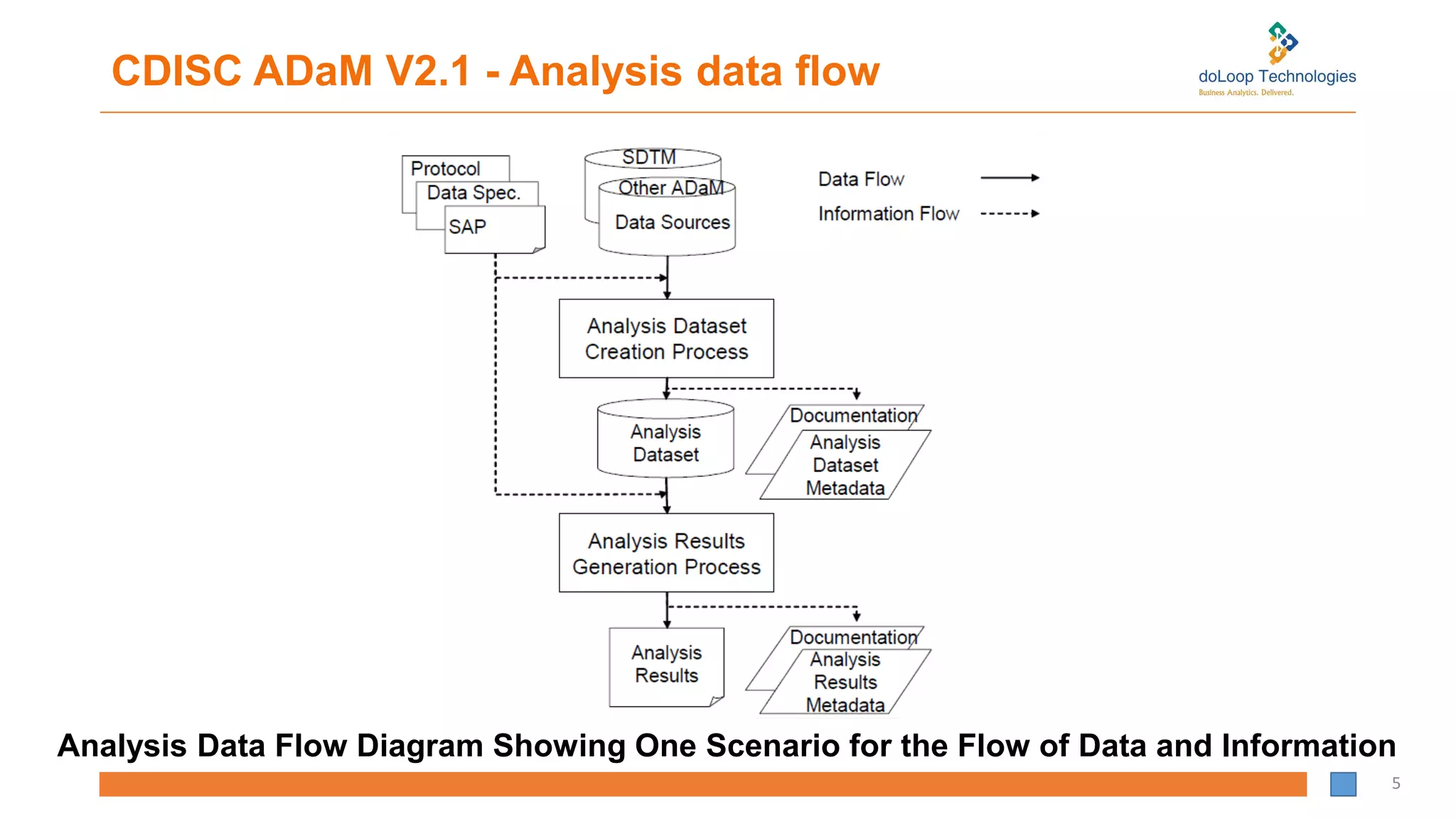
CDISC ADaM V2.1- Analysis data flow
5
Analysis Data Flow Diagram Showing One Scenario for the Flow of Data and Information
6.
Fundamental Principles ofADaM
Provide Traceability
Readily Usable
Associated with Metadata
Communicate Clearly and Unambiguously
6
Analysis Ready Datasets
7.
The ADaM DataStructure
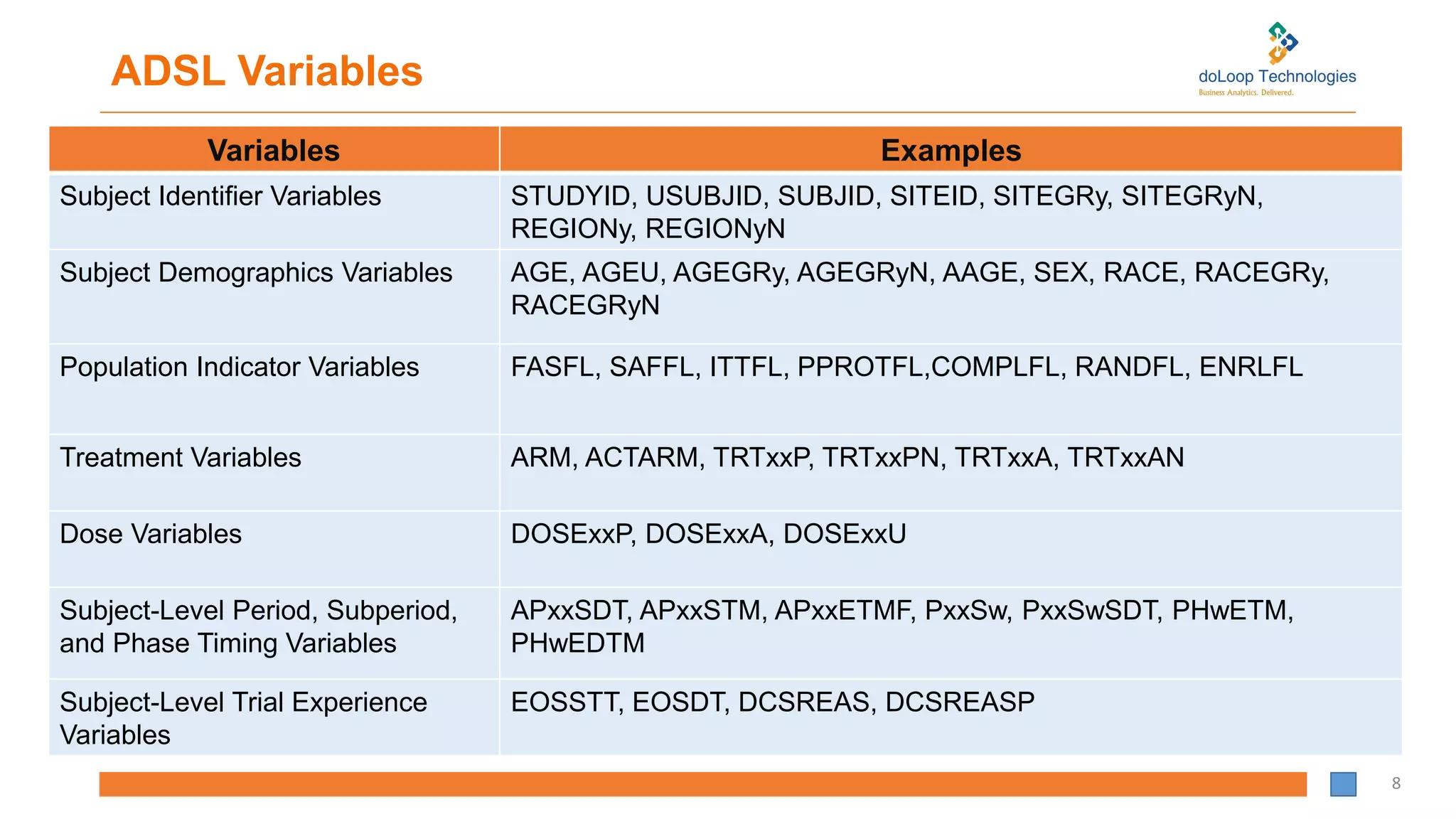
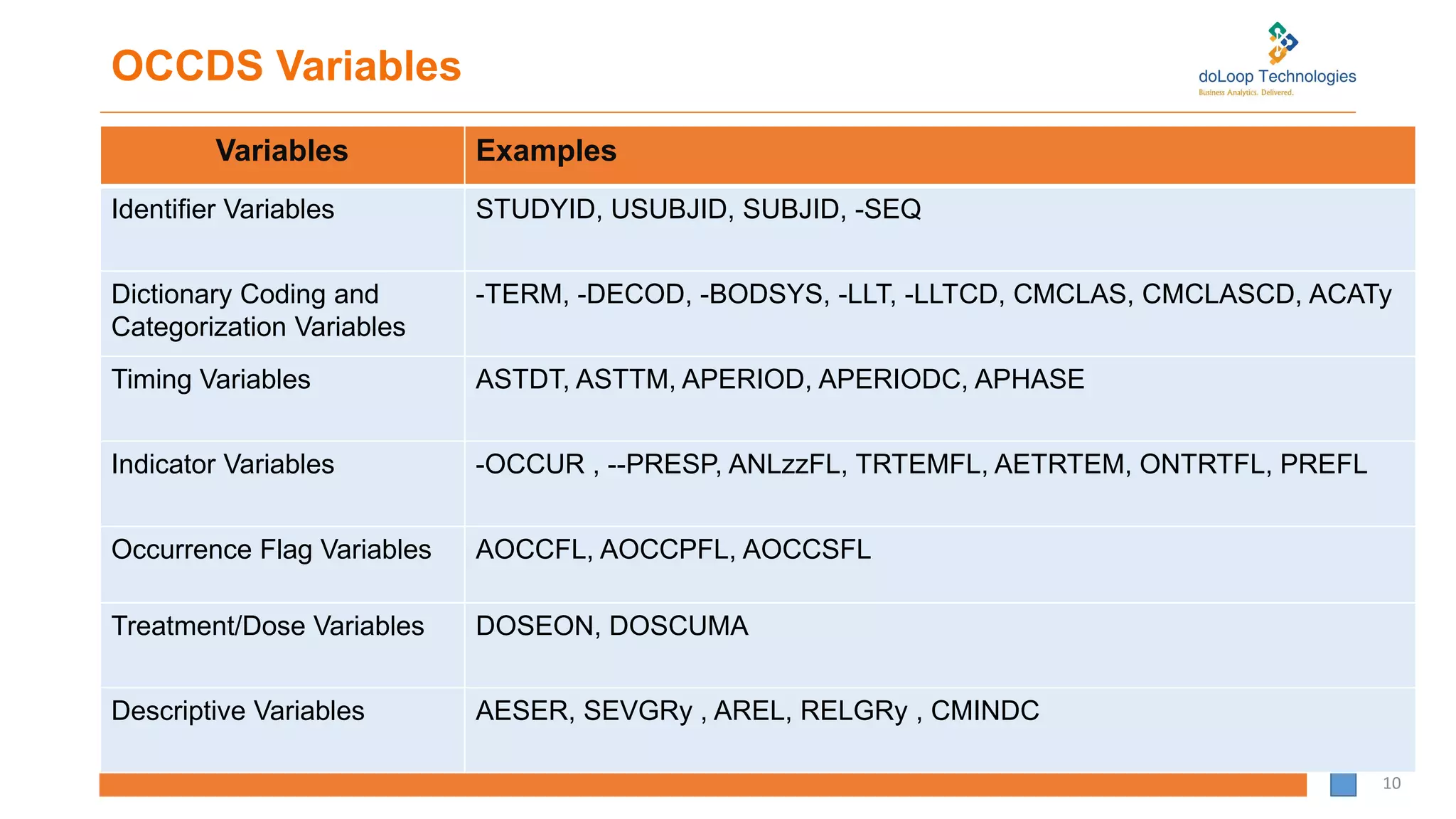
ADSL BDS OCCDS
1) Known as “Subject
level Analysis Data”
1) Known as “Basic Data
Structure”
1) Known as “Occurrence Data
Structure”
2) Structure: One
record per subject
2) Structure: Contains one or
more records per subject,
per analysis parameter, per
analysis time point
2) Structure: One record per record in
SDTM domain (optional: per coding
path, per Analysis Period and/or
Phase)
3) Contains subject-
level information
3) Contains PARAM, AVAL
and AVALC and related
variables
3) Support Occurrence Data Models
such as Medical History, Concomitant
Medications, and Lab Events
4) Example: ADSL 4) Example: ADLB, ADVS 4) Example: ADAE, ADMH
7
Values of ADaM“Core” Attribute
Conditionally
Required
Permissible
11
The variable must be
included in the
dataset in certain
circumstances
The variable may
be included in the
dataset, but is not
required
The variable
must be included
in the dataset
ADaM Specification Development:Where Do I Start ?
13
ADaM Subject Matter Expert
Well defined specification template
SDTM Datasets
Analysis keys
ADaM Specification Development is the starting point for ADaM process after
SDTM. Here is the ABC’s for specification developments….
14.
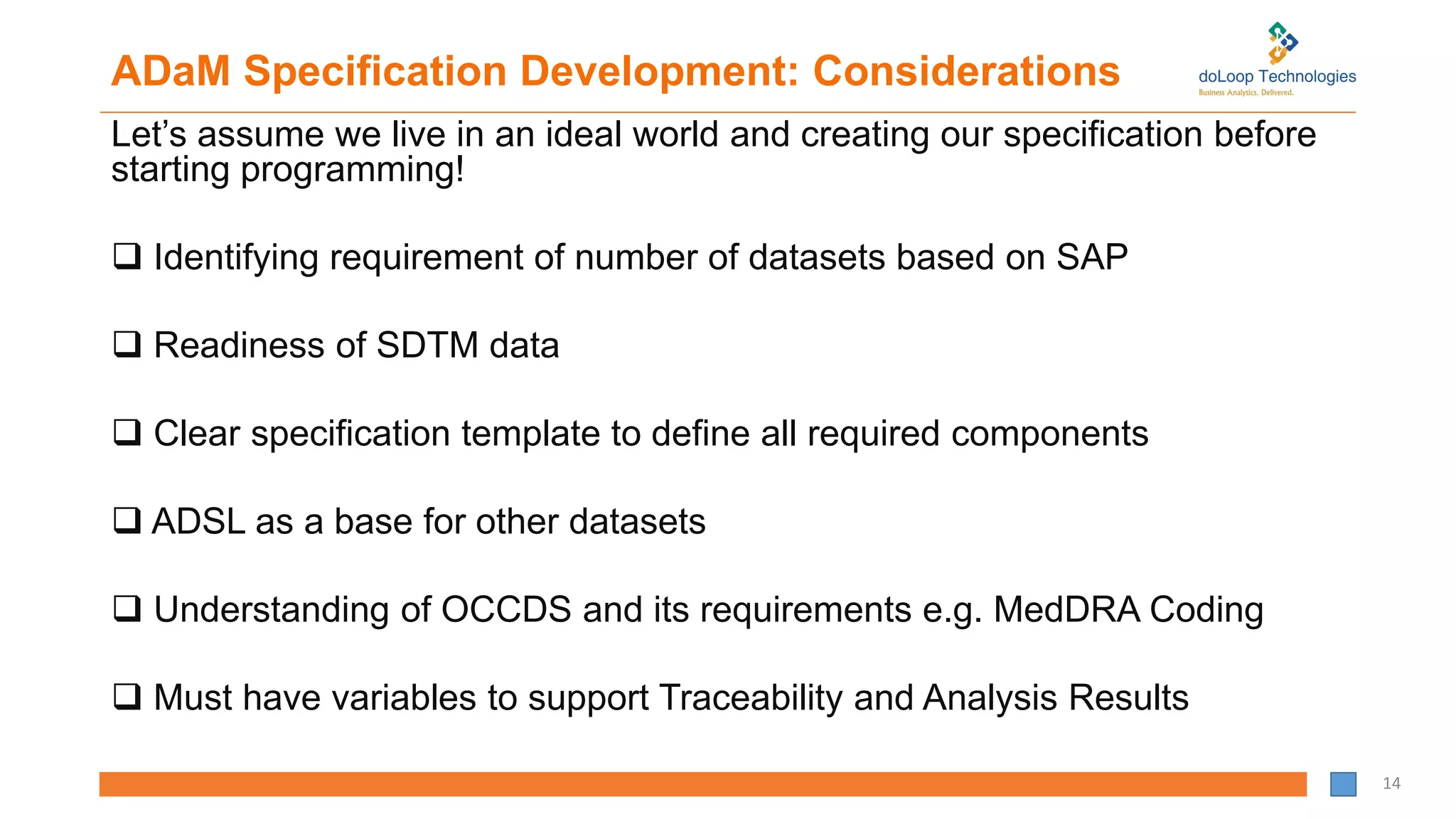
ADaM Specification Development:Considerations
Let’s assume we live in an ideal world and creating our specification before
starting programming!
Identifying requirement of number of datasets based on SAP
Readiness of SDTM data
Clear specification template to define all required components
ADSL as a base for other datasets
Understanding of OCCDS and its requirements e.g. MedDRA Coding
Must have variables to support Traceability and Analysis Results
14
15.
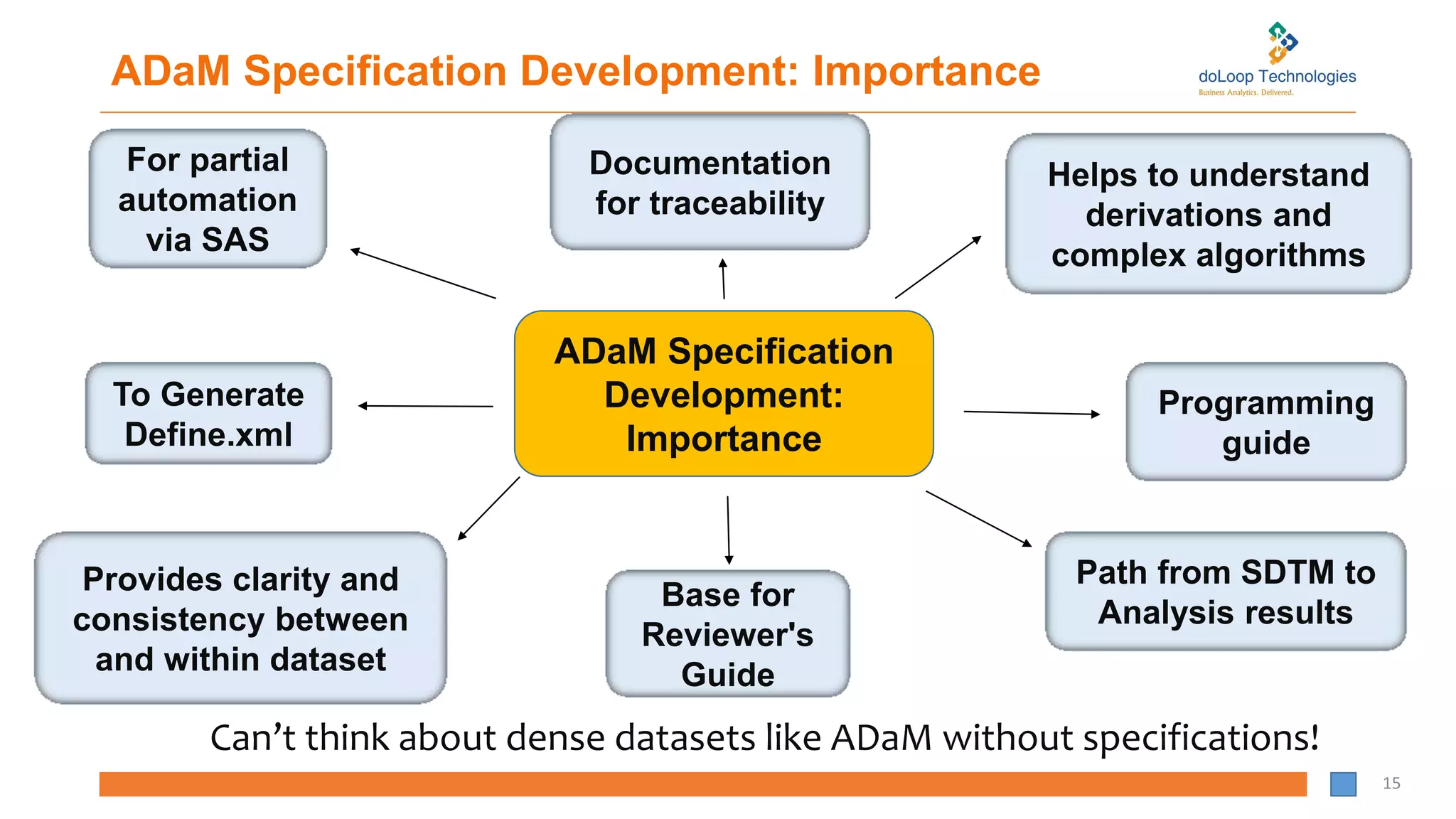
ADaM Specification Development:Importance
ADaM Specification
Development:
Importance
Path from SDTM to
Analysis results
Programming
guide
Helps to understand
derivations and
complex algorithms
For partial
automation
via SAS
Base for
Reviewer's
Guide
Documentation
for traceability
Provides clarity and
consistency between
and within dataset
15
To Generate
Define.xml
Can’t think about dense datasets like ADaM without specifications!
16.
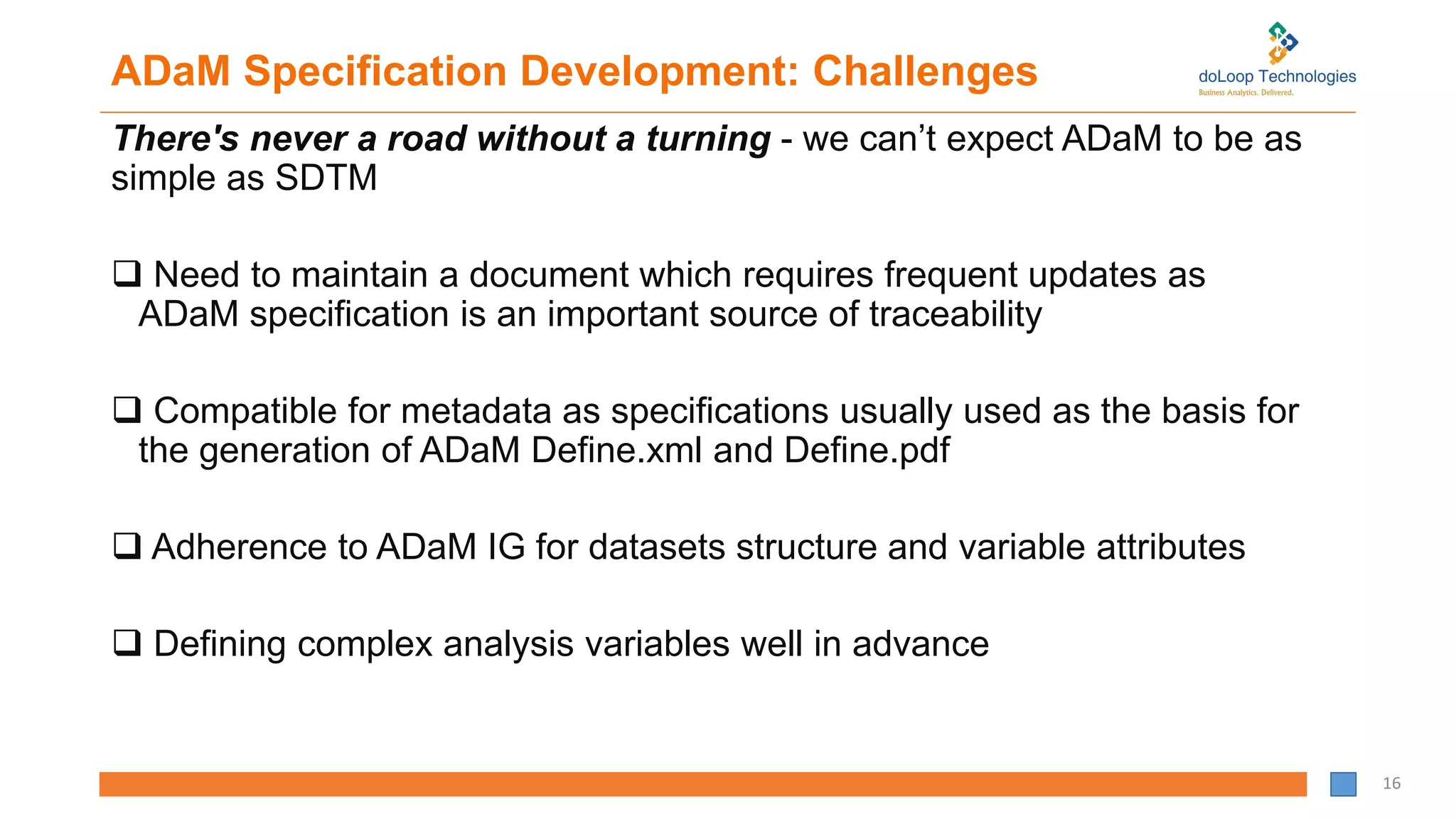
ADaM Specification Development:Challenges
There's never a road without a turning - we can’t expect ADaM to be as
simple as SDTM
Need to maintain a document which requires frequent updates as
ADaM specification is an important source of traceability
Compatible for metadata as specifications usually used as the basis for
the generation of ADaM Define.xml and Define.pdf
Adherence to ADaM IG for datasets structure and variable attributes
Defining complex analysis variables well in advance
16
17.
ADaM Specification Development:Recommendation
Identify any discrepancy in SDTM during specification development level
Follow the standard process, prepare specifications first and then start
programming
Adhere ADaM Implementation Guide and write specifications for ADaM
datasets instead ADaM like datasets from beginning
ADaM is the extended process and changes or updates are expected at
any point of time, document and track the updates applicable to
specification without delaying
17
18.
Example
Order Active DatasetDescription Structure Purpose Keys Location
1 Y ADSL Subject Level Characteristics One record per subject Analysis STUDYID, USUBJID ADSL.xpt
2 Y ADAE Adverse Events
One record per Event per
subject Analysis
STUDYID, USUBJID, AETERM,
AEDECOD, AEBODSYS, ASTDT, AENDTADAE.xpt
order
Dom
ain
Nam
e
Activ
e
Varia
ble
Name Variable Label Type
Codelis
t
Origin of
Variable
(Protocol,
Assigned,
Derived,
eDT, CRF
Page no.)
Internal
Variable
Length Mapping Rules Notes provided by CDISC v1.1
Type of
CDISC
Variable
1 ADSL Y
STUDYI
D Study Identifier text 12 DM.studyid;
Must be identical to the SDTM variable
DM.STUDYID. Req
2 ADSL Y
DOMA
IN Domain Abbreviation text DOMAIN 4 domain = 'ADSL'; Req
Domain Sheet
ADSL Sheet
18
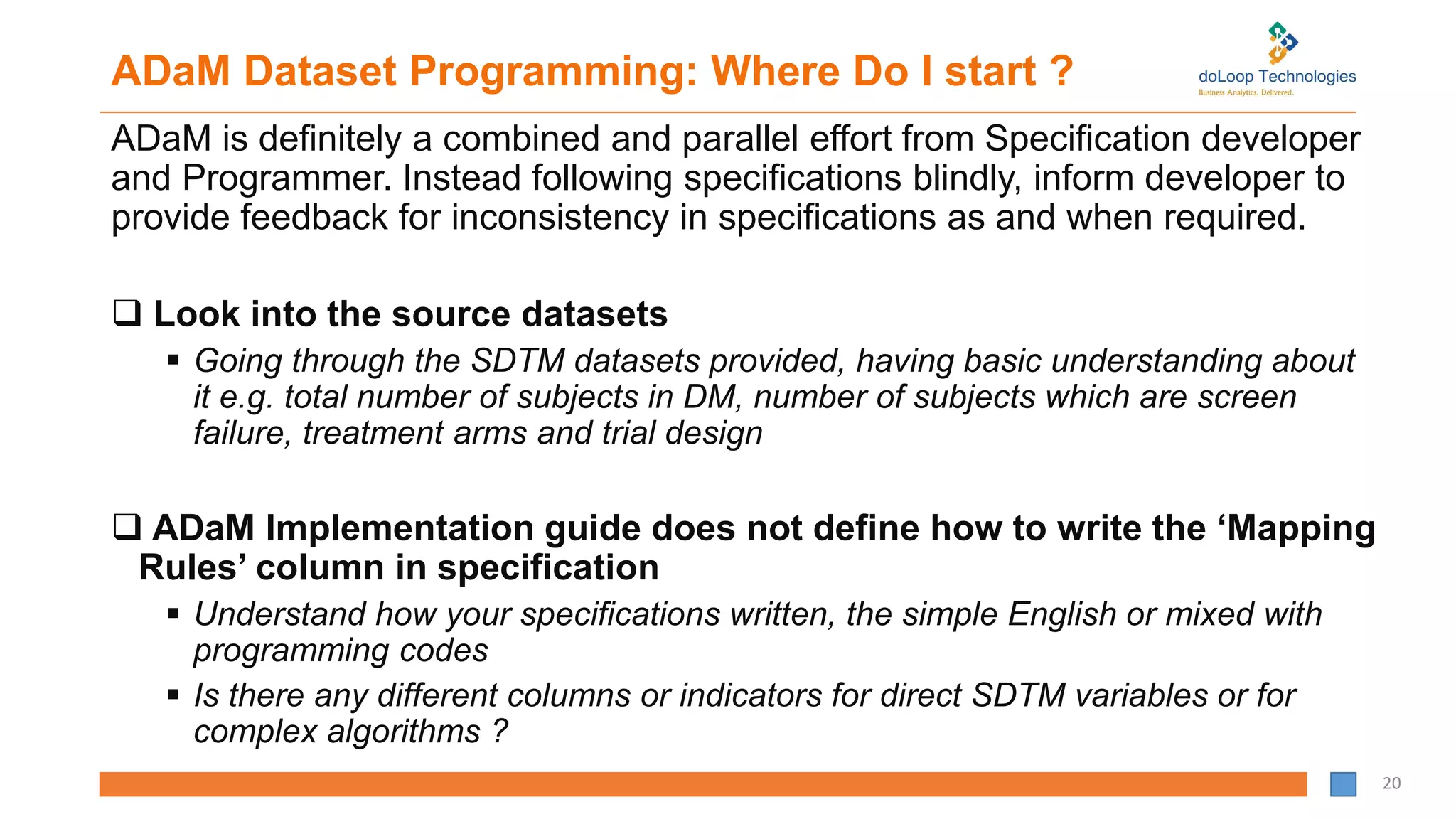
ADaM Dataset Programming:Where Do I start ?
ADaM is definitely a combined and parallel effort from Specification developer
and Programmer. Instead following specifications blindly, inform developer to
provide feedback for inconsistency in specifications as and when required.
Look into the source datasets
Going through the SDTM datasets provided, having basic understanding about
it e.g. total number of subjects in DM, number of subjects which are screen
failure, treatment arms and trial design
ADaM Implementation guide does not define how to write the ‘Mapping
Rules’ column in specification
Understand how your specifications written, the simple English or mixed with
programming codes
Is there any different columns or indicators for direct SDTM variables or for
complex algorithms ?
20
21.
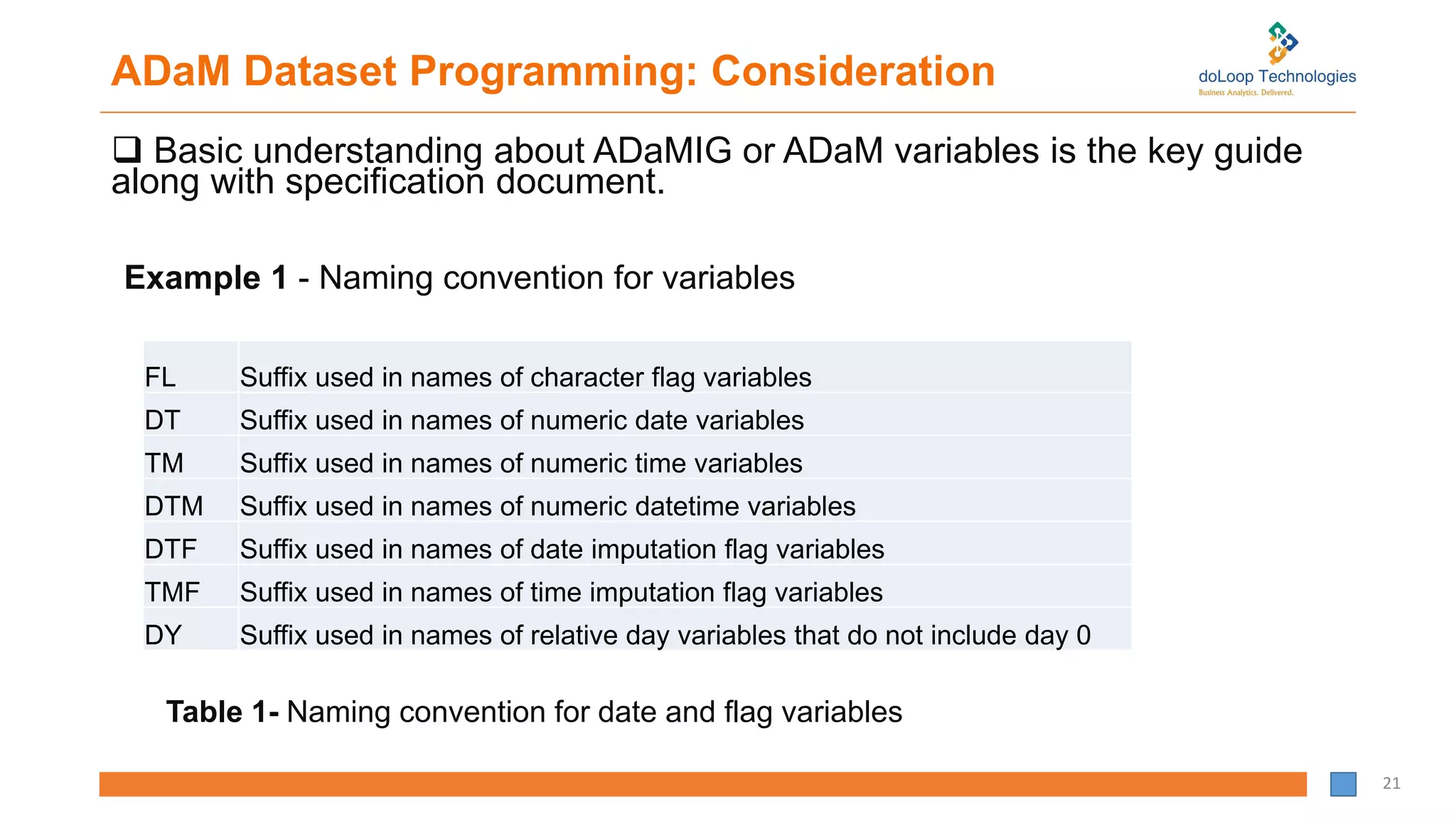
ADaM Dataset Programming:Consideration
Basic understanding about ADaMIG or ADaM variables is the key guide
along with specification document.
Example 1 - Naming convention for variables
Table 1- Naming convention for date and flag variables
FL Suffix used in names of character flag variables
DT Suffix used in names of numeric date variables
TM Suffix used in names of numeric time variables
DTM Suffix used in names of numeric datetime variables
DTF Suffix used in names of date imputation flag variables
TMF Suffix used in names of time imputation flag variables
DY Suffix used in names of relative day variables that do not include day 0
21
22.
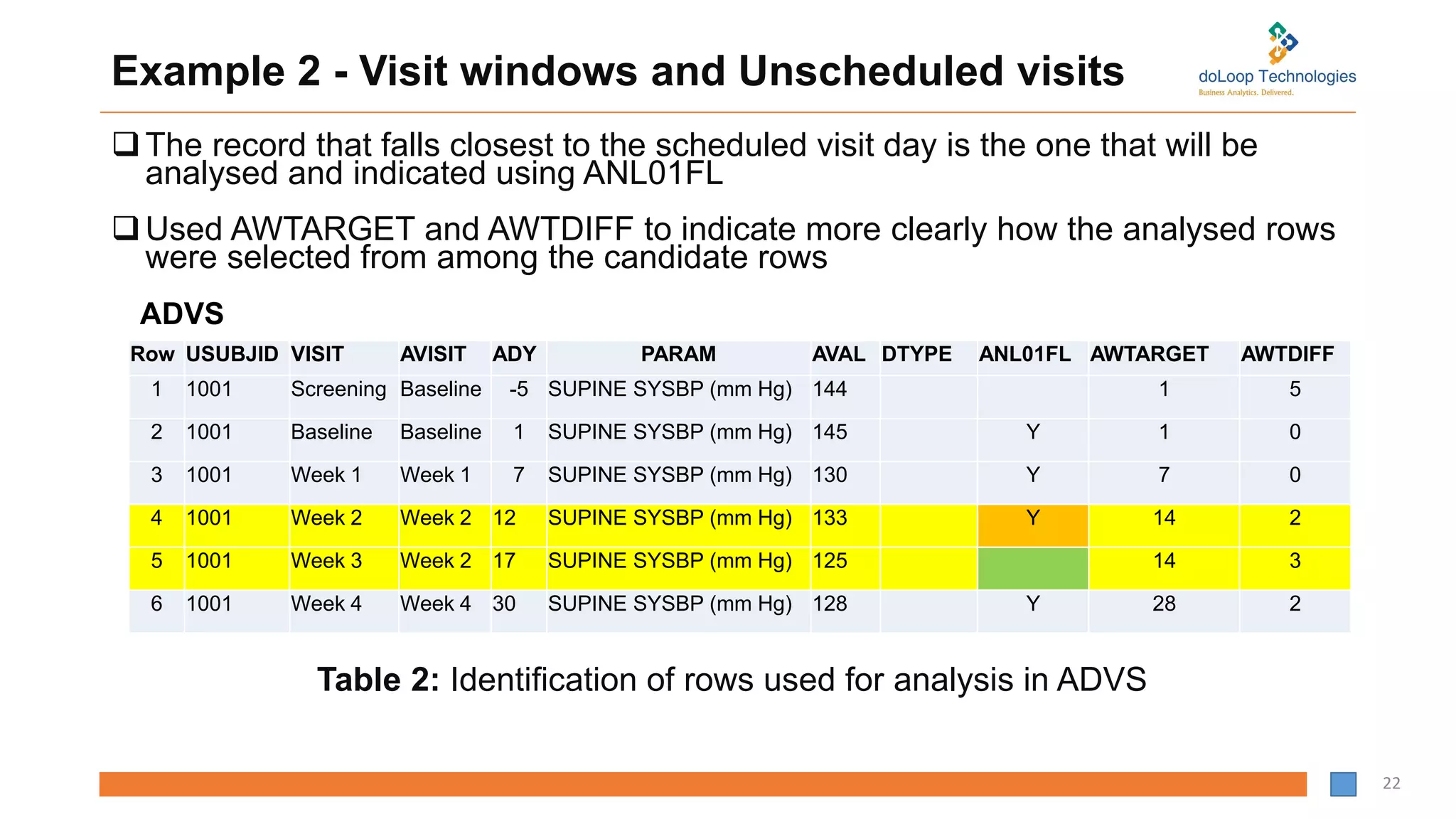
Example 2 -Visit windows and Unscheduled visits
The record that falls closest to the scheduled visit day is the one that will be
analysed and indicated using ANL01FL
Used AWTARGET and AWTDIFF to indicate more clearly how the analysed rows
were selected from among the candidate rows
Table 2: Identification of rows used for analysis in ADVS
22
Row USUBJID VISIT AVISIT ADY PARAM AVAL DTYPE ANL01FL AWTARGET AWTDIFF
1 1001 Screening Baseline -5 SUPINE SYSBP (mm Hg) 144 1 5
2 1001 Baseline Baseline 1 SUPINE SYSBP (mm Hg) 145 Y 1 0
3 1001 Week 1 Week 1 7 SUPINE SYSBP (mm Hg) 130 Y 7 0
4 1001 Week 2 Week 2 12 SUPINE SYSBP (mm Hg) 133 Y 14 2
5 1001 Week 3 Week 2 17 SUPINE SYSBP (mm Hg) 125 14 3
6 1001 Week 4 Week 4 30 SUPINE SYSBP (mm Hg) 128 Y 28 2
ADVS
Table 2: Identification of rows used for analysis in ADVS
23.
Example 3 -How to handle missing values
23
Row PARAM AVISIT AVISITN VISITNUM VSSEQ ABLFL AVAL BASE CHG DTYPE ADY AWTARGET AWTDIFF ANL01FL
1 Systolic BP (mm Hg) Screening -4 1 3821 120 114 . -30 -28 2 Y
2 Systolic BP (mm Hg) Run-In -2 2 3822 116 114 . -16 -14 2 Y
3 Systolic BP (mm Hg) Week 0 0 3 3823 Y 114 114 0 -2 1 2 Y
4 Systolic BP (mm Hg) Week 2 2 4 3824 118 114 4 13 14 1 Y
5 Systolic BP (mm Hg) Week 2 2 4.1 3825 126 114 12 17 14 3
6 Systolic BP (mm Hg) Week 4 4 5 3826 122 114 8 23 28 5 Y
7 Systolic BP (mm Hg) Week 8 8 5 3826 122 114 8 LOCF 23 56 33 Y
8 Systolic BP (mm Hg) Week 8 8 4.1 3825 126 114 12 WOCF 17 56 39 Y
9 Systolic BP (mm Hg) Week 12 12 7 3827 134 114 20 83 84 1 Y
At Week 8, there is a scheduled visit (visit number 6), at that visit, blood pressure should be collected.
However, no data on blood pressure were collected. The SAP says that missing post-baseline data
should be imputed by two methods: LOCF (last observation carried forward), and WOCF (worst
observation carried forward)
ADVS
Table 3 - Creation of New Rows to Handle Imputation of Missing Values by LOCF & WOCF
24.
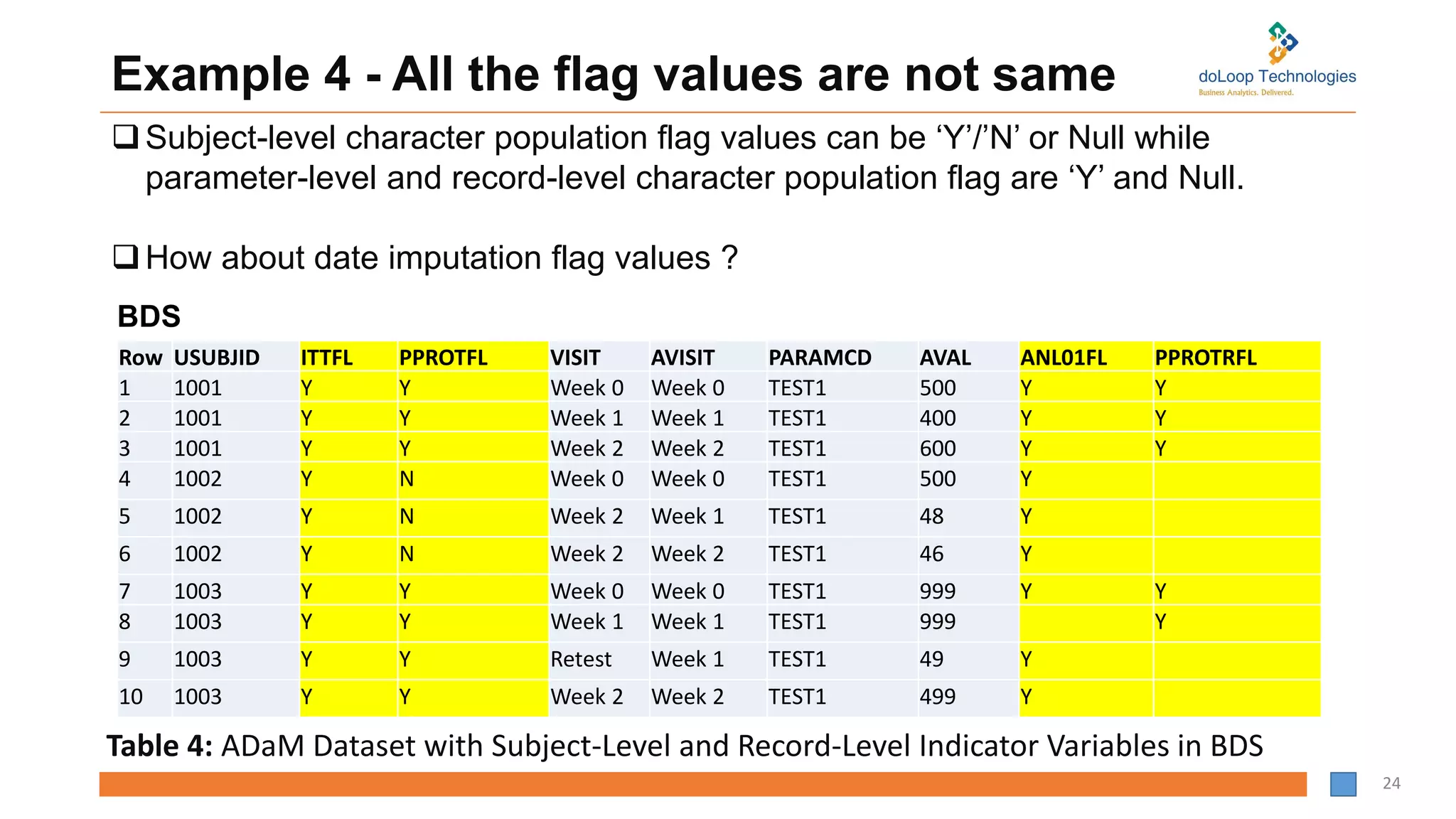
Example 4 -All the flag values are not same
Row USUBJID ITTFL PPROTFL VISIT AVISIT PARAMCD AVAL ANL01FL PPROTRFL
1 1001 Y Y Week 0 Week 0 TEST1 500 Y Y
2 1001 Y Y Week 1 Week 1 TEST1 400 Y Y
3 1001 Y Y Week 2 Week 2 TEST1 600 Y Y
4 1002 Y N Week 0 Week 0 TEST1 500 Y
5 1002 Y N Week 2 Week 1 TEST1 48 Y
6 1002 Y N Week 2 Week 2 TEST1 46 Y
7 1003 Y Y Week 0 Week 0 TEST1 999 Y Y
8 1003 Y Y Week 1 Week 1 TEST1 999 Y
9 1003 Y Y Retest Week 1 TEST1 49 Y
10 1003 Y Y Week 2 Week 2 TEST1 499 Y
24
Subject-level character population flag values can be ‘Y’/’N’ or Null while
parameter-level and record-level character population flag are ‘Y’ and Null.
How about date imputation flag values ?
Table 4: ADaM Dataset with Subject-Level and Record-Level Indicator Variables in BDS
BDS
25.
ADaM Dataset Programming:Importance
Helps to understand how Derivation
and Algorithms works on data
Well written programs can also be used in next study
Helps to self QC the output dataset for programmers
Helps find out any loopholes in specifications
25
26.
ADaM Dataset Programming:Challenges
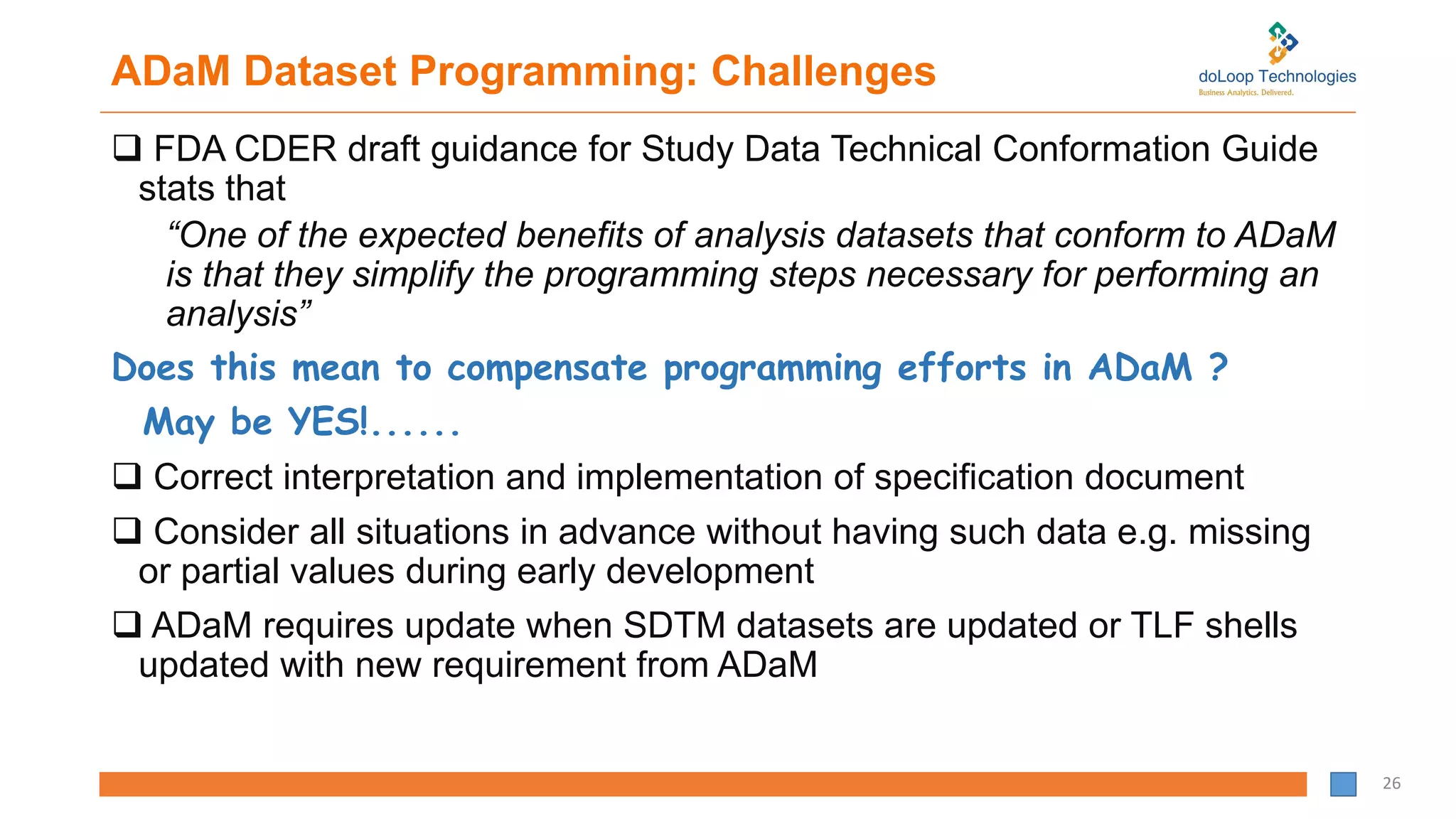
FDA CDER draft guidance for Study Data Technical Conformation Guide
stats that
“One of the expected benefits of analysis datasets that conform to ADaM
is that they simplify the programming steps necessary for performing an
analysis”
Does this mean to compensate programming efforts in ADaM ?
May be YES!......
Correct interpretation and implementation of specification document
Consider all situations in advance without having such data e.g. missing
or partial values during early development
ADaM requires update when SDTM datasets are updated or TLF shells
updated with new requirement from ADaM
26
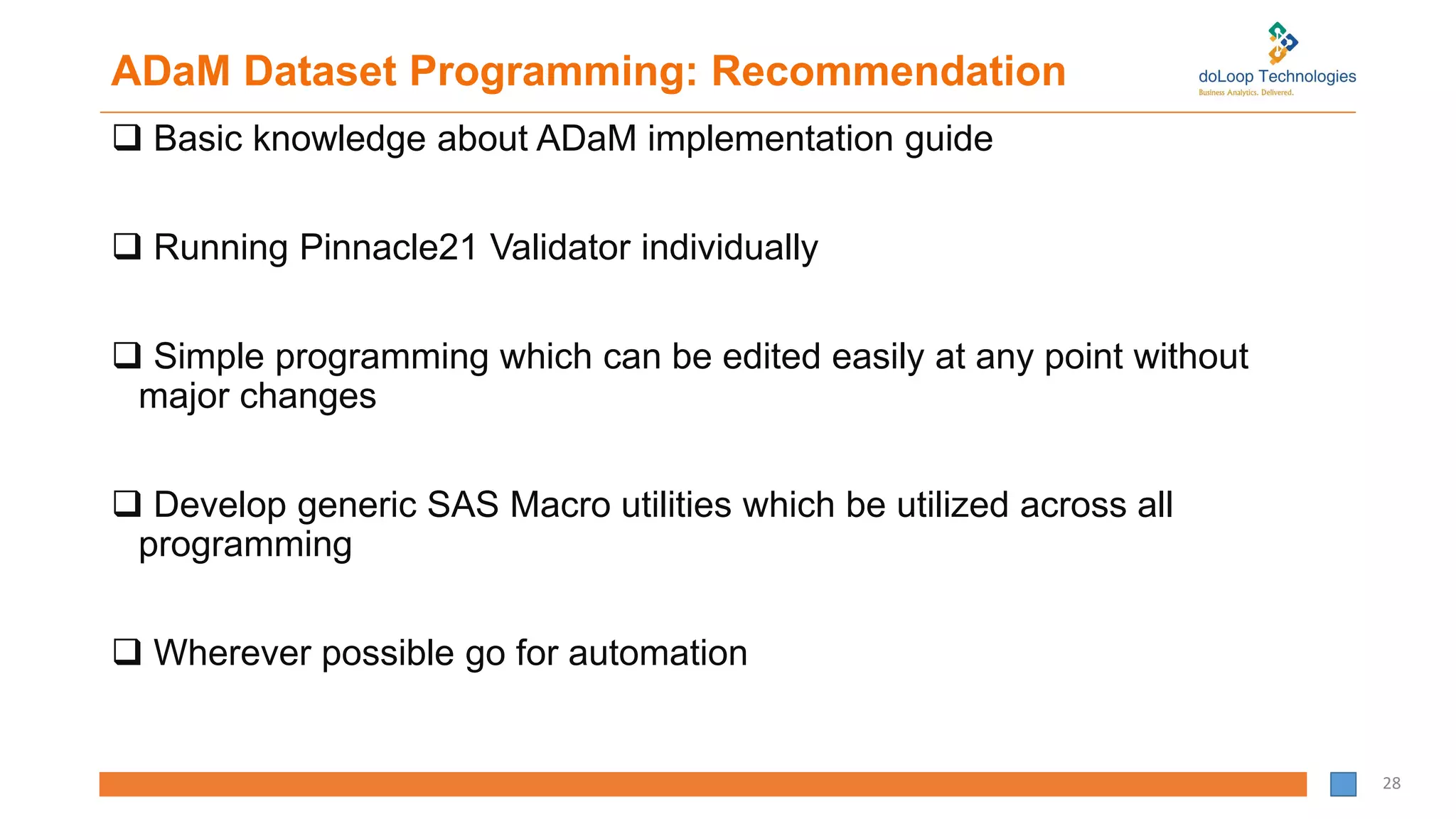
ADaM Dataset Programming:Recommendation
Basic knowledge about ADaM implementation guide
Running Pinnacle21 Validator individually
Simple programming which can be edited easily at any point without
major changes
Develop generic SAS Macro utilities which be utilized across all
programming
Wherever possible go for automation
28
ADaM QC: Wheredo I Start ?
QC goal should be
Tracking ADaM data back to SDTM
Checking compliance with the ADaM Implementation Guide
Checking compliance of analysis variables and its derivation with
required analysis results
QC process may involve
Pinnacle21 Validator report
Using standardized macro which can also generate report
Identify independent QC resource with ADaM implementation
knowledge
Create a study specific QC checklist which can check basic ADaM
principle
Documentation of QC process and QC findings
30
31.
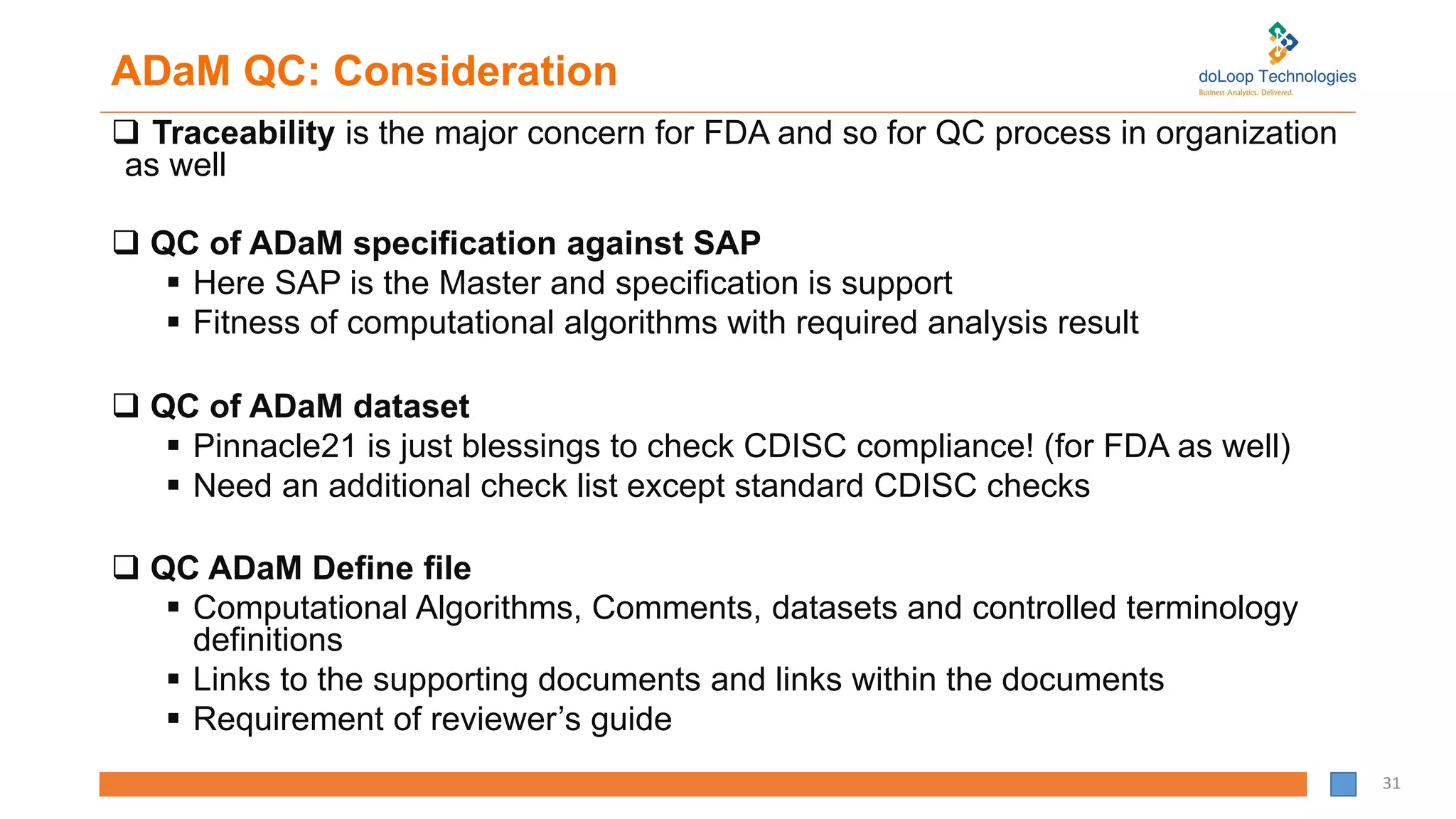
ADaM QC: Consideration
Traceability is the major concern for FDA and so for QC process in organization
as well
QC of ADaM specification against SAP
Here SAP is the Master and specification is support
Fitness of computational algorithms with required analysis result
QC of ADaM dataset
Pinnacle21 is just blessings to check CDISC compliance! (for FDA as well)
Need an additional check list except standard CDISC checks
QC ADaM Define file
Computational Algorithms, Comments, datasets and controlled terminology
definitions
Links to the supporting documents and links within the documents
Requirement of reviewer’s guide
31
32.
ADaM QC: Importance
Importance
32
Minimalreview
comments from
regulatory reviewers
Minimize future
rework by resolving
issues at ADaM level
Save time for
TLF generation
33.
ADaM QC: Challenges
33
Understandthe source
data and tracking it to
the ADaM Statistical basis of
analysis variables
Accuracy of
computational and
complex algorithms
Adherence to
ADaM Model
34.
ADaM QC: Recommendations
34
Planning
ofTimelines
Simultaneous QC as
datasets are generated
Double check your
Programming to
avoid major issuesPrioritize datasets
considering
interdependency
ADaM Expert as ADaM QC
resource and not a beginner
35.
References
Analysis DataModel Implementation Guide Version 1.1
ADaM Structure for Occurrence Data (OCCDS) Version 1.0
CDISC Analysis Data Model Version 2.1
How to build ADaM from SDTM: A real case study (JIAN HUA (DANIEL)
HUANG, FOREST LABORATORIES, NJ PharmaSUG2010 - Paper CD06)
Challenges of Questionnaire Data from Collection to SDTM to ADaM and
Solutions using SAS® (Karin LaPann, PRA International, Horsham, PA
Terek Peterson, MBA, PRA International, Horsham, PA PharmaSUG 2014
– DS08)
An Innovative ADaM Programming Tool for FDA Submission Xiangchen
(Bob) Cui, Min Chen Vertex Pharmaceuticals, Cambridge, MA
Challenges in Validation of ADaM data, Presented at PhUSE SDE April
18, 2013
35
36.
36
Dr.Sangram Parbhane
Associate ClinicalSAS Programmer
doLoop Technologies India Pvt. Ltd.
Email: sangram.parbhane@dolooptech.com
www.dolooptech.com
Krupali Ladani
Senior Clinical SAS Programmer
doLoop Technologies India Pvt. Ltd.
Email: krupali.ladani@dolooptech.com
www.dolooptech.com
Reach out to us @




















![[DSC Europe 25] Bassam Maharmeh - Artificial Intelligence: Opportunities and ...](https://cdn.slidesharecdn.com/ss_thumbnails/thhfmr2fqpawzj7hsjpg-5-251211083048-2c23204f-thumbnail.jpg?width=640&height=640&fit=bounds)
![[DSC Europe 25] Branko Dzakula - From Defense to Attack: How AI Redefines Cyb...](https://cdn.slidesharecdn.com/ss_thumbnails/80bdzdxpr3ky2g0qvyk9-8-251211083048-ce5fc1ee-thumbnail.jpg?width=640&height=640&fit=bounds)
![[DSC Europe 25] Dusan Nesic - Securing Tomorrow’s Infrastructure: Why Cyber-P...](https://cdn.slidesharecdn.com/ss_thumbnails/qikbszfftyowjm2q6duw-1-251211083848-8f2ead6b-thumbnail.jpg?width=640&height=640&fit=bounds)
![[DSC Europe 25] Marija Vlajkovic & Andrea Radonjanin - Integration of AI tool...](https://cdn.slidesharecdn.com/ss_thumbnails/qf1jrglttoc3bm8s3aop-final-integration-of-ai-tools-251208151905-394f3a6a-thumbnail.jpg?width=640&height=640&fit=bounds)
![[DSC Europe 25] Dusan Jovicic - AI Story: From on-prem to cloud and back agai...](https://cdn.slidesharecdn.com/ss_thumbnails/8kp49m6uq22ifnbwhfnk-2-251205085715-964d11a6-thumbnail.jpg?width=640&height=640&fit=bounds)

![[DSC Europe 25] Aleksandra Dragicevic - AI-Boosted Research in Healthcare: Fr...](https://cdn.slidesharecdn.com/ss_thumbnails/iqwngszurf2r7pi1lnnj-4-aleksandra-dragicevic-ad-dsc-europe-conference-20-251208151905-37c3238a-thumbnail.jpg?width=640&height=640&fit=bounds)

![[DSC Europe 25] Dusan Pavlov - There Is No Spoon: Inferring Vision from Neura...](https://cdn.slidesharecdn.com/ss_thumbnails/wg0v1umoqjm4nnbd3p0v-there-is-no-spoon-251205085715-6d81d6c5-thumbnail.jpg?width=640&height=640&fit=bounds)

![[DSC Europe 25] Milan Sekuloski - Data, Defence, and Development: Cybersecuri...](https://cdn.slidesharecdn.com/ss_thumbnails/dfrkwwx4qly6atqpbl4z-4-251209104645-c3d4b0ca-thumbnail.jpg?width=640&height=640&fit=bounds)
![[DSC Europe 25] Andy Cotgreave - Nothing is new in analytics.pptx](https://cdn.slidesharecdn.com/ss_thumbnails/mba4vzcurvoh5lfrd5zw-6-251205194645-341bbbbe-thumbnail.jpg?width=640&height=640&fit=bounds)


![[DSC Europe 25] Max Talanov - Non digital NNs.pptx](https://cdn.slidesharecdn.com/ss_thumbnails/wif8tr3gtua74qvtopke-non-digital-nns-251205090438-26b0eea6-thumbnail.jpg?width=640&height=640&fit=bounds)

![[DSC Europe 25] Bogdan Daniel Maruneac - AI - It starts with you.pptx](https://cdn.slidesharecdn.com/ss_thumbnails/odov3snhrcqs9hx5ny2n-4-251205085715-f1daacfe-thumbnail.jpg?width=640&height=640&fit=bounds)
