Mobile Payments
SDP Global Summit
Rome
12. 9. 2012
Martin Prosek, VAS Platform Development Manager
Telefónica Czech Republic
Telefó
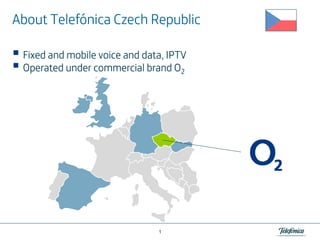
About Telefónica Czech Republic
Fixed and mobile voice and data, IPTV
Operated under commercial brand O2

1
Telefó
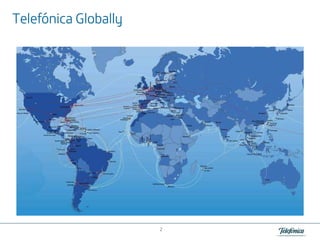
Telefónica Globally

2
BlueVia – Global APIs

https://bluevia.com/
Introduction

01 Mobile Payments Quick Review
02 Telefónica Czech Republic Experience
03 Opportunities
04 Technical Solutions
05 Risks and their Mitigations
06 Summary/Recommendations
Disclaimer: The opinions of the author expressed in this document do not
necessarily state or reflect those of Telefónica company
4
Mobile Payments
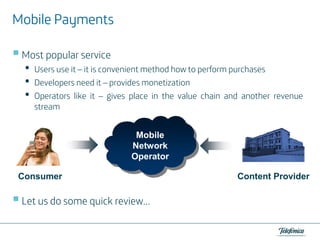
Most popular service

•
•
•

Users use it – it is convenient method how to perform purchases
Developers need it – provides monetization
Operators like it – gives place in the value chain and another revenue
stream
Mobile
Network
Mobile Network
Operator
Operator

Consumer

Let us do some quick review…

Content Provider
Payments?
What are the Mobile Payments?
Many definitions exist…

•

It generally refers to payment services performed from or via a mobile
device.

Focus on Mobile Network Operator service

•
•
•
•

Not mobile banking
Not payments using credit/debit card
Not payment through online payment provider
Not NFC

Direct to bill (D2B)
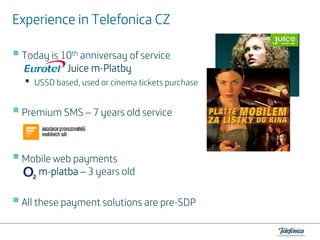
Experience in Telefonica CZ
Today is 10th anniversay of service
mJuice m-Platby

•

USSD based, used or cinema tickets purchase

Premium SMS – 7 years old service

Mobile web payments
m-platba – 3 years old
All these payment solutions are pre-SDP
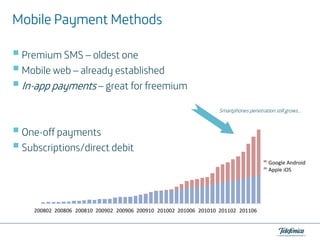
Mobile Payment Methods
Premium SMS – oldest one
Mobile web – already established
In-app payments – great for freemium
InSmartphones penetration still grows…

One-off payments
Subscriptions/direct debit
Google Android
Apple iOS

200802 200806 200810 200902 200906 200910 201002 201006 201010 201102 201106
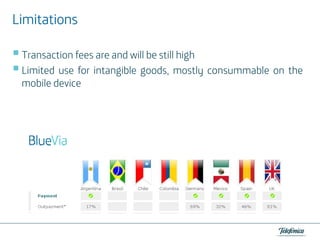
Limitations
Transaction fees are and will be still high
Limited use for intangible goods, mostly consummable on the
mobile device
Opportunity
The situation is very positive

•
•
•
•

The smartphones penetration is high
Users already have learned to pay for apps
Operators are perceived as trusted parties and have
good track of history in mobile content
User experience is better than for using payment
cards

Mobile Payments can substitute the declining
content revenues
Mobile Payments can help operators to return
to the value chain and stop being dumb pipe
Technical Solutions
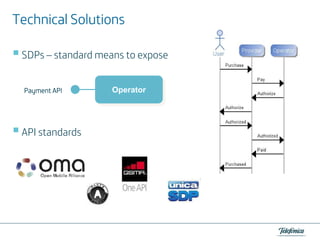
SDPs – standard means to expose
Payment API

API standards

Operator
Operator
Business Risks
Repudiation

•
•

When operator cannot prove user‘s consent user later can reject the
payment
Closely connected to subscribe identification

Provider charging without providing service

•
•

By mistake or technical failure
Biggest problem can be fraudulent use

Unclear relation to the provider

•

Not possible to get clear responsibility
Technical Risks
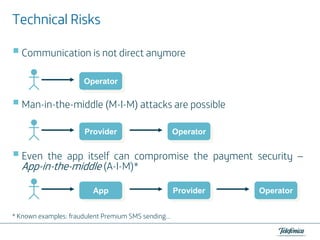
Communication is not direct anymore
Operator
Operator

Man-in-the-middle (M-I-M) attacks are possible
Provider
Provider

Operator
Operator

Even the app itself can compromise the payment security –
App-in-theApp-in-the-middle (A-I-M)*
App
App
* Known examples: fraudulent Premium SMS sending…

Provider
Provider

Operator
Operator
Mitigations
Possible Risk Mitigations
Payment transactions and/or spend limits (per day, month…)
Different security levels for different amount of payments

•

E.g. for purchases under 2 € lower security

Security influenced design of payment authorization

•
•
•

User giving consent as directly as possible (no M-I-M)
Verification of human interaction (login by username/password, PIN,
captcha, mouse movements/gestures…)
Alternative communication channels (SMS, USSD…), use of one-time
password
Mitigations
Possible Risk Mitigations
Payment notifications (by SMS and/or e-mails)

•

User gets info about payment transaction everytime

Offering opt-in model

•

Use must confirm intention to have payments enabled

Best solution would be use of SIM-based transaction signing
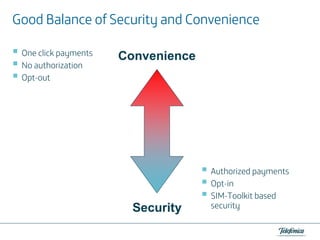
Good Balance of Security and Convenience
One click payments
No authorization
Opt-out

Convenience

Security

Authorized payments
Opt-in
SIM-Toolkit based
security
Recommendations
Let the user be in control of the service security settings – provide good web
selfcare
Give the user access to full history of the payments – on the web selfcare
MADo your best to have direct access to user (no M-I-M or A-I-M)
Have clear contracts with providers stating responsibility for all cases
all

17
Empire…
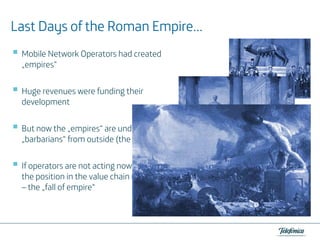
Last Days of the Roman Empire…
Mobile Network Operators had created
„empires“
Huge revenues were funding their
development
But now the „empires“ are under attacks of
„barbarians“ from outside (the Internet…)
If operators are not acting now
the position in the value chain might be lost
– the „fall of empire“
Questions?
Thank you.

SDP Global Summit 2012

  • 1.
    Mobile Payments SDP GlobalSummit Rome 12. 9. 2012 Martin Prosek, VAS Platform Development Manager Telefónica Czech Republic
  • 2.
    Telefó About Telefónica CzechRepublic Fixed and mobile voice and data, IPTV Operated under commercial brand O2 1
  • 3.
  • 4.
    BlueVia – GlobalAPIs https://bluevia.com/
  • 5.
    Introduction 01 Mobile PaymentsQuick Review 02 Telefónica Czech Republic Experience 03 Opportunities 04 Technical Solutions 05 Risks and their Mitigations 06 Summary/Recommendations Disclaimer: The opinions of the author expressed in this document do not necessarily state or reflect those of Telefónica company 4
  • 6.
    Mobile Payments Most popularservice • • • Users use it – it is convenient method how to perform purchases Developers need it – provides monetization Operators like it – gives place in the value chain and another revenue stream Mobile Network Mobile Network Operator Operator Consumer Let us do some quick review… Content Provider
  • 7.
    Payments? What are theMobile Payments? Many definitions exist… • It generally refers to payment services performed from or via a mobile device. Focus on Mobile Network Operator service • • • • Not mobile banking Not payments using credit/debit card Not payment through online payment provider Not NFC Direct to bill (D2B)
  • 8.
    Experience in TelefonicaCZ Today is 10th anniversay of service mJuice m-Platby • USSD based, used or cinema tickets purchase Premium SMS – 7 years old service Mobile web payments m-platba – 3 years old All these payment solutions are pre-SDP
  • 9.
    Mobile Payment Methods PremiumSMS – oldest one Mobile web – already established In-app payments – great for freemium InSmartphones penetration still grows… One-off payments Subscriptions/direct debit Google Android Apple iOS 200802 200806 200810 200902 200906 200910 201002 201006 201010 201102 201106
  • 10.
    Limitations Transaction fees areand will be still high Limited use for intangible goods, mostly consummable on the mobile device
  • 11.
    Opportunity The situation isvery positive • • • • The smartphones penetration is high Users already have learned to pay for apps Operators are perceived as trusted parties and have good track of history in mobile content User experience is better than for using payment cards Mobile Payments can substitute the declining content revenues Mobile Payments can help operators to return to the value chain and stop being dumb pipe
  • 12.
    Technical Solutions SDPs –standard means to expose Payment API API standards Operator Operator
  • 13.
    Business Risks Repudiation • • When operatorcannot prove user‘s consent user later can reject the payment Closely connected to subscribe identification Provider charging without providing service • • By mistake or technical failure Biggest problem can be fraudulent use Unclear relation to the provider • Not possible to get clear responsibility
  • 14.
    Technical Risks Communication isnot direct anymore Operator Operator Man-in-the-middle (M-I-M) attacks are possible Provider Provider Operator Operator Even the app itself can compromise the payment security – App-in-theApp-in-the-middle (A-I-M)* App App * Known examples: fraudulent Premium SMS sending… Provider Provider Operator Operator
  • 15.
    Mitigations Possible Risk Mitigations Paymenttransactions and/or spend limits (per day, month…) Different security levels for different amount of payments • E.g. for purchases under 2 € lower security Security influenced design of payment authorization • • • User giving consent as directly as possible (no M-I-M) Verification of human interaction (login by username/password, PIN, captcha, mouse movements/gestures…) Alternative communication channels (SMS, USSD…), use of one-time password
  • 16.
    Mitigations Possible Risk Mitigations Paymentnotifications (by SMS and/or e-mails) • User gets info about payment transaction everytime Offering opt-in model • Use must confirm intention to have payments enabled Best solution would be use of SIM-based transaction signing
  • 17.
    Good Balance ofSecurity and Convenience One click payments No authorization Opt-out Convenience Security Authorized payments Opt-in SIM-Toolkit based security
  • 18.
    Recommendations Let the userbe in control of the service security settings – provide good web selfcare Give the user access to full history of the payments – on the web selfcare MADo your best to have direct access to user (no M-I-M or A-I-M) Have clear contracts with providers stating responsibility for all cases all 17
  • 19.
    Empire… Last Days ofthe Roman Empire… Mobile Network Operators had created „empires“ Huge revenues were funding their development But now the „empires“ are under attacks of „barbarians“ from outside (the Internet…) If operators are not acting now the position in the value chain might be lost – the „fall of empire“
  • 20.
  • 21.