Sculpture in Wood
Sculpture course
Manami Ishimura
Objective
In this project, students explore the potential of sculpture in wood
considering its materiality, history, and cultural usage.
• Research art works made of wood
• Brainstorm your idea
• Create a maquette out of clay
• Transform wood (and other mediums) to “art”
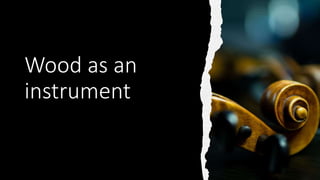
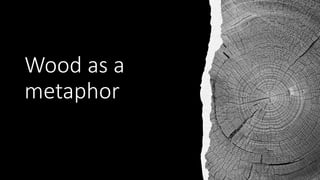
Wood as an
instrument
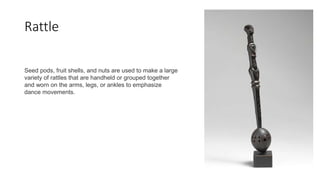
Rattle
Seed pods, fruit shells, and nuts are used to make a large
variety of rattles that are handheld or grouped together
and worn on the arms, legs, or ankles to emphasize
dance movements.
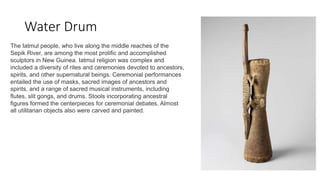
Water Drum
The Iatmul people, who live along the middle reaches of the
Sepik River, are among the most prolific and accomplished
sculptors in New Guinea. Iatmul religion was complex and
included a diversity of rites and ceremonies devoted to ancestors,
spirits, and other supernatural beings. Ceremonial performances
entailed the use of masks, sacred images of ancestors and
spirits, and a range of sacred musical instruments, including
flutes, slit gongs, and drums. Stools incorporating ancestral
figures formed the centerpieces for ceremonial debates. Almost
all utilitarian objects also were carved and painted.
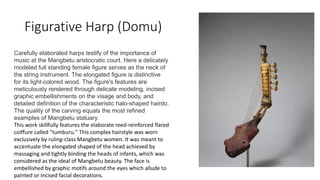
Figurative Harp (Domu)
Carefully elaborated harps testify of the importance of
music at the Mangbetu aristocratic court. Here a delicately
modeled full standing female figure serves as the neck of
the string instrument. The elongated figure is distinctive
for its light-colored wood. The figure's features are
meticulously rendered through delicate modeling, incised
graphic embellishments on the visage and body, and
detailed definition of the characteristic halo-shaped hairdo.
The quality of the carving equals the most refined
examples of Mangbetu statuary.
This work skillfully features the elaborate reed-reinforced flared
coiffure called "tumburu." This complex hairstyle was worn
exclusively by ruling-class Mangbetu women. It was meant to
accentuate the elongated shaped of the head achieved by
massaging and tightly binding the heads of infants, which was
considered as the ideal of Mangbetu beauty. The face is
embellished by graphic motifs around the eyes which allude to
painted or incised facial decorations.
Wood as a tool
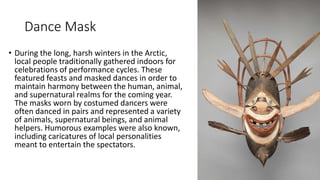
Dance Mask
• During the long, harsh winters in the Arctic,
local people traditionally gathered indoors for
celebrations of performance cycles. These
featured feasts and masked dances in order to
maintain harmony between the human, animal,
and supernatural realms for the coming year.
The masks worn by costumed dancers were
often danced in pairs and represented a variety
of animals, supernatural beings, and animal
helpers. Humorous examples were also known,
including caricatures of local personalities
meant to entertain the spectators.
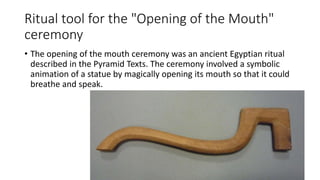
Ritual tool for the "Opening of the Mouth"
ceremony
• The opening of the mouth ceremony was an ancient Egyptian ritual
described in the Pyramid Texts. The ceremony involved a symbolic
animation of a statue by magically opening its mouth so that it could
breathe and speak.
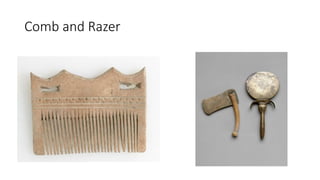
Comb and Razer
Wood as an
Incarnation
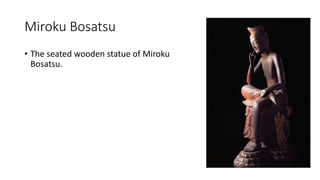
Miroku Bosatsu
• The seated wooden statue of Miroku
Bosatsu.
Henry Moore
• Figure is an early example of Moore’s
development towards abstraction in the
first half of the 1930s. In this sculpture a
figure of a woman is interpreted fluidly, a
rendering that is in part determined by the
sensitivities of the wood’s grain. Its rounded
contours, in common with others from this
period, relate to the sculptor’s interest in
the lines of the landscape, where natural
forms are softened and simplified as a
consequence of weathering.
Henry Moore, FIgure, Beech (1931)
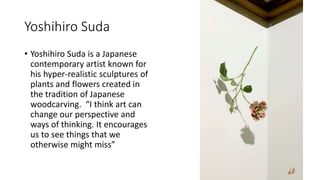
Yoshihiro Suda
• Yoshihiro Suda is a Japanese
contemporary artist known for
his hyper-realistic sculptures of
plants and flowers created in
the tradition of Japanese
woodcarving. “I think art can
change our perspective and
ways of thinking. It encourages
us to see things that we
otherwise might miss”
Wood as a
symbol
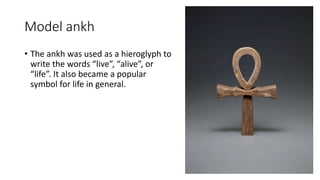
Model ankh
• The ankh was used as a hieroglyph to
write the words “live”, “alive”, or
“life”. It also became a popular
symbol for life in general.
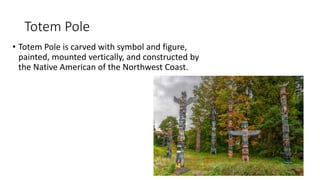
Totem Pole
• Totem Pole is carved with symbol and figure,
painted, mounted vertically, and constructed by
the Native American of the Northwest Coast.
Wood as a
metaphor
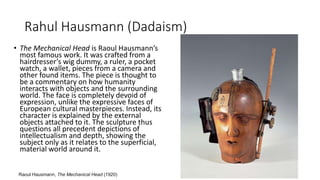
Rahul Hausmann (Dadaism)
• The Mechanical Head is Raoul Hausmann’s
most famous work. It was crafted from a
hairdresser’s wig dummy, a ruler, a pocket
watch, a wallet, pieces from a camera and
other found items. The piece is thought to
be a commentary on how humanity
interacts with objects and the surrounding
world. The face is completely devoid of
expression, unlike the expressive faces of
European cultural masterpieces. Instead, its
character is explained by the external
objects attached to it. The sculpture thus
questions all precedent depictions of
intellectualism and depth, showing the
subject only as it relates to the superficial,
material world around it.
Raoul Hausmann, The Mechanical Head (1920)
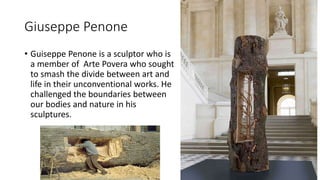
Giuseppe Penone
• Guiseppe Penone is a sculptor who is
a member of Arte Povera who sought
to smash the divide between art and
life in their unconventional works. He
challenged the boundaries between
our bodies and nature in his
sculptures.
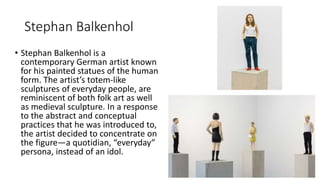
Stephan Balkenhol
• Stephan Balkenhol is a
contemporary German artist known
for his painted statues of the human
form. The artist’s totem-like
sculptures of everyday people, are
reminiscent of both folk art as well
as medieval sculpture. In a response
to the abstract and conceptual
practices that he was introduced to,
the artist decided to concentrate on
the figure—a quotidian, “everyday”
persona, instead of an idol.
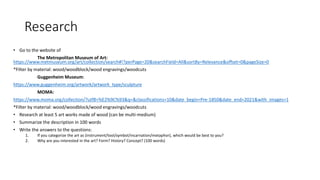
Research
• Go to the website of
The Metropolitan Museum of Art:
https://www.metmuseum.org/art/collection/search#!?perPage=20&searchField=All&sortBy=Relevance&offset=0&pageSize=0
*Filter by material: wood/woodblock/wood engravings/woodcuts
Guggenheim Museum:
https://www.guggenheim.org/artwork/artwork_type/sculpture
MOMA:
https://www.moma.org/collection/?utf8=%E2%9C%93&q=&classifications=10&date_begin=Pre-1850&date_end=2021&with_images=1
*Filter by material: wood/woodblock/wood engravings/woodcuts
• Research at least 5 art works made of wood (can be multi-medium)
• Summarize the description in 100 words
• Write the answers to the questions:
1. If you categorize the art as (instrument/tool/symbol/incarnation/metaphor), which would be best to you?
2. Why are you interested in the art? Form? History? Concept? (100 words)
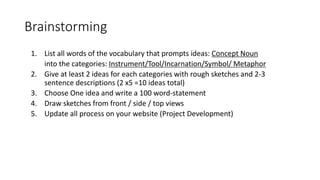
Brainstorming
1. List all words of the vocabulary that prompts ideas: Concept Noun
into the categories: Instrument/Tool/Incarnation/Symbol/ Metaphor
2. Give at least 2 ideas for each categories with rough sketches and 2-3
sentence descriptions (2 x5 =10 ideas total)
3. Choose One idea and write a 100 word-statement
4. Draw sketches from front / side / top views
5. Update all process on your website (Project Development)
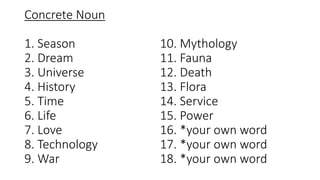
Concrete Noun
1. Season
2. Dream
3. Universe
4. History
5. Time
6. Life
7. Love
8. Technology
9. War
10. Mythology
11. Fauna
12. Death
13. Flora
14. Service
15. Power
16. *your own word
17. *your own word
18. *your own word
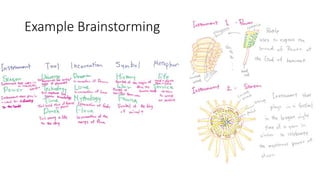
Example Brainstorming
Maquette
• Create maquette out of clay
*There is a change that you can fire the maquette if it is possible. So
please try to make it neat!
• Take pictures from three different angles.
• Updates the pictures on your website (Project Development)
Templates
The school provides a blank new paper sheet.
Draw outline of your design in the actual scale from the front view and
side view.
Update the pictures of the sketches on your website.
Saw
• Trace the templates on your wood with maker pen
• Saw
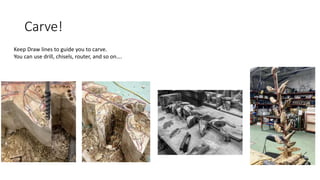
Carve!
Keep Draw lines to guide you to carve.
You can use drill, chisels, router, and so on….

Sculpture in wood

  • 1.
    Sculpture in Wood Sculpturecourse Manami Ishimura
  • 2.
    Objective In this project,students explore the potential of sculpture in wood considering its materiality, history, and cultural usage. • Research art works made of wood • Brainstorm your idea • Create a maquette out of clay • Transform wood (and other mediums) to “art”
  • 3.
  • 4.
    Rattle Seed pods, fruitshells, and nuts are used to make a large variety of rattles that are handheld or grouped together and worn on the arms, legs, or ankles to emphasize dance movements.
  • 5.
    Water Drum The Iatmulpeople, who live along the middle reaches of the Sepik River, are among the most prolific and accomplished sculptors in New Guinea. Iatmul religion was complex and included a diversity of rites and ceremonies devoted to ancestors, spirits, and other supernatural beings. Ceremonial performances entailed the use of masks, sacred images of ancestors and spirits, and a range of sacred musical instruments, including flutes, slit gongs, and drums. Stools incorporating ancestral figures formed the centerpieces for ceremonial debates. Almost all utilitarian objects also were carved and painted.
  • 6.
    Figurative Harp (Domu) Carefullyelaborated harps testify of the importance of music at the Mangbetu aristocratic court. Here a delicately modeled full standing female figure serves as the neck of the string instrument. The elongated figure is distinctive for its light-colored wood. The figure's features are meticulously rendered through delicate modeling, incised graphic embellishments on the visage and body, and detailed definition of the characteristic halo-shaped hairdo. The quality of the carving equals the most refined examples of Mangbetu statuary. This work skillfully features the elaborate reed-reinforced flared coiffure called "tumburu." This complex hairstyle was worn exclusively by ruling-class Mangbetu women. It was meant to accentuate the elongated shaped of the head achieved by massaging and tightly binding the heads of infants, which was considered as the ideal of Mangbetu beauty. The face is embellished by graphic motifs around the eyes which allude to painted or incised facial decorations.
  • 7.
  • 8.
    Dance Mask • Duringthe long, harsh winters in the Arctic, local people traditionally gathered indoors for celebrations of performance cycles. These featured feasts and masked dances in order to maintain harmony between the human, animal, and supernatural realms for the coming year. The masks worn by costumed dancers were often danced in pairs and represented a variety of animals, supernatural beings, and animal helpers. Humorous examples were also known, including caricatures of local personalities meant to entertain the spectators.
  • 9.
    Ritual tool forthe "Opening of the Mouth" ceremony • The opening of the mouth ceremony was an ancient Egyptian ritual described in the Pyramid Texts. The ceremony involved a symbolic animation of a statue by magically opening its mouth so that it could breathe and speak.
  • 10.
  • 11.
  • 12.
    Miroku Bosatsu • Theseated wooden statue of Miroku Bosatsu.
  • 13.
    Henry Moore • Figureis an early example of Moore’s development towards abstraction in the first half of the 1930s. In this sculpture a figure of a woman is interpreted fluidly, a rendering that is in part determined by the sensitivities of the wood’s grain. Its rounded contours, in common with others from this period, relate to the sculptor’s interest in the lines of the landscape, where natural forms are softened and simplified as a consequence of weathering. Henry Moore, FIgure, Beech (1931)
  • 14.
    Yoshihiro Suda • YoshihiroSuda is a Japanese contemporary artist known for his hyper-realistic sculptures of plants and flowers created in the tradition of Japanese woodcarving. “I think art can change our perspective and ways of thinking. It encourages us to see things that we otherwise might miss”
  • 15.
  • 16.
    Model ankh • Theankh was used as a hieroglyph to write the words “live”, “alive”, or “life”. It also became a popular symbol for life in general.
  • 17.
    Totem Pole • TotemPole is carved with symbol and figure, painted, mounted vertically, and constructed by the Native American of the Northwest Coast.
  • 18.
  • 19.
    Rahul Hausmann (Dadaism) •The Mechanical Head is Raoul Hausmann’s most famous work. It was crafted from a hairdresser’s wig dummy, a ruler, a pocket watch, a wallet, pieces from a camera and other found items. The piece is thought to be a commentary on how humanity interacts with objects and the surrounding world. The face is completely devoid of expression, unlike the expressive faces of European cultural masterpieces. Instead, its character is explained by the external objects attached to it. The sculpture thus questions all precedent depictions of intellectualism and depth, showing the subject only as it relates to the superficial, material world around it. Raoul Hausmann, The Mechanical Head (1920)
  • 20.
    Giuseppe Penone • GuiseppePenone is a sculptor who is a member of Arte Povera who sought to smash the divide between art and life in their unconventional works. He challenged the boundaries between our bodies and nature in his sculptures.
  • 21.
    Stephan Balkenhol • StephanBalkenhol is a contemporary German artist known for his painted statues of the human form. The artist’s totem-like sculptures of everyday people, are reminiscent of both folk art as well as medieval sculpture. In a response to the abstract and conceptual practices that he was introduced to, the artist decided to concentrate on the figure—a quotidian, “everyday” persona, instead of an idol.
  • 22.
    Research • Go tothe website of The Metropolitan Museum of Art: https://www.metmuseum.org/art/collection/search#!?perPage=20&searchField=All&sortBy=Relevance&offset=0&pageSize=0 *Filter by material: wood/woodblock/wood engravings/woodcuts Guggenheim Museum: https://www.guggenheim.org/artwork/artwork_type/sculpture MOMA: https://www.moma.org/collection/?utf8=%E2%9C%93&q=&classifications=10&date_begin=Pre-1850&date_end=2021&with_images=1 *Filter by material: wood/woodblock/wood engravings/woodcuts • Research at least 5 art works made of wood (can be multi-medium) • Summarize the description in 100 words • Write the answers to the questions: 1. If you categorize the art as (instrument/tool/symbol/incarnation/metaphor), which would be best to you? 2. Why are you interested in the art? Form? History? Concept? (100 words)
  • 23.
    Brainstorming 1. List allwords of the vocabulary that prompts ideas: Concept Noun into the categories: Instrument/Tool/Incarnation/Symbol/ Metaphor 2. Give at least 2 ideas for each categories with rough sketches and 2-3 sentence descriptions (2 x5 =10 ideas total) 3. Choose One idea and write a 100 word-statement 4. Draw sketches from front / side / top views 5. Update all process on your website (Project Development)
  • 24.
    Concrete Noun 1. Season 2.Dream 3. Universe 4. History 5. Time 6. Life 7. Love 8. Technology 9. War 10. Mythology 11. Fauna 12. Death 13. Flora 14. Service 15. Power 16. *your own word 17. *your own word 18. *your own word
  • 25.
  • 26.
    Maquette • Create maquetteout of clay *There is a change that you can fire the maquette if it is possible. So please try to make it neat! • Take pictures from three different angles. • Updates the pictures on your website (Project Development)
  • 27.
    Templates The school providesa blank new paper sheet. Draw outline of your design in the actual scale from the front view and side view. Update the pictures of the sketches on your website.
  • 28.
    Saw • Trace thetemplates on your wood with maker pen • Saw
  • 29.
    Carve! Keep Draw linesto guide you to carve. You can use drill, chisels, router, and so on….