CHAPTER 15
Nature, Knowledge, & Technology
By: Alejandro Lebrija
INTRO
• Art can imitate, praise, or criticize the world around us. That
world consist of animals and plants as well as human constructs:
our knowledge systems, our technology, our cities.
NATURE
• Our natural world consists of the earth and its flora and
fauna.
• The relationship of humans and animals is very complex. We
hunt them, love them, and eat them.
• They are part of industry as we breed some and extinguish
others.
• We identify with animals and project our highest aspirations
and deepest fears onto them.
ANIMALS
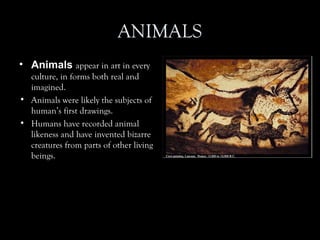
• Animals appear in art in every
culture, in forms both real and
imagined.
• Animals were likely the subjects of
human’s first drawings.
• Humans have recorded animal
likeness and have invented bizarre
creatures from parts of other living
beings.
Fantastic Creatures
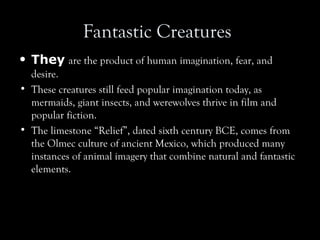
• They are the product of human imagination, fear, and
desire.
• These creatures still feed popular imagination today, as
mermaids, giant insects, and werewolves thrive in film and
popular fiction.
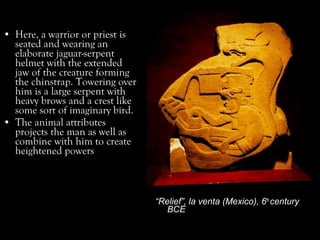
• The limestone “Relief”, dated sixth century BCE, comes from
the Olmec culture of ancient Mexico, which produced many
instances of animal imagery that combine natural and fantastic
elements.
• Here, a warrior or priest is
seated and wearing an
elaborate jaguar-serpent
helmet with the extended
jaw of the creature forming
the chinstrap. Towering over
him is a large serpent with
heavy brows and a crest like
some sort of imaginary bird.
• The animal attributes
projects the man as well as
combine with him to create
heightened powers
“Relief”, la venta (Mexico), 6th
century
BCE
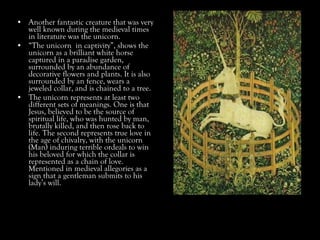
• Another fantastic creature that was very
well known during the medieval times
in literature was the unicorn.
• “The unicorn in captivity”, shows the
unicorn as a brilliant white horse
captured in a paradise garden,
surrounded by an abundance of
decorative flowers and plants. It is also
surrounded by an fence, wears a
jeweled collar, and is chained to a tree.
• The unicorn represents at least two
different sets of meanings. One is that
Jesus, believed to be the source of
spiritual life, who was hunted by man,
brutally killed, and then rose back to
life. The second represents true love in
the age of chivalry, with the unicorn
(Man) induring terrible ordeals to win
his beloved for which the collar is
represented as a chain of love.
Mentioned in medieval allegories as a
sign that a gentleman submits to his
lady’s will.
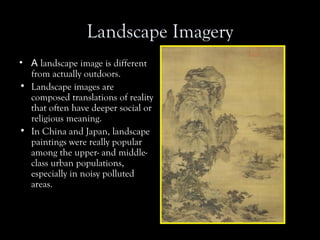
Landscape Imagery
• A landscape image is different
from actually outdoors.
• Landscape images are
composed translations of reality
that often have deeper social or
religious meaning.
• In China and Japan, landscape
paintings were really popular
among the upper- and middle-
class urban populations,
especially in noisy polluted
areas.
Cont.
• Landscape paintings were particularly common in
the United States and Europe in the nineteenth
century.
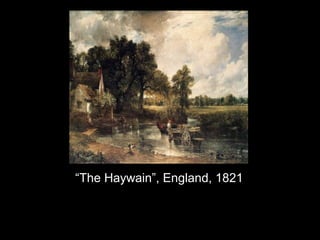
• Landscapes tended to have a nationalistic look. Ex:
German landscapes sometimes were marked by
melancholy or morbidity. English landscapes however,
tended to emphasize the open-air expansiveness of
farm scenes.
“The Haywain”, England, 1821
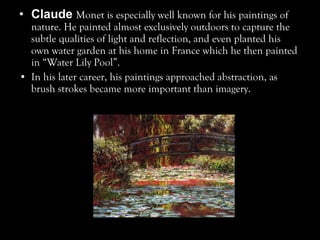
• Claude Monet is especially well known for his paintings of
nature. He painted almost exclusively outdoors to capture the
subtle qualities of light and reflection, and even planted his
own water garden at his home in France which he then painted
in “Water Lily Pool”.
• In his later career, his paintings approached abstraction, as
brush strokes became more important than imagery.
Flowers and Gardens
• Art gives us framed, composed, distilled, and transcendent
images of flowers.
• Gardens are living sculptures, exotic refuges arranged for
human enjoyment.
• Water is frequently a central motif in a garden of any size.
Flowers
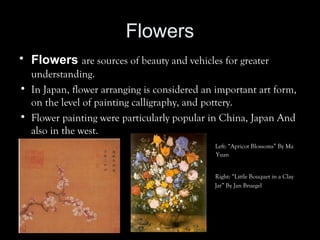
• Flowers are sources of beauty and vehicles for greater
understanding.
• In Japan, flower arranging is considered an important art form,
on the level of painting calligraphy, and pottery.
• Flower painting were particularly popular in China, Japan And
also in the west.
• Left: “Apricot Blossoms” By Ma
Yuan
» Right: “Little Bouquet in a Clay
» Jar” By Jan Bruegel
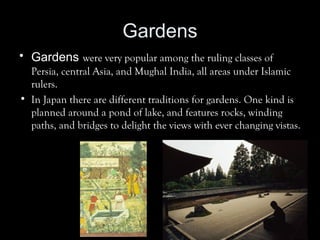
Gardens
• Gardens were very popular among the ruling classes of
Persia, central Asia, and Mughal India, all areas under Islamic
rulers.
• In Japan there are different traditions for gardens. One kind is
planned around a pond of lake, and features rocks, winding
paths, and bridges to delight the views with ever changing vistas.
Earthworks and site pieces
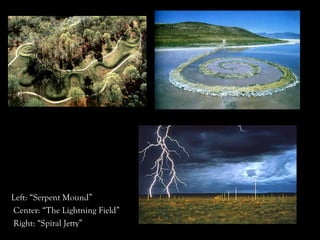
• The earth itself is sculptural material. Hundreds of years ago,
native peoples of North America used dirt to construct large
ceremonial mounds.
• Contemporary earthworks are large-scale environmental pieces
in which the earth itself is an important component. Earthwork
artists not only use natural materials but also are responsive to
their sites.
• The monumental scale of their work is an attribute of both
ancient and modern art.
• Artist who deal with the land and with landscape often have
ecological concerns as part of their motivation to make art.
Left: “Serpent Mound”
Center: “The Lightning Field”
Right: “Spiral Jetty”
KNOWLEDGE
• Humans systematically study and examine the world in an
attempt to understand its course.
• There are numerous examples of art that illustrate a specific
body of knowledge.
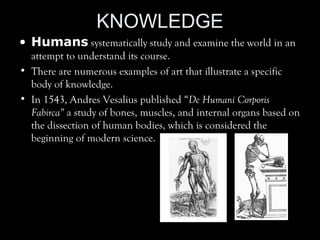
• In 1543, Andres Vesalius published “De Humani Corporis
Fabirca” a study of bones, muscles, and internal organs based on
the dissection of human bodies, which is considered the
beginning of modern science.
Cont.
• Drawings in the service of science continue to be made. Even
though photography might seem to be an adequate substitute
for them, artist drawings can emphasize details that either do
not stand out in photographs or become lost in the wealth of
detail.
• Medical books are still enhanced with drawings, and medical
illustrations are essential aids for study. Drawings also are sued
in studies of plants and insects and for very small items.
Art and Intuited Knowledge
• for humans, the “world” consists not only of the external
environmental but also of the internal realm of the mind and
the metaphysical world.
• Art also deals with knowledge that humans can intuitively grasp
without necessarily being able to articulate it. This kind of
knowing is the product of dreams, visions, and speculative
guessing. It is not systematic, organized, or scientific.
• Surrealism was an early-twentieth-century art movement in
Europe and the U.S. that explored the unconscious, especially
through dream imagery. Surrealism developed in part as a
reaction to increased industrialization.
• Surrealism posited that this unconscious or dream world is at
least as, or probably more important than, the ordered and
regimented external world in which humans function.
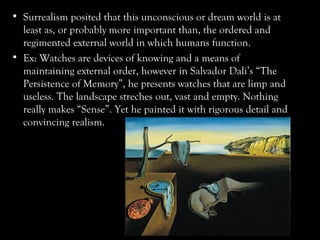
• Ex: Watches are devices of knowing and a means of
maintaining external order, however in Salvador Dali’s “The
Persistence of Memory”, he presents watches that are limp and
useless. The landscape streches out, vast and empty. Nothing
really makes “Sense”. Yet he painted it with rigorous detail and
convincing realism.
The Critique of learning
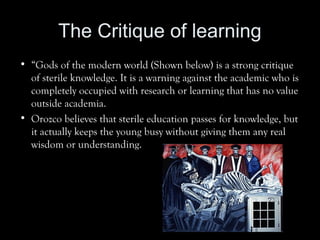
• “Gods of the modern world (Shown below) is a strong critique
of sterile knowledge. It is a warning against the academic who is
completely occupied with research or learning that has no value
outside academia.
• Orozco believes that sterile education passes for knowledge, but
it actually keeps the young busy without giving them any real
wisdom or understanding.
Technology
• When we consider technology today, we most likely think of
the world since the industrial revolution of the nineteenth
century and more recent developments in transportation,
manufacturing, and communication.
• Technology advanced rapidly in the early twentieth century,
causing cities to expand and producing structures in shapes
and sizes never seen before. This inspired many artist.
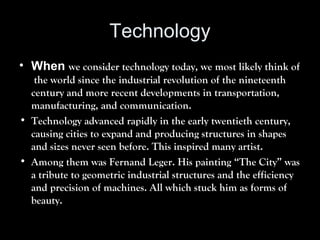
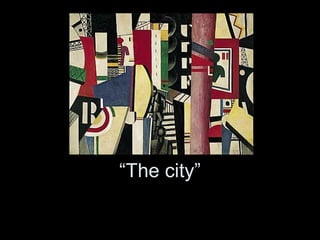
• Among them was Fernand Leger. His painting “The City” was
a tribute to geometric industrial structures and the efficiency
and precision of machines. All which stuck him as forms of
beauty.
“The city”
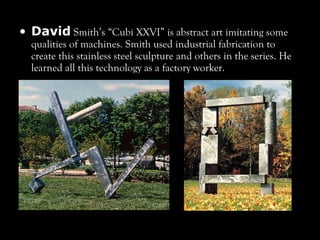
• David Smith’s “Cubi XXVI” is abstract art imitating some
qualities of machines. Smith used industrial fabrication to
create this stainless steel sculpture and others in the series. He
learned all this technology as a factory worker.
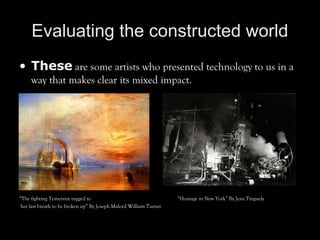
Evaluating the constructed world
• These are some artists who presented technology to us in a
way that makes clear its mixed impact.
“The fighting Temeraire tugged to “Homage in New York” By Jean Tinguely
her last breath to be broken up” By Joseph Malord William Turner
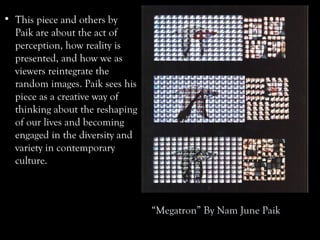
“Megatron” By Nam June Paik
• This piece and others by
Paik are about the act of
perception, how reality is
presented, and how we as
viewers reintegrate the
random images. Paik sees his
piece as a creative way of
thinking about the reshaping
of our lives and becoming
engaged in the diversity and
variety in contemporary
culture.
FIN!!

Chapter 15

  • 1.
    CHAPTER 15 Nature, Knowledge,& Technology By: Alejandro Lebrija
  • 2.
    INTRO • Art canimitate, praise, or criticize the world around us. That world consist of animals and plants as well as human constructs: our knowledge systems, our technology, our cities.
  • 3.
    NATURE • Our naturalworld consists of the earth and its flora and fauna. • The relationship of humans and animals is very complex. We hunt them, love them, and eat them. • They are part of industry as we breed some and extinguish others. • We identify with animals and project our highest aspirations and deepest fears onto them.
  • 4.
    ANIMALS • Animals appearin art in every culture, in forms both real and imagined. • Animals were likely the subjects of human’s first drawings. • Humans have recorded animal likeness and have invented bizarre creatures from parts of other living beings.
  • 5.
    Fantastic Creatures • Theyare the product of human imagination, fear, and desire. • These creatures still feed popular imagination today, as mermaids, giant insects, and werewolves thrive in film and popular fiction. • The limestone “Relief”, dated sixth century BCE, comes from the Olmec culture of ancient Mexico, which produced many instances of animal imagery that combine natural and fantastic elements.
  • 6.
    • Here, awarrior or priest is seated and wearing an elaborate jaguar-serpent helmet with the extended jaw of the creature forming the chinstrap. Towering over him is a large serpent with heavy brows and a crest like some sort of imaginary bird. • The animal attributes projects the man as well as combine with him to create heightened powers “Relief”, la venta (Mexico), 6th century BCE
  • 7.
    • Another fantasticcreature that was very well known during the medieval times in literature was the unicorn. • “The unicorn in captivity”, shows the unicorn as a brilliant white horse captured in a paradise garden, surrounded by an abundance of decorative flowers and plants. It is also surrounded by an fence, wears a jeweled collar, and is chained to a tree. • The unicorn represents at least two different sets of meanings. One is that Jesus, believed to be the source of spiritual life, who was hunted by man, brutally killed, and then rose back to life. The second represents true love in the age of chivalry, with the unicorn (Man) induring terrible ordeals to win his beloved for which the collar is represented as a chain of love. Mentioned in medieval allegories as a sign that a gentleman submits to his lady’s will.
  • 8.
    Landscape Imagery • Alandscape image is different from actually outdoors. • Landscape images are composed translations of reality that often have deeper social or religious meaning. • In China and Japan, landscape paintings were really popular among the upper- and middle- class urban populations, especially in noisy polluted areas.
  • 9.
    Cont. • Landscape paintingswere particularly common in the United States and Europe in the nineteenth century. • Landscapes tended to have a nationalistic look. Ex: German landscapes sometimes were marked by melancholy or morbidity. English landscapes however, tended to emphasize the open-air expansiveness of farm scenes.
  • 10.
  • 11.
    • Claude Monetis especially well known for his paintings of nature. He painted almost exclusively outdoors to capture the subtle qualities of light and reflection, and even planted his own water garden at his home in France which he then painted in “Water Lily Pool”. • In his later career, his paintings approached abstraction, as brush strokes became more important than imagery.
  • 12.
    Flowers and Gardens •Art gives us framed, composed, distilled, and transcendent images of flowers. • Gardens are living sculptures, exotic refuges arranged for human enjoyment. • Water is frequently a central motif in a garden of any size.
  • 13.
    Flowers • Flowers aresources of beauty and vehicles for greater understanding. • In Japan, flower arranging is considered an important art form, on the level of painting calligraphy, and pottery. • Flower painting were particularly popular in China, Japan And also in the west. • Left: “Apricot Blossoms” By Ma Yuan » Right: “Little Bouquet in a Clay » Jar” By Jan Bruegel
  • 14.
    Gardens • Gardens werevery popular among the ruling classes of Persia, central Asia, and Mughal India, all areas under Islamic rulers. • In Japan there are different traditions for gardens. One kind is planned around a pond of lake, and features rocks, winding paths, and bridges to delight the views with ever changing vistas.
  • 15.
    Earthworks and sitepieces • The earth itself is sculptural material. Hundreds of years ago, native peoples of North America used dirt to construct large ceremonial mounds. • Contemporary earthworks are large-scale environmental pieces in which the earth itself is an important component. Earthwork artists not only use natural materials but also are responsive to their sites. • The monumental scale of their work is an attribute of both ancient and modern art. • Artist who deal with the land and with landscape often have ecological concerns as part of their motivation to make art.
  • 16.
    Left: “Serpent Mound” Center:“The Lightning Field” Right: “Spiral Jetty”
  • 17.
    KNOWLEDGE • Humans systematicallystudy and examine the world in an attempt to understand its course. • There are numerous examples of art that illustrate a specific body of knowledge. • In 1543, Andres Vesalius published “De Humani Corporis Fabirca” a study of bones, muscles, and internal organs based on the dissection of human bodies, which is considered the beginning of modern science.
  • 18.
    Cont. • Drawings inthe service of science continue to be made. Even though photography might seem to be an adequate substitute for them, artist drawings can emphasize details that either do not stand out in photographs or become lost in the wealth of detail. • Medical books are still enhanced with drawings, and medical illustrations are essential aids for study. Drawings also are sued in studies of plants and insects and for very small items.
  • 19.
    Art and IntuitedKnowledge • for humans, the “world” consists not only of the external environmental but also of the internal realm of the mind and the metaphysical world. • Art also deals with knowledge that humans can intuitively grasp without necessarily being able to articulate it. This kind of knowing is the product of dreams, visions, and speculative guessing. It is not systematic, organized, or scientific. • Surrealism was an early-twentieth-century art movement in Europe and the U.S. that explored the unconscious, especially through dream imagery. Surrealism developed in part as a reaction to increased industrialization.
  • 20.
    • Surrealism positedthat this unconscious or dream world is at least as, or probably more important than, the ordered and regimented external world in which humans function. • Ex: Watches are devices of knowing and a means of maintaining external order, however in Salvador Dali’s “The Persistence of Memory”, he presents watches that are limp and useless. The landscape streches out, vast and empty. Nothing really makes “Sense”. Yet he painted it with rigorous detail and convincing realism.
  • 21.
    The Critique oflearning • “Gods of the modern world (Shown below) is a strong critique of sterile knowledge. It is a warning against the academic who is completely occupied with research or learning that has no value outside academia. • Orozco believes that sterile education passes for knowledge, but it actually keeps the young busy without giving them any real wisdom or understanding.
  • 22.
    Technology • When weconsider technology today, we most likely think of the world since the industrial revolution of the nineteenth century and more recent developments in transportation, manufacturing, and communication. • Technology advanced rapidly in the early twentieth century, causing cities to expand and producing structures in shapes and sizes never seen before. This inspired many artist. • Among them was Fernand Leger. His painting “The City” was a tribute to geometric industrial structures and the efficiency and precision of machines. All which stuck him as forms of beauty.
  • 23.
  • 24.
    • David Smith’s“Cubi XXVI” is abstract art imitating some qualities of machines. Smith used industrial fabrication to create this stainless steel sculpture and others in the series. He learned all this technology as a factory worker.
  • 25.
    Evaluating the constructedworld • These are some artists who presented technology to us in a way that makes clear its mixed impact. “The fighting Temeraire tugged to “Homage in New York” By Jean Tinguely her last breath to be broken up” By Joseph Malord William Turner
  • 26.
    “Megatron” By NamJune Paik • This piece and others by Paik are about the act of perception, how reality is presented, and how we as viewers reintegrate the random images. Paik sees his piece as a creative way of thinking about the reshaping of our lives and becoming engaged in the diversity and variety in contemporary culture.
  • 27.