SCRUM Framework
By Nhan Nguyen
Course Objectives
- Able to understand what the SCRUM is
- Able to apply SCRUM in project management
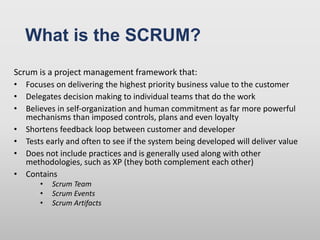
What is the SCRUM?
Scrum is a project management framework that:
• Focuses on delivering the highest priority business value to the customer
• Delegates decision making to individual teams that do the work
• Believes in self-organization and human commitment as far more powerful
mechanisms than imposed controls, plans and even loyalty
• Shortens feedback loop between customer and developer
• Tests early and often to see if the system being developed will deliver value
• Does not include practices and is generally used along with other
methodologies, such as XP (they both complement each other)
• Contains
• Scrum Team
• Scrum Events
• Scrum Artifacts
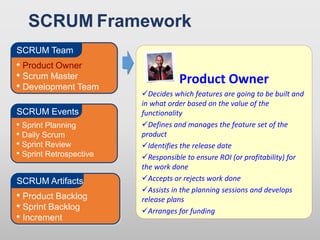
SCRUM Framework
• Product Owner
• Scrum Master
• Development Team
SCRUM Team
• Sprint Planning
• Daily Scrum
• Sprint Review
• Sprint Retrospective
SCRUM Events
• Product Backlog
• Sprint Backlog
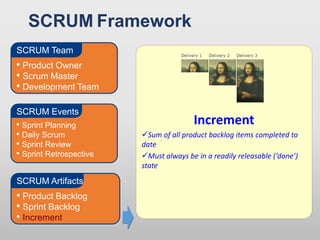
• Increment
SCRUM Artifacts
Product Owner
Decides which features are going to be built and
in what order based on the value of the
functionality
Defines and manages the feature set of the
product
Identifies the release date
Responsible to ensure ROI (or profitability) for
the work done
Accepts or rejects work done
Assists in the planning sessions and develops
release plans
Arranges for funding
• Product Owner
• Scrum Master
• Development Team
SCRUM Team
• Product Owner
• Scrum Master
• Development Team
SCRUM Team
• Product Owner
• Scrum Master
• Development Team
SCRUM Team
• Sprint Planning
• Daily Scrum
• Sprint Review
• Sprint Retrospective
SCRUM Events
• Product Backlog
• Sprint Backlog
• Increment
SCRUM Artifacts
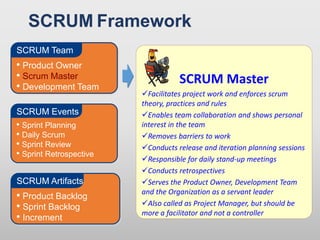
SCRUM Master
Facilitates project work and enforces scrum
theory, practices and rules
Enables team collaboration and shows personal
interest in the team
Removes barriers to work
Conducts release and iteration planning sessions
Responsible for daily stand-up meetings
Conducts retrospectives
Serves the Product Owner, Development Team
and the Organization as a servant leader
Also called as Project Manager, but should be
more a facilitator and not a controller
• Product Owner
• Scrum Master
• Development Team
SCRUM Team
• Product Owner
• Scrum Master
• Development Team
SCRUM Team
SCRUM Framework
• Product Owner
• Scrum Master
• Development Team
SCRUM Team
• Sprint Planning
• Daily Scrum
• Sprint Review
• Sprint Retrospective
SCRUM Events
• Product Backlog
• Sprint Backlog
• Increment
SCRUM Artifacts
Development Team
Set of generalizing specialists who are cross-
functional in nature
Collaborate and self-organize
Commit to work for each iteration as a team
Perform estimations, development and testing
Demonstrate work done
Provide lessons learned
• Product Owner
• Scrum Master
• Development Team
SCRUM Team
• Product Owner
• Scrum Master
• Development Team
SCRUM Team
SCRUM Framework
• Product Owner
• Scrum Master
• Development Team
SCRUM Team
• Sprint Planning
• Daily Scrum
• Sprint Review
• Sprint Retrospective
SCRUM Events
• Product Backlog
• Sprint Backlog
• Increment
SCRUM Artifacts
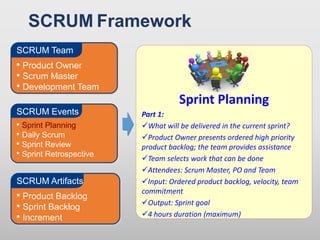
Sprint Planning
Part 1:
What will be delivered in the current sprint?
Product Owner presents ordered high priority
product backlog; the team provides assistance
Team selects work that can be done
Attendees: Scrum Master, PO and Team
Input: Ordered product backlog, velocity, team
commitment
Output: Sprint goal
4 hours duration (maximum)
• Product Owner
• Scrum Master
• Development Team
SCRUM Team
• Product Owner
• Scrum Master
• Development Team
SCRUM Team
SCRUM Framework
• Product Owner
• Scrum Master
• Development Team
SCRUM Team
• Sprint Planning
• Daily Scrum
• Sprint Review
• Sprint Retrospective
SCRUM Events
• Product Backlog
• Sprint Backlog
• Increment
SCRUM Artifacts
Sprint Planning
Part 2:
Team plans what and how to accomplish the
sprint goals
Sprint backlog created with tasks, task estimates
and assignments
Team self-organizes and splits work and creates
a working plan
This marks the start of the sprint
4 hours duration (maximum)
• Product Owner
• Scrum Master
• Development Team
SCRUM Team
• Product Owner
• Scrum Master
• Development Team
SCRUM Team
SCRUM Framework
• Product Owner
• Scrum Master
• Development Team
SCRUM Team
• Sprint Planning
• Daily Scrum
• Sprint Review
• Sprint Retrospective
SCRUM Events
• Product Backlog
• Sprint Backlog
• Increment
SCRUM Artifacts
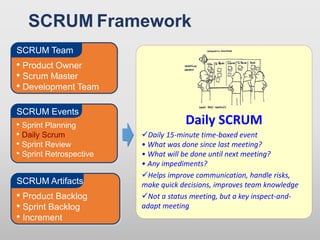
Daily SCRUM
Daily 15-minute time-boxed event
• What was done since last meeting?
• What will be done until next meeting?
• Any impediments?
Helps improve communication, handle risks,
make quick decisions, improves team knowledge
Not a status meeting, but a key inspect-and-
adapt meeting
• Product Owner
• Scrum Master
• Development Team
SCRUM Team
• Product Owner
• Scrum Master
• Development Team
SCRUM Team
SCRUM Framework
• Product Owner
• Scrum Master
• Development Team
SCRUM Team
• Sprint Planning
• Daily Scrum
• Sprint Review
• Sprint Retrospective
SCRUM Events
• Product Backlog
• Sprint Backlog
• Increment
SCRUM Artifacts
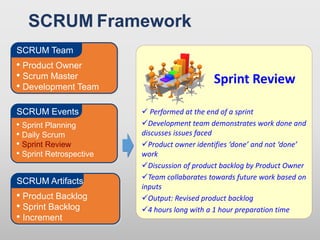
Sprint Review
 Performed at the end of a sprint
Development team demonstrates work done and
discusses issues faced
Product owner identifies ‘done’ and not ‘done’
work
Discussion of product backlog by Product Owner
Team collaborates towards future work based on
inputs
Output: Revised product backlog
4 hours long with a 1 hour preparation time
• Product Owner
• Scrum Master
• Development Team
SCRUM Team
• Product Owner
• Scrum Master
• Development Team
SCRUM Team
SCRUM Framework
• Product Owner
• Scrum Master
• Development Team
SCRUM Team
• Sprint Planning
• Daily Scrum
• Sprint Review
• Sprint Retrospective
SCRUM Events
• Product Backlog
• Sprint Backlog
• Increment
SCRUM Artifacts
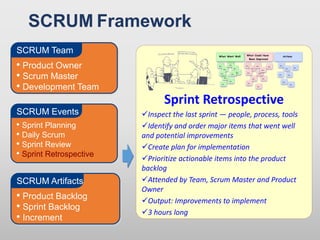
Sprint Retrospective
Inspect the last sprint — people, process, tools
Identify and order major items that went well
and potential improvements
Create plan for implementation
Prioritize actionable items into the product
backlog
Attended by Team, Scrum Master and Product
Owner
Output: Improvements to implement
3 hours long
• Product Owner
• Scrum Master
• Development Team
SCRUM Team
• Product Owner
• Scrum Master
• Development Team
SCRUM Team
SCRUM Framework
• Product Owner
• Scrum Master
• Development Team
SCRUM Team
• Sprint Planning
• Daily Scrum
• Sprint Review
• Sprint Retrospective
SCRUM Events
• Product Backlog
• Sprint Backlog
• Increment
SCRUM Artifacts
Product Backlog
Product Owner maintains and orders list of
requirements
Is dynamic and may constantly evolve
Contains features, functions, fixes,
enhancements
Attributes — description, order and estimate
Ordered by value, risk, priority and necessity
Development team and Product Owner
collaborate
• Product Owner
• Scrum Master
• Development Team
SCRUM Team
• Product Owner
• Scrum Master
• Development Team
SCRUM Team
SCRUM Framework
• Product Owner
• Scrum Master
• Development Team
SCRUM Team
• Sprint Planning
• Daily Scrum
• Sprint Review
• Sprint Retrospective
SCRUM Events
• Product Backlog
• Sprint Backlog
• Increment
SCRUM Artifacts
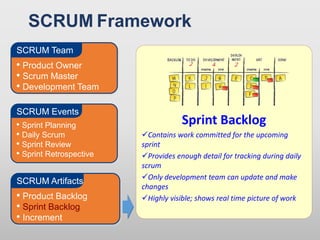
Sprint Backlog
Contains work committed for the upcoming
sprint
Provides enough detail for tracking during daily
scrum
Only development team can update and make
changes
Highly visible; shows real time picture of work
• Product Owner
• Scrum Master
• Development Team
SCRUM Team
• Product Owner
• Scrum Master
• Development Team
SCRUM Team
SCRUM Framework
• Product Owner
• Scrum Master
• Development Team
SCRUM Team
• Sprint Planning
• Daily Scrum
• Sprint Review
• Sprint Retrospective
SCRUM Events
• Product Backlog
• Sprint Backlog
• Increment
SCRUM Artifacts
Increment
Sum of all product backlog items completed to
date
Must always be in a readily releasable (‘done’)
state
• Product Owner
• Scrum Master
• Development Team
SCRUM Team
• Product Owner
• Scrum Master
• Development Team
SCRUM Team
SCRUM Framework
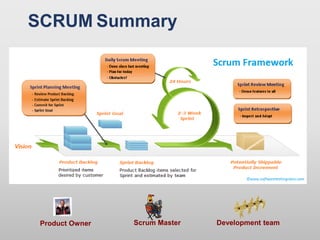
Product Owner Scrum Master Development team
SCRUM Summary
Q&A

Scrum Framework

  • 1.
  • 2.
    Course Objectives - Ableto understand what the SCRUM is - Able to apply SCRUM in project management
  • 3.
    What is theSCRUM? Scrum is a project management framework that: • Focuses on delivering the highest priority business value to the customer • Delegates decision making to individual teams that do the work • Believes in self-organization and human commitment as far more powerful mechanisms than imposed controls, plans and even loyalty • Shortens feedback loop between customer and developer • Tests early and often to see if the system being developed will deliver value • Does not include practices and is generally used along with other methodologies, such as XP (they both complement each other) • Contains • Scrum Team • Scrum Events • Scrum Artifacts
  • 4.
    SCRUM Framework • ProductOwner • Scrum Master • Development Team SCRUM Team • Sprint Planning • Daily Scrum • Sprint Review • Sprint Retrospective SCRUM Events • Product Backlog • Sprint Backlog • Increment SCRUM Artifacts Product Owner Decides which features are going to be built and in what order based on the value of the functionality Defines and manages the feature set of the product Identifies the release date Responsible to ensure ROI (or profitability) for the work done Accepts or rejects work done Assists in the planning sessions and develops release plans Arranges for funding • Product Owner • Scrum Master • Development Team SCRUM Team • Product Owner • Scrum Master • Development Team SCRUM Team
  • 5.
    • Product Owner •Scrum Master • Development Team SCRUM Team • Sprint Planning • Daily Scrum • Sprint Review • Sprint Retrospective SCRUM Events • Product Backlog • Sprint Backlog • Increment SCRUM Artifacts SCRUM Master Facilitates project work and enforces scrum theory, practices and rules Enables team collaboration and shows personal interest in the team Removes barriers to work Conducts release and iteration planning sessions Responsible for daily stand-up meetings Conducts retrospectives Serves the Product Owner, Development Team and the Organization as a servant leader Also called as Project Manager, but should be more a facilitator and not a controller • Product Owner • Scrum Master • Development Team SCRUM Team • Product Owner • Scrum Master • Development Team SCRUM Team SCRUM Framework
  • 6.
    • Product Owner •Scrum Master • Development Team SCRUM Team • Sprint Planning • Daily Scrum • Sprint Review • Sprint Retrospective SCRUM Events • Product Backlog • Sprint Backlog • Increment SCRUM Artifacts Development Team Set of generalizing specialists who are cross- functional in nature Collaborate and self-organize Commit to work for each iteration as a team Perform estimations, development and testing Demonstrate work done Provide lessons learned • Product Owner • Scrum Master • Development Team SCRUM Team • Product Owner • Scrum Master • Development Team SCRUM Team SCRUM Framework
  • 7.
    • Product Owner •Scrum Master • Development Team SCRUM Team • Sprint Planning • Daily Scrum • Sprint Review • Sprint Retrospective SCRUM Events • Product Backlog • Sprint Backlog • Increment SCRUM Artifacts Sprint Planning Part 1: What will be delivered in the current sprint? Product Owner presents ordered high priority product backlog; the team provides assistance Team selects work that can be done Attendees: Scrum Master, PO and Team Input: Ordered product backlog, velocity, team commitment Output: Sprint goal 4 hours duration (maximum) • Product Owner • Scrum Master • Development Team SCRUM Team • Product Owner • Scrum Master • Development Team SCRUM Team SCRUM Framework
  • 8.
    • Product Owner •Scrum Master • Development Team SCRUM Team • Sprint Planning • Daily Scrum • Sprint Review • Sprint Retrospective SCRUM Events • Product Backlog • Sprint Backlog • Increment SCRUM Artifacts Sprint Planning Part 2: Team plans what and how to accomplish the sprint goals Sprint backlog created with tasks, task estimates and assignments Team self-organizes and splits work and creates a working plan This marks the start of the sprint 4 hours duration (maximum) • Product Owner • Scrum Master • Development Team SCRUM Team • Product Owner • Scrum Master • Development Team SCRUM Team SCRUM Framework
  • 9.
    • Product Owner •Scrum Master • Development Team SCRUM Team • Sprint Planning • Daily Scrum • Sprint Review • Sprint Retrospective SCRUM Events • Product Backlog • Sprint Backlog • Increment SCRUM Artifacts Daily SCRUM Daily 15-minute time-boxed event • What was done since last meeting? • What will be done until next meeting? • Any impediments? Helps improve communication, handle risks, make quick decisions, improves team knowledge Not a status meeting, but a key inspect-and- adapt meeting • Product Owner • Scrum Master • Development Team SCRUM Team • Product Owner • Scrum Master • Development Team SCRUM Team SCRUM Framework
  • 10.
    • Product Owner •Scrum Master • Development Team SCRUM Team • Sprint Planning • Daily Scrum • Sprint Review • Sprint Retrospective SCRUM Events • Product Backlog • Sprint Backlog • Increment SCRUM Artifacts Sprint Review  Performed at the end of a sprint Development team demonstrates work done and discusses issues faced Product owner identifies ‘done’ and not ‘done’ work Discussion of product backlog by Product Owner Team collaborates towards future work based on inputs Output: Revised product backlog 4 hours long with a 1 hour preparation time • Product Owner • Scrum Master • Development Team SCRUM Team • Product Owner • Scrum Master • Development Team SCRUM Team SCRUM Framework
  • 11.
    • Product Owner •Scrum Master • Development Team SCRUM Team • Sprint Planning • Daily Scrum • Sprint Review • Sprint Retrospective SCRUM Events • Product Backlog • Sprint Backlog • Increment SCRUM Artifacts Sprint Retrospective Inspect the last sprint — people, process, tools Identify and order major items that went well and potential improvements Create plan for implementation Prioritize actionable items into the product backlog Attended by Team, Scrum Master and Product Owner Output: Improvements to implement 3 hours long • Product Owner • Scrum Master • Development Team SCRUM Team • Product Owner • Scrum Master • Development Team SCRUM Team SCRUM Framework
  • 12.
    • Product Owner •Scrum Master • Development Team SCRUM Team • Sprint Planning • Daily Scrum • Sprint Review • Sprint Retrospective SCRUM Events • Product Backlog • Sprint Backlog • Increment SCRUM Artifacts Product Backlog Product Owner maintains and orders list of requirements Is dynamic and may constantly evolve Contains features, functions, fixes, enhancements Attributes — description, order and estimate Ordered by value, risk, priority and necessity Development team and Product Owner collaborate • Product Owner • Scrum Master • Development Team SCRUM Team • Product Owner • Scrum Master • Development Team SCRUM Team SCRUM Framework
  • 13.
    • Product Owner •Scrum Master • Development Team SCRUM Team • Sprint Planning • Daily Scrum • Sprint Review • Sprint Retrospective SCRUM Events • Product Backlog • Sprint Backlog • Increment SCRUM Artifacts Sprint Backlog Contains work committed for the upcoming sprint Provides enough detail for tracking during daily scrum Only development team can update and make changes Highly visible; shows real time picture of work • Product Owner • Scrum Master • Development Team SCRUM Team • Product Owner • Scrum Master • Development Team SCRUM Team SCRUM Framework
  • 14.
    • Product Owner •Scrum Master • Development Team SCRUM Team • Sprint Planning • Daily Scrum • Sprint Review • Sprint Retrospective SCRUM Events • Product Backlog • Sprint Backlog • Increment SCRUM Artifacts Increment Sum of all product backlog items completed to date Must always be in a readily releasable (‘done’) state • Product Owner • Scrum Master • Development Team SCRUM Team • Product Owner • Scrum Master • Development Team SCRUM Team SCRUM Framework
  • 15.
    Product Owner ScrumMaster Development team SCRUM Summary
  • 16.