Brief presentation of script-
writing techniques
Eirini Arnaouti, English Teacher
M.A. in Literature, Ph.D. in Media Education
Evangeliki Model High School of Smyrna
school year: 2016-2017
Introduction
 Script: a story told with images
 A script is written to be played and shot, not read.
 We write what can be put in images.
 We DON’T say/narrate what we can show. No explanations are
needed.
 Dialogues must sound natural and spontaneous.
 No literary elements are needed.
 We explain in a detailed way what will be projected.
 Three-part film structure (Introduction – Development –
Resolution), according to Aristotle’s model. Not always
followed, e.g. flashback technique.
Important tips
 The script develops around an idea: American approach
The script develops around the given characters:
European approach
 Hypertext: the film story background. It pushes the
action and explains the characters’ choices and acts.
We form the characters before writing the script.
The characters have their “wants” and their “needs”.
 The hooks are objects used to push the film action
and create suspense. E.g. In “The Lord of the Rings”
film trilogy, the hook is the ring itself.
 About 1’ of film duration corresponds to 1 page of
script.
 Stages of script-writing:
idea, character(s)  premise (synopsis, summary)  treatment
(long summary, like short story without dialogues)  scaletta
(for TV series)  1st
draft: initial script form  2nd
draft
etc.  shooting script (final draft)
 Four ways of script-writing in relation to the spectator:
1. the main character/script-writer knows – the spectator knows
2. the main character knows – the spectator doesn’t know
3. the main character doesn’t know – the spectator knows: technique
originating in the ancient Greek tragedy (tragic irony), creation of a
suspense feeling
4. the main character doesn’t know – the spectator doesn’t know
A scene structure in the
script
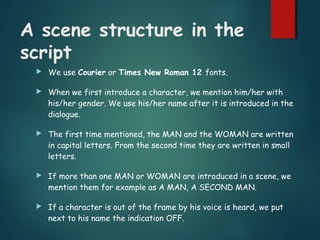
 We use Courier or Times New Roman 12 fonts.
 When we first introduce a character, we mention him/her with
his/her gender. We use his/her name after it is introduced in the
dialogue.
 The first time mentioned, the MAN and the WOMAN are written
in capital letters. From the second time they are written in small
letters.
 If more than one MAN or WOMAN are introduced in a scene, we
mention them for example as A MAN, A SECOND MAN.
 If a character is out of the frame by his voice is heard, we put
next to his name the indication OFF.
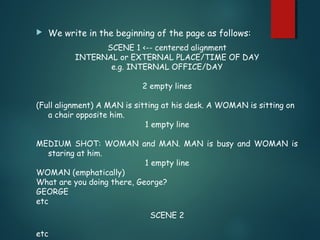
 We write in the beginning of the page as follows:
SCENE 1 <-- centered alignment
INTERNAL or EXTERNAL PLACE/TIME OF DAY
e.g. INTERNAL OFFICE/DAY
2 empty lines
(Full alignment) A MAN is sitting at his desk. A WOMAN is sitting on
a chair opposite him.
1 empty line
MEDIUM SHOT: WOMAN and MAN. MAN is busy and WOMAN is
staring at him.
1 empty line
WOMAN (emphatically)
What are you doing there, George?
GEORGE
etc
SCENE 2
etc
Film syntax
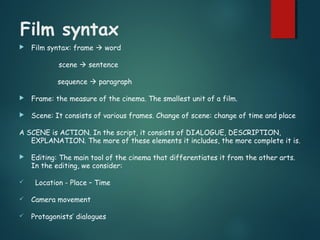
 Film syntax: frame  word
scene  sentence
sequence  paragraph
 Frame: the measure of the cinema. The smallest unit of a film.
 Scene: It consists of various frames. Change of scene: change of time and place
A SCENE is ACTION. In the script, it consists of DIALOGUE, DESCRIPTION,
EXPLANATION. The more of these elements it includes, the more complete it is.
 Editing: The main tool of the cinema that differentiates it from the other arts.
In the editing, we consider:
 Location - Place – Time
 Camera movement
 Protagonists’ dialogues
Main shots
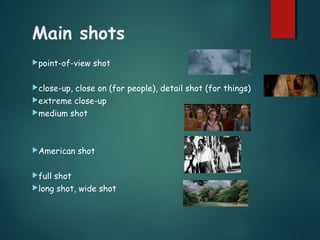
point-of-view shot
close-up, close on (for people), detail shot (for things)
extreme close-up
medium shot
American shot
full shot
long shot, wide shot
Bibliography
American Movie Classics Company LLC, (2009), ‘Film Terms
Glossary – Dictionary’. [Online]. Available at
http://www.filmsite.org/filmterms.html Last accessed on
07/12/2009.
IMDb.com, Inc. The Internet Database, (2010), ‘The Lord of
the Rings: The Fellowship of the Ring’. [Online]. Available at
http://www.imdb.com/title/tt0120737/ Last accessed on
18/12/2009.
New Line Cinema Productions, Inc., (2001), ‘The Lord of the
Rings: The Fellowship of the Ring’.
Γιώτης, Κ. (2012) «Σεμινάριο Συγγραφής Σεναρίου». Αθήνα.
Κιούκας, Α., Φόρσος, Ν., Λιναράς, Θ., Θεοδωρίδης, Μ., Μηλώσης,
Δ., (2003), ‘Η Κινηματογραφική Αφήγηση’. Αθήνα & Θεσσαλονίκη:
Φεστιβάλ Κινηματογράφου Θεσσαλονίκης.
Bibliography
American Movie Classics Company LLC, (2009), ‘Film Terms
Glossary – Dictionary’. [Online]. Available at
http://www.filmsite.org/filmterms.html Last accessed on
07/12/2009.
IMDb.com, Inc. The Internet Database, (2010), ‘The Lord of
the Rings: The Fellowship of the Ring’. [Online]. Available at
http://www.imdb.com/title/tt0120737/ Last accessed on
18/12/2009.
New Line Cinema Productions, Inc., (2001), ‘The Lord of the
Rings: The Fellowship of the Ring’.
Γιώτης, Κ. (2012) «Σεμινάριο Συγγραφής Σεναρίου». Αθήνα.
Κιούκας, Α., Φόρσος, Ν., Λιναράς, Θ., Θεοδωρίδης, Μ., Μηλώσης,
Δ., (2003), ‘Η Κινηματογραφική Αφήγηση’. Αθήνα & Θεσσαλονίκη:
Φεστιβάλ Κινηματογράφου Θεσσαλονίκης.

Script writing theory

  • 1.
    Brief presentation ofscript- writing techniques Eirini Arnaouti, English Teacher M.A. in Literature, Ph.D. in Media Education Evangeliki Model High School of Smyrna school year: 2016-2017
  • 2.
    Introduction  Script: astory told with images  A script is written to be played and shot, not read.  We write what can be put in images.  We DON’T say/narrate what we can show. No explanations are needed.  Dialogues must sound natural and spontaneous.  No literary elements are needed.  We explain in a detailed way what will be projected.  Three-part film structure (Introduction – Development – Resolution), according to Aristotle’s model. Not always followed, e.g. flashback technique.
  • 3.
    Important tips  Thescript develops around an idea: American approach The script develops around the given characters: European approach  Hypertext: the film story background. It pushes the action and explains the characters’ choices and acts. We form the characters before writing the script. The characters have their “wants” and their “needs”.  The hooks are objects used to push the film action and create suspense. E.g. In “The Lord of the Rings” film trilogy, the hook is the ring itself.  About 1’ of film duration corresponds to 1 page of script.
  • 4.
     Stages ofscript-writing: idea, character(s)  premise (synopsis, summary)  treatment (long summary, like short story without dialogues)  scaletta (for TV series)  1st draft: initial script form  2nd draft etc.  shooting script (final draft)  Four ways of script-writing in relation to the spectator: 1. the main character/script-writer knows – the spectator knows 2. the main character knows – the spectator doesn’t know 3. the main character doesn’t know – the spectator knows: technique originating in the ancient Greek tragedy (tragic irony), creation of a suspense feeling 4. the main character doesn’t know – the spectator doesn’t know
  • 5.
    A scene structurein the script  We use Courier or Times New Roman 12 fonts.  When we first introduce a character, we mention him/her with his/her gender. We use his/her name after it is introduced in the dialogue.  The first time mentioned, the MAN and the WOMAN are written in capital letters. From the second time they are written in small letters.  If more than one MAN or WOMAN are introduced in a scene, we mention them for example as A MAN, A SECOND MAN.  If a character is out of the frame by his voice is heard, we put next to his name the indication OFF.
  • 6.
     We writein the beginning of the page as follows: SCENE 1 <-- centered alignment INTERNAL or EXTERNAL PLACE/TIME OF DAY e.g. INTERNAL OFFICE/DAY 2 empty lines (Full alignment) A MAN is sitting at his desk. A WOMAN is sitting on a chair opposite him. 1 empty line MEDIUM SHOT: WOMAN and MAN. MAN is busy and WOMAN is staring at him. 1 empty line WOMAN (emphatically) What are you doing there, George? GEORGE etc SCENE 2 etc
  • 7.
    Film syntax  Filmsyntax: frame  word scene  sentence sequence  paragraph  Frame: the measure of the cinema. The smallest unit of a film.  Scene: It consists of various frames. Change of scene: change of time and place A SCENE is ACTION. In the script, it consists of DIALOGUE, DESCRIPTION, EXPLANATION. The more of these elements it includes, the more complete it is.  Editing: The main tool of the cinema that differentiates it from the other arts. In the editing, we consider:  Location - Place – Time  Camera movement  Protagonists’ dialogues
  • 8.
    Main shots point-of-view shot close-up,close on (for people), detail shot (for things) extreme close-up medium shot American shot full shot long shot, wide shot
  • 9.
    Bibliography American Movie ClassicsCompany LLC, (2009), ‘Film Terms Glossary – Dictionary’. [Online]. Available at http://www.filmsite.org/filmterms.html Last accessed on 07/12/2009. IMDb.com, Inc. The Internet Database, (2010), ‘The Lord of the Rings: The Fellowship of the Ring’. [Online]. Available at http://www.imdb.com/title/tt0120737/ Last accessed on 18/12/2009. New Line Cinema Productions, Inc., (2001), ‘The Lord of the Rings: The Fellowship of the Ring’. Γιώτης, Κ. (2012) «Σεμινάριο Συγγραφής Σεναρίου». Αθήνα. Κιούκας, Α., Φόρσος, Ν., Λιναράς, Θ., Θεοδωρίδης, Μ., Μηλώσης, Δ., (2003), ‘Η Κινηματογραφική Αφήγηση’. Αθήνα & Θεσσαλονίκη: Φεστιβάλ Κινηματογράφου Θεσσαλονίκης.
  • 10.
    Bibliography American Movie ClassicsCompany LLC, (2009), ‘Film Terms Glossary – Dictionary’. [Online]. Available at http://www.filmsite.org/filmterms.html Last accessed on 07/12/2009. IMDb.com, Inc. The Internet Database, (2010), ‘The Lord of the Rings: The Fellowship of the Ring’. [Online]. Available at http://www.imdb.com/title/tt0120737/ Last accessed on 18/12/2009. New Line Cinema Productions, Inc., (2001), ‘The Lord of the Rings: The Fellowship of the Ring’. Γιώτης, Κ. (2012) «Σεμινάριο Συγγραφής Σεναρίου». Αθήνα. Κιούκας, Α., Φόρσος, Ν., Λιναράς, Θ., Θεοδωρίδης, Μ., Μηλώσης, Δ., (2003), ‘Η Κινηματογραφική Αφήγηση’. Αθήνα & Θεσσαλονίκη: Φεστιβάλ Κινηματογράφου Θεσσαλονίκης.