INSPECTION GUAGES WEEK # 02
WHAT IS A GUAGE ?
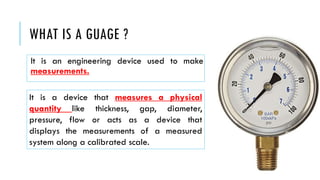
It is an engineering device used to make
measurements.
It is a device that measures a physical
quantity like thickness, gap, diameter,
pressure, flow or acts as a device that
displays the measurements of a measured
system along a calibrated scale.
INSPECTION GAUGES
 A tool which is used to check a physical quantity like a product’s
dimension with reference to its maximum and minimum acceptable
limits.
 Helps in segregating acceptable and non-acceptable product in
mass production.
TYPES OF INSPECTION GAUGES
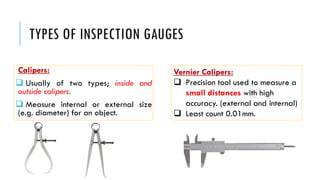
Calipers:
 Usually of two types; inside and
outside calipers.
 Measure internal or external size
(e.g. diameter) for an object.
Vernier Calipers:
 Precision tool used to measure a
small distances with high
accuracy. (external and internal)
 Least count 0.01mm.
TYPES OF INSPECTION GAUGES
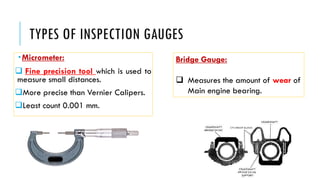
Micrometer:
 Fine precision tool which is used to
measure small distances.
More precise than Vernier Calipers.
Least count 0.001 mm.
Bridge Gauge:
 Measures the amount of wear of
Main engine bearing.
TYPES OF INSPECTION GAUGES
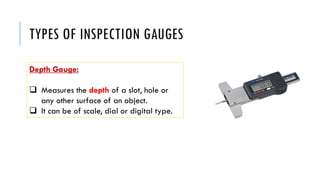
Depth Gauge:
 Measures the depth of a slot, hole or
any other surface of an object.
 It can be of scale, dial or digital type.
TYPES OF INSPECTION GAUGES
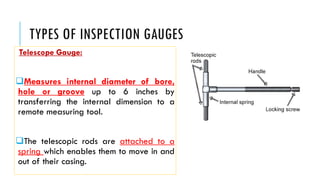
Telescope Gauge:
Measures internal diameter of bore,
hole or groove up to 6 inches by
transferring the internal dimension to a
remote measuring tool.
The telescopic rods are attached to a
spring which enables them to move in and
out of their casing.
TYPES OF INSPECTION GAUGES
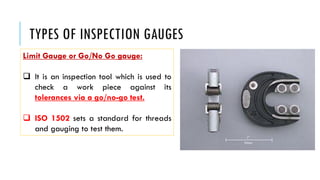
Limit Gauge or Go/No Go gauge:
 It is an inspection tool which is used to
check a work piece against its
tolerances via a go/no-go test.
 ISO 1502 sets a standard for threads
and gauging to test them.
TYPES OF INSPECTION GAUGES
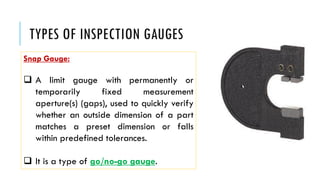
Snap Gauge:
 A limit gauge with permanently or
temporarily fixed measurement
aperture(s) (gaps), used to quickly verify
whether an outside dimension of a part
matches a preset dimension or falls
within predefined tolerances.
 It is a type of go/no-go gauge.
TYPES OF INSPECTION GAUGES
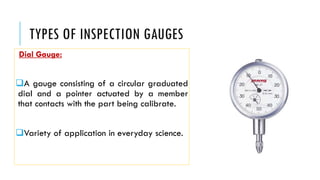
Dial Gauge:
A gauge consisting of a circular graduated
dial and a pointer actuated by a member
that contacts with the part being calibrate.
Variety of application in everyday science.
TYPES OF INSPECTION GAUGES
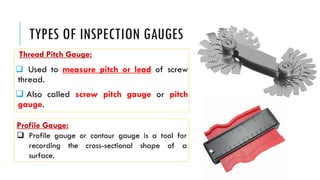
Thread Pitch Gauge:
 Used to measure pitch or lead of screw
thread.
 Also called screw pitch gauge or pitch
gauge.
Profile Gauge:
 Profile gauge or contour gauge is a tool for
recording the cross-sectional shape of a
surface.
TYPES OF INSPECTION GAUGES
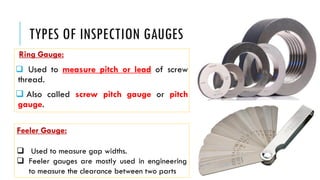
Ring Gauge:
 Used to measure pitch or lead of screw
thread.
 Also called screw pitch gauge or pitch
gauge.
Feeler Gauge:
 Used to measure gap widths.
 Feeler gauges are mostly used in engineering
to measure the clearance between two parts
TYPES OF INSPECTION GAUGES
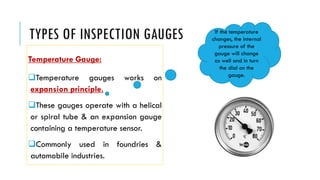
Temperature Gauge:
Temperature gauges works on
expansion principle.
These gauges operate with a helical
or spiral tube & an expansion gauge
containing a temperature sensor.
Commonly used in foundries &
automobile industries.
If the temperature
changes, the internal
pressure of the
gauge will change
as well and in turn
the dial on the
gauge.
TYPES OF INSPECTION GAUGES
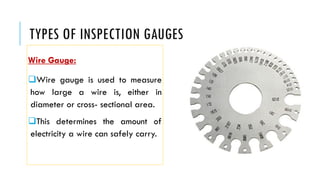
Wire Gauge:
Wire gauge is used to measure
how large a wire is, either in
diameter or cross- sectional area.
This determines the amount of
electricity a wire can safely carry.
TYPES OF INSPECTION GAUGES
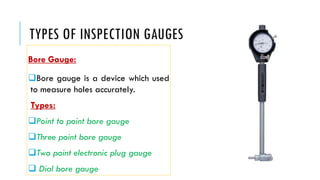
Bore Gauge:
Bore gauge is a device which used
to measure holes accurately.
Types:
Point to point bore gauge
Three point bore gauge
Two point electronic plug gauge
 Dial bore gauge
TYPES OF INSPECTION GAUGES
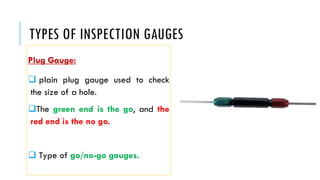
Plug Gauge:
 plain plug gauge used to check
the size of a hole.
The green end is the go, and the
red end is the no go.
 Type of go/no-go gauges.
TYPES OF INSPECTION GAUGES
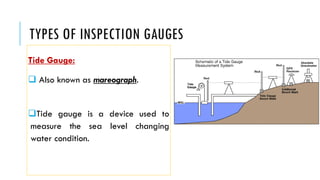
Tide Gauge:
 Also known as mareograph.
Tide gauge is a device used to
measure the sea level changing
water condition.
THE END

2 industry Inspection Guages (Week-02).pdf

  • 1.
  • 2.
    WHAT IS AGUAGE ? It is an engineering device used to make measurements. It is a device that measures a physical quantity like thickness, gap, diameter, pressure, flow or acts as a device that displays the measurements of a measured system along a calibrated scale.
  • 3.
    INSPECTION GAUGES  Atool which is used to check a physical quantity like a product’s dimension with reference to its maximum and minimum acceptable limits.  Helps in segregating acceptable and non-acceptable product in mass production.
  • 4.
    TYPES OF INSPECTIONGAUGES Calipers:  Usually of two types; inside and outside calipers.  Measure internal or external size (e.g. diameter) for an object. Vernier Calipers:  Precision tool used to measure a small distances with high accuracy. (external and internal)  Least count 0.01mm.
  • 5.
    TYPES OF INSPECTIONGAUGES Micrometer:  Fine precision tool which is used to measure small distances. More precise than Vernier Calipers. Least count 0.001 mm. Bridge Gauge:  Measures the amount of wear of Main engine bearing.
  • 6.
    TYPES OF INSPECTIONGAUGES Depth Gauge:  Measures the depth of a slot, hole or any other surface of an object.  It can be of scale, dial or digital type.
  • 7.
    TYPES OF INSPECTIONGAUGES Telescope Gauge: Measures internal diameter of bore, hole or groove up to 6 inches by transferring the internal dimension to a remote measuring tool. The telescopic rods are attached to a spring which enables them to move in and out of their casing.
  • 8.
    TYPES OF INSPECTIONGAUGES Limit Gauge or Go/No Go gauge:  It is an inspection tool which is used to check a work piece against its tolerances via a go/no-go test.  ISO 1502 sets a standard for threads and gauging to test them.
  • 9.
    TYPES OF INSPECTIONGAUGES Snap Gauge:  A limit gauge with permanently or temporarily fixed measurement aperture(s) (gaps), used to quickly verify whether an outside dimension of a part matches a preset dimension or falls within predefined tolerances.  It is a type of go/no-go gauge.
  • 10.
    TYPES OF INSPECTIONGAUGES Dial Gauge: A gauge consisting of a circular graduated dial and a pointer actuated by a member that contacts with the part being calibrate. Variety of application in everyday science.
  • 11.
    TYPES OF INSPECTIONGAUGES Thread Pitch Gauge:  Used to measure pitch or lead of screw thread.  Also called screw pitch gauge or pitch gauge. Profile Gauge:  Profile gauge or contour gauge is a tool for recording the cross-sectional shape of a surface.
  • 12.
    TYPES OF INSPECTIONGAUGES Ring Gauge:  Used to measure pitch or lead of screw thread.  Also called screw pitch gauge or pitch gauge. Feeler Gauge:  Used to measure gap widths.  Feeler gauges are mostly used in engineering to measure the clearance between two parts
  • 13.
    TYPES OF INSPECTIONGAUGES Temperature Gauge: Temperature gauges works on expansion principle. These gauges operate with a helical or spiral tube & an expansion gauge containing a temperature sensor. Commonly used in foundries & automobile industries. If the temperature changes, the internal pressure of the gauge will change as well and in turn the dial on the gauge.
  • 14.
    TYPES OF INSPECTIONGAUGES Wire Gauge: Wire gauge is used to measure how large a wire is, either in diameter or cross- sectional area. This determines the amount of electricity a wire can safely carry.
  • 15.
    TYPES OF INSPECTIONGAUGES Bore Gauge: Bore gauge is a device which used to measure holes accurately. Types: Point to point bore gauge Three point bore gauge Two point electronic plug gauge  Dial bore gauge
  • 16.
    TYPES OF INSPECTIONGAUGES Plug Gauge:  plain plug gauge used to check the size of a hole. The green end is the go, and the red end is the no go.  Type of go/no-go gauges.
  • 17.
    TYPES OF INSPECTIONGAUGES Tide Gauge:  Also known as mareograph. Tide gauge is a device used to measure the sea level changing water condition.
  • 18.