Dec 8th, 2018
sailon.erk@gmail.com
edX DelftX: Scratch TENGX, Scratch: Programming for Teachers
Week6 Homework assignment
Erika Hayashi
Lesson Plan
Erika Hayashi
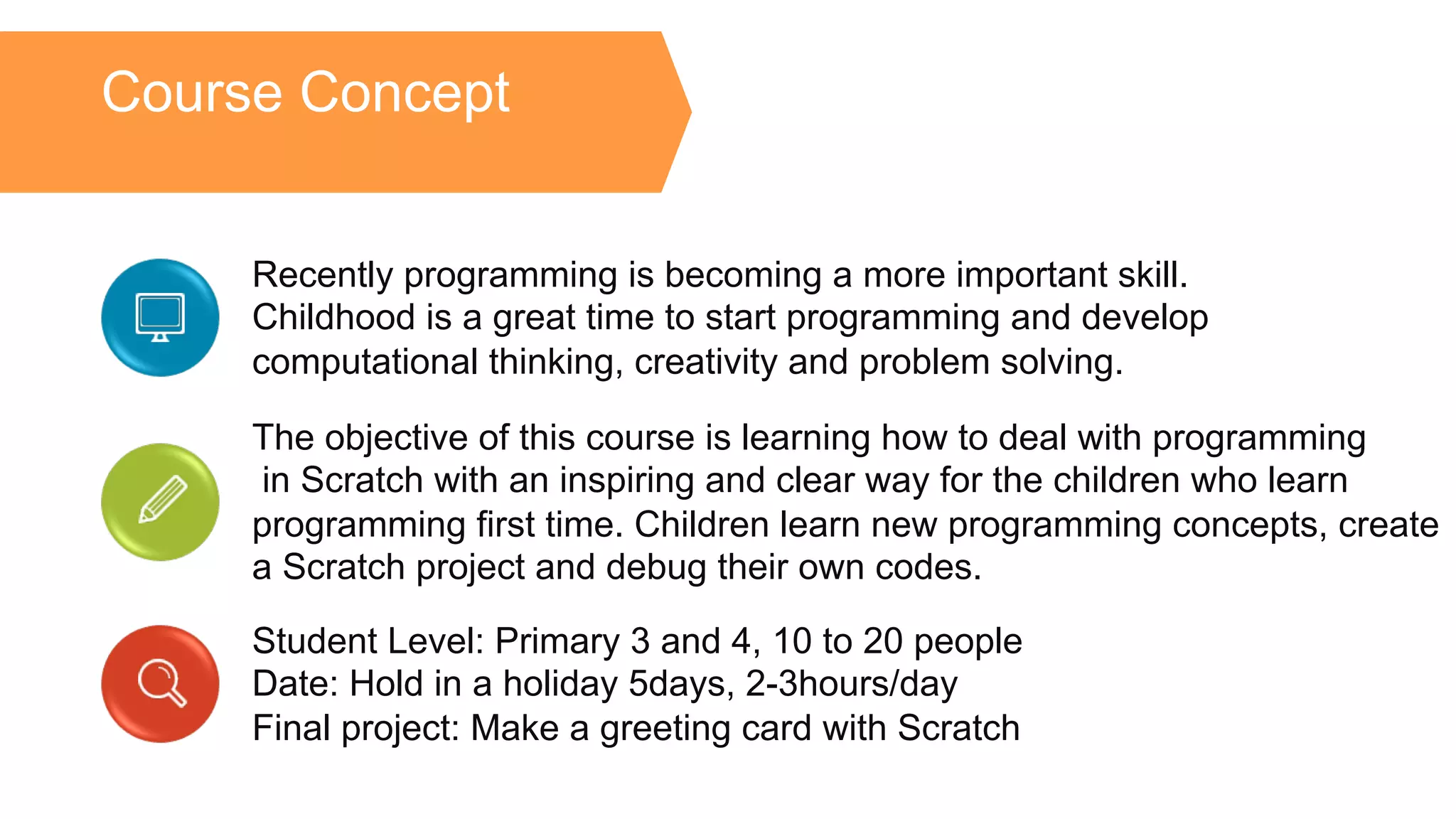
Course Concept
Recently programming is becoming a more important skill.
Childhood is a great time to start programming and develop
computational thinking, creativity and problem solving.
The objective of this course is learning how to deal with programming
in Scratch with an inspiring and clear way for the children who learn
programming first time. Children learn new programming concepts, create
a Scratch project and debug their own codes.
Student Level: Primary 3 and 4, 10 to 20 people
Date: Hold in a holiday 5days, 2-3hours/day
Final project: Make a greeting card with Scratch
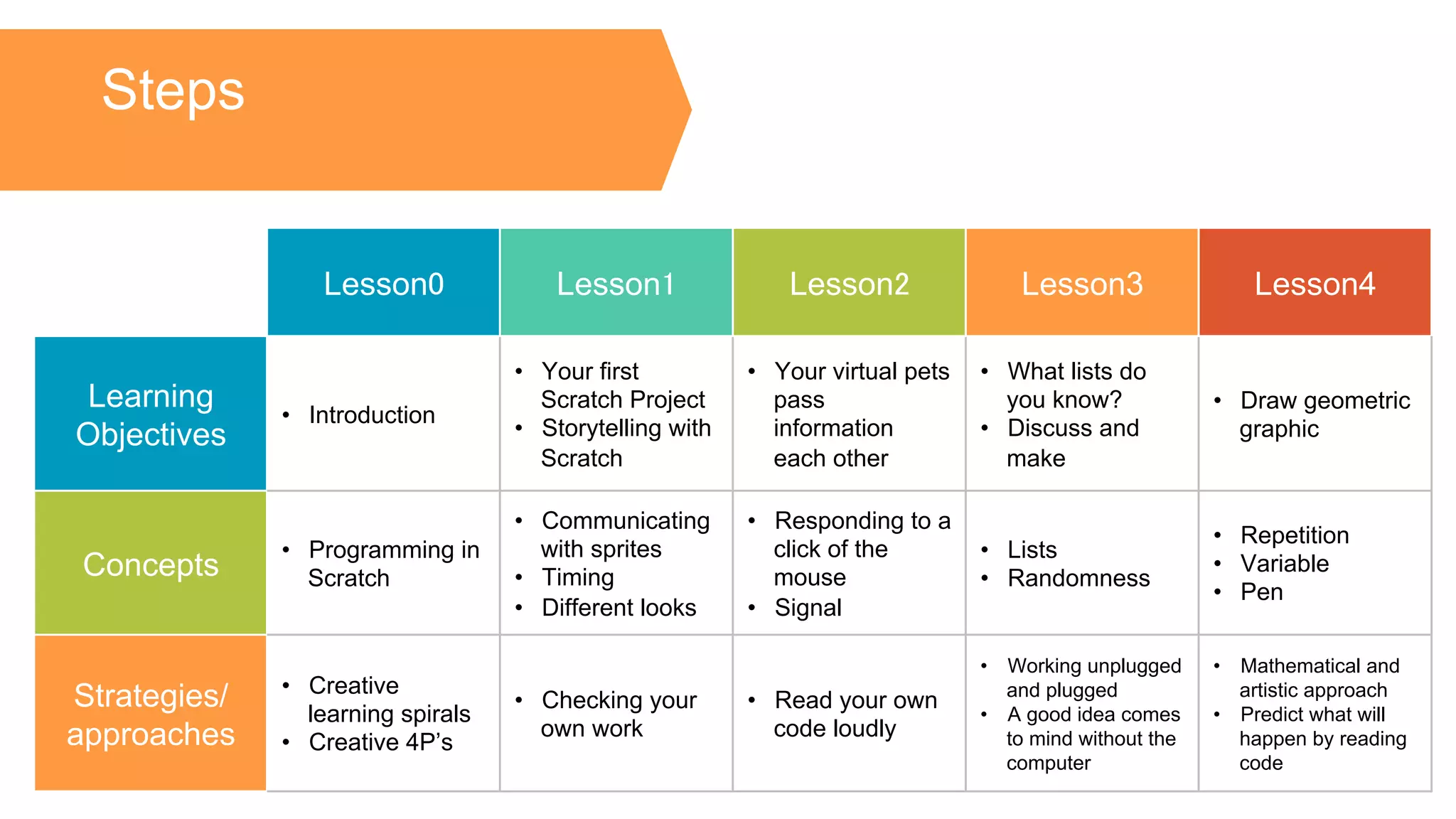
Steps
Lesson0	 Lesson1	 Lesson2	 Lesson3	 Lesson4	
Learning
Objectives	
•  Introduction	
•  Your first
Scratch Project
•  Storytelling with
Scratch	
•  Your virtual pets
pass
information
each other	
•  What lists do
you know?
•  Discuss and
make	
•  Draw geometric 
graphic	
Concepts	
•  Programming in
Scratch	
•  Communicating
with sprites
•  Timing
•  Different looks	
•  Responding to a
click of the
mouse
•  Signal	
•  Lists
•  Randomness	
•  Repetition
•  Variable
•  Pen	
Strategies/
approaches	
•  Creative
learning spirals
•  Creative 4P’s	
•  Checking your
own work	
•  Read your own
code loudly	
•  Working unplugged
and plugged
•  A good idea comes
to mind without the
computer	
•  Mathematical and
artistic approach
•  Predict what will
happen by reading
code
Methods
The Creative Learning Spiral is the creative process as kindergarten children play
with blocks, build castles, and tell stories (Resnick, 2017).
Resnick, M. (2017). p11. Lifelong Kindergarten. Cultivating
Creativity through Projects, Passion, Peers, and Play.
The MIT Press.
After kindergarten, most people shift away from this
spiral. They spend much time for sitting at desk,
filling out worksheet, and just listening to lectures.
They have forgotten this spiral.
Methods
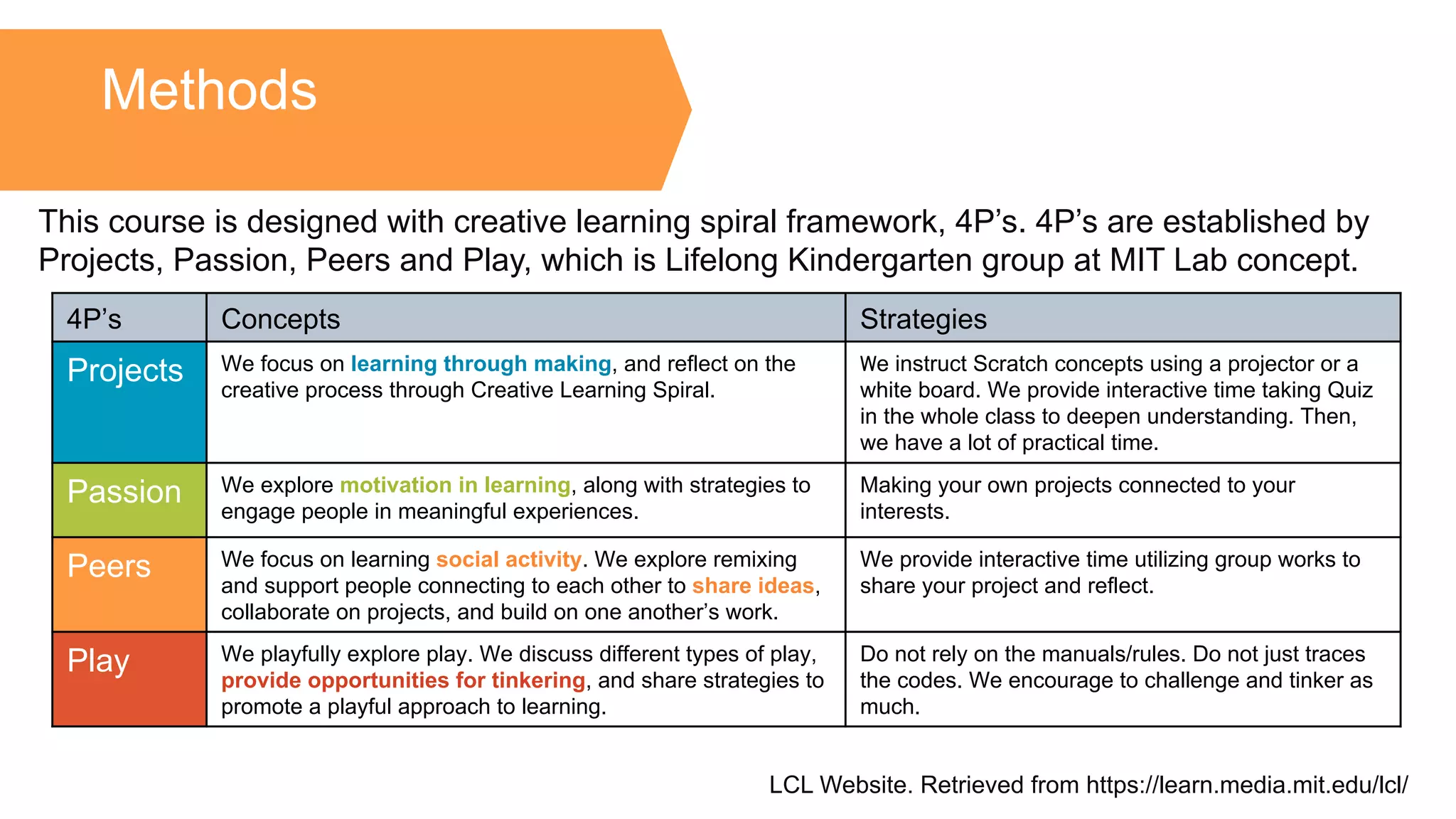
This course is designed with creative learning spiral framework, 4P’s. 4P’s are established by
Projects, Passion, Peers and Play, which is Lifelong Kindergarten group at MIT Lab concept.
4P’s	 Concepts	 Strategies	
Projects	 We focus on learning through making, and reflect on the
creative process through Creative Learning Spiral.	
We instruct Scratch concepts using a projector or a
white board. We provide interactive time taking Quiz
in the whole class to deepen understanding. Then,
we have a lot of practical time.	
Passion	 We explore motivation in learning, along with strategies to
engage people in meaningful experiences.	
Making your own projects connected to your
interests.	
Peers	 We focus on learning social activity. We explore remixing
and support people connecting to each other to share ideas,
collaborate on projects, and build on one another’s work.	
We provide interactive time utilizing group works to
share your project and reflect.	
Play	 We playfully explore play. We discuss different types of play,
provide opportunities for tinkering, and share strategies to
promote a playful approach to learning.	
Do not rely on the manuals/rules. Do not just traces
the codes. We encourage to challenge and tinker as
much.	
LCL Website. Retrieved from https://learn.media.mit.edu/lcl/
Additional resources
Facilities	
A projector, a whiteboard, electricity, Computers for each
children, A4 size mini whiteboard, paper, pens
Course materials	 Presentation slides, Scratch projects
References	
・edX Delft – Scratch TENGX Scratch: Programming for Teachers
・edX Delft – Scratch ENGX Scratch: Programming for Kids
・Learning Creative Learning https://learn.media.mit.edu/lcl/

Scratch Lesson Plan

  • 1.
    Dec 8th, 2018 sailon.erk@gmail.com edXDelftX: Scratch TENGX, Scratch: Programming for Teachers Week6 Homework assignment Erika Hayashi Lesson Plan Erika Hayashi
  • 2.
    Course Concept Recently programmingis becoming a more important skill. Childhood is a great time to start programming and develop computational thinking, creativity and problem solving. The objective of this course is learning how to deal with programming in Scratch with an inspiring and clear way for the children who learn programming first time. Children learn new programming concepts, create a Scratch project and debug their own codes. Student Level: Primary 3 and 4, 10 to 20 people Date: Hold in a holiday 5days, 2-3hours/day Final project: Make a greeting card with Scratch
  • 3.
    Steps Lesson0 Lesson1 Lesson2 Lesson3 Lesson4 Learning Objectives •  Introduction •  Your first Scratch Project •  Storytelling with Scratch •  Your virtual pets pass information each other •  What lists do you know? •  Discuss and make •  Draw geometric  graphic Concepts •  Programming in Scratch •  Communicating with sprites •  Timing •  Different looks •  Responding to a click of the mouse •  Signal •  Lists •  Randomness •  Repetition •  Variable •  Pen Strategies/ approaches •  Creative learning spirals •  Creative 4P’s •  Checking your own work •  Read your own code loudly •  Working unplugged and plugged •  A good idea comes to mind without the computer •  Mathematical and artistic approach •  Predict what will happen by reading code
  • 4.
    Methods The Creative LearningSpiral is the creative process as kindergarten children play with blocks, build castles, and tell stories (Resnick, 2017). Resnick, M. (2017). p11. Lifelong Kindergarten. Cultivating Creativity through Projects, Passion, Peers, and Play. The MIT Press. After kindergarten, most people shift away from this spiral. They spend much time for sitting at desk, filling out worksheet, and just listening to lectures. They have forgotten this spiral.
  • 5.
    Methods This course isdesigned with creative learning spiral framework, 4P’s. 4P’s are established by Projects, Passion, Peers and Play, which is Lifelong Kindergarten group at MIT Lab concept. 4P’s Concepts Strategies Projects We focus on learning through making, and reflect on the creative process through Creative Learning Spiral. We instruct Scratch concepts using a projector or a white board. We provide interactive time taking Quiz in the whole class to deepen understanding. Then, we have a lot of practical time. Passion We explore motivation in learning, along with strategies to engage people in meaningful experiences. Making your own projects connected to your interests. Peers We focus on learning social activity. We explore remixing and support people connecting to each other to share ideas, collaborate on projects, and build on one another’s work. We provide interactive time utilizing group works to share your project and reflect. Play We playfully explore play. We discuss different types of play, provide opportunities for tinkering, and share strategies to promote a playful approach to learning. Do not rely on the manuals/rules. Do not just traces the codes. We encourage to challenge and tinker as much. LCL Website. Retrieved from https://learn.media.mit.edu/lcl/
  • 6.
    Additional resources Facilities A projector,a whiteboard, electricity, Computers for each children, A4 size mini whiteboard, paper, pens Course materials Presentation slides, Scratch projects References ・edX Delft – Scratch TENGX Scratch: Programming for Teachers ・edX Delft – Scratch ENGX Scratch: Programming for Kids ・Learning Creative Learning https://learn.media.mit.edu/lcl/