DIGITAL FABRICATION | CODING | ROBOTICS | PASSION
A Different Approach to Coding, Creativity, Innovation
How kids are making and remaking themselves from Scratch.
A message to their business parents, empowering an end-to-end Digital Change.
At the beginning of November Code.org has launched the 2015 ac-
tivities for Hour of Code, an annual effort to encourage schools
around the world to spend at least one hour introducing students to
coding (that is, computer programming). During the week of Decem-
ber 7–13, millions of students will have their first coding experience
following tutorials on the Hour of Code website. Many schools are
going beyond these initial coding activities. A growing number of cit-
ies (including New York City) and even entire countries (including
England) are adding coding as a requirement in their school curricula.
In Italy… not exactly: school is running after, but digital initiatives are
sprinting faster: there are more coder
dojos in Italy than in any other coun-
try, the last Maker Faire in Rome
scored more visitors than the one in
NY.
We are strong proponents of children
learning to code, but we have concerns
about the motivations and methods un-
derlying many of these new learn-to-code
initiatives. Many of them, motivated by a
shortage of programmers and software de-
velopers in industry, focus especially on
preparing students for computer science
degrees and careers, and they typically in-
troduce coding as a series of logic puzzles
for students to solve.
Seymour Papert founded the Constructionism theory across the ‘80s.
Mitch Resnick and David Siegel co-founded the Scratch Foundation in
2013 to support and promote a very different approach to coding.
Coding is not a set of technical skills but a
new type of literacy and personal expres-
sion, valuable for everyone, much like
learning to write. We see coding as a new
way for people to organize, express, and
share their ideas.
This approach to coding is embodied within the Scratch program-
ming software developed at the MIT Media Lab and available for free
online. With Scratch, children ages seven and up snap together
graphical programming blocks to create interactive stories and
games with animated characters. They can share their projects in the
Scratch online community, where others can try them out, give feed-
back and suggestions, and even re-
vise and extend the projects with
their own ideas.
Since the launch of Scratch in
2007, children around the world
have shared more than 11 million projects in the Scratch community.
More than 17,000 new projects are added each day.
Young people use Scratch in many different settings: homes, schools,
libraries, community centers. As they create and share projects in
Scratch, they are learning more than coding skills. They are learning
to think creatively, reason systematically, and work collaboratively —
 essential skills for everyone in today’s society.
Consider Jocelyn, a teenager who has programmed and shared more
than 200 projects over the past two years in the Scratch community
under her Scratch username CrazyNimbus. She’s developed a wide
variety of projects, including a helicopter-flying game, several dress-
up doll games, a back-to-school animation with dancing pencils and
calculators, and a countdown animation that calculates and displays
the number of days until Thanksgiving.
Jocelyn initially came to Scratch to learn
how to create games. She stayed because of
the community. “I shared my first project, I
got instant feedback, and I knew I needed to
keep going and keep coding,” says Jocelyn.
Scratch is similar to other coding ap-
proaches in that it requires systematic, logi-
cal reasoning. To create her projects, Joce-
lyn needed to learn a variety of problem-
solving strategies, such as breaking complex
problems into simpler parts and continually
revising her projects when they didn’t work
as expected.
But where Scratch is different from the majority of coding approaches
is that it puts a high priority on children learning to express themselves
creatively and to share their creations with others. For example, Joce-
lyn used Scratch to program interactive birthday cards for her friends,
each with its own personalized animation. Jocelyn also developed an
interactive tutorial that showed other children how to make their
own customized Valentine’s Day cards.
“Everyone needs a voice with
computers,” she says. “I like
sharing my projects with the
world and seeing what other
people think about them.”
Most learn-to-code initiatives
do not support this type of
creative expression. In many introductory coding activities, students
are asked to program the movements of a virtual character navigating
through a set of obstacles toward a goal. This approach can help stu-
dents learn some basic coding concepts, but it doesn’t allow them to
express themselves creatively — or develop a long-term engagement
with coding. It’s like offering a writing class that teaches only grammar
“Play is the highest form of
research” (Albert Einstein)
“The mind is not a vessel to be
filled, but a fire to be kindled”
(Plutarch)
and punctuation without providing students a chance to write their
own stories. With Scratch, our goal is for young people to become flu-
ent with coding — not only learning the mechanics and concepts of
coding, but also developing their own voice and their ability to express
their ideas.
As young people express themselves with Scratch, they begin to think of
themselves differently, just as they do when they learn to write.
We see something similar happening when kids code with Scratch.
Jocelyn and other Scratch community members begin to see them-
selves as creators who are able to make their own projects on the com-
puter, not just interact with pro-
grams created by others. “It’s a life
changer,” says Jocelyn. In today’s
society, digital technologies are a
symbol of possibility and progress.
As young people create and share
projects with Scratch, they begin to
see the possibility of contributing actively and fully to society.
If coding is going to make a true difference in children’s lives, it’s im-
portant to move beyondthe traditional view of coding as simply a tech-
nical skill or just a pipeline to getting a technical job.
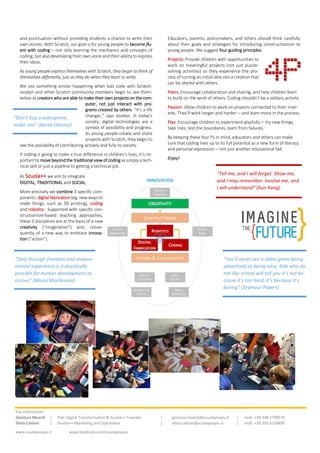
As Scuola++ we aim to integrate
DIGITAL, TRADITIONAL and SOCIAL.
More precisely we combine 3 specific com-
ponents: digital fabrication (eg. new ways to
make things, such as 3D printing), coding
and robotics. Supported with specific con-
structionism-based teaching approaches,
these 3 disciplines are at the basis of a new
creativity (“imagination”) and, conse-
quently of a new way to embrace innova-
tion (“action”).
Educators, parents, policymakers, and others should think carefully
about their goals and strategies for introducing constructionism to
young people. We suggest four guiding principles:
Projects: Provide children with opportunities to
work on meaningful projects (not just puzzle-
solving activities) so they experience the pro-
cess of turning an initial idea into a creation that
can be shared with others.
Peers: Encourage collaboration and sharing, and help children learn
to build on the work of others. Coding shouldn’t be a solitary activity.
Passion: Allow children to work on projects connected to their inter-
ests. They’ll work longer and harder — and learn more in the process.
Play: Encourage children to experiment playfully — try new things,
take risks, test the boundaries, learn from failures.
By keeping these four Ps in mind, educators and others can make
sure that coding lives up to its full potential as a new form of literacy
and personal expression — not just another educational fad.
Enjoy!
“Don’t buy a videogame,
make one” (Barak Obama)
“You’ll never see a video game being
advertised as being easy. Kids who do
not like school will tell you it’s not be-
cause it’s too hard. It’s because it’s
boring” (Seymour Papert)
“Only through freedom and environ-
mental experience is it practically
possible for human development to
occour” (Maria Montessori)
“Tell me, and I will forget. Show me,
and I may remember. Involve me, and
I will understand” (Xun Kang)
For information:
Gianluca Meardi | PwC Digital Transformation & Scuola++ Founder | gianluca.meardi@scuolapiupiu.it | mob. +39.348.5799576
Silvia Cattoni | Scuola++ Marketing and Operations | silvia.cattoni@scuolapiupiu.it | mob. +39.393.6234890
www.scuolapiupiu.it www.facebook.com/scuolapiupiu

Scuola++ Whitepaper, nov 2015

  • 1.
    DIGITAL FABRICATION |CODING | ROBOTICS | PASSION A Different Approach to Coding, Creativity, Innovation How kids are making and remaking themselves from Scratch. A message to their business parents, empowering an end-to-end Digital Change. At the beginning of November Code.org has launched the 2015 ac- tivities for Hour of Code, an annual effort to encourage schools around the world to spend at least one hour introducing students to coding (that is, computer programming). During the week of Decem- ber 7–13, millions of students will have their first coding experience following tutorials on the Hour of Code website. Many schools are going beyond these initial coding activities. A growing number of cit- ies (including New York City) and even entire countries (including England) are adding coding as a requirement in their school curricula. In Italy… not exactly: school is running after, but digital initiatives are sprinting faster: there are more coder dojos in Italy than in any other coun- try, the last Maker Faire in Rome scored more visitors than the one in NY. We are strong proponents of children learning to code, but we have concerns about the motivations and methods un- derlying many of these new learn-to-code initiatives. Many of them, motivated by a shortage of programmers and software de- velopers in industry, focus especially on preparing students for computer science degrees and careers, and they typically in- troduce coding as a series of logic puzzles for students to solve. Seymour Papert founded the Constructionism theory across the ‘80s. Mitch Resnick and David Siegel co-founded the Scratch Foundation in 2013 to support and promote a very different approach to coding. Coding is not a set of technical skills but a new type of literacy and personal expres- sion, valuable for everyone, much like learning to write. We see coding as a new way for people to organize, express, and share their ideas. This approach to coding is embodied within the Scratch program- ming software developed at the MIT Media Lab and available for free online. With Scratch, children ages seven and up snap together graphical programming blocks to create interactive stories and games with animated characters. They can share their projects in the Scratch online community, where others can try them out, give feed- back and suggestions, and even re- vise and extend the projects with their own ideas. Since the launch of Scratch in 2007, children around the world have shared more than 11 million projects in the Scratch community. More than 17,000 new projects are added each day. Young people use Scratch in many different settings: homes, schools, libraries, community centers. As they create and share projects in Scratch, they are learning more than coding skills. They are learning to think creatively, reason systematically, and work collaboratively —  essential skills for everyone in today’s society. Consider Jocelyn, a teenager who has programmed and shared more than 200 projects over the past two years in the Scratch community under her Scratch username CrazyNimbus. She’s developed a wide variety of projects, including a helicopter-flying game, several dress- up doll games, a back-to-school animation with dancing pencils and calculators, and a countdown animation that calculates and displays the number of days until Thanksgiving. Jocelyn initially came to Scratch to learn how to create games. She stayed because of the community. “I shared my first project, I got instant feedback, and I knew I needed to keep going and keep coding,” says Jocelyn. Scratch is similar to other coding ap- proaches in that it requires systematic, logi- cal reasoning. To create her projects, Joce- lyn needed to learn a variety of problem- solving strategies, such as breaking complex problems into simpler parts and continually revising her projects when they didn’t work as expected. But where Scratch is different from the majority of coding approaches is that it puts a high priority on children learning to express themselves creatively and to share their creations with others. For example, Joce- lyn used Scratch to program interactive birthday cards for her friends, each with its own personalized animation. Jocelyn also developed an interactive tutorial that showed other children how to make their own customized Valentine’s Day cards. “Everyone needs a voice with computers,” she says. “I like sharing my projects with the world and seeing what other people think about them.” Most learn-to-code initiatives do not support this type of creative expression. In many introductory coding activities, students are asked to program the movements of a virtual character navigating through a set of obstacles toward a goal. This approach can help stu- dents learn some basic coding concepts, but it doesn’t allow them to express themselves creatively — or develop a long-term engagement with coding. It’s like offering a writing class that teaches only grammar “Play is the highest form of research” (Albert Einstein) “The mind is not a vessel to be filled, but a fire to be kindled” (Plutarch)
  • 2.
    and punctuation withoutproviding students a chance to write their own stories. With Scratch, our goal is for young people to become flu- ent with coding — not only learning the mechanics and concepts of coding, but also developing their own voice and their ability to express their ideas. As young people express themselves with Scratch, they begin to think of themselves differently, just as they do when they learn to write. We see something similar happening when kids code with Scratch. Jocelyn and other Scratch community members begin to see them- selves as creators who are able to make their own projects on the com- puter, not just interact with pro- grams created by others. “It’s a life changer,” says Jocelyn. In today’s society, digital technologies are a symbol of possibility and progress. As young people create and share projects with Scratch, they begin to see the possibility of contributing actively and fully to society. If coding is going to make a true difference in children’s lives, it’s im- portant to move beyondthe traditional view of coding as simply a tech- nical skill or just a pipeline to getting a technical job. As Scuola++ we aim to integrate DIGITAL, TRADITIONAL and SOCIAL. More precisely we combine 3 specific com- ponents: digital fabrication (eg. new ways to make things, such as 3D printing), coding and robotics. Supported with specific con- structionism-based teaching approaches, these 3 disciplines are at the basis of a new creativity (“imagination”) and, conse- quently of a new way to embrace innova- tion (“action”). Educators, parents, policymakers, and others should think carefully about their goals and strategies for introducing constructionism to young people. We suggest four guiding principles: Projects: Provide children with opportunities to work on meaningful projects (not just puzzle- solving activities) so they experience the pro- cess of turning an initial idea into a creation that can be shared with others. Peers: Encourage collaboration and sharing, and help children learn to build on the work of others. Coding shouldn’t be a solitary activity. Passion: Allow children to work on projects connected to their inter- ests. They’ll work longer and harder — and learn more in the process. Play: Encourage children to experiment playfully — try new things, take risks, test the boundaries, learn from failures. By keeping these four Ps in mind, educators and others can make sure that coding lives up to its full potential as a new form of literacy and personal expression — not just another educational fad. Enjoy! “Don’t buy a videogame, make one” (Barak Obama) “You’ll never see a video game being advertised as being easy. Kids who do not like school will tell you it’s not be- cause it’s too hard. It’s because it’s boring” (Seymour Papert) “Only through freedom and environ- mental experience is it practically possible for human development to occour” (Maria Montessori) “Tell me, and I will forget. Show me, and I may remember. Involve me, and I will understand” (Xun Kang) For information: Gianluca Meardi | PwC Digital Transformation & Scuola++ Founder | gianluca.meardi@scuolapiupiu.it | mob. +39.348.5799576 Silvia Cattoni | Scuola++ Marketing and Operations | silvia.cattoni@scuolapiupiu.it | mob. +39.393.6234890 www.scuolapiupiu.it www.facebook.com/scuolapiupiu