‘Tinker Education’ is a global STEM education brand of Korean top-tier EdTech company,
EMCAST’s STEM Education is driven by Computer Science
32
Tinker Education teaches students Computer Science with the
integration of Science, Mathematics, Engineering, and Art.
Tinker Education aims to teach students that the computer is a powerful tool for
creativity and invention. We consider our students not as consumers but as future
innovators and idea makers.
The students will be equipped to utilize technology confidently in the infinite world that is
composed of 0 and 1. Tinker Education will enhance the student’s natural talents by
equipping them with critical thinking. We promise that Tinker Education students
will become innovative thinkers who will surprise the world with dynamic
solutions to real life needs.
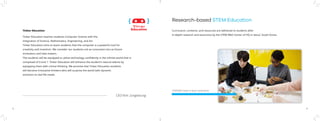
Curriculum, contents, and resources are delivered to students after
in-depth research and assurance by the STEM R&D Center of HQ in Seoul, South Korea.
STEM R&D Center in Seoul, South Korea
Tinker Education
Research-based STEM Education
CEO Kim Jungwoung
54
Computer Science Framework of Tinker Education Tinker Education’s STEM Programs
Key Concepts
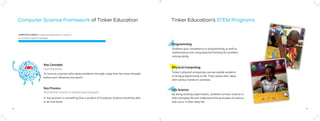
Programming
Key Process
Physical Computing
Life Science
Learning Goals
Educational content to achieve learning goals
To nurture a person who solves problems through a way that has never thought
before and influences the world
Students gain competency in programming as well as
mathematical and computational thinking for problem
solving ability.
A “key process” is something that a student of Computer Science should be able
to do and know
Tinker’s physical computing courses enable students
to bring programming to life. They realize their ideas
with various hands-on activities.
By doing exciting experiments, students connect science to
their everyday life and understand the principles of science
that occur in their daily life.
COMPUTER SCIENCE is powering approaches to many of
our world’s toughest challenges.
76
Computer Science Key Concepts of Tinker Education
1. Logical Reasoning
2. Algorithm
3. Decomposition
4. Pattern Recognition
5. Generalization
6. Abstraction
7. Evaluation
Logical reasoning is the process of applying rules to problem
solving. Logical reasoning selects an appropriate
algorithm by predicting what happens at this stage.
The predictions of each algorithm can be used to compare
solutions and determine the best solution.
Step-by-step plans or guidelines for problem solving used
for calculations, data processing, or automation
Separating the elements necessary for problem solving into
small units
Patterns can be said to be similarities or characteristics.
It means the process of finding similarities and
commonalities between small disaggregated problems
that can help with problem-solving
It is often used with patterns. It can be described as a generalization
that produces a common problem-solving method that can solve
various problems. Or, it is a generalization to use for solving a variety
of new problems by applying a method that solved a similar
problem in the past.
It is the process of concentrating on key ideas for the purpose of
problem solving, gradually reducing the complexity of the problem,
removing the irrelevant ones, and reducing the complexity by adding
information for problem solving.
Decision making by judgment is about making judgments in an
objective and systematic way as much as possible. Evaluation is done
in daily situations that we face every day. We judge and decide what to
do and how to think based on various factors.
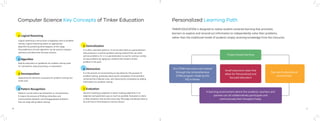
TINKER EDUCATION is designed to realize student-centered learning that promotes
learners to explore and reconstruct information to independently solve their problems,
rather than the traditional model of students simply receiving knowledge from the instructor.
Project based learning
Small classroom sizes that
allow for Personalized and
focused education
Our STEM instructors are trained
through the comprehensive
STEM program made by the
HQ in Korea.
Top-notch educational
environment
A learning environment where the students, teachers and
parents can all collaboratively participate and
communicate their thoughts freely.
Personalized Learning Path
98
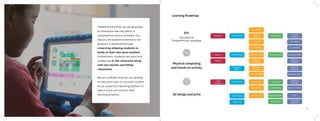
TINKER EDUCATION can be described
as interactive learning which is
composed of various activities. Our
lessons are student-centered as the
program is delivered through
e-learning allowing students to
study at their own pace anytime.
Furthermore, students can learn and
collaborate in the classroom along
with the teacher and fellow
classmates.
We are confident that we can develop
an education plan to suit each student
as our powerful e-learning platform is
able to track and monitor their
learning progress.
Physical computing
and Hands on activity
3D Design and print
EPL
Educational
Programming Language
Scratch Jr
Beebot
Ozobot
Paper
invention
Scratch Basic
Scratch
intensive
Python Basic
Scratch
intensive
CS + SCIENCE CS + SCIENCE
CS + GAME
CS + MATH CS + MATH
Little bits Basic Little bits STEM Little bits cloud Little bits STEM
Little bits
Invention
Little bits
Invention
Microbits
Basic
Microbits
intensive
Microbits
intensive
Microbits STEM Microbits STEM
Paper circuit Lilypad Basic e-Textile
Wearable
Invention
Sensor board
Robot Basic Robot intensive Robot Invention
Tinker cad
Arduino basic Arduino intensive
Autocad 123
3D printer
assemble
I.O.T.
Learning Roadmap
1110
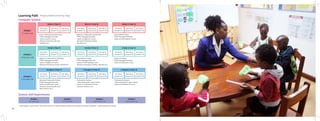
Progress/Advancement by Stage
Computer Science
Learning Path
STAGE 1
5-7 years old
ㆍ Junior Coding with Scratch Junior
ㆍ STEM Unplugged Activities
ㆍ Hands-on Junior Course
(Physical Computing: Bee-bot,
Littlebits, etc.)
i:Block 1 (Year 1)
1st Term
(Level 1-1)
2nd Term
(Level 1-2)
3rd Term
(Level 1-3)
ㆍ Beginner Coding with Scratch Basic
ㆍ STEM Unplugged Activities
ㆍ Hands-on Beginner Course
(Physical Computing: Ozobot,
Microbit, etc.)
i:Block 2 (Year 2)
1st Term
(Level 2-1)
2nd Term
(Level 2-2)
3rd Term
(Level 2-3)
ㆍ Intermediate Coding
ㆍ STEM Unplugged Activities
ㆍ Hands-on Intermediate Course
i:Block 3 (Year 3)
1st Term
(Level 3-1)
2nd Term
(Level 3-2)
3rd Term
(Level 3-3)
STAGE 2
8-10 years old
ㆍ Beginner Coding with Scratch Basic
ㆍ STEM Unplugged Activities
ㆍ Hands-on Beginner Course
(Physical Computing: Ozobot, Mirobit etc.)
i:Code 1 (Year 1)
1st Term
(Level 1-1)
2nd Term
(Level 1-2)
3rd Term
(Level 1-3)
ㆍ Intermediate Coding
ㆍ STEM Unplugged Activities
ㆍ Hands-on Intermediate Course
(Physical computing: CODEino, Microbit etc.)
i:Code 2 (Year 2)
1st Term
(Level 2-1)
2nd Term
(Level 2-2)
3rd Term
(Level 2-3)
ㆍ Advanced Coding
ㆍ STEM Unplugged Activities
ㆍ Hands-on Advanced Course
i:Code 3 (Year 3)
1st Term
(Level 3-1)
2nd Term
(Level 3-2)
3rd Term
(Level 3-3)
STAGE 3
11-15 years old
ㆍ Advanced Coding with Python
ㆍ STEM Unplugged Activities
ㆍ Hands-on Advanced Course
(Physical Computing: Microbit,
Basic Arduino, etc.)
i:Imagine 1 (Year 1)
1st Term
(Level 1-1)
2nd Term
(Level 1-2)
3rd Term
(Level 1-3)
ㆍ Professional Coding I
: Web Development, App Inventor
ㆍ Hands-on Professional Course
(Intensive Arduino, etc.)
i: Imagine 2 (Year 2)
1st Term
(Level 2-1)
2nd Term
(Level 2-2)
3rd Term
(Level 2-3)
ㆍ Professional Coding II
: Web Development, App Inventor
ㆍ Hands-on Professional Course
i: Imagine 3 (Year 3)
1st Term
(Level 3-1)
2nd Term
(Level 3-2)
3rd Term
(Level 3-3)
Science with Experiments
STAGE 1
5-7 Years Old
STAGE 2
8-11 Years Old
STAGE 3
12  14 Years Old
STAGE 4
15  16 Years Old
* Each stage is a year course. The science course of Tinker Education follows the national curriculum in England – science programs of study.
www.tinkeredu.net │ T. 0715-978-986 │ E. support@tinkeredu.net │ A. 2nd Floor, Edulink International College Ndemi Rd, Nairobi, Kenya
@TinkerEducation

Tinker Education_Brochure 2019

  • 1.
    ‘Tinker Education’ isa global STEM education brand of Korean top-tier EdTech company, EMCAST’s STEM Education is driven by Computer Science
  • 2.
    32 Tinker Education teachesstudents Computer Science with the integration of Science, Mathematics, Engineering, and Art. Tinker Education aims to teach students that the computer is a powerful tool for creativity and invention. We consider our students not as consumers but as future innovators and idea makers. The students will be equipped to utilize technology confidently in the infinite world that is composed of 0 and 1. Tinker Education will enhance the student’s natural talents by equipping them with critical thinking. We promise that Tinker Education students will become innovative thinkers who will surprise the world with dynamic solutions to real life needs. Curriculum, contents, and resources are delivered to students after in-depth research and assurance by the STEM R&D Center of HQ in Seoul, South Korea. STEM R&D Center in Seoul, South Korea Tinker Education Research-based STEM Education CEO Kim Jungwoung
  • 3.
    54 Computer Science Frameworkof Tinker Education Tinker Education’s STEM Programs Key Concepts Programming Key Process Physical Computing Life Science Learning Goals Educational content to achieve learning goals To nurture a person who solves problems through a way that has never thought before and influences the world Students gain competency in programming as well as mathematical and computational thinking for problem solving ability. A “key process” is something that a student of Computer Science should be able to do and know Tinker’s physical computing courses enable students to bring programming to life. They realize their ideas with various hands-on activities. By doing exciting experiments, students connect science to their everyday life and understand the principles of science that occur in their daily life. COMPUTER SCIENCE is powering approaches to many of our world’s toughest challenges.
  • 4.
    76 Computer Science KeyConcepts of Tinker Education 1. Logical Reasoning 2. Algorithm 3. Decomposition 4. Pattern Recognition 5. Generalization 6. Abstraction 7. Evaluation Logical reasoning is the process of applying rules to problem solving. Logical reasoning selects an appropriate algorithm by predicting what happens at this stage. The predictions of each algorithm can be used to compare solutions and determine the best solution. Step-by-step plans or guidelines for problem solving used for calculations, data processing, or automation Separating the elements necessary for problem solving into small units Patterns can be said to be similarities or characteristics. It means the process of finding similarities and commonalities between small disaggregated problems that can help with problem-solving It is often used with patterns. It can be described as a generalization that produces a common problem-solving method that can solve various problems. Or, it is a generalization to use for solving a variety of new problems by applying a method that solved a similar problem in the past. It is the process of concentrating on key ideas for the purpose of problem solving, gradually reducing the complexity of the problem, removing the irrelevant ones, and reducing the complexity by adding information for problem solving. Decision making by judgment is about making judgments in an objective and systematic way as much as possible. Evaluation is done in daily situations that we face every day. We judge and decide what to do and how to think based on various factors. TINKER EDUCATION is designed to realize student-centered learning that promotes learners to explore and reconstruct information to independently solve their problems, rather than the traditional model of students simply receiving knowledge from the instructor. Project based learning Small classroom sizes that allow for Personalized and focused education Our STEM instructors are trained through the comprehensive STEM program made by the HQ in Korea. Top-notch educational environment A learning environment where the students, teachers and parents can all collaboratively participate and communicate their thoughts freely. Personalized Learning Path
  • 5.
    98 TINKER EDUCATION canbe described as interactive learning which is composed of various activities. Our lessons are student-centered as the program is delivered through e-learning allowing students to study at their own pace anytime. Furthermore, students can learn and collaborate in the classroom along with the teacher and fellow classmates. We are confident that we can develop an education plan to suit each student as our powerful e-learning platform is able to track and monitor their learning progress. Physical computing and Hands on activity 3D Design and print EPL Educational Programming Language Scratch Jr Beebot Ozobot Paper invention Scratch Basic Scratch intensive Python Basic Scratch intensive CS + SCIENCE CS + SCIENCE CS + GAME CS + MATH CS + MATH Little bits Basic Little bits STEM Little bits cloud Little bits STEM Little bits Invention Little bits Invention Microbits Basic Microbits intensive Microbits intensive Microbits STEM Microbits STEM Paper circuit Lilypad Basic e-Textile Wearable Invention Sensor board Robot Basic Robot intensive Robot Invention Tinker cad Arduino basic Arduino intensive Autocad 123 3D printer assemble I.O.T. Learning Roadmap
  • 6.
    1110 Progress/Advancement by Stage ComputerScience Learning Path STAGE 1 5-7 years old ㆍ Junior Coding with Scratch Junior ㆍ STEM Unplugged Activities ㆍ Hands-on Junior Course (Physical Computing: Bee-bot, Littlebits, etc.) i:Block 1 (Year 1) 1st Term (Level 1-1) 2nd Term (Level 1-2) 3rd Term (Level 1-3) ㆍ Beginner Coding with Scratch Basic ㆍ STEM Unplugged Activities ㆍ Hands-on Beginner Course (Physical Computing: Ozobot, Microbit, etc.) i:Block 2 (Year 2) 1st Term (Level 2-1) 2nd Term (Level 2-2) 3rd Term (Level 2-3) ㆍ Intermediate Coding ㆍ STEM Unplugged Activities ㆍ Hands-on Intermediate Course i:Block 3 (Year 3) 1st Term (Level 3-1) 2nd Term (Level 3-2) 3rd Term (Level 3-3) STAGE 2 8-10 years old ㆍ Beginner Coding with Scratch Basic ㆍ STEM Unplugged Activities ㆍ Hands-on Beginner Course (Physical Computing: Ozobot, Mirobit etc.) i:Code 1 (Year 1) 1st Term (Level 1-1) 2nd Term (Level 1-2) 3rd Term (Level 1-3) ㆍ Intermediate Coding ㆍ STEM Unplugged Activities ㆍ Hands-on Intermediate Course (Physical computing: CODEino, Microbit etc.) i:Code 2 (Year 2) 1st Term (Level 2-1) 2nd Term (Level 2-2) 3rd Term (Level 2-3) ㆍ Advanced Coding ㆍ STEM Unplugged Activities ㆍ Hands-on Advanced Course i:Code 3 (Year 3) 1st Term (Level 3-1) 2nd Term (Level 3-2) 3rd Term (Level 3-3) STAGE 3 11-15 years old ㆍ Advanced Coding with Python ㆍ STEM Unplugged Activities ㆍ Hands-on Advanced Course (Physical Computing: Microbit, Basic Arduino, etc.) i:Imagine 1 (Year 1) 1st Term (Level 1-1) 2nd Term (Level 1-2) 3rd Term (Level 1-3) ㆍ Professional Coding I : Web Development, App Inventor ㆍ Hands-on Professional Course (Intensive Arduino, etc.) i: Imagine 2 (Year 2) 1st Term (Level 2-1) 2nd Term (Level 2-2) 3rd Term (Level 2-3) ㆍ Professional Coding II : Web Development, App Inventor ㆍ Hands-on Professional Course i: Imagine 3 (Year 3) 1st Term (Level 3-1) 2nd Term (Level 3-2) 3rd Term (Level 3-3) Science with Experiments STAGE 1 5-7 Years Old STAGE 2 8-11 Years Old STAGE 3 12 14 Years Old STAGE 4 15 16 Years Old * Each stage is a year course. The science course of Tinker Education follows the national curriculum in England – science programs of study.
  • 7.
    www.tinkeredu.net │ T.0715-978-986 │ E. support@tinkeredu.net │ A. 2nd Floor, Edulink International College Ndemi Rd, Nairobi, Kenya @TinkerEducation