Inventing Things That Matter To The World
Jim Spohrer
Director, IBM Cognitive OpenTech
April 22, 2020
with help from
Cheryl Kieliszewski (IBM Research)
Presentations on line at: http://slideshare.net/spohrer
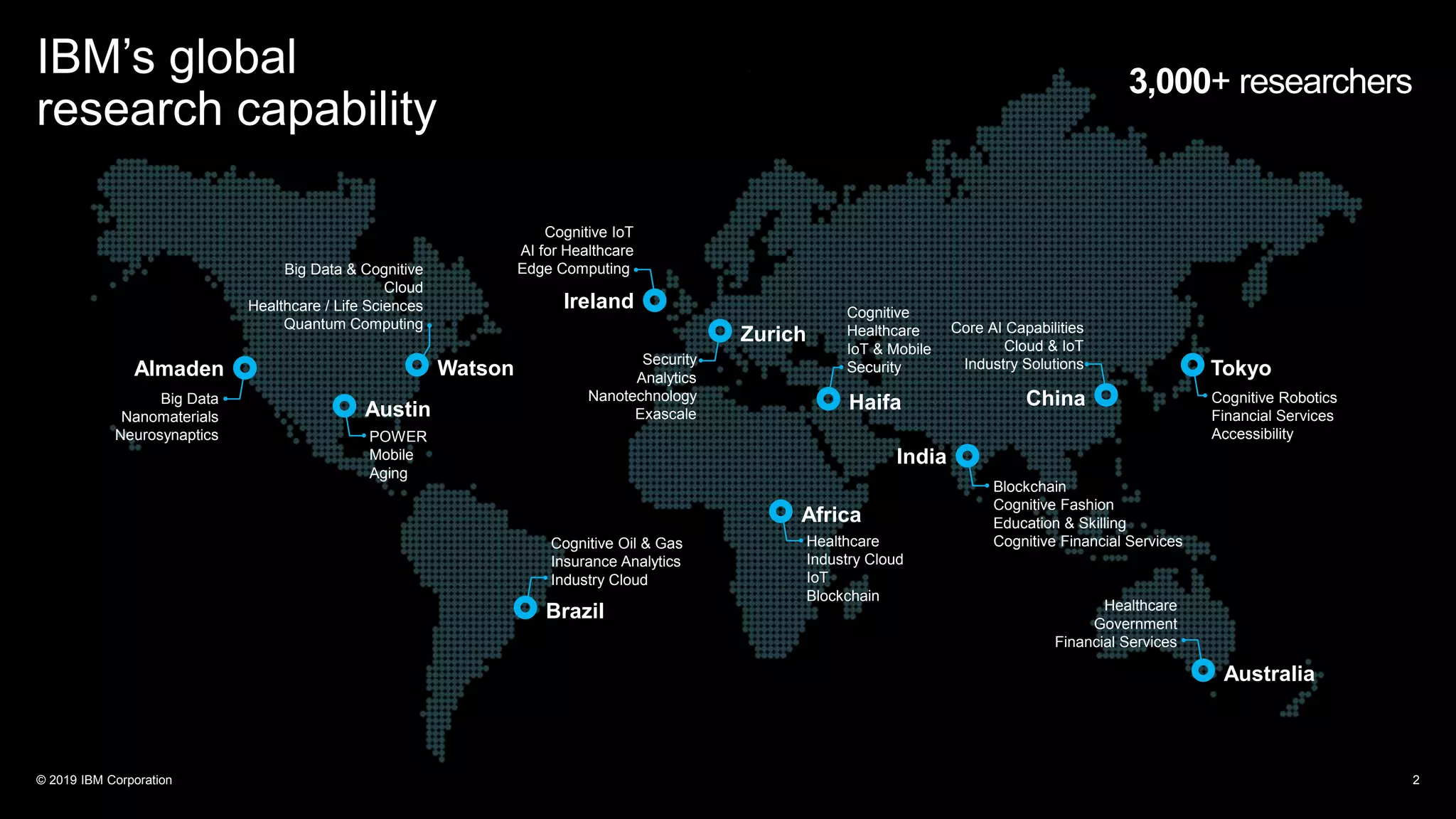
IBM’s global
research capability
Healthcare
Government
Financial Services
Healthcare
Industry Cloud
IoT
Blockchain
Cognitive Robotics
Financial Services
Accessibility
Core AI Capabilities
Cloud & IoT
Industry Solutions
Blockchain
Cognitive Fashion
Education & Skilling
Cognitive Financial Services
Cognitive
Healthcare
IoT & Mobile
Security
Security
Analytics
Nanotechnology
Exascale
Cognitive IoT
AI for Healthcare
Edge ComputingBig Data & Cognitive
Cloud
Healthcare / Life Sciences
Quantum Computing
POWER
Mobile
Aging
Cognitive Oil & Gas
Insurance Analytics
Industry Cloud
Big Data
Nanomaterials
Neurosynaptics
3,000+ researchers
Australia
Tokyo
China
Almaden
Haifa
Zurich
Africa
Ireland
Brazil
Watson
Austin
India
© 2019 IBM Corporation 2
Foundational breakthroughs
have made us famous
6
Nobel
Laureates
10
National
Medals of
Technology
6
Turing
Awards
5
National
Medals of
Science
© 2019 IBM Corporation 3
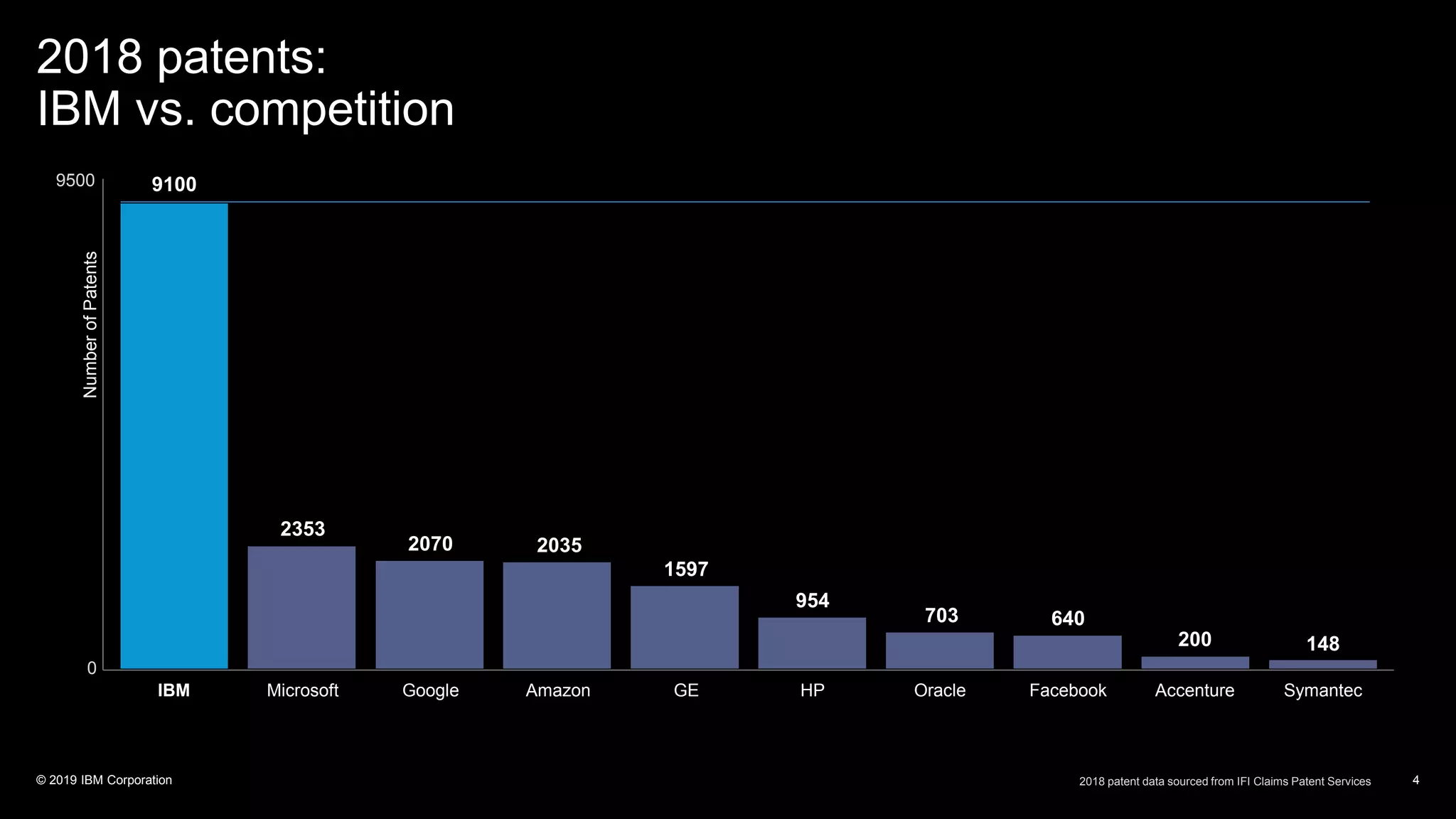
2018 patents:
IBM vs. competition
© 2019 IBM Corporation 4
0
9500 9100
IBM
2353
Microsoft Amazon
2070
Google
2035
GE
954
HP
703
Oracle
640
Facebook
200
Accenture
1597
148
Symantec
NumberofPatents
2018 patent data sourced from IFI Claims Patent Services
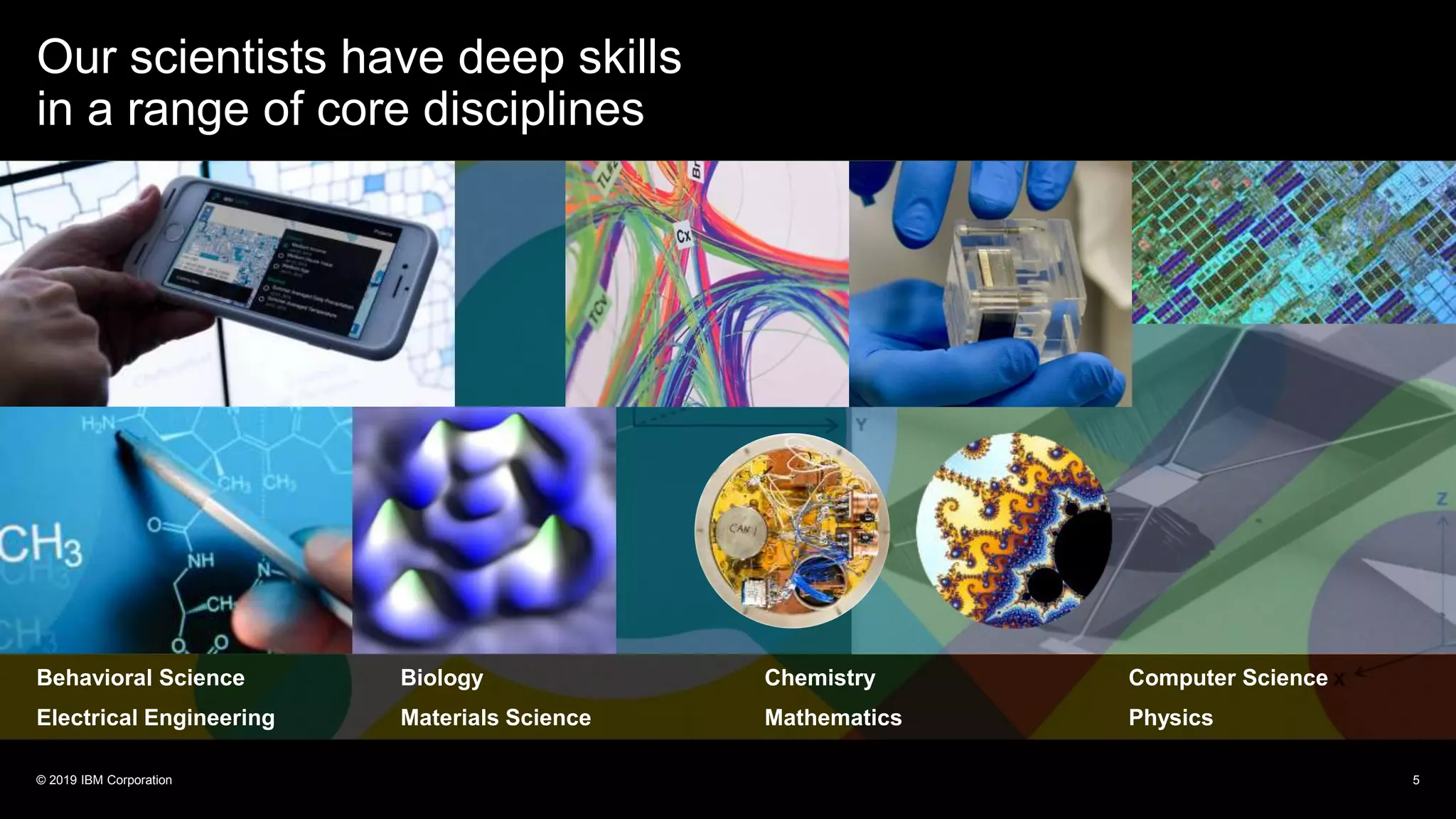
Our scientists have deep skills
in a range of core disciplines
© 2019 IBM Corporation 5
Behavioral Science Biology Chemistry Computer Science
Electrical Engineering Materials Science Mathematics Physics
IBM Quantum
4/21/2020 (c) IBM MAP COG .| 6
IBM-MIT $240M
over 10 year AI mission
4/21/2020 (c) IBM 2017, Cognitive Opentech Group 7
Narrow AI
Emerging
Broad AI
Disruptive and
Pervasive
General AI
Revolutionary
▼ We are here 2050 and beyond 8IBM Research AI © 2018 IBM Corporation
The evolution of AI
Borrowed from David Cox, IBM-MIT Lead
9September 2018 / © 2018 IBM Corporation
Petaflops = 1,000,000,000,000,000 or a
million billion = 10 ** 15
Megaflops = 1,000,000 = million = 10 ** 6
Gigaflops = 1,000,000,000 = billion = 10 ** 9
Larges Super Computer in the World,
= 13 MegaWatts of Power (HOT!)
10September 2018 / © 2018 IBM Corporation
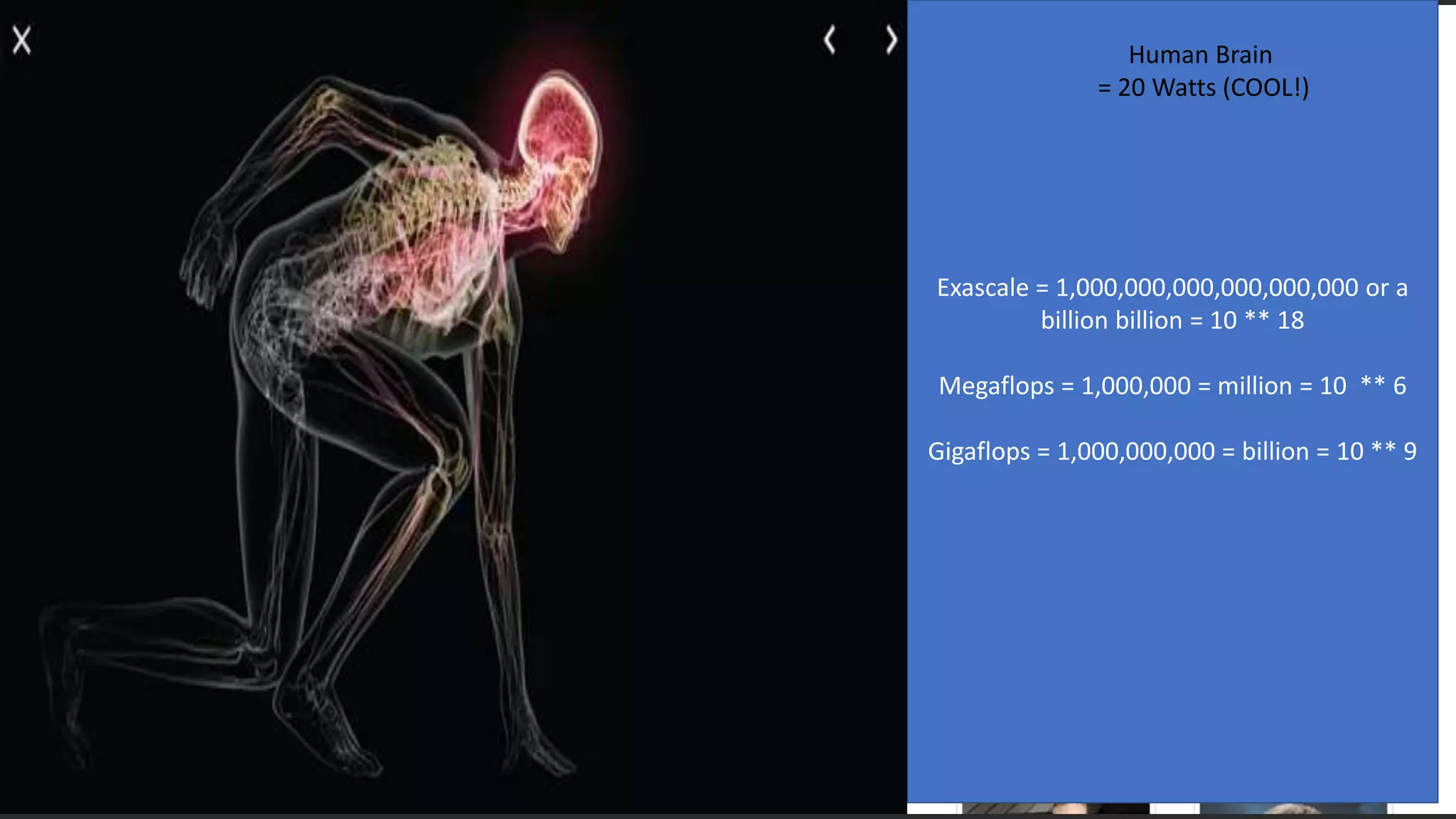
Exascale = 1,000,000,000,000,000,000 or a
billion billion = 10 ** 18
Megaflops = 1,000,000 = million = 10 ** 6
Gigaflops = 1,000,000,000 = billion = 10 ** 9
Human Brain
= 20 Watts (COOL!)
Questions
• What is the timeline for solving AI and IA?
• TBD: When can a CEO buy AI capability <X> for price <Y>?
• Who are the leaders driving AI progress?
• What will the biggest benefits from AI be?
• What are the biggest risks associated with AI, and are they real?
• What other technologies may have a bigger impact than AI?
• What are the implications for stakeholders?
• How should we prepare to get the benefits and avoid the risks?
4/21/2020 (c) IBM 2017, Cognitive Opentech Group 11
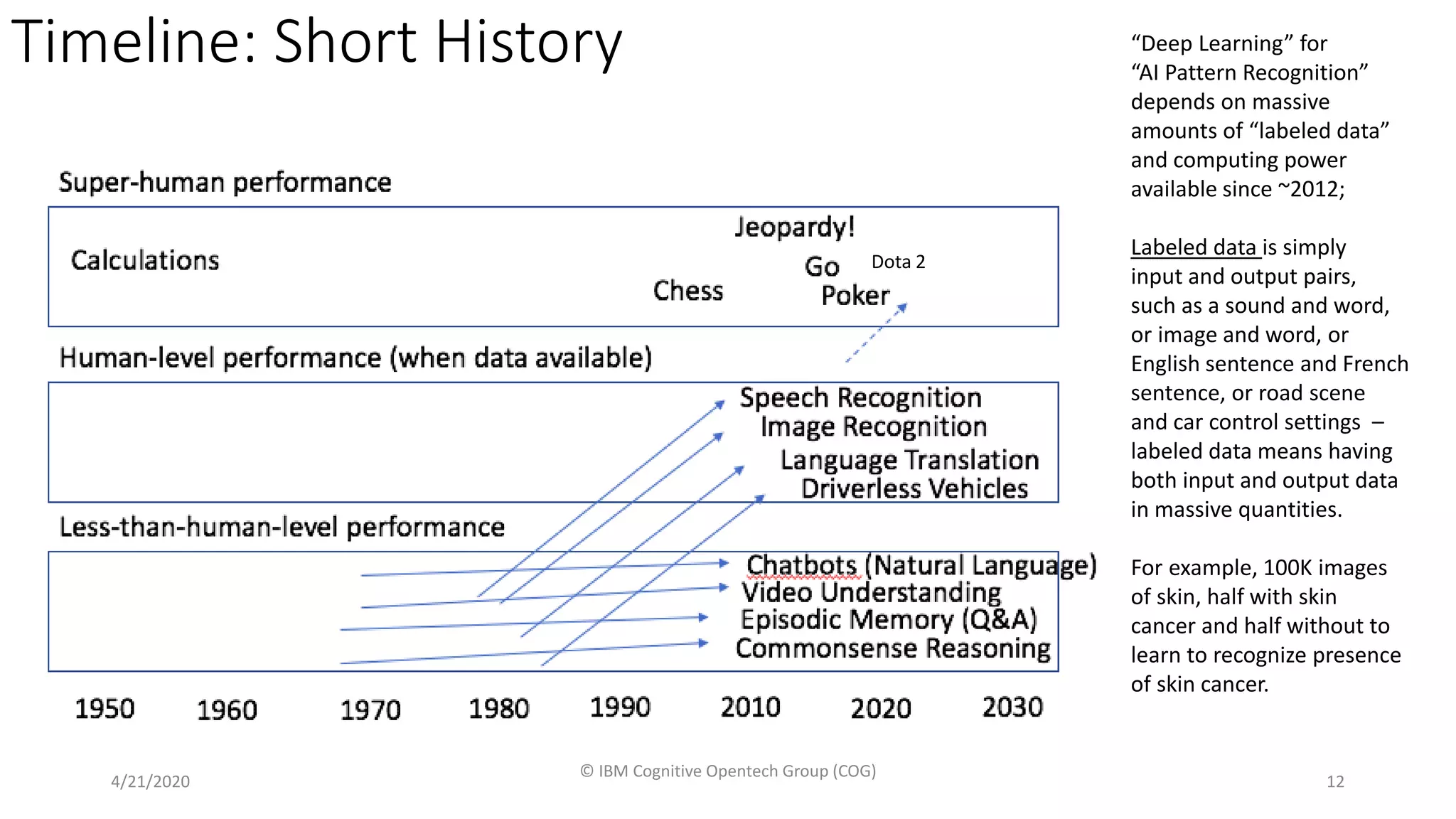
Timeline: Short History
4/21/2020
© IBM Cognitive Opentech Group (COG)
12
Dota 2
“Deep Learning” for
“AI Pattern Recognition”
depends on massive
amounts of “labeled data”
and computing power
available since ~2012;
Labeled data is simply
input and output pairs,
such as a sound and word,
or image and word, or
English sentence and French
sentence, or road scene
and car control settings –
labeled data means having
both input and output data
in massive quantities.
For example, 100K images
of skin, half with skin
cancer and half without to
learn to recognize presence
of skin cancer.
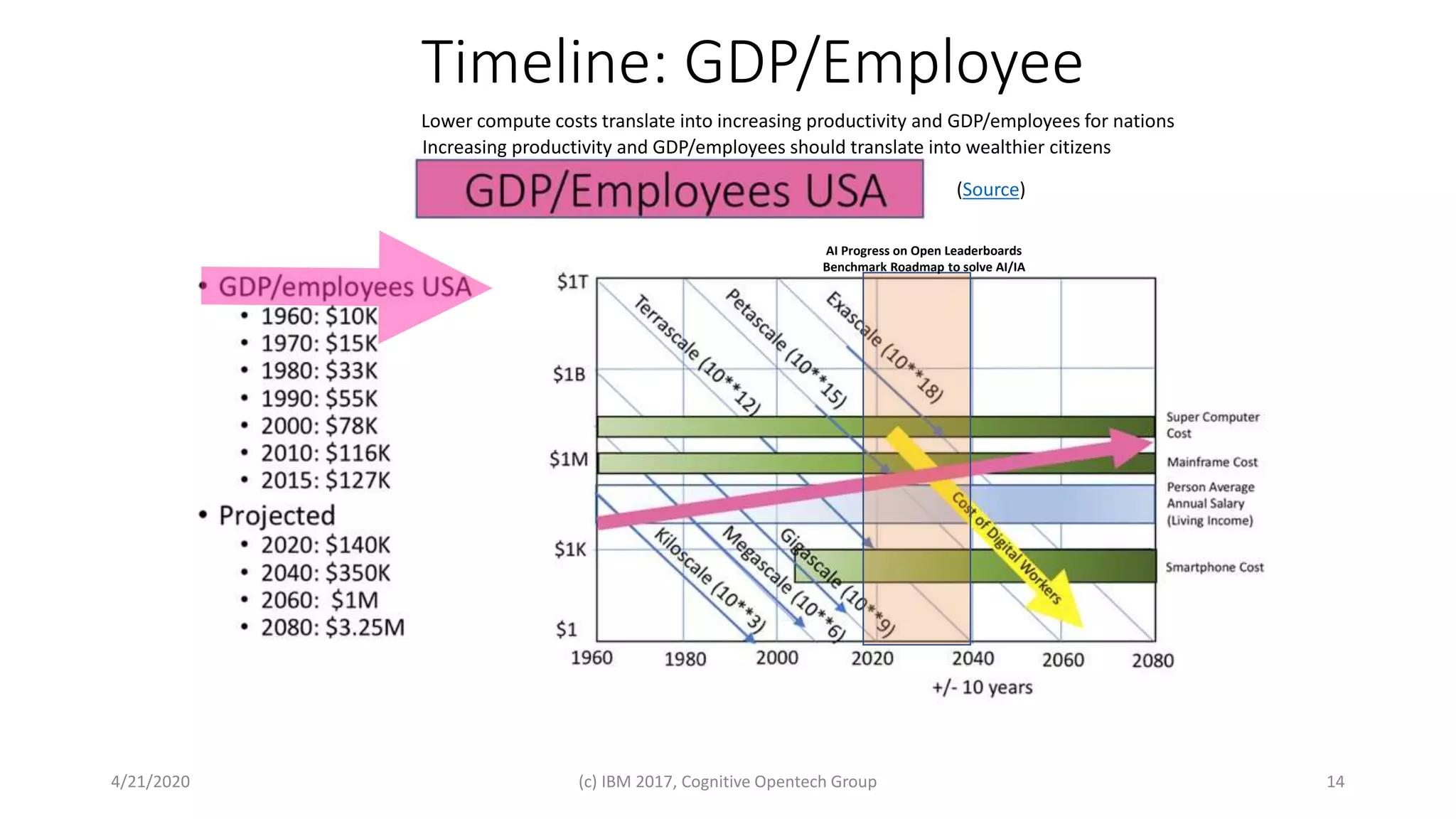
Timeline: Every 20 years,
compute costs are down by 1000x
• Cost of Digital Workers
• Moore’s Law can be thought of as
lowering costs by a factor of a…
• Thousand times lower
in 20 years
• Million times lower
in 40 years
• Billion times lower
in 60 years
• Smarter Tools (Terascale)
• Terascale (2017) = $3K
• Terascale (2020) = ~$1K
• Narrow Worker (Petascale)
• Recognition (Fast)
• Petascale (2040) = ~$1K
• Broad Worker (Exascale)
• Reasoning (Slow)
• Exascale (2060) = ~$1K
134/21/2020 (c) IBM 2017, Cognitive Opentech Group
2080204020001960
$1K
$1M
$1B
$1T
206020201980
+/- 10 years
$1
Person Average
Annual Salary
(Living Income)
Super Computer
Cost
Mainframe Cost
Smartphone Cost
T
P
E
T P E
AI Progress on Open Leaderboards
Benchmark Roadmap to solve AI/IA
Timeline: GDP/Employee
4/21/2020 (c) IBM 2017, Cognitive Opentech Group 14
(Source)
Lower compute costs translate into increasing productivity and GDP/employees for nations
Increasing productivity and GDP/employees should translate into wealthier citizens
AI Progress on Open Leaderboards
Benchmark Roadmap to solve AI/IA
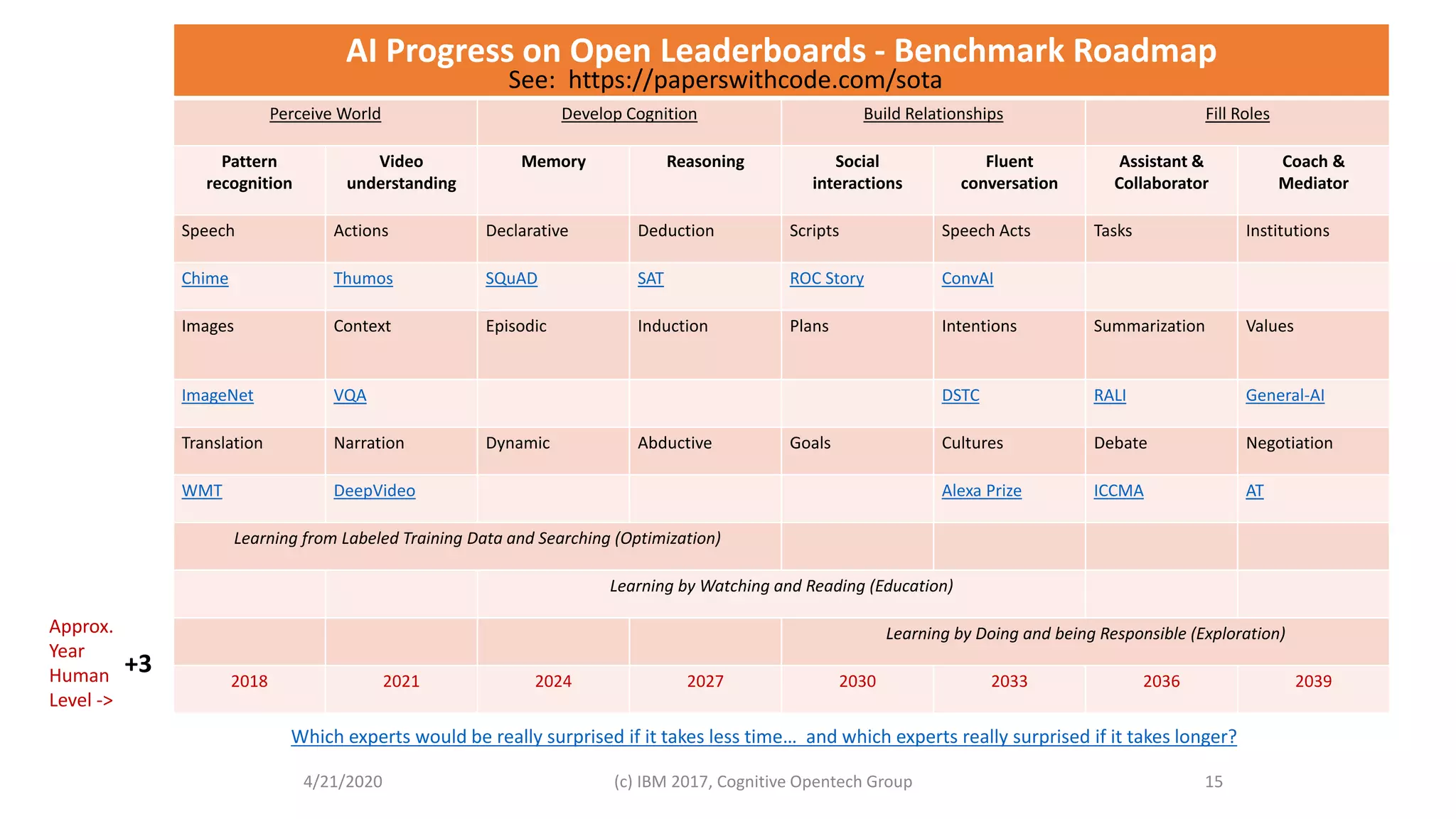
Timeline: Leaderboards FrameworkAI Progress on Open Leaderboards - Benchmark Roadmap
Perceive World Develop Cognition Build Relationships Fill Roles
Pattern
recognition
Video
understanding
Memory Reasoning Social
interactions
Fluent
conversation
Assistant &
Collaborator
Coach &
Mediator
Speech Actions Declarative Deduction Scripts Speech Acts Tasks Institutions
Chime Thumos SQuAD SAT ROC Story ConvAI
Images Context Episodic Induction Plans Intentions Summarization Values
ImageNet VQA DSTC RALI General-AI
Translation Narration Dynamic Abductive Goals Cultures Debate Negotiation
WMT DeepVideo Alexa Prize ICCMA AT
Learning from Labeled Training Data and Searching (Optimization)
Learning by Watching and Reading (Education)
Learning by Doing and being Responsible (Exploration)
2018 2021 2024 2027 2030 2033 2036 2039
4/21/2020 (c) IBM 2017, Cognitive Opentech Group 15
Which experts would be really surprised if it takes less time… and which experts really surprised if it takes longer?
Approx.
Year
Human
Level ->
+3
See: https://paperswithcode.com/sota
Who is winning
4/21/2020 (c) IBM 2017, Cognitive Opentech Group 16
https://www.technologyreview.com/s/608112/who-is-winning-the-ai-race/
Robots by Country
• Industrial robots per 10,000 people by country
4/21/2020 IBM #OpenTechAI 17
34
Economic Growth Rates 2035: AI Projected Impact
4/21/2020 (c) IBM MAP COG .| 18
AI Benefits
• Access to expertise
• “Insanely great” labor productivity for trusted service providers
• Digital workers for healthcare, education, finance, etc.
• Better choices
• ”Insanely great” collaborations with others on what matters most
• AI for IA = Augmented Intelligence and higher value co-creation interactions
4/21/2020 (c) IBM 2017, Cognitive Opentech Group 19
AI Risks
• Job Loss
• Shorter term bigger risk
= de-skilling
• Super-intelligence
• Shorter term bigger risk
= bad actors
4/21/2020 (c) IBM 2017, Cognitive Opentech Group 20
Other Technologies: Bigger impact? Yes.
• Augmented Reality (AR)/
Virtual Reality (VR)
• Game worlds
grow-up
• Blockchain/
Security Systems
• Trust and security
immutable
• Advanced Materials/
Energy Systems
• Manufacturing as cheap,
local recycling service
(utility fog, artificial leaf, etc.)
4/21/2020 (c) IBM 2017, Cognitive Opentech Group 21
“The best way to predict the future is to inspire the
next generation of students to build it better”
Digital Natives Transportation Water Manufacturing
Energy Construction ICT Retail
Finance Healthcare Education Government
Artificial Leaf
• Daniel Nocera, a professor of energy
science at Harvard who pioneered the
use of artificial photosynthesis, says that
he and his colleague Pamela Silver have
devised a system that completes the
process of making liquid fuel from
sunlight, carbon dioxide, and water. And
they’ve done it at an efficiency of 10
percent, using pure carbon dioxide—in
other words, one-tenth of the energy in
sunlight is captured and turned into fuel.
That is much higher than natural
photosynthesis, which converts about 1
percent of solar energy into the
carbohydrates used by plants, and it
could be a milestone in the shift away
from fossil fuels. The new system is
described in a new paper in Science.
4/21/2020 IBM Code #OpenTechAI 23
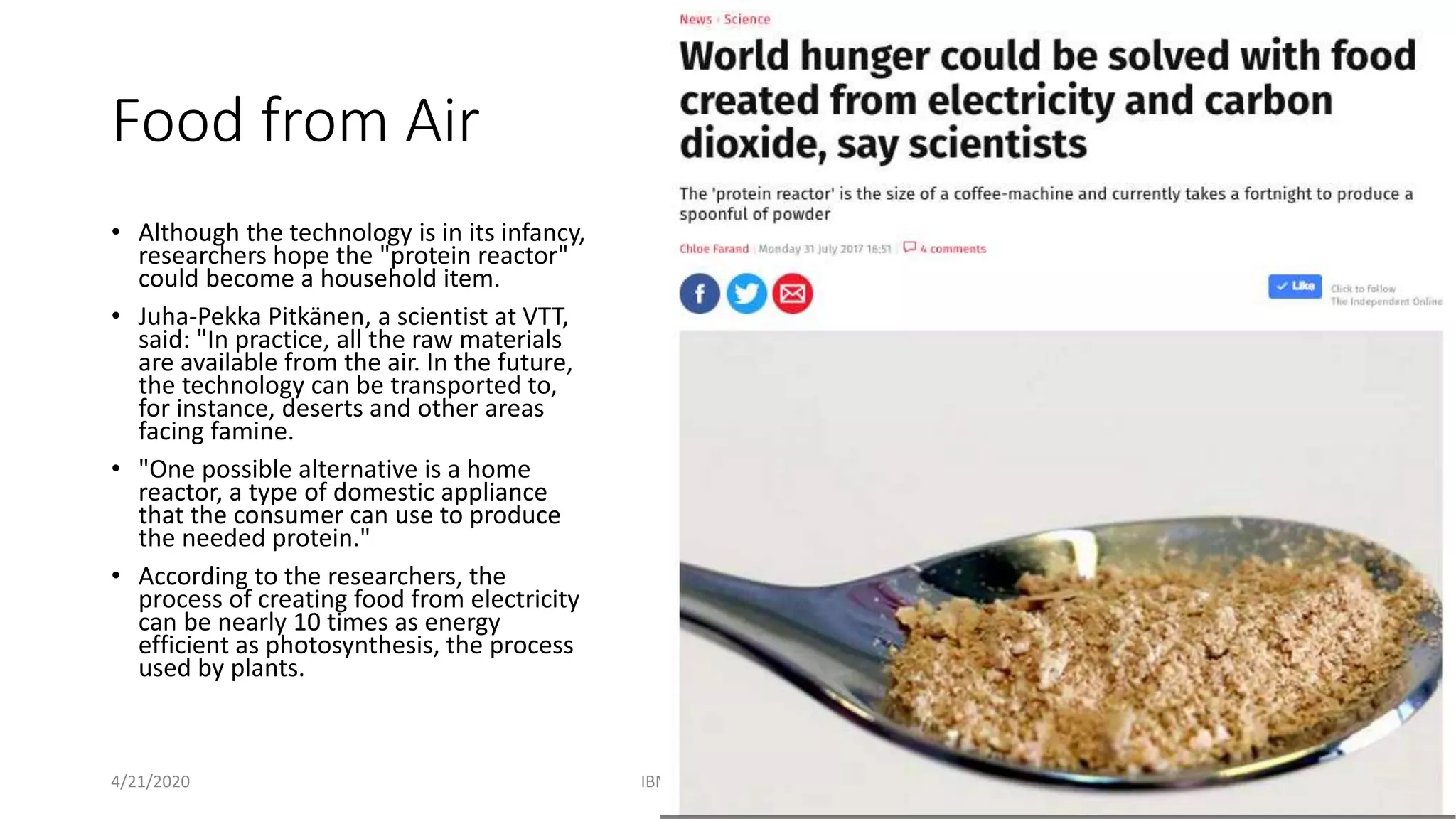
Food from Air
• Although the technology is in its infancy,
researchers hope the "protein reactor"
could become a household item.
• Juha-Pekka Pitkänen, a scientist at VTT,
said: "In practice, all the raw materials
are available from the air. In the future,
the technology can be transported to,
for instance, deserts and other areas
facing famine.
• "One possible alternative is a home
reactor, a type of domestic appliance
that the consumer can use to produce
the needed protein."
• According to the researchers, the
process of creating food from electricity
can be nearly 10 times as energy
efficient as photosynthesis, the process
used by plants.
4/21/2020 IBM Code #OpenTechAI 24
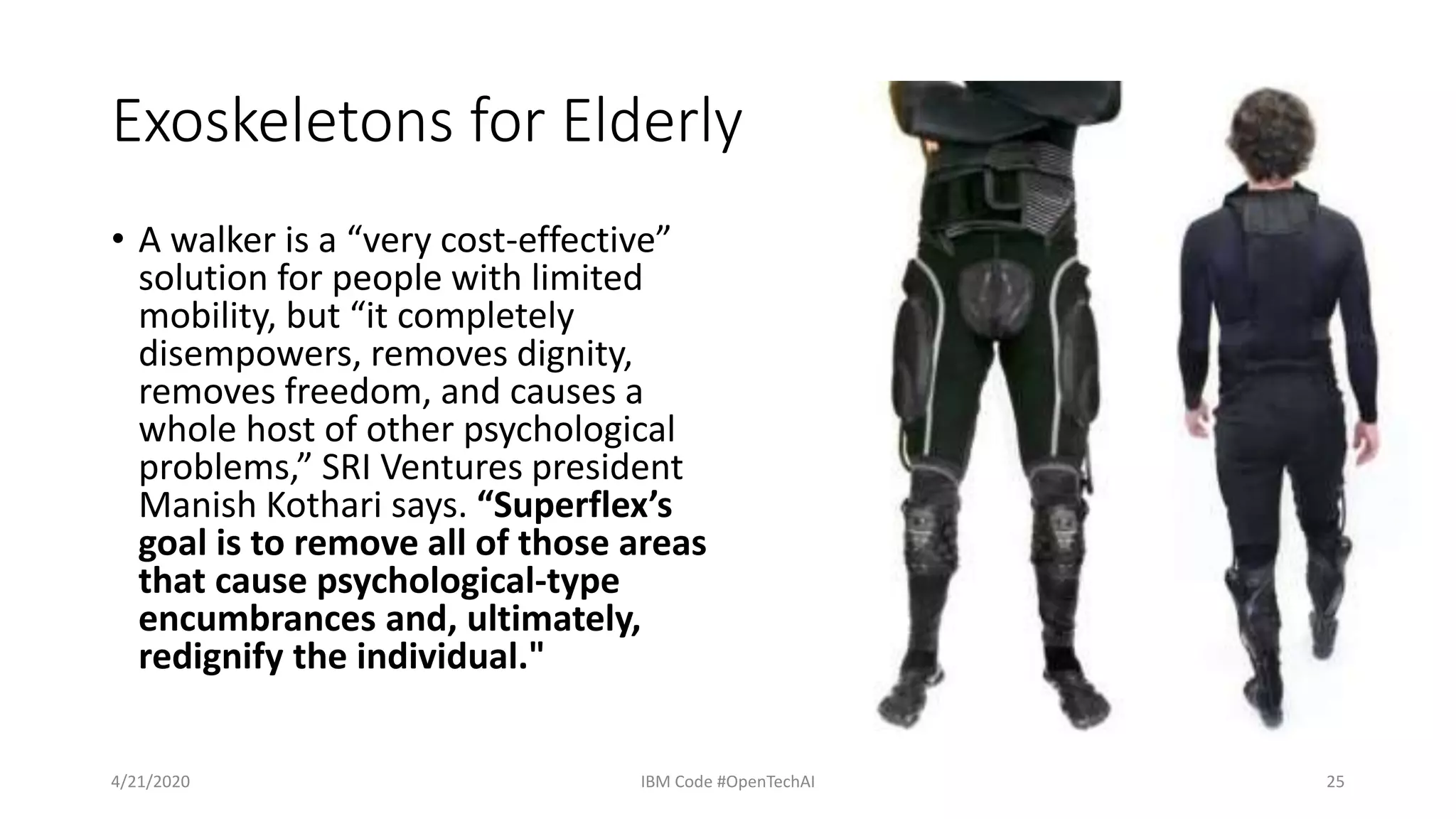
Exoskeletons for Elderly
• A walker is a “very cost-effective”
solution for people with limited
mobility, but “it completely
disempowers, removes dignity,
removes freedom, and causes a
whole host of other psychological
problems,” SRI Ventures president
Manish Kothari says. “Superflex’s
goal is to remove all of those areas
that cause psychological-type
encumbrances and, ultimately,
redignify the individual."
4/21/2020 IBM Code #OpenTechAI 25
4/21/2020 26
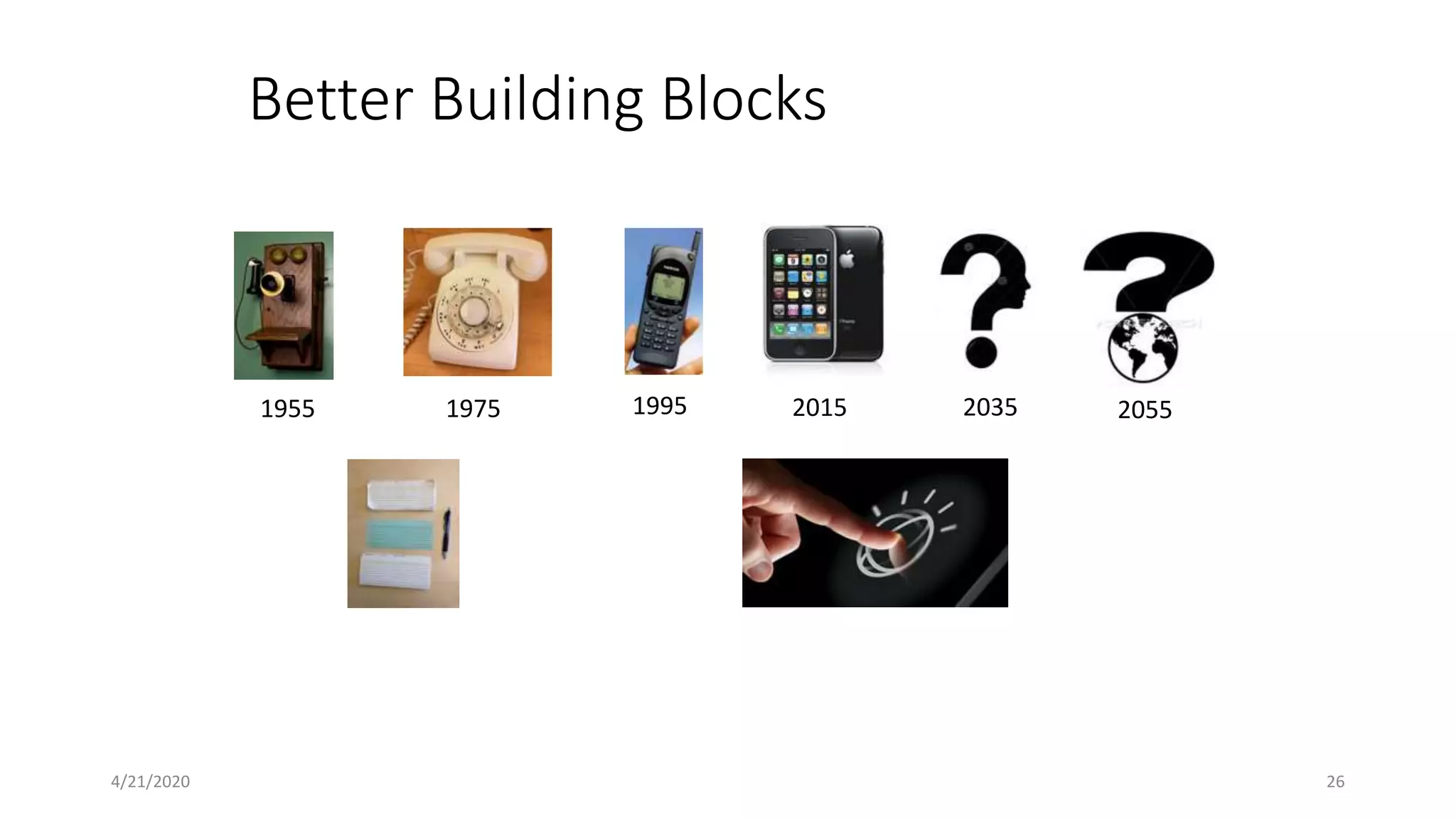
1955 1975 1995 2015 2035 2055
Better Building Blocks
4/21/2020
© IBM 2015, IBM Upward University Programs Worldwide
accelerating regional development
27
I have…
Have you noticed how the building blocks just
keep getting better?
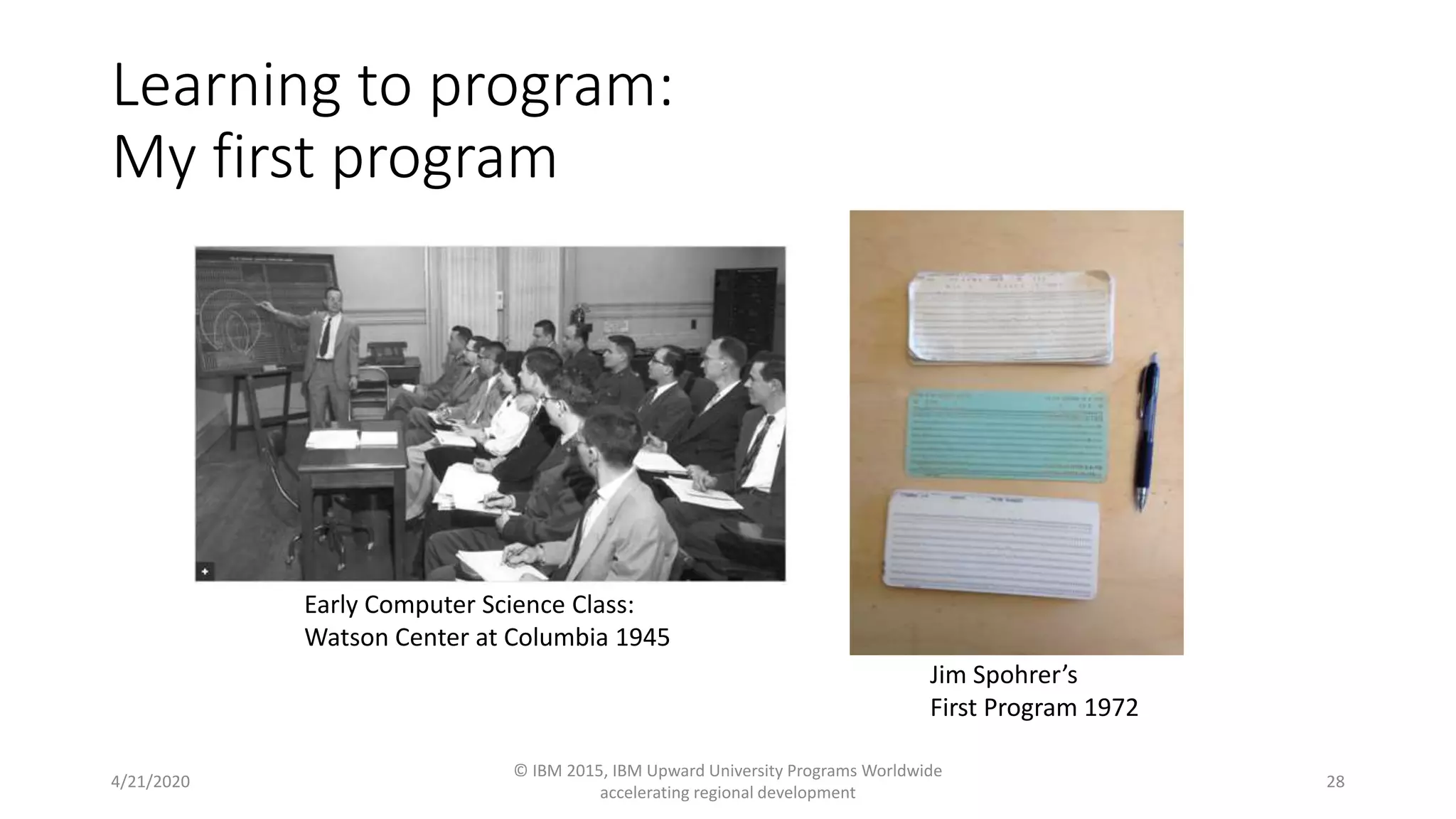
Learning to program:
My first program
4/21/2020
© IBM 2015, IBM Upward University Programs Worldwide
accelerating regional development
28
Early Computer Science Class:
Watson Center at Columbia 1945
Jim Spohrer’s
First Program 1972
4/21/2020
© IBM UPWard 2016
29
Fast Forward 2016:
Consider this…
Microsoft CaptionBot June 19, 2016
4/21/2020
© IBM UPWard 2016
30
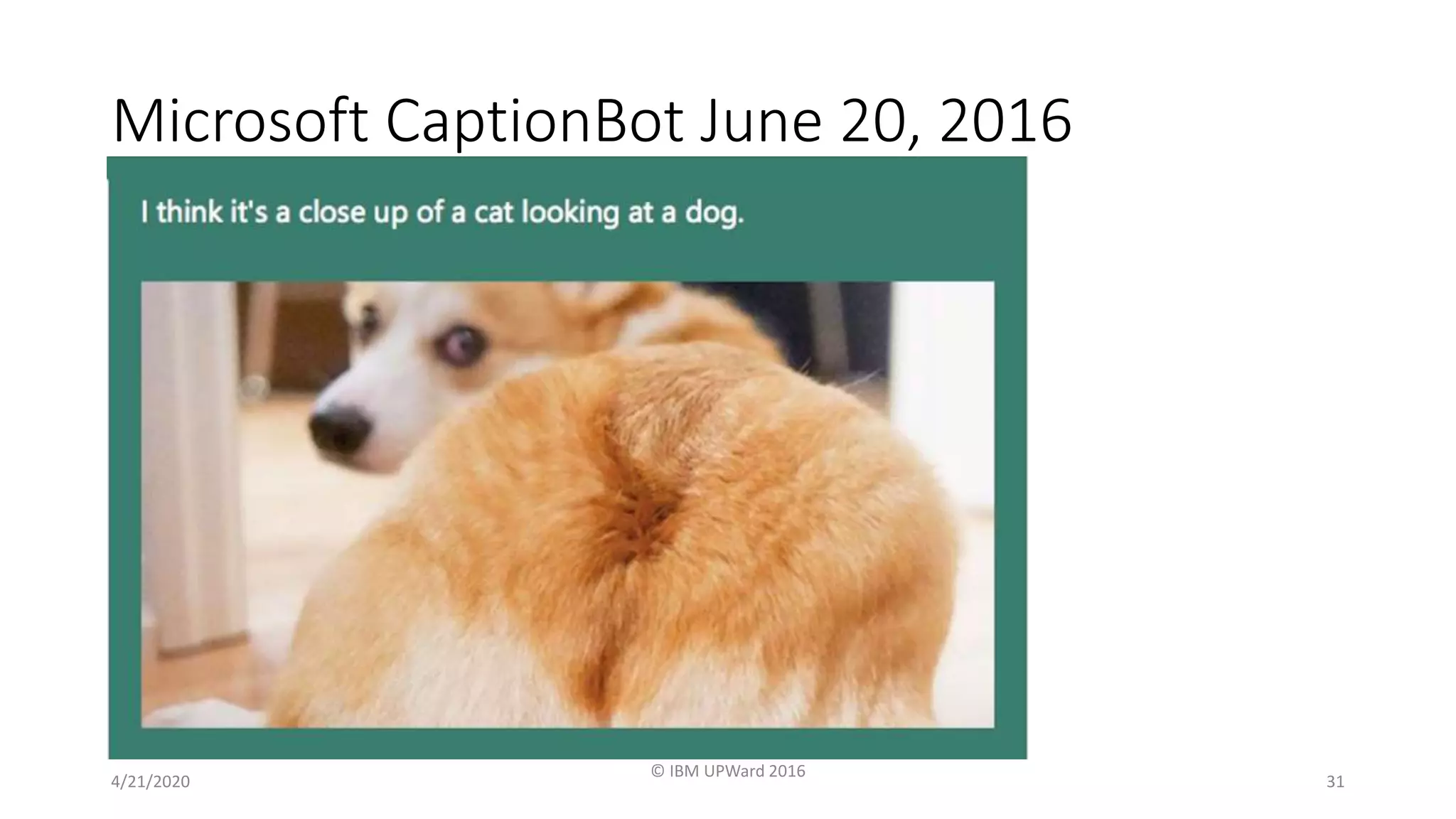
Microsoft CaptionBot June 20, 2016
4/21/2020
© IBM UPWard 2016
31
IBM Image Tagging
4/21/2020
© IBM UPWard 2016
32
Today: November 10, 2017
4/21/2020
© IBM DBG COG 2017
33
IBM
10 million minutes of experience
4/21/2020 Understanding Cognitive Systems 34
2 million minutes of experience
4/21/2020 Understanding Cognitive Systems 35
4/21/2020 (c) IBM MAP COG .| 36
4/21/2020 (c) IBM MAP COG .| 37
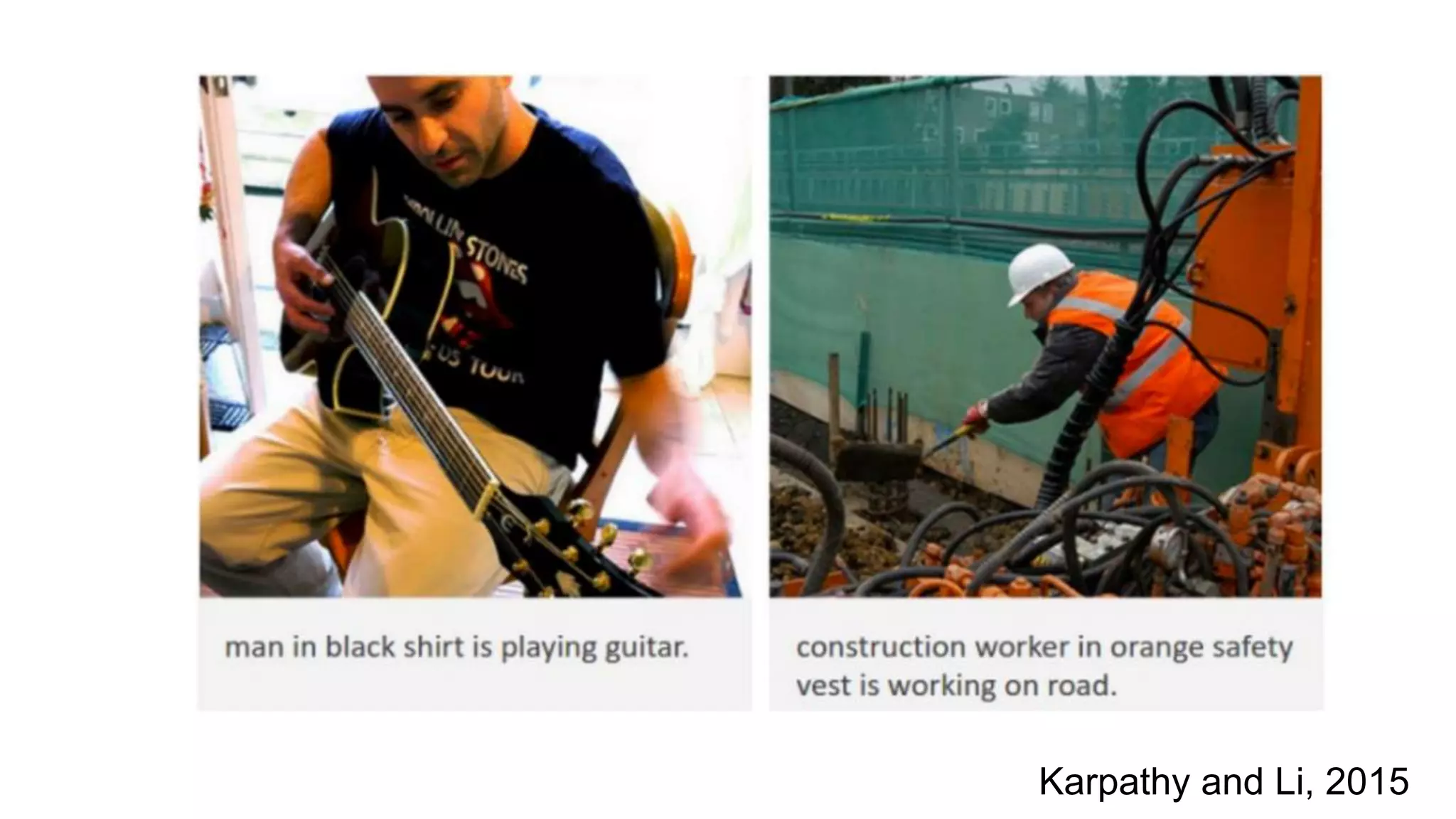
Karpathy and Li, 2015
“Teddy Bear”
Meret Oppenheim, Le Déjeuner en fourrure
4/21/2020
© IBM 2015, IBM Upward University Programs Worldwide
accelerating regional development
40
Icons of AI Progress
• 1956: Dartmouth Conference
organized by:
• John McCarthy (Dartmouth, later
Stanford)
• Marvin Minsky (MIT)
• and two senior scientists:
• Claude Shannon (Bell Labs)
• Nathan Rochester (IBM)
• 1997: Deep Blue (IBM) - Chess
• 2011: Watson Jeopardy! (IBM)
• 2016: AlphaGo (Google DeepMinds)
4/21/2020 (c) IBM 2017, Cognitive Opentech Group 41
AI at IBM: Past (Nathan Rochester)
4/21/2020 (c) IBM MAP COG .| 42
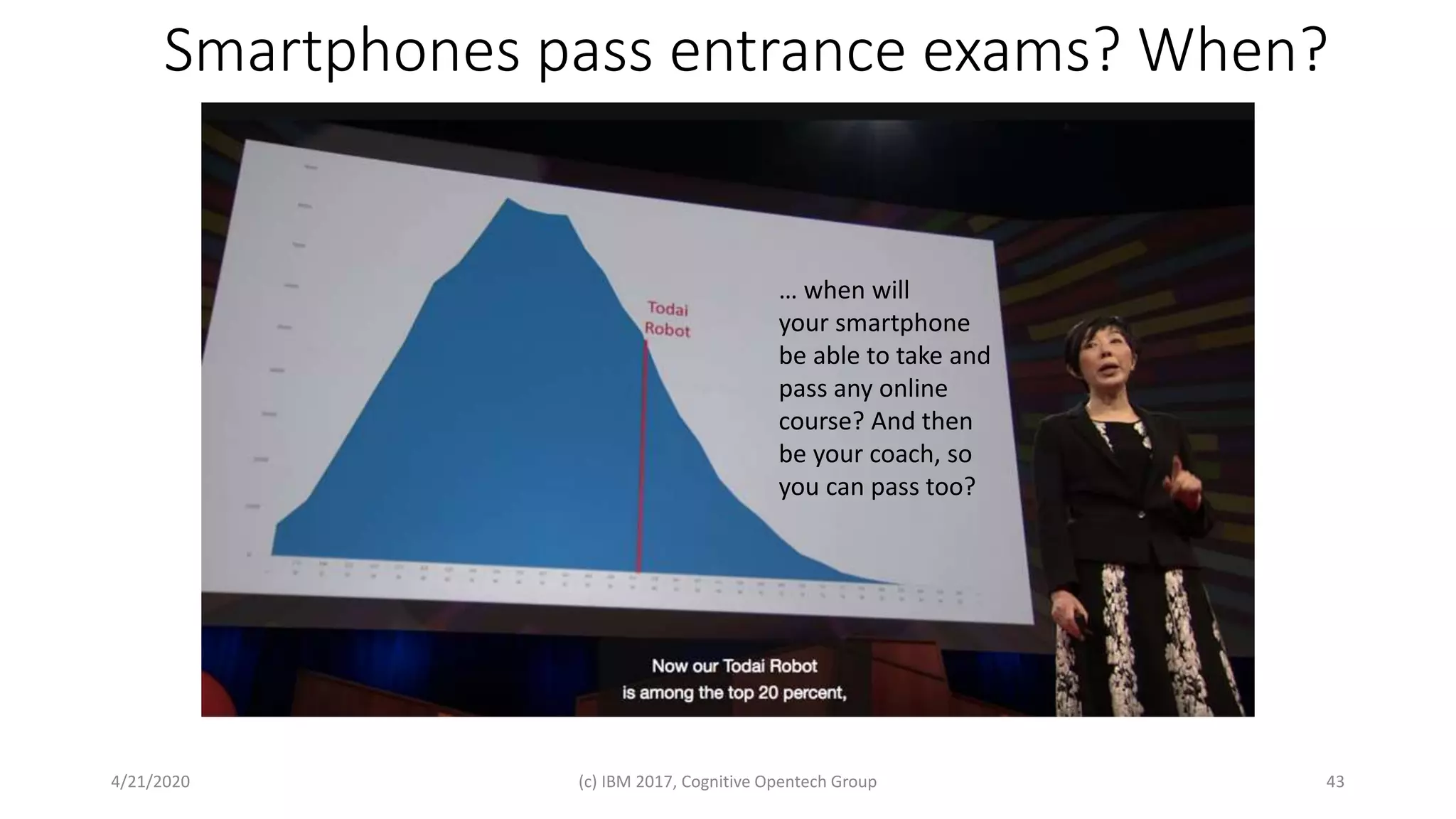
Smartphones pass entrance exams? When?
4/21/2020 (c) IBM 2017, Cognitive Opentech Group 43
… when will
your smartphone
be able to take and
pass any online
course? And then
be your coach, so
you can pass too?
4/21/2020
© IBM 2015, IBM Upward University Programs Worldwide
accelerating regional development
44
Cognitive Mediators
for all people in all roles
Occupations = Many Tasks
4/21/2020
© IBM 2015, IBM Upward University Programs Worldwide
accelerating regional development
45
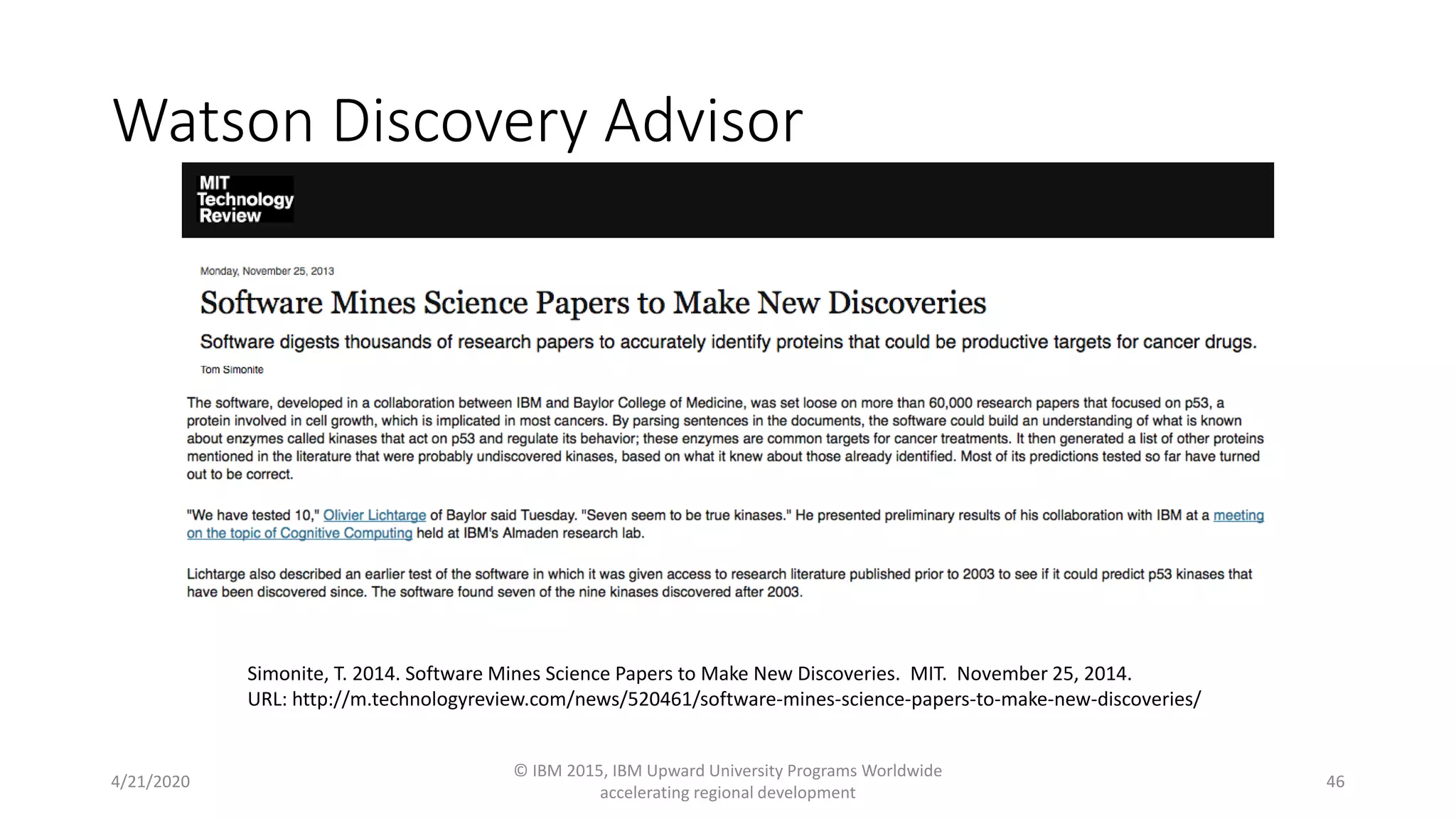
Watson Discovery Advisor
4/21/2020
© IBM 2015, IBM Upward University Programs Worldwide
accelerating regional development
46
Simonite, T. 2014. Software Mines Science Papers to Make New Discoveries. MIT. November 25, 2014.
URL: http://m.technologyreview.com/news/520461/software-mines-science-papers-to-make-new-discoveries/
Step Comment
GitHub Get an account and read the guide
MAX CODAIT’s Model Asset Exchange
Learn 3 R's - Read, Redo, Report Read (Medium/arXiv), Redo (GitHub), Report (Jupyter Notebook)
PapersWithCode Stay on top of recent advances; Do 3 R’s.
Kaggle Compete in a Kaggle competition
Leaderboards Compete to advance AI progress
Linux Foundation AI Help end-to-end open source industry AI & Data infrastructure
Mozilla Common Voice Donate your speech; Label and verify data; Recruit others.
Figure Eight Generate a set of labeled data (also Mechanical Turk)
Design New Challenges Build for Call for Code/Code and Response; Build your AI Helper;
Build test-taker, that can switch to tutor-mode; Etc.
Open Source Guide Establish open source culture in your organization
4/21/2020 IBM Code #OpenTechAI 47
4/21/2020 (c) IBM MAP COG .| 48
Microsoft acquiring GitHub $7.5B
2018 John Marks on Open Source
Models will run the world
Why SW is eating the world
Sweden
4/21/2020 (c) IBM MAP COG .| 49
IBM AI
Explain a transaction
Deployment: Claim Approval Model name: Claim Model
AI Fairness
360 toolkit
Trust and transparency
integral to AI on the IBM Cloud
Explainability, fairness, lineage
are critical principles of trusted AI
Open source toolkit
to check for unwanted bias in datasets
and machine learning models
© 2019 IBM Corporation 50
DENIED APPROVEDCONFIDENCE
90% 10%
POLICY HOLDER AGE: 18 RESPONSIBLE PARTY: Self
CAR BRAND: Oldsmobile Cutlass POLICE REPORT: Yes
CAR VALUE: $20,000 POLICY AGE: 5 Years
65% 17%
23% 13%
13% 5%
Factors contributing to a DENIED confidence level Factors contributing to an APPROVED confidence level

Ert 20200420 v11

  • 1.
    Inventing Things ThatMatter To The World Jim Spohrer Director, IBM Cognitive OpenTech April 22, 2020 with help from Cheryl Kieliszewski (IBM Research) Presentations on line at: http://slideshare.net/spohrer
  • 2.
    IBM’s global research capability Healthcare Government FinancialServices Healthcare Industry Cloud IoT Blockchain Cognitive Robotics Financial Services Accessibility Core AI Capabilities Cloud & IoT Industry Solutions Blockchain Cognitive Fashion Education & Skilling Cognitive Financial Services Cognitive Healthcare IoT & Mobile Security Security Analytics Nanotechnology Exascale Cognitive IoT AI for Healthcare Edge ComputingBig Data & Cognitive Cloud Healthcare / Life Sciences Quantum Computing POWER Mobile Aging Cognitive Oil & Gas Insurance Analytics Industry Cloud Big Data Nanomaterials Neurosynaptics 3,000+ researchers Australia Tokyo China Almaden Haifa Zurich Africa Ireland Brazil Watson Austin India © 2019 IBM Corporation 2
  • 3.
    Foundational breakthroughs have madeus famous 6 Nobel Laureates 10 National Medals of Technology 6 Turing Awards 5 National Medals of Science © 2019 IBM Corporation 3
  • 4.
    2018 patents: IBM vs.competition © 2019 IBM Corporation 4 0 9500 9100 IBM 2353 Microsoft Amazon 2070 Google 2035 GE 954 HP 703 Oracle 640 Facebook 200 Accenture 1597 148 Symantec NumberofPatents 2018 patent data sourced from IFI Claims Patent Services
  • 5.
    Our scientists havedeep skills in a range of core disciplines © 2019 IBM Corporation 5 Behavioral Science Biology Chemistry Computer Science Electrical Engineering Materials Science Mathematics Physics
  • 6.
    IBM Quantum 4/21/2020 (c)IBM MAP COG .| 6
  • 7.
    IBM-MIT $240M over 10year AI mission 4/21/2020 (c) IBM 2017, Cognitive Opentech Group 7
  • 8.
    Narrow AI Emerging Broad AI Disruptiveand Pervasive General AI Revolutionary ▼ We are here 2050 and beyond 8IBM Research AI © 2018 IBM Corporation The evolution of AI Borrowed from David Cox, IBM-MIT Lead
  • 9.
    9September 2018 /© 2018 IBM Corporation Petaflops = 1,000,000,000,000,000 or a million billion = 10 ** 15 Megaflops = 1,000,000 = million = 10 ** 6 Gigaflops = 1,000,000,000 = billion = 10 ** 9 Larges Super Computer in the World, = 13 MegaWatts of Power (HOT!)
  • 10.
    10September 2018 /© 2018 IBM Corporation Exascale = 1,000,000,000,000,000,000 or a billion billion = 10 ** 18 Megaflops = 1,000,000 = million = 10 ** 6 Gigaflops = 1,000,000,000 = billion = 10 ** 9 Human Brain = 20 Watts (COOL!)
  • 11.
    Questions • What isthe timeline for solving AI and IA? • TBD: When can a CEO buy AI capability <X> for price <Y>? • Who are the leaders driving AI progress? • What will the biggest benefits from AI be? • What are the biggest risks associated with AI, and are they real? • What other technologies may have a bigger impact than AI? • What are the implications for stakeholders? • How should we prepare to get the benefits and avoid the risks? 4/21/2020 (c) IBM 2017, Cognitive Opentech Group 11
  • 12.
    Timeline: Short History 4/21/2020 ©IBM Cognitive Opentech Group (COG) 12 Dota 2 “Deep Learning” for “AI Pattern Recognition” depends on massive amounts of “labeled data” and computing power available since ~2012; Labeled data is simply input and output pairs, such as a sound and word, or image and word, or English sentence and French sentence, or road scene and car control settings – labeled data means having both input and output data in massive quantities. For example, 100K images of skin, half with skin cancer and half without to learn to recognize presence of skin cancer.
  • 13.
    Timeline: Every 20years, compute costs are down by 1000x • Cost of Digital Workers • Moore’s Law can be thought of as lowering costs by a factor of a… • Thousand times lower in 20 years • Million times lower in 40 years • Billion times lower in 60 years • Smarter Tools (Terascale) • Terascale (2017) = $3K • Terascale (2020) = ~$1K • Narrow Worker (Petascale) • Recognition (Fast) • Petascale (2040) = ~$1K • Broad Worker (Exascale) • Reasoning (Slow) • Exascale (2060) = ~$1K 134/21/2020 (c) IBM 2017, Cognitive Opentech Group 2080204020001960 $1K $1M $1B $1T 206020201980 +/- 10 years $1 Person Average Annual Salary (Living Income) Super Computer Cost Mainframe Cost Smartphone Cost T P E T P E AI Progress on Open Leaderboards Benchmark Roadmap to solve AI/IA
  • 14.
    Timeline: GDP/Employee 4/21/2020 (c)IBM 2017, Cognitive Opentech Group 14 (Source) Lower compute costs translate into increasing productivity and GDP/employees for nations Increasing productivity and GDP/employees should translate into wealthier citizens AI Progress on Open Leaderboards Benchmark Roadmap to solve AI/IA
  • 15.
    Timeline: Leaderboards FrameworkAIProgress on Open Leaderboards - Benchmark Roadmap Perceive World Develop Cognition Build Relationships Fill Roles Pattern recognition Video understanding Memory Reasoning Social interactions Fluent conversation Assistant & Collaborator Coach & Mediator Speech Actions Declarative Deduction Scripts Speech Acts Tasks Institutions Chime Thumos SQuAD SAT ROC Story ConvAI Images Context Episodic Induction Plans Intentions Summarization Values ImageNet VQA DSTC RALI General-AI Translation Narration Dynamic Abductive Goals Cultures Debate Negotiation WMT DeepVideo Alexa Prize ICCMA AT Learning from Labeled Training Data and Searching (Optimization) Learning by Watching and Reading (Education) Learning by Doing and being Responsible (Exploration) 2018 2021 2024 2027 2030 2033 2036 2039 4/21/2020 (c) IBM 2017, Cognitive Opentech Group 15 Which experts would be really surprised if it takes less time… and which experts really surprised if it takes longer? Approx. Year Human Level -> +3 See: https://paperswithcode.com/sota
  • 16.
    Who is winning 4/21/2020(c) IBM 2017, Cognitive Opentech Group 16 https://www.technologyreview.com/s/608112/who-is-winning-the-ai-race/
  • 17.
    Robots by Country •Industrial robots per 10,000 people by country 4/21/2020 IBM #OpenTechAI 17 34
  • 18.
    Economic Growth Rates2035: AI Projected Impact 4/21/2020 (c) IBM MAP COG .| 18
  • 19.
    AI Benefits • Accessto expertise • “Insanely great” labor productivity for trusted service providers • Digital workers for healthcare, education, finance, etc. • Better choices • ”Insanely great” collaborations with others on what matters most • AI for IA = Augmented Intelligence and higher value co-creation interactions 4/21/2020 (c) IBM 2017, Cognitive Opentech Group 19
  • 20.
    AI Risks • JobLoss • Shorter term bigger risk = de-skilling • Super-intelligence • Shorter term bigger risk = bad actors 4/21/2020 (c) IBM 2017, Cognitive Opentech Group 20
  • 21.
    Other Technologies: Biggerimpact? Yes. • Augmented Reality (AR)/ Virtual Reality (VR) • Game worlds grow-up • Blockchain/ Security Systems • Trust and security immutable • Advanced Materials/ Energy Systems • Manufacturing as cheap, local recycling service (utility fog, artificial leaf, etc.) 4/21/2020 (c) IBM 2017, Cognitive Opentech Group 21
  • 22.
    “The best wayto predict the future is to inspire the next generation of students to build it better” Digital Natives Transportation Water Manufacturing Energy Construction ICT Retail Finance Healthcare Education Government
  • 23.
    Artificial Leaf • DanielNocera, a professor of energy science at Harvard who pioneered the use of artificial photosynthesis, says that he and his colleague Pamela Silver have devised a system that completes the process of making liquid fuel from sunlight, carbon dioxide, and water. And they’ve done it at an efficiency of 10 percent, using pure carbon dioxide—in other words, one-tenth of the energy in sunlight is captured and turned into fuel. That is much higher than natural photosynthesis, which converts about 1 percent of solar energy into the carbohydrates used by plants, and it could be a milestone in the shift away from fossil fuels. The new system is described in a new paper in Science. 4/21/2020 IBM Code #OpenTechAI 23
  • 24.
    Food from Air •Although the technology is in its infancy, researchers hope the "protein reactor" could become a household item. • Juha-Pekka Pitkänen, a scientist at VTT, said: "In practice, all the raw materials are available from the air. In the future, the technology can be transported to, for instance, deserts and other areas facing famine. • "One possible alternative is a home reactor, a type of domestic appliance that the consumer can use to produce the needed protein." • According to the researchers, the process of creating food from electricity can be nearly 10 times as energy efficient as photosynthesis, the process used by plants. 4/21/2020 IBM Code #OpenTechAI 24
  • 25.
    Exoskeletons for Elderly •A walker is a “very cost-effective” solution for people with limited mobility, but “it completely disempowers, removes dignity, removes freedom, and causes a whole host of other psychological problems,” SRI Ventures president Manish Kothari says. “Superflex’s goal is to remove all of those areas that cause psychological-type encumbrances and, ultimately, redignify the individual." 4/21/2020 IBM Code #OpenTechAI 25
  • 26.
    4/21/2020 26 1955 19751995 2015 2035 2055 Better Building Blocks
  • 27.
    4/21/2020 © IBM 2015,IBM Upward University Programs Worldwide accelerating regional development 27 I have… Have you noticed how the building blocks just keep getting better?
  • 28.
    Learning to program: Myfirst program 4/21/2020 © IBM 2015, IBM Upward University Programs Worldwide accelerating regional development 28 Early Computer Science Class: Watson Center at Columbia 1945 Jim Spohrer’s First Program 1972
  • 29.
    4/21/2020 © IBM UPWard2016 29 Fast Forward 2016: Consider this…
  • 30.
    Microsoft CaptionBot June19, 2016 4/21/2020 © IBM UPWard 2016 30
  • 31.
    Microsoft CaptionBot June20, 2016 4/21/2020 © IBM UPWard 2016 31
  • 32.
  • 33.
    Today: November 10,2017 4/21/2020 © IBM DBG COG 2017 33 IBM
  • 34.
    10 million minutesof experience 4/21/2020 Understanding Cognitive Systems 34
  • 35.
    2 million minutesof experience 4/21/2020 Understanding Cognitive Systems 35
  • 36.
    4/21/2020 (c) IBMMAP COG .| 36
  • 37.
    4/21/2020 (c) IBMMAP COG .| 37
  • 38.
  • 39.
    “Teddy Bear” Meret Oppenheim,Le Déjeuner en fourrure
  • 40.
    4/21/2020 © IBM 2015,IBM Upward University Programs Worldwide accelerating regional development 40
  • 41.
    Icons of AIProgress • 1956: Dartmouth Conference organized by: • John McCarthy (Dartmouth, later Stanford) • Marvin Minsky (MIT) • and two senior scientists: • Claude Shannon (Bell Labs) • Nathan Rochester (IBM) • 1997: Deep Blue (IBM) - Chess • 2011: Watson Jeopardy! (IBM) • 2016: AlphaGo (Google DeepMinds) 4/21/2020 (c) IBM 2017, Cognitive Opentech Group 41
  • 42.
    AI at IBM:Past (Nathan Rochester) 4/21/2020 (c) IBM MAP COG .| 42
  • 43.
    Smartphones pass entranceexams? When? 4/21/2020 (c) IBM 2017, Cognitive Opentech Group 43 … when will your smartphone be able to take and pass any online course? And then be your coach, so you can pass too?
  • 44.
    4/21/2020 © IBM 2015,IBM Upward University Programs Worldwide accelerating regional development 44 Cognitive Mediators for all people in all roles
  • 45.
    Occupations = ManyTasks 4/21/2020 © IBM 2015, IBM Upward University Programs Worldwide accelerating regional development 45
  • 46.
    Watson Discovery Advisor 4/21/2020 ©IBM 2015, IBM Upward University Programs Worldwide accelerating regional development 46 Simonite, T. 2014. Software Mines Science Papers to Make New Discoveries. MIT. November 25, 2014. URL: http://m.technologyreview.com/news/520461/software-mines-science-papers-to-make-new-discoveries/
  • 47.
    Step Comment GitHub Getan account and read the guide MAX CODAIT’s Model Asset Exchange Learn 3 R's - Read, Redo, Report Read (Medium/arXiv), Redo (GitHub), Report (Jupyter Notebook) PapersWithCode Stay on top of recent advances; Do 3 R’s. Kaggle Compete in a Kaggle competition Leaderboards Compete to advance AI progress Linux Foundation AI Help end-to-end open source industry AI & Data infrastructure Mozilla Common Voice Donate your speech; Label and verify data; Recruit others. Figure Eight Generate a set of labeled data (also Mechanical Turk) Design New Challenges Build for Call for Code/Code and Response; Build your AI Helper; Build test-taker, that can switch to tutor-mode; Etc. Open Source Guide Establish open source culture in your organization 4/21/2020 IBM Code #OpenTechAI 47
  • 48.
    4/21/2020 (c) IBMMAP COG .| 48 Microsoft acquiring GitHub $7.5B 2018 John Marks on Open Source Models will run the world Why SW is eating the world
  • 49.
  • 50.
    IBM AI Explain atransaction Deployment: Claim Approval Model name: Claim Model AI Fairness 360 toolkit Trust and transparency integral to AI on the IBM Cloud Explainability, fairness, lineage are critical principles of trusted AI Open source toolkit to check for unwanted bias in datasets and machine learning models © 2019 IBM Corporation 50 DENIED APPROVEDCONFIDENCE 90% 10% POLICY HOLDER AGE: 18 RESPONSIBLE PARTY: Self CAR BRAND: Oldsmobile Cutlass POLICE REPORT: Yes CAR VALUE: $20,000 POLICY AGE: 5 Years 65% 17% 23% 13% 13% 5% Factors contributing to a DENIED confidence level Factors contributing to an APPROVED confidence level

Editor's Notes

  • #2 Susan’s references Internal https://w3.ibm.com/w3publisher/ibm-developer-marketing/code-and-response https://w3.ibm.com/w3publisher/cfc-finalists External https://developer.ibm.com/callforcode/ https://developer.ibm.com/code-and-response/
  • #3 The activities of our global labs reflect both local market needs and the deep technical expertise found in these key regions of the world. For example, our Dublin, Ireland lab collaborates with academic and industrial partners on research programs established by the European Union as well as collaborative projects developed side by side with University College Dublin scientists. In Africa we are developing commercially-viable solutions to transform lives and spark new business opportunities in key areas such as agriculture, healthcare, financial inclusion, education, energy, blockchain and cloud computing. In Brazil we are working on natural resources solutions, collaborating with leading energy companies to enhance energy exploration and develop new transformative technologies. In India we are bringing cognitive technologies to bear in solving problems within several industry domains such as financial services, education, human resources and fashion.
  • #4 We have been a home for creative scientific minds since 1945. Many of our researchers have become famous for their inventions and discoveries, earning an array of the most prestigious awards in science. These include six Nobel Prizes, 10 U.S. national medals of technology, five U.S. national medals of science and six Turing Awards, along with many other distinguished honors.
  • #5 IBM inventors received a record 9,100 patents in 2018, including more than 3,000 patents related to work in artificial intelligence, cloud and quantum computing. This marks the company’s 26th consecutive year of U.S. patent leadership, having crossing the 100,000-patent milestone the year before, in 2017. Our work in many of these began long before there were practical enterprise uses for the technology, and that spirit of research for the sake of discovery is what has propelled us to lead the field in patent grants for more than a quarter of a century. This year we led the industry with 1,600 AI-related patents, a number of which stemmed from our work around the language and machine learning techniques that power Project Debater. These innovations will help transform how we interact with AI and enhance our ability to use it as a tool to gain more meaningful insights. We’ve also explored how technology can improve our health and promote safety, patenting methods for smart wearables to communicate with electronic components embedded in prostheses – from hearing aids to prosthetic arms – potentially helping them quickly adapt to better suit the wearer’s needs. Another significant patent this year was for foundational blockchain technology that encrypts transactions as they are recorded and allows users to share transactions with an encryption key. Different keys can be provided to different user sets depending upon the type of data a user is authorized to access. For example, one key could be provided for access to medical transactions, and another key could be provided for financial transactions. IBM inventors also patented significant inventions in quantum computing, including a new way of miniaturizing components that improve the performance of quantum computers. This may allow the integration of discrete elements into a single quantum computing chip. The outstanding innovations from IBM researchers around the world who contributed to this record patent year are truly leading the way for the future – helping to make business and society smarter, safer and more sustainable.
  • #6 IBM Research collaborates across diverse disciplines, closely aligned with peers in the core fields of academia, to address some of the world’s most complex problems and promising opportunities. We believe that profound breakthroughs will come when businesses, governments, academic institutions and others work together to tap into diverse points of view and expertise. Collectively, we’re working to understand how systems are interconnected and the role technology plays within them.
  • #8 URL: http://news.mit.edu/2017/ibm-mit-joint-research-watson-artificial-intelligence-lab-0907 URL: https://www.amazon.com/Master-Algorithm-Ultimate-Learning-Machine/dp/0465094279
  • #13 1950 Nathaniel Rochester (IBM) 701 first commercial computer that did super-human levels of numeric calculations routinely. He worked at MIT on arithmetic unit of WhirlWind I programmable computer. Dota 2 is most recent August 11, 2017 as a super-human game player in Valve Dota 2 competition – Elon Musk’s OpenAI result. Miles Bundage tracks gaming progress: http://www.milesbrundage.com/blog-posts/my-ai-forecasts-past-present-and-future-main-post DOTA2: https://blog.openai.com/more-on-dota-2/
  • #14 What is beyond Exascale? Zetta (21), Yotta (24) Time dimension (x-axis) is plus or minus 10 years…. Daniel Pakkala (VTT) URL: https://aiimpacts.org/preliminary-prices-for-human-level-hardware/ Dan Gruhl: https://www.washingtonpost.com/archive/business/1983/11/06/in-pursuit-of-the-10-gigaflop-machine/012c995a-2b16-470b-96df-d823c245306e/?utm_term=.d4bde5652826   In 1983 10 GF was ~10 million.   That's 24.55 million in today's dollars.   or 2.4 billion for 1 TF in 1983   Today 1 TF is about $3k http://www.popsci.com/intel-teraflop-chip
  • #15 Source: http://service-science.info/archives/4741
  • #16 +3 from original estimates, getting video understanding (verbs and nouns and context) and episodic dynamic memory for learning events and expectation violations and importance is taking longer than expected… Expert predictions on HMLI: URL https://arxiv.org/pdf/1705.08807.pdf 2015 Pattern Recognition Speech: URL: http://spandh.dcs.shef.ac.uk/chime_challenge/chime2016/results.html 2015 Pattern Recognition Images: URL: http://www.image-net.org/ 2015 Patten Recognition Translation: URL: http://www.statmt.org/wmt17/ 2018 Video Understanding Actions: URL: http://www.thumos.info/home.html > Also UCF101 http://crcv.ucf.edu/data/UCF101.php 2018 Video Understanding Context: URL: http://visualqa.org/challenge.html 2018 Video Understanding DeepVideo: URL: http://cs.stanford.edu/people/karpathy/deepvideo/ 2021 Memory Declarative: URL: https://rajpurkar.github.io/SQuAD-explorer/ Also Allen AI Kaggle Science Challenge https://www.kaggle.com/c/the-allen-ai-science-challenge 2024 Reasoning Deduction: URL: http://www.satcompetition.org/ 2027: Social Interaction Scripts: URL: https://competitions.codalab.org/competitions/15333 2030: Fluent Conversation Speech Acts: URL: http://convai.io/ 2030: Fluent Conversation Intentions: URL: http://workshop.colips.org/dstc6/ 2030: Fluent Conversation Alexa Prize: URL: https://developer.amazon.com/alexaprize 2033: Assistant & Collaborator Summarization: URL: http://rali.iro.umontreal.ca/rali/?q=en/Automatic%20summarization 2033: Assistant & Collaborator Debate: URL: http://argumentationcompetition.org/2015/ 2036: Coach & Mediator General AI: URL: https://www.general-ai-challenge.org/ 2036: Coach & Mediator Negotiation: URL: https://easychair.org/cfp/AT2017
  • #17 ROW – Rest of World Who is winning: https://www.technologyreview.com/s/608112/who-is-winning-the-ai-race/ Leaderboards and reproducibility: Hugo Larochelle (Google Brain) (@hugo_larochelle)  8/21/17, 7:36 AM My slides for my talk at ICML 2017 Reproducibility Workshop, on incentives for open source and on open research:  https://drive.google.com/file/d/0B8lLzpxgRHNQZ0paZWQ0cTcxMlNYYnc0TnpHekMxMjVBckVR/view Slide 20: Conclusions: "Open source is the key to better reproducibility"
  • #19 URL: https://www.slideshare.net/AccentureTechnology/ai-and-the-economy/1 URL: https://www.accenture.com/no-en/insight-artificial-intelligence-future-growth Plastino E, Purdy M (2018) Game changing value from Artificial Intelligence: eight strategies. Strategy & Leadership. 2018 Jan 15;46(1):16-22. URL: https://www.slideshare.net/AccentureTechnology/ai-and-the-economy/1 URL: https://www.accenture.com/no-en/insight-artificial-intelligence-future-growth URL: https://www.researchgate.net/profile/Eduardo_Plastino/publication/323126961_Strategy_Leadership_Game_changing_value_from_Artificial_Intelligence_eight_strategies_Article_information/links/5a81ae20a6fdcc6f3eacfe35/Strategy-Leadership-Game-changing-value-from-Artificial-Intelligence-eight-strategies-Article-information.pdf Someday we will have AI's that help write the first draft of our chapters - see Narrative Sciences: How the future gets written - https://narrativescience.com/  Alex when to grad school with Kris Hammond who founded Narrative Sciences...   and one of Alex's and my office mates Natalie Dehn was working on this topic for her dissertation at Yale - see: https://nil.cs.uno.edu/publications/papers/dehn1981story.pdf  Circa 1984.... about 34 years ago...   Writing papers will get much easier....
  • #21 URL: https://www.wsj.com/articles/automation-makes-us-dumb-1416589342 URL: https://maliciousaireport.com/
  • #22 The nature of reality changes when there is more than one intelligent species, and we are not the smartest. The nature of reality also changes when the cost of exploring alternate experience pathways are made less risky – the notions of time and identity changes as a result. Mitigate risks and harvest benefits of existence, by learning to evermore efficiently and rapidly rebuild from scratch to higher states of value and capability of entities. The evolving ecology of service system entities their value co-creation and capability co-elevation mechanisms, as well as their capabilities, constraints, rights, and responsibilities at each stage in time. Human progress as well as the development of individuals, and the arc of institutions can be viewed in this way. Entities exist as individuals and populations. Generations of entities, generations of species (populations), generations of individuals (cohorts).
  • #23 By 2036, there will be an accumulation of knowledge as well as a distribution of knowledge in service systems globally. We need to ensure as there is knowledge accumulation that service systems at all scale become more resilient. Leading to the capability of rapid rebuilding of service systems across scales, by T-shaped people who understand how to rapidly rebuild – knowledge has been chunked, modularized, and put into networks that support rapid rebuilding.
  • #24 URL: https://www.technologyreview.com/s/601641/a-big-leap-for-an-artificial-leaf/
  • #25 URL: https://www.independent.co.uk/news/science/world-hunger-food-electricity-carbon-dioxide-ingredients-solve-climate-change-scientists-finland-a7869316.html
  • #26 URL: https://www.technologyreview.com/s/601420/the-elderly-may-toss-their-walkers-for-this-robotic-suit/
  • #27 The weakest link is what needs to be improved – according to system scientists. Accessing help, service, experts is the weakest link in most systems. By 2035 the phone may have the power of one human brain – by 2055 the phone may have the power of all human brains. Before trying to answer the question about which types of sciences are more important – the ones that try to explain the external world or the ones that try to explain the internal world – consider this, slide that shows the different telephones that I have used in my life. I grew up in rural Maine, where we had a party line telephone because we were somewhat remote on our farm in Newburgh, Maine. However, over the years phones got much better…. So in 2035 or 2055, who are you going to call when you need help?
  • #28 Today’s talk will explore two questions What should we know how to make? What might programming education become? If we look at history we see a time when people could make only simple things, and often a single person could make them. Would it ever be possible for a single person to know and make complex things? And what role might programming education play? Will the cognitive era – the coming era of smart machines – make people more capable or less capable to know and make complex things?
  • #29 In the 1940’s IBM started teaching computer science at Columbia. My first program – punch cards 1972.
  • #30 Wendy Murphy’s dog – hard for AI to recognize in 2016, easy in 2018…
  • #37 Visit IBM Research – Almaden, San Jose, CA USA 05120 – instructions: http://service-science.info/archives/4679 Join ISSIP.org – it’s free for individuals to join and get monthly newsletter: http://service-science.info/archives/4901 Contribute a short book to our series – blog compilations welcomed - http://www.businessexpertpress.com/product-category/service-systems-and-innovations-in-business-and-society/ We are trying to make complex servce systems things simpler – but not too simple. Wise innovation increase resilience with abundant opportunities for all.
  • #38 Visit IBM Research – Almaden, San Jose, CA USA 05120 – instructions: http://service-science.info/archives/4679 Join ISSIP.org – it’s free for individuals to join and get monthly newsletter: http://service-science.info/archives/4901 Contribute a short book to our series – blog compilations welcomed - http://www.businessexpertpress.com/product-category/service-systems-and-innovations-in-business-and-society/ We are trying to make complex servce systems things simpler – but not too simple. Wise innovation increase resilience with abundant opportunities for all.
  • #39 it used to be that computers couldn’t understand images
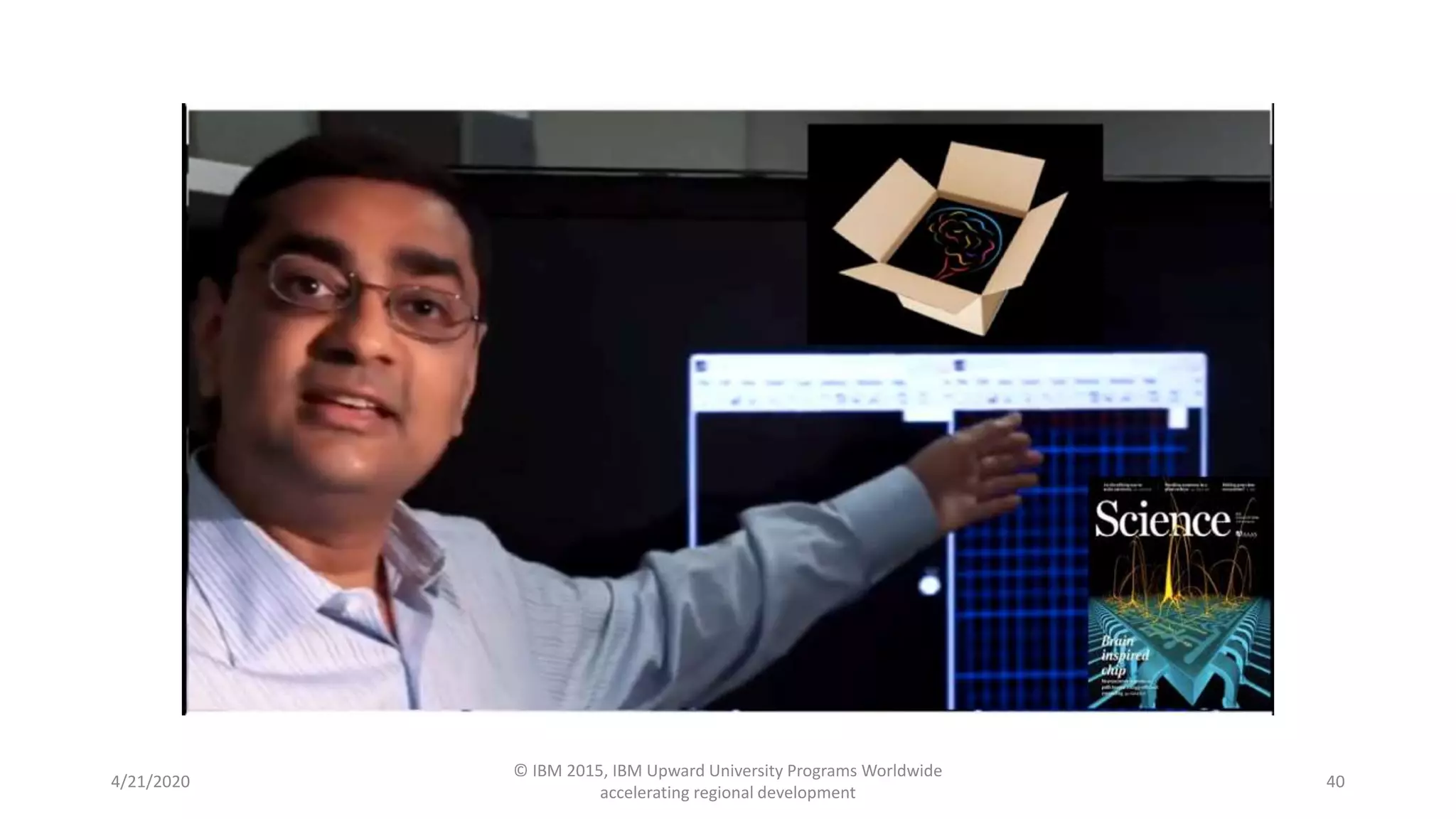
  • #41 Modha’s Brain - Goal 1KW and 2 Litres…. Dharmendra Modha and his design for a brain chip playing pong: https://www.youtube.com/watch?v=gQ3HEVelBFY https://www.youtube.com/watch?v=tqeINGOzIZo https://twitter.com/dharmendramodha/status/545693986149511168
  • #42 URL: https://en.wikipedia.org/wiki/History_of_artificial_intelligence URL: http://www.businessinsider.com/infographic-ai-effect-on-economy-2017-8 Today’s infographic comes from the Extraordinary Future 2017, a new conference in Vancouver, BC that focuses on emerging technologies such as AI, autonomous vehicles, fintech, and block http://extraordinaryfuture.com/e/extraordinary-future-2017-71chain tech. Nathaniel Rochester: In 1948, Rochester moved to IBM where he designed the IBM 701, the first general purpose, mass-produced computer. He wrote the first symbolic assembler, which allowed programs to be written in short, readable commands rather than pure numbers or punch codes.
  • #43 URL: http://www-formal.stanford.edu/jmc/history/dartmouth/dartmouth.html URL: https://en.wikipedia.org/wiki/Nathaniel_Rochester_(computer_scientist)
  • #44 URL: https://www.ted.com/talks/noriko_arai_can_a_robot_pass_a_university_entrance_exam
  • #45 O*NET Online is the occupation network online, started by the US Dept of Labor in the 1990’s – it now represents one of the most comprehensive lists of occupations along with a great deal of information about each occupation, including skills, tasks, certifications, demand for these jobs, etc. O*NET lists about 1000 occupations from Accountants to Zoologists – and many job families in between. O*NET updates the descriptions of the occupations as well as adding new occupations over time. Source: http://www.onetonline.org/find/family?f=0
  • #48 GitHub – open source code – http://github.com Kaggle – data and competitions – http://Kaggle.com Leaderboard – AI an competitions - https://www.slideshare.net/spohrer/leaderboards-80909263 Figure Eight – label data - https://en.wikipedia.org/wiki/Figure_Eight_Inc. Open Source Guides – reader, contributor, committer, governance - https://opensource.guide/ GitHub is to knowledge in action (writing code) as Wikidedia is to knowledge in text (writing text)
  • #49 URL: Why software is eating the world – see https://www.wsj.com/articles/SB10001424053111903480904576512250915629460 URL: Microsoft acquiring GitHub – see https://blogs.microsoft.com/blog/2018/06/04/microsoft-github-empowering-developers/ URL: Models will run the world – see https://www.wsj.com/articles/models-will-run-the-world-1534716720 URL: John Marks, “Why Open Source Failed” https://medium.com/@johnmark/why-open-source-failed-6cae5d6a9f6 First, the good news, which is actually bad. In a 2016 survey from Blackduck, 96% of software products developed that year used open source software. That number is likely higher now. In the software world, particularly software that runs the computing infrastructure of the internet, open source is ubiquitous. One could claim, without any exaggeration, that our current world runs on open source software or that our modern world would not exist in its current form without open source software. I don’t know how to calculate the total value of open source software to the world, but I do know that if open source software suddenly went away, the results would be catastrophic, an existential crisis for humanity. So when I write that “open source has failed” I’m obviously not writing from a technology perspective, where it was been a clear-cut winner and the foundation of an endless supply of business models, products, and services. To say that open source contributed to the overall innovation of the world would be a shameful understatement. Better would be to say that the world’s computing innovations owe their existence to the triumph of open source development. If you think this all sounds pretty terrific, read on to find out what I left out. In the context of this essay, “failure” refers not to any technical achievements but rather to the lack of social ones. When we were but wee lads and lasses on the forefront of this thing we called free software and eventually open source, we knew that this was dangerous stuff. It was destined to set fire to an entire industry, undermining entrenched monopoly powers and establishing a more equitable approach to building wealth around the tools that would power humanity in the 21st century. It was about the democratization of software and would smash what we then called the “digital divide”. That premise was entirely false. The crux of this essay is thus: not only did open source not stem or stall the redistribution of wealth and power upwards, but rather it aided and abetted the redistribution of wealth and power upwards. To be an open source proponent at this time without acknowledging this very real and most unfortunate consequence is to be a cog in a much larger machine; a stooge; a very useful idiot. When considering the role of open source in redistributing wealth upwards, it’s instructive to consider the example of Microsoft. Not because I enjoy picking on them or think they’re evil — I don’t; Microsoft as a publicly traded company is no more or less evil than any other company. Rather, I like to single them out because their public stance towards open source has changed much over the years and is a useful measuring stick for the points I’m trying to make. Did you ever wonder *why* their public stance towards open source shifted so much over the years, from “Linux is a cancer” to “use our open source software”? Could it be because, unlike the company’s predecessors in 2000, current executives now understand that open source software forms the building blocks of modern capitalist behemoths?
  • #50 URL: https://www.nytimes.com/2017/12/27/business/the-robots-are-coming-and-sweden-is-fine.html
  • #51 AI Fairness 360 toolkit (AIF360) is a comprehensive open-source toolkit of metrics to check for unwanted bias in datasets and machine learning models, and state-of-the-art algorithms to mitigate such bias. Machine learning models are increasingly used to inform high-stakes decisions about people. Although machine learning, by its very nature, is always a form of statistical discrimination, the discrimination becomes objectionable when it places certain privileged groups at systematic advantage and certain unprivileged groups at systematic disadvantage. Bias in training data, due to either prejudice in labels or under-/over-sampling, yields models with unwanted bias. The initial release of the AIF360 Python package contains nine different algorithms, developed by the broader algorithmic fairness research community, to mitigate that unwanted bias. The goal of the package is not only a way to bring researchers together, but also to translate collective research results to data scientists, data engineers, and developers deploying solutions in a variety of industries. AIF360 is a bit different from currently available open source efforts due its focus on bias mitigation (as opposed to simply on metrics), its focus on industrial usability, and its software engineering. AIF360 is relevant to credit scoring, predicting medical expenditures, and classifying face images by gender, among many other areas.