OPHS Chemistry
Unit 1
Scientific Inquiry & Measurement
Section 4: Significant Figures & Scientific Notation
Scientific Notation
• Scientific notation is an expression of
numbers in the form of N x 10x.
• Scientific notation is a way of expressing really
big numbers or really small numbers.
• It is most often used in “scientific” calculations
where the analysis must be very precise.
• Numbers expressed in scientific notation can
be used in a computation with far greater ease.
2
The Andromeda Galaxy (the closest one to our Milky Way galaxy) contains at
least 200,000,000,000 stars. On the other hand, the weight of an alpha
particle, which is emitted in the radioactive decay of Plutonium-239, is
0.000,000,000,000,000,000,000,000,006,645 kilograms.
Scientific Notation
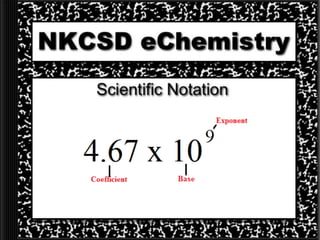
• In scientific notation, a number is written as
the product of two numbers.
– The first number is called the base, or coefficient.
• The base is a number between 1 & 10 and is
usually written with only one digit in front of
the decimal point.
– The second number is a power of ten.
• The small numeral 3 in 103 is called the
exponent. The exponent indicates how many
times the coefficient must be multiplied by 10 to
equal the number in question. 3
N x 10x
Converting Standard Form to
Scientific Notation
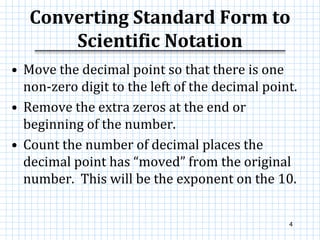
• Move the decimal point so that there is one
non-zero digit to the left of the decimal point.
• Remove the extra zeros at the end or
beginning of the number.
• Count the number of decimal places the
decimal point has “moved” from the original
number. This will be the exponent on the 10.
4
Converting Standard Form to
Scientific Notation
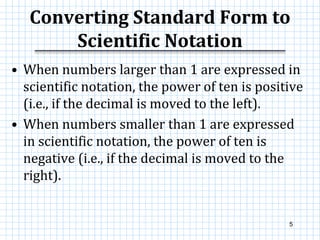
• When numbers larger than 1 are expressed in
scientific notation, the power of ten is positive
(i.e., if the decimal is moved to the left).
• When numbers smaller than 1 are expressed
in scientific notation, the power of ten is
negative (i.e., if the decimal is moved to the
right).
5
Practice
6
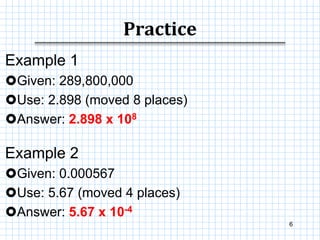
Example 1
Given: 289,800,000
Use: 2.898 (moved 8 places)
Answer: 2.898 x 10⁸
Example 2
Given: 0.000567
Use: 5.67 (moved 4 places)
Answer: 5.67 x 10⁻⁴
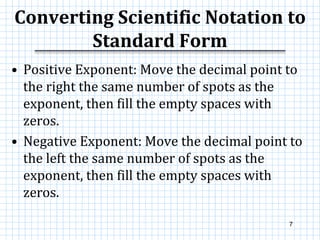
Converting Scientific Notation to
Standard Form
• Positive Exponent: Move the decimal point to
the right the same number of spots as the
exponent, then fill the empty spaces with
zeros.
• Negative Exponent: Move the decimal point to
the left the same number of spots as the
exponent, then fill the empty spaces with
zeros.
7
Practice
8
Example 3
Given: 5.093 x 10⁶
Answer: 5,093,000 (moved 6 places to the right)
Example 4
Given: 1.976 x 10⁻⁴
Answer: 0.0001976 (moved 4 places to the left)
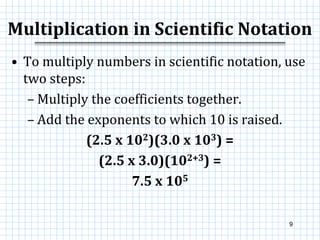
Multiplication in Scientific Notation
• To multiply numbers in scientific notation, use
two steps:
– Multiply the coefficients together.
– Add the exponents to which 10 is raised.
(2.5 x 10²)(3.0 x 10³) =
(2.5 x 3.0)(102+3) =
7.5 x 10⁵
9
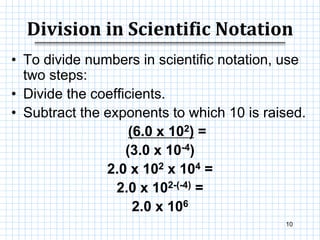
Division in Scientific Notation
• To divide numbers in scientific notation, use
two steps:
• Divide the coefficients.
• Subtract the exponents to which 10 is raised.
(6.0 x 10²) =
(3.0 x 10⁻⁴)
2.0 x 102 x 104 =
2.0 x 10²-(-4) =
2.0 x 10⁶
10
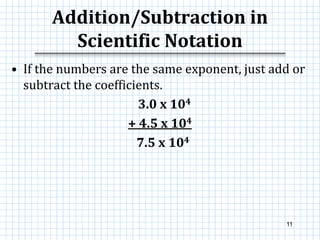
Addition/Subtraction in
Scientific Notation
• If the numbers are the same exponent, just add or
subtract the coefficients.
3.0 x 10⁴
+ 4.5 x 10⁴
7.5 x 10⁴
11
Addition/Subtraction in
Scientific Notation
• If the numbers have different exponents, convert
both to standard notation and perform the
calculation.
(2.05 x 10²) – (9.05 x 10⁻¹) =
205 - 0.905 = 204.095
• OR convert one number so they have 10 raised to the
same power and perform the calculation.
(2.05 x 10²) – (9.05 x 10⁻¹) =
2.05 x 10²
-0.00905 x 10²
2.04095 x 10²
12
Using a Calculator!
• Scientific calculators can be used to calculate
numbers involving scientific notation! Watch this
youtube video to learn how (excuse the narrator’s
negativity…focus on the process)!
13

Scientific Notation

  • 1.
    OPHS Chemistry Unit 1 ScientificInquiry & Measurement Section 4: Significant Figures & Scientific Notation
  • 2.
    Scientific Notation • Scientificnotation is an expression of numbers in the form of N x 10x. • Scientific notation is a way of expressing really big numbers or really small numbers. • It is most often used in “scientific” calculations where the analysis must be very precise. • Numbers expressed in scientific notation can be used in a computation with far greater ease. 2 The Andromeda Galaxy (the closest one to our Milky Way galaxy) contains at least 200,000,000,000 stars. On the other hand, the weight of an alpha particle, which is emitted in the radioactive decay of Plutonium-239, is 0.000,000,000,000,000,000,000,000,006,645 kilograms.
  • 3.
    Scientific Notation • Inscientific notation, a number is written as the product of two numbers. – The first number is called the base, or coefficient. • The base is a number between 1 & 10 and is usually written with only one digit in front of the decimal point. – The second number is a power of ten. • The small numeral 3 in 103 is called the exponent. The exponent indicates how many times the coefficient must be multiplied by 10 to equal the number in question. 3 N x 10x
  • 4.
    Converting Standard Formto Scientific Notation • Move the decimal point so that there is one non-zero digit to the left of the decimal point. • Remove the extra zeros at the end or beginning of the number. • Count the number of decimal places the decimal point has “moved” from the original number. This will be the exponent on the 10. 4
  • 5.
    Converting Standard Formto Scientific Notation • When numbers larger than 1 are expressed in scientific notation, the power of ten is positive (i.e., if the decimal is moved to the left). • When numbers smaller than 1 are expressed in scientific notation, the power of ten is negative (i.e., if the decimal is moved to the right). 5
  • 6.
    Practice 6 Example 1 Given: 289,800,000 Use:2.898 (moved 8 places) Answer: 2.898 x 10⁸ Example 2 Given: 0.000567 Use: 5.67 (moved 4 places) Answer: 5.67 x 10⁻⁴
  • 7.
    Converting Scientific Notationto Standard Form • Positive Exponent: Move the decimal point to the right the same number of spots as the exponent, then fill the empty spaces with zeros. • Negative Exponent: Move the decimal point to the left the same number of spots as the exponent, then fill the empty spaces with zeros. 7
  • 8.
    Practice 8 Example 3 Given: 5.093x 10⁶ Answer: 5,093,000 (moved 6 places to the right) Example 4 Given: 1.976 x 10⁻⁴ Answer: 0.0001976 (moved 4 places to the left)
  • 9.
    Multiplication in ScientificNotation • To multiply numbers in scientific notation, use two steps: – Multiply the coefficients together. – Add the exponents to which 10 is raised. (2.5 x 10²)(3.0 x 10³) = (2.5 x 3.0)(102+3) = 7.5 x 10⁵ 9
  • 10.
    Division in ScientificNotation • To divide numbers in scientific notation, use two steps: • Divide the coefficients. • Subtract the exponents to which 10 is raised. (6.0 x 10²) = (3.0 x 10⁻⁴) 2.0 x 102 x 104 = 2.0 x 10²-(-4) = 2.0 x 10⁶ 10
  • 11.
    Addition/Subtraction in Scientific Notation •If the numbers are the same exponent, just add or subtract the coefficients. 3.0 x 10⁴ + 4.5 x 10⁴ 7.5 x 10⁴ 11
  • 12.
    Addition/Subtraction in Scientific Notation •If the numbers have different exponents, convert both to standard notation and perform the calculation. (2.05 x 10²) – (9.05 x 10⁻¹) = 205 - 0.905 = 204.095 • OR convert one number so they have 10 raised to the same power and perform the calculation. (2.05 x 10²) – (9.05 x 10⁻¹) = 2.05 x 10² -0.00905 x 10² 2.04095 x 10² 12
  • 13.
    Using a Calculator! •Scientific calculators can be used to calculate numbers involving scientific notation! Watch this youtube video to learn how (excuse the narrator’s negativity…focus on the process)! 13