






The
Scientific
 Method
Scientific Method
 – a logical approach to
   solving problems by
observing and collecting
  data, formulating and
   testing hypotheses ,
forming theories that are
 supported by data, then
  communicating these
Observing
  – qualitative or
quantitative data in
     a system
Qualitative Data
Observable,
 non-measurable
   information
Ex. Windex is blue
Quantitative Data
   Measurable,
    numerical
   information
Ex. the candle is
    6.55 cm tall
System
-an environment in
which observations
     are made
Ex. this classroom
  or a test tube
Hypothesis
 – a generalization
that is to be tested
Theory –
is a logical explanation
for
describing the behavior
of
natural phenomena.
It originates from or is
supported by
experimental evidence.
Models
    – diagrams,
   equations, or
  representations
that help explain a
       theory
Law
 – generalization
  that describes
phenomena (does
   not explain)
Alchemy – responsible for the
 tools and techniques needed for
 working with chemicals both
 mystical and practical.
The word chemistry comes from
 alchemy – practiced in China and
 India since 400 B.C.
An Experimental Approach
In the 1500s, a shift started from
 alchemy to science
“Royal Society of London for the
 Promotion of Natural Knowledge”
 was responsible for this shift.
Encouraged scientists to use more
 experimental evidence
Lavoisier
In the late 1700s, Antoine
 Lavoisier helped transform
 chemistry from a science of
 observation to the science of
 measurement
He settled on long-standing debate
 about burning, which was…
Oxygen was required!
OK, Now a Review…
The Scientific Method
A logical approach to solving
 problems or answering questions.
Starts with observation- noting
 and recording information and
 facts
Hypothesis- a proposed
 explanation for the observation;
 must be tested by an experiment
Steps in the Scientific Method
1. Observations (uses your senses)
   a) quantitative involves numbers = 95oF
   b) qualitative is word description = hot
2. Formulating hypotheses (ideas)
   - a testable statement
3. Performing experiments (the test)
   - gathers new information to help decide
     whether the hypothesis is valid
Scientific Method
 “Controlled” experiment- designed
  to test the hypothesis
 We gather data and observations by
  doing the experiment
 Modify hypothesis - repeat the cycle
Outcomes over the long term…
Theory (Model)
 - A set of well-tested hypotheses that give an overall
 explanation of some natural phenomenon – not able
 to be proved
Natural Law (or Scientific Law)
 - The same observation applies to many
   different systems; summarizes results
 - an example would be:
   the Law of Conservation of Mass
Law vs. Theory
A law summarizes what has
 happened.
A theory (model) is an attempt to
 explain why it happened – this
 changes as new information is
 gathered.
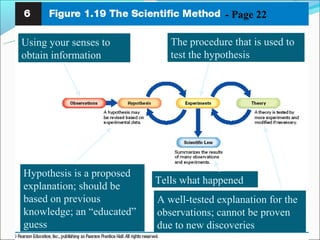
- Page 22

Using your senses to          The procedure that is used to
obtain information            test the hypothesis


Hypothesis is a proposed
                           Tells what happened
explanation; should be
based on previous          A well-tested explanation for the
knowledge; an “educated”   observations; cannot be proven
guess                      due to new discoveries
Collaboration / Communication
When scientists share ideas by
 collaboration and communication,
 they increase the likelihood of a
 successful outcome.

Scientific Method

  • 1.
  • 4.
    Scientific Method –a logical approach to solving problems by observing and collecting data, formulating and testing hypotheses , forming theories that are supported by data, then communicating these
  • 8.
    Observing –qualitative or quantitative data in a system
  • 11.
    Qualitative Data Observable, non-measurable information Ex. Windex is blue
  • 14.
    Quantitative Data Measurable, numerical information Ex. the candle is 6.55 cm tall
  • 17.
    System -an environment in whichobservations are made Ex. this classroom or a test tube
  • 22.
    Hypothesis – ageneralization that is to be tested
  • 24.
    Theory – is alogical explanation for describing the behavior of natural phenomena. It originates from or is supported by experimental evidence.
  • 25.
    Models – diagrams, equations, or representations that help explain a theory
  • 30.
    Law – generalization that describes phenomena (does not explain)
  • 41.
    Alchemy – responsiblefor the tools and techniques needed for working with chemicals both mystical and practical. The word chemistry comes from alchemy – practiced in China and India since 400 B.C.
  • 42.
    An Experimental Approach Inthe 1500s, a shift started from alchemy to science “Royal Society of London for the Promotion of Natural Knowledge” was responsible for this shift. Encouraged scientists to use more experimental evidence
  • 43.
    Lavoisier In the late1700s, Antoine Lavoisier helped transform chemistry from a science of observation to the science of measurement He settled on long-standing debate about burning, which was… Oxygen was required!
  • 44.
    OK, Now aReview… The Scientific Method A logical approach to solving problems or answering questions. Starts with observation- noting and recording information and facts Hypothesis- a proposed explanation for the observation; must be tested by an experiment
  • 45.
    Steps in theScientific Method 1. Observations (uses your senses) a) quantitative involves numbers = 95oF b) qualitative is word description = hot 2. Formulating hypotheses (ideas) - a testable statement 3. Performing experiments (the test) - gathers new information to help decide whether the hypothesis is valid
  • 46.
    Scientific Method  “Controlled”experiment- designed to test the hypothesis  We gather data and observations by doing the experiment  Modify hypothesis - repeat the cycle
  • 47.
    Outcomes over thelong term… Theory (Model) - A set of well-tested hypotheses that give an overall explanation of some natural phenomenon – not able to be proved Natural Law (or Scientific Law) - The same observation applies to many different systems; summarizes results - an example would be: the Law of Conservation of Mass
  • 48.
    Law vs. Theory Alaw summarizes what has happened. A theory (model) is an attempt to explain why it happened – this changes as new information is gathered.
  • 49.
    - Page 22 Usingyour senses to The procedure that is used to obtain information test the hypothesis Hypothesis is a proposed Tells what happened explanation; should be based on previous A well-tested explanation for the knowledge; an “educated” observations; cannot be proven guess due to new discoveries
  • 50.
    Collaboration / Communication Whenscientists share ideas by collaboration and communication, they increase the likelihood of a successful outcome.