THE SCIENCE
CURRICULUM
FRAMEWORK
Presented by Judy Ann Hachero
A central feature of the Scie nce curriculum is the balanced integration of
three interrelated content strands:
• Performing scientific inquiry skills;
• Understanding and applying scientific
knowledge;and
• Developing and
demonstrating scientific
attitude and values
This content is structured into a developmental sequence of
science content, which progressively increases in conceptual
demand. The
design supports learners to engage with and learn in science
appropriate to the expected prior experiences and learning.
Other approaches that enhance inquiry
learning and have also contributed to the
curriculum design include:
01
02
Application led-learning,
03
The science -technology-society approach,
Problem-based learning, and
04 Multidisciplinary learning
The Science curriculum recognizes the place of science and
technology in everyday human affairs. It integrates science and
technology in the social, economic, personal, and ethical aspects
of life. The science curriculum promotes strong links between
science and technology,including indigenous know-how in the use
of natural materials, thus contributing to the preservation of the
country’s cultural heritage.
The intention of the curriculum is not to rely solely on textbooks, but to engage learners in science, as well as
technological and engineering-related practices and processes and to incorporate varied hands-on and
minds-on activities to develop learners’ interest and encourage them to bee active learners. Where learning
competencies suggest engagement with and demonstrations of knowledge and understanding, this
curriculum sets the expectation that learners will actively engage in locating and interpreting the relevant
scientific facts, concepts, laws, and theories, and reinterpret or represent them as a deliberate learning
strategy. This approach is strongly supported in brain-based learning, which suggests that teachers can
promote higher learning through guidance with questions rather than by requiring learners to rote learn.
The Science curriculum is designed to be learner-centered and inquiry-based, emphasizing the use
of evidence in constructing explanations and providing opportunities for collaboration, innovation,
creative scientific exploration, and engineering design. The curriculum explicitly presents many
learning competencies that require active learner participation and leadership. Thus, teachers
should also deliberately look for opportunities to apply inquiry learning when addressing any
learning competency, as this models the nature and practice of science in authentic scientific
research and enterprise.
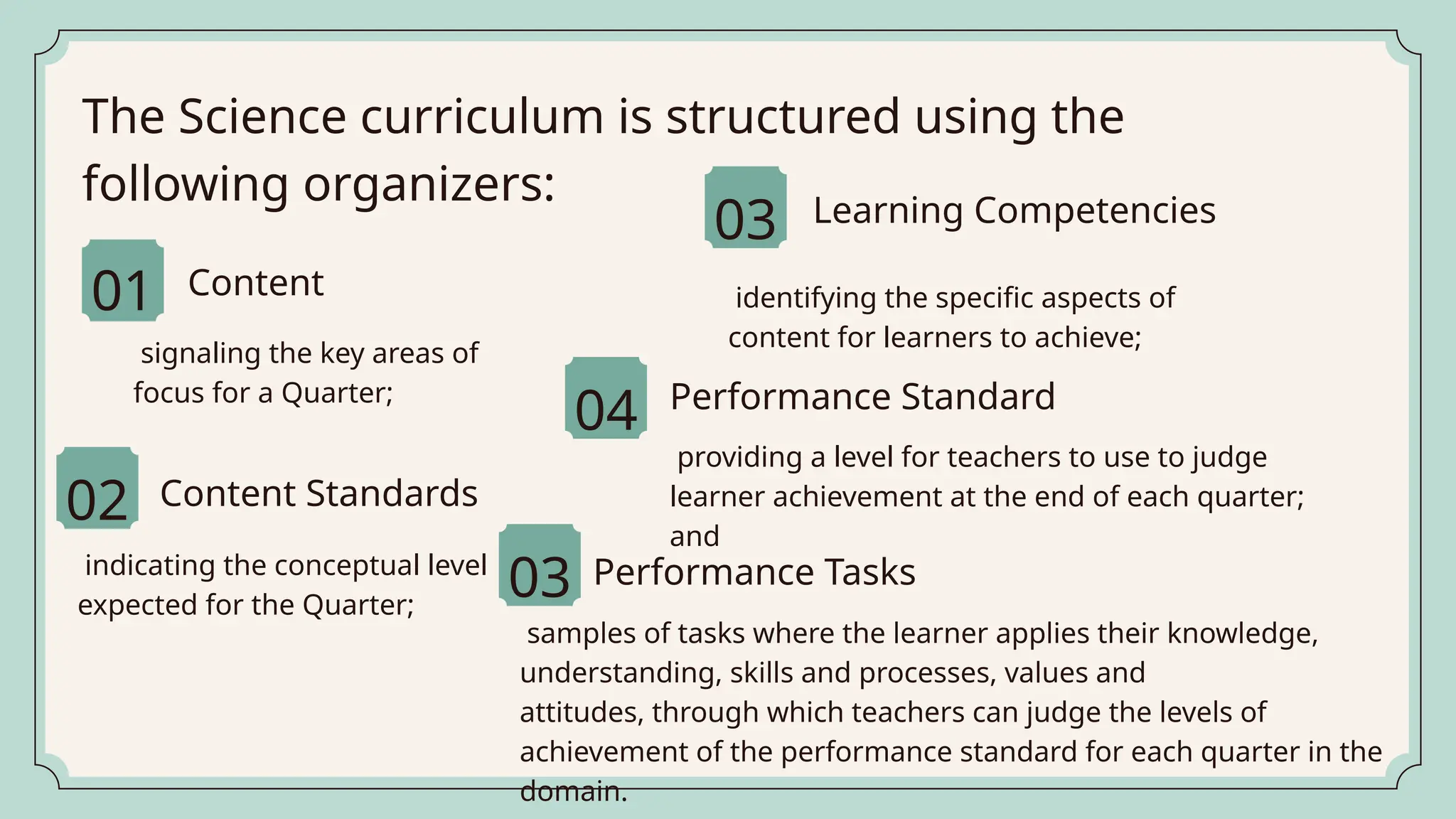
The Science curriculum is structured using the
following organizers:
01
02
signaling the key areas of
focus for a Quarter;
Content
Content Standards
indicating the conceptual level
expected for the Quarter;
03 Learning Competencies
identifying the specific aspects of
content for learners to achieve;
04
03
Performance Standard
providing a level for teachers to use to judge
learner achievement at the end of each quarter;
and
Performance Tasks
samples of tasks where the learner applies their knowledge,
understanding, skills and processes, values and
attitudes, through which teachers can judge the levels of
achievement of the performance standard for each quarter in the
domain.
Thank
you!

Science-Curriculum-Framework-_20240821_071327_0000.pptx

  • 1.
  • 2.
    A central featureof the Scie nce curriculum is the balanced integration of three interrelated content strands: • Performing scientific inquiry skills; • Understanding and applying scientific knowledge;and • Developing and demonstrating scientific attitude and values
  • 3.
    This content isstructured into a developmental sequence of science content, which progressively increases in conceptual demand. The design supports learners to engage with and learn in science appropriate to the expected prior experiences and learning.
  • 4.
    Other approaches thatenhance inquiry learning and have also contributed to the curriculum design include: 01 02 Application led-learning, 03 The science -technology-society approach, Problem-based learning, and 04 Multidisciplinary learning
  • 5.
    The Science curriculumrecognizes the place of science and technology in everyday human affairs. It integrates science and technology in the social, economic, personal, and ethical aspects of life. The science curriculum promotes strong links between science and technology,including indigenous know-how in the use of natural materials, thus contributing to the preservation of the country’s cultural heritage.
  • 6.
    The intention ofthe curriculum is not to rely solely on textbooks, but to engage learners in science, as well as technological and engineering-related practices and processes and to incorporate varied hands-on and minds-on activities to develop learners’ interest and encourage them to bee active learners. Where learning competencies suggest engagement with and demonstrations of knowledge and understanding, this curriculum sets the expectation that learners will actively engage in locating and interpreting the relevant scientific facts, concepts, laws, and theories, and reinterpret or represent them as a deliberate learning strategy. This approach is strongly supported in brain-based learning, which suggests that teachers can promote higher learning through guidance with questions rather than by requiring learners to rote learn. The Science curriculum is designed to be learner-centered and inquiry-based, emphasizing the use of evidence in constructing explanations and providing opportunities for collaboration, innovation, creative scientific exploration, and engineering design. The curriculum explicitly presents many learning competencies that require active learner participation and leadership. Thus, teachers should also deliberately look for opportunities to apply inquiry learning when addressing any learning competency, as this models the nature and practice of science in authentic scientific research and enterprise.
  • 7.
    The Science curriculumis structured using the following organizers: 01 02 signaling the key areas of focus for a Quarter; Content Content Standards indicating the conceptual level expected for the Quarter; 03 Learning Competencies identifying the specific aspects of content for learners to achieve; 04 03 Performance Standard providing a level for teachers to use to judge learner achievement at the end of each quarter; and Performance Tasks samples of tasks where the learner applies their knowledge, understanding, skills and processes, values and attitudes, through which teachers can judge the levels of achievement of the performance standard for each quarter in the domain.
  • 8.