The Commonwealth Commitment
to College Access & Affordability in Massachusetts
Board of Higher Education | January 26, 2016
Commonwealth Commitment
Campuses Show theWay
2
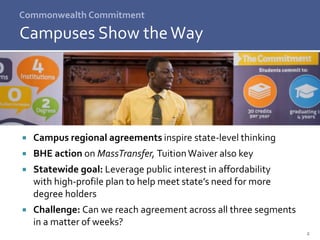
 Campus regional agreements inspire state-level thinking
 BHE action on MassTransfer, TuitionWaiver also key
 Statewide goal: Leverage public interest in affordability
with high-profile plan to help meet state’s need for more
degree holders
 Challenge: Can we reach agreement across all three segments
in a matter of weeks?
Commonwealth Commitment
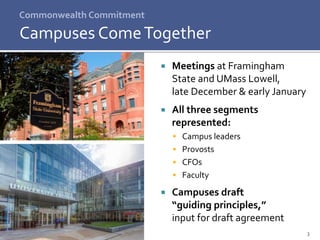
 Meetings at Framingham
State and UMass Lowell,
late December & early January
 All three segments
represented:
 Campus leaders
 Provosts
 CFOs
 Faculty
 Campuses draft
“guiding principles,”
input for draft agreement
Campuses ComeTogether
3
Commonwealth Commitment
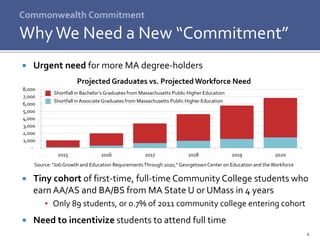
 Urgent need for more MA degree-holders
 Tiny cohort of first-time, full-time Community College students who
earn AA/AS and BA/BS from MA State U or UMass in 4 years
▪ Only 89 students, or 0.7% of 2011 community college entering cohort
 Need to incentivize students to attend full time
WhyWe Need a New “Commitment”
4
-
1,000
2,000
3,000
4,000
5,000
6,000
7,000
8,000
2015 2016 2017 2018 2019 2020
Projected Graduates vs. Projected Workforce Need
Source: “Job Growth and Education RequirementsThrough 2020,” GeorgetownCenter on Education and theWorkforce
Shortfall in Bachelor’s Graduates from Massachusetts Public Higher Education
Shortfall in Associate Graduates from Massachusetts Public Higher Education
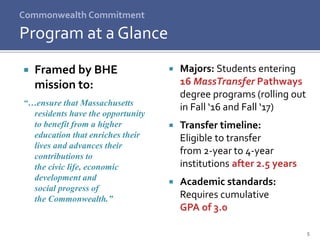
 Framed by BHE
mission to:
“…ensure that Massachusetts
residents have the opportunity
to benefit from a higher
education that enriches their
lives and advances their
contributions to
the civic life, economic
development and
social progress of
the Commonwealth.”
 Majors: Students entering
16 MassTransfer Pathways
degree programs (rolling out
in Fall ‘16 and Fall ‘17)
 Transfer timeline:
Eligible to transfer
from 2-year to 4-year
institutions after 2.5 years
 Academic standards:
Requires cumulative
GPA of 3.0
Commonwealth Commitment
Program at a Glance
5
Commonwealth Commitment
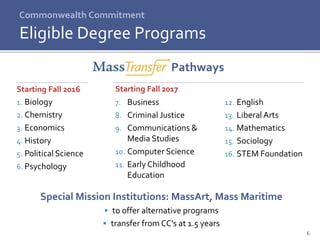
Starting Fall 2016
1. Biology
2. Chemistry
3. Economics
4. History
5. Political Science
6. Psychology
Eligible Degree Programs
6
7. Business
8. Criminal Justice
9. Communications &
Media Studies
10. Computer Science
11. Early Childhood
Education
Special Mission Institutions: MassArt, Mass Maritime
 to offer alternative programs
 transfer from CC’s at 1.5 years
12. English
13. Liberal Arts
14. Mathematics
15. Sociology
16. STEM Foundation
Starting Fall 2017
Pathways
Commonwealth Commitment
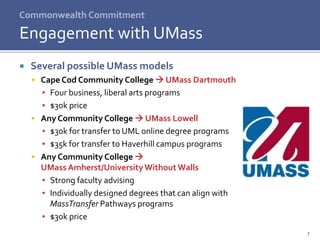
 Several possible UMass models
 Cape Cod Community College  UMass Dartmouth
▪ Four business, liberal arts programs
▪ $30k price
 Any Community College  UMass Lowell
▪ $30k for transfer to UML online degree programs
▪ $35k for transfer to Haverhill campus programs
 Any Community College 
UMass Amherst/UniversityWithout Walls
▪ Strong faculty advising
▪ Individually designed degrees that can align with
MassTransfer Pathways programs
▪ $30k price
Engagement with UMass
7
Commonwealth Commitment
 Under discussion: 10% discount to students, payable at end of
each completed semester, available for those entering Fall ‘16
through Fall ‘17
 Savings for students; faster pathway to degree completion
 Example #1: RCC  UMB: $32,880 – 10% = $29,592
 Example #2: GCC  MMA: $28,224 – 10% = $25,402
 Alternate plan: Fixed 4-year degree price, with or without
discount, but…
 Benefits some institutions more than others
 Would need to be revisited every few years
 Context: Campus commitment to students in tight budget year
 Significant savings for students, dependent on “stable & predictable state
funding” to safeguard academic excellence, provide necessary supports
Costs & Exposures
8
Commonwealth Commitment
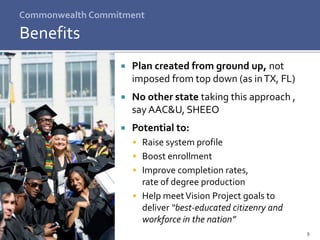
 Plan created from ground up, not
imposed from top down (as inTX, FL)
 No other state taking this approach ,
say AAC&U, SHEEO
 Potential to:
 Raise system profile
 Boost enrollment
 Improve completion rates,
rate of degree production
 Help meetVision Project goals to
deliver “best-educated citizenry and
workforce in the nation”
Benefits
9
Questions & Discussion
Commonwealth Commitment
10

The Commonwealth Commitment

  • 1.
    The Commonwealth Commitment toCollege Access & Affordability in Massachusetts Board of Higher Education | January 26, 2016
  • 2.
    Commonwealth Commitment Campuses ShowtheWay 2  Campus regional agreements inspire state-level thinking  BHE action on MassTransfer, TuitionWaiver also key  Statewide goal: Leverage public interest in affordability with high-profile plan to help meet state’s need for more degree holders  Challenge: Can we reach agreement across all three segments in a matter of weeks?
  • 3.
    Commonwealth Commitment  Meetingsat Framingham State and UMass Lowell, late December & early January  All three segments represented:  Campus leaders  Provosts  CFOs  Faculty  Campuses draft “guiding principles,” input for draft agreement Campuses ComeTogether 3
  • 4.
    Commonwealth Commitment  Urgentneed for more MA degree-holders  Tiny cohort of first-time, full-time Community College students who earn AA/AS and BA/BS from MA State U or UMass in 4 years ▪ Only 89 students, or 0.7% of 2011 community college entering cohort  Need to incentivize students to attend full time WhyWe Need a New “Commitment” 4 - 1,000 2,000 3,000 4,000 5,000 6,000 7,000 8,000 2015 2016 2017 2018 2019 2020 Projected Graduates vs. Projected Workforce Need Source: “Job Growth and Education RequirementsThrough 2020,” GeorgetownCenter on Education and theWorkforce Shortfall in Bachelor’s Graduates from Massachusetts Public Higher Education Shortfall in Associate Graduates from Massachusetts Public Higher Education
  • 5.
     Framed byBHE mission to: “…ensure that Massachusetts residents have the opportunity to benefit from a higher education that enriches their lives and advances their contributions to the civic life, economic development and social progress of the Commonwealth.”  Majors: Students entering 16 MassTransfer Pathways degree programs (rolling out in Fall ‘16 and Fall ‘17)  Transfer timeline: Eligible to transfer from 2-year to 4-year institutions after 2.5 years  Academic standards: Requires cumulative GPA of 3.0 Commonwealth Commitment Program at a Glance 5
  • 6.
    Commonwealth Commitment Starting Fall2016 1. Biology 2. Chemistry 3. Economics 4. History 5. Political Science 6. Psychology Eligible Degree Programs 6 7. Business 8. Criminal Justice 9. Communications & Media Studies 10. Computer Science 11. Early Childhood Education Special Mission Institutions: MassArt, Mass Maritime  to offer alternative programs  transfer from CC’s at 1.5 years 12. English 13. Liberal Arts 14. Mathematics 15. Sociology 16. STEM Foundation Starting Fall 2017 Pathways
  • 7.
    Commonwealth Commitment  Severalpossible UMass models  Cape Cod Community College  UMass Dartmouth ▪ Four business, liberal arts programs ▪ $30k price  Any Community College  UMass Lowell ▪ $30k for transfer to UML online degree programs ▪ $35k for transfer to Haverhill campus programs  Any Community College  UMass Amherst/UniversityWithout Walls ▪ Strong faculty advising ▪ Individually designed degrees that can align with MassTransfer Pathways programs ▪ $30k price Engagement with UMass 7
  • 8.
    Commonwealth Commitment  Underdiscussion: 10% discount to students, payable at end of each completed semester, available for those entering Fall ‘16 through Fall ‘17  Savings for students; faster pathway to degree completion  Example #1: RCC  UMB: $32,880 – 10% = $29,592  Example #2: GCC  MMA: $28,224 – 10% = $25,402  Alternate plan: Fixed 4-year degree price, with or without discount, but…  Benefits some institutions more than others  Would need to be revisited every few years  Context: Campus commitment to students in tight budget year  Significant savings for students, dependent on “stable & predictable state funding” to safeguard academic excellence, provide necessary supports Costs & Exposures 8
  • 9.
    Commonwealth Commitment  Plancreated from ground up, not imposed from top down (as inTX, FL)  No other state taking this approach , say AAC&U, SHEEO  Potential to:  Raise system profile  Boost enrollment  Improve completion rates, rate of degree production  Help meetVision Project goals to deliver “best-educated citizenry and workforce in the nation” Benefits 9
  • 10.

Editor's Notes

  • #3 Photo from the Central MA announcement
  • #5 Suggested comment on graph: “You’ve already seen this graph once today, but this is a critical topic.” (Same graph will be used in the Early College presentation at the prior Joint BHE/BESE meeting.) Notes from Mario & Jonathan on bullet 2: Must say “2011 entering cohort” to be accurate. These are students who graduated from both CC & 4-year by June 30, 2015. You can add that the trend has been completely flat in recent history. (We looked at 9 years of trend.) To connect the dots between bullet 1 and bullet 2, you might say that half of all public higher ed students are enrolled in the community colleges.
  • #7 People might ask when the special mission institutions will start offering their programs, given the staggered dates above. Do you know?
  • #9 For UMASS, slightly different principles will apply. UMASS receives $22,600 in a 34K scenario