Models and Modeling in the High School Physics Classroom Larry Dukerich Modeling Instruction Program Arizona State University Dobson HS - Mesa, AZ
The Problem with Traditional Instruction It presumes two kinds of knowledge:  facts and knowhow. Facts and ideas are  things  that can be packaged into words and distributed to students. Knowhow can be packaged as rules or procedures. We come to understand the structure and behavior of real objects only by constructing models.
“ Teaching by Telling” is Ineffective Students usually miss the point of what we tell them. Key words or concepts do not elicit the same “schema” for students as they do for us. Watching the  teacher  solve problems does not improve  student  problem-solving skills.
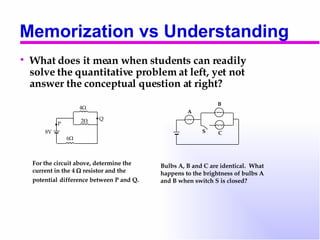
Memorization vs Understanding What does it mean when students can readily solve the quantitative problem at left, yet not answer the conceptual question at right? For the circuit above, determine the current in the 4    resistor and the potential   difference between P and Q. Bulbs A, B and C are identical.  What happens to the brightness of bulbs A and B when switch S is closed?
Construct and use  scientific models  to describe, to explain, to predict and to control physical phenomena. Model physical objects and processes using diagrammatic, graphical and algebraic representations. Small set of basic models as the  content core   of physics. Evaluate scientific models through comparison with empirical data. Modeling as the  procedural core   of scientific knowledge. Instructional Objectives
Why modeling?! To make students’ classroom experience closer to the  scientific practice  of physicists. To make the  coherence  of scientific knowledge more evident to students by making it more explicit. Construction and testing of math models  is a central activity of research physicists. Models and Systems  are explicitly recognized as major unifying ideas for all the sciences by the  AAAS Project 2061  for the reform of US science education. Robert Karplus  made systems and models central to the  SCIS  elementary school science curriculum.
Models vs Problems The problem with problem-solving Students come to see problems and their answers as the units of knowledge. Students fail to see common elements in novel problems. “ But we never did a problem like this!” Models as basic units of knowledge A few basic models are used again and again with only minor modifications. Students identify or create a model and make inferences from the model to produce a solution.
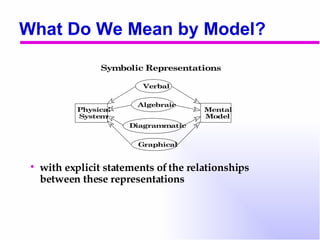
What Do We Mean by Model? with explicit statements of the relationships between these representations
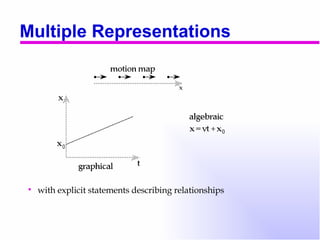
Multiple Representations with explicit statements describing relationships
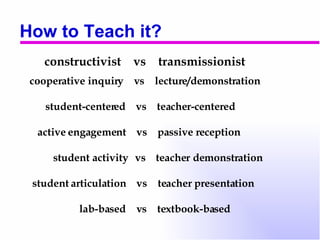
How to Teach it? constructivist  vs  transmissionist cooperative inquiry  vs  lecture/demonstration student-centered  vs  teacher-centered active engagement  vs  passive reception  student activity  vs  teacher demonstration student articulation  vs  teacher presentation lab-based  vs  textbook-based
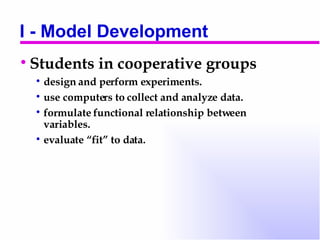
I - Model Development Students in cooperative groups design and perform experiments. use computers to collect and analyze data. formulate functional relationship between variables. evaluate “fit” to data.
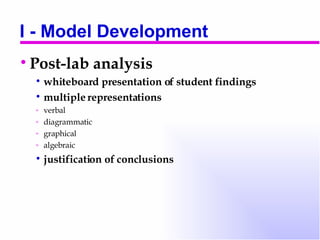
I - Model Development Post-lab analysis whiteboard presentation of student findings multiple representations verbal diagrammatic graphical algebraic justification of conclusions
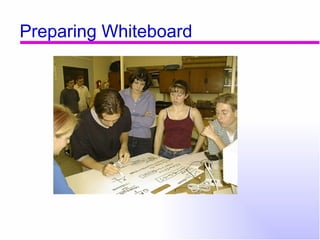
Preparing Whiteboard
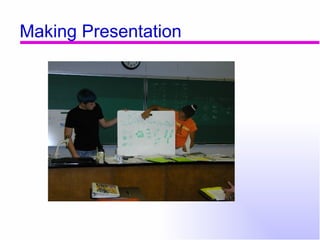
Making Presentation
II - Model Deployment In post-lab extension, the instructor brings closure to the experiment. fleshes out details of the model, relating common features of various representations. helps students to abstract the model from the context in which it was developed.
II - Model Deployment In deployment activities, students articulate their understanding in oral presentations. are guided by instructor's questions: Why did you do that? How do you know that? learn to apply model to variety of related situations. identify system composition accurately represent its structure
II - Model Deployment Objectives: to improve the quality of scientific discourse. move toward progressive deepening of student understanding of models and modeling with each pass through the modeling cycle. get students to see models everywhere! Ultimate Objective: autonomous scientific thinkers fluent in all aspects of conceptual and mathematical modeling.

Modeling Method

  • 1.
    Models and Modelingin the High School Physics Classroom Larry Dukerich Modeling Instruction Program Arizona State University Dobson HS - Mesa, AZ
  • 2.
    The Problem withTraditional Instruction It presumes two kinds of knowledge: facts and knowhow. Facts and ideas are things that can be packaged into words and distributed to students. Knowhow can be packaged as rules or procedures. We come to understand the structure and behavior of real objects only by constructing models.
  • 3.
    “ Teaching byTelling” is Ineffective Students usually miss the point of what we tell them. Key words or concepts do not elicit the same “schema” for students as they do for us. Watching the teacher solve problems does not improve student problem-solving skills.
  • 4.
    Memorization vs UnderstandingWhat does it mean when students can readily solve the quantitative problem at left, yet not answer the conceptual question at right? For the circuit above, determine the current in the 4  resistor and the potential difference between P and Q. Bulbs A, B and C are identical. What happens to the brightness of bulbs A and B when switch S is closed?
  • 5.
    Construct and use scientific models to describe, to explain, to predict and to control physical phenomena. Model physical objects and processes using diagrammatic, graphical and algebraic representations. Small set of basic models as the content core of physics. Evaluate scientific models through comparison with empirical data. Modeling as the procedural core of scientific knowledge. Instructional Objectives
  • 6.
    Why modeling?! Tomake students’ classroom experience closer to the scientific practice of physicists. To make the coherence of scientific knowledge more evident to students by making it more explicit. Construction and testing of math models is a central activity of research physicists. Models and Systems are explicitly recognized as major unifying ideas for all the sciences by the AAAS Project 2061 for the reform of US science education. Robert Karplus made systems and models central to the SCIS elementary school science curriculum.
  • 7.
    Models vs ProblemsThe problem with problem-solving Students come to see problems and their answers as the units of knowledge. Students fail to see common elements in novel problems. “ But we never did a problem like this!” Models as basic units of knowledge A few basic models are used again and again with only minor modifications. Students identify or create a model and make inferences from the model to produce a solution.
  • 8.
    What Do WeMean by Model? with explicit statements of the relationships between these representations
  • 9.
    Multiple Representations withexplicit statements describing relationships
  • 10.
    How to Teachit? constructivist vs transmissionist cooperative inquiry vs lecture/demonstration student-centered vs teacher-centered active engagement vs passive reception student activity vs teacher demonstration student articulation vs teacher presentation lab-based vs textbook-based
  • 11.
    I - ModelDevelopment Students in cooperative groups design and perform experiments. use computers to collect and analyze data. formulate functional relationship between variables. evaluate “fit” to data.
  • 12.
    I - ModelDevelopment Post-lab analysis whiteboard presentation of student findings multiple representations verbal diagrammatic graphical algebraic justification of conclusions
  • 13.
  • 14.
  • 15.
    II - ModelDeployment In post-lab extension, the instructor brings closure to the experiment. fleshes out details of the model, relating common features of various representations. helps students to abstract the model from the context in which it was developed.
  • 16.
    II - ModelDeployment In deployment activities, students articulate their understanding in oral presentations. are guided by instructor's questions: Why did you do that? How do you know that? learn to apply model to variety of related situations. identify system composition accurately represent its structure
  • 17.
    II - ModelDeployment Objectives: to improve the quality of scientific discourse. move toward progressive deepening of student understanding of models and modeling with each pass through the modeling cycle. get students to see models everywhere! Ultimate Objective: autonomous scientific thinkers fluent in all aspects of conceptual and mathematical modeling.

Editor's Notes

  • #2 We’re here to tell you about the Modeling Method of instruction: developed in a collaborative effort by Malcolm Wells, a HS teacher and David Hestenes, prof of physics at ASU. These are the folks who developed the FCI and MB test which appearedin Mar 92 TPT. The MM, using results of physics education research attemprs to match instructional design to the way we believe students learn