
State Authorization
Reciprocity Agreement (SARA)
Board of Higher Education Meeting | June 14, 2016
State Authorization Reciprocity Agreement (SARA)
 What is SARA?
 Benefits & Concerns
 Stakeholder Comments
 Gabrielle Viator, Assistant Attorney General & Senior Policy
Advisor Office of Attorney General Maura Healey
 Margaret Mattes, Policy Associate,The Century Foundation
 Michael Alexander, President of Lasell College (rep. AICUM)
 John Cunningham, CEO of UMass Online;Vice President of
Academic Affairs, University of Massachusetts
 Questions
Presentation Overview
State Authorization Reciprocity Agreement (SARA)
 2006 – Congress Eliminates 50 Percent Rule
 Led to proliferation of online learning, particularly in
for-profit sector
 2010 – USDOE Creates State Authorization Rule
 Required distance education providers seekingTitle IV
funding to be “authorized” in each state from which
students are enrolled
 Still awaiting USDOE regulations defining what will satisfy
requirement of “state authorization”
 Currently, each state regulates online learning
independently; requirements and fees vary by state
Origins
State Authorization Reciprocity Agreement (SARA)
 SARA is an effort, in part, to get ahead of state
authorization rule and streamline nationwide
oversight of online learning
 Managed by national organization (NC-SARA) and
regional compacts (NEBHE for New England states)
 When an institution is authorized in one state
(its home state), it can operate in all other
member states without any other requirements
 Institutions > Home State > Regional Compact
Summary
State Authorization Reciprocity Agreement (SARA)
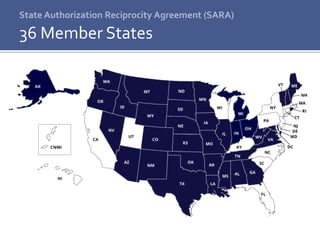
36 Member States
State Authorization Reciprocity Agreement (SARA)
 Lower costs of regulatory compliance for institutions
 e.g., eliminates the need and cost to comply with 50
different states’ “patchwork” regulations of online
learning
 Increases online options for consumers
 Reduces administrative burdens on state regulators
 e.g., program review and state authorization would
be limited to in-state, physically present institutions;
 Provides minimum protections where they may not
currently exist
Benefits
State Authorization Reciprocity Agreement (SARA)
 Program Quality
 Only defers to accreditation
 Consumer Protection
 Requires that laws and policies inconsistent with SARA
must be amended to meet requirements
▪ MA AGO regulations for proprietary institutions (940 CMR 31)
 Few minimum protections (e.g., refund policies,
admission standards, recruitment practices)
 Complaints are forwarded to home state for resolution
▪ MA cannot prohibit an institution with multiple substantive
complaints from operating in MA
Concerns
State Authorization Reciprocity Agreement (SARA)
 SARA legislation filed in MA in FY17
House & Senate budgets
 2 proposed amendments would have authorized BHE to
enter into SARA
 Senate budget includes language to charge a commission
to study SARA
 USDOE expected to issue state authorization rule
Conclusion / Next Steps
StakeholderTestimony
Gabrielle Viator, Assistant Attorney General & Senior Policy
Advisor, Office of Attorney General Maura Healey
Margaret Mattes, Policy Associate,The Century Foundation
Michael Alexander, President, Lasell College (representing
AICUM)
John Cunningham, CEO of UMass Online;Vice President of
Academic Affairs, University of Massachusetts
Discussion

State Authorization Reciprocity Agreement (SARA) Briefing

  • 1.
    State Authorization Reciprocity Agreement(SARA) Board of Higher Education Meeting | June 14, 2016
  • 2.
    State Authorization ReciprocityAgreement (SARA)  What is SARA?  Benefits & Concerns  Stakeholder Comments  Gabrielle Viator, Assistant Attorney General & Senior Policy Advisor Office of Attorney General Maura Healey  Margaret Mattes, Policy Associate,The Century Foundation  Michael Alexander, President of Lasell College (rep. AICUM)  John Cunningham, CEO of UMass Online;Vice President of Academic Affairs, University of Massachusetts  Questions Presentation Overview
  • 3.
    State Authorization ReciprocityAgreement (SARA)  2006 – Congress Eliminates 50 Percent Rule  Led to proliferation of online learning, particularly in for-profit sector  2010 – USDOE Creates State Authorization Rule  Required distance education providers seekingTitle IV funding to be “authorized” in each state from which students are enrolled  Still awaiting USDOE regulations defining what will satisfy requirement of “state authorization”  Currently, each state regulates online learning independently; requirements and fees vary by state Origins
  • 4.
    State Authorization ReciprocityAgreement (SARA)  SARA is an effort, in part, to get ahead of state authorization rule and streamline nationwide oversight of online learning  Managed by national organization (NC-SARA) and regional compacts (NEBHE for New England states)  When an institution is authorized in one state (its home state), it can operate in all other member states without any other requirements  Institutions > Home State > Regional Compact Summary
  • 5.
    State Authorization ReciprocityAgreement (SARA) 36 Member States
  • 6.
    State Authorization ReciprocityAgreement (SARA)  Lower costs of regulatory compliance for institutions  e.g., eliminates the need and cost to comply with 50 different states’ “patchwork” regulations of online learning  Increases online options for consumers  Reduces administrative burdens on state regulators  e.g., program review and state authorization would be limited to in-state, physically present institutions;  Provides minimum protections where they may not currently exist Benefits
  • 7.
    State Authorization ReciprocityAgreement (SARA)  Program Quality  Only defers to accreditation  Consumer Protection  Requires that laws and policies inconsistent with SARA must be amended to meet requirements ▪ MA AGO regulations for proprietary institutions (940 CMR 31)  Few minimum protections (e.g., refund policies, admission standards, recruitment practices)  Complaints are forwarded to home state for resolution ▪ MA cannot prohibit an institution with multiple substantive complaints from operating in MA Concerns
  • 8.
    State Authorization ReciprocityAgreement (SARA)  SARA legislation filed in MA in FY17 House & Senate budgets  2 proposed amendments would have authorized BHE to enter into SARA  Senate budget includes language to charge a commission to study SARA  USDOE expected to issue state authorization rule Conclusion / Next Steps
  • 9.
    StakeholderTestimony Gabrielle Viator, AssistantAttorney General & Senior Policy Advisor, Office of Attorney General Maura Healey Margaret Mattes, Policy Associate,The Century Foundation Michael Alexander, President, Lasell College (representing AICUM) John Cunningham, CEO of UMass Online;Vice President of Academic Affairs, University of Massachusetts
  • 10.

Editor's Notes

  • #4 1. What is the 50% rule? The 50 Percent Rule, required that at least half of a college’s students be enrolled at a physical campus in order for a program to be eligible for federal student aid funding/ Title IV. -- law was put in place in 1990s; At the time, the law was intended to address rise of fraudulent correspondence schools and diploma mills, which offered courses over videotapes or through written coursework — or simply mailed diplomas and credentials in exchange for money. Current jurisdictional model: physical presence test Need to reexamine this stems from: The proliferation of online higher education providers Shift of higher education landscape from traditional “brick-and-mortar” institutions to 100% online or hybrid models.
  • #9 UDOE- when we last check the new rules were put on indefinite hold; just yesterday we learned that USDOE seems to be moving forward and may be issuing regulations for regulations in the next few months (September?? If they want to meet an October deadline).