










Introduction The application of training and conditioning Tests & validity Biomechanics defined How and why does it work How can it improve actual performance What you can do with your clients
A little about me…. Founder and president of The Institute of Sport Science & Athletic Conditioning (ISSAC) Current graduate student in Biomechanics at the University of Nevada, Las Vegas (UNLV) In the industry for over twenty years Former powerlifter (ADFPA) And just to get it out of the way….
 
Sports & Specificity So many different types of sports So many different ways of training them Sport Specific? How about Athlete Specific? But the underlying science is constant!
Training & Conditioning What is the “Right Way?” Speed, Power, Strength, etc…. Outcome dependent SAID Principle : S pecific Adaptations to Imposed Demands
Traditional Testing
Why Do We Do It? Assess athletic ability Identify strengths Identify weaknesses Goal setting Develop and adjust program “Starting Point, End Point”
Steps to Success! Where are we? Where do we want to go? How do we get there? Alternate paths? Are we identifying the right variables?
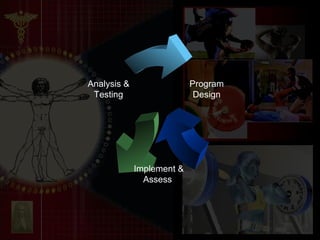
Program Design Implement &  Assess Analysis & Testing
Validity Test must emulate energy requirements Must duplicate the important movements of the sport for which it is being tested
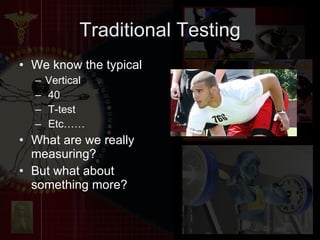
Traditional Testing We know the typical Vertical 40 T-test Etc…… What are we really measuring? But what about something more?
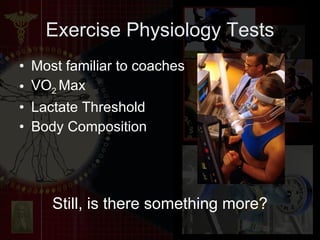
Exercise Physiology Tests Most familiar to coaches VO 2  Max Lactate Threshold Body Composition Still, is there something more?
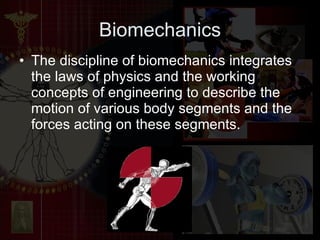
Biomechanics The discipline of biomechanics integrates the laws of physics and the working concepts of engineering to describe the motion of various body segments and the forces acting on these segments.
What do we need to do? Stick with The Foundations Newtonian Physics applies across the board Human or Machine, these are constant This allows more precise and direct application
Power Production Force Development Work Load Capacity Acceleration Torque Linear Velocity Angular Momentum What are we looking for?
Common Biomechanical Studies Angular velocity of throwing/swinging arm Arm swing/leg swing for sprinting Vertical Jump How about a little more detail? Let’s get past the surface and down to the specifics!
Application of Tests
How do tests improve actual performance? The science is constant The basics are still observable Therefore, methods are still applicable
Why Are These Tests Valid? Use “real life” motion The important movements of sports are measurable
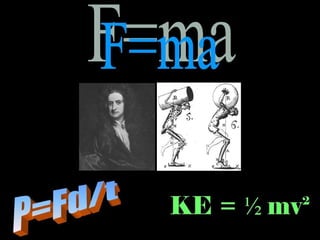
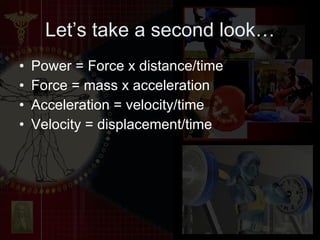
Power = Force x distance/time Force = mass x acceleration Acceleration = velocity/time Velocity = displacement/time Let’s take a second look…
TIME! The Common Factor?
Time is the common denominator variable in… Increasing Power Increasing Force Increasing acceleration Increasing velocity Therefore, decrease your time, you increase your production.
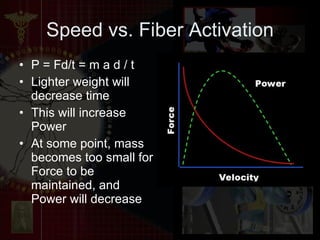
Speed vs. Fiber Activation P = Fd/t = m a d / t Lighter weight will decrease time This will increase Power  At some point, mass becomes too small for Force to be maintained, and Power will decrease
Speed vs. Fiber Activation Speed isn’t everything Time may small, but is Force (mass) exerted sufficient? Recruit muscle fibers Stimulate growth But with substantial mass, fatigue sets in faster
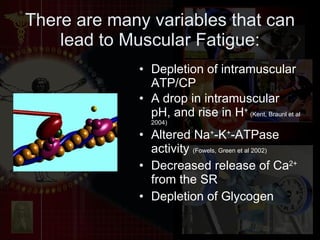
There are many variables that can lead to Muscular Fatigue: Depletion of intramuscular ATP/CP A drop in intramuscular pH, and rise in H +  (Kent, Braunl et al 2004) Altered Na + -K + -ATPase activity  (Fowels, Green et al 2002) Decreased release of Ca 2+  from the SR Depletion of Glycogen
Muscle Fatigue =  Force Production Decreases in maximum force (F Max ) and force production (F Prod ) are evident with muscle fatigue during high intensity anaerobic exercises  (Viitasalo, Komi et al 1981)
Anaerobic/complex movements High intensity anaerobic sports demand explosive power/energy Muscles involved can achieve muscular fatigue quickly  Highly technical complex multi joint lifts are also subject to neuromuscular fatigue for similar reasons This can result in a rapid deterioration of technique and form, increasing the risk of injury and decreasing the effectiveness of the exercise Consequently, they are generally kept at lower repetition ranges
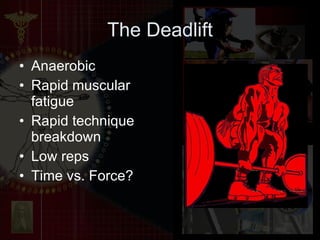
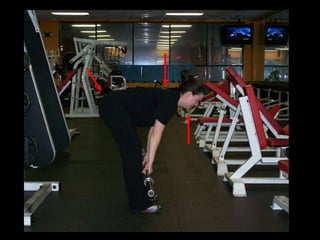
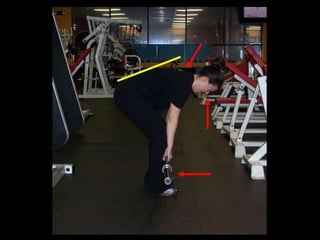
The Deadlift Anaerobic Rapid muscular fatigue Rapid technique breakdown Low reps Time vs. Force?
Fatigue quantifiable by: Reduction in lifting force Reduction in power Decreased bar speed Hip torque generation Decreased hip and knee motion Increased lumbar flexion  Decreased postural stability
Does It Matter? The ends are the same (fatigue) Doesn’t quite matter how you get there Observable biomechanical deficiencies  will still be present
So, now what? We know what to look for But how are we going to look for it?
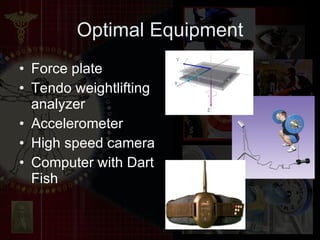
Optimal Equipment Force plate Tendo weightlifting analyzer Accelerometer High speed camera Computer with Dart Fish
A  TON  of variables! Marker selection Signal “noise,” Data smoothing Discontinuity of Measuring angles (0 to 360°, +180° to -180°) Cartesian or Polar coordinates? Parallax Error
A  TON  of variables! Ridiculous amounts of anthropometric measurements Throw in some Calculus How about some more formulas?
Do we  REALLY  want to deal with all this??
Not practical… Equipment expensive Location restrictions Time restraints Got access to a full lab? A day or two to kill?
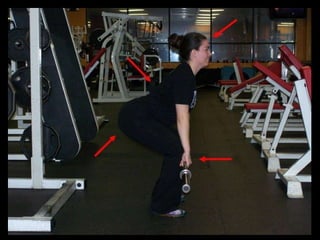
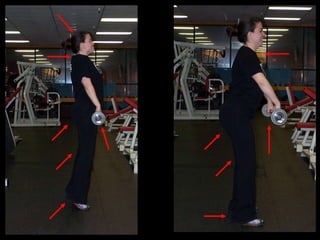
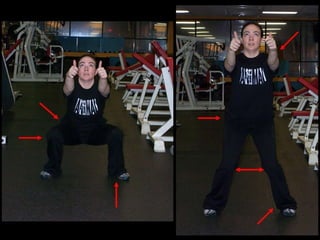
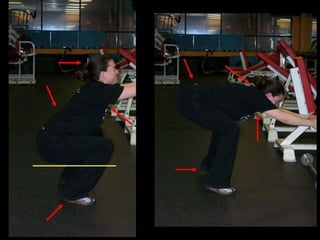
Realistic Equipment Simple Video Camera Olympic Bar & Plates A pair or two of good eyeballs Items to look for…


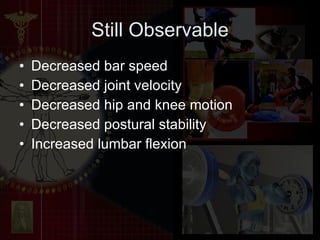
Still Observable Decreased bar speed Decreased joint velocity Decreased hip and knee motion Decreased postural stability Increased lumbar flexion
Examples of other movements…


Bottom Line… Unless you are in a lab conducting research This will get the job done with what you want to accomplish!
Other Applications
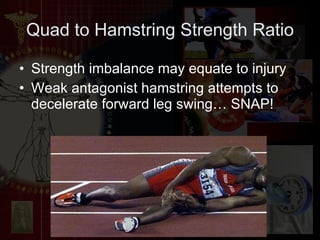
Quad to Hamstring Strength Ratio Strength imbalance may equate to injury Weak antagonist hamstring attempts to decelerate forward leg swing… SNAP!
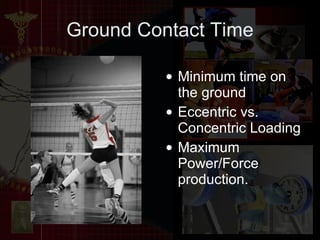
Ground Contact Time Minimum time on the ground Eccentric vs. Concentric Loading Maximum Power/Force production.
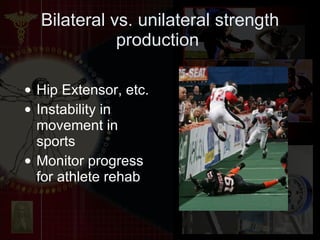
Bilateral vs. unilateral strength production  Hip Extensor, etc. Instability in movement in sports Monitor progress for athlete rehab
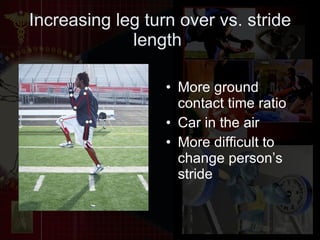
Increasing leg turn over vs. stride length  More ground contact time ratio Car in the air More difficult to change person’s stride
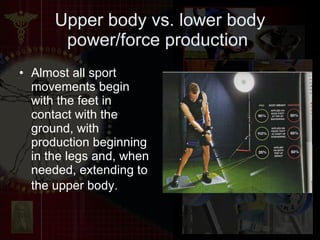
Upper body vs. lower body power/force production  Almost all sport movements begin with the feet in contact with the ground, with production beginning in the legs and, when needed, extending to the upper body.
So, what to do… Learn a little bit of the basics Don’t ignore the obvious Don’t wear the blinders We’re not really that bad!
How to put it all together Observe and Assess Recognize and Translate Design and Apply Implement and Improve
Questions?
Michael S. Palmieri,  CSCS, USAW [email_address]

Application of Biomechanical Analysis to Performance Testing & Program Design

  • 1.
  • 2.
    Introduction The applicationof training and conditioning Tests & validity Biomechanics defined How and why does it work How can it improve actual performance What you can do with your clients
  • 3.
    A little aboutme…. Founder and president of The Institute of Sport Science & Athletic Conditioning (ISSAC) Current graduate student in Biomechanics at the University of Nevada, Las Vegas (UNLV) In the industry for over twenty years Former powerlifter (ADFPA) And just to get it out of the way….
  • 4.
  • 5.
    Sports & SpecificitySo many different types of sports So many different ways of training them Sport Specific? How about Athlete Specific? But the underlying science is constant!
  • 6.
    Training & ConditioningWhat is the “Right Way?” Speed, Power, Strength, etc…. Outcome dependent SAID Principle : S pecific Adaptations to Imposed Demands
  • 7.
  • 8.
    Why Do WeDo It? Assess athletic ability Identify strengths Identify weaknesses Goal setting Develop and adjust program “Starting Point, End Point”
  • 9.
    Steps to Success!Where are we? Where do we want to go? How do we get there? Alternate paths? Are we identifying the right variables?
  • 10.
    Program Design Implement& Assess Analysis & Testing
  • 11.
    Validity Test mustemulate energy requirements Must duplicate the important movements of the sport for which it is being tested
  • 12.
    Traditional Testing Weknow the typical Vertical 40 T-test Etc…… What are we really measuring? But what about something more?
  • 13.
    Exercise Physiology TestsMost familiar to coaches VO 2 Max Lactate Threshold Body Composition Still, is there something more?
  • 14.
    Biomechanics The disciplineof biomechanics integrates the laws of physics and the working concepts of engineering to describe the motion of various body segments and the forces acting on these segments.
  • 15.
    What do weneed to do? Stick with The Foundations Newtonian Physics applies across the board Human or Machine, these are constant This allows more precise and direct application
  • 16.
    Power Production ForceDevelopment Work Load Capacity Acceleration Torque Linear Velocity Angular Momentum What are we looking for?
  • 17.
    Common Biomechanical StudiesAngular velocity of throwing/swinging arm Arm swing/leg swing for sprinting Vertical Jump How about a little more detail? Let’s get past the surface and down to the specifics!
  • 18.
  • 19.
    How do testsimprove actual performance? The science is constant The basics are still observable Therefore, methods are still applicable
  • 20.
    Why Are TheseTests Valid? Use “real life” motion The important movements of sports are measurable
  • 21.
    Power = Forcex distance/time Force = mass x acceleration Acceleration = velocity/time Velocity = displacement/time Let’s take a second look…
  • 22.
  • 23.
    Time is thecommon denominator variable in… Increasing Power Increasing Force Increasing acceleration Increasing velocity Therefore, decrease your time, you increase your production.
  • 24.
    Speed vs. FiberActivation P = Fd/t = m a d / t Lighter weight will decrease time This will increase Power At some point, mass becomes too small for Force to be maintained, and Power will decrease
  • 25.
    Speed vs. FiberActivation Speed isn’t everything Time may small, but is Force (mass) exerted sufficient? Recruit muscle fibers Stimulate growth But with substantial mass, fatigue sets in faster
  • 26.
    There are manyvariables that can lead to Muscular Fatigue: Depletion of intramuscular ATP/CP A drop in intramuscular pH, and rise in H + (Kent, Braunl et al 2004) Altered Na + -K + -ATPase activity (Fowels, Green et al 2002) Decreased release of Ca 2+ from the SR Depletion of Glycogen
  • 27.
    Muscle Fatigue = Force Production Decreases in maximum force (F Max ) and force production (F Prod ) are evident with muscle fatigue during high intensity anaerobic exercises (Viitasalo, Komi et al 1981)
  • 28.
    Anaerobic/complex movements Highintensity anaerobic sports demand explosive power/energy Muscles involved can achieve muscular fatigue quickly Highly technical complex multi joint lifts are also subject to neuromuscular fatigue for similar reasons This can result in a rapid deterioration of technique and form, increasing the risk of injury and decreasing the effectiveness of the exercise Consequently, they are generally kept at lower repetition ranges
  • 29.
    The Deadlift AnaerobicRapid muscular fatigue Rapid technique breakdown Low reps Time vs. Force?
  • 30.
    Fatigue quantifiable by:Reduction in lifting force Reduction in power Decreased bar speed Hip torque generation Decreased hip and knee motion Increased lumbar flexion Decreased postural stability
  • 31.
    Does It Matter?The ends are the same (fatigue) Doesn’t quite matter how you get there Observable biomechanical deficiencies will still be present
  • 32.
    So, now what?We know what to look for But how are we going to look for it?
  • 33.
    Optimal Equipment Forceplate Tendo weightlifting analyzer Accelerometer High speed camera Computer with Dart Fish
  • 34.
    A TON of variables! Marker selection Signal “noise,” Data smoothing Discontinuity of Measuring angles (0 to 360°, +180° to -180°) Cartesian or Polar coordinates? Parallax Error
  • 35.
    A TON of variables! Ridiculous amounts of anthropometric measurements Throw in some Calculus How about some more formulas?
  • 36.
    Do we REALLY want to deal with all this??
  • 37.
    Not practical… Equipmentexpensive Location restrictions Time restraints Got access to a full lab? A day or two to kill?
  • 38.
    Realistic Equipment SimpleVideo Camera Olympic Bar & Plates A pair or two of good eyeballs Items to look for…
  • 39.
  • 40.
  • 41.
  • 42.
    Still Observable Decreasedbar speed Decreased joint velocity Decreased hip and knee motion Decreased postural stability Increased lumbar flexion
  • 43.
    Examples of othermovements…
  • 44.
  • 45.
  • 46.
  • 47.
    Bottom Line… Unlessyou are in a lab conducting research This will get the job done with what you want to accomplish!
  • 48.
  • 49.
    Quad to HamstringStrength Ratio Strength imbalance may equate to injury Weak antagonist hamstring attempts to decelerate forward leg swing… SNAP!
  • 50.
    Ground Contact TimeMinimum time on the ground Eccentric vs. Concentric Loading Maximum Power/Force production.
  • 51.
    Bilateral vs. unilateralstrength production Hip Extensor, etc. Instability in movement in sports Monitor progress for athlete rehab
  • 52.
    Increasing leg turnover vs. stride length More ground contact time ratio Car in the air More difficult to change person’s stride
  • 53.
    Upper body vs.lower body power/force production Almost all sport movements begin with the feet in contact with the ground, with production beginning in the legs and, when needed, extending to the upper body.
  • 54.
    So, what todo… Learn a little bit of the basics Don’t ignore the obvious Don’t wear the blinders We’re not really that bad!
  • 55.
    How to putit all together Observe and Assess Recognize and Translate Design and Apply Implement and Improve
  • 56.
  • 57.
    Michael S. Palmieri, CSCS, USAW [email_address]