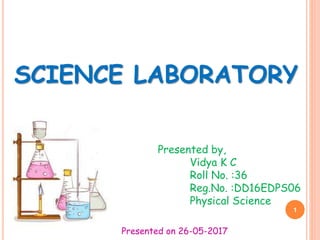
SCIENCE LABORATORY
Presented by,
Vidya K C
Roll No. :36
Reg.No. :DD16EDPS06
Physical Science
1
Presented on 26-05-2017
INDEX
Introduction
Design
Selection and purchase
Maintenance
Reference
2
“Special facility where experiments
are done under controlled conditions”
Importance:
Learning by doing
Promotion of scientific attitude
Development of manipulative skills
Development of sense of cooperation
Source of motivation
Application of empirical knowledge
3
DESIGN
Features:
Spacious
Conductive environment (air, light, temperature)
Flexibility for teacher demonstration and group work
Teacher’s supervision
Water, Gas and Electric points
Ample storage facilities
Emergency exit if not in ground floor
4
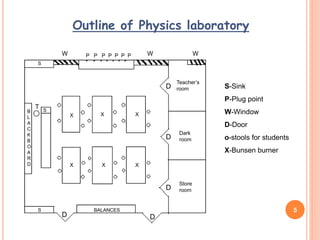
Outline of Physics laboratory
D D
D
D
D
X X X
X X X
S
Teacher’s
room
Dark
room
Store
room
S BALANCES
B
L
A
C
K
B
O
A
R
D
S
W W W
T
P P P P P P P
S-Sink
P-Plug point
W-Window
D-Door
o-stools for students
X-Bunsen burner
5
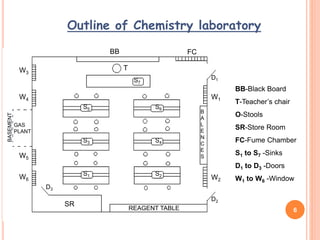
Outline of Chemistry laboratory
S7
S6
S4
S2
S5
S3
S1
BB
T
FC
GAS
PLANT
BASEMENT
D1
D2
D3
REAGENT TABLE
SR
W1
W2
W3
W4
W5
W6
B
A
L
E
N
C
E
S
BB-Black Board
T-Teacher’s chair
O-Stools
SR-Store Room
FC-Fume Chamber
S1 to S7 -Sinks
D1 to D3 -Doors
W1 to W6 -Window
6
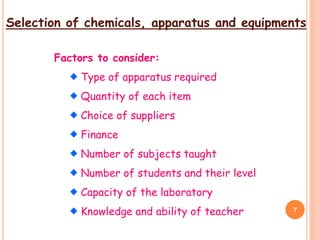
Selection of chemicals, apparatus and equipments
Factors to consider:
Type of apparatus required
Quantity of each item
Choice of suppliers
Finance
Number of subjects taught
Number of students and their level
Capacity of the laboratory
Knowledge and ability of teacher 7
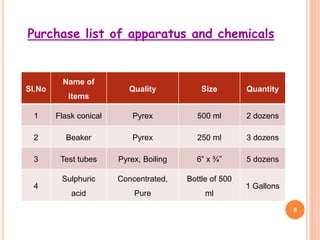
Purchase list of apparatus and chemicals
Sl.No
Name of
items
Quality Size Quantity
1 Flask conical Pyrex 500 ml 2 dozens
2 Beaker Pyrex 250 ml 3 dozens
3 Test tubes Pyrex, Boiling 6” x ¾” 5 dozens
4
Sulphuric
acid
Concentrated,
Pure
Bottle of 500
ml
1 Gallons
8
Maintenance
Purchase in required quantity
Fixed place to the items
Remaining items in racks, ready for use
Registers
Clear labeling of chemicals
Heavy items on lower part of the shelves
Frequently used reagents and chemicals on working tables
Cleaning of apparatus after use
Poisons and corrosive chemicals under lock and key 9
Minimum use of chemicals
Storing of decomposing chemicals
No interchange of corks and stoppers
Not to kept hot apparatus on painted surface
Not to heat cold apparatus suddenly
Greasing of iron apparatus
Regular polishing of wooden items
Polishing of brass apparatus with brasso
Breakages should be noted down
Maintenance
10
REFERENCE
1. Radha Mohan, Innovative science teaching, 3rd edition
2. Dr. K. Sivarajan, Prof. A. Faziluddin, Science
Education, Revised 6th edition
3. Dr. Manoj Praveen G, Dr. Hassan Koya M. P, Teaching
science-Resources, Methods and Practices, 1st edition
4. Aman Rao, Teaching of Physics
11
12
THANK YOU…

Science laboratory

  • 1.
    SCIENCE LABORATORY Presented by, VidyaK C Roll No. :36 Reg.No. :DD16EDPS06 Physical Science 1 Presented on 26-05-2017
  • 2.
  • 3.
    “Special facility whereexperiments are done under controlled conditions” Importance: Learning by doing Promotion of scientific attitude Development of manipulative skills Development of sense of cooperation Source of motivation Application of empirical knowledge 3
  • 4.
    DESIGN Features: Spacious Conductive environment (air,light, temperature) Flexibility for teacher demonstration and group work Teacher’s supervision Water, Gas and Electric points Ample storage facilities Emergency exit if not in ground floor 4
  • 5.
    Outline of Physicslaboratory D D D D D X X X X X X S Teacher’s room Dark room Store room S BALANCES B L A C K B O A R D S W W W T P P P P P P P S-Sink P-Plug point W-Window D-Door o-stools for students X-Bunsen burner 5
  • 6.
    Outline of Chemistrylaboratory S7 S6 S4 S2 S5 S3 S1 BB T FC GAS PLANT BASEMENT D1 D2 D3 REAGENT TABLE SR W1 W2 W3 W4 W5 W6 B A L E N C E S BB-Black Board T-Teacher’s chair O-Stools SR-Store Room FC-Fume Chamber S1 to S7 -Sinks D1 to D3 -Doors W1 to W6 -Window 6
  • 7.
    Selection of chemicals,apparatus and equipments Factors to consider: Type of apparatus required Quantity of each item Choice of suppliers Finance Number of subjects taught Number of students and their level Capacity of the laboratory Knowledge and ability of teacher 7
  • 8.
    Purchase list ofapparatus and chemicals Sl.No Name of items Quality Size Quantity 1 Flask conical Pyrex 500 ml 2 dozens 2 Beaker Pyrex 250 ml 3 dozens 3 Test tubes Pyrex, Boiling 6” x ¾” 5 dozens 4 Sulphuric acid Concentrated, Pure Bottle of 500 ml 1 Gallons 8
  • 9.
    Maintenance Purchase in requiredquantity Fixed place to the items Remaining items in racks, ready for use Registers Clear labeling of chemicals Heavy items on lower part of the shelves Frequently used reagents and chemicals on working tables Cleaning of apparatus after use Poisons and corrosive chemicals under lock and key 9
  • 10.
    Minimum use ofchemicals Storing of decomposing chemicals No interchange of corks and stoppers Not to kept hot apparatus on painted surface Not to heat cold apparatus suddenly Greasing of iron apparatus Regular polishing of wooden items Polishing of brass apparatus with brasso Breakages should be noted down Maintenance 10
  • 11.
    REFERENCE 1. Radha Mohan,Innovative science teaching, 3rd edition 2. Dr. K. Sivarajan, Prof. A. Faziluddin, Science Education, Revised 6th edition 3. Dr. Manoj Praveen G, Dr. Hassan Koya M. P, Teaching science-Resources, Methods and Practices, 1st edition 4. Aman Rao, Teaching of Physics 11
  • 12.