
The Science Behind Chest
Compressions
Matthew Sholl, MD MPH, FACEP
Maine Medical Center/MaineHealth
Curr Op Crit Care 2004;10:208-212
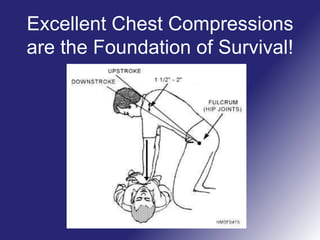
Excellent Chest Compressions
are the Foundation of Survival!
Recent Changes in ACLS?
• Most recent AHA changes
(2005/2010)attempted to highlight the
importance of uninterrupted chest
compressions and limited the positive
pressure ventilation rate to 8 – 12 breaths
per minute
Why focus on minimally interrupted chest
compressions and limiting positive
pressure ventilation?
What’s The Big Deal?
Do Chest Compressions Really Work?
• While in early phases
of OHCA (< 5 min), no
benefit to bystander
CPR existed
• As time to shock
increased, see
increasing survival
benefit of bystander
CPR
• No survivors seen if
collapse to shock
interval > 15 minutes
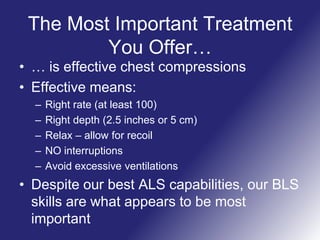
The Most Important Treatment
You Offer…
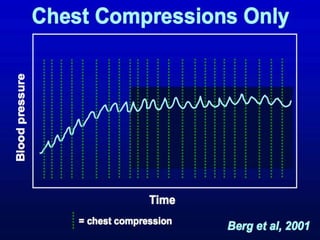
• … is effective chest compressions
• Effective means:
– Right rate (at least 100)
– Right depth (2.5 inches or 5 cm)
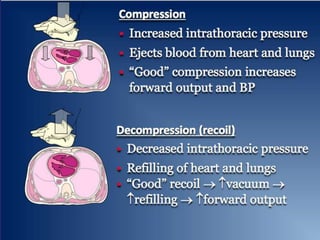
– Relax – allow for recoil
– NO interruptions
– Avoid excessive ventilations
• Despite our best ALS capabilities, our BLS
skills are what appears to be most
important
Cardio-cerebral Resuscitation
(CCR)
• Based on the Three Phase Model of resuscitation
• Generated in AZ –the AZ Sarver Heart Center
Goals:
1. Minimize interruptions of chest compression
2. Provide immediate post-shock chest
compressions for prolonged VF
– Why is that important?
3. Delay or eliminate endotracheal intubation
4. Minimize all positive pressure ventilation
5. Decrease the time interval to IV Epinephrine
Benbrow, B –6th Annual Symposium on Neurologic Emergencies and Neurocritical Care , June 2009, NYC, NY
A New Horizon for OHCA…
• Two new thoughts on OHCA:
1.Primary and Secondary Injury
– Primary injury – cardiac arrest
– Secondary injury – brain injury
• Even if we can obtain ROSC – still see large
numbers of deaths
• These deaths predominantly due to hypoxic brain
injury
– Target of therapeutic hypothermia
2.Three Phase Model for Resuscitation…
Three Phase Model of
Resuscitation
Minimizing Positive Pressure
Ventilation
• Old Paradigm:
– ABC’s – M2M/BVM/ETT to deliver high flow O2
• New Concepts:
– Positive pressure ventilation increases intrathoracic
pressure
– Increased intrathoracic pressure decreases venous
return
– Resultant decrease in coronary and cerebral blood flow
• SO… AHA has recommended RR of 8 – 12
breaths/minute
The Message may Not Have Been
Received….
• Observational study of EMS
practitioners performing CPR
• Measured ventilation rate
• Average rate = 37 +/- 3 per
minute
– Range 15-49
– Recall: BLS/ACLS
recommends 8-12
• Second part of the study….
Disadvantages to Ventilations
During CPR
• Delays/Interrupts chest compressions
• Complicated
• Stops bystanders from doing CPR
• Gastric inflation – aspiration
• Increases intrathoracic pressure
– Reducing coronary/cerebral perfusion
• Animal models show worse outocme
What Have We Learned So
Far?
• OHCA happens to a lot of people!!
– One of the top causes of death
• There remain opportunities to save lives
– Especially through engaging laypersons and
both PAD programs as well as by-stander
CPR
• New ACLS/BLS protocols attempted to improve
well preformed, continuous chest compressions
with minimal interruptions
• Despite these recommendations, still see many
interruptions and too aggressive ventilation
Questions?
Thank You

Science behind chest compressions

  • 1.
    The Science BehindChest Compressions Matthew Sholl, MD MPH, FACEP Maine Medical Center/MaineHealth
  • 2.
    Curr Op CritCare 2004;10:208-212
  • 4.
    Excellent Chest Compressions arethe Foundation of Survival!
  • 5.
    Recent Changes inACLS? • Most recent AHA changes (2005/2010)attempted to highlight the importance of uninterrupted chest compressions and limited the positive pressure ventilation rate to 8 – 12 breaths per minute Why focus on minimally interrupted chest compressions and limiting positive pressure ventilation?
  • 8.
    What’s The BigDeal? Do Chest Compressions Really Work?
  • 13.
    • While inearly phases of OHCA (< 5 min), no benefit to bystander CPR existed • As time to shock increased, see increasing survival benefit of bystander CPR • No survivors seen if collapse to shock interval > 15 minutes
  • 15.
    The Most ImportantTreatment You Offer… • … is effective chest compressions • Effective means: – Right rate (at least 100) – Right depth (2.5 inches or 5 cm) – Relax – allow for recoil – NO interruptions – Avoid excessive ventilations • Despite our best ALS capabilities, our BLS skills are what appears to be most important
  • 16.
    Cardio-cerebral Resuscitation (CCR) • Basedon the Three Phase Model of resuscitation • Generated in AZ –the AZ Sarver Heart Center Goals: 1. Minimize interruptions of chest compression 2. Provide immediate post-shock chest compressions for prolonged VF – Why is that important? 3. Delay or eliminate endotracheal intubation 4. Minimize all positive pressure ventilation 5. Decrease the time interval to IV Epinephrine
  • 17.
    Benbrow, B –6thAnnual Symposium on Neurologic Emergencies and Neurocritical Care , June 2009, NYC, NY
  • 18.
    A New Horizonfor OHCA… • Two new thoughts on OHCA: 1.Primary and Secondary Injury – Primary injury – cardiac arrest – Secondary injury – brain injury • Even if we can obtain ROSC – still see large numbers of deaths • These deaths predominantly due to hypoxic brain injury – Target of therapeutic hypothermia 2.Three Phase Model for Resuscitation…
  • 20.
    Three Phase Modelof Resuscitation
  • 21.
    Minimizing Positive Pressure Ventilation •Old Paradigm: – ABC’s – M2M/BVM/ETT to deliver high flow O2 • New Concepts: – Positive pressure ventilation increases intrathoracic pressure – Increased intrathoracic pressure decreases venous return – Resultant decrease in coronary and cerebral blood flow • SO… AHA has recommended RR of 8 – 12 breaths/minute
  • 22.
    The Message mayNot Have Been Received….
  • 24.
    • Observational studyof EMS practitioners performing CPR • Measured ventilation rate • Average rate = 37 +/- 3 per minute – Range 15-49 – Recall: BLS/ACLS recommends 8-12 • Second part of the study….
  • 25.
    Disadvantages to Ventilations DuringCPR • Delays/Interrupts chest compressions • Complicated • Stops bystanders from doing CPR • Gastric inflation – aspiration • Increases intrathoracic pressure – Reducing coronary/cerebral perfusion • Animal models show worse outocme
  • 26.
    What Have WeLearned So Far? • OHCA happens to a lot of people!! – One of the top causes of death • There remain opportunities to save lives – Especially through engaging laypersons and both PAD programs as well as by-stander CPR • New ACLS/BLS protocols attempted to improve well preformed, continuous chest compressions with minimal interruptions • Despite these recommendations, still see many interruptions and too aggressive ventilation
  • 27.
  • 28.