Republic of the Philippines
Department of Education
National Capital Region
Schools Division Office of Pasig City
UGONG PASIG NATIONAL HIGH SCHOOL
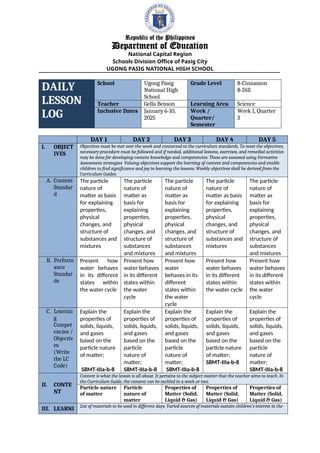
DAILY
LESSON
LOG
School Ugong Pasig
National High
School
Grade Level 8-Cinnamon
8-Dill
Teacher Gella Benson Learning Area Science
Inclusive Dates January 6-10,
2025
Week /
Quarter/
Semester
Week 1, Quarter
3
DAY 1 DAY 2 DAY 3 DAY 4 DAY 5
I. OBJECT
IVES
Objectives must be met over the week and connected to the curriculum standards. To meet the objectives,
necessary procedure must be followed and if needed, additional lessons, exercises, and remedial activities
may be done for developing content knowledge and competencies. These are assessed using Formative
Assessment strategies. Valuing objectives support the learning of content and competencies and enable
children to find significance and joy in learning the lessons. Weekly objectives shall be derived from the
Curriculum Guides.
A. Content
Standar
d
The particle
nature of
matter as basis
for explaining
properties,
physical
changes, and
structure of
substances and
mixtures
The particle
nature of
matter as
basis for
explaining
properties,
physical
changes, and
structure of
substances
and mixtures
The particle
nature of
matter as
basis for
explaining
properties,
physical
changes, and
structure of
substances
and mixtures
The particle
nature of
matter as basis
for explaining
properties,
physical
changes, and
structure of
substances and
mixtures
The particle
nature of
matter as
basis for
explaining
properties,
physical
changes, and
structure of
substances
and mixtures
B. Perform
ance
Standar
ds
Present how
water behaves
in its different
states within
the water cycle
Present how
water behaves
in its different
states within
the water
cycle
Present how
water
behaves in its
different
states within
the water
cycle
Present how
water behaves
in its different
states within
the water cycle
Present how
water behaves
in its different
states within
the water
cycle
C. Learnin
g
Compet
encies /
Objectiv
es
(Write
the LC
Code)
Explain the
properties of
solids, liquids,
and gases
based on the
particle nature
of matter;
S8MT-IIIa-b-8
Explain the
properties of
solids, liquids,
and gases
based on the
particle
nature of
matter;
S8MT-IIIa-b-8
Explain the
properties of
solids, liquids,
and gases
based on the
particle
nature of
matter;
S8MT-IIIa-b-8
Explain the
properties of
solids, liquids,
and gases
based on the
particle nature
of matter;
S8MT-IIIa-b-8
Explain the
properties of
solids, liquids,
and gases
based on the
particle
nature of
matter;
S8MT-IIIa-b-8
II. CONTE
NT
Content is what the lesson is all about. It pertains to the subject matter that the teacher aims to teach. In
the Curriculum Guide, the content can be tackled in a week or two.
Particle nature
of matter
Particle
nature of
matter
Properties of
Matter (Solid,
Liquid & Gas)
Properties of
Matter (Solid,
Liquid & Gas)
Properties of
Matter (Solid,
Liquid & Gas)
III. LEARNI List of materials to be used in different days. Varied sources of materials sustain children’s interest in the
Republic of the Philippines
Department of Education
National Capital Region
Schools Division Office of Pasig City
UGONG PASIG NATIONAL HIGH SCHOOL
NG
RESOU
RCES
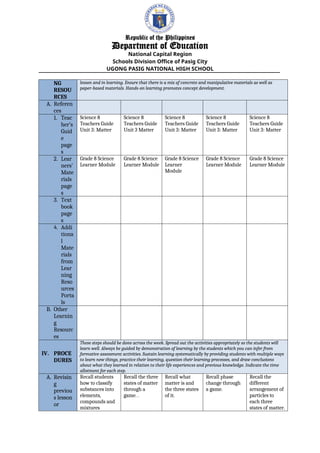
lesson and in learning. Ensure that there is a mix of concrete and manipulative materials as well as
paper-based materials. Hands-on learning promotes concept development.
A. Referen
ces
1. Teac
her’s
Guid
e
page
s
Science 8
Teachers Guide
Unit 3: Matter
Science 8
Teachers Guide
Unit 3 Matter
Science 8
Teachers Guide
Unit 3: Matter
Science 8
Teachers Guide
Unit 3: Matter
Science 8
Teachers Guide
Unit 3: Matter
2. Lear
ners’
Mate
rials
page
s
Grade 8 Science
Learner Module
Grade 8 Science
Learner Module
Grade 8 Science
Learner
Module
Grade 8 Science
Learner Module
Grade 8 Science
Learner Module
3. Text
book
page
s
4. Addi
tiona
l
Mate
rials
from
Lear
ning
Reso
urces
Porta
ls
B. Other
Learnin
g
Resourc
es
IV. PROCE
DURES
These steps should be done across the week. Spread out the activities appropriately so the students will
learn well. Always be guided by demonstration of learning by the students which you can infer from
formative assessment activities. Sustain learning systematically by providing students with multiple ways
to learn new things, practice their learning, question their learning processes, and draw conclusions
about what they learned in relation to their life experiences and previous knowledge. Indicate the time
allotment for each step.
A. Revisin
g
previou
s lesson
or
Recall students
how to classify
substances into
elements,
compounds and
mixtures
Recall the three
states of matter
through a
game. .
Recall what
matter is and
the three states
of it.
Recall phase
change through
a game.
Recall the
different
arrangement of
particles to
each three
states of matter.
Republic of the Philippines
Department of Education
National Capital Region
Schools Division Office of Pasig City
UGONG PASIG NATIONAL HIGH SCHOOL
presenti
ng the
new
lesson
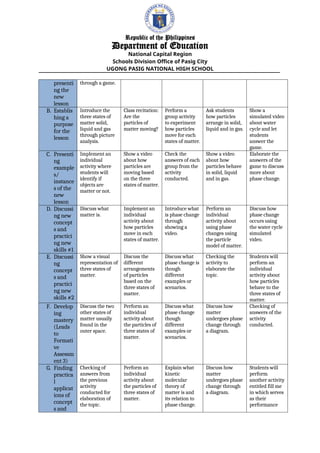
through a game.
B. Establis
hing a
purpose
for the
lesson
Introduce the
three states of
matter solid,
liquid and gas
through picture
analysis.
Class recitation:
Are the
particles of
matter moving?
Perform a
group activity
to experiment
how particles
move for each
states of matter.
Ask students
how particles
arrange in solid,
liquid and in gas.
Show a
simulated video
about water
cycle and let
students
answer the
game.
C. Presenti
ng
example
s/
instance
s of the
new
lesson
Implement an
individual
activity where
students will
identify if
objects are
matter or not.
Show a video
about how
particles are
moving based
on the three
states of matter.
Check the
answers of each
group from the
activity
conducted.
Show a video
about how
particles behave
in solid, liquid
and in gas.
Elaborate the
answers of the
game to discuss
more about
phase change.
D. Discussi
ng new
concept
s and
practici
ng new
skills #1
Discuss what
matter is.
Implement an
individual
activity about
how particles
move in each
states of matter.
Introduce what
is phase change
through
showing a
video.
Perform an
individual
activity about
using phase
changes using
the particle
model of matter.
Discuss how
phase change
occurs using
the water cycle
simulated
video.
E. Discussi
ng
concept
s and
practici
ng new
skills #2
Show a visual
representation of
three states of
matter.
Discuss the
different
arrangements
of particles
based on the
three states of
matter.
Discuss what
phase change is
though
different
examples or
scenarios.
Checking the
activity to
elaborate the
topic.
Students will
perform an
individual
activity about
how particles
behave to the
three states of
matter.
F. Develop
ing
mastery
(Leads
to
Formati
ve
Assessm
ent 3)
Discuss the two
other states of
matter usually
found in the
outer space.
Perform an
individual
activity about
the particles of
three states of
matter.
Discuss what
phase change
though
different
examples or
scenarios.
Discuss how
matter
undergoes phase
change through
a diagram.
Checking of
answers of the
activity
conducted.
G. Finding
practica
l
applicat
ions of
concept
s and
Checking of
answers from
the previous
activity
conducted for
elaboration of
the topic.
Perform an
individual
activity about
the particles of
three states of
matter.
Explain what
kinetic
molecular
theory of
matter is and
its relation to
phase change.
Discuss how
matter
undergoes phase
change through
a diagram.
Students will
perform
another activity
entitled fill me
in which serves
as their
performance
Republic of the Philippines
Department of Education
National Capital Region
Schools Division Office of Pasig City
UGONG PASIG NATIONAL HIGH SCHOOL
skills in
daily
living
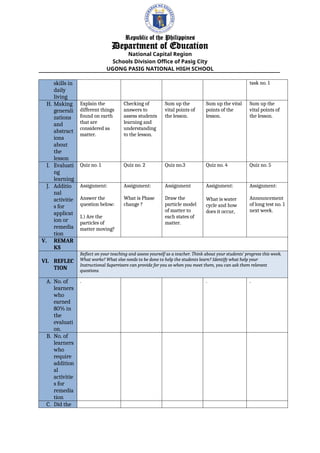
task no. 1
H. Making
generali
zations
and
abstract
ions
about
the
lesson
Explain the
different things
found on earth
that are
considered as
matter.
Checking of
answers to
assess students
learning and
understanding
to the lesson.
Sum up the
vital points of
the lesson.
Sum up the vital
points of the
lesson.
Sum up the
vital points of
the lesson.
I. Evaluati
ng
learning
Quiz no. 1 Quiz no. 2 Quiz no.3 Quiz no. 4 Quiz no. 5
J. Additio
nal
activitie
s for
applicat
ion or
remedia
tion
Assignment:
Answer the
question below:
1.) Are the
particles of
matter moving?
Assignment:
What is Phase
change ?
Assignment
Draw the
particle model
of matter to
each states of
matter.
Assignment:
What is water
cycle and how
does it occur,
Assignment:
Announcement
of long test no. 1
next week.
V. REMAR
KS
VI. REFLEC
TION
Reflect on your teaching and assess yourself as a teacher. Think about your students’ progress this week.
What works? What else needs to be done to help the students learn? Identify what help your
Instructional Supervisors can provide for you so when you meet them, you can ask them relevant
questions.
A. No. of
learners
who
earned
80% in
the
evaluati
on.
. . .
B. No. of
learners
who
require
addition
al
activitie
s for
remedia
tion
C. Did the
Republic of the Philippines
Department of Education
National Capital Region
Schools Division Office of Pasig City
UGONG PASIG NATIONAL HIGH SCHOOL
remedia
l lessons
work?
No. of
learners
who
have
caught
up with
the
lesson.
D. No. of
learners
who
continu
e to
require
remedia
tion.
E. Which
of my
teachin
g
strategi
es
worked
well?
Why
did it
work?
. .
F. What
difficult
ies did I
encount
er
which
my
principa
l or
supervis
or can
help me
solve?
G. What
innovati
on or
localize
d
Republic of the Philippines
Department of Education
National Capital Region
Schools Division Office of Pasig City
UGONG PASIG NATIONAL HIGH SCHOOL
materia
ls did I
used/di
scover
which I
wish to
share
with
other
learners
?
Prepared by:
Gella L. Benson
Check by:
Gaily Ann I. Tolentino
Assistant Principal II
Noted by:
Junie C. Serot
Principal II

DLL-WEEK 1.docxSFFFfszcxccccccccccccccccc

  • 1.
    Republic of thePhilippines Department of Education National Capital Region Schools Division Office of Pasig City UGONG PASIG NATIONAL HIGH SCHOOL DAILY LESSON LOG School Ugong Pasig National High School Grade Level 8-Cinnamon 8-Dill Teacher Gella Benson Learning Area Science Inclusive Dates January 6-10, 2025 Week / Quarter/ Semester Week 1, Quarter 3 DAY 1 DAY 2 DAY 3 DAY 4 DAY 5 I. OBJECT IVES Objectives must be met over the week and connected to the curriculum standards. To meet the objectives, necessary procedure must be followed and if needed, additional lessons, exercises, and remedial activities may be done for developing content knowledge and competencies. These are assessed using Formative Assessment strategies. Valuing objectives support the learning of content and competencies and enable children to find significance and joy in learning the lessons. Weekly objectives shall be derived from the Curriculum Guides. A. Content Standar d The particle nature of matter as basis for explaining properties, physical changes, and structure of substances and mixtures The particle nature of matter as basis for explaining properties, physical changes, and structure of substances and mixtures The particle nature of matter as basis for explaining properties, physical changes, and structure of substances and mixtures The particle nature of matter as basis for explaining properties, physical changes, and structure of substances and mixtures The particle nature of matter as basis for explaining properties, physical changes, and structure of substances and mixtures B. Perform ance Standar ds Present how water behaves in its different states within the water cycle Present how water behaves in its different states within the water cycle Present how water behaves in its different states within the water cycle Present how water behaves in its different states within the water cycle Present how water behaves in its different states within the water cycle C. Learnin g Compet encies / Objectiv es (Write the LC Code) Explain the properties of solids, liquids, and gases based on the particle nature of matter; S8MT-IIIa-b-8 Explain the properties of solids, liquids, and gases based on the particle nature of matter; S8MT-IIIa-b-8 Explain the properties of solids, liquids, and gases based on the particle nature of matter; S8MT-IIIa-b-8 Explain the properties of solids, liquids, and gases based on the particle nature of matter; S8MT-IIIa-b-8 Explain the properties of solids, liquids, and gases based on the particle nature of matter; S8MT-IIIa-b-8 II. CONTE NT Content is what the lesson is all about. It pertains to the subject matter that the teacher aims to teach. In the Curriculum Guide, the content can be tackled in a week or two. Particle nature of matter Particle nature of matter Properties of Matter (Solid, Liquid & Gas) Properties of Matter (Solid, Liquid & Gas) Properties of Matter (Solid, Liquid & Gas) III. LEARNI List of materials to be used in different days. Varied sources of materials sustain children’s interest in the
  • 2.
    Republic of thePhilippines Department of Education National Capital Region Schools Division Office of Pasig City UGONG PASIG NATIONAL HIGH SCHOOL NG RESOU RCES lesson and in learning. Ensure that there is a mix of concrete and manipulative materials as well as paper-based materials. Hands-on learning promotes concept development. A. Referen ces 1. Teac her’s Guid e page s Science 8 Teachers Guide Unit 3: Matter Science 8 Teachers Guide Unit 3 Matter Science 8 Teachers Guide Unit 3: Matter Science 8 Teachers Guide Unit 3: Matter Science 8 Teachers Guide Unit 3: Matter 2. Lear ners’ Mate rials page s Grade 8 Science Learner Module Grade 8 Science Learner Module Grade 8 Science Learner Module Grade 8 Science Learner Module Grade 8 Science Learner Module 3. Text book page s 4. Addi tiona l Mate rials from Lear ning Reso urces Porta ls B. Other Learnin g Resourc es IV. PROCE DURES These steps should be done across the week. Spread out the activities appropriately so the students will learn well. Always be guided by demonstration of learning by the students which you can infer from formative assessment activities. Sustain learning systematically by providing students with multiple ways to learn new things, practice their learning, question their learning processes, and draw conclusions about what they learned in relation to their life experiences and previous knowledge. Indicate the time allotment for each step. A. Revisin g previou s lesson or Recall students how to classify substances into elements, compounds and mixtures Recall the three states of matter through a game. . Recall what matter is and the three states of it. Recall phase change through a game. Recall the different arrangement of particles to each three states of matter.
  • 3.
    Republic of thePhilippines Department of Education National Capital Region Schools Division Office of Pasig City UGONG PASIG NATIONAL HIGH SCHOOL presenti ng the new lesson through a game. B. Establis hing a purpose for the lesson Introduce the three states of matter solid, liquid and gas through picture analysis. Class recitation: Are the particles of matter moving? Perform a group activity to experiment how particles move for each states of matter. Ask students how particles arrange in solid, liquid and in gas. Show a simulated video about water cycle and let students answer the game. C. Presenti ng example s/ instance s of the new lesson Implement an individual activity where students will identify if objects are matter or not. Show a video about how particles are moving based on the three states of matter. Check the answers of each group from the activity conducted. Show a video about how particles behave in solid, liquid and in gas. Elaborate the answers of the game to discuss more about phase change. D. Discussi ng new concept s and practici ng new skills #1 Discuss what matter is. Implement an individual activity about how particles move in each states of matter. Introduce what is phase change through showing a video. Perform an individual activity about using phase changes using the particle model of matter. Discuss how phase change occurs using the water cycle simulated video. E. Discussi ng concept s and practici ng new skills #2 Show a visual representation of three states of matter. Discuss the different arrangements of particles based on the three states of matter. Discuss what phase change is though different examples or scenarios. Checking the activity to elaborate the topic. Students will perform an individual activity about how particles behave to the three states of matter. F. Develop ing mastery (Leads to Formati ve Assessm ent 3) Discuss the two other states of matter usually found in the outer space. Perform an individual activity about the particles of three states of matter. Discuss what phase change though different examples or scenarios. Discuss how matter undergoes phase change through a diagram. Checking of answers of the activity conducted. G. Finding practica l applicat ions of concept s and Checking of answers from the previous activity conducted for elaboration of the topic. Perform an individual activity about the particles of three states of matter. Explain what kinetic molecular theory of matter is and its relation to phase change. Discuss how matter undergoes phase change through a diagram. Students will perform another activity entitled fill me in which serves as their performance
  • 4.
    Republic of thePhilippines Department of Education National Capital Region Schools Division Office of Pasig City UGONG PASIG NATIONAL HIGH SCHOOL skills in daily living task no. 1 H. Making generali zations and abstract ions about the lesson Explain the different things found on earth that are considered as matter. Checking of answers to assess students learning and understanding to the lesson. Sum up the vital points of the lesson. Sum up the vital points of the lesson. Sum up the vital points of the lesson. I. Evaluati ng learning Quiz no. 1 Quiz no. 2 Quiz no.3 Quiz no. 4 Quiz no. 5 J. Additio nal activitie s for applicat ion or remedia tion Assignment: Answer the question below: 1.) Are the particles of matter moving? Assignment: What is Phase change ? Assignment Draw the particle model of matter to each states of matter. Assignment: What is water cycle and how does it occur, Assignment: Announcement of long test no. 1 next week. V. REMAR KS VI. REFLEC TION Reflect on your teaching and assess yourself as a teacher. Think about your students’ progress this week. What works? What else needs to be done to help the students learn? Identify what help your Instructional Supervisors can provide for you so when you meet them, you can ask them relevant questions. A. No. of learners who earned 80% in the evaluati on. . . . B. No. of learners who require addition al activitie s for remedia tion C. Did the
  • 5.
    Republic of thePhilippines Department of Education National Capital Region Schools Division Office of Pasig City UGONG PASIG NATIONAL HIGH SCHOOL remedia l lessons work? No. of learners who have caught up with the lesson. D. No. of learners who continu e to require remedia tion. E. Which of my teachin g strategi es worked well? Why did it work? . . F. What difficult ies did I encount er which my principa l or supervis or can help me solve? G. What innovati on or localize d
  • 6.
    Republic of thePhilippines Department of Education National Capital Region Schools Division Office of Pasig City UGONG PASIG NATIONAL HIGH SCHOOL materia ls did I used/di scover which I wish to share with other learners ? Prepared by: Gella L. Benson Check by: Gaily Ann I. Tolentino Assistant Principal II Noted by: Junie C. Serot Principal II