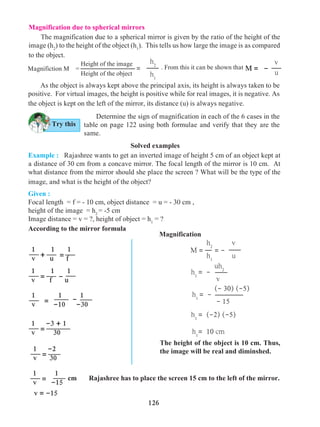
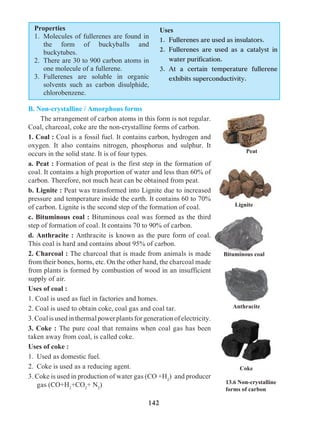
S.No.	 Name of Lesson							 Page No.
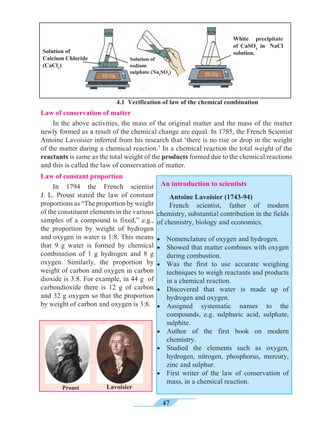
1.	 Laws of Motion......................................................................................................... 1
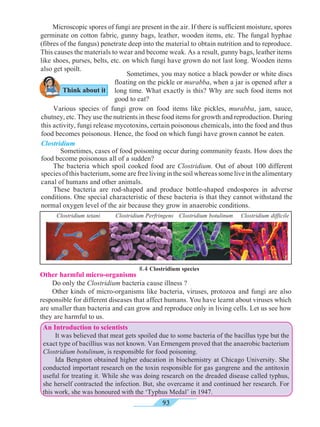
2.	 Work and Energy..................................................................................................... 18
3.	 Current Electricity................................................................................................... 30
4.	 Measurement of Matter........................................................................................... 46
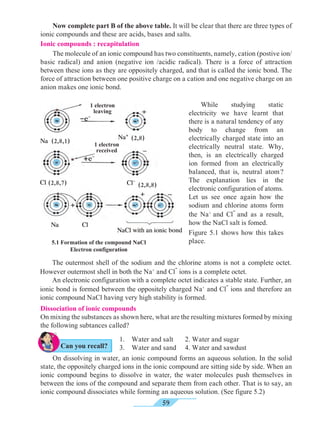
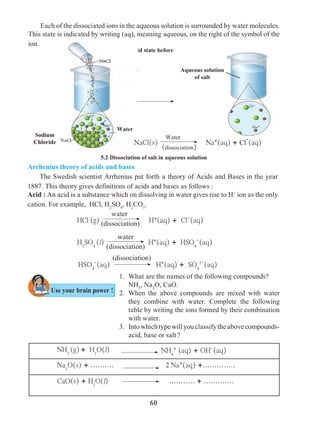
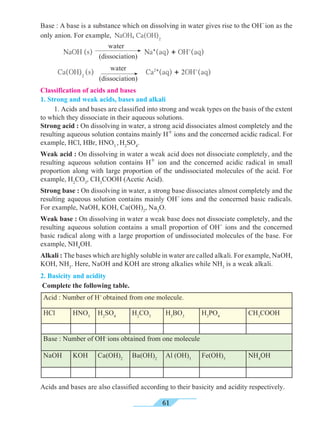
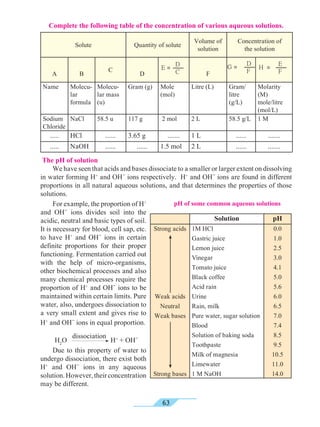
5.	 Acids, Bases and Salts............................................................................................ 58
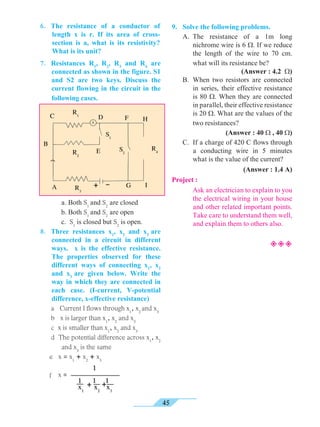
6.	 Classification of Plants........................................................................................... 75
7.	 Energy Flow in an Ecosystem................................................................................. 81
8.	 Useful and Harmful Microbes................................................................................. 88
9.	 Environmental Management................................................................................... 96
10. 	Information Communication Technology (ICT) ....................................................... 108
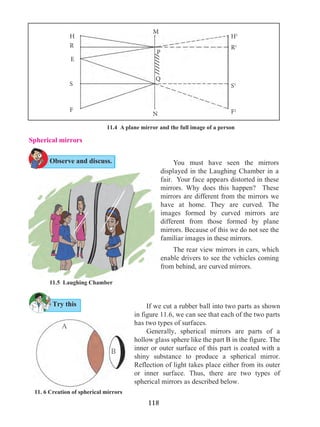
11. 	Reflection of Light................................................................................................. 115
12. 	Study of Sound...................................................................................................... 128
13. 	Carbon : An important element............................................................................. 138
14. 	Substances in Common Use.................................................................................. 150
15. 	Life Processes in Living Organisms...................................................................... 163
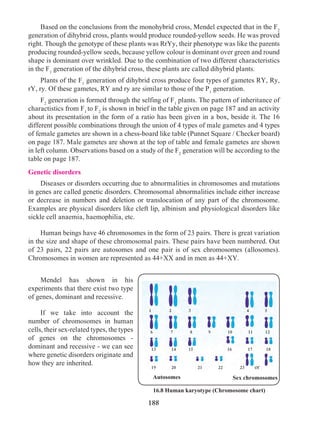
16. 	Heredity and Variation.......................................................................................... 179
17. 	Introduction to Biotechnology............................................................................... 194
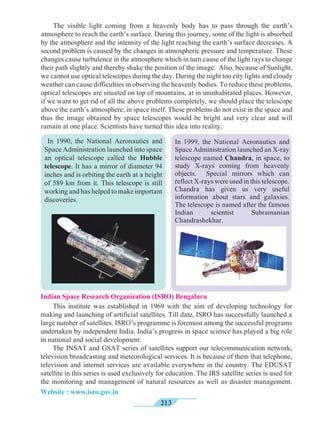
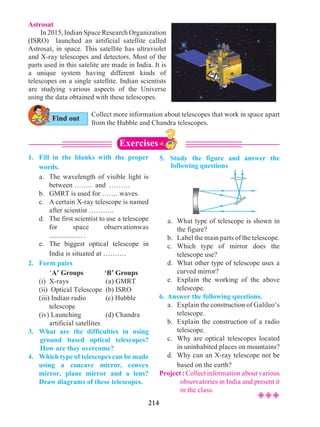
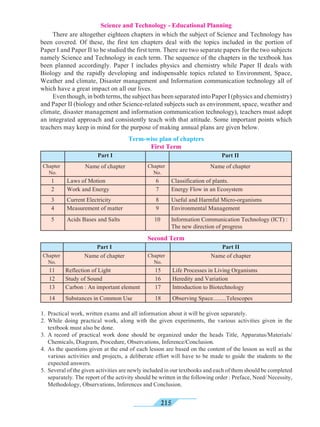
18. 	Observing Space : Telescopes .............................................................................. 209
															
Contents
1
Motion of an object
	 In which of the following examples can you sense motion?
How will you explain presence and absence of motion?
1. You are travelling in a bus. Is the person sitting next to you in motion?
2. What do you take into consideration to decide if an object is moving or not?
	 You have learnt that motion is a relative concept. If the position of an object is
changing with respect to its surroundings, then it is said to be in motion. Otherwise, it is
said to be at rest.
	 We see the motion of several objects every day. Sometimes we cannot see the
motion of an object directly, as in the case of a breeze. Can you list other examples of
motion, besides those given here?
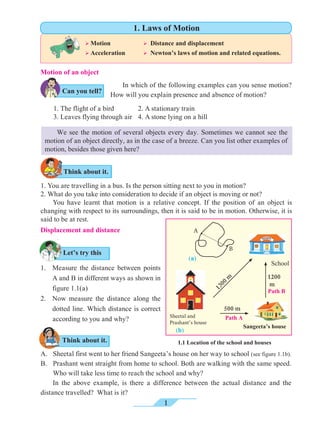
A. 	 Sheetal first went to her friend Sangeeta’s house on her way to school (see figure 1.1b).
B. 	 Prashant went straight from home to school. Both are walking with the same speed.
Who will take less time to reach the school and why?
	 In the above example, is there a difference between the actual distance and the
distance travelled? What is it?
Think about it.
Think about it.
Displacement and distance
Let’s try this
Ø Motion		 Ø Distance and displacement
Ø Acceleration	 Ø Newton’s laws of motion and related equations.
1. Laws of Motion
Sheetal and
Prashant’s house
Sangeeta’s house
School
1300m
500 m
1200
m
1.1 Location of the school and houses
A
B
(a)
(b)
1. 	 Measure the distance between points
A and B in different ways as shown in
figure 1.1(a)
2. 	 Now measure the distance along the
dotted line. Which distance is correct
according to you and why?
	 1. The flight of a bird		 2. A stationary train
	 3. Leaves flying through air	 4. A stone lying on a hill
Path A
Path B
Can you tell?
2
Use your brain power!
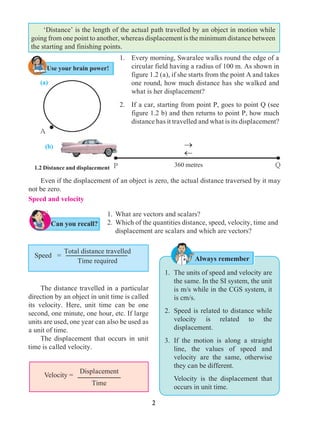
1. 	 Every morning, Swaralee walks round the edge of a
circular field having a radius of 100 m. As shown in
figure 1.2 (a), if she starts from the point A and takes
one round, how much distance has she walked and
what is her displacement?
2. 	 If a car, starting from point P, goes to point Q (see
figure 1.2 b) and then returns to point P, how much
distance has it travelled and what is its displacement?
A
.
QP
®
®
360 metres
Total distance travelled
Time required
Speed =
	 Even if the displacement of an object is zero, the actual distance traversed by it may
not be zero.
Displacement
Time
Velocity =
1. 	The units of speed and velocity are
the same. In the SI system, the unit
is m/s while in the CGS system, it
is cm/s.
2. 	Speed is related to distance while
velocity is related to the
displacement.
3. 	If the motion is along a straight
line, the values of speed and
velocity are the same, otherwise
they can be different.
	 Velocity is the displacement that
occurs in unit time.
	 The distance travelled in a particular
direction by an object in unit time is called
its velocity. Here, unit time can be one
second, one minute, one hour, etc. If large
units are used, one year can also be used as
a unit of time.
	 The displacement that occurs in unit
time is called velocity.
1.2 Distance and displacement
Can you recall?
Always remember
(a)
(b)
	 ‘Distance’ is the length of the actual path travelled by an object in motion while
going from one point to another, whereas displacement is the minimum distance between
the starting and finishing points.
1.	 What are vectors and scalars? 	
2.	 Which of the quantities distance, speed, velocity, time and
displacement are scalars and which are vectors?	
Speed and velocity
3
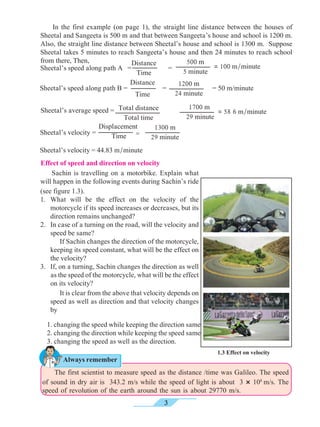
	 Sachin is travelling on a motorbike. Explain what
will happen in the following events during Sachin’s ride
(see figure 1.3).
1. 	What will be the effect on the velocity of the
motorcycle if its speed increases or decreases, but its
direction remains unchanged?
2. 	 In case of a turning on the road, will the velocity and
speed be same?
		 If Sachin changes the direction of the motorcycle,
keeping its speed constant, what will be the effect on
the velocity?
3. 	 If, on a turning, Sachin changes the direction as well
as the speed of the motorcycle, what will be the effect
on its velocity?
	 	 It is clear from the above that velocity depends on
speed as well as direction and that velocity changes
by
1. changing the speed while keeping the direction same
2. changing the direction while keeping the speed same
3. changing the speed as well as the direction.
Effect of speed and direction on velocity
Distance
Time
Sheetal’s speed along path A = =
500 m
5 minute
= 100 m/minute
Distance
Time
Sheetal’s speed along path B = =
1200 m
24 minute
= 50 m/minute
Total distance
Total time
Sheetal’s average speed = 1700 m
29 minute
= 58 6 m/minute
Sheetal’s velocity = 44.83 m/minute
Displacement
Time
Sheetal’s velocity =
1300 m
29 minute
=
1.3 Effect on velocity
	 In the first example (on page 1), the straight line distance between the houses of
Sheetal and Sangeeta is 500 m and that between Sangeeta’s house and school is 1200 m.
Also, the straight line distance between Sheetal’s house and school is 1300 m. Suppose
Sheetal takes 5 minutes to reach Sangeeta’s house and then 24 minutes to reach school
from there, Then,
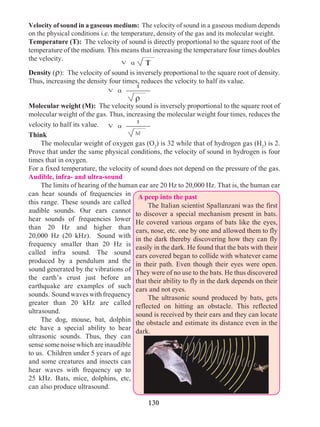
	 The first scientist to measure speed as the distance /time was Galileo. The speed
of sound in dry air is 343.2 m/s while the speed of light is about 3 × 10⁸
m/s. The
speed of revolution of the earth around the sun is about 29770 m/s.
Always remember
4
Uniform and non-uniform linear motion
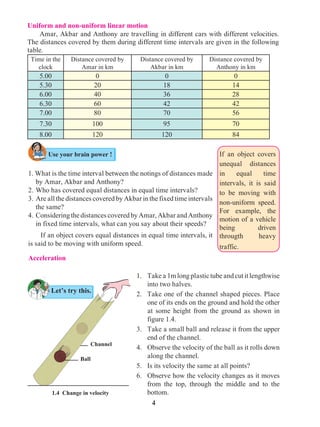
	 Amar, Akbar and Anthony are travelling in different cars with different velocities.
The distances covered by them during different time intervals are given in the following
table.
Time in the
clock
Distance covered by
Amar in km
Distance covered by
Akbar in km
Distance covered by
Anthony in km
5.00 0 0 0
5.30 20 18 14
6.00 40 36 28
6.30 60 42 42
7.00 80 70 56
7.30 100 95 70
8.00 120 120 84
Let’s try this.
1. What is the time interval between the notings of distances made
by Amar, Akbar and Anthony?
2. 	Who has covered equal distances in equal time intervals?
3. 	Are all the distances covered by Akbar in the fixed time intervals
the same?
4. 	ConsideringthedistancescoveredbyAmar,AkbarandAnthony
in fixed time intervals, what can you say about their speeds?
	 If an object covers equal distances in equal time intervals, it
is said to be moving with uniform speed.
Acceleration
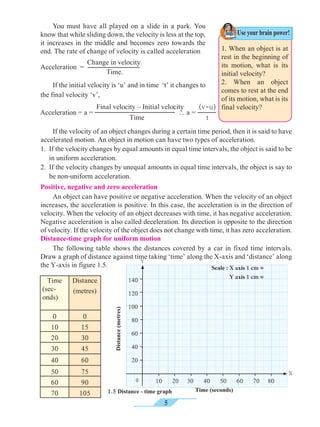
1. 	 Takea1mlongplastictubeandcutitlengthwise
into two halves.
2. 	 Take one of the channel shaped pieces. Place
one of its ends on the ground and hold the other
at some height from the ground as shown in
figure 1.4.
3. 	 Take a small ball and release it from the upper
end of the channel.
4. 	 Observe the velocity of the ball as it rolls down
along the channel.
5. 	 Is its velocity the same at all points?
6. 	 Observe how the velocity changes as it moves
from the top, through the middle and to the
bottom.1.4 Change in velocity
Use your brain power !
Ball
Channel
If an object covers
unequal distances
in equal time
intervals, it is said
to be moving with
non-uniform speed.
For example, the
motion of a vehicle
being driven
througth heavy
traffic.
5
	 You must have all played on a slide in a park. You
know that while sliding down, the velocity is less at the top,
it increases in the middle and becomes zero towards the
end. The rate of change of velocity is called acceleration
Acceleration = 	
	 If the initial velocity is ‘u’ and in time ‘t’ it changes to
the final velocity ‘v’,
	 If the velocity of an object changes during a certain time period, then it is said to have
accelerated motion. An object in motion can have two types of acceleration.
1. 	If the velocity changes by equal amounts in equal time intervals, the object is said to be
in uniform acceleration.
2. If the velocity changes by unequal amounts in equal time intervals, the object is say to
be non-uniform acceleration.
Change in velocity
Time.
Final velocity – Initial velocity 	
	 Time
(v-u)
t
Acceleration = a =  a =
Positive, negative and zero acceleration
	 An object can have positive or negative acceleration. When the velocity of an object
increases, the acceleration is positive. In this case, the acceleration is in the direction of
velocity. When the velocity of an object decreases with time, it has negative acceleration.
Negative acceleration is also called deceleration. Its direction is opposite to the direction
of velocity. If the velocity of the object does not change with time, it has zero acceleration.
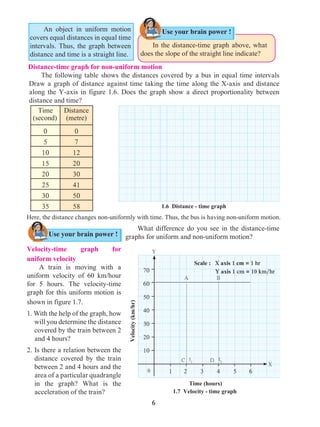
Distance-time graph for uniform motion
	 The following table shows the distances covered by a car in fixed time intervals.
Draw a graph of distance against time taking ‘time’ along the X-axis and ‘distance’ along
the Y-axis in figure 1.5.
Time
(sec-
onds)
Distance
(metres)
0 0
10 15
20 30
30 45
40 60
50 75
60 90
70 105
Distance(metres)
1.5 Distance - time graph
Scale : X axis 1 cm =
Y axis 1 cm =
0 10 20 30 40 50 60 70 80
X
140
120
100
80
60
40
20
Y
Time (seconds)
Use your brain power!
1. When an object is at
rest in the beginning of
its motion, what is its
initial velocity?
2. When an object
comes to rest at the end
of its motion, what is its
final velocity?
6
Use your brain power !An object in uniform motion
covers equal distances in equal time
intervals. Thus, the graph between
distance and time is a straight line. 	
	 In the distance-time graph above, what
does the slope of the straight line indicate?
Distance-time graph for non-uniform motion
Use your brain power !
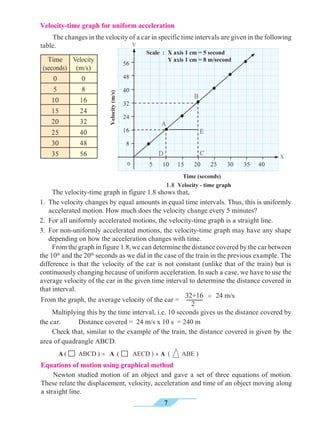
Here, the distance changes non-uniformly with time. Thus, the bus is having non-uniform motion. 	
Time
(second)
Distance
(metre)
0 0
5 7
10 12
15 20
20 30
25 41
30 50
35 58
	 The following table shows the distances covered by a bus in equal time intervals
Draw a graph of distance against time taking the time along the X-axis and distance
along the Y-axis in figure 1.6. Does the graph show a direct proportionality between
distance and time?
	 What difference do you see in the distance-time
graphs for uniform and non-uniform motion?
Velocity-time graph for
uniform velocity
	 A train is moving with a
uniform velocity of 60 km/hour
for 5 hours. The velocity-time
graph for this uniform motion is
shown in figure 1.7.
1. With the help of the graph, how
will you determine the distance
covered by the train between 2
and 4 hours?
2. 	Is there a relation between the
distance covered by the train
between 2 and 4 hours and the
area of a particular quadrangle
in the graph? What is the
acceleration of the train?
1.6 Distance - time graph
1.7 Velocity - time graph
Velocity(km/hr)
0 1 2 3 4 5  6  
X
70
60
50
40
30
20
10
Y
Time (hours)
A B
C Dt1
t2
Scale : 	X axis 1 cm = 1 hr
		Y axis 1 cm = 10 km/hr
7
Velocity-time graph for uniform acceleration
	 The changes in the velocity of a car in specific time intervals are given in the following
table.
Time
(seconds)
Velocity
(m/s)
0 0
5 8
10 16
15 24
20 32
25 40
30 48
35 56
	 The velocity-time graph in figure 1.8 shows that,
1. 	The velocity changes by equal amounts in equal time intervals. Thus, this is uniformly
accelerated motion. How much does the velocity change every 5 minutes?
2. 	For all uniformly accelerated motions, the velocity-time graph is a straight line.
3. 	For non-uniformly accelerated motions, the velocity-time graph may have any shape
depending on how the acceleration changes with time.
	 From the graph in figure 1.8, we can determine the distance covered by the car between
the 10th
and the 20th
seconds as we did in the case of the train in the previous example. The
difference is that the velocity of the car is not constant (unlike that of the train) but is
continuously changing because of uniform acceleration. In such a case, we have to use the
average velocity of the car in the given time interval to determine the distance covered in
that interval.
Equations of motion using graphical method
	 Newton studied motion of an object and gave a set of three equations of motion.
These relate the displacement, velocity, acceleration and time of an object moving along
a straight line.
	 Multiplying this by the time interval, i.e. 10 seconds gives us the distance covered by
the car.	 Distance covered = 24 m/s x 10 s = 240 m
	 Check that, similar to the example of the train, the distance covered is given by the
area of quadrangle ABCD.
32+16
2
= 24 m/s
A ( ABCD ) = A ( AECD ) + A ( ABE )
B
A
E
D C
1.8 Velocity - time graph
0 5 10 15 20 25 30 35 40
X
56
48
40
32
24
16
8
Y
Time (seconds)
Scale : 	X axis 1 cm = 5 second
		 Y axis 1 cm = 8 m/second
Velocity(m/s)
From the graph, the average velocity of the car =
8
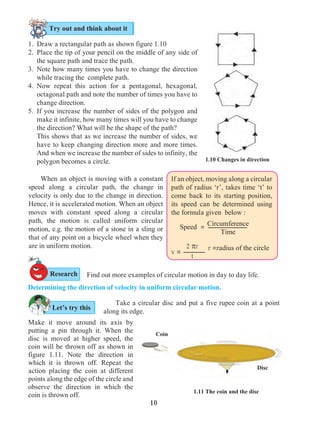
Equation describing the relation between displacement and time
	 Let us suppose that an object in uniform acceleration ‘a’ and it has covered the
distance ‘s’ within time ‘t’. From the graph in figure 1.9, the distance covered by the object
during time ‘t’ is given by the area of quadrangle DOEB.
 s = area of quadrangle DOEB
= area (rectangle DOEA) + area of triangle (DAB)
 s = (AE × OE ) + ( × [AB × DA])
1
2
Equation describing the relation between velocity and time
	 Figure 1.9 shows the change in velocity with time of a uniformly accelerated object.
The object starts from the point D in the graph with velocity u. Its velocity keeps increasing
and after time t, it reaches the point B on the graph.
v = u + at This is the relation between velocity and time.
s = ut + at2
This is the relation between displacement and time.
v2
= u2
+ 2as This is the relation between displacement and velocity.
Let us try to obtain these equations by the graphical method.
	 Suppose an object is in motion along a straight line with initial velocity ‘u’. It attains
a final velocity ‘v’ in time ‘t’ due to acceleration ‘a’ its desplacement is ‘s’. The three
equations of motion can be written as
1
2
The initial velocity of the object = u = OD
The final velocity of the object = v = OC
Time = t = OE
Change in velocity
Time
Acceleration (a) =
(Final velocity – Initial velocity)	
Time=
 CD = at …… (i) (OC - OD = CD)
From the graph BE = AB + AE
 v = CD + OD .....(AB = CD and AE = OD)
 v = at + u (from i )
 v = u + at
This is the first equation of motion.
(OC - OD)
t
=
Velocity
v
u
1.9 Velocity - time graph
Time
C
D
A
t
EO
B
Draw a line parallel to Y axis passing through
B. This will cross the X axis in E. Draw a line
parallel to X-axis passing through D. This will
cross the line BE at A.
9
(v-u)
t
a =
(v-u)
a
t =
1
2
Equation describing the relation between displacement and velocity
	 The velocity of an accelerated
object changes with time. Change
in the velocity can be due to a
change in direction or magnitude
of the velocity or both.
Always remember
1
2
1
2
s = ut + at2
 Newton’s second equation of motion is
 s = u × t + × at × t
	 We have seen that from the graph in figure 1.9 we can determine the distance covered
by the object in time t from the area of the quadrangle DOEB. DOEB is a trapezium. So
we can use the formula for its area.
 s = area of trapezium DOEB
 s = × sum of lengths of parallel sides × distance between the parallel sides
 s = × (OD + BE ) × OE But, OD = u, BE = v and OE = t
 s = × ( u + v) × t ------ (ii)
But,
 ---------------(iii)
1
2
1
2
 s = × (u + v)×

 2 as =(v+u) ( v-u) = v2
-u2
1
2
(v-u)
a
(v+u) ( v-u)
		 2a
s =
 v2
= u2
+ 2as
this is Newton’s third equation of motion
Let’s try this
Uniform circular motion
	 The speed of the tip is constant, but the direction of its displacement and therefore, its
velocity is constantly changing. As the tip is moving along a circular path, its motion is
called uniform circular motion. Can you give more examples of such motion?
	 Observe the tip of the second hand of a clock. What can you
say about its velocity and speed?
But, AE = u, OE = t and (OE = DA = t)	
AB = at ---( AB = CD ) --- from (i)
10
Determining the direction of velocity in uniform circular motion.	
Let’s try this
	 Find out more examples of circular motion in day to day life.
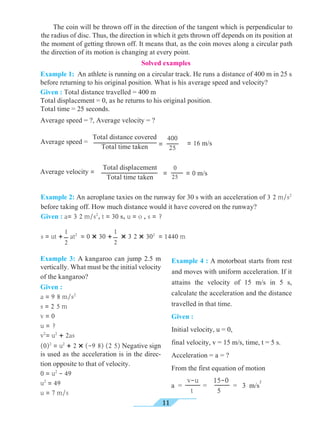
1. 	Draw a rectangular path as shown figure 1.10
2. 	Place the tip of your pencil on the middle of any side of
the square path and trace the path.
3. 	Note how many times you have to change the direction
while tracing the complete path.
4. 	Now repeat this action for a pentagonal, hexagonal,
octagonal path and note the number of times you have to
change direction.
5. 	If you increase the number of sides of the polygon and
make it infinite, how many times will you have to change
the direction? What will be the shape of the path?
	 This shows that as we increase the number of sides, we
have to keep changing direction more and more times.
And when we increase the number of sides to infinity, the
polygon becomes a circle. 1.10 Changes in direction
1.11 The coin and the disc
Circumference
Time
Speed =
2 pr
tv =
If an object, moving along a circular
path of radius ‘r’, takes time ‘t’ to
come back to its starting position,
its speed can be determined using
the formula given below :
r =radius of the circle
	 When an object is moving with a constant
speed along a circular path, the change in
velocity is only due to the change in direction.
Hence, it is accelerated motion. When an object
moves with constant speed along a circular
path, the motion is called uniform circular
motion, e.g. the motion of a stone in a sling or
that of any point on a bicycle wheel when they
are in uniform motion.
Try out and think about it
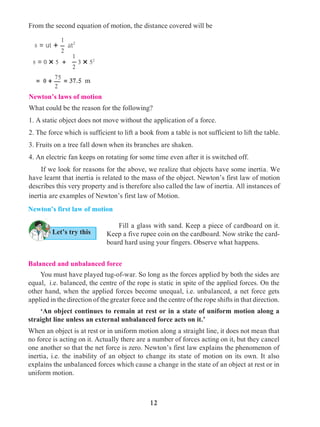
	 Take a circular disc and put a five rupee coin at a point
along its edge.
Disc
Coin
Research
Make it move around its axis by
putting a pin through it. When the
disc is moved at higher speed, the
coin will be thrown off as shown in
figure 1.11. Note the direction in
which it is thrown off. Repeat the
action placing the coin at different
points along the edge of the circle and
observe the direction in which the
coin is thrown off.
11
Example 1: An athlete is running on a circular track. He runs a distance of 400 m in 25 s
before returning to his original position. What is his average speed and velocity?
Given : Total distance travelled = 400 m
Total displacement = 0, as he returns to his original position.
Total time = 25 seconds.
Average speed = ?, Average velocity = ?
Solved examples
Total distance covered
Total time taken
Average speed = =
400
25
= 16 m/s
Total displacement
Total time taken
Average velocity = =
0
25 = 0 m/s
	 The coin will be thrown off in the direction of the tangent which is perpendicular to
the radius of disc. Thus, the direction in which it gets thrown off depends on its position at
the moment of getting thrown off. It means that, as the coin moves along a circular path
the direction of its motion is changing at every point.
Example 2: An aeroplane taxies on the runway for 30 s with an acceleration of 3 2 m/s2
before taking off. How much distance would it have covered on the runway?
Given : a= 3 2 m/s2
, t = 30 s, u = o , s = ?
s = ut + at2
= 0 × 30 + × 3 2 × 302
= 1440 m
1
2
1
2
Example 3: A kangaroo can jump 2.5 m
vertically. What must be the initial velocity
of the kangaroo?
Given :
a = 9 8 m/s2
s = 2 5 m
v = 0
u = ?
v2
= u2
+ 2as
(0)2
= u2
+ 2 × (-9 8) (2 5) Negative sign
is used as the acceleration is in the direc-
tion opposite to that of velocity.
0 = u2
- 49
u2
= 49
u = 7 m/s
Example 4 : A motorboat starts from rest
and moves with uniform acceleration. If it
attains the velocity of 15 m/s in 5 s,
calculate the acceleration and the distance
travelled in that time.
Given :
Initial velocity, u = 0,
final velocity, v = 15 m/s, time, t = 5 s.
Acceleration = a = ?
From the first equation of motion
v-u
t
a = = = 3 m/s
215-0
5
12
Newton’s laws of motion
What could be the reason for the following?
1. A static object does not move without the application of a force.
2. The force which is sufficient to lift a book from a table is not sufficient to lift the table.
3. Fruits on a tree fall down when its branches are shaken.
4. An electric fan keeps on rotating for some time even after it is switched off.
	 If we look for reasons for the above, we realize that objects have some inertia. We
have learnt that inertia is related to the mass of the object. Newton’s first law of motion
describes this very property and is therefore also called the law of inertia. All instances of
inertia are examples of Newton’s first law of Motion.
Let’s try this
Newton’s first law of motion
	 Fill a glass with sand. Keep a piece of cardboard on it.
Keep a five rupee coin on the cardboard. Now strike the card-
board hard using your fingers. Observe what happens.
Balanced and unbalanced force
	 You must have played tug-of-war. So long as the forces applied by both the sides are
equal, i.e. balanced, the centre of the rope is static in spite of the applied forces. On the
other hand, when the applied forces become unequal, i.e. unbalanced, a net force gets
applied in the direction of the greater force and the centre of the rope shifts in that direction.
	 ‘An object continues to remain at rest or in a state of uniform motion along a
straight line unless an external unbalanced force acts on it.’
When an object is at rest or in uniform motion along a straight line, it does not mean that
no force is acting on it. Actually there are a number of forces acting on it, but they cancel
one another so that the net force is zero. Newton’s first law explains the phenomenon of
inertia, i.e. the inability of an object to change its state of motion on its own. It also
explains the unbalanced forces which cause a change in the state of an object at rest or in
uniform motion.
1
2
s = ut + at2
= 0 + = 37.5 m
75
2
From the second equation of motion, the distance covered will be
1
2
s = 0 × 5 + 3 × 52
13
Newton’s second law of motion
Let’s try this
A. 1. 	 Ask your friend to drop one plastic and one rubber
ball from the same height.
	 2. 	You catch the balls. Which ball was easier to catch
and why?
B. 	 1.	 Ask your friend to throw a ball towards you at slow speed. Try to catch it.
	 2. 	Now ask your friend to throw the same ball at high speed towards you. Try to catch
it. Which ball could you catch with greater ease? Why?
	 The effect of one object
striking another object depends
both on the mass of the former
object and its velocity. This
means that the effect of the force
depends on a property related to
both mass and velocity of the
striking object. This property
was termed ‘momentum’ by
Newton.
	 Momentum has magnitude as well as
direction. Its direction is the same as that of
velocity. In SI system, the unit of momentum is
kg m/s, while in CGS system, it is g cm/s.
If an unbalanced force applied on an object causes
a change in the velocity of the object, then it also
causes a change in its momentum. The force
necessary to cause a change in the momentum of
an object depends upon the rate of change of
momentum.
Momentum (P) : Momentum is the product of mass and velocity of an object. P = m v.
Momentum is a vector quantity.
	 ‘The rate of change of momentum is proportional to the applied force and the
change of momentum occurs in the direction of the force.’
Change in momentum
Time
 Rate of change of momentum =
According to Newton’s second law of motion, the rate of change of momentum is
proportional to the applied force.
mv- mu
t
 Rate of change of momentum =
m (v- u)
t
= = ma
 ma a F
 F = k ma (k = Constant of proportionality and its value is 1).
F = m × a
	 Suppose an object of mass m has an initial velocity u. When a force F is applied in
the direction of its velocity for time t, its velocity becomes v.
 The initial momentum of the object = mu,
Its final momentum after time t = mv
14
	 Why is there a thick bed of sand for a high jumper
to fall on after his jump?
Newton’s third law of motion
Let’s try this
Use your brain power !
1. 	 Take a plastic boat and make a hole at its rear end.
2. 	 Inflate a balloon and fix it on the hole in the boat. Release
the boat in water. What happens to the boat as the air in the
balloon escapes slowly? Why?
	 We have learnt about force and its effect on an object through Newton’s first and
second laws of motion.
	 ‘However, in nature force cannot act alone.’ Force is a reciprocal action between two
objects. Forces are always applied in pairs. When one object applies a force on another
object, the latter object also simultaneously applies a force on the former object. The
forces between two objects are always equal and opposite. This idea is expressed in
Newton’s third law of motion. The force applied by the first object is called action force
while the force applied by the second object on the first is called reaction force.
‘Every action force has an equal and opposite reaction force which acts simultaneously.’
	 Consider two objects having different
masses which are initially at rest. The
initial momentum for both is zero. Suppose
a force ‘F’ acts for time ‘t’ on both objects.
The lighter object starts moving faster than
the heavier object. However, from the
above formula, we know that the rate of
change of momentum i.e. ‘F’ in both
objects is same and the total change in their
momentum will also be same i.e. ‘Ft’.
Thus, if the same force is applied on
different objects, the change in momentum
is the same.
	 In SI system, the unit of force is
newton.
Newton (N) : The force necessary to cause
an acceleration of 1 m/s2
in an object of
mass 1 kg is called 1 newton.
1 N = 1 kg × 1 m/s2
In CGS system the unit of force is a dyne.	
Dyne: The force necessary to cause an
acceleration of 1 cm/s2
in an object of
mass 1 gm is called 1 dyne.
1 dyne = 1 g × 1 cm/s2
Use your brain power !
1. 	While hitting a ball with a bat, the speed
of the bat decreases.
2. 	A gun recoils i.e. moves backwards
when a bullet is fired.
3. 	Mechanism of firing of a rocket.
	 How will you explain these with the
help of Newton’s third law of motion?
1. 	Action and reaction are terms that
express force.
2. 	 These forces act in pairs. One force
cannot exist by itself.
3. 	Action and reaction forces act
simultaneously.
4. 	Action and reaction forces act on
different objects. They do not act
on the same object and hence
cannot cancel each other’s effect.
15
 (m2
v2
+ m1
v1
)= (m1
u1
+m2
u2
)
The magnitude of total final momentum = the magnitude of total initial momentum.
	 Thus, if no external force is acting on two objects, then their total initial momentum is
equal to their total final momentum. This statement is true for any number of objects.
	 ‘When no external force acts on two interacting objects, their total momentum
remains constant. It does not change.’
	 This is a corollary to Newton’s third law of motion. The momentum is unchanged
after the collision. The momentum gets redistributed between the colliding objects. The
momentum of one of the objects decreases while that of the other increases. Thus, we can
also state this corollary as follows.
	 ‘When two objects collide, the total momentum before collision is equal to the
total momentum after collision.’
	 In order to understand this principle, let us consider the example of a bullet fired from
a gun. When a bullet of mass m1
is fired from a gun of mass m2
, its velocity becomes v1
,
and its momentum becomes m1
v1
. Before firing the bullet, both the gun and the bullet are
at rest and hence the total initial momentum is zero. According to the above law, the total
final momentum also has to be zero. Thus, the forward moving bullet causes the gun to
move backward after firing. This backward motion of the gun is called its recoil. The
velocity of recoil, v2
, is such that,
m1
v1
+ m2
v2
= 0 or v2
= -
m1
m2
v1×
Law of conservation of momentum
Suppose an object A has mass m1
and its initial velocity is u1
. An object B has mass m2
and
initial velocity u2
.
According to the formula for momentum, the initial momentum of A is m1
u1
and that of B
is m2
u2
.
Suppose these two objects collide. Let the force on A due to B be F1
. This force will cause
acceleration in A and its velocity will become v1
.
 Momentum of A after collision = m1
v1
According to Newton’s third law of motion, A also exerts an equal force on B but in the
opposite direction. This will cause a change in the momentum of B. If its velocity after
collision is v2
,
The momentum of B after collision = m2
v2
. If F2
is the force that acts on object B,
F2
= -F1
 m2
a2
= - m1
a1
…………

F= ma
………

a =
 m2
(v2
- u2
)= - m1
(v1
-u1
)
 m2
v2
- m2
u2
= - m1
v1
+ m1
u1
(v-u)
t
(v1
-u1
)
t
(v2
-u2
)
t
 m2
× = - m1
×
16
Solved examples
0 175
0 1
= 1 75 m/sv2
=
	 As the mass of the gun is much higher than the mass of the bullet, the velocity of the
gun is much smaller than the velocity of the bullet. The magnitude of the momentum of
the bullet and that of the gun are equal and their directions are opposite. Thus, the total
momentum is constant. Total momentum is also constant during the launch of a rocket.
Example 1: The mass of a cannon is 500 kg and it recoils with a speed of 0.25 m/s. What
is the momentum of the cannon?
Given : mass of the cannon = 500 kg, recoil speed = 0.25 m/s Momentum = ?
Momentum = m × v = 500 x 0.25 = 125 kg m/s
Example 2: 2 balls have masses of 50 gm and 100 gm and they are moving along the
same line in the same direction with velocities of 3 m/s and 1.5 m/s respectively. They
collide with each other and after the collision, the first ball moves with a velocity of 2.5
m/s. Calculate the velocity of the other ball after collision.
Given :
The mass of first ball = m1
= 50 g = 0 05 kg, mass of the second ball = m2
= 100 g = 0 1 kg
Initial velocity of the first ball = u1
= 3 m/s, Initial velocity of the second ball = u2
= 1.5 m/s
Final velocity of the first ball = v1
= 2 5 m/s ,Final velocity of the second ball = v2
= ?
According to the law of conservation of momentum, total initial momentum = Total final
momentum.
m1
u1
+ m2
u2
= m1
v1
+ m2
v2
(0 05 × 3) + (0 1 × 1 5) = (0 05 × 2 5) + (0 1 × v2
)
 (0 15)+(0 15) = 0 125 + 0 1v2
 0 3 = 0 125 + 0 1 v2
 0 1v2
= 0 3 - 0 125
1. 	 Match the first column with appropriate entries in the second and third columns
and remake the table.
S. No. Column 1 Column 2 Column 3
1 Negative
acceleration
The velocity of the ob-
ject remains constant
A car, initially at rest
reaches a velocity of 50 km/hr in 10 seconds
2 Positive
acceleration
The velocity of
the object decreases
A vehicle is moving with a
velocity of 25 m/s
3 Zero
acceleration
The velocity of the
object increases
A vehicle moving with the velocity of
10 m/s, stops after 5 seconds.
2. Clarify the differences
	 A. Distance and displacement
	 B. Uniform and non-uniform motion.
Exercises
17
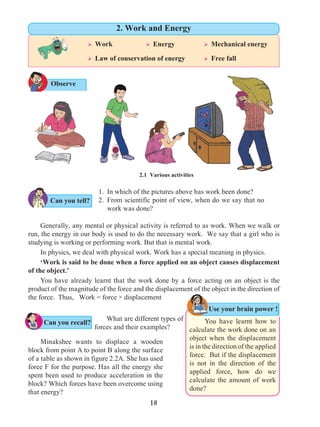
3. Complete the following table.
u (m/s) a (m/s2
) t (sec) v = u + at (m/s)
2 4 3 -
- 5 2 20
u (m/s) a (m/s2
) t (sec)
5 12 3 -
7 - 4 92
u (m/s) a (m/s2
) s (m) v 2
= u2
+ 2as (m/s)2
4 3 - 8
- 5 8.4 10
4. 	 Complete the sentences and explain
them.
	 a. 	The minimum distance between
the start and finish points of the
motion of an object is called the
……….. of the object.
	 b. 	 Decelerationis--------acceleration
	 c. 	When an object is in uniform
circular motion, its ………
changes at every point.
	 d. 	During collision ......….. remains
constant.
	 e. 	 The working of a rocket depends
on Newton’s ….…. law of motion.
5. 	 Give scientific reasons.
	 a. When an object falls freely to the
ground, its acceleration is uniform.
	 b. 	Even though the magnitudes of
action force and reaction force are
equal and their directions are
opposite, their effects do not get
cancelled.
	 c. It is easier to stop a tennis ball as
compared to a cricket ball, when
both are travelling with the same
velocity.
	 d. The velocity of an object at rest is
considered to be uniform.
6. 	Take 5 examples from your
surroundings and give explanation
based on Newtons laws of motion.
7. Solve the following examples.
	 a) 	An object moves 18 m in the first
3 s, 22 m in the next 3 s and 14 m in
the last 3 s. What is its average
speed? 		 (Ans: 6 m/s)
	 b) 	An object of mass 16 kg is moving
with an acceleration of 3 m/s2
.
Calculate the applied force. If the
same force is applied on an object of
mass 24 kg, how much will be the
acceleration? (Ans: 48 N, 2 m/s2
)
	 c) 	A bullet having a mass of 10 g and
moving with a speed of 1.5 m/s,
penetrates a thick wooden plank of
mass 90 g. The plank was initially
at rest. The bullet gets embedded in
the plank and both move together.
Determine their velocity.
					 (Ans:0.15m/s)
	 d) 	A person swims 100 m in the first
40 s, 80 m in the next 40 s and 45 m
in the last 20 s. What is the average
speed? (Ans: 2.25 m/s2
)
Project:
		Obtain information about
commonly used gadgets or devices
which are based on the principles
of Newton’s laws of motion.
1
2
s = ut + at2
(m)
²²²
18
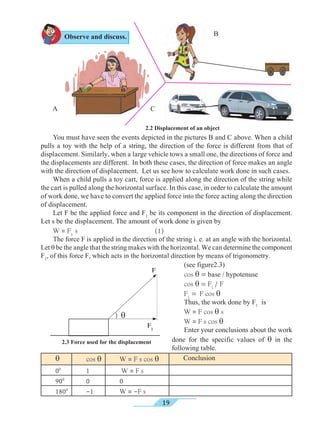
1.	 In which of the pictures above has work been done?
2.	 From scientific point of view, when do we say that no
work was done?
Generally, any mental or physical activity is referred to as work. When we walk or
run, the energy in our body is used to do the necessary work. We say that a girl who is
studying is working or performing work. But that is mental work.
In physics, we deal with physical work. Work has a special meaning in physics.
‘Work is said to be done when a force applied on an object causes displacement
of the object.’
You have already learnt that the work done by a force acting on an object is the
product of the magnitude of the force and the displacement of the object in the direction of
the force. Thus, Work = force × displacement
Observe
2.1 Various activities
What are different types of
forces and their examples?
Minakshee wants to displace a wooden
block from point A to point B along the surface
of a table as shown in figure 2.2A. She has used
force F for the purpose. Has all the energy she
spent been used to produce acceleration in the
block? Which forces have been overcome using
that energy?
Use your brain power !
Can you recall?
Ø Work		 Ø Energy		 Ø Mechanical energy
Ø Law of conservation of energy	 Ø Free fall
2. Work and Energy
You have learnt how to
calculate the work done on an
object when the displacement
is in the direction of the applied
force. But if the displacement
is not in the direction of the
applied force, how do we
calculate the amount of work
done?
Can you tell?
19
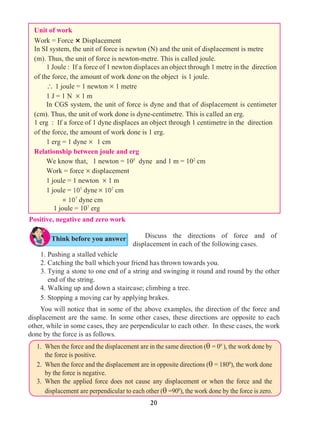
You must have seen the events depicted in the pictures B and C above. When a child
pulls a toy with the help of a string, the direction of the force is different from that of
displacement. Similarly, when a large vehicle tows a small one, the directions of force and
the displacements are different. In both these cases, the direction of force makes an angle
with the direction of displacement. Let us see how to calculate work done in such cases.
When a child pulls a toy cart, force is applied along the direction of the string while
the cart is pulled along the horizontal surface. In this case, in order to calculate the amount
of work done, we have to convert the applied force into the force acting along the direction
of displacement.
Let F be the applied force and F1
be its component in the direction of displacement.
Let s be the displacement. The amount of work done is given by
W = F1
s (1)
The force F is applied in the direction of the string i. e. at an angle with the horizontal.
Let q be the angle that the string makes with the horizontal. We can determine the component
F1
, of this force F, which acts in the horizontal direction by means of trigonometry.
(see figure2.3)
cos q = base / hypotenuse
cos q = F1
/ F
F1
= F cos q
Thus, the work done by F1
is
W = F cos q s
W = F s cos q
Enter your conclusions about the work
done for the specific values of q in the
following table.
Observe and discuss.
2.2 Displacement of an object
q cos q W = F s cos q Conclusion
00
1 W = F s
900
0 0
1800
-1 W = -F s
2.3 Force used for the displacement
A
B
C
A B
q
F1
F
)
20
Positive, negative and zero work
Unit of work
Work = Force × Displacement
In SI system, the unit of force is newton (N) and the unit of displacement is metre
(m). Thus, the unit of force is newton-metre. This is called joule.
1 Joule : If a force of 1 newton displaces an object through 1 metre in the direction
of the force, the amount of work done on the object is 1 joule.
 1 joule = 1 newton ´ 1 metre
1 J = 1 N ´ 1 m
In CGS system, the unit of force is dyne and that of displacement is centimeter
(cm). Thus, the unit of work done is dyne-centimetre. This is called an erg.
1 erg : If a force of 1 dyne displaces an object through 1 centimetre in the direction
of the force, the amount of work done is 1 erg.
1 erg = 1 dyne ´ 1 cm
Relationship between joule and erg
We know that, 1 newton = 105
dyne and 1 m = 102
cm
Work = force ´ displacement
1 joule = 1 newton ´ 1 m
1 joule = 105
dyne´ 102
cm
	 = 107
dyne cm
	 1 joule = 107
erg
Discuss the directions of force and of
displacement in each of the following cases.
1.	Pushing a stalled vehicle
2.	Catching the ball which your friend has thrown towards you.
	 3.	Tying a stone to one end of a string and swinging it round and round by the other
end of the string.
4.	Walking up and down a staircase; climbing a tree.
5.	Stopping a moving car by applying brakes.
You will notice that in some of the above examples, the direction of the force and
displacement are the same. In some other cases, these directions are opposite to each
other, while in some cases, they are perpendicular to each other. In these cases, the work
done by the force is as follows.
1.	 When the force and the displacement are in the same direction (q = 00
), the work done by
the force is positive.
2.	 When the force and the displacement are in opposite directions (q = 1800
), the work done
by the force is negative.
3.	When the applied force does not cause any displacement or when the force and the
displacement are perpendicular to each other (q =900
), the work done by the force is zero.
Think before you answer
21
Take a plastic cup and make a hole in the
centre of its bottom. Take a long thread, double it
and pass it through the hole. Tie a thick enough
knot at the end so that the knot will not pass
through the hole, taking care that the two loose
ends are below the bottom of the cup. Tie a nut
each to the two ends as shown in figure 2.4. Now
do the following.
As shown in figure ‘A’, put the cup on a table,
keep one of the nuts in the cup and let the thread
carrying the other nut hang down along the side
of the table. What happens?
As shown in figure ‘B’, when the cup is
sliding along the table, stop it by putting a ruler in
its path.
As shown in figure ‘C’, keep the cup at the
centre of the table and leave the two nuts hanging
on opposite sides of the table.
Questions:
1.	 Figure A - Why does the cup get pulled?
2.	Figure B - What is the relation between the
displacement of the cup and the force applied
through the ruler?
3. 	In figure C - Why doesn’t the cup get displaced?
4. 	What is the type of work done in figures A, B 	
and C?
	 In the three actions above, what is the
relationship between the applied force and the
displacement?
Suppose an artificial satellite is moving around the earth in a circular orbit. As
the gravitational force acting on the satellite (along the radius of the circle) and its
displacement (along the tangent to the circle) are perpendicular to each other, the
work done by the gravitational force is zero
2.4 Positive, negative and zero work
Institutes at work
	 The National Physical Laboratory, New Delhi, was conceptualized in 1943. It
functions under the Council of Scientific and Industrial Research. Its conducts basic
research in the various branches of physics and helps various industries and institutes
engaged in developmental work. Its main objective is to establish national standards of
various physical quantities.
Cup
Cup
Cup
nut
nutnut
thread
Figure A
Figure B
Figure C
thread
thread
Try this
nut
22
Example 1: 	 Calculate the work done to
take an object of mass 20 kg to a height of
10 m.
(g = 9 8 m/s2
)
Given: m = 20 kg; s = 10 m
g = 9 8 m/s2
 F = m g
= 20 ´ (-9 8)
(The negative sign is taken because
the displacement is opposite to the direction
of the force.)
F = -196 N
 W = F s
= -196 ´ 10
W = -1960 J
(The negative sign appears because
the direction of force is opposite to the
direction of displacement so that the work
done is negative.)
Example 2 : Pravin has applied a force of
100 N on an object, at an angle of 600
to
the horizontal. The object gets displaced in
the horizontal direction and 400 J work is
done. What is the displacement of the
object?
(cos 600
= )
Given :
q = 600
		
F = 100 N
W = 400 J ,
W = F s Cos q
400 = 100 ´ s ´
= ´ s
 s = 8 m		
The object will be displaced through 8 m.
Energy
Why does it happen?
1. 	 If a pot having a plant is kept in the dark, the plant languishes.
2. 	 On increasing the volume of a music system or TV beyond a limit, the vessels in the
house start vibrating.
3. 	 Collecting sunlight on a paper with the help of a convex lens burns the paper.
	 The capacity of a body to perform work is called its energy. The units of work and
energy are the same. The unit in SI system is joule while that in cgs system is erg.
	 You have learnt that energy exists in various forms like mechanical, heat, light, sound,
electro-magnetic, chemical, nuclear and solar. In this chapter, we are going to study two
forms of mechanical energy, namely, potential energy and kinetic energy.
Kinetic energy
What will happen in the following cases?
1.	A fast cricket ball strikes the stumps.
2.	The striker hits a coin on the carom board.
3.	One marble strikes another in a game of marbles.
From the above examples we understand that when a moving object strikes a stationary
object, the stationary object moves. Thus, the moving object has some energy, part or all
of which it shares with the stationary object, thereby setting it in motion. ‘The energy
which an object has because of its motion is called its kinetic energy’. The work done by
a force to displace a stationary object through a distance s is the kinetic energy gained by
the object.
Kinetic energy = work done on the object
 K E = F × s
Solved examples
1
2
1
2
1
2
s = ?
400
100
4 ´ 2 = s
23
Example : A stone having a mass of 250 gm is falling from a height. How much kinetic
energy does it have at the moment when its velocity is 2 m/s?
Given : 	 m = 250 g 		 m = 0 25 kg 							
	 v = 2 m/s	
K E = = × 0 25 × (2)2
= 0 5 J
If the mass of a moving body is doubled, how
many times will the kinetic energy increase?
1
2 mv2 1
2
Expression for kinetic energy :
Suppose a stationary object of mass m moves because of an applied force. Let u be its
initial velocity (here u = 0). Let the applied force be F. This generates an acceleration a in
the object, and, after time t, the velocity of the object becomes equal to v. The displacement
during this time is s. The work done on the object, W = F . s
W = F × s
According to Newton’s second law of motion,
F = ma -------- (1)	Similarly, using Newton’s second equation of motion
s = ut + 	
However, as initial velocity is zero, u = 0.
s = 0 +
s = ------(2)
 W = ma ´ 1
2 at2
------ using equations (1) and (2)
W = -------(3)
Using Newton’s first equation of motion ..............
v = u + at
 v = 0 + at
 v = at
 v2
= (at)2
------(4)
 W = ------- using equations (3) and (4)
The kinetic energy gained by an object is the amount of work done on the object.
 K E = W
 K E =
1
2 at2
1
2 at2
1
2 mv2
1
2 m(at)2
1
2 at2
1
2 mv2
Use your brain power !
24
1. An arrow is released from a stretched bow.
2. Water kept at a height flows through a pipe into the tap below.
3. A compressed spring is released.
Which words describe the state of the object in the above examples? Where did the
energy required to cause the motion of objects come from?
If the objects were not brought in those states, would they have moved?
‘The energy stored in an object because of its specific state or position is called
its potential energy.’
1.Hold a chalk at a height of 5 cm from the floor and release it.
2.	Now stand up straight and then release the chalk.
3 Is there a difference in the results of the two activities? If so, why?
Expression for potential energy
	 To carry an object of mass ‘m’ to a height ‘h’ above the earth’s surface, a force equal
to ‘mg’ has to be used against the direction of the gravitational force. The amount of
work done can be calculated as follows.
	 Work = force x displacement
W = mg × h
 W = mgh
 The amount of potential energy stored in the object because of its displacement
P.E. = mgh 	 (W = P.E.)
 Displacement to height h causes energy equal to mgh to be stored in the object.
Example : 500 kg water is stored in the overhead tank of a 10 m high building. Calculate
the amount of potential energy stored in the water.
Given :
h = 10 m, m = 500 kg g = 9 8 m/s2
 P E = mgh
	 = 10 × 9 8 ×500
P E = 49000 J
Potential energy
Ajay and Atul have been asked to
determine the potential energy of a ball of
mass m kept on a table as shown in the
figure. What answers will they get? Will
they be different? What do you conclude
from this?
Potential energy is relative. The
heights of the ball with respect to Ajay
and Atul are different. So the potential
energy with respect to them will be
different.
Ajay
Atul
h2
h1
Try this
25
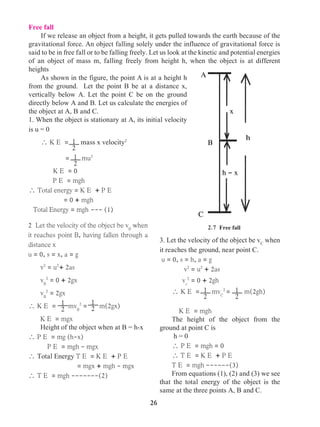
Make two pendulums of the same length with the help of thread
and two nuts. Tie another thread in the horizontal position.
Tie the two pendulums to this horizontal thread
in such a way that they will not hit each other while
swinging. Now swing one of the pendulums and
observe. What do you see?
You will see that as the speed of oscillation of the
pendulum slowly decreases, the second pendulum
which was initially stationary, begins to swing. Thus,
one pendulum transfers its energy to the other
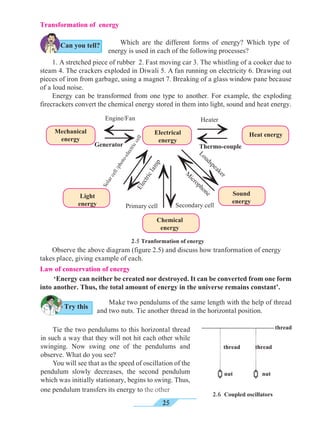
Observe the above diagram (figure 2.5) and discuss how tranformation of energy
takes place, giving example of each.
Law of conservation of energy
‘Energy can neither be created nor destroyed. It can be converted from one form
into another. Thus, the total amount of energy in the universe remains constant’.
Which are the different forms of energy? Which type of
energy is used in each of the following processes?
2.5 Tranformation of energy
1.	A stretched piece of rubber 2. Fast moving car 3. The whistling of a cooker due to
steam 4. The crackers exploded in Diwali 5. A fan running on electricity 6. Drawing out
pieces of iron from garbage, using a magnet 7. Breaking of a glass window pane because
of a loud noise.
Energy can be transformed from one type to another. For example, the exploding
firecrackers convert the chemical energy stored in them into light, sound and heat energy.
Transformation of energy
Engine/Fan
Generator
Heater
Thermo-couple
LoudspeakerM
icrophone
Secondary cellPrimary cell
Solarcell/photo-electriccellElectriclamp
Electrical
energy
Mechanical
energy
Heat energy
Light
energy
Chemical
energy
Sound
energy
®®®
®®
® ®®
®
®
thread
thread
nut
thread
nut
2.6 Coupled oscillators
Try this
Can you tell?
26
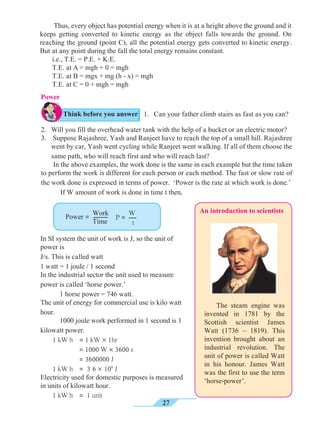
Free fall
If we release an object from a height, it gets pulled towards the earth because of the
gravitational force. An object falling solely under the influence of gravitational force is
said to be in free fall or to be falling freely. Let us look at the kinetic and potential energies
of an object of mass m, falling freely from height h, when the object is at different
heights
As shown in the figure, the point A is at a height h
from the ground. Let the point B be at a distance x,
vertically below A. Let the point C be on the ground
directly below A and B. Let us calculate the energies of
the object at A, B and C.
1. When the object is stationary at A, its initial velocity
is u = 0
 K E = mass x velocity2
	 = mu2
	 K E = 0
P E = mgh
 Total energy = K E + P E
	 = 0 + mgh
Total Energy = mgh --- (1)
2 Let the velocity of the object be vB
when
it reaches point B, having fallen through a
distance x
u = 0, s = x, a = g
v2
= u2
+ 2as
vB
2
= 0 + 2gx
vB
2
= 2gx
 K E = mvB
2
= m(2gx)
K E = mgx
Height of the object when at B = h-x
 P E = mg (h-x)
P E = mgh - mgx
 Total Energy T E = K E + P E
	 = mgx + mgh - mgx
 T E = mgh -------(2)
3. Let the velocity of the object be vC
when
it reaches the ground, near point C.
u = 0, s = h, a = g
v2
= u2
+ 2as
vc
2
= 0 + 2gh
 K E = mvC
2
= m(2gh)
	 K E = mgh
The height of the object from the
ground at point C is
h = 0
 P E = mgh = 0
 T E = K E + P E
T E = mgh ------(3)
From equations (1), (2) and (3) we see
that the total energy of the object is the
same at the three points A, B and C.
1
2
2.7 Free fall
A
x
h
h - x
B
C
1
2
1
2
1
2
1
2
1
2
27
In SI system the unit of work is J, so the unit of
power is
J/s. This is called watt
1 watt = 1 joule / 1 second
In the industrial sector the unit used to measure
power is called ‘horse power.’
	 1 horse power = 746 watt.
The unit of energy for commercial use is kilo watt
hour.
	 1000 joule work performed in 1 second is 1
kilowatt power.
1 kW h 	 = 1 kW ´ 1hr
		 = 1000 W ´ 3600 s
		 = 3600000 J
1 kW h	 = 3 6 ´ 106
J
Electricity used for domestic purposes is measured
in units of kilowatt hour.
1 kW h	 = 1 unit
The steam engine was
invented in 1781 by the
Scottish scientist James
Watt (1736 – 1819). This
invention brought about an
industrial revolution. The
unit of power is called Watt
in his honour. James Watt
was the first to use the term
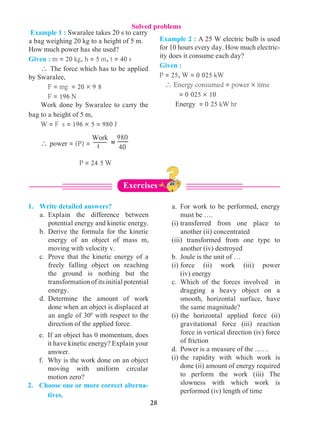
‘horse-power’.
Power
Thus, every object has potential energy when it is at a height above the ground and it
keeps getting converted to kinetic energy as the object falls towards the ground. On
reaching the ground (point C), all the potential energy gets converted to kinetic energy.
But at any point during the fall the total energy remains constant.
i.e., T.E. = P.E. + K.E.
T.E. at A = mgh + 0 = mgh
T.E. at B = mgx + mg (h - x) = mgh
T.E. at C = 0 + mgh = mgh
An introduction to scientists
1.	 Can your father climb stairs as fast as you can?
2.	 Will you fill the overhead water tank with the help of a bucket or an electric motor?
3.	 Suppose Rajashree, Yash and Ranjeet have to reach the top of a small hill. Rajashree
went by car, Yash went cycling while Ranjeet went walking. If all of them choose the
same path, who will reach first and who will reach last?
In the above examples, the work done is the same in each example but the time taken
to perform the work is different for each person or each method. The fast or slow rate of
the work done is expressed in terms of power. ‘Power is the rate at which work is done.’
	 If W amount of work is done in time t then,
Think before you answer
P =
W
t
Work
Time
Power =
28
1.	 Write detailed answers?	
a.	 Explain the difference between
potential energy and kinetic energy.	
b.	 Derive the formula for the kinetic
energy of an object of mass m,
moving with velocity v.	
c.	 Prove that the kinetic energy of a
freely falling object on reaching
the ground is nothing but the
transformation of its initial potential
energy.	
d.	 Determine the amount of work
done when an object is displaced at
an angle of 300
with respect to the
direction of the applied force.	
e.	 If an object has 0 momentum, does
it have kinetic energy? Explain your
answer.	
f.	 Why is the work done on an object
moving with uniform circular
motion zero?
2. 	Choose one or more correct alterna-
tives.		
a.	 For work to be performed, energy
must be …. 	
(i)	transferred from one place to
another (ii) concentrated	
(iii) transformed from one type to
another (iv) destroyed	
b.	 Joule is the unit of …	
(i)	force (ii) work (iii) power
(iv) energy	
c.	 Which of the forces involved in
dragging a heavy object on a
smooth, horizontal surface, have
the same magnitude?	
(i)	the horizontal applied force (ii)
gravitational force (iii) reaction
force in vertical direction (iv) force
of friction	
d.	 Power is a measure of the ...….	
(i)	the rapidity with which work is
done (ii) amount of energy required
to perform the work (iii) The
slowness with which work is
performed (iv) length of time
Example 2 : A 25 W electric bulb is used
for 10 hours every day. How much electric-
ity does it consume each day?
Given :
P = 25, W = 0 025 kW
 Energy consumed = power ´ time			
= 0 025 ´ 10
Energy = 0 25 kW hr
Example 1 : Swaralee takes 20 s to carry
a bag weighing 20 kg to a height of 5 m.
How much power has she used?
Given : m = 20 kg, h = 5 m, t = 40 s
 The force which has to be applied
by Swaralee, 	
F = mg = 20 ´ 9 8	
F = 196 N
Work done by Swaralee to carry the
bag to a height of 5 m,
W = F s = 196 ´ 5 = 980 J
 power = (P) = 			
P = 24 5 W
Work
t
980
40
=
Solved problems
Exercises
29
	 e.	 While dragging or lifting an object,
negative work is done by
		 (i)theappliedforce(ii)gravitational
force (iii) frictional force
(iv) reaction force
3.	Rewrite the following sentences
using proper alternative.
	 a.	 The potential energy of your body is
least when you are …..
		 (i) sitting on a chair (ii) sitting on
the ground (iii) sleeping on the
ground (iv) standing on the ground
	 b. The total energy of an object falling
freely towards the ground …
		 (i)decreases (ii)remainsunchanged
(iii) increases (iv) increases in the
beginning and then decreases
	 c.	 If we increase the velocity of a car
moving on a flat surface to four
times its original speed, its potential
energy ….
	 	 (i) will be twice its original energy
(ii) will not change (iii) will be 4
times its original energy (iv) will be
16 times its original energy.
	 d.	The work done on an object does
not depend on ….
		 (i)	 displacement (ii) applied
force (iii) initial velocity of the
object (iv) the angle between force
and displacement.
4.	Study the following activity and
answer the questions.
	1. Take two aluminium channels of
different lengths.
	 2. 	Place the lower ends of the channels
on the floor and hold their upper
ends at the same height.
	 3.	 Now take two balls of the same size
and weight and release them from
the top end of the channels. They
will roll down and cover the same
distance.
Questions
	 1. At the moment of releasing the
balls, which energy do the balls
have?
	 2. As the balls roll down which energy
is converted into which other form
of energy?
	 3.	Why do the balls cover the same
distance on rolling down?
	 4.	What is the form of the eventual
total energy of the balls?
	 5. Which law related to energy does
the above activity demonstrate ?
Explain.
5.	 Solve the following examples.
	 a. An electric pump has 2 kW power.
How much water will the pump lift
every minute to a height of 10 m?
(Ans : 1224.5 kg)
	 b. If a 1200 W electric iron is used
daily for 30 minutes, how much
total electricity is consumed in the
month of April? (Ans :18 Unit)
	 c.	 If the energy of a ball falling from a
height of 10 metres is reduced by
40%, how high will it rebound?	
				 (Ans : 6 m)
	 d. 	The velocity of a car increase from
54 km/hr to 72 km/hr. How much is
the work done if the mass of the car
is 1500 kg ?
				 (Ans. : 131250 J)
	 e. 	Ravi applied a force of 10 N and
moved a book 30 cm in the direction
of the force. How much was the
work done by Ravi?
(Ans: 3 J)
Project :
		 Study the various instances of
trasnformation of energy you see
around you and discuss them in
class.
²²²
30
	 Electricity is of utmost importance in the modern world. We depend on it for almost
everything in our day to day life. In order to avoid the inconvenience faced due to failure
of power supply, hospitals, banks, offices and private institutions make alternative
arrangements with the help of generators. Electricity is used for running electric furnaces,
electric motors and several other instruments used in industries.
	 Domestic appliances like the fridge, electric oven, mixer, fans, washing machines,
vacuum cleaner, rotimaker, etc. have helped us by saving time and labour. All these
devices cannot be run without electricity.
	 Not only human beings but some animals also use electricity. For example, fishes
such as eels use electricity to catch their prey and also for self-defence. The lightning that
strikes the earth is an excellent example of natural flow of electricity. What if we could
collect and store this electricity!
You must have seen a waterfall. Which way does the water
flow?
	 For the generation of electricity, water is released from a dam at a higher level and
because of gravity, it falls to a lower level. Thus, as we know, the direction of flow of
water between two points depends on the level of the two points.
Try this
Potential and potential difference
Equipment : Two plastic bottles, rubber tube, clamp, water.
Procedure : Set up the experiment as shown in figure 3.1. Then
remove the clamp from the rubber tube. Note your observations.
Answer the following questions.
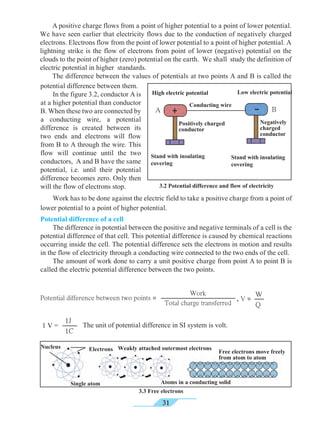
3.1 Level of water and direction of flow
1. 	What happens when the clamp is
removed?
2. 	Does the water stop flowing? Why?
3. 	 What will you do to keep the water
flowing for a longer duration?
	 Just like water, the flow of electric
charge between two points depends on
a kind of electric level at those points.
This level is called electric potential.
Can you recall?
All around us
Ø Potential and potential difference	 Ø Conductors and insulators
(bad conductors) Ø Electrical resistance and Ohm’s Law
	 Ø Connection of resistors and effective resistance
Clamp
3. Current Electricity
31
	 Work has to be done against the electric field to take a positive charge from a point of
lower potential to a point of higher potential.
Potential difference of a cell
	 The difference in potential between the positive and negative terminals of a cell is the
potential difference of that cell. This potential difference is caused by chemical reactions
occurring inside the cell. The potential difference sets the electrons in motion and results
in the flow of electricity through a conducting wire connected to the two ends of the cell.
	 The amount of work done to carry a unit positive charge from point A to point B is
called the electric potential difference between the two points.
Potential difference between two points =
	 A positive charge flows from a point of higher potential to a point of lower potential.
We have seen earlier that electricity flows due to the conduction of negatively charged
electrons. Electrons flow from the point of lower potential to a point of higher potential. A
lightning strike is the flow of electrons from point of lower (negative) potential on the
clouds to the point of higher (zero) potential on the earth. We shall study the definition of
electric potential in higher standards.
	 The difference between the values of potentials at two points A and B is called the
potential difference between them.
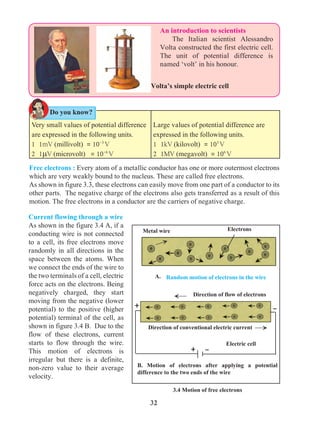
	 In the figure 3.2, conductor A is
at a higher potential than conductor
B. When these two are connected by
a conducting wire, a potential
difference is created between its
two ends and electrons will flow
from B to A through the wire. This
flow will continue until the two
conductors, A and B have the same
potential, i.e. until their potential
difference becomes zero. Only then
will the flow of electrons stop.
3.3 Free electrons
Electrons Weakly attached outermost electrons
Free electrons move freely
from atom to atom
Single atom Atoms in a conducting solid
Nucleus
3.2 Potential difference and flow of electricity
High electric potential Low electric potential
Stand with insulating
covering
Stand with insulating
covering
A B
Positively charged
conductor
Conducting wire
Negatively
charged
conductor
1J
1C
Ê Ê
ÊÊ
W
Q
, V =
Work
Total charge transferred
The unit of potential difference in SI system is volt.1 V =
32
Very small values of potential difference
are expressed in the following units.
1 1mV (millivolt) = 10-3
V
2 1mV (microvolt) = 10-6
V
Large values of potential difference are
expressed in the following units.
1 1kV (kilovolt) = 103
V
2 1MV (megavolt) = 106
V
Free electrons : Every atom of a metallic conductor has one or more outermost electrons
which are very weakly bound to the nucleus. These are called free electrons.
As shown in figure 3.3, these electrons can easily move from one part of a conductor to its
other parts. The negative charge of the electrons also gets transferred as a result of this
motion. The free electrons in a conductor are the carriers of negative charge.
Volta’s simple electric cell
An introduction to scientists
	 The Italian scientist Alessandro
Volta constructed the first electric cell.
The unit of potential difference is
named ‘volt’ in his honour.
3.4 Motion of free electrons
Current flowing through a wire
As shown in the figure 3.4 A, if a
conducting wire is not connected
to a cell, its free electrons move
randomly in all directions in the
space between the atoms. When
we connect the ends of the wire to
the two terminals of a cell, electric
force acts on the electrons. Being
negatively charged, they start
moving from the negative (lower
potential) to the positive (higher
potential) terminal of the cell, as
shown in figure 3.4 B. Due to the
flow of these electrons, current
starts to flow through the wire.
This motion of electrons is
irregular but there is a definite,
non-zero value to their average
velocity.
Random motion of electrons in the wire
Electric cell
ElectronsMetal wire
Direction of flow of electrons®
Direction of conventional electric current ®
+
+
-
-
Do you know?
A.
B. Motion of electrons after applying a potential
difference to the two ends of the wire
®
33
Even though, electrons
move from negative end to
positive end, conventionally, the
direction of current flow is taken
to be opposite of the direction of
flow of electrons i.e. from the
+ve end to the –ve end of a cell.
Electric current	
An electric current is the flow of electrons through
a conductor. Quantitatively, current (I) is defined as
the charge passing through a conductor in unit time. 	
If charge Q is flowing through cross-section of a
conductor in time t then the
Very small values of current are expressed in the
following units.
1. 1mA (mili ampere ) = 10-3
A
2. 1mA (micro ampere) = 10-6
A	
The French mathematician and scientist, Ampere,
conducted a number of experiments on electricity. Today,
we can measure the current flowing in a conductor only
because of his extraordinary work. The unit of current is
called ampere in recognition of his great work.
Example : Acurrent of 0.4 Aflows through
a conductor for 5 minutes. How much
charge would have passed through the con-
ductor?
Given : I = 0 4 A
t = 5 min = 5 ´ 60 s =300 s
Formula 	 Q = I ´ t	
Q = 0 4 A ´ 300 s	
Q = 120 C
 Charge passing through the conductor
= 120 C
1C
1s
1A =
current = I =
Q
t
Do you know?
	
The unit of charge in SI units is Coulomb (C). Current is expressed in Ampere (A).
The charge of one electron is 1.6 x10⁻¹⁹
C.
Ampere : One ampere current is said to flow in a conductor if one Coulomb charge flows
through it every second.
34
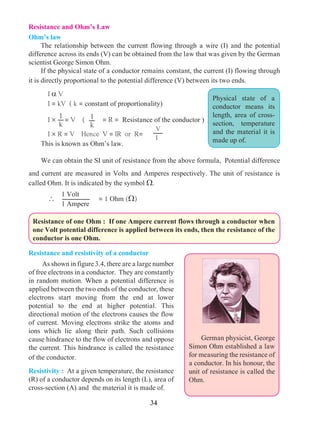
Resistance and Ohm’s Law
Ohm’s law
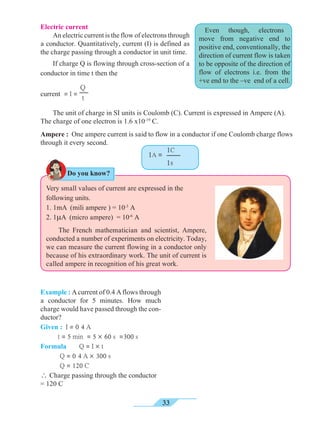
	 The relationship between the current flowing through a wire (I) and the potential
difference across its ends (V) can be obtained from the law that was given by the German
scientist George Simon Ohm.
	 If the physical state of a conductor remains constant, the current (I) flowing through
it is directly proportional to the potential difference (V) between its two ends.
	I a V
	 I = kV ( k = constant of proportionality)
	I ´ = V ( = R = Resistance of the conductor )
	I ´ R = V Hence V = IR or R=
	 This is known as Ohm’s law.
	 We can obtain the SI unit of resistance from the above formula, Potential difference
and current are measured in Volts and Amperes respectively. The unit of resistance is
called Ohm. It is indicated by the symbol W.
	 	 = 1 Ohm (W)
Physical state of a
conductor means its
length, area of cross-
section, temperature
and the material it is
made up of.
1
k
1
k
Resistance and resistivity of a conductor
	As shown in figure 3.4, there are a large number
of free electrons in a conductor. They are constantly
in random motion. When a potential difference is
applied between the two ends of the conductor, these
electrons start moving from the end at lower
potential to the end at higher potential. This
directional motion of the electrons causes the flow
of current. Moving electrons strike the atoms and
ions which lie along their path. Such collisions
cause hindrance to the flow of electrons and oppose
the current. This hindrance is called the resistance
of the conductor.
Resistivity : At a given temperature, the resistance
(R) of a conductor depends on its length (L), area of
cross-section (A) and the material it is made of.
	 German physicist, George
Simon Ohm established a law
for measuring the resistance of
a conductor. In his honour, the
unit of resistance is called the
Ohm.
V
I
Resistance of one Ohm : If one Ampere current flows through a conductor when
one Volt potential difference is applied between its ends, then the resistance of the
conductor is one Ohm.
1 Volt
1 Ampere
35
	 If the resistance of a
conductor is R, then
	 R a L
Also,	R a
1
A
	R a
L
A
	 R = r
L
A 	
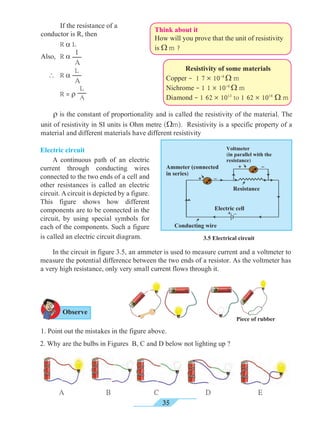
Electric circuit
	 A continuous path of an electric
current through conducting wires
connected to the two ends of a cell and
other resistances is called an electric
circuit. Acircuit is depicted by a figure.
This figure shows how different
components are to be connected in the
circuit, by using special symbols for
each of the components. Such a figure
is called an electric circuit diagram.
1. Point out the mistakes in the figure above.
A	 B	 	 C		 D		 E
2. Why are the bulbs in Figures B, C and D below not lighting up ?
	 In the circuit in figure 3.5, an ammeter is used to measure current and a voltmeter to
measure the potential difference between the two ends of a resistor. As the voltmeter has
a very high resistance, only very small current flows through it.
Think about it
How will you prove that the unit of resistivity
is W m ?
Piece of rubber
	 ρ is the constant of proportionality and is called the resistivity of the material. The
unit of resistivity in SI units is Ohm metre (Wm). Resistivity is a specific property of a
material and different materials have different resistivity
	 Resistivity of some materials
Copper - 1 7 ´ 10-8
W m
Nichrome - 1 1 ´ 10-6
W m
Diamond - 1 62 ´ 1013
to 1 62 ´ 1018
W m
3.5 Electrical circuit
Electric cell
Conducting wire
Ammeter (connected
in series)
Voltmeter
(in parallel with the
resistance)
Resistance
Observe
36
Material: copper and aluminium
wires, glass rod, rubber
Method : Make connections as shown in figure 3.6.
First connect a copper wire between points A and B and
measure the current in the circuit. Then, in place of the
copper wire, connect aluminium wire, glass rod, rubber,
etc, one at a time and measure the current each time.
Compare the values of the current in different cases.
Try this
Symbols for components of an electric circuit and their uses
Component Picture Symbol Use
Electric cell To apply a potential
difference between two
ends of a conductor
Battery (collection
of a number of
cells)
To apply a larger potential
difference between two
ends of a conductor
Open tap key or
plug key
To stop the flow of current
flowing in a circuit by
disconnecting two ends of
a wire
Closed tap key or
plug key
To start the flow of current
in a circuit by connecting
two ends of a wires.
Connecting
(conducting) wires
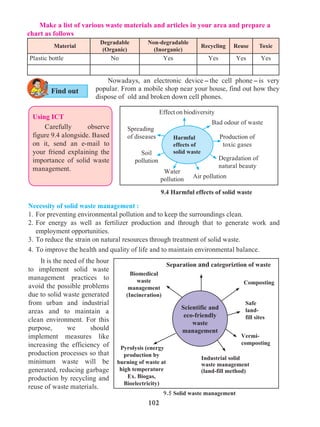
To connect various
components in the circuit.
Crossing wires To show wires which cross
but are not connected
Light bulb To test the flow of electri-
city : Lighted : current is
flowing; unlighted :
current is not flowing
Resistance To control the flow of
current in the circuit
Variable resistance To change the resistance
as required and thereby
control the current
Ammeter To measure the current
flowing in the circuit
Voltmeter To measure the potential
difference between two
points in the circuit
+ -
+ -
( )
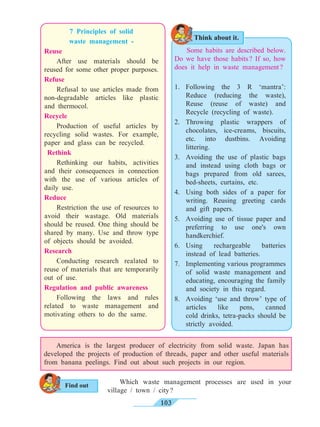
( ).
3.6 Electric Circuit
37
Experimental proof of Ohm’s law :
Material : 4 cells of 1.5 V each, ammeter, voltmeter, conducting
wires, nichrome wire, plug key.
Procedure : 	
1.	 Set up the circuit as shown in figure 3.7.
2.	Use the nichrome wire XY as the
resistance.
3.	 Connect one of the 4 cells as shown in
figure3.7(a.) Takereadingsofammeter
and voltmeter and enter them in the
table below.
4.	 Now add the rest of the cells one by one
as shown in figures 3.7 (b, c and d).
Enter the readings in the table for each
case.
5.	 Determine the values of for each
case.
6.	Draw a graph between current and
potential difference and study it.
No. Number of
cells used
Current (I)
(mA)
Current (I)
(A)
Potential
difference
(Volts)
V / I = R in (Ω)
1
2
3
4
Conductors and insulators
	 We have learnt about the resistance to an electric current. We can divide substances
into conductors and insulators (bad conductors).
Conductors : Those substances which have very low resistance are called conductors.
Current can flow easily through such materials.
Insulators : Those substances which have extremely high resistance and through which
current cannot flow are called insulators.
1. Why are some substances conductors while others are insulators?
2. Why can our body conduct electricity?
Make a list of conductors and insulators you see around you.
3.7 Verification of Ohm’s Law
Observation chart
Try this
V
I
X Y
R
K
a b c d
38
Solved examples : Ohm’s law and resistivity
Example 4 : Determine the current that
will flow when a potential difference of
33 V is applied between two ends of an
appliance having a resistance of 110 W. If
the same current is to flow through an
appliance having a resistance of 500 W,
how much potential difference should be
applied across its two ends?
Given : V = 33 V and R = 110 W
In the first case,
	 	 I =
V
R =
	  I = 0 3 A
Current flowing through the appliance
= 0.3 A
In the second case,
	 I = 0 3 A, R = 500 W
	 V = IR = 0 3 ´ 500 V = 150 V
The required potential difference between
its two ends = 150 V
Example 3 : A current of 0.24 A flows
through a conductor when a potential
difference of 24 V is applied between its
two ends. What is its resistance?
Given : V = 24 V, I = 0 24 A
Formula	 R =
V
I
 I =
24 V
0.24 A
	 R = 100 W
The resistance of the conductor is
100 W
Example 1 : The resistance of the filament
in a light bulb is 1000 W. If the bulb is fed
by a current from a source of potential
difference 230 V, how much current will
flow through it?
Given : R = 1000 W
		 V = 230 V
Formula 	 I =
V
R 	
 I =
230 V
1000 W
= 0 23 A
 The current flowing through the filament
of the bulb = 0.23 A.
Example 2 : The length of a conducting
wire is 50 cm and its radius is 0.5 mm. If its
resistance is 30 W, what is the resistivity of
its material?
Given : L = 50 cm = 50 ´ 10-2
m
	 r = 0 5 mm = 0 5 ´ 10-3
m
= 5 ´ 10-4
m and R = 30 W
	 Resistivity r = RA
L	 and A = pr2
	  r = R
pr2
L
=
30 ´ 3.14 ´ (5 ´ 10-4
)2
50 ´ 10-2
=
30 ´ 3.14 ´ 25 ´ 10-8
50 ´ 10-2
= 47 1 ´ 10-6
W m
= 4 71 ´ 10-5
W m
 Resistivity of the wire 4.71 ´ 10-5
W m
Using ICT
Using the internet find out about the different softwares used to solve mathematical
problems and use them to solve problems given in this and other chapters.
33
110
39
Example 5 : Determine the resistance of a copper wire having a length of 1 km and
diameter of 0.5 mm
Given : r = Resistivity of copper = 1 7 ´ 10-8
W m
	 Converting all measures into metres.
	 L = 1 km = 1000 m = 103
m
	 d = 0 5 mm = 0 5 ´ 10-3
m
	 If r is the radius of the wire then, its area of cross-section
	 A = pr2
	 	 =
p
4
(0 5 ´ 10-3
)2
m2
= 0 2 ´ 10-6
m2
	 R = r
L
A =
1.7 ´ 10-8
W m ´ (103
m)
0.2 ´ 10-6
m2
= 85W
System of resistors and effective resistance
	 A resistor is a two ended component having a given amount of resistance between its
two ends. In several electrical devices, a number of resistors are connected together in
different ways. Ohm’s law is applicable to all such connected resistors.
Resistors in series
	 Study figure 3.8.
	 You can see that the ends of the three
resistors are connected so that they follow
one after the other in a single line. These
resistors are said to be connected in ‘series.’
In such an arrangement, the same current
flows through each resistor. The value of
current is I and the potential difference
between C and D is V.
The three resistors, R1
, R2
and R3
are
connected in series in the circuit. Let the
voltages across them be V1
, V2
and V3
respectively. Then,
	 V = V1
+ V2
+ V3
--------(1)
If RS
(S for series) is the effective resistance
between C and D, then, according to Ohm’s
law,
	 V = I RS
V1
=IR1
,V2
=IR2
andV3
=IR3
Substituting
all these in equation (1) we get,
	 I RS
= I R1
+ I R2
+ I R3
	RS
= R1
+ R2
+ R3
If n resistors are connected in series then,
Rs
= R1
+ R2
+ R3
+-------+ Rn
d
2
2
 A = p ´
3.8 Resistors in series
K E
R3
R2
R1
C D
40
	 When resistors are connected in
series, they are connected one after
another. If any one of them does not
function, the circuit breaks and there is
no flow of electricity. If two bulbs are
connected in series, they will both give
less light than if they had been
connected individually. If three bulbs
are connected in series, their light
output will decrease further.
Think about it : What is the reason
behind this?
If resistors are connected in series,
1.	 The same current flows through each
resistor.
2. 	The effective resistance of the
resistors is equal to the sum of their
individual resistances.
3. The potential difference between the
two extremes of the arrangement is
equal to the sum of the potential
differences across individual
resistors.
4. 	 The effective resistance is larger than
each of the individual resistances.
5. 	This arrangement is used to increase
the resistance in a circuit.
Solved examples for resistors in series
Example 1 : Three resistors having resistances of 15 W, 3 W and 4 W are connected in
series. What is the effective resistance in the circuit?
Given : R1
= 15 W, R2
= 3 W, R3
= 4 W
Effective resistance	Rs
= R1
+ R2
+ R3
= 15 + 3 + 4 = 22 W
	  The effective resistance in the circuit = 22 W
Example 2 : Two resistors having resistances of 16 W and 14 W are connected in series.
If a potential difference of 18 V is applied across them, calculate the current flowing
through the circuit and the potential difference across each individual resistor.
Given : R1
= 16 W and R2
= 14 W
	
Rs
= 14 W + 16 W = 30 W
Let the current flowing through the circuit be I and the potential differences across 16 W
and 14 W be V1
and V2
respectively.
	 V = I R V = V1
+ V2
= 18 V
	 I =
V
R =
18 V
30 W
	  I = 0 6 A
	 V1
= I R1
	
V1
= 0 6 ´ 16 = 9 6 V
	 V2
= I R2
= 0 6 ´ 14 = 8 4 V
 The current flowing in the circuit is 0.6 A and the potential differences across the
resistances 16 W and 14 W are 9.6 V and 8.4 V respectively.
Do you know?
41
	 The resistance of some conductors becomes nearly zero if their temperature is
decreaseduptoacertainvaluecloseto0K.Suchconductorsarecalledsuperconductors.
	 Some conductors do not obey Ohm’s law. Such conductors are called non-ohmic
conductors.
Resistors in parallel
	 Resistors are said to be connected in
parallel when their ends are connected at
both sides as shown in figure 3.9. The
figure shows three resistors R1
, R2
and R3
connected in parallel between points C and
D. V is the potential difference between C
and D. Let I1
, I2
and I3
be the currents
flowing through R1
,R2
,andR3
respectively.
	 Then, the total current flowing
through the circuit is
	 I = I1
+ I2
+ I3
-------(1)
	 Let Rp
(p for parallel) be the effective resistance between C and D. According to
Ohm’s law,
	 I =
V
RP
Similarly I1
=
V
R1
, I2
=
V
R2
, I3
=
V
R3
	 Substituting these in equation (1)
	
V
RP
=
V
R1
+ +

1
RP
=
1
R1
+ +
If n resistors are connected in parallel,
	
1
RP
=
1
R1
+
1
R2
+
1
R3
+ +
1
Rn
	 Even if any one of the several bulbs connected in parallel becomes non-functional
because of some damage to its filament, the circuit does not break as the current flows
through the other paths, and the rest of the bulbs light up.
	 When several bulbs are connected in parallel, they emit the same amount of light
as when they are connected individually in the circuit, while bulbs connected in series
emit less light than when connected individually.
3.9 Resistors in parallel
K E
R2
R3
R1 DC
Do you know?
V
R2
V
R3
1
R3
1
R2
42
Solved examples of resistors in parallel
Example 1: Resistors having resistances of 15 W, 20 W and 10 W are connected in
parallel. What is the effective resistance in the circuit?
Given : R1
= 15 W, R2
= 20 W and R3
= 10 W
 Effective resistance in the circuit = 4 615 W, less than the least of the three, 10 W.
Example 2 : Three resistors having resistances of 5 W, 10 W and 30 W are connected in
parallel and a potential difference of 12 V is applied across them. Obtain the current
flowing through the circuit and through individual resistors. What is the effective resistance
in the circuit?
Given : R1
= 5 W, R2
= 10 W and R3
= 30 W, V = 12 V
	 I1
=
V
R1
=
12
5
= 2 4 A
	I2
=
V
R2
=
12
10
= 1 2 A
	I3
=
V
R3
=
12
30
= 0 4 A
	 I = I1
+ I2
+ I3
= 2 4+ 1 2 + 0 4 = 4 0 A
= =
10
30
1
3
6 +3 + 1
30
	
1
RP
1
R1
+
1
R2
+
1
R3
== 1
5
1
10
1
30
+ + =
If a number of resistors are connected in parallel,
1. The inverse of the effective resistance is equal to the sum of the inverses of individual
resistances.
2.	The current flowing through an individual resistor is proportional to the inverse of its
resistance and the total current flowing through the circuit is the sum of the currents
flowing through individual resistors.
3.	The potential difference across all resistors is the same.
4.	The effective resistance of resistors connected in parallel is less than the least
resistance of individual resistors.
5.	This arrangement is used to reduce the resistance in a circuit.
Effective resistance in the circuit = 3 W and the current flowing through the resistances 5
W, 10 W and 30 W is 2.4 A, 1.2 Aand 0.4 A respectively. The total current flowing through
the circuit is 4 A.
	
1
RP
=
1
R1
+
1
R2
+
1
R3
	
1
RP
=
1
15
+
1
20
+
1
10
4 + 3 + 6
60
13
60
= =
60
13
RP
= = 4 615 W
43
Domestic electrical connections
	 The electricity in our homes is brought through the main conducting cable either
from the electric pole or from underground cables. Usually, there are three wires in the
cable. One is called the live wire which brings in the current. It has a red or brown
insulation. The other wire is called neutral wire through which the current returns. It is
blue or black. In India, the voltage difference between the live and neutral wires is
about 220V. Both these wires are connected to the electric meter through a fuse. Through
a main switch, they are connected to all the conducting wires inside the home so as to
provide electricity to every room. In each separate circuit, various electrical appliances
are connected between the live and neutral wires. The different appliances are connected
in parallel and the potential difference across every appliance is the same. The third
wire is called the earth wire and is of yellow or green colour. This is connected to a
metal plate buried deep underground near the house and is for safety purposes.
Precautions to be taken while using electricity
1. 	Electric switches and sockets should be fitted at a height at which small children
cannot reach and put pins or nails inside. Plug wires should not be pulled while
removing a plug from its socket.
2. 	Before cleaning an electrical appliance it should be switched off and its plug
removed from the socket.
3. 	One’s hands should be dry while handling an electrical appliance, and, as far as
possible, one should use footwear with rubber soles. As rubber is an insulator, it
prevents the current from flowing through our body, thereby protecting it.
4. 	If a person gets an electric shock, you should not touch that person. You should
switch off the main switch and if the switch is too far or you do not know where it
is located, then you should remove the plug from the socket if possible. If not, then
you should use a wooden pole to push the person away from the electric wire.
Fuse wire : Fuse wire is used to protect domestic
appliances. It is made of a mixture of substances and
has a specific melting point. It is connected in series to
the electric appliances. If for some reason, the current in
the circuit increases excessively, the fuse wire gets
heated up and melts. The circuit gets broken and the
flow of current stops, thus protecting the appliance. This
wire is fitted in a groove in a body of porcelain - like
non-conducting material. For domestic use, fuse wires
with upper limits of 1 A, 2 A, 3 A, 4 A, 5 A and 10 A are
used.
Cartridge fuse
Ceramic fuse
44
1.	The accompanying figure shows
some electrical appliances connected
in a circuit in a house. Answer the
following questions.
	 A. 	By which method are the appliances
connected?
	 B.	What must be the potential
difference across individual
appliances?
	 C. 	Will the current passing through
each appliance be the same? Justify
your answer.
	 D.	Why are the domestic appliances
connected in this way?
	 E.	 If the T.V. stops working, will the
other appliances also stop working?
Explain your answer.
2.Thefollowingfigureshowsthesymbols
for components used in the
accompanying electrical circuit.
Place them at proper places and
complete the circuit.	
	 Which law can you prove with the help
of the above circuit?
3.	 Umesh has two bulbs having
resistances of 15 W and 30 W. He
wants to connect them in a circuit,
but if he connects them one at a time
the filament gets burnt. Answer the
following. 	
	 A.	Which method should he use to
connect the bulbs?
	 B. 	What are the characteristics of this
way of connecting the bulbs
depending on the answer of A
above?
4. The following table shows current in
Amperes and potential difference in
Volts.
	 a. 	Find the average resistance.
	 b. 	What will be the nature of the graph
between the current and potential
difference? (Do not draw a graph.)
	 c. 	Which law will the graph prove?
Explain the law.
V (Volts) I (Amp)
4 9
5 11.25
6 13.5
5.	 Match the pairs
	 ‘A’ Group	 ‘B’ Group
	 1. Free electrons 	 a. V/ R
	 2. Current 	 b. Increases the 		
		 resistance in the 		
		 circuit
	 3. Resistivity	 c. Weakly attached
	 4. Resistances in 	 d. VA/LI
		series	
Exercises
	 C. 	What will be the effective resistance
in the above circuit?
45
6.	 The resistance of a conductor of
length x is r. If its area of cross-
section is a, what is its resistivity?
What is its unit?
9.	 Solve the following problems.
	 A. 	The resistance of a 1m long
nichrome wire is 6 W. If we reduce
the length of the wire to 70 cm.
what will its resistance be? 	
(Answer : 4.2 W)
	 B. 	When two resistors are connected
in series, their effective resistance
is 80 W. When they are connected
in parallel, their effective resistance
is 20 W. What are the values of the
two resistances? 	 			
	 (Answer : 40 W , 40 W)
	 C. 	If a charge of 420 C flows through
a conducting wire in 5 minutes
what is the value of the current?
	 (Answer : 1.4 A)
Project :
		Ask an electrician to explain to you
the electrical wiring in your house
and other related important points.
Take care to understand them well,
and explain them to others also.
²²²
7. 	 Resistances R1
, R2
, R3
and R4
are
connected as shown in the figure. S1
and S2 are two keys. Discuss the
current flowing in the circuit in the
following cases.


	 a. Both S1
and S2
are closed
	 b. Both S1
and S2
are open
	 c. S1
is closed but S2
is open.
8.	 Three resistances x1
, x2
and x3
are
connected in a circuit in different
ways. x is the effective resistance.
The properties observed for these
different ways of connecting x1
, x2
and x3
are given below. Write the
way in which they are connected in
each case. (I-current, V-potential
difference, x-effective resistance)
	 a Current I flows through x1
, x2
and x3
	 b x is larger than x1
, x2
and x3
	 c x is smaller than x1
, x2
and x3
	 d The potential difference across x1
, x2
and x3
is the same
e x = x1
+ x2
+ x3
f 	x =
1 1 1
x1
x2
x3
+ +
1
R1
R2
B
C F
S2
S1
E
D
+ -
H
G
R4
R3
IA
46
1. 	 What is the Dalton’s atomic theory ?
2. 	 How are the compounds formed ?
3. 	 What are the molecular formulae of salt, slaked lime,
water, lime, limestone ?
	 In the previous standard we have learnt that compounds are formed by chemical
combination of elements. We have also learnt that an important principle of Dalton’s
atomic theory is that molecules of a compound are formed by joining atoms of different
elements.
	 The composition of a substance changes during a chemical change. The fundamental
experiments is this regard were performed by scientists in the 18th
and 19th
century. While
doing this, they measured accurately, the substances used and formed. The scientists
Dalton, Thomson and Rutherford studied the structure of substances and the atom and thus
discovered the laws of chemical combination. Scientists could then write the molecular
formulae of various compounds on the basis of Dalton’s atomic theory and the laws of
chemical combination. Here we shall verify the laws of chemical combination by means
of known molecular formulae.
Activity 1
—	Take 56 g calcium oxide in a large
conical flask and put 18 g water in it.
—	 Observe what happens.
—	Measure the mass of the substance
formed.
—	What similarity do you find? Write
your inference.
Activity 2
—	Take a solution of calcium chloride
in a conical flask and a solution of
sodium sulphate in a test tube.
—	Tie a thread to the test tube and insert
it in the conical flask.
—	 Seal the conical flask with an airtight
rubber cork.
—	Weigh the conical flask using a
balance.
—	Now tilt the conical flask so that the
solution in the test tube gets poured in
the conical flask.
— Now weigh the conical flask again.
	
-------------------------
-------------------------
-------------------------
-------------------------
Apparatus ः Conical flask, test tubes, balance, etc.
Chemicals : Calcium chloride (CaCl2
), sodium sulphate (Na2
SO4
),
calcium oxide (CaO), Water (H2
O)
Try this
Can you recall?
Ø Laws of chemical combination Ø Atom - shape, mass, valency
Ø Molecular mass and the concept of mole Ø Radicals
4. Measurement of Matter
Laws of chemical combination
47
4.1 Verification of law of the chemical combination
Law of conservation of matter
	 In the above activities, the mass of the original matter and the mass of the matter
newly formed as a result of the chemical change are equal. In 1785, the French Scientist
Antoine Lavoisier inferred from his research that ‘there is no rise or drop in the weight
of the matter during a chemical reaction.’ In a chemical reaction the total weight of the
reactants is same as the total weight of the products formed due to the chemical reactions
and this is called the law of conservation of matter.
Law of constant proportion
	 In 1794 the French scientist
J. L. Proust stated the law of constant
proportionsas“Theproportionbyweight
of the constituent elements in the various
samples of a compound is fixed,” e.g.,
the proportion by weight of hydrogen
and oxygen in water is 1:8. This means
that 9 g water is formed by chemical
combination of 1 g hydrogen and 8 g
oxygen. Similarly, the proportion by
weight of carbon and oxygen in carbon
dioxide is 3:8. For example, in 44 g of
carbondioxide there is 12 g of carbon
and 32 g oxygen so that the proportion
by weight of carbon and oxygen is 3:8.
	 Antoine Lavoisier (1743-94)
	 French scientist, father of modern
chemistry, substantial contribution in the fields
of chemistry, biology and economics.
•• Nomenclature of oxygen and hydrogen.
•• Showed that matter combines with oxygen
during combustion.
•• Was the first to use accurate weighing
techniques to weigh reactants and products
in a chemical reaction.
•• Discovered that water is made up of
hydrogen and oxygen.
•• Assigned systematic names to the
compounds, e.g. sulphuric acid, sulphate,
sulphite.
•• Author of the first book on modern
chemistry.
•• Studied the elements such as oxygen,
hydrogen, nitrogen, phosphorus, mercury,
zinc and sulphur.
•• First writer of the law of conservation of
mass, in a chemical reaction.
Solution of
Calcium Chloride
(CaCl2
)
Solution of
sodium
sulphate (Na2
SO4
)
White precipitate
of CaSO4
in NaCl
solution.
LavoisierProust
An introduction to scientists
48
Atom : size, mass and valency
1. From which experiments was it discovered that atoms have an
internal structure? When?
2.What are the two parts of an atom? What are they made up of?
	 We have learnt that at the centre of an atom is the nucleus and that there are moving
electrons in the extra-nuclear part. The electrons are negatively charged elementary
particles while the elementary particles that make up the nucleus are positively charged
protons and electrically neutral neutrons. Look at the image of an atom obtained with a
field ion microscope.
Approximate size of atom
Atomic radius (in metres) Example
10-10 Hydrogen atom
10-9 Water molecule
10-8 Haemoglobin
molecule
1
109
m = 1nm
1m = 109
nm.
4.2 Field ion microscope image of
iridium atoms (every spot in this
image is an atom)
Verification of the law of constant proportion
	 Many compounds can be made by different methods. For example, two samples of the
compound copper oxide, CuO, were obtained, one by decomposition of copper carbonate,
CuCO3
, and another by decomposition of copper nitrate, Cu(NO3
)2
. From each of these samples,
a mass of 8g of copper oxide was taken and each was treated independently with hydrogen
gas. Both gave 6.4 g copper and 1.8 g water. Let us see how this is a verification of the law of
constant proportion.
	 The reaction of copper oxide with hydrogen yielded two known substances, namely, the
compound water and the element copper. It is known that, in the compound water, H2
O, the
elements H and O are in the proportion 1:8 by weight. This means that in 9g water there
are 8g of the element oxygen. Therefore, 1.8g water contains (8x1.8/9 = 1.6)g oxygen. This
oxygen has come from 8g copper oxide. It means that 8g of both the samples of copper oxide
contained 6.4g copper and 1.6g oxygen; and the proportion by weight of copper and oxygen
in it is 6.4:1.6, that is, 4:1. Thus, the experiment showed that the proportion by weight of the
constituent elements in different samples of a compound is constant.
	 Now let us see what the expected proportion by weight of the constituent elements of
copper oxide would be from its known molecular formula CuO. To find out this, we need to
use the known atomic masses of the elements. The atomic masses of Cu and O are 63.5 and 16
respectively. This means that the proportion by weight of the constituent elements Cu and O in
the compound CuO is 63.5 : 16 which is 3.968:1, or approximately 4:1.
	 The experimental value of proportion by weight of the constituent elements matched with
the expected proportion calculated from the molecular formula. Thus, the law of constant
proportion is verified.
Can you recall?
	 The size of an atom is determined by its radius. The
atomic radius of an isolated atom is the distance between the
nucleus of an atom and its outermost orbit. Atomic radius is
expressed in nanometres..
49
Atoms are very very tiny.
Modern instruments like
the electron microscope,
field ion microscope,
scanning tunneling micro-
scope have the capacity to
show enlarged images of the
atom.
	 The atomic size depends on the number of electron
orbits in the atom. The greater the number of orbits the
larger the size. For example, an atom of K is bigger than
an atom of Na. If two atoms have the same outermost
orbit, then the atom having the larger number of electrons
in the outermost orbit is smaller than the one having
fewer electrons in the same outermost orbit. For example
an atom of Mg is smaller than an atom of Na.
The mass of an atom
	 The mass of an atom is concentrated in its nucleus and it is due to the protons (p)
and neutrons (n) in it. The number (p+n) in the atomic nucleus is called the atomic mass
number. Protons and neutrons are together called nucleons.
	 An atom is very very tiny. Then how do we determine its mass? Scientists too, struggled
with this question. It was not possible for scientists of the 19th century to measure atomic
mass accurately. Therefore, the concept of ‘relative mass of an atom’ was put forth. A
reference atom was required for expressing the relative mass of an atom. The hydrogen
atom being the lightest was initially chosen as the reference atom. The relative mass
of a hydrogen atom which has only one proton in its nucleus was accepted as one (1).
Therefore, the magnitude of the relative atomic masses of various atoms became equal to
their atomic mass number (p+n).
	 Let us see how to express the relative mass of a nitrogen atom, having accepted the
relative atomic mass of hydrogen as 1.
	 The mass of one nitrogen atom is fourteen (14) times that of a hydrogen atom. Therefore,
the relative mass of a nitrogen atom is 14. This is how the relative atomic masses of various
elements were determined. On this scale, the relative atomic masses of many elements came
out to be fractional. Therefore, in the course of time, different atoms were chosen as reference
atoms. Finally in 1961, the carbon atom was selected as the reference atom. In this scale, the
relative mass a carbon atom was accepted as 12. The relative atomic mass of one hydrogen
atom compared to the carbon atom becomes 12 x 1/12, that is 1. The mass of one proton and
of one neutron on the scale of relative atomic masses is approximately one.
	 The relative atomic masses of some elements in the chart below are
given. You have to find the relative atomic masses of the others.
Element Atomic mass Element Atomic mass Element Atomic mass
Hydrogen 1 Oxygen - Phosphorus -
Helium 4 Fluorine 19 Sulphur 32
Lithium 7 Neon 20 Chlorine 35.5
Beryllium 9 Sodium - Argon -
Boron 11 Magnesium 24 Potassium -
Carbon 12 Aluminium - Calcium 40
Nitrogen 14 Silicon 28
Research
50
Chemical symbols of elements
1. How is an element indicated in Chemistry?
2. Write down the symbols of the elements you know.
3. Write down the symbols for the following elements : antimony,
iron, gold, silver, mercury, lead, sodium.
	 Dalton used certain signs represent elements. For example € for hydrogen, © for
copper. Today we use the symbols determined by IUPAC (International Union of Pure
and Applied Chemistry). These are offical names and symbols and are used all over the
world. The current method of choosing chemical symbols is based on the method invented
by Berzelius. According to this method the symbol of an element is either the first letter
or the first and second/another specific letter in its name. Of the two letters, the first is a
capital letter and the second is small.
Molecules of elements and compounds
	 Atoms of some elements such as helium, neon have independent existence. It means
that these elements are in a mono-atomic molecular state. Sometimes, two or more atoms
of an element combine to form molecules of that element. Such elements are in a poly-
atomic molecular state. For example, the elements oxygen, nitrogen are in a diatomic
molecular state as O2
, N2
respectively. When atoms of different elements combine with
each other, the molecules of compounds are formed. In other words, compounds are formed
by chemical attraction between different elements.
Make a list of elements in the mono-atomic and in the
diatomic molecular state.
Molecular mass and the concept of mole
Molecular mass
	 The molecular mass of a substance is the sum of the atomic masses of all the atoms
in a single molecule of that subtance. Like atomic mass, molecular mass is also expressed
in the unit Dalton (u).
How to deduce the molecular mass of H2
O ?
Molecule Constituent
elements
Atomic mass
u
Number of
atoms in the
molecule
Atomic mass ´
number of
atoms
Mass of the
constituents
u
H2
O Hydrogen 1 2 1 ´ 2 2
Oxygen 16 1 16 ´ 1 16
Molecular mass = sum of constituent atomic masses
(Molecular mass of H2
O) = (Atomic mass of H) ´ 2 + (Atomic mass
of O) ´ 1
Molecular
Mass
18
	 Today, we have highly accurate methods for measuring the mass of an atom directly.
Hence, instead of relative mass, Unified Mass has now been accepted as the unit of atomic
mass. It is called Dalton. Its symbol is ‘u’. 1u = 1 66053904 ´ 10-27
kg
Make a list and discuss
Can you tell?
51
	 Following are atomic masses of a few elements in
Daltons and the molecular formulae of some compounds.
Deduce the molecular masses of those compounds.
	 When elements and compounds take part in chemical reactions, it is their atoms and
molecules that react with each other, and therefore it is necessary to know the numbers
of their atoms and molecules. However, while carrying out a chemical reaction it, is
convenient to measure out quantities that can be handled instead of counting the numbers
of atoms and molecules. The concept of ‘mole’ is useful for this purpose.
	 A mole is that quantity of a substance whose mass in grams is equal in magnitude to
the molecular mass of that substance in Daltons. Thus, the molecular mass of oxygen is
32u, and therefore 32g oxygen is 1mole of oxygen. The molecular mass of water is 18u.
Therefore, 18g of water make 1 mole of water.
1. 	Weigh single grains of tur dal, masoor dal and chana dal on a
balance. What was your experience?
2. 	 Weigh 10g of tur dal, masoor dal and chana dal each and count the
	 How much of wheat, jowar and bajra seed is required for
sowing one acre of land? Can these weights be correlated to the
number of grains of the respective cereals they contain?
1. Is it possible to weigh one molecule using a weighing balance?
2. Will the number of molecules be the same in equal weights of
different substances?
	 1 mole of a compound is
the mass of that subtance in
grams equal in magnitude to
its molecular mass. The SI
unit is mol.
3. If we want equal numbers of molecules of different substances, will it work to take
equal weights those substances?
Number of moles
of a substances (n) =
Mass of subtance in grams
Molecular mass of substance
Think about it
Try this
Use your brain power !
Can you tell?
Atomic masses à H(1), O(16), N(14), C(12), K(39), S(32) Ca(40), Na(23), Cl(35 5),
Mg(24), Al(27)
Molecular formulae àNaCl, MgCl2
, KNO3
, H2
O2
, AlCl3
, Ca(OH)2
, MgO, H2
SO4
,
HNO3
, NaOH
Mole
number of dal grains of each kind in the weighed portions. Is the number the same in
each portion, or different?
3. Draw a line sketch on a paper. Paint it by placing/pasting the dal grains in the
sequence Tur, Masoor and Bengal gram. You will need equal number of dal-
grains of the three kinds. Count that number and therefrom deduce the number
of grams of tur dal, masoor dal and chana dal required for painting the picture.
Also find out how many dozens of the respective dal-grains were required.
4. What inference will you draw about the weights of an equal number of its
different dal grains and the number of its dal grains in equal weights of different
dals?
52
Avogadro’s number
	 The number of molecules in one mole of any substance is constant. The Italian scientist
Avogadro did pioneering work in this context. Therefore this number is called Avogadro’s
number and is denoted by the symbol NA
. Later scientists demonstrated experimentally
that the value of Avogadro’s number is 6.022 x 10²³
. A mole of any substance stands for
6.022 x 10²³
molecules. Just as a dozen has 12 items, a century has 100 or a gross has 144,
a mole means 6.022 x 10²³
. For example, a mole of water, that is, 18g of water contains
6.022 x 10²³
molecules of water.
How many molecules are there in 66 g of CO2
?
Method : molecular mass of CO2
is 44.
	
. ं. n = 1.5 mol
. ं. 1 mol of CO2
contains 6.022 x 10²³
molecules.
. ं. 1.5 mol CO2
contains 1.5 x 6.022x1023
molecules = 9.033 x 10²³
molecules
4.3 One mole (Avogadro's number)
1.	 The number of molecules in a given quantity
of a substance is determined by its molecular
mass.
2.	 The number of molecules in equal masses of
different substances is different.
3.	One mole quantities of different substances
have different masses measured in grams.
1.	 How many molecules of water
are there in 36g water?
2.	 How many molecules of
H2
SO4
are there in a 49g
sample?
1 dozen bananas
are 12 bananas
144 notebooks make
1 gross of note books
1 mole water = 6.022 x 10²³
molecules
1 mole common salt =
6.022 x 10²³
molecules
Use your brain power ! Always remember
66
44
Mass of CO2
in grams
Molecular mass of CO2
Number of moles in the given CO2
(n) = 	 = 	
58.5 g
53
Valency
1. Determine the valencies of H, Cl, O and Na from the
molecular formulae H2
, HCl, H2
O and NaCl.
2. What is the type of chemical bond in NaCl and MgCl2
?
	 The capacity of an element to combine is called its valency. The valency of an element
is indicated by a specific number. It is the number of chemical bonds formed by one atom
of that element with other atoms. In the 18th and 19th century, the laws of chemical
combinationwereusedtofindoutthevalenciesofelements.In20thcentury,therelationship
of the valency of an element with its electronic configuration was recognised.
	Thus, a sodium atom has the capacity to give
away 1e-
while a chlorine atom has the capacity to
take up 1e-
. This means that the valency of both the
elements sodium and chlorine is one. From this the
electronic definition of valency is as follows : “The
number of electrons that an atom of an element gives
away or takes up while forming an ionic bond, is
called the valency of that element.”
	 How will the compounds, MgCl2
and CaO be
formed their elements?
The number of
electrons that are
given away or
taken up is always
a whole number.
Therefore, valency
is always a whole
number.
Sodium atom (Na) Electron configuration (2,8,1) 	 Sodium ion Na+
(2,8)
Chlorine atom (Cl) Electron configuration (2,8,7) 	 Chloride ion Cl-
(2,8,8)
-1e-
+1e-
Na+
+ Cl-
NaCl (sodium chloride)
	 A sodium atom gives away 1e-
and a cation of sodium is formed, hence, the valency
of sodium is one. A chlorine atom takes up 1e-
and forms an anion of chlorine (chloride),
and thus, the valency of chlorine is one. After the give and take of electrons is over, the
electronic configuration of both the resulting ions has a complete octet. Due to the attraction
between the unit but opposite charges on the two ions, one chemical bond is formed
between Na+
and Cl-
and the compound NaCl is formed.
Can you recall?
Use your brain power !
Science capsule
	 Positively charged ions are
called cations while negatively
charged ions are called anions.
For example, MgCl2
contains
Mg++
and Cl-
as cation and
anion respectively. The
electrons present in the
outermost orbit of an atom are
called valence electrons.
The National Chemical Laboratory (NCL), a unit of the CSIR,
was established in 1950. Its objectives are to conduct research
in the various branches of chemistry, to aid industry and to
develop new technology with a view to making profitable use
of the country's natural resources. The Laboratory conducts
research in fields such as biotechnology, nonotechnology and
polymer science.
54
Complete the following chart.
Element Atomic
number
Electron
configu-
ration
Valence
elec-
trons
Valen-
cy
Hydrogen 1 1 1 1
Helium 2 2 2 0
Lithium …… 2,1 ….. ……
Beryllium 4 ……. ……. 2
Boron 5 2,3 …… …….
Carbon ……. 2,4 4 …….
Nitrogen 7 …….. …….. 3
Oxygen ….. 2,6 6 ……..
Fluorine 9 …… 7 …….
Neon 0 ………. …… ……..
Sodium …… 2,8,1 1 1
Magnesium 12 …… 2 ……
Aluminium 13 2,8,3 …… ……
Silicon 14 …… 4 …….
Some elements that exhibit variable valency
Element Symbol Valency Ion Nomenclature
Copper Cu 1 and 2 Cu+
Cu2+
Cuprous
Cupric
Mercury Hg 1 and 2 Hg+
Hg2+
Mercurous
Mercuric
Iron Fe 2 and 3 Fe2+
Fe3+
Ferrous
Ferric
1. Find out some more
elements which have
variable valency.
2. Find out the compounds
of the above elements
which have variable
valency.
Radicals
Base Cation Anion Acid Cation Anion
NaOH HCl
KOH HBr
Ca(OH)2
HNO3
Write down the cations and anions obtained from the
compounds in the following chart.
Iron (Fe) exhibits the
variable valencies 2 and 3.
Therefore iron forms two
compounds with chlorine
FeCl2
and FeCl3
.
Complete the table
Research
Always remember
Variable valency
	 Under different conditions
the atoms of some elements give
away or take up different
numbers of electrons. In such
cases those elements exhibit
more than one valency. This
property of elements is called
variable valency.
55	
Compounds with ionic bonds have two constituents. These are a cation (positively
charged ion) and anion (negatively charged ion).They take part independently in chemical
reactions, and are therefore, called radicals. It is seen from the above chart that different
bases such as NaOH, KOH are formed when various cationic radicals are paired with the
anionic radical, hydroxide. Hence the cationic radicals are also called basic radicals.
Different bases are distinguished from each other by the basic radicals in them. On the
other hand, different acids, such as HCl, HBr are formed when various anionic radicals
are paired with the cationic radical H+
. Therefore, the anionic radicals are called acidic
radicals. The difference in the composition of various acids becomes clear by the acidic
radicals in them.	
Which are the basic radicals and which are the acidic
radicals among the following?
Ag+
, Cu2+
, Cl-
, I-
, SO4
2-
, Fe3+
, Ca2+
, NO3
-
, S2-
, NH4
+
, K+
, MnO4
-
, Na+	
Generally, basic radicals are formed by removal of electrons from the atoms of metals,
such as Na+
, Cu2+
. But there are some exceptions, such as NH4
+
. Similarly, the acidic
radicals are formed by adding electrons to the atoms of non-metals, such as Cl-
, S2-
. But
there are some exceptions like MnO4
-	
Classify the following radicals into two types. While
doing this use a criterion other than the criteria used
above.
Ag+
, Mg2+
, Cl-
, SO4
2-
, Fe2+
, ClO3
-
, NH4
+
, Br-
, NO3
-	
Monoatomic radicals such as Na+
, Cu+
, Cl-
are called simple radicals. When a radical
is a group of atoms carrying charge, such as SO4
2-
, NH4
+
, it is called composite radical.
The magnitude of charge on any radical is its valency.
Chemical formulae of compounds : recapitulation.	
The characteristics of a compound formed by ionic bonds is that its molecule has two
parts. These are a cation and an anion, that is, a basic radical and an acidic radical. These
two parts are oppositely charged. The force of attraction between them constitutes the
ionic bond. The name of an ionic compound has two words. The first word is the name of
the cation and the second is the name of the anion. For example, while writing the formula
of a compound such as sodium chloride the symbol of the cation is written on the left and
adjoined to it on the right is the symbol of the anion. The charges are not shown though the
number of the ions is written as a subscript on the right of the symbol of the ion. This
number is obtained easily by the method of cross multiplication of the valencies. The steps
for writing a chemical formula are shown on the next page.
Using ICT	
To study ‘Measurement of Matter’ further
and for additional information, visit the
websites given alongside.	
Prepare a spreadsheet showing the atomic
mass of elements, molecular masses, electronic
configurations and valencies.
Use your brain power !
Can you tell?
56
Ions/Radicals
Basic Radicals			 Acidic Radicals
	H +
	 Hydrogen	Al3+	
Aluminium	H-	
Hydride 	 MnO4
- 	
Permanganate 	
	Na+	
Sodium	Cr3+	
Chromium	F-	
Fluoride	ClO3
- 	
Chlorate
	 K+	
Potassium	Fe3+	
Ferric	Cl-	
Chloride	BrO3
- 	
Bromate
	Ag+	
Silver 	 Au3+	
Gold	Br-	
Bromide 	 IO3
- 	
Iodate
	Cu+
	 Cuprous	Sn4+	
Stannic	I-	
Iodide	 CO3
2- 	
Carbonate
	Hg+	
Mercurous	NH4
+	
Ammonium	O2-	
Oxide	 SO4
2-
	 Sulphate
	Cu2+	
Cupric/Copper			 S2-	
Sulphide	SO3
2- 	
Sulphite 		
	Mg2+	
Magnesium	 		
N3-	
Nitride	
CrO4
2- 	
Chromate
	Ca2+	
Calcium	 	 	
		 Cr2
O7
2- 	
Dichromate
	Ni2+	
Nickel			 OH-	
Hydroxide 	 PO4
3- 	
Phosphate
	Co2+	
Cobalt			 NO3
- 	
Nitrate	
	Hg2+	
Mercuric			 NO2
-
	 Nitrite
	Mn2+ 	
Manganese			 HCO3
-	
Bicarbonate
	Fe2+
	 Ferrous (Iron II)			 HSO4
- 	
Bisulphate		
	Sn2+
	 Stannous 			 HSO3
-
	 Bisulphite	
	Pt2+
Platinum
Step 1 : To write the symbols of the radicals. (Basic radical on the left.)
		 Na		 SO4
Step 2 : To write the valency below the respective radical.
		 Na		 SO4
		 1		 2
Step 3 : To cross-multiply as shown by the arrows the number of the radicals.
		 Na		 SO4
		 1		 2
Step 4 : To write down the chemical formula of the compound.
		 Na2
SO4
	 In order to write the chemical formulae of compounds, it is necessary to know the
valency of the various radicals. The names and symbols along with the charge of
common radicals are given in the chart below.
Books are my friends
Essentials of Chemistry, The Encylopedia of Chemistry, Science and Technology Dictionary.
57
	 Using the chart of ions/radicals and the cross-
multiplication method, write the chemical formulae of
the following compounds : Calcium carbonate, Sodium
1. 	 Give examples.
	 a. 	Positive radicals
	 b. 	Basic radicals
	 c.	 Composite radicals
	 d. 	Metals with variable valency
	 e. 	 Bivalent acidic radicals
	 f. 	 Trivalent basic radicals
2.	Write symbols of the following
elements and the radicals obtained
from them, and indicate the charge
on the radicals.
	 Mercury, potassium, nitrogen, copper,
sulphur, carbon, chlorine, oxygen
3. 	 Write the steps in deducing the
chemical formulae of the following
compounds.
	 Sodium sulphate, potassium nitrate,
ferric phosphate, calcium oxide,
aluminium hydroxide
4. 	Write answers to the following
questions and explain your answers.
	 a.	 Explain how the element sodium is
monovalent.
	 b. 	M is a bivalent metal. Write down
the steps to find the chemical
formulae of its compounds formed
with the radicals, sulphate and
phosphate
	 c. Explain the need for a reference
atom for atomic mass. Give some
information about two reference
atoms.
	 d. What is meant by Unified Atomic
Mass.'
	 e. Explain with examples what is
meant by a 'mole' of a substance.
5.	 Write the names of the following
compounds and deduce their
molecular masses.	
Na2
SO4
, K2
CO3
, CO2
, MgCl2
, NaOH,
AlPO4
, NaHCO3
6. 	 Two samples ‘m’ and ‘n’ of slaked
lime were obtained from two
different reactions. The details
about their composition are as
follows:	
‘sample m’ mass : 7g
	 Mass of constituent oxygen : 2g
	 Mass of constituent calcium : 5g
	 ‘sample n’ mass : 1.4g
	 Mass of constituent oxygen : 0.4g
	 Mass of constituent calcium : 1.0g
	 Which law of chemical combination
does this prove? Explain.
7. 	 Deduce the number of molecules of
the following compounds in the given
quantities.
	 32g oxygen, 90g water, 8.8g carbon di
oxide, 7.1g chlorine.
8. 	 If 0.2 mol of the following substances
are required how many grams of
those substances should be taken?
	 Sodium chloride, magnesium oxide,
calcium carbonate
Project :
		 Prepare models of various radicals
using cardboard, small circular
magnets and araldite. From these
make molecules of various
compounds.
bicarbonate, Silver chloride, Calcium hydroxide, Magnesium oxide, Ammonium
phosphate, Cuprous bromide, Copper sulphate, Potassium nitrate, Sodium dichromate
²²²
Use your brain power !
Exercises
58
	 How are the following substances classified into three groups
with the help of litmus? Lemon, tamarind, baking soda, buttermilk,
vinegar, orange, milk, lime, tomato, milk of magnesia, water,
alum.
	 	
Fill in the columns in the part a of the following table.
A B
Name of the
compound
Molecular
formula
Basic radical Acidic radical Type of the
compound
Hydrochloric acid HCl H+
Cl-
Acid
HNO3
HBr
H2
SO4
H3
BO3
NaOH
KOH
Ca(OH)2
NH4
OH
NaCl
Ca(NO3
)2
K2
SO4
CaCl2
(NH4
)2
SO4
	 Some compounds are seen to have H +
as the basic radical in their molecules. These
are all acids. Some compounds are seen to have OH -
as the acidic radical in their molecule.
All these compounds are bases. Those ionic compounds which have a basic radical other
than H +
and an acidic radical other than OH -
are called salts.
Can you recall?
Ø Arrhenius theory of acids and bases Ø Concentration of an acid or a base
Ø pH of a solution	Ø pH of an acid and a base Ø Salts
5. Acids, Bases and Salts
	 We have earlier seen that some foodstuffs are sour to taste while some others are
bitter and slippery or soapy to touch. When these substances are studied scientifically, it
is found that they contain acidic and basic substances respectively. We have also learnt an
easy and safe method of using an indicator like litmus to identify acids and bases.
	 How are acids and alkalies identified with the help of litmus paper?
	 We shall now learn more about acids and bases. But let us first review what the
molecules of compounds are made up of ?
59
	 Now complete part B of the above table. It will be clear that there are three types of
ionic compounds and these are acids, bases and salts.
Ionic compounds : recapitulation
	 The molecule of an ionic compound has two constituents, namely, cation (postive ion/
basic radical) and anion (negative ion /acidic radical). There is a force of attraction
between these ions as they are oppositely charged, and that is called the ionic bond. The
force of attraction between one positive charge on a cation and one negative charge on an
anion makes one ionic bond.
5.1 Formation of the compound NaCl
Electron configuration
	While studying static
electricity we have learnt that
there is a natural tendency of any
body to change from an
electrically charged state into an
electrically neutral state. Why,
then, is an electrically charged
ion formed from an electrically
balanced, that is, neutral atom ?
The explanation lies in the
electronic configuration of atoms.
Let us see once again how the
sodium and chlorine atoms form
the Na+
and Cl
-
and as a result,
how the NaCl salt is fomed.
Figure 5.1 shows how this takes
place.
	 The outermost shell of the sodium and the chlorine atoms is not a complete octet.
However outermost shell in both the Na+
and Cl
-
ions is a complete octet.
	 An electronic configuration with a complete octet indicates a stable state. Further, an
ionic bond is formed between the oppositely charged Na+
and Cl
-
ions and therefore an
ionic compound NaCl having very high stability is formed.
Dissociation of ionic compounds
On mixing the substances as shown here, what are the resulting mixtures formed by mixing
the following subtances called?
NaCl with an ionic bond
Cl-
Na
Cl
Na
-e-
+e-
Cl
Na+
1.	 Water and salt	 2. Water and sugar
3.	 Water and sand	 4. Water and sawdust
	 On dissolving in water, an ionic compound forms an aqueous solution. In the solid
state, the oppositely charged ions in the ionic compound are sitting side by side. When an
ionic compound begins to dissolve in water, the water molecules push themselves in
between the ions of the compound and separate them from each other. That is to say, an
ionic compound dissociates while forming an aqueous solution. (See figure 5.2)
(2,8,1)
(2,8,7) (2,8,8)
(2,8)
1 electron
leaving
1 electron
received
Can you recall?
60
5.2 Dissociation of salt in aqueous solution
	 Each of the dissociated ions in the aqueous solution is surrounded by water molecules.
This state is indicated by writing (aq), meaning aqueous, on the right of the symbol of the
ion.
HCl (g) H+
(aq) + Cl-
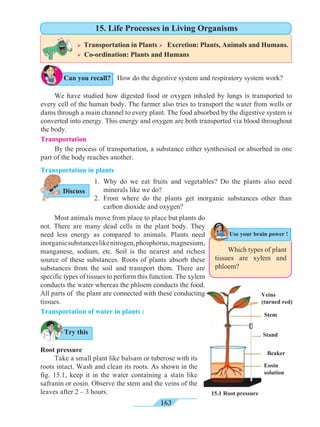
(aq)
water
(dissociation)
H2
SO4
(l) H+
(aq) + HSO4
-
(aq)
water
(dissociation)
HSO4
-
(aq) H+
(aq) + SO4
2-
(aq)
(dissociation)
1. 	What are the names of the following compounds?
	NH3
, Na2
O, CaO.
2. 	When the above compounds are mixed with water
they combine with water. Complete the following
table by writing the ions formed by their combination
with water.
3.	 Intowhichtypewillyouclassifytheabovecompounds-
acid, base or salt ?
NH3
(g)+ H2
O(l)
Na2
O(s) + .......... 2 Na+
(aq) +..............
CaO(s) + H2
O(l) ........... + .............
NH4
+
(aq) + OH-
(aq)
Arrhenius theory of acids and bases
	 The Swedish scientist Arrhenius put forth a theory of Acids and Bases in the year
1887. This theory gives definitions of acids and bases as follows :
Acid : An acid is a substance which on dissolving in water gives rise to H+
ion as the only
cation. For example, HCl, H2
SO4
, H2
CO3
.
id state before
Use your brain power !
NaCl(s) Na+
(aq) + Cl
-
(aq)
Water
(dissociation)
Aqueous solution
of salt
Water
Sodium
Chloride Na
61
Base : A base is a substance which on dissolving in water gives rise to the OH- 
ion as the
only anion. For example, NaOH, Ca(OH)2
Classification of acids and bases
1. Strong and weak acids, bases and alkali
	 1. Acids and bases are classified into strong and weak types on the basis of the extent
to which they dissociate in their aqueous solutions.
Strong acid : On dissolving in water, a strong acid dissociates almost completely and the
resulting aqueous solution contains mainly H+ ions and the concerned acidic radical. For
example, HCl, HBr, HNO3
,H2
SO4
.
Weak acid : On dissolving in water a weak acid does not dissociate completely, and the
resulting aqueous solution contains H+ ion and the concerned acidic radical in small
proportion along with large proportion of the undissociated molecules of the acid. For
example, H2
CO3
, CH3
COOH (Acetic Acid).
Strong base : On dissolving in water, a strong base dissociates almost completely and the
resulting aqueous solution contains mainly OH-
ions and the concerned basic radicals.
For example, NaOH, KOH, Ca(OH)2
, Na2
O.
Weak base : On dissolving in water a weak base does not dissociate completely, and the
resulting aqueous solution contains a small proportion of OH-
ions and the concerned
basic radical along with a large proportion of undissociated molecules of the base. For
example, NH4
OH.
Alkali : The bases which are highly soluble in water are called alkali. For example, NaOH,
KOH, NH3
. Here, NaOH and KOH are strong alkalies while NH3
is a weak alkali.
2. Basicity and acidity
Complete the following table.
Acid : Number of H+
obtained from one molecule.
HCl HNO3
H2
SO4
H2
CO3
H3
BO3
H3
PO4
CH3
COOH
Base : Number of OH-
ions obtained from one molecule
NaOH KOH Ca(OH)2
Ba(OH)2
Al (OH)3
Fe(OH)3
NH4
OH
Acids and bases are also classified according to their basicity and acidity respectively.
NaOH (s) Na+
(aq) + OH-
(aq)
water
(dissociation)
Ca(OH)2
(s) Ca2+
(aq) + 2OH-
(aq)water
(dissociation)
62
Basicity of acids : The number of H+
ions obtainable by the dissociation of one molecule
of an acid is called its basicity.
Acidity of bases : The numbers of OH-
ions obtainable by the dissociation of one molecule
of a base is called its acidity.
1. 	On the basis of the above table give examples of
monobasic, dibasic and tribasic acids.
2. 	 On the basis of the above table give the three types of
bases their examples.
Concentration of acid and base
	 Cut a lemon into two equal parts. Take the juice
of each part into two separate beakers. Pour 10ml of
drinking water in one beaker and 20ml in the second.
Stir the solutions in both the beakers and taste them.
Is there any difference in the tastes of the solutions
in the two beakers? What is that difference?
	 In the above activity, the sour taste of the
solutions is because of the solute, lemon juice, in
them. The quantity of the lemon juice is the same in
both the solutions. Yet their taste is different. The
solution in the first beaker is more sour than the one
in the second. Why is it so?
	 Although the quantity of the solute is the same in both the solutions, the quantity of
the solvent is different. Ratio of the quantity of the solute to the quantity of the resulting
solution is different. This ratio is larger for the soultion in the first beaker and, therefore,
that solution tastes more sour. On the other hand, the proportion of the lemon juice in the
total solution in the second beaker is smaller and the taste is less sour.
	 The taste of foodstuff depends upon the nature of the taste-giving ingredient and its
proportion in the foodstuff. Similarly, all the properties of a solution depend on the nature
of the solute and solvent and also on the proportion of the solute in the solution. The
Proportion of a solute in a solution is called the concentration of the solute in the solution.
When the concentration of a solute in its solution is high, it is a concentrated solution,
while the solution is called a dilute solution when the concentration of the solute is low.
	 Several units are used to express the concentration of a solution. Two of these units
are used more frequently. The first unit is the mass of solute in grams dissolved in one litre
of the solution. (grams per litre, g/L). The second unit is the number of moles of the solute
dissolved in one litre of the solution. This is also called the molarity (M) of the solution.
The molarity of a solute is indicated by writing its molecular formula inside a square
bracket. For example [NaCl] = 1 means the molarity of this solution of common salt is 1M
(1 Molar).
5.3 Solution of lemon juice
Try this
Use your brain power !
B	A
63
Solute Quantity of solute
Volume of
solution
Concentration of
the solution
A B
C
D F
Name Molecu-
lar
formula
Molecu-
lar mass
(u)
Gram (g) Mole
(mol)
Litre (L) Gram/
litre
(g/L)
Molarity
(M)
mole/litre
(mol/L)
Sodium
Chloride
NaCl 58.5 u 117 g 2 mol 2 L 58.5 g/L 1 M
..... HCl ...... 3.65 g ....... 1 L ...... .......
..... NaOH ...... ...... 1.5 mol 2 L ...... .......
E = D
C
G = D
F H = E
F
Complete the following table of the concentration of various aqueous solutions.
The pH of solution
	 We have seen that acids and bases dissociate to a smaller or larger extent on dissolving
in water forming H+
and OH-
ions respectively. H+
and OH-
ions are found in different
proportions in all natural aqueous solutions, and that determines the properties of those
solutions.
	 For example, the proportion of H+
and OH-
ions divides soil into the
acidic, neutral and basic types of soil.
It is necessary for blood, cell sap, etc.
to have H+
and OH-
ions in certain
definite proportions for their proper
functioning. Fermentation carried out
with the help of micro-organisms,
other biochemical processes and also
many chemical processes require the
proportion of H+
and OH-
ions to be
maintained within certain limits. Pure
water, also, undergoes dissociation to
a very small extent and gives rise to
H+
and OH-
ions in equal proportion.
	
	
	 Due to this property of water to
undergo dissociation, there exist both
H+
and OH-
ions in any aqueous
solution.However,theirconcentration
may be different.
pH of some common aqueous solutions
Solution pH
Strong acids
Weak acids
Neutral
Weak bases
Strong bases
1M HCl
Gastric juice
Lemon juice
Vinegar
Tomato juice
Black coffee
Acid rain
Urine
Rain, milk
Pure water, sugar solution
Blood
Solution of baking soda
Toothpaste
Milk of magnesia
Limewater
1 M NaOH
0.0
1.0
2.5
3.0
4.1
5.0
5.6
6.0
6.5
7.0
7.4
8.5
9.5
10.5
11.0
14.0
H2
O H+
+ OH-dissociation
64
	 The concentration of H+
ions formed by dissociation of water at 250
C is 1 x
10-7
mol/L. At the same temperature, the concentration of H+
ions in 1M solution
of HCl is 1 x 100
mol/L. While in a 1M NaOH solution, the concentration of H+
ions is 1 x 10-14
mol/L. Thus, we see that in common aqueous solutions, the range
of H+
ion concentration is very wide from 100
to 10-14
mol/L. In 1909, the Danish
scientist Sorensen introduced a convenient new scale of expressing H+
ion
concentration which is found to be very useful in chemical and biochemical
processes. It is the pH scale (pH : power of hydrogen) The pH scale extends from
0 to 14. According to this scale pure water has a pH of 7 meaning pure water
has [H+
] = 1 x 10⁻⁷
mol/L. pH 7 indicates a neutral solution. This pH is the midpoint
of the scale. The pH of an acidic solution is less than 7 and that of a basic solution
is greater than 7. The table (See page no. 63) gives the pH values of some
common solutions.
	 By which other method could we find out the pH of a solution?
Universal indicators
5.4 Measurement of pH : universal indicator and pH meter
	 What are the colours of the following natural and
synthetic indicators in acidic and basic solutions ?
Litmus, turmeric, jamun, methyl orange, phenolphthalein ?
	 A universal indicator is made by mixing several synthetic indicators in specific
proportions. The pH of a solution can be determined by means of a universal
indicator solution or the pH paper made from it. However, the most accurate method
of measuring the pH of a solution is to use an electrical instrument called pH
meter. In this method, pH is measured by dipping electrodes into the solution.
BasicAcid
Neutral
Can you recall?
	 We know that some natural and synthetic dyes show two different colours in acidic
and basic solutions, and such dyes are used as acid-base indicators. In the pH scale, the
pH of solutions varies from 0 to 14 in accordance with the strength of the acid or base. To
show these variations in pH, a universal indicator is used. A universal indicator shows
different colours at different values of pH.
65
Reactivity of acids and bases
1. Neutralization
Do this : Take 10ml dilute HCl in a beaker. Use a
glass rod to put a drop of this solution on a pH paper
and record the pH of the solution. Add to it a few
drops of dilute NaOH solution by means of a dropper
and stir the solution with the glass rod. Measure the
pH of the resulting solution by putting a drop of this
solution on another pH paper. In this manner, go on
adding dilute NaOH drop by drop and recording the
pH. What do you find? Stop adding NaOH when a
green colour appears on the pH paper, that is when
the pH of the solution becomes 7.
H+
+ Cl-
+ Na+
+ OH-
Na+
+ Cl-
+ H2
O
H+
+ OH-
H2
O
HCl + NaOH NaCl + H2
O
Acid base Salt
The neutralization reaction : Why does the pH increase as NaOH solution is added drop
by drop to the HCl solution? The answer lies in the process of dissociation. Both HCl and
NaOH dissociate in their aqueous solutions. Addition of NaOH solution to HCl solution is
like adding a large concentration of OH-
ions to a large concentration of H+
ions. However
water dissociates into H+
and OH-
ions to a very small extent. Therefore, on mixing, the
excess OH-
ions combine with the excess H+
ions to form H2
O molecules which mix with
the solvent water. This change can be represented by the ionic equation shown as follows.
	 It can be seen from the above equation that the Na+
and Cl-
ions are on both the sides.
Therefore the net ionic reaction is
	 As the NaOH solution is added drop by drop to the HCl solution, the concentration of
H+
goes on decreasing due to combination with added OH-
ions, and that is how the pH
goes on increasing.
	 When enough NaOH is added to HCl, the resulting aqueous solution contains only
Na+
and Cl-
ions, that is, NaCl, a salt, and the solvent water. The only source of H+
and
OH-
ions in this solution is dissociation of water. Therefore, this reaction is called the
neutralization reaction. The neutralization reaction is also represented by the following
simple equation.
Complete the following table of neutralization reactions and also write down the
names of the acids, bases and salts in it.
Acid + base Salt + Water
HNO3
+ .......... KNO3
+ H2
O
...............+ 2 NH4
OH (NH4
)2
SO4
+ ...........
..............+ KOH KBr +
Try this
5.5 Neutralization
Dilute HCl
Glass rod
Indicator
strip
66
Activity : Take a big test tube. Choose a rubber
stopper in which a gas tube can be fitted. Take
a few pieces of magnesuim ribbon in the test tube
and add some dilute HCl to it. Take a lighted
candle near the end of the gas tube and observe.
What did you observe ?
2. Reaction of acids with metals	
	 The reaction of acids with metals is determined
by the strength and the concentration of the acid
and also by the reactivity of the metal and the
temperature. It is easy to bring about the reaction
of a dilute solution of strong acids with moderately
reactive metals at normal temperature.
3. Reaction of acids with oxides of metals
	 Magnesium metal reacts with dilute hydrochloric acid and an inflammable gas,
hydrogen, is formed. During this reaction, the reactive metal displaces hydrogen from the
acid to release hydrogen gas. At the same time, the metal is converted into basic radical
which combines with the acidic radical from the acid to form the salt.
Complete the following reactions.
		 Metal + Dilute acid Salt + Water
		 Mg(s) + 2HCl (aq) MgCl2
(aq) + H2
(g)
		 Zn (s) + .......... (aq) ZnSO4
(aq) + .......
		 ........(s) + ....... (aq) Cu (NO3
)2
(aq) + H2
(g)
5.6 Reaction of a dilute solution
of a strong acid with a metal
	 Take some water in a test tube and add a little red oxide
(the primer used before painting iron articles) to it. Now add
a small quantity of dilute HCl to it, shake the test tube and
observe.
1. 	Does the red oxide dissolve in water?
2. 	What change takes place in the particles of red oxide on
adding dilute HCl ?
Dilute HCl
Mg ribbon
Bubbles of H2
Test tube
Cork
Burning of H2
with an explostion
Try this
Try this
Use your brain power !Always remember
	 What would be the definition of an
acid and a base with reference to the
neutralization reaction ?
In the neutralization reaction, an
acid reacts with a base to form a salt
and water.
67
1.	What type of compound is a metal oxide, with reference to neutralization reaction?
2.	Explain the statement ‘Metal oxides are basic in nature.’
	 The chemical formula of red oxide is Fe2
O3
. The water-insoluble red oxide reacts with
HCl to produce a water soluble salt FeCl3
. This gives a yellowish colour to the water. The
following chemical equation can be written for this chemical change.
Complete the following.
Fe2
O3
(s) + 6HCl (aq) 2FeCl3
(aq) + 3H2
O (l)
Metal oxide + dilute acid Salt + Water
CaO (s) + 2 HCl (aq) 		 +
MgO (s)+ 	 MgCl2
(aq) + H2
O (l)
ZnO (s) + 2 HCl (aq) 	 + 	
Al2
O3
(s) + 6 HF(l) 	 +
4. Reaction of bases with oxides of non-metals
Bases react with oxides of non-metals to form a salt and water.
Hence, oxides of non-metals are said to be acidic in nature. Sometimes
the oxides of non-metals themselves are said to be examples of acids.
Complete the following reactions.
Oxide of non-metal + base salt + water
CO2
(g) + 2 NaOH (aq) 		 Na2
CO3
(aq) + H2
O (l)
+ 2 KOH (aq)		 K2
CO3
(aq) + H2
O (l)
SO3
(g) + 		 Na2
SO4
(aq) + H2
O (l)
Zinc oxide reacts with sodium hydroxide to form sodium zincate (Na2
ZnO2
) and
water. Similarly, aluminium oxide reacts with sodium hydroxide to form sodium aluminate
(NaAlO2
) and water.
1. Write down chemical equations for both these
reactions.
2. 	Can we call Al2
O3
and ZnO acidic oxides on the
basis of these reactions?
3. 	 Define ‘amphoteric oxides’ and give two examples.
5. Reaction of acids with carbonates and bicarbonates of metals
Try this
Try this
Use your brain power !
Activity : Fit a bent tube in a rubber cork. Take some lime water in
a test tube and keep it handy. Take some baking soda in another test
tube and add some lemon juice to it. Immediately fit the bent tube
over it. Insert its other end into the lime water. Note down your
observations of both the test tubes. Repeat the procedure using
washing soda, vinegar and dilute HCl properly. What do you see ?
68
	 We have seen that salts are formed by the reaction between acids and bases. Though
this reaction is called a neutralization reaction, the resulting salts are not always neutral.
A neutral salt is formed by neutralization of a strong acid by a strong base. The aqueous
solution of a neutral salt has pH equal to 7.
	 An acidic salt is formed by the neutralization reaction between a strong acid and a
weak base. The pH of the aqueous solution of an acidic salt is less than 7. On the contrarary,
a basic salt is formed by a neutralization reaction between a weak acid and a strong base.
The pH of an aqueous solution of such a basic salt is greater than 7.
	 Classify the following salts into the types acidic, basic and neutral. Sodium sulphate,
potassium chloride, ammonium nitrate, sodium carbonate, sodium acetate, sodium
chloride.
Complete the reactions in the following table.
Carbonate salt of metal + dilute acid Another salt of metal + Carbon dioxide
Na2
CO3
(s) + 2 HCl (aq) 2 NaCl (aq) + CO2
(g)
Na2
CO3
(s)+ ................... Na2
SO4
(aq) + CO2
(g)
CaCO3
(s) + 2 HNO3
(aq) .................. + ..................
K2
CO3
(s) + H2
SO4
(aq) .................. + ..................
Bicarbonate salt of metal + dilute acid Another salt of metal + carbon dioxide + water
1. NaHCO3
(s) + HCl (aq) NaCl (aq) + CO2
(g) + H2
O (l)
2. KHCO3
(s) + HNO3
(aq) .................. + .................. + ..................
3. NaHCO3
(s) + .............. CH3
COONa (aq)+ ............ + ..................
	 In this activity, when limewater comes in contact with the gas released in the form of
an effervescence, it turns milky. This is a chemical test for carbon dioxide gas. When lime
water turns milky, we infer that the effervescence is of carbon dioxide gas. This gas is
produced on reaction of acids with carbonate and bicarbonate salts of metals. Aprecipitate
of CaCO3
is produced on its reaction with the limewater Ca(OH)2
. This reaction can be
represented by the following chemical equation.
Ca(OH)2
(aq) + CO2
(g) CaCO3
(s) +H2
O(l)
Salts
Types of salts : acidic, basic and neutral salts
Try this
Activity : Prepare 10 ml aqueous solutions from 1gm each of sodium
chloride, ammonium chloride and sodium bicarbonate. Measure pH
of each solution by means of pH paper. Are the values the same for all
three ? Classify the salts based on the pH values.
69
1.	Crystalline substances contain water of
crystallization.
2.The molecules of water of crystallization are
part of the internal arrangement of the crystal.
3. On heating or just by keeping, the water of
crystallization is lost and the crystalline shape
of that part is lost.
1 	Crystalline blue vitriol-CuSO4
5H2
O
2 	Crystalline ferrous sulphate
	 (Green vitriol) -	FeSO4
7H2
O
3 	Crystallinewashingsoda-Na2
CO3
.10H2
O
4.Crystalline alum -K2
SO4
.Al2
(SO4
)3
.24 H2
O
5.7 Properties of water of crystalisation
Water of crystallisaton Activity : Take some crystals of blue vitriol in
two test tubes.
Add some water in one test tube and shake it.
What did you see?
What is the colour of the solution formed?
Heat the other test tube on low flame of a
burner. What did you see?
What change did occur in the colour of blue
vitriol?
What did you see in the upper part of the test
tube?
	 When the second test tube cools down add
some water in it and shake. What is the colour
of the resulting solution? What inference can
be drawn from this observation?
	 On heating, the crystalline structure of
blue vitriol broke down to form a colourless
powder and water came out. This water was
part of the crystal structure of blue vitriol. It
Try this
Repeat the above activity for Ferrous sulphate, sodium carbonate and write chemical
equations.
Drops of water
Copper
sulphate
(White)
Copper
sulphate
(Blue)
Apparatus : Evaporating dish, Bunsen burner, tripod stand, wire gauze, etc.
Chemicals : Alum.
Procedure : Taka a small stone of alum in the evaporating dish. Keep the dish on the tripod stand
and heat it with the help of burner.
What did you seen in the dish? What is meant by puffed alum?
®
Heat
(Blue) (White)
CuSO4
5H2
O CuSO4
+ 5H2
O
Try this
on giving heat to
copper sulphate
Ionic compounds are crystalline in nature. These crystals are formed as a result of
definite arrangement of ions. In the crystals of some compounds water molecules are also
includedinthisarrangement.Thatisthewaterofcrystallization.Thewaterofcrystallization
is present in a definite proportion of the chemical formula of the compound. It is indicated
in the chemical formula as shown below.
is called water of crystallization. On adding water to the white powder a solution was
formed which had the same colour as the solution in the first test tube. From this we come
to know that no chemical change has occurred in the crystals of blue vitriol due to heating.
Losing water on heating blue vitriol, breaking down of the crystal structure, losing blue
colour and regaining blue colour on adding water are all physical changes.
70
Ionic compounds and electrical
conductivity
Activity : Prepare a solution of 1g sodium
chloride in 50ml water. Take two electrical
wires. Connect one wire to the positive terminal
of a 6V battery. While connecting the other
wire to the negative terminal of the battery,
include one switch and one holder with an
electric bulb. Remove the insulating cladding
from 3cm portion of the other free ends of the
two wires. Take the salt solution in a 100ml
capacity beaker and immerse the uncovered
ends of the two wires in it keeping the wire
erect with the help of a support. Switch on the
current. Note whether the bulb glows. Repeat
the same procedure using solutions of 1g
copper sulphate, 1g glucose, 1g urea, 5ml dilute
H2
SO4
and 5ml dilute NaOH each in 50ml
water. Record your observations in a table.
(Do not forget to clean the beaker and
uncovered part of the wires with water,
every time you change the solution.)
Dissociation of ions and electrical conductivity
	 In the above activity it was found that the aqueous solutions of the compounds
NaCl, CuSO4
, H2
SO4
and NaOH are electricity conductors. Out of these NaCl and
CuSO4
are salts, H2
SO4
is a strong acid and NaOH is a strong base. We have seen
that salts, strong acids and strong bases dissociate almost completely in their aqueous
solutions. Therefore, the aqueous solutions of all these three contain large numbers
of cations and anions.
5.8 Testing the electrical conductivity
of a solution
Solution of sodium chloride
Bare electric wire
Bulb
Support
Switch
Beaker
Battery
Try this
Use your brain power !
1. With which solutions did the bulb glow?
2. Which solutions are electrical conductors?
The bulb glows only when electric current passes through it. And this can
happen only when the electric circuit is complete. In the above activity, the circuit
is found to be complete when the aqueous solutions of NaCl, CuSO4
, H2
SO4
and
NaOH are used. It means that these solutions are conductors of electricity.
Electrons conduct electricity through electrical wires; and ions conduct electricity
through a liquid or a solution. Electrons leave the battery at the negative terminal,
complete the electric circuit and enter the battery at the positive terminal. When
there is a liquid or a solution in the circuit, two rods, wires or plates are immersed
in it. These are called electrodes. Electrodes are usually made of a conducting solid.
The electrode connected to the negative terminal of a battery by means of a
conducting wire is called a cathode and the electrode connected to the positive
terminal of a battery is called an anode.
Why does the electric circuit get completed on immersing the electrodes in certain
liquids or solutions? In order to understand this phenomenon, let us look more closely
at the solutions in the above activity, which were found to be electrical conductors.
71
Electrolysis
Procedure : Take a solution of 1g copper
sulphate in 50ml water in a 100ml capacity
beaker. Use a thick plate of copper as
anode and a carbon rod as cathode.
Arrange the apparatus as shown in the
figure and pass an electric current though
the circuit for some time. Do you see any
changes ?
	 In the above activity copper appears to
have deposited on the portion of the cathode
immersed in the solution. How did this
happen? When an electric current started
flowing through the circuit, the cations, that
is, Cu++
ions in the solution got attracted
towards the cathode. Cu atoms are formed
when electrons coming out from the cathode
combine with the Cu++ 
ions. A deposit of the
copper appeared on the cathode. Even though
A characteristic of the liquid state is the
mobility of its particles. Due to this mobility, the
positively charged cations in the solution are
attracted towards the negative electrode or cathode
and move towards the cathode; on the other hand,
the negatively charged anions move in the
direction of the anode. The movement of ions in
the solution towards the respective electrodes
amounts to the conduction of electricity through
the solution. From this, you will understand that
those liquids or solutions which contain a large
number of dissociated ions conduct electricity.
the Cu++
ions in the solution were used up in this manner, the colour of the solution remained
the same. Because, while electric current was on, electrons were removed from the Cu
atoms of the anode and sent to the battery through the electric wire. The Cu++
ions formed
in this manner, entered the solution. In this way decomposition of the solute in the solution
took place due to the electric current. This is called electrolysis. There are two parts in the
electrolysis process. These are the cathode reaction and the anode reaction. The two parts
of the electrolysis process that take place in the above activity are shown below.
Cathode reaction	 Cu2+
(aq)+ 2e-
	 Cu(s)
Anode reaction 	 Cu (s) 		 Cu2+
(aq) + 2e-
5.10 Electrolysis
5.9 Dissociation of ions
Cu C
Key / Switch
Solution of CuSO4
e-
e-
Try this
72
If pure water is used in an electrolytic cell, current does not flow even on putting on
the switch. From this we learn that pure water is a bad conductor of electricity. And we
have already seen the reason behind this. The concentration of H+
and OH-
ions formed
by dissociation of water is very low, only 1 x 10⁻⁷
mol/L for each ion. However, the
electrical conductivity of water increases on mixing a small amount of salt or a strong
acid/base in it due to their dissociation and electrolysis of water takes place.
Electrolysis of water
Activity : Dissolve 2g salt in 500ml pure water.
Take 250 ml of this solution in a 500ml capacity
beaker. Connect two electrical wires to the
positive and negative terminals of a power
supply. Remove the insulating cladding from
about 2cm portions at the other ends of the
wires. These are the two electrodes. Fill two
test tubes upto the brim with the prepared dilute
salt solution. Invert them on the electrodes
without allowing any air to enter. Start the
electric current under 6V potential difference
form the power supply. Observe what happens
in the test tubes after some time.
5.11 Electrolysis of water
1 	In the above activity, if
electric current passesd
through the electrolytic
cell for a long time, what
change would be seen at
the anode?
2.	 Would water be a good
conductor of electricity?
1. 	Did you see the gas bubbles forming near the electrodes in the test tubes?
2. 	Are these gases heavier or lighter than water?
3. 	Are the volumes of the gases collected over the solution in the two test tubes the same
or different?
Beaker
Website for more information
www.chemicalformula.org
Try this
Use your brain power !
Always remember
Test tube
- + Battery
1.	It is necessary for the liquid/solution to have a
large number of dissociated ions for electrolysis
to take place. Therefore, substances which
undergo dissociation to great extent in the
liquid state or a solution are called electrolytes.
Salts, strong acids and strong bases are
electrolytes.Theirsolutionshavehighelectrical
conductivity. In other words electrolytes are
good conductors of electricity in their liquid or
solution state.
2.	An assembly that consists of a container
electrolyte and the electrodes dipped in it, is
called an electrolytic cell.
73
It is found in the above activity that the volume of the gas formed near the cathode is
double that of the gas formed near the anode. Scientists have shown that hydrogen gas is
formed near the cathode and oxygen gas near the anode. From this, it is clear that
electrolysis of water has taken place and its constituent elements have been released. The
concerned electrode reactions are as follows.
		 Cathode reaction 2H2
O (l) + 2e-
H2
(g) + 2OH-
(aq)	
		 Anode reaction 2H2
O (l) O2
(g) + 4H +
(aq)+ 4e-
1.	 Identify the odd one out and justify.
	 (a) 	Chloride, nitrate, hydride,
ammonium
	(b)	Hydrogen chloride, sodium
hydroxide,calciumoxide,ammonia
	 (c)	Acetic acid, carbonic acid,
hydrochloric acid, nitric acid
	(d)	Ammonium chloride, sodium
chloride, potassium nitrate, sodium
sulphate
	 (e)	Sodium nitrate, sodium carbonate,
sodium sulphate, sodium chloride
	 (f)	Calcium oxide, magnesium oxide,
zinc oxide, sodium oxide.
	 (g)	Crystalline blue vitriol, crystalline
common salt, crystalline ferrous
sulphate, crystalline sodium
carbonate.
	(h)	Sodium chloride, potassium
hydroxide, acetic acid, sodium
acetate.
2. 	Write down the changes that will be
seen in each instance and explain the
reason behind it.
	 (a)	50ml water is added to 50ml
solution of copper sulphate.
	 (b)	Two drops of the indicator
phenlphthalein were added to 10ml
solution of sodium hydroxide.
	 (c) 	Two or three filings of copper were
added to 10ml dilute nitric acid and
stirred.
	 (d) A litmus paper was dropped into
2ml dilute HCl. Then 2ml
concentrated NaOH was added to it
and stirred.
	 (e) 	Magnesium oxide was added to
dilute HCl and magnesium oxide
was a added to dilute NaOH.
	 (f) 	Zinc oxide was added to dilute HCl
and zinc oxide was added to dilute
NaOH.
	 (g) 	Dilute HCl was added to limestone.
	 (h) 	Pieces of blue vitriol were heated in
a test tube. On cooling, water was
added to it.
	 (i) Dilute H2
SO4
was taken in an
electrolytic cell and electric current
was passed through it.
3. 	Classify the following oxides into
three types and name the types.
	 CaO, MgO, CO2
, SO3
, Na2
O, ZnO,
Al2
O3
, Fe2
O3
4. Explain by drawing a figure of the
electronic configuration.
	 a. Formation of sodium chloride from
Exercises
1. 	 Test the solutions in the two test tubes with litmus paper, what do you see ?
2. 	 Repeat the activity by using dilute H2
SO4
as well as dilute NaOH as the electrolyte.
Research
	 There are many applications of electrolysis of electrolytes.
Collect information about them.
74
sodium and chlorine.
	 b.	 Formation of a magnesium chloride
from magnesium and chlorine.
5. 	Show the dissociation of the following
compounds on dissolving in water,
with the help of chemical equation
and write whether the proportion of
dissociation is small or large.
	 Hydrochloric acid, Sodium chloride,
Potassium hydroxide, Ammonia,
Acetic acid, Magnesium chloride,
Copper sulphate.
6.	 Write down the concentration of
each of the following solutions in g/L
and mol/L.
	 a.	 7.3g HCl in 100ml solution
	 b. 	 2g NaOH in 50ml solution
	 c. 	 3g CH3
COOH in 100ml solution
	 d. 	 4.9g H2
SO4
in 200ml solution
7. 	 Obtain a sample of rainwater. Add to
it a few drops of universal indicator.
Meausre its pH. Describe the nature
of the sample of rainwater and
explain the effect if it has on the
living world.
8. 	 Answer the following questions.
	 a.	Classify the acids according to
their basicity and give one example
of each type.
	 b.	 What is meant by neutralization?
Give two examples from everyday
life of the neutralization reaction.
	 c. 	Explain what is meant by
electrolysis of water. Write the
electrode reactions and explain
them.
9. Give reason for the following.
	 a. Hydronium ions are always in the
form H3
O+
	 b. Buttermilk spoils if kept in a copper
or brass container.
10. Write the chemical equations for the
following activities.
	 (a) NaOH solution was added to HCl
solution.
	 (b) Zinc dust was added to dilute
H2
SO4
.
	 (c) Dilute nitric acid was added to
calcium oxide.
	 (e) Carbon dioxide gas was passed
through KOH solution.
	 (f) Dilute HCl was poured on baking
soda.
11. State the differences.
	 a.	 Acids and bases
	 b. 	Cation and anion
	 c. 	Negative electrode and positive
electrode.
12. Classify aqueous solutions of the
following substances according to
their pH into three groups : 7, more
than 7, less than 7.
	 Common salt, sodium acetate,
hydrochloric acid, carbon dioxide,
potassium bromide, calcium hydoxide,
ammonium chloride, vinegar, sodium
carbonate, ammonia, sulphur dioxide.
Project :
	 	Collect information about
electroplating. Make a list of
articles in day-to-day life, where
this technique is used.
²²²
75
You have already studied the
kingdoms Monera, Protista and Fungi
of the ‘Five Kingdom’ classification
system proposed by Robert Whittaker
(1959) for the study of living
organisms.
What are the hidden secrets of the
Kingdom plantae which impart this
green freshness to our surroundings?
Just how much diversity is there in
this Kingdom? Let us see!
Kingdom plantae
	 The group of autotrophic living organisms having eukaryotic cells with cell walls
is the group of plants. Plants have become autotrophic as they can perform photosynthesis
with the help of chlorophyll. Living organisms of kingdom plantae are the main source of
food for all other living organisms.
	 In 1883, Eichler, a
botanist, classified the
Kingdom Plantae into
two subkingdoms. As a
result, twosubkingdoms,
cryptogams and
phanerogams were
considered for plant
classification.
An introduction
to scientists
Prokaryotic
Unicellular
Protista
Autotrophs
(Plantae)
Multicellular
With cell
wall
Heterotrophs
(Fungi)
Monera
Without
cell wall
(Animalia)
Eukaryotic
Living Organisms
Which are the special cell organelles that differentiate plant
cells from animal cells?
How have living organisms been
classified?
Basis for classification :
The presence or absence of organs is the first criterion for classification of plants.
The presence or absence of separate conducting tissues for conduction of water and food
Ø Kingdom Plantae	 Ø Sub-kingdom: Gymnosperms	
Ø Sub-kingdom: Angiosperms
6. Classification of plants
Can you tell?
is the next consideration for classification. Do the plants bear
seeds? If they do then, whether the seeds are enclosed in a
fruit or not is also an important criterion for classification.
Finally, plants are grouped depending upon the number of
cotyledons in the seeds.
At the higher levels of plant classification, different
characteristics are considered for classification, e.g.
depending upon the absence or presence of flowers, fruits and
seeds, plants are classified as cryptogams or phanerogams.
Depending upon whether seeds are enclosed within a fruit or
not, phanerogams are classified as gymnosperms and
angiosperms. Angiosperms are further classified as monocots
or dicots depending upon the number of cotyledons in seeds.
Can you recall?
76
Cryptogams	
	 Search for a pond with greenish water. Collect some of the
green fibres from the water. Put the fibres in a Petri dish and wash
them clean with water. Put one of the fibres in a drop of water on a
glass slide and spread it out straight.
Division I - Thallophyta
	 These plants grow mainly in water. This group of plants, which do not have specific
parts like root-stem-leaves-flowers but are autotrophic due to the presence of chlorophyll,
is called algae. Algae show great diversity. They may be unicellular or multicellular, and
microscopic or large. Examples of algae are Spirogyra, Ulothrix, Ulva, Sargassum, etc.
Some of these are found in fresh water while some are found in saline water. These plants
usually have a soft and fibre-like body. Various types of fungi like yeasts and moulds
which do not have chlorophyll are also included in this group.
6.1 Plants of the Thallophyta division.
Division II - Bryophyta
SpirogyraUlva Chara
Cell wall
Spiral
chloroplasts
Nucleus
Pyrenoid
You may have seen a lush green soft carpet on old
walls, bricks and rocks in the rainy season. Scrape it gently
with a small ruler, observe it under a magnifying lens and
discuss.
	 This group of plants is called the ‘amphibians’ of the plant kingdom because they grow
in moist soil but need water for reproduction. These plants are thalloid, multicellular and
autotrophic. They reproduce by spore formation.The structure of the plant body of bryophytes
is flat, ribbon-like long, without true roots, stem and leaves. Instead, they have stem-like or
leaf-like parts and root-like rhizoids. They do not have specific tissues for conduction of food
and water. Examples are Moss (Funaria), Marchantia, Anthoceros, Riccia, etc.
	 Put a cover-slip over the slide and observe under a compound microscope. Do you
see the spirally arranged green thread-like chloroplasts in the cells in that straight fibre?
This plant is known as Spirogyra.
Observe
Observe and discuss.
77
Leaflets
Ferns rootsSporangia in sori
on leaflet
What is the similarity between the plants
of the groups Thallophyta, Bryophyta and
Pteridophyta irrespective of differences in
their body structure?
Selaginella Lycopodium
6.3 Plants of the pteridophyta division
You may have seen ferns among the
ornamental plants in a garden. Take a leaf of
a fully grown fern and observe it carefully.
Division III- Pteridophyta
Plants from this group have well-
developed roots, stem and leaves and
separate tissues for conduction of food and
water. But, they do not bear flowers and
fruits. They reproduce with the help of spores
formed along the back or posterior surface of
their leaves. Examples are ferns like
Nephrolepis, Marsilea, Pteris, Adiantum,
Equisetum, Selaginella, Lycopodium, etc.
	 These plants reproduce asexually by
spore-formation and sexually by zygote
formation. They have a well-developed
conducting system.
Observe and discuss.
Use your brain power !
6.2 Plants of the bryophyta division
Capsule
MarchantiaFunaria
Leaf - like
parts
Rhizoids Anthoceros
Capsule
Leaf - like parts
Rhizoids
Stalk
Leaf - like parts
Capsule
Stalk
78
All these plants reproduce by spore formation. They are called cryptogams as their
reproductive organs cannot be seen. (cryptos: hidden, gams: reproductive organs).
Phanerogams
	 Plants which have special structures for reproduction and produce seeds are called
phanerogams. In these plants, after the process of reproduction, seeds are formed which
contain the embryo and stored food. During germination of the seed, the stored food is used
for the initial growth of the embryo. Depending upon whether seeds are enclosed in a fruit or
not, phanerogams are classified into gymnosperms and angiosperms.
Observe all garden plants like Cycas,
Christmas tree, Hibiscus, lily, etc. and compare
them. Note the similarities and differences among
them. Which differences did you notice between
gymnosperms and angiosperms?
Gymnosperms are mostly evergreen,
perennial and woody. Their stems are without
branches. The leaves form a crown. These plants
bear male and female flowers on different
sporophylls of the same plant. Seeds of these
plants do not have natural coverings, i.e. these
plants do not form fruits and are therefore called
gymnosperms. (gymnos: naked, sperms: seeds).
Examples Cycas, Picea (Christmas tree),
Thuja (Morpankhi), Pinus (Deodar), etc.
Division I - (Gymnosperms)
Soak the seeds of corn, beans, groundnut, tamarind, mango,
wheat, etc. in water for 8 to 10 hrs. After they are soaked, check each
seed to see whether it divides into two equal halves or not and
categorize them accordingly.
Cycas
6.4 Gymnosperms
Try this
Observe
The flowers these plants bear are their reproductive organs. Flowers develop into
fruits and seeds are formed within fruits. Thus, these seeds are covered; hence, they are
called angiosperms (angios: cover, sperms: seeds).
The plants whose seeds can be divided into two equal halves or dicotyledons are
called dicotyledonous plants and those whose seeds cannot be divided into equal parts are
called monocotyledonous plants.
Division II- Angiosperms
79
Cryptogams
Thallophyta Bryophyta Pteridophyta
Gymnosperms
Phanerogams
Angiosperms
MonocotyledonsDicotyledons
6.4 Mustard and Maize
Observe and verify
Kingdom: Plantae
Dicotyledonous plants Monocotyledonous
Seed Two cotyledons Single cotyledon
Root Well developed, primary root
(Tap root)
Fibrous roots
Stem Strong, hard. Ex. Banyan tree Hollow, Ex. Bamboo
False, Ex. Banana
Disc-like, Ex. Onion.
Leaf Reticulate venation Parallel venation
Flower Flowers with 4 or 5 parts or
in their multiples (tetramerous
or pentamerous)
Flowers with 3 parts or in multiples of three
(trimerous).
80
1.	 Match the proper terms from columns A and C with the description in column B.
2.	 Complete the sentences by filling in
the blanks and explain those
statements.
	 (angiosperms, gymnosperms, spore,
bryophyta, thallophyta, zygote)
	 a. .................... plants have soft and
fibre-like body.
	b.	.................... is called the
‘amphibian’ of the plant kingdom.
	c.	In pteridophytes, asexual
reproduction occurs by ....................
formation and sexual reproduction
occurs by ....................formation.
	 d.	Male and female flowers of
....................are borne on different
sporophylls of the same plant.
3.	 Answer the following questions in
your own words.
	 a.	Write the charateristics of
subkingdom Phanerogams.
	 b.	 Distinguish between monocots and
dicots.
	 c.	 Write a paragraph in your own
words about the ornamental plants
called ferns.
	 d.	Sketch, label and describe the
Spirogyra.
‘A’ ‘B’ ‘C’
Thallophyta Seeds are formed in fruits. Fern
Bryophyta No natural covering on seeds. Cycas
Pteridophyta These plants mainly grow in water. Tamarind
Gymnosperms These plants need water for reproduction. Moss
Angiosperms Tissues are present for conduction of water and food Algae
1. 	Sketch the diagrams of the plants mentioned in the lesson with the help of the
drawing software in the computer.
2. 	 Using those sketches, prepare a power point presentation about plant classification
and present it in the class.
	 e.	Write the characteristics of the
plants belonging to division
Bryophyta.
4.	Sketch and label the figures of the
following plants and explain them
into brief.
	 Marchantia, Funaria, Fern, Spirogyra.
5. 	Collect a monocot and dicot plant
available in your area. Observe the
plants carefully and describe them in
scientific language.
6.	Which criteria are used for the
classification of plants? Explain with
reasons.
Project :
	 a.	Collect more information about
plant classification from the
internet, prepare a talk of about
5 to 7 minutes on that topic and
present it in school during assembly.
	 b. 	Prepare an album of moncot and
dicot seeds and display it in the
classroom.
	 c. 	Collect photographs of 5 plants
each of the Thallophyta, Bryophyta
and Pteridophyta divisions and
write a description of each.
Using ICT:
²²²
Exercises
81
	 Construct four chains like the one
shown in figure 7.1.
	 Interactions go on continously
between producers, consumers and
saprophytes. There is a definite
sequence in these interactions which is
called the food chain. Each chain
consists of four, five or more links. An
ecosystem consists of many food chains
that are interconnected at various
levels. Thus a food web is formed.
Energy flow in an ecosystem
	 We have already learnt the classification of living organisms according to the mode
of nutrition into producers, consumers, saprotrophs (saprophytes) and decomposers.
Consider the various trophic levels of the ecosystem around you as given below.
Secondary
consumers
(carnivores)
Ex. Frog, owl, fox,
etc.
These consumers
use herbivores as
their food.
Apex or top consumers
(carnivores)
Ex. Tiger, lion, etc.
These consumers use
herbivores and carni-
vores as their food. No
other animals feed on
top consumers.
Primary consumers
(herbivores)
Ex. Grasshopper,
squirrel, elephant,
etc. They are directly
dependent on
autotrophs
(producers).
Food chain and food web
7.1 Food chain
Observefigure7.1andexplaintherelationshipbetweenthecomponents.
	 Explain the food chains of various ecosystems which
you have studied last year.
Observe
Use your brain power !
Looking back
Ø Food chain and food web 		 Ø The energy pyramid
Ø Bio-geo-chemical cycle : Carbon, oxygen and nitrogen cycles
7. Energy Flow in an Ecosystem
1. 	 What is meant by ‘ecosystem’?
2. 	 Which are the different types of ecosystems?
3. 	 How do interactions take place between biotic and abiotic
factors of an ecosystem?
Omnivores
(mixed
consumers)
Ex. Humans,
bear, etc. Feed
on herbivores
and carnivores
82
	 An organism may be the prey for many other organisms. For example, an insect feeds
upon leaves of various plants but the same insect is the prey for different animals like frog,
wall lizard, birds, etc. If this is to be shown in a figure, it will form an intricate web instead
of a linear food chain. Such an intricate network is called a ‘Food Web’. Generally, food-
webs are found everywhere in nature.
7.2 Various living organisans
	 Make some interesting observations while having a meal at
home. Identify the trophic level of the various food items in your dish.
Identify your own level in the chain.
The energy pyramid
Trophic level
	 Each level in the food chain is
called a trophic level. A trophic level
is the step at which the organism
obtains its food in the chain. The
amountofmatterandenergygradually
decreases from producers at lowest
level to top consumers at the highest
level.
3rd
Trophic level
2nd
Trophic level
1st
Trophic level
Carnivores
Herbivores
All producers in the ecosystem (Plants)
Omnivores
Producers
7.3 Trophic levels
	 Make a list of the various
consumers of the ecosystems
around you and classify them
according to mode of nutrition.
	Pictures of various
organisms are given in fig. 7.2.
Construct a foodweb from those
pictures.
1.	Is the number of consumers
in a food web fixed?
2.	 What will be the effect on an
ecosystem if only one type of
organism in it forms the food
for several different
consumersinthatecosystem?
3.	Why is balance or
equilibrium necessary in a
foodweb?
An introduction to scientists
	 Lindeman, In 1942 studied the food chain and energy flow through it. Charles Elton,
a British scientist first proposed the concept of the Ecological Pyramid in 1927 after his
study of the Tundra Ecosystem of the Beer islands in England. Hence, this pyramid is
also called the Eltonian Pyramid.
Use your brain power !
Research
83
Humans
10 kcal
100 kcal
1000 kcal
10,000 kcal
Fishes
Zooplanktons
Phytoplanktons
	 What happens to the energy during
its transfer from producers to apex
consumers? Does it remain trapped in
the apex consumer? Does it remain in
the body of apex consumer till its
death?
	 What would happen if the energy
remains trapped in the body of apex
consumers even after their death? What
willhappeniftherewerenodecomposers
like microbes and fungi in nature?
	 Figure 7.4 shows the energy transfer that takes place at each trophic level. There are
different levels of energy exchange in the food chain. The initial quantity of energy goes
on decreasing at every level of energy exchange. Similarly, the number of organisms also
decreases from the lowest level to the highest level. This pattern of energy exchange in an
ecosystem is called a ‘Pyramid of energy’.
	 After the death of apex consumers,
their energy becomes available to the
decomposers. Fungi and other micro-
-organisms decompose the bodies of dead
animals. They are called decomposers. In
the process of obtaining food from the
remains of organisms, decomposers
convert them into simple carbon
compounds. These substances easily mix
with air, water and soil from where they
are again absorbed by plants and
incorporated into the food chain.
7.4 Pyramid of energy in an aquatic ecosystem
	 You can now see that due to the food web formed by the various modes of nutrition,
energy and various nutrients circulate continuously in the ecosystem.
	 The sun is the most important source of energy in any ecosystem. Green plants of the
ecosystem store some of the solar energy in the form of food. Before reaching the
decomposers, this energy is passed on from one trophic level to the next. Decomposers
dissipate some amount of energy in the form of heat. However, no part of the energy ever
returns to the sun. Hence, such passage of energy is referred to as ‘one way’ transport.
Institutes at work
	The Indian Institute of Ecology and
Environment, Delhi, was established in 1980 and is
involved mainly in research, training and arranging
workshopsandseminars.Thisinstitutehaspublished
the International Encyclopaedia of Ecology and
Environment.
	 Why are the numbers of
tertiary consumers (apex
carnivores) always less than
those of other consumers?
Use your brain power !
Think about it
84
Bio-geo-chemical cycle
	 Though the energy flow in an
ecosystem is one way, the flow of
nutrients is cyclical. All organisms
need nutrients for their growth.
Study the various components in
the figure given alongside and
explain the bio-geo-chemical cycle
in your own words.
	 The cyclical flow of nutrients
within an ecosystem is called the
bio-geo-chemical cycle.
	 Nutrients, necessary for the growth of organisms are continuously transferred from
abiotic to biotic factors and biotic to abiotic factors within an ecosystem. This cycle
operates continuously through the medium of the biosphere formed by the lithosphere,
atmosphere and hydrosphere. The recycling of biological, geological and chemical sources
of nutrients in this process is a complex process and depends upon the level of energy
transfer in the ecosystem.
Types of bio-geo-chemical cycles
Gaseous cycle Sedimentary cycle
*	 An accumulation of the main abiotic
gaseous nutrient materials is found in
the earth’s atmosphere.
*	 Includes nitrogen, oxygen, carbon
dioxide, water vapour, etc.
* An accumulation of the main abiotic
nutrient materials is found in soil,
sediment and sedimentary rocks, etc. of
the earth.
*	 Includes soil components like iron,
calcium, phosphorus, etc.
	 The gaseous cycle is a speedier cycle than the sedimentation cycle. For example, if
CO2
has accumulated in an area, it is quickly dispersed with the wind or absorbed by
plants.
	 Climatic changes and human activities seriously affect the speed, intensity and
equilibrium of these cycles Hence, various aspects of these cycles are extensively studied
nowadays.
7.5 Bio-geo-chemical cycle
		The cycle of gases and the sedimentary cycle cannot be completely separated
from each other. For example, nitrogen is present in the form of a gas in the atmosphere
and in the form of compounds like nitrogen oxide in the soil and sediments. Similarly,
carbon occurs in abiotic form mainly in coal, granite, diamond, limestone, etc. in the
earth's crust and in the form of carbon dioxide gas in the atmosphere. Generally, carbon
is present in plants and animals for a much shorter duration than it is in coal.
Hydrosphere
- atmosphere
interaction
Atmosphere
- environment
interaction
Interaction of hydrosphere - astmosphere -
lithosphere with the biosphere
Conversion of
lithosphere into rock,
soil
Do you know?
85
	 	 Carbon dioxide is released into the
atmosphere through abiotic processes like
burning of fossil fuels and wood, forest
fires and volcanic activity. Oxygen is
released into the atmosphere by the biotic
process of photosynthesis and CO2
through
respiration. The equilibrium of oxygen and
carbon dioxide gases in the atmosphere is
maitained by plants.
1.	 The carbon cycle is very effective in
the temperate region. Why is it so?
2.	 Even though the carbon content on
earth is constant, why is there a rise
in temperature due to carbon
dioxide?
3.	Identify the relationship between
carbon in the air and the rise in
atmospheric temperature.
7.6 The carbon cycle
	 Eventally, after death, all types of consumer, are decomposed by decomposers like
bacteria and fungi and carbon dioxide is released again into the atmosphere and is used
again by living organism. In this way, carbon is continuously passed on from one living
organism to another. After the death of living organisms, carbon goes to the atmosphere
and is again taken up by living organisms.
Do you know? Think about it
6 CO2
+ 12 H2
O C6
H12
O6
+ 6 H2
O + 6 O2
Sunlight
Chlorophyll
C6
H12
O6
+ 6 O2
6 CO2
+ 6 H2
O + Energy
Mitochondria
Main processes in
the carbon cycle
Absorption in water
CO2
from factories
Respiration in plants
Biotic carbon
Biotic
decompositions
Respiration in
animals
Sunlight
Fossil fuel
	 Plants convert carbon
dioxide into carbohydrates by
the process of photosynthesis.
Similarly, they produce carbon
compounds like proteins and
fats, too. Herbivores feed upon
plants. Carnivores feed upon
herbivores. In this way, biotic
carbon is transported from
plants to herbivores, from
herbivores to carnivores and
from carnivores to apex
consumers.
The carbon cycle
	 The circulation and recycling of carbon from the atmosphere to living organisms and
after their death back to the atomsphere is called the carbon cycle. Abiotic carbon atoms
are circulated and recycled into biotic form mainly through photosynthesis and respiration.
Hence, the carbon cycle is one of the important bio-geo-chemical cycles.
86
	 Most micro-organisms use oxygen for
respiration. Such microbes are called aerobes.
Microbes which do not need oxygen are called
anaerobes. Oxygen is important for the synthesis of
proteins, carbohydrates and fats. It is also used in
various chemical reactions. Ozone (O3
) is produced
from oxygen through various atmospheric processes.
The oxygen cycle
Oxygen forms 21% of the
amosphere. It is also present
in the hydrosphere and
lithosphere. Circulation and
recycling of oxygen within the
biosphere is called the oxygen
cycle. This cycle, too, includes
both the biotic and abiotic
components. Oxygen is
continuously produced as well
as used up in the atmosphere.
	 Oxygen is highly reactive
and it readily reacts with other
elements and compounds. As
oxygen is found in various
forms like molecular oxygen
(O2
), water (H2
O), carbon
dioxide (CO2
), inorganic
compounds, etc. the oxygen
cycle of the biosphere is
extremely complex. Oxygen is
released in the process of
photosynthesis whereas it is
used up in processes like
respiration, combustion,
decomposition, corrosion,
rusting, etc.
7.7 The oxygen cycle
The nitrogen cycle
7.8 The nitrogen cycle
	 Nitrogen forms 78% i.e. the maximum
portion of the atmosphere. It is necessary
for the maintenance of the cycle of nature.
The circulation and recycling of nitrogen
gas into the form of different compounds
through various biotic and abiotic processes
in nature is called the nitrogen cycle.
Plants produce
oxygen
Animals breathe in
oxygen
Breakdown of sugar molecules by animals
Animals give out
CO2
Plants absorb
CO2
and
produce food
material
1. 	 What is meant by nitrogen fixation?
2.	Which microbes bring about the
process of nitrogen fixation?
Can you recall?
Do you know?
87
	 All organisms participate in the nitrogen cycle. It is an important component of
proteins and nucleic acids. As compared to other elements, it is inactive and does not
easily combine with other elements. Most organisms cannot use the free form of nitrogen.
Important processes of the nitrogen cycle
1.	 Nitrogen fixation: Conversion of nitrogen into nitrates and nitrites through atmospheric,
industrial and biological processes.
2.	Ammonification: Release of ammonia through decomposition of dead bodies and
excretory wastes of organisms.
3.	 Nitrification: Conversion of ammonia into a nitrite and then nitrate.
4.	 Denitrification: Conversion of nitrogen compounds into gaseous nitrogen.
1. 	 Complete the following table (Carefully study the carbon, oxygen and nitrogen cycles).
Bio-geo-chemical cycles Biotic processes Abiotic processes
1. Carbon cycle
2. Oxygen cycle
3. Nitrogen cycle
2. 	Correct and rewrite the following
statements and justify your
corrections.
	 a. 	 Carnivores occupy the second trophic
level in the food chain.
	 b. 	 The flow of nutrients in an ecosystem
is considered to be a ‘one way’
transport.
	 c. 	Plants in an ecosystem are called
primary consumers.
3.	 Give reasons.
	 a. 	 Energy flow through an ecosystem is
‘one way’.
	 b. Equilibrium is necessary in the various
bio-geo-chemical cycles.
	 c. 	 Flowofnutrientsthroughanecosystem
is cyclic.
4.	 Explain the following cycles in your
own words with suitable diagrams.
	 a. 	 Carbon cycle.
	 b. 	 Nitrogen cycle.
	 c. 	 Oxygen cycle.
5.	 What would you do to help maintain the
equilibrium in the various bio-geo-
-chemical cycles? Explain in brief.
6.	Explainindetailtheinter-relationship
between the food chain and food
web.
7.	 State the different types of bio-geo-
chemical cycles and explain the
importance of those cycles.
8.	 Explain the following with suitable
examples.
	 a. 	 What type of changes occur in the
amount of energy during its transfer
from plants to apex consumers?
	 b. 	What are the differences between
flow of matter and of energy in an
ecosystem? Why?
Activities :
	 1.	 Prepare a model based on any natural
cycle and present it in a science
exhibition.
	 2.	 Write a paragraph on ‘Balance in an
Ecosystem’.
	 Surf the internet for information about processes in the oxygen
cycle and carbon cycle similar to those of the nitrogen cycle.
²²²
Exercises
Research
88
1.	 What is meant by microbes? What are their characteristics?
2.	 How did you observe microbes?
Try this
Can you recall.
	 You are familiar with different types of microbes which are all around us but cannot
be seen with our eyes. In what way are they related to our everday life?
Useful micro-organisms
	 How is yoghurt made from milk? What exactly happens in
this process?
	 The lactobacilli convert lactose, the sugar in the milk, into lactic acid. This process is
called fermentation. As a result, the pH of milk decreases causing coagulation of milk
proteins. Thus, milk proteins are separated from other constituents of milk. This is what
happens when milk changes into yoghurt. Yoghurt has a specific sour taste due to lactic
acid. The low pH destroys harmful microbes present in the milk.
1.	 Why do doctors advise you to have
yoghurt or buttermilk if you have
indigestion or abdominal
discomfort?
2.	 Sometimes, yoghurt becomes bitter
and froths up. Why does this
happen?
3.	 Which different milk products are
obtained at home by fermentation
of the cream from the milk?
Lactobacilli
	 Smear a drop of fresh buttermilk on a glass slide. Stain it
with methylene blue and put a coverslip over it.
Observe the smear under the 10X objective of a compound
microscope and then with the more powerful 60X objective.
	 Did you notice the blue rod-shaped organisms moving
around? They are lactobacilli, a kind of bacteria. They are
minute and rectangular in shape. Lactobacilli are anaerobic
bacteria i.e. they can produce energy without the use of oxygen.8.1 Lactobacilli
	 What is meant by ‘probiotic’ yoghurt
and other foodstuffs that are popular
nowadays?
	 Useful microbes like lactobacilli are
added to these eatables. Such eatables are
healthy because they kill the harmful
bacteria like clostridum in the alimentary
canal and help to improve our immunity.
Use your brain power !
Do you know?
Ø Useful micro-organisms : Lactobacilli, Rhizobium, Yeast	
Ø Harmful micro-organisms : Clostridium and others.
8. Useful and Harmful Microbes
Can you tell?
89
Let’s try this
Uses of Lactobacilli :
1.	 Various milk products like yoghurt, buttermilk, ghee, cheese, shrikhand, etc. can be
obtained by fermentation of milk.
2.	Lactobacilli fermentation is useful for large scale production of cider, cocoa,
pickles of vegetables, etc.
3.	Lactobacilli and some other useful microbes taken together are used to treat
abdominal discomfort.
4.	Leavened fodder offered to domestic cattle like cows and buffalos, is fodder
fermented with the help of lactobacilli.
5.	 The lactobacilli fermentation process is used to make wine and some types of
bread.
1.	How many different industries depend upon the lactobacilli bacteria?
2.	Which types of cottage industries and factories can be started in areas
with abundant milk production?
Rhizobium : Symbiotic bacteria
	 Take a plantlet of fenugreek, groundnut or any other bean
and sterilize it with a 3 to 5 % solution of hydrogen peroxide.
Role and importance of rhizobium
	 Rhizobia living in root nodules supply nitrates, nitrites and amino acids to that plant
and in exchange get energy in the form of carbohydrates from it. Such a mutually beneficial
relationship is called symbiosis.
	 Rhizobia produce nitrogenous compounds from atmospheric nitrogen. However, for
this process of nitrogen fixation, they need leguminous plants like beans, sweet pea,
soyabean, etc. as ‘host’. Beans and pulses are rich in proteins due to the nitrogenous
compounds made available by rhizobia.
	 Afterwards, keep it in a 70%
solution of ethyl alcohol for 4 to 5
minutes. Clean the roots with sterile
water and take thin sections of the
root nodules. Select good section
and place it in a solution of safranin
for 2 to 3 minutes. Place the stained
section on a glass slide, cover it with
a coverslip and observe it under the
compound microscope. The pinkish
rod-shaped organisms are the
rhizobium bacteria.
	 Note that we had to search for
the root nodules of leguminous
plants to obtain these bacteria. Are
the rhizobium bacilli useful to these
plants or harmful?
Research
8.2 Root nodules of soyabean plant
Rhizobium
Growth of
root nodules
Bacteroid
Cell division
Conducting
tissue of
nodule
Cell division
Bacteria
Infected
root hair
Infection by
bacteria
Bacteroid
90
	 After harvesting a leguminous
crop, the left over roots and other plant
parts are deliberately dumped in farm
soil to maintain its bacterial population.
The use of rhizobium has helped to
reduce the use of chemical fertilizers
and thereby their adverse effects. It has
also helped to reduce expenses on
fertilizers and thus works to the benefit
of farmers.
	 Nowadays, seeds are coated with
rhizobial solution or powder before
sowing. After sowing, rhizobia enter the
plantlets. This is called ‘rhizobial
inoculation’. This experiment has helped
in the supply of nitrogen to cereal and
other crops, besides leguminous crops.
8.3 Yeast cells
Cytoplasm
Nucleus
Cell wall
Bud
Fungus
cells
Yeast
Activity : Bring ‘active dry yeast’ from the
market. Mix a spoonful of yeast, two spoonfuls
sugar with a sufficient quantity of lukewarm
water in a bottle. Fix a colourless, transparent
balloon on the mouth of that bottle.
	 What changes do you observe after 10
minutes? Mix limewater with the gas
accumulated in the balloon. Collect that
limewater in a beaker and observe it. What do
you notice?
	 Take a drop of the solution from the bottle
on a glass slide, put a cover-slip over it and
observe it under the compound microscope.
Store the solution in the bottle carefully.
	 Do you see the colourless, oval cells of
yeast on the slide? Some of those cells may
have small round bodies attached to them.
These are new daughter cells of yeast in the
process of formation.
	 This method of asexual reproduction is
called ‘budding’. Yeast is a heterotrophic
fungal microbe that grows on carbon
compounds.
	 Yeast is a unicellular fungus with 1500
different species in existence. The yeast cell is
a eukaryotic type of cell.
	 In the above experiment, yeast grows and multiplies very quickly due to the carbon
compounds in the sugar solution. In the process of obtaining nutrition, yeast cells convert
the carbohydrates in that solution into alcohol and carbon dioxide. This process called
fermentation.
How is bread made ?
	 Find out how to use the solution prepared in the above experiment, to make bread.
Follow the recipe and make the bread. Find out and note down the reasons why the dough
rises and makes the bread spongy.
Let’s try this
91
Do you know?
	 Often, alcohol is produced along
withsugarinsugarfactories.Molasses
is produced from sugarcane juice. It
is rich in carbohydrates. Molasses is
fermented with the help of the yeast
called Saccharomyces. In this process,
ethanol (C2
H5
OH) alcohol is produced
as a primary product and ester and
other alcohols as secondary products.
	 Spirit and other alcohols can be
obtained from ethanol. Ethanol is also
a smokeless and high quality fuel.
Besides molasses, maize, barley, and
other grains are also used for industrial
production of ethanol.
	 Glucose and fructose, the sugars
present in grape juice, are also fer-
mented with the help of yeast to pro-
duce the alcohol which is used for
making wines.
Use your brain power !
1.	 Recently, it has been made compulsory
in India and some other countries to mix
10% ethanol with fuels like petrol and
diesel. What is the reason for this?
2.	Why are wineries located near Nashik
in Maharashtra?
3.	 Chapattis made from wheat only swell
up but bread becomes spongy, soft and
easy to digest. Why is it so?
Bio-remediation
	 Ayeast, Yarrowia lipolytica is used
to absorb the toxins released during the
production of palm oil and the heavy
metals and minerals released in some
other industrial processes.
Saccharomyces cereviceae is used for
absorption of a pollutant, arsenic.
	 Oil spills in oceans are cleaned
with the help of Alcanivorax bacteria.
Antibiotics
	 Carboncompoundsobtainedfromsomebacteriaandfungifordestroyingorpreventing
the growth of harmful micro-organisms are called ‘antibiotics’. Antibiotics, a discovery of
the 20th
century, have brought about a revolution in the field of medicine. Even a disease
like tuberculosis has been almost completely eradicated from some countries.
	 Antibiotics mainly act against bacteria. Some antibiotics can destroy protozoa. 	
Some antibiotics are useful against a wide variety of bacteria. They are called broad-
spectrum antibiotics. Examples are ampicillin, amoxicillin, tetracycline, etc. When the
pathogen cannot be identified even though the symptoms of disease are visible, broad
spectrum antibiotics are used.
	 Whenever a pathogenic micro-organism is definitely known, then narrow-spectrum
antibiotics are used. Examples are penicillin, gentamycin, erythromycin, etc.
Institutes at work
	 The National Institute of Virology, established in 1952 in Pune, undertakes
research related to diseases like measles, jaundice, fever and diseases of the lungs,
with support from the World Health Organization.
92
Harmful micro-organisms
Fungi
	 Penicillin is a group of antibiotics obtained from a fungus, Penicillium, and is used for
controlling the infections caused by bacteria like Staphylococci, Clostridia, Streptococci,
etc. Medicines containing penicillin are useful to treat certain bacterial infections of the
ear, nose, throat and skin as well as diseases like pneumonia and scarlet fever.
Penicillin
1.	 Which changes do you notice in leather articles and gunny
(jute) bags during the rainy season?
2.	 For how long afterwards can you use those articles?
3.	 Why do these articles not get spoilt during the summer or
winter?
Introduction to scientists
Alexander Fleming, a professor of
microbiology at St Mary’s Hospital had
cultured varieties of bacteria and fungi in
Petri dishes in his laboratory.
	 On 3 September 1928, while
observing staphylococci cultures, he
made an interesting observation in one
Petri dish. In that Petri dish, fungal
colonies had grown but the area around
those colonies was clean and clear. i.e.
bacteria had actually been destroyed.
After further studies, he confirmed that
the fungus growing there was Penicillium
and its secretion had destroyed the
bacterial colonies.
	 Thus, the first antibiotic - penicillin
had been discovered accidentlly and this
formed the basis for attempts to find cures
for incurable diseases.
	 Shouldn’t we always be grateful to
Alexander Fleming for discovering the
life-saving antibiotics?
Caution
*	 Antibiotics should be taken only
when prescribed by a doctor.
*	 Don’t purchase any antibiotic from
medical stores without a prescription
from a doctor.
*	 Don’t consume antibiotics on your
own to treat common diseases like a
throat infection, common cold or
influenza.
*	 Even if you feel well before
completing of the prescribed course
of the antibiotic you must continue
and complete it.
*	 	Don’t suggest to others the
antibiotics which were useful to you.
Wonderful to know
	 Ants grow fungi in their termitarium (anthill) and obtain food from it. Some species
of wasps and other insects lay their eggs in the fungal bodies growing on trees thus
ensuring a food supply for their larvae.
Dr Alexander Fleming
Can you tell?
93
	 Microscopic spores of fungi are present in the air. If there is sufficient moisture, spores
germinate on cotton fabric, gunny bags, leather, wooden items, etc. The fungal hyphae
(fibres of the fungus) penetrate deep into the material to obtain nutrition and to reproduce.
This causes the materials to wear and become weak. As a result, gunny bags, leather items
like shoes, purses, belts, etc. on which fungi have grown do not last long. Wooden items
also get spoilt.
	 Sometimes, you may notice a black powder or white discs
floating on the pickle or murabba, when a jar is opened after a
long time. What exactly is this? Why are such food items not
good to eat?
	 Various species of fungi grow on food items like pickles, murabba, jam, sauce,
chutney, etc. They use the nutrients in these food items for growth and reproduction. During
this activity, fungi release mycotoxins, certain poisonous chemicals, into the food and thus
food becomes poisonous. Hence, the food on which fungi have grown cannot be eaten.
Clostridium
	 	 Sometimes, cases of food poisoning occur during community feasts. How does the
food become poisonous all of a sudden?
	 The bacteria which spoil cooked food are Clostridium. Out of about 100 different
species of this bacterium, some are free living in the soil whereas some live in the alimentary
canal of humans and other animals.
	 These bacteria are rod-shaped and produce bottle-shaped endospores in adverse
conditions. One special characteristic of these bacteria is that they cannot withstand the
normal oxygen level of the air because they grow in anaerobic conditions.
An Introduction to scientists
	 It was believed that meat gets spoiled due to some bacteria of the bacillus type but the
exact type of bacillius was not known. Van Ermengem proved that the anaerobic bacterium
Clostridium botulinum, is responsible for food poisoning.
	 Ida Bengston obtained higher education in biochemistry at Chicago University. She
conducted important research on the toxin responsible for gas gangrene and the antitoxin
useful for treating it. While she was doing research on the dreaded disease called typhus,
she herself contracted the infection. But, she overcame it and continued her research. For
this work, she was honoured with the ‘Typhus Medal’ in 1947.
Think about it
Other harmful micro-organisms
	 Do only the Clostridium bacteria cause illness ?
	 Other kinds of micro-organisms like bacteria, viruses, protozoa and fungi are also
responsible for different diseases that affect humans. You have learnt about viruses which
are smaller than bacteria and can grow and reproduce only in living cells. Let us see how
they are harmful to us.
8.4 Clostridium species
Clostridium tetani Clostridium Perfringens Clostridium botulinum Clostridium difficile
94
The spread and prevention of disease
	 Which plant and animal diseases are caused by
micro-organisms and what are the measures to be taken
against them?
Collect information
Name of disease Pathogen Mode of infection Preventive measures
AIDS Virus Through blood and semen of
infected person and milk of
mother suffering from AIDS.
Safe sexual contact, avoid
reuse of needles and injections.
Hepatitis Virus Contaminated water and
food.
Clean and filtered water,
proper storage of food.
Influenza Virus Contact with infected person Personal hygiene and avoiding
contact with infected person
Measles and
Chicken pox
Virus Contact with infected person Vaccination, uncontaminated
water, clean food
Bird Flu (H7
N9
)
Swine Flu (H1
N1
)
Virus Contact with infected birds
and animals
Personal hygiene, properly
cooked meat.
Dengue Virus Mosquito bite Cleanliness of surroundings
preventing stagnation of water,
mosquito control.
Pneumonia Bacteria Droplets spread in air by
infected person
Vaccination, avoiding contact
with infected person
Leprosy Bacteria Long term contact with
infected person
Avoiding contact with infected
persons and their belongings
Cholera Bacteria Contaminated food and
water.
Clean food and water.
Malaria Protozoa Mosquito bite, uncleaned
surroundings.
Cleanliness of surroundings,
preventing stagnation of water,
controlling mosquitoes.
Dandruff,
ringworm, scabies
Fungi Contact with infected person
or his/her belongings like
clothes.
Personal hygiene, avoiding
contact with infected person
Use your brain power !
8.5 A lichen (dagadphool)-
used as a condiment
1. 	 Salt is applied on the inner surface of pickle jars and the
pickle is covered with oil. Why is this done?
2. 	 Which preservatives mixed with ready-to-eat foods to keep
them from spoiling?
3. 	 Find out the uses of fungi to plants and animals.
4. 	 What is the structure of lichen, a condiment? Where else
is it used?
95
1.	 Complete the statements using the
proper option from those given
below. Explain the statements.
	 (mycotoxins, budding, rhizobium)
	 a. Yeast reproduces asexually by the
............. method.
	 b. Toxins of fungal origin are called
............. .
	 c. Leguminous plants can produce
more proteins due to ............. .
2	 Write the names of microbes found
in following food materials.
		yoghurt, bread, root nodules of
leguminous plants, idli, dosa, spoiled
potato curry.
3. 	Identify the odd word out and say
why it is the odd one?
	 a. 	Pneumonia, diphtheria, chicken
pox, cholera.
	b.	Lactobacilli, rhizobia, yeast,
clostridia.
	 c. 	 Root rot, rust (tambera), rubella,
mozaic.
4. 	 Give scientific reasons.
	 a. Foam accumulates on a the surface
of ‘dal’ kept for a long time in
summer.
	 b. Why are naphthalene balls kept with
clothes to be put away.
5. 	Write down the modes of infection
and the preventive measures against
fungal diseases.
6.	 Match the pairs.
		 ‘A’ group		 ‘B’ group
	1.	Rhizobium	 a. Food poisoning
	2.	Clostridium	 b. Nitrogen fixation
	3.	Penicillium	 c. Bakery products
	 4.	 Yeast	 d. Production of 		
	 antibiotics
7.	 Answer the following questions.
	 a. 	Which vaccines are given to
infants? Why?
	 b. 	 How is a vaccine produced?
	 c. 	 How do antibiotics cure disease?
	 d. 	 Are the antibiotics given to humans
and animals the same? Why?
	 e. 	 Why is it necessary to safely store
the pathogens of a disease against
which vaccines are to be produced?
8.	 Answer the following questions in
brief.
	a.	What are ‘broad spectrum
antibiotics’?
	 b. 	 What is fermentation?
	 c. 	 Define ‘Antibiotic’.
Activity :
		 Collect information about generic
medicines and discuss them in the
class.
²²²
Exercises
96
Weather and climate
	 Atmospheric conditions at a specific time at a particular place are referred to as
weather. Atmospheric conditions depend upon a variety of factors. (Figure 9.1)
	 We frequently express our opinion about the weather by making statements like,
‘Today, it is too cold’ or ‘It is very hot today.’
Changes in weather
	 Climate does not change continuously. Climate is that which remains constant in a
region for a long duration. Thus we see that weather is related to a specific location and
specific time whereas climate is related to a longer duration and larger area. Changes in
the weather may occur for short periods of time whereas changes in the climate take place
slowly over a much long duration.
	 Climate plays a very important role in our day to day life. It influences our basic
needs like food, clothing and shelter as well as our occupations. Climate is especially
important for an agrarian country like India. Various climatic factors like direction and
speed of wind, temperature, atmospheric pressure, etc. are considered during construction
of runways, seaports, huge bridges and skyscrapers, etc.
Can you recall.
1. 	How does the atmosphere affect our daily life?
2. 	Forecasts about which weather related factors are given
during the news bulletins on Doordarshan and Akashvani?
Visibility
Weather related/
Climatic factors
Sunlight
Clouds
Atmospheric pressure
HumidityRainfall
Temperature	
9.1 Weather-related / climatic factors
	 Which factors are affected favourably or
unfavourably by climate? What must we do to
minimize this effect?
Use your brain power !
Ø Weather and climate		 Ø Meteorology
Ø Solid waste management	 Ø Disaster management
9. Environmental Management
	 Weather depends upon
the prevailing conditions of
the air. The climate of a
particular region is the average
of daily readings of various
weather-related parameters
recorded for several years.
Hence, climate is a long term
predominant condition of the
atmosphere.
97
While ascertaining the climate of a particular region, a review of earlier studies of
various aspects of climate is very important. Most countries in the world have established
meteorology departments for making and recording such observations. These departments
have ‘observatories’ which are equipped with modern instruments and technology.
	 If present climatic conditions are analysed with reference to the past climatic
conditions, we can predict climatic changes of the future. However, as climate is the net
resultofacomplexmixtureofvariousatmosphericfactors,forecastingitisverycomplicated
and difficult. Forecasting is easy for places where climatic changes are slow and of a
limited nature. However, where climatic changes are complex, interdependent and rapid,
making forecasts is very difficult.
1.	 Human progress is related to a conducive climate
and geography.
2.	 Human beings have designed a time schedule for
their lives based upon centuries of climatic
experiences.
3.	 Scientists find it necessary to study climate in
view of its effect on agricultural production.
Importance of weather in the living world
1.	 Daily weather as also long term climatic conditions influence human lifestyle
directly or indirectly. Land, water bodies, plants and animals collectively form the
natural environment on earth. This environment is responsible for the development
of organisms.
2.	 The climate of a particular region helps to determine the diet, clothing, housing,
occupationsandlifestyleofthepeopleofthatregion.Forexample,thecharacteristic
lifestyle of Kashmiri and Rajasthani people.
3.	 Salinity of marine water, formation of oceanic currents, water cycle, etc. are all
related to various weather and climatic factors.
4.	 Various climatic factors bring about the weathering of rocks in the earth's crust.
5.	 Climate plays a very important role in the formation and enrichment of soil.
6.	 Microbes in the soil play an important role in formation of organic materials. This
process depends upon various climatic factors.
	 Thus, it is very clear that the study of meteorology is very important from the view
point of human life.
	23rd March is
observed as ‘World
Meteorological Day’.
	 Collect information
about Meteorology and
prepare charts to create
awareness about it.
A special dayThink and discuss.
98
Using ICT
With the help of various search engines on
the Internet, search for links giving information
about the following institutes and prepare a
report based upon the information obtained.
World Meteorological Organization (WMO)
Indian Institute of Tropical Meteorology (IITM)
National Oceanographic and Atmospheric
Administration. (NOAA)
Meteorology
	 The science that studies the inter-relationships between the various components of
air, natural cycles, geological movements of the earth and climate is called meteorology.
	 Meteorology includes the study of storms, clouds, rainfall, thunder, lightning, etc.
Depending upon the study of such factors, weather forecasts are made. They are useful to
common people, farmers, fisheries, aviation services, water transport and various other
organizations.
India Meteorological Department
The India Meteorological Department was founded by the British in 1875 at Shimla.
Its head office is at Pune and its Regional Offices are at Mumbai, Kolkata, Chennai,
Nagpur and Delhi. Maps are prepared every day which indicate the daily predictions
about the weather. Such maps are prepared and published twice in every 24 hours. In this
institute, research goes on continuously on various aspects like instruments for climatic
readings, predictions about climate made using radar, predictions about climate related to
siesmology, predictions regarding rainfall by satellites, air pollution, etc.
	 The India Meteorological Department provides important information regarding
weather and climatic conditions to other departments like aviation, shipping, agriculture,
irrigation, marine oil exploration and production, etc. Predictions regarding calamities
like dust storms, sand storms, heavy rainfall, hot and cold waves, tsunami, etc. are
communicated to various departments, all types of mass communication media and all
citizens. For this purpose, India has launched several satellites equipped with highclass
technology. Observatories at several locations are doing excellent work in the analysis of
the information received from these satellites. (www.imdpune.gov.in)
Monsoon model and climate prediction
	 The tradition of forecasting the monsoon season in India is older than 100 years. After
the famine of 1877, H. F. Blanford, the founder of IMD had made such a prediction for the
first time taking the snowfall in the Himalayas as a parameter for this prediction. In the
decade of the 1930's the then director of IMD, Sir Gilbert Walker had underlined the
relationship between various worldwide climatic factors and the Indian monsoon, and,
based on available observations and previous recordings related to this relationship he put
forth a hypothesis regarding the nature of the monsoon. With the initiative of
Dr Vasantrao Govarikar in the decade of the 1990's a monsoon model based upon 16
worldwide climatic parameters was developed. This model was in use from 1990 to 2002.
Institutes at work
The World Meteorological
Organization was established by
the United Nations Organization on
23rd March 1950. This organization
plays an important role in food
security, water management,
transportation and communication.
99
Statistical model : In this model,
current climatic observations in a region
are compared with earlier parameters
such as oceanic temperature,
atmospheric pressure and the nature of
the monsoon rainfall of several years.
This data is comparatively analysed by
statistical methods and predictions are
made about the monsoon in the present
conditions.
Mathematical model (Dynamic)
	 Forecasts are made with the help of
mathematical models which take into
account estimates of current weather
related events and ongoing physical
interactions between them. Data about
current climatic parameters is
mathematically analysed with the help
of the Param supercomputer. Various
mathematical models based upon daily
geographic events are developed by
supercomputer technology.
	 Anymeteorologicalmodeldependsupontheinter-relationshipbetweenparameters
used in that model and the results expected from it. However, as these inter-relationships
with reference to the ocean and atmosphere are never constant, meteorological models
need to be changed continually.
Holistic model
	 In this model, predictions are based
upon those parameters used in other
models which have the greatest effect
on the monsoon. Nowadays, predictions
declared by IMD are the collective
outcome of various models. This is
called a holistic model.
Presently, new models are being
developed at the IITM. Work is in progress
at two levels, namely, designing new models
and developing new technology. The main
focus is on development of the radar system
and satellite technology.
Solid waste management : need of the hour
1. What is meant by pollution?
2. In which different ways do our surroundings get polluted?
Try this
Always remember
9.2 Solid waste
Can you tell?
Observe the garbage collected in
the dustbin of your classroom and make
a list of the various materials in it.
Discuss with your teacher, how these
materials can be properly disposed of.
Can we do the same with the
garbage generated in our house? Think
about it.
100
9.3 Area with garbage vs clean area
Garbage production per day
	 Solid waste generated in the main metro
cities of the state is approximtely as follows-
Mumbai: 5000 tons, Pune: 1700 tons, Nagpur :
900 tons.
	 On 26th July 2005, a serious flood calamity
had arisen in Mumbai. Improper solid waste
management was one of the main reasons behind
that calamity. Thus we see that accumulation of
solid waste can lead to various calamities.
Make a survey of the
building or area where you live.
Categorise the garbage as
degradable and non-degradable
waste. Approximately, how
much solid waste is generated in
a week? Make a list of the factors
responsible for it.
1.	What is main difference between
what we see in the two pictures
alongside (9.2 A and B)?
2.	 What should we do to permanently
maintain the condition seen in
picture B?
	 Many waste materials are
generated through the various daily
human activities. This is called solid
waste. If these waste materials are
properly disposed of, they can be a
valuable source of energy. Currently,
solid waste is a serious world wide
problem as it causes both water and
soil pollution. Solid waste is also
serious problem from the point of
view of economic growth,
environmental degradation and
health. It has posed a serious threat to
nature and human habitat because of
the air, water and soil pollution it
causes.
1.	What is meant by solid waste?
2.	What are the different things included in solid waste?
We make use of many materials and articles in our daily life. They are of different
kinds. Some of them are reusable but others have to be discarded. However, if they are not
properly disposed of, it affects the environment adversely.
A
B
Observe
Observe and discuss.
Do you know?
Can you tell?
101
Into which two categories can the waste materials in the
lists above be classified ?
Read the following table carefully. What do
you notice?
Classification Source
Domestic waste Waste food, paper, plastic paper, plastic bags, vegetable waste, fruit
skins, glass and sheet metal articles, etc.
Industrial waste Chemicals, pigments, sludge, ash, metals, etc.
Hazardous
waste
Chemicals generated in various industries, radioactive materials,
explosives, infectious materials, etc.
Farm/Garden
waste
Leaves, flowers, branches of trees, crop residues like straw, animal
urine and dung, pesticides, remains of various chemicals and
fertilizers, etc.
Electronic waste Non-functional TV sets, cell phones, music systems, computers and
their parts, etc.
Biomedical
waste
Bandages, dressings, gloves, needles, saline bottles, medicines,
medicine bottles, test tubes, body parts, blood, etc. from clinics,
hospitals, blood banks and laboratories.
Urban waste Waste generated through household industries and large commercial
and industrial establishments, carry bags, glass, metal pieces and
rods, threads, rubber, paper, cans from shops, vegetable and meat
markets, construction waste, etc.
Radioactive
waste
Radioactive materials like Strontium-10, Cerium-141, Barium-140
and heavy water, etc. generated from atomic energy plants, uranium
mines, atomic research centres, nuclear weapons testing sites, etc.
Mining waste Remains of heavy metals like lead, arsenic, cadmium, etc. from
mines.
1. Why is it necessary to recycle non-degradable
waste ?
2. Which materials are included in solid dry waste ?
Use your brain power !
Make a list and discuss
Think about it.
Biodegradable waste : This type of waste is easily degraded by microbes. It mainly
includes kitchen waste (spoiled food, fruits, vegetables) ash, soil, dung, parts of the plants,
etc. This waste is mainly of organic type and is also called ‘wet solid waste’ or ‘wet
garbage’. If it is carefully decomposed, we can get compost and fuel of good quality from
it. Such bio-fuel projects have been started in many cities.
Non-biodegradable waste : This type of waste is not easily degraded because it
requires a very long period of time and the use of various techniques. It includes
plastic, metal and other similar materials. This type of waste is also called ‘dry
solid waste’ or ‘dry garbage’.
102
Necessity of solid waste management :
1.	For preventing environmental pollution and to keep the surroundings clean.
2.	For energy as well as fertilizer production and through that to generate work and
employment opportunities.
3.	To reduce the strain on natural resources through treatment of solid waste.
4.	To improve the health and quality of life and to maintain environmental balance.
Degradation of
natural beauty
Bad odour of waste
Production of
toxic gases
Spreading
of diseases
Air pollution
Water
pollution
Soil
pollution
Effect on biodiversity
Harmful
effects of
solid waste
9.4 Harmful effects of solid waste
Make a list of various waste materials and articles in your area and prepare a
chart as follows
Material
Degradable
(Organic)
Non-degradable
(Inorganic)
Recycling Reuse Toxic
Plastic bottle No Yes Yes Yes Yes
	 It is the need of the hour
to implement solid waste
management practices to
avoid the possible problems
due to solid waste generated
from urban and industrial
areas and to maintain a
clean environment. For this
purpose, we should
implement measures like
increasing the efficiency of
production processes so that
minimum waste will be
generated, reducing garbage
production by recycling and
reuse of waste materials.
9.5 Solid waste management
Scientific and
eco-friendly
waste
management
Separation and categoriztion of waste
Biomedical
waste
management
(Incineration)
Pyrolysis (energy
production by
burning of waste at
high temperature
Ex. Biogas,
Bioelectricity)
Composting
Vermi-
composting
Industrial solid
waste management
(land-fill method)
Safe
land-
fill sites
Using ICT
Carefully observe
figure 9.4 alongside. Based
on it, send an e-mail to
your friend explaining the
importance of solid waste
management.
Find out
Nowadays, an electronic device - the cell phone - is very
popular. From a mobile shop near your house, find out how they
dispose of old and broken down cell phones.
103
7 Principles of solid
waste management -
Reuse
	 After use materials should be
reused for some other proper purposes.
Refuse
	 Refusal to use articles made from
non-degradable articles like plastic
and thermocol.
Recycle
	 Production of useful articles by
recycling solid wastes. For example,
paper and glass can be recycled.
Rethink
	 Rethinking our habits, activities
and their consequences in connection
with the use of various articles of
daily use.
Reduce
	 Restriction the use of resources to
avoid their wastage. Old materials
should be reused. One thing should be
shared by many. Use and throw type
of objects should be avoided.
Research
	 Conducting research realated to
reuse of materials that are temporarily
out of use.
Regulation and public awareness
	 Following the laws and rules
related to waste management and
motivating others to do the same.
Some habits are described below.
Do we have those habits ? If so, how
does it help in waste management ?
1.	Following the 3 R ‘mantra’:
Reduce (reducing the waste),
Reuse (reuse of waste) and
Recycle (recycling of waste).
2.	Throwing plastic wrappers of
chocolates, ice-creams, biscuits,
etc. into dustbins. Avoiding
littering.
3.	 Avoiding the use of plastic bags
and instead using cloth bags or
bags prepared from old sarees,
bed-sheets, curtains, etc.
4.	 Using both sides of a paper for
writing. Reusing greeting cards
and gift papers.
5.	 Avoiding use of tissue paper and
preferring to use one's own
handkerchief.
6.	Using rechargeable batteries
instead of lead batteries.
7.	 Implementing various programmes
of solid waste management and
educating, encouraging the family
and society in this regard.
8.	 Avoiding ‘use and throw’ type of
articles like pens, canned
cold drinks, tetra-packs should be
strictly avoided.
Which waste management processes are used in your
village / town / city ?
	 America is the largest producer of electricity from solid waste. Japan has
developed the projects of production of threads, paper and other useful materials
from banana peelings. Find out about such projects in our region.
Think about it.
Find out
104
Period required for degradation of waste-
Waste Material Period of Natural
Degradation
Banana peelings 3 – 4 weeks
Cloth bags 1 month
Rags 5 months
Woollen socks 1 year
Wood 10 – 15 years
Leather shoes 40 – 50 years
Tin cans 50 – 100 years
Aluminium cans 200 – 250 years
Certain plastic bags 10 lakh years
Thermocol/styrofoam
cup
Infinite duration
9.5 Methods of storing solid waste
		 If the time required for
degradation of the solid waste
generated around us is long, it
seriously affects other environmental
factors. What care will you take to
avoid this ?
		 Figure 9.5 A, below shows a
method of storing waste and 9.5 B,
shows the use of specific dustbins
as per the type of waste. Think
about how such eco-friendly waste
management can be achieved by
following these methods in our
homes, too.
A peep into the past.
Ever since ancient times, special attention has been given to garbage disposal. In
the Greek city of Athens, in 320 BCE, a law had been enacted regarding garbage
disposal. It made throwing garbage in the open an offence.
1. 	 Which natural calamities have you experienced? How did
they affect the conditions in your surroundings?
2. 	 How will you make a plan to be safe from calamities or
to minimize the damage?
	 Various natural disasters like thunderbolts (lightning), floods, fire and man-made
disasters like accidents, bomb explosions, chemical accidents in industries, stampedes in
mass gatherings, riots, etc. occur around us from time to time. They cause large scale
damage to life and property.
A B
Disaster management
Can you recall?
Wet
Waste
Dry
Waste
105
First aid to disaster victims :
The main objective of first aid is
prevention of death, preventing
deterioration of health and starting the
process of rehabilitation. Hence, it is
important to know about the emergency
measures or first aid practices to be
followed
Basic principles of first aid :
Life and Rescucitation - ABC
1.	Airway : If the victim has difficulty
breathing, the head should be held in a
backward sloping position or the chin
should be raised so that the respiratory
passage remains open.
2.	Breathing : If breathing has stopped,
the victim should be given artificial
ventilation by mouth to mouth
rescucitation.
3.	Circulation : If the victim is
unconscious, then after giving mouth to
mouth respiration twice, the heart
should by pressed down hard by
pressing the chest with both the palms.
These two actions should be repeated
alternately about 15 times. This is
called cardio-pulmonary rescucitation
(CPR). It helps to bring the circulation
back to normal.
What are the types of casualties that
are seen to occur in differant types of
disasters?
9.6 Artificial breathing
Disaster management is
action implemented through
proper planning, organized activitiy
and co-ordination. It includes the
following -
1.	 Prevention of losses and danger.
2.	 Improving tolerance.
3.	Providing relief from disaster,
minimising the intensity and extent
of harm.
4.	 Preparation to face the disaster.
5.	 Immediate action in the disaster
situation.
6.	Assessment of damages and
intensity of the disaster.
7.	Arranging for rescue work and
help.
8.	 Rehabilitation and rebuilding.
Can you tell?
Bleeding : If the victim is injured and bleeding through the wound, then the wound
should be covered with an antiseptic pad and pressure applied on it for 5 minutes with
either thumb or palm.
Fracture and impact on vertebrae : If any bone is fractured, it is essential that the
fractured part be immobilized. It can be done with the help of any available wooden
rods/batons/rulers. If there is an impact on the back or vertebral column, the patient
should be kept immobile on a firm stretcher.
Burns : If victims have burn injuries, it is beneficial to hold the injured part under clean
and cold flowing water for at least 10 minutes.
106
Cradle method :
Useful for children
and under-weight
victims.
Human crutch method : If one of the legs is
injured, the victim should be supported with
minimum load on the other leg.
Pulling or lifting method : This is used
for carrying an unconscious patient,
through a short distance.
Carrying on two-hand chair : Useful
for those patients who cannot use their
hands but can hold their body upright.
Carrying on four-hand chair : This is
useful when support is needed for the part
below the waist.
For injuries like sprains, twisting and contusion, the 'RICE' remedy should be applied :
Rest : Allow the victim to sit in a relaxed position.
Ice : Apply an ice-pack to the injured part.
Compression : After the ice-pack treatment, the injured part should be massaged gently.
Elevate : The injured part should be kept in a raised / elevated position.
Stretcher : In an emergency, if a
conventional stretcher is not available,
then a temporary stretcher can be made
using bamboos, blanket, etc.
Methods used by the fire-brigade
Carrying piggy back :
Useful for carrying
patients who are
unconscious.
How to trnsport victims / patients?
107
1.	 Match the items in column ‘A’ with the proper ones in coloum ‘B’ and explain their
impact on the environment.
	 Column ‘A’				 Column ‘B’
	 1.	 Harmful waste		a. Glass, rubber, carry bags, etc.
	 2.	 Domestic waste		b. Chemicals, pigments, ash, etc.
	 3.	 Biomedical waste		 c. Radioactive material
	 4.	 Industrial waste		d. Left over food, vegetables, peelings of fruits.
	 5.	 Urban waste		e. Bandages, cotton, needles, etc.
2.	 Complete the statements using the
given options and justify those
statements.
	 (Geographic favourability, climate,
weather, observatory)
	 a.	Of the abiotic factors that affect
biodiversity by far the most important
is .................. .
	 b.	A description of the climatic
conditions of short duration in a
particular area is .................. .
	 c.	 Irrespective of the progress of human
beings, we have to think about
.................. .
	d.	Establishments where various
climatic factors are recorded are
called .................. .
3.	 Answer the following questions.
	 a.	 How is first aid provided to victims
of disasters who are injured?
	 b.	 State the scientific and eco-friendly
methods of waste management.
	 c.	 Explain with suitable examples, the
relationship between weather
forecastinganddisastermanagement.
	 d.	Why is e-waste harmful? Express
your opinion about this.
	 e.	 How will you register individual your
participation in solid waste
management?
4.	 Write notes.
	 Meteorology, Climatic factors, Monsoon
model, Industrial waste, Plastic waste, 	
Principles of first aid.
5.	 Give examples of the importance of
climate in the living world with
explanations, in your own words.
6.	 Explain with suitable examples, the
care to be taken when using the
methods of transporting patients.
7.	 Explain the differences.
	 a.	 Weather and climate
	 b.	Degradable and non-degradable
waste
Activity :
	 1.	Visit a nearby hospital and collect
information about how waste is
managed.
	 2.	 Establish a vermi compost project in
your school under the guidance of
your teachers.
Other emergency measures: Boats are used by the civil administration to rescue people
trapped in a flooded area. As an emergency measure, wooden boards, bamboo floats,
air-filled rubber tube from a tyre can be used to advantage.
²²²
A fire-extinguisher is a portable appliance that can be easily
carried anywhere. Various appliances are used to put out a fire.
Visitthefiredepartmentinyourcityandcollectdetailedinformation.
(For more information, refer to lesson 13.)
Find out
Exercises
108
Which devices do we use directly or indirectly for collecting,
sharing, processing and communicating information?
The term Information Communication Technology (ICT) includes communication
devices and the use of those devices as well as the services provided with their help. The
store of information generated due to the advances in science and technology is increasing
at a tremendous rate. If we ignore this explosion in information, the knowledge that we
have will become outdated.
How is information communication technology important
for dealing with the explosion of information?
Devices used in information communication technology : Different devices are
usedforproducinginformation,forcommunicating,classifying,saving/storinginformation,
managing information etc. For example, the telephone is used for sharing information by
conversing with someone.
The following table has names of some ICT devices.
Complete the table based on the questions asked. Also,
enter the names of any additional devices that you know of.
The computer, which is the most important device for
information communication, is considered to have gone
through five generations, since it was first created. The
computers used during the period between 1946 and 1959
are said to be ‘first generation computers.’ The ENIAC
computer was made in this period. Valves were used in its
construction. These valves were large in size. They also
consumed a lot of electricity. That generated heat and
computers would shut down many times. Today’s
computers are 5th generation computers.
Use the Internet to
collect information about
all the generations of
computers and their types.
Make a note of the
differences in their
characteristics.
Complete the table
Think about it
Ø Important components of a computer 	 Ø Different types of software
Ø Importance of information communication in science and technology
Ø Opportunities in the field of computers
10. Information Communication Technology : The new direction of progress
Name of the
device
What is it used for? Where is it
used?
Benefits from its
use
Computer /
laptop
Mobile
Radio
Television set
Can you tell?
Find out
109
The entry of computers in all fields in this age of technology has been possible only
due to the increased speed of computers. In which fields of work eo we see computers
being used?
How does a computer work?
Important components of a computer
Memory : Memory is the place for storing data obtained from the input and also the
generated solution or answer by the computer. There are two types of memories in a
computer.
1. Internal Memory 2. External Memory
The internal memory is of two types.
1. RAM (Random Access Memory): This is created from electronic components. Any
electronic component can function only as long as it is supplied with electricity.
2. ROM (Read Only Memory): The information stored here can only be read. We
cannot make changes to the information originally stored here.
Operating system : This is a program which provides a means of communication between
the computer and the person working on it. It is called the DOS (Disk Operating System).
We cannot use a computer without its operating system.
Program : A program is a group of commands to be given to a computer.
Data and information : Data is information in its raw (unprocessed) form.
Processing unit
10.1 Working of a computer
Output Unit : The result / solution
/ answer is eventually sent to the output
unit. Generally a screen / monitor or
printer is used as an output unit.
Input unit : All types of
information/data is entered into
the computer through this unit.
Generally, a keyboard is used to
enter data or information
Processor
Can you tell?
1. Memory unit
2. Control unit
3. ALU unit
110
Two main components of computers
Hardware : Hardware consists of all the electronic and mechanical parts used in
computers.
Software : Software refers to the commands given to the computer, information
supplied to it (input) and the results obtained from the computer after analysis (output).
Make a list of the various hardware and software items
of a computer and discuss their working in the class.
Using Microsoft Word to create a document and write equations.
1. Click on the icon on the desktop.
2. Select the ‘New’ option in the ‘File’ tab, and then select the
‘Blank document’ option.
3. Type your material on the blank page on the screen using the keyboard. Use the language,
font size, bold, etc. options in the Home tab to make the typed material attractive.
4. To type equations in the text, select the ‘Equation’ option in the ‘Insert’ tab.
Try this
Make a list and discuss
5. Select the proper equation and type it using mathematical symbols.
111
What precautions will you take when entering data?
1. 	As far as possible, the data should be kept in tabular form. Different types of data
should be entered in different cells. Data should be entered neatly and in one ‘flow’.
Unnecessary space and special characters should not be used.
2. 	 Many times we ‘drag and fill’ data. At such times, the ‘smart tag’ can be used after
‘drag data’ to fill any data in any manner as required.
3. 	 Once the data has been entered it can be formatted in different ways. Similarly, we
can perform different types of calculations, using different formulae.
4. 	While using a formula, the ‘=’ sign should be typed first. Similarly, no space should
be inserted while typing any formula.
	 Using Microsoft Excel to draw graphs based on the obtained
numerical information
1. Click on the icon on desktop.
2. Select the ‘New’ and then ‘Blank’ option from the ‘File’ tab.
3. Type the information which is to be used to draw the graph, on the ‘sheet’ on the screen.
4. After you have finished typing,‘Select’ the information and click on the required graph
in the ‘Insert’ tab.
5. Analyze the information using the graph.
Try this
112
Microsoft Powerpoint
A PDF or Portable Document Format file
can be used to view the file to print it or to
handle files.
Internet Explorer
This is a kind of Search Engine. It
helps to find the information we want
from all the information available on
the internet.
Acrobat Reader
Using Microsoft Powerpoint to create a presentation
1. 	Click on the icon on the Desktop.
2. 	You must have with you the material and pictures related to the topic on which you
wish to make the presentation.
3. 	 Select the ‘New’ option under the ‘File’ tab and choose the ‘Blank slide’ option.
	 (You can select the kind of slide you need according to your presentation.)
4. 	 Type the information you need on the blank slide and insert pictures.
5. 	 Use the ‘Design’ tab to design your slide.
6. 	 Use the ‘Animation’ tab to animate the slide and make a slide show.
Try this
113
Opportunities in the of computers field
1. Software field : This is an important field. Having accepted the challenge of
creating software, many companies have entered this field. The opportunities in the
software field can be classified as follows - application program development, software
package development, operating systems and utility development, special purpose
scientific applications.
2. Hardware field : Today, there are several companies in our country too, which
make computers. They sell computers that they have themselves made. Others sell
computers brought from outside as well as repair them and take maintenance contracts
to keep computers in big companies working efficiently without a break. Plenty of jobs
are available here. There are job opportunities in hardware designing, hardware
production, hardware assembly and testing, hardware maintenance, servicing and
repairs, etc.
3. Training : The training of new entrants for various jobs is a vast field. It is very
important to have dedicated teachers who are competent in the field of computers.
4. Marketing : There are many establishments which make and sell computers and
related accessories. They need good sales personnel who are experienced in the
working of computers as well as skilled in marketing.
Collecting scientific
information
Internet, emails,
newsgroups, blogs, chat
rooms, Wikipedia, video
conferencing, etc.
	 Some uses of information communication technology are given in the boxes below.
What are its other uses?
Prediction
Predictions can be
made after compiling
and processing
information e.g.
meteorology .
Demonstration
Some experiments and
concepts in science can be
demonstrated easily and
effectively by using
simulation and animation
e.g. functioning of the
nervous system.
Note: While studying the subject of science and technology you have to actually make
use of the information communication technology that you learnt in this lesson. Do
take the help of your teachers as well as your parents and friends if you need it.
Institutes at work
	 C-DAC, the welknown Centre for Development of Advanced Computing, situated
in Pune, is the leading institute in India which conducts research in the field of
computers. The first Indian supercomputer was made with help from this institute.
Valuable guidance for making this computer (the Param computer) was received from
the senior scientist Vijay Bhatkar. Param means the supreme. This computer can
perform one billion calculations per second. It is used in many fields like space research,
movements in the interior of the earth, research in oil deposits, medicine, meteorology,
engineering, military etc. C-DAC has also participated in developing the ISCII code
for writing different language scripts. (Indian Script Code for Information Interchange)
114
1.	 Fill in the blanks to complete the
statements. Justify the statements.
	 a. 	While working with a computer
we can read the information stored
in its memory and perform other
actions in …………… memory.
	 b.	While presenting pictures and
videosabouttheworksofscientists,
we can use …………..
	 c. To draw graphs based on the
quantitative information obtained
in an experiment, one uses …..
	 d. 	The first generation computers
used to shut down because of …….
	 e. 	 A computer will not work unless
…. is supplied to it.
2.	 Answer the following questions.
	 a. 	 Explain the role and importance of
information communication in
science and technology.
	 b. 	 Which application software in the
computer system did you find
useful while studying science, and
how?
	 c. 	 How does a computer work?
	 d. 	 What precautions should be taken
while using various types of
software on the computer?
	 e.	 Which are the various devices
used in information communi-
cation? How are they used in the
context of science?
3. 	 Using a spreadsheet, draw graphs
between distance and time, using
the information about the
movements of Amar, Akbar and
Anthony given in the table on page
4 , in the lesson on Laws of Motion.
What precautions will you take
while drawing the graph?
4. 	 Explain the differences between the
different generations of computers.
How did science contribute to these
developments?
5. 	 What devices will you use to share
with others the knowledge that you
have?
6. 	Using information communication
technology, prepare powerpoint
presentations on at least three topics
in your textbook.
	 Make a flowchart of the steps you
used while making these
presentations.
7. 	 Which technical difficulties did you
face while using the computer?
What did you do to overcome them?
Project :
		Taking help from your teachers,
make a documentary about
ISRO the institute mentioned in
Chapter 18, using information
comunication devices.
²²²
Exercises
115
1. 	What is light?
2. 	What is meant by reflection of light? Which are the different
types of reflection?
Plane mirror - Plane mirrors are used in various activities
in our day to day life. A mirror is made by coating the back
surface of a flat and smooth glass piece with a thin, reflecting
film of aluminium or silver. To protect this reflecting film and
to make that side opaque, another coat of a substance like
lead oxide is given over it.
An introduction to scientists
	The German
scientist Justus von
Liebig coated the plane
surface of a piece of
ordinary glass with
silver metal and made
the first mirror. Such a
mirror is called a
silvered glass mirror.
Mirror and types of mirrors
	 Light is an agent which gives us information about what is happening in our surroundings.
We can enjoy various wonders of nature like the sunrise, sunset and rainbow only because
there is light. It is only because of light that we can see the lush green vegetation, colourful
flowers, deep blue skies in the day, stars shining in the dark night sky in the beautiful world
around us. We can see the man-made objects in our surroundings as well. Light is actually
electromagnetic radiation which causes the sensation of vision.
	 Light reflects differently from the various surfaces around us. We have already learnt
that the reflection from smooth, flat surfaces is regular reflection while rough surfaces reflect
light irregularly.
	 We need polished surfaces for
reflecting light. This is because polished
surfaces absorb less light and so maximum
light gets reflected.
	 In scientific language, a surface which
reflects light and creates clear images is
called a mirror. A mirror is a reflecting
surface.
	 We use various types of mirrors in our
daily life. Mirrors are of two types: plane
mirrors and spherical mirrors.
What are the laws of reflection of light? 10.1 Plane mirror
Can you recall?
Can you recall?
Ø Mirrors and types of mirrors	 Ø Spherical mirrors and images
formed by them 	 Ø Magnification due to spherical mirrors	
11. Reflection of Light
Can you tell? What is a mirror?
116
Incident
ray
Reflected
ray
Plain mirror
Object
Eye
ImageM1
M2
S2
S1
R2
R1
O1O
	 We see a clear image of ourselves when
we stand in front of a mirror in our house. To
understand how an image is formed in a mirror
let us first consider an image formed by a point
source. Light rays travel in all directions from
such a source. Several of these rays fall on the
mirror, get reflected and reach our eyes. Due to
reflection, they appear to be coming from a
point behind the mirror. That point is the image
of the point source.
	 As figure 11.2 A shows, light rays falling
perpendicularly on the mirror are reflected
back in the perpendicular direction.
	 Figure 11.2 B shows a point source O in
front of the plane mirror M1
M2
. Incident rays
OR1
and OR2
get reflected according to the
laws of reflection along paths R1
S1
and R2
S2
respectively. When these reflected rays are
extended behind the mirror, they meet at O1
.
When seen from E, the rays appear to be
coming from O1
. Other rays starting from O
also get reflected and appear to be coming
from O1
. Thus, point O1
is the image of point O.
	 The reflected rays do not actually meet.
Hence, such an image is called a virtual
image. The perpendicular distance of the
image from the mirror is equal to the
perpendicular distance of the source from
the mirror.
	 If we use an extended source instead of a
point source, an image is formed of every point
of the source, thereby forming an extended
image of the whole source. As shown in figure
11.2 C, an extended source PQ is kept in front
of the mirror M1
M2
. The images of P and Q are
formed at P1
and Q1
respectively. Similarly,
images of all points between P and Q are
formed between P1
and Q1
resulting in the
image P1
Q1
of the entire extended source.
The image formed by a plane mirror is of the
same size as the source.
C. Image of an extended source formed by a
mirror
B. Image of a point source formed by a mirror
M1
M2
Q1Q
P1P
A. Rays falling on a mirror normal
to its surface
E
1. 	If we hold a page of a book in front of a mirror, we see laterally
inverted letters in the mirror. Why does it happen?
2. 	 Which letters of the English alphabet form images that look the
same as the original letters?
11.2 Formation of images by a mirror
Can you tell?
117
	 The image of a word appears laterally inverted in the mirror. The image of every
point on the word is formed behind the mirror at the same distance from the mirror as the
point itself. This is called lateral inversion. 	
Angle Number of
images
120०
90०
60०
45०
30०
Statement: In order to see the full image of a person standing in front of a mirror, the
minimum height of the mirror must be half the height of the person.
Proof : In figure 11.4, the point at the top of the head, the eyes and a point at the feet of a
person are indicated by H, E and F respectively. R and S are midpoints of HE and EF
respectively. The mirror PQ is at a height of NQ from the ground and is perpendicular to
it. PQ is the minimum height of the mirror in order to obtain the full image of the person.
For this, RP and QS must be perpendicular to the mirror. Find out why, by studying the
figure 11.4.
Minimum height of the mirror
PQ = RS
= RE + ES
	 Now change the angle between the mirrors
as given in the following table and count the
number of images each time. How is this
number related to the measure of the angle?
Discuss this relationship.
	 When a person stands in front a plane mirror,
how is the image formed? What is the nature of the
image?
	 Place two plane mirrors at an angle of 900
to each other. Place a
small object between them. Images will be formed in both mirrors.
How many images do you see?
n = - 1
3600
A
n = number of images, A = angle between
the mirrors
= + = =
HE
2
EF
2
Half of the person’s height
HF
2
11.3 Mirrors at right angles to each other
Try this
Use your brain power !
1.	 Check if the number of images that you obtained for different values of angles is
consistent with the above formula.
2.	 If we keep the mirrors parallel to each other, how many images will we see?
118
Spherical mirrors
	 If we cut a rubber ball into two parts as shown
in figure 11.6, we can see that each of the two parts
has two types of surfaces.
	 Generally, spherical mirrors are parts of a
hollow glass sphere like the part B in the figure. The
inner or outer surface of this part is coated with a
shiny substance to produce a spherical mirror.
Reflection of light takes place either from its outer
or inner surface. Thus, there are two types of
spherical mirrors as described below.
	 You must have seen the mirrors
displayed in the Laughing Chamber in a
fair. Your face appears distorted in these
mirrors. Why does this happen? These
mirrors are different from the mirrors we
have at home. They are curved. The
images formed by curved mirrors are
different from those formed by plane
mirrors. Because of this we do not see the
familiar images in these mirrors.
	 The rear view mirrors in cars, which
enable drivers to see the vehicles coming
from behind, are curved mirrors.
A
B
11.4 A plane mirror and the full image of a person
11. 6 Creation of spherical mirrors
11.5 Laughing Chamber
Observe and discuss.
Try this
H
R
E
S
F
H1
R1
S1
F1
M
P
Q
N
119
	
A. Concave mirror
	 If the inner surface of the spherical mirror is the reflecting surface, then it is called a
concave mirror.
B. Convex mirror
	 If the outer surface of the spherical mirror is the reflecting surface then it is called a
convex mirror.
Terms related to spherical mirrors
Pole : The centre of the mirror surface is called its pole. P is the pole of the mirror in figure
11.7.
Centre of curvature : The centre of the sphere of which the mirror is a part, is called the
centre of curvature of the mirror. C is the centre of curvature of the mirror in the figure.
Radius of curvature : The radius of the sphere of which the mirror is a part, is called the
radius of curvature of the mirror. The length CP or CAin the figure is the radius of curvature
of the mirror.
Principal axis : The straight line passing through the pole and centre of curvature of the
mirror is called its principal axis. PM is the principal axis of the mirror in the figure.
Principal focus : Incident rays which are parallel to the principal axis of a concave mirror,
after reflection from the mirror, meet at a particular point in front of the mirror on the
principal axis. This point (F) is called the principal focus of the concave mirror. In the
case of a convex mirror, incident rays parallel to the principal axis, after reflection, appear
to come from a particular point behind the mirror lying along the principal axis. This point
is called the principal focus of the convex mirror.
Focal length : The distance (f) between the pole and the principal focus of the mirror is
called the focal length. This distance is half of the radius of curvature of the mirror.
	 What is the difference between the principal
focus of the concave and convex mirrors?
11.7 Terms related to spherical mirrors
Use your brain power !
Radius of curvature
Pole of the mirror
Principal focus
Centre of curvature
P
C
M
A
F
120
Drawing the reflected rays
	 How do we determine the direction
that an incident ray will take after reflection
from a spherical mirror? In figure 11.8,
MN is a spherical mirror and ray AQ is
incident on it. CQ is a radius and therefore
is perpendicular to the mirror at Q. Thus,
angle AQC is the angle of incidence.
According to the laws of reflection, angle
of incidence and angle of reflection are of
the same measure. Thus, while drawing
the reflected ray QB, angle CQB must be
equal to the angle AQC.
11.8 Drawing the reflected rays.
	 We can study the images produced by spherical mirrors by drawing ray diagrams. A
ray diagram is the depiction of the path taken by light rays. To draw a ray diagram, we
use the following rules, which are based on the laws of reflection of light. (See figure
11.9).
Rule 1	 :	If an incident ray is parallel to the principal axis then the reflected ray passes
through the principal focus.
Rule 2	:	If an incident ray passes through the principal focus of the mirror, the
reflected ray is parallel to the principal axis.
Rule 3	 :	If an incident ray passes through the centre of curvature of the mirror, the
reflected ray traces the same path back.
Incident ray
Reflected
ray
Incident ray
Incident ray
Reflected ray
Reflected ray P
PP
FF FC CC
Rule 1 Rule 2 Rule 3
11.9 Rules for drawing ray diagrams
Try this
A
N
M
C
B
P
Q
121
	 Place the screen near a window and place the mirror in front of it such that the image
of the sun or some far away object forms clearly on the screen. Measure the distance
between the screen and the mirror in this situation. This is the focal length of the mirror.
	 Set up the experiment as shown in figure 11.10, in a dark room. Place the mirror near
the 0 mark on the metre scale. Place the screen in front of it and place the light source in
between the two so that the distance between the mirror and the source is a little more than
the focal length of the mirror.
	 Obtain a clear image of the source on the screen by moving the screen along the metre
scale and perpendicular to it. The image will be inverted and larger than the source. As the
image is obtained on the screen, it is a real image.
	 Now move the source away from the mirror so that the distance between the two is
greater than twice the focal length of the mirror. Get a clear image on the screen by
moving it towards the mirror. The image is inverted, smaller than the object and real.
11.10 Images formed by a plane mirror
M M
B.A.
N
Q
P
S
A
B
B1
A1
T
R
FC
A
C
F P B1
A1
N
B
Q
S
11.11 Images obtained in a concave mirror
Images formed by a concave mirror
Material : Candle or glass lamp, two cardboard boxes, large card-
board sheet, white paper, concave mirror, metre ruler, wooden block.
Action : Take the cardboard box,
large enough to hold the candle or
lamp. Cut off one side and place the
candle inside. Cut out an arrow
shaped slit from one side, so that we
get an arrow shaped light source.
Make a screen of size 20 cm x30 cm
by sticking a white paper on the
cardboard sheet and set it up
vertically with the help of the wooden
block. Fix the mirror vertically on
the other cardboard box by making a
slit on its top surface.
Try this
Observe
Concave mirror
Metre scale
Cardboard
box
As shown in figure 11.11 A, an object AB is placed between the focus and the centre
of curvature of the concave mirror MN. The incident ray AQ, starting from A, and going
through the focus F, becomes parallel to the principal axis after reflection and returns
along QR. The incident ray AS, parallel to the axis, after reflection passes through the
focus and returns along the path ST. It cuts the reflected ray QR at point A1
. Thus, the
image of A is formed at A1
. The point B is situated on the principal axis and so its image
will also be on the axis and will be directly above A1
. Thus the image of B is at B1
. The
images of points between A1
and B1
will be formed between points A1
and B1
. Thus, the
image of object AB is A1
B1
. 	
From this we see that when the object is placed between the focus and the centre of
curvature of the mirror, the image is formed beyond the centre of curvature. This image is
larger than the object and is inverted. As the reflected rays actually cross each other, the
image is a real image and can be obtained on a screen.	
In figure 11.11 B, an object AB is placed between the pole and focus of the mirror.
The incident ray AQ is parallel to the principal axis and the incident ray AS is in the
direction joining A with the centre of curvature. The figure shows how these rays get
reflected and form the image A1
B1
of the object. This image is behind the mirror, erect and
larger than the object. As the reflected rays do not actually meet but appear to come
together behind the mirror, the image is a virtual image. 	
The position and type of the image produced by a concave mirror when an object is
placed at different distances from it are given in the following table.
Images formed by concave mirrors
No. Position of the
object
Position of the image Nature of
image
Size of the
image
1 Between pole and
focus
Behind the mirror Erect, virtual Magnified
2 At the focus At infinity Inverted, real Very large
3 Between focus and
centre of curvature
Beyond the centre of
curvature
Inverted, real Magnified
4 At the centre of
curvature
At the centre of
curvature
Inverted, real Same as the
object
5 Beyond the centre
of curvature
Between the centre of
curvature and focus
Inverted, real Diminished
6 At a very large
(infinite) distance
At focus Inverted, real Point image
123
Image formed by a convex mirror	
Figure 11.12 shows an object AB kept in front of a convex mirror MN. Incident rays
AQ, starting from A and travelling parallel to the axis and AR going towards the centre of
curvature are shown. How these get reflected and form the image A1
B1
can be understood
from the figure. It is clear that the image is smaller than the object, behind the mirror and
erect. As the reflected rays do not actually cross one another, the image is a virtual image. 	
Draw ray diagrams and determine the position and type of
images formed by a concave mirror when the object is placed at
(1) Focus (2) Centre of curvature (3) Beyond the centre of
curvature and (4) At an infinite distance. Tally your answers with
the information given in the table.
11.12 Image formed in a convex mirror	
The nature of the image formed
by a convex mirror does not depend
on the distance of the object from the
mirror. These images are always
virtual, smaller than the object and
situated behind the mirror.
Divergence and convergence of light
A.	 Take 5 sticks from a matchbox. Arrange
them so that their heads come together
at a point. In this arrangement, the
heads of the matchsticks are said to
have converged.
B.	 Now arrange the sticks so that their
uncoated ends are together at a point.
The heads are spread apart. In this
arrangement, the heads are diverging
from the point.
11.13 Divergence and convergence 	
A concave mirror is also called a focusing mirror. This is because, as shown in figure
11.14 A, parallel rays get focused after reflection in this mirror. The size of the image
produced by these mirrors can be larger or smaller than the object, depending upon the
distance of the object from the mirror.
A
B
M
P
R
Q A1
B1
F C
N
Try this
Try this
124
	 The image produced by a plane mirror
is a virtual image. This image is produced
at a point from which the reflected light
rays appear to diverge (figure 11.2 B). This
image cannot be obtained on a screen as
the rays do not actually meet there.
	 When light rays collect at a point after
reflection from a spherical mirror, they are
said to converge there. When we want to
bring light rays together at a point, a
converging light beam is used. Doctors use
such a beam to converge light on a tooth,
ear, nose, etc. Equipment using solar
energy also use converging light.
	 When light rays starting from a point
spread out after reflection by a spherical
mirror, light is said to have diverged. When
we want light rays to spread out from a
source, a divergent beam is used, as for
example, in street lamps.
Convex mirror
Focal length
Focal length
.
C
F
F
P
P
11.14 Concave and convex mirror
Concave mirror
.
C
A
B
	 How will you find out if a mirror is concave or convex?
	 The special mirror which is used for shaving is a concave mirror. When held close to
the face, it gives vertical and larger image of the face. If the same mirror is taken farther
away from the face, the image gets smaller and smaller.
	 The mirrors used in cars and motorcycles are convex mirrors. In these mirrors the
image of a face is erect and smaller and it remains erect but becomes smaller and smaller
when the mirror is taken away from the face. As a result we can see the images of the
surroundings also in the mirror. Thus, we can determine the nature of the mirror by studying
the images produced by them.
	 When the light rays coming from an object enter our eyes, we can see the object
because, while passing through the lenses in our eyes, the rays converge, and the image of
the object forms on the retina of our eye. This image, formed by the light rays actually
converging at a point, is a real image. A real image can be obtained on a screen.
	 A convex mirror is also called a dispersing mirror. This is because, as shown in figure
11.14 B, parallel incident rays get dispersed after reflection in this mirror. The size of the
images produced by these mirrors is always smaller than the size of the objects.
125
Uses of concave mirrors
1. 	Barber shop, dental hospital – If the object is placed between the pole and focus of
the mirror, an erect, virtual and magnified image is obtained
2. 	Torch and head lamps of vehicles- The source of light is kept at the focus of the
mirror. Thus, a parallel beam of light is obtained.
3. 	Flood lights- The source of light is placed a little beyond the centre of curvature of
the mirror. This gives a bright beam of light.
4. 	Various equipment using solar energy - Sun rays reflected by a concave mirror
come together in the focal plane.
Uses of convex mirrors
1. Mirrors on the sides of cars are convex mirrors
2. Big convex mirrors are fitted in shops.
	 According to the Cartesian
sign convention, the pole of the
mirror is taken as the origin. The
principal axis is taken as the
X- axis of the frame of reference.
The sign conventions are as
follows.
1.	The object is always kept on
the left of the mirror. All
distances parallel to the
principal axis are measured
from the pole of the mirror.
2.	All distances measured
towards the right of the pole
are taken to be positive, while those measured towards the left are taken to be negative.
3.	Distances measured vertically upwards from the principal axis are taken to be
positive.
4.	Distances measured vertically downwards from the principal axis are taken to be
negative.
5.	The focal length of a concave mirror is negative while that of a convex mirror is
positive.
Mirror formula
	 We get the correct values of distances
by using the Cartesian sign convention.
The object distance (u) is the distance of
the object from the pole, while the image
distance (v) is the distance of the image
from the pole. The relationship between
the object distance, image distance and the
focal length (f) is called the mirror formula.
Principal axis
Direction of incident rays
Distances
upward
(positive +)
Distances
down
ward
(negative-)
Distances on the left
(negative -)
Distances on the right
(positve +)
Y axis
X axis
11.15 Cartesian sign conventions
The mirror formula is expressed as
follows :
1	 1 1
v u f+ =
	 This formula is valid for all spherical
mirrors, for all positions of objects, under
all circumstances.
126
Magnification due to spherical mirrors
	 The magnification due to a spherical mirror is given by the ratio of the height of the
image (h2
) to the height of the object (h1
). This tells us how large the image is as compared
to the object.
	 As the object is always kept above the principal axis, its height is always taken to be
positive. For virtual images, the height is positive while for real images, it is negative. As
the object is kept on the left of the mirror, its distance (u) is always negative.
	 Determine the sign of magnification in each of the 6 cases in the
table on page 122 using both formulae and verify that they are the
same.
Solved examples
Example : Rajashree wants to get an inverted image of height 5 cm of an object kept at
a distance of 30 cm from a concave mirror. The focal length of the mirror is 10 cm. At
what distance from the mirror should she place the screen ? What will be the type of the
image, and what is the height of the object?
The height of the object is 10 cm. Thus,
the image will be real and diminshed.
Given :
Focal length = f = - 10 cm, object distance = u = - 30 cm ,
height of the image = h2
= -5 cm
Image distance = v = ?, height of object = h1
= ?
According to the mirror formula
cm Rajashree has to place the screen 15 cm to the left of the mirror.
1	 1 1
v u f+ =
1	 1 1
v f u-=
1	 1 1
v -10 -30= -
1 -3 + 1
v 30=
1 -2
v 30=
1 1
v -15=
v = -15
M = = -
h2
h1
v
u
h1
= -
uh2
v
h1
= -
(- 30) (-5)
- 15
h1
= (-2) (-5)
h1
= 10 cm
Magnification
Try this
M = -
v
u
Height of the image
Height of the object
h2
h1
=Magnifiction M = . From this it can be shown that
127
	 The image in front of the mirror which can be obtained on a screen is called a real
image. For any position of the object, a convex mirror always produces an erect
diminished image (which is smaller than the object) and is situated behind the mirror.
The image which is behind the mirror and thus cannot be obtained on a screen is
called a virtual image. The magnification of such an image is less than 1.
1.	 Answer the following questions.
	 a.	Explain the difference between a
plane mirror, a concave mirror and a
convex mirror with respect to the type
and size of the images produced.
	 b.	 Describe the positions of the source
of light with respect to a concave
mirror in 1.Torch light
		 2. Projector lamp 3. Floodlight
	 c.	Why are concave mirrors used in
solar devices?
	 d.	Why are the mirrors fitted on the
outside of cars convex?
	 e.	 Why does obtaining the image of the
sun on a paper with the help of a
concave mirror burn the paper?
	 f.	 If a spherical mirror breaks, what
type of mirrors are the individual
pieces?
2.	 What sign conventions are used for
reflection from a spherical mirror?
3.	 Draw ray diagrams for the cases of
images obtained in concave mirrors as
described in the table on page 122.
4.	 Which type of mirrors are used in the
following?
	 Periscope, floodlights, shaving mirror,
kaleidoscope, street lights, head lamps
of a car.
5.	 Solve the following examples
	 a.	 An object of height 7 cm is kept at a
distance of 25 cm in front of a
concave mirror. The focal length of
the mirror is 15 cm. At what distance
from the mirror should a screen be
kept so as to get a clear image? What
will be the size and nature of the
image? (Answer: 37.5 cm and
10.5 cm. Image is real)
b. 	A convex mirror has a focal length of
18 cm. The image of an object kept
in front of the mirror is half the height
of the object. What is the distance of
the object from the mirror?
(Answer: 18 cm)
c. A 10 cm long stick is kept in front of
a concave mirror having focal length
of 10 cm in such a way that the end
of the stick closest to the pole is at a
distance of 20 cm. What will be the
length of the image?
(Answer: 10 cm)
6.	 Three mirrors are created from a
singlesphere.Whichofthefollowing
- pole, centre of curvature, radius of
curvature, principal axis - will be
common to them and which will not
be common?
Project :
		Make a kaleidoscope and make a
presentation in the class about how
it works.
Always remember
Exercises
²²²
128
	 Sound is a form of energy which creates the sensation of hearing in our ears. This
energy is in the form of waves. A medium is necessary for the propagation of sound
waves. Sound waves give rise to a chain of compression (place of higher density) and
rarefaction (place of lower density) in the medium. The particles of the medium oscillate
about their central or mean positions, in a direction parallel to the propagation of the
wave. Such waves are called longitudinal waves. On the other hand, in the waves created
by dropping a stone in still water, the particles of water oscillate up and down. These
oscillations are perpendicular to the direction of propagation of the wave, such waves are
called transverse waves.
	 A sound wave can be shown
in the form a graph. At any
moment during the propagation
of a sound wave we would find
alternate bands of compression
and rarefaction of the medium
i.e. bands of greater and lesser
density.
	 Figure 12.1 A shows the
changes in density while figure B
shows the changes in pressure.
Thechangesindensityorpressure
are shown in the form of a graph
in figure C.
	 The wavelength of sound waves is indicated by the Greek letter lambda (l), while its
frequency is indicated by nu (u). The amplitude, which is the maximum value of pressure
or density, is indicated by A. The time taken for one oscillation of pressure or density at a
point in the medium is called the time period and is indicated by T.
	 The value of frequency determines the pitch (high or low) of the sound while the value
of the amplitude determines its strength or loudness.
12.1 Sound waves
1. 	How are the frequencies of notes sa, re ga ma, pa, dha, ni related
to each other?
2. 	What is the main difference between the frequencies of the voice
of a man and that of a woman?
1. 	How does the velocity of sound depend on its frequency?
2. 	How is the direction of the oscillation of the particles of the
medium related to the direction of propagation of the sound-
wave?
Change in density
Loudspeaker
Change in pressure
Density or
pressure
Average
density or pressure
C
B
A
Loudspeaker
Can you recall?
Observe and discuss.
Ø Sound waves	 Ø Velocity of sound	 Ø Reflection of sound
Ø The human ear, audible sound, infra sound and ultrasound	
12. Study of Sound
Research
129
Velocity of sound in various mediums at 250
C
State Substance Speed (m/s)
Solid Aluminum
Nickel
Steel
Iron
Brass
Glass
5420
6040
5960
5950
4700
3980
Liquid Sea water
Pure water
Ethanol
Methanol
1531
1498
1207
1103
Gas Hydrogen
Helium
Air
Oxygen
Sulphur dioxide
1284
965
346
316
213
Velocity of sound
1. Take your friend to a place where there are iron pipes e.g. the school
verandah, a staircase or a fence.
2. Stand near one end of the pipe and ask the friend to stand 20 to 25
feet away from you near the pipe.
	 The distance covered by a point on the wave (for example the point of highest den-
sity or lowest density) in unit time is the velocity of the sound wave.
3. Ask the friend to gently tap the pipe with a stone. Press your ear to the pipe and listen
to the sound coming through the pipe.
4. The same sound coming through the air can also be heard. But which sound reaches
you first?
	 From the above activity you can see that you hear the sound through the iron pipe much
before you hear it coming through air. This shows that sound travels faster in iron than
in air.
Distance
Time
Velocity =
Wavelength
Time period
Velocity =
l
Tv =
	
v = u l 1
T
because = u
Any point on the sound wave covers a distance equal to l (wavelength) in time T (time period).
Thus the velocity of sound is given by
	 The Italian physicists Borelli
and Viviani, in the 1660s, first
calculated the speed of sound.
They measured the time between
seeing the flash of a gun and
hearing its sound from a long
distance. Their value of 350 m/s
is very close to the value of 346
m/s which is accepted today.
Try this
Thus, the velocity of sound = wavelength x frequency.
	 In any medium at fixed physical
conditions the velocity of sound of
different frequencies is very nearly the
same. The velocity is highest in solids
and least in gases. It increases with an
increase in the temperature of the
medium.
130
Velocity of sound in a gaseous medium: The velocity of sound in a gaseous medium depends
on the physical conditions i.e. the temperature, density of the gas and its molecular weight.
Temperature (T): The velocity of sound is directly proportional to the square root of the
temperature of the medium. This means that increasing the temperature four times doubles
the velocity.
Density (r): The velocity of sound is inversely proportional to the square root of density.
Thus, increasing the density four times, reduces the velocity to half its value.
Molecular weight (M): The velocity sound is inversely proportional to the square root of
molecular weight of the gas. Thus, increasing the molecular weight four times, reduces the
velocity to half its value.
Think
	 The molecular weight of oxygen gas (O2
) is 32 while that of hydrogen gas (H2
) is 2.
Prove that under the same physical conditions, the velocity of sound in hydrogen is four
times that in oxygen.
For a fixed temperature, the velocity of sound does not depend on the pressure of the gas.
Audible, infra- and ultra-sound
	 The limits of hearing of the human ear are 20 Hz to 20,000 Hz. That is, the human ear
can hear sounds of frequencies in
this range. These sounds are called
audible sounds. Our ears cannot
hear sounds of frequencies lower
than 20 Hz and higher than
20,000 Hz (20 kHz). Sound with
frequency smaller than 20 Hz is
called infra sound. The sound
produced by a pendulum and the
sound generated by the vibrations of
the earth’s crust just before an
earthquake are examples of such
sounds. Soundwaveswithfrequency
greater than 20 kHz are called
ultrasound.
	 The dog, mouse, bat, dolphin
etc have a special ability to hear
ultrasonic sounds. Thus, they can
sensesomenoisewhichareinaudible
to us. Children under 5 years of age
and some creatures and insects can
hear waves with frequency up to
25 kHz. Bats, mice, dolphins, etc,
can also produce ultrasound.
A peep into the past
	 The Italian scientist Spallanzani was the first
to discover a special mechanism present in bats.
He covered various organs of bats like the eyes,
ears, nose, etc. one by one and allowed them to fly
in the dark thereby discovering how they can fly
easily in the dark. He found that the bats with their
ears covered began to collide with whatever came
in their path. Even though their eyes were open.
They were of no use to the bats. He thus discovered
that their ability to fly in the dark depends on their
ears and not eyes.
	 The ultrasonic sound produced by bats, gets
reflected on hitting an obstacle. This reflected
sound is received by their ears and they can locate
the obstacle and estimate its distance even in the
dark.
1
av
M
av T
r
1
av
131
Reflection of sound
1. Make two sufficiently long, identical
tubes out of a cardboard.
2. 	Arrange them on a table, in front of a
wall as shown in figure 12.2.
3. 	Place a clock near the end of one of the
tubes and try to hear the ticking of the
clock at the end of the other tube by
placing your ear there.
4. 	Adjust the angles of the two tubes till
you can hear the sound very clearly.
5. 	Measure the angle of incidence q1
and
the angle of reflection q2
. Try to see if
they are related in any way.
	 Like light waves, sound waves, too, get reflected from a solid or a liquid surface.
These waves also follow the laws of reflection. A smooth or a rough surface is needed for
the reflection of sound. The direction of the incident sound wave and reflected sound
wave make equal angles with the perpendicular to the surface and all these three lie in the
same plane.
Good and bad reflectors of sound
	 How much of the incident sound gets reflected decides whether a reflector is a good
or a bad reflector. A hard and flat surface is a good reflector while clothes, paper, curtains,
carpet, furniture, etc. absorb sound instead of reflecting it and, therefore are called bad
reflectors.
12.2 Reflection of sound
Wall
Cardboard
tubes
Clock
q1
q2
Try this
Uses of ultrasonic sound
1. 	For communication between ships at sea.
2. 	To join plastic surfaces together.
3. 	To sterilize liquids like milk by killing the bacteria in it so that the milk keeps for a
longer duration.
4. 	Echocardiaography which studies heartbeats, is based on ultrasonic waves
(Sonography technology).
5. 	To obtain images of internal organs in a human body.
6. 	In industry, to clean intricate parts of machines where hands cannot reach.
7. To locate the cracks and faults in metals blocks.
132
Compare the two cases:
Science in the surroundings......	
	 Echo can be heard multiple
times due to continuous or
multiple reflections. The
golghumat at Vijapur in
Karnataka is an excellent
example of this.
Use your brain power !
1. To hear the echo distinctly, will
the distance from the source of
sound to the reflecting surface
be same at all temperatures?
Explain your answer.
2. When is the reflection of sound
harmful?
Echo
	 You must have visited an echo point at a hill
station. If you shout loudly at such a point, you
hear the same sound just after a little while. This
sound is called an echo.
	 An echo is the repetition of the original
sound because of reflection by some surface.
	 In order to be able to hear the original sound
and its reflection distinctly, at 22 0
C, what must
the minimum distance be between the source
and the reflecting surface? At 22 0
C, the velocity
of sound in air is 344 m/s. Our brain retains a
sound for 0.1 s. Thus, for us to be able to hear a
distinct echo, the sound should take more than
0.1 s after starting from the source to get reflected
and come back to us. Thus we can determine the
minimum distance between the source and the
reflecting surface as follows:
Distance = speed ´ time
	 = 344 m/s ´ 0.1 s
	 = 34.4 m
Thus, to be able to hear a distinct echo, the
reflecting surface should be at a minimum
distance of half of the above i.e. 17.2 m. As the
velocity of sound depends on the temperature of
air, this distance depends on the temperature.
In the above activity, what will happen if you lift one
of the tubes to some height?Use your brain power !
Reverberation
1.	 Close the doors and windows of your
house and switch on the music system.
2. 	 Increase the loudness of the system as
much as possible.
3. 	Note what you sense.
1. 	Go to an empty, closed house with
your friends.
2. 	Once inside, chat with your friends.
3. 	Note what you sense.
133
Use your brain power !
	 Sound waves get reflected from the walls
and roof of a room multiple times. This
causes a single sound to be heard not once
but continously. This is called reverberation.
The time between successive reflections of a
particular soundwave reaching us becomes
smaller and the reflected sounds get mixed
up and produce a continuous sound of
increased loudness which cannot be
deciphered clearly. This is the reason why
some auditoriums or some particular seats in
an auditorium have inferior sound reception.
This is shown in figure 12.3.
How will you reduce reverberation in public halls
or buildings?
SONAR
	 SONAR is the short
form for Sound Navigation
and Ranging. It is used to
determine the direction,
distance and speed of an
underwater object with the
help of ultrasonic sound
waves. SONAR has a
transmitter and a receiver,
which are fitted on ships or
boats.
	The transmitter
produces and transmits
ultrasonic sound waves.
These waves travel through
water, strike underwater
objects and get reflected by
them. The reflected waves
are received by the receiver
on the ship.
	 The receiver converts the ultrasonic sound into electrical signals and these signals are
properly interpreted. The time difference between transmission and reception is noted.
This time and the velocity of sound in water give the distance from the ship, of the object
which reflects the waves.
	 SONAR is used to determine the depth of the sea. SONAR is also used to search
underwater hills, valleys, submarines, icebergs, sunken ships etc.
12.4 The SONAR technique
12.3 Reverberation
Direct sound
ListenerSinger
Reflected sound
Water
Ship
Seabed
Reflection pulseTransmitted
pulse
ReceiverTransmiter
134
Sonography
	 Sonography technology uses ultrasonic sound waves to generate images of internal
organs of the human body. This is useful in finding out the cause of swelling, infection,
pain, etc. The condition of the heart, the state of the heart after a heart attack as well as
the growth of foetus inside the womb of a pregnant woman are studied using this
technique. 		
Find out
12.5 Sonography machine and images obtained
	 This technique makes use of a probe and a gel. The gel
is used to make proper contact between the skin and the
probe so that the full capacity of the ultrasound can be
utilized.
	 The gel is applied to the skin outside the internal organ
to be studied. High frequency ultrasound is transmitted inside
the body with the help of the probe. The sound reflected from
the internal organ is again collected by the probe and fed to
a computer which generates the images of the internal organ.
As this method is painless, it is increasingly used in medical
practice for correct diagnosis.
	 How is ultrasound
used in medical
science?
Image obtained
Examination
procedure
Sonography
machine
	 Developments in science have led to advances in technology
which have helped us make much progress. However, every coin
has two sides and the misuse of science has had serious
consequences for human life. The sonography technique can help
to follow the growth and well being of an unborn baby. But the
increasing incidence of female foeticide as a result of the
discrimination between the girl and the boy child is an example
of the grave misuse of this technique. Female foeticide is now a
cognizable offence under the PNDT Act.
Always remember
135
	 The ear is an important organ of the human body. We hear sounds because of our ear.
When sound waves fall on the eardrum, it vibrates. These vibrations are converted into
electrical signals which travel to the brain through nerves. The ear can be divided into
three parts: 1. Outer ear 2. Middle ear 3. Inner ear.
Outer ear or Pinna
	 The outer ear collects the sound waves and passes them through a tube to a cavity in
the middle ear. Its peculiar funnel like shape helps to collect and pass sounds into the
middle ear.
Middle ear
	 There is a thin membrane in the cavity of the middle ear called the eardrum. When a
compression in a sound wave reaches the eardrum, the pressure outside it increases and it
gets pushed inwards. The opposite happens when a rarefaction reaches there. The pressure
outside decreases and the membrane gets pulled outwards. Thus, sound waves cause
vibrations of the membrane.
Inner ear
	 The auditory nerve connects the inner ear to the brain. The inner ear has a structure
resembling the shell of a snail. It is called the cochlea. The cochlea receives the vibrations
coming from the membrane and converts them into electrical signals which are sent to the
brain through the nerve. The brain analyses these signals.
	 The ear is an important sensory organ. Sticks or other pointed objects should
never be inserted into the ear for cleaning it. Also, one should not hear very loud
music using earphones. It may cause grave injury to the eardrum. 	
Outer ear
(Pinna)
Auditory canal
Middle ear
Inner ear
Tympanic cavity
Semi-circular canals
Chain of three bones
Eardrum
Eustachian tube
CochleaStapes
Always remember
Human ear
12.6 Structure of the human ear
136
Distance
Velocity
Time=
Example 1 : How long will it take for a
sound wave of 25 cm wavelength and 1.5
kHz frequency of, to travel a distance of
1.5 km?
Given : Frequency (u) = 1 5 kHz
= 1 5 × 10³
Hz
Wavelength (l) = 25 cm = 0 25 m
distance (s) = 1 5 km = 1 5 × 10³
m
	 time (t) = ?
Velocity of sound = Frequency × Wavelength
v = u l
v = 1 5 x 103
× 0 25
v = 0 375 ×103
v = 375 m/s
The sound wave takes 4 s to travel the
distance of 1.5 km.
s
v
1.5 × 10³
375
=
1500
375
= = 4 st =
Example 3 : Sound waves of wavelength 1 cm have a velocity of 340 m/s in air. What
is their frequency? Can this sound be heard by the human ear?
Given :
= 4
2 = 2 s
Example 2 : Ultrasonic waves are
transmitted downwards into the sea with
the help of a SONAR. The reflected sound
is received after 4 s. What is the depth of
the sea at that place?
(Velocity of sound in seawater = 1550 m/s)
Given :
Velocity of sound in seawater = 1550 m/s
	 	 Time for echo to be heard = 4s
Time taken by sound waves to reach the
bottom of the sea
v = u l
v
l
 u =
340
1 x 10 -2= = 340 × 102
 u = 34000 Hz
This frequency is higher than 20000 Hz and, therefore, this sound cannot be heard by
the human ear.
	 The SONAR technology was first developed during World War I to detect enemy
submarines. This technology can be used in air also. In fact, bats use this technique to
detect obstacles in their path so that they can avoid them and fly freely even in the dark.
Solved examples
Wavelength = l =1cm=1 x 10⁻²
m,
Distance
Time
Velocity =
Distance = Velocity × Time
= 1550 x 2 = 3100 m
Depth of the sea at that place = 3100 m
Velocity of sound = v = 340 m/s
137
1.	 Fill in the blanks and explain.
	 a. Sound does not travel through
…………
	 b 	 The velocity of sound in steel is
…............ than the velocity of
sand in water.
	 c. The incidence of ……… in daily life
shows that the velocity of sound is
less than the velocity of light.
	 d. To discover a sunken ship or objects
deep inside the sea, .......................
technology is used.
2.	 Explain giving scientific reasons.
	 a. The roof of a movie theatre and a
conference hall is curved.
	 b. The intensity of reverberation is
higher in a closed and empty house.
	 c. We cannot hear the echo produced
in a classroom.
3.	 Answer the following questions in
your own words.
	 a. 	 What is an echo? What factors are
important to get a distinct echo?
	 b. Study the construction of the
Golghumat at Vijapur and discuss
the reasons for the multiple echoes
produced there.
	 c. 	What should be the dimensions
and the shape of classrooms so
that no echo can be produced
there?
4. 	 Where and why are sound absorbing
materials used?
5. 	 Solve the following examples.
	 a. 	 The speed of sound in air at 0 0
C is
332 m/s. If it increases at the rate
of 0.6 m/s per degree, what will be
the temperature when the velocity
has increased to 344 m/s?
(Ans: 200 0
C)
	 b. 	 Nita heard the sound of lightning
after 4 seconds of seeing it. What
was the distance of the lightning
from her?
		 (The velocity of sound in air is 340
m/s?)
(Ans: 1360 m)
	 c. 	Sunil is standing between two
walls. The wall closest to him is at
a distance of 360 m. If he shouts,
he hears the first echo after 4 s and
another after another 2 seconds.
	 1. 	What is the velocity of sound in
air?
	 2. 	 What is the distance between the
two walls?
(Ans: 330 m/s; 1650 m)
	 d. Hydrogen gas is filled in two
identical bottles, A and B, at the
same temperature. The mass of
hydrogen in the two bottles is 12
gm and 48 gm respectively. In
which bottle will sound travel
faster? How may times as fast as
the other?
(Ans: In A; Twice)
	 e. 	 Helium gas is filled in two identical
bottles A and B. The mass of the
gas in the two bottles is 10 gm and
40 gm respectively. If the speed of
sound is the same in both bottles,
what conclusions will you draw?
(Ans: Temperature of B is 4
times the temperature of A.)
Project :
	 	 Collect information about the
musical instrument called
Jaltarang and find out how the
different notes are produced in it.
Exercises
²²²
138
Carbon
	 The element carbon is available abundantly in the
nature and occurs in free as well as in the combined
state. In this chapter, let us study the properties of the
non-metallic element carbon.
	 Make a list of all substances/objects that you use in
daily life from morning till night and divide those
substances into the columns in the following table.
1. Symbol of carbon – C
2. Atomic number – 6
3. Atomic mass – 12
4. Electron configuration 	
– 2,4
5.	Valency – 4
6. Non-metallic element
Metallic objects Earthen/glass objects Other objects/substances
	 Now look at the list of objects in the last column. It contains foodstuffs, clothes,
medicines, fuels, wooden objects, etc. Carbon is the common and important constituent of
all these substances.
	 You have learnt that carbon is a non-metallic element. You have also learnt about its
occurrence in nature in the form of some compounds.
1.	What is an element? What are the different types of elements?
2.	What remains behind on complete combustion of any organic
compound?
3.	What type of element is carbon? Give some information about it.
1 Take some milk in an evaporating dish. Heat the evaporating dish
on a Bunsen burner. What remains behind at the bottom of an
evaporating dish on complete evaporation of the milk?
2. Take small samples of sugar, wool, dry leaves, hair, seeds, split pulses and plastic in
separate test tubes. Heat each test tube and observe the changes taking place in the
substances.
	 What does the black substance remaining in each test tube indicate?
Try this
Can you recall?
Ø Carbon – occurrence, properties, allotropes Ø Hydrocarbons
Ø Carbon dioxide and methane – occurrence, properties, uses
13. Carbon : An Important Element
What is a compound ? How are compounds formed ?
	 Compounds obtained directly or indirectly from plants and animals are called organic
compounds and compounds obtained from minerals are called inorganic compounds. All
the organic compounds contain carbon. Carbon is the main element even in cellular DNA
and RNA that transfer hereditary characteristics from one generation to the next.
Can you tell?
139
13.1 Diamond
	 The German chemist Wohler synthesized an organic compound
urea from an inorganic compound ammonium cyanate. Ever since
then, many organic compounds have been made from inorganic
compounds. Carbon was found to be the main element in all these
compounds. Hence, organic chemistry is also referred to as chemistry
of carbon compounds.
Occurrence of carbon
	 The name ‘carbon’ is derived from the Latin
word ‘carbo’ meaning coal. Carbon is found in
nature in free as well as compound state. Carbon in
the free state is found as diamond and graphite, and
in the combined state in the following compounds.
1.	As carbon dioxide and in the form of carbonates
such as calcium carbonate, marble, calamine
(ZnCO3
)
2.	Fossil fuel – coal, petroleum, natural gas
3.	Carbonaceous nutrients – carbohydrates,
proteins, fats
4.	Natural fibres – cotton, wool, silk
Properties of carbon
Allotropic nature of Carbon
Allotropy - Some elements occur in nature in more than one form. The chemical properties
of these different forms are the same but their physical properties are different. This
property of elements is called allotropy. Like carbon, sulphur and phosphorus also exhibit
allotropy.
Allotropes of carbon
A. Crystalline forms
1. A crystalline form has a regular and definite arrangement of atoms.
2. They have high melting points and boiling points.
3. A crystalline form has a definite geometrical shape, sharp edges and plane surfaces.
Carbon has three crystalline allotropes.
1. Diamond
	 Diamonds are found in India mainly in
Govalkonda (Karnatak) and Panna
(Madhya Pradesh). Diamonds are also
found in South Africa, Brazil, Belgium,
Russia and America.
®
Heat
NH4
+
CNO-
NH2
CONH2
An introduction to scientists
Science capsule
	 In the earth's crust, carbon is
present to the extent of
approximately 0 27% in the form
of carbonate, coal, petroleum. In
atmosphere, the proportion of
carbon in the form of carbon
dioxide is approximately 0 03 %
	 Some types of plants which
grow on the ocean floor convert
carbon in marine water into
calcium carbonate.
140
Uses
1. 	Diamonds are used in glass cutting and rock drilling machines.
2. 	Diamonds are used in ornaments.
3. 	Diamond knives are used in the eye surgery.
4. 	Diamond dust is used for polishing other diamonds.
5. 	Diamond is used to make windows giving protection from radiation in space and in
artificial satellites.
2. Graphite
	 Graphite is found in the natural state in Russia, New Zealand, America and India.
The lead used in pencil is made by mixing graphite with clay. This process was discovered
by Nicholas Jacques Conte in 1795.
	 13.2 Structure of carbon atoms in diamond
A peep into the past
Once upon a time, India was famous for
the 'Kohinoor' diamond. This diamond
was found in the 13th
century in the mine at
Guntur (Andhra Pradesh). Its weight was
186 carats.
Structure : In diamond, every carbon atom
is bonded to four neighbouring atoms by
covalent bonds. Therefore, diamond has a
tetragonal three dimensional structure
which makes it very hard.
Properties
1.	 Brilliant and pure diamond is the hardest
natural substance.
2.	 The density of diamond is 3.5 g/cm3
.
3.	The melting point of diamond is
3500 0
C
4.	When diamond is heated at 800 0
C in
the presence of oxygen CO2
is given
away. In this process no other product
besides CO2
is formed.
5.	Diamond does not dissolve in any
solvent.
6.	 Acids/bases have no effect on diamond.
7.	 Diamondisabadconductorofelectricity
as it does not have free electrons.
Structure : Every carbon atom in graphite
is bonded to three other carbon atoms in
such a way that a hexagonal layered
structure is formed. A graphite crystal is
made of many sheets or layers of carbon
atoms. These layers slip over each other on
applying pressure. One layer of graphite is
called graphene.
13.3 Graphite and structure of carbon atoms
in graphite
Carbon
Carbon
141
Procedure :
1. Remove the lead from a pencil, and feel it with
your fingers. What colour is it? Try to break the
lead with your hand.
2.	Assemble the apparatus as shown in the
diagram. Start the electric current in the circuit.
Observe. What did you find?
3.	Take some water in a test tube. Take some
kerosene in another test tube. Put lead dust in
both the test tubes. What did you find?
Properties of graphite
1.	 Graphite found in nature is black, soft, brittle and slippery.
2.	 Inside each layer of graphite, free electrons move continuously within the entire layer.
That is why graphite is a good conductor of electricity.
3.	 Due to the layered structure graphite can be used for writing on paper.
4.	 The density of graphite is 1.9 to 2.3 g/cm3
.
5.	 Graphite does not dissolve in most solvents.
Uses of graphite
1. Graphite is used for making lubricants.
2. Graphite is used for making carbon electrodes.
3. Graphite is used in pencils for writing.
4. Graphite is used in paints and polish.
5. Graphite is used in arc lamps which give a very bright light.
3. Fullerene
Fullerene, an allotrope of carbon, is rarely found
in nature. It is found in soot and in interstellar
space. The first example of fullerene is
Buckminsterfullerene (C60
). This allotrope of
carbon is named fullerene after the architect
Richard Buckminster Fuller because the structure
of C60
resembles the structure of the geodesic dome
he designed.
	 Harold Kroto, Robert Curl and Richard
Smalley were given the Nobel prize in chemistry
1996, for the discovery of this carbon allotrope,
fullerene C60
.
	C60 ,
C70 ,
C76 ,
C82
and C86
are other examples of
fullerene. Their molecules occur in small numbers
in soot.
Apparatus : Pencil, electrical wires, battery/cell, small bulb, water,
kerosene, test tubes, lead pencil, etc.
13.5 Structure of fullerene
Buckytubes (Carbon nano-tube)
Buckyball (C60
)
13.4 Flow of electric current
through graphite
Pencil
Bulb
Cell
Try this
142
Properties	
1.	 Molecules of fullerenes are found in
the form of buckyballs and
buckytubes.
2.	 There are 30 to 900 carbon atoms in
one molecule of a fullerene.
3.	Fullerenes are soluble in organic
solvents such as carbon disulphide,
chlorobenzene.
Uses
1.	 Fullerenes are used as insulators.
2.	Fullerenes are used as a catalyst in
water purification.
3.	At a certain temperature fullerene
exhibits superconductivity.
B. Non-crystalline / Amorphous forms
	 The arrangement of carbon atoms in this form is not regular.
Coal, charcoal, coke are the non-crystalline forms of carbon.
1. Coal : Coal is a fossil fuel. It contains carbon, hydrogen and
oxygen. It also contains nitrogen, phosphorus and sulphur. It
occurs in the solid state. It is of four types.
a. Peat : Formation of peat is the first step in the formation of
coal. It contains a high proportion of water and less than 60% of
carbon. Therefore, not much heat can be obtained from peat.
b. Lignite : Peat was transformed into Lignite due to increased
pressure and temperature inside the earth. It contains 60 to 70%
of carbon. Lignite is the second step of the formation of coal.
c. Bituminous coal : Bituminous coal was formed as the third
step of formation of coal. It contains 70 to 90% of carbon.
d. Anthracite : Anthracite is known as the pure form of coal.
This coal is hard and contains about 95% of carbon.
2. Charcoal : The charcoal that is made from animals is made
from their bones, horns, etc. On the other hand, the charcoal made
from plants is formed by combustion of wood in an insufficient
supply of air.
Uses of coal :
1. Coal is used as fuel in factories and homes.
2. Coal is used to obtain coke, coal gas and coal tar.
3.Coalisusedinthermalpowerplantsforgenerationofelectricity.
3. Coke : The pure coal that remains when coal gas has been
taken away from coal, is called coke.
Uses of coke :
1. 	Used as domestic fuel.
2. 	Coke is used as a reducing agent.
3. Coke is used in production of water gas (CO +H2
) and producer
gas (CO+H2
+CO2
+ N2
) 13.6 Non-crystalline
forms of carbon
Peat
Lignite
Bituminous coal
Anthracite
Coke
143
Hydrocarbons : basic organic compounds
	 Along with carbon, the element hydrogen is also included in most organic compounds.
Thecompoundsformedfromonlycarbonandhydrogenarecalledbasicorganiccompounds.
These are also called hydrocarbons.
	 The electronic configuration of carbon is 2, 4. If four electrons are added to the second
orbit of carbon, its octet becomes complete and its electronic configuration becomes stable
like that of the nearest inert gas neon (2, 8). Therefore, the valency of carbon is 4. However,
this occurs by sharing of electron rather than a give and take of electrons. In other words
a carbon atom can form four covalent bonds with other carbon atoms or atoms of different
elements.
	 When a carbon atom shares one electron each with four hydrogen atoms and forms
four C-H bonds, a methane CH4
molecule is formed.
Properties of covalent compounds
1.	 Covalent compounds have low melting
points and boiling points.
2.	 Generally they are insoluble in water
and soluble in organic solvents.
3.	 They are poor conductors of heat and
electricity.
Apparatus : 3 conical flasks, stirrer.
Chemicals : Water, kerosene, cooking oil, coal powder, etc.
13.8 Solubility of coal in
water
Solubility of carbon
Try this
13.7 Structural formula and electron dot model of methane
Procedure : Take 3 conical flasks and take cooking oil, water
and kerosene respectively in each. Add half a spoonful of coal
powder in each of the conical flasks and stir with the help of
stirrer. Observe the mixtures in the three conical flasks.
Saturated and unsaturated hydrocarbons
	 A carbon atom exhibits a characteristic property. It can form a chain of carbon atoms
by forming covalent bonds with other carbon atoms. The hydrocarbons having only single
bonds between carbon atoms are called saturated hydrocarbons. For example ethane
(C2
H6
) which is (CH3
CH3
), propane (CH3
CH2
CH3
).
	 Some hydrocarbons have a multiple bond between two carbon atoms. Amultiple bond
can be a double bond or a triple bond. Hydrocarbons having at least one multiple bond are
called unsaturated hydrocarbons. For example, ethene (H2
C=CH2
),
ethyne propene (CH3
-CH=CH2
), propyne (CH3
-C CH).(HC CH),
Use your brain power !
Does an electric charge form on
atoms when a covalent bond is
formed between them? Why is a
single bond between two carbon
atoms strong and stable?
144
13.9 Reaction of carbon with oxygen
Reaction of carbon with oxygen
1. In which of the solvents- water, kerosene and cooking oil
does the coal powder dissolve?
2. What inference will you draw about the solubility of
carbon?
Apparatus : Coal, match box, moist litmus
paper, etc.
Procedure : Ignite the coal. Hold the moist
blue litmus paper over the gas released on
igniting the coal. Note the observation.
1.	With which gas in the air does the coal
react on igniting?
2.	What is the substance formed?
3. What change takes place in the litmus
paper?
4.	Write down the chemical reaction taking
place in the above procedure.
Apparatus : Test tube, straw, limewater,
etc.
Procedure : Take freshly prepared
limewater in a test tube. Blow for sometime
into the limewater through the straw and
observe the limewater. What did you see? 	
	 What might be the reason behind the
change?
Carbon dioxide
Molecular formula: CO2
, molecular mass : 44, melting point : - 56.6 0
C
Occurrence : Carbon dioxide occurs in the air in the free state to the extent of about 0.03%.
Exhaled air contains about 4% of CO2
. CO2
is present as a salt in chalk and Shahabad
tiles/ marble/ limestone. CO2
is given out in the combustion of wood and the fossil fuel
coal.
Apparatus : Retord stand, round bottom flask, thistle funnel, gas
delivery tube, gas jars.
Chemicals : Calcium carbonate (Pieces of Shahabad tiles / marble
pieces / limestone), dilute hydrochloric acid.
13.10 Reaction of limewater with CO2
Blowing air
Limewater
Try this
Try this
Use your brain power!
Coal
Moist blue litmus
145
13.11 Preparation of carbon dioxide
CaCO3
+ 2 HCl ® CaCl2
+ H2
O + CO2
®
Procedure :
1. Assemble the apparatus as shown in
the figure. While assembling place
CaCO3
in the round bottom flask.
2. Add dilute HCl in the flask through
thistle funnel. See to it that the end of
the funnel dips in the acid.
3. CO2
is formed as a result of the
reaction between CaCO3
and HCl.
Collect this gas in four to five gas jars.
The chemical equation of the above
reaction is as follows.
Physical and chemical properties of carbon dioxide
1. 	Observe the colour of the gas formed in the above experiment.
2. 	Smell the gas in the gas jar.
	 Use separate gas jars for the activities 3 to 7 below:
3. 	Remove the lid of a gas jar and put some limewater in it.
4. 	Place a burning candle in a gas jar.
5. 	Drop a small amount of a solution of some universal indicator in one gas jar filled with
CO2
and shake it.
6. 	Pour some water in a gas jar and shake it.
7. 	Moisten a blue and a red litmus paper and drop them in a gas jar of CO2
.
	 Enter your observations in all the above activities in the following table.
Physical properties of CO2
Test Observations
Odour
Colour
Chemical properties of CO2
Test Observations
Burning candle
Universal indicator
Limewater
Water
Litmus paper
Dilute hydrochloric acid
CO2
CaCO3
Upward
displacement
of air
Is the density of CO2
more or less than that of air?Use your brain power!
146
13.12 Internal structure of fire extinguisher
Some more chemical properties of carbon dioxide
1.	Sodium carbonate is formed when carbon dioxide is passed through an aqueous solution
of sodium hydroxide (Sodium carbonate = washing soda)
	 Chemical equation of the reaction 2NaOH + CO2
® Na2
CO3
+ H2
O
2. 	Sodium bicarbonate is formed on passing CO2
through an aqueous solution of sodium
carbonate. (sodium bicarbonate = baking soda)
	 Chemical equation of the reaction Na2
CO3
+ H2
O + CO2
® 2NaHCO3
a. 	 Write down the equation of the chemical reaction taking place between water and
carbon dioxide in the above experiment.
b. 	 Write down the equation of the chemical reaction taking place on putting limewater
in the gas jar of CO2
.
Uses of carbon dioxide
1. 	CO2
is used to make aerated drinks
2.	Solid carbon dioxide is used in cold storage and also to keep milk and milk products
and frozen substances cool during transport. It is also used for getting special effects of
a mist in dramas and movies.
3.	CO2
obtained by chemical reaction or kept under pressure is used in fire extinguishers.
4.	Liquified CO2
is used to remove caffeine from coffee.
5.	Liquid CO2
is used as solvent in modern eco-friendly dry cleaning.
6.	Plants use CO2
in air for photosynthesis.
Regular fire extinguisher
	 A fire extinguisher contains sodium
bicarbonatepowder.Thereisalsodilutesulphuric
acid placed in a glass capsule. The capsule
breaks on pressing the knob, the sulphuric acid
comes in contact with the sodium bicarbonate
and the two react chemically to release CO2
which comes out.
	CO2
based fire extinguishers do not cause
corrosion and are non conductors of electricity.
Therefore these are used when electrical and
electronic equipment catches fire.
	CO2
based fire extinguishers are used to
extinguish small scale fire. It is beyond their
capacity to extinguish a big fire.
In modern fire extinguishers liquid and solid 	
CO2
is filled under pressure. On reducing the
pressure it becomes gaseous and comes out
forcefully through the horn-like hose pipe.
2NaHCO3
+ H2
SO4
® Na2
SO4
+ 2 H2
O + 2 CO2
Chemical reaction
®
Powder of
sodium
bicarbonate
Sulphuric
acid
The knob
Capsule
	 Nowadays, many types of fire extinguishers are used. Collect more information
about the way CO2
is used in them to extinguish a fire.
147
Methane – molecular formula CH4
, molecular mass – 16
Occurrence
1. 	Methane occurs in natural gas to the extent of 87%.
2.	 Decomposition of organic matter in the absence of air (anaerobic) produces methane.
3. 	Methane is present in biogas.
4.	 Methane is found in coal mines.
5.	Methane is found at the surface of marshy places which is why it is also called marsh
gas.
6.	 On heating a mixture of hydrogen and carbon monoxide gases at 300 0
C in the presence
of nickel (catalyst) methane gas is formed.
7.	 Fractional distillation of natural gas gives methane in pure form.
Physical properties of methane
1.	 Melting point of methane is (-182.5 0
C).
2.	 Boling point of methane is (-161.5 0
C).
3.	 It is a colourless gas.
4.	 The density of liquid methane is less than that of water.
5.	Methane is sparingly soluble in water. It is highly soluble in organic solvents like
gasoline, ether and alcohol.
6.	 Methane is in gaseous state at room temperature.
Chemical properties of methane
1.	 Methane is highly inflammable. It burns by reacting with oxygen to give a bluish flame.
In this reaction, 213 kcal/mol of heat is given out. Methane burns completely.
	 Chemical reaction CH4
+2O2
® CO2
+ 2H2
O + heat
2.	Chlorination
	 Methane and chlorine gases react with each other at the temperature of 250 0
C to
400 0
C in presence of ultraviolet light and form mainly methyl chloride (chloromethane)
and hydrogen chloride. This reaction is called chlorination of methane.
Chemical reaction
Uses of methane
1.	Methane in the form of natural gas is used in industries such as fabric mills, paper
mills, food processing industry, petrol purification.
2.	 Being the smallest hydrocarbon, the proportion of CO2
released in the combustion of
methane is small and, therefore, it is used as a domestic fuel.
3.	 Methane is used for production of organic compounds such as ethanol, methyl chloride,
methylene chloride and acetylene.
®CH4
+Cl2
Light
CH3
Cl + HCl
Methane gas was discovered by the Italian scientist Alessandro Volta between 1776
and 1778 while he was studying the gases found in marshy land.
148
13.13 Biogas plant
Biogas plant : Animal dung, dry leaves, wet garbage get decomposed by anaerobic
microbes in a biogas plant. This produces methane gas also called biogas. Biogas is a very
cheap fuel option which meets the demand for cooking gas. It is also used for production
of an electricity. Biogas contains about 55% to 60% methane and the rest is carbon dioxide.
Biogas is a fuel which is convenient to use and, in addition to this, a very good manure is
also produced as a side product of the process.
Biogas production process	
Production of biogas is an anaerobic process. It takes place in two stages.	
	 Visit a biogas plant
and get to know the actual
functioning of the plant.
Find out which electrical
instruments are run on that
plant.
Exit of gas
Outlet chamber
Underground
digester tank
Dung and
water mixture
Inlet chamber
Overflow tankSlab cover
(Slurry of cattle dung)
Spent slurry
®CH3
COOH CH4
+ CO2
®
1. Production of acids	
The microbes act on the biodegradable complex
organic compound and produce organic acids.
2. Methane gas production	
The methanogenic bacteria act on the organic
acids to produce methane gas
Find out
Mixing tank
149
1. 	 Selecttheproperoptionandcomplete
the statements
	 (single, all, double, ionic, carbon, give
and take, hydrogen, multiple, share,
most, covalent)
	 a.	 A carbon atom forms a …… bond
with other atoms. In this bond the
two atoms ….electrons.
	 b.	 All the carbon bonds in a saturated
hydrocarbon ....…. electrons.
	 c.	At least one carbon bond in an
unsaturated hydrocarbon is ….
	 d.	….. is the essential element in all
the organic compounds.
	 e.	 The element hydrogen is present in
….. organic compound.
2.	 Answer the following questions
	 a.	 Why are carbon and its compounds
used as fuels?
	 b.	 In which compound forms does
carbon occur?
	 c.	 Write the uses of diamond.
3.	 Explain the difference:
	 a.	 Diamond and graphite.
	 b.	 Crystalline and non-crystalline
forms of carbon.
4.	 Write scientific reasons
	a.	Graphite is a conductor of electricity.
	 b.	 Graphite is not used in ornaments.
	 c.	 Limewater turns milky when CO2
is passed through it.
	 d.	 Biogas is an eco-friendly fuel.
5.	 Explain the following.
	 a.	Diamond, graphite and fullerenes
are crystalline forms of carbon.
	 b.	 Methane is called marsh gas.
	 c.	 Petrol, diesel, coal are fossil fuels.
	 d.	 Usesofvariousallotropesofcarbon.
	 e. Use of CO2
in fire extinguisher.
	 f.	 Practical uses of CO2
.
6.	 Write two physical properties each.
	 a.	Diamond
	 b.	Charcoal
	 c.	Fullerene
7.	 Complete the following Chemical
reactions.
	 1. ........+.......® CO2
+ 2H2
O + Heat
	 2 ...........+.........® CH3
Cl + HCl
	3 2 NaOH + CO2
®........+........
8.	 Write answers to the following in
detail.
	 a.	 What are the different types of coal?
What are their uses?
	 b.	 How will you prove experimentally
that graphite is good conductor of
electricity?
	 c.	 Explain the properties of carbon.
	 d.	 Classify carbon.
9.	 How will you verify the properties of
carbon dioxide?
Project
	 Make a model of a biogas plant and
make a presentation in the class about
the process of gas production.
Exercises
²²²
150
We use various substances in day to day life. We have previously learnt in some
detail about a few of them, their uses and constituents and the method of their preparation.
Salt Original
color (of
the
solution)
Color on
addition of
universal
indicator
pH
value
Nature
Table salt Colorless Green 7 Neutral
Soap
Washing soda
Baking soda
Baking
powder
POP
1.	What are the important substances that we use in day to day
life? For what purposes do we use them?
2.	How are the various substances in day to day use classified
from the scientific point of view?
Important salts in daily life
The names of some substances in everyday use are given
below. Classify them into groups like acids, bases, metals, non-
-metals and salts.
Substances :Table salt, soap, toothpaste, baking soda, water, curds, milk, alum, iron,
sulphur, washing powder.
The ionic compounds which do not contain H+
and
OH-
ions and contain only one kind of cation and anion
are called simple salts. For example, Na2
SO4
, K3
PO4
,
CaCl2
.
Inorganic substances occur naturally in the form of
salts rather than acids or bases. About 80 million tons of
salts are added every year to seawater. Therefore, the
sea is said to be a rich source of salts. In fact, the sea is
a rich source of several salts of various elements such as
chlorine, sodium, magnesium, potassium, calcium,
bromine., However, we also use other salts apart from
these in day to day life. Let us learn more about them.
What are salts?
The important salts found
in sea water
1.	Sodium chloride
2.	Magnesium chloride
3.	Magnesium sulphate
4.	Potassium chloride
5.	Calcium carbonate
6.	Magnesium bromide
Prepare saturated
solutions of some salts
and put 2-3 drops of the
universal indicator in
them and note your
observations in the table
alongside.
Ø Important salts in day to day life -NaCl, NaHCO3
, Na2
CO3
		
Ø Radioactive substances Ø Some chemical substances in day to day life
14. Substances in Common Use
Can you recall?
Do you know?
Try this
Classify
Can you tell?
151
We have seen in the previous lesson that a salt is neutral when its pH value is 7. Such
a salt is made from a strong acid and a strong base. The pH value of a salt made from a
strong acid and a weak base is less than 7 and it is acidic. On the other hand, the pH value
of a salt made from a weak acid and strong base is more than 7 and it is basic. Let us now
learn about some salts of everyday use.
Sodium chloride
(Table salt- NaCl)
Table salt, or common
salt, which gives a salty taste
to food, is the most used of all
salts. Its chemical name is
sodium chloride. Sodium
chloride is formed by a
neutralization reaction
between sodium hydroxide
and hydrochloric acid.
We have already seen that
this is a neutral salt and that
the pH value of its aqueous
solution is 7.
1.	 What is the strip shown below? What is it used for?
2. 	How is it determined whether a substance is acidic, basic or
neutral?
3.	Make a list of substances in day to day use in accordance
with their pH value (1 to 14).
The 25% aqueous solution of salt is called saturated brine. When of this solution
is evaporated the dissolved salt gets crystallized and salt gets separated from the
solution.
1
5
Salt is also obtained from a certain type of rock. This
salt is called rock salt. The mineral halite and Himalayan
rock salt are some examples of rock salt. This salt is used
to treat many diseases.
Do you know?
Can you tell?
®
®
2NaCl + 2H2
O ® 2NaOH + Cl2
+ H2
Properties and uses
1. 	Common salt is a colourless and crystalline ionic
compound. There is no water of crystallization in its
crystalline structure.
2. 	It is a neutral salt, salty in taste.
3. 	This compound is used for the production of salts
like Na2
CO3
, NaHCO3
.
4. When an electric current is passed through a saturated
solution of sodium chloride (brine) it is electrolysed
and hydrogen gas is released at the cathode while
chlorine gas is released at the anode. This method
is used for production of chlorine gas. In this method
an important basic compound NaOH is formed in
the cell.
5. When salt is heated to a high temperature (about
800 0
C), it melts. This is called the fused state of the
salt.
6. When fused salt is electrolysed, chlorine gas is
released at the anode and liquid sodium metal, at the
cathode.
152
Sodium bicarbonate (Baking soda –
NaHCO3
)
Your mother brings cake on your
birthday or makes it at home. She also
makes crisp bhaji. Have you ever asked
your mother what makes the cake porous
or the bhaji crisp?
	 Mother adds baking soda in the
batter. Baking soda is a white non-
crystalline powder. Its chemical name is
sodium hydrogen carbonate or sodium
bicarbonate and its molecular formula is
NaHCO3
.
What are the constituents of baking powder? Where is the
baking powder used?
	 Take a piece of coloured cloth. Put some saturated solution of
bleaching powder on a small part and observe.
	 What change takes place in the colour of the cloth?
	 Bleaching powder is obtained by the
reaction of chlorine gas with slaked lime.
	Ca(OH)2
+ Cl2
® CaOCl2
+ H2
O
1. About various types of bleaching powder available in the market.
2. What distinguishes these different types?
	 Tap water has a typical strong odour in the rainy season. Have you experienced it?
Water in a swimming pool also has the same odour. It is the odour of the chlorine gas
used to destroy the microbes in the water. Chlorine gas is a strong oxidizing agent and
therefore, it has a strong disinfecting as well as bleaching action.
Chlorine is inconvenient to handle because of its gaseous state. Instead, the solid
bleaching powder which has the same effect is more convenient to use. Bleaching powder
undergoes slow decomposition due to the carbon dioxide in air and chlorine gas is released.
Bleaching powder gets its property because of this release of chlorine gas.
Bleaching powder (Calcium oxychloride CaOCl2
)
®
CaOCl2
+ CO2
® CaCO3
+ Cl2­­­­­­­­­­­­­
Try this
Research
Find out
Properties and uses
1.	NaHCO3
reacts with moist litmus paper
and red litmus turns blue which means
that it is basic in nature.
2.	 It is used to make bread, cake, dhokla.
3.	 Being basic in nature it is used to reduce
acidity in the stomach.
4.	NaHCO3
is used to make the active
substance CO2
in the fire extinguisher.
5.	 Baking soda is used to clean an oven.
153
Washing soda Na2
CO3
.H2
O
Procedure : Take a sample of water from a well or a bore-well, in
a beaker, add some soap to it and stir. Then take another sample, add
one spoonful of washing soda and stir; then add some soap and stir
again. Observe the changes that take place. Which changes did occur?
Why do they occur?
	 The hard water from a well or a bore-well becomes soft on adding washing soda
and we come to know this from the lather formed on it. The hardness of water is due to the
presence of chlorides and sulphates of calcium and magnesium in it. Na2
CO3
is added to
it to soften such water and make it suitable for use. The reaction with Na2
CO3
causes the
formation of insoluble carbonate salts of magnesium and calcium.
Sodium carbonate is a water soluble salt of sodium. Crystalline sodium carbonate,on
keeping, loses its water of crystallization readily and a white powder is obtained. This
powder is called washing soda.
MgCl2
(aq)+ Na2
CO3
(s) ® MgCO3
(s) + 2 NaCl(s)
Na2
CO3
.10 H2
O Na2
CO3
.H2
O
- H2
O
®
white powder (washing soda)
Properties and uses
1.	 Washing soda is a whitish and odourless powder at room temperature.
2.	 Litmus has a blue color in its aqueous solution.
3.	 It is hygroscopic, that is, it absorbs moisture if left exposed to air.
4.	 It is used mainly for washing clothes.
5.	 Sodium carbonate is used in the glass and paper industry and also in refining of
petrol.
Try this
Write down the reaction of Na2
CO3
with H2
SO4
Properties and uses
1.	 Bleaching powder is a yellowish white coloured solid substance.
2.	 Its chemical name is calcium oxychloride.
3.	 It has a strong odour of chlorine gas.
4.	 It is used for disinfection of drinking water at the water works and the water in the
swimming pool.
5.	 It is used for bleaching of cloth.
6.	 It is used for disinfection by the road side and garbage sites.
7.	Dilute sulphuric acid and dilute hydrochloric acid react rapidly with bleaching
powder to release chlorine gas completely.
	CaOCl2
+ H2
SO4
CaSO4
+ Cl2
+ H2
O
8.	 Calcium oxychloride reacts slowly with carbon dioxide to form calcium carbonate
and chlorine.
154
Some crystalline salts
You have learnt about water of crystallization in the previous chapter. We use various
salts which contain water of crystallization.
1.	 What are detergents?
2.	Which chemicals and apparatus will you use in the
laboratory for making soap?
Some substances in our daily use which contain water of crystallization
1. Alum (Potash alum - K2
SO4
.Al2
(SO4
)3
.24H2
O )
2. Borax (Na2
B4
O7
.10H2
O)
3. Epsom salt (Magnesium sulphate MgSO4
.7H2
O)
4. Barium chloride (BaCl2
.2H2
O)
5. Sodium sulphate (Glauber’s salt Na2
SO4
.10 H2
O)
	 Collect more information on the properties and uses of the substances listed above.
	 You have learnt that alum is used in the process of water purification. Because of
property of coagulation, the solid impurities in water come together, become heavy and
settle to the bottom. As a result, the water above becomes clear.
	 Blue vitriol is used in the blood test for diagnosing anaemia. In the Bordeaux mixture
which is used as a fungicide on fruits like grapes, musk melon, slaked lime it is used with
blue vitriol.
Soap
Bathing soap Washing soap
1. High grade fats and oils are used as the
raw material
1. 	 Low grade fats and oils are used
2 2
	 When oil or animal fat is boiled with an aqueous solution of sodium or potassium
hydroxide, sodium or potassium salts of carboxylic acids (fatty acids) are formed. These
salts are called soap. When soap is mixed with hard water calcium and magnesium salts
of fatty acids are formed. These being water insoluble they form a precipitate and that is
why lather is not formed.
	 Complete the table by writing the differences between bathing soap and washing
soap
Radioactive substances
Elements with a high atomic number such as uranium, thorium, radium have a property
of spontaneously emitting invisible, highly penetrating and high energy radiation. This
property is called radioactivity. A substance having this property is called a radioactive
substance. The nucleus of radioactive elements is unstable. Radiation occurs from an
unstable nucleus. Radioactive substances are relevant to our day to day life. However,
before going further, let us learn something more about these substances.
	 Three types of radiation are given out by radioactive substances. These are alpha,
beta and gamma rays.
Can you recall?
155
An introduction to scientists
	 The French scientist Henry
Becquerel was studying pitch-
blende, a compound of uranium.
He had kept some unused
photographic plates in a
cardboard box in a drawer. A
key was lying on the box. He
happened to leave the uranium
compounds on it. After a few
days, he washed the plates only
to find that the plates were
cloudy and showed the shape of
the key. As this incidence
occurred in the dark, Becquerel
inferred that the uranium
compounds might be emitting
from their interiors, rays like
x-rays which penetrate
substances. These rays were
called Becquerel rays. After a
few days, Madame Curie
discovered similar properties in
compounds of thorium.
क
14.1 Alpha, beta and gamma rays
Lead block
Radioactive substance Slit
Electrically
charged plates
a rays
b rays
g rays
ZnS coated
photographic plate
An introduction to scientists : Ernest Rutherford (1871-1937),
a scientist from New Zealand did research on radioactivity under
the guidance of J.J. Thomson at the Cavendish Laboratory at
Cambridge and McGill University, Canada. He showed that the
nitrogen atom could be split by bombarding it with alpha particles.
This experiment ushered in a new era in the field of Physics.
Nature of radioactive radiation
	 In 1889 Rutherford discovered that the
radiations emitted by radium were of two types.
They are called alpha and beta radiation. Willard
discovered the third type namely gamma radiation.
	 When these rays are allowed to pass through
two oppositely charged plates they get separated.
This method was introduced by Rutherford in
1902. Rutherford and Willard studied the radiation
emittedbyradioactivesubstances.Forthispurpose,
the rays were allowed to pass through an electrical
field and a photographic plate was held in their
path. It was found that the radiation was divided
into three types. One type of radiation deviated
slightly towards the negatively charged plate,
while the second type of radiation deviated
substantially towards the positively charged plate.
However, the third type of radiation did not deviate
at all in the electrical field. The rays which deviated
slightly toward negatively charged plate are called
alpha rays, those which deviate substantially
towards the positively charged plate are called
beta rays and those which do not deviate at all are
called gamma rays.
156
Characteristics of alpha, beta and gamma rays
Sr.
No.
Property Alpha rays (a) Beta rays (b) Gamma rays (g)
1 Nature Current of alpha (He++
)
particles
Current of beta (e-
)
particles
Electromagnetic
radiation
2 Mass 4 0028 u 0 000548 u No mass
3 Charge +2 -1 Electrically neutral
4 Velocity 1/5 to 1/20 times the
velocity of light
1/5 to 9/10 times the
velocity of light
Same as the velocity
of light
5 Deviation in
the electric
field
Attracted toward
negatively charged
plate
Attracted toward
positively charged
plate
Not deviated
6 Penetrating
power
Can penetrate an
aluminum sheet of
thickness < 0.02 mm
Can penetrate an
aluminium sheet of
thickness 2mm,
which is 100 times
the penetration of
alpha particles.
Can penetrate 15
cm thick lead
screen which is
10,000 times the
penetration of alpha
particles
7 Ionization
power
Very high Low Very low
8. Power to
produce
fluorescence
Very high Very low Low
Uses of radioactive isotopes : It is a misconception that radioactive elements are used
only for making an atom bomb. Radioactive isotopes are used in various fields such as
scientific research, agriculture, industry, medicine, etc. Radioactive substances are used in
two ways.
a.	 By using the radiation alone.
b.	 By using the radioactive element itself.
Natural radioactivity : Generally, the
elements with atomic numbers from 82 to 92
are found to radiate spontaneously in nature.
These are called natural radioactive elements.
Artificial radioactive elements – The couple
Fredric Joliot Curie and Irene Joliot Curie
first invented induced radioactivity. The
radioactive elements produced in the nuclear
fission processes brought about in the
laboratory by bombardment of particles are
called artificial radioactive elements. They were awarded the Nobel prize in 1935 for
this invention.
157
Hazards of radioactive substances and radiation
1.	 The central nervous system is affected by radioactive radiations.
2.	 Hereditary defects are generated by bombardment of radiation on D.N.A in the body.
3.	Radioactive radiation can penetrate the skin, and causes diseases like skin cancer,
leukemia.
4.	 The radiative pollutants created due to explosions enter the body through air and it is
difficult to control them.
5.	The radioactive pollutants released in the sea enter the bodies of fishes and through
them enter the human body.
6.	 The radioactive paint on the watch can cause cancer.
7.	The radioactive isotopes strontium-90 can enter the body through plants, fruits,
flowers, cereals, milk, etc. and cause diseases like bone cancer, leukemia.
Radioactive isotopes are used in various fields as follows
1. Industrial field
Radiography – Internal cracks and voids in cast iron articles and iron solder can be detected
with the help of gramma rays. For this purpose, isotopes like cobalt-60, iridium-192 are used in
the radiography camera. This technique is used for detecting flaws in metal work.
Measurement of thickness, density and level- It is necessary to maintain the required thickness
in the manufacture of aluminium, plastic, iron sheets of differing thickness. In the manufacturing
process, a radioactive substance is placed on one side and an instrument to measure radiation
on the other. The radiation read by the measuring instrument varies with the thickness of the
sheet. Material inside a packing can also be examined by the same technique.
Luminescent paint and radioluminescence – The radioactive substances radium, promethium,
tritium with some phosphor are used to make certain objects visible in the dark, for example,
the hands of a clock, and certain other objects. Krypton-85 is used in HID (High Intensity
Discharge) lamps while promethium-147 is used in portable X-ray units as the source of beta
rays.
Use in Ceramic articles – Luminous colours are used to decorate ceramic tiles, utensils, plates,
etc. Earlier uranium oxide was used in these paints.
2. Field of agriculture
1. The genes and chromosomes that give seeds properties like fast growth, higher productivity,
etc. can be modified by means of radiation.
2. The radioactive isotope cobalt-60 is used for food preservation.
3. Onions, potatoes are irradiated with gamma rays from cobalt-60 to prevent their sprouting.
4. Strontium-90 is used as a tracer in the research on various crops.
Medical science
1. 	Polycythemia : The red blood cell count increases in the disease polycythemia. Phosphorus-
32 is used in its treatment.
2. 	Bone cancer : Strontium-89, strontium-90, samarium-153 and radium-223 are used in the
treatment of bone cancer.
3. 	Hyperthyroidism : Enlargement of thyroid gland, weight loss in spite of appetite, insomnia
are the symptoms of hyperthyroidism. It occurs due to overproduction of hormones by the
thyroid gland. Iodine-123 is used in the treatment of hyperthyroidism .
4. 	Tumour detection : Boron-10, iodine-131, cobalt-60 are used in treatment of brain tumour,
while arsenic-74 is used in detection of small tumours in the body.
158
14.2 Colourful eatables
Some chemical substances in day to day life.
The food that we eat, objects like clothes, utensils, watches, medicines and other
objects are made from various kinds of matter. These affect our health directly or indirectly.
Let us learn about some such substances.
1.	A sweets shop looks attractive because of the colorful sweets
displayed there. Which colours are used in these substances?
2.	A doctor gives you medicines when you fall ill. What are the
medicines made from?
Food colours and essences
	 Food colours are mixed in most soft drinks
and foodstuffs available in the market. These food
colours are in the form of powders, gels and pastes.
Food colours are used in domestic as well as
commercialproducts.Certaincoloursandessences
are added to ice cream, ice candies, sauce, fruit
juices, cold drinks, pickles, jams and jelly. Food
colors are often found to be added to packaged
meat (chicken, mutton), chilli powder, turmeric,
sweets and other similar substances so as to give
them a good colour.
Food colours are natural as well as artificial. The food colours prepared from
seeds, beetroot, flowers and fruit concentrate are natural. Tetrazene, sunset yellow
are artificial food colours used extensively. However, over-consumption of artificial
food colours can be detrimental to health. Therefore, usage of natural food colours
is always good.
Always remember
A peep into the past
Chernobyl disaster : On 26th
April 1986 the graphite reactor in the Chernobyl atomic power
plant exploded, and suddenly the radioactive isotopes and radiation came out. Due to this
episode radioactive isotopes entered the human body through water and land and caused
genetic disorders. These got carried further into the next generation. Thyroid disorders
increased in children as well as adults. As a result, the incidence of throat diseases is greater
there than in other places.
Can you tell?
Harmful effects of artificial food colours
1. 	Food colours added to pickles, jam and sauce contain small quantities of lead and
mercury. These can be harmful for those who consume these products on a regular
basis.
2. 	Diseases like ADHD (Attention Deficit Hyperactivity Disorder) can affect children
due to excessive consumption of foods with added food colours.
159
Dye
The coloured substance which on applying
to an article, imparts that colour to the article,
is called a dye. Generally, a dye is soluble in
water and insoluble in oil. Often a mordant has
to be used to fix the colour after dying a cloth.
	 Plants are the main source of colour for
preparing a natural dye. Roots, leaves, flowers,
bark, fruits, seeds, fungus and pistil are used
for making dyes. In Kashmir a very good dye is
made from saffron, which is used to dye fibres
from which saris, shawls and dresses are made.
These are very costly. Many people are engaged
in this occupation as their means of earning a
livelihood.The use of henna leaves to colour
hair is safe for health.
	William Henry Perkin invented an
artificial dye in 1856. Artificial dyes are
classified into many types on the basis of
chemical properties and solubility. Petroleum
products and minerals are used in these dyes.
Artificial colours
1.	What problems do you get after playing colours on Rang
Panchami? Why?
2.	 Which colors will you use to prevent the occurence of these
problems?
3.	 Whatproblemdoyouhaveonpaintingthehouseandfurniture?
	 We regularly use artificial colours
on Rang Panchami, decorating the
housd by painting. The red color use
on Rang Panchami is very dangerous.
It contains a high proportion of mercury
in it. This poses risks like blindness,
skin cancer, asthma, itching of the
skin, permanent blocking of sweat
pores etc. Therefore, it is necessary
that artificial colours are used
cautiously.
	 Find out the hazardous chemicals present in the artificial
colours and their harmful effects.
	 Prepare colours for Rang Panchami from natural resources
such as beet root, flowers of flame of forest, spinach, flame tree
(gulmohar) and protect your health by using these.	
Try this
14.3 Harmful effects of artificial colours
Can you tell?
Uses
1.	They are used for colouring cloth
and hair.
2.	Fluorescent colours are used to
make street boards that are visible
at night.
3.	Dyes are used to polish leather
shoes, purses and chappals.
Adverse effects
1.	Dyeing hair can have adverse
effects like hair fall, damage to hair
texture, burning of skin, adverse
effect on eyes, etc.
2.	Lipstick contains a dye named
carmine. It does not affect lips but
causes stomach disorders.
3.	 Excessive use of plants for making
natural dyes results in deterioration
of the environment.
Find out
160
14.4 Teflon coating
Properties
1.	The atmosphere and chemical
substances have no effect on
Teflon.
2.	 Neither water nor oil will stick
to Teflon coated articles.
3.	High temperatures do not affect
Teflon as its melting point is
327 0
C.
4.	Teflon coated articles are easy
to clean.
Uses
1.	 Teflon is a poor conductor of electricity.
Therefore, Teflon cladded wires and parts
are used in high technology electronics
instruments.
2.	 Itisusedformakingnon-stickkitchenware.
3.	 The colored metal sheets of two-wheelers
and four-wheelers are given a Teflon
coating to protect them from damage due
to high temperature and rain.
Teflon
Teflon is used for coating cooking utensils and
industrial equipment to avoid sticking. It is the
polymer of tetrafluoroethylene. Roy J. Plunkett
discovered it in 1938. Its chemical name is
polytetrafluoroethene (C2
F4
)n
.
Can you tell?
Deodorant
Body odour is caused by the bacterial decomposition of the sweat. A deodorant is used to
prevent this odour. Everybody likes a fragrant deodorant to remain fresh the whole day.
School children use deo on a large scale. This large scale use of deo in adolescent is a
result of the advertisements shown on television. Deodorants contain parabens (methyl,
ethyl, propyl, benzyl and butyl) and also alcohol in large proportions. Aluminium
compounds and silica are also used.
1. Ordinary deo – It contains a smaller proportion of aluminium. It decreases the odour
of the sweat.
2. Antiperspirant deo – This decreases the extent of sweating. It contains about 15% of
aluminium chlorohydrate. It clogs the sweat pores on the skin.
3. Clinical deo – Some people sweat heavily and it has harmful effects on the skin. Clinical
deo is meant for such people. It contain 20 to 25% aluminium. It is used during the night.
Harmful effects
1. Aluminium – Zirconium compounds are the most harmful chemicals in the deodorant.
Disorders like headache, asthma, respiratory disorders, heart disease are likely to occur
without our knowledge.
2. There is a possibility of various skin disorders and also skin cancer due to the aluminium
chlorohydrates.
What is the property of Teflon because of which it is used in
nonstick ware ?
161
Ceramic : Ceramic is a heat resistant substance formed by kneading an inorganic
substance in water and then shaping it and hardening it by heating. Pots made by a potter,
Mangalore roofing tiles , construction bricks, pottery, terracotta articles are some examples
of common ceramic articles that we see around.
This is how a ceramic article is made
	 When clay is kneaded in water, shaped
and then fired in a kiln at a temperature of
1000 to 11500
C , a porous ceramic is formed.
To overcome the porosity the fired object is
covered with finely ground glass powder
suspended in water (glaze) and is then fired
again. As a result, the surface of the ceramic
becomes shiny and its porosity disappears 14.5 Ceramics
Powder coating : Powder coating is a method of applying a layer harder than paint on
the surface of an iron object to prevent rusting. In this method, a polymer resin, a pigment
and some other ingredients are melt mixed, cooled and ground into a uniform powder.
This powder is sprayed on the polished metal surface by electrostatic spray deposition
(ESD). In this method, the particles of the powder are given an electrostatic charge due to
which a uniform layer of the powder sticks to the metal surface. Then the object is heated
in the over along with the coating. A chemical reaction occurs in the layer, resulting in the
formation of long cross-linked polymeric chains. This powder coating is highly durable,
hard and attractive. Powder coating can be done on plastic and medium density fibre
(MDF) board in day to day use as well.
Anodizing :	 A protective layer is formed naturally on the surface of aluminium metal by
reaction with oxygen in air. In the anodizing process, this layer can be made of the desired
thickness. Anodizing is done by electrolysis. Dilute acid is taken in the electrolytic cell and
the aluminium article is dipped in it as the anode. When an electric current is passed
hydrogen gas is released at the cathode and oxygen gas at the anode. A reaction with
oxygen occurs and a layer of hydrated aluminium oxide is formed on the anode, i.e. the
ironarticle..Thislayercanbemadeattractivebyaddingcolourinthecellduringelectrolysis.
We use anodized cooking utensils like griddles and cookers. Why?
Porcelain : This is a hard, translucent and white coloured ceramic. It is made by using the
white clay called kaolin, found in China. Glass, granite and the mineral feldspar is mixed
with kaolin and kneaded with water. The resulting mixture is shaped and fired in a kiln
at a temperature of 1200 to 1450 0
C. On firing again after glazing, beautiful articles of
porcelain are obtained. Which porcelain vessels are used in the laboratory?
Bone china – Bone china is made by adding some ash of animal bones in the mixture of
china clay, feldspar and fine silica while making porcelain. This ceramic is harder than
porcelain.
Advanced ceramics : Oxides like Alumina (Al2
O3
), Zirconia (ZrO2
) Silica (SiO2
) and
some other compounds like silicon carbide (SiC), boron carbide (B4
C) are used instead
of clay for making advanced ceramic. This ceramic requires a temperature of 1600 to
1800 0
C and an oxygen free atmosphere for firing. This process is called sintering.
162
1.	 Fill in the blanks.
	 a.	 The number of molecules of water
of crystallization in washing soda is
…..
	 b.	 The chemical name of baking soda
is ….
	 c.	….. is used in treatment of
hyperthyroidism.
	 d.	 The chemical name of Teflon is ….
2.	 Match the pairs
	 Group A	 Group B
	 1. Saturated brine a. sodium metal freed
	 2. Fused salt	 b. basic salt
	 3. CaOCl2
		 c. crystallization of salt
	 4. NaHCO3
	 d. oxidation of colour
3.	 Write answers to the following
	 a. What is meant by radioactivity?
	 b.	When is said to be the nucleus
unstable?
	 c.	Which diseases are caused by
artificial food colours ?
	 d.	Where in the industrial field is
radioactivity used?
	 e.	 Write down properties of teflon.
	 f.	 What type of colours will you use to
celebrate ecofriendly Rang
Panchami? Why?
	 g.	Why has the use of methods like
Teflon coating become more
common?
4.	 Give scientific explanation
	 a.	 Bleaching powder has the odour of
chlorine.
	 b.	 The hard water of a well becomes
soft on adding washing soda to it.
	 c.	Soap forms a precipitate in hard
water.
	 d.	 The particles of powder are given an
electric charge while spraying them
to form the powder coating.
	 e.	 The aluminium article is used as an
anode in the anodising process.
	 f.	 When the radiation coming out from
certain radioactive substance is
passed through an electric field,
marks are found at three places on
the photographic plate placed in its
path.
	 g	 A certain type of ceramic tiles are
fixed on the outer layer of a space
shuttle.
5.	 Write answers to the following
	 a.	 Write about artificial food colours,
the substances used in them and
their harmful effects.
	 b.	What is meant by water of
crystallization? Give examples of
salts with water of crystallization,
and their uses.
	 c.	 Writebrieflyaboutthethreemethods
of electrolysis of sodium chloride.
6.	 Write the uses.
	 a.	 Anodizing b. Powder coating
	 c.	 Radioactive substances d. Ceramic
7.	 Write the harmful effects
	 a.	 Artificial dye b. Artificial food colour
	 c.	 Radioactive substances d. Deodorant
8.	 Write the chemical formula
	 Bleaching powder, common salt,
baking soda, washing soda
9.	 Explain what you see in the following
picture
Project : 	Visit the places where powder
coating, Teflon coating is done. Get
information about the process and
present it in the class.
	 Ceramics can withstand high temperatures without decomposing. Ceramic is brittle,
water resistant and an electrical insulator. Therefore, it is used in electrical instruments,
for coating the interior of a kiln, the outer surfaces of ships and blades of jet engines. A
certain type of ceramic tiles are fixed on the outer layer of a space shuttle. Some types
of ceramics are used as superconductors.
Exercises
²²²
163
	 We have studied how digested food or oxygen inhaled by lungs is transported to
every cell of the human body. The farmer also tries to transport the water from wells or
dams through a main channel to every plant. The food absorbed by the digestive system is
converted into energy. This energy and oxygen are both transported via blood throughout
the body.
Transportation
	 By the process of transportation, a substance either synthesised or absorbed in one
part of the body reaches another.
Transportation in plants
How do the digestive system and respiratory system work?
Veins
(turned red)
Stand
Beaker
15.1 Root pressure
Eosin
solution
Stem
Transportation of water in plants :
1.	Why do we eat fruits and vegetables? Do the plants also need
minerals like we do?
2.	From where do the plants get inorganic substances other than
carbon dioxide and oxygen?
	 Most animals move from place to place but plants do
not. There are many dead cells in the plant body. They
need less energy as compared to animals. Plants need
inorganicsubstanceslikenitrogen,phosphorus,magnesium,
manganese, sodium, etc. Soil is the nearest and richest
source of these substances. Roots of plants absorb these
substances from the soil and transport them. There are
specific types of tissues to perform this function. The xylem
conducts the water whereas the phloem conducts the food.
All parts of the plant are connected with these conducting
tissues.
Root pressure
	 Take a small plant like balsam or tuberose with its
roots intact. Wash and clean its roots. As shown in the
fig. 15.1, keep it in the water containing a stain like
safranin or eosin. Observe the stem and the veins of the
leaves after 2 – 3 hours.	
Can you recall?
Use your brain power !
Discuss
Try this
Ø Transportation in Plants Ø Excretion: Plants, Animals and Humans.
Ø Co-ordination: Plants and Humans
15. Life Processes in Living Organisms
	 Which types of plant
tissues are xylem and
phloem?
164
Take a transverse section of the stem of a plant and observe the
stained xylem under a compound microscope.
15.2 Absorption with the help of roots
	 Root cells are in contact with water and minerals in the soil. Water and minerals enter
the cells on the root surface due to differences in concentration. As a result, these cells
become turgid. These turgid cells exert pressure on the adjacent cells. This is called ‘root
pressure’. Under the effect of this pressure, water and minerals reach the xylem of the
roots and to reduce this difference in concentration they are continuously pushed forward.
As a result of this continuous movement, a water column is formed, which is continuously
pushed ahead. This pressure is sufficient to lift the water up in shrubs, small plants and
small trees.
Transpiration pull
	 Previously you have performed the activity of observing a
branch covered in a plastic bag. What did you observe in that
activity?
	 Plants give out water in the form of vapour through the stomata on their leaves. Two
cells called guard cells are present around the stomata. These cells control the opening
and closing of stomata. Transpiration occurs through these stomata. Water is released into
the atmosphere by leaves through the process of evaporation. As a result, water level in
the epidermal layer of the leaf decreases. Water is brought up to the leaves through the
xylem so as to compensate for the lost water. Transpiration helps in absorption of water
and minerals and distribution to all parts of the plant whereas root pressure performs the
important role of pushing the water up during the night time.
15.3 Transpiration through Leaves
Sugar
Minerals Water
Water
Soil particles
Cortex
Water
Xylem
Root hairs
Roots
Stomatal
opening
Guard
cells
Leaf
Thin layer
Tissue
Water
Can you recall?
Observe
165
	 The oak tree releases about 1,51,000 litres
ofwaterintotheairbytheprocessoftranspiration
in one year whereas a maize crop in an area of
one acre gives out about 11,400 to 15,100 litres
of water per day.
Think about it
Do you know?
Transportation of food and other substances in plants :
	 The food produced in leaves is transported to each cell in the plant body. Excess food,
except amino acids, is stored in roots, fruits and seeds. This process is called ‘translocation’
of materials. It is carried out in both the upward and the downward directions by the
phloem. Translocation of materials is not a simple physical process; it requires energy.
This energy is obtained from ATP.
	 Whenever food material like sucrose is transported towards a part of a plant via the
phloem with the help of ATP, the water concentration decreases in that part. As a result,
water enters the cell by the process of diffusion. The pressure on the cell wall increases due
to the increase in cellular contents. Due to the increased pressure, food is pushed into the
neighbouring cells where the pressure is low. This process helps the phloem to transport
the materials as per the need of the plant. During flowering season, the sugar stored in
roots or stem is transported towards the floral buds to make them open and blossom.
Excretion
	 At least a small quantity of garbage or waste is produced
every day in each house. What will happen if you keep this
garbage for many days in your house?
	 Many harmful and waste substances like
urea, uric acid, ammonia, etc. are produced in
living organisms. If these substances accumulate
in the body or are retained in the body for long, it
can lead to serious harm or even death. Hence, it is
necessary to remove such harmful and waste
substances from the body. Different organisms
have different methods of doing this. Removal of
waste or harmful substances from the body is
called excretion. In unicellular organisms, waste
materials are directly eliminated across the cell
surface whereas the process of excretion in
multicellular organisms is complex.
	 Retention of unwanted
and harmful substances in the
body is dangerous. Hence, just
as the process of excretion
occurs in living organisms,
similarly, proper disposal of
the garbage produced in our
locality and home is also
necessary. This will help you
lead a healthy life.
Always remember
166
1. 	Leaves of plants fall off in a particular season.
2. 	Fruits, flowers fall off after a certain period of time.
3. 	Substances like resin, gum, etc. are given out of the plant
body.
	 Excretion is a simpler process in plants than in animals.
There is no special organ or system for excretion in plants.
Gaseous substances are given out by diffusion. Most of the waste
substances of plants are stored in vacuoles of leaf-cells and in
flowers, fruits and the bark of the stem. After some time these
parts fall off. Some other waste materials are stored in old and
worn xylem in the form of resin and gum. Some waste materials
are also given out through roots into the surrounding soil.
Why does this happen?
	 Observe your mother while she cuts elephant’s foot
(Amorphophallus) or arum leaves. Your hands may also begin
to itch if you try to cut those leaves. Why does this happen?
Try to find out. Ask your mother what she does to prevent the
itching.
	 In some plants, waste materials are present in the form of
crystals of calcium oxalate. They are called raphides. As they
are needle-shaped, they prickle and cause irritation of the
skin.
	 Some waste materials of plants are useful to humans, for
example, gum, resin, latex of rubber, etc.
Excretion in human beings
15.4 Leaf fall
Observe and find out.
Excretion in plants
	 There are different organ systems in the human body to bring about the different life
processes, such as the digestive system for digestion of food, respiratory system for
respiration, etc. The process of digestion leading to energy production is an important
process of our body. Various waste materials are formed during this process. Removal of
these wastes from the body is very important and it is the excretory system that carries out
this function.
	 The human excretory system consists of a pair of kidneys, a pair of ureters, the urinary
bladder and the urethra. Urine is formed by the kidneys by separating the waste and
unwanted excess substances from the blood.
Can you tell?
Can you tell?
15.5 Gum and latex
1.	 Which waste materials are produced in our body through
metabolic activities?
2.	 How does the process of excretion take place in humans?
167
	 The two bean-shaped kidneys are situated one on either side of the vertebral column,
on the posterior side of abdomen. The functional unit of the kidney that performs the basic
function of filtration is called a nephron. Each nephron has a cup-like, thin-walled upper
part called the Bowman’s capsule. The network of capillaries in it is called a glomerulus.
The urea produced in the liver comes into the blood. When the urea-containing blood
comes into the glomerulus, it is filtered through its capillaries and urea and other similar
substances are separated from it. 	 Water molecules and small molecules
of some other substances can cross the
semipermeable membrane of Bowman’s
capsule. The solution accumulated in the
cavity of Bowman’s capsule passes into
the tubular part of the nephron. Here,
molecules of water and some other useful
substances are reabsorbed into the blood.
Urineisformedfromtheremainingsolution
which is full of waste materials. The urine
is carried by the ureters and stored in the
urinary bladder. Afterwards, urine is given
out through the urethra. The urinary bladder
is muscular and it is under the control of
nerves. Hence, we are able to keep a control
on urination. Though the kidneys are the
main organs of excretion in human beings,
the skin and lungs also help in the process
of excretion.
	The right kidney is in a slightly lower position than the left. Each kidney has
approximately 10 lakh nephrons. The approximately 5 litre of blood which is present in a
normal healthy person’s body is filtered by the kidneys about 400 times every day. Thus,
every day, the kidneys filter about 190 litres of blood from which about 1 to 1.9 litres of
urine is formed. The remaining liquid is reabsorbed.
15.6 Excretory system and kidneys
Medulla
Renal pelvis
Cortex
रा
Renal vein
Renal artery
Adrenal gland
Ureter
Kidney
Inferior vena
cava
Urethra
Bladder
Abdominal
aorta
Proximal
convoluted
tubule
to ureter
Distal
convoluted
tubule
Cortex
Bowman’s
capsule
Glomerulus
Medulla
Loop of
Henle
Col-
lecting
duct
15.7 Nephron
Renal capsule
Cortex
Ureter
Renal artery
Renal calyx
Renal pyramid
Kidney
Renal vein
168
Dialysis
Use your brain power !
	 The efficiency of kidneys can be adversely affected by injury, infection or decreased
blood supply. In case this happens, an excess of toxic substances accumulates in the body
and it can lead to death. If kidneys fail, nitrogenous wastes are separated from the blood
with the help of a man-made machine. The process of separating the nitrogenous waste
from blood with the help of this machine is called dialysis. About 500 ml of blood is sent
at one time through this machine. Purified blood is reinfused into the body of the patient.
1.	 As compared to the monsoons and winter a very small
quantity of urine is produced in the summer season.
Why is it so?
2.	 In adults, the process of urination is under their control
but not in infants. Why is it so?
Think about it
Co-ordination
1.	Sometimes, while eating we bite our own finger or
tongue by mistake.
2.	 Sometimes, we choke while eating in a hurry.
Artery
Blood pump
Dialysis machine
Fresh
dialysate
Compressed
air
Used dialysate
Blood
flow
diverted
towards
dialysis
Vein
Air trap
Dialysis
machine
	 Several different organ systems function in multicellular organisms. Their life goes on
smoothly if there is co-ordination between the different organ systems or organs and the
stimuli in the surrounding. Depending upon this, we can say that systematic regulation of
different processes can be called control and bringing about the different processes in the
proper sequence can be called co-ordination.
	 If any activity in the body is to be completed successfully, proper co-ordination
between different systems and organs participating at different steps of that activity is
necessary. If due to lack of co-ordination or some other factor, there is confusion at any
step the activity may not get completed. There should not be any randomness at any step.
There needs to be proper co-ordination between internal activities of the body resulting
from various factors like body temperature, water-level, enzyme-level, etc. or stimuli
arising in the surrounding environment. Proper co-ordination between various systems of
an organism helps to maintain a state of equilibrium called ‘homeostasis’ which is
necessary for the optimal efficiency of the body.
15.8 Dialysis of blood
Arterial pressure
monitor
169
	 Movement or growth of any part of the plant
in response to an external stimulus is called
‘tropism’ or ‘tropic movement’.
	 The shoot system of any plant responds to the
light stimulus i.e. it grows towards the source of
light. The movement shown by plants towards the
source of light is called ‘Phototropic movement’.
	 The root system of plants responds to stimuli
like gravitation and water. These responses are
called ‘gravitropic movement’ and ‘hydrotropic
movement’ respectively.
	 Movement shown by plants in response to
specific chemicals is called ‘chemotropic
movement’. For exmaple, the growth of the pollen
tube towards the ovule.
	 All the above-mentioned movements of plants
are related with growth; hence all such movements
arecollectivelycalled‘growthrelevantmovements’.
Co-ordination in plants
	 Plant do not have systems like the nervous system or muscular system of animals.
Then, how do plants bring about movements? In plants, movements are mainly in the form
of responses given to the stimuli.
Observe the following figures carefully.
15.9 Co-ordination in plants
Pollen tube growing
towards the ovule
Pollen grains
Pollen tube
Ovule
Ovary
Tendrils
Phototropic response Thigmotropic
response
Observe
Do you know?
*	 Tendrils of climbers are
sensitive to touch.
*	 A hormone called auxin
produced in the apical part
of the shoot helps in
enlargement of cells.
*	 Hormones like gibberellins
help in stem elongation and
cytokinins help in cell
division.
*	 The hormone, abscisic
acid, is effective in
prevention and retardation
of growth, leaf wilting, etc.
Sun
Plantlet bent
towards the sun
170
Venus fly trapTouch-me-not Lotus Balsam
	 On careful observation it is seen that
in plants like touch-me-not (Mimosa),
movement also occurs at the places other
than where it has been touched. Hence, we
can infer that the information about the
touch must have been relayed within the
plant from one place to another. Plants use
electro-chemical impulses for transfer of
information from one place to another.
Plant cells change their shape by increasing
or decreasing their water content and
thereby bring about the movements of
plants.
	 Some specific movements of the
plants do not lead to the plant’s growth.
Such movements are called ‘growth-
irrelevant movements’. As a response to
changes in the surroundings, plant
hormones bring about various movements
in plants.
Co-ordination in human being
Do you know?
	 In the plant called Venus fly trap,
there is a trap that appears and smells
like flowers and deceives insects. When
an insect visits that flower-like trap, the
trap closes up and the trapped insect is
digested by the plant.
	 The lotus flower opens during day-
time while that of the tuberose
(Polyanthus) opens at night.
	 Fibrils present on the leaves of the
insectivorous plant Drosera, bend
inwards as soon as an insect lands on
the leaves and surround the insect from
all sides.
	 In Balsam, the ripened fruit dehisces
(bursts-open) at the right time to disperse
the seeds.
	 As you watch the match being played on your school ground, you
will see the control and co-ordination among the movements of the
players. Make a list of of all such different actions.
15.10 Various plants
Observe
Observe Observe the pictures carefully and think about them.
171
	 Different processes go on simultaneously in the human body. All these process need
to be efficiently and effectively conrolled and co-ordinated. This is done with the help of
two systems.
A. Nervous control : Humans can respond to changes in their surroundings due to nervous
control. Impulses are generated in the human body, in accordance with changes in the
surroundings. Nervous control plays the important role of empowering the body cells with
ability to respond to these impulses. This ability depends upon the complexity of
organization in the organism’s body structure. Unicellular animals like the amoeba do
not have a nervous system which produces such impulses and responses. However,
multicellular animals like humans, have a nervous system to respond to the stimuli.
Control and co-ordination is brought about with the help of a special type of cells called
nerve cells or neurons.
Post-synaptic
membrane
Neurons (Nerve cells) : Special types of cells
which conduct impulses from one place to
another in the body are called neurons. Neurons
are the structural and functional units of the
nervous system. Nerve cells, the largest cells
in the human the body, may measure up to a
few metres in length. Nerve cells have the
ability to generate and conduct electro-
chemical impulses. The cells that support the
nerve cells and help in their functioning are
called neuroglia. Nerve cells and neuroglial
cells together form the nerves.
	 All the information about our surroundings
is collected by the ends or dendrites of the
neuron. The chemical process begins at those
ends and electric impulses are generated which
are conducted from the dendrites to the cell
body, from the cell body to the axon and from
the axon to its terminal. These impulses are
then to be transferred from this nerve cell to
the next. Now the impulse that reaches the
terminal of an axon, stimulates the nerve cell
to secrete certain chemicals. These chemicals
pass through a minute space, called the
synapse, between two adjacent neurons and
generate the impulse in the dendrites of next
neuron. In this way, impulses are conducted in
the body and these impulses are finally
conveyed by nerve cells to muscle cells or
glands.
Dendrites
Nucleus
Cell body
Axon
Myelin
sheath
Schwann’s cell
Node of Ranvier
Axon
terminal
Nerve
cell
Pre-synaptic
terminal
Synaptic vesicles
Synaptic cleft
15.11 Nerve cell and neuro-muscular junction
172
	 When an action or movement is to be brought about in the body, the work of the
muscular tissue comes last in the sequence. Movement of muscle cells is essential to bring
about any activity. When cells contract to change their shape, movement occurs at cellular
level. Muscle cells have the ability to change their shape due to a special type of protein.
Besides, due to these same proteins, cells become able to respond to electrical impulses of
nerves.
	 Thus, we can say that the nervous system consists of a well-organized network of
nerves which can conduct information in the form of electrical impulses from one part of
the body to other.
Types of nerve cells/neurons
	 According to their function, nerve cells are classified
into three types.
1.	 Sensoryneurons:Sensoryneuronsconductimpulses
from sensory organs to the brain and the spinal cord.
2.	 Motor neurons : Motor neurons conduct impulses
from the brain or spinal cord to effector organs like
muscles or glands.
3.	 Association neurons : Association neurons perform
the function of integration in the nervous system.
The human nervous system
	 The human nervous system is devided into the
following three parts.
1. Central nervous system
2. Peripheral nervous system
3. Autonomic nervous system
Central Nervous System or CNS
Can you tell?
	 The central nervous system consists of the brain and spinal cord.
	 The organization of the brain is extremely delicate and highly evolved. The brain is
the main controlling part of the nervous system and it is safely located in the cranial
cavity. The spinal cord is protected by the vertebral column. In the space between the
delicate central nervous system and its bony covering are the protective layers called the
meninges. Cavities present in various parts of the brain are called ‘ventricles’ whereas
the long tubular cavity of the spinal cord is called the ‘central canal’. The ventricles,
central canal and spaces between the meninges are filled with cerebro-spinal fluid. This
fluid supplies nutrients to the central nervous system and protects it from shock.
15.12 Human nervous system
1.	 Which are the sensory organs of an organism? What is their
function?
2.	 Where are the gustatory and olfactory nerves to be found?
3.	 Collect information about the function of all the above
mentioned parts and present it in the class.
CNS
PNS
173
	 The brain of an adult human
weighs about 1300 – 1400 grams and
consists of approximately 100 billion
neurons.
	 The left side of our brain controls
the right side of our body and right
side of our brain controls left side of
the body. In addition, the left side of
the brain controls our speech and
conversation, writing, logical
thinking, etc. whereas the right side
controls artistic abilities. 15.14 Left and right sides of brain
Cerebrum :
	 This is largest part of our brain and consists of two cerebral hemispheres. These
hemispheres are joined with each other with the help of tough fibres and nerve tracts. The
cerebrum occupies two-thirds of the brain. Hence, it is also called the large brain. Its
surface has deep, irregular ridges and grooves which are called convolutions. Convolution
increases the surface area of the cerebrum and therefore a large number of nerve cells can
be accommodated.
Cerebellum :
	 This is the smaller part of the brain situated below the cerebrum at the back of the
cranial cavity. Its surface shows shallow grooves instead of deep convolutions.
Medulla oblongata :
	 This is the hind-most part of brain. There are two triangular swollen structures called
pyramids on the upper side of medulla oblongata. The medulla oblongata continues
downwards as the spinal cord.
15.11 Structure of Brain
Convolutions of the cerebrum
Spinal cord
Pons
Cerebellum
Medulla
oblongata
Cerebrum
Medulla oblongataSpinal cord
Cerebellum
Function of the left brain Function of the right brain
Analytical thinking
Logical thinking
Language
Science and
Mathematics
Holistic thinking
Intuition
Creativity
Art and music
174
An injury to the medulla oblongata can lead to death. Why?Think about it
Find out.
Spinal cord
	 The spinal cord is a part of the central nervous system and it is held within the
vertebral column. It is slightly thick but gradually tapers towards the end. There is a
thread-like fibrous structure at its end. It is called the Filum terminale.
	 You may have
seen how a drunken
person struggles to
maintain his body
balance. An excess of
alcohol in the body
causes one to lose
control over it. Why
does this happen? Find
out the reason with the
help of the internet.
Brain: different regions and functions
Parts of the Brain Functions
Cerebrum Control of voluntary movements, concentration, planning,
decision-making, memory, intelligence, and intellectual
activities.
Cerebellum 1. Co-ordination of voluntary movements.
2. Maintaining the body’s balance.
Medulla oblongata Control of involuntary activities like the beating of the heart,
blood circulation, breathing, sneezing, coughing, salivation,
etc.
Spinal cord 1. Conduction of impulses from the skin towards the brain.
2. Conduction of impulses from brain to muscles and glands.
3. Functions as centre of co-ordination of reflex actions.
15.15 Brain and spinal cord
Vertebral
column
(Backbone)
Brain
Spinal
cord
Spinal cord
Nerve
Spinal cord
Vertebra
175
Peripheral nervous system
	 The peripheral nervous system consists of the nerves originating from the central
nervous system. These nerves connect the central nervous system with all parts of the
body. They are of two types.
A. Cranial nerves
	 Nerves originating from the brain are called cranial nerves. They are associated with
various parts in the head, thorax and abdomen. There are 12 pairs of cranial nerves.
B. Spinal nerves
	 Nerves originating from the spinal cord are called spinal nerves. These are associated
with arms, legs, skin and some other parts of the body. There are 31 pairs of spinal nerves.
3. Autonomic nervous system
	 The autonomous nervous system consists of the nerves of involuntary organs like the
heart, lungs, stomach, etc. It is is not under the control of our will.
Reflex action
	An immediate and
involuntary response given to
a stimulus from the
environment is called a reflex
action. Sometimes we react to
an incident without any
thinking on our part or control
over the reaction. This is a
response given to a certain
stimulus from the
surroundings. In such
situations, proper control and
co-ordination is achieved
even without intervention of
the brain.
	 Observe the above figure carefully and as per the numbers in that figure, answer
the following questions.
a. What is happening at 1 and 2?
b. Which nerve carried the impulse to the point marked 3? In which direction is it conducting
the impulse?
c. Which is the nerve shown by 4?
d. Which is the organ marked as 5?
e. At 6, which nerve is conducting the response impulse?
f. At 7, where has the impulse reached? What is its effect?
Sketch and label the above figure.
Try to sketch any other example of a reflex action.
Try this
1
2
3
4
5
6
7
15.16 Reflex action
176
B. Chemical control	
Control and co-ordination in our body is also brought about with the help of certain
chemical substances called hormones. Hormones are secreted by endocrine glands. These
glands are also called ductless glands. These glands do not have any arrangement of their
own to either store or carry their secretions. Hence, as soon as hormones are produced,
they are directly released into the blood circulation. Thus, though these endocrine glands are
present at specific locations in our body, their secretions reach all parts of the body via blood.	
Endocrine glands along with the nervous system are responsible for the control and
co-ordination in our body. These two systems help each other to control and integrate the
various activities of the body. A marked difference between these two systems is that
nerve impulses are fast but short lived whereas the action of hormones is very slow but
long lasting.
15.17 Endocrine glands	
It is very important
that hormones are secreted
only in the required
quantity and there is a
special mechanism which
controls the quantity and
timing of hormone
secretion. For example,
whenever there is an
increase in blood-glucose
level, certain cells in the
pancreas get stimulated
and as a response, they
release a greater quantity
of insulin.	
Hypothalamus
Adrenal
glands
Ovary
Pituitary gland
Thyroid gland and
Parathyroid gland
Thymus
Testis
Pineal gland
177
Endocrine glands: Location and important functions
Glands Location Hormones Functions
Hypothala-
mus
Above the pituitary
gland, in the
forebrain
Secretes the
hormones which control
the activity of the
secretory cells of the
pituitary gland
-	 Controls the pituitary gland
Pituitary At the base of brain Growth Hormone
Adrenocorticotropic
hormone
Thyroid stimulating
hormone
Prolactin
Follicle stimulating hor-
mone
Luteinizing hormone
Oxytocin
Antidiuretic hormone
- Stimulates growth of bones
- Stimulates adrenal gland
- Stimulates thyroid gland
- Stimulates milk production
- Controls growth of gonads
- Controls menstrual cycle and ovulation
- Contracts uterus during parturition.
- Regulates water-level in the body
Thyroid Anterolateral sides
of trachaea in neck
region
Thyroxine
Calcitonin
- Controls growth of body and metabolic
activities
- Controls calcium metabolism and
calcium level in blood
Parathyroid Four glands behind
thyroid gland
Parathormone Controls metabolism of calcium and
phosphorus
Pancreas Behind the stomach.
Four types of cells
Alpha-cells (20%)
Beta-cells (70%)
Delta-cells (5%)
P.P. cells or F-cells
(5%)
Glucagon
Insulin
Somatostatin
Pancreatic Polypeptide
- Stimulates liver to convert glycogen into
glucose
- Stimulates liver to convert excess blood-
glucose into glycogen
- Controls levels of insulin and glucagon
- Controls movements of intestine and
thereby glucose absorption
- Controls secretion of pancreatic juice
Adrenal
Gland
Anterior end of each
kidney
Adrenaline and
Nor-adrenaline
Corticosteroid
-Controls behaviour during crisis and
emotional situations
- Stimulates heart and its conducting tissue
and metabolic processes.
Maintains balance of Na+
and K+
and
stimulates metabolism
Ovary On either side of
uterus in women
Oestrogen
Progesterone
-Stimulates growth of endometrium
-Stimulates growth of secondary sexual
characterstics in women
-Prepares the endometrium for conception
and maintains the pregnancy.
Testis In scrotum Testosterone Stimulates growth of secondary sexual
characterstics like beard, mustache, hoarse
voice, etc. in men
Thymus In thoracic cage,
near the heart
Thymosin Controls the cells which give rise to
immunity
178
2.	 Complete the paragraph.
	 The milk was on the stove. Rasika was
engrossed watching television. She
smelled something burning. She ran
towards the kitchen. The milk was
boiling over. She held the vessel with
her bare hands but, screaming, she let
it go at once. This activity was
controlled by .................... cells.
Special ends of .................... in these
cells collected the information, from
where it was transferred to the
.................... and then towards the
terminal end of the .................... The
chemicals produced at the terminal end
passed through the minute space i.e.
................... . In this way, ....................
were conducted in the body and the
process of .................... was completed
by conducting the impulses from
.................... to ..................
(Nerve, muscle cell, impulse, dendrite,
synapse, axon, reflex action, cell body)
3.	 Write notes on-
	 Root pressure, Transpiration, Nerve
cell, Human brain, Reflex action
4.	 Name the hormones of the following
endocrine glands and the function of
each.	
	 Pituitary, Thyroid, Adrenal, Thymus,
Testis, Ovary.	
5.	 Draw and label the diagrams.
	 Human endocrine glands, Human
brain, Nephron, Nerve cell, Human
excretory system.
6.	 Answer the following.
	 a. 	Explain chemical co-ordination in
humans and give the names and
functions of some hormones.
	 b. 	Explain the difference between the
excretory system of humans and
plants.
	 c. 	Explain co-ordination in plants
with the help of suitable examples.
7.	Explain in your own words with
suitable examples.
	 a. 	What is meant by co-ordination?
	 b. 	 How does excretion occur in human
beings?
	 c. 	 How is excretion in plants useful to
human beings?
	 d. 	Describe the transportation system
in plants.
1.	 Match the pairs and explain.
‘A’ ‘B’
1.	Growth of pollen tube towards ovule
2.	Growth of shoot system
3.	Growth of root system
4.	Growth towards water
a. Gravitropic movement
b. Chemotropic movement
c. Phototropic movement
d. Growth-irrelevant movement
e. Hydrotropic movement
Activity :
	 1.	Collect information about the evolu-
tion of the brain of vertebrates and
present it in the classroom.
	 2.	Explain the functions of various
endocrine glands by presenting an act
like ‘Why I Am Important?’
	 3.	 Collect the information to justify the
statement ‘Human beings are intelli-
gent and different from other animals’
and present it in the classroom.
²²²
Exercises
179
1. 	Do all the boys and girls of your class look alike?
2. 	Think about the following characteristics and note similarities
and differences. (Teachers should help in this activity.)
Sr.
No.
Personal
characteristics
Own Grandfather Granmother Father Mother
1 Colour of skin
2 Shape of face (Round/
Oblong)
3 Height
4 Colour of eyes
5 Orientation of thumb
	 Earlier, we have seen that there is great variation within every species in nature. In
this chapter, we shall study the factors that give rise to these variations.
Inheritance
	 The branch of biology which studies the transfer of characteristics of organisms from
one generation to the next, and genes in particular, is called ‘genetics’.
	 New progeny is formed through the process of reproduction. Except for a few minor
differences, the offspring shows great similarities with parents. Organisms produced by
asexual reproduction show minor variations. However, offspring produced through sexual
reproduction, show comparatively greater variations.
Facial features
16.1 Some differences in facial features
The nose and lips
Attachment of the earlobe Hairline
Observe
Think about it
Ø Inheritance Ø Heredity: Characteristics and their appearance
Ø Mendel’s laws of inheritance Ø Diseases due to chromosomal
		 aberrations
16. Heredity and Variation
1.	Carefully observe your
classmate’s earlobes.
2.	 Irrespective of all of us being
humans, what difference do
you notice in our skin colour?
3.	 All of you are in std. IX. Why
then are some students tall and
some short?
180
Heredity :
	 Transfer of characteristics from parents to offspring is called heredity. It is due to
heredity that puppies are similar to dogs, squabs are similar to pigeons and infants are
similar to humans.
Inherited traits and expression of traits :
	 How do specific traits or characteristics appear in organisms?	
Arms of
chromosomes
Centromere
p Arm
q Arm
(DNA)
16.2 Organization of chromosome
Chromosomes
	 The structure in the nucleus of cells that carries
the hereditary characteristics is called the
chromosome. It is made up mainly of nucleic acids
and proteins. During cell division chromosomes
canbeclearlyseenunderthecompoundmicroscope.
‘Genes’ which contain the information about
hereditary characteristics in coded form are located
on chromosomes. Each species has a specific
number of chromosomes.
	 Each chromosome is made up of DNA and it
appears dumbell-shaped midway during cell
division. There is a constricted region on each
chromosome.Itiscalledthe‘Primaryconstriction’
or ‘Centromere’. This divides the chromosome
into two parts. Each part is called an ‘arm’. The
centromere has a specific position in each
chromosome. Depending upon this, there are four
types of chromosomes.
Types of chromosomes :
Number of chromosomes in different organisms
	 Though there are many similarities between parents and their offsprings there are
some differences too. These similarities and differences are all the effect of heredity. Let
us study the mechanism of heredity. Information necessary for protein synthesis in the cell
is stored in DNA. The segment of DNA which contains all the information for synthesis
of a particular protein is called a ‘gene’ for that protein. It is necessary to know the
relationship of these proteins with the characteristics of organisms.
	 To understand the concept of heredity let us consider the characteritic ‘plant height’.
We know that there are growth hormones in plants. Increase in height of plants depends
upon the quantity of growth hormones.
	 The quantity of growth hormones produced by a plant depends upon the efficiency of
the concerned enzyme. Efficient enzymes produce a greater quantity of the hormone due
to which the height of the plant increases. However, if the enzymes are less efficient, a
smaller quantity of hormone is produced leading to a stunting of the plant.
Can you tell?
Find out
181
Sr.
No.
Organism No. of
Chromosomes
1 Crab 200
2 Maize 20
3 Frog 26
4 Roundworm 04
5 Potato 48
6 Human 46
	 Types of chromosomes can be easily
identified during cell division.
1. Metacentric : The centromere is exactly
at the mid-point in this chromosome, and
therefore the chromosome looks like the
English letter ‘V’. The arms of this
chromosome are equal in length.
2. Sub-metacentric : The centromere is
somewhere near the mid-point in this
chromosome which therefore looks like
English letter ‘L’. One arm is slightly shorter
than the other.
3. Acrocentric : The centromere is near one
end of this chromosome which therefore
looks like the English letter ‘j’. One arm is
much smaller than other.
4. Telocentric : The centromere is right at
the end of this chromosome making the
chromosome look like the English letter ‘i’.
This chromosome consists of only one arm.
	 Generally, in somatic cells chromosomes
are in pairs. If the pair consists of similar
chromosomes by shape and organization,
they are called ‘homologous chromosomes’
and if they are not similar they are called
‘heterologous chromosomes’. In case of
organisms that reproduce sexually one of the
chromosomal pairs is different from all than
others. Chromosomes of this different pair
are called ‘sex chromosomes’ or allosomes
and all other chromosomes are called
‘autosomes’.
16.3 Types of chromosomes
Deoxyribonucleic acid (DNA)
Chromosomes are mainly made up of DNA. This acid was discovered by the Swiss
biochemist, Frederick Miescher in 1869 while studying white blood cells. Initially this
acid was reported to be only in the nucleus of cells. Hence, it was named nucleic acid.
However, it was later realized that it is present in other parts of the cell too. Molecules of
DNA are present in all organisms from viruses and bacteria to human beings. These
molecules control the functioning, growth and division (reproduction) of the cell and are
therefore called ‘Master Molecules’.
The structure of the DNA molecule is the same in all organisms. In 1953, Watson and
Crick produced a model of the DNA molecule. As per this model, two parallel threads of
nucleotides are coiled around each other. This arrangement is called a ‘double helix’. This
sturcture can be compared with a coiled and flexible ladder.
Metacentric
Acrocentric Telocentric
Sub-metacentric
Chromosome number of some
organisms has been given in the
following table -
Arm
Centromere
182
	 Each strand in the molecule of DNA is
made up of many small molecules known
as ‘nucleotide’. There are four types of
nitrogenous bases adenine, guanine,
cytosine and thymine. Adenine and guanine
are called as ‘purines’ while cytosine and
thymine are called ‘pyrimidines’.
	 In the structure of the nucleotide, a
molecule of a nitrogenous base and
phosphoric acid are each joined to a
molecule of sugar.
	 As there are four types of nitrogenous
bases, nucleotides also are of four types.
	 Nucleotides are arranged like a chain,
in a molecule of DNA. The two threads of
the DNA molecule are comparable to the
two rails of a ladder and each rail is made
up of alternately joined molecules of sugar
and phosphoric acid. Each rung of the
ladder is a pair of nitrogenous bases joined
by hydrogen bonds. Adenine always pairs
with thymine and cytosine always pairs
with guanine.
Gene
	 Each chromosome is made up of a
single DNA molecule. Segments of the
DNA molecule are called genes. Due to
variety in the sequence of nucleotides,
different kinds of genes are formed. These
genes are arranged in a line. Genes control
the structure and function of the cells and
of the body. Also, they transmit the
hereditary characteristics from parents to
offspring. Hence, they are said to be the
functional units of heredity. That is why,
many similarities are seen between parents
and their offspring. Information about
protein synthesis is stored in the genes.
DNA fingerprinting : The sequence of the genes in the DNA of a person i.e. the genome
of the person is identified. It is useful to identify the lineage and to identify criminals
because it is unique to every person.
Gene
Cell
त्र
16.4 DNA (Watson and Crick’s Model)
Chromosome
Nucleus
of cell
183
Ribonucleic acid (RNA) :
	 RNA is the second important nucleic acid of the cell. This
nucleic acid is made up of ribose sugar, phosphate molecules and
four types of nitrogenous bases adenine, guanine, cytosine and
uracil. The nucleotide i.e. smallest unit of the chain of the RNA
molecule is formed by combination of a ribose sugar, phosphate
molecule and one of the nitrogenous bases. Large numbers of
nucleotides are bonded together to form the macromolecule of
RNA. According to function, there are three types of RNA.
1. Ribosomal RNA (rRNA) : The molecule of RNA which is a
component of the ribosome organelle is called a ribosomal RNA.
Ribosomes perform the function of protein synthesis.
2. Messenger RNA(mRNA) : The RNAmolecule that carries the
information of protein synthesis from genes i.e. DNA chain in the
cell nucleus to ribosomes in the cytoplasm which produce the
proteins, is called messenger RNA.
3. Transfer RNA (tRNA) : The RNA molecule which, according
to the message of the mRNA carries the amino acid up to the
ribosomes is called transfer RNA.
Seeds of technology :
	 In 1990, the ‘Human Genome Project’ was together undertaken by all the
geneticists of the world. In June 2000, scientists of this project and Celera Genomics
Corporation (a private industry in USA) collectively announced the discovery of the
complete DNA sequence of the human genome. Depending upon the findings of this
project, scientists confirmed that the number of genes in the human genome is about
20,000 to 30,000. Later, scientists discovered the genomic sequence of many micro-
organisms. Due to research in genomics, disease causing genes can be identified. If
disease causing genes are identified, genetic diseases can be diagnosed and properly
treated.
Website : www.genome.gov
rRNA
mRNA
tRNA
Pair of nitrogenous
bases (nucleotides)
Rails of the DNA
made up of sugar
and phosphoric
acid
16.6 Types of RNA
16.5 Structure of DNA
Adenine Thymine
Guanine Cytosine
184
Gregor Johann Mendel
(Birth: 20th
July 1822, Death: 6th
Jan 1884)
	 Gregor Johann Mendel was an
Austrian scientist. He studied the
inheritance of some characteristics of the
pea plant. He showed that inheritance of
these characteristics follows certain
principles. Later, these principles becomes
popular by his name. Mendel’s work was
recognized only in the 20th
century. After a
reconfirmation of these principles, the
same principles now form the basis of
modern genetics.
Yellow
Round
RecessiveDominant
Green
Axillary
Colour
of seed
Tall
Shape of
the seed
Wrinkled
Height of
plant
Position of
flower
Inflated
WhitePurple
Yellow
Constricted
Colour of
flower
Shape of pod
Colour of
pod
16.7 Seven mutually contrasting visible
characteristics
Mendel’s principles of heredity
	 Genetic material is transferred in equal quantity from parents to progeny. Principles
of heredity are based upon this fact. If both the parents make equal contribution to
inheritance of characteristics, which characteristics will appear in the progeny? Mendel
carried out research in this direction and put forth the principles of heredity responsible for
such inheritance. The experiments performed by Mendel, almost a century ago are quite
astonishing. All of Mendel’s experiments were based upon the visible characteristics of
the pea plant (Pisum sativum). These characteristics are as follows -
Dwarf
Terminal
Green
An introduction to scientists
	 Some dominant and recessive
characteristics of human beings
Dominant Recessive
Rolling tongue Non-rolling tongue
Presence of hair on
arms
Absence of hairs on
arms
Black and curly
hair
Brown and straight hair
Free earlobe Attached earlobe
(R) (r)
(a)
(Y)
(C)
(y)
(c)
(G) (g)
(i)
(A)
(I)
(T) (t)
Do you know?
185
Mendel’s experiment of the Monohybrid Cross
Parental Generation (P1
)
Phenotype:	 Tall	Dwarf
Genotype:	 T T	 t t
Gametes:	 T	t
First Filial
Generation (F1
)	 Tt
Phenotype:	 Tall
Parental Generation (P2
) Selfing in F1
Phenotype:	 Tall 	 Tall
Genotype:	 Tt	 Tt
Gametes:	 T and t	 T and t
First Filial
Generation (F2
)
	
T t
T TT (Tall) Tt (Tall)
t Tt (Tall) tt (Dwarf)
Male
gamete
Female
gamete
	 We shall study the following crosses to clearly understand the conclusions of Mendel’s
experiments.
Monohybrid cross
	 In this experiment, Mendel brought about the cross between two pea plants with only
one pair of contrasting characters. This type of cross is called a monohybrid cross.
	 So as to study the monohybrid ratio, let us consider the characteristic ‘plant height’
with a pair of contrasting characteristics tall plant and dwarf plant.
Parental generation (P1
) :
	 Tall pea plants and dwarf pea plant were used in this cross. Hence, this is parent
generation (P1
). Mendel referred to the tall and dwarf plants as dominant and recessive
respectively. The tall plant was referred to as dominant because all the plants in the next
generation were tall. The dwarf plant was referred to as recessive because this characteristic
did not appear in next generation at all. This experiment has been presented by the ‘Punnet
Square’ method as shown below.
	 Depending upon these
observations, Mendel
proposed that the factors
responsible for inheritance of
characteristics are present in
pairs. Today, we refer to these
factors as genes. Dominant
genes are denoted by capital
letters whereas recessive
genes are denoted by small
letters. As genes are present in
pairs, tall plants are denoted
by TT and dwarf plants are
denoted by tt. During
gametogenesis, these genes
separate from each other. Due
to this, two types of gametes
one containing factor T and
other containing factor t are
formed.
186
First filial generation (F1
) :
	 In this experiment, Mendel observed
that all plants of first filial generation
(F1
) were tall. But, he realised that tall
plants of F1
generation were different
from the tall plants of P1
generation
because parents of F1
tall plants are tall
as well as dwarf plants. Depending upon
observations of F1
generation, Mendel
concluded that factors of tall plants are
dominant over the factors of dwarf
plants. Though all the plants in F1
generation were tall, they contained the
factor responsible for dwarfness. i.e.
though the phenotype of F1
plants is tall,
their genotype is mixed. Phenotype
means external appearance or visible
charactersistics of organisms, for
example, tallness or dwarfness of plants
whereas genotype means the pairs of
genes (factors) responsible for the visible
characteristics. Genotype of P1
tall plants
is TT and produces only one type of
gametes (T). Genotype of F1
tall plants
isTtanditproducestwotypesofgametes,
T and t. Thus, based on this, we can say
that in case of tall plants of F1
and P1
generations, though they show similar
phenotype, their genotypes are different.
Mendel further continued this experiment
and brought about self-fertilization in F1
plants from which a second filial (F2
)
generation was produced.
Second filial generation (F2
):
	 In the second filial generation (F2
),
both i.e. tall and dwarf types of plants
appeared.Accordingtothedatacollected
by Mendel, out of 929 pea plants, 705
were tall and 224 were short. Thus, the
phenotypic ratio of these plants is
3(tall):1(dwarf) and genotypic ratio is
1(TT):2(Tt):1(tt). Thus, it can be inferred
that in the F2
generation, phenotypically
there are two types of plants whereas
genotypically there are three types.
These types are shown in the following
table.	
F2
Pure dominant (TT)
- tall plants
Homozygous
F2
Pure recessive (tt)
- dwarf plants
Homozygous
F2
Hybrid plants (Tt)
–tall plants
Heterozygous
Mendel’s experiment on dihybrid cross:
	 In the dihybrid cross, two pairs of contrasting characteristics are under consideration.
Mendel performed more experiments on hybridization in which he considered more than
one pair of contrasting characteristics. He brought about a cross between a pea plant
producing rounded and yellow coloured seeds and a pea plant with wrinkled and green
coloured seeds. In this cross, two pairs of contrasting characteristics were considered
colour of seeds and shape of seeds. Hence, it is called a dihybrid cross.
Parental generation (P1
) :
	 Mendel selected the pea plants producing rounded yellow seeds and wrinkled green
seeds as parent plants, as shown in the chart -
187
Mendel’s experiment of dihybrid cross
Parental Generation (P1
)
Phenotype: Rounded-yellow seeds Wrinkled-green seeds
Genotype: RRYY rryy
Gametes RY ry
First Filial
Generation (F1
) RrYy
		
Phenotype: (Rounded-yellow seeds)
Parental Generation (P2
) Selfing in F1
Phenotype: Rounded-yellow seeds Rounded-yellow seeds
Genotype: RrYy RrYy
Gametes RY, Ry, rY, ry RY, Ry, rY, ry
Second Filial
Generation (F2
)
	
RY Ry rY ry
RY RRYY RRYy RrYY RrYy
Ry RRYy RRyy RrYy Rryy
rY RrYY RrYy rrYY rrYy
ry RrYy Rryy rrYy rryy
Male
gamete
Female
gamete
	 Phenotypic ratio:
1.	Round-Yellow:
2.	Wrinkled-Yellow:
3.	Round-Green:
4.	Wrinkled-Green:
Genotypic ratio : 	
Genotypic ratio :
RRYY -
RRYy -
RRyy -
RrYY -
RrYy -
Rryy -
rrYY -
rrYy -
rryy -
Ratio
= : : : : : : : :
	 During gamete formation in P1
generation, the
pair of gametes separate independently i.e. in RRYY
plants, only RY type gametes are formed and not RR
and YY. Similarly, in rryy plants, only ry gametes are
formed. Thus we can say that each pair of genes is
represented in the gamete by only one gene from that
pair.
Use your brain power !
1.	Show the monohybrid
cross between (RR) and
(rr) and write the
phenotypic and
genotypic ratio of F2
generation.
2.	Why did the
characteristic of the
Rounded-Yellow seeds
alone appear in the F1
generation but not the
characteristic of the
wrinkled-green seeds?
188
	 Based on the conclusions from the monohybrid cross, Mendel expected that in the F2
generation of dihybrid cross, plants would produce rounded-yellow seeds. He was proved
right. Though the genotype of these plants was RrYy, their phenotype was like the parents
producing rounded-yellow seeds, because yellow colour is dominant over green and round
shape is dominant over wrinkled. Due to the combination of two different characteristics
in the F1
generation of the dihybrid cross, these plants are called dihybrid plants.
	 Plants of the F1
generation of dihybrid cross produce four types of gametes RY, Ry,
rY, ry. Of these gametes, RY and ry are similar to those of the P1
generation.
	F2
generation is formed through the selfing of F1
plants. The pattern of inheritance of
charactistics from F1
to F2
is shown in brief in the table given on page 187 and an activity
about its presentation in the form of a ratio has been given in a box, beside it. The 16
different possible combinations through the union of 4 types of male gametes and 4 types
of female gametes are shown in a chess-board like table (Punnet Square / Checker board)
on page 187. Male gametes are shown at the top of table and female gametes are shown
in left column. Observations based on a study of the F2
generation will be according to the
table on page 187.
Genetic disorders
	 Diseases or disorders occurring due to abnormalities in chromosomes and mutations
in genes are called genetic disorders. Chromosomal abnormalities include either increase
or decrease in numbers and deletion or translocation of any part of the chromosome.
Examples are physical disorders like cleft lip, albinism and physiological disorders like
sickle cell anaemia, haemophilia, etc.
	 Human beings have 46 chromosomes in the form of 23 pairs. There is great variation
in the size and shape of these chromosomal pairs. These pairs have been numbered. Out
of 23 pairs, 22 pairs are autosomes and one pair is of sex chromosomes (allosomes).
Chromosomes in women are represented as 44+XX and in men as 44+XY.
	 Mendel has shown in his
experiments that there exist two type
of genes, dominant and recessive.
	 If we take into account the
number of chromosomes in human
cells, their sex-related types, the types
of genes on the chromosomes -
dominant and recessive - we can see
where genetic disorders originate and
how they are inherited.
16.8 Human karyotype (Chromosome chart)
Autosomes Sex chromosomes
1	 2 3 4 5
6	 7 8 9 10 11 12
13	 14 15 16 17 18
19	 20 21 22 23 or
189
1. Down syndrome (46+1, Trisomy of 21st
Chromosome) :
16.10 Hand of a child with
Turner syndrome
A. Disorders due to chromosomal abnormalities:
	 Following are the disorders that occur due to numerical changes in chromosomes.
Offspring are not sterile if there is change in the number of autosomes is less. Instead, if
there is an increase in number of any autosomal pair, physical or mental abnormalities
arise and the lifespan is shortened with a shortened life span. Following are some disorders.
	 Aswithautosomes,abnormalitiesinsexchromosomes
also cause some disorders. Turner syndrome (or 44+X)
arises due to either inheritance of only one X chromosome
from parents or due to inactivation of the gender-related
part of X-chromosomes. Instead of the normal 44+XX
condition, women suffering from Turner syndrome show
a 44+X condition. Such women are sterile i.e. unable to
have children due to improper growth of the reproductive
organs.
3. 3. Klinefelter syndrome (44+XXY) :
16.9 Child with Down
syndrome
	 Down syndrome is a disorder arising due to
chromosomal abnormality. This is the first discovered and
described chromosomal disorder in human beings. This
disorder is characterised by the presence of 47
chromosomes. It is described as trisomy of the 21st
chromosome. Infants with this disorder have one extra
chromosome with the 21st
pair in every cell of their body.
Therefore they have 47 chromosomes instead of 46.
Children suffering from Down’s syndrome are usually
mentally retarded and have a short lifespan. Mental
retardation is the most prominent characteristic. Other
symptoms include short height, short wide neck, flat nose,
short fingers, scanty hair, single horizontal crease on palm,
and a life expentancy of about 16–20 years.
2. Turner syndrome (Monosomy of X chromosome) :
	 This disorder arises in men due to abnormalities in sex chromosomes. In this disorder,
men have one extra X chromosome; hence their chromosomal condition becomes 44+XXY.
Such men are sexually sterile because their reproductive organs are not well developed.
National Health Mission
	 Under the National Health Mission, the National Rural Health Mission has been
started since April 2005 and the National Urban Health Mission since 2013.
	 The main objectives of this mission are strengthening of the rural and urban
health facilities, controlling various diseases and illnesses, increasing public
awareness about health, and offering financial assistance to patients through various
schemes.
190
B. Diseases occuring due to mutation in single gene (monogenic disorders) :
	 Disorders or diseases occurring due to mutation in any single gene into a defective
one are called monogenic disorders. Approximately 4000 different disorders of this type
are now known. Due to abnormal genes, their products are either produced in insufficient
quantity or not at all. It causes abnormal metabolism that may lead to death at a tender
age. Examples of such disorders are Hutchinson’s disease, Tay-Sachs disease,
galactosaemia, phenylketonuria, sickle cell anaemia, cystic fibrosis, albinism,
haemophilia, night blindness, etc.
1. Albinism :
	 This is a genetic disorder. Our eyes,
skin and hair have colour due to the
brown pigment, melanin. In this disease,
the body cannot produce melanin. The
skin becomes pale, hairs are white and
eyes are usually pink due to absence of
melanin pigment in the retina and sclera.
16.11 Hair and eyes of child with albinism
2. Sickle-cell anaemia :
	 Even minor changes in molecular structure of proteins and DNA may lead to diseases
or disorders. Normal haemoglobin has glutamic acid as the 6th amino acid in its molecular
structure. However, if it is replaced by valine, the shape/structure of the haemoglobin
molecule changes. Due to this, the erythrocytes or red blood corpuscles (RBC), which are
normally biconcave become sickle-shaped. This condition is called ‘sickle-cell anaemia’.
The oxygen carrying capacity of haemoglobin in such individuals is very low.
	 In this condition, clumping and thereby destruction of erythrocytes occurs most often.
As a result blood vessels are obstructed and the circulatory system, brain, lungs, kidneys,
etc. are damaged. Sickle-cell anaemia is a hereditary disease. It occurs due to changes in
genes during conception. If the father and mother are both affected by sickle-cell anaemia
or if they are carriers of this disorder, their offspring are likely to suffer from this disease.
Hence, marriages between the persons who are carriers of or suffering from sickle-cell
anaemia should be avoided.
There are two types of persons affected by
sickle-cell anaemia :
1. Sickle-cell anaemia carrier (AS)
2. Sufferer from sickle-cell anaemia (SS)
Symptoms of sickle-cell anaemia :
	 Swelling of hands and legs, pain in joints,
severe general body aches, frequent colds and
cough, constant low grade fever, exhaustion, pale
face, low haemoglobin content.
	 In Maharashtra, there are
more than 2.5 lakh people
suffering from sickle-cell
anaemiaandabout21districts
including 11 districts from
Vidarbha are affected by this
disorder.
Do you know?
191
This disease is spread in only one way i.e.
reproduction. Hence, husband and wife should
get their blood exmined either before marriage or
after it.
1.	 A carrier or sufferer should avoid marriage with
another carrier or sufferer.
2.	 A person suffering from sickle cell anaemia
should take a tablet of folic acid daily.
Let’s get our blood
tested !
Let’s overcome
sickle cell anaemia !
16.12 Sickle cells
Normal
Affected
sufferer
Sickle cell anaemia occurs as follows :
Symbols: AA = Normal, AS = Carrier, SS = Sufferer
Sr.
No.
Man Woman Progeny
1 AA AA Normal progeny if both parents are normal.
2 AA or
AS
AS or
AA
50% progeny normal and 50% carrier, if one parent is normal
and one is a carrier.
3 AA or
SS
SS or
AA
All progeny will be carrier, if one parent is normal and one is
a sufferer.
4 AS AS 25% progeny normal, 25% sufferer and 50% carrier if both
parents are carriers.
5 AS or
SS
SS or
AS
50% progeny carrier and 50% sufferer if one parent is carrier
and one is a sufferer.
6 SS SS All progeny will be sufferers if both parents are sufferers.
Diagnosis of sickle-cell anaemia : Under the National Health Mission scheme, the
‘Solubility Test’ for diagnosis of sickle-cell anaemia is available at all district
hospitals. Similarly, the confirmatory diagnostic test- ‘Electrophoresis’ is performed
at rural and sub-district hospitals.
Remedies :
16.13 Hand of a child with
sickle-cell anaemia
192
C. Mitochondrial disorder :
	 Mitochondrial DNA may also become defective due to mutation. During fertilization,
mitochondria are contributed by the egg cell (ovum) alone. Hence, mitochondrial disorders
are inherited from the mother only. Leber hereditary optic neuropathy is an example of a
mitochondrial disorder.
D] Disorders due to mutations in multiple genes : (Polygenic disorders)
	 Sometimes, disorders arise due to mutations in more than one gene. In most such
disorders, their severity increases due to effects of environmental factors on the foetus.
Common examples of such disorders are cleft lip, cleft palate, constricted stomach, spina
bifida (a defect of the spinal cord), etc. Besides, diabetes, blood pressure, heart disorders,
asthma, obesity are also polygenic disorders. Polygenic disorders do not strictly follow
Mendel’s principles of heredity. These disorders arise from a complex interaction between
environment, life style and defects in several genes.
Compose and present a
street play against tobacco
consumption and participate
in a drive against tobacco.
Always remember
Inter-relationship between tobacco addiction and
cancer (Uncontrolled growth of cells)
	 Many people consume tobacco, either by smoking or by
chewing. Consumption of tobacco in any form can cause
cancer. Smoking of cigarettes and bidi adversely affects the
process of digestion. It causes a burning sensation in the
throat and a cough. Excessive smoking causes instability
and trembling of fingers. A dry cough causes sleeplessness.
Tobacco consumption can also lead to shortening of life
span, chronic bronchitis, pericarditis, cancer of the lungs,
mouth, larynx (voice box), pharynx, pancreas, urinary
bladder, etc.
	 Harmful effects of smoking are due to the nicotine
present in tobacco. It affects the central and peripheral
nervous system. Arteries become hard i.e. it causes
arteriosclerosis and hypertension.
	 Tobacco smoke contains harmful chemicals like
pyridine, ammonia, aldehyde furfural, carbon monoxide,
nicotine, sulphur dioxide, etc. They cause uncontrolled cell
division. Tobacco smoke is full of minute carbon particles
which causes normal tissue of the lung to transform into
thickened black tissue. This causes cancer. While chewing
tobacco or tobacco products much of the extract is absorbed
into the body. Excessive tobacco consumption may cause
cancer of lips or tongue, visual disorders or tremors.
To protect one’s body from cancer one must avoid smoking
and consumption of tobacco and tobacco products in any
form.
193
1.	 Complete the following sentences by
choosing the appropriate words from
the brackets.
		(Inheritance, sexual reproduction,
asexual reproduction, chromosomes,
DNA, RNA, gene)
	 a. 	 Hereditary characters are transferred
from parents to offsprings by ............,
hence they are said to be structural
and functional units of heredity.
	 b. 	Organisms produced by ............
show minor variations.
	 c. 	 The component which is in the nuclei
of cells and carries the hereditary
characteristics is called .............
	 d. 	Chromosomes are mainly made up
of .............
	 e. 	 Organisms produced through ............
show major variations.
2. 	 Explain following.
	 a.	Explain Mendel’s monohybrid
progeny with the help of any one
cross.
	 b.	Explain Mendel’s dihybrid ratio
with the help of any one cross.
	 c.	Distinguish between monohybrid
and dihybrid cross.
	 d.	 Is it right to avoid living with a
person suffering from a genetic
disorder?
3.	 Answers the following questions in
your own words.
	 a.	 What is meant by ‘chromosome’.
Explain its types.
	 b.	 Describe the structure of the DNA
molecule.
	 c.	 Express your opinion about the use
of DNA fingerprinting.
	 d.	 Explain the structure, function and
types of RNA.
	 e.	 Why is it necessary for people to
have their blood examined before
marriage?
4.	 Write a brief note on each.
	 a.	 Down syndrome
	 b.	 Monogenic disorders
	 c.	 Sickle cell anaemia: symptoms and
treatment.
5. How are the items in groups A, B and
C inter-releated?
A B C
Leber
hereditary optic
neuropathy
44+XXY Pale skin,
white hairs
Diabetes 45+X Men are sterile
Albinism Mito-
chondrial
disorder
Women are
sterile
Turner
syndrome
Polygen-
ic
disorder
This disorder
arises during
development
of zygote.
Klinefelter
syndrome
Mono-
genic
disorder
Effect on
blood-glucose
level.
6.	 Filling the blanks based on the given
realationship.
a.	44+X:Turner syndrome: :44+XXY:-
..............
b.	 3:1 Monohybrid: : 9:3:3:1 : .............
c.	 Women : Turner syndrome : : Men : .......
7. 	Complete the tree diagram below
based on types of hereditary
disorders.	
Hereditary disorders
	
Activity
	 a.	 Prepare a model of the DNA and
give a presentation based on it.
	 b.	 Prepare a power point presentation
on awareness about tobacco
consumption and cancer and
present it in the class.
²²²
Exercises
194
Tissue
	 In the case of amoeba-like unicellular organisms, all functions are performed by
organelles of that single cell. However, most of the organisms are multicellular. How
are the various processes brought in their body? Groups of cells come together, so as to
perform the various functions of the body.
Are you familiar with the sequence- lettersg words g sentences g lessons g text book?
	 Similarly, organization of the body of organisms follows a definite hierarchy. You
have already studied cells and cell organelles in that hierarchy.
	 ‘A group of cells having the same origin, same structure and same function is called
‘tissue’. Millions of cells are present in the body of multicellular organisms. These cells
are divided into different groups and each group performs a definite function. For example,
we can perform movements due to contraction-relaxation of muscles. Conducting tissues
in plants transport water and food to all its parts. All functions of the body occur with full
efficiency due to the specific organization of cells and their division of work.
1. 	 Which components bring about important processes in the
	 living organisms?
2. 	 Which is the smallest structural and functional unit of the
body of living organisms?
Simple tissue
Simple Tissues
Made up of only one type of cells
Ex. Epithelial tissue of animals,
Meristematic tissue of plants
Complex tissue
Complex Tissues
Made up of more than one type of
cells Ex. Blood of animals, Xylem
and phloem of plants
Types of tissue
Are the sturcture and functions of the bodies of plants and
animals the same?	
Plants being sedentary, most of their tissues are of the type that give support. There
are dead cells in some tissues and these do not need much attention. Growth of the plants
occurs in specific parts of their body where the tissues contain dividing cells. As animals
have to move from place to place in search of food, shelter and partners, their energy
needs are greater. Most of the tissues of animals are made up of living cells. Uniform
growth occurs through out the body of an animal and they do not have different dividing
and non-dividing tissue. This means that plants and animals have different types of tissue
to performing the necessary functions.
Can you recall?
Think about it
Ø Tissues: animal tissues and plant tissues 	 Ø Tissue culture
Ø Agritourism	 Ø Agri-business
17. Introduction to Biotechnology
195
Animal tissue	
Why can we not see our organs like the heart, blood vessels
and intestines?
Observe the skin of the back of your hand with the help of
a magnifying lens. Do you see the closely attached squarish and
pentagonal shapes?
	 What keeps the various organs and organ systems
separate from each other? How?
	 In the body of animal
different organs come together
to perform a specific function.
Organs like the lungs and trachea,
with the help of the contraction
and relaxation of some muscles
bring about the function of
respiration. Different tissues
perform different functions in the
organs. Accordingly, tissues are
classified into different types.
	 There are four main types of
animal tissues, namely epithelial
tissue, connective tissue,
muscular tissue and nervous
tissue.
Blood is also a type of connective tissue. It circulates in our body from one part
to another and transports different materials. For example, it transports oxygen and
nutrients to all cells in the body. Similarly, it transports waste materials generated
all over the body to the kidney for excretion.
17.1 Types of animal tissues
Epithelial tissue
	 Protective coverings in the animal body are called epithelial tissues. Cells in this
tissue are closely packed and form continuous layers. Any material that enters the body
first encounters epithelial tissue. Cells of epithelial tissue are separated from the cells of
other underlying tissues by a fibrous membrane. The skin, mucous layer of the mouth
cavity, inner surface of blood vessels, walls of the alveoli, etc. are made up of epithelial
tissues.
Muscular tissue
Nervous
tissue
Epithelial
tissue
Connective
tissue
Observe
Do you know?
Use your brain power !
Think about it
196
Types of epithelial tissues
Name Appearance (diagrammatic) Location Sturcture Function
Squamous
epithelium
Inner surface of
mouth,
oesophagus,
blood-vessels,
alveoli
Thin, small, flat
cells form
semipermeable
membrane.
Selective
transport of
substances.
Stratified
epithelium
Outer layer of
skin
Many layers of
cells
Prevention of
wearing of
organs,
protection of
organs.
Glandular
epithelium
Inner layer of
skin, etc.
Cells contain
vesicles packed
with secretory
material
Secretion of
sweat, oil
(sebum),
mucus, etc.
Columnar
epithelium
Inner surface
(mucosa) of
intestine,
alimentary
canal
Column-like tall
cells. Upper free
surface bears
folds made of
these cells at
places of
absorption
Secretion of
digestive
juice,
absorption of
nutrients
Ciliated
Epithelium
Inner surface of
respiratory tract
Upper free
surface of cells
bears minute
hair-like
processes
Push mucus
and air
forward to
keep the air
passage free
Cuboidal
epithelium
Tubules of
kidney
(nephron),
salivary gland
Cells are
cuboidal
Reabsorption
of useful
materials from
urine,
secretion of
saliva
Why are epithelial tissues said to be simple tissues?
	 Observe a permanent slide of a blood smear under a compound
microscope. What did you see?
	 Cells of different types, colour and shape are mixed together.
Hence, blood is a type of complex tissue.
Observe
Use your brain power !
197
Connective tissue : Tissues which join different parts of the body are called connective
tissues. Cells in this type of tissue are loosely arranged with a ground substance in the free
spaces in between. The ground substance may be solid, liquid like water or jelly-like.
Types of connective tissue
Type Appearance
(diagrammatic)
Location Structure Function
Blood Closed
circulatory
system
Erythrocytes,
leucocytes and
platelets in a liquid
plasma
Transport of
oxygen
nutrients,
hormones and
waste.
Lymph All around
the cells in
the body.
Fluid oozed out of
blood capillaries,
containsleucocytes
and liquid ground
substance
Protection of
body from
infections.
Areolar
Tissue
Between the
skin and
muscles,
around blood
vessels
Different types of
cells loosely arran-
ged and supported
by a jelly-like
ground substance
and elastic fibres
Supports
internal organs
Adipose
Tissue
Below the
skin and
around
internal
organs.
Cells filled with
fat droplets,
jelly-like ground
substance
Insulation,
supply of
energy, storage
of fats
Cartilage Nose, ear,
larynx,
trachea
Cells supported by
fibrous, flexible
Jelly-like ground
substance
Lubricates the
surfaces of bones,
gives support and
shape to organs
Bones Skeleton
(A specific
structure
extending
throughout
the body
Osteocytes
embedded in solid
ground substance
made up of
calcium phosphate
Supports and
protects
different organs,
helps in
movement
Tendons
and
liga-
ments
At the joints Tendons: fibrous,
strong, less elastic
Ligaments: strong
and highly flexible
Tendons: join
muscles to
bones
Ligaments: join
two bones to
each other
198
Muscular tissue
1.	 Why do slim persons feel more cold in winter
than those who are obese?
2. 	 Why can bones not be folded?
Close your eyes and try to identify different objects by feeling them
with your hand. Why is it possible for you to identify things like a note-
book, text-book, bench, compass-box, etc, only by touching them?
Bend your arm at elbow. Observe the muscles in the front and the
back of the arm. Straighten the arm and observe the same muscles again.
Do the same with your leg folding it at the knee joint. Did you experience
the contraction and relaxation of muscles at every movement?
Which type of muscle is the diaphragm of the respiratory
system?
Try this
Try this
Can you recall?
Use your brain power !
Muscle fibres and muscular tissues are formed from special type of contractile proteins
due to which this contraction and relaxation is possible. Muscular tissues are made up
of the long cells of muscle fibres. Muscular movement occurs due to contraction and
relaxation of the contractile proteins in these cells.
Types of muscular tissues
Straited muscles Non-striated muscles Cardiac muscles
Muscle cells are long,
cylindrical, multinucleate
and have no branches.
Muscle cells are short,
spindle-shaped, uninucleate
and have no branches.
Muscle cells are
cylindrical, uninucleate
and branched.
Structure: There are alter-
nate dark and light bands
on these muscles at they are
attached to bones, they are
also called skeletal mus-
cles. They move as per our
will, hence they are called
voluntary muscles.
Structure: Dark and light
bands are absent. Not
attached to bones. Their
movements are not under the
control of our will, hence
they are called involuntary
muscles. They are present in
the alimentary canal, blood
vessels, etc.
Structure: Dark and light
bands are present. The
heart is made of these
muscles. Their movements
are not under the control
of our will. They contract
and relax rhythmically.
Function: These muscles
bring about movements of
arms and legs, running,
speaking, etc.
Function: Movements of eye
lids, passage of food through
alimentary canal, contrac-
tion and relaxation of blood
vessels
Function: Contraction and
relaxation of the heart.
Nucleus
Nucleus
Striations
Striations
Nucleus
199
Nervous tissue
Often you must have identified the singer by
merely listening to the song or identified what is
being cooked in the kitchen by the mere smell! What
helps us do this?
Nervous tissue enables us to respond to stimulii
like touch, sound, odour, colour, etc.
Cells of the nervous tissue are specially made
to be come excited and to conduct that excitation
form one part of body to other. The cell body which
contents the cytoplasm and the nucleus is the main
part of each nerve cell. Numerous, small, branched
fibres called dendrites arise from the cell body. One
of the fibres, however, is extremely long. It is called
as the axon. The length of a nerve cell may even
be up to one meter. Many nerve cells are bound
together with the help of connective tissue to form a
nerve. Nervous tissue is present in the brain, spinal
cord and the network of nerves spread all through
the body. In most animals, action in response to a
stimules occurs due to the integrated functioning of
nervous tissue and muscular tissue.
Nerve cell
Nucleus
Cell body
Dendrites
Axon
Length (cm) Day 1 Day 2 Day 3 Day 4 Day 5
Flask A
Flask B
1. Which onion has longer roots? Why?
2. Why did the roots of the onion in jar B stop growing?
17.2 Nerve cell : A unit of nervous tissue
17.3 Changes in roots of onion
Plant tissue
1. 	What is the main difference between the growth of animals
and plants?
2.	 Why does the growth of a plant occur only at specific parts
of the plant body?
BA
	 As shown in the figure 17.3, place an
onion on each gas jar in such a way that its
base (roots) will remain dipped in water.
Measure and record the length of the roots
of both onions on the first, second and third
day. On the fourth day, cut off 1 cm of the
roots of the onion in flask B.
	 Measure the length of the roots of both
onions for the next five days and record
your observations in the following table.
Try this
Can you recall?
roots
200
17.5 Tissue of Rhoeo plant
Meristematic tissue	
As meristematic tissue is present in specific parts of a plant, growth occurs in those
parts only. Cells of meristematic tissue contain thick cytoplasm, a conspicuous nucleus
and a thin cell wall and are compactly packed together. Vacuoles are usually absent in
these cells. These cells are highly active. To bring about plant growth is the main function
of meristematic tissue. According to the location, meristematic tissue is of three types as
given below.
17.4 Location of meristematic tissues in plants
Figure Location Function
Apical meristem : At the
tip of the root and stem
Increases the length of
the root and stem.
Intercalary meristem : At
the base of the petiole of
leaves and of branches.
Growth of branches,
formation of leaves and
flowers.
Lateral meristem :
Lateral sides of root and
stem
Increases girth
(diameter) of the root
and stem.
Permanent tissue
After their growth is complete, new cells formed by division of meristematic tissue
lose their ability to divide and start to perform a specific function at specific place. Thus,
they permanently acquire a specific structure, shape and location and perform a specific
function. This is called as differentiation and permanent tissues are formed from these
differentiated cells. There are two types of permanent tissues-simple permanent and
complex permanent tissue.
Simple permanent tissues	
These are made up of only one type of cells. According to function, they are of the
following different types.
Epidermis
Try this
Take a fresh and fleshy leaf of Rhoeo, lily or any other
plant. Pull and press it, tearing it obliquely in such a way that its
transparent epidermis will be visible at the cut margins. Take the
transparent epidermis with the forceps and keep it in dilute safranin
solution. for 1 minute. Spread it on a slide, cover with a cover-slip
and observe it under a compound microscope.
The entire outer surface of a plant is made up of only one layer
of cells. That layer is called ‘epidermis’. Cells of the epidermis are
flat and as there are no intercellular spaces between them, a single
continuous layer is formed. The epidermis of the stem and leaves
is covered by a waxy layer of ‘cuticle’ due to which water in the
underlying parts is retained.
201
Types of simple permanent tissues
Name of
Tissue
Parenchyma Collenchyma Sclerenchyma
Figure
Structure
of Cells
Living cells with thin cell
wall and intercellular spaces
Elongated living cells
with thickened cell wall
at corners due to
cellulose and pectin
Dead and fibrous cells
with tapering ends, cell
wall contains lignin
Location All parts like roots, stem,
leaves, flowers and seeds
At the base of leaf
petiole, branches and
stem
Stem, veins of leaves,
hard coats of seeds, out-
er covering of coconut
Functions Support, storage of food and
filling vacant spaces
Support and flexibility
to various parts
Give strength and
rigidity to parts of the
plants.
Sub-types Chlorenchyma: Leaves,
performs photosynthesis.
Aerenchyma : Helps aquatic
plants, leaves and stem to float
Types of complex permanent tissues
Name of
tissue
Xylem Phloem
Figure
Characteris-
tics
Consists of thick-walled dead
cells
Consists of cytoplasm containing living
cells
Types of
cells
Tracheids, vessels and xylem
fibres-dead cells
Xylem parenchyma-living cells
Sieve tubes, companion cells, phloem
parenchyma- living cells
Phloem fibres- dead cells
Function Structure like interconnected
tubes,conduct water and minerals
only in upward direction.
Tubes joined to each other, conduct sugar
and amino acids from leaves to various
parts in upward and downward direction
Xylem Phloem
Vessel
element
Tracheid
Companion
cell
Sieve tube
Inter-cellular spaces
Vacuole
Chloroplasts
Vacuole Vacuole
Cell wall
Simple pit pair
Lumen
(cavity)
Lignified thick cell wall
202
	 Some cells in the body of living organisms are ‘totipotent’, that is if provided a
proper environment, a new organism can grow from these cells. It was realized that with
the help of this property of the cells and their genetically controlled biochemical processes,
varieties of high yielding crops and new species of animals and various vaccines could be
produced. This led to the rise of a new branch in biology, ‘biotechnology’.
Biotechnology	
With the help of this technique it has become possible to produce plants and animals
bearingsomenewcharactersticsinadditiontotheirnaturalones.Thetechniquesofbringing
about improvements in living organisms by artificial genetic changes and by hybridization
for the welfare of human beings, are together called ‘Biotechnology’. It includes the
techiques of genetic engineering and tissue culture. Its uses are in the production of cash
crops, improvement in varieties of cash crops, increase in abilities of plants to withstand
environmental stresses, vaccine production, early diagnosis of congenital diseases, organ
transplant, cancer research, production of artificial skin, cartilage, etc. in laboratories.
Tissue culture
Suppose you want to grow a garden like the one shown
in the picture, around your home or school. What would you
do to achieve that? By which methods will you cultivate those
seedlings?	
You must have
seen flowers of same
variety but of 2 or 3
different colours borne
by same plant. How is
this possible? 	
Let us learn about
a modern technique
related to farming and
gardening.	
‘Ex vivo growth of cells or tissues in an aseptic and nutrient-rich medium’ is called
tissue culture. Nowadays, a complete organism can be developed from a single cell or
from tissue with help of the tissue culture technique. 	
A liquid, solid or gel-like medium prepared from agar, which supplies nutrients and
energy necessary for tissue culture is used in this technique.
17.6 Tissue culture: Plantlets of banana and farming with their help
Using ICT
With the help of the following websites, collect information about tissue culture
and make a presentation in the class.
Can you tell?
203
Changes in agricultural management due to
biotechnology
1.	Genetically Modified Crops (GM crops) are being
produced by introducing changes in DNA of natural
crops. Normally, such varieties are not found in nature.
Thus, new varieties are produced artificially. Different
useful characters are introduced in such varieties.
2.	Ability to withstand environmental stress- Some
naturally occurring varieties cannot withstand
envioromental stresses like frequently changing
temperature, wet and dry famines, changing climate,
etc. However, GM crops can grow in any of such
adverse conditions.
3.	As GM crops are resistant to insect pests, pathogens,
chemical weedicides, etc, the use of harmful chemicals
like pesticides can be avoided.
4.	 Due to use of seeds of GM crops, there is improvement
in nutritive value and decrease in loss of crops.
An introduction to
scientists
	 Frederick Campion
Steward (1904–1993) was
a British Botanist. He had
shownthatcellsandtissues
can be grown ex vivo. To
prove this, he isolated the
cells from carrot root and
cultured them in a nutrient
medium. He also proved
that each cell has the
ability to produce a new
plant.17.7 Various processes in tissue-culture
Reproduction / Multiplication
Source plant
Bulb corm
of source
plant
Secondary
hardening
Primary
hardening
Shooting
and
rooting
Primary
treatment
204
Application of biotechnology in floriculture, nurseries and forestry
	 Nurseries are necessary for various purposes like growing gardens on a large scale,
afforestation, reforestation, etc. Seedlings have to be supplied in large numbers for all
these purposes. It is profitable in such cases to produce plantlets with the help of tissue
culture techniques.
	 In this way, as seeds of a better quality of crops
are being produced, farmers all over the world are
cultivating the GM crops on large scale. The area
under its cultivation is increasing day by day. High
Yielding Varieties of GM crops like banana, maize,
rice, potato, soybean, tomato, cotton, apple, brinjal,
papaya, beet, rose, tobacco, wheat, etc. are available.
Pest-resistant genes have been introduced in some of these
GM crops. For example,
Maize : MON 810, MON 863.
Potato : Amflora
Rice : Golden Rice
Soybean : Vistive Gold
Tomato : Vaishali
Cotton : BT cotton
Establish your own plant nursery near your school or home. Prepare
the seedlings of flowering plants, fruit plants, and ornamental plants
being grown in your area. Can you start a business in the future with
the help of this activity? Think it over.
1. Tissue culture can be used to grow
those plants on a large scale, which
bear flowers, fruits of excellent quality.
2. Fully grown plants can be produced
in shorter durations.
3. Plants can be grown on a large
scale even if means of pollination or
germinating seeds are not available.
For example, orchids or pitcher plant
do not germinate but these plants can
easily be produced by means of tissue
culture.
4. In a bioreactor, cells can be grown in
a more nutritive medium and protected
from pathogens. Bioreactors are useful
for producing plantlets on a very large
scale.
17.8 Bioreactor and production of plantlets
Try this
Find out
	 In this way, a ‘green evolution’ is being achieved through tissue culture and a country
like India with a huge population is meeting with success in producing sufficient food-
grains for all.
1 2
3
Collect information
about GM varieties of
crops in your area and
make a note of them. Also
find out if there are any
adverse effects of GM
crops on human beings and
the environment.
205
5.	 Large numbers of seedlings/plantlets can be produced in a short time using minimum
resources and materials.
6.	 Usually, plants produced by tissue culture and genetic modification techniques are
disease-free. Plantlets produced by tissue culture of the meristem are virus-free.
7.	 Embryos formed by conventional hybridization technique between two or more
varieties may not grow fully for some reasons. However, embryos produced by tissue
culture technique always complete their growth.
8.	 Rare and endangered plants can be grown by tissue culture technique and can thus
be protected from extinction. Similarly, various parts and seeds of such plants can be
preserved by tissue culture and those varieties can be protected.	
These are the uses of tissue culture and biotecnology in the case of plants. Next year,
we will study the use of this technique in the medical field and for conservation of
animals.
1. Which other industries can be developed as an extension of the of plant nursery business?
2. To which places do people choose to go on vacation in order to relax when they are tired
of crowds and a stressful life?
What is inter-relationship between the two questions above?
Agritourism
	 If sufficient land is
available, the emerging field of
‘agri-tourism would be a good
business. Plantlets of flowering,
medicinal, ornamental,
vegetable plants and fruit trees
can be produced on a large
scale by the tissue culture
technique. And, by growing
some of the plants fully a self-
sufficient agritourism centre
can be developed. 17.9 Some of the fruit trees in the agritourism centre
Use your brain power !
l Mango, chikoo (sapota), guava, coconut, custard apple and some other regional fruit
trees.
l Shade giving local or exotic attractive plants.
l Ornamental and flowering plants.
l Butterfly garden.
l Medicinal plant garden.
l Organic vegetables and fruits.	
People visit places with such attractions in large numbers. Selling plantlets / seedlings,
fruits, vegetables at such place can be quite profitable.
206
Agro-complementary occupations :
A. Animal husbandry
	 Visit a modern cowshed nearby and record
the following points -
	 The number of cattle, their variety, total
milk production, cleanliness in cattle-shed,
arrangements for health care of cattle.
	 In India, animal husbandry is practised
for milk production and for using the catttle
as help in farming operations. Ex. Cows and
buffaloes are raised for milk and bulls and
male buffaloes for pulling the heavy loads.
	 LocalIndianvarietiesofcowslikesahiwal,
sindhi, gir, lal kandhari, devni, khillari, dangi,
etc. and exotic varieties like jersey, brown
Swiss, Holstein, etc. are kept for their milk.
Proper care of cattle is necessary for a clean
and high yield of milk.
1.	 A balanced diet i.e. which includes all
constitents of food should be given to
cattle. It must include fibre-rich coarse
food, fodder, and sufficient water.
2.	 The cattle-shed should be clean and dry
with proper ventilation and a roof.
3.	 Cattle should be regularly vaccinated.
1.	 What is meant by ‘white revolution?
Who was its pioneer? What benefits
did it bring?
2.	Collect more information about
animal husbandry.
3.	 Find out from the internet the average
daily milk yield from local and exotic
varieties of cows.
Observe and discuss.
17.10 Animal husbandry
Find out
207
B. Poultry farming
	 Rearing of egg and meat yielding chickens is called poultry farming.
	 The objectives behind development of new hybrid varieties from a cross between
Indian varieties like Aseel and exotic varieties like leghorn are as follows : to produce good
quality chickens in large numbers, to develop the ability to withstand high temperature, to
use by-products of agriculture as poultry feed, etc.
	 Rhode Island Red, New Hampshire, Plymouth Rock, Black Rock are varieties of
chicken reared for eggs as well as meat.
Layers Broilers
Chickens raised for eggs. Chickens raised for meat.
Leghorn, Minorca, Ancona, Lehman Brahma, Long, Cochin, Aseel
E. Sericulture
	 Silkworms (moths) are reared for
production of silk. Bombyx mori is the most
commonly used variety for this purpose. The
life cycle of the silk moth consists of four
stages, namely egg, larva, pupa and adult.
Thousands of eggs deposited by female
moths are incubated artificially to shorten
the incubation period. Larvae hatching out of
eggs are released on mulberry plants. Larvae
are nourished by feeding on mulberry leaves.
After feeding for 3 – 4 days, larvae move to
branches of mulberry plant. The silk thread
is formed from the secretion of their salivary
glands. Larvae spin this thread around
themselves to form a cocoon. The cocoon
may be spherical in shape.
	 Ten days before the pupa turns into an
adult, all the cocoons are transferred into
boiling water. due to the boiling water, the
pupa dies in the cocoon and silk fibres become
loose. These fibres are unwound, processed
and reeled. Various kinds of fabric is woven
from silk threads.
Egg Adult moth
Larva Pupa
17.10 Life cycle of the silk moth
208
1.	 Each of the following statements is
wrong. Rewrite them correctly by
changing either one or two words.
	 a.	Simple squamous epithelium is
present in respiratory tract.
	 b.	 Glandular epithelium is present in
kidneys.
	 c.	 Chlorenchyma helps the plant to
float in water.
	 d.	 Striated muscles are also called in-
voluntary muscles.
	 e.	 Chloroplast is present in permanent
tissue.
2.	 Identify the odd word and explain
why it is odd.
	 a.	 Xylem, phloem, permanent tissue,
meristematic tissue.
	 b.	Epithelium, Muscle fibre, nerve
fibre, epidermis.
	 c.	Cartilage, bone, tendon, cardiac
muscle.
3.	 Write the names of the following
tissues.
	 a.	Tissue lining inner surface of
mouth.
	 b.	 Tissue joining muscles and bones.
	 c.	 Tissue responsible for increasing
height of plants.
	 d.	Tissue responsible for increasing
girth of stem.
4.	 Write the differences.
		 Simple tissue and complex tissues
in plants.
5.	 Write short notes.
	 a.	 Meristematic tissue.
	 b.	Xylem
	 c.	 Striated muscles.
	 d.	 Agro-complementary business.
	 e.	 Genetic engineering
	 f.	Sericulture
6.	 Explainthemeaningofbiotechnology
and its impact on agricultural
management with suitable examples.
7.	 Which two main techniques are used
in biotechnology? Why?
8.	 Discuss ‘Agritourism’ in the class
and write a project on an agro-
tourism centre nearby. Present it in
the class in groups.
9.	 Define the term tissue and explain
the concept of tissue culture.
10.	‘Rearing of sheep is a livestock’.
Justify this statement.
Activity :
	 1.	Obtain information about the
diversity of butterflies. Collect
detailed information about what
would have to be done to establish
a butterfly garden in your school.
	 2.	Visit an apiculture centre and
gather information about it.
²²²
Use your brain power !
Exercises
Why are the cocoons transferred to boiling water
before the pupa develops into an adult?
209
Can you recall?
	 From early days, man has been curious about the sun as well as the moon and stars
seen in the night sky. Using his boundless imagination, he tried to understand the sky as
observed by the naked eyes. He noticed that the position of the stars changed with time
and had something to do with the occurrence of seasons. As the knowledge of the cycle of
seasons was necessary for agriculture, sky watching began to prove useful to him. The
position of the constellations was also useful to sea goers for navigation. Man began to
make determined efforts to find answers to questions which arose out of his sky watching.
But he did not have any equipment to get a closer view of the stars and planets in the sky.
	 Today, 400 years after Galileo’s
use of the telescope, tremendous
progress has been made in telescope
technology and in space science and
technology on the whole. This great
leap in technology has helped to
construct for us an astounding picture
of our universe. Space science and
technology are not only important for
research purposes, but also to help
provide us with many of the comforts
and facilities we enjoy in our everday
life. A telescope is used to observe
space, but will one telescope be
sufficient for us to observe space
completely?Why do we need different
telescopes for the purpose? Are
telescopes installed even in space? In
this chapter, we are going to study the
science behind many such questions.
	 In 1608, spectacle maker and researcher,
Hans Lippershey discovered that seeing through
two lenses kept one behind the other, seems to
brings objects closer to us. He thus made the
first telescope. Galileo made a telescope in
1609 and used it for space observations. He
realized that there are many more stars than
what could be seen with naked eyes. Using his
telescope, he also discovered the moons of
Jupiter, the black spots on the sun, etc.
Different forms of light
	 Light is an electromagnetic wave. Every wave has a characteristic wavelength. Our
eyes can see only that light which has wavelengths between 400 nm to 800 nm. Such light is
called visible radiation. However, there are electromagnetic waves of wavelengths other
than the visible ones most of which we cannot ‘see’ as our eyes are not sensitive to them.
An introduction to scientists
1. What is the difference between the sky and space?
2. What is meant by space observation? Why is it important?
Ø Forms of light	 Ø Telescopes and types of telescopes	
Ø Telescopes in space Ø Indian Space Research Orgnaisation (ISRO)	
18. Observing Space : Telescopes
Galileo Galilei
210
Study the following table.
1 nm (nanometer) = 10-9
m and 1 pm (picometer) = 10-12
m
Type of radiation Wavelength
Radio waves	
Micro waves	
Infrared waves	
Visible light rays	
Ultraviolet rays	
X-rays	
Gamma rays
Longer than about 20 cm
0.3 mm – 20 cm
800 nm – 0.3 mm
400 nm – 800 nm
300 pm – 400 nm
3 pm – 300 pm
Shorter than 3pm
Telescopes
Optical telescopes	
	 Most optical telescopes are made
with two or more lenses as shown in
figure 18.1. To collect the maximum
amount of light coming from a
heavenly object, the objective lens
should be made as large as possible.
Using the light collected by the
objective a smaller lens, called the
eyepiece, produces a large image of
the source. Light rays change their
direction as they enter a lens from the
atmosphere and again when they enter
the atmosphere after passing through
the lens. This is called refraction.
Hence such telescopes are called
refracting telescopes. We shall study
image formation by lenses in the next
standard.
	 Even though such a telescope is useful for space observations, it presents certain
difficulties.
1. 	As we saw above, if we wish to obtain a bright image of a source by collecting the
maximum possible light from it, the objective lens must be made as large as possible.
However, it is very difficult to make very large lenses. Also, large lenses are very
heavy and tend to get distorted.
2. 	As the objective and eyepiece are placed at the opposite ends of the telescope, the
length of the telescope also increases with increase in the size of the lenses and the
telescope becomes difficult to manage.
3. 	The images formed by lenses have erorrs of colours. This is called chromatic aberration.
	 Of all the above types, our eyes are only capable of seeing the visible radiation. Thus, we
use the visible radiation telescopes i.e. optical telescopes, made from regular lenses or mirrors
to see the visible radiation coming from the space. However many heavenly bodies emit
radiations other than the visible light. Thus we need different types of telescopes like the
X-ray, gamma-ray and radio telescopes to receive such radiation and to study their sources.
18.1 A refracting telescope
Objective lens
Source of
light
Eye-piece
211
	 To overcome these difficulties, telescopes are made using concave mirrors. As light
rays get reflected by mirrors in these telescopes, they are called reflecting telescopes. In
order to get a bright image of a source, large mirrors are necessary (so that they can collect
a large amount of light from the source), but it is easier to make large mirrors as compared
to making large lenses. Also, big mirrors can be made by combining several smaller
pieces. The weight of a large mirror too is less than that of a lense of the same size. The
images formed by mirrors do not have errors of colour. Only by using these large telescopes,
can we see far away stars and galaxies, which we could never have seen using our naked
eyes.
	 The reflecting telescopes are
mainly of two types: Newtonian and
Cassegrain. As shown in figure 18.2
light rays coming from space are
reflected by the concave mirror.
Before these reflected rays converge
at the focus, they are deflected again
by a small plane mirror. As a result,
they get focused at a point lying on
the perpendicular to the axis of the
telescope’s cylinder. They pass
through the eyepiece and we get a
magnified image of the source.
	 The construction of a Cassegrain
type of telescope is shown in figure
18.3. The Cassegrain telescope also
uses a concave mirror. However, here
light rays, after reflection from the
concave mirror, are reflected back
towards it by a small convex mirror.
They pass through a hole at the centre
of the concave mirror and then through
the eyepiece situated at the back of
the mirror. The eyepiece gives us a
magnified image of the source.
18.2 The Newtonian telescope
	 In India, we have several telescopes
with concave mirrors of 2 m diameter that
have been in use for many years. The
biggest optical telescope in India, having a
mirror of 3.6 m diameter is situated in the
Aryabhatt Research Institute of
Experimental Sciences, Nainital. This is
the largest optical telescope in Asia.
18.3 The Cassegrain telescope
Concave mirror
Eyepiece
Eyepiece
Concave mirror
Plane mirror
Light source
Light source
Light source
Convex
mirror
Light source
212
Radio telescope
	Many heavenly objects emit radio waves in addition to visible radiation. We cannot
see this radiation with our eyes. Hence, a special type of telescope is used to receive these
rays. It is called a radio telescope. It is made from one or more dishes of a particular
parabolic shape. As in optical telescope the incident radio waves are reflected by these
dishes and converge at the focus. A radio receiver is placed at the focal point. The
information gathered by this receiver is passed on to a computer which analyses it and
constructs an image of the source.
18.4 A. Radio telescope (photograph) B. The structure of a radio telescope
	 A large radio telescope called the
Giant Meterwave Radio Telescope
(GMRT) has been erected at
Narayangaon near Pune. It uses radio
waves having wavelengths of about a
metre, coming from heavenly bodies to
study those bodies. This telescope is
actually a collection of 30 dishes, each
having a diameter of 45 m. It is called
a giant telescope as the arrangement of
the 30 dishes over an area which
measures up to 25 km across, is made
in such a way that it works as a single
dish having a diameter of 25 km. This
means that the GMRT gives the same
data that we would have got from a
telescope having a single dish of 25 km
diameter! GMRT has been made by
Indian scientists and engineers at
minimum cost. It is a world standard
research facility. Scientists study the
solar system, solar winds, pulsars,
supernova, interstellar hydrogen
clouds, etc. with the help of the GMRT.
Scientists from all over the world come
to India to make use of this facility.
A
Telescopes in space
	 Visible light and the radio waves emitted by heavenly bodies in space can pass through
the earth’s atmosphere and reach the earth’s surface. So, optical and radio telescopes can
be erected on the surface of the earth. However, these earth-based telescopes present some
problems in making good quality observations.
B
Computer
Amplifier
Dish
Radio waves
Receiver
213
In 1990, the National Aeronautics and
Space Administration launched into space
an optical telescope called the Hubble
telescope. It has a mirror of diameter 94
inches and is orbiting the earth at a height
of 589 km from it. This telescope is still
working and has helped to make important
discoveries.
In 1999, the National Aeronautics and
Space Administration launched an X-ray
telescope named Chandra, in space, to
study X-rays coming from heavenly
objects. Special mirrors which can
reflect X-rays were used in this telescope.
Chandra has given us very useful
information about stars and galaxies.
The telescope is named after the famous
Indian scientist Subramanian
Chandrashekhar.
	 The visible light coming from a heavenly body has to pass through the earth’s
atmosphere to reach the earth’s surface. During this journey, some of the light is absorbed
by the atmosphere and the intensity of the light reaching the earth’s surface decreases. A
second problem is caused by the changes in atmospheric pressure and temperature. These
changes cause turbulence in the atmosphere which in turn cause of the light rays to change
their path slightly and thereby shake the position of the image. Also, because of Sunlight,
we cannot use optical telescopes during the day. During the night too city lights and cloudy
weather can cause difficulties in observing the heavenly bodies. To reduce these problems,
optical telescopes are situated on top of mountains, at in uninhabitated places. However,
if we want to get rid of all the above problems completely, we should place the telescope
above the earth’s atmosphere, in space itself. These problems do not exist in the space and
thus the image obtained by space telescopes would be bright and very clear and will
ramain at one place. Scientists have turned this idea into reality.
Indian Space Research Organization (ISRO) Bengaluru
	 This institute was established in 1969 with the aim of developing technology for
making and launching of artificial satellites. Till date, ISRO has successfully launched a
large number of satellites. ISRO’s programme is foremost among the successful programs
undertaken by independent India. India’s progress in space science has played a big role
in national and social development.
	 The INSAT and GSAT series of satellites support our telecommunication network,
television broadcasting and meteorological services. It is because of them that telephone,
television and internet services are available everywhere in the country. The EDUSAT
satellite in this series is used exclusively for education. The IRS satellite series is used for
the monitoring and management of natural resources as well as disaster management.
Website : www.isro.gov.in
214
1. 	Fill in the blanks with the proper
words.
	 a. 	The wavelength of visible light is
between …….. and ………
	 b. 	 GMRT is used for ……. waves.
	 c. 	A certain X-ray telescope is named
after scientist ………..
	 d. 	 The first scientist to use a telescope
for space observationwas
................... .
	 e. 	The biggest optical telescope in
India is situated at ……….
2. 	 Form pairs
	 ‘A’ Groups ‘B’ Groups
	 (i) 	X-rays		 (a) GMRT
	 (ii) Optical Telescope	 (b) ISRO
	 (iii) Indian radio		 (c) Hubble
		telescope
	 (iv) Launching		 (d) Chandra
		 artificial satellites
3. 	What are the difficulties in using
ground based optical telescopes?
How are they overcome?
4.	 Which type of telescopes can be made
using a concave mirror, convex
mirror, plane mirror and a lens?
Draw diagrams of these telescopes.
	 a. 	What type of telescope is shown in
the figure?
	 b. 	 Label the main parts of the telescope.
	 c. 	Which type of mirror does the
telescope use?
	 d. 	What other type of telescope uses a
curved mirror?
	 e. 	Explain the working of the above
telescope.
6. 	Answer the following questions.
	 a. 	 Explain the construction of Galileo’s
telescope.
	 b. 	Explain the construction of a radio
telescope.
	 c. 	Why are optical telescopes located
in uninhabited places on mountains?
	 d. 	Why can an X-ray telescope not be
based on the earth?
Project : Collect information about various
observatories in India and present it
in the class.
Astrosat
	 In 2015, Indian Space Research Organization
(ISRO) launched an artificial satellite called
Astrosat, in space. This satellite has ultraviolet
and X-ray telescopes and detectors. Most of the
parts used in this satelite are made in India. It is
a unique system having different kinds of
telescopes on a single satellite. Indian scientists
are studying various aspects of the Universe
using the data obtained with these telescopes.
Collect more information about telescopes that work in space apart
from the Hubble and Chandra telescopes.
Find out
²²²
Exercises
5.	Study the figure and answer the
following questions
215
Science and Technology - Educational Planning
	 There are altogether eighteen chapters in which the subject of Science and Technology has
been covered. Of these, the first ten chapters deal with the topics included in the portion of
Paper I and Paper II to be studied the first term. There are two separate papers for the two subjects
namely Science and Technology in each term. The sequence of the chapters in the textbook has
been planned accordingly. Paper I includes physics and chemistry while Paper II deals with
Biology and the rapidly developing and indispensable topics related to Environment, Space,
Weather and climate, Disaster management and Information communication technology all of
which have a great impact on all our lives.
	 Even though, in both terms, the subject has been separated into Paper I (physics and chemistry)
and Paper II (biology and other Science-related subjects such as environment, space, weather and
climate, disaster management and information communication technology), teachers must adopt
an integrated approach and consistently teach with that attitude. Some important points which
teachers may keep in mind for the purpose of making annual plans are given below.
Term-wise plan of chapters
First Term
Part I Part II
Chapter
No.
Name of chapter Chapter
No.
Name of chapter
1 Laws of Motion 6 Classification of plants.
2 Work and Energy 7 Energy Flow in an Ecosystem
3 Current Electricity 8 Useful and Harmful Micro-organisms
4 Measurement of matter 9 Environmental Management
5 Acids Bases and Salts 10 Information Communication Technology (ICT) :
The new direction of progress
Second Term
Part I Part II
Chapter
No.
Name of chapter Chapter
No.
Name of chapter
11 Reflection of Light 15 Life Processes in Living Organisms
12 Study of Sound 16 Heredity and Variation
13 Carbon : An important element 17 Introduction to Biotechnology
14 Substances in Common Use 18 Observing Space.........Telescopes
	
1. 	Practical work, written exams and all information about it will be given separately.
2. 	While doing practical work, along with the given experiments, the various activities given in the
textbook must also be done.
3. 	A record of practical work done should be organized under the heads Title, Apparatus/Materials/
Chemicals, Diagram, Procedure, Observations, Inference/Conclusion.
4. 	As the questions given at the end of each lesson are based on the content of the lesson as well as the
various activities and projects, a deliberate effort will have to be made to guide the students to the
expected answers.
5. 	Several of the given activities are newly included in our textbooks and each of them should be completed
separately. The report of the activity should be written in the following order : Preface, Need/ Necessity,
Methodology, Observations, Inferences and Conclusion.

Science and-technology-for-class-9-maharashtra-board

  • 1.
    S.No. Name ofLesson Page No. 1. Laws of Motion......................................................................................................... 1 2. Work and Energy..................................................................................................... 18 3. Current Electricity................................................................................................... 30 4. Measurement of Matter........................................................................................... 46 5. Acids, Bases and Salts............................................................................................ 58 6. Classification of Plants........................................................................................... 75 7. Energy Flow in an Ecosystem................................................................................. 81 8. Useful and Harmful Microbes................................................................................. 88 9. Environmental Management................................................................................... 96 10. Information Communication Technology (ICT) ....................................................... 108 11. Reflection of Light................................................................................................. 115 12. Study of Sound...................................................................................................... 128 13. Carbon : An important element............................................................................. 138 14. Substances in Common Use.................................................................................. 150 15. Life Processes in Living Organisms...................................................................... 163 16. Heredity and Variation.......................................................................................... 179 17. Introduction to Biotechnology............................................................................... 194 18. Observing Space : Telescopes .............................................................................. 209 Contents
  • 2.
    1 Motion of anobject In which of the following examples can you sense motion? How will you explain presence and absence of motion? 1. You are travelling in a bus. Is the person sitting next to you in motion? 2. What do you take into consideration to decide if an object is moving or not? You have learnt that motion is a relative concept. If the position of an object is changing with respect to its surroundings, then it is said to be in motion. Otherwise, it is said to be at rest. We see the motion of several objects every day. Sometimes we cannot see the motion of an object directly, as in the case of a breeze. Can you list other examples of motion, besides those given here? A. Sheetal first went to her friend Sangeeta’s house on her way to school (see figure 1.1b). B. Prashant went straight from home to school. Both are walking with the same speed. Who will take less time to reach the school and why? In the above example, is there a difference between the actual distance and the distance travelled? What is it? Think about it. Think about it. Displacement and distance Let’s try this Ø Motion Ø Distance and displacement Ø Acceleration Ø Newton’s laws of motion and related equations. 1. Laws of Motion Sheetal and Prashant’s house Sangeeta’s house School 1300m 500 m 1200 m 1.1 Location of the school and houses A B (a) (b) 1. Measure the distance between points A and B in different ways as shown in figure 1.1(a) 2. Now measure the distance along the dotted line. Which distance is correct according to you and why? 1. The flight of a bird 2. A stationary train 3. Leaves flying through air 4. A stone lying on a hill Path A Path B Can you tell?
  • 3.
    2 Use your brainpower! 1. Every morning, Swaralee walks round the edge of a circular field having a radius of 100 m. As shown in figure 1.2 (a), if she starts from the point A and takes one round, how much distance has she walked and what is her displacement? 2. If a car, starting from point P, goes to point Q (see figure 1.2 b) and then returns to point P, how much distance has it travelled and what is its displacement? A . QP ® ® 360 metres Total distance travelled Time required Speed = Even if the displacement of an object is zero, the actual distance traversed by it may not be zero. Displacement Time Velocity = 1. The units of speed and velocity are the same. In the SI system, the unit is m/s while in the CGS system, it is cm/s. 2. Speed is related to distance while velocity is related to the displacement. 3. If the motion is along a straight line, the values of speed and velocity are the same, otherwise they can be different. Velocity is the displacement that occurs in unit time. The distance travelled in a particular direction by an object in unit time is called its velocity. Here, unit time can be one second, one minute, one hour, etc. If large units are used, one year can also be used as a unit of time. The displacement that occurs in unit time is called velocity. 1.2 Distance and displacement Can you recall? Always remember (a) (b) ‘Distance’ is the length of the actual path travelled by an object in motion while going from one point to another, whereas displacement is the minimum distance between the starting and finishing points. 1. What are vectors and scalars? 2. Which of the quantities distance, speed, velocity, time and displacement are scalars and which are vectors? Speed and velocity
  • 4.
    3 Sachin istravelling on a motorbike. Explain what will happen in the following events during Sachin’s ride (see figure 1.3). 1. What will be the effect on the velocity of the motorcycle if its speed increases or decreases, but its direction remains unchanged? 2. In case of a turning on the road, will the velocity and speed be same? If Sachin changes the direction of the motorcycle, keeping its speed constant, what will be the effect on the velocity? 3. If, on a turning, Sachin changes the direction as well as the speed of the motorcycle, what will be the effect on its velocity? It is clear from the above that velocity depends on speed as well as direction and that velocity changes by 1. changing the speed while keeping the direction same 2. changing the direction while keeping the speed same 3. changing the speed as well as the direction. Effect of speed and direction on velocity Distance Time Sheetal’s speed along path A = = 500 m 5 minute = 100 m/minute Distance Time Sheetal’s speed along path B = = 1200 m 24 minute = 50 m/minute Total distance Total time Sheetal’s average speed = 1700 m 29 minute = 58 6 m/minute Sheetal’s velocity = 44.83 m/minute Displacement Time Sheetal’s velocity = 1300 m 29 minute = 1.3 Effect on velocity In the first example (on page 1), the straight line distance between the houses of Sheetal and Sangeeta is 500 m and that between Sangeeta’s house and school is 1200 m. Also, the straight line distance between Sheetal’s house and school is 1300 m. Suppose Sheetal takes 5 minutes to reach Sangeeta’s house and then 24 minutes to reach school from there, Then, The first scientist to measure speed as the distance /time was Galileo. The speed of sound in dry air is 343.2 m/s while the speed of light is about 3 × 10⁸ m/s. The speed of revolution of the earth around the sun is about 29770 m/s. Always remember
  • 5.
    4 Uniform and non-uniformlinear motion Amar, Akbar and Anthony are travelling in different cars with different velocities. The distances covered by them during different time intervals are given in the following table. Time in the clock Distance covered by Amar in km Distance covered by Akbar in km Distance covered by Anthony in km 5.00 0 0 0 5.30 20 18 14 6.00 40 36 28 6.30 60 42 42 7.00 80 70 56 7.30 100 95 70 8.00 120 120 84 Let’s try this. 1. What is the time interval between the notings of distances made by Amar, Akbar and Anthony? 2. Who has covered equal distances in equal time intervals? 3. Are all the distances covered by Akbar in the fixed time intervals the same? 4. ConsideringthedistancescoveredbyAmar,AkbarandAnthony in fixed time intervals, what can you say about their speeds? If an object covers equal distances in equal time intervals, it is said to be moving with uniform speed. Acceleration 1. Takea1mlongplastictubeandcutitlengthwise into two halves. 2. Take one of the channel shaped pieces. Place one of its ends on the ground and hold the other at some height from the ground as shown in figure 1.4. 3. Take a small ball and release it from the upper end of the channel. 4. Observe the velocity of the ball as it rolls down along the channel. 5. Is its velocity the same at all points? 6. Observe how the velocity changes as it moves from the top, through the middle and to the bottom.1.4 Change in velocity Use your brain power ! Ball Channel If an object covers unequal distances in equal time intervals, it is said to be moving with non-uniform speed. For example, the motion of a vehicle being driven througth heavy traffic.
  • 6.
    5 You musthave all played on a slide in a park. You know that while sliding down, the velocity is less at the top, it increases in the middle and becomes zero towards the end. The rate of change of velocity is called acceleration Acceleration = If the initial velocity is ‘u’ and in time ‘t’ it changes to the final velocity ‘v’, If the velocity of an object changes during a certain time period, then it is said to have accelerated motion. An object in motion can have two types of acceleration. 1. If the velocity changes by equal amounts in equal time intervals, the object is said to be in uniform acceleration. 2. If the velocity changes by unequal amounts in equal time intervals, the object is say to be non-uniform acceleration. Change in velocity Time. Final velocity – Initial velocity Time (v-u) t Acceleration = a = a = Positive, negative and zero acceleration An object can have positive or negative acceleration. When the velocity of an object increases, the acceleration is positive. In this case, the acceleration is in the direction of velocity. When the velocity of an object decreases with time, it has negative acceleration. Negative acceleration is also called deceleration. Its direction is opposite to the direction of velocity. If the velocity of the object does not change with time, it has zero acceleration. Distance-time graph for uniform motion The following table shows the distances covered by a car in fixed time intervals. Draw a graph of distance against time taking ‘time’ along the X-axis and ‘distance’ along the Y-axis in figure 1.5. Time (sec- onds) Distance (metres) 0 0 10 15 20 30 30 45 40 60 50 75 60 90 70 105 Distance(metres) 1.5 Distance - time graph Scale : X axis 1 cm = Y axis 1 cm = 0 10 20 30 40 50 60 70 80 X 140 120 100 80 60 40 20 Y Time (seconds) Use your brain power! 1. When an object is at rest in the beginning of its motion, what is its initial velocity? 2. When an object comes to rest at the end of its motion, what is its final velocity?
  • 7.
    6 Use your brainpower !An object in uniform motion covers equal distances in equal time intervals. Thus, the graph between distance and time is a straight line. In the distance-time graph above, what does the slope of the straight line indicate? Distance-time graph for non-uniform motion Use your brain power ! Here, the distance changes non-uniformly with time. Thus, the bus is having non-uniform motion. Time (second) Distance (metre) 0 0 5 7 10 12 15 20 20 30 25 41 30 50 35 58 The following table shows the distances covered by a bus in equal time intervals Draw a graph of distance against time taking the time along the X-axis and distance along the Y-axis in figure 1.6. Does the graph show a direct proportionality between distance and time? What difference do you see in the distance-time graphs for uniform and non-uniform motion? Velocity-time graph for uniform velocity A train is moving with a uniform velocity of 60 km/hour for 5 hours. The velocity-time graph for this uniform motion is shown in figure 1.7. 1. With the help of the graph, how will you determine the distance covered by the train between 2 and 4 hours? 2. Is there a relation between the distance covered by the train between 2 and 4 hours and the area of a particular quadrangle in the graph? What is the acceleration of the train? 1.6 Distance - time graph 1.7 Velocity - time graph Velocity(km/hr) 0 1 2 3 4 5  6   X 70 60 50 40 30 20 10 Y Time (hours) A B C Dt1 t2 Scale : X axis 1 cm = 1 hr Y axis 1 cm = 10 km/hr
  • 8.
    7 Velocity-time graph foruniform acceleration The changes in the velocity of a car in specific time intervals are given in the following table. Time (seconds) Velocity (m/s) 0 0 5 8 10 16 15 24 20 32 25 40 30 48 35 56 The velocity-time graph in figure 1.8 shows that, 1. The velocity changes by equal amounts in equal time intervals. Thus, this is uniformly accelerated motion. How much does the velocity change every 5 minutes? 2. For all uniformly accelerated motions, the velocity-time graph is a straight line. 3. For non-uniformly accelerated motions, the velocity-time graph may have any shape depending on how the acceleration changes with time. From the graph in figure 1.8, we can determine the distance covered by the car between the 10th and the 20th seconds as we did in the case of the train in the previous example. The difference is that the velocity of the car is not constant (unlike that of the train) but is continuously changing because of uniform acceleration. In such a case, we have to use the average velocity of the car in the given time interval to determine the distance covered in that interval. Equations of motion using graphical method Newton studied motion of an object and gave a set of three equations of motion. These relate the displacement, velocity, acceleration and time of an object moving along a straight line. Multiplying this by the time interval, i.e. 10 seconds gives us the distance covered by the car. Distance covered = 24 m/s x 10 s = 240 m Check that, similar to the example of the train, the distance covered is given by the area of quadrangle ABCD. 32+16 2 = 24 m/s A ( ABCD ) = A ( AECD ) + A ( ABE ) B A E D C 1.8 Velocity - time graph 0 5 10 15 20 25 30 35 40 X 56 48 40 32 24 16 8 Y Time (seconds) Scale : X axis 1 cm = 5 second Y axis 1 cm = 8 m/second Velocity(m/s) From the graph, the average velocity of the car =
  • 9.
    8 Equation describing therelation between displacement and time Let us suppose that an object in uniform acceleration ‘a’ and it has covered the distance ‘s’ within time ‘t’. From the graph in figure 1.9, the distance covered by the object during time ‘t’ is given by the area of quadrangle DOEB. s = area of quadrangle DOEB = area (rectangle DOEA) + area of triangle (DAB) s = (AE × OE ) + ( × [AB × DA]) 1 2 Equation describing the relation between velocity and time Figure 1.9 shows the change in velocity with time of a uniformly accelerated object. The object starts from the point D in the graph with velocity u. Its velocity keeps increasing and after time t, it reaches the point B on the graph. v = u + at This is the relation between velocity and time. s = ut + at2 This is the relation between displacement and time. v2 = u2 + 2as This is the relation between displacement and velocity. Let us try to obtain these equations by the graphical method. Suppose an object is in motion along a straight line with initial velocity ‘u’. It attains a final velocity ‘v’ in time ‘t’ due to acceleration ‘a’ its desplacement is ‘s’. The three equations of motion can be written as 1 2 The initial velocity of the object = u = OD The final velocity of the object = v = OC Time = t = OE Change in velocity Time Acceleration (a) = (Final velocity – Initial velocity) Time= CD = at …… (i) (OC - OD = CD) From the graph BE = AB + AE v = CD + OD .....(AB = CD and AE = OD) v = at + u (from i ) v = u + at This is the first equation of motion. (OC - OD) t = Velocity v u 1.9 Velocity - time graph Time C D A t EO B Draw a line parallel to Y axis passing through B. This will cross the X axis in E. Draw a line parallel to X-axis passing through D. This will cross the line BE at A.
  • 10.
    9 (v-u) t a = (v-u) a t = 1 2 Equationdescribing the relation between displacement and velocity The velocity of an accelerated object changes with time. Change in the velocity can be due to a change in direction or magnitude of the velocity or both. Always remember 1 2 1 2 s = ut + at2 Newton’s second equation of motion is s = u × t + × at × t We have seen that from the graph in figure 1.9 we can determine the distance covered by the object in time t from the area of the quadrangle DOEB. DOEB is a trapezium. So we can use the formula for its area. s = area of trapezium DOEB s = × sum of lengths of parallel sides × distance between the parallel sides s = × (OD + BE ) × OE But, OD = u, BE = v and OE = t s = × ( u + v) × t ------ (ii) But, ---------------(iii) 1 2 1 2 s = × (u + v)× 2 as =(v+u) ( v-u) = v2 -u2 1 2 (v-u) a (v+u) ( v-u) 2a s = v2 = u2 + 2as this is Newton’s third equation of motion Let’s try this Uniform circular motion The speed of the tip is constant, but the direction of its displacement and therefore, its velocity is constantly changing. As the tip is moving along a circular path, its motion is called uniform circular motion. Can you give more examples of such motion? Observe the tip of the second hand of a clock. What can you say about its velocity and speed? But, AE = u, OE = t and (OE = DA = t) AB = at ---( AB = CD ) --- from (i)
  • 11.
    10 Determining the directionof velocity in uniform circular motion. Let’s try this Find out more examples of circular motion in day to day life. 1. Draw a rectangular path as shown figure 1.10 2. Place the tip of your pencil on the middle of any side of the square path and trace the path. 3. Note how many times you have to change the direction while tracing the complete path. 4. Now repeat this action for a pentagonal, hexagonal, octagonal path and note the number of times you have to change direction. 5. If you increase the number of sides of the polygon and make it infinite, how many times will you have to change the direction? What will be the shape of the path? This shows that as we increase the number of sides, we have to keep changing direction more and more times. And when we increase the number of sides to infinity, the polygon becomes a circle. 1.10 Changes in direction 1.11 The coin and the disc Circumference Time Speed = 2 pr tv = If an object, moving along a circular path of radius ‘r’, takes time ‘t’ to come back to its starting position, its speed can be determined using the formula given below : r =radius of the circle When an object is moving with a constant speed along a circular path, the change in velocity is only due to the change in direction. Hence, it is accelerated motion. When an object moves with constant speed along a circular path, the motion is called uniform circular motion, e.g. the motion of a stone in a sling or that of any point on a bicycle wheel when they are in uniform motion. Try out and think about it Take a circular disc and put a five rupee coin at a point along its edge. Disc Coin Research Make it move around its axis by putting a pin through it. When the disc is moved at higher speed, the coin will be thrown off as shown in figure 1.11. Note the direction in which it is thrown off. Repeat the action placing the coin at different points along the edge of the circle and observe the direction in which the coin is thrown off.
  • 12.
    11 Example 1: Anathlete is running on a circular track. He runs a distance of 400 m in 25 s before returning to his original position. What is his average speed and velocity? Given : Total distance travelled = 400 m Total displacement = 0, as he returns to his original position. Total time = 25 seconds. Average speed = ?, Average velocity = ? Solved examples Total distance covered Total time taken Average speed = = 400 25 = 16 m/s Total displacement Total time taken Average velocity = = 0 25 = 0 m/s The coin will be thrown off in the direction of the tangent which is perpendicular to the radius of disc. Thus, the direction in which it gets thrown off depends on its position at the moment of getting thrown off. It means that, as the coin moves along a circular path the direction of its motion is changing at every point. Example 2: An aeroplane taxies on the runway for 30 s with an acceleration of 3 2 m/s2 before taking off. How much distance would it have covered on the runway? Given : a= 3 2 m/s2 , t = 30 s, u = o , s = ? s = ut + at2 = 0 × 30 + × 3 2 × 302 = 1440 m 1 2 1 2 Example 3: A kangaroo can jump 2.5 m vertically. What must be the initial velocity of the kangaroo? Given : a = 9 8 m/s2 s = 2 5 m v = 0 u = ? v2 = u2 + 2as (0)2 = u2 + 2 × (-9 8) (2 5) Negative sign is used as the acceleration is in the direc- tion opposite to that of velocity. 0 = u2 - 49 u2 = 49 u = 7 m/s Example 4 : A motorboat starts from rest and moves with uniform acceleration. If it attains the velocity of 15 m/s in 5 s, calculate the acceleration and the distance travelled in that time. Given : Initial velocity, u = 0, final velocity, v = 15 m/s, time, t = 5 s. Acceleration = a = ? From the first equation of motion v-u t a = = = 3 m/s 215-0 5
  • 13.
    12 Newton’s laws ofmotion What could be the reason for the following? 1. A static object does not move without the application of a force. 2. The force which is sufficient to lift a book from a table is not sufficient to lift the table. 3. Fruits on a tree fall down when its branches are shaken. 4. An electric fan keeps on rotating for some time even after it is switched off. If we look for reasons for the above, we realize that objects have some inertia. We have learnt that inertia is related to the mass of the object. Newton’s first law of motion describes this very property and is therefore also called the law of inertia. All instances of inertia are examples of Newton’s first law of Motion. Let’s try this Newton’s first law of motion Fill a glass with sand. Keep a piece of cardboard on it. Keep a five rupee coin on the cardboard. Now strike the card- board hard using your fingers. Observe what happens. Balanced and unbalanced force You must have played tug-of-war. So long as the forces applied by both the sides are equal, i.e. balanced, the centre of the rope is static in spite of the applied forces. On the other hand, when the applied forces become unequal, i.e. unbalanced, a net force gets applied in the direction of the greater force and the centre of the rope shifts in that direction. ‘An object continues to remain at rest or in a state of uniform motion along a straight line unless an external unbalanced force acts on it.’ When an object is at rest or in uniform motion along a straight line, it does not mean that no force is acting on it. Actually there are a number of forces acting on it, but they cancel one another so that the net force is zero. Newton’s first law explains the phenomenon of inertia, i.e. the inability of an object to change its state of motion on its own. It also explains the unbalanced forces which cause a change in the state of an object at rest or in uniform motion. 1 2 s = ut + at2 = 0 + = 37.5 m 75 2 From the second equation of motion, the distance covered will be 1 2 s = 0 × 5 + 3 × 52
  • 14.
    13 Newton’s second lawof motion Let’s try this A. 1. Ask your friend to drop one plastic and one rubber ball from the same height. 2. You catch the balls. Which ball was easier to catch and why? B. 1. Ask your friend to throw a ball towards you at slow speed. Try to catch it. 2. Now ask your friend to throw the same ball at high speed towards you. Try to catch it. Which ball could you catch with greater ease? Why? The effect of one object striking another object depends both on the mass of the former object and its velocity. This means that the effect of the force depends on a property related to both mass and velocity of the striking object. This property was termed ‘momentum’ by Newton. Momentum has magnitude as well as direction. Its direction is the same as that of velocity. In SI system, the unit of momentum is kg m/s, while in CGS system, it is g cm/s. If an unbalanced force applied on an object causes a change in the velocity of the object, then it also causes a change in its momentum. The force necessary to cause a change in the momentum of an object depends upon the rate of change of momentum. Momentum (P) : Momentum is the product of mass and velocity of an object. P = m v. Momentum is a vector quantity. ‘The rate of change of momentum is proportional to the applied force and the change of momentum occurs in the direction of the force.’ Change in momentum Time Rate of change of momentum = According to Newton’s second law of motion, the rate of change of momentum is proportional to the applied force. mv- mu t Rate of change of momentum = m (v- u) t = = ma ma a F F = k ma (k = Constant of proportionality and its value is 1). F = m × a Suppose an object of mass m has an initial velocity u. When a force F is applied in the direction of its velocity for time t, its velocity becomes v. The initial momentum of the object = mu, Its final momentum after time t = mv
  • 15.
    14 Why isthere a thick bed of sand for a high jumper to fall on after his jump? Newton’s third law of motion Let’s try this Use your brain power ! 1. Take a plastic boat and make a hole at its rear end. 2. Inflate a balloon and fix it on the hole in the boat. Release the boat in water. What happens to the boat as the air in the balloon escapes slowly? Why? We have learnt about force and its effect on an object through Newton’s first and second laws of motion. ‘However, in nature force cannot act alone.’ Force is a reciprocal action between two objects. Forces are always applied in pairs. When one object applies a force on another object, the latter object also simultaneously applies a force on the former object. The forces between two objects are always equal and opposite. This idea is expressed in Newton’s third law of motion. The force applied by the first object is called action force while the force applied by the second object on the first is called reaction force. ‘Every action force has an equal and opposite reaction force which acts simultaneously.’ Consider two objects having different masses which are initially at rest. The initial momentum for both is zero. Suppose a force ‘F’ acts for time ‘t’ on both objects. The lighter object starts moving faster than the heavier object. However, from the above formula, we know that the rate of change of momentum i.e. ‘F’ in both objects is same and the total change in their momentum will also be same i.e. ‘Ft’. Thus, if the same force is applied on different objects, the change in momentum is the same. In SI system, the unit of force is newton. Newton (N) : The force necessary to cause an acceleration of 1 m/s2 in an object of mass 1 kg is called 1 newton. 1 N = 1 kg × 1 m/s2 In CGS system the unit of force is a dyne. Dyne: The force necessary to cause an acceleration of 1 cm/s2 in an object of mass 1 gm is called 1 dyne. 1 dyne = 1 g × 1 cm/s2 Use your brain power ! 1. While hitting a ball with a bat, the speed of the bat decreases. 2. A gun recoils i.e. moves backwards when a bullet is fired. 3. Mechanism of firing of a rocket. How will you explain these with the help of Newton’s third law of motion? 1. Action and reaction are terms that express force. 2. These forces act in pairs. One force cannot exist by itself. 3. Action and reaction forces act simultaneously. 4. Action and reaction forces act on different objects. They do not act on the same object and hence cannot cancel each other’s effect.
  • 16.
    15 (m2 v2 + m1 v1 )=(m1 u1 +m2 u2 ) The magnitude of total final momentum = the magnitude of total initial momentum. Thus, if no external force is acting on two objects, then their total initial momentum is equal to their total final momentum. This statement is true for any number of objects. ‘When no external force acts on two interacting objects, their total momentum remains constant. It does not change.’ This is a corollary to Newton’s third law of motion. The momentum is unchanged after the collision. The momentum gets redistributed between the colliding objects. The momentum of one of the objects decreases while that of the other increases. Thus, we can also state this corollary as follows. ‘When two objects collide, the total momentum before collision is equal to the total momentum after collision.’ In order to understand this principle, let us consider the example of a bullet fired from a gun. When a bullet of mass m1 is fired from a gun of mass m2 , its velocity becomes v1 , and its momentum becomes m1 v1 . Before firing the bullet, both the gun and the bullet are at rest and hence the total initial momentum is zero. According to the above law, the total final momentum also has to be zero. Thus, the forward moving bullet causes the gun to move backward after firing. This backward motion of the gun is called its recoil. The velocity of recoil, v2 , is such that, m1 v1 + m2 v2 = 0 or v2 = - m1 m2 v1× Law of conservation of momentum Suppose an object A has mass m1 and its initial velocity is u1 . An object B has mass m2 and initial velocity u2 . According to the formula for momentum, the initial momentum of A is m1 u1 and that of B is m2 u2 . Suppose these two objects collide. Let the force on A due to B be F1 . This force will cause acceleration in A and its velocity will become v1 . Momentum of A after collision = m1 v1 According to Newton’s third law of motion, A also exerts an equal force on B but in the opposite direction. This will cause a change in the momentum of B. If its velocity after collision is v2 , The momentum of B after collision = m2 v2 . If F2 is the force that acts on object B, F2 = -F1 m2 a2 = - m1 a1 ………… F= ma ……… a = m2 (v2 - u2 )= - m1 (v1 -u1 ) m2 v2 - m2 u2 = - m1 v1 + m1 u1 (v-u) t (v1 -u1 ) t (v2 -u2 ) t m2 × = - m1 ×
  • 17.
    16 Solved examples 0 175 01 = 1 75 m/sv2 = As the mass of the gun is much higher than the mass of the bullet, the velocity of the gun is much smaller than the velocity of the bullet. The magnitude of the momentum of the bullet and that of the gun are equal and their directions are opposite. Thus, the total momentum is constant. Total momentum is also constant during the launch of a rocket. Example 1: The mass of a cannon is 500 kg and it recoils with a speed of 0.25 m/s. What is the momentum of the cannon? Given : mass of the cannon = 500 kg, recoil speed = 0.25 m/s Momentum = ? Momentum = m × v = 500 x 0.25 = 125 kg m/s Example 2: 2 balls have masses of 50 gm and 100 gm and they are moving along the same line in the same direction with velocities of 3 m/s and 1.5 m/s respectively. They collide with each other and after the collision, the first ball moves with a velocity of 2.5 m/s. Calculate the velocity of the other ball after collision. Given : The mass of first ball = m1 = 50 g = 0 05 kg, mass of the second ball = m2 = 100 g = 0 1 kg Initial velocity of the first ball = u1 = 3 m/s, Initial velocity of the second ball = u2 = 1.5 m/s Final velocity of the first ball = v1 = 2 5 m/s ,Final velocity of the second ball = v2 = ? According to the law of conservation of momentum, total initial momentum = Total final momentum. m1 u1 + m2 u2 = m1 v1 + m2 v2 (0 05 × 3) + (0 1 × 1 5) = (0 05 × 2 5) + (0 1 × v2 ) (0 15)+(0 15) = 0 125 + 0 1v2 0 3 = 0 125 + 0 1 v2 0 1v2 = 0 3 - 0 125 1. Match the first column with appropriate entries in the second and third columns and remake the table. S. No. Column 1 Column 2 Column 3 1 Negative acceleration The velocity of the ob- ject remains constant A car, initially at rest reaches a velocity of 50 km/hr in 10 seconds 2 Positive acceleration The velocity of the object decreases A vehicle is moving with a velocity of 25 m/s 3 Zero acceleration The velocity of the object increases A vehicle moving with the velocity of 10 m/s, stops after 5 seconds. 2. Clarify the differences A. Distance and displacement B. Uniform and non-uniform motion. Exercises
  • 18.
    17 3. Complete thefollowing table. u (m/s) a (m/s2 ) t (sec) v = u + at (m/s) 2 4 3 - - 5 2 20 u (m/s) a (m/s2 ) t (sec) 5 12 3 - 7 - 4 92 u (m/s) a (m/s2 ) s (m) v 2 = u2 + 2as (m/s)2 4 3 - 8 - 5 8.4 10 4. Complete the sentences and explain them. a. The minimum distance between the start and finish points of the motion of an object is called the ……….. of the object. b. Decelerationis--------acceleration c. When an object is in uniform circular motion, its ……… changes at every point. d. During collision ......….. remains constant. e. The working of a rocket depends on Newton’s ….…. law of motion. 5. Give scientific reasons. a. When an object falls freely to the ground, its acceleration is uniform. b. Even though the magnitudes of action force and reaction force are equal and their directions are opposite, their effects do not get cancelled. c. It is easier to stop a tennis ball as compared to a cricket ball, when both are travelling with the same velocity. d. The velocity of an object at rest is considered to be uniform. 6. Take 5 examples from your surroundings and give explanation based on Newtons laws of motion. 7. Solve the following examples. a) An object moves 18 m in the first 3 s, 22 m in the next 3 s and 14 m in the last 3 s. What is its average speed? (Ans: 6 m/s) b) An object of mass 16 kg is moving with an acceleration of 3 m/s2 . Calculate the applied force. If the same force is applied on an object of mass 24 kg, how much will be the acceleration? (Ans: 48 N, 2 m/s2 ) c) A bullet having a mass of 10 g and moving with a speed of 1.5 m/s, penetrates a thick wooden plank of mass 90 g. The plank was initially at rest. The bullet gets embedded in the plank and both move together. Determine their velocity. (Ans:0.15m/s) d) A person swims 100 m in the first 40 s, 80 m in the next 40 s and 45 m in the last 20 s. What is the average speed? (Ans: 2.25 m/s2 ) Project: Obtain information about commonly used gadgets or devices which are based on the principles of Newton’s laws of motion. 1 2 s = ut + at2 (m) ²²²
  • 19.
    18 1. In whichof the pictures above has work been done? 2. From scientific point of view, when do we say that no work was done? Generally, any mental or physical activity is referred to as work. When we walk or run, the energy in our body is used to do the necessary work. We say that a girl who is studying is working or performing work. But that is mental work. In physics, we deal with physical work. Work has a special meaning in physics. ‘Work is said to be done when a force applied on an object causes displacement of the object.’ You have already learnt that the work done by a force acting on an object is the product of the magnitude of the force and the displacement of the object in the direction of the force. Thus, Work = force × displacement Observe 2.1 Various activities What are different types of forces and their examples? Minakshee wants to displace a wooden block from point A to point B along the surface of a table as shown in figure 2.2A. She has used force F for the purpose. Has all the energy she spent been used to produce acceleration in the block? Which forces have been overcome using that energy? Use your brain power ! Can you recall? Ø Work Ø Energy Ø Mechanical energy Ø Law of conservation of energy Ø Free fall 2. Work and Energy You have learnt how to calculate the work done on an object when the displacement is in the direction of the applied force. But if the displacement is not in the direction of the applied force, how do we calculate the amount of work done? Can you tell?
  • 20.
    19 You must haveseen the events depicted in the pictures B and C above. When a child pulls a toy with the help of a string, the direction of the force is different from that of displacement. Similarly, when a large vehicle tows a small one, the directions of force and the displacements are different. In both these cases, the direction of force makes an angle with the direction of displacement. Let us see how to calculate work done in such cases. When a child pulls a toy cart, force is applied along the direction of the string while the cart is pulled along the horizontal surface. In this case, in order to calculate the amount of work done, we have to convert the applied force into the force acting along the direction of displacement. Let F be the applied force and F1 be its component in the direction of displacement. Let s be the displacement. The amount of work done is given by W = F1 s (1) The force F is applied in the direction of the string i. e. at an angle with the horizontal. Let q be the angle that the string makes with the horizontal. We can determine the component F1 , of this force F, which acts in the horizontal direction by means of trigonometry. (see figure2.3) cos q = base / hypotenuse cos q = F1 / F F1 = F cos q Thus, the work done by F1 is W = F cos q s W = F s cos q Enter your conclusions about the work done for the specific values of q in the following table. Observe and discuss. 2.2 Displacement of an object q cos q W = F s cos q Conclusion 00 1 W = F s 900 0 0 1800 -1 W = -F s 2.3 Force used for the displacement A B C A B q F1 F )
  • 21.
    20 Positive, negative andzero work Unit of work Work = Force × Displacement In SI system, the unit of force is newton (N) and the unit of displacement is metre (m). Thus, the unit of force is newton-metre. This is called joule. 1 Joule : If a force of 1 newton displaces an object through 1 metre in the direction of the force, the amount of work done on the object is 1 joule. 1 joule = 1 newton ´ 1 metre 1 J = 1 N ´ 1 m In CGS system, the unit of force is dyne and that of displacement is centimeter (cm). Thus, the unit of work done is dyne-centimetre. This is called an erg. 1 erg : If a force of 1 dyne displaces an object through 1 centimetre in the direction of the force, the amount of work done is 1 erg. 1 erg = 1 dyne ´ 1 cm Relationship between joule and erg We know that, 1 newton = 105 dyne and 1 m = 102 cm Work = force ´ displacement 1 joule = 1 newton ´ 1 m 1 joule = 105 dyne´ 102 cm = 107 dyne cm 1 joule = 107 erg Discuss the directions of force and of displacement in each of the following cases. 1. Pushing a stalled vehicle 2. Catching the ball which your friend has thrown towards you. 3. Tying a stone to one end of a string and swinging it round and round by the other end of the string. 4. Walking up and down a staircase; climbing a tree. 5. Stopping a moving car by applying brakes. You will notice that in some of the above examples, the direction of the force and displacement are the same. In some other cases, these directions are opposite to each other, while in some cases, they are perpendicular to each other. In these cases, the work done by the force is as follows. 1. When the force and the displacement are in the same direction (q = 00 ), the work done by the force is positive. 2. When the force and the displacement are in opposite directions (q = 1800 ), the work done by the force is negative. 3. When the applied force does not cause any displacement or when the force and the displacement are perpendicular to each other (q =900 ), the work done by the force is zero. Think before you answer
  • 22.
    21 Take a plasticcup and make a hole in the centre of its bottom. Take a long thread, double it and pass it through the hole. Tie a thick enough knot at the end so that the knot will not pass through the hole, taking care that the two loose ends are below the bottom of the cup. Tie a nut each to the two ends as shown in figure 2.4. Now do the following. As shown in figure ‘A’, put the cup on a table, keep one of the nuts in the cup and let the thread carrying the other nut hang down along the side of the table. What happens? As shown in figure ‘B’, when the cup is sliding along the table, stop it by putting a ruler in its path. As shown in figure ‘C’, keep the cup at the centre of the table and leave the two nuts hanging on opposite sides of the table. Questions: 1. Figure A - Why does the cup get pulled? 2. Figure B - What is the relation between the displacement of the cup and the force applied through the ruler? 3. In figure C - Why doesn’t the cup get displaced? 4. What is the type of work done in figures A, B and C? In the three actions above, what is the relationship between the applied force and the displacement? Suppose an artificial satellite is moving around the earth in a circular orbit. As the gravitational force acting on the satellite (along the radius of the circle) and its displacement (along the tangent to the circle) are perpendicular to each other, the work done by the gravitational force is zero 2.4 Positive, negative and zero work Institutes at work The National Physical Laboratory, New Delhi, was conceptualized in 1943. It functions under the Council of Scientific and Industrial Research. Its conducts basic research in the various branches of physics and helps various industries and institutes engaged in developmental work. Its main objective is to establish national standards of various physical quantities. Cup Cup Cup nut nutnut thread Figure A Figure B Figure C thread thread Try this nut
  • 23.
    22 Example 1: Calculate the work done to take an object of mass 20 kg to a height of 10 m. (g = 9 8 m/s2 ) Given: m = 20 kg; s = 10 m g = 9 8 m/s2 F = m g = 20 ´ (-9 8) (The negative sign is taken because the displacement is opposite to the direction of the force.) F = -196 N W = F s = -196 ´ 10 W = -1960 J (The negative sign appears because the direction of force is opposite to the direction of displacement so that the work done is negative.) Example 2 : Pravin has applied a force of 100 N on an object, at an angle of 600 to the horizontal. The object gets displaced in the horizontal direction and 400 J work is done. What is the displacement of the object? (cos 600 = ) Given : q = 600 F = 100 N W = 400 J , W = F s Cos q 400 = 100 ´ s ´ = ´ s s = 8 m The object will be displaced through 8 m. Energy Why does it happen? 1. If a pot having a plant is kept in the dark, the plant languishes. 2. On increasing the volume of a music system or TV beyond a limit, the vessels in the house start vibrating. 3. Collecting sunlight on a paper with the help of a convex lens burns the paper. The capacity of a body to perform work is called its energy. The units of work and energy are the same. The unit in SI system is joule while that in cgs system is erg. You have learnt that energy exists in various forms like mechanical, heat, light, sound, electro-magnetic, chemical, nuclear and solar. In this chapter, we are going to study two forms of mechanical energy, namely, potential energy and kinetic energy. Kinetic energy What will happen in the following cases? 1. A fast cricket ball strikes the stumps. 2. The striker hits a coin on the carom board. 3. One marble strikes another in a game of marbles. From the above examples we understand that when a moving object strikes a stationary object, the stationary object moves. Thus, the moving object has some energy, part or all of which it shares with the stationary object, thereby setting it in motion. ‘The energy which an object has because of its motion is called its kinetic energy’. The work done by a force to displace a stationary object through a distance s is the kinetic energy gained by the object. Kinetic energy = work done on the object K E = F × s Solved examples 1 2 1 2 1 2 s = ? 400 100 4 ´ 2 = s
  • 24.
    23 Example : Astone having a mass of 250 gm is falling from a height. How much kinetic energy does it have at the moment when its velocity is 2 m/s? Given : m = 250 g m = 0 25 kg v = 2 m/s K E = = × 0 25 × (2)2 = 0 5 J If the mass of a moving body is doubled, how many times will the kinetic energy increase? 1 2 mv2 1 2 Expression for kinetic energy : Suppose a stationary object of mass m moves because of an applied force. Let u be its initial velocity (here u = 0). Let the applied force be F. This generates an acceleration a in the object, and, after time t, the velocity of the object becomes equal to v. The displacement during this time is s. The work done on the object, W = F . s W = F × s According to Newton’s second law of motion, F = ma -------- (1) Similarly, using Newton’s second equation of motion s = ut + However, as initial velocity is zero, u = 0. s = 0 + s = ------(2) W = ma ´ 1 2 at2 ------ using equations (1) and (2) W = -------(3) Using Newton’s first equation of motion .............. v = u + at v = 0 + at v = at v2 = (at)2 ------(4) W = ------- using equations (3) and (4) The kinetic energy gained by an object is the amount of work done on the object. K E = W K E = 1 2 at2 1 2 at2 1 2 mv2 1 2 m(at)2 1 2 at2 1 2 mv2 Use your brain power !
  • 25.
    24 1. An arrowis released from a stretched bow. 2. Water kept at a height flows through a pipe into the tap below. 3. A compressed spring is released. Which words describe the state of the object in the above examples? Where did the energy required to cause the motion of objects come from? If the objects were not brought in those states, would they have moved? ‘The energy stored in an object because of its specific state or position is called its potential energy.’ 1.Hold a chalk at a height of 5 cm from the floor and release it. 2. Now stand up straight and then release the chalk. 3 Is there a difference in the results of the two activities? If so, why? Expression for potential energy To carry an object of mass ‘m’ to a height ‘h’ above the earth’s surface, a force equal to ‘mg’ has to be used against the direction of the gravitational force. The amount of work done can be calculated as follows. Work = force x displacement W = mg × h W = mgh The amount of potential energy stored in the object because of its displacement P.E. = mgh (W = P.E.) Displacement to height h causes energy equal to mgh to be stored in the object. Example : 500 kg water is stored in the overhead tank of a 10 m high building. Calculate the amount of potential energy stored in the water. Given : h = 10 m, m = 500 kg g = 9 8 m/s2 P E = mgh = 10 × 9 8 ×500 P E = 49000 J Potential energy Ajay and Atul have been asked to determine the potential energy of a ball of mass m kept on a table as shown in the figure. What answers will they get? Will they be different? What do you conclude from this? Potential energy is relative. The heights of the ball with respect to Ajay and Atul are different. So the potential energy with respect to them will be different. Ajay Atul h2 h1 Try this
  • 26.
    25 Make two pendulumsof the same length with the help of thread and two nuts. Tie another thread in the horizontal position. Tie the two pendulums to this horizontal thread in such a way that they will not hit each other while swinging. Now swing one of the pendulums and observe. What do you see? You will see that as the speed of oscillation of the pendulum slowly decreases, the second pendulum which was initially stationary, begins to swing. Thus, one pendulum transfers its energy to the other Observe the above diagram (figure 2.5) and discuss how tranformation of energy takes place, giving example of each. Law of conservation of energy ‘Energy can neither be created nor destroyed. It can be converted from one form into another. Thus, the total amount of energy in the universe remains constant’. Which are the different forms of energy? Which type of energy is used in each of the following processes? 2.5 Tranformation of energy 1. A stretched piece of rubber 2. Fast moving car 3. The whistling of a cooker due to steam 4. The crackers exploded in Diwali 5. A fan running on electricity 6. Drawing out pieces of iron from garbage, using a magnet 7. Breaking of a glass window pane because of a loud noise. Energy can be transformed from one type to another. For example, the exploding firecrackers convert the chemical energy stored in them into light, sound and heat energy. Transformation of energy Engine/Fan Generator Heater Thermo-couple LoudspeakerM icrophone Secondary cellPrimary cell Solarcell/photo-electriccellElectriclamp Electrical energy Mechanical energy Heat energy Light energy Chemical energy Sound energy ®®® ®® ® ®® ® ® thread thread nut thread nut 2.6 Coupled oscillators Try this Can you tell?
  • 27.
    26 Free fall If werelease an object from a height, it gets pulled towards the earth because of the gravitational force. An object falling solely under the influence of gravitational force is said to be in free fall or to be falling freely. Let us look at the kinetic and potential energies of an object of mass m, falling freely from height h, when the object is at different heights As shown in the figure, the point A is at a height h from the ground. Let the point B be at a distance x, vertically below A. Let the point C be on the ground directly below A and B. Let us calculate the energies of the object at A, B and C. 1. When the object is stationary at A, its initial velocity is u = 0 K E = mass x velocity2 = mu2 K E = 0 P E = mgh Total energy = K E + P E = 0 + mgh Total Energy = mgh --- (1) 2 Let the velocity of the object be vB when it reaches point B, having fallen through a distance x u = 0, s = x, a = g v2 = u2 + 2as vB 2 = 0 + 2gx vB 2 = 2gx K E = mvB 2 = m(2gx) K E = mgx Height of the object when at B = h-x P E = mg (h-x) P E = mgh - mgx Total Energy T E = K E + P E = mgx + mgh - mgx T E = mgh -------(2) 3. Let the velocity of the object be vC when it reaches the ground, near point C. u = 0, s = h, a = g v2 = u2 + 2as vc 2 = 0 + 2gh K E = mvC 2 = m(2gh) K E = mgh The height of the object from the ground at point C is h = 0 P E = mgh = 0 T E = K E + P E T E = mgh ------(3) From equations (1), (2) and (3) we see that the total energy of the object is the same at the three points A, B and C. 1 2 2.7 Free fall A x h h - x B C 1 2 1 2 1 2 1 2 1 2
  • 28.
    27 In SI systemthe unit of work is J, so the unit of power is J/s. This is called watt 1 watt = 1 joule / 1 second In the industrial sector the unit used to measure power is called ‘horse power.’ 1 horse power = 746 watt. The unit of energy for commercial use is kilo watt hour. 1000 joule work performed in 1 second is 1 kilowatt power. 1 kW h = 1 kW ´ 1hr = 1000 W ´ 3600 s = 3600000 J 1 kW h = 3 6 ´ 106 J Electricity used for domestic purposes is measured in units of kilowatt hour. 1 kW h = 1 unit The steam engine was invented in 1781 by the Scottish scientist James Watt (1736 – 1819). This invention brought about an industrial revolution. The unit of power is called Watt in his honour. James Watt was the first to use the term ‘horse-power’. Power Thus, every object has potential energy when it is at a height above the ground and it keeps getting converted to kinetic energy as the object falls towards the ground. On reaching the ground (point C), all the potential energy gets converted to kinetic energy. But at any point during the fall the total energy remains constant. i.e., T.E. = P.E. + K.E. T.E. at A = mgh + 0 = mgh T.E. at B = mgx + mg (h - x) = mgh T.E. at C = 0 + mgh = mgh An introduction to scientists 1. Can your father climb stairs as fast as you can? 2. Will you fill the overhead water tank with the help of a bucket or an electric motor? 3. Suppose Rajashree, Yash and Ranjeet have to reach the top of a small hill. Rajashree went by car, Yash went cycling while Ranjeet went walking. If all of them choose the same path, who will reach first and who will reach last? In the above examples, the work done is the same in each example but the time taken to perform the work is different for each person or each method. The fast or slow rate of the work done is expressed in terms of power. ‘Power is the rate at which work is done.’ If W amount of work is done in time t then, Think before you answer P = W t Work Time Power =
  • 29.
    28 1. Write detailedanswers? a. Explain the difference between potential energy and kinetic energy. b. Derive the formula for the kinetic energy of an object of mass m, moving with velocity v. c. Prove that the kinetic energy of a freely falling object on reaching the ground is nothing but the transformation of its initial potential energy. d. Determine the amount of work done when an object is displaced at an angle of 300 with respect to the direction of the applied force. e. If an object has 0 momentum, does it have kinetic energy? Explain your answer. f. Why is the work done on an object moving with uniform circular motion zero? 2. Choose one or more correct alterna- tives. a. For work to be performed, energy must be …. (i) transferred from one place to another (ii) concentrated (iii) transformed from one type to another (iv) destroyed b. Joule is the unit of … (i) force (ii) work (iii) power (iv) energy c. Which of the forces involved in dragging a heavy object on a smooth, horizontal surface, have the same magnitude? (i) the horizontal applied force (ii) gravitational force (iii) reaction force in vertical direction (iv) force of friction d. Power is a measure of the ...…. (i) the rapidity with which work is done (ii) amount of energy required to perform the work (iii) The slowness with which work is performed (iv) length of time Example 2 : A 25 W electric bulb is used for 10 hours every day. How much electric- ity does it consume each day? Given : P = 25, W = 0 025 kW Energy consumed = power ´ time = 0 025 ´ 10 Energy = 0 25 kW hr Example 1 : Swaralee takes 20 s to carry a bag weighing 20 kg to a height of 5 m. How much power has she used? Given : m = 20 kg, h = 5 m, t = 40 s The force which has to be applied by Swaralee, F = mg = 20 ´ 9 8 F = 196 N Work done by Swaralee to carry the bag to a height of 5 m, W = F s = 196 ´ 5 = 980 J power = (P) = P = 24 5 W Work t 980 40 = Solved problems Exercises
  • 30.
    29 e. Whiledragging or lifting an object, negative work is done by (i)theappliedforce(ii)gravitational force (iii) frictional force (iv) reaction force 3. Rewrite the following sentences using proper alternative. a. The potential energy of your body is least when you are ….. (i) sitting on a chair (ii) sitting on the ground (iii) sleeping on the ground (iv) standing on the ground b. The total energy of an object falling freely towards the ground … (i)decreases (ii)remainsunchanged (iii) increases (iv) increases in the beginning and then decreases c. If we increase the velocity of a car moving on a flat surface to four times its original speed, its potential energy …. (i) will be twice its original energy (ii) will not change (iii) will be 4 times its original energy (iv) will be 16 times its original energy. d. The work done on an object does not depend on …. (i) displacement (ii) applied force (iii) initial velocity of the object (iv) the angle between force and displacement. 4. Study the following activity and answer the questions. 1. Take two aluminium channels of different lengths. 2. Place the lower ends of the channels on the floor and hold their upper ends at the same height. 3. Now take two balls of the same size and weight and release them from the top end of the channels. They will roll down and cover the same distance. Questions 1. At the moment of releasing the balls, which energy do the balls have? 2. As the balls roll down which energy is converted into which other form of energy? 3. Why do the balls cover the same distance on rolling down? 4. What is the form of the eventual total energy of the balls? 5. Which law related to energy does the above activity demonstrate ? Explain. 5. Solve the following examples. a. An electric pump has 2 kW power. How much water will the pump lift every minute to a height of 10 m? (Ans : 1224.5 kg) b. If a 1200 W electric iron is used daily for 30 minutes, how much total electricity is consumed in the month of April? (Ans :18 Unit) c. If the energy of a ball falling from a height of 10 metres is reduced by 40%, how high will it rebound? (Ans : 6 m) d. The velocity of a car increase from 54 km/hr to 72 km/hr. How much is the work done if the mass of the car is 1500 kg ? (Ans. : 131250 J) e. Ravi applied a force of 10 N and moved a book 30 cm in the direction of the force. How much was the work done by Ravi? (Ans: 3 J) Project : Study the various instances of trasnformation of energy you see around you and discuss them in class. ²²²
  • 31.
    30 Electricity isof utmost importance in the modern world. We depend on it for almost everything in our day to day life. In order to avoid the inconvenience faced due to failure of power supply, hospitals, banks, offices and private institutions make alternative arrangements with the help of generators. Electricity is used for running electric furnaces, electric motors and several other instruments used in industries. Domestic appliances like the fridge, electric oven, mixer, fans, washing machines, vacuum cleaner, rotimaker, etc. have helped us by saving time and labour. All these devices cannot be run without electricity. Not only human beings but some animals also use electricity. For example, fishes such as eels use electricity to catch their prey and also for self-defence. The lightning that strikes the earth is an excellent example of natural flow of electricity. What if we could collect and store this electricity! You must have seen a waterfall. Which way does the water flow? For the generation of electricity, water is released from a dam at a higher level and because of gravity, it falls to a lower level. Thus, as we know, the direction of flow of water between two points depends on the level of the two points. Try this Potential and potential difference Equipment : Two plastic bottles, rubber tube, clamp, water. Procedure : Set up the experiment as shown in figure 3.1. Then remove the clamp from the rubber tube. Note your observations. Answer the following questions. 3.1 Level of water and direction of flow 1. What happens when the clamp is removed? 2. Does the water stop flowing? Why? 3. What will you do to keep the water flowing for a longer duration? Just like water, the flow of electric charge between two points depends on a kind of electric level at those points. This level is called electric potential. Can you recall? All around us Ø Potential and potential difference Ø Conductors and insulators (bad conductors) Ø Electrical resistance and Ohm’s Law Ø Connection of resistors and effective resistance Clamp 3. Current Electricity
  • 32.
    31 Work hasto be done against the electric field to take a positive charge from a point of lower potential to a point of higher potential. Potential difference of a cell The difference in potential between the positive and negative terminals of a cell is the potential difference of that cell. This potential difference is caused by chemical reactions occurring inside the cell. The potential difference sets the electrons in motion and results in the flow of electricity through a conducting wire connected to the two ends of the cell. The amount of work done to carry a unit positive charge from point A to point B is called the electric potential difference between the two points. Potential difference between two points = A positive charge flows from a point of higher potential to a point of lower potential. We have seen earlier that electricity flows due to the conduction of negatively charged electrons. Electrons flow from the point of lower potential to a point of higher potential. A lightning strike is the flow of electrons from point of lower (negative) potential on the clouds to the point of higher (zero) potential on the earth. We shall study the definition of electric potential in higher standards. The difference between the values of potentials at two points A and B is called the potential difference between them. In the figure 3.2, conductor A is at a higher potential than conductor B. When these two are connected by a conducting wire, a potential difference is created between its two ends and electrons will flow from B to A through the wire. This flow will continue until the two conductors, A and B have the same potential, i.e. until their potential difference becomes zero. Only then will the flow of electrons stop. 3.3 Free electrons Electrons Weakly attached outermost electrons Free electrons move freely from atom to atom Single atom Atoms in a conducting solid Nucleus 3.2 Potential difference and flow of electricity High electric potential Low electric potential Stand with insulating covering Stand with insulating covering A B Positively charged conductor Conducting wire Negatively charged conductor 1J 1C Ê Ê ÊÊ W Q , V = Work Total charge transferred The unit of potential difference in SI system is volt.1 V =
  • 33.
    32 Very small valuesof potential difference are expressed in the following units. 1 1mV (millivolt) = 10-3 V 2 1mV (microvolt) = 10-6 V Large values of potential difference are expressed in the following units. 1 1kV (kilovolt) = 103 V 2 1MV (megavolt) = 106 V Free electrons : Every atom of a metallic conductor has one or more outermost electrons which are very weakly bound to the nucleus. These are called free electrons. As shown in figure 3.3, these electrons can easily move from one part of a conductor to its other parts. The negative charge of the electrons also gets transferred as a result of this motion. The free electrons in a conductor are the carriers of negative charge. Volta’s simple electric cell An introduction to scientists The Italian scientist Alessandro Volta constructed the first electric cell. The unit of potential difference is named ‘volt’ in his honour. 3.4 Motion of free electrons Current flowing through a wire As shown in the figure 3.4 A, if a conducting wire is not connected to a cell, its free electrons move randomly in all directions in the space between the atoms. When we connect the ends of the wire to the two terminals of a cell, electric force acts on the electrons. Being negatively charged, they start moving from the negative (lower potential) to the positive (higher potential) terminal of the cell, as shown in figure 3.4 B. Due to the flow of these electrons, current starts to flow through the wire. This motion of electrons is irregular but there is a definite, non-zero value to their average velocity. Random motion of electrons in the wire Electric cell ElectronsMetal wire Direction of flow of electrons® Direction of conventional electric current ® + + - - Do you know? A. B. Motion of electrons after applying a potential difference to the two ends of the wire ®
  • 34.
    33 Even though, electrons movefrom negative end to positive end, conventionally, the direction of current flow is taken to be opposite of the direction of flow of electrons i.e. from the +ve end to the –ve end of a cell. Electric current An electric current is the flow of electrons through a conductor. Quantitatively, current (I) is defined as the charge passing through a conductor in unit time. If charge Q is flowing through cross-section of a conductor in time t then the Very small values of current are expressed in the following units. 1. 1mA (mili ampere ) = 10-3 A 2. 1mA (micro ampere) = 10-6 A The French mathematician and scientist, Ampere, conducted a number of experiments on electricity. Today, we can measure the current flowing in a conductor only because of his extraordinary work. The unit of current is called ampere in recognition of his great work. Example : Acurrent of 0.4 Aflows through a conductor for 5 minutes. How much charge would have passed through the con- ductor? Given : I = 0 4 A t = 5 min = 5 ´ 60 s =300 s Formula Q = I ´ t Q = 0 4 A ´ 300 s Q = 120 C Charge passing through the conductor = 120 C 1C 1s 1A = current = I = Q t Do you know? The unit of charge in SI units is Coulomb (C). Current is expressed in Ampere (A). The charge of one electron is 1.6 x10⁻¹⁹ C. Ampere : One ampere current is said to flow in a conductor if one Coulomb charge flows through it every second.
  • 35.
    34 Resistance and Ohm’sLaw Ohm’s law The relationship between the current flowing through a wire (I) and the potential difference across its ends (V) can be obtained from the law that was given by the German scientist George Simon Ohm. If the physical state of a conductor remains constant, the current (I) flowing through it is directly proportional to the potential difference (V) between its two ends. I a V I = kV ( k = constant of proportionality) I ´ = V ( = R = Resistance of the conductor ) I ´ R = V Hence V = IR or R= This is known as Ohm’s law. We can obtain the SI unit of resistance from the above formula, Potential difference and current are measured in Volts and Amperes respectively. The unit of resistance is called Ohm. It is indicated by the symbol W. = 1 Ohm (W) Physical state of a conductor means its length, area of cross- section, temperature and the material it is made up of. 1 k 1 k Resistance and resistivity of a conductor As shown in figure 3.4, there are a large number of free electrons in a conductor. They are constantly in random motion. When a potential difference is applied between the two ends of the conductor, these electrons start moving from the end at lower potential to the end at higher potential. This directional motion of the electrons causes the flow of current. Moving electrons strike the atoms and ions which lie along their path. Such collisions cause hindrance to the flow of electrons and oppose the current. This hindrance is called the resistance of the conductor. Resistivity : At a given temperature, the resistance (R) of a conductor depends on its length (L), area of cross-section (A) and the material it is made of. German physicist, George Simon Ohm established a law for measuring the resistance of a conductor. In his honour, the unit of resistance is called the Ohm. V I Resistance of one Ohm : If one Ampere current flows through a conductor when one Volt potential difference is applied between its ends, then the resistance of the conductor is one Ohm. 1 Volt 1 Ampere
  • 36.
    35 If theresistance of a conductor is R, then R a L Also, R a 1 A R a L A R = r L A Electric circuit A continuous path of an electric current through conducting wires connected to the two ends of a cell and other resistances is called an electric circuit. Acircuit is depicted by a figure. This figure shows how different components are to be connected in the circuit, by using special symbols for each of the components. Such a figure is called an electric circuit diagram. 1. Point out the mistakes in the figure above. A B C D E 2. Why are the bulbs in Figures B, C and D below not lighting up ? In the circuit in figure 3.5, an ammeter is used to measure current and a voltmeter to measure the potential difference between the two ends of a resistor. As the voltmeter has a very high resistance, only very small current flows through it. Think about it How will you prove that the unit of resistivity is W m ? Piece of rubber ρ is the constant of proportionality and is called the resistivity of the material. The unit of resistivity in SI units is Ohm metre (Wm). Resistivity is a specific property of a material and different materials have different resistivity Resistivity of some materials Copper - 1 7 ´ 10-8 W m Nichrome - 1 1 ´ 10-6 W m Diamond - 1 62 ´ 1013 to 1 62 ´ 1018 W m 3.5 Electrical circuit Electric cell Conducting wire Ammeter (connected in series) Voltmeter (in parallel with the resistance) Resistance Observe
  • 37.
    36 Material: copper andaluminium wires, glass rod, rubber Method : Make connections as shown in figure 3.6. First connect a copper wire between points A and B and measure the current in the circuit. Then, in place of the copper wire, connect aluminium wire, glass rod, rubber, etc, one at a time and measure the current each time. Compare the values of the current in different cases. Try this Symbols for components of an electric circuit and their uses Component Picture Symbol Use Electric cell To apply a potential difference between two ends of a conductor Battery (collection of a number of cells) To apply a larger potential difference between two ends of a conductor Open tap key or plug key To stop the flow of current flowing in a circuit by disconnecting two ends of a wire Closed tap key or plug key To start the flow of current in a circuit by connecting two ends of a wires. Connecting (conducting) wires To connect various components in the circuit. Crossing wires To show wires which cross but are not connected Light bulb To test the flow of electri- city : Lighted : current is flowing; unlighted : current is not flowing Resistance To control the flow of current in the circuit Variable resistance To change the resistance as required and thereby control the current Ammeter To measure the current flowing in the circuit Voltmeter To measure the potential difference between two points in the circuit + - + - ( ) ( ). 3.6 Electric Circuit
  • 38.
    37 Experimental proof ofOhm’s law : Material : 4 cells of 1.5 V each, ammeter, voltmeter, conducting wires, nichrome wire, plug key. Procedure : 1. Set up the circuit as shown in figure 3.7. 2. Use the nichrome wire XY as the resistance. 3. Connect one of the 4 cells as shown in figure3.7(a.) Takereadingsofammeter and voltmeter and enter them in the table below. 4. Now add the rest of the cells one by one as shown in figures 3.7 (b, c and d). Enter the readings in the table for each case. 5. Determine the values of for each case. 6. Draw a graph between current and potential difference and study it. No. Number of cells used Current (I) (mA) Current (I) (A) Potential difference (Volts) V / I = R in (Ω) 1 2 3 4 Conductors and insulators We have learnt about the resistance to an electric current. We can divide substances into conductors and insulators (bad conductors). Conductors : Those substances which have very low resistance are called conductors. Current can flow easily through such materials. Insulators : Those substances which have extremely high resistance and through which current cannot flow are called insulators. 1. Why are some substances conductors while others are insulators? 2. Why can our body conduct electricity? Make a list of conductors and insulators you see around you. 3.7 Verification of Ohm’s Law Observation chart Try this V I X Y R K a b c d
  • 39.
    38 Solved examples :Ohm’s law and resistivity Example 4 : Determine the current that will flow when a potential difference of 33 V is applied between two ends of an appliance having a resistance of 110 W. If the same current is to flow through an appliance having a resistance of 500 W, how much potential difference should be applied across its two ends? Given : V = 33 V and R = 110 W In the first case, I = V R = I = 0 3 A Current flowing through the appliance = 0.3 A In the second case, I = 0 3 A, R = 500 W V = IR = 0 3 ´ 500 V = 150 V The required potential difference between its two ends = 150 V Example 3 : A current of 0.24 A flows through a conductor when a potential difference of 24 V is applied between its two ends. What is its resistance? Given : V = 24 V, I = 0 24 A Formula R = V I I = 24 V 0.24 A R = 100 W The resistance of the conductor is 100 W Example 1 : The resistance of the filament in a light bulb is 1000 W. If the bulb is fed by a current from a source of potential difference 230 V, how much current will flow through it? Given : R = 1000 W V = 230 V Formula I = V R I = 230 V 1000 W = 0 23 A The current flowing through the filament of the bulb = 0.23 A. Example 2 : The length of a conducting wire is 50 cm and its radius is 0.5 mm. If its resistance is 30 W, what is the resistivity of its material? Given : L = 50 cm = 50 ´ 10-2 m r = 0 5 mm = 0 5 ´ 10-3 m = 5 ´ 10-4 m and R = 30 W Resistivity r = RA L and A = pr2 r = R pr2 L = 30 ´ 3.14 ´ (5 ´ 10-4 )2 50 ´ 10-2 = 30 ´ 3.14 ´ 25 ´ 10-8 50 ´ 10-2 = 47 1 ´ 10-6 W m = 4 71 ´ 10-5 W m Resistivity of the wire 4.71 ´ 10-5 W m Using ICT Using the internet find out about the different softwares used to solve mathematical problems and use them to solve problems given in this and other chapters. 33 110
  • 40.
    39 Example 5 :Determine the resistance of a copper wire having a length of 1 km and diameter of 0.5 mm Given : r = Resistivity of copper = 1 7 ´ 10-8 W m Converting all measures into metres. L = 1 km = 1000 m = 103 m d = 0 5 mm = 0 5 ´ 10-3 m If r is the radius of the wire then, its area of cross-section A = pr2 = p 4 (0 5 ´ 10-3 )2 m2 = 0 2 ´ 10-6 m2 R = r L A = 1.7 ´ 10-8 W m ´ (103 m) 0.2 ´ 10-6 m2 = 85W System of resistors and effective resistance A resistor is a two ended component having a given amount of resistance between its two ends. In several electrical devices, a number of resistors are connected together in different ways. Ohm’s law is applicable to all such connected resistors. Resistors in series Study figure 3.8. You can see that the ends of the three resistors are connected so that they follow one after the other in a single line. These resistors are said to be connected in ‘series.’ In such an arrangement, the same current flows through each resistor. The value of current is I and the potential difference between C and D is V. The three resistors, R1 , R2 and R3 are connected in series in the circuit. Let the voltages across them be V1 , V2 and V3 respectively. Then, V = V1 + V2 + V3 --------(1) If RS (S for series) is the effective resistance between C and D, then, according to Ohm’s law, V = I RS V1 =IR1 ,V2 =IR2 andV3 =IR3 Substituting all these in equation (1) we get, I RS = I R1 + I R2 + I R3 RS = R1 + R2 + R3 If n resistors are connected in series then, Rs = R1 + R2 + R3 +-------+ Rn d 2 2 A = p ´ 3.8 Resistors in series K E R3 R2 R1 C D
  • 41.
    40 When resistorsare connected in series, they are connected one after another. If any one of them does not function, the circuit breaks and there is no flow of electricity. If two bulbs are connected in series, they will both give less light than if they had been connected individually. If three bulbs are connected in series, their light output will decrease further. Think about it : What is the reason behind this? If resistors are connected in series, 1. The same current flows through each resistor. 2. The effective resistance of the resistors is equal to the sum of their individual resistances. 3. The potential difference between the two extremes of the arrangement is equal to the sum of the potential differences across individual resistors. 4. The effective resistance is larger than each of the individual resistances. 5. This arrangement is used to increase the resistance in a circuit. Solved examples for resistors in series Example 1 : Three resistors having resistances of 15 W, 3 W and 4 W are connected in series. What is the effective resistance in the circuit? Given : R1 = 15 W, R2 = 3 W, R3 = 4 W Effective resistance Rs = R1 + R2 + R3 = 15 + 3 + 4 = 22 W The effective resistance in the circuit = 22 W Example 2 : Two resistors having resistances of 16 W and 14 W are connected in series. If a potential difference of 18 V is applied across them, calculate the current flowing through the circuit and the potential difference across each individual resistor. Given : R1 = 16 W and R2 = 14 W Rs = 14 W + 16 W = 30 W Let the current flowing through the circuit be I and the potential differences across 16 W and 14 W be V1 and V2 respectively. V = I R V = V1 + V2 = 18 V I = V R = 18 V 30 W I = 0 6 A V1 = I R1 V1 = 0 6 ´ 16 = 9 6 V V2 = I R2 = 0 6 ´ 14 = 8 4 V The current flowing in the circuit is 0.6 A and the potential differences across the resistances 16 W and 14 W are 9.6 V and 8.4 V respectively. Do you know?
  • 42.
    41 The resistanceof some conductors becomes nearly zero if their temperature is decreaseduptoacertainvaluecloseto0K.Suchconductorsarecalledsuperconductors. Some conductors do not obey Ohm’s law. Such conductors are called non-ohmic conductors. Resistors in parallel Resistors are said to be connected in parallel when their ends are connected at both sides as shown in figure 3.9. The figure shows three resistors R1 , R2 and R3 connected in parallel between points C and D. V is the potential difference between C and D. Let I1 , I2 and I3 be the currents flowing through R1 ,R2 ,andR3 respectively. Then, the total current flowing through the circuit is I = I1 + I2 + I3 -------(1) Let Rp (p for parallel) be the effective resistance between C and D. According to Ohm’s law, I = V RP Similarly I1 = V R1 , I2 = V R2 , I3 = V R3 Substituting these in equation (1) V RP = V R1 + + 1 RP = 1 R1 + + If n resistors are connected in parallel, 1 RP = 1 R1 + 1 R2 + 1 R3 + + 1 Rn Even if any one of the several bulbs connected in parallel becomes non-functional because of some damage to its filament, the circuit does not break as the current flows through the other paths, and the rest of the bulbs light up. When several bulbs are connected in parallel, they emit the same amount of light as when they are connected individually in the circuit, while bulbs connected in series emit less light than when connected individually. 3.9 Resistors in parallel K E R2 R3 R1 DC Do you know? V R2 V R3 1 R3 1 R2
  • 43.
    42 Solved examples ofresistors in parallel Example 1: Resistors having resistances of 15 W, 20 W and 10 W are connected in parallel. What is the effective resistance in the circuit? Given : R1 = 15 W, R2 = 20 W and R3 = 10 W Effective resistance in the circuit = 4 615 W, less than the least of the three, 10 W. Example 2 : Three resistors having resistances of 5 W, 10 W and 30 W are connected in parallel and a potential difference of 12 V is applied across them. Obtain the current flowing through the circuit and through individual resistors. What is the effective resistance in the circuit? Given : R1 = 5 W, R2 = 10 W and R3 = 30 W, V = 12 V I1 = V R1 = 12 5 = 2 4 A I2 = V R2 = 12 10 = 1 2 A I3 = V R3 = 12 30 = 0 4 A I = I1 + I2 + I3 = 2 4+ 1 2 + 0 4 = 4 0 A = = 10 30 1 3 6 +3 + 1 30 1 RP 1 R1 + 1 R2 + 1 R3 == 1 5 1 10 1 30 + + = If a number of resistors are connected in parallel, 1. The inverse of the effective resistance is equal to the sum of the inverses of individual resistances. 2. The current flowing through an individual resistor is proportional to the inverse of its resistance and the total current flowing through the circuit is the sum of the currents flowing through individual resistors. 3. The potential difference across all resistors is the same. 4. The effective resistance of resistors connected in parallel is less than the least resistance of individual resistors. 5. This arrangement is used to reduce the resistance in a circuit. Effective resistance in the circuit = 3 W and the current flowing through the resistances 5 W, 10 W and 30 W is 2.4 A, 1.2 Aand 0.4 A respectively. The total current flowing through the circuit is 4 A. 1 RP = 1 R1 + 1 R2 + 1 R3 1 RP = 1 15 + 1 20 + 1 10 4 + 3 + 6 60 13 60 = = 60 13 RP = = 4 615 W
  • 44.
    43 Domestic electrical connections The electricity in our homes is brought through the main conducting cable either from the electric pole or from underground cables. Usually, there are three wires in the cable. One is called the live wire which brings in the current. It has a red or brown insulation. The other wire is called neutral wire through which the current returns. It is blue or black. In India, the voltage difference between the live and neutral wires is about 220V. Both these wires are connected to the electric meter through a fuse. Through a main switch, they are connected to all the conducting wires inside the home so as to provide electricity to every room. In each separate circuit, various electrical appliances are connected between the live and neutral wires. The different appliances are connected in parallel and the potential difference across every appliance is the same. The third wire is called the earth wire and is of yellow or green colour. This is connected to a metal plate buried deep underground near the house and is for safety purposes. Precautions to be taken while using electricity 1. Electric switches and sockets should be fitted at a height at which small children cannot reach and put pins or nails inside. Plug wires should not be pulled while removing a plug from its socket. 2. Before cleaning an electrical appliance it should be switched off and its plug removed from the socket. 3. One’s hands should be dry while handling an electrical appliance, and, as far as possible, one should use footwear with rubber soles. As rubber is an insulator, it prevents the current from flowing through our body, thereby protecting it. 4. If a person gets an electric shock, you should not touch that person. You should switch off the main switch and if the switch is too far or you do not know where it is located, then you should remove the plug from the socket if possible. If not, then you should use a wooden pole to push the person away from the electric wire. Fuse wire : Fuse wire is used to protect domestic appliances. It is made of a mixture of substances and has a specific melting point. It is connected in series to the electric appliances. If for some reason, the current in the circuit increases excessively, the fuse wire gets heated up and melts. The circuit gets broken and the flow of current stops, thus protecting the appliance. This wire is fitted in a groove in a body of porcelain - like non-conducting material. For domestic use, fuse wires with upper limits of 1 A, 2 A, 3 A, 4 A, 5 A and 10 A are used. Cartridge fuse Ceramic fuse
  • 45.
    44 1. The accompanying figureshows some electrical appliances connected in a circuit in a house. Answer the following questions. A. By which method are the appliances connected? B. What must be the potential difference across individual appliances? C. Will the current passing through each appliance be the same? Justify your answer. D. Why are the domestic appliances connected in this way? E. If the T.V. stops working, will the other appliances also stop working? Explain your answer. 2.Thefollowingfigureshowsthesymbols for components used in the accompanying electrical circuit. Place them at proper places and complete the circuit. Which law can you prove with the help of the above circuit? 3. Umesh has two bulbs having resistances of 15 W and 30 W. He wants to connect them in a circuit, but if he connects them one at a time the filament gets burnt. Answer the following. A. Which method should he use to connect the bulbs? B. What are the characteristics of this way of connecting the bulbs depending on the answer of A above? 4. The following table shows current in Amperes and potential difference in Volts. a. Find the average resistance. b. What will be the nature of the graph between the current and potential difference? (Do not draw a graph.) c. Which law will the graph prove? Explain the law. V (Volts) I (Amp) 4 9 5 11.25 6 13.5 5. Match the pairs ‘A’ Group ‘B’ Group 1. Free electrons a. V/ R 2. Current b. Increases the resistance in the circuit 3. Resistivity c. Weakly attached 4. Resistances in d. VA/LI series Exercises C. What will be the effective resistance in the above circuit?
  • 46.
    45 6. The resistanceof a conductor of length x is r. If its area of cross- section is a, what is its resistivity? What is its unit? 9. Solve the following problems. A. The resistance of a 1m long nichrome wire is 6 W. If we reduce the length of the wire to 70 cm. what will its resistance be? (Answer : 4.2 W) B. When two resistors are connected in series, their effective resistance is 80 W. When they are connected in parallel, their effective resistance is 20 W. What are the values of the two resistances? (Answer : 40 W , 40 W) C. If a charge of 420 C flows through a conducting wire in 5 minutes what is the value of the current? (Answer : 1.4 A) Project : Ask an electrician to explain to you the electrical wiring in your house and other related important points. Take care to understand them well, and explain them to others also. ²²² 7. Resistances R1 , R2 , R3 and R4 are connected as shown in the figure. S1 and S2 are two keys. Discuss the current flowing in the circuit in the following cases. a. Both S1 and S2 are closed b. Both S1 and S2 are open c. S1 is closed but S2 is open. 8. Three resistances x1 , x2 and x3 are connected in a circuit in different ways. x is the effective resistance. The properties observed for these different ways of connecting x1 , x2 and x3 are given below. Write the way in which they are connected in each case. (I-current, V-potential difference, x-effective resistance) a Current I flows through x1 , x2 and x3 b x is larger than x1 , x2 and x3 c x is smaller than x1 , x2 and x3 d The potential difference across x1 , x2 and x3 is the same e x = x1 + x2 + x3 f x = 1 1 1 x1 x2 x3 + + 1 R1 R2 B C F S2 S1 E D + - H G R4 R3 IA
  • 47.
    46 1. Whatis the Dalton’s atomic theory ? 2. How are the compounds formed ? 3. What are the molecular formulae of salt, slaked lime, water, lime, limestone ? In the previous standard we have learnt that compounds are formed by chemical combination of elements. We have also learnt that an important principle of Dalton’s atomic theory is that molecules of a compound are formed by joining atoms of different elements. The composition of a substance changes during a chemical change. The fundamental experiments is this regard were performed by scientists in the 18th and 19th century. While doing this, they measured accurately, the substances used and formed. The scientists Dalton, Thomson and Rutherford studied the structure of substances and the atom and thus discovered the laws of chemical combination. Scientists could then write the molecular formulae of various compounds on the basis of Dalton’s atomic theory and the laws of chemical combination. Here we shall verify the laws of chemical combination by means of known molecular formulae. Activity 1 — Take 56 g calcium oxide in a large conical flask and put 18 g water in it. — Observe what happens. — Measure the mass of the substance formed. — What similarity do you find? Write your inference. Activity 2 — Take a solution of calcium chloride in a conical flask and a solution of sodium sulphate in a test tube. — Tie a thread to the test tube and insert it in the conical flask. — Seal the conical flask with an airtight rubber cork. — Weigh the conical flask using a balance. — Now tilt the conical flask so that the solution in the test tube gets poured in the conical flask. — Now weigh the conical flask again. ------------------------- ------------------------- ------------------------- ------------------------- Apparatus ः Conical flask, test tubes, balance, etc. Chemicals : Calcium chloride (CaCl2 ), sodium sulphate (Na2 SO4 ), calcium oxide (CaO), Water (H2 O) Try this Can you recall? Ø Laws of chemical combination Ø Atom - shape, mass, valency Ø Molecular mass and the concept of mole Ø Radicals 4. Measurement of Matter Laws of chemical combination
  • 48.
    47 4.1 Verification oflaw of the chemical combination Law of conservation of matter In the above activities, the mass of the original matter and the mass of the matter newly formed as a result of the chemical change are equal. In 1785, the French Scientist Antoine Lavoisier inferred from his research that ‘there is no rise or drop in the weight of the matter during a chemical reaction.’ In a chemical reaction the total weight of the reactants is same as the total weight of the products formed due to the chemical reactions and this is called the law of conservation of matter. Law of constant proportion In 1794 the French scientist J. L. Proust stated the law of constant proportionsas“Theproportionbyweight of the constituent elements in the various samples of a compound is fixed,” e.g., the proportion by weight of hydrogen and oxygen in water is 1:8. This means that 9 g water is formed by chemical combination of 1 g hydrogen and 8 g oxygen. Similarly, the proportion by weight of carbon and oxygen in carbon dioxide is 3:8. For example, in 44 g of carbondioxide there is 12 g of carbon and 32 g oxygen so that the proportion by weight of carbon and oxygen is 3:8. Antoine Lavoisier (1743-94) French scientist, father of modern chemistry, substantial contribution in the fields of chemistry, biology and economics. •• Nomenclature of oxygen and hydrogen. •• Showed that matter combines with oxygen during combustion. •• Was the first to use accurate weighing techniques to weigh reactants and products in a chemical reaction. •• Discovered that water is made up of hydrogen and oxygen. •• Assigned systematic names to the compounds, e.g. sulphuric acid, sulphate, sulphite. •• Author of the first book on modern chemistry. •• Studied the elements such as oxygen, hydrogen, nitrogen, phosphorus, mercury, zinc and sulphur. •• First writer of the law of conservation of mass, in a chemical reaction. Solution of Calcium Chloride (CaCl2 ) Solution of sodium sulphate (Na2 SO4 ) White precipitate of CaSO4 in NaCl solution. LavoisierProust An introduction to scientists
  • 49.
    48 Atom : size,mass and valency 1. From which experiments was it discovered that atoms have an internal structure? When? 2.What are the two parts of an atom? What are they made up of? We have learnt that at the centre of an atom is the nucleus and that there are moving electrons in the extra-nuclear part. The electrons are negatively charged elementary particles while the elementary particles that make up the nucleus are positively charged protons and electrically neutral neutrons. Look at the image of an atom obtained with a field ion microscope. Approximate size of atom Atomic radius (in metres) Example 10-10 Hydrogen atom 10-9 Water molecule 10-8 Haemoglobin molecule 1 109 m = 1nm 1m = 109 nm. 4.2 Field ion microscope image of iridium atoms (every spot in this image is an atom) Verification of the law of constant proportion Many compounds can be made by different methods. For example, two samples of the compound copper oxide, CuO, were obtained, one by decomposition of copper carbonate, CuCO3 , and another by decomposition of copper nitrate, Cu(NO3 )2 . From each of these samples, a mass of 8g of copper oxide was taken and each was treated independently with hydrogen gas. Both gave 6.4 g copper and 1.8 g water. Let us see how this is a verification of the law of constant proportion. The reaction of copper oxide with hydrogen yielded two known substances, namely, the compound water and the element copper. It is known that, in the compound water, H2 O, the elements H and O are in the proportion 1:8 by weight. This means that in 9g water there are 8g of the element oxygen. Therefore, 1.8g water contains (8x1.8/9 = 1.6)g oxygen. This oxygen has come from 8g copper oxide. It means that 8g of both the samples of copper oxide contained 6.4g copper and 1.6g oxygen; and the proportion by weight of copper and oxygen in it is 6.4:1.6, that is, 4:1. Thus, the experiment showed that the proportion by weight of the constituent elements in different samples of a compound is constant. Now let us see what the expected proportion by weight of the constituent elements of copper oxide would be from its known molecular formula CuO. To find out this, we need to use the known atomic masses of the elements. The atomic masses of Cu and O are 63.5 and 16 respectively. This means that the proportion by weight of the constituent elements Cu and O in the compound CuO is 63.5 : 16 which is 3.968:1, or approximately 4:1. The experimental value of proportion by weight of the constituent elements matched with the expected proportion calculated from the molecular formula. Thus, the law of constant proportion is verified. Can you recall? The size of an atom is determined by its radius. The atomic radius of an isolated atom is the distance between the nucleus of an atom and its outermost orbit. Atomic radius is expressed in nanometres..
  • 50.
    49 Atoms are veryvery tiny. Modern instruments like the electron microscope, field ion microscope, scanning tunneling micro- scope have the capacity to show enlarged images of the atom. The atomic size depends on the number of electron orbits in the atom. The greater the number of orbits the larger the size. For example, an atom of K is bigger than an atom of Na. If two atoms have the same outermost orbit, then the atom having the larger number of electrons in the outermost orbit is smaller than the one having fewer electrons in the same outermost orbit. For example an atom of Mg is smaller than an atom of Na. The mass of an atom The mass of an atom is concentrated in its nucleus and it is due to the protons (p) and neutrons (n) in it. The number (p+n) in the atomic nucleus is called the atomic mass number. Protons and neutrons are together called nucleons. An atom is very very tiny. Then how do we determine its mass? Scientists too, struggled with this question. It was not possible for scientists of the 19th century to measure atomic mass accurately. Therefore, the concept of ‘relative mass of an atom’ was put forth. A reference atom was required for expressing the relative mass of an atom. The hydrogen atom being the lightest was initially chosen as the reference atom. The relative mass of a hydrogen atom which has only one proton in its nucleus was accepted as one (1). Therefore, the magnitude of the relative atomic masses of various atoms became equal to their atomic mass number (p+n). Let us see how to express the relative mass of a nitrogen atom, having accepted the relative atomic mass of hydrogen as 1. The mass of one nitrogen atom is fourteen (14) times that of a hydrogen atom. Therefore, the relative mass of a nitrogen atom is 14. This is how the relative atomic masses of various elements were determined. On this scale, the relative atomic masses of many elements came out to be fractional. Therefore, in the course of time, different atoms were chosen as reference atoms. Finally in 1961, the carbon atom was selected as the reference atom. In this scale, the relative mass a carbon atom was accepted as 12. The relative atomic mass of one hydrogen atom compared to the carbon atom becomes 12 x 1/12, that is 1. The mass of one proton and of one neutron on the scale of relative atomic masses is approximately one. The relative atomic masses of some elements in the chart below are given. You have to find the relative atomic masses of the others. Element Atomic mass Element Atomic mass Element Atomic mass Hydrogen 1 Oxygen - Phosphorus - Helium 4 Fluorine 19 Sulphur 32 Lithium 7 Neon 20 Chlorine 35.5 Beryllium 9 Sodium - Argon - Boron 11 Magnesium 24 Potassium - Carbon 12 Aluminium - Calcium 40 Nitrogen 14 Silicon 28 Research
  • 51.
    50 Chemical symbols ofelements 1. How is an element indicated in Chemistry? 2. Write down the symbols of the elements you know. 3. Write down the symbols for the following elements : antimony, iron, gold, silver, mercury, lead, sodium. Dalton used certain signs represent elements. For example € for hydrogen, © for copper. Today we use the symbols determined by IUPAC (International Union of Pure and Applied Chemistry). These are offical names and symbols and are used all over the world. The current method of choosing chemical symbols is based on the method invented by Berzelius. According to this method the symbol of an element is either the first letter or the first and second/another specific letter in its name. Of the two letters, the first is a capital letter and the second is small. Molecules of elements and compounds Atoms of some elements such as helium, neon have independent existence. It means that these elements are in a mono-atomic molecular state. Sometimes, two or more atoms of an element combine to form molecules of that element. Such elements are in a poly- atomic molecular state. For example, the elements oxygen, nitrogen are in a diatomic molecular state as O2 , N2 respectively. When atoms of different elements combine with each other, the molecules of compounds are formed. In other words, compounds are formed by chemical attraction between different elements. Make a list of elements in the mono-atomic and in the diatomic molecular state. Molecular mass and the concept of mole Molecular mass The molecular mass of a substance is the sum of the atomic masses of all the atoms in a single molecule of that subtance. Like atomic mass, molecular mass is also expressed in the unit Dalton (u). How to deduce the molecular mass of H2 O ? Molecule Constituent elements Atomic mass u Number of atoms in the molecule Atomic mass ´ number of atoms Mass of the constituents u H2 O Hydrogen 1 2 1 ´ 2 2 Oxygen 16 1 16 ´ 1 16 Molecular mass = sum of constituent atomic masses (Molecular mass of H2 O) = (Atomic mass of H) ´ 2 + (Atomic mass of O) ´ 1 Molecular Mass 18 Today, we have highly accurate methods for measuring the mass of an atom directly. Hence, instead of relative mass, Unified Mass has now been accepted as the unit of atomic mass. It is called Dalton. Its symbol is ‘u’. 1u = 1 66053904 ´ 10-27 kg Make a list and discuss Can you tell?
  • 52.
    51 Following areatomic masses of a few elements in Daltons and the molecular formulae of some compounds. Deduce the molecular masses of those compounds. When elements and compounds take part in chemical reactions, it is their atoms and molecules that react with each other, and therefore it is necessary to know the numbers of their atoms and molecules. However, while carrying out a chemical reaction it, is convenient to measure out quantities that can be handled instead of counting the numbers of atoms and molecules. The concept of ‘mole’ is useful for this purpose. A mole is that quantity of a substance whose mass in grams is equal in magnitude to the molecular mass of that substance in Daltons. Thus, the molecular mass of oxygen is 32u, and therefore 32g oxygen is 1mole of oxygen. The molecular mass of water is 18u. Therefore, 18g of water make 1 mole of water. 1. Weigh single grains of tur dal, masoor dal and chana dal on a balance. What was your experience? 2. Weigh 10g of tur dal, masoor dal and chana dal each and count the How much of wheat, jowar and bajra seed is required for sowing one acre of land? Can these weights be correlated to the number of grains of the respective cereals they contain? 1. Is it possible to weigh one molecule using a weighing balance? 2. Will the number of molecules be the same in equal weights of different substances? 1 mole of a compound is the mass of that subtance in grams equal in magnitude to its molecular mass. The SI unit is mol. 3. If we want equal numbers of molecules of different substances, will it work to take equal weights those substances? Number of moles of a substances (n) = Mass of subtance in grams Molecular mass of substance Think about it Try this Use your brain power ! Can you tell? Atomic masses à H(1), O(16), N(14), C(12), K(39), S(32) Ca(40), Na(23), Cl(35 5), Mg(24), Al(27) Molecular formulae àNaCl, MgCl2 , KNO3 , H2 O2 , AlCl3 , Ca(OH)2 , MgO, H2 SO4 , HNO3 , NaOH Mole number of dal grains of each kind in the weighed portions. Is the number the same in each portion, or different? 3. Draw a line sketch on a paper. Paint it by placing/pasting the dal grains in the sequence Tur, Masoor and Bengal gram. You will need equal number of dal- grains of the three kinds. Count that number and therefrom deduce the number of grams of tur dal, masoor dal and chana dal required for painting the picture. Also find out how many dozens of the respective dal-grains were required. 4. What inference will you draw about the weights of an equal number of its different dal grains and the number of its dal grains in equal weights of different dals?
  • 53.
    52 Avogadro’s number Thenumber of molecules in one mole of any substance is constant. The Italian scientist Avogadro did pioneering work in this context. Therefore this number is called Avogadro’s number and is denoted by the symbol NA . Later scientists demonstrated experimentally that the value of Avogadro’s number is 6.022 x 10²³ . A mole of any substance stands for 6.022 x 10²³ molecules. Just as a dozen has 12 items, a century has 100 or a gross has 144, a mole means 6.022 x 10²³ . For example, a mole of water, that is, 18g of water contains 6.022 x 10²³ molecules of water. How many molecules are there in 66 g of CO2 ? Method : molecular mass of CO2 is 44. . ं. n = 1.5 mol . ं. 1 mol of CO2 contains 6.022 x 10²³ molecules. . ं. 1.5 mol CO2 contains 1.5 x 6.022x1023 molecules = 9.033 x 10²³ molecules 4.3 One mole (Avogadro's number) 1. The number of molecules in a given quantity of a substance is determined by its molecular mass. 2. The number of molecules in equal masses of different substances is different. 3. One mole quantities of different substances have different masses measured in grams. 1. How many molecules of water are there in 36g water? 2. How many molecules of H2 SO4 are there in a 49g sample? 1 dozen bananas are 12 bananas 144 notebooks make 1 gross of note books 1 mole water = 6.022 x 10²³ molecules 1 mole common salt = 6.022 x 10²³ molecules Use your brain power ! Always remember 66 44 Mass of CO2 in grams Molecular mass of CO2 Number of moles in the given CO2 (n) = = 58.5 g
  • 54.
    53 Valency 1. Determine thevalencies of H, Cl, O and Na from the molecular formulae H2 , HCl, H2 O and NaCl. 2. What is the type of chemical bond in NaCl and MgCl2 ? The capacity of an element to combine is called its valency. The valency of an element is indicated by a specific number. It is the number of chemical bonds formed by one atom of that element with other atoms. In the 18th and 19th century, the laws of chemical combinationwereusedtofindoutthevalenciesofelements.In20thcentury,therelationship of the valency of an element with its electronic configuration was recognised. Thus, a sodium atom has the capacity to give away 1e- while a chlorine atom has the capacity to take up 1e- . This means that the valency of both the elements sodium and chlorine is one. From this the electronic definition of valency is as follows : “The number of electrons that an atom of an element gives away or takes up while forming an ionic bond, is called the valency of that element.” How will the compounds, MgCl2 and CaO be formed their elements? The number of electrons that are given away or taken up is always a whole number. Therefore, valency is always a whole number. Sodium atom (Na) Electron configuration (2,8,1) Sodium ion Na+ (2,8) Chlorine atom (Cl) Electron configuration (2,8,7) Chloride ion Cl- (2,8,8) -1e- +1e- Na+ + Cl- NaCl (sodium chloride) A sodium atom gives away 1e- and a cation of sodium is formed, hence, the valency of sodium is one. A chlorine atom takes up 1e- and forms an anion of chlorine (chloride), and thus, the valency of chlorine is one. After the give and take of electrons is over, the electronic configuration of both the resulting ions has a complete octet. Due to the attraction between the unit but opposite charges on the two ions, one chemical bond is formed between Na+ and Cl- and the compound NaCl is formed. Can you recall? Use your brain power ! Science capsule Positively charged ions are called cations while negatively charged ions are called anions. For example, MgCl2 contains Mg++ and Cl- as cation and anion respectively. The electrons present in the outermost orbit of an atom are called valence electrons. The National Chemical Laboratory (NCL), a unit of the CSIR, was established in 1950. Its objectives are to conduct research in the various branches of chemistry, to aid industry and to develop new technology with a view to making profitable use of the country's natural resources. The Laboratory conducts research in fields such as biotechnology, nonotechnology and polymer science.
  • 55.
    54 Complete the followingchart. Element Atomic number Electron configu- ration Valence elec- trons Valen- cy Hydrogen 1 1 1 1 Helium 2 2 2 0 Lithium …… 2,1 ….. …… Beryllium 4 ……. ……. 2 Boron 5 2,3 …… ……. Carbon ……. 2,4 4 ……. Nitrogen 7 …….. …….. 3 Oxygen ….. 2,6 6 …….. Fluorine 9 …… 7 ……. Neon 0 ………. …… …….. Sodium …… 2,8,1 1 1 Magnesium 12 …… 2 …… Aluminium 13 2,8,3 …… …… Silicon 14 …… 4 ……. Some elements that exhibit variable valency Element Symbol Valency Ion Nomenclature Copper Cu 1 and 2 Cu+ Cu2+ Cuprous Cupric Mercury Hg 1 and 2 Hg+ Hg2+ Mercurous Mercuric Iron Fe 2 and 3 Fe2+ Fe3+ Ferrous Ferric 1. Find out some more elements which have variable valency. 2. Find out the compounds of the above elements which have variable valency. Radicals Base Cation Anion Acid Cation Anion NaOH HCl KOH HBr Ca(OH)2 HNO3 Write down the cations and anions obtained from the compounds in the following chart. Iron (Fe) exhibits the variable valencies 2 and 3. Therefore iron forms two compounds with chlorine FeCl2 and FeCl3 . Complete the table Research Always remember Variable valency Under different conditions the atoms of some elements give away or take up different numbers of electrons. In such cases those elements exhibit more than one valency. This property of elements is called variable valency.
  • 56.
    55 Compounds with ionicbonds have two constituents. These are a cation (positively charged ion) and anion (negatively charged ion).They take part independently in chemical reactions, and are therefore, called radicals. It is seen from the above chart that different bases such as NaOH, KOH are formed when various cationic radicals are paired with the anionic radical, hydroxide. Hence the cationic radicals are also called basic radicals. Different bases are distinguished from each other by the basic radicals in them. On the other hand, different acids, such as HCl, HBr are formed when various anionic radicals are paired with the cationic radical H+ . Therefore, the anionic radicals are called acidic radicals. The difference in the composition of various acids becomes clear by the acidic radicals in them. Which are the basic radicals and which are the acidic radicals among the following? Ag+ , Cu2+ , Cl- , I- , SO4 2- , Fe3+ , Ca2+ , NO3 - , S2- , NH4 + , K+ , MnO4 - , Na+ Generally, basic radicals are formed by removal of electrons from the atoms of metals, such as Na+ , Cu2+ . But there are some exceptions, such as NH4 + . Similarly, the acidic radicals are formed by adding electrons to the atoms of non-metals, such as Cl- , S2- . But there are some exceptions like MnO4 - Classify the following radicals into two types. While doing this use a criterion other than the criteria used above. Ag+ , Mg2+ , Cl- , SO4 2- , Fe2+ , ClO3 - , NH4 + , Br- , NO3 - Monoatomic radicals such as Na+ , Cu+ , Cl- are called simple radicals. When a radical is a group of atoms carrying charge, such as SO4 2- , NH4 + , it is called composite radical. The magnitude of charge on any radical is its valency. Chemical formulae of compounds : recapitulation. The characteristics of a compound formed by ionic bonds is that its molecule has two parts. These are a cation and an anion, that is, a basic radical and an acidic radical. These two parts are oppositely charged. The force of attraction between them constitutes the ionic bond. The name of an ionic compound has two words. The first word is the name of the cation and the second is the name of the anion. For example, while writing the formula of a compound such as sodium chloride the symbol of the cation is written on the left and adjoined to it on the right is the symbol of the anion. The charges are not shown though the number of the ions is written as a subscript on the right of the symbol of the ion. This number is obtained easily by the method of cross multiplication of the valencies. The steps for writing a chemical formula are shown on the next page. Using ICT To study ‘Measurement of Matter’ further and for additional information, visit the websites given alongside. Prepare a spreadsheet showing the atomic mass of elements, molecular masses, electronic configurations and valencies. Use your brain power ! Can you tell?
  • 57.
    56 Ions/Radicals Basic Radicals AcidicRadicals H + Hydrogen Al3+ Aluminium H- Hydride MnO4 - Permanganate Na+ Sodium Cr3+ Chromium F- Fluoride ClO3 - Chlorate K+ Potassium Fe3+ Ferric Cl- Chloride BrO3 - Bromate Ag+ Silver Au3+ Gold Br- Bromide IO3 - Iodate Cu+ Cuprous Sn4+ Stannic I- Iodide CO3 2- Carbonate Hg+ Mercurous NH4 + Ammonium O2- Oxide SO4 2- Sulphate Cu2+ Cupric/Copper S2- Sulphide SO3 2- Sulphite Mg2+ Magnesium N3- Nitride CrO4 2- Chromate Ca2+ Calcium Cr2 O7 2- Dichromate Ni2+ Nickel OH- Hydroxide PO4 3- Phosphate Co2+ Cobalt NO3 - Nitrate Hg2+ Mercuric NO2 - Nitrite Mn2+ Manganese HCO3 - Bicarbonate Fe2+ Ferrous (Iron II) HSO4 - Bisulphate Sn2+ Stannous HSO3 - Bisulphite Pt2+ Platinum Step 1 : To write the symbols of the radicals. (Basic radical on the left.) Na SO4 Step 2 : To write the valency below the respective radical. Na SO4 1 2 Step 3 : To cross-multiply as shown by the arrows the number of the radicals. Na SO4 1 2 Step 4 : To write down the chemical formula of the compound. Na2 SO4 In order to write the chemical formulae of compounds, it is necessary to know the valency of the various radicals. The names and symbols along with the charge of common radicals are given in the chart below. Books are my friends Essentials of Chemistry, The Encylopedia of Chemistry, Science and Technology Dictionary.
  • 58.
    57 Using thechart of ions/radicals and the cross- multiplication method, write the chemical formulae of the following compounds : Calcium carbonate, Sodium 1. Give examples. a. Positive radicals b. Basic radicals c. Composite radicals d. Metals with variable valency e. Bivalent acidic radicals f. Trivalent basic radicals 2. Write symbols of the following elements and the radicals obtained from them, and indicate the charge on the radicals. Mercury, potassium, nitrogen, copper, sulphur, carbon, chlorine, oxygen 3. Write the steps in deducing the chemical formulae of the following compounds. Sodium sulphate, potassium nitrate, ferric phosphate, calcium oxide, aluminium hydroxide 4. Write answers to the following questions and explain your answers. a. Explain how the element sodium is monovalent. b. M is a bivalent metal. Write down the steps to find the chemical formulae of its compounds formed with the radicals, sulphate and phosphate c. Explain the need for a reference atom for atomic mass. Give some information about two reference atoms. d. What is meant by Unified Atomic Mass.' e. Explain with examples what is meant by a 'mole' of a substance. 5. Write the names of the following compounds and deduce their molecular masses. Na2 SO4 , K2 CO3 , CO2 , MgCl2 , NaOH, AlPO4 , NaHCO3 6. Two samples ‘m’ and ‘n’ of slaked lime were obtained from two different reactions. The details about their composition are as follows: ‘sample m’ mass : 7g Mass of constituent oxygen : 2g Mass of constituent calcium : 5g ‘sample n’ mass : 1.4g Mass of constituent oxygen : 0.4g Mass of constituent calcium : 1.0g Which law of chemical combination does this prove? Explain. 7. Deduce the number of molecules of the following compounds in the given quantities. 32g oxygen, 90g water, 8.8g carbon di oxide, 7.1g chlorine. 8. If 0.2 mol of the following substances are required how many grams of those substances should be taken? Sodium chloride, magnesium oxide, calcium carbonate Project : Prepare models of various radicals using cardboard, small circular magnets and araldite. From these make molecules of various compounds. bicarbonate, Silver chloride, Calcium hydroxide, Magnesium oxide, Ammonium phosphate, Cuprous bromide, Copper sulphate, Potassium nitrate, Sodium dichromate ²²² Use your brain power ! Exercises
  • 59.
    58 How arethe following substances classified into three groups with the help of litmus? Lemon, tamarind, baking soda, buttermilk, vinegar, orange, milk, lime, tomato, milk of magnesia, water, alum. Fill in the columns in the part a of the following table. A B Name of the compound Molecular formula Basic radical Acidic radical Type of the compound Hydrochloric acid HCl H+ Cl- Acid HNO3 HBr H2 SO4 H3 BO3 NaOH KOH Ca(OH)2 NH4 OH NaCl Ca(NO3 )2 K2 SO4 CaCl2 (NH4 )2 SO4 Some compounds are seen to have H + as the basic radical in their molecules. These are all acids. Some compounds are seen to have OH - as the acidic radical in their molecule. All these compounds are bases. Those ionic compounds which have a basic radical other than H + and an acidic radical other than OH - are called salts. Can you recall? Ø Arrhenius theory of acids and bases Ø Concentration of an acid or a base Ø pH of a solution Ø pH of an acid and a base Ø Salts 5. Acids, Bases and Salts We have earlier seen that some foodstuffs are sour to taste while some others are bitter and slippery or soapy to touch. When these substances are studied scientifically, it is found that they contain acidic and basic substances respectively. We have also learnt an easy and safe method of using an indicator like litmus to identify acids and bases. How are acids and alkalies identified with the help of litmus paper? We shall now learn more about acids and bases. But let us first review what the molecules of compounds are made up of ?
  • 60.
    59 Now completepart B of the above table. It will be clear that there are three types of ionic compounds and these are acids, bases and salts. Ionic compounds : recapitulation The molecule of an ionic compound has two constituents, namely, cation (postive ion/ basic radical) and anion (negative ion /acidic radical). There is a force of attraction between these ions as they are oppositely charged, and that is called the ionic bond. The force of attraction between one positive charge on a cation and one negative charge on an anion makes one ionic bond. 5.1 Formation of the compound NaCl Electron configuration While studying static electricity we have learnt that there is a natural tendency of any body to change from an electrically charged state into an electrically neutral state. Why, then, is an electrically charged ion formed from an electrically balanced, that is, neutral atom ? The explanation lies in the electronic configuration of atoms. Let us see once again how the sodium and chlorine atoms form the Na+ and Cl - and as a result, how the NaCl salt is fomed. Figure 5.1 shows how this takes place. The outermost shell of the sodium and the chlorine atoms is not a complete octet. However outermost shell in both the Na+ and Cl - ions is a complete octet. An electronic configuration with a complete octet indicates a stable state. Further, an ionic bond is formed between the oppositely charged Na+ and Cl - ions and therefore an ionic compound NaCl having very high stability is formed. Dissociation of ionic compounds On mixing the substances as shown here, what are the resulting mixtures formed by mixing the following subtances called? NaCl with an ionic bond Cl- Na Cl Na -e- +e- Cl Na+ 1. Water and salt 2. Water and sugar 3. Water and sand 4. Water and sawdust On dissolving in water, an ionic compound forms an aqueous solution. In the solid state, the oppositely charged ions in the ionic compound are sitting side by side. When an ionic compound begins to dissolve in water, the water molecules push themselves in between the ions of the compound and separate them from each other. That is to say, an ionic compound dissociates while forming an aqueous solution. (See figure 5.2) (2,8,1) (2,8,7) (2,8,8) (2,8) 1 electron leaving 1 electron received Can you recall?
  • 61.
    60 5.2 Dissociation ofsalt in aqueous solution Each of the dissociated ions in the aqueous solution is surrounded by water molecules. This state is indicated by writing (aq), meaning aqueous, on the right of the symbol of the ion. HCl (g) H+ (aq) + Cl- (aq) water (dissociation) H2 SO4 (l) H+ (aq) + HSO4 - (aq) water (dissociation) HSO4 - (aq) H+ (aq) + SO4 2- (aq) (dissociation) 1. What are the names of the following compounds? NH3 , Na2 O, CaO. 2. When the above compounds are mixed with water they combine with water. Complete the following table by writing the ions formed by their combination with water. 3. Intowhichtypewillyouclassifytheabovecompounds- acid, base or salt ? NH3 (g)+ H2 O(l) Na2 O(s) + .......... 2 Na+ (aq) +.............. CaO(s) + H2 O(l) ........... + ............. NH4 + (aq) + OH- (aq) Arrhenius theory of acids and bases The Swedish scientist Arrhenius put forth a theory of Acids and Bases in the year 1887. This theory gives definitions of acids and bases as follows : Acid : An acid is a substance which on dissolving in water gives rise to H+ ion as the only cation. For example, HCl, H2 SO4 , H2 CO3 . id state before Use your brain power ! NaCl(s) Na+ (aq) + Cl - (aq) Water (dissociation) Aqueous solution of salt Water Sodium Chloride Na
  • 62.
    61 Base : Abase is a substance which on dissolving in water gives rise to the OH-  ion as the only anion. For example, NaOH, Ca(OH)2 Classification of acids and bases 1. Strong and weak acids, bases and alkali 1. Acids and bases are classified into strong and weak types on the basis of the extent to which they dissociate in their aqueous solutions. Strong acid : On dissolving in water, a strong acid dissociates almost completely and the resulting aqueous solution contains mainly H+ ions and the concerned acidic radical. For example, HCl, HBr, HNO3 ,H2 SO4 . Weak acid : On dissolving in water a weak acid does not dissociate completely, and the resulting aqueous solution contains H+ ion and the concerned acidic radical in small proportion along with large proportion of the undissociated molecules of the acid. For example, H2 CO3 , CH3 COOH (Acetic Acid). Strong base : On dissolving in water, a strong base dissociates almost completely and the resulting aqueous solution contains mainly OH- ions and the concerned basic radicals. For example, NaOH, KOH, Ca(OH)2 , Na2 O. Weak base : On dissolving in water a weak base does not dissociate completely, and the resulting aqueous solution contains a small proportion of OH- ions and the concerned basic radical along with a large proportion of undissociated molecules of the base. For example, NH4 OH. Alkali : The bases which are highly soluble in water are called alkali. For example, NaOH, KOH, NH3 . Here, NaOH and KOH are strong alkalies while NH3 is a weak alkali. 2. Basicity and acidity Complete the following table. Acid : Number of H+ obtained from one molecule. HCl HNO3 H2 SO4 H2 CO3 H3 BO3 H3 PO4 CH3 COOH Base : Number of OH- ions obtained from one molecule NaOH KOH Ca(OH)2 Ba(OH)2 Al (OH)3 Fe(OH)3 NH4 OH Acids and bases are also classified according to their basicity and acidity respectively. NaOH (s) Na+ (aq) + OH- (aq) water (dissociation) Ca(OH)2 (s) Ca2+ (aq) + 2OH- (aq)water (dissociation)
  • 63.
    62 Basicity of acids: The number of H+ ions obtainable by the dissociation of one molecule of an acid is called its basicity. Acidity of bases : The numbers of OH- ions obtainable by the dissociation of one molecule of a base is called its acidity. 1. On the basis of the above table give examples of monobasic, dibasic and tribasic acids. 2. On the basis of the above table give the three types of bases their examples. Concentration of acid and base Cut a lemon into two equal parts. Take the juice of each part into two separate beakers. Pour 10ml of drinking water in one beaker and 20ml in the second. Stir the solutions in both the beakers and taste them. Is there any difference in the tastes of the solutions in the two beakers? What is that difference? In the above activity, the sour taste of the solutions is because of the solute, lemon juice, in them. The quantity of the lemon juice is the same in both the solutions. Yet their taste is different. The solution in the first beaker is more sour than the one in the second. Why is it so? Although the quantity of the solute is the same in both the solutions, the quantity of the solvent is different. Ratio of the quantity of the solute to the quantity of the resulting solution is different. This ratio is larger for the soultion in the first beaker and, therefore, that solution tastes more sour. On the other hand, the proportion of the lemon juice in the total solution in the second beaker is smaller and the taste is less sour. The taste of foodstuff depends upon the nature of the taste-giving ingredient and its proportion in the foodstuff. Similarly, all the properties of a solution depend on the nature of the solute and solvent and also on the proportion of the solute in the solution. The Proportion of a solute in a solution is called the concentration of the solute in the solution. When the concentration of a solute in its solution is high, it is a concentrated solution, while the solution is called a dilute solution when the concentration of the solute is low. Several units are used to express the concentration of a solution. Two of these units are used more frequently. The first unit is the mass of solute in grams dissolved in one litre of the solution. (grams per litre, g/L). The second unit is the number of moles of the solute dissolved in one litre of the solution. This is also called the molarity (M) of the solution. The molarity of a solute is indicated by writing its molecular formula inside a square bracket. For example [NaCl] = 1 means the molarity of this solution of common salt is 1M (1 Molar). 5.3 Solution of lemon juice Try this Use your brain power ! B A
  • 64.
    63 Solute Quantity ofsolute Volume of solution Concentration of the solution A B C D F Name Molecu- lar formula Molecu- lar mass (u) Gram (g) Mole (mol) Litre (L) Gram/ litre (g/L) Molarity (M) mole/litre (mol/L) Sodium Chloride NaCl 58.5 u 117 g 2 mol 2 L 58.5 g/L 1 M ..... HCl ...... 3.65 g ....... 1 L ...... ....... ..... NaOH ...... ...... 1.5 mol 2 L ...... ....... E = D C G = D F H = E F Complete the following table of the concentration of various aqueous solutions. The pH of solution We have seen that acids and bases dissociate to a smaller or larger extent on dissolving in water forming H+ and OH- ions respectively. H+ and OH- ions are found in different proportions in all natural aqueous solutions, and that determines the properties of those solutions. For example, the proportion of H+ and OH- ions divides soil into the acidic, neutral and basic types of soil. It is necessary for blood, cell sap, etc. to have H+ and OH- ions in certain definite proportions for their proper functioning. Fermentation carried out with the help of micro-organisms, other biochemical processes and also many chemical processes require the proportion of H+ and OH- ions to be maintained within certain limits. Pure water, also, undergoes dissociation to a very small extent and gives rise to H+ and OH- ions in equal proportion. Due to this property of water to undergo dissociation, there exist both H+ and OH- ions in any aqueous solution.However,theirconcentration may be different. pH of some common aqueous solutions Solution pH Strong acids Weak acids Neutral Weak bases Strong bases 1M HCl Gastric juice Lemon juice Vinegar Tomato juice Black coffee Acid rain Urine Rain, milk Pure water, sugar solution Blood Solution of baking soda Toothpaste Milk of magnesia Limewater 1 M NaOH 0.0 1.0 2.5 3.0 4.1 5.0 5.6 6.0 6.5 7.0 7.4 8.5 9.5 10.5 11.0 14.0 H2 O H+ + OH-dissociation
  • 65.
    64 The concentrationof H+ ions formed by dissociation of water at 250 C is 1 x 10⁻⁷ mol/L. At the same temperature, the concentration of H+ ions in 1M solution of HCl is 1 x 100 mol/L. While in a 1M NaOH solution, the concentration of H+ ions is 1 x 10-14 mol/L. Thus, we see that in common aqueous solutions, the range of H+ ion concentration is very wide from 100 to 10-14 mol/L. In 1909, the Danish scientist Sorensen introduced a convenient new scale of expressing H+ ion concentration which is found to be very useful in chemical and biochemical processes. It is the pH scale (pH : power of hydrogen) The pH scale extends from 0 to 14. According to this scale pure water has a pH of 7 meaning pure water has [H+ ] = 1 x 10⁻⁷ mol/L. pH 7 indicates a neutral solution. This pH is the midpoint of the scale. The pH of an acidic solution is less than 7 and that of a basic solution is greater than 7. The table (See page no. 63) gives the pH values of some common solutions. By which other method could we find out the pH of a solution? Universal indicators 5.4 Measurement of pH : universal indicator and pH meter What are the colours of the following natural and synthetic indicators in acidic and basic solutions ? Litmus, turmeric, jamun, methyl orange, phenolphthalein ? A universal indicator is made by mixing several synthetic indicators in specific proportions. The pH of a solution can be determined by means of a universal indicator solution or the pH paper made from it. However, the most accurate method of measuring the pH of a solution is to use an electrical instrument called pH meter. In this method, pH is measured by dipping electrodes into the solution. BasicAcid Neutral Can you recall? We know that some natural and synthetic dyes show two different colours in acidic and basic solutions, and such dyes are used as acid-base indicators. In the pH scale, the pH of solutions varies from 0 to 14 in accordance with the strength of the acid or base. To show these variations in pH, a universal indicator is used. A universal indicator shows different colours at different values of pH.
  • 66.
    65 Reactivity of acidsand bases 1. Neutralization Do this : Take 10ml dilute HCl in a beaker. Use a glass rod to put a drop of this solution on a pH paper and record the pH of the solution. Add to it a few drops of dilute NaOH solution by means of a dropper and stir the solution with the glass rod. Measure the pH of the resulting solution by putting a drop of this solution on another pH paper. In this manner, go on adding dilute NaOH drop by drop and recording the pH. What do you find? Stop adding NaOH when a green colour appears on the pH paper, that is when the pH of the solution becomes 7. H+ + Cl- + Na+ + OH- Na+ + Cl- + H2 O H+ + OH- H2 O HCl + NaOH NaCl + H2 O Acid base Salt The neutralization reaction : Why does the pH increase as NaOH solution is added drop by drop to the HCl solution? The answer lies in the process of dissociation. Both HCl and NaOH dissociate in their aqueous solutions. Addition of NaOH solution to HCl solution is like adding a large concentration of OH- ions to a large concentration of H+ ions. However water dissociates into H+ and OH- ions to a very small extent. Therefore, on mixing, the excess OH- ions combine with the excess H+ ions to form H2 O molecules which mix with the solvent water. This change can be represented by the ionic equation shown as follows. It can be seen from the above equation that the Na+ and Cl- ions are on both the sides. Therefore the net ionic reaction is As the NaOH solution is added drop by drop to the HCl solution, the concentration of H+ goes on decreasing due to combination with added OH- ions, and that is how the pH goes on increasing. When enough NaOH is added to HCl, the resulting aqueous solution contains only Na+ and Cl- ions, that is, NaCl, a salt, and the solvent water. The only source of H+ and OH- ions in this solution is dissociation of water. Therefore, this reaction is called the neutralization reaction. The neutralization reaction is also represented by the following simple equation. Complete the following table of neutralization reactions and also write down the names of the acids, bases and salts in it. Acid + base Salt + Water HNO3 + .......... KNO3 + H2 O ...............+ 2 NH4 OH (NH4 )2 SO4 + ........... ..............+ KOH KBr + Try this 5.5 Neutralization Dilute HCl Glass rod Indicator strip
  • 67.
    66 Activity : Takea big test tube. Choose a rubber stopper in which a gas tube can be fitted. Take a few pieces of magnesuim ribbon in the test tube and add some dilute HCl to it. Take a lighted candle near the end of the gas tube and observe. What did you observe ? 2. Reaction of acids with metals The reaction of acids with metals is determined by the strength and the concentration of the acid and also by the reactivity of the metal and the temperature. It is easy to bring about the reaction of a dilute solution of strong acids with moderately reactive metals at normal temperature. 3. Reaction of acids with oxides of metals Magnesium metal reacts with dilute hydrochloric acid and an inflammable gas, hydrogen, is formed. During this reaction, the reactive metal displaces hydrogen from the acid to release hydrogen gas. At the same time, the metal is converted into basic radical which combines with the acidic radical from the acid to form the salt. Complete the following reactions. Metal + Dilute acid Salt + Water Mg(s) + 2HCl (aq) MgCl2 (aq) + H2 (g) Zn (s) + .......... (aq) ZnSO4 (aq) + ....... ........(s) + ....... (aq) Cu (NO3 )2 (aq) + H2 (g) 5.6 Reaction of a dilute solution of a strong acid with a metal Take some water in a test tube and add a little red oxide (the primer used before painting iron articles) to it. Now add a small quantity of dilute HCl to it, shake the test tube and observe. 1. Does the red oxide dissolve in water? 2. What change takes place in the particles of red oxide on adding dilute HCl ? Dilute HCl Mg ribbon Bubbles of H2 Test tube Cork Burning of H2 with an explostion Try this Try this Use your brain power !Always remember What would be the definition of an acid and a base with reference to the neutralization reaction ? In the neutralization reaction, an acid reacts with a base to form a salt and water.
  • 68.
    67 1. What type ofcompound is a metal oxide, with reference to neutralization reaction? 2. Explain the statement ‘Metal oxides are basic in nature.’ The chemical formula of red oxide is Fe2 O3 . The water-insoluble red oxide reacts with HCl to produce a water soluble salt FeCl3 . This gives a yellowish colour to the water. The following chemical equation can be written for this chemical change. Complete the following. Fe2 O3 (s) + 6HCl (aq) 2FeCl3 (aq) + 3H2 O (l) Metal oxide + dilute acid Salt + Water CaO (s) + 2 HCl (aq) + MgO (s)+ MgCl2 (aq) + H2 O (l) ZnO (s) + 2 HCl (aq) + Al2 O3 (s) + 6 HF(l) + 4. Reaction of bases with oxides of non-metals Bases react with oxides of non-metals to form a salt and water. Hence, oxides of non-metals are said to be acidic in nature. Sometimes the oxides of non-metals themselves are said to be examples of acids. Complete the following reactions. Oxide of non-metal + base salt + water CO2 (g) + 2 NaOH (aq) Na2 CO3 (aq) + H2 O (l) + 2 KOH (aq) K2 CO3 (aq) + H2 O (l) SO3 (g) + Na2 SO4 (aq) + H2 O (l) Zinc oxide reacts with sodium hydroxide to form sodium zincate (Na2 ZnO2 ) and water. Similarly, aluminium oxide reacts with sodium hydroxide to form sodium aluminate (NaAlO2 ) and water. 1. Write down chemical equations for both these reactions. 2. Can we call Al2 O3 and ZnO acidic oxides on the basis of these reactions? 3. Define ‘amphoteric oxides’ and give two examples. 5. Reaction of acids with carbonates and bicarbonates of metals Try this Try this Use your brain power ! Activity : Fit a bent tube in a rubber cork. Take some lime water in a test tube and keep it handy. Take some baking soda in another test tube and add some lemon juice to it. Immediately fit the bent tube over it. Insert its other end into the lime water. Note down your observations of both the test tubes. Repeat the procedure using washing soda, vinegar and dilute HCl properly. What do you see ?
  • 69.
    68 We haveseen that salts are formed by the reaction between acids and bases. Though this reaction is called a neutralization reaction, the resulting salts are not always neutral. A neutral salt is formed by neutralization of a strong acid by a strong base. The aqueous solution of a neutral salt has pH equal to 7. An acidic salt is formed by the neutralization reaction between a strong acid and a weak base. The pH of the aqueous solution of an acidic salt is less than 7. On the contrarary, a basic salt is formed by a neutralization reaction between a weak acid and a strong base. The pH of an aqueous solution of such a basic salt is greater than 7. Classify the following salts into the types acidic, basic and neutral. Sodium sulphate, potassium chloride, ammonium nitrate, sodium carbonate, sodium acetate, sodium chloride. Complete the reactions in the following table. Carbonate salt of metal + dilute acid Another salt of metal + Carbon dioxide Na2 CO3 (s) + 2 HCl (aq) 2 NaCl (aq) + CO2 (g) Na2 CO3 (s)+ ................... Na2 SO4 (aq) + CO2 (g) CaCO3 (s) + 2 HNO3 (aq) .................. + .................. K2 CO3 (s) + H2 SO4 (aq) .................. + .................. Bicarbonate salt of metal + dilute acid Another salt of metal + carbon dioxide + water 1. NaHCO3 (s) + HCl (aq) NaCl (aq) + CO2 (g) + H2 O (l) 2. KHCO3 (s) + HNO3 (aq) .................. + .................. + .................. 3. NaHCO3 (s) + .............. CH3 COONa (aq)+ ............ + .................. In this activity, when limewater comes in contact with the gas released in the form of an effervescence, it turns milky. This is a chemical test for carbon dioxide gas. When lime water turns milky, we infer that the effervescence is of carbon dioxide gas. This gas is produced on reaction of acids with carbonate and bicarbonate salts of metals. Aprecipitate of CaCO3 is produced on its reaction with the limewater Ca(OH)2 . This reaction can be represented by the following chemical equation. Ca(OH)2 (aq) + CO2 (g) CaCO3 (s) +H2 O(l) Salts Types of salts : acidic, basic and neutral salts Try this Activity : Prepare 10 ml aqueous solutions from 1gm each of sodium chloride, ammonium chloride and sodium bicarbonate. Measure pH of each solution by means of pH paper. Are the values the same for all three ? Classify the salts based on the pH values.
  • 70.
    69 1. Crystalline substances containwater of crystallization. 2.The molecules of water of crystallization are part of the internal arrangement of the crystal. 3. On heating or just by keeping, the water of crystallization is lost and the crystalline shape of that part is lost. 1 Crystalline blue vitriol-CuSO4 5H2 O 2 Crystalline ferrous sulphate (Green vitriol) - FeSO4 7H2 O 3 Crystallinewashingsoda-Na2 CO3 .10H2 O 4.Crystalline alum -K2 SO4 .Al2 (SO4 )3 .24 H2 O 5.7 Properties of water of crystalisation Water of crystallisaton Activity : Take some crystals of blue vitriol in two test tubes. Add some water in one test tube and shake it. What did you see? What is the colour of the solution formed? Heat the other test tube on low flame of a burner. What did you see? What change did occur in the colour of blue vitriol? What did you see in the upper part of the test tube? When the second test tube cools down add some water in it and shake. What is the colour of the resulting solution? What inference can be drawn from this observation? On heating, the crystalline structure of blue vitriol broke down to form a colourless powder and water came out. This water was part of the crystal structure of blue vitriol. It Try this Repeat the above activity for Ferrous sulphate, sodium carbonate and write chemical equations. Drops of water Copper sulphate (White) Copper sulphate (Blue) Apparatus : Evaporating dish, Bunsen burner, tripod stand, wire gauze, etc. Chemicals : Alum. Procedure : Taka a small stone of alum in the evaporating dish. Keep the dish on the tripod stand and heat it with the help of burner. What did you seen in the dish? What is meant by puffed alum? ® Heat (Blue) (White) CuSO4 5H2 O CuSO4 + 5H2 O Try this on giving heat to copper sulphate Ionic compounds are crystalline in nature. These crystals are formed as a result of definite arrangement of ions. In the crystals of some compounds water molecules are also includedinthisarrangement.Thatisthewaterofcrystallization.Thewaterofcrystallization is present in a definite proportion of the chemical formula of the compound. It is indicated in the chemical formula as shown below. is called water of crystallization. On adding water to the white powder a solution was formed which had the same colour as the solution in the first test tube. From this we come to know that no chemical change has occurred in the crystals of blue vitriol due to heating. Losing water on heating blue vitriol, breaking down of the crystal structure, losing blue colour and regaining blue colour on adding water are all physical changes.
  • 71.
    70 Ionic compounds andelectrical conductivity Activity : Prepare a solution of 1g sodium chloride in 50ml water. Take two electrical wires. Connect one wire to the positive terminal of a 6V battery. While connecting the other wire to the negative terminal of the battery, include one switch and one holder with an electric bulb. Remove the insulating cladding from 3cm portion of the other free ends of the two wires. Take the salt solution in a 100ml capacity beaker and immerse the uncovered ends of the two wires in it keeping the wire erect with the help of a support. Switch on the current. Note whether the bulb glows. Repeat the same procedure using solutions of 1g copper sulphate, 1g glucose, 1g urea, 5ml dilute H2 SO4 and 5ml dilute NaOH each in 50ml water. Record your observations in a table. (Do not forget to clean the beaker and uncovered part of the wires with water, every time you change the solution.) Dissociation of ions and electrical conductivity In the above activity it was found that the aqueous solutions of the compounds NaCl, CuSO4 , H2 SO4 and NaOH are electricity conductors. Out of these NaCl and CuSO4 are salts, H2 SO4 is a strong acid and NaOH is a strong base. We have seen that salts, strong acids and strong bases dissociate almost completely in their aqueous solutions. Therefore, the aqueous solutions of all these three contain large numbers of cations and anions. 5.8 Testing the electrical conductivity of a solution Solution of sodium chloride Bare electric wire Bulb Support Switch Beaker Battery Try this Use your brain power ! 1. With which solutions did the bulb glow? 2. Which solutions are electrical conductors? The bulb glows only when electric current passes through it. And this can happen only when the electric circuit is complete. In the above activity, the circuit is found to be complete when the aqueous solutions of NaCl, CuSO4 , H2 SO4 and NaOH are used. It means that these solutions are conductors of electricity. Electrons conduct electricity through electrical wires; and ions conduct electricity through a liquid or a solution. Electrons leave the battery at the negative terminal, complete the electric circuit and enter the battery at the positive terminal. When there is a liquid or a solution in the circuit, two rods, wires or plates are immersed in it. These are called electrodes. Electrodes are usually made of a conducting solid. The electrode connected to the negative terminal of a battery by means of a conducting wire is called a cathode and the electrode connected to the positive terminal of a battery is called an anode. Why does the electric circuit get completed on immersing the electrodes in certain liquids or solutions? In order to understand this phenomenon, let us look more closely at the solutions in the above activity, which were found to be electrical conductors.
  • 72.
    71 Electrolysis Procedure : Takea solution of 1g copper sulphate in 50ml water in a 100ml capacity beaker. Use a thick plate of copper as anode and a carbon rod as cathode. Arrange the apparatus as shown in the figure and pass an electric current though the circuit for some time. Do you see any changes ? In the above activity copper appears to have deposited on the portion of the cathode immersed in the solution. How did this happen? When an electric current started flowing through the circuit, the cations, that is, Cu++ ions in the solution got attracted towards the cathode. Cu atoms are formed when electrons coming out from the cathode combine with the Cu++  ions. A deposit of the copper appeared on the cathode. Even though A characteristic of the liquid state is the mobility of its particles. Due to this mobility, the positively charged cations in the solution are attracted towards the negative electrode or cathode and move towards the cathode; on the other hand, the negatively charged anions move in the direction of the anode. The movement of ions in the solution towards the respective electrodes amounts to the conduction of electricity through the solution. From this, you will understand that those liquids or solutions which contain a large number of dissociated ions conduct electricity. the Cu++ ions in the solution were used up in this manner, the colour of the solution remained the same. Because, while electric current was on, electrons were removed from the Cu atoms of the anode and sent to the battery through the electric wire. The Cu++ ions formed in this manner, entered the solution. In this way decomposition of the solute in the solution took place due to the electric current. This is called electrolysis. There are two parts in the electrolysis process. These are the cathode reaction and the anode reaction. The two parts of the electrolysis process that take place in the above activity are shown below. Cathode reaction Cu2+ (aq)+ 2e- Cu(s) Anode reaction Cu (s) Cu2+ (aq) + 2e- 5.10 Electrolysis 5.9 Dissociation of ions Cu C Key / Switch Solution of CuSO4 e- e- Try this
  • 73.
    72 If pure wateris used in an electrolytic cell, current does not flow even on putting on the switch. From this we learn that pure water is a bad conductor of electricity. And we have already seen the reason behind this. The concentration of H+ and OH- ions formed by dissociation of water is very low, only 1 x 10⁻⁷ mol/L for each ion. However, the electrical conductivity of water increases on mixing a small amount of salt or a strong acid/base in it due to their dissociation and electrolysis of water takes place. Electrolysis of water Activity : Dissolve 2g salt in 500ml pure water. Take 250 ml of this solution in a 500ml capacity beaker. Connect two electrical wires to the positive and negative terminals of a power supply. Remove the insulating cladding from about 2cm portions at the other ends of the wires. These are the two electrodes. Fill two test tubes upto the brim with the prepared dilute salt solution. Invert them on the electrodes without allowing any air to enter. Start the electric current under 6V potential difference form the power supply. Observe what happens in the test tubes after some time. 5.11 Electrolysis of water 1 In the above activity, if electric current passesd through the electrolytic cell for a long time, what change would be seen at the anode? 2. Would water be a good conductor of electricity? 1. Did you see the gas bubbles forming near the electrodes in the test tubes? 2. Are these gases heavier or lighter than water? 3. Are the volumes of the gases collected over the solution in the two test tubes the same or different? Beaker Website for more information www.chemicalformula.org Try this Use your brain power ! Always remember Test tube - + Battery 1. It is necessary for the liquid/solution to have a large number of dissociated ions for electrolysis to take place. Therefore, substances which undergo dissociation to great extent in the liquid state or a solution are called electrolytes. Salts, strong acids and strong bases are electrolytes.Theirsolutionshavehighelectrical conductivity. In other words electrolytes are good conductors of electricity in their liquid or solution state. 2. An assembly that consists of a container electrolyte and the electrodes dipped in it, is called an electrolytic cell.
  • 74.
    73 It is foundin the above activity that the volume of the gas formed near the cathode is double that of the gas formed near the anode. Scientists have shown that hydrogen gas is formed near the cathode and oxygen gas near the anode. From this, it is clear that electrolysis of water has taken place and its constituent elements have been released. The concerned electrode reactions are as follows. Cathode reaction 2H2 O (l) + 2e- H2 (g) + 2OH- (aq) Anode reaction 2H2 O (l) O2 (g) + 4H + (aq)+ 4e- 1. Identify the odd one out and justify. (a) Chloride, nitrate, hydride, ammonium (b) Hydrogen chloride, sodium hydroxide,calciumoxide,ammonia (c) Acetic acid, carbonic acid, hydrochloric acid, nitric acid (d) Ammonium chloride, sodium chloride, potassium nitrate, sodium sulphate (e) Sodium nitrate, sodium carbonate, sodium sulphate, sodium chloride (f) Calcium oxide, magnesium oxide, zinc oxide, sodium oxide. (g) Crystalline blue vitriol, crystalline common salt, crystalline ferrous sulphate, crystalline sodium carbonate. (h) Sodium chloride, potassium hydroxide, acetic acid, sodium acetate. 2. Write down the changes that will be seen in each instance and explain the reason behind it. (a) 50ml water is added to 50ml solution of copper sulphate. (b) Two drops of the indicator phenlphthalein were added to 10ml solution of sodium hydroxide. (c) Two or three filings of copper were added to 10ml dilute nitric acid and stirred. (d) A litmus paper was dropped into 2ml dilute HCl. Then 2ml concentrated NaOH was added to it and stirred. (e) Magnesium oxide was added to dilute HCl and magnesium oxide was a added to dilute NaOH. (f) Zinc oxide was added to dilute HCl and zinc oxide was added to dilute NaOH. (g) Dilute HCl was added to limestone. (h) Pieces of blue vitriol were heated in a test tube. On cooling, water was added to it. (i) Dilute H2 SO4 was taken in an electrolytic cell and electric current was passed through it. 3. Classify the following oxides into three types and name the types. CaO, MgO, CO2 , SO3 , Na2 O, ZnO, Al2 O3 , Fe2 O3 4. Explain by drawing a figure of the electronic configuration. a. Formation of sodium chloride from Exercises 1. Test the solutions in the two test tubes with litmus paper, what do you see ? 2. Repeat the activity by using dilute H2 SO4 as well as dilute NaOH as the electrolyte. Research There are many applications of electrolysis of electrolytes. Collect information about them.
  • 75.
    74 sodium and chlorine. b. Formation of a magnesium chloride from magnesium and chlorine. 5. Show the dissociation of the following compounds on dissolving in water, with the help of chemical equation and write whether the proportion of dissociation is small or large. Hydrochloric acid, Sodium chloride, Potassium hydroxide, Ammonia, Acetic acid, Magnesium chloride, Copper sulphate. 6. Write down the concentration of each of the following solutions in g/L and mol/L. a. 7.3g HCl in 100ml solution b. 2g NaOH in 50ml solution c. 3g CH3 COOH in 100ml solution d. 4.9g H2 SO4 in 200ml solution 7. Obtain a sample of rainwater. Add to it a few drops of universal indicator. Meausre its pH. Describe the nature of the sample of rainwater and explain the effect if it has on the living world. 8. Answer the following questions. a. Classify the acids according to their basicity and give one example of each type. b. What is meant by neutralization? Give two examples from everyday life of the neutralization reaction. c. Explain what is meant by electrolysis of water. Write the electrode reactions and explain them. 9. Give reason for the following. a. Hydronium ions are always in the form H3 O+ b. Buttermilk spoils if kept in a copper or brass container. 10. Write the chemical equations for the following activities. (a) NaOH solution was added to HCl solution. (b) Zinc dust was added to dilute H2 SO4 . (c) Dilute nitric acid was added to calcium oxide. (e) Carbon dioxide gas was passed through KOH solution. (f) Dilute HCl was poured on baking soda. 11. State the differences. a. Acids and bases b. Cation and anion c. Negative electrode and positive electrode. 12. Classify aqueous solutions of the following substances according to their pH into three groups : 7, more than 7, less than 7. Common salt, sodium acetate, hydrochloric acid, carbon dioxide, potassium bromide, calcium hydoxide, ammonium chloride, vinegar, sodium carbonate, ammonia, sulphur dioxide. Project : Collect information about electroplating. Make a list of articles in day-to-day life, where this technique is used. ²²²
  • 76.
    75 You have alreadystudied the kingdoms Monera, Protista and Fungi of the ‘Five Kingdom’ classification system proposed by Robert Whittaker (1959) for the study of living organisms. What are the hidden secrets of the Kingdom plantae which impart this green freshness to our surroundings? Just how much diversity is there in this Kingdom? Let us see! Kingdom plantae The group of autotrophic living organisms having eukaryotic cells with cell walls is the group of plants. Plants have become autotrophic as they can perform photosynthesis with the help of chlorophyll. Living organisms of kingdom plantae are the main source of food for all other living organisms. In 1883, Eichler, a botanist, classified the Kingdom Plantae into two subkingdoms. As a result, twosubkingdoms, cryptogams and phanerogams were considered for plant classification. An introduction to scientists Prokaryotic Unicellular Protista Autotrophs (Plantae) Multicellular With cell wall Heterotrophs (Fungi) Monera Without cell wall (Animalia) Eukaryotic Living Organisms Which are the special cell organelles that differentiate plant cells from animal cells? How have living organisms been classified? Basis for classification : The presence or absence of organs is the first criterion for classification of plants. The presence or absence of separate conducting tissues for conduction of water and food Ø Kingdom Plantae Ø Sub-kingdom: Gymnosperms Ø Sub-kingdom: Angiosperms 6. Classification of plants Can you tell? is the next consideration for classification. Do the plants bear seeds? If they do then, whether the seeds are enclosed in a fruit or not is also an important criterion for classification. Finally, plants are grouped depending upon the number of cotyledons in the seeds. At the higher levels of plant classification, different characteristics are considered for classification, e.g. depending upon the absence or presence of flowers, fruits and seeds, plants are classified as cryptogams or phanerogams. Depending upon whether seeds are enclosed within a fruit or not, phanerogams are classified as gymnosperms and angiosperms. Angiosperms are further classified as monocots or dicots depending upon the number of cotyledons in seeds. Can you recall?
  • 77.
    76 Cryptogams Search fora pond with greenish water. Collect some of the green fibres from the water. Put the fibres in a Petri dish and wash them clean with water. Put one of the fibres in a drop of water on a glass slide and spread it out straight. Division I - Thallophyta These plants grow mainly in water. This group of plants, which do not have specific parts like root-stem-leaves-flowers but are autotrophic due to the presence of chlorophyll, is called algae. Algae show great diversity. They may be unicellular or multicellular, and microscopic or large. Examples of algae are Spirogyra, Ulothrix, Ulva, Sargassum, etc. Some of these are found in fresh water while some are found in saline water. These plants usually have a soft and fibre-like body. Various types of fungi like yeasts and moulds which do not have chlorophyll are also included in this group. 6.1 Plants of the Thallophyta division. Division II - Bryophyta SpirogyraUlva Chara Cell wall Spiral chloroplasts Nucleus Pyrenoid You may have seen a lush green soft carpet on old walls, bricks and rocks in the rainy season. Scrape it gently with a small ruler, observe it under a magnifying lens and discuss. This group of plants is called the ‘amphibians’ of the plant kingdom because they grow in moist soil but need water for reproduction. These plants are thalloid, multicellular and autotrophic. They reproduce by spore formation.The structure of the plant body of bryophytes is flat, ribbon-like long, without true roots, stem and leaves. Instead, they have stem-like or leaf-like parts and root-like rhizoids. They do not have specific tissues for conduction of food and water. Examples are Moss (Funaria), Marchantia, Anthoceros, Riccia, etc. Put a cover-slip over the slide and observe under a compound microscope. Do you see the spirally arranged green thread-like chloroplasts in the cells in that straight fibre? This plant is known as Spirogyra. Observe Observe and discuss.
  • 78.
    77 Leaflets Ferns rootsSporangia insori on leaflet What is the similarity between the plants of the groups Thallophyta, Bryophyta and Pteridophyta irrespective of differences in their body structure? Selaginella Lycopodium 6.3 Plants of the pteridophyta division You may have seen ferns among the ornamental plants in a garden. Take a leaf of a fully grown fern and observe it carefully. Division III- Pteridophyta Plants from this group have well- developed roots, stem and leaves and separate tissues for conduction of food and water. But, they do not bear flowers and fruits. They reproduce with the help of spores formed along the back or posterior surface of their leaves. Examples are ferns like Nephrolepis, Marsilea, Pteris, Adiantum, Equisetum, Selaginella, Lycopodium, etc. These plants reproduce asexually by spore-formation and sexually by zygote formation. They have a well-developed conducting system. Observe and discuss. Use your brain power ! 6.2 Plants of the bryophyta division Capsule MarchantiaFunaria Leaf - like parts Rhizoids Anthoceros Capsule Leaf - like parts Rhizoids Stalk Leaf - like parts Capsule Stalk
  • 79.
    78 All these plantsreproduce by spore formation. They are called cryptogams as their reproductive organs cannot be seen. (cryptos: hidden, gams: reproductive organs). Phanerogams Plants which have special structures for reproduction and produce seeds are called phanerogams. In these plants, after the process of reproduction, seeds are formed which contain the embryo and stored food. During germination of the seed, the stored food is used for the initial growth of the embryo. Depending upon whether seeds are enclosed in a fruit or not, phanerogams are classified into gymnosperms and angiosperms. Observe all garden plants like Cycas, Christmas tree, Hibiscus, lily, etc. and compare them. Note the similarities and differences among them. Which differences did you notice between gymnosperms and angiosperms? Gymnosperms are mostly evergreen, perennial and woody. Their stems are without branches. The leaves form a crown. These plants bear male and female flowers on different sporophylls of the same plant. Seeds of these plants do not have natural coverings, i.e. these plants do not form fruits and are therefore called gymnosperms. (gymnos: naked, sperms: seeds). Examples Cycas, Picea (Christmas tree), Thuja (Morpankhi), Pinus (Deodar), etc. Division I - (Gymnosperms) Soak the seeds of corn, beans, groundnut, tamarind, mango, wheat, etc. in water for 8 to 10 hrs. After they are soaked, check each seed to see whether it divides into two equal halves or not and categorize them accordingly. Cycas 6.4 Gymnosperms Try this Observe The flowers these plants bear are their reproductive organs. Flowers develop into fruits and seeds are formed within fruits. Thus, these seeds are covered; hence, they are called angiosperms (angios: cover, sperms: seeds). The plants whose seeds can be divided into two equal halves or dicotyledons are called dicotyledonous plants and those whose seeds cannot be divided into equal parts are called monocotyledonous plants. Division II- Angiosperms
  • 80.
    79 Cryptogams Thallophyta Bryophyta Pteridophyta Gymnosperms Phanerogams Angiosperms MonocotyledonsDicotyledons 6.4Mustard and Maize Observe and verify Kingdom: Plantae Dicotyledonous plants Monocotyledonous Seed Two cotyledons Single cotyledon Root Well developed, primary root (Tap root) Fibrous roots Stem Strong, hard. Ex. Banyan tree Hollow, Ex. Bamboo False, Ex. Banana Disc-like, Ex. Onion. Leaf Reticulate venation Parallel venation Flower Flowers with 4 or 5 parts or in their multiples (tetramerous or pentamerous) Flowers with 3 parts or in multiples of three (trimerous).
  • 81.
    80 1. Match theproper terms from columns A and C with the description in column B. 2. Complete the sentences by filling in the blanks and explain those statements. (angiosperms, gymnosperms, spore, bryophyta, thallophyta, zygote) a. .................... plants have soft and fibre-like body. b. .................... is called the ‘amphibian’ of the plant kingdom. c. In pteridophytes, asexual reproduction occurs by .................... formation and sexual reproduction occurs by ....................formation. d. Male and female flowers of ....................are borne on different sporophylls of the same plant. 3. Answer the following questions in your own words. a. Write the charateristics of subkingdom Phanerogams. b. Distinguish between monocots and dicots. c. Write a paragraph in your own words about the ornamental plants called ferns. d. Sketch, label and describe the Spirogyra. ‘A’ ‘B’ ‘C’ Thallophyta Seeds are formed in fruits. Fern Bryophyta No natural covering on seeds. Cycas Pteridophyta These plants mainly grow in water. Tamarind Gymnosperms These plants need water for reproduction. Moss Angiosperms Tissues are present for conduction of water and food Algae 1. Sketch the diagrams of the plants mentioned in the lesson with the help of the drawing software in the computer. 2. Using those sketches, prepare a power point presentation about plant classification and present it in the class. e. Write the characteristics of the plants belonging to division Bryophyta. 4. Sketch and label the figures of the following plants and explain them into brief. Marchantia, Funaria, Fern, Spirogyra. 5. Collect a monocot and dicot plant available in your area. Observe the plants carefully and describe them in scientific language. 6. Which criteria are used for the classification of plants? Explain with reasons. Project : a. Collect more information about plant classification from the internet, prepare a talk of about 5 to 7 minutes on that topic and present it in school during assembly. b. Prepare an album of moncot and dicot seeds and display it in the classroom. c. Collect photographs of 5 plants each of the Thallophyta, Bryophyta and Pteridophyta divisions and write a description of each. Using ICT: ²²² Exercises
  • 82.
    81 Construct fourchains like the one shown in figure 7.1. Interactions go on continously between producers, consumers and saprophytes. There is a definite sequence in these interactions which is called the food chain. Each chain consists of four, five or more links. An ecosystem consists of many food chains that are interconnected at various levels. Thus a food web is formed. Energy flow in an ecosystem We have already learnt the classification of living organisms according to the mode of nutrition into producers, consumers, saprotrophs (saprophytes) and decomposers. Consider the various trophic levels of the ecosystem around you as given below. Secondary consumers (carnivores) Ex. Frog, owl, fox, etc. These consumers use herbivores as their food. Apex or top consumers (carnivores) Ex. Tiger, lion, etc. These consumers use herbivores and carni- vores as their food. No other animals feed on top consumers. Primary consumers (herbivores) Ex. Grasshopper, squirrel, elephant, etc. They are directly dependent on autotrophs (producers). Food chain and food web 7.1 Food chain Observefigure7.1andexplaintherelationshipbetweenthecomponents. Explain the food chains of various ecosystems which you have studied last year. Observe Use your brain power ! Looking back Ø Food chain and food web Ø The energy pyramid Ø Bio-geo-chemical cycle : Carbon, oxygen and nitrogen cycles 7. Energy Flow in an Ecosystem 1. What is meant by ‘ecosystem’? 2. Which are the different types of ecosystems? 3. How do interactions take place between biotic and abiotic factors of an ecosystem? Omnivores (mixed consumers) Ex. Humans, bear, etc. Feed on herbivores and carnivores
  • 83.
    82 An organismmay be the prey for many other organisms. For example, an insect feeds upon leaves of various plants but the same insect is the prey for different animals like frog, wall lizard, birds, etc. If this is to be shown in a figure, it will form an intricate web instead of a linear food chain. Such an intricate network is called a ‘Food Web’. Generally, food- webs are found everywhere in nature. 7.2 Various living organisans Make some interesting observations while having a meal at home. Identify the trophic level of the various food items in your dish. Identify your own level in the chain. The energy pyramid Trophic level Each level in the food chain is called a trophic level. A trophic level is the step at which the organism obtains its food in the chain. The amountofmatterandenergygradually decreases from producers at lowest level to top consumers at the highest level. 3rd Trophic level 2nd Trophic level 1st Trophic level Carnivores Herbivores All producers in the ecosystem (Plants) Omnivores Producers 7.3 Trophic levels Make a list of the various consumers of the ecosystems around you and classify them according to mode of nutrition. Pictures of various organisms are given in fig. 7.2. Construct a foodweb from those pictures. 1. Is the number of consumers in a food web fixed? 2. What will be the effect on an ecosystem if only one type of organism in it forms the food for several different consumersinthatecosystem? 3. Why is balance or equilibrium necessary in a foodweb? An introduction to scientists Lindeman, In 1942 studied the food chain and energy flow through it. Charles Elton, a British scientist first proposed the concept of the Ecological Pyramid in 1927 after his study of the Tundra Ecosystem of the Beer islands in England. Hence, this pyramid is also called the Eltonian Pyramid. Use your brain power ! Research
  • 84.
    83 Humans 10 kcal 100 kcal 1000kcal 10,000 kcal Fishes Zooplanktons Phytoplanktons What happens to the energy during its transfer from producers to apex consumers? Does it remain trapped in the apex consumer? Does it remain in the body of apex consumer till its death? What would happen if the energy remains trapped in the body of apex consumers even after their death? What willhappeniftherewerenodecomposers like microbes and fungi in nature? Figure 7.4 shows the energy transfer that takes place at each trophic level. There are different levels of energy exchange in the food chain. The initial quantity of energy goes on decreasing at every level of energy exchange. Similarly, the number of organisms also decreases from the lowest level to the highest level. This pattern of energy exchange in an ecosystem is called a ‘Pyramid of energy’. After the death of apex consumers, their energy becomes available to the decomposers. Fungi and other micro- -organisms decompose the bodies of dead animals. They are called decomposers. In the process of obtaining food from the remains of organisms, decomposers convert them into simple carbon compounds. These substances easily mix with air, water and soil from where they are again absorbed by plants and incorporated into the food chain. 7.4 Pyramid of energy in an aquatic ecosystem You can now see that due to the food web formed by the various modes of nutrition, energy and various nutrients circulate continuously in the ecosystem. The sun is the most important source of energy in any ecosystem. Green plants of the ecosystem store some of the solar energy in the form of food. Before reaching the decomposers, this energy is passed on from one trophic level to the next. Decomposers dissipate some amount of energy in the form of heat. However, no part of the energy ever returns to the sun. Hence, such passage of energy is referred to as ‘one way’ transport. Institutes at work The Indian Institute of Ecology and Environment, Delhi, was established in 1980 and is involved mainly in research, training and arranging workshopsandseminars.Thisinstitutehaspublished the International Encyclopaedia of Ecology and Environment. Why are the numbers of tertiary consumers (apex carnivores) always less than those of other consumers? Use your brain power ! Use your brain power ! Think about it
  • 85.
    84 Bio-geo-chemical cycle Thoughthe energy flow in an ecosystem is one way, the flow of nutrients is cyclical. All organisms need nutrients for their growth. Study the various components in the figure given alongside and explain the bio-geo-chemical cycle in your own words. The cyclical flow of nutrients within an ecosystem is called the bio-geo-chemical cycle. Nutrients, necessary for the growth of organisms are continuously transferred from abiotic to biotic factors and biotic to abiotic factors within an ecosystem. This cycle operates continuously through the medium of the biosphere formed by the lithosphere, atmosphere and hydrosphere. The recycling of biological, geological and chemical sources of nutrients in this process is a complex process and depends upon the level of energy transfer in the ecosystem. Types of bio-geo-chemical cycles Gaseous cycle Sedimentary cycle * An accumulation of the main abiotic gaseous nutrient materials is found in the earth’s atmosphere. * Includes nitrogen, oxygen, carbon dioxide, water vapour, etc. * An accumulation of the main abiotic nutrient materials is found in soil, sediment and sedimentary rocks, etc. of the earth. * Includes soil components like iron, calcium, phosphorus, etc. The gaseous cycle is a speedier cycle than the sedimentation cycle. For example, if CO2 has accumulated in an area, it is quickly dispersed with the wind or absorbed by plants. Climatic changes and human activities seriously affect the speed, intensity and equilibrium of these cycles Hence, various aspects of these cycles are extensively studied nowadays. 7.5 Bio-geo-chemical cycle The cycle of gases and the sedimentary cycle cannot be completely separated from each other. For example, nitrogen is present in the form of a gas in the atmosphere and in the form of compounds like nitrogen oxide in the soil and sediments. Similarly, carbon occurs in abiotic form mainly in coal, granite, diamond, limestone, etc. in the earth's crust and in the form of carbon dioxide gas in the atmosphere. Generally, carbon is present in plants and animals for a much shorter duration than it is in coal. Hydrosphere - atmosphere interaction Atmosphere - environment interaction Interaction of hydrosphere - astmosphere - lithosphere with the biosphere Conversion of lithosphere into rock, soil Do you know?
  • 86.
    85 Carbondioxide is released into the atmosphere through abiotic processes like burning of fossil fuels and wood, forest fires and volcanic activity. Oxygen is released into the atmosphere by the biotic process of photosynthesis and CO2 through respiration. The equilibrium of oxygen and carbon dioxide gases in the atmosphere is maitained by plants. 1. The carbon cycle is very effective in the temperate region. Why is it so? 2. Even though the carbon content on earth is constant, why is there a rise in temperature due to carbon dioxide? 3. Identify the relationship between carbon in the air and the rise in atmospheric temperature. 7.6 The carbon cycle Eventally, after death, all types of consumer, are decomposed by decomposers like bacteria and fungi and carbon dioxide is released again into the atmosphere and is used again by living organism. In this way, carbon is continuously passed on from one living organism to another. After the death of living organisms, carbon goes to the atmosphere and is again taken up by living organisms. Do you know? Think about it 6 CO2 + 12 H2 O C6 H12 O6 + 6 H2 O + 6 O2 Sunlight Chlorophyll C6 H12 O6 + 6 O2 6 CO2 + 6 H2 O + Energy Mitochondria Main processes in the carbon cycle Absorption in water CO2 from factories Respiration in plants Biotic carbon Biotic decompositions Respiration in animals Sunlight Fossil fuel Plants convert carbon dioxide into carbohydrates by the process of photosynthesis. Similarly, they produce carbon compounds like proteins and fats, too. Herbivores feed upon plants. Carnivores feed upon herbivores. In this way, biotic carbon is transported from plants to herbivores, from herbivores to carnivores and from carnivores to apex consumers. The carbon cycle The circulation and recycling of carbon from the atmosphere to living organisms and after their death back to the atomsphere is called the carbon cycle. Abiotic carbon atoms are circulated and recycled into biotic form mainly through photosynthesis and respiration. Hence, the carbon cycle is one of the important bio-geo-chemical cycles.
  • 87.
    86 Most micro-organismsuse oxygen for respiration. Such microbes are called aerobes. Microbes which do not need oxygen are called anaerobes. Oxygen is important for the synthesis of proteins, carbohydrates and fats. It is also used in various chemical reactions. Ozone (O3 ) is produced from oxygen through various atmospheric processes. The oxygen cycle Oxygen forms 21% of the amosphere. It is also present in the hydrosphere and lithosphere. Circulation and recycling of oxygen within the biosphere is called the oxygen cycle. This cycle, too, includes both the biotic and abiotic components. Oxygen is continuously produced as well as used up in the atmosphere. Oxygen is highly reactive and it readily reacts with other elements and compounds. As oxygen is found in various forms like molecular oxygen (O2 ), water (H2 O), carbon dioxide (CO2 ), inorganic compounds, etc. the oxygen cycle of the biosphere is extremely complex. Oxygen is released in the process of photosynthesis whereas it is used up in processes like respiration, combustion, decomposition, corrosion, rusting, etc. 7.7 The oxygen cycle The nitrogen cycle 7.8 The nitrogen cycle Nitrogen forms 78% i.e. the maximum portion of the atmosphere. It is necessary for the maintenance of the cycle of nature. The circulation and recycling of nitrogen gas into the form of different compounds through various biotic and abiotic processes in nature is called the nitrogen cycle. Plants produce oxygen Animals breathe in oxygen Breakdown of sugar molecules by animals Animals give out CO2 Plants absorb CO2 and produce food material 1. What is meant by nitrogen fixation? 2. Which microbes bring about the process of nitrogen fixation? Can you recall? Do you know?
  • 88.
    87 All organismsparticipate in the nitrogen cycle. It is an important component of proteins and nucleic acids. As compared to other elements, it is inactive and does not easily combine with other elements. Most organisms cannot use the free form of nitrogen. Important processes of the nitrogen cycle 1. Nitrogen fixation: Conversion of nitrogen into nitrates and nitrites through atmospheric, industrial and biological processes. 2. Ammonification: Release of ammonia through decomposition of dead bodies and excretory wastes of organisms. 3. Nitrification: Conversion of ammonia into a nitrite and then nitrate. 4. Denitrification: Conversion of nitrogen compounds into gaseous nitrogen. 1. Complete the following table (Carefully study the carbon, oxygen and nitrogen cycles). Bio-geo-chemical cycles Biotic processes Abiotic processes 1. Carbon cycle 2. Oxygen cycle 3. Nitrogen cycle 2. Correct and rewrite the following statements and justify your corrections. a. Carnivores occupy the second trophic level in the food chain. b. The flow of nutrients in an ecosystem is considered to be a ‘one way’ transport. c. Plants in an ecosystem are called primary consumers. 3. Give reasons. a. Energy flow through an ecosystem is ‘one way’. b. Equilibrium is necessary in the various bio-geo-chemical cycles. c. Flowofnutrientsthroughanecosystem is cyclic. 4. Explain the following cycles in your own words with suitable diagrams. a. Carbon cycle. b. Nitrogen cycle. c. Oxygen cycle. 5. What would you do to help maintain the equilibrium in the various bio-geo- -chemical cycles? Explain in brief. 6. Explainindetailtheinter-relationship between the food chain and food web. 7. State the different types of bio-geo- chemical cycles and explain the importance of those cycles. 8. Explain the following with suitable examples. a. What type of changes occur in the amount of energy during its transfer from plants to apex consumers? b. What are the differences between flow of matter and of energy in an ecosystem? Why? Activities : 1. Prepare a model based on any natural cycle and present it in a science exhibition. 2. Write a paragraph on ‘Balance in an Ecosystem’. Surf the internet for information about processes in the oxygen cycle and carbon cycle similar to those of the nitrogen cycle. ²²² Exercises Research
  • 89.
    88 1. What ismeant by microbes? What are their characteristics? 2. How did you observe microbes? Try this Can you recall. You are familiar with different types of microbes which are all around us but cannot be seen with our eyes. In what way are they related to our everday life? Useful micro-organisms How is yoghurt made from milk? What exactly happens in this process? The lactobacilli convert lactose, the sugar in the milk, into lactic acid. This process is called fermentation. As a result, the pH of milk decreases causing coagulation of milk proteins. Thus, milk proteins are separated from other constituents of milk. This is what happens when milk changes into yoghurt. Yoghurt has a specific sour taste due to lactic acid. The low pH destroys harmful microbes present in the milk. 1. Why do doctors advise you to have yoghurt or buttermilk if you have indigestion or abdominal discomfort? 2. Sometimes, yoghurt becomes bitter and froths up. Why does this happen? 3. Which different milk products are obtained at home by fermentation of the cream from the milk? Lactobacilli Smear a drop of fresh buttermilk on a glass slide. Stain it with methylene blue and put a coverslip over it. Observe the smear under the 10X objective of a compound microscope and then with the more powerful 60X objective. Did you notice the blue rod-shaped organisms moving around? They are lactobacilli, a kind of bacteria. They are minute and rectangular in shape. Lactobacilli are anaerobic bacteria i.e. they can produce energy without the use of oxygen.8.1 Lactobacilli What is meant by ‘probiotic’ yoghurt and other foodstuffs that are popular nowadays? Useful microbes like lactobacilli are added to these eatables. Such eatables are healthy because they kill the harmful bacteria like clostridum in the alimentary canal and help to improve our immunity. Use your brain power ! Do you know? Ø Useful micro-organisms : Lactobacilli, Rhizobium, Yeast Ø Harmful micro-organisms : Clostridium and others. 8. Useful and Harmful Microbes Can you tell?
  • 90.
    89 Let’s try this Usesof Lactobacilli : 1. Various milk products like yoghurt, buttermilk, ghee, cheese, shrikhand, etc. can be obtained by fermentation of milk. 2. Lactobacilli fermentation is useful for large scale production of cider, cocoa, pickles of vegetables, etc. 3. Lactobacilli and some other useful microbes taken together are used to treat abdominal discomfort. 4. Leavened fodder offered to domestic cattle like cows and buffalos, is fodder fermented with the help of lactobacilli. 5. The lactobacilli fermentation process is used to make wine and some types of bread. 1. How many different industries depend upon the lactobacilli bacteria? 2. Which types of cottage industries and factories can be started in areas with abundant milk production? Rhizobium : Symbiotic bacteria Take a plantlet of fenugreek, groundnut or any other bean and sterilize it with a 3 to 5 % solution of hydrogen peroxide. Role and importance of rhizobium Rhizobia living in root nodules supply nitrates, nitrites and amino acids to that plant and in exchange get energy in the form of carbohydrates from it. Such a mutually beneficial relationship is called symbiosis. Rhizobia produce nitrogenous compounds from atmospheric nitrogen. However, for this process of nitrogen fixation, they need leguminous plants like beans, sweet pea, soyabean, etc. as ‘host’. Beans and pulses are rich in proteins due to the nitrogenous compounds made available by rhizobia. Afterwards, keep it in a 70% solution of ethyl alcohol for 4 to 5 minutes. Clean the roots with sterile water and take thin sections of the root nodules. Select good section and place it in a solution of safranin for 2 to 3 minutes. Place the stained section on a glass slide, cover it with a coverslip and observe it under the compound microscope. The pinkish rod-shaped organisms are the rhizobium bacteria. Note that we had to search for the root nodules of leguminous plants to obtain these bacteria. Are the rhizobium bacilli useful to these plants or harmful? Research 8.2 Root nodules of soyabean plant Rhizobium Growth of root nodules Bacteroid Cell division Conducting tissue of nodule Cell division Bacteria Infected root hair Infection by bacteria Bacteroid
  • 91.
    90 After harvestinga leguminous crop, the left over roots and other plant parts are deliberately dumped in farm soil to maintain its bacterial population. The use of rhizobium has helped to reduce the use of chemical fertilizers and thereby their adverse effects. It has also helped to reduce expenses on fertilizers and thus works to the benefit of farmers. Nowadays, seeds are coated with rhizobial solution or powder before sowing. After sowing, rhizobia enter the plantlets. This is called ‘rhizobial inoculation’. This experiment has helped in the supply of nitrogen to cereal and other crops, besides leguminous crops. 8.3 Yeast cells Cytoplasm Nucleus Cell wall Bud Fungus cells Yeast Activity : Bring ‘active dry yeast’ from the market. Mix a spoonful of yeast, two spoonfuls sugar with a sufficient quantity of lukewarm water in a bottle. Fix a colourless, transparent balloon on the mouth of that bottle. What changes do you observe after 10 minutes? Mix limewater with the gas accumulated in the balloon. Collect that limewater in a beaker and observe it. What do you notice? Take a drop of the solution from the bottle on a glass slide, put a cover-slip over it and observe it under the compound microscope. Store the solution in the bottle carefully. Do you see the colourless, oval cells of yeast on the slide? Some of those cells may have small round bodies attached to them. These are new daughter cells of yeast in the process of formation. This method of asexual reproduction is called ‘budding’. Yeast is a heterotrophic fungal microbe that grows on carbon compounds. Yeast is a unicellular fungus with 1500 different species in existence. The yeast cell is a eukaryotic type of cell. In the above experiment, yeast grows and multiplies very quickly due to the carbon compounds in the sugar solution. In the process of obtaining nutrition, yeast cells convert the carbohydrates in that solution into alcohol and carbon dioxide. This process called fermentation. How is bread made ? Find out how to use the solution prepared in the above experiment, to make bread. Follow the recipe and make the bread. Find out and note down the reasons why the dough rises and makes the bread spongy. Let’s try this
  • 92.
    91 Do you know? Often, alcohol is produced along withsugarinsugarfactories.Molasses is produced from sugarcane juice. It is rich in carbohydrates. Molasses is fermented with the help of the yeast called Saccharomyces. In this process, ethanol (C2 H5 OH) alcohol is produced as a primary product and ester and other alcohols as secondary products. Spirit and other alcohols can be obtained from ethanol. Ethanol is also a smokeless and high quality fuel. Besides molasses, maize, barley, and other grains are also used for industrial production of ethanol. Glucose and fructose, the sugars present in grape juice, are also fer- mented with the help of yeast to pro- duce the alcohol which is used for making wines. Use your brain power ! 1. Recently, it has been made compulsory in India and some other countries to mix 10% ethanol with fuels like petrol and diesel. What is the reason for this? 2. Why are wineries located near Nashik in Maharashtra? 3. Chapattis made from wheat only swell up but bread becomes spongy, soft and easy to digest. Why is it so? Bio-remediation Ayeast, Yarrowia lipolytica is used to absorb the toxins released during the production of palm oil and the heavy metals and minerals released in some other industrial processes. Saccharomyces cereviceae is used for absorption of a pollutant, arsenic. Oil spills in oceans are cleaned with the help of Alcanivorax bacteria. Antibiotics Carboncompoundsobtainedfromsomebacteriaandfungifordestroyingorpreventing the growth of harmful micro-organisms are called ‘antibiotics’. Antibiotics, a discovery of the 20th century, have brought about a revolution in the field of medicine. Even a disease like tuberculosis has been almost completely eradicated from some countries. Antibiotics mainly act against bacteria. Some antibiotics can destroy protozoa. Some antibiotics are useful against a wide variety of bacteria. They are called broad- spectrum antibiotics. Examples are ampicillin, amoxicillin, tetracycline, etc. When the pathogen cannot be identified even though the symptoms of disease are visible, broad spectrum antibiotics are used. Whenever a pathogenic micro-organism is definitely known, then narrow-spectrum antibiotics are used. Examples are penicillin, gentamycin, erythromycin, etc. Institutes at work The National Institute of Virology, established in 1952 in Pune, undertakes research related to diseases like measles, jaundice, fever and diseases of the lungs, with support from the World Health Organization.
  • 93.
    92 Harmful micro-organisms Fungi Penicillinis a group of antibiotics obtained from a fungus, Penicillium, and is used for controlling the infections caused by bacteria like Staphylococci, Clostridia, Streptococci, etc. Medicines containing penicillin are useful to treat certain bacterial infections of the ear, nose, throat and skin as well as diseases like pneumonia and scarlet fever. Penicillin 1. Which changes do you notice in leather articles and gunny (jute) bags during the rainy season? 2. For how long afterwards can you use those articles? 3. Why do these articles not get spoilt during the summer or winter? Introduction to scientists Alexander Fleming, a professor of microbiology at St Mary’s Hospital had cultured varieties of bacteria and fungi in Petri dishes in his laboratory. On 3 September 1928, while observing staphylococci cultures, he made an interesting observation in one Petri dish. In that Petri dish, fungal colonies had grown but the area around those colonies was clean and clear. i.e. bacteria had actually been destroyed. After further studies, he confirmed that the fungus growing there was Penicillium and its secretion had destroyed the bacterial colonies. Thus, the first antibiotic - penicillin had been discovered accidentlly and this formed the basis for attempts to find cures for incurable diseases. Shouldn’t we always be grateful to Alexander Fleming for discovering the life-saving antibiotics? Caution * Antibiotics should be taken only when prescribed by a doctor. * Don’t purchase any antibiotic from medical stores without a prescription from a doctor. * Don’t consume antibiotics on your own to treat common diseases like a throat infection, common cold or influenza. * Even if you feel well before completing of the prescribed course of the antibiotic you must continue and complete it. * Don’t suggest to others the antibiotics which were useful to you. Wonderful to know Ants grow fungi in their termitarium (anthill) and obtain food from it. Some species of wasps and other insects lay their eggs in the fungal bodies growing on trees thus ensuring a food supply for their larvae. Dr Alexander Fleming Can you tell?
  • 94.
    93 Microscopic sporesof fungi are present in the air. If there is sufficient moisture, spores germinate on cotton fabric, gunny bags, leather, wooden items, etc. The fungal hyphae (fibres of the fungus) penetrate deep into the material to obtain nutrition and to reproduce. This causes the materials to wear and become weak. As a result, gunny bags, leather items like shoes, purses, belts, etc. on which fungi have grown do not last long. Wooden items also get spoilt. Sometimes, you may notice a black powder or white discs floating on the pickle or murabba, when a jar is opened after a long time. What exactly is this? Why are such food items not good to eat? Various species of fungi grow on food items like pickles, murabba, jam, sauce, chutney, etc. They use the nutrients in these food items for growth and reproduction. During this activity, fungi release mycotoxins, certain poisonous chemicals, into the food and thus food becomes poisonous. Hence, the food on which fungi have grown cannot be eaten. Clostridium Sometimes, cases of food poisoning occur during community feasts. How does the food become poisonous all of a sudden? The bacteria which spoil cooked food are Clostridium. Out of about 100 different species of this bacterium, some are free living in the soil whereas some live in the alimentary canal of humans and other animals. These bacteria are rod-shaped and produce bottle-shaped endospores in adverse conditions. One special characteristic of these bacteria is that they cannot withstand the normal oxygen level of the air because they grow in anaerobic conditions. An Introduction to scientists It was believed that meat gets spoiled due to some bacteria of the bacillus type but the exact type of bacillius was not known. Van Ermengem proved that the anaerobic bacterium Clostridium botulinum, is responsible for food poisoning. Ida Bengston obtained higher education in biochemistry at Chicago University. She conducted important research on the toxin responsible for gas gangrene and the antitoxin useful for treating it. While she was doing research on the dreaded disease called typhus, she herself contracted the infection. But, she overcame it and continued her research. For this work, she was honoured with the ‘Typhus Medal’ in 1947. Think about it Other harmful micro-organisms Do only the Clostridium bacteria cause illness ? Other kinds of micro-organisms like bacteria, viruses, protozoa and fungi are also responsible for different diseases that affect humans. You have learnt about viruses which are smaller than bacteria and can grow and reproduce only in living cells. Let us see how they are harmful to us. 8.4 Clostridium species Clostridium tetani Clostridium Perfringens Clostridium botulinum Clostridium difficile
  • 95.
    94 The spread andprevention of disease Which plant and animal diseases are caused by micro-organisms and what are the measures to be taken against them? Collect information Name of disease Pathogen Mode of infection Preventive measures AIDS Virus Through blood and semen of infected person and milk of mother suffering from AIDS. Safe sexual contact, avoid reuse of needles and injections. Hepatitis Virus Contaminated water and food. Clean and filtered water, proper storage of food. Influenza Virus Contact with infected person Personal hygiene and avoiding contact with infected person Measles and Chicken pox Virus Contact with infected person Vaccination, uncontaminated water, clean food Bird Flu (H7 N9 ) Swine Flu (H1 N1 ) Virus Contact with infected birds and animals Personal hygiene, properly cooked meat. Dengue Virus Mosquito bite Cleanliness of surroundings preventing stagnation of water, mosquito control. Pneumonia Bacteria Droplets spread in air by infected person Vaccination, avoiding contact with infected person Leprosy Bacteria Long term contact with infected person Avoiding contact with infected persons and their belongings Cholera Bacteria Contaminated food and water. Clean food and water. Malaria Protozoa Mosquito bite, uncleaned surroundings. Cleanliness of surroundings, preventing stagnation of water, controlling mosquitoes. Dandruff, ringworm, scabies Fungi Contact with infected person or his/her belongings like clothes. Personal hygiene, avoiding contact with infected person Use your brain power ! 8.5 A lichen (dagadphool)- used as a condiment 1. Salt is applied on the inner surface of pickle jars and the pickle is covered with oil. Why is this done? 2. Which preservatives mixed with ready-to-eat foods to keep them from spoiling? 3. Find out the uses of fungi to plants and animals. 4. What is the structure of lichen, a condiment? Where else is it used?
  • 96.
    95 1. Complete thestatements using the proper option from those given below. Explain the statements. (mycotoxins, budding, rhizobium) a. Yeast reproduces asexually by the ............. method. b. Toxins of fungal origin are called ............. . c. Leguminous plants can produce more proteins due to ............. . 2 Write the names of microbes found in following food materials. yoghurt, bread, root nodules of leguminous plants, idli, dosa, spoiled potato curry. 3. Identify the odd word out and say why it is the odd one? a. Pneumonia, diphtheria, chicken pox, cholera. b. Lactobacilli, rhizobia, yeast, clostridia. c. Root rot, rust (tambera), rubella, mozaic. 4. Give scientific reasons. a. Foam accumulates on a the surface of ‘dal’ kept for a long time in summer. b. Why are naphthalene balls kept with clothes to be put away. 5. Write down the modes of infection and the preventive measures against fungal diseases. 6. Match the pairs. ‘A’ group ‘B’ group 1. Rhizobium a. Food poisoning 2. Clostridium b. Nitrogen fixation 3. Penicillium c. Bakery products 4. Yeast d. Production of antibiotics 7. Answer the following questions. a. Which vaccines are given to infants? Why? b. How is a vaccine produced? c. How do antibiotics cure disease? d. Are the antibiotics given to humans and animals the same? Why? e. Why is it necessary to safely store the pathogens of a disease against which vaccines are to be produced? 8. Answer the following questions in brief. a. What are ‘broad spectrum antibiotics’? b. What is fermentation? c. Define ‘Antibiotic’. Activity : Collect information about generic medicines and discuss them in the class. ²²² Exercises
  • 97.
    96 Weather and climate Atmospheric conditions at a specific time at a particular place are referred to as weather. Atmospheric conditions depend upon a variety of factors. (Figure 9.1) We frequently express our opinion about the weather by making statements like, ‘Today, it is too cold’ or ‘It is very hot today.’ Changes in weather Climate does not change continuously. Climate is that which remains constant in a region for a long duration. Thus we see that weather is related to a specific location and specific time whereas climate is related to a longer duration and larger area. Changes in the weather may occur for short periods of time whereas changes in the climate take place slowly over a much long duration. Climate plays a very important role in our day to day life. It influences our basic needs like food, clothing and shelter as well as our occupations. Climate is especially important for an agrarian country like India. Various climatic factors like direction and speed of wind, temperature, atmospheric pressure, etc. are considered during construction of runways, seaports, huge bridges and skyscrapers, etc. Can you recall. 1. How does the atmosphere affect our daily life? 2. Forecasts about which weather related factors are given during the news bulletins on Doordarshan and Akashvani? Visibility Weather related/ Climatic factors Sunlight Clouds Atmospheric pressure HumidityRainfall Temperature 9.1 Weather-related / climatic factors Which factors are affected favourably or unfavourably by climate? What must we do to minimize this effect? Use your brain power ! Ø Weather and climate Ø Meteorology Ø Solid waste management Ø Disaster management 9. Environmental Management Weather depends upon the prevailing conditions of the air. The climate of a particular region is the average of daily readings of various weather-related parameters recorded for several years. Hence, climate is a long term predominant condition of the atmosphere.
  • 98.
    97 While ascertaining theclimate of a particular region, a review of earlier studies of various aspects of climate is very important. Most countries in the world have established meteorology departments for making and recording such observations. These departments have ‘observatories’ which are equipped with modern instruments and technology. If present climatic conditions are analysed with reference to the past climatic conditions, we can predict climatic changes of the future. However, as climate is the net resultofacomplexmixtureofvariousatmosphericfactors,forecastingitisverycomplicated and difficult. Forecasting is easy for places where climatic changes are slow and of a limited nature. However, where climatic changes are complex, interdependent and rapid, making forecasts is very difficult. 1. Human progress is related to a conducive climate and geography. 2. Human beings have designed a time schedule for their lives based upon centuries of climatic experiences. 3. Scientists find it necessary to study climate in view of its effect on agricultural production. Importance of weather in the living world 1. Daily weather as also long term climatic conditions influence human lifestyle directly or indirectly. Land, water bodies, plants and animals collectively form the natural environment on earth. This environment is responsible for the development of organisms. 2. The climate of a particular region helps to determine the diet, clothing, housing, occupationsandlifestyleofthepeopleofthatregion.Forexample,thecharacteristic lifestyle of Kashmiri and Rajasthani people. 3. Salinity of marine water, formation of oceanic currents, water cycle, etc. are all related to various weather and climatic factors. 4. Various climatic factors bring about the weathering of rocks in the earth's crust. 5. Climate plays a very important role in the formation and enrichment of soil. 6. Microbes in the soil play an important role in formation of organic materials. This process depends upon various climatic factors. Thus, it is very clear that the study of meteorology is very important from the view point of human life. 23rd March is observed as ‘World Meteorological Day’. Collect information about Meteorology and prepare charts to create awareness about it. A special dayThink and discuss.
  • 99.
    98 Using ICT With thehelp of various search engines on the Internet, search for links giving information about the following institutes and prepare a report based upon the information obtained. World Meteorological Organization (WMO) Indian Institute of Tropical Meteorology (IITM) National Oceanographic and Atmospheric Administration. (NOAA) Meteorology The science that studies the inter-relationships between the various components of air, natural cycles, geological movements of the earth and climate is called meteorology. Meteorology includes the study of storms, clouds, rainfall, thunder, lightning, etc. Depending upon the study of such factors, weather forecasts are made. They are useful to common people, farmers, fisheries, aviation services, water transport and various other organizations. India Meteorological Department The India Meteorological Department was founded by the British in 1875 at Shimla. Its head office is at Pune and its Regional Offices are at Mumbai, Kolkata, Chennai, Nagpur and Delhi. Maps are prepared every day which indicate the daily predictions about the weather. Such maps are prepared and published twice in every 24 hours. In this institute, research goes on continuously on various aspects like instruments for climatic readings, predictions about climate made using radar, predictions about climate related to siesmology, predictions regarding rainfall by satellites, air pollution, etc. The India Meteorological Department provides important information regarding weather and climatic conditions to other departments like aviation, shipping, agriculture, irrigation, marine oil exploration and production, etc. Predictions regarding calamities like dust storms, sand storms, heavy rainfall, hot and cold waves, tsunami, etc. are communicated to various departments, all types of mass communication media and all citizens. For this purpose, India has launched several satellites equipped with highclass technology. Observatories at several locations are doing excellent work in the analysis of the information received from these satellites. (www.imdpune.gov.in) Monsoon model and climate prediction The tradition of forecasting the monsoon season in India is older than 100 years. After the famine of 1877, H. F. Blanford, the founder of IMD had made such a prediction for the first time taking the snowfall in the Himalayas as a parameter for this prediction. In the decade of the 1930's the then director of IMD, Sir Gilbert Walker had underlined the relationship between various worldwide climatic factors and the Indian monsoon, and, based on available observations and previous recordings related to this relationship he put forth a hypothesis regarding the nature of the monsoon. With the initiative of Dr Vasantrao Govarikar in the decade of the 1990's a monsoon model based upon 16 worldwide climatic parameters was developed. This model was in use from 1990 to 2002. Institutes at work The World Meteorological Organization was established by the United Nations Organization on 23rd March 1950. This organization plays an important role in food security, water management, transportation and communication.
  • 100.
    99 Statistical model :In this model, current climatic observations in a region are compared with earlier parameters such as oceanic temperature, atmospheric pressure and the nature of the monsoon rainfall of several years. This data is comparatively analysed by statistical methods and predictions are made about the monsoon in the present conditions. Mathematical model (Dynamic) Forecasts are made with the help of mathematical models which take into account estimates of current weather related events and ongoing physical interactions between them. Data about current climatic parameters is mathematically analysed with the help of the Param supercomputer. Various mathematical models based upon daily geographic events are developed by supercomputer technology. Anymeteorologicalmodeldependsupontheinter-relationshipbetweenparameters used in that model and the results expected from it. However, as these inter-relationships with reference to the ocean and atmosphere are never constant, meteorological models need to be changed continually. Holistic model In this model, predictions are based upon those parameters used in other models which have the greatest effect on the monsoon. Nowadays, predictions declared by IMD are the collective outcome of various models. This is called a holistic model. Presently, new models are being developed at the IITM. Work is in progress at two levels, namely, designing new models and developing new technology. The main focus is on development of the radar system and satellite technology. Solid waste management : need of the hour 1. What is meant by pollution? 2. In which different ways do our surroundings get polluted? Try this Always remember 9.2 Solid waste Can you tell? Observe the garbage collected in the dustbin of your classroom and make a list of the various materials in it. Discuss with your teacher, how these materials can be properly disposed of. Can we do the same with the garbage generated in our house? Think about it.
  • 101.
    100 9.3 Area withgarbage vs clean area Garbage production per day Solid waste generated in the main metro cities of the state is approximtely as follows- Mumbai: 5000 tons, Pune: 1700 tons, Nagpur : 900 tons. On 26th July 2005, a serious flood calamity had arisen in Mumbai. Improper solid waste management was one of the main reasons behind that calamity. Thus we see that accumulation of solid waste can lead to various calamities. Make a survey of the building or area where you live. Categorise the garbage as degradable and non-degradable waste. Approximately, how much solid waste is generated in a week? Make a list of the factors responsible for it. 1. What is main difference between what we see in the two pictures alongside (9.2 A and B)? 2. What should we do to permanently maintain the condition seen in picture B? Many waste materials are generated through the various daily human activities. This is called solid waste. If these waste materials are properly disposed of, they can be a valuable source of energy. Currently, solid waste is a serious world wide problem as it causes both water and soil pollution. Solid waste is also serious problem from the point of view of economic growth, environmental degradation and health. It has posed a serious threat to nature and human habitat because of the air, water and soil pollution it causes. 1. What is meant by solid waste? 2. What are the different things included in solid waste? We make use of many materials and articles in our daily life. They are of different kinds. Some of them are reusable but others have to be discarded. However, if they are not properly disposed of, it affects the environment adversely. A B Observe Observe and discuss. Do you know? Can you tell?
  • 102.
    101 Into which twocategories can the waste materials in the lists above be classified ? Read the following table carefully. What do you notice? Classification Source Domestic waste Waste food, paper, plastic paper, plastic bags, vegetable waste, fruit skins, glass and sheet metal articles, etc. Industrial waste Chemicals, pigments, sludge, ash, metals, etc. Hazardous waste Chemicals generated in various industries, radioactive materials, explosives, infectious materials, etc. Farm/Garden waste Leaves, flowers, branches of trees, crop residues like straw, animal urine and dung, pesticides, remains of various chemicals and fertilizers, etc. Electronic waste Non-functional TV sets, cell phones, music systems, computers and their parts, etc. Biomedical waste Bandages, dressings, gloves, needles, saline bottles, medicines, medicine bottles, test tubes, body parts, blood, etc. from clinics, hospitals, blood banks and laboratories. Urban waste Waste generated through household industries and large commercial and industrial establishments, carry bags, glass, metal pieces and rods, threads, rubber, paper, cans from shops, vegetable and meat markets, construction waste, etc. Radioactive waste Radioactive materials like Strontium-10, Cerium-141, Barium-140 and heavy water, etc. generated from atomic energy plants, uranium mines, atomic research centres, nuclear weapons testing sites, etc. Mining waste Remains of heavy metals like lead, arsenic, cadmium, etc. from mines. 1. Why is it necessary to recycle non-degradable waste ? 2. Which materials are included in solid dry waste ? Use your brain power ! Make a list and discuss Think about it. Biodegradable waste : This type of waste is easily degraded by microbes. It mainly includes kitchen waste (spoiled food, fruits, vegetables) ash, soil, dung, parts of the plants, etc. This waste is mainly of organic type and is also called ‘wet solid waste’ or ‘wet garbage’. If it is carefully decomposed, we can get compost and fuel of good quality from it. Such bio-fuel projects have been started in many cities. Non-biodegradable waste : This type of waste is not easily degraded because it requires a very long period of time and the use of various techniques. It includes plastic, metal and other similar materials. This type of waste is also called ‘dry solid waste’ or ‘dry garbage’.
  • 103.
    102 Necessity of solidwaste management : 1. For preventing environmental pollution and to keep the surroundings clean. 2. For energy as well as fertilizer production and through that to generate work and employment opportunities. 3. To reduce the strain on natural resources through treatment of solid waste. 4. To improve the health and quality of life and to maintain environmental balance. Degradation of natural beauty Bad odour of waste Production of toxic gases Spreading of diseases Air pollution Water pollution Soil pollution Effect on biodiversity Harmful effects of solid waste 9.4 Harmful effects of solid waste Make a list of various waste materials and articles in your area and prepare a chart as follows Material Degradable (Organic) Non-degradable (Inorganic) Recycling Reuse Toxic Plastic bottle No Yes Yes Yes Yes It is the need of the hour to implement solid waste management practices to avoid the possible problems due to solid waste generated from urban and industrial areas and to maintain a clean environment. For this purpose, we should implement measures like increasing the efficiency of production processes so that minimum waste will be generated, reducing garbage production by recycling and reuse of waste materials. 9.5 Solid waste management Scientific and eco-friendly waste management Separation and categoriztion of waste Biomedical waste management (Incineration) Pyrolysis (energy production by burning of waste at high temperature Ex. Biogas, Bioelectricity) Composting Vermi- composting Industrial solid waste management (land-fill method) Safe land- fill sites Using ICT Carefully observe figure 9.4 alongside. Based on it, send an e-mail to your friend explaining the importance of solid waste management. Find out Nowadays, an electronic device - the cell phone - is very popular. From a mobile shop near your house, find out how they dispose of old and broken down cell phones.
  • 104.
    103 7 Principles ofsolid waste management - Reuse After use materials should be reused for some other proper purposes. Refuse Refusal to use articles made from non-degradable articles like plastic and thermocol. Recycle Production of useful articles by recycling solid wastes. For example, paper and glass can be recycled. Rethink Rethinking our habits, activities and their consequences in connection with the use of various articles of daily use. Reduce Restriction the use of resources to avoid their wastage. Old materials should be reused. One thing should be shared by many. Use and throw type of objects should be avoided. Research Conducting research realated to reuse of materials that are temporarily out of use. Regulation and public awareness Following the laws and rules related to waste management and motivating others to do the same. Some habits are described below. Do we have those habits ? If so, how does it help in waste management ? 1. Following the 3 R ‘mantra’: Reduce (reducing the waste), Reuse (reuse of waste) and Recycle (recycling of waste). 2. Throwing plastic wrappers of chocolates, ice-creams, biscuits, etc. into dustbins. Avoiding littering. 3. Avoiding the use of plastic bags and instead using cloth bags or bags prepared from old sarees, bed-sheets, curtains, etc. 4. Using both sides of a paper for writing. Reusing greeting cards and gift papers. 5. Avoiding use of tissue paper and preferring to use one's own handkerchief. 6. Using rechargeable batteries instead of lead batteries. 7. Implementing various programmes of solid waste management and educating, encouraging the family and society in this regard. 8. Avoiding ‘use and throw’ type of articles like pens, canned cold drinks, tetra-packs should be strictly avoided. Which waste management processes are used in your village / town / city ? America is the largest producer of electricity from solid waste. Japan has developed the projects of production of threads, paper and other useful materials from banana peelings. Find out about such projects in our region. Think about it. Find out
  • 105.
    104 Period required fordegradation of waste- Waste Material Period of Natural Degradation Banana peelings 3 – 4 weeks Cloth bags 1 month Rags 5 months Woollen socks 1 year Wood 10 – 15 years Leather shoes 40 – 50 years Tin cans 50 – 100 years Aluminium cans 200 – 250 years Certain plastic bags 10 lakh years Thermocol/styrofoam cup Infinite duration 9.5 Methods of storing solid waste If the time required for degradation of the solid waste generated around us is long, it seriously affects other environmental factors. What care will you take to avoid this ? Figure 9.5 A, below shows a method of storing waste and 9.5 B, shows the use of specific dustbins as per the type of waste. Think about how such eco-friendly waste management can be achieved by following these methods in our homes, too. A peep into the past. Ever since ancient times, special attention has been given to garbage disposal. In the Greek city of Athens, in 320 BCE, a law had been enacted regarding garbage disposal. It made throwing garbage in the open an offence. 1. Which natural calamities have you experienced? How did they affect the conditions in your surroundings? 2. How will you make a plan to be safe from calamities or to minimize the damage? Various natural disasters like thunderbolts (lightning), floods, fire and man-made disasters like accidents, bomb explosions, chemical accidents in industries, stampedes in mass gatherings, riots, etc. occur around us from time to time. They cause large scale damage to life and property. A B Disaster management Can you recall? Wet Waste Dry Waste
  • 106.
    105 First aid todisaster victims : The main objective of first aid is prevention of death, preventing deterioration of health and starting the process of rehabilitation. Hence, it is important to know about the emergency measures or first aid practices to be followed Basic principles of first aid : Life and Rescucitation - ABC 1. Airway : If the victim has difficulty breathing, the head should be held in a backward sloping position or the chin should be raised so that the respiratory passage remains open. 2. Breathing : If breathing has stopped, the victim should be given artificial ventilation by mouth to mouth rescucitation. 3. Circulation : If the victim is unconscious, then after giving mouth to mouth respiration twice, the heart should by pressed down hard by pressing the chest with both the palms. These two actions should be repeated alternately about 15 times. This is called cardio-pulmonary rescucitation (CPR). It helps to bring the circulation back to normal. What are the types of casualties that are seen to occur in differant types of disasters? 9.6 Artificial breathing Disaster management is action implemented through proper planning, organized activitiy and co-ordination. It includes the following - 1. Prevention of losses and danger. 2. Improving tolerance. 3. Providing relief from disaster, minimising the intensity and extent of harm. 4. Preparation to face the disaster. 5. Immediate action in the disaster situation. 6. Assessment of damages and intensity of the disaster. 7. Arranging for rescue work and help. 8. Rehabilitation and rebuilding. Can you tell? Bleeding : If the victim is injured and bleeding through the wound, then the wound should be covered with an antiseptic pad and pressure applied on it for 5 minutes with either thumb or palm. Fracture and impact on vertebrae : If any bone is fractured, it is essential that the fractured part be immobilized. It can be done with the help of any available wooden rods/batons/rulers. If there is an impact on the back or vertebral column, the patient should be kept immobile on a firm stretcher. Burns : If victims have burn injuries, it is beneficial to hold the injured part under clean and cold flowing water for at least 10 minutes.
  • 107.
    106 Cradle method : Usefulfor children and under-weight victims. Human crutch method : If one of the legs is injured, the victim should be supported with minimum load on the other leg. Pulling or lifting method : This is used for carrying an unconscious patient, through a short distance. Carrying on two-hand chair : Useful for those patients who cannot use their hands but can hold their body upright. Carrying on four-hand chair : This is useful when support is needed for the part below the waist. For injuries like sprains, twisting and contusion, the 'RICE' remedy should be applied : Rest : Allow the victim to sit in a relaxed position. Ice : Apply an ice-pack to the injured part. Compression : After the ice-pack treatment, the injured part should be massaged gently. Elevate : The injured part should be kept in a raised / elevated position. Stretcher : In an emergency, if a conventional stretcher is not available, then a temporary stretcher can be made using bamboos, blanket, etc. Methods used by the fire-brigade Carrying piggy back : Useful for carrying patients who are unconscious. How to trnsport victims / patients?
  • 108.
    107 1. Match theitems in column ‘A’ with the proper ones in coloum ‘B’ and explain their impact on the environment. Column ‘A’ Column ‘B’ 1. Harmful waste a. Glass, rubber, carry bags, etc. 2. Domestic waste b. Chemicals, pigments, ash, etc. 3. Biomedical waste c. Radioactive material 4. Industrial waste d. Left over food, vegetables, peelings of fruits. 5. Urban waste e. Bandages, cotton, needles, etc. 2. Complete the statements using the given options and justify those statements. (Geographic favourability, climate, weather, observatory) a. Of the abiotic factors that affect biodiversity by far the most important is .................. . b. A description of the climatic conditions of short duration in a particular area is .................. . c. Irrespective of the progress of human beings, we have to think about .................. . d. Establishments where various climatic factors are recorded are called .................. . 3. Answer the following questions. a. How is first aid provided to victims of disasters who are injured? b. State the scientific and eco-friendly methods of waste management. c. Explain with suitable examples, the relationship between weather forecastinganddisastermanagement. d. Why is e-waste harmful? Express your opinion about this. e. How will you register individual your participation in solid waste management? 4. Write notes. Meteorology, Climatic factors, Monsoon model, Industrial waste, Plastic waste, Principles of first aid. 5. Give examples of the importance of climate in the living world with explanations, in your own words. 6. Explain with suitable examples, the care to be taken when using the methods of transporting patients. 7. Explain the differences. a. Weather and climate b. Degradable and non-degradable waste Activity : 1. Visit a nearby hospital and collect information about how waste is managed. 2. Establish a vermi compost project in your school under the guidance of your teachers. Other emergency measures: Boats are used by the civil administration to rescue people trapped in a flooded area. As an emergency measure, wooden boards, bamboo floats, air-filled rubber tube from a tyre can be used to advantage. ²²² A fire-extinguisher is a portable appliance that can be easily carried anywhere. Various appliances are used to put out a fire. Visitthefiredepartmentinyourcityandcollectdetailedinformation. (For more information, refer to lesson 13.) Find out Exercises
  • 109.
    108 Which devices dowe use directly or indirectly for collecting, sharing, processing and communicating information? The term Information Communication Technology (ICT) includes communication devices and the use of those devices as well as the services provided with their help. The store of information generated due to the advances in science and technology is increasing at a tremendous rate. If we ignore this explosion in information, the knowledge that we have will become outdated. How is information communication technology important for dealing with the explosion of information? Devices used in information communication technology : Different devices are usedforproducinginformation,forcommunicating,classifying,saving/storinginformation, managing information etc. For example, the telephone is used for sharing information by conversing with someone. The following table has names of some ICT devices. Complete the table based on the questions asked. Also, enter the names of any additional devices that you know of. The computer, which is the most important device for information communication, is considered to have gone through five generations, since it was first created. The computers used during the period between 1946 and 1959 are said to be ‘first generation computers.’ The ENIAC computer was made in this period. Valves were used in its construction. These valves were large in size. They also consumed a lot of electricity. That generated heat and computers would shut down many times. Today’s computers are 5th generation computers. Use the Internet to collect information about all the generations of computers and their types. Make a note of the differences in their characteristics. Complete the table Think about it Ø Important components of a computer Ø Different types of software Ø Importance of information communication in science and technology Ø Opportunities in the field of computers 10. Information Communication Technology : The new direction of progress Name of the device What is it used for? Where is it used? Benefits from its use Computer / laptop Mobile Radio Television set Can you tell? Find out
  • 110.
    109 The entry ofcomputers in all fields in this age of technology has been possible only due to the increased speed of computers. In which fields of work eo we see computers being used? How does a computer work? Important components of a computer Memory : Memory is the place for storing data obtained from the input and also the generated solution or answer by the computer. There are two types of memories in a computer. 1. Internal Memory 2. External Memory The internal memory is of two types. 1. RAM (Random Access Memory): This is created from electronic components. Any electronic component can function only as long as it is supplied with electricity. 2. ROM (Read Only Memory): The information stored here can only be read. We cannot make changes to the information originally stored here. Operating system : This is a program which provides a means of communication between the computer and the person working on it. It is called the DOS (Disk Operating System). We cannot use a computer without its operating system. Program : A program is a group of commands to be given to a computer. Data and information : Data is information in its raw (unprocessed) form. Processing unit 10.1 Working of a computer Output Unit : The result / solution / answer is eventually sent to the output unit. Generally a screen / monitor or printer is used as an output unit. Input unit : All types of information/data is entered into the computer through this unit. Generally, a keyboard is used to enter data or information Processor Can you tell? 1. Memory unit 2. Control unit 3. ALU unit
  • 111.
    110 Two main componentsof computers Hardware : Hardware consists of all the electronic and mechanical parts used in computers. Software : Software refers to the commands given to the computer, information supplied to it (input) and the results obtained from the computer after analysis (output). Make a list of the various hardware and software items of a computer and discuss their working in the class. Using Microsoft Word to create a document and write equations. 1. Click on the icon on the desktop. 2. Select the ‘New’ option in the ‘File’ tab, and then select the ‘Blank document’ option. 3. Type your material on the blank page on the screen using the keyboard. Use the language, font size, bold, etc. options in the Home tab to make the typed material attractive. 4. To type equations in the text, select the ‘Equation’ option in the ‘Insert’ tab. Try this Make a list and discuss 5. Select the proper equation and type it using mathematical symbols.
  • 112.
    111 What precautions willyou take when entering data? 1. As far as possible, the data should be kept in tabular form. Different types of data should be entered in different cells. Data should be entered neatly and in one ‘flow’. Unnecessary space and special characters should not be used. 2. Many times we ‘drag and fill’ data. At such times, the ‘smart tag’ can be used after ‘drag data’ to fill any data in any manner as required. 3. Once the data has been entered it can be formatted in different ways. Similarly, we can perform different types of calculations, using different formulae. 4. While using a formula, the ‘=’ sign should be typed first. Similarly, no space should be inserted while typing any formula. Using Microsoft Excel to draw graphs based on the obtained numerical information 1. Click on the icon on desktop. 2. Select the ‘New’ and then ‘Blank’ option from the ‘File’ tab. 3. Type the information which is to be used to draw the graph, on the ‘sheet’ on the screen. 4. After you have finished typing,‘Select’ the information and click on the required graph in the ‘Insert’ tab. 5. Analyze the information using the graph. Try this
  • 113.
    112 Microsoft Powerpoint A PDFor Portable Document Format file can be used to view the file to print it or to handle files. Internet Explorer This is a kind of Search Engine. It helps to find the information we want from all the information available on the internet. Acrobat Reader Using Microsoft Powerpoint to create a presentation 1. Click on the icon on the Desktop. 2. You must have with you the material and pictures related to the topic on which you wish to make the presentation. 3. Select the ‘New’ option under the ‘File’ tab and choose the ‘Blank slide’ option. (You can select the kind of slide you need according to your presentation.) 4. Type the information you need on the blank slide and insert pictures. 5. Use the ‘Design’ tab to design your slide. 6. Use the ‘Animation’ tab to animate the slide and make a slide show. Try this
  • 114.
    113 Opportunities in theof computers field 1. Software field : This is an important field. Having accepted the challenge of creating software, many companies have entered this field. The opportunities in the software field can be classified as follows - application program development, software package development, operating systems and utility development, special purpose scientific applications. 2. Hardware field : Today, there are several companies in our country too, which make computers. They sell computers that they have themselves made. Others sell computers brought from outside as well as repair them and take maintenance contracts to keep computers in big companies working efficiently without a break. Plenty of jobs are available here. There are job opportunities in hardware designing, hardware production, hardware assembly and testing, hardware maintenance, servicing and repairs, etc. 3. Training : The training of new entrants for various jobs is a vast field. It is very important to have dedicated teachers who are competent in the field of computers. 4. Marketing : There are many establishments which make and sell computers and related accessories. They need good sales personnel who are experienced in the working of computers as well as skilled in marketing. Collecting scientific information Internet, emails, newsgroups, blogs, chat rooms, Wikipedia, video conferencing, etc. Some uses of information communication technology are given in the boxes below. What are its other uses? Prediction Predictions can be made after compiling and processing information e.g. meteorology . Demonstration Some experiments and concepts in science can be demonstrated easily and effectively by using simulation and animation e.g. functioning of the nervous system. Note: While studying the subject of science and technology you have to actually make use of the information communication technology that you learnt in this lesson. Do take the help of your teachers as well as your parents and friends if you need it. Institutes at work C-DAC, the welknown Centre for Development of Advanced Computing, situated in Pune, is the leading institute in India which conducts research in the field of computers. The first Indian supercomputer was made with help from this institute. Valuable guidance for making this computer (the Param computer) was received from the senior scientist Vijay Bhatkar. Param means the supreme. This computer can perform one billion calculations per second. It is used in many fields like space research, movements in the interior of the earth, research in oil deposits, medicine, meteorology, engineering, military etc. C-DAC has also participated in developing the ISCII code for writing different language scripts. (Indian Script Code for Information Interchange)
  • 115.
    114 1. Fill inthe blanks to complete the statements. Justify the statements. a. While working with a computer we can read the information stored in its memory and perform other actions in …………… memory. b. While presenting pictures and videosabouttheworksofscientists, we can use ………….. c. To draw graphs based on the quantitative information obtained in an experiment, one uses ….. d. The first generation computers used to shut down because of ……. e. A computer will not work unless …. is supplied to it. 2. Answer the following questions. a. Explain the role and importance of information communication in science and technology. b. Which application software in the computer system did you find useful while studying science, and how? c. How does a computer work? d. What precautions should be taken while using various types of software on the computer? e. Which are the various devices used in information communi- cation? How are they used in the context of science? 3. Using a spreadsheet, draw graphs between distance and time, using the information about the movements of Amar, Akbar and Anthony given in the table on page 4 , in the lesson on Laws of Motion. What precautions will you take while drawing the graph? 4. Explain the differences between the different generations of computers. How did science contribute to these developments? 5. What devices will you use to share with others the knowledge that you have? 6. Using information communication technology, prepare powerpoint presentations on at least three topics in your textbook. Make a flowchart of the steps you used while making these presentations. 7. Which technical difficulties did you face while using the computer? What did you do to overcome them? Project : Taking help from your teachers, make a documentary about ISRO the institute mentioned in Chapter 18, using information comunication devices. ²²² Exercises
  • 116.
    115 1. What islight? 2. What is meant by reflection of light? Which are the different types of reflection? Plane mirror - Plane mirrors are used in various activities in our day to day life. A mirror is made by coating the back surface of a flat and smooth glass piece with a thin, reflecting film of aluminium or silver. To protect this reflecting film and to make that side opaque, another coat of a substance like lead oxide is given over it. An introduction to scientists The German scientist Justus von Liebig coated the plane surface of a piece of ordinary glass with silver metal and made the first mirror. Such a mirror is called a silvered glass mirror. Mirror and types of mirrors Light is an agent which gives us information about what is happening in our surroundings. We can enjoy various wonders of nature like the sunrise, sunset and rainbow only because there is light. It is only because of light that we can see the lush green vegetation, colourful flowers, deep blue skies in the day, stars shining in the dark night sky in the beautiful world around us. We can see the man-made objects in our surroundings as well. Light is actually electromagnetic radiation which causes the sensation of vision. Light reflects differently from the various surfaces around us. We have already learnt that the reflection from smooth, flat surfaces is regular reflection while rough surfaces reflect light irregularly. We need polished surfaces for reflecting light. This is because polished surfaces absorb less light and so maximum light gets reflected. In scientific language, a surface which reflects light and creates clear images is called a mirror. A mirror is a reflecting surface. We use various types of mirrors in our daily life. Mirrors are of two types: plane mirrors and spherical mirrors. What are the laws of reflection of light? 10.1 Plane mirror Can you recall? Can you recall? Ø Mirrors and types of mirrors Ø Spherical mirrors and images formed by them Ø Magnification due to spherical mirrors 11. Reflection of Light Can you tell? What is a mirror?
  • 117.
    116 Incident ray Reflected ray Plain mirror Object Eye ImageM1 M2 S2 S1 R2 R1 O1O Wesee a clear image of ourselves when we stand in front of a mirror in our house. To understand how an image is formed in a mirror let us first consider an image formed by a point source. Light rays travel in all directions from such a source. Several of these rays fall on the mirror, get reflected and reach our eyes. Due to reflection, they appear to be coming from a point behind the mirror. That point is the image of the point source. As figure 11.2 A shows, light rays falling perpendicularly on the mirror are reflected back in the perpendicular direction. Figure 11.2 B shows a point source O in front of the plane mirror M1 M2 . Incident rays OR1 and OR2 get reflected according to the laws of reflection along paths R1 S1 and R2 S2 respectively. When these reflected rays are extended behind the mirror, they meet at O1 . When seen from E, the rays appear to be coming from O1 . Other rays starting from O also get reflected and appear to be coming from O1 . Thus, point O1 is the image of point O. The reflected rays do not actually meet. Hence, such an image is called a virtual image. The perpendicular distance of the image from the mirror is equal to the perpendicular distance of the source from the mirror. If we use an extended source instead of a point source, an image is formed of every point of the source, thereby forming an extended image of the whole source. As shown in figure 11.2 C, an extended source PQ is kept in front of the mirror M1 M2 . The images of P and Q are formed at P1 and Q1 respectively. Similarly, images of all points between P and Q are formed between P1 and Q1 resulting in the image P1 Q1 of the entire extended source. The image formed by a plane mirror is of the same size as the source. C. Image of an extended source formed by a mirror B. Image of a point source formed by a mirror M1 M2 Q1Q P1P A. Rays falling on a mirror normal to its surface E 1. If we hold a page of a book in front of a mirror, we see laterally inverted letters in the mirror. Why does it happen? 2. Which letters of the English alphabet form images that look the same as the original letters? 11.2 Formation of images by a mirror Can you tell?
  • 118.
    117 The imageof a word appears laterally inverted in the mirror. The image of every point on the word is formed behind the mirror at the same distance from the mirror as the point itself. This is called lateral inversion. Angle Number of images 120० 90० 60० 45० 30० Statement: In order to see the full image of a person standing in front of a mirror, the minimum height of the mirror must be half the height of the person. Proof : In figure 11.4, the point at the top of the head, the eyes and a point at the feet of a person are indicated by H, E and F respectively. R and S are midpoints of HE and EF respectively. The mirror PQ is at a height of NQ from the ground and is perpendicular to it. PQ is the minimum height of the mirror in order to obtain the full image of the person. For this, RP and QS must be perpendicular to the mirror. Find out why, by studying the figure 11.4. Minimum height of the mirror PQ = RS = RE + ES Now change the angle between the mirrors as given in the following table and count the number of images each time. How is this number related to the measure of the angle? Discuss this relationship. When a person stands in front a plane mirror, how is the image formed? What is the nature of the image? Place two plane mirrors at an angle of 900 to each other. Place a small object between them. Images will be formed in both mirrors. How many images do you see? n = - 1 3600 A n = number of images, A = angle between the mirrors = + = = HE 2 EF 2 Half of the person’s height HF 2 11.3 Mirrors at right angles to each other Try this Use your brain power ! 1. Check if the number of images that you obtained for different values of angles is consistent with the above formula. 2. If we keep the mirrors parallel to each other, how many images will we see?
  • 119.
    118 Spherical mirrors Ifwe cut a rubber ball into two parts as shown in figure 11.6, we can see that each of the two parts has two types of surfaces. Generally, spherical mirrors are parts of a hollow glass sphere like the part B in the figure. The inner or outer surface of this part is coated with a shiny substance to produce a spherical mirror. Reflection of light takes place either from its outer or inner surface. Thus, there are two types of spherical mirrors as described below. You must have seen the mirrors displayed in the Laughing Chamber in a fair. Your face appears distorted in these mirrors. Why does this happen? These mirrors are different from the mirrors we have at home. They are curved. The images formed by curved mirrors are different from those formed by plane mirrors. Because of this we do not see the familiar images in these mirrors. The rear view mirrors in cars, which enable drivers to see the vehicles coming from behind, are curved mirrors. A B 11.4 A plane mirror and the full image of a person 11. 6 Creation of spherical mirrors 11.5 Laughing Chamber Observe and discuss. Try this H R E S F H1 R1 S1 F1 M P Q N
  • 120.
    119 A. Concave mirror If the inner surface of the spherical mirror is the reflecting surface, then it is called a concave mirror. B. Convex mirror If the outer surface of the spherical mirror is the reflecting surface then it is called a convex mirror. Terms related to spherical mirrors Pole : The centre of the mirror surface is called its pole. P is the pole of the mirror in figure 11.7. Centre of curvature : The centre of the sphere of which the mirror is a part, is called the centre of curvature of the mirror. C is the centre of curvature of the mirror in the figure. Radius of curvature : The radius of the sphere of which the mirror is a part, is called the radius of curvature of the mirror. The length CP or CAin the figure is the radius of curvature of the mirror. Principal axis : The straight line passing through the pole and centre of curvature of the mirror is called its principal axis. PM is the principal axis of the mirror in the figure. Principal focus : Incident rays which are parallel to the principal axis of a concave mirror, after reflection from the mirror, meet at a particular point in front of the mirror on the principal axis. This point (F) is called the principal focus of the concave mirror. In the case of a convex mirror, incident rays parallel to the principal axis, after reflection, appear to come from a particular point behind the mirror lying along the principal axis. This point is called the principal focus of the convex mirror. Focal length : The distance (f) between the pole and the principal focus of the mirror is called the focal length. This distance is half of the radius of curvature of the mirror. What is the difference between the principal focus of the concave and convex mirrors? 11.7 Terms related to spherical mirrors Use your brain power ! Radius of curvature Pole of the mirror Principal focus Centre of curvature P C M A F
  • 121.
    120 Drawing the reflectedrays How do we determine the direction that an incident ray will take after reflection from a spherical mirror? In figure 11.8, MN is a spherical mirror and ray AQ is incident on it. CQ is a radius and therefore is perpendicular to the mirror at Q. Thus, angle AQC is the angle of incidence. According to the laws of reflection, angle of incidence and angle of reflection are of the same measure. Thus, while drawing the reflected ray QB, angle CQB must be equal to the angle AQC. 11.8 Drawing the reflected rays. We can study the images produced by spherical mirrors by drawing ray diagrams. A ray diagram is the depiction of the path taken by light rays. To draw a ray diagram, we use the following rules, which are based on the laws of reflection of light. (See figure 11.9). Rule 1 : If an incident ray is parallel to the principal axis then the reflected ray passes through the principal focus. Rule 2 : If an incident ray passes through the principal focus of the mirror, the reflected ray is parallel to the principal axis. Rule 3 : If an incident ray passes through the centre of curvature of the mirror, the reflected ray traces the same path back. Incident ray Reflected ray Incident ray Incident ray Reflected ray Reflected ray P PP FF FC CC Rule 1 Rule 2 Rule 3 11.9 Rules for drawing ray diagrams Try this A N M C B P Q
  • 122.
    121 Place thescreen near a window and place the mirror in front of it such that the image of the sun or some far away object forms clearly on the screen. Measure the distance between the screen and the mirror in this situation. This is the focal length of the mirror. Set up the experiment as shown in figure 11.10, in a dark room. Place the mirror near the 0 mark on the metre scale. Place the screen in front of it and place the light source in between the two so that the distance between the mirror and the source is a little more than the focal length of the mirror. Obtain a clear image of the source on the screen by moving the screen along the metre scale and perpendicular to it. The image will be inverted and larger than the source. As the image is obtained on the screen, it is a real image. Now move the source away from the mirror so that the distance between the two is greater than twice the focal length of the mirror. Get a clear image on the screen by moving it towards the mirror. The image is inverted, smaller than the object and real. 11.10 Images formed by a plane mirror M M B.A. N Q P S A B B1 A1 T R FC A C F P B1 A1 N B Q S 11.11 Images obtained in a concave mirror Images formed by a concave mirror Material : Candle or glass lamp, two cardboard boxes, large card- board sheet, white paper, concave mirror, metre ruler, wooden block. Action : Take the cardboard box, large enough to hold the candle or lamp. Cut off one side and place the candle inside. Cut out an arrow shaped slit from one side, so that we get an arrow shaped light source. Make a screen of size 20 cm x30 cm by sticking a white paper on the cardboard sheet and set it up vertically with the help of the wooden block. Fix the mirror vertically on the other cardboard box by making a slit on its top surface. Try this Observe Concave mirror Metre scale Cardboard box
  • 123.
    As shown infigure 11.11 A, an object AB is placed between the focus and the centre of curvature of the concave mirror MN. The incident ray AQ, starting from A, and going through the focus F, becomes parallel to the principal axis after reflection and returns along QR. The incident ray AS, parallel to the axis, after reflection passes through the focus and returns along the path ST. It cuts the reflected ray QR at point A1 . Thus, the image of A is formed at A1 . The point B is situated on the principal axis and so its image will also be on the axis and will be directly above A1 . Thus the image of B is at B1 . The images of points between A1 and B1 will be formed between points A1 and B1 . Thus, the image of object AB is A1 B1 . From this we see that when the object is placed between the focus and the centre of curvature of the mirror, the image is formed beyond the centre of curvature. This image is larger than the object and is inverted. As the reflected rays actually cross each other, the image is a real image and can be obtained on a screen. In figure 11.11 B, an object AB is placed between the pole and focus of the mirror. The incident ray AQ is parallel to the principal axis and the incident ray AS is in the direction joining A with the centre of curvature. The figure shows how these rays get reflected and form the image A1 B1 of the object. This image is behind the mirror, erect and larger than the object. As the reflected rays do not actually meet but appear to come together behind the mirror, the image is a virtual image. The position and type of the image produced by a concave mirror when an object is placed at different distances from it are given in the following table. Images formed by concave mirrors No. Position of the object Position of the image Nature of image Size of the image 1 Between pole and focus Behind the mirror Erect, virtual Magnified 2 At the focus At infinity Inverted, real Very large 3 Between focus and centre of curvature Beyond the centre of curvature Inverted, real Magnified 4 At the centre of curvature At the centre of curvature Inverted, real Same as the object 5 Beyond the centre of curvature Between the centre of curvature and focus Inverted, real Diminished 6 At a very large (infinite) distance At focus Inverted, real Point image
  • 124.
    123 Image formed bya convex mirror Figure 11.12 shows an object AB kept in front of a convex mirror MN. Incident rays AQ, starting from A and travelling parallel to the axis and AR going towards the centre of curvature are shown. How these get reflected and form the image A1 B1 can be understood from the figure. It is clear that the image is smaller than the object, behind the mirror and erect. As the reflected rays do not actually cross one another, the image is a virtual image. Draw ray diagrams and determine the position and type of images formed by a concave mirror when the object is placed at (1) Focus (2) Centre of curvature (3) Beyond the centre of curvature and (4) At an infinite distance. Tally your answers with the information given in the table. 11.12 Image formed in a convex mirror The nature of the image formed by a convex mirror does not depend on the distance of the object from the mirror. These images are always virtual, smaller than the object and situated behind the mirror. Divergence and convergence of light A. Take 5 sticks from a matchbox. Arrange them so that their heads come together at a point. In this arrangement, the heads of the matchsticks are said to have converged. B. Now arrange the sticks so that their uncoated ends are together at a point. The heads are spread apart. In this arrangement, the heads are diverging from the point. 11.13 Divergence and convergence A concave mirror is also called a focusing mirror. This is because, as shown in figure 11.14 A, parallel rays get focused after reflection in this mirror. The size of the image produced by these mirrors can be larger or smaller than the object, depending upon the distance of the object from the mirror. A B M P R Q A1 B1 F C N Try this Try this
  • 125.
    124 The imageproduced by a plane mirror is a virtual image. This image is produced at a point from which the reflected light rays appear to diverge (figure 11.2 B). This image cannot be obtained on a screen as the rays do not actually meet there. When light rays collect at a point after reflection from a spherical mirror, they are said to converge there. When we want to bring light rays together at a point, a converging light beam is used. Doctors use such a beam to converge light on a tooth, ear, nose, etc. Equipment using solar energy also use converging light. When light rays starting from a point spread out after reflection by a spherical mirror, light is said to have diverged. When we want light rays to spread out from a source, a divergent beam is used, as for example, in street lamps. Convex mirror Focal length Focal length . C F F P P 11.14 Concave and convex mirror Concave mirror . C A B How will you find out if a mirror is concave or convex? The special mirror which is used for shaving is a concave mirror. When held close to the face, it gives vertical and larger image of the face. If the same mirror is taken farther away from the face, the image gets smaller and smaller. The mirrors used in cars and motorcycles are convex mirrors. In these mirrors the image of a face is erect and smaller and it remains erect but becomes smaller and smaller when the mirror is taken away from the face. As a result we can see the images of the surroundings also in the mirror. Thus, we can determine the nature of the mirror by studying the images produced by them. When the light rays coming from an object enter our eyes, we can see the object because, while passing through the lenses in our eyes, the rays converge, and the image of the object forms on the retina of our eye. This image, formed by the light rays actually converging at a point, is a real image. A real image can be obtained on a screen. A convex mirror is also called a dispersing mirror. This is because, as shown in figure 11.14 B, parallel incident rays get dispersed after reflection in this mirror. The size of the images produced by these mirrors is always smaller than the size of the objects.
  • 126.
    125 Uses of concavemirrors 1. Barber shop, dental hospital – If the object is placed between the pole and focus of the mirror, an erect, virtual and magnified image is obtained 2. Torch and head lamps of vehicles- The source of light is kept at the focus of the mirror. Thus, a parallel beam of light is obtained. 3. Flood lights- The source of light is placed a little beyond the centre of curvature of the mirror. This gives a bright beam of light. 4. Various equipment using solar energy - Sun rays reflected by a concave mirror come together in the focal plane. Uses of convex mirrors 1. Mirrors on the sides of cars are convex mirrors 2. Big convex mirrors are fitted in shops. According to the Cartesian sign convention, the pole of the mirror is taken as the origin. The principal axis is taken as the X- axis of the frame of reference. The sign conventions are as follows. 1. The object is always kept on the left of the mirror. All distances parallel to the principal axis are measured from the pole of the mirror. 2. All distances measured towards the right of the pole are taken to be positive, while those measured towards the left are taken to be negative. 3. Distances measured vertically upwards from the principal axis are taken to be positive. 4. Distances measured vertically downwards from the principal axis are taken to be negative. 5. The focal length of a concave mirror is negative while that of a convex mirror is positive. Mirror formula We get the correct values of distances by using the Cartesian sign convention. The object distance (u) is the distance of the object from the pole, while the image distance (v) is the distance of the image from the pole. The relationship between the object distance, image distance and the focal length (f) is called the mirror formula. Principal axis Direction of incident rays Distances upward (positive +) Distances down ward (negative-) Distances on the left (negative -) Distances on the right (positve +) Y axis X axis 11.15 Cartesian sign conventions The mirror formula is expressed as follows : 1 1 1 v u f+ = This formula is valid for all spherical mirrors, for all positions of objects, under all circumstances.
  • 127.
    126 Magnification due tospherical mirrors The magnification due to a spherical mirror is given by the ratio of the height of the image (h2 ) to the height of the object (h1 ). This tells us how large the image is as compared to the object. As the object is always kept above the principal axis, its height is always taken to be positive. For virtual images, the height is positive while for real images, it is negative. As the object is kept on the left of the mirror, its distance (u) is always negative. Determine the sign of magnification in each of the 6 cases in the table on page 122 using both formulae and verify that they are the same. Solved examples Example : Rajashree wants to get an inverted image of height 5 cm of an object kept at a distance of 30 cm from a concave mirror. The focal length of the mirror is 10 cm. At what distance from the mirror should she place the screen ? What will be the type of the image, and what is the height of the object? The height of the object is 10 cm. Thus, the image will be real and diminshed. Given : Focal length = f = - 10 cm, object distance = u = - 30 cm , height of the image = h2 = -5 cm Image distance = v = ?, height of object = h1 = ? According to the mirror formula cm Rajashree has to place the screen 15 cm to the left of the mirror. 1 1 1 v u f+ = 1 1 1 v f u-= 1 1 1 v -10 -30= - 1 -3 + 1 v 30= 1 -2 v 30= 1 1 v -15= v = -15 M = = - h2 h1 v u h1 = - uh2 v h1 = - (- 30) (-5) - 15 h1 = (-2) (-5) h1 = 10 cm Magnification Try this M = - v u Height of the image Height of the object h2 h1 =Magnifiction M = . From this it can be shown that
  • 128.
    127 The imagein front of the mirror which can be obtained on a screen is called a real image. For any position of the object, a convex mirror always produces an erect diminished image (which is smaller than the object) and is situated behind the mirror. The image which is behind the mirror and thus cannot be obtained on a screen is called a virtual image. The magnification of such an image is less than 1. 1. Answer the following questions. a. Explain the difference between a plane mirror, a concave mirror and a convex mirror with respect to the type and size of the images produced. b. Describe the positions of the source of light with respect to a concave mirror in 1.Torch light 2. Projector lamp 3. Floodlight c. Why are concave mirrors used in solar devices? d. Why are the mirrors fitted on the outside of cars convex? e. Why does obtaining the image of the sun on a paper with the help of a concave mirror burn the paper? f. If a spherical mirror breaks, what type of mirrors are the individual pieces? 2. What sign conventions are used for reflection from a spherical mirror? 3. Draw ray diagrams for the cases of images obtained in concave mirrors as described in the table on page 122. 4. Which type of mirrors are used in the following? Periscope, floodlights, shaving mirror, kaleidoscope, street lights, head lamps of a car. 5. Solve the following examples a. An object of height 7 cm is kept at a distance of 25 cm in front of a concave mirror. The focal length of the mirror is 15 cm. At what distance from the mirror should a screen be kept so as to get a clear image? What will be the size and nature of the image? (Answer: 37.5 cm and 10.5 cm. Image is real) b. A convex mirror has a focal length of 18 cm. The image of an object kept in front of the mirror is half the height of the object. What is the distance of the object from the mirror? (Answer: 18 cm) c. A 10 cm long stick is kept in front of a concave mirror having focal length of 10 cm in such a way that the end of the stick closest to the pole is at a distance of 20 cm. What will be the length of the image? (Answer: 10 cm) 6. Three mirrors are created from a singlesphere.Whichofthefollowing - pole, centre of curvature, radius of curvature, principal axis - will be common to them and which will not be common? Project : Make a kaleidoscope and make a presentation in the class about how it works. Always remember Exercises ²²²
  • 129.
    128 Sound isa form of energy which creates the sensation of hearing in our ears. This energy is in the form of waves. A medium is necessary for the propagation of sound waves. Sound waves give rise to a chain of compression (place of higher density) and rarefaction (place of lower density) in the medium. The particles of the medium oscillate about their central or mean positions, in a direction parallel to the propagation of the wave. Such waves are called longitudinal waves. On the other hand, in the waves created by dropping a stone in still water, the particles of water oscillate up and down. These oscillations are perpendicular to the direction of propagation of the wave, such waves are called transverse waves. A sound wave can be shown in the form a graph. At any moment during the propagation of a sound wave we would find alternate bands of compression and rarefaction of the medium i.e. bands of greater and lesser density. Figure 12.1 A shows the changes in density while figure B shows the changes in pressure. Thechangesindensityorpressure are shown in the form of a graph in figure C. The wavelength of sound waves is indicated by the Greek letter lambda (l), while its frequency is indicated by nu (u). The amplitude, which is the maximum value of pressure or density, is indicated by A. The time taken for one oscillation of pressure or density at a point in the medium is called the time period and is indicated by T. The value of frequency determines the pitch (high or low) of the sound while the value of the amplitude determines its strength or loudness. 12.1 Sound waves 1. How are the frequencies of notes sa, re ga ma, pa, dha, ni related to each other? 2. What is the main difference between the frequencies of the voice of a man and that of a woman? 1. How does the velocity of sound depend on its frequency? 2. How is the direction of the oscillation of the particles of the medium related to the direction of propagation of the sound- wave? Change in density Loudspeaker Change in pressure Density or pressure Average density or pressure C B A Loudspeaker Can you recall? Observe and discuss. Ø Sound waves Ø Velocity of sound Ø Reflection of sound Ø The human ear, audible sound, infra sound and ultrasound 12. Study of Sound Research
  • 130.
    129 Velocity of soundin various mediums at 250 C State Substance Speed (m/s) Solid Aluminum Nickel Steel Iron Brass Glass 5420 6040 5960 5950 4700 3980 Liquid Sea water Pure water Ethanol Methanol 1531 1498 1207 1103 Gas Hydrogen Helium Air Oxygen Sulphur dioxide 1284 965 346 316 213 Velocity of sound 1. Take your friend to a place where there are iron pipes e.g. the school verandah, a staircase or a fence. 2. Stand near one end of the pipe and ask the friend to stand 20 to 25 feet away from you near the pipe. The distance covered by a point on the wave (for example the point of highest den- sity or lowest density) in unit time is the velocity of the sound wave. 3. Ask the friend to gently tap the pipe with a stone. Press your ear to the pipe and listen to the sound coming through the pipe. 4. The same sound coming through the air can also be heard. But which sound reaches you first? From the above activity you can see that you hear the sound through the iron pipe much before you hear it coming through air. This shows that sound travels faster in iron than in air. Distance Time Velocity = Wavelength Time period Velocity = l Tv = v = u l 1 T because = u Any point on the sound wave covers a distance equal to l (wavelength) in time T (time period). Thus the velocity of sound is given by The Italian physicists Borelli and Viviani, in the 1660s, first calculated the speed of sound. They measured the time between seeing the flash of a gun and hearing its sound from a long distance. Their value of 350 m/s is very close to the value of 346 m/s which is accepted today. Try this Thus, the velocity of sound = wavelength x frequency. In any medium at fixed physical conditions the velocity of sound of different frequencies is very nearly the same. The velocity is highest in solids and least in gases. It increases with an increase in the temperature of the medium.
  • 131.
    130 Velocity of soundin a gaseous medium: The velocity of sound in a gaseous medium depends on the physical conditions i.e. the temperature, density of the gas and its molecular weight. Temperature (T): The velocity of sound is directly proportional to the square root of the temperature of the medium. This means that increasing the temperature four times doubles the velocity. Density (r): The velocity of sound is inversely proportional to the square root of density. Thus, increasing the density four times, reduces the velocity to half its value. Molecular weight (M): The velocity sound is inversely proportional to the square root of molecular weight of the gas. Thus, increasing the molecular weight four times, reduces the velocity to half its value. Think The molecular weight of oxygen gas (O2 ) is 32 while that of hydrogen gas (H2 ) is 2. Prove that under the same physical conditions, the velocity of sound in hydrogen is four times that in oxygen. For a fixed temperature, the velocity of sound does not depend on the pressure of the gas. Audible, infra- and ultra-sound The limits of hearing of the human ear are 20 Hz to 20,000 Hz. That is, the human ear can hear sounds of frequencies in this range. These sounds are called audible sounds. Our ears cannot hear sounds of frequencies lower than 20 Hz and higher than 20,000 Hz (20 kHz). Sound with frequency smaller than 20 Hz is called infra sound. The sound produced by a pendulum and the sound generated by the vibrations of the earth’s crust just before an earthquake are examples of such sounds. Soundwaveswithfrequency greater than 20 kHz are called ultrasound. The dog, mouse, bat, dolphin etc have a special ability to hear ultrasonic sounds. Thus, they can sensesomenoisewhichareinaudible to us. Children under 5 years of age and some creatures and insects can hear waves with frequency up to 25 kHz. Bats, mice, dolphins, etc, can also produce ultrasound. A peep into the past The Italian scientist Spallanzani was the first to discover a special mechanism present in bats. He covered various organs of bats like the eyes, ears, nose, etc. one by one and allowed them to fly in the dark thereby discovering how they can fly easily in the dark. He found that the bats with their ears covered began to collide with whatever came in their path. Even though their eyes were open. They were of no use to the bats. He thus discovered that their ability to fly in the dark depends on their ears and not eyes. The ultrasonic sound produced by bats, gets reflected on hitting an obstacle. This reflected sound is received by their ears and they can locate the obstacle and estimate its distance even in the dark. 1 av M av T r 1 av
  • 132.
    131 Reflection of sound 1.Make two sufficiently long, identical tubes out of a cardboard. 2. Arrange them on a table, in front of a wall as shown in figure 12.2. 3. Place a clock near the end of one of the tubes and try to hear the ticking of the clock at the end of the other tube by placing your ear there. 4. Adjust the angles of the two tubes till you can hear the sound very clearly. 5. Measure the angle of incidence q1 and the angle of reflection q2 . Try to see if they are related in any way. Like light waves, sound waves, too, get reflected from a solid or a liquid surface. These waves also follow the laws of reflection. A smooth or a rough surface is needed for the reflection of sound. The direction of the incident sound wave and reflected sound wave make equal angles with the perpendicular to the surface and all these three lie in the same plane. Good and bad reflectors of sound How much of the incident sound gets reflected decides whether a reflector is a good or a bad reflector. A hard and flat surface is a good reflector while clothes, paper, curtains, carpet, furniture, etc. absorb sound instead of reflecting it and, therefore are called bad reflectors. 12.2 Reflection of sound Wall Cardboard tubes Clock q1 q2 Try this Uses of ultrasonic sound 1. For communication between ships at sea. 2. To join plastic surfaces together. 3. To sterilize liquids like milk by killing the bacteria in it so that the milk keeps for a longer duration. 4. Echocardiaography which studies heartbeats, is based on ultrasonic waves (Sonography technology). 5. To obtain images of internal organs in a human body. 6. In industry, to clean intricate parts of machines where hands cannot reach. 7. To locate the cracks and faults in metals blocks.
  • 133.
    132 Compare the twocases: Science in the surroundings...... Echo can be heard multiple times due to continuous or multiple reflections. The golghumat at Vijapur in Karnataka is an excellent example of this. Use your brain power ! 1. To hear the echo distinctly, will the distance from the source of sound to the reflecting surface be same at all temperatures? Explain your answer. 2. When is the reflection of sound harmful? Echo You must have visited an echo point at a hill station. If you shout loudly at such a point, you hear the same sound just after a little while. This sound is called an echo. An echo is the repetition of the original sound because of reflection by some surface. In order to be able to hear the original sound and its reflection distinctly, at 22 0 C, what must the minimum distance be between the source and the reflecting surface? At 22 0 C, the velocity of sound in air is 344 m/s. Our brain retains a sound for 0.1 s. Thus, for us to be able to hear a distinct echo, the sound should take more than 0.1 s after starting from the source to get reflected and come back to us. Thus we can determine the minimum distance between the source and the reflecting surface as follows: Distance = speed ´ time = 344 m/s ´ 0.1 s = 34.4 m Thus, to be able to hear a distinct echo, the reflecting surface should be at a minimum distance of half of the above i.e. 17.2 m. As the velocity of sound depends on the temperature of air, this distance depends on the temperature. In the above activity, what will happen if you lift one of the tubes to some height?Use your brain power ! Reverberation 1. Close the doors and windows of your house and switch on the music system. 2. Increase the loudness of the system as much as possible. 3. Note what you sense. 1. Go to an empty, closed house with your friends. 2. Once inside, chat with your friends. 3. Note what you sense.
  • 134.
    133 Use your brainpower ! Sound waves get reflected from the walls and roof of a room multiple times. This causes a single sound to be heard not once but continously. This is called reverberation. The time between successive reflections of a particular soundwave reaching us becomes smaller and the reflected sounds get mixed up and produce a continuous sound of increased loudness which cannot be deciphered clearly. This is the reason why some auditoriums or some particular seats in an auditorium have inferior sound reception. This is shown in figure 12.3. How will you reduce reverberation in public halls or buildings? SONAR SONAR is the short form for Sound Navigation and Ranging. It is used to determine the direction, distance and speed of an underwater object with the help of ultrasonic sound waves. SONAR has a transmitter and a receiver, which are fitted on ships or boats. The transmitter produces and transmits ultrasonic sound waves. These waves travel through water, strike underwater objects and get reflected by them. The reflected waves are received by the receiver on the ship. The receiver converts the ultrasonic sound into electrical signals and these signals are properly interpreted. The time difference between transmission and reception is noted. This time and the velocity of sound in water give the distance from the ship, of the object which reflects the waves. SONAR is used to determine the depth of the sea. SONAR is also used to search underwater hills, valleys, submarines, icebergs, sunken ships etc. 12.4 The SONAR technique 12.3 Reverberation Direct sound ListenerSinger Reflected sound Water Ship Seabed Reflection pulseTransmitted pulse ReceiverTransmiter
  • 135.
    134 Sonography Sonography technologyuses ultrasonic sound waves to generate images of internal organs of the human body. This is useful in finding out the cause of swelling, infection, pain, etc. The condition of the heart, the state of the heart after a heart attack as well as the growth of foetus inside the womb of a pregnant woman are studied using this technique. Find out 12.5 Sonography machine and images obtained This technique makes use of a probe and a gel. The gel is used to make proper contact between the skin and the probe so that the full capacity of the ultrasound can be utilized. The gel is applied to the skin outside the internal organ to be studied. High frequency ultrasound is transmitted inside the body with the help of the probe. The sound reflected from the internal organ is again collected by the probe and fed to a computer which generates the images of the internal organ. As this method is painless, it is increasingly used in medical practice for correct diagnosis. How is ultrasound used in medical science? Image obtained Examination procedure Sonography machine Developments in science have led to advances in technology which have helped us make much progress. However, every coin has two sides and the misuse of science has had serious consequences for human life. The sonography technique can help to follow the growth and well being of an unborn baby. But the increasing incidence of female foeticide as a result of the discrimination between the girl and the boy child is an example of the grave misuse of this technique. Female foeticide is now a cognizable offence under the PNDT Act. Always remember
  • 136.
    135 The earis an important organ of the human body. We hear sounds because of our ear. When sound waves fall on the eardrum, it vibrates. These vibrations are converted into electrical signals which travel to the brain through nerves. The ear can be divided into three parts: 1. Outer ear 2. Middle ear 3. Inner ear. Outer ear or Pinna The outer ear collects the sound waves and passes them through a tube to a cavity in the middle ear. Its peculiar funnel like shape helps to collect and pass sounds into the middle ear. Middle ear There is a thin membrane in the cavity of the middle ear called the eardrum. When a compression in a sound wave reaches the eardrum, the pressure outside it increases and it gets pushed inwards. The opposite happens when a rarefaction reaches there. The pressure outside decreases and the membrane gets pulled outwards. Thus, sound waves cause vibrations of the membrane. Inner ear The auditory nerve connects the inner ear to the brain. The inner ear has a structure resembling the shell of a snail. It is called the cochlea. The cochlea receives the vibrations coming from the membrane and converts them into electrical signals which are sent to the brain through the nerve. The brain analyses these signals. The ear is an important sensory organ. Sticks or other pointed objects should never be inserted into the ear for cleaning it. Also, one should not hear very loud music using earphones. It may cause grave injury to the eardrum. Outer ear (Pinna) Auditory canal Middle ear Inner ear Tympanic cavity Semi-circular canals Chain of three bones Eardrum Eustachian tube CochleaStapes Always remember Human ear 12.6 Structure of the human ear
  • 137.
    136 Distance Velocity Time= Example 1 :How long will it take for a sound wave of 25 cm wavelength and 1.5 kHz frequency of, to travel a distance of 1.5 km? Given : Frequency (u) = 1 5 kHz = 1 5 × 10³ Hz Wavelength (l) = 25 cm = 0 25 m distance (s) = 1 5 km = 1 5 × 10³ m time (t) = ? Velocity of sound = Frequency × Wavelength v = u l v = 1 5 x 103 × 0 25 v = 0 375 ×103 v = 375 m/s The sound wave takes 4 s to travel the distance of 1.5 km. s v 1.5 × 10³ 375 = 1500 375 = = 4 st = Example 3 : Sound waves of wavelength 1 cm have a velocity of 340 m/s in air. What is their frequency? Can this sound be heard by the human ear? Given : = 4 2 = 2 s Example 2 : Ultrasonic waves are transmitted downwards into the sea with the help of a SONAR. The reflected sound is received after 4 s. What is the depth of the sea at that place? (Velocity of sound in seawater = 1550 m/s) Given : Velocity of sound in seawater = 1550 m/s Time for echo to be heard = 4s Time taken by sound waves to reach the bottom of the sea v = u l v l u = 340 1 x 10 -2= = 340 × 102 u = 34000 Hz This frequency is higher than 20000 Hz and, therefore, this sound cannot be heard by the human ear. The SONAR technology was first developed during World War I to detect enemy submarines. This technology can be used in air also. In fact, bats use this technique to detect obstacles in their path so that they can avoid them and fly freely even in the dark. Solved examples Wavelength = l =1cm=1 x 10⁻² m, Distance Time Velocity = Distance = Velocity × Time = 1550 x 2 = 3100 m Depth of the sea at that place = 3100 m Velocity of sound = v = 340 m/s
  • 138.
    137 1. Fill inthe blanks and explain. a. Sound does not travel through ………… b The velocity of sound in steel is …............ than the velocity of sand in water. c. The incidence of ……… in daily life shows that the velocity of sound is less than the velocity of light. d. To discover a sunken ship or objects deep inside the sea, ....................... technology is used. 2. Explain giving scientific reasons. a. The roof of a movie theatre and a conference hall is curved. b. The intensity of reverberation is higher in a closed and empty house. c. We cannot hear the echo produced in a classroom. 3. Answer the following questions in your own words. a. What is an echo? What factors are important to get a distinct echo? b. Study the construction of the Golghumat at Vijapur and discuss the reasons for the multiple echoes produced there. c. What should be the dimensions and the shape of classrooms so that no echo can be produced there? 4. Where and why are sound absorbing materials used? 5. Solve the following examples. a. The speed of sound in air at 0 0 C is 332 m/s. If it increases at the rate of 0.6 m/s per degree, what will be the temperature when the velocity has increased to 344 m/s? (Ans: 200 0 C) b. Nita heard the sound of lightning after 4 seconds of seeing it. What was the distance of the lightning from her? (The velocity of sound in air is 340 m/s?) (Ans: 1360 m) c. Sunil is standing between two walls. The wall closest to him is at a distance of 360 m. If he shouts, he hears the first echo after 4 s and another after another 2 seconds. 1. What is the velocity of sound in air? 2. What is the distance between the two walls? (Ans: 330 m/s; 1650 m) d. Hydrogen gas is filled in two identical bottles, A and B, at the same temperature. The mass of hydrogen in the two bottles is 12 gm and 48 gm respectively. In which bottle will sound travel faster? How may times as fast as the other? (Ans: In A; Twice) e. Helium gas is filled in two identical bottles A and B. The mass of the gas in the two bottles is 10 gm and 40 gm respectively. If the speed of sound is the same in both bottles, what conclusions will you draw? (Ans: Temperature of B is 4 times the temperature of A.) Project : Collect information about the musical instrument called Jaltarang and find out how the different notes are produced in it. Exercises ²²²
  • 139.
    138 Carbon The elementcarbon is available abundantly in the nature and occurs in free as well as in the combined state. In this chapter, let us study the properties of the non-metallic element carbon. Make a list of all substances/objects that you use in daily life from morning till night and divide those substances into the columns in the following table. 1. Symbol of carbon – C 2. Atomic number – 6 3. Atomic mass – 12 4. Electron configuration – 2,4 5. Valency – 4 6. Non-metallic element Metallic objects Earthen/glass objects Other objects/substances Now look at the list of objects in the last column. It contains foodstuffs, clothes, medicines, fuels, wooden objects, etc. Carbon is the common and important constituent of all these substances. You have learnt that carbon is a non-metallic element. You have also learnt about its occurrence in nature in the form of some compounds. 1. What is an element? What are the different types of elements? 2. What remains behind on complete combustion of any organic compound? 3. What type of element is carbon? Give some information about it. 1 Take some milk in an evaporating dish. Heat the evaporating dish on a Bunsen burner. What remains behind at the bottom of an evaporating dish on complete evaporation of the milk? 2. Take small samples of sugar, wool, dry leaves, hair, seeds, split pulses and plastic in separate test tubes. Heat each test tube and observe the changes taking place in the substances. What does the black substance remaining in each test tube indicate? Try this Can you recall? Ø Carbon – occurrence, properties, allotropes Ø Hydrocarbons Ø Carbon dioxide and methane – occurrence, properties, uses 13. Carbon : An Important Element What is a compound ? How are compounds formed ? Compounds obtained directly or indirectly from plants and animals are called organic compounds and compounds obtained from minerals are called inorganic compounds. All the organic compounds contain carbon. Carbon is the main element even in cellular DNA and RNA that transfer hereditary characteristics from one generation to the next. Can you tell?
  • 140.
    139 13.1 Diamond TheGerman chemist Wohler synthesized an organic compound urea from an inorganic compound ammonium cyanate. Ever since then, many organic compounds have been made from inorganic compounds. Carbon was found to be the main element in all these compounds. Hence, organic chemistry is also referred to as chemistry of carbon compounds. Occurrence of carbon The name ‘carbon’ is derived from the Latin word ‘carbo’ meaning coal. Carbon is found in nature in free as well as compound state. Carbon in the free state is found as diamond and graphite, and in the combined state in the following compounds. 1. As carbon dioxide and in the form of carbonates such as calcium carbonate, marble, calamine (ZnCO3 ) 2. Fossil fuel – coal, petroleum, natural gas 3. Carbonaceous nutrients – carbohydrates, proteins, fats 4. Natural fibres – cotton, wool, silk Properties of carbon Allotropic nature of Carbon Allotropy - Some elements occur in nature in more than one form. The chemical properties of these different forms are the same but their physical properties are different. This property of elements is called allotropy. Like carbon, sulphur and phosphorus also exhibit allotropy. Allotropes of carbon A. Crystalline forms 1. A crystalline form has a regular and definite arrangement of atoms. 2. They have high melting points and boiling points. 3. A crystalline form has a definite geometrical shape, sharp edges and plane surfaces. Carbon has three crystalline allotropes. 1. Diamond Diamonds are found in India mainly in Govalkonda (Karnatak) and Panna (Madhya Pradesh). Diamonds are also found in South Africa, Brazil, Belgium, Russia and America. ® Heat NH4 + CNO- NH2 CONH2 An introduction to scientists Science capsule In the earth's crust, carbon is present to the extent of approximately 0 27% in the form of carbonate, coal, petroleum. In atmosphere, the proportion of carbon in the form of carbon dioxide is approximately 0 03 % Some types of plants which grow on the ocean floor convert carbon in marine water into calcium carbonate.
  • 141.
    140 Uses 1. Diamonds areused in glass cutting and rock drilling machines. 2. Diamonds are used in ornaments. 3. Diamond knives are used in the eye surgery. 4. Diamond dust is used for polishing other diamonds. 5. Diamond is used to make windows giving protection from radiation in space and in artificial satellites. 2. Graphite Graphite is found in the natural state in Russia, New Zealand, America and India. The lead used in pencil is made by mixing graphite with clay. This process was discovered by Nicholas Jacques Conte in 1795. 13.2 Structure of carbon atoms in diamond A peep into the past Once upon a time, India was famous for the 'Kohinoor' diamond. This diamond was found in the 13th century in the mine at Guntur (Andhra Pradesh). Its weight was 186 carats. Structure : In diamond, every carbon atom is bonded to four neighbouring atoms by covalent bonds. Therefore, diamond has a tetragonal three dimensional structure which makes it very hard. Properties 1. Brilliant and pure diamond is the hardest natural substance. 2. The density of diamond is 3.5 g/cm3 . 3. The melting point of diamond is 3500 0 C 4. When diamond is heated at 800 0 C in the presence of oxygen CO2 is given away. In this process no other product besides CO2 is formed. 5. Diamond does not dissolve in any solvent. 6. Acids/bases have no effect on diamond. 7. Diamondisabadconductorofelectricity as it does not have free electrons. Structure : Every carbon atom in graphite is bonded to three other carbon atoms in such a way that a hexagonal layered structure is formed. A graphite crystal is made of many sheets or layers of carbon atoms. These layers slip over each other on applying pressure. One layer of graphite is called graphene. 13.3 Graphite and structure of carbon atoms in graphite Carbon Carbon
  • 142.
    141 Procedure : 1. Removethe lead from a pencil, and feel it with your fingers. What colour is it? Try to break the lead with your hand. 2. Assemble the apparatus as shown in the diagram. Start the electric current in the circuit. Observe. What did you find? 3. Take some water in a test tube. Take some kerosene in another test tube. Put lead dust in both the test tubes. What did you find? Properties of graphite 1. Graphite found in nature is black, soft, brittle and slippery. 2. Inside each layer of graphite, free electrons move continuously within the entire layer. That is why graphite is a good conductor of electricity. 3. Due to the layered structure graphite can be used for writing on paper. 4. The density of graphite is 1.9 to 2.3 g/cm3 . 5. Graphite does not dissolve in most solvents. Uses of graphite 1. Graphite is used for making lubricants. 2. Graphite is used for making carbon electrodes. 3. Graphite is used in pencils for writing. 4. Graphite is used in paints and polish. 5. Graphite is used in arc lamps which give a very bright light. 3. Fullerene Fullerene, an allotrope of carbon, is rarely found in nature. It is found in soot and in interstellar space. The first example of fullerene is Buckminsterfullerene (C60 ). This allotrope of carbon is named fullerene after the architect Richard Buckminster Fuller because the structure of C60 resembles the structure of the geodesic dome he designed. Harold Kroto, Robert Curl and Richard Smalley were given the Nobel prize in chemistry 1996, for the discovery of this carbon allotrope, fullerene C60 . C60 , C70 , C76 , C82 and C86 are other examples of fullerene. Their molecules occur in small numbers in soot. Apparatus : Pencil, electrical wires, battery/cell, small bulb, water, kerosene, test tubes, lead pencil, etc. 13.5 Structure of fullerene Buckytubes (Carbon nano-tube) Buckyball (C60 ) 13.4 Flow of electric current through graphite Pencil Bulb Cell Try this
  • 143.
    142 Properties 1. Molecules offullerenes are found in the form of buckyballs and buckytubes. 2. There are 30 to 900 carbon atoms in one molecule of a fullerene. 3. Fullerenes are soluble in organic solvents such as carbon disulphide, chlorobenzene. Uses 1. Fullerenes are used as insulators. 2. Fullerenes are used as a catalyst in water purification. 3. At a certain temperature fullerene exhibits superconductivity. B. Non-crystalline / Amorphous forms The arrangement of carbon atoms in this form is not regular. Coal, charcoal, coke are the non-crystalline forms of carbon. 1. Coal : Coal is a fossil fuel. It contains carbon, hydrogen and oxygen. It also contains nitrogen, phosphorus and sulphur. It occurs in the solid state. It is of four types. a. Peat : Formation of peat is the first step in the formation of coal. It contains a high proportion of water and less than 60% of carbon. Therefore, not much heat can be obtained from peat. b. Lignite : Peat was transformed into Lignite due to increased pressure and temperature inside the earth. It contains 60 to 70% of carbon. Lignite is the second step of the formation of coal. c. Bituminous coal : Bituminous coal was formed as the third step of formation of coal. It contains 70 to 90% of carbon. d. Anthracite : Anthracite is known as the pure form of coal. This coal is hard and contains about 95% of carbon. 2. Charcoal : The charcoal that is made from animals is made from their bones, horns, etc. On the other hand, the charcoal made from plants is formed by combustion of wood in an insufficient supply of air. Uses of coal : 1. Coal is used as fuel in factories and homes. 2. Coal is used to obtain coke, coal gas and coal tar. 3.Coalisusedinthermalpowerplantsforgenerationofelectricity. 3. Coke : The pure coal that remains when coal gas has been taken away from coal, is called coke. Uses of coke : 1. Used as domestic fuel. 2. Coke is used as a reducing agent. 3. Coke is used in production of water gas (CO +H2 ) and producer gas (CO+H2 +CO2 + N2 ) 13.6 Non-crystalline forms of carbon Peat Lignite Bituminous coal Anthracite Coke
  • 144.
    143 Hydrocarbons : basicorganic compounds Along with carbon, the element hydrogen is also included in most organic compounds. Thecompoundsformedfromonlycarbonandhydrogenarecalledbasicorganiccompounds. These are also called hydrocarbons. The electronic configuration of carbon is 2, 4. If four electrons are added to the second orbit of carbon, its octet becomes complete and its electronic configuration becomes stable like that of the nearest inert gas neon (2, 8). Therefore, the valency of carbon is 4. However, this occurs by sharing of electron rather than a give and take of electrons. In other words a carbon atom can form four covalent bonds with other carbon atoms or atoms of different elements. When a carbon atom shares one electron each with four hydrogen atoms and forms four C-H bonds, a methane CH4 molecule is formed. Properties of covalent compounds 1. Covalent compounds have low melting points and boiling points. 2. Generally they are insoluble in water and soluble in organic solvents. 3. They are poor conductors of heat and electricity. Apparatus : 3 conical flasks, stirrer. Chemicals : Water, kerosene, cooking oil, coal powder, etc. 13.8 Solubility of coal in water Solubility of carbon Try this 13.7 Structural formula and electron dot model of methane Procedure : Take 3 conical flasks and take cooking oil, water and kerosene respectively in each. Add half a spoonful of coal powder in each of the conical flasks and stir with the help of stirrer. Observe the mixtures in the three conical flasks. Saturated and unsaturated hydrocarbons A carbon atom exhibits a characteristic property. It can form a chain of carbon atoms by forming covalent bonds with other carbon atoms. The hydrocarbons having only single bonds between carbon atoms are called saturated hydrocarbons. For example ethane (C2 H6 ) which is (CH3 CH3 ), propane (CH3 CH2 CH3 ). Some hydrocarbons have a multiple bond between two carbon atoms. Amultiple bond can be a double bond or a triple bond. Hydrocarbons having at least one multiple bond are called unsaturated hydrocarbons. For example, ethene (H2 C=CH2 ), ethyne propene (CH3 -CH=CH2 ), propyne (CH3 -C CH).(HC CH), Use your brain power ! Does an electric charge form on atoms when a covalent bond is formed between them? Why is a single bond between two carbon atoms strong and stable?
  • 145.
    144 13.9 Reaction ofcarbon with oxygen Reaction of carbon with oxygen 1. In which of the solvents- water, kerosene and cooking oil does the coal powder dissolve? 2. What inference will you draw about the solubility of carbon? Apparatus : Coal, match box, moist litmus paper, etc. Procedure : Ignite the coal. Hold the moist blue litmus paper over the gas released on igniting the coal. Note the observation. 1. With which gas in the air does the coal react on igniting? 2. What is the substance formed? 3. What change takes place in the litmus paper? 4. Write down the chemical reaction taking place in the above procedure. Apparatus : Test tube, straw, limewater, etc. Procedure : Take freshly prepared limewater in a test tube. Blow for sometime into the limewater through the straw and observe the limewater. What did you see? What might be the reason behind the change? Carbon dioxide Molecular formula: CO2 , molecular mass : 44, melting point : - 56.6 0 C Occurrence : Carbon dioxide occurs in the air in the free state to the extent of about 0.03%. Exhaled air contains about 4% of CO2 . CO2 is present as a salt in chalk and Shahabad tiles/ marble/ limestone. CO2 is given out in the combustion of wood and the fossil fuel coal. Apparatus : Retord stand, round bottom flask, thistle funnel, gas delivery tube, gas jars. Chemicals : Calcium carbonate (Pieces of Shahabad tiles / marble pieces / limestone), dilute hydrochloric acid. 13.10 Reaction of limewater with CO2 Blowing air Limewater Try this Try this Use your brain power! Coal Moist blue litmus
  • 146.
    145 13.11 Preparation ofcarbon dioxide CaCO3 + 2 HCl ® CaCl2 + H2 O + CO2 ® Procedure : 1. Assemble the apparatus as shown in the figure. While assembling place CaCO3 in the round bottom flask. 2. Add dilute HCl in the flask through thistle funnel. See to it that the end of the funnel dips in the acid. 3. CO2 is formed as a result of the reaction between CaCO3 and HCl. Collect this gas in four to five gas jars. The chemical equation of the above reaction is as follows. Physical and chemical properties of carbon dioxide 1. Observe the colour of the gas formed in the above experiment. 2. Smell the gas in the gas jar. Use separate gas jars for the activities 3 to 7 below: 3. Remove the lid of a gas jar and put some limewater in it. 4. Place a burning candle in a gas jar. 5. Drop a small amount of a solution of some universal indicator in one gas jar filled with CO2 and shake it. 6. Pour some water in a gas jar and shake it. 7. Moisten a blue and a red litmus paper and drop them in a gas jar of CO2 . Enter your observations in all the above activities in the following table. Physical properties of CO2 Test Observations Odour Colour Chemical properties of CO2 Test Observations Burning candle Universal indicator Limewater Water Litmus paper Dilute hydrochloric acid CO2 CaCO3 Upward displacement of air Is the density of CO2 more or less than that of air?Use your brain power!
  • 147.
    146 13.12 Internal structureof fire extinguisher Some more chemical properties of carbon dioxide 1. Sodium carbonate is formed when carbon dioxide is passed through an aqueous solution of sodium hydroxide (Sodium carbonate = washing soda) Chemical equation of the reaction 2NaOH + CO2 ® Na2 CO3 + H2 O 2. Sodium bicarbonate is formed on passing CO2 through an aqueous solution of sodium carbonate. (sodium bicarbonate = baking soda) Chemical equation of the reaction Na2 CO3 + H2 O + CO2 ® 2NaHCO3 a. Write down the equation of the chemical reaction taking place between water and carbon dioxide in the above experiment. b. Write down the equation of the chemical reaction taking place on putting limewater in the gas jar of CO2 . Uses of carbon dioxide 1. CO2 is used to make aerated drinks 2. Solid carbon dioxide is used in cold storage and also to keep milk and milk products and frozen substances cool during transport. It is also used for getting special effects of a mist in dramas and movies. 3. CO2 obtained by chemical reaction or kept under pressure is used in fire extinguishers. 4. Liquified CO2 is used to remove caffeine from coffee. 5. Liquid CO2 is used as solvent in modern eco-friendly dry cleaning. 6. Plants use CO2 in air for photosynthesis. Regular fire extinguisher A fire extinguisher contains sodium bicarbonatepowder.Thereisalsodilutesulphuric acid placed in a glass capsule. The capsule breaks on pressing the knob, the sulphuric acid comes in contact with the sodium bicarbonate and the two react chemically to release CO2 which comes out. CO2 based fire extinguishers do not cause corrosion and are non conductors of electricity. Therefore these are used when electrical and electronic equipment catches fire. CO2 based fire extinguishers are used to extinguish small scale fire. It is beyond their capacity to extinguish a big fire. In modern fire extinguishers liquid and solid CO2 is filled under pressure. On reducing the pressure it becomes gaseous and comes out forcefully through the horn-like hose pipe. 2NaHCO3 + H2 SO4 ® Na2 SO4 + 2 H2 O + 2 CO2 Chemical reaction ® Powder of sodium bicarbonate Sulphuric acid The knob Capsule Nowadays, many types of fire extinguishers are used. Collect more information about the way CO2 is used in them to extinguish a fire.
  • 148.
    147 Methane – molecularformula CH4 , molecular mass – 16 Occurrence 1. Methane occurs in natural gas to the extent of 87%. 2. Decomposition of organic matter in the absence of air (anaerobic) produces methane. 3. Methane is present in biogas. 4. Methane is found in coal mines. 5. Methane is found at the surface of marshy places which is why it is also called marsh gas. 6. On heating a mixture of hydrogen and carbon monoxide gases at 300 0 C in the presence of nickel (catalyst) methane gas is formed. 7. Fractional distillation of natural gas gives methane in pure form. Physical properties of methane 1. Melting point of methane is (-182.5 0 C). 2. Boling point of methane is (-161.5 0 C). 3. It is a colourless gas. 4. The density of liquid methane is less than that of water. 5. Methane is sparingly soluble in water. It is highly soluble in organic solvents like gasoline, ether and alcohol. 6. Methane is in gaseous state at room temperature. Chemical properties of methane 1. Methane is highly inflammable. It burns by reacting with oxygen to give a bluish flame. In this reaction, 213 kcal/mol of heat is given out. Methane burns completely. Chemical reaction CH4 +2O2 ® CO2 + 2H2 O + heat 2. Chlorination Methane and chlorine gases react with each other at the temperature of 250 0 C to 400 0 C in presence of ultraviolet light and form mainly methyl chloride (chloromethane) and hydrogen chloride. This reaction is called chlorination of methane. Chemical reaction Uses of methane 1. Methane in the form of natural gas is used in industries such as fabric mills, paper mills, food processing industry, petrol purification. 2. Being the smallest hydrocarbon, the proportion of CO2 released in the combustion of methane is small and, therefore, it is used as a domestic fuel. 3. Methane is used for production of organic compounds such as ethanol, methyl chloride, methylene chloride and acetylene. ®CH4 +Cl2 Light CH3 Cl + HCl Methane gas was discovered by the Italian scientist Alessandro Volta between 1776 and 1778 while he was studying the gases found in marshy land.
  • 149.
    148 13.13 Biogas plant Biogasplant : Animal dung, dry leaves, wet garbage get decomposed by anaerobic microbes in a biogas plant. This produces methane gas also called biogas. Biogas is a very cheap fuel option which meets the demand for cooking gas. It is also used for production of an electricity. Biogas contains about 55% to 60% methane and the rest is carbon dioxide. Biogas is a fuel which is convenient to use and, in addition to this, a very good manure is also produced as a side product of the process. Biogas production process Production of biogas is an anaerobic process. It takes place in two stages. Visit a biogas plant and get to know the actual functioning of the plant. Find out which electrical instruments are run on that plant. Exit of gas Outlet chamber Underground digester tank Dung and water mixture Inlet chamber Overflow tankSlab cover (Slurry of cattle dung) Spent slurry ®CH3 COOH CH4 + CO2 ® 1. Production of acids The microbes act on the biodegradable complex organic compound and produce organic acids. 2. Methane gas production The methanogenic bacteria act on the organic acids to produce methane gas Find out Mixing tank
  • 150.
    149 1. Selecttheproperoptionandcomplete thestatements (single, all, double, ionic, carbon, give and take, hydrogen, multiple, share, most, covalent) a. A carbon atom forms a …… bond with other atoms. In this bond the two atoms ….electrons. b. All the carbon bonds in a saturated hydrocarbon ....…. electrons. c. At least one carbon bond in an unsaturated hydrocarbon is …. d. ….. is the essential element in all the organic compounds. e. The element hydrogen is present in ….. organic compound. 2. Answer the following questions a. Why are carbon and its compounds used as fuels? b. In which compound forms does carbon occur? c. Write the uses of diamond. 3. Explain the difference: a. Diamond and graphite. b. Crystalline and non-crystalline forms of carbon. 4. Write scientific reasons a. Graphite is a conductor of electricity. b. Graphite is not used in ornaments. c. Limewater turns milky when CO2 is passed through it. d. Biogas is an eco-friendly fuel. 5. Explain the following. a. Diamond, graphite and fullerenes are crystalline forms of carbon. b. Methane is called marsh gas. c. Petrol, diesel, coal are fossil fuels. d. Usesofvariousallotropesofcarbon. e. Use of CO2 in fire extinguisher. f. Practical uses of CO2 . 6. Write two physical properties each. a. Diamond b. Charcoal c. Fullerene 7. Complete the following Chemical reactions. 1. ........+.......® CO2 + 2H2 O + Heat 2 ...........+.........® CH3 Cl + HCl 3 2 NaOH + CO2 ®........+........ 8. Write answers to the following in detail. a. What are the different types of coal? What are their uses? b. How will you prove experimentally that graphite is good conductor of electricity? c. Explain the properties of carbon. d. Classify carbon. 9. How will you verify the properties of carbon dioxide? Project Make a model of a biogas plant and make a presentation in the class about the process of gas production. Exercises ²²²
  • 151.
    150 We use varioussubstances in day to day life. We have previously learnt in some detail about a few of them, their uses and constituents and the method of their preparation. Salt Original color (of the solution) Color on addition of universal indicator pH value Nature Table salt Colorless Green 7 Neutral Soap Washing soda Baking soda Baking powder POP 1. What are the important substances that we use in day to day life? For what purposes do we use them? 2. How are the various substances in day to day use classified from the scientific point of view? Important salts in daily life The names of some substances in everyday use are given below. Classify them into groups like acids, bases, metals, non- -metals and salts. Substances :Table salt, soap, toothpaste, baking soda, water, curds, milk, alum, iron, sulphur, washing powder. The ionic compounds which do not contain H+ and OH- ions and contain only one kind of cation and anion are called simple salts. For example, Na2 SO4 , K3 PO4 , CaCl2 . Inorganic substances occur naturally in the form of salts rather than acids or bases. About 80 million tons of salts are added every year to seawater. Therefore, the sea is said to be a rich source of salts. In fact, the sea is a rich source of several salts of various elements such as chlorine, sodium, magnesium, potassium, calcium, bromine., However, we also use other salts apart from these in day to day life. Let us learn more about them. What are salts? The important salts found in sea water 1. Sodium chloride 2. Magnesium chloride 3. Magnesium sulphate 4. Potassium chloride 5. Calcium carbonate 6. Magnesium bromide Prepare saturated solutions of some salts and put 2-3 drops of the universal indicator in them and note your observations in the table alongside. Ø Important salts in day to day life -NaCl, NaHCO3 , Na2 CO3 Ø Radioactive substances Ø Some chemical substances in day to day life 14. Substances in Common Use Can you recall? Do you know? Try this Classify Can you tell?
  • 152.
    151 We have seenin the previous lesson that a salt is neutral when its pH value is 7. Such a salt is made from a strong acid and a strong base. The pH value of a salt made from a strong acid and a weak base is less than 7 and it is acidic. On the other hand, the pH value of a salt made from a weak acid and strong base is more than 7 and it is basic. Let us now learn about some salts of everyday use. Sodium chloride (Table salt- NaCl) Table salt, or common salt, which gives a salty taste to food, is the most used of all salts. Its chemical name is sodium chloride. Sodium chloride is formed by a neutralization reaction between sodium hydroxide and hydrochloric acid. We have already seen that this is a neutral salt and that the pH value of its aqueous solution is 7. 1. What is the strip shown below? What is it used for? 2. How is it determined whether a substance is acidic, basic or neutral? 3. Make a list of substances in day to day use in accordance with their pH value (1 to 14). The 25% aqueous solution of salt is called saturated brine. When of this solution is evaporated the dissolved salt gets crystallized and salt gets separated from the solution. 1 5 Salt is also obtained from a certain type of rock. This salt is called rock salt. The mineral halite and Himalayan rock salt are some examples of rock salt. This salt is used to treat many diseases. Do you know? Can you tell? ® ® 2NaCl + 2H2 O ® 2NaOH + Cl2 + H2 Properties and uses 1. Common salt is a colourless and crystalline ionic compound. There is no water of crystallization in its crystalline structure. 2. It is a neutral salt, salty in taste. 3. This compound is used for the production of salts like Na2 CO3 , NaHCO3 . 4. When an electric current is passed through a saturated solution of sodium chloride (brine) it is electrolysed and hydrogen gas is released at the cathode while chlorine gas is released at the anode. This method is used for production of chlorine gas. In this method an important basic compound NaOH is formed in the cell. 5. When salt is heated to a high temperature (about 800 0 C), it melts. This is called the fused state of the salt. 6. When fused salt is electrolysed, chlorine gas is released at the anode and liquid sodium metal, at the cathode.
  • 153.
    152 Sodium bicarbonate (Bakingsoda – NaHCO3 ) Your mother brings cake on your birthday or makes it at home. She also makes crisp bhaji. Have you ever asked your mother what makes the cake porous or the bhaji crisp? Mother adds baking soda in the batter. Baking soda is a white non- crystalline powder. Its chemical name is sodium hydrogen carbonate or sodium bicarbonate and its molecular formula is NaHCO3 . What are the constituents of baking powder? Where is the baking powder used? Take a piece of coloured cloth. Put some saturated solution of bleaching powder on a small part and observe. What change takes place in the colour of the cloth? Bleaching powder is obtained by the reaction of chlorine gas with slaked lime. Ca(OH)2 + Cl2 ® CaOCl2 + H2 O 1. About various types of bleaching powder available in the market. 2. What distinguishes these different types? Tap water has a typical strong odour in the rainy season. Have you experienced it? Water in a swimming pool also has the same odour. It is the odour of the chlorine gas used to destroy the microbes in the water. Chlorine gas is a strong oxidizing agent and therefore, it has a strong disinfecting as well as bleaching action. Chlorine is inconvenient to handle because of its gaseous state. Instead, the solid bleaching powder which has the same effect is more convenient to use. Bleaching powder undergoes slow decomposition due to the carbon dioxide in air and chlorine gas is released. Bleaching powder gets its property because of this release of chlorine gas. Bleaching powder (Calcium oxychloride CaOCl2 ) ® CaOCl2 + CO2 ® CaCO3 + Cl2­­­­­­­­­­­­­ Try this Research Find out Properties and uses 1. NaHCO3 reacts with moist litmus paper and red litmus turns blue which means that it is basic in nature. 2. It is used to make bread, cake, dhokla. 3. Being basic in nature it is used to reduce acidity in the stomach. 4. NaHCO3 is used to make the active substance CO2 in the fire extinguisher. 5. Baking soda is used to clean an oven.
  • 154.
    153 Washing soda Na2 CO3 .H2 O Procedure: Take a sample of water from a well or a bore-well, in a beaker, add some soap to it and stir. Then take another sample, add one spoonful of washing soda and stir; then add some soap and stir again. Observe the changes that take place. Which changes did occur? Why do they occur? The hard water from a well or a bore-well becomes soft on adding washing soda and we come to know this from the lather formed on it. The hardness of water is due to the presence of chlorides and sulphates of calcium and magnesium in it. Na2 CO3 is added to it to soften such water and make it suitable for use. The reaction with Na2 CO3 causes the formation of insoluble carbonate salts of magnesium and calcium. Sodium carbonate is a water soluble salt of sodium. Crystalline sodium carbonate,on keeping, loses its water of crystallization readily and a white powder is obtained. This powder is called washing soda. MgCl2 (aq)+ Na2 CO3 (s) ® MgCO3 (s) + 2 NaCl(s) Na2 CO3 .10 H2 O Na2 CO3 .H2 O - H2 O ® white powder (washing soda) Properties and uses 1. Washing soda is a whitish and odourless powder at room temperature. 2. Litmus has a blue color in its aqueous solution. 3. It is hygroscopic, that is, it absorbs moisture if left exposed to air. 4. It is used mainly for washing clothes. 5. Sodium carbonate is used in the glass and paper industry and also in refining of petrol. Try this Write down the reaction of Na2 CO3 with H2 SO4 Properties and uses 1. Bleaching powder is a yellowish white coloured solid substance. 2. Its chemical name is calcium oxychloride. 3. It has a strong odour of chlorine gas. 4. It is used for disinfection of drinking water at the water works and the water in the swimming pool. 5. It is used for bleaching of cloth. 6. It is used for disinfection by the road side and garbage sites. 7. Dilute sulphuric acid and dilute hydrochloric acid react rapidly with bleaching powder to release chlorine gas completely. CaOCl2 + H2 SO4 CaSO4 + Cl2 + H2 O 8. Calcium oxychloride reacts slowly with carbon dioxide to form calcium carbonate and chlorine.
  • 155.
    154 Some crystalline salts Youhave learnt about water of crystallization in the previous chapter. We use various salts which contain water of crystallization. 1. What are detergents? 2. Which chemicals and apparatus will you use in the laboratory for making soap? Some substances in our daily use which contain water of crystallization 1. Alum (Potash alum - K2 SO4 .Al2 (SO4 )3 .24H2 O ) 2. Borax (Na2 B4 O7 .10H2 O) 3. Epsom salt (Magnesium sulphate MgSO4 .7H2 O) 4. Barium chloride (BaCl2 .2H2 O) 5. Sodium sulphate (Glauber’s salt Na2 SO4 .10 H2 O) Collect more information on the properties and uses of the substances listed above. You have learnt that alum is used in the process of water purification. Because of property of coagulation, the solid impurities in water come together, become heavy and settle to the bottom. As a result, the water above becomes clear. Blue vitriol is used in the blood test for diagnosing anaemia. In the Bordeaux mixture which is used as a fungicide on fruits like grapes, musk melon, slaked lime it is used with blue vitriol. Soap Bathing soap Washing soap 1. High grade fats and oils are used as the raw material 1. Low grade fats and oils are used 2 2 When oil or animal fat is boiled with an aqueous solution of sodium or potassium hydroxide, sodium or potassium salts of carboxylic acids (fatty acids) are formed. These salts are called soap. When soap is mixed with hard water calcium and magnesium salts of fatty acids are formed. These being water insoluble they form a precipitate and that is why lather is not formed. Complete the table by writing the differences between bathing soap and washing soap Radioactive substances Elements with a high atomic number such as uranium, thorium, radium have a property of spontaneously emitting invisible, highly penetrating and high energy radiation. This property is called radioactivity. A substance having this property is called a radioactive substance. The nucleus of radioactive elements is unstable. Radiation occurs from an unstable nucleus. Radioactive substances are relevant to our day to day life. However, before going further, let us learn something more about these substances. Three types of radiation are given out by radioactive substances. These are alpha, beta and gamma rays. Can you recall?
  • 156.
    155 An introduction toscientists The French scientist Henry Becquerel was studying pitch- blende, a compound of uranium. He had kept some unused photographic plates in a cardboard box in a drawer. A key was lying on the box. He happened to leave the uranium compounds on it. After a few days, he washed the plates only to find that the plates were cloudy and showed the shape of the key. As this incidence occurred in the dark, Becquerel inferred that the uranium compounds might be emitting from their interiors, rays like x-rays which penetrate substances. These rays were called Becquerel rays. After a few days, Madame Curie discovered similar properties in compounds of thorium. क 14.1 Alpha, beta and gamma rays Lead block Radioactive substance Slit Electrically charged plates a rays b rays g rays ZnS coated photographic plate An introduction to scientists : Ernest Rutherford (1871-1937), a scientist from New Zealand did research on radioactivity under the guidance of J.J. Thomson at the Cavendish Laboratory at Cambridge and McGill University, Canada. He showed that the nitrogen atom could be split by bombarding it with alpha particles. This experiment ushered in a new era in the field of Physics. Nature of radioactive radiation In 1889 Rutherford discovered that the radiations emitted by radium were of two types. They are called alpha and beta radiation. Willard discovered the third type namely gamma radiation. When these rays are allowed to pass through two oppositely charged plates they get separated. This method was introduced by Rutherford in 1902. Rutherford and Willard studied the radiation emittedbyradioactivesubstances.Forthispurpose, the rays were allowed to pass through an electrical field and a photographic plate was held in their path. It was found that the radiation was divided into three types. One type of radiation deviated slightly towards the negatively charged plate, while the second type of radiation deviated substantially towards the positively charged plate. However, the third type of radiation did not deviate at all in the electrical field. The rays which deviated slightly toward negatively charged plate are called alpha rays, those which deviate substantially towards the positively charged plate are called beta rays and those which do not deviate at all are called gamma rays.
  • 157.
    156 Characteristics of alpha,beta and gamma rays Sr. No. Property Alpha rays (a) Beta rays (b) Gamma rays (g) 1 Nature Current of alpha (He++ ) particles Current of beta (e- ) particles Electromagnetic radiation 2 Mass 4 0028 u 0 000548 u No mass 3 Charge +2 -1 Electrically neutral 4 Velocity 1/5 to 1/20 times the velocity of light 1/5 to 9/10 times the velocity of light Same as the velocity of light 5 Deviation in the electric field Attracted toward negatively charged plate Attracted toward positively charged plate Not deviated 6 Penetrating power Can penetrate an aluminum sheet of thickness < 0.02 mm Can penetrate an aluminium sheet of thickness 2mm, which is 100 times the penetration of alpha particles. Can penetrate 15 cm thick lead screen which is 10,000 times the penetration of alpha particles 7 Ionization power Very high Low Very low 8. Power to produce fluorescence Very high Very low Low Uses of radioactive isotopes : It is a misconception that radioactive elements are used only for making an atom bomb. Radioactive isotopes are used in various fields such as scientific research, agriculture, industry, medicine, etc. Radioactive substances are used in two ways. a. By using the radiation alone. b. By using the radioactive element itself. Natural radioactivity : Generally, the elements with atomic numbers from 82 to 92 are found to radiate spontaneously in nature. These are called natural radioactive elements. Artificial radioactive elements – The couple Fredric Joliot Curie and Irene Joliot Curie first invented induced radioactivity. The radioactive elements produced in the nuclear fission processes brought about in the laboratory by bombardment of particles are called artificial radioactive elements. They were awarded the Nobel prize in 1935 for this invention.
  • 158.
    157 Hazards of radioactivesubstances and radiation 1. The central nervous system is affected by radioactive radiations. 2. Hereditary defects are generated by bombardment of radiation on D.N.A in the body. 3. Radioactive radiation can penetrate the skin, and causes diseases like skin cancer, leukemia. 4. The radiative pollutants created due to explosions enter the body through air and it is difficult to control them. 5. The radioactive pollutants released in the sea enter the bodies of fishes and through them enter the human body. 6. The radioactive paint on the watch can cause cancer. 7. The radioactive isotopes strontium-90 can enter the body through plants, fruits, flowers, cereals, milk, etc. and cause diseases like bone cancer, leukemia. Radioactive isotopes are used in various fields as follows 1. Industrial field Radiography – Internal cracks and voids in cast iron articles and iron solder can be detected with the help of gramma rays. For this purpose, isotopes like cobalt-60, iridium-192 are used in the radiography camera. This technique is used for detecting flaws in metal work. Measurement of thickness, density and level- It is necessary to maintain the required thickness in the manufacture of aluminium, plastic, iron sheets of differing thickness. In the manufacturing process, a radioactive substance is placed on one side and an instrument to measure radiation on the other. The radiation read by the measuring instrument varies with the thickness of the sheet. Material inside a packing can also be examined by the same technique. Luminescent paint and radioluminescence – The radioactive substances radium, promethium, tritium with some phosphor are used to make certain objects visible in the dark, for example, the hands of a clock, and certain other objects. Krypton-85 is used in HID (High Intensity Discharge) lamps while promethium-147 is used in portable X-ray units as the source of beta rays. Use in Ceramic articles – Luminous colours are used to decorate ceramic tiles, utensils, plates, etc. Earlier uranium oxide was used in these paints. 2. Field of agriculture 1. The genes and chromosomes that give seeds properties like fast growth, higher productivity, etc. can be modified by means of radiation. 2. The radioactive isotope cobalt-60 is used for food preservation. 3. Onions, potatoes are irradiated with gamma rays from cobalt-60 to prevent their sprouting. 4. Strontium-90 is used as a tracer in the research on various crops. Medical science 1. Polycythemia : The red blood cell count increases in the disease polycythemia. Phosphorus- 32 is used in its treatment. 2. Bone cancer : Strontium-89, strontium-90, samarium-153 and radium-223 are used in the treatment of bone cancer. 3. Hyperthyroidism : Enlargement of thyroid gland, weight loss in spite of appetite, insomnia are the symptoms of hyperthyroidism. It occurs due to overproduction of hormones by the thyroid gland. Iodine-123 is used in the treatment of hyperthyroidism . 4. Tumour detection : Boron-10, iodine-131, cobalt-60 are used in treatment of brain tumour, while arsenic-74 is used in detection of small tumours in the body.
  • 159.
    158 14.2 Colourful eatables Somechemical substances in day to day life. The food that we eat, objects like clothes, utensils, watches, medicines and other objects are made from various kinds of matter. These affect our health directly or indirectly. Let us learn about some such substances. 1. A sweets shop looks attractive because of the colorful sweets displayed there. Which colours are used in these substances? 2. A doctor gives you medicines when you fall ill. What are the medicines made from? Food colours and essences Food colours are mixed in most soft drinks and foodstuffs available in the market. These food colours are in the form of powders, gels and pastes. Food colours are used in domestic as well as commercialproducts.Certaincoloursandessences are added to ice cream, ice candies, sauce, fruit juices, cold drinks, pickles, jams and jelly. Food colors are often found to be added to packaged meat (chicken, mutton), chilli powder, turmeric, sweets and other similar substances so as to give them a good colour. Food colours are natural as well as artificial. The food colours prepared from seeds, beetroot, flowers and fruit concentrate are natural. Tetrazene, sunset yellow are artificial food colours used extensively. However, over-consumption of artificial food colours can be detrimental to health. Therefore, usage of natural food colours is always good. Always remember A peep into the past Chernobyl disaster : On 26th April 1986 the graphite reactor in the Chernobyl atomic power plant exploded, and suddenly the radioactive isotopes and radiation came out. Due to this episode radioactive isotopes entered the human body through water and land and caused genetic disorders. These got carried further into the next generation. Thyroid disorders increased in children as well as adults. As a result, the incidence of throat diseases is greater there than in other places. Can you tell? Harmful effects of artificial food colours 1. Food colours added to pickles, jam and sauce contain small quantities of lead and mercury. These can be harmful for those who consume these products on a regular basis. 2. Diseases like ADHD (Attention Deficit Hyperactivity Disorder) can affect children due to excessive consumption of foods with added food colours.
  • 160.
    159 Dye The coloured substancewhich on applying to an article, imparts that colour to the article, is called a dye. Generally, a dye is soluble in water and insoluble in oil. Often a mordant has to be used to fix the colour after dying a cloth. Plants are the main source of colour for preparing a natural dye. Roots, leaves, flowers, bark, fruits, seeds, fungus and pistil are used for making dyes. In Kashmir a very good dye is made from saffron, which is used to dye fibres from which saris, shawls and dresses are made. These are very costly. Many people are engaged in this occupation as their means of earning a livelihood.The use of henna leaves to colour hair is safe for health. William Henry Perkin invented an artificial dye in 1856. Artificial dyes are classified into many types on the basis of chemical properties and solubility. Petroleum products and minerals are used in these dyes. Artificial colours 1. What problems do you get after playing colours on Rang Panchami? Why? 2. Which colors will you use to prevent the occurence of these problems? 3. Whatproblemdoyouhaveonpaintingthehouseandfurniture? We regularly use artificial colours on Rang Panchami, decorating the housd by painting. The red color use on Rang Panchami is very dangerous. It contains a high proportion of mercury in it. This poses risks like blindness, skin cancer, asthma, itching of the skin, permanent blocking of sweat pores etc. Therefore, it is necessary that artificial colours are used cautiously. Find out the hazardous chemicals present in the artificial colours and their harmful effects. Prepare colours for Rang Panchami from natural resources such as beet root, flowers of flame of forest, spinach, flame tree (gulmohar) and protect your health by using these. Try this 14.3 Harmful effects of artificial colours Can you tell? Uses 1. They are used for colouring cloth and hair. 2. Fluorescent colours are used to make street boards that are visible at night. 3. Dyes are used to polish leather shoes, purses and chappals. Adverse effects 1. Dyeing hair can have adverse effects like hair fall, damage to hair texture, burning of skin, adverse effect on eyes, etc. 2. Lipstick contains a dye named carmine. It does not affect lips but causes stomach disorders. 3. Excessive use of plants for making natural dyes results in deterioration of the environment. Find out
  • 161.
    160 14.4 Teflon coating Properties 1. Theatmosphere and chemical substances have no effect on Teflon. 2. Neither water nor oil will stick to Teflon coated articles. 3. High temperatures do not affect Teflon as its melting point is 327 0 C. 4. Teflon coated articles are easy to clean. Uses 1. Teflon is a poor conductor of electricity. Therefore, Teflon cladded wires and parts are used in high technology electronics instruments. 2. Itisusedformakingnon-stickkitchenware. 3. The colored metal sheets of two-wheelers and four-wheelers are given a Teflon coating to protect them from damage due to high temperature and rain. Teflon Teflon is used for coating cooking utensils and industrial equipment to avoid sticking. It is the polymer of tetrafluoroethylene. Roy J. Plunkett discovered it in 1938. Its chemical name is polytetrafluoroethene (C2 F4 )n . Can you tell? Deodorant Body odour is caused by the bacterial decomposition of the sweat. A deodorant is used to prevent this odour. Everybody likes a fragrant deodorant to remain fresh the whole day. School children use deo on a large scale. This large scale use of deo in adolescent is a result of the advertisements shown on television. Deodorants contain parabens (methyl, ethyl, propyl, benzyl and butyl) and also alcohol in large proportions. Aluminium compounds and silica are also used. 1. Ordinary deo – It contains a smaller proportion of aluminium. It decreases the odour of the sweat. 2. Antiperspirant deo – This decreases the extent of sweating. It contains about 15% of aluminium chlorohydrate. It clogs the sweat pores on the skin. 3. Clinical deo – Some people sweat heavily and it has harmful effects on the skin. Clinical deo is meant for such people. It contain 20 to 25% aluminium. It is used during the night. Harmful effects 1. Aluminium – Zirconium compounds are the most harmful chemicals in the deodorant. Disorders like headache, asthma, respiratory disorders, heart disease are likely to occur without our knowledge. 2. There is a possibility of various skin disorders and also skin cancer due to the aluminium chlorohydrates. What is the property of Teflon because of which it is used in nonstick ware ?
  • 162.
    161 Ceramic : Ceramicis a heat resistant substance formed by kneading an inorganic substance in water and then shaping it and hardening it by heating. Pots made by a potter, Mangalore roofing tiles , construction bricks, pottery, terracotta articles are some examples of common ceramic articles that we see around. This is how a ceramic article is made When clay is kneaded in water, shaped and then fired in a kiln at a temperature of 1000 to 11500 C , a porous ceramic is formed. To overcome the porosity the fired object is covered with finely ground glass powder suspended in water (glaze) and is then fired again. As a result, the surface of the ceramic becomes shiny and its porosity disappears 14.5 Ceramics Powder coating : Powder coating is a method of applying a layer harder than paint on the surface of an iron object to prevent rusting. In this method, a polymer resin, a pigment and some other ingredients are melt mixed, cooled and ground into a uniform powder. This powder is sprayed on the polished metal surface by electrostatic spray deposition (ESD). In this method, the particles of the powder are given an electrostatic charge due to which a uniform layer of the powder sticks to the metal surface. Then the object is heated in the over along with the coating. A chemical reaction occurs in the layer, resulting in the formation of long cross-linked polymeric chains. This powder coating is highly durable, hard and attractive. Powder coating can be done on plastic and medium density fibre (MDF) board in day to day use as well. Anodizing : A protective layer is formed naturally on the surface of aluminium metal by reaction with oxygen in air. In the anodizing process, this layer can be made of the desired thickness. Anodizing is done by electrolysis. Dilute acid is taken in the electrolytic cell and the aluminium article is dipped in it as the anode. When an electric current is passed hydrogen gas is released at the cathode and oxygen gas at the anode. A reaction with oxygen occurs and a layer of hydrated aluminium oxide is formed on the anode, i.e. the ironarticle..Thislayercanbemadeattractivebyaddingcolourinthecellduringelectrolysis. We use anodized cooking utensils like griddles and cookers. Why? Porcelain : This is a hard, translucent and white coloured ceramic. It is made by using the white clay called kaolin, found in China. Glass, granite and the mineral feldspar is mixed with kaolin and kneaded with water. The resulting mixture is shaped and fired in a kiln at a temperature of 1200 to 1450 0 C. On firing again after glazing, beautiful articles of porcelain are obtained. Which porcelain vessels are used in the laboratory? Bone china – Bone china is made by adding some ash of animal bones in the mixture of china clay, feldspar and fine silica while making porcelain. This ceramic is harder than porcelain. Advanced ceramics : Oxides like Alumina (Al2 O3 ), Zirconia (ZrO2 ) Silica (SiO2 ) and some other compounds like silicon carbide (SiC), boron carbide (B4 C) are used instead of clay for making advanced ceramic. This ceramic requires a temperature of 1600 to 1800 0 C and an oxygen free atmosphere for firing. This process is called sintering.
  • 163.
    162 1. Fill inthe blanks. a. The number of molecules of water of crystallization in washing soda is ….. b. The chemical name of baking soda is …. c. ….. is used in treatment of hyperthyroidism. d. The chemical name of Teflon is …. 2. Match the pairs Group A Group B 1. Saturated brine a. sodium metal freed 2. Fused salt b. basic salt 3. CaOCl2 c. crystallization of salt 4. NaHCO3 d. oxidation of colour 3. Write answers to the following a. What is meant by radioactivity? b. When is said to be the nucleus unstable? c. Which diseases are caused by artificial food colours ? d. Where in the industrial field is radioactivity used? e. Write down properties of teflon. f. What type of colours will you use to celebrate ecofriendly Rang Panchami? Why? g. Why has the use of methods like Teflon coating become more common? 4. Give scientific explanation a. Bleaching powder has the odour of chlorine. b. The hard water of a well becomes soft on adding washing soda to it. c. Soap forms a precipitate in hard water. d. The particles of powder are given an electric charge while spraying them to form the powder coating. e. The aluminium article is used as an anode in the anodising process. f. When the radiation coming out from certain radioactive substance is passed through an electric field, marks are found at three places on the photographic plate placed in its path. g A certain type of ceramic tiles are fixed on the outer layer of a space shuttle. 5. Write answers to the following a. Write about artificial food colours, the substances used in them and their harmful effects. b. What is meant by water of crystallization? Give examples of salts with water of crystallization, and their uses. c. Writebrieflyaboutthethreemethods of electrolysis of sodium chloride. 6. Write the uses. a. Anodizing b. Powder coating c. Radioactive substances d. Ceramic 7. Write the harmful effects a. Artificial dye b. Artificial food colour c. Radioactive substances d. Deodorant 8. Write the chemical formula Bleaching powder, common salt, baking soda, washing soda 9. Explain what you see in the following picture Project : Visit the places where powder coating, Teflon coating is done. Get information about the process and present it in the class. Ceramics can withstand high temperatures without decomposing. Ceramic is brittle, water resistant and an electrical insulator. Therefore, it is used in electrical instruments, for coating the interior of a kiln, the outer surfaces of ships and blades of jet engines. A certain type of ceramic tiles are fixed on the outer layer of a space shuttle. Some types of ceramics are used as superconductors. Exercises ²²²
  • 164.
    163 We havestudied how digested food or oxygen inhaled by lungs is transported to every cell of the human body. The farmer also tries to transport the water from wells or dams through a main channel to every plant. The food absorbed by the digestive system is converted into energy. This energy and oxygen are both transported via blood throughout the body. Transportation By the process of transportation, a substance either synthesised or absorbed in one part of the body reaches another. Transportation in plants How do the digestive system and respiratory system work? Veins (turned red) Stand Beaker 15.1 Root pressure Eosin solution Stem Transportation of water in plants : 1. Why do we eat fruits and vegetables? Do the plants also need minerals like we do? 2. From where do the plants get inorganic substances other than carbon dioxide and oxygen? Most animals move from place to place but plants do not. There are many dead cells in the plant body. They need less energy as compared to animals. Plants need inorganicsubstanceslikenitrogen,phosphorus,magnesium, manganese, sodium, etc. Soil is the nearest and richest source of these substances. Roots of plants absorb these substances from the soil and transport them. There are specific types of tissues to perform this function. The xylem conducts the water whereas the phloem conducts the food. All parts of the plant are connected with these conducting tissues. Root pressure Take a small plant like balsam or tuberose with its roots intact. Wash and clean its roots. As shown in the fig. 15.1, keep it in the water containing a stain like safranin or eosin. Observe the stem and the veins of the leaves after 2 – 3 hours. Can you recall? Use your brain power ! Discuss Try this Ø Transportation in Plants Ø Excretion: Plants, Animals and Humans. Ø Co-ordination: Plants and Humans 15. Life Processes in Living Organisms Which types of plant tissues are xylem and phloem?
  • 165.
    164 Take a transversesection of the stem of a plant and observe the stained xylem under a compound microscope. 15.2 Absorption with the help of roots Root cells are in contact with water and minerals in the soil. Water and minerals enter the cells on the root surface due to differences in concentration. As a result, these cells become turgid. These turgid cells exert pressure on the adjacent cells. This is called ‘root pressure’. Under the effect of this pressure, water and minerals reach the xylem of the roots and to reduce this difference in concentration they are continuously pushed forward. As a result of this continuous movement, a water column is formed, which is continuously pushed ahead. This pressure is sufficient to lift the water up in shrubs, small plants and small trees. Transpiration pull Previously you have performed the activity of observing a branch covered in a plastic bag. What did you observe in that activity? Plants give out water in the form of vapour through the stomata on their leaves. Two cells called guard cells are present around the stomata. These cells control the opening and closing of stomata. Transpiration occurs through these stomata. Water is released into the atmosphere by leaves through the process of evaporation. As a result, water level in the epidermal layer of the leaf decreases. Water is brought up to the leaves through the xylem so as to compensate for the lost water. Transpiration helps in absorption of water and minerals and distribution to all parts of the plant whereas root pressure performs the important role of pushing the water up during the night time. 15.3 Transpiration through Leaves Sugar Minerals Water Water Soil particles Cortex Water Xylem Root hairs Roots Stomatal opening Guard cells Leaf Thin layer Tissue Water Can you recall? Observe
  • 166.
    165 The oaktree releases about 1,51,000 litres ofwaterintotheairbytheprocessoftranspiration in one year whereas a maize crop in an area of one acre gives out about 11,400 to 15,100 litres of water per day. Think about it Do you know? Transportation of food and other substances in plants : The food produced in leaves is transported to each cell in the plant body. Excess food, except amino acids, is stored in roots, fruits and seeds. This process is called ‘translocation’ of materials. It is carried out in both the upward and the downward directions by the phloem. Translocation of materials is not a simple physical process; it requires energy. This energy is obtained from ATP. Whenever food material like sucrose is transported towards a part of a plant via the phloem with the help of ATP, the water concentration decreases in that part. As a result, water enters the cell by the process of diffusion. The pressure on the cell wall increases due to the increase in cellular contents. Due to the increased pressure, food is pushed into the neighbouring cells where the pressure is low. This process helps the phloem to transport the materials as per the need of the plant. During flowering season, the sugar stored in roots or stem is transported towards the floral buds to make them open and blossom. Excretion At least a small quantity of garbage or waste is produced every day in each house. What will happen if you keep this garbage for many days in your house? Many harmful and waste substances like urea, uric acid, ammonia, etc. are produced in living organisms. If these substances accumulate in the body or are retained in the body for long, it can lead to serious harm or even death. Hence, it is necessary to remove such harmful and waste substances from the body. Different organisms have different methods of doing this. Removal of waste or harmful substances from the body is called excretion. In unicellular organisms, waste materials are directly eliminated across the cell surface whereas the process of excretion in multicellular organisms is complex. Retention of unwanted and harmful substances in the body is dangerous. Hence, just as the process of excretion occurs in living organisms, similarly, proper disposal of the garbage produced in our locality and home is also necessary. This will help you lead a healthy life. Always remember
  • 167.
    166 1. Leaves ofplants fall off in a particular season. 2. Fruits, flowers fall off after a certain period of time. 3. Substances like resin, gum, etc. are given out of the plant body. Excretion is a simpler process in plants than in animals. There is no special organ or system for excretion in plants. Gaseous substances are given out by diffusion. Most of the waste substances of plants are stored in vacuoles of leaf-cells and in flowers, fruits and the bark of the stem. After some time these parts fall off. Some other waste materials are stored in old and worn xylem in the form of resin and gum. Some waste materials are also given out through roots into the surrounding soil. Why does this happen? Observe your mother while she cuts elephant’s foot (Amorphophallus) or arum leaves. Your hands may also begin to itch if you try to cut those leaves. Why does this happen? Try to find out. Ask your mother what she does to prevent the itching. In some plants, waste materials are present in the form of crystals of calcium oxalate. They are called raphides. As they are needle-shaped, they prickle and cause irritation of the skin. Some waste materials of plants are useful to humans, for example, gum, resin, latex of rubber, etc. Excretion in human beings 15.4 Leaf fall Observe and find out. Excretion in plants There are different organ systems in the human body to bring about the different life processes, such as the digestive system for digestion of food, respiratory system for respiration, etc. The process of digestion leading to energy production is an important process of our body. Various waste materials are formed during this process. Removal of these wastes from the body is very important and it is the excretory system that carries out this function. The human excretory system consists of a pair of kidneys, a pair of ureters, the urinary bladder and the urethra. Urine is formed by the kidneys by separating the waste and unwanted excess substances from the blood. Can you tell? Can you tell? 15.5 Gum and latex 1. Which waste materials are produced in our body through metabolic activities? 2. How does the process of excretion take place in humans?
  • 168.
    167 The twobean-shaped kidneys are situated one on either side of the vertebral column, on the posterior side of abdomen. The functional unit of the kidney that performs the basic function of filtration is called a nephron. Each nephron has a cup-like, thin-walled upper part called the Bowman’s capsule. The network of capillaries in it is called a glomerulus. The urea produced in the liver comes into the blood. When the urea-containing blood comes into the glomerulus, it is filtered through its capillaries and urea and other similar substances are separated from it. Water molecules and small molecules of some other substances can cross the semipermeable membrane of Bowman’s capsule. The solution accumulated in the cavity of Bowman’s capsule passes into the tubular part of the nephron. Here, molecules of water and some other useful substances are reabsorbed into the blood. Urineisformedfromtheremainingsolution which is full of waste materials. The urine is carried by the ureters and stored in the urinary bladder. Afterwards, urine is given out through the urethra. The urinary bladder is muscular and it is under the control of nerves. Hence, we are able to keep a control on urination. Though the kidneys are the main organs of excretion in human beings, the skin and lungs also help in the process of excretion. The right kidney is in a slightly lower position than the left. Each kidney has approximately 10 lakh nephrons. The approximately 5 litre of blood which is present in a normal healthy person’s body is filtered by the kidneys about 400 times every day. Thus, every day, the kidneys filter about 190 litres of blood from which about 1 to 1.9 litres of urine is formed. The remaining liquid is reabsorbed. 15.6 Excretory system and kidneys Medulla Renal pelvis Cortex रा Renal vein Renal artery Adrenal gland Ureter Kidney Inferior vena cava Urethra Bladder Abdominal aorta Proximal convoluted tubule to ureter Distal convoluted tubule Cortex Bowman’s capsule Glomerulus Medulla Loop of Henle Col- lecting duct 15.7 Nephron Renal capsule Cortex Ureter Renal artery Renal calyx Renal pyramid Kidney Renal vein
  • 169.
    168 Dialysis Use your brainpower ! The efficiency of kidneys can be adversely affected by injury, infection or decreased blood supply. In case this happens, an excess of toxic substances accumulates in the body and it can lead to death. If kidneys fail, nitrogenous wastes are separated from the blood with the help of a man-made machine. The process of separating the nitrogenous waste from blood with the help of this machine is called dialysis. About 500 ml of blood is sent at one time through this machine. Purified blood is reinfused into the body of the patient. 1. As compared to the monsoons and winter a very small quantity of urine is produced in the summer season. Why is it so? 2. In adults, the process of urination is under their control but not in infants. Why is it so? Think about it Co-ordination 1. Sometimes, while eating we bite our own finger or tongue by mistake. 2. Sometimes, we choke while eating in a hurry. Artery Blood pump Dialysis machine Fresh dialysate Compressed air Used dialysate Blood flow diverted towards dialysis Vein Air trap Dialysis machine Several different organ systems function in multicellular organisms. Their life goes on smoothly if there is co-ordination between the different organ systems or organs and the stimuli in the surrounding. Depending upon this, we can say that systematic regulation of different processes can be called control and bringing about the different processes in the proper sequence can be called co-ordination. If any activity in the body is to be completed successfully, proper co-ordination between different systems and organs participating at different steps of that activity is necessary. If due to lack of co-ordination or some other factor, there is confusion at any step the activity may not get completed. There should not be any randomness at any step. There needs to be proper co-ordination between internal activities of the body resulting from various factors like body temperature, water-level, enzyme-level, etc. or stimuli arising in the surrounding environment. Proper co-ordination between various systems of an organism helps to maintain a state of equilibrium called ‘homeostasis’ which is necessary for the optimal efficiency of the body. 15.8 Dialysis of blood Arterial pressure monitor
  • 170.
    169 Movement orgrowth of any part of the plant in response to an external stimulus is called ‘tropism’ or ‘tropic movement’. The shoot system of any plant responds to the light stimulus i.e. it grows towards the source of light. The movement shown by plants towards the source of light is called ‘Phototropic movement’. The root system of plants responds to stimuli like gravitation and water. These responses are called ‘gravitropic movement’ and ‘hydrotropic movement’ respectively. Movement shown by plants in response to specific chemicals is called ‘chemotropic movement’. For exmaple, the growth of the pollen tube towards the ovule. All the above-mentioned movements of plants are related with growth; hence all such movements arecollectivelycalled‘growthrelevantmovements’. Co-ordination in plants Plant do not have systems like the nervous system or muscular system of animals. Then, how do plants bring about movements? In plants, movements are mainly in the form of responses given to the stimuli. Observe the following figures carefully. 15.9 Co-ordination in plants Pollen tube growing towards the ovule Pollen grains Pollen tube Ovule Ovary Tendrils Phototropic response Thigmotropic response Observe Do you know? * Tendrils of climbers are sensitive to touch. * A hormone called auxin produced in the apical part of the shoot helps in enlargement of cells. * Hormones like gibberellins help in stem elongation and cytokinins help in cell division. * The hormone, abscisic acid, is effective in prevention and retardation of growth, leaf wilting, etc. Sun Plantlet bent towards the sun
  • 171.
    170 Venus fly trapTouch-me-notLotus Balsam On careful observation it is seen that in plants like touch-me-not (Mimosa), movement also occurs at the places other than where it has been touched. Hence, we can infer that the information about the touch must have been relayed within the plant from one place to another. Plants use electro-chemical impulses for transfer of information from one place to another. Plant cells change their shape by increasing or decreasing their water content and thereby bring about the movements of plants. Some specific movements of the plants do not lead to the plant’s growth. Such movements are called ‘growth- irrelevant movements’. As a response to changes in the surroundings, plant hormones bring about various movements in plants. Co-ordination in human being Do you know? In the plant called Venus fly trap, there is a trap that appears and smells like flowers and deceives insects. When an insect visits that flower-like trap, the trap closes up and the trapped insect is digested by the plant. The lotus flower opens during day- time while that of the tuberose (Polyanthus) opens at night. Fibrils present on the leaves of the insectivorous plant Drosera, bend inwards as soon as an insect lands on the leaves and surround the insect from all sides. In Balsam, the ripened fruit dehisces (bursts-open) at the right time to disperse the seeds. As you watch the match being played on your school ground, you will see the control and co-ordination among the movements of the players. Make a list of of all such different actions. 15.10 Various plants Observe Observe Observe the pictures carefully and think about them.
  • 172.
    171 Different processesgo on simultaneously in the human body. All these process need to be efficiently and effectively conrolled and co-ordinated. This is done with the help of two systems. A. Nervous control : Humans can respond to changes in their surroundings due to nervous control. Impulses are generated in the human body, in accordance with changes in the surroundings. Nervous control plays the important role of empowering the body cells with ability to respond to these impulses. This ability depends upon the complexity of organization in the organism’s body structure. Unicellular animals like the amoeba do not have a nervous system which produces such impulses and responses. However, multicellular animals like humans, have a nervous system to respond to the stimuli. Control and co-ordination is brought about with the help of a special type of cells called nerve cells or neurons. Post-synaptic membrane Neurons (Nerve cells) : Special types of cells which conduct impulses from one place to another in the body are called neurons. Neurons are the structural and functional units of the nervous system. Nerve cells, the largest cells in the human the body, may measure up to a few metres in length. Nerve cells have the ability to generate and conduct electro- chemical impulses. The cells that support the nerve cells and help in their functioning are called neuroglia. Nerve cells and neuroglial cells together form the nerves. All the information about our surroundings is collected by the ends or dendrites of the neuron. The chemical process begins at those ends and electric impulses are generated which are conducted from the dendrites to the cell body, from the cell body to the axon and from the axon to its terminal. These impulses are then to be transferred from this nerve cell to the next. Now the impulse that reaches the terminal of an axon, stimulates the nerve cell to secrete certain chemicals. These chemicals pass through a minute space, called the synapse, between two adjacent neurons and generate the impulse in the dendrites of next neuron. In this way, impulses are conducted in the body and these impulses are finally conveyed by nerve cells to muscle cells or glands. Dendrites Nucleus Cell body Axon Myelin sheath Schwann’s cell Node of Ranvier Axon terminal Nerve cell Pre-synaptic terminal Synaptic vesicles Synaptic cleft 15.11 Nerve cell and neuro-muscular junction
  • 173.
    172 When anaction or movement is to be brought about in the body, the work of the muscular tissue comes last in the sequence. Movement of muscle cells is essential to bring about any activity. When cells contract to change their shape, movement occurs at cellular level. Muscle cells have the ability to change their shape due to a special type of protein. Besides, due to these same proteins, cells become able to respond to electrical impulses of nerves. Thus, we can say that the nervous system consists of a well-organized network of nerves which can conduct information in the form of electrical impulses from one part of the body to other. Types of nerve cells/neurons According to their function, nerve cells are classified into three types. 1. Sensoryneurons:Sensoryneuronsconductimpulses from sensory organs to the brain and the spinal cord. 2. Motor neurons : Motor neurons conduct impulses from the brain or spinal cord to effector organs like muscles or glands. 3. Association neurons : Association neurons perform the function of integration in the nervous system. The human nervous system The human nervous system is devided into the following three parts. 1. Central nervous system 2. Peripheral nervous system 3. Autonomic nervous system Central Nervous System or CNS Can you tell? The central nervous system consists of the brain and spinal cord. The organization of the brain is extremely delicate and highly evolved. The brain is the main controlling part of the nervous system and it is safely located in the cranial cavity. The spinal cord is protected by the vertebral column. In the space between the delicate central nervous system and its bony covering are the protective layers called the meninges. Cavities present in various parts of the brain are called ‘ventricles’ whereas the long tubular cavity of the spinal cord is called the ‘central canal’. The ventricles, central canal and spaces between the meninges are filled with cerebro-spinal fluid. This fluid supplies nutrients to the central nervous system and protects it from shock. 15.12 Human nervous system 1. Which are the sensory organs of an organism? What is their function? 2. Where are the gustatory and olfactory nerves to be found? 3. Collect information about the function of all the above mentioned parts and present it in the class. CNS PNS
  • 174.
    173 The brainof an adult human weighs about 1300 – 1400 grams and consists of approximately 100 billion neurons. The left side of our brain controls the right side of our body and right side of our brain controls left side of the body. In addition, the left side of the brain controls our speech and conversation, writing, logical thinking, etc. whereas the right side controls artistic abilities. 15.14 Left and right sides of brain Cerebrum : This is largest part of our brain and consists of two cerebral hemispheres. These hemispheres are joined with each other with the help of tough fibres and nerve tracts. The cerebrum occupies two-thirds of the brain. Hence, it is also called the large brain. Its surface has deep, irregular ridges and grooves which are called convolutions. Convolution increases the surface area of the cerebrum and therefore a large number of nerve cells can be accommodated. Cerebellum : This is the smaller part of the brain situated below the cerebrum at the back of the cranial cavity. Its surface shows shallow grooves instead of deep convolutions. Medulla oblongata : This is the hind-most part of brain. There are two triangular swollen structures called pyramids on the upper side of medulla oblongata. The medulla oblongata continues downwards as the spinal cord. 15.11 Structure of Brain Convolutions of the cerebrum Spinal cord Pons Cerebellum Medulla oblongata Cerebrum Medulla oblongataSpinal cord Cerebellum Function of the left brain Function of the right brain Analytical thinking Logical thinking Language Science and Mathematics Holistic thinking Intuition Creativity Art and music
  • 175.
    174 An injury tothe medulla oblongata can lead to death. Why?Think about it Find out. Spinal cord The spinal cord is a part of the central nervous system and it is held within the vertebral column. It is slightly thick but gradually tapers towards the end. There is a thread-like fibrous structure at its end. It is called the Filum terminale. You may have seen how a drunken person struggles to maintain his body balance. An excess of alcohol in the body causes one to lose control over it. Why does this happen? Find out the reason with the help of the internet. Brain: different regions and functions Parts of the Brain Functions Cerebrum Control of voluntary movements, concentration, planning, decision-making, memory, intelligence, and intellectual activities. Cerebellum 1. Co-ordination of voluntary movements. 2. Maintaining the body’s balance. Medulla oblongata Control of involuntary activities like the beating of the heart, blood circulation, breathing, sneezing, coughing, salivation, etc. Spinal cord 1. Conduction of impulses from the skin towards the brain. 2. Conduction of impulses from brain to muscles and glands. 3. Functions as centre of co-ordination of reflex actions. 15.15 Brain and spinal cord Vertebral column (Backbone) Brain Spinal cord Spinal cord Nerve Spinal cord Vertebra
  • 176.
    175 Peripheral nervous system The peripheral nervous system consists of the nerves originating from the central nervous system. These nerves connect the central nervous system with all parts of the body. They are of two types. A. Cranial nerves Nerves originating from the brain are called cranial nerves. They are associated with various parts in the head, thorax and abdomen. There are 12 pairs of cranial nerves. B. Spinal nerves Nerves originating from the spinal cord are called spinal nerves. These are associated with arms, legs, skin and some other parts of the body. There are 31 pairs of spinal nerves. 3. Autonomic nervous system The autonomous nervous system consists of the nerves of involuntary organs like the heart, lungs, stomach, etc. It is is not under the control of our will. Reflex action An immediate and involuntary response given to a stimulus from the environment is called a reflex action. Sometimes we react to an incident without any thinking on our part or control over the reaction. This is a response given to a certain stimulus from the surroundings. In such situations, proper control and co-ordination is achieved even without intervention of the brain. Observe the above figure carefully and as per the numbers in that figure, answer the following questions. a. What is happening at 1 and 2? b. Which nerve carried the impulse to the point marked 3? In which direction is it conducting the impulse? c. Which is the nerve shown by 4? d. Which is the organ marked as 5? e. At 6, which nerve is conducting the response impulse? f. At 7, where has the impulse reached? What is its effect? Sketch and label the above figure. Try to sketch any other example of a reflex action. Try this 1 2 3 4 5 6 7 15.16 Reflex action
  • 177.
    176 B. Chemical control Controland co-ordination in our body is also brought about with the help of certain chemical substances called hormones. Hormones are secreted by endocrine glands. These glands are also called ductless glands. These glands do not have any arrangement of their own to either store or carry their secretions. Hence, as soon as hormones are produced, they are directly released into the blood circulation. Thus, though these endocrine glands are present at specific locations in our body, their secretions reach all parts of the body via blood. Endocrine glands along with the nervous system are responsible for the control and co-ordination in our body. These two systems help each other to control and integrate the various activities of the body. A marked difference between these two systems is that nerve impulses are fast but short lived whereas the action of hormones is very slow but long lasting. 15.17 Endocrine glands It is very important that hormones are secreted only in the required quantity and there is a special mechanism which controls the quantity and timing of hormone secretion. For example, whenever there is an increase in blood-glucose level, certain cells in the pancreas get stimulated and as a response, they release a greater quantity of insulin. Hypothalamus Adrenal glands Ovary Pituitary gland Thyroid gland and Parathyroid gland Thymus Testis Pineal gland
  • 178.
    177 Endocrine glands: Locationand important functions Glands Location Hormones Functions Hypothala- mus Above the pituitary gland, in the forebrain Secretes the hormones which control the activity of the secretory cells of the pituitary gland - Controls the pituitary gland Pituitary At the base of brain Growth Hormone Adrenocorticotropic hormone Thyroid stimulating hormone Prolactin Follicle stimulating hor- mone Luteinizing hormone Oxytocin Antidiuretic hormone - Stimulates growth of bones - Stimulates adrenal gland - Stimulates thyroid gland - Stimulates milk production - Controls growth of gonads - Controls menstrual cycle and ovulation - Contracts uterus during parturition. - Regulates water-level in the body Thyroid Anterolateral sides of trachaea in neck region Thyroxine Calcitonin - Controls growth of body and metabolic activities - Controls calcium metabolism and calcium level in blood Parathyroid Four glands behind thyroid gland Parathormone Controls metabolism of calcium and phosphorus Pancreas Behind the stomach. Four types of cells Alpha-cells (20%) Beta-cells (70%) Delta-cells (5%) P.P. cells or F-cells (5%) Glucagon Insulin Somatostatin Pancreatic Polypeptide - Stimulates liver to convert glycogen into glucose - Stimulates liver to convert excess blood- glucose into glycogen - Controls levels of insulin and glucagon - Controls movements of intestine and thereby glucose absorption - Controls secretion of pancreatic juice Adrenal Gland Anterior end of each kidney Adrenaline and Nor-adrenaline Corticosteroid -Controls behaviour during crisis and emotional situations - Stimulates heart and its conducting tissue and metabolic processes. Maintains balance of Na+ and K+ and stimulates metabolism Ovary On either side of uterus in women Oestrogen Progesterone -Stimulates growth of endometrium -Stimulates growth of secondary sexual characterstics in women -Prepares the endometrium for conception and maintains the pregnancy. Testis In scrotum Testosterone Stimulates growth of secondary sexual characterstics like beard, mustache, hoarse voice, etc. in men Thymus In thoracic cage, near the heart Thymosin Controls the cells which give rise to immunity
  • 179.
    178 2. Complete theparagraph. The milk was on the stove. Rasika was engrossed watching television. She smelled something burning. She ran towards the kitchen. The milk was boiling over. She held the vessel with her bare hands but, screaming, she let it go at once. This activity was controlled by .................... cells. Special ends of .................... in these cells collected the information, from where it was transferred to the .................... and then towards the terminal end of the .................... The chemicals produced at the terminal end passed through the minute space i.e. ................... . In this way, .................... were conducted in the body and the process of .................... was completed by conducting the impulses from .................... to .................. (Nerve, muscle cell, impulse, dendrite, synapse, axon, reflex action, cell body) 3. Write notes on- Root pressure, Transpiration, Nerve cell, Human brain, Reflex action 4. Name the hormones of the following endocrine glands and the function of each. Pituitary, Thyroid, Adrenal, Thymus, Testis, Ovary. 5. Draw and label the diagrams. Human endocrine glands, Human brain, Nephron, Nerve cell, Human excretory system. 6. Answer the following. a. Explain chemical co-ordination in humans and give the names and functions of some hormones. b. Explain the difference between the excretory system of humans and plants. c. Explain co-ordination in plants with the help of suitable examples. 7. Explain in your own words with suitable examples. a. What is meant by co-ordination? b. How does excretion occur in human beings? c. How is excretion in plants useful to human beings? d. Describe the transportation system in plants. 1. Match the pairs and explain. ‘A’ ‘B’ 1. Growth of pollen tube towards ovule 2. Growth of shoot system 3. Growth of root system 4. Growth towards water a. Gravitropic movement b. Chemotropic movement c. Phototropic movement d. Growth-irrelevant movement e. Hydrotropic movement Activity : 1. Collect information about the evolu- tion of the brain of vertebrates and present it in the classroom. 2. Explain the functions of various endocrine glands by presenting an act like ‘Why I Am Important?’ 3. Collect the information to justify the statement ‘Human beings are intelli- gent and different from other animals’ and present it in the classroom. ²²² Exercises
  • 180.
    179 1. Do allthe boys and girls of your class look alike? 2. Think about the following characteristics and note similarities and differences. (Teachers should help in this activity.) Sr. No. Personal characteristics Own Grandfather Granmother Father Mother 1 Colour of skin 2 Shape of face (Round/ Oblong) 3 Height 4 Colour of eyes 5 Orientation of thumb Earlier, we have seen that there is great variation within every species in nature. In this chapter, we shall study the factors that give rise to these variations. Inheritance The branch of biology which studies the transfer of characteristics of organisms from one generation to the next, and genes in particular, is called ‘genetics’. New progeny is formed through the process of reproduction. Except for a few minor differences, the offspring shows great similarities with parents. Organisms produced by asexual reproduction show minor variations. However, offspring produced through sexual reproduction, show comparatively greater variations. Facial features 16.1 Some differences in facial features The nose and lips Attachment of the earlobe Hairline Observe Think about it Ø Inheritance Ø Heredity: Characteristics and their appearance Ø Mendel’s laws of inheritance Ø Diseases due to chromosomal aberrations 16. Heredity and Variation 1. Carefully observe your classmate’s earlobes. 2. Irrespective of all of us being humans, what difference do you notice in our skin colour? 3. All of you are in std. IX. Why then are some students tall and some short?
  • 181.
    180 Heredity : Transferof characteristics from parents to offspring is called heredity. It is due to heredity that puppies are similar to dogs, squabs are similar to pigeons and infants are similar to humans. Inherited traits and expression of traits : How do specific traits or characteristics appear in organisms? Arms of chromosomes Centromere p Arm q Arm (DNA) 16.2 Organization of chromosome Chromosomes The structure in the nucleus of cells that carries the hereditary characteristics is called the chromosome. It is made up mainly of nucleic acids and proteins. During cell division chromosomes canbeclearlyseenunderthecompoundmicroscope. ‘Genes’ which contain the information about hereditary characteristics in coded form are located on chromosomes. Each species has a specific number of chromosomes. Each chromosome is made up of DNA and it appears dumbell-shaped midway during cell division. There is a constricted region on each chromosome.Itiscalledthe‘Primaryconstriction’ or ‘Centromere’. This divides the chromosome into two parts. Each part is called an ‘arm’. The centromere has a specific position in each chromosome. Depending upon this, there are four types of chromosomes. Types of chromosomes : Number of chromosomes in different organisms Though there are many similarities between parents and their offsprings there are some differences too. These similarities and differences are all the effect of heredity. Let us study the mechanism of heredity. Information necessary for protein synthesis in the cell is stored in DNA. The segment of DNA which contains all the information for synthesis of a particular protein is called a ‘gene’ for that protein. It is necessary to know the relationship of these proteins with the characteristics of organisms. To understand the concept of heredity let us consider the characteritic ‘plant height’. We know that there are growth hormones in plants. Increase in height of plants depends upon the quantity of growth hormones. The quantity of growth hormones produced by a plant depends upon the efficiency of the concerned enzyme. Efficient enzymes produce a greater quantity of the hormone due to which the height of the plant increases. However, if the enzymes are less efficient, a smaller quantity of hormone is produced leading to a stunting of the plant. Can you tell? Find out
  • 182.
    181 Sr. No. Organism No. of Chromosomes 1Crab 200 2 Maize 20 3 Frog 26 4 Roundworm 04 5 Potato 48 6 Human 46 Types of chromosomes can be easily identified during cell division. 1. Metacentric : The centromere is exactly at the mid-point in this chromosome, and therefore the chromosome looks like the English letter ‘V’. The arms of this chromosome are equal in length. 2. Sub-metacentric : The centromere is somewhere near the mid-point in this chromosome which therefore looks like English letter ‘L’. One arm is slightly shorter than the other. 3. Acrocentric : The centromere is near one end of this chromosome which therefore looks like the English letter ‘j’. One arm is much smaller than other. 4. Telocentric : The centromere is right at the end of this chromosome making the chromosome look like the English letter ‘i’. This chromosome consists of only one arm. Generally, in somatic cells chromosomes are in pairs. If the pair consists of similar chromosomes by shape and organization, they are called ‘homologous chromosomes’ and if they are not similar they are called ‘heterologous chromosomes’. In case of organisms that reproduce sexually one of the chromosomal pairs is different from all than others. Chromosomes of this different pair are called ‘sex chromosomes’ or allosomes and all other chromosomes are called ‘autosomes’. 16.3 Types of chromosomes Deoxyribonucleic acid (DNA) Chromosomes are mainly made up of DNA. This acid was discovered by the Swiss biochemist, Frederick Miescher in 1869 while studying white blood cells. Initially this acid was reported to be only in the nucleus of cells. Hence, it was named nucleic acid. However, it was later realized that it is present in other parts of the cell too. Molecules of DNA are present in all organisms from viruses and bacteria to human beings. These molecules control the functioning, growth and division (reproduction) of the cell and are therefore called ‘Master Molecules’. The structure of the DNA molecule is the same in all organisms. In 1953, Watson and Crick produced a model of the DNA molecule. As per this model, two parallel threads of nucleotides are coiled around each other. This arrangement is called a ‘double helix’. This sturcture can be compared with a coiled and flexible ladder. Metacentric Acrocentric Telocentric Sub-metacentric Chromosome number of some organisms has been given in the following table - Arm Centromere
  • 183.
    182 Each strandin the molecule of DNA is made up of many small molecules known as ‘nucleotide’. There are four types of nitrogenous bases adenine, guanine, cytosine and thymine. Adenine and guanine are called as ‘purines’ while cytosine and thymine are called ‘pyrimidines’. In the structure of the nucleotide, a molecule of a nitrogenous base and phosphoric acid are each joined to a molecule of sugar. As there are four types of nitrogenous bases, nucleotides also are of four types. Nucleotides are arranged like a chain, in a molecule of DNA. The two threads of the DNA molecule are comparable to the two rails of a ladder and each rail is made up of alternately joined molecules of sugar and phosphoric acid. Each rung of the ladder is a pair of nitrogenous bases joined by hydrogen bonds. Adenine always pairs with thymine and cytosine always pairs with guanine. Gene Each chromosome is made up of a single DNA molecule. Segments of the DNA molecule are called genes. Due to variety in the sequence of nucleotides, different kinds of genes are formed. These genes are arranged in a line. Genes control the structure and function of the cells and of the body. Also, they transmit the hereditary characteristics from parents to offspring. Hence, they are said to be the functional units of heredity. That is why, many similarities are seen between parents and their offspring. Information about protein synthesis is stored in the genes. DNA fingerprinting : The sequence of the genes in the DNA of a person i.e. the genome of the person is identified. It is useful to identify the lineage and to identify criminals because it is unique to every person. Gene Cell त्र 16.4 DNA (Watson and Crick’s Model) Chromosome Nucleus of cell
  • 184.
    183 Ribonucleic acid (RNA): RNA is the second important nucleic acid of the cell. This nucleic acid is made up of ribose sugar, phosphate molecules and four types of nitrogenous bases adenine, guanine, cytosine and uracil. The nucleotide i.e. smallest unit of the chain of the RNA molecule is formed by combination of a ribose sugar, phosphate molecule and one of the nitrogenous bases. Large numbers of nucleotides are bonded together to form the macromolecule of RNA. According to function, there are three types of RNA. 1. Ribosomal RNA (rRNA) : The molecule of RNA which is a component of the ribosome organelle is called a ribosomal RNA. Ribosomes perform the function of protein synthesis. 2. Messenger RNA(mRNA) : The RNAmolecule that carries the information of protein synthesis from genes i.e. DNA chain in the cell nucleus to ribosomes in the cytoplasm which produce the proteins, is called messenger RNA. 3. Transfer RNA (tRNA) : The RNA molecule which, according to the message of the mRNA carries the amino acid up to the ribosomes is called transfer RNA. Seeds of technology : In 1990, the ‘Human Genome Project’ was together undertaken by all the geneticists of the world. In June 2000, scientists of this project and Celera Genomics Corporation (a private industry in USA) collectively announced the discovery of the complete DNA sequence of the human genome. Depending upon the findings of this project, scientists confirmed that the number of genes in the human genome is about 20,000 to 30,000. Later, scientists discovered the genomic sequence of many micro- organisms. Due to research in genomics, disease causing genes can be identified. If disease causing genes are identified, genetic diseases can be diagnosed and properly treated. Website : www.genome.gov rRNA mRNA tRNA Pair of nitrogenous bases (nucleotides) Rails of the DNA made up of sugar and phosphoric acid 16.6 Types of RNA 16.5 Structure of DNA Adenine Thymine Guanine Cytosine
  • 185.
    184 Gregor Johann Mendel (Birth:20th July 1822, Death: 6th Jan 1884) Gregor Johann Mendel was an Austrian scientist. He studied the inheritance of some characteristics of the pea plant. He showed that inheritance of these characteristics follows certain principles. Later, these principles becomes popular by his name. Mendel’s work was recognized only in the 20th century. After a reconfirmation of these principles, the same principles now form the basis of modern genetics. Yellow Round RecessiveDominant Green Axillary Colour of seed Tall Shape of the seed Wrinkled Height of plant Position of flower Inflated WhitePurple Yellow Constricted Colour of flower Shape of pod Colour of pod 16.7 Seven mutually contrasting visible characteristics Mendel’s principles of heredity Genetic material is transferred in equal quantity from parents to progeny. Principles of heredity are based upon this fact. If both the parents make equal contribution to inheritance of characteristics, which characteristics will appear in the progeny? Mendel carried out research in this direction and put forth the principles of heredity responsible for such inheritance. The experiments performed by Mendel, almost a century ago are quite astonishing. All of Mendel’s experiments were based upon the visible characteristics of the pea plant (Pisum sativum). These characteristics are as follows - Dwarf Terminal Green An introduction to scientists Some dominant and recessive characteristics of human beings Dominant Recessive Rolling tongue Non-rolling tongue Presence of hair on arms Absence of hairs on arms Black and curly hair Brown and straight hair Free earlobe Attached earlobe (R) (r) (a) (Y) (C) (y) (c) (G) (g) (i) (A) (I) (T) (t) Do you know?
  • 186.
    185 Mendel’s experiment ofthe Monohybrid Cross Parental Generation (P1 ) Phenotype: Tall Dwarf Genotype: T T t t Gametes: T t First Filial Generation (F1 ) Tt Phenotype: Tall Parental Generation (P2 ) Selfing in F1 Phenotype: Tall Tall Genotype: Tt Tt Gametes: T and t T and t First Filial Generation (F2 ) T t T TT (Tall) Tt (Tall) t Tt (Tall) tt (Dwarf) Male gamete Female gamete We shall study the following crosses to clearly understand the conclusions of Mendel’s experiments. Monohybrid cross In this experiment, Mendel brought about the cross between two pea plants with only one pair of contrasting characters. This type of cross is called a monohybrid cross. So as to study the monohybrid ratio, let us consider the characteristic ‘plant height’ with a pair of contrasting characteristics tall plant and dwarf plant. Parental generation (P1 ) : Tall pea plants and dwarf pea plant were used in this cross. Hence, this is parent generation (P1 ). Mendel referred to the tall and dwarf plants as dominant and recessive respectively. The tall plant was referred to as dominant because all the plants in the next generation were tall. The dwarf plant was referred to as recessive because this characteristic did not appear in next generation at all. This experiment has been presented by the ‘Punnet Square’ method as shown below. Depending upon these observations, Mendel proposed that the factors responsible for inheritance of characteristics are present in pairs. Today, we refer to these factors as genes. Dominant genes are denoted by capital letters whereas recessive genes are denoted by small letters. As genes are present in pairs, tall plants are denoted by TT and dwarf plants are denoted by tt. During gametogenesis, these genes separate from each other. Due to this, two types of gametes one containing factor T and other containing factor t are formed.
  • 187.
    186 First filial generation(F1 ) : In this experiment, Mendel observed that all plants of first filial generation (F1 ) were tall. But, he realised that tall plants of F1 generation were different from the tall plants of P1 generation because parents of F1 tall plants are tall as well as dwarf plants. Depending upon observations of F1 generation, Mendel concluded that factors of tall plants are dominant over the factors of dwarf plants. Though all the plants in F1 generation were tall, they contained the factor responsible for dwarfness. i.e. though the phenotype of F1 plants is tall, their genotype is mixed. Phenotype means external appearance or visible charactersistics of organisms, for example, tallness or dwarfness of plants whereas genotype means the pairs of genes (factors) responsible for the visible characteristics. Genotype of P1 tall plants is TT and produces only one type of gametes (T). Genotype of F1 tall plants isTtanditproducestwotypesofgametes, T and t. Thus, based on this, we can say that in case of tall plants of F1 and P1 generations, though they show similar phenotype, their genotypes are different. Mendel further continued this experiment and brought about self-fertilization in F1 plants from which a second filial (F2 ) generation was produced. Second filial generation (F2 ): In the second filial generation (F2 ), both i.e. tall and dwarf types of plants appeared.Accordingtothedatacollected by Mendel, out of 929 pea plants, 705 were tall and 224 were short. Thus, the phenotypic ratio of these plants is 3(tall):1(dwarf) and genotypic ratio is 1(TT):2(Tt):1(tt). Thus, it can be inferred that in the F2 generation, phenotypically there are two types of plants whereas genotypically there are three types. These types are shown in the following table. F2 Pure dominant (TT) - tall plants Homozygous F2 Pure recessive (tt) - dwarf plants Homozygous F2 Hybrid plants (Tt) –tall plants Heterozygous Mendel’s experiment on dihybrid cross: In the dihybrid cross, two pairs of contrasting characteristics are under consideration. Mendel performed more experiments on hybridization in which he considered more than one pair of contrasting characteristics. He brought about a cross between a pea plant producing rounded and yellow coloured seeds and a pea plant with wrinkled and green coloured seeds. In this cross, two pairs of contrasting characteristics were considered colour of seeds and shape of seeds. Hence, it is called a dihybrid cross. Parental generation (P1 ) : Mendel selected the pea plants producing rounded yellow seeds and wrinkled green seeds as parent plants, as shown in the chart -
  • 188.
    187 Mendel’s experiment ofdihybrid cross Parental Generation (P1 ) Phenotype: Rounded-yellow seeds Wrinkled-green seeds Genotype: RRYY rryy Gametes RY ry First Filial Generation (F1 ) RrYy Phenotype: (Rounded-yellow seeds) Parental Generation (P2 ) Selfing in F1 Phenotype: Rounded-yellow seeds Rounded-yellow seeds Genotype: RrYy RrYy Gametes RY, Ry, rY, ry RY, Ry, rY, ry Second Filial Generation (F2 ) RY Ry rY ry RY RRYY RRYy RrYY RrYy Ry RRYy RRyy RrYy Rryy rY RrYY RrYy rrYY rrYy ry RrYy Rryy rrYy rryy Male gamete Female gamete Phenotypic ratio: 1. Round-Yellow: 2. Wrinkled-Yellow: 3. Round-Green: 4. Wrinkled-Green: Genotypic ratio : Genotypic ratio : RRYY - RRYy - RRyy - RrYY - RrYy - Rryy - rrYY - rrYy - rryy - Ratio = : : : : : : : : During gamete formation in P1 generation, the pair of gametes separate independently i.e. in RRYY plants, only RY type gametes are formed and not RR and YY. Similarly, in rryy plants, only ry gametes are formed. Thus we can say that each pair of genes is represented in the gamete by only one gene from that pair. Use your brain power ! 1. Show the monohybrid cross between (RR) and (rr) and write the phenotypic and genotypic ratio of F2 generation. 2. Why did the characteristic of the Rounded-Yellow seeds alone appear in the F1 generation but not the characteristic of the wrinkled-green seeds?
  • 189.
    188 Based onthe conclusions from the monohybrid cross, Mendel expected that in the F2 generation of dihybrid cross, plants would produce rounded-yellow seeds. He was proved right. Though the genotype of these plants was RrYy, their phenotype was like the parents producing rounded-yellow seeds, because yellow colour is dominant over green and round shape is dominant over wrinkled. Due to the combination of two different characteristics in the F1 generation of the dihybrid cross, these plants are called dihybrid plants. Plants of the F1 generation of dihybrid cross produce four types of gametes RY, Ry, rY, ry. Of these gametes, RY and ry are similar to those of the P1 generation. F2 generation is formed through the selfing of F1 plants. The pattern of inheritance of charactistics from F1 to F2 is shown in brief in the table given on page 187 and an activity about its presentation in the form of a ratio has been given in a box, beside it. The 16 different possible combinations through the union of 4 types of male gametes and 4 types of female gametes are shown in a chess-board like table (Punnet Square / Checker board) on page 187. Male gametes are shown at the top of table and female gametes are shown in left column. Observations based on a study of the F2 generation will be according to the table on page 187. Genetic disorders Diseases or disorders occurring due to abnormalities in chromosomes and mutations in genes are called genetic disorders. Chromosomal abnormalities include either increase or decrease in numbers and deletion or translocation of any part of the chromosome. Examples are physical disorders like cleft lip, albinism and physiological disorders like sickle cell anaemia, haemophilia, etc. Human beings have 46 chromosomes in the form of 23 pairs. There is great variation in the size and shape of these chromosomal pairs. These pairs have been numbered. Out of 23 pairs, 22 pairs are autosomes and one pair is of sex chromosomes (allosomes). Chromosomes in women are represented as 44+XX and in men as 44+XY. Mendel has shown in his experiments that there exist two type of genes, dominant and recessive. If we take into account the number of chromosomes in human cells, their sex-related types, the types of genes on the chromosomes - dominant and recessive - we can see where genetic disorders originate and how they are inherited. 16.8 Human karyotype (Chromosome chart) Autosomes Sex chromosomes 1 2 3 4 5 6 7 8 9 10 11 12 13 14 15 16 17 18 19 20 21 22 23 or
  • 190.
    189 1. Down syndrome(46+1, Trisomy of 21st Chromosome) : 16.10 Hand of a child with Turner syndrome A. Disorders due to chromosomal abnormalities: Following are the disorders that occur due to numerical changes in chromosomes. Offspring are not sterile if there is change in the number of autosomes is less. Instead, if there is an increase in number of any autosomal pair, physical or mental abnormalities arise and the lifespan is shortened with a shortened life span. Following are some disorders. Aswithautosomes,abnormalitiesinsexchromosomes also cause some disorders. Turner syndrome (or 44+X) arises due to either inheritance of only one X chromosome from parents or due to inactivation of the gender-related part of X-chromosomes. Instead of the normal 44+XX condition, women suffering from Turner syndrome show a 44+X condition. Such women are sterile i.e. unable to have children due to improper growth of the reproductive organs. 3. 3. Klinefelter syndrome (44+XXY) : 16.9 Child with Down syndrome Down syndrome is a disorder arising due to chromosomal abnormality. This is the first discovered and described chromosomal disorder in human beings. This disorder is characterised by the presence of 47 chromosomes. It is described as trisomy of the 21st chromosome. Infants with this disorder have one extra chromosome with the 21st pair in every cell of their body. Therefore they have 47 chromosomes instead of 46. Children suffering from Down’s syndrome are usually mentally retarded and have a short lifespan. Mental retardation is the most prominent characteristic. Other symptoms include short height, short wide neck, flat nose, short fingers, scanty hair, single horizontal crease on palm, and a life expentancy of about 16–20 years. 2. Turner syndrome (Monosomy of X chromosome) : This disorder arises in men due to abnormalities in sex chromosomes. In this disorder, men have one extra X chromosome; hence their chromosomal condition becomes 44+XXY. Such men are sexually sterile because their reproductive organs are not well developed. National Health Mission Under the National Health Mission, the National Rural Health Mission has been started since April 2005 and the National Urban Health Mission since 2013. The main objectives of this mission are strengthening of the rural and urban health facilities, controlling various diseases and illnesses, increasing public awareness about health, and offering financial assistance to patients through various schemes.
  • 191.
    190 B. Diseases occuringdue to mutation in single gene (monogenic disorders) : Disorders or diseases occurring due to mutation in any single gene into a defective one are called monogenic disorders. Approximately 4000 different disorders of this type are now known. Due to abnormal genes, their products are either produced in insufficient quantity or not at all. It causes abnormal metabolism that may lead to death at a tender age. Examples of such disorders are Hutchinson’s disease, Tay-Sachs disease, galactosaemia, phenylketonuria, sickle cell anaemia, cystic fibrosis, albinism, haemophilia, night blindness, etc. 1. Albinism : This is a genetic disorder. Our eyes, skin and hair have colour due to the brown pigment, melanin. In this disease, the body cannot produce melanin. The skin becomes pale, hairs are white and eyes are usually pink due to absence of melanin pigment in the retina and sclera. 16.11 Hair and eyes of child with albinism 2. Sickle-cell anaemia : Even minor changes in molecular structure of proteins and DNA may lead to diseases or disorders. Normal haemoglobin has glutamic acid as the 6th amino acid in its molecular structure. However, if it is replaced by valine, the shape/structure of the haemoglobin molecule changes. Due to this, the erythrocytes or red blood corpuscles (RBC), which are normally biconcave become sickle-shaped. This condition is called ‘sickle-cell anaemia’. The oxygen carrying capacity of haemoglobin in such individuals is very low. In this condition, clumping and thereby destruction of erythrocytes occurs most often. As a result blood vessels are obstructed and the circulatory system, brain, lungs, kidneys, etc. are damaged. Sickle-cell anaemia is a hereditary disease. It occurs due to changes in genes during conception. If the father and mother are both affected by sickle-cell anaemia or if they are carriers of this disorder, their offspring are likely to suffer from this disease. Hence, marriages between the persons who are carriers of or suffering from sickle-cell anaemia should be avoided. There are two types of persons affected by sickle-cell anaemia : 1. Sickle-cell anaemia carrier (AS) 2. Sufferer from sickle-cell anaemia (SS) Symptoms of sickle-cell anaemia : Swelling of hands and legs, pain in joints, severe general body aches, frequent colds and cough, constant low grade fever, exhaustion, pale face, low haemoglobin content. In Maharashtra, there are more than 2.5 lakh people suffering from sickle-cell anaemiaandabout21districts including 11 districts from Vidarbha are affected by this disorder. Do you know?
  • 192.
    191 This disease isspread in only one way i.e. reproduction. Hence, husband and wife should get their blood exmined either before marriage or after it. 1. A carrier or sufferer should avoid marriage with another carrier or sufferer. 2. A person suffering from sickle cell anaemia should take a tablet of folic acid daily. Let’s get our blood tested ! Let’s overcome sickle cell anaemia ! 16.12 Sickle cells Normal Affected sufferer Sickle cell anaemia occurs as follows : Symbols: AA = Normal, AS = Carrier, SS = Sufferer Sr. No. Man Woman Progeny 1 AA AA Normal progeny if both parents are normal. 2 AA or AS AS or AA 50% progeny normal and 50% carrier, if one parent is normal and one is a carrier. 3 AA or SS SS or AA All progeny will be carrier, if one parent is normal and one is a sufferer. 4 AS AS 25% progeny normal, 25% sufferer and 50% carrier if both parents are carriers. 5 AS or SS SS or AS 50% progeny carrier and 50% sufferer if one parent is carrier and one is a sufferer. 6 SS SS All progeny will be sufferers if both parents are sufferers. Diagnosis of sickle-cell anaemia : Under the National Health Mission scheme, the ‘Solubility Test’ for diagnosis of sickle-cell anaemia is available at all district hospitals. Similarly, the confirmatory diagnostic test- ‘Electrophoresis’ is performed at rural and sub-district hospitals. Remedies : 16.13 Hand of a child with sickle-cell anaemia
  • 193.
    192 C. Mitochondrial disorder: Mitochondrial DNA may also become defective due to mutation. During fertilization, mitochondria are contributed by the egg cell (ovum) alone. Hence, mitochondrial disorders are inherited from the mother only. Leber hereditary optic neuropathy is an example of a mitochondrial disorder. D] Disorders due to mutations in multiple genes : (Polygenic disorders) Sometimes, disorders arise due to mutations in more than one gene. In most such disorders, their severity increases due to effects of environmental factors on the foetus. Common examples of such disorders are cleft lip, cleft palate, constricted stomach, spina bifida (a defect of the spinal cord), etc. Besides, diabetes, blood pressure, heart disorders, asthma, obesity are also polygenic disorders. Polygenic disorders do not strictly follow Mendel’s principles of heredity. These disorders arise from a complex interaction between environment, life style and defects in several genes. Compose and present a street play against tobacco consumption and participate in a drive against tobacco. Always remember Inter-relationship between tobacco addiction and cancer (Uncontrolled growth of cells) Many people consume tobacco, either by smoking or by chewing. Consumption of tobacco in any form can cause cancer. Smoking of cigarettes and bidi adversely affects the process of digestion. It causes a burning sensation in the throat and a cough. Excessive smoking causes instability and trembling of fingers. A dry cough causes sleeplessness. Tobacco consumption can also lead to shortening of life span, chronic bronchitis, pericarditis, cancer of the lungs, mouth, larynx (voice box), pharynx, pancreas, urinary bladder, etc. Harmful effects of smoking are due to the nicotine present in tobacco. It affects the central and peripheral nervous system. Arteries become hard i.e. it causes arteriosclerosis and hypertension. Tobacco smoke contains harmful chemicals like pyridine, ammonia, aldehyde furfural, carbon monoxide, nicotine, sulphur dioxide, etc. They cause uncontrolled cell division. Tobacco smoke is full of minute carbon particles which causes normal tissue of the lung to transform into thickened black tissue. This causes cancer. While chewing tobacco or tobacco products much of the extract is absorbed into the body. Excessive tobacco consumption may cause cancer of lips or tongue, visual disorders or tremors. To protect one’s body from cancer one must avoid smoking and consumption of tobacco and tobacco products in any form.
  • 194.
    193 1. Complete thefollowing sentences by choosing the appropriate words from the brackets. (Inheritance, sexual reproduction, asexual reproduction, chromosomes, DNA, RNA, gene) a. Hereditary characters are transferred from parents to offsprings by ............, hence they are said to be structural and functional units of heredity. b. Organisms produced by ............ show minor variations. c. The component which is in the nuclei of cells and carries the hereditary characteristics is called ............. d. Chromosomes are mainly made up of ............. e. Organisms produced through ............ show major variations. 2. Explain following. a. Explain Mendel’s monohybrid progeny with the help of any one cross. b. Explain Mendel’s dihybrid ratio with the help of any one cross. c. Distinguish between monohybrid and dihybrid cross. d. Is it right to avoid living with a person suffering from a genetic disorder? 3. Answers the following questions in your own words. a. What is meant by ‘chromosome’. Explain its types. b. Describe the structure of the DNA molecule. c. Express your opinion about the use of DNA fingerprinting. d. Explain the structure, function and types of RNA. e. Why is it necessary for people to have their blood examined before marriage? 4. Write a brief note on each. a. Down syndrome b. Monogenic disorders c. Sickle cell anaemia: symptoms and treatment. 5. How are the items in groups A, B and C inter-releated? A B C Leber hereditary optic neuropathy 44+XXY Pale skin, white hairs Diabetes 45+X Men are sterile Albinism Mito- chondrial disorder Women are sterile Turner syndrome Polygen- ic disorder This disorder arises during development of zygote. Klinefelter syndrome Mono- genic disorder Effect on blood-glucose level. 6. Filling the blanks based on the given realationship. a. 44+X:Turner syndrome: :44+XXY:- .............. b. 3:1 Monohybrid: : 9:3:3:1 : ............. c. Women : Turner syndrome : : Men : ....... 7. Complete the tree diagram below based on types of hereditary disorders. Hereditary disorders Activity a. Prepare a model of the DNA and give a presentation based on it. b. Prepare a power point presentation on awareness about tobacco consumption and cancer and present it in the class. ²²² Exercises
  • 195.
    194 Tissue In thecase of amoeba-like unicellular organisms, all functions are performed by organelles of that single cell. However, most of the organisms are multicellular. How are the various processes brought in their body? Groups of cells come together, so as to perform the various functions of the body. Are you familiar with the sequence- lettersg words g sentences g lessons g text book? Similarly, organization of the body of organisms follows a definite hierarchy. You have already studied cells and cell organelles in that hierarchy. ‘A group of cells having the same origin, same structure and same function is called ‘tissue’. Millions of cells are present in the body of multicellular organisms. These cells are divided into different groups and each group performs a definite function. For example, we can perform movements due to contraction-relaxation of muscles. Conducting tissues in plants transport water and food to all its parts. All functions of the body occur with full efficiency due to the specific organization of cells and their division of work. 1. Which components bring about important processes in the living organisms? 2. Which is the smallest structural and functional unit of the body of living organisms? Simple tissue Simple Tissues Made up of only one type of cells Ex. Epithelial tissue of animals, Meristematic tissue of plants Complex tissue Complex Tissues Made up of more than one type of cells Ex. Blood of animals, Xylem and phloem of plants Types of tissue Are the sturcture and functions of the bodies of plants and animals the same? Plants being sedentary, most of their tissues are of the type that give support. There are dead cells in some tissues and these do not need much attention. Growth of the plants occurs in specific parts of their body where the tissues contain dividing cells. As animals have to move from place to place in search of food, shelter and partners, their energy needs are greater. Most of the tissues of animals are made up of living cells. Uniform growth occurs through out the body of an animal and they do not have different dividing and non-dividing tissue. This means that plants and animals have different types of tissue to performing the necessary functions. Can you recall? Think about it Ø Tissues: animal tissues and plant tissues Ø Tissue culture Ø Agritourism Ø Agri-business 17. Introduction to Biotechnology
  • 196.
    195 Animal tissue Why canwe not see our organs like the heart, blood vessels and intestines? Observe the skin of the back of your hand with the help of a magnifying lens. Do you see the closely attached squarish and pentagonal shapes? What keeps the various organs and organ systems separate from each other? How? In the body of animal different organs come together to perform a specific function. Organs like the lungs and trachea, with the help of the contraction and relaxation of some muscles bring about the function of respiration. Different tissues perform different functions in the organs. Accordingly, tissues are classified into different types. There are four main types of animal tissues, namely epithelial tissue, connective tissue, muscular tissue and nervous tissue. Blood is also a type of connective tissue. It circulates in our body from one part to another and transports different materials. For example, it transports oxygen and nutrients to all cells in the body. Similarly, it transports waste materials generated all over the body to the kidney for excretion. 17.1 Types of animal tissues Epithelial tissue Protective coverings in the animal body are called epithelial tissues. Cells in this tissue are closely packed and form continuous layers. Any material that enters the body first encounters epithelial tissue. Cells of epithelial tissue are separated from the cells of other underlying tissues by a fibrous membrane. The skin, mucous layer of the mouth cavity, inner surface of blood vessels, walls of the alveoli, etc. are made up of epithelial tissues. Muscular tissue Nervous tissue Epithelial tissue Connective tissue Observe Do you know? Use your brain power ! Think about it
  • 197.
    196 Types of epithelialtissues Name Appearance (diagrammatic) Location Sturcture Function Squamous epithelium Inner surface of mouth, oesophagus, blood-vessels, alveoli Thin, small, flat cells form semipermeable membrane. Selective transport of substances. Stratified epithelium Outer layer of skin Many layers of cells Prevention of wearing of organs, protection of organs. Glandular epithelium Inner layer of skin, etc. Cells contain vesicles packed with secretory material Secretion of sweat, oil (sebum), mucus, etc. Columnar epithelium Inner surface (mucosa) of intestine, alimentary canal Column-like tall cells. Upper free surface bears folds made of these cells at places of absorption Secretion of digestive juice, absorption of nutrients Ciliated Epithelium Inner surface of respiratory tract Upper free surface of cells bears minute hair-like processes Push mucus and air forward to keep the air passage free Cuboidal epithelium Tubules of kidney (nephron), salivary gland Cells are cuboidal Reabsorption of useful materials from urine, secretion of saliva Why are epithelial tissues said to be simple tissues? Observe a permanent slide of a blood smear under a compound microscope. What did you see? Cells of different types, colour and shape are mixed together. Hence, blood is a type of complex tissue. Observe Use your brain power !
  • 198.
    197 Connective tissue :Tissues which join different parts of the body are called connective tissues. Cells in this type of tissue are loosely arranged with a ground substance in the free spaces in between. The ground substance may be solid, liquid like water or jelly-like. Types of connective tissue Type Appearance (diagrammatic) Location Structure Function Blood Closed circulatory system Erythrocytes, leucocytes and platelets in a liquid plasma Transport of oxygen nutrients, hormones and waste. Lymph All around the cells in the body. Fluid oozed out of blood capillaries, containsleucocytes and liquid ground substance Protection of body from infections. Areolar Tissue Between the skin and muscles, around blood vessels Different types of cells loosely arran- ged and supported by a jelly-like ground substance and elastic fibres Supports internal organs Adipose Tissue Below the skin and around internal organs. Cells filled with fat droplets, jelly-like ground substance Insulation, supply of energy, storage of fats Cartilage Nose, ear, larynx, trachea Cells supported by fibrous, flexible Jelly-like ground substance Lubricates the surfaces of bones, gives support and shape to organs Bones Skeleton (A specific structure extending throughout the body Osteocytes embedded in solid ground substance made up of calcium phosphate Supports and protects different organs, helps in movement Tendons and liga- ments At the joints Tendons: fibrous, strong, less elastic Ligaments: strong and highly flexible Tendons: join muscles to bones Ligaments: join two bones to each other
  • 199.
    198 Muscular tissue 1. Whydo slim persons feel more cold in winter than those who are obese? 2. Why can bones not be folded? Close your eyes and try to identify different objects by feeling them with your hand. Why is it possible for you to identify things like a note- book, text-book, bench, compass-box, etc, only by touching them? Bend your arm at elbow. Observe the muscles in the front and the back of the arm. Straighten the arm and observe the same muscles again. Do the same with your leg folding it at the knee joint. Did you experience the contraction and relaxation of muscles at every movement? Which type of muscle is the diaphragm of the respiratory system? Try this Try this Can you recall? Use your brain power ! Muscle fibres and muscular tissues are formed from special type of contractile proteins due to which this contraction and relaxation is possible. Muscular tissues are made up of the long cells of muscle fibres. Muscular movement occurs due to contraction and relaxation of the contractile proteins in these cells. Types of muscular tissues Straited muscles Non-striated muscles Cardiac muscles Muscle cells are long, cylindrical, multinucleate and have no branches. Muscle cells are short, spindle-shaped, uninucleate and have no branches. Muscle cells are cylindrical, uninucleate and branched. Structure: There are alter- nate dark and light bands on these muscles at they are attached to bones, they are also called skeletal mus- cles. They move as per our will, hence they are called voluntary muscles. Structure: Dark and light bands are absent. Not attached to bones. Their movements are not under the control of our will, hence they are called involuntary muscles. They are present in the alimentary canal, blood vessels, etc. Structure: Dark and light bands are present. The heart is made of these muscles. Their movements are not under the control of our will. They contract and relax rhythmically. Function: These muscles bring about movements of arms and legs, running, speaking, etc. Function: Movements of eye lids, passage of food through alimentary canal, contrac- tion and relaxation of blood vessels Function: Contraction and relaxation of the heart. Nucleus Nucleus Striations Striations Nucleus
  • 200.
    199 Nervous tissue Often youmust have identified the singer by merely listening to the song or identified what is being cooked in the kitchen by the mere smell! What helps us do this? Nervous tissue enables us to respond to stimulii like touch, sound, odour, colour, etc. Cells of the nervous tissue are specially made to be come excited and to conduct that excitation form one part of body to other. The cell body which contents the cytoplasm and the nucleus is the main part of each nerve cell. Numerous, small, branched fibres called dendrites arise from the cell body. One of the fibres, however, is extremely long. It is called as the axon. The length of a nerve cell may even be up to one meter. Many nerve cells are bound together with the help of connective tissue to form a nerve. Nervous tissue is present in the brain, spinal cord and the network of nerves spread all through the body. In most animals, action in response to a stimules occurs due to the integrated functioning of nervous tissue and muscular tissue. Nerve cell Nucleus Cell body Dendrites Axon Length (cm) Day 1 Day 2 Day 3 Day 4 Day 5 Flask A Flask B 1. Which onion has longer roots? Why? 2. Why did the roots of the onion in jar B stop growing? 17.2 Nerve cell : A unit of nervous tissue 17.3 Changes in roots of onion Plant tissue 1. What is the main difference between the growth of animals and plants? 2. Why does the growth of a plant occur only at specific parts of the plant body? BA As shown in the figure 17.3, place an onion on each gas jar in such a way that its base (roots) will remain dipped in water. Measure and record the length of the roots of both onions on the first, second and third day. On the fourth day, cut off 1 cm of the roots of the onion in flask B. Measure the length of the roots of both onions for the next five days and record your observations in the following table. Try this Can you recall? roots
  • 201.
    200 17.5 Tissue ofRhoeo plant Meristematic tissue As meristematic tissue is present in specific parts of a plant, growth occurs in those parts only. Cells of meristematic tissue contain thick cytoplasm, a conspicuous nucleus and a thin cell wall and are compactly packed together. Vacuoles are usually absent in these cells. These cells are highly active. To bring about plant growth is the main function of meristematic tissue. According to the location, meristematic tissue is of three types as given below. 17.4 Location of meristematic tissues in plants Figure Location Function Apical meristem : At the tip of the root and stem Increases the length of the root and stem. Intercalary meristem : At the base of the petiole of leaves and of branches. Growth of branches, formation of leaves and flowers. Lateral meristem : Lateral sides of root and stem Increases girth (diameter) of the root and stem. Permanent tissue After their growth is complete, new cells formed by division of meristematic tissue lose their ability to divide and start to perform a specific function at specific place. Thus, they permanently acquire a specific structure, shape and location and perform a specific function. This is called as differentiation and permanent tissues are formed from these differentiated cells. There are two types of permanent tissues-simple permanent and complex permanent tissue. Simple permanent tissues These are made up of only one type of cells. According to function, they are of the following different types. Epidermis Try this Take a fresh and fleshy leaf of Rhoeo, lily or any other plant. Pull and press it, tearing it obliquely in such a way that its transparent epidermis will be visible at the cut margins. Take the transparent epidermis with the forceps and keep it in dilute safranin solution. for 1 minute. Spread it on a slide, cover with a cover-slip and observe it under a compound microscope. The entire outer surface of a plant is made up of only one layer of cells. That layer is called ‘epidermis’. Cells of the epidermis are flat and as there are no intercellular spaces between them, a single continuous layer is formed. The epidermis of the stem and leaves is covered by a waxy layer of ‘cuticle’ due to which water in the underlying parts is retained.
  • 202.
    201 Types of simplepermanent tissues Name of Tissue Parenchyma Collenchyma Sclerenchyma Figure Structure of Cells Living cells with thin cell wall and intercellular spaces Elongated living cells with thickened cell wall at corners due to cellulose and pectin Dead and fibrous cells with tapering ends, cell wall contains lignin Location All parts like roots, stem, leaves, flowers and seeds At the base of leaf petiole, branches and stem Stem, veins of leaves, hard coats of seeds, out- er covering of coconut Functions Support, storage of food and filling vacant spaces Support and flexibility to various parts Give strength and rigidity to parts of the plants. Sub-types Chlorenchyma: Leaves, performs photosynthesis. Aerenchyma : Helps aquatic plants, leaves and stem to float Types of complex permanent tissues Name of tissue Xylem Phloem Figure Characteris- tics Consists of thick-walled dead cells Consists of cytoplasm containing living cells Types of cells Tracheids, vessels and xylem fibres-dead cells Xylem parenchyma-living cells Sieve tubes, companion cells, phloem parenchyma- living cells Phloem fibres- dead cells Function Structure like interconnected tubes,conduct water and minerals only in upward direction. Tubes joined to each other, conduct sugar and amino acids from leaves to various parts in upward and downward direction Xylem Phloem Vessel element Tracheid Companion cell Sieve tube Inter-cellular spaces Vacuole Chloroplasts Vacuole Vacuole Cell wall Simple pit pair Lumen (cavity) Lignified thick cell wall
  • 203.
    202 Some cellsin the body of living organisms are ‘totipotent’, that is if provided a proper environment, a new organism can grow from these cells. It was realized that with the help of this property of the cells and their genetically controlled biochemical processes, varieties of high yielding crops and new species of animals and various vaccines could be produced. This led to the rise of a new branch in biology, ‘biotechnology’. Biotechnology With the help of this technique it has become possible to produce plants and animals bearingsomenewcharactersticsinadditiontotheirnaturalones.Thetechniquesofbringing about improvements in living organisms by artificial genetic changes and by hybridization for the welfare of human beings, are together called ‘Biotechnology’. It includes the techiques of genetic engineering and tissue culture. Its uses are in the production of cash crops, improvement in varieties of cash crops, increase in abilities of plants to withstand environmental stresses, vaccine production, early diagnosis of congenital diseases, organ transplant, cancer research, production of artificial skin, cartilage, etc. in laboratories. Tissue culture Suppose you want to grow a garden like the one shown in the picture, around your home or school. What would you do to achieve that? By which methods will you cultivate those seedlings? You must have seen flowers of same variety but of 2 or 3 different colours borne by same plant. How is this possible? Let us learn about a modern technique related to farming and gardening. ‘Ex vivo growth of cells or tissues in an aseptic and nutrient-rich medium’ is called tissue culture. Nowadays, a complete organism can be developed from a single cell or from tissue with help of the tissue culture technique. A liquid, solid or gel-like medium prepared from agar, which supplies nutrients and energy necessary for tissue culture is used in this technique. 17.6 Tissue culture: Plantlets of banana and farming with their help Using ICT With the help of the following websites, collect information about tissue culture and make a presentation in the class. Can you tell?
  • 204.
    203 Changes in agriculturalmanagement due to biotechnology 1. Genetically Modified Crops (GM crops) are being produced by introducing changes in DNA of natural crops. Normally, such varieties are not found in nature. Thus, new varieties are produced artificially. Different useful characters are introduced in such varieties. 2. Ability to withstand environmental stress- Some naturally occurring varieties cannot withstand envioromental stresses like frequently changing temperature, wet and dry famines, changing climate, etc. However, GM crops can grow in any of such adverse conditions. 3. As GM crops are resistant to insect pests, pathogens, chemical weedicides, etc, the use of harmful chemicals like pesticides can be avoided. 4. Due to use of seeds of GM crops, there is improvement in nutritive value and decrease in loss of crops. An introduction to scientists Frederick Campion Steward (1904–1993) was a British Botanist. He had shownthatcellsandtissues can be grown ex vivo. To prove this, he isolated the cells from carrot root and cultured them in a nutrient medium. He also proved that each cell has the ability to produce a new plant.17.7 Various processes in tissue-culture Reproduction / Multiplication Source plant Bulb corm of source plant Secondary hardening Primary hardening Shooting and rooting Primary treatment
  • 205.
    204 Application of biotechnologyin floriculture, nurseries and forestry Nurseries are necessary for various purposes like growing gardens on a large scale, afforestation, reforestation, etc. Seedlings have to be supplied in large numbers for all these purposes. It is profitable in such cases to produce plantlets with the help of tissue culture techniques. In this way, as seeds of a better quality of crops are being produced, farmers all over the world are cultivating the GM crops on large scale. The area under its cultivation is increasing day by day. High Yielding Varieties of GM crops like banana, maize, rice, potato, soybean, tomato, cotton, apple, brinjal, papaya, beet, rose, tobacco, wheat, etc. are available. Pest-resistant genes have been introduced in some of these GM crops. For example, Maize : MON 810, MON 863. Potato : Amflora Rice : Golden Rice Soybean : Vistive Gold Tomato : Vaishali Cotton : BT cotton Establish your own plant nursery near your school or home. Prepare the seedlings of flowering plants, fruit plants, and ornamental plants being grown in your area. Can you start a business in the future with the help of this activity? Think it over. 1. Tissue culture can be used to grow those plants on a large scale, which bear flowers, fruits of excellent quality. 2. Fully grown plants can be produced in shorter durations. 3. Plants can be grown on a large scale even if means of pollination or germinating seeds are not available. For example, orchids or pitcher plant do not germinate but these plants can easily be produced by means of tissue culture. 4. In a bioreactor, cells can be grown in a more nutritive medium and protected from pathogens. Bioreactors are useful for producing plantlets on a very large scale. 17.8 Bioreactor and production of plantlets Try this Find out In this way, a ‘green evolution’ is being achieved through tissue culture and a country like India with a huge population is meeting with success in producing sufficient food- grains for all. 1 2 3 Collect information about GM varieties of crops in your area and make a note of them. Also find out if there are any adverse effects of GM crops on human beings and the environment.
  • 206.
    205 5. Large numbersof seedlings/plantlets can be produced in a short time using minimum resources and materials. 6. Usually, plants produced by tissue culture and genetic modification techniques are disease-free. Plantlets produced by tissue culture of the meristem are virus-free. 7. Embryos formed by conventional hybridization technique between two or more varieties may not grow fully for some reasons. However, embryos produced by tissue culture technique always complete their growth. 8. Rare and endangered plants can be grown by tissue culture technique and can thus be protected from extinction. Similarly, various parts and seeds of such plants can be preserved by tissue culture and those varieties can be protected. These are the uses of tissue culture and biotecnology in the case of plants. Next year, we will study the use of this technique in the medical field and for conservation of animals. 1. Which other industries can be developed as an extension of the of plant nursery business? 2. To which places do people choose to go on vacation in order to relax when they are tired of crowds and a stressful life? What is inter-relationship between the two questions above? Agritourism If sufficient land is available, the emerging field of ‘agri-tourism would be a good business. Plantlets of flowering, medicinal, ornamental, vegetable plants and fruit trees can be produced on a large scale by the tissue culture technique. And, by growing some of the plants fully a self- sufficient agritourism centre can be developed. 17.9 Some of the fruit trees in the agritourism centre Use your brain power ! l Mango, chikoo (sapota), guava, coconut, custard apple and some other regional fruit trees. l Shade giving local or exotic attractive plants. l Ornamental and flowering plants. l Butterfly garden. l Medicinal plant garden. l Organic vegetables and fruits. People visit places with such attractions in large numbers. Selling plantlets / seedlings, fruits, vegetables at such place can be quite profitable.
  • 207.
    206 Agro-complementary occupations : A.Animal husbandry Visit a modern cowshed nearby and record the following points - The number of cattle, their variety, total milk production, cleanliness in cattle-shed, arrangements for health care of cattle. In India, animal husbandry is practised for milk production and for using the catttle as help in farming operations. Ex. Cows and buffaloes are raised for milk and bulls and male buffaloes for pulling the heavy loads. LocalIndianvarietiesofcowslikesahiwal, sindhi, gir, lal kandhari, devni, khillari, dangi, etc. and exotic varieties like jersey, brown Swiss, Holstein, etc. are kept for their milk. Proper care of cattle is necessary for a clean and high yield of milk. 1. A balanced diet i.e. which includes all constitents of food should be given to cattle. It must include fibre-rich coarse food, fodder, and sufficient water. 2. The cattle-shed should be clean and dry with proper ventilation and a roof. 3. Cattle should be regularly vaccinated. 1. What is meant by ‘white revolution? Who was its pioneer? What benefits did it bring? 2. Collect more information about animal husbandry. 3. Find out from the internet the average daily milk yield from local and exotic varieties of cows. Observe and discuss. 17.10 Animal husbandry Find out
  • 208.
    207 B. Poultry farming Rearing of egg and meat yielding chickens is called poultry farming. The objectives behind development of new hybrid varieties from a cross between Indian varieties like Aseel and exotic varieties like leghorn are as follows : to produce good quality chickens in large numbers, to develop the ability to withstand high temperature, to use by-products of agriculture as poultry feed, etc. Rhode Island Red, New Hampshire, Plymouth Rock, Black Rock are varieties of chicken reared for eggs as well as meat. Layers Broilers Chickens raised for eggs. Chickens raised for meat. Leghorn, Minorca, Ancona, Lehman Brahma, Long, Cochin, Aseel E. Sericulture Silkworms (moths) are reared for production of silk. Bombyx mori is the most commonly used variety for this purpose. The life cycle of the silk moth consists of four stages, namely egg, larva, pupa and adult. Thousands of eggs deposited by female moths are incubated artificially to shorten the incubation period. Larvae hatching out of eggs are released on mulberry plants. Larvae are nourished by feeding on mulberry leaves. After feeding for 3 – 4 days, larvae move to branches of mulberry plant. The silk thread is formed from the secretion of their salivary glands. Larvae spin this thread around themselves to form a cocoon. The cocoon may be spherical in shape. Ten days before the pupa turns into an adult, all the cocoons are transferred into boiling water. due to the boiling water, the pupa dies in the cocoon and silk fibres become loose. These fibres are unwound, processed and reeled. Various kinds of fabric is woven from silk threads. Egg Adult moth Larva Pupa 17.10 Life cycle of the silk moth
  • 209.
    208 1. Each ofthe following statements is wrong. Rewrite them correctly by changing either one or two words. a. Simple squamous epithelium is present in respiratory tract. b. Glandular epithelium is present in kidneys. c. Chlorenchyma helps the plant to float in water. d. Striated muscles are also called in- voluntary muscles. e. Chloroplast is present in permanent tissue. 2. Identify the odd word and explain why it is odd. a. Xylem, phloem, permanent tissue, meristematic tissue. b. Epithelium, Muscle fibre, nerve fibre, epidermis. c. Cartilage, bone, tendon, cardiac muscle. 3. Write the names of the following tissues. a. Tissue lining inner surface of mouth. b. Tissue joining muscles and bones. c. Tissue responsible for increasing height of plants. d. Tissue responsible for increasing girth of stem. 4. Write the differences. Simple tissue and complex tissues in plants. 5. Write short notes. a. Meristematic tissue. b. Xylem c. Striated muscles. d. Agro-complementary business. e. Genetic engineering f. Sericulture 6. Explainthemeaningofbiotechnology and its impact on agricultural management with suitable examples. 7. Which two main techniques are used in biotechnology? Why? 8. Discuss ‘Agritourism’ in the class and write a project on an agro- tourism centre nearby. Present it in the class in groups. 9. Define the term tissue and explain the concept of tissue culture. 10. ‘Rearing of sheep is a livestock’. Justify this statement. Activity : 1. Obtain information about the diversity of butterflies. Collect detailed information about what would have to be done to establish a butterfly garden in your school. 2. Visit an apiculture centre and gather information about it. ²²² Use your brain power ! Exercises Why are the cocoons transferred to boiling water before the pupa develops into an adult?
  • 210.
    209 Can you recall? From early days, man has been curious about the sun as well as the moon and stars seen in the night sky. Using his boundless imagination, he tried to understand the sky as observed by the naked eyes. He noticed that the position of the stars changed with time and had something to do with the occurrence of seasons. As the knowledge of the cycle of seasons was necessary for agriculture, sky watching began to prove useful to him. The position of the constellations was also useful to sea goers for navigation. Man began to make determined efforts to find answers to questions which arose out of his sky watching. But he did not have any equipment to get a closer view of the stars and planets in the sky. Today, 400 years after Galileo’s use of the telescope, tremendous progress has been made in telescope technology and in space science and technology on the whole. This great leap in technology has helped to construct for us an astounding picture of our universe. Space science and technology are not only important for research purposes, but also to help provide us with many of the comforts and facilities we enjoy in our everday life. A telescope is used to observe space, but will one telescope be sufficient for us to observe space completely?Why do we need different telescopes for the purpose? Are telescopes installed even in space? In this chapter, we are going to study the science behind many such questions. In 1608, spectacle maker and researcher, Hans Lippershey discovered that seeing through two lenses kept one behind the other, seems to brings objects closer to us. He thus made the first telescope. Galileo made a telescope in 1609 and used it for space observations. He realized that there are many more stars than what could be seen with naked eyes. Using his telescope, he also discovered the moons of Jupiter, the black spots on the sun, etc. Different forms of light Light is an electromagnetic wave. Every wave has a characteristic wavelength. Our eyes can see only that light which has wavelengths between 400 nm to 800 nm. Such light is called visible radiation. However, there are electromagnetic waves of wavelengths other than the visible ones most of which we cannot ‘see’ as our eyes are not sensitive to them. An introduction to scientists 1. What is the difference between the sky and space? 2. What is meant by space observation? Why is it important? Ø Forms of light Ø Telescopes and types of telescopes Ø Telescopes in space Ø Indian Space Research Orgnaisation (ISRO) 18. Observing Space : Telescopes Galileo Galilei
  • 211.
    210 Study the followingtable. 1 nm (nanometer) = 10-9 m and 1 pm (picometer) = 10-12 m Type of radiation Wavelength Radio waves Micro waves Infrared waves Visible light rays Ultraviolet rays X-rays Gamma rays Longer than about 20 cm 0.3 mm – 20 cm 800 nm – 0.3 mm 400 nm – 800 nm 300 pm – 400 nm 3 pm – 300 pm Shorter than 3pm Telescopes Optical telescopes Most optical telescopes are made with two or more lenses as shown in figure 18.1. To collect the maximum amount of light coming from a heavenly object, the objective lens should be made as large as possible. Using the light collected by the objective a smaller lens, called the eyepiece, produces a large image of the source. Light rays change their direction as they enter a lens from the atmosphere and again when they enter the atmosphere after passing through the lens. This is called refraction. Hence such telescopes are called refracting telescopes. We shall study image formation by lenses in the next standard. Even though such a telescope is useful for space observations, it presents certain difficulties. 1. As we saw above, if we wish to obtain a bright image of a source by collecting the maximum possible light from it, the objective lens must be made as large as possible. However, it is very difficult to make very large lenses. Also, large lenses are very heavy and tend to get distorted. 2. As the objective and eyepiece are placed at the opposite ends of the telescope, the length of the telescope also increases with increase in the size of the lenses and the telescope becomes difficult to manage. 3. The images formed by lenses have erorrs of colours. This is called chromatic aberration. Of all the above types, our eyes are only capable of seeing the visible radiation. Thus, we use the visible radiation telescopes i.e. optical telescopes, made from regular lenses or mirrors to see the visible radiation coming from the space. However many heavenly bodies emit radiations other than the visible light. Thus we need different types of telescopes like the X-ray, gamma-ray and radio telescopes to receive such radiation and to study their sources. 18.1 A refracting telescope Objective lens Source of light Eye-piece
  • 212.
    211 To overcomethese difficulties, telescopes are made using concave mirrors. As light rays get reflected by mirrors in these telescopes, they are called reflecting telescopes. In order to get a bright image of a source, large mirrors are necessary (so that they can collect a large amount of light from the source), but it is easier to make large mirrors as compared to making large lenses. Also, big mirrors can be made by combining several smaller pieces. The weight of a large mirror too is less than that of a lense of the same size. The images formed by mirrors do not have errors of colour. Only by using these large telescopes, can we see far away stars and galaxies, which we could never have seen using our naked eyes. The reflecting telescopes are mainly of two types: Newtonian and Cassegrain. As shown in figure 18.2 light rays coming from space are reflected by the concave mirror. Before these reflected rays converge at the focus, they are deflected again by a small plane mirror. As a result, they get focused at a point lying on the perpendicular to the axis of the telescope’s cylinder. They pass through the eyepiece and we get a magnified image of the source. The construction of a Cassegrain type of telescope is shown in figure 18.3. The Cassegrain telescope also uses a concave mirror. However, here light rays, after reflection from the concave mirror, are reflected back towards it by a small convex mirror. They pass through a hole at the centre of the concave mirror and then through the eyepiece situated at the back of the mirror. The eyepiece gives us a magnified image of the source. 18.2 The Newtonian telescope In India, we have several telescopes with concave mirrors of 2 m diameter that have been in use for many years. The biggest optical telescope in India, having a mirror of 3.6 m diameter is situated in the Aryabhatt Research Institute of Experimental Sciences, Nainital. This is the largest optical telescope in Asia. 18.3 The Cassegrain telescope Concave mirror Eyepiece Eyepiece Concave mirror Plane mirror Light source Light source Light source Convex mirror Light source
  • 213.
    212 Radio telescope Many heavenlyobjects emit radio waves in addition to visible radiation. We cannot see this radiation with our eyes. Hence, a special type of telescope is used to receive these rays. It is called a radio telescope. It is made from one or more dishes of a particular parabolic shape. As in optical telescope the incident radio waves are reflected by these dishes and converge at the focus. A radio receiver is placed at the focal point. The information gathered by this receiver is passed on to a computer which analyses it and constructs an image of the source. 18.4 A. Radio telescope (photograph) B. The structure of a radio telescope A large radio telescope called the Giant Meterwave Radio Telescope (GMRT) has been erected at Narayangaon near Pune. It uses radio waves having wavelengths of about a metre, coming from heavenly bodies to study those bodies. This telescope is actually a collection of 30 dishes, each having a diameter of 45 m. It is called a giant telescope as the arrangement of the 30 dishes over an area which measures up to 25 km across, is made in such a way that it works as a single dish having a diameter of 25 km. This means that the GMRT gives the same data that we would have got from a telescope having a single dish of 25 km diameter! GMRT has been made by Indian scientists and engineers at minimum cost. It is a world standard research facility. Scientists study the solar system, solar winds, pulsars, supernova, interstellar hydrogen clouds, etc. with the help of the GMRT. Scientists from all over the world come to India to make use of this facility. A Telescopes in space Visible light and the radio waves emitted by heavenly bodies in space can pass through the earth’s atmosphere and reach the earth’s surface. So, optical and radio telescopes can be erected on the surface of the earth. However, these earth-based telescopes present some problems in making good quality observations. B Computer Amplifier Dish Radio waves Receiver
  • 214.
    213 In 1990, theNational Aeronautics and Space Administration launched into space an optical telescope called the Hubble telescope. It has a mirror of diameter 94 inches and is orbiting the earth at a height of 589 km from it. This telescope is still working and has helped to make important discoveries. In 1999, the National Aeronautics and Space Administration launched an X-ray telescope named Chandra, in space, to study X-rays coming from heavenly objects. Special mirrors which can reflect X-rays were used in this telescope. Chandra has given us very useful information about stars and galaxies. The telescope is named after the famous Indian scientist Subramanian Chandrashekhar. The visible light coming from a heavenly body has to pass through the earth’s atmosphere to reach the earth’s surface. During this journey, some of the light is absorbed by the atmosphere and the intensity of the light reaching the earth’s surface decreases. A second problem is caused by the changes in atmospheric pressure and temperature. These changes cause turbulence in the atmosphere which in turn cause of the light rays to change their path slightly and thereby shake the position of the image. Also, because of Sunlight, we cannot use optical telescopes during the day. During the night too city lights and cloudy weather can cause difficulties in observing the heavenly bodies. To reduce these problems, optical telescopes are situated on top of mountains, at in uninhabitated places. However, if we want to get rid of all the above problems completely, we should place the telescope above the earth’s atmosphere, in space itself. These problems do not exist in the space and thus the image obtained by space telescopes would be bright and very clear and will ramain at one place. Scientists have turned this idea into reality. Indian Space Research Organization (ISRO) Bengaluru This institute was established in 1969 with the aim of developing technology for making and launching of artificial satellites. Till date, ISRO has successfully launched a large number of satellites. ISRO’s programme is foremost among the successful programs undertaken by independent India. India’s progress in space science has played a big role in national and social development. The INSAT and GSAT series of satellites support our telecommunication network, television broadcasting and meteorological services. It is because of them that telephone, television and internet services are available everywhere in the country. The EDUSAT satellite in this series is used exclusively for education. The IRS satellite series is used for the monitoring and management of natural resources as well as disaster management. Website : www.isro.gov.in
  • 215.
    214 1. Fill inthe blanks with the proper words. a. The wavelength of visible light is between …….. and ……… b. GMRT is used for ……. waves. c. A certain X-ray telescope is named after scientist ……….. d. The first scientist to use a telescope for space observationwas ................... . e. The biggest optical telescope in India is situated at ………. 2. Form pairs ‘A’ Groups ‘B’ Groups (i) X-rays (a) GMRT (ii) Optical Telescope (b) ISRO (iii) Indian radio (c) Hubble telescope (iv) Launching (d) Chandra artificial satellites 3. What are the difficulties in using ground based optical telescopes? How are they overcome? 4. Which type of telescopes can be made using a concave mirror, convex mirror, plane mirror and a lens? Draw diagrams of these telescopes. a. What type of telescope is shown in the figure? b. Label the main parts of the telescope. c. Which type of mirror does the telescope use? d. What other type of telescope uses a curved mirror? e. Explain the working of the above telescope. 6. Answer the following questions. a. Explain the construction of Galileo’s telescope. b. Explain the construction of a radio telescope. c. Why are optical telescopes located in uninhabited places on mountains? d. Why can an X-ray telescope not be based on the earth? Project : Collect information about various observatories in India and present it in the class. Astrosat In 2015, Indian Space Research Organization (ISRO) launched an artificial satellite called Astrosat, in space. This satellite has ultraviolet and X-ray telescopes and detectors. Most of the parts used in this satelite are made in India. It is a unique system having different kinds of telescopes on a single satellite. Indian scientists are studying various aspects of the Universe using the data obtained with these telescopes. Collect more information about telescopes that work in space apart from the Hubble and Chandra telescopes. Find out ²²² Exercises 5. Study the figure and answer the following questions
  • 216.
    215 Science and Technology- Educational Planning There are altogether eighteen chapters in which the subject of Science and Technology has been covered. Of these, the first ten chapters deal with the topics included in the portion of Paper I and Paper II to be studied the first term. There are two separate papers for the two subjects namely Science and Technology in each term. The sequence of the chapters in the textbook has been planned accordingly. Paper I includes physics and chemistry while Paper II deals with Biology and the rapidly developing and indispensable topics related to Environment, Space, Weather and climate, Disaster management and Information communication technology all of which have a great impact on all our lives. Even though, in both terms, the subject has been separated into Paper I (physics and chemistry) and Paper II (biology and other Science-related subjects such as environment, space, weather and climate, disaster management and information communication technology), teachers must adopt an integrated approach and consistently teach with that attitude. Some important points which teachers may keep in mind for the purpose of making annual plans are given below. Term-wise plan of chapters First Term Part I Part II Chapter No. Name of chapter Chapter No. Name of chapter 1 Laws of Motion 6 Classification of plants. 2 Work and Energy 7 Energy Flow in an Ecosystem 3 Current Electricity 8 Useful and Harmful Micro-organisms 4 Measurement of matter 9 Environmental Management 5 Acids Bases and Salts 10 Information Communication Technology (ICT) : The new direction of progress Second Term Part I Part II Chapter No. Name of chapter Chapter No. Name of chapter 11 Reflection of Light 15 Life Processes in Living Organisms 12 Study of Sound 16 Heredity and Variation 13 Carbon : An important element 17 Introduction to Biotechnology 14 Substances in Common Use 18 Observing Space.........Telescopes 1. Practical work, written exams and all information about it will be given separately. 2. While doing practical work, along with the given experiments, the various activities given in the textbook must also be done. 3. A record of practical work done should be organized under the heads Title, Apparatus/Materials/ Chemicals, Diagram, Procedure, Observations, Inference/Conclusion. 4. As the questions given at the end of each lesson are based on the content of the lesson as well as the various activities and projects, a deliberate effort will have to be made to guide the students to the expected answers. 5. Several of the given activities are newly included in our textbooks and each of them should be completed separately. The report of the activity should be written in the following order : Preface, Need/ Necessity, Methodology, Observations, Inferences and Conclusion.