Describing Motion
Using Distance, Time,
And Speed
Science 4
Quarter 3, Week 4
Learning Competency 1: The learners measure
accurately the distance and time when things move
usingsimple equipment.
The learners will be able to:
Lesson Objective 1: define the concepts of distance and
time as they relate to motion;
Lesson Objective 2: familiarize oneself with simple
equipment to measure distance and time, like a meter
stick,ruler, measuring tape, and stopwatch
Learning Competency
Learning Competency 2: The learners identify that
how far an object moves in a given time is called
speed.
The learners will be able to:
Lesson Objective 1: calculate the speed of a moving
object;
Lesson Objective 2: recognize the importance of
having accurate measurements in describing
motion
Day 1
Directions: What is force?
What are its effects?
_____________________________
________________________
Let’s watch this!
Is the horse moving forward or
backward?
Youtube Link:
https://www.youtube.com/watch?
v=ukJpogiGJA0
Distance
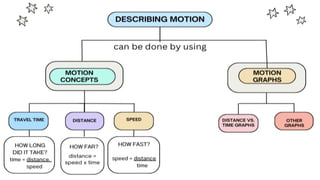
Distance refers to the total length of the path
traveled by an object, regardless of direction. It is a
scalar quantity, meaning it only has magnitude and
no direction.
It is typically measured in units like meters (m),
kilometers (km), miles, etc.
Distance can be thought of as the "how much" of
travel, without considering the specific route or
direction taken.
Time
Time is a measure of the duration between
two events or the interval during which
something happens. It is a scalar quantity
and is measured in units such as seconds
(s), minutes (min), hours (h), etc.
Time helps in understanding the rate at
which events occur or the duration for
which an object is in motion.
Distance and Time in Relation to Motion
In the context of motion, distance and time are two key
concepts used to describe how objects move.
1. Distance:
Distance refers to the total length of the path an object
travels during its motion, regardless of the direction. It
is how far the object has moved from its starting point.
For example, if a car moves along a curved road, the
distance is the total length of the road covered, not
how far the car is from its starting point in a straight
line. Distance is measured in units such as meters (m),
kilometers (km), or miles.
2. Time:
Time is the duration or interval over which
the motion occurs. It measures how long it
takes for an object to move from one point to
another. For example, if a car travels a
certain distance, the time tells us how long it
took to cover that distance. Time is
measured in units like seconds (s), minutes
(min), or hours (h).
PUSH AND GO
What you need:
toy car
meter stick or ruler stopwatch
What to do:
1. Find a flat surface on the floor.
2. Mark a starting point on the floor.
3. Put the toy car on the starting line. See to it that the
front end of the toy car is aligned to the starting line.
4. Gently push the toy car with your hand. Then,
record the time it travels using your stopwatch and
the distance using the meterstick or ruler.
5. Bring the toy car back to the starting line, but push
the toy car with a greater force than the first trial.
Write your data for the second trial in Table 1.
6. Repeat step number 5 for trials 3 - 5 with
increasing forces applied. Record your data in Table
1. Write your observations in your science
notebook.
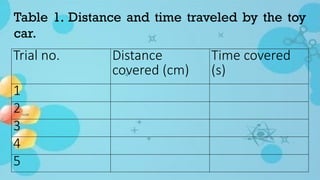
Table 1. Distance and time traveled by the toy
car.
Trial no. Distance
covered (cm)
Time covered
(s)
1
2
3
4
5
Directions:
Based on the activity, answer the following
questions. Write your answers in your science
notebook.
1.What action makes the toy car move?
2. In which trial did the toy car travel the shortest
distance? Why?
3. In which trial did the toy car travel the longest
distance? Why?
What is a
motion?
Direction: Give your
conclusion the
activity.
Conclusion:
____________________________________
____________________________________
____________________________________
____________________________________
____________________________________
____________________________________
Day 2
Directions: Identify
what is ask in the
statement and choose
your answers in the
box.
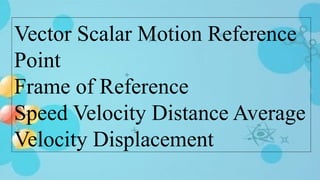
Vector Scalar Motion Reference
Point
Frame of Reference
Speed Velocity Distance Average
Velocity Displacement
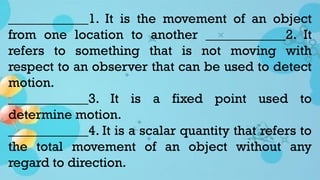
____________1. It is the movement of an object
from one location to another ____________2. It
refers to something that is not moving with
respect to an observer that can be used to detect
motion.
____________3. It is a fixed point used to
determine motion.
____________4. It is a scalar quantity that refers to
the total movement of an object without any
regard to direction.
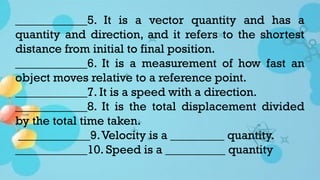
____________5. It is a vector quantity and has a
quantity and direction, and it refers to the shortest
distance from initial to final position.
____________6. It is a measurement of how fast an
object moves relative to a reference point.
____________7. It is a speed with a direction.
____________8. It is the total displacement divided
by the total time taken.
____________9.Velocity is a _________ quantity.
____________10. Speed is a __________ quantity
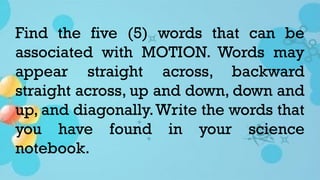
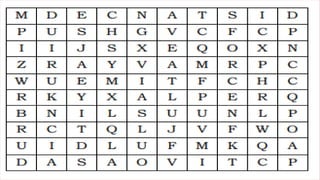
Find the five (5) words that can be
associated with MOTION. Words may
appear straight across, backward
straight across, up and down, down and
up, and diagonally.Write the words that
you have found in your science
notebook.
Distance
Distance is the total length of the path that an
object moves along, without considering the
direction. It is a scalar quantity, meaning it only
has size or magnitude, not direction. Distance is
usually measured in units such as meters (m),
kilometers (km), or miles. It represents the
"amount" of travel, independent of the specific
path or direction taken.
Time
Time is the measurement of the duration
between two events or the period during
which something occurs. It is a scalar
quantity, measured in units like seconds
(s), minutes (min), or hours (h). Time helps
in understanding how quickly events
unfold or the length of time an object
remains in motion.
Distance and Time in Motion
When we talk about how things move, two
important ideas are distance and time. These
help us understand how far something travels
and how long it takes to get there.
1. Distance:
Distance is how far something travels. It tells us
the total length of the path an object takes when it
moves.
For example, if you walk from your house to the store
and then to a friend’s house, the distance is how far
you traveled in total, no matter if you took a straight
or curved path. We measure distance in units like
meters (m), kilometers (km), or miles.
2. Time:
Time is how long it takes for something to move from
one place to another. For example, if it takes you 10
minutes to walk to the park, time tells us the amount
of time it took. We measure time in seconds (s),
minutes (min), or hours (h).
When we know both distance and time, we
can figure out how fast something is
moving. This is called speed. Speed tells
us how far something travels in a certain
amount of time. To find speed, we use this
simple formula:
Speed=Distance/Time
So, if you walk 100 meters in 20
seconds, you can figure out how fast
you were walking by dividing the
distance (100 meters) by the time (20
seconds). The result gives you the
speed in meters per second (m/s). The
faster you go, the more distance you
cover in less time!
The illustrations in the activity yesterday
indicate that force is exerted when you push
the toy car. When you lift a sack of rice, you
exert force by pulling the sack upward. When
you push a stalled car, you exert force to move
it forward. When you mop a floor using a rag,
you exert force by moving the rag back and
forth. When you close a door, you exert force
by pulling on the doorknob. So, we define force
as a push or a pull.
Forces may initiate and influence motion. When you
exert force, therefore, motion is produced. Motion is
a change of place or position in relation to time due
to the applied force. How far it moves, or it is moved
is the distance. Distance is measured in meter (m)
same as for the length according to the International
Bureau of Weights and Measurements (BIMP), but
the standard unit for distance on a smaller scale is
centimeter (cm) and kilometer (km) for the bigger
one.
When there is movement, there is motion. Motion is
also defined as a change in position with respect to a
reference point. A reference point is a place or object
used for comparison to determine if something is in
motion. An object is in motion if it changes position
relative to a reference point.
The fastness and slowness of a motion at a certain
distance can be calculated using the time it takes for
an object to cover the distance. The second (s) is the
basic unit of time, but for longer durations, minute (min
or m) or hour (h) may be use
Directions: Give at least five (5)
activities at home and school,
where there is motion. Copy
the table below and write your
answer in your science
notebook.
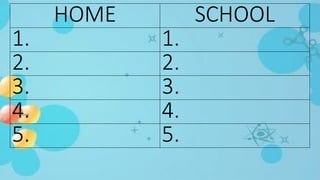
HOME SCHOOL
1. 1.
2. 2.
3. 3.
4. 4.
5. 5.
How can you say
that an object
moved?
Directions: Draw an
illustration that shows
motion and reference point.
Draw your illustration in
your science notebook.
Day 3
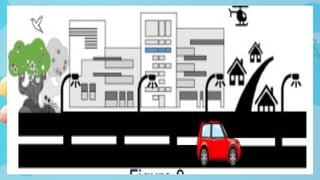
Directions: Observe the picture
below and identify the points of
reference that the car is in motion.
Give atleast five and write your
answers in the space provided.
What are the reference points of
the moving car in the picture?
1.
2.
3.
4.
5.
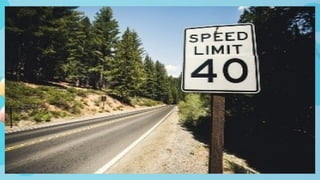
When do we
usually see this
signage? What
does it mean?
Distance
Distance is the total length of the path that an
object moves along, without considering the
direction. It is a scalar quantity, meaning it only
has size or magnitude, not direction. Distance is
usually measured in units such as meters (m),
kilometers (km), or miles. It represents the
"amount" of travel, independent of the specific
path or direction taken.
Time
Time is the measurement of the duration
between two events or the period during
which something occurs. It is a scalar
quantity, measured in units like seconds
(s), minutes (min), or hours (h). Time helps
in understanding how quickly events
unfold or the length of time an object
remains in motion.
Simple Equipment to Measure Distance and Time
1. Meter Stick
A meter stick is a long, straight tool used to
measure distance. It is exactly 1 meter long
(about the length of a baseball bat).You can use a
meter stick to measure how far something is from
one point to another, like measuring how long
your desk is or how far you can throw a ball.
• To use it, simply place one end of the meter
stick at the starting point and extend it to the
endpoint of the object you're measuring. You’ll see
numbers marked on the stick, telling you the
distance in meters and centimeters.
2. Ruler
A ruler is a smaller tool, usually about 30
centimeters (or 1 foot) long. It is helpful for
measuring smaller distances, like the length of a
book, a pencil, or a piece of paper. It shows
measurements in centimeters (cm) and millimeters
(mm).
• To measure something with a ruler, place it next to the
object, lining up the "0" mark of the ruler with one end of the
object.Then, read the number at the other end of the object to
see its length.
3. Measuring Tape
A measuring tape is a flexible tool that can measure longer
distances, like the length of a room or a piece of furniture. It
rolls up into a small case and can stretch out to several meters
or even more. Measuring tapes are marked with both
centimeters and inches.
• To use a measuring tape, pull it out to the length you
need to measure. Then, place the beginning of the tape at one
end of the object, and stretch the tape to the other end.
Read the number at the end of the object to find the
distance.
4. Stopwatch
A stopwatch is used to measure time. It helps us see
how long something takes. For example, you can use
a stopwatch to time how long it takes you to run a
race, or how long it takes to boil water.
• To use a stopwatch, press the start button when
the action begins. When the action ends, press the
stop button. The stopwatch will show the time in
seconds or minutes, depending on how long the
activity took.
Some stopwatches also show milliseconds for
very quick events.
Why Are These Tools Useful?
These tools are helpful because they let us
measure distance (how far something moves)
and time (how long it takes) easily. By knowing
both, we can calculate the speed of things
moving. For example, you can measure how far
a toy car travels with a ruler and use a
stopwatch to see how long it takes.
Then, you can find out how fast the
car is by dividing the distance by
the time!
These tools are simple, easy to use,
and can help you understand more
about the world around you.
Motion is the movement of objects from one
location to another. Whenever anything moves
from one location to another, motion is involved.
Even when something moves in a circle or a
cycle and comes back to where it started, there
is motion because the object moves to
intermediate points before returning to its
starting position. Motion always takes time. No
matter how fast an object moves, it takes some
time to travel from one location to another.
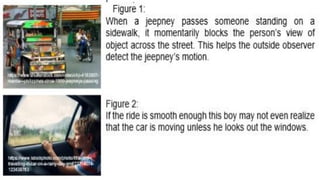
When a body or an object is continuously
changing its position with respect to the frame
of reference, then we can say that the body is in
motion. Frame of reference refers to something
that is not moving with respect to an observer
that can be used to detect motion.
Here are some examples to understand better
the Frame of Reference:
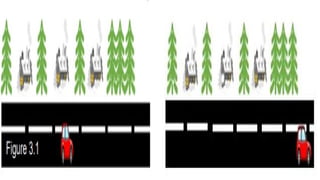
The objects that appears to be not
moving (trees, mountains,
driveways, streetlights, mailboxes,
etc.) is what is known as a
reference point. Observe the
picture below to understand better
the reference point:
A car is in the highway, how did you know that it is
moving? Well, you compared the car to the houses
and trees. Those were all reference points. They
helped you to determine that the car in fact moving.
A reference point is a fixed point used to determine
motion.
But remember that not all reference points have to be
standing still. An example of a reference point that is
moving is when you look out the window of a car and
notice that you are moving faster than the car next to
you.
The car next to you is moving, it is just
moving slower than your car. You use that
other car as a reference point to determine
that your car is moving. Almost everything
can be used as a reference point. The
Earth, classrooms, hallways, basketball
court, tables, and chairs are full of things
that you can use compare motion.
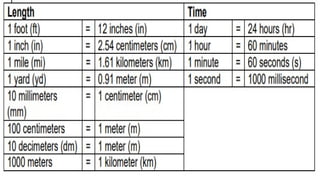
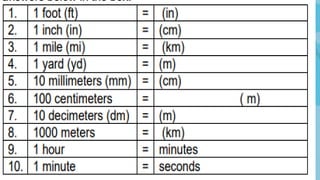
Measuring Motion International System of Units (SI)
Scientists all over the world use the same system of
measurement so that they can communicate clearly.
This system of measurement is called the
International System of Units. When describing
motion, scientists use SI units to describe the
distance an object moves. When you measure
distance, you measure length. The SI unit of length is
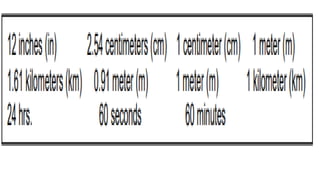
the meter (m). The table below is examples of
English and Metric System and their equivalents:
Whenever we measure how much motion an object has,
we refer to it as the speed of an object. Speed is defined
as the distance of an object travels divided by the time it
took the object to travel that distance.
Distance and Displacement
Distance is a scalar quantity that refers to the total
movement of an object without any regard to direction.
We can define distance as to how much ground an
object has covered despite its starting or ending point.
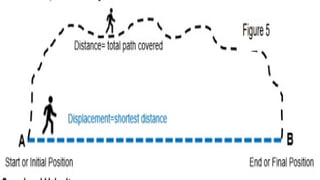
The displacement is a vector
quantity and has a quantity and
direction. It refers to the
shortest distance from initial to
final position. See Figure below
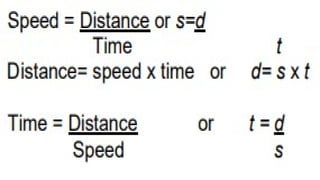
Speed and Velocity
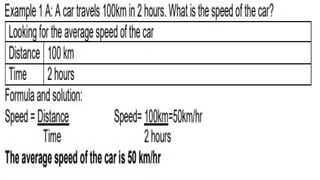
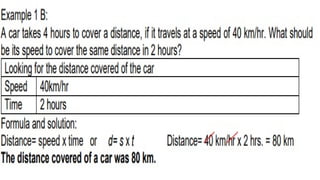
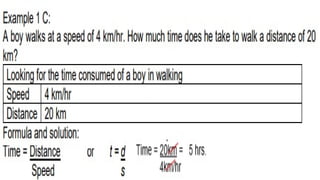
Speed is a measurement of how fast an object
moves relative to a reference point. It does not
have a direction and is considered a magnitude
or scalar quantity.The average speed of a body
in a certain time interval is the distance
covered by the body in that time interval
divided by time. Speed, distance and time can
be figured by the formula:
The standard unit of measure
for speed is generally meters
per second or m/s. Speed is
commonly measured in meters
per second (m/s), or
kilometers per hour (km/hr).
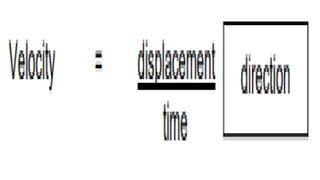
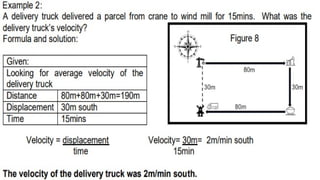
Velocity Velocity is speed with a direction.
It is actually a vector quantity as it has
magnitude and direction. The direction is
important in velocity because it’s using
displacement instead of distance. The
average velocity of an object is its total
displacement divided by the total time
taken. Velocity is represented by the
formula:
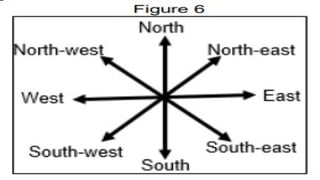
To understand velocity
you should know the
geographical locations.
See Figure 6.
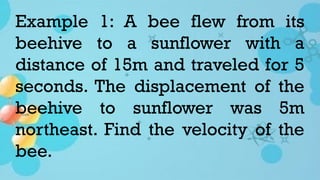
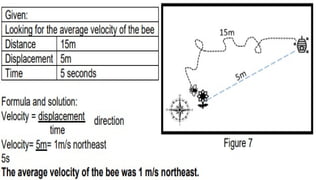
Example 1: A bee flew from its
beehive to a sunflower with a
distance of 15m and traveled for 5
seconds. The displacement of the
beehive to sunflower was 5m
northeast. Find the velocity of the
bee.
Directions: Give the
equivalent of the
following English and
Metric System. Choose
your answers below in the
box.
How can you
say that an
object moved?
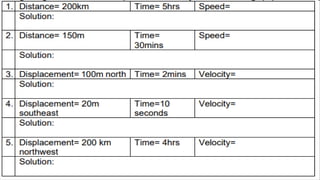
Directions: Using the
given data find the
speed and velocity of
the following.
Day 4
• What is the difference between a meter stick
and a ruler?
• How do you use a measuring tape to measure
something?
• Which tool would you use to measure the length
of a pencil: a meter stick, a ruler, or a measuring
tape? Why?
• How does a stopwatch help you measure time,
and what do you do when the activity is done?
• Why is it important to measure distance and
time accurately when finding speed? Give an
example.
Today, we will learn
on how to calculate
the distance of a
moving object.
Distance
Distance is the total length an object travels,
regardless of direction. It is a measure of how far
something has moved and is usually measured in
units like meters (m), kilometers (km), or miles.
Time
Time is the amount of time that passes between
two events. It tells us how long something takes
and is measured in units like seconds (s), minutes
(min), or hours (h).
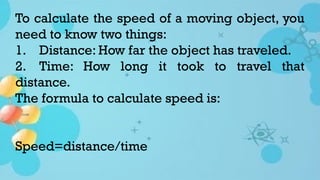
To calculate the speed of a moving object, you
need to know two things:
1. Distance: How far the object has traveled.
2. Time: How long it took to travel that
distance.
The formula to calculate speed is:
Speed=distance/time
Steps to Calculate Speed:
1. Measure the distance the object traveled. For
example, if you measure with a ruler or meter
stick and find that the object traveled 100 meters.
2. Measure the time it took for the object to
travel that distance. You can use a stopwatch for
this. Suppose it took 20 seconds.
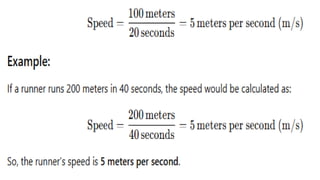
3. Apply the formula. Substitute the values for
distance and time into the formula:
Answer the following questions:
1. What is the formula for calculating speed?
2. If a car travels 150 meters in 30 seconds, what is
its speed?
3. A runner covers a distance of 200 meters in 40
seconds.What is their speed?
4. A bicycle travels 100 kilometers in 5 hours.
What is its average speed?
5. If a person walks 500 meters in 10 minutes, how
fast are they walking in meters per second?
6. A train moves at a speed of 80 kilometers per
hour. How far will it travel in 2 hours?
7. You run 300 meters in 60 seconds. What is your
speed in meters per second?
8. A jet travels 1,000 kilometers in 2 hours. What is
its speed?
9. If a dog runs 200 meters in 25 seconds, what is
its speed in meters per second?
10. A car moves 120 meters in 15 seconds. How long
will it take to travel 240 meters at the same speed?
Answer the following questions:
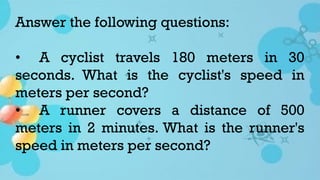
• A cyclist travels 180 meters in 30
seconds. What is the cyclist's speed in
meters per second?
• A runner covers a distance of 500
meters in 2 minutes. What is the runner's
speed in meters per second?
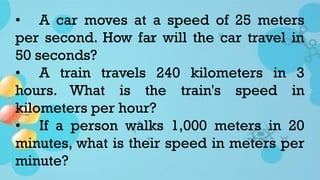
• A car moves at a speed of 25 meters
per second. How far will the car travel in
50 seconds?
• A train travels 240 kilometers in 3
hours. What is the train's speed in
kilometers per hour?
• If a person walks 1,000 meters in 20
minutes, what is their speed in meters per
minute?
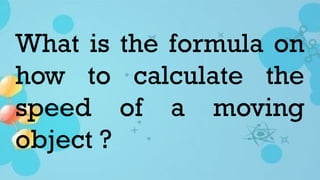
What is the formula on
how to calculate the
speed of a moving
object ?
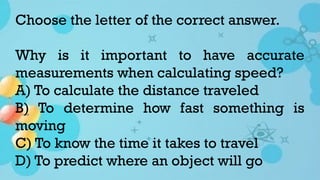
Choose the letter of the correct answer.
Why is it important to have accurate
measurements when calculating speed?
A) To calculate the distance traveled
B) To determine how fast something is
moving
C) To know the time it takes to travel
D) To predict where an object will go
What can happen if measurements of
distance and time are inaccurate?
A) Predictions about speed can be
wrong
B) The object will stop moving
C) The time will always be shorter
D) The speed will increase
automatically
How can accurate measurements help
in sports?
A) They can make the athlete run faster
B) They help coaches understand the
athlete's performance
C) They can change the outcome of the
race
D) They help the athlete rest longer
What happens if you don't measure
carefully when crossing the street?
A) You might misjudge the distance or
speed of an oncoming car
B) You will never need to cross the
street
C) The car will stop automatically
D) The street will change its direction
Why is it important to have accurate
measurements when doing science
experiments?
A) It makes the experiment faster
B) It helps us get accurate results to understand
how things work
C) It makes the experiment more exciting
D) It allows us to predict the weather
How does accurate measurement affect
predicting the future motion of an object?
A) It helps us guess the future movement
B) It allows us to predict when the object
will stop
C) It helps us predict when the object will
reach its destination
D) It has no effect on predictions
Why is measuring time important when
studying motion?
A) To know when the object started
moving
B) To measure how long something takes
to move
C) To guess how fast the object will move
D) To stop the object from moving
Which of the following is a result of
using inaccurate measurements in
motion?
A) More accurate predictions
B) Safe crossing of the street
C) Incorrect speed calculations
D) Better performance in sports
What does measuring the distance and
time of two runners allow us to do?
A) Predict how fast the runners will be
next time
B) Compare their speeds accurately
C) Make them run faster
D) Help them rest more
How can incorrect measurements in
experiments affect the results?
A) They will still show the correct result
B) The experiment will be more fun
C) The results will be wrong and not
helpful
D) The results will be delayed
Day 5
• Why do we need accurate
measurements to calculate speed?
• How do accurate measurements help
us know when something will arrive?
• Why is it important to measure
carefully when crossing the street?
• How does accuracy in
measuring help in science
experiments?
• How can accurate
measurements help compare how
fast two things are moving?
Today, we will delve on
the Importance of
Accurate Measurements
in Describing Motion
Distance
Distance is the total length an object travels,
regardless of direction. It is a measure of how far
something has moved and is usually measured in
units like meters (m), kilometers (km), or miles.
Time
Time is the amount of time that passes between two
events. It tells us how long something takes and is
measured in units like seconds (s), minutes (min),
or hours (h).
The Importance of Accurate Measurements
in Describing Motion
When we study motion, it’s important to
have accurate measurements of distance
and time. This helps us understand how
fast things are moving, how far they travel,
and how long it takes them to get there.
Here’s why accurate measurements are so
important:
1. Understanding Speed and Performance
Accurate measurements allow us to calculate
the speed of an object correctly. For example,
in sports, measuring how far an athlete runs
and how long it takes helps coaches
understand their performance. If the
measurements are wrong, it could give
incorrect information about how fast or slow
they are moving, which could affect training
and improvement.
2. Predicting Future Motion
When we have accurate measurements, we can
better predict what will happen next. For
example, if we know how fast a car is moving,
we can predict when it will reach its
destination. If the measurements are wrong, our
predictions could be inaccurate, leading to
mistakes or unsafe situations, like arriving too
early or too late.
3. Safety and Planning
Accurate measurements are also important
for safety. For example, if you’re planning
to cross a street, knowing the exact
distance and the time it takes a car to
reach you helps you decide whether it's
safe to cross. If you didn’t measure
carefully, you could misjudge the car’s
speed and distance, putting you in danger.
4. Experiments and Science
In science experiments, we rely on accurate
measurements to understand how things work.
For example, if you are studying the speed of a
ball rolling down a hill, precise measurements
of distance and time help you calculate the
speed correctly. If the measurements are not
accurate, the results could be wrong, and you
won’t learn what’s really happening.
5. Comparing Different Movements
Accurate measurements help us compare
how different objects move. If you measure
the distance and time of two runners, you
can accurately compare their speeds.
Without accuracy, you might think one is
faster when they’re actually moving at the
same speed.
Write TRUE if the statement is correct and FALSE if it
is not.
1. Accurate measurements help us calculate the
speed of an object correctly.
2. If the measurements are wrong, we can still
make accurate predictions about when a moving
object will reach its destination.
3. Accurate measurements are only important for
sports, not for safety when crossing the street.
4. In science experiments, using inaccurate
measurements can lead to wrong results and
prevent us from understanding how things work.
5. By measuring the distance and time of two
runners, we can easily compare their speeds and
know who is faster, even without accurate
measurements.
Instructions:
In groups with five members, students conduct
a walking activity to determine how
fast or slow each walk is and who walks fastest
in the group.
Instruct the students to follow the following
procedure:
1. Go to the corridor or the nearest area to your
room that is clear and safe for this walking
activity.
2. Using the meter stick, measure 10 meters.
Use chalk or any marker to indicate the starting
and ending points with a line.
3. Let each member walk at a normal pace (not
fast nor slow) along the path from the starting
to the ending points. Ask another member to
record the time taken to walk 10 meters.
4. Let each member do two more trials by
walking slower and faster than the first.
5. Compute the fastest speed of each member by
dividing the distance traveled by the shortest time
of travel.
Process questions:
1. What happened to your travel time when you
walked slower? faster?
2. Who walked fastest in your group? What is the
basis for concluding that he or she is the fastest in
your group?
3. Is it safe when you move fast? Why?
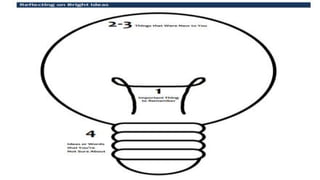
Using the provided template, ask
the students to reflect on bright
ideas. In the light bulb image, they
will write 2-3 things in this lesson
that were new to them, 1 important
thing to remember, and 4 ideas or
words that they’re not sure about.
Choose the letter of the correct answer.
Why are accurate measurements important
when calculating speed?
A) To understand how fast an object is moving
B) To know the weight of the object
C) To know how long the object will stay in
motion
D) To understand the direction of the motion
What can happen if the measurements of
distance and time are incorrect?
A) The object will stop moving
B) Speed calculations may be wrong,
leading to inaccurate results
C) The object will speed up automatically
D) The object will move in the wrong
direction
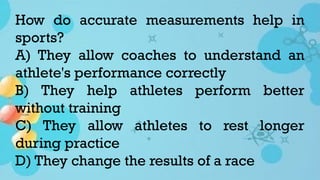
How do accurate measurements help in
sports?
A) They allow coaches to understand an
athlete's performance correctly
B) They help athletes perform better
without training
C) They allow athletes to rest longer
during practice
D) They change the results of a race
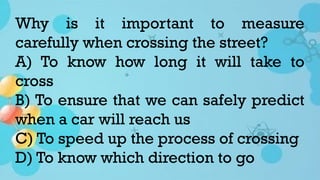
Why is it important to measure
carefully when crossing the street?
A) To know how long it will take to
cross
B) To ensure that we can safely predict
when a car will reach us
C) To speed up the process of crossing
D) To know which direction to go
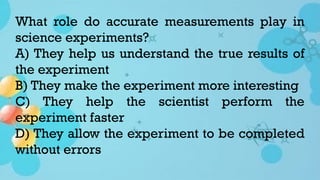
What role do accurate measurements play in
science experiments?
A) They help us understand the true results of
the experiment
B) They make the experiment more interesting
C) They help the scientist perform the
experiment faster
D) They allow the experiment to be completed
without errors
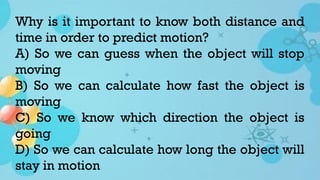
Why is it important to know both distance and
time in order to predict motion?
A) So we can guess when the object will stop
moving
B) So we can calculate how fast the object is
moving
C) So we know which direction the object is
going
D) So we can calculate how long the object will
stay in motion
How can accurate measurements of speed
affect safety?
A) They allow us to predict when an object
will collide with something
B) They help us safely judge how fast
things are moving around us
C) They prevent the object from stopping
D) They make the object move faster
What would happen if we didn’t
measure carefully when comparing the
speeds of two runners?
A) We might wrongly think one runner
is faster than the other
B) Both runners will run faster
C) The race will be canceled
D) The runners will stop moving
Why is it important to measure the time
and distance when studying motion?
A) To know the exact location of the object
B) To calculate the speed of the object
correctly
C) To predict when the object will stop
moving
D) To guess how far the object has traveled
What is the result of using inaccurate
measurements in a science experiment?
A) The experiment will give wrong
results and we won’t learn the true facts
B) The experiment will end sooner
C) The object will move faster
D) The results will be more fun to study
SCIENCE 4 quarter three, week four Describing motion

  • 1.
    Describing Motion Using Distance,Time, And Speed Science 4 Quarter 3, Week 4
  • 2.
    Learning Competency 1:The learners measure accurately the distance and time when things move usingsimple equipment. The learners will be able to: Lesson Objective 1: define the concepts of distance and time as they relate to motion; Lesson Objective 2: familiarize oneself with simple equipment to measure distance and time, like a meter stick,ruler, measuring tape, and stopwatch Learning Competency
  • 3.
    Learning Competency 2:The learners identify that how far an object moves in a given time is called speed. The learners will be able to: Lesson Objective 1: calculate the speed of a moving object; Lesson Objective 2: recognize the importance of having accurate measurements in describing motion
  • 4.
  • 5.
    Directions: What isforce? What are its effects? _____________________________ ________________________
  • 6.
    Let’s watch this! Isthe horse moving forward or backward? Youtube Link: https://www.youtube.com/watch? v=ukJpogiGJA0
  • 7.
    Distance Distance refers tothe total length of the path traveled by an object, regardless of direction. It is a scalar quantity, meaning it only has magnitude and no direction. It is typically measured in units like meters (m), kilometers (km), miles, etc. Distance can be thought of as the "how much" of travel, without considering the specific route or direction taken.
  • 8.
    Time Time is ameasure of the duration between two events or the interval during which something happens. It is a scalar quantity and is measured in units such as seconds (s), minutes (min), hours (h), etc. Time helps in understanding the rate at which events occur or the duration for which an object is in motion.
  • 9.
    Distance and Timein Relation to Motion In the context of motion, distance and time are two key concepts used to describe how objects move. 1. Distance: Distance refers to the total length of the path an object travels during its motion, regardless of the direction. It is how far the object has moved from its starting point. For example, if a car moves along a curved road, the distance is the total length of the road covered, not how far the car is from its starting point in a straight line. Distance is measured in units such as meters (m), kilometers (km), or miles.
  • 10.
    2. Time: Time isthe duration or interval over which the motion occurs. It measures how long it takes for an object to move from one point to another. For example, if a car travels a certain distance, the time tells us how long it took to cover that distance. Time is measured in units like seconds (s), minutes (min), or hours (h).
  • 11.
    PUSH AND GO Whatyou need: toy car meter stick or ruler stopwatch What to do: 1. Find a flat surface on the floor. 2. Mark a starting point on the floor. 3. Put the toy car on the starting line. See to it that the front end of the toy car is aligned to the starting line.
  • 12.
    4. Gently pushthe toy car with your hand. Then, record the time it travels using your stopwatch and the distance using the meterstick or ruler. 5. Bring the toy car back to the starting line, but push the toy car with a greater force than the first trial. Write your data for the second trial in Table 1. 6. Repeat step number 5 for trials 3 - 5 with increasing forces applied. Record your data in Table 1. Write your observations in your science notebook.
  • 13.
    Table 1. Distanceand time traveled by the toy car. Trial no. Distance covered (cm) Time covered (s) 1 2 3 4 5
  • 14.
    Directions: Based on theactivity, answer the following questions. Write your answers in your science notebook. 1.What action makes the toy car move? 2. In which trial did the toy car travel the shortest distance? Why? 3. In which trial did the toy car travel the longest distance? Why?
  • 15.
  • 16.
  • 17.
  • 18.
  • 19.
    Directions: Identify what isask in the statement and choose your answers in the box.
  • 20.
    Vector Scalar MotionReference Point Frame of Reference Speed Velocity Distance Average Velocity Displacement
  • 21.
    ____________1. It isthe movement of an object from one location to another ____________2. It refers to something that is not moving with respect to an observer that can be used to detect motion. ____________3. It is a fixed point used to determine motion. ____________4. It is a scalar quantity that refers to the total movement of an object without any regard to direction.
  • 22.
    ____________5. It isa vector quantity and has a quantity and direction, and it refers to the shortest distance from initial to final position. ____________6. It is a measurement of how fast an object moves relative to a reference point. ____________7. It is a speed with a direction. ____________8. It is the total displacement divided by the total time taken. ____________9.Velocity is a _________ quantity. ____________10. Speed is a __________ quantity
  • 23.
    Find the five(5) words that can be associated with MOTION. Words may appear straight across, backward straight across, up and down, down and up, and diagonally.Write the words that you have found in your science notebook.
  • 25.
    Distance Distance is thetotal length of the path that an object moves along, without considering the direction. It is a scalar quantity, meaning it only has size or magnitude, not direction. Distance is usually measured in units such as meters (m), kilometers (km), or miles. It represents the "amount" of travel, independent of the specific path or direction taken.
  • 26.
    Time Time is themeasurement of the duration between two events or the period during which something occurs. It is a scalar quantity, measured in units like seconds (s), minutes (min), or hours (h). Time helps in understanding how quickly events unfold or the length of time an object remains in motion.
  • 27.
    Distance and Timein Motion When we talk about how things move, two important ideas are distance and time. These help us understand how far something travels and how long it takes to get there. 1. Distance: Distance is how far something travels. It tells us the total length of the path an object takes when it moves.
  • 28.
    For example, ifyou walk from your house to the store and then to a friend’s house, the distance is how far you traveled in total, no matter if you took a straight or curved path. We measure distance in units like meters (m), kilometers (km), or miles. 2. Time: Time is how long it takes for something to move from one place to another. For example, if it takes you 10 minutes to walk to the park, time tells us the amount of time it took. We measure time in seconds (s), minutes (min), or hours (h).
  • 29.
    When we knowboth distance and time, we can figure out how fast something is moving. This is called speed. Speed tells us how far something travels in a certain amount of time. To find speed, we use this simple formula: Speed=Distance/Time
  • 30.
    So, if youwalk 100 meters in 20 seconds, you can figure out how fast you were walking by dividing the distance (100 meters) by the time (20 seconds). The result gives you the speed in meters per second (m/s). The faster you go, the more distance you cover in less time!
  • 31.
    The illustrations inthe activity yesterday indicate that force is exerted when you push the toy car. When you lift a sack of rice, you exert force by pulling the sack upward. When you push a stalled car, you exert force to move it forward. When you mop a floor using a rag, you exert force by moving the rag back and forth. When you close a door, you exert force by pulling on the doorknob. So, we define force as a push or a pull.
  • 32.
    Forces may initiateand influence motion. When you exert force, therefore, motion is produced. Motion is a change of place or position in relation to time due to the applied force. How far it moves, or it is moved is the distance. Distance is measured in meter (m) same as for the length according to the International Bureau of Weights and Measurements (BIMP), but the standard unit for distance on a smaller scale is centimeter (cm) and kilometer (km) for the bigger one.
  • 33.
    When there ismovement, there is motion. Motion is also defined as a change in position with respect to a reference point. A reference point is a place or object used for comparison to determine if something is in motion. An object is in motion if it changes position relative to a reference point. The fastness and slowness of a motion at a certain distance can be calculated using the time it takes for an object to cover the distance. The second (s) is the basic unit of time, but for longer durations, minute (min or m) or hour (h) may be use
  • 34.
    Directions: Give atleast five (5) activities at home and school, where there is motion. Copy the table below and write your answer in your science notebook.
  • 35.
    HOME SCHOOL 1. 1. 2.2. 3. 3. 4. 4. 5. 5.
  • 36.
    How can yousay that an object moved?
  • 37.
    Directions: Draw an illustrationthat shows motion and reference point. Draw your illustration in your science notebook.
  • 39.
  • 40.
    Directions: Observe thepicture below and identify the points of reference that the car is in motion. Give atleast five and write your answers in the space provided. What are the reference points of the moving car in the picture?
  • 42.
  • 44.
    When do we usuallysee this signage? What does it mean?
  • 45.
    Distance Distance is thetotal length of the path that an object moves along, without considering the direction. It is a scalar quantity, meaning it only has size or magnitude, not direction. Distance is usually measured in units such as meters (m), kilometers (km), or miles. It represents the "amount" of travel, independent of the specific path or direction taken.
  • 46.
    Time Time is themeasurement of the duration between two events or the period during which something occurs. It is a scalar quantity, measured in units like seconds (s), minutes (min), or hours (h). Time helps in understanding how quickly events unfold or the length of time an object remains in motion.
  • 47.
    Simple Equipment toMeasure Distance and Time 1. Meter Stick A meter stick is a long, straight tool used to measure distance. It is exactly 1 meter long (about the length of a baseball bat).You can use a meter stick to measure how far something is from one point to another, like measuring how long your desk is or how far you can throw a ball.
  • 48.
    • To useit, simply place one end of the meter stick at the starting point and extend it to the endpoint of the object you're measuring. You’ll see numbers marked on the stick, telling you the distance in meters and centimeters. 2. Ruler A ruler is a smaller tool, usually about 30 centimeters (or 1 foot) long. It is helpful for measuring smaller distances, like the length of a book, a pencil, or a piece of paper. It shows measurements in centimeters (cm) and millimeters (mm).
  • 49.
    • To measuresomething with a ruler, place it next to the object, lining up the "0" mark of the ruler with one end of the object.Then, read the number at the other end of the object to see its length. 3. Measuring Tape A measuring tape is a flexible tool that can measure longer distances, like the length of a room or a piece of furniture. It rolls up into a small case and can stretch out to several meters or even more. Measuring tapes are marked with both centimeters and inches. • To use a measuring tape, pull it out to the length you need to measure. Then, place the beginning of the tape at one end of the object, and stretch the tape to the other end.
  • 50.
    Read the numberat the end of the object to find the distance. 4. Stopwatch A stopwatch is used to measure time. It helps us see how long something takes. For example, you can use a stopwatch to time how long it takes you to run a race, or how long it takes to boil water. • To use a stopwatch, press the start button when the action begins. When the action ends, press the stop button. The stopwatch will show the time in seconds or minutes, depending on how long the activity took.
  • 51.
    Some stopwatches alsoshow milliseconds for very quick events. Why Are These Tools Useful? These tools are helpful because they let us measure distance (how far something moves) and time (how long it takes) easily. By knowing both, we can calculate the speed of things moving. For example, you can measure how far a toy car travels with a ruler and use a stopwatch to see how long it takes.
  • 52.
    Then, you canfind out how fast the car is by dividing the distance by the time! These tools are simple, easy to use, and can help you understand more about the world around you.
  • 53.
    Motion is themovement of objects from one location to another. Whenever anything moves from one location to another, motion is involved. Even when something moves in a circle or a cycle and comes back to where it started, there is motion because the object moves to intermediate points before returning to its starting position. Motion always takes time. No matter how fast an object moves, it takes some time to travel from one location to another.
  • 54.
    When a bodyor an object is continuously changing its position with respect to the frame of reference, then we can say that the body is in motion. Frame of reference refers to something that is not moving with respect to an observer that can be used to detect motion. Here are some examples to understand better the Frame of Reference:
  • 56.
    The objects thatappears to be not moving (trees, mountains, driveways, streetlights, mailboxes, etc.) is what is known as a reference point. Observe the picture below to understand better the reference point:
  • 58.
    A car isin the highway, how did you know that it is moving? Well, you compared the car to the houses and trees. Those were all reference points. They helped you to determine that the car in fact moving. A reference point is a fixed point used to determine motion. But remember that not all reference points have to be standing still. An example of a reference point that is moving is when you look out the window of a car and notice that you are moving faster than the car next to you.
  • 59.
    The car nextto you is moving, it is just moving slower than your car. You use that other car as a reference point to determine that your car is moving. Almost everything can be used as a reference point. The Earth, classrooms, hallways, basketball court, tables, and chairs are full of things that you can use compare motion.
  • 60.
    Measuring Motion InternationalSystem of Units (SI) Scientists all over the world use the same system of measurement so that they can communicate clearly. This system of measurement is called the International System of Units. When describing motion, scientists use SI units to describe the distance an object moves. When you measure distance, you measure length. The SI unit of length is the meter (m). The table below is examples of English and Metric System and their equivalents:
  • 62.
    Whenever we measurehow much motion an object has, we refer to it as the speed of an object. Speed is defined as the distance of an object travels divided by the time it took the object to travel that distance. Distance and Displacement Distance is a scalar quantity that refers to the total movement of an object without any regard to direction. We can define distance as to how much ground an object has covered despite its starting or ending point.
  • 63.
    The displacement isa vector quantity and has a quantity and direction. It refers to the shortest distance from initial to final position. See Figure below
  • 65.
    Speed and Velocity Speedis a measurement of how fast an object moves relative to a reference point. It does not have a direction and is considered a magnitude or scalar quantity.The average speed of a body in a certain time interval is the distance covered by the body in that time interval divided by time. Speed, distance and time can be figured by the formula:
  • 67.
    The standard unitof measure for speed is generally meters per second or m/s. Speed is commonly measured in meters per second (m/s), or kilometers per hour (km/hr).
  • 71.
    Velocity Velocity isspeed with a direction. It is actually a vector quantity as it has magnitude and direction. The direction is important in velocity because it’s using displacement instead of distance. The average velocity of an object is its total displacement divided by the total time taken. Velocity is represented by the formula:
  • 73.
    To understand velocity youshould know the geographical locations. See Figure 6.
  • 75.
    Example 1: Abee flew from its beehive to a sunflower with a distance of 15m and traveled for 5 seconds. The displacement of the beehive to sunflower was 5m northeast. Find the velocity of the bee.
  • 78.
    Directions: Give the equivalentof the following English and Metric System. Choose your answers below in the box.
  • 81.
    How can you saythat an object moved?
  • 82.
    Directions: Using the givendata find the speed and velocity of the following.
  • 84.
  • 85.
    • What isthe difference between a meter stick and a ruler? • How do you use a measuring tape to measure something? • Which tool would you use to measure the length of a pencil: a meter stick, a ruler, or a measuring tape? Why? • How does a stopwatch help you measure time, and what do you do when the activity is done? • Why is it important to measure distance and time accurately when finding speed? Give an example.
  • 86.
    Today, we willlearn on how to calculate the distance of a moving object.
  • 87.
    Distance Distance is thetotal length an object travels, regardless of direction. It is a measure of how far something has moved and is usually measured in units like meters (m), kilometers (km), or miles. Time Time is the amount of time that passes between two events. It tells us how long something takes and is measured in units like seconds (s), minutes (min), or hours (h).
  • 88.
    To calculate thespeed of a moving object, you need to know two things: 1. Distance: How far the object has traveled. 2. Time: How long it took to travel that distance. The formula to calculate speed is: Speed=distance/time
  • 89.
    Steps to CalculateSpeed: 1. Measure the distance the object traveled. For example, if you measure with a ruler or meter stick and find that the object traveled 100 meters. 2. Measure the time it took for the object to travel that distance. You can use a stopwatch for this. Suppose it took 20 seconds. 3. Apply the formula. Substitute the values for distance and time into the formula:
  • 91.
    Answer the followingquestions: 1. What is the formula for calculating speed? 2. If a car travels 150 meters in 30 seconds, what is its speed? 3. A runner covers a distance of 200 meters in 40 seconds.What is their speed? 4. A bicycle travels 100 kilometers in 5 hours. What is its average speed? 5. If a person walks 500 meters in 10 minutes, how fast are they walking in meters per second?
  • 92.
    6. A trainmoves at a speed of 80 kilometers per hour. How far will it travel in 2 hours? 7. You run 300 meters in 60 seconds. What is your speed in meters per second? 8. A jet travels 1,000 kilometers in 2 hours. What is its speed? 9. If a dog runs 200 meters in 25 seconds, what is its speed in meters per second? 10. A car moves 120 meters in 15 seconds. How long will it take to travel 240 meters at the same speed?
  • 93.
    Answer the followingquestions: • A cyclist travels 180 meters in 30 seconds. What is the cyclist's speed in meters per second? • A runner covers a distance of 500 meters in 2 minutes. What is the runner's speed in meters per second?
  • 94.
    • A carmoves at a speed of 25 meters per second. How far will the car travel in 50 seconds? • A train travels 240 kilometers in 3 hours. What is the train's speed in kilometers per hour? • If a person walks 1,000 meters in 20 minutes, what is their speed in meters per minute?
  • 95.
    What is theformula on how to calculate the speed of a moving object ?
  • 96.
    Choose the letterof the correct answer. Why is it important to have accurate measurements when calculating speed? A) To calculate the distance traveled B) To determine how fast something is moving C) To know the time it takes to travel D) To predict where an object will go
  • 97.
    What can happenif measurements of distance and time are inaccurate? A) Predictions about speed can be wrong B) The object will stop moving C) The time will always be shorter D) The speed will increase automatically
  • 98.
    How can accuratemeasurements help in sports? A) They can make the athlete run faster B) They help coaches understand the athlete's performance C) They can change the outcome of the race D) They help the athlete rest longer
  • 99.
    What happens ifyou don't measure carefully when crossing the street? A) You might misjudge the distance or speed of an oncoming car B) You will never need to cross the street C) The car will stop automatically D) The street will change its direction
  • 100.
    Why is itimportant to have accurate measurements when doing science experiments? A) It makes the experiment faster B) It helps us get accurate results to understand how things work C) It makes the experiment more exciting D) It allows us to predict the weather
  • 101.
    How does accuratemeasurement affect predicting the future motion of an object? A) It helps us guess the future movement B) It allows us to predict when the object will stop C) It helps us predict when the object will reach its destination D) It has no effect on predictions
  • 102.
    Why is measuringtime important when studying motion? A) To know when the object started moving B) To measure how long something takes to move C) To guess how fast the object will move D) To stop the object from moving
  • 103.
    Which of thefollowing is a result of using inaccurate measurements in motion? A) More accurate predictions B) Safe crossing of the street C) Incorrect speed calculations D) Better performance in sports
  • 104.
    What does measuringthe distance and time of two runners allow us to do? A) Predict how fast the runners will be next time B) Compare their speeds accurately C) Make them run faster D) Help them rest more
  • 105.
    How can incorrectmeasurements in experiments affect the results? A) They will still show the correct result B) The experiment will be more fun C) The results will be wrong and not helpful D) The results will be delayed
  • 106.
  • 107.
    • Why dowe need accurate measurements to calculate speed? • How do accurate measurements help us know when something will arrive? • Why is it important to measure carefully when crossing the street?
  • 108.
    • How doesaccuracy in measuring help in science experiments? • How can accurate measurements help compare how fast two things are moving?
  • 109.
    Today, we willdelve on the Importance of Accurate Measurements in Describing Motion
  • 110.
    Distance Distance is thetotal length an object travels, regardless of direction. It is a measure of how far something has moved and is usually measured in units like meters (m), kilometers (km), or miles. Time Time is the amount of time that passes between two events. It tells us how long something takes and is measured in units like seconds (s), minutes (min), or hours (h).
  • 111.
    The Importance ofAccurate Measurements in Describing Motion When we study motion, it’s important to have accurate measurements of distance and time. This helps us understand how fast things are moving, how far they travel, and how long it takes them to get there. Here’s why accurate measurements are so important:

  • 112.
    1. Understanding Speedand Performance Accurate measurements allow us to calculate the speed of an object correctly. For example, in sports, measuring how far an athlete runs and how long it takes helps coaches understand their performance. If the measurements are wrong, it could give incorrect information about how fast or slow they are moving, which could affect training and improvement.
  • 113.
    2. Predicting FutureMotion When we have accurate measurements, we can better predict what will happen next. For example, if we know how fast a car is moving, we can predict when it will reach its destination. If the measurements are wrong, our predictions could be inaccurate, leading to mistakes or unsafe situations, like arriving too early or too late.
  • 114.
    3. Safety andPlanning Accurate measurements are also important for safety. For example, if you’re planning to cross a street, knowing the exact distance and the time it takes a car to reach you helps you decide whether it's safe to cross. If you didn’t measure carefully, you could misjudge the car’s speed and distance, putting you in danger.
  • 115.
    4. Experiments andScience In science experiments, we rely on accurate measurements to understand how things work. For example, if you are studying the speed of a ball rolling down a hill, precise measurements of distance and time help you calculate the speed correctly. If the measurements are not accurate, the results could be wrong, and you won’t learn what’s really happening.
  • 116.
    5. Comparing DifferentMovements Accurate measurements help us compare how different objects move. If you measure the distance and time of two runners, you can accurately compare their speeds. Without accuracy, you might think one is faster when they’re actually moving at the same speed.
  • 117.
    Write TRUE ifthe statement is correct and FALSE if it is not. 1. Accurate measurements help us calculate the speed of an object correctly. 2. If the measurements are wrong, we can still make accurate predictions about when a moving object will reach its destination.
  • 118.
    3. Accurate measurementsare only important for sports, not for safety when crossing the street. 4. In science experiments, using inaccurate measurements can lead to wrong results and prevent us from understanding how things work. 5. By measuring the distance and time of two runners, we can easily compare their speeds and know who is faster, even without accurate measurements.
  • 119.
    Instructions: In groups withfive members, students conduct a walking activity to determine how fast or slow each walk is and who walks fastest in the group. Instruct the students to follow the following procedure: 1. Go to the corridor or the nearest area to your room that is clear and safe for this walking activity.
  • 120.
    2. Using themeter stick, measure 10 meters. Use chalk or any marker to indicate the starting and ending points with a line. 3. Let each member walk at a normal pace (not fast nor slow) along the path from the starting to the ending points. Ask another member to record the time taken to walk 10 meters. 4. Let each member do two more trials by walking slower and faster than the first.
  • 121.
    5. Compute thefastest speed of each member by dividing the distance traveled by the shortest time of travel. Process questions: 1. What happened to your travel time when you walked slower? faster? 2. Who walked fastest in your group? What is the basis for concluding that he or she is the fastest in your group? 3. Is it safe when you move fast? Why?
  • 123.
    Using the providedtemplate, ask the students to reflect on bright ideas. In the light bulb image, they will write 2-3 things in this lesson that were new to them, 1 important thing to remember, and 4 ideas or words that they’re not sure about.
  • 125.
    Choose the letterof the correct answer. Why are accurate measurements important when calculating speed? A) To understand how fast an object is moving B) To know the weight of the object C) To know how long the object will stay in motion D) To understand the direction of the motion
  • 126.
    What can happenif the measurements of distance and time are incorrect? A) The object will stop moving B) Speed calculations may be wrong, leading to inaccurate results C) The object will speed up automatically D) The object will move in the wrong direction
  • 127.
    How do accuratemeasurements help in sports? A) They allow coaches to understand an athlete's performance correctly B) They help athletes perform better without training C) They allow athletes to rest longer during practice D) They change the results of a race
  • 128.
    Why is itimportant to measure carefully when crossing the street? A) To know how long it will take to cross B) To ensure that we can safely predict when a car will reach us C) To speed up the process of crossing D) To know which direction to go
  • 129.
    What role doaccurate measurements play in science experiments? A) They help us understand the true results of the experiment B) They make the experiment more interesting C) They help the scientist perform the experiment faster D) They allow the experiment to be completed without errors
  • 130.
    Why is itimportant to know both distance and time in order to predict motion? A) So we can guess when the object will stop moving B) So we can calculate how fast the object is moving C) So we know which direction the object is going D) So we can calculate how long the object will stay in motion
  • 131.
    How can accuratemeasurements of speed affect safety? A) They allow us to predict when an object will collide with something B) They help us safely judge how fast things are moving around us C) They prevent the object from stopping D) They make the object move faster
  • 132.
    What would happenif we didn’t measure carefully when comparing the speeds of two runners? A) We might wrongly think one runner is faster than the other B) Both runners will run faster C) The race will be canceled D) The runners will stop moving
  • 133.
    Why is itimportant to measure the time and distance when studying motion? A) To know the exact location of the object B) To calculate the speed of the object correctly C) To predict when the object will stop moving D) To guess how far the object has traveled
  • 134.
    What is theresult of using inaccurate measurements in a science experiment? A) The experiment will give wrong results and we won’t learn the true facts B) The experiment will end sooner C) The object will move faster D) The results will be more fun to study