DLL Science 5 Q3 W2
Related literature (Northern Bukidnon State College)
Scan to open on Studocu
Studocu is not sponsored or endorsed by any college or university
Downloaded by Darleen Villena (darlvillena@gmail.com)
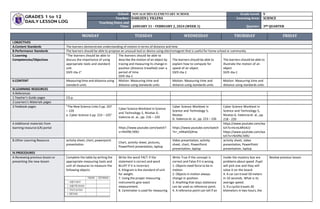
GRADES 1 to 12
DAILY LESSON LOG
School: NOVALICHES ELEMENTARY SCHOOL Grade Level: V
Teacher: DARLEEN J. VILLENA Learning Area: SCIENCE
Teaching Dates and
Time: JANUARY 31 – FEBRUARY 2, 2024 (WEEK 1) Quarter: 3RD QUARTER
MONDAY TUESDAY WEDNESDAY THURSDAY FRIDAY
I.OBJECTIVES
A.Content Standards The learners demonstrate understanding of motion in terms of distance and time
B.Performance Standards The learners should be able to propose an unusual tool or device using electromagnet that is useful for home school or community
C.Learning
Competencies/Objectives
"The learners should be able to
discuss the importance of using
appropriate tools and standard
unit
S5FE-IIIa-1"
The learners should be able to
describe the motion of an object by
tracing and measuring its change in
position (distance travelled) over a
period of time
S5FE-IIIa-1
The learners should be able to
explain how to compute for
speed of an object
S5FE-IIIa-1
The learners should be able to
illustrate the motion of an
object
S5FE-IIIa-1
II.CONTENT Measuring time and distance using
standard units
Motion: Measuring time and
distance using standards units
Motion: Measuring time and
distance using standards units
Motion: Measuring time and
distance using standards units
III.LEARNING RESOURCES
A.References
1.Teacher’s Guide pages CG p.
2.Learners’s Materials pages
3.Textbook pages "The New Science Links 5 pp. 207
– 220
e. Cyber Science 5 pp. 223 – 225"
Cyber Science Worktext in Science
and Technology 5, Nicetas G.
Valencia et. al., pp. 216 – 220
Cyber Science Worktext in
Science and Technology 5,
Nicetas
G. Valencia et. al., pp. 223 – 226
Cyber Science Worktext in
Science and Technology 5,
Nicetas G. Valencia et. al., pp.
218 - 220
4.Additional materials from
learning resource (LR) portal https://www.youtube.com/watch?
v=rfeVlNL7d9U
https://www.youtube.com/watch
?v=_nAKwhZyXnw
https://www.youtube.com/wa
tch?v=HcmL4RVAi1I
https://www.youtube.com/wa
tch?v=rfeVlNL7d9U
B.Other Learning Resource activity sheet, chart, powerpoint
presentation
Chart, activity sheet, pictures,
PowerPoint presentation, laptop
Video presentation, activity
sheet, chart, PowerPoint
presentation, laptop
activity sheet, video
presentation, PowerPoint
presentation, laptop
IV.PROCEDURES
A.Reviewing previous lesson or
presenting the new lesson
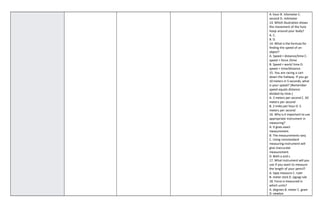
Complete the table by writing the
appropriate measuring tools and
unit of measures to measure the
following objects
Write the word FACT if the
statement is correct and word
BLUFF if it is incorrect.
6. Kilogram is the standard of unit
for weight.
7. Using the proper measuring
instruments give exact
measurement.
8. Centimeter is used for measuring
Write True if the concept is
correct and False if it is wrong.
1. Objects need force to be in
motion.
2. Objects in motion always
change in position.
3. Anything that stays stationary
can be used as reference point.
4. A reference point can tell if an
Inside the mystery box are
problems about speed .Pupil
will pick one and they will
solve it on the board.
4. A car can travel 50 meters
in 10 seconds. What is its
average speed.
5. If a cyclist travels 30
kilometers in two hours, the
Review previous lesson
short distances.
9. The SI unit is accepted all over
the word.
object moves.
5. A reference point must move
along with the object in motion.
6. Motion refers to the changing
position of an object
average speed is
6. A car travels 240 kilometers
for 6 hours. What is the
speed?
7. A bird flies towards North
Luzon at 72 meters for 8
seconds. What is the speed of
the bird?
B.Establishing a purpose for the
lesson
The teacher will call the shortest
and the tallest pupils in the class
and will let them to measure the
length of a piece of wood using
their body parts. The teacher will
record the measurement on the
board.
How will you describe the
measurement of the two pupils?
Why do you think their
measurements vary?
What shall we do to obtain
accurate measurement?
A video presentation:
https://www.youtube.com/watch?
v=rfeVlNL7d9U
What have you seen in the video
presented?
What is motion?
A video presentation
https://www.youtube.com/watch
?v=_nAKwhZyXnw
What can you say about the
video?
What is speed?
How do we calculate the speed of
an object?
Original File Submitted and
Formatted by DepEd Club
Member - visit depedclub.com
for more
Establishing a purpose for the
lesson
A video presentation
https://www.youtube.com/wa
tch?v=HcmL4RVAi1I
What have you observed in
the video presented?
What are the kinds of motion?
How do they differ?
How will you illustrate each
kind of motion?
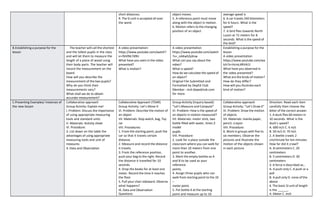
C.Presenting Examples/ instances of
the new lesson
Collaborative approach
Group Activity: Explain me!
I. Problem: Discuss the importance
of using appropriate measuring
tools and standard units
V. Materials: Activity sheet
VI. Procedure:
3. List down on the table the
advantages of using appropriate
measuring tools and unit of
measures
4. Data and Observation
Collaborative Approach (TDAR)
Group Activity: Let’s Move It
VI. Problem: Describe the motion of
an object
VII. Materials: Stop watch, bag, Toy
car
VIII. Procedures:
1. From the starting point, push the
car so that it travels certain
distance.
2. Measure and record the distance
it travels.
3. From the reference position,
push your bag to the right. Record
the distance it travelled for 10
seconds.
4. Drop the books for at least one
meter. Record the time it reaches
the floor
5. Pull your chair sideward. Observe
what happens?
IX. Data and Observation
Questions:
Group Activity (Inquiry based):
“Let’s Measure and Compute”
VI. Problem: How is the speed of
an objects in motion measured?
VII. Materials: meter stick, two
bottle filled with water, timer,3
model
pupils
VIII. Procedure:
2. Look for a place outside the
classroom where you can walk for
more than 10 meters from one
point to another.
3. Mark the empty bottles as A
and B to be used as your
reference
points.
4. Assign three pupils who can
walk from starting point to the 10
–
meter point.
5. Put bottle A at the starting
point and measure up to 10
Collaborative approach
Group Activity: “Let’s Draw it”
VI. Problem: Draw the motion
of objects
VII. Materials: manila paper,
pencil, crayon
VIII. Procedure:
6. Work in groups with five to
six members. Observe the
pictures and illustrate the
motion of the objects shown
in each picture.
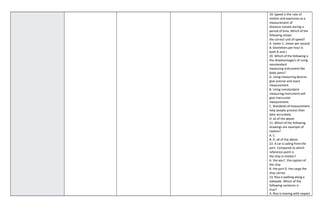
Direction: Read each item
carefully then choose the
letter of the correct answer.
1. A duck flies 60 meters in
10 seconds. What is the
duck’s speed?
A. 600 m/s C. 6 m/s
B. 50 m/s D. 70 m/s
2. A beetle crawls 2
cm/minute for ten minutes.
How far did it crawl?
A. 8 centimeters C. 20
centimeters
B. 5 centimeters D. 30
centimeters
3. A force is described as...
A. A push only C. A push or a
pull
B. A pull only D. none of the
above
4. The basic SI unit of length
is the .
A. Meter C. inch
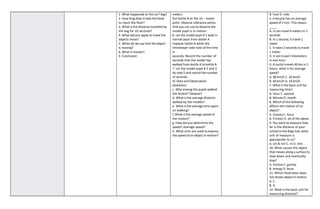
1. What happened to the car? bag?
2. How long does it take the book
to reach the floor?
3. What is the distance travelled by
the bag for 10 seconds?
4. What did you apply to make the
objects move?
5. When do we say that the object
is moving?
6. What is motion?
X. Conclusion:
meters.
Put bottle B at the 10 – meter
point. Observe reference points
that you can use to observe the
model pupil is in motion.
6. Let the model pupil # 1 walk in
normal pace from bottle A
towards bottle B while the
timekeeper take note of the time
in
seconds. Record the number of
seconds that the model has
walked from bottle A to bottle B.
7. Let the model pupil # 2 and 3
do step 5 and record the number
of seconds.
IX. Data and Observation
Questions:
c. Who among the pupils walked
the fastest? Slowest?
d. What is the average distance
walked by the models?
e. What is the average time spent
un walking?
f. What is the average speed of
the motion?
g. How did you determine the
speed? Average speed?
h. What units are used to express
the speed of an object in motion?
B. Foot D. mile
5. A bicycle has an average
speed of 2 m/s. This means
.
A. It can travel 4 meters in 2
seconds
B. In 1 second, it travel 1
meter
C. It takes 2 seconds to travel
1 meter
D. It can travel 2 kilometers
in one hour
6. A cyclist travels 40 km in 2
hours, what is his average
speed?
A. 80 km/h C. 20 km/h
B. 60 km/h D. 10 km/h
7. What is the basic unit for
measuring time?
A. Hour C. second
B. Minute D. month
8. Which of the following
affects the motion of an
object?
A. Gravity C. force
B. Friction D. all of the above
9. You want to measure how
far is the distance of your
school to the Brgy hall, what
unit of measure is
appropriate to us?
A. cm B. km C. m D. mm
10. What causes the object
that moves along a surface to
slow down and eventually
stop?
A. friction C. gravity
B. energy D. force
11. Which illustration does
not shows object in motion
A. C.
B. D.
12. What is the basic unit for
measuring distance?
A. hour B . kilometer C.
second D. milimeter
13. Which illustration shows
the movement of the hula
hoop around your body?
A. C.
B. D.
14. What is the formula for
finding the speed of an
object?
A. Speed = distance/time C.
speed = force /time
B. Speed = work/ time D.
speed = time/distance
15. You are racing a cart
down the hallway. If you go
10 meters in 5 seconds, what
is your speed? (Remember
speed equals distance
divided by time.)
A. 2 meters per second C. 50
meters per second
B. 2 miles per hour D. 5
meters per second
16. Why is it important to use
appropriate instrument in
measuring?
A. It gives exact
measurement.
B. The measurements vary.
C. Using nonstandard
measuring instrument will
give inaccurate
measurement.
D. Both a and c
17. What instrument will you
use if you want to measure
the length of your pencil?
A. tape measure C. ruler
B. meter stick D. zigzag rule
18. Force is measured in
which units?
A. degrees B. meter C. gram
D. newton
19. Speed is the rate of
motion and expresses as a
measurement of
distance moved during a
period of time. Which of the
following shows
the correct unit of speed?
A. meter C. meter per second
B. kilometers per hour D.
both B and c
20. Which of the following is
the disadvantage/s of using
nonstandard
measuring instrument like
body parts?
A. Using measuring devices
give precise and exact
measurement.
B. Using nonstandard
measuring instrument will
give inaccurate
measurement.
C. Standards of measurement
help people process their
data accurately.
D. all of the above
21. Which of the following
drawings are example of
motion?
A. C.
B. D. all of the above
22. A car is sailing from the
port. Compared to which
reference point is
the ship in motion?
A. the sea C. the captain of
the ship
B. the port D. the cargo the
ship carries
23. Riza is walking along a
sidewalk. Which of the
following sentence is
true?
A. Riza is moving with respect
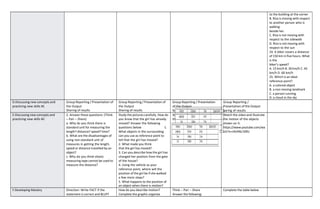
answer to the nearest hundreds.
haring of results S
udy the table below and fill in
e missing data. Round your
to the building at the corner
B. Riza is moving with respect
to another person who is
walking
beside her.
C. Riza is not moving with
respect to the sidewalk
D. Riza is not moving with
respect to the sun
24. A biker covers a distance
of 150 km in five hours. What
is the
biker’s speed?
A. 15 km/h B. 30 km/h C. 45
km/h D. 60 km/h
25. Which is an ideal
reference point?
A. a colored object
B. a non moving landmark
C. a person running
D. a cloud in the sky
D.Discussing new concepts and
practicing new skills #1
Group Reporting / Presentation of
the Output
Sharing of results
Group Reporting / Presentation of
the Output
Sharing of results
Group Reporting / Presentation
of the Output
S
Group Reporting /
Presentation of the Output
haring of results
E.Discussing new concepts and
practicing new skills #2
2. Answer these questions: (Think
– Pair – Share)
a. Why do you think there is
standard unit for measuring the
length? distance? speed? time?
b. What are the disadvantages of
using non-standard unit of
measures in getting the length,
speed or distance travelled by an
object?
c. Why do you think elastic
measuring tape cannot be used to
measure the distance?
Study the pictures carefully. How do
you know that the girl has already
moved? Answer the following
questions below 1.
What objects in the surrounding
can you use as reference point to
tell that the girl has moved?
2. What made you think
that the girl has moved?
3. Can you describe how the girl has
changed her position from the gate
of the house?
4. Using the vehicle as your
reference point, where will the
position of the girl be if she walked
a few more steps?
5. What happens to the position of
an object when there is motion?
St
th
Watch the video and illustrate
the motion of the objects
shown on it.
https://www.youtube.com/wa
tch?v=rfeVlNL7d9U
F.Developing Mastery Direction: Write FACT if the
statement is correct and BLUFF
How do you describe motion?
Complete the graphic organize
Think – Pair – Share
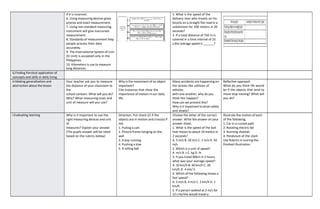
Answer the following:
Complete the table below
if it is incorrect.
6. Using measuring devices gives
precise and exact measurement.
7. Using non-standard measuring
instrument will give inaccurate
measurement.
8. Standards of measurement help
people process their data
accurately.
9. The International System of Unit
(SI Unit) is accepted only in the
Philippines.
10. Kilometers is use to measure
long distances.
1. What is the speed of the
delivery man who travels on his
bicycle on a straight flat road in a
subdivision for 100 meters in 20
seconds?
2. If a total distance of 750 m is
covered in a time interval of 25
s,the average speed is ?
G.Finding Parctical application of
concepts and skills in daily living
H.Making generalization and
abstraction about the lesson
Your teacher ask you to measure
the distance of your classroom to
the
school canteen. What will you do?
Why? What measuring tools and
unit of measure will you use?
Why is the movement of an object
important?
Cite instances that show the
importance of motion in our daily
life.
Many accidents are happening on
the streets like collision of
vehicles
with one another, why do you
think this happen?
How can we prevent this?
Why is it important to drive safely
and slowly?
Reflective approach
What do you think life would
be if the objects that tend to
move stop moving? What will
you do?
I.Evaluating learning Why is it important to use the
right measuring devices and unit
of
measures? Explain your answer.
(The pupils answer will be rated
based on the rubrics below)
Direction: Put check (/) if the
objects are in motion and cross(x) if
not
1. Pulling a cart
2. Picture frame hanging on the
wall
3. A boy running
4. Pushing a tree
5. A rolling ball
Choose the letter of the correct
answer. Write the answer on your
answer sheet.
1. What is the speed of the ball
that moves to about 10 meters in
2 seconds?
A. 5 m/s B. 20 m/s C. 1 m/s D. 50
m/s
2. Which is a unit of speed?
A. m/s B. s C. kg D. hr
3. If you travel 80km in 2 hours,
what was your average speed?
A. 10 km/h B. 40 km/h C. 20
km/h D. 4 km/ h
4. Which of the following shows a
fast speed?
A. 5 m/s B. 4 m/s C. 2 km/h D. 1
km/h
5. If a person walked at 2 m/s for
12 s he/she would travel a
Illustrate the motion of each
of the following;
1. Car in a curved path
2. Rotating electric fan
3. Running cheetah
4. Pendulum of the clock
Use Rubrics in scoring the
finished illustration
distance of
.
A. 6 m B. 3 m C.4 m D. 24 m
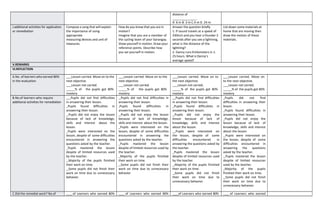
J.additional activities for application
or remediation
Compose a song that will explain
the importance of using
appropriate
measuring devices and unit of
measures.
How do you know that you are in
motion?
Imagine that you are a member of
the cycling team of your barangay.
Show yourself in motion. Draw your
reference points. Describe how
you set yourself in motion.
Answer the question briefly
1. If sound travels at a speed of
330m/s and you hear a thunder 3
seconds after you see a lightning,
what is the distance of the
lightning?
2. Danny runs 8 kilometers in 1.
25 hours. What is Danny’s
average speed?
List down some materials at
home that are moving then
draw the motion of these
materials.
V.REMARKS
VI.REFLECTION
A.No. of learners who earned 80%
in the evaluation
Lesson carried. Move on to the
next objective.
Lesson not carried.
% of the pupils got 80%
mastery
Lesson carried. Move on to the
next objective.
Lesson not carried.
% of the pupils got 80%
mastery
Lesson carried. Move on to
the next objective.
Lesson not carried.
% of the pupils got 80%
mastery
Lesson carried. Move on
to the next objective.
Lesson not carried.
% of the pupils got 80%
mastery
B.No.of learners who require
additional activities for remediation
Pupils did not find difficulties
in answering their lesson.
Pupils found difficulties in
answering their lesson.
Pupils did not enjoy the lesson
because of lack of knowledge,
skills and interest about the
lesson.
Pupils were interested on the
lesson, despite of some difficulties
encountered in answering the
questions asked by the teacher.
Pupils mastered the lesson
despite of limited resources used
by the teacher.
Majority of the pupils finished
their work on time.
Some pupils did not finish their
work on time due to unnecessary
behavior.
Pupils did not find difficulties in
answering their lesson.
Pupils found difficulties in
answering their lesson.
Pupils did not enjoy the lesson
because of lack of knowledge,
skills and interest about the lesson.
Pupils were interested on the
lesson, despite of some difficulties
encountered in answering the
questions asked by the teacher.
Pupils mastered the lesson
despite of limited resources used by
the teacher.
Majority of the pupils finished
their work on time.
Some pupils did not finish their
work on time due to unnecessary
behavior.
Pupils did not find difficulties
in answering their lesson.
Pupils found difficulties in
answering their lesson.
Pupils did not enjoy the
lesson because of lack of
knowledge, skills and interest
about the lesson.
Pupils were interested on
the lesson, despite of some
difficulties encountered in
answering the questions asked by
the teacher.
Pupils mastered the lesson
despite of limited resources used
by the teacher.
Majority of the pupils finished
their work on time.
Some pupils did not finish
their work on time due to
unnecessary behavior.
Pupils did not find
difficulties in answering their
lesson.
Pupils found difficulties in
answering their lesson.
Pupils did not enjoy the
lesson because of lack of
knowledge, skills and interest
about the lesson.
Pupils were interested on
the lesson, despite of some
difficulties encountered in
answering the questions
asked by the teacher.
Pupils mastered the lesson
despite of limited resources
used by the teacher.
Majority of the pupils
finished their work on time.
Some pupils did not finish
their work on time due to
unnecessary behavior.
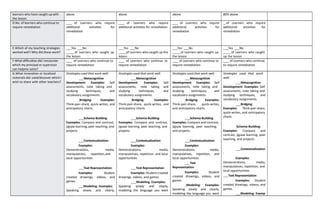
C.Did the remedial work? No.of of Learners who earned 80% of Learners who earned 80% of Learners who earned 80% of Learners who earned
learners who have caught up with
the lesson
above above above 80% above
D.No. of learners who continue to
require remediation
of Learners who require
additional activities for
remediation
of Learners who require
additional activities for remediation
of Learners who require
additional activities for
remediation
of Learners who require
additional activities for
remediation
E.Which of my teaching strategies
worked well? Why did these work?
Yes No
of Learners who caught up
the lesson
Yes No
of Learners who caught up the
lesson
Yes No
of Learners who caught up
the lesson
Yes No
of Learners who caught
up the lesson
F.What difficulties did I encounter
which my principal or supervisor
can helpme solve?
of Learners who continue to
require remediation
of Learners who continue to
require remediation
of Learners who continue to
require remediation
of Learners who continue
to require remediation
G.What innovation or localized
materials did used/discover which I
wish to share with other teachers?
Strategies used that work well:
Metacognitive
Development: Examples: Self
assessments, note taking and
studying techniques, and
vocabulary assignments.
Bridging: Examples:
Think-pair-share, quick-writes, and
anticipatory charts.
Schema-Building:
Examples: Compare and contrast,
jigsaw learning, peer teaching, and
projects.
Contextualization:
Examples:
Demonstrations, media,
manipulatives, repetition,and
local opportunities.
Text Representation:
Examples: Student
created drawings, videos, and
games.
Modeling: Examples:
Speaking slowly and clearly,
Strategies used that work well:
Metacognitive
Development: Examples: Self
assessments, note taking and
studying techniques, and
vocabulary assignments.
Bridging: Examples:
Think-pair-share, quick-writes, and
anticipatory charts.
Schema-Building:
Examples: Compare and contrast,
jigsaw learning, peer teaching, and
projects.
Contextualization:
Examples:
Demonstrations, media,
manipulatives, repetition, and local
opportunities.
Text Representation:
Examples: Student created
drawings, videos, and games.
Modeling: Examples:
Speaking slowly and clearly,
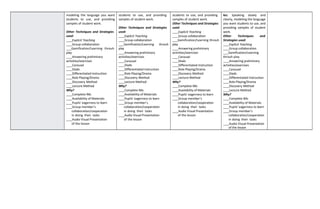
modeling the language you want
Strategies used that work well:
Metacognitive
Development: Examples: Self
assessments, note taking and
studying techniques, and
vocabulary assignments.
Bridging: Examples:
Think-pair-share, quick-writes,
and anticipatory charts.
Schema-Building:
Examples: Compare and contrast,
jigsaw learning, peer teaching,
and projects.
Contextualization:
Examples:
Demonstrations, media,
manipulatives, repetition, and
local opportunities.
Text
Representation:
Examples: Student
created drawings, videos, and
games.
Modeling: Examples:
Speaking slowly and clearly,
modeling the language you want
Strategies used that work
well:
Metacognitive
Development: Examples: Self
assessments, note taking and
studying techniques, and
vocabulary assignments.
Bridging:
Examples: Think-pair-share,
quick-writes, and anticipatory
charts.
Schema-Building:
Examples: Compare and
contrast, jigsaw learning, peer
teaching, and projects.
Contextualization
:
Examples:
Demonstrations, media,
manipulatives, repetition, and
local opportunities.
Text Representation:
Examples: Student
created drawings, videos, and
games.
Modeling: Examp
modeling the language you want
students to use, and providing
samples of student work.
Other Techniques and Strategies
used:
Explicit Teaching
Group collaboration
Gamification/Learning throuh
play
Answering preliminary
activities/exercises
Carousel
Diads
Differentiated Instruction
Role Playing/Drama
Discovery Method
Lecture Method
Why?
Complete IMs
Availability of Materials
Pupils’ eagerness to learn
Group member’s
collaboration/cooperation
in doing their tasks
Audio Visual Presentation
of the lesson
students to use, and providing
samples of student work.
Other Techniques and Strategies
used:
Explicit Teaching
Group collaboration
Gamification/Learning throuh
play
Answering preliminary
activities/exercises
Carousel
Diads
Differentiated Instruction
Role Playing/Drama
Discovery Method
Lecture Method
Why?
Complete IMs
Availability of Materials
Pupils’ eagerness to learn
Group member’s
collaboration/cooperation
in doing their tasks
Audio Visual Presentation
of the lesson
students to use, and providing
samples of student work.
Other Techniques and Strategies
used:
Explicit Teaching
Group collaboration
Gamification/Learning throuh
play
Answering preliminary
activities/exercises
Carousel
Diads
Differentiated Instruction
Role Playing/Drama
Discovery Method
Lecture Method
Why?
Complete IMs
Availability of Materials
Pupils’ eagerness to learn
Group member’s
collaboration/cooperation
in doing their tasks
Audio Visual Presentation
of the lesson
les: Speaking slowly and
clearly, modeling the language
you want students to use, and
providing samples of student
work.
Other Techniques and
Strategies used:
Explicit Teaching
Group collaboration
Gamification/Learning
throuh play
Answering preliminary
activities/exercises
Carousel
Diads
Differentiated Instruction
Role Playing/Drama
Discovery Method
Lecture Method
Why?
Complete IMs
Availability of Materials
Pupils’ eagerness to learn
Group member’s
collaboration/cooperation
in doing their tasks
Audio Visual Presentation
of the lesson

SCIENCE 5 Q3 W1.docx

  • 1.
    DLL Science 5Q3 W2 Related literature (Northern Bukidnon State College) Scan to open on Studocu Studocu is not sponsored or endorsed by any college or university Downloaded by Darleen Villena (darlvillena@gmail.com)
  • 2.
    GRADES 1 to12 DAILY LESSON LOG School: NOVALICHES ELEMENTARY SCHOOL Grade Level: V Teacher: DARLEEN J. VILLENA Learning Area: SCIENCE Teaching Dates and Time: JANUARY 31 – FEBRUARY 2, 2024 (WEEK 1) Quarter: 3RD QUARTER MONDAY TUESDAY WEDNESDAY THURSDAY FRIDAY I.OBJECTIVES A.Content Standards The learners demonstrate understanding of motion in terms of distance and time B.Performance Standards The learners should be able to propose an unusual tool or device using electromagnet that is useful for home school or community C.Learning Competencies/Objectives "The learners should be able to discuss the importance of using appropriate tools and standard unit S5FE-IIIa-1" The learners should be able to describe the motion of an object by tracing and measuring its change in position (distance travelled) over a period of time S5FE-IIIa-1 The learners should be able to explain how to compute for speed of an object S5FE-IIIa-1 The learners should be able to illustrate the motion of an object S5FE-IIIa-1 II.CONTENT Measuring time and distance using standard units Motion: Measuring time and distance using standards units Motion: Measuring time and distance using standards units Motion: Measuring time and distance using standards units III.LEARNING RESOURCES A.References 1.Teacher’s Guide pages CG p. 2.Learners’s Materials pages 3.Textbook pages "The New Science Links 5 pp. 207 – 220 e. Cyber Science 5 pp. 223 – 225" Cyber Science Worktext in Science and Technology 5, Nicetas G. Valencia et. al., pp. 216 – 220 Cyber Science Worktext in Science and Technology 5, Nicetas G. Valencia et. al., pp. 223 – 226 Cyber Science Worktext in Science and Technology 5, Nicetas G. Valencia et. al., pp. 218 - 220 4.Additional materials from learning resource (LR) portal https://www.youtube.com/watch? v=rfeVlNL7d9U https://www.youtube.com/watch ?v=_nAKwhZyXnw https://www.youtube.com/wa tch?v=HcmL4RVAi1I https://www.youtube.com/wa tch?v=rfeVlNL7d9U B.Other Learning Resource activity sheet, chart, powerpoint presentation Chart, activity sheet, pictures, PowerPoint presentation, laptop Video presentation, activity sheet, chart, PowerPoint presentation, laptop activity sheet, video presentation, PowerPoint presentation, laptop IV.PROCEDURES A.Reviewing previous lesson or presenting the new lesson Complete the table by writing the appropriate measuring tools and unit of measures to measure the following objects Write the word FACT if the statement is correct and word BLUFF if it is incorrect. 6. Kilogram is the standard of unit for weight. 7. Using the proper measuring instruments give exact measurement. 8. Centimeter is used for measuring Write True if the concept is correct and False if it is wrong. 1. Objects need force to be in motion. 2. Objects in motion always change in position. 3. Anything that stays stationary can be used as reference point. 4. A reference point can tell if an Inside the mystery box are problems about speed .Pupil will pick one and they will solve it on the board. 4. A car can travel 50 meters in 10 seconds. What is its average speed. 5. If a cyclist travels 30 kilometers in two hours, the Review previous lesson
  • 3.
    short distances. 9. TheSI unit is accepted all over the word. object moves. 5. A reference point must move along with the object in motion. 6. Motion refers to the changing position of an object average speed is 6. A car travels 240 kilometers for 6 hours. What is the speed? 7. A bird flies towards North Luzon at 72 meters for 8 seconds. What is the speed of the bird? B.Establishing a purpose for the lesson The teacher will call the shortest and the tallest pupils in the class and will let them to measure the length of a piece of wood using their body parts. The teacher will record the measurement on the board. How will you describe the measurement of the two pupils? Why do you think their measurements vary? What shall we do to obtain accurate measurement? A video presentation: https://www.youtube.com/watch? v=rfeVlNL7d9U What have you seen in the video presented? What is motion? A video presentation https://www.youtube.com/watch ?v=_nAKwhZyXnw What can you say about the video? What is speed? How do we calculate the speed of an object? Original File Submitted and Formatted by DepEd Club Member - visit depedclub.com for more Establishing a purpose for the lesson A video presentation https://www.youtube.com/wa tch?v=HcmL4RVAi1I What have you observed in the video presented? What are the kinds of motion? How do they differ? How will you illustrate each kind of motion? C.Presenting Examples/ instances of the new lesson Collaborative approach Group Activity: Explain me! I. Problem: Discuss the importance of using appropriate measuring tools and standard units V. Materials: Activity sheet VI. Procedure: 3. List down on the table the advantages of using appropriate measuring tools and unit of measures 4. Data and Observation Collaborative Approach (TDAR) Group Activity: Let’s Move It VI. Problem: Describe the motion of an object VII. Materials: Stop watch, bag, Toy car VIII. Procedures: 1. From the starting point, push the car so that it travels certain distance. 2. Measure and record the distance it travels. 3. From the reference position, push your bag to the right. Record the distance it travelled for 10 seconds. 4. Drop the books for at least one meter. Record the time it reaches the floor 5. Pull your chair sideward. Observe what happens? IX. Data and Observation Questions: Group Activity (Inquiry based): “Let’s Measure and Compute” VI. Problem: How is the speed of an objects in motion measured? VII. Materials: meter stick, two bottle filled with water, timer,3 model pupils VIII. Procedure: 2. Look for a place outside the classroom where you can walk for more than 10 meters from one point to another. 3. Mark the empty bottles as A and B to be used as your reference points. 4. Assign three pupils who can walk from starting point to the 10 – meter point. 5. Put bottle A at the starting point and measure up to 10 Collaborative approach Group Activity: “Let’s Draw it” VI. Problem: Draw the motion of objects VII. Materials: manila paper, pencil, crayon VIII. Procedure: 6. Work in groups with five to six members. Observe the pictures and illustrate the motion of the objects shown in each picture. Direction: Read each item carefully then choose the letter of the correct answer. 1. A duck flies 60 meters in 10 seconds. What is the duck’s speed? A. 600 m/s C. 6 m/s B. 50 m/s D. 70 m/s 2. A beetle crawls 2 cm/minute for ten minutes. How far did it crawl? A. 8 centimeters C. 20 centimeters B. 5 centimeters D. 30 centimeters 3. A force is described as... A. A push only C. A push or a pull B. A pull only D. none of the above 4. The basic SI unit of length is the . A. Meter C. inch
  • 4.
    1. What happenedto the car? bag? 2. How long does it take the book to reach the floor? 3. What is the distance travelled by the bag for 10 seconds? 4. What did you apply to make the objects move? 5. When do we say that the object is moving? 6. What is motion? X. Conclusion: meters. Put bottle B at the 10 – meter point. Observe reference points that you can use to observe the model pupil is in motion. 6. Let the model pupil # 1 walk in normal pace from bottle A towards bottle B while the timekeeper take note of the time in seconds. Record the number of seconds that the model has walked from bottle A to bottle B. 7. Let the model pupil # 2 and 3 do step 5 and record the number of seconds. IX. Data and Observation Questions: c. Who among the pupils walked the fastest? Slowest? d. What is the average distance walked by the models? e. What is the average time spent un walking? f. What is the average speed of the motion? g. How did you determine the speed? Average speed? h. What units are used to express the speed of an object in motion? B. Foot D. mile 5. A bicycle has an average speed of 2 m/s. This means . A. It can travel 4 meters in 2 seconds B. In 1 second, it travel 1 meter C. It takes 2 seconds to travel 1 meter D. It can travel 2 kilometers in one hour 6. A cyclist travels 40 km in 2 hours, what is his average speed? A. 80 km/h C. 20 km/h B. 60 km/h D. 10 km/h 7. What is the basic unit for measuring time? A. Hour C. second B. Minute D. month 8. Which of the following affects the motion of an object? A. Gravity C. force B. Friction D. all of the above 9. You want to measure how far is the distance of your school to the Brgy hall, what unit of measure is appropriate to us? A. cm B. km C. m D. mm 10. What causes the object that moves along a surface to slow down and eventually stop? A. friction C. gravity B. energy D. force 11. Which illustration does not shows object in motion A. C. B. D. 12. What is the basic unit for measuring distance?
  • 5.
    A. hour B. kilometer C. second D. milimeter 13. Which illustration shows the movement of the hula hoop around your body? A. C. B. D. 14. What is the formula for finding the speed of an object? A. Speed = distance/time C. speed = force /time B. Speed = work/ time D. speed = time/distance 15. You are racing a cart down the hallway. If you go 10 meters in 5 seconds, what is your speed? (Remember speed equals distance divided by time.) A. 2 meters per second C. 50 meters per second B. 2 miles per hour D. 5 meters per second 16. Why is it important to use appropriate instrument in measuring? A. It gives exact measurement. B. The measurements vary. C. Using nonstandard measuring instrument will give inaccurate measurement. D. Both a and c 17. What instrument will you use if you want to measure the length of your pencil? A. tape measure C. ruler B. meter stick D. zigzag rule 18. Force is measured in which units? A. degrees B. meter C. gram D. newton
  • 6.
    19. Speed isthe rate of motion and expresses as a measurement of distance moved during a period of time. Which of the following shows the correct unit of speed? A. meter C. meter per second B. kilometers per hour D. both B and c 20. Which of the following is the disadvantage/s of using nonstandard measuring instrument like body parts? A. Using measuring devices give precise and exact measurement. B. Using nonstandard measuring instrument will give inaccurate measurement. C. Standards of measurement help people process their data accurately. D. all of the above 21. Which of the following drawings are example of motion? A. C. B. D. all of the above 22. A car is sailing from the port. Compared to which reference point is the ship in motion? A. the sea C. the captain of the ship B. the port D. the cargo the ship carries 23. Riza is walking along a sidewalk. Which of the following sentence is true? A. Riza is moving with respect
  • 7.
    answer to thenearest hundreds. haring of results S udy the table below and fill in e missing data. Round your to the building at the corner B. Riza is moving with respect to another person who is walking beside her. C. Riza is not moving with respect to the sidewalk D. Riza is not moving with respect to the sun 24. A biker covers a distance of 150 km in five hours. What is the biker’s speed? A. 15 km/h B. 30 km/h C. 45 km/h D. 60 km/h 25. Which is an ideal reference point? A. a colored object B. a non moving landmark C. a person running D. a cloud in the sky D.Discussing new concepts and practicing new skills #1 Group Reporting / Presentation of the Output Sharing of results Group Reporting / Presentation of the Output Sharing of results Group Reporting / Presentation of the Output S Group Reporting / Presentation of the Output haring of results E.Discussing new concepts and practicing new skills #2 2. Answer these questions: (Think – Pair – Share) a. Why do you think there is standard unit for measuring the length? distance? speed? time? b. What are the disadvantages of using non-standard unit of measures in getting the length, speed or distance travelled by an object? c. Why do you think elastic measuring tape cannot be used to measure the distance? Study the pictures carefully. How do you know that the girl has already moved? Answer the following questions below 1. What objects in the surrounding can you use as reference point to tell that the girl has moved? 2. What made you think that the girl has moved? 3. Can you describe how the girl has changed her position from the gate of the house? 4. Using the vehicle as your reference point, where will the position of the girl be if she walked a few more steps? 5. What happens to the position of an object when there is motion? St th Watch the video and illustrate the motion of the objects shown on it. https://www.youtube.com/wa tch?v=rfeVlNL7d9U F.Developing Mastery Direction: Write FACT if the statement is correct and BLUFF How do you describe motion? Complete the graphic organize Think – Pair – Share Answer the following: Complete the table below
  • 8.
    if it isincorrect. 6. Using measuring devices gives precise and exact measurement. 7. Using non-standard measuring instrument will give inaccurate measurement. 8. Standards of measurement help people process their data accurately. 9. The International System of Unit (SI Unit) is accepted only in the Philippines. 10. Kilometers is use to measure long distances. 1. What is the speed of the delivery man who travels on his bicycle on a straight flat road in a subdivision for 100 meters in 20 seconds? 2. If a total distance of 750 m is covered in a time interval of 25 s,the average speed is ? G.Finding Parctical application of concepts and skills in daily living H.Making generalization and abstraction about the lesson Your teacher ask you to measure the distance of your classroom to the school canteen. What will you do? Why? What measuring tools and unit of measure will you use? Why is the movement of an object important? Cite instances that show the importance of motion in our daily life. Many accidents are happening on the streets like collision of vehicles with one another, why do you think this happen? How can we prevent this? Why is it important to drive safely and slowly? Reflective approach What do you think life would be if the objects that tend to move stop moving? What will you do? I.Evaluating learning Why is it important to use the right measuring devices and unit of measures? Explain your answer. (The pupils answer will be rated based on the rubrics below) Direction: Put check (/) if the objects are in motion and cross(x) if not 1. Pulling a cart 2. Picture frame hanging on the wall 3. A boy running 4. Pushing a tree 5. A rolling ball Choose the letter of the correct answer. Write the answer on your answer sheet. 1. What is the speed of the ball that moves to about 10 meters in 2 seconds? A. 5 m/s B. 20 m/s C. 1 m/s D. 50 m/s 2. Which is a unit of speed? A. m/s B. s C. kg D. hr 3. If you travel 80km in 2 hours, what was your average speed? A. 10 km/h B. 40 km/h C. 20 km/h D. 4 km/ h 4. Which of the following shows a fast speed? A. 5 m/s B. 4 m/s C. 2 km/h D. 1 km/h 5. If a person walked at 2 m/s for 12 s he/she would travel a Illustrate the motion of each of the following; 1. Car in a curved path 2. Rotating electric fan 3. Running cheetah 4. Pendulum of the clock Use Rubrics in scoring the finished illustration
  • 9.
    distance of . A. 6m B. 3 m C.4 m D. 24 m J.additional activities for application or remediation Compose a song that will explain the importance of using appropriate measuring devices and unit of measures. How do you know that you are in motion? Imagine that you are a member of the cycling team of your barangay. Show yourself in motion. Draw your reference points. Describe how you set yourself in motion. Answer the question briefly 1. If sound travels at a speed of 330m/s and you hear a thunder 3 seconds after you see a lightning, what is the distance of the lightning? 2. Danny runs 8 kilometers in 1. 25 hours. What is Danny’s average speed? List down some materials at home that are moving then draw the motion of these materials. V.REMARKS VI.REFLECTION A.No. of learners who earned 80% in the evaluation Lesson carried. Move on to the next objective. Lesson not carried. % of the pupils got 80% mastery Lesson carried. Move on to the next objective. Lesson not carried. % of the pupils got 80% mastery Lesson carried. Move on to the next objective. Lesson not carried. % of the pupils got 80% mastery Lesson carried. Move on to the next objective. Lesson not carried. % of the pupils got 80% mastery B.No.of learners who require additional activities for remediation Pupils did not find difficulties in answering their lesson. Pupils found difficulties in answering their lesson. Pupils did not enjoy the lesson because of lack of knowledge, skills and interest about the lesson. Pupils were interested on the lesson, despite of some difficulties encountered in answering the questions asked by the teacher. Pupils mastered the lesson despite of limited resources used by the teacher. Majority of the pupils finished their work on time. Some pupils did not finish their work on time due to unnecessary behavior. Pupils did not find difficulties in answering their lesson. Pupils found difficulties in answering their lesson. Pupils did not enjoy the lesson because of lack of knowledge, skills and interest about the lesson. Pupils were interested on the lesson, despite of some difficulties encountered in answering the questions asked by the teacher. Pupils mastered the lesson despite of limited resources used by the teacher. Majority of the pupils finished their work on time. Some pupils did not finish their work on time due to unnecessary behavior. Pupils did not find difficulties in answering their lesson. Pupils found difficulties in answering their lesson. Pupils did not enjoy the lesson because of lack of knowledge, skills and interest about the lesson. Pupils were interested on the lesson, despite of some difficulties encountered in answering the questions asked by the teacher. Pupils mastered the lesson despite of limited resources used by the teacher. Majority of the pupils finished their work on time. Some pupils did not finish their work on time due to unnecessary behavior. Pupils did not find difficulties in answering their lesson. Pupils found difficulties in answering their lesson. Pupils did not enjoy the lesson because of lack of knowledge, skills and interest about the lesson. Pupils were interested on the lesson, despite of some difficulties encountered in answering the questions asked by the teacher. Pupils mastered the lesson despite of limited resources used by the teacher. Majority of the pupils finished their work on time. Some pupils did not finish their work on time due to unnecessary behavior. C.Did the remedial work? No.of of Learners who earned 80% of Learners who earned 80% of Learners who earned 80% of Learners who earned
  • 10.
    learners who havecaught up with the lesson above above above 80% above D.No. of learners who continue to require remediation of Learners who require additional activities for remediation of Learners who require additional activities for remediation of Learners who require additional activities for remediation of Learners who require additional activities for remediation E.Which of my teaching strategies worked well? Why did these work? Yes No of Learners who caught up the lesson Yes No of Learners who caught up the lesson Yes No of Learners who caught up the lesson Yes No of Learners who caught up the lesson F.What difficulties did I encounter which my principal or supervisor can helpme solve? of Learners who continue to require remediation of Learners who continue to require remediation of Learners who continue to require remediation of Learners who continue to require remediation G.What innovation or localized materials did used/discover which I wish to share with other teachers? Strategies used that work well: Metacognitive Development: Examples: Self assessments, note taking and studying techniques, and vocabulary assignments. Bridging: Examples: Think-pair-share, quick-writes, and anticipatory charts. Schema-Building: Examples: Compare and contrast, jigsaw learning, peer teaching, and projects. Contextualization: Examples: Demonstrations, media, manipulatives, repetition,and local opportunities. Text Representation: Examples: Student created drawings, videos, and games. Modeling: Examples: Speaking slowly and clearly, Strategies used that work well: Metacognitive Development: Examples: Self assessments, note taking and studying techniques, and vocabulary assignments. Bridging: Examples: Think-pair-share, quick-writes, and anticipatory charts. Schema-Building: Examples: Compare and contrast, jigsaw learning, peer teaching, and projects. Contextualization: Examples: Demonstrations, media, manipulatives, repetition, and local opportunities. Text Representation: Examples: Student created drawings, videos, and games. Modeling: Examples: Speaking slowly and clearly, modeling the language you want Strategies used that work well: Metacognitive Development: Examples: Self assessments, note taking and studying techniques, and vocabulary assignments. Bridging: Examples: Think-pair-share, quick-writes, and anticipatory charts. Schema-Building: Examples: Compare and contrast, jigsaw learning, peer teaching, and projects. Contextualization: Examples: Demonstrations, media, manipulatives, repetition, and local opportunities. Text Representation: Examples: Student created drawings, videos, and games. Modeling: Examples: Speaking slowly and clearly, modeling the language you want Strategies used that work well: Metacognitive Development: Examples: Self assessments, note taking and studying techniques, and vocabulary assignments. Bridging: Examples: Think-pair-share, quick-writes, and anticipatory charts. Schema-Building: Examples: Compare and contrast, jigsaw learning, peer teaching, and projects. Contextualization : Examples: Demonstrations, media, manipulatives, repetition, and local opportunities. Text Representation: Examples: Student created drawings, videos, and games. Modeling: Examp
  • 11.
    modeling the languageyou want students to use, and providing samples of student work. Other Techniques and Strategies used: Explicit Teaching Group collaboration Gamification/Learning throuh play Answering preliminary activities/exercises Carousel Diads Differentiated Instruction Role Playing/Drama Discovery Method Lecture Method Why? Complete IMs Availability of Materials Pupils’ eagerness to learn Group member’s collaboration/cooperation in doing their tasks Audio Visual Presentation of the lesson students to use, and providing samples of student work. Other Techniques and Strategies used: Explicit Teaching Group collaboration Gamification/Learning throuh play Answering preliminary activities/exercises Carousel Diads Differentiated Instruction Role Playing/Drama Discovery Method Lecture Method Why? Complete IMs Availability of Materials Pupils’ eagerness to learn Group member’s collaboration/cooperation in doing their tasks Audio Visual Presentation of the lesson students to use, and providing samples of student work. Other Techniques and Strategies used: Explicit Teaching Group collaboration Gamification/Learning throuh play Answering preliminary activities/exercises Carousel Diads Differentiated Instruction Role Playing/Drama Discovery Method Lecture Method Why? Complete IMs Availability of Materials Pupils’ eagerness to learn Group member’s collaboration/cooperation in doing their tasks Audio Visual Presentation of the lesson les: Speaking slowly and clearly, modeling the language you want students to use, and providing samples of student work. Other Techniques and Strategies used: Explicit Teaching Group collaboration Gamification/Learning throuh play Answering preliminary activities/exercises Carousel Diads Differentiated Instruction Role Playing/Drama Discovery Method Lecture Method Why? Complete IMs Availability of Materials Pupils’ eagerness to learn Group member’s collaboration/cooperation in doing their tasks Audio Visual Presentation of the lesson