EDMA 506: ADMINISTRATIVE BEHAVIOR IN
EDUCATION

POPS P. MACALINO
Discussant
The Social System
Organizational Structure

Governance and Decision
Making
The SCHOOL as
a SOCIAL
SYSTEM
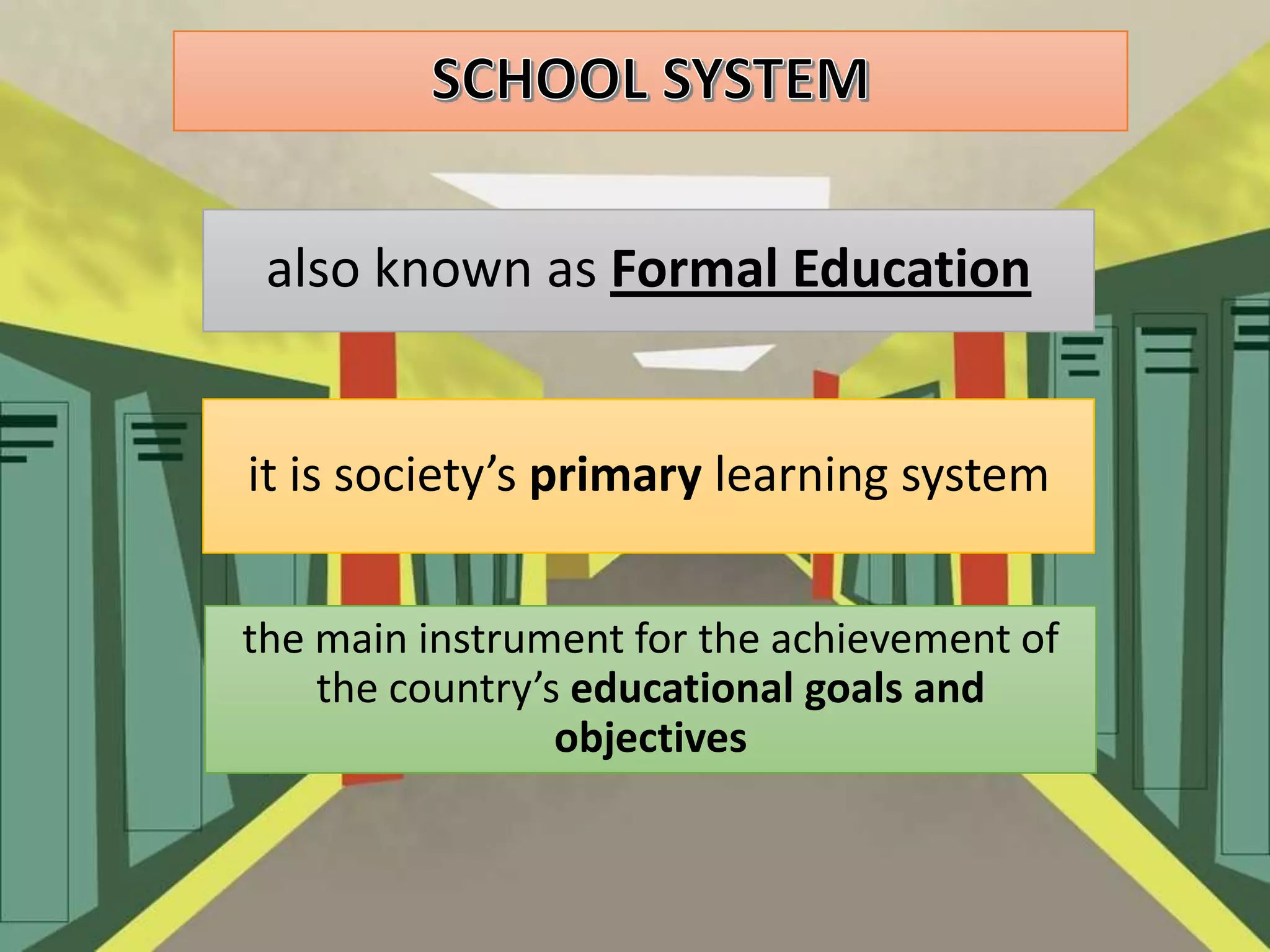
also known as Formal Education

it is society’s primary learning system
the main instrument for the achievement of
the country’s educational goals and
objectives
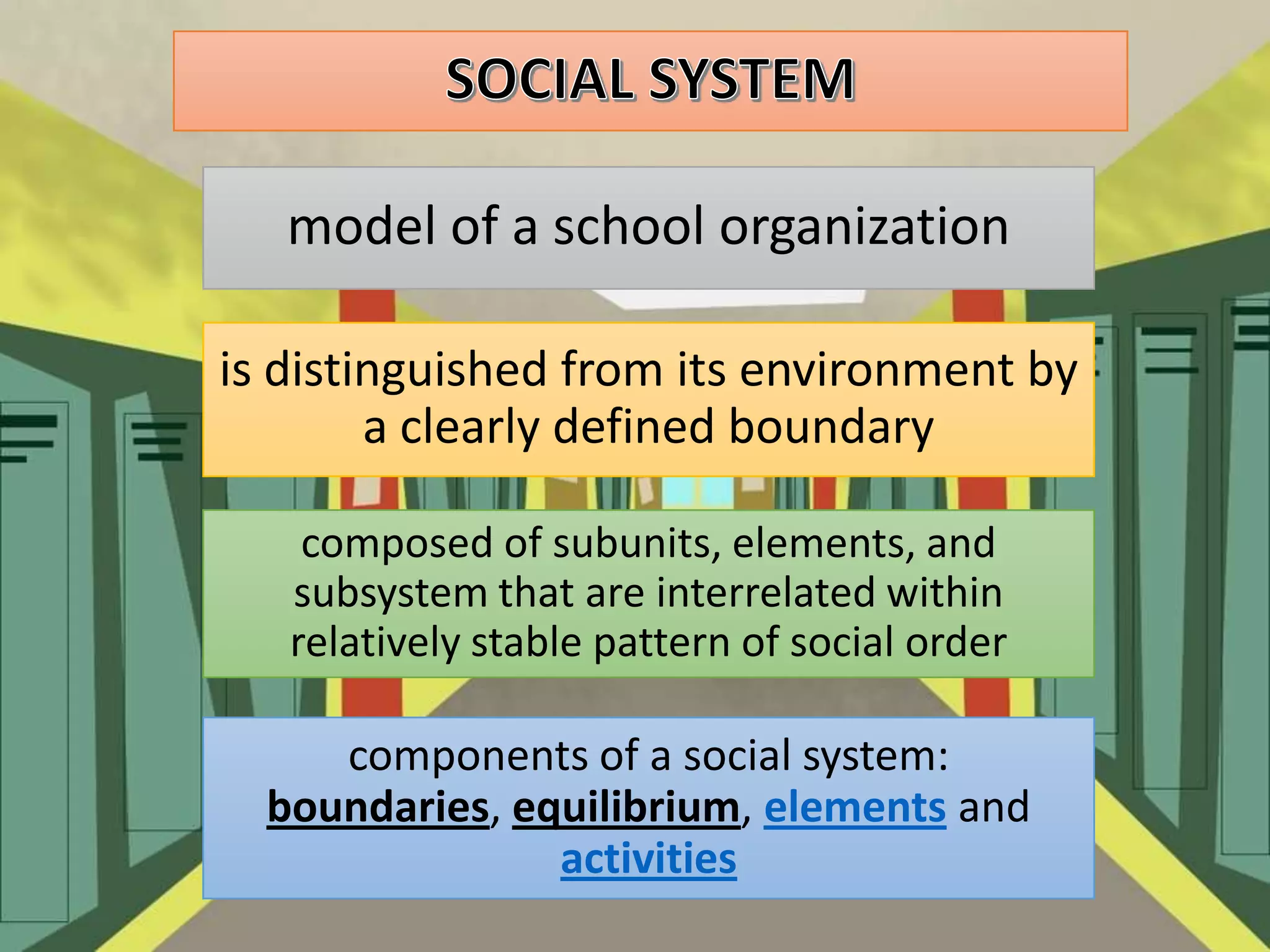
model of a school organization
is distinguished from its environment by
a clearly defined boundary
composed of subunits, elements, and
subsystem that are interrelated within
relatively stable pattern of social order

components of a social system:
boundaries, equilibrium, elements and
activities
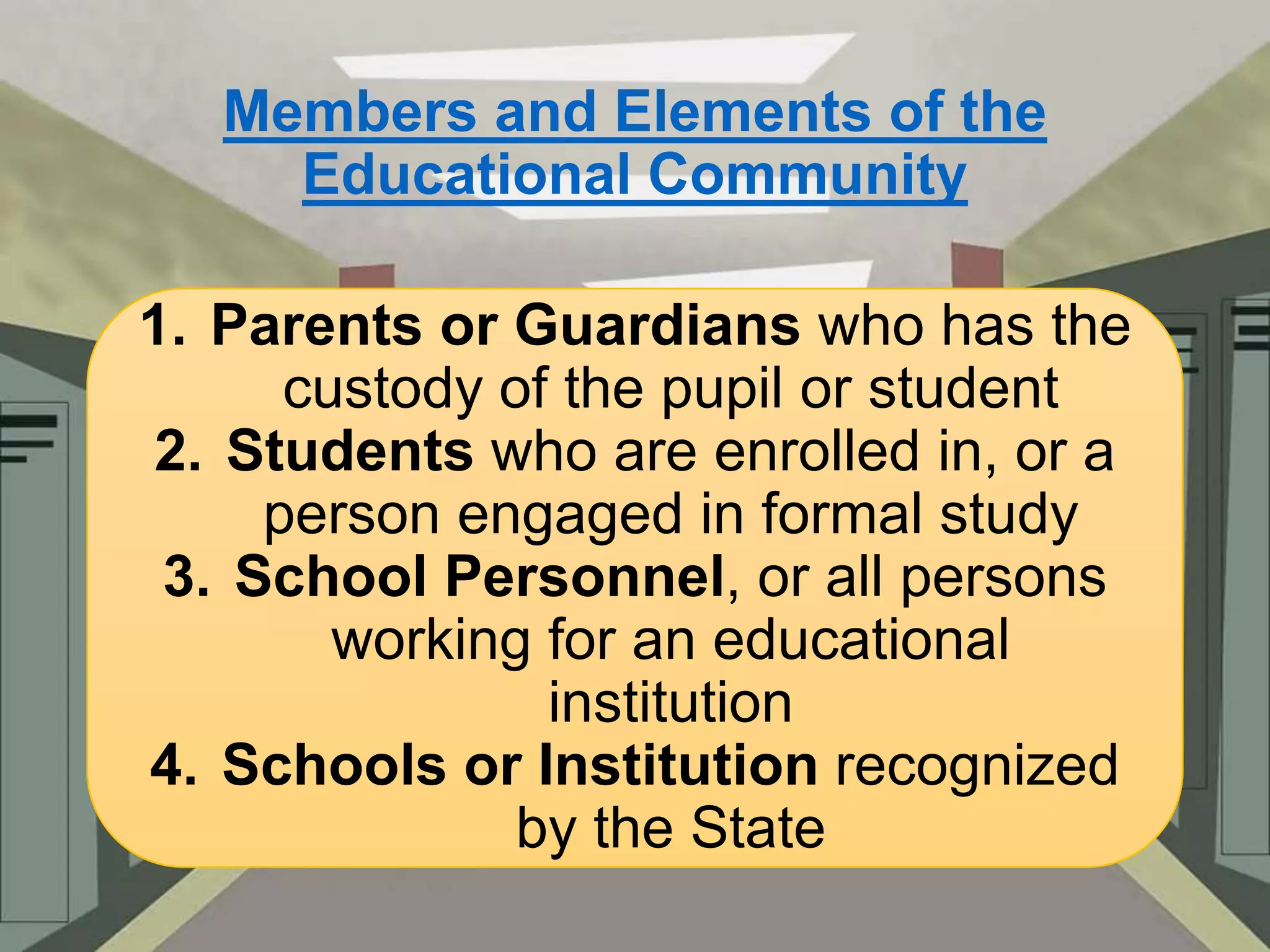
Members and Elements of the
Educational Community
1. Parents or Guardians who has the
custody of the pupil or student
2. Students who are enrolled in, or a
person engaged in formal study
3. School Personnel, or all persons
working for an educational
institution
4. Schools or Institution recognized
by the State
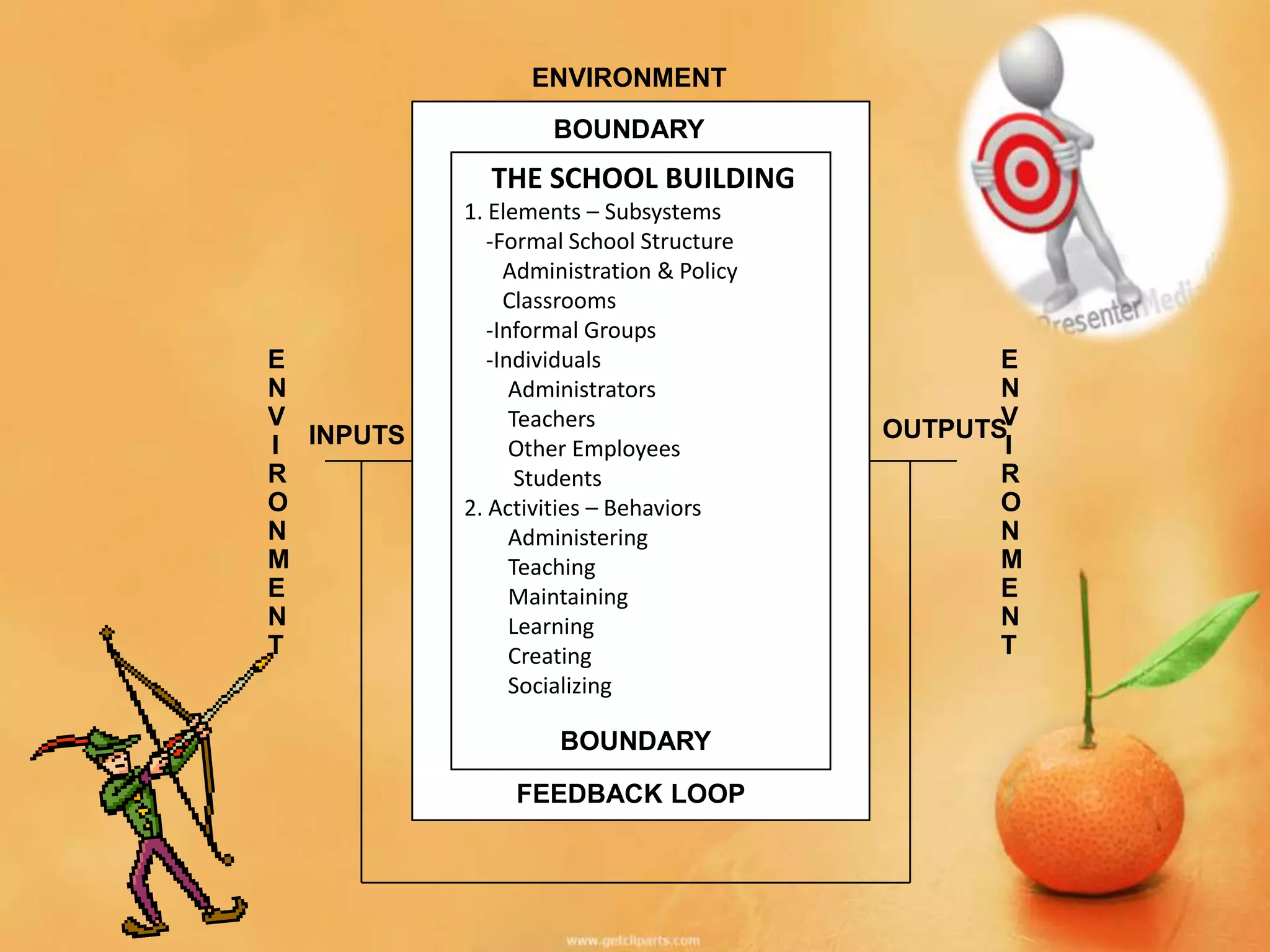
ENVIRONMENT
BOUNDARY

THE SCHOOL BUILDING

E
N
V
I INPUTS
R
O
N
M
E
N
T

1. Elements – Subsystems
-Formal School Structure
Administration & Policy
Classrooms
-Informal Groups
-Individuals
Administrators
Teachers
Other Employees
Students
2. Activities – Behaviors
Administering
Teaching
Maintaining
Learning
Creating
Socializing

BOUNDARY
FEEDBACK LOOP

E
N
V
OUTPUTS
I
R
O
N
M
E
N
T
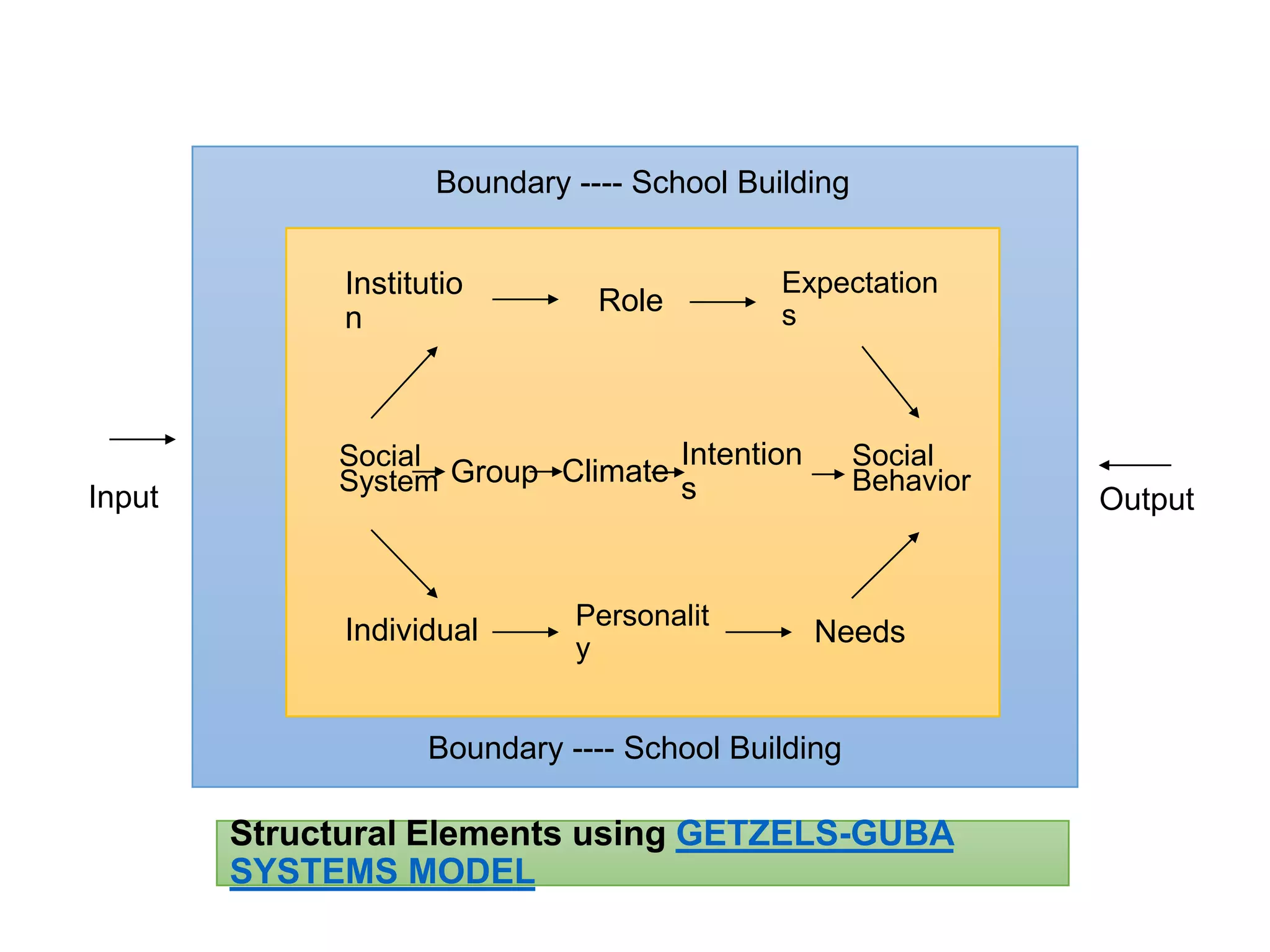
The GETZELS-GUBA BASIC MODEL

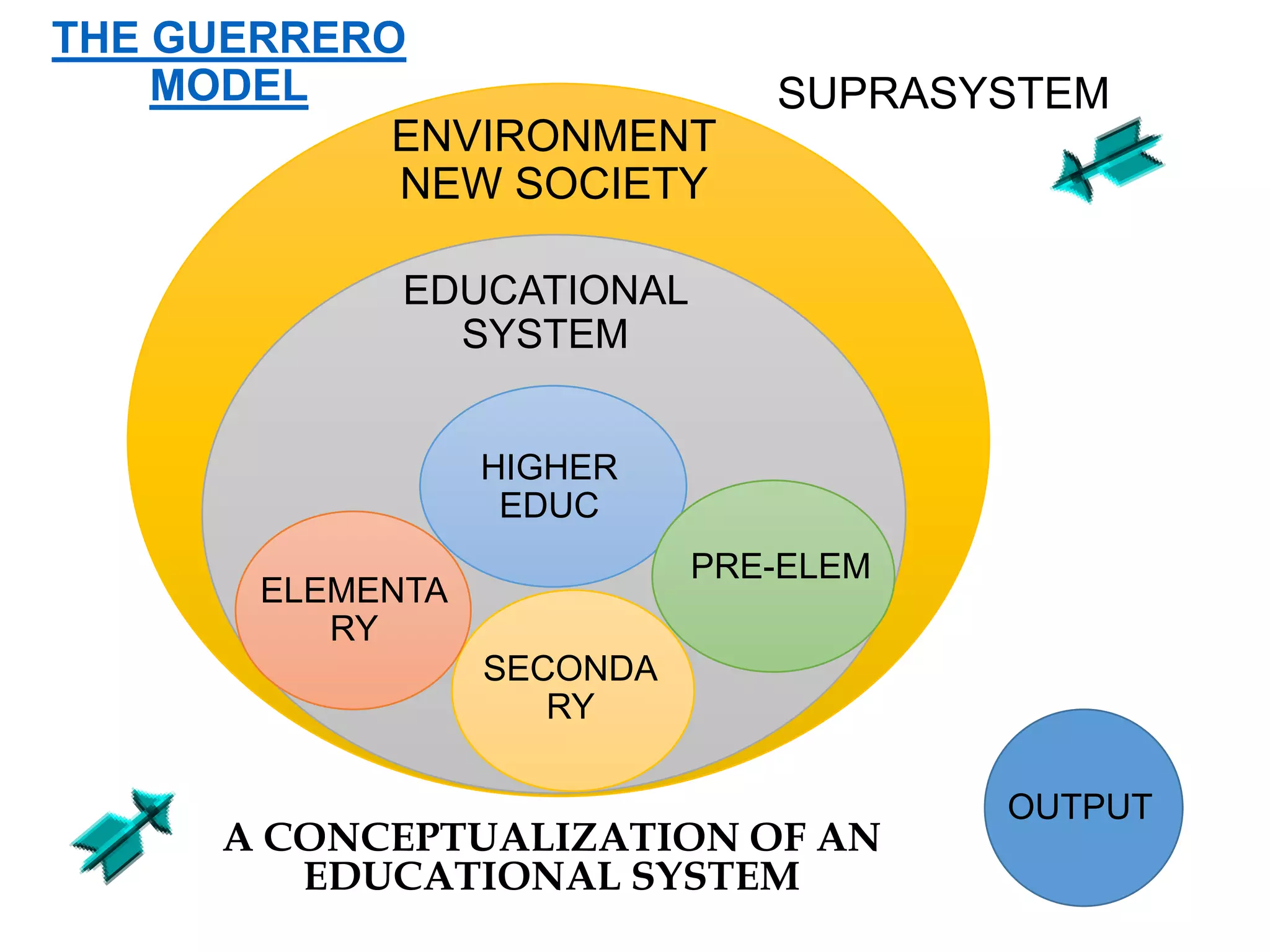
The GUERRERO MODEL

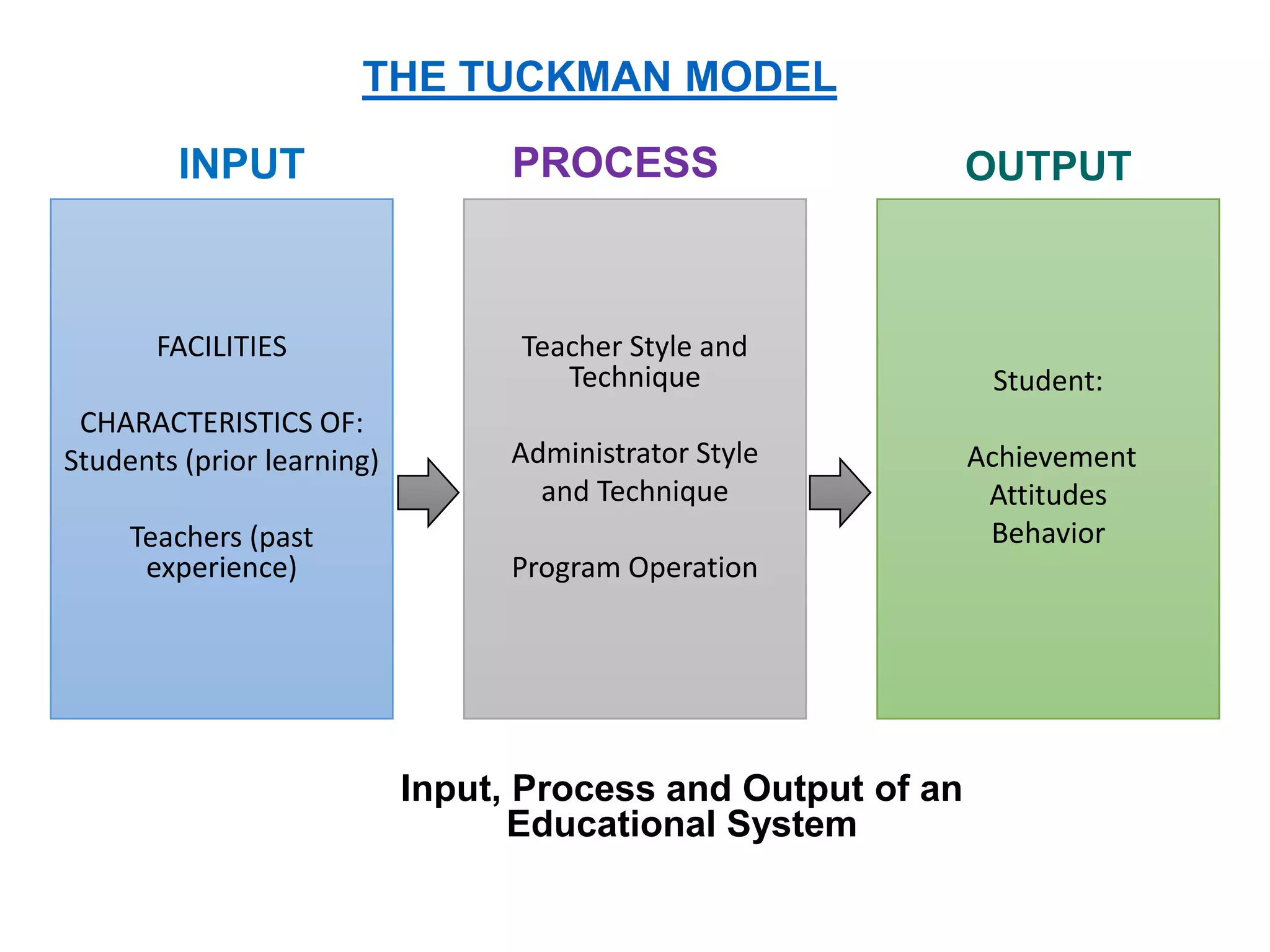
The TUCKMAN MODEL
Boundary ---- School Building
Institutio
n

Input

Role

Expectation
s

Intention
Social
Group Climate
System
s

Individual

Personalit
y

Social
Behavior

Needs

Boundary ---- School Building

Structural Elements using GETZELS-GUBA
SYSTEMS MODEL

Output
THE GUERRERO
MODEL
ENVIRONMENT
NEW SOCIETY

SUPRASYSTEM

EDUCATIONAL
SYSTEM
HIGHER
EDUC
PRE-ELEM

ELEMENTA
RY
SECONDA
RY

A CONCEPTUALIZATION OF AN
EDUCATIONAL SYSTEM

OUTPUT
THE TUCKMAN MODEL
INPUT

FACILITIES
CHARACTERISTICS OF:
Students (prior learning)
Teachers (past
experience)

PROCESS

Teacher Style and
Technique
Administrator Style
and Technique
Program Operation

Input, Process and Output of an
Educational System

OUTPUT

Student:
Achievement
Attitudes
Behavior
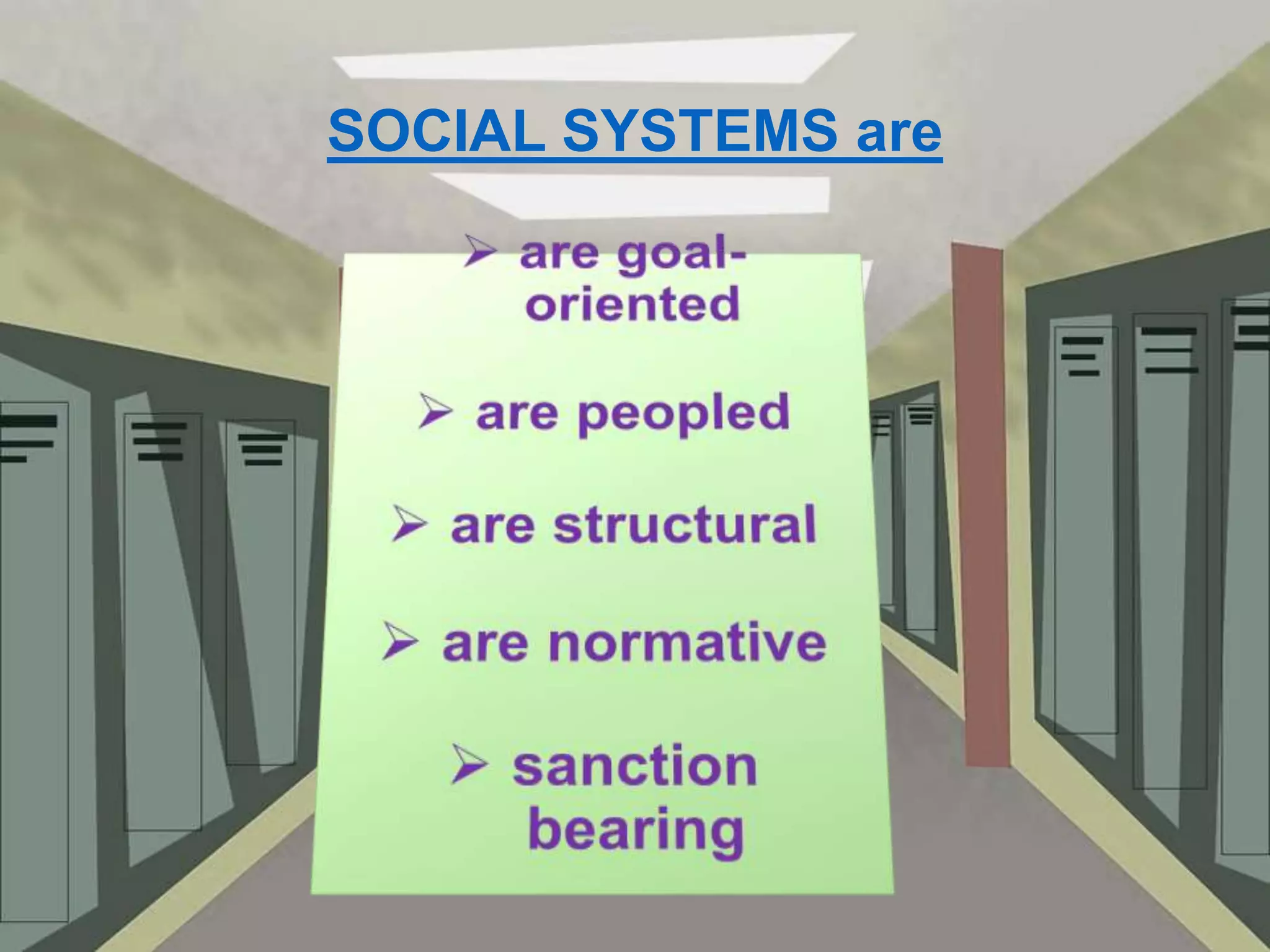
SOCIAL SYSTEMS are
ORGANIZATIONAL
STRUCTURE
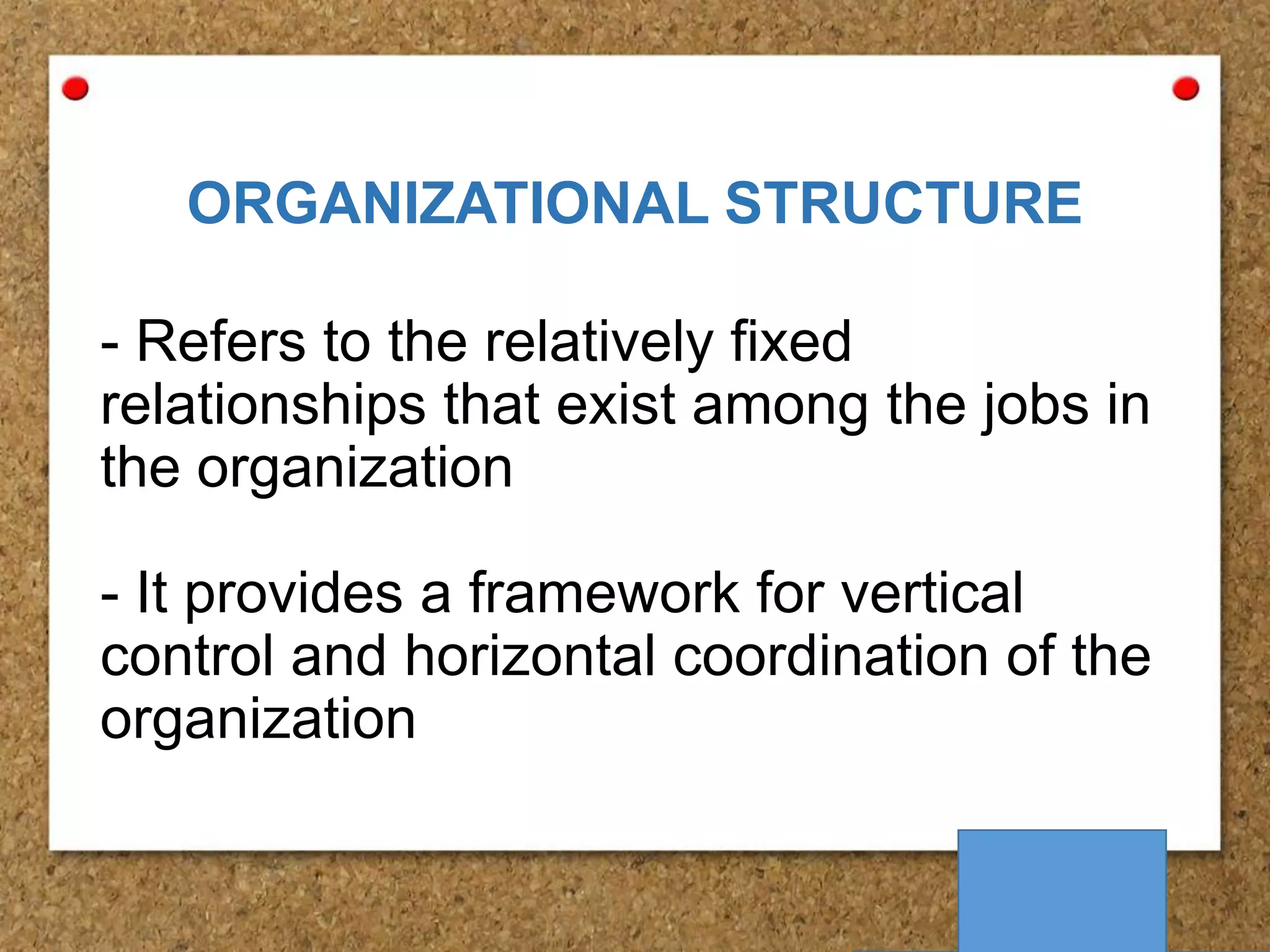
ORGANIZATIONAL STRUCTURE
- Refers to the relatively fixed
relationships that exist among the jobs in
the organization
- It provides a framework for vertical
control and horizontal coordination of the
organization
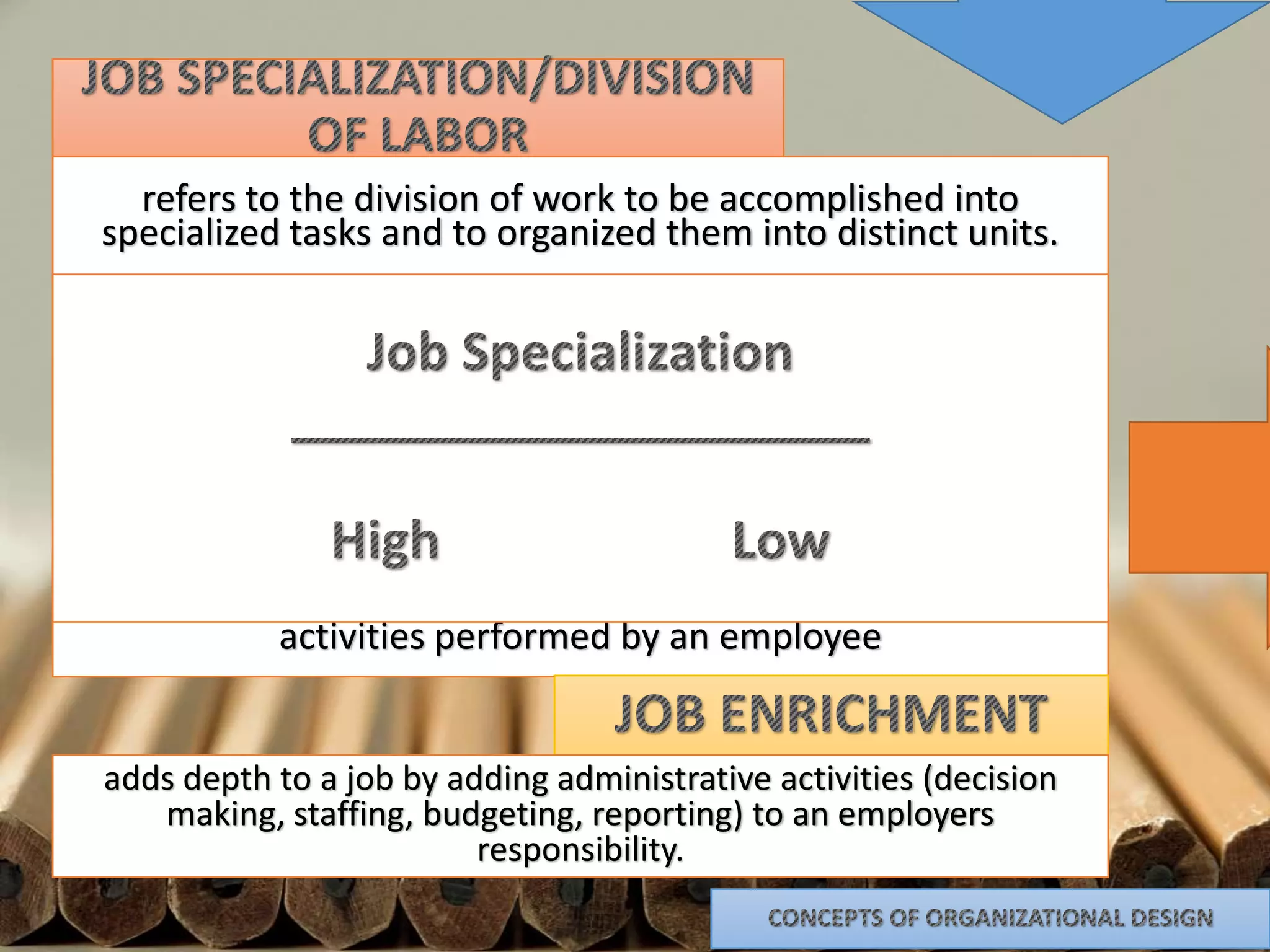
refers to the division of work to be accomplished into
specialized tasks and to organized them into distinct units.

involves systematically moving employees from 1 job to
another

adds breadth to a job by increasing the no. and variety of
activities performed by an employee

adds depth to a job by adding administrative activities (decision
making, staffing, budgeting, reporting) to an employers
responsibility.
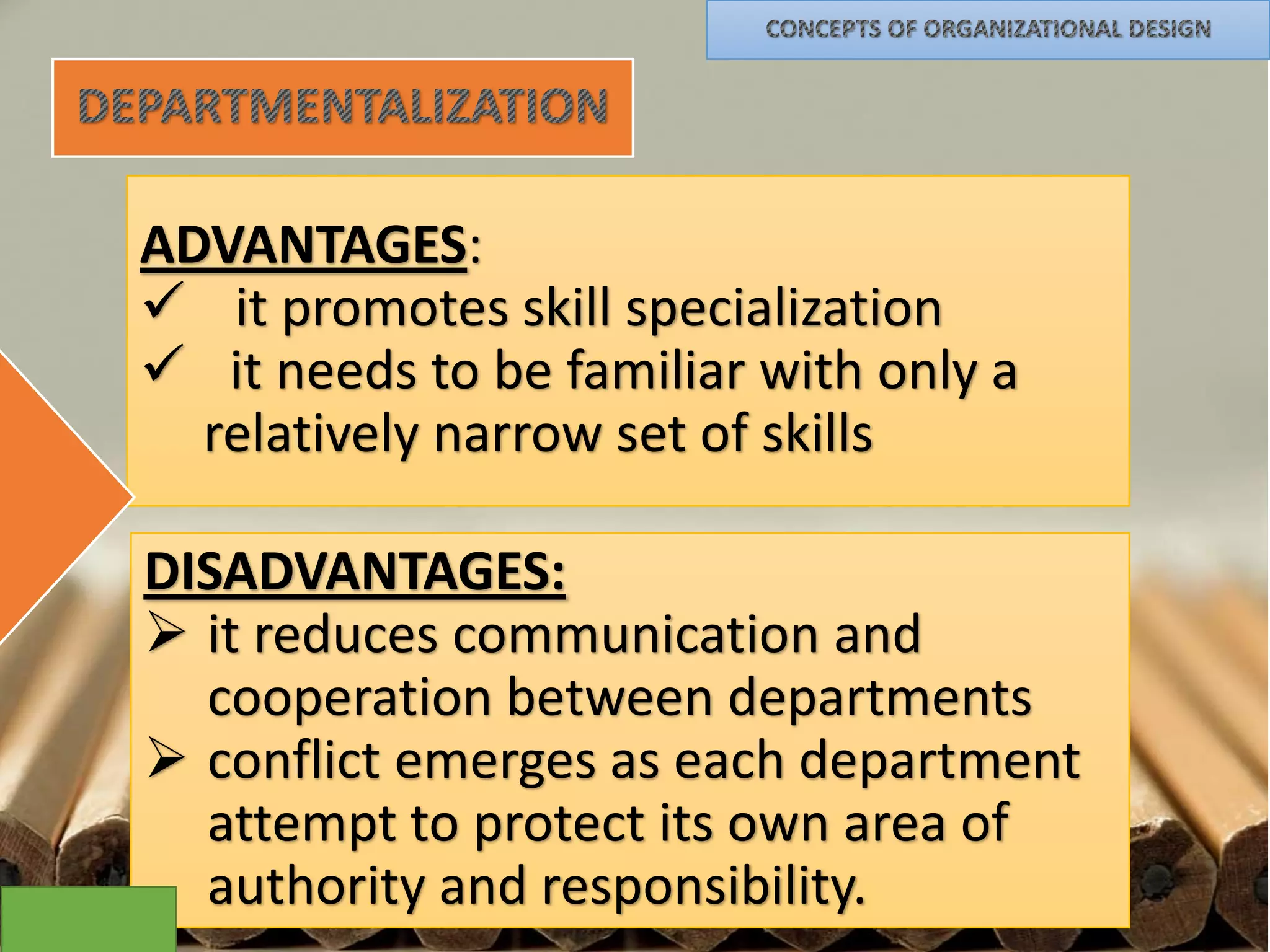
is the process of combining jobs into
ADVANTAGES: or departments
groups

 it promotes skill specialization
 it needs to be familiar with only a
JOB SIMILARITY
relatively narrow set of skills
HOMOGENOUS

HETEROGENOUS

DISADVANTAGES:
 it reduces communication and
cooperation between departments
 conflict emerges as each department
attempt to protect its own area of
authority and responsibility.
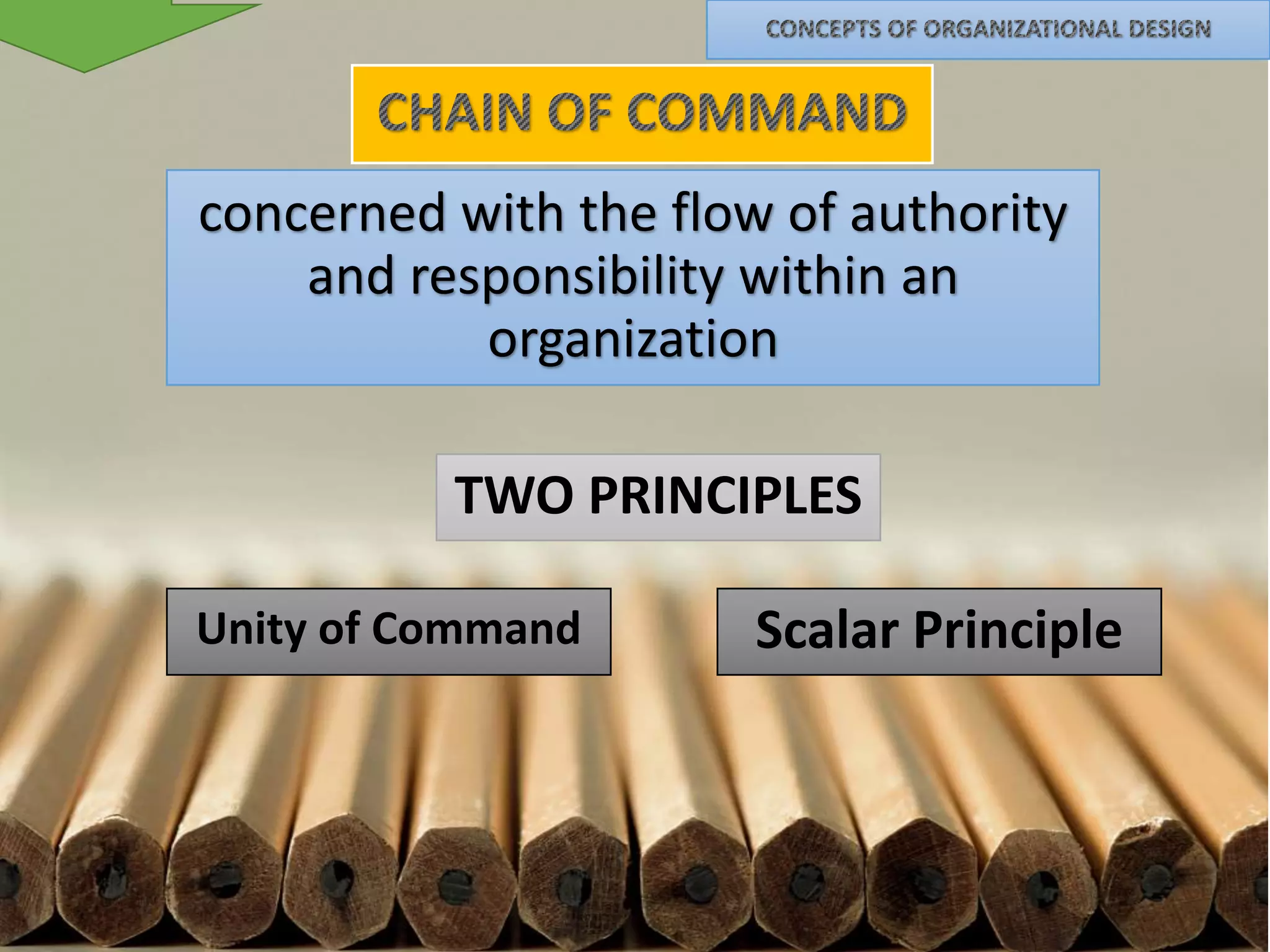
concerned with the flow of authority
and responsibility within an
organization
TWO PRINCIPLES
Unity of Command

Scalar Principle
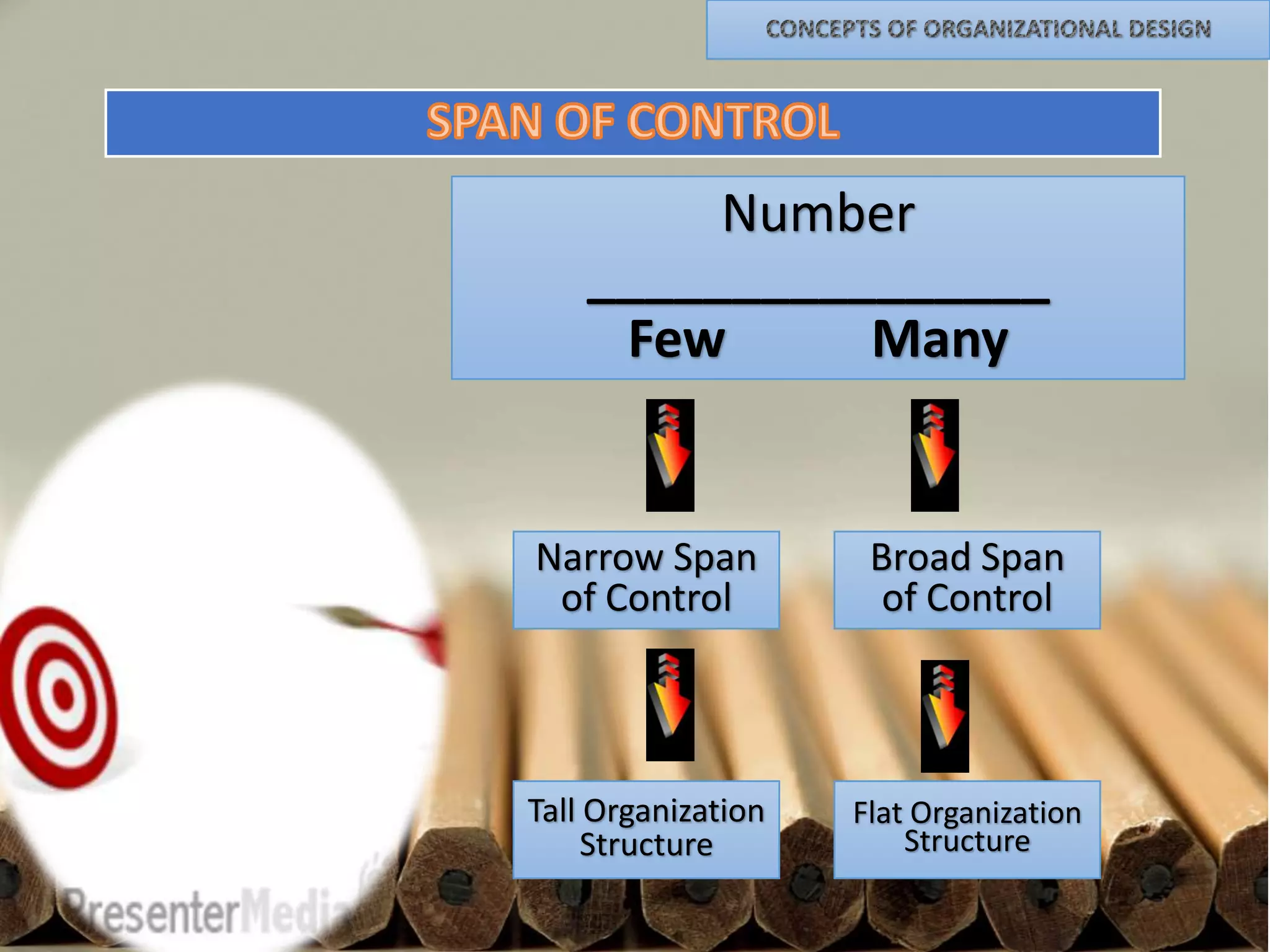
Number
________________
Few
Many

Narrow Span
of Control

Broad Span
of Control

Tall Organization
Structure

Flat Organization
Structure
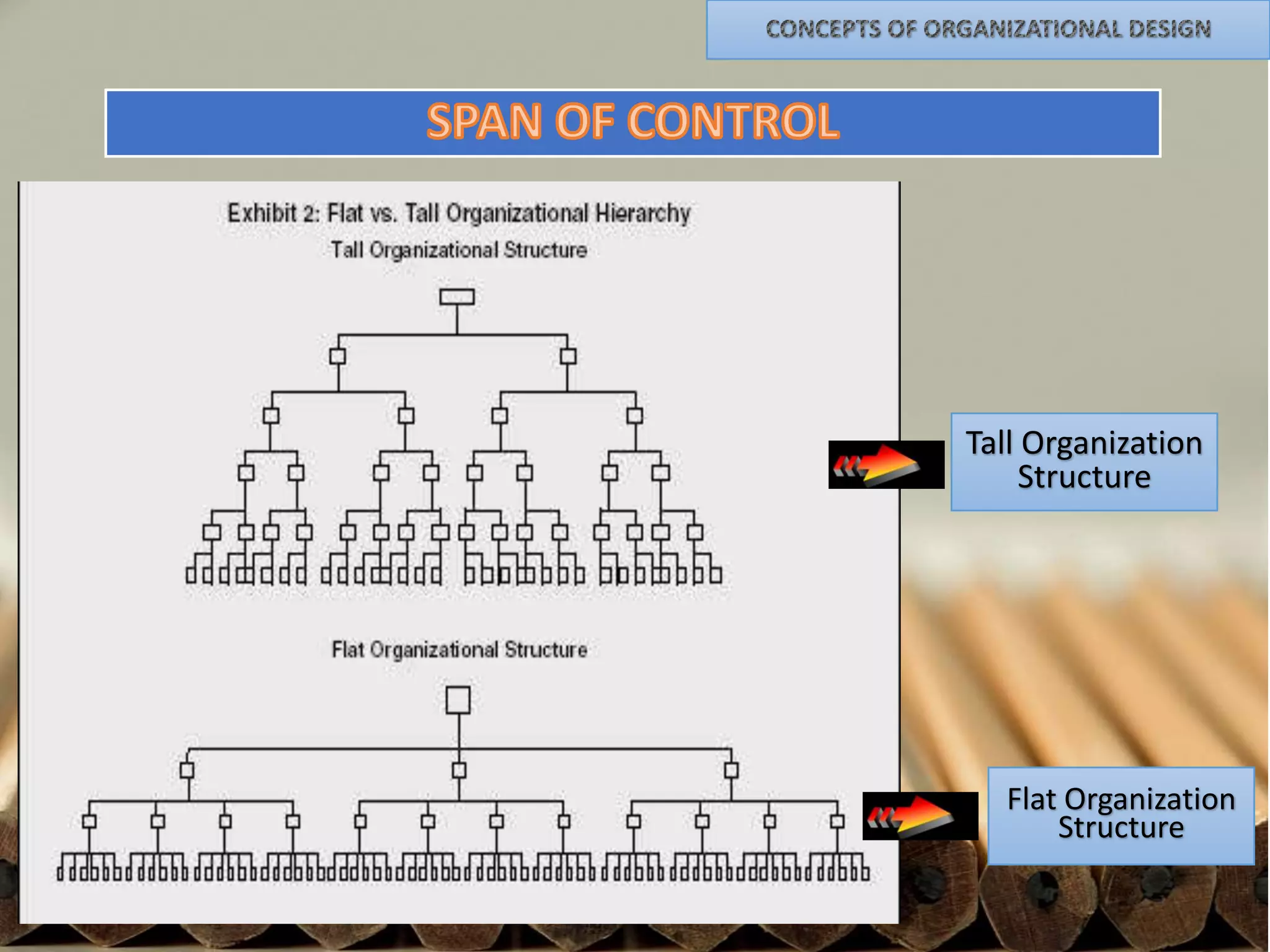
Tall Organization
Structure

Flat Organization
Structure
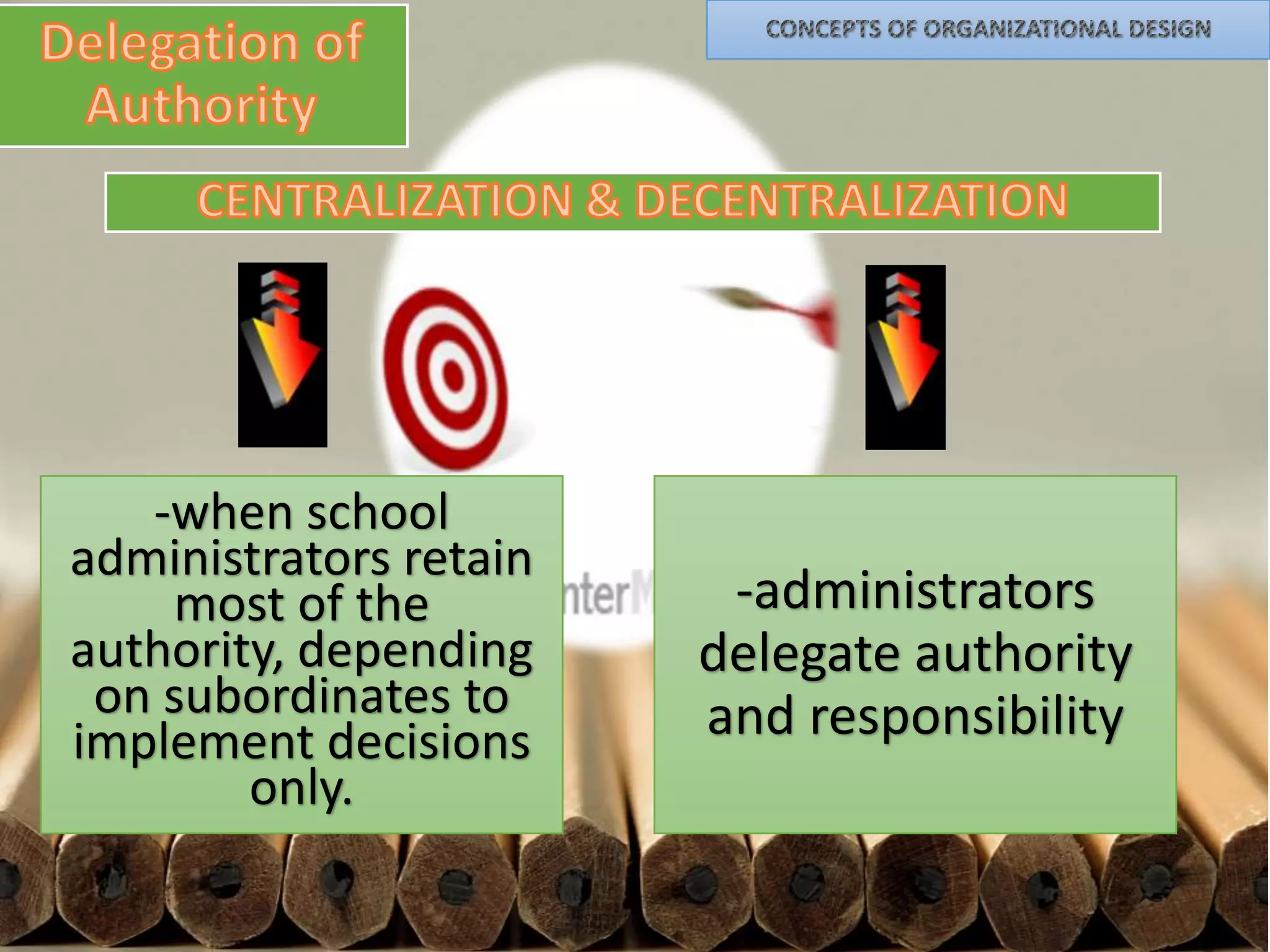
CONCEPTS OF ORGANIZATIONAL DESIGN

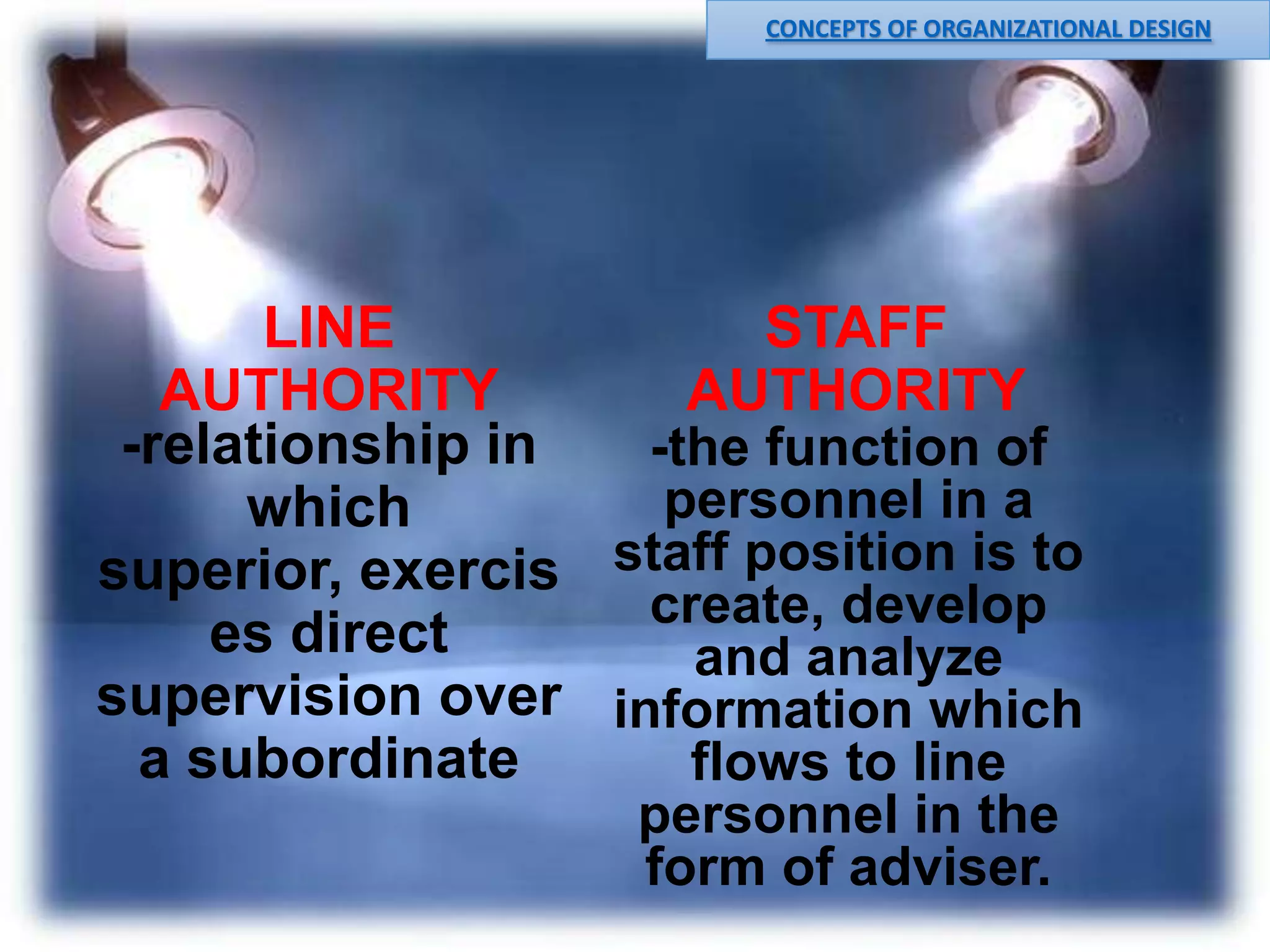
LINE
STAFF
AUTHORITY
AUTHORITY
-relationship in
-the function of
personnel in a
which
superior, exercis staff position is to
create, develop
es direct
and analyze
supervision over information which
a subordinate
flows to line
personnel in the
form of adviser.
-when school
administrators retain
most of the
authority, depending
on subordinates to
implement decisions
only.

-administrators
delegate authority
and responsibility
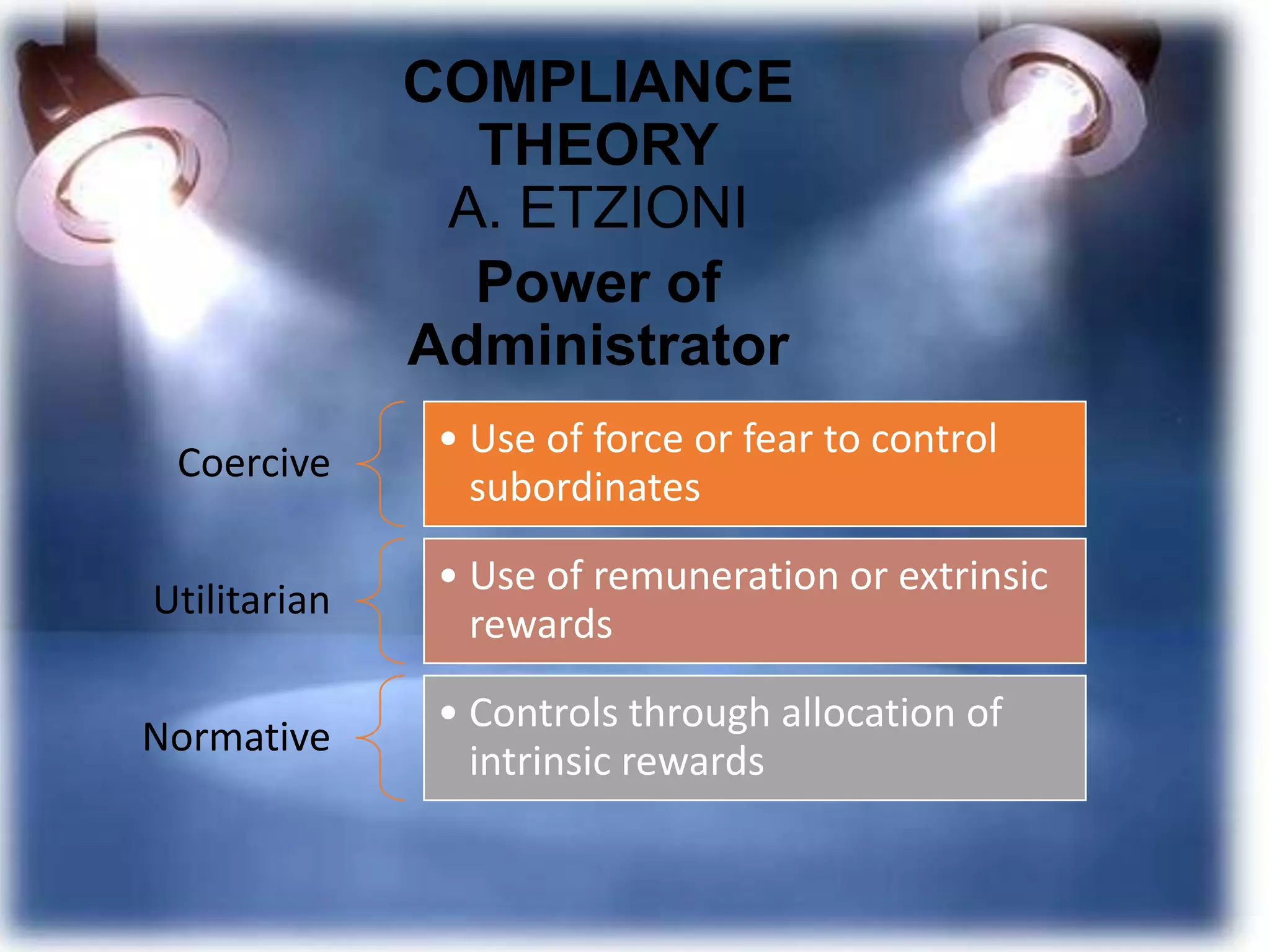
COMPLIANCE
THEORY
A. ETZIONI
Power of
Administrator
Coercive

• Use of force or fear to control
subordinates

Utilitarian

• Use of remuneration or extrinsic
rewards

Normative

• Controls through allocation of
intrinsic rewards
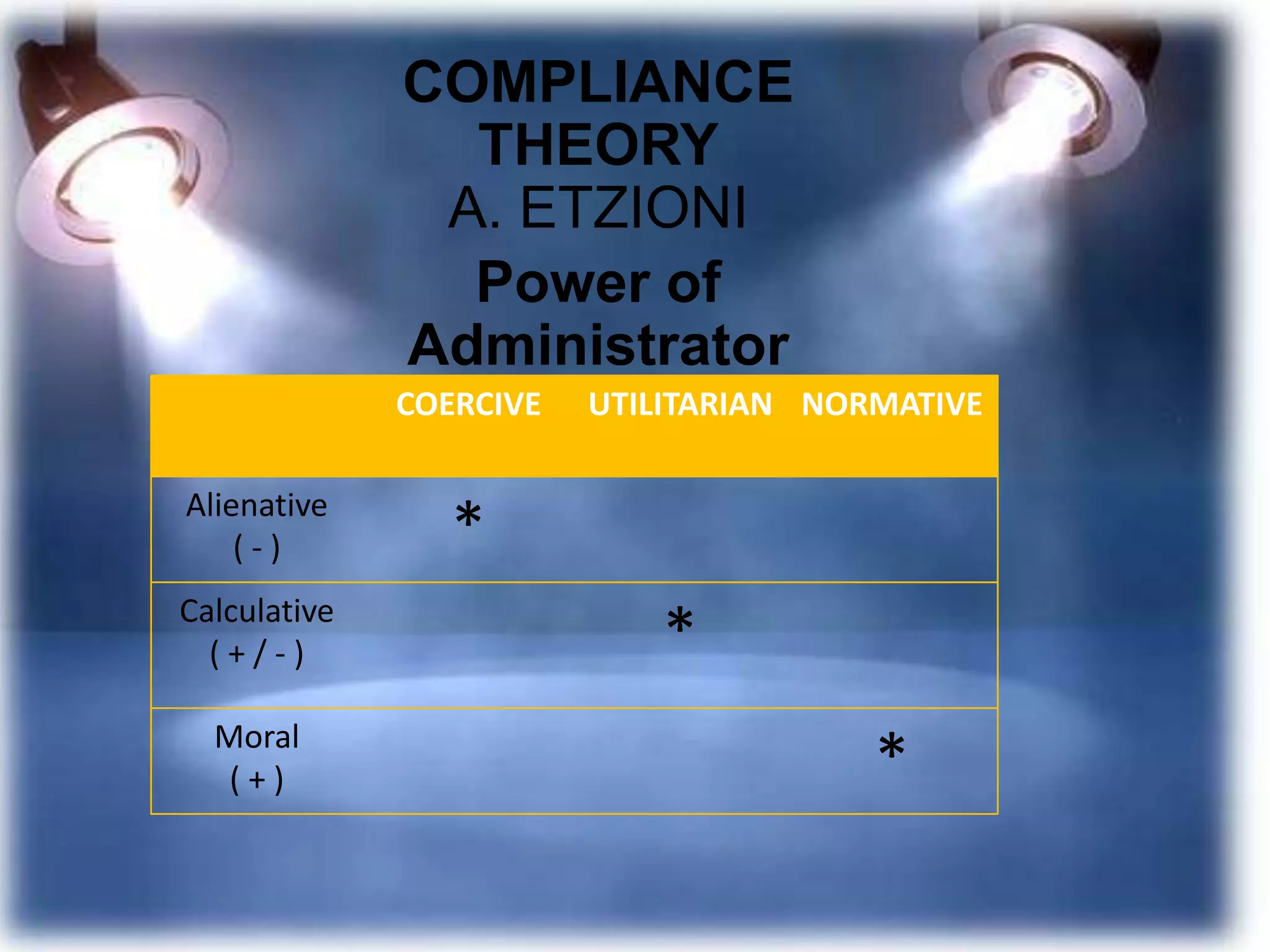
COMPLIANCE
THEORY
A. ETZIONI
Power of
Administrator
COERCIVE
Alienative
(-)
Calculative
(+/-)
Moral
(+)

UTILITARIAN NORMATIVE

*
*

*
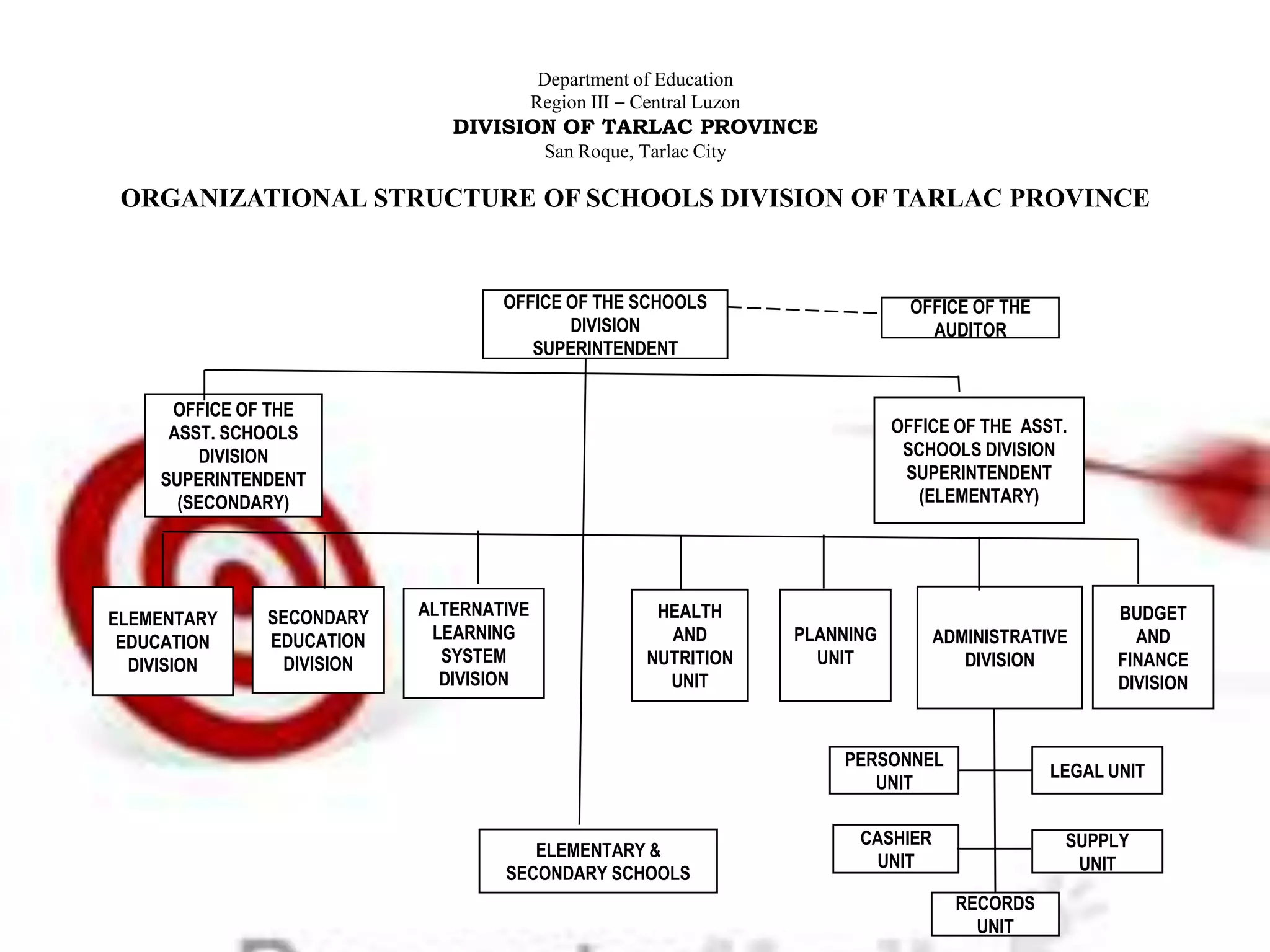
Department of Education
Region III – Central Luzon

DIVISION OF TARLAC PROVINCE
San Roque, Tarlac City

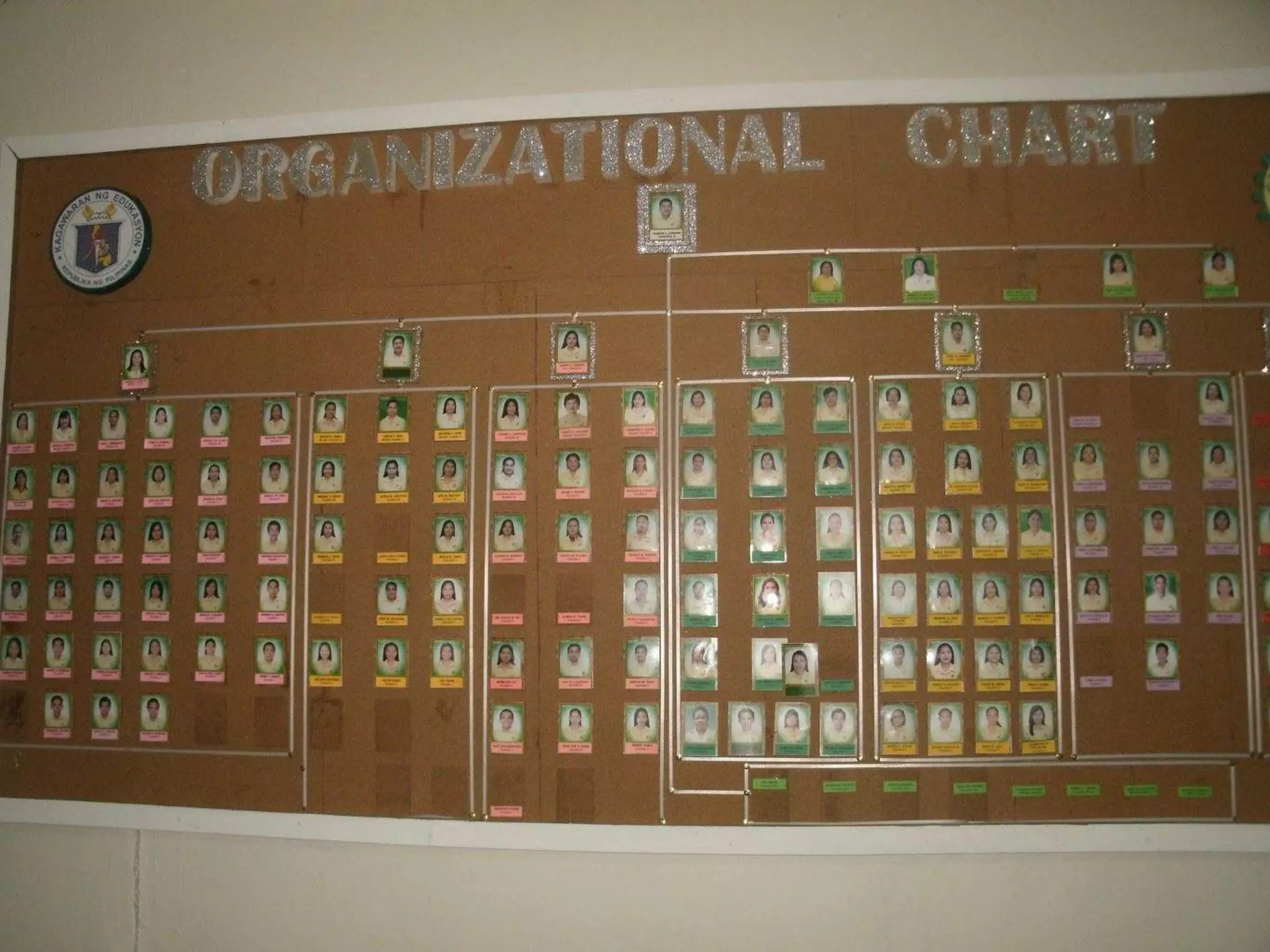
ORGANIZATIONAL STRUCTURE OF SCHOOLS DIVISION OF TARLAC PROVINCE

OFFICE OF THE SCHOOLS
DIVISION
SUPERINTENDENT

OFFICE OF THE
AUDITOR

OFFICE OF THE
ASST. SCHOOLS
DIVISION
SUPERINTENDENT
(SECONDARY)

ELEMENTARY
EDUCATION
DIVISION

SECONDARY
EDUCATION
DIVISION

OFFICE OF THE ASST.
SCHOOLS DIVISION
SUPERINTENDENT
(ELEMENTARY)

ALTERNATIVE
LEARNING
SYSTEM
DIVISION

HEALTH
AND
NUTRITION
UNIT

PLANNING
UNIT

ADMINISTRATIVE
DIVISION

BUDGET
AND
FINANCE
DIVISION

PERSONNEL
UNIT
ELEMENTARY &
SECONDARY SCHOOLS

LEGAL UNIT

CASHIER
UNIT

SUPPLY
UNIT
RECORDS
UNIT
GOVERNANCE
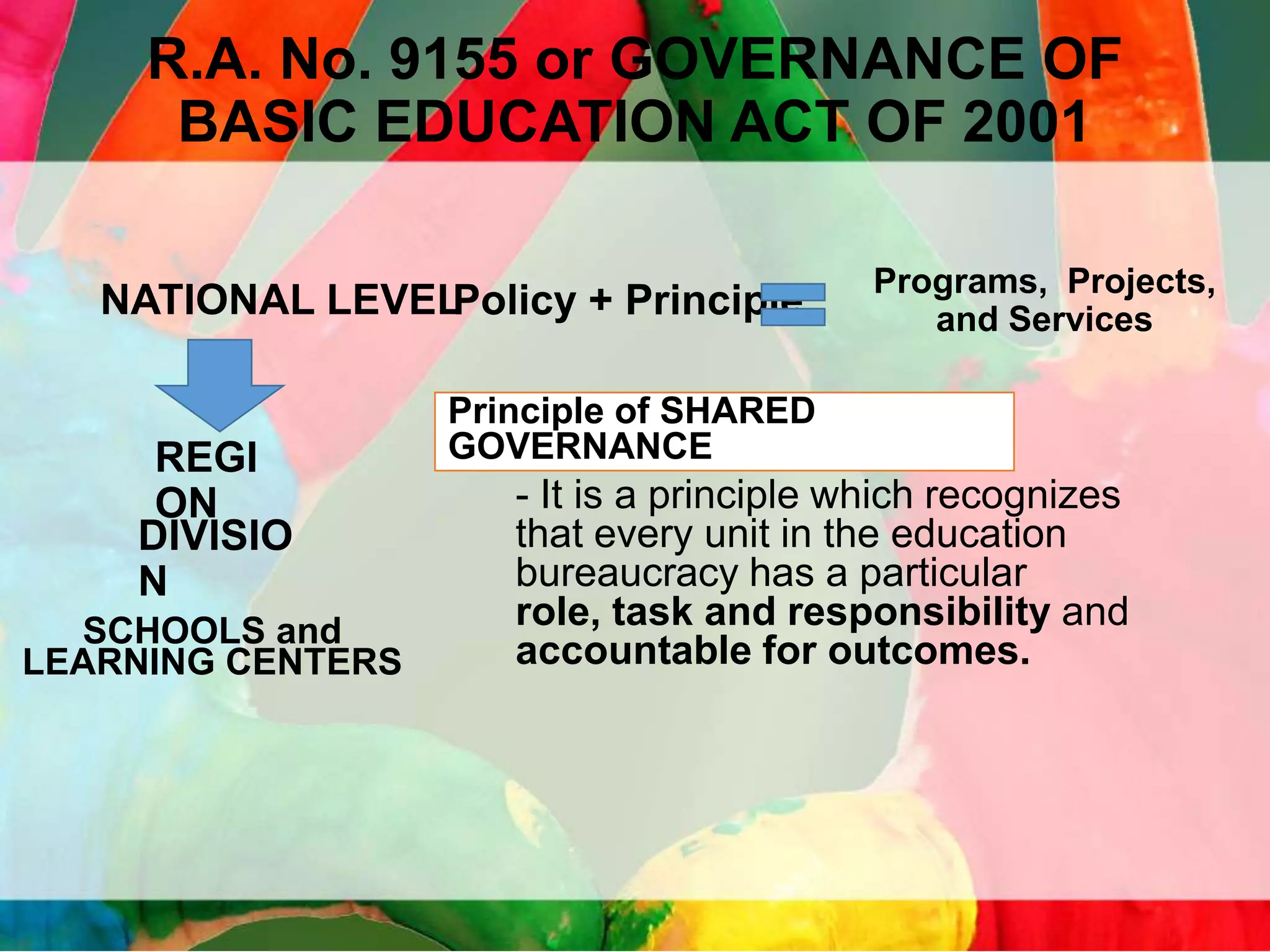
R.A. No. 9155 or GOVERNANCE OF
BASIC EDUCATION ACT OF 2001
NATIONAL LEVEL
Policy + Principle

REGI
ON
DIVISIO
N
SCHOOLS and
LEARNING CENTERS

Programs, Projects,
and Services

Principle of SHARED
GOVERNANCE

- It is a principle which recognizes
that every unit in the education
bureaucracy has a particular
role, task and responsibility and
accountable for outcomes.
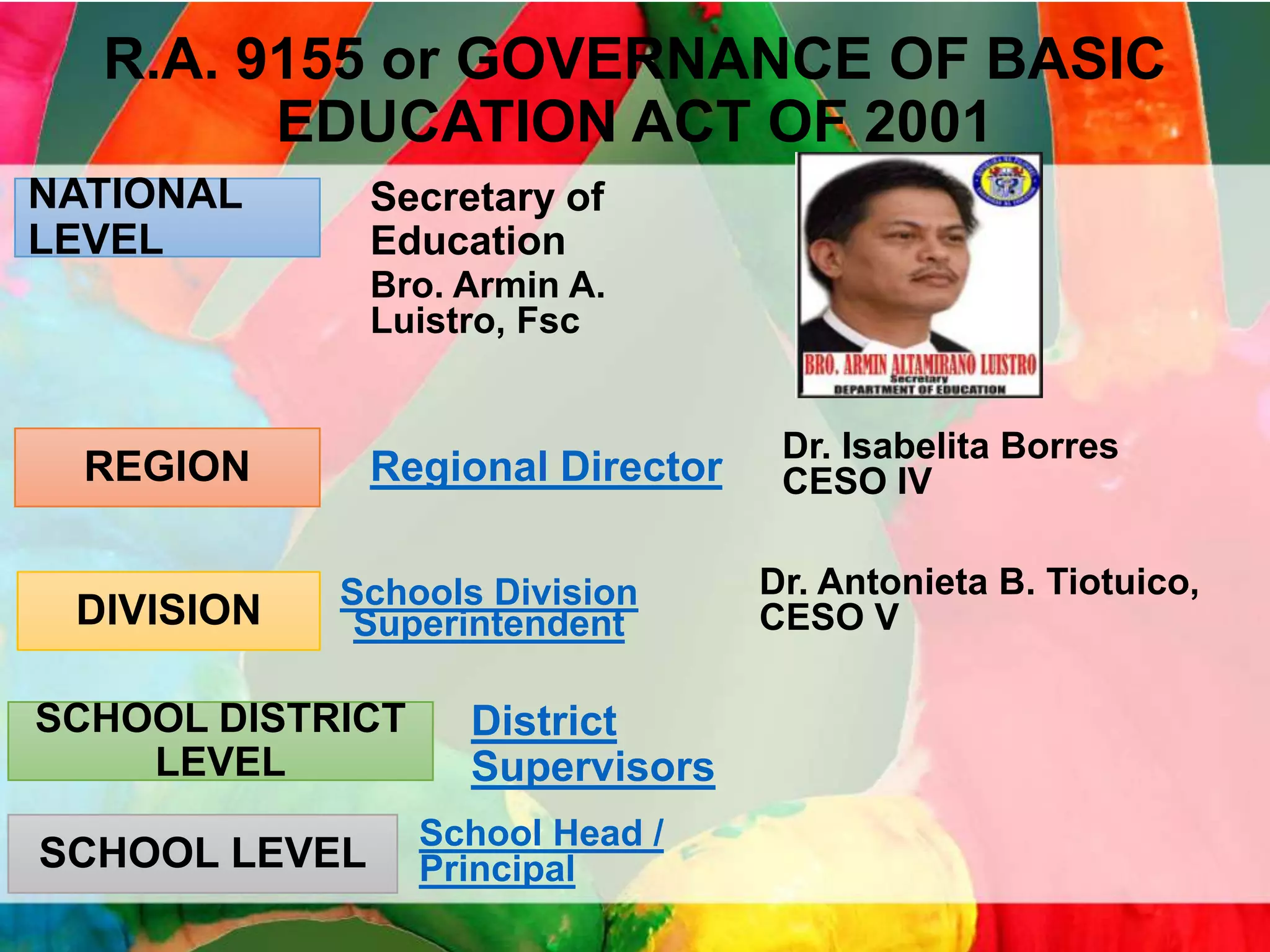
R.A. 9155 or GOVERNANCE OF BASIC
EDUCATION ACT OF 2001
NATIONAL
LEVEL

Secretary of
Education
Bro. Armin A.
Luistro, Fsc

REGION
DIVISION

Regional Director
Schools Division
Superintendent

SCHOOL DISTRICT
LEVEL

SCHOOL LEVEL

District
Supervisors
School Head /
Principal

Dr. Isabelita Borres
CESO IV

Dr. Antonieta B. Tiotuico,
CESO V
FUNCTIONS OF SCHOOL PRINCIPALS
1. Supervise and direct all school personnel
2. Lead in the development and implementation of
all educational programs of the school
3. Promote efficiency of teaching and learning in all
classes through in-service
training, observations, visits, etc.

4. Leads in the evaluation of achievements towards
the growth of the school.
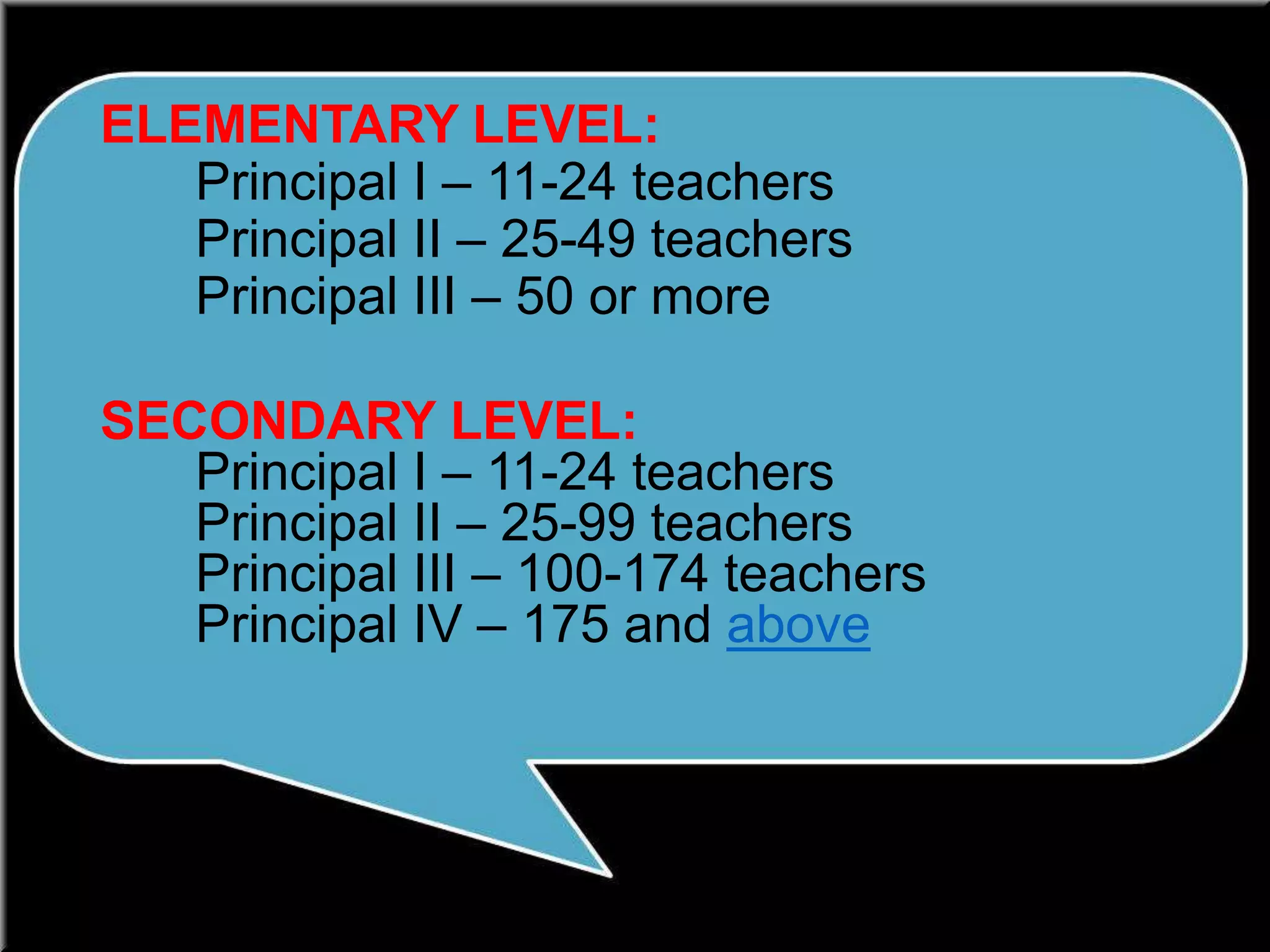
ELEMENTARY LEVEL:
Principal I – 11-24 teachers
Principal II – 25-49 teachers
Principal III – 50 or more
SECONDARY LEVEL:
Principal I – 11-24 teachers
Principal II – 25-99 teachers
Principal III – 100-174 teachers
Principal IV – 175 and above
FUNCTIONS OF DISTRICT
SUPERVISORS
 Supervises pre-elementary and
elementary classes with prior
authority from the division/city
schools superintendent
 Evaluates educational
achievements in the district
 Preparing and ensuring the proper
distribution of instructional
materials, equipment and supplies
for the district
FUNCTIONS OF REGIONAL
DIRECTORS

 Defining regional policy framework
 Approving on the establishment of public
and private elementary and high
schools, and learning centers
 Evaluating all SDS and ASDS in the region
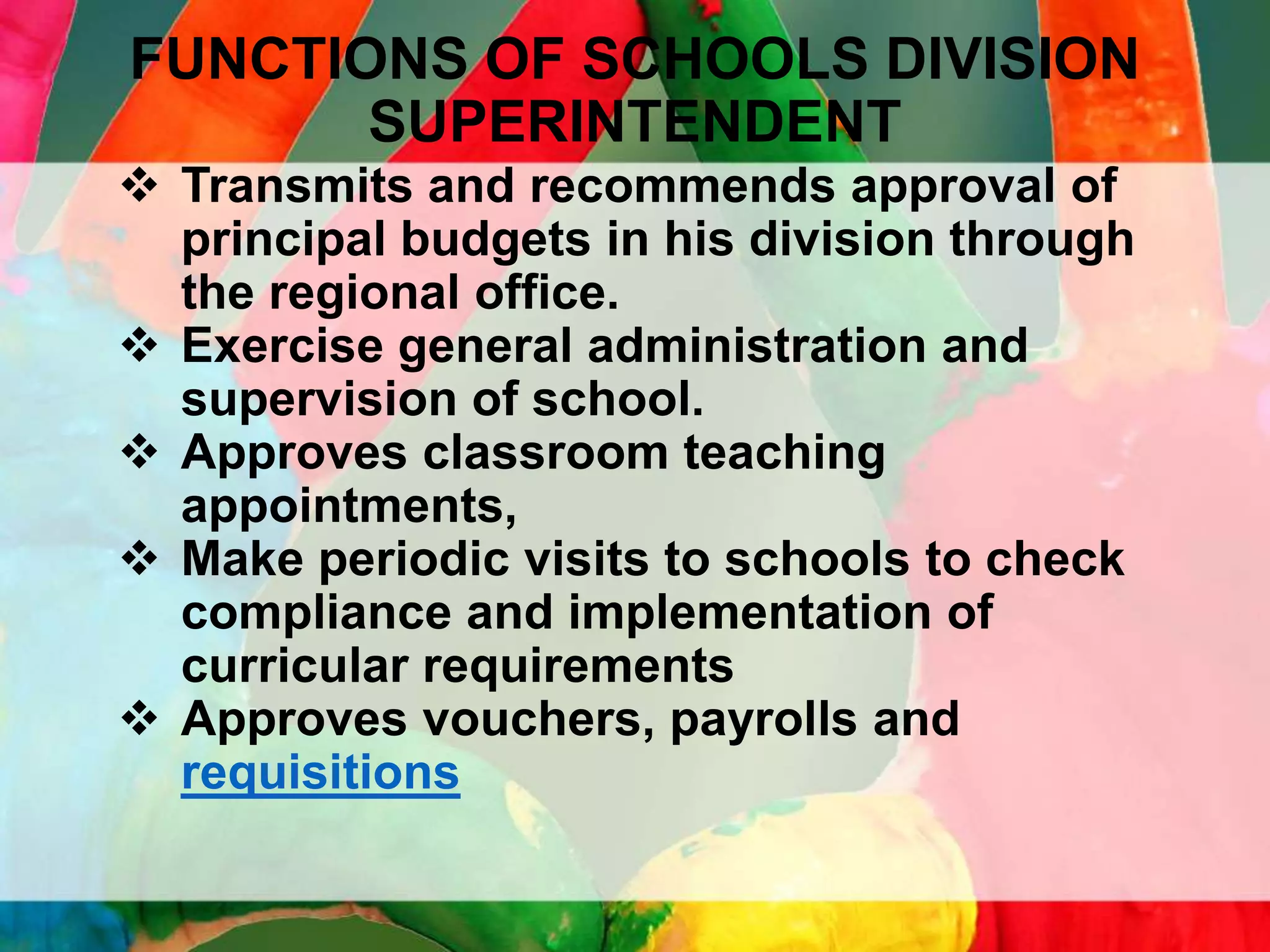
FUNCTIONS OF SCHOOLS DIVISION
SUPERINTENDENT
 Transmits and recommends approval of
principal budgets in his division through
the regional office.
 Exercise general administration and
supervision of school.
 Approves classroom teaching
appointments,
 Make periodic visits to schools to check
compliance and implementation of
curricular requirements
 Approves vouchers, payrolls and
requisitions
DECISION MAKING
 what has to be done
 how it is to be done
 substance
 process
Establish Goals and Objectives

Identify the Problem
Develop alternative solutions
Evaluate alternative
Choose an Alternative
Implement the Decision

Evaluation and Control
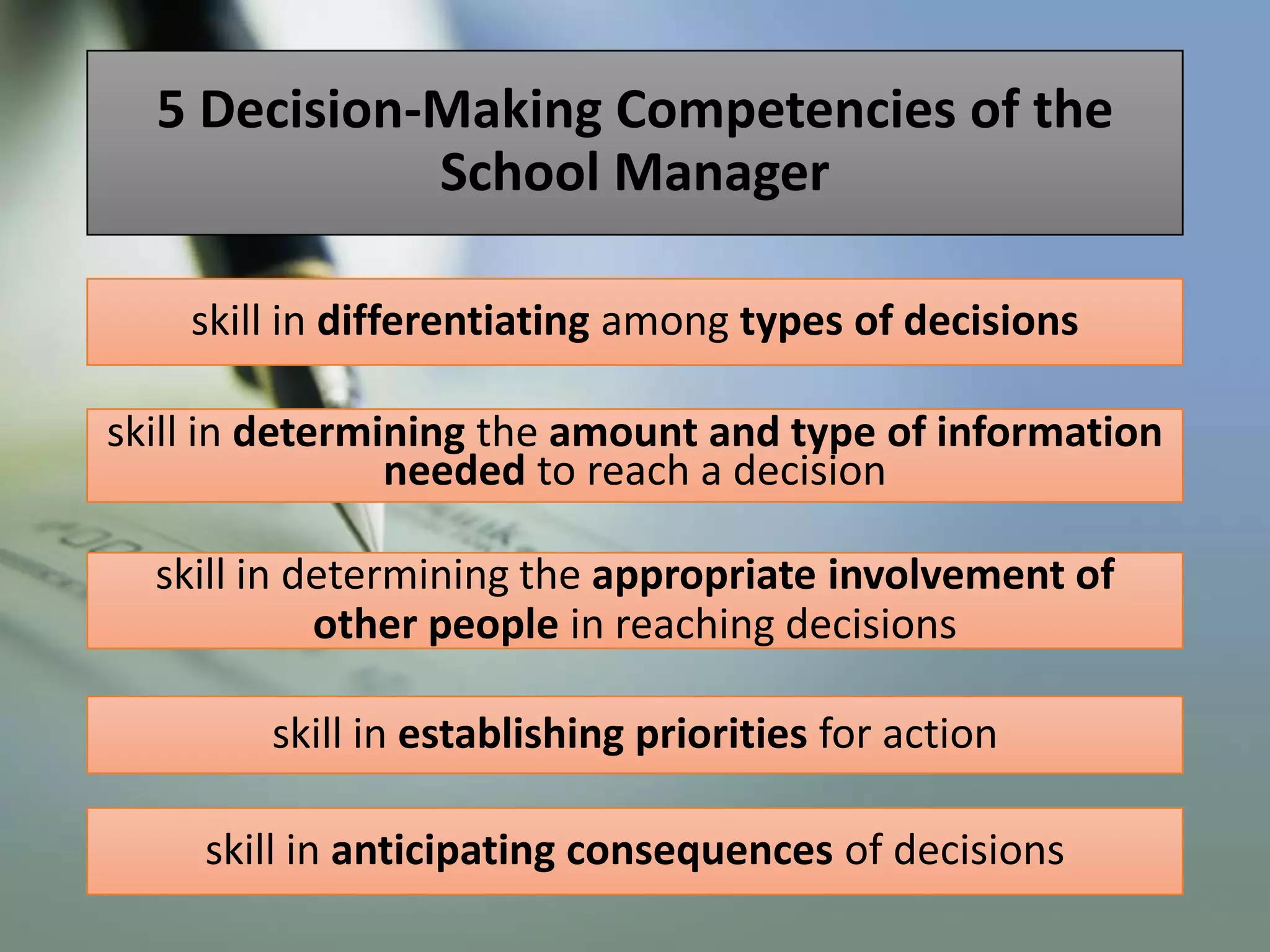
5 Decision-Making Competencies of the
School Manager
skill in differentiating among types of decisions
skill in determining the amount and type of information
needed to reach a decision
skill in determining the appropriate involvement of
other people in reaching decisions
skill in establishing priorities for action
skill in anticipating consequences of decisions
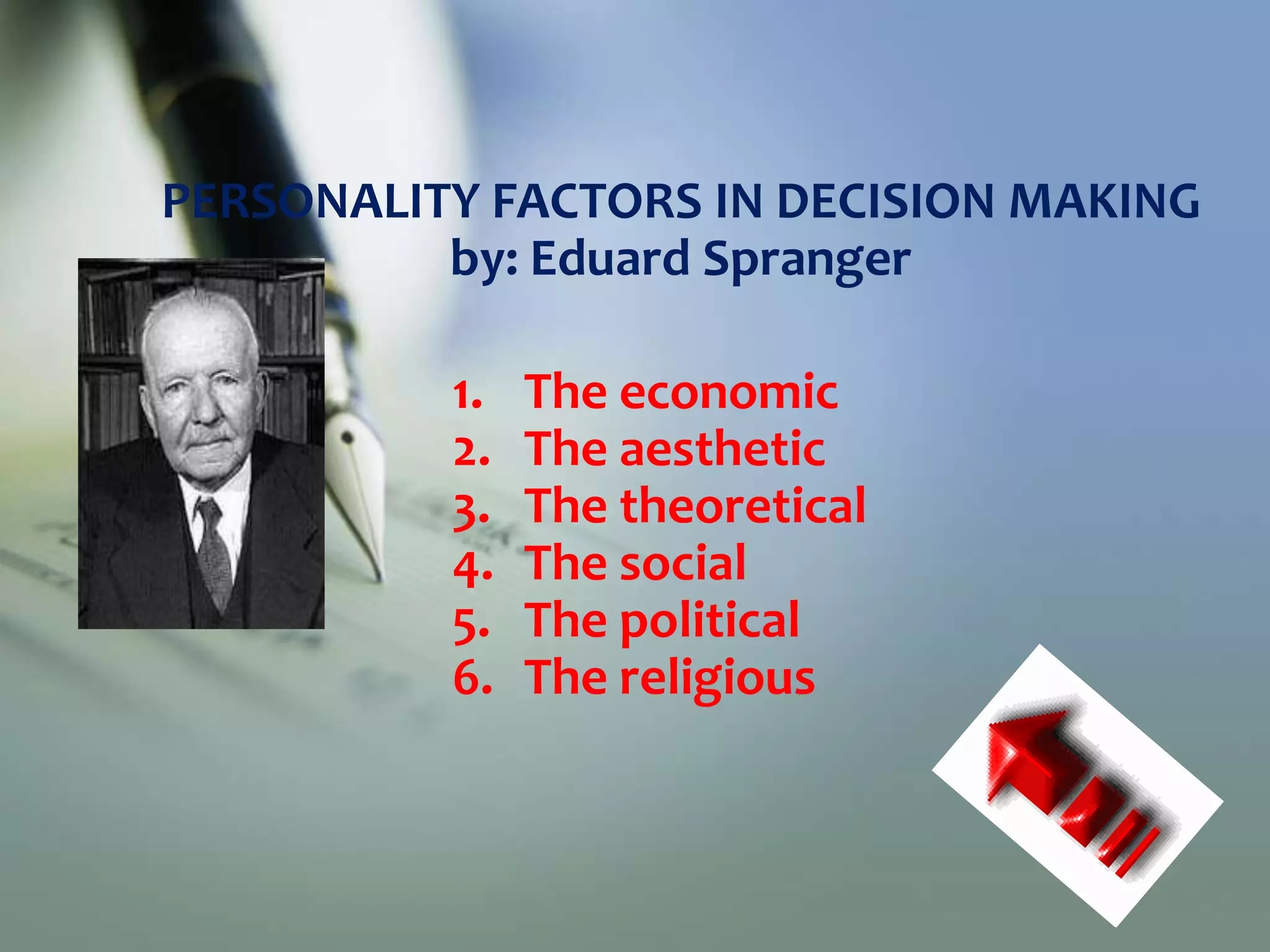
PERSONALITY FACTORS IN DECISION MAKING
by: Eduard Spranger
1.
2.
3.
4.
5.
6.

The economic
The aesthetic
The theoretical
The social
The political
The religious
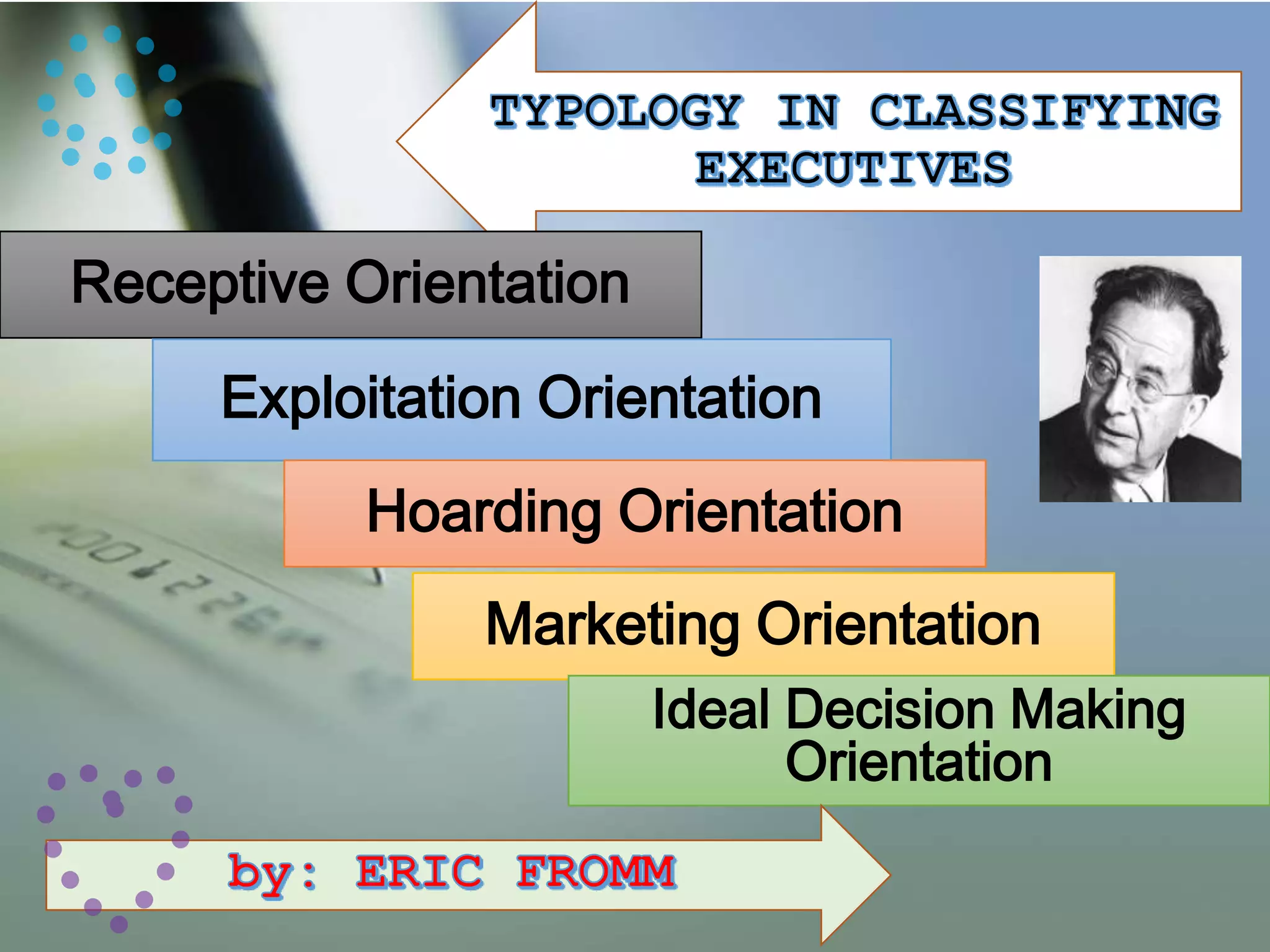
Receptive Orientation
Exploitation Orientation
Hoarding Orientation
Marketing Orientation
Ideal Decision Making
Orientation
Aquino, Gaudencio V. “EDUCATIONAL
ADMINISTRATION:THEORY AND PRACTICE.” Rex
Bookstore:Manila.2002 pp.118-150
Cherrington, David J. “ORGANIZATIONAL BEHAVIOR: THE
MANAGEMENT OF
INDIVIDUAL PERFORMANCE.”
Massachusetts.1989.pp.515-524,607-627

Lunenberg, Fred and Allan Ornstein. “EDUCATIONAL
ADMINISTRATION
CONCEPTS AND PRACTICES. 4th
Edition.2004. California
Sims, Ronald, et.al., “READINGS IN ORGANIZATIONAL
BEHAVIOR.”
1992.Massachusetts.

Wagner III, John A. and John R. Hollenbeck. “MANAGEMENT
OF ORGANIZATIONAL BEHAVIOR. 2nd Edition. 1992: New
Jersey.
http://www.gov.ph/2001/08/11/republic-act-no-9155/
http://www.slideshare.net/smseow/organization-behaviordecision-making
Schools as Socio-Political System

Schools as Socio-Political System

  • 1.
    EDMA 506: ADMINISTRATIVEBEHAVIOR IN EDUCATION POPS P. MACALINO Discussant
  • 2.
    The Social System OrganizationalStructure Governance and Decision Making
  • 3.
    The SCHOOL as aSOCIAL SYSTEM
  • 4.
    also known asFormal Education it is society’s primary learning system the main instrument for the achievement of the country’s educational goals and objectives
  • 5.
    model of aschool organization is distinguished from its environment by a clearly defined boundary composed of subunits, elements, and subsystem that are interrelated within relatively stable pattern of social order components of a social system: boundaries, equilibrium, elements and activities
  • 6.
    Members and Elementsof the Educational Community 1. Parents or Guardians who has the custody of the pupil or student 2. Students who are enrolled in, or a person engaged in formal study 3. School Personnel, or all persons working for an educational institution 4. Schools or Institution recognized by the State
  • 7.
    ENVIRONMENT BOUNDARY THE SCHOOL BUILDING E N V IINPUTS R O N M E N T 1. Elements – Subsystems -Formal School Structure Administration & Policy Classrooms -Informal Groups -Individuals Administrators Teachers Other Employees Students 2. Activities – Behaviors Administering Teaching Maintaining Learning Creating Socializing BOUNDARY FEEDBACK LOOP E N V OUTPUTS I R O N M E N T
  • 8.
    The GETZELS-GUBA BASICMODEL The GUERRERO MODEL The TUCKMAN MODEL
  • 9.
    Boundary ---- SchoolBuilding Institutio n Input Role Expectation s Intention Social Group Climate System s Individual Personalit y Social Behavior Needs Boundary ---- School Building Structural Elements using GETZELS-GUBA SYSTEMS MODEL Output
  • 10.
  • 11.
    THE TUCKMAN MODEL INPUT FACILITIES CHARACTERISTICSOF: Students (prior learning) Teachers (past experience) PROCESS Teacher Style and Technique Administrator Style and Technique Program Operation Input, Process and Output of an Educational System OUTPUT Student: Achievement Attitudes Behavior
  • 12.
  • 13.
  • 14.
    ORGANIZATIONAL STRUCTURE - Refersto the relatively fixed relationships that exist among the jobs in the organization - It provides a framework for vertical control and horizontal coordination of the organization
  • 15.
    refers to thedivision of work to be accomplished into specialized tasks and to organized them into distinct units. involves systematically moving employees from 1 job to another adds breadth to a job by increasing the no. and variety of activities performed by an employee adds depth to a job by adding administrative activities (decision making, staffing, budgeting, reporting) to an employers responsibility.
  • 16.
    is the processof combining jobs into ADVANTAGES: or departments groups  it promotes skill specialization  it needs to be familiar with only a JOB SIMILARITY relatively narrow set of skills HOMOGENOUS HETEROGENOUS DISADVANTAGES:  it reduces communication and cooperation between departments  conflict emerges as each department attempt to protect its own area of authority and responsibility.
  • 17.
    concerned with theflow of authority and responsibility within an organization TWO PRINCIPLES Unity of Command Scalar Principle
  • 18.
    Number ________________ Few Many Narrow Span of Control BroadSpan of Control Tall Organization Structure Flat Organization Structure
  • 19.
  • 20.
    CONCEPTS OF ORGANIZATIONALDESIGN LINE STAFF AUTHORITY AUTHORITY -relationship in -the function of personnel in a which superior, exercis staff position is to create, develop es direct and analyze supervision over information which a subordinate flows to line personnel in the form of adviser.
  • 21.
    -when school administrators retain mostof the authority, depending on subordinates to implement decisions only. -administrators delegate authority and responsibility
  • 22.
    COMPLIANCE THEORY A. ETZIONI Power of Administrator Coercive •Use of force or fear to control subordinates Utilitarian • Use of remuneration or extrinsic rewards Normative • Controls through allocation of intrinsic rewards
  • 23.
  • 24.
    Department of Education RegionIII – Central Luzon DIVISION OF TARLAC PROVINCE San Roque, Tarlac City ORGANIZATIONAL STRUCTURE OF SCHOOLS DIVISION OF TARLAC PROVINCE OFFICE OF THE SCHOOLS DIVISION SUPERINTENDENT OFFICE OF THE AUDITOR OFFICE OF THE ASST. SCHOOLS DIVISION SUPERINTENDENT (SECONDARY) ELEMENTARY EDUCATION DIVISION SECONDARY EDUCATION DIVISION OFFICE OF THE ASST. SCHOOLS DIVISION SUPERINTENDENT (ELEMENTARY) ALTERNATIVE LEARNING SYSTEM DIVISION HEALTH AND NUTRITION UNIT PLANNING UNIT ADMINISTRATIVE DIVISION BUDGET AND FINANCE DIVISION PERSONNEL UNIT ELEMENTARY & SECONDARY SCHOOLS LEGAL UNIT CASHIER UNIT SUPPLY UNIT RECORDS UNIT
  • 26.
  • 27.
    R.A. No. 9155or GOVERNANCE OF BASIC EDUCATION ACT OF 2001 NATIONAL LEVEL Policy + Principle REGI ON DIVISIO N SCHOOLS and LEARNING CENTERS Programs, Projects, and Services Principle of SHARED GOVERNANCE - It is a principle which recognizes that every unit in the education bureaucracy has a particular role, task and responsibility and accountable for outcomes.
  • 28.
    R.A. 9155 orGOVERNANCE OF BASIC EDUCATION ACT OF 2001 NATIONAL LEVEL Secretary of Education Bro. Armin A. Luistro, Fsc REGION DIVISION Regional Director Schools Division Superintendent SCHOOL DISTRICT LEVEL SCHOOL LEVEL District Supervisors School Head / Principal Dr. Isabelita Borres CESO IV Dr. Antonieta B. Tiotuico, CESO V
  • 29.
    FUNCTIONS OF SCHOOLPRINCIPALS 1. Supervise and direct all school personnel 2. Lead in the development and implementation of all educational programs of the school 3. Promote efficiency of teaching and learning in all classes through in-service training, observations, visits, etc. 4. Leads in the evaluation of achievements towards the growth of the school.
  • 30.
    ELEMENTARY LEVEL: Principal I– 11-24 teachers Principal II – 25-49 teachers Principal III – 50 or more SECONDARY LEVEL: Principal I – 11-24 teachers Principal II – 25-99 teachers Principal III – 100-174 teachers Principal IV – 175 and above
  • 31.
    FUNCTIONS OF DISTRICT SUPERVISORS Supervises pre-elementary and elementary classes with prior authority from the division/city schools superintendent  Evaluates educational achievements in the district  Preparing and ensuring the proper distribution of instructional materials, equipment and supplies for the district
  • 32.
    FUNCTIONS OF REGIONAL DIRECTORS Defining regional policy framework  Approving on the establishment of public and private elementary and high schools, and learning centers  Evaluating all SDS and ASDS in the region
  • 33.
    FUNCTIONS OF SCHOOLSDIVISION SUPERINTENDENT  Transmits and recommends approval of principal budgets in his division through the regional office.  Exercise general administration and supervision of school.  Approves classroom teaching appointments,  Make periodic visits to schools to check compliance and implementation of curricular requirements  Approves vouchers, payrolls and requisitions
  • 34.
  • 35.
     what hasto be done  how it is to be done  substance  process
  • 37.
    Establish Goals andObjectives Identify the Problem Develop alternative solutions Evaluate alternative Choose an Alternative Implement the Decision Evaluation and Control
  • 38.
    5 Decision-Making Competenciesof the School Manager skill in differentiating among types of decisions skill in determining the amount and type of information needed to reach a decision skill in determining the appropriate involvement of other people in reaching decisions skill in establishing priorities for action skill in anticipating consequences of decisions
  • 39.
    PERSONALITY FACTORS INDECISION MAKING by: Eduard Spranger 1. 2. 3. 4. 5. 6. The economic The aesthetic The theoretical The social The political The religious
  • 40.
    Receptive Orientation Exploitation Orientation HoardingOrientation Marketing Orientation Ideal Decision Making Orientation
  • 41.
    Aquino, Gaudencio V.“EDUCATIONAL ADMINISTRATION:THEORY AND PRACTICE.” Rex Bookstore:Manila.2002 pp.118-150 Cherrington, David J. “ORGANIZATIONAL BEHAVIOR: THE MANAGEMENT OF INDIVIDUAL PERFORMANCE.” Massachusetts.1989.pp.515-524,607-627 Lunenberg, Fred and Allan Ornstein. “EDUCATIONAL ADMINISTRATION CONCEPTS AND PRACTICES. 4th Edition.2004. California Sims, Ronald, et.al., “READINGS IN ORGANIZATIONAL BEHAVIOR.” 1992.Massachusetts. Wagner III, John A. and John R. Hollenbeck. “MANAGEMENT OF ORGANIZATIONAL BEHAVIOR. 2nd Edition. 1992: New Jersey. http://www.gov.ph/2001/08/11/republic-act-no-9155/ http://www.slideshare.net/smseow/organization-behaviordecision-making