Chapter 2
A Systems Model of
Classroom Performance
Social System
 A large aggregates of human relationships such as neighborhood, society, or
organizations.
 A set of interacting personalities bound together by social relationships.
 Can be divided to large (society), intermediate (formal organization), or small
(primary group).
pg 18
Open Systems
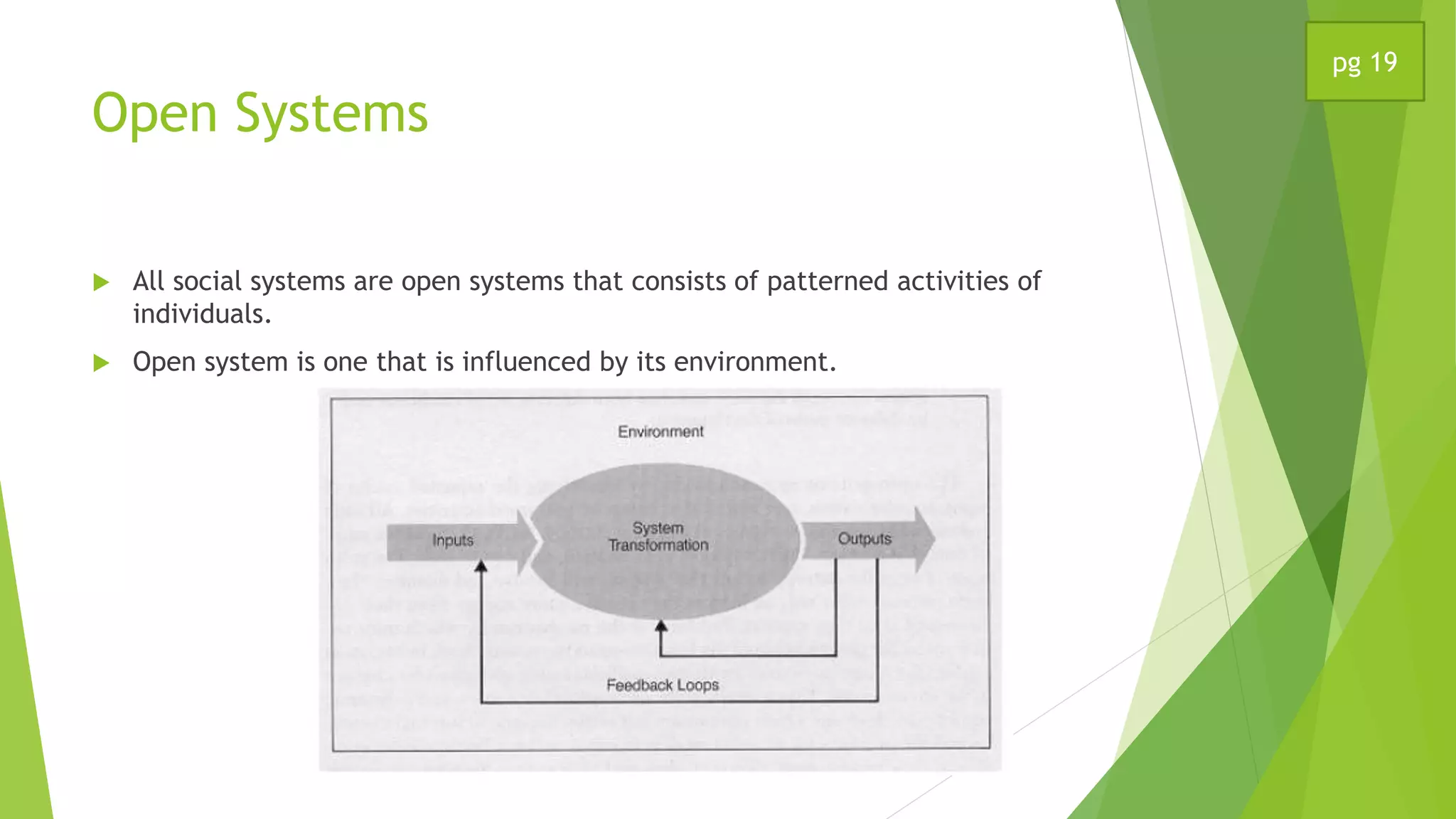
 All social systems are open systems that consists of patterned activities of
individuals.
 Open system is one that is influenced by its environment.
pg 19
10 Characteristic of open systems
(Katz and Kahn, 1978)
1. Input (information and resouces)
2. Throughput (transformation of the input)
3. Output (outcomes)
4. Cycles of Event (patterns of activities, repetitive)
5. Negative Entropy (tendency to run down)
6. Feedback (system channel information back into the system to regulate)
7. Dynamic equilibrium and Homeostasis (system that survive move toward a steady state)
8. Differentiation (system grow larger, more complex)
9. Integration and Coordination (assure the function of the system)
10. Equifinality (a system to reach the same end goal)
pg 19 - 20
The School As a Social System
 Hoy and Miskel (1982) developed an open-system model of the school.
 Interaction of 3 basic elements:
- bureaucratic expectation
- informal norms
- individual needs
pg 21
Bureaucratic Expectation
 Official positions, rules and regulations
 Bureaucratic > Hierarchy of Authority& Rules and Regulations > Expectations > Behavior
 Eg: a teacher is expected to behave in appropriate ways based on the schools rules and
expertise demanded by the job.
pg 21
Individual Needs
 However, individuals have different personalities and needs that affect their
behavior too.
 Needs for achievement, security, acceptance, strongly influence behavior.
 Individual > Personality and work motivation > Needs > Behavior
 In formal organization, the work group is the mechanism by which
bureaucratic expectation and individual needs interact and modify each
other.
pg 22
Informal Norms
 Work Group > Informal Organizations > Norms > Behavior
 Eg : Peer Pressures among teachers
 Member receive rewards from group norms, and group norms are significant in
guiding their behavior.
 Teacher expect their peers to act appropriately to control students, if a
teacher fail to do so, others will apply judgement, criticism.
pg 23
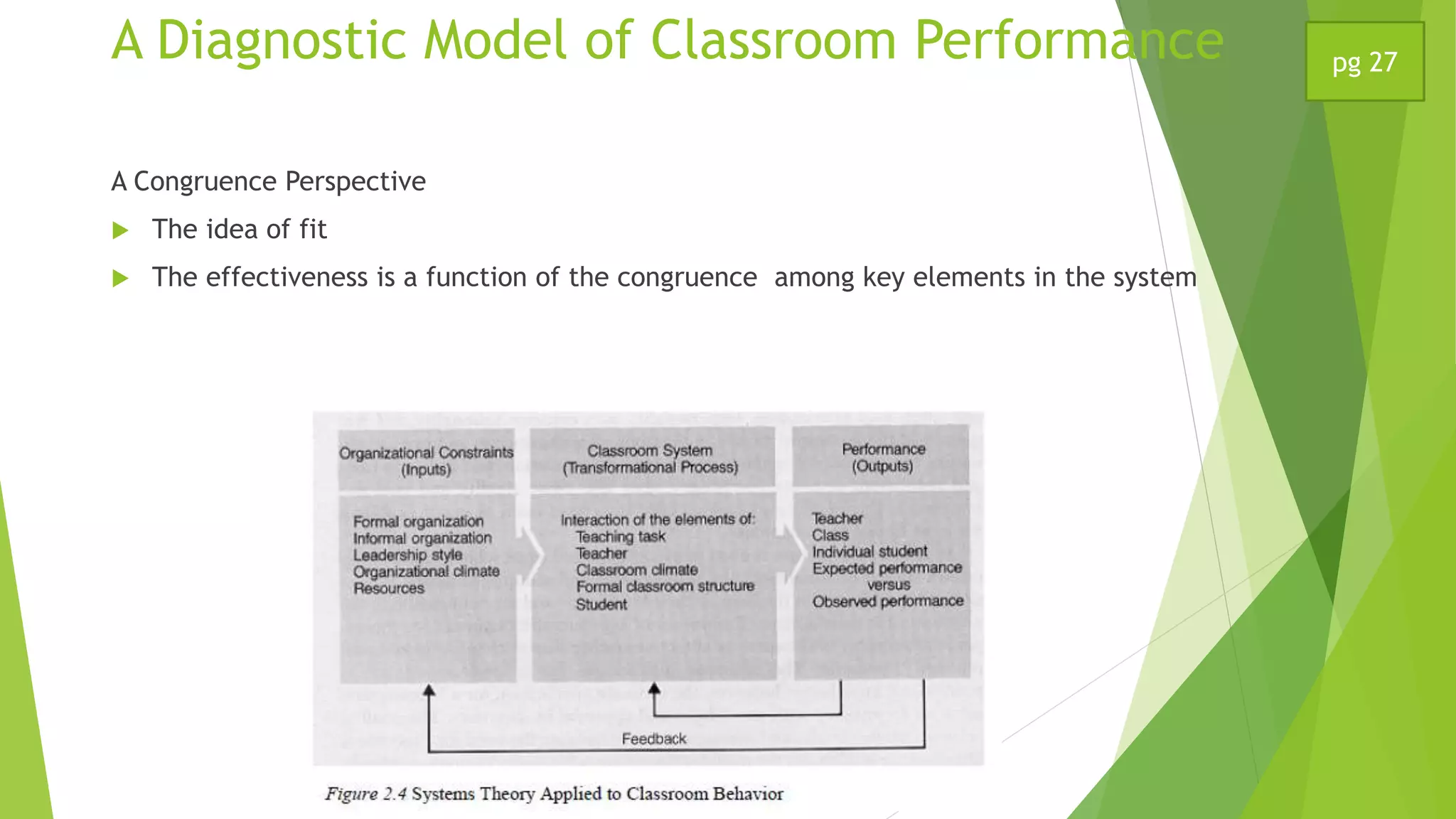
A Diagnostic Model of Classroom Performance
A Congruence Perspective
 The idea of fit
 The effectiveness is a function of the congruence among key elements in the system
pg 27
Organizational Constraints (Input)
 Formal Organization - division of labor, specialization
 Informal Organization - unofficial rules, norms
 Leadership Style - Task-leader, Social-leader, Integrated leader, and Passive-
leader.
 Organization Climate - Professional interactions (open-closed), Pupil control
orientation (custodial-humanistic), managerial system (participative-
exploitive)
 Resources - Material resources (facilities), people resources (asst. teacher)
and in-service resources (workshops).
pg 28
Classroom System (Transformational
Process)
 Teaching task - skill-learning, knowledge-learning and value learning.
1. Preparation
2. Presentation
3. Diagnosis
4. Reinforcement or correction
5. Formal Evaluation
 Teacher – personal characteristic, knowledge, skills, motivational needs
pg 33 - 37
 Student – skills, knowledge, expectation and perceptions,
 Formal classroom organization – classroom arrangement, routine procedures
 Classroom Climate – norms, attitudes, values, interaction, leaderships
-Pupil control structure (custodial-humanistic)
pg 33 - 37
Performance (Outputs)
 Teacher performance – flexibility of teacher behavior, satisfaction
 Individual student performance – cognitive growth, social and emotional
developments, satisfaction
 Class performance – achievement of academic and social performance goals,
student commitment to the class
pg 41
Application to “Lean On Me”
 Eastside High School is a social system
 Bureaucratic expectation : Joe Clark as a principal, expect the teachers to
show professionalism as a teacher
 Input of the system: task-oriented leadership, custodial pupil control
orientation, exploitive managerial system
 Classroom system (process) – student perception of themselves, teacher
motivation (reading class)
 Output – academic achievement of the basic skill test

System Model of Classroom Performance

  • 1.
    Chapter 2 A SystemsModel of Classroom Performance
  • 2.
    Social System  Alarge aggregates of human relationships such as neighborhood, society, or organizations.  A set of interacting personalities bound together by social relationships.  Can be divided to large (society), intermediate (formal organization), or small (primary group). pg 18
  • 3.
    Open Systems  Allsocial systems are open systems that consists of patterned activities of individuals.  Open system is one that is influenced by its environment. pg 19
  • 4.
    10 Characteristic ofopen systems (Katz and Kahn, 1978) 1. Input (information and resouces) 2. Throughput (transformation of the input) 3. Output (outcomes) 4. Cycles of Event (patterns of activities, repetitive) 5. Negative Entropy (tendency to run down) 6. Feedback (system channel information back into the system to regulate) 7. Dynamic equilibrium and Homeostasis (system that survive move toward a steady state) 8. Differentiation (system grow larger, more complex) 9. Integration and Coordination (assure the function of the system) 10. Equifinality (a system to reach the same end goal) pg 19 - 20
  • 5.
    The School Asa Social System  Hoy and Miskel (1982) developed an open-system model of the school.  Interaction of 3 basic elements: - bureaucratic expectation - informal norms - individual needs pg 21
  • 6.
    Bureaucratic Expectation  Officialpositions, rules and regulations  Bureaucratic > Hierarchy of Authority& Rules and Regulations > Expectations > Behavior  Eg: a teacher is expected to behave in appropriate ways based on the schools rules and expertise demanded by the job. pg 21
  • 7.
    Individual Needs  However,individuals have different personalities and needs that affect their behavior too.  Needs for achievement, security, acceptance, strongly influence behavior.  Individual > Personality and work motivation > Needs > Behavior  In formal organization, the work group is the mechanism by which bureaucratic expectation and individual needs interact and modify each other. pg 22
  • 8.
    Informal Norms  WorkGroup > Informal Organizations > Norms > Behavior  Eg : Peer Pressures among teachers  Member receive rewards from group norms, and group norms are significant in guiding their behavior.  Teacher expect their peers to act appropriately to control students, if a teacher fail to do so, others will apply judgement, criticism. pg 23
  • 9.
    A Diagnostic Modelof Classroom Performance A Congruence Perspective  The idea of fit  The effectiveness is a function of the congruence among key elements in the system pg 27
  • 10.
    Organizational Constraints (Input) Formal Organization - division of labor, specialization  Informal Organization - unofficial rules, norms  Leadership Style - Task-leader, Social-leader, Integrated leader, and Passive- leader.  Organization Climate - Professional interactions (open-closed), Pupil control orientation (custodial-humanistic), managerial system (participative- exploitive)  Resources - Material resources (facilities), people resources (asst. teacher) and in-service resources (workshops). pg 28
  • 11.
    Classroom System (Transformational Process) Teaching task - skill-learning, knowledge-learning and value learning. 1. Preparation 2. Presentation 3. Diagnosis 4. Reinforcement or correction 5. Formal Evaluation  Teacher – personal characteristic, knowledge, skills, motivational needs pg 33 - 37
  • 12.
     Student –skills, knowledge, expectation and perceptions,  Formal classroom organization – classroom arrangement, routine procedures  Classroom Climate – norms, attitudes, values, interaction, leaderships -Pupil control structure (custodial-humanistic) pg 33 - 37
  • 13.
    Performance (Outputs)  Teacherperformance – flexibility of teacher behavior, satisfaction  Individual student performance – cognitive growth, social and emotional developments, satisfaction  Class performance – achievement of academic and social performance goals, student commitment to the class pg 41
  • 14.
    Application to “LeanOn Me”  Eastside High School is a social system  Bureaucratic expectation : Joe Clark as a principal, expect the teachers to show professionalism as a teacher  Input of the system: task-oriented leadership, custodial pupil control orientation, exploitive managerial system  Classroom system (process) – student perception of themselves, teacher motivation (reading class)  Output – academic achievement of the basic skill test