Targeted Intermittent Treatment in End Stage Schizophrenia


                                      Adonis Sfera*


                              Metropolitan State Hospital


Correspondence:

Dr. Adonis Sfera
South Coast Clinical Trials
3400 W. Ball rd, suite 100
Anaheim, CA, 92804, USA
Dr.sfera@gmail.com
Sfera       1


 1       Targeted Intermittent Treatment in End Stage Schizophrenia
 2                                             Adonis Sfera

 3   1. Introduction
 4
 5           Talking about non-continuous antipsychotic treatment in psychiatric practice in our time
 6   is tantamount to heresy. We have been perseverating in comparing psychiatric illness to diabetes
 7   and hypertension so much that we are having a hard time fathoming a different analogy; perhaps,
 8   lupus, asthma, rheumatoid arthritis or cancer in which intermittent dosing for shorter period of
 9   time is acceptable.
10
11          In 1960s and 70s, there was a lot of talk about targeting intermittent treatment throughout
12   the duration of illness, rather than chronic and final phase of schizophrenia. Widespread use of
13   antipsychotics is historically novel that only a small percentage phase four patients are being
14   seen currently by average psychiatrists, but this number may grow in time. Reviewing the
15   psychiatric literature from 1970s, it appeares that continuous antipsychotic exposure were not
16   always necessary at that time (Prien, et al., 1973).
17
18            Even in our times there are advocates of non-continuous treatment after the first episode
19   of schizophrenia, as about 50 percent of patients have remained stable after discontinuing
20   medications in the second year of treatment (Harrow and Jobe, 2007).Also, the duration of
21   antipsychotic treatment after a first episode of psychosis remains unclear. A comparison of
22   evidence-based treatment guidelines from different countries developed on highest-quality
23   criteria, yielded inconsistent recommendations regarding the duration of maintenance treatment
24   (Gaebel, et al., 2011).
25
26   2. Tolerance to Antipsychotic drugs?
27
28           Reviewing the current body of evidence, it appears that though the efficacy of
29   antipsychotics in general is proven, a significant proportion of patients suffer from partial
30   remission, symptom recurrence, or relapse, despite continuous antipsychotic treatment. This also
31   applies to depot neuroleptic treatment, which minimizes adherence problems.
32
33           Several studies suggest that with careful clinical observation, substantial reduction of
34   maintenance doses can, for many patients, lead to improvement in some areas of subjective and
35   objective well-being and to a diminution of adverse effects (Kane, et al.,1986)
36
37           Schizophrenic patients remain on antipsychotic (i.e.antidopaminergic) treatment for
38   years, yet remarkably little is known about what happens to the dopamine function during
39   ongoing treatment. What is known is that in late stages of schizophrenia,antipsychotics become
40   inefficient frequently,despite chronic continuous treatment.
41
42         There is evidence from preclinical as well as clinical studies that point to the build up of
43   dopamine supersensitivity and tolerance to antipsychotics, leading to treatment failure over time.
44
Sfera          2


45          Neuroleptic-induced supersensitivity psychosis (Chouinard, et al., 1978; Chouinard and
46   Jones, 1980) has been observed after withdrawal from antipsychotic drugs such as
47   quetiapine(Margolese, et al., 2002), clozapine (Ekblom, et al., 1984; Tollefson, et al., 1999),
48   olanzapine (Llorca, et al., 2001), haloperidol (Kahne, 1989), and fluphenazineenanthate
49   (Chouinard and Jones, 1980).
50
51           Clinical data are available to suggest antipsychotic tolerance with continuous treatment
52   (Stip, et al., 1995). The late or chronic stages of schizophrenia are associated with higher
53   antipsychotic doses and diminished clinical response, also suggesting tolerance (Remington, et
54   al., 1997)(Yamin and Vaddadi, 2010).
55
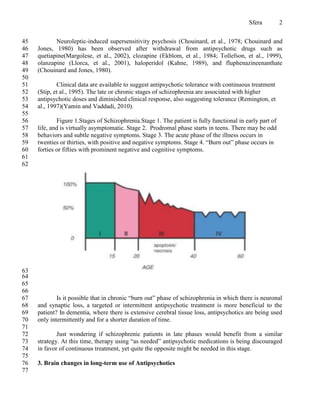
56           Figure 1.Stages of Schizophrenia.Stage 1. The patient is fully functional in early part of
57   life, and is virtually asymptomatic. Stage 2. Prodromal phase starts in teens. There may be odd
58   behaviors and subtle negative symptoms. Stage 3. The acute phase of the illness occurs in
59   twenties or thirties, with positive and negative symptoms. Stage 4. “Burn out” phase occurs in
60   forties or fifties with prominent negative and cognitive symptoms.
61
62


63
64
65
66
67           Is it possible that in chronic “burn out” phase of schizophrenia in which there is neuronal
68   and synaptic loss, a targeted or intermittent antipsychotic treatment is more beneficial to the
69   patient? In dementia, where there is extensive cerebral tissue loss, antipsychotics are being used
70   only intermittently and for a shorter duration of time.
71
72           Just wondering if schizophrenic patients in late phases would benefit from a similar
73   strategy. At this time, therapy using “as needed” antipsychotic medications is being discouraged
74   in favor of continuous treatment, yet quite the opposite might be needed in this stage.
75
76   3. Brain changes in long-term use of Antipsychotics
77
Sfera        3


78          Recent data including animal studies, suggests that long-term antipsychotic treatment
79          leads to global brain volume reduction(Ho, et al., 2011).
80
81          In medicine, we are aware of many instances where target symptom improves by
82          worsening other symptoms. Hormone therapy relieves menopausal symptoms but
83          increases stroke risk. Non-steroidal anti-inflammatory drugs relieve pain, but increase the
84          likelihood of duodenal ulcers and gastrointestinal tract bleeding. It is possible that
85          although antipsychotics relieve psychosis and its attendant suffering, these drugs may not
86          arrest the pathophysiologic processes underlying schizophrenia, and may even aggravate
87          progressive brain tissue volume reductions (Ho, et al., 2011).
88
89   4. Conclusions
90           The last phase of schizophrenia or the “burn out” phase, like dementia,is characterized by
91   extensive neuronal and synaptic loss. Since both chronic schizophrenia and prolonged
92   antipsychotic treatment result in cerebral tissue loss, it is appropriate to revisit intermittent,
93   targeted or “as needed” use of antipsychotics at this stage.
94
Sfera       1


References:

   1. Prien, Robert F., Gillis, Roderic D., and Caffey, Eugene M. 1973. “Intermittent
      Pharmacotherapy in Chronic Schizophrenia.” Hospital & Community
      Psychiatry24(5):317-22.

   2. Remington, Gary andKapur, Shitij. 2010. “Antipsychotic Dosing: How Much but also
      How Often?” Schizophrenia Bulletin 36(5); 900-903.

   3. Samaha, A., Seeman, P., Stewart, J., Rajabi, H. and Kapur, S. 2007. “Breakthrough
      Dopamine Supersensitivity during Ongoing Antipsychotic Treatment Leads to Treatment
      Failure over Time.” The Journal of Neuroscience27(11):2979-2986; doi: 10.1523/
      JNEUROSCI.5416-06.2007.

   4. Stip, E., Tourjman, V., Lew, V., Fabian, J., Cormier, H., Landry, P., Lalonde, P. and
      Cournoyer, J. 1995. "Awakenings" effect with risperidone.” AM J Psychiatry
      152(12):1833. PMID:8526260.

   5. Remington, G.J., Prendergast, P. andBezchlibnyk-Butler, K.Z. 1997. “Neuroleptic
      dosing in chronic schizophrenia: a 10-year follow-up.” Can J Psychiatry 42(1):53-7.

   6. Yamin, S, and Vaddadi, K. 2010. “Are we using excessive neuroleptics? An argument
      for systematic neuroleptic dose reduction in stable patients with schizophrenia with
      specific reference to clozapine.” Int Rev Psychiatry 22(2):138-47.

   7. Ho, B.C., Andreasen, N.C., Ziebell, S., Pierson, R. andMagnotta, V. 2011. “Long-term
      antipsychotic treatment and brain volumes: a longitudinal study of first-episode
      schizophrenia.” Arch Gen Psychiatry 68(2):128-37
      Doi10.1001/archgenpsychiatry.2010.199.

   8. Chouinard, G. and Jones, B.D.1980. "Neuroleptic-induced supersensitivity psychosis:
      clinical and pharmacologic characteristics." Am J Psychiatry 137 (1): 16–21.

   9. Chouinard, G., Jones, B.D. and Annable, L. 1978. "Neuroleptic-induced supersensitivity
      psychosis." Am J Psychiatry 135 (11): 1409–10 .

   10. Ekblom, B., Eriksson, K. and Lindstrom, L.H.1984. “Supersensitivity psychosis in
       schizophrenic patients after sudden clozapine withdrawal.” Psychopharmacology
       83:293–294.

   11. Gaebel, W, Riesbeck M. and Wobrock, T. 2011. “Schizophrenia guidelines across the
       world: a selective review and comparison.” Int Rev Psychiatry 23: 379-87.

   12. Harrow, M. andJobe, T.H. 2007. “Factors involved in outcome and recovery in
       schizophrenia patients not on antipsychotic medications: a 15-year multifollow-up
       study.”J NervMent Dis. 195(5):406-14.
Sfera      2


    13. Kahne, G.J.1989. “Rebound psychoses following the discontinuation of a high potency
        neuroleptic.” Can J Psychiatry 34:227–229.

    14. Llorca, P.M., Vaiva, G. and Lancon. C. 2001. “Supersensitivity psychosis in patients
        with schizophrenia after sudden olanzapine withdrawal”, Can J Psychiatry 46:87–88.

    15. Margolese, H.C., Chouinard, G., Beauclair, L. and Belanger, M.C. 2002. “Therapeutic
        tolerance and rebound psychosis during quetiapine maintenance monotherapy in patients
        with schizophrenia and schizoaffective disorder.” J ClinPsychopharmacol 22:347–352.

    16. Tollefson, G.D., Dellva. M.A., Mattler, C.A., Kane, J.M.,Wirshing, D.A. and Kinon,
        B.J.1999. “Controlled, double-blind investigation of the clozapine discontinuation
        symptoms with conversion to either olanzapine or placebo. The Collaborative Crossover
        Study Group.” J ClinPsychopharmacol 19:435–443.

    17. Kane, J.M., Woerner, M., Sarantakos, S. 1986 “Depot neuroleptics: a comparative review
        of standard, intermediate, and low-dose regimens.” The Journal of clinical psychiatry 47
        (Suppl):30-33.


Conflict of interest:

There is no conflict of interest with respect to this article.

Acknowledgement:

I would like to thank Dr.Stahl for providing the figure “Stages of Schizophrenia”.

End stage schizophrenia

  • 1.
    Targeted Intermittent Treatmentin End Stage Schizophrenia Adonis Sfera* Metropolitan State Hospital Correspondence: Dr. Adonis Sfera South Coast Clinical Trials 3400 W. Ball rd, suite 100 Anaheim, CA, 92804, USA Dr.sfera@gmail.com
  • 2.
    Sfera 1 1 Targeted Intermittent Treatment in End Stage Schizophrenia 2 Adonis Sfera 3 1. Introduction 4 5 Talking about non-continuous antipsychotic treatment in psychiatric practice in our time 6 is tantamount to heresy. We have been perseverating in comparing psychiatric illness to diabetes 7 and hypertension so much that we are having a hard time fathoming a different analogy; perhaps, 8 lupus, asthma, rheumatoid arthritis or cancer in which intermittent dosing for shorter period of 9 time is acceptable. 10 11 In 1960s and 70s, there was a lot of talk about targeting intermittent treatment throughout 12 the duration of illness, rather than chronic and final phase of schizophrenia. Widespread use of 13 antipsychotics is historically novel that only a small percentage phase four patients are being 14 seen currently by average psychiatrists, but this number may grow in time. Reviewing the 15 psychiatric literature from 1970s, it appeares that continuous antipsychotic exposure were not 16 always necessary at that time (Prien, et al., 1973). 17 18 Even in our times there are advocates of non-continuous treatment after the first episode 19 of schizophrenia, as about 50 percent of patients have remained stable after discontinuing 20 medications in the second year of treatment (Harrow and Jobe, 2007).Also, the duration of 21 antipsychotic treatment after a first episode of psychosis remains unclear. A comparison of 22 evidence-based treatment guidelines from different countries developed on highest-quality 23 criteria, yielded inconsistent recommendations regarding the duration of maintenance treatment 24 (Gaebel, et al., 2011). 25 26 2. Tolerance to Antipsychotic drugs? 27 28 Reviewing the current body of evidence, it appears that though the efficacy of 29 antipsychotics in general is proven, a significant proportion of patients suffer from partial 30 remission, symptom recurrence, or relapse, despite continuous antipsychotic treatment. This also 31 applies to depot neuroleptic treatment, which minimizes adherence problems. 32 33 Several studies suggest that with careful clinical observation, substantial reduction of 34 maintenance doses can, for many patients, lead to improvement in some areas of subjective and 35 objective well-being and to a diminution of adverse effects (Kane, et al.,1986) 36 37 Schizophrenic patients remain on antipsychotic (i.e.antidopaminergic) treatment for 38 years, yet remarkably little is known about what happens to the dopamine function during 39 ongoing treatment. What is known is that in late stages of schizophrenia,antipsychotics become 40 inefficient frequently,despite chronic continuous treatment. 41 42 There is evidence from preclinical as well as clinical studies that point to the build up of 43 dopamine supersensitivity and tolerance to antipsychotics, leading to treatment failure over time. 44
  • 3.
    Sfera 2 45 Neuroleptic-induced supersensitivity psychosis (Chouinard, et al., 1978; Chouinard and 46 Jones, 1980) has been observed after withdrawal from antipsychotic drugs such as 47 quetiapine(Margolese, et al., 2002), clozapine (Ekblom, et al., 1984; Tollefson, et al., 1999), 48 olanzapine (Llorca, et al., 2001), haloperidol (Kahne, 1989), and fluphenazineenanthate 49 (Chouinard and Jones, 1980). 50 51 Clinical data are available to suggest antipsychotic tolerance with continuous treatment 52 (Stip, et al., 1995). The late or chronic stages of schizophrenia are associated with higher 53 antipsychotic doses and diminished clinical response, also suggesting tolerance (Remington, et 54 al., 1997)(Yamin and Vaddadi, 2010). 55 56 Figure 1.Stages of Schizophrenia.Stage 1. The patient is fully functional in early part of 57 life, and is virtually asymptomatic. Stage 2. Prodromal phase starts in teens. There may be odd 58 behaviors and subtle negative symptoms. Stage 3. The acute phase of the illness occurs in 59 twenties or thirties, with positive and negative symptoms. Stage 4. “Burn out” phase occurs in 60 forties or fifties with prominent negative and cognitive symptoms. 61 62 63 64 65 66 67 Is it possible that in chronic “burn out” phase of schizophrenia in which there is neuronal 68 and synaptic loss, a targeted or intermittent antipsychotic treatment is more beneficial to the 69 patient? In dementia, where there is extensive cerebral tissue loss, antipsychotics are being used 70 only intermittently and for a shorter duration of time. 71 72 Just wondering if schizophrenic patients in late phases would benefit from a similar 73 strategy. At this time, therapy using “as needed” antipsychotic medications is being discouraged 74 in favor of continuous treatment, yet quite the opposite might be needed in this stage. 75 76 3. Brain changes in long-term use of Antipsychotics 77
  • 4.
    Sfera 3 78 Recent data including animal studies, suggests that long-term antipsychotic treatment 79 leads to global brain volume reduction(Ho, et al., 2011). 80 81 In medicine, we are aware of many instances where target symptom improves by 82 worsening other symptoms. Hormone therapy relieves menopausal symptoms but 83 increases stroke risk. Non-steroidal anti-inflammatory drugs relieve pain, but increase the 84 likelihood of duodenal ulcers and gastrointestinal tract bleeding. It is possible that 85 although antipsychotics relieve psychosis and its attendant suffering, these drugs may not 86 arrest the pathophysiologic processes underlying schizophrenia, and may even aggravate 87 progressive brain tissue volume reductions (Ho, et al., 2011). 88 89 4. Conclusions 90 The last phase of schizophrenia or the “burn out” phase, like dementia,is characterized by 91 extensive neuronal and synaptic loss. Since both chronic schizophrenia and prolonged 92 antipsychotic treatment result in cerebral tissue loss, it is appropriate to revisit intermittent, 93 targeted or “as needed” use of antipsychotics at this stage. 94
  • 5.
    Sfera 1 References: 1. Prien, Robert F., Gillis, Roderic D., and Caffey, Eugene M. 1973. “Intermittent Pharmacotherapy in Chronic Schizophrenia.” Hospital & Community Psychiatry24(5):317-22. 2. Remington, Gary andKapur, Shitij. 2010. “Antipsychotic Dosing: How Much but also How Often?” Schizophrenia Bulletin 36(5); 900-903. 3. Samaha, A., Seeman, P., Stewart, J., Rajabi, H. and Kapur, S. 2007. “Breakthrough Dopamine Supersensitivity during Ongoing Antipsychotic Treatment Leads to Treatment Failure over Time.” The Journal of Neuroscience27(11):2979-2986; doi: 10.1523/ JNEUROSCI.5416-06.2007. 4. Stip, E., Tourjman, V., Lew, V., Fabian, J., Cormier, H., Landry, P., Lalonde, P. and Cournoyer, J. 1995. "Awakenings" effect with risperidone.” AM J Psychiatry 152(12):1833. PMID:8526260. 5. Remington, G.J., Prendergast, P. andBezchlibnyk-Butler, K.Z. 1997. “Neuroleptic dosing in chronic schizophrenia: a 10-year follow-up.” Can J Psychiatry 42(1):53-7. 6. Yamin, S, and Vaddadi, K. 2010. “Are we using excessive neuroleptics? An argument for systematic neuroleptic dose reduction in stable patients with schizophrenia with specific reference to clozapine.” Int Rev Psychiatry 22(2):138-47. 7. Ho, B.C., Andreasen, N.C., Ziebell, S., Pierson, R. andMagnotta, V. 2011. “Long-term antipsychotic treatment and brain volumes: a longitudinal study of first-episode schizophrenia.” Arch Gen Psychiatry 68(2):128-37 Doi10.1001/archgenpsychiatry.2010.199. 8. Chouinard, G. and Jones, B.D.1980. "Neuroleptic-induced supersensitivity psychosis: clinical and pharmacologic characteristics." Am J Psychiatry 137 (1): 16–21. 9. Chouinard, G., Jones, B.D. and Annable, L. 1978. "Neuroleptic-induced supersensitivity psychosis." Am J Psychiatry 135 (11): 1409–10 . 10. Ekblom, B., Eriksson, K. and Lindstrom, L.H.1984. “Supersensitivity psychosis in schizophrenic patients after sudden clozapine withdrawal.” Psychopharmacology 83:293–294. 11. Gaebel, W, Riesbeck M. and Wobrock, T. 2011. “Schizophrenia guidelines across the world: a selective review and comparison.” Int Rev Psychiatry 23: 379-87. 12. Harrow, M. andJobe, T.H. 2007. “Factors involved in outcome and recovery in schizophrenia patients not on antipsychotic medications: a 15-year multifollow-up study.”J NervMent Dis. 195(5):406-14.
  • 6.
    Sfera 2 13. Kahne, G.J.1989. “Rebound psychoses following the discontinuation of a high potency neuroleptic.” Can J Psychiatry 34:227–229. 14. Llorca, P.M., Vaiva, G. and Lancon. C. 2001. “Supersensitivity psychosis in patients with schizophrenia after sudden olanzapine withdrawal”, Can J Psychiatry 46:87–88. 15. Margolese, H.C., Chouinard, G., Beauclair, L. and Belanger, M.C. 2002. “Therapeutic tolerance and rebound psychosis during quetiapine maintenance monotherapy in patients with schizophrenia and schizoaffective disorder.” J ClinPsychopharmacol 22:347–352. 16. Tollefson, G.D., Dellva. M.A., Mattler, C.A., Kane, J.M.,Wirshing, D.A. and Kinon, B.J.1999. “Controlled, double-blind investigation of the clozapine discontinuation symptoms with conversion to either olanzapine or placebo. The Collaborative Crossover Study Group.” J ClinPsychopharmacol 19:435–443. 17. Kane, J.M., Woerner, M., Sarantakos, S. 1986 “Depot neuroleptics: a comparative review of standard, intermediate, and low-dose regimens.” The Journal of clinical psychiatry 47 (Suppl):30-33. Conflict of interest: There is no conflict of interest with respect to this article. Acknowledgement: I would like to thank Dr.Stahl for providing the figure “Stages of Schizophrenia”.