Scenography
    and
Scenic Design
Scene Design

• Functions of scene design:
• Defines performance space
• Creates a floor plan
• Characterizes the acting space visually
• Makes a strong interpretational
  statement
• Creates mood and atmosphere
Scene Design
•   Floor plan provides opportunities for:
    • Movement
    • Composition
    • Character Interaction
    • Stage Business

    It should also be noted that the scenic designer essentially
    “blocks” the play. All the action in the play must work around,
    the architecture established by the design team. So care
    forethought can resolve artistic and directional problems later.
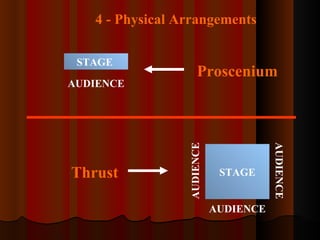
4 - Physical Arrangements

 STAGE
                      Proscenium
AUDIENCE


                 AUDIENCE


                                       AUDIENCE
Thrust                       STAGE


                            AUDIENCE
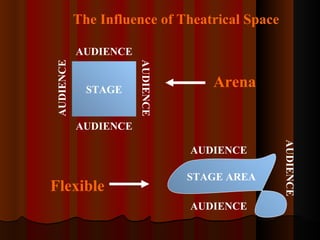
The Influence of Theatrical Space

           AUDIENCE
AUDIENCE


                      AUDIENCE
             STAGE
                                    Arena

           AUDIENCE


                                               AUDIENCE
                                 AUDIENCE

                                 STAGE AREA
Flexible
                                 AUDIENCE
Kinds of SETS

Box


Unit


Suggested
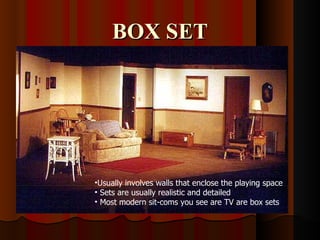
BOX SET


•Usually involves walls that enclose the playing space
• Sets are usually realistic and detailed
• Most modern sit-coms you see are TV are box sets
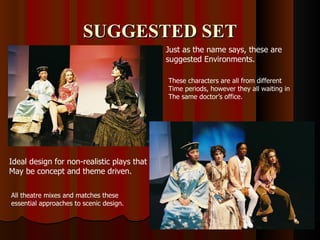
UNIT SET
•Composed of units that can be moved on and off stage
•Most musicals are considered “unit” sets.
•Most unit sets are aesthetically supported by drops, lit backgrounds, or projections.
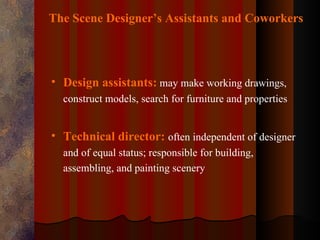
SUGGESTED SET
                                            Just as the name says, these are
                                            suggested Environments.

                                            These characters are all from different
                                            Time periods, however they all waiting in
                                            The same doctor’s office.


Ideal design for non-realistic plays that
May be concept and theme driven.

All theatre mixes and matches these
essential approaches to scenic design.
The Scene Designer’s Assistants and Coworkers


• Design assistants: may make working drawings,
  construct models, search for furniture and properties


• Technical director: often independent of designer
  and of equal status; responsible for building,
  assembling, and painting scenery
Working Plans and Procedures

• Design process varies from designer to designer, but
  generally includes:
• Working on Proof
• Working on Elephant Man
   • Preliminary designs
       • Sketches
       • Scale model
   • Final designs
       • Perspective color renderings
       • Floor plan
       • 3-D scale model
Basic Scenic Elements

• Soft-Scenery Units:
  • Made of unframed cloth, suspended


  • Drops: may enclose setting; may be painted with scenes
  • Draperies: may mask the sides of the stage, may be painted
    and hung to create stylized backgrounds
  • Scrim: specialized curtain made of gauze; opaque when
    lighted from front; transparent when lighted from behind
  • Cyclorama: any arrangement of curtains that surround the
    stage area on 3 sides
Basic Scenic Elements

• Framed Units:


  • Flats: basic framed units; wooden or metal frame covered by
    a relatively flat surface of cloth or thin wood; painted or
    treated texturally


  • Screens: typical framed units since 1960s; rest on floor or
    are suspended; any shape or size; any material; used for
    projection
Innovative Materials and Methods

• Use of nontraditional materials and unconventional
  structural methods
   • Styrofoam
   • Thermoplastics
   • Molded Plexiglas
• Wood substitutes
   • Steel, aluminum, other metal alloys
   • Fiberglass
   • Styrofoam and urethane
   • Vacuform molds
Shifting Scenery on Stage

• When using multiple settings, units must be shifted


• Methods used in shifting scenery include:


   • Manual: scenic units moved by stagehands


   • Flying: suspending scenic elements above the stage
     and raising or lowering them as needed
Shifting Scenery on Stage

• Methods used in shifting scenery include:


   • Wagon: a platform on casters


   • Revolve: revolving stage turned by electric motors


   • Elevator Stage: raises and lowers segments of the
     stage


• Combination of methods used frequently
Set Decoration and Properties

• 2 types of properties:


   • Set Props = attached to setting or function
     as part of scenic design


   • Hand props = used by actors in stage
     business
Technical Rehearsals, Dress Rehearsals, and
              Performances


 • Technical rehearsals = focus on technical
   elements; ensure elements are functioning
   properly


 • Dress rehearsals = allow scene designer to
   see settings in relation to all elements of
   production

Scenic Design Chapter 15

  • 1.
    Scenography and Scenic Design
  • 2.
    Scene Design • Functionsof scene design: • Defines performance space • Creates a floor plan • Characterizes the acting space visually • Makes a strong interpretational statement • Creates mood and atmosphere
  • 3.
    Scene Design • Floor plan provides opportunities for: • Movement • Composition • Character Interaction • Stage Business It should also be noted that the scenic designer essentially “blocks” the play. All the action in the play must work around, the architecture established by the design team. So care forethought can resolve artistic and directional problems later.
  • 4.
    4 - PhysicalArrangements STAGE Proscenium AUDIENCE AUDIENCE AUDIENCE Thrust STAGE AUDIENCE
  • 5.
    The Influence ofTheatrical Space AUDIENCE AUDIENCE AUDIENCE STAGE Arena AUDIENCE AUDIENCE AUDIENCE STAGE AREA Flexible AUDIENCE
  • 6.
  • 7.
    BOX SET •Usually involveswalls that enclose the playing space • Sets are usually realistic and detailed • Most modern sit-coms you see are TV are box sets
  • 8.
    UNIT SET •Composed ofunits that can be moved on and off stage •Most musicals are considered “unit” sets. •Most unit sets are aesthetically supported by drops, lit backgrounds, or projections.
  • 9.
    SUGGESTED SET Just as the name says, these are suggested Environments. These characters are all from different Time periods, however they all waiting in The same doctor’s office. Ideal design for non-realistic plays that May be concept and theme driven. All theatre mixes and matches these essential approaches to scenic design.
  • 10.
    The Scene Designer’sAssistants and Coworkers • Design assistants: may make working drawings, construct models, search for furniture and properties • Technical director: often independent of designer and of equal status; responsible for building, assembling, and painting scenery
  • 11.
    Working Plans andProcedures • Design process varies from designer to designer, but generally includes: • Working on Proof • Working on Elephant Man • Preliminary designs • Sketches • Scale model • Final designs • Perspective color renderings • Floor plan • 3-D scale model
  • 12.
    Basic Scenic Elements •Soft-Scenery Units: • Made of unframed cloth, suspended • Drops: may enclose setting; may be painted with scenes • Draperies: may mask the sides of the stage, may be painted and hung to create stylized backgrounds • Scrim: specialized curtain made of gauze; opaque when lighted from front; transparent when lighted from behind • Cyclorama: any arrangement of curtains that surround the stage area on 3 sides
  • 13.
    Basic Scenic Elements •Framed Units: • Flats: basic framed units; wooden or metal frame covered by a relatively flat surface of cloth or thin wood; painted or treated texturally • Screens: typical framed units since 1960s; rest on floor or are suspended; any shape or size; any material; used for projection
  • 14.
    Innovative Materials andMethods • Use of nontraditional materials and unconventional structural methods • Styrofoam • Thermoplastics • Molded Plexiglas • Wood substitutes • Steel, aluminum, other metal alloys • Fiberglass • Styrofoam and urethane • Vacuform molds
  • 15.
    Shifting Scenery onStage • When using multiple settings, units must be shifted • Methods used in shifting scenery include: • Manual: scenic units moved by stagehands • Flying: suspending scenic elements above the stage and raising or lowering them as needed
  • 16.
    Shifting Scenery onStage • Methods used in shifting scenery include: • Wagon: a platform on casters • Revolve: revolving stage turned by electric motors • Elevator Stage: raises and lowers segments of the stage • Combination of methods used frequently
  • 17.
    Set Decoration andProperties • 2 types of properties: • Set Props = attached to setting or function as part of scenic design • Hand props = used by actors in stage business
  • 18.
    Technical Rehearsals, DressRehearsals, and Performances • Technical rehearsals = focus on technical elements; ensure elements are functioning properly • Dress rehearsals = allow scene designer to see settings in relation to all elements of production