Hi I am Cherry Ann N. Morales and I will be
your instructor for this morning!
Dear Lord and Father of all,
Thank you for today.
Thank you for ways in which you
Provide for us all. For your
Protection and love we thank
You.
Help us to focus our hearts and
Minds now on what we are about
To learn.
Inspire us by your Holy Spirit as
We listen and write.
Guide us by your eternal light
As we discover more about the
World around us.
We ask all this in the name
Of Jesus.
Amen.
GUESS WHAT KIND OF DESIGN I WILL
PRESENT WITH YOU
Scenic Design
prepared by: MORALES, CHERRY ANN N.
BSED-IV
Learning Outcomes:
1. Define scenic design in theater
2. Identify the qualities of a designer
3. Describe the elements of design
Introduction
The design of the set and the lightning of the stage
are two essential components of any theatrical play.
The achievement of a well-made play that has an
impact on the audience is dependent on these
factors. When it comes to establishing the world of
the play on stage, stage design and stage lightning
are both important components.
 Scenic design is the creation of set
pieces and sceneries that aid in the
overall visual appeal of production on
stage. These designs should convey the
mood and spirit of the play, which can be
achieved by conducting extensive research
into the script. In a theatrical
performance, scenic design is focused on
the overall visual look and functionality
of the many design components that are
utilized.
Scenic design
 Stage lightning, on the other
hand, illuminates the area where
the performers and sets are
positioned. A theatrical
production’s use of stage
lightning clearly indicates what
the director and design team want
the audience to see during a live
performance.
Stage lightning
Scenic design
 also known as scenography, set design or
stage design wherein it is the creative
process in theater production, where the
scenographer plans, designs, and creates
the needed sceneries for each act in the
play. The scenographer designs the stage
using the mixture of color, line, and form
to achieve a stage setting that supports
the performance.
 A scene designer creates the visual
interpretation and expression of the
playwright’s intention. Designers must
understand what the play is all about and
its dramatic structure to be able to
support both the director’s vision and
the playwright’s intention.
Qualities of a Designer
Wolf and Block (2014) identified the following qualities of a
designer.
5. A designer must be able to bring substance to
their ideas with skill and dispatch and within the
structural limitations of their medium.
6. A designer must have at least a basic
understanding and appreciation of the other areas of
design.
7. A designer must study the dramatic structure and
perception of the playwright’s intention to create
appropriate visual interpretation on stage.
8. A designer must understand all the physical and
textual elements, the actor’s needs, and a sense of
space and movement.
Qualities of a Designer
Wolf and Block (2014) identified the following qualities
of a designer.
1. A designer needs the vision and imagination of the
creative artist and ingenuity and skills of the stage
artisan.
2. A designer must display talent in their use of lines,
color, and form.
3. A designer must possess a visual vocabulary developed
through the study of art, history, and literature.
4. A designer must be keenly aware of the world around
them.
E L N I
A P H S E
O R O C L
X U R T E E T
G L H I T
E L C A S
Elements of Design
 The elements of design are the essential units in the
visual composition of the play. This can include
everything from set and costume design to lightning and
sound.
 Line
 Shape
 Scale
 Color
 Texture
 Light
Elements of design (Wolf and Block 2014):
Line
 Line determines the shape. Its value in composition is
derived from its versatility.
 A line can indicate a three-dimensional form by enclosing
space as an outline and creating shape (two-dimensional
form).
 It can be seemed like a real line in a variety of modes
(straight, curved, spiral, etc.
 As linear forms with a linelike character or as suggested
lines simulated by the eye as they follow a sequence of
related patterns. Line has several characteristics,
including direction, length, and thickness.
Characteristics of a Line (Wolf and Block 2014)
1. Vertical lines imply strength and
stability.
2. Horizontal and vertical lines follow
the frame’s direction and therefore
indicate no movement.
3. Diagonal lines imply action.
Shape
 Line defines the shape (or form). There are
geometric shapes, like squares, circles, and
triangles. Shapes can be organic as well which are
open curved and flowing which suggest imperfection
and irregularity. In theater, the use of shape
suggests metaphorical ideas derived from the
script.
Ex:
- The use of a square in design may suggest
a sense of a prison cell.
 In theater, a
vertical shape may
given an illusion
of command or
authority.
a horizontal shape
may suggest
calmness.
a diagonal shape,
on the other hand,
suggests action and
movement.
Scale
 In theater, a scale refers to the relationship of the stage to the
actor, as well as to the other elements in the space. The scale may
be utilized to add theatricality to a piece.
 During a theater performance, the audience anticipates that items
will be of a recognizable size. Increased sizes of a familiar
object can contribute to the creation of an overpowering mood, by
making actors unimportant on stage due to their small appearance.
On the other hand shrinking the scale of the object results in the
surrounding area appearing bigger.
 For example, the designer places a huge door at the center of the
stage, making the actors appear very small with it.
Color
 Color elicits the strongest appeal of all the elements
of design. As a powerful stimulus, it evokes feelings
and emotions in the audience. For example, yellow, red,
and orange (classified as warm colors) create a feeling
of happiness, joy, and excitement.
 On the other hand, the use of green and blue
(classified as cool colors) implies more sad feelings
or emotions. Thus, a designer needs to fully understand
color psychology to understand the impact and meaning
of colors when used on stage in a theater production.
Texture
 Texture refers to the tactile quality of the material.
It adds more interesting features to the finished form
of the design. The texture in the design catches and
reflects light, thereby, creating more dimensions and
enriching the overall look of the materials in the
space. Consideration of how texture and light
complement is necessary.
Ex:
- Projecting a light on a smooth surface door
will have a different feel from a rough surface door.
Light
 Light creates the mood of the scene in a theater production.
When used in a play, it can reveal form, whether two-
dimensional or three-dimensional representations of the
form. A good knowledge on how to use light in design
provides designers the great potential in maximizing its use
in the overall design.
 From the beginning, designers need to put into consideration
how light will affect the vision of the design. Designers
must take note that light will create an effect on design
structures and on the materials used.
Its QUIZ time!
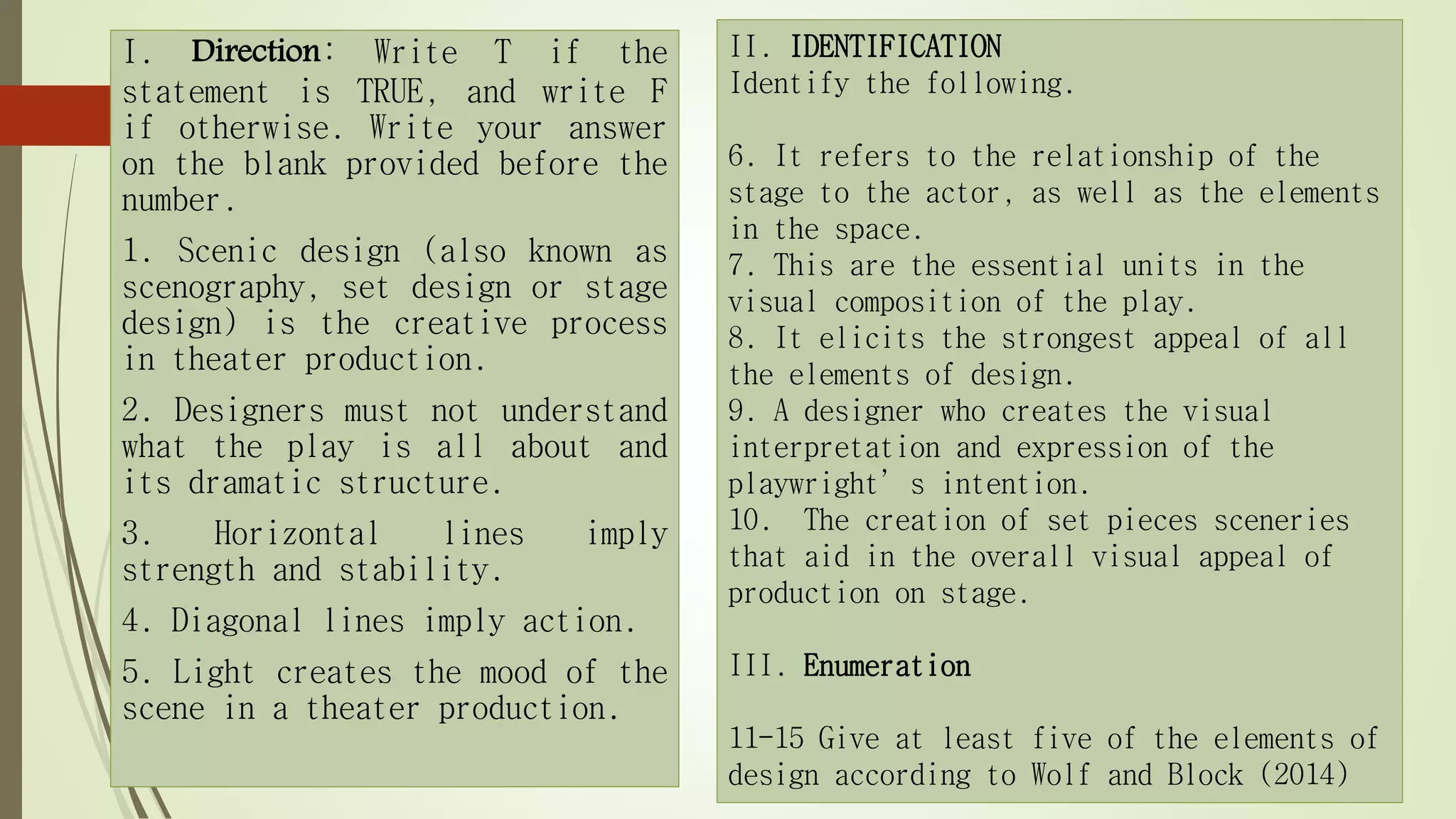
I. Direction: Write T if the
statement is TRUE, and write F
if otherwise. Write your answer
on the blank provided before the
number.
1. Scenic design (also known as
scenography, set design or stage
design) is the creative process
in theater production.
2. Designers must not understand
what the play is all about and
its dramatic structure.
3. Horizontal lines imply
strength and stability.
4. Diagonal lines imply action.
5. Light creates the mood of the
scene in a theater production.
II. IDENTIFICATION
Identify the following.
6. It refers to the relationship of the
stage to the actor, as well as the elements
in the space.
7. This are the essential units in the
visual composition of the play.
8. It elicits the strongest appeal of all
the elements of design.
9. A designer who creates the visual
interpretation and expression of the
playwright’s intention.
10. The creation of set pieces sceneries
that aid in the overall visual appeal of
production on stage.
III. Enumeration
11-15 Give at least five of the elements of
design according to Wolf and Block (2014)
Key:
I. T/F
1. T
2. F
3. F
4. T
5. T
II.Identification
6. Scale
7. Elements of
Design
8. Color
9. Scene designer
10. Scenic design
III. Enumeration
11-15. (line, shape, scale,
color, texture, and light.)

Scenic Design ppt.pdf

  • 1.
    Hi I amCherry Ann N. Morales and I will be your instructor for this morning!
  • 2.
    Dear Lord andFather of all, Thank you for today. Thank you for ways in which you Provide for us all. For your Protection and love we thank You. Help us to focus our hearts and Minds now on what we are about To learn. Inspire us by your Holy Spirit as We listen and write. Guide us by your eternal light As we discover more about the World around us. We ask all this in the name Of Jesus. Amen.
  • 3.
    GUESS WHAT KINDOF DESIGN I WILL PRESENT WITH YOU
  • 5.
    Scenic Design prepared by:MORALES, CHERRY ANN N. BSED-IV
  • 6.
    Learning Outcomes: 1. Definescenic design in theater 2. Identify the qualities of a designer 3. Describe the elements of design
  • 7.
    Introduction The design ofthe set and the lightning of the stage are two essential components of any theatrical play. The achievement of a well-made play that has an impact on the audience is dependent on these factors. When it comes to establishing the world of the play on stage, stage design and stage lightning are both important components.
  • 8.
     Scenic designis the creation of set pieces and sceneries that aid in the overall visual appeal of production on stage. These designs should convey the mood and spirit of the play, which can be achieved by conducting extensive research into the script. In a theatrical performance, scenic design is focused on the overall visual look and functionality of the many design components that are utilized. Scenic design
  • 9.
     Stage lightning,on the other hand, illuminates the area where the performers and sets are positioned. A theatrical production’s use of stage lightning clearly indicates what the director and design team want the audience to see during a live performance. Stage lightning
  • 10.
    Scenic design  alsoknown as scenography, set design or stage design wherein it is the creative process in theater production, where the scenographer plans, designs, and creates the needed sceneries for each act in the play. The scenographer designs the stage using the mixture of color, line, and form to achieve a stage setting that supports the performance.  A scene designer creates the visual interpretation and expression of the playwright’s intention. Designers must understand what the play is all about and its dramatic structure to be able to support both the director’s vision and the playwright’s intention.
  • 11.
    Qualities of aDesigner Wolf and Block (2014) identified the following qualities of a designer. 5. A designer must be able to bring substance to their ideas with skill and dispatch and within the structural limitations of their medium. 6. A designer must have at least a basic understanding and appreciation of the other areas of design. 7. A designer must study the dramatic structure and perception of the playwright’s intention to create appropriate visual interpretation on stage. 8. A designer must understand all the physical and textual elements, the actor’s needs, and a sense of space and movement.
  • 12.
    Qualities of aDesigner Wolf and Block (2014) identified the following qualities of a designer. 1. A designer needs the vision and imagination of the creative artist and ingenuity and skills of the stage artisan. 2. A designer must display talent in their use of lines, color, and form. 3. A designer must possess a visual vocabulary developed through the study of art, history, and literature. 4. A designer must be keenly aware of the world around them.
  • 13.
  • 14.
    A P HS E
  • 15.
    O R OC L
  • 16.
    X U RT E E T
  • 17.
    G L HI T
  • 18.
    E L CA S
  • 19.
    Elements of Design The elements of design are the essential units in the visual composition of the play. This can include everything from set and costume design to lightning and sound.
  • 20.
     Line  Shape Scale  Color  Texture  Light Elements of design (Wolf and Block 2014):
  • 21.
    Line  Line determinesthe shape. Its value in composition is derived from its versatility.  A line can indicate a three-dimensional form by enclosing space as an outline and creating shape (two-dimensional form).  It can be seemed like a real line in a variety of modes (straight, curved, spiral, etc.  As linear forms with a linelike character or as suggested lines simulated by the eye as they follow a sequence of related patterns. Line has several characteristics, including direction, length, and thickness.
  • 22.
    Characteristics of aLine (Wolf and Block 2014) 1. Vertical lines imply strength and stability. 2. Horizontal and vertical lines follow the frame’s direction and therefore indicate no movement. 3. Diagonal lines imply action.
  • 23.
    Shape  Line definesthe shape (or form). There are geometric shapes, like squares, circles, and triangles. Shapes can be organic as well which are open curved and flowing which suggest imperfection and irregularity. In theater, the use of shape suggests metaphorical ideas derived from the script. Ex: - The use of a square in design may suggest a sense of a prison cell.
  • 24.
     In theater,a vertical shape may given an illusion of command or authority. a horizontal shape may suggest calmness. a diagonal shape, on the other hand, suggests action and movement.
  • 25.
    Scale  In theater,a scale refers to the relationship of the stage to the actor, as well as to the other elements in the space. The scale may be utilized to add theatricality to a piece.  During a theater performance, the audience anticipates that items will be of a recognizable size. Increased sizes of a familiar object can contribute to the creation of an overpowering mood, by making actors unimportant on stage due to their small appearance. On the other hand shrinking the scale of the object results in the surrounding area appearing bigger.  For example, the designer places a huge door at the center of the stage, making the actors appear very small with it.
  • 26.
    Color  Color elicitsthe strongest appeal of all the elements of design. As a powerful stimulus, it evokes feelings and emotions in the audience. For example, yellow, red, and orange (classified as warm colors) create a feeling of happiness, joy, and excitement.  On the other hand, the use of green and blue (classified as cool colors) implies more sad feelings or emotions. Thus, a designer needs to fully understand color psychology to understand the impact and meaning of colors when used on stage in a theater production.
  • 27.
    Texture  Texture refersto the tactile quality of the material. It adds more interesting features to the finished form of the design. The texture in the design catches and reflects light, thereby, creating more dimensions and enriching the overall look of the materials in the space. Consideration of how texture and light complement is necessary. Ex: - Projecting a light on a smooth surface door will have a different feel from a rough surface door.
  • 28.
    Light  Light createsthe mood of the scene in a theater production. When used in a play, it can reveal form, whether two- dimensional or three-dimensional representations of the form. A good knowledge on how to use light in design provides designers the great potential in maximizing its use in the overall design.  From the beginning, designers need to put into consideration how light will affect the vision of the design. Designers must take note that light will create an effect on design structures and on the materials used.
  • 29.
  • 30.
    I. Direction: WriteT if the statement is TRUE, and write F if otherwise. Write your answer on the blank provided before the number. 1. Scenic design (also known as scenography, set design or stage design) is the creative process in theater production. 2. Designers must not understand what the play is all about and its dramatic structure. 3. Horizontal lines imply strength and stability. 4. Diagonal lines imply action. 5. Light creates the mood of the scene in a theater production. II. IDENTIFICATION Identify the following. 6. It refers to the relationship of the stage to the actor, as well as the elements in the space. 7. This are the essential units in the visual composition of the play. 8. It elicits the strongest appeal of all the elements of design. 9. A designer who creates the visual interpretation and expression of the playwright’s intention. 10. The creation of set pieces sceneries that aid in the overall visual appeal of production on stage. III. Enumeration 11-15 Give at least five of the elements of design according to Wolf and Block (2014)
  • 31.
    Key: I. T/F 1. T 2.F 3. F 4. T 5. T II.Identification 6. Scale 7. Elements of Design 8. Color 9. Scene designer 10. Scenic design III. Enumeration 11-15. (line, shape, scale, color, texture, and light.)