The t-distribution
The t-distribution
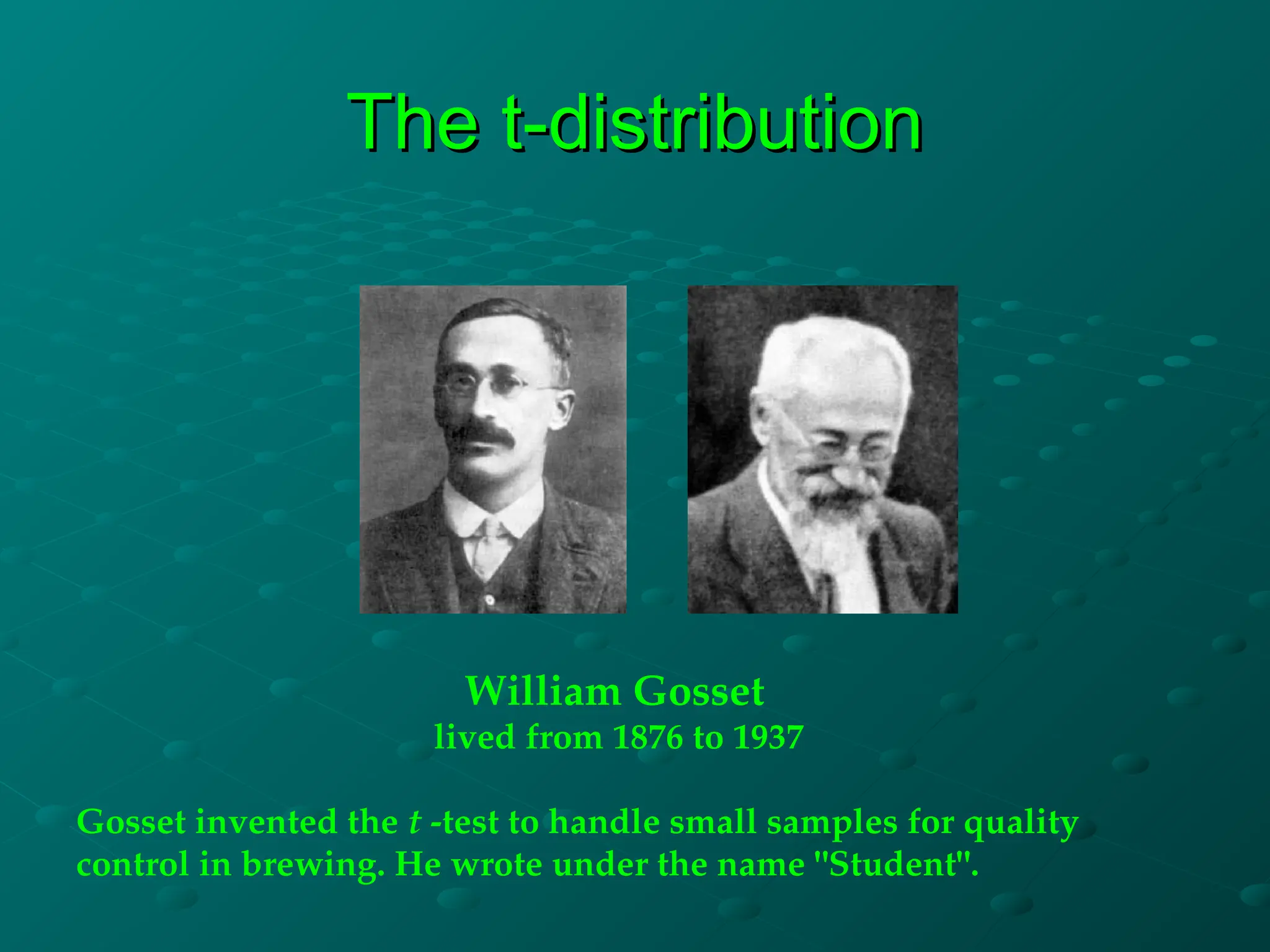
William Gosset
lived from 1876 to 1937
Gosset invented the t -test to handle small samples for quality
control in brewing. He wrote under the name "Student".
t test-origin
t test-origin
Founder WS Gosset
Founder WS Gosset
Wrote under the pseudonym “Student”
Mostly worked in tea (t) time
? Hence known as Student's
? Hence known as Student's t
t test.
test.
Preferable when the n < 60
Certainly if n
Certainly if n <
< 30
30
Types
Types
One sample
One sample
compare with population
Unpaired
Unpaired
compare with control
Paired
Paired
same subjects: pre-post
T-test
T-test
1.
1. Test for single mean
Test for single mean
Whether the sample mean is equal to the predefined
population mean ?
2. Test for difference in means
. Test for difference in means
Whether the CD4 level of patients taking treatment A is
equal to CD4 level of patients taking treatment B ?
3. Test for paired observation
Test for paired observation
Whether the treatment conferred any significant benefit ?
Test direction
Test direction
One tailed t test
One tailed t test
Two tailed test
Two tailed test
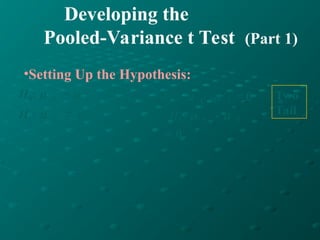
Developing the
Pooled-Variance t Test (Part 1)
•Setting Up the Hypothesis:
H0: 1 -2 = 0
H1: 1 - 2
 0
H0: 1 = 2
H1: 1  2
OR
Two
Tail
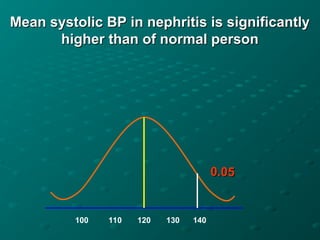
Mean systolic BP in nephritis is significantly
higher than of normal person
100 110 120 130 140
0.05
0.05
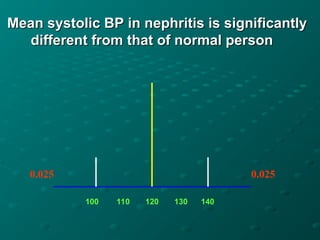
Mean systolic BP in nephritis is significantly
different from that of normal person
0.025 0.025
100 110 120 130 140
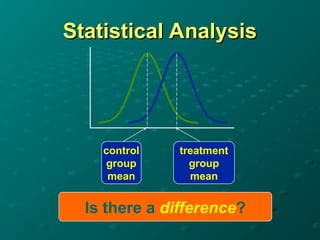
Statistical Analysis
control
group
mean
treatment
group
mean
Is there a difference?
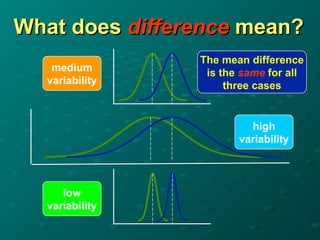
What does
What does difference
difference mean?
mean?
medium
variability
high
variability
low
variability
The mean difference
is the same for all
three cases
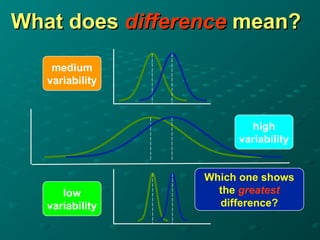
What does
What does difference
difference mean?
mean?
medium
variability
high
variability
low
variability
Which one shows
the greatest
difference?
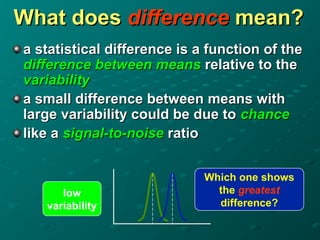
What does
What does difference
difference mean?
mean?
a statistical difference is a function of the
difference between means
difference between means relative to the
relative to the
variability
variability
a small difference between means with
large variability could be due to
large variability could be due to chance
chance
like a
like a signal-to-noise
signal-to-noise ratio
ratio
low
variability
Which one shows
the greatest
difference?
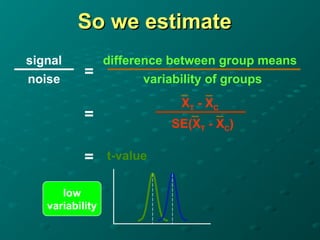
So we estimate
So we estimate
low
variability
signal
noise
difference between group means
variability of groups
=
XT - XC
SE(XT - XC)
=
= t-value
_ _
_ _
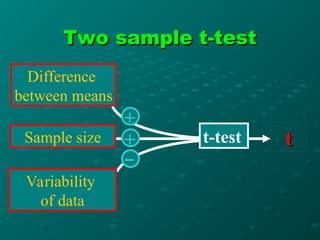
Two sample t-test
Two sample t-test
Difference
between means
Sample size
Variability
of data
t-test t
t
+
+
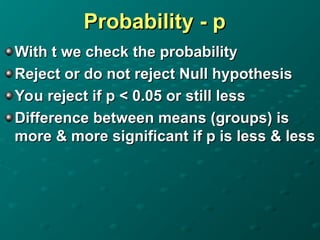
Probability - p
Probability - p
With t we check the probability
Reject or do not reject Null hypothesis
You reject if p < 0.05 or still less
Difference between means (groups) is
more & more significant if p is less & less
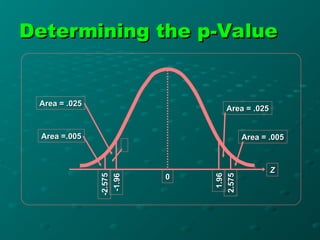
-1.96
-1.96
0
0
Area = .025
Area = .025
Area =.005
Area =.005
Z
Z
-2.575
-2.575 Area = .025
Area = .025
Area = .005
Area = .005
1.96
1.96
2.575
2.575
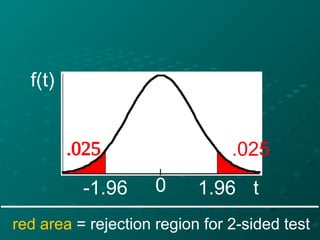
Determining the p-Value
.95
t
0
f(t)
-1.96 1.96
.025

red area = rejection region for 2-sided test
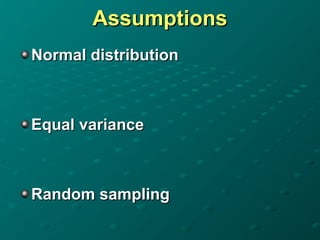
Assumptions
Assumptions
Normal distribution
Normal distribution
Equal variance
Equal variance
Random sampling
Random sampling
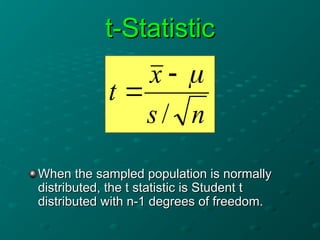
t-Statistic
t-Statistic
n
s
x
t
/



When the sampled population is normally
distributed, the t statistic is Student t
distributed with n-1 degrees of freedom.
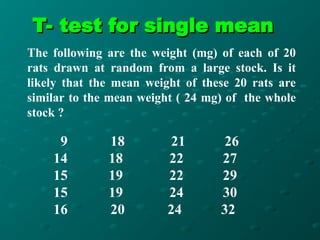
T- test for single mean
The following are the weight (mg) of each of 20
rats drawn at random from a large stock. Is it
likely that the mean weight of these 20 rats are
similar to the mean weight ( 24 mg) of the whole
stock ?
9 18 21 26
14 18 22 27
15 19 22 29
15 19 24 30
16 20 24 32
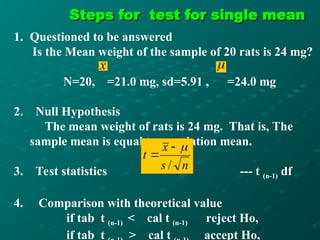
Steps for test for single mean
1. Questioned to be answered
Is the Mean weight of the sample of 20 rats is 24 mg?
N=20, =21.0 mg, sd=5.91 , =24.0 mg
2. Null Hypothesis
The mean weight of rats is 24 mg. That is, The
sample mean is equal to population mean.
3. Test statistics --- t (n-1) df
4. Comparison with theoretical value
if tab t (n-1) < cal t (n-1) reject Ho,
if tab t > cal t accept Ho,
n
s
x
t
/



x 
t –test for single mean
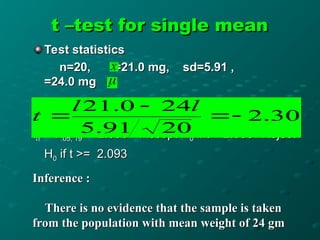
Test statistics
Test statistics
n=20, =21.0 mg, sd=5.91 ,
=24.0 mg
=24.0 mg
t
t
 = t
= t .05, 19
.05, 19 = 2.093
= 2.093 Accept H
Accept H0
0 if t < 2.093
if t < 2.093 Reject
Reject
H
H0
0 if t >= 2.093
if t >= 2.093
x
30
.
2
20
91
.
5
24
0
.
21




l
l
t

Inference :
Inference :
There is no evidence that the sample is taken
from the population with mean weight of 24 gm
In Conclusion !
In Conclusion !
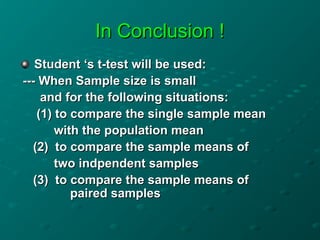
Student ‘s t-test will be used:
--- When Sample size is small
and for the following situations:
(1) to compare the single sample mean
with the population mean
(2) to compare the sample means of
two indpendent samples
(3) to compare the sample means of
paired samples
paired samples

student t-test (new) distrutuin t test.ppt

  • 1.
    The t-distribution The t-distribution WilliamGosset lived from 1876 to 1937 Gosset invented the t -test to handle small samples for quality control in brewing. He wrote under the name "Student".
  • 2.
    t test-origin t test-origin FounderWS Gosset Founder WS Gosset Wrote under the pseudonym “Student” Wrote under the pseudonym “Student” Mostly worked in tea (t) time Mostly worked in tea (t) time ? Hence known as Student's ? Hence known as Student's t t test. test. Preferable when the n < 60 Preferable when the n < 60 Certainly if n Certainly if n < < 30 30
  • 3.
    Types Types One sample One sample comparewith population compare with population Unpaired Unpaired compare with control compare with control Paired Paired same subjects: pre-post same subjects: pre-post
  • 4.
    T-test T-test 1. 1. Test forsingle mean Test for single mean Whether the sample mean is equal to the predefined population mean ? 2. Test for difference in means . Test for difference in means Whether the CD4 level of patients taking treatment A is equal to CD4 level of patients taking treatment B ? 3. Test for paired observation Test for paired observation Whether the treatment conferred any significant benefit ?
  • 5.
    Test direction Test direction Onetailed t test One tailed t test Two tailed test Two tailed test
  • 6.
    Developing the Pooled-Variance tTest (Part 1) •Setting Up the Hypothesis: H0: 1 -2 = 0 H1: 1 - 2  0 H0: 1 = 2 H1: 1  2 OR Two Tail
  • 7.
    Mean systolic BPin nephritis is significantly Mean systolic BP in nephritis is significantly higher than of normal person higher than of normal person 100 110 120 130 140 0.05 0.05
  • 8.
    Mean systolic BPin nephritis is significantly Mean systolic BP in nephritis is significantly different from that of normal person different from that of normal person 0.025 0.025 100 110 120 130 140
  • 9.
  • 10.
    What does What doesdifference difference mean? mean? medium variability high variability low variability The mean difference is the same for all three cases
  • 11.
    What does What doesdifference difference mean? mean? medium variability high variability low variability Which one shows the greatest difference?
  • 12.
    What does What doesdifference difference mean? mean? a statistical difference is a function of the a statistical difference is a function of the difference between means difference between means relative to the relative to the variability variability a small difference between means with a small difference between means with large variability could be due to large variability could be due to chance chance like a like a signal-to-noise signal-to-noise ratio ratio low variability Which one shows the greatest difference?
  • 13.
    So we estimate Sowe estimate low variability signal noise difference between group means variability of groups = XT - XC SE(XT - XC) = = t-value _ _ _ _
  • 14.
    Two sample t-test Twosample t-test Difference between means Sample size Variability of data t-test t t + +
  • 15.
    Probability - p Probability- p With t we check the probability With t we check the probability Reject or do not reject Null hypothesis Reject or do not reject Null hypothesis You reject if p < 0.05 or still less You reject if p < 0.05 or still less Difference between means (groups) is Difference between means (groups) is more & more significant if p is less & less more & more significant if p is less & less
  • 16.
    -1.96 -1.96 0 0 Area = .025 Area= .025 Area =.005 Area =.005 Z Z -2.575 -2.575 Area = .025 Area = .025 Area = .005 Area = .005 1.96 1.96 2.575 2.575 Determining the p-Value Determining the p-Value
  • 17.
    .95 t 0 f(t) -1.96 1.96 .025  red area= rejection region for 2-sided test
  • 18.
    Assumptions Assumptions Normal distribution Normal distribution Equalvariance Equal variance Random sampling Random sampling
  • 19.
    t-Statistic t-Statistic n s x t /    When the sampledpopulation is normally When the sampled population is normally distributed, the t statistic is Student t distributed, the t statistic is Student t distributed with n-1 degrees of freedom. distributed with n-1 degrees of freedom.
  • 20.
    T- test forsingle mean T- test for single mean The following are the weight (mg) of each of 20 rats drawn at random from a large stock. Is it likely that the mean weight of these 20 rats are similar to the mean weight ( 24 mg) of the whole stock ? 9 18 21 26 14 18 22 27 15 19 22 29 15 19 24 30 16 20 24 32
  • 21.
    Steps for testfor single mean Steps for test for single mean 1. Questioned to be answered Is the Mean weight of the sample of 20 rats is 24 mg? N=20, =21.0 mg, sd=5.91 , =24.0 mg 2. Null Hypothesis The mean weight of rats is 24 mg. That is, The sample mean is equal to population mean. 3. Test statistics --- t (n-1) df 4. Comparison with theoretical value if tab t (n-1) < cal t (n-1) reject Ho, if tab t > cal t accept Ho, n s x t /    x 
  • 22.
    t –test forsingle mean t –test for single mean Test statistics Test statistics n=20, =21.0 mg, sd=5.91 , n=20, =21.0 mg, sd=5.91 , =24.0 mg =24.0 mg t t  = t = t .05, 19 .05, 19 = 2.093 = 2.093 Accept H Accept H0 0 if t < 2.093 if t < 2.093 Reject Reject H H0 0 if t >= 2.093 if t >= 2.093 x 30 . 2 20 91 . 5 24 0 . 21     l l t  Inference : Inference : There is no evidence that the sample is taken There is no evidence that the sample is taken from the population with mean weight of 24 gm from the population with mean weight of 24 gm
  • 23.
    In Conclusion ! InConclusion ! Student ‘s t-test will be used: Student ‘s t-test will be used: --- When Sample size is small --- When Sample size is small and for the following situations: and for the following situations: (1) to compare the single sample mean (1) to compare the single sample mean with the population mean with the population mean (2) to compare the sample means of (2) to compare the sample means of two indpendent samples two indpendent samples (3) to compare the sample means of (3) to compare the sample means of paired samples paired samples