D Laser Scanning
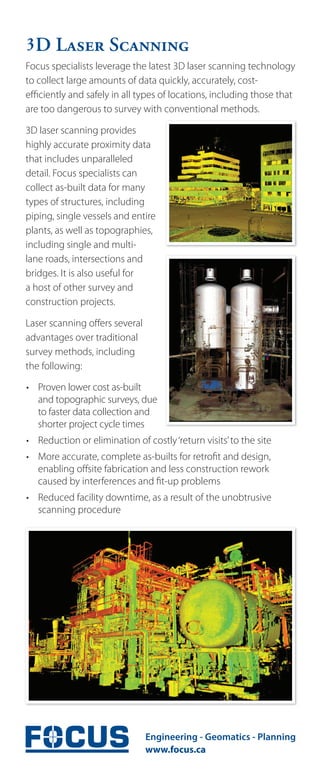
Focus specialists leverage the latest 3D laser scanning technology
to collect large amounts of data quickly, accurately, cost-
efficiently and safely in all types of locations, including those that
are too dangerous to survey with conventional methods.

3D laser scanning provides
highly accurate proximity data
that includes unparalleled
detail. Focus specialists can
collect as-built data for many
types of structures, including
piping, single vessels and entire
plants, as well as topographies,
including single and multi-
lane roads, intersections and
bridges. It is also useful for
a host of other survey and
construction projects.

Laser scanning offers several
advantages over traditional
survey methods, including
the following:

• Proven lower cost as-built
  and topographic surveys, due
  to faster data collection and
  shorter project cycle times
• Reduction or elimination of costly ‘return visits’ to the site
• More accurate, complete as-builts for retrofit and design,
  enabling offsite fabrication and less construction rework
  caused by interferences and fit-up problems
• Reduced facility downtime, as a result of the unobtrusive
  scanning procedure
D Laser Scanning Projects
Shell’s Scotford Refinery
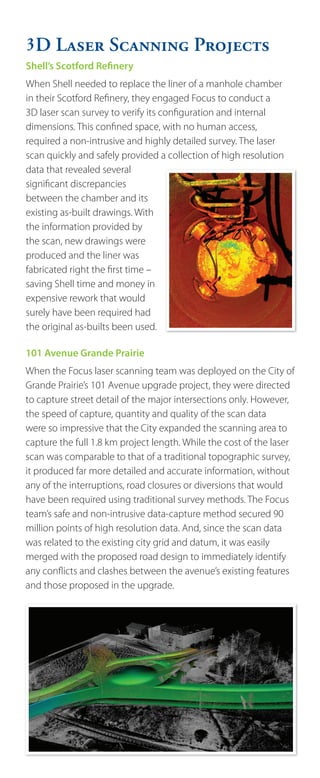
When Shell needed to replace the liner of a manhole chamber
in their Scotford Refinery, they engaged Focus to conduct a
3D laser scan survey to verify its configuration and internal
dimensions. This confined space, with no human access,
required a non-intrusive and highly detailed survey. The laser
scan quickly and safely provided a collection of high resolution
data that revealed several
significant discrepancies
between the chamber and its
existing as-built drawings. With
the information provided by
the scan, new drawings were
produced and the liner was
fabricated right the first time –
saving Shell time and money in
expensive rework that would
surely have been required had
the original as-builts been used.

101 Avenue Grande Prairie
When the Focus laser scanning team was deployed on the City of
Grande Prairie’s 101 Avenue upgrade project, they were directed
to capture street detail of the major intersections only. However,
the speed of capture, quantity and quality of the scan data
were so impressive that the City expanded the scanning area to
capture the full 1.8 km project length. While the cost of the laser
scan was comparable to that of a traditional topographic survey,
it produced far more detailed and accurate information, without
any of the interruptions, road closures or diversions that would
have been required using traditional survey methods. The Focus
team’s safe and non-intrusive data-capture method secured 90
million points of high resolution data. And, since the scan data
was related to the existing city grid and datum, it was easily
merged with the proposed road design to immediately identify
any conflicts and clashes between the avenue’s existing features
and those proposed in the upgrade.

Scanning Examples

  • 1.
    D Laser Scanning Focusspecialists leverage the latest 3D laser scanning technology to collect large amounts of data quickly, accurately, cost- efficiently and safely in all types of locations, including those that are too dangerous to survey with conventional methods. 3D laser scanning provides highly accurate proximity data that includes unparalleled detail. Focus specialists can collect as-built data for many types of structures, including piping, single vessels and entire plants, as well as topographies, including single and multi- lane roads, intersections and bridges. It is also useful for a host of other survey and construction projects. Laser scanning offers several advantages over traditional survey methods, including the following: • Proven lower cost as-built and topographic surveys, due to faster data collection and shorter project cycle times • Reduction or elimination of costly ‘return visits’ to the site • More accurate, complete as-builts for retrofit and design, enabling offsite fabrication and less construction rework caused by interferences and fit-up problems • Reduced facility downtime, as a result of the unobtrusive scanning procedure
  • 2.
    D Laser ScanningProjects Shell’s Scotford Refinery When Shell needed to replace the liner of a manhole chamber in their Scotford Refinery, they engaged Focus to conduct a 3D laser scan survey to verify its configuration and internal dimensions. This confined space, with no human access, required a non-intrusive and highly detailed survey. The laser scan quickly and safely provided a collection of high resolution data that revealed several significant discrepancies between the chamber and its existing as-built drawings. With the information provided by the scan, new drawings were produced and the liner was fabricated right the first time – saving Shell time and money in expensive rework that would surely have been required had the original as-builts been used. 101 Avenue Grande Prairie When the Focus laser scanning team was deployed on the City of Grande Prairie’s 101 Avenue upgrade project, they were directed to capture street detail of the major intersections only. However, the speed of capture, quantity and quality of the scan data were so impressive that the City expanded the scanning area to capture the full 1.8 km project length. While the cost of the laser scan was comparable to that of a traditional topographic survey, it produced far more detailed and accurate information, without any of the interruptions, road closures or diversions that would have been required using traditional survey methods. The Focus team’s safe and non-intrusive data-capture method secured 90 million points of high resolution data. And, since the scan data was related to the existing city grid and datum, it was easily merged with the proposed road design to immediately identify any conflicts and clashes between the avenue’s existing features and those proposed in the upgrade.