SCALING YOUR WEBSITE
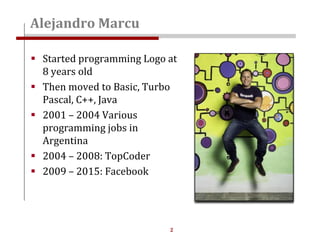
Alejandro Marcu
Dutch PHP Conference 2016
2
 Started programming Logo at
8 years old
 Then moved to Basic, Turbo
Pascal, C++, Java
 2001 – 2004 Various
programming jobs in
Argentina
 2004 – 2008: TopCoder
 2009 – 2015: Facebook
Alejandro Marcu
3
 Scalable architecture
 Scaling the database
 Caching
 Introducing new features
What You Will Learn Today
Scalable architecture
5
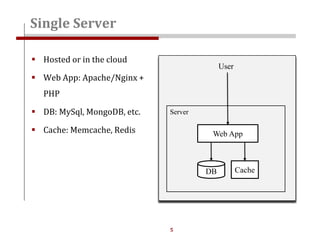
Single Server
 Hosted or in the cloud
 Web App: Apache/Nginx +
PHP
 DB: MySql, MongoDB, etc.
 Cache: Memcache, Redis Web App
CacheDB
Server
User
6
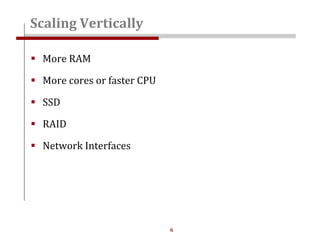
 More RAM
 More cores or faster CPU
 SSD
 RAID
 Network Interfaces
Scaling Vertically
7
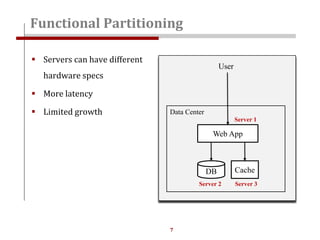
Functional Partitioning
 Servers can have different
hardware specs
 More latency
 Limited growth
Server 1
Server 3Server 2
Web App
CacheDB
Data Center
User
8
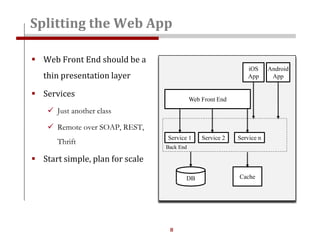
Splitting the Web App
 Web Front End should be a
thin presentation layer
 Services
 Just another class
 Remote over SOAP, REST,
Thrift
 Start simple, plan for scale
Web Front End
Service 1
DB
Service 2 Service n
Back End
Cache
iOS
App
Android
App
9
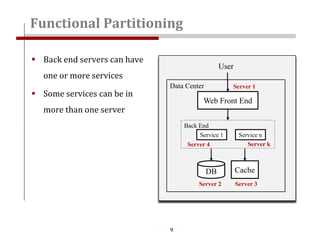
Functional Partitioning
 Back end servers can have
one or more services
 Some services can be in
more than one server
Service 1 Service n
Back End
Server 4 Server k
Server 1
Server 3Server 2
Web Front End
CacheDB
Data Center
User
10
 Don’t store anything locally
 Use external storage (e.g. databases)
 Can use local caching
Stateless Services
11
 HTTP Session
 Cookies
 External Data Store
 Uploaded Files
 DFS: GFS, HDFS, ClusterFS
 Amazon S3
Stateless Front End
12
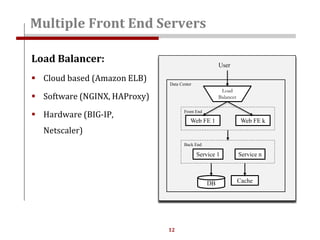
Multiple Front End Servers
Load Balancer:
 Cloud based (Amazon ELB)
 Software (NGINX, HAProxy)
 Hardware (BIG-IP,
Netscaler)
Load
Balancer
Service 1 Service n
Back End
CacheDB
Data Center
User
Web FE 1
Front End
Web FE k
13
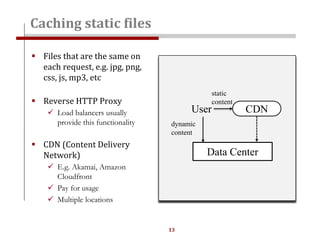
Caching static files
 Files that are the same on
each request, e.g. jpg, png,
css, js, mp3, etc
 Reverse HTTP Proxy
 Load balancers usually
provide this functionality
 CDN (Content Delivery
Network)
 E.g. Akamai, Amazon
Cloudfront
 Pay for usage
 Multiple locations
User CDN
Data Center
static
content
dynamic
content
14
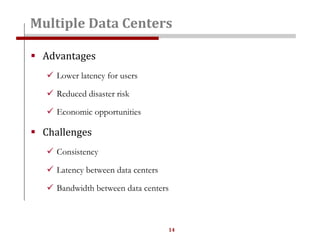
 Advantages
 Lower latency for users
 Reduced disaster risk
 Economic opportunities
 Challenges
 Consistency
 Latency between data centers
 Bandwidth between data centers
Multiple Data Centers
Scaling databases
16
 Too much data
 Too many reads
 Too many writes
 Want higher availability
Scaling relational databases
17
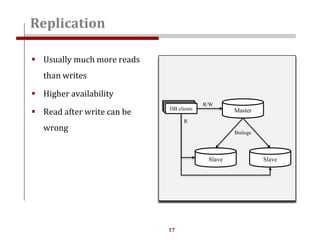
Replication
 Usually much more reads
than writes
 Higher availability
 Read after write can be
wrong
Master
Slave Slave
R/W
R
DB clients
Binlogs
18
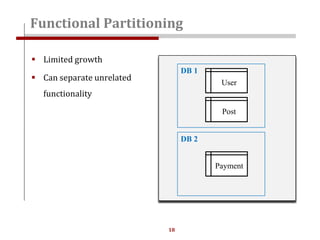
Functional Partitioning
 Limited growth
 Can separate unrelated
functionality
User
Post
Payment
DB 1
DB 2
19
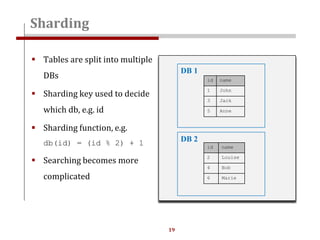
Sharding
 Tables are split into multiple
DBs
 Sharding key used to decide
which db, e.g. id
 Sharding function, e.g.
db(id) = (id % 2) + 1
 Searching becomes more
complicated
id name
1 John
3 Jack
5 Anne
id name
2 Louise
4 Bob
6 Marie
DB 1
DB 2
20
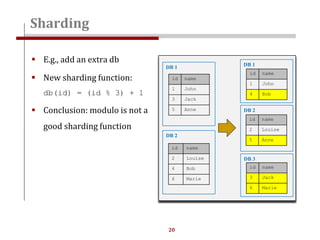
Sharding
 E.g., add an extra db
 New sharding function:
db(id) = (id % 3) + 1
 Conclusion: modulo is not a
good sharding function
id name
1 John
3 Jack
5 Anne
id name
2 Louise
4 Bob
6 Marie
DB 1
DB 2
id name
1 John
4 Bob
DB 1
id name
2 Louise
5 Anne
DB 2
id name
3 Jack
6 Marie
DB 3
21
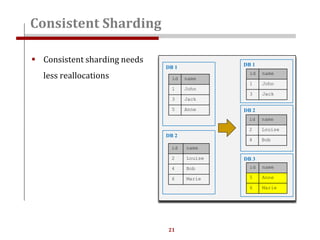
Consistent Sharding
 Consistent sharding needs
less reallocations id name
1 John
3 Jack
5 Anne
id name
2 Louise
4 Bob
6 Marie
DB 1
DB 2
id name
1 John
3 Jack
DB 1
id name
2 Louise
4 Bob
DB 2
id name
5 Anne
6 Marie
DB 3
22
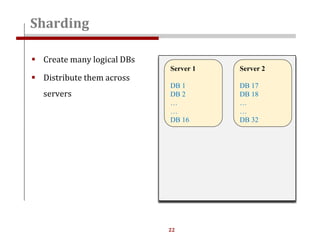
Sharding
 Create many logical DBs
 Distribute them across
servers
Server 1
DB 1
DB 2
…
…
DB 16
Server 2
DB 17
DB 18
…
…
DB 32
23
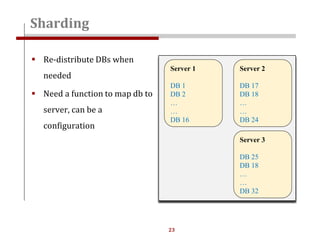
Sharding
 Re-distribute DBs when
needed
 Need a function to map db to
server, can be a
configuration
Server 1
DB 1
DB 2
…
…
DB 16
Server 2
DB 17
DB 18
…
…
DB 24
Server 3
DB 25
DB 18
…
…
DB 32
24
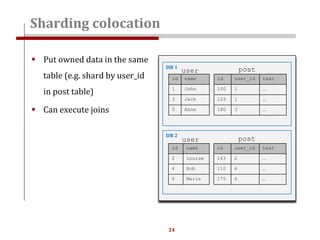
Sharding colocation
 Put owned data in the same
table (e.g. shard by user_id
in post table)
 Can execute joins
user
id name
1 John
3 Jack
5 Anne
id name
2 Louise
4 Bob
6 Marie
DB 1
DB 2
user
post
id user_id text
100 1 …
125 1 …
180 3 …
post
id user_id text
143 2 …
110 6 …
175 6 …
25
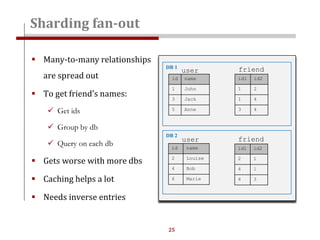
Sharding fan-out
 Many-to-many relationships
are spread out
 To get friend’s names:
 Get ids
 Group by db
 Query on each db
 Gets worse with more dbs
 Caching helps a lot
 Needs inverse entries
user
id name
1 John
3 Jack
5 Anne
id name
2 Louise
4 Bob
6 Marie
DB 1
DB 2
user
friend
id1 id2
1 2
1 4
3 4
friend
id1 id2
2 1
4 1
4 3
26
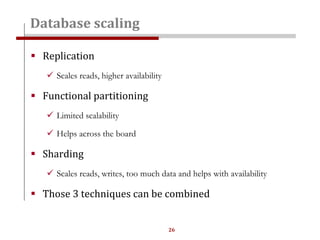
 Replication
 Scales reads, higher availability
 Functional partitioning
 Limited scalability
 Helps across the board
 Sharding
 Scales reads, writes, too much data and helps with availability
 Those 3 techniques can be combined
Database scaling
Caching
28
 Usually required at large scale
 Key-Value stores
 Set(key, value[, TTL])
 Get(key)
 Delete(key)
 Different levels
 Client side (e.g. in the browser in JS)
 In the WebServer (e.g. APC)
 Distributed cache (e.g. Redis, Memcached)
Caching application data
29
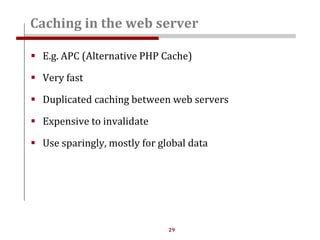
 E.g. APC (Alternative PHP Cache)
 Very fast
 Duplicated caching between web servers
 Expensive to invalidate
 Use sparingly, mostly for global data
Caching in the web server
30
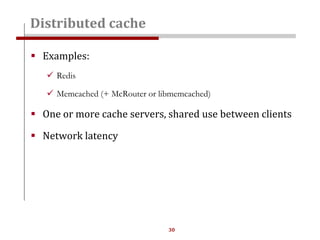
 Examples:
 Redis
 Memcached (+ McRouter or libmemcached)
 One or more cache servers, shared use between clients
 Network latency
Distributed cache
31
Features to consider:
 Replication
 Partitioning
 Separate pools
 Persistence
 Atomic operations
Distributed cache
32
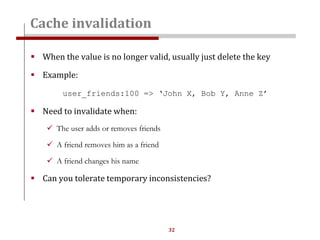
 When the value is no longer valid, usually just delete the key
 Example:
user_friends:100 => ‘John X, Bob Y, Anne Z’
 Need to invalidate when:
 The user adds or removes friends
 A friend removes him as a friend
 A friend changes his name
 Can you tolerate temporary inconsistencies?
Cache invalidation
33
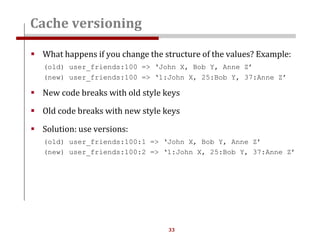
 What happens if you change the structure of the values? Example:
(old) user_friends:100 => ‘John X, Bob Y, Anne Z’
(new) user_friends:100 => ‘1:John X, 25:Bob Y, 37:Anne Z’
 New code breaks with old style keys
 Old code breaks with new style keys
 Solution: use versions:
(old) user_friends:100:1 => ‘John X, Bob Y, Anne Z’
(new) user_friends:100:2 => ‘1:John X, 25:Bob Y, 37:Anne Z’
Cache versioning
Introducing new features
35
Objectives:
 A/B testing
 Quickly revert it if needed
 Protect infrastructure
 Ease of development
Introducing new features
36
Some possibilities:
1. Development branch
2. Feature toggle
3. Percentage Rollout
4. Advanced Rollout
Introducing new features
37
 New branch for the feature, merge when finished
 Can be fine in the early stages
 No extra setup or complexity
 Long living branch, may be hard to merge
Development Branch
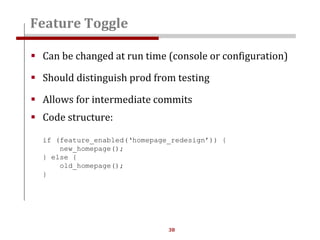
38
 Can be changed at run time (console or configuration)
 Should distinguish prod from testing
 Allows for intermediate commits
 Code structure:
if (feature_enabled(‘homepage_redesign’)) {
new_homepage();
} else {
old_homepage();
}
Feature Toggle
39
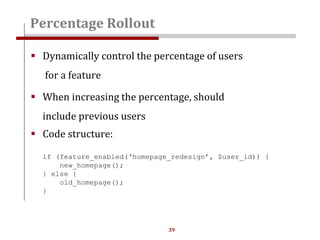
 Dynamically control the percentage of users
for a feature
 When increasing the percentage, should
include previous users
 Code structure:
if (feature_enabled(‘homepage_redesign’, $user_id)) {
new_homepage();
} else {
old_homepage();
}
Percentage Rollout
40
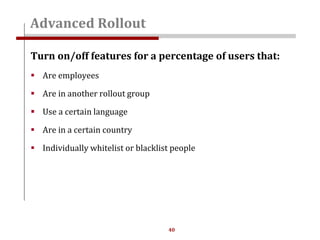
Turn on/off features for a percentage of users that:
 Are employees
 Are in another rollout group
 Use a certain language
 Are in a certain country
 Individually whitelist or blacklist people
Advanced Rollout
41
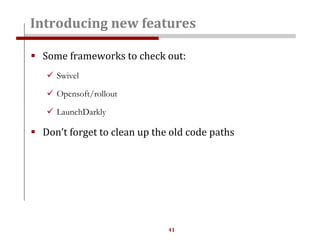
 Some frameworks to check out:
 Swivel
 Opensoft/rollout
 LaunchDarkly
 Don’t forget to clean up the old code paths
Introducing new features
42
Contact Information
amarcu@gmail.com
/alejandro.marcu
/alejandromarcu
@AlejandroMarcu
/in/alejandromarcu

Scaling your website

  • 1.
    SCALING YOUR WEBSITE AlejandroMarcu Dutch PHP Conference 2016
  • 2.
    2  Started programmingLogo at 8 years old  Then moved to Basic, Turbo Pascal, C++, Java  2001 – 2004 Various programming jobs in Argentina  2004 – 2008: TopCoder  2009 – 2015: Facebook Alejandro Marcu
  • 3.
    3  Scalable architecture Scaling the database  Caching  Introducing new features What You Will Learn Today
  • 4.
  • 5.
    5 Single Server  Hostedor in the cloud  Web App: Apache/Nginx + PHP  DB: MySql, MongoDB, etc.  Cache: Memcache, Redis Web App CacheDB Server User
  • 6.
    6  More RAM More cores or faster CPU  SSD  RAID  Network Interfaces Scaling Vertically
  • 7.
    7 Functional Partitioning  Serverscan have different hardware specs  More latency  Limited growth Server 1 Server 3Server 2 Web App CacheDB Data Center User
  • 8.
    8 Splitting the WebApp  Web Front End should be a thin presentation layer  Services  Just another class  Remote over SOAP, REST, Thrift  Start simple, plan for scale Web Front End Service 1 DB Service 2 Service n Back End Cache iOS App Android App
  • 9.
    9 Functional Partitioning  Backend servers can have one or more services  Some services can be in more than one server Service 1 Service n Back End Server 4 Server k Server 1 Server 3Server 2 Web Front End CacheDB Data Center User
  • 10.
    10  Don’t storeanything locally  Use external storage (e.g. databases)  Can use local caching Stateless Services
  • 11.
    11  HTTP Session Cookies  External Data Store  Uploaded Files  DFS: GFS, HDFS, ClusterFS  Amazon S3 Stateless Front End
  • 12.
    12 Multiple Front EndServers Load Balancer:  Cloud based (Amazon ELB)  Software (NGINX, HAProxy)  Hardware (BIG-IP, Netscaler) Load Balancer Service 1 Service n Back End CacheDB Data Center User Web FE 1 Front End Web FE k
  • 13.
    13 Caching static files Files that are the same on each request, e.g. jpg, png, css, js, mp3, etc  Reverse HTTP Proxy  Load balancers usually provide this functionality  CDN (Content Delivery Network)  E.g. Akamai, Amazon Cloudfront  Pay for usage  Multiple locations User CDN Data Center static content dynamic content
  • 14.
    14  Advantages  Lowerlatency for users  Reduced disaster risk  Economic opportunities  Challenges  Consistency  Latency between data centers  Bandwidth between data centers Multiple Data Centers
  • 15.
  • 16.
    16  Too muchdata  Too many reads  Too many writes  Want higher availability Scaling relational databases
  • 17.
    17 Replication  Usually muchmore reads than writes  Higher availability  Read after write can be wrong Master Slave Slave R/W R DB clients Binlogs
  • 18.
    18 Functional Partitioning  Limitedgrowth  Can separate unrelated functionality User Post Payment DB 1 DB 2
  • 19.
    19 Sharding  Tables aresplit into multiple DBs  Sharding key used to decide which db, e.g. id  Sharding function, e.g. db(id) = (id % 2) + 1  Searching becomes more complicated id name 1 John 3 Jack 5 Anne id name 2 Louise 4 Bob 6 Marie DB 1 DB 2
  • 20.
    20 Sharding  E.g., addan extra db  New sharding function: db(id) = (id % 3) + 1  Conclusion: modulo is not a good sharding function id name 1 John 3 Jack 5 Anne id name 2 Louise 4 Bob 6 Marie DB 1 DB 2 id name 1 John 4 Bob DB 1 id name 2 Louise 5 Anne DB 2 id name 3 Jack 6 Marie DB 3
  • 21.
    21 Consistent Sharding  Consistentsharding needs less reallocations id name 1 John 3 Jack 5 Anne id name 2 Louise 4 Bob 6 Marie DB 1 DB 2 id name 1 John 3 Jack DB 1 id name 2 Louise 4 Bob DB 2 id name 5 Anne 6 Marie DB 3
  • 22.
    22 Sharding  Create manylogical DBs  Distribute them across servers Server 1 DB 1 DB 2 … … DB 16 Server 2 DB 17 DB 18 … … DB 32
  • 23.
    23 Sharding  Re-distribute DBswhen needed  Need a function to map db to server, can be a configuration Server 1 DB 1 DB 2 … … DB 16 Server 2 DB 17 DB 18 … … DB 24 Server 3 DB 25 DB 18 … … DB 32
  • 24.
    24 Sharding colocation  Putowned data in the same table (e.g. shard by user_id in post table)  Can execute joins user id name 1 John 3 Jack 5 Anne id name 2 Louise 4 Bob 6 Marie DB 1 DB 2 user post id user_id text 100 1 … 125 1 … 180 3 … post id user_id text 143 2 … 110 6 … 175 6 …
  • 25.
    25 Sharding fan-out  Many-to-manyrelationships are spread out  To get friend’s names:  Get ids  Group by db  Query on each db  Gets worse with more dbs  Caching helps a lot  Needs inverse entries user id name 1 John 3 Jack 5 Anne id name 2 Louise 4 Bob 6 Marie DB 1 DB 2 user friend id1 id2 1 2 1 4 3 4 friend id1 id2 2 1 4 1 4 3
  • 26.
    26  Replication  Scalesreads, higher availability  Functional partitioning  Limited scalability  Helps across the board  Sharding  Scales reads, writes, too much data and helps with availability  Those 3 techniques can be combined Database scaling
  • 27.
  • 28.
    28  Usually requiredat large scale  Key-Value stores  Set(key, value[, TTL])  Get(key)  Delete(key)  Different levels  Client side (e.g. in the browser in JS)  In the WebServer (e.g. APC)  Distributed cache (e.g. Redis, Memcached) Caching application data
  • 29.
    29  E.g. APC(Alternative PHP Cache)  Very fast  Duplicated caching between web servers  Expensive to invalidate  Use sparingly, mostly for global data Caching in the web server
  • 30.
    30  Examples:  Redis Memcached (+ McRouter or libmemcached)  One or more cache servers, shared use between clients  Network latency Distributed cache
  • 31.
    31 Features to consider: Replication  Partitioning  Separate pools  Persistence  Atomic operations Distributed cache
  • 32.
    32  When thevalue is no longer valid, usually just delete the key  Example: user_friends:100 => ‘John X, Bob Y, Anne Z’  Need to invalidate when:  The user adds or removes friends  A friend removes him as a friend  A friend changes his name  Can you tolerate temporary inconsistencies? Cache invalidation
  • 33.
    33  What happensif you change the structure of the values? Example: (old) user_friends:100 => ‘John X, Bob Y, Anne Z’ (new) user_friends:100 => ‘1:John X, 25:Bob Y, 37:Anne Z’  New code breaks with old style keys  Old code breaks with new style keys  Solution: use versions: (old) user_friends:100:1 => ‘John X, Bob Y, Anne Z’ (new) user_friends:100:2 => ‘1:John X, 25:Bob Y, 37:Anne Z’ Cache versioning
  • 34.
  • 35.
    35 Objectives:  A/B testing Quickly revert it if needed  Protect infrastructure  Ease of development Introducing new features
  • 36.
    36 Some possibilities: 1. Developmentbranch 2. Feature toggle 3. Percentage Rollout 4. Advanced Rollout Introducing new features
  • 37.
    37  New branchfor the feature, merge when finished  Can be fine in the early stages  No extra setup or complexity  Long living branch, may be hard to merge Development Branch
  • 38.
    38  Can bechanged at run time (console or configuration)  Should distinguish prod from testing  Allows for intermediate commits  Code structure: if (feature_enabled(‘homepage_redesign’)) { new_homepage(); } else { old_homepage(); } Feature Toggle
  • 39.
    39  Dynamically controlthe percentage of users for a feature  When increasing the percentage, should include previous users  Code structure: if (feature_enabled(‘homepage_redesign’, $user_id)) { new_homepage(); } else { old_homepage(); } Percentage Rollout
  • 40.
    40 Turn on/off featuresfor a percentage of users that:  Are employees  Are in another rollout group  Use a certain language  Are in a certain country  Individually whitelist or blacklist people Advanced Rollout
  • 41.
    41  Some frameworksto check out:  Swivel  Opensoft/rollout  LaunchDarkly  Don’t forget to clean up the old code paths Introducing new features
  • 42.