







Scalable Web Architecture and
     Distributed Systems
        The Architecture of Open Source Applications II
                                                 Ver 1.0


                  아키텍트를 꿈꾸는 사람들 cafe.naver.com/architect1
                               현수명 soomong.net
                                                           #soomong
Scalable?


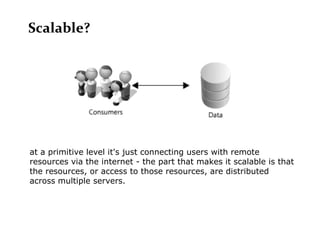
at a primitive level it's just connecting users with remote
resources via the internet - the part that makes it scalable is that
the resources, or access to those resources, are distributed
across multiple servers.
Key principles
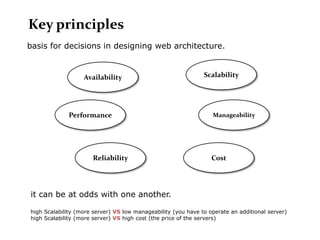
basis for decisions in designing web architecture.


                   Availability                                Scalability


             Performance                                          Manageability


                      Reliability                                 Cost


it can be at odds with one another.

high Scalability (more server) VS low manageability (you have to operate an additional server)
high Scalability (more server) VS high cost (the price of the servers)
Key principles


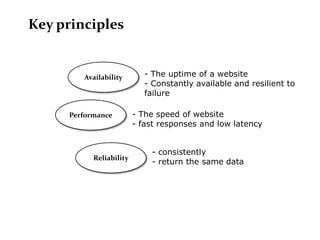
        Availability        - The uptime of a website
                            - Constantly available and resilient to
                            failure

     Performance         - The speed of website
                         - fast responses and low latency


                             - consistently
           Reliability
                             - return the same data
Key principles


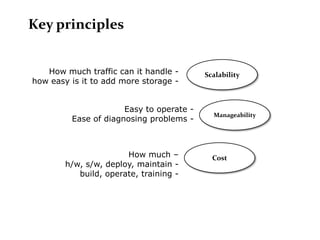
   How much traffic can it handle -       Scalability
how easy is it to add more storage -


                      Easy to operate -
                                            Manageability
         Ease of diagnosing problems -


                       How much –           Cost
        h/w, s/w, deploy, maintain -
           build, operate, training -
What are the right pieces?


How these pieces fit together?


         What are the right tradeoffs?
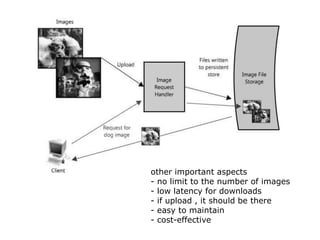
Example. Image Hosting Application

 User can upload images can be requested via a web or API
other important aspects
- no limit to the number of images
- low latency for downloads
- if upload , it should be there
- easy to maintain
- cost-effective
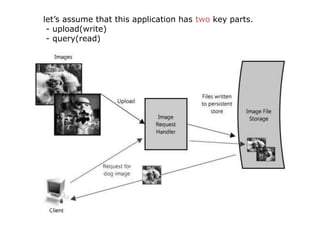
let’s assume that this application has two key parts.
 - upload(write)
 - query(read)
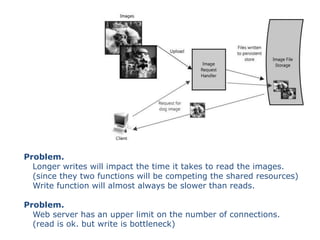
Problem.
  Longer writes will impact the time it takes to read the images.
  (since they two functions will be competing the shared resources)
  Write function will almost always be slower than reads.

Problem.
  Web server has an upper limit on the number of connections.
  (read is ok. but write is bottleneck)
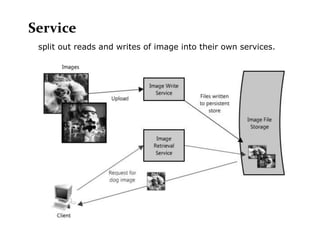
Service
 split out reads and writes of image into their own services.
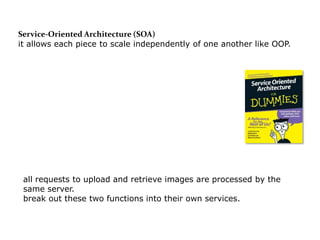
Service-Oriented Architecture (SOA)
it allows each piece to scale independently of one another like OOP.


 all requests to upload and retrieve images are processed by the
 same server.
 break out these two functions into their own services.
this allows us to scale each of them independently
(always do more reading than writing)


Flickr solves this read/write issue by distributing users across
different shards such that each shard can handle a set number of
users.


   Problem.
      When failure happens
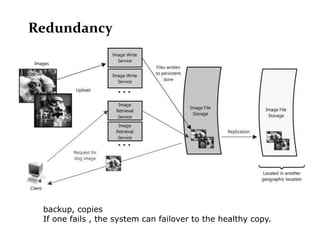
Redundancy


 backup, copies
 If one fails , the system can failover to the healthy copy.
shared-nothing architecture
 - each node is able to operate independently
 - there is no central brain
 - new nodes can be added without special condition or knowledge.
 - they are much more resilient to failure


      Problem.
         There may be very large data sets that are
     unable to fit on a single server.
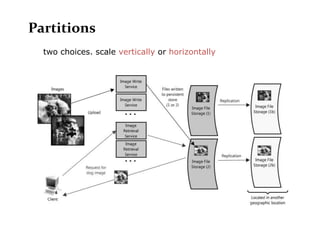
Partitions
  two choices. scale vertically or horizontally
to scale vertically means adding more resources to an individual
server.
 - adding more hard drives on a single server


to scale horizontally means adding more nodes.
 - adding more servers
 - it should be included as an intrinsic design principle of the system
architecture.
 - to break up your services into partitions, or shards.
 - (by geographic boundaries or by non-playing user VS playing users)


        an image’s name could be formed from a consistent hashing
        scheme mapped across servers.
Problem.
   data locality
  to perform a costly fetch of the required information across the network.


Problem.
   inconsistency
  race condition could occur.
The Building Blocks of
        Fast and Scalable Data Access
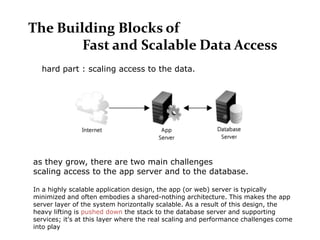
  hard part : scaling access to the data.


as they grow, there are two main challenges
scaling access to the app server and to the database.

In a highly scalable application design, the app (or web) server is typically
minimized and often embodies a shared-nothing architecture. This makes the app
server layer of the system horizontally scalable. As a result of this design, the
heavy lifting is pushed down the stack to the database server and supporting
services; it's at this layer where the real scaling and performance challenges come
into play
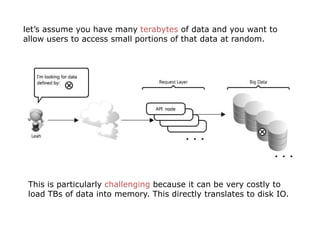
let’s assume you have many terabytes of data and you want to
allow users to access small portions of that data at random.


 This is particularly challenging because it can be very costly to
 load TBs of data into memory. This directly translates to disk IO.
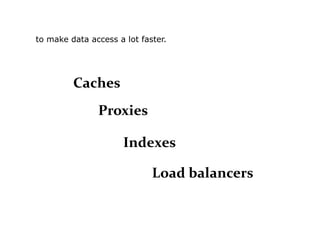
to make data access a lot faster.


         Caches
               Proxies

                      Indexes

                             Load balancers
Caches
Principle : Recently requested data is likely to be requested
again.

like short-term memory.

Caches can exist at all levels in architecture, but are often found
at the level nearest to the front end.

There are a couple of places you can insert a cache.
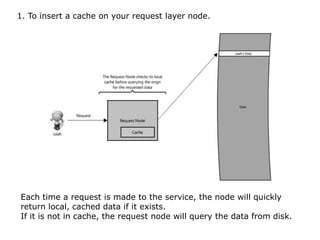
1. To insert a cache on your request layer node.


Each time a request is made to the service, the node will quickly
return local, cached data if it exists.
If it is not in cache, the request node will query the data from disk.
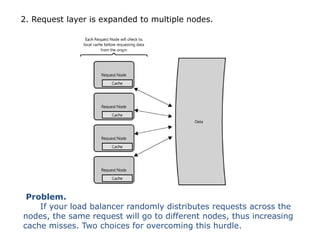
2. Request layer is expanded to multiple nodes.


 Problem.
    If your load balancer randomly distributes requests across the
nodes, the same request will go to different nodes, thus increasing
cache misses. Two choices for overcoming this hurdle.
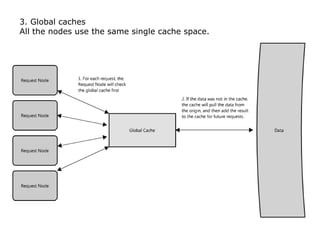
3. Global caches
All the nodes use the same single cache space.
Each of the request nodes queries the cache in the same way it would
a local one.

It can get a bit complicated because it is very easy to overwhelm a
single cache as the number of clients and requests increase.

But it is very effective in some architectures

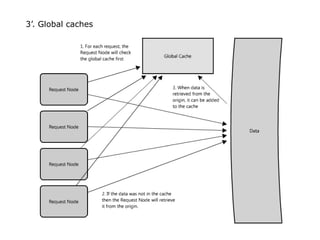
There are two common forms of global cache
(Who has responsible for retrieval?)
3’. Global caches
Tend to use the first type.


However, there are some cases where the second implementation
makes more sense.

If the cache is being used for very large files, a low cache hit
percentage would cause the cache buffer to become overwhelmed
with cache misses
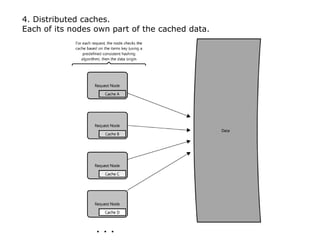
4. Distributed caches.
Each of its nodes own part of the cached data.
If a refrigerator acts as a cache to the grocery store, a distributed
cache is like putting your food in several locations , convenient
locations for retrieving snacks from, without a trip to the store.

Typically the cache is divided up using a consistent hashing
function.


Advantages.
The increased cache space that can be had just by adding nodes to
the request pool.

Disadvantage.
Remedying a missing node. Some distributed caches get around this
by storing multiple copies of the data on different nodes.
however, you can imagine how this logic can get complicated
quickly, especially when you add or remove nodes from the request
layer.

Problem.
   what to do when the data is not in the cache
popular open source cache is Memcached
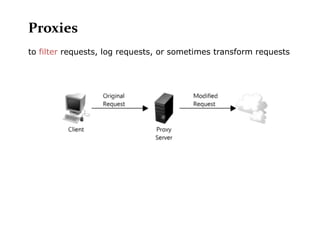
Proxies
to filter requests, log requests, or sometimes transform requests
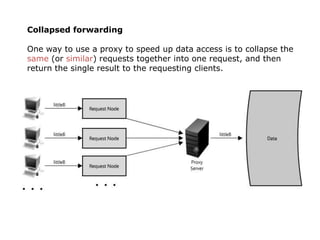
Collapsed forwarding

One way to use a proxy to speed up data access is to collapse the
same (or similar) requests together into one request, and then
return the single result to the requesting clients.
There is some cost associated with this design, since each
request can have slightly higher latency, and some requests may
be slightly delayed to be grouped with similar ones.

But it will improve performance in high load
situations, particularly when that same data is requested over
and over
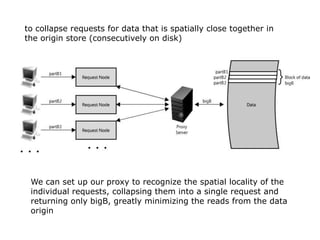
to collapse requests for data that is spatially close together in
the origin store (consecutively on disk)


 We can set up our proxy to recognize the spatial locality of the
 individual requests, collapsing them into a single request and
 returning only bigB, greatly minimizing the reads from the data
 origin
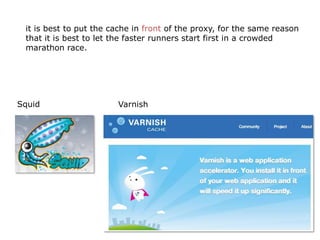
it is best to put the cache in front of the proxy, for the same reason
 that it is best to let the faster runners start first in a crowded
 marathon race.


Squid                   Varnish
Indexes
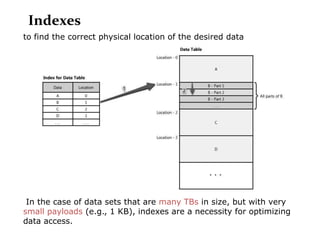
to find the correct physical location of the desired data


 In the case of data sets that are many TBs in size, but with very
small payloads (e.g., 1 KB), indexes are a necessity for optimizing
data access.
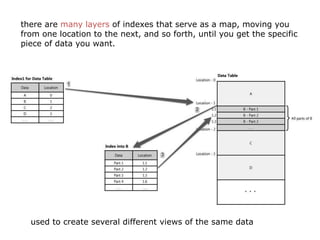
there are many layers of indexes that serve as a map, moving you
from one location to the next, and so forth, until you get the specific
piece of data you want.


  used to create several different views of the same data
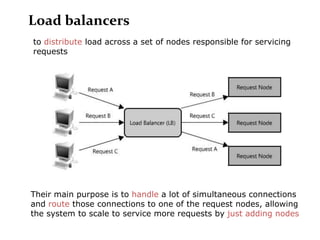
Load balancers
to distribute load across a set of nodes responsible for servicing
requests


Their main purpose is to handle a lot of simultaneous connections
and route those connections to one of the request nodes, allowing
the system to scale to service more requests by just adding nodes
There are many different algorithms

Load balancers can be implemented as software or hardware
appliances.

Open source software load balancer is HAProxy
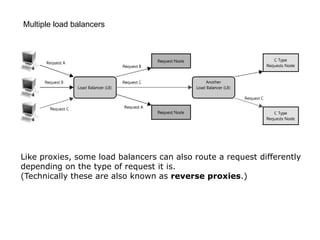
Multiple load balancers


Like proxies, some load balancers can also route a request differently
depending on the type of request it is.
(Technically these are also known as reverse proxies.)
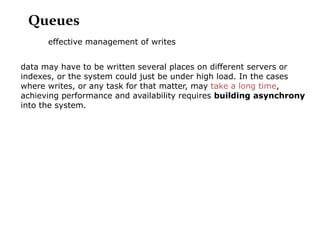
Queues
      effective management of writes


data may have to be written several places on different servers or
indexes, or the system could just be under high load. In the cases
where writes, or any task for that matter, may take a long time,
achieving performance and availability requires building asynchrony
into the system.
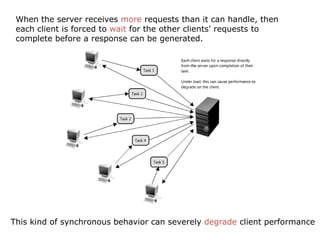
When the server receives more requests than it can handle, then
 each client is forced to wait for the other clients' requests to
 complete before a response can be generated.


This kind of synchronous behavior can severely degrade client performance
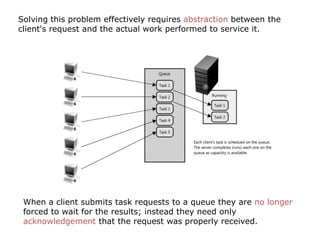
Solving this problem effectively requires abstraction between the
client's request and the actual work performed to service it.


 When a client submits task requests to a queue they are no longer
 forced to wait for the results; instead they need only
 acknowledgement that the request was properly received.
There are quite a few open source queues
like RabbitMQ, ActiveMQ, BeanstalkD,
but some also use services like Zookeeper, or even data stores
like Redis.
Yes. It is barely scratching the surface. :)
Reference


                     The Architecture of Open Source Applications
                     http://www.aosabook.org/en/distsys.html


  https://www.lib.uwo.ca/blogs/education/phoneflickr.jpg
Thank you

Scalable Web Architecture and Distributed Systems

  • 1.
    Scalable Web Architectureand Distributed Systems The Architecture of Open Source Applications II Ver 1.0 아키텍트를 꿈꾸는 사람들 cafe.naver.com/architect1 현수명 soomong.net #soomong
  • 2.
    Scalable? at a primitivelevel it's just connecting users with remote resources via the internet - the part that makes it scalable is that the resources, or access to those resources, are distributed across multiple servers.
  • 3.
    Key principles basis fordecisions in designing web architecture. Availability Scalability Performance Manageability Reliability Cost it can be at odds with one another. high Scalability (more server) VS low manageability (you have to operate an additional server) high Scalability (more server) VS high cost (the price of the servers)
  • 4.
    Key principles Availability - The uptime of a website - Constantly available and resilient to failure Performance - The speed of website - fast responses and low latency - consistently Reliability - return the same data
  • 5.
    Key principles How much traffic can it handle - Scalability how easy is it to add more storage - Easy to operate - Manageability Ease of diagnosing problems - How much – Cost h/w, s/w, deploy, maintain - build, operate, training -
  • 6.
    What are theright pieces? How these pieces fit together? What are the right tradeoffs?
  • 7.
    Example. Image HostingApplication User can upload images can be requested via a web or API
  • 8.
    other important aspects -no limit to the number of images - low latency for downloads - if upload , it should be there - easy to maintain - cost-effective
  • 9.
    let’s assume thatthis application has two key parts. - upload(write) - query(read)
  • 10.
    Problem. Longerwrites will impact the time it takes to read the images. (since they two functions will be competing the shared resources) Write function will almost always be slower than reads. Problem. Web server has an upper limit on the number of connections. (read is ok. but write is bottleneck)
  • 11.
    Service split outreads and writes of image into their own services.
  • 12.
    Service-Oriented Architecture (SOA) itallows each piece to scale independently of one another like OOP. all requests to upload and retrieve images are processed by the same server. break out these two functions into their own services.
  • 13.
    this allows usto scale each of them independently (always do more reading than writing) Flickr solves this read/write issue by distributing users across different shards such that each shard can handle a set number of users. Problem. When failure happens
  • 14.
    Redundancy backup, copies If one fails , the system can failover to the healthy copy.
  • 15.
    shared-nothing architecture -each node is able to operate independently - there is no central brain - new nodes can be added without special condition or knowledge. - they are much more resilient to failure Problem. There may be very large data sets that are unable to fit on a single server.
  • 16.
    Partitions twochoices. scale vertically or horizontally
  • 17.
    to scale verticallymeans adding more resources to an individual server. - adding more hard drives on a single server to scale horizontally means adding more nodes. - adding more servers - it should be included as an intrinsic design principle of the system architecture. - to break up your services into partitions, or shards. - (by geographic boundaries or by non-playing user VS playing users) an image’s name could be formed from a consistent hashing scheme mapped across servers.
  • 18.
    Problem. data locality to perform a costly fetch of the required information across the network. Problem. inconsistency race condition could occur.
  • 19.
    The Building Blocksof Fast and Scalable Data Access hard part : scaling access to the data. as they grow, there are two main challenges scaling access to the app server and to the database. In a highly scalable application design, the app (or web) server is typically minimized and often embodies a shared-nothing architecture. This makes the app server layer of the system horizontally scalable. As a result of this design, the heavy lifting is pushed down the stack to the database server and supporting services; it's at this layer where the real scaling and performance challenges come into play
  • 20.
    let’s assume youhave many terabytes of data and you want to allow users to access small portions of that data at random. This is particularly challenging because it can be very costly to load TBs of data into memory. This directly translates to disk IO.
  • 21.
    to make dataaccess a lot faster. Caches Proxies Indexes Load balancers
  • 22.
    Caches Principle : Recentlyrequested data is likely to be requested again. like short-term memory. Caches can exist at all levels in architecture, but are often found at the level nearest to the front end. There are a couple of places you can insert a cache.
  • 23.
    1. To inserta cache on your request layer node. Each time a request is made to the service, the node will quickly return local, cached data if it exists. If it is not in cache, the request node will query the data from disk.
  • 24.
    2. Request layeris expanded to multiple nodes. Problem. If your load balancer randomly distributes requests across the nodes, the same request will go to different nodes, thus increasing cache misses. Two choices for overcoming this hurdle.
  • 25.
    3. Global caches Allthe nodes use the same single cache space.
  • 26.
    Each of therequest nodes queries the cache in the same way it would a local one. It can get a bit complicated because it is very easy to overwhelm a single cache as the number of clients and requests increase. But it is very effective in some architectures There are two common forms of global cache (Who has responsible for retrieval?)
  • 27.
  • 28.
    Tend to usethe first type. However, there are some cases where the second implementation makes more sense. If the cache is being used for very large files, a low cache hit percentage would cause the cache buffer to become overwhelmed with cache misses
  • 29.
    4. Distributed caches. Eachof its nodes own part of the cached data.
  • 30.
    If a refrigeratoracts as a cache to the grocery store, a distributed cache is like putting your food in several locations , convenient locations for retrieving snacks from, without a trip to the store. Typically the cache is divided up using a consistent hashing function. Advantages. The increased cache space that can be had just by adding nodes to the request pool. Disadvantage. Remedying a missing node. Some distributed caches get around this by storing multiple copies of the data on different nodes. however, you can imagine how this logic can get complicated quickly, especially when you add or remove nodes from the request layer. Problem. what to do when the data is not in the cache
  • 31.
    popular open sourcecache is Memcached
  • 32.
    Proxies to filter requests,log requests, or sometimes transform requests
  • 33.
    Collapsed forwarding One wayto use a proxy to speed up data access is to collapse the same (or similar) requests together into one request, and then return the single result to the requesting clients.
  • 34.
    There is somecost associated with this design, since each request can have slightly higher latency, and some requests may be slightly delayed to be grouped with similar ones. But it will improve performance in high load situations, particularly when that same data is requested over and over
  • 35.
    to collapse requestsfor data that is spatially close together in the origin store (consecutively on disk) We can set up our proxy to recognize the spatial locality of the individual requests, collapsing them into a single request and returning only bigB, greatly minimizing the reads from the data origin
  • 36.
    it is bestto put the cache in front of the proxy, for the same reason that it is best to let the faster runners start first in a crowded marathon race. Squid Varnish
  • 37.
    Indexes to find thecorrect physical location of the desired data In the case of data sets that are many TBs in size, but with very small payloads (e.g., 1 KB), indexes are a necessity for optimizing data access.
  • 38.
    there are manylayers of indexes that serve as a map, moving you from one location to the next, and so forth, until you get the specific piece of data you want. used to create several different views of the same data
  • 39.
    Load balancers to distributeload across a set of nodes responsible for servicing requests Their main purpose is to handle a lot of simultaneous connections and route those connections to one of the request nodes, allowing the system to scale to service more requests by just adding nodes
  • 40.
    There are manydifferent algorithms Load balancers can be implemented as software or hardware appliances. Open source software load balancer is HAProxy
  • 41.
    Multiple load balancers Likeproxies, some load balancers can also route a request differently depending on the type of request it is. (Technically these are also known as reverse proxies.)
  • 42.
    Queues effective management of writes data may have to be written several places on different servers or indexes, or the system could just be under high load. In the cases where writes, or any task for that matter, may take a long time, achieving performance and availability requires building asynchrony into the system.
  • 43.
    When the serverreceives more requests than it can handle, then each client is forced to wait for the other clients' requests to complete before a response can be generated. This kind of synchronous behavior can severely degrade client performance
  • 44.
    Solving this problemeffectively requires abstraction between the client's request and the actual work performed to service it. When a client submits task requests to a queue they are no longer forced to wait for the results; instead they need only acknowledgement that the request was properly received.
  • 45.
    There are quitea few open source queues like RabbitMQ, ActiveMQ, BeanstalkD, but some also use services like Zookeeper, or even data stores like Redis.
  • 46.
    Yes. It isbarely scratching the surface. :)
  • 47.
    Reference The Architecture of Open Source Applications http://www.aosabook.org/en/distsys.html https://www.lib.uwo.ca/blogs/education/phoneflickr.jpg
  • 48.