Scalable, Good,
    Cheap
 a tale of sexiness, puppets, shell
         scripts, and python
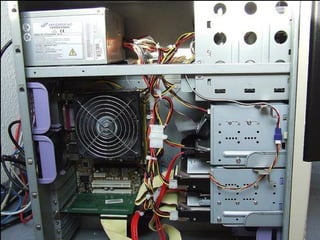
From this...
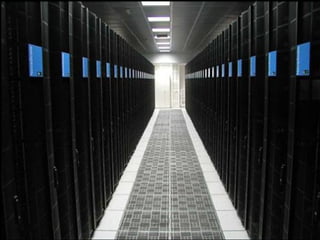
...to this!
Get your infrastructure
     started right!

  (not just preparing for incident and
         rapid event response)
Who we are?

Avleen Vig (@avleen)
 ● Senior Systems Engineer at Etsy
 ● Good at: Scaling frontends, python
 ● Previous companies: WooMe, Google, Earthlink

Marc Cluet (@lynxman)
● Senior Systems Engineer at WooMe
● Good at: Backend scaling, bash/python, languages
● Previous companies: RTFX, Tiscali, World Online
Overview
● Workflow

● Why planning for scaling is important

● How do you choose your software

● Setting up your infrastructure

● Managing your infrastructure
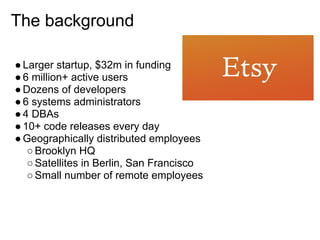
The background

● Larger startup, $32m in funding
● 6 million+ active users
● Dozens of developers
● 6 systems administrators
● 4 DBAs
● 10+ code releases every day
● Geographically distributed employees
   ○ Brooklyn HQ
   ○ Satellites in Berlin, San Francisco
   ○ Small number of remote employees
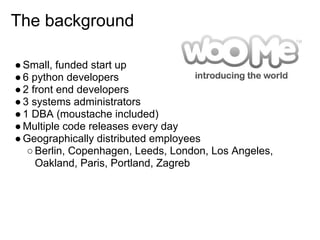
The background

● Small, funded start up
● 6 python developers
● 2 front end developers
● 3 systems administrators
● 1 DBA (moustache included)
● Multiple code releases every day
● Geographically distributed employees
   ○ Berlin, Copenhagen, Leeds, London, Los Angeles,
     Oakland, Paris, Portland, Zagreb
Workflow

● Ticket systems
   ○ Ticket, or it didn't happen!

● Documentation
   ○ Wikis are good

● Don't Repeat Yourself
   ○ If you keep doing the same thing manually, automate

● Version control everything
   ○ All of your scripts
   ○ All of your configurations
Workflow

● Everything will change

● Technical debt vs Premature optimisation
   ○ If you try to be too accurate too early, you'll fail
Team integration

● Be sure to hire the right people
   ○ Beer recruitment interview

● Encourage speed
   ○ Release soon and release often

● Embrace mistakes as part of your day to day
   ○ Learn to work with it

● Ask for peer reviews for important components
   ○ Helps sanity checking your logic

● Developers, Sysadmins, DBAs, one team
Team communication

● Team communication is the most critical factor

● Make sure everyone is in the loop

● Useful applications
   ○ IRC
   ○ Skype
   ○ email
   ○ shout!

● Don't be afraid to use the phone to avoid miscommunication
Layering! Not just for haircuts.

Separate your systems

● Front end

● Application

● Database

● Caching
Choosing your software

● What does your software need to do?
  ○ FastCGI / HTTP proxy? Use nginx
  ○ PHP processing? Use apache

● What expertise do you already have?
  ○ Stick to what you're 100% good at

● Don't rewrite everything
  ○ If it does 70% of what you need it's good for you
Release management

● Fast and furious

● Automate, automate, automate

● Script your deploys and rollbacks

● Continuous deployment

● MTTR vs MTBF
MTTR vs MTBF
Logging

● Centralize your logging

  ○ syslog-ng

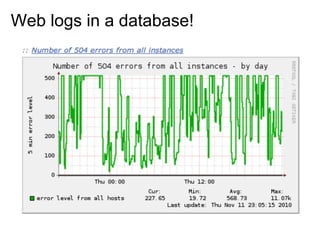
● Parsing web logs - the secret troubleshooting weapon

  ○ SQL

  ○ Splunk
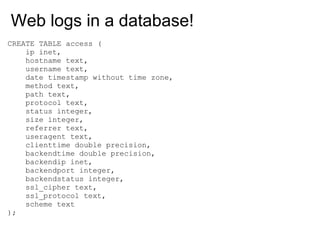
Web logs in a database!
CREATE TABLE access (
    ip inet,
    hostname text,
    username text,
    date timestamp without time zone,
    method text,
    path text,
    protocol text,
    status integer,
    size integer,
    referrer text,
    useragent text,
    clienttime double precision,
    backendtime double precision,
    backendip inet,
    backendport integer,
    backendstatus integer,
    ssl_cipher text,
    ssl_protocol text,
    scheme text
);
Web logs in a database!
Monitoring

● Alerting vs Trend analysis
Monitoring

● Alerting vs Trend analysis
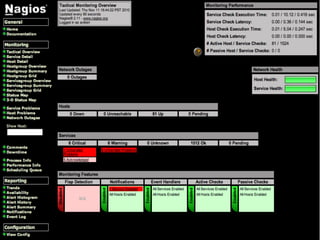
   ○ Nagios is great for raising alerts on problems
Monitoring

● Alerting vs Trend analysis

  ○ Nagios is great for raising alerts on problems

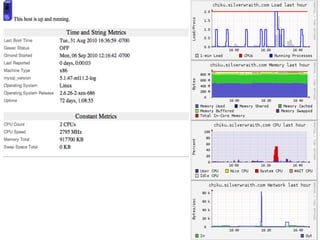
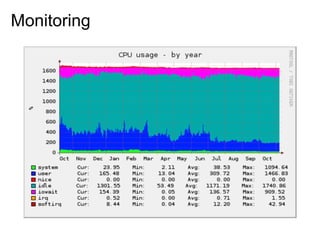
  ○ Ganglia is great at long term trend analysis

  ○ Know when something is out of the "ordinary"
Monitoring

● Alerting vs Trend analysis

  ○ Nagios is great for raising alerts on problems

  ○ Ganglia is great at long term trend analysis

  ○ Know when something is out of the "ordinary"

● What should you monitor?

  ○ Anything which breaks once

  ○ Customer facing services
Monitoring

● Alerting vs Trend analysis

  ○ Nagios is great for raising alerts on problems

  ○ Ganglia is great at long term trend analysis

  ○ Know when something is out of the "ordinary"

● What should you graph?

  ○ Everything! If it moves, graph it.

  ○ Customer facing rates and statistics
Monitoring

Get statistics from your logs:

● PostgreSQL: pgfouine

● MySQL: mk-query-digest

● Web servers: webalizer, awstats, urchin

● Custom applications: Do it yourself! Integrate with Ganglia
Monitoring
Caching

● Caches are disposable
Caching

● Caches are disposable

● But what about the thundering herd?
The importance of scaling
 ● August 2003 Northeastern US and Canada blackout

   ○ Caused by poor process execution

   ○ Lack of good monitoring

   ○ Poor scaling
The importance of scaling
 ● Massive destruction avoided!

   ○ 256 power stations automatically shut down

   ○ 85% after disconnecting from the grid

   ○ Power lost but plants saved!
Caching

● Caches are disposable

● But what about the thundering herd?

  ○ Increase backend capacity along with cache capacity

  ○ Plan for cache failure

  ○ Reduce demand when cache fails
Caching

● Find out how your caching software works

  ○ Memcache + peep!

  ○ Is it better with lots of keys and small objects?

  ○ Or fewer keys and large objects?

  ○ How is memory allocated?
Caching

● Caches are disposable
   ○ Solved!

● But what about the thundering herd?
   ○ Solved!

● Now we get into database scaling!
   ○ Over to Marc...
Databases

                Databases...


      or how to live and die dangerously
Databases

            SQL or NoSQL?
Databases

● SQL
   ○ Gives you transactional consistency
   ○ Good known system
   ○ Hard to scale

● NoSQL
   ○ Transactionally consistent "eventually"
   ○ New cool system
   ○ Easy to scale
Databases

● SQL
   ○ Gives you transactional consistency
   ○ Good known system
   ○ Hard to scale

● NoSQL
   ○ Transactionally consistent "eventually"
   ○ New cool system
   ○ Easy to scale

               You may end up using BOTH!
Databases

● Be smart about your table design
Databases

● Be smart about your table design
   ○ Keep it simple but modular to avoid surprises
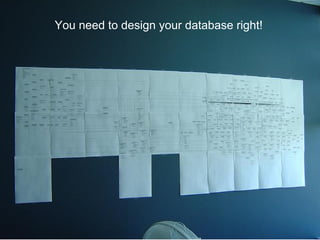
You need to design your database right!
Databases

● Be smart about your table design
   ○ Keep it simple but modular to avoid surprises
   ○ Don't abuse many-to-many tables, they will just give you
     hell
Databases

● Be smart about your table design
   ○ Keep it simple but modular to avoid surprises
   ○ Don't abuse many-to-many tables, they will just give you
     hell

● YOU WILL GET IT WRONG
   ○ You'll need to redesign parts of your DB semi-regularly
   ○ Be prepared for the unexpected
Databases

The read dilemma

● As the tables grow so do read times and memory.
  Several options:

  ○ Check your slow query log, tune indexes

  ○ Partition to read smaller numbers of rows

  ○ Master / Slave, but this adds replication lag!
Databases

The read dilemma

● As the tables grow so do read times and memory.
  Several options:

  ○ Check your slow query log, tune indexes
     ■ Single most common problem with slow queries and
       capacity
     ■ Be careful about foreign keys
Databases

The read dilemma

● As the tables grow so do read times and memory.
  Several options:

  ○ Check your slow query log, tune indexes

  ○ Partition to read smaller numbers of rows
     ■ By range (date, id)
     ■ By hash (usernames)
     ■ By anything you can imagine!
Databases

The write conundrum

● As the database grows so do writes

● Writes are bound by disk I/O
  ○ RAID1+0 helps

● Don't shoot yourself in the foot!
   ○ Don't try to solve this early
   ○ Have monitoring ready to foresee this issue
   ○ Bring pizza
Databases

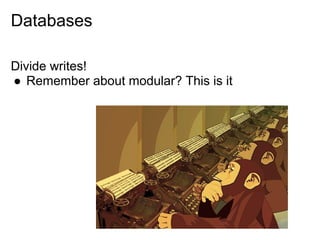
Divide writes!
● Remember about modular? This is it
Databases

How to give a consistent view to the servers?

Use a query director!

● pgbouncer on Postgres

● gizzard on MySQL
Web frontend

● Hardware load balancers - Good but expensive!

● Software load balancers - Good and cheap! (more pizza)

  ○ Web server frontends
    ■ nginx, lighttpd, apache

  ○ Reverse proxies
     ■ varnish, squid

  ○ Kernel stuff
     ■ Linux ipvs
Web frontend

Which way should I go?

● Web servers as load balancers
  ○ Gives you nice add on features
  ○ You can offload some process in the frontend
  ○ Buffering problems

● Reverse proxies
   ○ Caching stuff is good
   ○ Fast reaction time
   ○ No buffering problems
Web frontend

Divide your web clusters!

● You can send different requests to different clusters

● You can use an API call to connect between them
Configuration management

● Be ready to mass scale
   ○ Keep all your machines in line

● Automated server installs
   ○ Use it to install new software
   ○ Also to rapidly deploy new versions
Writing tools

● If you do something more than 2 times it's worth scripting

● Write small tools when you need them

● Stick to one or two languages
   ○ And be good at them
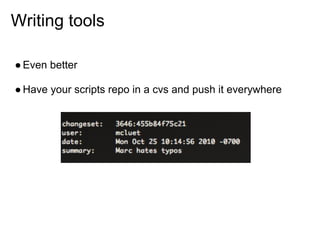
Writing tools

● Even better

● Have your scripts repo in a cvs and push it everywhere
Backups

● It's important to have backups
Backups

● It's important to have backups

● It's even more important to exercise them!
   ○ Having backups without testing recovery is like having no
      backups
Backups

● It's important to have backups

● It's even more important to exercise them!
   ○ Having backups without testing recovery is like having no
      backups

● How can we exercise backups for cheap?
Backups

● It's important to have backups

● It's even more important to exercise them!
   ○ Having backups without testing recovery is like having no
      backups

● How can we exercise backups for cheap?
  ○ Cloud computing!
Cloud computing

● Cloud computing help us recreate our platform on the cloud

● Giving us a more than credible recovery scenario

● Also very useful to spawn more instances if we run into
  problems
Interesting things to read

Wikipedia
● http://en.wikipedia.org/wiki/DevOps

Web Operations and Capacity Planning
● http://kitchensoap.com

High scalability (if you get there)
 ● http://highscalability.com/

If you really fancy databases, explain extended
 ● http://explainextended.com/
Questions?


   Work at Etsy!           Work at WooMe!
http://etsy.com/jobs   http://bit.ly/work4woome


     @avleen                @lynxman

Scalable, good, cheap

  • 1.
    Scalable, Good, Cheap a tale of sexiness, puppets, shell scripts, and python
  • 2.
  • 4.
  • 6.
    Get your infrastructure started right! (not just preparing for incident and rapid event response)
  • 7.
    Who we are? AvleenVig (@avleen) ● Senior Systems Engineer at Etsy ● Good at: Scaling frontends, python ● Previous companies: WooMe, Google, Earthlink Marc Cluet (@lynxman) ● Senior Systems Engineer at WooMe ● Good at: Backend scaling, bash/python, languages ● Previous companies: RTFX, Tiscali, World Online
  • 8.
    Overview ● Workflow ● Whyplanning for scaling is important ● How do you choose your software ● Setting up your infrastructure ● Managing your infrastructure
  • 9.
    The background ● Largerstartup, $32m in funding ● 6 million+ active users ● Dozens of developers ● 6 systems administrators ● 4 DBAs ● 10+ code releases every day ● Geographically distributed employees ○ Brooklyn HQ ○ Satellites in Berlin, San Francisco ○ Small number of remote employees
  • 10.
    The background ● Small,funded start up ● 6 python developers ● 2 front end developers ● 3 systems administrators ● 1 DBA (moustache included) ● Multiple code releases every day ● Geographically distributed employees ○ Berlin, Copenhagen, Leeds, London, Los Angeles, Oakland, Paris, Portland, Zagreb
  • 11.
    Workflow ● Ticket systems ○ Ticket, or it didn't happen! ● Documentation ○ Wikis are good ● Don't Repeat Yourself ○ If you keep doing the same thing manually, automate ● Version control everything ○ All of your scripts ○ All of your configurations
  • 12.
    Workflow ● Everything willchange ● Technical debt vs Premature optimisation ○ If you try to be too accurate too early, you'll fail
  • 13.
    Team integration ● Besure to hire the right people ○ Beer recruitment interview ● Encourage speed ○ Release soon and release often ● Embrace mistakes as part of your day to day ○ Learn to work with it ● Ask for peer reviews for important components ○ Helps sanity checking your logic ● Developers, Sysadmins, DBAs, one team
  • 14.
    Team communication ● Teamcommunication is the most critical factor ● Make sure everyone is in the loop ● Useful applications ○ IRC ○ Skype ○ email ○ shout! ● Don't be afraid to use the phone to avoid miscommunication
  • 15.
    Layering! Not justfor haircuts. Separate your systems ● Front end ● Application ● Database ● Caching
  • 16.
    Choosing your software ●What does your software need to do? ○ FastCGI / HTTP proxy? Use nginx ○ PHP processing? Use apache ● What expertise do you already have? ○ Stick to what you're 100% good at ● Don't rewrite everything ○ If it does 70% of what you need it's good for you
  • 17.
    Release management ● Fastand furious ● Automate, automate, automate ● Script your deploys and rollbacks ● Continuous deployment ● MTTR vs MTBF
  • 18.
  • 20.
    Logging ● Centralize yourlogging ○ syslog-ng ● Parsing web logs - the secret troubleshooting weapon ○ SQL ○ Splunk
  • 21.
    Web logs ina database! CREATE TABLE access ( ip inet, hostname text, username text, date timestamp without time zone, method text, path text, protocol text, status integer, size integer, referrer text, useragent text, clienttime double precision, backendtime double precision, backendip inet, backendport integer, backendstatus integer, ssl_cipher text, ssl_protocol text, scheme text );
  • 22.
    Web logs ina database!
  • 23.
  • 25.
    Monitoring ● Alerting vsTrend analysis ○ Nagios is great for raising alerts on problems
  • 27.
    Monitoring ● Alerting vsTrend analysis ○ Nagios is great for raising alerts on problems ○ Ganglia is great at long term trend analysis ○ Know when something is out of the "ordinary"
  • 28.
    Monitoring ● Alerting vsTrend analysis ○ Nagios is great for raising alerts on problems ○ Ganglia is great at long term trend analysis ○ Know when something is out of the "ordinary" ● What should you monitor? ○ Anything which breaks once ○ Customer facing services
  • 29.
    Monitoring ● Alerting vsTrend analysis ○ Nagios is great for raising alerts on problems ○ Ganglia is great at long term trend analysis ○ Know when something is out of the "ordinary" ● What should you graph? ○ Everything! If it moves, graph it. ○ Customer facing rates and statistics
  • 30.
    Monitoring Get statistics fromyour logs: ● PostgreSQL: pgfouine ● MySQL: mk-query-digest ● Web servers: webalizer, awstats, urchin ● Custom applications: Do it yourself! Integrate with Ganglia
  • 31.
  • 32.
  • 34.
    Caching ● Caches aredisposable ● But what about the thundering herd?
  • 35.
  • 36.
    The importance ofscaling ● August 2003 Northeastern US and Canada blackout ○ Caused by poor process execution ○ Lack of good monitoring ○ Poor scaling
  • 37.
  • 38.
    The importance ofscaling ● Massive destruction avoided! ○ 256 power stations automatically shut down ○ 85% after disconnecting from the grid ○ Power lost but plants saved!
  • 39.
    Caching ● Caches aredisposable ● But what about the thundering herd? ○ Increase backend capacity along with cache capacity ○ Plan for cache failure ○ Reduce demand when cache fails
  • 40.
    Caching ● Find outhow your caching software works ○ Memcache + peep! ○ Is it better with lots of keys and small objects? ○ Or fewer keys and large objects? ○ How is memory allocated?
  • 41.
    Caching ● Caches aredisposable ○ Solved! ● But what about the thundering herd? ○ Solved! ● Now we get into database scaling! ○ Over to Marc...
  • 42.
    Databases Databases... or how to live and die dangerously
  • 43.
    Databases SQL or NoSQL?
  • 44.
    Databases ● SQL ○ Gives you transactional consistency ○ Good known system ○ Hard to scale ● NoSQL ○ Transactionally consistent "eventually" ○ New cool system ○ Easy to scale
  • 45.
    Databases ● SQL ○ Gives you transactional consistency ○ Good known system ○ Hard to scale ● NoSQL ○ Transactionally consistent "eventually" ○ New cool system ○ Easy to scale You may end up using BOTH!
  • 46.
    Databases ● Be smartabout your table design
  • 47.
    Databases ● Be smartabout your table design ○ Keep it simple but modular to avoid surprises
  • 48.
    You need todesign your database right!
  • 49.
    Databases ● Be smartabout your table design ○ Keep it simple but modular to avoid surprises ○ Don't abuse many-to-many tables, they will just give you hell
  • 50.
    Databases ● Be smartabout your table design ○ Keep it simple but modular to avoid surprises ○ Don't abuse many-to-many tables, they will just give you hell ● YOU WILL GET IT WRONG ○ You'll need to redesign parts of your DB semi-regularly ○ Be prepared for the unexpected
  • 51.
    Databases The read dilemma ●As the tables grow so do read times and memory. Several options: ○ Check your slow query log, tune indexes ○ Partition to read smaller numbers of rows ○ Master / Slave, but this adds replication lag!
  • 52.
    Databases The read dilemma ●As the tables grow so do read times and memory. Several options: ○ Check your slow query log, tune indexes ■ Single most common problem with slow queries and capacity ■ Be careful about foreign keys
  • 53.
    Databases The read dilemma ●As the tables grow so do read times and memory. Several options: ○ Check your slow query log, tune indexes ○ Partition to read smaller numbers of rows ■ By range (date, id) ■ By hash (usernames) ■ By anything you can imagine!
  • 54.
    Databases The write conundrum ●As the database grows so do writes ● Writes are bound by disk I/O ○ RAID1+0 helps ● Don't shoot yourself in the foot! ○ Don't try to solve this early ○ Have monitoring ready to foresee this issue ○ Bring pizza
  • 55.
    Databases Divide writes! ● Rememberabout modular? This is it
  • 56.
    Databases How to givea consistent view to the servers? Use a query director! ● pgbouncer on Postgres ● gizzard on MySQL
  • 57.
    Web frontend ● Hardwareload balancers - Good but expensive! ● Software load balancers - Good and cheap! (more pizza) ○ Web server frontends ■ nginx, lighttpd, apache ○ Reverse proxies ■ varnish, squid ○ Kernel stuff ■ Linux ipvs
  • 58.
    Web frontend Which wayshould I go? ● Web servers as load balancers ○ Gives you nice add on features ○ You can offload some process in the frontend ○ Buffering problems ● Reverse proxies ○ Caching stuff is good ○ Fast reaction time ○ No buffering problems
  • 59.
    Web frontend Divide yourweb clusters! ● You can send different requests to different clusters ● You can use an API call to connect between them
  • 60.
    Configuration management ● Beready to mass scale ○ Keep all your machines in line ● Automated server installs ○ Use it to install new software ○ Also to rapidly deploy new versions
  • 61.
    Writing tools ● Ifyou do something more than 2 times it's worth scripting ● Write small tools when you need them ● Stick to one or two languages ○ And be good at them
  • 62.
    Writing tools ● Evenbetter ● Have your scripts repo in a cvs and push it everywhere
  • 63.
  • 64.
    Backups ● It's importantto have backups ● It's even more important to exercise them! ○ Having backups without testing recovery is like having no backups
  • 65.
    Backups ● It's importantto have backups ● It's even more important to exercise them! ○ Having backups without testing recovery is like having no backups ● How can we exercise backups for cheap?
  • 66.
    Backups ● It's importantto have backups ● It's even more important to exercise them! ○ Having backups without testing recovery is like having no backups ● How can we exercise backups for cheap? ○ Cloud computing!
  • 67.
    Cloud computing ● Cloudcomputing help us recreate our platform on the cloud ● Giving us a more than credible recovery scenario ● Also very useful to spawn more instances if we run into problems
  • 68.
    Interesting things toread Wikipedia ● http://en.wikipedia.org/wiki/DevOps Web Operations and Capacity Planning ● http://kitchensoap.com High scalability (if you get there) ● http://highscalability.com/ If you really fancy databases, explain extended ● http://explainextended.com/
  • 69.
    Questions? Work at Etsy! Work at WooMe! http://etsy.com/jobs http://bit.ly/work4woome @avleen @lynxman