Scaling Massive ElasticSearch
          Clusters

    Rafał Kuć – Sematext International
   @kucrafal @sematext sematext.com
Who Am I
•   „Solr 3.1 Cookbook” author
•   Sematext software engineer
•   Solr.pl co-founder
•   Father and husband :-)


                Copyright 2012 Sematext Int’l. All rights reserved
What Will I Talk About ?
•   ElasticSearch scaling
•   Indexing thousands of documents per second
•   Performing queries in tens of milliseconds
•   Controling shard and replica placement
•   Handling multilingual content
•   Performance testing
•   Cluster monitoring

                Copyright 2012 Sematext Int’l. All rights reserved
The Challenge
•   More than 50 millions of documents a day
•   Real time search
•   Less than 200ms average query latency
•   Throughput of at least 1000 QPS
•   Multilingual indexing
•   Multilingual querying


                Copyright 2012 Sematext Int’l. All rights reserved
Why ElasticSearch ?
• Written with NRT and cloud support in mind
• Uses Lucene and all its goodness
• Distributed indexing with document
  distribution control out of the box
• Easy index, shard and replicas creation on live
  cluster


               Copyright 2012 Sematext Int’l. All rights reserved
Index Design
• Several indices (at least one index for each day
  of data)
• Indices divided into multiple shards
• Multiple replicas of a single shard
• Real-time, synchronous replication
• Near-real-time index refresh (1 to 30 seconds)


               Copyright 2012 Sematext Int’l. All rights reserved
Shard Deployment Problems
•   Multiple shards per node
•   Replicas on the same nodes as shards
•   Not evenly distributed shards and replicas
•   Some nodes being hot, while others are cold


                Copyright 2012 Sematext Int’l. All rights reserved
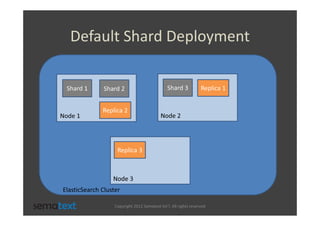
Default Shard Deployment

 Shard 1       Shard 2                         Shard 3            Replica 1


              Replica 2
Node 1                                      Node 2


                    Replica 3


                  Node 3
ElasticSearch Cluster

                   Copyright 2012 Sematext Int’l. All rights reserved
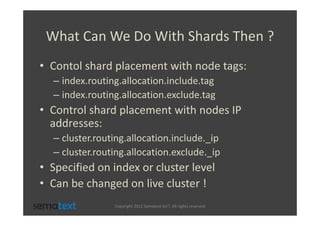
What Can We Do With Shards Then ?
• Contol shard placement with node tags:
  – index.routing.allocation.include.tag
  – index.routing.allocation.exclude.tag
• Control shard placement with nodes IP
  addresses:
  – cluster.routing.allocation.include._ip
  – cluster.routing.allocation.exclude._ip
• Specified on index or cluster level
• Can be changed on live cluster !
                Copyright 2012 Sematext Int’l. All rights reserved
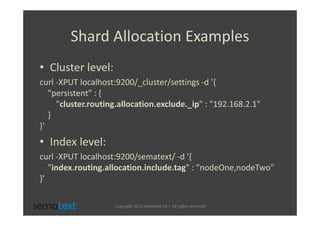
Shard Allocation Examples
• Cluster level:
curl -XPUT localhost:9200/_cluster/settings -d '{
   "persistent" : {
     "cluster.routing.allocation.exclude._ip" : "192.168.2.1"
   }
}'
• Index level:
curl -XPUT localhost:9200/sematext/ -d '{
   "index.routing.allocation.include.tag" : "nodeOne,nodeTwo"
}'

                    Copyright 2012 Sematext Int’l. All rights reserved
Number of Shards Per Node
• Allows one to specify number of shards per
  node
• Specified on index level
• Can be changed on live indices
• Example:
curl -XPUT localhost:9200/sematext -d '{
   "index.routing.allocation.total_shards_per_node" : 2
}'


                   Copyright 2012 Sematext Int’l. All rights reserved
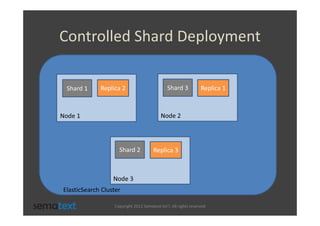
Controlled Shard Deployment

 Shard 1     Replica 2                        Shard 3            Replica 1


Node 1                                     Node 2


                    Shard 2            Replica 3


                  Node 3
ElasticSearch Cluster

                  Copyright 2012 Sematext Int’l. All rights reserved
Does Routing Matters ?
• Controls target shard for each document
• Defaults to hash of a document identifier
• Can be specified explicitly (routing parameter) or
  as a field value (a bit less performant)
• Can take any value
• Example:
curl -XPUT localhost:9200/sematext/test/1?routing=1234 -d '{
  "title" : "Test routing document"
}'


                   Copyright 2012 Sematext Int’l. All rights reserved
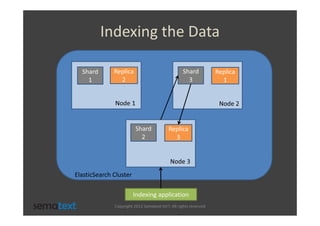
Indexing the Data

  Shard       Replica                              Shard           Replica
    1           2                                    3               1


              Node 1                                                Node 2


                         Shard             Replica
                           2                 3


                                            Node 3
ElasticSearch Cluster

                        Indexing application
              Copyright 2012 Sematext Int’l. All rights reserved
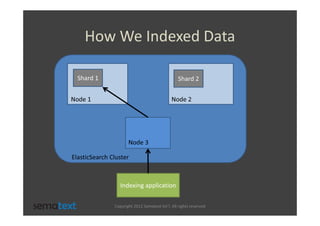
How We Indexed Data

  Shard 1                                        Shard 2


Node 1                                        Node 2


                      Node 3

ElasticSearch Cluster


                  Indexing application

               Copyright 2012 Sematext Int’l. All rights reserved
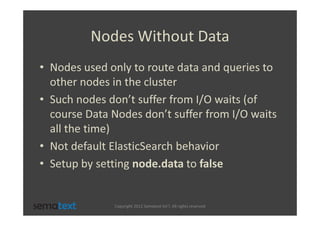
Nodes Without Data
• Nodes used only to route data and queries to
  other nodes in the cluster
• Such nodes don’t suffer from I/O waits (of
  course Data Nodes don’t suffer from I/O waits
  all the time)
• Not default ElasticSearch behavior
• Setup by setting node.data to false


              Copyright 2012 Sematext Int’l. All rights reserved
Multilingual Indexing
• Detection of document's language before
  sending it for indexing
• With, e.g. Sematext LangID or Apache Tika
• Set known language analyzers in configuration
  or mappings
• Set analyzer during indexing (_analyzer field)


               Copyright 2012 Sematext Int’l. All rights reserved
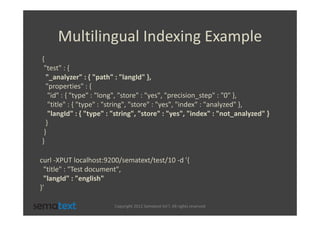
Multilingual Indexing Example
{
 "test" : {
  "_analyzer" : { "path" : "langId" },
  "properties" : {
   "id" : { "type" : "long", "store" : "yes", "precision_step" : "0" },
   "title" : { "type" : "string", "store" : "yes", "index" : "analyzed" },
   "langId" : { "type" : "string", "store" : "yes", "index" : "not_analyzed" }
  }
 }
}

curl -XPUT localhost:9200/sematext/test/10 -d '{
  "title" : "Test document",
  "langId" : "english"
}'

                        Copyright 2012 Sematext Int’l. All rights reserved
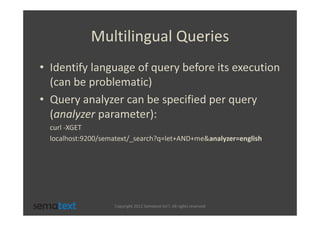
Multilingual Queries
• Identify language of query before its execution
  (can be problematic)
• Query analyzer can be specified per query
  (analyzer parameter):
  curl -XGET
  localhost:9200/sematext/_search?q=let+AND+me&analyzer=english


                    Copyright 2012 Sematext Int’l. All rights reserved
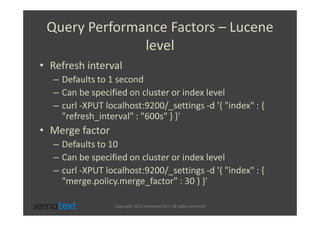
Query Performance Factors – Lucene
               level
• Refresh interval
  – Defaults to 1 second
  – Can be specified on cluster or index level
  – curl -XPUT localhost:9200/_settings -d '{ "index" : {
    "refresh_interval" : "600s" } }'
• Merge factor
  – Defaults to 10
  – Can be specified on cluster or index level
  – curl -XPUT localhost:9200/_settings -d '{ "index" : {
    "merge.policy.merge_factor" : 30 } }'

                 Copyright 2012 Sematext Int’l. All rights reserved
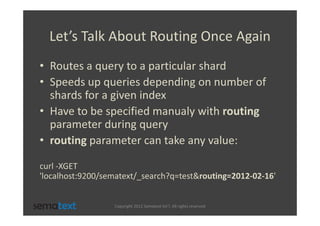
Let’s Talk About Routing Once Again
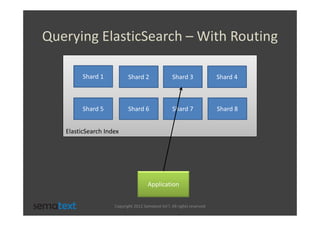
• Routes a query to a particular shard
• Speeds up queries depending on number of
  shards for a given index
• Have to be specified manualy with routing
  parameter during query
• routing parameter can take any value:

curl -XGET
'localhost:9200/sematext/_search?q=test&routing=2012-02-16'


                  Copyright 2012 Sematext Int’l. All rights reserved
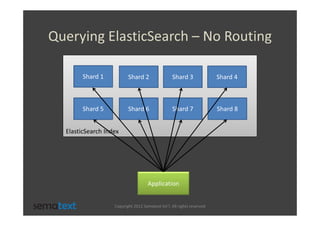
Querying ElasticSearch – No Routing

        Shard 1           Shard 2                 Shard 3               Shard 4


        Shard 5           Shard 6                 Shard 7               Shard 8


  ElasticSearch Index


                                     Application


                   Copyright 2012 Sematext Int’l. All rights reserved
Querying ElasticSearch – With Routing

         Shard 1           Shard 2                 Shard 3               Shard 4


         Shard 5           Shard 6                 Shard 7               Shard 8


   ElasticSearch Index


                                      Application


                    Copyright 2012 Sematext Int’l. All rights reserved
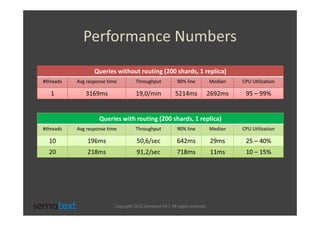
Performance Numbers
                  Queries without routing (200 shards, 1 replica)
#threads   Avg response time          Throughput             90% line           Median   CPU Utilization

   1          3169ms                  19,0/min              5214ms              2692ms    95 – 99%


                    Queries with routing (200 shards, 1 replica)
#threads   Avg response time          Throughput             90% line           Median   CPU Utilization

  10           196ms                   50,6/sec              642ms              29ms      25 – 40%
  20           218ms                   91,2/sec              718ms              11ms      10 – 15%


                           Copyright 2012 Sematext Int’l. All rights reserved
Scaling Query Throughput – What Else ?

• Increasing the number of shards for data
  distribution
• Increasing the number of replicas
• Using routing
• Avoid always hitting the same node and
  hotspotting it


              Copyright 2012 Sematext Int’l. All rights reserved
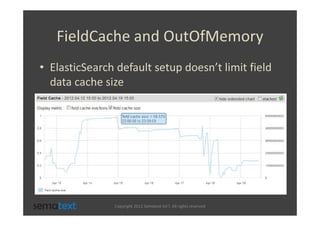
FieldCache and OutOfMemory
• ElasticSearch default setup doesn’t limit field
  data cache size


               Copyright 2012 Sematext Int’l. All rights reserved
FieldCache – What We Can do With It ?
• Keep its default type and set:
   – Maximum size (index.cache.field.max_size)
   – Expiration time (index.cache.field.expire)
• Change its type:
   – soft (index.cache.field.type)
• Change your data:
   – Make your fields less precise (ie: dates)
   – If you sort or facet on fields think if you can reduce
     fields granularity
• Buy more servers :-)

                   Copyright 2012 Sematext Int’l. All rights reserved
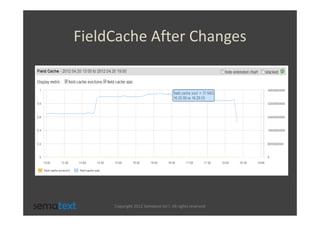
FieldCache After Changes


     Copyright 2012 Sematext Int’l. All rights reserved
Additional Problems We Encountered
• Rebalancing after full cluster restarts
  – cluster.routing.allocation.disable_allocation
  – cluster.routing.allocation.disable_replica_allocation
• Long startup and initialization
• Faceting with strings vs faceting on numbers on
  high cardinality fields


                Copyright 2012 Sematext Int’l. All rights reserved
JVM Optimization
• Remember to leave enough memory to OS for
  cache
• Make GC frequent ans short vs. rare and long
  – -XX:+UseParNewGC
  – -XX:+UseConcMarkSweepGC
  – -XX:+CMSParallelRemarkEnabled
• -XX:+AlwaysPreTouch (for short performance
  tests)

              Copyright 2012 Sematext Int’l. All rights reserved
Performance Testing
• Data
  – How much data do I need ?
  – Choosing the right queries
• Make changes
  – One change at a time
  – Understand the impact of the change
• Monitor your cluster (jstat, dstat/vmstat,
  SPM)
• Analyze your results
               Copyright 2012 Sematext Int’l. All rights reserved
ElasticSearch Cluster Monitoring
•   Cluster health
•   Indexing statistics
•   Query rate
•   JVM memory and garbage collector work
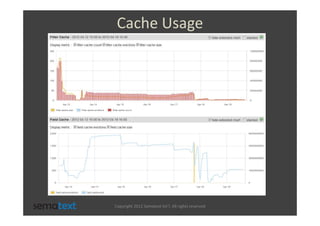
•   Cache usage
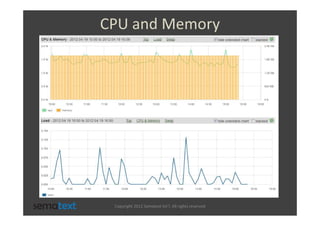
•   Node memory and CPU usage


               Copyright 2012 Sematext Int’l. All rights reserved
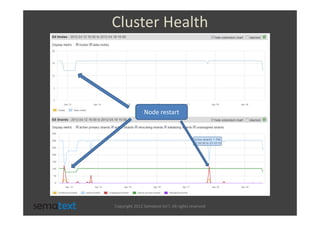
Cluster Health


                Node restart


Copyright 2012 Sematext Int’l. All rights reserved
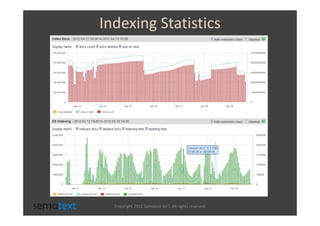
Indexing Statistics


  Copyright 2012 Sematext Int’l. All rights reserved
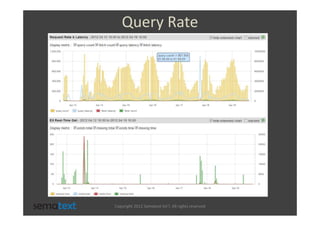
Query Rate


Copyright 2012 Sematext Int’l. All rights reserved
JVM Memory and GC


   Copyright 2012 Sematext Int’l. All rights reserved
Cache Usage


Copyright 2012 Sematext Int’l. All rights reserved
CPU and Memory


 Copyright 2012 Sematext Int’l. All rights reserved
Summary
• Controlling shard and replica placement
• Indexing and querying multilingual data
• How to use sharding and routing and not to
  tear your hair out
• How to test your cluster performance to find
  bottle-necks
• How to monitor your cluster and find
  problems right away
              Copyright 2012 Sematext Int’l. All rights reserved
We Are Hiring !
•   Dig Search ?
•   Dig Analytics ?
•   Dig Big Data ?
•   Dig Performance ?
•   Dig working with and in open – source ?
•   We’re hiring world – wide !
       http://sematext.com/about/jobs.html

                Copyright 2012 Sematext Int’l. All rights reserved
How to Reach Us
• Rafał Kuć
  – Twitter: @kucrafal
  – E-mail: rafal.kuc@sematext.com
• Sematext
  – Twitter: @sematext
  – Website: http://sematext.com
• Graphs used in the presentation are from:
  – SPM for ElasticSearch (http://sematext.com/spm)

               Copyright 2012 Sematext Int’l. All rights reserved
Thank You For Your Attention

Scaling massive elastic search clusters - Rafał Kuć - Sematext

  • 1.
    Scaling Massive ElasticSearch Clusters Rafał Kuć – Sematext International @kucrafal @sematext sematext.com
  • 2.
    Who Am I • „Solr 3.1 Cookbook” author • Sematext software engineer • Solr.pl co-founder • Father and husband :-) Copyright 2012 Sematext Int’l. All rights reserved
  • 3.
    What Will ITalk About ? • ElasticSearch scaling • Indexing thousands of documents per second • Performing queries in tens of milliseconds • Controling shard and replica placement • Handling multilingual content • Performance testing • Cluster monitoring Copyright 2012 Sematext Int’l. All rights reserved
  • 4.
    The Challenge • More than 50 millions of documents a day • Real time search • Less than 200ms average query latency • Throughput of at least 1000 QPS • Multilingual indexing • Multilingual querying Copyright 2012 Sematext Int’l. All rights reserved
  • 5.
    Why ElasticSearch ? •Written with NRT and cloud support in mind • Uses Lucene and all its goodness • Distributed indexing with document distribution control out of the box • Easy index, shard and replicas creation on live cluster Copyright 2012 Sematext Int’l. All rights reserved
  • 6.
    Index Design • Severalindices (at least one index for each day of data) • Indices divided into multiple shards • Multiple replicas of a single shard • Real-time, synchronous replication • Near-real-time index refresh (1 to 30 seconds) Copyright 2012 Sematext Int’l. All rights reserved
  • 7.
    Shard Deployment Problems • Multiple shards per node • Replicas on the same nodes as shards • Not evenly distributed shards and replicas • Some nodes being hot, while others are cold Copyright 2012 Sematext Int’l. All rights reserved
  • 8.
    Default Shard Deployment Shard 1 Shard 2 Shard 3 Replica 1 Replica 2 Node 1 Node 2 Replica 3 Node 3 ElasticSearch Cluster Copyright 2012 Sematext Int’l. All rights reserved
  • 9.
    What Can WeDo With Shards Then ? • Contol shard placement with node tags: – index.routing.allocation.include.tag – index.routing.allocation.exclude.tag • Control shard placement with nodes IP addresses: – cluster.routing.allocation.include._ip – cluster.routing.allocation.exclude._ip • Specified on index or cluster level • Can be changed on live cluster ! Copyright 2012 Sematext Int’l. All rights reserved
  • 10.
    Shard Allocation Examples •Cluster level: curl -XPUT localhost:9200/_cluster/settings -d '{ "persistent" : { "cluster.routing.allocation.exclude._ip" : "192.168.2.1" } }' • Index level: curl -XPUT localhost:9200/sematext/ -d '{ "index.routing.allocation.include.tag" : "nodeOne,nodeTwo" }' Copyright 2012 Sematext Int’l. All rights reserved
  • 11.
    Number of ShardsPer Node • Allows one to specify number of shards per node • Specified on index level • Can be changed on live indices • Example: curl -XPUT localhost:9200/sematext -d '{ "index.routing.allocation.total_shards_per_node" : 2 }' Copyright 2012 Sematext Int’l. All rights reserved
  • 12.
    Controlled Shard Deployment Shard 1 Replica 2 Shard 3 Replica 1 Node 1 Node 2 Shard 2 Replica 3 Node 3 ElasticSearch Cluster Copyright 2012 Sematext Int’l. All rights reserved
  • 13.
    Does Routing Matters? • Controls target shard for each document • Defaults to hash of a document identifier • Can be specified explicitly (routing parameter) or as a field value (a bit less performant) • Can take any value • Example: curl -XPUT localhost:9200/sematext/test/1?routing=1234 -d '{ "title" : "Test routing document" }' Copyright 2012 Sematext Int’l. All rights reserved
  • 14.
    Indexing the Data Shard Replica Shard Replica 1 2 3 1 Node 1 Node 2 Shard Replica 2 3 Node 3 ElasticSearch Cluster Indexing application Copyright 2012 Sematext Int’l. All rights reserved
  • 15.
    How We IndexedData Shard 1 Shard 2 Node 1 Node 2 Node 3 ElasticSearch Cluster Indexing application Copyright 2012 Sematext Int’l. All rights reserved
  • 16.
    Nodes Without Data •Nodes used only to route data and queries to other nodes in the cluster • Such nodes don’t suffer from I/O waits (of course Data Nodes don’t suffer from I/O waits all the time) • Not default ElasticSearch behavior • Setup by setting node.data to false Copyright 2012 Sematext Int’l. All rights reserved
  • 17.
    Multilingual Indexing • Detectionof document's language before sending it for indexing • With, e.g. Sematext LangID or Apache Tika • Set known language analyzers in configuration or mappings • Set analyzer during indexing (_analyzer field) Copyright 2012 Sematext Int’l. All rights reserved
  • 18.
    Multilingual Indexing Example { "test" : { "_analyzer" : { "path" : "langId" }, "properties" : { "id" : { "type" : "long", "store" : "yes", "precision_step" : "0" }, "title" : { "type" : "string", "store" : "yes", "index" : "analyzed" }, "langId" : { "type" : "string", "store" : "yes", "index" : "not_analyzed" } } } } curl -XPUT localhost:9200/sematext/test/10 -d '{ "title" : "Test document", "langId" : "english" }' Copyright 2012 Sematext Int’l. All rights reserved
  • 19.
    Multilingual Queries • Identifylanguage of query before its execution (can be problematic) • Query analyzer can be specified per query (analyzer parameter): curl -XGET localhost:9200/sematext/_search?q=let+AND+me&analyzer=english Copyright 2012 Sematext Int’l. All rights reserved
  • 20.
    Query Performance Factors– Lucene level • Refresh interval – Defaults to 1 second – Can be specified on cluster or index level – curl -XPUT localhost:9200/_settings -d '{ "index" : { "refresh_interval" : "600s" } }' • Merge factor – Defaults to 10 – Can be specified on cluster or index level – curl -XPUT localhost:9200/_settings -d '{ "index" : { "merge.policy.merge_factor" : 30 } }' Copyright 2012 Sematext Int’l. All rights reserved
  • 21.
    Let’s Talk AboutRouting Once Again • Routes a query to a particular shard • Speeds up queries depending on number of shards for a given index • Have to be specified manualy with routing parameter during query • routing parameter can take any value: curl -XGET 'localhost:9200/sematext/_search?q=test&routing=2012-02-16' Copyright 2012 Sematext Int’l. All rights reserved
  • 22.
    Querying ElasticSearch –No Routing Shard 1 Shard 2 Shard 3 Shard 4 Shard 5 Shard 6 Shard 7 Shard 8 ElasticSearch Index Application Copyright 2012 Sematext Int’l. All rights reserved
  • 23.
    Querying ElasticSearch –With Routing Shard 1 Shard 2 Shard 3 Shard 4 Shard 5 Shard 6 Shard 7 Shard 8 ElasticSearch Index Application Copyright 2012 Sematext Int’l. All rights reserved
  • 24.
    Performance Numbers Queries without routing (200 shards, 1 replica) #threads Avg response time Throughput 90% line Median CPU Utilization 1 3169ms 19,0/min 5214ms 2692ms 95 – 99% Queries with routing (200 shards, 1 replica) #threads Avg response time Throughput 90% line Median CPU Utilization 10 196ms 50,6/sec 642ms 29ms 25 – 40% 20 218ms 91,2/sec 718ms 11ms 10 – 15% Copyright 2012 Sematext Int’l. All rights reserved
  • 25.
    Scaling Query Throughput– What Else ? • Increasing the number of shards for data distribution • Increasing the number of replicas • Using routing • Avoid always hitting the same node and hotspotting it Copyright 2012 Sematext Int’l. All rights reserved
  • 26.
    FieldCache and OutOfMemory •ElasticSearch default setup doesn’t limit field data cache size Copyright 2012 Sematext Int’l. All rights reserved
  • 27.
    FieldCache – WhatWe Can do With It ? • Keep its default type and set: – Maximum size (index.cache.field.max_size) – Expiration time (index.cache.field.expire) • Change its type: – soft (index.cache.field.type) • Change your data: – Make your fields less precise (ie: dates) – If you sort or facet on fields think if you can reduce fields granularity • Buy more servers :-) Copyright 2012 Sematext Int’l. All rights reserved
  • 28.
    FieldCache After Changes Copyright 2012 Sematext Int’l. All rights reserved
  • 29.
    Additional Problems WeEncountered • Rebalancing after full cluster restarts – cluster.routing.allocation.disable_allocation – cluster.routing.allocation.disable_replica_allocation • Long startup and initialization • Faceting with strings vs faceting on numbers on high cardinality fields Copyright 2012 Sematext Int’l. All rights reserved
  • 30.
    JVM Optimization • Rememberto leave enough memory to OS for cache • Make GC frequent ans short vs. rare and long – -XX:+UseParNewGC – -XX:+UseConcMarkSweepGC – -XX:+CMSParallelRemarkEnabled • -XX:+AlwaysPreTouch (for short performance tests) Copyright 2012 Sematext Int’l. All rights reserved
  • 31.
    Performance Testing • Data – How much data do I need ? – Choosing the right queries • Make changes – One change at a time – Understand the impact of the change • Monitor your cluster (jstat, dstat/vmstat, SPM) • Analyze your results Copyright 2012 Sematext Int’l. All rights reserved
  • 32.
    ElasticSearch Cluster Monitoring • Cluster health • Indexing statistics • Query rate • JVM memory and garbage collector work • Cache usage • Node memory and CPU usage Copyright 2012 Sematext Int’l. All rights reserved
  • 33.
    Cluster Health Node restart Copyright 2012 Sematext Int’l. All rights reserved
  • 34.
    Indexing Statistics Copyright 2012 Sematext Int’l. All rights reserved
  • 35.
    Query Rate Copyright 2012Sematext Int’l. All rights reserved
  • 36.
    JVM Memory andGC Copyright 2012 Sematext Int’l. All rights reserved
  • 37.
    Cache Usage Copyright 2012Sematext Int’l. All rights reserved
  • 38.
    CPU and Memory Copyright 2012 Sematext Int’l. All rights reserved
  • 39.
    Summary • Controlling shardand replica placement • Indexing and querying multilingual data • How to use sharding and routing and not to tear your hair out • How to test your cluster performance to find bottle-necks • How to monitor your cluster and find problems right away Copyright 2012 Sematext Int’l. All rights reserved
  • 40.
    We Are Hiring! • Dig Search ? • Dig Analytics ? • Dig Big Data ? • Dig Performance ? • Dig working with and in open – source ? • We’re hiring world – wide ! http://sematext.com/about/jobs.html Copyright 2012 Sematext Int’l. All rights reserved
  • 41.
    How to ReachUs • Rafał Kuć – Twitter: @kucrafal – E-mail: rafal.kuc@sematext.com • Sematext – Twitter: @sematext – Website: http://sematext.com • Graphs used in the presentation are from: – SPM for ElasticSearch (http://sematext.com/spm) Copyright 2012 Sematext Int’l. All rights reserved
  • 42.
    Thank You ForYour Attention