Scale Cloud
         Across the Enterprise

                       Chris Haddad
           Vice President, Technology Evangelism
             Follow me on Twitter @cobiacomm
Read architecture guidance at http://blog.cobia.net/cobiacomm
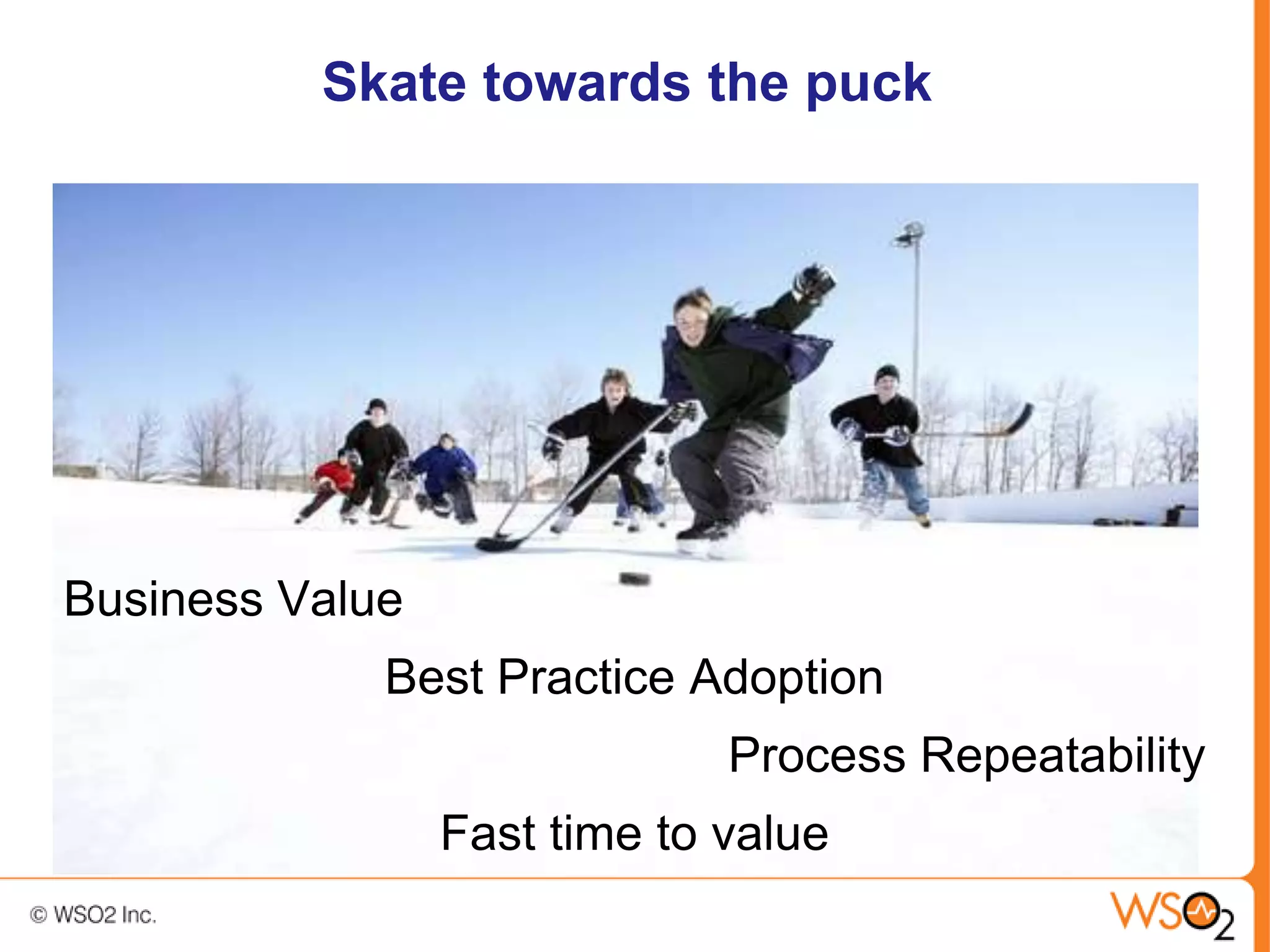
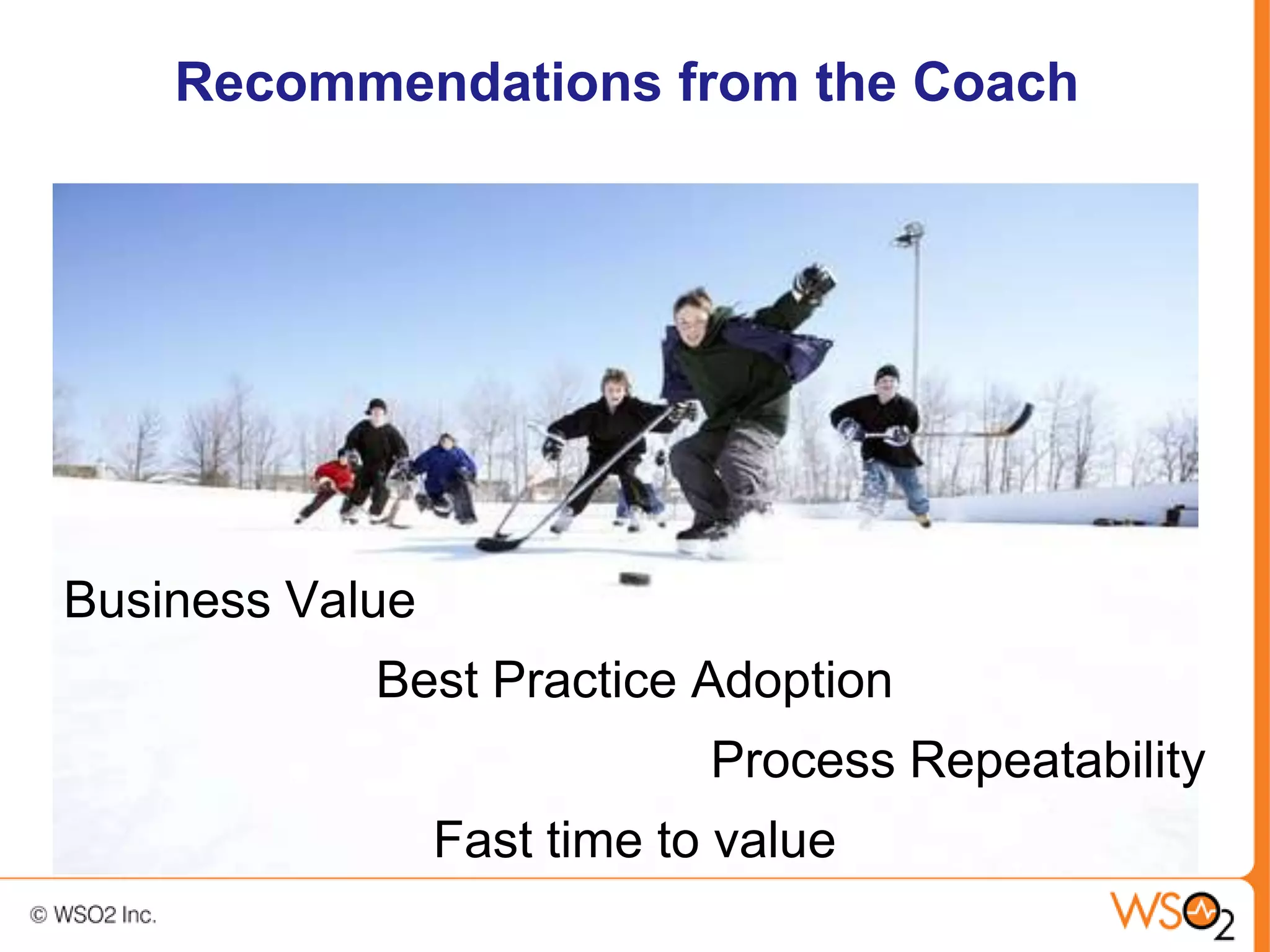
Skate towards the puck


Business Value
             Best Practice Adoption
                              Process Repeatability
                 Fast time to value
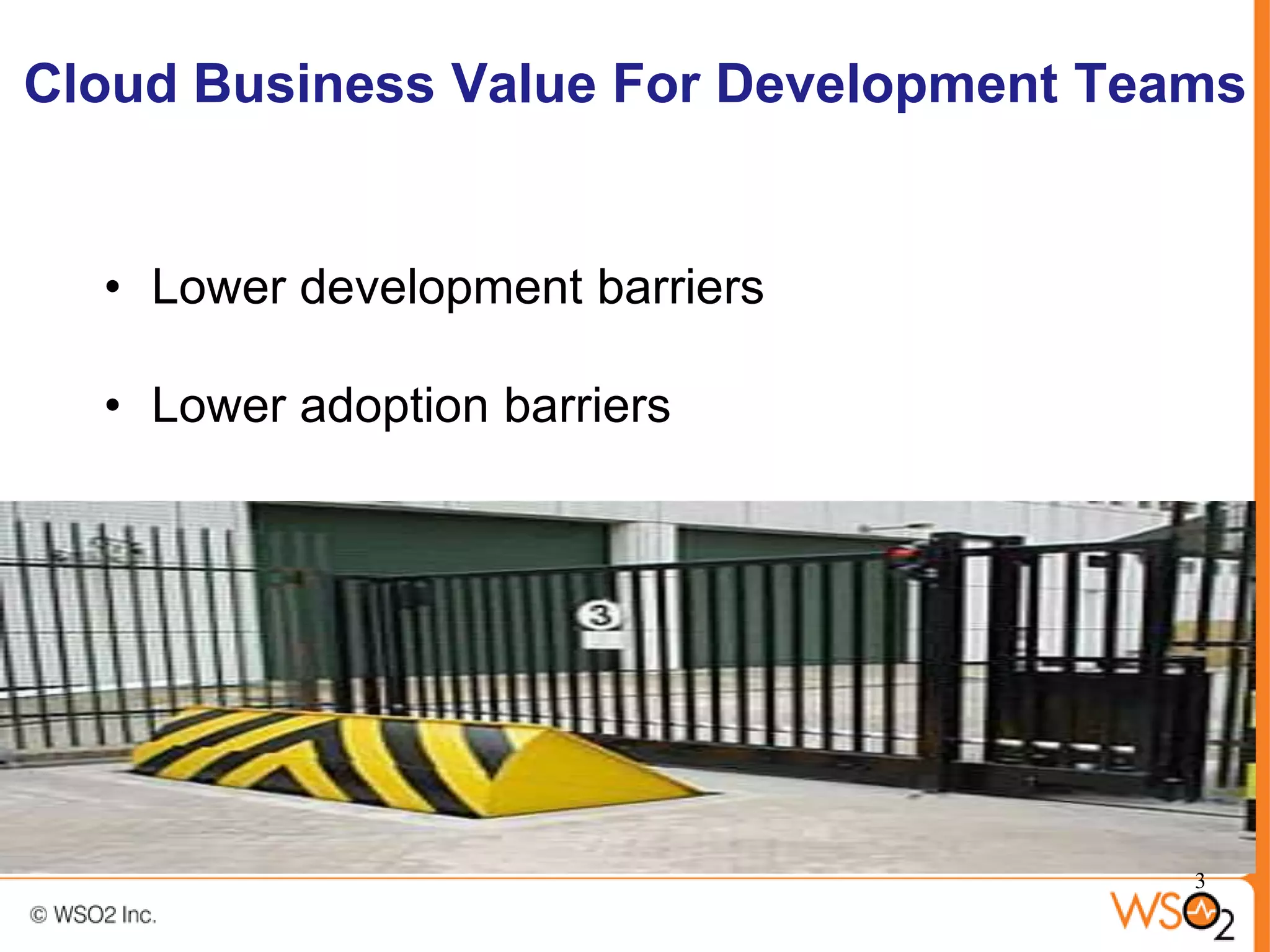
Cloud Business Value For Development Teams


  • Lower development barriers

  • Lower adoption barriers


                                        3
Best Practice Adoption and
          Process Repeatability

• Cost-effective, development, collaboration, and
  deployment infrastructure enabling a long tail of
  application development


• A shared environment for cross-organization
  application development and delivery


• Infrastructure enabling user experience composition
  across multiple disparate application providers
Fast Time to Value – Increase Agility

• Rapidly adapt and fulfill new market demand

• Reduce time to introduce new services,

  applications, and products into long tail market(s)
Enterprise Architecture
            Business Model Challenges

• Unable to cost-effectively support long tail of
  application delivery
• Lack of metrics and baseline measurements
• Limited ability to influence adoption
• High friction and interaction cost when building
  cross-team business processes
• Inability to capitalize on business opportunities
  due to long IT solution lead times
12/9/2012                                             6
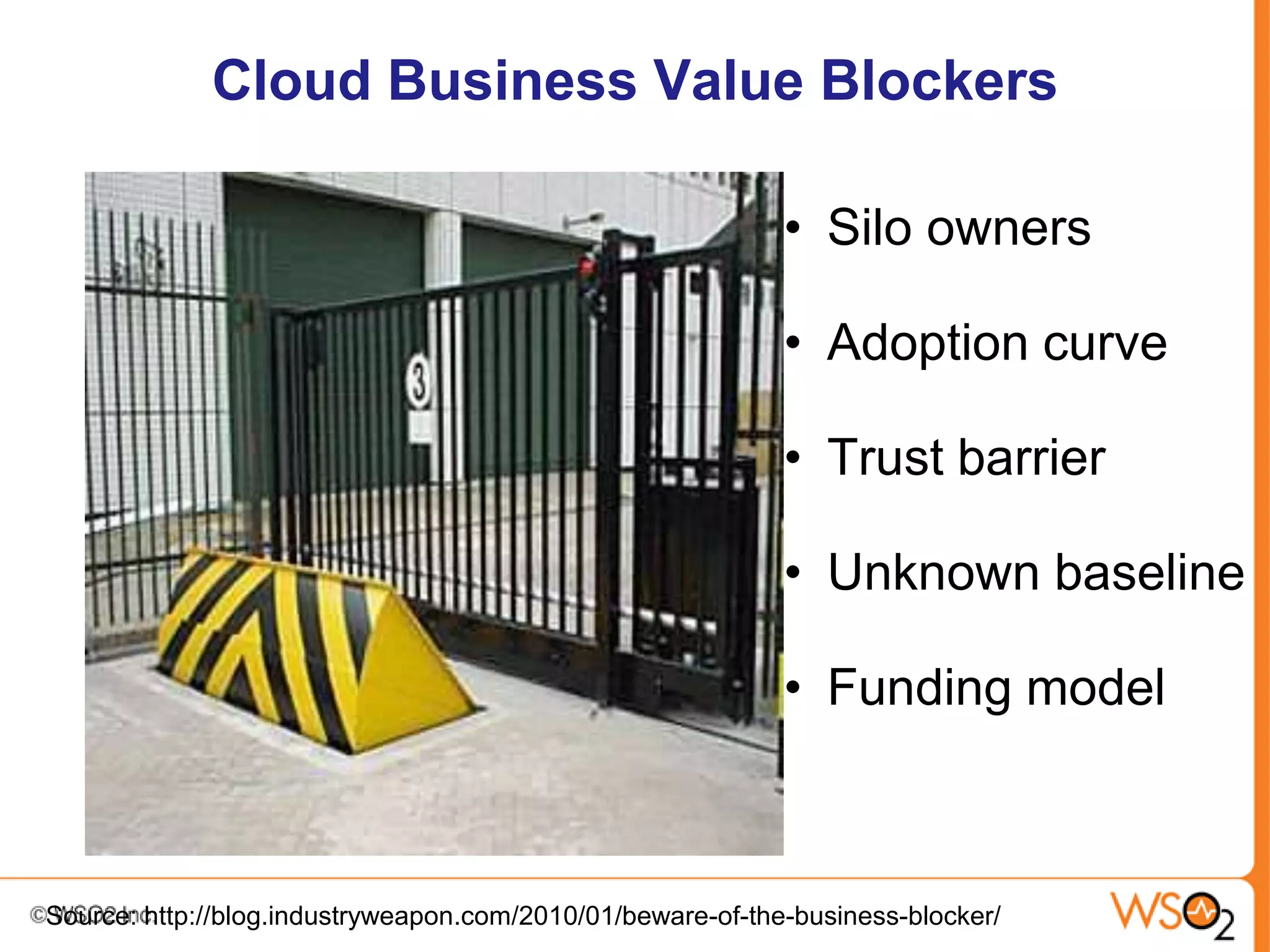
Cloud Business Value Blockers

                                                            • Silo owners

                                                            • Adoption curve

                                                            • Trust barrier

                                                            • Unknown baseline

                                                            • Funding model


Source: http://blog.industryweapon.com/2010/01/beware-of-the-business-blocker/
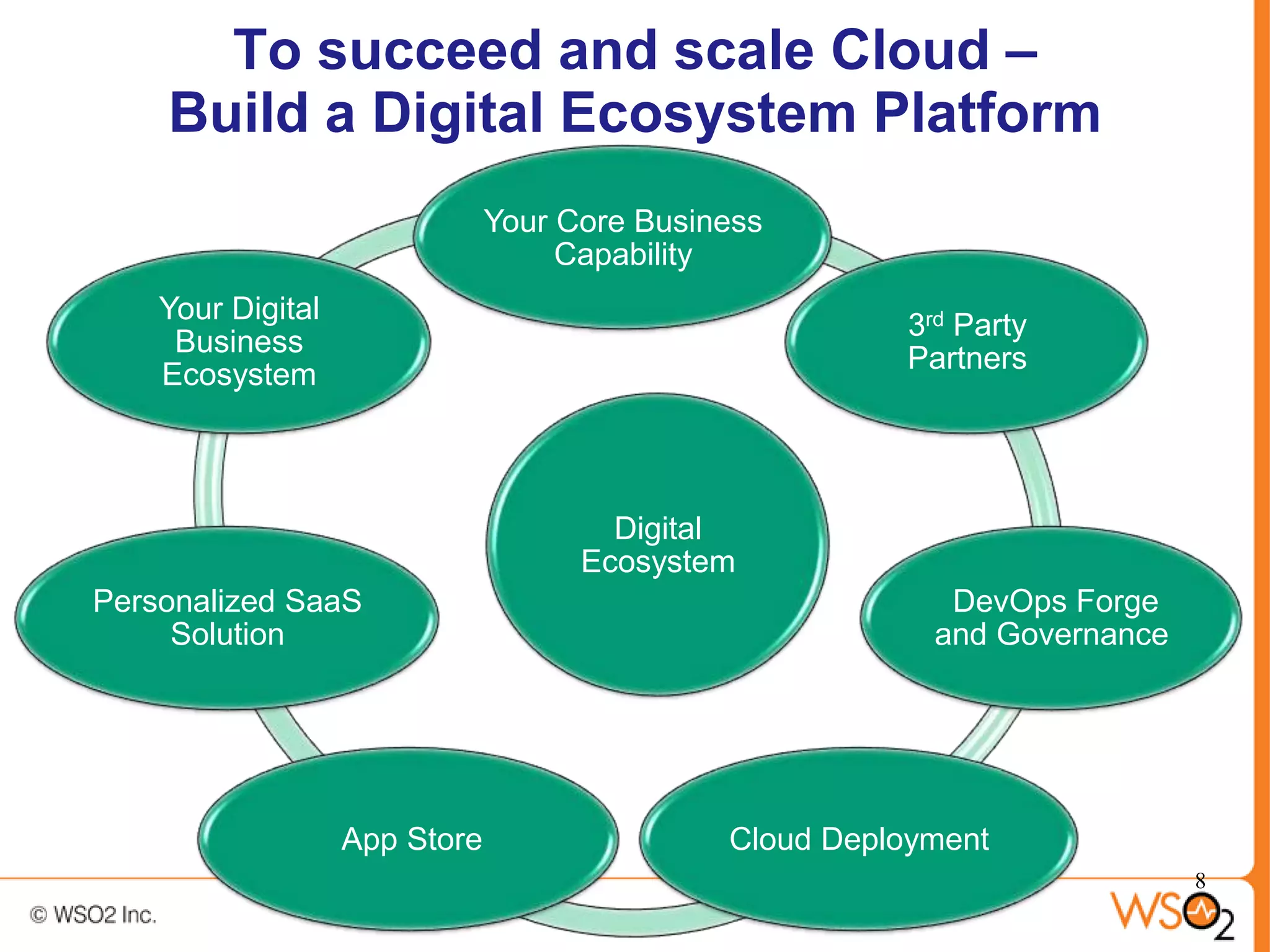
To succeed and scale Cloud –
    Build a Digital Ecosystem Platform
                               Your Core Business
                                    Capability
    Your Digital
                                                        3rd Party
     Business
                                                        Partners
    Ecosystem


                                       Digital
                                     Ecosystem
Personalized SaaS                                          DevOps Forge
     Solution                                             and Governance


                   App Store                  Cloud Deployment
                                                                           8
New Enterprise Architecture Approach

• Self-organization
     • Crowdsourcing – source apps and capabilities from
       crowd
     • Dynamic distribution channels and fluid connections
• Adaptation and evolution
     • Local autonomy leading to unforeseen ecosystem partner
       extensions
     • Spontaneous selection and aggregation across services
       and solutions
• Low interaction cost
     • Frictionless information flow
     • Enables cost effectively serving a smaller, niche audience
12/9/2012                                                       9
Recommendations from the Coach


Business Value
            Best Practice Adoption
                             Process Repeatability
                 Fast time to value
Cloud Business Value For Development Teams
  • Lower development barriers
     • Provide on-demand Application Development project
       infrastructure and run-time environments
     • Catalogue of re-usable open APIs, cloud services,
       and domain frameworks

  • Lower adoption barriers
  • On-demand web application and Cloud API
    subscriptions via a self-service provisioning portal
     • Establish searchable registry of app, service, api, and
       data descriptors
     • Reliable, available, and scalable solutions


                                                            11
Best Practice Adoption and
          Process Repeatability
• Cost-effective, development, collaboration, and
  deployment infrastructure enabling a long tail of
  application development
   • Architecture templates and application platform services
• A shared environment for cross-organization
  application development and delivery
   • Governed, iterative lifecycle management across hybrid
     clouds and composite applications
   • IT Business performance metrics and analytics
• Infrastructure enabling user experience composition
  across multiple disparate application providers
Fast Time to Value with
  On-demand Contextual Personalization
• Increase agility
  • Rapidly adapt and fulfill new market demand
  • Reduce time to introduce new services, applications,
    and products into long tail market(s)
• On-demand Contextual Personalization
  •   Information access and social network access privileges
  •   Information aggregation and composition
  •   Business processes and rules
  •   Service levels, Quality of Service, and monetization rates
  •   Security policies
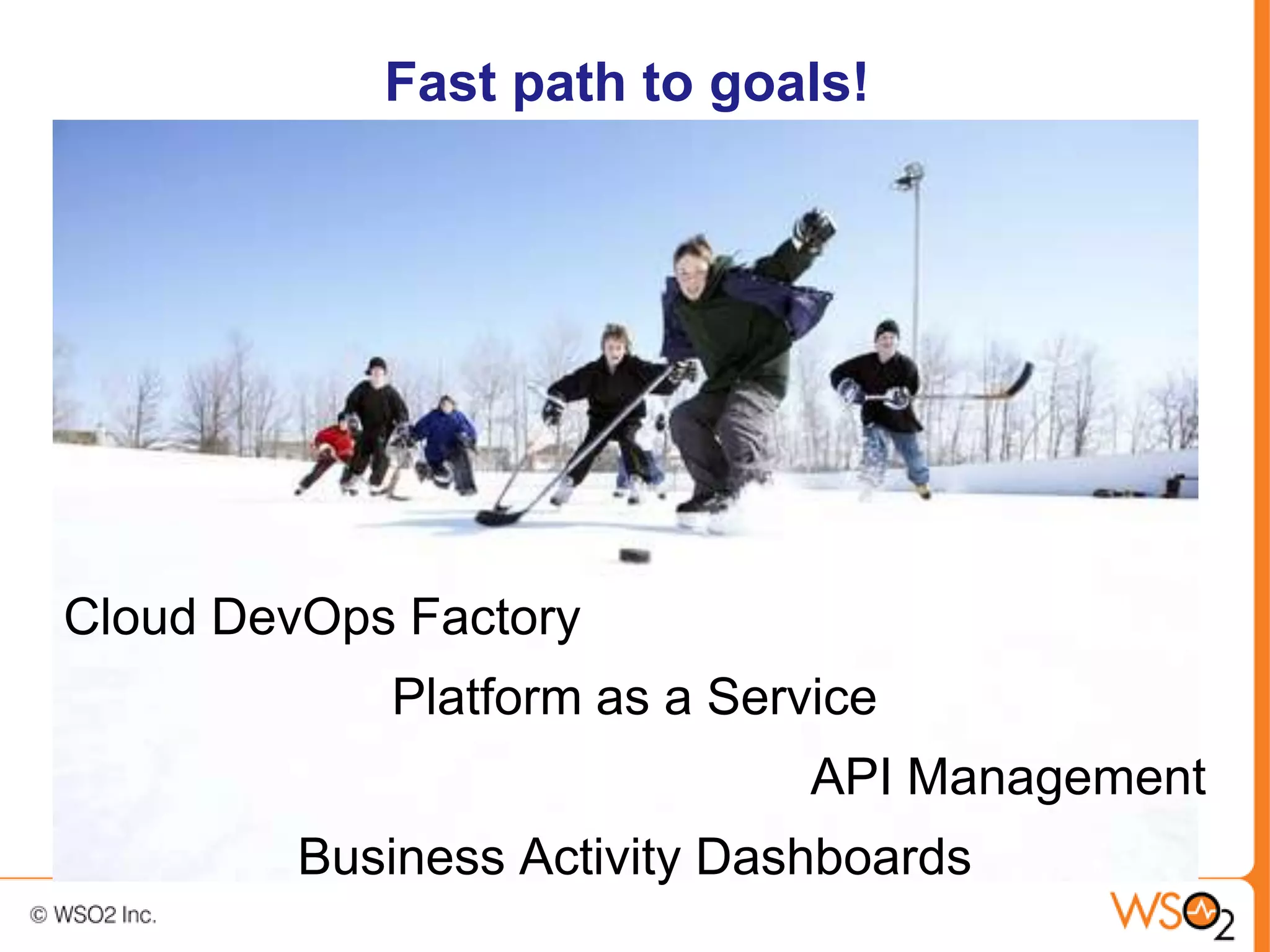
Fast path to goals!


Cloud DevOps Factory
            Platform as a Service
                              API Management
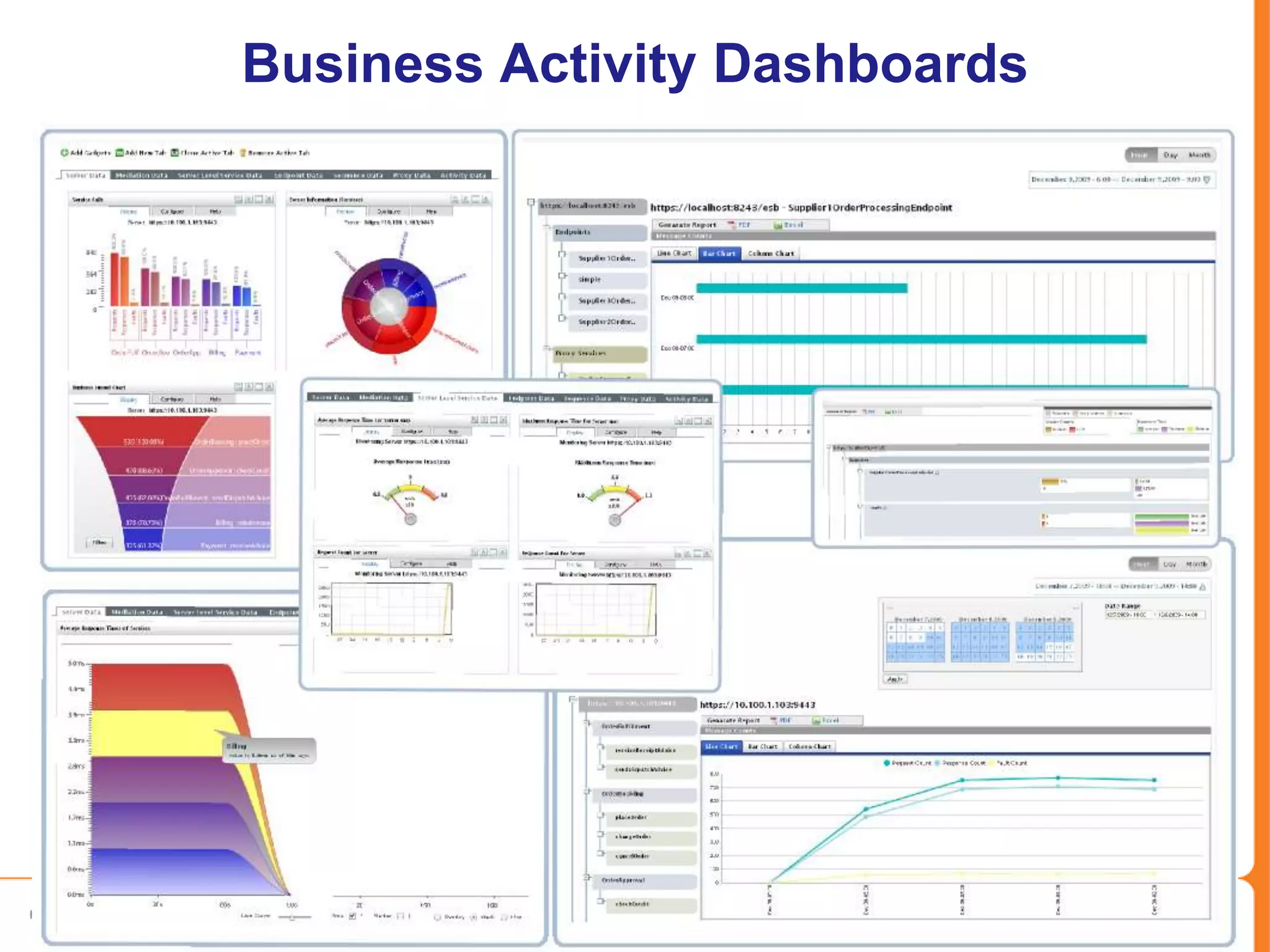
         Business Activity Dashboards
Embrace DevOps Processes


• Self-service configuration
• Automated provisioning
• Continuous build
• Continuous integration
• Continuous delivery
• Automated release management
• Incremental testing
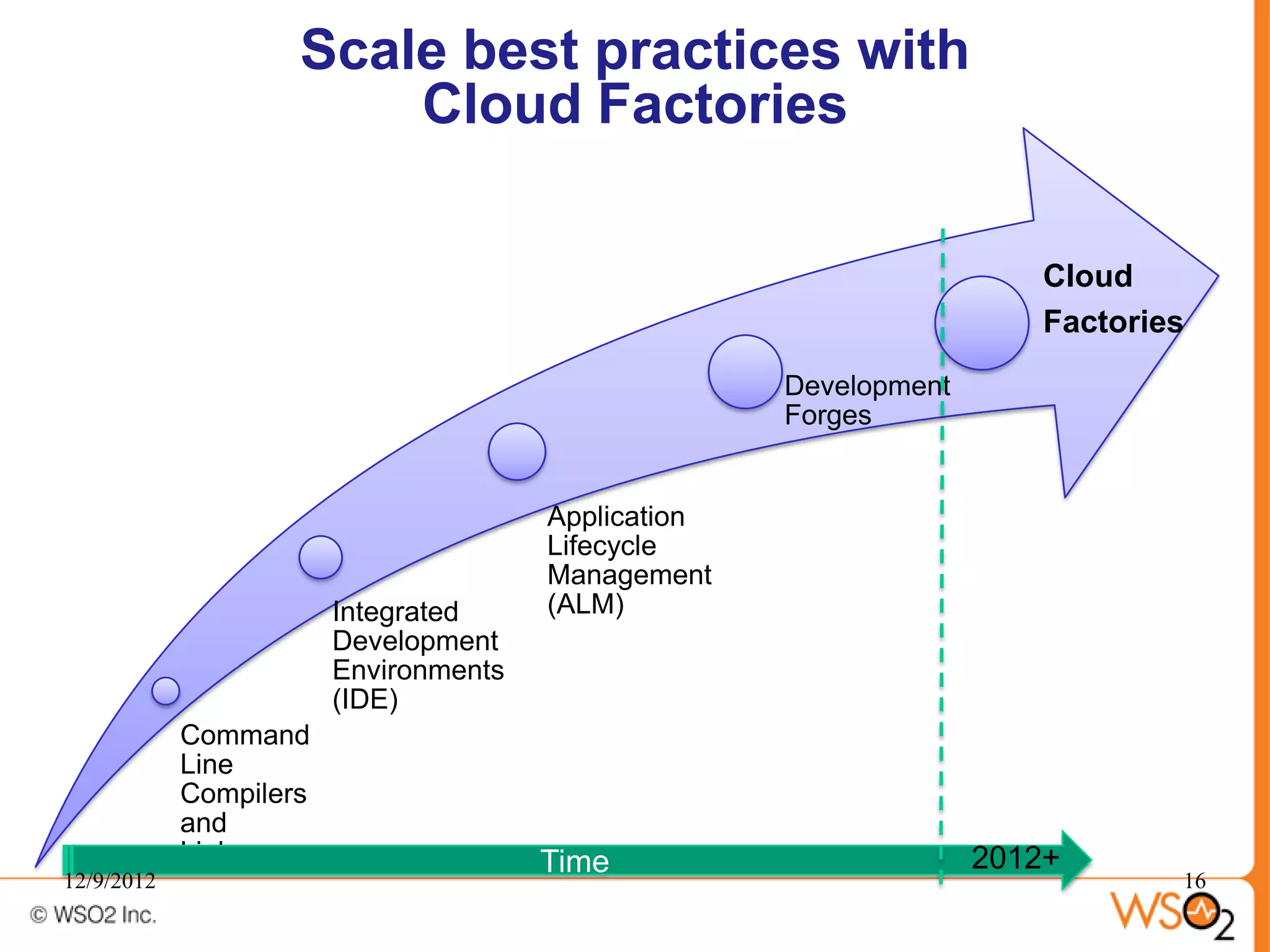
Scale best practices with
                        Cloud Factories

                                                                       Cloud
                                                                       Factories
                                                     Development
                                                     Forges


                                       Application
                                       Lifecycle
                                       Management
                        Integrated     (ALM)
                        Development
                        Environments
                        (IDE)
            Command
            Line
            Compilers
            and
            Linkers                    Time                        2012+
12/9/2012                                                                      16
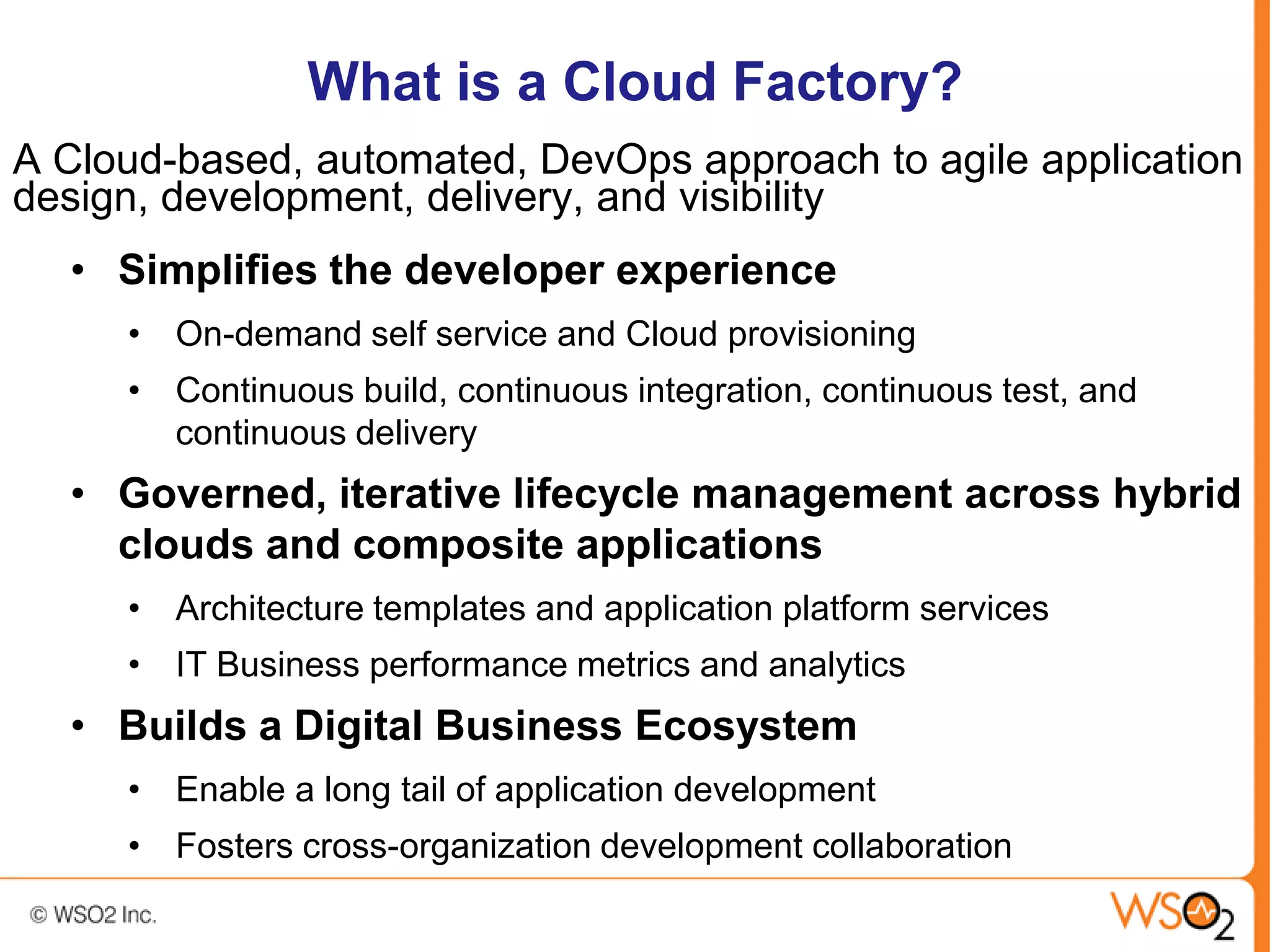
What is a Cloud Factory?
A Cloud-based, automated, DevOps approach to agile application
design, development, delivery, and visibility
  • Simplifies the developer experience
     • On-demand self service and Cloud provisioning
     • Continuous build, continuous integration, continuous test, and
       continuous delivery
  • Governed, iterative lifecycle management across hybrid
    clouds and composite applications
     • Architecture templates and application platform services
     • IT Business performance metrics and analytics
  • Builds a Digital Business Ecosystem
     • Enable a long tail of application development
     • Fosters cross-organization development collaboration
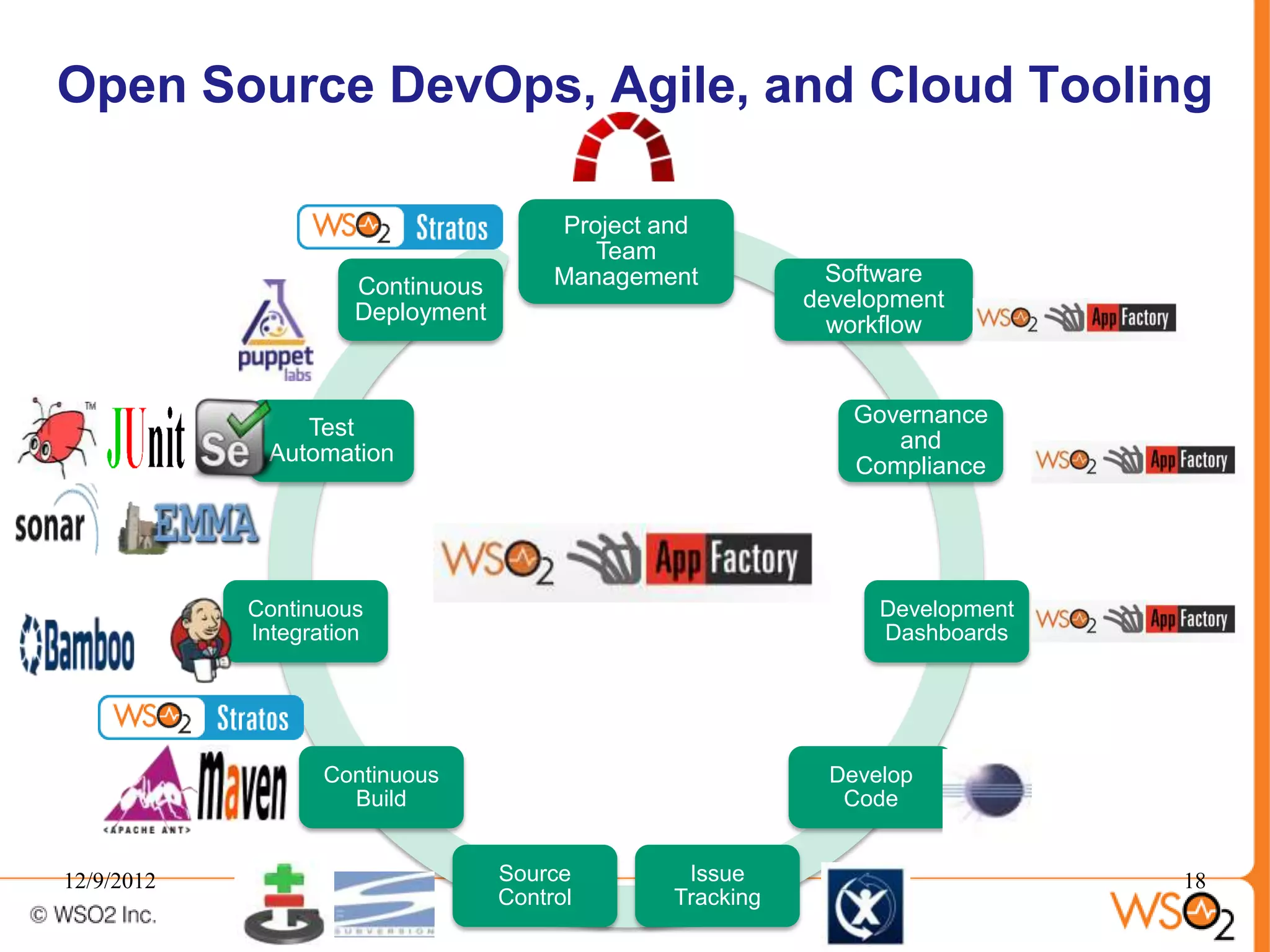
Open Source DevOps, Agile, and Cloud Tooling

                                        Project and
                                           Team
                                        Management            Software
                      Continuous
                                                            development
                      Deployment
                                                              workflow


                                                                Governance
                 Test
                                                                   and
              Automation
                                                                Compliance


            Continuous                                            Development
            Integration                                           Dashboards


                   Continuous                                 Develop
                     Build                                     Code


12/9/2012                          Source         Issue                         18
                                   Control       Tracking
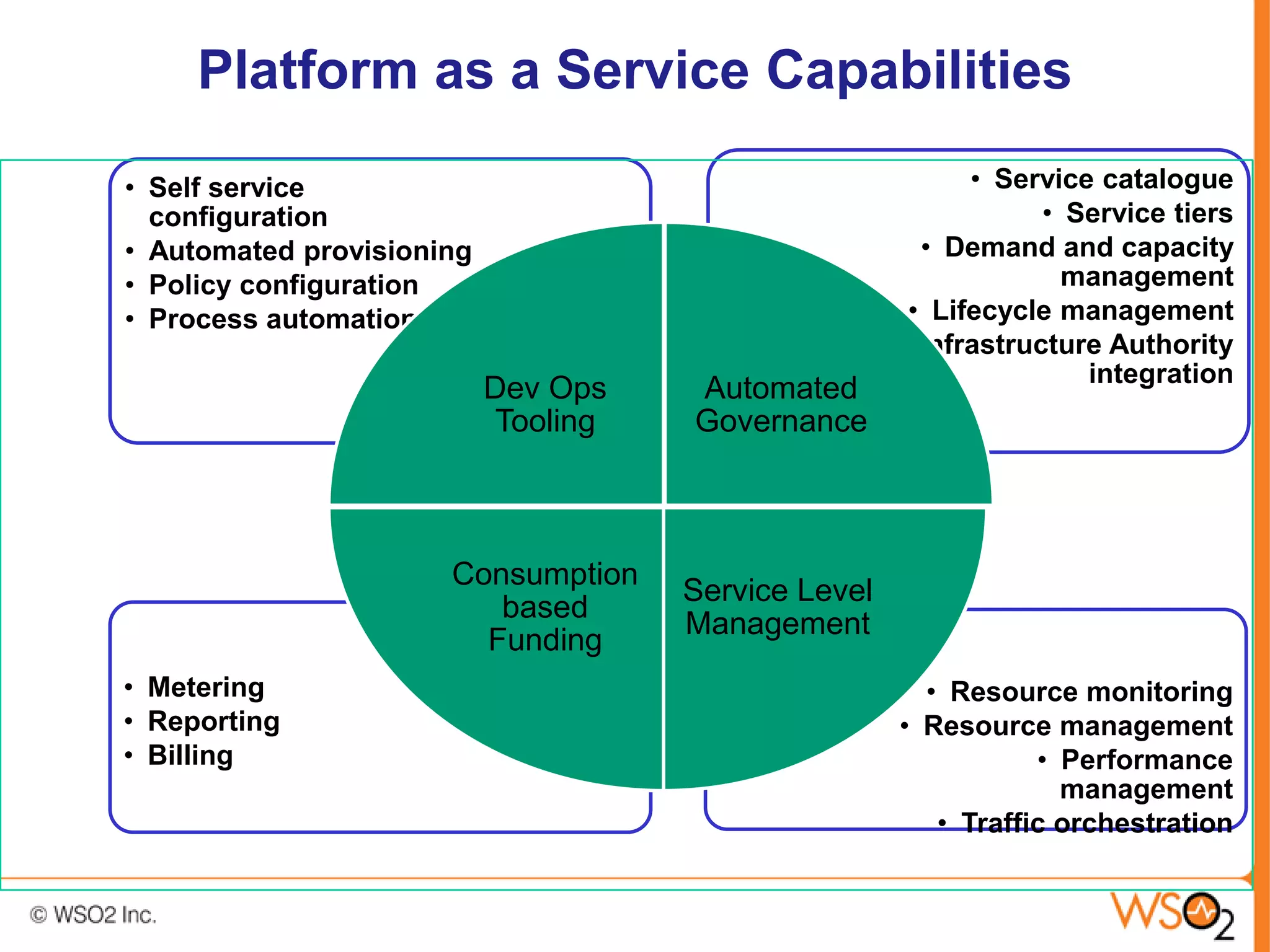
Platform as a Service Capabilities
• Self service                                             • Service catalogue
  configuration                                                  • Service tiers
• Automated provisioning                               • Demand and capacity
• Policy configuration                                             management
• Process automation                                  • Lifecycle management
                                                     • Infrastructure Authority
                                                                    integration
                           Dev Ops   Automated
                           Tooling   Governance


                      Consumption
                                     Service Level
                         based
                                     Management
                        Funding
• Metering                                             • Resource monitoring
• Reporting                                          • Resource management
• Billing                                                       • Performance
                                                                  management
                                                        • Traffic orchestration
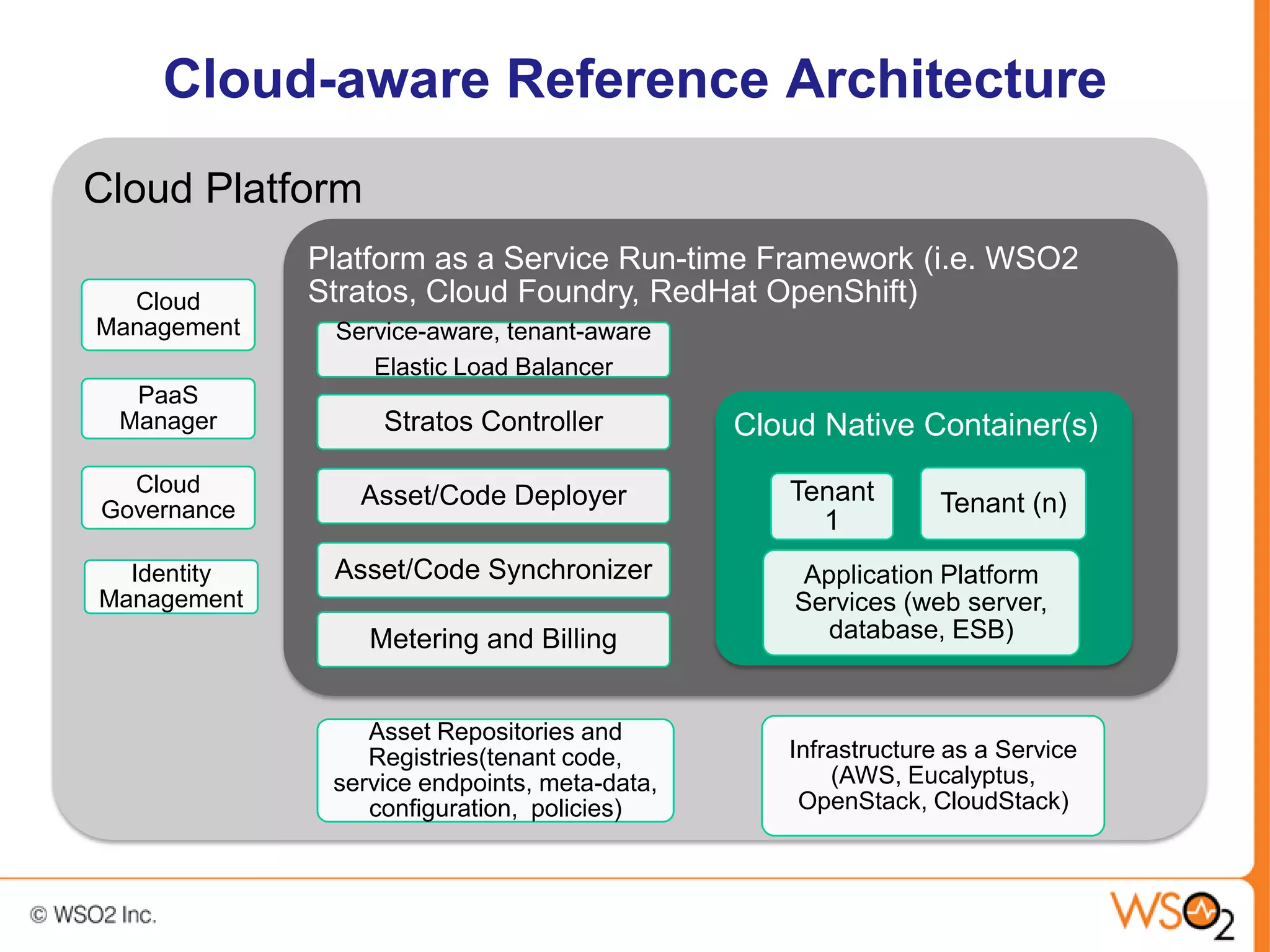
Cloud-aware Reference Architecture
Cloud Platform
             Platform as a Service Run-time Framework (i.e. WSO2
  Cloud      Stratos, Cloud Foundry, RedHat OpenShift)
Management    Service-aware, tenant-aware
                 Elastic Load Balancer
  PaaS
 Manager          Stratos Controller          Cloud Native Container(s)
  Cloud         Asset/Code Deployer              Tenant
Governance                                                     Tenant (n)
                                                   1
  Identity    Asset/Code Synchronizer              Application Platform
Management                                        Services (web server,
                 Metering and Billing                database, ESB)


                 Asset Repositories and
                 Registries(tenant code,         Infrastructure as a Service
              service endpoints, meta-data,          (AWS, Eucalyptus,
                 configuration, policies)         OpenStack, CloudStack)
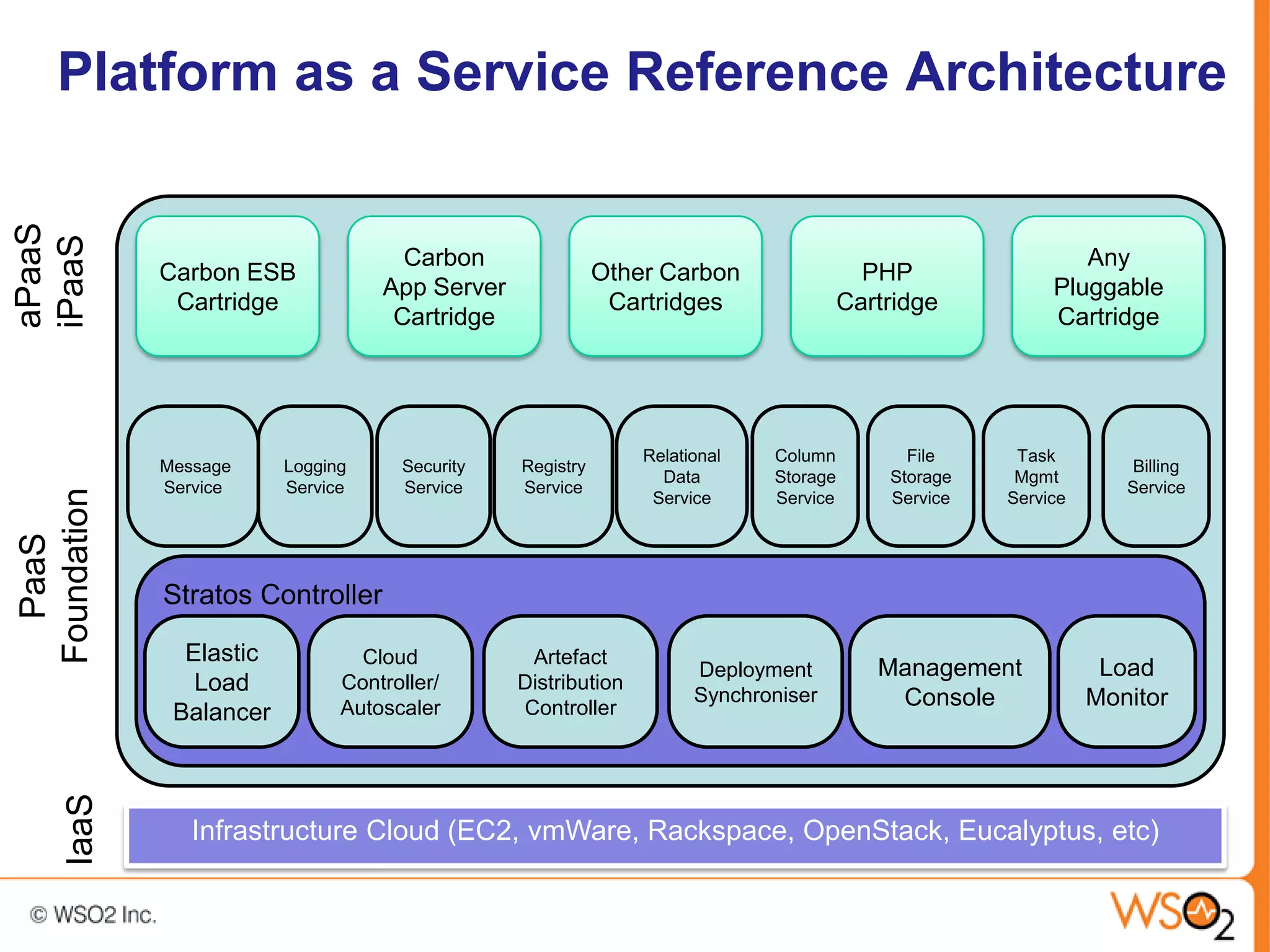
Platform as a Service Reference Architecture
aPaaS
iPaaS


                                     Carbon                                                                 Any
             Carbon ESB                                    Other Carbon                 PHP
                                   App Server                                                            Pluggable
              Cartridge                                     Cartridges                Cartridge
                                    Cartridge                                                            Cartridge


                                                               Relational   Column          File     Task
             Message     Logging     Security   Registry                                                          Billing
                                                                 Data       Storage       Storage    Mgmt
             Service     Service     Service    Service                                                          Service
Foundation


                                                                Service     Service       Service   Service
  PaaS


             Stratos Controller

               Elastic           Cloud           Artefact
                                                                     Deployment          Management            Load
                Load           Controller/      Distribution
                                                                     Synchroniser
                               Autoscaler       Controller                                Console             Monitor
              Balancer
      IaaS


                Infrastructure Cloud (EC2, vmWare, Rackspace, OpenStack, Eucalyptus, etc)
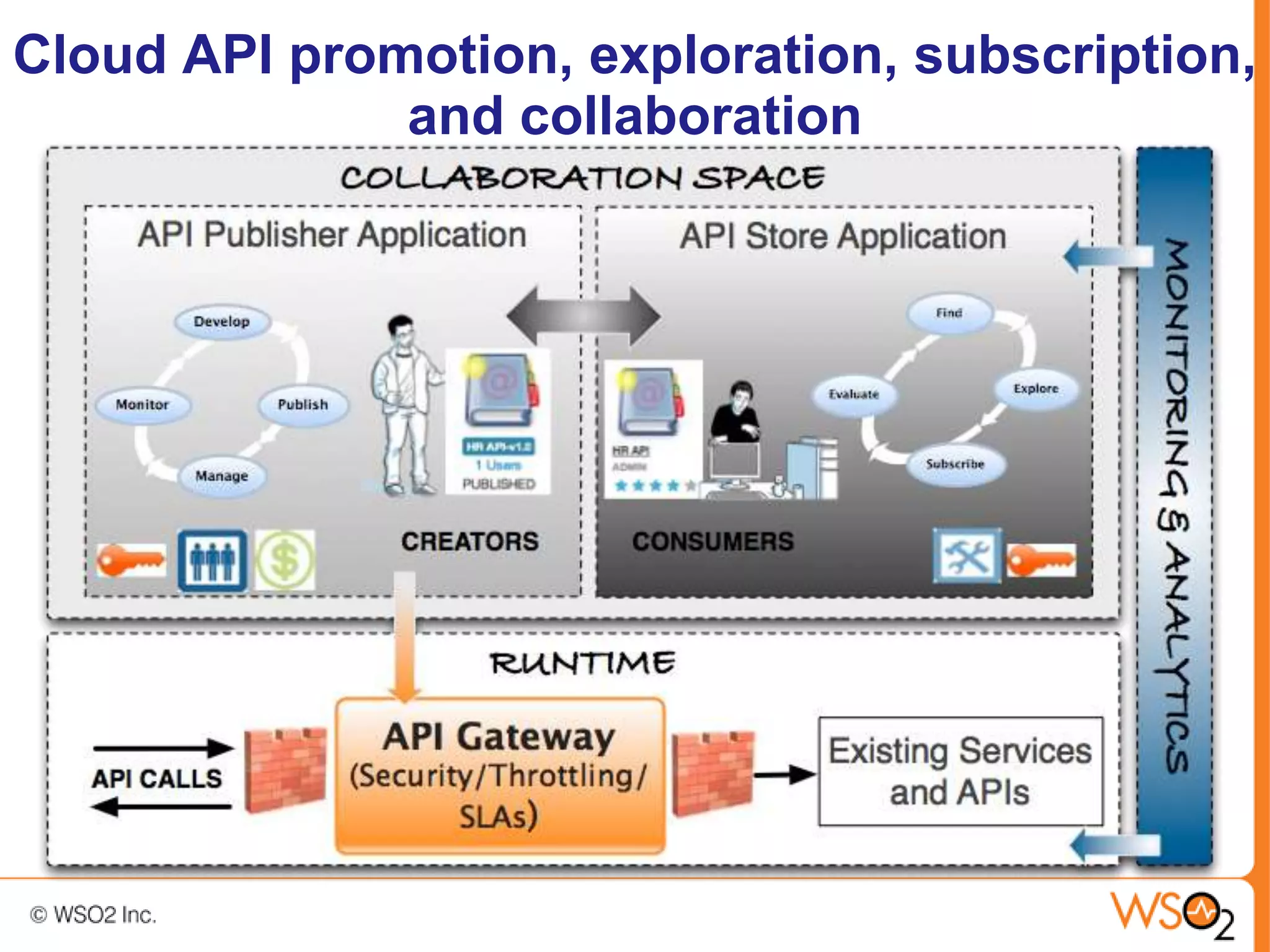
Cloud API promotion, exploration, subscription,
              and collaboration
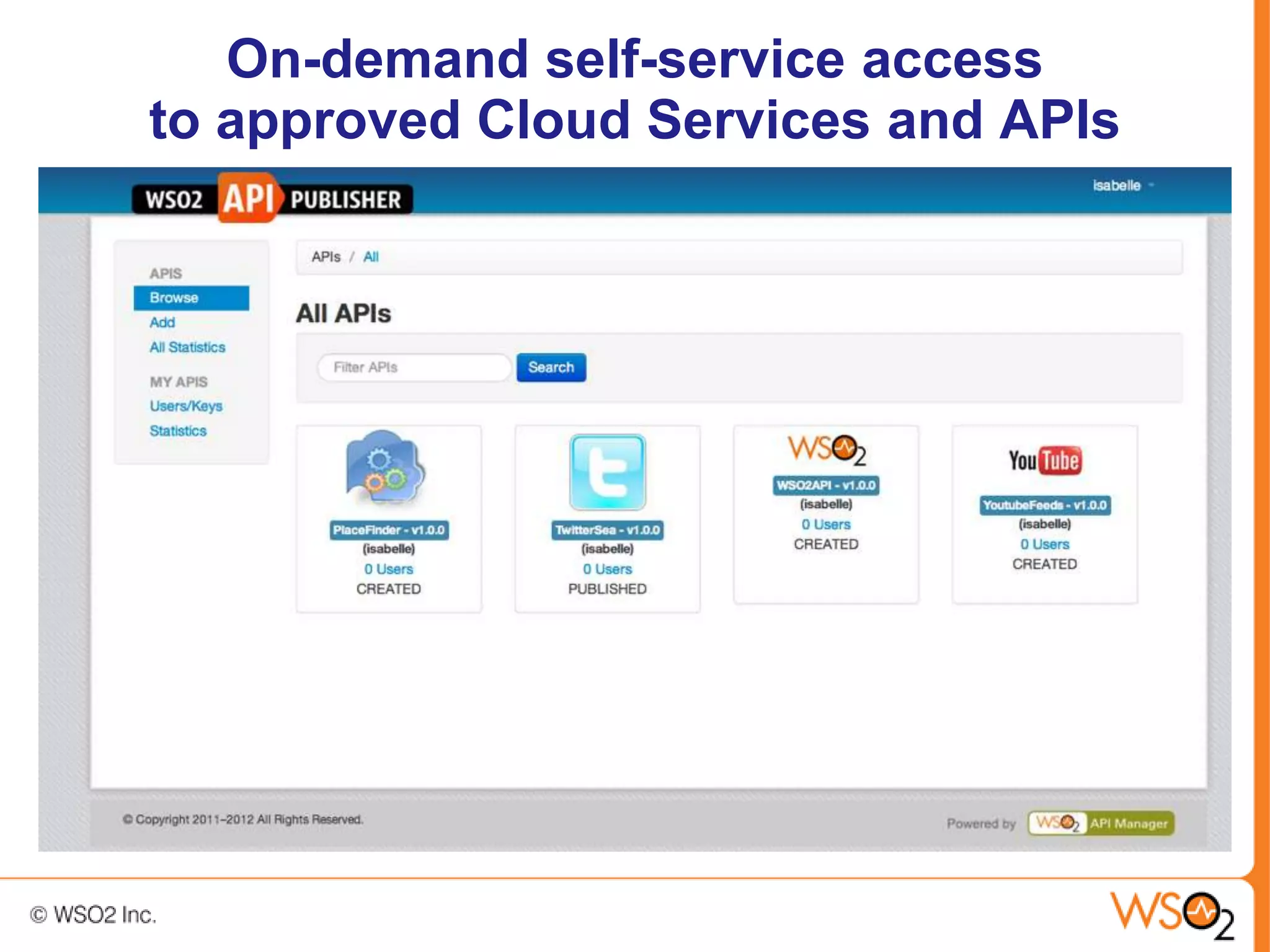
On-demand self-service access
to approved Cloud Services and APIs
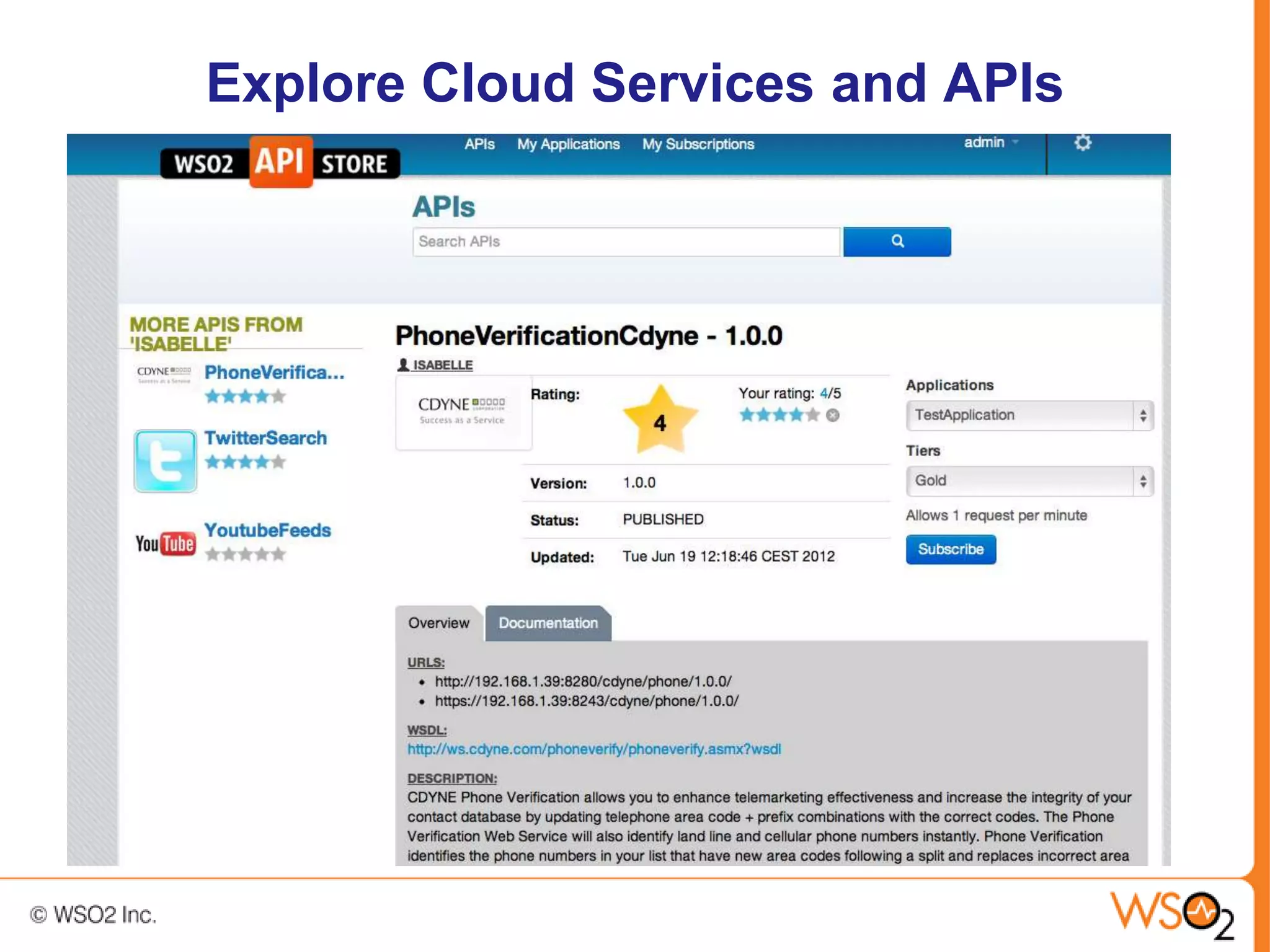
Explore Cloud Services and APIs
Business Activity Dashboards


TODO
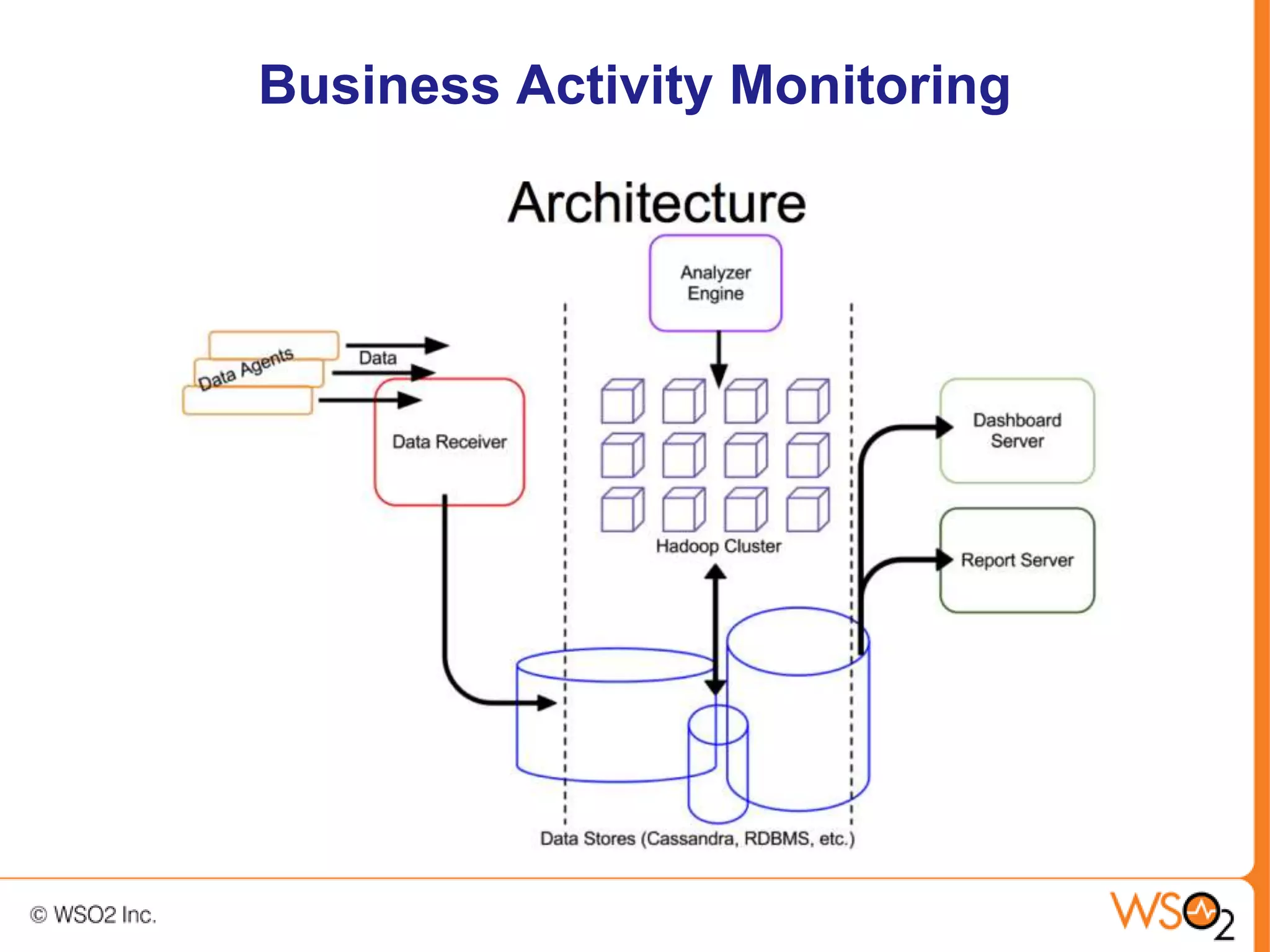
Business Activity Monitoring
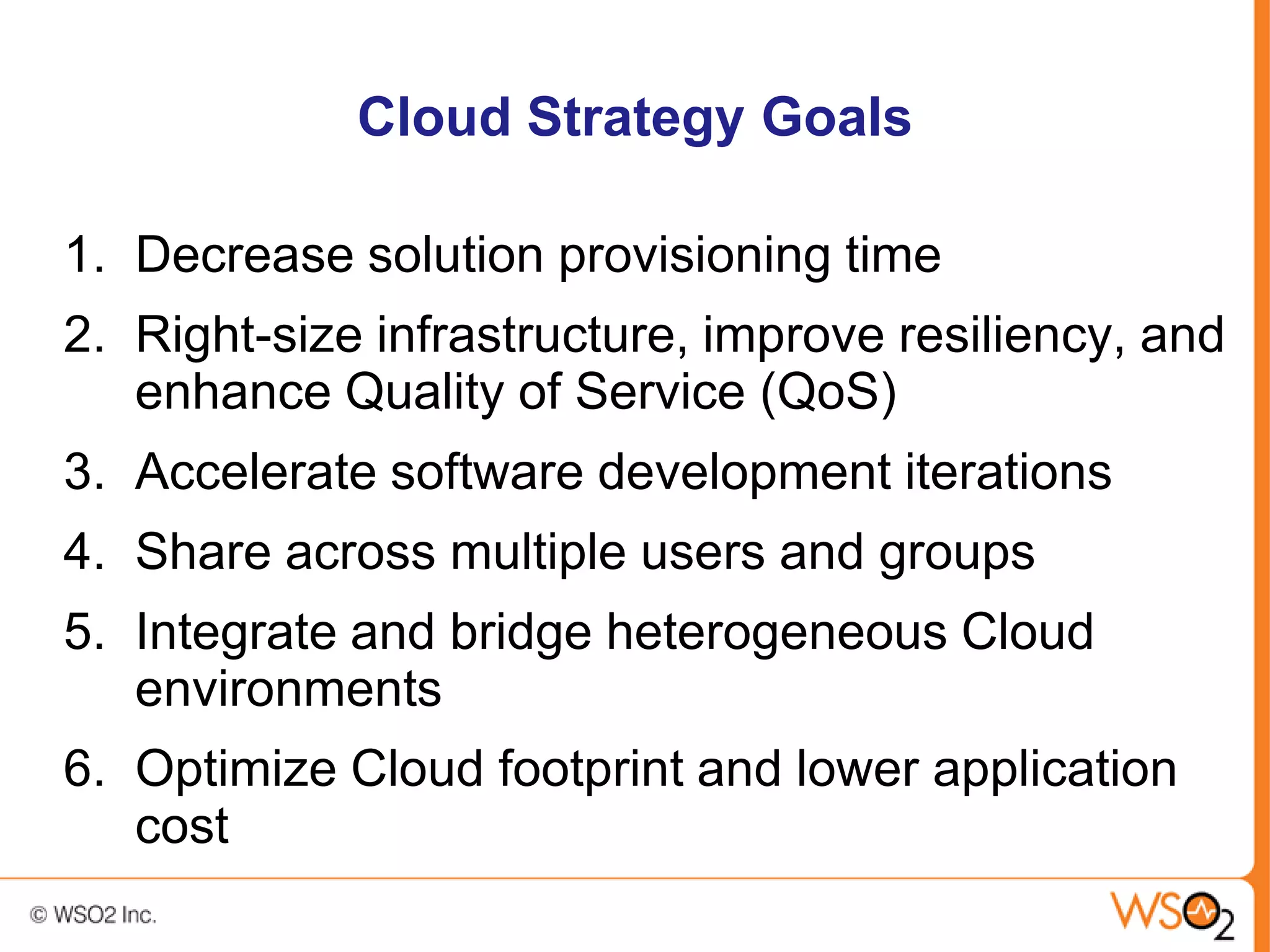
Cloud Strategy Goals

1. Decrease solution provisioning time
2. Right-size infrastructure, improve resiliency, and
   enhance Quality of Service (QoS)
3. Accelerate software development iterations
4. Share across multiple users and groups
5. Integrate and bridge heterogeneous Cloud
   environments
6. Optimize Cloud footprint and lower application
   cost
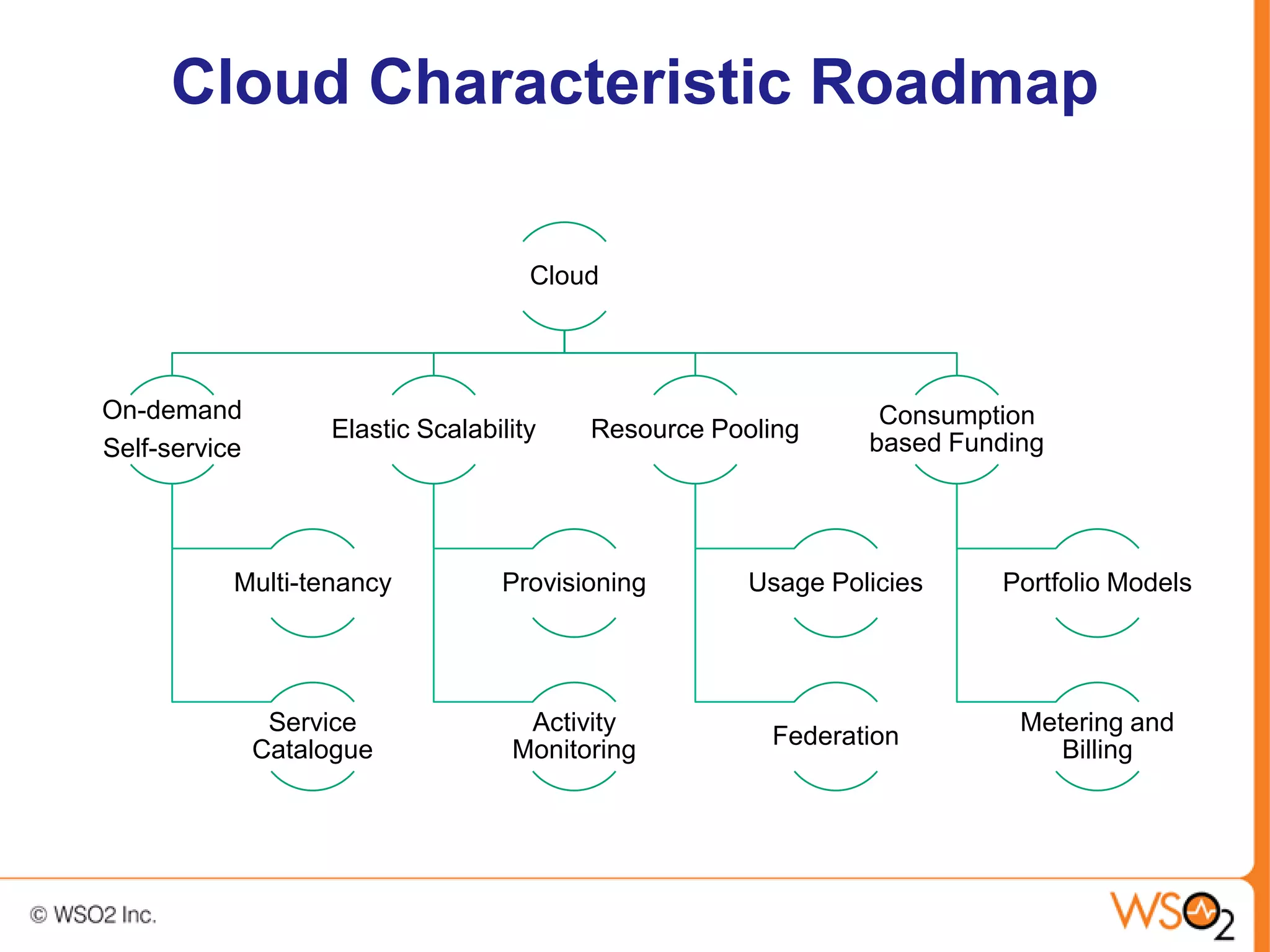
Cloud Characteristic Roadmap

                                      Cloud


On-demand                                                       Consumption
                    Elastic Scalability   Resource Pooling
Self-service                                                   based Funding


           Multi-tenancy           Provisioning       Usage Policies    Portfolio Models


                Service              Activity                             Metering and
                                                       Federation
               Catalogue            Monitoring                               Billing
7 +/- 2 Objectives

   1.   Engage stakeholders in a collaborative
        development workspace
   2.   Promote best practice workflow,
        architecture, and governance practices
   3.   Deploy applications into a Cloud run-
        time environment
   4.   On-demand application subscriptions
        via a self-service provisioning portal
   5.   Share applications across multiple
        tenants (e.g. departments,
        workgroups, employees, partners)
   6.   Scale run-time to meet usage
   7.   Deploy Open APIs
   8.   Encourage API adoption via API Store
   9.   Track business activity and analyze
        Cloud service usage, performance,
        and cost
                                           29
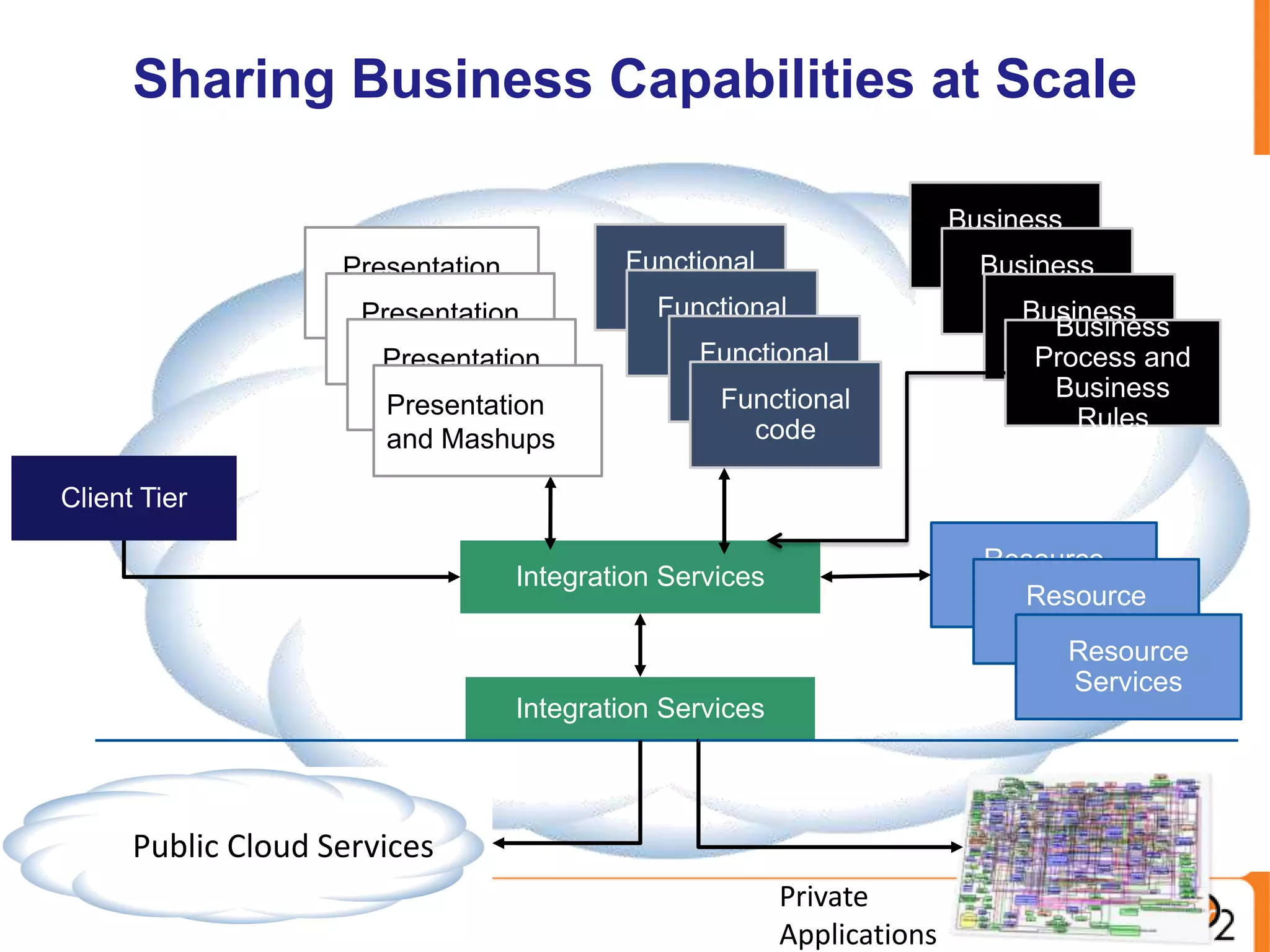
Sharing Business Capabilities at Scale

                                                                       Business
                                         Functional                     Proces
                    Presentation                                         Business
                    and Mashups            Role                           Process
                      Presentation         Functional                       Business
                                              Role                             Business
                          Role                 Functional                    Process
                       Presentation                                          Process and
                       and Mashups               Role                          Business
                        Presentation            Functional
                                                   code                         Rules
                        and Mashups

Client Tier

                                                                         Resource
                                 Integration Services                      Tier
                                                                           Resource
                                                                            Services
                                                                                Resource
                                                                                Services
                                 Integration Services


      Public Cloud Services
                                                        Private
                                                        Applications
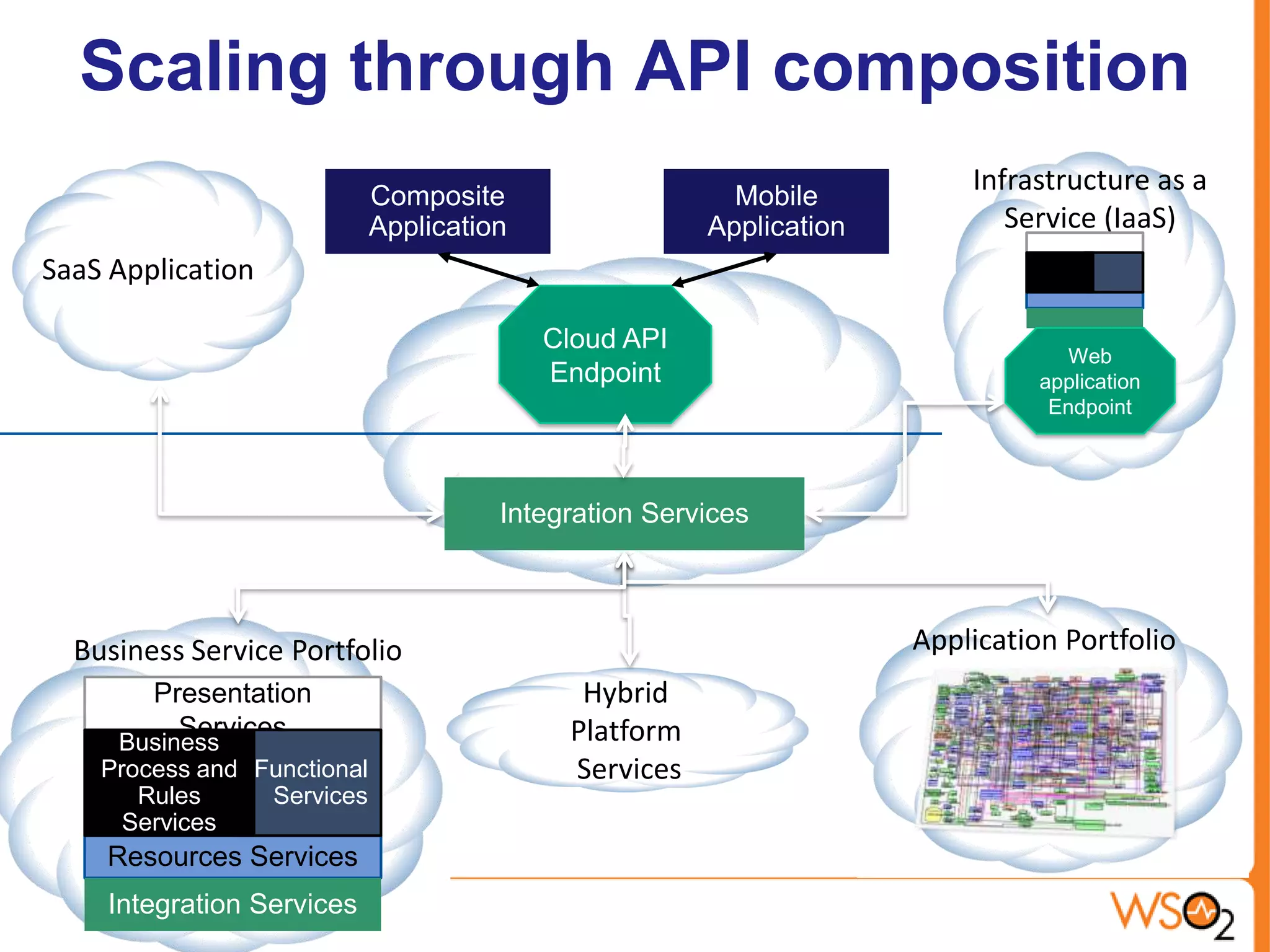
Scaling through API composition
                             Composite                   Mobile
                                                                         Infrastructure as a
                             Application               Application          Service (IaaS)
SaaS Application

                                           Cloud API
                                                                                  Web
                                           Endpoint                            application
                                                                                Endpoint


                                       Integration Services


  Business Service Portfolio                                         Application Portfolio
        Presentation                         Hybrid
          Services                          Platform
     Business
    Process and Functional                  Services
       Rules     Services
      Services
    Resources Services
    Integration Services
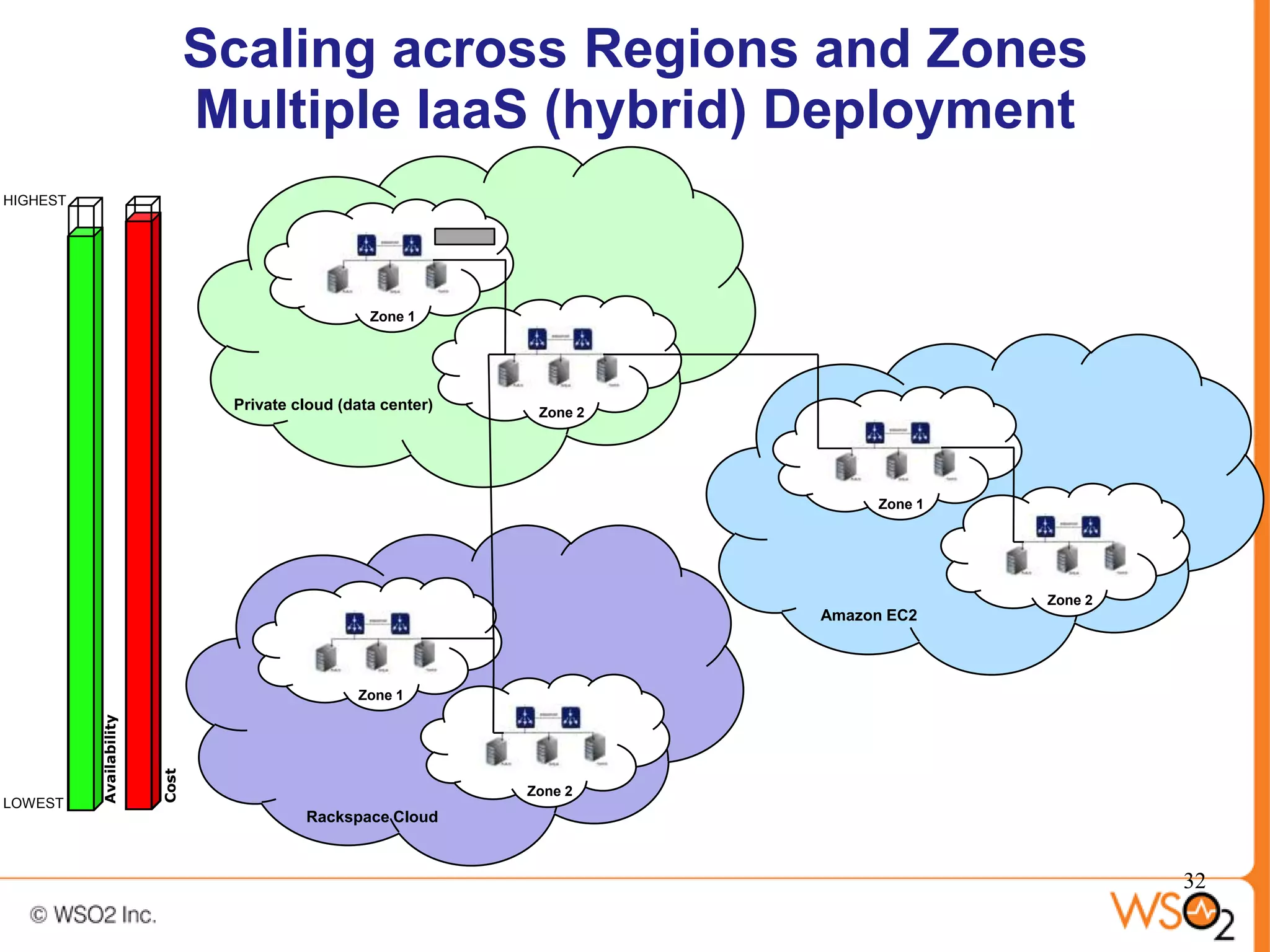
Scaling across Regions and Zones
                                Multiple IaaS (hybrid) Deployment
HIGHEST


                                                   Zone 1


                                 Private cloud (data center)    Zone 2


                                                                               Zone 1


                                                                                        Zone 2
                                                                         Amazon EC2


                                                 Zone 1
          Availability


                         Cost


                                                               Zone 2
LOWEST
                                          Rackspace Cloud


                                                                                                 32
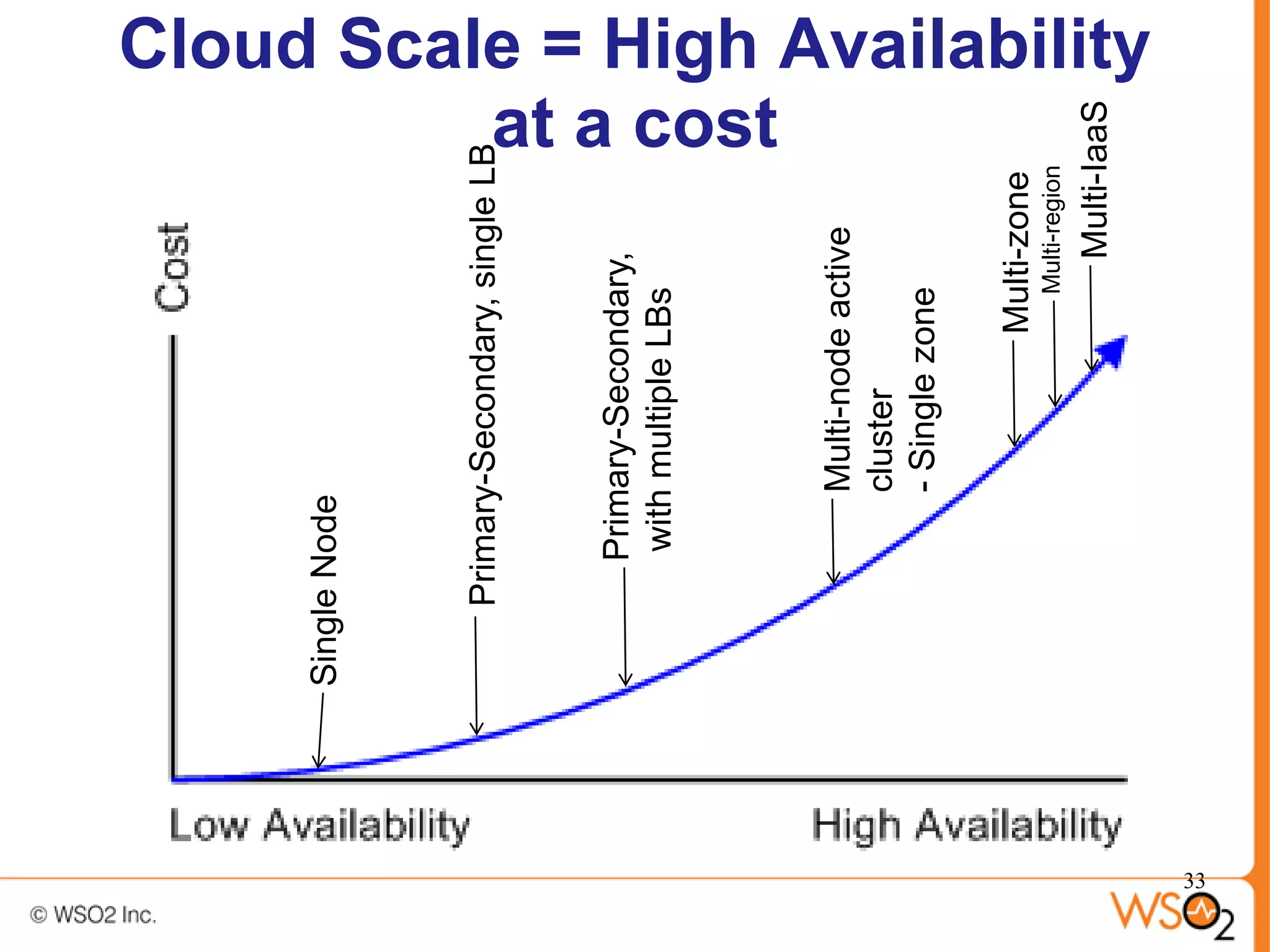
Single Node


         Primary-Secondary, single LB


            Primary-Secondary,
            with multiple LBs
                                                        at a cost


                   Multi-node active
                   cluster
                   - Single zone

                             Multi-zone
                               Multi-region
                                  Multi-IaaS
                                              Cloud Scale = High Availability


33
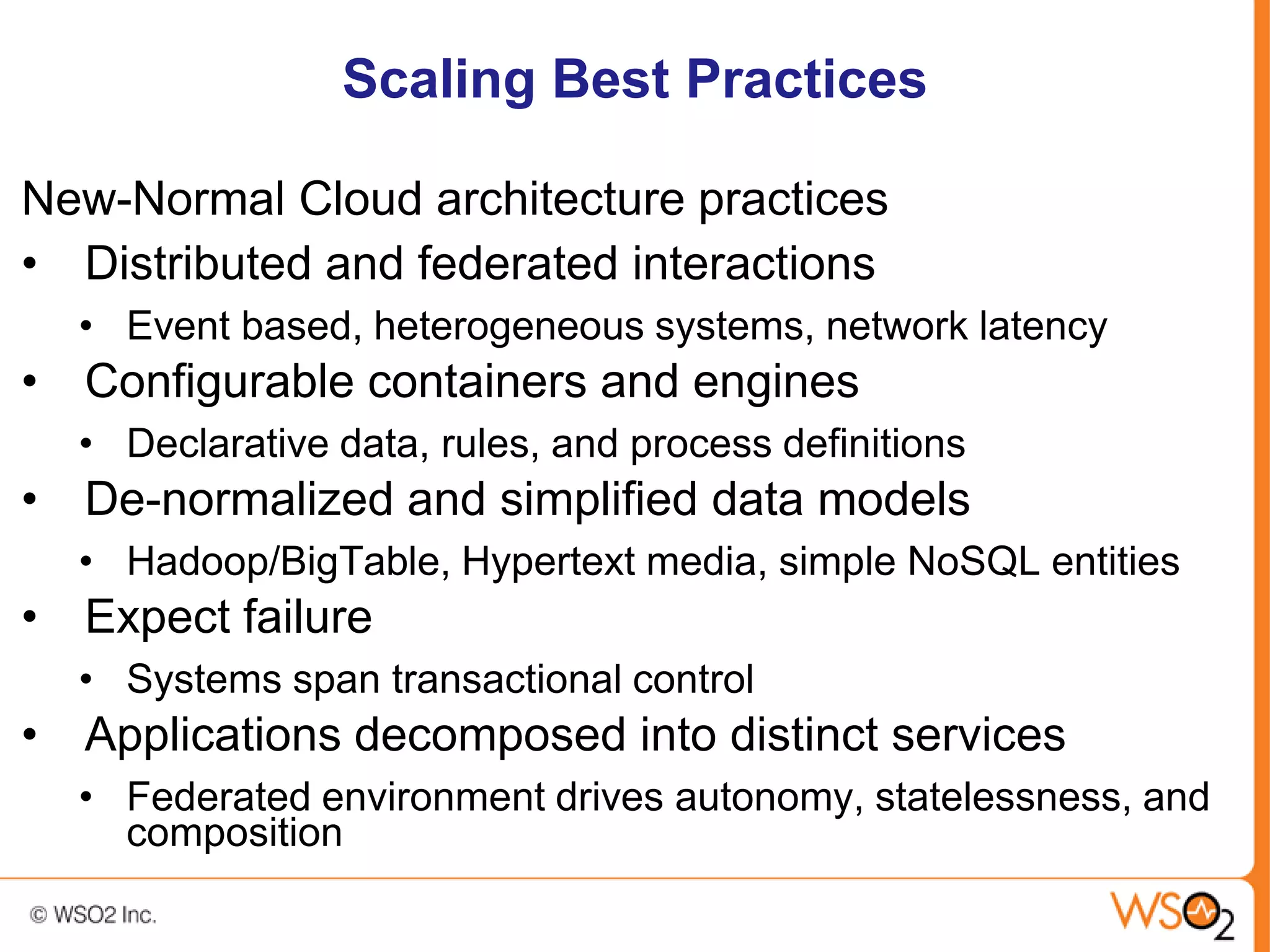
Scaling Best Practices

New-Normal Cloud architecture practices
• Distributed and federated interactions
  • Event based, heterogeneous systems, network latency
• Configurable containers and engines
  • Declarative data, rules, and process definitions
• De-normalized and simplified data models
  • Hadoop/BigTable, Hypertext media, simple NoSQL entities
• Expect failure
  • Systems span transactional control
• Applications decomposed into distinct services
  • Federated environment drives autonomy, statelessness, and
    composition
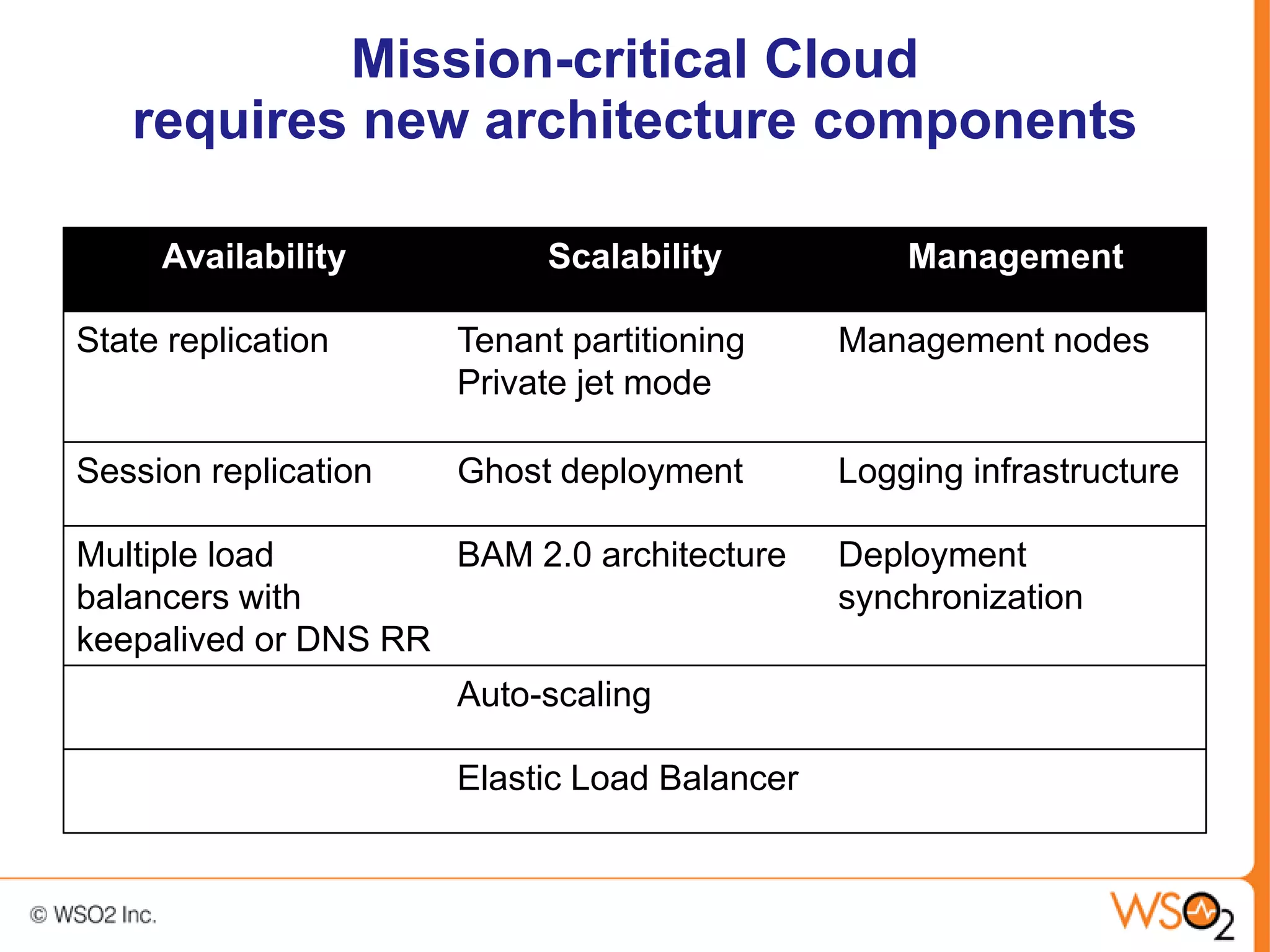
Mission-critical Cloud
   requires new architecture components

     Availability          Scalability            Management

State replication     Tenant partitioning     Management nodes
                      Private jet mode

Session replication   Ghost deployment        Logging infrastructure

Multiple load        BAM 2.0 architecture     Deployment
balancers with                                synchronization
keepalived or DNS RR
                      Auto-scaling

                      Elastic Load Balancer
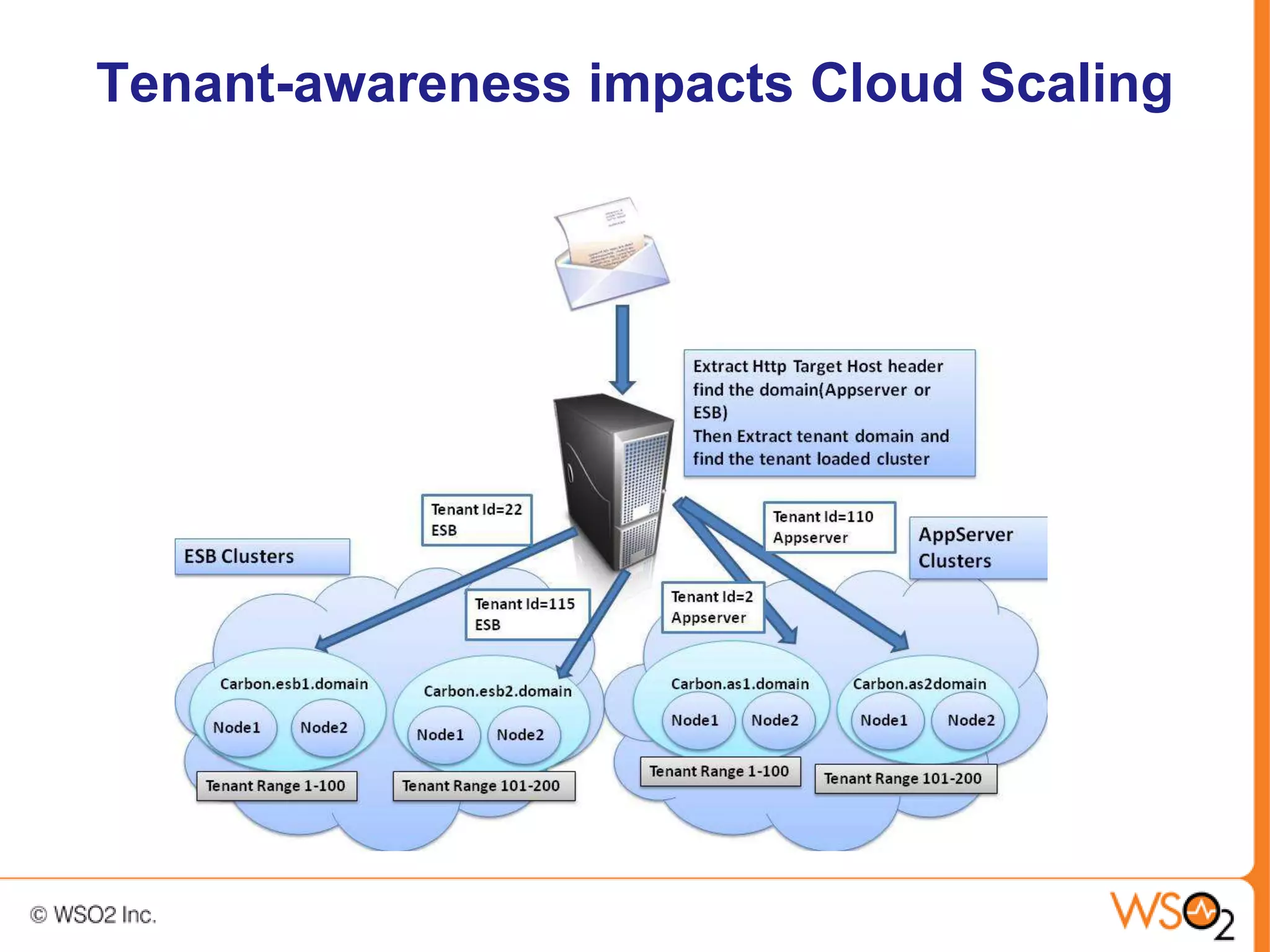
Tenant-awareness impacts Cloud Scaling
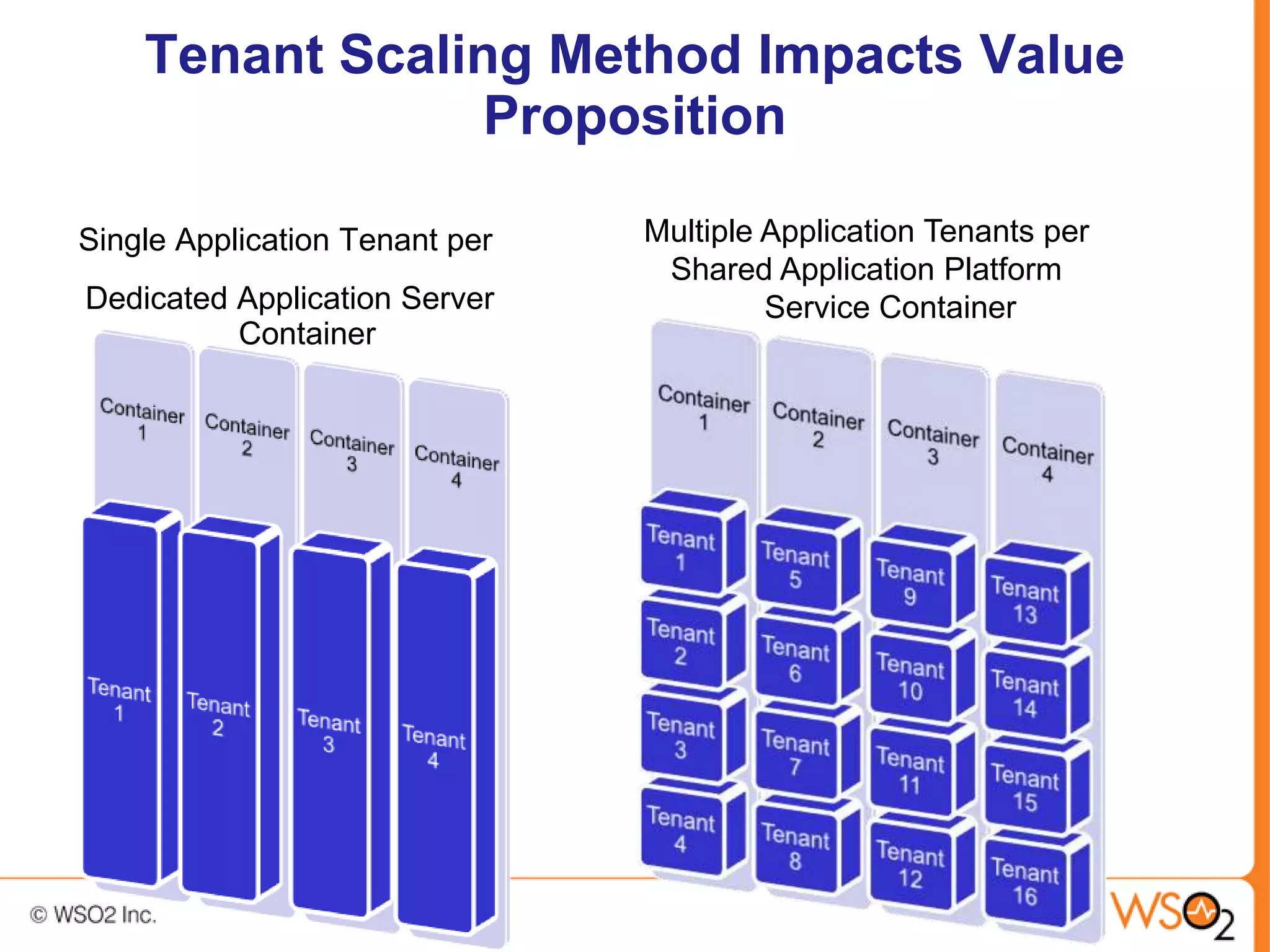
Tenant Scaling Method Impacts Value
                 Proposition

Single Application Tenant per   Multiple Application Tenants per
                                 Shared Application Platform
Dedicated Application Server             Service Container
          Container
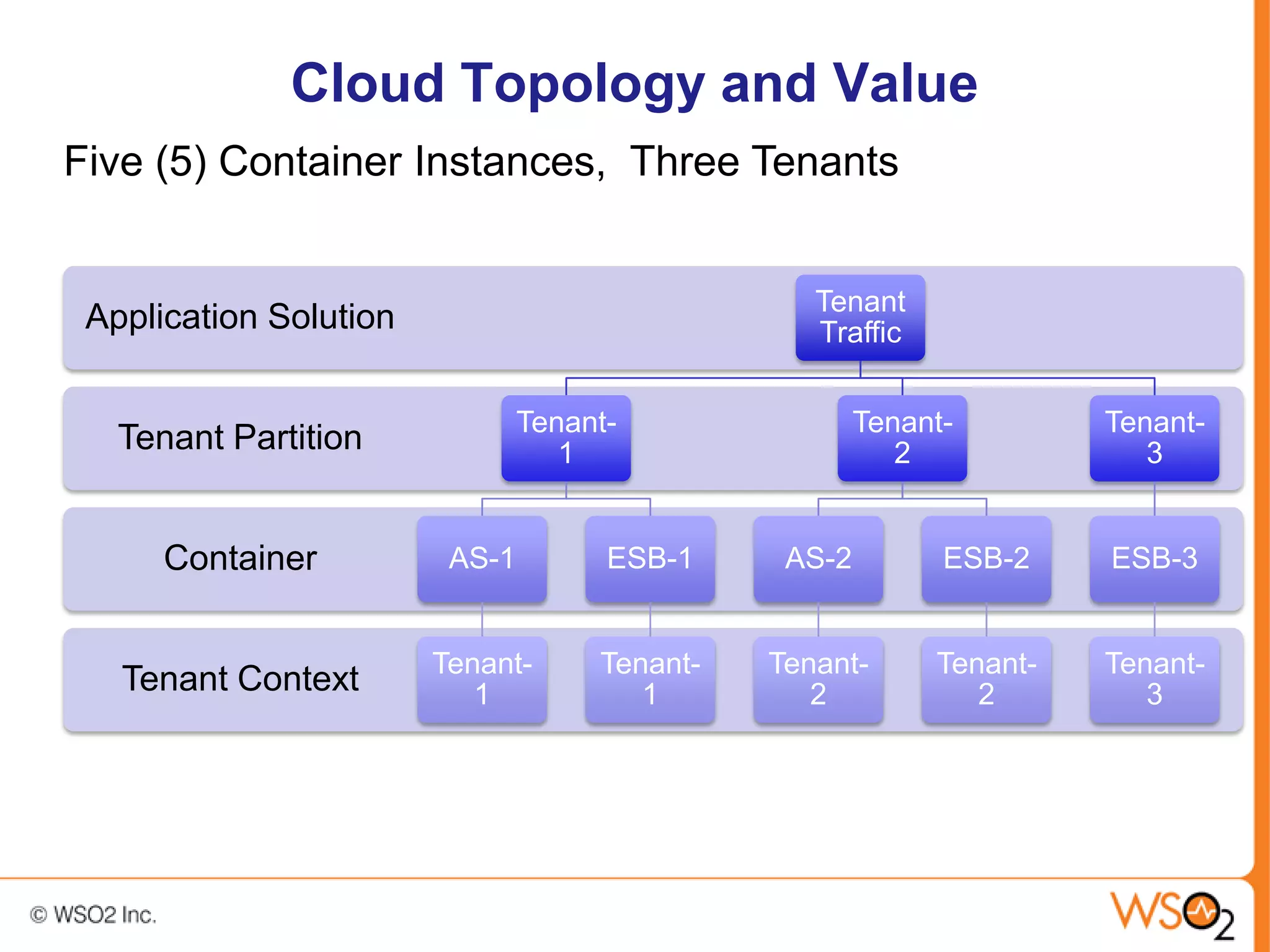
Cloud Topology and Value
Five (5) Container Instances, Three Tenants


                                                  Tenant
 Application Solution                             Traffic

                                Tenant-                Tenant-        Tenant-
   Tenant Partition                1                      2              3


      Container          AS-1         ESB-1     AS-2         ESB-2    ESB-3


                        Tenant-      Tenant-   Tenant-      Tenant-   Tenant-
   Tenant Context          1            1         2            2         3
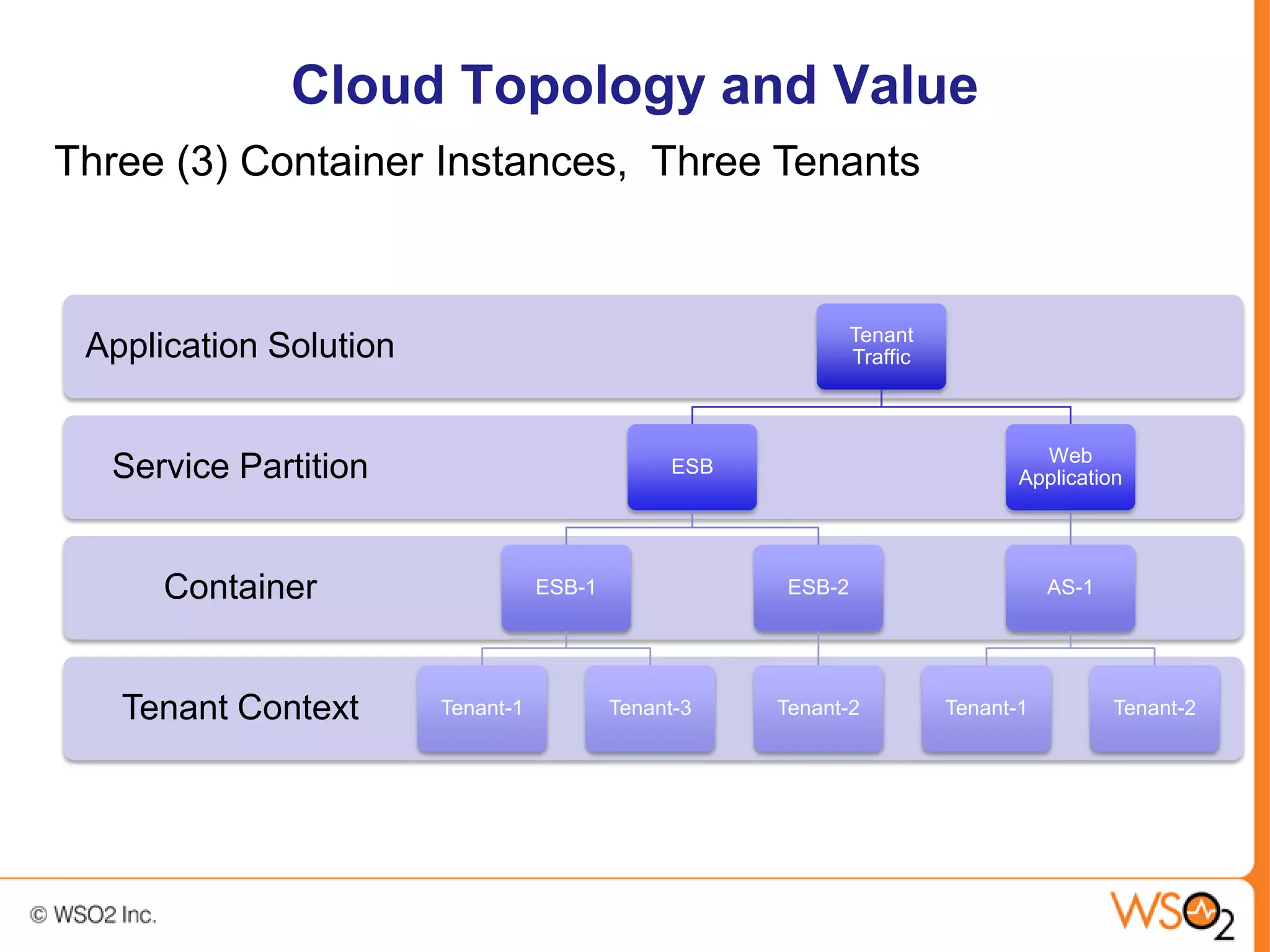
Cloud Topology and Value
Three (3) Container Instances, Three Tenants


                                                                Tenant
 Application Solution                                           Traffic


                                                                                   Web
  Service Partition                              ESB
                                                                                 Application


      Container                    ESB-1                ESB-2                        AS-1


   Tenant Context       Tenant-1           Tenant-3    Tenant-2           Tenant-1          Tenant-2
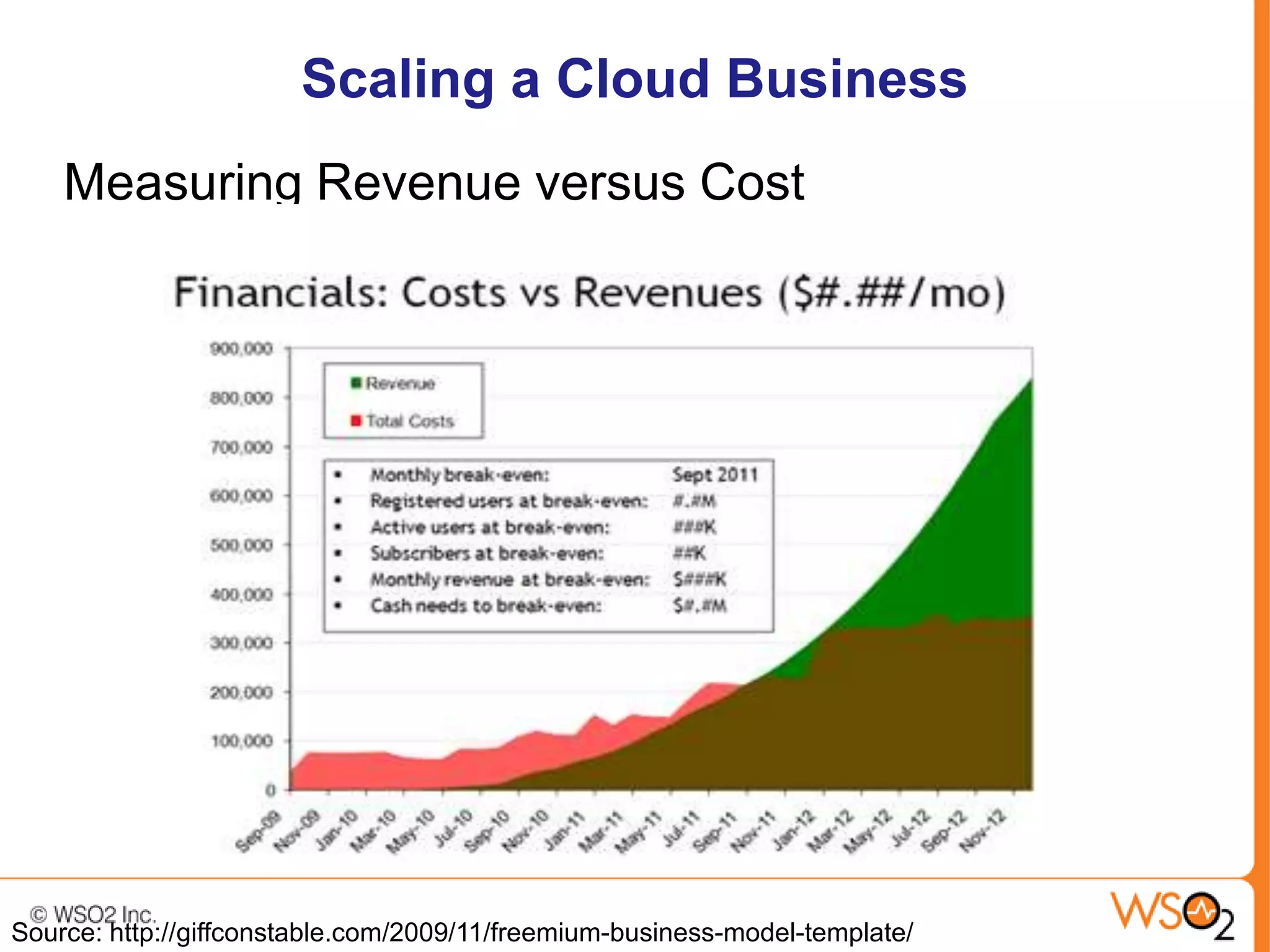
Scaling a Cloud Business
    Measuring Revenue versus Cost


Source: http://giffconstable.com/2009/11/freemium-business-model-template/
Scale Strategy and Tactics

• Gain Credibility
  •   Demonstrate improved resiliency and QoS
• Converge teams
  •   Offer standard shared application platform services
  •   Establish and promote the service catalogue
• Be inclusive
  •   Support multiple development languages,
      environments, and use cases
  •   Lower barriers to entry (e.g. financial, tooling, skills)
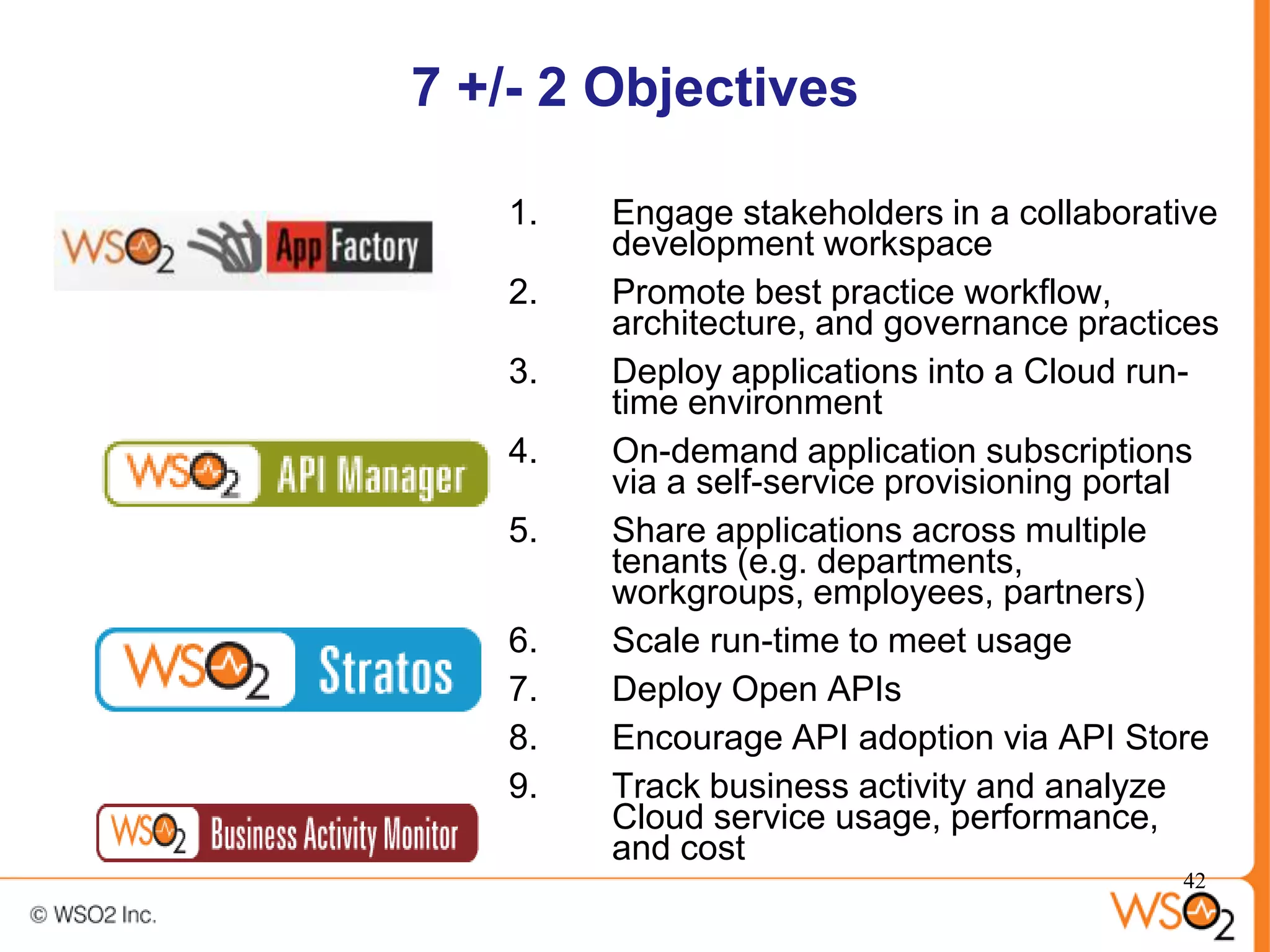
7 +/- 2 Objectives

   1.   Engage stakeholders in a collaborative
        development workspace
   2.   Promote best practice workflow,
        architecture, and governance practices
   3.   Deploy applications into a Cloud run-
        time environment
   4.   On-demand application subscriptions
        via a self-service provisioning portal
   5.   Share applications across multiple
        tenants (e.g. departments,
        workgroups, employees, partners)
   6.   Scale run-time to meet usage
   7.   Deploy Open APIs
   8.   Encourage API adoption via API Store
   9.   Track business activity and analyze
        Cloud service usage, performance,
        and cost
                                           42
Questions?


    http://www.flickr.com/photos/oberazzi/
                                   43
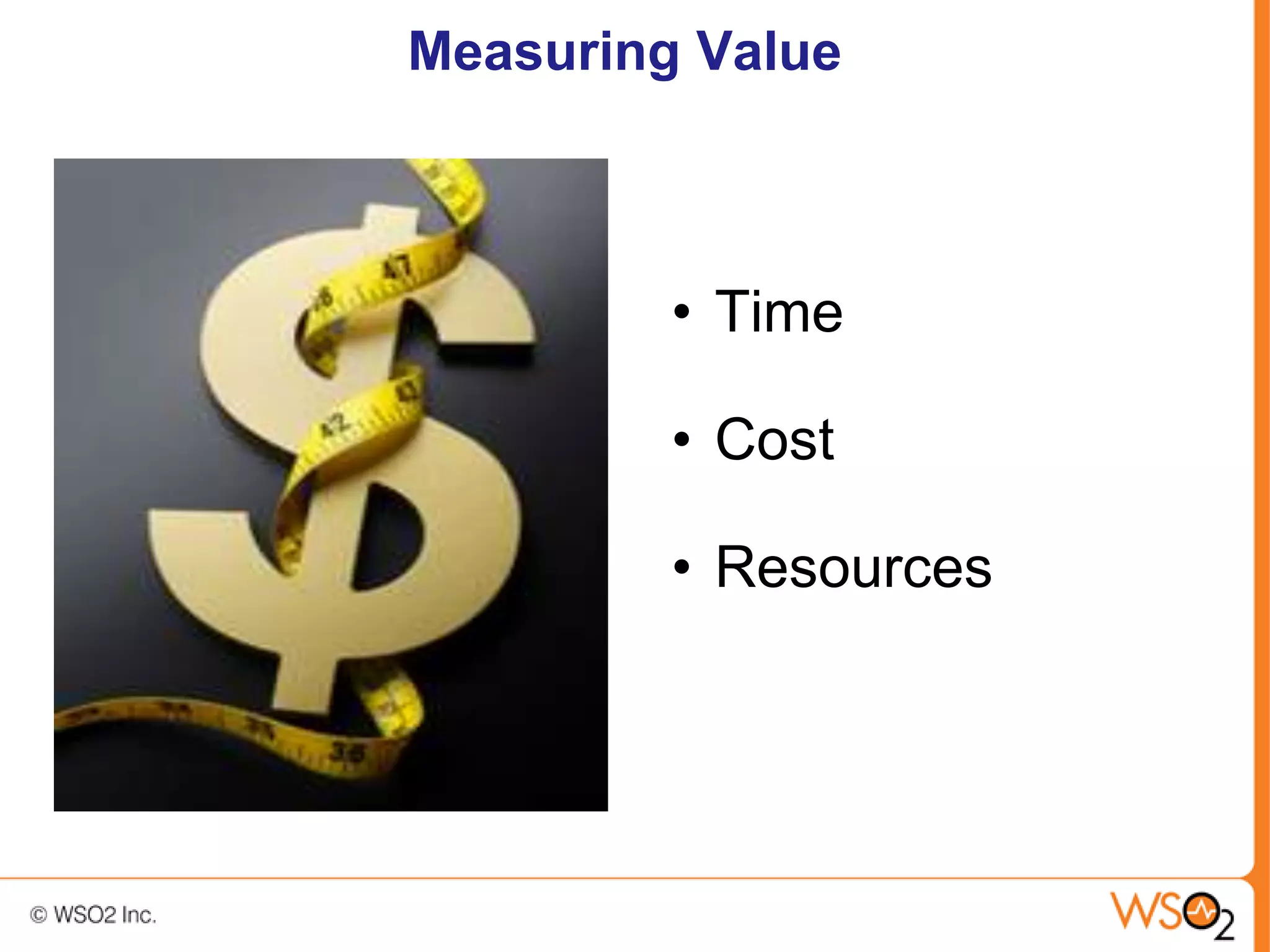
Measuring Value


         • Time

         • Cost

         • Resources
Key Metrics


Foundation
  Time to create new application environment
  Time to redeploy application
• Optimize
  Minimum and maximum scale
  Scale frequency (i.e. time to scale up/down)
• Transformation
  Time and effort required integrating business process, event
     processor – creating a complex app.
  Time and effort required to apply policy across tenant(s)
  Cost to operate application per user or transaction
What is your value baseline?
Quick Start Use Cases


1. DevOps Tooling and On-demand self-
   service
2. Automated Governance
3. Service level management and elastic scale
4. Consumption based pricing and billing
Quick Start Use Cases


DevOps Tooling and On-demand self-service
• Use Cases
  • Rapidly provision application environment
  • Rapidly provision application tenant
  • Allocate, provision, monitor, manage, and administer
    resources across multiple tenants, nodes, and locations
  • Develop complex, composite integrated applications
• Key metrics
  • Time to create new application environment
  • Time to redeploy application
Quick Start Use Cases

Automated Governance
• Use Cases
  • Create users and configure rights
  • Deploy on preferred topology that meets deterministic
    performance requirements (e.g., replication, utilization,
    latency, bandwidth, and coherency)
  • Create service throttling and security governance
    (XACML) policies
• Key Metrics
  • Time and effort required integrating business process,
    event processor – creating a complex app.
  • Time and effort required to apply policy across tenant(s)
Quick Start Use Cases

Service level management and elastic scale
• Use cases
  • Ensure application satisfies consumer demand while
    maximizing resource utilization
     • Scale workload processing and increase performance while
       minimizing infrastructure spend
  • Load test application service
  • Demonstrate multi-tenant web application
• Key Metrics
  • Minimum and maximum scale
  • Scale frequency (i.e. time to scale up/down)
Quick Start Use Cases


Consumption based pricing and billing
• Use cases
  • View service logs
  • View bill by business value
• Key Metric
  • Cost to operate application per user or transaction

Scale Cloud across Enterprise

  • 1.
    Scale Cloud Across the Enterprise Chris Haddad Vice President, Technology Evangelism Follow me on Twitter @cobiacomm Read architecture guidance at http://blog.cobia.net/cobiacomm
  • 2.
    Skate towards thepuck Business Value Best Practice Adoption Process Repeatability Fast time to value
  • 3.
    Cloud Business ValueFor Development Teams • Lower development barriers • Lower adoption barriers 3
  • 4.
    Best Practice Adoptionand Process Repeatability • Cost-effective, development, collaboration, and deployment infrastructure enabling a long tail of application development • A shared environment for cross-organization application development and delivery • Infrastructure enabling user experience composition across multiple disparate application providers
  • 5.
    Fast Time toValue – Increase Agility • Rapidly adapt and fulfill new market demand • Reduce time to introduce new services, applications, and products into long tail market(s)
  • 6.
    Enterprise Architecture Business Model Challenges • Unable to cost-effectively support long tail of application delivery • Lack of metrics and baseline measurements • Limited ability to influence adoption • High friction and interaction cost when building cross-team business processes • Inability to capitalize on business opportunities due to long IT solution lead times 12/9/2012 6
  • 7.
    Cloud Business ValueBlockers • Silo owners • Adoption curve • Trust barrier • Unknown baseline • Funding model Source: http://blog.industryweapon.com/2010/01/beware-of-the-business-blocker/
  • 8.
    To succeed andscale Cloud – Build a Digital Ecosystem Platform Your Core Business Capability Your Digital 3rd Party Business Partners Ecosystem Digital Ecosystem Personalized SaaS DevOps Forge Solution and Governance App Store Cloud Deployment 8
  • 9.
    New Enterprise ArchitectureApproach • Self-organization • Crowdsourcing – source apps and capabilities from crowd • Dynamic distribution channels and fluid connections • Adaptation and evolution • Local autonomy leading to unforeseen ecosystem partner extensions • Spontaneous selection and aggregation across services and solutions • Low interaction cost • Frictionless information flow • Enables cost effectively serving a smaller, niche audience 12/9/2012 9
  • 10.
    Recommendations from theCoach Business Value Best Practice Adoption Process Repeatability Fast time to value
  • 11.
    Cloud Business ValueFor Development Teams • Lower development barriers • Provide on-demand Application Development project infrastructure and run-time environments • Catalogue of re-usable open APIs, cloud services, and domain frameworks • Lower adoption barriers • On-demand web application and Cloud API subscriptions via a self-service provisioning portal • Establish searchable registry of app, service, api, and data descriptors • Reliable, available, and scalable solutions 11
  • 12.
    Best Practice Adoptionand Process Repeatability • Cost-effective, development, collaboration, and deployment infrastructure enabling a long tail of application development • Architecture templates and application platform services • A shared environment for cross-organization application development and delivery • Governed, iterative lifecycle management across hybrid clouds and composite applications • IT Business performance metrics and analytics • Infrastructure enabling user experience composition across multiple disparate application providers
  • 13.
    Fast Time toValue with On-demand Contextual Personalization • Increase agility • Rapidly adapt and fulfill new market demand • Reduce time to introduce new services, applications, and products into long tail market(s) • On-demand Contextual Personalization • Information access and social network access privileges • Information aggregation and composition • Business processes and rules • Service levels, Quality of Service, and monetization rates • Security policies
  • 14.
    Fast path togoals! Cloud DevOps Factory Platform as a Service API Management Business Activity Dashboards
  • 15.
    Embrace DevOps Processes •Self-service configuration • Automated provisioning • Continuous build • Continuous integration • Continuous delivery • Automated release management • Incremental testing
  • 16.
    Scale best practiceswith Cloud Factories Cloud Factories Development Forges Application Lifecycle Management Integrated (ALM) Development Environments (IDE) Command Line Compilers and Linkers Time 2012+ 12/9/2012 16
  • 17.
    What is aCloud Factory? A Cloud-based, automated, DevOps approach to agile application design, development, delivery, and visibility • Simplifies the developer experience • On-demand self service and Cloud provisioning • Continuous build, continuous integration, continuous test, and continuous delivery • Governed, iterative lifecycle management across hybrid clouds and composite applications • Architecture templates and application platform services • IT Business performance metrics and analytics • Builds a Digital Business Ecosystem • Enable a long tail of application development • Fosters cross-organization development collaboration
  • 18.
    Open Source DevOps,Agile, and Cloud Tooling Project and Team Management Software Continuous development Deployment workflow Governance Test and Automation Compliance Continuous Development Integration Dashboards Continuous Develop Build Code 12/9/2012 Source Issue 18 Control Tracking
  • 19.
    Platform as aService Capabilities • Self service • Service catalogue configuration • Service tiers • Automated provisioning • Demand and capacity • Policy configuration management • Process automation • Lifecycle management • Infrastructure Authority integration Dev Ops Automated Tooling Governance Consumption Service Level based Management Funding • Metering • Resource monitoring • Reporting • Resource management • Billing • Performance management • Traffic orchestration
  • 20.
    Cloud-aware Reference Architecture CloudPlatform Platform as a Service Run-time Framework (i.e. WSO2 Cloud Stratos, Cloud Foundry, RedHat OpenShift) Management Service-aware, tenant-aware Elastic Load Balancer PaaS Manager Stratos Controller Cloud Native Container(s) Cloud Asset/Code Deployer Tenant Governance Tenant (n) 1 Identity Asset/Code Synchronizer Application Platform Management Services (web server, Metering and Billing database, ESB) Asset Repositories and Registries(tenant code, Infrastructure as a Service service endpoints, meta-data, (AWS, Eucalyptus, configuration, policies) OpenStack, CloudStack)
  • 21.
    Platform as aService Reference Architecture aPaaS iPaaS Carbon Any Carbon ESB Other Carbon PHP App Server Pluggable Cartridge Cartridges Cartridge Cartridge Cartridge Relational Column File Task Message Logging Security Registry Billing Data Storage Storage Mgmt Service Service Service Service Service Foundation Service Service Service Service PaaS Stratos Controller Elastic Cloud Artefact Deployment Management Load Load Controller/ Distribution Synchroniser Autoscaler Controller Console Monitor Balancer IaaS Infrastructure Cloud (EC2, vmWare, Rackspace, OpenStack, Eucalyptus, etc)
  • 22.
    Cloud API promotion,exploration, subscription, and collaboration
  • 23.
    On-demand self-service access toapproved Cloud Services and APIs
  • 24.
  • 25.
  • 26.
  • 27.
    Cloud Strategy Goals 1.Decrease solution provisioning time 2. Right-size infrastructure, improve resiliency, and enhance Quality of Service (QoS) 3. Accelerate software development iterations 4. Share across multiple users and groups 5. Integrate and bridge heterogeneous Cloud environments 6. Optimize Cloud footprint and lower application cost
  • 28.
    Cloud Characteristic Roadmap Cloud On-demand Consumption Elastic Scalability Resource Pooling Self-service based Funding Multi-tenancy Provisioning Usage Policies Portfolio Models Service Activity Metering and Federation Catalogue Monitoring Billing
  • 29.
    7 +/- 2Objectives 1. Engage stakeholders in a collaborative development workspace 2. Promote best practice workflow, architecture, and governance practices 3. Deploy applications into a Cloud run- time environment 4. On-demand application subscriptions via a self-service provisioning portal 5. Share applications across multiple tenants (e.g. departments, workgroups, employees, partners) 6. Scale run-time to meet usage 7. Deploy Open APIs 8. Encourage API adoption via API Store 9. Track business activity and analyze Cloud service usage, performance, and cost 29
  • 30.
    Sharing Business Capabilitiesat Scale Business Functional Proces Presentation Business and Mashups Role Process Presentation Functional Business Role Business Role Functional Process Presentation Process and and Mashups Role Business Presentation Functional code Rules and Mashups Client Tier Resource Integration Services Tier Resource Services Resource Services Integration Services Public Cloud Services Private Applications
  • 31.
    Scaling through APIcomposition Composite Mobile Infrastructure as a Application Application Service (IaaS) SaaS Application Cloud API Web Endpoint application Endpoint Integration Services Business Service Portfolio Application Portfolio Presentation Hybrid Services Platform Business Process and Functional Services Rules Services Services Resources Services Integration Services
  • 32.
    Scaling across Regionsand Zones Multiple IaaS (hybrid) Deployment HIGHEST Zone 1 Private cloud (data center) Zone 2 Zone 1 Zone 2 Amazon EC2 Zone 1 Availability Cost Zone 2 LOWEST Rackspace Cloud 32
  • 33.
    Single Node Primary-Secondary, single LB Primary-Secondary, with multiple LBs at a cost Multi-node active cluster - Single zone Multi-zone Multi-region Multi-IaaS Cloud Scale = High Availability 33
  • 34.
    Scaling Best Practices New-NormalCloud architecture practices • Distributed and federated interactions • Event based, heterogeneous systems, network latency • Configurable containers and engines • Declarative data, rules, and process definitions • De-normalized and simplified data models • Hadoop/BigTable, Hypertext media, simple NoSQL entities • Expect failure • Systems span transactional control • Applications decomposed into distinct services • Federated environment drives autonomy, statelessness, and composition
  • 35.
    Mission-critical Cloud requires new architecture components Availability Scalability Management State replication Tenant partitioning Management nodes Private jet mode Session replication Ghost deployment Logging infrastructure Multiple load BAM 2.0 architecture Deployment balancers with synchronization keepalived or DNS RR Auto-scaling Elastic Load Balancer
  • 36.
  • 37.
    Tenant Scaling MethodImpacts Value Proposition Single Application Tenant per Multiple Application Tenants per Shared Application Platform Dedicated Application Server Service Container Container
  • 38.
    Cloud Topology andValue Five (5) Container Instances, Three Tenants Tenant Application Solution Traffic Tenant- Tenant- Tenant- Tenant Partition 1 2 3 Container AS-1 ESB-1 AS-2 ESB-2 ESB-3 Tenant- Tenant- Tenant- Tenant- Tenant- Tenant Context 1 1 2 2 3
  • 39.
    Cloud Topology andValue Three (3) Container Instances, Three Tenants Tenant Application Solution Traffic Web Service Partition ESB Application Container ESB-1 ESB-2 AS-1 Tenant Context Tenant-1 Tenant-3 Tenant-2 Tenant-1 Tenant-2
  • 40.
    Scaling a CloudBusiness Measuring Revenue versus Cost Source: http://giffconstable.com/2009/11/freemium-business-model-template/
  • 41.
    Scale Strategy andTactics • Gain Credibility • Demonstrate improved resiliency and QoS • Converge teams • Offer standard shared application platform services • Establish and promote the service catalogue • Be inclusive • Support multiple development languages, environments, and use cases • Lower barriers to entry (e.g. financial, tooling, skills)
  • 42.
    7 +/- 2Objectives 1. Engage stakeholders in a collaborative development workspace 2. Promote best practice workflow, architecture, and governance practices 3. Deploy applications into a Cloud run- time environment 4. On-demand application subscriptions via a self-service provisioning portal 5. Share applications across multiple tenants (e.g. departments, workgroups, employees, partners) 6. Scale run-time to meet usage 7. Deploy Open APIs 8. Encourage API adoption via API Store 9. Track business activity and analyze Cloud service usage, performance, and cost 42
  • 43.
    Questions? http://www.flickr.com/photos/oberazzi/ 43
  • 44.
    Measuring Value • Time • Cost • Resources
  • 45.
    Key Metrics Foundation Time to create new application environment Time to redeploy application • Optimize Minimum and maximum scale Scale frequency (i.e. time to scale up/down) • Transformation Time and effort required integrating business process, event processor – creating a complex app. Time and effort required to apply policy across tenant(s) Cost to operate application per user or transaction
  • 46.
    What is yourvalue baseline?
  • 47.
    Quick Start UseCases 1. DevOps Tooling and On-demand self- service 2. Automated Governance 3. Service level management and elastic scale 4. Consumption based pricing and billing
  • 48.
    Quick Start UseCases DevOps Tooling and On-demand self-service • Use Cases • Rapidly provision application environment • Rapidly provision application tenant • Allocate, provision, monitor, manage, and administer resources across multiple tenants, nodes, and locations • Develop complex, composite integrated applications • Key metrics • Time to create new application environment • Time to redeploy application
  • 49.
    Quick Start UseCases Automated Governance • Use Cases • Create users and configure rights • Deploy on preferred topology that meets deterministic performance requirements (e.g., replication, utilization, latency, bandwidth, and coherency) • Create service throttling and security governance (XACML) policies • Key Metrics • Time and effort required integrating business process, event processor – creating a complex app. • Time and effort required to apply policy across tenant(s)
  • 50.
    Quick Start UseCases Service level management and elastic scale • Use cases • Ensure application satisfies consumer demand while maximizing resource utilization • Scale workload processing and increase performance while minimizing infrastructure spend • Load test application service • Demonstrate multi-tenant web application • Key Metrics • Minimum and maximum scale • Scale frequency (i.e. time to scale up/down)
  • 51.
    Quick Start UseCases Consumption based pricing and billing • Use cases • View service logs • View bill by business value • Key Metric • Cost to operate application per user or transaction

Editor's Notes

  • #2 In this session, Chris Haddad will describe where your Cloud application strategy may encounter challenges, when to migrate applications to the Cloud, and how to scale cloud strategy and cloud tactics across the organization.45 minute version
  • #3 http://www.webstockpro.com/UpperCut-RF/tre02014.Ice-hockey-player-skating-Photo/
  • #5 eTrade: API, consumers must submit application for code review* compliance focus * *automation* enables long tail *Cloud is a game changing enabler use cases
  • #7 What is It that customers want and how might it construct a new business model or even an ecosystem of partnerships and external relationships to provide that new value to them?Value creation via certain business processes and activities ( also refered to as value network, value chain, etc.) and a revenue model for value captureCreate value: processes/activities , resources/assetsCapture value: cost, financial aspect, profitValue network: suppliers, customer information, customer relationships, information flows, product/service flowsStrategic choices: customer (target market / scope), value proposition, capabilities/competencies, revenue/pricing, competitors, output (offering), strategy, branding, differentiation, missionSOURCE: Shafer et al, 2005, p.202Infrastructure: Partners, key activities, key resourcesOffering: value propositionCustomer interface: relationships, customers, distribution and acquisition channelsFinance: cost/structure, revenue stream / pricingSource: adapted from Osterwalder & Pigneur 2009
  • #11 http://www.webstockpro.com/UpperCut-RF/tre02014.Ice-hockey-player-skating-Photo/
  • #13 eTrade: API, consumers must submit application for code review* compliance focus * *automation* enables long tail *Cloud is a game changing enabler use cases
  • #15 http://www.webstockpro.com/UpperCut-RF/tre02014.Ice-hockey-player-skating-Photo/
  • #16 Apply DevOps activities across software development life-cycle phases (i.e. design, develop, test, build, deploy, manage). Teams use DevOps tools and processes to manage application construction and maintenance tasks. Iterative, incremental, continuous, automated, self-service
  • #18 Message: win for developers - simplifies the developer experience during build processeTrade: API, consumers must submit application for code review* compliance focus * *automation* enables long tail *Cloud is a game changing enabler use cases
  • #19 Workflow – bps and brsGovernance and compliance – wso2 registryDevelopment dashboard – BAM, Jaggery
  • #20 Some solution architects find Cloud characteristics and supporting PaaS attributes too abstract and infrastructure focused. Architects may be more interested in delivering measurable business value, shielding IT personnel from complex dependencies, and deliver a productive development and operations (i.e. DevOps) environment. The following PaaS capabilities (See Figure 4) are used to achieve these objectives:DevOps ToolingAutomated GovernanceService Level ManagementConsumption based pricing Figure 4: Platform as a Service (PaaS) Capabilities and supporting practices DevOps ToolingDevOps tooling creates an environment fostering collaboration between development and operations team members. Practice and tooling enable teams to implement self-service configuration, automated provisioning, policy configuration, and process automation practices which bridge the design, build, deploy, and manage phases within the software development life-cycle. By integrating DevOps tooling with on-demand resource instances, teams can reduce time to market and increase agility. Automated GovernanceGovernance is a practice, which defines policies, people, and processes. Effective governance mitigates risks, improves performance, and facilitates correct actions. Automated governance enables application and infrastructure services to efficiently scale across numerous consumers and providers while effectively monetizing, maintaining, and securing assets and consumer-provider interactions. By publishing a service catalogue offering tiered levels of service, teams can promote standard offerings that meet customer requirements. By streamlining access and approval, automated governance encourages customers to choose standard offerings and reduce cost. Scaling a Cloud environment while right-sizing available capacity is non-trivial, and the infrastructure must support demand management and capacity management activities. When organizations move beyond their first Cloud service release, automated lifecycle management becomes a predominant concern. To effectively manage the service lifecycle, the infrastructure must report on service versions, subscribed consumers, and usage trends. In the run-time environment, an infrastructure authority component makes resource allocation decisions, which are enforced by service level management components. Service Level ManagementService level management enforces governance policies. PaaS infrastructure should integrate service level management activities throughout the solution stack (i.e. network, processing, storage, managed code container, application platform engines, and application logic). Resource monitoring, resource management, performance management, and traffic orchestration must monitor, manage, and optimize machine node instances, message routing, application service location, tenant security, and session state. Intelligent service level management on Cloud native PaaS infrastructure has the ability to raise infrastructure utilization while maintaining quality of service. Consumption Based PricingToday, cloud consumption based pricing reflects IT asset monetization (e.g. machine instance per hour, network I/O, storage bytes). However, business users don’t really care how many instances are running in the Cloud. Business users care about business entities, business activity performance, and associated cost. Table 1 below illustrates various pricing units. For example, the number of market leads generated by a marketing piece, or cost to process an insurance policy. Decoupling metering and billing from IT assets and shifting the reporting model to focus on business activity and holistic IT cost will positively change the IT investment conversation. Coupling multi-tenant metering and billing with business activity monitoring and reporting will facilitate the shift. “Cloud consumers of PaaS can employ the tools and execution resources provided by cloud providers to develop, test, deploy and manage the applications hosted in a cloud environment. PaaS consumers can be application developers who design and implement application software, application testers who run and test applications in cloud-based environments, application deployers who publish applications into the cloud, and application administrators who configure and monitor application performance on a platform. PaaS consumers can be billed according to, processing, database storage and network resources consumed by the PaaS application, and the duration of the platform usage.”Source: http://collaborate.nist.gov/twiki-cloud-computing/pub/CloudComputing/ReferenceArchitectureTaxonomy/NIST_SP_500-292_-_090611.pdf“For PaaS, the Cloud Provider manages the computing infrastructure for the platform and runs the cloud software that provides the components of the platform, such as runtime software execution stack, databases, and other middleware components. The PaaS Cloud Provider typically also supports the development, deployment and management process of the PaaS Cloud Consumer by providing tools such as integrated development environments (IDEs), development version of cloud software, software development kits (SDKs), deployment and management tools. The PaaS Cloud Consumer has control over the applications and possibly some the hosting environment settings, but has no or limited access to the infrastructure underlying the platform such as network, servers, operating systems (OS), or storage.”Source: http://collaborate.nist.gov/twiki-cloud-computing/pub/CloudComputing/ReferenceArchitectureTaxonomy/NIST_SP_500-292_-_090611.pdf
  • #21 The Asset/Code deployer will provision tenant specific applications, services, and business process The artifacts are deployed into one or more containersContainers are partitioned based on ability to isolate and share resourcesSingle tenant containers dedicate one or more containers for exclusive use by an application tenant (during a period of time)Cloud Native, Multi-tenant containers share containers across multiple simultaneous application tenants
  • #29 http://www.webstockpro.com/UpperCut-RF/tre02014.Ice-hockey-player-skating-Photo/
  • #30 A Platform as a Service offering should promote deploying applications onto a flexible, distributed topology. To maximize Cloud characteristics, a PaaS should facilitate scaling way out (e.g. across cloud zones, data centers) and automatically distribute fine-grained service component resources. Figure 6 presents a logical view of a cloud application executing across a distributed topology. The Integration Services PaaS service component is used to connect application service components and external cloud services by message passing, not function invocation. Integration services commonly include a Enterprise Service Bus (ESB), service governance registry, service gateways, and message brokers. Figure 6: Cloudy Topology
  • #38 Tenant = application
  • #39 Service-level partitions are more efficientAll solutions deployed within a single partitionAll tenants deployed within a single partition
  • #41 http://giffconstable.com/2009/11/freemium-business-model-template/
  • #45 To perform an activityTo build and deploy solution
  • #46 Agreeing on a strategic goal and gaining stakeholder buy-in is only the first step. Teams should define key metrics, baseline current performance, and create a quick start project plan to prove PaaS benefits. Metrics can be divided into foundational, optimal, and transformational categories. A few example metrics to consider are: FoundationTime to create new application environmentTime to redeploy applicationOptimizeMinimum and maximum scale Scale frequency (i.e. time to scale up/down)TransformationTime and effort required integrating business process, event processor – creating a complex app.Time and effort required to apply policy across tenant(s)Cost to operate application per user or transaction
  • #48 In today’s IT environment, demonstrating tangible improvement is often illusive. Rather than simply stating a goal, randomly selecting a PaaS provider, installing an application on the PaaS, and declaring success, your team has an opportunity to demonstrate and prove how PaaS capabilities can improve agility, efficiency, or platform economics. Your team should correlate quick start demonstration use cases with PaaS capabilities and key metrics. The following listing details a sample plan:
  • #49 DevOps Tooling and On-demand self-serviceUse CasesRapidly provision application environmentRapidly provision application tenantAllocate, provision, monitor, manage, and administer resources across multiple tenants, nodes, and locationsDevelop complex, composite integrated applicationsKey metricsTime to create new application environmentTime to redeploy application
  • #50 Automated GovernanceUse CasesCreate users and configure rightsDeploy on preferred topology that meets deterministic performance requirements (e.g., replication, utilization, latency, bandwidth, and coherency)Create service throttling and security governance (XACML) policiesKey MetricsTime and effort required integrating business process, event processor – creating a complex app.Time and effort required to apply policy across tenant(s)
  • #51 Service level management and elastic scaleUse casesEnsure application satisfies consumer demand while maximizing resource utilizationScale workload processing and increase performance while minimizing infrastructure spendLoad test application serviceDemonstrate multi-tenant web applicationKey MetricsMinimum and maximum scale Scale frequency (i.e. time to scale up/down)