Case Study
A Viable Solution to Humanizing a Technology Company


USAData
Concept, Direction & Design • Dylan Nirvana
Illustration • Ashley Solomon
Editing • Kristen Dell’ Orso
November 2008
Outline of New Model for Identity & Re-Branding of
USAData and Website Application


INTRODUCTION

What I am hearing is the voice of a marketing company that cares deeply about
people. It thinks about its customers, employees and the community as a whole. It
has developed a tremendous capacity to deliver on the needs of its clientele. But that
personal message is not coming through. What comes through now is the cold blue
TV screen glow of Technology. USAData is not communicating the capabilities,
values and culture of the company. We want more of the person to shine through.
More of the future. We want to reach out and bring our resources to the customer
demonstrating that concern instead of asking them to come to us, figure us out.

Apple Computer is a good example of a company that is leading the way in making
technology about the person, instead of the other way around. Apple focuses on the
customer’ s lifestyle. Their branding and marketing has moved beyond, “ Hey, look at
me. Look what I can do for you,” to “ Look at you! Aren’ t you fantastic!” It is not
just about their website. It is everything about them.

And Apple is not the only company moving forward.

Technology No Longer An Attractive Advertising Tool
USAData’ s branding and identity design have become outdated. We have outgrown
it. It has served its purpose to get us to a certain level.

The problem, however, is larger than just one company. We are emerging from an
out-of-date cultural trend. Most websites look as if a database programmer did
double-time as the designer. That is because they did. This accounts for the norm on
the internet. The impression is: info-crazy, overkill, AD-HD, attack of the killer
frogs, mediocrity.

Personalizing Technology
That cultural trend is changing. Leading companies are prioritizing good design,
bringing more flexibility to the customer and helping everyone embrace possibilities.

If the heart of the issue for USAData is one of identity & branding, the larger
challenge is in aligning ourselves with a more vibrant forward-looking aesthetic.

The forefront of good design is moving toward personalization and openness.


2
Qualities of a Viable Solution
Technology will be perceived to serve people and not be an attractive end in itself.
Warmer than the cold blue glow of technology is a significant solution that focuses
in on the individual. By bringing an actual person into the foreground we convey a
message that is personal. We are able to show the tremendous capacity of our
technology by what we do with it.


3
What are the Elements of Good Design?


Utility –   Fits in the hand


Aesthetic –   Feels good in the hand


Memorable –       As opposed to forgettable


Defined Foreground and Background –          Clarity


Use of symbols –      Drawing appropriately on the power of the subconscious


What is the Traditional Process of Corporate Identity Development?

Style Sheets –     Including color, type faces, page treatments. All the details that guide
the visual presentation of the company to the public. This is like the style of
clothing you wear. Even a t-shirt and jeans are a statement of style.

Logo & Signets –      Think of a family crest. Or a flag. It represents the core values (and
value) of the entity. It encapsulates who we are, what we believe in. To disgrace the
flag is to disgrace the nation. To win a war, you capture the enemy’ s flag.

Language –       Factual, dry, hyperbolic, colorful, repetitive, sparse, cryptic…   How is the
customer being spoken to? How close or distant is the voice? Is it intellectual or
more emotional? Is it the vocabulary of selfishness and fear? Or of hope, brilliance
and self-determination?

Direction –   The overall impression it leaves you with. The thing it leads you to
conclude. Whom does all this serve? The almighty dollar? Or can the customer feel
the enthusiasm of a bright future?

Note: Randomly applying design principles or attempting branding without a specific
direction is like rearranging deck chairs on the Titanic.

A New Approach
Before we can test core concepts or even properly apply general principles we need a
New Model to help us define them. That Model cannot be incomplete or abstract. It
doesn’ t have to be exactly where we eventually end up. But it may help us get there.


4
It is a model that can be parallel with other developing ideas inspired by team
members. But it must be specific. Concrete.

We can do that by showing a valued person, happy with her success and letting her
tell her story.


5
NEW MODEL – “Case Study”

Focus: A Person (successful customer). Her story. Her community.

Application: Website

1. THE FIRST THING I SEE


Susan


Foreground: Person (silo –   on white background). Susan. Introduces herself as a
Successful Customer. “ Hi, my name is Susan. And i just realized my dreams. May i
tell you how i did it?” offers to tell her story. And take you through the process.

Background: Clean, empty, white. Understated USAData signet & modest
navigation.

Notes: each time page loads, different (1 of 5) Successful Customer displays. Each
are specifically accessible by name on top toolbar: Joey. Karen. Henry. Susan.
Robert.

Who is the Successful Customer?
Your proven customer base. From small business average Joes to major corporate
accounts (they are headed by people too). Focus on key decision makers and
beneficiary of the services. A plumber. Pizza shop owner. Regional manager Mailbox
Express. Pharma corp marketing exec.

How does the Potential Customer see the model?
As a person “ just like me” . They would hopefully identify with her. They naturally
pick the archetype that fits them.

How are the model types derived?
Analysis of marketing base should provide basic generalizations that could be
grouped together. These categories or archetypes should be exactly 5.

Why 5?
Why are there 7 digits in a phone number? Because the average person cannot
remember more. (Example 867-5309 = Jenny). And 5 feels easier than 7.


6
2. ONCE I START TO INTERACT WITH IT, WHAT HAPPENS?


She Tells Her Story


Foreground: She tells the specifics of what she did that led to her success. How she
did it. She focuses on her process, and clearly offers to take you through yours, to
show you how you can do it too.

Background: As always USAData is implied, in the background. Otherwise, empty
white.

She Offers To Take You Through The Process. For real. She is the guide. A Successful
Customer, not a company representative.

Where does her story come from?
Actual stories of successful customers, where else? They can be composited. Edited
and streamlined to organize the ideas. But they should be based in reality.
(Remember, there are 5 Archetypes that between them must distribute all the
important differences and share the essential steps).

Is This The Model Telling A Story As An Example Or A Guided Tutorial Though The
Actual Process?
Both. There are two levels that the Potential Customer is able to Freely choose
between. Forest and trees, or Overview and Participation. In Overview, they should
be able to quantify the process and have a clear understanding. By Participating
they move toward close.

This is a wizard model, with two additional key features: the ability to Overview and
quantify the entire process; and Participate in a non-linear way. The customer can
switch back and forth in any direction at will. A non-linear two level wizard. We
want them to Rehearse the process.

We do not want to make the interface burdensome in any way. They should be able
to navigate to any point at any time. There is also a parallel Expert Mode which is
closer to the current model.

The availability of a live expert on the phone or video conference or IM as a Tandem
Process should be emphasized at this point.

Most websites are text based, telling you what to do. They throw all their
technology at the person, hoping somebody will be impressed. The company opens
their tool box and says, “ Here is everything you need. Now go build a house” . Is that


7
the way to treat a person? It is not even polite.


8
3. I HAVE GONE THROUGH THE MIDDLE PROCESS. NOW WHAT?


Showing the People who Helped Her Realize Her Dreams, she says, “Connect to
Opportunity: CONNECT YOUR DREAMS.”


She shows people. Not numbers. Not email. People.

Connect to Opportunity
Susan (or whichever of the 5 that is guiding you) introduces you to part of her
community, People who Helped Her Realize Her Dreams. By approaching direct
marketing in this way, we are demonstrating how to do it more effectively.

If I am Overviewing, I get to see all the way to the end. If I Participated, this is the
Close. Here is where I purchase the services and make the agreements.

Is this an overview or actual sale?
Both. The Potential Customer can clearly choose to view the entire process or
Participate in it. They can switch back and forth. It makes it easy for them to
Rehearse the steps. The idea is not to hide anything. Let them see everything. It is
non-linear. Let them repeat the steps so they build confidence in the process. By
being able to Rehearse, they will have plenty of opportunities to close when they are
ready.

A Teachable Method
Our tools and resources can be made readily available so our customers feel
supported, not out there on their own. The client should feel knowledgable at this
point. Informed. Because they are able to freely move between Overviewing and
Participating, they will have Rehearsed the territory, perhaps many times. They
learn a teachable method. People learn by teaching.

A Successful Customer Guides You Through Entire Process in 3 Steps
Its easier to relate to a real person than it is to a form. And it is easier to convey
that we value people by integrating a calm confident person into the foreground of
the process.


9
SUMMARY OF NEW MODEL: KEY ELEMENTS


Person Who Is “Just Like Me” Guides Me Through The Process
Person centered. Siloed. Showing a calm, confident and believable professional. A
person “ just like me” , saying “ I fulfilled my dreams. Let me show you how I did it” .
Not a company rep.

Encapsulate Entire Process in the Middle
Quantify it. You don’ t just say, “ anybody can do it” and strand them in some
indeterminable process where they have no overview, don’ t know how long it will
take, don’ t know how bad it will hurt, or if they will ever understand what they did.
Define a beginning, a middle and an end. Then contain this middle section.

Make it Teachable
We want them to identify with the model and be able to Rehearse. By generating
confidence and enthusiasm they will want to share it with others.

Get to Full Purchase in 3 Steps
As opposed to saying, “ easy as one, two, three” . I don’ t have to say it. It simply is.

Understate the Company
Put company decidedly in the background. Let the customer speak. It is not about
how great we are. It is about how great they are. Besides, talking about oneself is
the fastest way to get ignored.

What Then? Is There A Follow Up?
Yes. A full module similar to the Entry Module. Follow up means asking, “ How are
you doing? How can we help?”

Is anybody else doing this doing this? Is it effective?
Of course!
http://www.hm.com/us/
http://www.uniqlo.com/us/
http://www.apple.com/
http://www.adobe.com/
http://www.prokeds.com/

CASE STUDY shines a bright light, refocuses and informs the Identity Development
Process. It makes it more relevant. More powerful. It has the power to pull
everything in line even if executed in stages (recommended), and does not preclude
or exclude other parallel or even contradictory ideas because it takes time to
develop. And the testing of principles is involved.


10
***


11
METAMORPHOSIS –          THE STAGING AND TESTING OF TRANSFORMATION

Expectations can be managed by attending to the process. Not hurrying through,
not rushing to find a solution. The process can be fruitful. Synergistic. Letting the
goal guide the process. And, letting the process inform the end result.

Isolate and apply core concepts as appropriate to short term needs. Test performance
with web metrics.

Lets Revisit Design Principles And Identity Development From The Perspective Of Case
Study

Utility –   Current model asks the customer to come to us. The new model brings our
expertise to them in a wizard with parallel non-linear tracking. Hallmark of a
progressive design like this is guiding the customer as an individual through a
transparent, clearly defined and quantified process to get the result they want.

Aesthetic –   From tight, database technological feel to using the elastic screen, clean
and personal.

Memorable –     Defaultism to personalism. Making it more enjoyable.

Defined Foreground and Background –      Current model is factual but flat. Graciously
not hyperbolic. New model is, however, clearer and more concise.

Style Sheets – Clean open white with accent, thinner more open unique san sarif –
modern and personal, clear and spacious pages, not overloaded with information.
Brighter, better use of color.

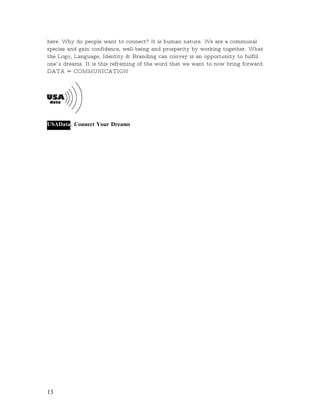
Logo & Signet – The sample logo (below) used in Case Study demonstrates
communication, activity & connection to community. Logo development is process of
its own that can generate many ideas.

Language – Slogan should be personal, self-activating and connected to the idea of
fulfillment in community. Let’ s try: CONNECT YOUR DREAMS

Regarding the Word DATA…
On one hand, impersonal, bits and bytes, impossible to conceptualize or understand,
inhuman. We cannot underestimate people’ s aversion to numbers and science!

DATA is also communication, being heard, connecting. Much more positive message


12
here. Why do people want to connect? It is human nature. We are a communal
species and gain confidence, well-being and prosperity by working together. What
the Logo, Language, Identity & Branding can convey is an opportunity to fulfill
one’ s dreams. It is this reframing of the word that we want to now bring forward.
DATA = COMMUNICATION


USAData. Connect Your Dreams


13

Proposal Draft

  • 1.
    Case Study A ViableSolution to Humanizing a Technology Company USAData Concept, Direction & Design • Dylan Nirvana Illustration • Ashley Solomon Editing • Kristen Dell’ Orso November 2008
  • 2.
    Outline of NewModel for Identity & Re-Branding of USAData and Website Application INTRODUCTION What I am hearing is the voice of a marketing company that cares deeply about people. It thinks about its customers, employees and the community as a whole. It has developed a tremendous capacity to deliver on the needs of its clientele. But that personal message is not coming through. What comes through now is the cold blue TV screen glow of Technology. USAData is not communicating the capabilities, values and culture of the company. We want more of the person to shine through. More of the future. We want to reach out and bring our resources to the customer demonstrating that concern instead of asking them to come to us, figure us out. Apple Computer is a good example of a company that is leading the way in making technology about the person, instead of the other way around. Apple focuses on the customer’ s lifestyle. Their branding and marketing has moved beyond, “ Hey, look at me. Look what I can do for you,” to “ Look at you! Aren’ t you fantastic!” It is not just about their website. It is everything about them. And Apple is not the only company moving forward. Technology No Longer An Attractive Advertising Tool USAData’ s branding and identity design have become outdated. We have outgrown it. It has served its purpose to get us to a certain level. The problem, however, is larger than just one company. We are emerging from an out-of-date cultural trend. Most websites look as if a database programmer did double-time as the designer. That is because they did. This accounts for the norm on the internet. The impression is: info-crazy, overkill, AD-HD, attack of the killer frogs, mediocrity. Personalizing Technology That cultural trend is changing. Leading companies are prioritizing good design, bringing more flexibility to the customer and helping everyone embrace possibilities. If the heart of the issue for USAData is one of identity & branding, the larger challenge is in aligning ourselves with a more vibrant forward-looking aesthetic. The forefront of good design is moving toward personalization and openness. 2
  • 3.
    Qualities of aViable Solution Technology will be perceived to serve people and not be an attractive end in itself. Warmer than the cold blue glow of technology is a significant solution that focuses in on the individual. By bringing an actual person into the foreground we convey a message that is personal. We are able to show the tremendous capacity of our technology by what we do with it. 3
  • 4.
    What are theElements of Good Design? Utility – Fits in the hand Aesthetic – Feels good in the hand Memorable – As opposed to forgettable Defined Foreground and Background – Clarity Use of symbols – Drawing appropriately on the power of the subconscious What is the Traditional Process of Corporate Identity Development? Style Sheets – Including color, type faces, page treatments. All the details that guide the visual presentation of the company to the public. This is like the style of clothing you wear. Even a t-shirt and jeans are a statement of style. Logo & Signets – Think of a family crest. Or a flag. It represents the core values (and value) of the entity. It encapsulates who we are, what we believe in. To disgrace the flag is to disgrace the nation. To win a war, you capture the enemy’ s flag. Language – Factual, dry, hyperbolic, colorful, repetitive, sparse, cryptic… How is the customer being spoken to? How close or distant is the voice? Is it intellectual or more emotional? Is it the vocabulary of selfishness and fear? Or of hope, brilliance and self-determination? Direction – The overall impression it leaves you with. The thing it leads you to conclude. Whom does all this serve? The almighty dollar? Or can the customer feel the enthusiasm of a bright future? Note: Randomly applying design principles or attempting branding without a specific direction is like rearranging deck chairs on the Titanic. A New Approach Before we can test core concepts or even properly apply general principles we need a New Model to help us define them. That Model cannot be incomplete or abstract. It doesn’ t have to be exactly where we eventually end up. But it may help us get there. 4
  • 5.
    It is amodel that can be parallel with other developing ideas inspired by team members. But it must be specific. Concrete. We can do that by showing a valued person, happy with her success and letting her tell her story. 5
  • 6.
    NEW MODEL –“Case Study” Focus: A Person (successful customer). Her story. Her community. Application: Website 1. THE FIRST THING I SEE Susan Foreground: Person (silo – on white background). Susan. Introduces herself as a Successful Customer. “ Hi, my name is Susan. And i just realized my dreams. May i tell you how i did it?” offers to tell her story. And take you through the process. Background: Clean, empty, white. Understated USAData signet & modest navigation. Notes: each time page loads, different (1 of 5) Successful Customer displays. Each are specifically accessible by name on top toolbar: Joey. Karen. Henry. Susan. Robert. Who is the Successful Customer? Your proven customer base. From small business average Joes to major corporate accounts (they are headed by people too). Focus on key decision makers and beneficiary of the services. A plumber. Pizza shop owner. Regional manager Mailbox Express. Pharma corp marketing exec. How does the Potential Customer see the model? As a person “ just like me” . They would hopefully identify with her. They naturally pick the archetype that fits them. How are the model types derived? Analysis of marketing base should provide basic generalizations that could be grouped together. These categories or archetypes should be exactly 5. Why 5? Why are there 7 digits in a phone number? Because the average person cannot remember more. (Example 867-5309 = Jenny). And 5 feels easier than 7. 6
  • 7.
    2. ONCE ISTART TO INTERACT WITH IT, WHAT HAPPENS? She Tells Her Story Foreground: She tells the specifics of what she did that led to her success. How she did it. She focuses on her process, and clearly offers to take you through yours, to show you how you can do it too. Background: As always USAData is implied, in the background. Otherwise, empty white. She Offers To Take You Through The Process. For real. She is the guide. A Successful Customer, not a company representative. Where does her story come from? Actual stories of successful customers, where else? They can be composited. Edited and streamlined to organize the ideas. But they should be based in reality. (Remember, there are 5 Archetypes that between them must distribute all the important differences and share the essential steps). Is This The Model Telling A Story As An Example Or A Guided Tutorial Though The Actual Process? Both. There are two levels that the Potential Customer is able to Freely choose between. Forest and trees, or Overview and Participation. In Overview, they should be able to quantify the process and have a clear understanding. By Participating they move toward close. This is a wizard model, with two additional key features: the ability to Overview and quantify the entire process; and Participate in a non-linear way. The customer can switch back and forth in any direction at will. A non-linear two level wizard. We want them to Rehearse the process. We do not want to make the interface burdensome in any way. They should be able to navigate to any point at any time. There is also a parallel Expert Mode which is closer to the current model. The availability of a live expert on the phone or video conference or IM as a Tandem Process should be emphasized at this point. Most websites are text based, telling you what to do. They throw all their technology at the person, hoping somebody will be impressed. The company opens their tool box and says, “ Here is everything you need. Now go build a house” . Is that 7
  • 8.
    the way totreat a person? It is not even polite. 8
  • 9.
    3. I HAVEGONE THROUGH THE MIDDLE PROCESS. NOW WHAT? Showing the People who Helped Her Realize Her Dreams, she says, “Connect to Opportunity: CONNECT YOUR DREAMS.” She shows people. Not numbers. Not email. People. Connect to Opportunity Susan (or whichever of the 5 that is guiding you) introduces you to part of her community, People who Helped Her Realize Her Dreams. By approaching direct marketing in this way, we are demonstrating how to do it more effectively. If I am Overviewing, I get to see all the way to the end. If I Participated, this is the Close. Here is where I purchase the services and make the agreements. Is this an overview or actual sale? Both. The Potential Customer can clearly choose to view the entire process or Participate in it. They can switch back and forth. It makes it easy for them to Rehearse the steps. The idea is not to hide anything. Let them see everything. It is non-linear. Let them repeat the steps so they build confidence in the process. By being able to Rehearse, they will have plenty of opportunities to close when they are ready. A Teachable Method Our tools and resources can be made readily available so our customers feel supported, not out there on their own. The client should feel knowledgable at this point. Informed. Because they are able to freely move between Overviewing and Participating, they will have Rehearsed the territory, perhaps many times. They learn a teachable method. People learn by teaching. A Successful Customer Guides You Through Entire Process in 3 Steps Its easier to relate to a real person than it is to a form. And it is easier to convey that we value people by integrating a calm confident person into the foreground of the process. 9
  • 10.
    SUMMARY OF NEWMODEL: KEY ELEMENTS Person Who Is “Just Like Me” Guides Me Through The Process Person centered. Siloed. Showing a calm, confident and believable professional. A person “ just like me” , saying “ I fulfilled my dreams. Let me show you how I did it” . Not a company rep. Encapsulate Entire Process in the Middle Quantify it. You don’ t just say, “ anybody can do it” and strand them in some indeterminable process where they have no overview, don’ t know how long it will take, don’ t know how bad it will hurt, or if they will ever understand what they did. Define a beginning, a middle and an end. Then contain this middle section. Make it Teachable We want them to identify with the model and be able to Rehearse. By generating confidence and enthusiasm they will want to share it with others. Get to Full Purchase in 3 Steps As opposed to saying, “ easy as one, two, three” . I don’ t have to say it. It simply is. Understate the Company Put company decidedly in the background. Let the customer speak. It is not about how great we are. It is about how great they are. Besides, talking about oneself is the fastest way to get ignored. What Then? Is There A Follow Up? Yes. A full module similar to the Entry Module. Follow up means asking, “ How are you doing? How can we help?” Is anybody else doing this doing this? Is it effective? Of course! http://www.hm.com/us/ http://www.uniqlo.com/us/ http://www.apple.com/ http://www.adobe.com/ http://www.prokeds.com/ CASE STUDY shines a bright light, refocuses and informs the Identity Development Process. It makes it more relevant. More powerful. It has the power to pull everything in line even if executed in stages (recommended), and does not preclude or exclude other parallel or even contradictory ideas because it takes time to develop. And the testing of principles is involved. 10
  • 11.
  • 12.
    METAMORPHOSIS – THE STAGING AND TESTING OF TRANSFORMATION Expectations can be managed by attending to the process. Not hurrying through, not rushing to find a solution. The process can be fruitful. Synergistic. Letting the goal guide the process. And, letting the process inform the end result. Isolate and apply core concepts as appropriate to short term needs. Test performance with web metrics. Lets Revisit Design Principles And Identity Development From The Perspective Of Case Study Utility – Current model asks the customer to come to us. The new model brings our expertise to them in a wizard with parallel non-linear tracking. Hallmark of a progressive design like this is guiding the customer as an individual through a transparent, clearly defined and quantified process to get the result they want. Aesthetic – From tight, database technological feel to using the elastic screen, clean and personal. Memorable – Defaultism to personalism. Making it more enjoyable. Defined Foreground and Background – Current model is factual but flat. Graciously not hyperbolic. New model is, however, clearer and more concise. Style Sheets – Clean open white with accent, thinner more open unique san sarif – modern and personal, clear and spacious pages, not overloaded with information. Brighter, better use of color. Logo & Signet – The sample logo (below) used in Case Study demonstrates communication, activity & connection to community. Logo development is process of its own that can generate many ideas. Language – Slogan should be personal, self-activating and connected to the idea of fulfillment in community. Let’ s try: CONNECT YOUR DREAMS Regarding the Word DATA… On one hand, impersonal, bits and bytes, impossible to conceptualize or understand, inhuman. We cannot underestimate people’ s aversion to numbers and science! DATA is also communication, being heard, connecting. Much more positive message 12
  • 13.
    here. Why dopeople want to connect? It is human nature. We are a communal species and gain confidence, well-being and prosperity by working together. What the Logo, Language, Identity & Branding can convey is an opportunity to fulfill one’ s dreams. It is this reframing of the word that we want to now bring forward. DATA = COMMUNICATION USAData. Connect Your Dreams 13